Decision Tree Models for Automated Quality Tools Selection



Abstract
1. Introduction
2. Materials and Methods
2.1. Development of a Dataset
- Testing the compliance of the tool characteristics records in the system database with the knowledge of experts;
- Examining the effectiveness of the program in searching for quality tools when a gradually narrowing number of search criteria was provided;
- Indicating the minimum number of features necessary to obtain a clear result in the ranking of quality tools generated in the program response.
2.2. Methods
- Preparing a training file based on actual quality tool selections by company employees;
- Selecting decision tree algorithms;
- Developing models by conducting a training phase of these models along with changing two parameters (% pruning and minimum number of examples forming a leaf)—changing these parameters also allowed for reducing the effect of model overfitting;
- Testing the models on new input dataset;
- Selecting the most effective model;
- Implementing the model in an expert system.
3. Results and Discussion
3.1. A Model Based on an Artificial Neural Network
3.2. Decision Tree Models
- The size of the dataset; the dataset contains actual data from the enterprise, which is difficult to collect and is a lengthy process.
- During the research, many steps had to be performed manually.
- Lack of external validation.
3.3. An Example of Using a Decision Tree Model in an Expert System for Selecting Quality Tools
4. Conclusions
Author Contributions
Funding
Institutional Review Board Statement
Informed Consent Statement
Data Availability Statement
Conflicts of Interest
References
- Venkatesh, V.; Samsingh, R.V.; Karthik, P. Application of Quality Tools in a Plastic Based Production Industry to achieve the Continuous Improvement Cycle. Qual.Access Success 2017, 18, 61. [Google Scholar]
- Uddin, M.M. Improving product quality and production yield in wood flooring manufacturing using basic quality tools. Int. J. Qual. Res. 2020, 15, 155–170. [Google Scholar] [CrossRef]
- Chen, S.-H. Integrated Analysis of the Performance of TQM Tools and Techniques: A Case Study in the Taiwanese Motor Industry. Int. J. Prod. Res. 2013, 51, 1072–1083. [Google Scholar] [CrossRef]
- Singh, J.; Singh, H. Quality Control Tools for Enhancing Manufacturing Performance: A Case Study. IUP J. Oper. Manag. 2024, 23, 27–43. [Google Scholar]
- Hamrol, A. Quality Management and Engineering. With a Look into Reality 4.0; PWN: Warszawa, Poland, 2023. [Google Scholar]
- ISO 9001:2015; Quality Management Systems–Requirements. ISO: Geneva, Switzerland, 2015.
- Castello, J.; De Castro, R.; Marimon, F. Use of quality tools and techniques and their integration into ISO 9001: A wind power supply chain case. Int. J. Qual. Reliab. Manag. 2020, 37, 68–89. [Google Scholar] [CrossRef]
- Fotopoulos, C.; Psomas, E. The use of quality management tools and techniques in ISO 9001: 2000 certified companies: The Greek case. Int. J. Product. Perform. Manag. 2009, 58, 564–580. [Google Scholar] [CrossRef]
- Nedra, A.; Néjib, S.; Yassine, C.; Morched, C. A new lean Six Sigma hybrid method based on the combination of PDCA and the DMAIC to improve process performance: Application to clothing SME. Ind. Textila 2019, 70, 447–456. [Google Scholar] [CrossRef]
- Breyfogle, F.W., III. Implementing Six Sigma: Smarter Solutions using Statistical Methods; John Wiley & Sons: Hoboken, NJ, USA, 2003. [Google Scholar]
- Starzyńska, B.; Bryke, M.; Diakun, J. Human lean green method -a new approach toward auditing manufacturing & service companies. Sustainability 2021, 13, 10789. [Google Scholar]
- Wittenberger, G.; Teplická, K. The Synergy Model of Quality Tools and Methods and Its Influence on Process Performance and Improvement. Appl. Sci. 2024, 14, 5079. [Google Scholar] [CrossRef]
- Hagemeyer, C.; Gershenson, J.K.; Johnson, D.M. Classification and application of problem solving quality tools: A manufacturing case study. TQM Mag. 2006, 18, 455–483. [Google Scholar] [CrossRef]
- Okpala, C.; Nwamekwe, C.O.; Ezeanyim, O.C. The Implementation of Kaizen Principles in Manufacturing Processes: A Pathway to Continuous Improvement. Int. J. Eng. Invent. 2024, 13, 116–124. [Google Scholar]
- Fonseca, L.; Lima, V.; Silva, M. Utilization of quality tools: Does sector and size matter? Int. J. Qual. Res. 2015, 9, 605–620. [Google Scholar]
- Oakland, J.S. Total Quality Management and Operational Excellence: Text With Cases; Routledge: London, UK, 2014. [Google Scholar]
- Masoudi, E.; Shahin, A. The influence of TQM on sustainability performance: The mediating role of green technology innovation in manufacturing firms. Technol. Sustain. 2025, 4, 353–379. [Google Scholar] [CrossRef]
- Fotopoulos, C.B.; Psomas, E.L. The impact of “soft” and “hard” TQM elements on quality management results. Int. J. Qual. Reliab. Manag. 2009, 26, 150–163. [Google Scholar] [CrossRef]
- Safari, A.; Parast, M.M.; Al Ismail, V.B. Lean Six Sigma, ISO 9001, and organizational performance: An integrated approach. Qual. Manag. J. 2025, 32, 180–195. [Google Scholar] [CrossRef]
- Athab, K.R. The Impact of Applying Kaizen on Improving Product Quality: A Case Study in the General Company for Electrical Industries. Eur. J. Manag. Econ. Bus. 2025, 2, 99–112. [Google Scholar] [CrossRef] [PubMed]
- Widiwati, I.T.B.; Liman, S.D.; Nurprihatin, F. The implementation of Lean Six Sigma approach to minimize waste at a food manufacturing industry. J. Eng. Res. 2025, 13, 611–626. [Google Scholar] [CrossRef]
- Ibrahim, A.; Kumar, G. A framework for integrating Lean Six Sigma and Industry 4.0 for sustainable manufacturing. Int. J. Prod. Res. 2025, 1–23. [Google Scholar] [CrossRef]
- Emmanuel, S.; Taifa, I.W. Quality Management Systems (QMSs): Exploring the Effect of Risk Factors and Developing the Risk Management Framework for QMS Effectiveness in Service Institutions. Qual. Reliab. Eng. Int. 2025, 41, 3176–3196. [Google Scholar] [CrossRef]
- Tague, N.R. The Quality Toolbox; Quality Press: Milwaukee, WI, USA, 2023. [Google Scholar]
- Arcidiacono, G.; Pieroni, A. The revolution lean six sigma 4.0. Int. J. Adv. Sci. Eng. Inf. Technol. 2018, 8, 141–149. [Google Scholar] [CrossRef]
- Bhattacharya, A.; Nand, A.; Castka, P. Lean-green integration and its impact on sustainability performance: A critical review. J. Clean. Prod. 2019, 236, 117697. [Google Scholar] [CrossRef]
- Abualfaraa, W.; Salonitis, K.; Al-Ashaab, A.; Ala’raj, M. Lean-green manufacturing practices and their link with sustainability: A critical review. Sustainability 2020, 12, 981. [Google Scholar] [CrossRef]
- Duarte, S.; Mc Dermott, O. The dimensions of lean-green 4.0 readiness a systematic literature review. Prod. Plan. Control. 2025, 36, 1175–1187. [Google Scholar] [CrossRef]
- Le, H.; Duffy, G. Human-Centered Lean Six Sigma: Creating a Culture of Integrated Operational Excellence; Productivity Press: New York, NY, USA, 2023. [Google Scholar]
- Kowang, T.O.; Binti Afandi, N.N.; Long, C.S.; Rasli, A. Classification of quality tools and techniques: A quality management system approach. Adv. Sci. Lett. 2015, 21, 1329–1332. [Google Scholar] [CrossRef]
- Misztal, A.; Ratajszczak, K. Possibilities of using contemporary quality management methods and tools for the sustainable development of the organization. Sustainability 2025, 17, 617. [Google Scholar] [CrossRef]
- Tetteh, F.K.; Nyantakyi, B.; Owusu Kwateng, K.; Osei, H.V. The mediation role of innovation in the relationship between total quality management and performance of small and medium scale enterprises. Int. J. Qual. Reliab. Manag. 2025, 42, 676–705. [Google Scholar] [CrossRef]
- Tari, J.J.; Sabater, V. Quality tools and techniques: Are they necessary for quality management? Int. J. Prod. Econ. 2004, 92, 267–280. [Google Scholar] [CrossRef]
- Żukowska, M.; Buń, P.; Górski, F.; Starzyńska, B. Cyber sickness in industrial virtual reality training. In Proceedings of the International Scientific-Technical Conference Manufacturing; Springer International Publishing: Cham, Switzerland, 2019; pp. 137–149. [Google Scholar]
- Shahin, A.; Arabzad, M.S.; Ghorbani, M. Proposing an integrated framework of seven basic and new quality management tools and techniques: A roadmap. Res. J. Int. Stud. 2010, 17, 183–195. [Google Scholar]
- Saifuddin, I.; Rizal, H.S. A Study of Quality Tools and Techniques in the Context of Industrial Revolution 4.0 in Malaysia. What’s New? Calitatea 2020, 21, 88–96. [Google Scholar]
- Markulik, Š.; Šolc, M.; Fiľo, M. Implementation of Quality Tools in Mechanical Engineering Piece Production. Appl. Sci. 2024, 14, 944. [Google Scholar] [CrossRef]
- Pongboonchai-Empl, T.; Antony, J.; Garza-Reyes, J.A.; Komkowski, T.; Tortorella, G.L. Integration of Industry 4.0 technologies into Lean Six Sigma DMAIC: A systematic review. Prod. Plan. Control. 2023, 35, 1–26. [Google Scholar] [CrossRef]
- Sader, S.; Husti, I.; Daroczi, M. A review of quality 4.0: Definitions, features, technologies, applications, and challenges. Total Qual. Manag. Bus. Excell. 2022, 33, 1164–1182. [Google Scholar] [CrossRef]
- Santos, G.; Sá, J.C.; Félix, M.J.; Barreto, L.; Carvalho, F.; Doiro, M.; Zgodavová, K.; Stefanović, M. New needed quality management skills for quality managers 4.0. Sustainability 2021, 13, 6149. [Google Scholar] [CrossRef]
- Carnerud, D.; Mårtensson, A.; Ahlin, K.; Slumpi, T.P. On the inclusion of sustainability and digitalisation in quality management—An overview from past to present. Total Qual. Manag. Bus. Excell. 2025, 36, 199–221. [Google Scholar] [CrossRef]
- Turner, M.; Oakland, J. Defining Quality 4.0. Qual. World 2021, 30, 25–31. [Google Scholar]
- Alves, K.R.S.; Hansen, É. Application of quality tools and process automation in a PVC analysis laboratory. Int. J. Product. Qual. Manag. 2025, 44, 256–277. [Google Scholar] [CrossRef]
- Oliveira, D.; Alvelos, H.; Rosa, M.J. Quality 4.0: Results from a systematic literature review. TQM J. 2025, 37, 379–456. [Google Scholar] [CrossRef]
- Armutcu, B.; Majeed, M.U.; Hussain, Z.; Aslam, S. The impact of digital voice of customer and product lifecycle management on Quality 4.0: Moderating role of AI in SMEs. J. Manuf. Technol. Manag. 2025, 36, 1265–1283. [Google Scholar] [CrossRef]
- Sarker, T.R.; Dunston, J.K. Implementation of Quality 4.0, a systematic review of approaches, root causes, and challenges. Qual. Eng. 2025, 37, 204–218. [Google Scholar] [CrossRef]
- Kushwaha, D.; Talib, F. A bibliometric analysis of Quality 4.0: Current status, trends and future research directions. Int. J. Qual. Reliab. Manag. 2025, 42, 474–503. [Google Scholar] [CrossRef]
- Starzyńska, B.; Hamrol, A. Excellence toolbox: Decision support system for quality tools and techniques selection and application. Total Qual. Manag. Bus. Excell. 2013, 24, 577–595. [Google Scholar] [CrossRef]
- Amran, M.M.; Khairanum, S.; Roslan, B.R.; Ikbar, A.M.; Anwar, A.F. Development of intelligent decision support system for selection of quality tools and techniques. Int. J. Mach. Learn. Comput. 2019, 9, 893–898. [Google Scholar] [CrossRef]
- Ibrahim, S.Z.; Daril, M.A.M.; Wahab, M.I.A.; Subari, K.; Manan, Q.; Irum, S. Optimizing Quality Tool Selection with Cosine Similarity for Continuous Improvement. Pak. J. Life Soc. Sci. 2024, 22, 3228–3239. [Google Scholar] [CrossRef]
- Ibrahim, S.Z.; Daril, M.A.M.; Subari, K.; Wahab, M.I.A.; Ali, K.A.M. Development of Attributes of Quality Tools and Techniques for Quality Engineering Improvement. In Advanced Transdisciplinary Engineering and Technology; Springer International Publishing: Cham, Switzerland, 2022; pp. 143–152. [Google Scholar]
- Amran, M.; Daril, B.M. Rational Decision for Selection of Quality Tools and Techniques using Cosine Similarity. Asia Proc. Soc. Sci. 2022, 9, 273–274. [Google Scholar] [CrossRef]
- Starzyńska, B.; Rojek, I. Supporting the Selection of Quality Tools Using Neural Networks. In Proceedings of the ISPEM 2023: International Conference on Intelligent Systems in Production Engineering and Maintenance, Advances in Production, Wrocław, Poland, 13–15 September 2023; Lecture Notes in Networks and Systems. Burduk, A., Batako, A., Machado, J., Wyczółkowski, R., Antosz, K., Gola, A., Eds.; Springer: Cham, Switzerland, 2023; Volume 790, pp. 133–145. [Google Scholar]
- Starzyńska, B.; Rojek, I. Further Research on Neural Networks in Supporting the Selection of Quality Tools. In Proceedings of the International Conference on Intelligent Systems in Production Engineering and Maintenance; Springer Nature Switzerland: Cham, Switzerland, 2025; pp. 278–290. [Google Scholar]
- Rameshkumar, K. Effective Decision Tree Algorithm for Reality Mining; Lap Lambert Academic Publishing: Saarbrücken, Germany, 2021. [Google Scholar]



| Inputs | Output | |||||||
|---|---|---|---|---|---|---|---|---|
| Type of input data (TID) | Tool category (TC) | Place in PDCA (PPDCA) | Place in DMAIC (PDMAIC) | Purpose of use (PU) | Form of the output (FO) | Tool user (TU) | Difficulty level (DL) | Quality Tool (QT) |
| 1_1 | 2_4 | 3_3 | 4_2 | 5_2 | 6_6 | 7_3 | 8_1 | check_sheet_100 |
| 1_1 | 2_4 | 3_3 | 4_2 | 5_2 | 6_6 | 7_3 | P | check_sheet_100 |
| 1_1 | 2_4 | 3_3 | 4_2 | 5_2 | 6_6 | P | P | check_sheet_100 |
| 1_1 | 2_4 | 3_3 | 4_2 | 5_2 | P | P | P | check_sheet_100; stratification_100 |
| 1_1 | 2_4 | 3_3 | 4_2 | P | P | P | P | no_clear_indication |
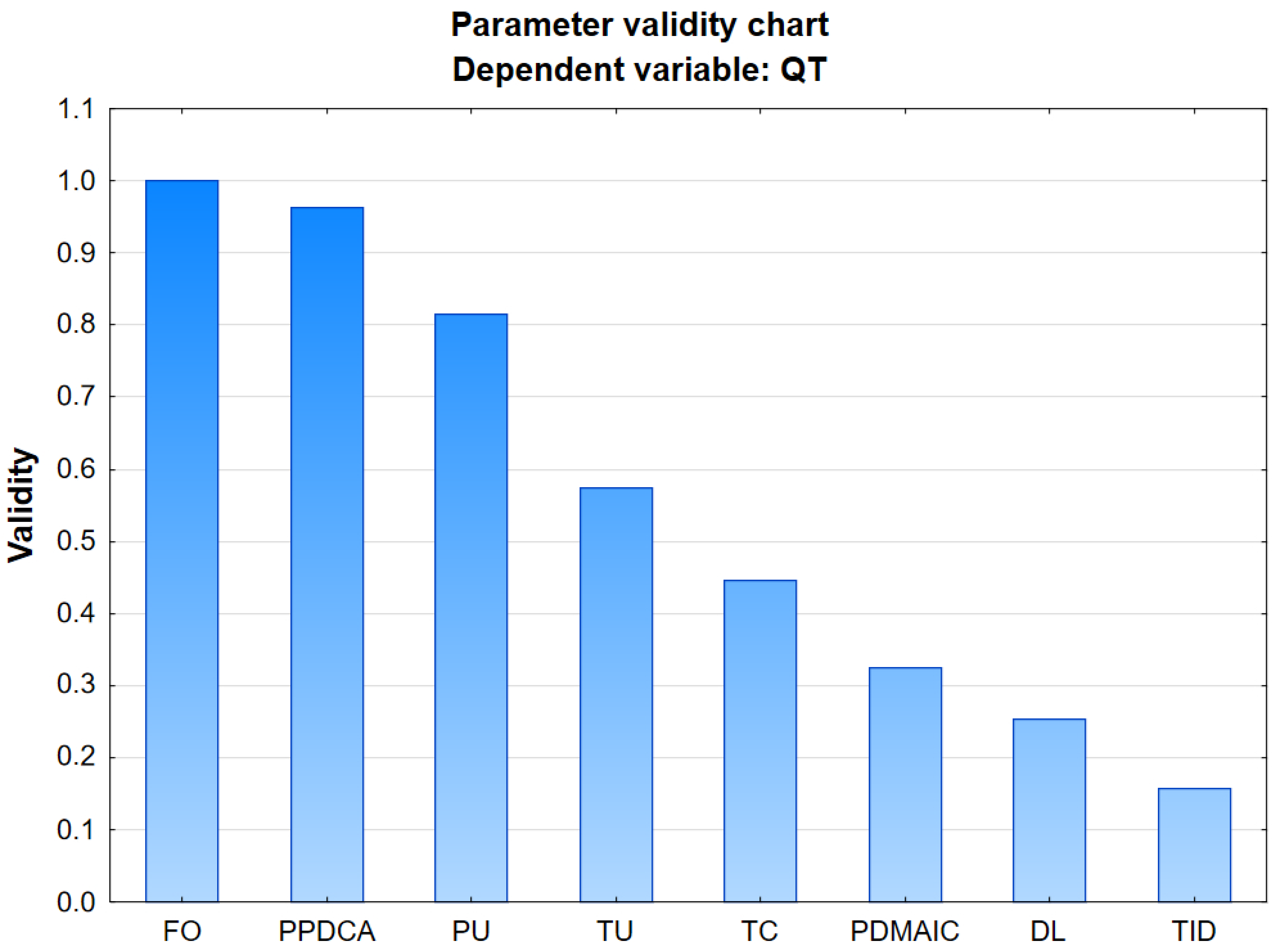
| Parameter | % | Validity |
|---|---|---|
| FO | 100 | 1.000000 |
| PPDCA | 96 | 0.963274 |
| PU | 81 | 0.814341 |
| TU | 57 | 0.574614 |
| TC | 45 | 0.445353 |
| PDMAIC | 32 | 0.324221 |
| DL | 25 | 0.252921 |
| TID | 16 | 0.157190 |
| % Tree Pruning | Min. Number of Examples Forming a Leaf of the Tree | Number of Misclassified Cases | % of Misclassified Cases | Classifier Efficiency % |
|---|---|---|---|---|
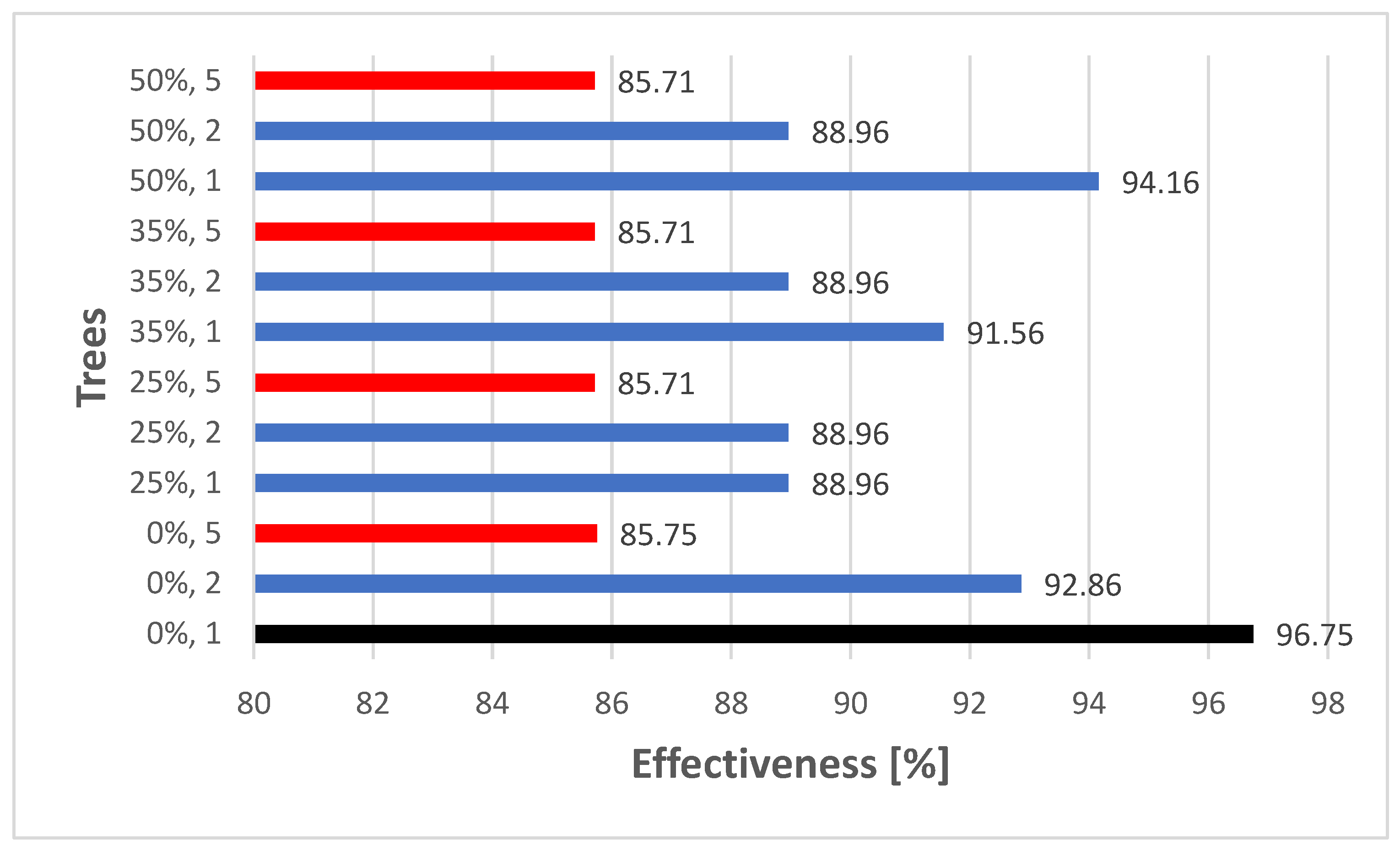
| No trim (0%) | 1 | 5 | 3.25 | 96.75 |
| No trim (0%) | 2 | 11 | 7.14 | 92.86 |
| No trim (0%) | 5 | 22 | 14.25 | 85.75 |
| 25% | 1 | 17 | 11.04 | 88.96 |
| 25% | 2 | 17 | 11.04 | 88.96 |
| 25% | 5 | 22 | 14.29 | 85.71 |
| 35% | 1 | 13 | 8.44 | 91.56 |
| 35% | 2 | 17 | 11.04 | 88.96 |
| 35% | 5 | 22 | 14.29 | 85.71 |
| 50% | 1 | 9 | 5.84 | 94.16 |
| 50% | 2 | 17 | 11.04 | 88.96 |
| 50% | 5 | 22 | 14.29 | 85.71 |
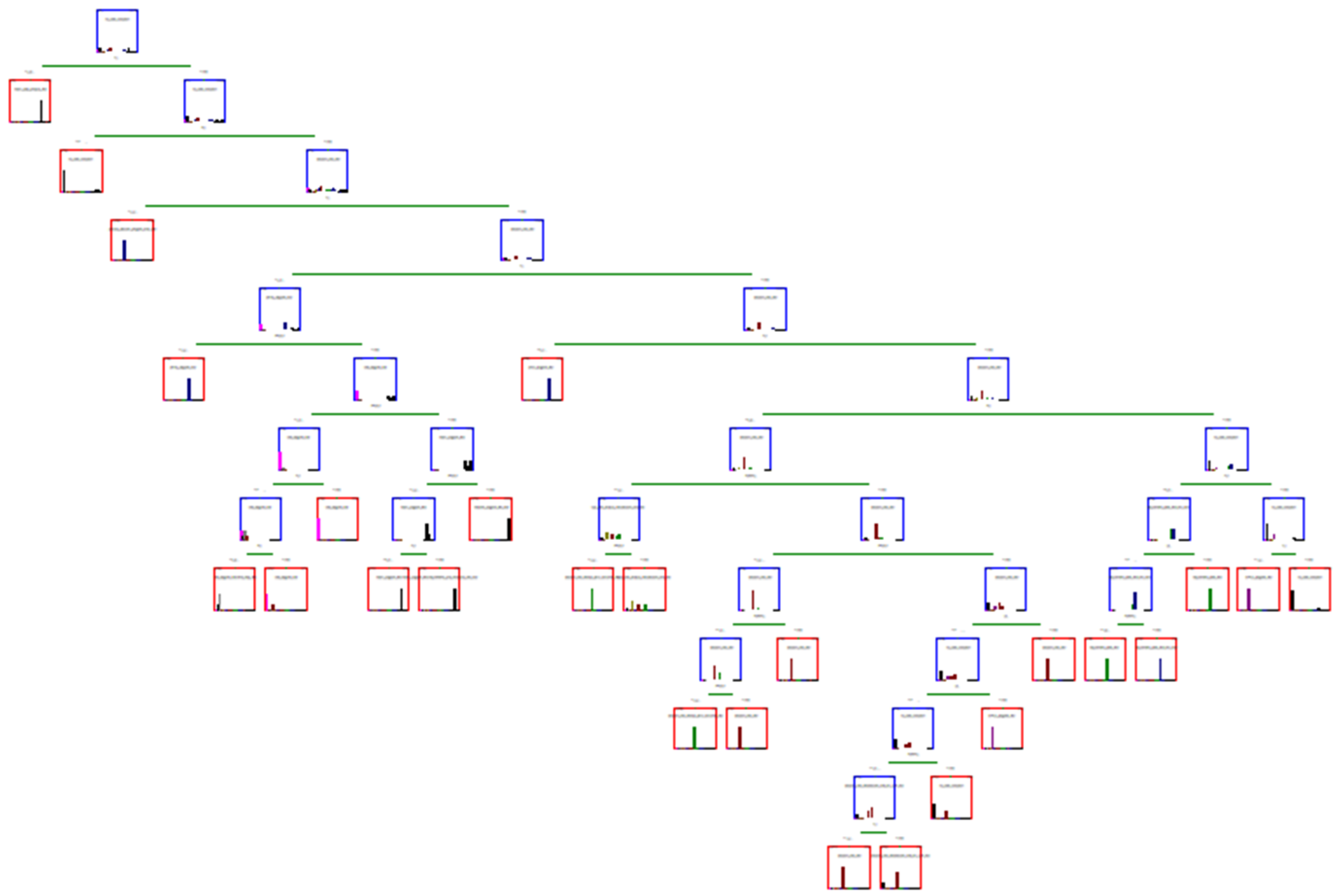
| ID | End Nodes | SK Cost | Sk Std. Error | Resubstitution Cost |
|---|---|---|---|---|
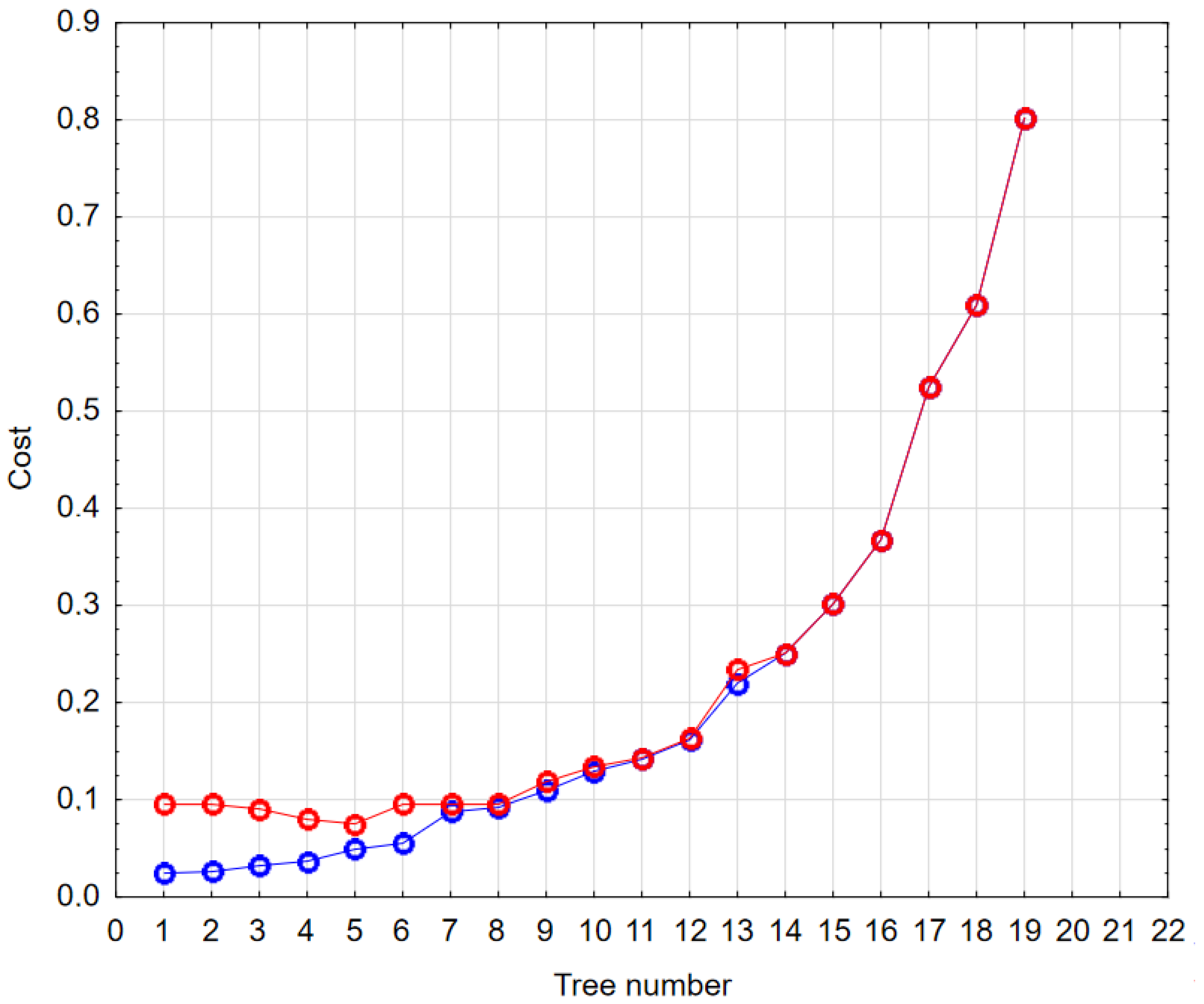
| tree 1 | 45 | 0.095122 | 0.014489 | 0.024390 |
| tree 2 | 41 | 0.095122 | 0.014489 | 0.026829 |
| tree 3 | 35 | 0.090244 | 0.014151 | 0.031707 |
| tree 4 | 31 | 0.080488 | 0.013435 | 0.036585 |
| * tree 5 | 26 | 0.075610 | 0.013056 | 0.048780 |
| tree 6 | 24 | 0.095122 | 0.014489 | 0.056098 |
| tree 7 | 17 | 0.095122 | 0.014489 | 0.087805 |
| tree 8 | 16 | 0.095122 | 0.014489 | 0.092683 |
| tree 9 | 14 | 0.119512 | 0.016020 | 0.109756 |
| tree 10 | 12 | 0.134146 | 0.016831 | 0.129268 |
| tree 11 | 11 | 0.143902 | 0.017334 | 0.141463 |
| tree 12 | 10 | 0.163415 | 0.018260 | 0.160976 |
| tree 13 | 8 | 0.234146 | 0.020913 | 0.219512 |
| tree 14 | 7 | 0.251220 | 0.021420 | 0.251220 |
| tree 15 | 6 | 0.302439 | 0.022684 | 0.302439 |
| tree 16 | 5 | 0.368293 | 0.023821 | 0.368293 |
| tree 17 | 3 | 0.524390 | 0.024664 | 0.524390 |
| tree 18 | 2 | 0.609756 | 0.024091 | 0.609756 |
| tree 19 | 1 | 0.802439 | 0.019664 | 0.802439 |
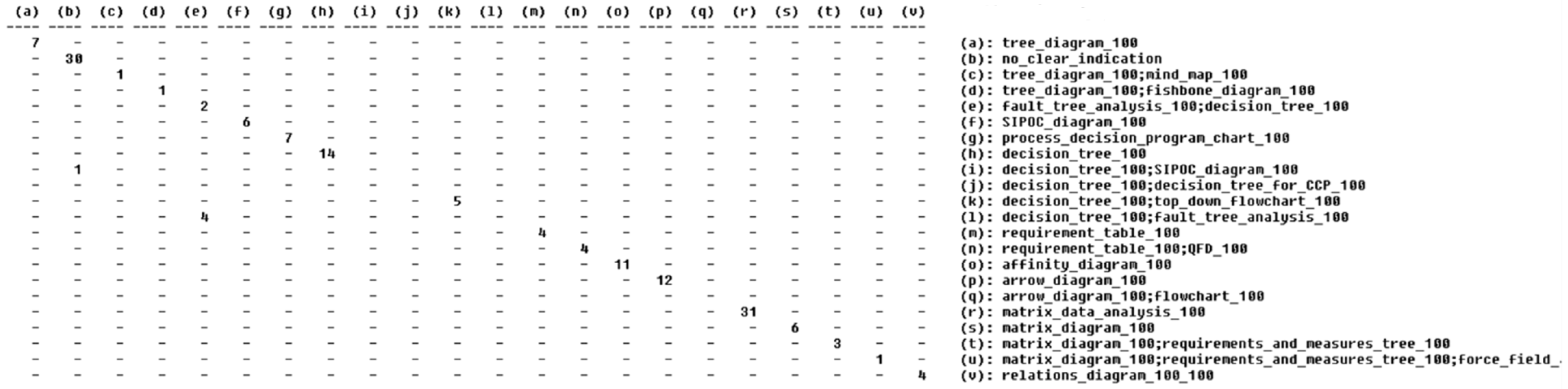
| ID | QT | Recall | Precision | F1-Score |
|---|---|---|---|---|
| 1 | tree_diagram_100 | 0.964285714 | 0.900000000 | 0.931034483 |
| 2 | no_clear_indication | 0.935897436 | 0.848837209 | 0.890243902 |
| 3 | tree_diagram_100;mind_map_100 | 1.000000000 | 0.750000000 | 0.857142857 |
| 4 | tree_diagram_100;fishbone_diagram_100 | 1.000000000 | 1.000000000 | 1.000000000 |
| 5 | fault_tree_analysis_100;decision_tree_100 | 0.615384615 | 0.615384615 | 0.615384615 |
| 6 | SIPOC_diagram_100 | 1.000000000 | 1.000000000 | 1.000000000 |
| 7 | process_decision_program_chart_100 | 1.000000000 | 1.000000000 | 1.000000000 |
| 8 | decision_tree_100 | 1.000000000 | 1.000000000 | 1.000000000 |
| 9 | decision_tree_100;SIPOC_diagram_100 | 0.500000000 | 0.500000000 | 0.500000000 |
| 10 | decision_tree_100;decision_tree_for_CCP_100 | 1.000000000 | 0.750000000 | 0.857142857 |
| 11 | decision_tree_100;top_down_flowchart_100 | 1.000000000 | 1.000000000 | 1.000000000 |
| 12 | decision_tree_100;fault_tree_analysis_100 | 0.800000000 | 0.666666667 | 0.727272727 |
| 13 | requirement_table_100 | 1.000000000 | 1.000000000 | 1.000000000 |
| 14 | requirement_table_100;QFD_100 | 1.000000000 | 1.000000000 | 1.000000000 |
| 15 | affinity_diagram_100 | 1.000000000 | 1.000000000 | 1.000000000 |
| 16 | matrix_diagram_+E5:E26100;requirements_and_measures_tree_100 | 1.000000000 | 1.000000000 | 1.000000000 |
| 17 | arrow_diagram_100;flowchart_100 | 1.000000000 | 1.000000000 | 1.000000000 |
| 18 | matrix_data_analysis_100 | 1.000000000 | 0.987654321 | 0.993788820 |
| 19 | matrix_diagram_100 | 1.000000000 | 1.000000000 | 1.000000000 |
| 20 | matrix_diagram_100;requirements_and_measures_tree_100 | 1.000000000 | 1.000000000 | 1.000000000 |
| 21 | matrix_diagram_100;requirements_and_measures_tree_100;force_field_analysis_100 | 0.750000000 | 0.600000000 | 0.666666667 |
| 22 | relations_diagram_100_100 | 1.000000000 | 1.000000000 | 1.000000000 |
| AVERAGE VALUE | 0.934798535 | 0.891751946 | 0.910848951 |
Disclaimer/Publisher’s Note: The statements, opinions and data contained in all publications are solely those of the individual author(s) and contributor(s) and not of MDPI and/or the editor(s). MDPI and/or the editor(s) disclaim responsibility for any injury to people or property resulting from any ideas, methods, instructions or products referred to in the content. |
© 2026 by the authors. Licensee MDPI, Basel, Switzerland. This article is an open access article distributed under the terms and conditions of the Creative Commons Attribution (CC BY) license.
Share and Cite
Starzyńska, B.; Rojek, I. Decision Tree Models for Automated Quality Tools Selection. Appl. Sci. 2026, 16, 472. https://doi.org/10.3390/app16010472
Starzyńska B, Rojek I. Decision Tree Models for Automated Quality Tools Selection. Applied Sciences. 2026; 16(1):472. https://doi.org/10.3390/app16010472
Chicago/Turabian StyleStarzyńska, Beata, and Izabela Rojek. 2026. "Decision Tree Models for Automated Quality Tools Selection" Applied Sciences 16, no. 1: 472. https://doi.org/10.3390/app16010472
APA StyleStarzyńska, B., & Rojek, I. (2026). Decision Tree Models for Automated Quality Tools Selection. Applied Sciences, 16(1), 472. https://doi.org/10.3390/app16010472