Article

Unveiling the Extremely Low Frequency Component of Heart Rate Variability

Faculty of Electronics, Photonics and Microsystems, Wrocław University of Science and Technology, 50-372 Wrocław, Poland
*
Author to whom correspondence should be addressed.
Appl. Sci. 2026, 16(1), 426; https://doi.org/10.3390/app16010426
Submission received: 5 December 2025 / Revised: 24 December 2025 / Accepted: 29 December 2025 / Published: 30 December 2025
(This article belongs to the Special Issue Data Processing in Biomedical Devices and Sensors)

Featured Application

This work presents an adaptive method for separating the conventional ultra-low frequency band (ULF) of heart rate variability (HRV) into two independent components, leading to the description of extremely low frequency (ELF) oscillations. By establishing that the distinct ELF and nULF (narrowed ULF) components correspond to circadian and ultradian biological rhythms, respectively, this research offers a novel approach for potential long-term health monitoring, e.g., using wearable devices, enabling the assessment of slow changes in physiological regulation.

Abstract

Heart rate variability (HRV) comprises several components driven by various internal processes, the least understood of which is the ultra-low frequency (ULF) one. Recently published research has shown that the HRV frequency distribution in this range is bimodal. The main aims of this work were to verify this finding, to determine the basic characteristics of these two components and to analyze their potential physiological couplings. For this purpose, two components within the conventional ULF band (below 4 mHz) were extracted from HRVs of 25 patients with apnea using adaptive variational mode decomposition (AVMD) and continuous wavelet transform (CWT), and then analyzed with the Hilbert transform (HT), Savitzky–Golay filter, and empirical distributions of instantaneous amplitudes and frequencies. These studies have demonstrated the existence of both components in HRVs of all subjects and apnea groups: extremely low frequencies (ELFs) in the range of 0.01–0.4 mHz and narrowed ultra-low frequencies (nULFs) in the range of 0.1–4 mHz. The independence of both components is also shown. Concluding, heart rate variability is separately regulated by circadian rhythms (ELF bound) and ultradian fluctuations (nULF bound), which can be assessed by decomposing HRV, and the obtained components may be helpful to better understand the underlying homeostatic mechanisms, as well as in the long-term monitoring of patients.

1. Introduction

Heart rate variability (HRV) is one of the richest biosignals in terms of information about the state of the human organism. This is because the heart’s interbeat intervals are the result of many internal processes striving for homeostasis, as well as the influence of the external environment and stimuli utilized by the autonomic nervous system (ANS) to control the cardiac sinus rhythm [1,2,3,4,5,6,7,8,9,10,11]. In addition, HRV is determined from easily measurable signals, such as the electrocardiogram (ECG) [2,3,5,7,8,10,11,12,13,14,15,16,17,18], mechanocardiogram [2,5] or the increasingly frequently analyzed photoplethysmogram (PPG) measured unobtrusively by wearable devices [4,9,10,16,18,19].
The mechanisms behind HRV make it a non-stationary signal in which one can clearly distinguish components of variability originating from various internal processes occurring in the body. The best-known components are the high (HF) and low frequency (LF) ones. HF (150–400 mHz) is related to the parasympathetic activity of the ANS, or more specifically, the influence of the vagus nerve on the respiratory rhythm, while LF (40–150 mHz) reflects both sympathetic and parasympathetic activity and is related to such processes, as baroreceptor regulation of blood pressure, the influence of hormones, the concentration of oxygen and carbon dioxide in the blood or physical exercises [1,2,3,7,8,11,13,20].
Much less understood are the mechanisms associated with the slowly varying components of HRV: the very low (VLF) and ultra-low frequency (ULF) ones, which is primarily due to the need for ECG or PPG recordings exceeding many hours [1,20] and simultaneous measurement of other biosignals potentially related to these components. While there are hypotheses regarding VLF oscillations (3.3–40 mHz), such as their connection with hormonal processes, thermoregulation, vascular smooth muscle activity, the current understanding of ULF (<3.3 mHz) is based mainly on speculations without consensus, balancing it with long-term biological, behavioral and cognitive performance, including circadian rhythms, body temperature, glucose metabolism, or long-term autonomic and hormonal activity, being associated also with mortality [1,3,6,11]. In summary, the relevant literature lacks a more in-depth analysis of ULF, especially in long records.
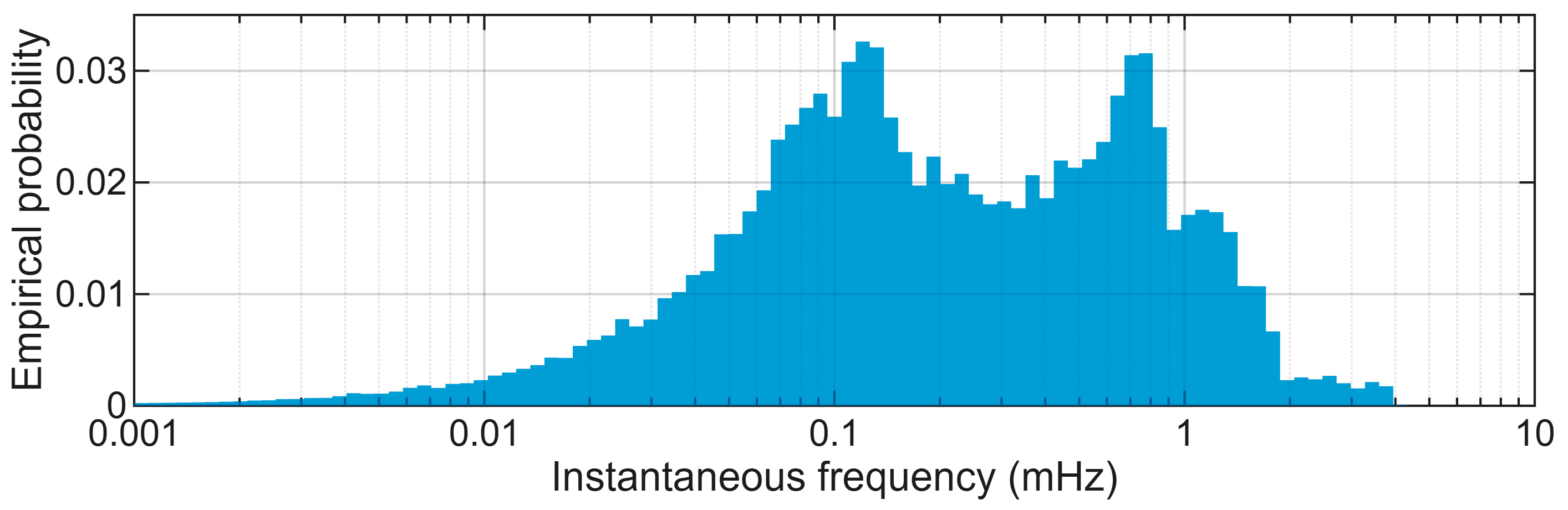
In previous studies, ULF was treated as one component with frequencies below 3.3 mHz. However, the results of recent work on offline [15] and online [17] HRV decomposition methods showed a bimodal frequency distribution of the ULF components extracted from overnight HRVs, similar in nature to the distribution of the remaining components: HF, LF and VLF. This suggests the existence of two separate processes underlying the nature of the ULF signal (the remaining components have unimodal distributions). This is visible in Figure 1, which presents the results from Figure 8 in [17] restricted to frequencies conventionally assigned to ULF.
The obtained results gave rise to the hypothesis that in the frequency range below 3.3 mHz, heart rate variability is independently influenced by two groups of processes containing extremely low frequencies (ELFs) below approximately 0.35 mHz (lowest bin in the histogram) and narrowed ULFs (nULFs) approximately between 0.35 mHz and 3 mHz (the abbreviation nULF will be used from now on to distinguish this component from conventional ULF). The following questions also arose: (i) whether these two components are visible in all patient data from the database used; (ii) what are the amplitude (AM) and frequency modulation (FM) ranges of both these new components; (iii) whether these components are independent of each other; (iv) whether they or their modulations are related to other biosignals from polysomnographic studies included in this database.
The aim of this work was to verify the formulated hypothesis and answer the above questions, in particular to confirm the presence of two frequency components in conventional ULF and to characterize ELF and nULF in terms of their AM and FM ranges. For this purpose, polysomnographic data of all 25 patients from the database were processed and analyzed only in terms of slowly varying components, which allowed to achieve the assumed research goals (in [17] only a subset of subjects was investigated). This work demonstrates the existence of ELF and nULF components in HRV with their properties, which constitutes its novelty and offers new prospects for practical contributions in the future.
The rest of the paper is organized as follows: Section 2 describes the methods of preprocessing the ECG signal to determine HRV, decomposition of the HRV signal using two methods to verify the correctness of the calculations, AM and FM analysis of extracted components, determination of the ELF and nULF properties, and correlation studies with the arterial blood oxygen saturation signal. Section 3 presents the obtained results, and Section 4 discusses them with reference to the current knowledge in the research area, shows the limitations of the approach and suggests directions for further research. The most important conclusions are summarized in Section 5.

2. Materials and Methods

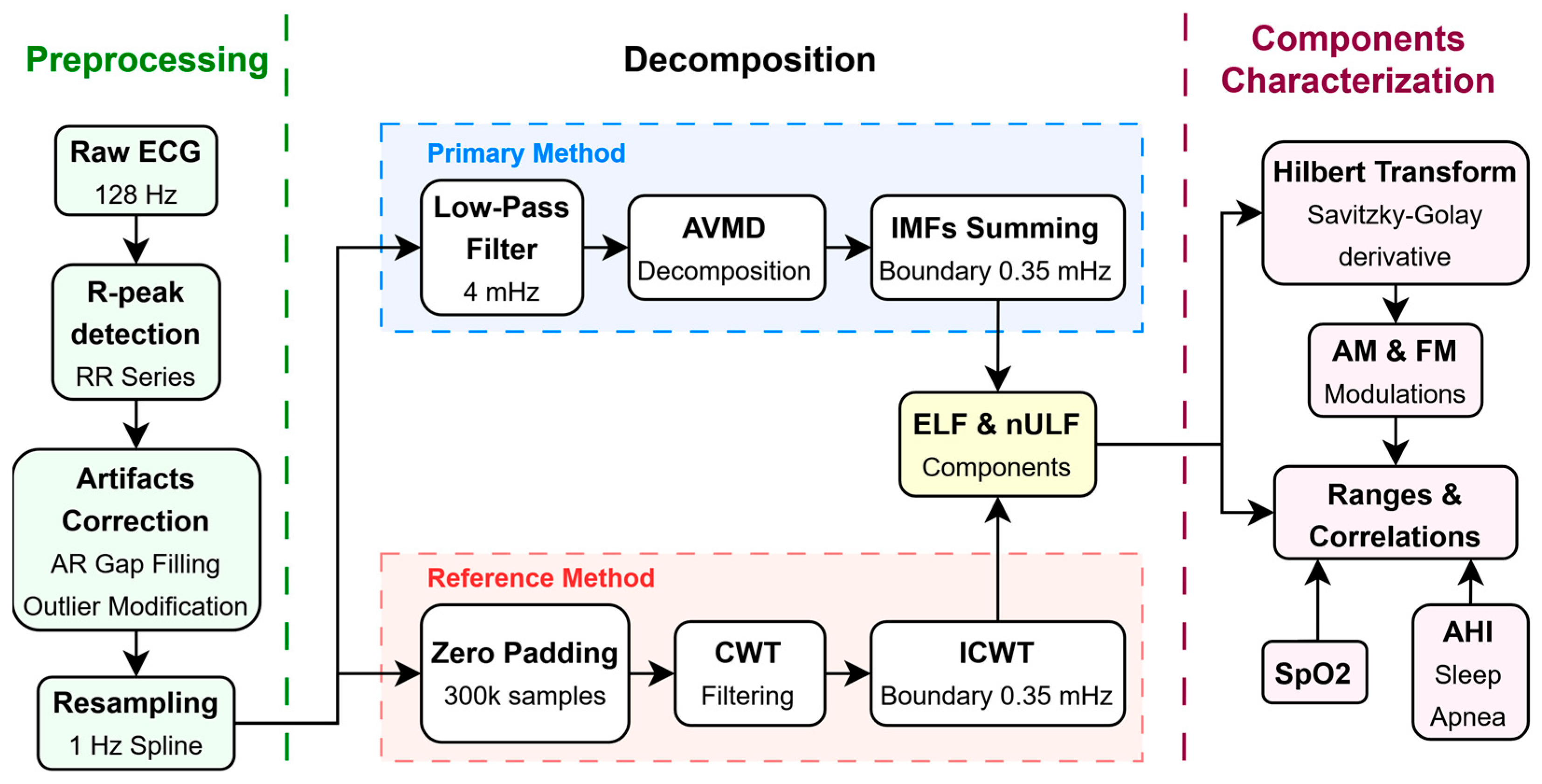
The signal processing procedure was developed in the MATLAB 2025b environment (The MathWorks, Inc., Natick, MA, USA) and the complete flowchart is presented in Figure 2. It illustrates the sequential workflow, starting with raw ECG recordings, through preprocessing and artifact removal, to the stages of ELF and nULF extraction and characterization of their instantaneous frequencies and amplitudes. A comprehensive description of each processing stage can be found in the following subsections.

2.1. Data

The dataset used in this study comes from the St. Vincent’s University Hospital/University College Dublin Sleep Apnea Database (Dublin, Ireland), publicly available on the PhysioNet platform (Cambridge, MA, USA) [21]. It comprises overnight polysomnographic (PSG) recordings from 25 adults (21 males, 4 females; age range: 28–68 years) referred to the Sleep Disorders Clinic due to suspected sleep-disordered breathing. The cohort represents a randomly selected group of patients without any known cardiac conditions, autonomic dysfunction, or medication influencing heart rate. For each patient information about AHI (Apnea-Hypopnea Index) is available and the recorded signals include: two channels of electroencephalogram (EEG: C3-A2 and C4-A1), left and right electrooculogram (EOG), submental electromyogram (EMG), oro-nasal airflow, ribcage and abdomen movements, oxygen saturation (SpO2), body position, tracheal sound (snoring) and the most important for the HRV analysis, an electrocardiogram (ECG: modified lead V2, sampled at 128 Hz). The recordings vary in duration from 5.85 to 7.7 h. This length is sufficient to capture slow physiological processes and for ULF component analysis.

2.2. Preprocessing

The raw ECG signals were processed using the PhysioToolkit software package (WFDB version 10.6.2; PhysioNet) to detect QRS complexes for R-peaks localization [21]. Then, the raw HRV signals were formed as a time differences between consecutive R-peaks [17]. As this study focuses on the potential nULF and ELF components only (periods over 5 min), the original sampling frequency of ECG is sufficient. The task of this work was to include data from the whole database, without cutting or rejection of any signal. Nevertheless, it is common that ECG signals (and further HRVs), especially long recordings, may contain artifacts like temporary disturbances or longer corrupted fragments caused by electrode detachment. To ensure signal continuity (affecting instantaneous frequency), a three-stage preprocessing on raw HRVs was applied. First, gaps resulting from signal loss were filled with simulated samples using an autoregressive (AR) model (order 10, history length 60 samples) to preserve natural character of local variability. Next, the RR series were corrected for non-physiological outliers (RR < 0.5 s or >1.5 s) in the same way as in [17]. At this point it was also checked how many samples were corrected for each patient to assess signals quality. Finally, irregularly distributed RRs were resampled to 1 Hz using cubic splines, forming final HRV signals. This frequency is lower than commonly used 2–4 Hz, but it is still enough for any spectral analysis focusing on sought-after ELFs and nULFs, whose frequencies are expected to fall below 3.3 mHz.
Only oxygen saturation (SpO2) was selected from the polysomnography dataset to investigate the potential correlation with nULF and ELF components. Other signals, such as EMG, EOG, airflow, or ribcage and abdomen respiratory movements, exhibit dynamics that are much faster than the ultra-slow oscillations of interest. In terms of electrical brain activity, potential coupling could be sought in infra-slow EEG fluctuations (<500 mHz) [22], but their analysis is not possible due to the used high-pass filter in the database with the cutoff frequency of 300 mHz, that is typical for EEG recordings [23]—as a result, the slowest available EEG rhythm, delta waves (0.5–4 Hz), remains two orders of magnitude faster than the nULF/ELF.
To isolate slow oxygenation trends corresponding to nULF/ELF bands, the SpO2 signal was artifact-corrected (non-physiological drops caused by, e.g., sensor displacement): abnormal samples (SpO2 < 70%) were removed and linearly interpolated without disturbing the ultra-slow variable components and maintaining continuity. The signal was then low-pass filtered (cutoff of 4 mHz) to match the ULF spectrum.

2.3. HRV Decomposition

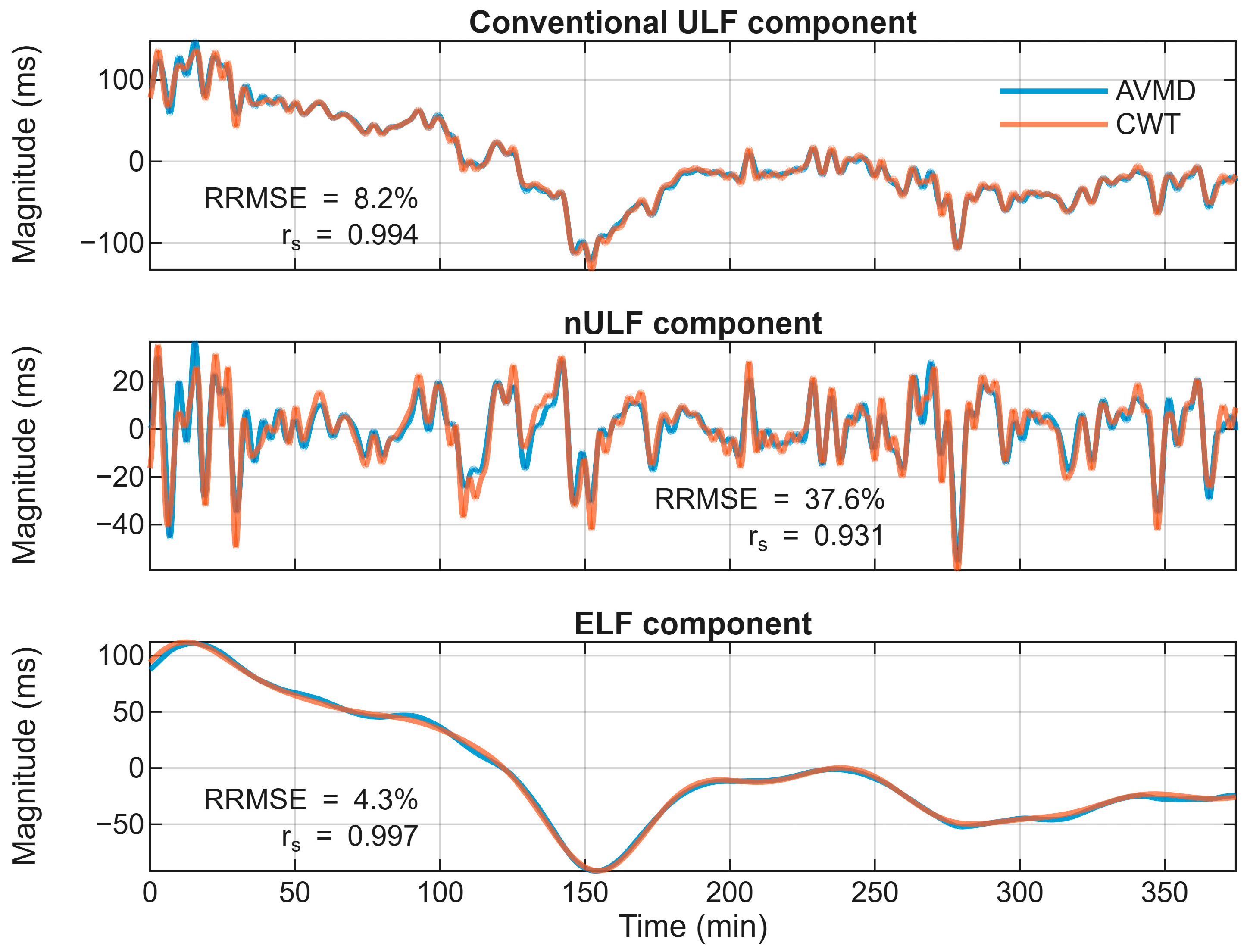
Two fundamentally different methods were used for HRV decomposition after removing its mean value: continuous wavelet transform (CWT) and adaptive variational mode decomposition (AVMD), to verify the correctness of calculations and exclude processing artifacts. This choice is consistent with the results of recent comparative studies [17], which has demonstrated their high effectiveness in extracting HRV components. The use of both, a fixed-based approach (CWT) and an adaptive data-driven method (AVMD), provides the necessary cross-validation of results. For quantitative assessment, RRMSE (relative root mean square error) was calculated for conventional ULF, nULF, and ELF obtained by both methods, as well as Spearman correlation coefficient rs (the components do not have a normal distribution [17], which was additionally checked with the Lilliefors test [24]).
CWT decomposes a signal into the time-frequency domain by convolving it with scaled and shifted versions of the mother waveform [8]. Unlike Fourier-based methods, CWT offers a variable trade-off between time and frequency resolution, providing high frequency resolution at low frequencies. In this study, the decomposition was performed similarly to [25], using Morlet wavelets with a filter bank configured to cover the frequency range from 0.001 to 4 mHz (10 voices per octave). The lowest value was chosen based on the population range presented in [17]. A technical limitation in analyzing such extremely low frequencies is that the required time support for the wavelet exceeds the duration of standard sleep recordings due to the inverse relationship between frequency and needed width of a wavelet. To overcome this difficulty and generate valid filters, the signals were symmetrically padded with zeros to a fixed length of 300,000 samples (seconds), allowing the extraction of the slowest ELF oscillations, representing a slowly changing baseline. Finally, the components were reconstructed using inverse CWT (ICWT) with specific spectral boundaries: <0.35 mHz for ELF and 0.35–4 mHz for nULF (based on Figure 1). These components may likely overlap slightly, as evidenced by [17].
As a data-driven alternative, adaptive VMD (AVMD) was also employed [15]. AVMD optimizes the decomposition of non-stationary signals into multiple intrinsic mode functions (IMFs) of different center frequencies, without requiring a predetermined number of modes like the original VMD procedure. This approach proved to be effective in [17], and the only modification was to limit it exclusively to ELF and nULF extraction. Prior to decomposition, the HRV signal was subjected to zero-phase low-pass filtering (−3 dB at 4 mHz). This limit slightly exceeds the conventional ULF upper limit (3.3 mHz) to account for potential spectral variability observed in long-term recordings. The extracted IMFs are classified as ELF or nULF based on their dominant frequency content calculated using the Hilbert transform (HT) [17]. Thanks to this approach, AVMD (unlike CWT) does not impose rigid spectral boundaries, allowing overlapping components to be separated and accommodating intersubject variability.

2.4. Modulations Extraction

To characterize the nonstationary properties of the extracted components, the instantaneous amplitude (responsible for amplitude modulation, AM) and phase were calculated using the HT. Next, the instantaneous frequency (related to frequency modulation, FM) was computed by differentiating the phase using the Savitzky–Golay low-pass filter (SGF) [26]. A second-order polynomial was chosen to ensure a robust approximation of the local trend while avoiding the overfitting artifacts that are common with higher orders. With a maximum expected ULF of 4 mHz (period ≈ 4.16 min) and based on the calculation of a −3 dB cutoff frequency for a second-order SGF [27], the filter window length was set defensively at 4 min. This value allows for effective suppression of high-frequency noise without attenuating the fastest relevant physiological oscillations. The obtained AM and FM signals were not further smoothed, although the HT can cause numerical artifacts, such as negative frequencies in non-stationary signals [28]. Preserving the raw AM and FM data minimizes the bias of the final processing and allows the transparency of the decomposition results to be maintained.

2.5. Analysis of ELF and nULF Properties

The following analyses were performed on AVMD results only, as this method is more adaptive to the variabilities in HRV than CWT. The population characteristics of AM and FM were determined by aggregating data from all 25 subjects. Lilliefors test was employed to confirm the non-gaussian distributions and the ranges of amplitude and frequency were calculated as 95% and 99% central intervals (covering 95% or 99% of middle observations).
Furthermore, in order to empirically define the spectral separation between the ELF and nULF bands, an analysis of instantaneous frequency distribution was performed. A consolidated FM histogram (combining both components) was generated for the entire population. In the case of nonstationary signals, this approach allows for a better characterization of their frequency content than traditional spectral analysis. The central frequencies of the ELF and nULF bands were identified as local maxima of the probability density function, while the spectral boundary separating these two components was defined as the local minimum located between these peaks. To mitigate quantization noise and spurious local extrema of empirical histograms, the density profile was smoothed using a Gaussian moving average filter (window size of 10 bins). Finally, in order to quantify inter-individual variability, the same approach based on the detection of peaks and spectral boundaries was applied individually to the FM data for each person, allowing for the assessment of the intersubject variability of these attributes.
Finally, the predictive horizon of these signals was examined. To this end, AR modeling was used again, finding the optimal model order for each patient’s ELF and nULF (Akaike Information Criterion) downsampled to 0.01 Hz, and then applying the optimal AR model and a window (ten times the width of the order) sliding across the signals to make predictions up to 20 steps ahead. For each step, the prediction was compared with the true signal value, the root mean square error (RMSE) was determined for all predictions in a given step, and the RMSEs were checked when they exceeded 5% of the signal value range, separately for the ELF and nULF component.

2.6. Coupling Between Analyzed Signals

To check whether the extracted components have different or the same underlying physiological mechanisms, an intercomponent dependence tests were performed using Spearman correlation coefficient rs calculated between all possible pairs of derived time series (ELF and nULF components, AMs, and FMs). This approach has the potential to exclude the existence of coupling between these separate HRV bands.
Next, the normalized cross-correlation function was calculated between the preprocessed SpO2 signal and all six signals resulting from HRV decomposition: ELF, nULF and their AMs, and FMs. For each pair, an extreme value of the correlation coefficient rextr and the corresponding time lag τ were determined. This approach allows for a quantitative assessment of the similarity of the tested signals shapes and, at the same time, for the detection of a shift in their phases. Additionally, to determine the general strength of a correlation in a whole population, the mean of absolute correlations | r e x t r | ¯ was calculated for each pair.
The statistical significance of correlation coefficients was assessed using the Wilcoxon test to determine whether their medians differed significantly from zero. To account for multiple testing, the Benjamini–Hochberg procedure was used to control the false discovery rate (FDR) at the level of α = 0.05 [29]. The strength of the correlation was expressed according to Evans’ classification [30]: ∣r∣ < 0.20 as very weak, 0.20 ≤ ∣r∣ < 0.40 as weak, 0.40 ≤ ∣r∣ < 0.60 as moderate, 0.60 ≤ ∣r∣ < 0.80 as strong and ∣r∣ ≥ 0.80 as very strong.
In addition, the impact of sleep apnea severity on the characteristics of ELF and nULF components was examined. Patients were divided into groups based on the apnea-hypopnea index (AHI) according to standard clinical values [31]: healthy (AHI < 5), mild (5 ≤ AHI < 15), moderate (15 ≤ AHI < 30), and severe (AHI ≥ 30). The instantaneous frequency (FM) distributions of each group were analyzed, and their ranges for the 95% central intervals were determined.

3. Results

3.1. HRV Preprocessing

First, an analysis of the quality of raw HRV signals for each patient was performed (see Supplementary Material for details). The signals did not require significant correction, as the average total artifact burden (total percentage of modified samples in HRV preprocessing) is 1.4%, and only for two patients it is higher than 4%. Additionally, it should be noted that modifications of local outliers will mainly affect higher-frequency components [16], which are not the subject of this study.

3.2. Extraction of ELF and nULF Components

Next, it was necessary to eliminate the possibility that the newly discovered ELF component was a spurious result of a specific extraction method. Figure 3 illustrates the decomposition of a representative HRV signal using two completely different algorithms (AVMD and CWT) aimed at extracting the conventionally defined ULF, as well as the nULF and ELF components, and it is clear that both algorithms returned almost identical waveforms, confirmed by RRMSE and Spearman correlation rs.
The similarity of results across the population was assessed as the mean ± standard deviation and presented in Table 1, also confirming agreement of both methods.
More importantly, the partitioning of ULF into separate subcomponents proved to be extremely consistent for AVMD and CWT. As shown in Figure 3 (middle and bottom panels), both algorithms extracted the same patterns: the nULF component, recording faster oscillations; and the ELF component, reflecting the baseline trend of slow waves.

3.3. Properties of Extracted Components

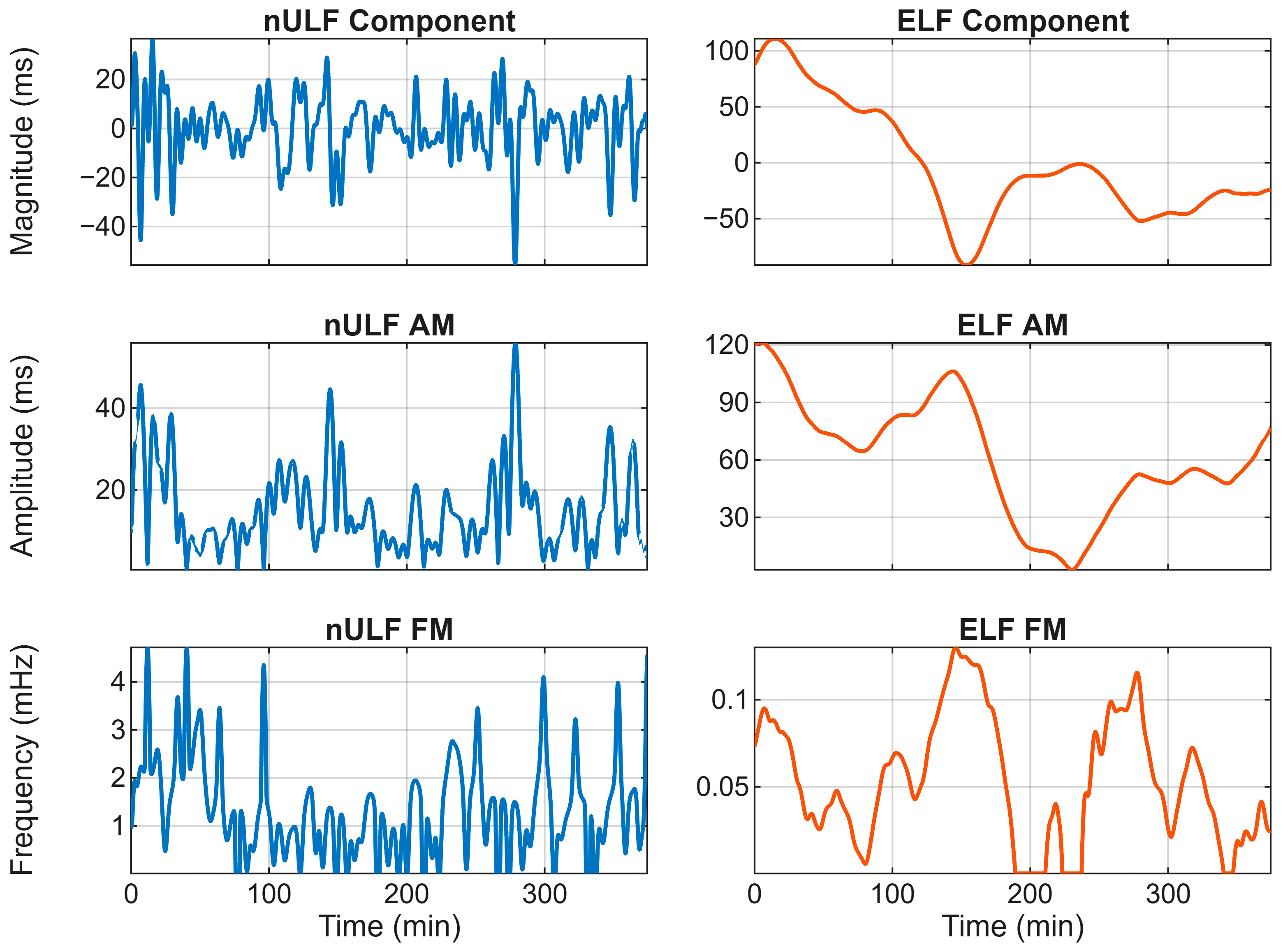
Figure 4 shows the characteristics of the isolated nULF and ELF components and their amplitude and frequency modulations (AM and FM, respectively) for representative data. In the case of FM, various modulation patterns with high variability are apparent, which are lost in standard spectral analyses based on the calculation of global properties such as band power. The instantaneous amplitude trajectories (AM) highlight the temporal variability of signal energy, showing that these components may be the result of dynamic stimulation. Together with the instantaneous frequency waveforms, they confirm the non-stationary nature of these bands.
It should be noted that although instantaneous phase differentiation after the Hilbert transformation can mathematically yield negative frequency values, which often occurs in areas of rapid magnitude changes or its near-zero values [28], such results are not physiologically plausible. Therefore, the visualization presented is strictly limited to positive values representing actual biological phenomena.
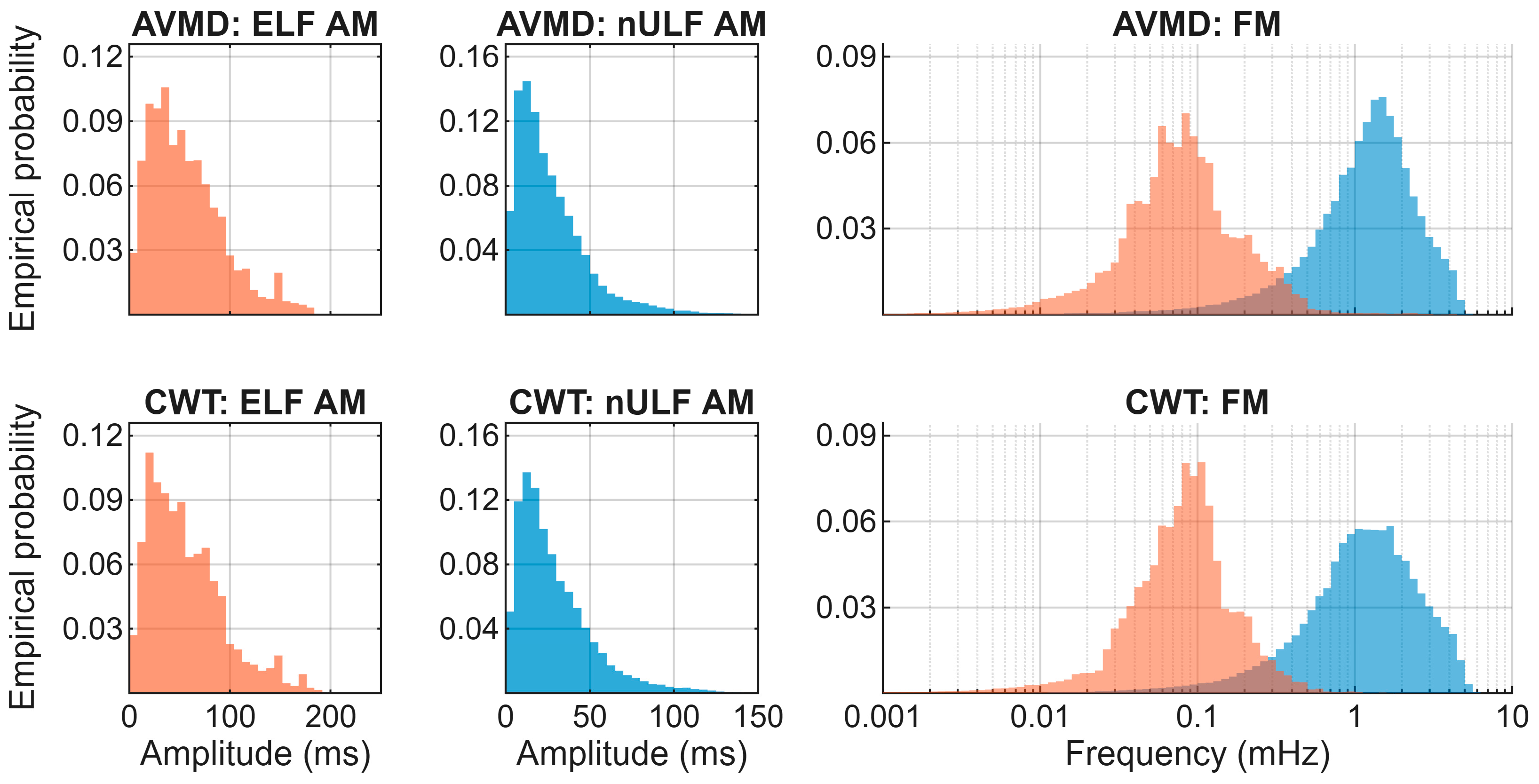
Figure 5 shows a comparison of the population probability densities of instantaneous amplitudes and frequencies obtained using AVMD and CWT. Both algorithms produced very similar profiles. The AM histograms show a strongly asymmetric distribution with long tails, typical for physiological variability [12]. The instantaneous frequency (FM) distributions show the spectral separation of the components, with clear evidence of their overlap, which was also observed for the other HRV components [17].
After verifying the reliability of the ELF and nULF extraction by checking the consistency of results obtained using the AVMD and CWT algorithms, the subsequent analyses focused exclusively on AVMD results, given its data-driven nature.
Taking into account the non-gaussian character of the distributions presented in Figure 5 (confirmed by the Lilliefors test, p = 0.001), quantitative population ranges were established on central interval analysis and were presented in Table 2. In terms of energy, ELF (being a slower-varying component) exhibits a broader amplitude range compared to nULF, which is consistent with previous observations of the other components [17]. In terms of frequency distribution, the components show clear spectral separation, however, with overlapping, and nULF itself extends beyond its literature-accepted range of 3.3 mHz.
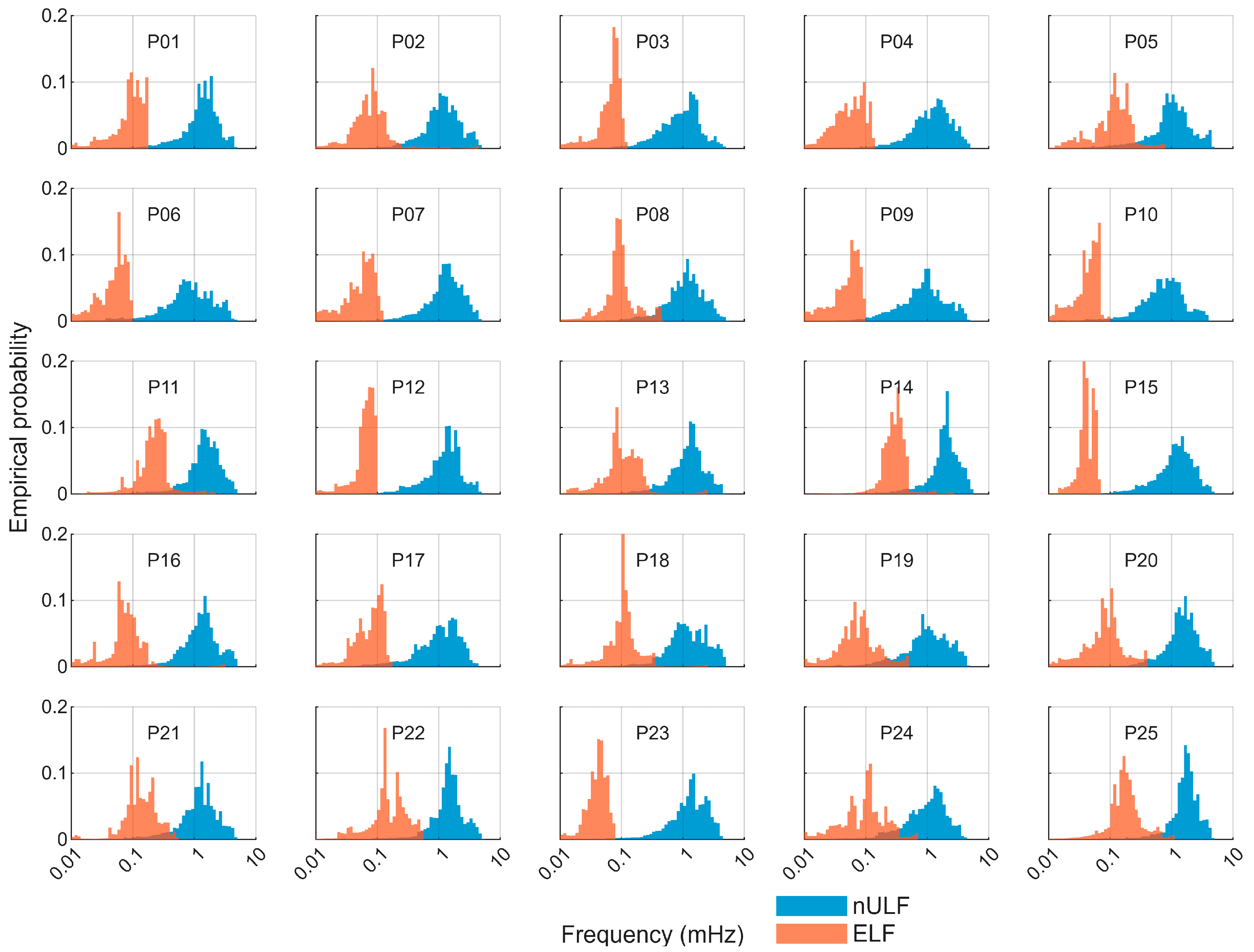
Population-level analysis of frequency allows general distributions to be determined, but masks specific intersubject differences. Therefore, individual assessment of instantaneous frequency distributions was performed using the AVMD method. Figure 6 shows individual frequency histograms of the entire cohort (n = 25). A consistent bimodal structure comprising distinct ELF and nULF bands can be observed in all patients. However, there is considerable intersubject variability in the exact spectral location and width of these bands. It is worth noting that the spectral “valley” separating the ELF and nULF peaks is well visible, but not static and uniform for everyone. This observation highlights the advantages of an adaptive approach to decomposition, which successfully tunes to each patient data without imposing artificial frequency constraints.
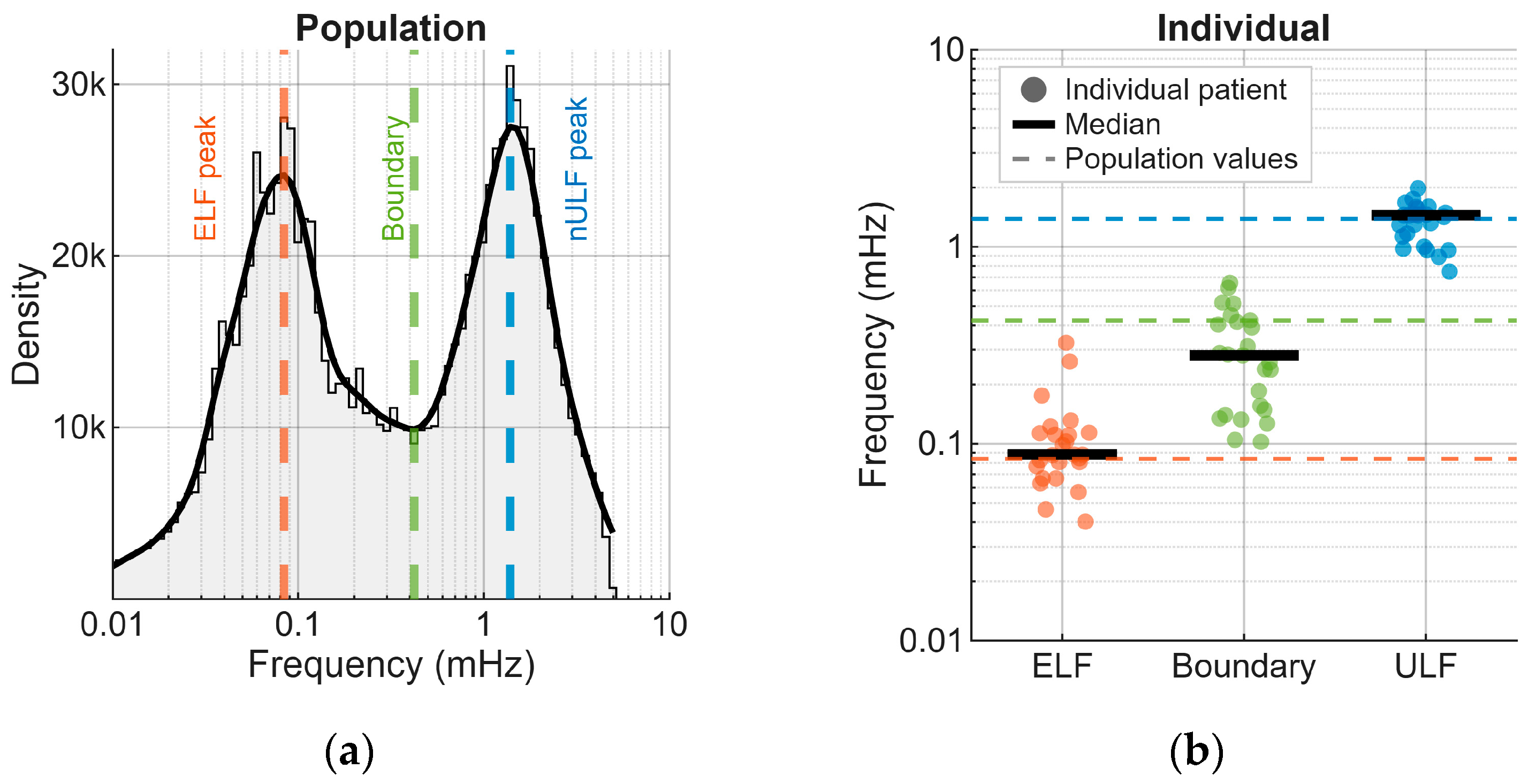
Figure 7 illustrates the identification of the dominant spectral peaks of both components and the boundary between them. The analysis was performed at two levels: as aggregate population data (Figure 7a) and as a distribution of these parameters for individuals (Figure 7b). The numerical results of this analysis are presented in Table 3.
Population and individual analyses again confirmed a clear bimodal pattern. The spectral cutoff, defined as the local minimum of the smoothed density function between these two peaks, was at 0.42 mHz. While this value is the optimal cutoff point for separating these components in the entire population, it takes on a different value for each patient in the wide range of 0.10–0.66 mHz. It can be seen that in the case of the nULF peak, the distribution of individual values coincides with the population peak, which means that the boundary and the ELF component are much more variable between individuals. In particular, it is worth noting that for some patients, the ELF peak has a higher frequency than the boundary between components for other individuals, as can also be seen in Figure 6.
Analysis of the predictive potential of these signals showed that the optimal order of the AR model is 2 (median, range 2–14) and 10 (median, range 4–19) for ELF and nULF, respectively. The RMSE exceeded 5% of the signal value range (Table 2, 95% central interval) in the 5th prediction step (6.8%) for ELF and already in the 1st prediction step (6.7%) for nULF. This means that the prediction horizon of these signals (sampled at 0.01 Hz) can be estimated as approximately 8 and 1.5 min, respectively.

3.4. Correlations

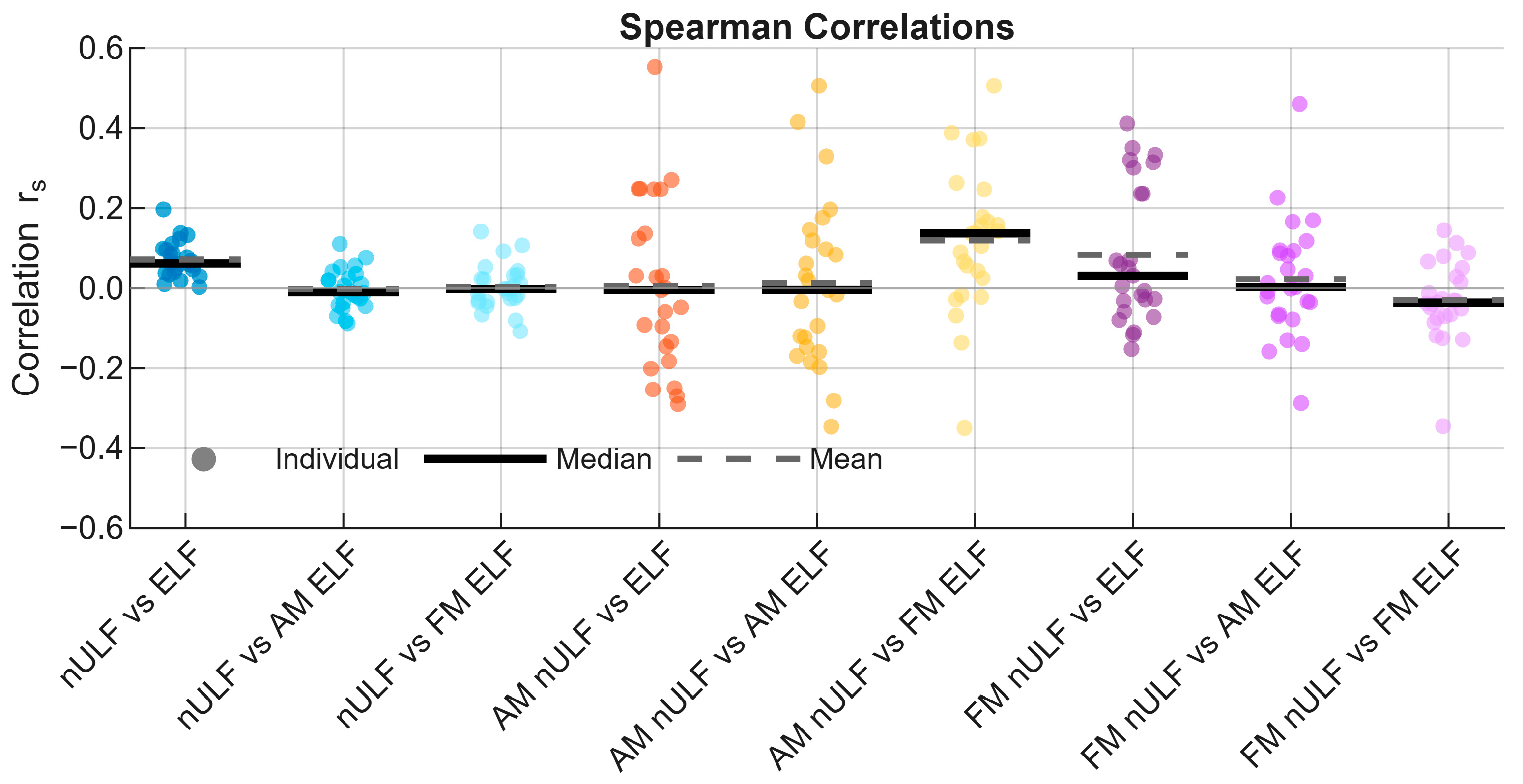
To verify the independence of both isolated components, Spearman rank correlation coefficients rs between the ELF and nULF and their modulations were calculated for all possible signal combinations, and are presented in Figure 8. The analysis showed insignificant relationship at the population level, with a slight exception for AM nULF vs. FM ELF which is still very weak (<0.2). Nevertheless, individual subjects show weak or even moderate correlation between ELF with its modulations and nULF modulations (but not with the nULF component itself), however the results are highly scattered and there is no agreement even on the sign (positive or negative correlation).
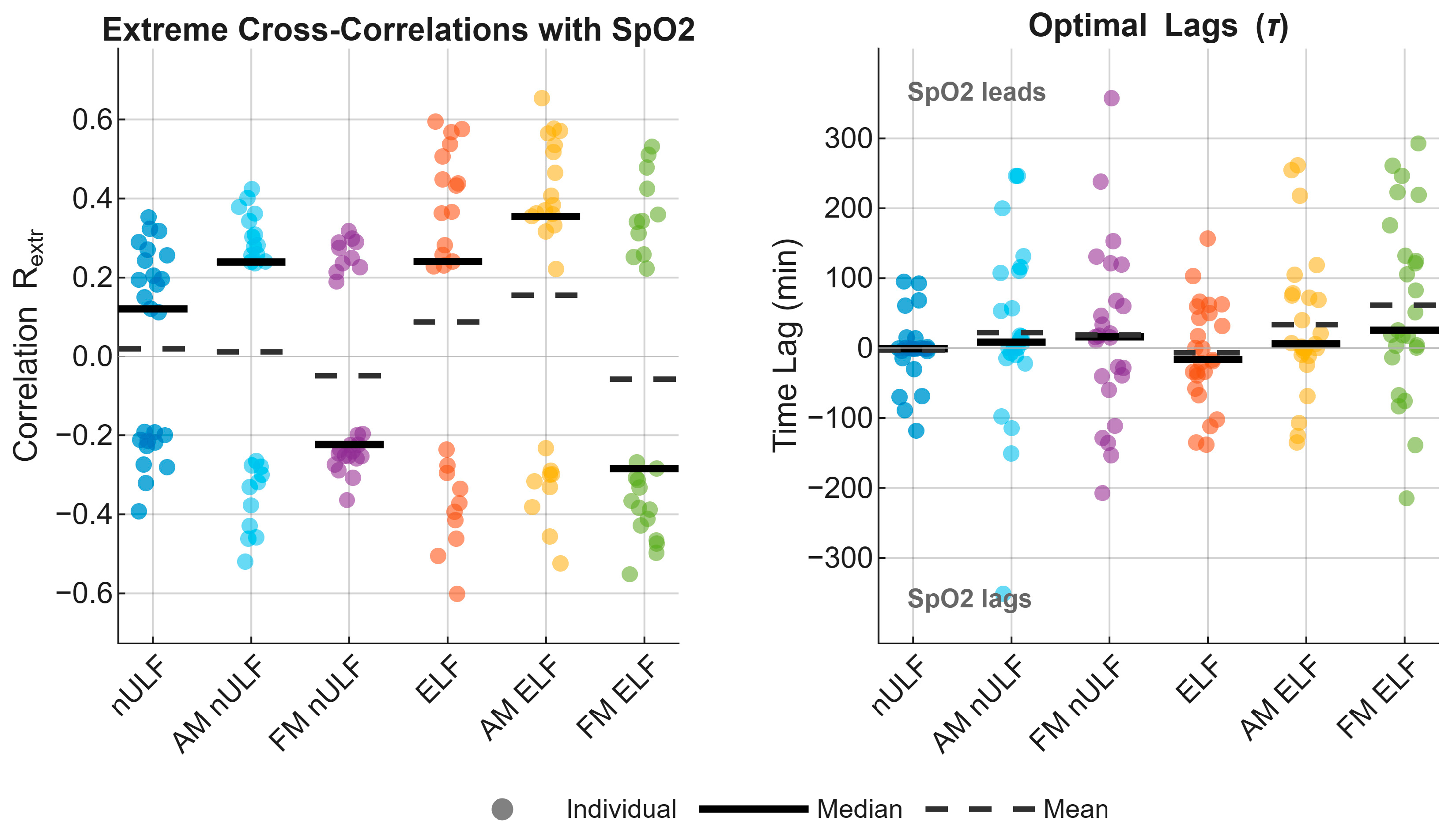
The cross-correlation analysis between the two isolated HRV components and SpO2 levels is shown in Figure 9. The average correlation coefficients for all six cases fluctuate around zero (with a slight exception for ELF, AM ELF and FM ELF). This indicates the absence of a universal coupling across the entire population, but there are significant correlations at the individual patient level. They differ, however, in both values and even sign (positive or negative correlation), as well as optimal time lag, presenting a huge dispersion. To determine the strength of this interaction regardless of its sign, the mean of absolute correlations | r e x t r | ¯ was calculated. The results indicate that ELF band show stronger coupling with SpO2 compared to the nULF. The highest | r e x t r | ¯ were observed for the raw ELF signal (0.40) and its AM (0.40 and FM (0.38), while the nULF signal showed a poorer correlation (0.24), as did its FM (0.26) and slightly higher AM (0.33). This suggests that oxygen saturation fluctuations are more closely related to the slowest changes in HRV.
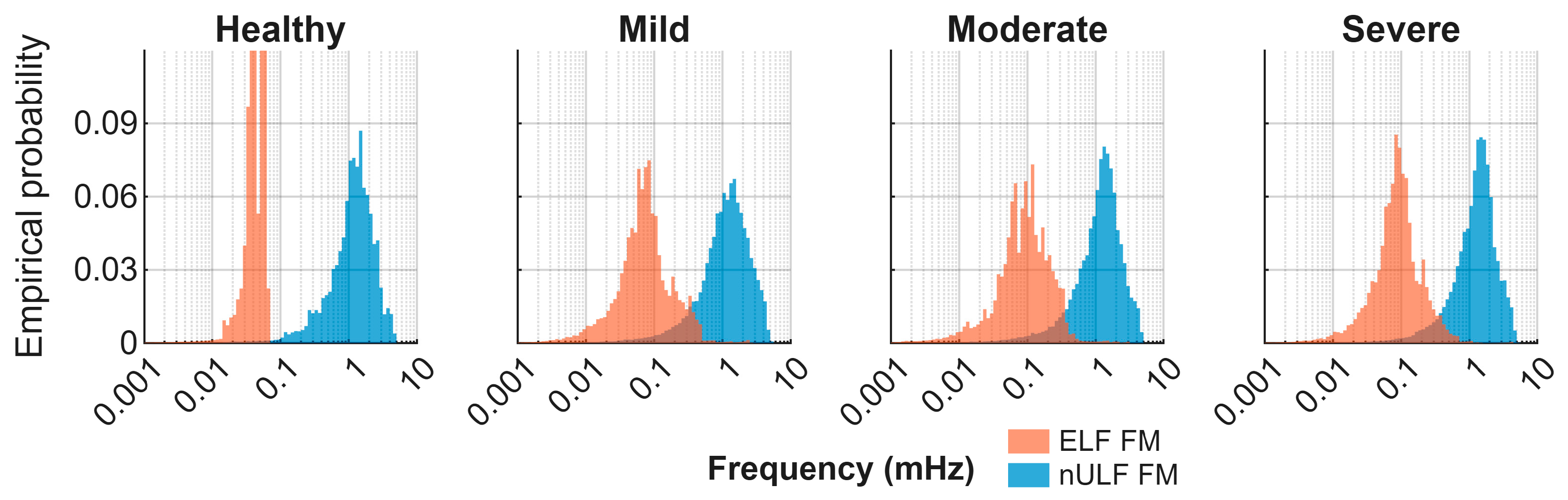
Analysis of the significance of sleep apnea confirmed that the characteristics of ELF and nULF are very similar in all severity levels and no clear trends can be observed (Table 4). Figure 10 shows the distributions of their instantaneous frequencies, which are again similar regardless of the severity of the disease.

4. Discussion

4.1. Novelty of the Work

The presented research was triggered by the observation of bimodality in the frequency histogram of the ULF component of HRV [17]. This was possible thanks to the approach used, which provides more detailed insight into the frequency distribution of a non-stationary signal than traditional spectral analysis. The scope of this study therefore included a closer look at the frequency content of conventional ULF to verify the hypothesis about two frequency-separated and independent groups of physiological processes underlying this bimodality. To the best of the authors’ knowledge, there have been no reports in the literature on the presence of an extremely low frequency (ELF) component in HRV. This paper presents such a comprehensive analysis conducted with this respect and the conclusions drawn from it.

4.2. Bimodality of the Conventional ULF Component

The first questions that were sought to be answered were: (i) whether the bimodality observed in previous limited study is not a spurious side effect of the HRV decomposition algorithm used; (ii) whether this phenomenon visible in the population histogram is not due to a unimodal distribution of ULF frequencies but grouped into two ranges in different subjects.
To ensure the correctness of ELF and nULF extraction from HRV, two decomposition algorithms with different operating principles were used in this study: adaptive variational mode decomposition (AVMD) and continuous wavelet transformation (CWT). Despite the internal diversity, both algorithms returned very consistent results, as illustrated in Figure 3 (representative similarity for all patients) and Figure 5 (the overlap of ELF and nULF ranges obtained from CWT in population data is due to intersubject variability). These outcomes, showing that the observed effect is not dependent on the HRV processing procedure, convincingly support the bimodality of the population frequency distribution in conventional ULF. Moreover, the determined frequency distribution in the range of these two components has the same nature as the higher frequency distributions in the VLF, LF and HF components [17]. While AVMD and CWT yield qualitatively and quantitatively similar results, AVMD is superior due to its adaptive nature driven by the signal itself. Unlike CWT, it does not assume filters with rigid boundaries, making the final extraction of components and their properties largely insensitive to initial misassumptions. This adaptivity is crucial given the relatively high inter-subject variability observed in this work, which makes the rigid definition of ELF and nULF parameters (in particular the frequency ranges) irrelevant.
Simultaneously, the results in Figure 6, showing the separation of ELF and nULF frequency histograms for all 25 patients from the analyzed database, prove that both slowly varying components are always present. Thus, the bimodality of the population histogram is a consequence of the bimodality of the individual distributions (and not of unimodal grouping of frequencies in two ranges in different subjects), while intersubject variability causes a greater overlap between ELF and nULF in the population results. Moreover, these very large intersubject differences lead to the conclusion that the HRV component ranges should not be treated as rigidly as before, but should be considered individually for a given subject. Therefore, the boundaries for the remaining HRV components should be re-verified in the future through a more precise analysis of individual data.
It should also be emphasized that the consistency of ULF extraction applies not only to the two methods presented here, but has also been confirmed in other studies using methods such as variational mode decomposition online, wavelet package decomposition, multiband filtering, empirical mode decomposition, and short-time Fourier transform, even though some of them were inferior in quality [14,15,17]. This provides an additional basis for the reliability of the results obtained.
To verify the robustness of the whole procedure, a comprehensive sensitivity analysis was performed, comparing the basic AVMD pipeline with eight alternative processing configurations. These variants examined the impact of: (i) preprocessing choices (gap interpolation, outlier handling, uniform resampling method); (ii) AVMD boundary assumptions; (iii) instantaneous frequency estimation window lengths (SG filter). Both ELF and nULF components were detected consistently across all nine configurations. The basic frequency ranges and spectral characteristics remained stable, confirming that the detected rhythms are an intrinsic part of the physiological signal and not artifacts resulting from processing (see Supplementary Material for details).
To summarize the studies conducted in this area, which were designed so that each of them had the power to reject the hypothesis of two independent components in the ULF range, the arguments for the existence of ELF and nULF signals in HRV are as follows: (i) two HRV decomposition algorithms with completely different mechanisms were used, which returned virtually identical waveforms of both components; (ii) the obtained histograms of instantaneous frequencies in the conventional ULF range always had a bimodal distribution (in the population, separately for each patient, and for groups of patients with different levels of apnea severity), and their qualitative characteristics were the same as the histograms for higher frequencies covering the HF, LF and VLF components; (iii) the conducted analysis of the sensitivity of the results to processing elements and to the hyperparameters of the decomposition algorithms showed that the bimodality of the histograms is not the result of the data processing method; (iv) although the frequency variability ranges of both components were not initially assumed, the obtained results show that they are closely correlated with the repeatedly described and separate circadian (ELF) and ultradian (nULF) rhythms, which could previously be expected for HRV content; (v) no correlations were found between ELF and nULF and their modulations.

4.3. Amplitude and Frequency Properties of ELF and nULF

The frequency ranges present in the faster-varying components of HRV (VLF, LF, and HF) have long been well defined, and the amplitude ranges have been more accurately estimated relatively recently [14,17]. Knowledge of frequency ranges is particularly useful in relating given components to other physiological processes whose dynamics are analogous, whereas knowledge of amplitude variability can be used to generate synthetic HRV [14,15,17]. Therefore, the analysis of the properties of the extracted ELF and nULF components from the HRVs of 25 patients is of practical importance.
Taking into account the results illustrated in Figure 5, and the data from Table 2, it can be found that the instantaneous ELF and nULF amplitudes are in the ranges 7.4–149 ms and 3.2–88 ms (95% populational central intervals), while the instantaneous frequencies of these components are in the approximate bands of 0.01–0.4 mHz and 0.1–4 mHz, respectively. However, when trying to roughly determine the frequency boundary between these slowly varying components, it can be assumed to be approximately 0.4 mHz (Figure 7 and Table 3).

4.4. Relationships of ELF and nULF to Physiological Processes

The coupling between various physiological processes related to maintaining homeostasis in the body in conditions of variable external stimuli, for which the ANS is responsible, is fairly well known (such as the mentioned connection of HF with the respiratory rhythm). However, the complexity of these processes is so great that it is difficult to predict in advance whether the physiological quantities related to each other are the instantaneous values of biosignals (magnitudes), their instantaneous amplitudes or frequencies. Therefore, first of all, such a coupling was sought between the extracted ELF and nULF components and their AM and FMs, and then analogously with SpO2.
The determined Spearman correlation coefficients for individual patient data were close to zero for the ELF and nULF component samples (Figure 8), which indicates the mutual independence of their instantaneous magnitudes. The correlations between these signals and their frequency and amplitude modulations are weak or very weak and a closer examination of the results shows a complete lack of consistency in these relationships between subjects, as the rs are scattered and sometimes indicate a positive correlation and sometimes a negative one, with the medians (and mean values) close to zero. The only readily noticeable exception are the very weak correlations between AM nULF and FM ELF, where their median is approximately 0.14 (significantly different from 0, Wilcoxon test, p = 0.009). One may therefore wonder whether one of these quantities regulates the other, but correlation studies, including the temporal phase shift between these signals, cannot provide a convincing answer. This is because even high correlation coefficient values do not indicate a cause-and-effect relationship, but merely a statistical connection between observations. Meanwhile, their similarity may stem from a common cause, such as control by the ANS. To sum up, the results of the conducted research do not provide any basis for concluding about a causal connection between the identified ELF and nULF components, and thus suggest the disconnection of the physiological phenomena behind their dynamics.
Identifying the coupling of extracted components with other biosignals is of great cognitive and practical importance, shedding new light on the internal mechanisms in the human body and providing a new basis for diagnostics and health monitoring. Unfortunately, the only signal in the analyzed polysomnographic database that had slowly varying component in the ELF and nULF spectrum was SpO2. Analysis of the correlation of this signal and its AM and FM with ELF, nULF and their modulations yielded results qualitatively and quantitatively similar to those described above (Figure 9). Again, all correlations (although sometimes moderate) are scattered and have both positive and negative values. This time, the highest median concerns the weak relationship between SpO2 and AM ELF (0.35, left panel); however, it is not statistically significantly different from 0 (Wilcoxon test, p = 0.15) and the optimal lags between these signals are completely random, with a median close to zero (right panel). Again, these results do not provide a basis for concluding about common internal mechanisms regulating ELF or nULF and SpO2.
However, the successful attempt to characterizing both newly discovered low-frequency HRV components allows for estimating the ranges of their variability periods. So for ELF it is roughly from 0.7 to 30 h, and for nULF from 4.3 to 150 min (Table 2, 95% central interval). Therefore, the processes behind the regulation of heart rate encompassed by these independent components must have analogous frequency ranges. The oscillation periods of the slowest component, ELF, correspond to the circadian rhythms. Basic circadian oscillations in humans are controlled by the suprachiasmatic nucleus in the hypothalamus of the brain [32], primarily regulating sleep–wake cycles [33,34], core body temperature [34,35], hormone release [36,37], and metabolism [35,36]. The dynamics of the nULF component, however, corresponds to biological oscillations called ultradian rhythms, which are primarily a manifestation of energetic optimization and internal coordination of the body [38]. These include, first of all, endocrine oscillations (influencing metabolism, hemodynamics, immune system or brain function) [39,40,41], autonomic rhythms [42,43] and thermoregulation [42,44]. The most easily measurable quantities associated with these long-term cycles include body temperature [45], blood pressure variability (BPV) [46,47], electrodermal activity (EDA) [48,49] (using wearable devices), and metabolism-related blood glucose level, BGL [50] (using continuous glucose monitoring devices, CGM). Unfortunately, their measurements were not included in the database used in this research. However, it cannot be ruled out that the observed unclear symptoms of the relationship between ELF and SpO2 result from the discussed rhythms, such as sleep–wake or repetitive daily physical activity. In this context, it should be noted that any success in linking ELF or nULF with the state of the organism in the future may allow for the prediction of this state in the horizon of 8 or 1.5 min, respectively, which may be important when making medical decisions.
It is worth mentioning here that the use of wearables recording the PPG instead of the ECG signal, despite the usually lower quality of the extracted pulse rate variability (PRV) in comparison to HRV, allows for the correct separation of slowly varying components. This is because the poor quality of the PPG and the resulting errors in PRV occur locally due to false pulse detection or omission, which mainly modifies the high-frequency components of PRV [16].

4.5. Limitations of the Work and Future Research

The research presented in the article was performed on overnight signals from a relatively small polysomnographic database covering 25 patients with suspected sleep apnea. Although the frequency histograms of both components clearly show separation between ELF and nULF for all subjects, the results obtained from a larger database would be even more convincing. At the same time, although the overnight signals in this database are long, they are not long enough to observe ULF and ELF over several days. Furthermore, single and one-night signal records in the database make it impossible to conduct analyses of test–retest reliability or inter-night variability.
An important limitation of this work is the analysis of signals originating only from patients initially diagnosed as suffering from sleep apnea syndrome (SAS) and this sample cannot be considered a healthy normative population. Furthermore, sleep apnea is a known factor influencing pathophysiology, including intermittent hypoxia, chemoreflex activation, night-time autonomic instability, and attracting attention to clinical reproducibility [51,52,53,54]. The relationship between this state and the functioning of the ANS, mentioned in the Introduction, obviously translates into HRV, especially in the high-frequency components (HF and LF) [55]. However, several studies have shown that SAS increases also the VLF component power (a sympathetic marker) compared to the control or post-therapy group [56,57,58,59]. It was also reported that ULF is lower in controls [56]. However, the shown coupling between SAS and the VLF component, and probably also with the ULF one, does not directly relate to the separation of the two newly described ULF components, which is clearly visible in all patients from the database. It is also worth noting that 90% of the signals is normal breathing, and only 9.8% is marked as apnea or hypopnea (in proportions of 22% to 78%, respectively). Moreover, comparative analysis between patients with different levels of apnea severity (AHI) showed no significant differences in the ELF and nULF distribution between these groups (Table 4 and Figure 10). Nevertheless, the question remains open whether the discovered ELF and nULF components exist only in subjects suffering from SAS or also in healthy individuals, which cannot be definitively answered by analyzing these data, although the ULF frequency content of Patient #15 (AHI < 5) suggests that this is the case (Figure 10).
Another major limitation is that the database used does not include those biosignals that could potentially be coupled to ELF and nULF components or their modulations; however, it was not possible to identify another database with a richer set of polysomnographic data (including, in addition to ECG, body temperature, BPV, EDA or BGL) recorded long-term, i.e., for at least 24 h. Therefore, in these studies it was not possible to clearly identify biosignals coupled with the newly isolated slowly changing HRV components.
Taking the above into account, in the future the authors plan to continue searching for publicly available long-term recordings containing pre-selected biosignals, which would allow for the continuation of research related to the identification of physiological couplings and the internal mechanisms behind them. A complementary approach is the retrospective analysis of available data measured in many patients over several days simultaneously by a smartwatch (recording, among others, inter-beat intervals, skin temperature, electrodermal activity) and a CGM device [60]. Similar information will also be provided by current research on the evaluation of anxiety therapy, in which long-term recordings of analogous signals (apart from BGL) are performed using another wearable device. These multi-day records will also allow for the assessment of inter-night and night-to-day variability. This future work has the potential to provide a better understanding of the observed components of heart rate variability.

5. Conclusions

The motivations for undertaking the work presented here were the results of an earlier frequency analysis of long-term HRV waveforms, suggesting the existence of two slowly varying components in the conventional ultra-low frequency (ULF) band.
The most important result of the conducted research is the confirmation that this traditionally recognized HRV ingredient actually contains two independent components: extremely low frequencies (ELFs) in the range of 0.01–0.4 mHz and a narrowed band of ultra-slow frequencies (nULFs) in the range of 0.1–4 mHz, which correspond to circadian and ultradian rhythms, respectively. The population boundary between these components is not sharp, causing them to slightly overlap, which is due to the relatively high intersubject variability in this respect. This indicates the need for an individual approach to the extraction and analysis of HRV components. In this context, adaptive variational mode decomposition (AVMD) used in this work proved to be a particularly useful tool, which, due to its internal mechanism of operation, returns results with initially unbounded cutoff frequencies.
The conducted studies failed to demonstrate the association of the extracted ELF and nULF components with other biosignals, as the database used does not contain any that could potentially be considered in such research. However, the literature analysis suggests that it is worth first looking for their coupling with, e.g., body temperature, blood pressure variability (BPV), electrodermal activity (EDA), or blood glucose level (BLG). In summary, these components may represent potential future biomarkers pending validation.

Supplementary Materials

The following supporting information can be downloaded at: https://www.mdpi.com/article/10.3390/app16010426/s1, Table S1: Signal quality metrics; Table S2: Sensitivity analysis of the processing pipeline (95% central intervals of ELF and nULF modulations for each version of the pipeline); Figure S1: Population distribution of instantaneous frequencies values obtained using different versions of processing pipeline.

Author Contributions

Conceptualization, K.A. and A.G.P.; methodology, K.A. and A.G.P.; software, K.A.; validation, K.A. and A.G.P.; formal analysis, K.A. and A.G.P.; investigation, K.A.; resources, K.A.; data curation, K.A.; writing—original draft preparation, K.A. and A.G.P.; writing—review and editing, A.G.P.; visualization, K.A.; supervision, A.G.P. All authors have read and agreed to the published version of the manuscript.

Funding

The research was partially supported by the National Science Centre, Poland, project no. 2020/37/B/ST6/03806.

Institutional Review Board Statement

Not applicable.

Informed Consent Statement

Ethics approval and patient consent were waived due to the use of fully anonymized data available in the public domain (ODC-By license).

Data Availability Statement

Datasets used in this study are available on the Physionet website: https://physionet.org/content/ucddb/1.0.0/ (accessed on 27 November 2025).

Conflicts of Interest

The authors declare no conflicts of interest.

Abbreviations

The following abbreviations are used in this manuscript:
AHIApnea-Hypopnea Index
AMAmplitude Modulation
ANSAutonomic Nervous System
AVMDAdaptive Variational Mode Decomposition
BLGBlood Glucose Level
BPVBlood Pressure Variability
CGMContinuous Glucose Monitoring
CWTContinuous Wavelet Transform
ECGElectrocardiogram
EEGElectroencephalogram
EDAElectrodermal Activity
ELFExtremely Low Frequency
EMGElectromyogram
EOGElectrooculogram
FDRFalse Discovery Rate
FMFrequency Modulation
HFHigh Frequency
HRVHeart Rate Variability
HTHilbert Transform
ICWTInverse Continuous Wavelet Transform
IMFIntrinsic Mode Function
LFLow Frequency
nULFNarrowed Ultra-low Frequency
PPGPhotoplethysmogram
PSGPolysomnography
RMSERoot Mean Square Error
RRMSERelative Root Mean Square Error
SASSleep Apnea Syndrome
SGFSavitzky–Golay Filter
SpO2Peripheral Oxygen Saturation
ULFUltra-low Frequency
VLFVery Low Frequency

References

  1. Shaffer, F.; Ginsberg, J.P. An overview of heart rate variability metrics and norms. Front. Public Health 2017, 5, 258. [Google Scholar] [CrossRef]
  2. Sieciński, S.; Kostka, P.S.; Tkacz, E.J. Heart rate variability analysis on electrocardiograms, seismocardiograms and gyrocardiograms on healthy volunteers. Sensors 2020, 20, 4522. [Google Scholar] [CrossRef]
  3. Imbimbo, C.; Spallazzi, M.; Ferrari-Pellegrini, F.; Villa, A.; Zilioli, A.; Mutti, C.; Parrino, L.; Lazzeroni, D. Heart rate variability and cognitive performance in adults with cardiovascular risk. Cereb. Circ.-Cogn. Behav. 2022, 3, 100136. [Google Scholar] [CrossRef] [PubMed]
  4. Mejía-Mejía, E.; Kyriacou, P.A. Photoplethysmography-Based Pulse Rate Variability and Haemodynamic Changes in the Absence of Heart Rate Variability: An In-Vitro Study. Appl. Sci. 2022, 12, 7238. [Google Scholar] [CrossRef]
  5. Sieciński, S.; Tkacz, E.J.; Kostka, P.S. Heart rate variability analysis on electrocardiograms, seismocardiograms and gyrocardiograms of healthy volunteers and patients with valvular heart diseases. Sensors 2023, 23, 2152. [Google Scholar] [CrossRef]
  6. Regueiro-Oliveira, O.L.; Osorio-Romero, L.F.; Sanchez-Mendez, L.D. Which indices of heart rate variability are the best predictors of mortality after acute myocardial infarction? Meta-analysis of observational studies. J. Electrocardiol. 2024, 84, 42–48. [Google Scholar] [CrossRef]
  7. Georgieva-Tsaneva, G.; Lebamovski, P.; Tsanev, Y.-A. Impact of Prolonged High-Intensity Training on Autonomic Regulation and Fatigue in Track and Field Athletes Assessed via Heart Rate Variability. Appl. Sci. 2025, 15, 10547. [Google Scholar] [CrossRef]
  8. Nelushi, A.M.; Manathunga, C.H.; Gamage, N.G.S.S.; Nakayama, T. Assessing Cardiac Sympatho-Vagal Balance Through Wavelet Transform Analysis of Heart Rate Variability. Appl. Sci. 2025, 15, 1687. [Google Scholar] [CrossRef]
  9. Rahbar, S.; Ferrero, R.; Pegoraro, P.A.; Toscani, S. Application of Taylor-Fourier Analysis to Photoplethysmography Signals for Instantaneous Heart Rate Measurement. IEEE Trans. Instrum. Meas. 2025, 74, 4019414. [Google Scholar] [CrossRef]
  10. Uryga, A.; Olszewski, B.; Pietroń, D.; Kasprowicz, M. Impact of signal length and window size on heart rate variability and pulse rate variability metrics. Physiol. Meas. 2025, 46, 075006. [Google Scholar] [CrossRef]
  11. Yuda, E.; Yoshida, Y. Influence of Posture and Sleep Duration on Heart Rate Variability in Older Subjects. Appl. Sci. 2025, 15, 2504. [Google Scholar] [CrossRef]
  12. Kiyono, K.; Hayano, J.; Kwak, S.; Watanabe, E.; Yamamoto, Y. Non-Gaussianity of low frequency heart rate variability and sympathetic activation: Lack of increases in multiple system atrophy and Parkinson disease. Front. Physiol. 2012, 3, 34. [Google Scholar] [CrossRef]
  13. Martino, P.F.; Miller, D.P.; Allen, M.T.; Handy, J.D.; Servatius, R.J. Cardiorespiratory Response to Moderate Hypercapnia in Female College Students Expressing Behaviorally Inhibited Temperament. Front. Neurosci. 2020, 14, 588813. [Google Scholar] [CrossRef]
  14. Adamczyk, K.; Polak, A.G. Comparison of multiband filtering, empirical mode decomposition and short-time Fourier transform used to extract physiological components from long-term heart rate variability. Metrol. Meas. Syst. 2021, 28, 643–660. [Google Scholar] [CrossRef]
  15. Adamczyk, K.; Polak, A.G. Derivation of frequency components from overnight heart rate variability using an adaptive variational mode decomposition. In Proceedings of the 2021 43rd Annual International Conference of the IEEE Engineering in Medicine & Biology Society (EMBC), Mexico City, Mexico, 1–5 November 2021. [Google Scholar] [CrossRef]
  16. Polak, A.G.; Klich, B.; Saganowski, S.; Prucnal, M.A.; Kazienko, P. Processing photoplethysmograms recorded by smartwatches to improve the quality of derived pulse rate variability. Sensors 2022, 22, 7047. [Google Scholar] [CrossRef]
  17. Adamczyk, K.; Polak, A.G. Online Algorithm for Deriving Heart Rate Variability Components and Their Time–Frequency Analysis. Appl. Sci. 2025, 15, 1210. [Google Scholar] [CrossRef]
  18. Prucnal, M.A.; Polak, A.G.; Kazienko, P. Improving the quality of pulse rate variability derived from wearable devices using adaptive, spectrum and nonlinear filtering. Biomed. Signal Process. Control 2025, 102, 107336. [Google Scholar] [CrossRef]
  19. Mejía-Mejía, E.; Kyriacou, P.A. Duration of photoplethysmographic signals for the extraction of Pulse Rate Variability Indices. Biomed. Signal Process. Control 2023, 80, 104214. [Google Scholar] [CrossRef]
  20. Panday, K.R.; Panday, D.R. Heart Rate Variability (HRV). J. Clin. Exp. Cardiol. 2018, 9, 583. [Google Scholar] [CrossRef]
  21. Goldberger, A.L.; Amaral, L.A.; Glass, L.; Hausdorff, J.M.; Ivanov, P.C.; Mark, R.G.; Mietus, J.E.; Moody, G.B.; Peng, C.K.; Stanley, H.E. PhysioBank, PhysioToolkit, and PhysioNet: Components of a new research resource for complex physiologic signals. Circulation 2000, 101, 215–220. [Google Scholar] [CrossRef] [PubMed]
  22. Kropotov, J.D. The enigma of infra-slow fluctuations in the human EEG. Front. Hum. Neurosci. 2022, 16, 928410. [Google Scholar] [CrossRef]
  23. Peltola, M.E.; Leitinger, M.; Halford, J.J.; Vinayan, K.P.; Kobayashi, K.; Pressler, R.M.; Mindruta, I.; Mayor, L.C.; Lauronen, L.; Beniczky, S. Routine and sleep EEG: Minimum recording standards of the International Federation of Clinical Neurophysiology and the International League Against Epilepsy. Epilepsia 2023, 64, 602–618. [Google Scholar] [CrossRef]
  24. Liliefors, H.W. On the Kolmogorov-Smirnov Test for Normality with Mean and Variance Unknown. J. Am. Stat. Assoc. 1967, 62, 399–402. [Google Scholar] [CrossRef]
  25. Nesaragi, N.P.; Sharma, A.; Patidar, S.; Acharya, U.R. Automated diagnosis of coronary artery disease using scalogram-based tensor decomposition with heart rate signals. Med. Eng. Phys. 2022, 110, 103811. [Google Scholar] [CrossRef] [PubMed]
  26. Savitzky, A.; Golay, M.J.E. Smoothing and differentiation of data by simplified least squares procedures. Anal. Chem. 1964, 36, 1627–1639. [Google Scholar] [CrossRef]
  27. Schmid, M.; Rath, D.; Diebold, U. Why and How Savitzky–Golay Filters Should Be Replaced. ACS Meas. Sci. Au 2022, 2, 185–196. [Google Scholar] [CrossRef]
  28. Hsu, M.-K.; Sheu, J.-C.; Hsue, C. Overcoming the negative frequencies-instantaneous frequency and amplitude estimation using osculating circle method. J. Mar. Sci. Technol. 2011, 19, 514–521. [Google Scholar] [CrossRef]
  29. Benjamini, Y.; Hochberg, Y. Controlling the False Discovery Rate: A Practical and Powerful Approach to Multiple Testing. J. R. Stat. Soc. Ser. B Methodol. 1995, 57, 289–300. [Google Scholar] [CrossRef]
  30. Evans, J.D. Straightforward Statistics for the Behavioral Sciences; Brooks/Cole Publishing: Pacific Grove, CA, USA, 1996. [Google Scholar]
  31. Epstein, L.J.; Kristo, D.; Strollo, P.J.; Friedman, N.; Malhotra, A.; Patil, S.P.; Ramar, K.; Rogers, R.; Schwab, R.J.; Weaver, E.M.; et al. Clinical guideline for the evaluation, management and long-term care of obstructive sleep apnea in adults. J. Clin. Sleep Med. 2009, 5, 263–276. [Google Scholar] [CrossRef]
  32. Hastings, M.H.; Maywood, E.S.; Brancaccio, M. Generation of circadian rhythms in the suprachiasmatic nucleus. Nat. Rev. Neurosci. 2018, 19, 453–469. [Google Scholar] [CrossRef]
  33. Dijk, D.J.; Landolt, H.P. Sleep physiology, circadian rhythms, waking performance and the development of sleep-wake therapeutics. In Sleep-Wake Neurobiology and Pharmacology; Springer: Cham, Switzerland, 2019; pp. 441–481. [Google Scholar] [CrossRef]
  34. Kimura, S.; Takaoka, Y.; Toyoura, M.; Kohira, S.; Ohta, M. Core body temperature changes in school-age children with circadian rhythm sleep–wake disorder. Sleep Med. 2021, 87, 97–104. [Google Scholar] [CrossRef]
  35. Refinetti, R. Circadian rhythmicity of body temperature and metabolism. Temperature 2020, 7, 321–362. [Google Scholar] [CrossRef]
  36. Martchenko, A.; Martchenko, S.E.; Biancolin, A.D.; Brubaker, P.L. Circadian rhythms and the gastrointestinal tract: Relationship to metabolism and gut hormones. Endocrinology 2020, 161, bqaa167. [Google Scholar] [CrossRef]
  37. Begemann, K.; Rawashdeh, O.; Olejniczak, I.; Pilorz, V.; de Assis, L.V.M.; Osorio-Mendoza, J.; Oster, H. Endocrine regulation of circadian rhythms. Npj Biol. Timing Sleep 2025, 2, 10. [Google Scholar] [CrossRef]
  38. Gerkema, M.P. Ultradian rhythms. In Biological Rhythms; Springer: Berlin/Heidelberg, Germany, 2002; pp. 207–215. [Google Scholar] [CrossRef]
  39. Grant, A.D.; Wilsterman, K.; Smarr, B.L.; Kriegsfeld, L.J. Evidence for a coupled oscillator model of endocrine ultradian rhythms. J. Biol. Rhythms 2018, 33, 475–496. [Google Scholar] [CrossRef]
  40. Kalafatakis, K.; Russell, G.M.; Lightman, S.L. MECHANISMS IN ENDOCRINOLOGY: Does circadian and ultradian glucocorticoid exposure affect the brain? Eur. J. Endocrinol. 2019, 180, R73–R89. [Google Scholar] [CrossRef] [PubMed]
  41. Lightman, S.L.; Conway-Campbell, B.L. Circadian and ultradian rhythms: Clinical implications. J. Intern. Med. 2024, 296, 121–138. [Google Scholar] [CrossRef]
  42. Grant, A.D.; Newman, M.; Kriegsfeld, L.J. Ultradian rhythms in heart rate variability and distal body temperature anticipate onset of the luteinizing hormone surge. Sci. Rep. 2020, 10, 20378. [Google Scholar] [CrossRef] [PubMed]
  43. Shannahoff-Khalsa, D.; Schult, R.; Sramek, B.B. Ultradian Hemodynamics and Autonomic-Central Nervous System Activity During Sleep: A Pilot Study with Insights for Hypertension. Integr. Med. Rep. 2022, 1, 164–176. [Google Scholar] [CrossRef]
  44. Blessing, W.W. Thermoregulation and the ultradian basic rest–activity cycle. Handb. Clin. Neurol. 2018, 156, 367–375. [Google Scholar] [CrossRef]
  45. Lu, E.; Le, T.D.; Jouvet, P.; Noumeir, R. Heart rate and body temperature relationship in children admitted to PICU-A machine learning approach. IEEE Trans. Biomed. Eng. 2025, 72, 2352–2365. [Google Scholar] [CrossRef]
  46. Stevens, S.L.; Wood, S.; Koshiaris, C.; Law, K.; Glasziou, P.; Stevens, R.J.; McManus, R.J. Blood pressure variability and cardiovascular disease: Systematic review and meta-analysis. BMJ 2016, 354, i4098. [Google Scholar] [CrossRef] [PubMed]
  47. Narita, K.; Hoshide, S.; Kario, K. Short-to long-term blood pressure variability: Current evidence and new evaluations. Hypertens. Res. 2023, 46, 950–958. [Google Scholar] [CrossRef] [PubMed]
  48. Soni, A.; Rawal, K. A review on physiological signals: Heart rate variability and skin conductance. In Proceedings of the First International Conference on Computing, Communications, and Cyber-Security (IC4S 2019), Gdańsk, Poland, 12–13 October 2019; Springer: Singapore, 2020; pp. 387–399. [Google Scholar] [CrossRef]
  49. Nechyporenko, A.; Frohme, M.; Strelchuk, Y.; Omelchenko, V.; Gargin, V.; Ishchenko, L.; Alekseeva, V. Galvanic Skin Response and Photoplethysmography for Stress Recognition Using Machine Learning and Wearable Sensors. Appl. Sci. 2024, 14, 11997. [Google Scholar] [CrossRef]
  50. Jarman, L.R.; Elliott, J.L.; Lees, T.; Clifton-Bligh, R.; Simpson, A.M.; Nassif, N.; Lal, S. Heart rate variability as a potential non-invasive marker of blood glucose level. Hum. Physiol. 2021, 47, 209–218. [Google Scholar] [CrossRef]
  51. Mansukhani, M.P.; Kara, T.; Caples, S.M.; Somers, V.K. Chemoreflexes, sleep apnea, and sympathetic dysregulation. Curr. Hypertens. Rep. 2014, 16, 476. [Google Scholar] [CrossRef]
  52. Labarca, G.; Gower, J.; Lamperti, L.; Dreyse, J.; Jorquera, J. Chronic intermittent hypoxia in obstructive sleep apnea: A narrative review from pathophysiological pathways to a precision clinical approach. Sleep Breath. 2020, 24, 751–760. [Google Scholar] [CrossRef]
  53. Zoccoli, G.; Amici, R. Sleep and autonomic nervous system. Curr. Opin. Physiol. 2020, 15, 128–133. [Google Scholar] [CrossRef]
  54. Cassidy, M.J.; Wallace, D.A.; Purcell, S.; Sofer, T. Reproducibility in computational sleep research: A call for action. Sleep 2024, 47, zsad143. [Google Scholar] [CrossRef]
  55. Sequeira, V.C.C.; Bandeira, P.M.; Azevedo, J.C.M. Heart rate variability in adults with obstructive sleep apnea: A systematic review. Sleep Sci. 2019, 12, 214–221. [Google Scholar] [CrossRef]
  56. Aydin, M.; Altin, R.; Ozeren, A.; Kart, L.; Bilge, M.; Unalacak, M. Cardiac autonomic activity in obstructive sleep apnea: Time-dependent and spectral analysis of heart rate variability using 24-hour Holter electrocardiograms. Tex. Heart Inst. J. 2004, 31, 132–136. [Google Scholar] [PubMed]
  57. Kim, Y.S.; Kim, S.; Wu, H.W.; Hwang, G.S.; Kim, H.J. Clinical implication of heart rate variability in obstructive sleep apnea syndrome patients. J. Craniofac. Surg. 2015, 26, 1592–1595. [Google Scholar] [CrossRef]
  58. Noda, A.; Hayano, J.; Ito, N.; Miyata, S.; Yasuma, F.; Yasuda, Y. Very low frequency component of heart rate variability as a marker for therapeutic efficacy in patients with obstructive sleep apnea: Preliminary study. J. Res. Med. Sci. 2019, 24, 84. [Google Scholar] [CrossRef] [PubMed]
  59. Attar, E.T. Detailed evaluation of sleep apnea using heart rate variability: A machine learning and statistical method using ECG data. Front. Neurol. 2025, 16, 1636983. [Google Scholar] [CrossRef] [PubMed]
  60. Polak, A.G.; Prucnal, M.A.; Adamczyk, K. Analysis of the Relationship Between Electrodermal Activity and Blood Glucose Level in Diabetics. In Proceedings of the International Work-Conference on Bioinformatics and Biomedical Engineering, Cham, Switzerland, 15–17 July 2024; pp. 250–262. [Google Scholar] [CrossRef]
Figure 1. Frequency distribution below 3.3 mHz in HRV signals of 18 patients [17].
Applsci 16 00426 g001
Figure 2. Flowchart of the signal processing pipeline.
Applsci 16 00426 g002
Figure 3. Results of extraction of HRV components using AVMD (blue) and CWT (red) applied to Patient #4.
Applsci 16 00426 g003
Figure 4. Results of extraction of nULF and ELF components and their modulations using AVMD applied to Patient #4.
Applsci 16 00426 g004
Figure 5. Population distribution of instantaneous amplitudes and frequencies values obtained using AVMD (top panels) and CWT (bottom panels).
Applsci 16 00426 g005
Figure 6. Individual distributions of ELF and nULF frequencies obtained using AVMD for 25 patients.
Applsci 16 00426 g006
Figure 7. Peaks of ELF and nULF, and the boundary between them from the results obtained using AVMD: (a) Population distribution of ELF and nULF frequencies; (b) Individual variability (features shown for each patient separately).
Applsci 16 00426 g007
Figure 8. Spearman correlations of inter-components results.
Applsci 16 00426 g008
Figure 9. Cross-correlations between blood oxygen saturation and ELF/nULF components and their modulations calculated for each patient.
Applsci 16 00426 g009
Figure 10. Population distribution of ELF and nULF instantaneous frequency values, obtained using AVMD, separated by sleep apnea severity.
Applsci 16 00426 g010
Table 1. Similarity of extracted components using AVMD and CWT, as RRMSE (relative root mean square error) and Spearman correlation coefficient rs.
ComponentRRMSE (%)
Mean ± SD
rs
Mean ± SD
ULF13.7 ± 4.40.998 ± 0.007
nULF34.2 ± 9.40.930 ± 0.042
ELF13.2 ± 10.70.979 ± 0.028
Table 2. Population ranges of amplitude and frequency distributions.
Central IntervalELF AM (ms)nULF AM (ms)ELF FM (mHz)nULF FM (mHz)
95%7.4–1493.2–880.009–0.3960.11–3.88
99%2.9–1731.5–1250.002–0.8740.02–4.49
Table 3. Peaks of ELF and nULF and the boundary between them from population data and individual patients.
ParameterPopulation
Based (mHz)
Individual
Median (mHz)
Individual
Range (mHz)
ELF Peak0.080.090.04–0.33
Boundary0.420.280.10–0.66
nULF Peak1.391.440.75–1.98
Table 4. Population ranges (95% central interval) of frequency distributions separated by sleep apnea severity.
Apnea SeverityAHI RangeNo. of PatientsELF FM (mHz)nULF FM (mHz)
Healthy<510.015–0.0620.14–3.69
Mild5–15100.008–0.4070.09–3.95
Moderate15–3060.008–0.3650.10–3.81
Severe≥3080.011–0.4140.16–3.85
Disclaimer/Publisher’s Note: The statements, opinions and data contained in all publications are solely those of the individual author(s) and contributor(s) and not of MDPI and/or the editor(s). MDPI and/or the editor(s) disclaim responsibility for any injury to people or property resulting from any ideas, methods, instructions or products referred to in the content.