Article

A Novel Stability Criterion Based on the Swing Projection Polygon for Gait Rehabilitation Exoskeletons


1
School of Mechatronic Engineering, Changchun Institute of Technology, Changchun 130012, China
2
Institute of Electromechanical Technology, Jilin Academy of Agricultural Machinery, Changchun 130021, China
3
School of Mechatronic Engineering, Changchun University of Technology, Changchun 130012, China
*
Author to whom correspondence should be addressed.
Appl. Sci. 2026, 16(1), 402; https://doi.org/10.3390/app16010402
Submission received: 24 October 2025 / Revised: 23 November 2025 / Accepted: 29 December 2025 / Published: 30 December 2025
(This article belongs to the Section Mechanical Engineering)

Abstract

Intelligent lower-limb exoskeleton rehabilitation robots are increasingly superseding traditional rehabilitation equipment, making them a focus of research in this field. However, existing systems remain challenged by dynamic instability resulting from various disturbances during actual walking. To address this limitation, this study proposes a novel dynamic stability criterion. Through an analysis of the principles and limitations of the traditional zero-moment point (ZMP) stability criterion, particularly during the late single-leg support phase, a new stability criterion is introduced, which is founded on the swing projection polygon during single-leg support. This approach elucidates the variation patterns of the stability polygon during a single-step motion and facilitates a qualitative analysis of the stability characteristics of the human–robot system in multiple postures. To further enhance the stability and smoothness of gait trajectories in lower-limb exoskeleton rehabilitation robots, the shortcomings of conventional gait planning approaches, namely their non-intuitive nature and discontinuity, are addressed. A recurrent gait planning method leveraging Long Short-Term Memory (LSTM) neural networks is proposed. The integration of the periodic motion characteristics of human gait serves to validate the feasibility and correctness of the proposed method. Finally, based on the recurrent gait planning method, the dynamic stability of walking postures is verified through theoretical analysis and experimental comparisons, accompanied by an in-depth analysis of key factors influencing dynamic stability.

1. Introduction

The increasing pace of modern life and evolving transportation systems have contributed to a growing incidence of lower limb injuries, often resulting in gait impairments, muscle weakness, and movement disorders [1,2]. Such conditions not only limit mobility and activities of daily living but may also lead to secondary complications due to prolonged inactivity. Restoration of walking ability has thus become a central goal in rehabilitation medicine [3].
Lower-limb exoskeleton robots offer a promising approach by providing partial weight support and physiologically aligned gait patterns during rehabilitation. The effectiveness of these systems largely depends on gait planning, which serves as the primary control objective. Unlike conventional bipedal robots that operate independently, rehabilitation exoskeletons must adapt to diverse human anatomies and functional states, posing a significant research challenge [4,5].
Currently, most investigations in exoskeleton gait planning employ similar methodological approaches to those developed for bipedal robot gait planning.
(1)
Human Motion Capture Data (HMCD)-Based Planning: This approach leverages motion data from healthy subjects to generate reference trajectories for patients. Techniques such as Complementary Limb Motion Estimation (CLME) and personalized gait modeling using neural networks have been developed to accommodate individual variability [6,7].
(2)
Gait planning based on model and geometric constraints analyzes the forward and inverse kinematic solutions of a robot based on hip and ankle joint motion parameters to generate periodic gait patterns for exoskeletons [8]. This method was pioneered by Kajita et al. in 2003 [9]. Their approach maintained a constant height for the centroid of mass (COM) and incorporated predictive optimal control to achieve precise gait planning. Subsequent research has built upon this foundation through the integration of zero-moment point (ZMP) stability theory. This evolution has led to innovations such as the virtual ZMP plane method, which provides a theoretical basis for simulation and analysis [10].
(3)
Gait planning based on the zero-moment point (ZMP) stability criterion ensures stable locomotion by maintaining the ZMP within a predefined stability region throughout the gait cycle. Grounded in the ZMP and center of gravity (COG) stability theory, the COG trajectory is derived from a predefined ZMP trajectory. For instance, Reference [11] presents an extension of an offline ZMP-based gait planning methodology. This approach generates optimal gait trajectories by pre-planning hip and ankle joint trajectories and integrating optimization algorithms such as particle swarm optimization (PSO) and genetic algorithms (GAs) [12]. Computer-aided optimization is employed to determine the center-of-mass position, thereby facilitating ZMP stability evaluation and a quantitative analysis of the stability margin within the planning framework. Finally, the specific joint angles for the gait configuration are computed using inverse kinematics.
(4)
In gait planning methods based on learning, a critical aspect is the accurate recognition of human movement intent through human–robot interaction, which enables real-time gait adaptation and planning within the coupled human–robot system. For example, Reference [13] introduced a method based on an adaptive Hopf oscillator, which integrates kinematic parameters from the hip and knee joints during human gait cycles and learns adaptive oscillator parameters to convert these inputs into drive signals for joint motion control. Similarly, deep learning approaches have shown considerable promise for gait planning applications. In Reference [14], hip and knee joint data serve as training samples. Predefined joint motion signals—including angles, angular velocities, and accelerations that reflect movement intent—are fed into a pre-trained LSTM network to generate gait trajectories. This process facilitates adaptive gait planning for the lower limbs through control of the hip and knee joints. Meanwhile, Reference [15] utilizes center-of-mass trajectory data to optimize patient-specific gait parameters. In another approach, Reference [16] analyzes human–robot interaction (HRI) forces during gait and employs Gaussian process (GP) regression to model the HRI dynamics. The continuous monitoring of these interaction forces throughout the gait cycle allows for real-time torque compensation, thereby facilitating online gait planning for the exoskeleton system.
Building on these foundations, this study integrates normal human gait models with the mechanical design of a 13-degree-of-freedom lower-limb exoskeleton [17]. We analyze the limitations of traditional ZMP criteria during late single-leg support and propose an improved stability criterion using swing projection polygons. Gait parameters are optimized via the whale optimization algorithm to enhance smoothness and stability. Furthermore, a recurrent gait planning method based on LSTM networks is introduced to address issues of intuitiveness and continuity in conventional planning. The proposed framework is validated through integration of human gait periodic characteristics, demonstrating its feasibility for effective rehabilitation training.
The main contributions of this study can be summarized as follows:
(1)
To address dynamic instability caused by disturbances during walking, this paper analyzes the limitations of traditional Zero-Moment Point (ZMP) criteria, particularly during the late single-leg support phase, and proposes a novel stability criterion based on the swing projection polygon to effectively evaluate stability in this critical gait phase.
(2)
To enhance gait stability and smoothness, this paper introduces a recurrent gait planning approach based on Long Short-Term Memory (LSTM) neural networks. This method overcomes the non-intuitive and discontinuous nature of existing ZMP-based planning, and its feasibility and correctness are validated by incorporating the periodic characteristics of human gait.

2. Dynamic Stability Mechanism Analysis of Lower Limb Rehabilitation Robots

2.1. ZMP Stability Criterion Method

The zero-moment point (ZMP) stability criterion assesses dynamic stability by ensuring that the ZMP remains within the support polygon, which is defined by the ground contact area of the lower-limb exoskeleton rehabilitation robot. However, conventional ZMP stability criteria offer only a binary assessment (stable/unstable) and lack the capability to quantify the degree of stability. To overcome this limitation, stability margin methods have been developed to provide a quantitative measure of stability robustness, going beyond the binary assessment of conventional ZMP criteria. ZMP-based stability margin criteria can be primarily categorized into the shortest distance method (Figure 1a) and the distance ratio method (Figure 1b). In comparison to the stability margin defined by the shortest distance criterion, the distance ratio method offers superior applicability and a more comprehensive stability assessment. This method employs a criterion based on the ratio *d*/D, where *d* represents the shortest distance from the ZMP to the support polygon boundary, and D denotes the shortest distance from the polygon centroid to its boundary. A larger value of this ratio corresponds to a greater degree of system stability [18].
Authors reporting large datasets should deposit their data in a publicly available database and are required to provide the corresponding accession numbers in the manuscript. If these numbers are not available at submission, authors must state that they will be provided during review and must be supplied prior to publication.

2.2. Analysis of Stability Criteria for Single-Leg Supported Oscillating Projected Polygons Based on ZMP Method

According to the ZMP stability criterion, instability in human movement is identified when the ZMP trajectory moves beyond the stable region of the support polygon. However, during normal human locomotion, the toe-off event at the terminal single-leg support phase naturally occurs outside this stable region—a mechanism essential for achieving the gait flexibility required for alternating limb movement. This inherent discrepancy reveals a fundamental limitation of the ZMP criterion, as it misclassifies this normal and necessary gait phase as unstable [19].
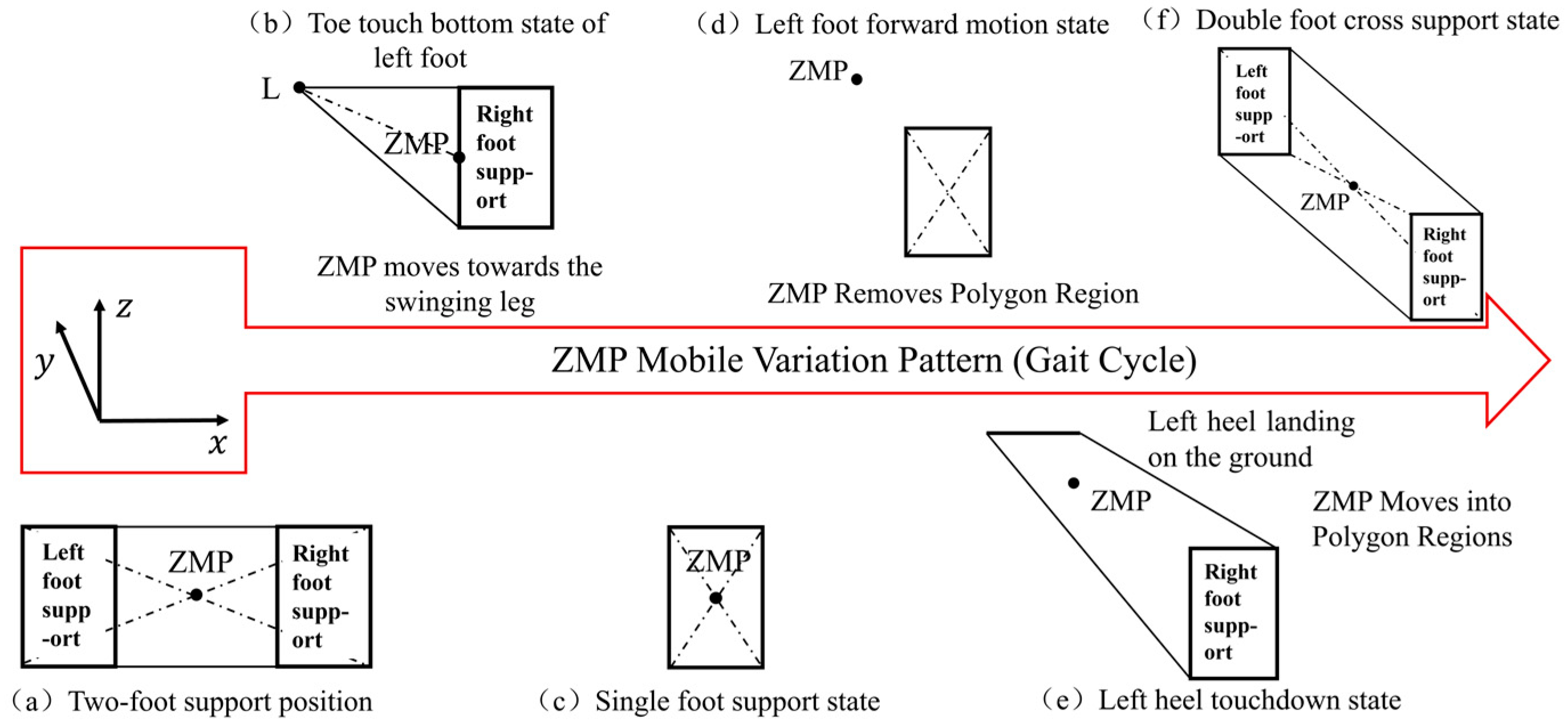
Gait instability in human walking predominantly arises during the single-leg support phase, characterized by the projection point of the resultant gravitational-inertial force vector falling outside the stable contact area of the supporting foot. During this critical phase, the zero-moment point (ZMP) remains outside the stable support region for approximately 67% of the gait cycle (Figure 2). Thus, ensuring the stability and safety of lower-limb exoskeleton rehabilitation robots requires a comprehensive stability analysis that accounts for conditions both inside and outside the support polygon boundaries.
The human gait cycle initiates with a double-leg support phase (Figure 2), during which the zero-moment point (ZMP) is located within the support polygon and closely aligns with its centroid. Taking initiation with the left leg as an example: as the left leg elevates and swings forward, the heel rises while the toes remain in contact with the ground. This action marks the critical transition from double-leg to single-leg support. Consequently, the support polygon geometry transforms, and the ZMP migrates toward the supporting limb. Once the swing leg completely clears the ground, the ZMP is contained within the redefined single-leg support polygon and continues to track the direction of the swinging leg’s movement. In the mid-to-late swing phase (Figure 2), the ZMP exits the stability region of the supporting foot’s contact polygon. According to ZMP stability theory, this condition is classified as system instability, yet it is an inherent and necessary requirement for normal gait progression. To address this paradox, this study analyzes the ZMP-polygon spatial relationship during single-leg support in lower-limb exoskeletons and proposes a novel swing-projection polygon stability criterion for a more comprehensive stability analysis of the human-exoskeleton system.

2.3. Research on Stability Criteria for Single-Leg Supported Oscillating Projected Polygons Based on ZMP

During the single-leg support phase, system stability is maintained when the projection point of the resultant body weight and inertial forces remains within the stable contact area of the supporting foot; otherwise, the system becomes unstable. This study therefore proposes a stability criterion for the single-leg support phase utilizing a ZMP-based swing projection polygon. The criterion is defined by a specific sequence of events: initiation begins at heel-off and toe-contact of the swing leg, triggering a ZMP shift towards the support leg. Following swing leg cycle completion, characterized by heel-contact of the swing leg and slight heel-rise of the support leg, the ZMP returns to the bipedal support polygon stability region. This polygonal region constitutes the stability determination area for the single-leg support phase.
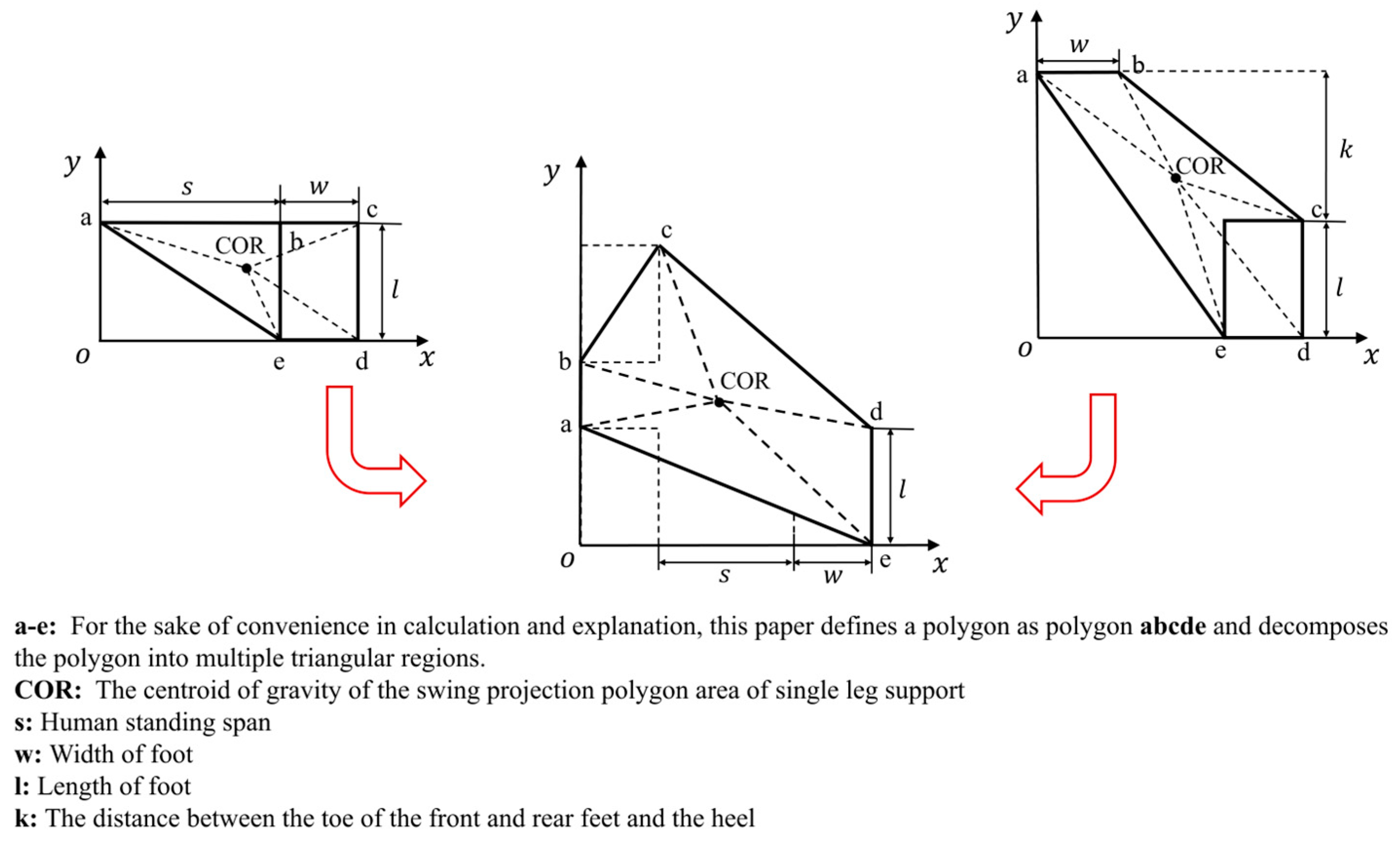
Figure 3 presents a simplified model of the proposed ZMP-based single-leg support swing projection polygon stability criterion. Although the swing projection polygon criterion facilitates stability assessment for human–robot gait systems, it inherits the inherent limitations of the foundational ZMP stability criterion. To address this, a quantitative method for evaluating the stability margin of lower-limb exoskeleton rehabilitation systems is proposed, building upon the swing projection polygon criterion. Specifically, the position of the zero-moment point (ZMP) relative to this polygon region quantifies the system’s stability level. The stability margin is quantified by the following formula:
M Z M P = D Z M P D C O R D
M Z M P represents the stability margin value when the ZMP lies within the single-leg support swing projection polygon area. D Z M P denotes the position of the zero-moment point within the single-leg support stability polygon. D C O R denotes the centroid of gravity position within the single-leg support swing projection polygon region, while D represents the distance between the intersection point of the straight line from the centroid of gravity to the zero-moment point and the boundary of the single-leg support swing projection polygon. As shown in Figure 2, different walking postures exist during the single-leg support phase, resulting in varying postural representations of D. In the ZMP-based stability criterion method for single-leg support swing projection polygons, the stability of the lower-limb exoskeleton rehabilitation robot system’s motion posture is evaluated using the magnitude criterion of M Z M P . Specifically, the distance expression between the centroid of gravity point and the zero-moment point within the stable polygon region is:
D Z M P D C O R = X Z M P X C O R 2 + Y Z M P Y C O R 2
In the formula,
  • X Z M P : X coordinate of zero moment point ZMP;
  • X C O R : X coordinate of the COR of the stable polygon;
  • Y Z M P : Y coordinate of zero moment point ZMP;
  • Y C O R : Y coordinate of the COR of the stable polygon;
This paper analyzes stability criteria and stability margin values for various gait patterns during lower-limb rehabilitation training, aiming to meet the fundamental requirements for lower-limb rehabilitation training assisted by exoskeleton rehabilitation robots.

2.4. Analysis and Research on Stability Criteria Methods for Single-Leg Support Oscillating Projected Polygons

This study analyzes the sequential motion of both lower limbs during normal human gait, focusing on the phase transitions within a single gait cycle. The gait sequence includes the following phases: the right foot flat-footed support; the left foot descent and forward progression to heel contact, accompanied by right heel rise; and the left foot flat-footed support with right forefoot contact and heel-off. Building upon this complete single-gait-cycle analysis, stability criteria for both single-leg and double-leg support phases are established. Although the zero-moment point (ZMP) stability criterion adequately assesses stability during double-leg support, it exhibits limitations during single-leg support phases. Specifically, instability in rehabilitation robotic systems can be induced by the forward momentum of the swing leg. To address this limitation, a swing-projection polygon stability criterion for the single-leg support phase, rooted in ZMP theory, is proposed. Furthermore, a quantitative stability margin method is introduced to facilitate systematic stability analysis across the entire gait cycle. All subsequent stability analyses are conducted with the left lower limb designated as the swing leg.
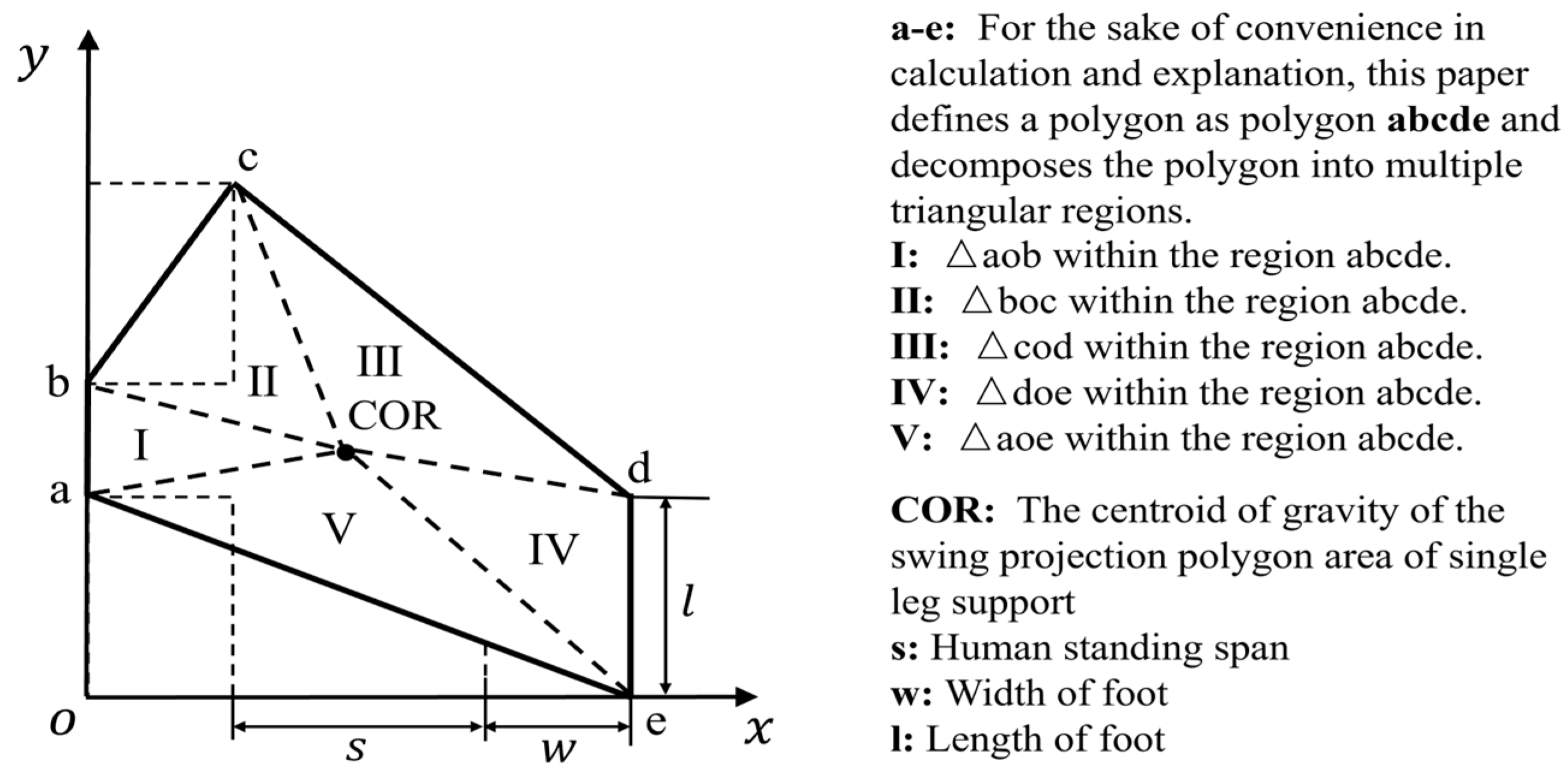
Figure 4 depicts the stability criterion model based on the single-leg support swing projection polygon. This model geometrically represents the support polygon derived from three sequential gait phases: (1) left heel-off with toe contact, (2) full left leg swing, and (3) left heel-contact concurrent with slight right heel-off.
As illustrated in Figure 4, the single-leg support swing projection polygon comprises five constituent triangles, forming an irregular polygonal shape. The centroid coordinates of this polygon are calculated using the area method, defined by the following formula:
X C O R = S i X i S i ,   Y C O R = S i Y i S i
where X C O R , Y C O R : irregular polygon barycentric coordinates; S i the area of each part of the irregular triangle; X i , Y i : irregular triangle barycenter coordinate.
The area method is applied to determine the centroid coordinates of the support polygon formed during the push-off phase, characterized by left forefoot contact, left heel elevation, and full right foot support. The calculation proceeds as follows:
X C O R = s + 2 w l / 2 x a + x d + x e / 3 + s + 2 w k / 2 x a + x d + x b / 3 + w 2 + l 2 l 2 + s + 2 w 2 / 2 x b + x d + x c / 3 s + 2 w l / 2 + s + 2 w k / 2 + w 2 + l 2 l 2 + s + 2 w 2 / 2
Y C O R = s + 2 w l / 2 y a + y d + y e / 3 + s + 2 w k / 2 y a + y b + y d / 3 + w 2 + l 2 l 2 + s + 2 w 2 / 2 y b + y c + y d / 3 s + 2 w l / 2 + s + 2 w k / 2 + w 2 + l 2 l 2 + s + 2 w 2 / 2
where l : the length of the foot; w : the width of the foot; s : human standing span; and k : the distance between the toe of the front and rear feet and the heel.
  • where x a , y a , x b , y b , x c , y c , x d , y d , and x e , y e are the coordinate values of points a, b, c, d, and e in Figure 4, respectively.
During rehabilitation training, external forces may act between the lower limb exoskeleton rehabilitation robot and the patient due to external factors such as wearing or assembly. The stability expression of ZMP is:
X Z M P = i = 1 7 m i z ¨ i + g x i i = 1 7 m i x ¨ i z i + m 8 z ¨ 8 + g x 8 m 8 x ¨ 8 z 8 i = 1 7 m i z ¨ i + g + m 8 z ¨ 8 + g
Y Z M P = i = 1 7 m i z ¨ i + g y i i = 1 7 m i y ¨ i z i + m 8 z ¨ 8 + g x 8 m 8 y ¨ 8 z 8 i = 1 7 m i z ¨ i + g + m 8 z ¨ 8 + g
In Equation (4), m 8 denotes the total body mass, and x 8 , y 8 , z 8 represent the three-dimensional coordinates of the whole-body center of mass (COM). The centroid (COR) of the contact polygon is subsequently calculated using Equation (4). As illustrated in Figure 3, connecting vertices a, b, c, d, and e to the centroid (COR) subdivides the polygon into five triangular regions: Δ a o b , Δ b o c , Δ c o d , Δ d o e , and Δ a o e . These triangles correspond to regions I through V in Figure 4, respectively.
According to Formula (4), the coordinate values of X Z M P and Y Z M P are solved. When the ZMPs are in the regions of I, II, III, IV, and V, respectively, the instability margin M Z M P is analyzed as follows.
  • Region I
When the ZMP is located in the Region I, namely Δ a o b , the instability margin value of the Region I is solved according to the triangle center point method, and the instability margin M Z M P is derived as follows:
M Z M P = D Z M P D C O R D = X Z M P X C O R 2 + Y Z M P Y C O R 2 D = X C O R X Z M P X C O R
In the formula, M Z M P is the unstable margin value of ZMP in the Region I a o b when the left leg swings. At this time, X Z M P , Y Z M P and X C O R , Y C O R are zero moment point coordinates and irregular polygon barycenter coordinates.
The change in the instability margin value is analyzed. When the M Z M P value gradually becomes larger and approaches 1, the ZMP gradually approaches the edge of the straight line ab outside the swing foot, resulting in the instability of the left side of the rehabilitation robot system. On the contrary, when the M Z M P value gradually decreases and approaches 0, the ZMP coordinates gradually approach the COR point coordinates, and the rehabilitation robot system is in a regional stable state.
2.
Region Ⅱ
When the ZMP is located in the Region Ⅱ, namely Δ b o c , the instability margin value of the Region Ⅱ is solved according to the triangle center point method, and the instability margin M Z M P is derived as follows:
M Z M P = D Z M P D C O R D = X Z M P X C O R 2 + Y Z M P Y C O R 2 D
In the formula, M Z M P is the unstable margin value of ZMP in the Region Ⅱ b o c when the left leg swings. At this time, the zero moment point coordinates and irregular polygon barycentric coordinates are X Z M P , Y Z M P and X C O R , Y C O R . The distance D is the distance from the COR to the intersection of the ZMP and the straight line bc.
When solving the length of D, since bc in the irregular b o c is an ordinary straight line, the coordinate points cannot be solved by the similar triangle method. Therefore, the slope line method between two points is used to start from the centroid of gravity of the irregular polygon and pass through the intersection of ZMP and the straight line bc x D , y D .
y Y C O R Y Z M P Y C O R = x X C O R X Z M P X C O R
y y c y b y c = x x c x b x c
In the formula, x b , y b and x c , y c are the coordinates of the b and c points, respectively.
Combining Equations (7) and (8), the intersection coordinates are x D , y D , and the length of D is:
D = X C O R X D 2 + Y C O R Y D 2
Solving the instability margin value of the Region Ⅱ, the instability margin M Z M P is derived as follows:
M Z M P = D Z M P D C O R D = X Z M P X C O R 2 + Y Z M P Y C O R 2 D = X Z M P X C O R 2 + Y Z M P Y C O R 2 X C O R X D 2 + Y C O R Y D 2
The change in the instability margin value is analyzed. When the M Z M P value gradually becomes larger and approaches 1, the ZMP gradually approaches the edge of the straight line bc outside the swing foot, resulting in the instability of the left side of the rehabilitation robot system. On the contrary, when the M Z M P value gradually decreases and approaches 0, the ZMP coordinates gradually approach the COR point coordinates, and the rehabilitation robot system is in a regional stable state.
3.
Region Ⅲ
When the ZMP is located in the Region Ⅲ, namely Δ c o d , according to the triangle center point method, the instability margin value of the Region Ⅲ is solved, and the instability margin M Z M P is derived as follows:
M Z M P = D Z M P D C O R D = X Z M P X C O R 2 + Y Z M P Y C O R 2 D
In the formula, M Z M P is the unstable margin value of ZMP in the Region Ⅲ c o d when the left leg swings. At this time, the zero moment point coordinates and irregular polygon barycentric coordinates are X Z M P , Y Z M P and X C O R , Y C O R . The distance D is the distance from the COR center of gravity to the intersection of the ZMP and the straight line cd.
When solving the length of D, since cd in the irregular Δ c o d is an ordinary straight line, the coordinate points cannot be solved by the similar triangle method. Therefore, the slope line method between two points is used to start from the centroid of gravity of the irregular polygon and pass through the intersection of ZMP and the straight line cd x D , y D .
y Y C O R Y Z M P Y C O R = x X C O R X Z M P X C O R
y y d y c y d = x x d x c x d
In the formula, x d , y d and x c , y c are the coordinates of the d and c points, respectively.
Combining Equations (12) and (13), the intersection coordinates are x D , y D , and the length of D is:
D = X C O R X D 2 + Y C O R Y D 2
Solving the instability margin value of the Region Ⅲ, the instability margin M Z M P is derived as follows:
M Z M P = D Z M P D C O R D = X Z M P X C O R 2 + Y Z M P Y C O R 2 D = X Z M P X C O R 2 + Y Z M P Y C O R 2 X C O R X D 2 + Y C O R Y D 2
The change in the instability margin value is analyzed. When the M Z M P value gradually becomes larger and approaches 1, the ZMP gradually approaches the edge of the straight line cd outside the swing foot, resulting in the instability of the left side of the rehabilitation robot system. On the contrary, when the M Z M P value gradually decreases and approaches 0, the ZMP coordinates gradually approach the COR point coordinates, and the rehabilitation robot system is in a regional stable state.
4.
Region Ⅳ
When the ZMP is located in the Region Ⅳ, namely Δ d o e , according to the triangle center point method, the instability margin value of the Region Ⅳ is solved, and the instability margin M Z M P is derived as follows:
M Z M P = D Z M P D C O R D = X Z M P X C O R 2 + Y Z M P Y C O R 2 D = X Z M P X C O R s + 2 w X C O R
In the formula, M Z M P is the unstable margin value of ZMP located in the IV region Δ d o e when the left leg swings. At this time, the zero moment point coordinates and irregular polygon barycenter coordinates of X Z M P , Y Z M P and X C O R , Y C O R at this time.
The change in the instability margin value is analyzed. When the M Z M P value gradually becomes larger and approaches 1, the ZMP gradually approaches the edge of the straight line de outside the swing foot, resulting in the instability of the left side of the rehabilitation robot system. On the contrary, when the M Z M P value gradually decreases and approaches 0, the ZMP coordinates gradually approach the COR point coordinates, and the rehabilitation robot system is in a regional stable state.
5.
Region Ⅴ
Because the ZMP criterion of the Region Ⅴ is the same as that of the Region III, the specific analysis process is no longer described here. When the ZMP is located in the V region, namely Δ a o e , according to the triangle center point method, the instability margin value of the Region III is solved, and the instability margin M Z M P is derived as follows:
M Z M P = D Z M P D C O R D = X Z M P X C O R 2 + Y Z M P Y C O R 2 D = X Z M P X C O R 2 + Y Z M P Y C O R 2 X C O R X D 2 + Y C O R Y D 2
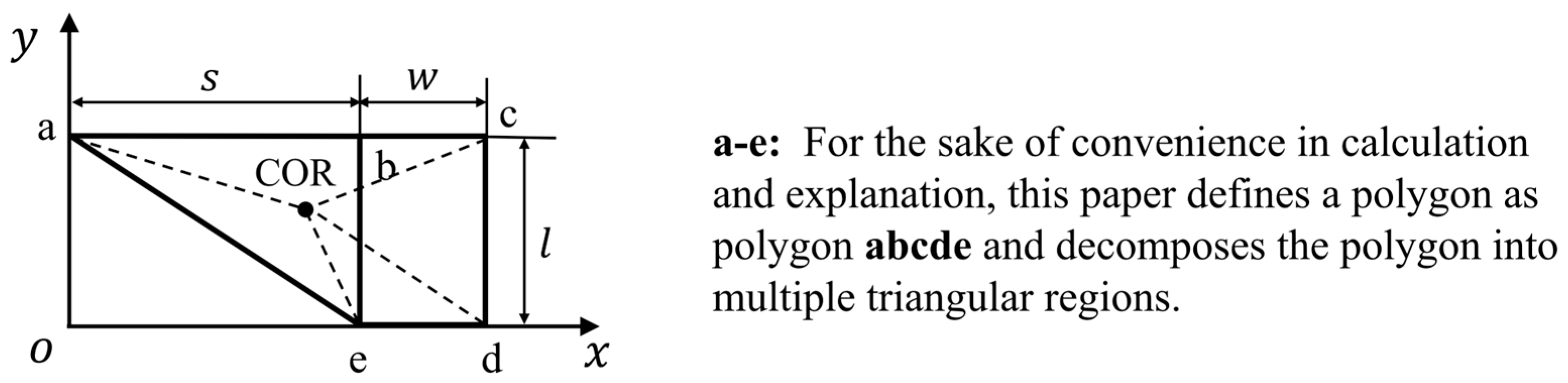
Because the ZMP stable region of the right foot support and the left toe touchdown stage is not completely covered in the Region Ⅴ Δ a o e , there is still a criterion area that cannot be covered in the two ZMP stability judgment areas. Therefore, the ZMP stability area of the right foot support and the left toe touchdown stage is further analyzed to obtain the instability margin values in the Δ a o e and Δ d o e regions. The contact polygon of this stage is shown in Figure 5.
As shown in Figure 5, the contact polygon is an asymmetric polygon, which can be seen as consisting of a rectangle and a group of right triangles. The area method is used to solve the coordinates of the centroid of gravity of the irregular polygon, and the formula for solving the COR coordinates is:
X C O R = l w w / 2 + l s / 2 x a + x b + x e / 3 l w + l s / 2
Y C O R = l w w / 2 + l s / 2 y c + y d + y f / 3 l w + l s / 2
In the formula, x a , y a , x b , y b , x c , y c , x d , y d , and x e , y e are the coordinate values of points a, b, c, d, and e in Figure 5, respectively. The COR of the contact polygon is solved by Equation (18), and the contact polygon is divided into four triangles by connecting a, c, e, and d points through the centroid COR.
Region Δ a o e
X Z M P and Y Z M P are the same as the solution method of Formula (5). When the ZMP is located in the Δ a o e region, the instability margin value of the Δ a o e region is solved according to the triangle center point method, and the instability margin M Z M P is derived as follows:
M Z M P = D Z M P D Z M P D = X Z M P X C O R 2 + Y Z M P Y C O R 2 D
In the formula, M Z M P is the instability margin value of the ZMP in the Region Δ a o e when the left foot forefoot touches the ground and the heel is off the ground. At this time, X Z M P , Y Z M P and X C O R , Y C O R are the zero moment point coordinates and irregular polygon barycenter coordinates. Distance D is the distance from the of COR to the intersection of ZMP and straight line ae.
When solving the length of D, since ae in the irregular Δ a o e is an ordinary straight line, the coordinate points cannot be solved by the similar triangle method. Therefore, the slope line method between two points is used to start from the COR of the irregular polygon and pass through the intersection of the ZMP and the straight line ae x D , y D .
y Y C O R Y Z M P Y C O R = x X C O R X Z M P X C O R
y y e y a y e = x x e x a x e
In the formula, x d , y d and x e , y e are the coordinates of the a and e points, respectively.
Combining Equations (20) and (21), the intersection coordinates are x D , y D , and the length of D is:
D = X C O R X D 2 + Y C O R Y D 2
Solving the instability margin value of the Region Δ a o e , the instability margin M Z M P is derived as follows:
M Z M P = D Z M P D C O R D = X Z M P X C O R 2 + Y Z M P Y C O R 2 D = X Z M P X C O R 2 + Y Z M P Y C O R 2 X C O R X D 2 + Y C O R Y D 2
Region d o e
When the ZMP is located in the Region Δ d o e , the instability margin value of the Region Δ d o e is solved according to the triangle center point method, and the instability margin M Z M P is derived as follows:
M Z M P = D Z M P D C O R D = X Z M P X C O R 2 + Y Z M P Y C O R 2 D = Y C O R Y Z M P Y C O R
In the formula, M Z M P is the instability margin value of the ZMP in the Region Δ d o e when the left foot forefoot touches the ground and the heel is off the ground. At this time, X Z M P , Y Z M P and X C O R , Y C O R are the zero moment point coordinates and irregular polygon barycenter coordinates at this time. Distance D is the distance from the COR to the intersection of ZMP and straight line ae.
Through the analysis, the instability margin values of the V region and the Δ a o e and Δ d o e regions in the single-leg support swing projection stability region are obtained. According to the degree of coverage in the two regions, combined with the ZMP dynamic stability criterion, the instability margin values of the two regions are analyzed, and the instability margin value in the V region is obtained:
M Z M P = X Z M P X C O R 2 + Y Z M P Y C O R 2 X C O R X D 2 + Y C O R Y D 2 0 < M Z M P < 1 M Z M P = 1 2 X Z M P X C O R 2 + Y Z M P Y C O R 2 X C O R X D 2 + Y C O R Y D 2 + 1 2 Y C O R Y Z M P Y C O R M Z M P > 1   0 < M Z M P < 1
Analyzing the instability margin value changes in Region V, as M Z M P gradually increases and approaches 1, the ZMP progressively converges toward the outer edge of the swinging foot’s straight line ae. This triggers a leftward tipping instability in the rehabilitation robot system. Concurrently, the formula R Z M P > 1 executed when operating outside the polygonal region—determines whether the criterion ratio exceeds the stable zone, thereby deciding whether an unstable state occurs. When the M Z M P value gradually decreases and approaches 0, the ZMP coordinates gradually approach the COR point coordinates, indicating that the rehabilitation robot system is in a stable state.

3. ZMP-Based Stable Gait Planning Method

3.1. Gait Planning Method Based on Geometric Constraints

Grounded in zero-moment point (ZMP) dynamic stability theory, a gait planning method that incorporates geometric constraints was developed to generate stable and safe walking trajectories for lower-limb exoskeleton rehabilitation robots. This method identifies key parameters governing gait initiation and termination, which are then integrated into a polynomial function; the unknown coefficients of this function are determined by solving a set of geometric constraints. A geometric constraint analysis of the swing leg ankle joint was used to derive the kinematic equations for the end-effector. The movement patterns of all exoskeleton joints were then analyzed and systematically integrated into the model.
This study adopts the linear gait characteristics employed during the initial phase of lower-limb rehabilitation training. To facilitate gait planning and data analysis, the lower-limb exoskeleton rehabilitation robot is modeled as a seven-bar linkage. Using optimization algorithms, both the initial and cyclic gaits of the lower-limb exoskeleton rehabilitation robot are optimized.

3.2. ZMP Stable Gait Planning Method Based on Whale Optimization Algorithm

Gait Parameter Optimization

The primary objective of lower-limb exoskeleton rehabilitation robots is to deliver comfortable and stable gait training for patients. However, polynomial interpolation-based gait planning guarantees only joint motion continuity in exoskeleton systems. To achieve enhanced stability and smoothness in gait trajectories, this study analyzes gait cycle parameters influencing the zero-moment point (ZMP) stability criterion and identifies key optimization parameters for trajectory refinement.
Based on the gait planning analysis presented in this chapter, key trajectory parameters of the hip joints that significantly influence the zero-moment point (ZMP) trajectory were identified. Stable walking training of the exoskeleton robot was achieved through optimization of these influential parameters. The hip joint’s initial position H i , maximum elevation H g , and motion coefficient c were selected as key parameters. Using the initial ZMP position as a constraint, the governing equation is formulated as:
X b < X Z M P = i = 1 7 m i z ¨ i + g x i i = 1 7 m i x ¨ i z i i = 1 7 m i z ¨ i + g < X f
Taking the projection point of the supporting leg ankle joint as the origin of the coordinate, the position of the central projection point of the supporting leg is:
X c = X b + X f 2
In the formula, X b is the back heel value coordinate origin distance (negative value), and X f is the distance from the toe to the origin of the coordinate (positive value).
In the single step T 1 , the ZMP stability of the exoskeleton in the X-axis direction can be described as X b < X Z M P < X f , so the stability index of the exoskeleton can be expressed as:
M = X Z M P X c
Equation (28) represents the degree to which the zero moment point of the robot deviates from the center of the support foot in the X direction. The smaller M indicates the better stability of the robot, so the optimization function can be set as:
O b j e c t = M i n F c , H i , H g
F c , H i , H g = M a x X Z M P X c , t 0 , T 1

3.3. Analysis of Gait Planning Parameter Optimization Results

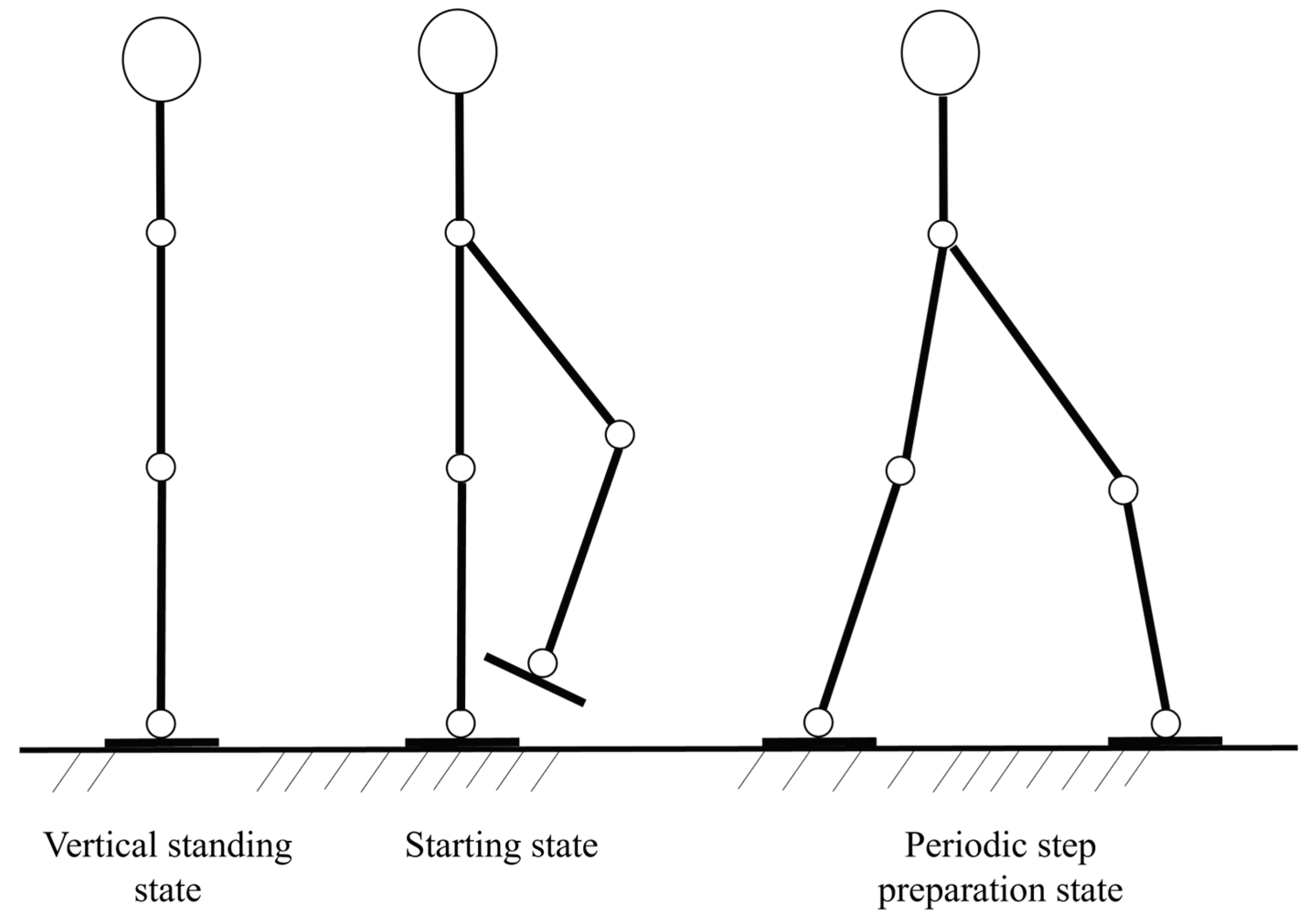
The gait motion of the rehabilitation robot is divided into two primary phases: the initial gait and the cyclic gait. Accordingly, a Cartesian coordinate system is established in the sagittal plane, aligned with the two phases of the human gait cycle. The origin is fixed at the ankle joint of the supporting leg, with the X-axis aligned with the direction of progression and the Z-axis oriented vertically upward (as shown in Figure 6). Gait planning for both the initial and cyclic phases focuses on the motion of the hip and ankle joints in the swing leg. The corresponding postures and trajectories of these joints are analyzed and defined within this Cartesian coordinate system (O-XZ).
Due to the characteristics of human gait cycle motion, the trajectories of the rehabilitation robot’s hip joints overlap in their sagittal plane projections. For the cyclic gait phase, modeling the motion as uniform better ensures the accuracy of the trajectory design. Therefore, the supporting leg is chosen as the focus of the optimization, with its ankle joint center as the coordinate origin; the optimization targets primarily the hip joint parameters.
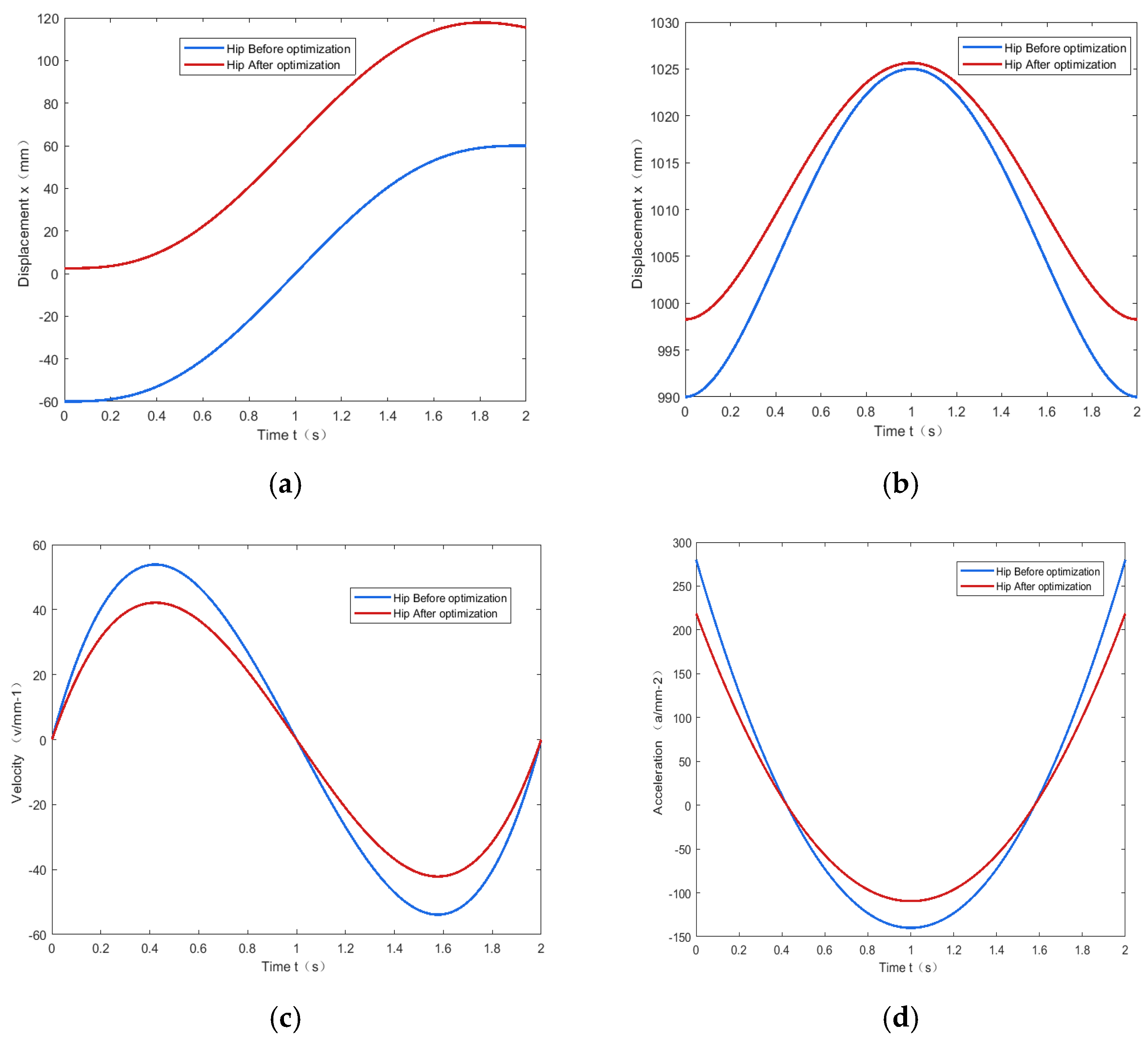
By applying the whale optimization algorithm to analyze the mathematical model, objective function, and constraints of gait planning, the following optimized parameters were determined: the initial position of the hip joint is H i = 1025.64   m m , the highest point position is H g = 998.27   m m , and the motion coefficient is c = 63.4   m m .
A comparative simulation analysis of gait trajectories before and after the application of the Whale Optimization Algorithm reveals that the optimized curves (Figure 7c,d) demonstrate smoother and slower joint movements, which more closely align with ideal rehabilitation training trajectories. This characteristic suggests a reduction in energy consumption for the swing leg’s hip joint motion. As shown in Figure 7a,b, the motion trajectory of the swing leg’s hip joint is characterized by a closer proximity to the origin and a reduced curvature. This geometric profile indicates a slower hip joint movement during the landing phase, thereby providing enhanced shock absorption and improving the stability and balance of the lower-limb exoskeleton rehabilitation robot.

4. Cycle Gait Generation Method of Lower Limb Exoskeleton Rehabilitation Robot Based on LSTM Neural Network

4.1. Construction of the Sample Set for the Cyclic Gait Prediction Model

As established in the literature [17], joint angle sequences during human gait can be extracted through integration of motion capture systems with clinical gait analysis (CGA) data, forming the basis for gait planning in lower-limb exoskeleton rehabilitation robots. Experimental limitations present challenges for conducting comprehensive model validation of cyclic gait planning in lower-limb exoskeleton systems. However, direct utilization of gait cycle feature parameters for predictive modeling is constrained by inadequate parameter representation and limited motion accuracy. To address these limitations, phase space reconstruction methodology is employed for gait data preprocessing, enabling effective cyclic gait planning in lower-limb exoskeleton rehabilitation systems.
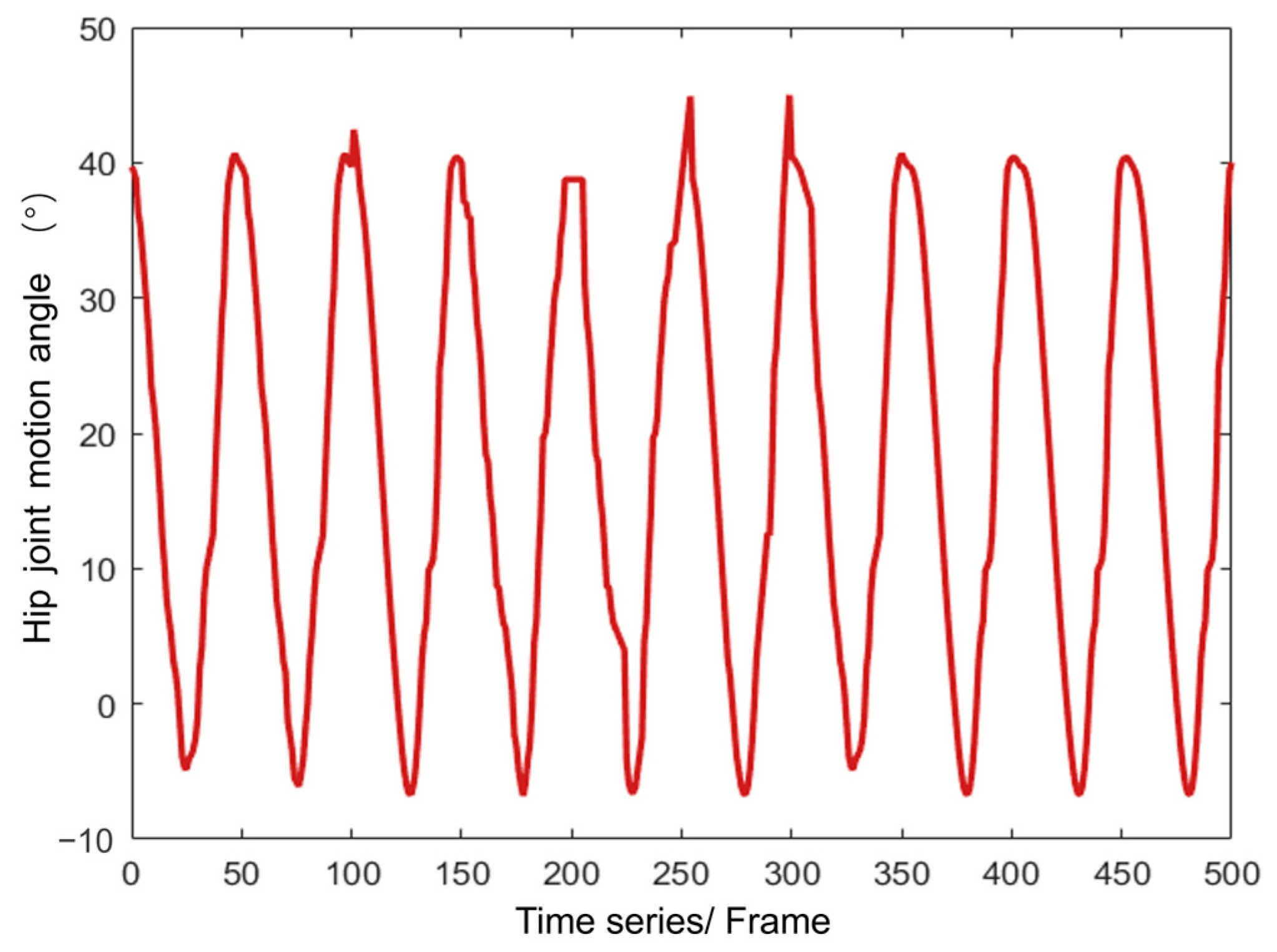
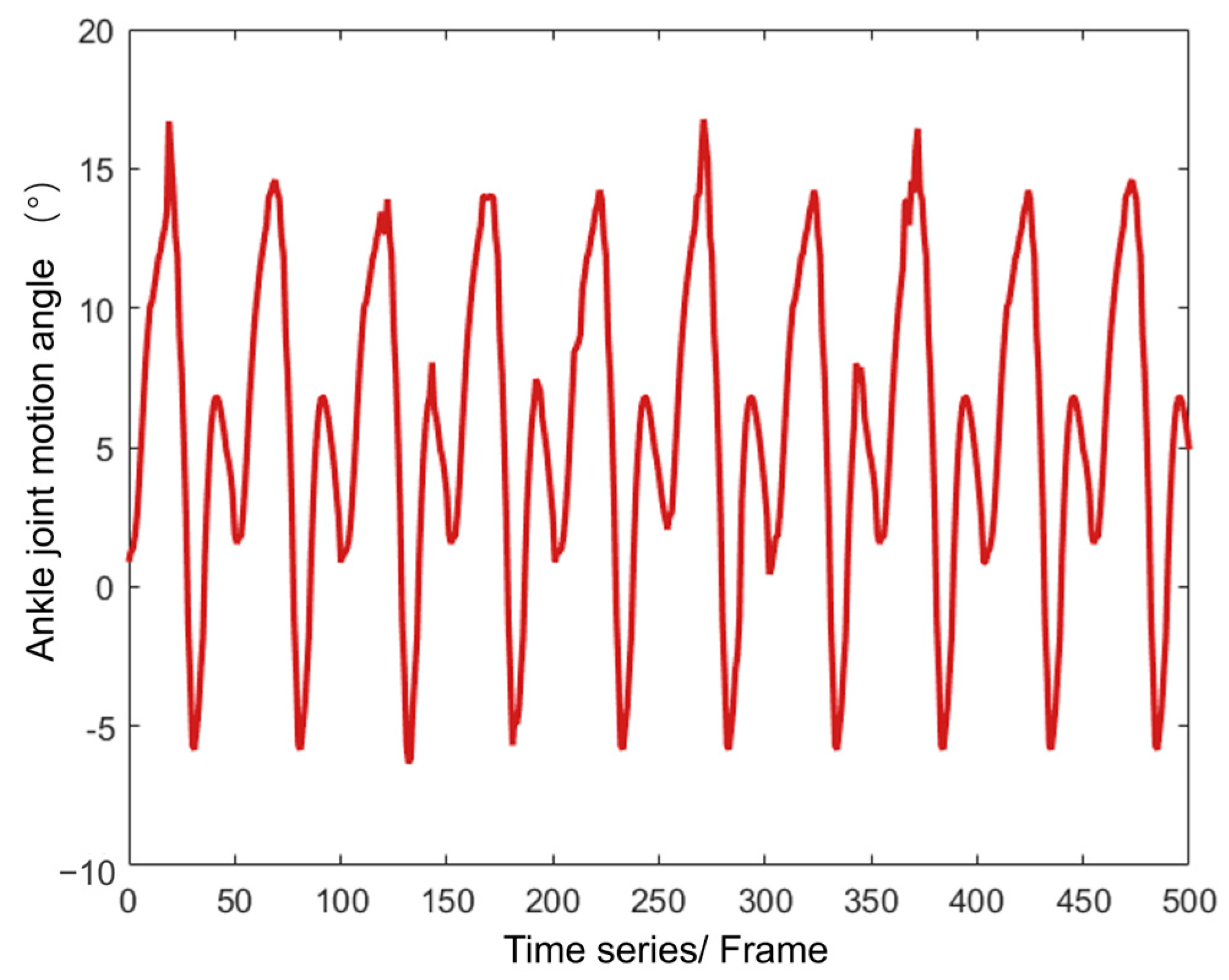
Figure 8 and Figure 9 illustrate the range of motion for hip and ankle joint flexion/extension in the lower limb of the human body.
Figure 8 and Figure 9 demonstrate that during the motion joint angle sequence splicing and preprocessing, this paper employs a predictive approach leveraging the generalization capability of the prediction model. This reduces instability and tipping phenomena in lower-limb exoskeleton rehabilitation robots caused by insufficient overlap between data acquisition start and end points, thereby enhancing the persistence and stability of gait rehabilitation training for rehabilitation robots.

4.2. Data Preprocessing for Lower Limb Exoskeleton Rehabilitation Robots Based on Phase Space Reconstruction

Since the sequence of joint motion angles is influenced by various factors such as coordinated joint movements, range of motion, and ZMP stability criteria, the collected time series of joint motion angles for the lower-limb exoskeleton rehabilitation robot constitute a one-dimensional time series.
x a n k l e = x a n k l e 1 , x a n k l e 2 , x a n k l e 3 , , x a n k l e 500 x h i p = x h i p 1 , x h i p 2 , x h i p 3 , , x h i p 500
In the formula, X a n k l e is the time series of the oscillating leg ankle joint in cyclic motion for rehabilitation robots, and X h i p is the time series of the swinging leg hip joint in a cyclic state for rehabilitation robots.
Therefore, to enhance the accuracy of the predictive model, this paper employs phase space reconstruction as a preprocessing method to perform backward derivation on the joint motion angle time series, thereby obtaining additional feature values for the joint motion sequence. In one-dimensional time series, based on the embedding theorem derived from phase space reconstruction theory, an appropriate dimension m and time delay τ are embedded. The reconstructed phase space exhibits the same dynamical structure as the original system.
Analysis of the relationship between dimension and time delay reveals that they are not mutually independent. Both dimension and time delay influence the accuracy of the prediction model to a certain extent. Therefore, this paper employs the C-C method to calculate the appropriate dimension m and time delay τ , with the associated integral formula being:
C s m , N , τ , t = 2 M M 1 1 i j M f τ X i X j f x = 1 ,       x 0 0 ,       x < 0
Among them,
  • N = 500 , joint angle sequence length;
  • m = N ( m 1 )   t , the number of state points in the reconstructed phase space;
  • t : the number of subsequences;
  • s : Sequence label.
The C-C method minimizes the difference between the embedding dimension m and the original sequence. This process determines the optimal embedding dimension m and time delay τ . First, the joint angle sequence of gait motion for the lower-limb exoskeleton rehabilitation robot is divided into t sub-sequences, as expressed by the formula:
x 1 , x 1 + t , , x 1 + m 1 t x 2 , x 2 + t , , x 2 + m 1 t x t , x 2 t , , x m t
The objective function is:
S m , N , r , t = 1 t s = 1 t C s m , N / t , r , t C s 1 , N / t , r , t
Then the definition difference is:
Δ S m , N , r , t = max S m , N , r , t min S m , N , r , t
Due to the limitation of the length of the time series and the common distribution of the subsequences, the maximum deviation value is within the range of radius r , and the minimum value corresponds to the zero point of S .
S ¯ t = 1 16 m = 2 5 i = 1 4 S m , N , r , t Δ S ¯ t = 1 4 m = 2 5 Δ S m , N , r , t S c o r t = Δ S ¯ t + S ¯ t
The optimal embedding dimension m and time delay τ in the time series are determined by minimizing S ¯ t   , Δ   S ¯ t , and S c o r in Equation (35). Based on BDS statistical conclusions, m = 2,3 , 4,5 ; r = i σ / 2 , and i = 1,2 , 3,4 , where σ is a negligible quantity.
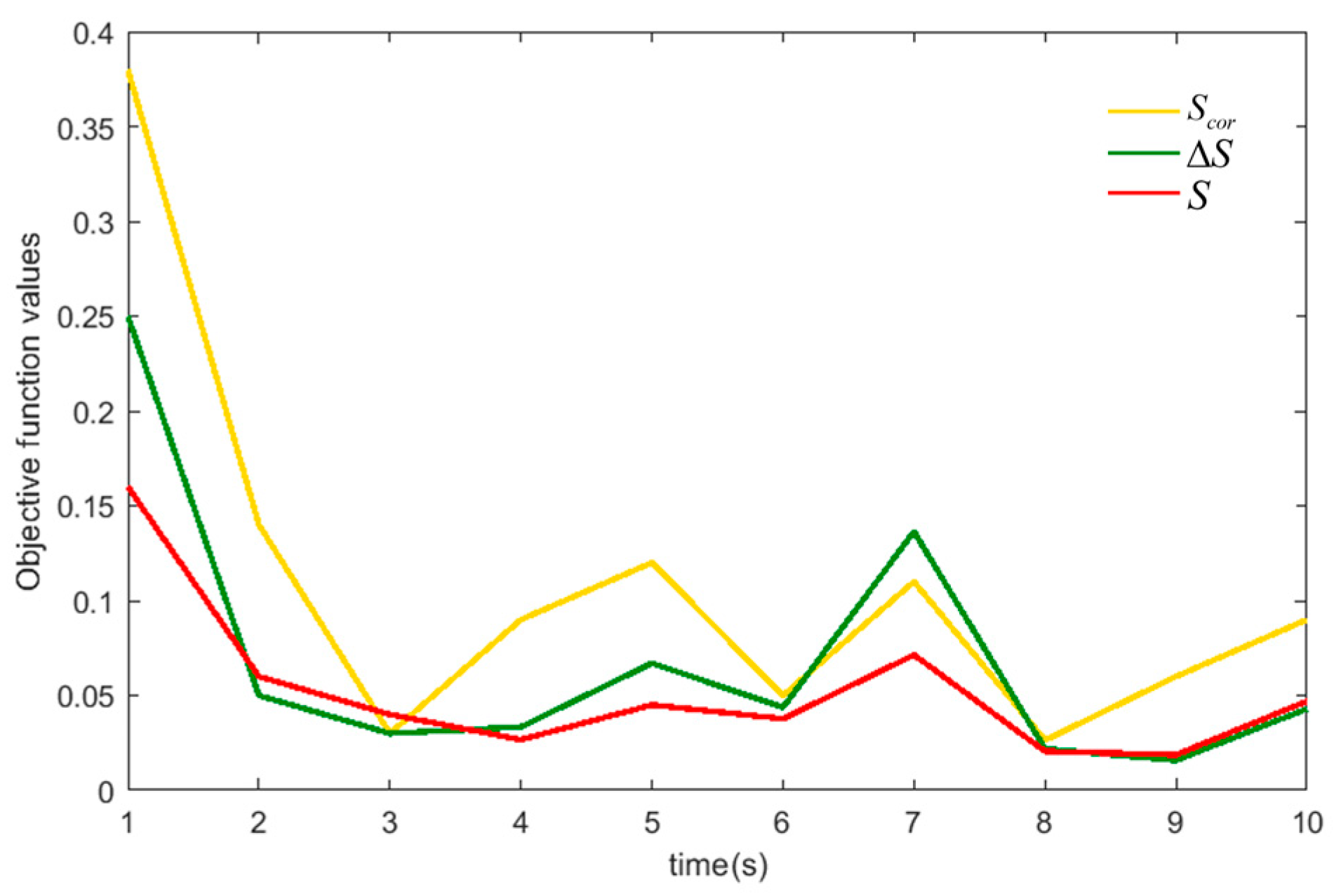
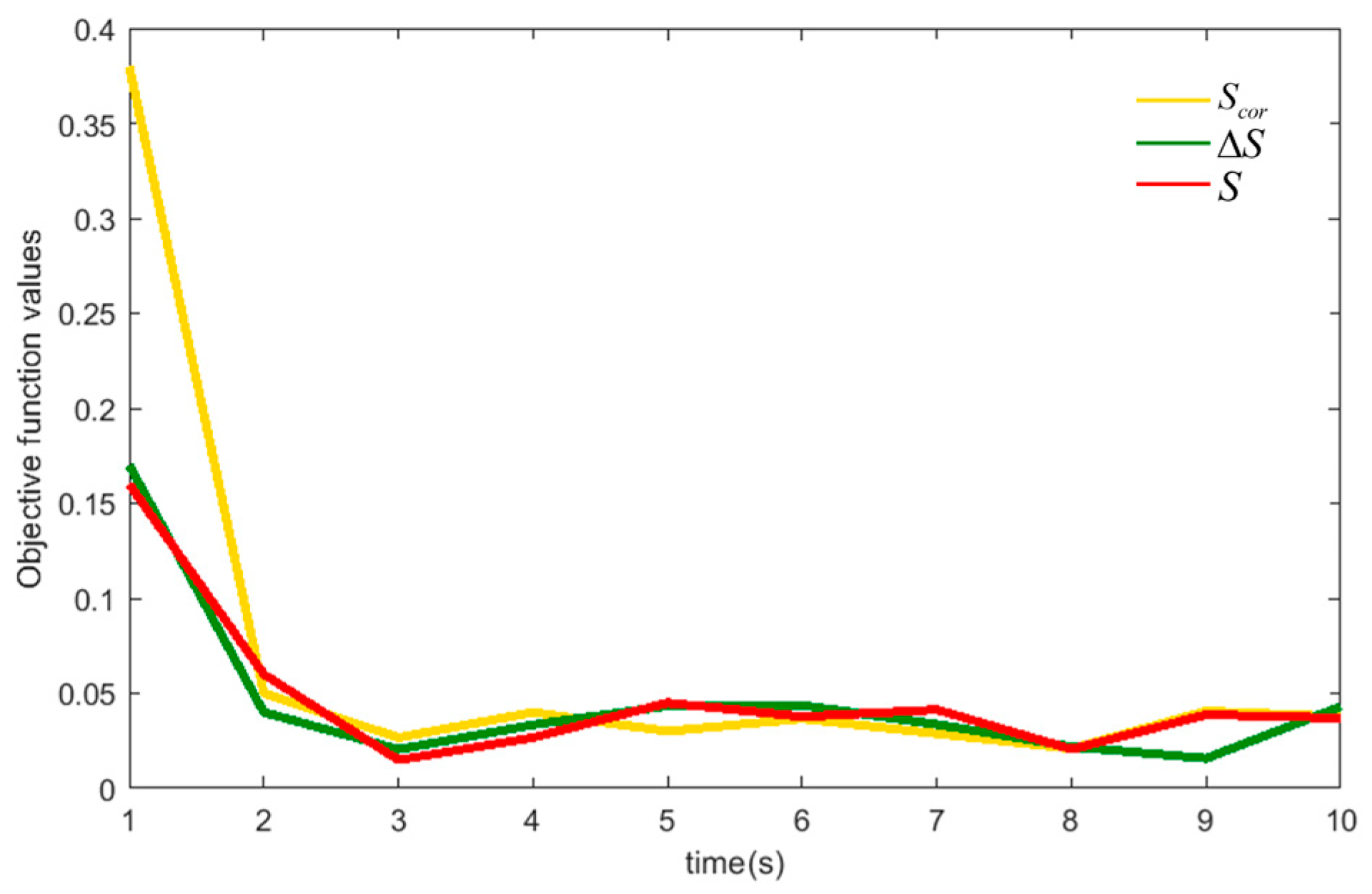
The C-C method for optimizing joint angle sequences in rehabilitation robots effectively addresses the limitations of characteristic values in joint sequences for gait rehabilitation training in lower-limb exoskeleton robots. The optimization process is illustrated in Figure 10 and Figure 11.
As shown in Figure 10 and Figure 11, the first zero of S ¯ t   , the first minimum of Δ   S ¯ t , and the minimum value of S c o r in the joint motion angle time series of the prediction sample set all occur at time delays τ = 6 and τ = 3 , respectively. Furthermore, based on the lower-limb exoskeleton rehabilitation robot configuration designed in this paper, the flexion/extension movements of its hip and ankle joints exhibit four joint angle couplings (four influencing factors). Therefore, m is selected as 5 according to the one-dimensional time series relationship. The same method described above is applied to calculate the remaining joint angles.
The C-C method enables rapid phase space reconstruction of the one-dimensional time series of joint angles during the gait cycle of the lower-limb exoskeleton rehabilitation robot. This yields a five-dimensional time series, where the one-dimensional component represents the target joint angles, and the remaining four dimensions constitute the reconstructed features.
y h i p t i = x t i , x t i + 6 , x t i + 12 , , x t i + 30 , i = 1 , 2 ,
The phase space expression after hip joint reconstruction is:
y a n k l e t i = x t i , x t i + 3 , x t i + 6 , , x t i + 15 , i = 1 , 2 ,
In the formula, y t i represents the i-th phase point in the m-dimensional phase space. The above equation constitutes the final sample set of the reconstructed five-dimensional phase space time series. Appropriately increasing its features can significantly enhance the model’s prediction accuracy.

4.3. Establishment of a Joint Angle Sequence Prediction Model for Walking Motion in Lower-Limb Exoskeleton Robots

This paper addresses the challenge of ensuring that lower-limb exoskeleton rehabilitation robots establish highly accurate and long-duration joint motion angle sequence models to achieve stable rehabilitation walking. We propose a long-term prediction method for joint motion angle sequences based on LSTM neural networks. This approach resolves issues such as instability and lateral tilt encountered during rehabilitation training, which arise from the lack of smoothness in the gait data acquisition and stitching phase when using direct cyclic gait planning methods [20].
The LSTM neural network achieves temporal relationship prediction through its inherent ability to forecast regular periodic patterns. Therefore, predicting the persistence and stability of gait planning for lower-limb exoskeleton rehabilitation robots in lower-limb gait rehabilitation training aligns well with its predictive characteristics. Based on the joint motion angle time series of a single gait cycle in rehabilitation robot training, the LSTM neural network prediction method can accurately forecast the joint motion angle time series across multiple gait cycles. Simultaneously, the LSTM’s self-optimizing capability significantly enhances prediction accuracy, further ensuring the smoothness and persistence of motion in lower-limb exoskeleton rehabilitation robot gait training [21].
As outlined in Section 4.2, the time series x t of joint movement angles during gait rehabilitation training for lower-limb exoskeleton rehabilitation robots, combined with the corresponding actual values y t from the sample set, constitute the sample set for the LSTM neural network. By training the joint motion angle time series prediction model for gait rehabilitation using this dataset, the model generates predicted joint motion angles across different LSTM layer configurations and varying numbers of neurons per layer. The experimental results are presented in Table 1.
As shown in Table 1, the prediction of joint motion angle time series for gait rehabilitation training using an LSTM neural network reveals that the error value is minimal when the neural network has three layers. As the number of layers and neurons increases, the error in joint motion angles also decreases, further indicating a significant improvement in prediction accuracy. Therefore, the selected LSTM neural network structure for the lower-limb exoskeleton rehabilitation robot gait training joint motion angle time series prediction model is a three-layer network with 300 neurons per layer.
To further validate the accuracy of the LSTM neural network in predicting the cyclic gait method for lower-limb exoskeleton rehabilitation robots, this study employed a human motion capture system to repeatedly collect lower limb joint motion trajectories, which underwent noise reduction and stitching processing. Based on phase space reconstruction methods, the sample data was analyzed and processed to extract one-dimensional joint angle time series features. Finally, the five-dimensional time series from the motion sample data were used for periodic training of the LSTM neural network, enabling prediction of joint angle sequences across multiple gait cycles.
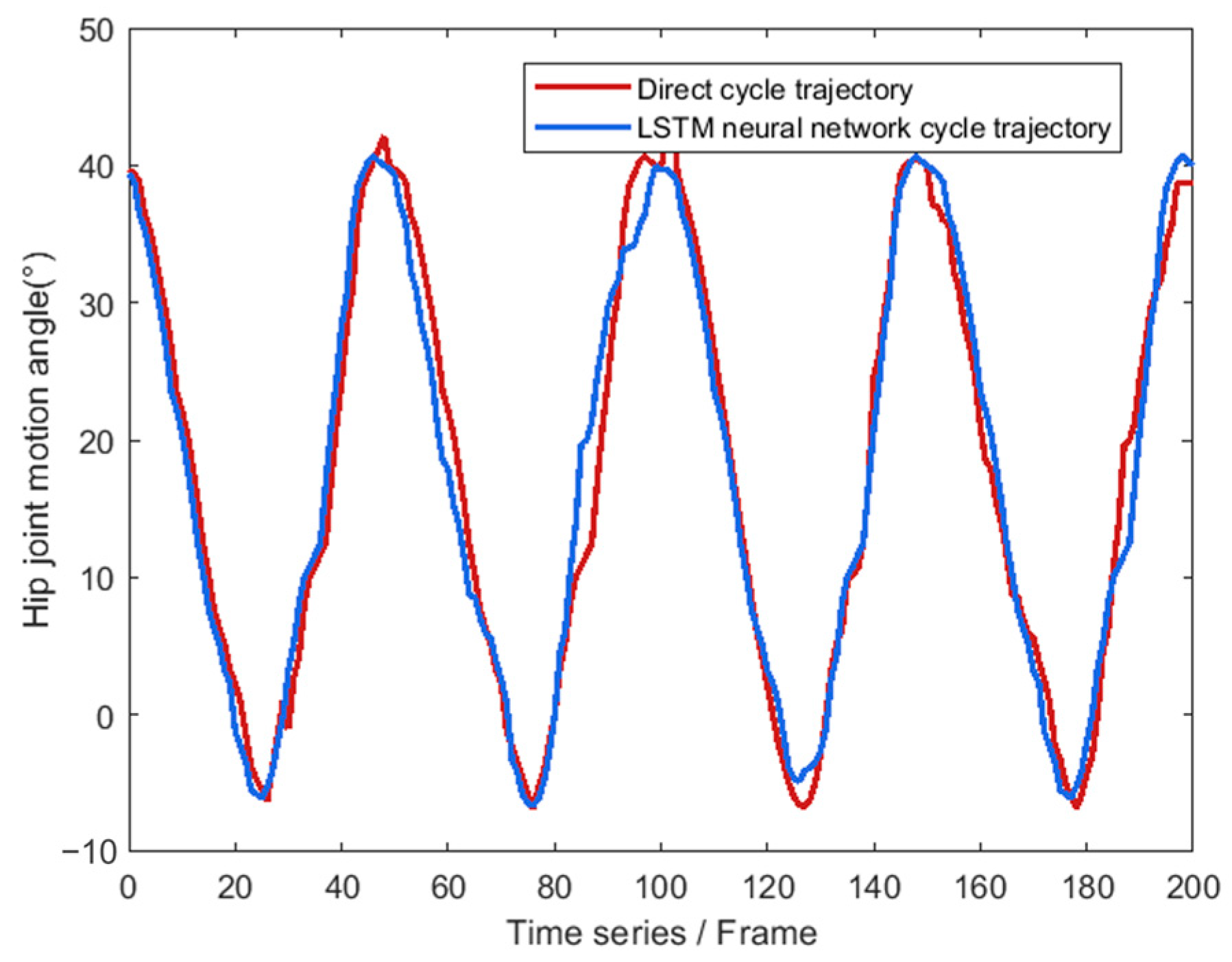
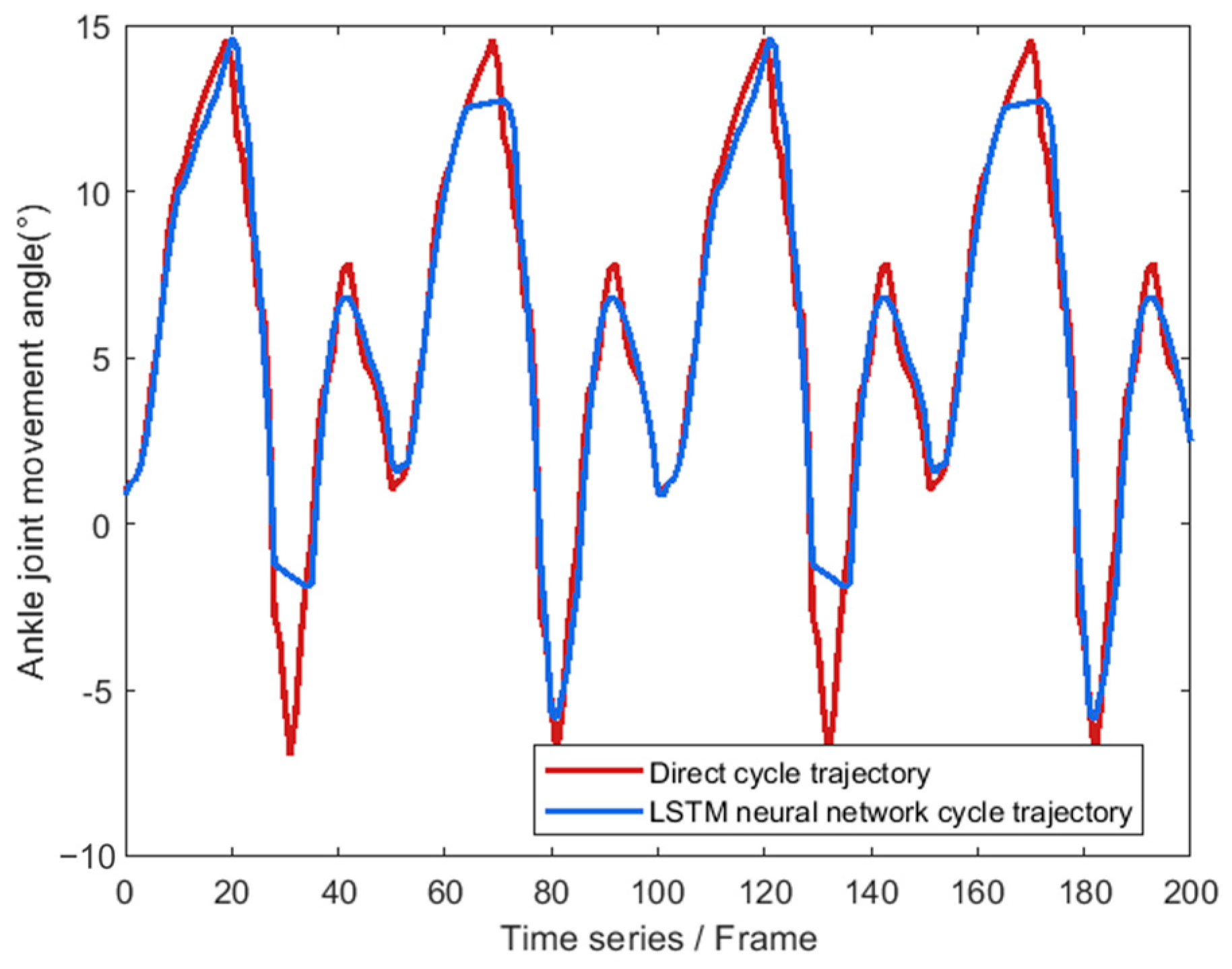
As shown in Figure 12 and Figure 13, comparative analysis of the direct cyclic gait planning method and the LSTM neural network prediction method reveals that the LSTM-based cyclic gait planning approach employed in this study significantly enhances both the movement cycle duration and joint motion continuity in gait rehabilitation training. Specifically, in ankle joint angle prediction (Figure 12), the LSTM method increased the amplitude from approximately 25° in the direct cycle to about 35°, extending the cycle by approximately 20%. In hip joint angle prediction (Figure 13), the range of motion in the LSTM-predicted trajectory expanded from approximately 70° in the direct cycle to about 90°, increasing the cycle duration by approximately 28.6%. These quantitative results demonstrate that the LSTM neural network can more accurately and stably predict joint motion angles for lower-limb exoskeleton rehabilitation robots during gait rehabilitation training. It effectively enhances smoothness and persistence during joint motion, thereby achieving comprehensive and systematic cyclic gait planning.

5. Experimental Analysis of Lower Limb Exoskeleton Rehabilitation Robots

5.1. Hardware System Design for Lower Limb Exoskeleton Rehabilitation Robot

5.1.1. Drive System Design

Based on the joint motion torques presented in [22], the maximum power during normal human walking was determined for the hip, knee, and ankle joints (including the stance support phase). Considering control margin requirements and referencing the characteristics of lower-limb exoskeleton rehabilitation robots, lightweight and compact disk motors were selected as the actuators for the joint system. The joint drive system employs MYACTUATOR LSG-142 and LSG-110 harmonic reduction disk servo motors from Pulsa Corporation (San Francisco, CA, USA).

5.1.2. Auxiliary System Design

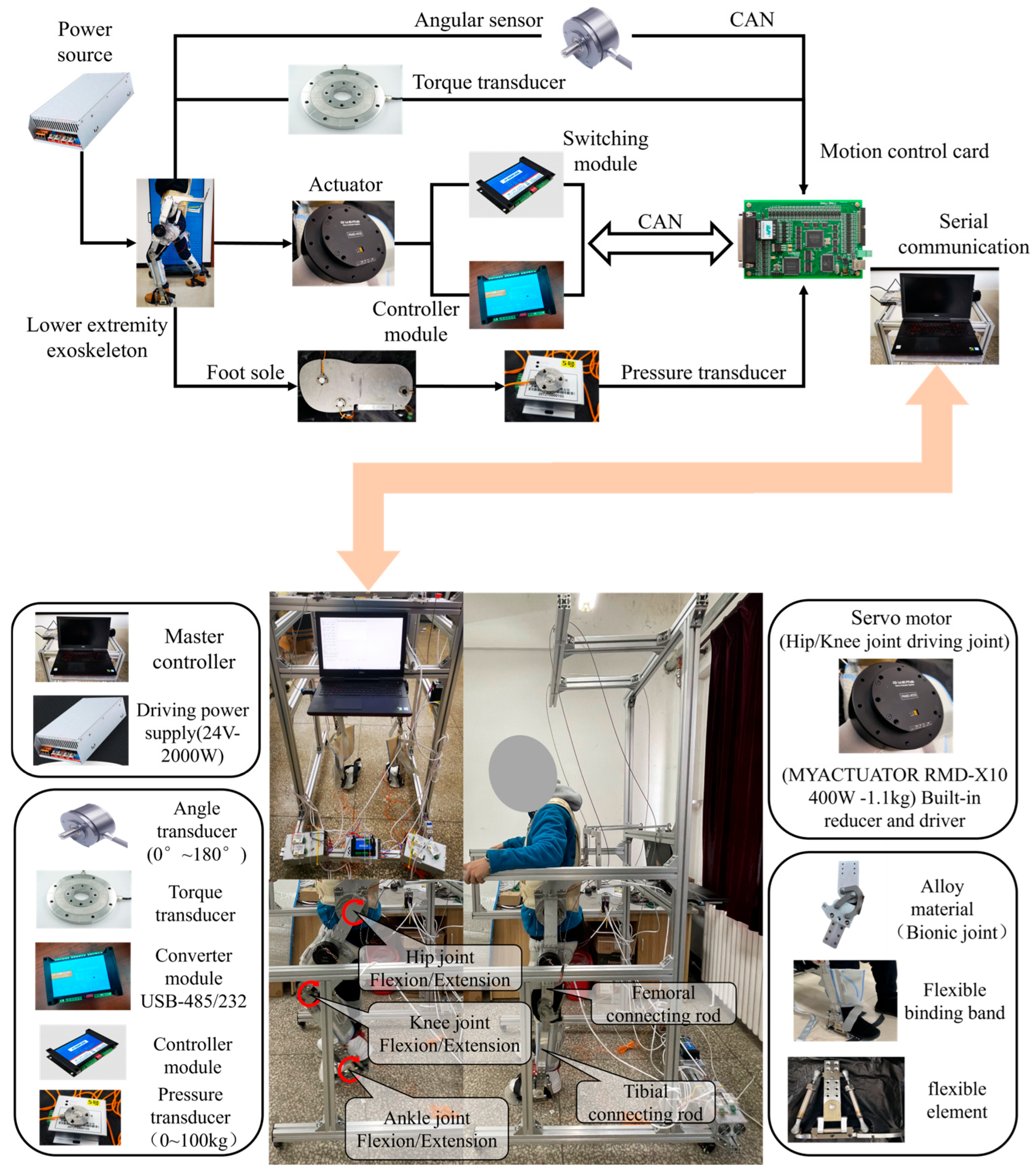
The lower-limb exoskeleton rehabilitation robot presented in this study uses a host computer to control passive rehabilitation training of the affected limb through a multi-joint coordinated gait rehabilitation approach. The overall system configuration is illustrated in Figure 14. The control system is centered around a host computer, which orchestrates continuous gait rehabilitation training for the affected limbs of patients with lower-limb movement disorders. Its core subsystem integrates a motion control card and a data acquisition card. The motion control card governs the movement of each joint, whereas the data acquisition card gathers data from various sensors, including pressure and angular displacement sensors. Via the host computer, operators can select rehabilitation training modes and configure movement parameters for each joint. These parameters are then transmitted to the motion control card. Simultaneously, data from the functional sensors is routed to the data acquisition card. After processing, the data acquisition card translates this sensory information into updated movement parameters. These updated parameters are sent to the motion control card, where they are converted into motor rotation commands. Finally, these commands are output to the corresponding joint motor drivers [23,24,25].
When designing control systems, ensuring patient safety and system stability are paramount. To prevent secondary injury to the affected limb from excessive motor torque, current detection and limit sensors are employed. Current output from the driver is continuously fed back to the motion control card, triggering an immediate shutdown if current exceeds permissible limits. Limit sensors at each joint continuously monitor bending angle changes, halting operation instantly if flexion exceeds the defined range. Additionally, a one-touch emergency stop function is integrated, enabling immediate system shutdown should the patient experience discomfort.

5.2. Study on Factors Affecting the Dynamic Stability of Lower-Limb Exoskeleton Rehabilitation Robots

5.2.1. The Influence of Gait Cycle on Dynamic Stability

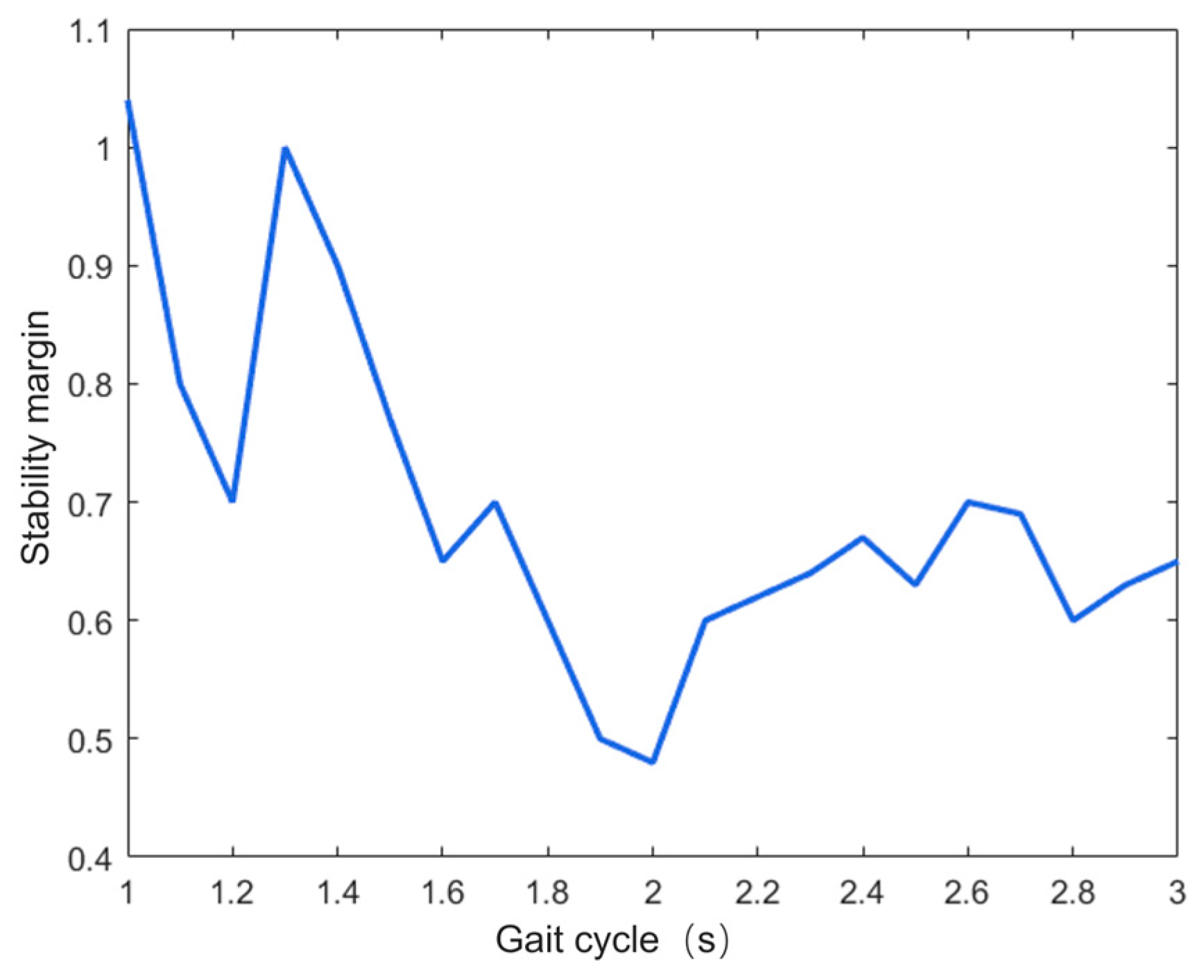
The gait cycle of the human lower limbs serves as a critical reference factor in lower limb rehabilitation training, with its impact on dynamic stability being paramount [26]. This paper analyzes the influence of gait cycle on dynamic stability during rehabilitation training using the ZMP stability criterion based on single-leg support swing projection polygon stability. The gait cycle is defined as the variable, while all other parameters remain constant. This study analyzed stability margin values across fifteen groups of different gait cycles, with the range spanning from 1 to 3 s. Figure 15 illustrates the variation in stability margin values under different gait cycles.
As shown in Figure 15, when the gait cycle falls between 1.3 s and 2 s, the stability margin value of the exoskeleton system decreases significantly with increasing gait cycle. However, when the gait cycle ranges from 2.2 s to 3 s, the stability margin value slightly increases with the increase in gait cycle and gradually stabilizes. Based on the analysis of dynamic stability effects across different gait cycles, the dynamic stability of the lower-limb exoskeleton rehabilitation robot is most stable when the gait cycle is controlled within the range of 2 to 2.2 s.

5.2.2. The Effect of Step Length on Dynamic Stability

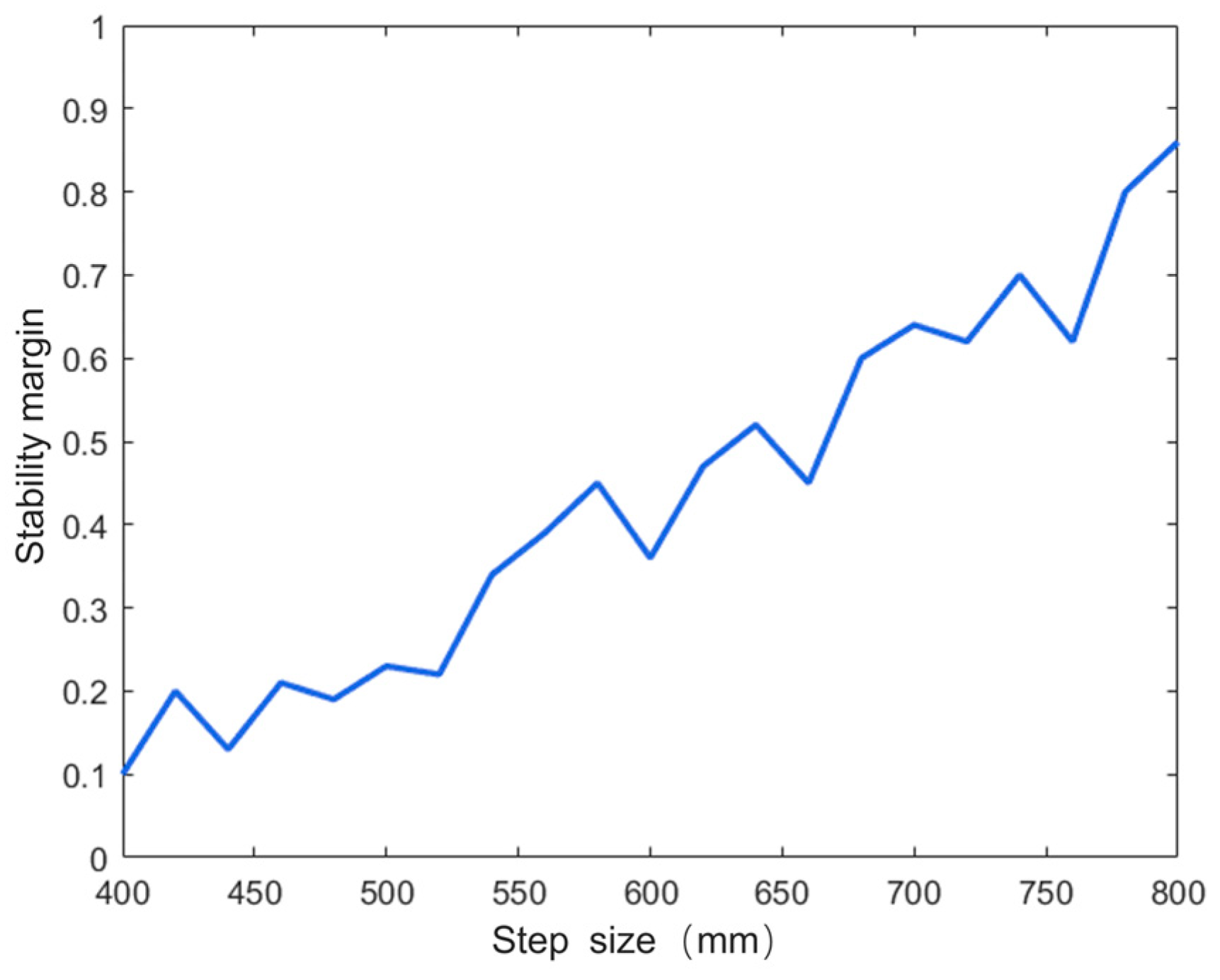
Stride length refers to the distance between two consecutive foot contact points on the same foot. This distance plays a crucial role in patients’ rehabilitation training and also significantly impacts dynamic stability. With stride length set as the variable and all other parameters held constant, the stride length parameter is calculated based on the lengths of lower limb segments and joint angles. This study analyzes and selects stability margins across fifteen different stride lengths, with the shortest and longest strides being 400 mm and 800 mm, respectively. Figure 16 illustrates the variation in stability margins under different stride lengths [27].
As shown in Figure 16, within the stride length range of 400 mm to 525 mm, the stability margin of dynamic stability flattens as stride length increases. Between 525 mm and 800 mm, the stability margin value continues to increase with stride length. Therefore, considering the stride length parameters characteristic of normal human gait, the stride length should be maintained within the range of 500 mm to 525 mm to ensure the dynamic stability of the lower-limb exoskeleton rehabilitation robot remains stable.

5.2.3. The Effect of Clearance Height on Dynamic Stability

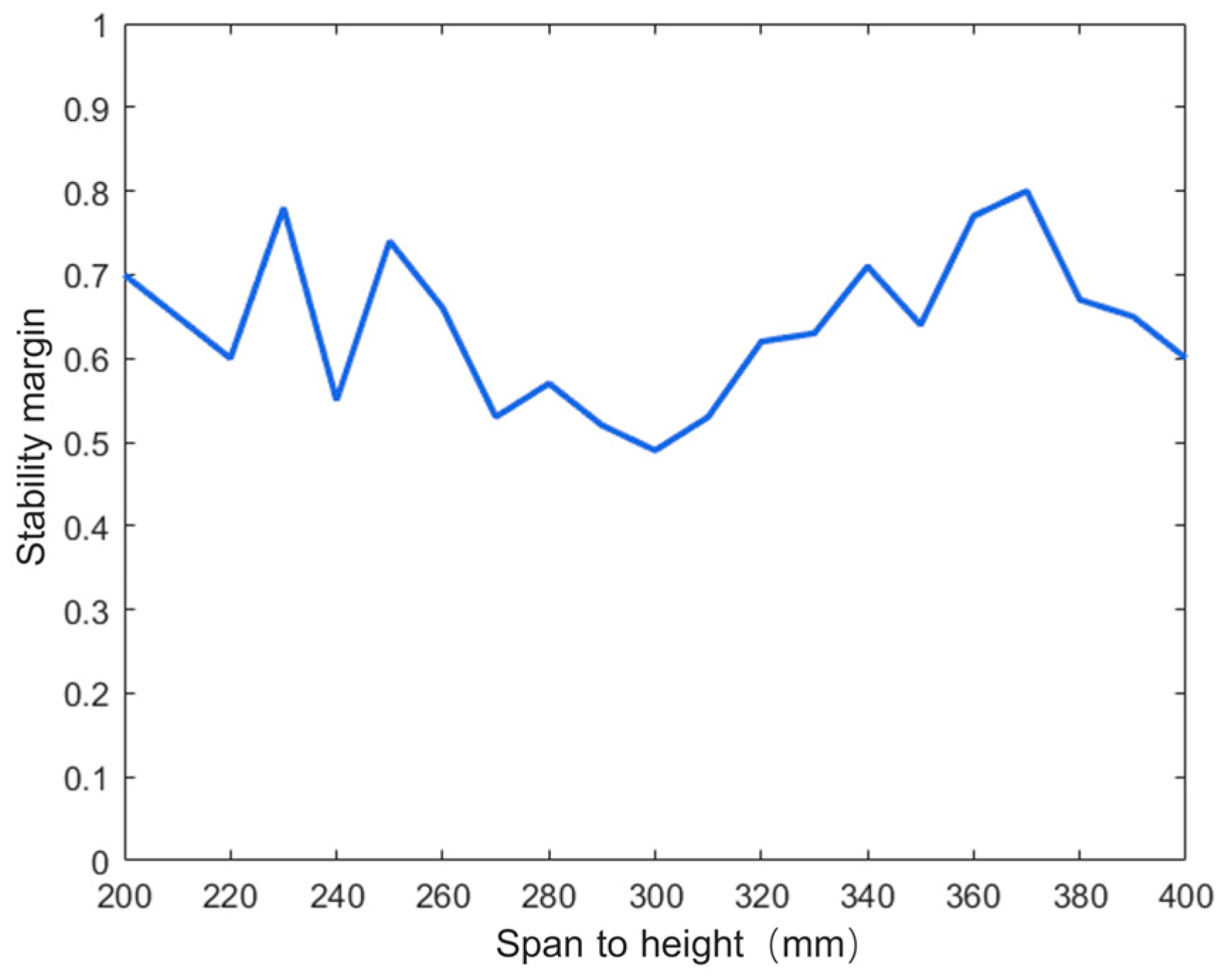
Striding height serves as an indicator for assessing normal human gait during rehabilitation training for individuals with lower limb movement disorders. Its height distance impacts the safety and stability of lower limb exoskeleton rehabilitation robotic systems. Therefore, employing the same parameter selection method as above, this study analyzes the impact of stride height variations on the stability margin of lower-limb exoskeleton rehabilitation robots. Fifteen sets of stability margin values were selected across stride heights ranging from a minimum of 200 mm to a maximum of 400 mm. Figure 16 illustrates the changes in stability margin under different stride heights. As evident from Figure 17, the stability margin values exhibit a consistent trend of gradual stability within the specified stride height range. To ensure the safety and stability of human–robot system movements, this study selects a stride height range between 280 mm and 310 mm where the stability margin remains relatively stable.

5.3. Experimental Analysis of Dynamic Stability Characteristics of Walking Posture

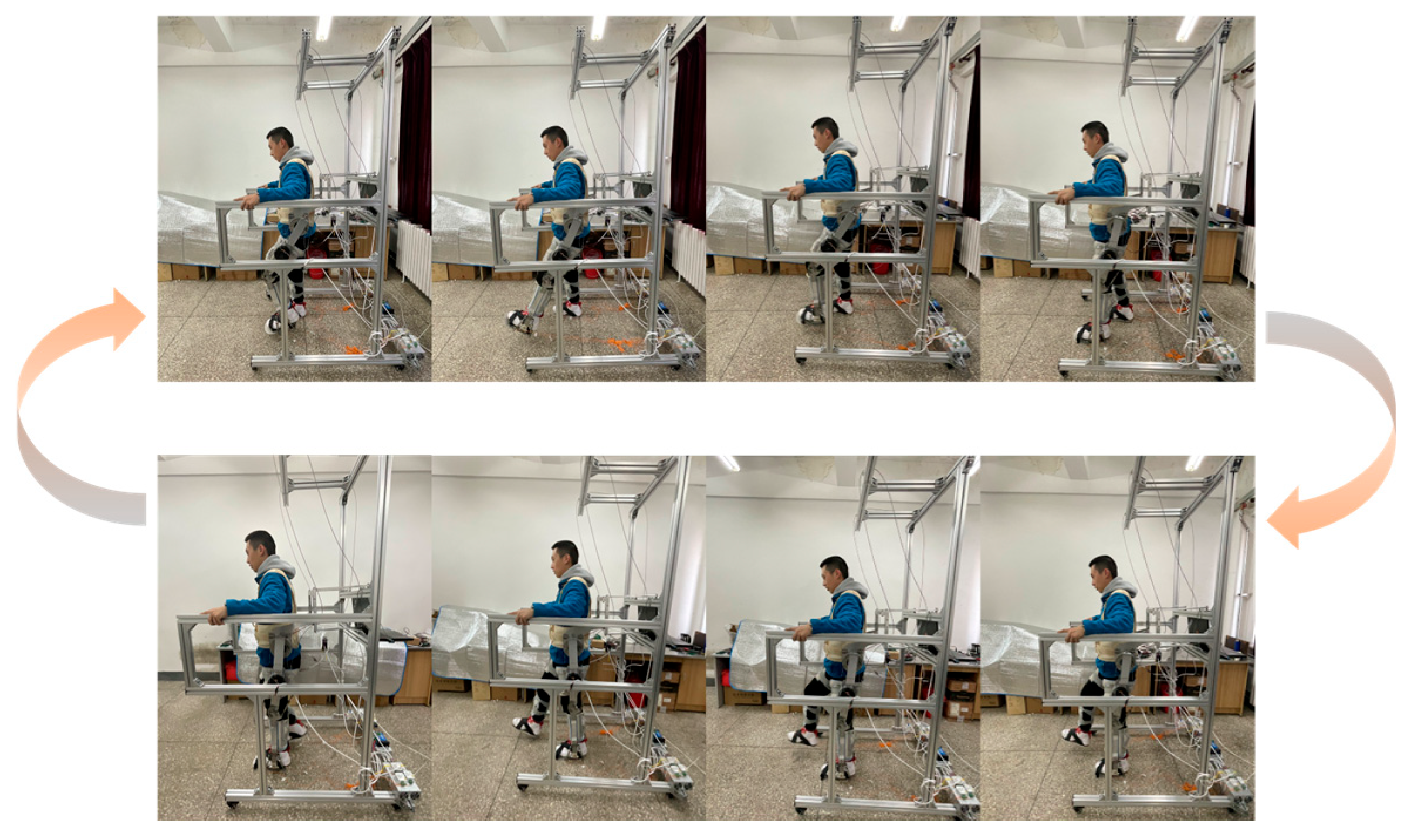
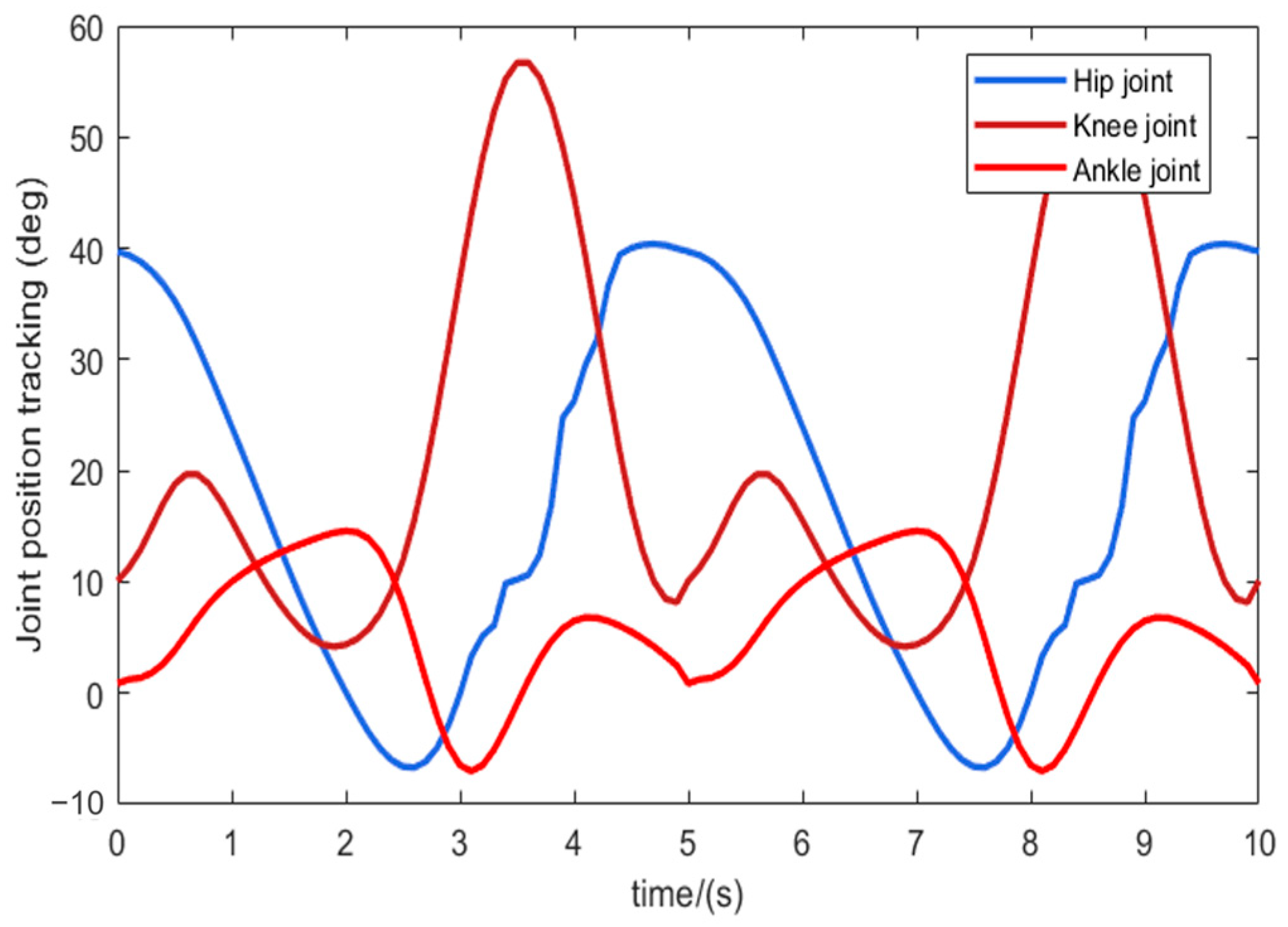
To better validate the stability of gait motion trajectories in lower-limb exoskeleton rehabilitation robot gait training, the sagittal plane lower-limb exoskeleton kinematic model described in Section 3 of Reference [17] was employed (shown in Figure 18). The dynamics model of the lower limb exoskeleton rehabilitation robot was determined by applying ADAMS simulation software (ADAMS 2019) with the given dimensions of each linkage. At the same time, the Qualisys 3D motion capture analysis system was used in the form of combining with CGA gait data to obtain the correct gait motion trajectory that meets and satisfies the lower limb rehabilitation training of different patients. As shown in Figure 19, the subjects completed the complete gait walking training of human lower limbs within 10 s, and the motion angle data of each joint captured by the 3D motion capture system was exported to MATLAB 2021b softwarefor smoothing, in which the desired trajectories of three motion joints are shown in Figure 19. Among them are the hip flexion/extension motion, knee flexion/extension motion, and ankle dorsiflexion/stumbling flexion motion, respectively.
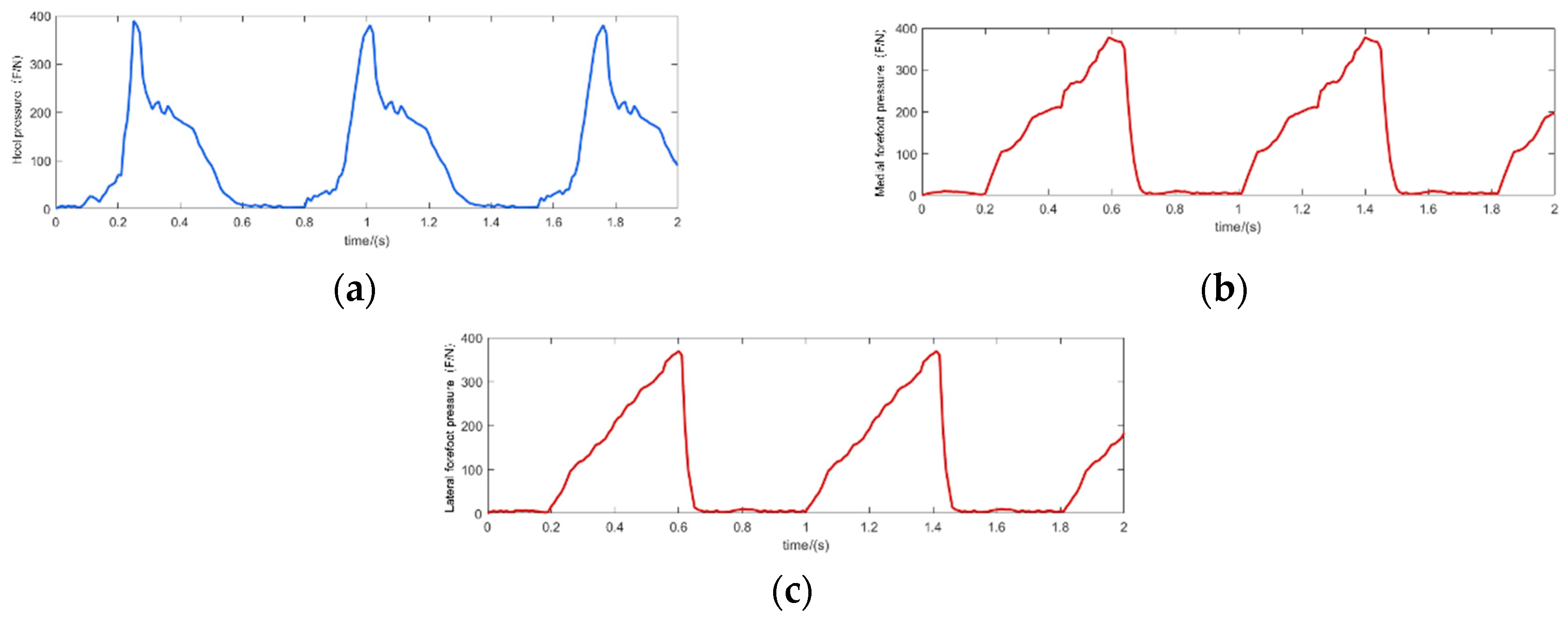
Walking posture is a very common type of posture. The aforementioned analysis of gait corresponding to walking posture reveals that walking motion is primarily accomplished through alternating support from both legs and single legs. During walking, the shape of the stability polygon changes with different walking postures. Section 2 analyzes the stability characteristics of the stability polygon’s changes during walking and the spatial relationship between the human–machine system’s ZMP and the stability polygon, calculating the instability rate for each state. Below, we analyze the ZMP variation during walking postures and the dynamic stability characteristics of the entire system through experimental methods. During walking tests across the aforementioned walking posture phases, foot pressure was measured using pressure sensors. The measurement results are shown in Figure 20.
As can be seen in the Figure 20 analysis, in the human body during normal walking, plantar pressure distribution process occurs at three points: with the heel on the ground, the pressure increases; with the forefoot empty, there is no pressure (as Figure 20a); and with the forefoot on the ground, heel pressure decreases (as Figure 20b). When the subject walks in normal gait, the pressure and time of the three points show a cyclic pattern, and the pressure on the medial forefoot is slightly larger than that on the lateral forefoot, because the design of the foot soleplate of the lower limb exoskeleton rehabilitation robot is wider than that of a normal human foot, and because the foot soleplate is stiffer, which leads to the change in the pressure distribution. The overall pressure distribution pattern is still cyclic, which is consistent with the cyclic movement characteristics of human gait.
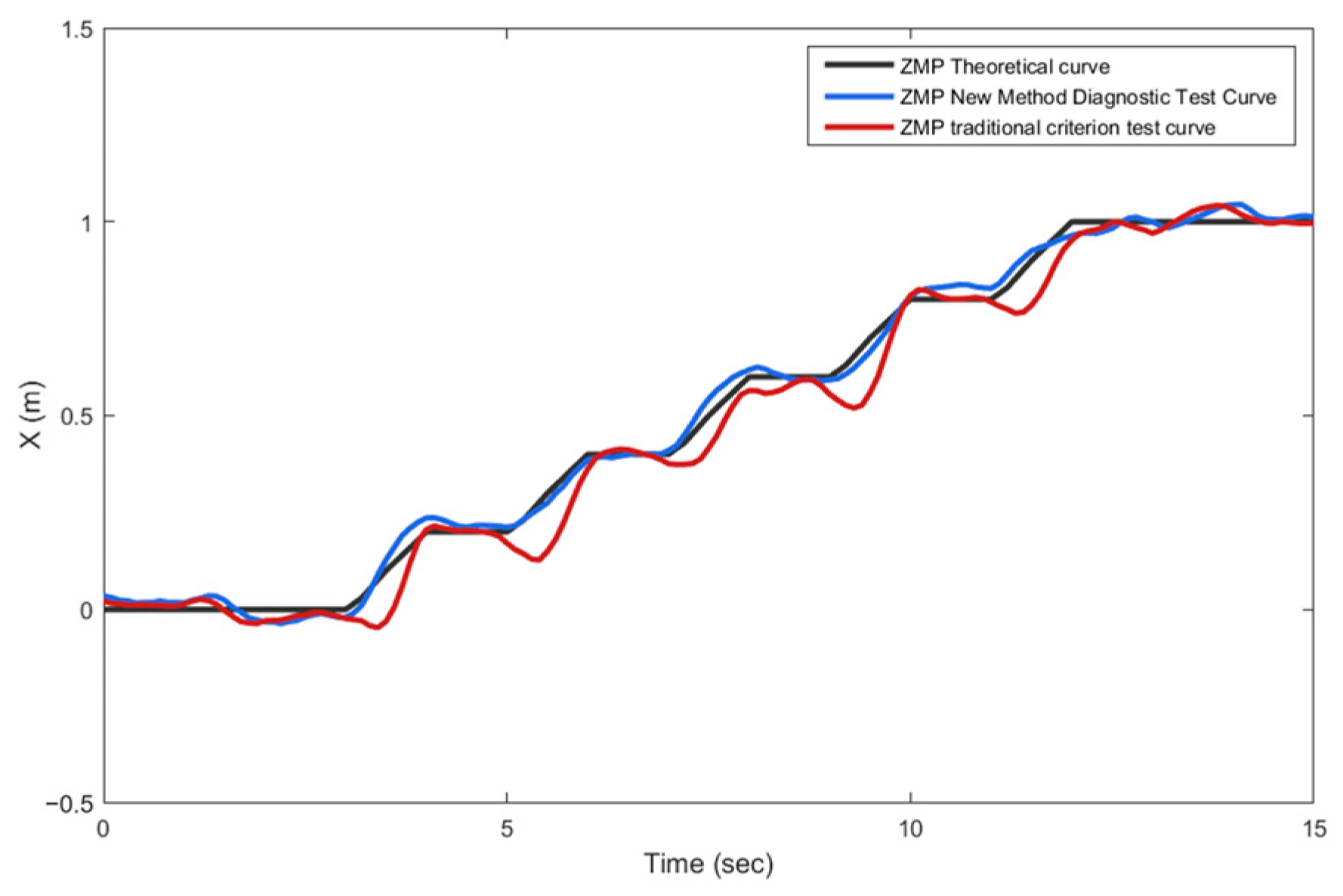
Based on the foot pressure value change curve, simulation analysis yields the theoretical and experimental ZMP change curves. As shown in Figure 21, the ZMP exhibits a stepwise upward trajectory along the X-axis. During walking, the phase where displacement occurs along the X-axis primarily corresponds to the single-leg support phase, during which the swing leg moves forward. Consequently, the human–machine center of gravity shifts forward, resulting in displacement along the X-axis. Figure 21 demonstrates that the experimentally obtained ZMP curve of the human–machine system and the theoretical ZMP curve exhibit essentially consistent trends. Between the 5 s–10 s cycle, the ZMP shows a reverse movement tendency. This occurs because during the process of the swing leg’s toe lifting off the ground and raising upward, the entire human–machine system undergoes a slight backward tilt.

6. Conclusions

To ensure stable and smooth gait training during patient rehabilitation, this study investigated the dynamic stability of a human–exoskeleton system across various motion postures based on the Zero Moment Point (ZMP) theory. We identified limitations of the traditional ZMP criterion during the late single-leg support phase and proposed an enhanced stability criterion based on a swing projection polygon for single-leg support, effectively addressing the instability issues inherent in conventional methods during human-like gait. Furthermore, gait parameters of the lower-limb exoskeleton rehabilitation robot were optimized using the whale optimization algorithm, significantly improving the stability and smoothness of the gait trajectory.
A recurrent gait planning method based on Long Short-Term Memory (LSTM) neural networks was also developed. By leveraging the periodic characteristics of human gait, this method enables continuous and natural motion generation, effectively overcoming the non-intuitive and discontinuous gait planning issues associated with traditional ZMP-based methods. To validate gait motion stability in practical applications, a comparative experimental analysis of ZMP-based dynamic stability was conducted. The results demonstrated that the theoretical and experimental ZMP trajectories were highly consistent. Throughout the gait cycle, the ZMP remained within the stable region, confirming the dynamic stability of the motion postures. Notably, during the 5–10 s interval, a slight reverse ZMP shift was observed, attributable to the backward tilting of the system during the swing leg’s toe-off and lift phase.
In addition, we systematically evaluated the influence of three key gait parameters—gait cycle, stride length, and step height—on dynamic stability. The analysis revealed that the system exhibits optimal stability when the gait cycle is controlled within 2–2.2 s, the stride length is maintained between 500 and 525 mm, and the step height is set within 280–310 mm. Under these conditions, the stability margin remains smooth and consistently high, ensuring safe and stable bipedal walking for the lower-limb exoskeleton rehabilitation robot. In summary, this study not only proposes an improved ZMP-based stability criterion and a robust LSTM-based gait planner but also identifies a set of optimized gait parameters validated through experimental tests. These contributions collectively enhance the stability, safety, and applicability of lower-limb exoskeleton systems in clinical gait rehabilitation.

Author Contributions

In this work, J.L. and Z.W. conceived and designed the experiments; B.W. gave some constructive suggestions; W.Y. and J.B. performed the experiments; Y.Z. and G.Z. analyzed the data; H.J. and Y.N. guided the writing of the article and made some modifications; and M.G. wrote the paper. All authors have read and agreed to the published version of the manuscript.

Funding

This work was supported by the Key Research and Development Project (No. 20240305035YY) of the Jilin Provincial Science and Technology Development Plan—Pharmaceutical and Health Industry Division.

Institutional Review Board Statement

This study was conducted in accordance with the Notice on Issuing the Ethical Review Measures for Life Sciences and Medical Research Involving Human Subjects of the People’s Republic of China. It adheres to internationally recognized ethical and regulatory standards for educational research (e.g., Exemption Category 1 under Article 32, Chapter 3 of the Ethical Review Measures for Life Sciences and Medical Research Involving Human Subjects issued by the National Health Commission of the People’s Republic of China; Research that does not cause harm to human subjects, does not involve sensitive personal information or commercial interests, and may be exempted from ethics review to reduce unnecessary burdens on researchers and promote the advancement of life science and medical research involving human subjects) and was conducted in a routine educational setting with minimal risk, formal ethics committee approval was not required. Furthermore, this study was implemented in natural classroom settings without interfering with teaching activities or academic assessments. It exclusively utilized anonymized data with all personally identifiable information permanently removed, thereby qualifying for exemption from ethics review and approval.

Informed Consent Statement

Not applicable.

Data Availability Statement

The data presented in this study are available in [J. Linskell. CGA Normative Gait Database]. These data were derived from the following resources available in the public domain: [http://www.clinicalgaitanalysis.com/data/, accessed on 5 October 2025].

Conflicts of Interest

The authors declare no conflicts of interest.

References

  1. Yu, F.; Liu, Y.; Wu, Z.; Tan, M.; Yu, J. Adaptive Gait Training of a Lower Limb Rehabilitation Robot Based on Human–Robot Interaction Force Measurement. Cyborg Bionic Syst. 2024, 5, 0115. [Google Scholar] [CrossRef]
  2. Zhou, J.; Sun, Y.; Song, R.; Wei, Z. Dynamic movement primitives modulation-based compliance control for a new sitting/lying lower limb rehabilitation robot. IEEE Access 2024, 12, 44125–44134. [Google Scholar] [CrossRef]
  3. Zhou, J.; Peng, H.; Zheng, M.; Wei, Z.; Fan, T.; Song, R. Trajectory deformation-based multi-modal adaptive compliance control for a wearable lower limb rehabilitation robot. IEEE Trans. Neural Syst. Rehabil. Eng. 2024, 32, 314–324. [Google Scholar] [CrossRef]
  4. Cao, L.; Zhang, J.; Zhang, P.; Fang, D. Research on the Influence of Exoskeletons on Human Characteristics by Modeling and Simulation Using the AnyBody Modeling System. Appl. Sci. 2023, 13, 8184. [Google Scholar] [CrossRef]
  5. Wang, X.; Wang, H.; Zhang, B.; Zheng, D.; Yu, H.; Cheng, B.; Niu, J. A multistage hemiplegic lower-limb rehabilitation robot: Design and gait trajectory planning. Sensors 2024, 24, 2310. [Google Scholar] [CrossRef]
  6. Vallery, H.; Van Asseldonk, E.H.; Buss, M.; Van Der Kooij, H. Reference trajectory generation for rehabilitation robots: Complementary limb motion estimation. IEEE Trans. Neural Syst. Rehabil. Eng. 2008, 17, 23–30. [Google Scholar] [CrossRef] [PubMed]
  7. Pfister, A.; West, A.M.; Bronner, S.; Noah, J.A. Comparative abilities of Microsoft Kinect and Vicon 3D motion capture for gait analysis. J. Med. Eng. Technol. 2014, 38, 274–280. [Google Scholar] [CrossRef]
  8. Li, S.; Su, C.; Huang, L.; Huang, S.; Xie, L. Personalized passive training control strategy for a lower limb rehabilitation robot with specified step lengths. Intell. Serv. Robot. 2025, 18, 137–156. [Google Scholar] [CrossRef]
  9. Kajita, S.; Kanehiro, F.; Kaneko, K.; Yokoi, K.; Hirukawa, H. The 3D linear inverted pendulum mode: A simple modeling for a biped walking pattern generation. In Proceedings of the 2001 IEEE/RSJ International Conference on Intelligent Robots and Systems. Expanding the Societal Role of Robotics in the Next Millennium, Maui, HI, USA, 29 October–3 November 2001; IEEE: New York, NJ, USA, 2001; Volume 1, pp. 239–246. [Google Scholar]
  10. Sczesny-Kaiser, M.; Höffken, O.; Aach, M.; Cruciger, O.; Grasmücke, D.; Meindl, R.; Schildhauer, T.; Schwenkreis, P.; Tegenthoff, M. HAL® exoskeleton training improves walking parameters and normalizes cortical excitability in primary somatosensory cortex in spinal cord injury patients. J. Neuroeng. Rehabil. 2015, 12, 68. [Google Scholar] [CrossRef]
  11. Nishiwaki, K.; Kagami, S. Simultaneous planning of CoM and ZMP based on the preview control method for online walking control. In Proceedings of the 11th IEEE-RAS International Conference on Humanoid Robots, Bled, Slovenia, 26–28 October 2011; IEEE: New York, NJ, USA, 2011; pp. 745–751. [Google Scholar]
  12. Jafar, K.; Sadjaad, O. Real-time walking pattern generation for a lower limb exoskeleton, implemented on the Exposed robot. Robot. Auton. Syst. 2019, 116, 1–23. [Google Scholar]
  13. Chen, Q.; Cheng, H.; Yue, C.; Huang, R.; Guo, H. Dynamic Balance Gait for Walking Assistance Exoskeleton. Appl. Bionics Biomech. 2018, 2018, 7847014. [Google Scholar] [CrossRef]
  14. Santacruz, C.; Nakamura, Y. Walking motion generation of humanoid robots: Connection of orbital energy trajectories via minimal energy control. In Proceedings of the IEEE-RAS International Conference on Humanoid Robots, Bled, Slovenia, 26–28 October 2011; IEEE: New York, NJ, USA, 2011; pp. 695–700. [Google Scholar]
  15. Duschau-Wicke, A.; Caprez, A.; Riener, R. Patient-cooperative Control Increases Active Participation of Individuals with SCI During Robot-aided Gait Training. J. Neuroeng. Rehabil. 2010, 7, 43–55. [Google Scholar] [CrossRef]
  16. Nilsson, A.; Vreede, K.S.; Häglund, V.; Kawamoto, H.; Sankai, Y.; Borg, J. Gait Training Early after Stroke with a New Exoskeleton–the Hybrid Assistive Limb: A Study of Safety and Feasibility. J. Neuroeng. Rehabil. 2014, 11, 92. [Google Scholar] [CrossRef]
  17. Gao, M.; Wang, Z.; Pang, Z.; Sun, J.; Li, J.; Li, S.; Zhang, H. Electrically driven lower limb exoskeleton rehabilitation robot based on anthropomorphic design. Machines 2022, 10, 266. [Google Scholar] [CrossRef]
  18. Tlalolini, D.; Chevallereau, C.; Aoustin, Y. Comparison of different gaits with rotation of the feet for a planar biped. Robot. Auton. Syst. 2009, 57, 371–383. [Google Scholar] [CrossRef]
  19. Zheng, Y.; Wang, Y.; Liu, J. Analysis and experimental research on stability characteristics of squatting posture of wearable lower limb exoskeleton robot. Future Gener. Comput. Syst. 2021, 125, 352–363. [Google Scholar] [CrossRef]
  20. Alam, N.; Hasan, S.; Mashud, G.A.; Bhujel, S. Neural Network for Enhancing Robot-Assisted Rehabilitation: A Systematic Review. Actuators 2025, 14, 16. [Google Scholar] [CrossRef]
  21. Jia, L.; Ai, Q.; Meng, W.; Liu, Q.; Xie, S.Q. Individualized gait trajectory prediction based on fusion LSTM networks for robotic rehabilitation training. In Proceedings of the 2021 IEEE/ASME International Conference on Advanced Intelligent Mechatronics (AIM), Delft, The Netherlands, 12–16 July 2021; IEEE: New York, NJ, USA, 2021; pp. 988–993. [Google Scholar]
  22. Li, J.; Jiang, H.; Gao, M.; Li, S.; Wang, Z.; Pang, Z.; Zhang, Y.; Jiao, Y. Research on Iterative Learning Method for Lower Limb Exoskeleton Rehabilitation Robot Based on RBF Neural Network. Appl. Sci. 2025, 15, 6053. [Google Scholar] [CrossRef]
  23. Xing, Y.; Jiao, W. Control Method of Lower Limb Rehabilitation Robot Based on Nonlinear Time Series Prediction Model and Sensor Technology. IEEE Access 2024, 12, 152532–152543. [Google Scholar] [CrossRef]
  24. Wang, A.; Dong, J.; Teng, R.; Liu, P.; Yue, X.; Zhang, X. A Hierarchical Distributed Control System Design for Lower Limb Rehabilitation Robot. Technologies 2025, 13, 462. [Google Scholar] [CrossRef]
  25. Leerskov, K.S.; Spaich, E.G.; Jochumsen, M.R.; Andreasen Struijk, L.N.S. Design and Demonstration of a Hybrid FES-BCI-Based Robotic Neurorehabilitation System for Lower Limbs. Sensors 2025, 25, 4571. [Google Scholar] [CrossRef] [PubMed]
  26. Yan, Q.; Zhang, J.; Li, B.; Zhou, L. Kinematic analysis and dynamic optimization simulation of a novel unpowered exoskeleton with parallel topology. J. Robot. 2019, 2019, 2953830. [Google Scholar] [CrossRef]
  27. Wang, B.; Du, Y.; Sun, X.; Lin, J. Study of humanoid robot gait based on human walking captured data. In Proceedings of the 2015 34th Chinese Control Conference (CCC), Hangzhou, China, 28–30 July 2015; IEEE: New York, NJ, USA, 2015; pp. 4480–4485. [Google Scholar]
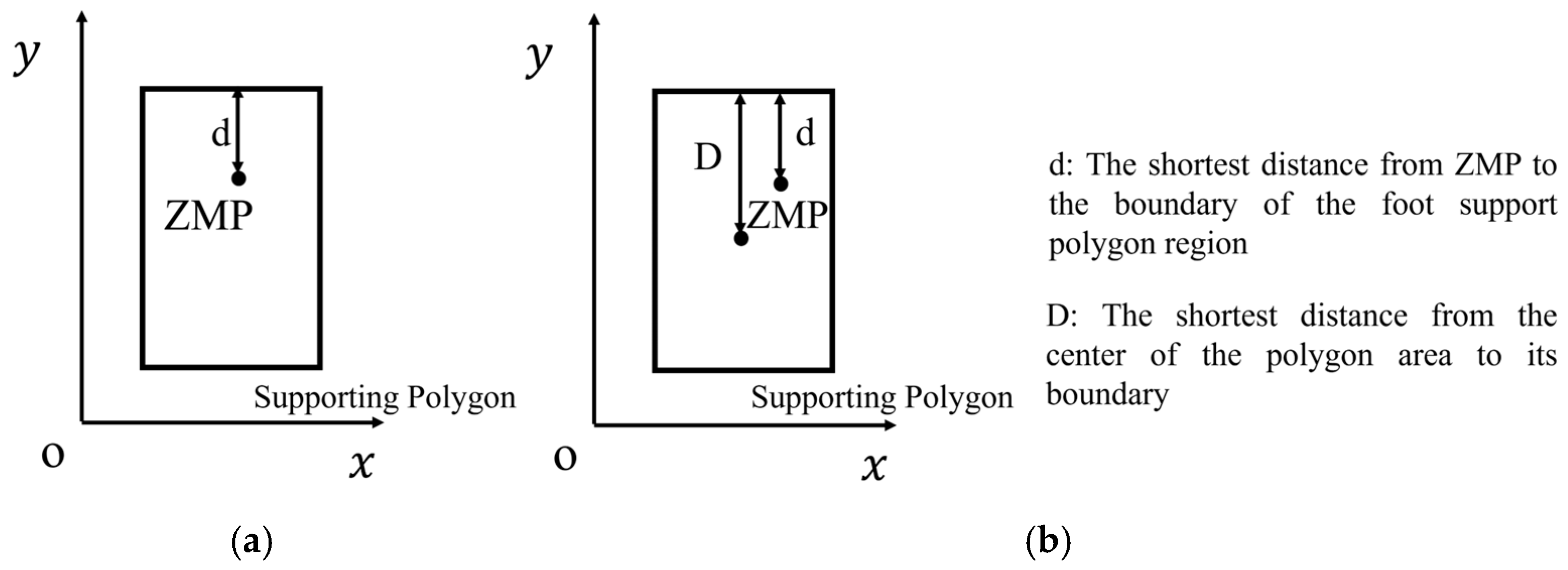
Figure 1. ZMP Stability Margin Criterion Method: (a) Shortest Distance Method; (b) Distance Ratio Method.
Applsci 16 00402 g001
Figure 2. The movement rule of ZMP in gait cycle.
Applsci 16 00402 g002
Figure 3. Simplified model of single foot support swing projection polygon stability criterion.
Applsci 16 00402 g003
Figure 4. Simplified model of stability criterion for single-leg support polygon.
Applsci 16 00402 g004
Figure 5. Simplified model of stable area of right foot support and left foot toe touchdown stage.
Applsci 16 00402 g005
Figure 6. Gait movement stage.
Applsci 16 00402 g006
Figure 7. Trajectory curve of swing leg hip joint after optimization: (a) Trajectory curve of the swing leg hip joint after X-axis optimization; (b) Trajectory curve of swing leg hip joint after Z-axis optimization; (c) The trajectory curve of the swing leg hip joint after X-axis optimization; and (d) Trajectory curve of swing leg hip joint after Z-axis optimization.
Applsci 16 00402 g007
Figure 8. Hip joint motion angle curve.
Applsci 16 00402 g008
Figure 9. Ankle joint motion angle curve.
Applsci 16 00402 g009
Figure 10. Hip joint optimization process diagram.
Applsci 16 00402 g010
Figure 11. Ankle joint optimization process diagram.
Applsci 16 00402 g011
Figure 12. LSTM neural network predicts time series of the hip joint motion angle.
Applsci 16 00402 g012
Figure 13. LSTM neural network predicts time series of the ankle joint motion angle.
Applsci 16 00402 g013
Figure 14. Hardware control system diagram of lower extremity exoskeleton rehabilitation robot.
Applsci 16 00402 g014
Figure 15. Dynamic stability evaluation parameters under different gait cycles.
Applsci 16 00402 g015
Figure 16. Dynamic stability evaluation parameters under different step sizes.
Applsci 16 00402 g016
Figure 17. Dynamic stability evaluation parameters under different span heights.
Applsci 16 00402 g017
Figure 18. Lower limb gait rehabilitation training.
Applsci 16 00402 g018
Figure 19. Movement trajectories of lower limb joints.
Applsci 16 00402 g019
Figure 20. Foot pressure map of a lower extremity exoskeleton rehabilitation robot. (a) Heel pressure; (b) medial forefoot pressure; and (c) lateral forefoot pressure.
Applsci 16 00402 g020
Figure 21. ZMP theory and experimental comparison curve.
Applsci 16 00402 g021
Table 1. LSTM with different structures predicts the angle error of exoskeleton robot walking motion.
Number of Network Layers and Number of Neurons per LayerMean Square Error
Hip Exoskeleton
Motion Angle
Ankle Exoskeleton
Motion Angle
Monolayer (100 neurons)0.01300.0110
Monolayer (200 neurons)0.00560.0061
Monolayer (300 neurons)0.00450.0093
Double layer (100 neurons)0.00900.0047
Double layer (200 neurons)0.00210.0064
Double layer (300 neurons)0.00240.0037
Three layers (100 neurons)0.00450.0022
Three layers (200 neurons)0.00330.0019
Three layers (300 neurons)0.00110.0012
Disclaimer/Publisher’s Note: The statements, opinions and data contained in all publications are solely those of the individual author(s) and contributor(s) and not of MDPI and/or the editor(s). MDPI and/or the editor(s) disclaim responsibility for any injury to people or property resulting from any ideas, methods, instructions or products referred to in the content.