Article

A Seismic Horizon Identification Method Based on scSE-VGG16-UNet++

by
Qin Wang
,
Cai Liu
,
Yang Liu
,
Jiaqi Fan
,
Dian Wang
,
Qi Lu
and
Peng Li
*
College of Geo-Exploration Science and Technology, Jilin University, Changchun 130026, China
*
Author to whom correspondence should be addressed.
Appl. Sci. 2026, 16(1), 394; https://doi.org/10.3390/app16010394 (registering DOI)
Submission received: 27 November 2025 / Revised: 22 December 2025 / Accepted: 28 December 2025 / Published: 30 December 2025

Abstract

The accuracy of seismic horizon identification results significantly impacts the precision of subsequent structural interpretation and reservoir analysis, making it a critical step in seismic data interpretation. While deep learning achieves horizon identification by establishing a mapping relationship between seismic data and training labels, networks often struggle to learn effectively when faced with highly similar profile features within the same survey area, leading to issues such as discontinuities and horizon mis-ties. To fully leverage the spatial relationships between seismic horizons and enhance network feature extraction capabilities, this paper proposes a progressive methodology based on the VGG16-UNet architecture. This paper first employs data augmentation to enrich seismic profile features and then introduces the Spatial and Channel Squeeze and Excitation (scSE) attention mechanism to improve the representation of salient features, designing the scSE-VGG16-UNet architecture. Building on this foundation, the deep supervision mechanism from UNet++ is integrated to finally propose the data-augmented scSE-VGG16-UNet++ method for seismic horizon identification. Quantitatively, the baseline VGG16-UNet method achieves a Pixel Accuracy (PA) and mean Intersection over Union (mIoU) of only 93.01% and 46.96%, respectively. Through the synergistic effect of data augmentation, the scSE attention mechanism, and the UNet++ architecture, the final data-augmented scSE-VGG16-UNet++ method elevates these metrics to 97.70% and 79.23%. The test results on both model data and field data demonstrate that the proposed method not only achieves high-continuity horizon identification and effectively mitigates the problem of horizon mis-ties, but also exhibits robust performance in the presence of noise, indicating superior generalization ability.

1. Introduction

In recent years, a stable supply of strategic resources, such as oil and gas, has become an essential cornerstone for maintaining national energy security and ensuring sustained economic development [1]. Seismic reflection data provide a primary source of subsurface structural information for hydrocarbon exploration. Interpreted seismic horizons constrain stratigraphic architecture, structural relief, and subsequent reservoir modeling [2,3], which are critical for predicting the location, size, and geometry of hydrocarbon reservoirs. Moreover, reliable horizon identification supports seismic stratigraphic interpretation and seismic geomorphology analysis, thereby improving the reliability of downstream tasks such as reservoir characterization and geological modeling [4].
Horizon identification is traditionally categorized into three approaches: manual picking, automatic identification, and intelligent identification. Automatic horizon identification mainly includes waveform-similarity-based methods [5] and image-processing-based methods. Marfurt et al. first introduced coherence-based techniques for automated horizon interpretation in 1998 [6]. Subsequently, the second-generation algorithm proposed by Gersztenkorn et al. significantly improved stability and noise resistance through multi-channel processing [7]. Dynamic time warping (DTW) provides an alternative formulation for horizon tracking, although its performance can be limited in localized regions such as faults [8]. To mitigate this limitation, Yan and Wu obtained an initial horizon via interpolation and then used dynamic programming with DTW to search for an optimal path corresponding to global maximum (or minimum) amplitudes within sub-volumes, thereby achieving horizon extraction [9]. Image-based automatic identification methods have commonly employed techniques such as image processing [10] and edge detection [11]. For instance, Faraklioti et al. performed correlation analysis on small horizon fragments using image-processing strategies [12]. Li et al. used the Canny operator for edge detection on seismic profiles [13]. Building upon this foundation, Li et al. experimented with five different edge detection operators for horizon identification [14]. Despite these advances, traditional approaches still face practical challenges, including sensitivity to seed-point selection, reduced performance under low signal-to-noise ratios, and difficulties in tracking discontinuous reflectors [15].
In recent years, Artificial Intelligence (AI) has emerged as a core driver of the Fourth Industrial Revolution [16], providing powerful momentum for the improvement and transformation of traditional technologies. Since the seminal neuron-inspired model proposed by McCulloch and Pitts [17], a series of neural-network models has been developed, including the perceptron [18], backpropagation-based networks [19], self-organizing feature maps [20], Hopfield networks [21], bidirectional associative memory networks [22], and convolutional neural networks [23]. In engineering, deep learning has been widely applied to time-series tasks, such as remaining useful life (RUL) prediction and time-series forecasting [24]. In the field of seismic exploration, benefiting from the availability of large-scale datasets, deep learning methods have also been widely used for seismic interpretation, classification, and recognition tasks [25]. For example, Wu et al. proposed an encoder–decoder convolutional network for automated horizon tracking [26]. To alleviate the scarcity of labeled samples, Di et al. developed a semi-supervised strategy for horizon identification [27]. Shi et al. proposed an unsupervised approach based on waveform embedding for horizon picking [28], and Yang et al. applied deep convolutional networks to horizon identification [29]. Tschannen et al. trained a 3D convolutional neural network (3D CNN) in a supervised manner and designed a multi-scale framework for horizon extraction [30]. Cheng et al. employed a Dense-UNet-based algorithm for horizon identification [31]. In addition, transformer-based encoders and hybrid CNN–Transformer architectures have demonstrated strong representation capability for segmentation tasks [32,33], and Zhao et al. further applied such designs to seismic horizon identification [34]. However, the high similarity of seismic profile characteristics within the same work area, together with reflection discontinuities and noise, still weakens the network’s recognition capability, making the identification results prone to discontinuities and horizon mis-ties.
To address these challenges, this paper transforms horizon identification into a semantic segmentation task. It employs the VGG16 backbone to enhance feature extraction capabilities, combined with data augmentation tailored to seismic profile characteristics, utilizes the Spatial and Channel Squeeze and Excitation (scSE) attention mechanism to strengthen feature representation, and performs multi-scale feature fusion through the UNet++ deep supervision structure to improve horizon continuity and reduce horizon mis-ties, thereby proposing a data augmentation-based scSE-VGG16-UNet++ seismic horizon identification method. This paper is structured as follows: Section 2 introduces the methodology and network architecture. Section 3 describes the experimental workflow and dataset. Section 4 analyzes and discusses the experimental results. Section 5 presents the conclusions and future directions.

2. The Data-Augmented scSE-VGG16-UNet++

This paper presents the methodological principles and implementation details following a “baseline architecture—iterative refinement—final framework” approach. First, UNet serves as the baseline architecture to establish the fundamental mapping relationship for seismic horizon identification. Subsequently, VGG16 is adopted as the backbone network to enhance feature extraction capabilities, while UNet++’s dense skip connections and deep supervision are further incorporated to improve multi-scale feature fusion. At the data level, addressing the practical challenge of highly similar seismic profile features within the same survey area and limited annotated samples, a data augmentation strategy aligned with horizon lateral continuity is designed to improve the model’s generalization ability. At the network-architecture level, integrating the scSE attention mechanism into the skip connections strengthens the model’s ability to extract critical features from images. Finally, the scSE-VGG16-UNet++ framework, combining data augmentation and scSE attention, achieves improvements in horizon continuity and horizon mis-ties. This section concludes by specifying the training loss function, optimization algorithm, and evaluation metrics, establishing a unified assessment framework for subsequent experimental results and discussions.

2.1. UNet

Deep learning-based tracking methods can be conceptualized as a process of finding a function that maps an input image to its corresponding ground truth. Generally, for a given input X , a CNN is trained to learn and optimize a composite nonlinear function, F ( | Θ ) , to achieve an optimal mapping between X and the output Y :
Y = F ( X | Θ ) = f L ( f 2 ( f 1 ( X | θ 1 ) | θ 2 ) | θ L )
where f l ( | θ l ) denotes the network layer defined by a set of parameter θ l [35]. The classic UNet architecture is composed of four primary layer types: convolutional, pooling, dropout, and deconvolutional (or up-convolutional) layers [36]. Convolutional layers are the core component of the UNet architecture, performing an operation that involves the element-wise multiplication and subsequent summation of a convolutional kernel with a local region of the input image. In a discrete color space, an image I and a convolution kernel K can be represented as three-dimensional tensors, ( H , W , C ) and ( k 1 , k 2 , c ) , respectively, where the first two dimensions represent spatial coordinates and the third represents the color channels [37]. For a single-channel grayscale seismic image, the convolution process can be expressed as follows:
( I K ) i j = m = 1 m n = 1 n K m , n I i + m , j + n
where m , n is the output pixel value at row m and column n of the feature map.

2.2. VGG16-UNet

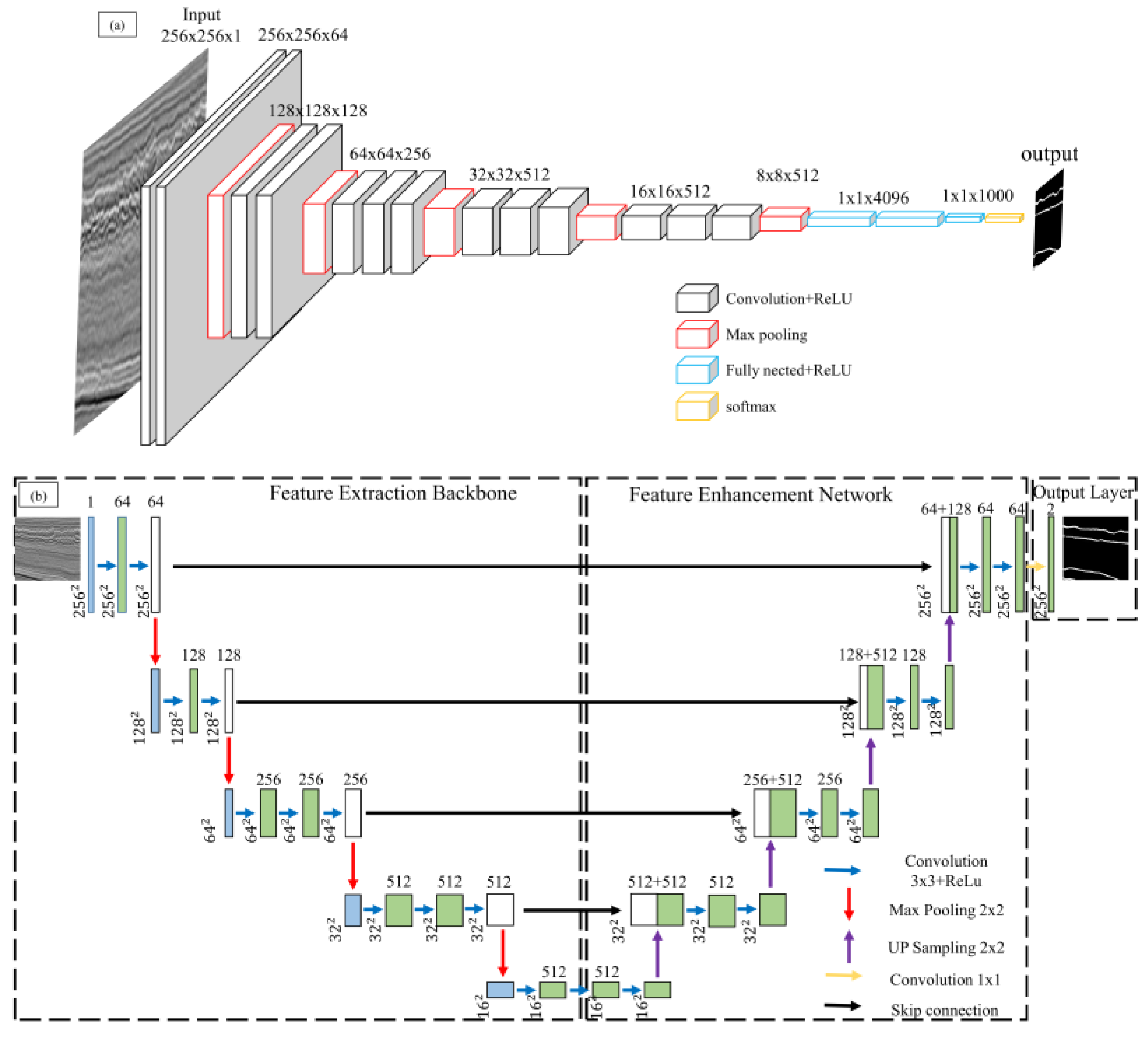
The VGG16-UNet model integrates two renowned deep learning architectures: VGG16 and UNet (as shown in Figure 1). This hybrid architecture offers an effective solution for image segmentation tasks, particularly for the efficient identification of seismic horizons.
The VGG16-UNet is an adaptation of the standard UNet in which the feature extraction backbone is modified [38], this paper is the first to apply this network structure to seismic horizon identification. The UNet architecture is divided into two parts: an encoder and a decoder [39]. In our model, the encoder, which serves as the feature extraction backbone, is replaced with the first five convolutional blocks of the VGG16 architecture [40]. These blocks contain 64, 128, 256, 512, and 512 filters (convolutional layers), respectively. Each convolutional layer operates with a stride and padding of 1, and each block concludes with a max-pooling layer of size 2 × 2. This configuration progressively extracts high-level features from the input image while reducing its spatial dimensions. The decoder, based on the original UNet design, systematically upsamples the feature maps and fuses them with high-resolution features from the corresponding encoder stage to accurately reconstruct spatial details for precise segmentation.
Compared to the standard UNet, the VGG16-UNet encoder is deeper, incorporating three additional convolutional layers and their corresponding ReLU activation functions [41,42], which enhances its ability to identify target horizons. Furthermore, the fifth block of our VGG16-UNet uses 512 filters instead of the 1024 filters found in the original UNet, a design choice that reduces the total number of trainable parameters. In contrast to the VGG16 classification network, our VGG16-UNet removes the final fully connected layers to optimize performance for image segmentation. This modification not only decreases the parameter count and computational complexity but also better preserves spatial information, allowing the network to adapt to inputs of varying resolutions. By synergizing the deep feature extraction power of VGG16 with the efficient segmentation mechanism of UNet, the VGG16-UNet architecture achieves superior accuracy and efficiency.

2.3. VGG16-UNet++

UNet++ [43] is an architecture similar to UNet, which was adapted by Chen et al. from VGG16-UNet to create VGG16-UNet++ [44]. Although VGG16-UNet achieves efficient segmentation, it has several shortcomings, such as an unknown optimal network depth and its reliance on skip connections that only fuse features at the same scale. VGG16-UNet++ employs dense connections and a deep supervision structure. In contrast to the standard UNet, which begins its upsampling process only from the deepest layer, VGG16-UNet++ generates a feature prediction via upsampling after each downsampling stage. The final output is then produced by fusing the predictions obtained from these different scales. This approach allows VGG16-UNet++ to not only integrate features from various levels to improve accuracy but also offers the flexibility to select an appropriate network depth, which can significantly reduce the number of parameters while maintaining acceptable performance.

2.4. Data Augmentation Techniques

Typical semantic segmentation tasks often rely on training sets containing thousands of images with diverse features. In contrast, seismic data annotation is both time-consuming and costly. Furthermore, seismic data can vary significantly between different geographical regions, and often only a limited number of annotated profiles are available from a single survey area. To address this data scarcity, this paper employs data augmentation techniques to expand our pre-processed model and field datasets, thereby enhancing the network’s feature extraction capabilities. General two-dimensional affine transformations include translation, scaling, and shear [45]. Considering that seismic horizons exhibit strong lateral characteristics, excessive vertical geometric transformations may compromise geological significance and the lateral continuity of horizons. This paper adopts the following six augmentation methods. The mathematical principles for these transformations are defined below. Let a pixel in the original image be denoted by its coordinates ( m , n ) , where m and n represent the horizontal and vertical positions, respectively.
Horizontal Flip:
( m , n ) = ( W m 1 , n )
where ( W , H ) is the width of the image.
Horizontal Translation:
( m , n ) = ( m + t m , n + t n )
where ( t m , t n ) is the translation offset, with t n = 0 .
Horizontal Scaling:
( m , n ) = ( m s m , n s n )
where ( s m , s n ) is the scaling factor, with s n = 1 .
Horizontal Shear:
( m , n ) = ( m + s h m n , n + s h n m )
where ( s h m , s h n ) is the shear factor, with s h n = 0 .
Gaussian Noise:
G ( m , n ) = G ( m , n ) + ε
where ε ~ N ( 0 , σ 2 ) .
Gaussian Blur:
G ( m , n ) = 1 2 π σ 2 e m 2 + n 2 2 σ 2

2.5. scSE Attention Mechanism

In deep learning, attention mechanisms serve to focus computational resources on important features while suppressing irrelevant ones. The Spatial and Channel Squeeze and Excitation (scSE) attention mechanism [46] is an enhancement of the original Squeeze and Excitation (SE) block [47]. It improves the network’s representational power by concurrently attending to both spatial and channel dimensions. This mechanism consists of two parallel branches: a Channel Squeeze and Excitation (cSE) module and a Spatial Squeeze and Excitation (sSE) module. The cSE module enhances informative channels by squeezing spatial information, whereas the sSE module highlights salient spatial regions by squeezing channel information.
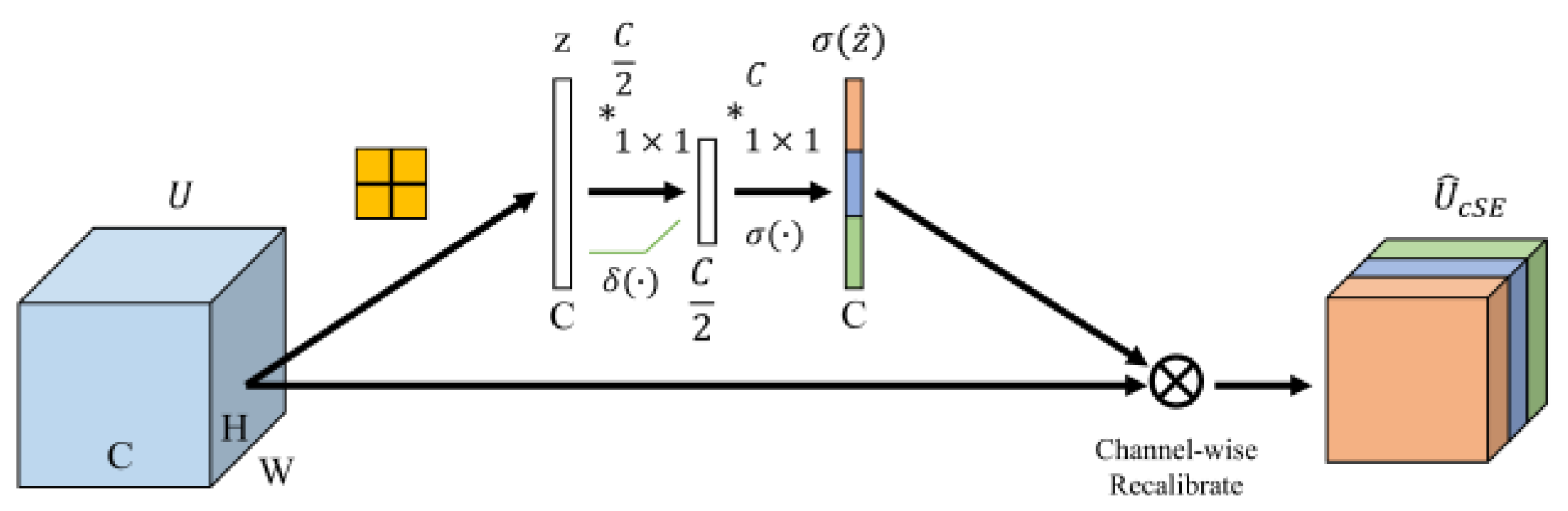
The Channel Squeeze and Excitation (cSE) module is a type of attention mechanism (Figure 2), mainly used to enhance informative feature channels in the network. Let the input feature map be:
U H × W × C
where denotes the set of real numbers, H and W are the spatial height and width, respectively, and C is the number of channels.
The input feature map U = u 1 , u 2 , , u C can be regarded as a set of C channel maps, where u C H × W . Perform global average pooling on the k-th channel u k . Compress the feature map containing global information H × W × C in the spatial dimension to 1 × 1 × C , yielding the channel descriptor vector z z 1 , , z k , , z C 1 × 1 × C :
z k = 1 H × W i = 1 H j = 1 W u k ( i , j )
where z is a scalar representing the channel description vector, i 1 , 2 , , H , j 1 , 2 , , W .
z after passing through two fully connected layers with ReLU activation functions, it is transformed into z ^ :
z ^ = W 1 ( δ ( W 2 z ) )
where W 1 C × C 2 and W 2 C 2 × C are the weight matrices for the two fully connected layers, respectively, and δ ( ) is the ReLU activation function. After sigmoid normalization, σ ( z ^ k ) is obtained, leading to the feature map U ^ c S E , which is recalibrated along the channel dimension for U :
U ^ c S E = σ ( z ^ 1 ) u 1 , σ ( z ^ k ) u k , σ ( z ^ C ) u C
where σ ( ) denotes the sigmoid activation function, σ ( z ^ k ) represents the importance of the k-th channel, and U ^ c S E constitutes the output of the cSE module.
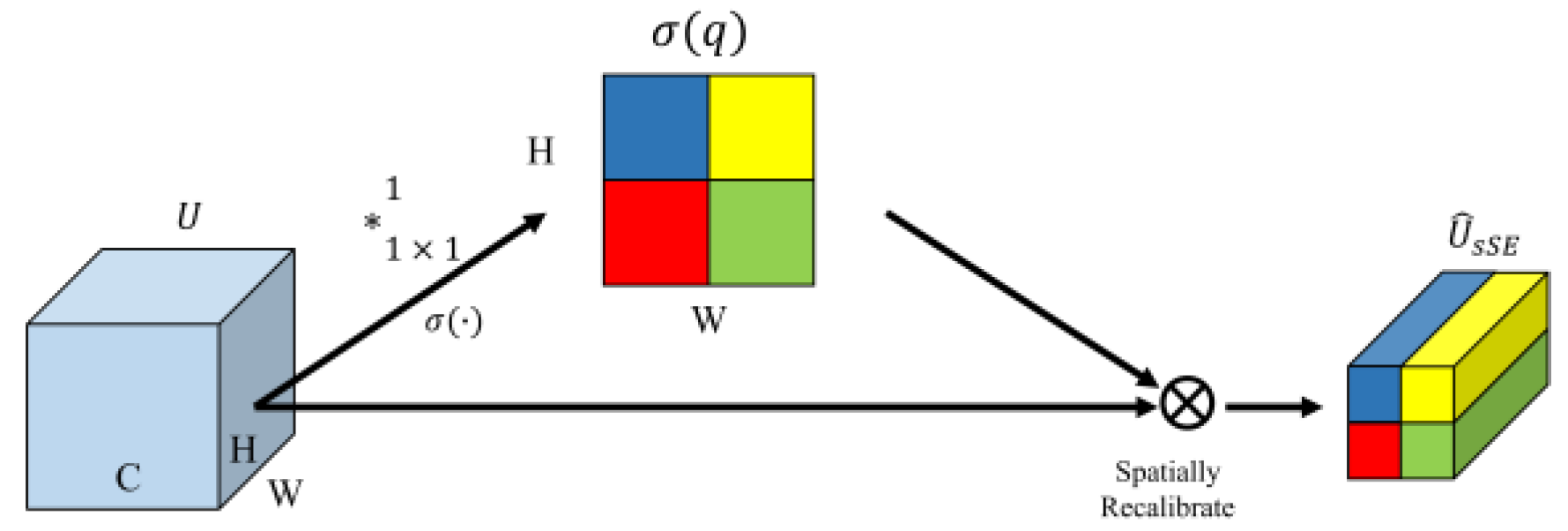
The Spatial Squeeze and Excitation (sSE) module is the component of the attention mechanism specifically designed to process spatial features (Figure 3). The input feature map U is treated as another form of slicing, i.e., spatially partitioned into U = u 1 , 1 , u 1 , 2 , , u i , j , , u H , W . A convolution kernel 1 × 1 is applied to U , yielding the output q = W s q U , where W s q 1 × 1 × C × 1 denotes the convolution kernel weights, q H × W represents the projection tensor of the convolution output, and denotes the two-dimensional discrete convolution operation.
Each element in the projection tensor q i , j represents a linear combination of all channels C at spatial position ( i , j ) . q i , j is normalized by the sigmoid activation function to yield σ ( q i , j ) , thereby producing the feature map U ^ s S E , which is a spatially recalibrated version of U :
U ^ s S E = σ ( q 1 , 1 ) u 1 , 1 , , σ ( q i , j ) u i , j , , σ ( q H , W ) u H , W
where σ ( ) denotes the sigmoid activation function, σ ( q i , j ) represents the importance at spatial location ( i , j ) , and U ^ s S E is the output of the sSE module.
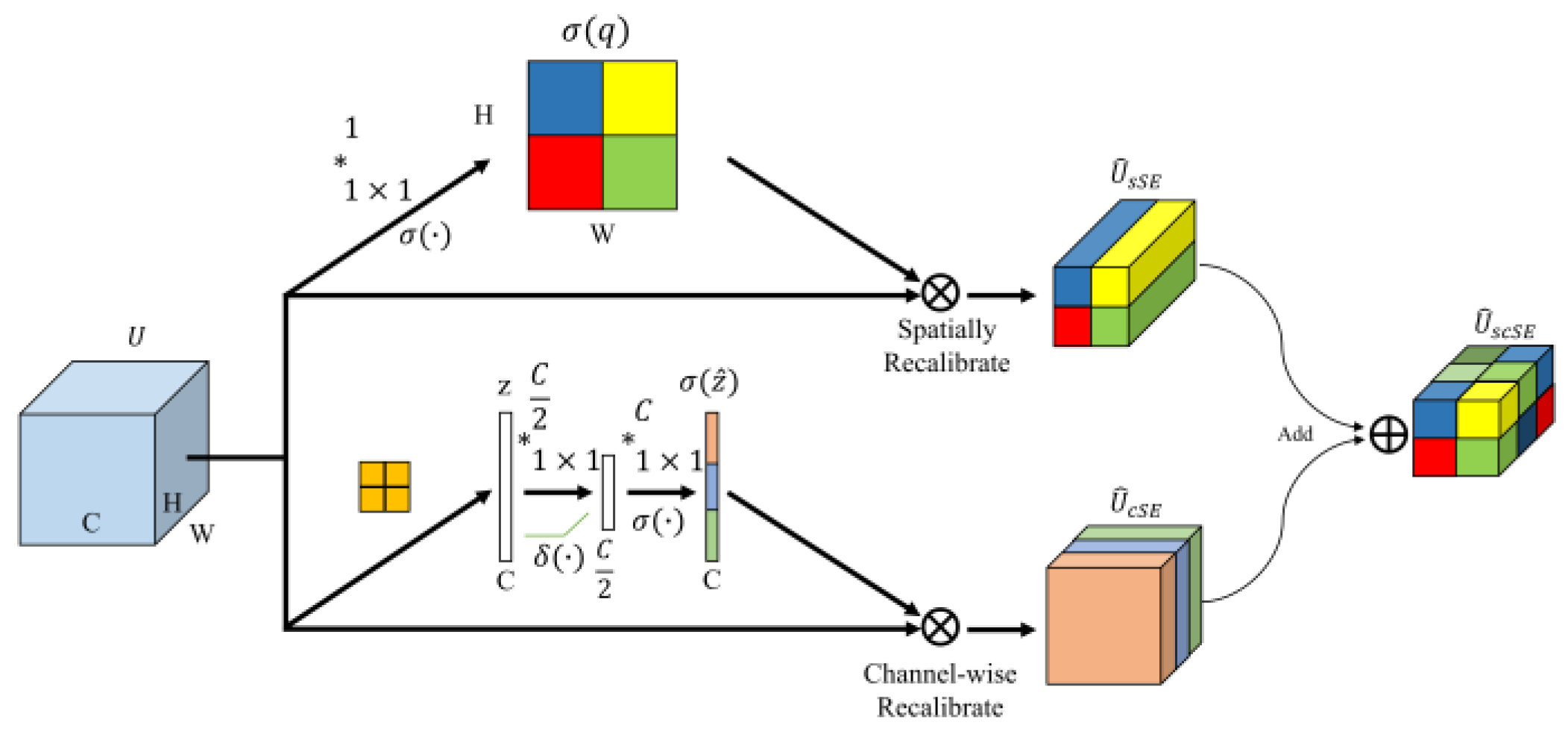
Combining these two attention modules forms the scSE module, whose structure is shown in Figure 4. This combination simultaneously recalibrates U in both the channel and spatial dimensions, yielding the calibrated feature map U ^ s c S E :
U ^ s c S E = U ^ c S E + U ^ s S E
where U ^ s c S E represents the output of the scSE module.
Through this approach, the scSE attention mechanism effectively enhances feature expressiveness and strengthens the model’s ability to extract key features from images.

2.6. The Data-Augmented scSE-VGG16-UNet++

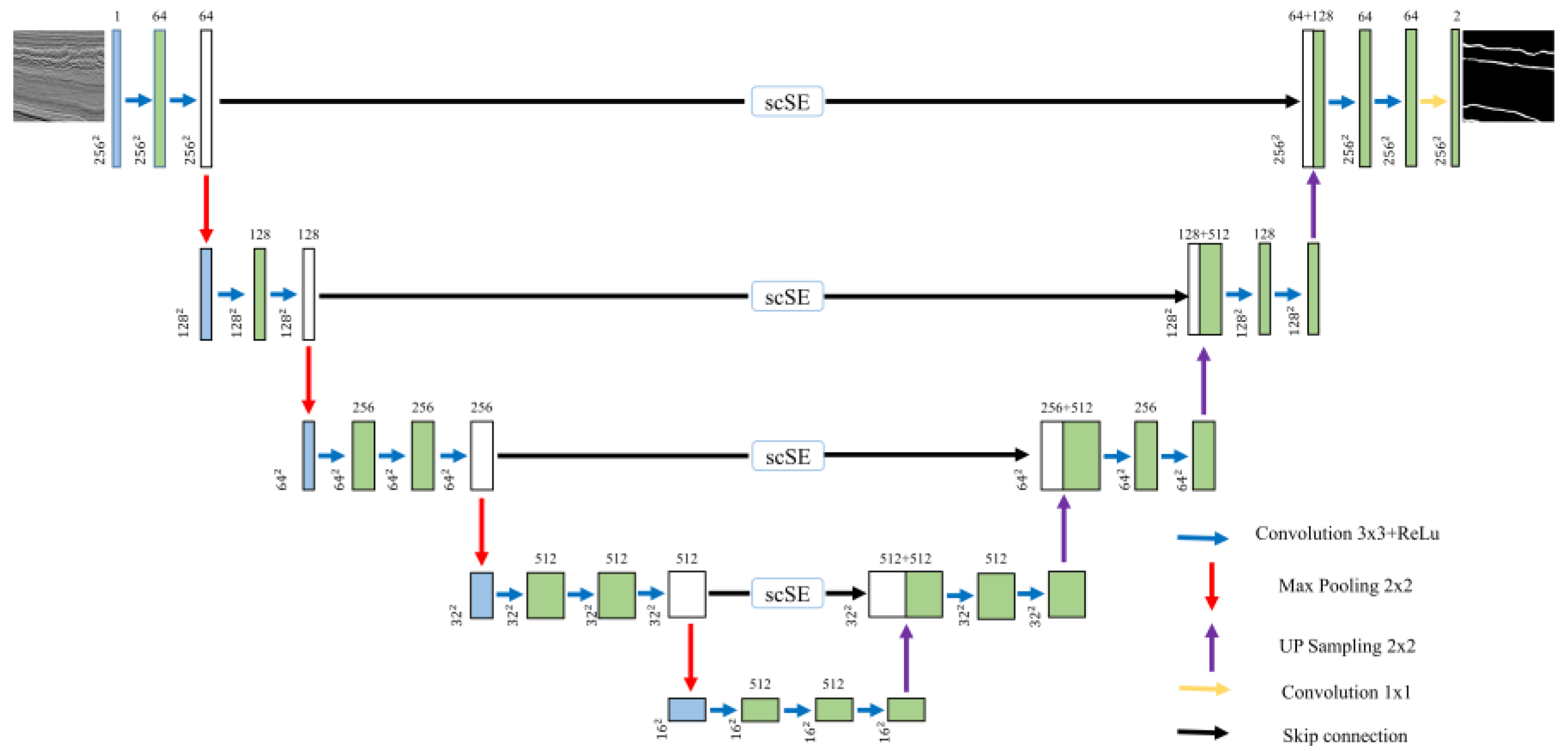
Building upon the VGG16-UNet architecture, this paper introduces the scSE-VGG16-UNet method by integrating, for the first time, the scSE attention mechanism into the skip connections at each level. This integrated attention mechanism enables VGG16-UNet to capture finer structural details and boundary information of target horizons when performing seismic horizon identification tasks. Combined with data augmentation techniques, it helps improve identification accuracy and stability. The overall architecture is illustrated in Figure 5.
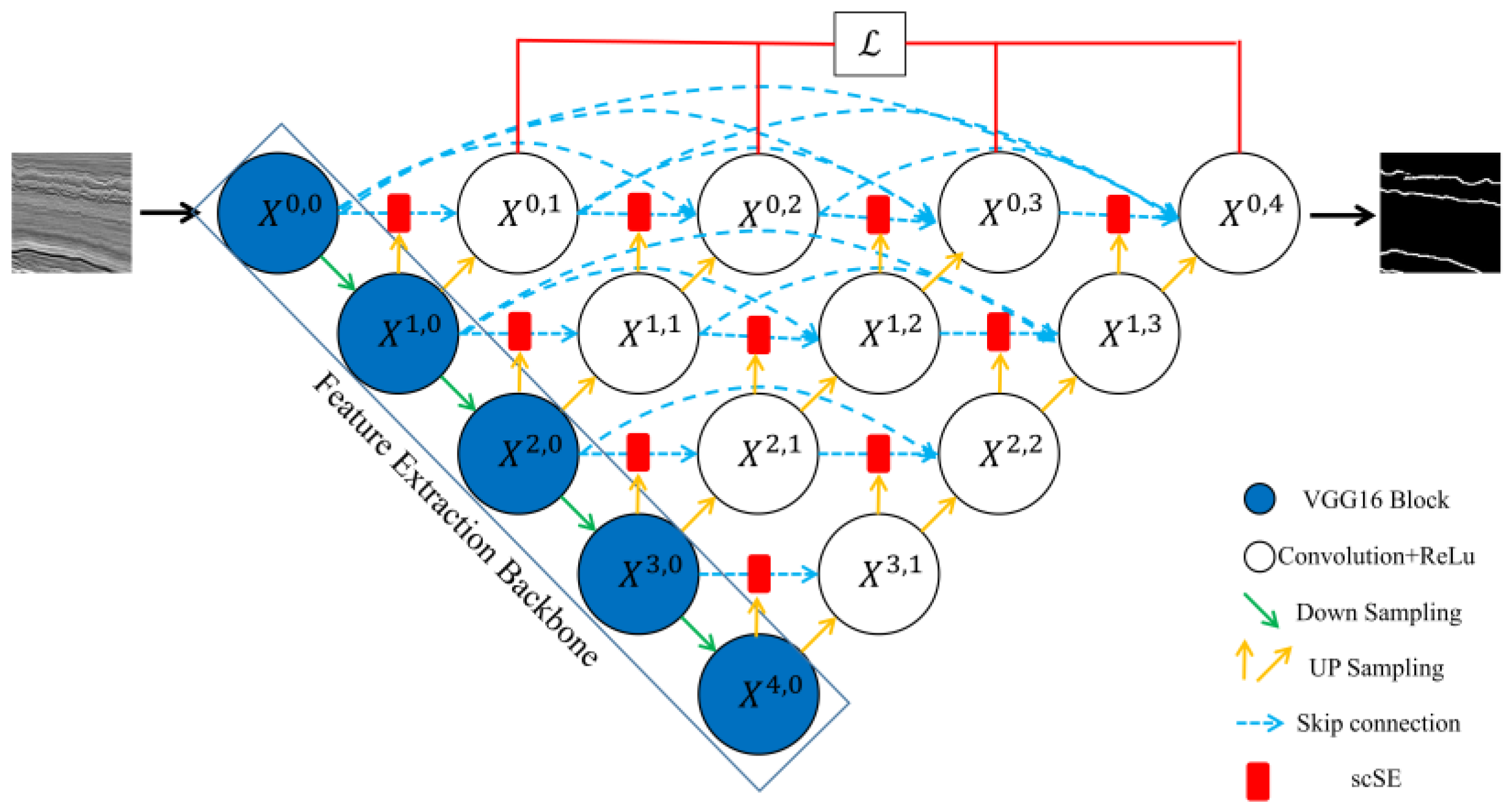
Further considering that the dense connections and deep supervision architecture in VGG16-UNet++ facilitate multi-scale feature fusion, this paper proposes the scSE-VGG16-UNet++ method. For the first time, the scSE attention mechanism is integrated into the skip connections at each level to enhance feature representation and reduce interference from non-target horizons (Figure 6). Combined with data augmentation techniques, this approach enables seismic horizon identification with high lateral continuity and further improves the network’s overall identification performance.

2.7. Loss Function and Optimizer

This paper employ the Adam (Adaptive Moment Estimation) algorithm as the optimizer [48]. The core advantage of Adam lies in its ability to compute adaptive learning rates for each parameter individually. This eliminates the need for manual learning rate tuning, thereby reducing external intervention and simplifying the model optimization process.
This paper utilizes the Cross-Entropy Loss [49], which is well-suited for multi-class segmentation tasks. This function quantifies the discrepancy between the model’s predicted probability distribution and the ground-truth probability distribution. For a multi-class classification problem, the Cross-Entropy Loss is defined as follows:
L = i = 1 N c = 1 M y i , c log ( p i , c )
where N is the total number of samples, M is the number of classes, y i , c indicates whether the i-th sample belongs to class c (0 or 1), and p i , c signifies the probability that the i-th sample belongs to class c. By minimizing this loss function, this paper effectively reduce the divergence between our model’s predictions and the true labels, thereby improving its classification accuracy.

2.8. Evaluation Criteria

In deep learning, the confusion matrix is a commonly used tool for evaluating the predictive performance of classification models (Table 1). The components of the confusion matrix for a given target class are defined as follows:
True Positive (TP): Pixels belonging to a target horizon that are correctly identified as that horizon.
False Positive (FP): Pixels from a non-target horizon that are incorrectly identified as a target horizon.
False Negative (FN): Pixels belonging to a target horizon that are incorrectly identified as a non-target horizon.
True Negative (TN): Pixels from a non-target horizon that are correctly identified as such.
Based on these components, this paper assesses the horizon identification results using two primary metrics: Pixel Accuracy (PA) and mean Intersection over Union (mIoU).
mIoU is used to evaluate the model’s segmentation performance. It is calculated as follows:
m I o U = T P F N + F P + T P
PA measures the proportion of correctly classified pixels out of the total number of pixels. It is calculated as follows:
P A = T P + T N T P + T N + F P + F N

3. Datasets and Experimental Setup

3.1. Horizon Identification Workflow

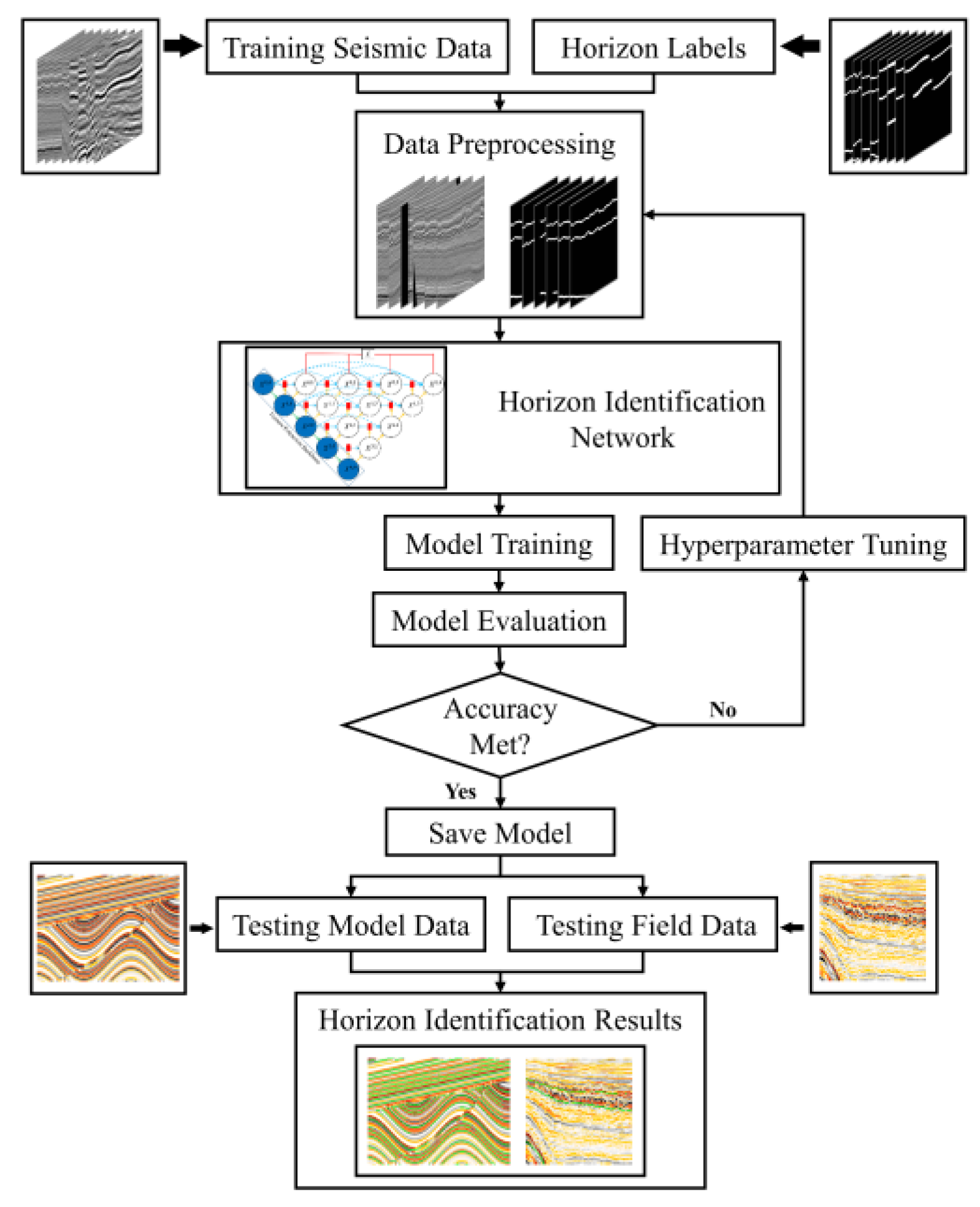
This paper formulates the seismic horizon identification problem as a semantic segmentation task, with the overall workflow illustrated in Figure 7. The specific workflow includes the following key steps: First, prepare the dataset and perform preprocessing, including amplitude normalization and data augmentation, then partition the dataset into training, validation, and test sets. Next, construct seismic horizon identification network architectures and train architecture. Continuously monitor the loss and evaluation metrics on the validation set, adopting the model weight with the best validation-set performance as the final weight. Subsequently, evaluate network architecture under uniform data partitioning and training settings. If validation-set performance fails to meet requirements, iteratively adjust hyperparameters such as learning rate, batch size, and training epochs while maintaining the original dataset partitioning. Finally, load the optimal validation-set weights to perform seismic horizon identification on both synthetic model data and field data from the survey area, analyzing the results through quantitative metrics and visually.

3.2. Dataset Construction

To evaluate the effectiveness of the seismic horizon identification method proposed in this paper, experimental validation was conducted using both synthetic model data and field data from the survey area. Prior to constructing the training set, the data were amplitude-normalized to eliminate variations in feature magnitude, thereby facilitating more effective feature extraction.
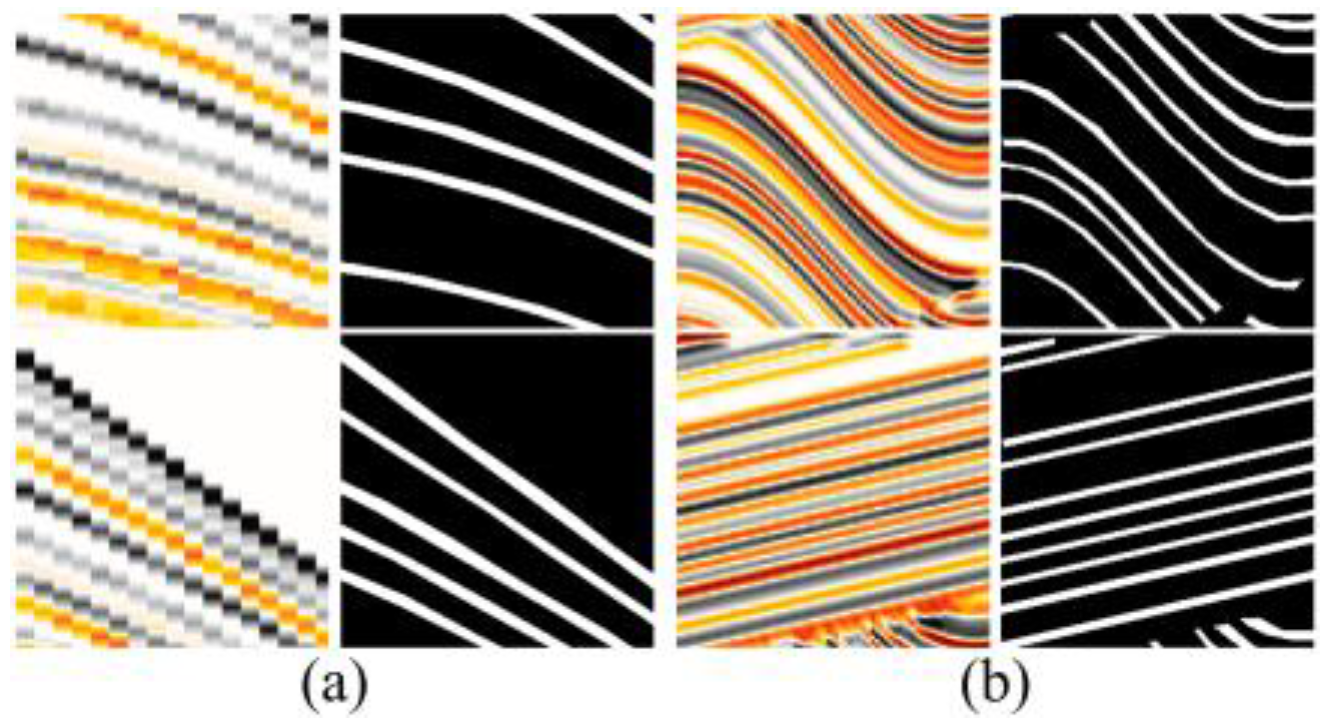
The synthetic model data were derived from the Synmarine model [50], which contains multiple hyperbolic events, and the Sigmoid post-stack seismic model [50], which incorporates dipping strata, faults, and unconformities (Figure 8). From these data, 24,256 × 256 two-dimensional patches were extracted.
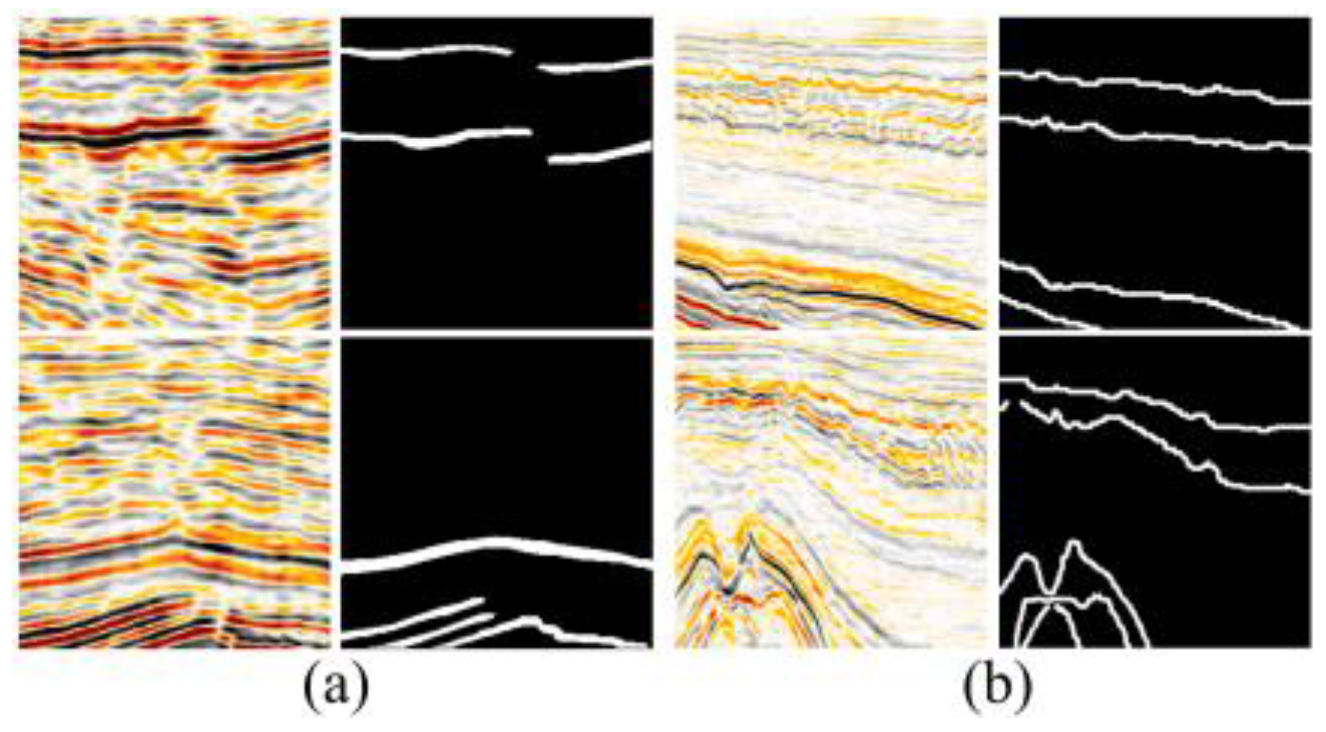
These field data were obtained from two 3D seismic volumes: the 3D seismic dataset from Block A and the public 3D seismic dataset from the Netherlands offshore F3 block in the North Sea [51]. The Block A 3D seismic volume has dimensions of 201 × 201 × 201 samples with a sampling interval of 4 ms. The Block F3 consists of 401 inlines and 701 crosslines, covering a time range of 1848 ms with a 4 ms sampling interval. Non-overlapping slicing was applied to these two datasets to extract 901,256 × 256 two-dimensional patches (Figure 9).
The synthetic model data and the horizon labels for Block A were manually interpreted and annotated on seismic sections to mark the target horizons. The horizon label data for the Block F3 can be found in the work of Alaudah et al. [51]. The curated dataset was divided into training, validation, and test sets in an 8:1:1 ratio, constituting the experimental dataset used in this study.
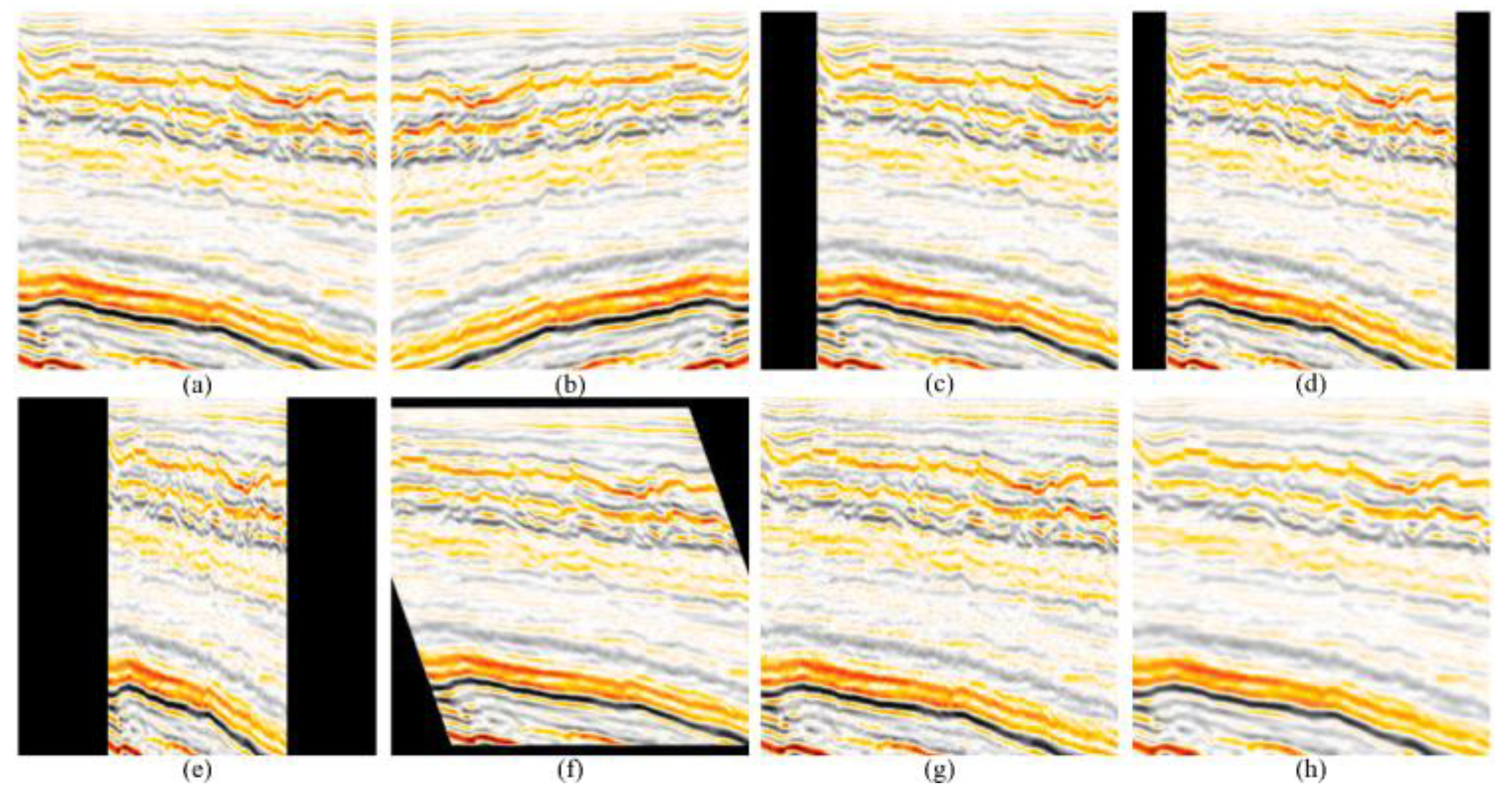
As shown in Figure 10, both the synthetic model data and the field data underwent data augmentation using the six methods described in Section 2.4: horizontal flipping, horizontal translation, horizontal scaling, horizontal shear, Gaussian noise, and Gaussian blur.

3.3. Experimental Setup

All models in this study were constructed and trained using the PyTorch deep learning framework. The key training hyperparameters were configured as follows. The Cross-Entropy Loss function served as the objective function, and the Adam optimizer was used for parameter adjustment. The initial learning rate was set to 0.001 and was subsequently adjusted automatically based on training progress to adapt to different training stages. A batch size of 8 was used, and all models were trained for a total of 100 epochs. The hardware configuration for these experiments is detailed in Table 2.

4. Results and Discussion

4.1. Comparative Experiment

To evaluate the performance of each improvement module, this paper uses UNet as the baseline network. Building upon this foundation, we first introduce the VGG16 backbone network to construct the VGG16-UNet architecture. Subsequently, we incorporate data augmentation to construct the data-augmented VGG16-UNet architecture. Further, we integrate the scSE attention mechanism to construct the data-augmented scSE-VGG16-UNet architecture. Finally, we incorporate the dense connections and deep supervision of UNet++ to construct our final architecture—the data-augmented scSE-VGG16-UNet++.
For clarity, the architectures are denoted as follows: M0 denotes UNet (baseline), M1 denotes VGG16-UNet, M2 denotes data-augmented VGG16-UNet, M3 denotes data-augmented scSE-VGG16-UNet, and M4 denotes data-augmented scSE-VGG16-UNet++—our final architecture.
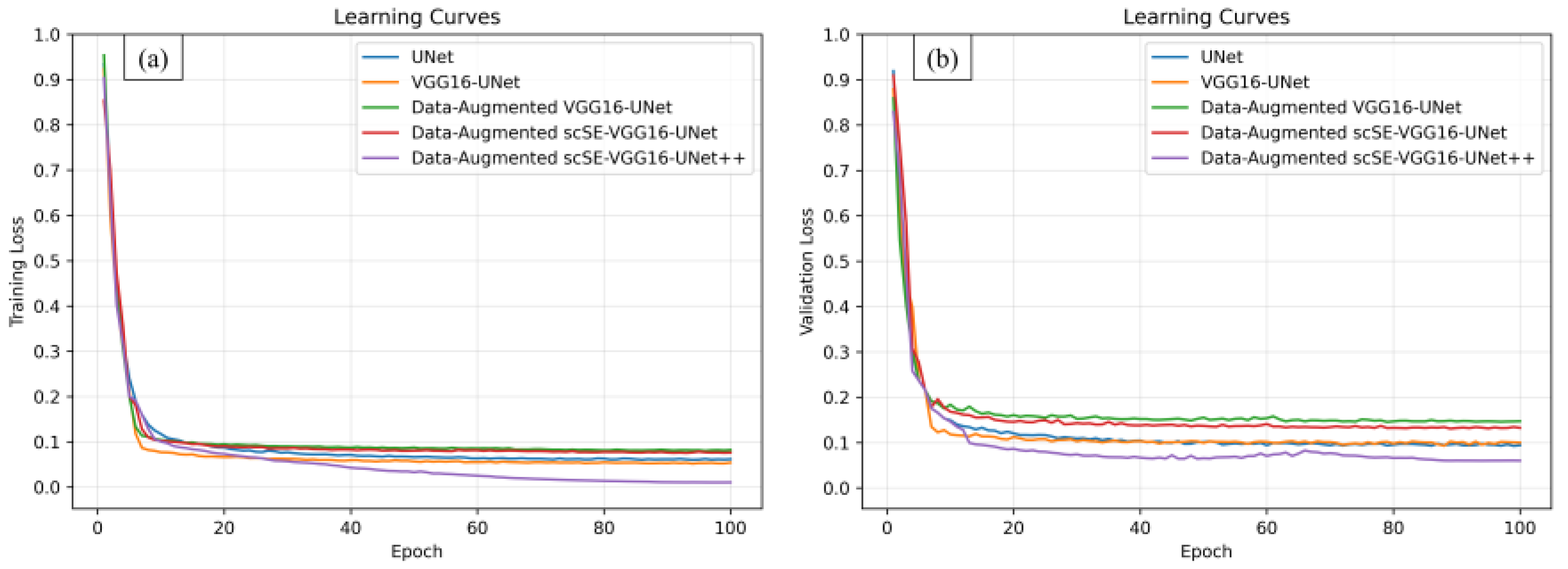
Table 3 summarizes the quantitative evaluation metrics (PA and mIoU) of each architecture on the test set, validating the effectiveness of the proposed method for seismic horizon identification. Additionally, Figure 11 displays the loss curves of each architecture on the training and validation sets, where the final architecture maintains lower and more stable loss levels on the validation set, reflecting better generalization performance.
Table 3 indicates that the data-augmented scSE-VGG16-UNet++ method outperforms UNet, VGG16-UNet, data-augmented VGG16-UNet, and data-augmented scSE-VGG16-UNet in both PA and mIoU. Compared with these four architectures, its PA increases by 5.58%, 5.04%, 4.78%, and 3.81%, respectively. The relative improvements in mIoU are 71.35%, 68.71%, 57.86%, and 56.30%, respectively. This demonstrates that the data-augmented scSE-VGG16-UNet++ method exhibits superior identification capability.

4.2. Synthetic Model Testing

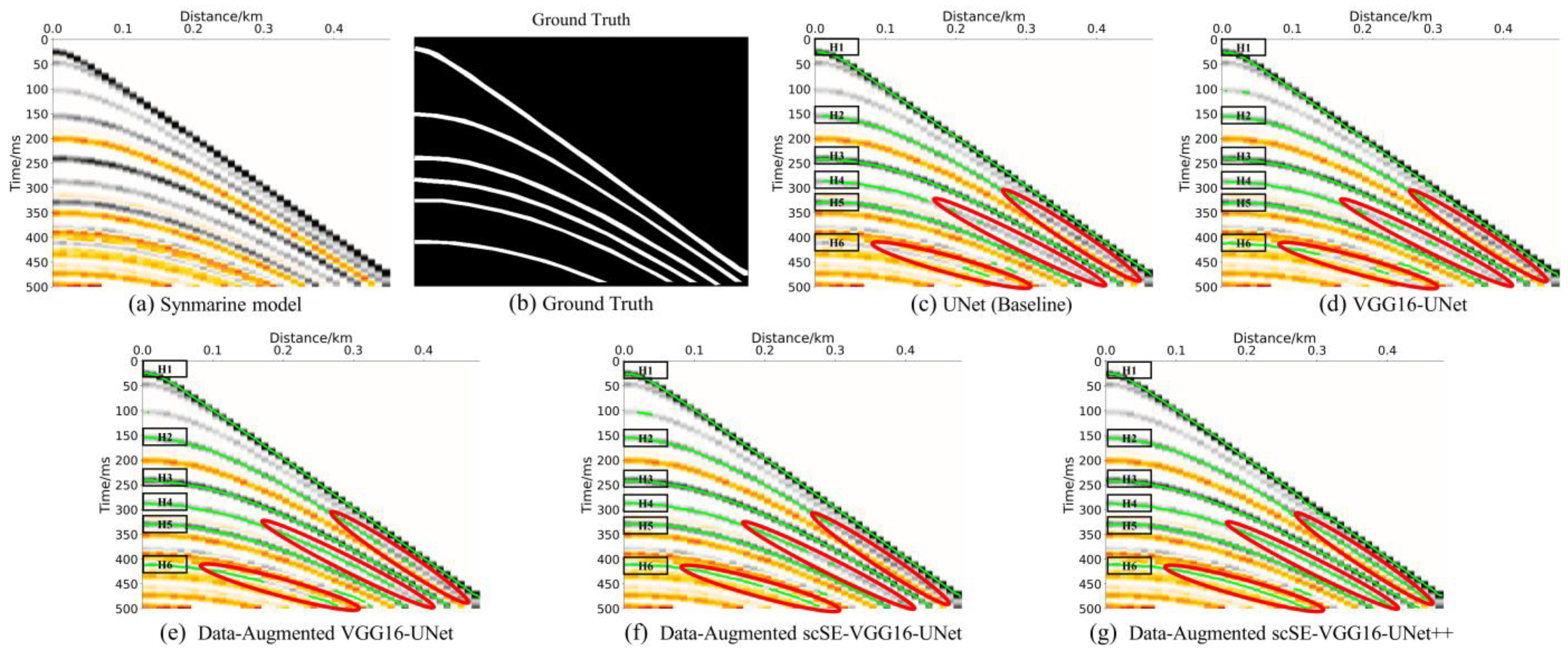
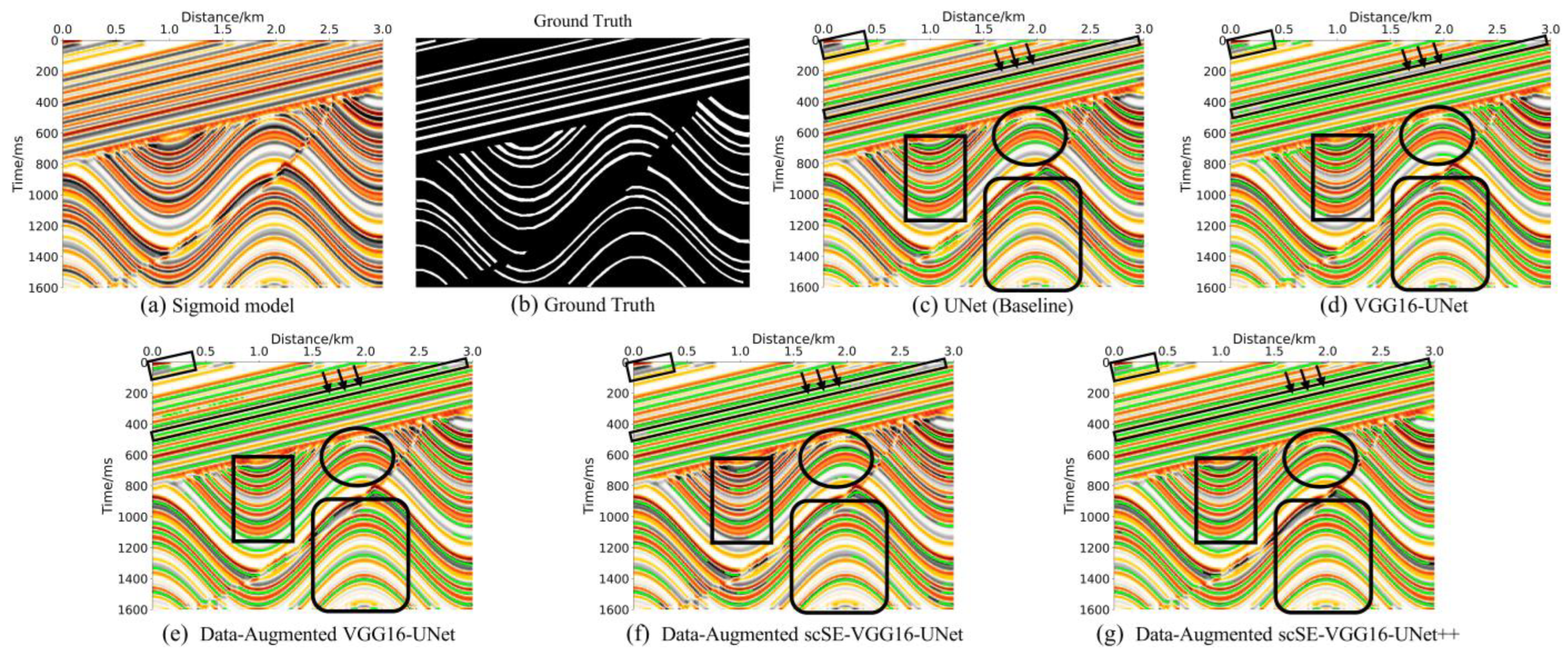
First, comparative evaluations were performed on the noise-free Synmarine and Sigmoid models using the M0–M4 notations defined in Section 4.1. The results are presented in Figure 12 and Figure 13.
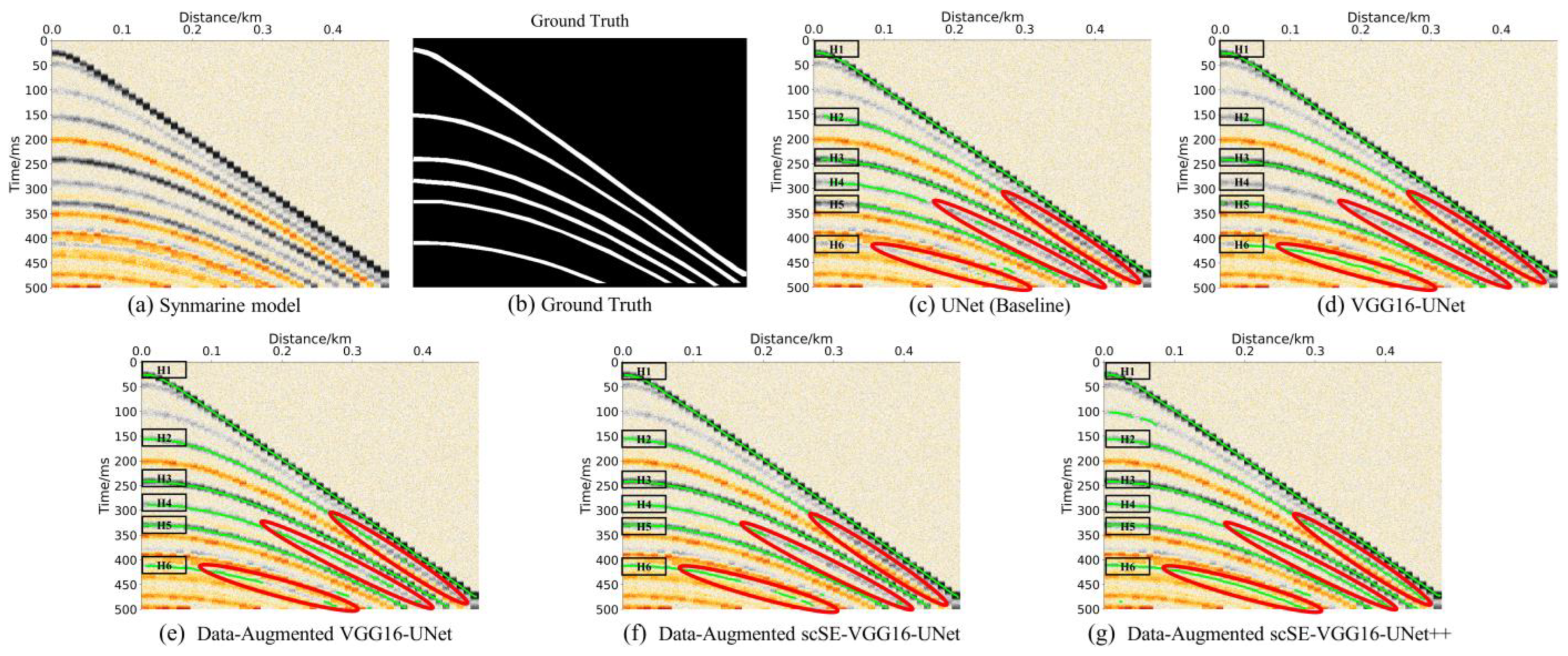
The Synmarine model includes six target horizons (Figure 12b). M0–M4 produce relatively continuous identification results for horizons H1, H3, and H5. However, for H2, H4, and H6, M0–M3 show poor continuity in the identification results (Figure 12c–f). In contrast, M4 yields continuous and smooth identification results for all six target horizons (Figure 12g).
The Sigmoid model consists of dipping strata and the underlying strata, presenting a complex configuration of target horizons (Figure 13b). For the dipping strata at 0–100 ms and 400–600 ms, discontinuities are observed in the horizon identification results of M0–M3 (Figure 13c–f). As indicated by the arrows, M0 fails to identify the targe horizon at the marked location (Figure 13c), while M1 also exhibits pronounced discontinuities (Figure 13d). In the syncline beneath the dipping strata at 0.5–1.5 km (boxed area) and the anticline at 1.5–25 km (elliptical and rounded-boxed areas), M0–M3 also show evident discontinuities (Figure 13c–f). In particular, M3 shows the most severe discontinuities in this region (Figure 13f). Meanwhile, in the fault zones marked by rounded rectangles, M0–M3 exhibit horizon mis-ties (Figure 13c–f). In contrast, M4 produces continuous and clear identification results for the dipping strata and the underlying strata, without apparent horizon mis-ties (Figure 13g).
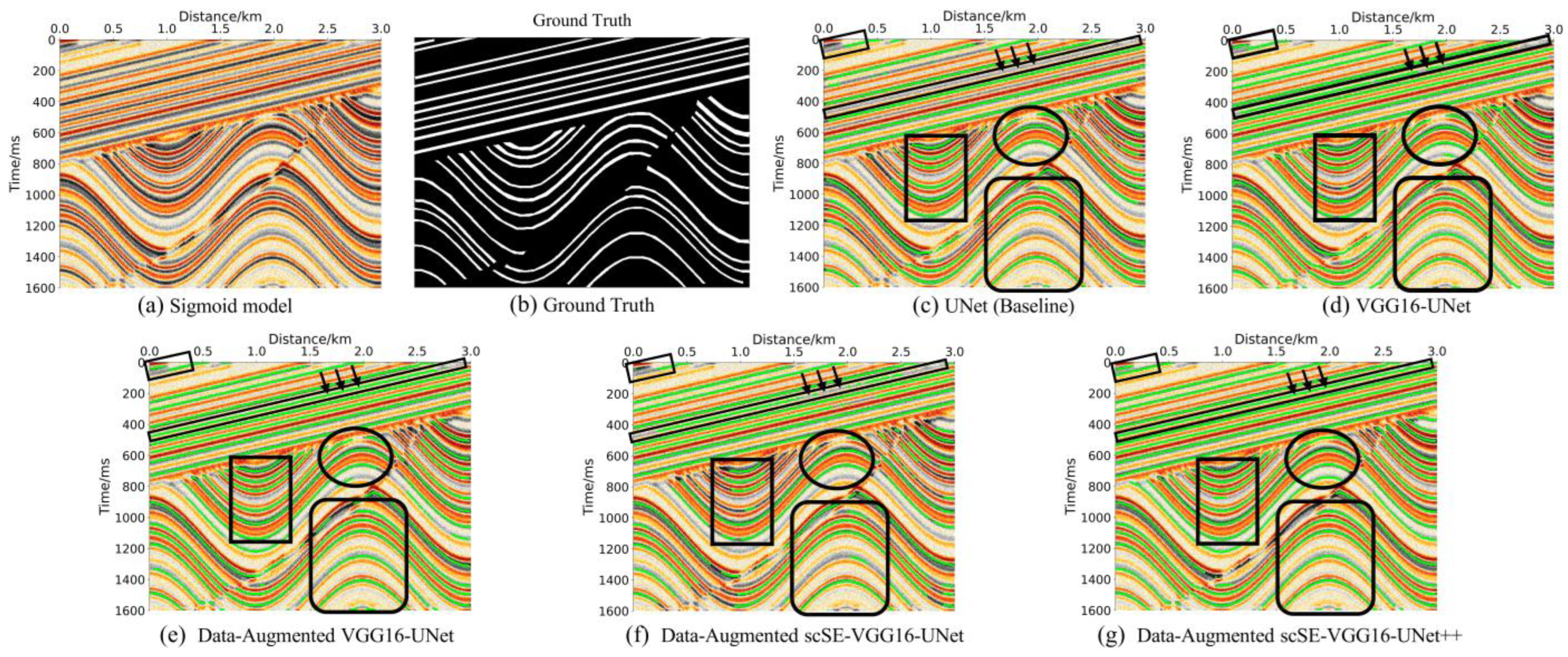
After adding Gaussian noise with a variance of 0.01 to the Synmarine and Sigmoid models, evaluations were performed using M0–M4. The results are presented in Figure 14 and Figure 15.
Analysis of the noisy Synmarine model shows that M0–M4 produce relatively continuous identification results for horizons H1, H3, and H5. However, M0-M3 exhibit discontinuities in the identification results for horizons H2, H4, and H6 (Figure 14c–f). Specifically, M0 fails to identify horizon H6 (Figure 14c), while M1 fails to identify horizon H4 (Figure 14d). In contrast, M4 yields continuous and smooth identification results for all six target horizons (Figure 14g).
Analysis of the noisy Sigmoid model reveals discontinuities in the horizon identification results of M0–M3 within the dipping strata regions spanning 0–100 ms and 400–600 ms (Figure 15c–f). As indicated by the arrows, M0 fails to identify the target horizon at the marked location (Figure 15c), and M3 also shows noticeable discontinuities (Figure 15f). In the syncline beneath the dipping strata at 0.5–1.5 km (boxed area) and the anticline at 1.5–25 km (elliptical and rounded-boxed areas), similar to the noise-free results, the baseline UNet and M0–M3 show pronounced discontinuities and horizon mis-ties (Figure 15c–f). In contrast, M4 yields more continuous results that better align with the horizon trends, without horizon mis-ties (Figure 15g).
In summary, the analyses on the synthetic models demonstrate that data augmentation effectively enriches seismic profile features. Furthermore, combining the scSE attention mechanism with the UNet++ architecture yields better continuity in seismic horizon identification and shows stronger noise resistance.

4.3. Application to Field Data

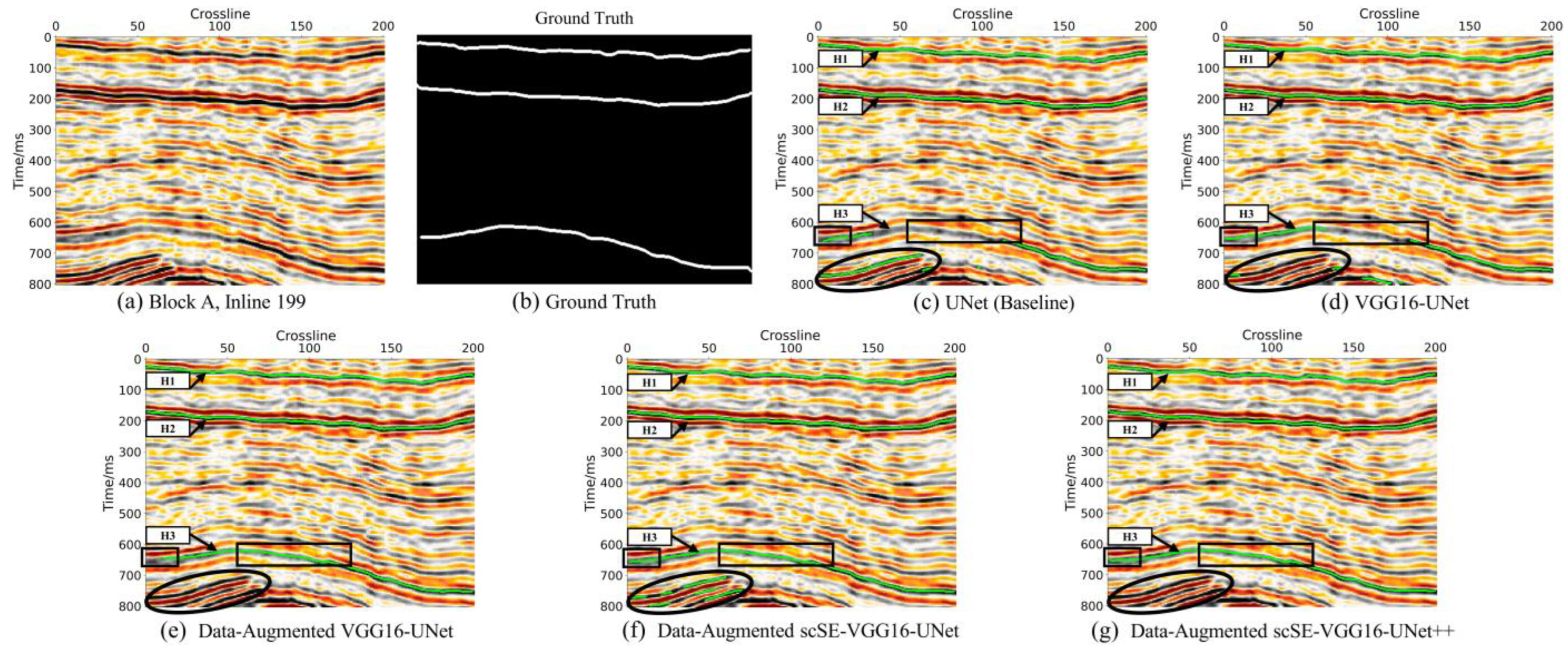
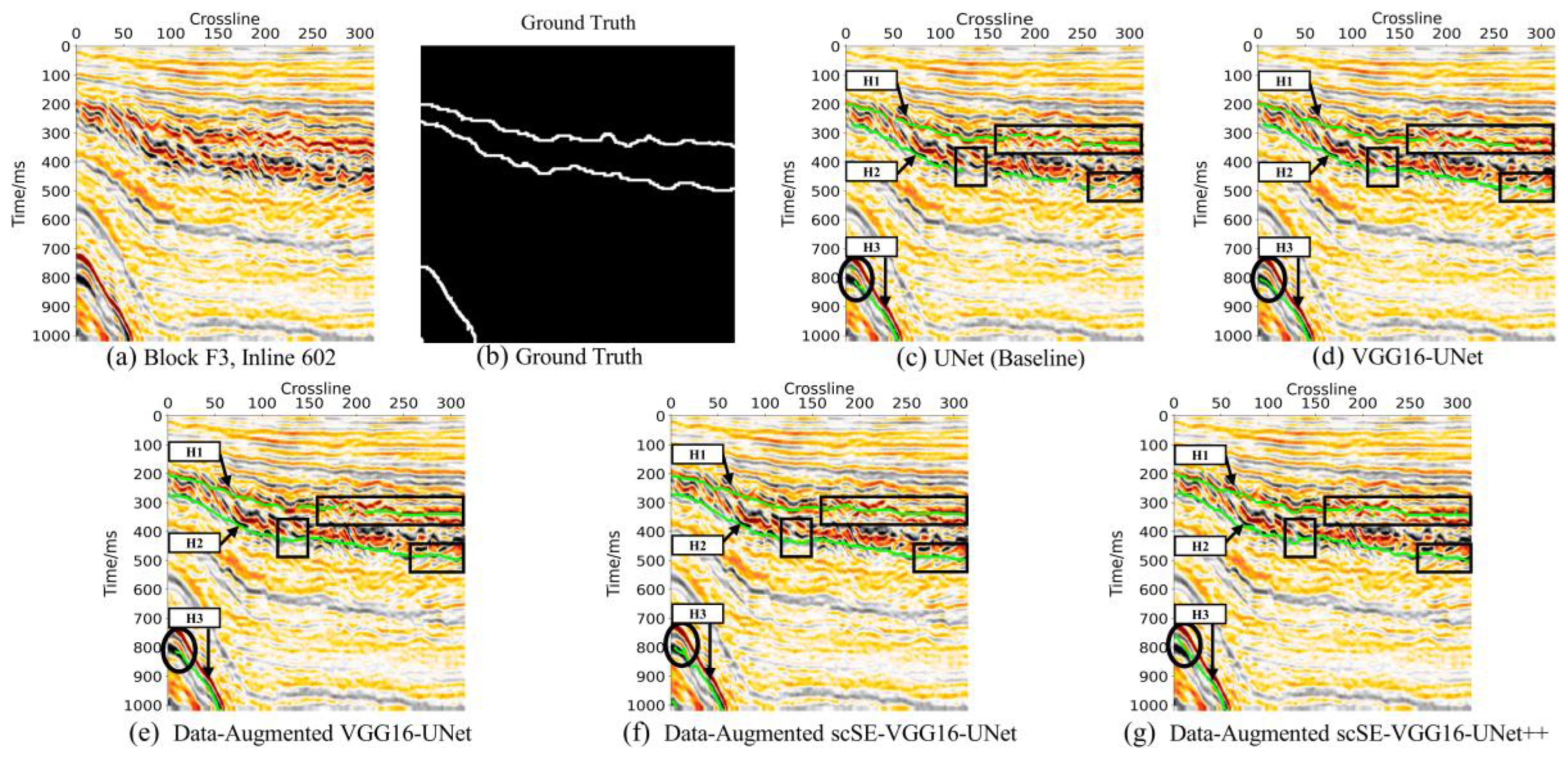
To evaluate the performance of M0–M4 on field data, this paper selected two inline sections for testing: Inline 199 from Block A (characterized by strong lateral continuity of the target horizon) and the publicly available Inline 602 from Block F3 (featuring relatively complex geological structures). The results are presented in Figure 16 and Figure 17.
In Inline 199 of Block A, three target horizons are present (Figure 16b). For H1 and H2, M0–M4 identify relatively continuous horizons. However, for horizon H3 (boxed area), M0–M1 show noticeable discontinuities in the identification results (Figure 16c,d). M2 also shows discontinuities between traces 0 and 20 (Figure 16e). In contrast, M3–M4 achieve better continuity (Figure 16f,g). In the ellipse-marked region of Inline 199, M2 and M4 produce cleaner results than the other networks. Overall, M4 yields more continuous identification results and better matches the target horizons (Figure 16g).
The Inline 602 section in Block F3 also contains three target horizons (Figure 17b). For H1 and H2 (boxed areas), M0–M2 networks show varying degrees of discontinuity in their identification results. After introducing data augmentation, horizon continuity is improved (Figure 17c–e). For H3 (ellipse-marked area), the identification results from M0–M3 do not align with the reflector trend (Figure 17c–f). Overall, M4 identifies more continuous horizons for all three targets (H1, H2, and H3), and its results better follow the reflector trend (Figure 17g).

5. Conclusions

Deep learning methods for seismic horizon identification often struggle when faced with highly similar seismic profile features within a single survey area, leading to issues such as discontinuities and horizon mis-ties. To address this challenge, this paper proposed the data-augmented scSE-VGG16-UNet++ method. This method leverages the deep feature extraction capabilities of VGG16, tailored data augmentation techniques, the scSE attention mechanism, and the deep supervision structure of UNet++. Tests on both synthetic model data and field data confirmed that this approach effectively mitigates the aforementioned problems. The main conclusions are as follows:
(1)
The VGG16-UNet architecture is constructed by integrating the deep feature extraction capabilities of VGG16 with the traditional UNet network architecture. This architecture is then applied this architecture to seismic horizon identification for the first time, and the experimental results confirmed its effectiveness for this task.
(2)
To address the high cost of seismic data annotation and the high similarity of sample features within a single survey area, this paper, for the first time, adopts data augmentation techniques tailored to the strong lateral continuity of seismic horizons to effectively enrich seismic profile features. The experimental results demonstrate that data augmentation can effectively alleviate discontinuities in seismic horizon identification caused by limited data diversity, and can also improve the identification capability of the network architecture on noisy data.
(3)
This paper introduced the scSE attention mechanism at the skip connections of the VGG16-UNet for the first time. This enabled the architecture to focus on horizon boundary information while suppressing interference from noise and non-target regions. The quantitative evaluation showed that the introduction of scSE significantly improved the accuracy and continuity of the identification results.
(4)
Building upon the scSE-VGG16-UNet method, the dense connections and deep supervision mechanisms of UNet++ and combined with data augmentation to form the final network architecture. The final network architecture demonstrated superior performance over the VGG16-UNet and all intermediate network architectures, both in quantitative metrics (PA and mIoU) and in qualitative tests on synthetic model data and field data. Furthermore, it exhibited strong noise resistance on noisy data, indicating its potential for intelligent horizon identification in complex seismic datasets and its good generalization ability.
In future work, the authors plan to integrate seismic attributes to construct a network architecture incorporating physical constraints, and to enable the identification of other geological structures such as faults and salt bodies.

Author Contributions

Conceptualization Q.W. and P.L.; methodology, Q.W. and P.L.; software, Q.W.; validation, Q.W. and J.F.; formal analysis, Q.W. and P.L.; investigation, Q.W.; resources, C.L., P.L. and D.W.; data curation, Q.W. and J.F.; writing—original draft preparation, Q.W.; writing—review and editing, C.L., P.L. and Q.L.; visualization, Q.W., C.L., P.L. and Y.L.; supervision, C.L., P.L. and Y.L.; project administration, C.L. and P.L.; funding acquisition, C.L. and P.L. All authors have read and agreed to the published version of the manuscript.

Funding

This research was funded by the National Natural Science Foundation of China (Grant No. 42430801), the class General Financial from the China Postdoctoral Science Foundation (Grant No. 2014M561295).

Institutional Review Board Statement

Not applicable.

Informed Consent Statement

Not applicable.

Data Availability Statement

The data that support the findings of this study are available from the corresponding author upon reasonable request.

Acknowledgments

The authors are grateful to the editors and anonymous reviewers for their constructive comments.

Conflicts of Interest

The authors declare no conflicts of interest.

References

  1. Shi, X.; Wei, X.; Yang, C.; Ma, H.; Li, Y. Problems and Countermeasures for Construction of China’s Salt Cavern Type Strategic Oil Storage. Bull. Chin. Acad. Sci. Chin. Version 2023, 38, 99–111. [Google Scholar] [CrossRef]
  2. Aki, K.; Richards, P.G. Quantitative Seismology; University Science Books: New York, NY, USA, 2002; ISBN 978-1891389634. [Google Scholar]
  3. Yilmaz, Ö. Seismic Data Analysis: Processing, Inversion, and Interpretation of Seismic Data; Society of Exploration Geophysicists: Houston, TX, USA, 2001. [Google Scholar]
  4. Harishidayat, D.; Al-Shuhail, A.; Randazzo, G.; Lanza, S.; Muzirafuti, A. Reconstruction of Land and Marine Features by Seismic and Surface Geomorphology Techniques. Appl. Sci. 2022, 12, 9611. [Google Scholar] [CrossRef]
  5. Borgos, H.G.; Skov, T.; Randen, T.; Sonneland, L. Automated Geometry Extraction from 3D Seismic Data. In Proceedings of the SEG International Exposition and Annual Meeting, Dallas, TX, USA, 26–31 October 2003; SEG: Houston, TX, USA, 2003. [Google Scholar]
  6. Marfurt, K.J.; Kirlin, R.L.; Farmer, S.L.; Bahorich, M.S. 3-D Seismic Attributes Using a Semblance-based Coherency Algorithm. Geophysics 1998, 63, 1150–1165. [Google Scholar] [CrossRef]
  7. Gersztenkorn, A.; Marfurt, K.J. Eigenstructure-based Coherence Computations as an Aid to 3-D Structural and Stratigraphic Mapping. Geophysics 1999, 64, 1468–1479. [Google Scholar] [CrossRef]
  8. Hale, D. Dynamic Warping of Seismic Images. Geophysics 2013, 78, S105–S115. [Google Scholar] [CrossRef]
  9. Yan, S.; Wu, X. Seismic Horizon Extraction with Dynamic Programming. Geophysics 2021, 86, IM51–IM62. [Google Scholar] [CrossRef]
  10. Roberts, L.G. Machine Perception of Three-Dimensional Solids. Ph.D. Thesis, Massachusetts Institute of Technology, Cambridge, MA, USA, 1963. [Google Scholar]
  11. Prewitt, J.M. Object Enhancement and Extraction. Pict. Process. Psychopictorics 1970, 10, 15–19. [Google Scholar]
  12. Faraklioti, M.; Petrou, M. Horizon Picking in 3D Seismic Data Volumes. Mach. Vis. Appl. 2004, 15, 216–219. [Google Scholar] [CrossRef]
  13. Li, H.; Liu, C.; Tao, C. The Study of Application of Edge Measuring Technique to the Detection of Phase Axis of Seismic Section. Prog. Geophys. 2007, 22, 1607–1610. [Google Scholar]
  14. Li, P.; Feng, X.; Wang, D.; Liu, C.; Li, H.X. Auto Tracking the Sync Phase Axis of Seismic Profiles. J. Jilin Univ. Earth Sci. Ed. 2008, 38, 76–79. [Google Scholar] [CrossRef]
  15. Herron, D.A. Horizon Autopicking. Lead. Edge 2000, 19, 491–492. [Google Scholar] [CrossRef]
  16. Xu, M.; David, J.M.; Kim, S.H. The Fourth Industrial Revolution: Opportunities and Challenges. Int. J. Financ. Res. 2018, 9, 90–96. [Google Scholar] [CrossRef]
  17. McCulloch, W.S.; Pitts, W. A Logical Calculus of the Ideas Immanent in Nervous Activity. Bull. Math. Biophys. 1943, 5, 115–133. [Google Scholar] [CrossRef]
  18. Rosenblatt, F. The Perceptron: A Probabilistic Model for Information Storage and Organization in the Brain. Psychol. Rev. 1958, 65, 386–408. [Google Scholar] [CrossRef]
  19. Rumelhart, D.E.; Hinton, G.E.; Williams, R.J. Learning Representations by Back-Propagating Errors. Nature 1986, 323, 533–536. [Google Scholar] [CrossRef]
  20. Kohonen, T. Self-Organized Formation of Topologically Correct Feature Maps. Biol. Cybern. 1982, 43, 59–69. [Google Scholar] [CrossRef]
  21. Hopfield, J.J. Neural Networks and Physical Systems with Emergent Collective Computational Abilities. Proc. Natl. Acad. Sci. USA 1982, 79, 2554–2558. [Google Scholar] [CrossRef]
  22. Kosko, B. Bidirectional Associative Memories. IEEE Trans. Syst. Man Cybern. 1988, 18, 49–60. [Google Scholar] [CrossRef]
  23. LeCun, Y.; Bottou, L.; Bengio, Y.; Haffner, P. Gradient-Based Learning Applied to Document Recognition. Proc. IEEE 2002, 86, 2278–2324. [Google Scholar] [CrossRef]
  24. Zhang, J.; Huang, C.; Chow, M.-Y.; Li, X.; Tian, J.; Luo, H.; Yin, S. A Data-Model Interactive Remaining Useful Life Prediction Approach of Lithium-Ion Batteries Based on PF-BiGRU-TSAM. IEEE Trans. Ind. Inform. 2023, 20, 1144–1154. [Google Scholar] [CrossRef]
  25. Khosro Anjom, F.; Vaccarino, F.; Socco, L.V. Machine Learning for Seismic Exploration: Where Are We and How Far Are We from the Holy Grail? Geophysics 2024, 89, WA157–WA178. [Google Scholar] [CrossRef]
  26. Wu, X.; Shi, Y.; Fomel, S.; Liang, L. Convolutional Neural Networks for Fault Interpretation in Seismic Images. In Proceedings of the SEG Technical Program Expanded Abstracts 2018, Anaheim, CA, USA, 14–19 October 2018; Society of Exploration Geophysicists: Anaheim, CA, USA, 2018; pp. 1946–1950. [Google Scholar]
  27. Di, H.; Li, Z.; Maniar, H.; Abubakar, A. Seismic Stratigraphy Interpretation by Deep Convolutional Neural Networks: A Semisupervised Workflow. Geophysics 2020, 85, WA77–WA86. [Google Scholar] [CrossRef]
  28. Shi, Y.; Wu, X.; Fomel, S. Waveform Embedding: Automatic Horizon Picking with Unsupervised Deep Learning. Geophysics 2020, 85, WA67–WA76. [Google Scholar] [CrossRef]
  29. Yang, L.; Sun, S.-Z. Seismic Horizon Tracking Using a Deep Convolutional Neural Network. J. Pet. Sci. Eng. 2020, 187, 106709. [Google Scholar] [CrossRef]
  30. Tschannen, V.; Delescluse, M.; Ettrich, N.; Keuper, J. Extracting Horizon Surfaces from 3D Seismic Data Using Deep Learning. Geophysics 2020, 85, N17–N26. [Google Scholar] [CrossRef]
  31. Cheng, M.; Cao, J.; You, J.; Wang, J.; Liu, J. Automatic Horizon Tracking Method Based on Image Semantic Segmentation. Prog. Geophys. 2021, 36, 1504–1511. [Google Scholar]
  32. Anandkumar, A.; Alvarez, J.; Xie, E.; Wang, W. Simple and Efficient Design for Semantic Segmentation with Transformers . Adv. Neural Inf. Process. Syst. 2021. submitted. [Google Scholar]
  33. Liu, Z.; Lin, Y.; Cao, Y.; Hu, H.; Wei, Y.; Zhang, Z.; Lin, S.; Guo, B. Swin Transformer: Hierarchical Vision Transformer Using Shifted Windows. In Proceedings of the IEEE/CVF International Conference on Computer Vision, Montreal, QC, Canada, 11–17 October 2021; pp. 10012–10022. [Google Scholar]
  34. Zhao, Z.; Zhao, J. Seismic Horizon Tracking Based on the TransUnet Model. Geophysics 2025, 90, IM1–IM13. [Google Scholar] [CrossRef]
  35. Salamon, J.; Bello, J.P. Deep Convolutional Neural Networks and Data Augmentation for Environmental Sound Classification. IEEE Signal Process. Lett. 2017, 24, 279–283. [Google Scholar] [CrossRef]
  36. Di, H.; Li, C.; Smith, S.; Li, Z.; Abubakar, A. Imposing Interpretational Constraints on a Seismic Interpretation Convolutional Neural Network. Geophysics 2021, 86, IM63–IM71. [Google Scholar] [CrossRef]
  37. Murugan, P. Feed Forward and Backward Run in Deep Convolution Neural Network. arXiv 2017, arXiv:1711.03278. [Google Scholar] [CrossRef]
  38. Ghosh, S.; Chaki, A.; Santosh, K. Improved U-Net Architecture with VGG-16 for Brain Tumor Segmentation. Phys. Eng. Sci. Med. 2021, 44, 703–712. [Google Scholar] [CrossRef]
  39. Ronneberger, O.; Fischer, P.; Brox, T. U-Net: Convolutional Networks for Biomedical Image Segmentation. In Proceedings of the International Conference on Medical Image Computing and Computer-Assisted Intervention, Munich, Germany, 5–9 October 2015; Springer: Berlin/Heidelberg, Germany, 2015; pp. 234–241. [Google Scholar]
  40. Simonyan, K.; Zisserman, A. Very Deep Convolutional Networks for Large-Scale Image Recognition. arXiv 2014, arXiv:1409.1556. [Google Scholar]
  41. Hahnloser, R.H.; Sarpeshkar, R.; Mahowald, M.A.; Douglas, R.J.; Seung, H.S. Digital Selection and Analogue Amplification Coexist in a Cortex-Inspired Silicon Circuit. Nature 2000, 405, 947–951. [Google Scholar] [CrossRef] [PubMed]
  42. Nair, V.; Hinton, G.E. Rectified Linear Units Improve Restricted Boltzmann Machines. In Proceedings of the 27th International Conference on Machine Learning (ICML-10), Haifa, Israel, 21–24 June 2010; pp. 807–814. [Google Scholar]
  43. Zhou, Z.; Siddiquee, M.M.R.; Tajbakhsh, N.; Liang, J. UNet++: A Nested U-Net Architecture for Medical Image Segmentation. In Deep Learning in Medical Image Analysis and Multimodal Learning for Clinical Decision Support; Springer Nature: Berlin, Germany, 2018. [Google Scholar]
  44. Chen, S.; Lei, F.; Zang, Z.; Zhang, M. Forest Mapping Using a VGG16-UNet++& Stacking Model Based on Google Earth Engine in the Urban Area. IEEE Geosci. Remote Sens. Lett. 2023, 20, 1–5. [Google Scholar] [CrossRef]
  45. Jähne, B. Digital Image Processing; Springer: Berlin/Heidelberg, Germany, 2005. [Google Scholar]
  46. Roy, A.G.; Navab, N.; Wachinger, C. Concurrent Spatial and Channel ‘Squeeze & Excitation’ in Fully Convolutional Networks. In Medical Image Computing and Computer Assisted Intervention—Miccai 2018; Frangi, A.F., Schnabel, J.A., Davatzikos, C., Alberola-López, C., Fichtinger, G., Eds.; Lecture Notes in Computer Science; Springer International Publishing: Cham, Switzerland, 2018; Volume 11070, pp. 421–429. ISBN 978-3-030-00927-4. [Google Scholar]
  47. Hu, J.; Shen, L.; Sun, G. Squeeze-and-Excitation Networks. In Proceedings of the IEEE Conference on Computer Vision and Pattern Recognition, Salt Lake City, UT, USA, 18–23 June 2018; pp. 7132–7141. [Google Scholar]
  48. Kinga, D.; Adam, J.B. A Method for Stochastic Optimization. In Proceedings of the International Conference on Learning Representations (ICLR), San Diego, CA, USA, 7–9 May 2015; Volume 5. [Google Scholar]
  49. De Boer, P.-T.; Kroese, D.P.; Mannor, S.; Rubinstein, R.Y. A Tutorial on the Cross-Entropy Method. Ann. Oper. Res. 2005, 134, 19–67. [Google Scholar] [CrossRef]
  50. Claerbout, J.F.; Green, I. Basic Earth Imaging; Citeseer: University Park, PA, USA, 2008. [Google Scholar]
  51. Alaudah, Y.; Michałowicz, P.; Alfarraj, M.; AlRegib, G. A Machine-Learning Benchmark for Facies Classification. Interpretation 2019, 7, SE175–SE187. [Google Scholar] [CrossRef]
Figure 1. Architectures of VGG16 and UNet. (a) The VGG16 architecture; (b) The UNet architecture.
Applsci 16 00394 g001
Figure 2. cSE attention mechanism. denotes the 2D convolution operation.
Applsci 16 00394 g002
Figure 3. sSE attention mechanism. denotes the 2D convolution operation.
Applsci 16 00394 g003
Figure 4. scSE attention mechanism. denotes the 2D convolution operation.
Applsci 16 00394 g004
Figure 5. The architecture of the scSE-VGG16-UNet model.
Applsci 16 00394 g005
Figure 6. The architecture of the scSE-VGG16-UNet++ model.
Applsci 16 00394 g006
Figure 7. Flowchart of the horizon identification process.
Applsci 16 00394 g007
Figure 8. Synthetic model data and corresponding horizon labels. (a) Synmarine model data and horizon labels; (b) Sigmoid post-stack seismic model data and horizon labels.
Applsci 16 00394 g008
Figure 9. Field data and corresponding horizon labels. (a) Block A seismic data and horizon labels; (b) Block F3 seismic data and horizon labels.
Applsci 16 00394 g009
Figure 10. Examples of data augmentation. (a) Original data; (b) Horizontal flip; (c) Horizontal translation; (d) Horizontal stretch; (e) Horizontal shrink; (f) Horizontal shear; (g) Gaussian noise; (h) Gaussian blur.
Applsci 16 00394 g010
Figure 11. Learning curves of different network architectures. (a) Training loss versus epoch. (b) Validation loss versus epoch. The curves correspond to UNet, VGG16-UNet, Data-Augmented VGG16-UNet, Data-Augmented scSE-VGG16-UNet, and Data-Augmented scSE-VGG16-UNet++.
Applsci 16 00394 g011
Figure 12. Seismic horizon identification results on the Synmarine model. (a) Synmarine model data; (b) ground-truth horizon labels; (c) UNet (baseline); (d) VGG16-UNet; (e) Data-Augmented VGG16-UNet; (f) Data-Augmented scSE-VGG16-UNet; (g) Data-Augmented scSE-VGG16-UNet++. Red ellipses highlight regions with discontinuities and mis-ties.
Applsci 16 00394 g012
Figure 13. Seismic horizon identification results on the Sigmoid model. (a) Sigmoid model data; (b) ground-truth horizon labels; (c) UNet (baseline); (d) VGG16-UNet; (e) Data-Augmented VGG16-UNet; (f) Data-Augmented scSE-VGG16-UNet; (g) Data-Augmented scSE-VGG16-UNet++. Black boxes, ellipses, rounded rectangles, and arrows highlight regions with discontinuities and horizon mis-ties.
Applsci 16 00394 g013
Figure 14. Seismic horizon identification results on the Synmarine model with Gaussian noise (variance = 0.01). (a) Noisy Synmarine model data; (b) ground-truth horizon labels; (c) UNet (baseline); (d) VGG16-UNet; (e) Data-Augmented VGG16-UNet; (f) Data-Augmented scSE-VGG16-UNet; (g) Data-Augmented scSE-VGG16-UNet++. Red ellipses highlight regions with discontinuities and horizon mis-ties.
Applsci 16 00394 g014
Figure 15. Seismic horizon identification results on the Sigmoid model with Gaussian noise (variance = 0.01). (a) Noisy Sigmoid model data; (b) ground-truth horizon labels; (c) UNet (baseline); (d) VGG16-UNet; (e) Data-Augmented VGG16-UNet; (f) Data-Augmented scSE-VGG16-UNet; (g) Data-Augmented scSE-VGG16-UNet++. Black boxes, ellipses, rounded rectangles, and arrows highlight regions with discontinuities and horizon mis-ties.
Applsci 16 00394 g015
Figure 16. Seismic horizon identification results on the Block A field data (Inline 199). (a) Block A field data (Inline 199); (b) ground-truth horizon labels; (c) UNet (baseline); (d) VGG16-UNet; (e) Data-Augmented VGG16-UNet; (f) Data-Augmented scSE-VGG16-UNet; (g) Data-Augmented scSE-VGG16-UNet++. Black boxes and ellipses highlight regions with discontinuities and horizon mis-ties.
Applsci 16 00394 g016
Figure 17. Seismic horizon identification results on the Block F3 field data (Inline 602). (a) Block F3 field data (Inline 602); (b) ground-truth horizon labels; (c) UNet (baseline); (d) VGG16-UNet; (e) Data-Augmented VGG16-UNet; (f) Data-Augmented scSE-VGG16-UNet; (g) Data-Augmented scSE-VGG16-UNet++. Black boxes and ellipses highlight regions with discontinuities and horizon mis-ties.
Applsci 16 00394 g017
Table 1. Confusion Matrix.
Predicted ClassActual Class
Target HorizonNon-Target Horizon
Target HorizonTPFN
Non-Target HorizonFPTN
Table 2. Experimental Environment.
ComponentSpecification
GPUNvidia GeForce RTX 4070 Ti Super
VRAM16 GB
Operation SystemWindows 11
Programming LanguagePython 3.8.5
Deep Learning FrameworkPytorch 1.12
Cuda12.4
Table 3. Evaluation Metrics for Each Network Architecture (%).
Method (Architecture)PAmIoU
M0 (UNet)92.5446.24
M1 (VGG16-UNet)93.0146.96
M2 (Data-Augmented VGG16-UNet)93.2450.19
M3 (Data-Augmented scSE-VGG16-UNet)94.1150.69
M4 (Data-Augmented scSE-VGG16-UNet++)97.7079.23
Disclaimer/Publisher’s Note: The statements, opinions and data contained in all publications are solely those of the individual author(s) and contributor(s) and not of MDPI and/or the editor(s). MDPI and/or the editor(s) disclaim responsibility for any injury to people or property resulting from any ideas, methods, instructions or products referred to in the content.