1. Introduction
Chronic knee pain related to osteoarthritis (OA) remains a leading cause of disability in individuals over 50 years of age, affecting up to 30% of this population [
1]. When conservative approaches are inadequate, escalation to intra-articular injections, radiofrequency neurotomy, or neuromodulation may be considered. In advanced disease, knee arthroplasty is often required to restore function and relieve pain [
2].
Despite generally favorable outcomes, a relevant proportion of patients experience persistent postoperative pain, sometimes without identifiable mechanical or infectious causes [
3,
4]. This pain is associated with decreased quality of life, functional limitations, mood disorders, and increased reliance on opioids [
5]. When mechanical and extra-articular causes are excluded, persistent synovial inflammation and pathological neovascularization may contribute to chronic pain [
6]. Angiogenesis has been shown to contribute to chronic pain through the parallel growth of nociceptive fibers and abnormal vessels [
7].
After unicompartmental knee arthroplasty (UKA), progression of arthritis in the lateral compartment represents a frequent cause of clinical failure [
8]. Progressive osteoarthritis was the cause of failure in 25–34% of cases in an early series [
9] often within the first 5 years. Despite improvements in implant design, surgical technique, and patient selection, lateral progression of osteoarthritis remains a relevant cause of revision, with reported rates ranging from 0.9% to 7% [
10,
11,
12,
13]. The condition of the lateral compartment on immediate postoperative radiographs is a significant predictor of subsequent arthrosis. However, radiographic findings alone do not fully explain disease progression, which is multifactorial [
14].
In parallel, recent work in osteoarthritis and post-arthroplasty pain has highlighted the role of synovial hypervascularity and neuroangiogenesis as major contributors to persistent nociceptive signaling [
15]. Abnormal angiogenesis allows for ingrowth of nociceptive nerve fibers into inflamed synovium, creating a feedback loop between inflammation and pain [
16].
In this context, chronic lateral knee pain after UKA should be viewed not solely as a mechanical issue but as a complex interplay of biomechanical, inflammatory, and vascular factors. Recognition of this multifactorial nature has opened the door to new therapeutic strategies, including biologic injections, radiofrequency ablation (RFA), and, most recently, genicular artery embolization (GAE).
GAE is an emerging endovascular technique aimed at reducing aberrant vascularity and inflammatory hyperemia in painful knees. Originally developed for OA-related pain and recurrent hemarthrosis, GAE has shown promising results in patients with refractory pain, including after TKA [
17,
18,
19] or Pigmented Villonodular Synovitis [
20]. Most embolizations have been performed using microspheres; however, Imipenem/Cilastatin (IPM/CS) has also been successfully used due to its transient embolic properties, reducing risks of long-term complications [
21]. The aim of this study is to provide a narrative overview of chronic pain following UKA and to report a clinical case illustrating the potential role of genicular artery embolization using Imipenem/Cilastatin.
2. Search Strategy and Selection Criteria
To provide a contextual and clinically oriented overview of chronic pain following UKA, a narrative review of the literature published over the last 25 years was performed. The literature search was conducted using PubMed, Scopus, Web of Science, and Google Scholar, focusing on studies addressing the pathophysiology, diagnosis, and management of persistent pain after UKA, with particular attention to minimally invasive vascular and interventional radiology approaches.
Search terms included combinations of “unicompartmental knee arthroplasty,” “chronic pain,” “UKA failure,” “revision surgery,” “genicular artery embolization,” “knee osteoarthritis,” “angiogenesis,” and “Imipenem/Cilastatin embolization.” The purpose of this search was to identify relevant and representative publications that support a comprehensive discussion of the mechanisms underlying chronic post-UKA pain and the rationale for emerging therapeutic strategies.
The retrieved literature included original research articles, narrative and systematic reviews, and selected case reports published in peer-reviewed journals. Key publications were selected based on their relevance to the clinical topic and their contribution to understanding inflammatory and vascular pain mechanisms in the post-arthroplasty setting. Additional references were identified through manual screening of the bibliographies of selected articles. This narrative approach allowed integration of current evidence with the presented clinical case, highlighting the potential role of GAE using Imipenem/Cilastatin in patients with persistent pain after UKA when mechanical failure and infection have been excluded.
3. Pathophysiology of Pain After Medial UKA
3.1. Progression of Lateral or Patellofemoral Osteoarthritis
Progression of OA in the unresurfaced compartments is the most common cause of mid-to-late term failures, accounting for 15–50% of failures [
22,
23,
24,
25,
26,
27]. Patient risk factors that contribute to progression of osteoarthritis include inflammatory arthritis, higher American Society of Anesthesiologists (ASA) score and obesity [
28,
29,
30]. Biomechanical overload, increased shear stress, and altered kinematics can lead to cartilage softening, subchondral bone marrow lesions, and osteophyte formation in the lateral and patellofemoral compartments [
31]. MRI studies demonstrate that early subchondral bone edema and synovial hypertrophy often precede radiographic OA changes [
32,
33]. Patellofemoral degeneration, especially in patients with trochlear dysplasia or maltracking, can also produce anterior and anterolateral pain [
34,
35].
3.2. Biomechanical Factors
Changes in knee alignment following UKA significantly affect load distribution [
36]. Finite element modeling has shown that overcorrection beyond 0° to 3° of valgus markedly increases lateral contact pressures [
37,
38]. Furthermore, component malrotation, excessive tibial slope, and altered joint line obliquity can contribute to uneven load transfer [
39,
40,
41]. The absence of the native medial meniscus alters rotational stability and contact mechanics, further increasing shear forces on the lateral side [
42].
3.3. Synovial Inflammation and Angiogenesis
Persistent synovitis and pathological angiogenesis have been identified as key drivers of chronic pain after arthroplasty. Mapp and Walsh described “neurovascular coupling,” where neovessels in inflamed synovium grow alongside nociceptive fibers, facilitating chronic pain signaling [
43,
44]. Increased expression of VEGF, NGF, and inflammatory cytokines has been documented in the periprosthetic synovium of patients with unexplained pain [
45,
46]. Dynamic contrast-enhanced MRI and Power Doppler ultrasound (PDUS) can visualize these areas of hyperperfusion, which correlate with pain severity [
47]. Histological studies in revision arthroplasties confirm ongoing vascular proliferation even in the absence of infection or loosening [
48].
3.4. Extra-Articular Sources
Lateral pain may also stem from iliotibial band friction syndrome, peroneal nerve entrapment, or referred pain from the hip or lumbar spine. Differentiating these conditions requires careful clinical examination and imaging correlation [
49].
3.5. Pain Distribution After UKA
UKA is intended to restore function and relieve pain confined to a single tibiofemoral compartment. However, postoperative pain does not always remain limited to the operated compartment, and its distribution may vary over time. Current evidence indicates that unilateral condylar surgery does not inevitably result in contralateral condylar pain. Most patients who report persistent or recurrent pain after medial UKA experience symptoms localized to the ipsilateral knee, particularly involving the non-resurfaced lateral or patellofemoral compartments. The progression of osteoarthritis in these compartments represents one of the most frequently reported causes of mid- to late-term failure, with incidence rates ranging from approximately 0.9% to 7%, depending on the follow-up duration, radiographic criteria, and patient selection [
8,
9,
10,
11,
12,
13]. In contrast, true contralateral condylar pain appears to be relatively uncommon and is poorly quantified in the literature. When present, contralateral symptoms are more often attributed to bilateral degenerative predisposition, altered gait patterns, or compensatory biomechanical loading, rather than being a direct consequence of unilateral UKA [
22,
23,
24,
25,
26,
27]. This distinction is clinically relevant, as contralateral pain generally reflects a systemic or bilateral disease process rather than a failure of the index procedure. The temporal evolution of pain distribution further supports this concept.
- -
Early postoperative pain is typically ipsilateral and related to surgical trauma, inflammation, or technical factors [
50,
51].
- -
Mid-term pain is more commonly associated with ipsilateral overload of the non-resurfaced compartments, altered joint kinematics, or early inflammatory changes [
31,
36,
37,
38].
- -
Late-onset pain may reflect degenerative progression either ipsilaterally or, less frequently, contralaterally, particularly in patients with pre-existing bilateral osteoarthritis [
22,
23,
24,
25,
26,
27].
Importantly, radiographic progression alone does not fully explain pain persistence or severity. Increasing evidence highlights the role of synovial inflammation and pathological neovascularization as independent pain generators, even in the absence of overt structural deterioration [
15,
16,
44]. The process of neurovascular coupling, characterized by parallel growth of neovessels and nociceptive nerve fibers within the synovium, provides a plausible pathophysiological mechanism for persistent pain in structurally preserved knees [
7,
43,
44]. Within this framework, persistent pain localized to the ipsilateral non-resurfaced compartment, in the absence of mechanical failure or infection, may reflect a predominantly inflammatory–vascular etiology. Recognition of this pain pattern is essential for appropriate patient selection and supports consideration of targeted, minimally invasive treatments aimed at modulating synovial hypervascularization, such as GAE.
4. Diagnostic Work-Up
4.1. Clinical Evaluation
The workup of a painful UKA begins with a thorough history and physical examination. The onset of pain in relation to the surgical date and exacerbating and mitigating factors are particularly important. Early postoperative pain, defined as onset within 5 years of surgery, may be due to technical error resulting in retained cement, fracture, intraarticular sources of impingement or periprosthetic joint infection [
50]. In the late postoperative period with onset greater than 5 years after index surgery, acute-onset pain may be traumatic in nature whereas an insidious onset may suggest infection, tibial subsidence, wear or progression of osteoarthritis [
51]. The physical exam should include evaluation of the knee, spine, and hip. The operative knee should be examined for signs of infection including erythema, effusion, drainage, and sinus tracts. Range of motion, ligamentous stability, and patellar tracking should be assessed as well [
5,
44]. Areas of tenderness frequently assist in diagnosis and should include the joint lines, proximal tibia, iliotibial band, patella, and pes anserine bursa. Overall limb alignment and gait should be analyzed for varus or valgus malalignment [
52]. The hip and spine, including a neurologic exam, should be assessed for sources of referred knee pain, such as hip arthritis and lumbar radiculopathy.
Validated outcome measures such as the Visual Analogue Scale (VAS) [
53], Western Ontario and McMaster Universities Osteoarthritis Index (WOMAC) [
8], and Knee Injury and Osteoarthritis Outcome Score (KOOS) are essential for monitoring progression [
54,
55]. The Oxford Knee Score and Forgotten Joint Score provide additional insight into patient-perceived knee function [
56]. Clinical changes were additionally interpreted using the Minimal Clinically Important Difference (MCID), defined as the smallest change in an outcome measure perceived as beneficial by patients. MCID thresholds for VAS, WOMAC pain, KOOS, and SF-36 physical component were derived from previously validated studies.
4.2. Imaging Assessment
First-line imaging includes a complete set of plain knee radiographs including standing anteroposterior, lateral, merchant, and fixed-flexion weight-bearing posteroanterior views [
44]. Computed tomography (CT) imaging is generally recommended when there is concern for loosening or significant osteolysis. Magnetic resonance imaging (MRI), particularly using metal artifact reduction, is useful for evaluating progression of osteoarthritis with nondiagnostic x-rays, synovitis, retained meniscus, stress fracture, and neoplasm [
57]. PDUS is a valuable, low-cost tool to detect hypervascular synovitis [
58].
4.3. Laboratory Studies
Serological markers (ESR, CRP) and joint aspiration are required when infection is suspected. If negative, and mechanical issues are ruled out, attention should shift to inflammatory and vascular causes [
59,
60].
5. Therapeutic Strategies
5.1. Conservative Management
Conservative therapy remains the cornerstone of initial management. Physiotherapy focuses on muscle strengthening (quadriceps, hamstrings, hip abductors), proprioceptive training, and gait correction [
61]. Weight management and avoidance of high-impact activity reduce lateral compartment load. Unloader bracing in varus alignment redistributes joint forces medially and provides symptomatic improvement in 50–60% of patients when combined with physiotherapy [
62,
63]. Nonsteroidal anti-inflammatory drugs (NSAIDs) and COX-2 inhibitors are commonly used to manage pain flares. However, long-term reliance should be minimized to avoid gastrointestinal and renal side effects [
64].
5.2. Minimally Invasive Interventions
Genicular nerve radiofrequency ablation (GNRFA) has emerged as a popular and effective procedure to treat arthritic knee pain [
65,
66,
67]. Interventional pain providers have been trialing GNRFA for post-TKA knee pain [
68,
69]. Some studies show that GNRFA can effectively treat post-TKA knee pain with similar efficacy as treating osteoarthritic knee pain, obtaining both pain relief and function improvement. GNRFA in post-TKA knee pain is more technically challenging than GNRFA in arthritic knee pain [
70].
5.3. Surgical Options
When non-surgical treatments fail, surgical revision may be necessary. This usually involves several options. Bi-Unicompartmental Arthroplasty (Bi-UKA), which adds a lateral UKA to an existing medial implant, is indicated for isolated lateral OA progression. This treatment option was evoked by Lustig et al. [
71] and is less invasive than revision to a TKA. Some strict rules must however be followed when choosing this treatment option: no anomalies in respect of the original implant (malpositioning, loosening, excessive wear, etc.), contralateral pain, intact anterior cruciate ligament, absence of stiffness, long interval since first procedure and older patients (often with significant co-morbidities) [
72]. A conversion from unicompartmental to bicompartmental arthroplasty has been described in the following configurations: an index patellofemoral arthroplasty (PFA) with later unicondylar arthroplasty and vice versa, and an index medial UKA with subsequent lateral UKA [
73,
74,
75]. Despite the relative paucity of data related to this approach, promising short- and mid-term results have been reported with better functional scores and patient-reported outcomes compared to TKA [
76,
77]. Patellofemoral Arthroplasty, on the other hand, is suitable for isolated patellofemoral disease, especially in young, active patients [
78]. Finally, conversion to TKA is reserved for diffuse OA, implant loosening, or instability, although outcomes are still inferior to primary TKA, with higher rates of stiffness and persistent pain [
79,
80,
81,
82,
83,
84,
85,
86,
87].
5.4. The Role of Genicular Artery Embolization (GAE)
GAE is a novel, minimally invasive, nonsurgical intervention for patients with symptomatic knee OA who are refractory to other treatments yet reluctant to undergo or ineligible for TKA such as patients with mild-to-moderate OA or patients who are not a surgical candidate. GAE targets synovial arterial hypervascularity of the knee joint, which plays a significant role in the pathogenesis and progression of knee OA. The procedure treats knee OA pain by reducing synovial blood flow, which is hypothesized to reduce knee pain related to inflammation, neovascularity, and neoinnervation [
88].
By selectively catheterizing and embolizing pathologic genicular branches, typically the superior and inferior medial or lateral arteries, GAE aims to interrupt the vascular–inflammatory cycle that sustains synovial pain and low-grade inflammation [
51,
52,
55]. Various embolic agents have been described, including permanent microspheres and transient materials such as Imipenem/Cilastatin (IPM/CS), which offers selective, short-term occlusion with spontaneous recanalization of normal vessels [
89,
90,
91].
GAE using Imipenem/Cilastatin may represent a valuable minimally invasive alternative for managing chronic pain after unicompartmental knee arthroplasty (UKA) when mechanical failure and infection are excluded. This technique can be applied in interventional radiology settings to reduce synovial hypervascularization and inflammation, offering durable pain relief in patients who are not eligible for revision surgery.
However, despite growing interest in this technique, no studies have yet described the use of GAE for persistent lateral knee pain following medial UKA. The application of selective genicular embolization in this setting remains unexplored in the literature and represents an innovative conservative approach for patients with chronic pain refractory to standard treatments and not suitable for revision surgery.
6. Rationale for the Illustrative Case
Despite advances in implant design, surgical technique, and patient selection, a subset of patients undergoing UKA continues to experience persistent postoperative pain in the absence of identifiable mechanical failure or infection. Previous studies have shown that persistent pain after knee arthroplasty can occur even when implant positioning is correct and radiographic findings are unremarkable, highlighting the multifactorial nature of postoperative pain mechanisms [
3,
4,
5]. As discussed above, postoperative pain after medial UKA is most commonly localized to the ipsilateral non-resurfaced compartment and is frequently associated with progression of osteoarthritis in the lateral or patellofemoral compartments [
8,
9,
10,
11,
12,
13]. However, radiographic progression alone does not fully account for symptom severity or persistence. Several studies have demonstrated that synovial inflammation and pathological angiogenesis may act as independent pain generators, even in the absence of overt structural degeneration [
15,
16,
44,
48]. Experimental and clinical data support the concept of neurovascular coupling, whereby synovial neovascularization is accompanied by ingrowth of nociceptive nerve fibers, perpetuating chronic pain signaling [
7,
43,
44]. Increased expression of vascular endothelial growth factor (VEGF), nerve growth factor (NGF), and pro-inflammatory cytokines has been identified in painful arthroplasty knees without mechanical failure, reinforcing the role of vascular-driven pain mechanisms [
46,
47]. In this context, conventional surgical solutions such as conversion to TKA may be disproportionate when no correctable mechanical abnormality is present. Revision surgery performed for unexplained pain has been associated with inferior outcomes and a high risk of persistent symptoms [
3,
4,
5,
79,
80,
81,
82,
83,
84,
85,
86,
87]. These findings underscore the need for less invasive, mechanism-targeted therapeutic alternatives. Minimally invasive, image-guided interventions aimed at modulating inflammatory and vascular pathways have therefore gained increasing interest. GAE has emerged as a promising option for reducing synovial hypervascularization and inflammation in patients with refractory knee pain due to osteoarthritis [
18,
19,
88]. More recently, preliminary evidence has demonstrated the feasibility and safety of GAE in selected patients with persistent pain after TKA, with significant improvements in pain and function and a favorable complication profile [
21]. However, to date, evidence regarding the application of GAE following UKA is lacking, and no dedicated studies have specifically addressed this clinical scenario. Against this background, the following case report is presented to illustrate a clinically relevant condition: persistent ipsilateral lateral knee pain after medial UKA, without mechanical failure or infection, associated with focal synovial hypervascularization detected on power Doppler ultrasound. The successful treatment with selective GAE using Imipenem/Cilastatin supports the hypothesis that vascular-driven pain mechanisms may contribute to chronic post-UKA pain and may represent a potential therapeutic target in carefully selected patients.
7. Case Presentation
The case report was prepared in accordance with the CARE (CAse REport) guidelines.
A 54-year-old male patient, working as a farmer, presented to our interventional unit with chronic lateral knee pain persisting for the past 8 months. He had undergone medial cemented UKA CORI-assisted (Journey II, Smith and Nephew) 24 months earlier for isolated medial compartment osteoarthritis. The patient described a dull, persistent lateral pain (VAS 78/100 on walking) that had progressively worsened despite extensive conservative treatment, including NSAIDs, physiotherapy, and ultrasound-guided lateral compartment injections with corticosteroids, which had been performed at another institution. The corticosteroid injections provided only transient, minimal relief, typically lasting less than two weeks, demonstrating the refractory nature of his pain syndrome.
The discomfort significantly interfered with his ability to perform occupational tasks and daily activities, especially those involving prolonged standing or squatting. His medical history included well-controlled hypertension and depressive disorder; he denied any known drug allergies. The patient did not report any recent trauma, fever, or systemic inflammatory symptoms. On physical examination, the knee appeared dry, with intact skin, a range of motion from 0° to 115°, stable anteroposterior and mediolateral laxity, and no signs of acute infection. No effusion or erythema was detected, and peripheral pulses were symmetric and palpable.
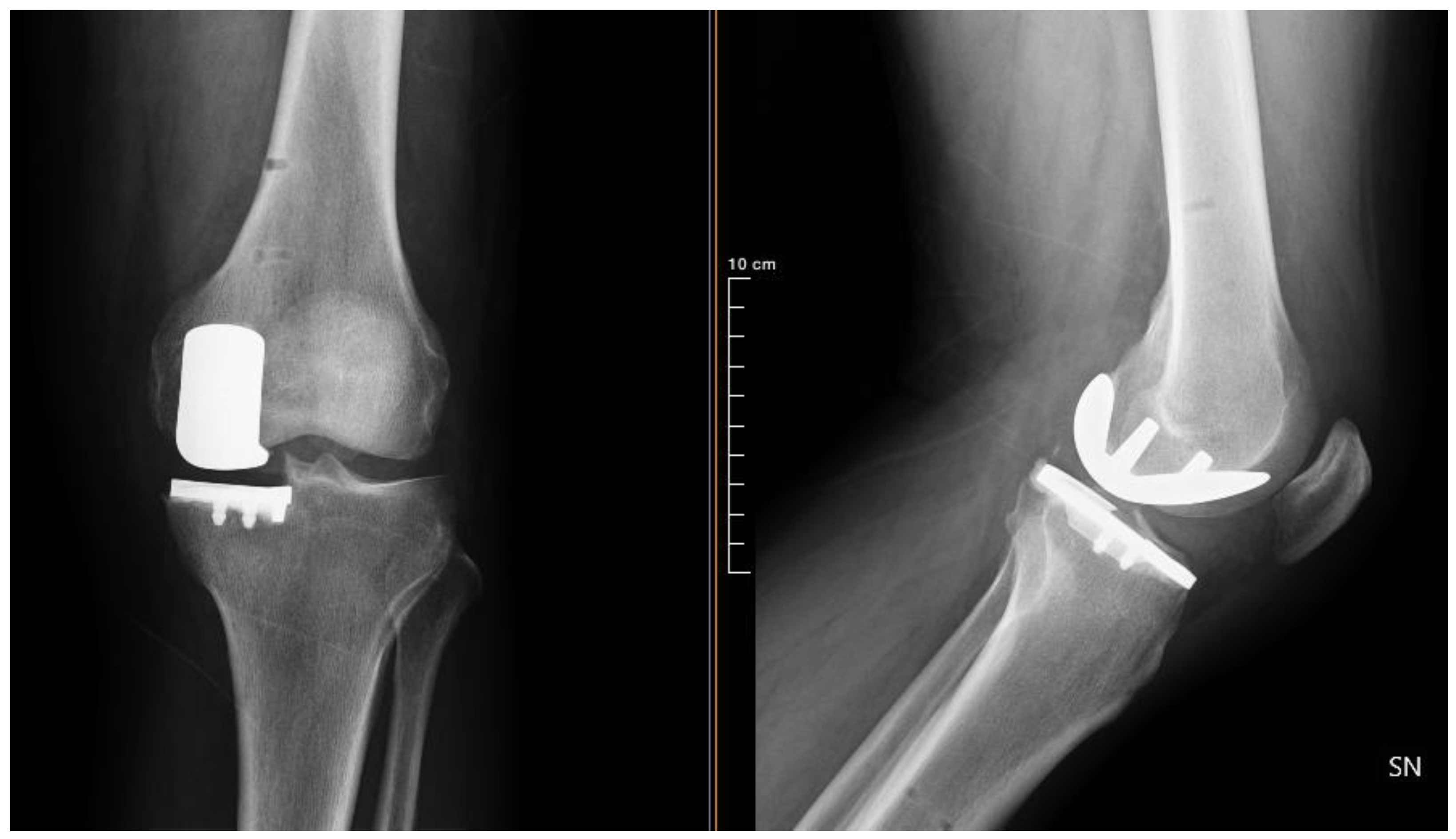
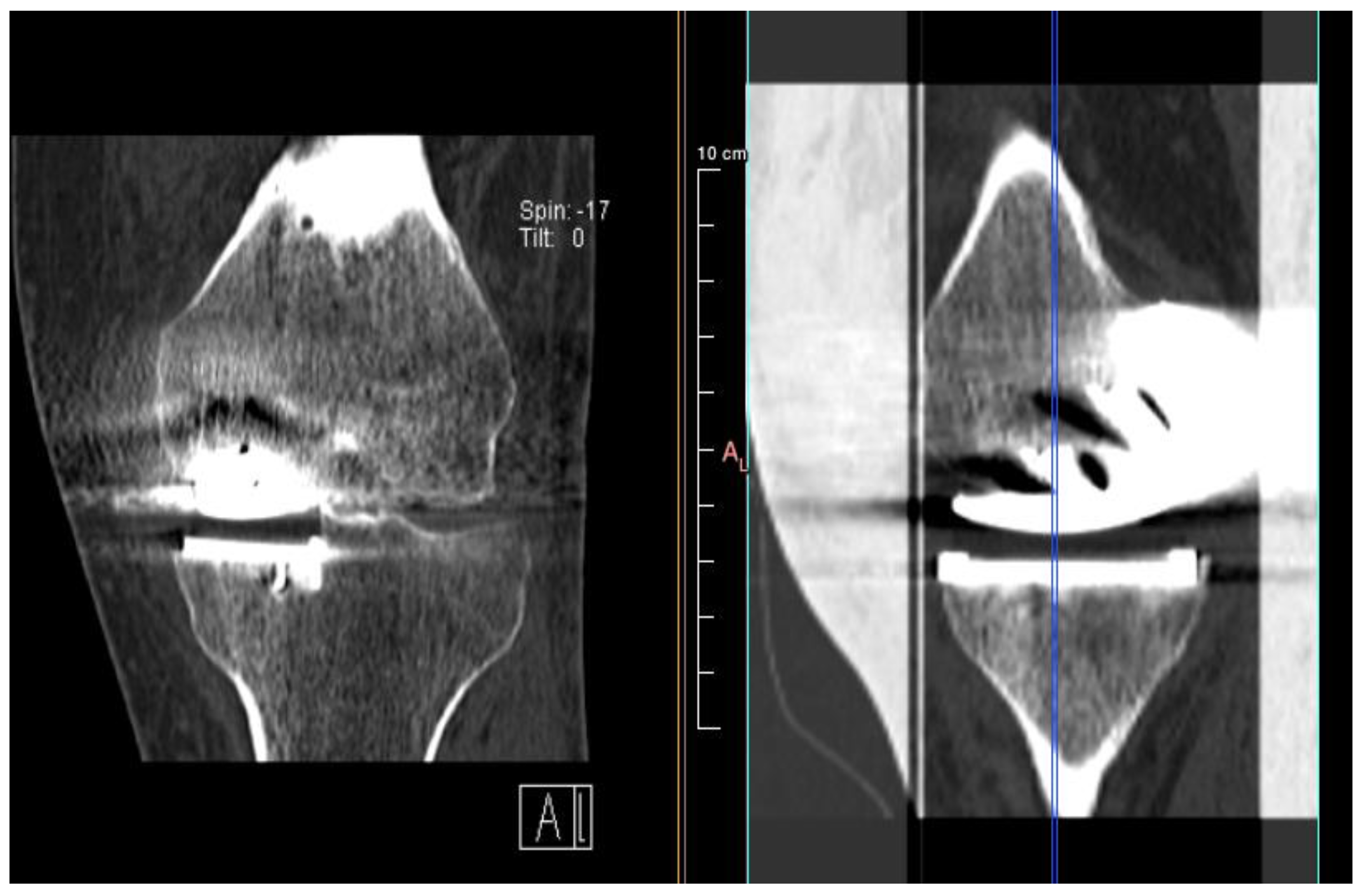
Clinical and imaging evaluations excluded prosthetic loosening, malalignment, infection, and progression of osteoarthritis in the lateral compartment. Standard radiographs confirmed correct positioning and alignment of the prosthetic components, while CT imaging provided detailed visualization of the bone–implant interface, demonstrating the absence of osteolysis or radiolucent lines (
Figure 1 and
Figure 2). Laboratory tests, including inflammatory markers and infection screening, were all within normal limits. PDUS revealed marked hypervascularization in the lateral peripatellar and lateral femoral condyle regions, suggesting active synovitis.
Given the absence of mechanical failure and infection, conversion UKA to TKA was initially proposed. However, the patient declined surgical revision. His refusal was based on concerns regarding the invasiveness of revision surgery, the prolonged recovery time which would impact his ability to work as a farmer, and the documented risk of persistent pain even after revision TKA. Consequently, he was referred for GAE. After informed consent, embolization was performed targeting the abnormal lateral genicular branches using Imipenem/Cilastatin mixed with contrast medium.
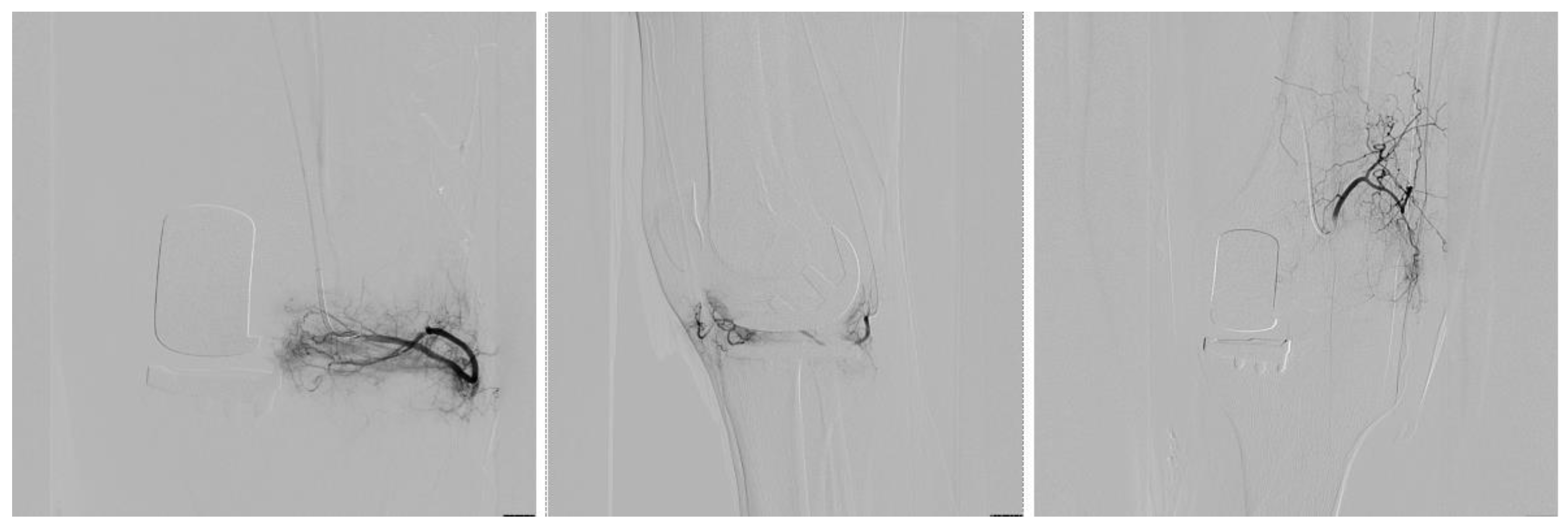
An anterograde approach was used on the ipsilateral superficial femoral artery with the placement of a 4F introducer. Ultra-selective catheterization of the superolateral and inferolateral genicular arteries was performed using a Bern 4F catheter and a TruSelect 2F 0.021″ 105 cm (Boston Scientific, Marlborough, MA, USA) microcatheter, revealing pathological vascularization with significant neoangiogenesis in the lateral compartment (
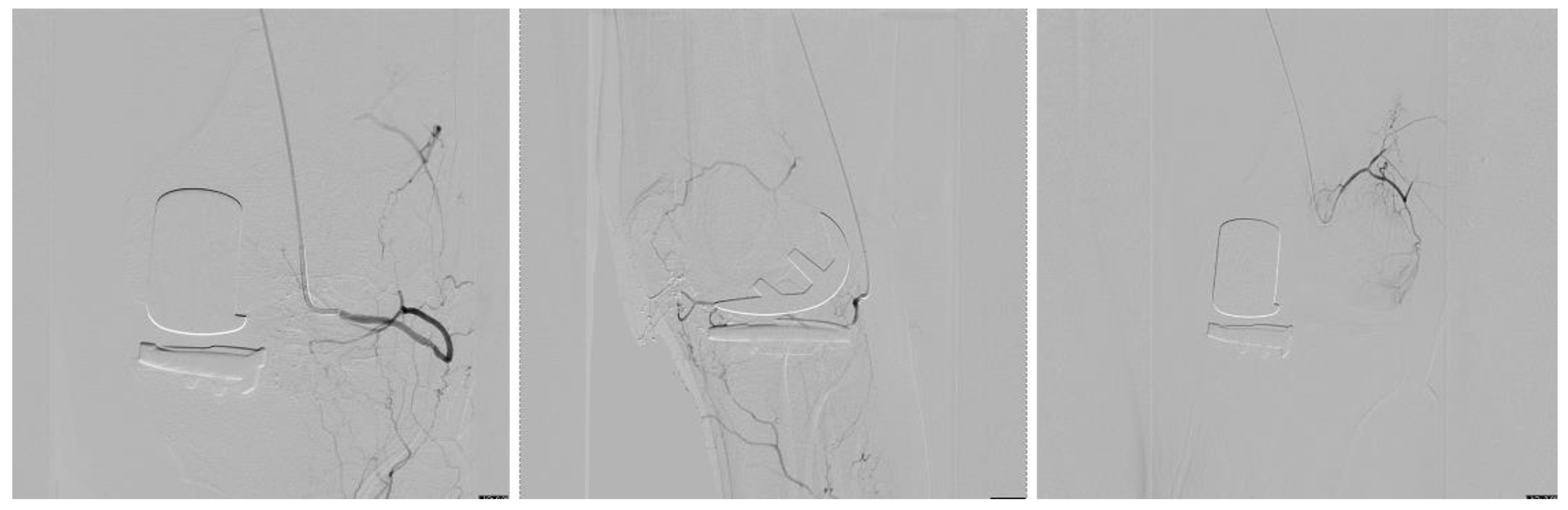
Figure 3). Embolization was subsequently carried out using Imipenem/Cilastatin mixed with contrast (
Figure 4). Care was taken to avoid reflux or non-target embolization, ensuring complete yet localized devascularization of the pathological network. Total procedure time was 45 min.
The procedure was technically successful, with two abnormal genicular branches embolized. No intra-procedural complications were observed. The patient tolerated the procedure well under local anesthesia and he was discharged on the same day.
Pain and function were assessed using VAS [
53], WOMAC [
8], KOOS [
54] and SF-36 [
92] at baseline and at 1, 3, 6, and 12 months.
At 12 months, VAS decreased from 78 to 28, WOMAC pain improved from 40.2 to 70.3, and KOOS total score increased from 52.4 to 75.8, indicating clinically meaningful improvement (
Table 1). Mild skin discoloration occurred and resolved spontaneously within 10 days. No neurological deficits, infections, or other complications were observed.
At 1 month, walking-related pain decreased from a baseline VAS of 78 to 54, with mild improvement in daily activity tolerance. By 3 months, pain had further decreased to 42, and the patient reported improved joint stability and mobility (ROM 0–120°). At 6 months, the VAS reached 32, and WOMAC pain and KOOS function scores demonstrated clinically meaningful improvement. At 12 months, the patient maintained pain relief and functional gains, with stable prosthetic imaging and no recurrence of hypervascularization on PDUS. The patient remained satisfied, returned to low-intensity farm activity, and reported no recurrence of significant pain or limitation. No further embolization or surgical interventions were required. Overall, the intervention provided a stable improvement in both pain perception and physical function, with no adverse long-term effects observed.
8. Discussion
Persistent knee pain after joint arthroplasty represents a challenging clinical condition, particularly when mechanical failure and infection have been excluded. While the literature on pain following UKA is less extensive, the occurrence of persistent pain after UKA, especially in the lateral compartment following medial implants, is not uncommon and remains underexplored in interventional treatment pathways [
43].
In the setting of unexplained pain post-arthroplasty, particularly in patients not eligible for revision surgery, treatment options are limited. Revision TKA in the absence of objective mechanical failure is associated with poor outcomes and high rates of persistent or worsening pain [
3,
4]. Revision surgery performed in the absence of clear mechanical failure is associated with a high risk of persistent pain [
5]. This substantial risk of persistent symptoms following non-indicated revision surgery underscores the critical need for highly targeted, less-invasive alternatives that address the underlying pathophysiology rather than structural components.
Such data highlight the complexity of postoperative pain mechanisms and the necessity of exploring targeted, less invasive therapeutic alternatives that can address non-mechanical sources of discomfort. This discrepancy underscores the importance of exploring alternative, less invasive strategies for managing chronic postoperative discomfort. Consequently, interest in image-guided, minimally invasive procedures such as GAE has progressively increased in recent years.
GAE has emerged as a minimally invasive procedure targeting abnormal hypervascularization in the synovium and periarticular soft tissues. The technique is performed via selective catheterization of genicular branches, allowing precise occlusion of pathological vessels while preserving the normal arterial supply to the knee joint. Persistent synovial inflammation and pathological neovascularization may contribute to chronic pain even in the absence of structural failure [
93]. These pathological vessels are often accompanied by nociceptive fibers, perpetuating pain [
6,
7]. Mapp and Walsh described how angiogenesis not only supplies oxygen and nutrients to inflamed tissues but also facilitates the ingrowth of sensory nerves, contributing to chronic nociception in osteoarthritis [
17]. This neurovascular coupling mechanism offers a strong pathophysiological basis for interventions like GAE, which aim to interrupt the cycle of inflammation and nerve sensitization.
Previous studies have demonstrated the effectiveness and safety of GAE in knee osteoarthritis and, more recently, in selected cases of persistent pain after total knee arthroplasty [
18,
19,
21].
In their pilot study, Chau et al. included 12 patients with persistent pain post-TKA. The average VAS score during walking improved from 73 ± 16 mm to 38 ± 35 mm at 6 months (
p < 0.05), while KOOS pain subscale scores increased from 43.6 ± 15.5 to 64.6 ± 27.1 (
p < 0.05). Moreover, 55% of patients achieved a minimal clinically important change (MCIC) in pain and 73% in quality of life. Importantly, no major adverse events were recorded; 42% of patients experienced transient skin discoloration, and 30% had a post-procedural VAS increase > 20 mm, which resolved within one week with basic analgesics [
21]. These outcomes provide preliminary but convincing evidence that GAE can safely alleviate pain even in complex post-arthroplasty scenarios.
To our knowledge, this is among the first reports describing the use of GAE for persistent pain following UKA. Angiography demonstrated focal hypervascularization of the lateral compartment, supporting a vascular-driven pain mechanism [
21]. This angiographic pattern, characterized by focal contrast pooling in the synovial region, has been increasingly recognized as a marker of inflammatory neovascularization. Post-procedural improvement in both VAS and WOMAC pain scores was observed over 6 months, without any major complications, reinforcing the safety and potential effectiveness of GAE beyond the traditional TKA population. The sustained functional improvement, evidenced by the increase in the KOOS total score from 52.4 to 75.8 at 12 months (
Table 1), is particularly noteworthy and suggests that this minimally invasive intervention can lead to meaningful long-term gains.
The pathophysiological substrate in our patient, chronic lateral knee pain in the absence of mechanical dysfunction, supports the hypothesis that localized inflammation and neovascularization are sufficient to perpetuate pain even in a structurally preserved compartment. This insight broadens the therapeutic perspective, suggesting that vascular modulation can be a viable option even when prosthetic integrity is maintained. This finding aligns with histopathological data from revision surgeries, which often reveal persistent inflammatory changes despite the absence of infection, prosthetic loosening, or malalignment [
7].
The choice of embolic agent is also worth discussion. While many studies have employed non-degradable microspheres (e.g., Embozene), our case utilized Imipenem/Cilastatin, a water-insoluble antibiotic with particulate properties capable of transient arterial occlusion. Okuno et al. found IPM/CS to be safe and effective, with the added advantage of potentially avoiding long-term tissue ischemia or foreign body reactions [
18]. The shorter duration of embolization with IPM/CS may also allow for revascularization of healthy tissues while selectively inhibiting pathological vessels, as hypothesized by Chau et al. [
21]. The transient embolic effect of Imipenem/Cilastatin may represent a safety advantage in post-arthroplasty patients.
A key consideration in expanding GAE to UKA patients is the vascular pattern. In Chau’s study, fewer arteries were involved post-TKA compared to OA cases, but neovascularization was more intense distally. It is plausible that UKA patients may display intermediate patterns, with localized but intense hyperemia in the preserved compartment, which can be effectively targeted [
21]. Future angiographic mapping studies could help clarify these vascular variations and guide more personalized procedural strategies.
Alternative treatment options for persistent pain post-arthroplasty, such as intra-articular corticosteroids, botulinum toxin injections, pulsed radiofrequency, and even spinal cord stimulation, have shown variable results and are often limited by short duration of effect or invasiveness [
94,
95,
96]. In this context, GAE offers a targeted, image-guided, and repeatable procedure with a favorable safety profile. In the STAR care pathway trial, approximately 25% of patients reported the same or worse pain levels three months post-TKA, highlighting the unmet need for effective interventions [
2]. GAE therefore occupies a valuable niche between conservative management and revision surgery, bridging a gap in the therapeutic algorithm for complex pain syndromes.
9. Limitations
This study has several limitations that should be acknowledged. First, the level of evidence is inherently limited by its design as a single case report, which does not allow causal inference or generalization of the findings. Accordingly, the observations presented should be interpreted as hypothesis-generating. Second, the absence of a control group prevents differentiation between treatment-related effects and potential placebo responses or spontaneous symptom fluctuations. Although the clinical improvement observed was sustained over time, such effects cannot be definitively excluded. A further limitation relates to selection bias. The case was intentionally selected after exclusion of mechanical failure, infection, and radiographic disease progression, and based on imaging evidence of synovial hypervascularization. While this approach limits generalizability to the broader post-UKA population, it was necessary to focus on a clinical scenario in which a vascular-driven pain mechanism was most likely to be present. Additionally, postoperative imaging follow-up relied on power Doppler ultrasound, which does not allow quantitative assessment of vascular changes. The absence of advanced quantitative imaging techniques, such as dynamic contrast-enhanced MRI, limits objective evaluation of treatment-related devascularization. Finally, although follow-up extended to 12 months, the long-term durability of symptom relief remains unknown. Larger prospective studies with standardized outcome measures and quantitative imaging protocols are required to validate these preliminary findings and to better define the role of genicular artery embolization in chronic post-UKA pain.
10. Conclusions
Chronic pain after unicompartmental knee arthroplasty (UKA) is often multifactorial, with synovial inflammation and pathological neovascularization playing a key role when mechanical failure and infection are excluded. Genicular artery embolization (GAE) using Imipenem/Cilastatin (IPM/CS) represents a minimally invasive approach that can selectively reduce hypervascularization and inflammation. The presented case demonstrates meaningful, sustained improvement in pain and function following targeted GAE, without major complications. These findings suggest that IPM/CS-based GAE may be a promising option for patients with refractory post-UKA pain who are not candidates for revision surgery. Larger studies are needed to confirm its efficacy, define optimal patient selection, and evaluate long-term outcomes.
Author Contributions
Conceptualization, G.B. and M.C.; methodology, R.T. and G.B.; validation, M.C., D.M., V.D.S. and R.M.C.; formal analysis, R.T.; investigation, G.B., D.M., C.B. and A.E.M.; resources, V.D.S.; data curation, C.B. and A.E.M.; writing—original draft preparation, G.B. and R.T.; writing—review and editing, M.C. and V.D.S.; visualization, R.M.C.; supervision, M.C. and V.D.S.; project administration, M.C. All authors have read and agreed to the published version of the manuscript.
Funding
This research received no external funding.
Institutional Review Board Statement
Ethical approval was not sought for the present study because the Health Directorate of Mater Olbia granted authorization, and the activation of an ethics committee was not required. In Italy, retrospective and anonymized case reports that do not involve experimental treatments are exempt from ethical approval under the Italian Code of Medical Ethics, provided informed consent for publication is obtained. This complies with the Declaration of Helsinki and the General Data Protection Regulation.
Informed Consent Statement
Informed consent was obtained from all the subjects involved in this study.
Data Availability Statement
The raw data supporting the conclusions of this article will be made available by the authors on request.
Acknowledgments
We are grateful to the Support Center for Medical Research and Education at Mater Olbia Hospital for clinical and radiological technical support.
Conflicts of Interest
The authors declare no conflicts of interest.
Abbreviations
| UKA | Unicompartmental Knee Arthroplasty |
| TKA | Total Knee Arthroplasty |
| GAE | Genicular Artery Embolization |
| IPM/CS | Imipenem/Cilastatin |
| OA | Osteoarthritis |
| VAS | Visual Analog Scale |
| WOMAC | Western Ontario and McMaster Universities Osteoarthritis Index |
| KOOS | Knee Injury and Osteoarthritis Outcome Score |
| SF-36 | Short Form-36 Health Survey |
| ROM | Range of Motion |
| MCIC | Minimal Clinically Important Change |
| CT | Computed Tomography |
| MRI | Magnetic Resonance Imaging |
References
- Wylde, V.; Beswick, A.; Bruce, J.; Blom, A.; Howells, N.; Gooberman-Hill, R. Chronic pain after total knee arthroplasty. EFORT Open Rev. 2018, 3, 461–470. [Google Scholar] [CrossRef] [Scilit]
- Carr, A.J.; Robertsson, O.; Graves, S.; Price, A.J.; Arden, N.K.; Judge, A.; Beard, D.J. Knee replacement. Lancet 2012, 379, 1331–1340. [Google Scholar] [CrossRef] [Scilit]
- Beswick, A.D.; Wylde, V.; Gooberman-Hill, R.; Blom, A.; Dieppe, P. What proportion of patients report long-term pain after total hip or knee replacement for osteoarthritis? A systematic review. BMJ Open 2012, 2, e000435. [Google Scholar] [CrossRef] [Scilit] [PubMed]
- Wylde, V.; Bertram, W.; Sanderson, E.; Noble, S.; Howells, N.; Peters, T.J.; Beswick, A.D.; Blom, A.W.; Moore, A.J.; Bruce, J.; et al. The STAR care pathway for patients with pain at 3 months after total knee replacement: A multicentre, pragmatic, randomised, controlled trial. Lancet Rheumatol. 2022, 4, e188–e197. [Google Scholar] [CrossRef] [Scilit]
- Petersen, K.K.; Simonsen, O.; Laursen, M.B.; Nielsen, T.A.; Rasmussen, S.; Arendt-Nielsen, L. Chronic postoperative pain after primary and revision total knee arthroplasty. Clin. J. Pain. 2015, 31, 1–6. [Google Scholar] [CrossRef] [Scilit] [PubMed]
- Park, C.N.; White, P.B.; Meftah, M.; Ranawat, A.S.; Ranawat, C.S. Diagnostic algorithm for residual pain after total knee arthroplasty. Orthopedics 2016, 39, e246–e252. [Google Scholar] [CrossRef] [Scilit]
- Paish, H.L.; Baldock, T.E.; Gillespie, C.S.; Pons, A.d.C.; Mann, D.A.; Deehan, D.J.; Borthwick, L.A.; Kalson, N.S. Chronic, active inflammation in patients with failed total knee replacements undergoing revision surgery. J. Orthop. Res. 2019, 37, 2316–2324. [Google Scholar] [CrossRef] [Scilit] [PubMed]
- Price, A.J.; Svard, U. A second decade lifetable survival analysis of the Oxford unicompartmental knee arthroplasty. Clin. Orthop. Relat. Res. 2011, 469, 174–179. [Google Scholar] [CrossRef] [Scilit] [PubMed] [PubMed Central]
- Lewold, S.; Robertsson, O.; Knutson, K.; Lidgren, L. Revision of unicompartmental knee arthroplasty: Outcome in 1,135 cases from the Swedish Knee Arthroplasty study. Acta Orthop. Scandz 1998, 69, 469. [Google Scholar] [CrossRef] [Scilit]
- Pandit, H.; Jenkins, C.; Gill, H.S.; Barker, K.; Dodd, C.A.; Murray, D.W. Minimally invasive Oxford phase 3 uni- compartmental knee replacement: Results of 1000 cases. J. Bone Jt. Surg. 2011, 93, 98. [Google Scholar]
- Emerson, R.H., Jr.; Higgin, L.L. Unicompartmental knee arthroplasty with the oxford prosthesis in patients with medial compartment arthritis. J. Bone Jt. Surg. 2008, 90, 118. [Google Scholar] [CrossRef] [Scilit] [PubMed]
- Khan, O.H.; Davies, H.; Newman, J.H.; Weale, A.E. Radiological changes ten years after St. Georg Sled unicompartmental knee replacement. Knee 2004, 11, 403. [Google Scholar] [CrossRef] [Scilit] [PubMed]
- Weale, A.E.; Murray, D.W.; Crawford, R.; Psychoyios, V.; Bonomo, A.; Howell, G.; O’Connor, J.; Goodfellow, J.W. Does arthritis progress in the retained compartments after ‘Oxford’ medial unicompartmental arthro-plasty? A clinical and radiological study with a minimum ten- year follow-up. J. Bone Jt. Surg. 1999, 81, 783. [Google Scholar] [CrossRef]
- Pandit, H.; Spiegelberg, B.; Clavé, A.; McGrath, C.; Liddle, A.D.; Murray, D.W. Aetiology of lateral progression of arthritis following Oxford medial unicompartmental knee replacement: A case-control study. Musculoskelet. Surg. 2016, 100, 97–102. [Google Scholar] [CrossRef] [Scilit] [PubMed] [PubMed Central]
- Sanchez-Lopez, E.; Coras, R.; Torres, A.; Lane, N.E.; Guma, M. Synovial inflammation in osteoarthritis progression. Nat. Rev. Rheumatol. 2022, 18, 258–275. [Google Scholar] [CrossRef] [Scilit] [PubMed] [PubMed Central]
- De Roover, A.; Escribano-Núñez, A.; Monteagudo, S.; Lories, R. Fundamentals of osteoarthritis: Inflammatory mediators in osteoarthritis. Osteoarthr. Cartil. 2023, 31, 1303–1311. [Google Scholar] [CrossRef] [Scilit] [PubMed]
- Mapp, P.I.; Walsh, D.A. Mechanisms and targets of angiogenesis and nerve growth in osteoarthritis. Nat. Rev. Rheumatol. 2012, 8, 390–398. [Google Scholar] [CrossRef] [Scilit]
- Okuno, Y.; Korchi, A.M.; Shinjo, T.; Kato, S.; Kaneko, T. Midterm clinical outcomes and MR imaging changes after transcatheter arterial embolization for knee osteoarthritis. J. Vasc. Interv. Radiol. 2017, 28, 995–1002. [Google Scholar] [CrossRef] [Scilit]
- Bagla, S.; Piechowiak, R.; Hartman, T.; Orlando, J.; Del Gaizo, D.; Isaacson, A. Genicular artery embolization for the treatment of knee pain secondary to osteoarthritis. J. Vasc. Interv. Radiol. 2020, 31, 1096–1102. [Google Scholar] [CrossRef] [Scilit]
- Cappucci, M.; Totti, R.; Bocchino, G.; Comodo, R.M.; Capece, G.; Rinaldi, P.M.; De Santis, V. Genicular Artery Embolization with Imipenem/Cilastatin for Pigmented Villonodular Synovitis of the Knee: A Case Report. Surgeries 2025, 6, 14. [Google Scholar] [CrossRef] [Scilit]
- Chau, Y.; Roux, C.; Gonzalez, J.F.; Breuil, V.; Bernard de Dompsure, R.; Fontas, E.; Rudel, A.; Sédat, J. Effectiveness of Genicular Artery Embolization in Chronic Pain After Total Knee Replacement: A Pilot Study. J. Vasc. Interv. Radiol. 2023, 34, 1725–1733. [Google Scholar] [CrossRef] [Scilit]
- Pandit, H.; Mancuso, F.; Jenkins, C.; Jackson, W.F.M.; Price, A.J.; Dodd, C.A.F.; Murray, D.W. Lateral unicompartmental knee replacement for the treatment of arthritis progres-sion after medial unicompartmental replacement. Knee Surg. Sports Traumatol. Arthrosc. 2017, 25, 669e74. [Google Scholar]
- Dyrhovden, G.S.; Lygre, S.H.L.; Badawy, M.; Gothesen, O.; Furnes, O. Have the causes of revision for total and unicompartmental knee arthroplasties changed during the past two decades? Clin. Orthop. Relat. Res. 2017, 475, 1874e86. [Google Scholar] [CrossRef] [Scilit] [PubMed]
- Ernstbrunner, L.; Imam, M.A.; Andronic, O.; Perz, T.; Wieser, K.; Fucentese, S.F. Lateral unicompartmental knee replacement: A systematic review of reasons for failure. Int. Orthop. 2018, 42, 1827–1833. [Google Scholar] [CrossRef] [Scilit] [PubMed]
- Foran, J.R.; Brown, N.M.; Della Valle, C.J.; Berger, R.A.; Galante, J.O. Long-term survivorship and failure modes of unicompartmental knee arthroplasty. Clin. Orthop. Relat. Res. 2013, 471, 102–108. [Google Scholar] [CrossRef] [Scilit] [PubMed] [PubMed Central]
- van der List, J.P.; Zuiderbaan, H.A.; Pearle, A.D. Why Do Medial Unicompartmental Knee Arthroplasties Fail Today? J. Arthroplast. 2016, 31, 1016–1021. [Google Scholar] [CrossRef] [Scilit] [PubMed]
- Hamilton, T.W.; Choudhary, R.; Jenkins, C.; Mellon, S.J.; Dodd, C.A.F.; Murray, D.W.; Pandit, H.G. Lateral osteophytes do not represent a contraindication to medial unicompartmental knee arthroplasty: A 15-year follow-up. Knee Surg. Sports Traumatol. Arthrosc. 2017, 25, 652–659. [Google Scholar] [CrossRef] [Scilit] [PubMed]
- Vasso, M.; Corona, K.; D’Apolito, R.; Mazzitelli, G.; Panni, A.S. Unicompartmental Knee Arthroplasty: Modes of Failure and Conversion to Total Knee Arthroplasty. Joints 2017, 5, 44–50. [Google Scholar] [CrossRef] [Scilit]
- Cooper, C.; Snow, S.; McAlindon, T.E.; Kellingray, S.; Stuart, B.; Coggon, D.; Dieppe, P.A. Risk factors for the incidence and progression of radiographic knee osteoarthritis. Arthritis Rheum. 2000, 43, 995–1000. [Google Scholar] [CrossRef] [Scilit]
- Bini, S.; Khatod, M.; Cafri, G.; Chen, Y.; Paxton, E. Surgeon, Implant, and Patient Variables May Explain Variability in Early Revision Rates Reported for Unicompartmental Arthroplasty. J. Bone Jt. Surg. Am. 2013, 95, 2195–2202. [Google Scholar] [CrossRef] [Scilit]
- Guilak, F. Biomechanical factors in osteoarthritis. Best Pract. Res. Clin. Rheumatol. 2011, 25, 815–823. [Google Scholar] [CrossRef] [Scilit] [PubMed] [PubMed Central]
- Ehmig, J.; Engel, G.; Lotz, J.; Lehmann, W.; Taheri, S.; Schilling, A.F.; Seif Amir Hosseini, A.; Panahi, B. MR-Imaging in Osteoarthritis: Current Standard of Practice and Future Outlook. Diagnostics 2023, 13, 2586. [Google Scholar] [CrossRef] [Scilit] [PubMed] [PubMed Central]
- Calvo, E.; Palacios, I.; Delgado, E.; Ruiz-Cabello, J.; Hernández, P.; Sánchez-Pernaute, O.; Egido, J.; Herrero-Beaumont, G. High-resolution MRI detects cartilage swelling at the early stages of experimental osteoarthritis. Osteoarthr. Cartil. 2001, 9, 463–472. [Google Scholar] [CrossRef] [Scilit] [PubMed]
- Dan, M.; Moralidou, M.; Kuder, I.; van Arkel, R.J.; Dejour, D.; Amis, A.A. High-grade trochlear dysplasia increases patellofemoral joint pressure and decreases the knee extension torque, and tibial tubercle anteriorisation does not correct these effects: Biomechanical study in vitro. Knee Surg. Sports Traumatol. Arthrosc. 2025, 33, 3499–3509. [Google Scholar] [CrossRef] [Scilit] [PubMed] [PubMed Central]
- Arias, C.; Lustig, S. Physiopathology of patello-femoral osteoarthritis: Current concepts. J. ISAKOS 2024, 9, 806–813. [Google Scholar] [CrossRef] [Scilit] [PubMed]
- Sava, M.P.; Leica, A.; Scala, I.; Beckmann, J.; Hirschmann, M.T. Significant correlations between postoperative outcomes and various limb and component alignment strategies in medial unicompartmental knee arthroplasty: A systematic review. J. Exp. Orthop. 2023, 10, 93. [Google Scholar] [CrossRef] [Scilit] [PubMed] [PubMed Central]
- Chang, T.W.; Yang, C.T.; Liu, Y.L.; Chen, W.C.; Lin, K.J.; Lai, Y.S.; Huang, C.H.; Lu, Y.C.; Cheng, C.K. Biomechanical evaluation of proximal tibial behavior following unicondylar knee arthroplasty: Modified resected surface with corresponding surgical technique. Med. Eng. Phys. 2011, 33, 1175–1182. [Google Scholar] [CrossRef] [Scilit] [PubMed]
- Innocenti, B.; Pianigiani, S.; Ramundo, G.; Thienpont, E. Biomechanical Effects of Different Varus and Valgus Alignments in Medial Unicompartmental Knee Arthroplasty. J. Arthroplast. 2016, 31, 2685–2691. [Google Scholar] [CrossRef] [Scilit] [PubMed]
- Li, C.; Chen, M.; Wang, X.; Yan, S.; Zhang, K.; Zeng, J.Z. Research on the biomechanical characteristics of the tibiofemoral joint before and after kinematic alignment unicompartmental knee arthroplasty. J. Orthop. Surg. Res. 2025, 20, 277. [Google Scholar] [CrossRef] [Scilit] [PubMed] [PubMed Central]
- Plancher, K.D.; Shanmugam, J.P.; Brite, J.E.; Briggs, K.K.; Petterson, S.C. Relevance of the Tibial Slope on Functional Outcomes in ACL-Deficient and ACL Intact Fixed-Bearing Medial Unicompartmental Knee Arthroplasty. J. Arthroplast. 2021, 36, 3123–3130. [Google Scholar] [CrossRef] [Scilit] [PubMed]
- Lee, J.; Koh, Y.; Kim, P.S.; Kang, K.W.; Kwak, Y.H.; Kang, K. Biomechanical effect of tibial slope on the stability of medial unicompartmental knee arthroplasty in posterior cruciate ligament-deficient knees. Bone Jt. Res. 2020, 9, 593–600. [Google Scholar] [CrossRef] [Scilit]
- Di Paolo, S.; Grassi, A.; Lucidi, G.A.; Macchiarola, L.; Dal Fabbro, G.; Zaffagnini, S. Biomechanics of the lateral meniscus: Evidences from narrative review. Ann. Jt. 2022, 7, 19. [Google Scholar] [CrossRef] [Scilit] [PubMed] [PubMed Central]
- Walsh, D.A.; Bonnet, C.S.; Turner, E.L.; Wilson, D.; Situ, M.; McWilliams, D.F. Angiogenesis in the synovium and at the osteochondral junction in osteoarthritis. Osteoarthr. Cartil. 2007, 15, 743–751. [Google Scholar] [CrossRef] [Scilit] [PubMed]
- Walsh, J.M.; Burnett, R.A.; Serino, J.; Gerlinger, T.L. Painful Unicompartmental Knee Arthroplasty: Etiology, Diagnosis and Management. Arch. Bone Jt. Surg. 2024, 12, 546–557. [Google Scholar] [CrossRef] [PubMed] [PubMed Central]
- Lombardi, A.V., Jr.; Kolich, M.T.; Berend, K.R.; Morris, M.J.; Crawford, D.A.; Adams, J.B. Revision of Unicompartmental Knee Arthroplasty to Total Knee Arthroplasty: Is It as Good as a Primary Result? J. Arthroplast. 2018, 33, S105–S108. [Google Scholar] [CrossRef] [Scilit] [PubMed]
- Jackson, J.R.; Minton, J.A.; Ho, M.L.; Wei, N.; Winkler, J.D. Expression of vascular endothelial growth factor in synovial fibroblasts is induced by hypoxia and interleukin 1beta. J. Rheumatol. 1997, 24, 1253–1259. [Google Scholar] [PubMed]
- Carotti, M.; Galeazzi, V.; Catucci, F.; Zappia, M.; Arrigoni, F.; Barile, A.; Giovagnoni, A. Clinical utility of eco-color-power Doppler ultrasonography and contrast enhanced magnetic resonance imaging for interpretation and quantification of joint synovitis: A review. Acta Biomed. 2018, 89, 48–77. [Google Scholar] [CrossRef] [Scilit] [PubMed] [PubMed Central]
- Pandey, R.; Berendt, A.R.; Athanasou, N.A. Histological and microbiological findings in non-infected and infected revision arthroplasty tissues. The OSIRIS Collaborative Study Group. Oxford Skeletal Infection Research and Intervention Service. Arch. Orthop. Trauma. Surg. 2000, 120, 570–574. [Google Scholar] [CrossRef] [Scilit] [PubMed]
- Zywiel, M.G.; Mont, M.A.; McGrath, M.S.; Ulrich, S.D.; Bonutti, P.M.; Bhave, A. Peroneal nerve dysfunction after total knee arthroplasty: Characterization and treatment. J. Arthroplast. 2011, 26, 379–385. [Google Scholar] [CrossRef] [Scilit] [PubMed]
- Emerson, R.J. Unicompartmental mobile-bearing knee arthroplasty. Instr. Course Lect. 2005, 54, 221–224. [Google Scholar] [CrossRef] [Scilit] [PubMed]
- Hefny, M.H.; Smith, N.A.; Waite, J. Cementless medial Oxford unicompartmental knee replacement. Five Year Results Indep. Ser. Knee 2020, 27, 1219–1227. [Google Scholar] [CrossRef] [Scilit] [PubMed]
- McDowell, M.; Park, A.; Gerlinger, T.L. The Painful Total Knee Arthroplasty. Orthop. Clin. N. Am. 2016, 47, 317–326. [Google Scholar] [CrossRef] [Scilit] [PubMed]
- Langley, G.B.; Sheppeard, H. The visual analogue scale: Its use in pain measurement. Rheumatol. Int. 1985, 5, 145–148. [Google Scholar] [CrossRef] [Scilit] [PubMed]
- Collins, N.J.; Prinsen, C.A.; Christensen, R.; Bartels, E.M.; Terwee, C.B.; Roos, E.M. Knee Injury and Osteoarthritis Outcome Score (KOOS): Systematic review and meta-analysis of measurement properties. Osteoarthr. Cartil. 2016, 24, 1317–1329. [Google Scholar] [CrossRef] [Scilit]
- Roos, E.M.; Lohmander, L.S. The Knee injury and Osteoarthritis Outcome Score (KOOS): From joint injury to osteoarthritis. Health Qual. Life Outcomes 2003, 1, 64. [Google Scholar] [CrossRef] [Scilit] [PubMed] [PubMed Central]
- Behrend, H.; Giesinger, K.; Giesinger, J.M.; Kuster, M.S. The “forgotten joint” as the ultimate goal in joint arthroplasty: Validation of a new patient-reported outcome measure. J. Arthroplast. 2012, 27, 430–436.e1. [Google Scholar] [CrossRef] [Scilit] [PubMed]
- Park, C.N.; Zuiderbaan, H.A.; Chang, A.; Khamaisy, S.; Pearle, A.D.; Ranawat, A.S. Role of magnetic resonance imaging in the diagnosis of the painful unicompartmental knee arthroplasty. Knee 2015, 22, 341–346. [Google Scholar] [CrossRef] [Scilit] [PubMed]
- Carotti, M.; Salaffi, F.; Manganelli, P.; Salera, D.; Simonetti, B.; Grassi, W. Power Doppler sonography in the assessment of synovial tissue of the knee joint in rheumatoid arthritis: A preliminary experience. Ann. Rheum. Dis. 2002, 61, 877–882. [Google Scholar] [CrossRef] [Scilit] [PubMed] [PubMed Central]
- Labruyère, C.; Zeller, V.; Lhotellier, L.; Desplaces, N.; Léonard, P.; Mamoudy, P.; Marmor, S. Chronic infection of unicompartmental knee arthroplasty: One-stage conversion to total knee arthroplasty. Orthop. Traumatol. Surg. Res. 2015, 101, 553–557. [Google Scholar] [CrossRef] [Scilit] [PubMed]
- Society of Unicondylar Research and Continuing Education. Diagnosis of periprosthetic joint infection after unicompartmental knee arthroplasty. J. Arthroplast. 2012, 27, 46–50. [Google Scholar] [CrossRef] [Scilit] [PubMed]
- Fransen, M.; McConnell, S.; Harmer, A.R.; Van der Esch, M.; Simic, M.; Bennell, K.L. Exercise for osteoarthritis of the knee: A Cochrane systematic review. Br. J. Sports Med. 2015, 49, 1554–1557. [Google Scholar] [CrossRef] [Scilit] [PubMed]
- Beck, S.; Dittrich, F.; Busch, A.; Jäger, M.; Theysohn, J.M.; Lazik-Palm, A.; Haubold, J. Unloader bracing in osteoarthritis of the knee—Is there a direct effect on the damaged cartilage? Knee 2023, 40, 16–23. [Google Scholar] [CrossRef] [Scilit] [PubMed]
- Moyer, R.F.; Birmingham, T.B.; Bryant, D.M.; Giffin, J.R.; Marriott, K.A.; Leitch, K.M. Valgus bracing for knee osteoarthritis: A meta-analysis of randomized trials. Arthritis Care Res. 2015, 67, 493–501. [Google Scholar] [CrossRef] [Scilit] [PubMed]
- Magni, A.; Agostoni, P.; Bonezzi, C.; Massazza, G.; Menè, P.; Savarino, V.; Fornasari, D. Management of Osteoarthritis: Expert Opinion on NSAIDs. Pain Ther. 2021, 10, 783–808. [Google Scholar] [CrossRef] [Scilit] [PubMed] [PubMed Central]
- Kidd, V.D.; Strum, S.R.; Strum, D.S.; Shah, J. Genicular nerve radiofrequency ablation for painful knee arthritis: The why and the how. JBJS Essent. Surg. Tech. 2019, 9, e10. [Google Scholar] [CrossRef] [Scilit]
- Fogarty, A.E.; Burnham, T.D.; Kuo, K.B.; Tate, Q.; Sperry, B.P.B.; Cheney, C.; Walega, D.R.M.; Kohan, L.; Cohen, S.P.; Cushman, D.M.; et al. The effectiveness of fluoroscopically guided genicular nerve radiofrequency ablation for the treatment of chronic knee pain due to osteoarthritis: A systematic Review. Am. J. Phys. Med. Rehabil. 2022, 101, 482–492. [Google Scholar] [CrossRef] [Scilit]
- McCormick, Z.L.; Korn, M.; Reddy, R.; Marcolina, A.; Dayanim, D.; Mattie, R.; Cushman, D.; Bhave, M.; McCarthy, R.J.; Khan, D.; et al. Cooled radiofrequency ablation of the genicular nerves for chronic pain due to knee osteoarthritis: Six-month outcomes. Pain Med. 2017, 18, 1631–1641. [Google Scholar] [CrossRef] [Scilit]
- Qudsi-Sinclair, S.; Borrás-Rubio, E.; Abellan-Guillén, J.F.; del Rey, M.L.P.; Ruiz-Merino, G. A comparison of genicular nerve treatment using either radiofrequency or analgesic block with corticosteroid for pain after a total knee arthroplasty: A double-blind, randomized clinical study. Pain Pract. 2017, 17, 578–588. [Google Scholar] [CrossRef] [Scilit]
- Khan, F.M.; Tran, A.; Wong, P.K.-W.; Aiyedipe, S.; Loya, M.F.; Cristescu, M.M.; Gonzalez, F.M. Management of uncomplicated total knee arthroplasty chronic pain and stiffness utilizing cooled radiofrequency ablation: A single institution pilot study. Skelet. Radiol. 2022, 51, 1215–1223. [Google Scholar] [CrossRef] [Scilit]
- Shi, W.; Vu, T.N.; Annaswamy, T.; Wu, H.; Moore, B.; Hatchard, N.; Mears, C.; Kunselman, A.R. Effectiveness comparison of genicular nerve ablation for knee osteoarthritic versus post-total knee arthroplasty pain. Interv. Pain Med. 2024, 3, 100390. [Google Scholar] [CrossRef] [Scilit] [PubMed] [PubMed Central]
- Lustig, S.; Servien, E.; Neyret, P.; Pereira, H. An original indi-cation for BiUnicondylar knee arthroplasty: Subsequent contralat-eral unicondylar knee arthroplasty after degenerative changes of the opposite compartment. Tech. Knee Surg. 2008, 7, 240–250. [Google Scholar] [CrossRef] [Scilit]
- Saragaglia, D.; Bonnin, M.; Dejour, D.; Deschamps, G.; Chol, C.; Chabert, B.; Refaie, R. French Society of Hip and Knee. Results of a French multicentre retrospective experience with four hundred and eighteen failed unicondylar knee arthroplasties. Int. Orthop. 2013, 37, 1273–1278. [Google Scholar] [CrossRef] [Scilit] [PubMed] [PubMed Central]
- Alnachoukati, O.K.; Barrington, J.W.; Berend, K.R.; Kolczun, M.C.; Emerson, R.H.; Lombardi, A.V., Jr.; Mauerhan, D.R. Eight Hundred Twenty-Five Medial Mobile-Bearing Unicompartmental Knee Arthroplasties: The First 10-Year US Multi-Center Survival Analysis. J. Arthroplast. 2018, 33, 677–683, Erratum in J. Arthroplast. 2018, 33, 2339. https://doi.org/10.1016/j.arth.2018.02.085. [Google Scholar] [CrossRef] [Scilit] [PubMed]
- Bohl, D.D.; Li, J.; Calkins, T.E.; Darrith, B.; Edmiston, T.A.; Nam, D.; Gerlinger, T.L.; Levine, B.R.; Della Valle, C.J. Physical Therapy on Postoperative Day Zero Following Total Knee Arthroplasty: A Randomized, Controlled Trial of 394 Patients. J. Arthroplast. 2019, 34, S173–S177.e1. [Google Scholar] [CrossRef] [Scilit] [PubMed]
- Parratte, S.; Pauly, V.; Aubaniac, J.M.; Argenson, J.N. Survival of bicompartmental knee arthroplasty at 5 to 23 years. Clin. Orthop. Relat. Res. 2010, 468, 64–72. [Google Scholar] [CrossRef] [Scilit] [PubMed] [PubMed Central]
- Kamath, A.F.; Levack, A.; John, T.; Thomas, B.S.; Lonner, J.H. Minimum two-year outcomes of modular bicompartmental knee arthroplasty. J. Arthroplast. 2014, 29, 75–79. [Google Scholar] [CrossRef] [Scilit] [PubMed]
- Parratte, S.; Ollivier, M.; Opsomer, G.; Lunebourg, A.; Argenson, J.N.; Thienpont, E. Is knee function better with contemporary modular bicompartmental arthroplasty compared to total knee arthroplasty? Short-term outcomes of a prospective matched study including 68 cases. Orthop. Traumatol. Surg. Res. 2015, 101, 547–552. [Google Scholar] [CrossRef] [Scilit] [PubMed]
- Gerow, D.E.; Small, S.R.; Lackey, W.G.; Carter, J.L.; Berend, M.E. What Role Does Patello-Femoral Joint Degeneration Have on Pain and Function After Unicompartmental Knee Arthroplasty? A Prospective Observational Cohort Study. J. Arthroplast. 2024, 39, 76–80. [Google Scholar] [CrossRef] [Scilit] [PubMed]
- Barrett, W.P.; Scott, R.D. Revision of failed unicondylar unicompartmental knee arthroplasty. J. Bone Jt. Surg. Am. 1987, 69, 1328–1335. [Google Scholar]
- Lindstrand, A.; Stenström, A.; Lewold, S. Multicenter study of unicompartmental knee revision. PCA, Marmor, and St Georg compared in 3,777 cases of arthrosis. Acta Orthop. Scand. 1992, 63, 256–259. [Google Scholar] [CrossRef] [Scilit]
- Lai, C.H.; Rand, J.A. Revision of failed unicompartmental total knee arthroplasty. Clin. Orthop. Relat. Res. 1993, 287, 193–201. [Google Scholar] [CrossRef] [Scilit]
- Chakrabarty, G.; Newman, J.H.; Ackroyd, C.E. Revision of unicompartmental arthroplasty of the knee. Clinical and technical considerations. J. Arthroplast. 1998, 13, 191–196. [Google Scholar] [CrossRef] [Scilit] [PubMed]
- Böhm, I.; Landsiedl, F. Revision surgery after failed unicompartmental knee arthroplasty: A study of 35 cases. J. Arthroplast. 2000, 15, 982–989. [Google Scholar] [CrossRef] [Scilit]
- McAuley, J.P.; Engh, G.A.; Ammeen, D.J. Revision of failed unicompartmental knee arthroplasty. Clin. Orthop. Relat. Res. 2001, 392, 279–282. [Google Scholar] [CrossRef] [Scilit] [PubMed]
- Châtain, F.; Richard, A.; Deschamps, G.; Chambat, P.; Neyret, P. Revision total knee arthroplasty after unicompartmental femorotibial prosthesis: 54 cases. Rev. Chir. Orthop. 2004, 90, 49–54. [Google Scholar]
- Saragaglia, D.; Estour, G.; Nemer, C.; Colle, P.E. Revision of 33 unicompartmental knee prostheses using total knee arthroplasty: Strategy and results. Int. Orthop. 2009, 33, 969–974. [Google Scholar] [CrossRef] [Scilit]
- Järvenpää, J.; Kettunen, J.; Miettinen, H.; Kröger, H. The clinical outcome of revision knee replacement after unicompartmental knee arthroplasty versus primary total knee arthroplasty: 8–17 years follow-up study of 49 patients. Int. Orthop. 2010, 34, 649–653. [Google Scholar] [CrossRef] [Scilit]
- Taslakian, B.; Miller, L.E.; Mabud, T.S.; Macaulay, W.; Samuels, J.; Attur, M.; Alaia, E.F.; Kijowski, R.; Hickey, R.; Sista, A.K. Genicular artery embolization for treatment of knee osteoarthritis pain: Systematic review and meta-analysis. Osteoarthr. Cartil. Open 2023, 5, 100342. [Google Scholar] [CrossRef] [Scilit] [PubMed] [PubMed Central]
- Liu, S.; Swilling, D.; Morris, E.M.; Macaulay, W.; Golzarian, J.; Hickey, R.; Taslakian, B. Genicular Artery Embolization: A Review of Essential Anatomic Considerations. J. Vasc. Interv. Radiol. 2024, 35, 487–496.e6. [Google Scholar] [CrossRef] [Scilit] [PubMed]
- Nakamura, H.; Yamamoto, A.; Fukunaga, T.; Watanabe, H.; Ito, K.; Higaki, A.; Kanki, A.; Fukukura, Y.; Tamada, T. In vitro study of the embolic characteristics of imipenem/cilastatin particles. CVIR Endovasc. 2024, 7, 27. [Google Scholar] [CrossRef] [Scilit] [PubMed] [PubMed Central]
- Okuno, Y.; Oguro, S.; Iwamoto, W.; Miyamoto, T.; Ikegami, H.; Matsumura, N. Short-term results of transcatheter arterial embolization for abnormal neovessels in patients with adhesive capsulitis: A pilot study. J. Shoulder Elb. Surg. 2014, 23, e199–e206. [Google Scholar] [CrossRef] [Scilit] [PubMed]
- Lins, L.; Carvalho, F.M. SF-36 total score as a single measure of health-related quality of life: Scoping review. SAGE Open Med. 2016, 4, 2050312116671725. [Google Scholar] [CrossRef] [Scilit] [PubMed]
- Roos, E.M.; Klässbo, M.; Lohmander, L.S. WOMAC osteoarthritis index. Reliability, validity, and responsiveness in patients with arthroscopically assessed osteoarthritis. Western Ontario and MacMaster Universities. Scand. J. Rheumatol. 1999, 28, 210–215. [Google Scholar] [CrossRef] [Scilit] [PubMed]
- Singh, J.A.; Mahomed, N.N.; Hawker, G.A. The impact of arthritis on the physical and mental health of older adults: Results from the National Health and Nutrition Examination Survey (NHANES) 2001–2008. BMJ Open 2015, 5, e007387. [Google Scholar]
- Willinger, M.L.; Heimroth, J.; Sodhi, N.; Garbarino, L.J.; Gold, P.A.; Rasquinha, V.; Danoff, J.R.; Boraiah, S. Management of refractory pain after total joint replacement. Curr. Pain. Headache Rep. 2021, 25, 42. [Google Scholar] [CrossRef] [Scilit]
- Urits, I.; Markel, M.; Vij, N.; Ulanday, J.; Machek, M.; An, D.; Charipova, K.; Gress, K.; Herman, J.A.; Kaye, A.D.; et al. Use of spinal cord stimulation for the treatment of post total knee arthroplasty pain. Best Pract. Res. Clin. Anaesthesiol. 2020, 34, 633–642. [Google Scholar] [CrossRef] [Scilit]
| Disclaimer/Publisher’s Note: The statements, opinions and data contained in all publications are solely those of the individual author(s) and contributor(s) and not of MDPI and/or the editor(s). MDPI and/or the editor(s) disclaim responsibility for any injury to people or property resulting from any ideas, methods, instructions or products referred to in the content. |




 ,
,