1. Introduction
Liquid sloshing in partially filled tanks is critical in aerospace, marine, and automotive systems because it affects vehicle stability, structural loads, and control performance [
1,
2,
3]. Sloshing-induced variations in the center of gravity (CG) are especially important: even small oscillations can alter the dynamic response and stability margins. Predicting and mitigating sloshing-driven CG shifts has, therefore, been a long-standing research focus [
4,
5].
Most mitigation strategies are mechanical or geometric, including internal baffles, compliant liners, tuned mass dampers, or tank shape optimization [
6,
7,
8,
9,
10,
11]. In parallel, high-fidelity computational fluid dynamics (CFD) models have been developed to analyze sloshing across excitation regimes [
12,
13,
14,
15], although they require careful validation against experiments.
Magnetic field interactions with liquids offer an alternative approach. In electrically conducting fluids, classical magnetohydrodynamics (MHD) shows that applied magnetic fields can damp motion, modify boundary layers, and redistribute spectral energy [
16,
17,
18,
19,
20,
21]. For weakly conducting aqueous media, however, the magnetic Reynolds and Stuart numbers are extremely small, so bulk induction-driven electromagnetic braking is expected to be negligible. This motivates a pragmatic bench-scale question: under otherwise identical conditions, does the presence of static magnets measurably influence the experimentally observed dynamic response of a mechanically excited water tank system?
Because prior magnetic-field-assisted sloshing studies have focused mainly on conductive fluids, quantitative evidence for weakly conducting liquids such as water is limited. Existing small-scale tests also do not isolate magnetic-field intensity from added mass or geometry. The present work addresses this gap by using a controlled bench-scale platform in which magnetic intensity is varied while the mass, geometry, and wetting boundary remain fixed.
To prevent misinterpretation, we emphasize that no volumetric MHD mechanism is proposed. Given the extremely small magnetic Reynolds numbers for tap water, any observed effects must arise—if at all—from near-wall or coupled fluid–structure interactions rather than bulk electromagnetic damping. The study is, therefore, framed strictly as a reproducible empirical observation at bench scale.
A recurring challenge in bench-scale sloshing experiments is the presence of high-frequency mechanical artefacts. In the present system, a transient ∼14 Hz component appears due to actuator reversal dynamics and impulsive mechanical “kicks,” not due to sloshing itself. This high-frequency component is not related to the fundamental sloshing mode and is absent in CFD simulations, confirming that it originates from the mechanical actuation rather than the fluid motion. Its contribution is, therefore, treated separately from the primary low-frequency sloshing response.
This paper examines whether static magnets influence the measured CG response of the mechanically excited tank system under these controlled conditions. The main contributions are as follows:
- 1.
Elimination of wetting and pinning variability by placing a ferromagnetic steel plate outside the tank bottom and keeping it identical across all runs.
- 2.
Execution of paired YES/NO magnet experiments at a 4 cm fill height near the first sloshing resonance, using both a split-wall (15 + 15) configuration and a higher-field single-wall configuration with 30 magnets (Mag–30@L) and a mass-matched control (Dummy–30@L).
- 3.
Quantification of steady-state CGy using time-domain (P2P, RMS) and frequency-domain metrics, with paired statistical testing.
- 4.
Inclusion of a concise “Scaling and Practicality” discussion based on the magnetic Reynolds number, Stuart number, and Bond number, clarifying why the present bench-scale observations cannot be extrapolated to larger systems without additional analysis.
In summary, no measurable influence on the fundamental sloshing mode is observed in either configuration. A modest reduction in CG amplitude appears only in the high-field Mag–30@L case and is confined to a higher-frequency side-band (10–20 Hz) associated with mechanically induced fluid–structure interaction, while the dominant sloshing mode near 0.55 Hz remains unchanged. This distinction aligns the interpretation consistently with both experimental observations and CFD results.
2. Experimental Setup
2.1. Tank Geometry and Fill Level
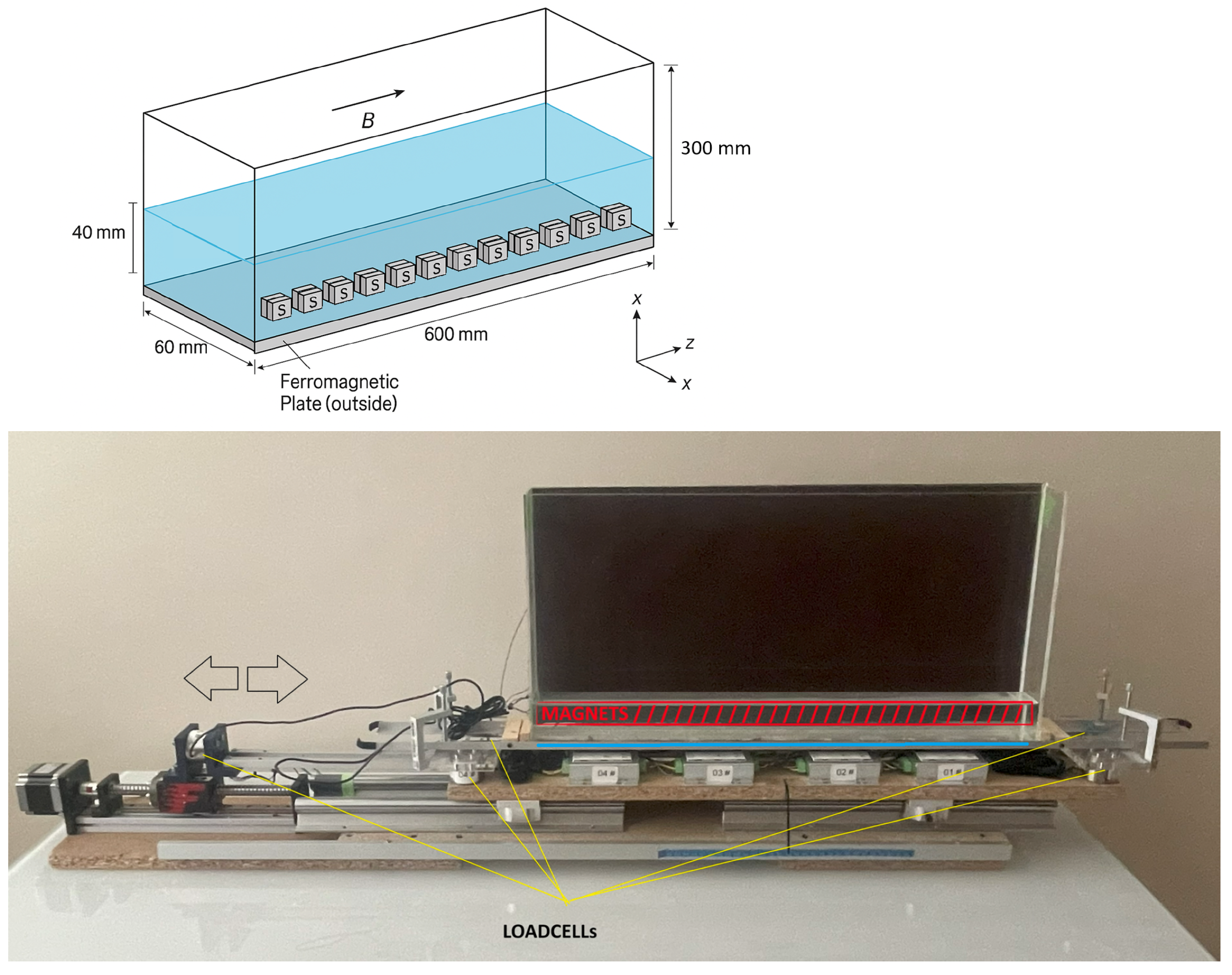
A transparent acrylic tank with internal dimensions (wall thickness 3 mm) was used. The coordinate origin was assigned to the geometric center of the tank floor, with x along the width, y along the length, and z vertical.
The tank was filled to a depth of .
This filling depth was selected to yield a clear and repeatable first sloshing mode while avoiding wave breaking or intermittent free-surface impacts. At , the response is dominated by a single low-frequency mode near –0.55 Hz, which provides a stable reference for distinguishing sloshing motion from mechanically induced higher-frequency components.
Figure 1 presents an overview of the test rig.
2.2. Base Excitation
A programmable linear stage imposed horizontal base motion described by
with amplitude
.
The nominal resonance of the first sloshing mode is estimated using
yielding
(
) for
and
. Tests were conducted near
to maximize the measurable low-frequency CG response.
Each run lasted 35 s. The first 5 s were discarded to remove start-up transients.
2.3. Magnetic Hardware and Configurations
Permanent magnets were NdFeB grade N35 ( mm). All magnets were mounted externally, with no direct fluid contact. A 2 mm thick ferromagnetic steel plate was placed on the outside of the tank bottom and kept identical across all configurations.
Two magnetic layouts were examined:
- 1.
Split-wall (15 + 15): Fifteen magnets were mounted on each long wall near the free surface, producing a weak, symmetric magnetic field with low spatial gradients.
- 2.
Single-wall, high-field (Mag–30@L): All 30 magnets were concentrated on a single long wall, increasing the local field strength and gradient.
A corresponding mass-matched control (Dummy–30@L) used non-magnetic steel pieces of identical mass and geometry placed at the same locations.
Hall-probe measurements confirmed that the magnetic flux density near the inner wall reached values on the order of tens of millitesla in the Mag–30@L configuration, whereas it remained below mT in the Dummy–30@L case.
The absence of any measurable effect in the split-wall configuration is, therefore, consistent with its weak and diffuse field geometry, while the single-wall arrangement produces a sufficiently concentrated field to influence the mechanically coupled high-frequency response of the system.
All structural components of the rig (load-cell bases, clamps, and fixtures) were manufactured from aluminum to minimize unintended magnetic coupling. The steel plate was identical in all configurations and never contacted the fluid, ensuring that the only difference between paired runs was the presence or absence of a magnetic field.
2.4. Instrumentation and CG Reconstruction
The tank was supported by four miniature load cells mounted at known coordinates. Signals were acquired at (; 16-bit resolution). Static calibration was performed before each campaign.
The center-of-gravity location was reconstructed as
This CG-based measurement reflects the global dynamic response of the coupled fluid–structure system and is directly relevant to stability and control considerations, rather than local free-surface elevation alone.
2.5. Test Matrix and Paired Design
Each condition (Split-wall (15 + 15) and Mag–30@L vs Dummy–30@L) was tested with paired runs. Between runs, the tank rested for 60 s to re-establish quiescence.
For the single-wall configuration, a total of 20 paired experiments were conducted, yielding more than 600 s of steady-state data at 191 Hz sampling, providing a statistically robust basis for the reported comparisons.
Paired indexing ensured one-to-one correspondence between magnetized and control runs.
2.6. CFD Cross-Check (No Magnets)
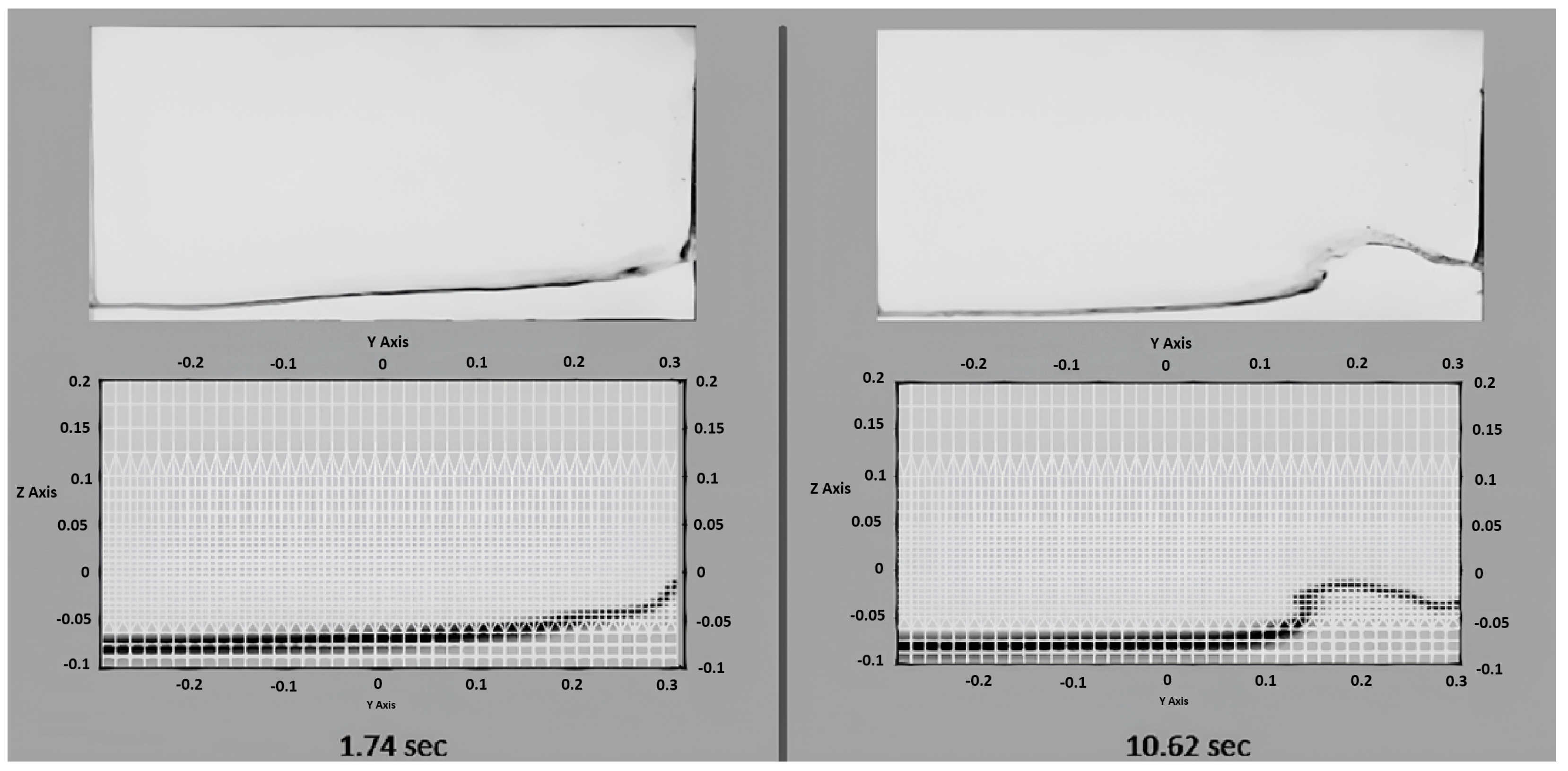
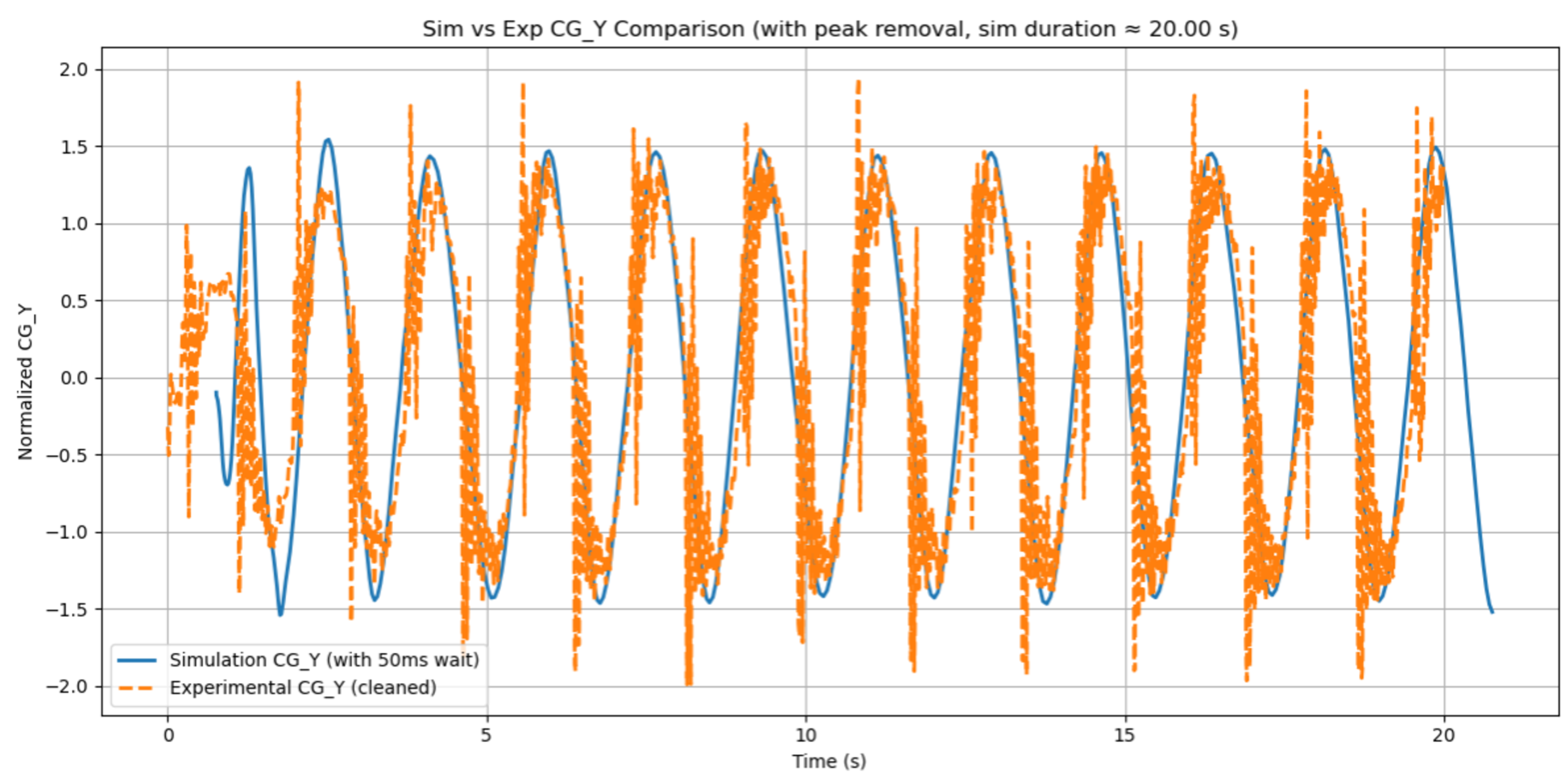
To validate the sloshing rig independently of magnetic effects, a two-phase VOF simulation (OpenFOAM interFoam) was performed with identical geometry and excitation. Magnetic fields were omitted.
The simulated CG response closely matched the baseline (no-magnet) experiments in both phase and amplitude, confirming that the observed high-frequency components in the measurements originate from the mechanical actuation and not from sloshing dynamics.
3. Test Configurations
All experiments were performed at a water depth of
, a regime in which the free surface couples strongly to the tank motion and yields a clear first-mode sloshing response near
. Each trial lasted 35 s; as described in
Section 2.2, the first 5 s were discarded and the remaining steady 20 s segment was used for analysis.
A 2 mm ferromagnetic steel plate was mounted externally beneath the tank bottom and kept strictly identical across all experiments. This eliminated geometric, wetting, and pinning effects while ensuring that the only experimental variable across paired runs was the presence or absence of an applied magnetic field.
Two magnetic layouts were examined: (i) a symmetric split-wall configuration used as an initial reference, and (ii) an intensified single-wall configuration introduced to increase local magnetic field strength.
- 1.
Split-wall (15 + 15 magnets). Fifteen N35 permanent magnets were bonded externally to each long wall near the free surface. This symmetric arrangement minimized geometric bias and served as a baseline configuration. Hall probe measurements indicated that the resulting magnetic field within the fluid region was relatively weak and spatially diffuse.
- 2.
Single-wall, high-field (Mag–30@L). All 30 magnets were concentrated on one wall to increase the local magnetic flux density and gradient. A mass-matched nonmagnetic configuration (Dummy–30@L) used steel blocks identical in mass and geometry but without magnetization, isolating magnetic effects from added mass or inertia.
Each configuration was tested using a paired experimental design: for each run index k, two trials were performed under identical excitation conditions, one with magnets and one without. This yielded paired trials per configuration. Between trials, the tank was allowed to rest for approximately 60 s to re-establish quiescence.
Both
and
were reconstructed from the four load cell reactions; however,
dominated the dynamic response and is treated as the primary observable throughout this study.
Table 1 provides an overview of the test configurations and experimental controls used in this study.
The absence of any measurable difference in the split-wall (15 + 15) configuration is consistent with its weak and diffuse magnetic field and confirms that this layout does not influence either the fundamental sloshing mode or the mechanically induced higher-frequency response.
In contrast, the single-wall Mag–30@L configuration enables examination of whether a stronger and more localized magnetic field modifies the system response. As demonstrated later, any observed differences are confined to a higher-frequency (10–20 Hz) component associated with mechanically induced fluid–structure interaction, while the primary sloshing mode remains unaffected.
To further isolate mechanical effects, empty tank trials were conducted. No persistent structural resonance or forcing defect was observed near 14–16 Hz, confirming that the high-frequency band appearing in filled-tank experiments arises from coupled liquid–structure dynamics rather than from the actuator or support structure alone.
4. Results and Discussion
4.1. Time-Domain Analysis of CG Oscillations
Time-domain responses of the reconstructed signal were analyzed under otherwise identical excitation conditions for two experimental campaigns: the symmetric split-wall (15 + 15) configuration and the intensified single-wall configuration (Mag–30@L vs Dummy–30@L). In all cases, the first 5 s were discarded and metrics were computed over the subsequent 20 s steady segment. Peak-to-peak (P2P) and RMS amplitudes were used as descriptive measures of the overall system response.
4.1.1. Split Wall (15 + 15)
Across paired runs, no statistically significant differences were detected between the magnetized and non-magnetized cases (), with relative changes remaining below 2%. Within the sensitivity of the present setup, this configuration, therefore, shows no measurable influence of the applied magnetic field on either the sloshing response or the higher-frequency system dynamics.
4.1.2. Single Wall (Mag–30@L vs. Dummy–30@L)
When all 30 magnets were concentrated on a single wall, a modest reduction was observed in full-band time-domain measures that include both low-frequency sloshing motion and higher-frequency mechanically induced components: the mean P2P amplitude decreased by approximately 8% and the RMS by approximately 3% relative to the mass-matched dummy configuration, with paired statistical tests yielding . These reductions are dominated by changes in the high-frequency portion of the signal and should, therefore, not be interpreted as attenuation of the fundamental sloshing mode.
It is emphasized that these percentages refer to time-domain measures of the entire signal, which includes both low-frequency sloshing motion and higher-frequency mechanically induced components. When attention is restricted to the fundamental sloshing band alone, the corresponding change in amplitude is substantially smaller and is addressed separately below.
4.2. Frequency-Domain Summary
Frequency-domain analysis was carried out using FFTs computed on the steady segments with Hann windowing. To clarify the physical interpretation, the spectra were examined in two distinct ranges: a low-frequency band (0–5 Hz) containing the fundamental sloshing mode, and a higher-frequency band (10–20 Hz) associated with mechanically induced fluid–structure interaction.
In the low-frequency band, the dominant spectral peak consistently appeared near for both magnetic and non-magnetic configurations. No detectable shift in the dominant sloshing frequency was observed, and the difference in peak amplitude between Mag–30@L and Dummy–30@L was small (on the order of a few percent), comparable to the measurement uncertainty. These results indicate that the fundamental sloshing dynamics are not measurably modified by the presence of static magnets under the present conditions.
In contrast, a broader spectral component within the 10–20 Hz range was observed in both configurations. This component is characterized by a short temporal duration and, therefore, appears as a relatively broad feature in frequency space rather than as a sharp resonance peak. Band-power integration over this interval shows a statistically significant reduction when magnets are present, with the largest relative change occurring near 14 Hz.
At the nominal 14 Hz bin, for example, the mean spectral amplitude decreases from (Dummy–30@L) to (Mag–30@L), corresponding to a 32.7% reduction (, paired t-test ). This quantitative suppression reconciles the modest changes observed at the fundamental sloshing frequency with the larger reductions seen in full-band P2P measures.
4.3. Statistical Reliability and Robustness
Both experimental campaigns employed paired designs, which control for slow drift and run-to-run variability. For the split-wall configuration, confidence intervals for P2P and RMS differences spanned zero, confirming the null result. For the Mag–30@L configuration, the confidence intervals for full-band P2P and RMS excluded zero under both paired t-tests and nonparametric checks.
Bootstrap resampling of the Mag–30@L vs. Dummy–30@L P2P differences further confirmed that the sign of the effect is robust to sampling variability, although its magnitude remains small.
Additional empty-tank and dummy-only tests showed no low-frequency peak below 1 Hz, confirming that the dominant peak near 0.55 Hz in filled-tank experiments originates from sloshing rather than from a structural resonance of the actuator or support structure.
4.4. Discussion of Implications
Taken together, the results indicate that static magnets do not measurably influence the fundamental sloshing mode under the present experimental conditions. The observable magnetic influence is confined to a higher-frequency component associated with mechanically induced fluid–structure interaction rather than to sloshing itself.
This distinction explains why full-band time-domain measures show a larger relative change than band-limited sloshing metrics. While the observed attenuation of the high-frequency component is statistically robust, its relevance to classical sloshing mitigation is limited.
The present experiments, therefore, do not demonstrate magnetic control of sloshing dynamics, but rather a modest modification of a mechanically excited high-frequency coupled mode of the experimental system. Whether such an effect is of broader interest depends on the specific application and on the role of mechanical actuation in the overall dynamics.
4.5. Physical Interpretation and Limitations
Order-of-magnitude estimates for tap water (magnetic Reynolds number and Stuart number ) confirm that volumetric magnetohydrodynamic effects are negligible. Accordingly, no bulk MHD mechanism is proposed.
The observations are instead interpreted as empirical evidence that static magnetic fields, in combination with the surrounding conducting structure, can slightly modify the effective damping of a mechanically excited fluid–structure system at bench scale. The detailed mechanism—whether dominated by near-wall fluid effects, eddy-current interactions in structural components, or their coupling— cannot be resolved with the present diagnostics.
The experiments were conducted at a single fill level and with a single tank geometry and magnet arrangement. Scaling to larger tanks, different fluids, or different excitation regimes therefore remains an open question and is addressed only qualitatively in
Section 5.
5. Conclusions
This bench-scale study investigated whether static magnetic fields measurably influence the experimentally observed center-of-gravity (CG) response of a mechanically excited, partially filled rectangular water tank. Two configurations were tested at a fixed fill height of under near-resonant horizontal excitation: a symmetric split-wall (15 + 15) layout and a higher-field single-wall (Mag–30@L) layout with a mass–matched Dummy–30@L control.
In the split-wall configuration, no statistically significant differences were detected between magnetic and non-magnetic conditions (), consistent with the weak and diffuse field distribution of that layout. In the single-wall configuration, full-band time-domain measures of the total signal exhibited a modest but statistically significant reduction relative to the dummy control (approximately 8% in P2P and 3% in RMS, ).
However, frequency domain analysis shows that the dominant sloshing mode near is not measurably altered by the magnetic field under the present conditions: the peak frequency is unchanged and the change in the fundamental band amplitude is small (on the order of a few percent), comparable to experimental uncertainty. Accordingly, the present results do not provide convincing evidence that static magnets attenuate the fundamental sloshing dynamics of water in this rig.
Instead, the clearest and most reproducible magnetic influence appears in a higher-frequency response component within the 10–20 Hz range (including the vicinity of 14 Hz), which is associated with mechanically induced fluid–structure interaction linked to actuator reversal dynamics. This component is short-lived in time, and therefore, appears as broadband content in the FFT rather than as a sharp resonance line. Its amplitude is consistently reduced when magnets are present, indicating a modest magnetic modification of a mechanically excited coupled mode of the experimental system rather than a change in sloshing itself.
5.1. Limitations, Scaling, and Future Work
The experiments were intentionally limited to bench scale and tap water, a weakly conducting fluid with extremely small magnetic Reynolds () and Stuart numbers (N∼10−7), precluding bulk MHD effects. The observations, therefore, cannot be interpreted as classical induction-driven electromagnetic braking.
Because the detected magnetic influence is confined to a mechanically excited high-frequency coupled response, its relevance is primarily methodological: it highlights that experimental sloshing measurements can be sensitive to actuation-induced fluid–structure interactions, and that static magnetic fields in combination with nearby conducting structures may modify the effective damping of such modes. The detailed mechanism (near-wall fluid effects, eddy-current interactions in structural parts, or their coupling) cannot be isolated with the present diagnostics.
Future work should, therefore, focus on (i) direct measurements of the actuation dynamics and structural compliance during reversals; (ii) controlled material-variation tests (e.g., reduced conductive aluminum near the magnet/plate assembly) and (iii) velocity-field diagnostics (high-speed imaging, PIV) to separate sloshing motion from high-frequency coupled responses. Parameter sweeps in fill height, excitation, and conductivity would also be required before any generalization to other regimes or scales can be made.
5.2. Key Contributions
A controlled paired experimental protocol with external magnets and mass-matched dummy blocks, designed to isolate magnetic effects while keeping the tank geometry and wetting boundary unchanged.
Demonstration that the fundamental sloshing mode near is not measurably modified by static magnets in the present water-tank rig.
Identification of a reproducible magnetic influence on a higher-frequency (10–20 Hz) response component attributed to mechanically induced fluid–structure interaction associated with actuator reversal dynamics.
An openly documented bench-scale dataset that may support future investigations of magnetic effects on experimentally induced coupled modes in sloshing rigs.