Article

Acute Sodium Bicarbonate Supplementation Improves Repeated Sprint Ability in Recreational Female Football Players: A Randomized, Double-Blind, Placebo-Controlled, Crossover Trial

by
Cláudia F. Barata
1,
Joana F. Reis
1,2,3,*,
Sofia A. Moncóvio
1,
Arminda M. Vilares
1,
André M. Bento
1,
Cristóvão H. Rosa
1,
Mário C. Espada
2,4,5,6,
Catarina N. Matias
7 and
Cristina P. Monteiro
1,2
1
Laboratory of Physiology and Biochemistry of Exercise, Faculdade de Motricidade Humana, Universidade de Lisboa, Estrada da Costa, Cruz Quebrada, 1495-761 Oeiras, Portugal
2
Interdisciplinary Center for the Study of Human Performance (CIPER), Faculdade de Motricidade Humana, Universidade de Lisboa, Estrada da Costa, 1495-761 Oeiras, Portugal
3
Portugal Football School, Portuguese Football Federation, Avenida das Seleções, 1495-433 Oeiras, Portugal
4
Escola Superior de Educação, Instituto Politécnico de Setúbal (CIEQV Setúbal), 2914-504 Setúbal, Portugal
5
Sport Physical Activity and Health Research & Innovation CenTer (SPRINT), Sport Sciences School of Rio Maior (ESDRM) Instituto Politécnico Santarém, 2040-413 Rio Maior, Portugal
6
Comprehensive Health Research Centre (CHRC), Universidade de Évora, Largo dos Colegiais 2, 7000-645 Évora, Portugal
7
CIDEFES—Universidade Lusófona & CIFI2D—Universidade do Porto, Universidade Lusófona, Campo Grande, 1749-024 Lisboa, Portugal
*
Author to whom correspondence should be addressed.
Appl. Sci. 2026, 16(1), 353; https://doi.org/10.3390/app16010353 (registering DOI)
Submission received: 4 November 2025 / Revised: 7 December 2025 / Accepted: 11 December 2025 / Published: 29 December 2025
(This article belongs to the Special Issue Exercise Physiology and Biomechanics in Human Health: 2nd Edition)

Abstract

Repeated sprint ability (RSA) is a critical component of football, yet high-intensity effort leads to H+ accumulation. Sodium bicarbonate (SB) is an effective buffering agent, though evidence supporting its use among female football players remains limited. We conducted a randomized, double-blind, placebo-controlled, crossover trial (NCT06098794) to examine the acute effects of SB on RSA in recreational female football players. Eleven athletes completed two RSA sessions on a cycle ergometer under SB and placebo (PL) conditions. Each session involved 3 sets of 6 maximal 6 s sprints performed every 30 s, with a 5 min recovery between sets. Participants ingested 0.2 g·kg−1 of the supplement 2 h prior to testing and 0.1 g·kg−1 1 h before the session. The results showed that SB induced a greater blood lactate accumulation (SB: 14.0 ± 4.32 vs. PL: 10.9 ± 3.55 mmol·L−1, p = 0.010) and a greater elimination of CO2 through breathing (p = 0.038), while maintaining muscle oxygenation. These physiological responses were accompanied by improved performance, as SB prevented a decline in mean power output from the first to the second set (SB: +1.4% vs. PL: −3.7%) and reduced the post-test drop in jump height (SB: −2.0% vs. PL: −8.2%). These findings suggest that SB supplementation may be useful to reduce muscular acidosis and fatigue in recreational female football players.

1. Introduction

Football is an intermittent sport characterized by alternating periods of high and low intensity activity [1,2]. A critical component of performance in this context is repeated sprint ability (RSA)—the capacity to perform successive bouts of high-intensity sprints with minimal recovery between efforts [3]. Given the high physical demands of football and the growing frequency of training sessions, matches and travel throughout the season, nutritional strategies aimed at enhancing performance and mitigating fatigue are of increasing relevance [1].
High-intensity intermittent exercise, such as that required in football, depends on the rapid resynthesis of adenosine triphosphate (ATP), which generates hydrogen ions (H+) as a byproduct of anaerobic metabolism, contributing to intramuscular acidosis. To preserve the functionality of both energy-producing and contractile systems, the body engages intramuscular buffers and dynamic pH regulation mechanisms [4]. Enhancing the body’s alkaline reserve prior to exercise may facilitate the efflux of H+ and lactate from muscle cells by steepening the transmembrane gradient [5]. Sodium bicarbonate (SB) is a well-established ergogenic aid known to elevate extracellular pH and attenuate exercise-induced acidosis [6,7]. However, its potential influence on oxygen transport and utilization within skeletal muscle has yet to be fully elucidated [1]. Technologies such as near-infrared spectroscopy (NIRS) allow for the real-time assessment of muscle oxygenation and blood flow, while pulmonary gas exchange analysis offers complementary insight into systemic oxygen uptake and utilization.
Despite promising physiological mechanisms, the transferability of SB supplementation benefits to football performance remains unclear. Some research suggests that the ergogenic effect of this supplement may be greater in recreational players due to their lower muscle buffering capacity compared to their professional counterparts [8]. Additionally, most studies exploring the effects of SB in football have focused on male players, even though the number of female cohorts has increased by approximately 50% in recent years [3,9]. This is probably associated with the biological differences in muscle physiology and metabolism between men and women, with men more likely to benefit from supplementation with SB [10]. In general, the female athlete has been severely underrepresented in research on SB supplementation, with only 20% of studies including women, and of those, 7.4% conducting group analyses exclusively in women [7,11].
The scope of this study was to provide female-specific, football-relevant evidence on the acute performance and physiological effects of SB, an area where research remains scarce. Specifically, we aimed to examine the effects of acute SB supplementation on RSA in recreational female football players, combining the analysis of performance outcomes and physiological markers, including blood lactate concentration ([La]), pulmonary gas exchange and muscle oxygenation.

2. Materials and Methods

2.1. Experimental Design

This study was a randomized, double-blind, placebo-controlled, crossover trial (NCT06098794). Participants attended the Laboratory of Physiology and Biochemistry of Exercise of the Faculty of Human Kinetics on three non-consecutive days, with sessions spaced at least one week apart within one month. To control for circadian variations, all sessions were conducted at the same time of day for each participant [12]. The first session involved anthropometric and body composition assessments, as well as familiarization with the cycle ergometer and exercise protocol. Participants ingested either SB or placebo (PL) during the following two sessions, before performing the exercise protocol. The order of supplement ingestion was randomized using block randomization (SB-PL: SB first session, PL second session; PL-SB: PL first session, SB second session). Data collected included sprint and jump performance, blood lactate concentration ([La]), pulmonary gas exchange and muscle oxygenation.

2.2. Participants

Participants were eligible for inclusion if they met the following criteria: (1) recreational female football players from the second division of women’s football with more than 3 years of continuous practice; (2) engaged in a microcycle of 3 to 5 training sessions per week plus a weekend match; (3) aged between 18 and 30 years; (4) able to provide informed consent. Exclusion criteria included: (1) injury occurrence or ergogenic supplement consumption within the month preceding data collection; (2) known intolerance to SB. An a priori power analysis using G*Power (Version 3.1.9.2, Düsseldorf, Germany) with a repeated measures ANOVA, aiming to detect an effect size of 0.62 for total work performed in the sprints [13], a power of 0.80 and a significance level of 0.05, determined that a sample size of 8 participants was required. Twelve athletes volunteered; however, one participant withdrew due to injury, leading to a final sample size of 11 athletes (Figure 1). All participants provided written informed consent. The study received approval from the Ethics Committee for Research of Faculty of Human Kinetics (No. 44/2021) and adhered to the Declaration of Helsinki [14].

2.3. Procedures

In the familiarization session, after measuring participants’ body mass and height, body composition was assessed using bioelectrical impedance analysis. To familiarize themselves with the cycle ergometer and the exercise protocol, athletes performed a single set of the RSA protocol and several countermovement jumps (CMJs) in a contact mat.
Before the two experimental sessions, participants ingested capsules containing 0.3 g·kg−1 of body mass of either SB or cellulose as PL, prepared specifically for the study in a pharmaceutical environment. This amount was divided into two doses to minimize possible gastrointestinal (GI) discomfort [7]. The first dose (0.2 g·kg−1) was taken with a carbohydrate-rich meal 2 h before the beginning of the exercise protocol and the second dose (0.1 g·kg−1) was taken 1 h before the protocol. Meal content was individualized based on participants’ dietary habits and participants were advised to consume liquids with the supplements. Both participants and investigators involved in data collection were blinded to the supplement content, with only the investigator responsible for randomization aware of the allocations.
In both sessions, upon arriving at the laboratory, participants completed a questionnaire to assess the GI symptoms of the supplement. Afterwards, they performed a standardized 5 min warm-up in a cycle ergometer (Monark Ergomedic 894E, Monark Exercise AB, Vansbro, Sweden) at 60–70 rpm, followed by a single maximal sprint to determine peak power output and set 95% of this value as the minimum target for the first sprint of the protocol. Jump performance was assessed and the participants were then fitted with the equipment for measuring pulmonary gas exchange, heart rate and muscle oxygenation. Before the RSA protocol, capillary blood was collected from the ear lobe to evaluate resting [La].
The RSA protocol consisted of 3 sets (S1, S2, S3) of six 6 s sprints, each separated by 24 s of active recovery. A 5 min passive recovery period was provided between sets. If the target of 95% of the predetermined peak power output was not met in the first sprint, a 5 min rest was provided before repeating the process. The exercise protocol adhered to general recommendations for RSA training [15]. The exercise workload was set at 4% of each participant’s body mass [16]. Participants were instructed to perform all sprints at maximal effort, with verbal encouragement provided. Capillary blood sampling from the ear lobe for [La] measurement was repeated 1 min after the end of each set and at 2 min intervals post-exercise until the values declined. After the RSA protocol, jump performance was again assessed.

2.4. Measurements

2.4.1. Anthropometry and Body Composition

Participants’ body mass and height were measured to the nearest 1.0 kg (Seca 761, Hamburg, Germany) and 0.1 cm (Harpenden, Holtain Ltd., Crosswell, UK), respectively. Body composition was assessed via single-frequency (50 kHz) bioelectrical impedance analysis (BIA 101, Akern, Florence, Italy), following a 10 min rest in the supine position to stabilize body fluids. The measurements were made with the subjects in the supine position with a leg opening of approximately 45° compared to the median line of the body and the upper limbs positioned about 30° away from the trunk. Two electrodes were placed on the back of the right hand and two electrodes on the corresponding foot, with a distance of 5 cm between each other, after cleaning the skin with alcohol [17]. Fat-free mass was calculated using the equations developed by Matias et al. [18].

2.4.2. Gastrointestinal Effects of the Supplement

The questionnaire used to assess the GI symptoms induced by supplement ingestion before the RSA protocol was adapted from Miller et al. [19]. Symptoms evaluated in a scale of 0 (“no symptom”) to 10 (“severe symptom”) included nausea, flatulence, stomach cramping, belching, stomach ache, bowel urgency, diarrhea, vomiting and bloating. Participants were also instructed to report any symptoms experienced during the exercise protocol.

2.4.3. Sprint Performance

Sprint performance metrics included mean power output (MPO), peak power output (PPO), total work (TW) and sprint decrement (SDec) for each set. Work per sprint was calculated by multiplying MPO by sprint duration. TW was the sum of work across the six sprints in each set. SDec was calculated using the formula proposed by Girard et al. [20].

2.4.4. Blood Lactate Accumulation

Measurements of [La] in capillary blood were performed using a portable analyser (Lactate Pro 2, KDK Corporation, Kyoto, Japan), following the manufacturer’s instructions. The values pre-protocol, 1 min post-each set and the maximal value achieved after the protocol were considered for analysis.

2.4.5. Pulmonary Gas Exchange and Heart Rate

During the RSA protocol, oxygen uptake (VO2), carbon dioxide production (VCO2) and ventilation (VE) were measured breath-by-breath using a calibrated gas analyser (MetaMax 3B, Cortex Biophysik, Leipzig, Germany). Heart rate (HR) was continuously monitored with a chest strap sensor (H7, Polar Electro Oy, Kempele, Finland). Data was interpolated on a second-by-second basis, with 6 s averages calculated. The highest values of relative VO2 (mL·kg−1·min−1), VE (L·min−1), and HR (bpm) were retained for analysis for each set. Mean values for absolute VO2 (L·min−1) and VCO2 (L·min−1) were also recorded throughout each set.

2.4.6. Muscle Oxygenation

Muscle oxygenation was assessed using near-infrared spectroscopy (Niro-200NX, Hamamatsu Photonics, Hamamatsu, Japan), with the probe placed on the bulkier portion of the vastus lateralis after hair removal and skin cleaning. The probe was secured with a dark band to prevent interference from external light. Device settings were adjusted based on the subcutaneous fat thickness of that muscle area. Data were collected at 0.5 Hz, with resting values prior to the protocol used as reference. The area under the curve was calculated for oxygenated (O2Hb) and deoxygenated hemoglobin (HHb) to reflect accumulated changes during each set.

2.4.7. Jump Performance

Participants performed three countermovement jumps (CMJs) in a contact mat (Chronojump BoscoSystem, Software Version 2.2.0, Barcelona, Spain) before and after the exercise protocol. Jump height (JH) was recorded and the highest value was used for analysis. A 30 s recovery period was provided between. Participants placed their hands on their hips, squatted to a 90-degree knee angle and immediately jumped vertically as high as possible, landing on the mat with both feet simultaneously [21].

2.5. Statistical Analyses

Statistical analyses were conducted using the Statistical Package for the Social Sciences (Version 27.0, IBM Corp., New York, NY, USA) and the nparLD package in R (Version 4.2.0, Open-Source Code, General Public License). Data were summarized using means and standard deviations. Normal distribution and sphericity were assessed using the Shapiro–Wilk and Mauchly tests, respectively. For normally distributed data, a general linear model for repeated measures ANOVA was applied, with Greenhouse–Geisser corrections when sphericity was not verified. Non-parametric data were analysed using a two-way ANOVA-type test. Post hoc paired comparisons employed the Bonferroni correction with significance set at p < 0.05. For non-normally distributed variables, the Friedman and Wilcoxon tests identified significant differences between sets and conditions, respectively, adjusting significance levels for the number of tests performed: p < 0.05/3 for sets and p < 0.05/2 for conditions.

3. Results

3.1. Participants’ Characterization

Table 1 presents age, body mass, height, body mass index (BMI), fat-free mass (FFM) and absolute and percentage fat mass (FM) of the participants.

3.2. Gastrointestinal Effects of the Supplement

Although athletes were blinded for supplement condition, three participants reported a single GI symptom each, all associated with SB ingestion: belching (severity rating: 4), stomach ache (rating: 4) and stomach cramping (rating: 2). However, none of the participants indicated that the symptoms interfered with their ability to complete the protocol. No symptoms were reported associated with PL ingestion.

3.3. Sprint Performance

The sprint performance results are presented in Table 2. A significant interaction between set and condition was found for MPO (F(1.162,10.457) = 4.854, p = 0.047). Under PL, MPO values decreased from S1 to S2 by 3.7%, but under SB they remained approximately stable (+1.4%). For PPO, a main effect of set was observed (F(2,18) = 5.563, p = 0.013), with values being higher at S3 than at S1. No main effects of set or condition nor any interaction were found for SDec or TW.

3.4. Blood Lactate Accumulation

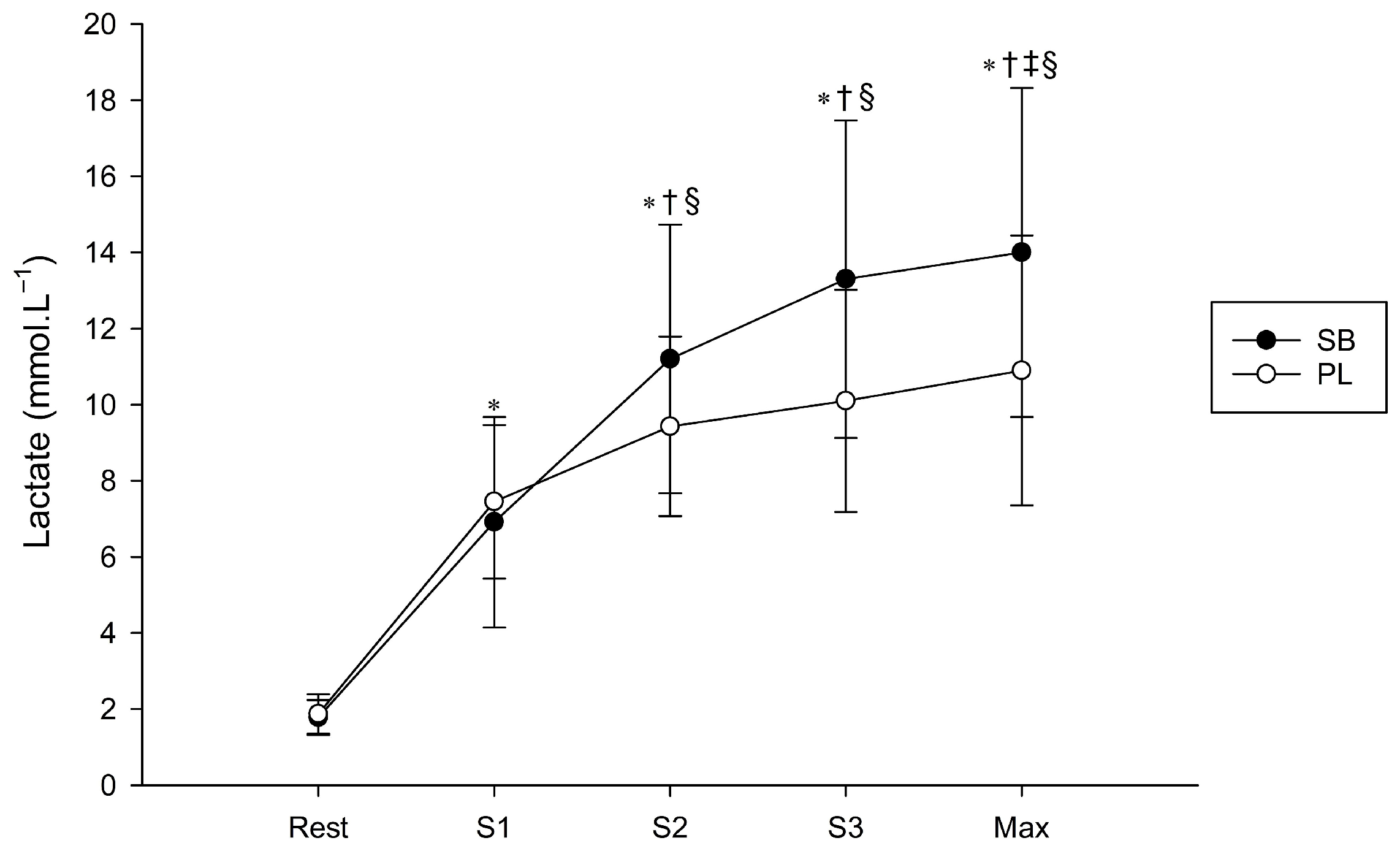
Results for [La] are shown in Figure 2. A significant interaction between set and condition was observed (F(4,40) = 7.741, p < 0.001), along with main effects of set (F(1.801,18.013) = 67.016, p < 0.001) and condition (F(1,10) = 8.753, p = 0.014). In both conditions, [La] at rest (SB: 1.78 ± 0.46; PL: 1.87 ± 0.52 mmol·L−1) was lower than at S1 (SB: 6.91 ± 2.77; PL: 7.45 ± 2.02 mmol·L−1), S2 (SB: 11.2 ± 3.53; PL: 9.43 ± 2.36 mmol·L−1), S3 (SB: 13.3 ± 4.17; PL: 10.1 ± 2.92 mmol·L−1) and Max (SB: 14.0 ± 4.32; PL: 10.9 ± 3.55 mmol·L−1). Values at S1 were also lower than those at S2, S3 and Max. Under SB only, [La] at S2 was lower than at Max. Furthermore, [La] was higher under SB than under PL at S2, S3 and Max.

3.5. Pulmonary Gas Exchange and Heart Rate

Pulmonary gas exchange and HR results are presented in Table 2. No interaction between set and condition was observed for any of these variables. For VCO2, main effects of set (F(2,20) = 34.454, p < 0.001) and condition (F(1,10) = 5.731, p = 0.038) were observed. VCO2 values were lower at S2 and S3 compared to S1 and higher under SB than under PL. In contrast, no main effects of set or condition were found for VO2, whether expressed as relative (mL·kg−1·min−1) or absolute (L·min−1) values. For VE, a main effect of set was found (F(2,20) = 3.822, p = 0.039), although post hoc analysis did not reveal any specific difference between sets. Regarding HR, a main effect of set was detected (F(1.547,∞) = 88.143, p < 0.001), with higher values at S3 compared to at S1, independently of condition.

3.6. Muscle Oxygenation

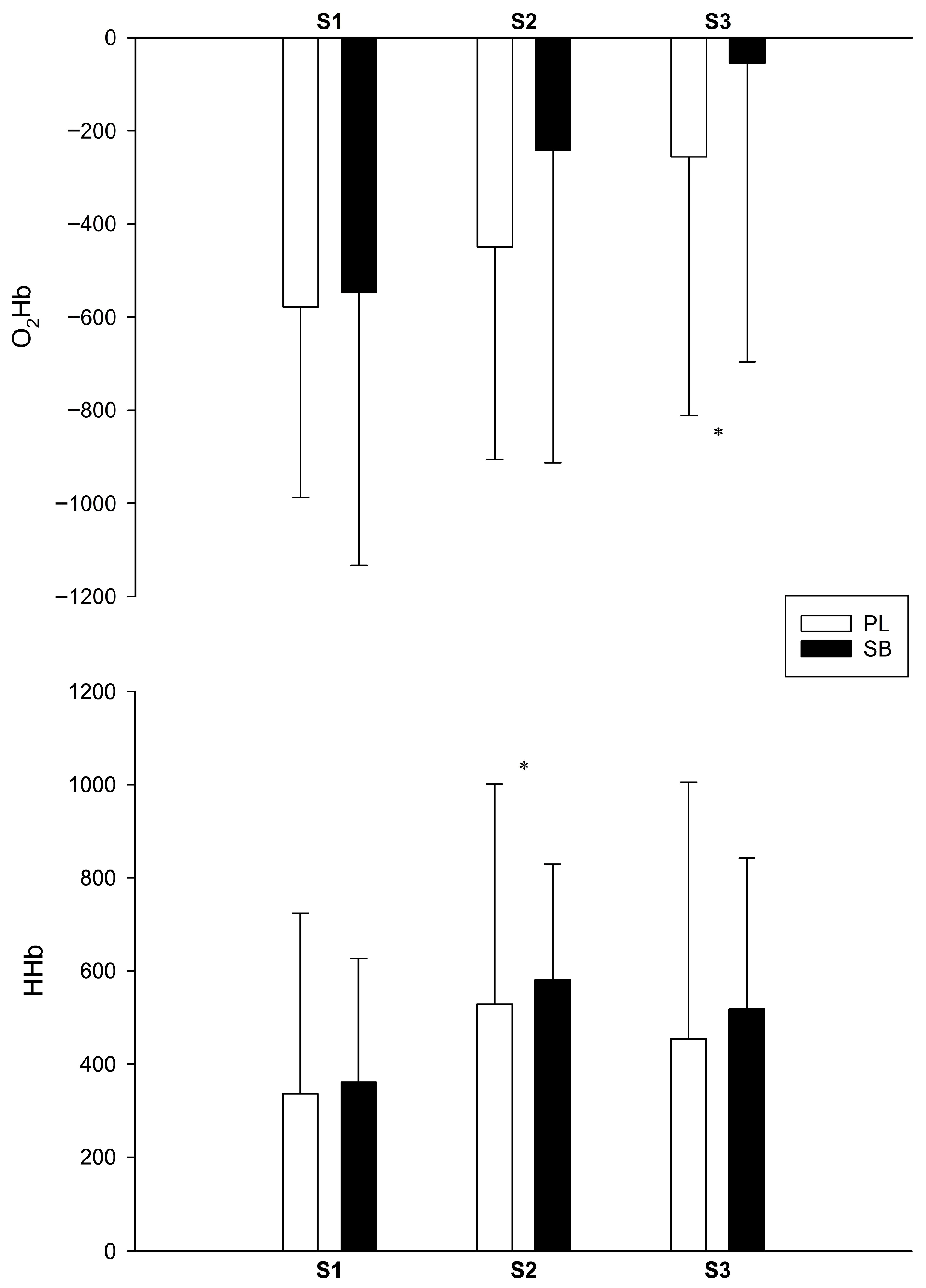
Table 2 and Figure 3 present the results for muscle oxygenation. O2Hb values were negative throughout the exercise protocol, indicating a reduction in oxygenated hemoglobin, while HHb values were positive, reflecting an increase in deoxygenated hemoglobin. For both O2Hb and HHb, no significant interaction between set and condition or main effect of condition was observed. However, a main effect of set was found for both variables (O2Hb: F(1.367,∞) = 10.702, p < 0.001; HHb: F(1.471,∞) = 13.192, p < 0.001). Specifically, O2Hb was higher at S3 than at S1, while HHb was higher at S2 than at S1, regardless of condition.

3.7. Jump Performance

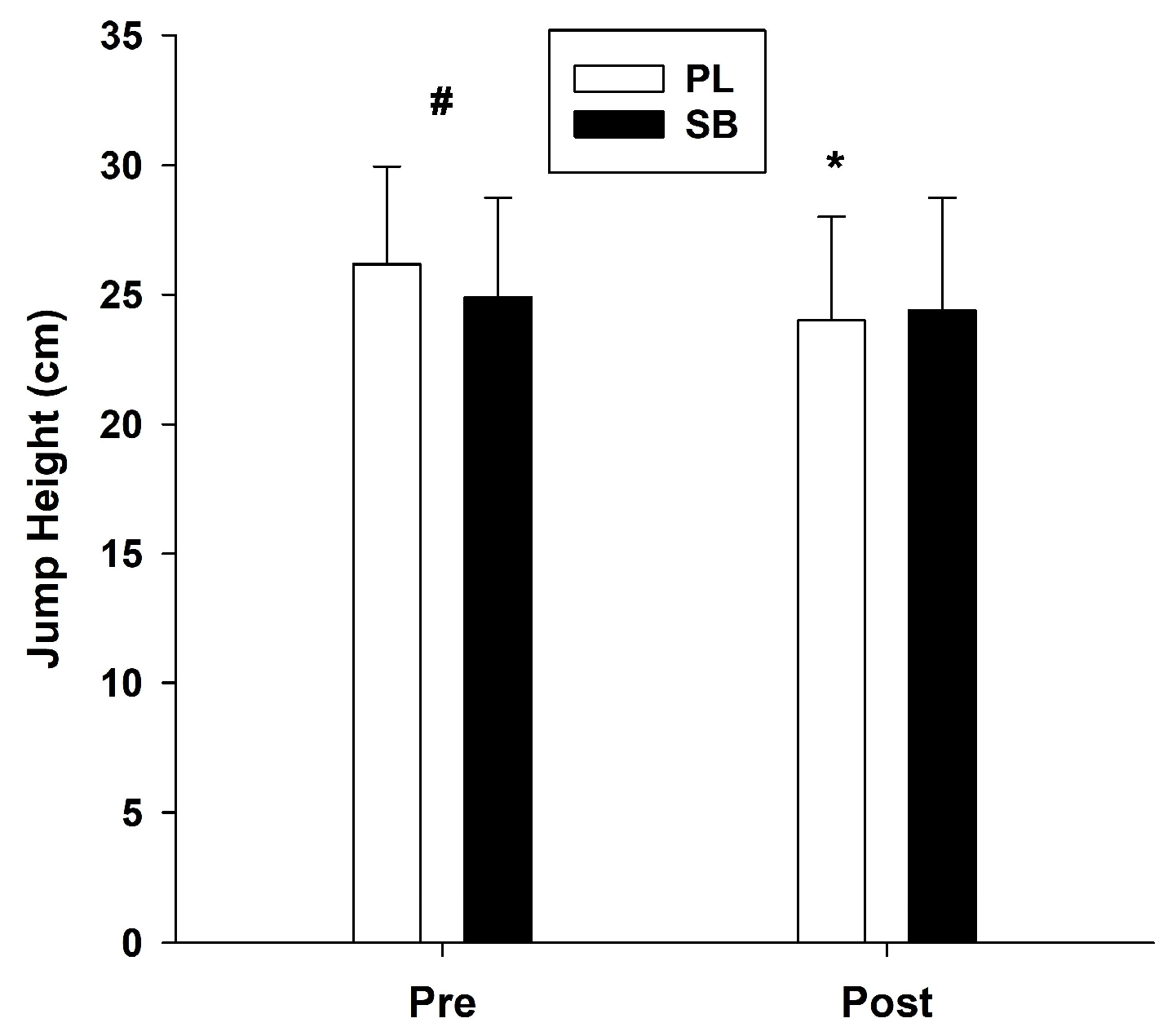
An interaction between set and condition was observed for JH (F(1,9) = 5.455, p = 0.044), along with a main effect of set (F(1,9) = 9.043, p = 0.015). As presented in Figure 4, pre-exercise JH values were lower under SB than under PL. Post-exercise, JH decreased under PL by approximately 8.2%, remaining relatively stable under SB (−2.0%).

4. Discussion

To the best of our knowledge, this is the first study to examine the effects of acute SB supplementation on RSA in recreational female football players integrating performance outcomes with physiological markers such as [La], pulmonary gas exchange, muscle oxygenation and neuromuscular fatigue. The main finding of our research is that SB supplementation led to greater blood lactate accumulation and enhanced CO2 elimination through breathing while preserving muscle oxygenation. These favourable metabolic responses contributed to the performance maintenance during the RSA protocol and in the CMJ test performed post-exercise under the SB condition.
Expanding on sprint performance, our results suggest a beneficial effect of SB supplementation, as MPO was maintained under SB while it declined under PL during the second set. Although several studies have documented the positive effects of SB on sprint performance [7], the diversity of exercise protocols and the underrepresentation of female participants hinder direct comparisons. For instance, in the study of Bishop et al. [22], female athletes completed a single set of 5 × 6 s all-out sprints, with SB supplementation increasing TW across all five sprints and PPO in the final three, but with no differences between conditions for SDec. In contrast, our study did not show differences between conditions for TW or PPO, possibly due to a longer protocol and the absence of individual sprint analysis. In another investigation, Bishop and Claudius [23] used a protocol consisting of two 36 min sets of 18 repeated ∼2 min blocks. These blocks included either: (1) an all-out 4 s sprint followed by 100 s of active rest and 20 s passive rest intervals (blocks 1–8, 10–16 and 18), or (2) 5 times all-out 2 s sprint interspersed with 20 s of active rest (blocks 9 and 17). Participants rested for 10 min between sets. The authors reported no differences between conditions for TW or PPO during the first set. However, in the second set, TW was greater under SB compared to PL in 7 of the 18 blocks, and PPO was greater in 8 out of the 18 blocks. This aligns with our findings, particularly the tendency toward improved performance as the protocol progressed, suggesting that longer or more fatiguing exercise protocols may better reveal and benefit more from the ergogenic effects of SB supplementation in this population.
In line with performance findings, a clear difference in the [La] profile was observed, with significantly higher [La] levels in the SB condition compared to PL. These findings are consistent with most prior studies [7], with the exceptions of Macutkiewicz and Sunderland [24] and Durkalec-Michalski et al. [25]. Overall, the effects of SB on [La] seem to be robust across studies. The higher [La] levels observed under SB may be attributed to a combination of factors: (1) the elevated extracellular HCO3 concentration enhances the transmembrane H+ gradient, facilitating greater H+ and lactate efflux to the extracellular space [26]; (2) the resulting maintenance of intracellular pH helps prevent downregulation of both phosphorylase and phosphofructokinase activity, thereby supporting anaerobic energy production and glycogenolytic flux [27]; (3) a reduction in blood lactate clearance by inactive tissues was previously reported by Granier et al. [28], although this mechanism has not been strongly supported by more recent studies. This [La] response aligns with the observed performance benefits found with SB, as maintained glycogenolytic flux may support sustained high-power output during repeated sprint efforts.
Further reinforcing this metabolic advantage, pulmonary gas exchange data revealed consistently higher VCO2 in the SB condition throughout the RSA protocol. Since 60 to 70% of the CO2 produced by working muscles is transported to the lungs as HCO3, SB ingestion increases extracellular levels of this ion, thereby enhancing buffering capacity and promoting greater CO2 elimination through respiration [26]. This likely explains the elevated VCO2 observed in our study. Unlike our findings, previous studies in this area did not report differences in pulmonary gas exchange variables between conditions [23,29]. One potential explanation for this discrepancy is our continuous monitoring of respiratory parameters throughout the protocol, which was not consistently employed in earlier investigations and may have revealed subtle yet meaningful variations. We suggest that this increased CO2 clearance and the improved lactate efflux discussed previously played a key role in sustaining performance during repeated sprint efforts.
When examining muscle oxygenation, no differences were found between conditions for either O2Hb or HHb. Since hemoglobin’s affinity for O2 decreases as pH drops (a phenomenon that facilitates O2 dissociation from hemoglobin), SB ingestion could theoretically attenuate this effect by buffering H+ ions and maintaining a more alkaline pH, potentially reducing O2 extraction. However, our results do not support this hypothesis. On the contrary, a slight trend towards increased O2 extraction was observed in the SB condition. This may reflect the improved physiological environment created by enhanced lactate efflux and elevated CO2 clearance, potentially facilitating greater O2 uptake by the working muscle. It is important to note, however, that NIRS does not distinguish between hemoglobin- and myoglobin-bound O2 or other heme-containing proteins within the tissue, which may have influenced the results. To our knowledge, no previous studies have examined the effects of SB supplementation on muscle oxygenation, underscoring the need for further research in this area to clarify these initial findings.
Regarding jump performance, SB supplementation appeared to preserve JH in the CMJ performed after the RSA protocol, whereas a decline was observed in the control group. This suggests that SB may aid in the faster recovery of the motor units recruited during high-intensity exercise, thereby sustaining jump performance. Except for Guimarães et al. [30], most previous studies have also found that SB supplementation benefits jump performance in female athletes [31,32]. Indeed, the literature consistently indicates that SB exerts beneficial effects on neuromuscular function and performance [7].
Despite the overall positive findings, it is important to acknowledge that three athletes reported GI symptoms following SB ingestion. Although these effects were not severe enough to compromise participation in the protocol, they are consistent with the literature and remain one of the main barriers to the widespread use of SB in real-world sports contexts. This even led the UEFA Expert Group on Nutrition to recently remove SB from the category of performance supplements [33]. However, a notable strength of our study lies in the supplementation protocol employed: the total SB dose was divided into two smaller intakes and consumed with a carbohydrate-rich meal. This strategy is supported by prior evidence showing reduced GI discomfort when SB is taken in this manner [5], and it likely contributed to the limited number and mild severity of symptoms observed. Furthermore, this approach aligns with newer recommendations for improving tolerance to SB supplementation. Other emerging strategies, such as enteric-coated formulations, are gaining attention and may offer even better individual tolerance [34]. As GI distress can negatively affect player comfort, focus and potentially performance during training or match conditions, careful dosing strategies, timing and assessments of individual tolerance and chronic exposure side effects are essential for the effective and safe implementation of SB supplementation in football practice. These considerations are especially relevant when translating laboratory findings to applied team sport settings, where unpredictable match dynamics and environmental stressors may exacerbate GI discomfort.
To the best of our knowledge, this is the first research to investigate the effects of acute SB supplementation on RSA in female football players using such a comprehensive, integrated analysis. Our results suggest beneficial effects of this supplement across multiple physiological and performance domains but more research is needed to confirm our results, particularly regarding muscle oxygenation, where this study serves as a preliminary, pilot investigation. Besides, some limitations must be acknowledged when interpreting and applying these findings, namely that the study involved recreational-level players and the laboratory-based cycling protocol does not fully replicate the multidirectional and variable-intensity demands of football match play. Future studies should explore the effects of SB in professional athletes and assess the practicality of its use in competitive football environments, aiming to enhance the ecological validity of the findings.

5. Conclusions

The main finding of our study is that acute SB ingestion before an RSA test leads to greater blood lactate accumulation and enhanced CO2 elimination through respiration without compromising muscle oxygenation. These physiological benefits contributed to the maintenance of both sprint and jump performance. The main practical application of this study is that, considering the relatively low cost and high accessibility of SB, this supplement may represent a practical strategy to help recreational female football players meet the intense physiological demands of training and competition. Future research should confirm these effects in elite female cohorts and test applicability in on-field football scenarios.

Author Contributions

Conceptualization, C.F.B., J.F.R. and C.P.M.; methodology, C.F.B., J.F.R., C.H.R. and C.P.M.; software, A.M.V., A.M.B., M.C.E. and C.N.M.; validation, C.N.M. and M.C.E.; formal analysis, J.F.R. and C.P.M.; investigation, C.F.B., J.F.R., S.A.M., A.M.V. and C.P.M.; resources, J.F.R., M.C.E., C.N.M. and C.P.M.; data curation, C.F.B., A.M.B. and C.P.M.; writing—original draft preparation, C.F.B., J.F.R., C.N.M. and C.P.M.; writing—review and editing, S.A.M., A.M.V., A.M.B., C.H.R. and M.C.E.; visualization, M.C.E. and C.N.M.; supervision, J.F.R. and C.P.M.; project administration, J.F.R. and C.P.M.; funding acquisition, J.F.R. and C.P.M. All authors have read and agreed to the published version of the manuscript.

Funding

This research was funded by Fundação para a Ciência e a Tecnologia (FCT), DOI number https://doi.org/10.54499/UID/06349/2025 attributed to CIPER–Interdisciplinary Center for the Study of Human Performance (UID/06349/2025). MCE was founded by SPRINT-Sport Physical Activity and Health Research & Innovation Center [UID/6185/2023].

Institutional Review Board Statement

The study was conducted in accordance with the Declaration of Helsinki and approved by the Ethics Committee for Research of Faculty of Human Kinetics (No. 44/2021).

Informed Consent Statement

Informed consent was obtained from all subjects involved in the study.

Data Availability Statement

The data presented in this study is available on request from the corresponding author due to ethical reasons.

Acknowledgments

We would like to acknowledge Farmácia da Luz for preparing the supplements needed for the research and the participants for their time and effort.

Conflicts of Interest

The authors declare no conflicts of interest.

Abbreviations

The following abbreviations are used in this manuscript:
BMIbody mass index
CMJcountermovement jump
FFMfat-free mass
FMfat mass
GIgastrointestinal
H+hydrogen ion
HHbdeoxygenated hemoglobin
HRheart rate
JHjump height
[La]blood lactate accumulation
MPOmean power output
NIRSnear-infrared spectroscopy
O2Hboxygenated hemoglobin
PLplacebo
PPOpeak power output
RSArepeated sprint ability
SBsodium bicarbonate
SDecsprint decrement
TWtotal work
VCO2carbon dioxide output
VEventilation
VO2oxygen uptake

References

  1. de Sousa, M.V.; Lundsgaard, A.M.; Christensen, P.M.; Christensen, L.; Randers, M.B.; Mohr, M.; Nybo, L.; Kiens, B.; Fritzen, A.M. Nutritional optimization for female elite football players-topical review. Scand. J. Med. Sci. Sports 2022, 32 (Suppl. S1), 81–104. [Google Scholar] [CrossRef] [PubMed]
  2. Lockie, R.G.; Liu, T.M.; Stage, A.A.; Lazar, A.; Giuliano, D.V.; Hurley, J.M.; Torne, I.A.; Beiley, M.D.; Birmingham-Babauta, S.A.; Stokes, J.J.; et al. Assessing Repeated-Sprint Ability in Division I Collegiate Women Soccer Players. J. Strength Cond. Res. 2020, 34, 2015–2023. [Google Scholar] [CrossRef] [PubMed]
  3. Gonçalves, L.; Clemente, F.M.; Barrera, J.I.; Sarmento, H.; González-Fernández, F.T.; Rico-González, M.; Carral, J. Exploring the Determinants of Repeated-Sprint Ability in Adult Women Soccer Players. Int. J. Environ. Res. Public Health 2021, 18, 4595. [Google Scholar] [CrossRef] [PubMed]
  4. Jones, R.L.; Stellingwerff, T.; Artioli, G.G.; Saunders, B.; Cooper, S.; Sale, C. Dose-Response of Sodium Bicarbonate Ingestion Highlights Individuality in Time Course of Blood Analyte Responses. Int. J. Sport Nutr. Exerc. Metab. 2016, 26, 445–453. [Google Scholar] [CrossRef]
  5. Dalle, S.; De Smet, S.; Geuns, W.; Rompaye, B.V.; Hespel, P.; Koppo, K. Effect of Stacked Sodium Bicarbonate Loading on Repeated All-out Exercise. Int. J. Sports Med. 2019, 40, 711–716. [Google Scholar] [CrossRef]
  6. Grgic, J.; Rodriguez, R.F.; Garofolini, A.; Saunders, B.; Bishop, D.J.; Schoenfeld, B.J.; Pedisic, Z. Effects of Sodium Bicarbonate Supplementation on Muscular Strength and Endurance: A Systematic Review and Meta-analysis. Sports Med. 2020, 50, 1361–1375. [Google Scholar] [CrossRef]
  7. Grgic, J.; Pedisic, Z.; Saunders, B.; Artioli, G.G.; Schoenfeld, B.J.; McKenna, M.J.; Bishop, D.J.; Kreider, R.B.; Stout, J.R.; Kalman, D.S.; et al. International Society of Sports Nutrition position stand: Sodium bicarbonate and exercise performance. J. Int. Soc. Sports Nutr. 2021, 18, 61. [Google Scholar] [CrossRef]
  8. Jones, M.L.; Owen, A.L.; Rouissi, M.; Chamari, K. Effects of Sodium Bicarbonate Supplementation on Repeated-sprint Ability in Professional vs. Amateur Soccer Players. J. Complement. Med. Altern. Healthc. 2019, 10, 555780. [Google Scholar] [CrossRef]
  9. Dobrowolski, H.; Karczemna, A.; Włodarek, D. Nutrition for Female Soccer Players-Recommendations. Medicina 2020, 56, 28. [Google Scholar] [CrossRef]
  10. Durkalec-Michalski, K.; Nowaczyk, P.M.; Saunders, B.; Carr, A.; Kamińska, J.; Steffl, M.; Podgórski, T. Sex-dependent responses to acute sodium bicarbonate different dose treatment: A randomized double-blind crossover study. J. Sci. Med. Sport 2025, 28, 154–165. [Google Scholar] [CrossRef]
  11. Saunders, B.; Oliveira, L.F.; Dolan, E.; Durkalec-Michalski, K.; McNaughton, L.; Artioli, G.G.; Swinton, P.A. Sodium bicarbonate supplementation and the female athlete: A brief commentary with small scale systematic review and meta-analysis. Eur. J. Sport Sci. 2022, 22, 745–754. [Google Scholar] [CrossRef] [PubMed]
  12. Pullinger, S.A.; Cocking, S.; Robertson, C.M.; Tod, D.; Doran, D.A.; Burniston, J.G.; Varamenti, E.; Edwards, B.J. Time-of-day variation on performance measures in repeated-sprint tests: A systematic review. Chronobiol. Int. 2019, 37, 451–468. [Google Scholar] [CrossRef] [PubMed]
  13. McNaughton, L.R.; Ford, S.; Newbold, C. Effect of Sodium Bicarbonate Ingestion on High Intensity Exercise in Moderately Trained Women. J. Strength Cond. Res. 1997, 11, 98–102. Available online: https://journals.lww.com/nsca-jscr/pages/default.aspx (accessed on 3 January 2022). [PubMed]
  14. World Medical Association. World Medical Association Declaration of Helsinki: Ethical principles for medical research involving human subjects. JAMA 2013, 310, 2191–2194. [Google Scholar] [CrossRef]
  15. Bishop, D.; Girard, O.; Mendez-Villanueva, A. Repeated-sprint ability—Part II: Recommendations for training. Sports Med. 2011, 41, 741–756. [Google Scholar] [CrossRef]
  16. Kasai, N.; Mizuno, S.; Ishimoto, S.; Sakamoto, E.; Maruta, M.; Goto, K. Effect of training in hypoxia on repeated sprint performance in female athletes. SpringerPlus 2015, 4, 310. [Google Scholar] [CrossRef]
  17. Reis, J.F.; Matias, C.N.; Campa, F.; Morgado, J.P.; Franco, P.; Quaresma, P.; Almeida, N.; Curto, D.; Toselli, S.; Monteiro, C.P. Bioimpedance Vector Patterns Changes in Response to Swimming Training: An Ecological Approach. Int. J. Environ. Res. Public Health 2020, 17, 4851. [Google Scholar] [CrossRef]
  18. Matias, C.N.; Campa, F.; Santos, D.A.; Lukaski, H.; Sardinha, L.B.; Silva, A.M. Fat-free Mass Bioelectrical Impedance Analysis Predictive Equation for Athletes using a 4-Compartment Model. Int. J. Sports Med. 2021, 42, 27–32. [Google Scholar] [CrossRef]
  19. Miller, P.; Robinson, A.L.; Sparks, S.A.; Bridge, C.A.; Bentley, D.J.; McNaughton, L.R. The Effects of Novel Ingestion of Sodium Bicarbonate on Repeated Sprint Ability. J. Strength Cond. Res. 2016, 30, 561–568. [Google Scholar] [CrossRef]
  20. Girard, O.; Mendez-Villanueva, A.; Bishop, D. Repeated-sprint ability—Part I: Factors contributing to fatigue. Sports Med. 2011, 41, 673–694. [Google Scholar] [CrossRef]
  21. Petrigna, L.; Karsten, B.; Marcolin, G.; Paoli, A.; D’Antona, G.; Palma, A.; Bianco, A. A Review of Countermovement and Squat Jump Testing Methods in the Context of Public Health Examination in Adolescence: Reliability and Feasibility of Current Testing Procedures. Front. Physiol. 2019, 10, 1384. [Google Scholar] [CrossRef]
  22. Bishop, D.; Edge, J.; Davis, C.; Goodman, C. Induced metabolic alkalosis affects muscle metabolism and repeated-sprint ability. Med. Sci. Sports Exerc. 2004, 36, 807–813. [Google Scholar] [CrossRef] [PubMed]
  23. Bishop, D.; Claudius, B. Effects of induced metabolic alkalosis on prolonged intermittent-sprint performance. Med. Sci. Sports Exerc. 2005, 37, 759–767. [Google Scholar] [CrossRef] [PubMed]
  24. Macutkiewicz, D.; Sunderland, C. Sodium bicarbonate supplementation does not improve elite women’s team sport running or field hockey skill performance. Physiol. Rep. 2018, 6, e13818. [Google Scholar] [CrossRef]
  25. Durkalec-Michalski, K.; Zawieja, E.E.; Zawieja, B.E.; Michałowska, P.; Podgórski, T. The gender dependent influence of sodium bicarbonate supplementation on anaerobic power and specific performance in female and male wrestlers. Sci. Rep. 2020, 10, 1878. [Google Scholar] [CrossRef] [PubMed]
  26. Calvo, J.L.; Xu, H.; Mon-López, D.; Pareja-Galeano, H.; Jiménez, S.L. Effect of sodium bicarbonate contribution on energy metabolism during exercise: A systematic review and meta-analysis. J. Int. Soc. Sports Nutr. 2021, 18, 11. [Google Scholar] [CrossRef]
  27. Hollidge-Horvat, M.G.; Parolin, M.L.; Wong, D.; Jones, N.L.; Heigenhauser, G.J. Effect of induced metabolic alkalosis on human skeletal muscle metabolism during exercise. Am. J. Physiol. Endocrinol. Metab. 2000, 278, E316–E329. [Google Scholar] [CrossRef]
  28. Granier, P.L.; Dubouchaud, H.; Mercier, B.M.; Mercier, J.G.; Ahmaidi, S.; Préfaut, C.G. Effect of NaHCO3 on lactate kinetics in forearm muscles during leg exercise in man. Med. Sci. Sports Exerc. 1996, 28, 692–697. [Google Scholar] [CrossRef]
  29. Peinado, A.B.; Holgado, D.; Luque-Casado, A.; Rojo-Tirado, M.A.; Sanabria, D.; González, C.; Mateo-March, M.; Sánchez-Muñoz, C.; Calderón, F.J.; Zabala, M. Effect of induced alkalosis on performance during a field-simulated BMX cycling competition. J. Sci. Med. Sport 2019, 22, 335–341. [Google Scholar] [CrossRef]
  30. Guimarães, R.; de Morais Junior, A.C.; Schincaglia, R.M.; Saunders, B.; Pimentel, G.D.; Mota, J.F. Sodium Bicarbonate Supplementation Does Not Improve Running Anaerobic Sprint Test Performance in Semiprofessional Adolescent Soccer Players. Int. J. Sport Nutr. Exerc. Metab. 2020, 30, 330–337. [Google Scholar] [CrossRef]
  31. Delextrat, A.; Mackessy, S.; Arceo-Rendon, L.; Scanlan, A.; Ramsbottom, R.; Calleja-Gonzalez, J. Effects of Three-Day Serial Sodium Bicarbonate Loading on Performance and Physiological Parameters During a Simulated Basketball Test in Female University Players. Int. J. Sport Nutr. Exerc. Metab. 2018, 28, 547–552. [Google Scholar] [CrossRef]
  32. Zabala, M.; Requena, B.; Sánchez-Muñoz, C.; González-Badillo, J.J.; García, I.; Oöpik, V.; Pääsuke, M. Effects of sodium bicarbonate ingestion on performance and perceptual responses in a laboratory-simulated BMX cycling qualification series. J. Strength Cond. Res. 2008, 22, 1645–1653. [Google Scholar] [CrossRef]
  33. Collins, J.; Maughan, R.J.; Gleeson, M.; Bilsborough, J.; Jeukendrup, A.; Morton, J.P.; Phillips, S.M.; Armstrong, L.; Burke, L.M.; Close, G.L.; et al. UEFA expert group statement on nutrition in elite football. Current evidence to inform practical recommendations and guide future research. Br. J. Sports Med. 2021, 55, 416. [Google Scholar] [CrossRef]
  34. Hilton, N.P.; Leach, N.K.; Sparks, S.A.; Gough, L.A.; Craig, M.M.; Deb, S.K.; McNaughton, L.R. A Novel Ingestion Strategy for Sodium Bicarbonate Supplementation in a Delayed-Release Form: A Randomised Crossover Study in Trained Males. Sports Med.-Open 2019, 5, 4. [Google Scholar] [CrossRef]
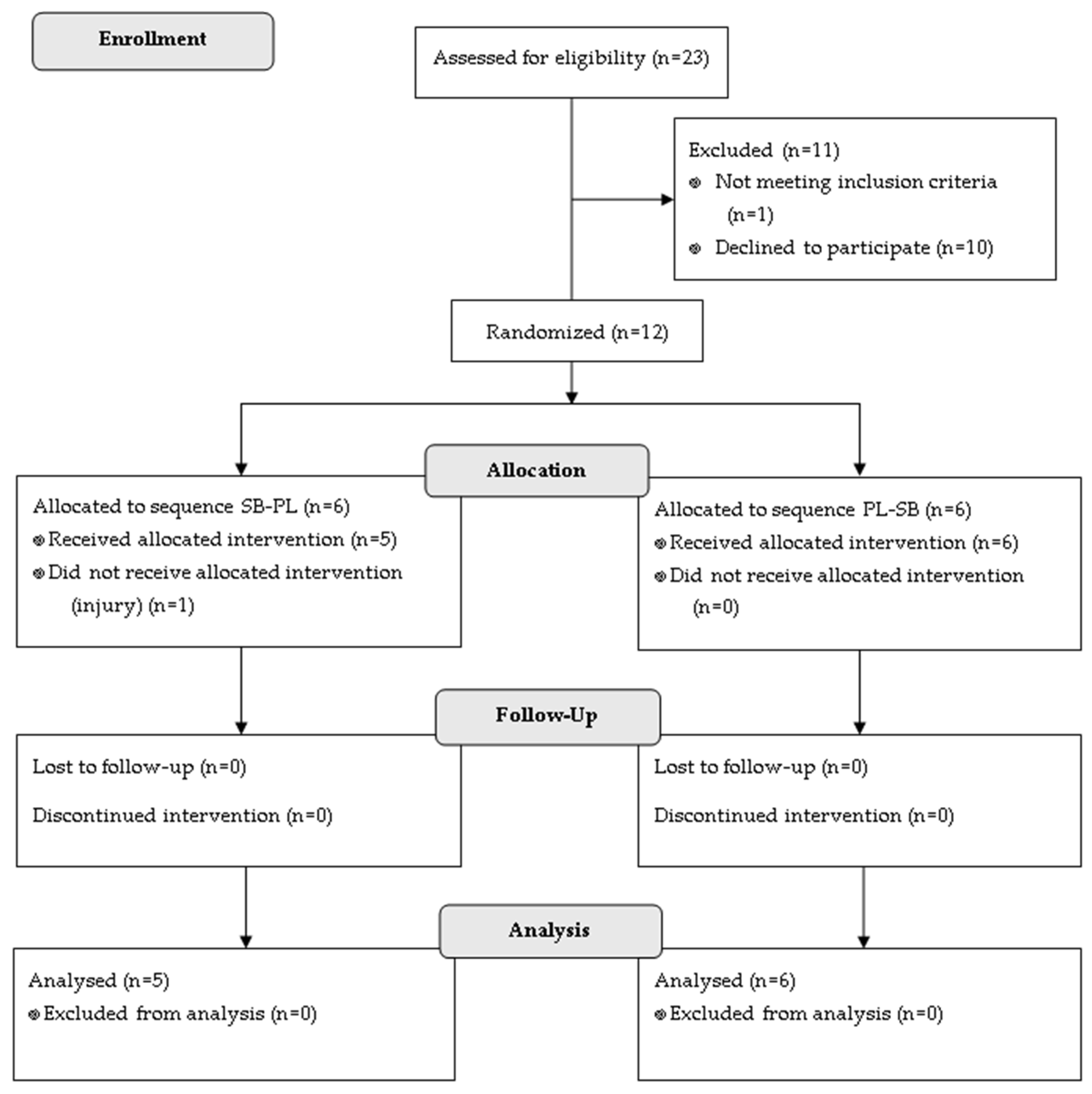
Figure 1. Flow diagram of the progress through enrollment, allocation, follow-up and analysis of a parallel randomized trial of two groups, namely SB-PL—sodium bicarbonate first session, placebo second session and PL-SB—placebo first session, sodium bicarbonate second session.
Applsci 16 00353 g001
Figure 2. Lactate accumulation profile in both supplementation conditions. SB—sodium bicarbonate; PL—placebo; * Different from Rest in both conditions; † Different from S1 in both conditions; ‡ Different from S2 in SB; § SB different from PL.
Applsci 16 00353 g002
Figure 3. Accumulated muscle oxygenated and deoxygenated hemoglobin in each set of the exercise protocol in both supplementation conditions. SB—sodium bicarbonate; PL—placebo; O2Hb—muscle oxygenated hemoglobin; HHb—muscle deoxygenated hemoglobin; * Different from S1 independently of condition.
Applsci 16 00353 g003
Figure 4. Jump height in both supplementation conditions. SB—sodium bicarbonate; PL—placebo; * Different from Pre in PL; # Different between conditions at Pre.
Applsci 16 00353 g004
Table 1. Participants’ characterization: age, body mass, height and body composition.
VariableMean ± SD
Age (years)20 ± 2
Body mass (kg)56 ± 6
Height (m)1.633 ± 0.057
BMI (kg/m−2)21.0 ± 2.10
FFM (kg)43.8 ± 4.24
FM (kg)12.2 ± 2.03
FM (%)21.7 ± 2.42
Legend: SD—standard deviation; BMI—body mass index; FFM—fat-free mass; FM—fat mass.
Table 2. Results of sprint performance, pulmonary gas exchange, heart rate and muscle oxygenation in each set of the exercise protocol in both supplementation conditions. Values represent mean ± standard deviation.
VariablePLSB
S1S2S3S1S2S3
MPO (W)296 ± 35.0285 ± 31.7 *288 ± 28.0287 ± 29.6291 ± 29.2291 ± 30.6
PPO (W)354 ± 44.8356 ± 47.5355 ± 40.5 †343 ± 42.0360 ± 49.9358 ± 45.7 †
SDec (%)4.43 ± 1.566.04 ± 2.955.55 ± 2.193.55 ± 2.415.66 ± 3.954.25 ± 3.43
TW (J)10,656 ± 126010,274 ± 114010,357 ± 100910,001 ± 138210,322 ± 131010,463 ± 1100
VO2 (mL·kg−1·min−1)42.3 ± 4.7641.0 ± 4.8540.5 ± 4.5144.4 ± 11.542.7 ± 7.2444.5 ± 9.02
VO2 (L·min−1)1.74 ± 0.161.75 ± 0.171.69 ± 0.301.74 ± 0.181.79 ± 0.191.80 ± 0.23
VCO2 (L·min−1)1.90 ± 0.191.73 ± 0.16 †1.64 ± 0.24 †1.97 ± 0.24 ‡1.84 ± 0.18 †‡1.81 ± 0.24 †‡
VE (L·min−1)93.6 ± 9.6795.9 ± 9.3997.1 ± 14.190.5 ± 8.6391.4 ± 7.0496.2 ± 11.6
HR (bpm)169 ± 11.3173 ± 11.6177 ± 12.2 †169 ± 10.7173 ± 10.7178 ± 11.2 †
O2Hb (a.u.)−578 ± 409−450 ± 456−256 ± 555 †−547 ± 586−241 ± 672−54.3 ± 642 †
HHb (a.u.)336 ± 388528 ± 473 †454 ± 571361 ± 266581 ± 248 †518 ± 325
Legend: PL—placebo; SB—sodium bicarbonate; MPO—mean power output; PPO—peak power output; SDec—sprint decrement; TW—total work; VO2 (mL·kg−1·min−1)—peak relative oxygen uptake; VO2 (L)—mean absolute oxygen uptake; VCO2 (L)—mean absolute carbon dioxide production; VE—peak ventilation; HR—peak heart rate; O2Hb—muscle oxygenated hemoglobin; HHb—muscle deoxygenated hemoglobin; a.u.—arbitrary units; * Different from S1 in PL; † Different from S1 independently of condition; ‡ SB different from PL.
Disclaimer/Publisher’s Note: The statements, opinions and data contained in all publications are solely those of the individual author(s) and contributor(s) and not of MDPI and/or the editor(s). MDPI and/or the editor(s) disclaim responsibility for any injury to people or property resulting from any ideas, methods, instructions or products referred to in the content.