Article

Hydrodynamic Analysis of Scale-Down Model Tests of Membrane-Type Floating Photovoltaic Under Different Sea States


1
China Power Engineering Consulting Group Co., Ltd., Beijing 100032, China
2
State Key Laboratory of Hydraulic Engineering Intelligent Construction and Operation, Tianjin University, Tianjin 300072, China
*
Author to whom correspondence should be addressed.
Appl. Sci. 2026, 16(1), 331; https://doi.org/10.3390/app16010331
Submission received: 24 October 2025 / Revised: 25 December 2025 / Accepted: 26 December 2025 / Published: 29 December 2025
(This article belongs to the Section Civil Engineering)

Abstract

Floating photovoltaic (FPV) systems are increasingly deployed in offshore environments. Among various FPV concepts, membrane-type platforms offer distinct advantages, including reduced weight, lower material consumption, and cost-effectiveness. This study investigates the hydrodynamic response of a membrane-type offshore FPV system through a 1:40 scale physical model test based on the Ocean Sun prototype. Static-water free-decay tests were first conducted to determine the natural periods and damping characteristics in heave, surge, and pitch motions. Subsequently, irregular-wave tests were performed under seven sea states representative of an offshore demonstration site. Free-decay results show model-scale natural periods of approximately 1.0 s for heave, 0.8 s for pitch, and 15 s for surge. The long surge natural period avoids resonance with short-period waves, while the high damping in heave and pitch effectively limit dynamic amplification. Under irregular waves, heave and pitch motions remain small, whereas surge motion exhibits pronounced long-frequency excursions. Spectral analysis reveals a dominant low-frequency surge peak at f ≈ 0.067 Hz (corresponding to the natural period of 15 s), superimposed with higher-frequency components associated with wave-induced motions. A strong correlation is observed between low-frequency surge and mooring tensions. Across Sea States 1–6, the motion responses increase gradually, while a marked rise in the exceedance probability of mooring forces occurs only in the most severe sea state. Weibull extreme-value fits show good linearity, indicating that the measured extremes are statistically consistent. The results provide experimental data and design insights for membrane-type FPV systems, establishing a foundation for future hydroelastic studies.

1. Introduction

In recent years, the global pursuit of sustainable energy solutions has intensified, driven by escalating climate change challenges and the urgent need to transition toward cleaner power sources [1,2,3]. Among diverse renewable energy technologies, solar photovoltaic (PV) systems have emerged as a frontrunner, offering a promising avenue for electricity generation without reliance on fossil fuels [4,5]. However, as land resources grow increasingly scarce, attention has shifted to unconventional spaces for deploying solar infrastructure [6]. An innovative solution gaining momentum is floating photovoltaic (FPV) systems, where solar panels are installed on water bodies [7,8]. This unique approach not only addresses the land-use constraints faced by traditional solar installations but also presents distinct advantages and challenges that warrant rigorous investigation [9].
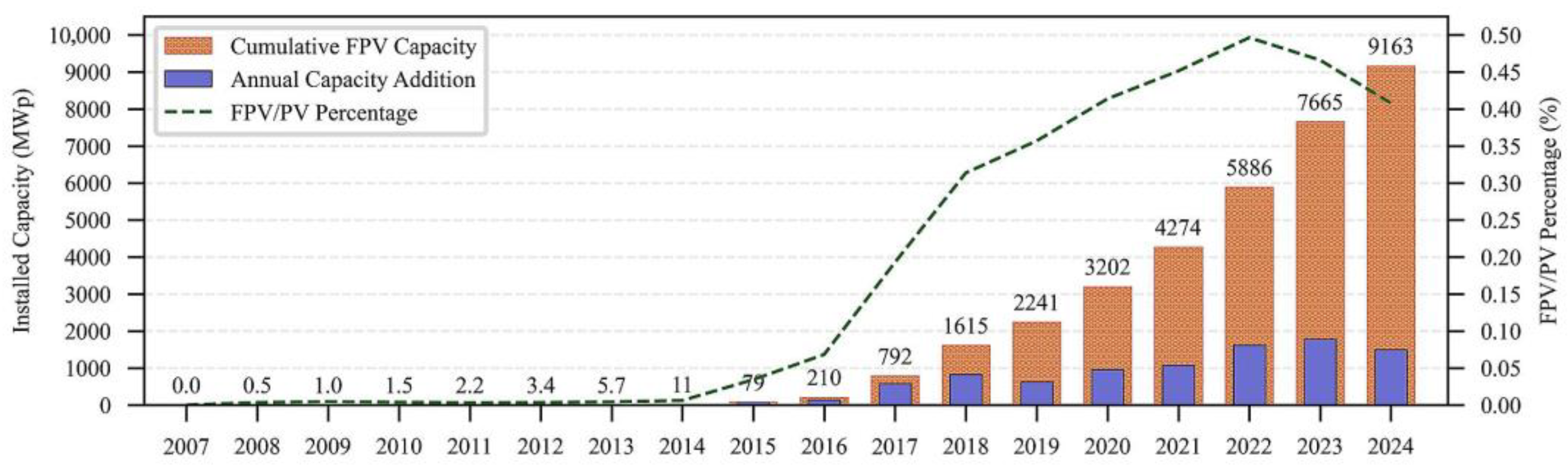
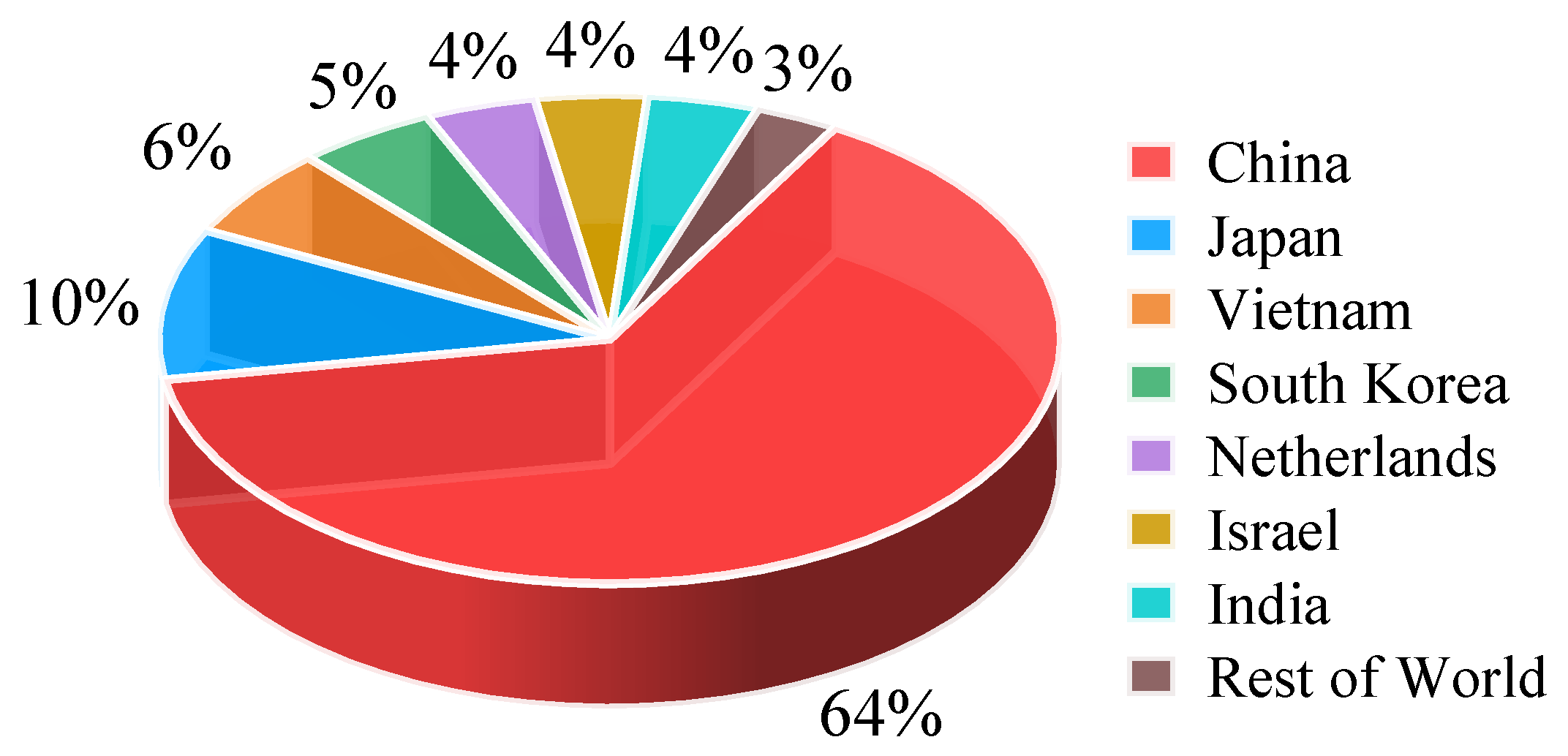
Figure 1 [10,11,12,13,14] illustrates the evolution of global installed FPV capacity from 2007 to 2024. In the early years., the overall capacity remained very modest because PV technology was still relatively immature and costly [15]. Around 2017, with growing awareness of climate change and its environmental impacts, FPV entered a phase of rapid development [16,17]. Reducing system costs and improving power generation efficiency are widely recognized as key drivers for FPV advancement [18]. The time window in Figure 1 begins in 2007, when the first commercial-scale FPV demonstrators emerged and consistent deployment statistics became available, and extends to 2024 (the latest year for which consolidated global data are reported in the cited sources). Global FPV capacity is projected to reach approximately 62 GW by 2030. To date, however, this expansion has been primarily confined to inland reservoirs and lakes. As shown in Figure 2 [19], current FPV installations are concentrated in Europe and Asia—regions with high population densities where land for utility-scale solar is scarce. Consequently, the next phase of growth will largely depend on the viability of marine deployments [9,18]. This shift from inland to offshore environments poses significant technological challenges, highlighting the need to study hydrodynamic forces in marine settings.
In response to the rising demand for clean energy, an increasing number of countries have introduced dedicated policies to support FPV deployment (Table 1 [20,21,22,23]). These policies provide financial incentives expected to actively drive FPV growth [24]. Against this backdrop, the rapid expansion of FPV installations underscores its promising commercial potential and growing strategic role in the global energy transition, demonstrating substantial value for both academic research and practical applications.
As demand for sustainable power intensifies, FPV research has gradually shifted toward a more detailed understanding of hydrodynamic behavior [25]. The interaction among the floating platforms, mooring systems, and waves introduces complex dynamics, requiring careful investigation of water-induced loads, buoyancy effects, and global motions [26]. For example, Choi et al. [27] conducted a structural analysis and safety assessments of an FPV system. However, their work was limited to inland lake conditions and did not address the additional challenges of offshore environments.
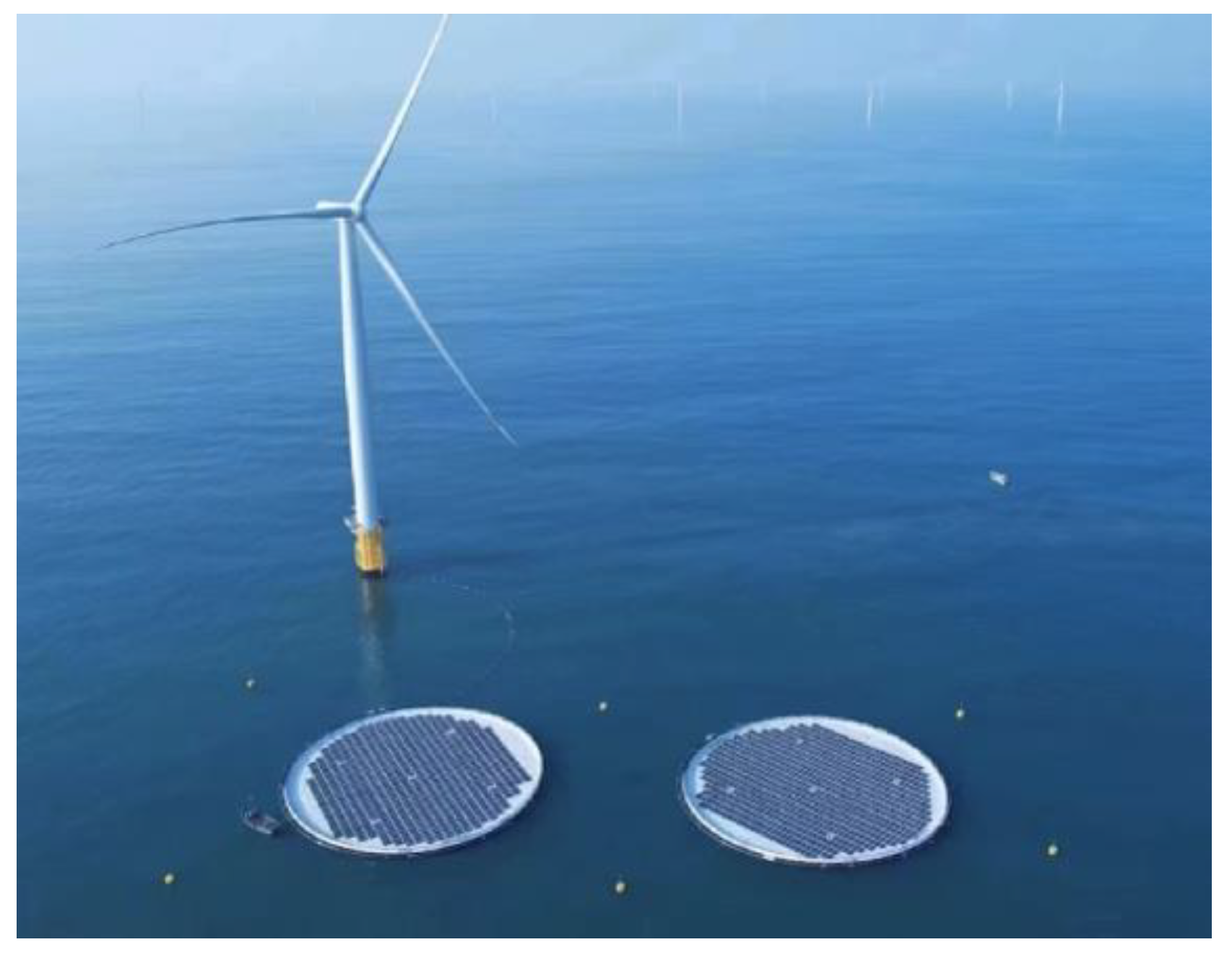
Based on floating structure classifications, FPV systems can be broadly categorized into pontoon-type, semi-submersible-type, and membrane-type concepts [22]. Among these, membrane-type FPV is a relatively recent innovation offering advantages such as lightweight construction and cost-effectiveness, thus attracting growing attention. Ocean Sun, in collaboration with State Power Investment Corporation (SPIC), has developed a membrane-type FPV project in Shandong Province, China (Figure 3) [28]. This project represents the world’s first operational installation integrating offshore wind turbines (20 MWp) with FPV (0.5–1 MWp) in a deep-sea setting [29]. Located in the Yellow Sea approximately 30 km offshore with water depths of about 30 m, the site is exposed to extreme sea states with significant wave heights of up to 10 m.
In the marine environment, membrane structures are subjected to substantial environmental loads [30,31,32]. To address the current lack of relevant data, this study designs and constructs a 1:40 scale physical model of a membrane-type FPV platform and investigates its hydrodynamic responses under severe and extreme irregular sea states representative of the Yellow Sea site. This work aims to fill the gap in experimental data for membrane-type FPV systems in the literature.
The scientific novelty of this study lies in the following: (i) the systematic laboratory testing of a membrane-type FPV platform under realistic offshore irregular sea states corresponding to an operational demonstration project; (ii) a combined analysis of global platform motions and mooring-line load statistics; and (iii) the provision of high-quality experimental data specifically for a membrane-type FPV—a configuration that has received limited hydrodynamic investigation to date.
This work is experimental and phenomenological in nature, so conclusions are restricted to qualitative and relative observations within the tested range. Future research will pursue more detailed nonlinear hydrodynamic and hydroelastic modeling (e.g., CFD or advanced numerical simulations) based on the experimental data presented herein.

2. Experimental Methodology

2.1. Experimental Site

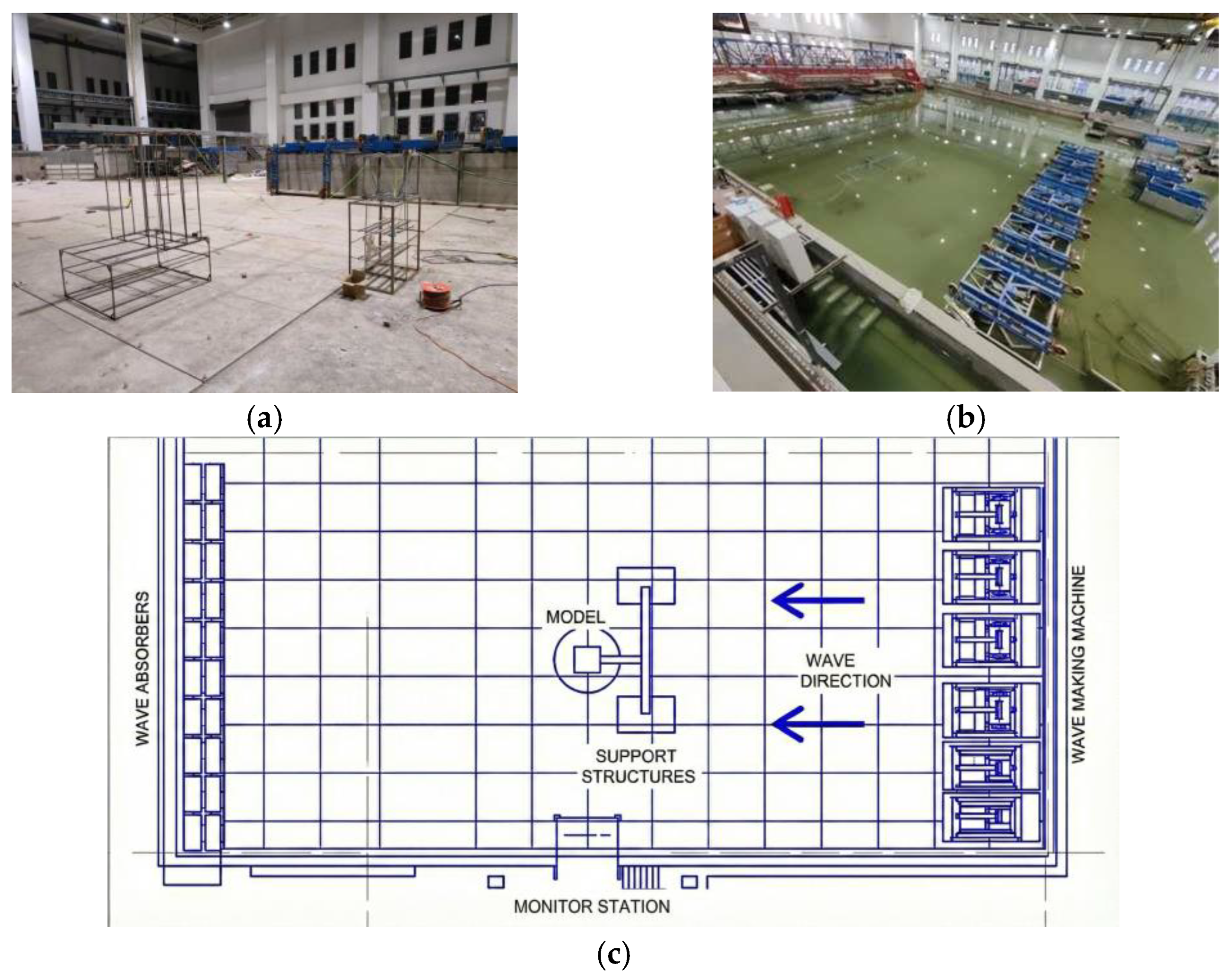
Experiments were conducted at the State Key Laboratory of Hydraulic Engineering Simulation and Safety, Tianjin University (Figure 4). The experimental system comprised a wave tank, wave generators, a physical FPV model, wave absorbers, support frames, and multiple measuring instruments. During initial setup, support frames were assembled, sensors were installed and calibrated, the mooring system was configured, and wave generators were positioned—all prior to filling the tank.
After installation, the tank was filled to a water depth of approximately 1.0 m, corresponding to the target model-scale test condition. To generate the required irregular waves, wave makers were aligned in parallel along one side of the tank, while wave absorbers were installed at the opposite end to minimize wave reflections and maintain stable test conditions. Support frames provided rigid mounting bases for sensors and cable routing. Thin steel rods were used as supports to minimize hydrodynamic interference with the measured motions and loads.

2.2. Prototype and Scaling

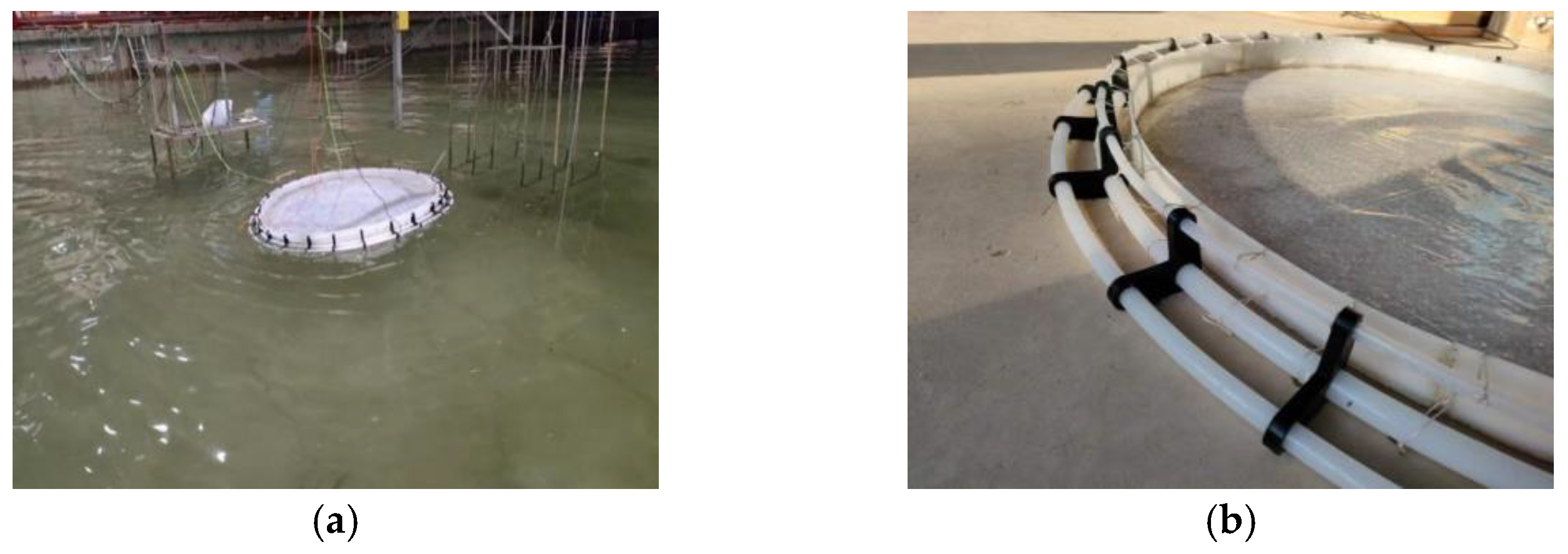
Based on Ocean Sun’s membrane-type prototype [33,34], a 1:40 laboratory-scale model was designed and constructed for experimental investigation (Figure 5) [35]. In physical model tests, Froude similarity was adopted to scale wave kinematics and global structural motion—appropriate for gravity-wave-dominated hydrodynamics. The 1:40 scale model was designed and tested following Froude similarity principles, which govern hydrodynamic scaling for gravity-dominated wave–body interaction problems. Key dimensionless parameters controlling global hydrodynamics were kept consistent between the model and prototype, particularly the Froude number:
F r = U g L
where U is a characteristic velocity, g is gravitational acceleration, and L is a characteristic length, as well as wave steepness H / λ (where H is wave height and λ is wavelength), and relative draft d / L . This ensures that dominant inertial and hydrostatic forces, as well as wave-induced motions and mooring-line tensions, are dynamically representative of the full-scale Ocean Sun FPV prototype. Exact Reynolds similarity was not achieved (since the kinematic viscosity of seawater is essentially the same at both scales), but model-scale Reynolds numbers remain sufficiently large for viscous effects to be secondary. Additionally, membrane stiffness and pre-tension were tuned to ensure that the model’s non-dimensional dynamic response closely matches that of the prototype.
However, the membrane’s elastic response depends not only on gravity but also on stiffness and inertia, so it does not automatically follow Froude scaling. To capture relevant hydroelastic effects, the model membrane was manufactured from a substitute material. Its thickness, in-plane stiffness, and pre-tension were selected to keep key non-dimensional quantities governing structural dynamics as close as practicable to the prototype configuration. In this way, the model’s hydrodynamics largely follow Froude similarity, while membrane structural properties are tuned to reproduce correct dynamic stiffness rather than strictly adhering to uniform geometric–material scaling laws.
The scaled model has a diameter of D = 1.25 m and a total mass of M = 4.9 kg. Since both the model and prototype are subjected to Earth’s gravity and use seawater, gravitational acceleration and kinematic viscosity are essentially identical. Froude similarity is therefore enforced to ensure proper scaling of dominant inertial and hydrostatic effects, while model Reynolds numbers remain sufficiently large for viscous effects to be secondary.
To reproduce the prototype’s geometry, structural configuration, and hydrodynamic behavior, the model comprises three main components: floating rings, an elastic membrane, and modular connectors. System buoyancy is provided jointly by the floating rings and membrane. Material properties of the floating rings, connectors, horizontal membrane, and annular membrane are summarized in Table 2.
The membrane comprises two distinct parts: a horizontal multilayer film and an annular film. The horizontal film has an outer diameter of 1.1 m, a total area of 0.95 m2, and a thickness of 2 mm. In the prototype, it consists of several layers; in the model, it is idealized as an upper polyethylene (PE) layer, a middle foam-bubble layer, and a lower PE layer. The annular film is ring-shaped, with a bottom diameter of 1.1 m, a top diameter of 1.15 m, and a total surface area of 3.54 m2.
The floating structure comprises three rings: an inner ring, an outer ring, and a top ring. These rings have identical cross-sectional thickness but differ in diameter and length (detailed dimensions are listed in Table 3). The membrane bottom and the center of the bottom floating ring are aligned at the reference elevation z = 0. The outer ring (largest diameter) primarily resists wave-induced loads. The inner ring (located in the structure’s lower part) contributes to overall buoyancy alongside the outer ring, while the top ring primarily serves as structural support. Ninety-six connecting ropes attach the floating rings to the membrane, providing a stable yet flexible coupling between components.
Modular fasteners (made of PE) connect the floating rings. In the full-scale design, multiple fasteners are used. To preserve the required similarity while maintaining structural integrity, the scaled model uses 24 fasteners—sufficient to stabilize the rings without increasing mass or rigidity.

2.3. Mooring Configuration

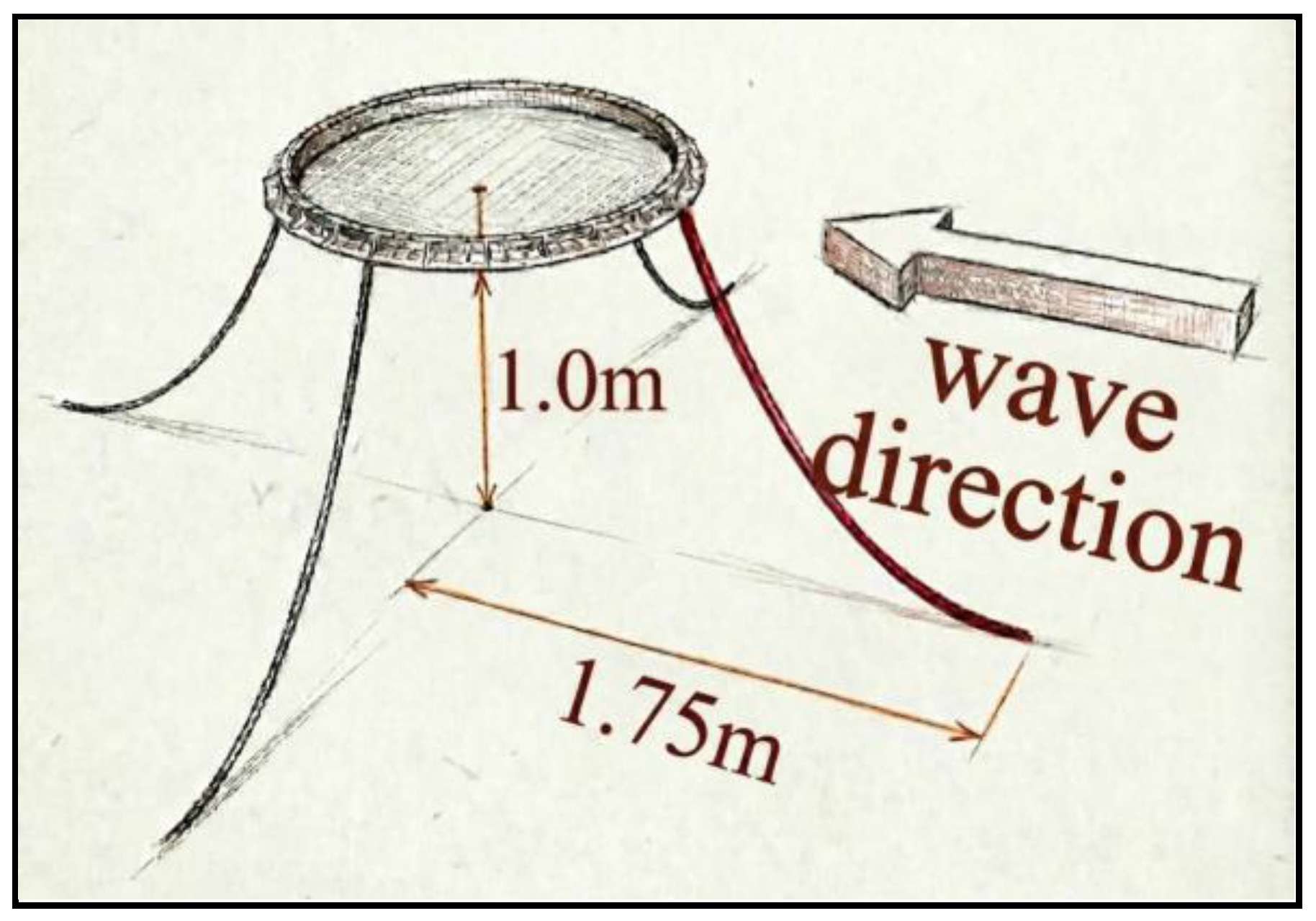
As illustrated in Figure 6, the mooring system comprises four anchor points located at the fore, aft, port, and starboard sides of the model. Each anchor point is connected to the edge of the platform by a chain arranged in a catenary configuration. The horizontal distance from the platform center to each anchor point is 1.75 m. Vertically, the anchors are placed on the tank floor at a water depth of 1.0 m. Each mooring chain (length: 2.1 m) links the corresponding tank-bottom anchor to the platform perimeter.
Given the complexity of full-scale offshore mooring systems, a simplified four-point layout was adopted to enable a qualitative investigation of hydrodynamic responses while maintaining a tractable experimental setup. The incident wave direction is aligned with a diagonal pair of anchor points (indicated by the red cable in Figure 6). This arrangement ensures that primary tensile forces in the mooring lines act approximately along the wave-propagation direction. In this study, mooring forces are defined as the tensile forces in individual mooring lines at their fairlead connections to the floating platform. For each sea state, time series of fairlead tensions were recorded for all four lines, and the maximum value among the lines was used as the representative mooring-force response for statistical analysis.

2.4. Measurement Sensors

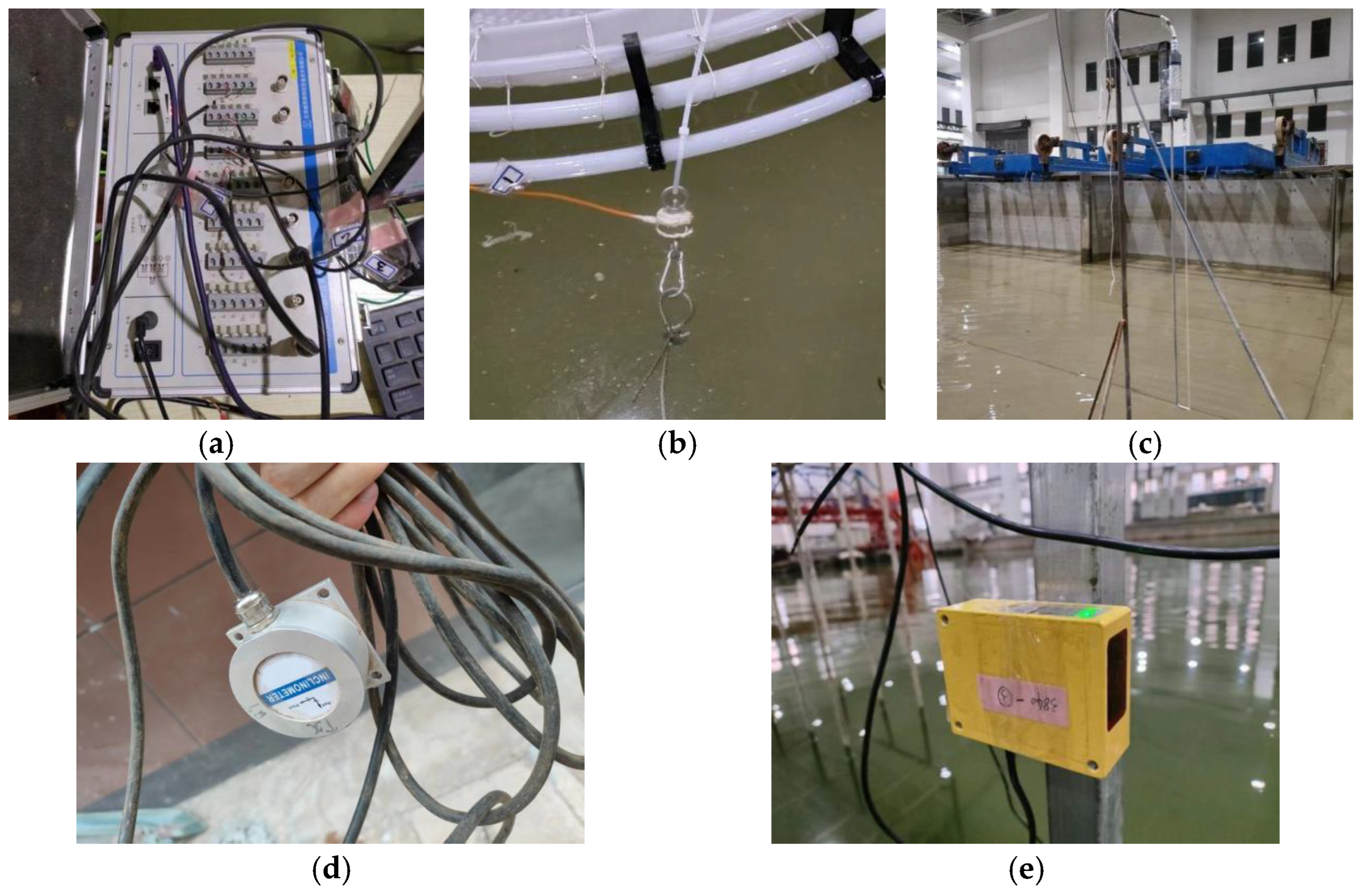
The experimental setup was equipped with several measurement devices, including a multi-channel data-acquisition system, four voltage-type tension load cells, a digital wave gauge, an aviation-grade gyroscope, and two three-wire voltage-output laser displacement sensors (Figure 7).
The data-acquisition system included measurement and control units capable of simultaneously recording signals from the four load cells and the two laser displacement sensors. The digital wave gauge measured free-surface elevation, from which the wave amplitude and period were derived. It has a measurement range of 0–2 m and a nominal vertical accuracy of approximately 0.5%. Platform motions were captured using a high-precision aviation-grade gyroscope (angular rate range: ±300°/s; accuracy: approximately 0.6°/hr). The gyroscope was mounted horizontally, with its positive axis pointing towards the wave maker. Two laser displacement sensors measured surge and heave displacements. Each sensor had a measurement range of 26–1200 mm and a nominal resolution of 0.25 μm.
The four tension load cells measured mooring-line forces. Each cell was fitted with circular steel buckles at both ends—one connected to the mooring line and the other attached to the platform edge via cable ties. Each load cell had a nominal capacity of 0.05–10 kg and a manufacturer-specified accuracy of <0.03% of full scale. Due to the small model-scale mooring forces and the load cells’ sensitivity to external disturbances (e.g., wave-induced platform motions and buckle friction), minor measurement errors and noise were unavoidable. These effects were mitigated via the careful alignment of connections and filtering of recorded time series during post-processing.
Prior to experiments, all sensors were calibrated to ensure measurement accuracy and reliability. Signal channels of the data-acquisition system were balanced and zeroed to eliminate initial offsets and establish stable baseline readings. During testing, transient disturbances and sensor noise occasionally introduced data errors. To mitigate these effects, recorded signals were post-processed using a Fourier-transform-based filtering procedure that removed unwanted high-frequency noise while preserving key useful responses. The overall uncertainty study is presented in Section 2.7.

2.5. Testing Conditions

In this study, the FPV system was subjected to seven irregular sea states designed to represent the range of wave conditions at the demonstration site. These wave conditions cover six sea-state levels (as defined by the site’s adopted sea-state classification) and are referred to as Sea States 1–7 (Test Groups 1–7) throughout the study. Corresponding prototype significant wave heights and peak periods are summarized in Table 4, with model-scale values derived via similarity scaling. For the present study, we adopted linear wave theory to describe wave kinematics. Irregular waves were generated using a JONSWAP spectrum with a peak enhancement factor of 3.3.
To ensure sufficient wave excitation for heave and pitch motions, data from a specific duration were selected for analysis. To investigate the characteristics of initial surge motion and mooring forces, the first 10 s prior to substantial wave action were selected as the analysis start time.
To examine the frequency-domain distribution of motion responses, Fourier transforms were applied to time–history curves, and amplitude–frequency spectra were plotted. Additionally, mathematical statistics were applied to data peak values for analysis.

2.6. Weibull Probability Distribution

In offshore engineering tests, a common assumption is that instantaneous values follow a normal distribution. However, amplitude statistics are better characterized by the Weibull distribution. The Weibull model is widely used in extreme-value analysis, as it effectively estimates the probability of amplitudes exceeding a given threshold. The cumulative distribution function is expressed as follows:
1 F x = exp A x x 0 B ,
where x0 is the maximum amplitude during the whole test, A and B are shape parameters typically calibrated using experimental data, and x is a given amplitude.
By applying a double logarithmic transformation, the formula can be expressed as follows:
l n l n 1 F x = l n A + B l n x x 0 .
Theoretically, if the amplitude data strictly follow the Weibull distribution, the cumulative probability function would appear as a straight line on this plot. But practical observations often deviate from this ideal. For instance, amplitudes from irregular waves and their structural responses in real marine environments seldom match the Weibull model exactly. Consequently, linear regression is often performed on the data to align with theory yet accommodate real-world variation.

2.7. Uncertainty Analysis

Uncertainty analysis is essential to assess the reliability of the reported results. The combined standard uncertainty u c for each measured quantity was estimated by combining the individual uncertainty contributions in quadrature (root-sum-square method), assuming that they are independent:
u c = i = 1 n u i 2 ,
where u i represents the standard uncertainty from each source.
In this study, the major contributors were the sensor accuracy ( u sensor 0.5 % ), wave repeatability ( u wave 1.5 % ), and data processing ( u proc 1.0 % ). The typical combined standard uncertainty was calculated as follows:
u c = u sensor 2 + u wave 2 + u proc 2 ,
The expanded uncertainty U was then obtained by multiplying the combined standard uncertainty by a coverage factor k = 2 , corresponding to a confidence level of approximately 95%:
U = k u c .
Combining the above contributions, the overall expanded uncertainty for the reported motion amplitudes is estimated to be within ±4% of the measured values. These uncertainties are reflected in the scatter of data points in the statistical plots and are considered acceptable for the qualitative and comparative conclusions.

3. Results and Discussion

3.1. Hydrostatic Tests

To investigate the hydrostatics of the physical model, free-decay tests were conducted in still water, and time histories of heave, surge, and pitch were recorded. In each test, the model was first displaced by a prescribed small offset in heave, surge, or pitch and then released from rest to undergo free oscillations in still water. Due to the difficulty of manually reproducing the exact initial displacement, recorded time histories were normalized to match the target offset at the initial time point. A Fourier transform was then applied to the normalized signals to derive response spectra and identify dominant oscillation frequencies.
Although the membrane structure is inherently flexible, the relatively stiff floating rings constrain the membrane; for small-amplitude free-decay motions, the global response can be approximated as rigid-body motion. In this regime, the local deformation energy of the membrane surface is much smaller than the structure’s overall translational kinetic energy.
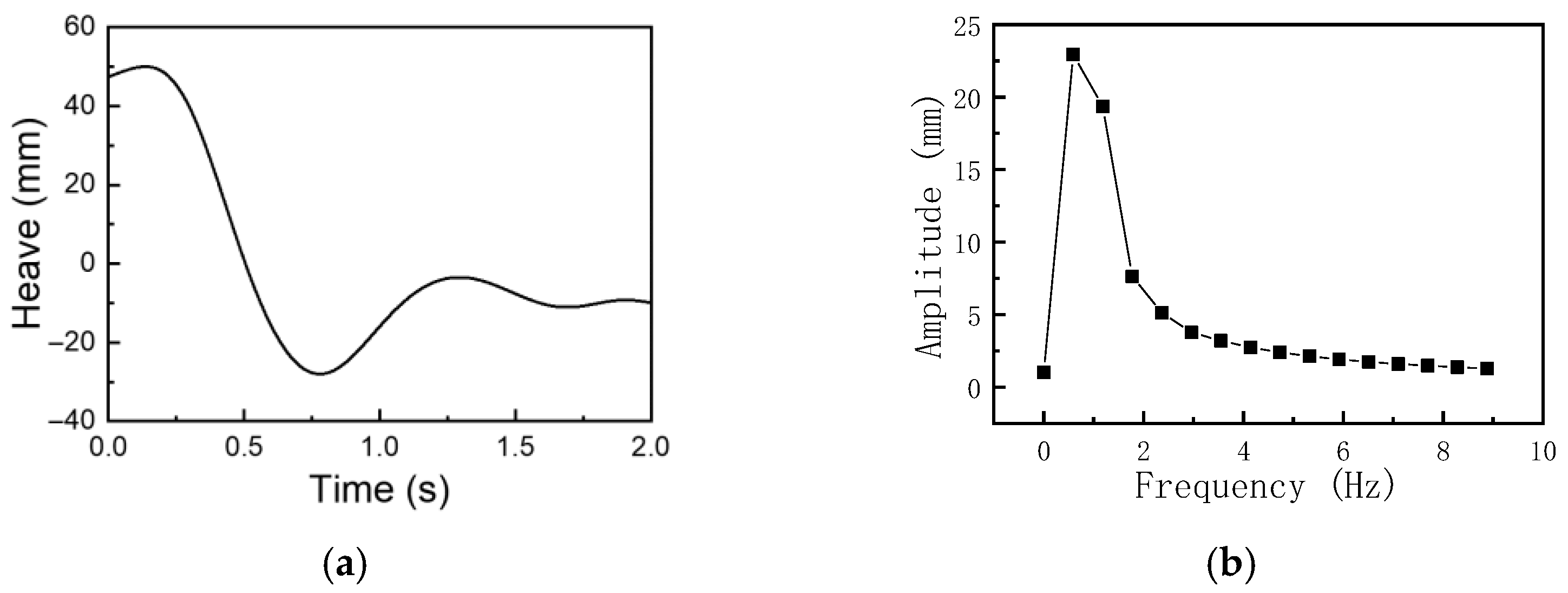
As shown in Figure 8, following the initial 5 cm offset, the model overshoots upward by approximately 3 cm beyond the equilibrium position and then decays rapidly. The frequency-domain response exhibits a single dominant peak at f ≈ 1.0 Hz, indicating a natural heave period of about Theave ≈ 1.0 s.
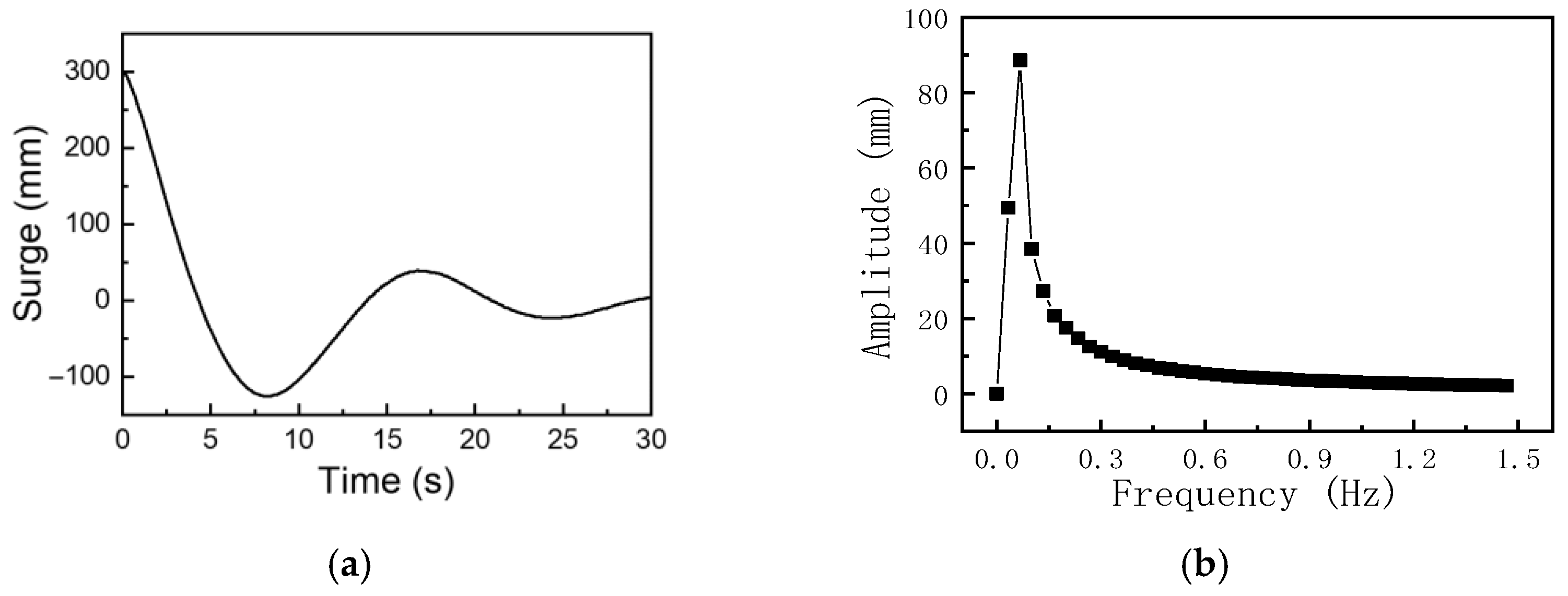
As shown in Figure 9, after the 30 cm offset, the model moves past the equilibrium position and overshoots by about 12 cm in the opposite direction, followed by a gradual decay. The corresponding frequency-domain response shows a single dominant peak at f ≈ 0.0667 Hz, which corresponds to a natural surge period of approximately Tsurge ≈ 15 s.
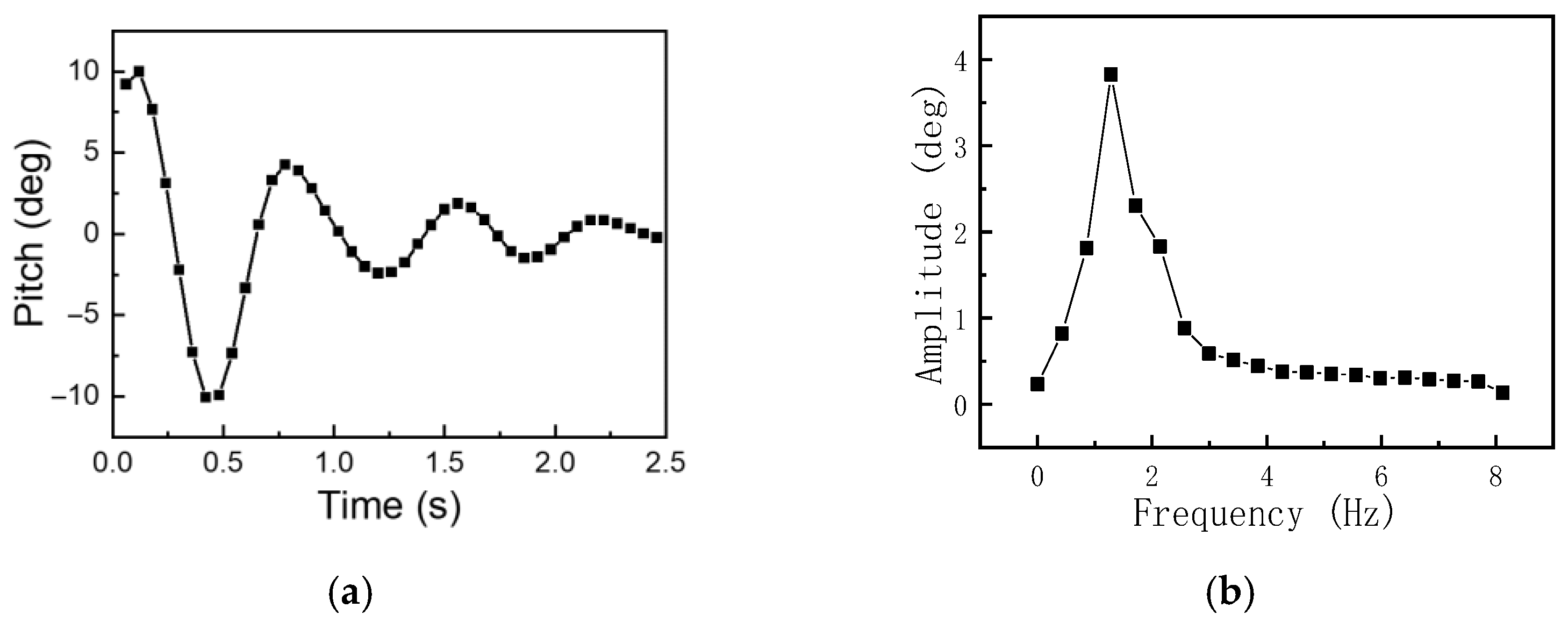
As shown in Figure 10, under the effect of a 10° rotation, the model rebounds in the opposite direction to about 9° beyond the equilibrium position, then gradually decays. The second peak and subsequent decay are relatively fast. The unique peak point on the amplitude–frequency spectrum curve is near frequency = 1.25 Hz, indicating the structure’s natural pitch period is around 0.8 s.
Static water free decay test analysis reveals a pronounced disparity in natural periods between surge (15 s) and heave/pitch (1/0.8 s).
In a conventional rigid pontoon system, the surge period is typically closer to the wave periods (5–8 s) owing to the relatively low mass and compact displacement hull. However, when it comes to membrane-type platform, the surge motion involves large-scale horizontal translation of the entire model, necessitating substantial fluid inertia to overcome the added mass effect. The primary restoring force originates from the horizontal component of the buoyancy gradient, which acts over the full length of the floating rings. This high-inertia, low-stiffness combination pushes the surge resonance well outside the typical wave energy frequency range, effectively isolating the system from first-order wave excitation in surge. In contrast, heave and pitch motions involve localized membrane deformation. Heave constraints primarily arise from incremental buoyancy margins, while pitch restoring moments stem from eccentric mass-distribution-induced lever arms. This large-diameter characteristic of membrane structures results in higher natural frequencies of heave and pitch motion than that of the predominant wave energy frequencies, which reflects a design approach based on “frequency avoidance.”
The decay curves for heave and pitch exhibit rapid attenuation, indicating high hydrodynamic damping. This is attributed to the large wetted surface area of the membrane, which produces significant wave radiation damping and viscous dissipation as it deforms. The high damping of the membrane system suggests that it is less prone to dynamic amplification in heave and pitch, further supporting its suitability for rougher waters.

3.2. Hydrodynamic Tests

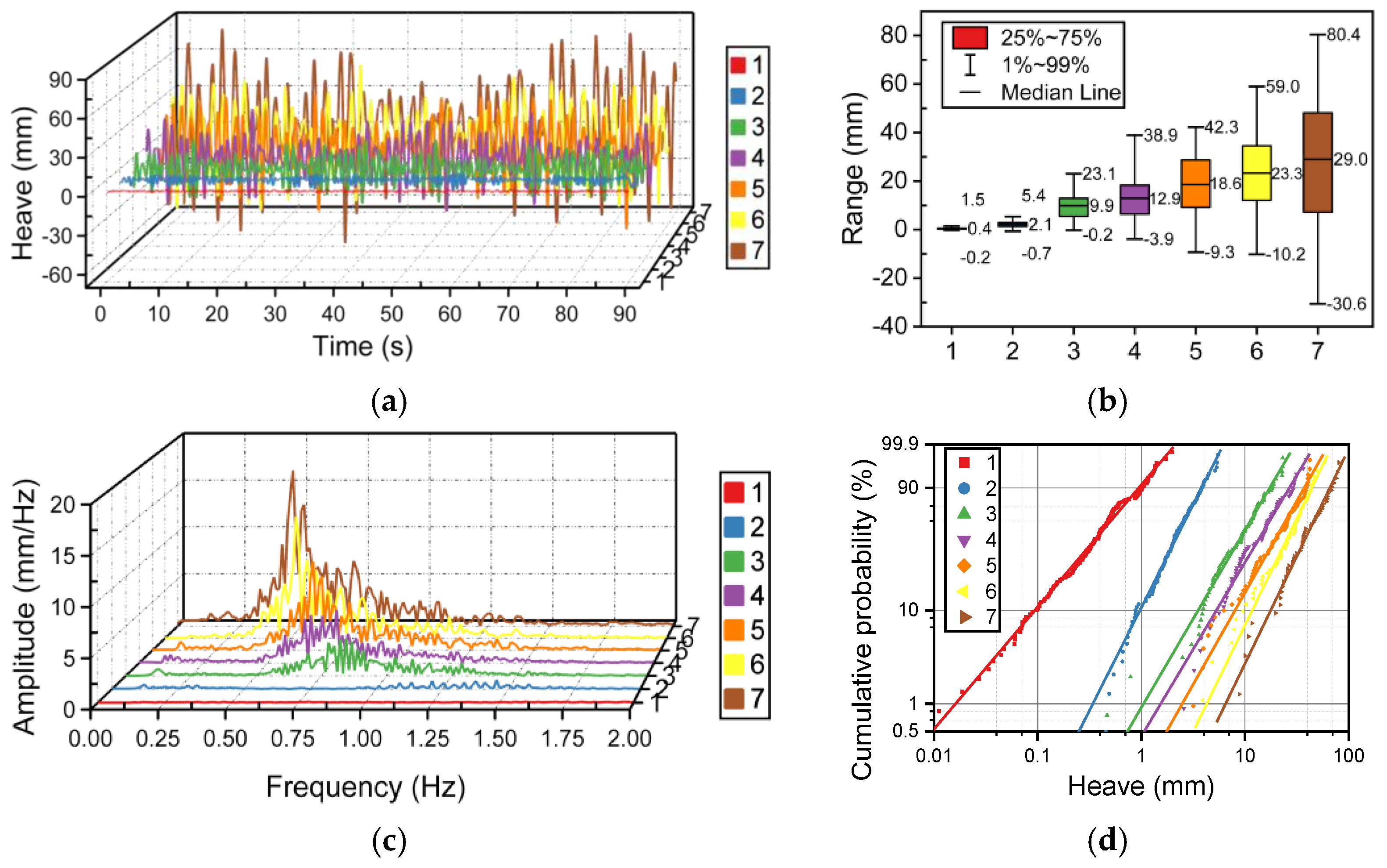
From Figure 11, it can be seen that, from Test Group 1 to 7, the heave response spectra display clear peaks clustered around 1.96 Hz, 1.54 Hz, 0.89 Hz, 0.77 Hz, 0.70 Hz, 0.57 Hz, and 0.51 Hz, respectively, corresponding to the wave periods of each sea state. The peak values of the curves increase sequentially, indicating an increase in heave power. Mathematical statistics reveal that, in the order of Test Group 1–7, the maximum, average, and amplitude range of heave motion increase. Weibull extreme-value analysis demonstrates that the extreme value probability functions fitted to the data points of each sea state exhibit good linearity. This indicates that the peak values approximately follow the Weibull distribution, validating the reliability of the data. The membrane-type platform exhibits excellent “compliant follow” characteristics, which reduces relative motion and thereby lowers the risks of wave slamming.
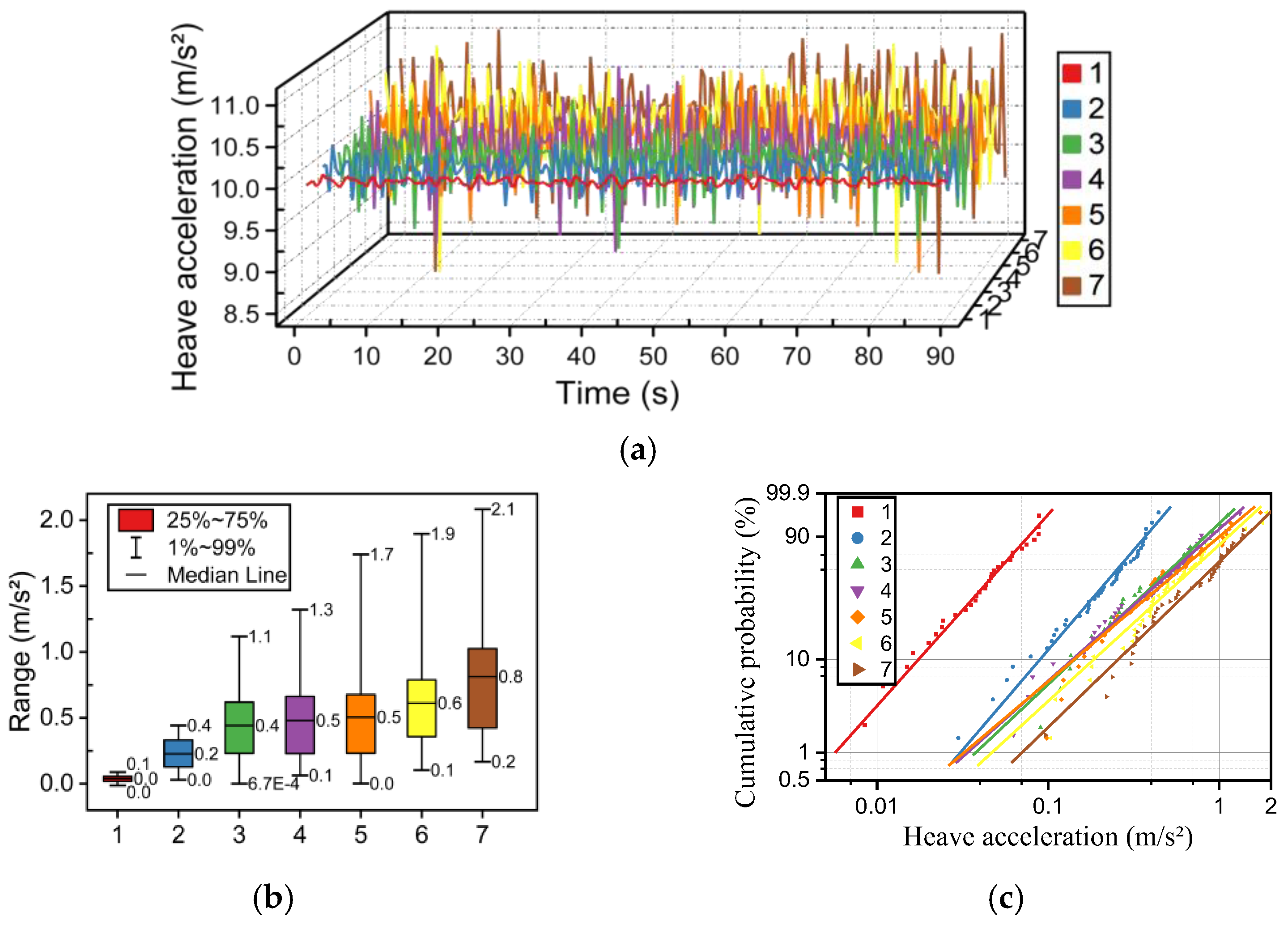
Heave acceleration refers to the vertical acceleration of the model. As shown in Figure 12, the heave acceleration time history oscillates about the Earth’s gravitational acceleration of 1 g. For statistical analysis, the absolute acceleration response was obtained by subtracting 1 g from the raw signal. From Sea State 1 to 7, the overall heave-acceleration level increases monotonically, consistent with the trends previously observed for heave motion. Weibull extreme-value analysis indicates that the fitted probability plots for each sea state exhibit good linearity, implying that the heave-acceleration peaks are approximately Weibull-distributed and that the data are statistically consistent.
The distribution of heave-acceleration peaks shifts towards higher values with increasing sea-state severity, indicating an escalation in structural demand. This suggests that the internal fasteners of the model are subjected to high-frequency, high-amplitude cyclic loading. For future engineering applications, it is therefore recommended to employ fatigue-resistant materials and/or incorporate damping pads at critical connections.
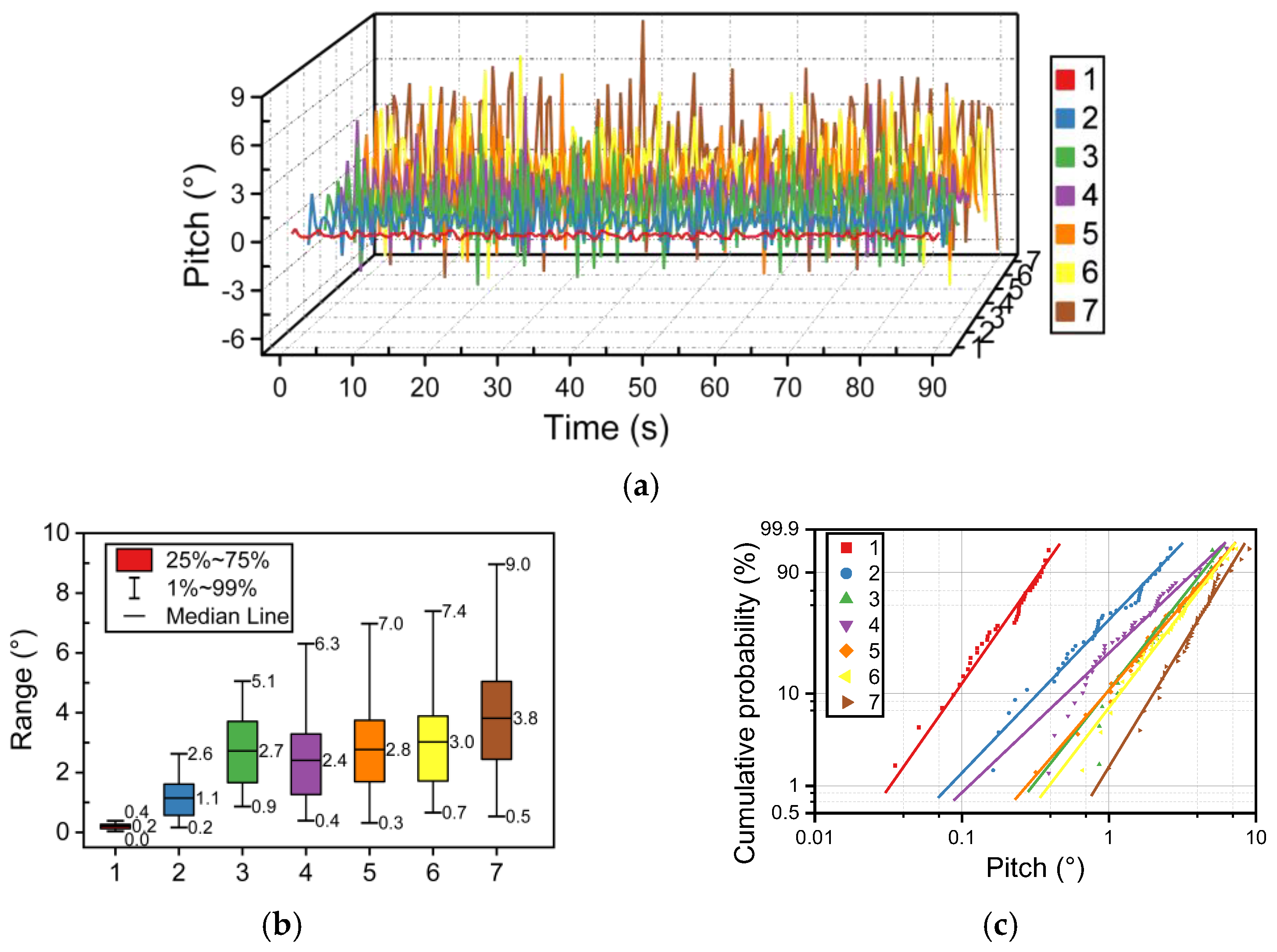
Figure 13 shows that, owing to the large diameter of the buoyancy ring, the model possesses a substantial mass moment of inertia and restoring moment in pitch. Even under 7 m-high waves, the pitch angle remains within a controllable range. Additionally, the time history curve of the pitch motion is smooth and exhibits good ergodicity, demonstrating excellent angular stability of the system.
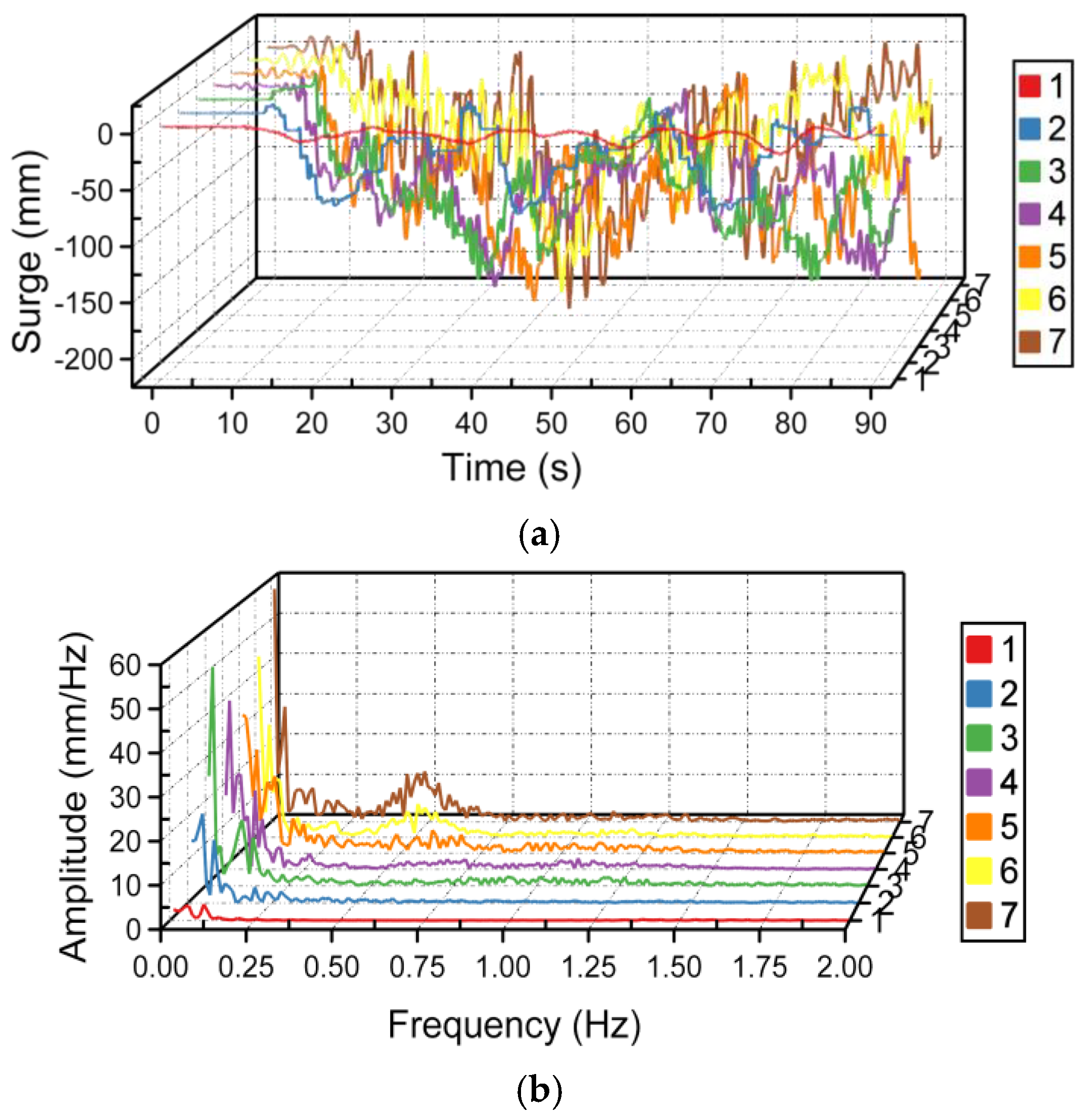
From Figure 14, it is evident that the surge response exhibits a complex nonlinear feature. In addition to short-period surge oscillations at wave frequency, a significant long-period surge motion displacing the model from its equilibrium position is also observed. The power spectral density of surge motion is mainly centered around 0.067 Hz, associated with the surge motion natural period of 15 s. Additionally, some power is concentrated at frequencies corresponding to the wave periods of each sea state.
To further investigate the surge motion characteristics of the membrane structure, Fourier analysis was applied to the data from each sea state. The waveforms within the range of 0 to 0.2 Hz were selected for low-frequency surge motion studies, and waveforms above 0.2 Hz were chosen for high-frequency surge motion studies.
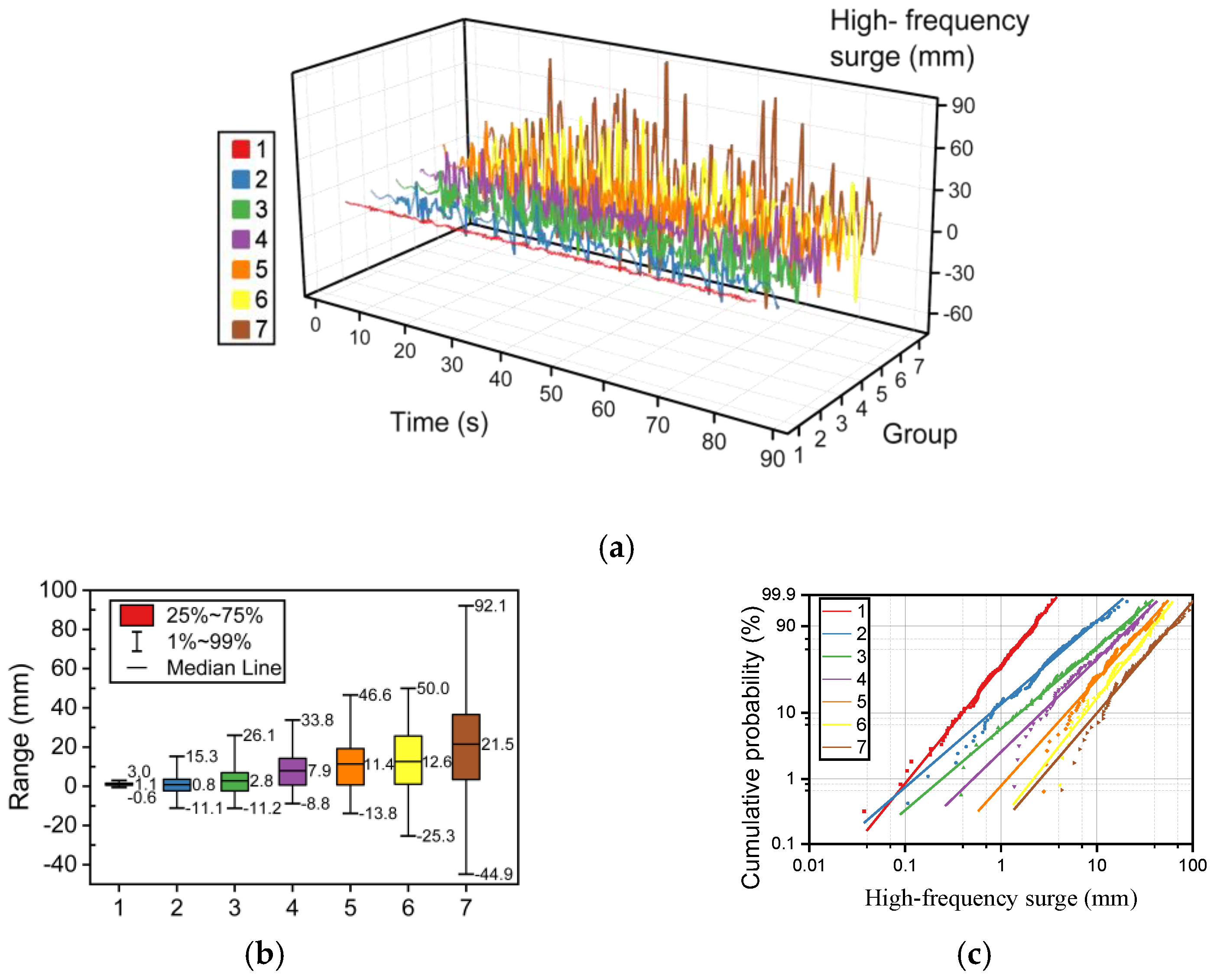
From Figure 15, it is evident that the overall amplitude of high-frequency surge motion tends to increase with the sea state level. Due to the relatively low energy of high-frequency waves, the surge motion is manifesting as minor oscillations within the waves. Probability density functions of the high-frequency surge peaks indicate that they are approximately Weibull-distributed, providing further support for the consistency and reliability of the measured data.
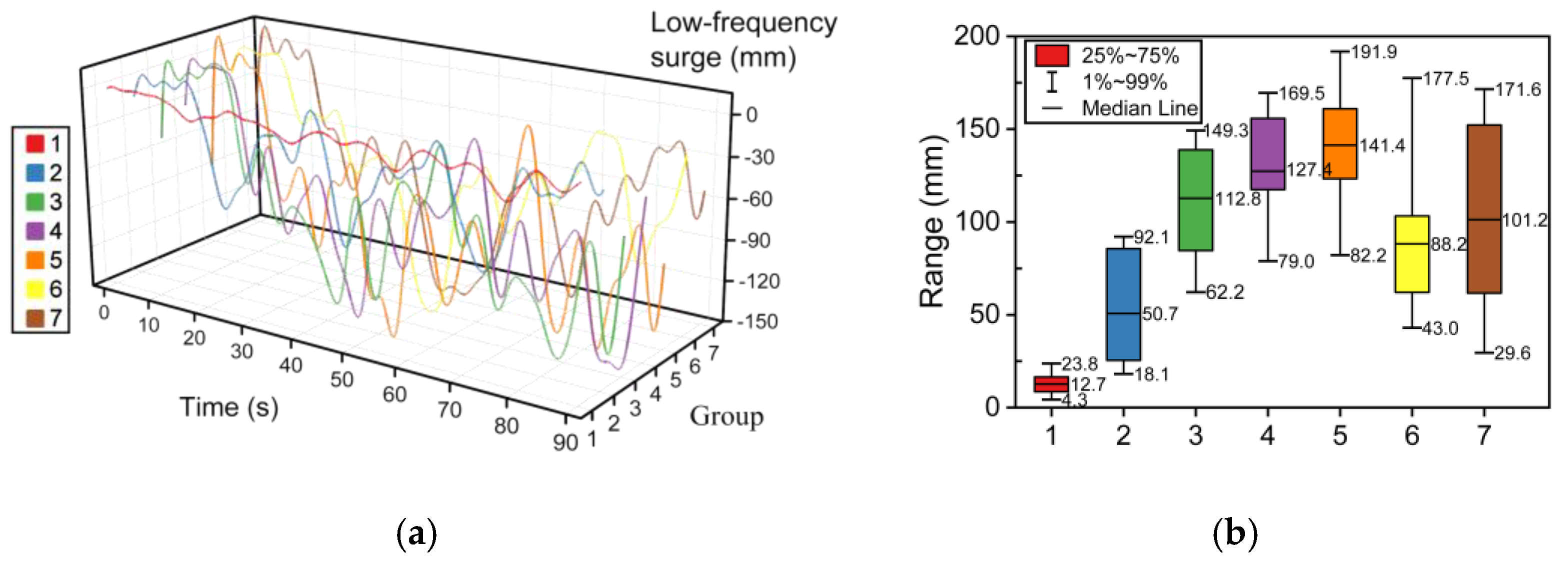
From Figure 16, it is evident that the low-frequency surge motion is larger than the high-frequency surge motion. From Sea State 1 to 5, as wave loads increase, the surge motion also increases. However, in Sea State 6 to 7, the surge motion does not further increase. This is because the catenary mooring cables become taut when fully extended, exerting a strong restraining force.
Frequency-domain analysis reveals that the energy spectrum of low-frequency surge motion (f < 0.2 Hz) exhibits a dominant frequency matching the natural period of the model (15 s), while high-frequency surge motion (f > 1 Hz) concentrates its energy around the wave-induced oscillation period. This low-frequency motion is not directly induced by individual waves but is rather driven by variations in the second-order mean drift force caused by wave grouping. Given that the natural period of surge (15 s) falls within the typical range of wave group periods and hydrodynamic damping is minimal at low frequencies, intense slow-drift resonance is triggered.
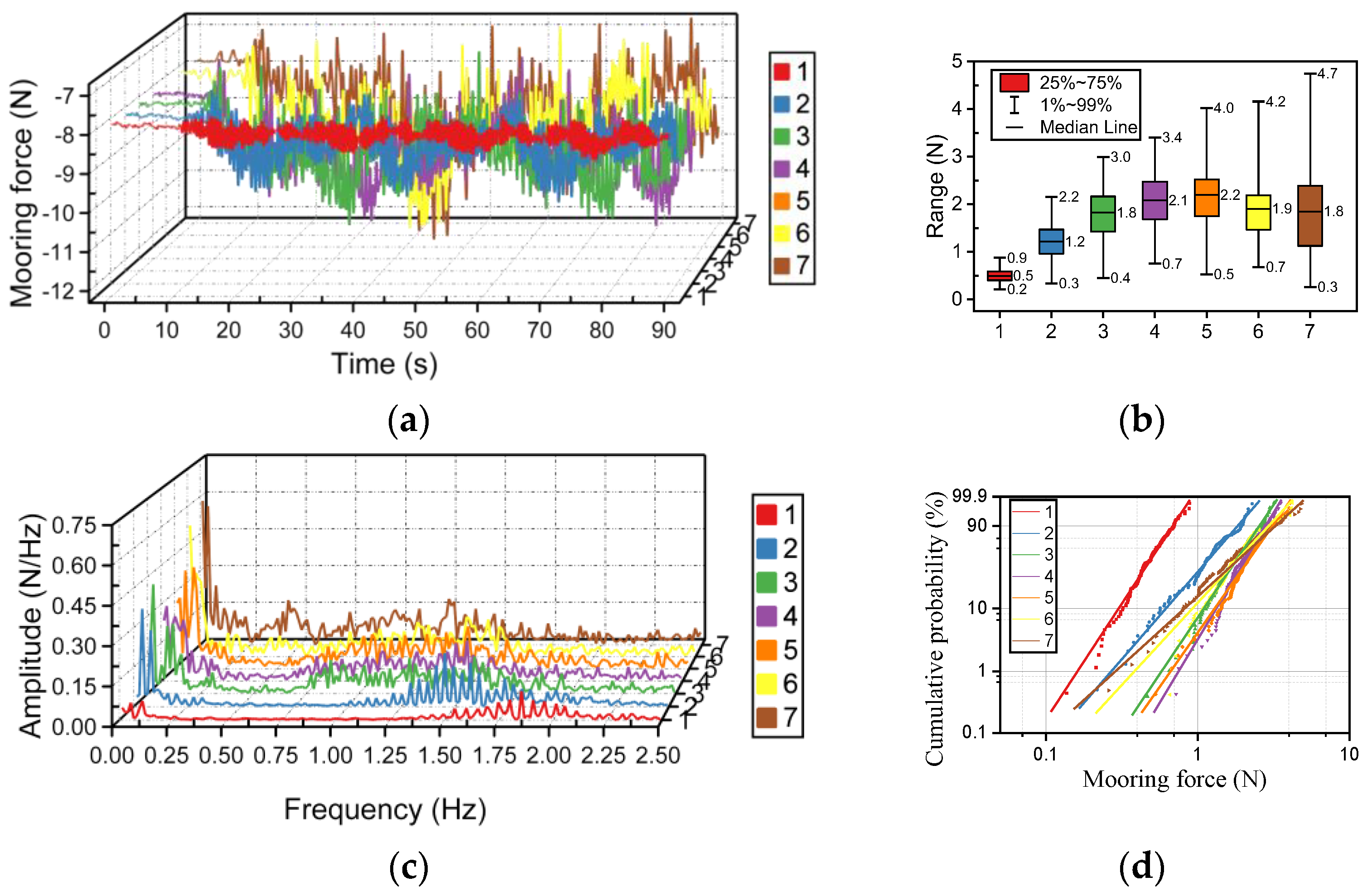
From Figure 17, it is observed that the static mooring force on the mooring chain is 7.9 N when in a static equilibrium position. The mooring force not only responds in the low-frequency domain with the frequency of coming waves but also exhibits a significant, high-frequency response. The power spectral density of the mooring force is mainly concentrated around 0.067 Hz, which corresponds to the natural surge period of 15 s. Additionally, there is some fluctuation in power between 0.5 Hz and 2 Hz. For statistical analysis, the initial static mooring force was subtracted to retain only the dynamic component. From Sea State 1 to Sea State 7, the dynamic mooring force exhibits an overall increasing trend, with a particularly pronounced rise in Sea State 7. The extreme-value probability distribution plot shows a change in the slope of data points for Sea State 7, suggesting a significant increase in the probability of extreme loads occurring.
A multivariate statistical analysis of the response variables reveals a strong correlation between surge and mooring force. Low-frequency surge motions are identified as the main contributor to large mooring forces, suggesting that long-period wave components are the dominant controlling factor for the design of the mooring system.
The results further indicate that under the action of giant waves and strong slow-drift motions, the mooring system has entered a nonlinear hardening stage. In this state, the mooring chain has been fully straightened (lift-off), losing the geometric elasticity of the catenary. During this phase, the mooring system abruptly transitions from a “flexible spring” to a “rigid tension link,” where even minor displacements could trigger a sharp surge in tension—known as a “snap load.” Experimental data clearly define the safety boundaries of this design. Under sea conditions exceeding Sea State 6, the existing four-point catenary mooring system presents an extremely high risk of failure.

4. Conclusions

This study investigated the hydrodynamic characteristics of a membrane-type FPV platform via 1:40 scale laboratory experiments based on Ocean Sun’s prototype. Static-water free-decay tests were first conducted to determine the model’s natural periods, followed by hydrodynamic tests under seven irregular sea states. The main conclusions are as follows:
(1) The membrane-type structure exhibits model-scale natural periods of approximately Theave ≈ 1.0 s, Tpitch ≈ 0.8 s, and Tsurge ≈ 15 s at model scale. The long surge period is attributed to the significant added mass of the large-diameter membrane, which prevents resonance with short-period waves. In contrast, strong hydrostatic restoring effects result in shorter natural periods for heave and pitch. The membrane system’s significant damping implies reduced susceptibility to dynamic amplification in these vertical and rotational modes.
(2) Under irregular wave loading, heave and pitch responses remain small. The membrane platform exhibits favorable “compliant follow” characteristics and excellent angular stability. In contrast, surge motion exhibits significant equilibrium offsets, comprising both short-period fluctuations and pronounced long-period excursions.
(3) Frequency-domain analysis shows that the energy spectrum of the low-frequency surge response (f < 0.2 Hz) is dominated by a peak corresponding to the natural surge period of about 15 s. The high-frequency component of surge motion (f > 1 Hz) concentrates its energy around the wave-induced oscillation periods. This indicates that the second-order drift force of long-period swells is the primary cause of large surge excursions, while high-frequency surge oscillations are driven by short-wave effects.
(4) A strong positive correlation is observed between surge motion and mooring-line tension. Low-frequency surge motions are identified as the primary contributor to large mooring forces, indicating that long-period wave components are a dominant controlling factor in mooring system design for membrane-type FPV platforms.
(5) Across Sea States 1–6, platform motion growth follows a consistent trend and remains within acceptable limits. In contrast, a significant increase in the exceedance probability of mooring forces is observed when the significant wave height reaches 7 m (Sea State 7). In this state, the catenary mooring chain is fully straightened and enters a nonlinear hardening regime, where even minor displacements can trigger a sharp tension surge. This elevated mooring failure risk under extreme sea states should be prioritized in the design and assessment of membrane-type FPV mooring systems.

Author Contributions

Conceptualization, X.Q. and P.Z.; methodology, L.X., X.Q. and P.Z.; software, X.Q., L.X. and L.Z.; validation, X.Q., L.X. and P.Z.; formal analysis, X.Q., L.X. and L.Z.; writing—original draft preparation, X.Q. and L.X.; writing—review and editing, L.Z. and P.Z.; project administration, P.Z. All authors have read and agreed to the published version of the manuscript.

Funding

This research received no external funding.

Institutional Review Board Statement

Not applicable.

Informed Consent Statement

Not applicable.

Data Availability Statement

The data presented in this study are available on request from the corresponding author. Data are unavailable due to privacy or ethical restrictions.

Conflicts of Interest

Author Xin Qi was employed by the company China Power Engineering Consulting Group Co., Ltd. The remaining authors declare that the research was conducted in the absence of any commercial or financial relationships that could be construed as a potential conflict of interest.

References

  1. Kougias, I.; Taylor, N.; Kakoulaki, G.; Jäger-Waldau, A. The role of photovoltaics for the European Green Deal and the recovery plan. Renew. Sustain. Energy Rev. 2021, 144, 111017. [Google Scholar] [CrossRef]
  2. Wang, J.; Ren, Y.; Shi, W.; Collu, M.; Vengatesan, V.; Li, X. Multi-objective optimization design for a 15 MW semisubmersible floating offshore wind turbine using evolutionary algorithm. Appl. Energy 2025, 377, 124533. [Google Scholar] [CrossRef]
  3. Ali, A.; Shi, W.; Wang, S.; Zhai, H.; Haider, R.; Leng, S.; Li, X.; Han, X. Dynamic analysis of a TetraSpar floating offshore wind turbine with different tendons failure scenario. Ocean Eng. 2025, 323, 120607. [Google Scholar] [CrossRef]
  4. Bian, Y.; Yunfang, L. Review on the development of photovoltaic power generation system of new energy. IOP Conf. Ser. Earth Environ. Sci. 2018, 186, 012078. [Google Scholar] [CrossRef]
  5. Guney, M.S. Solar power and application methods. Renew. Sustain. Energy Rev. 2016, 57, 776–785. [Google Scholar] [CrossRef]
  6. Gul, M.; Kotak, Y.; Muneer, T. Review on recent trend of solar photovoltaic technology. Energy Explor. Exploit. 2016, 34, 485–526. [Google Scholar] [CrossRef]
  7. Xiong, L.; Le, C.; Zhang, P.; Ding, H. Hydrodynamic characteristics of floating photovoltaic systems based on membrane structures in maritime environment. Ocean Eng. 2025, 315, 119827. [Google Scholar] [CrossRef]
  8. Pérez-Collazo, C.; Greaves, D.; Iglesias, G. A review of combined wave and offshore wind energy. Renew. Sustain. Energy Rev. 2015, 42, 141–153. [Google Scholar] [CrossRef]
  9. Wang, J.; Lund, P.D. Review of recent offshore photovoltaics development. Energies 2022, 15, 7462. [Google Scholar] [CrossRef]
  10. Essak, L.; Ghosh, A. Floating photovoltaics: A review. Clean Technol. 2022, 4, 752–769. [Google Scholar] [CrossRef]
  11. Floating PV: On the Rise in Europe. Available online: https://www.intersolar.de/market-trends/floating-pv-europe (accessed on 20 October 2025).
  12. Floating Solar: Emerging Technology Doubling Installed Power per Year. Available online: https://ratedpower.com/blog/floating-solar/ (accessed on 20 October 2025).
  13. Annual Floating Solar Additions to Top 6 GW by 2031, Says WoodMac. Available online: https://www.pv-magazine-india.com/2023/05/29/annual-floating-solar-additions-to-top-6-gw-by-2031-says-woodmac/ (accessed on 20 October 2025).
  14. 10 GW of Floating Solar by 2022: Current Status and Steps Needed to Achieve the Target. Available online: https://solarquarter.com/2021/05/24/10-gw-of-floating-solar-by-2022-current-status-and-steps-needed-to-achieve-the-target/ (accessed on 20 October 2025).
  15. Cuce, E.; Cuce, P.M.; Saboor, S.; Ghosh, A.; Sheikhnejad, Y. Floating PVs in terms of power generation, environmental aspects, market potential, and challenges. Sustainability 2022, 14, 2626. [Google Scholar] [CrossRef]
  16. Ghosh, A. A comprehensive review of water based PV: Flotavoltaics, under water, offshore & canal top. Ocean Eng. 2023, 281, 115044. [Google Scholar] [CrossRef]
  17. El Hammoumi, A.; Chtita, S.; Motahhir, S.; El Ghzizal, A. Solar PV energy: From material to use, and the most commonly used techniques to maximize the power output of PV systems: A focus on solar trackers and floating solar panels. Energy Rep. 2022, 8, 11992–12010. [Google Scholar] [CrossRef]
  18. Oliveira-Pinto, S.; Stokkermans, J. Marine floating solar plants: An overview of potential, challenges and feasibility. Proc. Inst. Civ. Eng. Marit. Eng. 2020, 173, 120–135. [Google Scholar] [CrossRef]
  19. Floating Photovoltaic System Cost Benchmark: Q1 2021 Installations on Artificial Water Bodies. Available online: https://research-hub.nrel.gov/en/publications/floating-photovoltaic-system-cost-benchmark-q1-2021-installations/ (accessed on 20 October 2025).
  20. Sahu, A.; Yadav, N.; Sudhakar, K. Floating photovoltaic power plant: A review. Renew. Sustain. Energy Rev. 2016, 66, 815–824. [Google Scholar] [CrossRef]
  21. Where Sun Meets Water: Floating Solar Market Report. Available online: https://www.worldbank.org/en/topic/energy/publication/where-sun-meets-water/ (accessed on 20 October 2025).
  22. Xiong, L.; Le, C.; Zhang, P.; Ding, H.; Li, J. Harnessing the power of floating photovoltaic: A global review. J. Renew. Sustain. Energy 2023, 15, 052701. [Google Scholar] [CrossRef]
  23. Kim, S.; Yoon, S.; Choi, W.; Choi, K. Application of floating photovoltaic energy generation systems in South Korea. Sustainability 2016, 8, 1333. [Google Scholar] [CrossRef]
  24. Crago, C.L.; Koegler, E. Drivers of growth in commercial-scale solar PV capacity. Energy Policy 2018, 120, 481–491. [Google Scholar] [CrossRef]
  25. Lee, G.; Choi, J.; Seo, J.; Ha, H. Comparative study of the effect of wind and wave load on floating PV: Computational simulation and design method. J. Korean Soc. Manuf. Process Eng. 2019, 18, 9–17. [Google Scholar] [CrossRef]
  26. Song, J.; Kim, J.; Lee, J.; Kim, S.; Chung, W. Dynamic response of multiconnected floating solar panel systems with vertical cylinders. J. Mar. Sci. Eng. 2022, 10, 189. [Google Scholar] [CrossRef]
  27. Choi, Y.K.; Lee, J.H. Structural safety assessment of ocean-floating photovoltaic structure model. Isr. J. Chem. 2015, 55, 1081–1090. [Google Scholar] [CrossRef]
  28. Haiyang (Offshore)|Ocean Sun. Available online: https://oceansun.no/project/haiyang-offshore/ (accessed on 20 October 2025).
  29. SPIC, Ocean Sun Switch on Offshore Floating Solar-Wind Pilot. Available online: https://www.pv-magazine.com/2022/11/02/spic-ocean-sun-build-worlds-first-offshore-floating-solar-wind-park/ (accessed on 20 October 2025).
  30. Xu, P.; Wellens, P.R. Theoretical analysis of nonlinear fluid–structure interaction between large-scale polymer offshore floating photovoltaics and waves. Ocean Eng. 2022, 249, 110829. [Google Scholar] [CrossRef]
  31. Campana, P.E.; Wästhage, L.; Nookuea, W.; Tan, Y.; Yan, J. Optimization and assessment of floating and floating-tracking PV systems integrated in on- and off-grid hybrid energy systems. Sol. Energy 2019, 177, 782–795. [Google Scholar] [CrossRef]
  32. Dai, J.; Zhang, C.; Lim, H.V.; Ang, K.K.; Qian, X.; Wong, J.L.H.; Tan, S.T.; Wang, C.L. Design and construction of floating modular photovoltaic system for water reservoirs. Energy 2020, 191, 116549. [Google Scholar] [CrossRef]
  33. WO2017209625—Solar Power Plant. Available online: https://patentscope.wipo.int/search/en/detail.jsf?docId=WO2017209625/ (accessed on 20 October 2025).
  34. WO2020040643—A Solar Power Plant and Method of Installing a Solar Power Plant. Available online: https://patentscope.wipo.int/search/en/detail.jsf?docId=WO2020040643/ (accessed on 20 October 2025).
  35. Xiong, L. Research on the Hydrodynamic Characteristics of Offshore Floating Photovoltaic Systems Based on Membrane Structures. Master’s Thesis, Tianjin University, Tianjin, China, 2024. [Google Scholar]
Figure 1. Global installed FPV capacity.
Applsci 16 00331 g001
Figure 2. Global FPV market shares by installed capacity.
Applsci 16 00331 g002
Figure 3. The prototype of Ocean Sun’s FPV membrane structure [28].
Applsci 16 00331 g003
Figure 4. Laboratory of Hydraulic Engineering Simulation and Safety at Tianjin University: (a) site layout, (b) experimental water tank, and (c) schematic diagram of the experiment set-up layout.
Applsci 16 00331 g004
Figure 5. Physical scaled membrane-type FPV model: (a) the scaled model deployed in water during laboratory tests, and (b) close-up view of the scaled model.
Applsci 16 00331 g005
Figure 6. Mooring configurations of the FPV model.
Applsci 16 00331 g006
Figure 7. The measurement instruments employed in the tests: (a) data-acquisition system, (b) tension load cell, (c) wave height gauge, (d) gyroscope, and (e) laser displacement sensor.
Applsci 16 00331 g007
Figure 8. Free decay test curve of heaving: (a) time–history curve, (b) amplitude spectrum curve.
Applsci 16 00331 g008
Figure 9. Free decay test curve of surging: (a) time–history curve, (b) amplitude spectrum curve.
Applsci 16 00331 g009
Figure 10. Free decay test curve of pitching: (a) time–history curve, (b) amplitude spectrum curve.
Applsci 16 00331 g010
Figure 11. Analysis of heave motion: (a) time–history curve, (b) mathematical statistics, (c) amplitude–frequency curve, and (d) Weibull distribution.
Applsci 16 00331 g011
Figure 12. Analysis of heave acceleration: (a) time–history curve, (b) mathematical statistics, and (c) Weibull distribution.
Applsci 16 00331 g012
Figure 13. Analysis of pitch motion: (a) time–history curve, (b) mathematical statistics, and (c) Weibull distribution.
Applsci 16 00331 g013
Figure 14. Analysis of surge motion: (a) time–history curve, and (b) amplitude-frequency curve.
Applsci 16 00331 g014
Figure 15. Analysis of high-frequency surge motion: (a) time–history curve, (b) mathematical statistics, and (c) Weibull distribution.
Applsci 16 00331 g015
Figure 16. Analysis of low-frequency surge motion: (a) time–history curve, and (b) mathematical statistics.
Applsci 16 00331 g016
Figure 17. Analysis of mooring force: (a) time–history curve, (b) mathematical statistics, (c) amplitude-frequency curve, and (d) Weibull distribution.
Applsci 16 00331 g017
Table 1. Policies of FPV programs in different countries.
CountryPolicies
SingaporeThe government has emphasized the need for innovation and sustainable solutions in FPV to meet its energy goals.
ChinaThe government has introduced various policies to support the development of FPV, including financial subsidies, feed-in tariffs, and tax incentives. The government also encourages the exploration of combined development of offshore wind power, solar power, and marine farming, integrating renewable energy sources for sustainable development.
JapanThe government has established a feed-in tariff scheme for FPV to promote its deployment. They have also implemented a certification system for FPV technology and provided subsidies for research and development.
South KoreaThe government has provided additional bonuses for renewable energy certificates and has opened tender processes for water-lease contracts by the relevant water management entities.
USSome states have implemented net metering policies, which allow FPV system owners to sell excess electricity back to the grid. There may be an extra “adder” value for floating solar generation under the compensation rates of the state incentives program.
NorwayThe government has encouraged research, demonstration projects, and pilot programs for FPV, with a focus on utilizing its vast water resources for renewable energy production.
UKThe UK’s Crown Estate, which manages the country’s seabed, has identified areas suitable for floating solar and wind projects.
NetherlandsThe government has established the North Sea Energy Program, which aims to facilitate the development of offshore renewable energy projects, including floating solar and wind projects.
Table 2. Material and component parameters.
Density
(g/cm3)
Thickness (mm)Young’s Modulus (GPa)Shear Modulus (GPa)Poisson’s Ratio
Floating ring1.120.360.240.25
Fastener2.3101.070.370.41
Ring-shaped film0.71.50.130.050.38
Horizontal film0.52---
Table 3. The dimensional value of the inner, outer, and top rings.
Cross-Sectional DiameterCross-Sectional
Thickness
HeightDiameterLength
Inner ring20 mm2 mm01.2 m3.77 m
Outer ring16 mm2 mm01.3 m4.1 m
Top ring10 mm2 mm5 cm1.2 m3.77 m
Table 4. Sea state condition test groups.
Test GroupSea StatePrototype Wave HeightPrototype Wave PeriodModel Wave HeightModel Wave Period
110.5 m3.2 s0.0125 m0.51 s
221 m4.1 s0.025 m0.65 s
332 m7.1 s0.05 m1.12 s
443 m8.2 s0.075 m1.30 s
564 m9.2 s0.1 m1.45 s
675 m11.1 s0.125 m1.76 s
787 m12.4 s0.175 m1.96 s
Disclaimer/Publisher’s Note: The statements, opinions and data contained in all publications are solely those of the individual author(s) and contributor(s) and not of MDPI and/or the editor(s). MDPI and/or the editor(s) disclaim responsibility for any injury to people or property resulting from any ideas, methods, instructions or products referred to in the content.