Article

A Study on Unsafe Behaviors of Construction Workers Based on Personality Trait Theory

Department of Engineering Management, School of Civil Engineering, Lanzhou Jiaotong University, Lanzhou 730070, China
*
Author to whom correspondence should be addressed.
Appl. Sci. 2026, 16(1), 336; https://doi.org/10.3390/app16010336
Submission received: 11 November 2025 / Revised: 12 December 2025 / Accepted: 23 December 2025 / Published: 29 December 2025

Abstract

The construction industry faces severe safety challenges with over 80% of accidents stemming from unsafe behaviors, yet traditional management overlooks the role of individual differences, and existing research fails to address the specific psychological mechanisms operative in this high-risk, dynamic environment. To effectively curtail unsafe behaviors in such high-risk environments, this study aims to reveal the underlying mechanisms through which personality traits influence unsafe behaviors. Grounded in causal chain theory, the theory of planned behavior, and trait activation theory, this study constructs a hypothetical model of personality traits and unsafe behaviors, with fluke mentality serving as a mediating variable and safety climate as a moderating variable. A comprehensive approach combining questionnaire surveys, confirmatory factor analysis, correlation tests, and linear regression was employed to test the hypotheses. The results indicate that neuroticism, openness, and extraversion have significant positive effects on unsafe behaviors, while conscientiousness has a significant negative effect; agreeableness shows no significant influence. Fluke mentality plays a partial mediating role between personality traits and unsafe behaviors, while safety climate plays a negative moderating role. By clarifying the cognitive pathways of individual differences, this study enriches the theoretical framework of unsafe behavior research. The findings provide a theoretical basis for construction enterprises to optimize safety management from the perspective of individual differences, offering practical pathways to promote high-quality development in the construction industry.

1. Introduction

Data from the National Bureau of Statistics indicate that the construction industry’s total output value has exhibited a consistent and steady upward trajectory, expanding its scale annually and cementing its position as a vital pillar of the national economy [1]. However, this rapid growth has been accompanied by a parallel surge in construction safety issues [2,3]. Ranking as the third most accident-prone and high-risk industry after mining and transportation [4], characterized significantly by frequent hazards such as falls from heights and structural collapses, the construction sector suffers from a high frequency of accidents and a substantial toll in fatalities, placing it second only to these sectors in terms of casualties [5,6]. Within this industry, safety incidents occur at a notably high rate, particularly during operational tasks, where unsafe behaviors by workers stand out as a leading cause of accidents [7,8,9]. Statistical evidence reveals that over 80% of construction-related accidents stem from such unsafe practices [10]. These behaviors not only endanger the lives and well-being of workers directly [11] but also inflict significant societal harm and financial losses on businesses [12]. Given these circumstances, the imperative to effectively curtail unsafe behaviors has become a central challenge in construction safety management, demanding urgent attention and innovative solutions.
Unsafe behaviors exhibited by construction workers are shaped by a complex interplay of factors, including individual variances [13], psychological conditions [14], work surroundings [15], and external management approaches [16,17]. Consequently, a growing number of scholars and corporate leaders have turned their attention towards curbing these unsafe behaviors through environmental modifications [18], skill enhancement [19], and the reinforcement of safety management frameworks [20,21]. However, relying solely on external environmental modifications is insufficient [22]. From the perspective of Socio-Technical Systems, construction sites are characterized by high systemic complexity. Unsafe behaviors are not merely isolated individual errors but often emerge from the interaction between organizational drivers and individual traits, potentially leading to a ‘drift into failure’. Within this complex organizational framework, while these external factors [23] provide the context, the inherent individual differences among workers [24] determine how they adapt to these systemic pressures and whether they succumb to unsafe precursors. As a result, exploring the individual disparities among construction workers has become a pivotal focus in contemporary safety research within the construction sector. From an individual standpoint, each worker’s distinct personality traits exert a substantial impact on their attitudes and responses towards safe practices [25]. From a psychological standpoint, unsafe mental states among workers can expedite the emergence of unsafe behaviors [9]. Amidst the interplay of these multifaceted factors, construction workers frequently demonstrate a notably high incidence of unsafe actions [26]. Recent interdisciplinary studies bridging psychology and safety management have underscored the critical role of individual personality traits in shaping and expressing safe behaviors [27,28]. Especially in high-risk sectors like construction, where employees must maintain a high level of concentration, workers’ personality traits can significantly impact their work attitudes and adherence to safety protocols [29]. However, prevailing research on personality traits has largely centered on groups from industries like education [30], healthcare [31], mining [32], and railway operation [33]. In these fields, employees typically face comparatively lower work stress and more stable external conditions, rendering the impact of personality traits on behavior more discernible [34]. Conversely, within the high-risk construction sector, characterized by its extreme and ever-changing work environment, workers are compelled to navigate not only individual differences but also to make decisions amidst intricate tasks and substantial work pressure [35]. Consequently, delving into the relationship between personality traits and unsafe behaviors constitutes a crucial avenue for exploration. It is essential to understand not just the individual differences, but how these traits manifest under the specific organizational constraints and systemic risks unique to the high-stakes construction context.
Given these circumstances, Occupational health and safety protocols in construction confront a myriad of challenges, as the prevalence of unsafe behaviors is intricately tied to workers’ individual variances, personality traits, and psychological elements [36,37]. Therefore, the primary objective of this work is to investigate the underlying mechanism linking personality traits to unsafe behaviors among construction workers. Specifically, this study aims to first examine the direct influence of personality traits on unsafe behaviors, second to explore the mediating role of risk-taking propensity, and third to evaluate the moderating effect of safety climate To more effectively tackle these objectives, the present study constructs a structural equation model, wherein personality traits serve as the independent variable, a propensity for risk-taking or “getting away with it” as the mediating variable, unsafe behaviors as the dependent variable, and safety climate as the moderating variable. Here, safety climate is conceptualized not just as a situational factor, but as a proxy for broader organizational drivers and systemic barriers. This design allows us to examine whether a robust organizational context can buffer the adverse effects of individual traits on safety behaviors. By exploring the underlying mechanism through which personality traits impact unsafe behaviors, this research not only enhances the theoretical understanding of construction workers’ safety behaviors but also lays a scientific foundation for safety management practices in the construction field. Through such rigorous investigation, tailored safety training and management strategies can be devised for construction workers, ultimately paving the way for the realization of safe production objectives in the construction sector.

2. Conceptual Definitions and Research Hypotheses

2.1. Conceptual Definitions

Personality Characteristics: These denote the systematically integrated features evident in an individual’s cognitive, emotional, and behavioral patterns, essentially constituting a psychological functional framework that harmonizes dynamic adaptability with core stability [38]. This psychological construct sustains internal consistency over time via a continual self-regulatory process, while concurrently exhibiting adaptability and responsiveness to varied situations across different contexts, ultimately forging a psychologically unique imprint characteristic of the individual [39]. Grounded in the Big Five Personality Theory, this study divides personality traits into five dimensions: neuroticism, openness, extraversion, agreeableness, and conscientiousness. It explores in depth how these distinct dimensions of personality traits influence unsafe behaviors among construction workers.
Fluke mentality: This denotes a cognitive bias where individuals, upon encountering risks or uncertain circumstances, develop irrational outcome expectations grounded in subjective wishes rather than objective facts. It is characterized by an underestimation of the probability of adverse events or an overestimation of their capacity to sidestep risks [40]. Fundamentally, this psychological condition entails placing hopes for success or risk evasion on contingent factors, instead of undertaking a rational evaluation of actual conditions [41].
Safety Climate: Rooted in the concept of organizational climate, the term “safety climate” was first coined by Israeli scholar Zohar [42], who characterized it as the holistic perception organizational members hold about their work environment and safety-related aspects. As a situational factor intertwined with individual traits, safety climate exerts a considerable influence [43]. Consequently, this study aims to investigate its moderating role in the relationship between the “get-away-with-it” mentality and unsafe behaviors.
Unsafe Behaviors: Initially introduced by Heinrich, the concept of “unsafe behaviors” suggests that such actions are shaped by influences at three levels: environmental, organizational, and individual [8]. While scholars globally have offered slightly differing definitions and interpretations, this paper defines unsafe behaviors as “individual actions in work or living settings that breach safety rules or procedures, potentially resulting in accidents, injuries, or property loss.”

2.2. Research Hypotheses

2.2.1. Personality Traits and Unsafe Behaviors

Previous research has shown that individuals with high neuroticism are generally emotionally unstable, susceptible to anxiety, nervousness, and impulsivity [44]. In the construction sector, these workers may face increased stress owing to the demanding, risky, and unpredictable work environment. Such stress can trigger more frequent emotional swings, ultimately leading to irrational decisions [45], such as overlooking safety rules, mishandling equipment, or bypassing standard procedures in a rush to finish tasks, thereby heightening the risk of unsafe behaviors. Consequently, this study puts forth the following hypothesis:
Hypothesis H1a.
Neuroticism is positively correlated with unsafe behaviors.
Individuals with high openness generally demonstrate enhanced innovation and curiosity, readily embracing new work methods and displaying an active, exploratory stance toward uncharted territories [46]. In the construction sector, such workers are more prone to risk-taking by adopting novel, untested techniques, often neglecting established safety procedures and thereby elevating the probability of unsafe behaviors. Hence, this study advances the following hypothesis:
Hypothesis H1b.
Openness is positively correlated with unsafe behaviors.
Extraversion reflects the degree of social inclination, vitality, and stimulation-seeking of an individual [47]. Research has shown that highly extraverted individuals are generally more socially active, proactive, and sensitive to external cues [48]. In the construction sector, these workers tend to favor trying out new work techniques or accelerating task progress. However, this inclination may also lead them to be less cautious about risks, causing them to neglect safety procedures and thereby elevate the risk of unsafe behaviors. Hence, this study formulates the following hypothesis:
Hypothesis H1c.
Extraversion is positively correlated with unsafe behaviors.
Agreeableness represents an individual’s traits in terms of cooperation, empathy, and trust in others [49]. Previous studies have indicated that individuals with high agreeableness typically exhibit strong prosocial tendencies, are adept at listening to others’ opinions, and are more inclined to maintain harmonious relationships within teams [50]. In the construction industry, where teamwork is frequently required, individuals with high agreeableness are more likely to adhere to team norms, proactively remind colleagues to follow safety operation procedures, and promptly report potential risks to management, thereby reducing the likelihood of unsafe behaviors. Therefore, this study proposes the following hypothesis:
Hypothesis H1d.
Agreeableness is negatively correlated with unsafe behaviors.
Conscientiousness refers to stable individual characteristics in self-discipline, goal orientation, and prudence [51]. Research has shown that highly conscientious individuals generally demonstrate a heightened sense of responsibility and discipline, executing tasks with greater precision and adhering rigorously to established norms and protocols [52]. In the construction sector, conscientious workers exhibit meticulous attention to detail and strict adherence to safety rules, including proper use of safety equipment, standardized machinery operation, and proactive risk avoidance, thereby minimizing the occurrence of unsafe behaviors. Consequently, this study posits the following hypothesis:
Hypothesis H1e.
Conscientiousness is negatively correlated with unsafe behaviors.

2.2.2. The Mediating Role of a Psychology of Fluke

While personality traits demonstrate consistency over time and across diverse contexts, a multitude of latent factors continue to play a role in how these traits shape human behavior amidst situational changes [53]. Analyses of historical accident data indicate that when confronted with abnormal work scenarios, psychological states of worker during the perceptual phase can markedly influence their actions, consequently leading to varying severities of accident outcomes [54].
Regarding neuroticism, workers with this trait frequently exhibit unsafe psychological conditions under pressure and challenges in the construction sector [55]. They are inclined to adopt irrational optimism as a coping mechanism, leading them to underestimate risks and potentially reject safety protocols, thereby nurturing a reliance on luck.
Similarly, within the construction industry, workers possessing high openness may be prone to seeking innovative methods for task completion [56]. This specific propensity can lead them to challenge safety regulations, downplay the importance of established rules, and neglect strict adherence to safety standards, ultimately exhibiting a pronounced fluke mentality.
For extraversion, highly extraverted workers in the construction sector may be more inclined to take risks and prone to underestimating potential dangers [57]. They are often convinced that they can sidestep hazards through their experience or intuition, thus nurturing a reliance on luck.
In contrast, workers with high agreeableness typically avoid conflicts with supervisors or colleagues [58]. As a result, they are more inclined to adhere to safety regulations, thereby preventing the emergence of a mindset reliant on chance.
Finally, regarding conscientiousness, workers exhibiting this trait demonstrate a heightened sense of responsibility within the construction sector [59]. When confronted with risks, they prefer to adopt systematic and analytical approaches instead of depending on intuition or heuristics, thus preventing the development of a reliance on luck. Consequently, this study posits the following research hypothesis:
Hypothesis H2a.
Neuroticism is positively correlated with a fluke mentality.
Hypothesis H2b.
Openness is positively correlated with a fluke mentality.
Hypothesis H2c.
Extraversion is positively correlated with a fluke mentality.
Hypothesis H2d.
Agreeableness is negatively correlated with a fluke mentality.
Hypothesis H2e.
Conscientiousness is negatively correlated with a fluke mentality.
Social cognitive theory posits that an individual’s behavior stems from their psychological state [60]. Construction workers, facing significant job-related risks, experience an even more pronounced influence of psychological states on their behavior [61]. Within the high-risk construction sector, those with a pronounced fluke mentality are prone to underestimating safety risks, mistakenly believing they can avoid injuries or accidents while disregarding safety regulations. As a result, they often ignore safety warnings, become less vigilant, and consequently heighten the probability of unsafe behaviors. Hence, this study advances the following research hypothesis:
Hypothesis H3.
A fluke mentality is positively correlated with unsafe behaviors.
In essence, the personality traits of construction workers initially shape their psychological states. Workers possessing distinct personality traits are prone to displaying varying levels of fluke mentality while performing tasks. This reliance, in turn, influenced behavioral judgments and decision-making processes, leading individuals to disregard potential safety hazards in the work environment. Consequently, this heightens the probability of accidents and fosters unsafe behaviors among workers. Hence, this study formulates the following hypothesis:
Hypothesis H4a.
A fluke mentality mediates the relationship between neuroticism and unsafe behaviors.
Hypothesis H4b.
A fluke mentality mediates the relationship between extraversion and unsafe behaviors.
Hypothesis H4c.
A fluke mentality mediates the relationship between openness and unsafe behaviors.
Hypothesis H4d.
A fluke mentality mediates the relationship between agreeableness and unsafe behaviors.
Hypothesis H4e.
A fluke mentality mediates the relationship between conscientiousness and unsafe behaviors.

2.2.3. The Moderating Effect of Safety Climate

Individuals with a strong fluke mentality do not invariably demonstrate a heightened tendency towards unsafe behaviors, as this reliance is shaped by situational factors. Trait activation theory posits that an individual’s behavioral outcome stems from the interplay between their traits and the surrounding situations. Neither traits nor psychological states and associated situations can singularly elucidate behavior; rather, it is the dynamic interaction between personal traits and situations that best explains it [62]. Safety climate, a situational factor intertwined with traits [63], had been shown by prior research to predominantly influence behavior by adjusting an individual’s psychological state within given contexts [43,64]. Specifically, a robust safety climate strengthens an organization’s internal safety management mechanisms, providing workers with enhanced safety training, management support, and peer collaboration, which in turn diminishes the impact of their fluke mentality on unsafe behaviors. Conversely, a weak safety climate may lead workers to feel neglected by safety management, thereby intensifying the effect of their fluke mentality on unsafe behaviors. Hence, this study posits the following hypothesis:
Hypothesis H5.
Safety climate exerts a negative moderating effect on the relationship between fluke mentality and unsafe behaviors.
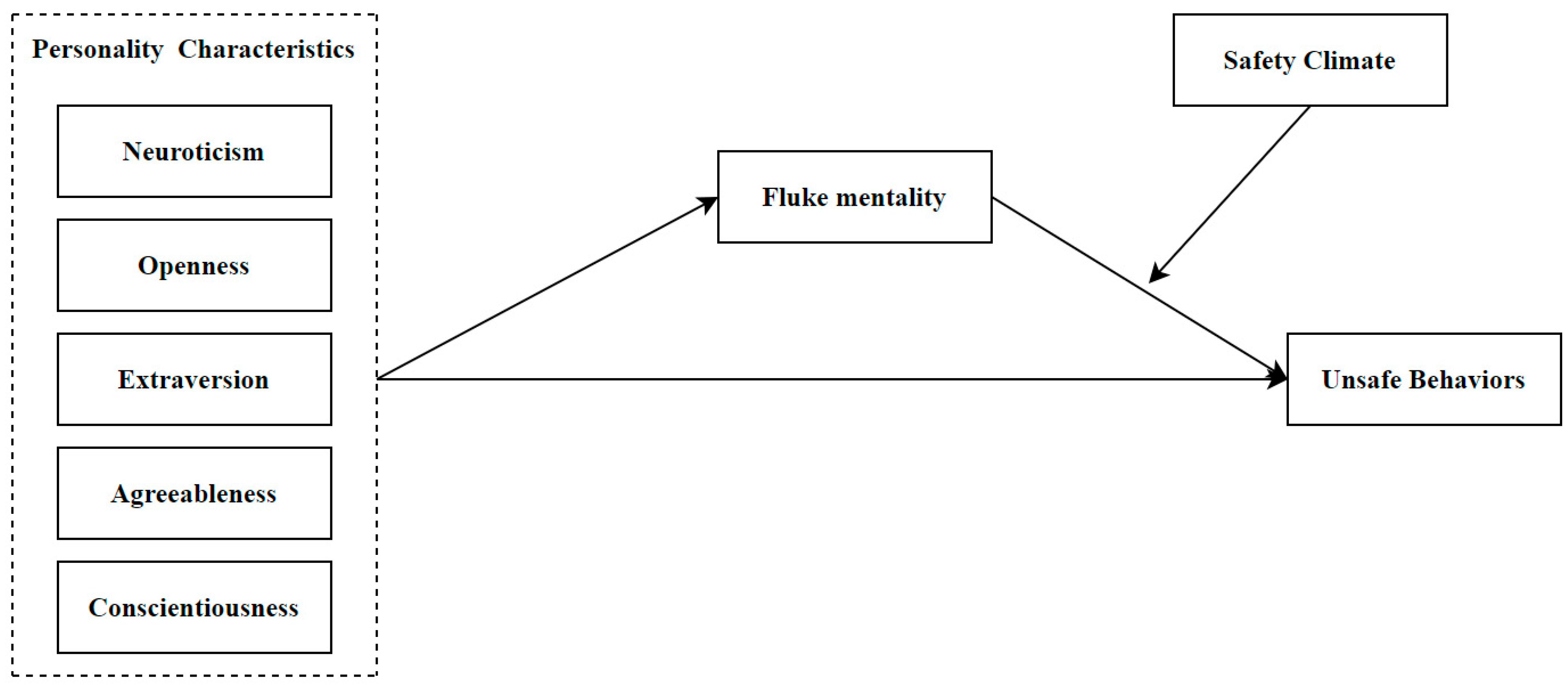
Based on the theoretical derivation and hypotheses proposed above, the research model constructed in this study is presented in Figure 1. This conceptual framework illustrates the mechanism through which personality characteristics influence unsafe behaviors. Specifically, it is hypothesized that personality characteristics not only have a direct effect on unsafe behaviors but also exert an indirect effect via the mediating role of fluke mentality. Furthermore, safety climate is posited to moderate the relationship between fluke mentality and unsafe behaviors.

3. Research Design

Based on the theoretical framework and literature review presented in Chapter 2, this study aims to empirically investigate the underlying mechanisms of construction workers’ unsafe behaviors. Specifically, the objectives of this work are to analyze the influence of personality traits on unsafe behaviors, and to separately explore the mediating role of fluke mentality and the moderating role of safety climate. To achieve these objectives and validate the proposed research hypotheses, this chapter details the research design, including the data collection procedures, the demographic characteristics of the sample, and the measurement scales utilized for each variable.

3.1. Data Collection

This study employed a questionnaire survey to gather data, utilizing validated scales to assess construction workers’ personality traits, fluke mentality, safety climate perceptions, and unsafe behaviors. The survey participants were strictly limited to frontline construction workers within the project department (excluding management personnel). To ensure data accuracy and a high response rate, questionnaires were distributed offline during workers’ rest breaks. Strict adherence to identical distribution conditions and protocols was maintained for all participants. A total of 400 paper questionnaires were distributed, with 357 actually retrieved subsequent to the screening process to remove invalid data (such as haphazard responses), 336 valid responses were obtained, yielding an 84% recovery rate. The gender distribution of the surveyed workers reflected a significant male predominance, with males comprising 91.1% and females just 8.9%, mirroring the prevalent gender imbalance on construction sites. In terms of age, the workforce skewed older: 15.5% were aged 18–29, 27.4% aged 30–39, 40.5% aged 40–49, and 16.6% aged 50 or above, indicating a notably mature workforce with a pronounced aging trend. Educational attainment was generally low, with 33.9% having completed primary school or less, 46.4% junior high school, and only 19.7% completing senior high school or higher, reflecting the overall low educational profile in the construction industry. Regarding work experience, 30.4% had 0–5 years, 50.6% had 6–10 years, and 19.0% had 11 years or more, suggesting that the surveyed workers had relatively extensive tenures, in line with their age distribution.

3.2. Variable Measurement

Personality Traits: The content of the scale drew reference from the new concise version of the Chinese Big Five Personality Inventory (CBF-PI-15). It was evaluated using the content validity testing method proposed by Hinkin [65] to enhance its applicability to the construction industry. The scale comprised five dimensions and employed a Likert 5-point rating scale. In this study, the Cronbach’s α coefficients for each dimension were 0.886, 0.920, 0.938, 0.941, and 0.949, respectively.
Unsafe Behaviors: The measurement scale for unsafe behaviors was adapted from the one modified by Gong Pengyi [66] based on Neal’s [67] original work. Utilizing a Likert 5-point rating scale, the Cronbach’s α coefficient in this study was found to be 0.948.
A sense of fluke mentality: The measurement scale for this construct was developed by Cao Lulu and Liu Yan [68]. Representative items include, ‘Although it is a violation, others may not necessarily discover it.’ Utilizing a Likert 5-point rating scale, the Cronbach’s α coefficient in this study was found to be 0.959.
Safety Climate: The safety climate scale utilized in this study was developed by Zhang Xiu [69] based on the safety climate scale referenced from Xinxia Liu [70]. Employing a Likert 5-point rating scale, the Cronbach’s α coefficient in this study was found to be 0.955.

4. Data Analysis and Hypothesis Testing

4.1. Confirmatory Factor Analysis

We conducted a series of confirmatory factor analyses (CFA) using SPSS 27.0 software to assess whether the model in this study possesses good discriminant validity. As shown in Table 1, X2/df = 1.507 < 3, RMSEA = 0.055 < 0.08, SRMR = 0.039 < 0.08, IFI = 0.938 > 0.9, TLI = 0.929 > 0.9, and CFI = 0.937 > 0.9, indicating that the model adopted in this study demonstrates good discriminant validity.

4.2. Common Method Bias Test

Since the data for this study were gathered through self-assessments by workers, with all core variables completed from a single source, raising concerns regarding common method bias. To counteract this bias, the survey design incorporated control measures such as anonymous responses, phased data collection, and multi-channel questionnaire dissemination. Additionally, Harman’s single-factor test was conducted using SPSS 25.0 software for factor analysis on all variables. The results demonstrated the presence of eight factors with eigenvalues greater than 1 (more than one), with the highest variance explained by a single factor being 25.81% (below 40%). However, recognizing the limitations of Harman’s test, we further employed the Unmeasured Latent Method Construct approach to rigorously assess the potential influence of common method variance. We introduced a common method factor linked to all indicators of the substantive constructs. The analysis revealed that the average substantively explained variance of the indicators was 0.634, whereas the average method-based variance was only 0.012, resulting in a high ratio of substantive to method variance. These combined results confirmed the absence of significant common method bias in the data.

4.3. Correlation Analysis

Table 2 presents the descriptive statistics, Pearson correlation coefficients, average variance extracted (AVE), and composite reliability (CR). Firstly, the AVE values for all variables exceeded 0.5, and the CR values are all above 0.8, indicating that the structural model in this study exhibited good convergent validity. Secondly, in the correlation analysis, the correlation coefficients between agreeableness and openness, safety climate, and unsafe behaviors were not significant. Similarly, the correlation coefficients between safety climate and neuroticism, openness, extraversion, and agreeableness were also not significant. Strong or weak correlations existed among the remaining variables (p < 0.05). Neuroticism, openness, and extraversion of construction workers were positively associated with a fluke mentality and unsafe behaviors. Conscientiousness was negatively correlated with neuroticism, openness, a sense of fluke mentality, and unsafe behaviors. Agreeableness was negatively correlated with a sense of fluke mentality and unsafe behaviors. Safety climate was positively correlated with conscientiousness and negatively correlated with unsafe behaviors.

4.4. Hypothesis Testing

First, Model 4 of Hayes’ [58] PROCESS macro for SPSS (a simple mediation model) was applied to test the mediating effect of luck psychology on the relationship between personality traits and unsafe behavior, while controlling for gender, age, education level, and work experience. The results (presented in Table 3 and Table 4) indicated that neuroticism (β = 0.507, t = 3.181, p < 0.001), openness (β = 0.449, t = 2.943, p < 0.001), and extraversion (β = 0.414, t = 2.922, p < 0.001) exerted significant positive impacts on unsafe behaviors. Conversely, conscientiousness (β = −0.500, t = −3.091, p < 0.001) demonstrated a significant negative impact on unsafe behaviors. Agreeableness (β = 0.099, t = −0.124, p > 0.05) did not show a significant effect on unsafe behaviors. When the mediating variable was included, neuroticism (β = 0.332, t = 4.780, p < 0.001), openness (β = 0.154, t = 2.231, p < 0.05), and extraversion (β = 0.349, t = 5.030, p < 0.001) still exhibited significant positive impacts on unsafe behaviors. Conscientiousness (β = −0.266, t = −3.756, p < 0.001) continued to demonstrate a significant negative impact on unsafe behaviors, while agreeableness (β = 0.057, t = −0.903, p > 0.05) still did not show a significant effect. Therefore, Hypotheses H1a, H1b, H1c, and H1e were supported, whereas Hypothesis H1d was not. Neuroticism (β = 0.545, t = 3.522, p < 0.001), openness (β = 0.334, t = 1.431, p < 0.001), and extraversion (β = 0.378, t = 2.243, p < 0.001) exerted significant positive influences on a sense of fluke mentality. Conversely, conscientiousness (β = −0.526, t = −3.463, p < 0.001) demonstrated a significant negative impact on a sense of fluke mentality. Agreeableness (β = 0.113, t = 0.521, p > 0.05) did not exhibit a significant effect on a sense of fluke mentality. Therefore, Hypotheses H2a, H2b, H2c, and H2e were supported, while Hypothesis H2d was not. Furthermore, a sense of fluke mentality significantly and positively influenced unsafe behaviors (β = 0.539, t = 3.182, p < 0.001), thereby supporting Hypothesis H3. Additionally, the direct effects of personality traits on unsafe behaviors and the mediating effects of a sense of fluke mentality did not include 0 within the upper and lower bounds of the 95% confidence interval derived from the bootstrap method (Table 4). This indicated that personality traits (neuroticism, extraversion, openness, and conscientiousness) not only directly predicted unsafe behaviors but also predicted them through the mediating role of a sense of fluke mentality. Consequently, Hypotheses H4a, H4b, H4c, and H4e are validated. To further verify the robustness of these findings, a post hoc power analysis was conducted using G*Power 3.1. The results showed that given the sample size (N = 336) and the observed effect sizes, the statistical power for detecting these significant path coefficients exceeded 0.91, well above the conventional 0.80 threshold. Additionally, the effect sizes (Partial R2) for the main endogenous variables (Table 3) indicated practical significance.
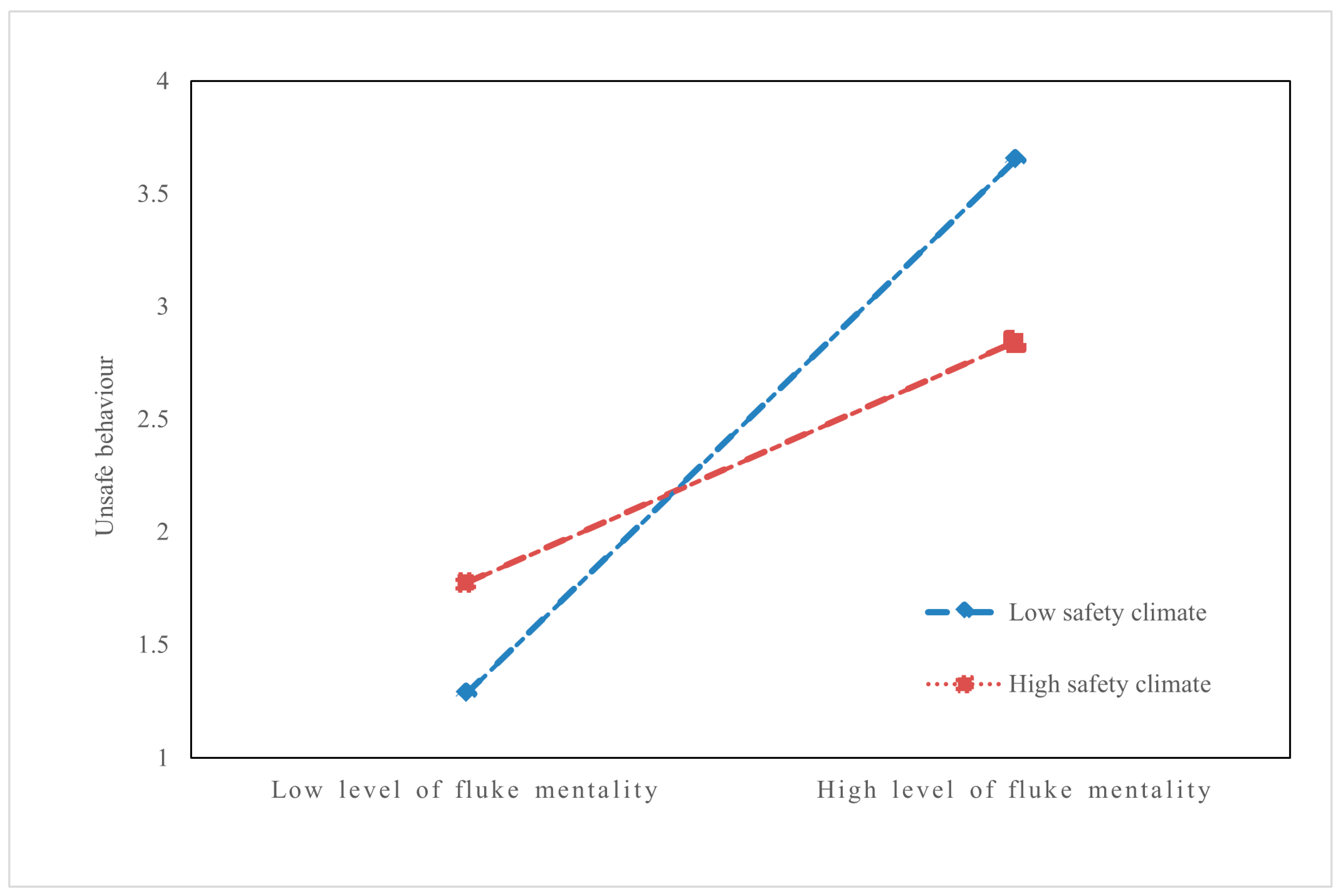
Secondly, Model 14 of the PROCESS macro in SPSS, developed by Hayes [58], was adopted to test the moderating effect of safety climate on the relationship between fluke mentality and unsafe behaviors, as this moderated mediation model assumes a moderating effect in the latter part of the mediation pathway, consistent with the theoretical framework of this study. As shown in Table 3, when safety climate was incorporated into the model, the product term of fluke mentality and safety climate exerted a strong predictive power regarding unsafe behaviors (β = −0.238, t = −4.429, p < 0.01), suggesting that safety climate negatively moderated the relationship between fluke mentality and unsafe behaviors. Therefore, Hypothesis H5 was supported. A post hoc power analysis for this interaction effect also yielded a power value greater than 0.80, confirming the sensitivity of the analysis to detect the moderation effect. Additionally, a simple slope analysis was conducted for the validated Hypothesis H5. As shown in Figure 2, when the safety climate was low (M–1SD), fluke mentality had a stronger positive effect on unsafe behavior. When the safety climate was high (M+1SD), this effect remained significant but weakened. Thus, the predictive effect of fluke mentality on unsafe behavior decreased as the safety climate increased (Table 5).

5. Discussion

Based on the causal chain theory, the theory of planned behavior, and the trait activation theory, this study, set against the backdrop of construction safety, proposed and examined the mediating and moderating mechanisms underlying the influence of personality traits on unsafe behaviors within the construction workforce. It not only elucidated how personality traits affect unsafe behaviors among construction workers through the mediating role of a sense of fluke mentality, but also addressed the conditions under which the impact of personality traits on unsafe behaviors becomes more pronounced, as moderated by safety climate. These findings not only enrich the application of personality traits in the field of construction safety but also hold theoretical and practical significance for strategies aimed at reducing unsafe behaviors among construction workers.

5.1. Theoretical Contributions

This study offers three pivotal theoretical implications.
Firstly, it deepens the exploration of the predictive role of personality traits regarding unsafe behaviors among construction workers. Set against the context of construction safety and grounded in trait activation theory, the research underscores the vital role personality traits play in mitigating unsafe behaviors. Distinctive work characteristics in the construction industry—including intense physical demands, dynamic work settings (such as high-altitude, outdoor, and hazardous environments), and erratic work schedules—often expose workers to prolonged stress. This stress can trigger negative emotions such as anxiety, irritability, and depression, which significantly impair risk perception and rational decision-making abilities among workers. Consequently, sensitivity to operational risks decreases, fostering a sense of fluke mentality. When this reliance dominates, workers’ respect for and adherence to safety protocols diminish, leading to neglect, simplification, or even violation of safety rules, and culminating in unsafe work practices. While prior research had mainly examined the effect of single-dimensional personality traits on unsafe behaviors, a gap remained in comprehensive studies investigating the broader influence of personality traits. This study filled that gap by thoroughly examining how personality traits affected unsafe behaviors among construction workers and clarified that enterprises could nurture beneficial personality traits through targeted management strategies to reduce unsafe behaviors. Thus, this research not only lays a theoretical framework for minimizing unsafe behaviors among construction personnel from a personality traits perspective but also introduces a fresh viewpoint for the nuanced utilization of personality traits within the domain of construction safety.
Secondly, the Theory of Planned Behavior (TPB) asserts that individual behavior stems from behavioral intention, which is influenced by three cognitive factors: attitudes, normative pressures, and self-efficacy concerning behavioral control. Furthermore, fluke mentality is identified as a specific cognitive bias emerging among construction personnel in high-risk settings (an irrational belief that non-compliance will not lead to accidents), significantly impacts behavior by distorting TPB’s core cognitive elements. Against the backdrop of construction safety, this study examined scenario-specific senses of fluke mentality and their mediating role between personality traits and unsafe behaviors, marking the first effort to unveil the “black box” connecting personality traits and unsafe behaviors. Previous research showed that a sense of fluke mentality mediated the link between a single personality trait and employee behavior. As expected, this study confirmed a significant mediating effect of this sense between various personality trait dimensions and unsafe behaviors among construction workers, consistent with Zhang’s findings. Moreover, the empirical results corroborated Ye’s assertion that a sense of fluke mentality was pivotal in predicting unsafe behaviors. These findings not only provide a cognitive explanation for the “personality → behavior” nexus but also offer precise intervention strategies for construction safety management. They further broaden and deepen the application of social cognitive theory in specific occupational safety contexts. Additionally, they establish a model for applying the concept of a sense of fluke mentality in future research across diverse industries.
Thirdly, Trait Activation Theory emphasized that the influence of psychological state on behavior was constrained by different situational contexts. Prior research highlighted the safety climate as a pivotal contextual element, exerted a moderating influence between unsafe psychological states and individual actions. This research adapted this theoretical construct for the construction safety sector, specifically examining how the safety climate, as a contextual variable, moderated the relationship between a sense of fluke mentality and unsafe behaviors among construction workers. The findings demonstrated a notable negative moderating effect of the safety climate on this relationship. This outcome corroborated the research findings of Neal and Griffin, which proposed that the safety climate weakened the impact of unsafe psychological states on unsafe behaviors by shaping employee perceptions of and motivations toward safety protocols. Crucially, this negative moderating effect offers a systemic interpretation beyond individual psychology. It demonstrates that a robust safety climate functions as a critical ‘organizational defense mechanism’. Even when workers experience ‘cognitive drift’ (high fluke mentality), a strong organizational context imposes systemic constraints that prevent these biases from manifesting as actual unsafe behaviors. This finding empirically validates that organizational drivers can effectively override individual vulnerabilities, serving as the final barrier in the accident causation chain. The results of this study not only extend the scope of Trait Activation Theory in investigating the interaction between behavioral outcomes, personality traits, and contextual determinants in safety management but also enhance the comprehension of the nuanced roles that contextual factors play in the intricate landscape of safety behaviors.

5.2. Managerial Implications

This study offers a range of valuable managerial insights aimed at curbing unsafe behaviors among construction workers.
Firstly, the research revealed that neuroticism, openness, and extraversion significantly contributed to unsafe behaviors among construction workers, whereas conscientiousness acted as a deterrent. Therefore, construction firms should consider not only work experience but also personality traits during recruitment, placing emphasis on the inherent characteristics of candidates. For current employees, regular specialized training programs can be implemented to diminish neuroticism, openness, and extraversion, while nurturing conscientiousness. To foster conscientiousness, leaders should conduct targeted training that elucidates the link between responsibility and safety, highlighting how responsible workers are more likely to prevent accidents. Establish a team accountability system, such as team responsibility contract, to assign collective responsibility for construction quality and safety, thereby strengthening individual accountability. Moreover, optimizing construction workflows to clarify task assignments will facilitate orderly task execution, enhance workers’ self-discipline, and ultimately boost their conscientiousness. To reduce neuroticism, openness, and extraversion, leaders should regularly organize mental health workshops to equip workers with emotional management techniques, minimizing the influence of negative emotions such as anxiety and irritability. Enhance the enforcement of safety regulations to ensure that workers fully understand the importance of strict compliance, and organize training programs to strengthen their identification with and commitment to safe practices.
Secondly, the research also highlighted the mediating effect of fluke mentality in the relationship between personality traits and unsafe behaviors among construction workers. To address this, enterprises must prioritize enhancing the training system for safety knowledge and skills. The training system should strike a balance between precise content and diverse delivery methods. Content-wise, it should ensure thorough coverage and job-specific applicability, focusing on key areas such as safety behavior standards, hazard identification and risk assessment at construction sites, emergency response plans for common accident scenarios, routine risk management measures, while maintaining strong alignment between the knowledge imparted and on-site operational requirements. Implementation-wise, it is imperative to transcend traditional one-way teaching models and embrace a variety of instructional techniques, including on-site practical exercises, case studies, multimedia visual aids, and interactive group discussions. These methods deepened the understanding and application of safety knowledge among trainees, facilitating a more efficient translation of this knowledge into practical on-site safety norms. Through systematic training, workers develop a profound appreciation for the significance of safety regulations and the dire consequences of non-compliance. This, in turn, diminishes the misguided reliance on past “accident-free” records among construction workers, effectively reducing their propensity for risky behavior and thereby curbing unsafe actions. Furthermore, enterprises should actively foster worker involvement within safety decision-making frameworks and managerial protocols. For example, during the formulation of safety regulations and interventions for construction sites, it is vital to solicit comprehensive input and suggestions among construction personnel, thereby cultivating a sense of ownership and responsibility toward safety initiatives. This, in turn, encourages workers to approach safety tasks with greater initiative, reduces their fluke mentality, and consequently lowers the incidence of unsafe behaviors. Concurrently, establishing a scientifically grounded and pragmatic safety objective system, supported by an incentive mechanism, requires disaggregating overarching safety goals into quantifiable, achievable phased sub-goals. When workers meet these sub-goals, the provision of immediate rewards and public recognition—combining material and non-material incentives—can effectively suppress the development and spread of a safety-related fluke mentality. This, in turn, significantly decreases the frequency of unsafe operational practices and ultimately drives a systematic improvement in organizational safety behavior standards.
Thirdly, the research findings highlighted the interactive influence of fluke mentality and safety climate on unsafe behaviors among construction workers, particularly emphasizing the negative moderating effect of safety climate on the relationship between fluke mentality and such unsafe behaviors. This implies a strategic shift: instead of solely trying to eliminate workers’ fluke mentality, enterprises act to ‘buffer’ these individual risks through a stringent organizational environment. By creating a high-pressure, high-support safety climate, the organization effectively ‘locks’ the behavioral pathway, ensuring that even if a worker thinks about taking a risk, the organizational context makes acting on it perceived as impossible. Consequently, Firstly, enterprise leaders should proactively take charge of fostering a positive safety climate. On the one hand, they must clearly establish safety benchmarks and operational standards for construction sites, explicitly detailing safety requirements at every stage. On the other hand, they should strengthen the dissemination of safety awareness through varied promotional and educational methods, such as placing prominent safety warning signs in work areas, regularly hosting safety knowledge seminars, and organizing practical training sessions. By providing consistent, scenario-based guidance, these initiatives can deeply embed safety concepts into the cognitive and behavioral frameworks of all operational staff. Meanwhile, leaders themselves must set an example by strictly adhering to safety regulations, thereby motivating all team members to develop sound safety habits and making safety an integral part of the team’s ethos. Secondly, enterprise leaders bear the responsibility to prioritize the establishment of safety interaction and collaboration mechanisms within the team. This can be realized by implementing diverse initiatives, including safety experience-sharing workshops and collaborative hazard inspection groups, guiding construction workers to actively participate, encouraging them to share their practical safety experiences and operational skills, and collectively discussing viable solutions to on-site safety issues. Through this interactive and collaborative process, team cohesion and the sense of belonging among members could be strengthened, subsequently enhancing the overall safety climate of the team. Moreover, the process could encourage construction workers to take a more proactive role in safety matters, thereby reducing the occurrence of unsafe behaviors.

6. Limitations and Future Research

Despite diligent efforts undertaken in this study to uphold the objectivity and scientific rigor of the research findings, several limitations remained.
Firstly, limited by cost, time, and other objective constraints, this study’s data collection was mainly confined to construction engineering geographically specific construction sites and specific sub-sectors, resulting in a sample that was predominantly male. Consequently, the geographical and demographic representativeness of the samples was restricted, failing to fully capture the diverse characteristics and disparities of the construction industry across regions and workforce groups, which may, to some extent, undermine the generalizability of the research findings. Therefore, caution should be exercised when generalizing these findings to female workers or broader construction trades. However, to address concerns regarding statistical conclusion validity given the sample constraints, post hoc power analyses and effect sizes (standardized betas; partial R2) were computed for key effects. These analyses confirmed that the study possessed adequate statistical power to detect the observed relationships. Given this, future research should broaden the sample selection to include construction workers from companies of all sizes, different genders, and in different regions. By expanding the scope of sample coverage, the generalizability and representativeness of the research findings can be notably enhanced. Furthermore, measurement tools can be refined by developing more precise and robust scales for pertinent variables or by employing methodological triangulation for verification. Adopting a repeated-measures design or interventional research paradigm would enable a more precise determination of the causal relationships among variables and facilitate an in-depth exploration of the underlying mechanisms through which personality traits influence unsafe behaviors among construction workers. Finally, regarding model specifications, this study primarily focused on specific psychological mechanisms. Due to constraints in data availability, we were unable to control for certain organizational-level precursors or test alternative individual-level mediators. Specifically, factors such as risk propensity, perceived behavioral control, fatigue, and job stress may also mediate the relationship between personality and safety behavior. In addition, the control variables in this study were limited to age, gender, education level, and work experience. Future research could incorporate physiological and organizational variables—such as job role, shift patterns, supervisor behavior, and incentive structures—as control variables, thereby providing a more comprehensive understanding of the boundary conditions surrounding frontline decision-making.

7. Conclusions

Drawing on the causal chain theory, theory of planned behavior, and trait activation theory, this study elucidated how personality traits influenced unsafe behaviors among construction workers. The findings revealed that neuroticism, openness, extraversion, and conscientiousness significantly influenced such behaviors. Notably, neuroticism had the strongest positive effect, whereas conscientiousness exerted the most significant negative effect. Fluke mentality exhibited a significant mediating effect in the relationship between personality traits and unsafe behaviors of construction workers, indicating that personality traits indirectly influenced unsafe behaviors through fluke mentality. Furthermore, the results showed that safety climate exerted a significant negative moderating effect between fluke mentality and unsafe behaviors. This finding is pivotal as it highlights the supremacy of organizational context over individual traits in safety-critical outcomes. It suggests that a resilient organizational system can provide the necessary external constraints to compensate for internal cognitive deficits (fluke mentality), effectively arresting the progression towards unsafe acts. Therefore, to mitigate unsafe behaviors among construction workers, it was crucial not only to cultivate and shape their personality traits, fostering a positive mental state and conscious compliance with safety regulations to minimize unsafe incidents. Simultaneously nurturing personality traits and fostering a robust safety climate was essential to fully activate the internal motivation of construction workers, promote consistent adherence to safety protocols across the full project lifecycle, and safeguard both individual well-being and project integrity, thereby driving an overall enhancement in the safety management standards of the construction industry.

Author Contributions

Conceptualization, J.M. and X.J.; methodology, X.J.; software, X.J.; validation, J.M., X.J. and L.C.; formal analysis, X.J.; investigation, G.L.; resources, J.M.; data curation, G.L.; writing—original draft preparation, X.J.; writing—review and editing, J.M.; visualization, L.C.; supervision, J.M.; project administration, J.M.; funding acquisition, J.M. All authors have read and agreed to the published version of the manuscript.

Funding

This research was funded by the National Natural Science Foundation of China (Grant No. 72261026); the National Natural Science Foundation of China (Grant No. 72561017); and the Gansu Province Joint Research Fund (Grant No. 24JRRA858).

Institutional Review Board Statement

The study was conducted in accordance with the Declaration of Helsinki, and approved by the Lanzhou Jiaotong University (protocol code LZJT-20250608, 24 June 2025).

Informed Consent Statement

Prior to publication, informed consent was obtained from all participants. After the researcher assured the participants of anonymity and informed them that their responses would be used solely for academic purposes, all participants accepted and voluntarily took part in the study.

Data Availability Statement

Due to the ongoing nature of the research and analysis, the datasets generated and/or analyzed throughout the present study are not made publicly accessible at this time. Nevertheless, upon a reasonable request, these datasets can be obtained from the corresponding author.

Acknowledgments

The authors would like to convey their profound appreciation to the editors and anonymous reviewers. Their incisive feedback and astute suggestions on the initial draft of this article have been of immeasurable value, significantly contributing to the refinement of the manuscript. The authors, however, acknowledge that any remaining errors, omissions, or inadequacies in this publication are solely their own responsibility.

Conflicts of Interest

The authors declare no conflicts of interest.

References

  1. Zhao, F.; Wang, Y.; Jin, L. Statistical analysis of the development of the construction industry in 2024. J. Eng. Manag. 2025, 39, 1–6. [Google Scholar] [CrossRef]
  2. Chang, B.; Yu, X.; Liu, Y. Methods to Stimulate the Proactivity of Enterprises in Fulfilling Safety Responsibilities: A Fundamental Issue in Construction Safety Management. Buildings 2024, 14, 3329. [Google Scholar] [CrossRef]
  3. Al-Otaibi, A.; Kineber, A.F. Identifying and Assessing Health and Safety Program Implementation Barriers in the Construction Industry: A Case of Saudi Arabia. Appl. Sci. 2023, 13, 2630. [Google Scholar] [CrossRef]
  4. Pedro, A.; Bao, Q.L.; Hussain, R.; Soltani, M.; Pham, H.C.; Park, C. Learning from construction accidents in virtual reality with an ontology-enabled framework. Autom. Constr. 2024, 166, 105597. [Google Scholar] [CrossRef]
  5. Haslam, R.A.; Hide, S.A.; Gibb, A.G.; Gyi, D.E.; Pavitt, T.; Atkinson, S.; Duff, A.R. Contributing factors in construction accidents. Appl. Ergon. 2005, 36, 401–415. [Google Scholar] [CrossRef]
  6. Muñoz-La Rivera, F.; Mora-Serrano, J.; Oñate, E.; Montecinos-Orellana, S. A Comprehensive Framework for Integrating Extended Reality into Lifecycle-Based Construction Safety Management. Appl. Sci. 2025, 15, 5690. [Google Scholar] [CrossRef]
  7. Wu, X.; Hou, L.; Liu, F. Research, analysis and prospect of safety thinking and accident models. Pet. Sci. Bull. 2020, 5, 254–268. [Google Scholar] [CrossRef]
  8. Lin, J.; Li, Q.; Wu, C.; Zhang, K. A targeted memory-based intervention model of construction workers’ unsafe behavior in human-robot interactions. Adv. Eng. Inform. 2025, 68, 103651. [Google Scholar] [CrossRef]
  9. Xiong, A.; Hu, R.; Xu, N.; Huang, D.; Fan, H.; Zhang, Y. Research on the Influence of Anxiety Psychology on Unsafe Behavior Among Construction Workers. Appl. Sci. 2025, 15, 5735. [Google Scholar] [CrossRef]
  10. Choi, B.; Ahn, S.; Lee, S. Role of Social Norms and Social Identifications in Safety Behavior of Construction Workers. I: Theoretical Model of Safety Behavior under Social Influence. J. Constr. Eng. Manag. 2016, 143, 04016124. [Google Scholar] [CrossRef]
  11. Mo, J.; Cui, L. The influence of inclusive leadership styles on the safety behaviors of new generation high altitude railway construction workers. Sci. Rep. 2025, 15, 10706. [Google Scholar] [CrossRef]
  12. Mingyuan, Z.; Qin, X. Analysis of the transmission model and intervention effect of unsafe behaviors of construction workers. Chin. J. Saf. Sci. 2021, 31, 1–9. [Google Scholar]
  13. Zong, Z.; Su, S.; Diao, L.; Ou, Y.; Long, T. Relationship between Perceived Occupational Stigma and Safety Behavior of Construction Workers: Moderated Mediation Model. J. Constr. Eng. Manag. 2025, 151, 04025041. [Google Scholar] [CrossRef]
  14. Wu, X.; Qian, Q.; Zhang, M. Impact of supervisor leadership on construction worker safety behavior in China: The moderating role of social capital. Eng. Constr. Archit. Manag. 2024, 31, 1947–1972. [Google Scholar] [CrossRef]
  15. Prayogo, A.; Teophilea, H.S.; Nugraha, P.; Sunindijo, R.Y.; Maharani, C.F.; Yang, K. Noise disturbance increases negative emotions and unsafe behaviour among construction workers. Int. J. Constr. Manag. 2025, 25, 932–939. [Google Scholar] [CrossRef]
  16. Gui, Y.; Shuailing, D.; Hongxia, W. Research on the causes of unsafe behaviors of construction workers. China Saf. Sci. Technol. 2015, 11, 170–177. [Google Scholar]
  17. Cui, L.; Mo, J. How Does Supportive Leadership Impact the Safety Behaviors of the New Generation of Construction Workers? Behav. Sci. 2025, 15, 110. [Google Scholar] [CrossRef]
  18. Juhyeon, B.; Byungjoo, C.; Erin, K.; SangHyun, L. Harnessing Project Identity and Safety Norms to Promote Construction Workers’ Safety Behavior: Field Intervention Study. J. Constr. Eng. Manag. 2025, 151, 04024208. [Google Scholar] [CrossRef]
  19. Bonyani, M.; Soleymani, M.; Wang, C. Construction workers’ unsafe behavior detection through adaptive spatiotemporal sampling and optimized attention based video monitoring. Autom. Constr. 2024, 165, 105508. [Google Scholar] [CrossRef]
  20. Deng, S.; Zhu, H.; Cai, Y.; Pan, Y. Group cognitive characteristics of construction Workers’ unsafe behaviors from personalized management. Saf. Sci. 2024, 175, 106492. [Google Scholar] [CrossRef]
  21. Zhou, W.; Zhao, T.; Xu, S. Modeling of influencing factors of construction workers’ safety behaviors based on DEMATEL and ISM. J. Civ. Eng. Manag. 2017, 34, 126–132. [Google Scholar] [CrossRef]
  22. Hilbig, B.E.; Thielmann, I.; Heck, D.W. Filling in the missing pieces: Personality traits (un)related to dishonest behavior. Eur. J. Personal. 2025, 39, 732–746. [Google Scholar] [CrossRef]
  23. Ni, G.; Zhang, Q.; Fang, Y.; Zhang, Z.; Qiao, Y.; Wang, W.; Deng, Y. How resilient safety culture correct unsafe behavior of new generation of construction workers: The mediating effects of job crafting and perceived work meaningfulness. Eng. Constr. Archit. Manag. 2023, 30, 4821–4845. [Google Scholar] [CrossRef]
  24. Lu, Y.; Yin, L.; Deng, Y.; Wu, G.; Li, C. Using cased based reasoning for automated safety risk management in construction industry. Saf. Sci. 2023, 163, 106113. [Google Scholar] [CrossRef]
  25. Zhang, J.; Xiang, P.; Zhang, R.; Chen, D.; Ren, Y. Mediating Effect of Risk Propensity between Personality Traits and Unsafe Behavioral Intention of Construction Workers. J. Constr. Eng. Manag. 2020, 146, 04020023. [Google Scholar] [CrossRef]
  26. Kuang, Y.; Chen, X.; Yang, H.; Zhang, H.; Wong, C.U.I. Cognitive Bias and Unsafe Behaviors in High-Altitude Construction Workers Across Age Groups. Buildings 2025, 15, 880. [Google Scholar] [CrossRef]
  27. Zhe, H.; Hao, H.; Feng, X. Research on personalized safety management for construction workers incorporating personality traits. J. Saf. Environ. 2023, 23, 1194–1201. [Google Scholar] [CrossRef]
  28. Yang, L.; Bashiru Danwana, S.; Issahaku, F.-L.Y.; Matloob, S.; Zhu, J. Investigating the effects of personality on the safety behavior of gold mine workers: A moderated mediation approach. Int. J. Environ. Res. Public Health 2022, 19, 16054. [Google Scholar] [CrossRef]
  29. Li, Y.; Yan, G. The Heterogeneity in the Relationships Between Psychological Drivers and Construction and Demolition Waste Management Intention and Behaviors Among Tunnel Construction Managers: Insights from Personality Profiles. Sustainability 2025, 17, 2286. [Google Scholar] [CrossRef]
  30. Xiao, L.; Hongyu, L.; Yishu, H. Research on the relationship between personality traits, work characteristics and job satisfaction of university teachers. Psychol. Behav. Res. 2012, 10, 215–219. [Google Scholar]
  31. Wang, J.; Liu, M.; Wang, D. Study on the relationship between medical staff’s knowledge, attitudes, and practices regarding medical waste classification and personality traits. Front. Health Serv. 2025, 5, 1609584. [Google Scholar] [CrossRef] [PubMed]
  32. Li, W. Research on the relationship between big five personality traits and work burnout among miners. Chin. J. Saf. Sci. 2015, 25, 20–24. [Google Scholar] [CrossRef]
  33. Zhong, S.; Tang, S.; Pang, J. Research on the personality traits of railway drivers and their mental health. Pract. Prev. Med. 2013, 20, 553–555. [Google Scholar]
  34. Hvidtfeldt, C.; Nielsen, M.L.S. Role of school wellbeing, personality traits, parental involvement and family norms in relation to immigrant–native educational gaps. A longitudinal study from Denmark. J. Ethn. Migr. Stud. 2025, 51, 3928–3955. [Google Scholar] [CrossRef]
  35. Man, S.S.; Wang, D.; Tsang, S.N.H.; Liu, L.; Chan, A.H.S. Relationships between occupational stress and occupational safety and health outcomes amongst construction workers: A meta-analysis of evidence from the past twenty years. Saf. Sci. 2025, 191, 106939. [Google Scholar] [CrossRef]
  36. Yang, S.; Liu, L.; Wang, T.; Guo, Y.; Qian, Y.; Chen, H. The Impact of Accident Experience on Unsafe Behaviors of Construction Workers Within Social Cognitive Theory. Buildings 2024, 15, 59. [Google Scholar] [CrossRef]
  37. Meng, Q.; Zhu, J.; Li, Z.; Chong, H.Y. Clarifying Unsafe Behaviors of Construction Workers through a Complex Network of Unsafe Behavior Chains. J. Constr. Eng. Manag. 2024, 150, 04024164. [Google Scholar] [CrossRef]
  38. Steep, A.S.; Bourdage, J.S. A review of the personality traits underlying workplace impression management. Curr. Opin. Psychol. 2025, 65, 102098. [Google Scholar] [CrossRef]
  39. Esfahani, M.D.; Ahmadabadi, H.B.; Ramayah, T.; Turner, J.J.; Iahad, N.A.; Azar, N. Stimulus-organism-response framework of decision-makers intention to adopt generative AI to replace entry-level jobs: The moderating impact of personality traits. Technol. Forecast. Soc. Change 2025, 219, 124291. [Google Scholar] [CrossRef]
  40. Jessa, N. No fluke that tadpoles croak. Nature 2000. [Google Scholar] [CrossRef]
  41. Fabian, B. When bankers feel guilty–Employees’ vicarious guilt and the support of moral business practices. Eur. Manag. J. 2022, 40, 419–428. [Google Scholar] [CrossRef]
  42. Zohar, D. Safety climate in industrial organizations: Theoretical and applied implications. J. Appl. Psychol. 1980, 65, 96. [Google Scholar] [CrossRef] [PubMed]
  43. Hubert, P.; Hadi, S.A.; Roswag, M.; Mojzisch, A.; Häusser, J.A. Organizational identification moderates the effects of perceived COVID-19 safety climate on COVID-19 safety behavior in employees’ personal life: A social identity approach. Appl. Psychol. Health Well-Being 2025, 17, e70057. [Google Scholar] [CrossRef] [PubMed]
  44. Tett, R.P.; Guterman, H.A. Situation Trait Relevance, Trait Expression, and Cross-Situational Consistency: Testing a Principle of Trait Activation. J. Res. Personal. 2000, 34, 397–423. [Google Scholar] [CrossRef]
  45. Huang, B.; Cheng, J.; Gao, J.; Wang, Y.; Wu, C.; Ruan, H.; Li, P.; Han, H.; Wang, Z. Complex brain networks mediation of neuroticism and extraversion on obsessive-compulsive disorder. J. Affect. Disord. 2025, 390, 119795. [Google Scholar] [CrossRef]
  46. Barrick, M.R.; Mount, M.K. Autonomy as a moderator of the relationships between the Big Five personality dimensions and job performance. J. Appl. Psychol. 1993, 78, 111. [Google Scholar] [CrossRef]
  47. He, Y.; Lei, P. Differential pathways from personality to risk-taking: How extraversion and negative emotionality shape decision-making through overconfidence. Front. Psychol. 2025, 16, 1537658. [Google Scholar] [CrossRef]
  48. Judge, T.A.; Higgins, C.A.; Thoresen, C.J.; Barrick, M.R. The big five personality traits, general mental ability, and career success across the life span. Pers. Psychol. 1999, 52, 621–652. [Google Scholar] [CrossRef]
  49. Liu, B.; Zhang, X.; Cao, W.; Cao, H. Who experiences work as meaningful? A meta-analysis of individual differences and work meaningfulness. Personal. Individ. Differ. 2025, 246, 113364. [Google Scholar] [CrossRef]
  50. McCrae, R.R.; Costa, P.T. Validation of the five-factor model of personality across instruments and observers. J. Personal. Soc. Psychol. 1987, 52, 81. [Google Scholar] [CrossRef]
  51. Bates, T.C. Getting things done: Conscientiousness enables physical effort by reducing frustration. Personal. Individ. Differ. 2025, 246, 113367. [Google Scholar] [CrossRef]
  52. Wallace, C.; Chen, G. A multilevel integration of personality, climate, self-regulation, and performance. Pers. Psychol. 2006, 59, 529–557. [Google Scholar] [CrossRef]
  53. Wang, B. Integrating research on interpersonal and organizational attraction via personality traits and value congruence. Curr. Opin. Psychol. 2025, 66, 102114. [Google Scholar] [CrossRef] [PubMed]
  54. Hanbai, Z. Research on Human Error of Metro Train Drivers Based on Personality Traits Kunming University of Science and Technology. Master’s Thesis, Kunming University of Science and Technology, Kunming, China, 2022. [Google Scholar]
  55. Cole, E.; Ponder, D.; Grillo, A.R.; Suresky, R.; Stroud, C.B.; Schallhorn, S.V. Association of early adversity, neuroticism, and depression with perceived severity ratings of stressful life event vignettes. Cogn. Emot. 2025, 1–12. [Google Scholar] [CrossRef]
  56. Proto, E.; Zhang, A. COVID-19 and mental health of individuals with different personalities. Proc. Natl. Acad. Sci. USA 2021, 118, e2109282118. [Google Scholar] [CrossRef]
  57. Gao, T.; Cui, H.; Bi, X.; Qing, Z.; Chen, W.; Shi, K.; Song, M.; Ma, Y. Family function and adolescent altruistic behavior: The chain mediating role of extraversion personality and perceived social support. Front. Psychol. 2024, 15, 1431978. [Google Scholar] [CrossRef]
  58. Haqqani, K.; Aleem, M.; Mahmood, S.; Iqbal, A.; El-Kenawy, E.-S.M.; Alharbi, A.H. Examining the mediating role of risk aversion and the moderating role of demographics in the relationship between personality traits and investment decisions. Acta Psychol. 2025, 259, 105411. [Google Scholar] [CrossRef]
  59. Ehsani, J.P.; Li, K.; Simons-Morton, B.G.; Tree-McGrath, C.F.; Perlus, J.G.; O’Brien, F.; Klauer, S.G. Conscientious personality and young drivers’ crash risk. J. Saf. Res. 2015, 54, 83–87. [Google Scholar] [CrossRef]
  60. Lee, S.; Cui, H.; Jeon, S. Exploring the role of psychological ownership in value co-creation in private clubs: Insights from social cognitive theory. Int. J. Hosp. Manag. 2025, 131, 104348. [Google Scholar] [CrossRef]
  61. Su, Y.; Fan, Z. The Impact of Unsafe Psychological Factors on Unsafe Behaviors of Construction Workers Based on SEM. J. Guizhou Univ. (Nat. Sci. Ed.) 2021, 38, 75–81. [Google Scholar] [CrossRef]
  62. Tett, R.P.; Toich, M.J.; Ozkum, S.B. Trait Activation Theory: A Review of the Literature and Applications to Five Lines of Personality Dynamics Research. Annu. Rev. Organ. Psychol. Organ. Behav. 2021, 8, 199–233. [Google Scholar] [CrossRef]
  63. Dera, A.K.; Adedokun, M.W.; Iyiola, K. The Psychosocial Safety Climate’s Influence on Safety Behavior and Employee Engagement: Does Safety Leadership Really Count? Behav. Sci. 2025, 15, 179. [Google Scholar] [CrossRef] [PubMed]
  64. Guo, N.; Liu, Y.; Yu, S.; Xia, B.; Cong, W. Examining the role of psychological symptoms and safety climate in shaping safety behaviors among construction workers. Behav. Sci. 2025, 15, 66. [Google Scholar] [CrossRef] [PubMed]
  65. Hinkin, T.R.; Schriesheim, C.A. Development and application of new scales to measure the French and Raven (1959) bases of social power. J. Appl. Psychol. 1989, 74, 561. [Google Scholar] [CrossRef]
  66. Pengyi, G. Research on the Formation Mechanism of Unsafe Behaviors of Construction Workers Based on the Theory of Planned Behavior. Master’s Thesis, Southwest University of Science and Technology, Mianyang, China, 2023. [Google Scholar]
  67. Neal, A.; Griffin, M.A.; Hart, P.M. The impact of organizational climate on safety climate and individual behavior. Saf. Sci. 2000, 34, 99–109. [Google Scholar] [CrossRef]
  68. Cao, L.; Liu, Y. Research on the unsafe psychological and behavioral scale of workers in limited space operations. Chin. J. Saf. Sci. 2020, 30, 37–42. [Google Scholar] [CrossRef]
  69. Xiu, Z. The Impact of Safety Atmosphere and Unsafe Psychology on Safety Behaviors. Master’s Thesis, Kunming University of Science and Technology, Kunming, China, 2020. [Google Scholar]
  70. Liu, X.; Huang, G.; Huang, H.; Wang, S.; Xiao, Y.; Chen, W. Safety climate, safety behavior, and worker injuries in the Chinese manufacturing industry. Saf. Sci. 2015, 78, 173–178. [Google Scholar] [CrossRef]
Figure 1. Research model.
Applsci 16 00336 g001
Figure 2. Moderating effect of safety climate on the relationship between fluke mentality and unsafe behavior.
Applsci 16 00336 g002
Table 1. Model goodness-of-fit test.
X2/dfRMSEASRMRIFITLICFI
1.5070.0550.0390.9380.9290.937
Table 2. Summary statistics and bivariate associations.
12345678
Neuroticism(0.707)
Openness−0.112 **(0.763)
Extraversion−0.202 **0.221 **(0.774)
Agreeableness−0.249 **0.1340.204 **(0.795)
Conscientiousness−0.290 **−0.221 **0.167 *0.122 *(0.820)
Fluke mentality0.542 **0.327 **0.381 **−0.243 **−0.524 **(0.717)
Unsafe Behavior0.274 **0.386 **0.306 **0.040−0.532 **0.534 **(0.844)
Safety Climate−0.04−0.056−0.065−0.0340.158 *0.024−0.199 *(0.700)
CR0.9230.9410.9450.9510.9580.9100.9770.949
Note: * represents p < 0.05, ** represents p < 0.01.
Table 3. Hierarchical regression analysis of mediation and moderation effects.
VariablesModel4Model14
Total EffectsDirect and Mediating EffectsModerating Effects
Unsafe BehaviorFluke MentalityUnsafe BehaviorUnsafe Behavior
βtβtβtβt
Gender0.0260.6810.0230.6630.1770.211−0.052−0.820
Age0.0550.9830.0110.581−0.072−0.863−0.039−0.647
Education level−0.062−0.711−0.054−0.6520.0510.9520.0560.927
Work experience−0.038−0.682−0.074−0.933−0.096−0.1310.0180.289
Neuroticism0.5073.181 ***0.5453.522 ***0.3324.780 ***
Openness0.4492.943 ***0.3341.431 ***0.1542.231 *
Extraversion0.4142.922 ***0.3782.243 ***0.3495.030 ***
Agreeableness0.099−0.1240.1130.521−0.057−0.903
Conscientiousness−0.500−3.091 ***−0.526−3.463 ***−0.266−3.756 ***
Fluke mentality 0.5393.182 ***0.7288.187 ***
Safety climate −0.168−1.994 *
Interactive −0.238−4.429 ***
R0.5820.6310.6590.697
R20.3380.3980.4340.486
F22.565 ***19.389 ***17.018 ***21.641 ***
Note: * represents p < 0.05, and *** represents p < 0.001; β = standardized regression coefficient; t = t-test statistic for testing whether β is significantly different from zero.
Table 4. Decomposition of mediating effects.
Mediating VariableIndependent Variable → Dependent VariableEffectSELL 95% CIUL 95% CI
Fluke mentalityNeuroticism → Unsafe behavior0.209 0.047 0.130 0.313
Openness → Unsafe behavior0.099 0.033 0.041 0.170
Extraversion → Unsafe behavior0.118 0.037 0.057 0.201
Agreeableness → Unsafe behavior0.082 0.033 0.031 0.158
Conscientiousness → Unsafe behavior−0.113 0.037 −0.185 −0.035
Note: Indirect effects were tested using bootstrapping analysis [5000 repetitions, 95% confidence intervals (CI)]; LL = lower level; and UL = upper level.
Table 5. Decomposition of moderating effects.
VariableModerating Variable
(Safety Climate)
EffectSELL 95% CIUL 95% CI
Fluke mentality → Unsafe behavior−1.157 (M–1SD)1.0030.0890.8281.177
(M)0.7280.0650.5990.856
1.157 (M+1SD)0.4530.0910.2720.633
Note: LL = lower level; UL = upper level; and CI = confidence interval.
Disclaimer/Publisher’s Note: The statements, opinions and data contained in all publications are solely those of the individual author(s) and contributor(s) and not of MDPI and/or the editor(s). MDPI and/or the editor(s) disclaim responsibility for any injury to people or property resulting from any ideas, methods, instructions or products referred to in the content.