Article

Mechanical Properties of Petroleum Hydrocarbon Contaminated Soil Treated by Percarbonate Coupled with Nanoscale Zero-Valent Iron Activated Persulfate

1
School of Civil Engineering and Architecture, Hainan University, Haikou 570228, China
2
School of Transportation Civil Engineering, Shandong Jiaotong University, Jinan 250357, China
*
Authors to whom correspondence should be addressed.
Appl. Sci. 2026, 16(1), 244; https://doi.org/10.3390/app16010244
Submission received: 5 November 2025 / Revised: 1 December 2025 / Accepted: 24 December 2025 / Published: 25 December 2025
(This article belongs to the Section Civil Engineering)

Abstract

Advanced oxidation processes (AOPs) are increasingly used for the remediation of soils contaminated with petroleum hydrocarbons, as they rapidly mineralize recalcitrant fractions to CO2 and H2O. However, the effects of AOPs on the geotechnical properties of such soils remain not well understood. In this study, the influences of a combined oxidation system of sodium percarbonate (SPC), nanoscale zero-valent iron (nZVI), and sodium persulfate (PS) on the geotechnical behavior of petroleum hydrocarbon-contaminated soil were investigated. A series of tests, including basic geotechnical index, pH, Atterberg limits, particle size distribution, and consolidated undrained triaxial compression test, were conducted to explore the geotechnical responses and underlying mechanisms associated with the dual AOPs treatment. The results indicate that the diesel-contaminated soil exhibited slightly higher LL and PI compared with the natural soil. For the treated soils, LL and PI remained essentially unchanged with increasing SPC dosage. The particle-size distribution first migrated to finer fractions and then reverted to a coarser mode. The strongest fining was observed at 2% SPC, whereas higher SPC dosages induced aggregation and the formation of larger agglomerates. Consolidated undrained triaxial tests indicate that diesel contamination reduced undrained stiffness and strength. The nZVI–PS treatment without SPC produced a partial recovery in stiffness and a slight increase in the friction angle. With increasing SPC dosage, the soils exhibited a nonmonotonic response in stiffness and shear strength, where low SPC enhanced apparent cohesion and higher SPC weakened bonds while partially restoring frictional resistance. These findings suggest that advanced oxidation of petroleum hydrocarbon–contaminated soils requires a trade-off. This trade-off is between contaminant degradation efficiency and the preservation of geotechnical performance to ensure the reuse of the remediated soil.

1. Introduction

The growth of industrial and urban activities has accelerated the use of petroleum and its derivatives, leading to widespread petroleum hydrocarbon (PHC) contamination in soils [1,2]. In China, the National Soil Pollution Survey Bulletin reported an overall pollution exceedance rate of 16.1%, with petroleum contaminants identified as one of the major threats to soil safety [3]. In heavily polluted oilfield regions such as Liaohe and Shengli, soil crude oil concentrations have exceeded 1.0 × 10⁴ mg/kg, far above the safety threshold of 500 mg/kg [4]. Similar challenges have been reported globally. For instance, in Australia, approximately 16,000 sites are primarily contaminated by PHCs [5], while in the Niger Delta, over 10,000 oil spills between 1976 and 2018 released over three million barrels of crude oil, causing long-term ecological damage [6]. PHC contamination not only alters soil structure and physicochemical properties but also generates significant ecological risks [7,8]. Volatilization and leaching allow hydrocarbons to migrate into air and water, while toxic compounds such as benzene, toluene, and phenanthrene, classified as carcinogenic, teratogenic, and mutagenic, pose serious threats to ecosystems [9,10]. The hydrophobicity, high adhesion, and poor degradability of PHC further hinder their natural removal, making remediation particularly challenging [11]. Various remediation approaches have been applied to PHC-contaminated soils, including physical, biological, and chemical methods [10,12,13]. Physical techniques, such as high-temperature thermal desorption, achieve efficient removal but are energy-intensive and destructive to soil structure [14,15]. Bioremediation is environmentally friendly but limited by slow degradation rates and strong dependence on environmental conditions [16]. In contrast, advanced oxidation processes (AOPs) generate highly reactive radicals that mineralize PHC into CO2 and H2O. Due to their fast reaction rate, broad applicability, and low risk of secondary pollution, AOPs have emerged as a promising solution for PHC contamination in soil remediation [17].
Among AOPs, Fenton oxidation has attracted extensive attention because of its environmental compatibility, simple operation, and minimal by-product formation [18]. It involves the catalytic decomposition of H2O2 by Fe2+ under acidic conditions, producing highly oxidative hydroxyl radicals (•OH) with strong oxidative potential [19]. Numerous researchers have demonstrated its effectiveness in degrading a wide range of organic pollutants, including PHC, PAHs, pesticides, and phenols. For example, Chang et al. [20] achieved a 66.5% removal efficiency of diesel over 60 days using Fe2+-activated H2O2, while Santos et al. [21] reported efficient treatment of petroleum-contaminated soils with 21 mM Fe2+ and 1.5 mM H2O2. In addition, both Fe2+ and H2O2 can activate persulfate (PS) to generate sulfate radicals (SO4), which exhibit higher redox potential, stronger selectivity, and longer persistence than •OH [22]. The efficiency of PS-based oxidation strongly depends on the activation pathway. For instance, Fe2+-activated PS showed superior PAHs removal compared to H2O2 or alkali-activated PS [23], whereas H2O2 activation performed slightly better in PCB degradation [24]. Nevertheless, the rapid oxidation or precipitation of Fe2+ in soils can limit its effectiveness. To address this limitation, nanoscale zero-valent iron (nZVI) has been widely applied as a catalyst. Acting both as a strong reductant and an effective catalyst, nZVI can directly produce reactive radicals or promote the degradation of diverse organic contaminants via synergistic oxidation pathways [25,26]. Through its intrinsic corrosion process, nZVI releases Fe2+ to activate hydrogen peroxide and persulfate. In addition, the Fe3+ generated during the reactions can be reduced back to Fe2+ by nZVI, thus facilitating the sustainable cycling of iron [27]. Previous studies have demonstrated that nZVI enhances radical generation and accelerates organic degradation. Nafise [28] showed that zero-valent iron exhibits higher catalytic activity than magnetite, producing more •OH radicals, while Song et al. [29] reported an 82.21% removal efficiency of PAHs after 104 days in an in situ nZVI activated PS system. Although nZVI-activated H2O2 and persulfate have achieved remarkable success in degrading organic-contaminated soils, relatively few studies have addressed how the reagents and their byproducts in advanced oxidation systems affect the geotechnical properties of soils.
The impacts of advanced-oxidation reagents and their byproducts on soil geotechnical behavior are complex and context-dependent. Unlike H2O2, SPC is a solid peroxygen compound that releases both H2O2 and carbonate upon dissolution. When combined with nZVI and persulfate, SPC plays multiple roles in the SPC–nZVI–PS advanced oxidation system. Firstly, it acts as a slow-release source of H2O2 that can be co-activated by nZVI corrosion to generate both hydroxyl and sulphate radicals, thereby sustaining oxidation without the need for strongly acidic conditions. Secondly, the alkaline nature of SPC and the associated increase in ionic strength modify the pore-water chemistry and iron redox cycling, which may alter radical pathways compared with classical Fe2+–H2O2 or nZVI–H2O2 Fenton-like systems. Thirdly, the carbonate ions produced from SPC dissolution can react with Ca2+, Fe2+ and Mg2+ to form carbonate precipitates. These reactions are absent from traditional Fenton systems and introduce an additional pathway by which advanced oxidation may influence soil microstructure, pore connectivity and stiffness [30]. Previous studies have shown that nZVI particles could adsorb onto clay surfaces and fill pores, thereby enhancing interparticle bonding and increasing shear strength in diesel-contaminated soils [31]. Similarly, treatment of oily sludge with nZVI–biochar composites nZVI-BC significantly increased the early strength and dry density of the sludge, with the unconfined compressive strength improving by 118.4% after 28 days [32]. Chen et al. [33] further reported that nZVI enhances interparticle bonding through surface adsorption, precipitation, and microstructural reorganization, resulting in a 250% increase in undrained shear strength. On the other hand, SO42− can react with Ca2+ to form gypsum or ettringite, which induces volume expansion and increased porosity, leading to strength deterioration. Lu et al. [34] found that water infiltration dissolves sulfate crystals, causing non-uniform particle grading and reductions in shear strength and stiffness. Similarly, Zhang et al. [35] demonstrated that soil strength decreases with increasing concentrations of persulfate. In contrast, CO32− can react with Ca2+, Fe2+, and Mg2+ to form carbonate precipitates that fill pores, thereby reducing permeability and increasing soil strength. Amrit et al. [36] showed through consolidation-permeability tests that carbonate precipitation forms fillings and cementation between soil particles, resulting in a lower compression index and reduced permeability. Other studies have also reported that carbonate precipitation significantly decreases soil porosity and permeability by filling pores and coating soil particle surfaces. It simultaneously increases unconfined compressive strength and shear stiffness, enhancing the soil’s overall mechanical performance [37]. These findings indicate that nZVI, SO42−, and CO32− each exert distinct and sometimes opposing effects on soil strength, deformation, and permeability. However, the coupled effects of their coexistence in advanced oxidation systems remain poorly understood. This uncertainty raises concerns regarding the stability, bearing capacity and long-term settlement of remediated soils when advanced oxidation is applied prior to engineering reuse. In particular, it is not yet clear (i) how diesel contamination and SPC–nZVI–PS treatment jointly modify particle-size distribution and Atterberg limits, (ii) how stiffness and undrained shear strength parameters, including the Mohr–Coulomb shear strength and critical state friction angle, respond to increasing SPC dosage, and (iii) whether the geotechnical response varies monotonically with SPC content or exhibits threshold behavior due to competing cementation and debonding mechanisms. On this basis, the present study focuses on how varying SPC dosage, in the presence of a fixed nZVI–PS system, affects the geotechnical properties of diesel-contaminated soil, including changes in particle-size distribution, Atterberg limits, stiffness and undrained shear strength.
This study investigates the geotechnical properties of diesel-contaminated soils treated by an SPC–nZVI–PS dual oxidation system. Five SPC dosages (0%, 1%, 2%, 3%, and 6%) with 1%nZVI and 3% PS were applied. The experimental program that included basic index, Atterberg limits, particle size analysis and consolidated undrained triaxial compression analysis was conducted. The findings are expected to clarify the mechanisms by which the coupled system influences soil strength, deformation, and permeability and to contribute to the development of effective soil remediation strategies in geotechnical engineering practice.

2. Materials and Methods

2.1. Chemicals and Soils

Natural soil was collected from the sediment of an inland lake in Haikou, China. After removing visible impurities such as plant roots and shells, the soil was oven-dried at 105 °C for 24 h. The dried soil was then crushed and sieved through a 1 mm standard sieve. The main chem–physical properties of the natural soil are summarized in Table 1.
Sodium percarbonate (SPC, 13–14% active oxygen) and sodium persulfate (PS, 99.9% metals basis) were obtained from Yuanfan Biotechnology Co., Ltd. (Shanghai, China). N-Hexane (Analytical grade, ≥98% (GC)) was purchased from Myrell Biochemical Technology Co., Ltd. (Shanghai, China), and diesel fuel was supplied by China Petroleum & Chemical Corporation (Haikou, China). Nanoscale zero-valent iron (50 nm, nZVI, 99.9% Fe0) was supplied by Xiang-Tian Co., Ltd. (Shanghai, China) and stored under vacuum until testing. The particles, as reported by the manufacturer, have an average diameter of 50 nm, a surface area of 30 m2/g, and a particle density of 1150–1250 kg/m3. Artificially contaminated soil was prepared using No. 0 diesel as the hydrocarbon contaminant.

2.2. Sample Preparation

Three types of samples were considered: natural soil, diesel-contaminated soil, and remediated soil. All specimens (natural, diesel-contaminated, and remediated soils) were prepared using the same slurry-consolidation method to ensure consistent specimen fabric and comparable drainage/consolidation histories. For the diesel-contaminated soil, a predetermined amount of diesel was uniformly sprayed onto the preconditioned soil to achieve a target concentration of 5000 mg/kg. After thorough mixing, the contaminated soil was sealed and aged at room temperature for 3 days to allow contaminant–soil equilibration. For the remediated soil, predetermined dosages of SPC, nZVI, and PS were added to the contaminated soil, followed by mechanical stirring for 15 min and ultrasonication for 10 min to ensure slurry homogeneity. Subsequently, slurries from each group were transferred to a double-drainage, one-dimensional consolidation cell (internal diameter 300 mm, height 410 mm). A vertical consolidation stress of 100 kPa was applied, selected on the basis of the preconsolidation pressure estimated by the Casagrande method. Consolidation was deemed complete when the increment of vertical settlement was <1 mm/day, after which specimens were extracted for subsequent geotechnical testing. Remolded soil samples were prepared using the slurry consolidation method. The specimens were subsequently employed in consolidated undrained triaxial compression tests, Atterberg limit tests and particle size distribution analyses. A detailed description of the soil sample types is presented in Table 2.
After sample preparation, the bulk density (ρ) of the soil was measured using the cutting-ring method. The dry density was then obtained from the measured bulk density and the gravimetric water content (w) as
ρ d = ρ 1 + w
and the porosity (n) was calculated from the specific gravity of solids (GS) as
n = 1 ρ G s ρ w ( 1 + w )
where GS is unitless, ρd is the dry density, and ρw is the density of water.

2.3. Experimental Program

A total of seven samples were prepared for the laboratory testing program. Subsamples taken from these remolded batches were used for particle size distribution (PSD), Atterberg limit and consolidated undrained triaxial shear tests.
The particle size distribution (PSD) of the soil samples was determined using a laser particle size analyzer. Prior to analysis, specimens were dispersed in ultrapure water and sonicated for 10 min. The resulting suspension was then introduced into the sample chamber, with the obscuration maintained between 20% and 50% and the rotational speed set at 2000 rpm. Each sample was tested three times, and the average value was recorded as the final PSD result.
Soil pH was determined with a pH meter (FE30, Mettler, Shanghai, China) on a 1:2.5 soil–water suspension. The suspension was prepared by mixing 10 g of the <2 mm fraction with 25 mL of water, stirring for 1 min, and then allowing it to stand for 30 min. The electrode was immersed in the suspension, and the beaker was gently swirled to dislodge any film on the electrode. The stabilized value was recorded as the pH.
The Atterberg limits were determined following the cone penetration (fall-cone) method specified in BS 1377-2:2022 [38], using an automatic liquid–plastic limit apparatus (LP 100D, KARE, Shanghai, China). After the slurry consolidation process, a total of seven remolded soil samples were used. Each sample was prepared at five target water contents with 2% increment and tested by cone penetration. For each penetration point, the corresponding water content was measured in triplicate, and the mean value was adopted for analysis. The water contents corresponding to cone penetration depths of 5 mm and 20 mm were defined as the plastic limit (PL) and liquid limit (LL), respectively. The plasticity index (PI) was calculated as the difference between LL and PL.
Consolidated undrained triaxial shear tests were performed in accordance with ASTM D4767-11 [39] using an automatic triaxial apparatus (TTS-1F, TKA, Nanjing, China). Specimens prepared via the slurry-consolidation method were vacuum saturated and then back-pressure saturated with de-aired water until Skempton’s B value exceeded 0.95. The specimens were subsequently isotropically consolidated under drained conditions at effective confining pressures of 100, 200 and 300 kPa until excess pore-water pressure dissipated. Subsequently, the drainage lines were closed, and specimens were sheared under undrained conditions at a constant displacement rate of 0.05 mm/min with continuous pore-pressure measurement. For shear strength reporting under each confining pressure, the peak deviator stress was adopted when a clear peak occurred. Otherwise (non-peak/strain-hardening response), shear strength was defined as the deviator stress at 15% axial strain to enable consistent comparison. Loading continued to an axial strain of 30% to ensure sufficiently large-strain deformation for critical state (CSL) analysis. The critical-state stress point was taken from the near-stationary large-strain segment (typically the terminal portion approaching 30% strain).

3. Results and Discussion

3.1. Particle-Size Distribution

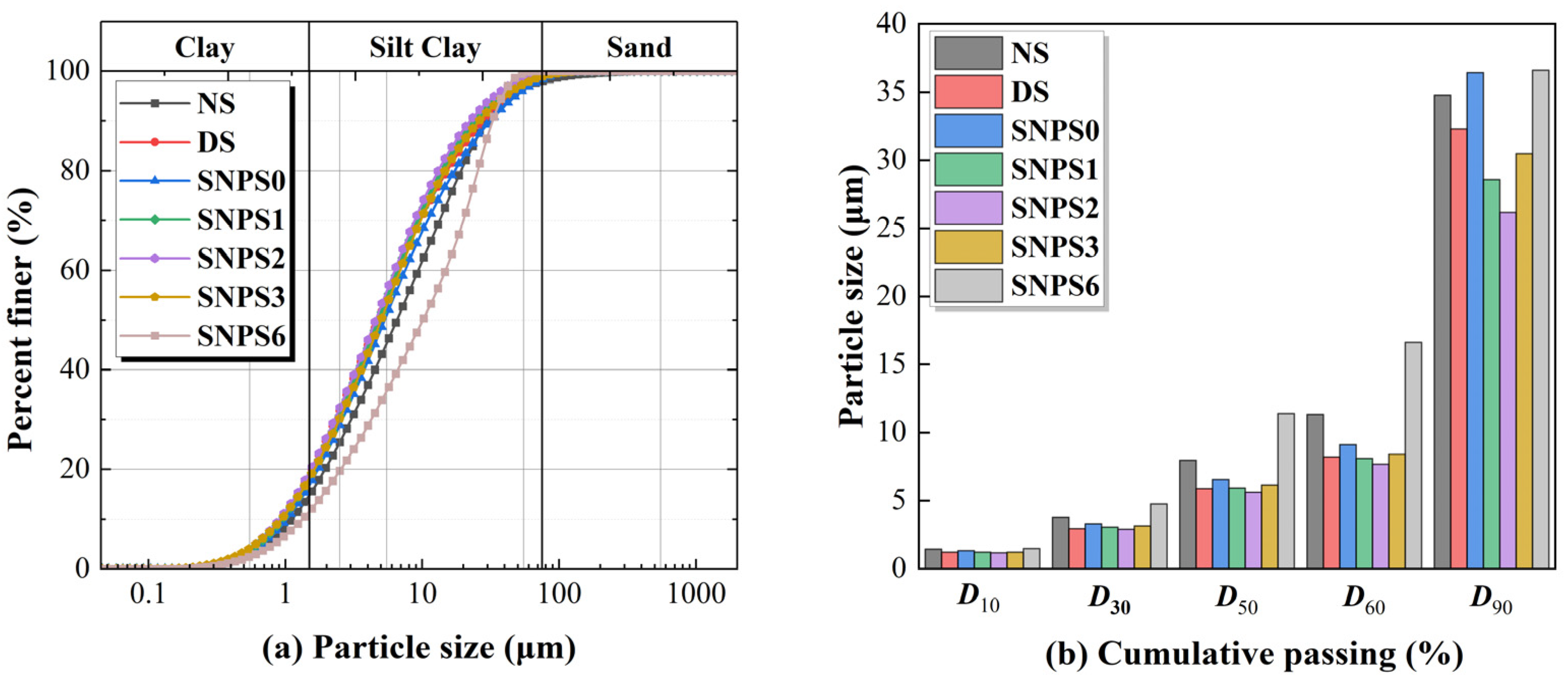
The measured pH was 7.8 for the natural soil and 7.6 for the diesel-contaminated soil. It decreased to 6.8 in SNPS0 and then increased progressively with increasing SPC dosage to 7.2 (SNPS1), 7.4 (SNPS2), 8.4 (SNPS3), and 8.9 (SNPS6). This subsection examines how diesel contamination and SPC–nZVI–PS treatment modify the PSD and the soil fabric. Figure 1 illustrates the particle-size distributions (as shown in Figure 1a) and the corresponding characteristic particle sizes (Figure 1b) of the various soil samples. The PSD curves of both contaminated and treated soils exhibited a leftward shift, suggesting a greater fraction of fine particles compared with NS. DS showed a pronounced leftward shift in the particle-size distribution. Its D50 declined to 5.882 μm, 22.8% lower than that of NS, indicating that diesel contamination reduces the median particle size and increases the fines fraction. For the treated soil, the PSD curve of SNPS0 shifted significantly to the right relative to DS, reflecting the formation of larger particles and aggregates as well as a decline in the fine fraction. After SPC was added, the PSD curves shifted back toward smaller particle sizes, indicating fewer coarse particles and an increase in fines. The fine fraction peaked at 2% SPC. At higher dosages, particle aggregation became more pronounced, producing larger particles again.
It has been reported that diesel contamination disrupts the diffuse double layer (DDL) of soil particles, thereby reducing electrostatic repulsion and facilitating the dispersion of particles into finer components, leading to a higher proportion of fines [40]. With nZVI, iron oxides and hydroxides produced by redox reactions tend to precipitate on soil particle surfaces or within pores, enhancing interparticle bonding and aggregation. The PSD curve shifts rightward, and the fraction of coarser particles increases. Similar observations were made by Wei et al. [41], who demonstrated that nZVI facilitates the development of larger aggregates. The introduction of SPC alters this trend: the H2O2 released reacts with nZVI, diminishing its aggregation potential, while the oxidative radicals (SO4, •OH) generated could disintegrate aggregates and increase the proportion of fines. When SPC exceeds a certain level, reaction byproducts (e.g., carbonates, ferric hydroxides) could accumulate between particles, creating cementation and renewed aggregation, which shifts the PSD back toward coarser sizes [42].
Diesel contamination appears to alter particle–water interactions (e.g., diffuse double-layer thickness and interparticle bonding), which promotes clay dispersion and the disintegration of weak aggregates, thereby increasing the clay-sized/active-fines fraction. The resulting fine-dominated fabric brings clay particles and small aggregates more directly into the load-bearing structure, leading to increased plasticity in the contaminated soil. In the SNPS0-treated soil, nZVI agglomeration promoted particle clustering, shifting the PSD toward coarser fractions. With SPC addition, low dosages (<2%) led to an increased proportion of fines, consistent with enhanced disintegration/dispersion and the generation of finer fragments. In contrast, at higher dosages (>2%), the PSD shifted back toward coarser fractions, indicating strengthened aggregation and/or cementation among particles. This transition from finer to coarser grading is likely to alter pore structure and, in turn, affect permeability, compressibility, and shear strength, giving the treated soil mechanical behavior different from that of the diesel-contaminated soil.

3.2. Atterberg Limits

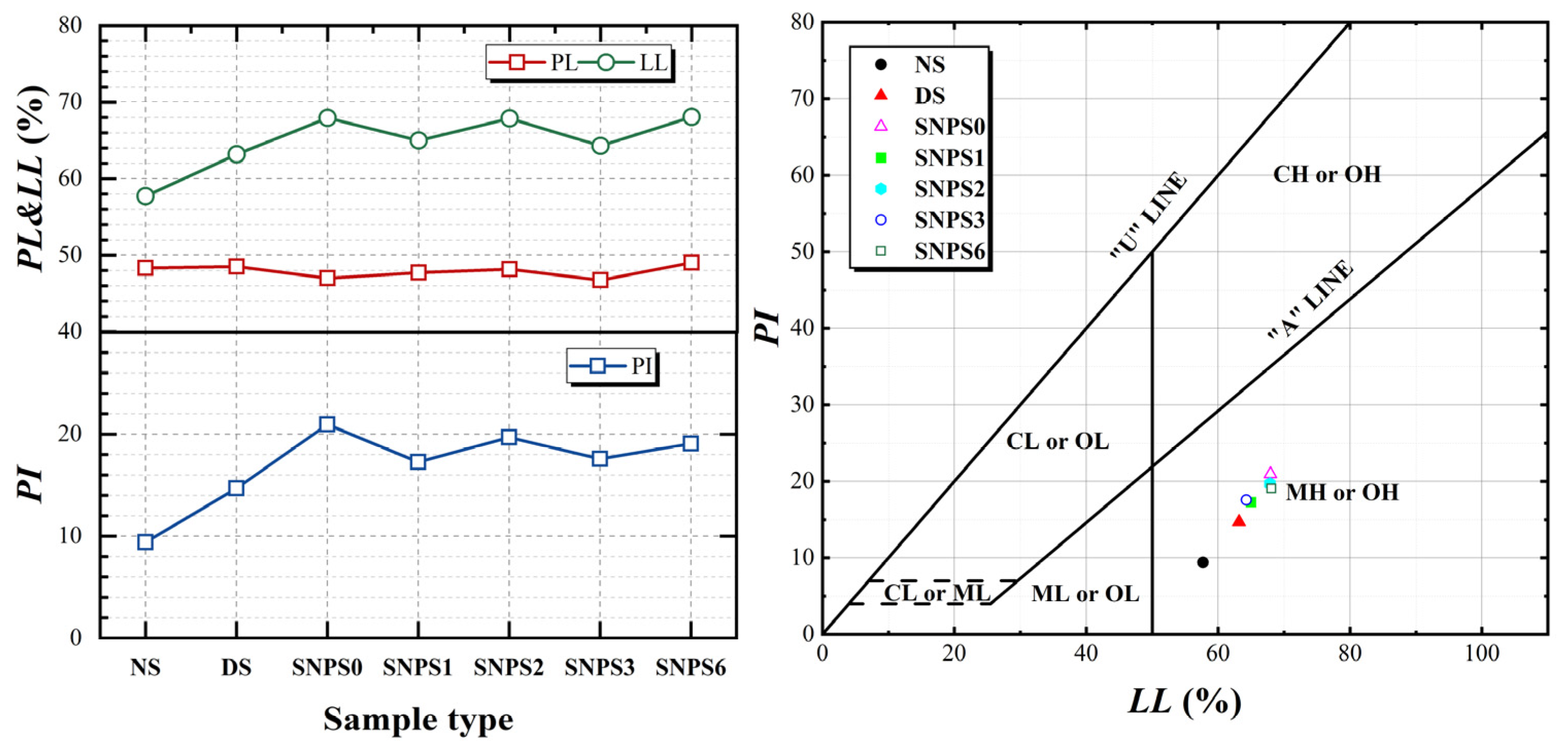
To further assess the influence of diesel contamination and SPC–nZVI–PS treatment on soil, this subsection analyses changes in the Atterberg limits. Variations in LL, PL, and PI of the soil samples, and their positions on the plasticity chart, were plotted in Figure 2. Diesel contamination and AOPs treatments markedly modified the Atterberg limits. Compared with natural soil (NS, LL = 57.7%), DS exhibited a higher LL (63.2%), while the PL remained nearly unchanged (≈48%), indicating that diesel enhanced plasticity and water uptake. In SNPS0, the LL further increased to 67.9%, and the PI reached 20.9, suggesting that nZVI may enhance water adsorption and strengthen the DDL. After adding SPC, the LL values of SNPS1–SNPS6 varied only slightly (64.9–68.0%), and the PL stayed around 47%. It indicates that SPC had a limited effect, while diesel, nZVI, and particle-size changes were the primary factors. It could be attributed to diesel-induced clay dispersion, dispersion increases the clay-sized (active fines) fraction and the equilibrium water-holding capacity at high water contents. As a result, LL rises, while PL changes little, which primarily depends on bound water [43]. In SNPS0, insoluble sulfates or iron oxides improved water retention, leading to higher LL [44]. This agrees with previous findings that finer particles tend to have higher LL values because of their larger specific surface area [45]. For instance, SNPS2, with the largest fraction of fines, exhibited the highest LL.
All samples were plotted within the MH/OH domain of the plasticity chart, classifying them as high-plasticity silts or organic soils. Thus, contamination and treatment did not change the soil type but significantly affected engineering properties. From a practical perspective, higher LL and PI values indicate a wider water-content range over which the soil exhibits plastic consistency, which may increase the sensitivity of field compaction control and the risk of post-construction volumetric deformation. The increased LL suggests enhanced compressibility and reduced strength, which are critical factors influencing foundation stability and the potential reuse of remediated soils.

3.3. CU Triaxial Test

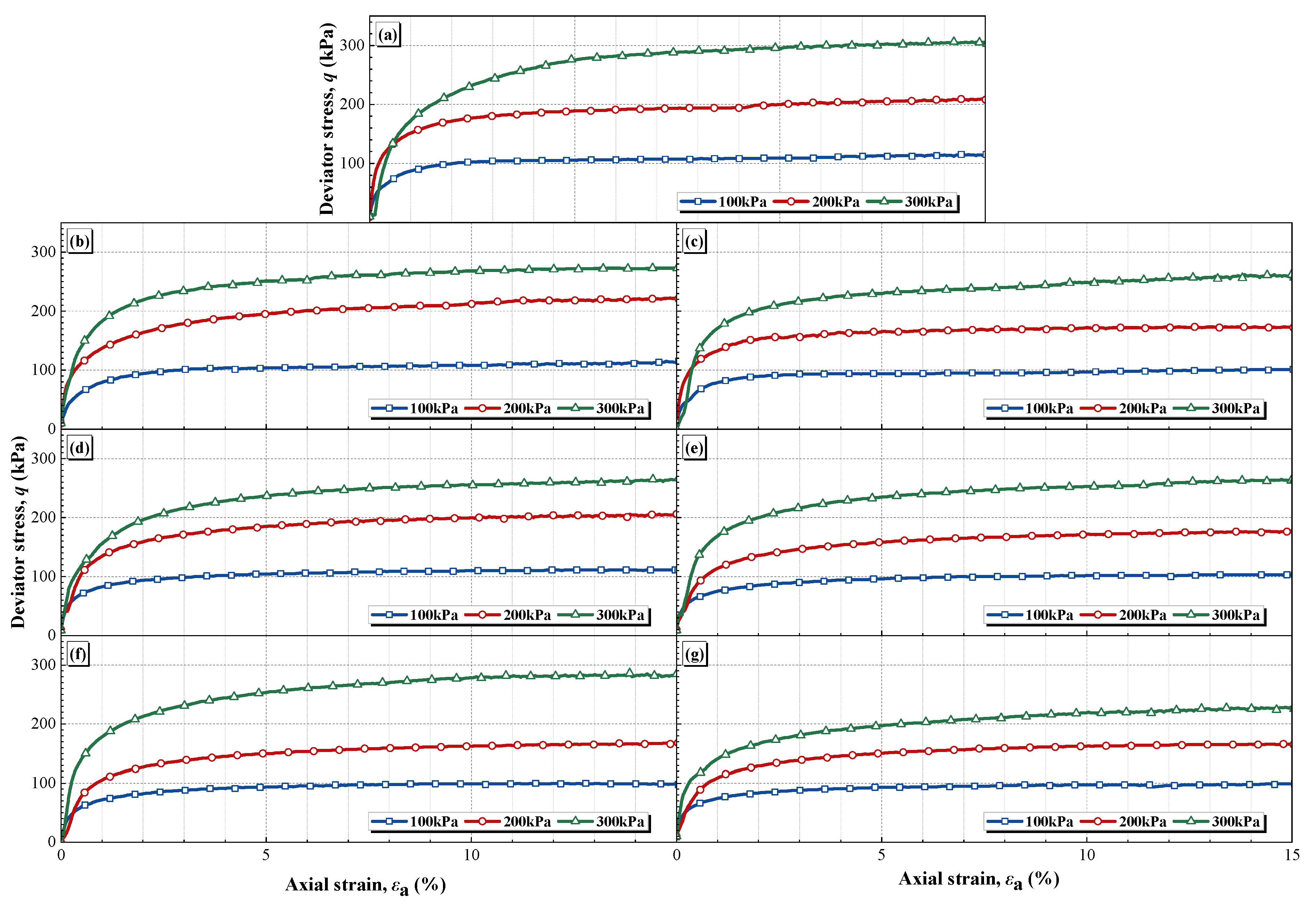
Prior to the triaxial testing, the post-preparation density state of each group was quantified to support the interpretation of subsequent mechanical responses. The measured dry densities for NS, DS, SNPS0, SNPS1, SNPS2, SNPS3, and SNPS6 were 1.24, 1.17, 1.18, 1.22, 1.15, 1.26, and 1.21 g/cm3, respectively, with corresponding void ratios of 0.54, 0.57, 0.56, 0.55, 0.57, 0.53, and 0.55. Figure 3 illustrates the deviator stress–axial strain responses of NS, DS, and treated soils (SNPS0–SNPS6) at effective confining pressures (ECP) of 100, 200, and 300 kPa. All specimens exhibited strain-hardening behavior, with deviator stress rising rapidly before approaching a stable state, though their strength levels differed markedly. For NS, the peak stresses (117, 211, and 307 kPa) increased significantly with ECP, reflecting a well-structured soil with effective particle bonding and friction. In contrast, DS exhibited lower peak stresses—113, 225, and 267 kPa—corresponding to reductions of approximately 3.4%, 6.6%, and 13% relative to NS. This loss of strength could be explained by two concurrent mechanisms: (1) diesel films at grain contacts provide lubrication, reducing interparticle friction; and (2) diesel-induced clay dispersion and the breakup of weak aggregates diminish physicochemical bonding and mechanical interlocking, yielding a fines-dominated, more compliant skeleton. This interpretation accords with the elevated LL and the essentially unchanged PL reported earlier. SNPS0, containing nZVI and PS but no SPC, showed even lower strengths (102, 171, and 263 kPa). This may be due to SO42− from PS reacting with Ca2+ to form gypsum or ettringite, inducing expansion, higher porosity, and thus reduced strength [34]. By contrast, low SPC dosages (SNPS1–SNPS2) lead to a partial recovery of undrained shear strength, whereas a higher dosage (SNPS6) causes the strength to decline again. Overall, the results reveal a clear non-monotonic dose–response to SPC, plausibly attributable to gas evolution associated with excess SPC. This mechanism requires confirmation through microscopic and mineralogical characterization in future work. Engineering-wise, the decrease in strength for SNPS0 translates to reduced short-term undrained capacity and a diminished stability margin for slopes. The partial recovery observed in SNPS1–SNPS2 is consistent with enhanced stability and serviceability. However, the further strength loss at higher SPC dosages (e.g., SNPS6) indicates a potential overdosing effect that can weaken the treated soil and increase deformation susceptibility. Therefore, careful dosage control is warranted in practice.
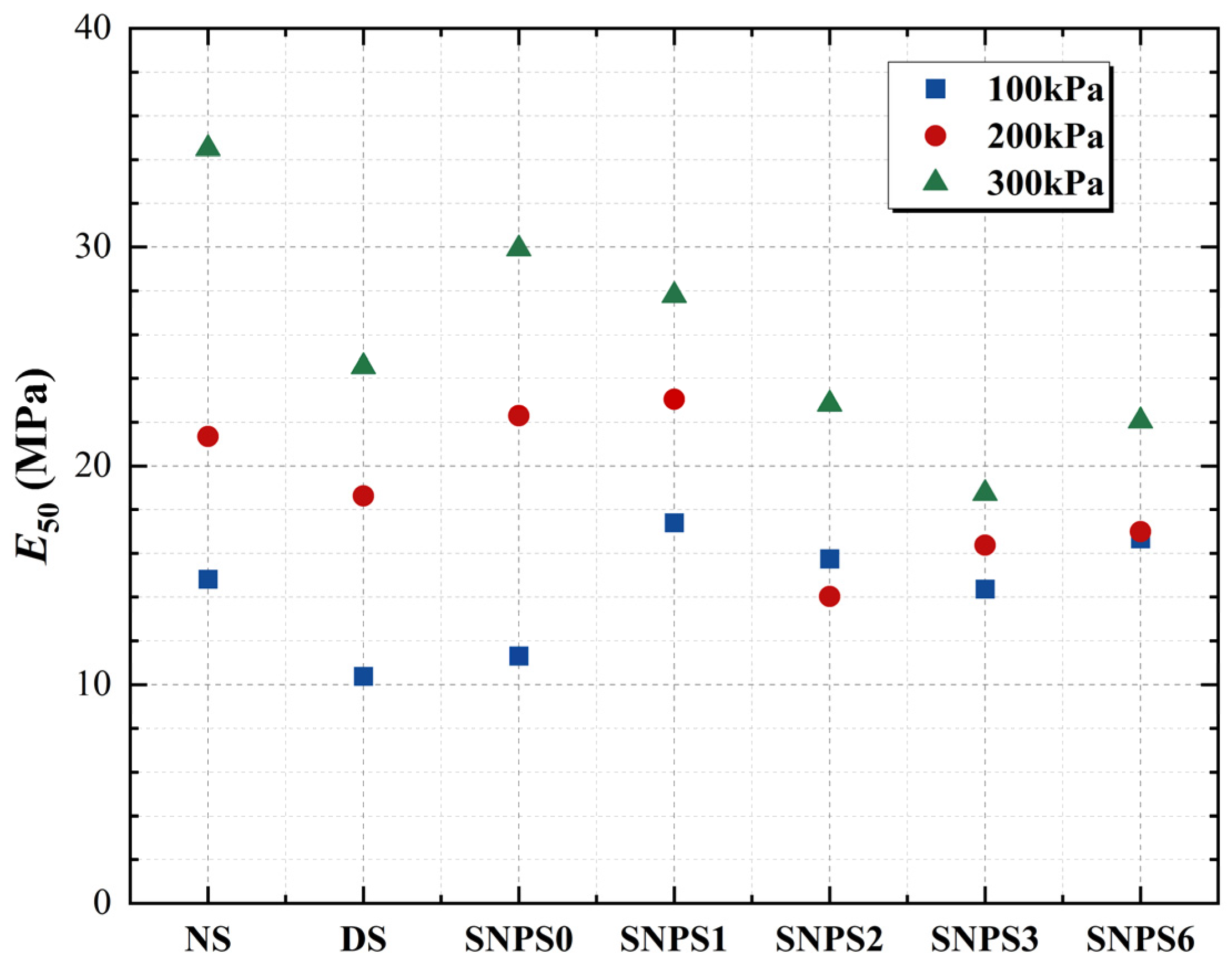
As shown in Figure 4, it presents the relationship between E50 and ECP for the different soils is presented. DS showed a pronounced stiffness loss, with E50 reduced by about 32.1% at 100 kPa compared with NS, but gradually recovered at higher pressures as compaction effects compensated for diesel-induced weakening of interparticle forces. With the addition of nZVI, E50 increased markedly. On average, the treated specimens exhibited an E50 approximately 1.20 times that of the contaminated soil. As the SPC content increased, E50 showed an overall decreasing trend and reached its minimum at SPC = 3%. SNPS0 displayed a modest increase in stiffness relative to DS, implying that nZVI strengthened the soil framework through filling and agglomeration. In contrast, upon adding SPC, the stiffness decreases because oxidation and dissolution are intensified, leading to particle breakage and a loosening of the soil fabric. While carbonate and iron-oxide precipitates provide a degree of cementation, this is insufficient to counterbalance the weakening associated with particle refinement. In summary, diesel contamination reduces stiffness through grain-size reduction and oil-film lubrication. nZVI strengthens the load-bearing skeleton and partially recovers E50. However, the coupled SPC–nZVI–PS treatment, while effective for contaminant degradation, results in a lower stiffness.
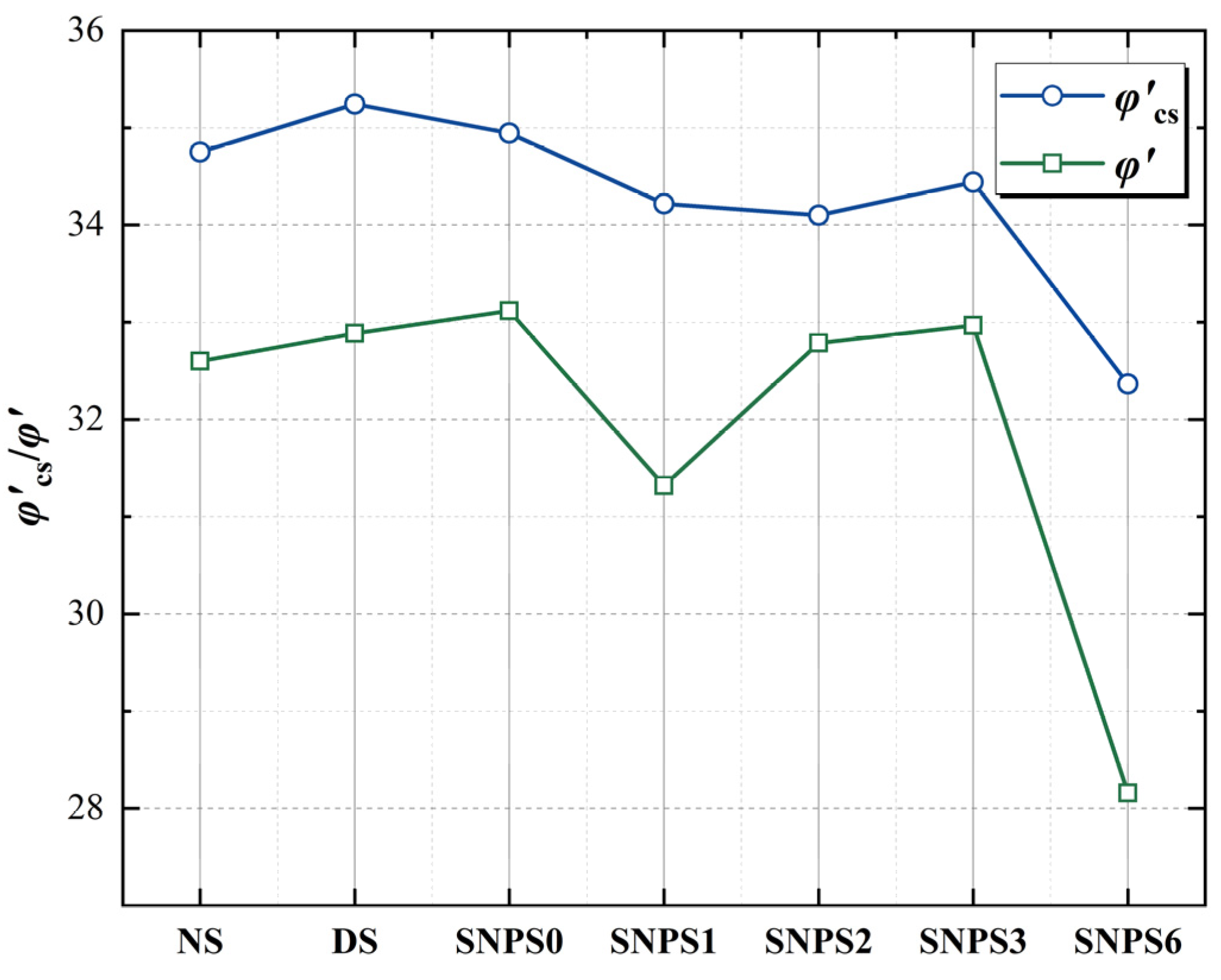
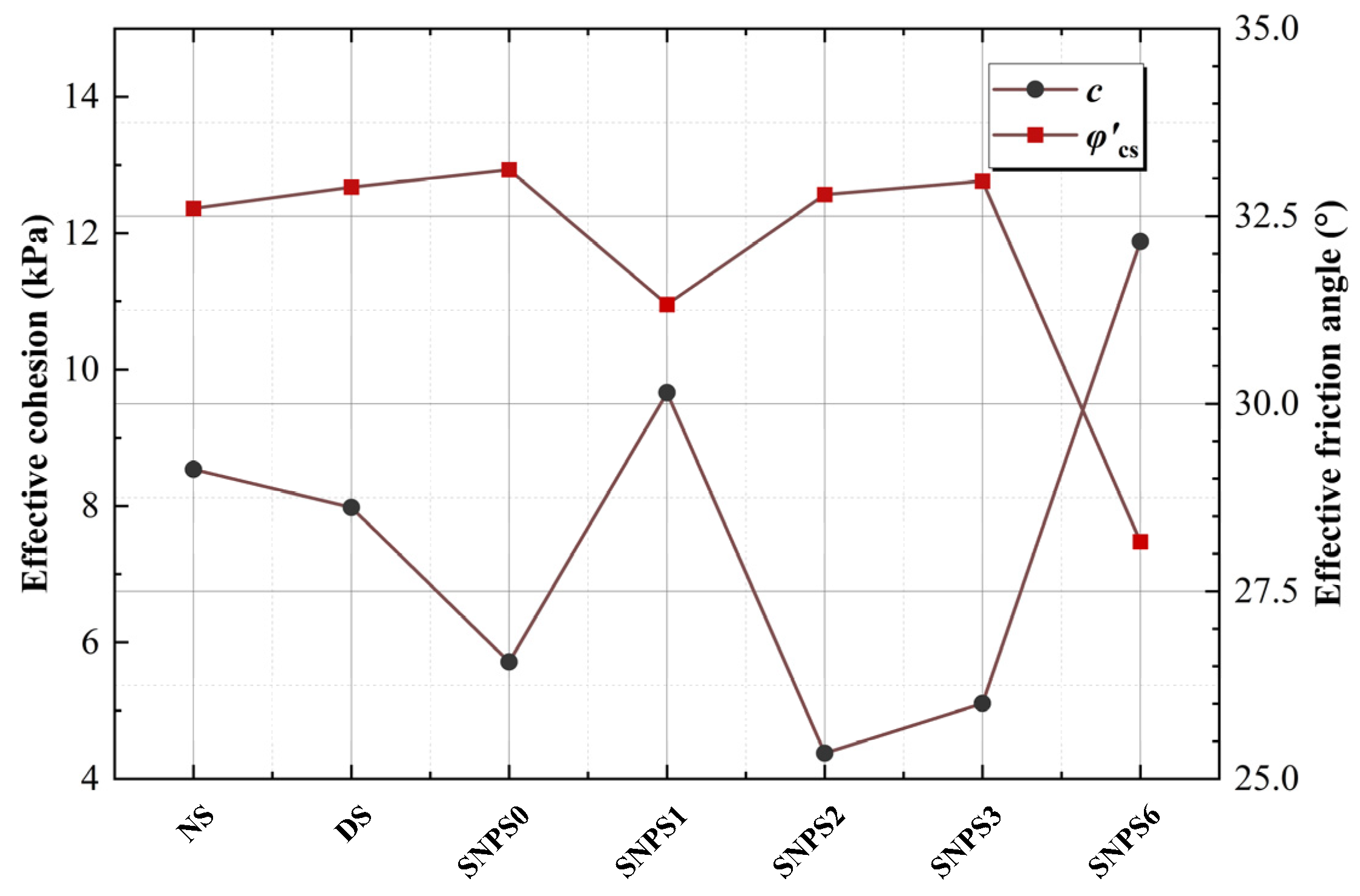
The effective cohesion (c′) and effective friction (φ′) differ markedly among the soil specimens (as shown in Figure 5). NS exhibits c′ = 8.5 kPa and φ′ = 32.6°. In the DS, c′ slightly decreases to 7.9 kPa, whereas φ′ increases to 32.8°. It is suggested that diesel weakens interparticle cementation while disruption of the DDL and changes in particle-surface properties shift the fabric toward friction-controlled behavior. For the treated soils, c′ for SNPS0 decreases to 5.7 kPa while φ′ rises to 33.1°, suggesting that nZVI and persulfate did not yield sufficient cementation products. Instead, particle rearrangement and partial aggregation enhanced frictional resistance [33]. In contrast, SNPS1 shows a marked increase in c′ to 9.7 kPa but a reduction in φ′ to 31.3°. This may be attributed to the formation of iron oxides, hydroxides, and carbonate precipitates during the reaction, which infill pore spaces and form coatings on particle surfaces, thereby strengthening the skeletal framework and interparticle bonding. With further increases in SPC, cohesion declines noticeably, likely because carbonate and sulfate ions (CO32−, SO42−) alter pore-fluid chemistry, compress the DDL, weaken electrostatic repulsion, and thereby favor friction-dominated behavior while diminishing cementation. When SPC dosages exceeds 2%, gases released during the excessive SPC reaction may increase porosity and thereby reduce φ′.
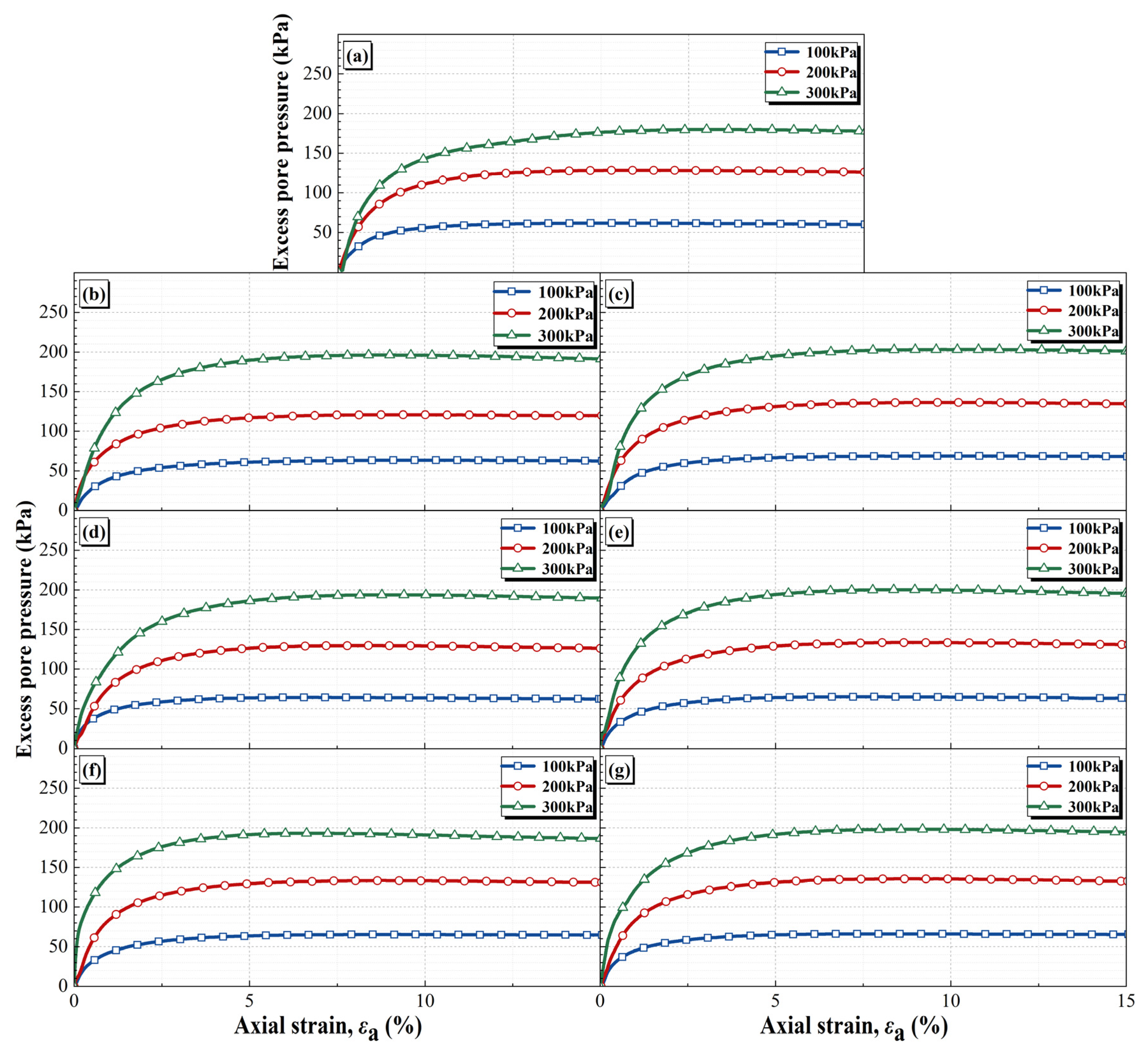
Excess pore pressure is a key state variable governing the effective stress of saturated soils, and its evolution is closely related to soil structure collapse. As shown in Figure 6, all specimens exhibited contractive responses, with excess pore pressure rising progressively during shearing before reaching stabilization. This behavior reflects an ideal elastoplastic trend and is typical of contractive soils. During consolidated–undrained triaxial compression at effective confining pressures of 100, 200, and 300 kPa, the specimens generated positive pore-water pressure rapidly at small axial strains, followed by a gradual approach to a steady value. The steady pore-pressure ratio was approximately 0.6 of the corresponding effective confinement (Δu/σ3′ ≈ 0.6). Thus, the soil exhibits a distinctly contractive undrained response, producing substantial excess pore pressure and reducing effective stress, yet retaining a considerable portion of the confining pressure. Under rapid undrained loading, it softens, and its strength declines, tending toward failure governed by residual/flow strength. Nevertheless, relative to the end-member case with pore pressure ≈ confining pressure, the liquefaction/flow-sliding risk is moderate.
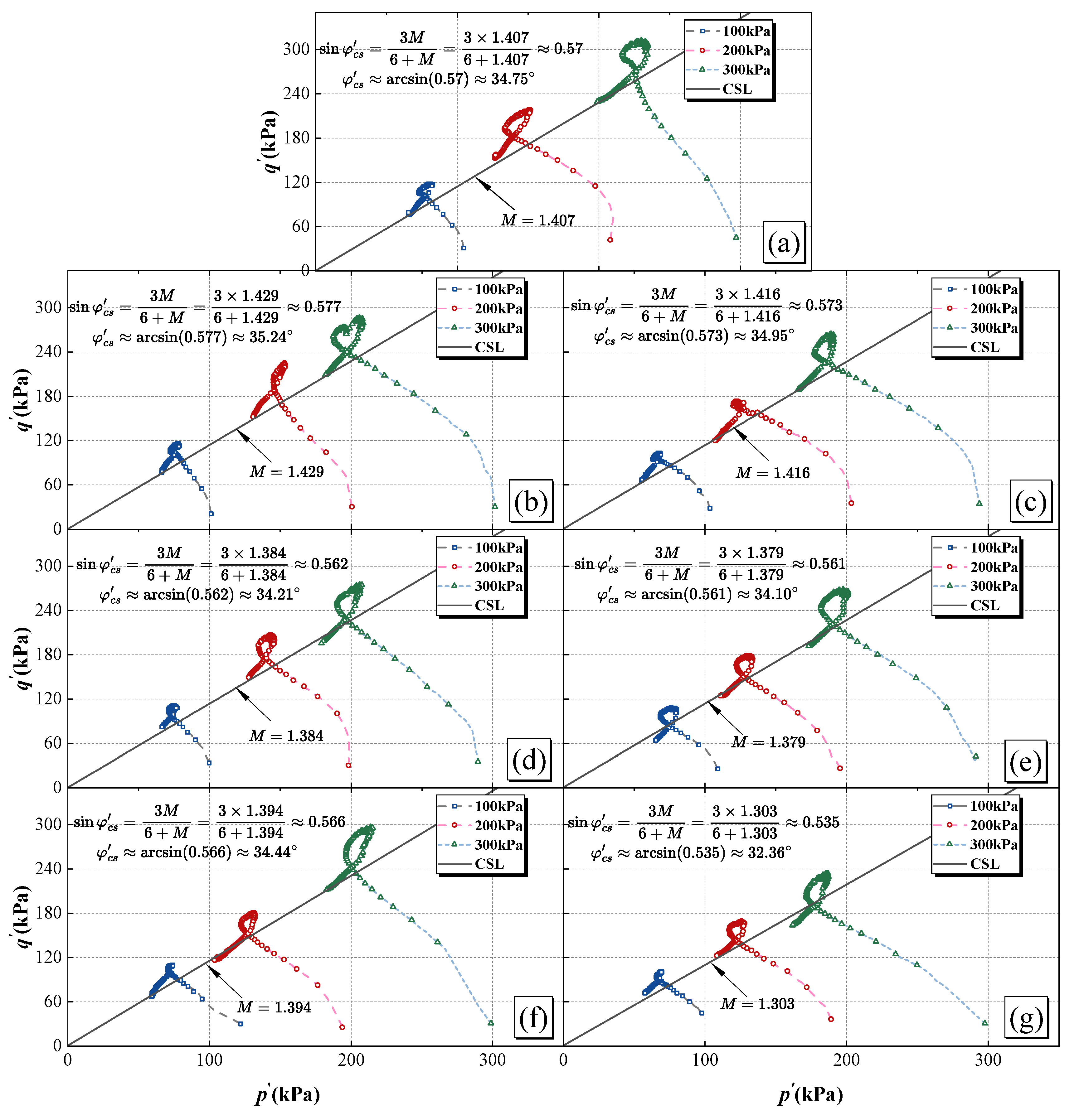
Critical state theory was employed to analyze the stress–strain behavior of the soils. The critical state is independent of drainage conditions and shear mode, and in this study, the scope is limited to axisymmetric stress states. The critical state line (CSL), defined as a straight line passing through the origin of the stress path (Equation (3)), describes the ultimate soil state where effective cohesion is zero. The critical state friction angle φcs defined by Equation (4) and relates deviator stress qcs, the critical stress ratio (M), and effective mean stress pcs. Accordingly, CSL enables consistent comparison of untreated, diesel-contaminated, and SPC–nZVI–PS–treated soils at the same ultimate state and interprets their differences through φcs, which is used in long-term deformation and slope-stability evaluations rather than only peak strength.
q c s = M p c s
s i n φ c s = 3 M 6 + M
The effective stress paths of each sample under ECP of 100, 200, and 300 kPa were plotted in Figure 7. The stress paths describe the evolution of stress states in soil elements during undrained shearing. Initially, all specimens exhibited a contractive response, rapidly generating positive excess pore-water pressures, which reduced the mean effective stress and the deviatoric stress to a peak. With continued straining, the paths bent rightward, indicating the onset of dilation, accompanied by a reduction in pore pressure and recovery of p′, leading to a gradual decline in q′. Regardless of ECP, the stress paths eventually approached the critical failure line (CSL), suggesting that the soils behaved in a friction-controlled manner with negligible apparent cohesion.
Compared to Figure 8, for NS (Figure 7a), M = 1.407, corresponding to φcs ≈ 34.75°, and the smooth stress path reflected a well-structured matrix with effective interparticle bonding. In contrast, the DS (Figure 7b) exhibited a slightly larger M = 1.429, φcs ≈ 35.24°, but the path curved sharply toward the right, implying that diesel disrupted particle bonding, enhanced frictional control, and induced more pronounced post-peak softening. Previous studies also reported a positive correlation between oil content and internal friction angle [46]. After nZVI–persulfate treatment (SNPS0; Figure 7c), M = 1.416 and φcs ≈ 34.95°, comparable to NS, indicating partial restoration of structural integrity by nZVI-induced aggregation, though limited cementation was achieved. With SPC addition (SNPS1–SNPS2–SNPS3; Figure 7d–f), M decreased to 1.379–1.384 and φcs ≈ 34.10–34.44°. The stress path became smoother and more dilative, likely because carbonate and iron-oxide precipitates formed, filling pores and enhancing interparticle bonding, thereby reinforcing the soil skeleton. However, at a higher SPC dosage (SNPS6; Figure 7g), M declined further to 1.303 (φcs ≈ 32.36°), and the paths shortened with a pronounced rightward bend, implying the formation of microvoids and local debonding due to excessive gas evolution and byproduct accumulation. Similar enhancements were reported by Nasehi et al. [47] with 5% nZVI addition to diesel-contaminated clay. As the SPC content was further increased, φcs declined to 32.36°, falling below that of the NS sample. This reduction is attributed to carbonate and other by-products that refined particle size distribution, increasing fines and weakening frictional resistance. In addition, φcs showed a decreasing trend with increasing PI, consistent with Yin [48].
In summary, the variations in M and φcs values indicate a transition from friction-dominated to cementation-enhanced behavior with moderate SPC addition, followed by a return to frictional control at higher dosages. These findings highlight that balanced oxidation conditions are essential to achieve both effective contaminant degradation and mechanical stability in remediated soils.
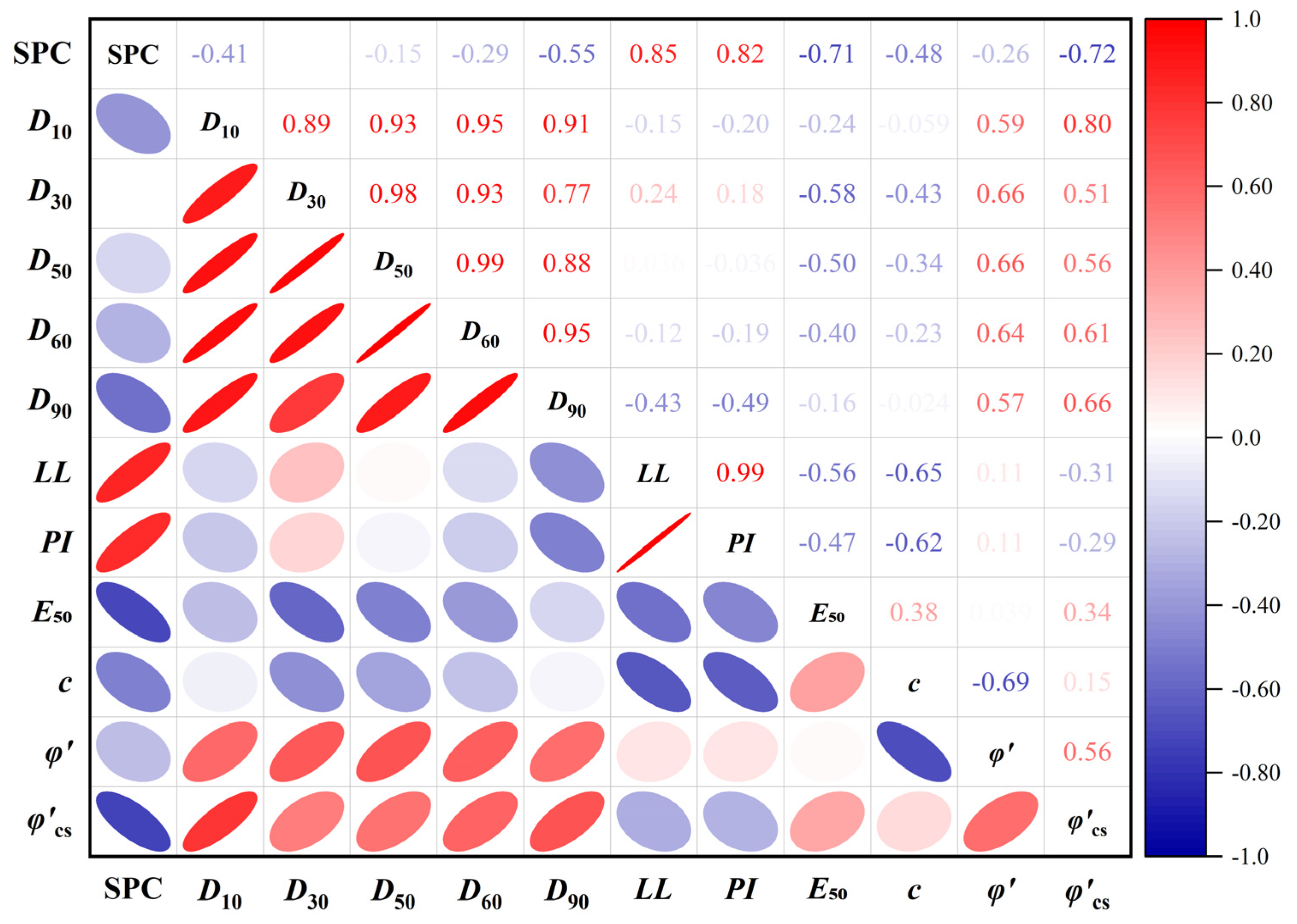
Pearson correlation matrix among soil indices and strength parameters was summarized in Figure 9. Cell values and colors represent the correlation coefficient r (unitless; color bar −1 to +1). Axes list variables with their units: SPC (%), D10D90 (mm), LL (%), PI, E50 (MPa), c (kPa), φ′ (°), and φcs (°). To improve transparency, the figure reports correlation coefficients (r) together with statistical significance. The SPC dosage is positively associated with LL and PI (r = 0.85 and 0.82, respectively) and negatively associated with D50. For mechanical responses, E50 is positively associated with D50 and negatively associated with SPC, LL, and PI (r ≈ −0.47 to −0.56). Similarly, φ′ and φcs show trends broadly consistent with E50. These patterns suggest a coupled relationship between index properties (PSD/plasticity) and mechanical response. It is indicated that SPC-induced dispersion and water-film thickening reduce interparticle friction and stiffness, leading to lower shear resistance. The negative link between SPC and cohesion (r = −0.69) further supports the interpretation that oxidative reactions weaken cementation by dissolving Fe–Al oxide bridges and replacing divalent exchangeable cations at particle contacts. A distinct transition is evident near 2% SPC dosage, where the system evolves from a dispersion-dominated to a cementation-dominated regime. Below this threshold, AOPs reactions and exchange enhance clay activity and disaggregate aggregates, producing a matrix-supported skeleton with low stiffness. Above 2%, the accumulation of carbonate and ferric hydroxide precipitates begins to bridge particles and restore local bonding. However, excessive SPC leads to pore clogging, microvoid formation, and renewed softening.
Collectively, the correlation patterns reveal a dual mechanism: SPC simultaneously governs the chemical environment and particle-scale structure, thereby coupling physicochemical modification with mechanical behavior. Optimizing SPC dosage near the critical transition (≈2%) appears essential for achieving balanced oxidation efficiency, adequate stiffness, and long-term geotechnical stability of remediated soils.

4. Conclusions

This study examines the mechanical response of diesel-contaminated soil treated with a SPC–nZVI–PS. With the nZVI/PS proportion ratio fixed, diesel-contaminated soil was treated using five SPC dosages—0, 1, 2, 3, and 6 wt.% with respect to the dry soil mass. The experimental program included PSD, Atterberg limits, and consolidated-undrained triaxial compression. The following conclusions were drawn:
(a)
The particle-size distribution varied with SPC dosage and showed a noticeable transition in grading behavior around SPC ≈ 2 wt.%.
(b)
Diesel contamination increased LL, whereas PL remained nearly constant (~47%) across groups. After treatment, LL showed limited variation across SPC dosages (LL = 64.9–67.8%), and the soil classification remained MH/OH.
(c)
The secant modulus E50 exhibited a non-monotonic response with SPC dosage. It followed a trend of decrease, partial recovery, and subsequent decrease. An apparent threshold appeared near 2 wt.% SPC.
(d)
Treatment with nZVI/PS alone resulted in insufficient cementation. However, aggregation reinforced the soil skeleton. This yielded a marginal rise in φ′. Upon SPC addition, low SPC dosages significantly increased cohesion but decreased φ′, whereas excess SPC diminished bonding. This partially restored frictional resistance.
Further investigation into the interactions among SPC, nZVI, and PS in soils is necessary. These processes occur simultaneously and influence each other. The effect of dosage on geotechnical properties remains unclear. It may exhibit complex trends with specific thresholds or optimal ranges. Accordingly, it is recommended that future work systematically examine treated soils under controlled SPC–nZVI–PS dosages, combining microstructural imaging (e.g., SEM-based morphology or X-ray micro-computed tomography) with chemical analyses. Such an approach will clarify interactions between chemicals, particles, and the soil skeleton. It will also establish quantitative links between oxidant dosage, soil microstructure, and macroscopic geotechnical indices.

Author Contributions

Conceptualization, Y.C. (Yongzhan Chen); writing—original draft preparation, M.Z. and Y.C. (Yongzhan Chen); methodology, Y.C. (Yongzhan Chen), M.Z. and K.C.; formal analysis, Y.C. (Yongzhan Chen) and M.Z.; data preparation, M.Z., M.L., Y.C. (Yuhao Chen), W.Z. and H.G.; writing—review and editing, Q.D., Y.C. (Yongzhan Chen), K.C. and M.Z.; project administration, Q.D. and Y.C. (Yongzhan Chen). All authors have read and agreed to the published version of the manuscript.

Funding

This research was funded by the special research fund of the Hainan Province Science and Technology Special Fund (ZDYF2024SHFZ141) and the Scientific Research Fund of Hainan University (Approval No. KYQD(ZR)-22038 & KYQD(ZR)-21067).

Institutional Review Board Statement

Not applicable.

Informed Consent Statement

Not applicable.

Data Availability Statement

The original contributions presented in this study are included in the article. Further inquiries can be directed to the corresponding author.

Conflicts of Interest

The authors declare no conflicts of interest.

Abbreviations

The following abbreviations are used in this manuscript:
AOPsAdvanced oxidation processes
SPCSodium percarbonate
nZVINanoscale zero-valent iron
PSSodium persulfate
PHCPetroleum hydrocarbon
PAHsPolycyclic Aromatic Hydrocarbons
PSDParticle size distribution
DDLDiffuse double layer
LLLiquid limit
PLPlastic limit
PIPlasticity index

References

  1. Liu, S.Y.; Du, Y.J.; Zhan, L.T.; Hu, L.M. Research progress in environmental geotechnical engineering. China Civ. Eng. J. 2016, 53, 80–94. [Google Scholar]
  2. Ministry of Ecology and Environment of the People’s Republic of China. Technical Policy for the Prevention and Control of Volatile Organic Compounds (VOCs) Pollution; Ministry of Ecology and Environment of the People’s Republic of China: Beijing, China, 2013.
  3. Wu, Y.; Liu, X.; Dong, Q.; Xiao, M.; Li, B.; Topalović, O.; Tao, Q.; Tang, X.; Huang, R.; Chen, G.; et al. Remediation of Petroleum Hydrocarbons-Contaminated Soil: Analysis Based on Chinese Patents. Chemosphere 2022, 297, 134173. [Google Scholar] [CrossRef] [PubMed]
  4. Fu, X.W.; Li, T.Y.; Ji, L.; Wang, L.L.; Zheng, L.W.; Wang, J.N.; Zhang, Q. Occurrence, Sources and Health Risk of Polycyclic Aromatic Hydrocarbons in Soils around Oil Wells in the Border Regions between Oil Fields and Suburbs. Ecotoxicol. Environ. Saf. 2018, 157, 276–284. [Google Scholar] [CrossRef] [PubMed]
  5. Khudur, L.S.; Gleeson, D.B.; Ryan, M.H.; Shahsavari, E.; Haleyur, N.; Nugegoda, D.; Ball, A.S. Implications of Co-Contamination with Aged Heavy Metals and Total Petroleum Hydrocarbons on Natural Attenuation and Ecotoxicity in Australian Soils. Environ. Pollut. 2018, 243, 94–102. [Google Scholar] [CrossRef]
  6. Ukhurebor, K.E.; Athar, H.; Adetunji, C.O.; Aigbe, U.O.; Onyancha, R.B.; Abifarin, O. Environmental Implications of Petroleum Spillages in the Niger Delta Region of Nigeria: A Review. J. Environ. Manag. 2021, 293, 112872. [Google Scholar] [CrossRef]
  7. Lee, Y.Y.; Cho, K.S.; Yun, J. Phytoremediaton Strategies for Co-Contaminated Soils: Overcoming Challenges, Enhancing Efficiency, and Exploring Future Advancements and Innovations. Processes 2025, 13, 132. [Google Scholar] [CrossRef]
  8. Li, Y.; Wang, Y.; Wang, Y.; Guo, H.; Zhang, G.; Ma, Q.; Zhou, J.; Wang, T. Source-Sink Relationship of Petroleum Hydrocarbons in the Oilfield Area of Northern Shaanxi: Multilayer Perceptron-Based Modelling Systems. Mar. Pollut. Bull. 2025, 221, 118567. [Google Scholar] [CrossRef]
  9. Alaidaroos, B.A. Advancing Eco-Sustainable Bioremediation for Hydrocarbon Contaminants: Challenges and Solutions. Processes 2023, 11, 3036. [Google Scholar] [CrossRef]
  10. Mu, S.; Chen, X.; Jiang, G.; Chen, W. Fenton Oxidation System for Treating Petroleum-Contaminated Solid Waste: Advances and Prospects. Sci. Total Environ. 2023, 893, 164793. [Google Scholar] [CrossRef]
  11. Li, Y.T.; Zhang, J.J.; Li, Y.H.; Chen, J.L.; Du, W.Y. Treatment of Soil Contaminated with Petroleum Hydrocarbons Using Activated Persulfate Oxidation, Ultrasound, and Heat: A Kinetic and Thermodynamic Study. Chem. Eng. J. 2022, 428, 131336. [Google Scholar] [CrossRef]
  12. Bianco, F.; Race, M.; Papirio, S.; Esposito, G. Removal of Polycyclic Aromatic Hydrocarbons during Anaerobic Biostimulation of Marine Sediments. Sci. Total Environ. 2020, 709, 136141. [Google Scholar] [CrossRef] [PubMed]
  13. Wang, M.; Wang, Y.; Jing, X.; Xu, J.; Li, M.; Xie, Q.; Cai, X. Developments of Efficient Dithionite-Zerovalent Iron/Persulfate Systems with Accelerated Fe(III)/Fe(II) Cycle for PAHs Removal in Water and Soils. Chem. Eng. J. 2023, 463, 142325. [Google Scholar] [CrossRef]
  14. Lee, S.H.; Lee, J.H.; Jung, W.C.; Park, M.; Kim, M.S.; Lee, S.J.; Park, H. Changes in Soil Health with Remediation of Petroleum Hydrocarbon Contaminated Soils Using Two Different Remediation Technologies. Sustainability 2020, 12, 10078. [Google Scholar] [CrossRef]
  15. Wojtowicz, K.; Steliga, T.; Skalski, T. Influence of Biosurfactants on the Efficiency of Petroleum Hydrocarbons Biodegradation in Soil. Sustainability 2025, 17, 6520. [Google Scholar] [CrossRef]
  16. Li, Y.T.; Li, D.; Lai, L.J.; Li, Y.H. Remediation of Petroleum Hydrocarbon Contaminated Soil by Using Activated Persulfate with Ultrasound and Ultrasound/Fe. Chemosphere 2020, 238, 124657. [Google Scholar] [CrossRef]
  17. Tang, X.; Li, Z.; Wang, Z.; Yu, C.; Sun, H.; Wang, J.; Wang, C. Efficient Remediation of PAHs Contaminated Site Soil Using the Novel Slow-Release Oxidant Material. Chem. Eng. J. 2023, 472, 144713. [Google Scholar] [CrossRef]
  18. Sun, Y.M.; Feng, L.; Yang, L. Degradation of PCB67 in Soil Using the Heterogenous Fenton Process Induced by Montmorillonite Supported Nanoscale Zero-Valent Iron. J. Hazard. Mater. 2021, 406, 124305. [Google Scholar] [CrossRef]
  19. Jalilian Ahmadkalaei, S.P.; Gan, S.; Ng, H.K.; Abdul Talib, S. The Role of Humic Acid in Fenton Reaction for the Removal of Aliphatic Fraction of Total Petroleum Hydrocarbons (Diesel Range) in Soil. Environ. Sci. Ecotechnology 2021, 7, 100109. [Google Scholar] [CrossRef]
  20. Chang, Y.C.; Peng, Y.P.; Chen, K.F.; Chen, T.Y.; Tang, C.T. The Effect of Different in Situ Chemical Oxidation (ISCO) Technologies on the Survival of Indigenous Microbes and the Remediation of Petroleum Hydrocarbon-Contaminated Soil. Process Saf. Environ. Prot. 2022, 163, 105–115. [Google Scholar] [CrossRef]
  21. Santos, A.; Firak, D.S.; Emmel, A.; Siedlecki, K.; Lopes, A.; Peralta-Zamora, P. Evaluation of the Fenton Process Effectiveness in the Remediation of Soils Contaminated by Gasoline: Effect of Soil Physicochemical Properties. Chemosphere 2018, 207, 154–161. [Google Scholar] [CrossRef]
  22. Tian, H.; Li, C.; Wang, Z.; Zhao, S.; Xu, Y.; Wang, S. Polycyclic Aromatic Hydrocarbons Degradation Mechanisms in Methods Using Activated Persulfate: Radical and Non-Radical Pathways. Chem. Eng. J. 2023, 473, 145319. [Google Scholar] [CrossRef]
  23. Zhao, D.; Liao, X.; Yan, X.; Huling, S.G.; Chai, T.; Tao, H. Effect and Mechanism of Persulfate Activated by Different Methods for PAHs Removal in Soil. J. Hazard. Mater. 2013, 254–255, 228–235. [Google Scholar] [CrossRef] [PubMed]
  24. Fan, G.; Cang, L.; Gomes, H.I.; Zhou, D. Electrokinetic Delivery of Persulfate to Remediate PCBs Polluted Soils: Effect of Different Activation Methods. Chemosphere 2016, 144, 138–147. [Google Scholar] [CrossRef] [PubMed]
  25. Ghisman, V.; Muresan, A.C.; Buruiana, D.L.; Bogatu, N.L.; Herbei, E.E. Recent Advances in the Remediation of Degraded and Contaminated Soils: A Review of Sustainable and Applied Strategies. Agronomy 2025, 15, 1920. [Google Scholar] [CrossRef]
  26. Duca, C.; Bogo, H.; Litter, M.I.; Román, E.S. Heterogeneous Photo-Fenton Process with Zerovalent Iron Nanoparticles for Degradation of Toluene in Aqueous Solution. Catal. Commun. 2023, 183, 106767. [Google Scholar] [CrossRef]
  27. Li, X.; Liu, L. Recent Advances in Nanoscale Zero-Valent Iron/Oxidant System as a Treatment for Contaminated Water and Soil. J. Environ. Chem. Eng. 2021, 9, 106276. [Google Scholar] [CrossRef]
  28. Jamialahmadi, N.; Gitipour, S.; Jamialahmadi, O.; Baghdadi, M. Remediation of a Diesel-Contaminated Soil Using a Fenton-like Advanced Oxidation Process: Optimization by Response Surface Methodology. Soil Sediment Contam. 2015, 24, 609–623. [Google Scholar] [CrossRef]
  29. Song, Y.; Fang, G.; Zhu, C.; Zhu, F.; Wu, S.; Chen, N.; Wu, T.; Wang, Y.; Gao, J.; Zhou, D. Zero-Valent Iron Activated Persulfate Remediation of Polycyclic Aromatic Hydrocarbon-Contaminated Soils: An in Situ Pilot-Scale Study. Chem. Eng. J. 2019, 355, 65–75. [Google Scholar] [CrossRef]
  30. Muente, A.; Cipriani-Ávila, I.; García-Villacís, K.; Pinos-Veléz, V.; Hidalgo-Lasso, D.; Ruíz, P.; Luna, V. Evaluation of the Use of Lime and Nanosilica for the Improvement of Clay Soil Structure and Degradation of Hydrocarbons. Pollutants 2022, 2, 422–434. [Google Scholar] [CrossRef]
  31. Division, E.G. Use of Nanoscale Zero-Valent Iron to Improve the Shear Strength Parameters of Gas Oil Contaminated Clay Sayed. Geopersia 2015, 5, 161–175. [Google Scholar]
  32. Shixin, W.; Yankai, W.; Fengmei, Y.; Jianxin, W.; Zequn, L.; Hongjie, L. Analysis and Study of ZVI on the Physical Properties and Microstructure of Solidified Oil Sludge Residue. Results Eng. 2025, 26, 105213. [Google Scholar] [CrossRef]
  33. Chen, Y.Z.; Zhou, W.H.; Liu, F.; Yi, S. Exploring the Effects of Nanoscale Zero-Valent Iron (NZVI) on the Mechanical Properties of Lead-Contaminated Clay. Can. Geotech. J. 2019, 56, 1395–1405. [Google Scholar] [CrossRef]
  34. Lu, T.; Wei, Z.; Li, S.; Wang, Y.; Wang, W.; Yang, Y.; Zheng, B. Effect of Soluble Salts in Electrolytic Manganese Residue on Its Geotechnical Characteristics. J. Environ. Manag. 2023, 340, 117999. [Google Scholar] [CrossRef] [PubMed]
  35. Zhang, W.; Ma, J.; Tang, L. Experimental Study on Shear Strength Characteristics of Sulfate Saline Soil in Ningxia Region under Long-Term Freeze-Thaw Cycles. Cold Reg. Sci. Technol. 2019, 160, 48–57. [Google Scholar] [CrossRef]
  36. Shekhawat, A.S.; Tiwari, S.K. Journal of Rock Mechanics and Geotechnical Engineering Impact of Sandstone Slurry Waste with Calcium Carbonate Nanoparticles on Geotechnical Properties of Clayey Soil Subgrade. J. Rock Mech. Geotech. Eng. 2025, 17, 5318–5333. [Google Scholar] [CrossRef]
  37. Wang, J.; Xu, N.; Wang, H.; Zhou, R.; Shi, Y.; Pan, W.; Huang, X.; Long, Y. Laboratory Experiment and Micro-Mechanism Analysis on the Influence of Particle Size and Distribution on MICP Enhanced Soil. Constr. Build. Mater. 2025, 471, 140679. [Google Scholar] [CrossRef]
  38. BS1377-2: 2022; Methods of Test for Soils for Civil Engineering Purposes. British Standards Institute: London, UK, 2022.
  39. ASTM_D4767-20; Standard Test Method for Consolidated Undrained Triaxial Compression Test for Cohesive Soils. ASTM International: West Conshohocken, PA, USA, 2020.
  40. Trzciński, J.; Williams, D.J.; Zbik, M.S. Can Hydrocarbon Contamination Influence Clay Soil Grain Size Composition? Appl. Clay Sci. 2015, 109–110, 49–54. [Google Scholar] [CrossRef]
  41. Wei, J.; Chen, Y.; Dong, Q.; Fan, C.; Zou, M. Dynamic Shear Responses of Combined Contaminated Soil Treated with Nano Zero-Valent Iron (NZVI) under Controlled Moisture. Sustainability 2023, 16, 289. [Google Scholar] [CrossRef]
  42. Wang, Z.; Wang, Y.; Xing, D.; Wagai, R.; Zheng, J.; Zhang, H.; Fan, B.; Feng, W. Divergent Effects of Soil Organic Matter and Carbonate on Soil Aggregation and Structure in Arid Regions. Catena 2025, 257, 109196. [Google Scholar] [CrossRef]
  43. Safehian, H.; Rajabi, A.M.; Ghasemzadeh, H. Effect of Diesel-Contamination on Geotechnical Properties of Illite Soil. Eng. Geol. 2018, 241, 55–63. [Google Scholar] [CrossRef]
  44. Fan, C.; Chen, Y.; Dong, Q.; Wei, J.; Zou, M. Deformation Characteristics of Combined Heavy Metals-Contaminated Soil Treated with NZVI through the Modified Slurry Consolidation Method. Sustainability 2023, 15, 16959. [Google Scholar] [CrossRef]
  45. Bhavya, K.; Nagaraj, H.B. Influence of Soil Structure and Clay Mineralogy on Atterberg Limits. Sci. Rep. 2025, 15, 15459. [Google Scholar] [CrossRef] [PubMed]
  46. Khamehchiyan, M.; Hossein Charkhabi, A.; Tajik, M. Effects of Crude Oil Contamination on Geotechnical Properties of Clayey and Sandy Soils. Eng. Geol. 2007, 89, 220–229. [Google Scholar] [CrossRef]
  47. Nasehi, S.A.; Uromeihy, A.; Nikudel, M.R.; Morsali, A. Use of Nanoscale Zero-Valent Iron and Nanoscale Hydrated Lime to Improve Geotechnical Properties of Gas Oil Contaminated Clay: A Comparative Study. Environ. Earth Sci. 2016, 75, 733. [Google Scholar] [CrossRef]
  48. Yin, J.H. Properties and Behaviour of Hong Kong Marine Deposits with Different Clay Contents. Can. Geotech. J. 1999, 36, 1085–1095. [Google Scholar] [CrossRef]
Figure 1. Particle-size distribution curves of each sample.
Applsci 16 00244 g001
Figure 2. Variations in Atterberg limits and USCS of each sample.
Applsci 16 00244 g002
Figure 3. Stress–strain curves: (a) NS, (b) DS, (c) SNPS0, (d) SNPS1, (e) SNPS2, (f) SNPS3, (g) SNPS6.
Applsci 16 00244 g003
Figure 4. Variation in secant stiffness modulus (E50) of all samples under different effective confining pressures.
Applsci 16 00244 g004
Figure 5. Variations in effective cohesion (c′) and effective friction angle (φ′) of all soil samples.
Applsci 16 00244 g005
Figure 6. Excess pore pressure variation curves: (a) NS, (b) DS, (c) SNPS0, (d) SNPS1, (e) SNPS2, (f) SNPS3, (g) SNPS6.
Applsci 16 00244 g006
Figure 7. Effective stress paths of all soil samples: (a) NS, (b) DS, (c) SNPS0, (d) SNPS1, (e) SNPS2, (f) SNPS3, (g) SNPS6.
Applsci 16 00244 g007
Figure 8. Critical state friction angle φcs of different soil samples.
Applsci 16 00244 g008
Figure 9. Correlation heatmap of geotechnical indices in treated contaminated soil. Red indicates positive correlations and blue indicates negative correlations. Ellipse orientation reflects the sign of the correlation, and degree of elongation reflects correlation strength. Corresponding p-value are also indicated.
Applsci 16 00244 g009
Table 1. Main properties of the natural soil.
Soil PropertyValue
Liquid limit (LL, %)58
Plastic limit (PL, %)48
Optimum moisture content (%)28
Maximum dry density (g/cm3)1.74
pH7.88
Organic matter content (%)7.57
USCS classificationMH
Table 2. Experimental design of test soils.
SampleDiesel Content
(mg/kg)
SPC
(%)
nZVI
(%)
PS
(%)
NS0000
DPS5000000
SNPS05000013
SNPS15000113
SNPS25000213
SNPS35000313
SNPS65000613
Disclaimer/Publisher’s Note: The statements, opinions and data contained in all publications are solely those of the individual author(s) and contributor(s) and not of MDPI and/or the editor(s). MDPI and/or the editor(s) disclaim responsibility for any injury to people or property resulting from any ideas, methods, instructions or products referred to in the content.