Article

Subclinical Neck Pain Alters Gaze Stability During the Vestibulo-Ocular Reflex

Faculty of Health Sciences, Ontario Tech University, Oshawa, ON L1G 0C5, Canada
*
Author to whom correspondence should be addressed.
Appl. Sci. 2026, 16(1), 247; https://doi.org/10.3390/app16010247
Submission received: 30 October 2025 / Revised: 5 December 2025 / Accepted: 17 December 2025 / Published: 25 December 2025
(This article belongs to the Special Issue Current Advances in Rehabilitation Technology)

Featured Application

Understanding the behavior of gaze stability during the vestibulo-ocular reflex may provide insight into the mechanisms underlying cervicogenic dizziness. Improved characterization of vestibulo-ocular reflex function could support the development of more targeted diagnostic and rehabilitation strategies for patients experiencing dizziness related to neck dysfunction.

Abstract

(1) Background: Subclinical neck pain is mild-to-moderate neck pain that has not yet been treated, and where individuals experience pain-free days. Alterations in sensorimotor integration, motor control, proprioception, and cerebellar inhibition have been observed in individuals with subclinical neck pain. Upregulation of the cervico-ocular reflex is documented in subclinical neck pain, with no difference in the gain of the vestibulo-ocular reflex. Vestibulo-ocular reflex gain adaptation and associated differences in visuo-motor control have not been successfully measured in this population. This study aims to investigate the vestibulo-ocular reflex gain adaptation and visuo-motor control in individuals with subclinical neck pain. (2) Methods: 30 right-hand-dominant participants (19 healthy controls: 10 male and 9 female; 16 subclinical neck pain: 6 male and 10 female) aged 18 to 35 performed an eye tracking task. Participants were seated 90cm away from a monitor and instructed to hold their gaze on a stationary or moving target projected onto a screen while performing active head rotations. Trials were divided into 12 blocks (pre-adaptation, 10 adaptation, and post-adaptation) for a total of 192 trials. During adaptation, the target would move at increasing speeds during each block, increasing by 10% of active head velocity up to a maximum of 100%. (3) Results: The subclinical neck pain group demonstrated significantly higher total saccades (p = 0.006, ƞ2 = 0.240) and overt catch-up saccades (p = 0.041, ƞ2 = 0.141) than the healthy control group. (4) Conclusion: Subclinical neck pain alters the visual–vestibular interaction.

1. Introduction

Neck pain poses a major problem in modern society. As the second most common musculoskeletal disorder, this multifactorial disease has a high prevalence, with 27.0 cases per 1000 population globally [1], and can be associated with comorbidities such as headache, dizziness, anxiety, and depression [2]. Neck pain can be classified as acute or chronic and occur due to traumatic (i.e., whiplash-associated disorder) or non-traumatic factors [3]. These various classifications of neck pain have been shown to alter biomechanical and neurophysiological pathways within the body, such as movement characteristics, balance, proprioception, and vestibular systems [4,5,6]. Due to the wide presentation of these types of neck pain, it is difficult to decipher if alterations in neural processing are occurring due to the presence of pain or neuroplastic change from altered sensorimotor integration (SMI). The presence of pain has been demonstrated to alter neural processing and movement patterns [7,8,9]; therefore, it is important to assess individuals on pain-free days. Subclinical neck pain (SCNP) is a type of neck pain defined by recurrent episodes of mild-to-moderate neck pain that has not yet received treatment [10]. The SCNP population provides a unique opportunity to study as they experience minimal pain and/or pain-free periods, which allows researchers to examine changes in neural processing that have developed due to neck dysfunction without the confounding variable of pain present at the time of testing or alteration in function due to previously received treatment [10].
Cervical proprioception is essential for effective sensorimotor integration, which involves integrating sensory information from the cervical spine, visual, and vestibular systems to maintain posture and coordinate head and eye movements [11]. Proper proprioception ensures that sensory feedback from the neck muscles and joints is accurately integrated with visual and vestibular inputs. Proprioception is often measured using joint position error (JPE), where error in repositioning a joint to a target position without visual cues is assessed [12]. In the cervical spine, this can be measured by repositioning the head to a neutral or target position [13]. Although cervical JPE has not been extensively evaluated in individuals with SCNP, prior research has demonstrated that individuals with SCNP show greater elbow JPE compared to healthy controls [13], and those with SCNP show a relationship between greater frequency of neck pain and altered cervicocephalic kinesthesia [14]. Impaired cervical JPE has been observed in individuals with chronic neck pain [12,15], potentially due to pain-induced inhibition of gamma motor neuron activity, which may decrease muscle spindle sensitivity and disrupt proprioceptive feedback [15,16,17]. Applying proprioceptive stimuli, such as neck muscle vibration, can improve cervical JPE and dynamic postural control in individuals with neck pain [18]. If altered JPE is a forerunner to the progression of SCNP to chronic neck pain, it is important to know whether cervical JPE is altered even on days when those with SCNP are experiencing minimal pain or are pain free. If this is the case, it could be an indicator of maladaptive neural plasticity that might explain how SCNP progresses to chronic pain.
The vestibulo-ocular reflex (VOR) is an involuntary eye movement that aids in the stabilization of gaze during head movements, allowing humans and other organisms to maintain focus on visual targets during head motion [19]. It works in conjunction with the cervico-ocular reflex (COR) which stabilizes images on the retina by maintaining the eye’s position within the orbit during trunk rotations [20]. During these complementary reflexes, the inactive reflex is suppressed to allow the active reflex to aid in gaze stabilization [21].
Pathology of the vestibular system, such as unilateral vestibular hypofunction, indicates that the VOR receives the majority of its input from the vestibular system [22,23]. However, pathology does not occlude the entirety of VOR function, as demonstrated by lower VOR gain in these patients rather than the absence of it [23]. This indicates that another afferent input is contributing to the VOR. Bimodal neurons within the fastigial nucleus in the cerebellum are activated during the VOR, and these neurons have been demonstrated to be sensitive to both vestibular and cervical proprioceptive input in rhesus monkeys [24]. Afferent information from the neck and from the vestibular nuclei converge within the fastigial nucleus, suggesting that there is an integrative function of the cervical spine during this reflex. This finding has been replicated in humans in a study by Padoan et al. (1998) that demonstrated that sustained cervical rotation during full body rotation in the opposite direction reduced VOR gain, suggesting that neck proprioception has an impact on the VOR in healthy individuals [25]. The demonstration of the role of cervical input in VOR integration indicates that investigation of whether, and how, cervical dysfunction may alter VOR function is warranted.
Cerebellar processing has become an important area of study in neck pain. Past work has found that individuals with neck pain have decreased capacity for cerebellar disinhibition in response to acquisition of novel motor skills measured via neurophysiological measures, including somatosensory evoked potentials [26] and transcranial magnetic stimulation [27]. The VOR provides a more direct measure of cerebellar integration, and investigation of VOR control may provide insight into the functional consequences of altered neural processing in neck pain populations.
Vestibular pathology is known to alter gaze stabilization [28]. This may be due to the projection pathway of the vestibular nuclei onto the oculo-motor nuclei during the VOR to ensure gaze stabilization [29]. Given that the VOR requires input from the proprioceptive system in conjunction with the vestibular system, gaze stabilization may be affected by poor cervical function, even in the absence of vestibular pathology. One study has attempted to quantify saccades during the VOR in individuals with neck pain. Johnston et al. (2017) sought to quantify saccadic behavior during eye–head motion and VOR suppression in patients with chronic neck pain [30]. They demonstrated that individuals with chronic neck pain had enhanced VOR suppression, inaccurate gaze saccades, and altered eye–head kinematics through delayed head and gaze onsets and prolonged saccade durations. These findings demonstrate that neck pain may alter how individuals move their head, but they are unable to adequately alter their visual control to compensate, as demonstrated by inaccurate gaze saccades. This work indicates the importance of measuring corrective saccades during VOR protocols. Quantifying corrective saccades during VOR gain adaptation can give insight into how individuals with SCNP maintain fixation on a target. Corrective saccades can be defined as covert or overt, with overt saccades falling into either catch-up or back-up categories [31,32]. Covert saccades occur during head movement, whereas overt saccades occur after the head has stopped moving [31]. Overt saccades can occur in two scenarios: when the eyes lag behind the head’s rotational velocity and need to jump ahead after the rotation has stopped to re-fixate on a target (overt catch-up saccades), or when enhanced eye velocity causes the eyes to overshoot the target position and must jump back to the target after the head rotation (overt back-up saccades) [32]. The majority of VOR research in neck pain ignores these corrective saccades [33]. However, understanding this eye movement may give insight into altered motor control of eye movement in those with SCNP, as well as the underlying mechanisms behind cervicogenic dizziness. Subclinical neck pain has been shown to alter neck movement and muscle activity [11]. Therefore, to evaluate the integration of cervical spine feedback into the VOR, it is necessary to assess this through an active head impulse rather than passive, which few studies have done.
Evaluating errors during cervical proprioception and VOR gain adaptation may provide insight into differences in movement behavior between SCNP and healthy individuals. Different types of errors can be quantified. Absolute error is the measure of accuracy of a single measurement compared to the true value, regardless of direction [34]. Constant error is the average of the signed differences between the observed value and the reference value that is used to indicate if there is an over or underestimation in the measurements, helping to decipher the direction and magnitude of error [34]. Variable error is the standard deviation of the differences between each measure and the average of those measurements, used to quantify how spread apart around the mean the observed measurements are as an indication of precision [34].
It has been established that the COR is upregulated in individuals with non-specific neck pain, traumatic and non-traumatic chronic neck pain, whiplash-associated neck pain, and subclinical neck pain [3,20,35,36,37]. One past study found that the VOR was not different in SCNP [35]. This may be due to the active nature of this protocol, where participants completed self-generated rotation. Della Santina et al. (2002) evaluated VOR gain differences in patients with known unilateral vestibular deficiency and found that self-generated head rotation produced less abnormality in VOR gain results in comparison to a passive head impulse [38]. The authors hypothesized that this may be due to feedforward programming of the head rotation, augmenting the VOR during voluntary head movement [38]. However, because the VOR uses visual, vestibular, and proprioceptive information from the neck, it is important to understand how the integration of the cervical spine influences VOR gain adaptation, as neck pain has been shown to alter biomechanical movement of the neck and contribute to symptoms such as cervicogenic dizziness [4,6,39]. Additionally, individuals with chronic neck pain and whiplash demonstrate altered neck proprioception [40,41,42]. Differences in VOR gain adaptation and eye movement control during gain adaptation protocols have not yet been assessed. The VOR remains an understudied reflex in individuals with SCNP. The present study aims to evaluate whether the presence of SCNP alters VOR gain adaptation, and eye movement control during adaptation protocols, as measured by the presence of corrective saccades during the VOR. Secondary outcomes include the evaluation of cervical movement during a rapid head impulse and proprioception of the neck in healthy individuals and those with SCNP. It was hypothesized that individuals with SCNP would show alteration in their VOR gain adaptation and eye movement control, as indicated by differences in the quantity of corrective saccades compared to HC. A secondary hypothesis was that cervical proprioception would be altered in the SCNP group.

2. Materials and Methods

2.1. Participants

The power calculation was performed using G*Power 3.1.9.7 statistical software [43]. A medium effect size (f = 0.25), with an alpha of 0.05 and a power (1-β) of 0.95 (set high to minimize the chance of type II error) for a repeated measures design with 12 repeated measures (pre-adaptation, 10 adaptation blocks, and post-adaptation) indicated that 18 participants in total would be needed (e.g., 9 per group) Eye tracking data can have missing or unusable data due to issues with tracking the corneal reflex that can occur due to differences in eye shape; therefore, we aimed to recruit 15 to 20 participants per group to allow for unusable data.
Participants aged 18–35 years old, right-hand-dominant, with and without SCNP, were recruited from Ontario Tech University. Informed written consent was obtained from all participants in the study. The study was approved by the University’s Research Ethics Board (REB# 14991). All participants were invited to participate if they met the following criteria: (1) right-hand-dominant; (2) no known neurological or vestibular conditions that might have an impact on neural processing and/or cognitive function such as attention deficit/hyperactivity disorder (ADHD), multiple sclerosis, Parkinson’s disease, or head injury with ongoing symptomatology; and (3) not taking any medication or other substances known to influence neural processing such as antidepressants, psychotropic drugs, dopamine agonists, cannabis, or other recreational drugs.

2.2. Eligibility

Eligibility was confirmed using the following questionnaires: Edinburgh Handedness Inventory (EHI), Neurophysiology screening checklist, Von Korff Chronic Pain Grading Scale (CPGS), neck disability index (NDI), and the four-item Vestibular Screening Tool (4-VST). The EHI was used to confirm hand dominance of individuals, where eligibility was confirmed by individuals demonstrating right-handedness described by a score of > +40 [44]. The Neurophysiology screening checklist was used to determine if participants used medication that would alter their balance or alertness, had been diagnosed with attention deficit hyperactive disorder (ADHD), or had a history of neurological, vestibular, or visual problems which could affect the specificity of results. The CPGS was used to classify the severity of each participant’s pain [45]. This would help in discerning which group a participant would fall into. The NDI was used to determine the presence or absence of reoccurring neck pain in the previous 3 months [46], as is consistent with previous research in SCNP populations [35,47,48]. The 4-VST was used to screen for participants who may have a vestibular disorder [49] which might alter VOR function [22,23].
On the day of collection, the pain visual analog scale (VAS) and NDI were administered to determine whether the participant was experiencing pain exacerbations on that day. Both the NDI and VAS are valid and reliable measures when administered to groups experiencing neck pain [50,51,52,53,54]. If participants were symptomatic, it would impact their movement pattern and neural processing, as pain is known to impact the aforementioned [55]. SCNP participants needed to have a VAS score of 3cm or less (on a 10 cm line) [56], and an NDI score of <15 on the day of testing [54,57]. Healthy control participants were to have a VAS score of 1cm or less [56], and an NDI score of <4 (no disability) [54]. Cervical range of motion was assessed for the availability and willingness to rotate the head by measuring range using a head-mounted goniometer (cervical range of motion (CROM) device (CROM 3, Performance Attainment Associates, Roseville, MN, USA). The 10-point Borg rating of perceived exertion (RPE) scale was administered prior to the study protocol and at various points throughout data collection to assess the participants’ level of fatigue of the head, neck, and eyes [58]. If participants indicated that their fatigue was increasing, they would be given a break before proceeding.

2.3. Instrumentation and Signal Acquisition

The Eye-Link-II eye-tracking device (SR-Research, Ottawa, Canada) was used to record binocular eye movement at a frequency of 250 Hz, as described by Campbell et al. (2023) [35]. Previous research has demonstrated inter-ocular differences in VOR gain during high accelerations [59]. Therefore, data from both eyes was collected by tracking the corneal reflection (CR) as seen in Figure 1. Additionally, data from the abducting eye during the head rotation was analyzed, as this has previously been demonstrated to have the greatest amount of directional symmetry [59]. The Eye-Link-II eye-tracking device was fitted with two rigid bodies attached to either side of the midline of the forehead band in order to record the degree of head rotation and angular velocity as seen in Figure 1. Each rigid body contained three infrared trackers (NDI, Waterloo, ON, Canada) that had a marker power frequency of 1000 Hz.
Two Northern Digital Incorporated (NDI) Cameras (3D Investigator, NDI, Waterloo, ON, Canada) were used to capture three-dimensional head kinematics, including rotation, based on the infrared marker data from the rigid bodies. The 3D investigator cameras were placed approximately 250 cm away from the participant and sampled at a frequency of 50 Hz.
VOR data from the EyeLink II was collected using MATrix LABoratory (MATLAB) (The MathWorks Inc., Natick, MA, USA).

2.4. VOR Protocol

Participants were seated 90 cm away from a 26-inch monitor and fitted with the Eye-Link-II eye tracker. Eye position was calibrated using a built-in three-point calibration system. After calibration and prior to the collection of each trial, participants were instructed to fixate their eyes on the target projected to the center of the screen.
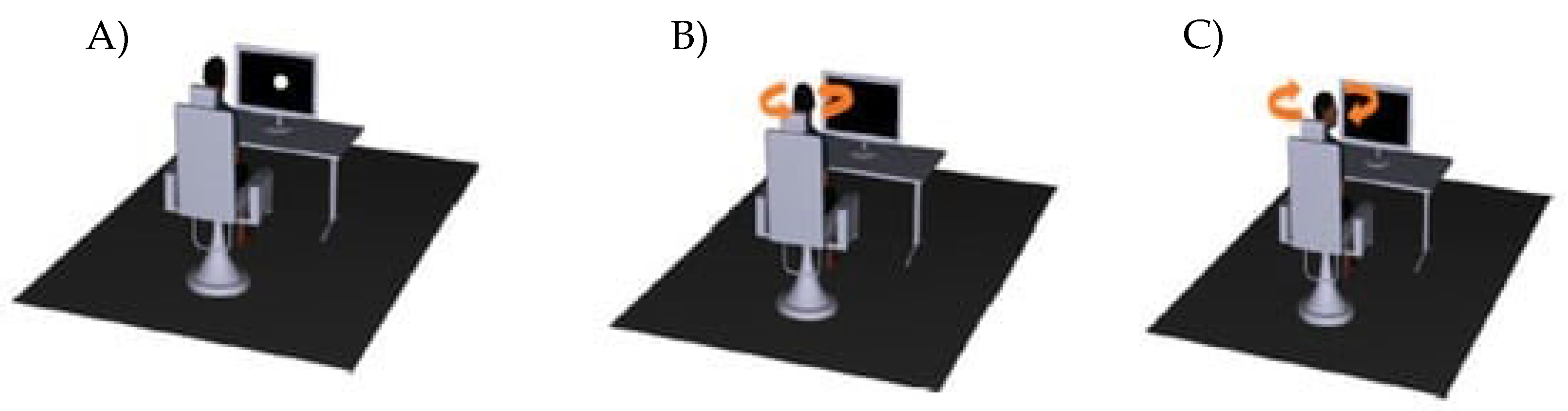
During each trial, a circular target was projected onto the screen (Figure 2). Participants were instructed to quickly rotate their head, alternating between left or right (counterbalanced for each block) by approximately 15° from center while maintaining their eyes fixed on the position where the target last appeared [35,60]. Prior studies have used an end rotational angle of 25° of passive head rotation [60]. However, Campbell et al. (2023) reported that during active head rotation participants tended to overestimate the rotation by 5–10° [35]. A rotation target of a minimum of 15° was chosen, because the VOR is optimally sensitive to rotations around 15–20° [61,62]. To indicate to the participant that they had reached the 15° of head rotation, a gray screen appeared on the monitor, at which point participants were to pause their head rotation and then slowly return their head to center. Participants were notified by two low pitch beeps if their peak angular velocity of head rotation was too low (below 140°/second) or two high pitch beeps if the peak angular velocity was too fast (above 170°/second). A single medium pitch beep was heard if the peak angular velocity was appropriately between 140 and 170°/second. The retinal slip elicited during the protocol was used to assess the ability of each participant to adapt their VOR response and was measured as VOR gain adaptation.
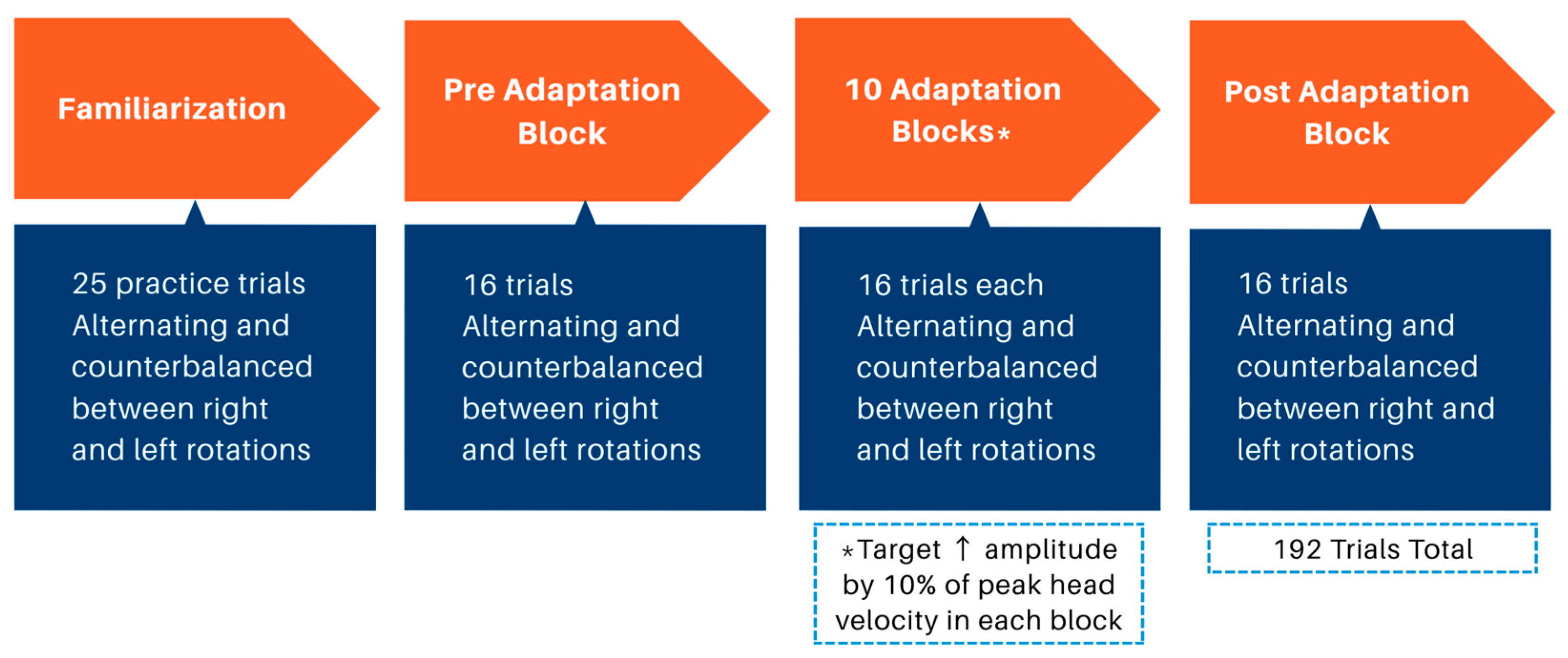
Prior to the VOR protocol, participants completed a familiarization phase, in which participants completed 24 trials counterbalanced between left and right rotations. Participants then completed 192 trials evenly divided between 12 blocks (i.e., 16 trials per block). Block 1, the pre-adaptation block, served to determine the participants’ pre-adaptation VOR, with the target remaining stationary in the center of the screen before disappearing after the first 2° of head rotation. In blocks 2–11, the adaptation blocks, the target moved in the opposite direction of the participants’ head rotation. During block 2, the target moved 10% of the participants’ angular head velocity. Each subsequent block had the target increase in movement speed by 10% up to 100% in block 11. Block 12, the post adaptation block, again had the target remain stationary, as this block was used to observe the participants ability to re-adapt their VOR back to pre-adaptation. A by-bock breakdown of the experimental sequence can be seen in Figure 3. Once each block was complete, the participants were asked to rate the RPE of their head, neck, and eyes. A break was offered at the end of each block; however, if the participant did not wish to take a break, the next block began. Participants were given a mandatory break if they reported an RPE in any area of >4.

2.5. Cervical Proprioception Protocol

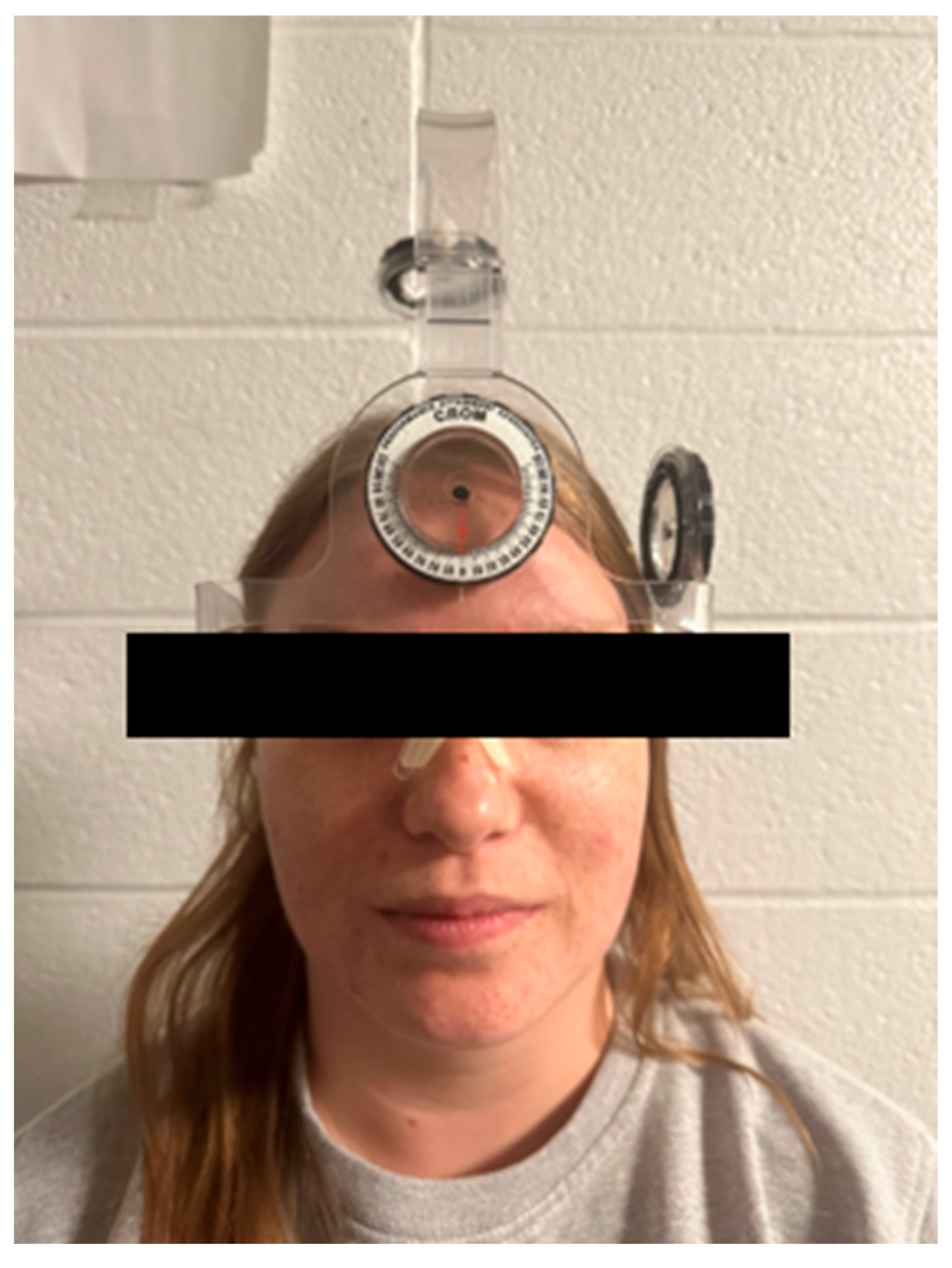
The participant was fitted with a cervical range of motion (CROM) device cervical ROM (CROM) device as seen in Figure 4 (CROM 3, Performance Attainment Associates, Roseville, MN, USA). Participants then completed three maximal pain-free range of motion trials in each direction to establish their available range of motion and calculate the required percent of maximum ranges for the head to 50% and 65% maximum range. Participants closed their eyes for each head to neutral, head to 50% maximum rotation, and head to 65% maximum range of motion trials to ensure that there were no visual clues that they had returned to the target position. For head to neutral, participants then rotated their head within their maximal pain-free range and returned to where they felt center was. Error in position of the head in the yaw plane on the head turn back to neutral was recorded. For head to target range, participants closed their eyes and were guided by the researcher to 50% and 65% maximal range in rotation before being returned to center. Participants were then asked to keep their eyes closed and recreate that joint angle. Error on returning to the same joint angle was recorded. Three trials were completed in each direction for head to neutral, head to 50%, and head to 65%.

2.6. Data Analysis

All data was analyzed using customized MATLAB R2021a codes (The MathWorks Inc., Natick, MA, USA).
Raw head displacement and angular velocity were fitted using a low-pass second-order Butterworth filter with a cut-off frequency of 10 Hz. Missing head angular velocity data was interpolated using a cubic spline.
Raw eye displacement and angular velocity were filtered using a low-pass second-order Butterworth filter with a cut-off frequency of 6 Hz. Blinks and fast phases in the eye tracking data were identified and removed using a custom-written MATLAB script. A Piecewise Cubic Hermite Interpolating Polynomial (PCHIP) was used to interpolate and fill in missing data within the eye position data frame.
VOR gain for each trial was calculated by computing the ratio of average eye angular velocity to average head angular velocity during a window of 30 ms, 15 ms before and after peak head velocity, consistent with the prior literature [60], with the following formula, and then averaged over each block:
VOR Gain   =   A v e r a g e   e y e   v e l o c i t y   30   m s   p r i o r   t o   &   f o l l o w i n g   p e a k   h e a d   v e l o c i t y A v e r a g e   h e a d   v e l o c i t y   30   m s   p r i o r   t o   &   f o l l o w i n g   p e a k   h e a d   v e l o c i t y
Data was visually inspected for the presence of saccades. A covert saccade was determined if the kinematic eye data changed direction to the same direction as the head rotation during the rotational head impulse. Overt catch-up saccades were determined if the kinematic eye data demonstrated impulses in the same direction of head velocity immediately after the cessation of the head impulse. Overt back-up saccades were determined if the kinematic eye data demonstrated impulses in the opposite direction of the head impulse.
Individual trials were removed from the participants dataset and not included in the data analysis if one of the following occurred: (1) loss of the corneal reflex (CR) during the 60 ms window; (2) participant did not reach the minimum 15° of head rotation; or (3) participant changed direction of head rotation mid-trial.

2.7. Statistical Analysis

Statistical analysis was completed using SPSS version 29 (IBM Corp., Armonk, NY, USA).
Unadjusted pre-adaptation VOR gain, pre-adaptation peak head velocity, and pre-adaptation head rotation were compared using independent samples t-tests. VOR gain adaptation, peak head velocity, peak head rotation, head rotation constant error during VOR, and head rotation variable error during VOR were analyzed using repeated measures ANOVAs with time as the repeated measure (pre-adaptation and 11 adaptation blocks) and group (SCNP vs. control) as the between-subjects factor, with a preplanned simple contrast to pre-adaptation. Post-adaptation VOR gain was analyzed using a repeated measures ANOVA with time as the repeated measure (post vs. pre-adaptation) and group as the between-subjects factor. The number of saccades were analyzed using a two-way ANOVA with group and saccade type as factors. Head and neck proprioception were compared using a repeated measures ANOVA with direction as the within-subjects factor and group as the between-subjects factor.
Data was first tested for homogeneity of variance using Levene’s test, and normal distribution using the Shapiro–Wilk test. If the Shapiro–Wilk test indicated that the data was skewed, an appropriate transformation was applied. If data violated sphericity, then the Greenhouse–Geisser correction was applied. Outliers were removed based on if a dataset was identified as two standard deviations outside of the first or third quartile range of a boxplot with a threshold of ± 1.5 × interquartile range (IBM SPSS for Windows, 2024). Statistical significance was set at p ≤ 0.05. For VOR gain adaptation, individual participant data was normalized to their own pre-adaptation baseline to facilitate comparison within and between groups. To do this, the baseline data was normalized to a value of 1 to allow for the analysis of proportional change in VOR gain relative to baseline using the following formula:
P r o p o r t i o n a l   V O R = 1 + B l o c k P r e   A d a p t a t i o n   V a l u e P r e   A d a p t a t i o n   V a l u e
For pre-adaptation VOR gain, post-adaption VOR gain, pre-adaptation peak head velocity, and pre-adaptation peak head rotation, effect size was reported using Cohen’s d, where 0.2 is considered a small effect size, 0.5 is considered a medium effect size, and 0.8 is considered a large effect size [63]. For all other results, effect size was reported using a partial eta squared, where 0.0099 is considered a small effect size, 0.0588 is considered a medium effect size, and 0.1379 is considered a large effect size [64].
To control for the false discovery rate (FDR) due to multiple comparisons, a Benjamini–Hochberg correction was used for the three different types of data (VOR gain adaptation, number of saccades, and proprioception), as it allows for controlling the rate of type I errors by modifying the p value [65]. An FDR was set to a threshold of ≤0.10 [65]. The unadjusted p values are reported in the results section; however, they were only stated as significant if the Benjamini–Hochberg correction indicated that the result was still significant.

3. Results

3.1. Demographics

In total, 35 individuals participated in the study: 19 healthy controls (HC) (10M and 9F, 22.53 ± 3.75 years) and 16 subclinical neck pain (SCNP) (6M and 10F, 21.50 ± 3.60 years). All participants were included in the cervical proprioception analysis. Thirty participants were included in the VOR analysis. Participants whose data could not be accurately analyzed due to an unstable corneal reflex were removed (4 F HC and 1 F SCNP).
Levene’s test of normality was violated for NDI (F (1,28) = 6.889, p = 0.013) and VAS (F (1,28) = 17.436, p = <0.001). The Shapiro–Wilk test of normality was violated for NDI (W (30) = 0.839, p = <0.001) and VAS (W (30) = 0.801, p = <0.001). To correct this, a logarithmic transform was applied to normalize this data and had the effect of creating equality of variance. The corrected values are reported in Table 1.
The HC group demonstrated lower NDI and VAS scores on the day of collection compared to the SCNP group; however, the difference between groups was only significant for the NDI score (NDI: x = 1.63 ± 2.03, 5.56 ± 4.41, p = 0.004; VAS: x = 0.27 ± 0.48, 1.32 ± 0.99, p = 0.104). No difference in cervical rotation range of motion was observed between the two groups in the right ( x = 65.40 ± 10.73, x = 64.96 ± 9.23, p = 0.897) or left direction ( x = 67.54 ± 8.88, x = 68.92 ± 9.85, p = 0.667).

3.2. VOR Results

Two HC participants and four SCNP participants were identified as outliers and removed from the analysis. Levene’s test of equality of variance was violated for block 3 (F (1,28) = 7.061, p = 0.013) and block 8 (F (1,28) = 20.744, p = <0.001). The Shapiro–Wilk test of normality was violated for block 7 (W (30) = 0.721, p = <0.001) and post adaptation (W (30) = 0.912, p = 0.017). To correct this, a logarithmic transform was applied to all data. This normalized all data and had the effect of creating equality of variance. Mauchley’s Test of Sphericity was violated; therefore, a Greenhouse–Geisser correction was applied.
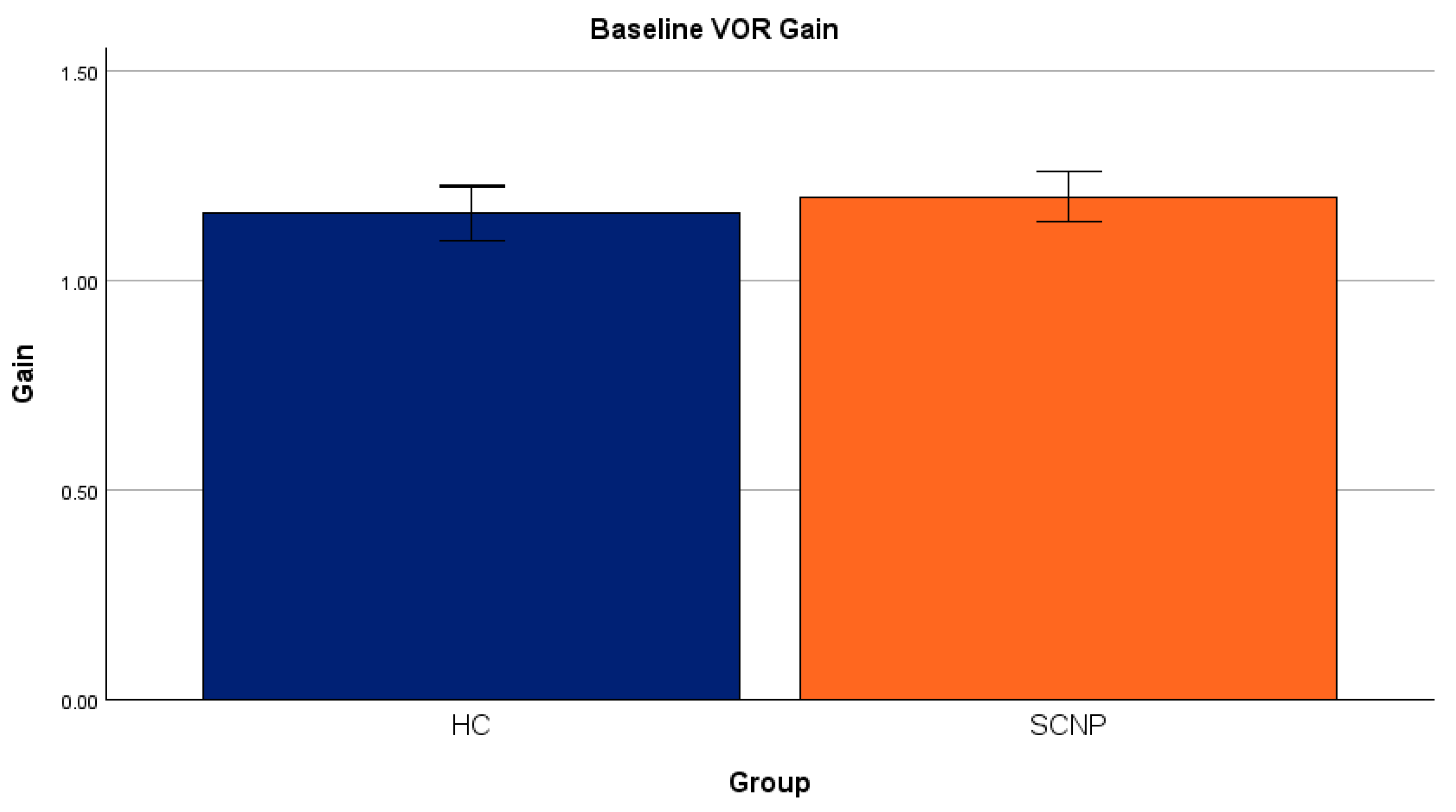
SCNP participants had a slightly higher pre-adaptation VOR gain ( x 1.20 ± 0.11) compared to HC ( x 1.16 ± 0.12); however, this difference was not statistically significant T (28) = −0.99, p = 0.331, d = 0.11) (Figure 5).
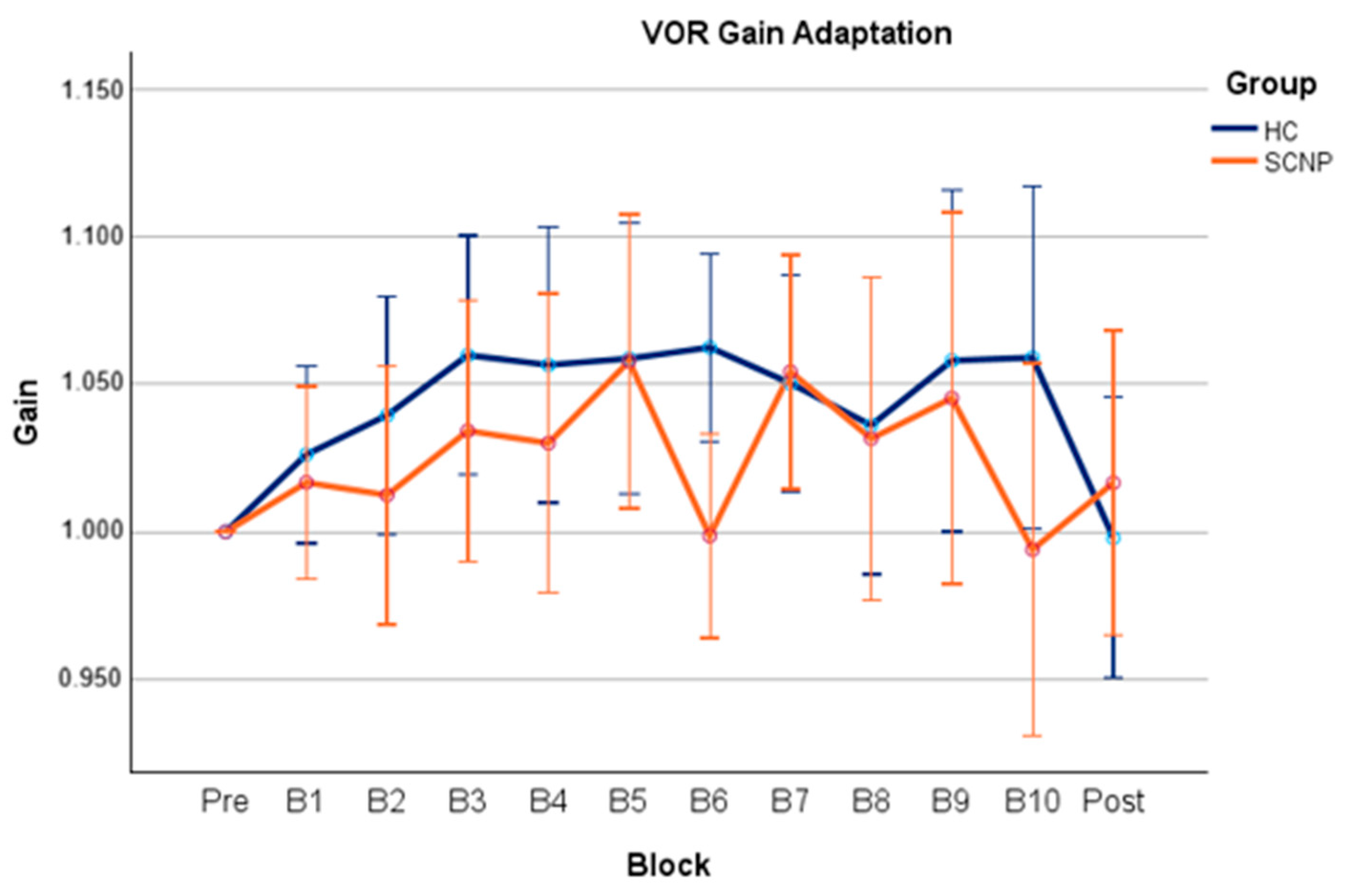
The overall gain adaptation showed a significant effect of time (F (6.77,148.83) = 2.496, p = 0.020, η2 = 0.102). No significant time by group interaction was observed (F (6.77,148.83) = 1.346, p = 0.234, η2 = 0.058). This indicates that VOR gain adaptation was occurring in both groups, but the groups did not differ from each other.
Preplanned contrasts demonstrated that VOR gain adaptation was significantly different to pre-adaptation at block 3 (F (1,22) = 10.034, p = 0.004, η2 = 0.313), block 4 (F (1,22) = 6.113, p = 0.022, η2 = 0.217), block 5 (F (1,22) = 12.437, p = 0.002, η2 = 0.361), block 6 (F (1,22) = 6.623, p = 0.017, η2 = 0.231), block 7 (F (1,22) = 15.924, p = <0.001, η2 = 0.420), and block 9 (F (1,22) = 5.529, p = 0.028, η2 = 0.201) (Figure 6).
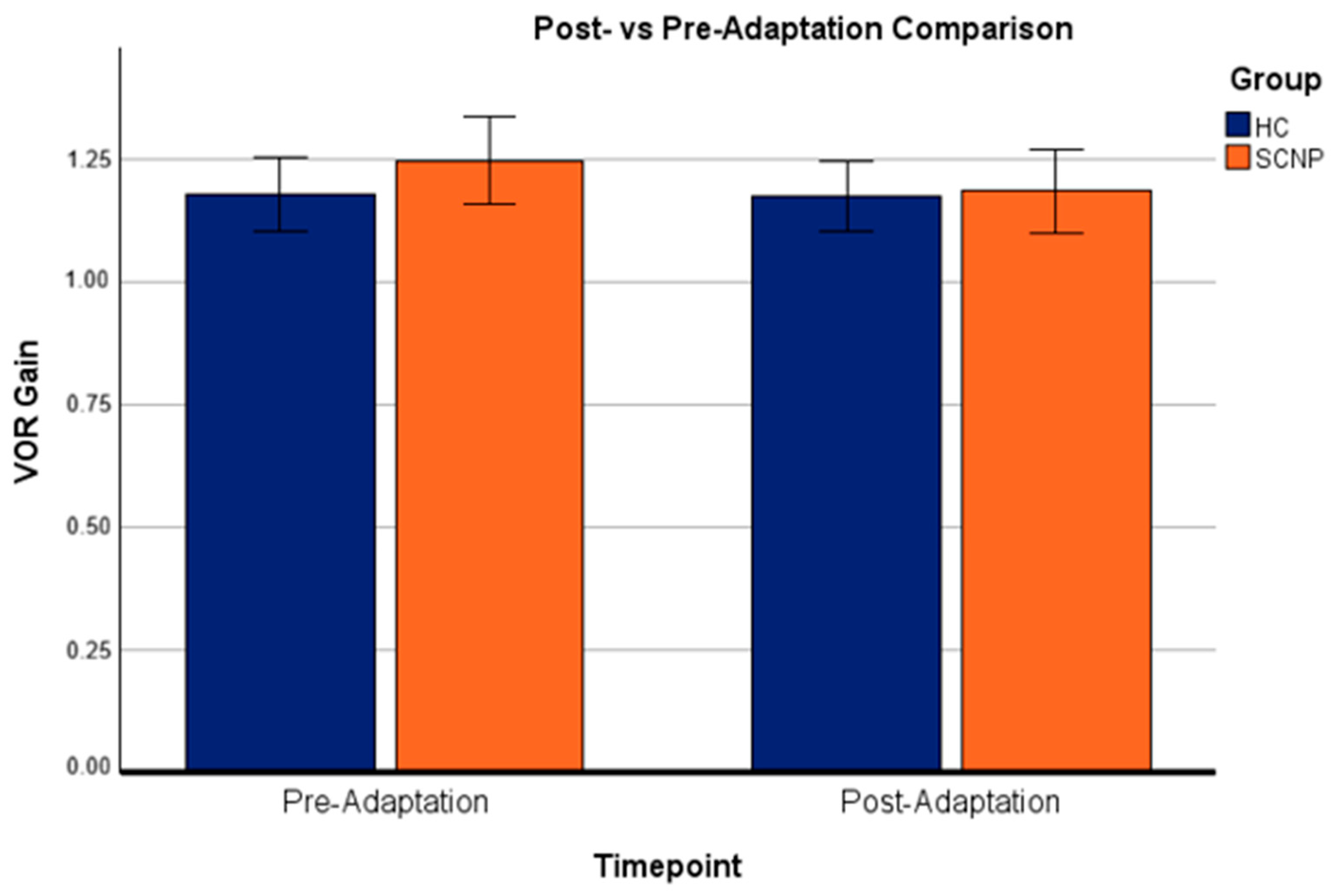
Post-adaptation VOR gain did not differ significantly between post-adaptation and pre-adaptation timepoints (F (1,22) = 1.581, p = 0.222, η2 = 0.067) or between groups (F (1,22) = 0.999, p = 0.328, η2 = 0.043) as seen in Figure 7, indicating that both groups were able to unadapt their VOR gain back to baseline.

3.3. Saccades

Levene’s test for homogeneity of variance was violated for total saccades (F (1,28) = 14.989, p = <0.001) and overt catch-up saccades (F (1,28) = 10.241, p = 0.003). The Shapiro–Wilk test of normality was violated for total saccades (W (30) = 0.882, p = 0.003), covert saccades (W (30) = 0.724, p = <0.001), overt catch-up saccades (W (30) = 0.871, p = 0.002), and overt back-up saccades (W (30) = 0.916, p = 0.021). To correct this, a logarithmic transform was applied which normalized the distribution and the variance.
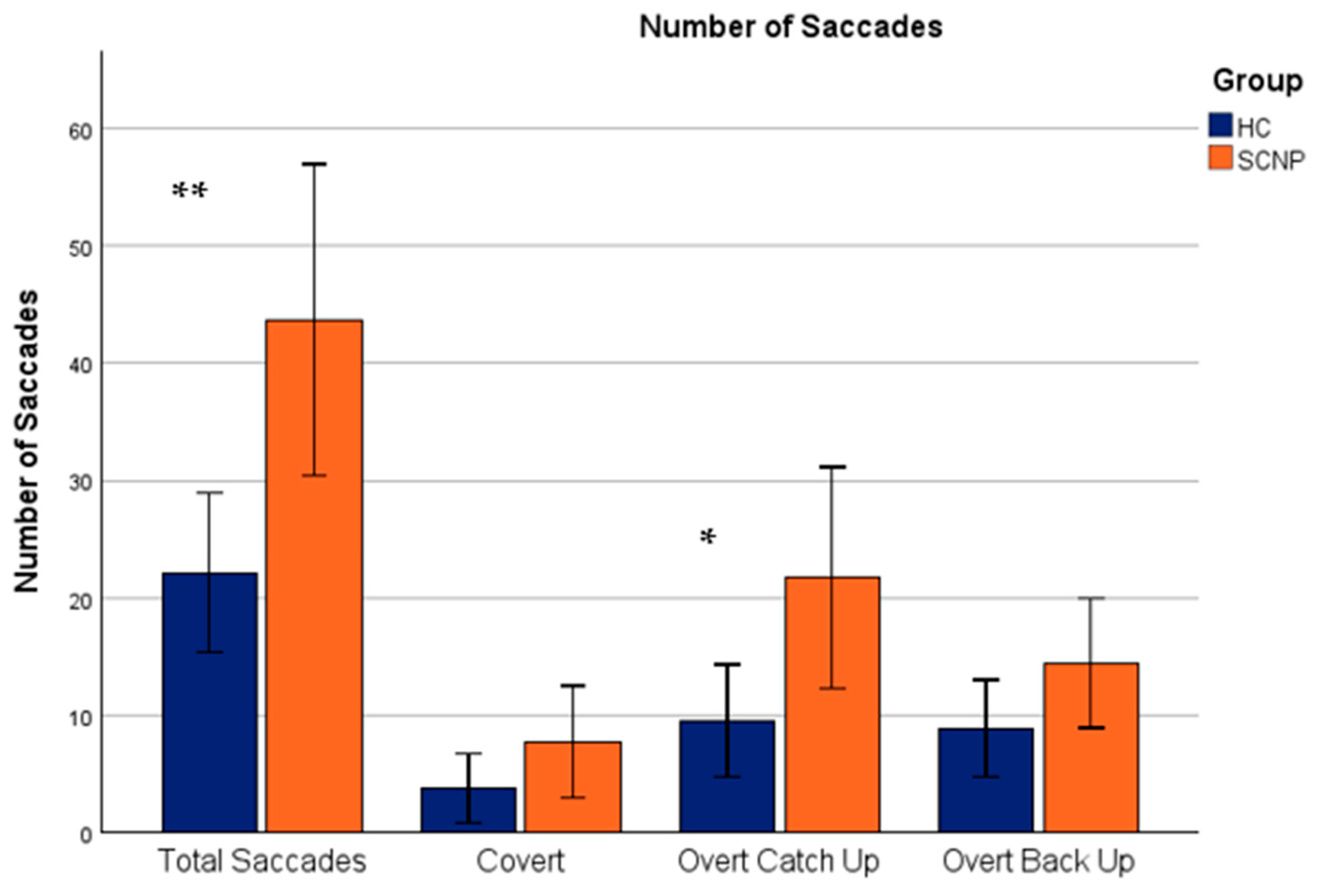
There was a significant difference between groups for the number of total saccades (SCNP: x = 43.73 ± 24.00, HC: x = 22.13 ± 12.26) (F (1,28) = 8.844, p = 0.006, η2 = 0.240) and overt catch-up saccades (SCNP: x = 21.73 ± 17.04, HC: x = 9.53 ± 8.62) (F (1,28) = 4.579, p = 0.041, η2 = 0.141). Although covert saccades (SCNP: x = 7.67 ± 8.68, HC: x = 3.73 ± 5.36) (F (1.28) = 3.501, p = 0.072) and overt back-up saccades (SCNP: x = 14.40 ± 9.96, HC: x = 8.87 ± 7.44) (F (1,28) = 3.245, p = 0.082) trended towards being different, they did not reach statistical significance, although both variables demonstrated a medium effect size (η2 = 0.111 and η2 = 0.104, respectively). Results can be seen in Figure 8.

3.4. Peak Head Velocity

Levene’s test of normality was violated for pre-adaptation (F (1,28) = 6.271, p = 0.018) block 2 (F (1,28) = 7.841, p = 0.009), block 7 (F (1,28) = 4.736, p = 0.038), and block 9 (F (1,28) = 6.837, p = 0.014). The Shapiro–Wilk test of normality was violated for block 4 (W (30) = 0.859, p = <0.001), block 6 (W (30) = 0.807, p = <0.001), and block 8 (W (30) = 0.879, p = 0.003). To correct this, a logarithmic transform was applied which normalized the distribution and variance. Mauchley’s Test of Sphericity was violated; therefore, a Greenhouse–Geisser correction was applied.
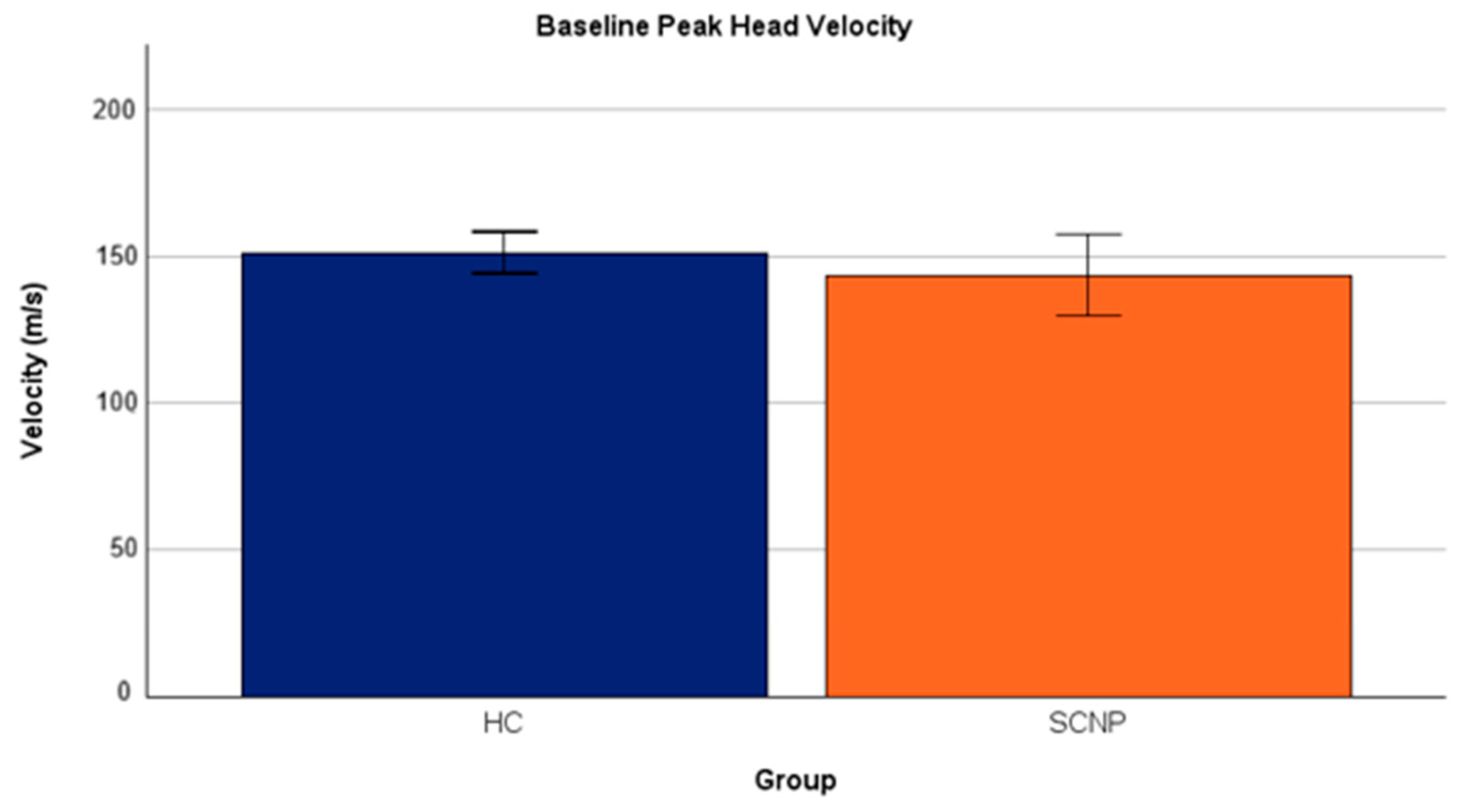
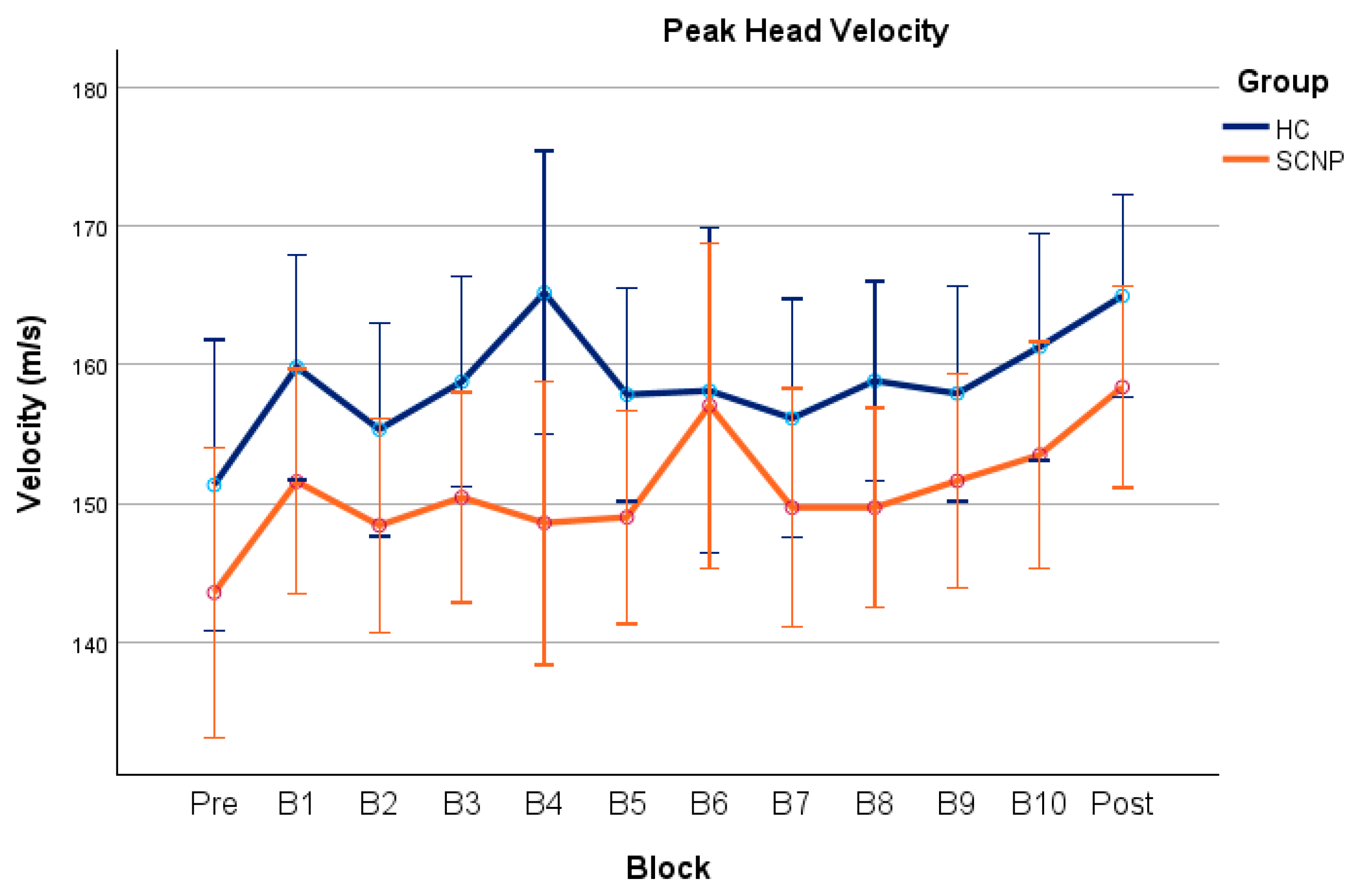
Pre-adaptation peak head velocity demonstrated no significant difference between groups, where SCNP participants had a slightly lower peak head velocity ( x 143.560 ± 24.976) compared to HC ( x 151.326 ± 12.763), with a near-medium effect size (T (28) = 1.251, p = 0.221, d = 0.457); however, the difference was not statistically significant (Figure 9).
Peak head velocity revealed a significant main effect of time (F (2.85,79.75) = 117.520, p = <0.001, η2 = 0.808) compared to baseline. No significant peak head velocity by group interaction was observed (F (2.85,79.75) = 1.076, p = 0.362, η2 = 0.037). This indicates that as the stimulus increased in velocity opposite head rotation, individuals increased the speed at which they rotated their heads, regardless of group.
Preplanned contrast to baseline revealed significant differences in peak head velocity compared to pre-adaptation at block 1 (F (1,28) = 111.912, p = <0.001, η2 = 0.800), block 2 (F (1,28) = 128.491, p = <0.001, η2 = 0.821), block 3 (F (1,28) = 4.183, p = 0.050, η2 = 0.130), block 4 (F (1,28) = 5.228, p = 0.030, η2 = 0.157), block 6 (F (1,28) = 3.697, p = 0.019, η2 = 0.181), block 8 (F (1,28) = 182.101, p = <0.001, η2 = 0.867), block 9 (F (1,28) = 127.210, p = <0.001, η2 = 0.820), block 10 (F (1,28) = 146.606, p = <0.001, η2 = 0.840), and post-adaptation (F (1,28) = 16.237, p = <0.001, η2 = 0.367) (Figure 10).

3.5. Head Rotation

Levene’s test of homogeneity of variance and the Shapiro–Wilk test of normality were not violated. Mauchley’s Test of Sphericity was violated; therefore, a Greenhouse–Geisser correction was applied.
Pre-adaptation maximum head rotation demonstrated no significant difference between groups. SCNP participants had a similar baseline peak head rotation ( x 25.34 ± 3.09 degrees) compared to HC ( x 25.10 ± 3.37 degrees), (T (28) = −0.209, p = 0.836, d = −0.076).
Peak head rotation revealed no significant main effect of time (F (5.33,149.22) = 2.104, p = 0.064, η2 = 0.070) or group (F (5.329,149.216) = 0.367, p = 0.881, η2 = 0.013) compared to baseline.

3.6. Error

Levene’s test of homogeneity of variance and the Shapiro–Wilk test of normality were not violated. Mauchley’s Test of Sphericity was violated; therefore, a Greenhouse–Geisser correction was applied.
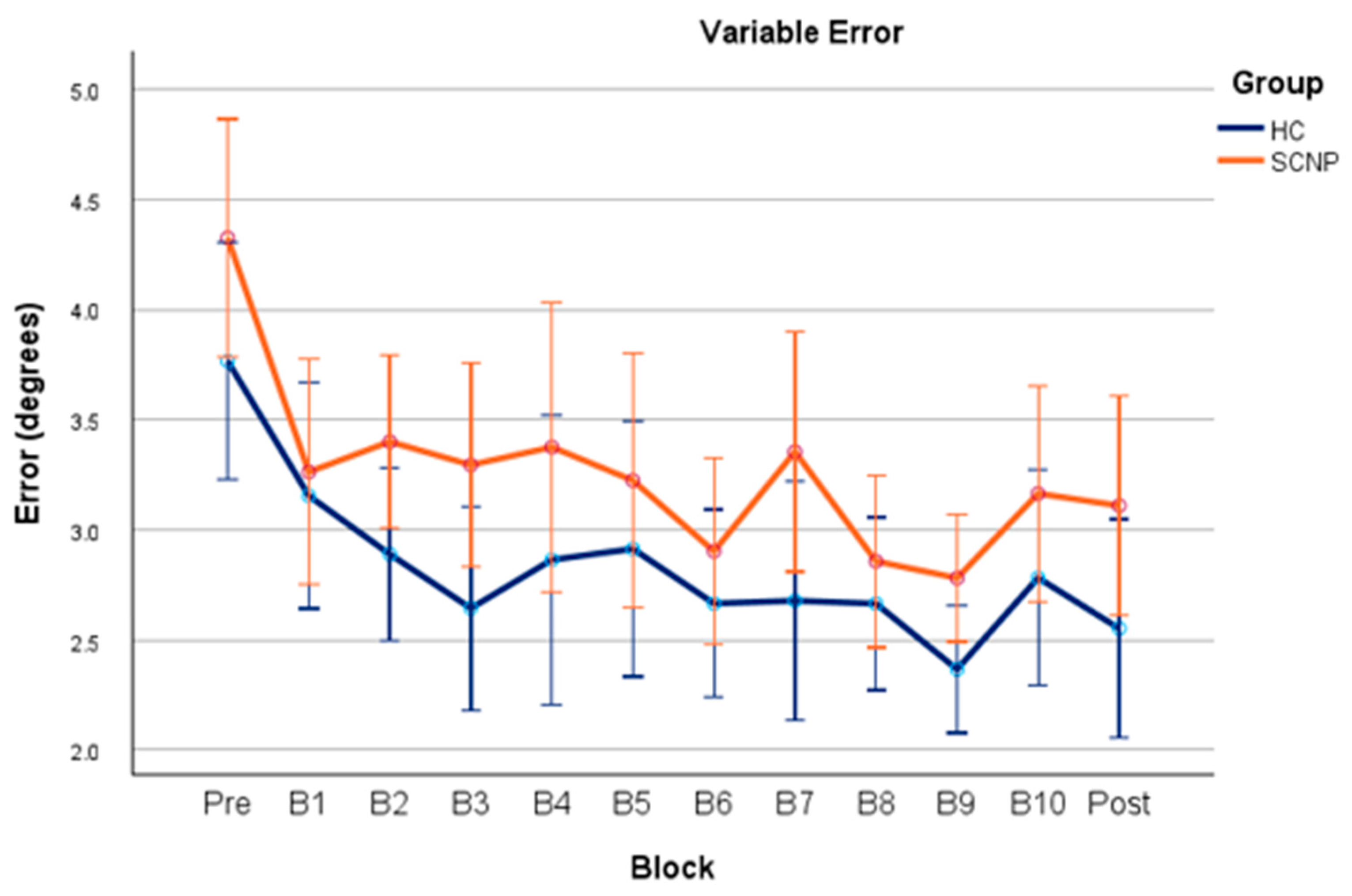
Constant error revealed no significant main effect of time (F (5.329,149.216) = 2.104, p = 0.064, η2 = 0.070) or group (F (5.329,149.216) = 0.367, p = 0.881, η2 = 0.013) compared to baseline. See Figure 11.
Levene’s test of normality was violated for block 3 (F (1,28) = 8.085, p = 0.008). The Shapiro–Wilk test of normality was violated for block 3 (W (30) = 0.929, p = 0.047), block 4 (W (30) = 0.905, p = 0.011), block 8 (W (30) = 0.920, p = 0.027), and post-adaptation (W (30) = 0.930, p = 0.049). To correct this, a logarithmic transform was applied which normalized the distribution and variance. Mauchley’s Test of Sphericity was violated; therefore, a Greenhouse–Geisser correction was applied.
Variable error revealed a significant main effect of time (F (5.319,123.673) = 136.933, p = <0.001, η2 = 0.830). Further investigation revealed that there were significant differences observed at each block compared to baseline, indicating that as adaptation occurred both groups had less variable error. There was no significant variable error by interaction observed (F (5.319,123.673) = 0.889, p = 0.495, η2 = 0.031).

3.7. Cervical Proprioception

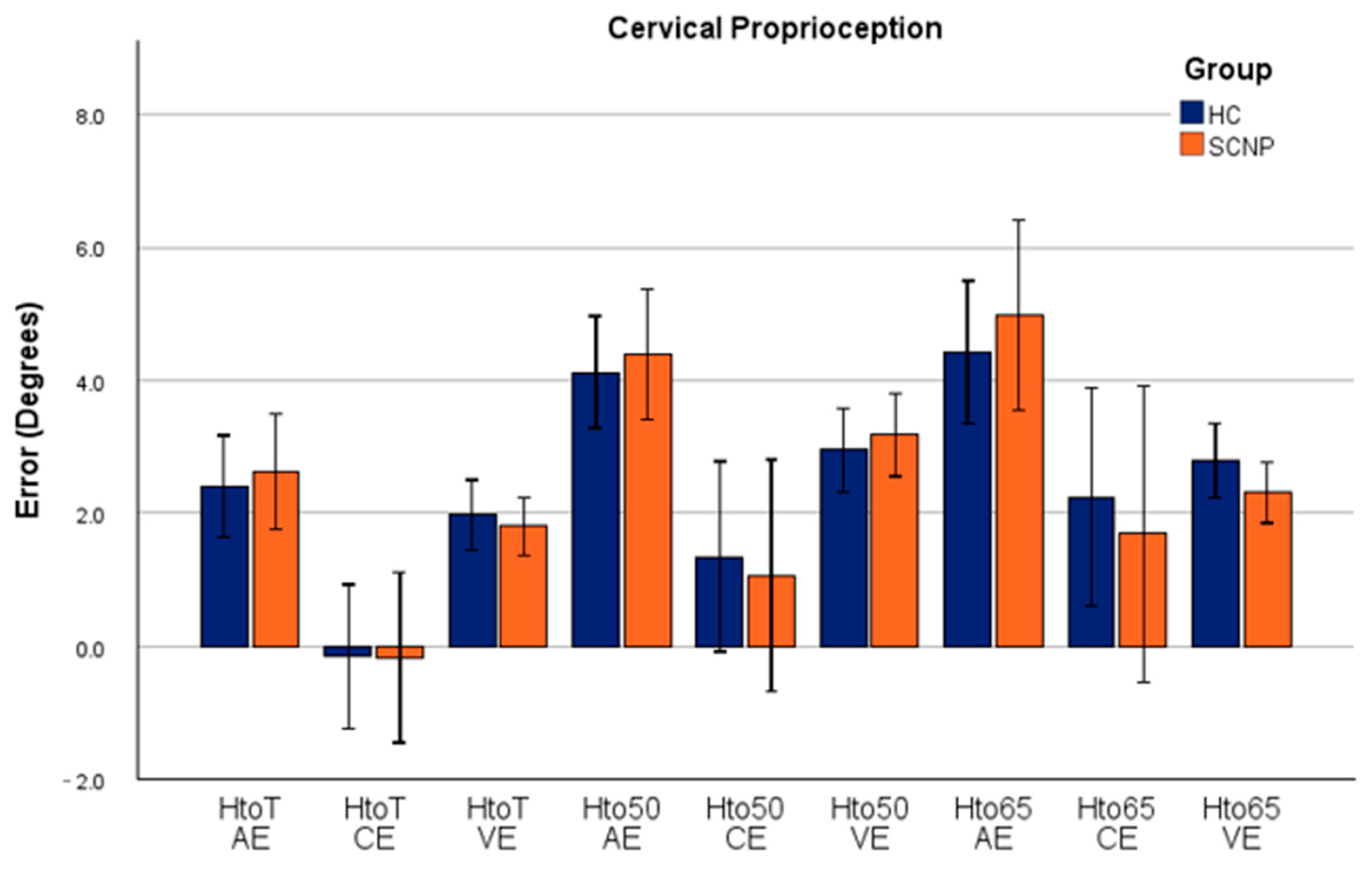
Levene’s test of normality was violated for head to target variable error (F (1,68) = 4.610, p = 0.035). The Shapiro–Wilk test of normality was violated for head to target absolute error (W (70) = 0.865, p = <0.001), head to target constant error (W( 70) = 0.949, p = 0.007), head to target variable error (W (70) = 0.907, p = <0.001), head to 50% absolute error (W(70) = 0.946, p = 0.005), head to 50% variable error (W (70) = 0.948, p = 0.006), head to 65% absolute error (W (70) = 0.895, p = <0.001), and head to 65% variable error (W (70) = 0.891, p = <0.001). To correct this, a logarithmic transform was applied which normalized the distribution and variance. Mauchley’s Test of Sphericity was violated; therefore, a Greenhouse–Geisser correction was applied. See Figure 12.
There was no significant effect of direction on head to target (F (1.05,70.40) = 1.574, p = 0.215, η2 = 0.023), head to 50% (F (1.15,77.22) = 1.985, p = 0.161, η2 = 0.029), or head to 65% (F (1.15,77.22) = 1.985, p = 0.161, η2 = 0.029). There was no significant effect of group on head to target (F (1.05,70.40) = 0.292, p = 0.602, η2 = 0.004), head to 50% (F (1.15,77.22) = 0.099, p = 0.790, η2 = 0.001), or head to 65% (F (1.15,77.22) = 0.099, p = 0.790, η2 = 0.001).

4. Discussion

The current study aimed to evaluate differences in VOR gain adaptation in healthy individuals and those with SCNP. Additionally, movement characteristics of the neck and eyes and proprioception were evaluated to give insight into how neck pain may alter SMI. The study found that individuals with SCNP had an increased frequency of corrective saccades compared to healthy individuals, although the presence of these visuo-motor errors did not alter VOR gain adaptation.

4.1. VOR Gain

The VOR is a reflex that uses information that integrates input from the visual, vestibular, and proprioceptive systems [66,67]. Pathology of the vestibular system, such as unilateral vestibular hypofunction, indicates that the VOR receives the majority of its input from the vestibular system. However, pathology does not occlude the entirety of VOR function, as demonstrated by lower VOR gain in these patients rather than the absence of it [68,69,70]. Additionally, active head rotations have demonstrated an improved VOR gain in individuals with unilateral vestibular hypofunction compared with passive head impulses [38]. This indicates that another afferent input is contributing to the VOR. Bimodal neurons have been demonstrated to be sensitive to both vestibular and proprioceptive input in rhesus monkeys [24,71]. Previous studies have demonstrated a preservation of VOR gain in whiplash-associated disorder (WAD) and chronic neck pain [3,37], consistent with our finding in SCNP. This suggests that during the VOR the vestibular system may be compensating for alterations in cervical input during head rotation. Contrary to our hypothesis, both the SCNP group and the HC group were able to adapt their VOR gain similarly. This is inconsistent with other types of neck pain, as VOR gain adaptation did not occur in individuals with WAD [69]. This may be due to the active head rotation methodology used in this study versus the passive head rotations used in the prior literature. The active nature of the head rotation may be supplementing the VOR gain during adaptation. The inconsistent finding of VOR gain adaptation may also be due to measuring on a day where the individual with SCNP has minimal pain or no pain, as the presence of pain has been shown to alter neural processing and movement patterns [7,8,9,71]. Differences in the observation of VOR gain and gain adaptation may be due to the mild-to-moderate nature of SCNP. Additionally, our participants were actively rotating their heads to more accurately simulate real-world head impulses and possibly contributing to the predictive feedforward control of the VOR, thus improving VOR gain adaptation.

4.2. Corrective Saccades

Corrective saccades typically occur to compensate for an insufficiency in the VOR. In these cases, vestibular dysfunction causes the eye velocity to become slower than the head impulse, causing the eye to lag in the orbit and requiring a corrective eye movement to re-fixate to the target [72,73]. The presence of corrective saccades with normal VOR gain has been observed in individuals with Meniere’s disease, vestibular neuritis, benign paroxysmal positional vertigo, and bilateral and unilateral vestibulopathy [70,74]. Given the dual sensitivity of bimodal neurons in the fastigial nucleus, it is plausible that altered cervical afferents can also impact the presence of corrective saccades during the VOR. Bimodal neurons in the fastigial nucleus project to the deep cerebellar nuclei for processing before projecting back to the fastigial nucleus then back to the vestibular nuclei before projecting to the abducens nuclei to control gaze position [71,75]. Therefore, altered cervical integration may impact oculo-motor control via this reflex pathway. The presence of increased saccades in the SCNP group suggests that corrective saccades may be an earlier and more sensitive marker of maladaptive neural plasticity in this subclinical population. Because the VOR receives the majority of its sensory input from the vestibular nuclei, VOR gain adaptation and VOR gain were able to compensate for likely alterations in sensory input due to the presence of SCNP; however, it did this at the expense of additional saccadic eye movements. Understanding the behavior of gaze stabilization through the VOR during and immediately following a head impulse may further our understanding of visuo-motor integration during head movement. This insight has further implications in enhancing our understanding of dizziness in individuals with neck pain.

4.3. Cervical Proprioception

Alterations in cervical proprioception have been demonstrated in various types of neck pain [76,77,78,79]. A study by Lee et al. (2005) evaluated the impact of SCNP on proprioception and range sensitization, finding that individuals with more frequent pain had a greater sensitivity to judging neck movement extent [10]. Another study evaluating a more severe type of neck pain in individuals with cervical spondylitis demonstrated worse proprioception compared to healthy individuals [77]. The lack of between-group differences in the present study indicates that joint position error metrics, when measured on minimal pain days, have insufficient sensitivity to evaluate proprioceptive function, possibly due to the fluctuating nature of proprioceptive dysfunction in SCNP. Additionally, the lack of between-group differences may be due to the characteristic nature of SCNP, where participants use the point of movement that elicits pain as a tactic to detect the extent of neck movement, diminishing the observed impact of altered proprioception in SCNP. Alternatively, because we evaluated individuals on days with minimal pain and observed no difference between available range of motion during rotation between the healthy and SCNP groups, it may be that the proprioception was not compromised in this subclinical group on the testing day.
This is the first study to quantify the presence of visuo-motor error by way of corrective saccades during the VOR in SCNP. Previous studies have demonstrated that the VOR is preserved in individuals with various types of neck pain; however, corrective saccade presence has not been reported. Our results suggest that an increased number of corrective saccades may be a more sensitive measure of altered SMI and cerebellar processing in SCNP. These findings may aid in our understanding of the interaction of the cervical spine and the visual and vestibular systems, enhancing our understanding of the mechanisms behind neck-based symptoms such as cervicogenic dizziness.

4.4. Limitations

Despite stable VOR gain, the mechanistic attribution of increased saccadic activity is theoretical in nature and cannot be confirmed without supportive neurophysiological or imaging data. Future studies should seek to understand this neurophysiological phenomenon and how it relates to cerebellar inhibition. Vestibular function was screened using the four-item Vestibular Screening Tool, a subjective questionnaire. Future studies could employ an objective vestibular screen, including the use of objective tests such as dynamic visual acuity, to more definitively ensure that the study population is free of vestibular pathology. Cervical function was screened using a range of motion testing. Future studies should look more deeply at the proprioceptive contribution to sensorimotor integration, using existing tools such as the smooth pursuit neck torsion test. SCNP may exhibit significant variability in the intensity, duration, and frequency of neck pain episodes. Future research should aim to recruit a diverse group of participants across different levels of pain severity to better understand how these variations within SCNP might influence movement and visuo-motor behavior. Given the length of the adaptation protocol, fatigue could have developed over time. Although we did record RPE after each block to ensure that participants were not experiencing pain as the protocol progressed, the report of the participant may not have been sensitive enough to assess subtleties in fatigue that were observed through the loss of gain adaptation in block 8 and subsequent increase in variable error during head rotation. This may have been confounded by the weight of the eye-tracker. Additionally, the study’s reliance on a youthful student population limits the generalizability of these findings on older, non-student populations. Future studies should include a broader age range to improve the applicability of the results.

5. Conclusions

This study found an increased number of total saccades and overt catch-up saccades, suggestive of altered eye movement control in those with SCNP relative to healthy controls. Additionally, the demonstration of similarity between groups and between subjects for both peak head velocity and cervical proprioception indicates that individuals with SCNP can move with similar velocity and accuracy to that of healthy individuals. Therefore, it is reasonable to conclude that it is not alterations in neck movement per se contributing to symptomatology associated with subclinical neck pain such as dizziness and eye strain. These symptoms are more likely due to alterations in gaze fixation through visuo-vestibular interaction.

Author Contributions

Conceptualization and study design: B.M., C.M., H.T. and P.C.Y. Methodology: C.M. and H.T. Investigation and Formal Analysis: C.M. and H.T. Writing—original draft preparation: C.M. Writing–Revising and editing: C.M., B.M. and P.C.Y. Funding Acquisition: B.M. Resources: B.M. Supervision: B.M. and P.C.Y. All authors have read and agreed to the published version of the manuscript.

Funding

Funding for this work was obtained by the National Sciences and Engineering Research Council of Canada (NSERC) through an NSERC Discovery Grant (BM), 2022-04777.

Institutional Review Board Statement

The study was conducted in accordance with the Declaration of Helsinki and approved by the Institutional Review Board of Ontario Tech University (REB#14991 on 28 October 2018).

Informed Consent Statement

Informed written and verbal consent was obtained from all study participants prior to participation. Written informed consent has been obtained from the participant(s) to publish this study.

Data Availability Statement

The datasets generated during and/or analyzed during the current study are available from the corresponding authors on reasonable request.

Conflicts of Interest

The authors declare no conflicts of interest.

References

  1. Kazeminasab, S.; Nejadghaderi, S.A.; Amiri, P.; Pourfathi, H.; Araj-Khodaei, M.; Sullman, M.J.M.; Kolahi, A.-A.; Safiri, S. Neck pain: Global epidemiology, trends and risk factors. BMC Musculoskelet. Disord. 2022, 23, 26. [Google Scholar] [CrossRef]
  2. Bobos, P.; MacDermid, J.; Nazari, G.; Furtado, R. Psychometric properties of the global rating of change scales in patients with neck disorders: A systematic review with meta-analysis and meta-regression. BMJ Open 2019, 9, e033909. [Google Scholar] [CrossRef]
  3. Ischebeck, B.K.; de Vries, J.; Janssen, M.; van Wingerden, J.P.; Kleinrensink, G.-J.; van der Geest, J.N.; Frens, M.A. Eye stabilization reflexes in traumatic and non-traumatic chronic neck pain patients. Musculoskelet. Sci. Pract. 2017, 29, 72–77. [Google Scholar] [CrossRef]
  4. Garcia-Perez-Juana, D.; Fernandez-de-Las-Penas, C.; Arias-Buria, J.L.; Cleland, J.A.; Plaza-Manzano, G.; Ortega-Santiago, R. Changes in Cervicocephalic Kinesthetic Sensibility, Widespread Pressure Pain Sensitivity, and Neck Pain After Cervical Thrust Manipulation in Patients With Chronic Mechanical Neck Pain: A Randomized Clinical Trial. J. Manip. Physiol. Ther. 2018, 41, 551–560. [Google Scholar] [CrossRef]
  5. Kendall, J.C.; French, S.D.; Hartvigsen, J.; Azari, M.F. Chiropractic treatment including instrument-assisted manipulation for non-specific dizziness and neck pain in community-dwelling older people: A feasibility randomised sham-controlled trial. Chiropr. Man. Therap 2018, 26, 14. [Google Scholar] [CrossRef]
  6. Reid, S.A.; Callister, R.; Katekar, M.G.; Rivett, D.A. Effects of cervical spine manual therapy on range of motion, head repositioning, and balance in participants with cervicogenic dizziness: A randomized controlled trial. Arch. Phys. Med. Rehabil. 2014, 95, 1603–1612. [Google Scholar] [CrossRef]
  7. Rossi, S.; della Volpe, R.; Ginanneschi, F.; Ulivelli, M.; Bartalini, S.; Spidalieri, R.; Rossi, A. Early somatosensory processing during tonic muscle pain in humans: Relation to loss of proprioception and motor ‘defensive’ strategies. Clin. Neurophysiol. 2003, 114, 1351–1358. [Google Scholar] [CrossRef] [PubMed]
  8. Strutton, P.H.; Theodorou, S.; Catley, M.; McGregor, A.H.; Davey, N.J. Corticospinal excitability in patients with chronic low back pain. J. Spinal Disord. Tech. 2005, 18, 420–424. [Google Scholar] [CrossRef] [PubMed]
  9. Waberski, T.D.; Lamberty, K.; Dieckhofer, A.; Buchner, H.; Gobbele, R. Short-term modulation of the ipsilateral primary sensory cortex by nociceptive interference revealed by SEPs. Neurosci. Lett. 2008, 435, 137–141. [Google Scholar] [CrossRef]
  10. Lee, H.; Nicholson, L.L.; Adams, R.D.; Bae, S.S. Proprioception and rotation range sensitization associated with subclinical neck pain. Spine 2005, 30, E60–E67. [Google Scholar] [CrossRef] [PubMed]
  11. Haavik, H.; Murphy, B. The role of spinal manipulation in addressing disordered sensorimotor integration and altered motor control. J. Electromyogr. Kinesiol. 2012, 22, 768–776. [Google Scholar] [CrossRef] [PubMed]
  12. AlDahas, A.; Devecchi, V.; Deane, J.A.; Falla, D. Measurement properties of cervical joint position error in people with and without chronic neck pain. PLoS ONE 2023, 18, e0292798. [Google Scholar] [CrossRef]
  13. Haavik, H.; Murphy, B. Subclinical neck pain and the effects of cervical manipulation on elbow joint position sense. J. Manip. Physiol. Ther. 2011, 34, 88–97. [Google Scholar] [CrossRef]
  14. Lee, H.Y.; Wang, J.D.; Yao, G.; Wang, S.F. Association between cervicocephalic kinesthetic sensibility and frequency of subclinical neck pain. Man. Ther. 2008, 13, 419–425. [Google Scholar] [CrossRef]
  15. Alahmari, K.A.; Reddy, R.S.; Silvian, P.; Ahmad, I.; Nagaraj, V.; Mahtab, M. Influence of chronic neck pain on cervical joint position error (JPE): Comparison between young and elderly subjects. J. Back Musculoskelet. Rehabil. 2017, 30, 1265–1271. [Google Scholar] [CrossRef] [PubMed]
  16. Johansson, H.; Sojka, P. Pathophysiological mechanisms involved in genesis and spread of muscular tension in occupational muscle pain and in chronic musculoskeletal pain syndromes: A hypothesis. Med. Hypotheses 1991, 35, 196–203. [Google Scholar] [CrossRef] [PubMed]
  17. Lund, J.P.; Donga, R.; Widmer, C.G.; Stohler, C.S. The pain-adaptation model: A discussion of the relationship between chronic musculoskeletal pain and motor activity. Can. J. Physiol. Pharmacol. 1991, 69, 683–694. [Google Scholar] [CrossRef] [PubMed]
  18. Beinert, K.; Englert, V.; Taube, W. After-effects of neck muscle vibration on sensorimotor function and pain in neck pain patients and healthy controls—A case-control study. Disabil. Rehabil. 2019, 41, 1906–1913. [Google Scholar] [CrossRef]
  19. Ranjbaran, M.; Galiana, H.L. Hybrid model of the context dependent vestibulo-ocular reflex: Implications for vergence-version interactions. Front. Comput. Neurosci. 2015, 9, 6. [Google Scholar] [CrossRef]
  20. De Vries, J.; Ischebeck, B.K.; Voogt, L.P.; Janssen, M.; Frens, M.A.; Kleinrensink, G.-J.; van der Geest, J.N. Cervico-ocular reflex is increased in people with nonspecific neck pain. Phys. Ther. 2016, 96, 1190–1195. [Google Scholar] [CrossRef]
  21. Gdowski, G.T.; Belton, T.; McCrea, R.A. The neurophysiological substrate for the cervico-ocular reflex in the squirrel monkey. Exp. Brain Res. 2001, 140, 253–264. [Google Scholar] [CrossRef]
  22. Cullen, K.E. The vestibular system: Multimodal integration and encoding of self-motion for motor control. Trends Neurosci. 2012, 35, 185–196. [Google Scholar] [CrossRef]
  23. Starkov, D.; Strupp, M.; Pleshkov, M.; Kingma, H.; van de Berg, R. Diagnosing vestibular hypofunction: An update. J. Neurol. 2021, 268, 377–385. [Google Scholar] [CrossRef] [PubMed]
  24. Schwarz, D.W.F.; Fredrickson, J.M. Rhesus Monkey Vestibular Cortex: A Bimodal Primary Projection Field. Science 1971, 172, 280–281. [Google Scholar] [CrossRef]
  25. Padoan, S.; Karlberg, M.; Fransson, P.A.; Magnusson, M. Passive sustained turning of the head induces asymmetric gain of the vestibulo-ocular reflex in healthy subjects. Acta Otolaryngol. 1998, 118, 778–782. [Google Scholar] [CrossRef]
  26. Andrew, D.; Yielder, P.; Haavik, H.; Murphy, B. The effects of subclinical neck pain on sensorimotor integration following a complex motor pursuit task. Exp. Brain Res. 2018, 236, 1–11. [Google Scholar] [CrossRef] [PubMed]
  27. Baarbé, J.K.; Yielder, P.; Haavik, H.; Holmes, M.W.R.; Murphy, B.A. Subclinical recurrent neck pain and its treatment impacts motor training-induced plasticity of the cerebellum and motor cortex. PLoS ONE 2018, 13, e0193413. [Google Scholar] [CrossRef]
  28. Sağlam, M.; Lehnen, N. Gaze stabilization in chronic vestibular-loss and in cerebellar ataxia: Interactions of feedforward and sensory feedback mechanisms. J. Vestib. Res. 2014, 24, 425–431. [Google Scholar] [CrossRef] [PubMed]
  29. Bronstein, A.M.; Patel, M.; Arshad, Q. A brief review of the clinical anatomy of the vestibular-ocular connections—How much do we know? Eye 2015, 29, 163–170. [Google Scholar] [CrossRef]
  30. Johnston, J.L.; Daye, P.M.; Thomson, G.T. Inaccurate Saccades and Enhanced Vestibulo-Ocular Reflex Suppression during Combined Eye-Head Movements in Patients with Chronic Neck Pain: Possible Implications for Cervical Vertigo. Front. Neurol. 2017, 8, 23. [Google Scholar] [CrossRef]
  31. Leigh, R.J.; Zee, D.S. The Neurology of Eye Movements; Oxford University Press: New York, NY, USA, 2015. [Google Scholar]
  32. Soriano-Reixach, M.M.; Rey-Martinez, J.; Altuna, X.; Curthoys, I. Enhanced Eye Velocity With Backup Saccades in vHIT Tests of a Menière Disease Patient: A Case Report. Front. Surg. 2021, 8, 727672. [Google Scholar] [CrossRef] [PubMed]
  33. Ranjbaran, M.; Smith, H.L.; Galiana, H.L. Automatic Classification of the Vestibulo-Ocular Reflex Nystagmus: Integration of Data Clustering and System Identification. IEEE Trans. Biomed. Eng. 2016, 63, 850–858. [Google Scholar] [CrossRef]
  34. Schmidt, R.A.; Lee, T.D. Motor Control and Learning: A Behavioral Emphasis, 5th ed.; Human Kinetics: Champaign, IL, USA, 2011. [Google Scholar]
  35. Campbell, D.; Murphy, B.A.; Burkitt, J.; La Delfa, N.; Sanmugananthan, P.; Ambalavanar, U.; Yielder, P. Cervico-Ocular and Vestibulo-Ocular Reflexes in Subclinical Neck Pain and Healthy Individuals: A Cross-Sectional Study. Brain Sci. 2023, 13, 1603. [Google Scholar] [CrossRef] [PubMed]
  36. Kelders, W.; Kleinrensink, G.; Geest, J.V.D.; Schipper, I.; Feenstra, L.; Zeeuw, C.D.; Frens, M. The cervico-ocular reflex is increased in whiplash injury patients. J. Neurotrauma 2005, 22, 133–137. [Google Scholar] [CrossRef]
  37. Montfoort, I.; Kelders, W.P.A.; van der Geest, J.N.; Schipper, I.B.; Feenstra, L.; de Zeeuw, C.I.; Frens, M.A. Interaction between Ocular Stabilization Reflexes in Patients with Whiplash Injury. Investig. Ophthalmol. Vis. Sci. 2006, 47, 2881–2884. [Google Scholar] [CrossRef]
  38. Della Santina, C.C.; Cremer, P.D.; Carey, J.P.; Minor, L.B. Comparison of Head Thrust Test With Head Autorotation Test Reveals that the Vestibulo-ocular Reflex Is Enhanced During Voluntary Head Movements. Arch. Otolaryngol.—Head. Neck Surg. 2002, 128, 1044–1054. [Google Scholar] [CrossRef]
  39. Rogers, R.G. The effects of spinal manipulation on cervical kinesthesia in patients with chronic neck pain: A pilot study. J. Manip. Physiol. Ther. 1997, 20, 80–85. [Google Scholar]
  40. Feipel, V.; Salvia, P.; Klein, H.; Rooze, M. Head repositioning accuracy in patients with whiplash-associated disorders. Spine 2006, 31, E51–E58. [Google Scholar] [CrossRef]
  41. Heikkila, H.; Astrom, P.G. Cervicocephalic kinesthetic sensibility in patients with whiplash injury. Scand. J. Rehabil. Med. 1996, 28, 133–138. Available online: https://www.ncbi.nlm.nih.gov/pubmed/8885035 (accessed on 10 June 2024). [CrossRef]
  42. Heikkila, H.V.; Wenngren, B.I. Cervicocephalic kinesthetic sensibility, active range of cervical motion, and oculomotor function in patients with whiplash injury. Arch. Phys. Med. Rehabil. 1998, 79, 1089–1094. [Google Scholar] [CrossRef] [PubMed]
  43. Faul, F.; Erdfelder, E.; Lang, A.G.; Buchner, A. G*Power 3: A flexible statistical power analysis program for the social, behavioral, and biomedical sciences. Behav. Res. Methods 2007, 39, 175–191. [Google Scholar] [CrossRef]
  44. Oldfield, R.C. The assessment and analysis of handedness: The Edinburgh inventory. Neuropsychologia 1971, 9, 97–113. [Google Scholar] [CrossRef] [PubMed]
  45. Von Korff, M.; Ormel, J.; Keefe, F.J.; Dworkin, S.F. Grading the severity of chronic pain. Pain 1992, 50, 133–149. Available online: https://journals.lww.com/pain/fulltext/1992/08000/grading_the_severity_of_chronic_pain.2.aspx (accessed on 3 June 2024). [CrossRef] [PubMed]
  46. Vernon, H.T.; Humphreys, B.K.; Hagino, C.A. A systematic review of conservative treatments for acute neck pain not due to whiplash. J. Manip. Physiol. Ther. 2005, 28, 443–448. [Google Scholar] [CrossRef]
  47. Baarbé, J.; Yielder, P.; Daligadu, J.; Behbahani, H.; Haavik, H.; Murphy, B. A novel protocol to investigate motor training-induced plasticity and sensorimotor integration in the cerebellum and motor cortex. J. Neurophysiol. 2014, 111, 715–721. [Google Scholar] [CrossRef]
  48. Daligadu, J.; Haavik, H.; Yielder, P.C.; Baarbe, J.; Murphy, B. Alterations in cortical and cerebellar motor processing in subclinical neck pain patients following spinal manipulation. J. Manip. Physiol. Ther. 2013, 36, 527–537. [Google Scholar] [CrossRef]
  49. Stewart, V.; Mendis, M.D.; Rowland, J.; Choy, N.L. Construction and Validation of the Vestibular Screening Tool for Use in the Emergency Department and Acute Hospital Setting. Arch. Phys. Med. Rehabil. 2015, 96, 2153–2160. [Google Scholar] [CrossRef]
  50. Begum, M.R.; Hossain, M.A. Validity and reliability of visual analogue scale (VAS) for pain measurement. J. Med. Case Rep. Rev. 2019, 2, 11. Available online: https://jmcrr.info/index.php/jmcrr/article/view/44 (accessed on 11 June 2024).
  51. Bijur, P.E.; Silver, W.; Gallagher, E.J. Reliability of the visual analog scale for measurement of acute pain. Acad. Emerg. Med. 2001, 8, 1153–1157. [Google Scholar] [CrossRef]
  52. Dimitriadis, Z.; Strimpakos, N.; Kapreli, E.; Oldham, J. Validity of visual analog scales for assessing psychological states in patients with chronic neck pain. J. Musculoskelet. Pain 2014, 22, 242–246. [Google Scholar] [CrossRef]
  53. McCarthy, M.J.H.; Grevitt, M.P.; Silcocks, P.; Hobbs, G. The reliability of the Vernon and Mior neck disability index, and its validity compared with the short form-36 health survey questionnaire. Eur. Spine J. 2007, 16, 2111–2117. [Google Scholar] [CrossRef]
  54. Vernon, H.; Mior, S. The Neck Disability Index: A study of reliability and validity. J. Manip. Physiol. Ther. 1991, 14, 409–415. [Google Scholar]
  55. Gombaut, C.; Holmes, S.A. Sensorimotor Integration and Pain Perception: Mechanisms Integrating Nociceptive Processing. A Systematic Review and ALE-Meta Analysis. Front. Integr. Neurosci. 2022, 16, 931292. [Google Scholar] [CrossRef] [PubMed]
  56. Tashjian, R.Z.; Deloach, J.; Porucznik, C.A.; Powell, A.P. Minimal clinically important differences (MCID) and patient acceptable symptomatic state (PASS) for visual analog scales (VAS) measuring pain in patients treated for rotator cuff disease. J. Shoulder Elbow Surg. 2009, 18, 927–932. [Google Scholar] [CrossRef]
  57. Goh, G.S.; Yue, W.-M.; Guo, C.-M.; Tan, S.-B.; Chen, J.L. Defining threshold values on the neck disability index corresponding to a patient acceptable symptom state in patients undergoing elective surgery for degenerative disorders of the cervical spine. Spine J. 2020, 20, 1316–1326. [Google Scholar] [CrossRef]
  58. Borg, G.A. Psychophysical bases of perceived exertion. Med. Sci. Sports Exerc. 1982, 14, 377–381. Available online: https://www.ncbi.nlm.nih.gov/pubmed/7154893 (accessed on 12 June 2024). [CrossRef] [PubMed]
  59. Weber, K.P.; Aw, S.T.; Todd, M.J.; McGarvie, L.A.; Pratap, S.; Curthoys, I.S.; Halmagyi, G.M. Inter-ocular differences of the horizontal vestibulo-ocular reflex during impulsive testing. Prog. Brain Res. 2008, 171, 195–198. [Google Scholar] [CrossRef]
  60. Schubert, M.C.; Della Santina, C.C.; Shelhamer, M. Incremental angular vestibulo-ocular reflex adaptation to active head rotation. Exp. Brain Res. 2008, 191, 435–446. [Google Scholar] [CrossRef]
  61. Angelaki, D.E.; Cullen, K.E. Vestibular System: The Many Facets of a Multimodal Sense. Annu. Rev. Neurosci. 2008, 31, 125–150. [Google Scholar] [CrossRef]
  62. Omer, W.; Abdulhadi, K. Physiology and Diagnostic Tests of the Vestibular System. In Textbook of Clinical Otolaryngology; Al-Qahtani, A., Haidar, H., Larem, A., Eds.; Springer International Publishing: Cham, Switzerland, 2021; pp. 129–134. [Google Scholar] [CrossRef]
  63. Cohen, J. Statistical Power Analysis for the Behavioral Sciences; Routledge: Milton Park, UK, 1988. [Google Scholar]
  64. Richardson, J.T.E. Eta squared and partial eta squared as measures of effect size in educational research. Educ. Res. Rev. 2011, 6, 135–147. [Google Scholar] [CrossRef]
  65. Benjamini, Y.; Hochberg, Y. Controlling the False Discovery Rate: A Practical and Powerful Approach to Multiple Testing. J. R. Stat. Soc. Ser. B Methodol. 2018, 57, 289–300. [Google Scholar] [CrossRef]
  66. Gray, L. Vestibular System: Structure and Function. Ph.D. Thesis, McGovern Medical School at UTHealth, Houston, TX, USA, 2020. Available online: https://nba.uth.tmc.edu/neuroscience/s2/chapter10.html (accessed on 16 May 2024).
  67. Kandel, E.R.; Koester, J.; Mack, S.; Siegelbaum, S. Principles of Neural Science, 6th ed.; McGraw Hill: Columbus, OH, USA, 2021. [Google Scholar]
  68. Maire, R.; van Melle, G. Dynamic asymmetry of the vestibulo-ocular reflex in unilateral peripheral vestibular and cochleovestibular loss. Laryngoscope 2000, 110, 256–263. [Google Scholar] [CrossRef] [PubMed]
  69. Montfoort, I.; Van Der Geest, J.N.; Slijper, H.P.; De Zeeuw, C.I.; Frens, M.A. Adaptation of the cervico-and vestibulo-ocular reflex in whiplash injury patients. J. Neurotrauma 2008, 25, 687–693. [Google Scholar] [CrossRef]
  70. Perez-Fernandez, N.; Eza-Nunez, P. Normal Gain of VOR with Refixation Saccades in Patients with Unilateral Vestibulopathy. J. Int. Adv. Otol. 2015, 11, 133–137. [Google Scholar] [CrossRef]
  71. Brooks, J.X.; Cullen, K.E. Multimodal integration in rostral fastigial nucleus provides an estimate of body movement. J. Neurosci. 2009, 29, 10499–10511. [Google Scholar] [CrossRef]
  72. MacDougall, H.; Weber, K.; McGarvie, L.; Halmagyi, G.; Curthoys, I. The video head impulse test: Diagnostic accuracy in peripheral vestibulopathy. Neurology 2009, 73, 1134–1141. [Google Scholar] [CrossRef]
  73. Yang, C.; Lee, J.; Kang, B.; Lee, H.; Yoo, M.; Park, H. Quantitative analysis of gains and catch-up saccades of video-head-impulse testing by age in normal subjects. Clin. Otolaryngol. 2016, 41, 532–538. [Google Scholar] [CrossRef]
  74. Kabaya, K.; Fukushima, A.; Katsumi, S.; Minakata, T.; Iwasaki, S. Presence of corrective saccades in patients with normal vestibulo-ocular reflex gain in video head impulse test. Front. Neurol. 2023, 14, 1152052. [Google Scholar] [CrossRef]
  75. O’Leary, S.; Falla, D.; Elliott, J.M.; Jull, G. Muscle Dysfunction in Cervical Spine Pain: Implications for Assessment and Management. J. Orthop. Sports Phys. Ther. 2009, 39, 324–333. [Google Scholar] [CrossRef] [PubMed]
  76. Peng, B.; Yang, L.; Li, Y.; Liu, T.; Liu, Y. Cervical Proprioception Impairment in Neck Pain-Pathophysiology, Clinical Evaluation, and Management: A Narrative Review. Pain Ther. 2021, 10, 143–164. [Google Scholar] [CrossRef] [PubMed]
  77. Reddy, R.S.; Tedla, J.S.; Dixit, S.; Abohashrh, M. Cervical proprioception and its relationship with neck pain intensity in subjects with cervical spondylosis. BMC Musculoskelet. Disord. 2019, 20, 447. [Google Scholar] [CrossRef] [PubMed]
  78. Röijezon, U.; Clark, N.C.; Treleaven, J. Proprioception in musculoskeletal rehabilitation. Part 1: Basic science and principles of assessment and clinical interventions. Manual Ther. 2015, 20, 368–377. [Google Scholar] [CrossRef] [PubMed]
  79. Treleaven, J.; Peterson, G.; Ludvigsson, M.L.; Kammerlind, A.-S.; Peolsson, A. Balance, dizziness and proprioception in patients with chronic whiplash associated disorders complaining of dizziness: A prospective randomized study comparing three exercise programs. Manual Ther. 2016, 22, 122–130. [Google Scholar] [CrossRef] [PubMed]
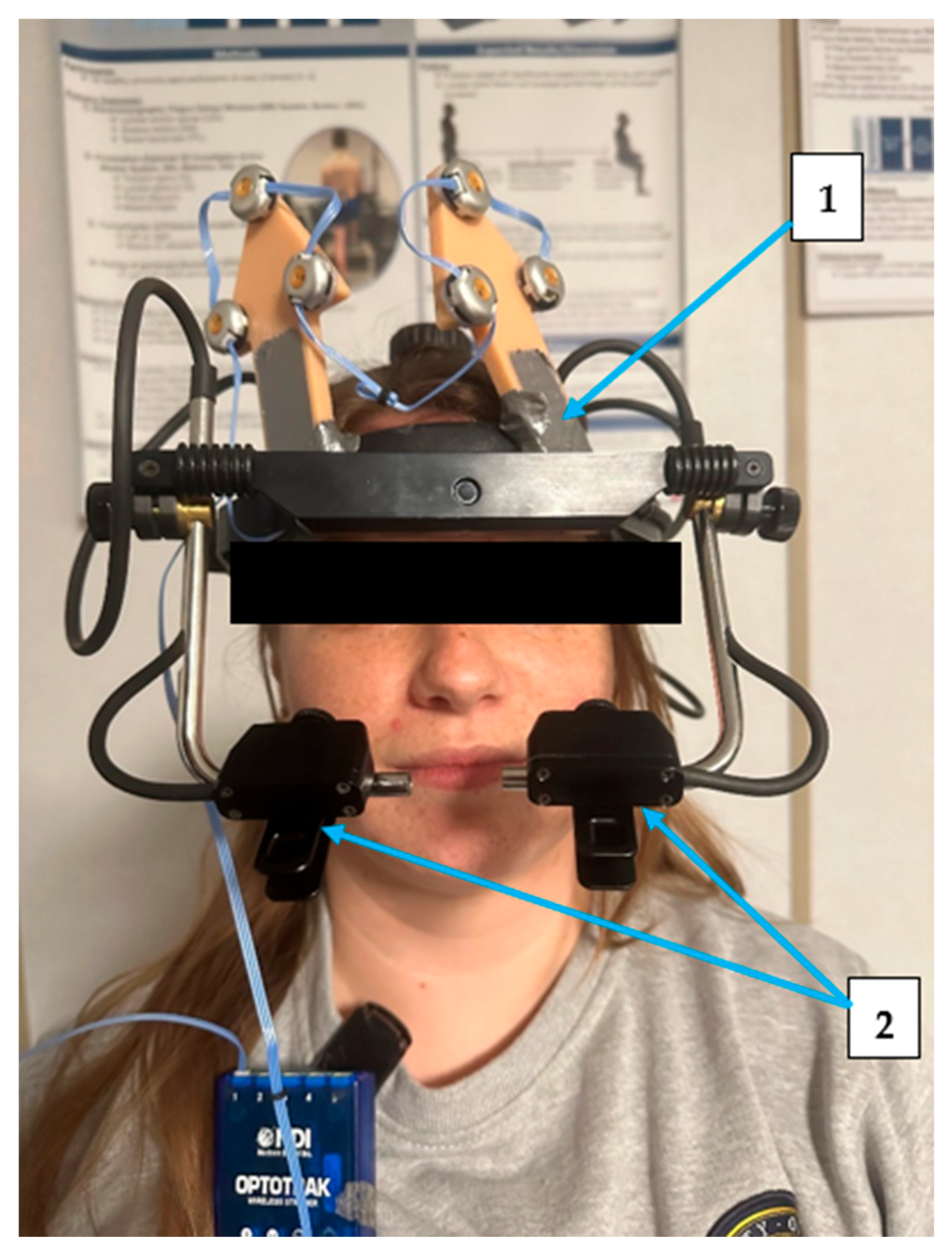
Figure 1. Eye-tracker set up. (1) Optotrack camera trackers on rigid bodies to track head position; (2) eye tracker cameras.
Applsci 16 00247 g001
Figure 2. Illustration of the VOR protocol, as published by Campbell et al. 2023 [35]. Panel (A) shows the participant position. The orange arrows in panels (B,C) indicate the direction of head rotation.
Applsci 16 00247 g002
Figure 3. Sequence of VOR gain adaptation protocol.
Applsci 16 00247 g003
Figure 4. CROM set up.
Applsci 16 00247 g004
Figure 5. Comparison of pre-adaptation VOR gain between groups with 95% confidence intervals.
Applsci 16 00247 g005
Figure 6. Comparison of VOR gain adaptation between groups with 95% confidence intervals.
Applsci 16 00247 g006
Figure 7. Comparison of pre- vs. post-adaptation VOR gain between groups with 95% confidence intervals.
Applsci 16 00247 g007
Figure 8. Comparison of total saccades and saccade types observed in each group (** p < −0.01; * p < 0.05) with 95% confidence intervals.
Applsci 16 00247 g008
Figure 9. Comparison of pre-adaptation peak head velocity between groups with 95% confidence intervals.
Applsci 16 00247 g009
Figure 10. Comparison of peak head velocity during adaptation blocks in each group with 95% confidence intervals.
Applsci 16 00247 g010
Figure 11. Comparison of head rotation variable error during VOR between groups with 95% confidence intervals.
Applsci 16 00247 g011
Figure 12. Proprioceptive error between groups with 95% confidence intervals. (HtoT=head to target, Hto50=head to 50% ROM and Hto65=head to 65% maximum head rotation). AE=absolute error, CE=constant error, VE=variable error.
Applsci 16 00247 g012
Table 1. Participant characteristics.
Healthy Control (HC)Subclinical Neck Pain (SCNP)
Biological Sex (M:F)10:96:10
Age (Years)22.53 ± 3.7521.50 ± 3.60
Von Kroff CPGSGrade 0190
Grade 109
Grade 205
Grade 302
Grade 400
Healthy Control (HC)Subclinical Neck Pain (SCNP)p-Value
NDI Score (/50)1.63 ± 2.035.56 ± 4.410.003
Pain VAS (/10 cm)0.27 ± 0.481.32 ± 0.990.104
Cervical ROMRight65.40 ± 10.7364.96 ±9.230.897
Left67.54 ± 8.8868.92 ± 9.850.667
Disclaimer/Publisher’s Note: The statements, opinions and data contained in all publications are solely those of the individual author(s) and contributor(s) and not of MDPI and/or the editor(s). MDPI and/or the editor(s) disclaim responsibility for any injury to people or property resulting from any ideas, methods, instructions or products referred to in the content.