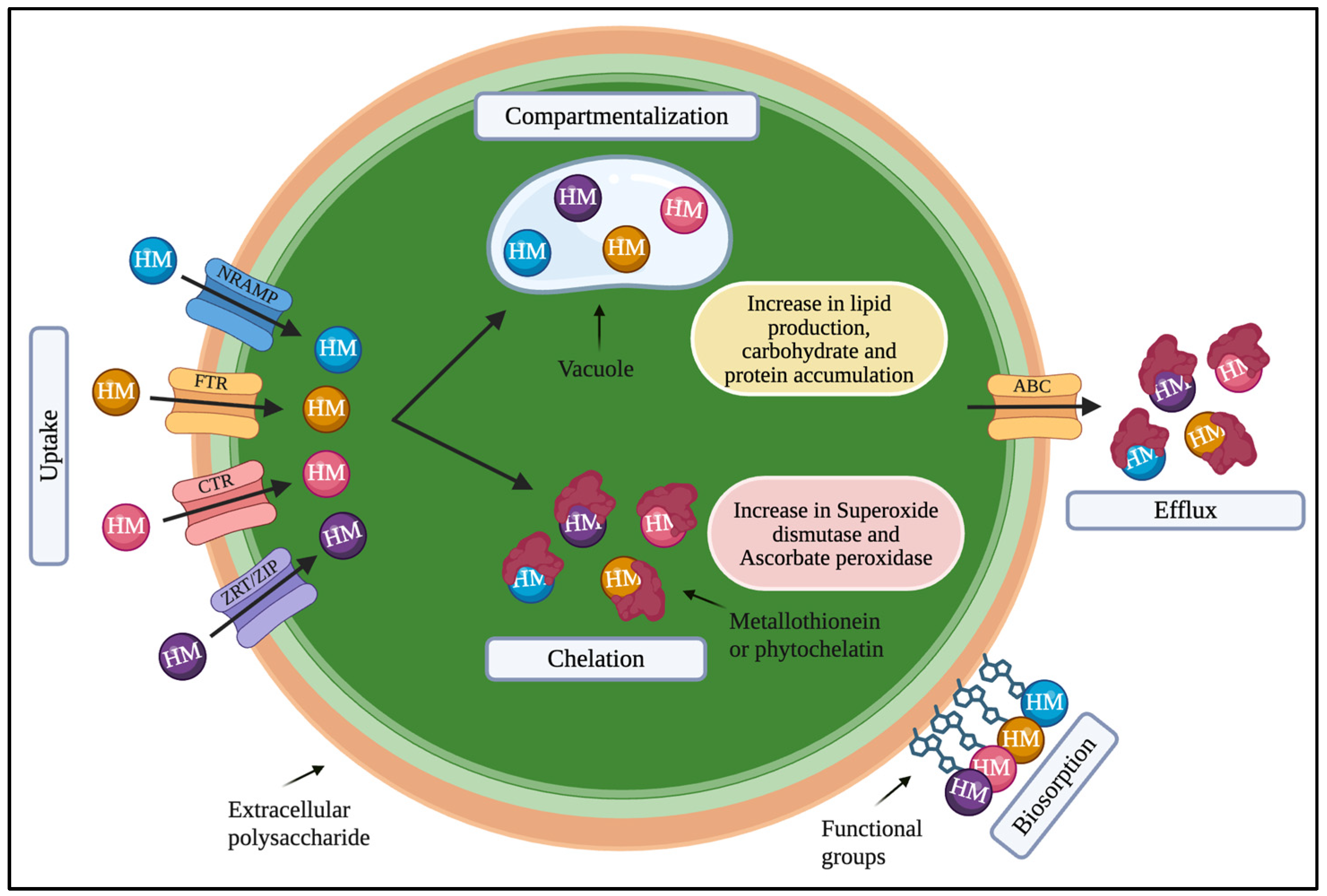

Prospects of Algal Strains for Acidic Wastewater Treatment

 , and
, and 
Abstract
1. Introduction
2. Algal Mechanisms for Acidic Wastewater Treatment
2.1. Passive Biosorption
2.2. Active Bioaccumulation

| Algae | pH Range | Reference |
|---|---|---|
| Chlamydomonas acidophila LAFIC-004 | 2.5–8.0 | [58] |
| Chlamydomonas eustigma | 2.0–6.0 | [34] |
| Chlamydomonas reinhardtii | 3.0–9.0 | [59] |
| Coccomyxa onubensis | 2.5–3.0 | [60] |
| Coccomyxa sp | 3.0–7.0 | [61] |
| Cyanidium sp. | 1.4–2.5 | [62] |
| Desmodesmus sp. MAS1 | 3–10.5 | [63] |
| Euglena sp. | 3.0–8.0 | [64] |
| Galdieria sulphuraria | 0–4 | [65] |
| Heterochlorella sp. MAS3 | 3–10.5 | [63] |
| Oscillatoria sp. | 2.93–6.78 | [66] |
| Pseudochlorella sp. YKT1 | 3.0–5.0 | [67] |
| Scenedesmus parvus | 3.0–9.0 | [68] |
| Tetratostichococcus sp. P1 | 3.0–8.0 | [69] |
3. Algal Potential for Biogas Upgrading
4. Application of Acidophilic and Acid-Tolerant Algae in Wastewater Treatment
| Algae Used | Type of Acidic Water Used (Synthetic or Real) | pH | Growth Conditions | Biomass Productivity | Remediated Potential (%) and Highlights | References |
|---|---|---|---|---|---|---|
| Desmodesmus sp. MAS1 and Heterochlorella sp. MAS3 | Modified BBM media with various heavy metals concentration | 3.5 | 30 mL flask cultivation; continuous light at 60 μmol m−2 s−1 | 0.27 to 0.4 relative fluorescence units per day; 12–20% biodiesel yield | Fe (40–80%), Mn (40–60%), Cu, Zn removal | [88] |
| Galdieria sulphuraria | Synthetic wastewater with Cd or Pb | 2.5 | 40 °C; 50 mL flask cultivation; continuous 4000 lux light for 7 days | 0.331 and 0.197 g/L day in 1.25 mg/L Cd and Pb | Cd (49.8%), Pb (25.1%), in addition to nutrients removal | [91] |
| Synthetic aqueous solution with Cd | 40 °C; 50 mL flask cultivation; 4000 lux light for 10days | 0.13–0.138 g/L day | Cd removal (30%), 1.59 mg/g sorption | [92] | ||
| Raw landfill leachate with additional nitrogen source | 42 °C; 50 mL flask cultivation; continuous light | 0.074 to 0.19 g/L day | NH4-N removal up to 100%, PO4-P removal up to 97.6% | [89] | ||
| 42 °C; 500 mL in Photobioreactor; 5-day cycles for 25 days | 0.356 to 0.768 g/L day | NH4-N removal up to 99.8%, PO4-P removal up to 100% | [89] | |||
| Galdieria phlegrea ACUF 784.3 | Raw municipal wastewater | 37 °C; 700 mL flask cultivation; 45 µmol photons/m2/s | 0.557 g/L after 9 days | 50% ammonium and 20% phosphate were removed in 24 hr | [90] | |
| Keratococcus rhaphidioides | Modified medium “A” | 3.0–4.0 | 8 °C; 7 L Photobioreactor; constant light at 80 µmol photons/m2/s for 34 days | 10-fold higher than flask culture | pH increases to as high as 10 daily. 7:1 (Fe:P) absorption ratio | [98] |
| Chlorella vulgaris UTEX # 265 with mixed algae and bacteria | Synthetic sulfate-containing wastewater | 3.5–4.0 | 25 °C; Revolving biofilm reactors; constant light at 130 µmol photons/m2/s for 4 weeks | Not reported | Sulfur removal up to 46% | [97] |
| Euglena gracilis CCALA 349 | Modified Hutner medium with various REE concentration (LaCl3 at 0–100uM) | ≤4.5 | 100 mL flask cultivation, dark | 10.27 g/L after 96 hr cultivation | 99.9% of REE removed | [96] |
| G. sulphuraria 074W | Altered Allen’s media | 0.5–2.5 | Glass vessels at 42 °C under constant light at 70 μE/m2s | Not reported | Removed 80% of Au3+ and Pd2+. And Pt4+ reached >60% | [93] |
| 0.3–2.3 | 50 mL glass vessels | 98% of cells adsorbed Au, 81% adsorbed Pd, and 67% adsorbed Pt | [94] |
5. Future Recommendations and Limitations
6. Conclusions
Author Contributions
Funding
Institutional Review Board Statement
Informed Consent Statement
Data Availability Statement
Acknowledgments
Conflicts of Interest
Abbreviations
| ALE | Adaptive laboratory evolution |
| CH4 | Methane |
| ABC transporters | ATP-binding cassette transporters |
| AL | Aluminum |
| BBM | Bold’s Basal Medium |
| C | Carbon |
| Cd | Cadmium |
| Ce3+ | Cerium |
| CM | Cyanidium medium |
| CO2 | Carbon dioxide |
| COD | Chemical oxygen demand |
| Cr | Chromium |
| CRISPR | Clustered Regularly Interspaced Short Palindromic Repeats |
| CTR | Copper transporters |
| Cu | Copper |
| Fe | Iron |
| FTIR | Fourier-transform infrared spectroscopy |
| FTR | Iron transporters |
| La3+ | Lanthanum |
| LCA | Life cycle assessment |
| LL | Landfill leachate |
| Mn | Manganese |
| N | Nitrogen |
| Na | Sodium |
| Nd3+ | Neodymium |
| Ni | Nickel |
| NRAMP | Natural resistance-associated macrophage proteins |
| Pb | Lead |
| RAB | Revolving algal biofilm |
| REEs | Rare earth elements |
| RFUs | Relative fluorescence units |
| SFAs | Saturated fatty acids |
| TEA | Techno-economic analysis |
| TN | Total nitrogen |
| TP | Total phosphorus |
| Zn | Zinc |
References
- Oladimeji, T.; Oyedemi, M.; Emetere, M.; Agboola, O.; Adeoye, J.; Odunlami, O. Review on the impact of heavy metals from industrial wastewater effluent and removal technologies. Heliyon 2024, 10, e40370. [Google Scholar] [CrossRef]
- Li, H.; Yao, J.; Min, N.; Duran, R. Comprehensive assessment of environmental and health risks of metal(loid)s pollution from non-ferrous metal mining and smelting activities. J. Clean. Prod. 2022, 375, 134049. [Google Scholar] [CrossRef]
- Gunarathne, V.; Phillips, A.J.; Zanoletti, A.; Rajapaksha, A.U.; Vithanage, M.; Maria, F.D.; Pivato, A.; Korzeniewska, E.; Bontempi, E. Environmental pitfalls and associated human health risks and ecological impacts from landfill leachate contaminants: Current evidence, recommended interventions and future directions. Sci. Total Environ. 2024, 912, 169026. [Google Scholar] [CrossRef]
- Masindi, V.; Foteinis, S.; Renforth, P.; Ndiritu, J.; Maree, J.P.; Tekere, M.; Chatzisymeon, E. Challenges and avenues for acid mine drainage treatment, beneficiation, and valorisation in circular economy: A review. Ecol. Eng. 2022, 183, 106740. [Google Scholar] [CrossRef]
- Sossou, K.; Prasad, S.B.; Agbotsou, K.E.; Souley, H.S.; Mudigandla, R. Characteristics of landfill leachate and leachate treatment by biological and advanced coagulation process: Feasibility and effectiveness—An overview. Waste Manag. Bull. 2024, 2, 181–198. [Google Scholar] [CrossRef]
- Rodríguez-Galán, M.; Baena-Moreno, F.M.; Vázquez, S.; Arroyo-Torralvo, F.; Vilches, L.F.; Zhang, Z. Remediation of acid mine drainage. Environ. Chem. Lett. 2019, 17, 1529–1538. [Google Scholar] [CrossRef]
- Matebese, F.; Mosai, A.K.; Tutu, H.; Tshentu, Z.R. Mining wastewater treatment technologies and resource recovery techniques: A review. Heliyon 2024, 10, e24730. [Google Scholar] [CrossRef]
- Meunier, N.; Drogui, P.; Montané, C.; Hausler, R.; Mercier, G.; Blais, J.-F. Comparison between electrocoagulation and chemical precipitation for metals removal from acidic soil leachate. J. Hazard. Mater. 2006, 137, 581–590. [Google Scholar] [CrossRef]
- Adnan, M.; Xiao, B.; Xiao, P.; Zhao, P.; Li, R.; Bibi, S. Research progress on heavy metals pollution in the soil of smelting sites in China. Toxics 2022, 10, 231. [Google Scholar] [CrossRef]
- Dybowska, A.; Farago, M.; Valsami-Jones, E.; Thornton, I. Remediation strategies for historical mining and smelting sites. Sci. Prog. 2006, 89, 71–138. [Google Scholar] [CrossRef]
- Gouider, M.; Feki, M.; Sayadi, S. Treatment of wastewaters from phosphate fertilizer industry. Environ. Prog. Sustain. Energy 2013, 33, 463–471. [Google Scholar] [CrossRef]
- Ahmad, N.; Usman, M.; Ahmad, H.R.; Sabir, M.; Farooqi, Z.U.R.; Shehzad, M.T. Environmental implications of phosphate-based fertilizer industrial waste and its management practices. Environ. Monit. Assess. 2023, 195, 1326. [Google Scholar] [CrossRef]
- Varghese, A.G.; Paul, S.A.; Latha, M. Remediation of heavy metals and dyes from wastewater using cellulose-based adsorbents. Environ. Chem. Lett. 2018, 17, 867–877. [Google Scholar] [CrossRef]
- Arora, N.; Tripathi, S.; Philippidis, G.P.; Kumar, S. Thriving in extremes: Harnessing the potential of pH-resilient algal strains for enhanced productivity and stability. Environ. Sci. Adv. 2025, 4, 884–900. [Google Scholar] [CrossRef]
- Jarnerud, T.; Karasev, A.V.; Jönsson, P.G. Neutralization of acidic wastewater from a steel plant by using CaO-containing waste materials from pulp and paper industries. Materials 2021, 14, 2653. [Google Scholar] [CrossRef]
- Meng, S.; Wen, S.; Han, G.; Wang, X.; Feng, Q. Wastewater treatment in mineral processing of non-ferrous metal resources: A Review. Water 2022, 14, 726. [Google Scholar] [CrossRef]
- Kim, M.; Yoon, Y.; Kamal, N.; Choong, C.E.; Jang, M.; Lee, G. Successive alkali diffusion ceramic reactor: Long-term removal of acidity and heavy metals in acid mine drainage. J. Water Process Eng. 2023, 53, 103858. [Google Scholar] [CrossRef]
- Monje, V.; Nobel, P.; Junicke, H.; Kjellberg, K.; Gernaey, K.V.; Flores-Alsina, X. Assessment of alkaline stabilization processes in industrial waste streams using a model-based approach. J. Environ. Manag. 2021, 293, 112806. [Google Scholar] [CrossRef]
- Nkuna, S.G.; Olwal, T.O.; Chowdhury, S.D.; Ndambuki, J.M. A review of wastewater sludge-to-energy generation focused on thermochemical technologies: An improved technological, economical and socio-environmental aspect. Clean. Waste Syst. 2024, 7, 100130. [Google Scholar] [CrossRef]
- Saeed, M.U.; Hussain, N.; Sumrin, A.; Shahbaz, A.; Noor, S.; Bilal, M.; Aleya, L.; Iqbal, H.M. Microbial bioremediation strategies with wastewater treatment potentialities–A review. Sci. Total Environ. 2022, 818, 151754. [Google Scholar] [CrossRef]
- Alharbi, R.M.; Abdel-Raouf, N.; Mohamed, M.S.; Fathy, W.A.; Ibraheem, I.B.M.; Hozayen, W.G. Phycomediation of cadmium contaminated aqueous solutions using Chlamydomonas sp.: Process optimization and adsorption characterization. Front. Bioeng. Biotechnol. 2025, 13, 1558757. [Google Scholar] [CrossRef]
- Zhu, J.; Guo, B.; Qie, F.; Li, X.; Zhao, X.; Rong, J.; Zong, B. A sustainable integration of removing CO2/NOx and producing biomass with high content of lipid/protein by microalgae. J. Energy Chem. 2022, 73, 13–25. [Google Scholar] [CrossRef]
- Ahmad, A.; Banat, F.; Alsafar, H.; Hasan, S.W. Algae biotechnology for industrial wastewater treatment, bioenergy production, and high-value bioproducts. Sci. Total Environ. 2022, 806, 150585. [Google Scholar] [CrossRef]
- Delanka-Pedige, H.M.K.; Munasinghe-Arachchige, S.P.; Cornelius, J.; Henkanatte-Gedera, S.M.; Tchinda, D.; Zhang, Y.; Nirmalakhandan, N. Pathogen reduction in an algal-based wastewater treatment system employing Galdieria sulphuraria. Algal Res. 2019, 39, 101423. [Google Scholar] [CrossRef]
- Alazaiza, M.Y.D.; He, S.; Su, D.; Amr, S.S.A.; Toh, P.Y.; Bashir, M.J.K. Sewage water treatment using Chlorella vulgaris microalgae for simultaneous nutrient separation and biomass production. Separations 2023, 10, 229. [Google Scholar] [CrossRef]
- Ma, X.; Chen, Y.; Liu, F.; Zhang, S.; Wei, Q. Enhanced tolerance and resistance characteristics of Scenedesmus obliquus FACHB-12 with K3 carrier in cadmium polluted water. Algal Res. 2021, 55, 102267. [Google Scholar] [CrossRef]
- Sepehri, A.; Sarrafzadeh, M.-H.; Avateffazeli, M. Interaction between Chlorella vulgaris and nitrifying-enriched activated sludge in the treatment of wastewater with low C/N ratio. J. Clean. Prod. 2020, 247, 119164. [Google Scholar] [CrossRef]
- Li, Y.; Zhou, W.; Hu, B.; Min, M.; Chen, P.; Ruan, R.R. Integration of algae cultivation as biodiesel production feedstock with municipal wastewater treatment: Strains screening and significance evaluation of environmental factors. Bioresour. Technol. 2011, 102, 10861–10867. [Google Scholar] [CrossRef]
- Abiusi, F.; Trompetter, E.; Pollio, A.; Wijffels, R.H.; Janssen, M. Acid tolerant and acidophilic microalgae: An underexplored world of biotechnological opportunities. Front. Microbiol. 2022, 13, 820907. [Google Scholar] [CrossRef]
- Porowska, D. Determination of the origin of dissolved inorganic carbon in groundwater around a reclaimed landfill in Otwock using stable carbon isotopes. Waste Manag. 2015, 39, 216–225. [Google Scholar] [CrossRef]
- Henkanatte-Gedera, S.; Selvaratnam, T.; Karbakhshravari, M.; Myint, M.; Nirmalakhandan, N.; Van Voorhies, W.; Lammers, P.J. Removal of dissolved organic carbon and nutrients from urban wastewaters by Galdieria sulphuraria: Laboratory to field scale demonstration. Algal Res. 2017, 24, 450–456. [Google Scholar] [CrossRef]
- Solovchenko, A.; Khozin-Goldberg, I. High-CO2 tolerance in microalgae: Possible mechanisms and implications for biotechnology and bioremediation. Biotechnol. Lett. 2013, 35, 1745–1752. [Google Scholar] [CrossRef]
- Abinandan, S.; Venkateswarlu, K.; Megharaj, M. Phenotypic changes in microalgae at acidic pH mediate their tolerance to higher concentrations of transition metals. Curr. Res. Microb. Sci. 2021, 2, 100081. [Google Scholar] [CrossRef] [PubMed]
- Hirooka, S.; Hirose, Y.; Kanesaki, Y.; Higuchi, S.; Fujiwara, T.; Onuma, R.; Era, A.; Ohbayashi, R.; Uzuka, A.; Nozaki, H.; et al. Acidophilic green algal genome provides insights into adaptation to an acidic environment. Proc. Natl. Acad. Sci. USA 2017, 114, E8304–E8313. [Google Scholar] [CrossRef] [PubMed]
- Taylor, A.R.; Brownlee, C.; Wheeler, G.L. Proton channels in algae: Reasons to be excited. Trends Plant Sci. 2012, 17, 675–684. [Google Scholar] [CrossRef]
- Gimmler, H.; Treffny, B.; Kowalski, M.; Zimmermann, U. The resistance of Dunaliella acidophila against heavy metals: The importance of the zeta potential. J. Plant Physiol. 1991, 138, 708–716. [Google Scholar] [CrossRef]
- Iovinella, M.; Carbone, D.A.; Cioppa, D.; Davis, S.J.; Innangi, M.; Esposito, S.; Ciniglia, C. Prevalent pH controls the capacity of Galdieria maxima to use ammonia and nitrate as a nitrogen source. Plants 2020, 9, 232. [Google Scholar] [CrossRef]
- Mustafa, S.; Bhatti, H.N.; Maqbool, M.; Iqbal, M. Microalgae biosorption, bioaccumulation and biodegradation efficiency for the remediation of wastewater and carbon dioxide mitigation: Prospects, challenges and opportunities. J. Water Process Eng. 2021, 41, 102009. [Google Scholar] [CrossRef]
- Pérez-Rama, M.; Alonso, J.A.; López, C.H.; Vaamonde, E.T. Cadmium removal by living cells of the marine microalga Tetraselmis suecica. Bioresour. Technol. 2002, 84, 265–270. [Google Scholar] [CrossRef]
- Priyadarshini, E.; Priyadarshini, S.S.; Pradhan, N. Heavy metal resistance in algae and its application for metal nanoparticle synthesis. Appl. Microbiol. Biotechnol. 2019, 103, 3297–3316. [Google Scholar] [CrossRef]
- Soto-Ramírez, R.; Lobos, M.-G.; Córdova, O.; Poirrier, P.; Chamy, R. Effect of growth conditions on cell wall composition and cadmium adsorption in Chlorella vulgaris: A new approach to biosorption research. J. Hazard. Mater. 2021, 411, 125059. [Google Scholar] [CrossRef]
- Karnwal, A. Unveiling the promise of biosorption for heavy metal removal from water sources. Desalination Water Treat. 2024, 319, 100523. [Google Scholar] [CrossRef]
- Abinandan, S.; Subashchandrabose, S.R.; Venkateswarlu, K.; Megharaj, M. Sustainable iron recovery and biodiesel yield by acid-adapted microalgae, Desmodesmus sp. MAS1 and Heterochlorella sp. MAS3, grown in synthetic acid mine drainage. ACS Omega 2020, 5, 6888–6894. [Google Scholar] [CrossRef]
- Bilal, M.; Rasheed, T.; Sosa-Hernández, J.E.; Raza, A.; Nabeel, F.; Iqbal, H.M. Biosorption: An interplay between marine algae and potentially toxic elements—A review. Mar. Drugs 2018, 16, 65. [Google Scholar] [CrossRef] [PubMed]
- Shamim, S. Biosorption of heavy metals. Biosorption 2018, 2, 21–49. [Google Scholar] [CrossRef]
- Iddrisu, L.; Danso, F.; Cheong, K.-L.; Fang, Z.; Zhong, S. Polysaccharides as protective agents against heavy metal toxicity. Foods 2024, 13, 853. [Google Scholar] [CrossRef]
- Vijayaraghavan, K.; Yun, Y.-S. Bacterial biosorbents and biosorption. Biotechnol. Adv. 2008, 26, 266–291. [Google Scholar] [CrossRef] [PubMed]
- Massocato, T.F.; Ramos, J.C.; Bascuñan, V.L.F.; Simioni, C.; Rörig, L.R.; Barufi, J.B. Tolerance of Ulothrix sp. LAFIC 010 (Chlorophyta) against high concentration of metals from acid mine drainage. Ecotoxicol. Environ. Saf. 2018, 157, 227–234. [Google Scholar] [CrossRef]
- Gaur, J.; Rai, L. Heavy Metal Tolerance in Algae. In Algal Adaptation to Environmental Stresses: Physiological, Biochemical and Molecular Mechanisms; Springer: Berlin/Heidelberg, Germany, 2001; pp. 363–388. [Google Scholar]
- Liu, A.; Zhang, L.; Zhou, A.; Yang, F.; Yue, Z.; Wang, J. Metabolomic and physiological changes of acid-tolerant Graesiella sp. MA1 during long-term acid stress. Environ. Sci. Pollut. 2023, 30, 97209–97218. [Google Scholar] [CrossRef]
- Kharel, H.L.; Tan, M.; Jha, L.; Selvaratnam, T. Removal of cadmium (II), lead (II), nickel (II), and zinc (II) from synthetic medium by extremophile red alga Galdieria sulphuraria: Investigating single and mixed metal systems. Algal Res. 2024, 83, 103699. [Google Scholar] [CrossRef]
- Zhang, L.; Wang, J.; Shao, R.; Chuai, X.; Wang, S.; Yue, Z. Detoxification and removal of heavy metal by an acid-tolerant microalgae, Graesiella sp. MA1. J. Water Process Eng. 2024, 64, 105579. [Google Scholar] [CrossRef]
- Sathasivam, R.; Ki, J.-S. Heat shock protein genes in the green alga Tetraselmis suecica and their role against redox and non-redox active metals. Eur. J. Protistol. 2019, 69, 37–51. [Google Scholar] [CrossRef]
- Cho, C.H.; Park, S.I.; Huang, T.-Y.; Lee, Y.; Ciniglia, C.; Yadavalli, H.C.; Yang, S.W.; Bhattacharya, D.; Yoon, H.S. Genome-wide signatures of adaptation to extreme environments in red algae. Nat. Commun. 2023, 14, 10. [Google Scholar] [CrossRef]
- Palmgren, M.; Engström, K.; Hallström, B.M.; Wahlberg, K.; Søndergaard, D.A.; Säll, T.; Vahter, M.; Broberg, K. AS3MT-mediated tolerance to arsenic evolved by multiple independent horizontal gene transfers from bacteria to eukaryotes. PLoS ONE 2017, 12, e0175422. [Google Scholar] [CrossRef] [PubMed]
- Blaby-Haas, C.E.; Merchant, S.S. The ins and outs of algal metal transport. Biochim. Biophys. Acta 2012, 1823, 1531–1552. [Google Scholar] [CrossRef]
- Zheng, C.; Aslam, M.; Liu, X.; Du, H.; Xie, X.; Jia, H.; Huang, N.; Tang, K.; Yang, Y.; Li, P. Impact of Pb on Chlamydomonas reinhardtii at physiological and transcriptional levels. Front. Microbiol. 2020, 11, 1443. [Google Scholar] [CrossRef]
- de Farias Nevesad, F.; Dernerb, R.B.; Rorigc, L.R.; de Melo, H. Growth performance of an acidophilic microalga cultivated in treated wastewater. J. Algal Biomass Util. 2017, 8, 125–130. [Google Scholar]
- Messerli, M.A.; Amaral-Zettler, L.A.; Zettler, E.; Jung, S.-K.; Smith, P.J.; Sogin, M.L. Life at acidic pH imposes an increased energetic cost for a eukaryotic acidophile. J. Exp. Biol. 2005, 208, 2569–2579. [Google Scholar] [CrossRef]
- Fuentes, J.-L.; Montero, Z.; Cuaresma, M.; Ruiz-Domínguez, M.-C.; Mogedas, B.; Nores, I.G.; González del Valle, M.; Vílchez, C. Outdoor large-scale cultivation of the acidophilic microalga Coccomyxa onubensis in a vertical close photobioreactor for lutein production. Processes 2020, 8, 324. [Google Scholar] [CrossRef]
- Gauthier, M.; Senhorinho, G.; Basiliko, N.; Desjardins, S.; Scott, J. Green photosynthetic microalgae from low pH environments associated with mining as a potential source of antioxidants. Ind. Biotechnol. 2022, 18, 168–175. [Google Scholar] [CrossRef]
- Kvíderová, J. Photochemical performance of the acidophilic red alga Cyanidium sp. in a pH gradient. Orig. Life Evol. Biosph. 2012, 42, 223–234. [Google Scholar] [CrossRef] [PubMed]
- Abinandan, S.; Subashchandrabose, S.R.; Venkateswarlu, K.; Perera, I.A.; Megharaj, M. Acid-tolerant microalgae can withstand higher concentrations of invasive cadmium and produce sustainable biomass and biodiesel at pH 3.5. Bioresour. Technol. 2019, 281, 469–473. [Google Scholar] [CrossRef] [PubMed]
- Yoshioka, K.; Suzuki, K.; Osanai, T. Effect of pH on metabolite excretion and cell morphology of Euglena gracilis under dark, anaerobic conditions. Algal Res. 2020, 51, 102084. [Google Scholar] [CrossRef]
- Barbier, G.; Oesterhelt, C.; Larson, M.D.; Halgren, R.G.; Wilkerson, C.; Garavito, R.M.; Benning, C.; Weber, A.P. Comparative genomics of two closely related unicellular thermo-acidophilic red algae, Galdieria sulphuraria and Cyanidioschyzon merolae, reveals the molecular basis of the metabolic flexibility of Galdieria sulphuraria and significant differences in carbohydrate metabolism of both algae. Plant Physiol. 2005, 137, 460–474. [Google Scholar] [CrossRef]
- Sheoran, A.; Bhandari, S. Treatment of mine water by a microbial mat: Bench-scale experiments. Mine Water Environ. 2005, 24, 38–42. [Google Scholar] [CrossRef]
- Hirooka, S.; Higuchi, S.; Uzuka, A.; Nozaki, H.; Miyagishima, S.-y. Acidophilic green alga Pseudochlorella sp. YKT1 accumulates high amount of lipid droplets under a nitrogen-depleted condition at a low-pH. PLoS ONE 2014, 9, e107702. [Google Scholar] [CrossRef]
- Tan, K.; Kassim, M.; Ng, Z.; Lalung, J. Isolation and characterization of novel acidophilic microalgae from abandoned mining site area for carbohydrate biosynthesis and its kinetic growth study in photobioreactor. IOP Conf. Ser. Mater. Sci. Eng. 2020, 716, 012011. [Google Scholar]
- Sahabudin, E.; Lee, J.; Asada, R.; Marsid, E.A.; Yusof, N.; Ahmad Sabri, N.S.; Susanti, H.; Muhammad Yuzir, M.A.; Md Akhir, F.N.; Othman, N.a. Isolation and characterization of acid-tolerant Stichococcus-like Microalga (Tetratostichococcus sp. P1) from a tropical peatland in Malaysia. J. Appl. Phycol. 2022, 34, 1881–1892. [Google Scholar] [CrossRef]
- Wall, D.M.; McDonagh, S.; Murphy, J.D. Cascading biomethane energy systems for sustainable green gas production in a circular economy. Bioresour. Technol. 2017, 243, 1207–1215. [Google Scholar] [CrossRef]
- Waseem, M.; Khan, M.U.; Bokhary, A.; Ahring, B.K. Emerging Trends in Sewage Sludge Pretreatment: Enhancing Treatment Efficiency and Sustainable Waste Management. Clean. Water 2025, 3, 100080. [Google Scholar] [CrossRef]
- Macor, A.; Benato, A. A human health toxicity assessment of biogas engines regulated and unregulated emissions. Appl. Sci. 2020, 10, 7048. [Google Scholar] [CrossRef]
- Rasi, S.; Veijanen, A.; Rintala, J. Trace compounds of biogas from different biogas production plants. Energy 2007, 32, 1375–1380. [Google Scholar] [CrossRef]
- Allen, M.R.; Braithwaite, A.; Hills, C.C. Trace organic compounds in landfill gas at seven UK waste disposal sites. Environ. Sci. Technol. 1997, 31, 1054–1061. [Google Scholar] [CrossRef]
- Lanzini, A.; Madi, H.; Chiodo, V.; Papurello, D.; Maisano, S.; Santarelli, M. Dealing with fuel contaminants in biogas-fed solid oxide fuel cell (SOFC) and molten carbonate fuel cell (MCFC) plants: Degradation of catalytic and electro-catalytic active surfaces and related gas purification methods. Prog. Energy Combust. Sci. 2017, 61, 150–188. [Google Scholar] [CrossRef]
- Ryckebosch, E.; Drouillon, M.; Vervaeren, H. Techniques for transformation of biogas to biomethane. Biomass Bioenergy 2011, 35, 1633–1645. [Google Scholar] [CrossRef]
- Toledo-Cervantes, A.; Estrada, J.M.; Lebrero, R.; Muñoz, R. A comparative analysis of biogas upgrading technologies: Photosynthetic vs. physical/chemical processes. Algal Res. 2017, 25, 237–243. [Google Scholar] [CrossRef]
- Xu, J.; Wang, X.; Sun, S.; Zhao, Y.; Hu, C. Effects of influent C/N ratios and treatment technologies on integral biogas upgrading and pollutants removal from synthetic domestic sewage. Sci. Rep. 2017, 7, 10897. [Google Scholar] [CrossRef]
- Werkneh, A.A. Biogas impurities: Environmental and health implications, removal technologies and future perspectives. Heliyon 2022, 8, e10929. [Google Scholar] [CrossRef]
- Yan, C.; Zheng, Z. Performance of photoperiod and light intensity on biogas upgrade and biogas effluent nutrient reduction by the microalgae Chlorella sp. Bioresour. Technol. 2013, 139, 292–299. [Google Scholar] [CrossRef]
- Henard, C.A.; Franklin, T.G.; Youhenna, B.; But, S.; Alexander, D.; Kalyuzhnaya, M.G.; Guarnieri, M.T. Biogas biocatalysis: Methanotrophic bacterial cultivation, metabolite profiling, and bioconversion to lactic acid. Front. Microbiol. 2018, 9, 2610. [Google Scholar] [CrossRef]
- Ali, B.T.I.; Senda, S.P.; Yanti, F.M.; Baruji, T.; Priambodo, T.B.; Yurismono, H.; Wulandari, W.; Prasetyo, D.H.; Pertiwi, A.; Tjahjono, E.W. Enhancing biogas production with fungi from oil palm empty fruit bunches: Isolation and innovative application. Case Stud. Chem. Environ. Eng. 2024, 10, 100845. [Google Scholar] [CrossRef]
- Wang, X.; Bao, K.; Cao, W.; Zhao, Y.; Hu, C.W. Screening of microalgae for integral biogas slurry nutrient removal and biogas upgrading by different microalgae cultivation technology. Sci. Rep. 2017, 7, 5426. [Google Scholar] [CrossRef]
- Angelidaki, I.; Treu, L.; Tsapekos, P.; Luo, G.; Campanaro, S.; Wenzel, H.; Kougias, P.G. Biogas upgrading and utilization: Current status and perspectives. Biotechnol. Adv. 2018, 36, 452–466. [Google Scholar] [CrossRef]
- Miyawaki, B.; Mariano, A.; Vargas, J.; Balmant, W.; Defrancheschi, A.; Corrêa, D.; Santos, B.; Selesu, N.; Ordonez, J.; Kava, V. Microalgae derived biomass and bioenergy production enhancement through biogas purification and wastewater treatment. Renew. Energy 2021, 163, 1153–1165. [Google Scholar] [CrossRef]
- Wojaczek, B.; Singer, E.; Vivekanand, V.; Lindenberger, C. From biogas to biomethane: Evaluating the role of microalgae in sustainable energy production–A review. Algal Res. 2024, 85, 103835. [Google Scholar] [CrossRef]
- Haider, M.N.; O’Higgins, L.; O’Shea, R.; Archer, L.; Wall, D.M.; Verma, N.; del Rosario Rodero, M.; Mehmood, M.A.; Murphy, J.D.; Bose, A. Selecting optimal algal strains for robust photosynthetic upgrading of biogas under temperate oceanic climates. Biotechnol. Adv. 2025, 82, 108581. [Google Scholar] [CrossRef]
- Abinandan, S.; Subashchandrabose, S.R.; Panneerselvan, L.; Venkateswarlu, K.; Megharaj, M. Potential of acid-tolerant microalgae, Desmodesmus sp. MAS1 and Heterochlorella sp. MAS3, in heavy metal removal and biodiesel production at acidic pH. Bioresour. Technol. 2019, 278, 9–16. [Google Scholar] [CrossRef]
- Selvaratnam, T.; Pan, S.; Rahman, A.; Tan, M.; Kharel, H.L.; Agrawal, S.; Nawaz, T. Bioremediation of Raw Landfill Leachate Using Galdieria sulphuraria: An Algal-Based System for Landfill Leachate Treatment. Water 2022, 14, 2389. [Google Scholar] [CrossRef]
- Cicco, M.R.d.; Palmieri, M.; Altieri, S.; Ciniglia, C.; Lubritto, C. Cultivation of the acidophilic microalgae Galdieria phlegrea with Wastewater: Process Yields. Int. J. Environ. Res. Public Health 2021, 18, 2291. [Google Scholar] [CrossRef] [PubMed]
- Kharel, H.L.; Shrestha, I.; Tan, M.; Selvaratnam, T. Removal of cadmium and lead from synthetic wastewater using Galdieria sulphuraria. Environments 2023, 10, 174. [Google Scholar] [CrossRef]
- Kharel, H.L.; Jha, L.; Tan, M.; Selvaratnam, T. Removal of cadmium (II) from aqueous solution using Galdieria sulphuraria CCMEE 5587.1. BioTech 2024, 13, 28. [Google Scholar] [CrossRef] [PubMed]
- Ju, X.; Igarashi, K.; Miyashita, S.-i.; Mitsuhashi, H.; Inagaki, K.; Fujii, S.-i.; Sawada, H.; Kuwabara, T.; Minoda, A. Effective and selective recovery of gold and palladium ions from metal wastewater using a sulfothermophilic red alga, Galdieria sulphuraria. Bioresour. Technol. 2016, 211, 759–764. [Google Scholar] [CrossRef]
- Minoda, A.; Miyashita, S.-i.; Fujii, S.-i.; Inagaki, K.; Takahashi, Y. Cell population behavior of the unicellular red alga Galdieria sulphuraria during precious metal biosorption. J. Hazard. Mater. 2022, 432, 128576. [Google Scholar] [CrossRef] [PubMed]
- Malhotra, N.; Hsu, H.-S.; Liang, S.-T.; Roldan, M.J.M.; Lee, J.-S.; Ger, T.-R.; Hsiao, C.-D. An updated review of toxicity effect of the rare earth elements (REEs) on aquatic organisms. Animals 2020, 9, 1663. [Google Scholar] [CrossRef] [PubMed]
- Kim, J.Y.; Kim, K.Y.; Kim, S.M.; Choi, Y.-E. Use of rare earth element (REE)-contaminated acidic water as Euglena gracilis growth stimulator: A strategy for bioremediation and simultaneous increase in biodiesel productivity. Chem. Eng. J. 2022, 445, 136814. [Google Scholar] [CrossRef]
- Zhou, H.; Sheng, Y.; Zhao, X.; Gross, M.; Wen, Z. Treatment of acidic sulfate-containing wastewater using revolving algae biofilm reactors: Sulfur removal performance and microbial community characterization. Bioresour. Technol. 2018, 264, 24–34. [Google Scholar] [CrossRef]
- Cabrera, J.M.; Schultz, S.S.; Baffico, G.D.; Rodriguez, M.C.; Pedrozo, F.L.; Diaz, M.M. Nutritional and ecotoxicological aspects of the acidotolerant alga Keratococcus rhaphidioides (Chlorophyta): A potential candidate for algal mediated bioremediation of extremely acidic waters. J. Appl. Phycol. 2021, 33, 1961–1975. [Google Scholar] [CrossRef]
- Magalhães, I.B.; Ferreira, J.; Castro, J.d.S.; Assis, L.R.d.; Calijuri, M.L. Technologies for improving microalgae biomass production coupled to effluent treatment: A life cycle approach. Algal Res. 2021, 57, 102346. [Google Scholar] [CrossRef]
- Khatiwada, B.; Hasan, M.T.; Sun, A.; Kamath, K.S.; Mirzaei, M.; Sunna, A.; Nevalainen, H. Proteomic response of Euglena gracilis to heavy metal exposure—Identification of key proteins involved in heavy metal tolerance and accumulation. Algal Res. 2020, 45, 101764. [Google Scholar] [CrossRef]
- Bennett, A.F.; Dao, K.M.; Lenski, R.E. Rapid evolution in response to high-temperature selection. Nature 1990, 346, 79–81. [Google Scholar] [CrossRef]
- Dragosits, M.; Mattanovich, D. Adaptive laboratory evolution—Principles and applications for biotechnology. Microb. Cell Factories 2013, 12, 64. [Google Scholar] [CrossRef]
- Hu, L.; Fang, X.; Wen, L.; Zhang, H.; Peng, B.; Li, C. Molecular insights into the enhanced growth of cyanobacteria by adaptive laboratory evolution in wastewater environments. Algal Res. 2024, 83, 103724. [Google Scholar] [CrossRef]
- Marchetto, F.; Conde, T.; Śliwińska, M.A.; Rewerski, B.; Lebiedzińska-Arciszewska, M.; Szymański, J.; Więckowski, M.R.; Matlakowska, R.; Domingues, M.R.; Kargul, J. Adaptive laboratory evolution of extremophilic red microalga Cyanidioschyzon merolae under high nickel stress enhances lipid production and alleviates oxidative damage. Bioresour. Technol. 2025, 434, 132826. [Google Scholar] [CrossRef]
- Aratboni, H.A.; Rafiei, N.; Garcia-Granados, R.; Alemzadeh, A.; Morones-Ramírez, J.R. Biomass and lipid induction strategies in microalgae for biofuel production and other applications. Microb. Cell Factories 2019, 18, 178. [Google Scholar] [CrossRef]
- Kasai, Y.; Takagi, S.; Ota, S.; Ishii, K.; Takeshita, T.; Kawano, S.; Harayama, S. Development of a CRISPR/Cas9-mediated gene-editing method to isolate a mutant of the unicellular green alga Parachlorella kessleri strain NIES-2152 with improved lipid productivity. Biotechnol. Biofuels Bioprod. 2024, 17, 36. [Google Scholar] [CrossRef]
- Ma, J.; Cui, Y.; Zhou, R.; Sun, F.; Zhang, H.; Meng, C.; Chen, G.; Gao, Z. Adaptive laboratory evolutionary strategies and mechanisms of Synechococcus elongatu PCC 7942 under high concentration of CO2. Bioresour. Technol. 2025, 434, 132789. [Google Scholar] [CrossRef] [PubMed]
- Mejía-Díaz, H.; Santiago-Alarcon, D.; Venegas-Andraca, S.E. A proposal for the quantum mechanical study of genomic mutations driven by environmental stressors. Proc. A 2025, 481, 20240439. [Google Scholar] [CrossRef]
- Fu, W.; Gudmundsson, S.; Wichuk, K.; Palsson, S.; Palsson, B.O.; Salehi-Ashtiani, K.; Brynjólfsson, S. Sugar-stimulated CO2 sequestration by the green microalga Chlorella vulgaris. Sci. Total Environ. 2019, 654, 275–283. [Google Scholar] [CrossRef]
- Harun, R.; Singh, M.; Forde, G.M.; Danquah, M.K. Bioprocess engineering of microalgae to produce a variety of consumer products. Renew. Sustain. Energy Rev. 2010, 14, 1037–1047. [Google Scholar] [CrossRef]
- Hoffman, J.; Pate, R.C.; Drennen, T.; Quinn, J.C. Techno-economic assessment of open microalgae production systems. Algal Res. 2017, 23, 51–57. [Google Scholar] [CrossRef]
- Ren, S.; Shao, C.; Zhu, F.; Schagerl, M.; Hu, X.; Sobhi, M.; Xu, L.; Qian, J.; Huo, S. Optimization and synergistic enhancement of microalgae productivity in laboratory raceway ponds via co-regulation of automated light-supplemented mixers and electric field system. Biotechnol. Biofuels Bioprod. 2025, 18, 63. [Google Scholar] [CrossRef] [PubMed]
- Benavides, A.M.S.; Torzillo, G.; Kopecký, J.; Masojídek, J. Productivity and biochemical composition of Phaeodactylum tricornutum (Bacillariophyceae) cultures grown outdoors in tubular photobioreactors and open ponds. Biomass Bioenergy 2013, 54, 115–122. [Google Scholar] [CrossRef]
- Dasan, Y.K.; Lam, M.K.; Yusup, S.; Lim, J.W.; Lee, K.T. Life cycle evaluation of microalgae biofuels production: Effect of cultivation system on energy, carbon emission and cost balance analysis. Sci. Total Environ. 2019, 688, 112–128. [Google Scholar] [CrossRef]

| Type of Acidic Wastewater | pH Range | Metal Composition | Reference |
|---|---|---|---|
| Mining and ore processing | 1.0–3.0 | Hg2+, Cr6+, Cu2+, Ni2+, Mn2+, Fe2+, Cd2+, Zn2+, Pb2+, As+3/As+5, Sb+3/Sb+5, Au+3 | [7] |
| Acid mine drainage | 2.0–4.5 | Al3+, Fe2+/Fe3+, Mg2+, Cu2+, Mn2+, Zn2+ | [6] |
| Acidic leachates | 1.9–5.5 | Cu2+, Ni2+, Mn2+, Fe2+, Cd2+, Zn2+, Pb2+ | [8] |
| Metal smelting | 2.0–4.5 | Pb2+, Cd2+, As+3/As+5, Cr6+ | [9,10] |
| Phosphate fertilizer industry | 1.5–4.0 | Fe2+, Ni2+, Zn2+, Cr3+, Al3+, As+3/As+5, Cd2+, V | [11,12] |
| Acidic dye wastewater | 3.0–5.0 | Pb2+, Cd2+, Zn2+, Hg2+, Cr6+, Cu2+, Fe2+ | [13] |
Disclaimer/Publisher’s Note: The statements, opinions and data contained in all publications are solely those of the individual author(s) and contributor(s) and not of MDPI and/or the editor(s). MDPI and/or the editor(s) disclaim responsibility for any injury to people or property resulting from any ideas, methods, instructions or products referred to in the content. |
© 2025 by the authors. Licensee MDPI, Basel, Switzerland. This article is an open access article distributed under the terms and conditions of the Creative Commons Attribution (CC BY) license.
Share and Cite
Slick, P.; Arora, N.; Lo, E.; Santiago-Alarcon, D.; Philippidis, G.P. Prospects of Algal Strains for Acidic Wastewater Treatment. Appl. Sci. 2026, 16, 216. https://doi.org/10.3390/app16010216
Slick P, Arora N, Lo E, Santiago-Alarcon D, Philippidis GP. Prospects of Algal Strains for Acidic Wastewater Treatment. Applied Sciences. 2026; 16(1):216. https://doi.org/10.3390/app16010216
Chicago/Turabian StyleSlick, Paulina, Neha Arora, Enlin Lo, Diego Santiago-Alarcon, and George P. Philippidis. 2026. "Prospects of Algal Strains for Acidic Wastewater Treatment" Applied Sciences 16, no. 1: 216. https://doi.org/10.3390/app16010216
APA StyleSlick, P., Arora, N., Lo, E., Santiago-Alarcon, D., & Philippidis, G. P. (2026). Prospects of Algal Strains for Acidic Wastewater Treatment. Applied Sciences, 16(1), 216. https://doi.org/10.3390/app16010216