Article

Research on Two-Stage Parameter Identification for Various Lithium-Ion Battery Models Using Bio-Inspired Optimization Algorithms


1
Department of Marine Engineering, National Taiwan Ocean University, Keelung 202301, Taiwan
2
Department of Electrical Engineering, National Taiwan University of Science and Technology, Taipei 106335, Taiwan
*
Author to whom correspondence should be addressed.
Appl. Sci. 2026, 16(1), 202; https://doi.org/10.3390/app16010202
Submission received: 17 November 2025 / Revised: 15 December 2025 / Accepted: 22 December 2025 / Published: 24 December 2025
(This article belongs to the Section Electrical, Electronics and Communications Engineering)

Featured Application

Integrating an IoT-based monitoring framework with the proposed methodology enables high-accuracy and cost-effective battery modeling and parameter identification. It supports advanced SOC and SOH estimation techniques for online battery management system applications in electric vehicles and battery energy storage systems.

Abstract

Lithium-ion batteries (LIBs) are vital components in electric vehicles (EVs) and battery energy storage systems (BESS). Accurate estimation of the state of charge (SOC) and state of health (SOH) depends heavily on precise battery modeling. This paper examines six commonly used equivalent circuit models (ECMs) by deriving their impedance transfer functions and comparing them with measured electrochemical impedance spectroscopy (EIS) data. The particle swarm optimization (PSO) algorithm is first utilized to identify the ECM with the best EIS fit. Then, thirteen bio-inspired optimization algorithms (BIOAs) are employed for parameter identification and comparison. Results show that the fractional-order R(RQ)(RQ) model with a mean absolute percentage error (MAPE) of 10.797% achieves the lowest total model fitting error and possesses the highest matching accuracy. In model parameter identification using BIOAs, the marine predators algorithm (MPA) reaches the lowest estimated MAPE of 10.694%, surpassing other algorithms in this study. The Friedman ranking test further confirms MPA as the most effective method. When combined with an Internet-of-Things-based online battery monitoring system, the proposed approach provides a low-cost, high-precision platform for rapid modeling and parameter identification, supporting advanced SOC and SOH estimation technologies.

1. Introduction

Lithium-ion batteries (LIBs) offer several advantages, including high energy density, long cycle life, and the absence of a memory effect, making them key technological components in the electrification of land, marine, and aerial transportation systems, as well as in portable electronic devices and energy storage systems [1,2,3,4,5]. However, the performance metrics (PMs)—namely the state of charge (SOC) and state of health (SOH)—are closely correlated with the operational performance and safety of LIBs. The battery management system (BMS) primarily functions by accurately estimating these two metrics to ensure reliable and efficient battery operation. Developing accurate battery models is therefore essential for the design and control of battery-powered systems, as the precision of these models largely depends on the reliability of parameter identification (PI). The recognition of model parameters can be optimized through experimental characterization and sensitivity analysis procedures [6,7,8,9,10].
Since the SOC cannot be directly observed or measured, accurately estimating the SOC remains one of the most critical and challenging tasks in BMS development [11]. Various SOC estimation methods have been proposed in the literature, such as the Coulomb integral method (CIM) [12], open-circuit voltage method (OCVM) [13], electrochemical impedance spectral method (EISM) [14], artificial neural network method (ANNM) [15], and battery model-based method (BMBM) [16]. The CIM and OCVM are advantageous for their relative simplicity and low computational requirements. However, the CIM requires an accurate initial value; otherwise, accumulated errors during prolonged operation may result in significant deviations from the intended value. The OCVM, on the other hand, requires extensive experimental effort and long rest periods for batteries to reach equilibrium, thereby establishing reliable reference tables, which makes real-time SOC estimation inefficient. For EISM-based estimation, hardware capable of generating variable-frequency AC excitation signals is required, which increases the complexity of the BMS’s implementation. Although the ANNM can effectively handle nonlinear characteristics, it requires a high computational effort and a large amount of training data, thereby increasing the system’s burden. Among these methods, except for the CIM, all require time-consuming data acquisition processes for accurate SOC estimation.
The BMBM-based SOC estimation enables the accurate prediction of battery states, allowing for the incorporation of metaheuristic optimization algorithms to enhance modeling and parameter identification. This approach has become the most widely adopted technique in both academic research and industrial applications. The equivalent models of LIBs can be generally classified into three categories: electrochemical models (EMs), fractional-order equivalent circuit models (FOECMs), and integer-order equivalent circuit models (IOECMs). The EM describes the internal electrochemical manipulation processes through nonlinear partial differential equations, capturing its thermodynamic and kinetic behaviors. Due to their robust physical foundation, EMs offer the highest modeling accuracy and are well-suited for long-term charge–discharge cycle analysis, where precision is crucial [17,18,19]. However, constructing EMs is highly complex since numerous manufacturing parameters—varying across different battery chemistries—must be identified. This complexity leads to a high computational burden, limiting their applicability in real-time SOC estimation.
The FOECM, derived from fractional calculus theory, provides a superior representation of the nonlinear and time-varying dynamics of LIBs [20,21,22,23]. It employs constant phase elements (CPEs) and Warburg impedance elements to compensate for the accuracy limitations of conventional IOECMs. Nevertheless, the nonlinear nature and strong parameter coupling of FOECMs make precise PI challenging, often causing optimization algorithms to converge to local optima during frequency-domain identification. Moreover, time-domain analysis of FOECMs requires historical data for fractional derivative computation, resulting in high computational complexity and substantial memory requirements. In contrast, the IOECM is established using classical circuit theory and employs standard electrical components—such as resistors, capacitors, and inductors—to depict the battery’s charge–discharge behavior. Although it cannot fully capture internal electrochemical reactions or temperature effects, IOECMs are favored for their simple structure, high interpretability, and low computational cost. Considering the trade-off between modeling complexity, accuracy, and computational efficiency required for on-board real-time SOC estimation, this study focuses on six representative battery models—three IOECMs and three FOECMs—that are widely utilized in both research and practice.
PI techniques for batteries can generally be classified into two categories: frequency-domain analysis (FDA) and time-domain analysis (TDA). The FDA approach applies small-signal or AC excitations at various frequencies using methods such as frequency sweeping, sinusoidal perturbation, EIS, frequency response function analysis, or distribution of relaxation times (DRT) analysis. By measuring the amplitude and phase differences between the voltage and current responses, frequency-dependent properties such as impedance, capacitance, and diffusion effects can be derived. Additionally, frequency-domain responses can be simulated from either physical models or ECMs and fitted to experimental EIS or DRT data to extract optimal model parameters [24,25,26,27]. In contrast, TDA involves applying current excitation signals in the form of pulses, step currents, charge–discharge cycles, or hybrid/dynamic load profiles and observing the corresponding voltage responses in the time domain. These responses include instantaneous voltage drops and exponential recovery phases that reflect the effects of RC components or diffusion elements. PI can also be performed through time-domain fitting of state-space models, ECMs, or EMs [28,29,30,31]. To further improve model accuracy, both FDA- and TDA-based identification techniques have increasingly incorporated bio-inspired optimization algorithms (BIOAs) for global search and parameter optimization. Examples include particle swarm optimization (PSO) [32], genetic algorithm (GA) [33], bat algorithm (BA) [34], artificial bee colony algorithm (ABC) [35], and cuckoo search (CS) [36]. In recent years, additional BIOA-based methods have been proposed and applied to battery-related research, such as Harris hawks optimization (HHO) [37], coyote optimization algorithm (COA) [38], grey wolf optimizer (GWO) [39], manta ray foraging optimization (MRFO) [40], whale optimization algorithm (WOA) [41], marine predators algorithm (MPA) [42], artificial rabbits optimization (ARO) [43], and honey badger algorithm (HBA) [44].
This study focuses on employing BIOAs to identify the optimal ECM of LIBs and to achieve accurate and efficient model parameter recognition. Although ECMs and BIOAs have been widely used in LIB modeling, current research typically focuses on a limited range of model types or individual algorithms without a comprehensive comparison. There is a lack of unified impedance-based formulations, robustness analysis, and statistical validation for BIOA-based parameter identification, and practical integration with BMS is rarely explored. This study addresses these issues by developing a unified frequency-domain framework for six integer- and fractional-order ECMs and introducing a two-stage optimization strategy for model selection and parameter estimation. Thirteen BIOAs are thoroughly benchmarked using different PMs and statistical rankings. The main contribution of this research lies in the integration of the identified results with an Internet of Things (IoT)-enabled online battery monitoring system, establishing a low-cost, fast, and high-precision simulation and validation platform for modeling and parameter estimation of various chemistries of LIBs. These contributions collectively distinguish this work from prior studies and advance the art in impedance-based battery modeling and BIOA-driven parameter identification.

2. Equivalent Circuit Models of LIBs

The PI process of an ECM involves representing the impedance behavior of an LIB across the entire frequency spectrum through combinations of different equivalent circuit elements. To obtain the parameters of the impedance model, an initial ECM must first be constructed based on the LIB’s electrochemical characteristics and the profile of its impedance spectrum. Subsequently, optimization algorithms are employed to fit the measured impedance data and determine the parameters of each circuit component within the model. In this study, six commonly used ECMs published in the literature are selected for PI, and the optimization of these parameters is carried out using the BIOAs inspired by various biological behaviors.

2.1. Electrochemistry Impedance Spectroscopy (EIS)

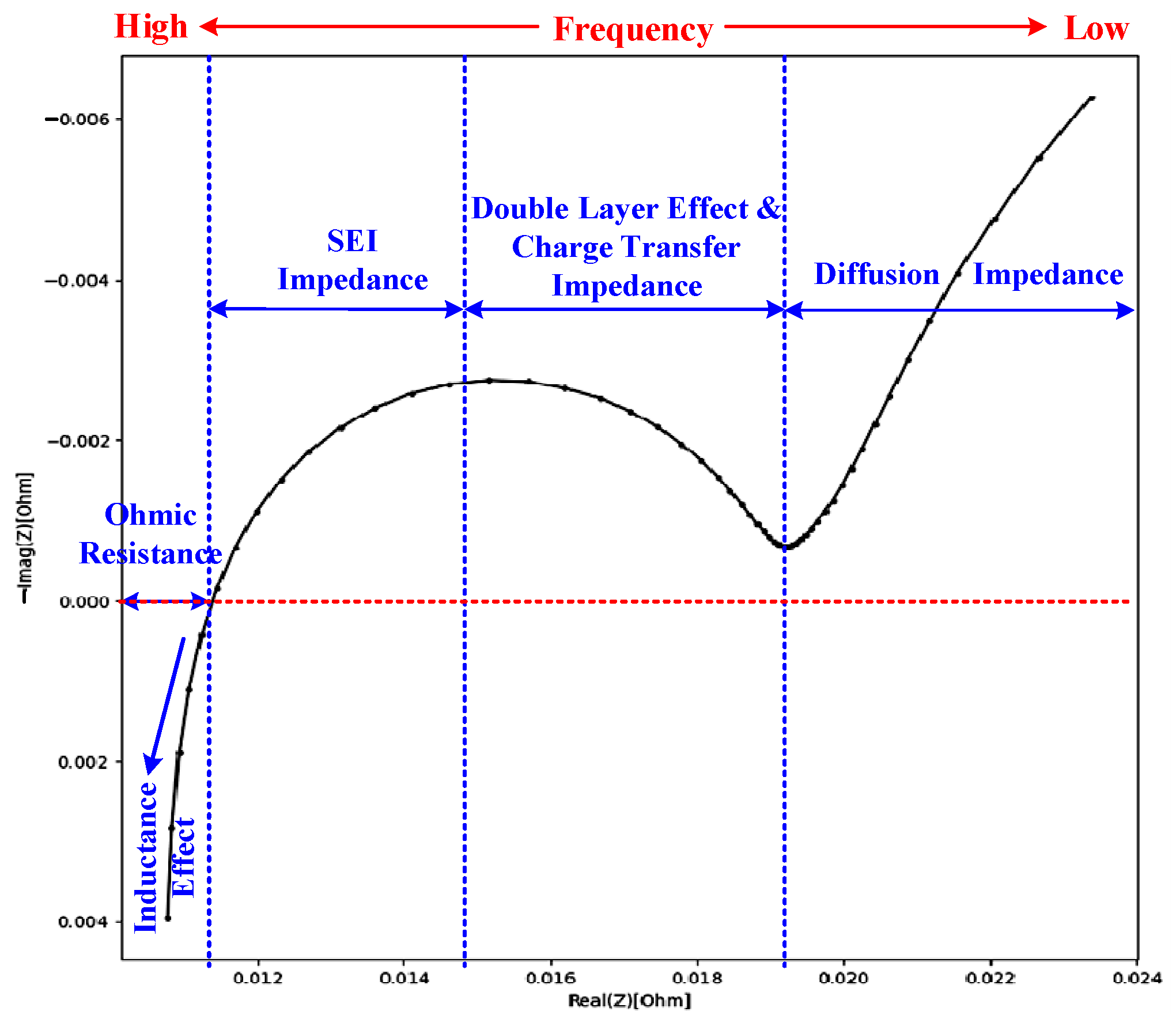
EIS is a widely applied technique in electrochemical system research. It can obtain critical insights into electrochemical components, including reaction kinetics, mass transport characteristics, and interfacial structures. The primary advantage of EIS lies in its non-destructive nature and high sensitivity, which allow for detailed characterization without damaging the battery under nominal test conditions. The resulting data reveal characteristic frequency responses associated with different electrochemical processes, facilitating the identification of model parameters and mechanistic analysis. Figure 1 illustrates a typical Nyquist plot commonly used to present EIS measuring results. When interpreting and analyzing EIS data, it is usually necessary to fit it through ECM. By combining components such as resistors, capacitors, and inductors into specific circuit topologies, the impedance behavior of a battery can be imitated over a range of frequencies. By comparing and adjusting the impedance response of the proposed model with measured data, several electrochemically relevant parameters—such as charge transfer resistance at the electrode interface, double-layer capacitance, and mass transport (diffusion) impedance—can be extracted. These parameters are essential for elucidating the electrochemical reaction mechanisms and developing accurate models.

2.2. Constituted Elements of ECM

2.2.1. Basic Components

Corresponding to the EIS response shown in Figure 1, most ECMs constructed for LIBs in the literature generally comprise four fundamental electrical elements: a resistor (R), a capacitor (C), an inductor (L), and a CPE. Among them, the R contributes only to the real part of the impedance and is independent of frequency. The impedance values of C and L are functions of angular frequency (ω), exhibiting purely imaginary components with no real part. The CPE element (Q) is closely associated with the phase angle φ, which represents the phase difference between voltage and current and reflects the time delay among components within the battery. When capacitive or inductive behaviors exist in the system, φ deviates from zero, indicating the presence of energy storage and release phenomena. The impedance of a CPE, ZQ, can be denoted as ZQ = 1/(Q()k). Its real part ZQ,Re, and imaginary part ZQ,Im can be, respectively, expressed as
Z Q , Re = 1 Q ω k cos k π 2
Z Q , Im = 1 Q ω k sin k π 2
Therefore, analyzing the CPE behavior in EIS data enables a deeper understanding of the energy storage and release mechanisms within the electrochemical system, providing insights into polarization, charge transfer, and mass transport characteristics. As shown in (1), Q and k are the two principal parameters describing the CPE. Here, Q with a unit of Sn/Ω, is a constant that characterizes the deviation from ideal capacitance, and k, ranging between 0 and 1, is an exponential factor. When k = 0, the CPE behaves as a pure resistor R; when k = 1, it is equivalent to a capacitance characteristic; and when k = 0.5, the Q is referred to as a Warburg element, whose Nyquist plot exhibits a line with a 45° slope. To distinguish the Warburg element from the general CPE, the parameters Q and k are redefined in this paper as W and α, respectively. Thus, the impedance of the Warburg element can be expressed as
Z W = 1 W ( j ω ) α

2.2.2. Composite Components

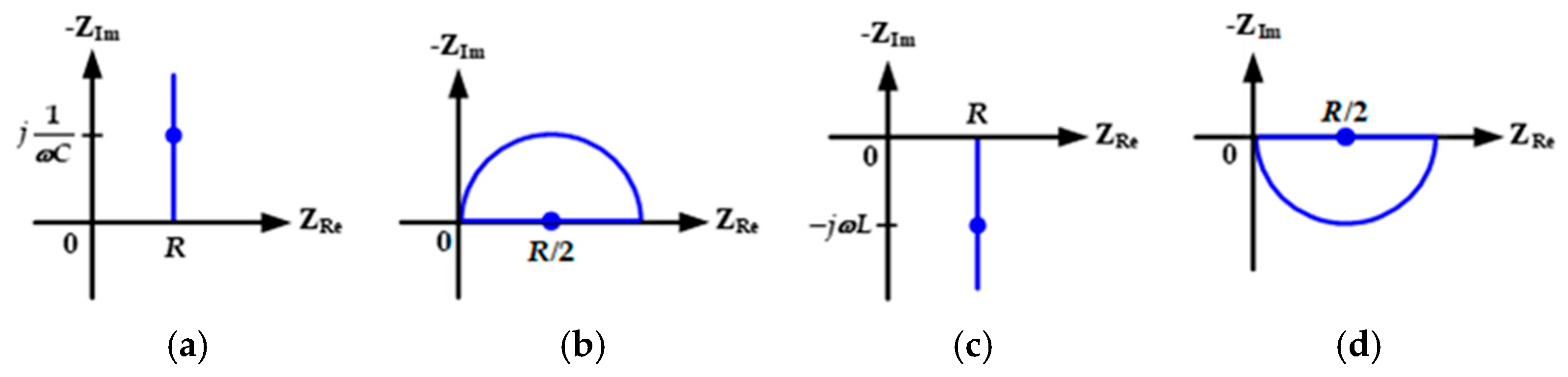
To describe a wider range of electrochemical reaction processes occurring in batteries, various composite equivalent components can be constructed by connecting the aforementioned basic elements in series or parallel. Such configurations allow modeling of distinct frequency response characteristics. For instance, when an RC pair is connected in series, the real and imaginary parts of the total impedance are independent of each other. The corresponding Nyquist plot is shown in Figure 2a. Conversely, when an RC pair is connected in parallel, both the real and imaginary components of the impedance are frequency-dependent, and the total impedance can be expressed as
Z R / / C = Z R / / C , Re + Z R / / C , Im = R 1 + ( ω R C ) 2 j ω R 2 C 1 + ( ω R C ) 2
From (3), it can be obtained that Z R / / C , Re 2 R Z R / / C , Re + Z R / / C , Im 2 = 0 , this impedance locus is a circle and can be derived as
( Z R / / C , Re R 2 ) 2 + Z R / / C , Im 2 = ( R 2 ) 2
Equation (4) represents a semicircle on the Nyquist plot, centered at (R/2, 0) with a radius of R/2, as shown in Figure 2b. Since the vertical axis of the Nyquist plot is represented by a negative imaginary part, the semicircle appears in the first quadrant of the Nyquist diagram. This characteristic behavior is typically used to describe the charge-transfer process occurring at the electrode–electrolyte interface of LIBs. Similarly, when an RL pair is connected in series, the real and imaginary parts of the total impedance remain independent, and the corresponding Nyquist plot is shown in Figure 2c. When connected in parallel, both components become frequency-dependent, and the total impedance can be expressed as
Z R / / L = Z R / / L , Re + Z R / / L , Im = ω 2 R L 2 R 2 + ( ω L ) 2 + j ω R 2 L R 2 + ( ω L ) 2
From (5), another circle equation can be derived as
( Z R / / L , Re R 2 ) 2 + Z R / / L , Im 2 = ( R 2 ) 2
Equation (6) also denotes a semicircle in the fourth quadrant of the Nyquist diagram, centered at (R/2, 0) with a radius of R/2, as shown in Figure 2d.
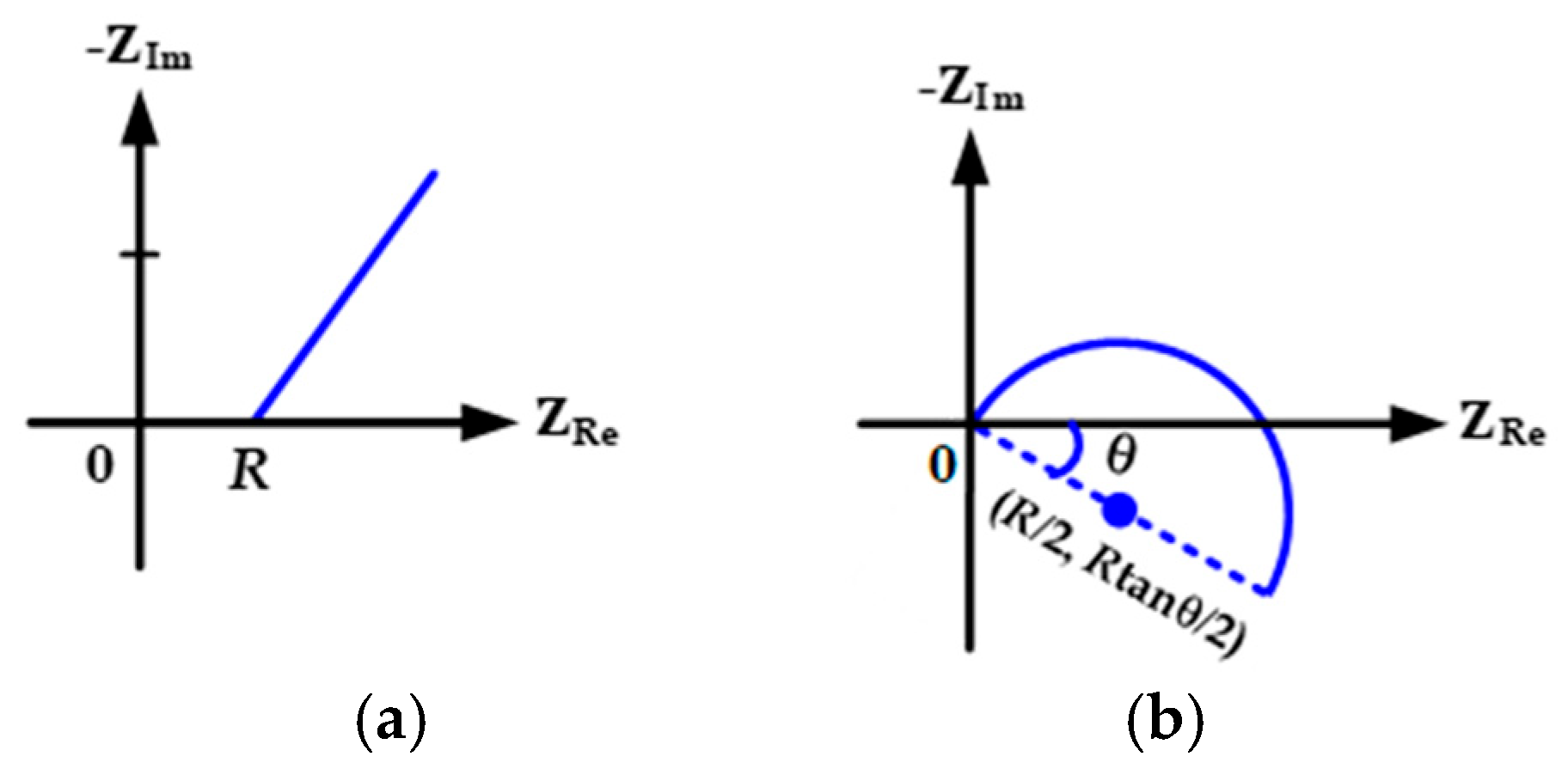
When an RQ pair is connected in series, both the real and imaginary parts of the total impedance are related to frequency. The corresponding Nyquist plot exhibits a straight line with a slope of tan (/2), as shown in Figure 3a. The total impedance of the series RQ network (ZR-Q), its real (ZR-Q,Re) and imaginary (ZR-Q,Im) parts can be, respectively, expressed as
Z R - Q = R + 1 Q ( j ω ) k
Z R - Q , Re = R + 1 Q ω k cos k π 2
Z R - Q , Im = 1 Q ω k sin k π 2
When the RQ elements are connected in parallel, the real and imaginary components of the total impedance are likewise frequency-dependent. The total impedance of the parallel RQ configuration (ZR//Q) and its real (ZR//Q,Re) and imaginary (ZR//Q,Im) components can be described, respectively, as
Z R / / Q = R 1 + ( j ω ) k R Q
Z R / / Q , Re = 1 R + Q ω k cos ( k π 2 ) ( 1 R ) 2 + ( 2 R ) Q ω k cos ( k π 2 ) + ( Q ω k ) 2
Z R / / Q , Im = Q ω k sin ( k π 2 ) ( 1 R ) 2 + ( 2 R ) Q ω k cos ( k π 2 ) + ( Q ω k ) 2
From (8b) and (8c), the impedance locus can be derived as a circular equation, given by
( Z R / / Q , Re R 2 ) 2 + ( Z R / / Q , Im R tan θ 2 ) 2 = ( R 2 cos θ ) 2
Equation (9) indicates a semicircle on the Nyquist plot, centered at (R/2, Rtanθ/2) with a radius of R/(2cosθ), as shown in Figure 3b. Where θ = π 2 ( 1 k ) . This semicircle has a fixed slope and can better mimic the charge transfer phenomenon in the EIS graph.

2.3. ECM Analysis in the Frequency Domain [45]

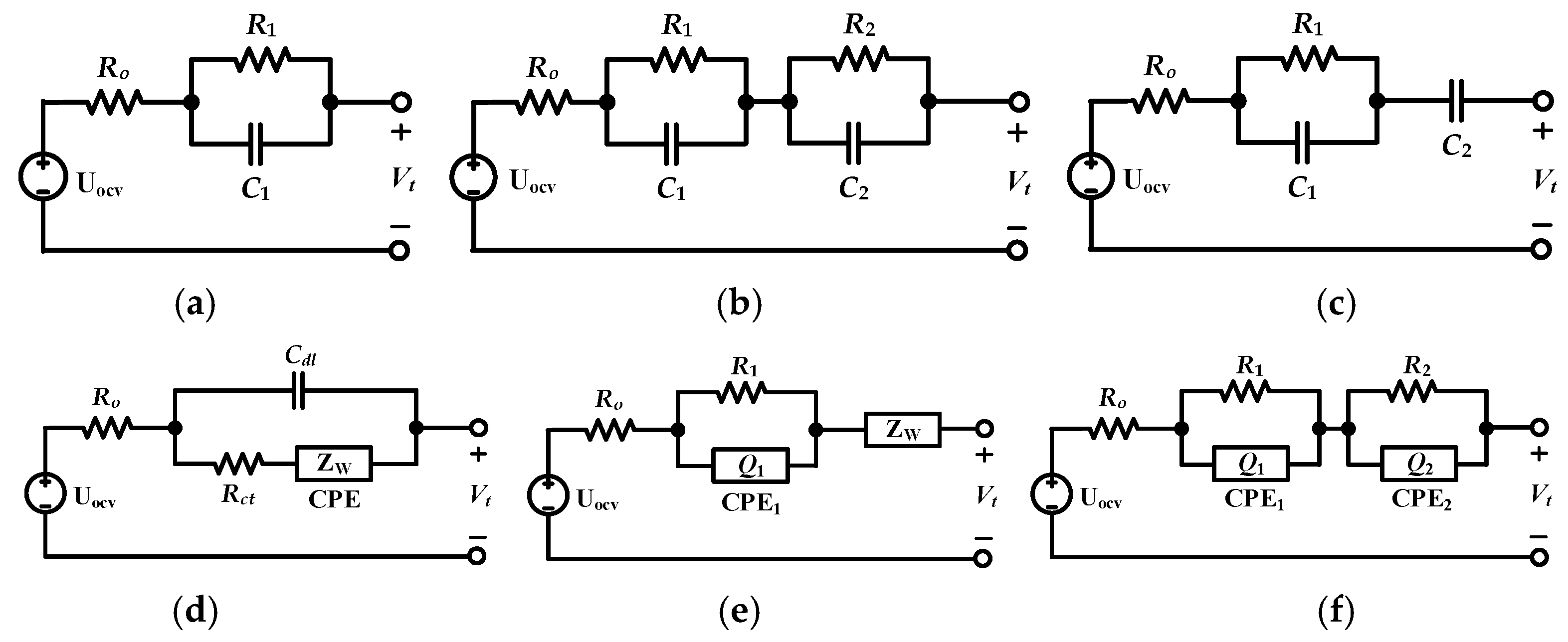
This section introduces six ECMs, as shown in Figure 4, that are commonly adopted in the literature. Based on the frequency-domain characteristics of their constituent elements, the frequency-domain transfer impedance of each model is derived. The first and second models are the Thevenin equivalent circuit models. The Thevenin ECM consists of an open-circuit voltage (OCV, Uocv), an ohmic resistance (Ro), and one or more parallel RC networks that stand for polarization effects. A configuration with one RC branch, shown in Figure 4a, is referred to as a first-order RC model (denoted model A), and a configuration with two RC branches, as shown in Figure 4b, is known as a second-order RC model (model B). In general, an n-order s-domain Thevenin model can be expressed as
Z ( s ) = R o + R 1 1 s C 1 R 1 + 1 s C 1 + R 2 1 s C 2 R 2 + 1 s C 2 + + R n 1 s C n R n + 1 s C n
The third model, as shown in Figure 4c, is the Partnership for a New Generation of Vehicles (PNGV) model (referred to as model C). The PNGV model is based on the first-order Thevenin model, with an additional capacitor C2 connected in series. The C2 represents the voltage variation associated with transient current fluctuations during charging and discharging, thus providing greater flexibility in curve fitting than the Thevenin model. Its frequency-domain transfer impedance is given by
Z ( s ) = R o + R 1 1 s C 1 R 1 + 1 s C 1 + 1 s C 2
The fourth model, as illustrated in Figure 4d, is the Randles model (model D), which consists of an ohmic resistance (Ro), a charge-transfer resistance (Rct), a double-layer capacitance (Cdl), and a Warburg element (W). The Warburg element represents the diffusion impedance within the electrolyte and provides an accurate fit in the low-frequency region. Hence, the Randles model impedance can be expressed as
Z ( s ) = R o + ( R c t + 1 s α W ) 1 s C d l R c t + 1 s α W + 1 s C d l
The fifth model, shown in Figure 4e, is the R(RQ)W model (referred to as model E), which can be regarded as the fractional-order form of the PNGV model. In this configuration, the parallel capacitor C1 is replaced by a CPE, and the series capacitor C2 is replaced by a Warburg element. Compared with the conventional RC branch, the RQ branch provides a more accurate representation of mid-frequency charge transfer behavior. To obtain the fractional-order frequency domain impedance formula without numerical approximation, the following assumptions were made before the derivation. The battery system has linear time-invariant characteristics under small-signal EIS excitation. A small-signal sinusoidal perturbation is applied to ensure linearization near the operating point. Fractional-order components (CPE and Warburg components) are modeled using their standard frequency domain impedance forms. Model-E transfer impedance can be expressed as
Z ( s ) = R o + R 1 + 1 s k Q 1 R 1 + 1 s k Q 1 + 1 s α W ,   0 < k < 1
As shown in Figure 4f, the sixth model is the R(RQ)(RQ) model (model F). It is a fractional-order counterpart of model B, in which the two capacitors C1 and C2 are replaced by CPE1 and CPE2, respectively. Its frequency-domain transfer impedance can be expressed as
Z ( s ) = R o + R 1 + 1 s k 1 Q 1 R 1 + 1 s k 1 Q 1 + R 2 + 1 s k 2 Q 2 R 2 + 1 s k 2 Q 2 ,   0 < k 1 , k 2 < 1
Table 1 summarizes and compares these six ECMs in terms of their constituent elements, model characteristics, advantages, and typical applications. The table highlights that the Thevenin and PNGV models are computationally efficient and suitable for real-time control and BMS applications, whereas the Randles and fractional-order models provide deeper insights into electrochemical mechanisms and impedance fitting accuracy, making them more suitable for diagnostic and research-oriented analysis.

3. Review of BIOAs Adopted

To obtain the parameters of the impedance model for LIBs, an initial ECM must first be established based on its electrochemical characteristics and the profile of the impedance spectrum. Subsequently, optimization algorithms are employed to fit the measured impedance data and extract the parameters of each circuit element. In this study, BIOAs are applied to identify the ECM that best fits the experimentally measured EIS data. The identified model parameters are then analyzed and compared to evaluate their accuracy and determine the most precise ECM representation. BIOAs are computational algorithms inspired by biological behaviors and evolutionary mechanisms observed in nature. Unlike gradient-based optimization methods, BIOAs do not rely on gradient information or explicit mathematical models of the problem. They offer strong global search capabilities, flexibility for hybridization with other methods, and suitability for handling multi-objective optimization problems. These features make BIOAs particularly effective for solving complex optimization tasks involving nonlinear, multimodal, high-dimensional, and non-differentiable functions that are difficult for conventional algorithms to address. However, their limitations include the inability to guarantee convergence to a global optimum, sensitivity to hyperparameter settings that often require empirical tuning, variability in the obtained optimal solutions due to randomness, and relatively long computation times resulting from iterative search processes.
This study aims to utilize the BIOAs to find the best-fit ECM for LIB and to accurately identify its model parameters. The SOC/SOH estimation algorithms are introduced solely as a practical motivation for improving model accuracy, and the main contribution of this paper is the BIOA-based EIS parameter identification method. As a result, thirteen BIOAs that have been widely applied in recent years to battery-related research are employed. These include Marine Predators Algorithm (MPA), Particle Swarm Optimization (PSO), Artificial Rabbits Optimization (ARO), Manta Ray Foraging Optimization (MRFO), Honey Badger Algorithm (HBA), Artificial Bee Colony algorithm (ABC), Grey Wolf Optimizer (GWO), Genetic Algorithm (GA), Whale Optimization Algorithm (WOA), Harris Hawk Optimization (HHO), Cuckoo Search (CS), Coyote Optimization Algorithm (COA), and Bat Algorithm (BA). The focus of this work is to utilize these BIOAs to identify the optimal ECM and to determine the most accurate and computationally efficient model parameters. Consequently, this paper provides only a concise summary of each algorithm’s main inspiration concept, search mechanism, core mathematical formulation, and key hyperparameters, as presented in Table 2. Readers interested in a more detailed description of the individual algorithms are referred to the literature in [32,33,34,35,36,37,38,39,40,41,42,43,44].

4. Searching for the Best Fitting ECM

4.1. Problem Formulation and Constraints

This study aims to achieve a highly accurate fitting of the LIB’s EIS curve in the frequency domain. Accordingly, the objective function is defined to minimize the error between the measured impedance and the impedance obtained from the frequency-domain ECM. To quantify the total fitting error between the two impedance spectra, the mean absolute percentage error (MAPE) is employed as the evaluation metric, as it can provide a scale-invariant and balanced assessment of fitting accuracy across frequencies. This is particularly suitable for comparing ECMs with different structural complexities and frequency-dependent behaviors. For each test frequency point, the MAPE values of both the real and imaginary components of the impedance are individually computed. The overall fitness value of the objective function is then defined as the sum of the MAPEs of the real-part impedance (ZMAPE,Re) and imaginary-part impedance (ZMAPE,Im). Consequently, the optimal fitting and parameter identification problem can be formulated as
O b j e c t i v e M i n i m i z e   F i t n e s s o b j = Z M A P E , Re + Z M A P E , Im S u b j e c t e d   t o Z M A P E , Re = 1 N i = 1 N Z i , Re Z ^ i , Re Z i , Re ,   Z R M S E , Im = 1 N i = 1 N Z i , Im Z ^ i , Im Z i , Im S e a r c h   S c o p e :   X b e n c h m a r k 10 X p a r a m 10 X b e n c h m a r k X p a r a m R o , R 1 , R 2 , R c t , C 1 , C 2 , C d l , Z W , Q 1 , Q 2 , k 1 , k 2
where Z ^ i , Re and Z ^ i , Im represent the real and imaginary parts of the impedance estimated by the frequency-domain fitting model, while Zi,Re and Zi,Im denote the real- and imaginary-part impedance values derived from experimental measurements, respectively. N is the number of frequency sampling points, Xparam refers to all relevant component parameters within the six ECMs, and Xbenchmark corresponds to the component parameter values of the optimal ECM screened during the first-stage evaluation. Based on prior knowledge of LIB characteristics, the solution space for Xparam recognition must be constrained within a physically reasonable search range. The specific determination of this feasible parameter range will be detailed later in Section 5.1.

4.2. Best Matching Model Screening via PSO

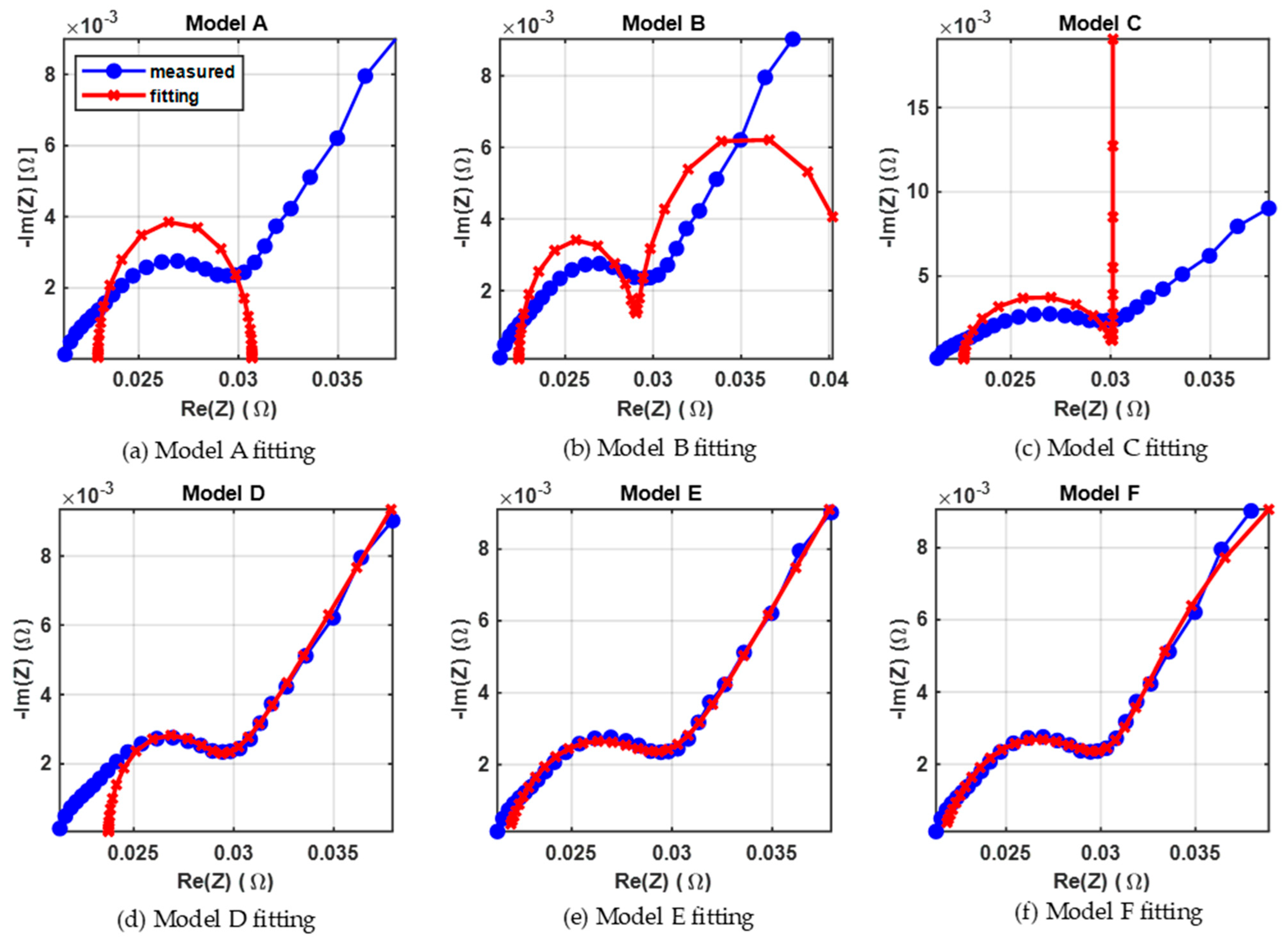
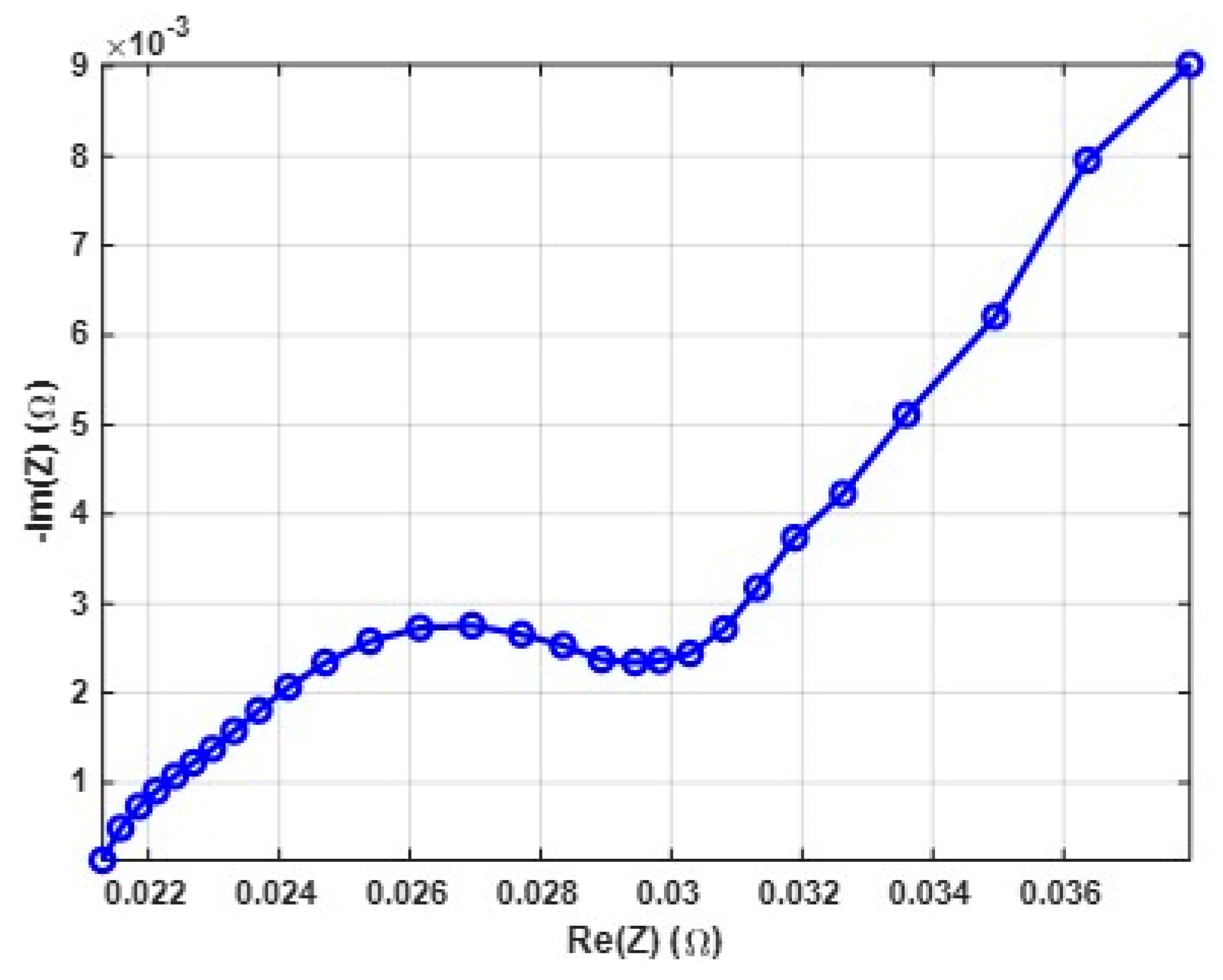
In this paper, the BIOAs were implemented in Python 3.13.8 and applied to the fitting of measured EIS data. Initially, the PSO was employed to perform PI for six different ECMs, aiming to screen the model that best fits the target EIS curve. The objective function and parameter constraints were defined as described in the previous subsection. The PSO was set to 100 particles and 100 iterations, repeated over 20 independent runs. After completing the 20 searching runs based on the evaluated fitness metric defined in (15), all identified component parameters were statistically analyzed. In this article, the actual EIS data are derived from the INR21700M50LT LIB, which was measured with the Bio-Logic BCS-815. The input test perturbation source for the cell is an AC voltage signal with an amplitude of 10 mV and a frequency range of 10 mHz to 10 kHz. The cell discharge C-rates include 0.2 C, 1 C, and 1.5 C, respectively, and the desired test temperatures are 5 °C, 25 °C, and 35 °C, respectively. The battery must be fully charged before each EIS test procedure so that the AC impedance can be completely collected from 100% to 0% SOC. The cell is charged at a constant current (CC) of 0.5 C until the voltage reaches 4.2 V. Then, it is switched to the constant voltage (CV) mode, using 4.2 V, to continue charging until the charging current is less than 0.01 C. The EIS at SOC 100% was measured after a 1 h rest. Next, the battery is discharged at the same C-rate (0.2 C, 1 C, 1.5 C) under the desired test temperature, and the EIS analysis is conducted every 5% SOC until the SOC reaches 0%. After a 1 h rest, the EIS test procedure is finished. Since the high-frequency inductance effect of the cell was not considered in this study, the Nyquist impedance plot in Figure 5 shows the EIS measured at 1C, 5% SOC, and 35 °C. The resulting comparison of fitness values among the six ECMs is summarized in Table 3. Figure 6 shows the Nyquist plots of the best-fitted EIS curves for each model, where the blue line is the baseline derived from measurement (measured), and the red line indicates the fitted impedance (fitting) obtained from the PSO-identified parameters.
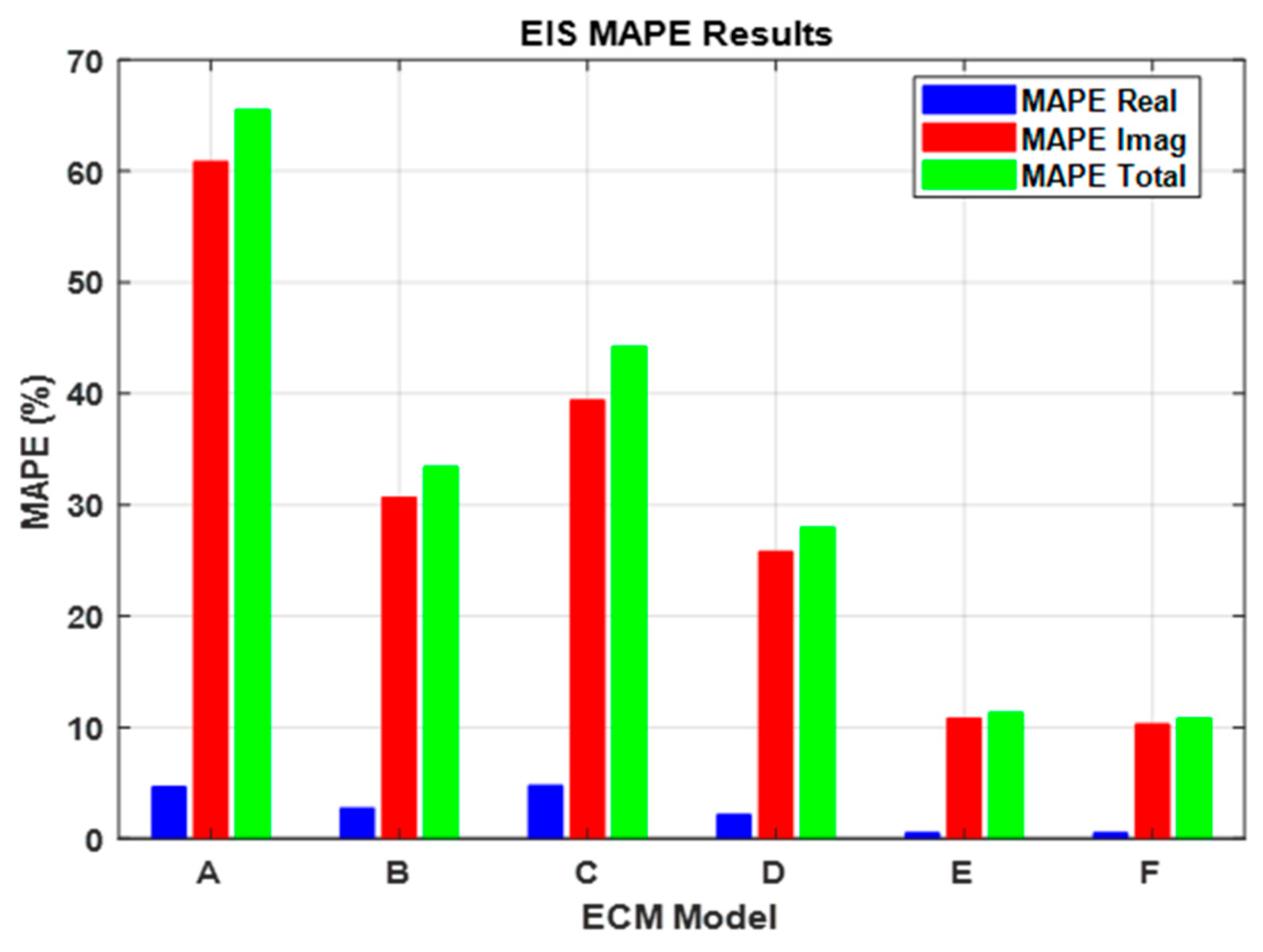
Additionally, Figure 7 illustrates a comparison bar chart of the real part, imaginary part, and total MAPE (%) of the six ECM fittings screened by PSO. From Figure 7, it can be seen that the fractional order R(RQ)(RQ) has the lowest EIS fitting error for the LIB under test. From the statistical results tabulated in Table 3 and the impedance fitting curves shown in Figure 6, model F demonstrated the best matching performance, yielding the least fitness value error of 10.797%. The corresponding component parameters, along with their fitness values, are listed in Table 4. Additionally, in Figure 7, the discrepancy between real and imaginary MAPE values arises from (1) different physical origins; (2) structural limitations and asymmetrical fitting capabilities of ECMs; and (3) the inherent sensitivity of the MAPE metric for low-magnitude imaginary impedance. Namely, the observed separation in MAPE between the real and imaginary parts is a quantitative reflection of model limitations rather than a contradiction of the visual fitting quality. On the other hand, to ensure fair screening, all ECM fitting experiments were executed under an identical hardware and software platform (CPU: AMD Ryzen™ 7 2700X 3.7 GHz; GPU: NVIDIA® GeForce RTX™ 2070; RAM: 8 GB × 2 DDR4-3200; operating system: Windows 10 x86_64), and the computational time required for each fitting process was recorded.

5. Experimental Results and Discussion

5.1. Optimal Parameter Identification via BIOAs with Reasonable Constraints

In this section, the optimal model screened in Section 4.2 is utilized, and thirteen BIOAs introduced in Section 3 are applied to search for the parameter set based on the optimal match model of R(RQ)(RQ). All BIOAs perform automated spectrum-level optimization using the full measured EIS dataset rather than point-to-point impedance fitting. The obtained results are then statistically analyzed and compared to determine the most efficient and accurate optimization algorithm for model fitting. To achieve this objective and a fair comparison, the number of search particles and iterations in each BIOA remains unchanged at 100, and each algorithm was executed 20 times. On the other hand, to better reflect the realistic application scenarios, this study refined the parameter search range by narrowing it to more physically reasonable bounds. The updated search range for the ECM parameters was determined by using the parameters listed in Table 4, which were derived from model F with the best fitting, as the benchmark (Xbenchmark). The upper and lower bounds for each parameter were then set to 10 times and 0.1 times their benchmark values, respectively. Then, the parameter search range is updated to
X b e n c h m a r k { R o = 0.0217 , R 1 = 5.5 × 10 3 , Q 1 = 13.866 , k 1 = 0.7 , R 2 = 4.5 × 10 3 , Q 2 = 89.697 , k 2 = 0.95 } X b e n c h m a r k 10 X 10 X b e n c h m a r k ,   X R o , R 1 , Q 1 , k 1 , R 2 , Q 2 , k 2
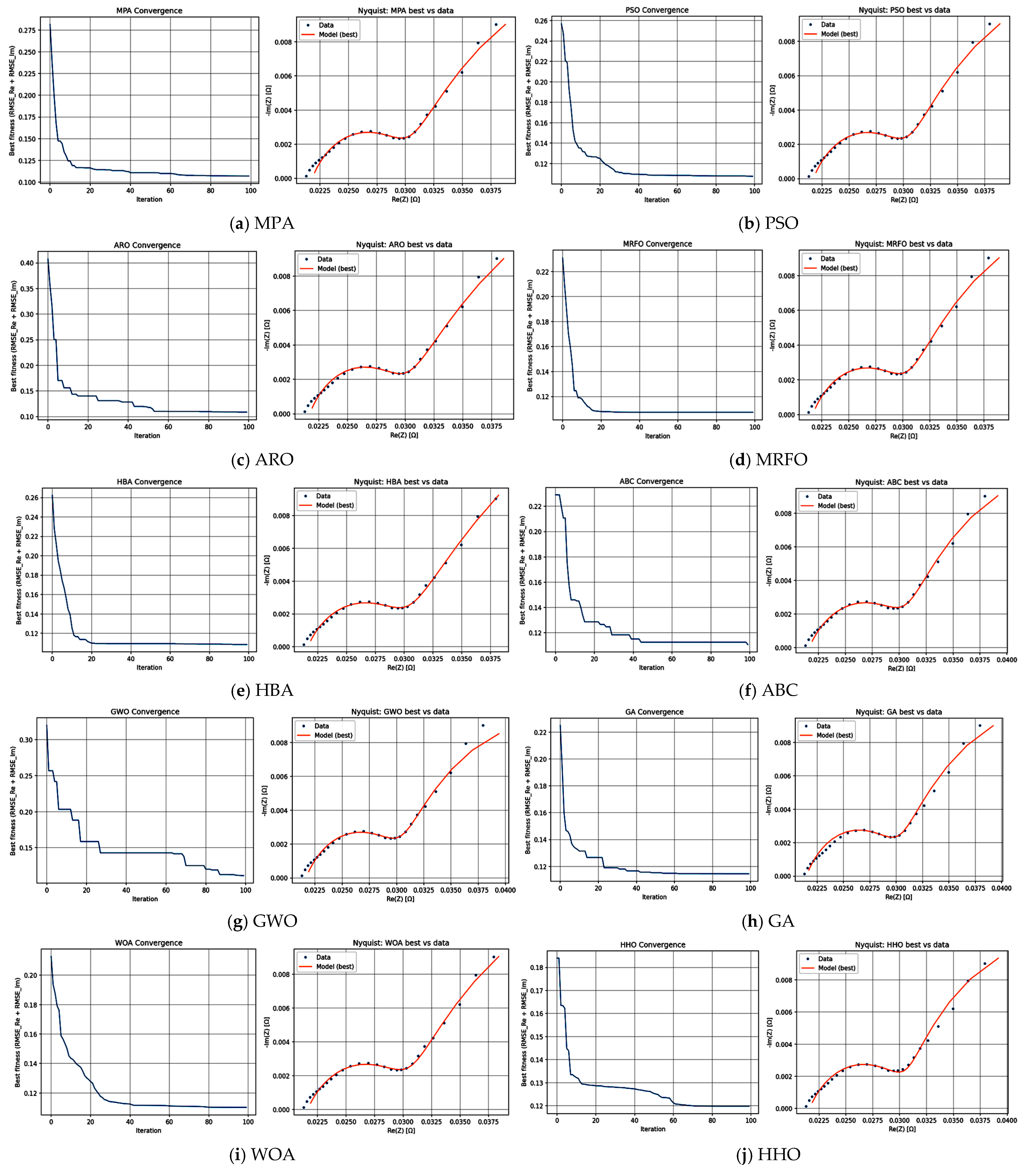
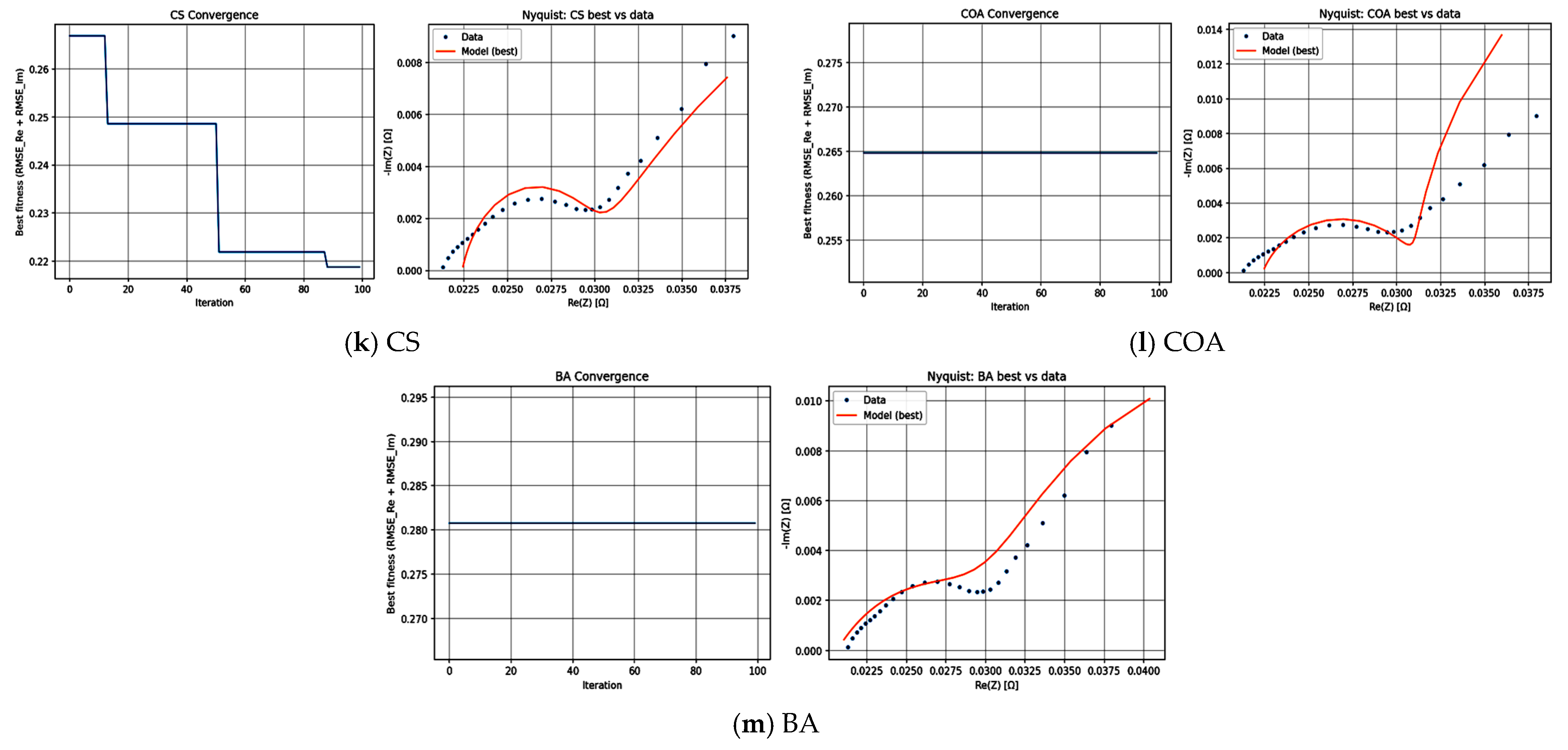
Figure 8 shows the convergence curve and Nyquist plot of the EIS fitting for 13 BIOAs under 100 iterations. To evaluate the convergence of each BIOA appropriately, the sum of the root mean square errors (RMSE) of the real and imaginary parts of the impedances is adopted as the objective fitness function, as it is more sensitive to absolute error reduction and provides a smoother, monotonic measure for monitoring iterative optimization progress. From Figure 8, across 100 iterations, all algorithms achieve convergence, except for COA and BA, which become trapped in local optima, preventing further reduction in RMSE. In addition, the algorithms converge to an RMSE of less than 0.11 except for BA, COA, CS, and HHO. Similarly, it can also be seen from the fitting Nyquist plot that the larger the convergence RMSE error, the greater the mismatch between the fitted curve and the measurement data, such as the CS, COA, and BA. Whereas the EIS fitting of the other algorithms is quite a match.
The statistical results obtained after 20 runs of execution for each BIOA are listed in Table 5. The performance metrics (PM) in Table 5 are as follows: ATM represents the average total MAPE (i.e., the average objective fitness, Fitnessobj), ASD stands for the average standard deviation, and AET is the average execution time. From Table 5, the algorithms with an ATM below 11% are HBA, MRFO, ARO, PSO, and MPA. The ATMs of ABC, GWO, and GA are between 10% and 12%, while the ATMs of the remaining five methods—WOA, HHO, CS, COA, and BA—are above 12%. Totally, the top three algorithms with the fewest ATMs are MAP, PSO, and ARO, indicating that these three methods have the highest accuracy in recognizing model parameters. On the other hand, the algorithm with better ATM has a relatively small ASD in its execution results. The smaller the ASD, the more concentrated the execution results are around the average value, that is, the smaller the fluctuation relative to the average value and the more stable it is to the best solution found. In summary, the top three algorithms with the lowest ASDs are MPA, PSO, and ABC, respectively. In terms of AET, the average execution time of all methods over 20 runs is comparable. BA has the fastest execution speed, while PSO and MPA rank second and third, respectively. However, BA has the largest parameter fitting error of 33.591%, which prevents it from ranking highly in the overall ranking of the most suitable parameter identification algorithms.
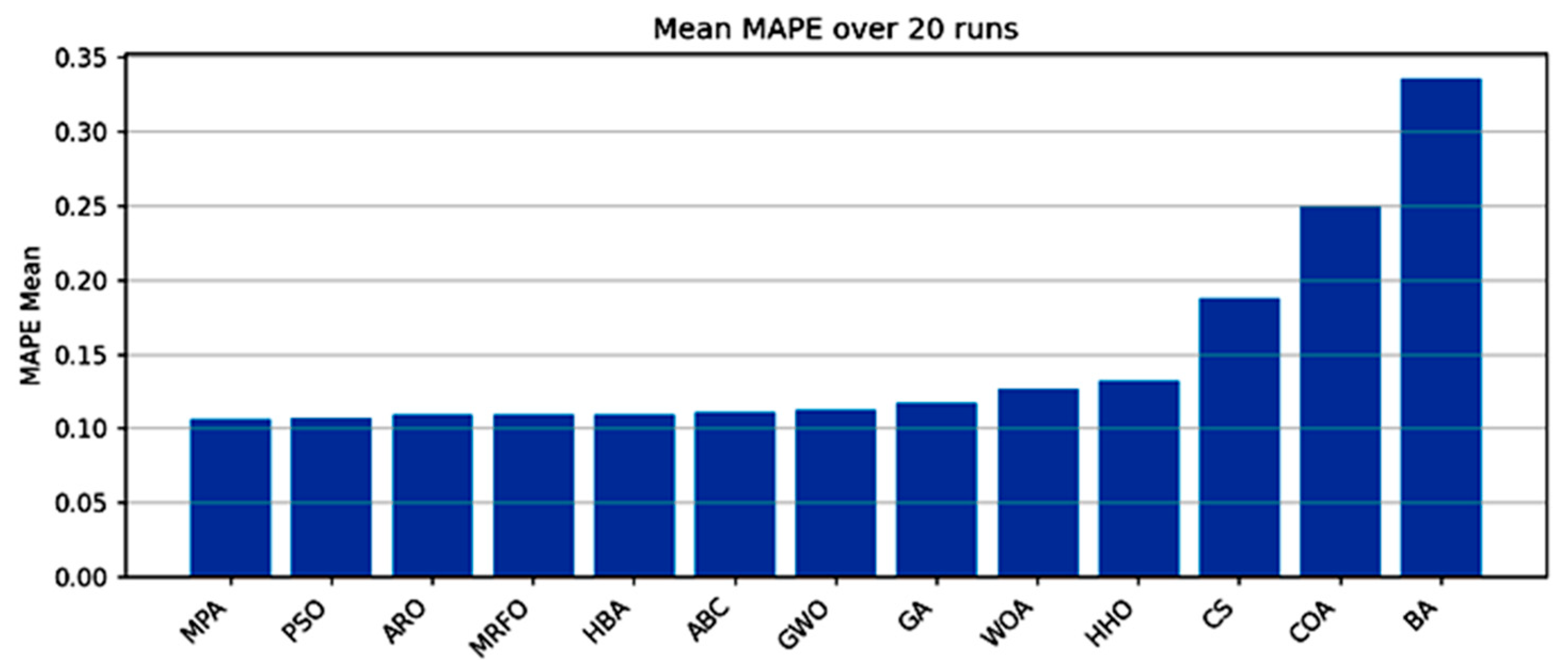
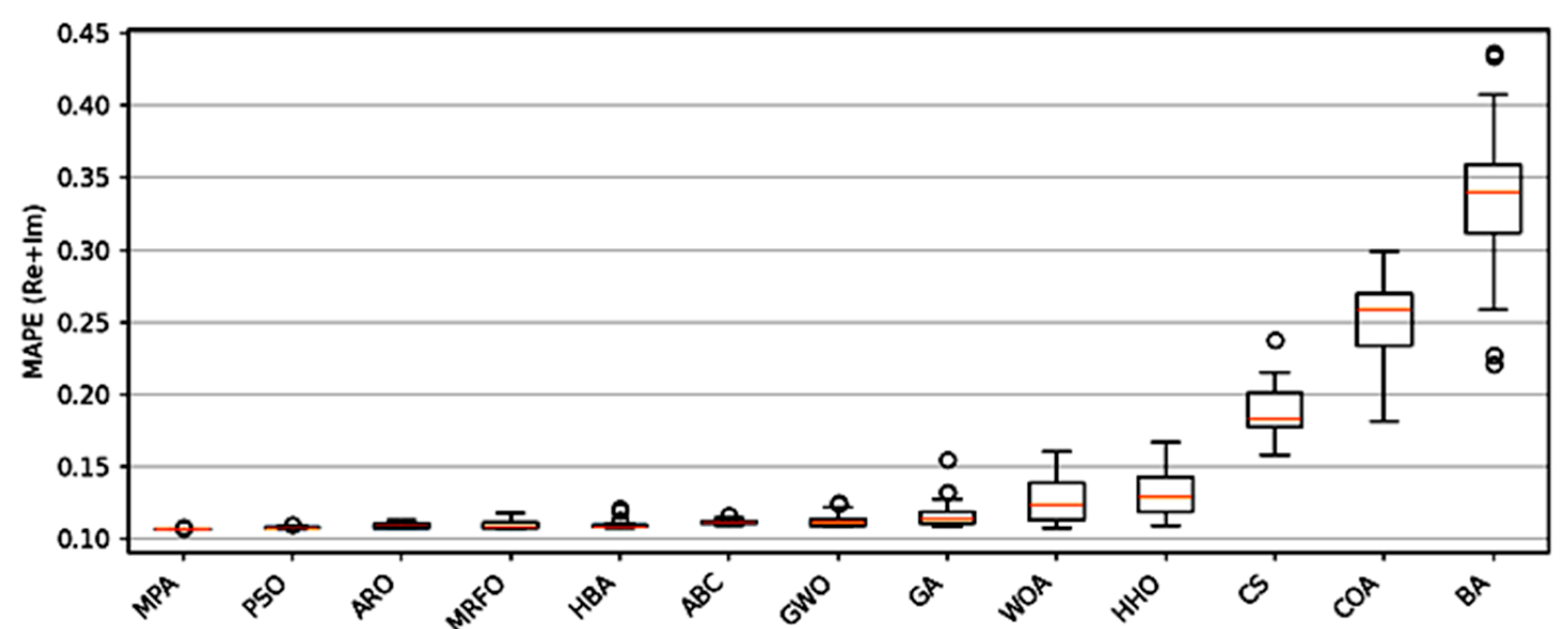
A comparison of the mean MAPE (MMAPE) across 20 runs, obtained using the 13 identification methods, is presented in a bar chart in Figure 9. From the bar chart, the differences in MMAPE among the various algorithms can be intuitively distinguished. Based on the MMAPE values, the data can be roughly divided into three groups: the first group has an MMAPE below 0.11, which includes five methods, ranging from MPA to HBA. The second group comprises three methods, ranging from ABC to GA, with an MMAPE of between 0.11 and 0.12. The third group has an MMAPE above 0.12, comprising five methods, ranging from WOA to BA. Similarly, the lower the MMAPE, the more accurate the model parameter identification and the better the EIS impedance curve fit. In addition, as shown in Figure 10, the boxplot is employed to further illustrate the distribution, central tendency/skewness, dispersion, and outliers of the total MAPE data obtained from 20 runs of parameter identification for each BIOA. From Figure 10, the algorithms exhibiting apparent outliers with distinct distribution characteristics among the 20 runs are MPA, PSO, HBA, ABC, GWO, GA, CS, and BA. Excluding the outliers, the MAPE data obtained by MPA, PSO, and ARO are highly concentrated and uniformly distributed; their maximum, upper quartile (Q3), lower quartile (Q1), mean, median (Q2), and minimum values align almost linearly in the plot. This indicates that these three methods possess the most stable capability in LIB model parameter identification, yielding the smallest parameter identification errors and EIS fitting mismatches. For methods from MRFO to GA, although their MAPE distributions are less compact than the aforementioned three, their identification errors and EIS fitting mismatches remain within an acceptable range. In contrast, methods from WOA to BA exhibit wider interquartile ranges, implying greater dispersion in MAPE values. Specifically, BA shows the widest interquartile range, indicating the least concentrated MAPE distribution. Furthermore, the boxplot reveals that methods with lower parameter identification errors (from MPA to GA) have MAPE values concentrated in the bottom region of the plot, significantly below those of other methods. Considering the interquartile range, the top three algorithms are MPA, PSO, and ARO.

5.2. The Scope of Validation and Statistical Rigor

As shown in Table 6, the parameter identification results obtained from data collected under two additional operating conditions (SOC 95% at 35 °C and SOC 5% at 25 °C) are presented to strengthen the claims made. Table 6 shows that MPA still maintains the lowest identification ATM. This demonstrates the robustness of parameter identification in EIS data measured at different operating points.
Regarding the verification of parameter sensitivity, the EIS data under operating conditions of 5% SOC and 35 °C are doped with 1%, 3%, and 5% noise to verify the parameter sensitivity of the identified model. The results are shown in Table 7. According to Table 7, the MPA continues to maintain the lowest parameter identification error, indicating that it exhibits the lowest sensitivity to data changes.
Additionally, regarding inter-run variability, the results of 20 independent trials are analyzed. As shown in Figure 10 and the statistical table in Table 8, the table tabulates the performance of each algorithm, sorted by the average RMSE, including the 95% confidence interval (CI) Margin, coefficient of variation (CV), and AET. From the obtained data, MPA demonstrates the lowest variability among all compared algorithms, with a CV of only 2.24% for the RMSE metric. This is significantly lower than other meta-heuristic algorithms, such as WOA (CV ≈ 38%) and CS (CV ≈ 35%). A shorter boxplot and a lower CV indicate a more stable algorithm. Table 8 shows that MPA and PSO exhibit extremely high stability, indicating that MPA is not only accurate but also highly robust against random initialization. On the other hand, to ensure statistical rigor, the 95% confidence intervals (CI) are calculated for all performance metrics. The narrow CI of MPA ( ± 4 × 10 6 ) further confirms the reliability of the estimated mean performance. Furthermore, a non-parametric Kruskal–Wallis test was conducted, yielding a p -value of p < 0.001 , which statistically confirms that the performance differences between the algorithms are significant and not due to chance.

5.3. Friedman Test for Ranking

To further determine which BIOA performs best for optimizing ECM fitting and parameter identification, this study employs the Friedman test (FT) for statistical validation. The FT is a nonparametric statistical method [46] that does not require specific distributional assumptions and is suitable for comparing multiple or repeated-measure samples. Since 13 BIOAs were used to fit EIS, FT is particularly appropriate because it can handle uncertain or non-normal distributions in algorithmic fitting results. Furthermore, it allows simultaneous comparison among multiple algorithms by ranking their average performances, thereby identifying whether significant differences exist among them. The FT provides an objective quantitative assessment to determine which algorithm yields the most accurate fitting performance, without requiring any prior assumption about which method is superior. The testing procedure is as follows:
  • Define the number of PMs (P), algorithms (A), and simulations (S). In this study, P = 3, A = 13, and S = 20.
  • Collect data from 20 simulation runs for each of the 13 algorithms.
  • Treat each of the 20 simulation outcomes for the 13 algorithms as an individual dataset and rank them accordingly; algorithms achieving better results receive higher ranks, while identical outcomes share an average rank.
  • Compute the average rank using Equation (17):
    R a n k j = 1 S i = 1 P r i , j
    where j ∈ [1, A] represents the algorithm index, i ∈ [1, P], and ri,j denotes the ranking of algorithm j in the ith simulation. The mean ranking across all runs yields the FT overall ranking, as shown in Table 9. The FT results align well with the aforesaid experimental findings: in terms of model match and fitting accuracy, the MPA exhibits the best overall performance, followed by PSO and ARO, which rank second and third, respectively.

6. Conclusions

This paper has developed a high-accuracy ECM parameter identification framework, evaluated six ECMs and 13 BIOAs for their ability to minimize EIS fitting error, and provided a reliable modeling foundation that can subsequently support SOC/SOH estimation methods. Python was used as the main tool during the EIS fitting experiments. In the first phase, the model parameters were identified for six studied ECMs, encompassing both integer- and fractional-order models, using the PSO algorithm to screen the optimal fit. Results showed that the R(RQ)(RQ) model most closely matched the measured EIS data. Next, thirteen BIOAs were employed to optimize the parameter identification of the model components. Under the tested cell and within the investigated scenario, experimental results demonstrated that the MPA offered the most stable and accurate optimization results. Based on the outcomes of the Friedman test under reasonable constraints for parameter search ranges and three PMs, the MPA ranked first among all algorithms, exhibiting the lowest parameter identification errors of 10.694% and 10.797% in EIS fitting mismatches. The PSO ranked second, with very low impedance fitting error and a faster execution speed than MPA, making it a preferable choice when faster parameter identification is needed. The ARO algorithm ranked third; its ATM, ASD, and AET are all slightly higher than those of the MPA and PSO.
The findings of this study, based on the operating conditions of the experimental cell in conjunction with the online battery monitoring system, provide a low-cost, rapid, and highly accurate platform for real-time modeling and parameter identification of various LIB chemistries. However, the generalization extension across cell chemistries and operating conditions, involving multiple cells, temperatures, and SOC levels, requires additional experimental validation. Accordingly, future studies include (1) implementing Fourier transform-based time-domain EIS measurement techniques to improve system practicality; (2) fine-tuning BIOAs’ hyperparameters for better model matching and lower identification error; (3) extending the proposed method applied to various cell chemistries and operating conditions; and (4) integrating the identified ECM parameters into SOC/SOH estimation frameworks, such as machine-learning-assisted observers.

Author Contributions

Conceptualization, Y.-H.L.; methodology, Y.-H.L.; software, S.-C.W.; validation, S.-C.W. and Y.-H.L.; writing—original draft preparation, S.-C.W.; writing—review and editing, S.-C.W. All authors have read and agreed to the published version of the manuscript.

Funding

This research was funded by the National Science and Technology Council (NSTC), Tai-wan, grant number NSTC 113-2221-E-019-064.

Data Availability Statement

The data presented in this study are available on request from the corresponding author due to privacy reasons.

Conflicts of Interest

The authors declare no conflicts of interest.

References

  1. Madani, S.S.; Shabeer, Y.; Allard, F.; Fowler, M.; Ziebert, C.; Wang, Z.; Panchal, S.; Chaoui, H.; Mekhilef, S.; Dou, S.X.; et al. A Comprehensive Review on Lithium-ion Battery Lifetime Prediction and Aging Mechanism Analysis. Batteries 2025, 11, 127. [Google Scholar] [CrossRef]
  2. Hasan, M.M.; Haque, R.; Jahirul, M.I.; Rasul, M.G.; Fattah, I.M.R.; Hassan, N.M.S.; Mofijur, M. Advancing Energy Storage: The Future Trajectory of Lithium-ion Battery Technologies. J. Energy Storage 2025, 120, 116511. [Google Scholar] [CrossRef]
  3. Yang, Y.; Okonkwo, E.G.; Huang, G.; Xu, S.; Sun, W.; He, Y. On the Sustainability of Lithium Ion Battery Industry—A Review and Perspective. Energy Storage Mater. 2021, 36, 186–212. [Google Scholar] [CrossRef]
  4. Khawaja, Y.; Shankar, N.; Qiqieh, I.; Alzubi, J.; Alzubi, O.; Nallakaruppan, M.K.; Padmanaban, S. Battery Management Solutions for Li-ion Batteries Based on Artificial Intelligence. Ain Shams Eng. J. 2023, 14, 102213. [Google Scholar] [CrossRef]
  5. Adebanjo, I.T.; Eko, J.; Agbeyegbe, A.G.; Yuk, S.F.; Cowart, S.V.; Nagelli, E.A.; Burpo, F.J.; Allen, J.L.; Tran, D.T.; Bhattarai, N.; et al. A Comprehensive Review of Lithium-ion Battery Components Degradation and Operational Considerations: A Safety Perspective. Energy Adv. 2025, 4, 820–877. [Google Scholar] [CrossRef]
  6. Catenaro, E.; Rizzo, D.M.; Onori, S. Framework for Energy Storage Selection to Design the Next Generation of Electrified Military Vehicles. Energy 2021, 231, 120695. [Google Scholar] [CrossRef]
  7. He, X.; Wu, Z.; Bai, J.; Zhu, J.; Lv, L.; Wang, L. A Novel SOH Estimation Method for Lithium-Ion Batteries Based on the PSO–GWO–LSSVM Prediction Model with Multi-Dimensional Health Features Extraction. Appl. Sci. 2025, 15, 3592. [Google Scholar] [CrossRef]
  8. Sungur, B.; Kaleli, A. State of Charge Estimation for Lithium-Ion Batteries Using Optimized Model Based on Optimal HPPC Conditions Created Using Taguchi Method and Multi-Objective Optimization. Appl. Sci. 2024, 14, 9245. [Google Scholar] [CrossRef]
  9. Olano, J.; Camblong, H.; López-Ibarra, J.A.; Lie, T.T. Development of Energy Management Systems for Electric Vehicle Charging Stations Associated with Batteries: Application to a Real Case. Appl. Sci. 2025, 15, 8798. [Google Scholar] [CrossRef]
  10. Akram, A.S.; Choi, W. Performance Enhancement of Second-Life Lithium-Ion Batteries Based on Gaussian Mixture Model Clustering and Simulation-Based Evaluation for Energy Storage System Applications. Appl. Sci. 2025, 15, 6787. [Google Scholar] [CrossRef]
  11. Chan, H.T.J.; Rubeša-Zrim, J.; Pichler, F.; Salihi, A.; Mourad, A.; Šimić, I.; Časni, K.; Veas, E. Explainable Artificial Intelligence for State of Charge Estimation of Lithium-Ion Batteries. Appl. Sci. 2025, 15, 5078. [Google Scholar] [CrossRef]
  12. Hassan, M.U.; Saha, S.; Haque, M.E.; Islam, S.; Mahmud, A.; Mendis, N. A Comprehensive Review of Battery State of Charge Estimation Techniques. Sustain. Energy Technol. Assess. 2022, 54, 102801. [Google Scholar] [CrossRef]
  13. Dang, X.; Yan, L.; Jiang, H.; Wu, X.; Sun, H. Open-circuit Voltage-based State of Charge Estimation of Lithium-ion Power Battery by Combining Controlled Autoregressive and Moving Average Modeling with Feedforward-Feedback Compensation Method. Int. J. Electr. Power Energy Syst. 2017, 90, 27–36. [Google Scholar] [CrossRef]
  14. Babaeiyazdi, I.; Zare, A.R.; Shokrzadeh, S. State of Charge Prediction of EV Li-ion Batteries Using EIS: A Machine Learning Approach. Energy 2021, 223, 120116. [Google Scholar] [CrossRef]
  15. Manoharan, A.; Begam, K.M.; Aparow, V.R.; Sooriamoorthy, D. Artificial Neural Networks, Gradient Boosting and Support Vector Machines for Electric Vehicle Battery State Estimation: A Review. J. Energy Storage 2022, 55, 105384. [Google Scholar] [CrossRef]
  16. Jiang, Y.; Xu, J.; Liu, M.; Mei, X. An Electromechanical Coupling Model-based State of Charge Estimation Method for Lithium-ion Pouch Battery Modules. Energy 2022, 259, 125019. [Google Scholar] [CrossRef]
  17. Santos-Mendoza, I.O.; Henquín, E.R.; Vazquez-Arenas, J.; Aguirre, P.A. Simplified Electrochemical Model to Account for Different Active/Inactive Cathode Compositions in Li-ion Batteries. J. Energy Storage 2020, 31, 101579. [Google Scholar] [CrossRef]
  18. Sgura, I.; Mainetti, L.; Negro, F.; Quarta, M.G.; Bozzini, B. Deep-Learning-Based Parameter Identification Enables Rationalization of Battery Material Evolution in Complex Electrochemical Systems. J. Comput. Sci. 2023, 66, 101900. [Google Scholar] [CrossRef]
  19. Gao, Y.; Zhang, X.; Zhu, C.; Guo, B. Global Parameter Sensitivity Analysis of Electrochemical Model for Lithium Ion Batteries Considering Aging. IEEE/ASME Trans. Mechatron. 2021, 26, 1283–1294. [Google Scholar] [CrossRef]
  20. Wu, L.; Gong, Y.; Song, S.; Zhao, Y.; Wang, X.; Li, F.; Tang, X.; Sun, Y.; Zhang, X.; Sun, X.; et al. Low-Frequency Characteristics and Fractional-Order Impedance Model for Electrochemical Impedance Spectroscopy in Large-Capacity Lithium-Ion Batteries. J. Energy Storage 2025, 134, 118222. [Google Scholar] [CrossRef]
  21. Qin, P.; Zhao, L. A Novel Composite Fractional Order Battery Model with Online Parameter Identification and Truncation Approximation Calculation. Energy 2025, 322, 135561. [Google Scholar] [CrossRef]
  22. Manivannan, R.; Vigneswar, N. A Comprehensive Review of Fractional-Order Mathematical Models for Lithium-Ion Batteries: Historical Progress, Recent Advancements, and Future Outlooks. J. Energy Storage 2025, 131, 117404. [Google Scholar] [CrossRef]
  23. Tian, J.; Xiong, R.; Shen, W. A Comparative Study of Fractional Order Models on State of Charge Estimation for Lithium-Ion Batteries. Chin. J. Mech. Eng. 2020, 33, 51. [Google Scholar] [CrossRef]
  24. Chen, C.; Wurzenberger, J. Parameterization of an Electrochemical Battery Model Using Impedance Spectroscopy in a Wide Range of Frequency; SAE Technical Paper; SAE International: Warrendale, PA, USA, 2024. [Google Scholar] [CrossRef]
  25. Wu, Y.; Sundaresan, S.; Balasingam, B. Battery Parameter Analysis Through Electrochemical Impedance Spectroscopy at Different State of Charge Levels. J. Low Power Electron. Appl. 2023, 13, 29–37. [Google Scholar] [CrossRef]
  26. Kirk, T.L.; Lewis-Douglas, A.; Howey, D.; Please, C.P.; Chapman, S.J. Nonlinear Electrochemical Impedance Spectroscopy for Lithium-ion Battery Model Parameterization. J. Electrochem. Soc. 2023, 170, 010514. [Google Scholar] [CrossRef]
  27. Sovljanski, V.; Paolone, M. On the Use of Cramér-Rao Lower Bound for Least-Variance Circuit Parameters Identification of Li-ion Cells. J. Energy Storage 2024, 94, 112223. [Google Scholar] [CrossRef]
  28. Kasper, M.; Moertelmaier, M.; Ragulskis, M.; Al-Zubaidi R-Smith, N.; Angerer, J.; Aufreiter, M.; Romero, A.; Krummacher, J.; Xu, J.; Root, D.E.; et al. Calibrated Electrochemical Impedance Spectroscopy and Time-Domain Measurements of a 7 kWh Automotive Lithium-Ion Battery Module with 396 Cylindrical Cells. Batter. Supercaps 2023, 6, e202200415. [Google Scholar] [CrossRef]
  29. Kasper, M.; Moertelmaier, M.; Popp, H.; Kienberger, F.; Al-Zubaidi R-Smith, N. Reconstruction of Electrochemical Impedance Spectroscopy from Time-Domain Pulses of a 3.7 kWh Lithium-Ion Battery Module. Electrochem 2025, 6, 17. [Google Scholar] [CrossRef]
  30. Chen, H.; Bai, J.; Wu, Z.; Song, Z.; Zuo, B.; Fu, C.; Zhang, Y.; Wang, L. Rapid Impedance Measurement of Lithium-Ion Batteries under Pulse Excitation and Analysis of Impedance Characteristics of the Regularization Distributed Relaxation Time. Batteries 2025, 11, 91. [Google Scholar] [CrossRef]
  31. Zhao, Y.; Jossen, A. Comparative Study of Parameter Identification with Frequency and Time Domain Fitting Using a Physics-based Battery Model. Batteries 2022, 8, 222. [Google Scholar] [CrossRef]
  32. Rahman, M.A.; Anwar, S.; Izadian, A. Electrochemical Model Parameter Identification of a Lithium-Ion Battery Using Particle Swarm Optimization Method. J. Power Sources 2016, 307, 86–97. [Google Scholar] [CrossRef]
  33. Zhang, L.; Wang, L.; Hinds, G.; Lyu, C.; Zheng, J.; Li, J. Multi-Objective Optimization of Lithium-Ion Battery Model Using Genetic Algorithm Approach. J. Power Sources 2014, 270, 367–378. [Google Scholar] [CrossRef]
  34. Ge, D.; Zhang, Z.; Kong, X.; Wan, Z. Extreme Learning Machine Using Bat Optimization Algorithm for Estimating State of Health of Lithium-Ion Batteries. Appl. Sci. 2022, 12, 1398. [Google Scholar] [CrossRef]
  35. Çarkıt, T.; Alçı, M. Comparison of the Performances of Heuristic Optimization Algorithms PSO, ABC, and GA for Parameter Estimation in the Discharge Processes of Li-NMC Battery. J. Energy Syst. 2022, 6, 387–400. [Google Scholar] [CrossRef]
  36. Dar, T.H.; Singh, S.; Duru, K.K. Lithium-Ion Battery Parameter Estimation Based on Variational and Logistic Map Cuckoo Search Algorithm. Electr. Eng. 2025, 107, 1427–1440. [Google Scholar] [CrossRef]
  37. Adaikkappan, M.; Sathiyamoorthy, N. A Real-Time State of Charge Estimation using Harris Hawks Optimization-based Filtering Approach for Electric Vehicle Power Batteries. Int. J. Energy Res. 2022, 46, 9293–9309. [Google Scholar] [CrossRef]
  38. Hao, Y.; Ding, J.; Huang, S.; Xiao, M. Improved Coyote Optimization Algorithm for Parameter Estimation of Lithium-Ion Batteries. Proc. Inst. Mech. Eng. Part A J. Power Energy 2022, 237, 787–796. [Google Scholar] [CrossRef]
  39. Camas-Náfate, M.; Coronado-Mendoza, A.; Vargas-Salgado, C.; Águila-León, J.; Alfonso-Solar, D. Optimizing Lithium-Ion Battery Modeling: A Comparative Analysis of PSO and GWO Algorithms. Energies 2024, 17, 822. [Google Scholar] [CrossRef]
  40. Rizk-Allah, R.M.; Zineldin, M.I.; Mousa, A.A.A.; Abdel-Khalek, S.; Mohamed, M.S.; Snášel, V. On a Novel Hybrid Manta Ray Foraging Optimizer and Its Application on Parameters Estimation of Lithium-Ion Battery. Int. J. Comput. Intell. Syst. 2022, 15, 62. [Google Scholar] [CrossRef]
  41. Fathy, A.; Yousri, D.; Alharbi, A.G.; Abdelkareem, M.A. A New Hybrid White Shark and Whale Optimization Approach for Estimating the Li-Ion Battery Model Parameters. Sustainability 2023, 15, 5667. [Google Scholar] [CrossRef]
  42. Ghadbane, H.E.; Rezk, H.; Alhumade, H. Advanced Parameter Identification in Electric Vehicles Lithium-Ion Batteries with Marine Predators Algorithm-Based Optimization. Int. J. Energy Res. 2025, 2025, 8883900. [Google Scholar] [CrossRef]
  43. Wang, L.; Cao, Q.; Zhang, Z.; Mirjalili, S.; Zhao, W. Artificial Rabbits Optimization: A New Bio-inspired Meta-heuristic Algorithm for Solving Engineering Optimization Problems. Eng. Appl. Artif. Intell. 2022, 114, 105082. [Google Scholar] [CrossRef]
  44. Anandhakumar, C.; Sakthivel Murugan, N.S.; Kumaresan, K. Extreme Learning Machine Model with Honey Badger Algorithm based State-of-Charge Estimation of Lithium-Ion Battery. Expert Syst. Appl. 2024, 238, 121609. [Google Scholar] [CrossRef]
  45. Brug, G.J.; van den Eeden, A.L.G.; Sluyters-Rehbach, M.; Sluyters, J.H. The Analysis of Electrode Impedances Complicated by the Presence of a Constant Phase Element. J. Electroanal. Chem. Interfacial Electrochem. 1984, 176, 275–295. [Google Scholar] [CrossRef]
  46. Eftimov, T.; Korošec, P. A Novel Statistical Approach for Comparing Meta-Heuristic Stochastic Optimization Algorithms According to the Distribution of Solutions in the Search Space. Inf. Sci. 2019, 489, 255–273. [Google Scholar] [CrossRef]
Figure 1. EIS of a typical LIB.
Applsci 16 00202 g001
Figure 2. Impedance diagram of R-C and R-L composite elements. (a) RC series; (b) RC parallel; (c) RL series; (d) RL parallel.
Applsci 16 00202 g002
Figure 3. Impedance diagram of RQ composite elements. (a) RQ series; (b) RQ parallel.
Applsci 16 00202 g003
Figure 4. The six ECMs studied. (a) Model A (1 RC); (b) Model B (2 RC); (c) Model C (PNGV); (d) Model D (Randles); (e) Model E (R(RQ)W); (f) Model F (R(RQ)(RQ)).
Applsci 16 00202 g004
Figure 5. Nyquist plot of the EIS measured from INR21700M50LT @ 5% SOC and 35 °C.
Applsci 16 00202 g005
Figure 6. Comparison of measured and fitting EIS for six ECMs.
Applsci 16 00202 g006
Figure 7. MAPE (%) comparison of the EIS fitting using a bar chart for six ECMs.
Applsci 16 00202 g007
Figure 8. The convergence curve and Nyquist plot of the EIS fitting for 13 BIOAs.
Applsci 16 00202 g008aApplsci 16 00202 g008b
Figure 9. A comparison of the MAPE means for 13 identification methods.
Applsci 16 00202 g009
Figure 10. MAPE distribution of the 13 BIOAs presented by the boxplot.
Applsci 16 00202 g010
Table 1. Summary of features for six ECMs.
ModelComponentsCharacteristicsAdvantagesApplications
A
(1 RC)
OCV source, series resistance (Ro), one RC pairSimple first-order dynamic response; captures transient behaviorLow computational cost; suitable for real-time SOC estimationBMS SOC/SOH estimation, low-cost embedded systems
B
(2 RC)
OCV source, Ro, two RC pairsSecond-order response; models short- and mid-term dynamicsBetter accuracy than 1 RC; balances complexity and precisionEV/HEV BMS, control-oriented simulations
C
(PNGV)
OCV source, Ro, one RC pair, polarization capacitanceStandardized model for automotive batteries; captures polarizationIndustry-accepted; relatively accurate for automotive drive cyclesAutomotive system design, vehicle-level simulation
D
(Randles)
OCV source, Ro, charge transfer resistance, double-layer capacitance, Warburg Classic electrochemical model; includes diffusion and reaction kineticsPhysically interpretable parameters; suitable for EIS analysisElectrochemical analysis, lab characterization
E
(R(RQ)W)
OCV source, Ro, one parallel RQ branch, Warburg Captures non-ideal capacitive behavior and diffusion effectsGood fit for EIS spectra; models diffusion wellEIS-based parameterization, electrochemical diagnostics
F
(R(RQ)(RQ))
OCV source, Ro, two parallel RQ branchesExtended equivalent model; better representation of complex electrode processesHigh fitting accuracy for a wide frequency rangeLaboratory modeling, research-oriented studies
Table 2. Review of the 13 BIOAs studied.
AlgorithmMain Inspiration and FeaturesKey Computational StepsCore FormulationsHyper-Parameters
MPA [42]Inspired by marine predator–prey foraging with Lévy and Brownian motions; strong exploration–exploitation balanceInitialize population → Compute predator–prey interaction phase → Update positions via random walks → Apply FADs (fish aggregating devices) effect → Evaluate fitness.First phase: s t e p s i z e i = R B r ( E l i t e R B r Prey i )   f o r   i = 0 , , n Prey i = Prey i + P R s t e p s i z e i ,   P = 0.5 ,   R [ 0 , 1 ]
Second phase:
First   group s t e p s i z e i = R L v ( E l i t e i R L v Prey i )   f o r   i = 0 , , n / 2 Prey i = Prey i + P R s t e p s i z e i Second   group s t e p s i z e i = R B r ( R B r E l i t e i Prey i )   f o r   i = n / 2 , , n Prey i = E l i t e i + P × C F s t e p s i z e i ,   CF :   convergence   factor
Third phase: s t e p s i z e i = R L v ( R L v E l i t e i Prey i )   f o r   i = 0 , , n Prey i = E l i t e i + P × C F s t e p s i z e i
FADs effect: Prey i = Prey i + C F [ X min + R ( X max X min ) U   I f   r F A D s Prey i + [ F A D s ( 1 r ) + r ] ( Prey r 1 Prey r 2 )   I f   r > F A D s r [ 0 , 1 ] ,   F A D s = 0.2 ,   U :   binary   vector
Elite ratio, FADs probability, step size, iterations
PSO [32]Swarm intelligence; velocity-position update; exploration–exploitation balanceInitialize swarm → Update velocity and position → Evaluate fitness → Update personal/global bestVelocity: v i ( t + 1 ) = ω v i ( t ) + c 1 r 1 ( P i x i ( t ) ) + c 2 r 2 ( g x i ( t ) )
Position:   x i ( t + 1 ) = x i ( t ) + v i ( t + 1 )
ω = inertia weight, c1 = cognitive coefficient, c2 = social coefficient, r1, r2 = random numbers ∈ [0, 1], pi = personal best, g = global best
ω, c1, c2
GA [33]Inspired by natural selection, chromosome-based searchInitialize population → Selection → Crossover → Mutation → Evaluate fitnessSelected probability: p i = f i t i / s u m ( f i t )
offspring after crossover: x = [ x 1 , x 2 , , x i , y i + 1 , , y n ] y = [ y 1 , y 2 , , y i , x i + 1 , , x n ]
Individual after mutation: g = [ g 1 , g 2 , , g i 1 , r , g i + 1 , , g n ]
fiti = fitness, sum(fit) = sum of fitness, x, y = parents’ genes, g = individual genes, r = new chromosomes
Population size, crossover rate, mutation rate
ABC [35]Mimics honeybee foraging; employed, onlooker, scout beesEmployed bee search → Onlooker bee selection → Scout bee exploration v i j = x i j + φ i j ( x i j x k j )
vij = new solution, xij = current solution, φij = random number ∈ [−1, 1], xkj = randomly selected solution
Colony size, limit parameter
BA [34]Echolocation-inspired: frequency, loudness, pulse rateInitialize bats → Update velocity and position with frequency → Local search → Loudness/pulse rate adjustFrequency: f i = f min + β ( f max f min )
Velocity: v i t = v i t 1 + f i ( x i t 1 x * )
A i t + 1 = α A i t ,   r i t + 1 = r i 0 [ 1 exp ( γ t ) ]
β ∈ [0, 1] = random number, fi = frequency, fmin and fmax = frequency range, A = loudness, r = pulse emission rate
A, r, fmin, fmax
ARO [43]Mimics rabbits’ hiding and exploration behaviors under predation pressureInitialize burrows → Exploration via random hops → Exploitation via hiding strategiesDetour foraging: v i ( t + 1 ) = x j ( t ) + ( x i ( t ) x j ( t ) ) + r o u n d ( 0.5 × ( 0.05 + r 1 ) n 1
Random hiding: b i j ( t ) = x i ( t ) + H g x i ( t ) v i ( t + 1 ) = x i ( t ) + ( r 4 b i r ( t ) x i ( t ) ) b i r ( t ) = x i ( t ) + H g r x i ( t )
Position update: x i ( t + 1 ) = x i ( t ) ,   f ( x i ( t ) ) f ( v i ( t + 1 ) ) v i ( t + 1 ) ,   f ( x i ( t ) ) > f ( v i ( t + 1 ) )
Energy factor: A ( t ) = 4 ( 1 t i t e r max ) ln 1 r
Burrow density, exploration ratio, iterations
COA [38]Mimics coyote social behavior; groups and pack dynamicsForm packs → Social influence update → New coyotes born → Replace weakestCultural propensity: c u l t j p , t = O ( N c + 1 ) / 2 , j p , t ,   i f   N c   i s   o d d ( O N c / 2 , j p , t + O ( N c + 1 ) / 2 , j p , t ) / 2 ,   o t h e r w i s e
Coyote birth and death: p u p j p , t = X m 1 , j 1 p , t ,   r a n d j 1 < P s X m 2 , j 2 p , t ,   r a n d j 2 > P s + P a R j ,   o t h e r w i s e
Nc = no. of coyote, Op,t = median of the wolf pack p at time t, scatter probability Ps = 1/D, association probability Pa = (1 − Ps)/2, m1, m2 = random individuals, j1, j2 = random dimensions, randj, Rj = rnd. no. in [0, 1]
Pack size, no. of packs
CS [36]Lévy flight-based random walk; brood parasitismGenerate nests → Lévy flights update → Replace worst solutions x i t + 1 = x i t + α L e v y ( λ )
x i t + 1 , x i t = positions at time (t + 1) and t, α = step size, λ = Lévy distribution index
Discovery rate, step size α
GWO [39]Leadership hierarchy (α, β, δ, ω); encircling and hunting preyInitialize wolves → Encircle prey → Position update guided by α, β, δPosition update: X = X 1 + X 2 + X 3 3
X 1 = X α A 1 D α X 2 = X β A 2 D β X 1 = X δ A 3 D δ ,   D α = C 1 X α X D β = C 2 X β X D δ = C 3 X δ X
a = 2 2 ( i i t e r max ) ,   A = 2 a r 1 a ,   C = 2 r 2
X1,2,3,α,β,δ = position, Dα,β,δ = distance, a = coeff., A ,   C = coeff. vectors, r1, r2 = rnd. vectors in [0, 1]
Coeff. vectors A ,   C , a
HHO [37]Predator-prey chasing strategies; surprise pounceExploration → Transition phase → Exploitation via soft/hard besiege X i + 1 = X r n d i r 1 X r n d i 2 r 2 X i ,   q 0.5 ( X r a b b i t i X m i ) r 3 ( L b + r 4 ( U b L b ) ) ,   q < 0.5
Prey energy: E = 2 E 0 ( 1 t i t e r max )
Xi+1, Xi = position at current and next iteration, Xm = median, r1~r4 rnd. no. ∈ [0, 1], q = selection of adopted strategy in (0, 1), Lb/Ub = lower/upper bound, E0 randomly change in (−1, 1)
Escaping energy parameter, population size
HBA [44]Based on honey badgers’ digging and hunting; balance exploitation and explorationInitialize population → Update intensity factor → Exploitation via digging mode → Exploration via honey searchOdor intensity: I i = r 1 × S i 4 π d i 2 , S i = ( x i x i + 1 ) 2 , d i = x p r e y x i
Intensity factor: α = C exp ( t i t e r max )
Digging phase: x i n e w = x p r e y + F β I x p r e y + F r 2 α d i cos ( 2 π r 3 ) × ( 1 cos ( 2 π r 4 ) )
Following honeyguide bird: x i n e w = x p r e y + F r 5 α d i
α, β (ability of acquiring food)
MRFO [40]Inspired by chain foraging, cyclone foraging, somersault foragingChain foraging → Cyclone foraging → Somersault foragingChain: x i d , t + 1 = x i d , t + r n d ( x b t d , t x i d , t ) + α ( x b t d , t x i d , t ) ,   i = 1 x i d , t + r n d ( x i 1 d , t x i d , t ) + α ( x b t d , t x i d , t ) ,   i = 2 , , N α = 2 r n d log ( r n d )
Cyclone : x i d , t + 1 = x i d , t + r n d ( x b t d , t x i d , t ) + β ( x b t d , t x i d , t ) ,   i = 1 x i d , t + r n d ( x i 1 d , t x i d , t ) + β ( x b t d , t x i d , t ) ,   i = 2 , , N β = 2 e r n d i t e r max t 1 i t e r max sin ( 2 π r n d )
Somersault: x i d , t + 1 = x i d , t + S ( r n d 2 x b t d , t r n d 3 x i d , t ) ,   i = 1 , 2 , , N
rnd ∈ [0, 1], α/β = weight coeff., S = somersault rage coeff.
α, β, S
WOA [41]Humpback whale bubble-net feeding; spiral encirclingEncircling prey → Bubble-net attack → Search for preyEncircling: D = C X * ( t ) X ( t )   X ( t + 1 ) = X * ( t ) A D
Spiral: D = X * ( t ) X ( t )   X ( t + 1 ) = D e b l cos ( 2 π l ) + X * ( t )
Search: D = C X r n d ( t ) X ( t )   X ( t + 1 ) = X r n d ( t ) A D
A = 2 a r a ,   C = 2 r
where C ,   A = coeff. vectors, b = spiral coeff., l = random number ∈ [−1, 1]
C ,   A , b
Table 3. Comparison of PSO-based fitness search results for six ECMs.
ModelZMAPE,Re (%)ZMAPE,Im (%)Fitnessobj (Total MAPE %)
A4.650560.84765.497
B2.742630.67833.421
C4.789739.40444.193
D2.174325.78327.958
E0.5104910.80611.316
F0.5108710.28610.797
Table 4. Parameter values of model F obtained by PSO.
Ro (Ω)R1 (×10−3 Ω)Q1 (Sk1/Ω)k1R2 (×10−3 Ω)Q2 (Sk2/Ω)k2
0.02175.513.8660.74.589.6970.95
Table 5. Statistical results of parameter identification.
BIOAATM (%)ASD (%)AET (s)
MPA10.69420.02711.6953
PSO10.75380.06961.6459
ARO10.94240.19142.3783
MRFO10.96330.30412.9638
HBA10.98750.37222.0863
ABC11.14380.18343.7872
GWO11.31010.54391.9513
GA11.75821.11382.5265
WOA12.67571.46571.7097
HHO13.25771.54152.4902
CS18.76951.96461.9357
COA25.08602.96981.9857
BA33.59105.78171.2420
Table 6. Identified results from two additional operating conditions.
BIOAATM (%) @SOC 95% and 35 °CATM (%) @SOC 5% and 25 °C
MPA14.29311.792
PSO14.29711.799
ARO14.31012.114
MRFO14.55111.811
HBA14.29412.817
ABC14.32112.807
GWO15.63012.339
GA14.59015.145
WOA15.61222.043
HHO27.29516.441
CS28.38626.090
COA44.72837.332
BA38.75347.782
Table 7. Verification of the parameter sensitivity.
BIOAATM (%) @1% NoiseATM (%) @3% NoiseATM (%) @5% Noise
MPA11.56812.52114.798
HBA11.62212.61814.843
ARO11.66912.65214.980
PSO11.67412.68815.376
GA11.70612.76815.402
ABC11.86312.80615.420
WOA12.61413.26215.451
MRFO12.62413.26515.733
HHO13.51217.04417.406
GWO13.62718.75718.821
CS22.09322.34523.927
COA22.10227.02528.543
BA30.35230.38831.149
Table 8. Statistical table.
RankBIOAMean RMSE95% CI MarginCV (%)AET (s)
1MPA0.000345±0.0000042.241.695
2PSO0.000346±0.0000095.461.646
3ARO0.000351±0.00001911.342.378
4MRFO0.000375±0.00003117.522.964
5ABC0.000377±0.00002011.393.787
6HBA0.000378±0.00003419.082.086
7GWO0.000442±0.00005627.101.951
8GA0.000469±0.00005525.182.527
9HHO0.000529±0.00006626.472.490
10WOA0.000557±0.00010038.251.710
11CS0.001240±0.00020234.721.936
12COA0.001817±0.00024628.971.986
13BA0.003006±0.00044431.581.242
Table 9. Friedman test ranking.
MethodMPAPSOAROHBAGWOMRFOABCWOAGACSBAHHOCOA
Rank1.662.05.336.336.667.07.337.339.09.09.010.010.33
Disclaimer/Publisher’s Note: The statements, opinions and data contained in all publications are solely those of the individual author(s) and contributor(s) and not of MDPI and/or the editor(s). MDPI and/or the editor(s) disclaim responsibility for any injury to people or property resulting from any ideas, methods, instructions or products referred to in the content.