

Proposed Simplified Seismic Design for Energy Storage Facilities: Underground Structures


Abstract
1. Introduction
2. Status of Energy Storage
2.1. Classification of Energy Storage Facilities
2.2. Hydrogen as an Energy Carrier and the Storage Challenge
3. Limitation of Existing Design Codes for Underground Hydrogen Storage
3.1. Design Codes for Hydrogen Storage
3.2. Seismic Design for Energy Storage
4. Seismic Design for LRC
4.1. Structural Characteristics of LRC
4.2. Material Characteristics and Comparison Between LRC Liner Steels and Tunnel Linings
4.3. Evaluation of LRC Liners Under Seismic Loading
5. Proposed Simplified Approach for Deep Underground Storage Facilities
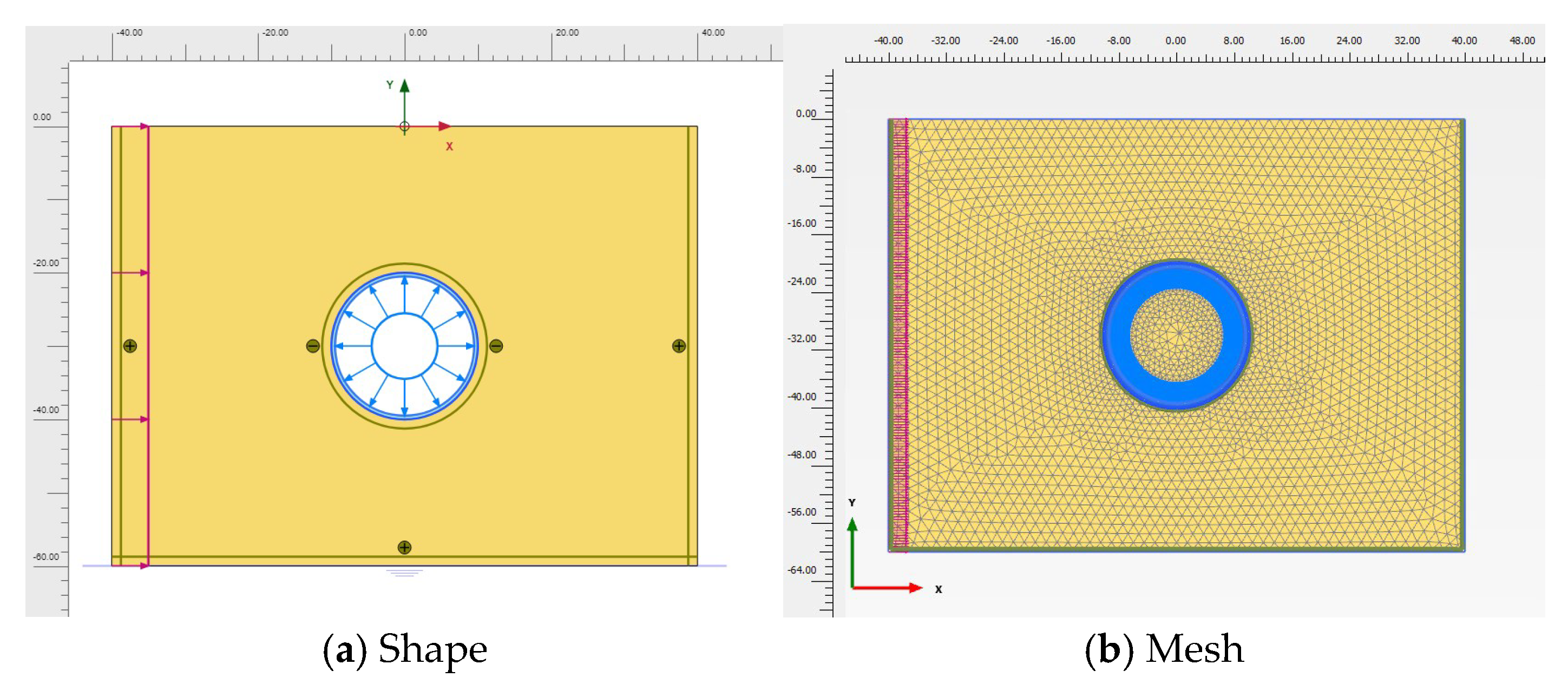
5.1. Simplified Seismic Evaluation Approach for Lined Rock Caverns
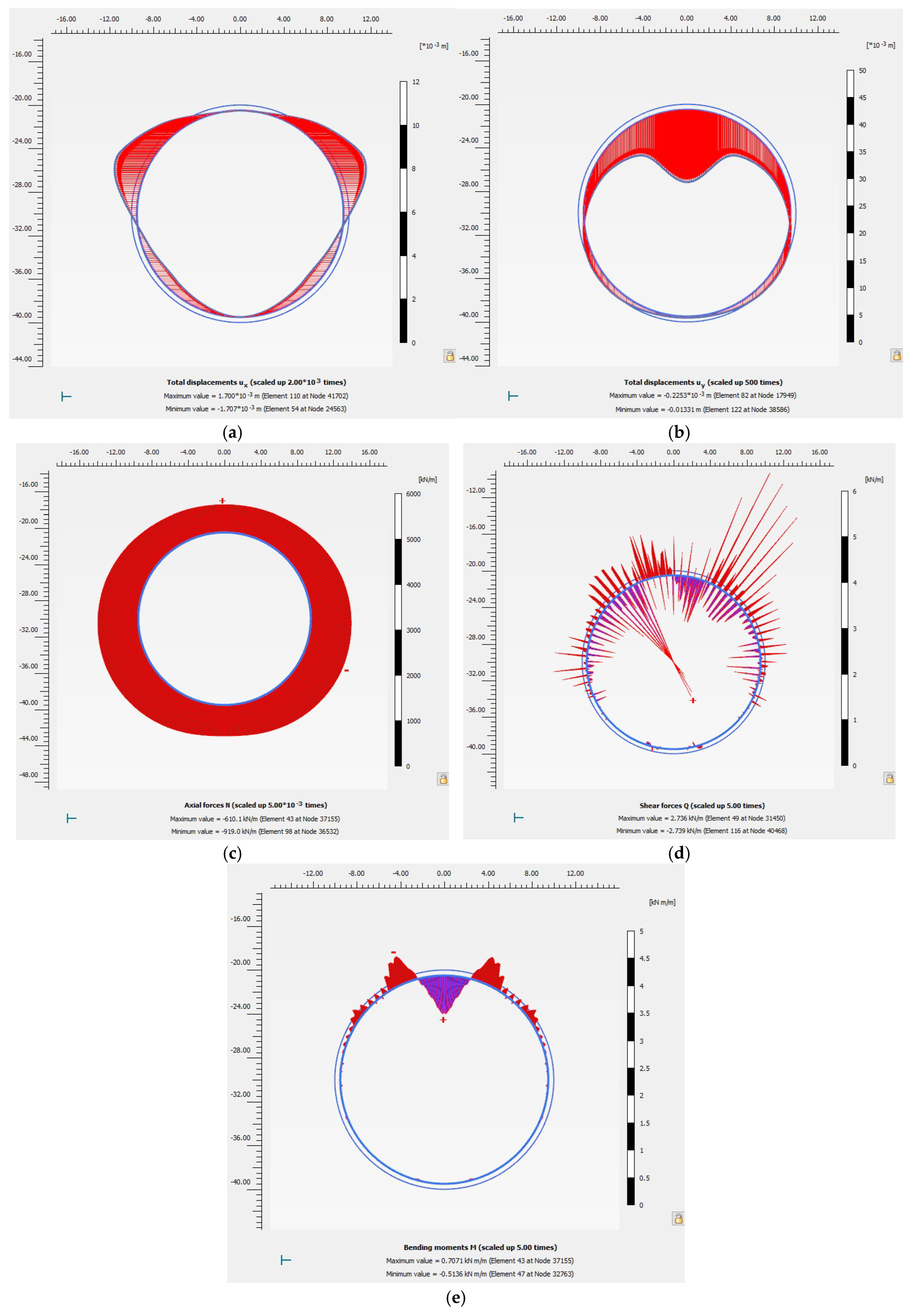
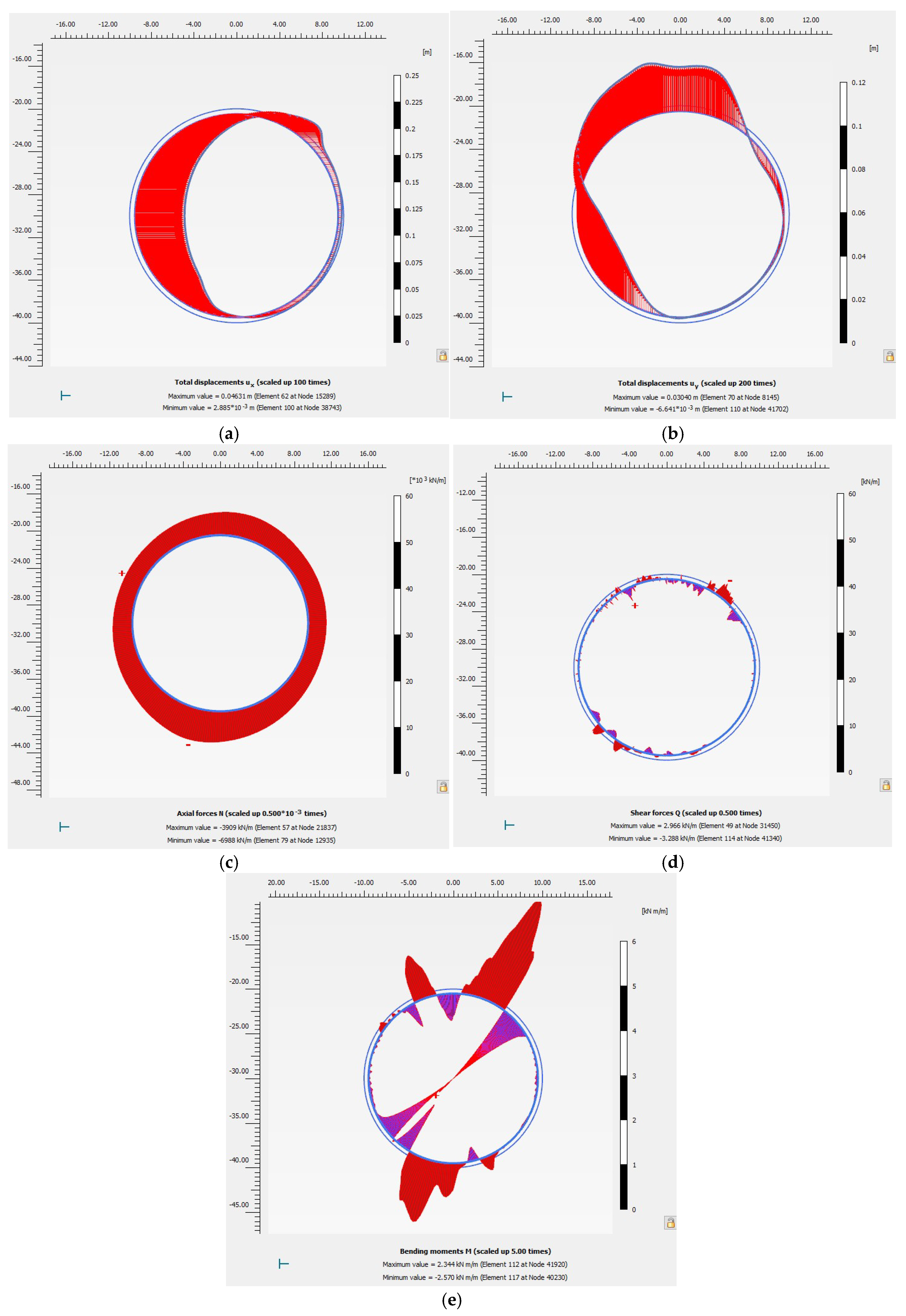
5.2. Numerical Results and Stress Response of the LRC
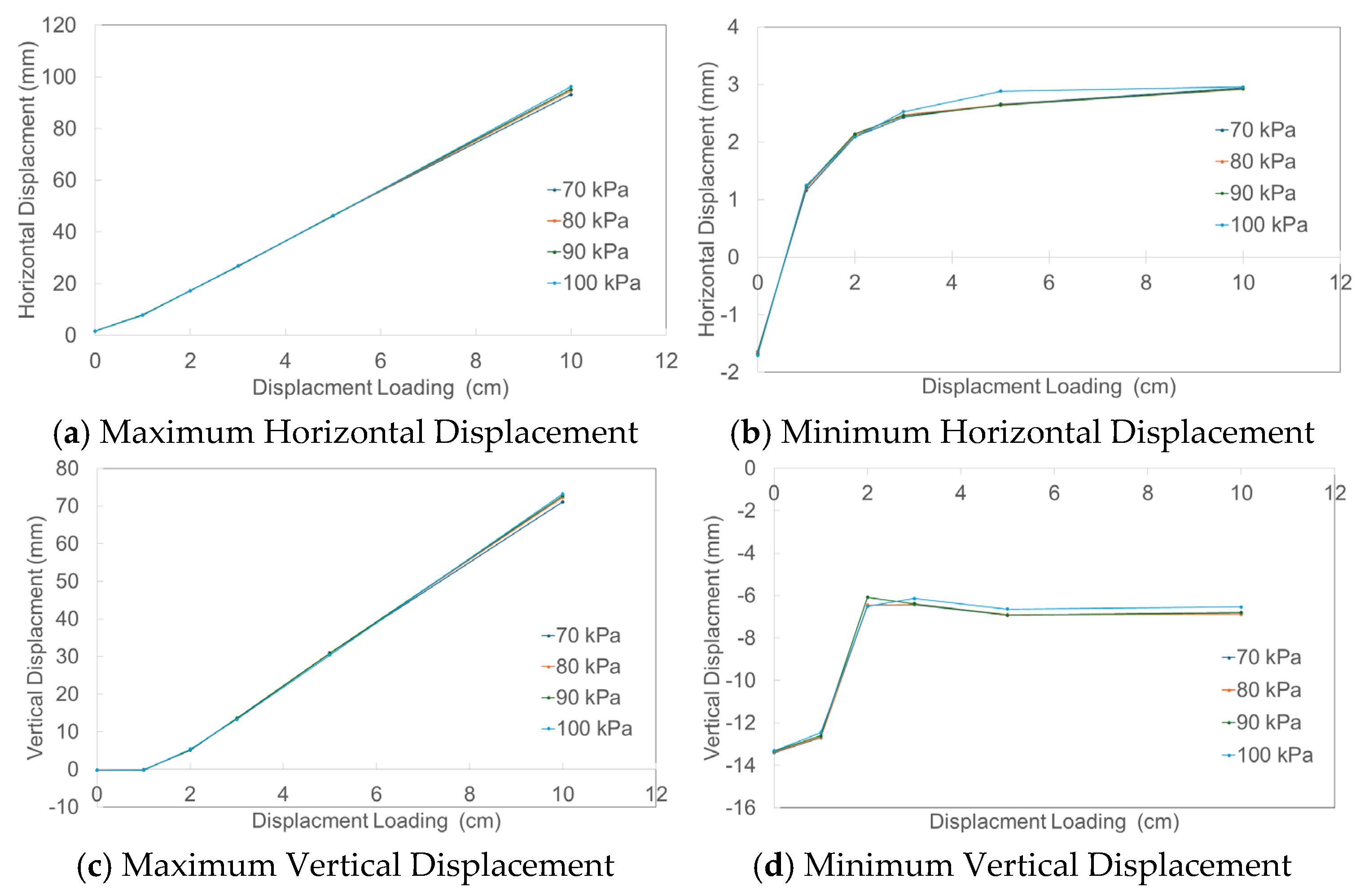
5.3. Lining Response Under Combined Internal Pressure and Ground Displacement
6. Discussion
6.1. Nonlinear Response and Convergence Behavior Under Reduced Internal Pressure
6.2. Role of Hoop Action in Lining Stability
6.3. Critical Internal Pressure and Design Implications
6.4. Design Considerations Under Combined Displacement and Pressure Effects
7. Conclusions
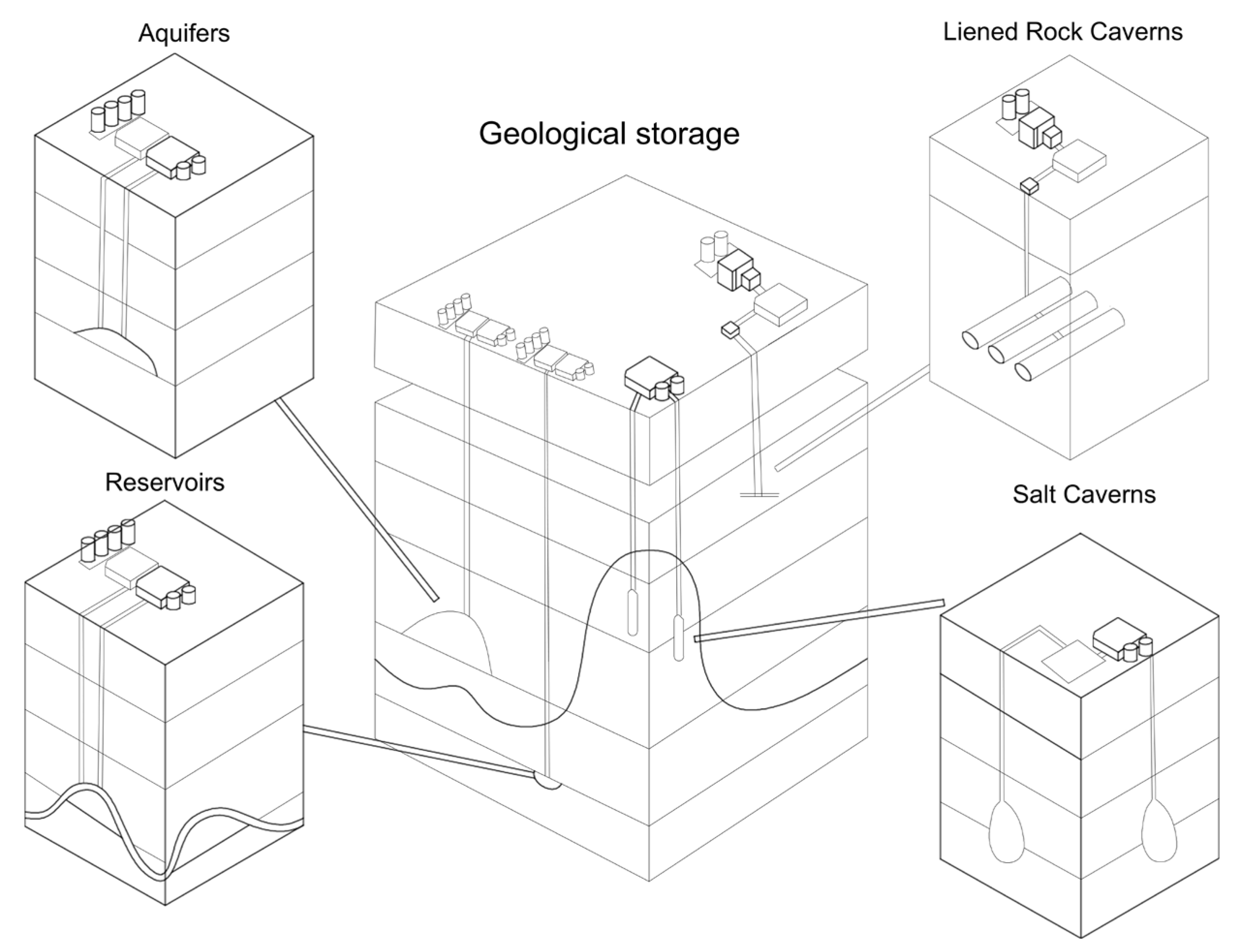
- Hydrogen’s physical characteristics and the need for long-term, large-capacity storage highlight the importance of deep underground facilities. Among available geological options, LRCs provide high impermeability, applicability across diverse rock formations, and suitability for pressurized operation. However, unlike surface tanks or pressure vessels, their seismic behavior is governed by ground–lining interaction under deformation-controlled loading rather than by vessel-type response alone.
- A review of domestic and international standards confirmed that no existing seismic design provisions explicitly address underground hydrogen storage caverns. Current codes, including ASCE 7, Eurocode 8, API 620/625, ACI 350.3, and NFPA 59A, focus on dams, LNG tanks, or pressure vessels and do not consider key aspects of LRC behavior, such as imposed ground deformation, internal pressure–lining interaction, or deformation-controlled loading mechanisms. This regulatory gap underscores the need for a dedicated seismic design framework for LRC-based hydrogen storage.
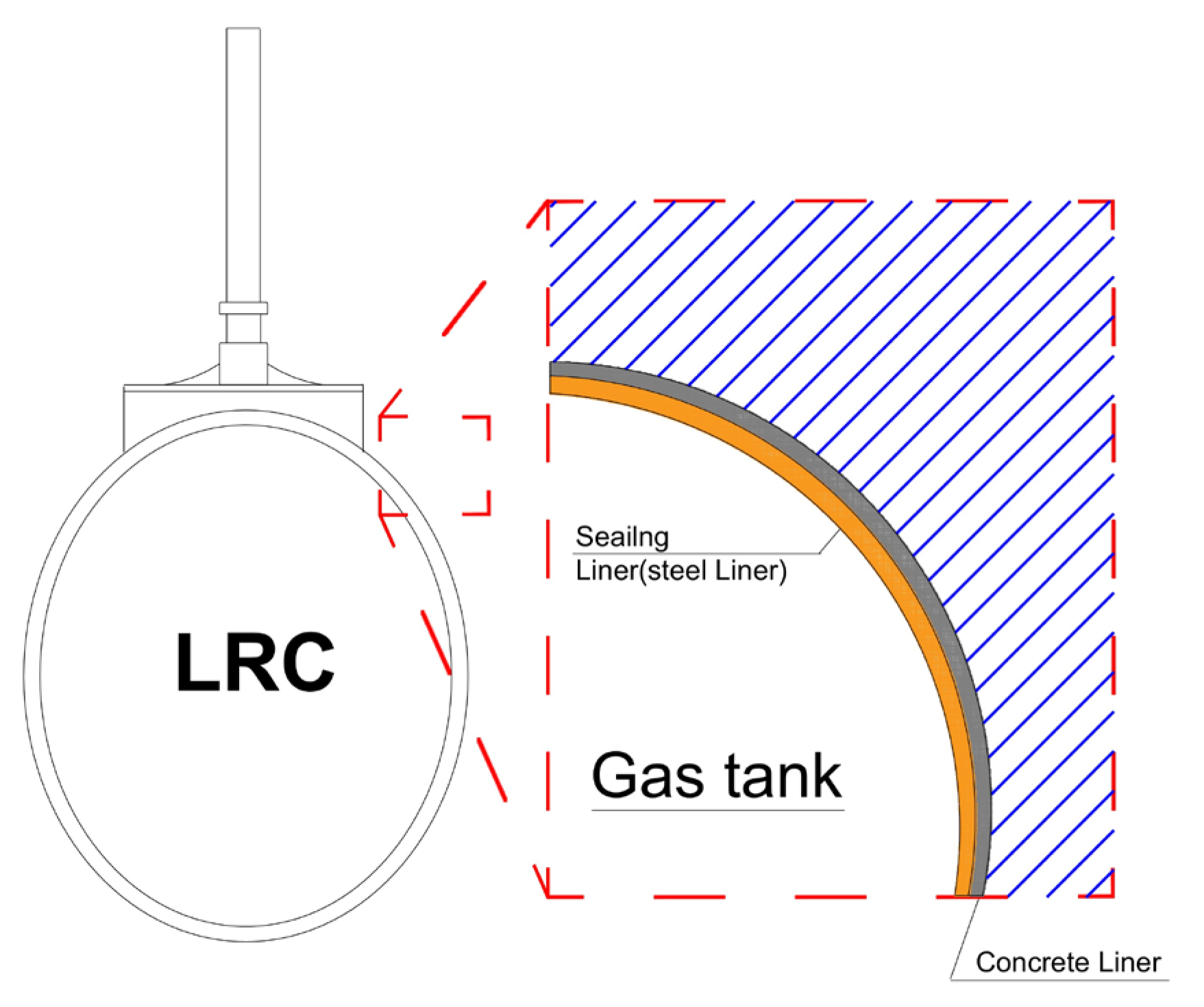
- The structural characteristics of LRCs differ fundamentally from those of conventional tunnels. While both rely on confinement and lining stiffness, LRCs must additionally sustain internal pressure through a multilayer system consisting of a steel liner, concrete support, and competent surrounding rock. The mechanical behavior of pressure-vessel steel differs markedly from that of tunnel shotcrete, confirming that conventional tunnel design approaches cannot be directly applied to pressurized underground storage caverns.
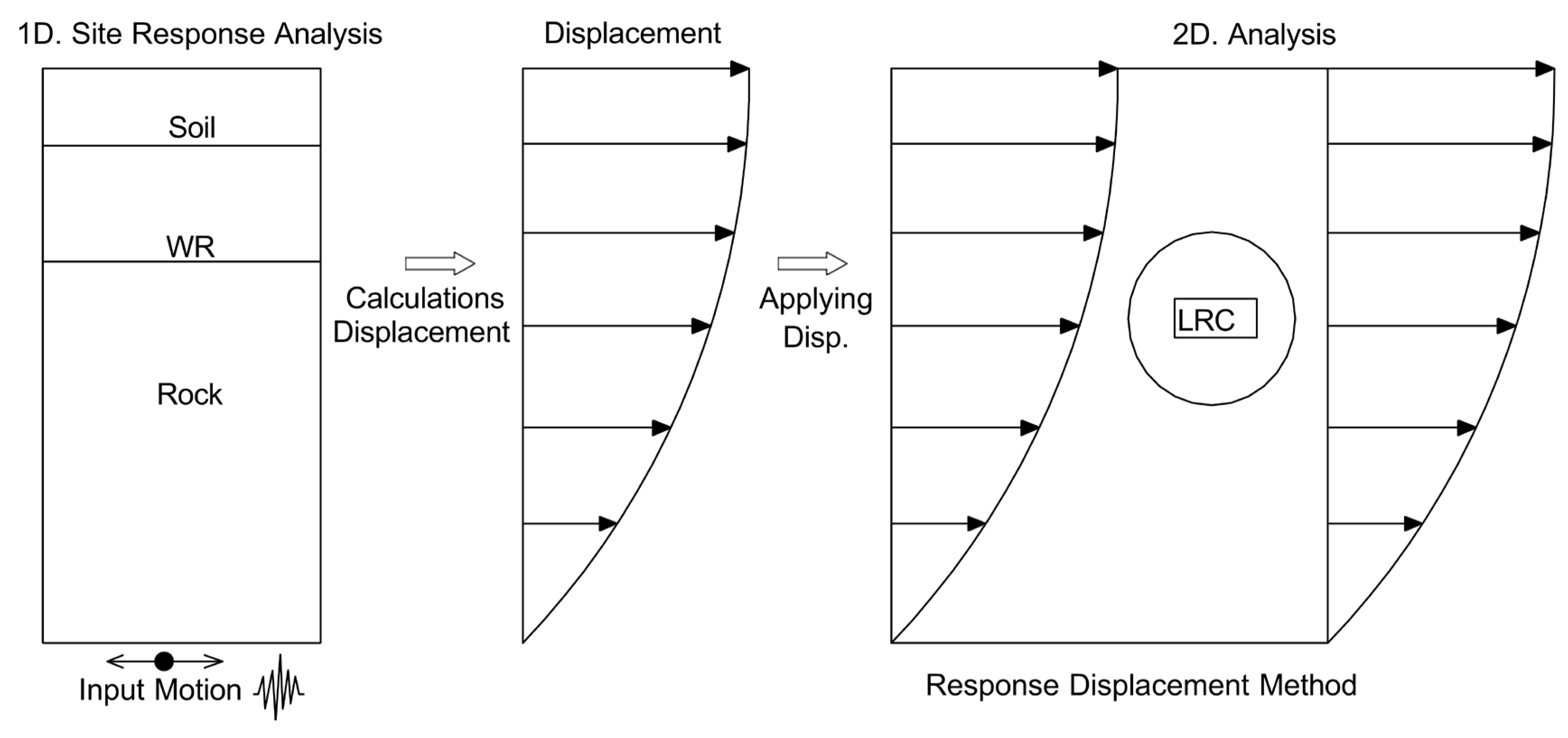
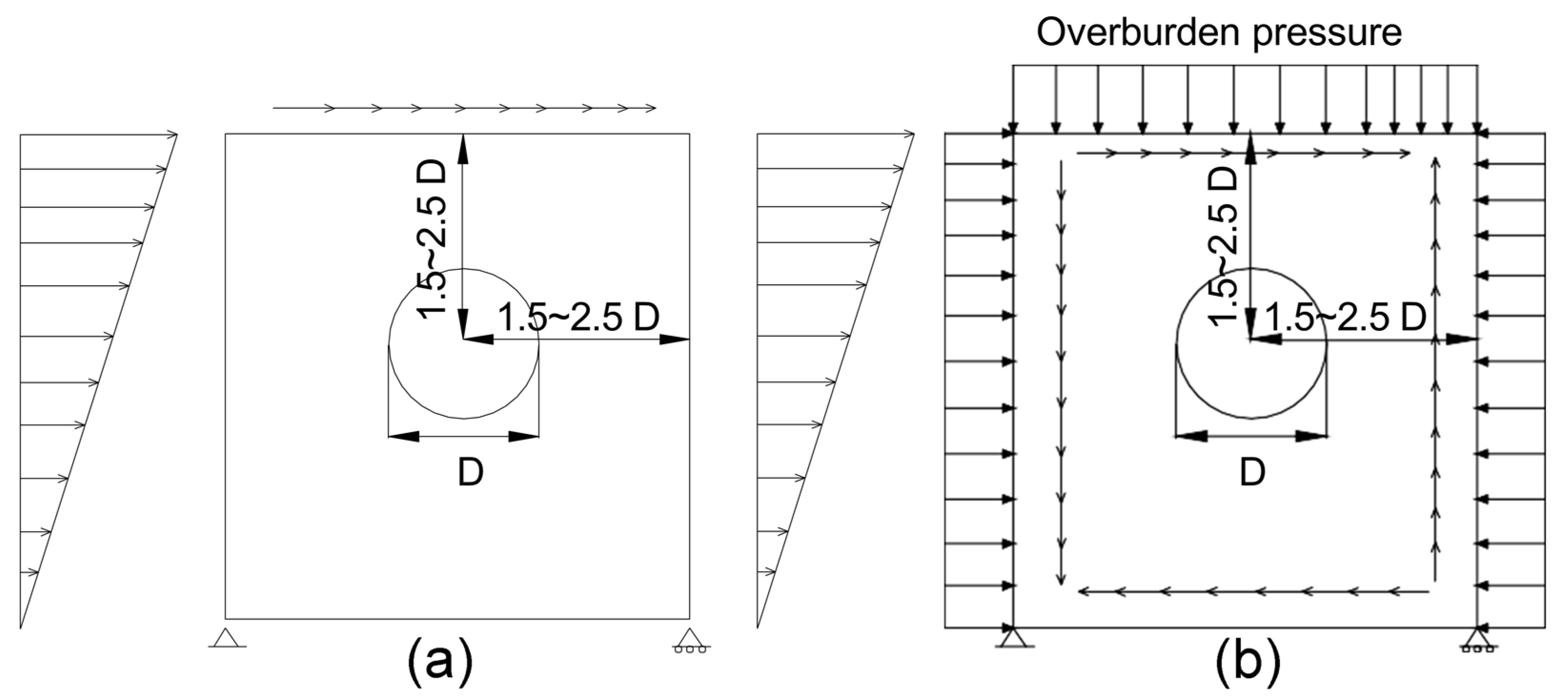
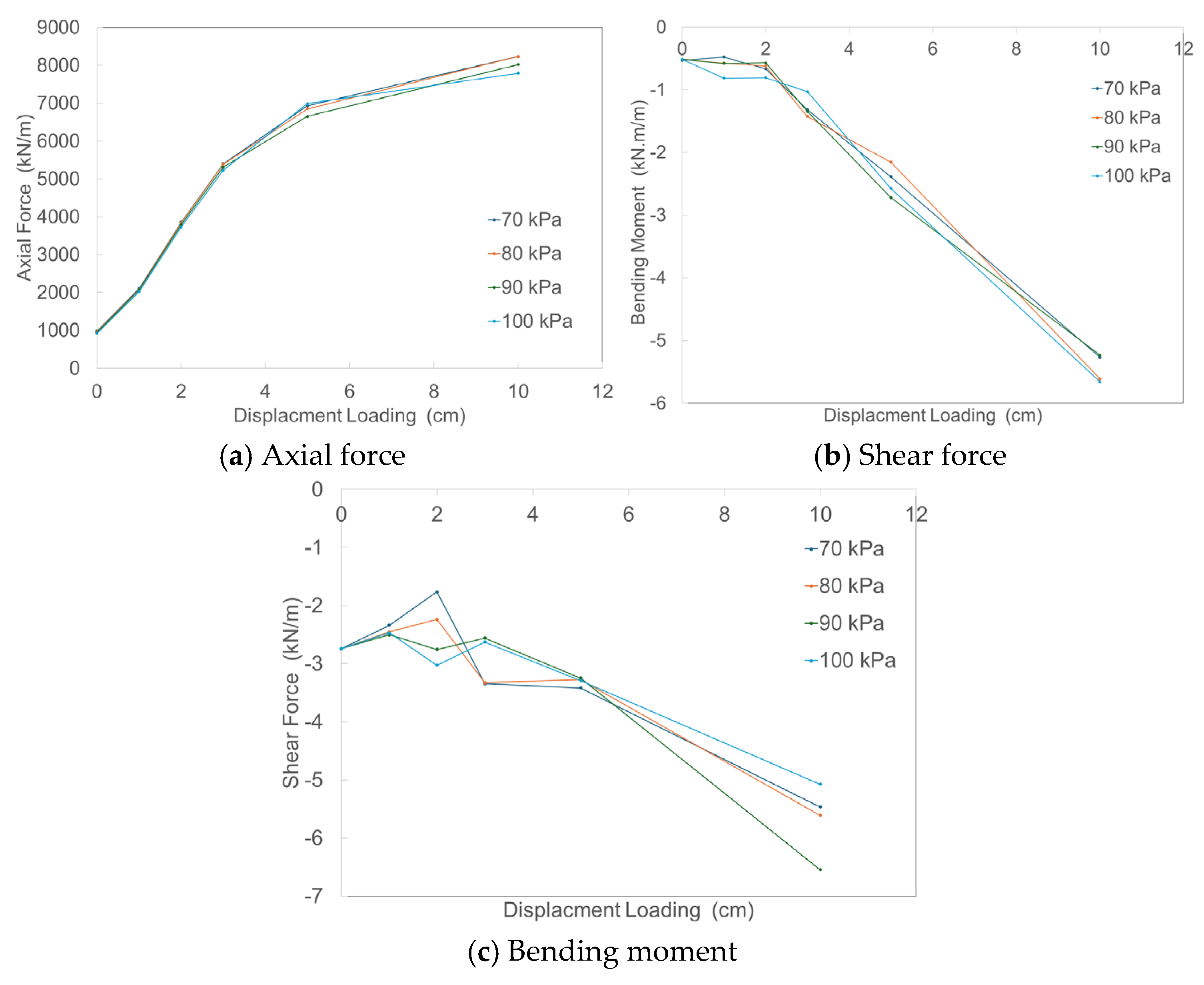
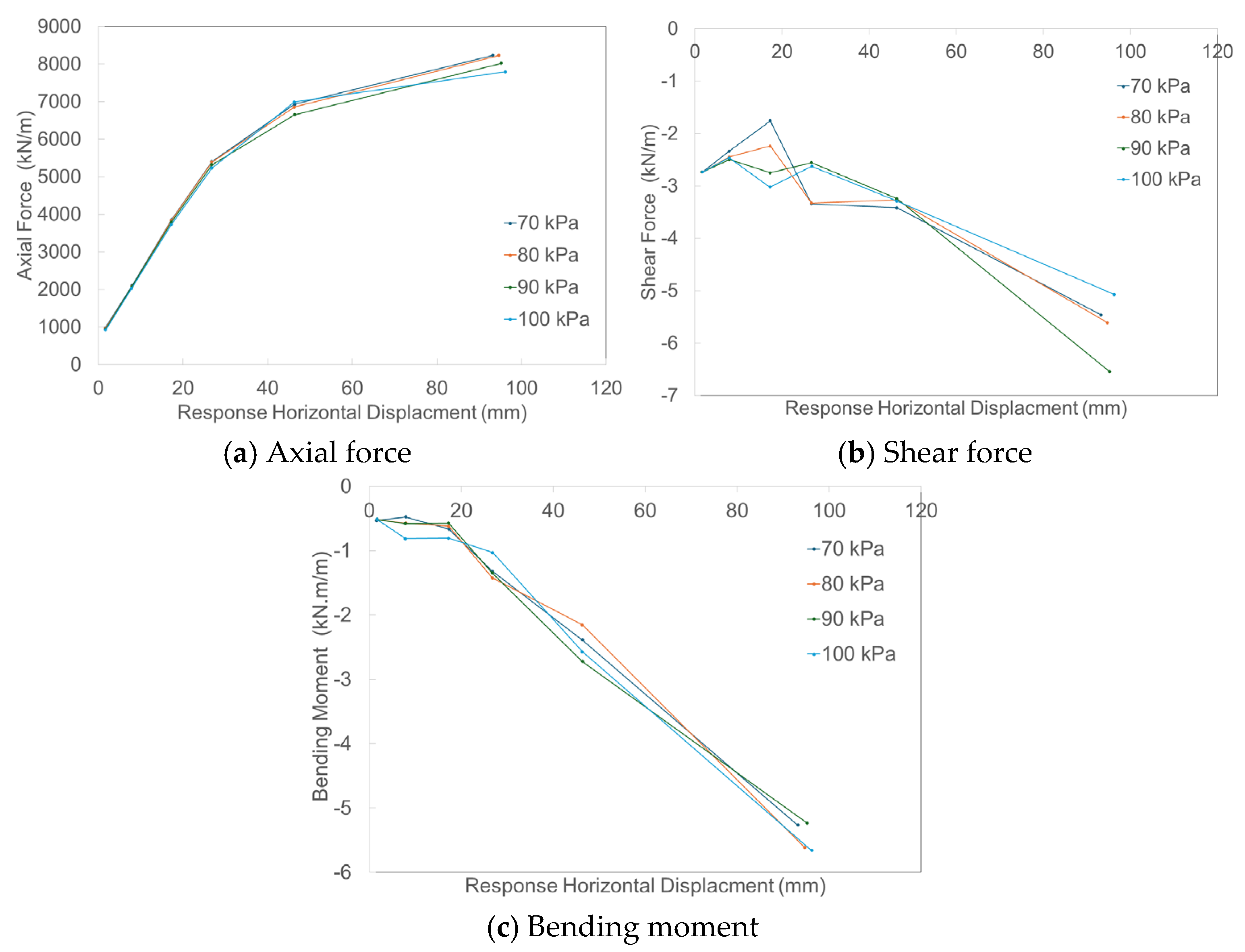
- Numerical analyses based on the RDM demonstrated that internal pressure plays a critical role in stabilizing the lining response under imposed ground deformation. A pressure range of approximately 60–70 kPa was identified as a transition zone between unstable and stable behavior. Below this range, reduced hoop action leads to bending-dominated deformation, ovalization, interface slip or opening, and loss of numerical convergence. For internal pressures of 70 kPa or higher, the lining response remains stable and convergent under stepwise ground displacement. Axial force was found to dominate the structural demand, while shear force and bending moment become significant primarily at large displacement levels.
- These findings indicate that seismic design of LRCs should treat internal pressure as a functional stability parameter rather than as a secondary load. Maintaining sufficient internal pressure during ground deformation enhances lining stability and robustness, and a minimum operational pressure of approximately 70 kPa is recommended. Given the absence of applicable design provisions in current codes, the results provide a rational basis for developing performance-based seismic design guidelines for underground hydrogen storage caverns.
- Future research should extend the present work to three-dimensional modeling, cyclic and cumulative damage effects, thermal–hydro–mechanical coupling, and nonlinear rock mass behavior, in order to support the formulation of comprehensive and codified seismic design provisions for underground hydrogen storage facilities.
Author Contributions
Funding
Data Availability Statement
Conflicts of Interest
References
- Intergovernmental Panel on Climate Change (IPCC). Climate Change 2023: Synthesis Report; IPCC: Geneva, Switzerland, 2023. [Google Scholar]
- International Energy Agency (IEA). Global Hydrogen Review 2022; IEA: Paris, France, 2022. [Google Scholar]
- International Energy Agency (IEA). Net Zero Roadmap: A Global Pathway to Keep the 1.5 °C Goal in Reach; IEA: Paris, France, 2023. [Google Scholar]
- Sarmah, M.K.; Singh, T.P.; Kalita, P.; Dewan, A. Sustainable hydrogen generation and storage—A review. RSC Adv. 2023, 13, 25253–25275. [Google Scholar] [CrossRef] [PubMed]
- Perna, A.; Minutillo, M.; Di Micco, S.; Jannelli, E. Design and costs analysis of hydrogen refuelling stations based on different hydrogen sources and plant configurations. Energies 2022, 15, 541. [Google Scholar] [CrossRef]
- Damasceno, D.R.; Spross, J.; Johansson, F. Rock mass response for lined rock caverns subjected to high internal gas pressure. J. Rock Mech. Geotech. Eng. 2023, 15, 119–129. [Google Scholar] [CrossRef]
- Gianni, E.; Tyrologou, P.; Couto, N.; Carneiro, J.F.; Scholtzová, E.; Koukouzas, N. Underground hydrogen storage: The techno-economic perspective. Open Res. Eur. 2024, 4, 17. [Google Scholar] [CrossRef]
- Masoudi, M.; Hassanpouryouzband, A.; Hellevang, H.; Haszeldine, R.S. Lined rock caverns: A hydrogen storage solution. J. Energy Storage 2024, 84, 110927. [Google Scholar] [CrossRef]
- Calabrese, M.; Portarapillo, M.; Di Nardo, A.; Venezia, V.; Turco, M.; Luciani, G.; Di Benedetto, A. Hydrogen safety challenges: A comprehensive review on production, storage, transport, utilization, and CFD-based consequence and risk assessment. Energies 2024, 17, 1350. [Google Scholar] [CrossRef]
- API Standard 620; Design and Construction of Large, Welded, Low-Pressure Storage Tanks. American Petroleum Institute (API): Washington, DC, USA, 2002.
- API Standard 625; Tank Systems for Refrigerated Liquefied Gas Storage. American Petroleum Institute (API): Washington, DC, USA, 2010.
- National Fire Protection Association (NFPA). NFPA 2: Hydrogen Technologies Code, 2023 Edition; NFPA: Quincy, MA, USA, 2023. [Google Scholar]
- Dagdag, O.; Kim, H. Recent advances in the hydrogen gas barrier performance of polymer liners and composites for type IV hydrogen storage tanks: Fabrication, properties, and molecular modeling. Polymers 2025, 17, 1231. [Google Scholar] [CrossRef]
- Thangarasu, S.; Oh, T.H. Impact of polymers on magnesium-based hydrogen storage systems. Polymers 2022, 14, 2608. [Google Scholar] [CrossRef]
- Liu, S.; Zhang, D. Study on long-term stability of lined rock cavern for compressed air energy storage. Energies 2024, 17, 5908. [Google Scholar] [CrossRef]
- Wang, J.N. Seismic Design of Tunnels: A Simple State of the Art Design Approach; Parsons Brinckerhoff Inc.: New York, NY, USA, 1993. [Google Scholar]
- Hashash, Y.M.A.; Hook, J.J.; Schmidt, B.; Yao, J.I.-C. Seismic design and analysis of underground structures. Tunn. Undergr. Space Technol. 2001, 16, 247–293. [Google Scholar] [CrossRef]
- Nikolaos, P.C.; Marios, F.; Dimitris, K. A review of pumped hydro storage systems. Energies 2023, 16, 4516. [Google Scholar] [CrossRef]
- Jankowski, M.; Pałac, A.; Sornek, K.; Goryl, W.; Żołądek, M.; Homa, M.; Filipowicz, M. Status and development perspectives of compressed air energy storage (CAES) technologies—A literature review. Energies 2024, 17, 2064. [Google Scholar] [CrossRef]
- Elliot, J.; Brown, J.; Mlilo, N.; Bowtell, L. Global trends in community energy storage: A comprehensive analysis. Sustainability 2025, 17, 1975. [Google Scholar] [CrossRef]
- Pellegrini, L.A.; Moioli, S.; Brignoli, F.; Bellini, C. LNG technology: The weathering in above-ground storage tanks. Ind. Eng. Chem. Res. 2014, 53, 3931–3937. [Google Scholar] [CrossRef]
- Sarvestani, K.; Ahmadi, O.; Alenjareghi, M.J. LPG storage tank accidents: Initiating events, causes, scenarios, and consequences. J. Fail. Anal. Prev. 2021, 21, 1305–1314. [Google Scholar] [CrossRef]
- Tarkowski, R. Underground hydrogen storage: Characteristics and prospects. Renew. Sustain. Energy Rev. 2019, 105, 86–94. [Google Scholar] [CrossRef]
- Sun, J.; Sun, D.; Asif, M.; Fang, B.; Bai, Y.; Qin, W.; Pan, T.; Jiang, J.; Zhang, M.; Wang, Z. Safety distance of ground and underground petrochemical installations. J. Loss Prev. Process Ind. 2021, 69, 104355. [Google Scholar] [CrossRef]
- Hematpur, H.; Abdollahi, R.; Rostami, S.; Haghighi, M.; Blunt, M.J. Review of underground hydrogen storage: Concepts and challenges. Adv. Geo-Energy Res. 2023, 7, 111–131. [Google Scholar] [CrossRef]
- Ahad, M.T.; Bhuiyan, M.M.H.; Sakib, A.N.; Corral, A.B.; Siddique, Z. Overview of challenges for the future of hydrogen. Materials 2023, 16, 6680. [Google Scholar] [CrossRef]
- Yu, H.; Díaz, A.; Lu, X.; Sun, B.; Ding, Y.; Koyama, M.; He, J.; Zhou, X.; Oudriss, A.; Feaugas, X.; et al. Hydrogen embrittlement as a conspicuous material challenge. Chem. Rev. 2024, 124, 6271–6392. [Google Scholar] [CrossRef]
- Griffioen, J.; van Wensem, J.; Oomes, J.L.; Barends, F.; Breunese, J.; Bruining, H.; Olsthoorn, T.; Stams, A.J.; van der Stoel, A.E. A technical investigation on tools and concepts for sustainable management of the subsurface in The Netherland. Sci. Total Environ. 2014, 485–486, 810–819. [Google Scholar] [CrossRef] [PubMed]
- Patanwar, Y.K.; Kim, H.M.; Deb, D.; Gujjala, Y.K. Underground storage of hydrogen in lined rock caverns: Key components and embrittlement issues. Int. J. Hydrogen Energy 2024, 50, 116–133. [Google Scholar] [CrossRef]
- Caglayan, D.G.; Weber, N.; Heinrichs, H.U.; Linßen, J.; Robinius, M.; Kukla, P.A.; Stolten, D. Technical potential of salt caverns for hydrogen storage in Europe. Int. J. Hydrogen Energy 2020, 45, 6793–6805. [Google Scholar] [CrossRef]
- Małachowska, A.; Łukasik, N.; Mioduska, J.; Gębicki, J. Hydrogen storage in geological formations—Potential of salt caverns. Energies 2022, 15, 5038. [Google Scholar] [CrossRef]
- Dopffel, N.; Jansen, S.; Gerritse, J. Microbial side effects of underground hydrogen storage. Int. J. Hydrogen Energy 2021, 46, 8594–8606. [Google Scholar] [CrossRef]
- Khajooie, S.; Gaus, G.; Dohrmann, A.B.; Krüger, M.; Littke, R. Methanogenic conversion of hydrogen to methane in reservoir rocks. Int. J. Hydrogen Energy 2024, 50, 272–290. [Google Scholar] [CrossRef]
- Aftab, A.; Hassanpouryouzband, A.; Xie, Q.; Machuca, L.L.; Sarmadivaleh, M. Toward a Fundamental Understanding of Geological Hydrogen Storage. Ind. Eng. Chem. Res. 2022, 61, 3233–3253. [Google Scholar] [CrossRef]
- Qian, X.; You, S.; Wang, R.; Yue, Y.; Liao, Q.; Dai, J.; Tian, S.; Liu, X. Underground hydrogen storage in salt caverns. Sustainability 2025, 17, 5900. [Google Scholar] [CrossRef]
- Sofregaz, U.; Gustafsväg, C. Commercial Potential of Natural Gas Storage in Lined Rock Caverns; US DOE: Washington, DC, USA, 1999. [Google Scholar]
- Ryu, D.; Kim, H.; Park, D. Rock engineering in underground compressed air energy storage. In Rock Mechanics and Engineering; CRC Press: Boca Raton, FL, USA, 2017; Volume 3, pp. 549–578. [Google Scholar]
- Zivar, D.; Kumar, S.; Foroozesh, J. Underground hydrogen storage: A comprehensive review. Int. J. Hydrogen Energy 2021, 46, 23436–23462. [Google Scholar] [CrossRef]
- Marchiori, L.; Albuquerque, A.; Pais, L.A.; Boscov, M.E.G.; Cavaleiro, V. Geoenvironmental engineered structures for water protection. Sustainability 2025, 17, 1850. [Google Scholar] [CrossRef]
- Louie, M.S.; Ehrhart, B.D. Regulations, Codes, and Standards Review for Underground Hydrogen Storage; Sandia National Laboratories: Livermore, CA, USA, 2024. [Google Scholar]
- OSHA. 29 CFR 1910.103—Hydrogen. Available online: https://www.osha.gov/laws-regs/regulations/standardnumber/1910/1910.103 (accessed on 2 June 2023).
- OSHA. 29 CFR 1910.119—Process Safety Management. Available online: https://www.ecfr.gov/ (accessed on 18 April 2024).
- API RP 1170; Design and Operation of Solution-Mined Salt Caverns. American Petroleum Institute (API): Washington, DC, USA, 2022.
- API RP 1171; Functional Integrity of Natural Gas Storage. American Petroleum Institute (API): Washington, DC, USA, 2022.
- European Industrial Gases Association (EIGA). Safety in Storage, Handling and Distribution of Liquid Hydrogen; Doc 06/19; EIGA: Brussels, Belgium, 2019. [Google Scholar]
- Ghosh, S.K. Significant changes from ASCE 7-05 to ASCE 7-10, Part 1: Seismic design provisions. PCI J. 2014, 59, 16–29. [Google Scholar] [CrossRef]
- Bisch, P. Introduction: Seismic design and Eurocode 8. In Seismic Design of Buildings to Eurocode 8; CRC Press: Boca Raton, FL, USA, 2016; pp. 15–20. [Google Scholar]
- Karcher, G.G.; Ecoff, R.A. Recent advances in ASME pressure vessel codes. J. Press. Vessel Technol. 1981, 103, 119–124. [Google Scholar] [CrossRef]
- API Standard 650; Low-Pressure Storage Tanks. American Petroleum Institute (API): Washington, DC, USA, 2018.
- ACI Committee. Code Requirements for Environmental Engineering Concrete Structures (ACI 350-01); ACI: Farmington Hills, MI, USA, 2001. [Google Scholar]
- ACI 318-05; Building Code Requirements for Structural Concrete. ACI Committee: Farmington Hills, MI, USA, 2005.
- Zhou, S.W.; Xia, C.C.; Du, S.G.; Zhang, P.Y.; Zhou, Y. Mechanical responses of lined rock caverns under temperature and air pressure. Rock Mech. Rock Eng. 2015, 48, 749–770. [Google Scholar] [CrossRef]
- Bowen, H.; Xianzhen, M.; Yu, L.; Shuchen, L.; Wei, L.; Chao, W. Effects of cushion gas pressure and operating parameters on hydrogen storage capacity in LRC. Renew. Energy 2024, 235, 121317. [Google Scholar] [CrossRef]
- ASME. Boiler and Pressure Vessel Code, Section VIII, Div. I.; ASME: New York, NY, USA, 2023. [Google Scholar]
- ISO 11114-4; Transportable Gas Cylinders—Compatibility of Cylinder and Valve Materials with Gas Contents—Part 4. ISO: Geneva, Switzerland, 2017.
- European Industrial Gases Association (EIGA). Hydrogen Pipeline Systems; Doc 121/14; EIGA: Brussels, Belgium, 2014. [Google Scholar]
- ASTM A516/A516M-21; Standard Specification for Carbon Steel Pressure Vessel Plates. ASTM: West Conshohocken, PA, USA, 2021.
- ASTM A537/A537M-20; Standard Specification for Pressure Vessel Plates, Heat-Treated Carbon-Manganese-Silicon Steel. ASTM: West Conshohocken, PA, USA, 2020.
- Korea Concrete Institute. Design Code for Shear and Torsion of Concrete Structures (KDS 14 20 22). MLIT: Seoul, Republic of Korea, 2024.
- Wang, G.; Yuan, M.; Miao, Y.; Wu, J.; Wang, Y. Seismic response of tunnel–soil–surface structure interaction. Tunn. Undergr. Space Technol. 2018, 76, 145–159. [Google Scholar] [CrossRef]
- Ambraseys, N.N.; Menu, J.A.M. Earthquake-induced ground displacements. Earthq. Eng. Struct. Dyn. 1988, 16, 985–1006. [Google Scholar] [CrossRef]
- Ahn, J.K.; Park, D.H.; Kim, D.K.; Kim, K.Y. Evaluation of seismic performance of operating road tunnels. J. Korean Tunn. Undergr. Space Assoc. 2013, 15, 69–80. (In Korean) [Google Scholar]
- Hashash, Y.M.A.; Musgrove, M.I.; Harmon, J.A.; Ilhan, O.; Groholski, D.R.; Phillips, C.A.; Park, D. DEEPSOIL 7.0 User Manual; Univ. of Illinois: Urbana-Champaign, IL, USA, 2017. [Google Scholar]
- Möller, S.C. Tunnel Induced Settlements and Structural Forces in Linings. Ph.D. Thesis, Universität Stuttgart, Stuttgart, Germany, 2006. [Google Scholar]



| Storage Type | Storage Medium | Facilities |
|---|---|---|
| PHS | Water | (Aboveground) Large-scale dams (Underground) Waterways, Connecting tunnels |
| CAES | Compressed air | (Aboveground) High-pressure vessels (Underground) Rock cavern, abandoned mines |
| CES | Compressed gas, liquefied hydrogen (LH2), metal hydrides, Methanol, ammonia, other synthetic hydrocarbons | (Aboveground) High-pressure vessels, spherical tanks, vertical tanks, LH2 flat-bottom tanks, Modular tanks (Underground) Cavern, Engineered cavern |
| LNG/LPG | Liquefied natural gas, liquefied petroleum gas | (Aboveground) LNG flat-bottom tanks, LPG spherical tanks (Underground) Cavern, Engineered cavern |
| Facility Type | Structural Form | Codes/Standards | Seismic Design Focus |
|---|---|---|---|
| PHS | Dams, Tunnels | ICOLD Bulletins Eurocode 8 | Stability of Facility |
| CAES | Caverns, pressure vessels | ASCE 7, ACI 350.3 | (Cavern) Stability, (Vessel) anchorage, uplift/overturning checks |
| Liquid tanks | Steel Concrete tanks | API 650 API 620/625, ACI 376, Eurocode 8 Part 4 | Stability of Facility base shear, shell buckling, anchorage |
| Pressure vessels | Cylindrical, spherical vessels | ASME BPVC Sec. VIII, ASCE 7 | Overturning, anchorage design, nozzle loads, SSI |
| LNG/LPG storage | Tanks, Caverns | NFPA 59A (LNG), NFPA 58 (LPG), API 625 | foundation–soil interaction |
| Hydrogen storage | High-pressure tanks, Caverns | no specific seismic criteria | no specific seismic criteria |
| Section | SA-516 Gr.70 (Carbon Steel) | SA-537 Cl.1 (Low Alloy Steel) | Shotcrete (Tunnel Application) |
|---|---|---|---|
| Code/Standard | ASTM A516 [57] | ASTM A537 [58] | KDS 14 20 10 [59] |
| Material | Fine-grained carbon steel & low-temperature pressure vessels | Mn-Mo low-alloy steel, quenched & tempered pressure vessel steel | Reinforced sprayed concrete |
| Density | 7850 kg/m3 | 7850 kg/m3 | 2300–2400 kg/m3 |
| Yield Strength | 260–300 MPa (min 260 MPa at RT) | 345 MPa (min, RT) | - |
| Compressive Strength | 25–40 MPa (28-day strength, typically 30 MPa) | ||
| Tensile Strength | 485–620 MPa | 485–620 MPa | 3–5 MPa |
| Elastic Modulus, E | 200 GPa (typical) | 205 GPa (typical) | 25–30 GPa |
| Poisson’s Ratio, ν | 0.29–0.30 | 0.29–0.30 | 0.20–0.25 |
| Model | Unit Weight (kN/m3) | Cohesiveness (kPa) | Initial Friction Angle (°) | Dilation (°) | Elastic Modulus (MPa) | Poisson’s Ratio | Vs (m/s) | |
|---|---|---|---|---|---|---|---|---|
| Rock | MC | 26 | 100 | 35 | 5 | 150 | 0.25 | 1500 |
| Contact-layer | MC | 20 | 20 | 25 | 0 | 150 | 0.25 | 171 |
| Unit Weight (kN/m3) | Elastic Modulus (GPa) | Poisson’s Ratio | Thickness (mm) | |
|---|---|---|---|---|
| shotcrete | 25 | 25 | 0.25 | 300 |
| Steel lining | 77 | 200 | 0.3 | 30 |
| Internal Pressure (kPa) | Disp. Loading (cm) | Horizontal Displacement (mm) | Vertical Displacement (mm) | Axial Force (kN/m) | Shear Force (kN/m) | Bending Moment (KN.m/m) | |||||
|---|---|---|---|---|---|---|---|---|---|---|---|
| Max | Min | Max | Min | Max | Min | Max | Min | Max | Min | ||
| 100 | 0 | 1.7 | −1.707 | −0.2253 | −13.31 | −610.1 | −919 | 2.736 | −2.739 | 0.7071 | −0.5136 |
| 1 | 7.848 | 1.251 | −0.2073 | −12.45 | −1505 | −2027 | 2.681 | −2.466 | 0.6458 | −0.8127 | |
| 2 | 17.24 | 2.086 | 5.371 | −6.506 | −2460 | −3731 | 2.385 | −3.024 | 0.7089 | −0.8061 | |
| 3 | 26.8 | 2.53 | 13.24 | −6.134 | −3093 | −5229 | 1.83 | −2.625 | 1.52 | −1.029 | |
| 5 | 46.31 | 2.885 | 30.4 | −6.641 | −3909 | −6988 | 2.966 | −3.288 | 2.344 | −2.57 | |
| 10 | 96.22 | 2.959 | 73.26 | −6.527 | −4145 | −7792 | 6.591 | −5.073 | 5.268 | −5.66 | |
| 90 | 0 | 1.677 | −1.685 | −0.1992 | −13.34 | −629.6 | −938.7 | 2.736 | −2.739 | 0.707 | −0.5134 |
| 1 | 7.891 | 1.227 | −0.1768 | −12.6 | −1562 | −2069 | 2.494 | −2.5 | 0.6386 | −0.5803 | |
| 2 | 17.27 | 2.141 | 5.148 | −6.081 | −2428 | −3792 | 1.789 | −2.753 | 0.6069 | −0.5708 | |
| 3 | 26.77 | 2.46 | 13.61 | −6.383 | −3127 | −5315 | 2.557 | −2.556 | 1.533 | −1.344 | |
| 5 | 46.35 | 2.64 | 30.96 | −6.921 | −3828 | −6650 | 3.126 | −3.246 | 2.275 | −2.721 | |
| 10 | 95.21 | 2.929 | 72.76 | −6.795 | −4217 | −8023 | 5.504 | −6.542 | 5.237 | −5.234 | |
| 80 | 0 | 1.656 | −1.663 | −0.1731 | −13.38 | −649.1 | −958.4 | 2.737 | −2.739 | 0.7069 | −0.5132 |
| 1 | 7.914 | 1.201 | −0.1464 | −12.67 | −1588 | −2082 | 2.464 | −2.449 | 0.6428 | −0.5711 | |
| 2 | 17.27 | 2.118 | 5.132 | −6.447 | −2541 | −3839 | 1.579 | −2.239 | 0.4623 | −0.621 | |
| 3 | 26.77 | 2.473 | 13.51 | −6.401 | −3267 | −5392 | 1.63 | −3.327 | 1.224 | −1.423 | |
| 5 | 46.29 | 2.645 | 30.92 | −6.901 | −3902 | −6852 | 3.094 | −3.27 | 2.414 | −2.151 | |
| 10 | 94.67 | 2.92 | 72.33 | −6.88 | −4350 | −8229 | 5.602 | −5.609 | 4.856 | −5.613 | |
| 70 | 0 | 1.634 | −1.641 | −0.147 | −13.41 | −668.6 | −978.1 | 2.738 | −2.74 | 0.7067 | −0.531 |
| 1 | 7.932 | 1.163 | −0.1166 | −12.7 | −1614 | −2104 | 2.457 | −2.334 | 0.635 | −0.4757 | |
| 2 | 17.31 | 2.096 | 5.219 | −6.467 | −2573 | −3861 | 2.011 | −1.761 | 0.4905 | −0.6663 | |
| 3 | 26.78 | 2.433 | 13.53 | −6.428 | −3325 | −5401 | 1.965 | −3.345 | 1.609 | −1.318 | |
| 5 | 46.35 | 2.657 | 30.92 | −6.911 | −3944 | −6927 | 2.961 | −3.417 | 2.382 | −2.386 | |
| 10 | 93.19 | 2.944 | 71.17 | −6.806 | −4378 | −8232 | 5.909 | −5.463 | 5.153 | −5.267 | |
Disclaimer/Publisher’s Note: The statements, opinions and data contained in all publications are solely those of the individual author(s) and contributor(s) and not of MDPI and/or the editor(s). MDPI and/or the editor(s) disclaim responsibility for any injury to people or property resulting from any ideas, methods, instructions or products referred to in the content. |
© 2025 by the authors. Licensee MDPI, Basel, Switzerland. This article is an open access article distributed under the terms and conditions of the Creative Commons Attribution (CC BY) license.
Share and Cite
Son, S.-W.; Lee, J.-W.; Ahn, J.-K.; Park, C. Proposed Simplified Seismic Design for Energy Storage Facilities: Underground Structures. Appl. Sci. 2026, 16, 174. https://doi.org/10.3390/app16010174
Son S-W, Lee J-W, Ahn J-K, Park C. Proposed Simplified Seismic Design for Energy Storage Facilities: Underground Structures. Applied Sciences. 2026; 16(1):174. https://doi.org/10.3390/app16010174
Chicago/Turabian StyleSon, Su-Won, Jae-Won Lee, Jae-Kwang Ahn, and Cheolwoo Park. 2026. "Proposed Simplified Seismic Design for Energy Storage Facilities: Underground Structures" Applied Sciences 16, no. 1: 174. https://doi.org/10.3390/app16010174
APA StyleSon, S.-W., Lee, J.-W., Ahn, J.-K., & Park, C. (2026). Proposed Simplified Seismic Design for Energy Storage Facilities: Underground Structures. Applied Sciences, 16(1), 174. https://doi.org/10.3390/app16010174