1. Introduction
Many calibration techniques such as the Thru-Reflect-Line (TRL) [
1] call for accurate determination of frequency-dependent propagation constant (
) for electromagnetic characterization of microwave networks or devices (not only for determination of error networks but also for evaluation of precise reference planes for scattering-parameter (S-parameter) measurements). Measurement of
is also important for characterization of these networks or devices by calibration-free methods (no direct calibration process) [
2,
3,
4,
5] to extract relative complex permittivity (
) or other equivalent parameters. These networks or devices can possess no-reflection property, symmetrical reflection property, or even asymmetric reflection property [
1,
6,
7,
8,
9,
10,
11,
12,
13].
The main problem in
determination of uniform lines with symmetric reflections is assignment or allocation of the correct eigenvalue and eigenfactor at a given frequency [
1,
6,
7,
8,
10,
14]. There are two types of remedies for resolving this problem: the direct approach and indirect approach. In the indirect approach, the terms
and
present in error networks are first determined by enforcing the passivity principle and then eigenfactors are calculated using one-to-one (unique) relation [
1,
10]. In the direct approach, eigenfactors are directly determined by using different methodologies [
6,
8,
14]. For example, in the study [
8], between two eigenfactors, the one yielding a monotonous frequency-dependent variation (counterclockwise or clockwise manner) is kept, whereas the other one is discarded for the analyzed frequency, and this process is repeated over the whole frequency band. The problem with this methodology is the assignment of reference eigenfactor at a given frequency from which monotonous variation of eigenfactors is evaluated for the remaining frequencies in the band.
On the other hand, in the studies [
6,
14], the accurate eigenfactor (positive or negative) at a given frequency is determined by using the property of cosine and sine hyperbolic functions and by exploiting the unique value of the cosine hyperbolic function. The problem associated with this methodology is the requirement of unity value of the determinant of an eigen matrix
where
denotes the determinant of ‘★’. It will be demonstrated by measurements in
Section 4 that
is close but not totally equal to unity. Many studies have also been contributed for deriving propagation constants in the literature recently [
15,
16,
17].
In this paper, we propose a novel and robust methodology to resolve the long-standing problem of eigenfactor ambiguity and the non-unity determinant limitation in determination for uniform lines with symmetric reflections. Our key contribution is the derivation of a new objective function by explicitly considering that the propagation constants () might be non-identical in opposite directions of the line. This novel formulation not only simplifies the extraction of correct eigenfactors but also provides a calibration-free and ambiguity-free approach, as validated by X-band measurements.
2. Background and Problem Description
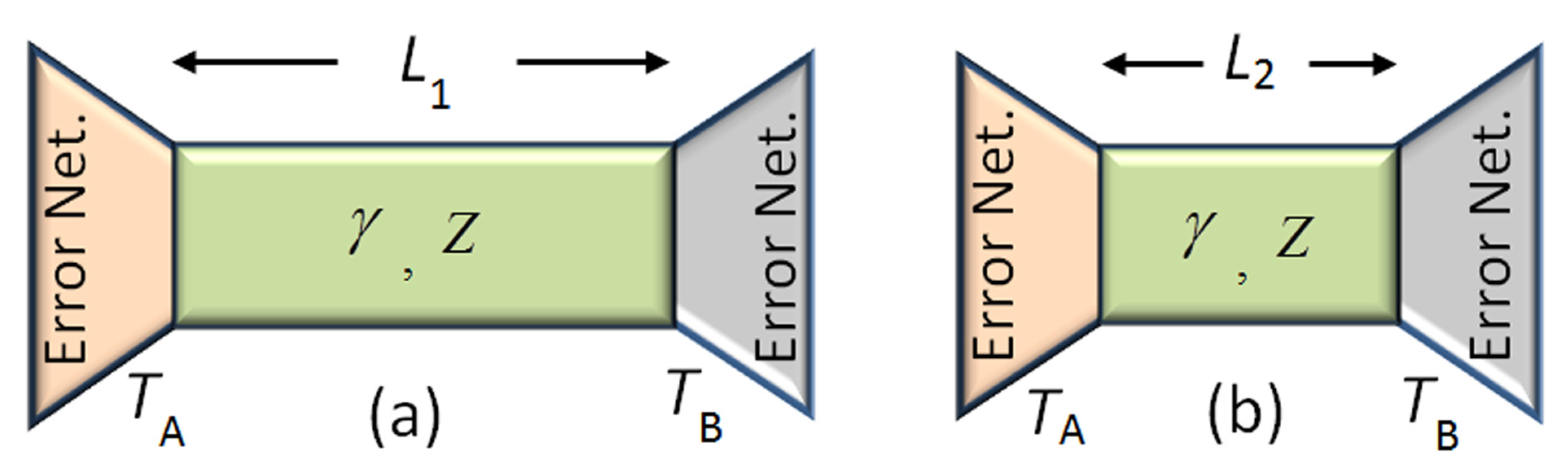
Figure 1 illustrates a pair of uniform and identical lines with different lengths to determine
by the proposed method.
Here, it is assumed that the lines are sandwiched between two error boxes
and
referring to imperfections of vector network analyzers (VNAs), effects of transitions, source and load match errors, and tracking (frequency) errors. It is also assumed that only the dominant mode propagates through the microwave network [
6].
For each line in
Figure 1 we can write
where
,
, and
denote the wave cascading matrices of lines and error networks and
,
,
, and
show the forward and backward reflection and transmission S-parameters of the
k-th microwave network.
Using (
1) and (
2), the following eigen matrix and eigen equation can be formed [
6,
14]
where
and
show the trace operation of the square matrix ‘★’.
Assuming that
, the following trigonometric expressions can be derived [
6,
14]:
where
and Ch and Sh denote the cosine and sine hyperbolic functions. The unique feature of expressions in (
5) and (
6) is that while Sh is two-valued due to sign-ambiguity, Ch is unique. This unique value of Ch is exploited to obtain unique value of Sh and thus
[
6] as
where
and
and
.
A variant form for
can be obtained [
14] as
The common premise of the expressions given in (
5)–(
13) is
. Although ideally it is true, it is difficult to satisfy this by experiments. Therefore, the effect of non-unity
should be accounted for to achieve accurate
extraction.
3. The Proposed Method
In this section, we derive a new eigenfactor expression accounting for non-unity
. Toward this end, we define two propagation constants,
and
, in different directions and obtain the following eigen matrices:
Although the investigated line is ideally reciprocal and symmetric, in practice, small non-reciprocal deviations arise from connector asymmetries, cable loss differences, and VNA error networks. To accommodate these imperfections, two propagation constants, and , are introduced to represent the forward and reverse traveling waves. Their averaged value, of , defines the physical propagation constant of the line, while their difference enables the determinant relations and to deviate from unity while maintaining . This generalization stabilizes the eigen-solution and allows robust extraction even when slight measurement asymmetries are present.
From (
14) and (
15), we find
It is seen from (
16) and (
20) that some of these expressions are linearly dependent, and some of them are not since
is inverse of
,
, and
.
Using (
17) and (
20), we derive a new eigen function for finding
as
The advantage of the new eigen function in (
21) is that the coefficient after
is identical to unity; that is,
. Therefore, by assuming that
, it is possible to apply the hyperbolic relations in (
5) and (
6) and thus the expressions in (
12) and (
13) to the new eigen function to derive
where
.
Finally, the
can be extracted from
where
m is the branch index (
) whose value can be ascertained by the stepwise method [
18].
4. Measurement and Discussion
A general-purpose microwave measurement setup operating in the X-band (8.2–12.4 GHz) was constructed for validation of formalism in [
11]. It involves a VNA (model N9918A from Keysight Instruments), two longer rugged phase-stable cables, two coaxial-to-waveguide adapters, and two waveguide straights with lengths greater than 2 times the wavelength at the minimum frequency of the X-band (8.2 GHz). These straights were used in securing dominant mode propagation, as assumed in
Section 2. S-parameter measurements with 1001 points were performed. In measurements, the length of the second line (
) is adjusted to zero (thru connection) and the length of the first line (X-band waveguide cell) is considered as
mm, yielding
mm.
Before starting
measurements, we first examine the variation in
(or
) and
over frequency.
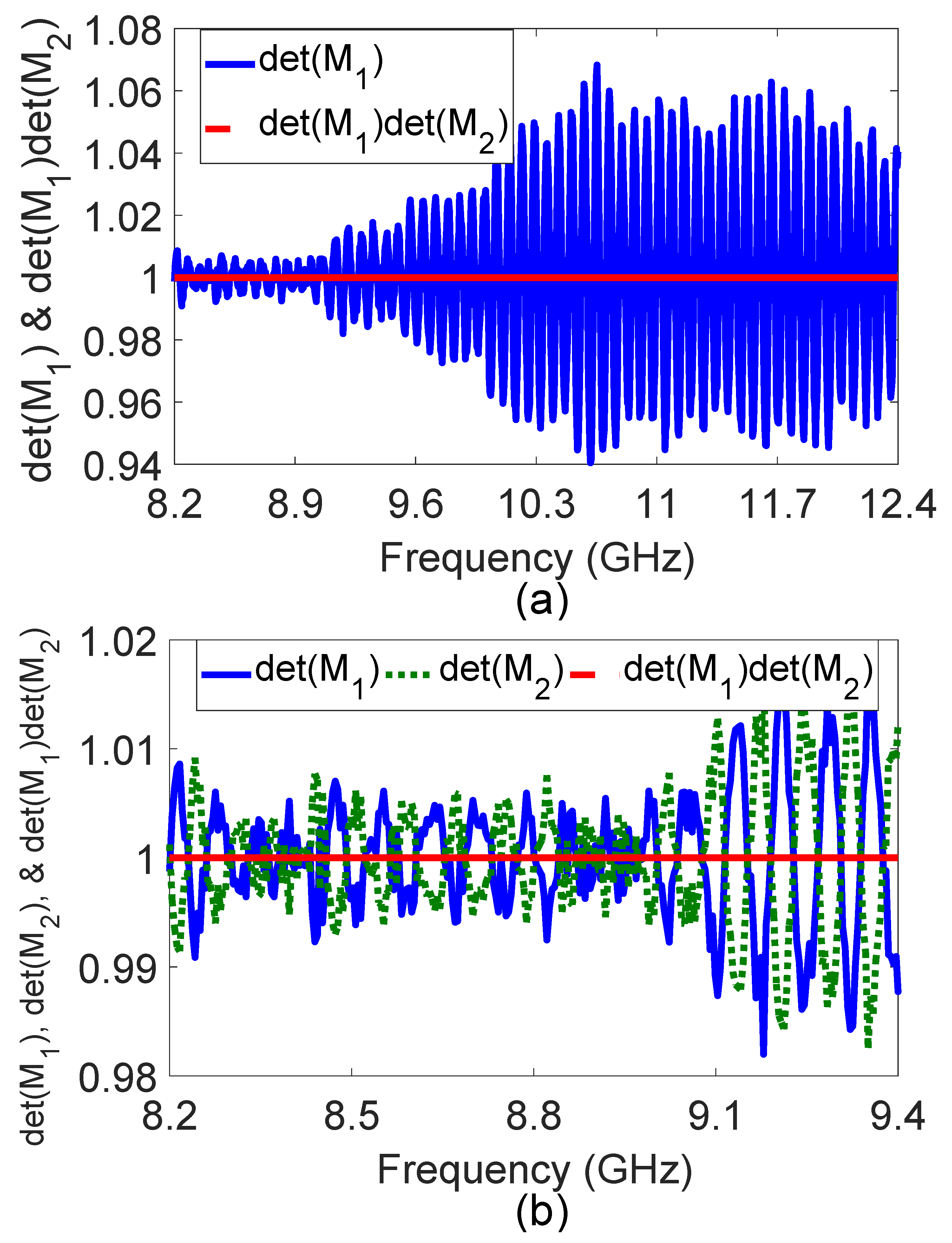
Figure 2a,b illustrate the frequency dependencies of
,
, and
over the whole band and over the 8.2–9.4 GHz band.
We note the following points from the dependencies in
Figure 2a,b. First, both
and
are close to but do not attain unity value (less than
) over the whole band. Second, while
increases at a given frequency,
decreases at that frequency (or vice versa). Third,
is close to unity regardless of how far
and/or
values are away from the unity. We then determined
and
of the X-band line by the method in [
14] and the proposed method.
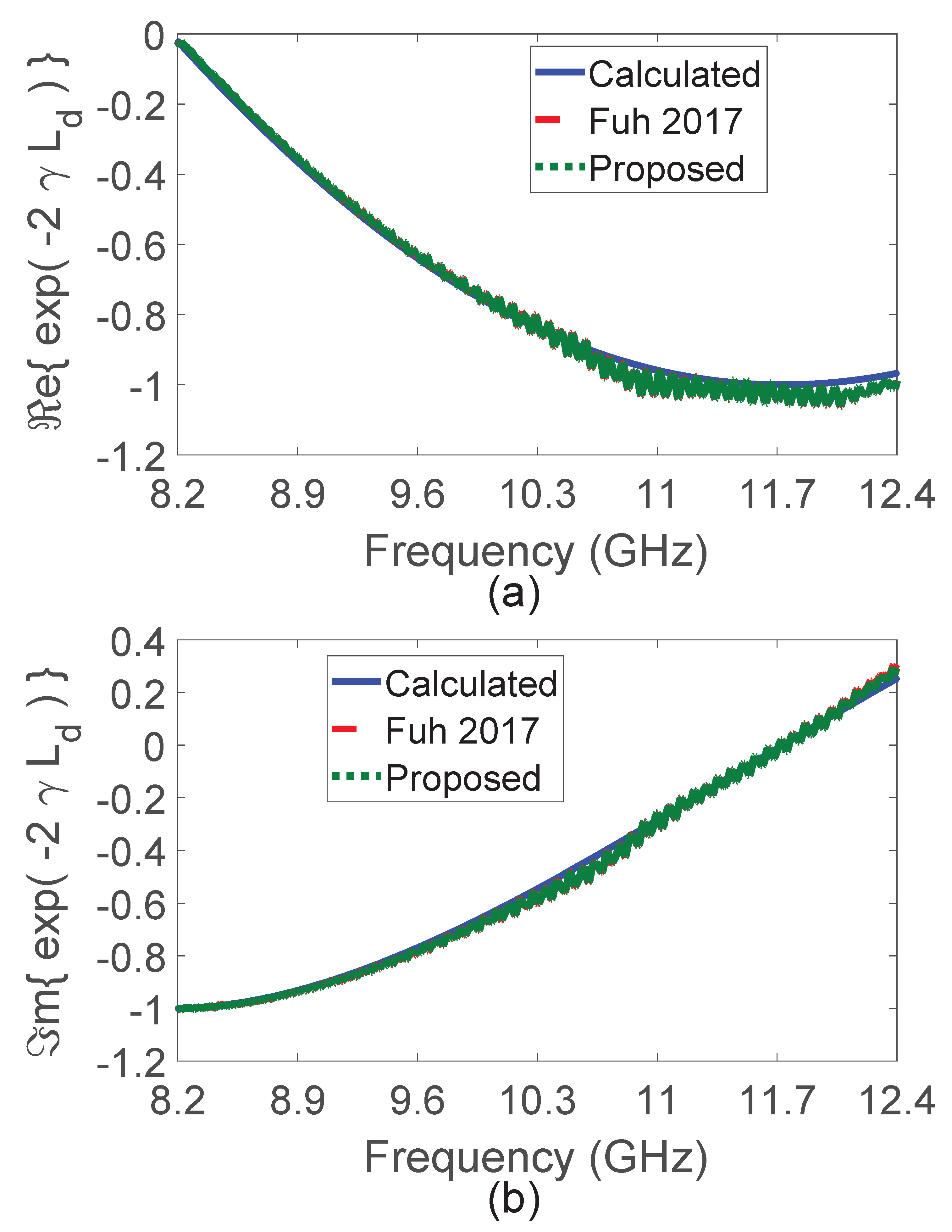
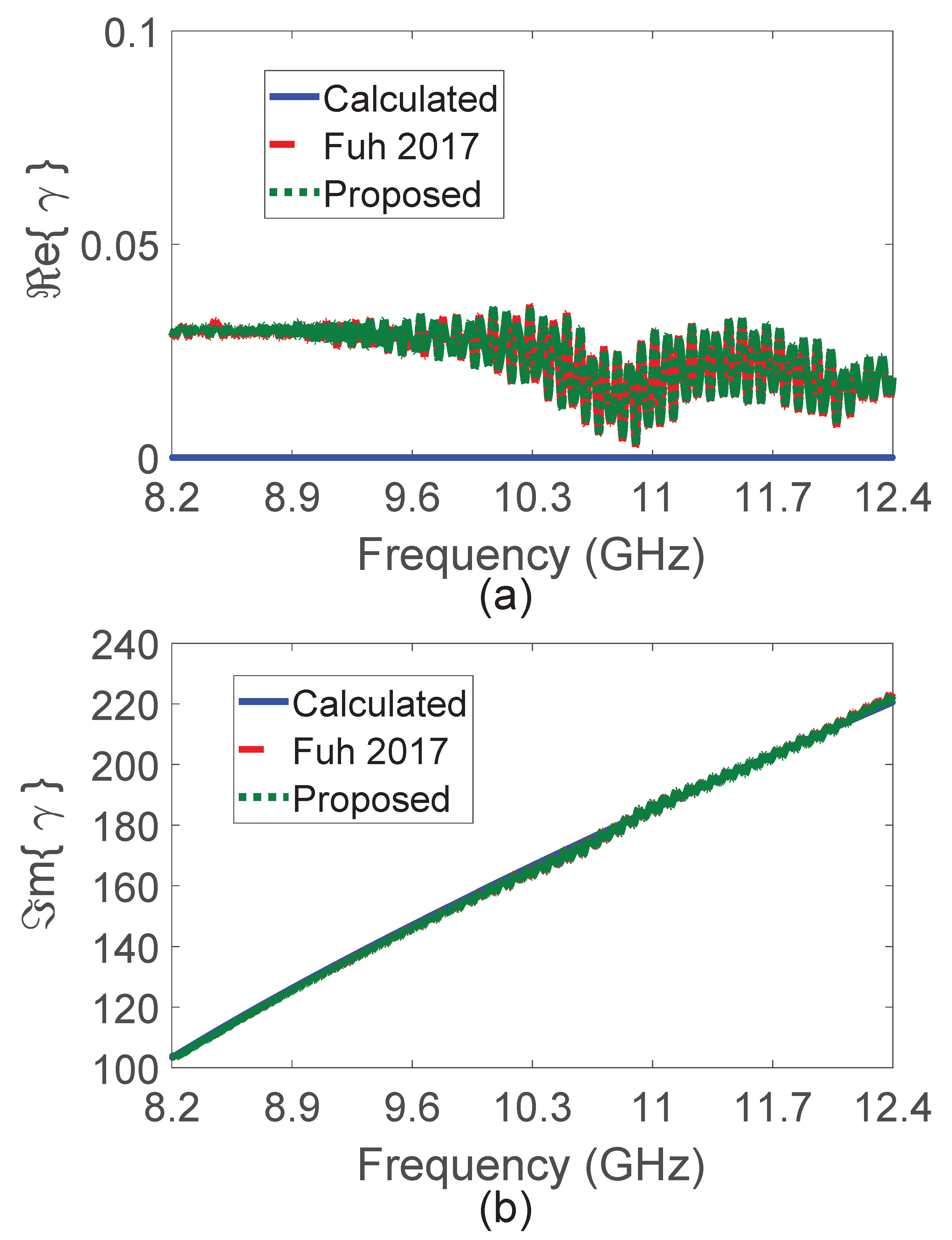
Figure 3 and
Figure 4 show, respectively, the real and imaginary parts of the determined
and extracted
by the method in [
14] and the proposed method.
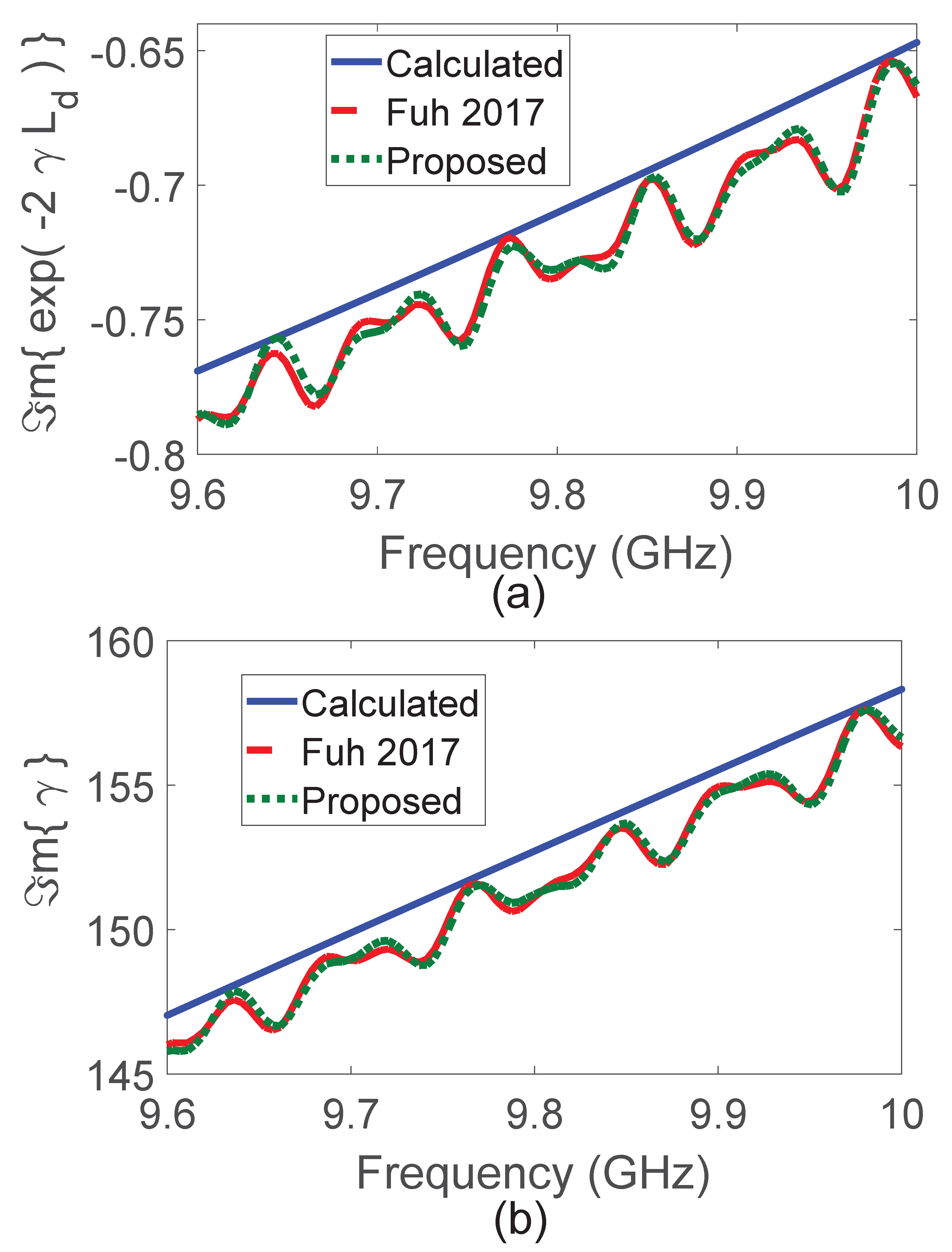
In addition, imaginary parts of
and
determined by the method in [
14] and the proposed method are also illustrated in
Figure 5a,b over the 9.6–10 GHz frequency region for better comparison. In order to compare the accuracy of determined
values, we also computed
using
where
is the free-space (unbounded) wavenumber and
GHz.
It is seen from
Figure 3 and
Figure 4 that extracted
and
values by the method in [
14] and the proposed method are in good agreement with the calculated
and
values. On the other hand, we note from
Figure 4a that extracted
values by the method in [
14] and the proposed method are greater than zero for the whole frequency band, which is a requirement of the passivity principle.
Finally, we note from
Figure 5a,b that the difference between
(and
) values extracted by the method in [
14] and the proposed method arises from non-unity values of
and
. The proposed method is more robust in
determination because it benefits the highly stable property
to mathematically reduce the impact of fluctuations inherent in the conventional assumption
. As demonstrated in
Figure 2, the stability of the product term is superior to the instability of
across the measured band, resulting in a more consistent extraction of the characteristic eigenfactor.
5. Conclusions
In this work, a new formalism has been introduced for the accurate extraction of the propagation constant (γ) in uniform reflection-symmetric microwave lines using a calibration-free line–line measurement approach. Unlike conventional techniques such as TRL or SOLT, which require extensive calibration standards and precise fixture alignment, the proposed method eliminates the need for prior calibration by employing a determinant-based objective function, where is inherently satisfied in measurement. The proposed method was validated experimentally using X-band (8.2–12.4 GHz) waveguide measurements and numerically through full-wave electromagnetic simulations. The extracted values accurately reproduced measured S-parameters, confirming the method’s reliability and physical consistency. The calibration-free nature of the method reduces VNA setup complexity, particularly in measurement environments where access to standard calibration kits is limited or impractical. It is especially advantageous for symmetric reflection structures, difficult-to-calibrate waveguide fixtures, and test environments involving integrated or miniaturized components, where conventional TRL or SOLT calibrations may introduce alignment and repeatability errors. The length was specifically chosen to optimize the phase separation between the two line measurements within the X-band (–). This length ensures that the phase shift avoids the critical points of , which prevents the root ambiguity often found in the quadratic characteristic equation. Furthermore, this choice provides a sufficient signal-to-noise ratio by ensuring the S-parameter differences are not dominated by measurement noise, while remaining short enough to allow for reliable phase unwrapping of the eigenfactor . The method can be extended to other uniform transmission line types, such as coaxial, microstrip, or coplanar waveguide lines, across various microwave and millimeter-wave bands. Conventional TRL and SOLT calibrations rely on multiple standards to relocate the reference planes, whereas the proposed approach achieves determination directly from line–line S-parameter pairs, without any calibration standards. The method therefore provides a simpler, faster, and inherently reference-plane-invariant alternative, while maintaining accuracy comparable to conventional VNA calibrations. Briefly, this calibration-free determinant-based line–line approach provides an efficient and robust solution for propagation constant determination in uniform transmission lines, with strong potential for practical use in metrology, material characterization, and on-site microwave measurements where calibration is infeasible. Future work will include a quantitative noise-sensitivity analysis, utilizing Monte Carlo simulations to statistically compare the variance and error of extraction under different determinant assumptions.