Article

Bioelectrical Impedance Parameters as Predictors of Functional Outcomes in Patients Undergoing Rehabilitation After Femoral Fracture Surgery: A Pilot Study


1
Department of Life Quality Sciences, University of Bologna, 47921 Rimini, Italy
2
AUSL Imola, 40026 Imola, Italy
3
Department of Medicine and Aging Sciences, University of Chieti-Pescara, 66100 Chieti, Italy
4
Department of Biomedical and Neuromotor Sciences, University of Bologna, 40126 Bologna, Italy
*
Authors to whom correspondence should be addressed.
Appl. Sci. 2026, 16(1), 158; https://doi.org/10.3390/app16010158
Submission received: 16 October 2025 / Revised: 26 November 2025 / Accepted: 22 December 2025 / Published: 23 December 2025

Abstract

Elderly patients with femoral fractures need specific rehabilitation after surgery that aims to improve their self-reliance and life quality, reducing their mortality rate. Although worsening patient body composition increased the risk of an unfavourable prognosis, it remains unclear whether evaluating bioelectrical impedance analysis (BIA) parameters can predict any functional recovery. A longitudinal design was conducted on 45 elders (84.59 ± 7.18 years, 75.6% female) who underwent femoral surgery to examine BIA features as rehabilitation biomarkers. The patient’s body composition, assessed by anthropometry and bioimpedance analysis (BIA), and self-reliance were evaluated three times during follow-up in both healthy and surgical lower limbs. The ANCOVA test, adjusted for gender and side of surgery, found improvements in daily living activities, while only thigh circumferences decreased over time. Regarding the BIA, the surgical leg showed a wider decrement in bioelectrical resistance (R), whereas the bioelectric reactance (Xc) exhibited similar trends. Females who underwent surgery on their dominant leg showed significant changes (p < 0.001) in bioimpedance vectorial analysis (BIVA), with a linear trend from baseline to postoperative time, while males exhibited beneficial variations only between baseline and time 2 (p < 0.01). Geriatric patients exhibit characteristic traits that require additional attention. BIA may be a feasible and non-invasive method for monitoring patient prognosis and reducing national health system costs.

1. Introduction

Surgical interventions involving the femur are among the most developed in the orthopaedic field and can relieve pain and improve gait motion [1]. In the EU in 2017, there were an estimated 2.7 million new fragility fractures, with hip/femur fractures accounting for 19.6% of all fractures. Almost twice as many fractures occurred in women (66%) compared to men [2]. Femoral pathologies represent a serious geriatric condition associated with poor outcomes, including a 1-year mortality rate of up to 30% after fracture [3,4], impaired ambulation compared to before fracture in 40–60% of patients [5], and failure to return to pre-fracture level of activity of daily living [6]. The risk of mortality increases, mainly due to changes in body composition [4,7]. In fact, some studies have observed a decrease in bone density, an increase in fat mass and a decrease in lean mass in subjects undergoing surgery after femoral fracture [7]. The reduction in lean mass is directly linked to the onset of sarcopenia, which can also be one of the causes of femoral fracture.
Given the importance of proper rehabilitation after femoral fracture, multidisciplinary rehabilitation programmes based on an intensive care pathway have been proposed in various countries [8,9,10]. However, postoperative outcomes are influenced by several factors, including age, gender, and body composition parameters, such as a reduction in total body water and consequent redistribution of intra- and extracellular fluids, a reduction in type-II fibre trophy and fibre recruitment capacity, and bone remodelling with loss of mineral content, among others [11,12,13,14]. For this reason, monitoring body composition post-surgery is essential to evaluate recovery and any risk conditions.
In the clinical field, scientific research on bioelectrical impedance has considerably increased. Bioelectrical impedance analysis (BIA) is a portable, simple, reproducible, noninvasive, and widely used method to estimate body composition [15]. It has been validated against other body composition methods such as dual-energy X-ray absorptiometry, underwater weighing, and magnetic resonance imaging [16,17], enhancing its ability to reflect skeletal muscle mass variability and quality, as well as hydration status.
However, the lack of specific equations for estimating body composition in frail patients has led to the prevalent use of raw impedance parameters [18]. Phase angle (PhA) is the most clinically consolidated impedance parameter, defined as the value of the arctangent between resistance, which represents the opposition to alternating current flow, and it is strongly related to fat tissue, and reactance, which describes how current flow reacts to the cell’s structure, and it is positively related to water and muscle contents [15,19]. PhA is considered an indicator of membrane integrity, cellular health, and intra- and extracellular water distribution: lower values suggest cell death or reduced cellular integrity, and higher values reflect greater cellularity, cell membrane integrity, and better cellular function [20,21,22,23]. PhA has recently shown promise as a prognostic tool for several clinical conditions, including impaired nutrition, sarcopenia, functional status, postoperative complications, and mortality and as a general indicator of health status [15,24,25]. It has been negatively correlated with fluid retention in the clinical field [26], supporting a role of low phase angle as an indicator of poor prognosis [27]. Reference values for PhA have been reported in a healthy population based on age, sex, and BMI [8,20,28], and in specific disease settings such as heart failure [24], cancer [25], and hemodialysis [6]. Low PhA was defined as <5.0° in men and <4.6° in women [29], and multiple studies have used a PhA of 4.5° as the cut-off value [25,30,31]. Also, regarding sarcopenia, various degrees of phase angle allow students to classify patients in a state of pre-sarcopenia or acute sarcopenia [32]. The onset of sarcopenia in subjects who have undergone a femur operation can become disabling for the subject and deserves particular attention; the use of bioelectrical impedance could represent a valid support.
However, few studies have been conducted on BIA in patients who have undergone femoral surgery [1,18,32,33]. According to Lim and Lim [33], one reason for the limited use of BIA after this surgery is that metal implants and postoperative oedema affect body composition [21,34], but the findings of Steihaug et al. [18], support using BIA to identify fractures in patients with low muscle mass. Moreover, besides the measure of BIA of the total body, it is possible to measure each limb separately, using the healthy limb value as a reference [1,21,35]. Codognotto et al. [36], provided evidence that segmental BIA is a reliable indicator of alterations in the fluid status of body segments. The authors showed that fluid accumulation in one leg decreased segmental impedance.
Starting from raw parameters, in 1994 Piccoli and colleagues tried to develop an alternative approach to estimate the variation in body fluids using the BIA [37]. The authors used the whole-body R and Xc values derived from a 50 kHz signal, normalised for the subject’s stature and plotted on the R-Xc graph, yielding a vector with length and direction [37]. With the bioelectrical impedance vector analysis (BIVA), the length of the vector is inversely related to the total body water [37]. Additionally, the vector direction, defined as the phase angle, was initially interpreted as representing the amount of body cell mass [37] and subsequently as an indicator of fluid distribution between the intra- and extracellular spaces. BIVA has gained popularity over the years as a method for classifying individuals’ body composition in relation to a reference population. For example, considering the centre of the ellipses as the mean bivariate value for the bioelectrical properties of a specific population, shorter vectors identify subjects with more fluids, as in the case of obesity or inflammation status. In contrast, longer vectors represent subjects with less total body water, as seen in cases of lean individuals or those with a state of dehydration. In addition, vectors displayed on the left side of the ellipses generally result in subjects with higher muscle mass, and in contrast, rightward vectors commonly occur in sarcopenic people [37,38]
Therefore, the main aim of this study was to evaluate the validity of bioelectrical impedance parameters and BIVA as a predictive outcome of functional recovery during the rehabilitation process in patients after femur surgery, considering not only the BIA of the total body but also the segmental one and taking as a reference the improvement of functional tests, usually used as recovery parameters. We hypothesise that the raw impedance value could be a useful clinical marker for functional outcomes after HF surgery.

2. Materials and Methods

2.1. Study Design

This study was a longitudinal design, with 30 days of follow-up and three-time assessments: baseline, which occurred the day after surgery, 10 days after arrival at the facility (time 1) and post (time 2), which occurred 20 days after time 1. Patients were recruited from the Orthopaedic Injury Department at the Castel San Pietro Terme hospital. Each patient underwent surgery for a femoral fracture and was targeted for the rehabilitation treatment at “Casa della Salute” in Castel San Pietro Terme, Bo, Italy. Inclusion criteria for treatment were (i) absence of neoplastic diseases, (ii) absence of any other musculoskeletal impairment before the femoral injury, (iii) absence of metabolic disorders, and (iv) absence of adverse psychiatric conditions. Each patient has been hospitalised until treatment ends, and lower-limb functioning has been recovered. Nurses were responsible for administering food throughout the entire treatment.
Before enrolment, all patients were informed and provided with their consent for study participation. The study was conducted in accordance with the Helsinki ethics guidelines for research involving humans. It was approved by the ethics committee of “Area Vasta Emilia Centro della Regione Emilia-Romagna” (approval code No. 64365, dated 27 May 2022).

2.2. Surgery

The diagnostic phase of a femoral fracture is carried out at the Emergency Department, which includes a radiological examination with an X-ray of the hip and femur.
Following the diagnosis of femoral fracture, the limb is kept in bed, all pre-operative diagnostic and laboratory tests are performed as an emergency, pending surgery to be performed within 48 h of access to the Emergency Department, including the correction of the drug therapy usually taken at home (e.g., some types of antidepressants, hormonal drugs, NSAIDs, anticoagulants, immunosuppressants, pulmonary antihypertensives).
After surgery, the person remains in bed for at least 72 h to assess clinical stability and the possible occurrence of post-operative complications of a cardiocirculatory and neurological nature.
In the next phase, the multidisciplinary team, comprising orthopaedic, geriatric, and psychiatric clinicians, physiotherapists, and nurses, evaluates and shares with the person and their family the rehabilitation plan based on the patient’s residual resources and the expectations for achieving the best possible quality of life for the person. Considering this, the standard rehabilitation path suitable to meet the expected expectations is defined, compared with the profiles already codified because of the best scientific evidence.

2.3. Treatment

The post-surgery treatment consisted of a daily activity conducted by an expert physiotherapist, which included the following steps:
Passive rehabilitation with induced lower limbs movements lying on a bed;
Active rehabilitation with lower limb movements lying on a bed;
Active rehabilitation with lower limb movements, helped by a walker or bars;
Active rehabilitation with lower limb movements on a horizontal surface, helped by crutches;
Active rehabilitation with lower limbs movements on a vertical surface (stairs), helped by crutches.
Each participant was assisted throughout all phases and could advance to the next step only after completing the previous one. The length of the post-surgery treatment was established based on previous anamneses provided by the Italian national health system and could vary based on the patient’s path. The treatment stopped if the participant could not regain her functionality or passed away.

2.4. Anthropometry

An anthropometry expert evaluated all the anthropometric parameters following standard recumbent anthropometry procedures [39].
Body length on the bed and body mass on a specific wheelchair were measured in accordance with the guidelines for special populations.
Circumferences were measured to the nearest 0.1 cm with a non-stretchable tape (Seca 201, Hamburg, Germany) at the following sites: thigh circumference at the midpoint between the inguinal fold and patellar; calf at the maximal bulk of the calf; waist at the midpoint between the last rib and the iliac crest; hip at the maximal bulk of the glutes. Lower limb length was measured as the distance from the trochanterion to the lateral malleolus. The waist-hip ratio (WHR) was calculated by dividing the waist circumference by the hip circumference. Body mass index (BMI) was calculated by dividing the total body mass (kg) by the square of the stature (m2). Then, the weight status was computed according to [40].

2.5. BIVA

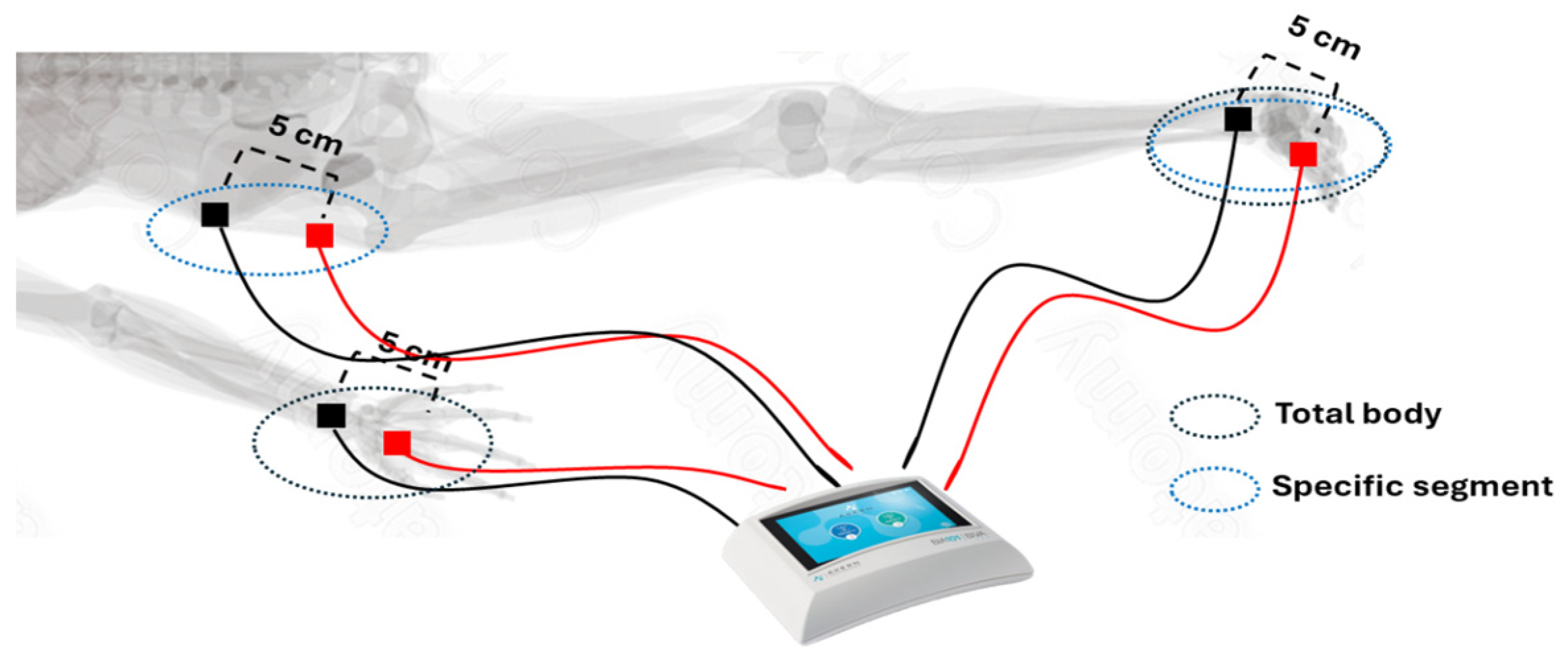
BIA was measured using a tetrapolar system (BIA 101 Anniversary, Akern, Florence, Italy). The impedance values were obtained at a 50 kHz frequency, as PhA is maximal at this frequency, and PhA was obtained using a previous predictive formula: PhA (°) = arctan (Xc/R) × (180/π) [37]. The patients were positioned on a bed in a supine position, with their arms abducted at 30° relative to their body and their legs at 45° to each other. After cleansing the skin with alcohol, Ag/AgCl low-impedance electrodes (Biatrodes Akern Srl, Florence, Italy) were used. The measurements were carried out (Figure 1):
(1)
On the entire body, through electrodes positioned on the right hand and foot: two electrodes were placed on the back of the right hand at the midpoint of the styloid process, and 5 cm away, and two electrodes were placed on the back of the right foot at the midpoint of the malleolus process.
(2)
Segmentally (only at the lower limb level), through electrodes explicitly placed on the lower limbs. Segments measured correspond to segments 18 and 24 of the study by [41] (Figure 1).
Figure 1. Electrodes standardised position for total (black circles) and segmental (blue circles) evaluations.
Applsci 16 00158 g001
R and Xc values derived from the two approaches were normalised for the subject’s stature and leg length, respectively, and plotted on the R-Xc graph.
To describe the BIVA results, the total body values were plotted in the tolerance ellipses (50%, 75%, and 95%) of the reference values for the Italian population [28].
All evaluations were conducted in the morning before breakfast and after the overnight fast, under standardised environmental conditions, including a temperature of approximately 22 °C and a humidity level of approximately 50%.

2.6. Activity of Daily Living Indices

The Barthel Index for Activities of Daily Living was used to assess a person’s ability to perform activities of daily living (ADLs).
The Tinetti test was used to assess a person’s perception of balance and stability during activities of daily living, as well as their fear of falling.

2.7. Statistical Analysis

A priori analysis was performed to estimate the minimum sample size needed to obtain the desired statistical power with the following parameters: repeated measures ANOVA, 5% of type I error probability, 5% of type II error probability (power 95%), error variance = 1, correlation between repeated measures = 0.3, variance explained by within-test effect = 0.1 (delta = 0.655). The estimated sample size was 38 participants. To compensate for potential attrition among participants, the sample size was increased by 20%. To prevent possible sample loss due to the duration of the experiment, 20% of the total sample was added, resulting in a final sample size of 45 patients.
Descriptive statistics have been reported as means and standard deviations (for continuous variables), as well as frequencies of appearance and proportions (for categorical variables). Function distributions were visually inspected and then tested using the Shapiro–Wilk and Kolmogorov–Smirnov methods. The presence of any outliers and leverage points was checked using the Cook’s distance and DFBETA tests. When heteroskedasticity was met, the weighted least-squares method was assessed [42]. Models’ residuals and fit were checked even with or without outliers. The ANCOVA test was performed, with previous times (baseline and time 1) serving as covariates and gender and surgery side serving as control factors. Interaction and main effects were analysed. The Bonferroni correction criterion was applied to multiple comparisons.
If relevant, trends, risk ratios (RR), odds ratios (OR), and relative 95% confidence intervals (CI) have been computed, according to [43]. The type I error probability has been settled at 5%. For BIVA comparisons, the Mahalanobis distance was calculated, and the Hotelling test was used to test the null hypothesis of no distance. No participant was excluded from the study. If missing data occurred in anthropometrical outcomes such as stature or body mass, it was considered as “missing completely at random” because it did not affect the main hypotheses of the study [44].
Data management and evaluation were performed using STATA® version 18 and SAS 9.4, Windows edition (StataCorp., College Station, TX, USA; SAS Institute, Cary, NC, USA).

3. Results

The analysed sample size was 45, with a sex OR = 2.45 for females. The average age of the female patients was 87.73 ± 7.26 years, whereas that of the male patients was 87.08 ± 5.71 years. However, no significant differences in sample proportion were found between sex and treatment side (χ2(1) = 0.614, p = 0.433), although women comprised 73.33% of the sample (n = 33). Generally, participants exhibited a significant reduction in body mass and BMI since baseline to time 2, although males showed a more heterogeneous distribution of weight status. The average stature was 159.3 ± 6.7 cm and 154.0 ± 7.1 cm for females undergoing left or right femoral surgery, respectively, while it was 167.8 ± 6.6 cm and 169.8 ± 6.9 cm for males undergoing left or right femoral surgery. Female patients reported an average right and left lower limb length of 88.02 ± 3.58 and 88.32 ± 4.02 cm, whereas males’ lengths were 98.58 ± 5.89 and 98.36 ± 5.17 cm for right and left lower limbs, respectively. Regarding the waist-to-hip ratio, females exhibited a mean value of 0.89 ± 0.05, whereas males had a mean value of 0.93 ± 0.06. The percentage of underweight subjects increased from baseline to time 1 and time 2 (from 9.1% to 12.1%), with a 2.75 risk ratio of males to females.
Table 1 shows the descriptive statistics stratified by gender and lower limb surgery side.

3.1. Daily Activity

The Barthel index at post showed a significant difference to time 2, with an estimated effect of 0.53 (95% CI: 0.199; 0.729), with no significant difference between female and male (95% CI of β: −14.366, 11.412) and treated at right or left thigh (95% CI of β: −13.135, 13.897). The interaction effect between gender and treated leg reported a contrast of −2.95 (95% CI: −14.362, 8.462; t = −0.5, p = 0.622). The adjusted means for females and males were 61.83 and 64.62 (t = −0.67, p = 0.508), while those for right and left surgery were 62.95 and 63.50 (t = 0.13, p = 0.894), respectively. Concerning Tinetti at post, a significant difference was observed with respect to time 2 (95% CI of η2 = 0.259, 0.628), with a mean effect of 0.66 ± 0.10 (t = 6.45, p < 0.001). No significant impact emerged in interaction and main parameters, where adjusted means were 18.0 and 18.01 for left surgery females and males, and 16.32 and 16.18 for right surgery females and males (estimated contrast = 0.14 ± 1.93; t = 0.07, p = 0.944).

3.2. Anthropometry

Mean’s patient’s body mass at post was almost explained by body mass at baseline (95% CI of η2 = 0.904, 0.975; F (1, 36) = 1476.95, p < 0.001) and time 2 (95% CI of η2 = 0.001, 0.132; F(1, 36) = 12.97, p < 0.001). The adjusted factors did not show significant interactions or main effects, despite a contrast of −1.11 ± 0.75 (t = −1.47, p = 0.151) between left and right leg surgery. In addition, males who underwent left surgery showed the lowest body mass (adjusted mean = 60.15) compared to left-treated females (62.08; t = 1.9, p = 0.065), right-treated females (62.22; t = −1.84, p = 0.074) and males (62.22; t = 1.69, p = 0.099).
Variation in the right thigh circumference at post was significantly affected by thigh circumference at baseline (95% CI of η2 = 0.751, 0.892; F(1,39) = 380.25, p < 0.001) and thigh circumference at time 2 (95% CI of η2 = 0.001, 0.223; F(1,39) = 25.48, p < 0.001), while no interaction and primary effect of gender (F(1,39) = 0.06, p = 0.814) and side of surgery emerged (F(1,39) = 3.34, p = 0.075). The adjusted means of left-leg surgery were 47.3 (95% CI: 46.33, 48.26) in females and 47.11 (95% CI: 45.48, 48.75) in males, whereas 46.03 (95% CI: 45.02, 47.05) and 46.48 (95% CI: 44.87, 48.09) in right-leg surgery females and males. However, the contrast of gender was −0.13 ± 0.67, while the contrast of surgery side was 0.95 ± 0.66. The left thigh circumference showed a similar trend, with the most significant effect size part explained by left thigh circumference at baseline (95% CI of η2 = 0.822, 0.923; F(1,39) = 386.09, p < 0.001), while the estimated effect of left thigh circumference at time two was 0.38 ± 0.16 (t = 2.43, p = 0.02). No difference appeared in the interaction and main effects of gender and surgery side.
Regarding the calf circumference, right leg at pre mainly influenced the post circumference (95% CI of η2 = 0.765, 0.898; F(1,39) = 284.44, p < 0.001), while no significant difference appeared in right calf circumference at time 2 (F(1,39) = 2.99, p = 0.092), gender (F(1,39) = 2.87, p = 0.098), surgery side (F(1,39) = 0.5, p = 0.484) and their interaction (F(1,39) = 0.94, p = 0.338). The gender contrast was −0.85 ± 0.5, whereas on the surgery side, it was 0.37 ± 0.53. Differently, the left side calf circumference at post was significantly affected by both baseline and time 2 circumferences, with parameter estimates of 0.44 (95% CI: 0.109, 0.769; t = 2.55, p = 0.015) and 0.44 (95% CI: 0.086, 0.792; t = 2.39, p = 0.022). The adjusted means were 31.03 (95% CI: 30.42, 31.64) and 30.79 (95% CI: 29.75, 31.83) for females and males undergoing left surgery, respectively, whereas they were 30.79 (95% CI: 30.13, 31.45) and 31.20 (95% CI: 31.15, 32.26) for females and males undergoing right surgery.

3.3. BIA

Total body resistance at post showed a significant difference from R at baseline (95% CI of η2 = 0.098, 0.488; F(1,39) = 27.23, p < 0.001) and time 1 (95% CI of η2 = 0.023, 0.372; F(1,39) = 16.13, p < 0.001). After adjustment, the patient who underwent surgery on the left leg showed a significantly different mean compared to those who underwent surgery on the right (η2 = 0.055, F(1,39) = 4.81, p = 0.034), with a contrast of −52.29 for left surgery. In addition, females who underwent surgery on the right showed a higher adjusted mean (95% CI: 568.94, 642.04) than males who underwent surgery on the left (95% CI: 476.8, 594.3; t = 1.96, p = 0.057). In contrast, the total final Xc was significantly different only against the baseline (95% CI of η2 = 0.338, 0.68; F(1,39) = 51.87, p < 0.001), with no factorial effects. However, when adjusted for the left-leg surgery, males exhibited the lowest mean (95% CI: 14.98, 60.16), whereas males who underwent right surgery had the highest one (95% CI: 38.6, 87.69). Concerning PhA at post, when the effect was adjusted by baseline (β = 0.105; t = 2.17, p = 0.036) and time 1 (β = 0.124; t = 2.17, p = 0.02) PhAs, females mean was higher (95% CI: 4.29; 5.16) than males (95% CI: 3.04, 4.49), with a contrast of 0.96 (t = 2.26, p = 0.03).
The specific right and left limbs R and Xc, which are considered the lower limb length, were considered separately. Concerning the right lower-limb, the specific-R at post varied from specific-R at baseline (95% CI of η2 = 0.174, 0.562; F(1,39) = 39.25, p < 0.001) and time 1 (95% CI of η2 = 0.018, 0.36; F(1,39) = 16.81, p <0.001). Despite the side of surgery and gender not reporting a significant effect, both left-treated females (95% adjusted mean CI: 279.93, 328.25) and males (95% adjusted mean CI: 246.48, 336.18) showed lower specific-R values (interaction contrast: 29.44 ± 25.6, t = 1.15, p = 0.257). Regarding specific-Xc at post, it varied from time 1 (95% CI of η2 = 0.016, 0.355; F(1,39) = 8.91, p = 0.005), but not from baseline (F(1,39) = 0.02, p = 0.886). The effect size of the treatment side increased (η2 = 0.047), showing a contrast of −20.92 from left to right in treated patients (t = −1.92, p = 0.062). When adjusted by Bonferroni criteria, a significant difference (t = −2.29, p = 0.028) emerged between females who underwent left femoral surgery (95% adjusted mean CI: 7.47, 37.71) and males who underwent right femoral surgery (95% adjusted mean CI: 30.37, 84.03).
Concerning the left lower-limb, the specific-R at post varied from specific-R at time 1 (95% CI of η2 = 0.017, 0.358; F(1,39) = 8.45, p = 0.006), but not from baseline (F(1,39) = 0.94, p = 0.339). No significant interaction and main effects emerged, even if females who underwent left surgery showed a higher adjusted mean (95% CI: 265.29, 372.34) than those who underwent right surgery (95% CI: 252.68, 375.75), whereas males showed the opposite (left mean: 287.53; right mean: 360.72). As regards specific-Xc at post, significant differences emerged compared to baseline (95% CI of η2 = 0.06, 0.439; F(1,39) = 16.88, p < 0.001) and time 1 (95% CI of η2 = 0.001, 0.279; F(1,39) = 6.54, p = 0.015). The adjusted (time) effect reported an 8.43% partial variation accounted for surgery side (F(1,39) = 3.59, p = 0.066), with a mean contrast of −11.41 ± 6.3. (from left to right). No significant gender or interaction effects were observed.
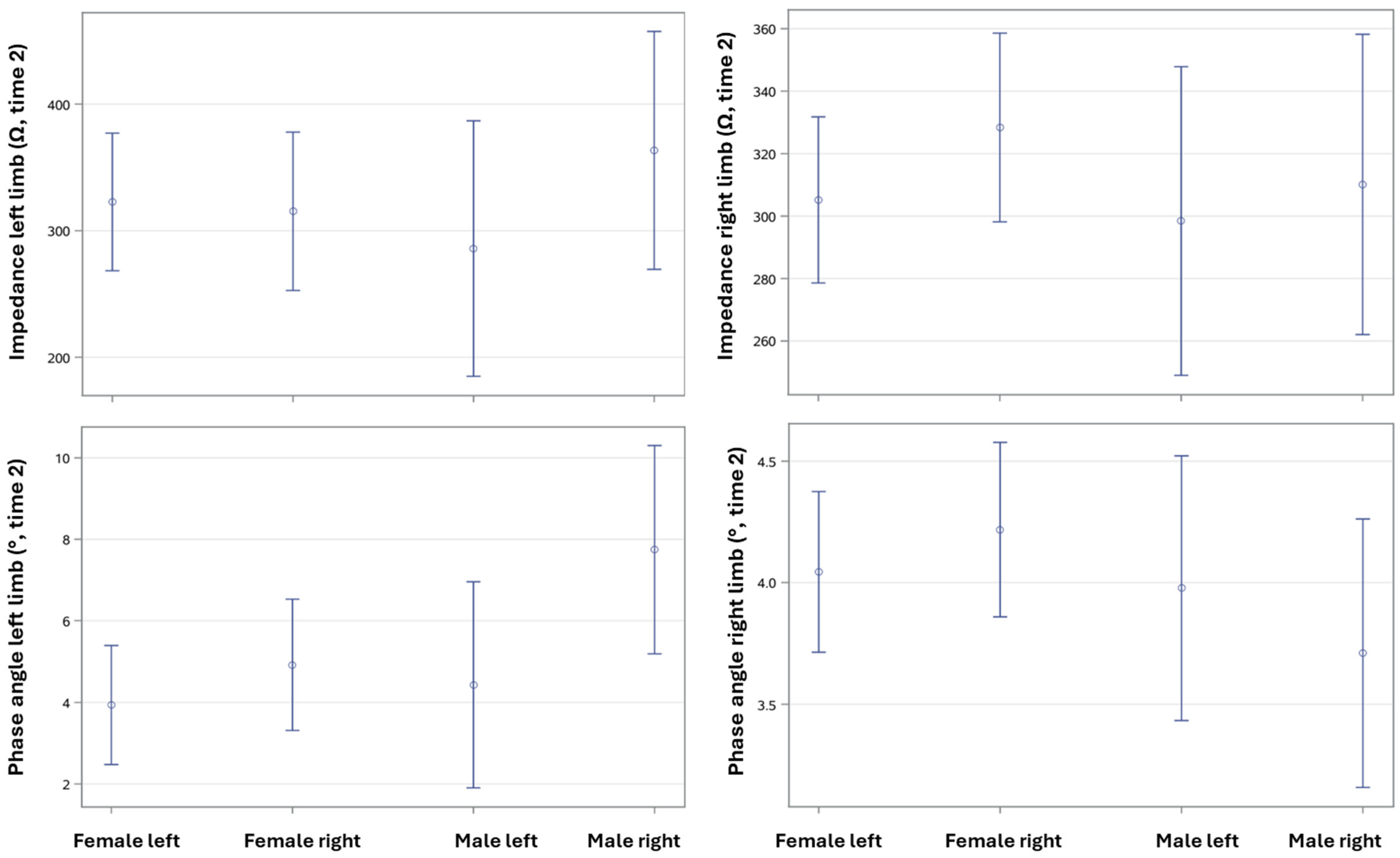
Finally, to control for the oedematous condition, we adjusted for the longitudinal difference in thigh circumference (delta) and days of treatment, as well as for Z and PhA of the left and right lower limbs. The right-limb Z at post showed significant differences from baseline (95% CI of η2 = 0.127, 0.519; F(1,39) = 30.58, p < 0.001) and time 1 (95% CI of η2 = 0.023, 0.372; F(1,39) = 16.18, p < 0.001), with an adjusted gender mean difference of 12.49 (95% CI: −29.33, 54.32; t = 0.6, p = 0.549) and right vs. left surgery of 17.45 (95% CI: −57.76, 22.86; t = −0.88, p = 0.386). Figure 2 shows no interaction effect (contrast = 18.25 ± 28.7, t = 0.64, p = 0.529). The left-limb Z at post showed a significant difference only compared to time 1 (95% CI of η2 = 0.005, 0.317; F(1,39) = 6.27, p = 0.017), while no interaction or main effect was detected (Figure 2).
Concerning right-limb PhA, the delta of thigh circumference showed a significant effect on PhA at post (95% CI of η2 = 0.0, 0.249; F(1,39) = 8.49, p = 0.006), also influenced by PhA at baseline (95% CI of η2 = 0.344, 0.684; F(1,39) = 63.11, p < 0.001). Although no significant interaction and main effects appeared, females showed higher PhA adjusted mean values than males (gender contrast = 0.29, t = 1.27, p = 0.211; Figure 2). The left-limb PhA at post differed from left-limb PhA at time 1 (95% CI of η2 = 0.0, 0.262; F(1,39) = 4.5, p = 0.041). However, some relevant effects (Figure 2) appeared between right and left surgery (t = −2.05, p = 0.048), with a mean difference of −2.15 (95% CI: −4.28, −0.02), and between females who underwent left surgery and males who underwent right surgery (95% mean difference CI: −6.77, −0.85; t = −2.6, p = 0.013).
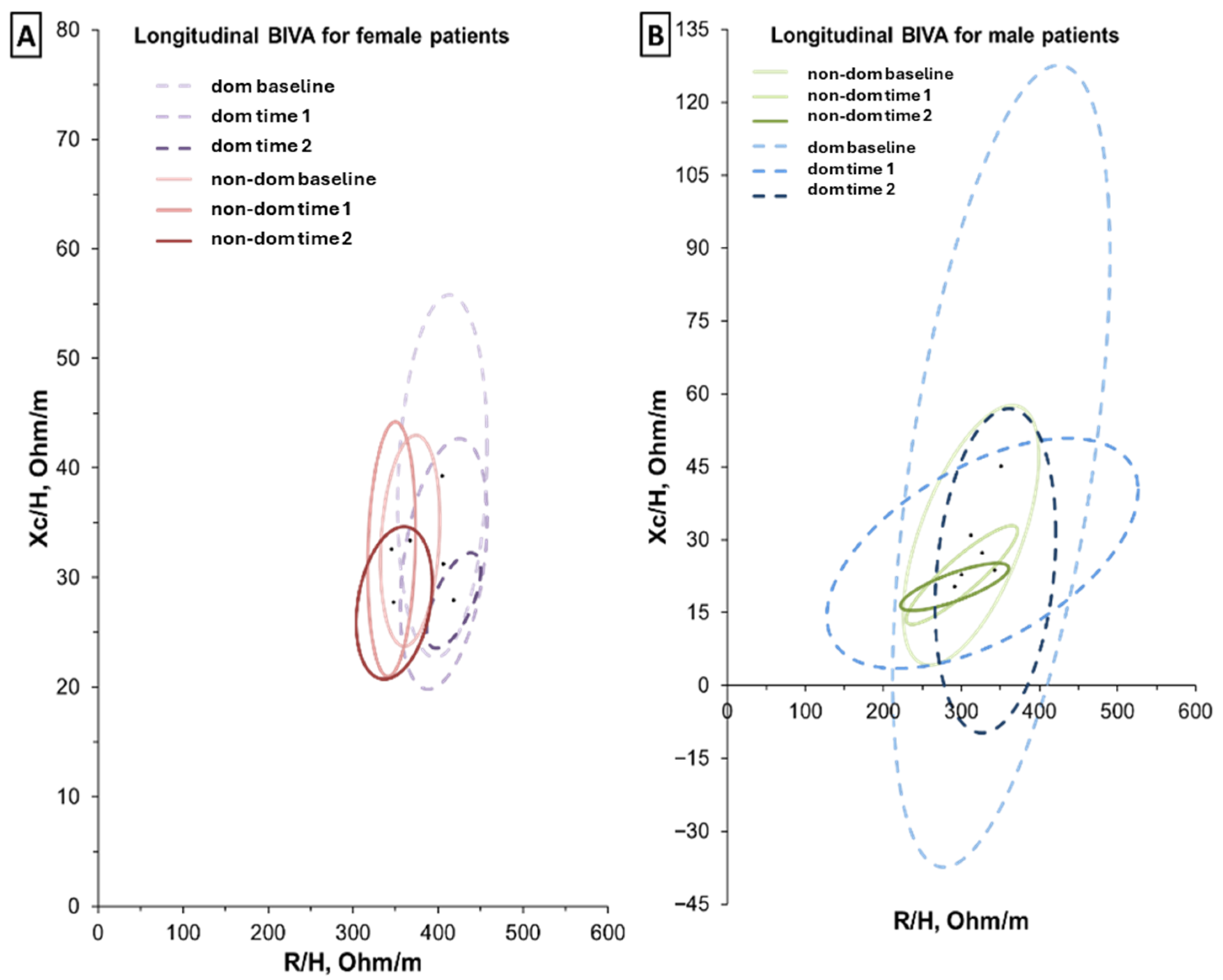
Figure 3 shows the BIVA differences between baseline, time 1 and post (time 2) for female (A) and male (B) patients, in accordance with the dominance of the treated leg. Significant differences were observed in non-dominant (Mahalanobis D = 1.05, p = 0.027) and dominant leg (Mahalanobis D = 1.33, p < 0.01) in females, and non-dominant (Mahalanobis D = 1.57, p < 0.001) and dominant (Mahalanobis D = 2.92, p = 0.026) leg in males between baseline and post (time 2). When considering time 1 and 2, significant differences were only observed in non-dominant (Mahalanobis D = 1.23, p < 0.001) and the dominant leg (Mahalanobis D = 1.52, p < 0.001) in females. In contrast, non-dominant (Mahalanobis D = 0.95, p = 0.339) and dominant leg (Mahalanobis D = 1.24, F = 1.3, p = 0.342) in males did not show significant differences.

4. Discussion

The primary objective of this study was to determine whether anthropometrical and BIA parameters could aid in monitoring elderly patients who underwent femoral fracture and surgery, and whether post-rehabilitation recovery may be associated with bioelectrical variations. 45 patients were evaluated and followed for 30 days, and received the same treatment in terms of physical therapy, nutrition and assistance. The sample proportion among sexes aligns with the reported literature, indicating a higher prevalence of fractures in women [2].
Concerning anthropometry and derived measures, women showed a greater heterogeneity in weight status, with variable shifts over time. Specifically, body mass exhibited a non-linear trend with an initial increase followed by a decrease of 2.67% in all participants in the last 20 days of treatment, reflecting a reduction trend typically observed in treated elderly individuals from 10 to 60 days post-fracture [4]. WHR also confirms this condition: both women and men showed a mean WHR higher than the recommended value by the WHO [45]. However, 84.8% of the females, compared with 75% of the males, presented a substantially increased risk of metabolic complications. We found a decreasing trend in body mass, a typical trait observed in treated elderly from 10 days up to 60 days post-fracture [4]. Elderly patients with femur fractures are often malnourished at the time of their fracture, and their nutritional status may hinder recovery. In general, malnutrition, changes in body composition, and immobility are associated with mortality and postoperative complications [46], and our study confirms the worsening of body composition parameters in patients over time. Naruishi and colleagues found that a BMI cut-off point of 19 could predict cognitive impairments in elderly patients with a specificity of 68% and a sensitivity of 57%, and a lower BMI value is strongly associated with various geriatric factors [47]. Additionally, a BMI lower than 18.5 is associated with functional impairments [48].
The burden sphere includes both cognitive and functional deficits, and post-surgery life may lead older people to lack self-sufficiency and need care. The rehabilitation phase, including drug, nutritional, psychological and physical therapies, is crucial in extending the life expectancy of elders, due to its mortality rate rising by 25% in just one year [49]. The rehab treatment proposed helped patients to increase their autonomy and mobility, independently of sex and treated limb, allowing them to perform many activities of daily life safely.
However, while functionality exhibited linear trends, body composition varies internally across the patients. We considered patients with treated and untreated lower limbs in terms of anthropometric and bioelectrical features. Concerning thigh circumference, a decreasing trend was observed in both limbs, with a greater percentage reduction in women and in the treated limb. This may reflect not only post-surgical oedema resolution but also systemic muscle loss due to inactivity or malnutrition, with women possibly more affected due to lower baseline muscle mass and a higher prevalence of sarcopenia.
Differently, calf circumference showed an interesting sex-related difference in the untreated limb, with males increasing by 2.36% and females decreasing by 1%, indicating an opposite trend between sexes and suggesting a different compensatory capacity, with men potentially benefiting more from functional overload during rehabilitation. These findings highlight the need to consider sex-specific responses and bilateral changes in body composition when planning and evaluating rehabilitation strategies in elderly patients after femoral fracture.
Segmental BIA revealed distinct limb-specific responses to rehabilitation. In the lower right limb, a significant reduction in specific resistance (R) was observed during rehabilitation, reflecting a possible resolution of post-surgical oedema and changes in tissue composition. In contrast, specific reactance remained relatively stable during the early phases but increased in the latter stages, suggesting a recovery of cellular integrity and membrane function. In contrast, specific resistance in the left lower limb showed less variation, indicating a more stable tissue composition over time, while specific reactance increased significantly during the recovery.
These findings confirm that BIA parameters are sensitive to local fluid shifts and inflammatory states following surgery, as reported by Codognotto and colleagues [36], who showed that BIA parameters are reliable indicators of segmental fluid status, and fluid accumulation could induce lower impedance values.
Interestingly, Szczesny et al. [50] also observed a persistent inflammatory activity during follow-up in patients with lower extremity fractures, suggesting a potential contribution of post-traumatic tissue response to the development of oedema after trauma.
This further supports the hypothesis that local inflammation and fluid accumulation can significantly impact impedance measurements in specific limbs after surgery.
Such evidence reinforces the link between inflammation, fluid retention, and alterations in tissue composition, which are further reflected in BIA-derived parameters.
Previous investigations have found a strong negative correlation between the oedema index, generally computed as the ratio of extracellular to total body water, and lean mass [51]. This correlation is notable because oedema (extracellular fluid overload) can erroneously lead to overestimation of lean mass, such as muscle. Considering that resistance has been associated with low-level hydration and muscle water content decreases with ageing [52], it was expected that predicted oedema levels would decrease over time, thereby affecting the measured resistance. Similar results have also been reported by Codognotto et al. [36] for both the baseline and post-surgery conditions, where the leg with oedema showed a decrease in specific impedance value. Many investigations are needed to overcome the confounding effects on BIA principles, water content, and its distribution, as well as oedema.
Adjusted impedance (Z) for oedematous status, assessed through thigh circumference differences, confirmed these trends from baseline in the right thigh for both sexes, with slightly higher values observed in the treated limb, consistent with oedema and fluid retention post-surgery.
We observed different patterns within the right and left limbs concerning the specific phase angle. In line with physiological expectations, PhA increased by approximately 34% in the left limb during treatment, with significant changes observed in the final 20 days of rehabilitation.
In the right limb, PhA was significantly influenced by baseline values and changes in thigh circumference, especially in female patients, who exhibited higher adjusted values, with an increase of approximately 14% in the operated limb. Interestingly, the highest PhA levels were found in males treated on the right side, with values approximately 38% higher than the group average, possibly reflecting more effective tissue recovery in this subgroup.
Our findings support that PhA is a sensitive parameter for monitoring rehabilitation progress, potentially more so than resistance or impedance alone. To the authors’ knowledge, no previous studies have simultaneously compared segmental PhA in surgical and contralateral limbs, highlighting the need for further investigation into the prognostic role of limb-specific bioelectrical responses. To the author’s knowledge, no other studies have investigated specific-limb phase angles simultaneously in surgical and healthy thighs, and no comparisons are available. Further investigations are needed.
Finally, after analysing the local responses at the lower limbs, we also investigated BIA parameters for the whole body, considering the right side to be dominant due to its validated assessment on the right side of the body. The variability of the sample was reduced in both males and females, but this effect was more pronounced in the dominant patients. Since no surgery has been assessed in the left femor for left-dominant patients, the dominant groups mainly reflect the treated limb, and their wider variation is linked to oedematous effects.
Total body resistance exhibited significant post-rehabilitation changes, particularly in patients with a dominant limb, indicating alterations in tissue hydration status. Similarly, total Xc significantly decreased from baseline, which may indicate a reduction in cellular membrane integrity and overall cellular health.
Concerning total PhA, sex-related differences remained evident with women maintaining higher values. However, despite this difference, an overall decline was observed over time, signalling possible deterioration of cellular integrity [25,30,31].
This could be achieved by a shift in water distribution from the intracellular to the extracellular compartment, resulting in weakness in skeletal muscle and reduced cell densities. Although extracellular body fluid volume is crucial in older adults, as it facilitates the transmission of energy and oxygen to skeletal muscle and vital organs, including the brain, heart, and lungs, through body fluids, the intracellular fluid content represents most of the total body water, given its role in cellular metabolism, function and homeostasis. A change in body liquid mass may cause various disorders, and reduced intracellular fluid intake may alter the osmotic structure of cells [53].
This study presented many limitations reported hereafter:
(a)
We cannot enrol an equal number of male and female participants, which can introduce sex-related bias.
(b)
The small sample size needs further evaluation to confirm and extend the presented results.
(c)
We cannot evaluate and measure haematoma status, which restrains the consideration of the oedema effect.
(d)
The absence of a control group of healthy elderly individuals restricts the generalizability of the findings. Although the use of the untreated limb as an internal control is an innovative and practical solution in a clinical setting and has been employed in other studies as a strategy to assess recovery, it assumes that the contralateral limb remains unaffected by the systemic consequences of surgery, bed rest, and rehabilitation [32,34]. However, it is plausible that both limbs could be influenced by overall physiological changes induced by hospitalisation, inflammation, immobilisation, and altered physical activity levels. This systemic impact might confound the interpretation of localised changes in BIA parameters, potentially underestimating or overestimating the actual recovery trajectory of the treated limb. Future studies should consider including a healthy control group and/or patients undergoing different types of surgeries to isolate local versus systemic effects more effectively and validate BIA as a reliable biomarker for post-operative rehabilitation monitoring.

5. Conclusions

Post-surgery rehabilitation and recovery pose complex challenges to the NHS, as well as private hospitals and clinics. Providing new perspectives and reducing hospitalisation costs helps clinicians manage many drawbacks related to geriatric patients. As previously discussed, the BIA technique enables investigators to gain physiological and pathological insights, thereby reducing the time and risk associated with invasive approaches. Recent literature suggests promising associations between BIA raw parameters and rehabilitation, which may reveal underlying properties. This study highlights the potential of segmental bioelectrical impedance analysis (BIA) as a non-invasive tool to monitor functional recovery in elderly patients after femoral fracture surgery. However, to enhance the clinical applicability and reliability of BIA in this context, future research should focus on multicenter validation studies involving larger and more diverse populations. Additionally, standardisation of segmental BIA measurement protocols is essential to ensure consistency and comparability across studies. Further investigations could also explore the integration of BIA parameters with other clinical and functional assessments to develop comprehensive prognostic models for personalised rehabilitation strategies.

Author Contributions

Conceptualization, S.T., S.B. and M.M.; methodology, S.T., S.B. and F.M.; software, S.M. and M.M.; validation, S.T., S.B. and M.M.; formal analysis, S.T., F.M. and M.M.; investigation, S.T., S.B., S.M., A.G. and M.M.; resources, A.G., S.G., A.C. and O.V.; data curation, S.T. and M.M.; writing—original draft preparation, S.T., S.B. and M.M.; writing—review and editing, S.M. and F.M.; visualisation, A.G. and F.M.; supervision, S.T., S.B., S.G., A.C. and O.V.; project administration, S.T., S.B., S.M., O.V. and M.M. All authors have read and agreed to the published version of the manuscript.

Funding

This research received no external funding.

Institutional Review Board Statement

The study was conducted in accordance with the Declaration of Helsinki and approved by the Institutional Review Board (or Ethics Committee) of “Area Vasta Emilia Centro della Regione Emilia-Romagna” ethics committee (approval code No. 64365, date 27 May 2022).

Informed Consent Statement

Informed consent was obtained from all subjects involved in the study.

Data Availability Statement

Data will be provided upon request, subject to specific requirements for the corresponding authors.

Acknowledgments

A special thank you goes to the nurses of the “Struttura Residenziale di Cure Intermedie (SRCI) della Casa della Comunità di Castel San Pietro Terme”.

Conflicts of Interest

The authors declare that they have no conflicts of interest.

Abbreviations

The following abbreviations are used in this manuscript:
BIABioelectric Impedance Analysis
PhAPhase Angle
RResistance
XcCapacitive Reactance
BIVABioelectric Impedance Vectorial Analysis
NSAIDNonsteroidal anti-inflammatory drug
BMIBody Mass Index
ADLActivity of Daily Living
ANOVAAnalysis of Variance
GGGreenhouse-Geisser
RRRisk Ratio
OROdds Ratio
CIConfidence Intervals
HRHazard Ratio
WHRWaist-Hip Ratio
WHOWorld Health Organization

References

  1. Ukai, T.; Watanabe, M. Do Metal Implants for Total Hip Arthroplasty Affect Bioelectrical Impedance Analysis? A Retrospective Study. BMC Musculoskelet. Disord. 2023, 24, 763. [Google Scholar] [CrossRef]
  2. Borgström, F.; Karlsson, L.; Ortsäter, G.; Norton, N.; Halbout, P.; Cooper, C.; Lorentzon, M.; McCloskey, E.V.; Harvey, N.C.; Javaid, M.K.; et al. Fragility Fractures in Europe: Burden, Management and Opportunities. Arch. Osteoporos. 2020, 15, 59. [Google Scholar] [CrossRef]
  3. Elliott, J.; Beringer, T.; Kee, F.; Marsh, D.; Willis, C.; Stevenson, M. Predicting Survival after Treatment for Fracture of the Proximal Femur and the Effect of Delays to Surgery. J. Clin. Epidemiol. 2003, 56, 788–795. [Google Scholar] [CrossRef]
  4. D’Adamo, C.R.; Hawkes, W.G.; Miller, R.R.; Jones, M.; Hochberg, M.; Yu-Yahiro, J.; Hebel, J.R.; Magaziner, J. Short-Term Changes in Body Composition after Surgical Repair of Hip Fracture. Age Ageing 2013, 43, 275. [Google Scholar] [CrossRef]
  5. Dyer, S.M.; Crotty, M.; Fairhall, N.; Magaziner, J.; Beaupre, L.A.; Cameron, I.D.; Sherrington, C. A Critical Review of the Long-Term Disability Outcomes Following Hip Fracture. BMC Geriatr. 2016, 16, 158. [Google Scholar] [CrossRef]
  6. Tang, V.L.; Sudore, R.; Cenzer, I.S.; Boscardin, W.J.; Smith, A.; Ritchie, C.; Wallhagen, M.; Finlayson, E.; Petrillo, L.; Covinsky, K. Rates of Recovery to Pre-Fracture Function in Older Persons with Hip Fracture: An Observational Study. J. Gen. Intern. Med. 2017, 32, 153–158. [Google Scholar] [CrossRef] [PubMed]
  7. Visser, M.; Harris, T.B.; Fox, K.M.; Hawkes, W.; Hebel, J.R.; Yahiro, J.Y.; Michael, R.; Zimmerman, S.I.; Magaziner, J. Change in Muscle Mass and Muscle Strength after a Hip Fracture: Relationship to Mobility Recovery. J. Gerontol. Ser. A Biol. Sci. Med. Sci. 2000, 55, M434–M440. [Google Scholar] [CrossRef] [PubMed]
  8. Beaupre, L.A.; Cinats, J.G.; Senthilselvan, A.; Lier, D.; Jones, C.A.; Scharfenberger, A.; Johnston, D.W.C.; Saunders, L.D. Reduced Morbidity for Elderly Patients with a Hip Fracture after Implementation of a Perioperative Evidence-Based Clinical Pathway. Qual. Saf. Health Care 2006, 15, 375–379. [Google Scholar] [CrossRef]
  9. Koval, K.J.; Cooley, M.R. Clinical Pathway after Hip Fracture. Disabil. Rehabil. 2005, 27, 1053–1060. [Google Scholar] [CrossRef]
  10. Lee, S.Y.; Beom, J.; Kim, B.R.; Lim, S.K.; Lim, J.Y. Comparative Effectiveness of Fragility Fracture Integrated Rehabilitation Management for Elderly Individuals after Hip Fracture Surgery: A Study Protocol for a Multicenter Randomized Controlled Trial. Medicine 2018, 97, e10763. [Google Scholar] [CrossRef]
  11. Hirose, J.; Ide, J.; Yakushiji, T.; Abe, Y.; Nishida, K.; Maeda, S.; Anraku, Y.; Usuku, K.; Mizuta, H. Prediction of Postoperative Ambulatory Status 1 Year After Hip Fracture Surgery. Arch. Phys. Med. Rehabil. 2010, 91, 67–72. [Google Scholar] [CrossRef]
  12. Kristensen, M.T.; Foss, N.B.; Ekdahl, C.; Kehlet, H. Prefracture Functional Level Evaluated by the New Mobility Score Predicts In-Hospital Outcome after Hip Fracture Surgery. Acta Orthop. 2010, 81, 296–302. [Google Scholar] [CrossRef]
  13. González-Montalvo, J.I.; Alarcón, T.; Gotor, P.; Queipo, R.; Velasco, R.; Hoyos, R.; Pardo, A.; Otero, A. Prevalence of Sarcopenia in Acute Hip Fracture Patients and Its Influence on Short-Term Clinical Outcome. Geriatr. Gerontol. Int. 2016, 16, 1021–1027. [Google Scholar] [CrossRef]
  14. Landi, F.; Calvani, R.; Ortolani, E.; Salini, S.; Martone, A.M.; Santoro, L.; Santoliquido, A.; Sisto, A.; Picca, A.; Marzetti, E. The Association between Sarcopenia and Functional Outcomes among Older Patients with Hip Fracture Undergoing In-Hospital Rehabilitation. Osteoporos. Int. 2017, 28, 1569–1576. [Google Scholar] [CrossRef] [PubMed]
  15. Norman, K.; Stobäus, N.; Pirlich, M.; Bosy-Westphal, A. Bioelectrical Phase Angle and Impedance Vector Analysis—Clinical Relevance and Applicability of Impedance Parameters. Clin. Nutr. 2012, 31, 854–861. [Google Scholar] [CrossRef] [PubMed]
  16. Janssen, I.; Heymsfield, S.B.; Baumgartner, R.N.; Ross, R. Estimation of Skeletal Muscle Mass by Bioelectrical Impedance Analysis. J. Appl. Physiol. 2000, 89, 465–471. [Google Scholar] [CrossRef]
  17. Mijnarends, D.M.; Meijers, J.M.M.; Halfens, R.J.G.; Ter Borg, S.; Luiking, Y.C.; Verlaan, S.; Schoberer, D.; Cruz Jentoft, A.J.; Van Loon, L.J.C.; Schols, J.M.G.A. Validity and Reliability of Tools to Measure Muscle Mass, Strength, and Physical Performance in Community-Dwelling Older People: A Systematic Review. J. Am. Med. Dir. Assoc. 2013, 14, 170–178. [Google Scholar] [CrossRef]
  18. Steihaug, O.M.; Gjesdal, C.G.; Bogen, B.; Ranhoff, A.H. Identifying Low Muscle Mass in Patients with Hip Fracture: Validation of Bioelectrical Impedance Analysis and Anthropometry Compared to Dual Energy X-Ray Absorptiometry. J. Nutr. Health Aging 2016, 20, 685–690. [Google Scholar] [CrossRef] [PubMed]
  19. Baumgartner, R.N.; Chumlea, W.C.; Roche, A.F. Bioelectric Impedance Phase Angle and Body Composition. Am. J. Clin. Nutr. 1988, 48, 16–23. [Google Scholar] [CrossRef]
  20. Barbosa-Silva, M.C.G.; Barros, A.J.D.; Wang, J.; Heymsfield, S.B.; Pierson, R.N. Bioelectrical Impedance Analysis: Population Reference Values for Phase Angle by Age and Sex. Am. J. Clin. Nutr. 2005, 82, 49–52. [Google Scholar] [CrossRef]
  21. Kyle, U.G.; Bosaeus, I.; De Lorenzo, A.D.; Deurenberg, P.; Elia, M.; Gómez, J.M.; Heitmann, B.L.; Kent-Smith, L.; Melchior, J.C.; Pirlich, M.; et al. Bioelectrical Impedance Analysis—Part II: Utilization in Clinical Practice. Clin. Nutr. 2004, 23, 1430–1453. [Google Scholar] [CrossRef]
  22. Lukaski, H.C.; Kyle, U.G.; Kondrup, J. Assessment of Adult Malnutrition and Prognosis with Bioelectrical Impedance Analysis: Phase Angle and Impedance Ratio. Curr. Opin. Clin. Nutr. Metab. Care 2017, 20, 330–339. [Google Scholar] [CrossRef]
  23. Garlini, L.M.; Alves, F.D.; Ceretta, L.B.; Perry, I.S.; Souza, G.C.; Clausell, N.O. Phase Angle and Mortality: A Systematic Review. Eur. J. Clin. Nutr. 2019, 73, 495–508. [Google Scholar] [CrossRef]
  24. Colín-Ramírez, E.; Castillo-Martínez, L.; Orea-Tejeda, A.; Vázquez-Durán, M.; Rodríguez, A.E.; Keirns-Davis, C. Bioelectrical Impedance Phase Angle as a Prognostic Marker in Chronic Heart Failure. Nutrition 2012, 28, 901–905. [Google Scholar] [CrossRef]
  25. Norman, K.; Stobäus, N.; Zocher, D.; Bosy-Westphal, A.; Szramek, A.; Scheufele, R.; Smoliner, C.; Pirlich, M. Cutoff Percentiles of Bioelectrical Phase Angle Predict Functionality, Quality of Life, and Mortality in Patients with Cancer. Am. J. Clin. Nutr. 2010, 92, 612–619. [Google Scholar] [CrossRef] [PubMed]
  26. Miura, T.; Matsumoto, Y.; Kawaguchi, T.; Masuda, Y.; Okizaki, A.; Koga, H.; Tagami, K.; Watanabe, Y.S.; Uehara, Y.; Yamaguchi, T.; et al. Low Phase Angle Is Correlated with Worse General Condition in Patients with Advanced Cancer. Nutr. Cancer 2019, 71, 83–88. [Google Scholar] [CrossRef] [PubMed]
  27. Ko, S.J.; Cho, J.; Choi, S.M.; Park, Y.S.; Lee, C.H.; Lee, S.M.; Yoo, C.G.; Kim, Y.W.; Lee, J. Phase Angle and Frailty Are Important Prognostic Factors in Critically Ill Medical Patients: A Prospective Cohort Study. J. Nutr. Health Aging 2021, 25, 218–223. [Google Scholar] [CrossRef] [PubMed]
  28. Campa, F.; Coratella, G.; Cerullo, G.; Stagi, S.; Paoli, S.; Marini, S.; Grigoletto, A.; Moroni, A.; Petri, C.; Andreoli, A.; et al. New Bioelectrical Impedance Vector References and Phase Angle Centile Curves in 4367 Adults: The Need for an Urgent Update after 30 Years. Clin. Nutr. 2023, 42, 1749–1758. [Google Scholar] [CrossRef]
  29. Kyle, U.G.; Soundar, E.P.; Genton, L.; Pichard, C. Can Phase Angle Determined by Bioelectrical Impedance Analysis Assess Nutritional Risk? A Comparison between Healthy and Hospitalized Subjects. Clin. Nutr. 2012, 31, 875–881. [Google Scholar] [CrossRef]
  30. Shin, Y.; Brangwynne, C.P. Liquid Phase Condensation in Cell Physiology and Disease. Science 2017, 357, eaaf4382. [Google Scholar] [CrossRef]
  31. Wirth, R.; Volkert, D.; Rösler, A.; Sieber, C.C.; Bauer, J.M. Bioelectric Impedance Phase Angle Is Associated with Hospital Mortality of Geriatric Patients. Arch. Gerontol. Geriatr. 2010, 51, 290–294. [Google Scholar] [CrossRef]
  32. Kołodziej, M.; Kozieł, S.; Ignasiak, Z. The Use of the Bioelectrical Impedance Phase Angle to Assess the Risk of Sarcopenia in People Aged 50 and above in Poland. Int. J. Environ. Res. Public Health 2022, 19, 4687. [Google Scholar] [CrossRef] [PubMed]
  33. Lim, S.K.; Lim, J.Y. Phase Angle as a Predictor of Functional Outcomes in Patients Undergoing In-Hospital Rehabilitation after Hip Fracture Surgery. Arch. Gerontol. Geriatr. 2020, 89, 104060. [Google Scholar] [CrossRef]
  34. Steihaug, O.M.; Bogen, B.; Kristoffersen, M.H.; Ranhoff, A.H. Bones, Blood and Steel: How Bioelectrical Impedance Analysis Is Affected by Hip Fracture and Surgical Implants. J. Electr. Bioimpedance 2017, 8, 54–59. [Google Scholar] [CrossRef]
  35. Lim, S.K.; Lee, S.Y.; Beom, J.; Lim, J.Y. Comparative Outcomes of Inpatient Fragility Fracture Intensive Rehabilitation Management (FIRM) after Hip Fracture in Sarcopenic and Non-Sarcopenic Patients: A Prospective Observational Study. Eur. Geriatr. Med. 2018, 9, 641–650. [Google Scholar] [CrossRef] [PubMed]
  36. Codognotto, M.; Piazza, M.; Frigatti, P.; Piccoli, A. Influence of Localized Edema on Whole-Body and Segmental Bioelectrical Impedance. Nutrition 2008, 24, 569–574. [Google Scholar] [CrossRef]
  37. Piccoli, A.; Rossi, B.; Pillon, L.; Bucciante, G. A New Method for Monitoring Body Fluid Variation by Bioimpedance Analysis: The RXc Graph. Kidney Int. 1994, 46, 534–539. [Google Scholar] [CrossRef]
  38. Lukaski, H.; Raymond-Pope, C.J. New Frontiers of Body Composition in Sport. Int. J. Sports Med. 2021, 42, 588. [Google Scholar] [CrossRef]
  39. Valutazione Antropometrica in Clinica, Riabilitazione e Sport: Cagnazzo, Francesco, Cagnazzo, Raffaele: Amazon.It: Books. Available online: https://www.amazon.it/Valutazione-antropometrica-clinica-riabilitazione-sport/dp/8870513297 (accessed on 13 May 2025).
  40. Cole, T.J.; Lobstein, T. Extended international (IOTF) body mass index cut-offs for thinness, overweight and obesity. Pediatr. Obes. 2012, 7, 284–294. [Google Scholar] [CrossRef]
  41. Organ, L.W.; Bradham, G.B.; Gore, D.T.; Lozier, S.L. Segmental Bioelectrical Impedance Analysis: Theory and Application of a New Technique. J. Appl. Physiol. 1994, 77, 98–112. [Google Scholar] [CrossRef]
  42. Kiyoshi, I. Iterative weighted least-squares estimates in a heteroscedastic linear regression model. J. Stat. Plan. Inference 2003, 110, 133–146. [Google Scholar] [CrossRef]
  43. Morris, J.A.; Gardner, M.J. Calculating confidence intervals for relative risks (odds ratios) and standardised ratios and rates. Br. Med. J. (Clin. Res. Ed.) 1988, 296, 1313–1316. [Google Scholar] [CrossRef]
  44. Pugh, S.L.; Brown, P.D.; Enserro, D. Missing repeated measures data in clinical trials. Neuro-Oncol. Pract. 2021, 9, 35–42. [Google Scholar] [CrossRef] [PubMed]
  45. Nishida, C.; Ko, G.T.; Kumanyika, S. Body Fat Distribution and Noncommunicable Diseases in Populations: Overview of the 2008 WHO Expert Consultation on Waist Circumference and Waist-Hip Ratio. Eur. J. Clin. Nutr. 2010, 64, 2–5. [Google Scholar] [CrossRef]
  46. Ishimoto, R.; Mutsuzaki, H.; Shimizu, Y.; Takeuchi, R.; Matsumoto, S.; Hada, Y. Association between Sarcopenia and Balance in Patients Undergoing Inpatient Rehabilitation after Hip Fractures: A Retrospective Cohort Study. Medicina 2024, 60, 742. [Google Scholar] [CrossRef]
  47. Naruishi, K.; Yumoto, H.; Kido, J. Clinical Effects of Low Body Mass Index on Geriatric Status in Elderly Patients. Exp. Gerontol. 2018, 110, 86–91. [Google Scholar] [CrossRef] [PubMed]
  48. Ahamed, F.; Rehman, T.; Krishnamoorthy, Y.; Kaur, A.; Debnath, A.; Ghosh, T. Underweight Is an Important Predictor for Functional Impairment among the Older Adults in Urban West Bengal, India: A Cross Sectional Analytical Study. J. Family Med. Prim. Care 2022, 11, 2008–2013. [Google Scholar] [CrossRef]
  49. Streubel, P.N.; Ricci, W.M.; Wong, A.; Gardner, M.J. Mortality after Distal Femur Fractures in Elderly Patients. Clin. Orthop. Relat. Res. 2011, 469, 1188–1196. [Google Scholar] [CrossRef]
  50. Szczesny, G.; Olszewski, W.L. The pathomechanism of posttraumatic oedema of the lower limbs: II—Changes in the lymphatic system. J. Trauma Acute Care Surg. 2003, 55, 350–354. [Google Scholar] [CrossRef] [PubMed]
  51. Kang, S.H.; Cho, K.H.; Park, J.W.; Yoon, K.W.; Do, J.Y. Comparison of Bioimpedance Analysis and Dual-Energy x-Ray Absorptiometry Body Composition Measurements in Peritoneal Dialysis Patients According to Edema. Clin. Nephrol. 2013, 79, 261–268. [Google Scholar] [CrossRef]
  52. Lohman, T.G.; Going, S.B. Multicomponent Models in Body Composition Research: Opportunities and Pitfalls. In Human Body Composition; Basic Life Sciences; Springer Nature: Berlin, Germany, 1993; Volume 60, pp. 53–58. [Google Scholar] [CrossRef] [PubMed]
  53. Lorenzo, I.; Serra-Prat, M.; Carlos Yébenes, J. The Role of Water Homeostasis in Muscle Function and Frailty: A Review. Nutrients 2019, 11, 1857. [Google Scholar] [CrossRef] [PubMed]
Figure 2. Impedance (upper) and phase angle (lower) means plots with 95% C.I. for left and right lower limbs adjusted by the previous time results, gender and side of surgery.
Applsci 16 00158 g002
Figure 3. BIA vectors for female (A) and male (B) patients. Note: dom = dominant leg, non-dom = no dominant leg.
Applsci 16 00158 g003
Table 1. Descriptive statistics are divided by gender, leg surgery, and time.
VariablesSexSide of Femoral SurgeryBaselineTime 1Time 2
Body Mass (kg)left66.29 ± 11.7066.70 ± 11.7765.23 ± 11.74
right52.98 ± 12.1753.47 ± 13.1153.17 ± 12.59
left68.17 ± 9.6068.73 ± 8.2266.17 ± 8.73
right65.40 ± 10.5565.10 ± 10.4264.60 ± 10.86
Barthelleft23.72 ± 11.47°49.22 ± 16.11°63.77 ± 13.08
right25.93 ± 15.47°45.2 ± 21.99°61.53 ± 19.01
left22.83 ± 8.65°39.33 ± 12.87°61.16 ± 12.81
right22.83 ± 11.17°43.83 ± 22.77°63.16 ± 14.52
Tinettileft0.00 ± 0.00°12.77 ± 6.48°18.22 ± 5.6
right0.00 ± 0.00°12.13 ± 5.64°16.6 ± 6.09
left0.00 ± 0.00°10.66 ± 5.68°16.83 ± 3.25
right0.00 ± 0.00°12.16 ± 5.7°16 ± 6.06
Right thigh circumference (cm)left50.02 ± 6.5750.36 ± 6.49°49.63 ± 5.37
right46.94 ± 6.43°46.33 ± 6.64°45 ± 6.87
left45.83 ± 4.79°44.58 ± 4.8644.66 ± 3.72
right45.41 ± 5.51°45.41 ± 6.1644.48 ± 6.22
Left thigh circumference (cm)left51.94 ± 7.22°51.25 ± 6.8550.91 ± 5.71
right45.43 ± 8.03°45.33 ± 7.21°44.58 ± 7.49
left47.5 ± 6.95°46.91 ± 6.4346.91 ± 5.98
right43.83 ± 4.7°45.16 ± 5.26°44.38 ± 5.7
Right calf circumference (cm)left31.94 ± 4.46°31.88 ± 3.9931.41 ± 4.41
right30 ± 3.94°30.23 ± 3.7229.69 ± 4.32
left31.5 ± 2.51°32.25 ± 2.0932.58 ± 2.1
right28.75 ± 2.4228.75 ± 2.5828.71 ± 2.82
Left calf circumference (cm)left32.05 ± 4.2632.05 ± 3.8632.02 ± 3.35
right29.93 ± 3.8129.92 ± 3.5629.91 ± 4.01
left32.16 ± 3.07°31.66 ± 3.0931.66 ± 2.52
right29.16 ± 3.7128.83 ± 3.77°29.51 ± 3.35
R (Ω)left577.19 ± 74.94°544.99 ± 60.15550.02 ± 100.6
right615.21 ± 92.48611.91 ± 98.74°633.09 ± 65.46
left492.28 ± 137.03502.78 ± 61.88°488.25 ± 63.44
right632.66 ± 91.56576.4 ± 79.59°609.76 ± 52.88
Xc (Ω)left60.87 ± 40.33°56.62 ± 33.1542.5 ± 18.96
right58.68 ± 32.97°46.64 ± 23.0742.12 ± 8.96
left57.55 ± 24.24°37.91 ± 9.4234.06 ± 4.67
right116.25 ± 111.76°93.38 ± 117.6185.6 ± 100.37
Phase Angleleft5.82 ± 2.84°5.57 ± 2.63°4.81 ± 1.51
right4.94 ± 2.22°3.9 ± 0.70°4.41 ± 1.19
left9.45 ± 9.28°4.28 ± 0.58°3.95 ± 0.32
right4.46 ± 1.08°8.46 ± 9.42°4.1 ± 1.82
Specific right-limb R (Ω/m)left302.85 ± 90.3309.98 ± 54.79°305.81 ± 51.04
right332.8 ± 62.74328.19 ± 57.04°349.34 ± 90.83
left259.22 ± 56.32243.47 ± 42°241.21 ± 46.95
right331.99 ± 57.65°283.06 ± 46.53292.37 ± 61.43
Specific right-limb Xc (Ω/m)left39.98 ± 66.16°23.37 ± 10.2323.47 ± 5.72
right24.75 ± 9.2322.14 ± 6.08°31.45 ± 16.18
left19.48 ± 6.05°17.53 ± 5.6617.79 ± 5.65
right70.02 ± 24.8126.17 ± 14.32°59.63 ± 21.74
Specific left-limb R (Ω/m)left305.02 ± 80.55300.37 ± 66.49°314.48 ± 94.83
right370.96 ± 95.97°353.34 ± 56.27336.65 ± 60.14
left296.49 ± 20.2°242.66 ± 47.45239.33 ± 64.77
right361.08 ± 45.55328.65 ± 60.83°365.83 ± 249.49
Specific left-limb Xc (Ω/m)left38.43 ± 60.77°28.35 ± 21.4325.64 ± 17.39
right32.95 ± 14.9930.55 ± 20.59°34.62 ± 23.8
left21.49 ± 4.3°19.89 ± 9.5°16.85 ± 3.46
right29.65 ± 10.55°42.13 ± 42.3°38.12 ± 35.53
Note: WHR, waist-to-hip ratio; ° = significant effect for time compared to time 2 (G-G) (p < 0.05). No significant difference appeared in the main gender and treatment effects.
Disclaimer/Publisher’s Note: The statements, opinions and data contained in all publications are solely those of the individual author(s) and contributor(s) and not of MDPI and/or the editor(s). MDPI and/or the editor(s) disclaim responsibility for any injury to people or property resulting from any ideas, methods, instructions or products referred to in the content.