Article

Proximate Analysis, Total Phenolic Content, and Antioxidant Activity of Wild Carob Pulp from Three Mediterranean Countries


by
Mohamad Ali El Chami
1,
Guillermo Palacios-Rodríguez
1,*,
José L. Ordóñez-Díaz
2,3,
Raquel Rodríguez-Solana
2,4,5,6,
Rafael M. Navarro-Cerrillo
1 and
José M. Moreno-Rojas
2,3,*
1
Assessment and Restoration of Agricultural and Forestry Systems Research Group (ERSAF RNM360), Department of Forestry Engineering, Campus of International Excellence in Agri-Food and Agriculture—ceiA3, University of Córdoba, 14071 Córdoba, Spain
2
Department of Agroindustry and Food Quality, Andalusian Institute of Agricultural and Fisheries Research and Training (IFAPA), Alameda del Obispo, Avda. Menéndez-Pidal, 14004 Córdoba, Spain
3
PhD Program Ingeniería Agraria, Alimentaria, Forestal y del Desarrollo Rural Sostenible, Universidad de Córdoba, 14071 Córdoba, Spain
4
Department of Agroindustry and Food Quality, Andalusian Institute of Agricultural and Fisheries Research and Training (IFAPA), Rancho de la Merced Center, Carretera Cañada de la Loba (CA-3102) Km 3.1., SN, 11471 Jerez de la Frontera, Spain
5
MED—Mediterranean Institute for Agriculture, Environment and Development, Faculdade de Ciências e Tecnologia, Universidade do Algarve, Campus de Gambelas, 8005-139 Faro, Portugal
6
CHANGE—Global Change and Sustainability Institute, Faculdade de Ciências e Tecnologia, Universidade do Algarve, Campus de Gambelas, 8005-139 Faro, Portugal
*
Authors to whom correspondence should be addressed.
Appl. Sci. 2025, 15(3), 1340; https://doi.org/10.3390/app15031340
Submission received: 29 December 2024 / Revised: 23 January 2025 / Accepted: 24 January 2025 / Published: 27 January 2025
(This article belongs to the Special Issue New Insights into Food Ingredients for Human Health Promotion)

Abstract

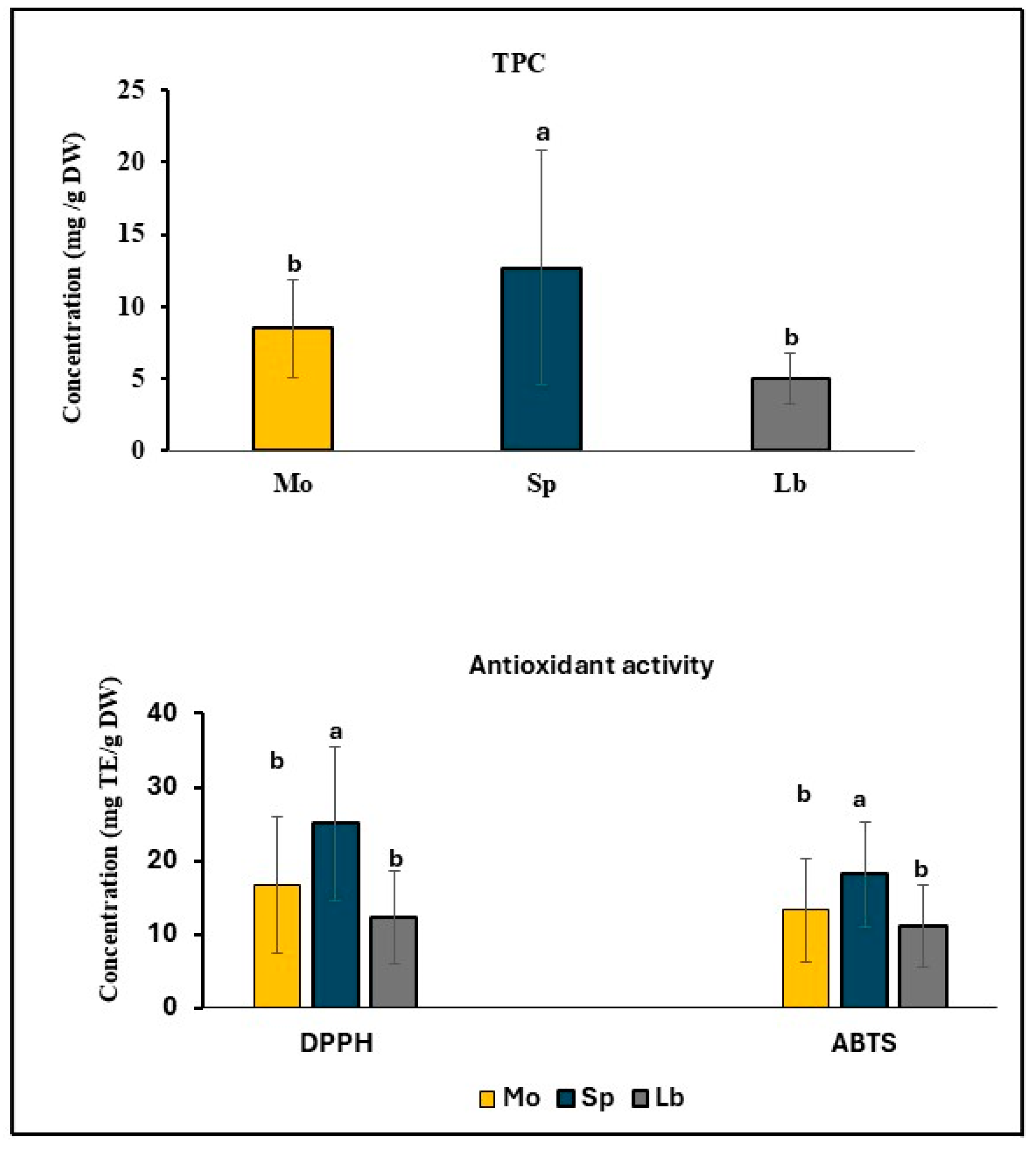
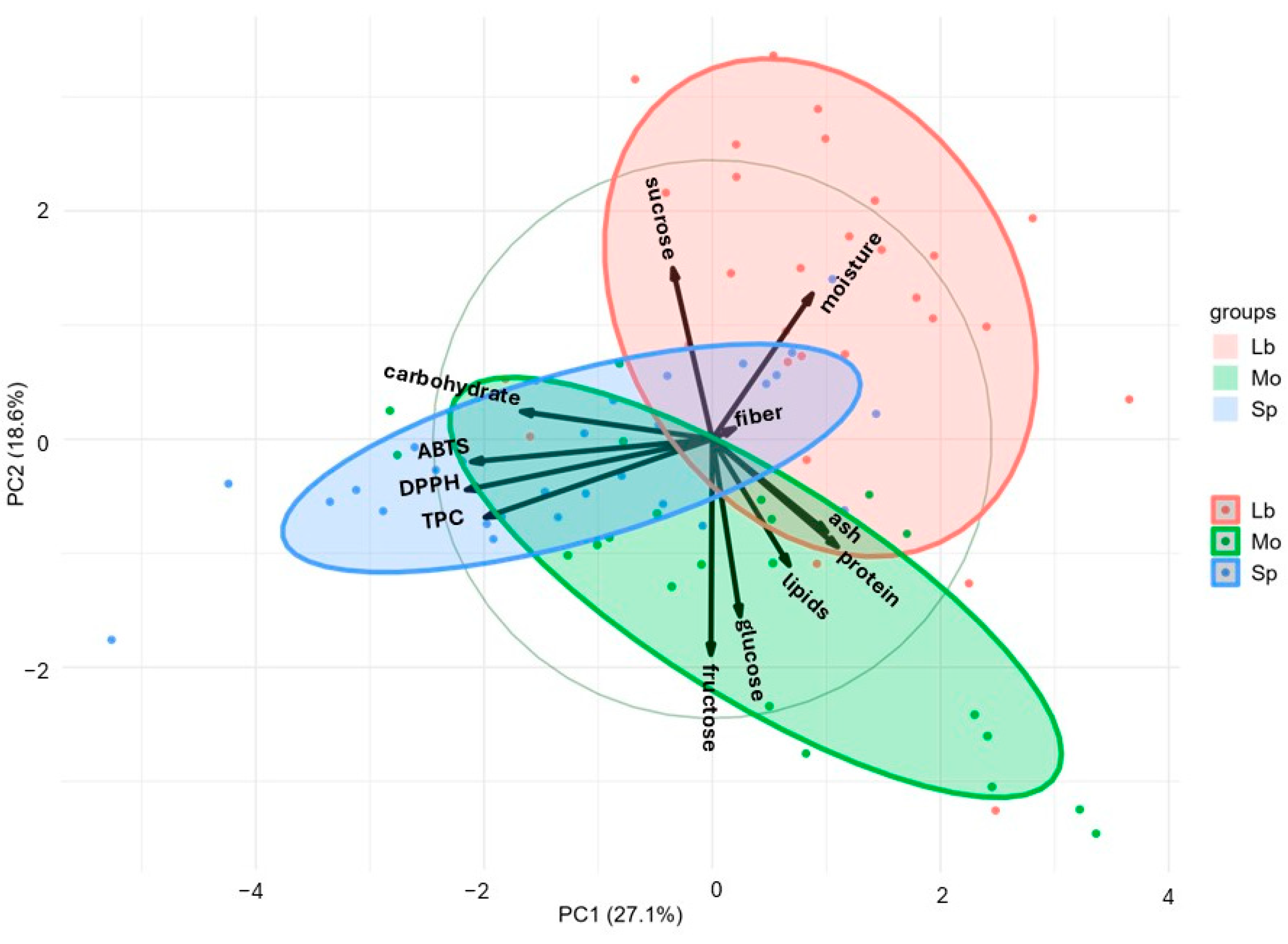
(1) Background: Carob tree (Ceratonia siliqua L.) pulp is of great interest nowadays due to its nutritional benefits and diverse utilization in the food process. The nutritional and antioxidant properties of carob pulp in the Mediterranean have been assessed in several studies. Still, few studies have combined, within the same work, a comprehensive analysis of the chemical composition of carob pulp from fruits of natural populations across different countries of the Mediterranean basin, while also incorporating new research areas. (2) Methods: In the present work, we evaluated the nutritional value, total phenolic compounds, and antioxidant activity of carob pulp derived from wild populations of carob trees from three Mediterranean countries: Lebanon, Spain, and Morocco; (3) Results: All assessed bromatological characteristics, with the exception of ash and fiber content, revealed significant differences in the carob pulp from the three countries under study. High variability was observed for the total polyphenols ranging between 5.05 mg/g and 12.70 mg/g. Sucrose was the predominant sugar quantified ranging between 13.70 g/100 g and 28.10 g/100 g. The lipid content was low (0.26–0.36%). The moisture content of carob pulp ranges between 4.36% and 6.40%. Carob pulp presented a rich composition in fiber, with an average of 35.87%. The ash content was between 2.52% and 3.28%. The percentage of the protein content of the carob pulp ranged between 4.40 and 5.52, with an average carbohydrate value of 74.71%; (4) Conclusions: Spanish wild carob pulp samples offered higher carbohydrates contents and values for sucrose, fructose, and glucose, polyphenol content, and antioxidant activity, whereas Moroccan samples had higher values of carbohydrates and in concrete, the monosaccharides fructose and glucose showed higher contents in proteins and lipids. In contrast, Lebanese samples exhibit a high content of the disaccharide sucrose. These findings could be exploited in breeding programs to improve varieties that balance both the agronomical quality and nutritional values of carob pulp.
Keywords: Ceratonia siliqua L.; Mediterranean; nutritional characteristics; antioxidant activity; total phenolic content Ceratonia siliqua L.; Mediterranean; nutritional characteristics; antioxidant activity; total phenolic content