Artificial Vision in Renewable Photovoltaic Systems: A Review and Vision of Specific Applications and Technologies

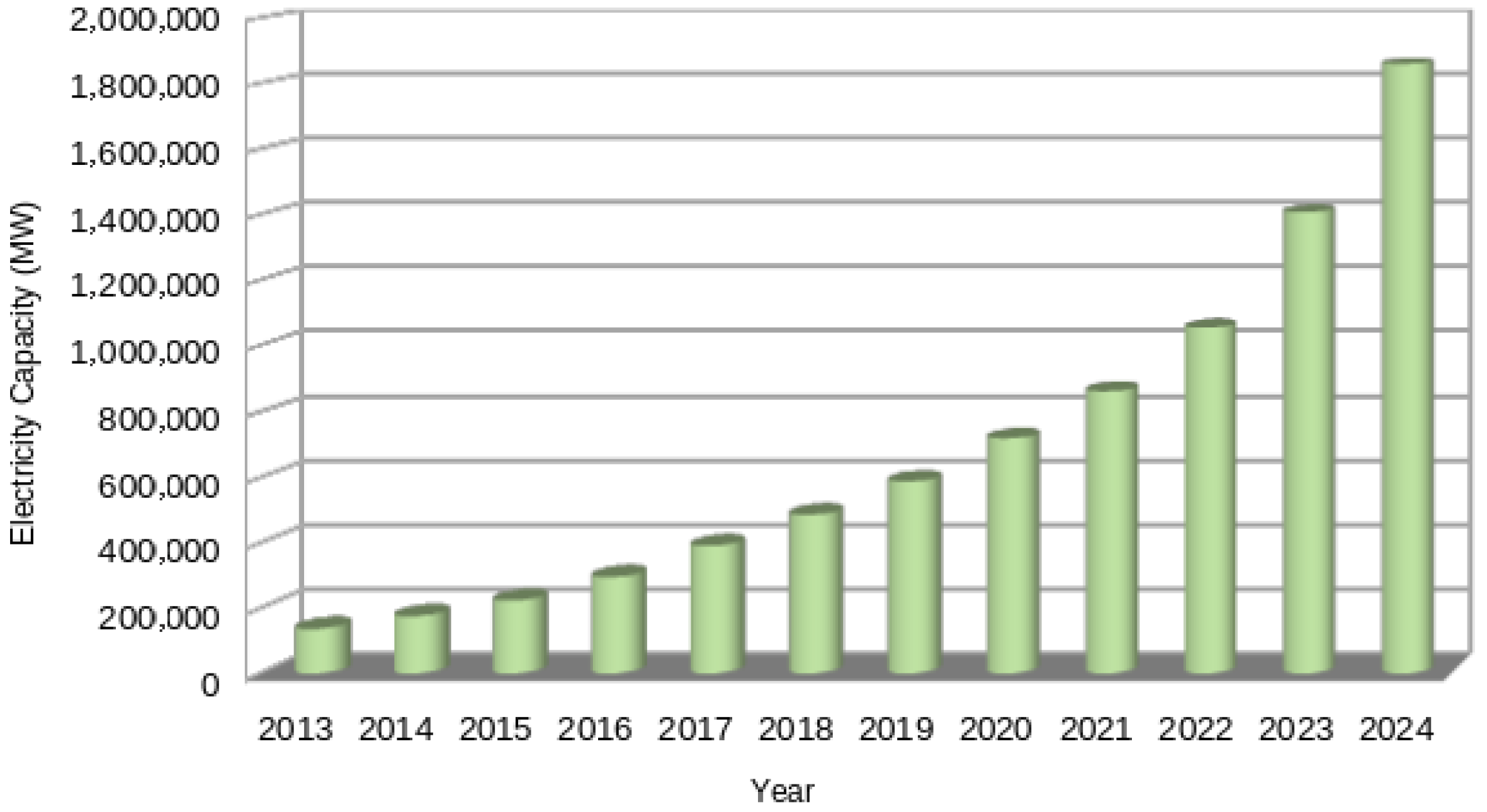
Abstract
1. Introduction
2. Research Methodology
- Identification: Papers were retrieved from various databases using predefined search terms and phrases;
- Screening: The full text of the retrieved papers was assessed to determine their applicability and relevance to our research topic;
- Synthesis: The papers that successfully passed the full-text screening process.
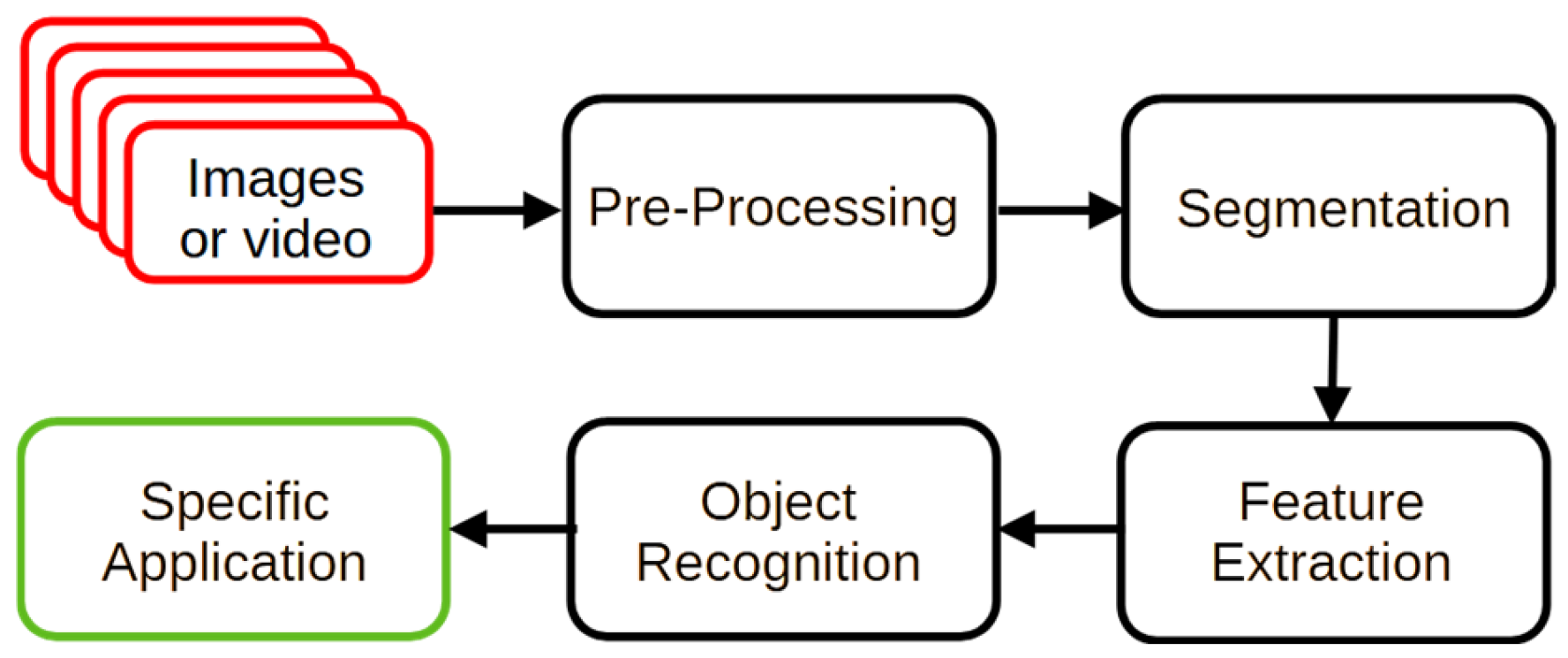
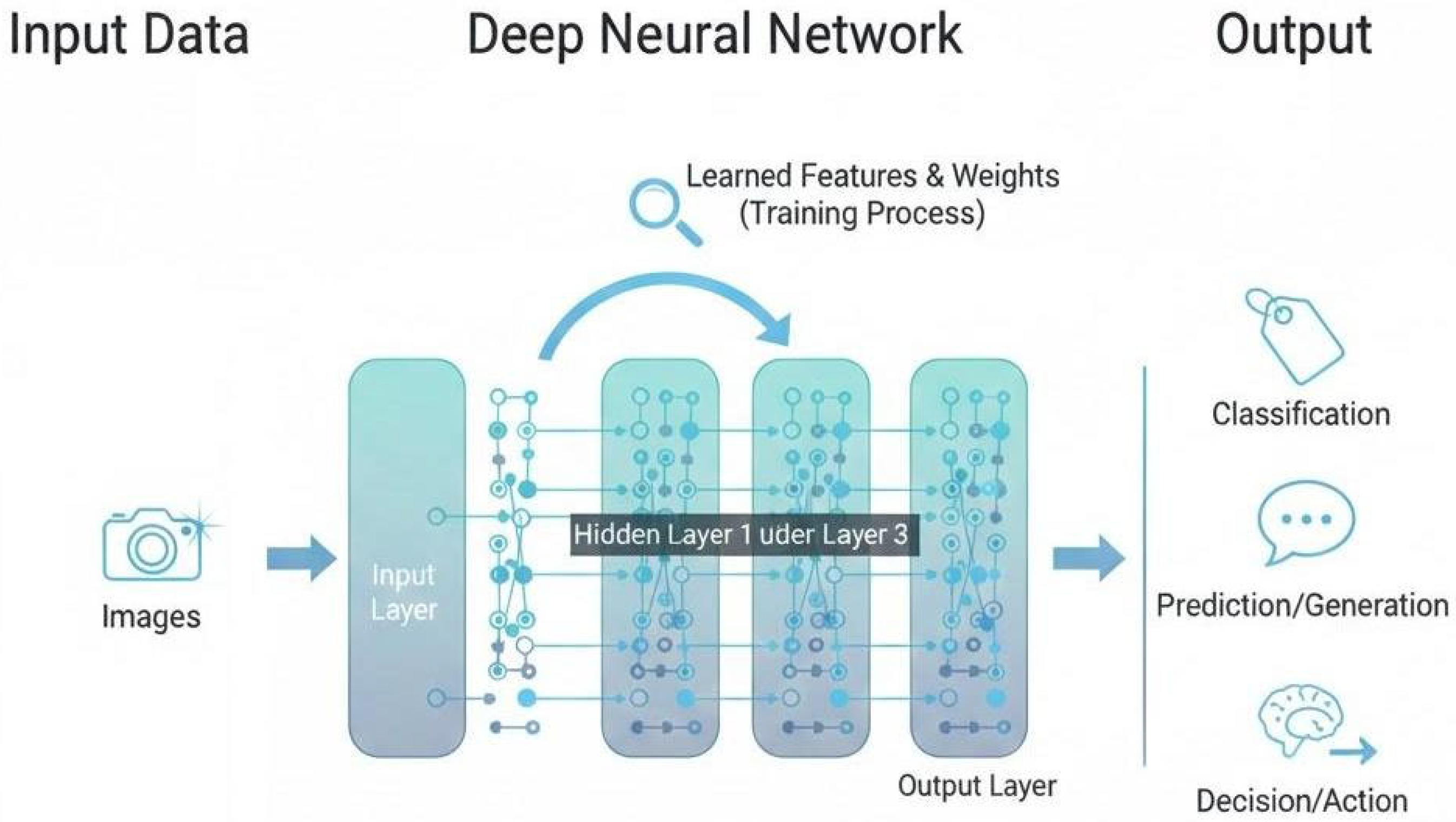
3. Computer Vision
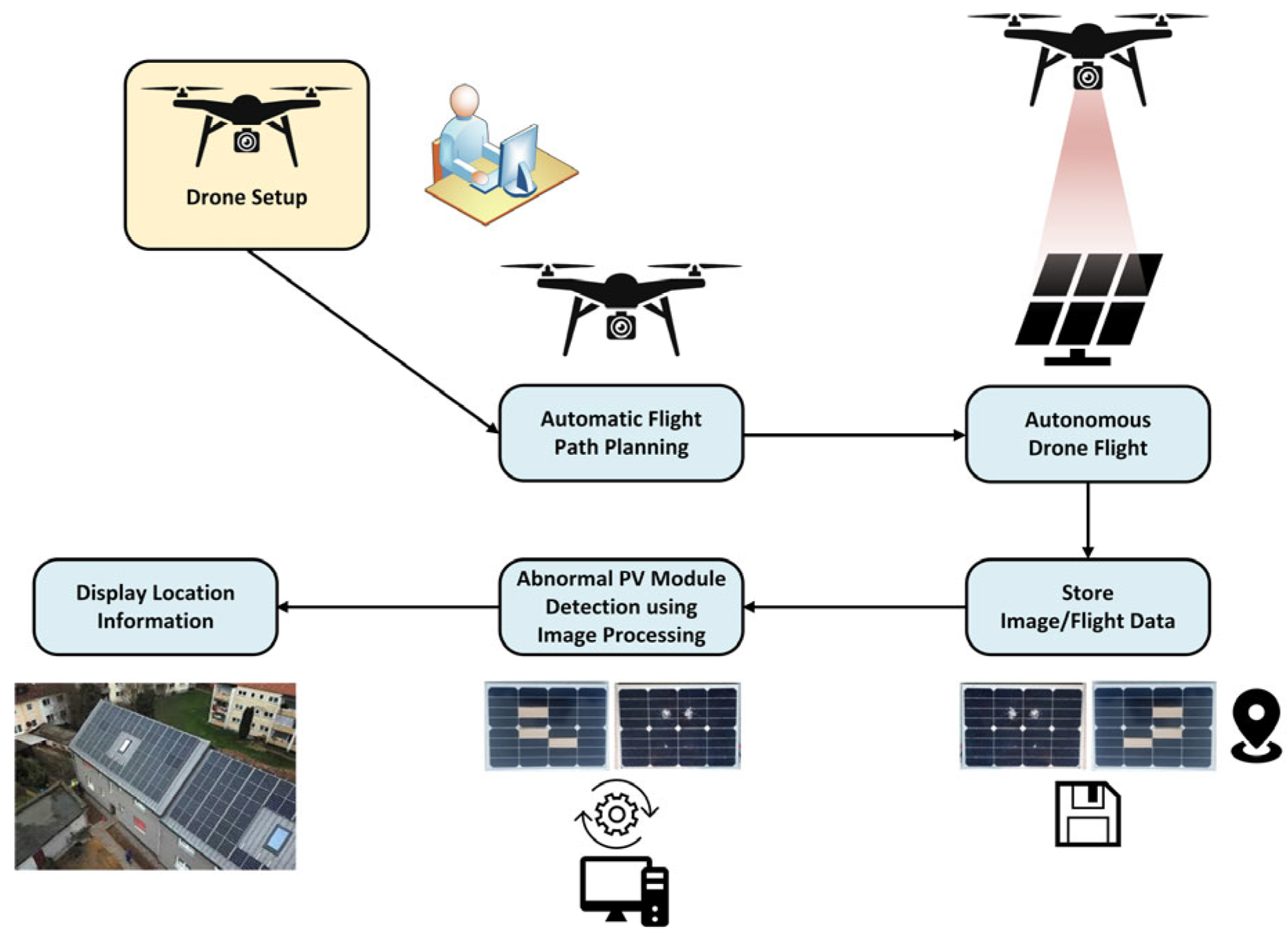
4. Applications of Artificial Vision in Renewable Photovoltaic Systems
- -
- Predicting PV areas;
- -
- Identification of Solar PV power plants;
- -
- Ecological performance of the PV landscape;
- -
- Power prediction of PV generators;
- -
- Fault detection and diagnosis of PV modules;
- -
- Fault detection of PV trackers (Detection of PV modules orientation);
- -
- Orientation of the PV modules;
- -
- Maintenance of PV systems;
- -
- Finding the optimal operating point of photovoltaic panels (MPPT).
4.1. Predicting PV Areas
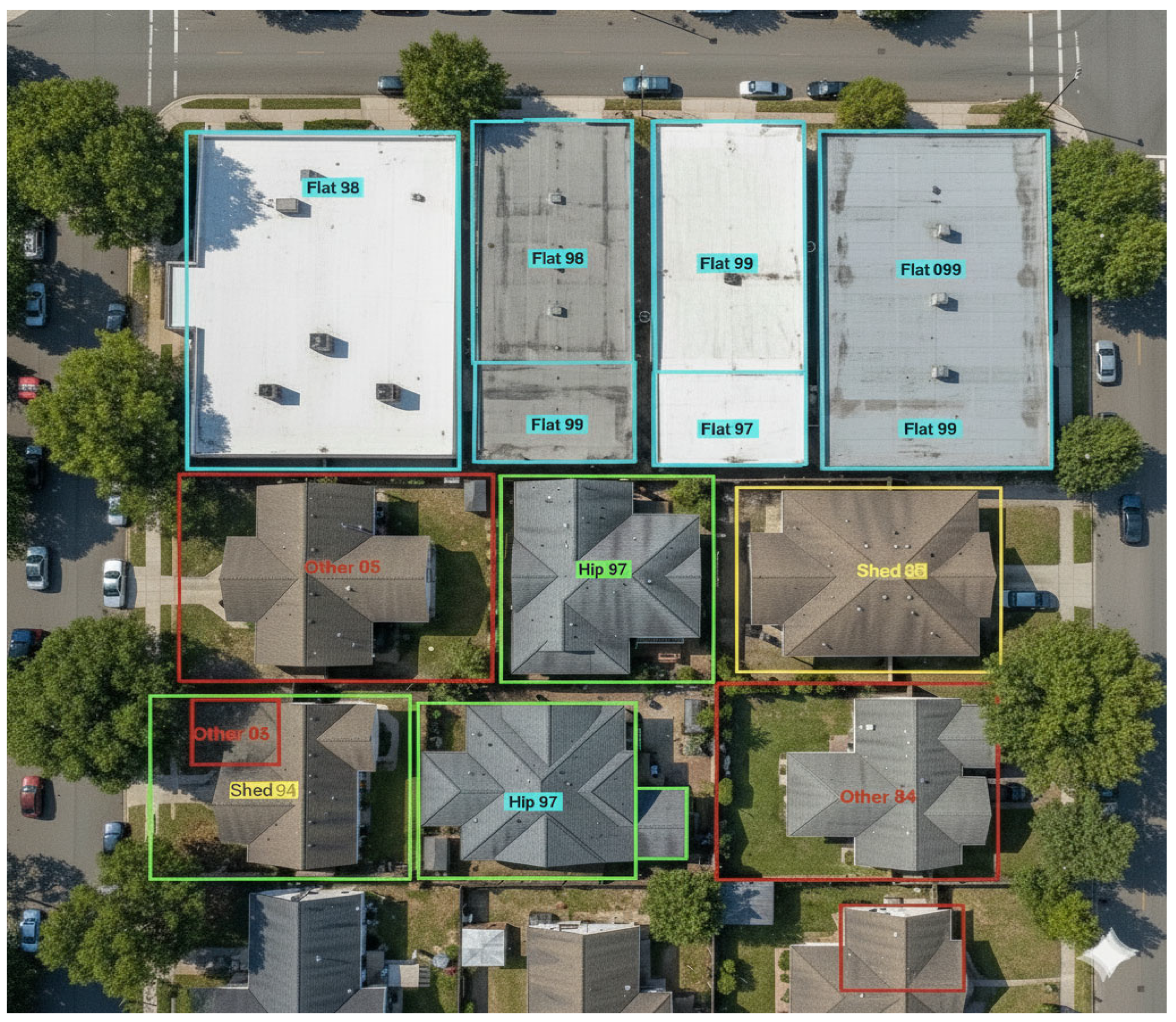
4.1.1. PV at the National or Global Level
- Standardization of Datasets: Establish a public and uniform benchmark dataset to enable objective comparison between algorithms and approaches proposed by different studies;
- Temporal Monitoring and Analysis: Extend current approaches to incorporate time-series data for monitoring installation dynamics, enabling the detection of newly installed, removed, or degraded panels;
- Policy and Infrastructure Integration: Integrate the comprehensive solar panel maps directly into urban planning tools, energy infrastructure planning systems, and climate policy dashboards to support data-driven decision-making and incentivize renewable energy adoption;
- Enhancing Model Robustness: Significantly improve the model’s resilience to challenging image conditions (e.g., shadows, occlusions, varying lighting, and seasonal changes). This can be achieved through advanced techniques such as data augmentation, adversarial training, or the design of more robust network architectures.
4.1.2. Rooftop PV Potential
- Standardization of Datasets: Promote the creation and use of a publicly available, standardized benchmark dataset to allow for fair and objective comparisons between different PV mapping algorithms and studies;
- Enhancing Robustness to Variability: Develop techniques (e.g., data augmentation, adversarial training, or domain adaptation) to make the model resilient to challenging conditions such as shadows, occlusions, varying sun angles, and seasonal changes;
- Temporal Monitoring and Change Detection: Extend the approach to incorporate time-series imagery (multitemporal data) to monitor installation dynamics. This would allow for the detection of newly installed, removed, or degraded panels over time;
- Application Integration: Integrate the generated solar panel maps into higher-level applications, such as urban planning tools, energy infrastructure planning, or dashboards designed for monitoring national-level climate policy targets;
- Model Benchmarking and Comparison: Use the RID as a standardized benchmark to host challenges or comparative studies, allowing researchers to objectively test and compare new computer vision algorithms for PV potential assessment.
4.2. Power Prediction of PV Generators
- Establishing Standardized datasets: To enable objective comparison, a uniform and publicly available benchmark dataset should be established for evaluating algorithms from different studies;
- Model Generalization and Transferability: Expand training datasets to include more diverse geographic areas (different climates, building types, solar installation styles) to make the segmentation + capacity estimation more robust;
- Capacity Estimation Model Refinement: Instead of (or in addition to) simple area-based estimates, develop a more sophisticated model that accounts for panel efficiency, tilt, orientation, degradation, and shading losses;
- Variation in Illumination Conditions: The accuracy of the image analysis algorithm (especially those based on simple thresholding) is drastically reduced under challenging illumination conditions (low light, long shadows, or different sun angles), leading to false positives or false negatives in snow detection;
- Multimodal Data Integration: Combining visual information (RGB cameras) with thermal information (infrared cameras) to detect residual ice or wet snow (which have different thermal signatures), thereby improving the quantification of energy losses.
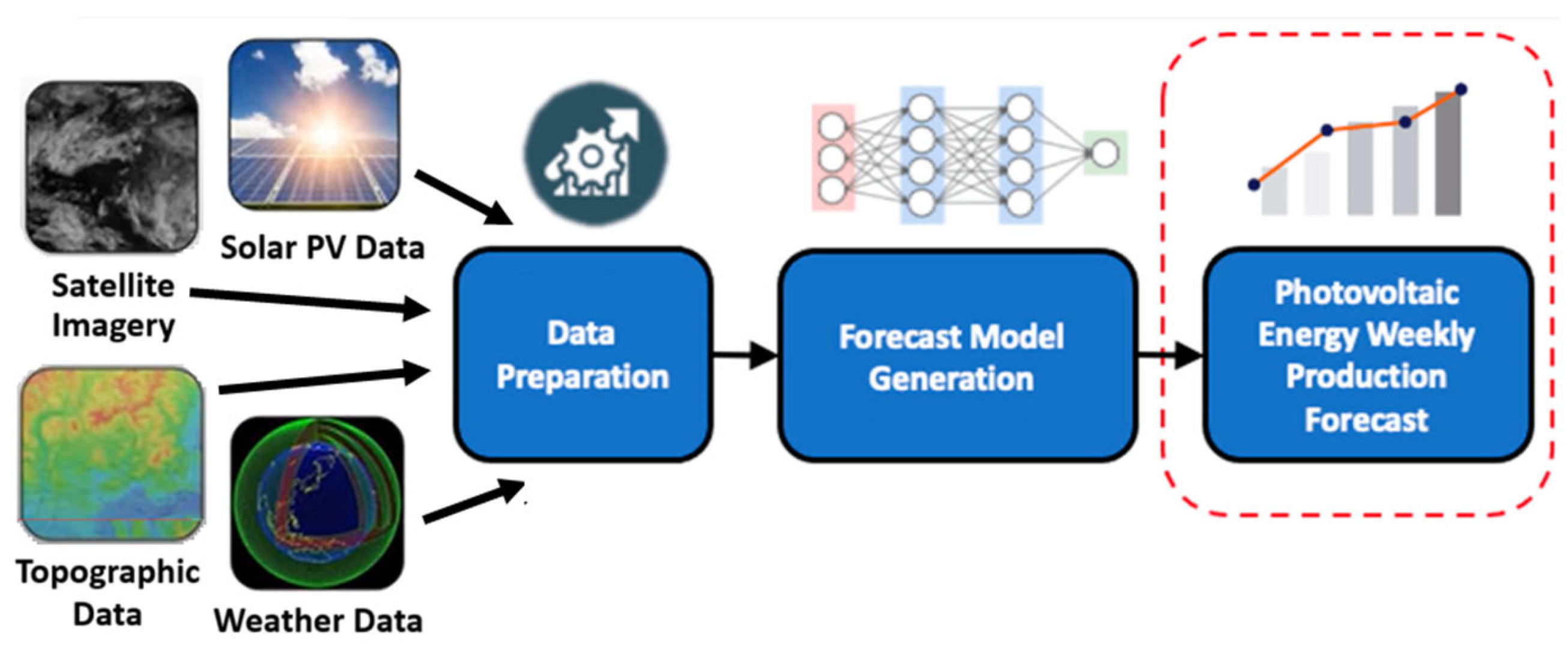
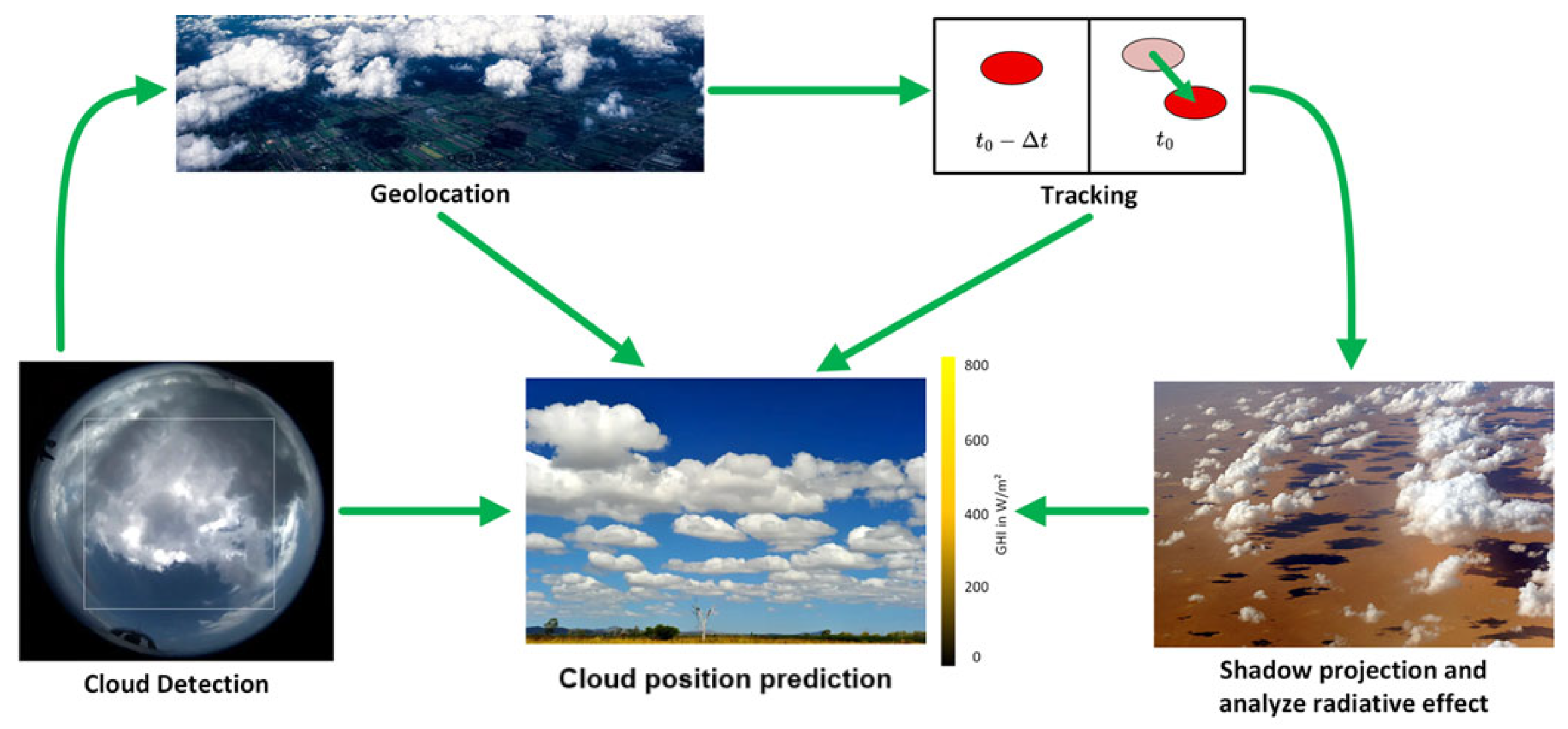
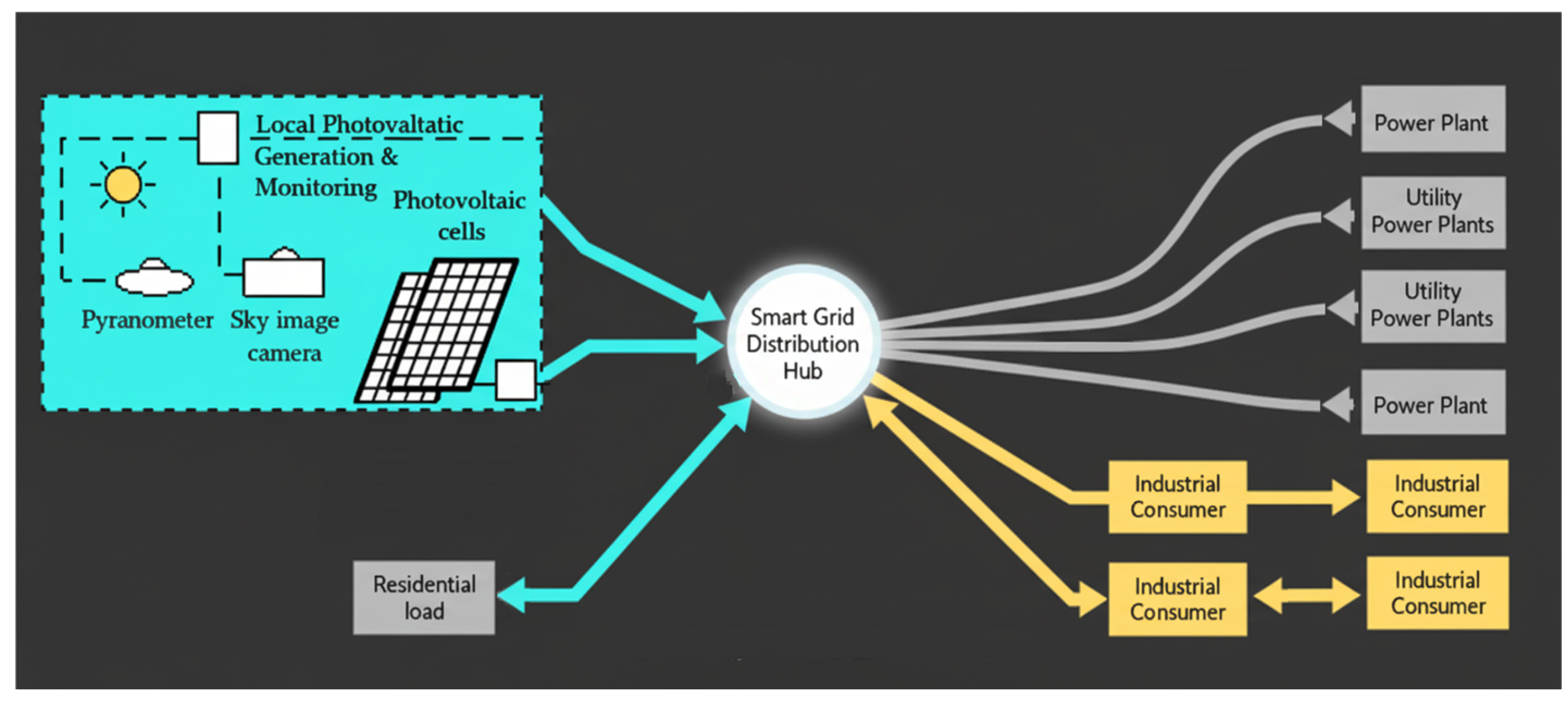
4.3. Computer Vision in Solar Forecasting
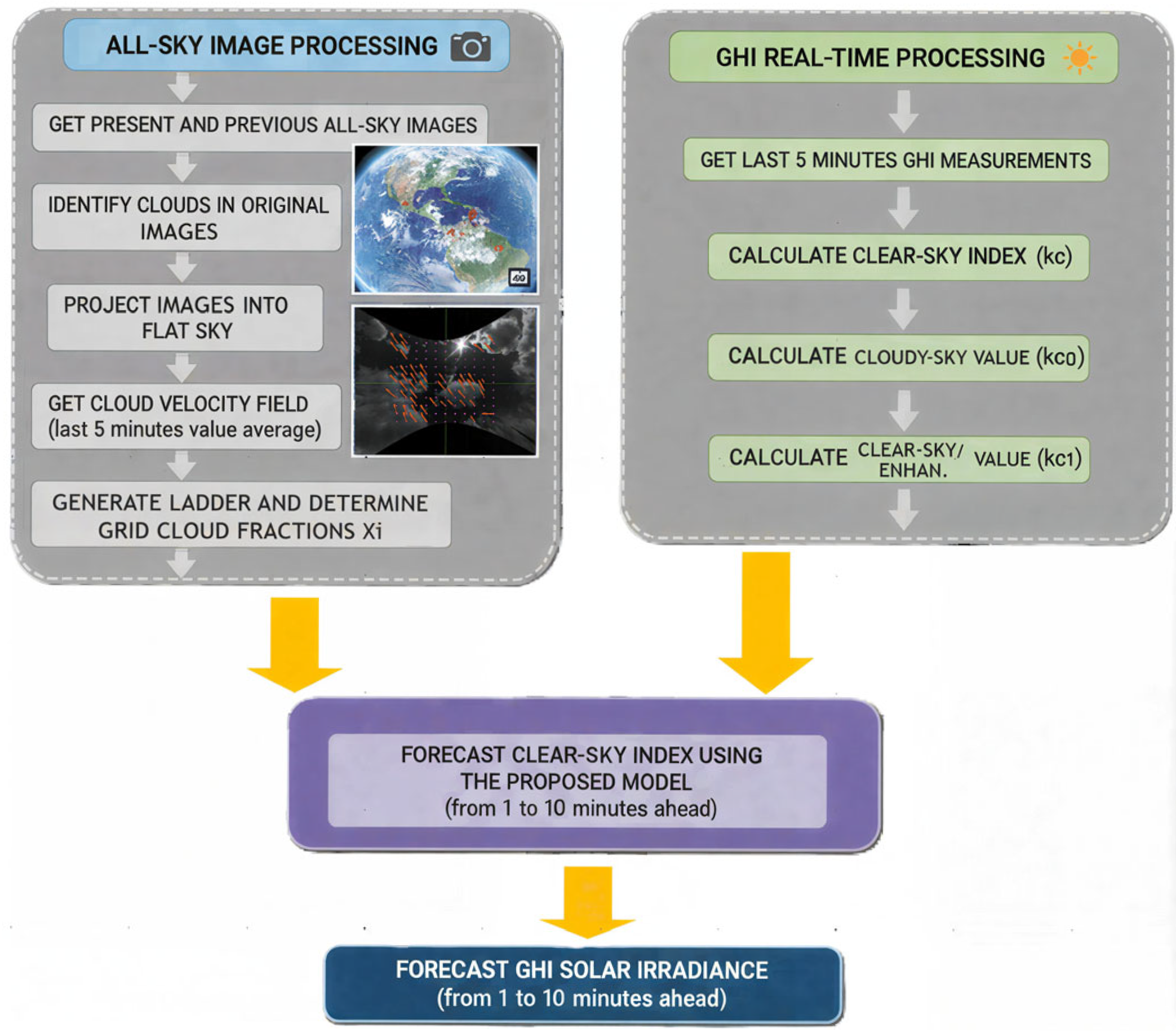
- Classic machine learning models, such as SVM, k-NN, or ANNs;
- Time series-based models, such as ARMA;
- Deep learning models, such as CNNs (e.g., LSTMs).
- Limited Generalization Across Sites, Seasons, and Weather Regimes;
- Heterogeneous Datasets and Lack of Standard Benchmarks;
- Field-of-View Constraints and Spatial-Scale Mismatch;
- Cloud Motion Estimation Errors;
- Sun-Region Artifacts and Camera Limitations;
- Limited Treatment of Uncertainty and Extreme Events
- Underrepresentation of Ramp and Event-Based Evaluation;
- Computational Complexity and Deployment Constraints;
- Dependence on Proprietary or Non-Standard Hardware,
4.4. Detection of Clean/Unclean PV Modules
- -
- A greater variety of classes (e.g., broken panels, inhomogeneous dust particles, and wet panels);
- -
- Additional factors such as environmental variables, particle size, and distribution uniformity;
- -
- Images captured under various lighting conditions and featuring photovoltaic panels of different sizes and orientations.
4.5. Advanced Computer Vision Techniques: Fault Detection and Classification of PV Modules
4.5.1. Physical Faults
- Failure in the encapsulation
- Degradation fault
- Cell cracks
- Corrosion
- Snail trails
4.5.2. Environmental Faults
- Hot spots
4.5.3. Electrical Faults
- The Balance of System (BOS) components failures, which are considered the main reason behind the existence of non-producing modules in the PV area leading to a reduced production;
- The inverter failure is considered the brain of the PV system and represents an expensive and complex element in the plant.
4.6. Fault Detection of PV Trackers
- Real-time Implementation: Integrating the image processing algorithm into an automated, real-time monitoring system that captures images, calculates the deviation index, and alerts operators immediately;
- Large-scale field validation: Conduct multi-site studies over multiple climates and tracker types (single-axis, dual-axis);
- Benchmark datasets and open-source image sets for PV tracking faults would accelerate research;
- Automatic Seasonal Adaptation: Develop algorithms that adjust thresholds dynamically based on seasonal lighting, sun path changes, and background environment changes. This improves robustness without manual recalibration;
- Expand to Night-Time Fault Detection: Integrate IR imaging or thermal cameras and use low-light or NIR-enabled cameras. This ensures 24/7 tracker monitoring.
4.7. Maintenance of PV Modules
- Multimodal Data Fusion for Enhanced Diagnostics: Move beyond basic visual (RGB) or thermal inspection to fuse data from multiple image modalities;
- AI-Driven Anomaly Detection and False Positive Reduction: Refine Machine Learning and Deep Learning algorithms to distinguish between genuine, performance-impacting faults and temporary anomalies (e.g., passing bird droppings, transient shadows, or temporary reflections);
- Standardized Image Datasets and Benchmarks: Address the lack of standard, publicly available, and diverse datasets;
- Integration of Image-Based State Estimation with Remaining Useful Life (RUL) Models: Connect the fault severity detected in an image to the panel’s overall health and estimated time until complete failure.
4.8. Finding the Optimal Operating Point of Photovoltaic Panels (MPPT)
- Methods to improve accuracy under varying lighting, angles, and weather;
- Hybrid optimization (vision + heuristic MPPT);
- Predictive MPPT that uses vision to anticipate shading events before power drops;
- Reinforcement learning–based MPPT that uses video feedback.
5. Conclusions
Author Contributions
Funding
Institutional Review Board Statement
Informed Consent Statement
Data Availability Statement
Acknowledgments
Conflicts of Interest
Abbreviations
| (AC) | Alternating current |
| (AE) | Autoencoder |
| (AI) | Artificial Intelligence |
| (AIRT) | Artificial Intelligence-based Intelligent Reactive Tracking |
| (AM) | Attention mechanisms |
| (AMV) | Atmospheric motion vector |
| (ANFIS) | Adaptive Network-based Fuzzy Inference System |
| (ANN) | Artificial Neural Networks |
| (AR) | Autoregressive |
| (ARM) | Atmospheric Radiation Measurement |
| (ARMA) | Auto-regressive moving average |
| (ASI) | All-sky imager |
| (BILST) | Bi-level Spatio-Temporal |
| (BOS) | Balance of System |
| (BPNN) | Backpropagation neural network |
| (CAE) | Convolutional autoencoder |
| (CBAM) | Convolutional Block Attention Module |
| (CCD) | Charge-coupled device |
| (CCM) | Cross-correlation method |
| (CDF) | Cloud distribution feature |
| (CF) | Cloud fraction |
| (CIADCast) | Cloud Index Advection and Diffusion Cast |
| (CLNSTM) | [Note: CLSTM—placed below] |
| (CLSTM) | Convolutional long short-term memory |
| (CNN) | Convolutional Neural Network |
| (CPM) | Coarse Prediction Module |
| (CPU) | Central Processing Units |
| (CRM) | Constraint Refinement Module |
| (CSL) | Clear Sky Library |
| (CSP) | Concentrating solar power |
| (CSPIMP) | Concentrating Solar Power plant efficiency IMProvement |
| (CVM) | Cross Validation Method |
| (DC) | Direct current |
| (DCNN) | Deep convolutional neural network |
| (DHLNN) | Double-Hidden Layer Feed Forward Neural Network plus Softmax function |
| (DIP) | Digital Image Processing |
| (DL) | Deep learning |
| (DNI) | Direct Normal Irradiance |
| (DRR) | Deep Roof Refiner |
| (ECLIPSE) | Envisioning CLoud Induced Perturbations in Solar Energy |
| (EL) | Electroluminescence |
| (EV) | Electric vehicle |
| (EVA) | Ethylene-vinyl acetate |
| (FCN) | Fully convolutional network |
| (FFL) | Fine-Grained Feature Layer |
| (FIA) | Filter-induced augmentations |
| (FOM) | Fine Optimization Module |
| (FPGA) | Field Programmable Gate Arrays |
| (FPN) | Feature Pyramid Network |
| (FPV) | Floating PV |
| (GA) | Genetic algorithm |
| (GAN) | Generative Adversarial Network |
| (GBC) | Ground-based camera |
| (GHI) | Global horizontal solar irradiance |
| (GMPP) | Global Maximum Power Point |
| (GMPPT) | Global Maximum power point tracking |
| (GPU) | Graphics Processing Units |
| (GRU) | Gated Recurrent Unit |
| (GTI) | Global Tilted Irradiance |
| (HDR) | High Dynamic Range |
| (HOG) | Histogram of Oriented Gradients |
| (HSRRS) | High spatial resolution remote sensing |
| (HSV) | Hue, Saturation, Value |
| (IR) | Infrared |
| (IREA) | International Renewable Energy Agency |
| (IRT) | Infrared Thermography |
| (IRTI) | Infrared thermal imaging |
| (IoT) | Internet of Things |
| (kNN) | k-Nearest Neighbor |
| (LBP) | Local Binary Patterns |
| (LCC) | Local cloud cover |
| (LMD) | Local measurement data |
| (LSTM) | Long short-term memory |
| (LWIR) | Long-wave infrared |
| (ML) | Machine Learning |
| (MLP) | Multilayer Perceptron |
| (MPPT) | Maximum power point tracking |
| (MPP) | Maximum power point |
| (MSG) | Meteosat Second Generation |
| (MSF) | Multistep forecasting |
| (NWP) | Numerical Weather Prediction |
| (OF) | Optical Flow |
| (PCA) | Principal Component Analysis |
| (PCTA) | Principal Components Thermal Analysis |
| (PIV) | Particle Image Velocimetry |
| (PI) | Prediction Interval |
| (PL) | Photoluminescence |
| (PM) | Persistence model |
| (PREDNET) | Predictive Coding Network |
| (PRRC) | Power ramp-rate control |
| (PSO) | Particle swarm optimization |
| (PSPNet) | Pyramid Scene Parsing Network |
| (PSSI) | Parking Space Suitability Index |
| (PV) | Photovoltaic |
| (RBF) | Radial basis function |
| (RBR) | Red-Blue Ratio |
| (RE) | Renewable energy |
| (RF) | Random Forest |
| (RGB) | Red, Green, and Blue |
| (RID) | Roof Information Dataset |
| (RNN) | Recurrent neural network |
| (ROIs) | Regions of Interest |
| (RSL) | Roof Structure Line |
| (RSP) | Rooftop solar panel |
| (RTM) | Randomized Training Method |
| (SBI) | Sun-Blocking Index |
| (SCM) | Semantic Constraint Module |
| (SES) | Solar energy systems |
| (SGP) | Southern Great Plains |
| (SHLNN) | Single-Hidden Layer Feed Forward Neural Network plus Softmax function |
| (SI) | Sky images |
| (SIFT) | Scale-Invariant Feature Transform |
| (SIM) | Solar irradiance map |
| (SLNN) | Simple machine learning model |
| (SPM) | Smart persistence model |
| (SPV) | Stationary PV |
| (ST) | Solar thermal |
| (SVC) | Support Vector for Classification |
| (SVM) | Support Vector Machine |
| (SVR) | Support Vector Regression |
| (SWIR) | Short-wave infrared |
| (TSIs) | Total sky images |
| (UAV) | Unmanned Aerial Vehicle |
| (UVF) | Ultraviolet fluorescence |
| (VGG19) | Visual Geometry Group-19 |
| (ViT) | Vision Transformer |
| (WPV) | Water-based photovoltaics |
| (WRF) | Weather Research and Forecasting |
References
- Rashid, M.H. Electric Renewable Energy Systems; Academic Press: New York, NY, USA, 2016; 240p. [Google Scholar]
- Communication from the Commission to the European Council and the European Parliament an Energy Policy for Europe. Commission of the European Communities, Brussels. 2007. Available online: https://eur-lex.europa.eu/legal-content/EN/TXT/PDF/?uri=CELEX:52007DC0001&from=en (accessed on 10 September 2025).
- IRENA—International Renewable Energy Agency. Available online: https://www.irena.org/Energy-Transition/Technology/Solar-energy (accessed on 24 May 2021).
- Høiaas, I.; Grujic, K.; Imenes, A.G.; Burud, I.; Olsen, E.; Belbachir, N. Inspection and condition monitoring of large-scale photovoltaic power plants: A review of imaging technologies. Renew. Sustain. Energy Rev. 2022, 161, 112353. [Google Scholar] [CrossRef]
- Michail, A.; Livera, A.; Tziolis, G.; Candás, J.L.C.; Fernandez, A.; Yudego, E.A.; Martínez, D.F.; Antonopoulos, A.; Tripolitsiotis, A.; Partsinevelos, P.; et al. A comprehensive review of unmanned aerial vehicle-based approaches to support photovoltaic plant diagnosis. Heliyon 2024, 10, e23983. [Google Scholar] [CrossRef] [PubMed]
- Gallardo-Saavedra, S.; Hernández-Callejo, L.; Duque-Perez, O. Technological review of the instrumentation used in aerial thermographic inspection of photovoltaic plants. Renew. Sustain. Energy Rev. 2018, 93, 566–579. [Google Scholar] [CrossRef]
- Kandeal, A.; Elkadeem, M.; Thakur, A.K.; Abdelaziz, G.B.; Sathyamurthy, R.; Kabeel, A.; Yang, N.; Sharshir, S.W. Infrared thermography-based condition monitoring of solar photovoltaic systems: A mini review of recent advances. Sol. Energy 2021, 223, 33–43. [Google Scholar] [CrossRef]
- Rahaman, S.A.; Urmee, T.; Parlevliet, D.A. PV system defects identification using Remotely Piloted Aircraft (RPA) based infrared (IR) imaging: A review. Sol. Energy 2020, 206, 579–595. [Google Scholar] [CrossRef]
- Tsanakas, J.A.; Ha, L.; Buerhop, C. Faults and infrared thermographic diagnosis in operating c-Si photovoltaic modules: A review of research and future challenges. Renew. Sustain. Energy Rev. 2016, 62, 695–709. [Google Scholar] [CrossRef]
- Buerhop, C.; Bommes, L.; Schlipf, J.; Pickel, T.; Fladung, A.; Peters, I.M. Infrared imaging of photovoltaic modules: A review of the state of the art and future challenges facing gigawatt photovoltaic power stations. Prog. Energy 2022, 4, 042010. [Google Scholar] [CrossRef]
- Puranik, V.E.; Kumar, R.; Gupta, R. Progress in module level quantitative electroluminescence imaging of crystalline silicon PV module: A review. Sol. Energy 2023, 264, 111994. [Google Scholar] [CrossRef]
- Mao, H.; Chen, X.; Luo, Y.; Deng, J.; Tian, Z.; Yu, J.; Xiao, Y.; Fan, J. Advances and prospects on estimating solar photovoltaic installation capacity and potential based on satellite and aerial images. Renew. Sustain. Energy Rev. 2023, 179, 113276. [Google Scholar] [CrossRef]
- de Oliveira, A.K.V.; Aghaei, M.; Rüther, R. Automatic Inspection of Photovoltaic Power Plants Using Aerial Infrared Thermography: A Review. Energies 2022, 15, 2055. [Google Scholar] [CrossRef]
- Al Mahdi, H.; Leahy, P.G.; Alghoul, M.; Morrison, A.P. A Review of Photovoltaic Module Failure and Degradation Mechanisms: Causes and Detection Techniques. Solar 2024, 4, 43–82. [Google Scholar] [CrossRef]
- Afifah, A.N.N.; Indrabayu, S.; Syafaruddin, A. A Review on Image Processing Techniques for Damage detection on Photovoltaic Panels. ICIC Express Lett. 2021, 15, 779–790. [Google Scholar] [CrossRef]
- Balachandran, G.B.; Devisridhivyadharshini, M.; Ramachandran, M.E.; Santhiya, R. Comparative investigation of imaging techniques, pre-processing and visual fault diagnosis using artificial intelligence models for solar photovoltaic system–A comprehensive review. Measurement 2024, 232, 114683. [Google Scholar] [CrossRef]
- Hussain, T.; Hussain, M.; Al-Aqrabi, H.; Alsboui, T.; Hill, R. A Review on Defect Detection of Electroluminescence-Based Photovoltaic Cell Surface Images Using Computer Vision. Energies 2023, 16, 4012. [Google Scholar] [CrossRef]
- Hijjawi, U.; Lakshminarayana, S.; Xu, T.; Fierro, G.P.M.; Rahman, M. A review of automated solar photovoltaic defect detection systems: Approaches, challenges, and future orientations. Sol. Energy 2023, 266, 112186. [Google Scholar] [CrossRef]
- Spagnolo, G.S.; Del Vecchio, P.; Makary, G.; Papalillo, D.; Martocchia, A. A review of IR thermography applied to PV systems. In Proceedings of the 11th International Conference on Environment and Electrical Engineering, Venice, Italy, 18–25 May 2012; pp. 879–884. [Google Scholar] [CrossRef]
- Yahya, Z.; Imane, S.; Hicham, H.; Ghassane, A.; Safia, E.B.-I. Applied imagery pattern recognition for photovoltaic modules’ inspection: A review on methods, challenges and future development. Sustain. Energy Technol. Assess. 2022, 52, 102071. [Google Scholar] [CrossRef]
- Hoog, J.; Maetschke, S.; Ilfrich, P.; Kolluri, R.R. Using Satellite and Aerial Imagery for Identification of Solar PV: State of the Art and Research Opportunities. In Proceedings of the e-Energy ‘20: Proceedings of the Eleventh ACM International Conference on Future Energy Systems, Virtual Event, 22–26 June 2020; Association for Computing Machinery: New York, NY, USA, 2020; pp. 308–313. [Google Scholar] [CrossRef]
- Scherer, R. Computer Vision Methods for Fast Image Classification and Retrieval; Springer: Berlin/Heidelberg, Germany, 2020. [Google Scholar]
- Cazzato, D.; Cimarelli, C.; Sanchez-Lopez, J.L.; Voos, H.; Leo, M. A Survey of Computer Vision Methods for 2D Object Detection from Unmanned Aerial Vehicles. J. Imaging 2020, 6, 78. [Google Scholar] [CrossRef]
- Kadam, P.; Fang, G.; Zou, J.J. Object Tracking Using Computer Vision: A Review. Computers 2024, 13, 136. [Google Scholar] [CrossRef]
- Murphy-Chutorian, E.; Trivedi, M.M. Head Pose Estimation in Computer Vision: A Survey. IEEE Trans. Pattern Anal. Mach. Intell. 2008, 31, 607–626. [Google Scholar] [CrossRef]
- Wołk, K.; Tatara, M.S. A Review of Semantic Segmentation and Instance Segmentation Techniques in Forestry Using LiDAR and Imagery Data. Electronics 2024, 13, 4139. [Google Scholar] [CrossRef]
- Nouriani, A.; McGovern, R.; Rajamani, R. Activity recognition using a combination of high gain observer and deep learning computer vision algorithms. Intell. Syst. Appl. 2023, 18, 200213. [Google Scholar] [CrossRef]
- Yilmaz, A.A.; Guzel, M.S.; Bostanci, E.; Askerzade, I. A Novel Action Recognition Framework Based on Deep-Learning and Genetic Algorithms. IEEE Access 2020, 8, 100631–100644. [Google Scholar] [CrossRef]
- Kong, Y.; Fu, Y. Human Action Recognition and Prediction: A Survey. Int. J. Comput. Vis. 2022, 130, 1366–1401. [Google Scholar] [CrossRef]
- Tang, Y.; Qiu, J.; Gao, M. Fuzzy Medical Computer Vision Image Restoration and Visual Application. Comput. Math. Methods Med. 2022, 2022, 6454550. [Google Scholar] [CrossRef]
- Harikrishnan, J.; Sudarsan, A.; Sadashiv, A.; Ajai, R.A. Vision-Face Recognition Attendance Monitoring System for Surveillance using Deep Learning Technology and Computer Vision. In Proceedings of the International Conference on Vision Towards Emerging Trends in Communication and Networking (ViTECoN), Vellore, India, 30–31 March 2019. [Google Scholar] [CrossRef]
- Matthey-Doret, C.; Baudry, L.; Breuer, A.; Montagne, R.; Guiglielmoni, N.; Scolari, V.; Jean, E.; Campeas, A.; Chanut, P.H.; Oriol, E.; et al. Computer vision for pattern detection in chromosome contact maps. Nat. Commun. 2020, 11, 5795. [Google Scholar] [CrossRef]
- Hesse, N.; Bodensteiner, C.; Arens, M.; Hofmann, U.G.; Weinberger, R.; Schroeder, A.S. Computer Vision for Medical Infant Motion Analysis: State of the Art and RGB-D Data Set. In Proceedings of the European Conference on Computer Vision (ECCV) Workshops, Munich, Germany, 8–14 September 2018. [Google Scholar]
- Gadasin, D.V.; Shvedov, A.V.; Kuzin, I.A. Reconstruction of a Three-Dimensional Scene from its Projections in Computer Vision Systems. In Proceedings of the Intelligent Technologies and Electronic Devices in Vehicle and Road Transport Complex (TIRVED), Moscow, Russia, 11–12 November 2021. [Google Scholar] [CrossRef]
- Shehu, V.; Dika, A. Using real time computer vision algorithms in automatic attendance management systems. In Proceedings of the 32nd International Conference on Information Technology Interfaces, Cavtat, Croatia, 21–24 June 2010. [Google Scholar]
- Brunetti, A.; Buongiorno, D.; Trotta, G.F.; Bevilacqua, V. Computer vision and deep learning techniques for pedestrian detection and tracking: A survey. Neurocomputing 2018, 300, 17–33. [Google Scholar] [CrossRef]
- Pena-Gonzalez, R.H.; Nuno-Maganda, M.A. Computer vision based real-time vehicle tracking and classification system. In Proceedings of the IEEE 57th International Midwest Symposium on Circuits and Systems (MWSCAS), College Station, TX, USA, 3–6 August 2014. [Google Scholar] [CrossRef]
- Dey, N.; Bhateja, V.; Hassanien, A.E. Medical Imaging in Clinical Applications—Algorithmic and Computer-Based Approaches; Studies in Computational Intelligence; Springer: Cham, Switzerland, 2016; Volume 651. [Google Scholar]
- Ettalibi, A.; Elouadi, A.; Mansour, A. AI and Computer Vision-based Real-time Quality Control: A Review of Industrial Applications. Procedia Comput. Sci. 2024, 231, 212–220. [Google Scholar] [CrossRef]
- Andhare, P.; Rawat, S. Pick and place industrial robot controller with computer vision. In Proceedings of the 2016 International Conference on Computing Communication Control and Automation (ICCUBEA), Pune, India, 12–13 August 2016; pp. 1–4. [Google Scholar]
- Kanchana, B.; Peiris, R.; Perera, D.; Jayasinghe, D.; Kasthurirathna, D. Computer Vision for Autonomous Driving. In Proceedings of the 3rd International Conference on Advancements in Computing (ICAC), Colombo, Sri Lanka, 9–11 December 2021. [Google Scholar] [CrossRef]
- Patrício, D.I.; Rieder, R. Computer vision and artificial intelligence in precision agriculture for grain crops: A systematic review. Comput. Electron. Agric. 2018, 153, 69–81. [Google Scholar] [CrossRef]
- Chang, M.-C.; Chiang, C.-K.; Tsai, C.-M.; Chang, Y.-K.; Chiang, H.-L.; Wang, Y.-A.; Chang, S.-Y.; Li, Y.-L.; Tsai, M.-S.; Tseng, H.-Y. AI City Challenge 2020—Computer Vision for Smart Transportation Applications. In Proceedings of the IEEE/CVF Conference on Computer Vision and Pattern Recognition (CVPR) Workshops, Online, 14–19 June 2020; pp. 620–621. [Google Scholar]
- Zhang, X.; Yi, W.-J.; Saniie, J. Home Surveillance System using Computer Vision and Convolutional Neural Network. In Proceedings of the IEEE International Conference on Electro Information Technology (EIT), Brookings, SD, USA, 20–22 May 2019. [Google Scholar] [CrossRef]
- Batchelor, B.G. Machine Vision Handbook; Springer: Berlin/Heidelberg, Germany, 2012. [Google Scholar]
- Nair, S.; Sharifzadeh, S.; Palade, V. Farmland Segmentation in Landsat 8 Satellite Images Using Deep Learning and Conditional Generative Adversarial Networks. Remote Sens. 2024, 16, 823. [Google Scholar] [CrossRef]
- da Costa, M.V.C.V.; de Carvalho, O.L.F.; Orlandi, A.G.; Hirata, I.; de Albuquerque, A.O.; e Silva, F.V.; Guimarães, R.F.; Gomes, R.A.T.; de Carvalho Júnior, O.A. Remote Sensing for Monitoring Photovoltaic Solar Plants in Brazil Using Deep Semantic Segmentation. Energies 2021, 14, 2960. [Google Scholar] [CrossRef]
- Hubert-Moy, L.; Fabre, E.; Rapinel, S. Contribution of SPOT-7 multi-temporal imagery for mapping wetland vegetation. Eur. J. Remote Sens. 2020, 53, 201–210. [Google Scholar] [CrossRef]
- Tong, X.-Y.; Lu, Q.; Xia, G.-S.; Zhang, L. Large-Scale Land Cover Classification in Gaofen-2 Satellite Imagery. In Proceedings of the IEEE International Geoscience and Remote Sensing Symposium, Valencia, Spain, 22–27 July 2018. [Google Scholar] [CrossRef]
- Lin, Y.; Saripalli, S. Road detection from aerial imagery. In Proceedings of the IEEE International Conference on Robotics and Automation, Saint Paul, MN, USA, 14–18 May 2012. [Google Scholar] [CrossRef]
- Pratt, L.; Govender, D.; Klein, R. Defect detection and quantification in electroluminescence images of solar PV modules using U-net semantic segmentation. Renew. Energy 2021, 178, 1211–1222. [Google Scholar] [CrossRef]
- Henry, C.; Poudel, S.; Lee, S.-W.; Jeong, H. Automatic Detection System of Deteriorated PV Modules Using Drone with Thermal Camera. Appl. Sci. 2020, 10, 3802. [Google Scholar] [CrossRef]
- Zikulnig, J.; Mühleisen, W.; Bolt, P.J.; Simor, M.; De Biasio, M. Photoluminescence Imaging for the In-Line Quality Control of Thin-Film Solar Cells. Solar 2022, 2, 1–11. [Google Scholar] [CrossRef]
- Eder, G.C.; Voronko, Y.; Hirschl, C.; Ebner, R.; Újvári, G.; Mühleisen, W. Non-Destructive Failure Detection and Visualization of Artificially and Naturally Aged PV Modules. Energies 2018, 11, 1053. [Google Scholar] [CrossRef]
- Lian, R.; Wang, W.; Mustafa, N.; Huang, L. Road Extraction Methods in High-Resolution Remote Sensing Images: A Comprehensive Review. IEEE J. Sel. Top. Appl. Earth Obs. Remote Sens. 2020, 13, 5489–5507. [Google Scholar] [CrossRef]
- Jia, J.; Sun, H.; Jiang, C.; Karila, K.; Karjalainen, M.; Ahokas, E.; Khoramshahi, E.; Hu, P.; Chen, C.; Xue, T.; et al. Review on Active and Passive Remote Sensing Techniques for Road Extraction. Remote Sens. 2021, 13, 4235. [Google Scholar] [CrossRef]
- Parhar, P.; Sawasaki, R.; Todeschini, A.; Reed, C.; Vahabi, H.; Nusaputra, N.; Vergara, F. HyperionSolarNet: Solar Panel Detection from Aerial Images. arXiv 2022, arXiv:2201.02107. [Google Scholar] [CrossRef]
- Qi, Q.; Zhao, J.; Lin, L.; Zhang, X.; Tian, Y. Combined multi-level context aggregation and attention mechanism method for photovoltaic panel extraction from high resolution remote sensing images. Int. J. Remote Sens. 2024, 45, 3560–3576. [Google Scholar] [CrossRef]
- Jiang, H.; Yao, L.; Lu, N.; Qin, J.; Liu, T.; Liu, Y.; Zhou, C. Multi-resolution dataset for photovoltaic panel segmentation from satellite and aerial imagery. Earth Syst. Sci. Data 2021, 13, 5389–5401. [Google Scholar] [CrossRef]
- Malof, J.M.; Bradbury, K.; Collins, L.M.; Newell, R.G. Automatic detection of solar photovoltaic arrays in high resolution aerial imagery. Appl. Energy 2016, 183, 229–240. [Google Scholar] [CrossRef]
- Malof, J.M.; Collins, L.M.; Bradbury, K.; Newell, R.G. A deep convolutional neural network and a random forest classifier for solar photovoltaic array detection in aerial imagery. In Proceedings of the 2016 IEEE International Conference on Renewable Energy Research and Applications (ICRERA), Birmingham, UK, 20–23 November 2016; pp. 650–654. [Google Scholar] [CrossRef]
- Yuan, J.; Yang, H.-H.L.; Omitaomu, O.A.; Bhaduri, B.L. Large-scale solar panel mapping from aerial images using deep convolutional networks. In Proceedings of the 2016 IEEE International Conference on Big Data (Big Data), Washington, DC, USA, 5–8 December 2016; pp. 2703–2708. [Google Scholar] [CrossRef]
- Sizkouhi, A.M.M.; Aghaei, M.; Esmailifar, S.M.; Mohammadi, M.R.; Grimaccia, F. Automatic Boundary Extraction of Large-Scale Photovoltaic Plants Using a Fully Convolutional Network on Aerial Imagery. IEEE J. Photovolt. 2020, 10, 1061–1067. [Google Scholar] [CrossRef]
- Schulz, M.; Boughattas, B.; Wendel, F. DetEEktor: Mask R-CNN based neural network for energy plant identification on aerial photographs. Energy AI 2021, 5, 100069. [Google Scholar] [CrossRef]
- Li, L.; Lu, N.; Jiang, H.; Qin, J. Impact of Deep Convolutional Neural Network Structure on Photovoltaic Array Extraction from High Spatial Resolution Remote Sensing Images. Remote Sens. 2023, 15, 4554. [Google Scholar] [CrossRef]
- Wang, J.; Chen, X.; Jiang, W.; Hua, L.; Liu, J.; Sui, H. PVNet: A novel semantic segmentation model for extracting high-quality photovoltaic panels in large-scale systems from high-resolution remote sensing imagery. Int. J. Appl. Earth Obs. Geoinf. 2023, 119, 103309. [Google Scholar] [CrossRef]
- Tan, H.; Guo, Z.; Zhang, H.; Chen, Q.; Lin, Z.; Chen, Y.; Yan, J. Enhancing PV panel segmentation in remote sensing images with constraint refinement modules. Appl. Energy 2023, 350, 121757. [Google Scholar] [CrossRef]
- Zhuang, L.; Zhang, Z.; Wang, L. The automatic segmentation of residential solar panels based on satellite images: A cross learning driven U-Net method. Appl. Soft Comput. 2020, 92, 106283. [Google Scholar] [CrossRef]
- Baek, J.; Choi, Y. Optimal installation and operation planning of parking spaces for solar-powered electric vehicles using hemispherical images. Renew. Energy 2023, 219, 119444. [Google Scholar] [CrossRef]
- Jiang, W.; Tian, B.; Duan, Y.; Chen, C.; Hu, Y. Rapid mapping and spatial analysis on the distribution of photovoltaic power stations with Sentinel-1&2 images in Chinese coastal provinces. Int. J. Appl. Earth Obs. Geoinf. 2023, 118, 103280. [Google Scholar] [CrossRef]
- Ji, C.; Bachmann, M.; Esch, T.; Feilhauer, H.; Heiden, U.; Heldens, W.; Hueni, A.; Lakes, T.; Metz-Marconcini, A.; Schroedter-Homscheidt, M.; et al. Solar photovoltaic module detection using laboratory and airborne imaging spectroscopy data. Remote Sens. Environ. 2021, 266, 112692. [Google Scholar] [CrossRef]
- Zech, M.; Ranalli, J. Predicting PV Areas in Aerial Images with Deep Learning. In Proceedings of the 47th IEEE Photovoltaic Specialists Conference, Online, 15–21 June 2020; pp. 767–774. [Google Scholar]
- Available online: https://getsolar.ai/blog/machine-learning-rooftop-detection-solar-installations/ (accessed on 4 August 2025).
- Krapf, S.; Bogenrieder, L.; Netzler, F.; Balke, G.; Lienkamp, M. RID—Roof Information Dataset for Computer Vision-Based Photovoltaic Potential Assessment. Remote Sens. 2022, 14, 2299. [Google Scholar] [CrossRef]
- Bommes, L.; Buerhop-Lutz, C.; Pickel, T.; Hauch, J.; Brabec, C.; Peters, I.M. Georeferencing of photovoltaic modules from aerial infrared videos using structure-from-motion. Prog. Photovolt. Res. Appl. 2022, 30, 1122–1135. [Google Scholar] [CrossRef]
- Kleebauer, M.; Horst, D.; Reudenbach, C. Semi-Automatic Generation of Training Samples for Detecting Renewable Energy Plants in High-Resolution Aerial Images. Remote Sens. 2021, 13, 4793. [Google Scholar] [CrossRef]
- Tan, H.; Guo, Z.; Lin, Z.; Chen, Y.; Huang, D.; Yuan, W.; Zhang, H.; Yan, J. General generative AI-based image augmentation method for robust rooftop PV segmentation. Appl. Energy 2024, 368, 123554. [Google Scholar] [CrossRef]
- Qian, Z.; Chen, M.; Zhong, T.; Zhang, F.; Zhu, R.; Zhang, Z.; Zhang, K.; Sun, Z.; Lü, G. Deep Roof Refiner: A detail-oriented deep learning network for refined delineation of roof structure lines using satellite imagery. Int. J. Appl. Earth Obs. Geoinf. 2022, 107, 102680. [Google Scholar] [CrossRef]
- Li, P.; Zhang, H.; Guo, Z.; Lyu, S.; Chen, J.; Li, W.; Song, X.; Shibasaki, R.; Yan, J. Understanding rooftop PV panel semantic segmentation of satellite and aerial images for better using machine learning. Adv. Appl. Energy 2021, 4, 100057. [Google Scholar] [CrossRef]
- Frimane, Â.; Johansson, R.; Munkhammar, J.; Lingfors, D.; Lindahl, J. Identifying small decentralized solar systems in aerial images using deep learning. Sol. Energy 2023, 262, 111822. [Google Scholar] [CrossRef]
- Castello, R.; Roquette, S.; Esguerra, M.; Guerra, A.; Scartezzini, J.-L. Deep learning in the built environment: Automatic detection of rooftop solar panels using Convolutional Neural Networks. Phys. Conf. Ser. 2019, 1343, 012034. [Google Scholar] [CrossRef]
- Mayer, K.; Rausch, B.; Arlt, M.-L.; Gust, G.; Wang, Z.; Neumann, D.; Rajagopal, R. 3D-PV-Locator: Large-scale detection of rooftop-mounted photovoltaic systems in 3D. Appl. Energy 2022, 310, 118469. [Google Scholar] [CrossRef]
- Lindahl, J.; Johansson, R.; Lingfors, D. Mapping of decentralised photovoltaic and solar thermal systems by remote sensing aerial imagery and deep machine learning for statistic generation. Energy AI 2023, 14, 100300. [Google Scholar] [CrossRef]
- Lu, N.; Li, L.; Qin, J. PV Identifier: Extraction of small-scale distributed photovoltaics in complex environments from high spatial resolution remote sensing images. Appl. Energy 2024, 365, 123311. [Google Scholar] [CrossRef]
- Paletta, Q.; Terrén-Serrano, G.; Nie, Y.; Li, B.; Bieker, J.; Zhang, W.; Dubus, L.; Dev, S.; Feng, C. Advances in solar forecasting: Computer vision with deep learning. Adv. Appl. Energy 2023, 11, 100150. [Google Scholar] [CrossRef]
- Jurakuziev, D.; Jumaboev, S.; Lee, M. A framework to estimate generating capacities of PV systems using satellite imagery segmentation. Eng. Appl. Artif. Intell. 2023, 123, 106186. [Google Scholar] [CrossRef]
- Zhu, R.; Guo, D.; Wong, M.S.; Qian, Z.; Chen, M.; Yang, B.; Chen, B.; Zhang, H.; You, L.; Heo, J.; et al. Deep solar PV refiner: A detail-oriented deep learning network for refined segmentation of photovoltaic areas from satellite imagery. Int. J. Appl. Earth Obs. Geoinf. 2022, 116, 103134. [Google Scholar] [CrossRef]
- Guo, Z.; Lu, J.; Chen, Q.; Liu, Z.; Song, C.; Tan, H.; Zhang, H.; Yan, J. TransPV: Refining photovoltaic panel detection accuracy through a vision transformer-based deep learning model. Appl. Energy 2023, 355, 122282. [Google Scholar] [CrossRef]
- Xia, Z.; Li, Y.; Guo, X.; Chen, R. High-resolution mapping of water photovoltaic development in China through satellite imagery. Int. J. Appl. Earth Obs. Geoinf. 2022, 107, 102707. [Google Scholar] [CrossRef]
- Braid, J.L.; Riley, D.; Pearce, J.M.; Burnham, L. Image Analysis Method for Quantifying Snow Losses on PV Systems. In Proceedings of the 2020 47th IEEE Photovoltaic Specialists Conference (PVSC), Calgary, AB, Canada, 15 June–21 August 2020; pp. 1510–1516. [Google Scholar] [CrossRef]
- Lin, F.; Zhang, Y.; Wang, J. Recent advances in intra-hour solar forecasting: A review of ground-based sky image methods. Int. J. Forecast. 2022, 39, 244–265. [Google Scholar] [CrossRef]
- Sawant, M.; Shende, M.K.; Feijóo-Lorenzo, A.E.; Bokde, N.D. The State-of-the-Art Progress in Cloud Detection, Identification, and Tracking Approaches: A Systematic Review. Energies 2021, 14, 8119. [Google Scholar] [CrossRef]
- Chu, Y.; Pedro, H.T.; Li, M.; Coimbra, C.F. Real-time forecasting of solar irradiance ramps with smart image processing. Sol. Energy 2015, 114, 91–104. [Google Scholar] [CrossRef]
- West, S.R.; Rowe, D.; Sayeef, S.; Berry, A. Short-term irradiance forecasting using skycams: Motivation and development. Sol. Energy 2014, 110, 188–207. [Google Scholar] [CrossRef]
- Kamadinata, J.O.; Ken, T.L.; Suwa, T. Sky image-based solar irradiance prediction methodologies using artificial neural networks. Renew. Energy 2019, 134, 837–845. [Google Scholar] [CrossRef]
- Chu, Y.; Urquhart, B.; Gohari, S.M.; Pedro, H.T.; Kleissl, J.; Coimbra, C.F. Short-term reforecasting of power output from a 48 MWe solar PV plant. Sol. Energy 2015, 112, 68–77. [Google Scholar] [CrossRef]
- Chu, Y.; Pedro, H.T.; Coimbra, C.F. Hybrid intra-hour DNI forecasts with sky image processing enhanced by stochastic learning. Sol. Energy 2013, 98, 592–603. [Google Scholar] [CrossRef]
- Pothineni, D.; Oswald, M.R.; Poland, J.; Pollefeys, M. KloudNet: Deep Learning for Sky Image Analysis and Irradiance Forecasting. In Pattern Recognition; Brox, T., Bruhn, A., Fritz, M., Eds.; GCPR 2018. Lecture Notes in Computer Science; Springer: Cham, Switzerland, 2019; Volume 11269. [Google Scholar] [CrossRef]
- Feng, C.; Zhang, J. SolarNet: A sky image-based deep convolutional neural network for intra-hour solar forecasting. Sol. Energy 2020, 204, 71–78. [Google Scholar] [CrossRef]
- Venugopal, V.; Sun, Y.; Brandt, A.R. Short-term solar PV forecasting using computer vision: The search for optimal CNN architectures for incorporating sky images and PV generation history. J. Renew. Sustain. Energy 2019, 11, 066102. [Google Scholar] [CrossRef]
- Wen, H.; Du, Y.; Chen, X.; Lim, E.; Wen, H.; Jiang, L. Deep Learning Based Multistep Solar Forecasting for PV Ramp-Rate Control Using Sky Images. IEEE Trans. Ind. Inform. 2021, 17, 1397–1406. [Google Scholar] [CrossRef]
- Feng, C.; Zhang, J.; Zhang, W.; Hodge, B.-M. Convolutional neural networks for intra-hour solar forecasting based on sky image sequences. Appl. Energy 2022, 310, 118438. [Google Scholar] [CrossRef]
- Ajith, M.; Martínez-Ramón, M. Deep learning based solar radiation micro forecast by fusion of infrared cloud images and radiation data. Appl. Energy 2021, 294, 117014. [Google Scholar] [CrossRef]
- Zhang, R.; Ma, H.; Saha, T.K.; Zhou, X. Photovoltaic Nowcasting with Bi-Level Spatio-Temporal Analysis Incorporating Sky Images. IEEE Trans. Sustain. Energy 2021, 12, 1766–1776. [Google Scholar] [CrossRef]
- Pérez, E.; Pérez, J.; Segarra-Tamarit, J.; Beltran, H. A deep learning model for intra-day forecasting of solar irradiance using satellite-based estimations in the vicinity of a PV power plant. Sol. Energy 2021, 218, 652–660. [Google Scholar] [CrossRef]
- Cheng, L.; Zang, H.; Wei, Z.; Ding, T.; Xu, R.; Sun, G. Short-term Solar Power Prediction Learning Directly from Satellite Images with Regions of Interest. IEEE Trans. Sustain. Energy 2021, 13, 629–639. [Google Scholar] [CrossRef]
- Sun, Y.C.; Venugopal, V.; Brandt, A.R. Short-term solar power forecast with deep learning: Exploring optimal input and output configuration. Sol. Energy 2019, 188, 730–741. [Google Scholar] [CrossRef]
- Sun, Y.; Szűcs, G.; Brandt, A.R. Solar PV output prediction from video streams using convolutional neural networks. Energy Environ. Sci. 2018, 11, 1811–1818. [Google Scholar] [CrossRef]
- Jiang, H.; Gu, Y.; Xie, Y.; Yang, R.; Zhang, Y. Solar Irradiance Capturing in Cloudy Sky Days–A Convolutional Neural Network Based Image Regression Approach. IEEE Access 2020, 8, 22235–22248. [Google Scholar] [CrossRef]
- Nie, Y.; Sun, Y.; Chen, Y.; Orsini, R.; Brandt, A. PV power output prediction from sky images using convolutional neural network: The comparison of sky-condition-specific sub-models and an end-to-end model. J. Renew. Sustain. Energy 2020, 12, 046101. [Google Scholar] [CrossRef]
- Lopez, V.A.M.; van Urk, G.; Doodkorte, P.J.; Zeman, M.; Isabella, O.; Ziar, H. Using sky-classification to improve the short-term prediction of irradiance with sky images and convolutional neural networks. Sol. Energy 2024, 269, 112320. [Google Scholar] [CrossRef]
- Ogliari, E.; Sakwa, M.; Cusa, P. Enhanced Convolutional Neural Network for solar radiation nowcasting: All-Sky camera infrared images embedded with exogeneous parameters. Renew. Energy 2024, 221, 119735. [Google Scholar] [CrossRef]
- Liu, J.; Zang, H.; Ding, T.; Cheng, L.; Wei, Z.; Sun, G. Harvesting spatiotemporal correlation from sky image sequence to improve ultra-short-term solar irradiance forecasting. Renew. Energy 2023, 209, 619–631. [Google Scholar] [CrossRef]
- Zhen, Z.; Liu, J.; Zhang, Z.; Wang, F.; Chai, H.; Yu, Y.; Lu, X.; Wang, T.; Lin, Y. Deep Learning Based Surface Irradiance Mapping Model for Solar PV Power Forecasting Using Sky Image. IEEE Trans. Ind. Appl. 2020, 56, 3385–3396. [Google Scholar] [CrossRef]
- Zhang, R.; Ma, H.; Saha, T.K.; Zhou, X. On Sky Imaging Analysis and Deep Learning for Photovoltaic Output Nowcasting. In Proceedings of the 2020 IEEE Power & Energy Society General Meeting (PESGM), Montreal, QC, Canada, 2–6 August 2020; pp. 1–5. [Google Scholar] [CrossRef]
- El Alani, O.; Abraim, M.; Ghennioui, H.; Ghennioui, A.; Ikenbi, I.; Dahr, F.-E. Short term solar irradiance forecasting using sky images based on a hybrid CNN–MLP model. Energy Rep. 2021, 7, 888–900. [Google Scholar] [CrossRef]
- Karout, Y.; Thil, S.; Eynard, J.; Guillot, E.; Grieu, S. Hybrid intrahour DNI forecast model based on DNI measurements and sky-imaging data. Sol. Energy 2022, 249, 541–558. [Google Scholar] [CrossRef]
- Qin, J.; Jiang, H.; Lu, N.; Yao, L.; Zhou, C. Enhancing solar PV output forecast by integrating ground and satellite observations with deep learning. Renew. Sustain. Energy Rev. 2022, 167, 112680. [Google Scholar] [CrossRef]
- Zhao, X.; Wei, H.; Wang, H.; Zhu, T.; Zhang, K. 3D-CNN-based feature extraction of ground-based cloud images for direct normal irradiance prediction. Sol. Energy 2019, 181, 510–518. [Google Scholar] [CrossRef]
- Yang, H.; Wang, L.; Huang, C.; Luo, X. 3D-CNN-Based Sky Image Feature Extraction for Short-Term Global Horizontal Irradiance Forecasting. Water 2021, 13, 1773. [Google Scholar] [CrossRef]
- Eşlik, A.H.; Akarslan, E.; Hocaoğlu, F.O. Short-term solar radiation forecasting with a novel image processing-based deep learning approach. Renew. Energy 2022, 200, 1490–1505. [Google Scholar] [CrossRef]
- Chu, T.-P.; Guo, J.-H.; Leu, Y.-G.; Chou, L.-F. Estimation of solar irradiance and solar power based on all-sky images. Sol. Energy 2022, 249, 495–506. [Google Scholar] [CrossRef]
- Rajagukguk, R.A.; Kamil, R.; Lee, H.-J. A Deep Learning Model to Forecast Solar Irradiance Using a Sky Camera. Appl. Sci. 2021, 11, 5049. [Google Scholar] [CrossRef]
- Yao, T.; Wang, J.; Wu, H.; Zhang, P.; Li, S.; Xu, K.; Liu, X.; Chi, X. Intra-Hour Photovoltaic Generation Forecasting Based on Multi-Source Data and Deep Learning Methods. IEEE Trans. Sustain. Energy 2021, 13, 607–618. [Google Scholar] [CrossRef]
- Si, Z.; Yang, M.; Yu, Y.; Ding, T. Photovoltaic power forecast based on satellite images considering effects of solar position. Appl. Energy 2021, 302, 117514. [Google Scholar] [CrossRef]
- Bo, Y.; Xia, Y.; Ni, Y.; Liu, K.; Wei, W. The ultra-short-term photovoltaic power prediction based on multi-exposure high-resolution total sky images using deep learning. Energy Rep. 2023, 9, 123–133. [Google Scholar] [CrossRef]
- Terrén-Serrano, G.; Martínez-Ramón, M. Deep learning for intra-hour solar forecasting with fusion of features extracted from infrared sky images. Inf. Fusion 2023, 95, 42–61. [Google Scholar] [CrossRef]
- Paletta, Q.; Arbod, G.; Lasenby, J. Omnivision forecasting: Combining satellite and sky images for improved deterministic and probabilistic intra-hour solar energy predictions. Appl. Energy 2023, 336, 120818. [Google Scholar] [CrossRef]
- Paletta, Q.; Hu, A.; Arbod, G.; Lasenby, J. ECLIPSE: Envisioning CLoud Induced Perturbations in Solar Energy. Appl. Energy 2022, 326, 119924. [Google Scholar] [CrossRef]
- Zhang, L.; Wilson, R.; Sumner, M.; Wu, Y. Advanced multimodal fusion method for very short-term solar irradiance forecasting using sky images and meteorological data: A gate and transformer mechanism approach. Renew. Energy 2023, 216, 118952. [Google Scholar] [CrossRef]
- Liu, J.; Zang, H.; Cheng, L.; Ding, T.; Wei, Z.; Sun, G. A Transformer-based multimodal-learning framework using sky images for ultra-short-term solar irradiance forecasting. Appl. Energy 2023, 342, 121160. [Google Scholar] [CrossRef]
- Mercier, T.M.; Sabet, A.; Rahman, T. Vision transformer models to measure solar irradiance using sky images in temperate climates. Appl. Energy 2024, 362, 122967. [Google Scholar] [CrossRef]
- Xu, S.; Zhang, R.; Ma, H.; Ekanayake, C.; Cui, Y. On vision transformer for ultra-short-term forecasting of photovoltaic generation using sky images. Sol. Energy 2023, 267, 112203. [Google Scholar] [CrossRef]
- Fu, Y.; Chai, H.; Zhen, Z.; Wang, F.; Xu, X.; Li, K.; Shafie-Khah, M.; Dehghanian, P.; Catalao, J.P.S. Sky Image Prediction Model Based on Convolutional Auto-Encoder for Minutely Solar PV Power Forecasting. IEEE Trans. Ind. Appl. 2021, 57, 3272–3281. [Google Scholar] [CrossRef]
- Zhen, Z.; Zhang, X.; Mei, S.; Chang, X.; Chai, H.; Yin, R.; Wang, F. Ultra-short-term irradiance forecasting model based on ground-based cloud image and deep learning algorithm. IET Renew. Power Gener. 2021, 16, 2604–2616. [Google Scholar] [CrossRef]
- Trigo-González, M.; Cortés-Carmona, M.; Marzo, A.; Alonso-Montesinos, J.; Martínez-Durbán, M.; López, G.; Portillo, C.; Batlles, F.J. Photovoltaic power electricity generation nowcasting combining sky camera images and learning supervised algorithms in the Southern Spain. Renew. Energy 2023, 206, 251–262. [Google Scholar] [CrossRef]
- Chu, Y.; Li, M.; Coimbra, C.F. Sun-tracking imaging system for intra-hour DNI forecasts. Renew. Energy 2016, 96, 792–799. [Google Scholar] [CrossRef]
- Hu, K.; Cao, S.; Wang, L.; Li, W.; Lv, M. A new ultra-short-term photovoltaic power prediction model based on ground-based cloud images. J. Clean. Prod. 2018, 200, 731–745. [Google Scholar] [CrossRef]
- Song, S.; Yang, Z.; Goh, H.; Huang, Q.; Li, G. A novel sky image-based solar irradiance nowcasting model with convolutional block attention mechanism. Energy Rep. 2022, 8, 125–132. [Google Scholar] [CrossRef]
- Manandhar, P.; Temimi, M.; Aung, Z. Short-term solar radiation forecast using total sky imager via transfer learning. Energy Rep. 2022, 9, 819–828. [Google Scholar] [CrossRef]
- Nespoli, A.; Niccolai, A.; Ogliari, E.; Perego, G.; Collino, E.; Ronzio, D. Machine Learning techniques for solar irradiation nowcasting: Cloud type classification forecast through satellite data and imagery. Appl. Energy 2022, 305, 117834. [Google Scholar] [CrossRef]
- Anagnostos, D.; Schmidt, T.; Cavadias, S.; Soudris, D.; Poortmans, J.; Catthoor, F. A method for detailed, short-term energy yield forecasting of photovoltaic installations. Renew. Energy 2019, 130, 122–129. [Google Scholar] [CrossRef]
- Wen, H.; Du, Y.; Chen, X.; Lim, E.G.; Wen, H.; Yan, K. A regional solar forecasting approach using generative adversarial networks with solar irradiance maps. Renew. Energy 2023, 216, 119043. [Google Scholar] [CrossRef]
- López-Cuesta, M.; Aler-Mur, R.; Galván-León, I.M.; Rodríguez-Benítez, F.J.; Pozo-Vázquez, A.D. Improving Solar Radiation Nowcasts by Blending Data-Driven, Satellite-Images-Based and All-Sky-Imagers-Based Models Using Machine Learning Techniques. Remote Sens. 2023, 15, 2328. [Google Scholar] [CrossRef]
- Al-lahham, A.; Theeb, O.; Elalem, K.A.; Alshawi, T.A.; Alshebeili, S. Sky Imager-Based Forecast of Solar Irradiance Using Machine Learning. Electronics 2020, 9, 1700. [Google Scholar] [CrossRef]
- Chu, Y.; Li, M.; Pedro, H.T.; Coimbra, C.F. Real-time prediction intervals for intra-hour DNI forecasts. Renew. Energy 2015, 83, 234–244. [Google Scholar] [CrossRef]
- Terrén-Serrano, G.; Martínez-Ramón, M. Multi-layer wind velocity field visualization in infrared images of clouds for solar irradiance forecasting. Appl. Energy 2021, 288, 116656. [Google Scholar] [CrossRef]
- Jang, H.S.; Bae, K.Y.; Park, H.; Sung, D.K. Solar Power Prediction Based on Satellite Images and Support Vector Machine. IEEE Trans. Sustain. Energy 2016, 7, 1255–1263. [Google Scholar] [CrossRef]
- Wang, F.; Xuan, Z.; Zhen, Z.; Li, Y.; Li, K.; Zhao, L.; Shafie-Khah, M.; Catalão, J.P. A minutely solar irradiance forecasting method based on real-time sky image-irradiance mapping model. Energy Convers. Manag. 2020, 220, 113075. [Google Scholar] [CrossRef]
- Straub, N.; Herzberg, W.; Dittmann, A.; Lorenz, E. Blending of a novel all sky imager model with persistence and a satellite based model for high-resolution irradiance nowcasting. Sol. Energy 2024, 269, 112319. [Google Scholar] [CrossRef]
- Catalina, A.; Torres-Barrán, A.; Alaíz, C.M.; Dorronsoro, J.R. Machine Learning Nowcasting of PV Energy Using Satellite Data. Neural Process. Lett. 2020, 52, 97–115. [Google Scholar] [CrossRef]
- Peng, Z.; Yu, D.; Huang, D.; Heiser, J.; Yoo, S.; Kalb, P. 3D cloud detection and tracking system for solar forecast using multiple sky imagers. Sol. Energy 2015, 118, 496–519. [Google Scholar] [CrossRef]
- Nie, Y.; Zelikman, E.; Scott, A.; Paletta, Q.; Brandt, A. SkyGPT: Probabilistic ultra-short-term solar forecasting using synthetic sky images from physics-constrained VideoGPT. Adv. Appl. Energy 2024, 14, 100172. [Google Scholar] [CrossRef]
- Arbizu-Barrena, C.; Ruiz-Arias, J.A.; Rodríguez-Benítez, F.J.; Pozo-Vázquez, D.; Tovar-Pescador, J. Short-term solar radiation forecasting by advecting and diffusing MSG cloud index. Sol. Energy 2017, 155, 1092–1103. [Google Scholar] [CrossRef]
- Terrén-Serrano, G.; Martínez-Ramón, M. Processing of global solar irradiance and ground-based infrared sky images for solar nowcasting and intra-hour forecasting applications. Sol. Energy 2023, 264, 111968. [Google Scholar] [CrossRef]
- Caldas, M.; Alonso-Suárez, R. Very short-term solar irradiance forecast using all-sky imaging and real-time irradiance measurements. Renew. Energy 2019, 143, 1643–1658. [Google Scholar] [CrossRef]
- Chu, Y.; Li, M.; Pedro, H.T.; Coimbra, C.F. A network of sky imagers for spatial solar irradiance assessment. Renew. Energy 2022, 187, 1009–1019. [Google Scholar] [CrossRef]
- Terrén-Serrano, G.; Martínez-Ramón, M. Kernel learning for intra-hour solar forecasting with infrared sky images and cloud dynamic feature extraction. Renew. Sustain. Energy Rev. 2023, 175, 113125. [Google Scholar] [CrossRef]
- Nou, J.; Chauvin, R.; Eynard, J.; Thil, S.; Grieu, S. Towards the intrahour forecasting of direct normal irradiance using sky-imaging data. Heliyon 2018, 4, e00598. [Google Scholar] [CrossRef] [PubMed]
- Ghonima, M.S.; Urquhart, B.; Chow, C.W.; Shields, J.E.; Cazorla, A.; Kleissl, J. A method for cloud detection and opacity classification ground-based round-based sky imagery. Atmos. Meas. Tech. 2012, 5, 2881–2892. [Google Scholar] [CrossRef]
- Li, Q.; Lu, W.; Yang, J. A Hybrid Thresholding Algorithm for Cloud Detection on Ground-Based Color Images. J. Atmos. Ocean. Technol. 2011, 28, 1286–1296. [Google Scholar] [CrossRef]
- Zhang, J.; Verschae, R.; Nobuhara, S.; Lalonde, J.-F. Deep photovoltaic nowcasting. Sol. Energy 2018, 176, 267–276. [Google Scholar] [CrossRef]
- Paletta, Q.; Arbod, G.; Lasenby, J. Benchmarking of deep learning irradiance forecasting models from sky images –An in-depth analysis. Sol. Energy 2021, 224, 855–867. [Google Scholar] [CrossRef]
- Kong, W.; Jia, Y.; Dong, Z.Y.; Meng, K.; Chai, S. Hybrid approaches based on deep whole-sky-image learning to photovoltaic generation forecasting. Appl. Energy 2020, 280, 115875. [Google Scholar] [CrossRef]
- Li, M.; Chu, Y.; Pedro, H.T.; Coimbra, C.F. Quantitative evaluation of the impact of cloud transmittance and cloud velocity on the accuracy of short-term DNI forecasts. Renew. Energy 2016, 86, 1362–1371. [Google Scholar] [CrossRef]
- Lourenco, M.; Barreto, J.P.; Vasconcelos, F. sRD-SIFT: Keypoint Detection and Matching in Images With Radial Distortion. IEEE Trans. Robot. 2012, 28, 752–760. [Google Scholar] [CrossRef]
- Nonnenmacher, L.; Coimbra, C.F. Streamline-based method for intra-day solar forecasting through remote sensing. Sol. Energy 2014, 108, 447–459. [Google Scholar] [CrossRef]
- Gui, L.C.; Merzkirch, W. A method of tracking ensembles of particle images. Exp. Fluids 1996, 21, 465–468. [Google Scholar] [CrossRef]
- Marquez, R.; Coimbra, C.F. Intra-hour DNI forecasting based on cloud tracking image analysis. Sol. Energy 2013, 91, 327–336. [Google Scholar] [CrossRef]
- Chow, C.W.; Urquhart, B.; Lave, M.; Dominguez, A.; Kleissl, J.; Shields, J.; Washom, B. Intra-hour forecasting with a total sky imager at the UC San Diego solar energy testbed. Sol. Energy 2011, 85, 2881–2893. [Google Scholar] [CrossRef]
- Nouri, B.; Kuhn, P.; Wilbert, S.; Prahl, C.; Pitz-Paal, R.; Blanc, P.; Schmidt, T.; Yasser, Z.; Santigosa, L.R.; Heineman, D. Nowcasting of DNI maps for the solar field based on voxel carving and individual 3D cloud objects from all sky images. AIP Conf. Proc. 2018, 2033, 190011. [Google Scholar] [CrossRef]
- Hammer, A.; Heinemann, D.; Lorenz, E.; Lückehe, B. Short-term forecasting of solar radiation: A statistical approach using satellite data. Sol. Energy 1999, 67, 139–150. [Google Scholar] [CrossRef]
- Nouri, B.; Wilbert, S.; Segura, L.; Kuhn, P.; Hanrieder, N.; Kazantzidis, A.; Schmidt, T.; Zarzalejo, L.; Blanc, P.; Pitz-Paal, R. Determination of cloud transmittance for all sky imager based solar nowcasting. Sol. Energy 2019, 181, 251–263. [Google Scholar] [CrossRef]
- Zhen, Z.; Pang, S.; Wang, F.; Li, K.; Li, Z.; Ren, H.; Shafie-Khah, M.; Catalao, J.P.S. Pattern Classification and PSO Optimal Weights Based Sky Images Cloud Motion Speed Calculation Method for Solar PV Power Forecasting. IEEE Trans. Ind. Appl. 2019, 55, 3331–3342. [Google Scholar] [CrossRef]
- Kuhn, P.; Nouri, B.; Wilbert, S.; Prahl, C.; Kozonek, N.; Schmidt, T.; Yasser, Z.; Ramirez, L.; Zarzalejo, L.; Meyer, A.; et al. Validation of an all-sky imager–based nowcasting system for industrial PV plants. Prog. Photovolt. Res. Appl. 2017, 26, 608–621. [Google Scholar] [CrossRef]
- Rajagukguk, R.A.; Choi, W.-K.; Lee, H. Sun-blocking index from sky image to estimate solar irradiance. Build. Environ. 2022, 223, 109481. [Google Scholar] [CrossRef]
- Fouad, M.M.; Shihata, L.A.; Morgan, E.I. An integrated review of factors influencing the perfomance of photovoltaic panels. Renew. Sustain. Energy Rev. 2017, 80, 1499–1511. [Google Scholar] [CrossRef]
- Kazem, H.A.; Chaichan, M.T.; Al-Waeli, A.H.; Sopian, K. A review of dust accumulation and cleaning methods for solar photovoltaic systems. J. Clean. Prod. 2020, 276, 123187. [Google Scholar] [CrossRef]
- Alatwi, A.M.; Albalawi, H.; Wadood, A.; Anwar, H.; El-Hageen, H.M. Deep Learning-Based Dust Detection on Solar Panels: A Low-Cost Sustainable Solution for Increased Solar Power Generation. Sustainability 2024, 16, 8664. [Google Scholar] [CrossRef]
- Abuqaaud, K.A.; Ferrah, A. A Novel Technique for Detecting and Monitoring Dust and Soil on Solar Photovoltaic Panel. In Proceedings of the 2020 Advances in Science and Engineering Technology International Conferences (ASET), Dubai, United Arab Emirates, 4 February–9 April 2020; pp. 1–6. [Google Scholar] [CrossRef]
- Hanafy, W.A.; Pina, A.; Salem, S.A. Machine Learning Approach for Photovoltaic Panels Cleanliness Detection. In Proceedings of the 2019 15th International Computer Engineering Conference, Cairo, Egypt, 29–30 December 2019. [Google Scholar] [CrossRef]
- Ozturk, O.; Hangun, B.; Eyecioglu, O. Detecting Snow Layer on Solar Panels using Deep Learning. In Proceedings of the 10th IEEE International Conference on Renewable Energy Research and Applications (ICRERA), Istanbul, Turkey, 26–29 September 2021. [Google Scholar] [CrossRef]
- Supe, H.; Avtar, R.; Singh, D.; Gupta, A.; Yunus, A.P.; Dou, J.; Ravankar, A.A.; Mohan, G.; Chapagain, S.K.; Sharma, V.; et al. Google Earth Engine for the Detection of Soiling on Photovoltaic Solar Panels in Arid Environments. Remote Sens. 2020, 12, 1466. [Google Scholar] [CrossRef]
- Cruz-Rojas, T.; Franco, J.A.; Hernandez-Escobedo, Q.; Ruiz-Robles, D.; Juarez-Lopez, J.M. A novel comparison of image semantic segmentation techniques for detecting dust in photovoltaic panels using machine learning and deep learning. Renew. Energy 2023, 217, 119126. [Google Scholar] [CrossRef]
- Tribak, H.; Zaz, Y. Dust Soiling Concentration Measurement on Solar Panels based on Image Entropy. In Proceedings of the 2019 7th International Renewable and Sustainable Energy Conference (IRSEC), Agadir, Morocco, 27–30 November 2019; pp. 1–4. [Google Scholar] [CrossRef]
- Unluturk, M.; Kulaksiz, A.A.; Unluturk, A. Image Processing-based Assessment of Dust Accumulation on Photovoltaic Modules. In Proceedings of the 2019 1st Global Power, Energy and Communication Conference (GPECOM), Nevsehir, Turkey, 12–15 June 2019; pp. 308–311. [Google Scholar] [CrossRef]
- Onim, S.H.; Sakif, Z.M.M.; Ahnaf, A.; Kabir, A.; Azad, A.K.; Oo, A.M.T.; Afreen, R.; Hridy, S.T.; Hossain, M.; Jabid, T.; et al. SolNet: A Convolutional Neural Network for Detecting Dust on Solar Panels. Energies 2023, 16, 155. [Google Scholar] [CrossRef]
- Zhou, Y.-J.; Sun, H.-R. Water photovoltaic plant contaminant identification using visible light images. Sustain. Energy Technol. Assess. 2022, 53, 102476. [Google Scholar] [CrossRef]
- Fan, S.; Wang, X.; Wang, Z.; Sun, B.; Zhang, Z.; Cao, S.; Zhao, B.; Wang, Y. A novel image enhancement algorithm to determine the dust level on photovoltaic (PV) panels. Renew. Energy 2022, 201, 172–180. [Google Scholar] [CrossRef]
- Fan, S.; Wang, Y.; Cao, S.; Zhao, B.; Sun, T.; Liu, P. A deep residual neural network identification method for uneven dust accumulation on photovoltaic (PV) panels. Energy 2022, 239, 122302. [Google Scholar] [CrossRef]
- Zhang, X.; Araji, M.T. Snow loss modeling for solar modules using image processing and deep learning. Sustain. Energy Grids Netw. 2023, 34, 101036. [Google Scholar] [CrossRef]
- Araji, M.T.; Waqas, A.; Ali, R. Utilizing deep learning towards real-time snow cover detection and energy loss estimation for solar modules. Appl. Energy 2024, 375, 124201. [Google Scholar] [CrossRef]
- Amaral, T.G.; Pires, A.J.; Pires, F.V. Solar Panel Fault Detection using Lightweight SqueezeNet model. In Proceedings of the 14th International Conference on Renewable Energy Research and Applications, Vienna, Austria, 27–30 October 2025. [Google Scholar]
- Saleem, A.; Awad, A.; Mazen, A.; Mazurkiewicz, Z.; Dyreson, A. Estimating Snow Coverage Percentage on Solar Panels Using Drone Imagery and Machine Learning for Enhanced Energy Efficiency. Energies 2025, 18, 1729. [Google Scholar] [CrossRef]
- Al-Dulaimi, A.A.; Guneser, M.T.; Hameed, A.A.; Márquez, F.P.G.; Fitriyani, N.L.; Syafrudin, M. Performance Analysis of Classification and Detection for PV Panel Motion Blur Images Based on Deblurring and Deep Learning Techniques. Sustainability 2023, 15, 1150. [Google Scholar] [CrossRef]
- Hwang, P.C.; Ku, C.C.-Y.; Chan, J.C.-C. Soiling Detection for Photovoltaic Modules Based on an Intelligent Method with Image Processing. In Proceedings of the 2020 IEEE International Conference on Consumer Electronics—Taiwan (ICCE-Taiwan), Taoyuan, Taiwan, 28–30 September 2020; pp. 1–2. [Google Scholar] [CrossRef]
- Naeem, U.; Chadda, K.; Vahaji, S.; Ahmad, J.; Li, X.; Asadi, E. Aerial Imaging-Based Soiling Detection System for Solar Photovoltaic Panel Cleanliness Inspection. Sensors 2025, 25, 738. [Google Scholar] [CrossRef] [PubMed]
- Cipriani, G.; D’amico, A.; Guarino, S.; Manno, D.; Traverso, M.; Di Dio, V. Convolutional Neural Network for Dust and Hotspot Classification in PV Modules. Energies 2020, 13, 6357. [Google Scholar] [CrossRef]
- Espinosa, A.R.; Bressan, M.; Giraldo, L.F. Failure signature classification in solar photovoltaic plants using RGB images and convolutional neural networks. Renew. Energy 2020, 162, 249–256. [Google Scholar] [CrossRef]
- Venkatakrishnan, G.R.; Rengaraj, R.; Tamilselvi, S.; Harshini, J.; Sahoo, A.; Saleel, C.A.; Abbas, M.; Cuce, E.; Jazlyn, C.; Shaik, S.; et al. Detection, location, and diagnosis of different faults in large solar PV system—A review. Int. J. Low-Carbon Technol. 2023, 18, 659–674. [Google Scholar] [CrossRef]
- Josè, D.F.; Janeiro, F.M.; Pires, V.F.; Pires, A.J.; Martins, J.F. Artificial Intelligence for Fault Detection in Photovoltaic Panels. In Proceedings of the IEEE 19th International Conference on Compatibility, Power Electronics and Power Engineering (CPE-POWERENG), Antalya, Türkiye, 20–22 May 2025. [Google Scholar] [CrossRef]
- Jordan, D.C.; Silverman, T.J.; Wohlgemuth, J.H.; Kurtz, S.R.; VanSant, K.T. Photovoltaic failure and degradation modes. Prog. Photovolt. Res. Appl. 2017, 25, 318–326. [Google Scholar] [CrossRef]
- Sridharan, N.V.; Sugumaran, V. Visual fault detection in photovoltaic modules using decision tree algorithms with deep learning features. Energy Sources Part A Recover. Util. Environ. Eff. 2021, 47, 2020379. [Google Scholar] [CrossRef]
- Sridharan, N.V.; Vaithiyanathan, S.; Aghaei, M. Voting based ensemble for detecting visual faults in photovoltaic modules using AlexNet features. Energy Rep. 2024, 11, 3889–3901. [Google Scholar] [CrossRef]
- Triki-Lahiani, A.; Abdelghani, A.B.-B.; Slama-Belkhodja, I. Fault detection and monitoring systems for photovoltaic installations: A review. Renew. Sustain. Energy Rev. 2018, 82, 2680–2692. [Google Scholar] [CrossRef]
- Jaffery, Z.A.; Dubey, A.K.; Irshad; Haque, A. Scheme for predictive fault diagnosis in photo-voltaic modules using thermal imaging. Infrared Phys. Technol. 2017, 83, 182–187. [Google Scholar] [CrossRef]
- Breitenstein, O.; Bauer, J.; Bothe, K.; Hinken, D.; Muller, J.; Kwapil, W.; Schubert, M.C.; Warta, W. Can luminescence imaging replace lockin thermography on solar cells? IEEE J. Photovolt. 2011, 1, 159–167. [Google Scholar] [CrossRef]
- Rahman, R.; Tabassum, S.; Haque, E.; Nishat, M.M.; Faisal, F.; Hossain, E. CNN-based Deep Learning Approach for Micro-crack Detection of Solar Panels. In Proceedings of the 3rd International Conference on Sustainable Technologies for Industry 4.0 (STI), Dhaka, Bangladesh, 18–19 December 2021. [Google Scholar]
- Hussain, M.; Al-Aqrabi, H.; Hill, R. PV-CrackNet Architecture for Filter Induced Augmentation and Micro-Cracks Detection within a Photovoltaic Manufacturing Facility. Energies 2022, 15, 8667. [Google Scholar] [CrossRef]
- Pillai, D.S.; Rajasekar, N. A comprehensive review on protection challenges and fault diagnosis in PV systems. Renew. Sustain. Energy Rev. 2018, 91, 18–40. [Google Scholar] [CrossRef]
- Dolara, A.; Leva, S.; Manzolini, G.; Ogliari, E. Investigation on Performance Decay on Photovoltaic Modules: Snail Trails and Cell Microcracks. IEEE J. Photovolt. 2014, 4, 1204–1211. [Google Scholar] [CrossRef]
- Lestary, F.D.; Syafaruddin; Areni, I.S. Deep Learning Implementation for Snail Trails Detection in Photovoltaic Module. In Proceedings of the FORTEI-International Conference on Electrical Engineering (FORTEI-ICEE), Riau, Indonesia, 11–12 October 2022. [Google Scholar] [CrossRef]
- Venkatesh, S.N.; Sugumaran, V.; Subramanian, B.; Josephin, J.F.; Varuvel, E.G. A comparative study on bayes classifier for detecting photovoltaic module visual faults using deep learning features. Sustain. Energy Technol. Assess. 2024, 64, 103713. [Google Scholar] [CrossRef]
- Krizhevsky, A.; Sutskever, I.; Hinton, G.E. ImageNet Classification with Deep Convolutional Neural Networks. Commun. ACM 2017, 60, 84–90. [Google Scholar] [CrossRef]
- Niazi, K.A.K.; Akhtar, W.; Khan, H.A.; Yang, Y.; Athar, S. Hotspot diagnosis for solar photovoltaic modules using a Naive Bayes classifier. Sol. Energy 2019, 190, 34–43. [Google Scholar] [CrossRef]
- Salazar, A.M.; Macabebe, E.Q.B. Hotspots Detection in Photovoltaic Modules Using Infrared Thermography. MATEC Web Conf. 2016, 70, 10015. [Google Scholar] [CrossRef]
- Nie, J.; Luo, T.; Li, H. Automatic hotspots detection based on UAV infrared images for large-scale PV plant. Electron. Lett. 2020, 56, 993–995. [Google Scholar] [CrossRef]
- Liu, J.; Ji, N. A bright spot detection and analysis method for infrared photovoltaic panels based on image processing. Front. Energy Res. 2023, 10, 978247. [Google Scholar] [CrossRef]
- Kuo, C.-F.J.; Chen, S.-H.; Huang, C.-Y. Automatic detection, classification and localization of defects in large photovoltaic plants using unmanned aerial vehicles (UAV) based infrared (IR) and RGB imaging. Energy Convers. Manag. 2023, 276, 116495. [Google Scholar] [CrossRef]
- Vlaminck, M.; Heidbuchel, R.; Philips, W.; Luong, H. Region-Based CNN for Anomaly Detection in PV Power Plants Using Aerial Imagery. Sensors 2022, 22, 1244. [Google Scholar] [CrossRef]
- de Oliveira, A.K.V.; Aghaei, M.; Rüther, R. Automatic Fault Detection of Photovoltaic Array by Convolutional Neural Networks during Aerial Infrared Thermography. In Proceedings of the 36th European Photovoltaic Solar Energy Conference and Exhibition, Marseille, France, 9–13 September 2019; pp. 1302–1307. [Google Scholar] [CrossRef]
- Dotenco, S.; Dalsass, M.; Winkler, L.; Wurzner, T.; Brabec, C.; Maier, A.; Gallwitz, F. Automatic detection and analysis of photovoltaic modules in aerial infrared imagery. In Proceedings of the 2016 IEEE Winter Conference on Applications of Computer Vision (WACV), Lake Placid, NY, USA, 7–9 March 2016; pp. 1–9. [Google Scholar] [CrossRef]
- Bakır, H.; Kuzhippallil, F.A.; Merabet, A. Automatic detection of deteriorated photovoltaic modules using IRT images and deep learning (CNN, LSTM) strategies. Eng. Fail. Anal. 2023, 146, 107132. [Google Scholar] [CrossRef]
- Ren, Y.; Yu, Y.; Li, J.; Zhang, W. Design of photovoltaic hot spot detection system based on deep learning. J. Phys. Conf. Ser. 2020, 1693, 012075. [Google Scholar] [CrossRef]
- Ramírez, I.S.; Márquez, F.P.G.; Chaparro, J.P. Convolutional neural networks and Internet of Things for fault detection by aerial monitoring of photovoltaic solar plants. Measurement 2024, 234, 114861. [Google Scholar] [CrossRef]
- Oulefki, A.; Himeur, Y.; Trongtirakul, T.; Amara, K.; Agaian, S.; Benbelkacem, S.; Guerroudji, M.A.; Zemmouri, M.; Ferhat, S.; Zenati, N.; et al. Detection and analysis of deteriorated areas in solar PV modules using unsupervised sensing algorithms and 3D augmented reality. Heliyon 2024, 10, e27973. [Google Scholar] [CrossRef]
- Zheng, Q.; Ma, J.; Liu, M.; Liu, Y.; Li, Y.; Shi, G. Lightweight Hot-Spot Fault Detection Model of Photovoltaic Panels in UAV Remote-Sensing Image. Sensors 2022, 22, 4617. [Google Scholar] [CrossRef]
- Sriram, A.; Sudhakar, T.D. Photovoltaic Cell Panels Soiling Inspection Using Principal Component Thermal Image Processing. Comput. Syst. Sci. Eng. 2023, 45, 2761–2772. [Google Scholar] [CrossRef]
- Ali, M.U.; Khan, H.F.; Masud, M.; Kallu, K.D.; Zafar, A. A machine learning framework to identify the hotspot in photovoltaic module using infrared thermography. Sol. Energy 2020, 208, 643–651. [Google Scholar] [CrossRef]
- Mobin, O.H.; Tajwar, T.; Khan, F.R.; Hossain, S.F. Infrared Thermography Based Defect Analysis of Photovoltaic Modules Using Machine Learning. Bachelor’s Thesis, Brac University, Dhaka, Bangladesh, 2020. [Google Scholar]
- Menéndez, O.; Guamán, R.; Pérez, M.; Cheein, F.A. Photovoltaic Modules Diagnosis Using Artificial Vision Techniques for Artifact Minimization. Energies 2018, 11, 1688. [Google Scholar] [CrossRef]
- Tsanakas, J.; Chrysostomou, D.; Botsaris, P.; Gasteratos, A. Fault diagnosis of photovoltaic modules through image processing and Canny edge detection on field thermographic measurements. Int. J. Sustain. Energy 2013, 34, 351–372. [Google Scholar] [CrossRef]
- Huerta Herraiz, A.; Marugán, A.P.; Márquez, F.P.G. Photovoltaic plant condition monitoring using thermal images analysis by convolutional neural network-based structure. Renew. Energy 2020, 153, 334–348. [Google Scholar] [CrossRef]
- Liu, B.; Chen, L.; Sun, K.; Wang, X.; Zhao, J. A Hot Spot Identification Approach for Photovoltaic Module Based on Enhanced U-Net with Squeeze-and-Excitation and VGG19. IEEE Trans. Instrum. Meas. 2024, 73, 3516510. [Google Scholar] [CrossRef]
- Pierdicca, R.; Malinverni, E.S.; Piccinini, F.; Paolanti, M.; Felicetti, A.; Zingaretti, P. Deep convolutional neural network for automatic detection of damaged photovoltaic cells. Int. Arch. Photogramm. Remote Sens. Spat. Inf. Sci. 2018, 42, 893–900. [Google Scholar] [CrossRef]
- Wei, S.; Li, X.; Ding, S.; Yang, Q.; Yan, W. Hotspots Infrared detection of photovoltaic modules based on Hough line transformation and Faster-RCNN approach. In Proceedings of the 2019 6th International Conference on Control, Decision and Information Technologies (CoDIT), Paris, France, 23–26 April 2019; pp. 1266–1271. [Google Scholar]
- Manno, D.; Cipriani, G.; Ciulla, G.; Di Dio, V.; Guarino, S.; Brano, V.L. Deep learning strategies for automatic fault diagnosis in photovoltaic systems by thermographic images. Energy Convers. Manag. 2021, 241, 114315. [Google Scholar] [CrossRef]
- Su, B.; Chen, H.; Liu, K.; Liu, W. RCAG-Net: Residual Channelwise Attention Gate Network for Hot Spot Defect Detection of Photovoltaic Farms. IEEE Trans. Instrum. Meas. 2021, 70, 3510514. [Google Scholar] [CrossRef]
- Su, Y.; Tao, F.; Jin, J.; Zhang, C. Automated Overheated Region Object Detection of Photovoltaic Module with Thermography Image. IEEE J. Photovolt. 2021, 11, 535–544. [Google Scholar] [CrossRef]
- Xiao, C.; Hacke, P.; Johnston, S.; Sulas-Kern, D.B.; Jiang, C.; Al-Jassim, M. Failure analysis of field-failed bypass diodes. Prog. Photovolt. Res. Appl. 2020, 28, 909–918. [Google Scholar] [CrossRef]
- Baltacı, Ö.; Kıral, Z.; Dalkılınç, K.; Karaman, O. Thermal Image and Inverter Data Analysis for Fault Detection and Diagnosis of PV Systems. Appl. Sci. 2024, 14, 3671. [Google Scholar] [CrossRef]
- Mellit, A. An embedded solution for fault detection and diagnosis of photovoltaic modules using thermographic images and deep convolutional neural networks. Eng. Appl. Artif. Intell. 2022, 116, 105459. [Google Scholar] [CrossRef]
- Hafez, A.; Soliman, A.; El-Metwally, K.; Ismail, I. Tilt and azimuth angles in solar energy applications—A review. Renew. Sustain. Energy Rev. 2017, 77, 147–168. [Google Scholar] [CrossRef]
- Yadav, A.K.; Chandel, S. Tilt angle optimization to maximize incident solar radiation: A review. Renew. Sustain. Energy Rev. 2013, 23, 503–513. [Google Scholar] [CrossRef]
- Quesada, G.; Guillon, L.; Rousse, D.R.; Mehrtash, M.; Dutil, Y.; Paradis, P.-L. Tracking strategy for photovoltaic solar systems in high latitudes. Energy Convers. Manag. 2015, 103, 147–156. [Google Scholar] [CrossRef]
- Dienst, S.; Schmidt, J.; Kühne, S. Case Study: Condition Assessment of a Photovoltaic Power Plant using Change-Point Analysis. In Proceedings of the International Conference on Smart Grids and Green IT Systems (SMARTGREENS), Aachen, Germany, 9–10 May 2013; pp. 1–16. [Google Scholar]
- Amaral, T.G.; Pires, V.F. Fault detection in trackers for PV systems based on a pattern recognition approach. Int. Trans. Electr. Energy Syst. 2018, 29, e2771. [Google Scholar] [CrossRef]
- Amaral, T.G.; Pires, V.F.; Pires, A.J. Fault Detection in PV Tracking Systems Using an Image Processing Algorithm Based on PCA. Energies 2021, 14, 7278. [Google Scholar] [CrossRef]
- Singh, U.P.; Chandra, S. A Predictive Maintenance Scheme for Solar PV System. In Control Applications in Modern Power Systems; Kumar, J., Tripathy, M., Jena, P., Eds.; Lecture Notes in Electrical Engineering; Springer: Singapore, 2022; Volume 870. [Google Scholar] [CrossRef]
- Bosman, L.B.; Leon-Salas, W.D.; Hutzel, W.; Soto, E.A. PV System Predictive Maintenance: Challenges, Current Approaches, and Opportunities. Energies 2020, 13, 1398. [Google Scholar] [CrossRef]
- Mahmoud, Y.; El-Saadany, E.F. A Novel MPPT Technique Based on an Image of PV Modules. IEEE Trans. Energy Convers. 2016, 32, 213–221. [Google Scholar] [CrossRef]
- Martin, A.D.; Vazquez, J.R.; Cano, J. MPPT in PV systems under partial shading conditions using artificial vision. Electr. Power Syst. Res. 2018, 162, 89–98. [Google Scholar] [CrossRef]
- Martin, A.D.; Cano, J.M.; Medina-García, J.; Gómez-Galán, J.A.; Hermoso, A.; Vazquez, J.R. Artificial vision wireless PV system to efficiently track the MPP under partial shading. Int. J. Electr. Power Energy Syst. 2023, 151, 109198. [Google Scholar] [CrossRef]
- Karakose, M.; Baygin, M. Image processing based analysis of moving shadow effects for reconfiguration in PV arrays. In Proceedings of the 2014 IEEE International Energy Conference (ENERGYCON), Cavtat, Croatia, 13–16 May 2014; pp. 683–687. [Google Scholar] [CrossRef]





| Camera Type | Description | Devices |
|---|---|---|
| Line scan cameras | Builds up an image one line at a time by using a line sensor that crosses in a linear motion with a specific object. | CMOS, GigE, CCD, CoaXPress, CameraLink |
| Area scan cameras | Acquire a single image in one frame, which results in an image with a width and height directly corresponding to the number of pixels on a sensor | CMOS, GigE, CCD, CoaXPress, CameraLink, HDMI, FireWire, Board level, HD-SDI, USB |
| Three-dimensional cameras | Allows for depth perception in images, replicating three dimensions as seen through human binocular vision. | Three-dimensional laser profile sensors, 3D line profile cameras, 3D time of flight, 3D fringe projection, 3D stereo cameras |
| Infrared | Electroluminescence | Photoluminescence | Ultraviolet Fluorescence |
|---|---|---|---|
| Contactless | Non-invasive | Contactless | Non-destructive |
| Non-invasive | Low-cost technique | Non-destructive | Unnecessary modification of the solar PV systems |
| Identifiable | High spatial resolution | High spatial resolution | |
| High Gradient Faults | Faults Localisation | Non-invasive | Independent of power supply state (on/off) of PV Modules |
| Ideal for Hotspots | Ideal for Micro-cracks | High repeatability | Use simple CCD camera |
| Not all faults result in High Temperature | External supply for Energizing PV Cell | High measurement speed | Fluorescence signal depends on the type of defect |
| High Temperature may not be due to fault | Output Image Quality dependent on external conditions | Do not detect interconnection failures | Output Image Quality dependent on external conditions |
| Limited measurement conditions on a cloud-free day. | Requires electrical contacts | Output Image Quality dependent on external conditions | Detect few types of faults |
| Year and Reference | Image Type | Method | Overall Acc. | Algorithm Type |
|---|---|---|---|---|
| Parhar et al., 2022 [57] | 2243 Satelite images (416 × 416 and 600 × 600) 80% training + 20% validation 2243 images | The method leverages a two-branch deep learning architecture that performs two tasks simultaneously: image classification and semantic segmentation. The first branch uses an EfficientNet-B7 for classification, while the second uses a U-Net for pixel-level segmentation, with the same EfficientNet-B7 serving as its shared encoder backbone | 96% | EfficientNet-B7 |
| Qi et al., 2024 [58] | 118 RGB (3840 × 2160) | An improved DeepLabv3+ semantic segmentation model | DeepLabv3+ | |
| Jiang et al., 2021 [59] | satellite and aerial imagery RGB images (1024 × 1024 and 256 × 256) | Performance Analysis of Deep Networks for PV Segmentation | From 97.9% to 98.4% | U-Net, RefineNet and DeepLabv3+ |
| Malof et al., 2016 [60] | 601 RGB aerial imagery (5000 × 5000) | A computer algorithm to automatically detect PV panels from very high-resolution color satellite imagery. A key advantage is its ability to operate at a much higher spatial resolution than existing techniques | 90% | Random Forest Classifier |
| Malof et al., 2016 [61] | RGB aerial imagery | Two algorithms were used for the detection of solar PV arrays in high-resolution aerial imagery: a Random Forest (RF) and a deep convolutional neural network (CNN). To improve computational efficiency, the algorithms operate in a cascade architecture. In this setup, the Random Forest (RF) first detects potential locations in the imagery, and the Convolutional Neural Network (CNN) then processes only those specific areas. | 80% | Random Forest classifier and a deep convolutional neural network (CNN) |
| Yuan et al., 2016 [62] | RGB aerial imagery (for the trained network to two images, each of which has 40,000 × 30,000 pixels, For quantitative evaluation, two images of 5000 × 5000 pixels) | Method for large-scale solar panel mapping from aerial images. The approach uses a specialized convolutional neural network (ConvNet) and new training strategies designed to overcome specific challenges in this task | From 81.2% to 85.5% | CNN (ConNet) |
| Sizkouhi et al., 2020 [63] | UAV RGB (80% training + 20% testing 3580 samples). | The use of two methods: CIP and a Mask R-CNN-based model. For the latter, the neural network’s architecture was a Mask R-CNN, which used a modified and fine-tuned VGG16 model for feature extraction | 97% | CIP and FCN |
| Schulz et al., 2021 [64] | 38,800 RGB aerial images (512 × 512) | A Mask R-CNN model for the simultaneous detection and characterization of six different renewable energy plant types from aerial imagery | 75% | Mask R-CNN |
| Li et al., 2023 [65] | 2072 RGB images (1024 × 1024) | A comparative study of the performance of seven representative Deep Convolutional Neural Networks (DCNNs)—AlexNet, VGG16, ResNet50, ResNeXt50, DenseNet121, Xception, and Efficient-NetB6—in the task of extracting PV arrays from HSRRS images | 96% | DCNNs—AlexNet, VGG16, ResNet50, ResNeXt50, Xception, DenseNet121, and EfficientNetB6 |
| Wang et al., 2023 [66] | 468 RGB aerial images (11,651 × 7767) 344 RGB images (5825 × 3884) 263 RGB images (11,651 × 8953) | This work proposes PVNet, a novel PV panel semantic segmentation model. The model was trained on a newly annotated PVP Dataset and tested under various real-world conditions in China | 95% | PVNet |
| Tan et al., 2023 [67] | 2455 images (80% training + 20% validation of 512 × 512) | The method integrates prior knowledge of PV panel characteristics with a Constraint Refinement Module (CRM) to improve both localization and shape regularization. It includes: (1) A color loss function that leverages known color characteristics of PV panels to reduce confusion with similar-looking objects; (2) A shape loss function based on multi-layer shape constraints, which sharpens edge definition and refines initial segmentation outputs | 96% | EfficientNet-B7 |
| Zhuang et al., 2020 [68] | Training 920 images, validation 231 images, and test 263 images (256 × 256) | The use of a cross-learning U-Net (CrossNets) and its extension, Adaptive CrossNets, for the automatic segmentation of residential solar panels in satellite imagery | 75% | cross learning driven U-Net (CrossNets) method |
| Baek and Choi, 2023 [69] | hemispherical images | The optimal installation location for SPEV-only parking spaces was determined by using hemispherical images to quantitatively analyze the shadow effect from nearby obstructions. A genetic algorithm was used to group spatially adjacent parking spaces, which allowed for the assignment of multiple solar-powered EV-only parking spots | Genetic algorithm | |
| Jiang et al., 2023 [70] | RGB aerial images (70% training + 30% testing 4727 samples) | a random forest classification method that uses information on morphology, optics, and SAR to address the challenge of cloud pollution is used. The results were examined in relation to geographical and socioeconomic factors to assess their development status | 96.9% | random forest |
| Ji et al., 2021 [71] | 10 imaging spectroscopy data sets | Identify particular spectral characteristics of photovoltaic (PV) materials within the optical spectral range and introduce spectral indices derived from laboratory goniometric measurements taken at various detection angles, along with a comprehensive labeled spectral library from HyMAP images | 92.8% | spectral indices |
| Year and Reference | Public Database | Source Database |
|---|---|---|
| Parhar et al., 2022 [57] | No | Not available by the authors for benchmarking and further research |
| Qi et al., 2024 [58] | Yes | Zenodo https://zenodo.org/records/5171712 |
| Jiang et al., 2021 [59] | Yes | Zenodo https://zenodo.org/records/5171712 |
| Malof et al., 2016 [60] | Yes | Nature https://www.nature.com/articles/sdata2016106 |
| Malof et al., 2016 [61] | Yes | Nature https://www.nature.com/articles/sdata2016106 |
| Yuan et al., 2016 [62] | No | Not available by the authors for benchmarking and further research |
| Sizkouhi et al., 2020 [63] | Yes | Github https://github.com/Amirmoradi94/solar_plant_detection?utm_source=chatgpt.com |
| Schulz et al., 2021 [64] | No | Not available by the authors for benchmarking and further research |
| Li et al., 2023 [65] | Yes | Zenodo https://zenodo.org/records/5171712 |
| Wang et al., 2023 [66] | No | Not available by the authors for benchmarking and further research |
| Tan et al., 2023 [67] | No | Not available by the authors for benchmarking and further research |
| Zhuang et al., 2020 [68] | No | Not available by the authors for benchmarking and further research |
| Baek and Choi, 2023 [69] | No | Not available by the authors for benchmarking and further research |
| Jiang et al., 2023 [70] | No | Not available by the authors for benchmarking and further research |
| Ji et al., 2021 [71] | No | Not available by the authors for benchmarking and further research |
| Year and Reference | Image Type | Method | Overal Acc. | Algorithm Type |
|---|---|---|---|---|
| Zech and Ranalli, 2020 [72] | 13,345 RGB aerial images (630 × 640) | This study used a Fully Convolutional Neural Network to identify PV sites in aerial images of Oldenburg, Germany, which were acquired from Google Maps. However, this method must be refined to improve its accuracy and assess its applicability in other environments with different building construction and rooftop configurations | From 70% to 86% | convolutional neural network (CNN) |
| Krapf et al., 2022 [74] | 1880 roof-centered aerial images | Two novel multiclass datasets are presented for the semantic segmentation of roof segments and roof superstructures, respectively. Furthermore, an approach was developed to evaluate dataset annotation quality with limited overhead, which was then applied to the initial roof superstructures dataset | convolutional neural network (CNN) | |
| Bomme et al., 2022 [75] | IR images | This study presents a method for the automatic extraction and georeferencing of PV modules from aerial infrared (IR) videos | 99.3% | |
| Kleebauer et al., 2021 [76] | Digital Orthophotos | A method was developed for the automated detection of PV-equipped buildings | Up to 92.77% | convolutional neural network (CNN) |
| Tan et al., 2024 [77] | 50 images to produce a total of 20,000 | This study uses a text-guided stable diffusion inpainting model to enhance a PV dataset, creating a vast number of multi-background rooftop PV panel samples. The real and generated samples are then combined in different proportions to create a new training set for conducting ablation experiments | 93.2% | Stable Diffusion model |
| Qian et al., 2022 [78] | 18 Google Earth satellite (GES) imagery (0.6 m/pixel) | This study highlights two challenges in using deep learning networks to create RSLs from satellite imagery. To address them, a novel detail-oriented deep learning network (DRR) and a synthetic strategy were designed | 63.48% | Deep Roof Refiner (DRR) |
| Li et al., 2021 [79] | satellite/aerial images with 0.15 m/0.3 m/0.6 m/1.2 m spatial resolution | This paper explores and analyzes the unique characteristics of PV segmentations from various perspectives to identify opportunities for improving existing methods | ||
| Frimane et al., 2023 [80] | 4027 aerial images (320 × 320) 1773 RGB images (5825 × 3884) 263 aerial images (299 × 299) | A U-Net model architecture for SES localization from aerial images is proposed. The model’s generalizability is improved by training and testing it on a combined dataset that includes images from both Sweden and Germany | From 79% to 90% | U-net model |
| Castello et al., 2019 [81] | 780 RGB aerial images (250 × 250) | A supervised method for delineating rooftop solar panels and detecting their sizes is proposed, which uses pixel-wise image segmentation based on convolutional neural networks (CNNs). The method relies on high-resolution aerial photos provided by the Swiss Federal Office of Topography. We explored different data augmentation techniques and varied network parameters to maximize its performance | 94% | convolutional neural network (CNN) |
| Mayer et al., 2022 [82] | aerial images and 3D building data | A tool called the 3D-PV-Locator has been developed for the large-scale, three-dimensional (3D) detection of roof-mounted PV systems. This method fuses data from aerial images and 3D building models by employing deep neural networks for image classification and segmentation, alongside 3D spatial data processing techniques | 81% to 93% | convolutional neural network (CNN) |
| Lindahl et al., 2023 [83] | Orthophotos are taken at a flight altitude of 3000 m, and each orthophoto covers 2.5 × 2.5 km (15,625 × 15,625) with approximated horizontal standard errors of 0.2 m | The real-world accuracy of a CNN aerial image classification algorithm for identifying small, decentralized PV and ST systems was assessed using aerial imagery from a combined area of 3513 km2 across three Swedish municipalities | 93.4% | convolutional neural network (CNN) |
| Lu et al., 2024 [84] | 601 aerial orthophotos (5000 × 5000) | This study proposes a distributed PV identification model, the PV Identifier, to improve the detection of small distributed PVs in complex backgrounds from HSRRS images. The model uses a specially designed Feature Fusion Layer (FFL) to extract spatially detailed features, which are tailored to the on-image size of small PVs to enhance their identification | From 74% to 89% | PV Identifier |
| Year and Reference | Public Database | Source Database |
|---|---|---|
| Zech and Ranalli, 2020 [72] | No | Not available by the authors for benchmarking and further research |
| Krapf et al., 2022 [74] | Yes | Github https://github.com/TUMFTM/RID |
| Bomme et al., 2022 [75] | Yes | Github https://github.com/TUMFTM/RID |
| Kleebauer et al., 2021 [76] | No | Not available by the authors for benchmarking and further research |
| Tan et al., 2024 [77] | No | Not available by the authors for benchmarking and further research |
| Qian et al., 2022 [78] | No | Not available by the authors for benchmarking and further research |
| Li et al., 2021 [79] | Yes | Zenodo https://zenodo.org/records/5171712 |
| Frimane et al., 2023 [80] | No | Not available by the authors for benchmarking and further research |
| Castello et al., 2019 [81] | No | Not available by the authors for benchmarking and further research |
| Mayer et al., 2022 [82] | No | Not available by the authors for benchmarking and further research |
| Lindahl et al., 2023 [83] | No | Not available by the authors for benchmarking and further research |
| Lu et al., 2024 [84] | No | Not available by the authors for benchmarking and further research |
| Year and Reference | Image Type | Method | Specific Application |
|---|---|---|---|
| Jurakuziev et al., 2023 [86] | 1058 RGB aerial images (800 × 800 pixels) | Leverages deep learning segmentation techniques to estimate solar energy from satellite imagery. It analyzes and compares the performance of five distinct architectures—UNet, UNet++, Feature Pyramid Network (FPN), Pyramid Scene Parsing Network (PSPNet), and DeepLabV3-employing various encoders | calculate PV panels area from satellite images, leading to accurate solar energy generation estimation |
| Zhu et al., 2022 [87] | RGB satellite images covered a 115.6 km2 area at a resolution of 0.15 m (7197 manually labeled PV áreas) | A novel semantic segmentation network for the accurate identification of PV areas from satellite imagery. Through the systematic integration of transfer learning and network refinement, an optimal network architecture was developed, which demonstrates superior performance to DeepLabv3+ across five key performance metrics, including PV mean IoU, Accuracy, and F1-score | accurate segmentation of PV areas from satellite imagery allowing a PV installed capacity estimation |
| Guo et al., 2023 [88] | aerial images (dataset consisting of 17,325 image patches with 512 × 512 pixels). | Analyzes the challenges of using deep learning for PV panel segmentation in remote sensing imagery, specifically addressing visual feature variations in shape, size, texture, and color. A novel deep learning framework called TransPV is proposed. It integrates a Mix Transformer as the encoder backbone within a U-Net architecture | Accurate segmentation of PV areas from remote sensing images allows for the detection, capacity estimation, and potential for electricity generation |
| Xia et al., 2022 [89] | 81,774 SAR images and 655,367 MSI images | Using satellite image time series, this study presents a classification algorithm for identifying and distinguishing between types of floating photovoltaic (FPV) systems. A novel classification algorithm leveraging Random Forest is proposed to extract FPV features and determine their types from Sentinel time series data | Mapping the spatial distribution of water photovoltaic (WPV) systems with satellite image time series for the estimation of the WPV power generation |
| Braid et al., 2020 [90] | time-series digital images of the modules taken at 5 min intervals | A method for quantifying snow coverage of PV modules and modeling the corresponding loss of module power, and temporal metrics for comparing snow shedding rates between modules and systems | quantifying snow coverage of PV modules and modeling the corresponding loss of module power |
| Year and Reference | Public Database | Source Database |
|---|---|---|
| Jurakuziev et al., 2023 [86] | No | Not available by the authors for benchmarking and further research |
| Zhu et al., 2022 [87] | Yes | Zenodo https://zenodo.org/records/5171712 |
| Guo et al., 2023 [88] | No | Not available by the authors for benchmarking and further research |
| Xia et al., 2022 [89] | No | Not available by the authors for benchmarking and further research |
| Braid et al., 2020 [90] | No | Not available by the authors for benchmarking and further research |
| Year and Reference | Image Type | Method | Overall Acc. | Algorithm Type |
|---|---|---|---|---|
| Chu et al., 2015 [93] | Aerial images (fish-eye cameras with a 3.1 MP CMOS sensor and a 360 panoramic view lens) | This work integrates cloud tracking from a low-cost fisheye network camera with an artificial neural network (ANN) that predicts solar ramp events using real-time sky images along with additional external inputs. | >65% | ANN + Exogenous inputs |
| West et al., 2014 [94] | Ground-based sky imaging cameras (or ‘skycams’), HDR images with output compressed JPEG files (Model 440 Total Sky Imager (TSI-440), Yankee Environmental Systems (YES) Inc., Turner Falls, MA, USA) | The approach introduces a new method centered on a binary shading model instead of irradiance prediction, using features derived from sky-camera pixel data to construct a model capable of forecasting major shading events. | Up to 97% | ANN + Binary shading model |
| Kamadinata et al., 2019 [95] | Sky photo images, general-purpose waterproof camera, with RGB, and red-blue ratio (RBR) extraction | The study introduces two new low-cost methods for forecasting global solar irradiance 1 to 5 min in advance, using sky images together with real-time GHI data. Both approaches rely on color information extracted from 60 or fewer sampled image points. | ANN + Reduced sampled points from cloud color images | |
| Chu et al., 2015 [96] | Two sky imaging units. Images are captured every 30 s at an effective resolution of 420 × 420 pixels. | A smart, real-time reforecasting approach is applied to intra-hour power prediction for a 48 MWe PV plant. The method integrates a sky imager to derive cloud height and utilizes power output measurements from 96 inverters. | Physical deterministic model based on cloud tracking + Auto-regressive moving average (ARMA) model + ANN + k-th Nearest Neighbor (kNN) model | |
| Chu et al., 2013 [97] | Total sky images are processed to generate cloud cover indices (CIs) using CCD cameras | A hybrid Artificial Neural Network (ANN) model is introduced for intelligent forecasting of 1 min averaged DNI, combining sky-image processing techniques with ANN optimization. | >80% | ANN-based forecasting + Genetic Algorithm (GA) optimization |
| Pothineni et al., 2019 [98] | Sky images (HDR fusion of different exposures) + a binary cloud map by a cloud segmentation (RBR-based) | A new image-based technique is presented for predicting short-term variations in solar irradiance using sky images. The authors propose a convolutional neural network (CNN) with residual blocks capable of learning from short sequences of images. | 92.9% | CNN + residual blocks |
| Feng and Zhang, 2020 [99] | sky images without numerical measurements (TSI-800 images are used in this study with 352 × 288 pixel resolution) | This work introduces SolarNet, a purely CNN-based architecture designed to forecast GHI one hour ahead solely from sky images, without numerical weather inputs or manual feature extraction. | >75% | SolarNet (Set of parallel CNN models) |
| Venugopal et al., 2019 [100] | Aerial historical RGB 64 × 64 pixel resolution images | The authors develop CNN-based models to predict PV power output 15 min in advance, using two types of inputs: historical PV generation data and ground-based sky imagery. | Historical PV output data + ground-based sky images + CNN-based model | |
| Wen et al., 2021 [101] | Three-channel RGB 1500 × 1500 pixel images from sky images (SI) | An MSF method is presented to predict GHI values with multiple forecast results. The approach relies on stacked sky images to capture cloud-movement information across a relatively long duration. | 98.9% | Multistep forecasting (MSF) CNN-based approach + Power Ramp-Rate Control (PRRC). |
| Feng et al., 2022 [102] | Two sky images with a 10 min 128 × 128 pixel resolution | The authors design two deep CNN architectures aimed at learning the underlying relationships between GHI and sequences of sky images. | Two deep custom CNN-based models | |
| Ajith and Martínez-Ramón, 2021 [103] | Infra-red sky images to capture the cloud motion and distribution | This work introduces a deep learning multi-modal CNN–LSTM fusion network designed for micro-scale solar radiation forecasting. | 99.2% | Multi-modal fusion network CNN-based that integrates infrared sky images and past irradiance data |
| Zhang et al., 2021 [104] | Sky images captured by the all-sky imager installed at the target PV site (RGB mode with resolution of 2048 × 1536 pixels). | A novel bi-level spatio-temporal modeling approach for PV output nowcasting is presented. The model features specialized modules tailored to extract distinct feature types from datasets originating from multiple domains. | Bi-level Spatio-Temporal (BILST) model using CNN-based spatiotemporal learning | |
| Pérez et al., 2021 [105] | Satellite images | This study introduces an intra-day GHI forecasting approach that requires neither training nor real-time measurements at the site. The model relies on a series of time-dependent irradiance estimates from nearby locations as its primary input. | 89.6% | CNN-based with dense layers |
| Cheng et al., 2021 [106] | Satellite images | An end-to-end forecasting model is presented that directly processes satellite imagery to predict PV power generation. | DL model based on auto-encoder (AE) framework + dynamic Regions of Interest (ROI) from satellite image data | |
| Sun et al., 2019 [107] | Sky images (6 MP (.jpg) fish-eye camera) and video images in a resolution of 1536 × 1536 pixels at 20 frames per second (fps). | The paper proposes a tailored CNN architecture for 15 min-ahead forecasting that integrates sky images and lagged PV output data within a single unified network. | 83% | Specialized CNN designed (SUNSET) + hybrid inputs—historical PV output and sky images |
| Sun et al., 2018 [108] | Sky images (6 megapixel with 3072 × 2048 resolution) fish-eye camera with a field of view (FOV) of 360° | A specialized CNN model is introduced for forecasting 15 min ahead, combining both sky images and time-lagged PV outputs into one fused architecture. | CNN-based + Impact of depth, width, and input image resolution | |
| Jiang et al., 2020 [109] | Sky images | This study investigates the estimation of minute-scale PV output from sky imagery using convolutional neural networks, confirming that such images contain rich information about solar irradiance and, consequently, local PV production. | CNN-based architectures inspired by AlexNet and VGG with nonlinear regression capabilities | |
| Nie et al., 2020 [110] | 102,885 sky images (resolution 64 × 64 pixels) | Building on standard CNN designs for classification, a new regression-focused CNN architecture is developed for image-to-value prediction, taking image sets as inputs and producing continuous outputs. | 73–89% | A CNN-based + non-parametric physics-based classifier with cloudiness threshold derived from sky images. |
| Lopez et al., 2024 [111] | sky images to identify clouds (cloud segmentation) mapped in the RGB color space | The goal of this work is to create a hybrid solar-forecasting model that integrates sky images, a sky-condition classifier, and a CNN-based prediction module. | 88.5% | Optical flow-based AI model (CNN-based model) |
| Ogliari et al., 2024 [112] | Infrared images captured by an All-Sky Imager (128 × 128 pixels resolution) | This paper presents a CNN that uses sequences of infrared images to forecast GHI across several forecasting horizons. A real-world evaluation is conducted using six months of high-resolution observational data. | Enhanced CNN + Exogenous inputs | |
| Liu et al., 2023 [113] | sky images (using optimized image sequence length and resolution) | This study introduces a sparse spatiotemporal feature descriptor designed to improve the extraction of dynamic spatiotemporal information from continuous grayscale sky images, with spatial pyramid pooling applied to refine the extracted features. | 41–76% | Dense CNN + RGB sky image + Spatial pyramid pooling |
| Zhen et al., 2020 [114] | 25,000 sky images (resolution of each original sky image is 258 × 245 pixels) | To accurately capture the real-time mapping between sky images and surface irradiance, this paper proposes a hybrid deep learning–based mapping model tailored for solar PV power forecasting. | 88.6% | Preprocessing extraction from sky images using a convolutional autoencoder + K-means clustering + hybrid deep learning CNN-based model |
| Zhang et al., 2020 [115] | Sky Imager system (RGB mode with fisheye lens. Resolution of the captured pictures is 2048 × 1536 pixels) | This work presents a pre-processing technique that extracts key statistical features from sky images. These features, together with historical PV output data, are then input into a lightweight deep learning forecasting model. The approach is evaluated using case studies from an operational solar farm. | Recurrent neural network (RNN) + CNN-based model | |
| El Alani et al., 2021 [116] | Sky images from a hemispherical camera (fisheye camera with a field of view of 182°, resolution size of 2048 × 1536 pixels) | The model utilizes hemispherical sky images, GHI time series, and weather measurements from a ground station. A hybrid CNN–MLP framework is proposed to forecast global irradiance 15 min in advance. | 94–99% | CNN + Multilayer Perceptron (MLP) |
| Karout et al., 2022 [117] | Sky imager (1.5 MP HDR image with high-end color CMOS; Model PROMES-CNRS, PROMECA, Paris, France) | This paper develops a short-term direct normal irradiance (DNI) forecasting method using a hybrid model that incorporates both DNI observations and ground-based sky imagery. | 72–80% | CNN-based in parallel with MLP (with cloud fraction (CF) in the ROI) + Regression MLP |
| Qin et al., 2022 [118] | Geostationary satellite images | This study focuses on integrating satellite data with ground-based observations to improve intraday PV power forecasts, particularly during cloudy conditions. | 90% | CNN-based + Long Short-Term Memory (LSTM) network |
| Zhao et al., 2019 [119] | Total Sky Imager (TSI-880 (Yankee Environmental Systems (YES) Inc., Turner Falls, MA, USA), with ground-based cloud (GBC) images. Resolution is 352 × 288 pixels) | A novel 3D-CNN approach is presented that processes sequences of GBC images to extract cloud features, including texture and temporal dynamics. These features, combined with DNI data, are used to construct a DNI forecasting model. | 67–82.6% | CNN architecture + Multiple dimensions from time-series GBC image sequences. |
| Yang et al., 2021 [120] | Sky image (RGB color with 1536 × 1536 pixels resolution) | A 3D CNN-based model is introduced to extract features from ground sky images for short-term GHI forecasting using machine learning techniques. | 72.1% | Tree-dimensional (3D) CNN + sky image sequences |
| Eşlik et al., 2022 [121] | Sequential sky images (167° angle of view is obtained with the 8 mm F3.5 fisheye lens, ISO100, RGB, 4000 × 6000-pixels resolution settings. JPEG format; model EOS 80D digital camera, Canon, Japan, Tokyo) | This paper develops a deep learning method using image processing to predict short-term cloud movement and solar radiation for a 5 min forecasting horizon. | 48–92% | K-means clustering with a red/blue color ratio + Long Short-Term Memory (LSTM) neural network |
| Chu et al., 2022 [122] | All-sky imager ASI-16 | In this study, a system is proposed to accurately estimate solar irradiance and PV power output. Features extracted from all-sky images are used to derive regional and global weighting factors, which are then fed into an LSTM model to estimate solar irradiance. | 95.6–96% | ASI + Long Short-Term Memory (LSTM) neural network |
| Rajagukguk et al., 2021 [123] | All-sky imager (180° field of view based on a digital camera with a resolution of 2272 × 1704 pixels; model VIS-J1006 (Total Sky Camera), Schreder CMS, Kirchbichl, Austria) | This study applies a long short-term memory (LSTM) deep learning algorithm, using cloud cover data extracted from sky images through image processing to forecast cloud cover 10 min in advance. | 61.2% | ASI + Long Short-Term Memory (LSTM) neural network |
| Yao et al., 2021 [124] | Satellite images (shortwave radiant (SWR) fluxe images) | The proposed framework combines an advanced U-Net and an encoder–decoder architecture to capture both temporal correlations in measurements and spatial correlations in satellite images, resulting in more accurate PV power predictions. | Local measurement data (LMD) + numerical weather predictions (NWP) + satellite images + specialized U-Net-based module + an encoder–decoder structure enhanced with attention mechanisms (AM) and LSTM networks | |
| Si et al., 2021 [125] | Satellite images | This paper introduces a satellite image–based method for PV power forecasting using low-frequency satellite data. Forecasting performance is enhanced by leveraging cloud information obtained through the active cloud region selection (ACRS) and sequential cloud region selection (SCRS) algorithms. | Convolutional Long Short-Term Memory (CLSTM) neural network | |
| Bo et al., 2023 [126] | Total sky images (TSI) (maps of images based on the RBR algorithm) | Using multi-exposure high-resolution total sky images (TSIs), this study presents an advanced ultra-short-term PV prediction method. The fused multi-exposure images provide enhanced detail on edges and brightness for better forecasting accuracy. | 49.1–66% | Convolutional Long Short-Term Memory (CLSTM) neural network |
| Terrén-Serrano and Martínez-Ramón, 2023 [127] | Infrared sky images | The method integrates local physical features—such as the mean and variance of cloud temperature, height, velocity magnitude, divergence, and curl—from sky images with global weather variables, including Clear Sky Index (CSI), solar azimuth and elevation, air temperature, dew point, atmospheric pressure, and relative humidity. | 89.4% | Convolutional Long Short-Term Memory (CLSTM) neural network |
| Paletta et al., 2023 [128] | Satellite and sky images | This paper introduces a hybrid solar forecasting model for clear-sky conditions that improves longer-term predictions and establishes a foundation for combining sky images and satellite observations within a single learning framework for enhanced solar nowcasting. | Spatial encoder + Temporal encoder + Gated Recurrent Unit (GRU) module | |
| Zhang et al., 2023 [130] | Sky images (1536 × 1536 pixels resolution) | A novel deep learning framework for solar irradiance forecasting is proposed, which establishes cross-modal connections between sky images and meteorological data to improve prediction accuracy. | Vision Transformer model + fusion improved ramp event prediction | |
| Liu et al., 2023 [131] | Ground-based sky images (RGB-channeled ground-based sky image sequence) | This study presents a cross-modality attention approach to explore correlations between sky images and historical data, enhancing the performance of solar forecasting models. | 49.5% | Historical clear-sky GHI estimates + encoded using Informer model + Sky images optical flow maps + Vision Transformer |
| Mercier et al., 2024 [132] | Sky images from both fisheye (all-sky) and standard lens cameras | Using 17 years of field data from a temperate climate site, this paper demonstrates that a vision transformer (ViT)–based model can accurately estimate irradiance from sky images alone, without relying on any auxiliary inputs. | Vision transformer model + sky images | |
| Xu et al., 2023 [133] | Sky images | This paper develops an ultra-short-term PV forecasting framework based on cloud images, integrating a ViT model with a GRU encoder for high-dimensional feature extraction, and employing an MLP to generate one-step-ahead PV power predictions. | Vision Transformer (ViT) + Gated Recurrent Unit (GRU) encoder + Multi-Layer Perceptron (MLP) | |
| Fu et al., 2021 [134] | Sky images (16,456 image sequences) | This study proposes CAE-based sky image prediction models to address the limitations of digital image processing technology (DIPT)-based approaches, such as restricted input image sequence lengths and linear image extrapolation. | Two-dimensional and 3D Convolutional Autoencoder (CAE)-based + based sky images | |
| Cheng et al., 2021 [106] | Satellite images (with resolution of 2401 × 2401 pixels) | An end-to-end short-term forecasting model is introduced that takes satellite images as input and learns cloud motion patterns from stacked optical flow maps. To manage the large data volume, static regions of interest (ROIs) are defined based on historical cloud velocity data. | 81.5% | Satellite images + Autoencoder (AE) + Static and dynamic Regions of Interest (ROIs) |
| Zhen et al., 2021 [135] | Total Sky Imager (TSI-880 (Yankee Environmental Systems (YES) Inc., Turner Falls, MA, USA), resolution of 352 × 288 pixels) | This paper introduces a novel CAE-based cloud distribution feature (CDF) extraction method, followed by an LSTM-FUSION model for irradiance forecasting, along with a new approach for determining input time step length using attention distribution analysis. | Convolutional Autoencoder (CAE)-based + LSTM-FUSION | |
| Trigo-González et al., 2023 [136] | Total Sky Imager (TSI-880 (Yankee Environmental Systems (YES) Inc., Turner Falls, MA, USA), resolution of 352 × 288 pixels. The images are saved in JPEG) | Two short-term (3 h) forecasting models are developed to predict PV production at the University of Almería’s integrated plant. The approach combines sky camera imagery with artificial intelligence techniques. | Multilayer Perceptron (MLP) + Support Vector Machine (SVM) | |
| Chu et al., 2016 [137] | Sky Images (8-bit RGB (1536 × 1536 pixels resolution using 3.1 MP CMOS sensors and a 360° panoramic-view lens; model FE8171V, Vivotek, New Taipei City, Taiwan) | This study presents a sky-imaging system featuring a fisheye digital camera mounted on an automatic solar tracker that follows the Sun’s diurnal path. Numerical image features are extracted from the segmented sky region and used as exogenous inputs for MLP models to forecast direct normal irradiance. | Sky images + Smart masking algorithm + Multilayer Perceptron (MLP) | |
| Hu et al., 2018 [138] | Sky Images (cloud images) | An ultra-short-term PV power prediction model is proposed based on the dynamic motion characteristics of clouds shading the Sun. The model employs a radial basis function (RBF) neural network. | Sky images + Radial Basis Function (RBF) neural network | |
| Song et al., 2022 [139] | Sky images | A novel nowcasting model incorporating a convolutional block attention module (CBAM) based on VGG networks is proposed. Local cloud cover (LCC) is combined with cloud features from sky images to improve GHI forecasting performance. | 90.99% | Convolutional Block Attention Module (CBAM) + VGG-based neural network |
| Manandhar et al., 2022 [140] | Total Sky Imager (resolution of 352 × 288 pixels) | This paper proposes a short-term forecasting method using transfer learning with Total Sky Imager (TSI) images. Deep neural networks such as AlexNet and ResNet-101 extract convolutional features, which are then used within an ensemble learning framework to forecast solar radiation. | 82.7% | Total Sky Imager (TSI) + AlexNet and ResNet-101 deep neural network architectures |
| Nespoli et al., 2022 [141] | Satellite Images | This work aims to forecast solar irradiance 15 min ahead with high accuracy, using machine learning techniques that incorporate satellite imagery and weather data. | 84.2% | Single-Hidden Layer Feed Forward Neural Network + Softmax function (SHLNN) + Double-Hidden Layer Feed Forward Neural Network + Softmax function (DHLNN) + Random Forest (RF) technique |
| Anagnostos et al., 2019 [142] | Sky Images (full 180° field of view, a circular fisheye frame in a 1920 × 1920 pixels resolution) | A method is presented for generating detailed and accurate PV energy yield forecasts with 1 s resolution and up to 15 min lead time, based on sky-imager data and tailored neural network models. | 72% | Sky images + NARX (non-linear auto-regressive with exogenous input) neural network |
| Wen et al., 2023 [143] | Satellite Images (solar irradiance maps (SIMs). SIM frames are saved as images of 128 × 128 pixels) | This paper introduces a generative forecasting approach for regional solar irradiance, addressing limitations of conventional methods. The model extends forecasts from small areas to an entire region, generating solar profiles at flexible spatial scales and resolutions. | 86% | Satellite-derived irradiance image data + Spatial Kriging interpolation + multi-scale Generative Adversarial Network (GAN) |
| López-Cuesta et al., 2023 [144] | Satellite and sky images | This study investigates the advantages of blending multiple forecasting models, including four all-sky imager (ASI)–based models, two satellite image–based models, and one data-driven model. Two blending strategies (general and horizon) and two blending techniques (linear and random forest) were evaluated. | Four all-sky imager (ASI)-based models + Two Satellite-based models + one data-driven model + Linear and Random Forest (RF) models | |
| Al-lahham et al., 2020 [145] | Sky images (TSI-880 (Yankee Environmental Systems (YES) Inc., Turner Falls, MA, USA), full-color wide-angle view sky images at an interval of 10 min, 313,562 images used) | A new method is presented for short-term solar irradiance estimation from sky images. The approach extracts features from the images and applies machine learning techniques to predict irradiance. Its performance is validated using two publicly available sky image datasets. | Random Forest (RF) + K-nearest neighbors (KNN) | |
| Chu et al., 2015 [146] | Sky images (8-bit RGB sky images with 1536 × 1536 pixels) | This work proposes a hybrid, real-time forecasting model to generate prediction intervals for one-minute averaged direct normal irradiance over four intra-hour horizons: 5, 10, 15, and 20 min. The model integrates sky imaging with SVM and ANN sub-models. | 89% | Support Vector Machines (SVM) + Artificial Neural Networks (ANN) |
| Terrén-Serrano and Martínez-Ramón, 2021 [147] | Ground-based radiometric long-wave infrared imaging system | This study introduces a method to visualize wind velocity fields from sequences of longwave infrared cloud images, even when multiple wind fields coexist. The technique can be used to anticipate cloud occlusion of the Sun, enhancing the stability of solar energy generation. | Longwave infrared cloud images + multi-output weighted SVM with flow constraints | |
| Jang et al., 2016 [148] | Meteorological Satellite images | A solar power forecasting model is proposed based on satellite imagery and a support vector machine (SVM) learning scheme. Cloud motion vectors are predicted using atmospheric motion vectors (AMVs) derived from satellite data. | 91% | Satellite images + cloud and irradiance images + Support Vector Machine (SVM) |
| Wang et al., 2020 [149] | Sky images (RGB values and position information (distance from the pixel to the sun center) of sky image pixels are extracted as model input) | In this approach, RGB values and pixel position information are extracted from sky images after background removal and distortion correction to explore the relationship between sky imagery and solar irradiance. A real-time sky image–irradiance mapping model is then developed, trained, and updated continuously using incoming sky images and irradiance measurements. | up to 90% | Backpropagation Neural Network (BPNN) + SVM |
| Straub et al., 2024 [150] | Meteorological satellite images and Sky images | This study presents a novel all-sky imager (ASI) nowcasting system, benchmarked against an existing ASI method, a satellite nowcasting system, and persistence. The outputs of these methods are subsequently combined into a hybrid model to enhance forecasting accuracy. | Sky Images + Linear-Times-dependent regression | |
| Catalina et al., 2020 [151] | Satellite Data (Visible and Infrared Imager technology) | This work uses clear-sky irradiance estimates together with machine learning models to nowcast PV energy production across peninsular Spain. Both linear models (Lasso and linear SVR) and highly non-linear models (Deep Neural Networks, including MLPs, and Gaussian SVR) are employed. | Lasso regression + linear Support Vector Regression (SVR) + Multilayer Perceptron (MLP) + Gaussian SVR | |
| Peng et al., 2015 [152] | Total sky imagers (TSIs) (Instead of tracking a single cloud pixel, sky images are used to generate both global features at the image level as well as local variations within a small pixel 7 × 7 window) | This paper presents a system for short-term solar irradiance forecasting using multiple total sky imagers (TSIs). The approach incorporates a novel method for identifying and tracking clouds in 3D space, along with a pipeline for forecasting surface solar irradiance based on extracted cloud image features. | 91–96.2% | Sky Images + linear RBR (Red-Blue ratio) delta + ordinary linear regression model + Support Vector Regression (SVR) based on a linear kernel + SVR with a non-linear kernel |
| Nie et al., 2024 [153] | Historical sky image sequences | This study focuses on ultra-short-term probabilistic solar forecasting, aiming to generate range predictions for PV power output 15 min ahead. It introduces a two-stage deep learning–based probabilistic framework to overcome challenges in sky image–based solar forecasting. | Sky Images + U-Net-based PV | |
| Arbizu-Barrena et al., 2017 [154] | Sky images (TSI-880 Total Sky Camera; Yankee Environmental Systems (YES) Inc., Turner Falls, MA, USA) and Visible and Satellite Data (Visible and Infrared Imager technology) | A new short-term solar radiation forecasting method, CIADCast, is proposed and validated. The approach relies on advection and diffusion of Meteosat Second Generation (MSG) cloud index images, combined with simulations from the WRF numerical weather prediction model. | Cloud Index Advection and Diffusion Cast (CIADCast) + Meteosat Second Generation (MSG) satellite cloud index images + Weather Research and Forecasting (WRF) model + Heliosat-2 technique | |
| Terrén-Serrano and Martínez-Ramón, 2023 [155] | Radiometric IR sky images | This investigation develops a method to extract cloud dynamic features from raw sky images and Global Solar Irradiance (GSI) measurements, which can be integrated into solar forecasting algorithms to reduce the need for hardware supervision. | Up to 98.1% | IR sky images + linear Support Vector for Classification (SVC) |
| Caldas and Alonso-Suárez, 2019 [156] | Ground-based all-sky images (DSLR camera 18 megapixel CMOS sensor with a fish-eye lens which provides a 180° field of view. Resolution of 1920 × 1280 pixels; Model PROMES-CNRS, PROMECA, Paris, France) | A hybrid model is presented that combines real-time irradiance measurements with all-sky imagery to produce 1-to-10 min-ahead forecasts of one-minute-averaged GHI at a collocated site. | Up to 62% | Sky Images + Cross-Correlation Method (CCM) |
| Chu et al., 2022 [157] | Network of hemispheric sky-imaging cameras (equipped with a CMOS sensor and RGB mode; model FE8173V, Vivotek, New Taipei City, Taiwan) | An Image-to-Irradiance (I2I) algorithm is introduced to simultaneously estimate high-resolution direct, diffuse, and global solar irradiance from sky images. Spatial interpolation using the Kriging method is applied to generate irradiance fields across the entire basin. | 85% | Image to Irradiance algorithm (I2I) + Spatial interpolation using the Kriging method |
| Terrén-Serrano and Martínez-Ramón, 2023 [158] | IR sky images | This method estimates cloud motion in consecutive sky images by extracting cloud dynamic features to forecast GHI for a photovoltaic system. The images are captured using a low-cost infrared sky imager mounted on a solar tracker. | 89.39% | Sky Images + Multi-Task Bayesian learning |
| Nou et al., 2018 [159] | Sky images (10 bit High Dynamic Range (HDR) images, 4-MP color camera with resolution of 2048 × 2048 pixels; Model PROMES-CNRS, PROMECA, Paris, France) | A novel approach for intra-hour DNI forecasting with lead times up to 30 min is introduced. The method decomposes DNI into clear-sky DNI and the clear-sky index to improve prediction accuracy. | Adaptive Network-based Fuzzy Inference System (ANFIS) | |
| Zhang et al., 2018 [162] | Sky images (HDR sky images, resolution of 1280 × 1280 pixels; Model IMX265 camera equipped with a Spacecom TV1634M fisheye lens, Sony, Japan, Tokyo) | This study proposes learning the relationship between sky appearance and short-term PV power output using deep learning. Several convolutional neural network variants are trained with historical PV power data and sky images to predict near-future PV generation. | MLP, CNN an LSTM | |
| Paletta et al., 2021 [163] | Sky images (RGB images of the EKO SRF-02 (EKO Instruments Europe, The Hague, The Netherlands) all-sky camera. Resolution of 768 × 1024 pixels) | The work evaluates and compares four widely used deep learning architectures for forecasting solar irradiance using sequences of hemispherical sky images, combined with additional external data. | CNN, CNN + LSTM, 3D-CNN and a convolutional long short-term memory network (CLSTM). | |
| Kong et al., 2020 [164] | Sky images | This paper presents several novel deep whole-sky-image learning approaches for very short-term PV forecasting, targeting lead times between 4 and 20 min. Multiple deep learning models are investigated, integrating both static sky image features and dynamic sky image sequences. | 50–74% | CLSTM, CLSTM-H, CNN-LSTM, CNN-LSTM-H, PREDNET (Predictive Coding Network), PREDNET-H, PM (persistence model), SPM (the smart persistence model), SLNN (simple machine learning model), SLNN-weather, Static Image Only and Static Image Hybrid. |
| Li et al., 2016 [165] | Sky images (The fish-eye camera has a 180° field-of-view and a 3.1 MP CMOS sensor; model FE8173V, Vivotek, New Taipei City, Taiwan) | This study quantitatively examines how cloud transmittance and cloud velocity affect the accuracy of short-term DNI forecasts. DNI predictions are first assessed using manually measured cloud velocities with invariant and real-time sky and cloud transmittance inputs, determined by visually comparing consecutive sky images and measuring cloud displacement with an e-ruler. | Up to 83.9% | Scale-Invariant Feature Transform (SIFT), Optical Flow (OF), Cross-Correlation (X-corr), and Particle Image Velocimetry (PIV) |
| Chow et al., 2011 [170] | Sky images (TSI 440 A (Yankee Environmental Systems (YES) Inc., Turner Falls, MA, USA), Images are 24-bit compressed JPGs. The camera provides images with 640 × 480 pixel resolution) | A method for intra-hour, sub-kilometer cloud forecasting and irradiance nowcasting using ground-based sky imagery is presented. Sky images captured every 30 s are processed to determine sky cover using a clear-sky library and sunshine parameter. Cloud shadows on the surface are then estimated from a 2D cloud map generated through coordinate-transformed sky cover data. | 60–90.6% | Cloud image cross-correlation |
| Nouri et al., 2018 [171] | Sky images (RBR mode) | This work introduces a novel object-oriented approach employing four spatially distributed all-sky imagers (ASIs). A key innovation is the modeling of each detected cloud as an individual 3D object with attributes such as height, position, surface area, volume, transmittance, and motion vector. The system tracks each cloud separately to account for frequent, complex multilayer cloud movements. | Three-dimensional voxel carving technique | |
| Hammer et al., 1999 [172] | Geostationary satellite METEOSAT images | This paper presents a statistical method to detect cloud motion from satellite images. By extrapolating the temporal evolution of cloud structures, solar radiation can be forecasted for time horizons ranging from 30 min to 2 h. | Bayesian-based algorithm | |
| Nouri et al., 2019 [173] | Hemispherical sky images (two ASIs (Mobotix Q24 surveillance cameras; Mobotix, Mobotix, Winnweiler, Geramny) | A probabilistic method for estimating cloud transmittance is introduced, leveraging historical and recent measurements of cloud height and transmittance. Cloud heights are obtained using a stereoscopic technique to enable accurate solar irradiance nowcasting. | Up to 90% | Historical and recent cloud height + Transmittance measurements + Cloud height is measured with a stereoscopic method |
| Zhen et al., 2019 [174] | Sky images (300 images with 256 × 256 pixel resolution) | To enhance computation accuracy, a pattern classification and particle swarm optimization–based method (PCPOW) is proposed for calculating cloud motion speed from sky images for solar PV power forecasting. | Up to 96.99% | Particle swarm optimization (PSO) + k-means clustering |
| Kuhn et al., 2017 [175] | Shadow camera system (six cameras taking photos from the top of a tower. An ortho-normalized image (orthoimage) is calculated. | This study presents a shadow camera system capable of providing spatially resolved maps of Direct Normal Irradiance (DNI), Global Horizontal Irradiance (GHI), and Global Tilted Irradiance (GTI). | Shadow camera system + Spatially resolved maps | |
| Rajagukguk et al., 2022 [176] | Hemispherical sky images (J1006, 4 MP, resolution of 2272 × 1704 pixels ands gives a 180° horizontal field of view; model VIS-J1006 (Total Sky Camera), Schreder CMS, Kirchbichl, Austria). | A new parameter, the sun-blocking index (SBI), is introduced to model partial solar occlusion by clouds, improving solar irradiance estimates under variable weather. Additionally, an image processing approach is proposed to calculate SBI from sky images. | >65% | Sun-Blocking Index (SBI) |
| Year and Reference | Public Database | Source Database |
|---|---|---|
| Chu et al., 2015 [93] | No | Not available by the authors for benchmarking and further research |
| West et al., 2014 [94] | Yes | CSIRO https://data.csiro.au/collection/csiro%3A41578 |
| Kamadinata et al., 2019 [95] | No | Not available by the authors for benchmarking and further research |
| Chu et al., 2015 [96] | No | Not available by the authors for benchmarking and further research |
| Chu et al., 2013 [97] | No | Not available by the authors for benchmarking and further research |
| Pothineni et al., 2019 [98] | No | Not available by the authors for benchmarking and further research |
| Feng and Zhang, 2020 [99] | Yes | Github https://github.com/yuhao-nie/Stanford-solar-forecasting-dataset |
| Venugopal et al., 2019 [100] | Yes | Github https://github.com/yuhao-nie/Stanford-solar-forecasting-dataset |
| Wen et al., 2021 [101] | No | Not available by the authors for benchmarking and further research |
| Feng et al., 2022 [102] | Yes | Github https://github.com/yuhao-nie/Stanford-solar-forecasting-dataset |
| Ajith and Martínez-Ramón, 2021 [103] | Yes | DRYAD https://doi.org/10.5061/dryad.zcrjdfn9m |
| Zhang et al., 2021 [104] | No | Not available by the authors for benchmarking and further research |
| Pérez et al., 2021 [105] | No | Not available by the authors for benchmarking and further research |
| Cheng et al., 2021 [106] | No | Not available by the authors for benchmarking and further research |
| Sun et al., 2019 [107] | Yes | Github https://github.com/yuhao-nie/Stanford-solar-forecasting-dataset |
| Sun et al., 2018 [108] | Yes | Github https://github.com/yuhao-nie/Stanford-solar-forecasting-dataset |
| Jiang et al., 2020 [109] | No | Not available by the authors for benchmarking and further research |
| Nie et al., 2020 [110] | Yes | Github https://github.com/yuhao-nie/Stanford-solar-forecasting-dataset |
| Lopez et al., 2024 [111] | No | Not available by the authors for benchmarking and further research |
| Ogliari et al., 2024 [112] | No | Not available by the authors for benchmarking and further research |
| Liu et al., 2023 [113] | No | Not available by the authors for benchmarking and further research |
| Zhen et al., 2020 [114] | No | Not available by the authors for benchmarking and further research |
| Zhang et al., 2020 [115] | Yes | The study uses three datasets. Zenodo https://zenodo.org/records/2826939 NREL https://data.nrel.gov/submissions/7 SIRTA Available upon request via the SIRTA observatory. |
| El Alani et al., 2021 [116] | No | Not available by the authors for benchmarking and further research |
| Karout et al., 2022 [117] | Yes | Zenodo https://zenodo.org/records/6410813 |
| Qin et al., 2022 [118] | No | Not available by the authors for benchmarking and further research |
| Zhao et al., 2019 [119] | No | Not available by the authors for benchmarking and further research |
| Yang et al., 2021 [120] | No | Not available by the authors for benchmarking and further research |
| Eşlik et al., 2022 [121] | Yes | Zenodo https://zenodo.org/records/2826939 |
| Chu et al., 2023 [122] | No | Not available by the authors for benchmarking and further research |
| Rajagukguk et al., 2021 [123] | No | Not available by the authors for benchmarking and further research |
| Yao et al., 2021 [124] | No | Not available by the authors for benchmarking and further research |
| Si et al., 2021 [125] | No | Not available by the authors for benchmarking and further research |
| Bo et al., 2023 [126] | No | Not available by the authors for benchmarking and further research |
| Terrén-Serrano and Martínez-Ramón, 2023 [127] | Yes | Dryad https://doi.org/10.5061/dryad.zcrjdfn9m |
| Paletta et al., 2023 [128] | No | Not available by the authors for benchmarking and further research |
| Zhang et al., 2023 [130] | No | Not available by the authors for benchmarking and further research |
| Liu et al., 2023 [131] | No | Not available by the authors for benchmarking and further research |
| Mercier et al., 2024 [132] | No | Not available by the authors for benchmarking and further research |
| Xu et al., 2023 [133] | No | Not available by the authors for benchmarking and further research |
| Fu et al., 2021 [134] | No | Not available by the authors for benchmarking and further research |
| Cheng et al., 2021 [106] | No | Not available by the authors for benchmarking and further research |
| Zhen et al., 2021 [135] | No | Not available by the authors for benchmarking and further research |
| Trigo-González et al., 2023 [136] | No | Not available by the authors for benchmarking and further research |
| Chu et al., 2016 [137] | Yes | Zenodo https://zenodo.org/records/2826939 |
| Hu et al., 2018 [138] | No | Not available by the authors for benchmarking and further research |
| Song et al., 2022 [139] | No | Not available by the authors for benchmarking and further research |
| Manandhar et al., 2022 [140] | Yes | OSTI.GOV https://www.osti.gov/biblio/1025309 |
| Nespoli et al., 2022 [141] | No | Not available by the authors for benchmarking and further research |
| Anagnostos et al., 2019 [142] | No | Not available by the authors for benchmarking and further research |
| Wen et al., 2023 [143] | No | Not available by the authors for benchmarking and further research |
| López-Cuesta et al., 2023 [144] | No | Not available by the authors for benchmarking and further research |
| Al-lahham et al., 2020 [145] | Yes | NREL SRRL Total Sky Imager (TSI-880) Sky Image Dataset, https://midcdmz.nrel.gov/ |
| Chu et al., 2015 [146] | Yes | Zenodo https://zenodo.org/records/2826939 |
| Terrén-Serrano and Martínez-Ramón, 2021 [147] | Yes | DRYAD https://datadryad.org/dataset/doi:10.5061/dryad.zcrjdfn9m |
| Jang et al., 2016 [148] | No | Not available by the authors for benchmarking and further research |
| Wang et al., 2020 [149] | No | Not available by the authors for benchmarking and further research |
| Straub et al., 2024 [150] | No | Not available by the authors for benchmarking and further research |
| Catalina et al., 2020 [151] | No | EUMETSAT radiances + REE PV energy datasets |
| Peng et al., 2015 [152] | No | Not available by the authors for benchmarking and further research |
| Nie et al., 2024 [153] | Yes | Github https://github.com/yuhao-nie/SkyGPT |
| Arbizu-Barrena et al., 2017 [154] | No | Not available by the authors for benchmarking and further research |
| Terrén-Serrano and Martínez-Ramón, 2023 [155] | Yes | DRYAD https://datadryad.org/dataset/doi:10.5061/dryad.zcrjdfn9m |
| Caldas and Alonso-Suárez, 2019 [156] | No | Not available by the authors for benchmarking and further research |
| Chu et al., 2022 [157] | No | Not available by the authors for benchmarking and further research |
| Terrén-Serrano and Martínez-Ramón, 2023 [158] | Yes | DRYAD https://datadryad.org/dataset/doi:10.5061/dryad.zcrjdfn9m |
| Nou et al., 2018 [159] | No | Not available by the authors for benchmarking and further research |
| Zhang et al., 2018 [162] | Yes | Private page https://rodrigo.verschae.org/skyPvCapture/ |
| Paletta et al., 2021 [163] | No | Not available by the authors for benchmarking and further research |
| Kong et al., 2020 [164] | No | Not available by the authors for benchmarking and further research |
| Li et al., 2016 [165] | No | Not available by the authors for benchmarking and further research |
| Chow et al., 2011 [170] | No | Not available by the authors for benchmarking and further research |
| Nouri et al., 2018 [171] | No | Not available by the authors for benchmarking and further research |
| Hammer et al., 1999 [172] | No | Not available by the authors for benchmarking and further research |
| Nouri et al., 2019 [173] | No | Not available by the authors for benchmarking and further research |
| Zhen et al., 2019 [174] | No | Not available by the authors for benchmarking and further research |
| Kuhn et al., 2017 [175] | No | Not available by the authors for benchmarking and further research |
| Rajagukguk et al., 2022 [176] | No | Not available by the authors for benchmarking and further research |
| Year and Reference | Target Fault | Image Type | Method | Overall Acc. | Algorithm Type |
|---|---|---|---|---|---|
| Abuqaaud et al., 2020 [180] | Dust and soil | 100 RGB Images | Soil and dust detection on PV is based on feature extraction using Gray Level Co-occurrence Matrix (GLCM). Classification performed using a linear combination of the image contrast and image homogeneity. | average recognition rate is 82% | linear classifier |
| Hanafy et al., 2019 [181] | Dust | 5551 RGB images | Automatic background removal with the extraction of textural and statistical features. Images are classified to detect the level of cleanliness. | 95.02 ± 0.9% (SVM) | K-Nearest Neighbor, Neural Networks, Random Forest, Support Vector Machine |
| Supe et al., 2020 [183] | Wind-blow dust | 44 satellite images | Satellite data with processing on Google Earth Engine used in real-time monitoring the soiling phenomenon on PV panels. | 89.60% | Dry Bare Sand Index + threshold |
| Tribak and Zaz, 2019 [185] | Dust | RGB images | Quantification of dust particle concentration based on image processing techniques. Image entropy and a small telltale image to obtain the power produced by PV panel. | - | Image entropy |
| Unluturk et al., 2019 [186] | Dust | RGB images | Compare three different densities of dust accumulation on the module surface. Features based on Gray Level Co-occurrence Matrix for different levels of dust accumulation. | 96.86% | Artificial Neural Networks (ANN) |
| Onim et al., 2023 [187] | Dust | 2231 RGB images (227 × 227) | SolNet model for the detection of solar panel dust accumulation. Results validate its efficiency and show a higher accuracy level than state-of-the-art classification algorithms. | 98.20% | SolNet, AlexNet, ResNet50, InceptionV3, VGG-19 |
| Fan et al., 2022 [189] | Dust | RGB images | Determines the dust concentration on the PV panels. | Relationship between transmittance and the RGB image components | |
| Fan et al., 2022 [190] | Dust | RGB images (1216 × 1824), (1824 × 2736), (1440 × 1080) | A DRNN model to obtain the regional dust concentration. An image transformation and correction, removal of the silver grid, nonlinear interpolation, equivalent segmentation and clustering are designed to classify the dust accumulation. | - | Deep residual neural network (DRNN) |
| Alatwi et al., 2024 [179] | Dust | 1068 images | Pre-trained deep learning-based models extract features from PV panel images that feed into SVM classifier to detect dust in PV modules. | 86.79% | SVM |
| Cipriani et al., 2020 [198] | Dust and hotspot | 600 IR images, 80% training and 20% test | Pre-processing phase based on grayscaling, thresholding and box blur Sobel-Feldman filters. The augmentation phase allows high accuracy in the classification. | 98% | CNN |
| Espinosa et al., 2020 [199] | Dust, Breakages and Shadows | 345 RGB images (200 × 200), 42% training and 58% testing | Convolutional neural networks used in semantic segmentation to extract the panel objects and to multi-class fault classification. | 70% | CNN |
| Naeem et al., 2025 [197] | Dust and bird-drop | 300 RGB images, 70% training, 15% validation, 15% test | Custom model which features Convolutional Block Attention Module and two dedicated detection heads optimized for dust and bird drop detection. | 76% mAP50 | YOLOv5 (SDS-YOLOv5) |
| Ozturk et al., 2021 [182] | Snow | 395 RGB images | Deep learning-based approach that can be used on drones for detecting snowy conditions on solar panels. Augmented dataset using rotation, Gaussian distortion, color and brightness manipulation. | 100% (InceptionV3) | ResNet50, InceptionV3 and VGG-19 |
| Zhang and Araji, 2023 [191] | Snow | 44 RGB images (from 471 × 308 to 4256 × 2832) | Impact of snow on PV panels using Direct Selection and Perspective Transformation methods. Deviation from 0.1% to 7.35% of one panel area and energy production average of 0.0368 kWh/panel (DS) and 0.0395 kWh/panel (PT). | - | CNN, Levenberg–Marquardt Backpropagation (LMB) |
| Araji et al., 2024 [192] | Snow | RGB images (from 512 × 512 to 3024 × 4032) | Maximizing solar energy conversion achieving 44% improvement over conventional computer vision methods. Effectiveness of CNN-based models in early detection for improving the management and maintenance of PV systems. | Dice coeficiente | U-Net model |
| Tito G. Amaral et al. 2025 [193] | Dust, Snow, bird drop and Breakages | 869 RGB images, 70% training, 15% validation and 15% testing | Fault detection of PV panels using a lightweight deep learning model. A multi-class fault classification is performed achieving high accuracy in the classification. | 84% | SqueezeNet |
| Saleem et al., 2025 [194] | Snow | 248 RGB images, 70% training, 10% validation and 20% test | Detect and quantify snow coverage on solar panels using two YOLO based models. One model for strategic decision making but computationally expensive and the other model efficient for real-time monitoring but sensitive to lighting variations. | Precision, recall and F1-score | YOLO-based model |
| Al-Dulaimi et al., 2023 [195] | Snow | 395 RGB images, 60% training, 20% validation and 20% test | Detection and classification performance analyses for snow-covered solar panel images. RCNN used to detect the solar panels and classification is performed using five deep learning models. All DL models achieved a high accuracy. | 100% (all models) | VGG16, VGG19, ResNet-18, ResNet-50, ResNet-101 |
| Year and Reference | Public Database | Source Database |
|---|---|---|
| Abuqaaud et al., 2020 [180] | No | Not available by the authors for benchmarking and further research |
| Hanafy et al., 2019 [181] | Yes | Kaggle—Solar PV Cleanliness https://www.kaggle.com/datasets/walidhanafy/solar-pv-cleanliness/data |
| Supe et al., 2020 [183] | Yes | Landsat 8, Sentinel-2, PlanetScope https://earthengine.google.com/ |
| Tribak and Zaz, 2019 [185] | No | Not available by the authors for benchmarking and further research |
| Unluturk et al., 2019 [186] | No | Not available by the authors for benchmarking and further research |
| Onim et al., 2023 [187] | Yes | https://github.com/Onimee58/SolNET?tab=readme-ov-file |
| Fan et al., 2022 [189] | No | Not available by the authors for benchmarking and further research |
| Fan et al., 2022 [190] | No | Not available by the authors for benchmarking and further research |
| Alatwi et al., 2024 [179] | Yes | Kaggle—Solar Panel dust detection https://www.kaggle.com/datasets/hemanthsai7/solar-panel-dust-detection |
| Cipriani et al., 2020 [198] | No | Not available by the authors for benchmarking and further research |
| Espinosa et al., 2020 [199] | Yes | Zenodo https://zenodo.org/records/5171712 |
| Naeem et al., 2025 [197] | Yes | The Soiling on PV Panels Dataset https://www.ia-cobotics.com/research-projects/ai-driven-sola-panel-inspection |
| Ozturk et al., 2021 [182] | Yes | Detecting Snow-Covered Solar Panels Dataset https://borealisdata.ca/dataset.xhtml?persistentId=doi:10.5683/SP2/ITQPHZ |
| Zang et al., 2023 [191] | No | Not available by the authors for benchmarking and further research |
| Araji et al., 2024 [192] | Yes | Kaggle—Solar Panel Images Clean and Faulty Images https://www.kaggle.com/datasets/pythonafroz/solar-panel-images/code |
| Kaggle—Solar Photovoltaics Panel for Dust Detection https://www.kaggle.com/datasets/safwanshamsir99/solar-photovoltaics-panell-for-dust-dectection | ||
| Tito G. Amaral et al., 2025 [193] | Yes | Kaggle—Solar Panel Images Clean and Faulty Images https://www.kaggle.com/datasets/pythonafroz/solar-panel-images/ |
| Saleem et al., 2025 [194] | Yes | Solar Snow Dataset https://github.com/RSSL-MTU/RSSL-MTU-Solar-Panel-Snow-Coverage |
| Al-Dulaimi et al., 2023 [195] | No | Not available by the authors for benchmarking and further research |
| Year and Reference | Image Type | Method | Overall Acc. | Algorithm Type |
|---|---|---|---|---|
| Niazi et al., 2019 [215] | IR images (640 × 512) | Analysis of thermal images from UAV. Texture and Histogram of Oriented Gradients features used for classification. nBayes classifier shows potential for large-scale PV monitoring. | 94.10% | Naive Bayes |
| Salazar and Macabebe, 2016 [216] | IR images (80 × 60) | Thermal images of PV modules are analyzed using Hotspot Detection algorithm. k-means clustering segmentation groups image data into distinct clusters isolating hotspot regions. | - | K-means clustering |
| Nie et al., 2020 [217] | 4000 IR images, 70% training, 20% validation and 10% test | Noise removal and crop in the IR images make obvious defect features. Module extraction through line segments detection and hotspot detection using deep learning model. | 95.00% | CNN |
| Liu and Ji, 2023 [218] | 450 IR images (512 × 512), 350 for training, 100 for test | PV infrared image segmentation and location detection of hot spots based on U-Net network and HSV color space. | 92.50% | Modified U-Net |
| Kuo et al., 2023 [219] | IR images (640 × 512), RGB images (8000 × 6000) | Image feature points detected using the Scale Invariant Feature Transform (SIFT). Optimal number of feature points calculated by homography transformation and random sample consensus (RANSAC). | 97.52% | CNN |
| Vlaminck et al., 2022 [220] | IR images (500 × 500) | Detection of anomalies in solar panels, using a region-based CNN. Using a dataset containing nearly 9000 solar panels it was achieved a recall of more than 90% for a false positive rate of around 2% to 3%. | 96.80% | Faster R-CNN |
| de Oliveira et al., 2019 [221] | IR images, 70% training, 10% validation and 20% test | Combine Gaussian filter, Laplacian operator and morphological operators for image analysis and CNNs algorithm for fault classification. | - | VGG16 |
| Dotenco et al., 2016 [222] | 37 IR images | Features used to detect and classify defects in PV modules are the module medians, grid cell medians, histogram skewness and vertical projections. | - | Grubbs’ and Dixon’s statistical outlier tests |
| Ramírez et al., 2024 [225] | IR images (640 × 512, 640 × 534) | Detect hot spots with two phases in an IoT platform. panel and hot spot detection. Different ANNS are proposed regarding the requirements of the PV plant. | 99% panel; 96% hot spot | R-CNN, Fast and Faster R-CNN, SSD |
| Oulefki et al., 2024 [226] | 277 IR images | Segmentation and analysis of hotspots and snail trails, utilizing unsupervised sensing algorithms coupled with 3D Augmented Reality for enhanced visualization. | - | Region growing-based segmentation |
| Zheng et al., 2022 [227] | 5600 IR images (640 × 480; 336 × 256; 320 × 240) | Hot-spot fault detection S-YOLOv5 model where the feature extraction is the Focus structure of ShuffleNetv2. The 3.71 M parameters in the model, mAP was 98.1% and detection speed was 49 f/s suitable for real-time. | - | S-YOLOv5 |
| Sriram and Sudhakar, 2023 [228] | RGB images (7026 × 5268) and IR images (180 × 120) | Soiling detection system based on Principal Components Thermal Analysis. | - | Principal Components Thermal Analysis |
| Ali et al., 2020 [229] | 315 IR images (640 × 512) | SVM using IR images for hotspot detection and classification. Feature vector with RGB, texture, Histogram of Oriented Gradient (HOG) and Local Binary Pattern (LBP). | 92% | SVM |
| Menéndez et al., 2018 [231] | RGB images (640 × 480) and IR images (160 × 120) | Edge detector extracts the edges of tentative hot-spots from raw binary images and Fuzzy C-Means algorithm merges all measurements related to same hot-spot. | 96.33% | Frobenius distance |
| Bakir et al., 2023 [223] | 1000 IR images | Classify hotspots in PV modules using thermographic images and a CNN deep learning. Accuracy of 95.05% with a computation time of 1 h:30 min achieved better performance than the LSTM method. | 95.05% | CNN |
| Tsanakas et al., 2013 [232] | IR images | ROI analysis, line profiles and histogram analysis provide thermal signature and location of hot spots. Diagnosis of hot spots is based on Canny edge detection. | - | Canny edge detection |
| Huerta Herraiz et al., 2020 [233] | 800 IR images (640 × 534) | Identify panels and detect hot spots and their locations using IR images in UAV. Detection response of the panel condition monitoring based on RCNN structure. | 99.02% | Fast R-CNN |
| Wei et al., 2019 [236] | 110 images. 50% training and 50% validation | Faster R-CNN and Transfer Learning. This technique presents a high number of false detections. | - | Faster R-CNN |
| Mobin et al., 2020 [230] | IR images (80 × 60) | Module analysis using reduced images. The temperature of the detected hot spots is analyzed and compared. | 75% | YOLO |
| Ren et al., 2020 [224] | Visual images, no resolution data | Improvements for SSD network around 5% with a feature extraction phase. This improved SSD is compared to YOLO and basic SSD, showing high accuracy and speed. | 85% | Improved SSD |
| Pierdicca et al., 2018 [235] | 3336 IR images (640 × 512) | Estimate PV cell degradations with DCNNs using a drone equipped with a thermal infrared sensor. Results show the effectiveness and suitability of the method. | - | VGG16 |
| Manno et al., 2021 [237] | 1000 and 500 IR image datasets, no resolution data | Classification of IR images using a CNN to detect a PV panel fault. Noise reduction using normalization and homogenization of pixels, grayscaling, thresholding, discrete wavelet transform, and Sobel Feldman and box blur filtering. | 99% | CNN |
| Cipriani et al., 2020 [198] | 600 IR images, 80% training and 20% test | Pre-processing phase based on grayscaling, thresholding and box blur Sobel-Feldman filters. The augmentation phase allows high accuracy in the classification | 98% | CNN |
| Su et al., 2021 [238] | 5060 IR images (640 × 512) | K-means algorithm calculates the most suitable anchors for small hot spot defect detection. Novel RCAG module to achieve multiscale feature fusion, complex background suppression, and defect feature highlighting. | 81.36% Average Precision | RCAG-Net |
| Liu et al., 2024 [234] | 200 IR images (640 × 480). 80% training and 20% test. | PV module image is processed by Gaussian blur and image sharpening method to improve the quality of the hot spot image. Semantic segmentation method is used to achieve accurate identification at the granularity level of pixels. | 98.37% | SVU-Net |
| Su et al., 2021 [239] | 1428 IR images (240 × 240) | Multiple large-scale images are transformed from IR images with overheated regions to detect overheated region targets. Regions of interest are extracted to bound potential regions that may exist overheated regions. | 98.7% Precision, 94.5% Recall | Deep Convolution Neural Network (DCNN) |
Disclaimer/Publisher’s Note: The statements, opinions and data contained in all publications are solely those of the individual author(s) and contributor(s) and not of MDPI and/or the editor(s). MDPI and/or the editor(s) disclaim responsibility for any injury to people or property resulting from any ideas, methods, instructions or products referred to in the content. |
© 2025 by the authors. Licensee MDPI, Basel, Switzerland. This article is an open access article distributed under the terms and conditions of the Creative Commons Attribution (CC BY) license (https://creativecommons.org/licenses/by/4.0/).
Share and Cite
Amaral, T.G.; Cordeiro, A.; Pires, V.F. Artificial Vision in Renewable Photovoltaic Systems: A Review and Vision of Specific Applications and Technologies. Appl. Sci. 2025, 15, 13285. https://doi.org/10.3390/app152413285
Amaral TG, Cordeiro A, Pires VF. Artificial Vision in Renewable Photovoltaic Systems: A Review and Vision of Specific Applications and Technologies. Applied Sciences. 2025; 15(24):13285. https://doi.org/10.3390/app152413285
Chicago/Turabian StyleAmaral, Tito G., Armando Cordeiro, and Vitor Fernão Pires. 2025. "Artificial Vision in Renewable Photovoltaic Systems: A Review and Vision of Specific Applications and Technologies" Applied Sciences 15, no. 24: 13285. https://doi.org/10.3390/app152413285
APA StyleAmaral, T. G., Cordeiro, A., & Pires, V. F. (2025). Artificial Vision in Renewable Photovoltaic Systems: A Review and Vision of Specific Applications and Technologies. Applied Sciences, 15(24), 13285. https://doi.org/10.3390/app152413285