1. Introduction
In antiquity, the coins were simply made by hand, using the hammer to strike each blank metal piece between the previously engraved two dies [
1]. The resulting coins by this technique were often called
hammered coins [
2]. Despite the exquisite craftsmanship of the figure representation on the coins, hammering was an imprecise striking procedure. In many cases, the force used was not always correctly applied [
1].
In modern times, after many attempts to improve coinage techniques, the mill and screw press was introduced in Europe: the pressing force was increased by the vertical screw rotation. As a result, the quality and quantity of manufactured coins improved. Since then, the coins made using machinery were called
milled coins [
2]. As a consequence of industrialization, the steam power machines were used at the end of 18th century, in order to obtain higher pressures and an improved surface quality [
2,
3].
Public confidence in a sustainable currency was always crucial. Over time, one of the most significant problems was to maintain uniform metal composition, dimension, and weight for all released coins that were a given value, especially those made in precious metals, such as silver or gold [
4,
5,
6,
7]. For hammered coins in precious metal, the uniform weight was obtained by weighting, filing, or clipping the exceeded quantity of material, a procedure which usually changed the coin’s shape [
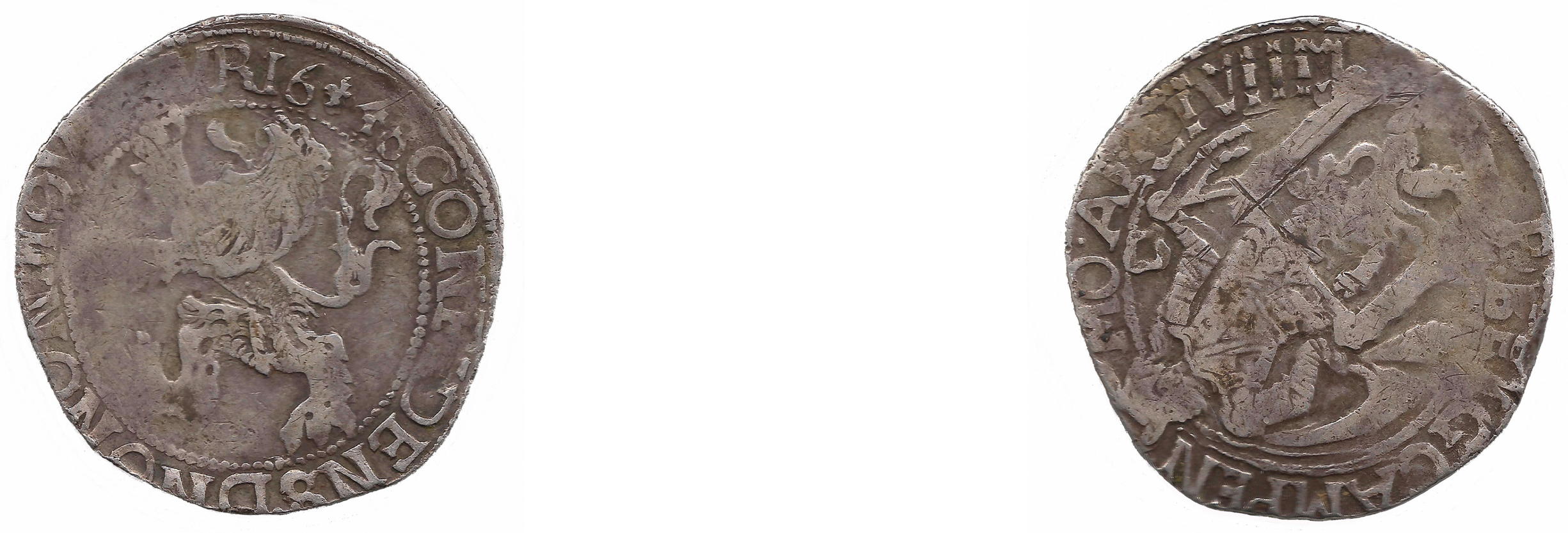
6]. The accuracy of this procedure was influenced by weighting precision and also by the technique used. For example,
Figure 1 presents a Dutch large silver coin,
leeuwendaalder, from year 1648, which circulated for decades in Europe and North America and gave its name to local currencies adopted later in some countries [
8,
9].
The lack of uniformity was followed by various “adjustments” made in the past by everyone interested to gain a few grains of valuable metal on each coin, by clipping the edges with adequate tools. To prevent these, the authorities introduced various penalties. Different standard weights patterns were made and used to check the coin weight [
9,
10].
In the following 18th and 19th centuries, the use of steam and then electric-powered presses led to some modern improvements in the coining industry. Punching the blank disks from a metal stripe and using the collar ring for the coin edge led to an increased dimensional precision; the coin’s weight was also easier to maintain within legally prescribed limits. To prevent private clipping for gaining precious metal or coin counterfeiting, the serrated or text-engraved edge was introduced as a security feature [
2].
The examples of modern clipped coins are from different decades, in which the quality control standards were slightly different, so it is quite difficult to relate the actual normative coin to coins in the past. For present day coins, despite improvements in the quality control field, the studied literature [
2,
9] reveals many examples of error coins which need an increased level of engineering investigation by using modern techniques.
2. Clipping Errors in Blank Disk Manufacturing
Currently, the improvements achieved in the coining industry allow the used manufacturing machines a simultaneous striking rate of a few hundred coins per minute.
First of all, to obtain the desired coin, a preliminary half-finished piece is needed for striking; there are used blank metal disks that are punched from a metal stripe on adequate machines [
11,
12,
13].
For a sustainable procedure, in order to avoid the metal waste, on a given metal stripe, the number of disks that are needed to be punched is related to the maximum proportion of used material; the disks can be arranged on the stripe at least on single row, but it is also possible for simultaneous punching on multiple rows [
12,
13,
14].
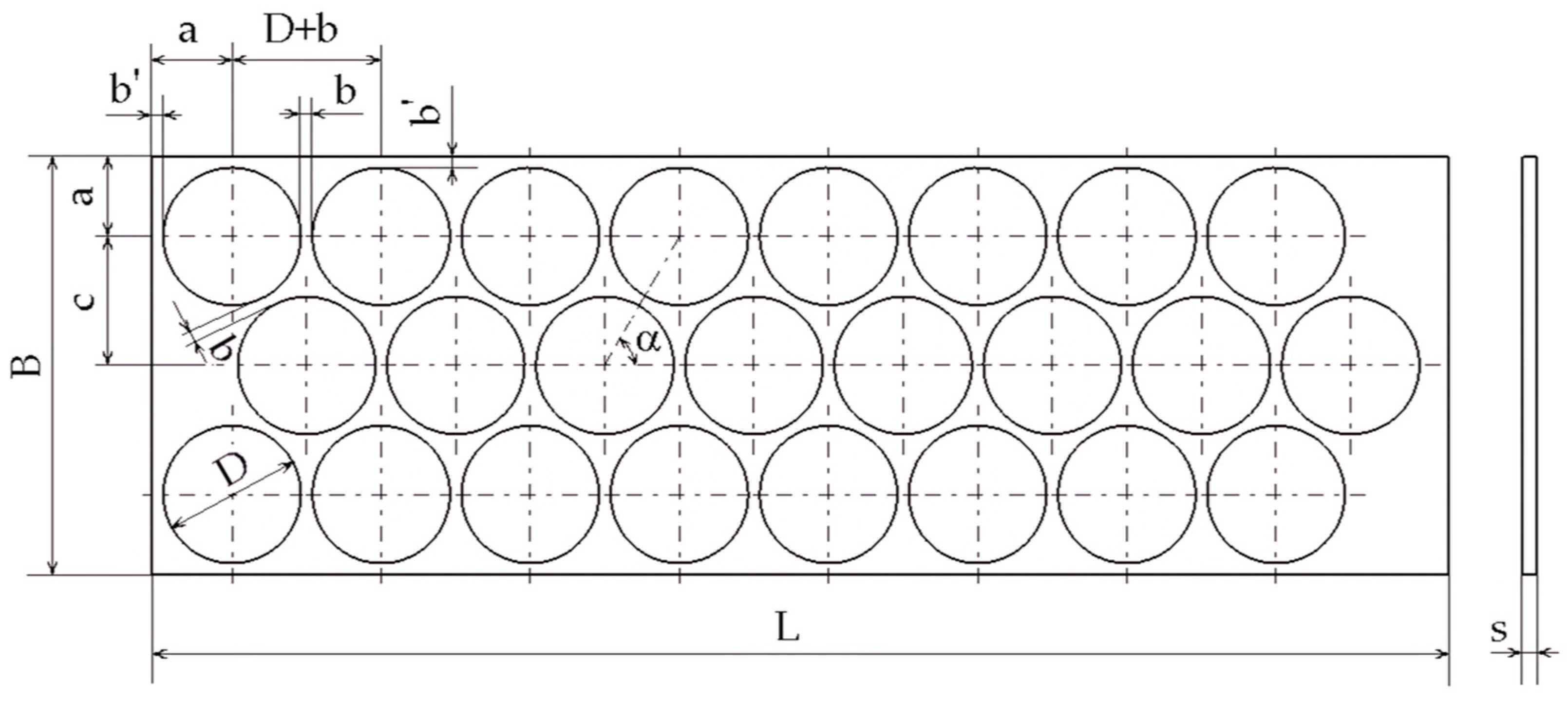
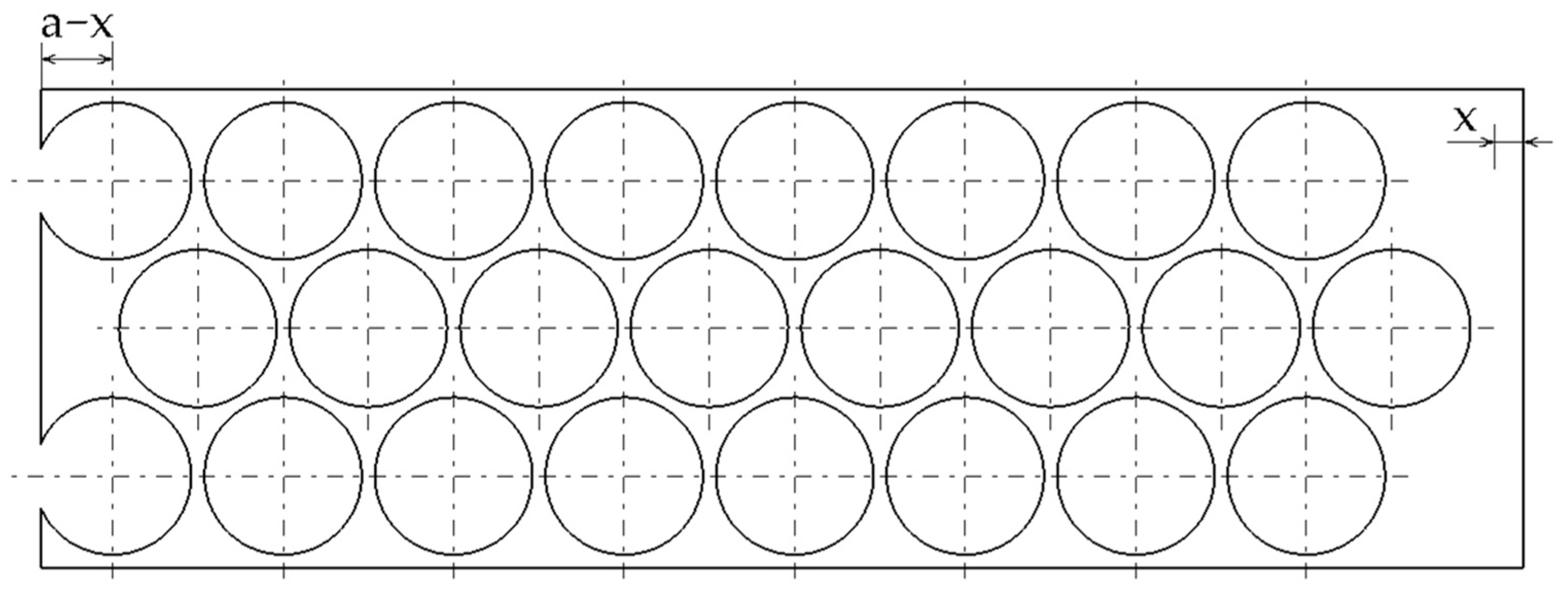
Figure 2 presents the disk arrangement on three rows, but the literature indicates, in some cases, a maximum number reaching from 7 to 11 rows [
12,
13,
14]. After obtaining the blank disks, the perforated metal stripe needs to be eliminated from the punching machine and recycled, so a minimum rigidity is still required for a secure handling [
12,
13,
14,
15]. To ensure this condition, after the perforation procedure, some little connection bridges must be obtained: between the neighboring disk holes and the disk hole, as well as the stripe margins. The dimensions represented in
Figure 2 are as follows:
D—diameter of the perforated hole for the resulting blank disk;
a—distance between the hole center and stripe edge;
b—width of remained bridge between the two neighboring holes;
b’—width of remained bridge near the stripe margin;
c—center distance between row holes along the metal stripe;
α—angle between the center line defined by two consecutive holes on the same row and the center line defined by two neighboring holes belonging on different rows;
B and L—the width and length of the metal stripe;
s—the thickness of the metal stripe on the blank disk.
Bridge dimension depends mainly on stripe thickness and disk diameter; the metal properties and the stripe advancing and indexing mechanism inside the punching machine are also considered. Some authors [
13,
14] recommend different values for neighboring disk hole bridges,
b, for margin stripe bridges,
b’. There are other authors who recommend the same dimension for both types of bridges,
b =
b’ [
12]. During blank disk perforation, some failures could appear. Then, the bridge size is changed, so the hole arrangement on metal stripe is perturbed and the resulting blank disk may incomplete.
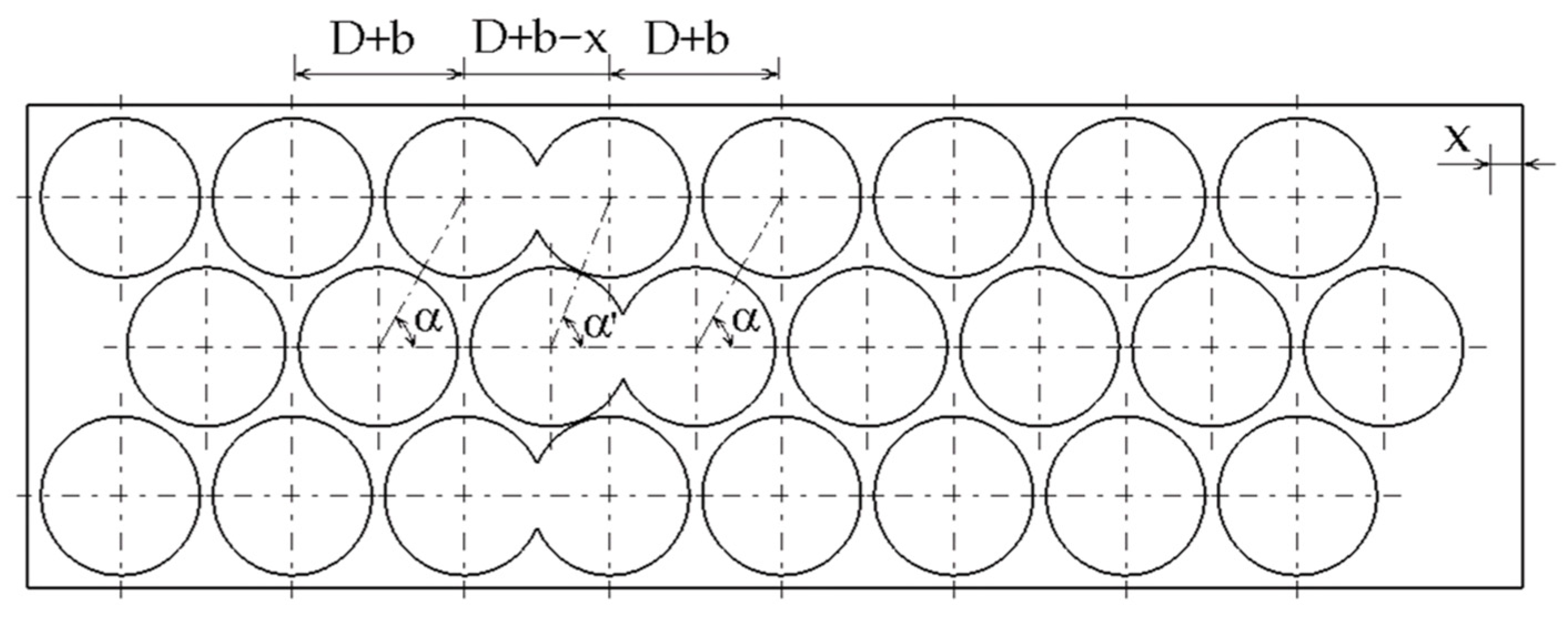
If the stripe advancing step inside the punching machine changes during perforation, the result is the overlap of the current perforated disk and the hole left by precedent one. From
Figure 3, it can be observed that the influence of the changed advancing step decreased with dimension
x: the hole center distance along the same row decreases and the angle
α increases to
α’. For the misalignment value
x >
b, the bridge portion between holes disappears and the result is the incomplete disk which named in the literature as
curved clipped blank [
16,
17]. From
Figure 3, the result of the clipped portion is the same size for all damaged disks. If the misalignment
x is increased, the center distance between the holes on neighboring rows decreases lower than
D and the blank disks may result in multiple clipped portions.
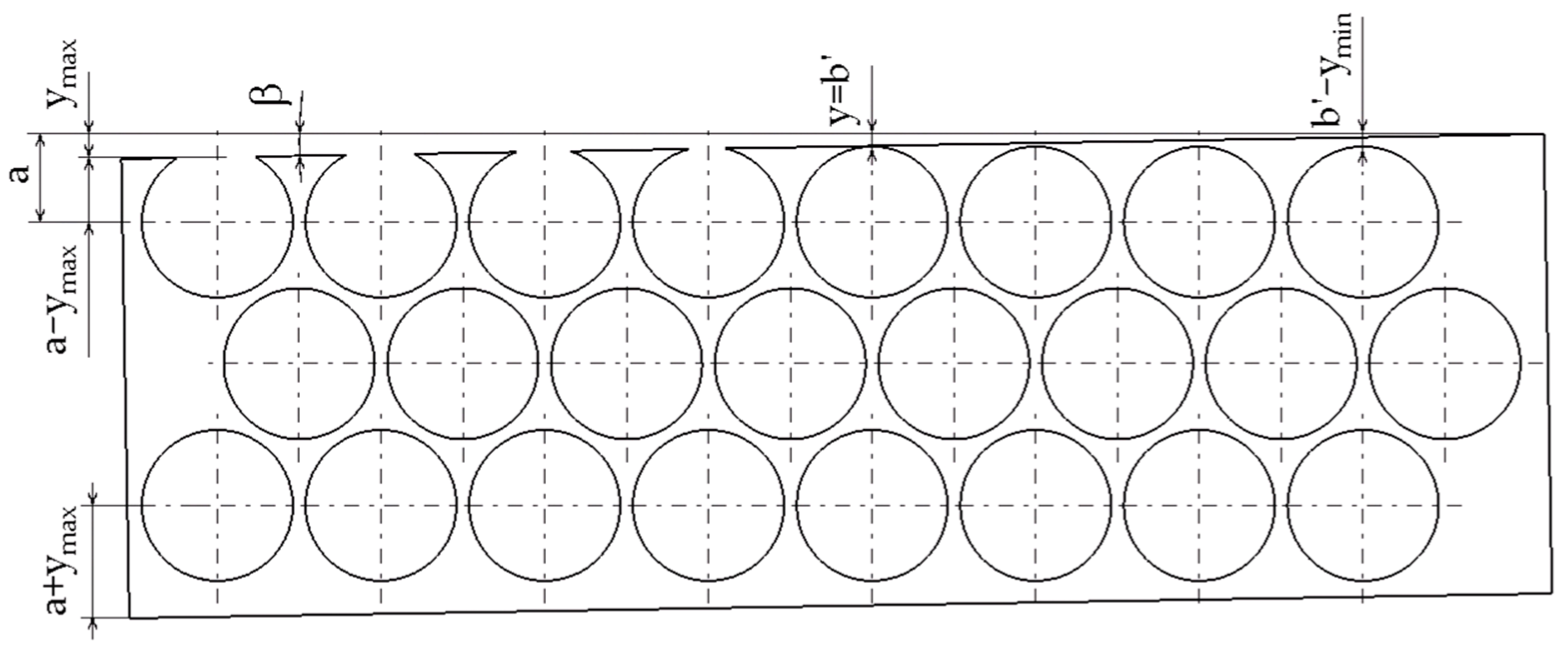
If the stripe guiding system inside the machine is perturbed, the misalignments are followed by disk perforation outside the stripe, as presented in
Figure 4. For metal stripe angular misalignment
β (rotation relative to the stripe corner), the resulting incomplete disks are named [
17,
18]. Since the stripe misalignment varies on the lateral edges from dimension
ymin to
ymax, the disks begin to be clipped from
y =
b’ to
ymax; the dimension of their clipped part is not constant.
If the perforation begins or ends outside of where the stripe ends and the misalignment value is
x >
b’, it will result in the straight clipped blank, as presented in
Figure 5; on the subjected disks, the clipped portion has the same size.
During perforation, the resulting disks and remained hole edges will undertake the marks of tool clearance. At a closer look, along with the thickness, the resulting surface will present the cut and torn portion [
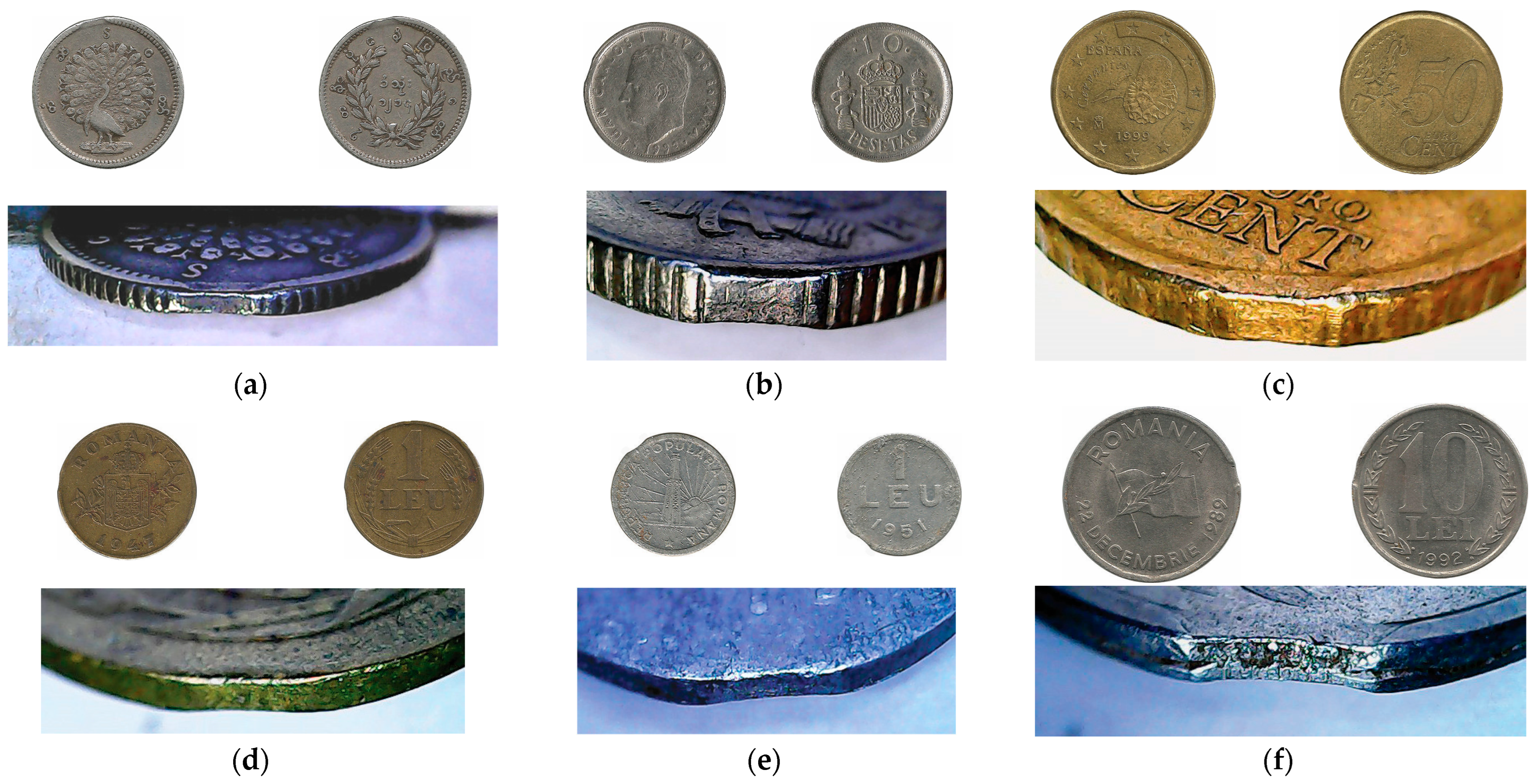
16], as presented in
Figure 6f. For the blank disks, this edge surface condition is changed during the next operation when the rim is obtained by decreasing the disk diameter and increasing the thickness on the margin; the edge quality is also improved. On defective clipped portions, the edge condition will remain unchanged. The curved clipped edge keeps the previous perforation traces, and the straight clipped edge takes the previous edge condition from main metal stripe. If the surface belonging to the stripe edge is not well-finished, the clipped edge on the disk will result in an irregular shape called the
ragged clipped blank. In the literature, the incidence of ragged clips is related mostly to the stripe ends [
17,
18]. The simultaneous appearance of combined misalignments should not be excluded as this leads to blank disks having various clipping types [
17,
18].
Usually, the clipped blank disks should not pass the checking control for the next operation; in a sustainable approach, scrap must be considered and redirected to recycling procedures. If the clipped blank is not detected, it follows the next operation, together with other complete disks. Due to the imperfections of the clipped blank disk, operations such as edge rimming or edge inscription punching could be inconsistent or fail; the tool damages should not be excluded [
3]. Finally, if a clipped blank skips the coin striking step, it will result in the coin having a clipped blank error.
In addition to changed shape, the weight of the clipped coin decreases; this could cause inconvenience when using this defective manufactured piece on the market, especially if the content is precious metal. Another undesired inconvenience is the rejection from mechanical devices, as vending or counting machines have fine adjustments related to regular coin dimension and weight. These inconveniences may induce our fear of using the currency and the lack of trust [
6,
19].
Despite the inconvenience, as a collectable item, the clipped coins are included by catalogs in the error coin category, desired and highly appreciated by collectors. The adequate literature records various round- or straight-type clipped coins, valued following a certain set of criteria, such as clipping size and type or coin condition; a coin having a spectacular clipped error fetches a higher price [
19,
20]. To measure the size of the clipped portion, in the literature, the percentage of missing material is counted by weighting the damaged coin, and the coin is then related to the nominal weight. The dimensional measurements are not excluded. The Official Red Book of the United States Coins [
9] defines coins with clipped planchet error as those having a missing part that is 10 to 25% of the metal content. For correct indication of the clip size in the catalog, some authors introduced a measurement increment of 5% in size; the clips without a particular mention of percentage are considered to have less than 5%. Other authors also consider indicating the percentages below 5% or those within the round values [
16]. Finally, there are authors who do not give a percentage of the clipped portion and leave the eventual estimation to be made based on the given photographs [
20,
21,
22]. Since the clip incidence on the coin edge is random, its position is indicated by most authors in relation to engraved figures on the coin obverse, in analogy with the clock dial [
16]. For example, “a 5% curved clip on 12:00” or “a 10% straight clip at 6:30” are two examples indicating the clip position on the coin obverse.
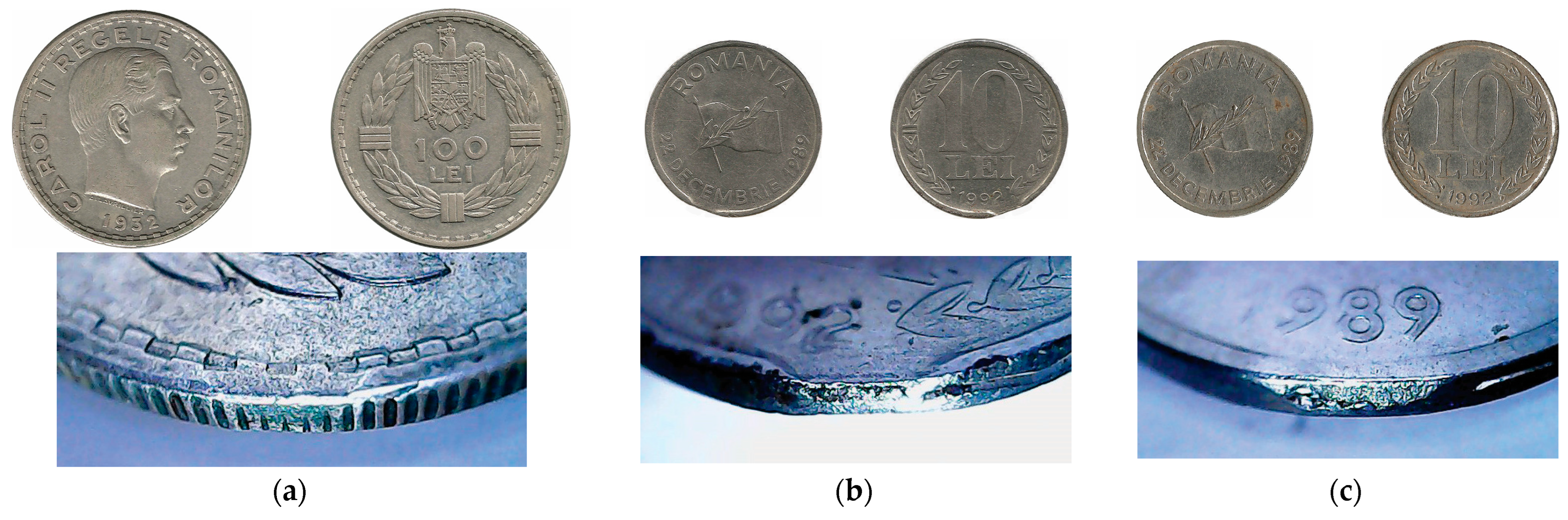
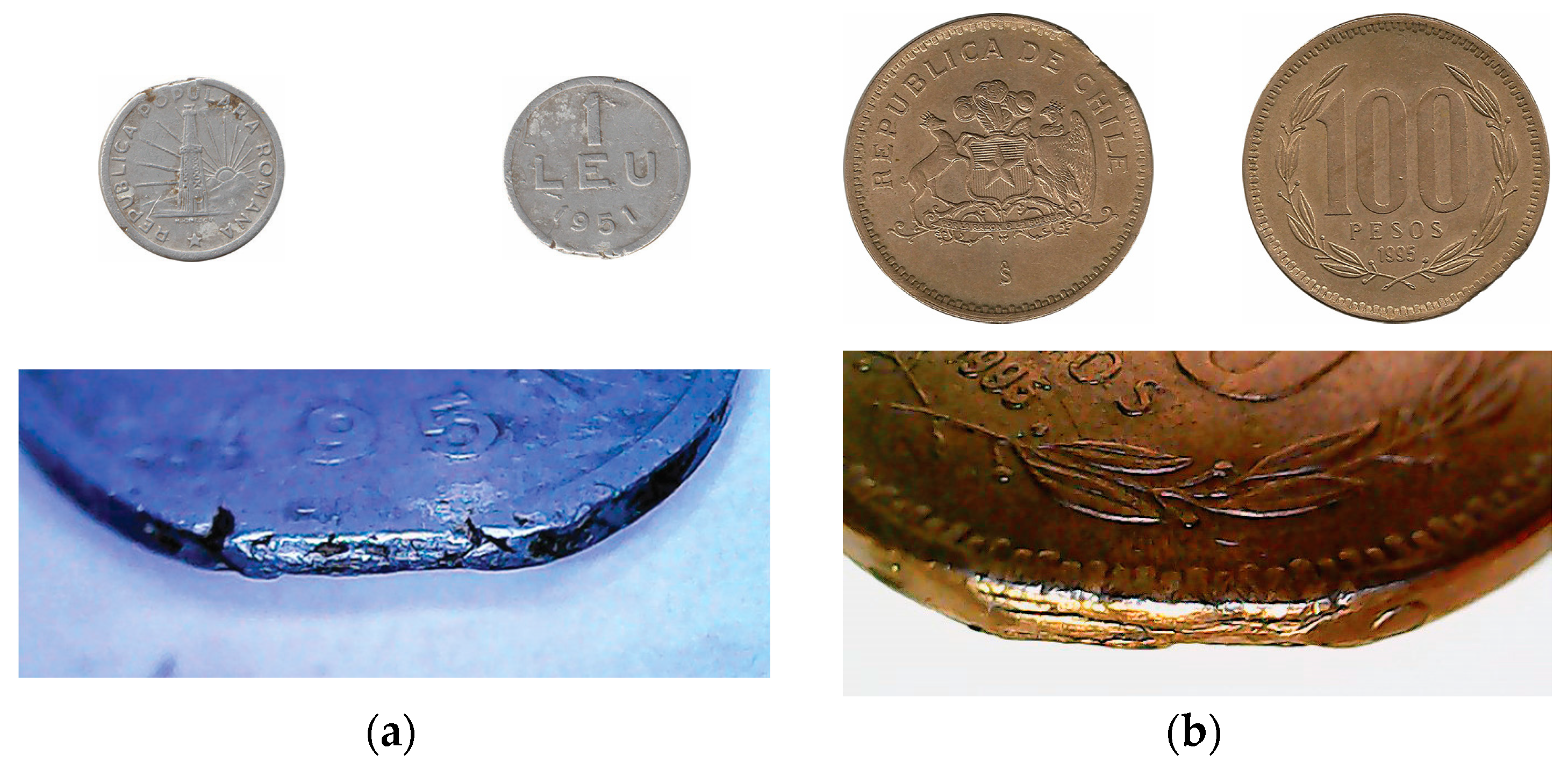
For example,
Figure 6,
Figure 7 and
Figure 8 present some modern coins manufactured on different types of clipped blanks. The image scale for all coins was slightly reduced to 90%; for clipped detail, the scale was adequately increased to 500%. Also, the coin diameters are indicated.
Apparently, the clipped blank error consists of a simple cut from the entire piece, so the temptation to privately produce its correspondent forgeries is not unheard of. Based on their experience, some authors [
16,
18] are providing useful guidelines to the interested collectors to help them in the process of checking for suspicious pieces. There are some clipped coin characteristics, such as the strike and rim weakness, the radial metal flow in the subjected area, or the clipped edge condition. But those characteristics must be related to the specific manufacturing conditions which reveal what caused the particularities of the clipped coins.
According to the historical development of coin manufacturing techniques, clipped coins have a lack of engineering research. Based on this, the paper presents engineering research by using modern modeling and analysis methods; this approach opens a new research horizon regarding the new engineering methods of investigation for other similar coin errors.
3. Coinage Manufacturing Field Research
In recent years, the literature related to the coinage industry has revealed new achievements by studying different aspects of coin manufacturing, such as coin material behavior under load, the surface quality of the coin, or tools durability along the coinage process. The most important and comprehensive contributions in the coining field are mentioned as follows.
The first application of the finite element method (FEM) in the study of coin minting is the work of Brekelmans et al. [
23] and has a focus on estimating coin material flow and the needed coining pressure in order to obtain a conical relief figure pressed in the center of a sample piece. As a result, accurate information on the corresponding stresses and strains was obtained. The upper bound theorem applied upon a quasi-static formulation with elasto-plastic constitutive equations was used in the article. The applied methods were detailed and evaluated, so a quantitative comparison within experiments was used to validate the work. An excellent agreement was found. The work’s findings were highly appreciated by subsequent authors in the field.
Cotton et al.’s work [
11] improved the understanding of coining forces for different coining shapes. A simplified force calculation formula was introduced, which included the following elements: the strengthen coefficient, the strain hardening exponent, and metal sheet thickness (before and after coining). The friction between the metal sheet and the tool is also considered. Experimental dry-condition coining of two metal sheets was carried out by a ring compression test. To perform the numerical simulation, the adequate software, Forge NXT2, was used. The comparisons between the measured and estimated forces revealed better results in coining force estimation using the proposed formula.
A comprehensive review of the literature of the forging tool durability for hot closed die forging was proposed by Ficak et al. [
24]. According to the classification of wear on forging tools, abrasive wear, plastic deformation, and fatigue cracking are predominant, and were estimated by authors to be 85%. Some methods to improve the tools’ lifetime were studied by authors. A durability comparison between different steel designation punches and the heat treatment effect on tool failure was also revealed. A ring compression test for different lubricants was presented to compare the obtained friction coefficient on the mechanical and hydraulic press. The aspects on tool reconditioning and their life prediction were also revealed. The research accuracy and the paper findings are useful in coining tool manufacturing.
Keran et al. [
25]’s article improves the accuracy of the force prediction model for the case of closed die coin striking process. The coin striking is considered a micro-forming process, so the microstructure of the work piece material and coined geometry reduced dimension have a substantial influence on material deformation phenomenon. There are three studied samples which have three different crystalline grain sizes. To obtain the accuracy of the introduced force prediction model, the experimental and modeled data were statistically analyzed and graphically presented by authors.
Pragana et al. [
26] introduced a new hybrid manufacture process in their work in order to obtain collector coins having holes with complex contour in their design. By combining metal deposition with metal cutting and forming, the production of these coins with intricate inner contour was carried out. First, the primary cylinder was obtained from steel powder deposition, having the inner hole with the desired complex contour; then, the blanks were sliced and polished. After determining the blank material’s relative density and flow curve, the coin minting tests were conducted using a special designed press tool placed on a hydraulic press. The dies, having the central recess of relief at 0.15 mm and the collar, were used on two types of tests and obtained the following the stroke preset: the incomplete minting and the complete minting. The numerical model of the minting process was performed using finite element i-form program. The deposited blanks were considered as the continuum medium with an average relative density. After the model analysis, it was observed that the contact between the blank and dies starts with the outer ring and continues with lettering. Then, the impression of relief and inscriptions led to a non-symmetric pressure distribution during minting, which may have had an effect on the pressing tools, creating a bending moment. Using the experimental results and the finite elements, the evolutions of the force with die stroke during coin minting on the additively manufactured blanks, made from stainless steel, were predicted. The conclusions highlighted the advantage of using the hybrid manufacturing application in collector coin production.
In their work, Alexandrino et al. [
27] introduced a new finite element method designing procedure in order to obtain the needed corrections on the coining die figures and to optimize the applied pressure distribution. With this approach, a new alignment of the resultant force in the vertical direction was obtained at the end of the die stroke. The innovative design solution introduced was to adjust the position of the engraved die model by tilting the obverse and the reverse die reliefs. The numerical simulation was able to be used in die model shape optimization and reduce coin striking forces, as well as extend die life. Using the finite element, the predicted evolution of the force vs. die stroke was presented. The author’s innovation was successfully applied at the state mint of Portugal, with two collection coins with the age of iron and glass in Europe commemorating the Portuguese ethnography; they were minted in 2017 [
28].
Zhong et al. [
29] studied the apparition of flash line defect in the coining process. According to the authors, flash line failure is an important surface inconvenience that appeared on manufactured silver commemorative coins. Due to the lack of study on producing causes, the failure requires a long procedure to be eliminated, an increased number of die tryouts, and development costs. In this work, the producing mechanism of flash line is carefully studied by authors through the coin metal flow analysis, using the modern finite element method. The research revealed the main reason for flash line defect: the radial components of friction between the die and the coin blank during the striking. Also, the work reveals that the defects easily appear in the model field plane areas where the metal flow presents compression and horizontal extrusion; the die heat treatment and recorded stress were also important in the subjected areas.
The flash line defect in the commemorative coin manufacture process was also studied by Xu et al. [
30]. During the research, the elasto-plastic behavior of porous materials led to deformations, where the constitutive minimization level updates were considered the result of a local variation problem. For different strokes, the material flow was studied during the entire coining procedure. The change in the flow direction of the material in the coin outer-rim region is responsible for the flash lines’ appearance. Also, the distribution of the flash line on the surface is obtained by increasing the friction on radial direction related to the work model. The authors proposed new rim geometry of the coin blank to avoid the flash-line defects; the proposed improvements led to good agreement with the conducted experiments.
Adequate predictions related to stress distribution and material flow in the coining manufacturing process are revealed in Peng et al.’s work [
31]. To study stress distribution and material flow in the coining processes of a bimetallic commemorative coin, the authors used a professional software, Deform 3D. The studies revealed that the stress concentrations appear at the corners of striking dies and the material interface in the case of the bimetallic coin. Because two materials having different characteristics are adopted for the coin core and the ring, the obtained numerical results indicate where the increased stress values occur: at the coin edge and at the interface between two metals—if the bimetallic coin has the soft core. Also, a deep adhesion occurs at the interface of the metals; the authors reveal that the use of hard material for the inner core and soft material for the outer ring may cause inadequate coin part assembly and falling of the coin core.
To improve the analysis of the material flow during the coining process, Xu et al. [
32] developed a new commercial software called CoinForm. The proposed software facilitates the prediction of the applied embossing force as well as geometry optimization for the working dies.
In the article of Tavodova et al. [
3], they studied the premises of die production process in order to increase their lifetime. On the manufactured die samples, the conditions of die failure apparition were investigated in the case of intensive use. After comprehensive research on sample microstructure, the identified failures were the surface wear and also the die material cracks. On a proposed sample, the heat treatment was improved in order to eliminate internal stress and the produced coin number was increased. The authors recommend the use of high purity steel and improvements on die manufacturing process by using the heat treatment method and chrome plating by new coating methods.
Torsakul et al. [
33]’s work focuses on tool life improvement used in the coining industry. Based on the die crack defect incidence of some recent Thailand coins, the authors developed their research in order to improve die lifetime and to prevent surface damages. They are compared to the characteristics of three types of materials used: alloy steel, cold working tool steel, and hot working tool steel. Each die sample was heat treated and coated with CrN or TiN and then used to stamp blank disks; after manufacturing a number of stamped disks, the dies’ coated surfaces were studied. To investigate the adherence of the applied coating layer, a scratch test was performed, and the coating types were compared. The cracks that appeared during the tests were also investigated to obtain useful data for some further improvements. The research results were successfully applied at Royal Thai Mint in manufacturing current circulating baht coins.
As the coinage literature reveals, modern methods such as tridimensional (3D) modeling and FEM analysis are used to improve the theoretical support for the striking condition, in order to resolve different issues that appear during coin striking to improve the tools’ durability, or to study the appearance of some coin manufacturing errors. There are remarkable achievements but the studied literature is focused more on the mentioned modern methods and the striking particularities and less of some interesting valuable clipped coins, such as collectible items from the past. The necessity to study the particularities of the clipped coin error is highlighted, in order to ease the valuation expertise on certain former error coins viewed as collectible items. On the other hand, clipped coins having an adequate estimated catalog value increases collector satisfaction as customers are also able to promote sustainable consumption practices in the coin collecting field [
19,
34].
Studying the state of the art, the literature in the coin error field does not contain the finite element method as an investigating tool of clipped coins. The paper opens a new direction for future studies of clipped coins, by using modern investigation techniques.
4. Computing the Virtual Model
The coin chosen to be modeled is a nickel-plated steel 10 lei from 1992 which has 60 million issued pieces [
35], from which both types of clips are recorded, as previously presented. The coin’s diameter is 23 mm and its thickness is 1.8 mm [
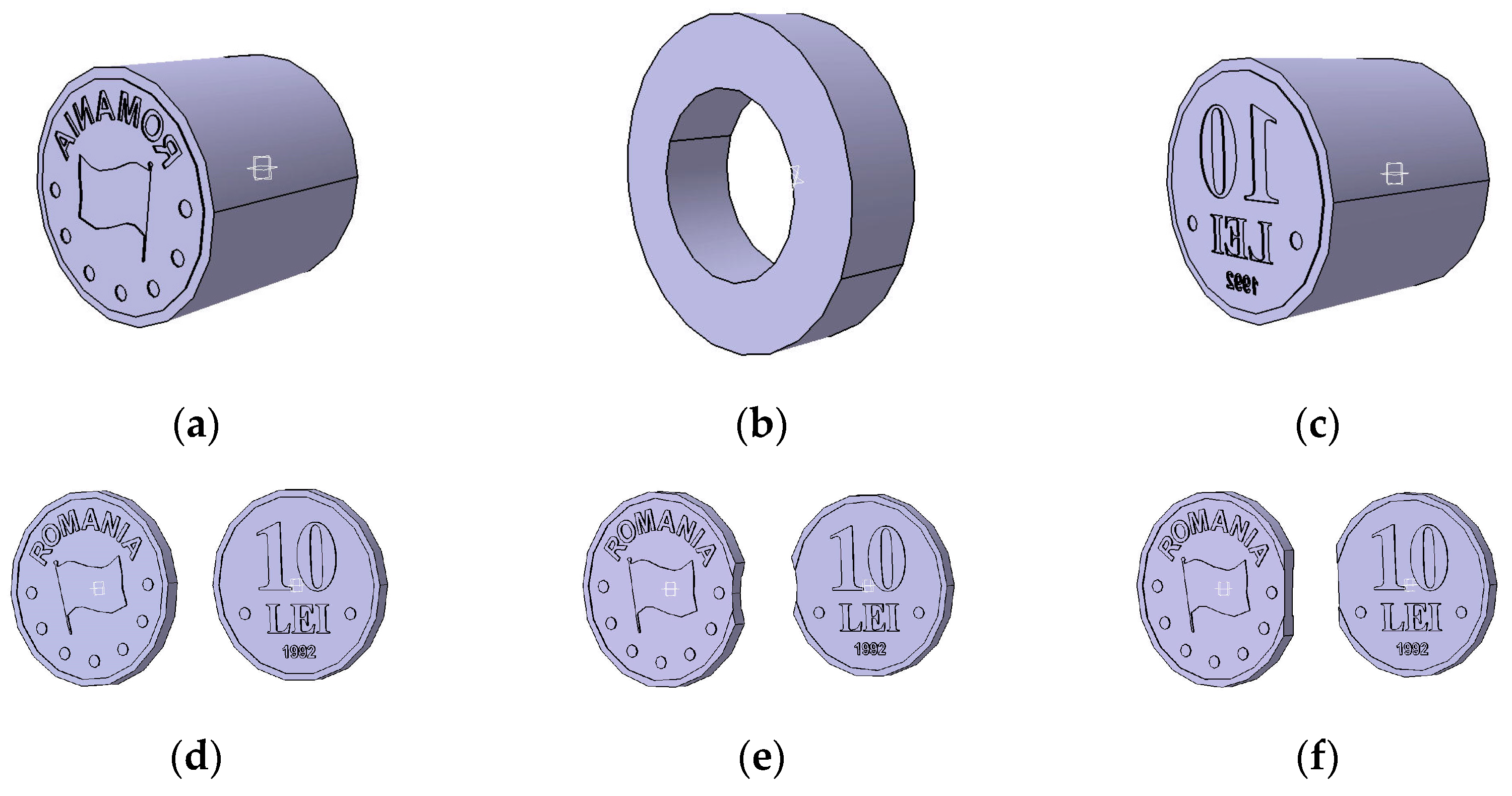
36]. The virtual model includes the striking negative dies, the collar, and the coin in three variants: without clip, with curved clip, and with straight clip, as presented in
Figure 9; due to the similarity with the straight clip and also the complexity of the edge surface, the ragged clip is not modeled. For both modeled clipped blanks, the clipped portion was placed in the same position, related to the figures represented on the coin. Its interference was established for both clip types as 1.15 mm from the coin’s edge, which means 5% from the coin’s diameter. On both faces, the engraved figures have 0.15 mm deepness from the flat field [
26]. Some unnecessary fine details of the engraved figures represented on the obverse and reverse were simplified [
37,
38]. In the ensemble arrangement, the coin angle between obverse–reverse figures was counted, 0
0, while the obverse figure and reverse figure were placed in normal positions [
37]. The virtual model was computed using the facilities offered by the CATIA V5 software, from the module Part Design [
39,
40].
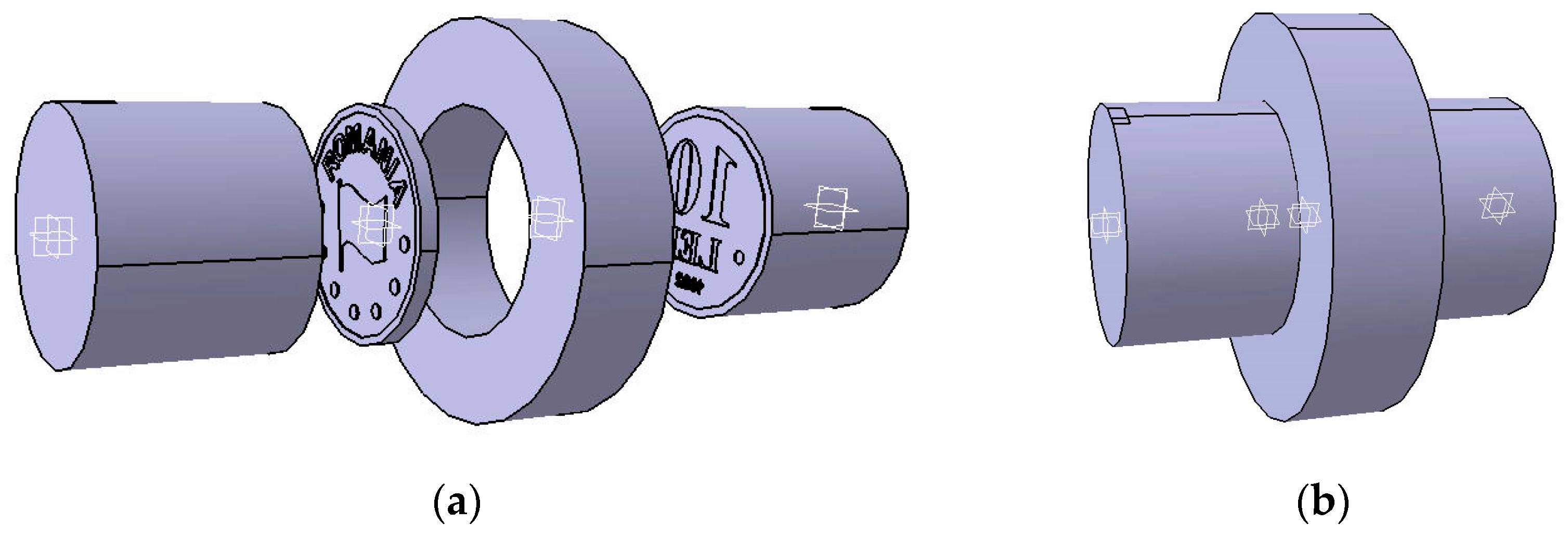
After their individual computing, the obtained parts were combined to obtain the ensemble models: between the same die and collar, the three different coins were introduced. Using the CATIA software’s Assembly Design module [
39,
40], the assemblies were computed and are presented in
Figure 10.
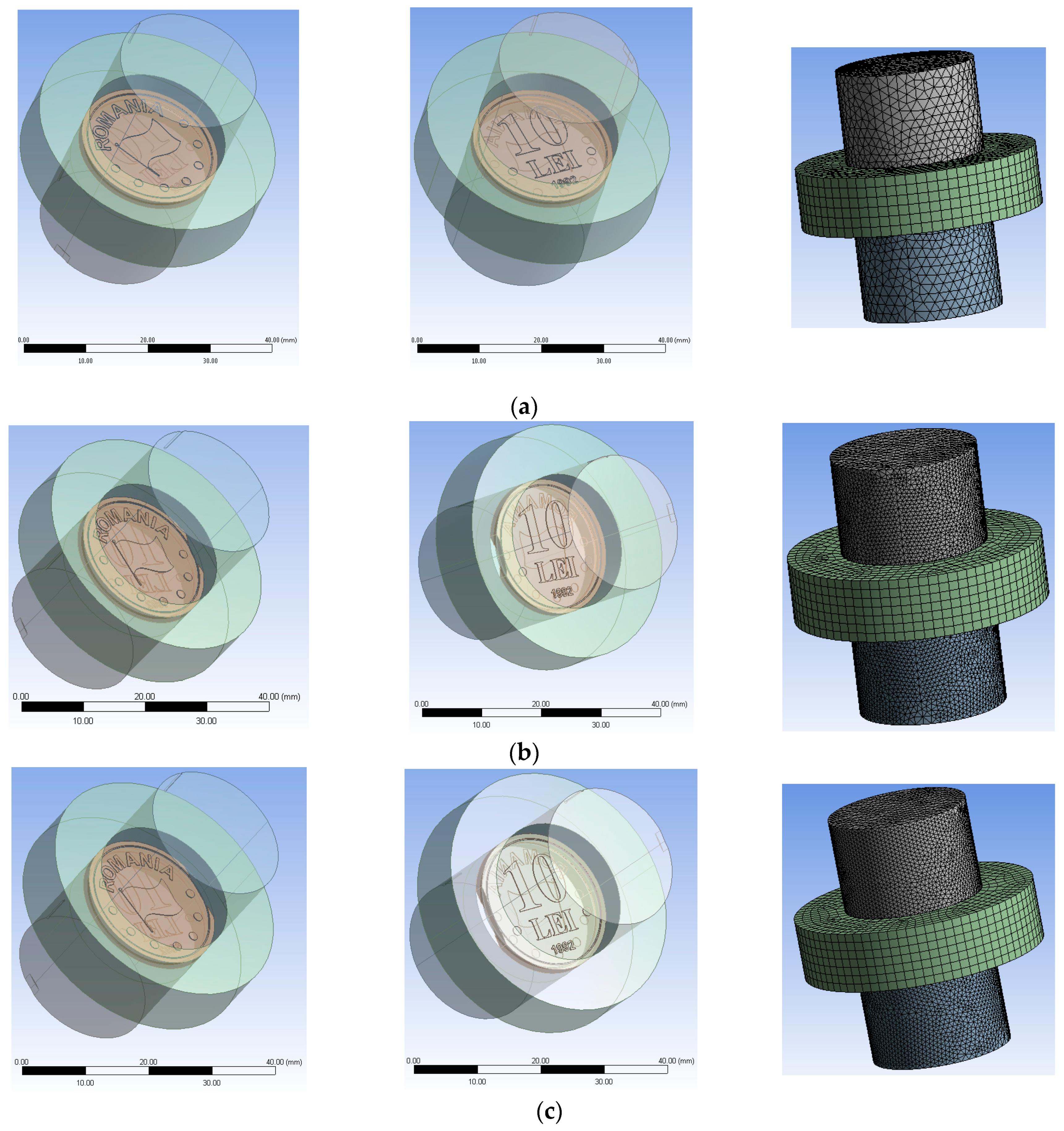
For the analysis, the advanced stage of striking was considered, in which there was no change in diameter and the metal filled all the embossed relief [
26,
27]. Counting the striking particularities and the corresponding contact between the figures represented on the dies, the coin faces and the ensemble adequate constraints were defined. The contact areas, defined between the striking dies and the coin, covered the entire common area for each engraved figure; the presumption is that the flat field is planar and there are no misalignments inside of the pressing machine [
12,
37]. Between the collar and coin circumference, the contact between the collar and dies was considered as their common diameter.
6. Results and Discussion
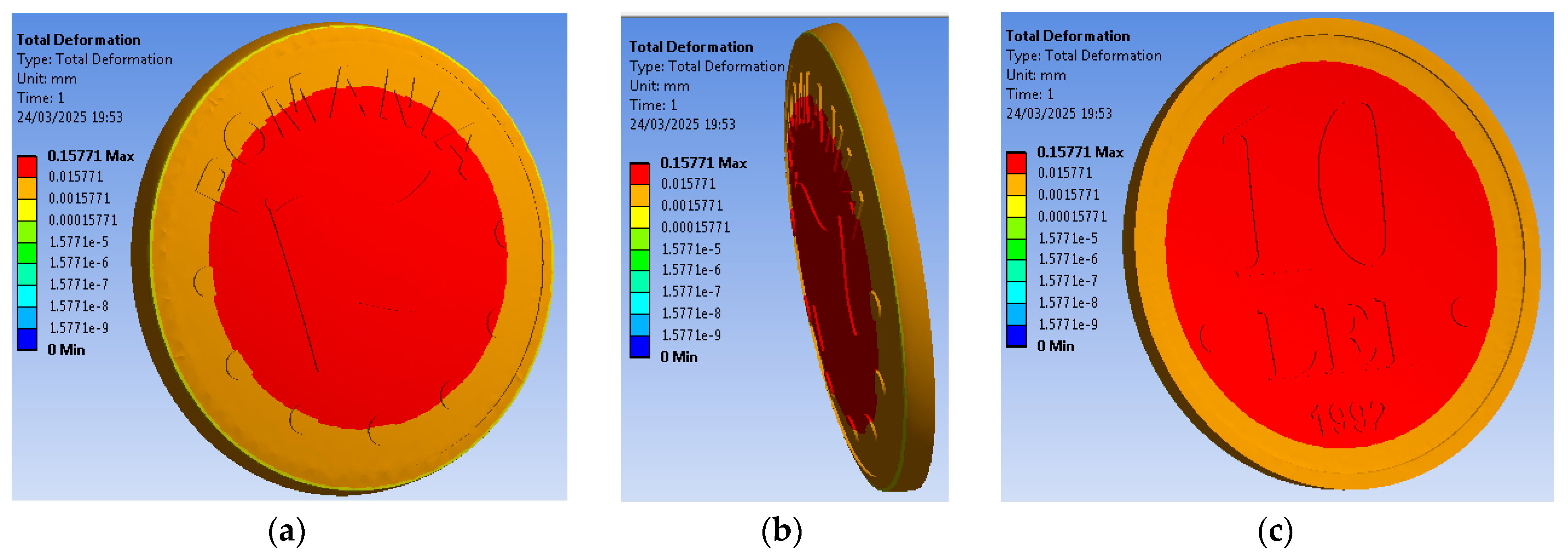
For the first studied model containing the unclipped coin, the total deformation is presented in
Figure 12. Due to the collar, the pressed coin metal deformation decreases around the circumference. Counting the different areas of the recessed relief represented on the dies, it is observed that their rigidity is different and the metal flow tendency through the coin edge is more pronounced on the reverse; the maximum values are distributed on a larger area than on the obverse.
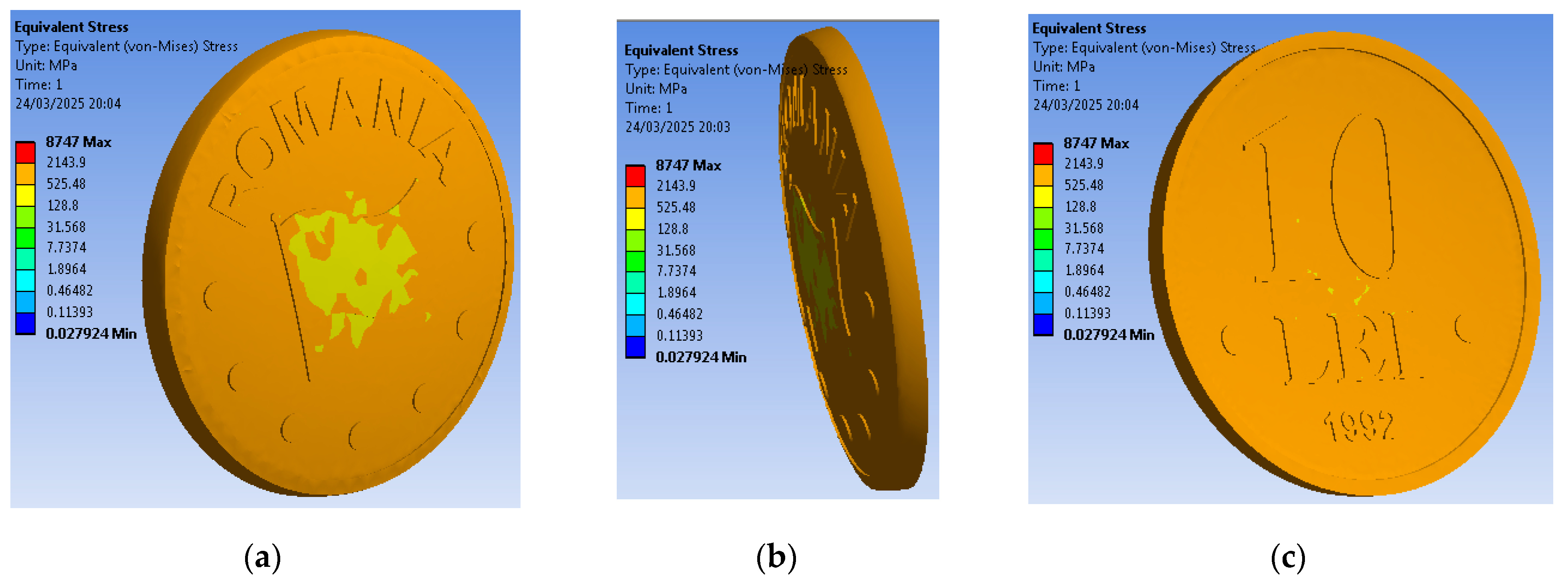
The equivalent stress distribution is relatively uniform on most of the coin’s surface, as represented in
Figure 13. The minimum value is placed on the coin’s central surface, which corresponds to the flag representation on the obverse and is the largest area that needs to be filled with the coin metal in the striking operation. The maximum value recorded is the intersection between the coin flat field and raised edge rim. The results agree also with findings from [
26,
27].
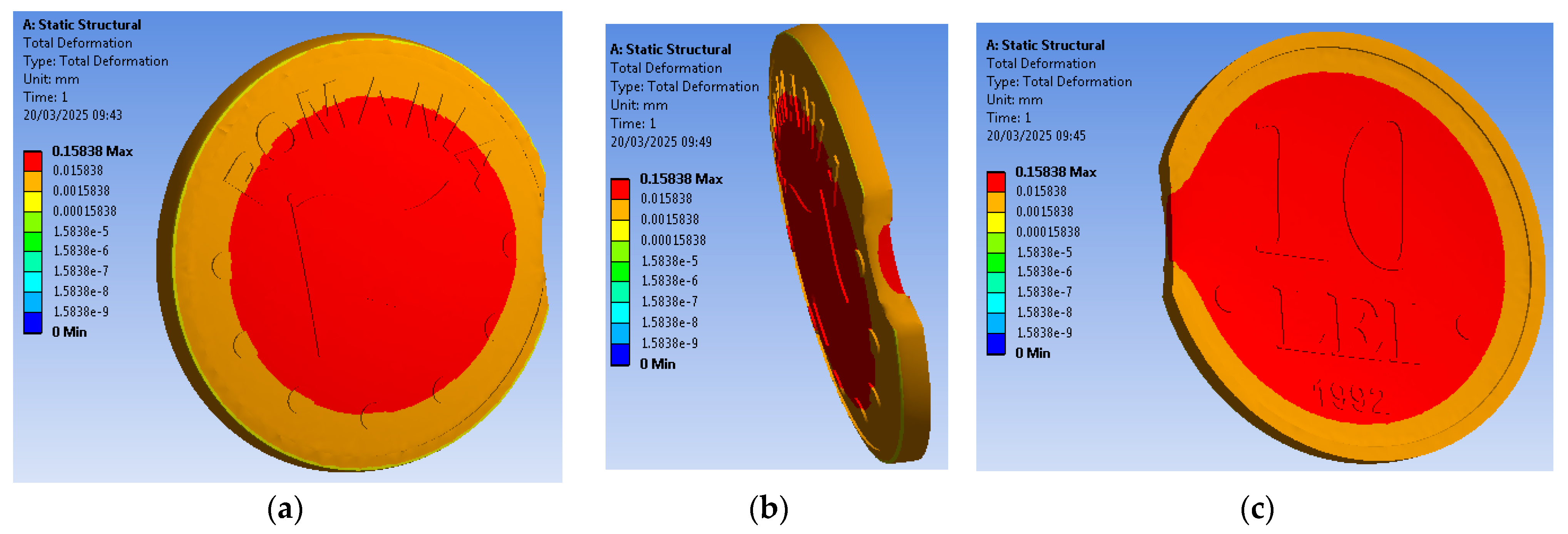
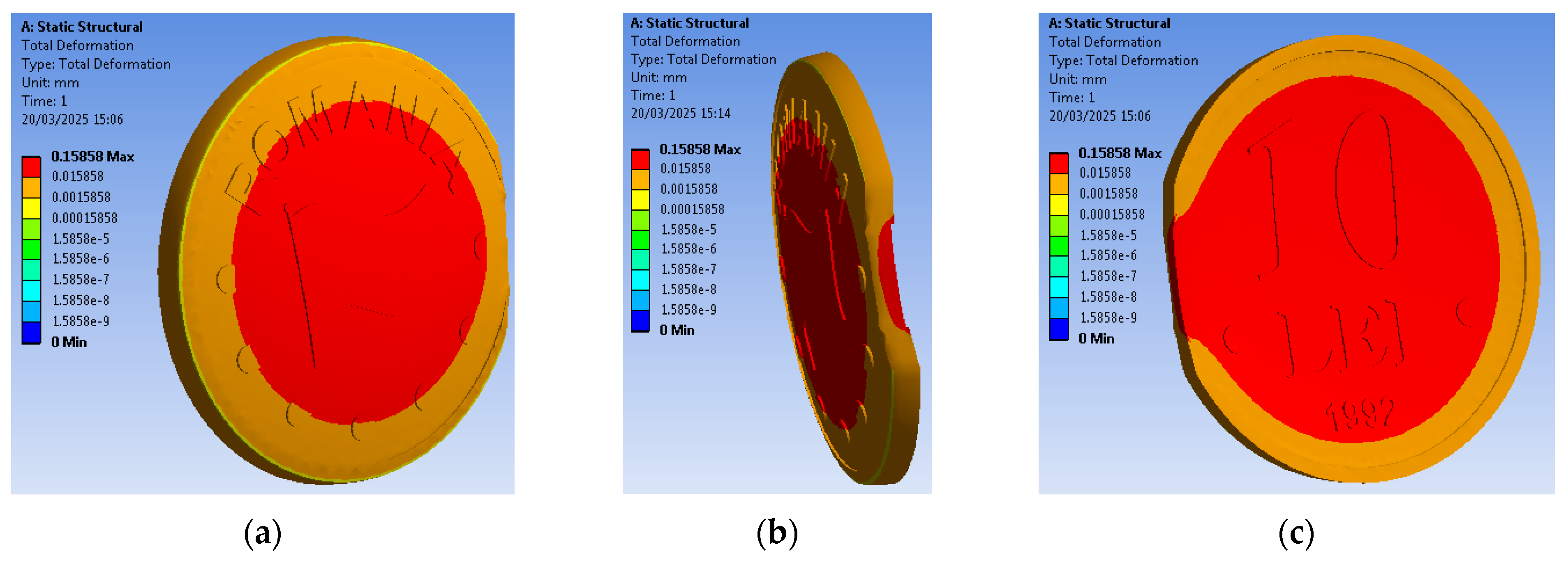
The second model contains the curved clipped coin. The clipped portion leaves between the coin blank, collar, and dies an empty space that needs to be filled with the neighboring coin metal. Because of the lack of a closed space, the coin metal allowable stress limit may change, decreasing until 30–50% [
13,
14,
44]. The total deformation represented in
Figure 14 records the metal flow towards the free space, so the clipped edge is deformed through the outside. Due to the different areas of the engraved relief represented on the dies (detailed in
Table 3), their rigidity is different and the flow tendency is more pronounced on the reverse.
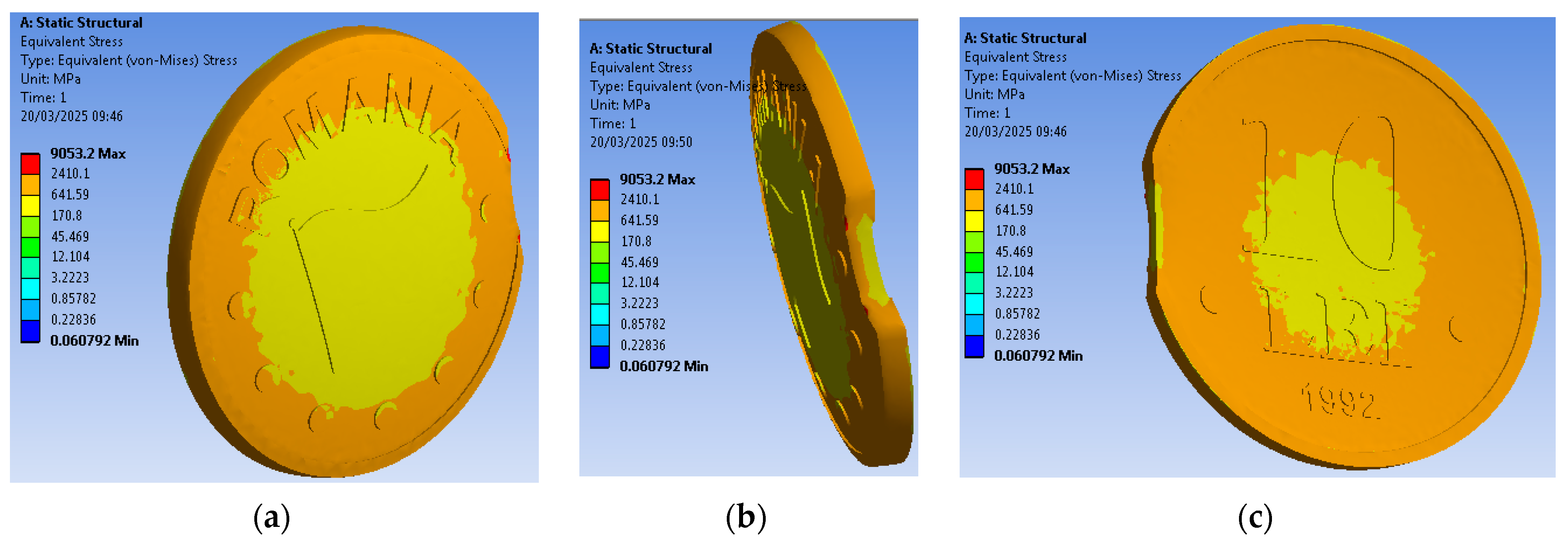
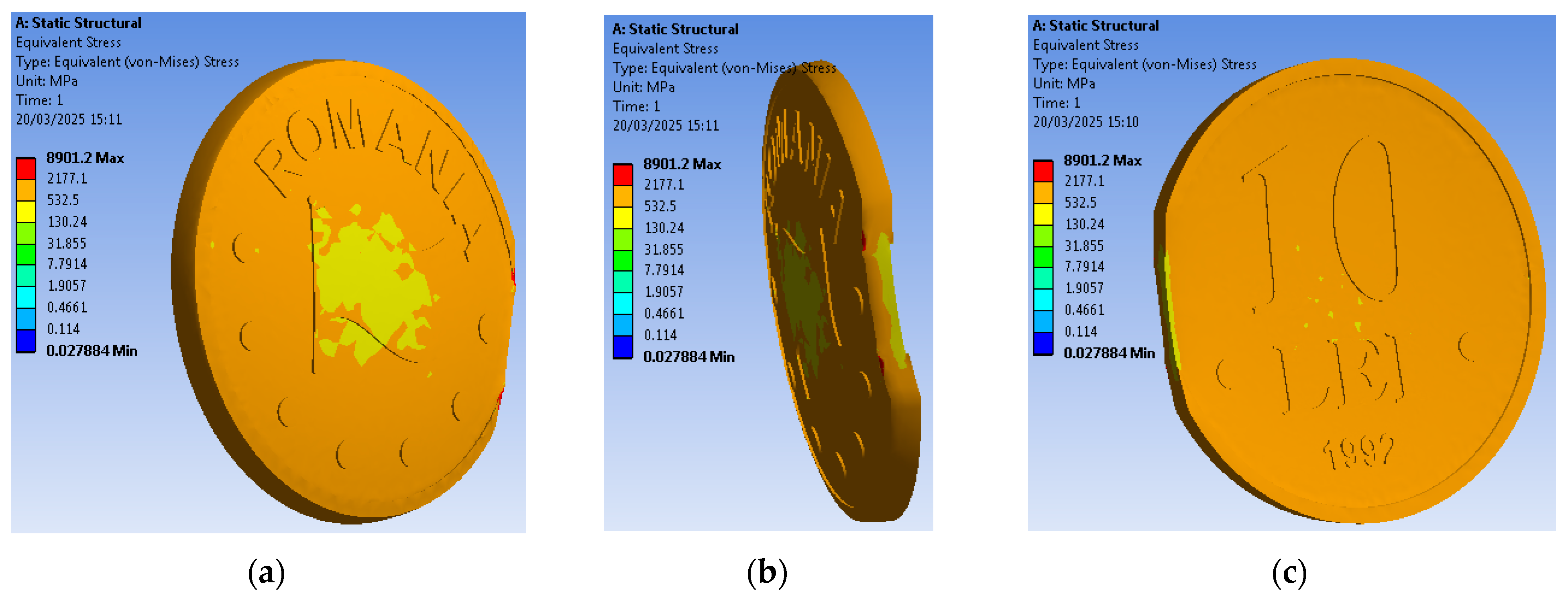
As observed from
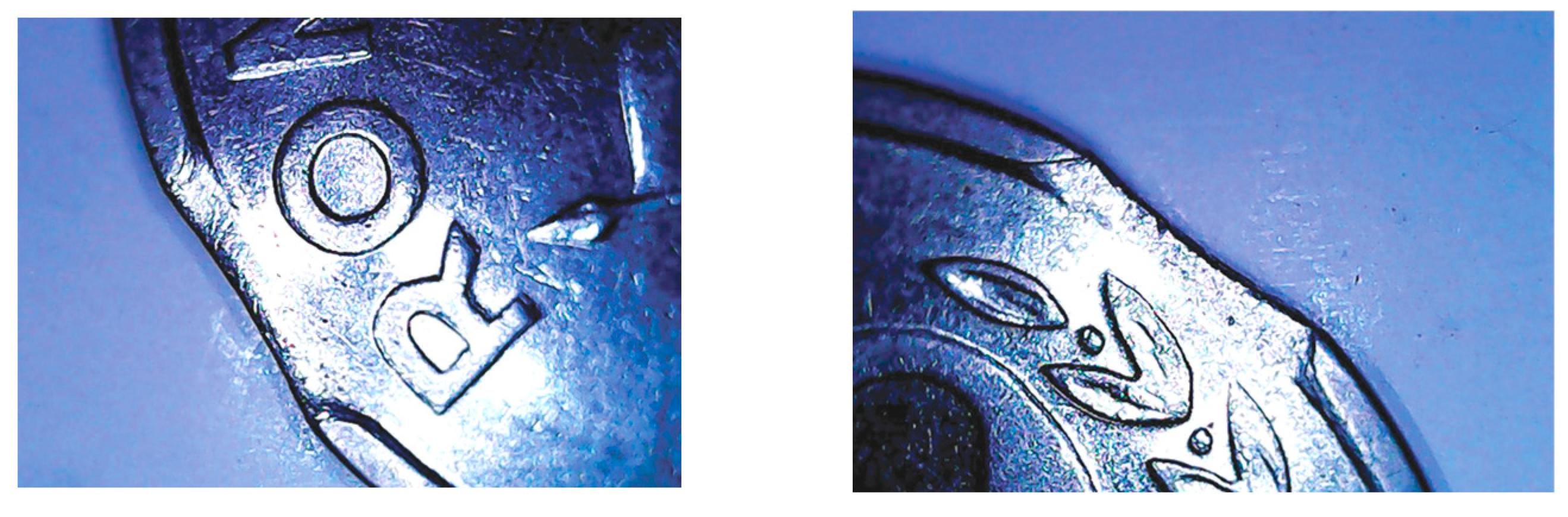
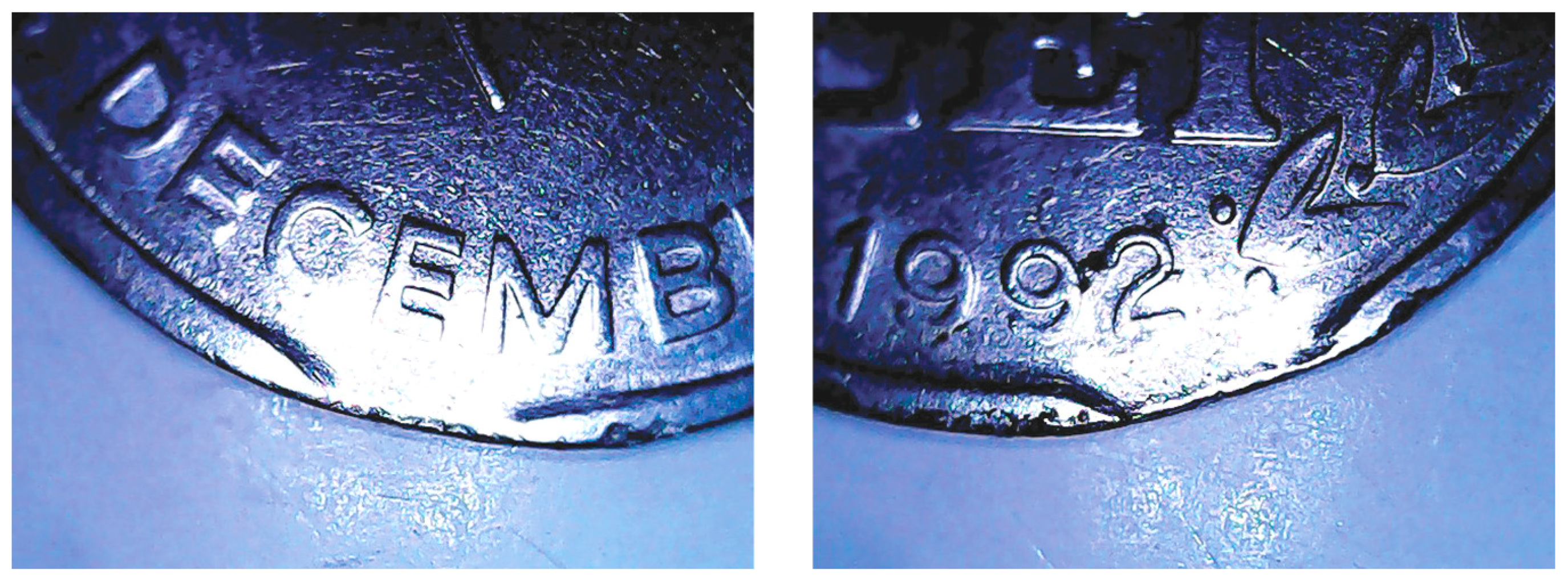
Figure 15, related to the unclipped coin, the equivalent stress values slowly decreased for the curved clip coin at the center and edge of the clip, with peaks shifting toward the intersection of the clip and rim, and even the maximum values are higher than the unclipped coin values. Due to the flow of coin metal, the maximum stress values are recorded where the clip intersects both the rim and the flat field, which corresponds to an increased metal deformation in that area. The results agree with the real details of a curved clipped coin (
Figure 16) having an increased scale to 500%.
For the third model, which contains the straight clipped coin, the results are presented in
Figure 17 and
Figure 18. In previous case, the metal tendency is to flow into the empty space, as observed from the real straight clipped coin details from
Figure 19. Due to the straight clip geometry, the remained coin edge area decreased more than the curved clip (as presented in
Table 3), so the free space is larger. Compared with curved clip, the amplitude of this phenomenon is slightly increased, and the straight clip edge is more deformed through the outside. This explains the observations from the literature [
16]. The equivalent stress representation from
Figure 18 reveals the similarities with the case of the curved clip; the maximum values, slightly decreased, are also recorded for the clip intersection with both the rim and the flat field, where the metal deformation increased; this agrees with the representation from
Figure 19 (having an increased scale to 500%).
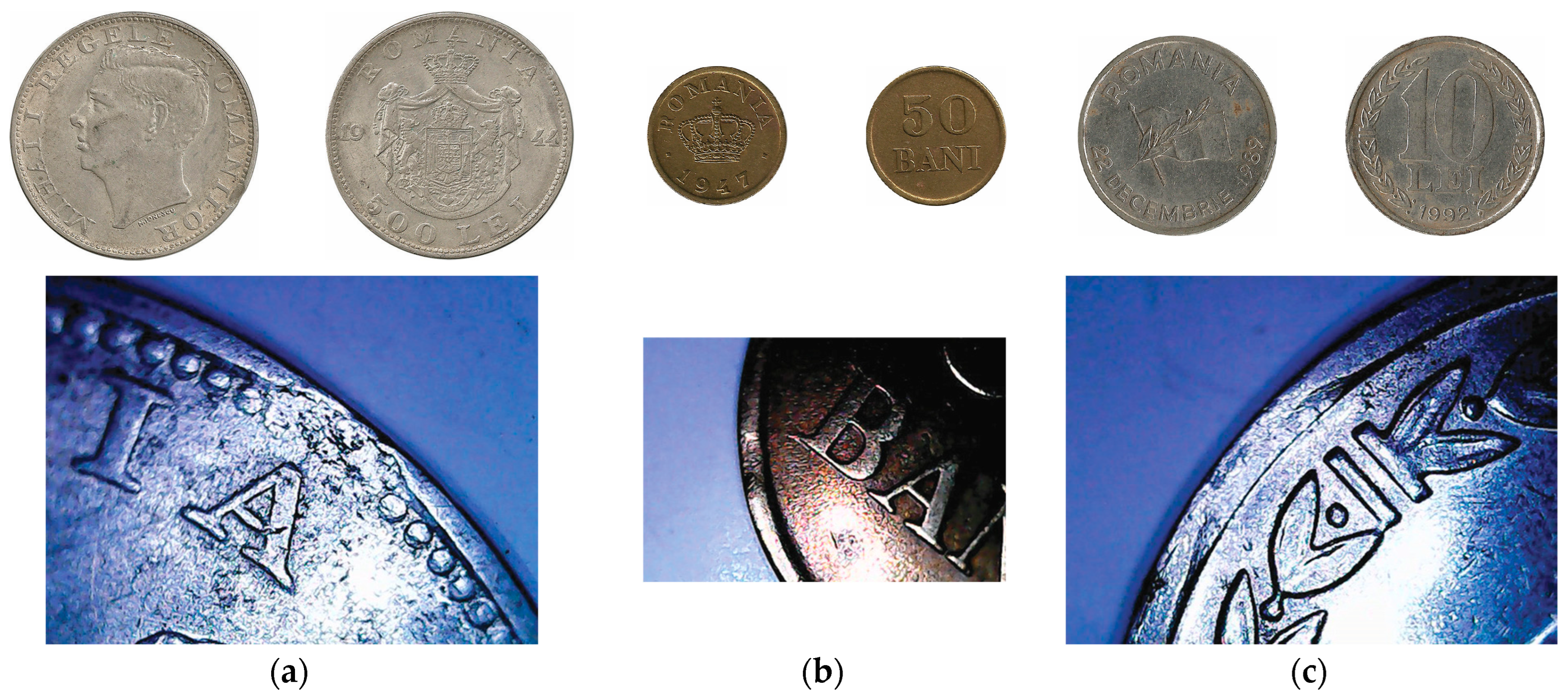
In the particular situation where the clip size on the blank disk is reduced and the metal deformation during striking reaches the collar, the coin round shape is restored, and the clip type cannot be distinguished. In the corresponding area, only the rim and its neighboring figures remain unraised after striking, indicating clip incidence. Such details of small clipped coins are presented in
Figure 20 (having an increased scale to 500%). Like previous figures, the image scale for all coins slightly reduced to 90%; for clipped details, the scale was adequately increased to 500%.
To simplify the comparison between the previous results,
Table 3 presents the areas for different contact portions belonging to each studied model, on the coin obverse and reverse; their values were measured using software facilities.