Article

Numerical Study on Thermal Performance of Radiant Panels Coupled with V-Shaped Grooves and Phase Change Materials

School of Civil Engineering and Transportation, Northeast Forestry University, Harbin 150040, China
*
Author to whom correspondence should be addressed.
Appl. Sci. 2025, 15(24), 13260; https://doi.org/10.3390/app152413260
Submission received: 7 November 2025 / Revised: 4 December 2025 / Accepted: 15 December 2025 / Published: 18 December 2025

Abstract

This study focuses on a proposed aluminum alloy radiant panel with 60° V-shaped grooves and integrated copper tubes. A numerical model of this novel grooved phase change material (PCM)-integrated radiant panel was established via Fluent 2022 R1 software. Through numerical simulations, the complete melting and solidification processes of two PCMs (n-hexadecane and LTXC-PCM-A-18) were analyzed, and differences in their phase change heat transfer performance were compared—revealing the role of the groove structure in enhancing PCM heat transfer and the material-structure compatibility. Results indicate that the groove structure effectively enhances convective heat transfer in the PCM liquid phase. During the melting stage, LTXC-PCM-A-18 exhibited a preheating rate of 0.00125 K/s, which is 67% higher than that of n-hexadecane (0.00075 K/s); its liquid fraction growth rate (0.0002 s−1) was 2.67 times that of n-hexadecane, and the melting completion time was accelerated by 20% (2000 s). During solidification, LTXC-PCM-A-18’s initial cooling rate (0.0006 K/s) was 50% higher than that of n-hexadecane (0.0004 K/s), with a liquid fraction decay rate twice that of n-hexadecane. Additionally, its solidification temperature plateau was 1 K higher, providing superior thermal output stability. These findings reflect two distinct technical strategies: “steady-state temperature control” and “dynamic regulation.” n-Hexadecane exhibits smoother melting and solidification processes, making it suitable for continuous heating applications. In contrast, LTXC-PCM-A-18 demonstrates superior thermal responsiveness and phase change efficiency, aligning with intermittent heating requirements. This study provides quantitative guidance for PCM selection in grooved radiant panels.

1. Introduction

Currently, the global energy shortage is becoming increasingly severe. Among major energy consumers, the building sector is prominent—according to the International Energy Agency (IEA), global heating and cooling energy consumption in buildings accounts for nearly 20% of total energy use, directly exacerbating energy pressure. As China advances its “carbon peak and carbon neutrality” strategy, the utilization of new energy sources still faces challenges such as efficiency improvement [1] and cost control [2]. Against this backdrop, developing building energy-saving technologies [3] and creating high-efficiency HVAC equipment [4] have become crucial and feasible pathways to reduce building energy consumption and advance the dual-carbon goals.
Among numerous energy-saving technologies, radiant cooling systems [5] have attracted significant attention [6] due to their high thermal comfort, low energy consumption, and quiet operation. However, traditional radiant panel systems suffer from high thermal inertia, slow response times, and difficulties in utilizing intermittent renewable energy [7]. Integrating phase change materials (PCMs) with building envelopes [8] or terminal units [9] to construct latent heat storage systems [10] provides an effective solution to these issues [11]. PCMs absorb or release substantial latent heat during phase transitions [12], enabling energy “peak shaving and valley filling” to improve energy utilization efficiency [13].
In recent years, scholars have extensively explored the integration of PCMs with building radiant systems. Anitha Gopalan et al. [14] studied PCM-integrated dynamic insulated composite panels (DIMS) walls, confirming superior energy savings compared to single-technology walls—reducing annual heat gain by 15–72% and heat loss by 7–38%. Binbo Sun et al. [15] developed a double-layer PCM radiant floor model; after parameter optimization, winter and summer energy storage times were reduced by 5 h and 2.5 h, respectively, enhancing building energy efficiency. However, traditional macro-encapsulation methods often introduce significant contact thermal resistance, and the inherent low thermal conductivity of PCMs limits heat transfer efficiency. To overcome these bottlenecks, researchers primarily focus on developing high-thermal-conductivity composite PCMs and optimizing encapsulation structures.
In the field of high-thermal-conductivity composite PCMs, Takahiro Nomura et al. [16] developed phase-change composites incorporating carbon fiber permeation networks, demonstrating that hot-pressing facilitates network formation and achieves high thermal conductivity with minimal fillers. Afaynou and Faraji et al. [17] developed hybrid PCM heat sinks using a partially filled metal foam strategy; numerical analysis indicated that φ = 2/3 represents the thermo-economically optimal configuration, balancing high thermal performance with lightweight design. In structural optimization, Mohamed Boujelbene et al. [18] compared twisted fins versus straight fins in horizontal double-tube heat exchangers for PCM melting rates, confirming twisted fins are superior for enhancing heat charging/discharging rates, with heat transfer rate positively correlated with pitch, thickness, and length. Zhang et al. [19] proposed a systematic optimization method for PCM/expanded graphite-based heat sinks; through numerical simulation and Kriging surrogate modeling, they determined the optimal aspect ratio of the encapsulation cavity to be 0.43, confirming the optimized structure significantly reduces heat source temperature, while the mass fraction of expanded graphite is positively correlated with heat sink volume and negatively correlated with heat flux density and operating time. Srivastava U et al. [20] compared the effects of L-shaped and W-shaped fins on the solidification performance of MXene-based and Al2O3-based nano-eutectic PCMs in triple-tube heat storage systems, confirming that W-shaped fins combined with MXene-based PCMs yield superior results, significantly enhancing solidification rates and thermal efficiency.
However, existing studies have primarily focused on independent heat storage units, with relatively limited research on integrated molded encapsulation structures for radiant panels. Particularly for specialized structures like grooved designs—which increase surface heat transfer area and enhance radiative/convective heat exchange—the internal phase-change heat transfer mechanisms and the influence of geometric parameters remain understudied. Moreover, while extensive numerical research focuses on natural convection during melting processes [21], simulations and analyses of solidification processes [22] are relatively scarce. Furthermore, existing studies predominantly address single PCMs [23], lacking systematic comparisons of PCMs with varying physical parameters within the same optimized structure to guide material selection. Therefore, simulating the complete phase change process within an integrated grooved PCM radiant panel and investigating performance differences among various PCMs is crucial for the design and application of this technology.
Based on this, this paper conducts a numerical simulation study on the heat transfer characteristics of a novel integrated grooved PCM radiant panel. A three-dimensional physical model of an aluminum alloy radiant panel with 60° V-shaped grooves and embedded copper tubes was constructed. Using Fluent software, the complete melting and solidification processes of two distinct PCMs within this structure were simulated. This revealed the phase-change heat transfer characteristics of PCMs in this specific groove configuration, enabled comparative analysis of the performance differences between the two PCMs, and explored material-structure compatibility.
The originality and novelty of this research are manifested in three aspects: (1) Structural Innovation: The proposed “integrated V-groove embedded copper tube” design achieves deep integration between PCMs and the radiant panel, differing from traditional discrete encapsulation structures and enhancing engineering applicability. (2) Content Innovation: It systematically compares the complete melting-solidification processes of pure and composite PCMs within a unified 60° V-groove structure for the first time, quantitatively revealing their material-structure compatibility and filling a gap in comparative studies of multi-PCMs in optimized structures. (3) Perspective Innovation: Focusing on the “differentiated enhancement mechanisms” of V-groove structures for distinct PCMs, this study demonstrates that the groove structure compensates for the low thermal conductivity of pure PCMs while reducing thermal resistance in the paste zone of composite PCMs, providing a novel perspective for synergistic “structure-material” optimization in PCM radiant panels.

2. Mathematical Model of PCM-Filled Grooved Radiator Panel

2.1. Simplified Physical Model

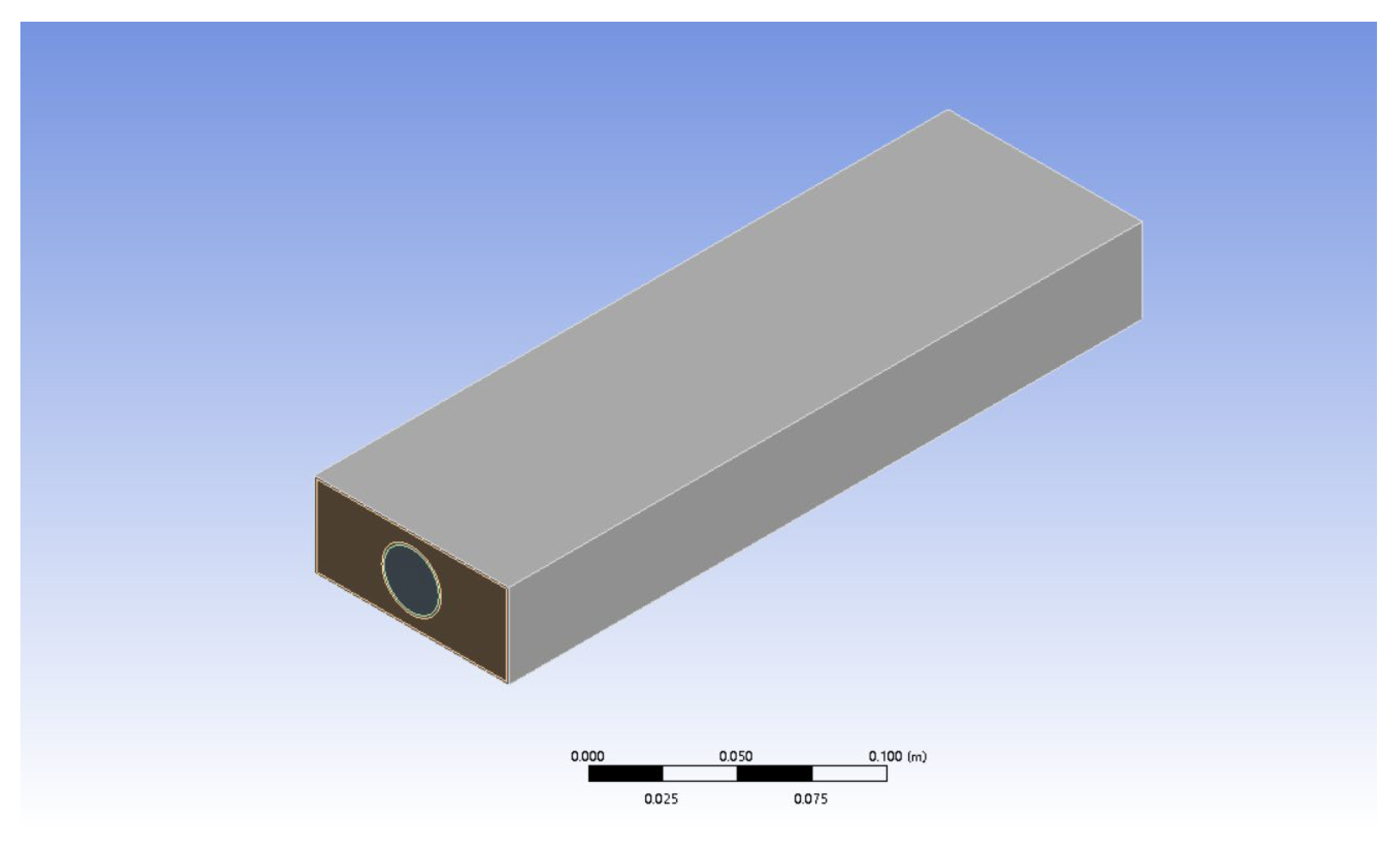
Figure 1 presents the heat transfer model and cross-sectional schematic of an integrated phase change material (PCM)-filled grooved radiant panel. The panel is fabricated by welding aluminum alloy, with overall dimensions of 300 mm (length) × 90 mm (width) × 78 mm (height). Its base is designed with a 60° V-shaped groove structure, and a copper tube (diameter: 26 mm) is installed at the bottom of the grooves inside the panel. During operation, hot water circulates through the copper tube, exchanging heat with the PCMs filled in the grooves. As the thermal storage medium, PCMs are injected into the groove cavities. Utilizing PCMs for heat transfer helps achieve a more uniform surface temperature of the radiant panel. Furthermore, during system operation, the PCMs achieve cyclic heat storage (melting) and release (solidification), serving as the energy storage core for the radiant panel’s delayed heat transfer process.

Selection Basis for Trough Structure and Materials

This study selected the 60° V-groove structure and the “aluminum alloy radiant panel-copper tube” composite material system based on three core requirements: “enhancing PCM phase change heat transfer efficiency,” “aligning with engineering application feasibility,” and “meeting the objective of comparing the performance of two PCMs.” The specific rationale is as follows:
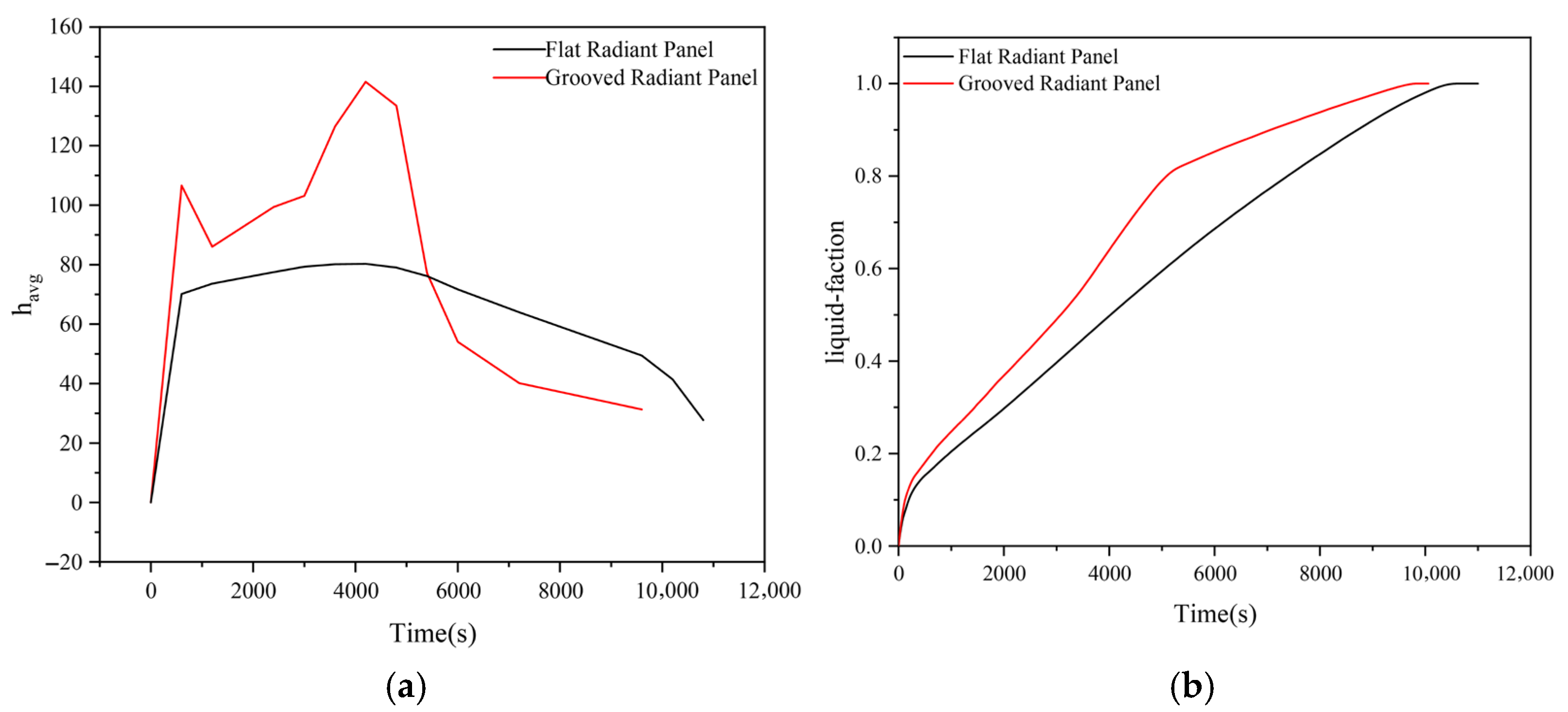
1. Rationale for selecting the 60° V-groove structure: Figure 2 illustrates the heat transfer model for a PCM-filled flat-plate radiant panel. The panel is also fabricated using welded aluminum alloy to maintain consistency with the key variables of the grooved radiant panel, except that the groove structure is replaced with a planar cavity filled with PCM. Its dimensions are 300 mm (length) × 90 mm (width) × 38 mm (height), with the height variation designed to ensure identical PCM filling volumes between the two panels. Simulation results of the n-hexadecane melting process for both flat-plate and grooved radiant panels under identical boundary conditions were compared. Figure 3 shows the temporal variation in the average convective heat transfer coefficient h avg on the wall surfaces of the grooved and flat radiant panels during the melting process of n-hexadecane. In the initial melting phase (0–1200 s), both h avg values remained at relatively low levels with slight fluctuations. This was because the PCM was predominantly in the solid state, where heat transfer was dominated by conduction, and convective effects had not yet become prominent. Entering the mid-melting phase (2400–4800 s), the h avg of the grooved radiant panel increased rapidly, peaking at 141.5 W/(m2·K) at 4200 s. Meanwhile, the peak h avg of the flat-plate radiant panel was only 80.3 W/(m2·K), meaning the convective heat transfer intensity of the grooved radiant panel was approximately 76% higher than that of the flat-plate counterpart. This disparity stems from the V-shaped structure of the grooved panel, which guides the liquid PCM into directed natural convection circulation, significantly enhancing convective heat exchange between the wall surface and the PCM. In the late melting stage (after 5400 s), the h avg of the flat-plate panel reversed and surpassed that of the grooved panel. This exhibits a typical heat transfer characteristic in the late phase of phase change: the grooved design, benefiting from convective enhancement, achieves faster PCM melting—reaching complete melting at 9836 s. At this point, the temperature difference between the overall PCM and the wall narrows significantly, causing h avg to decline rapidly with the reduced temperature difference. In contrast, the flat-plate design exhibits delayed melting, with residual solid PCM persisting in the later stages. Consequently, the temperature difference between the wall and PCM remains at a relatively high level. Thus, the higher h avg at this stage reflects not a reversal in convective intensity but a shift in the late-stage heat transfer mechanism from “convection-dominated” to “temperature-difference-dominated.”
The liquid fraction variation in Figure 3b further validates the convection enhancement effect: complete PCM melting took 9836 s for the grooved radiant panel versus 10,610 s for the flat-plate panel, representing a 7.3% reduction in melting time for the grooved design. This result is directly correlated with the enhanced convective heat transfer intensity observed in the mid-stage of the grooved panel in Figure 3a, indicating that the V-shaped groove structure effectively accelerates the phase change heat transfer rate of the PCM by intensifying convective heat exchange.
2. Selection Criteria for Aluminum Alloy Radiant Panels and Copper Tubes: Aluminum Alloy: It was selected for its high thermal conductivity and lightweight characteristics: (1) Thermal Conductivity: The aluminum alloy used in this study has a thermal conductivity of approximately 202 W/(m·K), which is nearly 1000 times that of phase change materials (PCMs, 0.15–0.2 W/(m·K)), effectively preventing localized overheating near the tube walls. (2) Lightweight Property: The density of aluminum alloy is only one-third that of steel, reducing the load imposed by radiant panels on building ceilings. (3) PCM Compatibility: Aluminum exhibits good chemical inertness toward n-hexadecane and LTXC-PCM-A-18, avoiding corrosion or chemical reactions that could degrade PCM performance.
Copper Tubing: It was selected for its corrosion resistance and high thermal conductivity in hot water systems: (1) Corrosion Resistance: Copper resists pitting corrosion in low-temperature hot water, whereas steel tubing requires anti-corrosion coatings that increase thermal resistance. (2) High Thermal Conductivity: Copper’s excellent thermal properties ensure efficient heat exchange between hot water and aluminum radiant panels.

2.2. Mathematical Model

To simplify the numerical model, the following reasonable assumptions are adopted in this study: (1) Natural convection effects are taken into account during the melting and solidification processes of the phase change material (PCM). (2) The density of the PCM obeys the Boussinesq assumption [24], while all other physical parameters are temperature-independent, uniform, and isotropic. (3) The enthalpy-porosity method is employed to simulate the phase change process. (4) The liquid PCM is modeled as a Newtonian fluid with laminar, unsteady, and incompressible flow characteristics. (5) The outer wall surface of the radiator plate is set as an adiabatic boundary condition. (6) The TCR was implemented via the “Contact Resistance” boundary condition in Fluent, and sensitivity analysis showed that ±30% variations in TCR values result in <4.2% deviation in core results, confirming the rationality of the settings.”
Based on the aforementioned assumptions, this study utilizes the solidification/melting model [25] embedded in FLUENT software to conduct numerical simulations of the established physical model, with the core algorithm being the enthalpy method. This method is uniquely suited to our study’s core challenge: simulating PCM’s moving solid–liquid interface in narrow V-grooves while capturing natural convection (a key factor in groove-induced heat transfer enhancement).
Continuity equation:
v = 0
In the equation: v is the velocity vector, m/s.
Physical meaning for our problem: Describes mass conservation of incompressible liquid PCM in V-grooves. For our narrow groove channels, this equation ensures we accurately simulate upward convection of heated liquid PCM (along groove walls) and downward flow of cooler liquid—this flow pattern is the core of how grooves enhance heat transfer.
Momentum equation:
ρ v t + v v = p + μ 2 v + ρ g β ( T T ref ) + S m
In the equation: ρ is the density of PCM, kg/m3; p is the pressure, Pa; μ is the dynamic viscosity, kg/(m·s); g is the gravitational acceleration, m/s2; β is the thermal expansion coefficient, 1/K; T ref is the reference temperature, K; S m is the paste zone source term.
Physical meaning for our problem: Balances forces (pressure, viscosity, buoyancy, mushy zone resistance) acting on liquid PCM in V-grooves.
Energy equation:
t ( ρ h ) + ( ρ v h ) = ( k T ) + S h
In the equation: h is the Specific enthalpy, J/kg; k is the Thermal conductivity, W/(m·K); S h is the Phase change latent heat source term, Enthalpy is decomposed into sensible heat and latent heat:
Physical meaning for our problem: The core equation for simulating PCM’s latent heat storage/release—our study’s key focus.
h = h sens + h lat
h sens = T ref T C p d T , h lat = f L L
In the equation: C p is the Specific heat capacity at constant pressure, J/(kg·K); L is the Latent heat of phase change, J/kg; f L is the fraction of liquid phase.
Liquid Phase Fraction:
f L = 0 T T solidus T T solidus T liquidus T solidus T solidus < T < T liquidus 1 T T liquidus
In the equation: T solidus is the solidus temperature, °C; T liquidus is the liquidus temperature, °C.
Physical meaning for our problem: Links temperature to PCM’s phase state (solid/liquid/paste), acting as a “bridge” between the energy equation and our observable results.
The source term in the energy equation S m can be expressed as
S m = A mush ( 1 f L ) 2 f L 3 + ϵ v
In the equation: A mush is the paste zone constant, values typically range from 104 to 107; this paper uses 105 for calculations. For the minimum value, preventing the denominator from becoming zero.
The source term in the momentum equation S h can be expressed as
S h = t ( ρ h lat ) ( ρ v h lat )

2.3. Setting of PCM Properties and Boundary Conditions

All abbreviations and symbols employed in this study are listed in Table 1. The phase change materials (PCMs) selected in this study are n-hexadecane and LTXC-PCM-A-18, with water serving as the heat transfer fluid. The relevant thermophysical properties of the two PCMs are listed in Table 2, where the subscript “s” denotes the solid state and “l” denotes the liquid state.
This study employed Ansys Fluent 2022 R1 for numerical computations, utilizing the solidification and melting model based on the enthalpy-porosity method to simulate the phase transition process. The pressure–velocity coupling equations were solved using the SIMPLE algorithm, while pressure discretization was implemented via the PRESTO method. The momentum and energy equations were discretized with a second-order upwind scheme. To improve convergence stability, the under-relaxation factors for pressure, density, momentum, liquid fraction, and energy were set to 0.3, 1.0, 0.5, 0.8, and 0.95, respectively. Set the convergence criteria for continuity and energy to 10−6 and 10−7, respectively.
During the cold storage process, the initial temperature of the PCMs is set to their respective liquidus temperatures, while the inlet temperature of the water (heat transfer fluid) is set 10 °C lower than the liquidus temperatures of the PCMs. During the heat release process, the initial temperature of the PCMs is set to their respective solidus temperatures, while the inlet temperature of the water is set 10 °C higher than the liquidus temperatures of the PCMs. The inlet velocity of the water is maintained consistently at 1.2 m/s during both processes. Radiator panel outer wall: Insulated with polyurethane foam coating, exhibiting minimal actual heat loss (q < 0.04 W/m2). In numerical simulations, it is defined as an insulated boundary (Zero Heat Flux), consistent with its actual heat transfer characteristics.

3. Mesh Independence Verification and Model Validation

3.1. Mesh Independence Verification

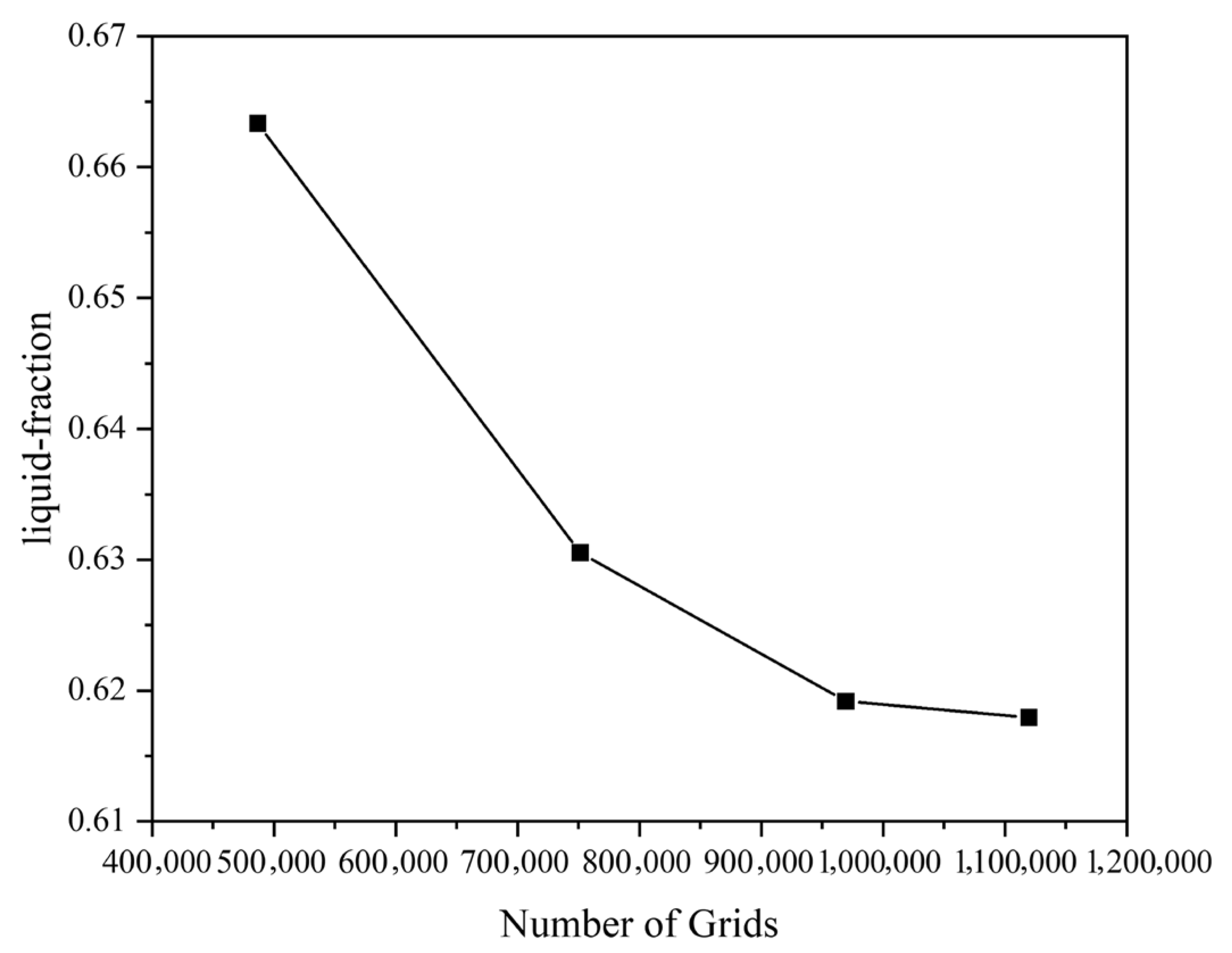
The number and quality of grid cells directly affect the accuracy of simulation results [26]. In this study, the small-facet meshing feature in Ansys Meshing was utilized to effectively capture geometric details, thereby generating a high-quality structured mesh [27]. To validate mesh independence, four sets of meshes with different scales were generated for comparative analysis, ensuring that the computational results are independent of mesh partitioning [28].
Mesh independence verification was performed as follows: Under the conditions of an inlet velocity of 1.2 m/s, an inlet water temperature of 8 °C, and an initial PCM temperature of 19 °C, mesh-independent calculations were conducted for the PCM-filled grooved radiant panel heat exchange units with mesh counts of 487,000, 752,000, 970,000, and 1,120,000. Figure 4 presents the variation in the PCM liquid fraction at 1000 s. The difference in liquid fraction between the meshes with 970,000 and 1,120,000 grid cells was merely 0.2%, indicating that the mesh density has a negligible influence on the simulation results when exceeding 970,000 grid cells. Therefore, the mesh with 970,000 grid cells was selected for subsequent calculations. Additionally, adaptive time stepping was employed, confirming that the results are independent of the time step size.

3.2. Model Validation

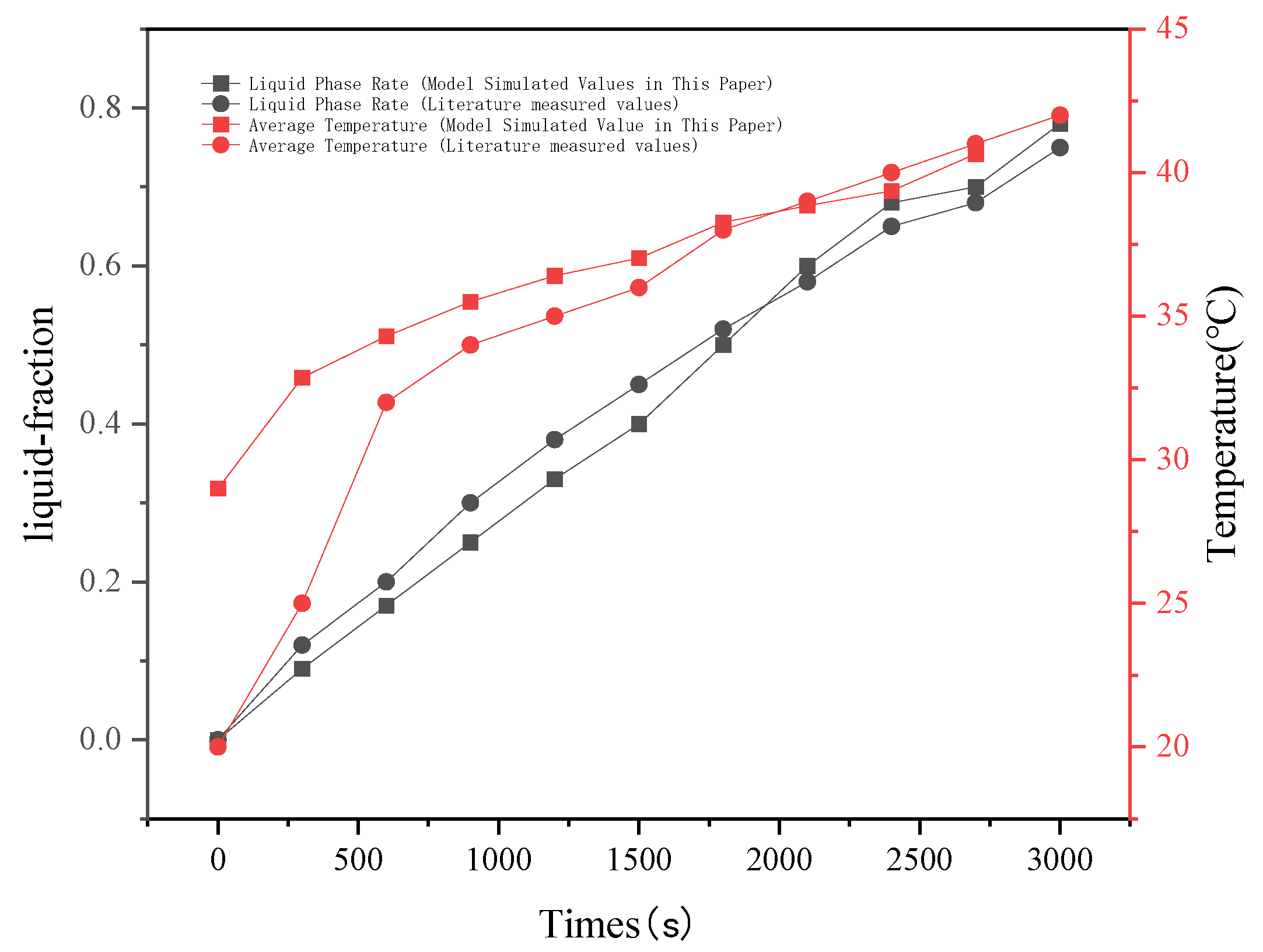
To further validate the reliability of the numerical model, this study replicated the three-dimensional finless “tube-PCM” heat transfer module proposed by Boujelbene et al. [18] to verify the validity of the enthalpy-porosity method. The three-dimensional model adopts a coaxial double-cylinder structure (i.e., inner tube: 20 mm × 250 mm; outer tube: 40 mm × 250 mm) filled with RT35 phase change material (PCM). For model validation, the melting process was simulated under the same operating conditions as the reference study (heat transfer fluid (HTF) inlet temperature: 50 °C; inlet velocity: 0.26 m/s), and the predicted liquid fraction and average temperature were compared with the experimental data from Boujelbene et al. [18].
Figure 5 shows that the trends of liquid fraction and average temperature predicted by the present model are in good agreement with the experimental measurements in [17], and the maximum relative error does not exceed 10%. This error may stem from the assumption of constant thermophysical properties for the PCM in the numerical model, whereas the actual thermal properties of the PCM vary with temperature. Nevertheless, the good agreement in overall trends confirms the reliability and validity of the proposed numerical model.

4. Results and Discussion

This section aims to compare the melting and solidification characteristics of two phase change materials (PCMs), namely n-hexadecane and LTXC-PCM-A-18, in a grooved radiant panel based on the established numerical model. Key parameters, including temperature field contour plots, liquid fraction contour plots, and liquid fraction-time curves, are focused on to compare the phase transition temperature ranges of the PCMs, analyze the phase interface evolution, and quantify the melting and solidification rates. These analyses also evaluate the comprehensive suitability of the two PCMs in terms of thermal response speed, energy storage density, and system coupling adaptability.

4.1. Melting Heat Absorption Processes of Different Phase Change Materials

4.1.1. Temperature Field and Phase Interface Evolution Analysis

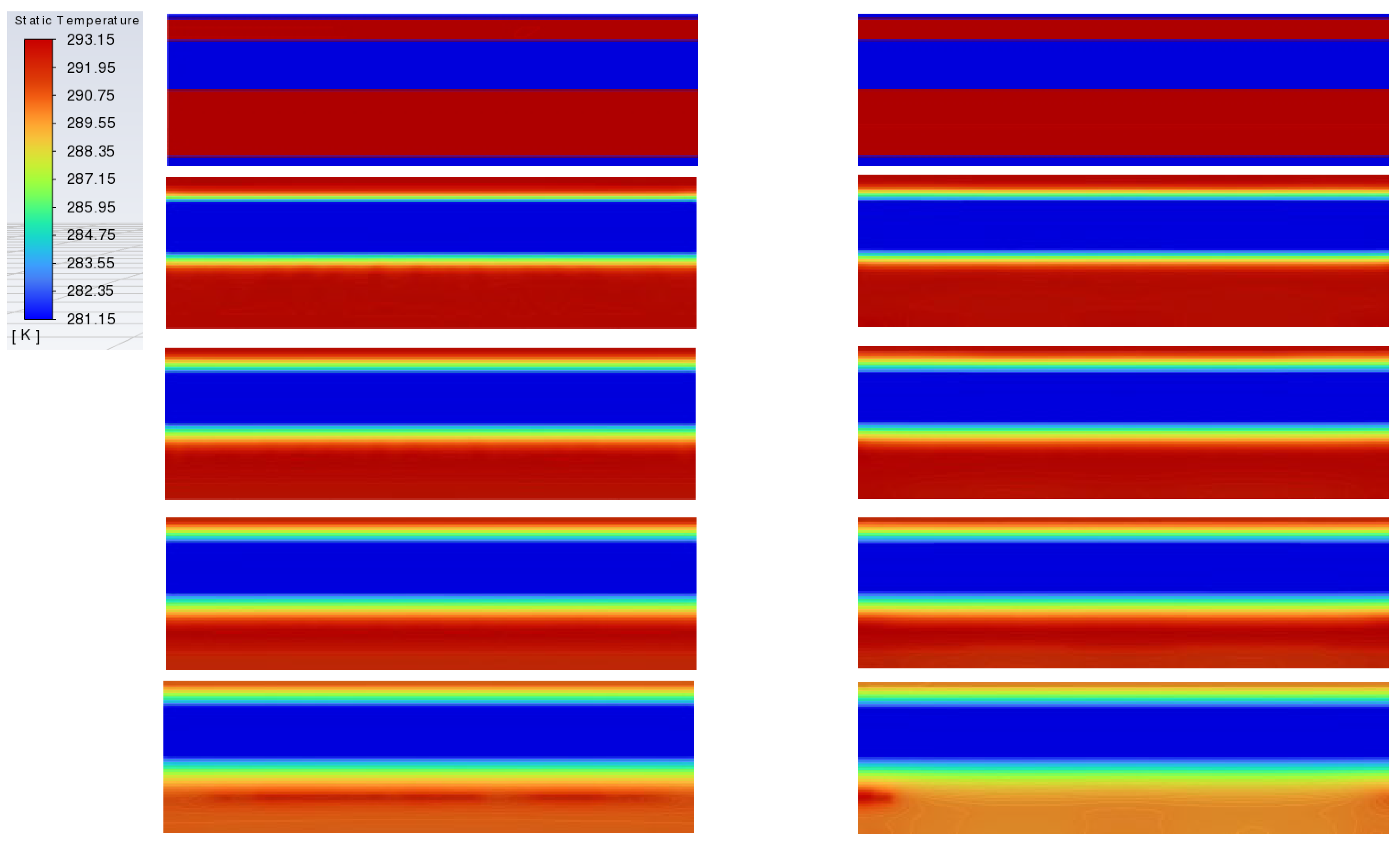
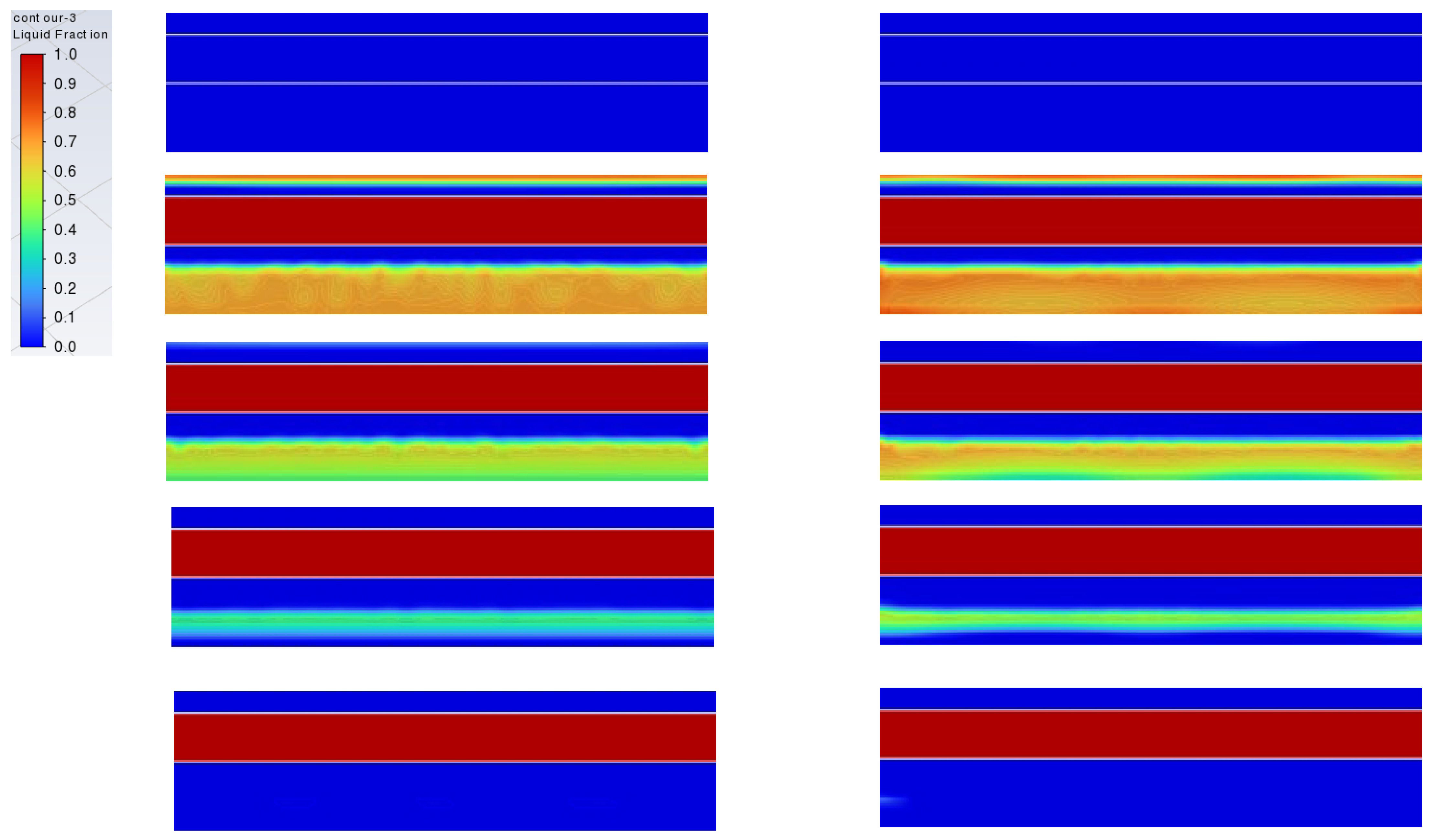
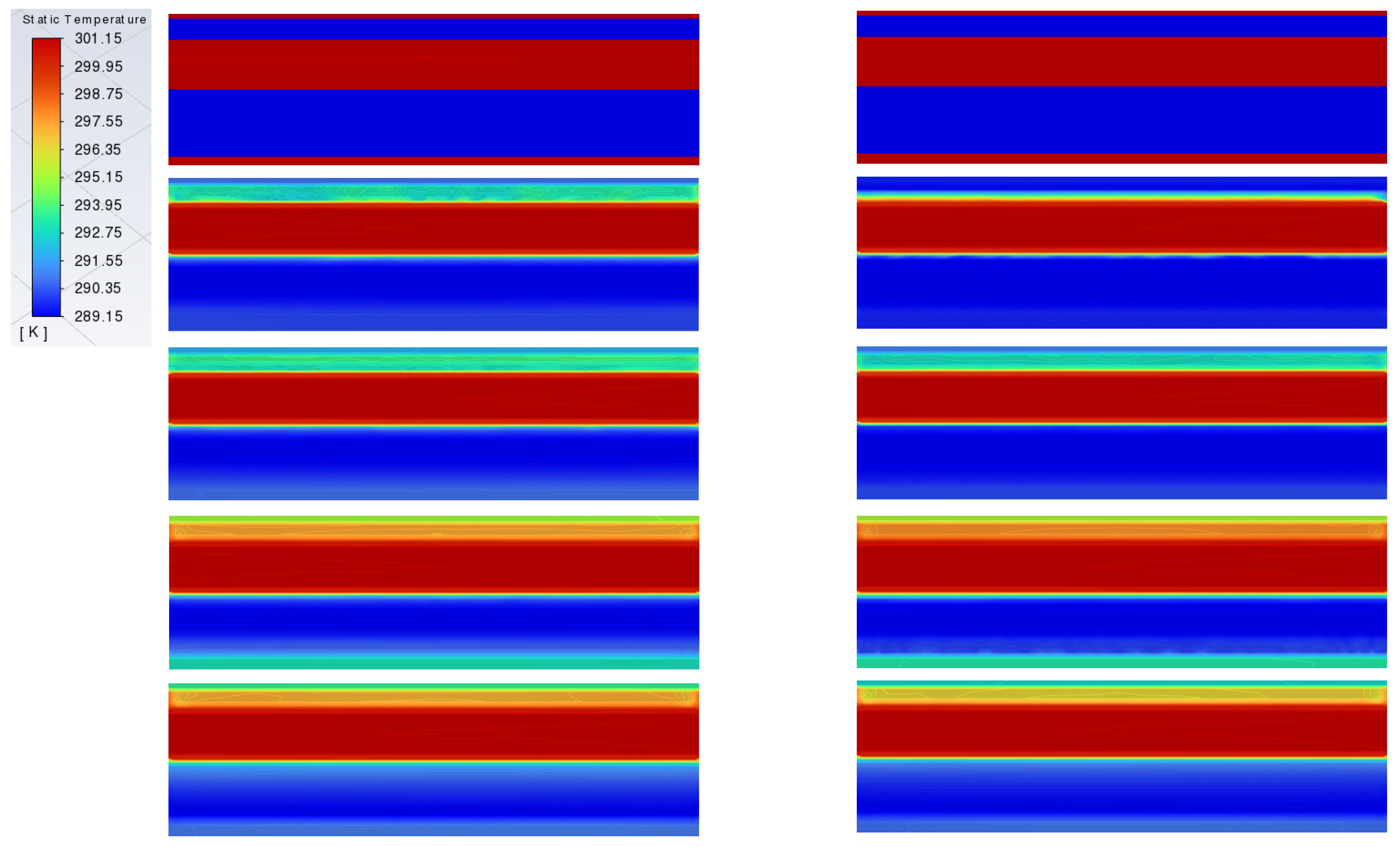
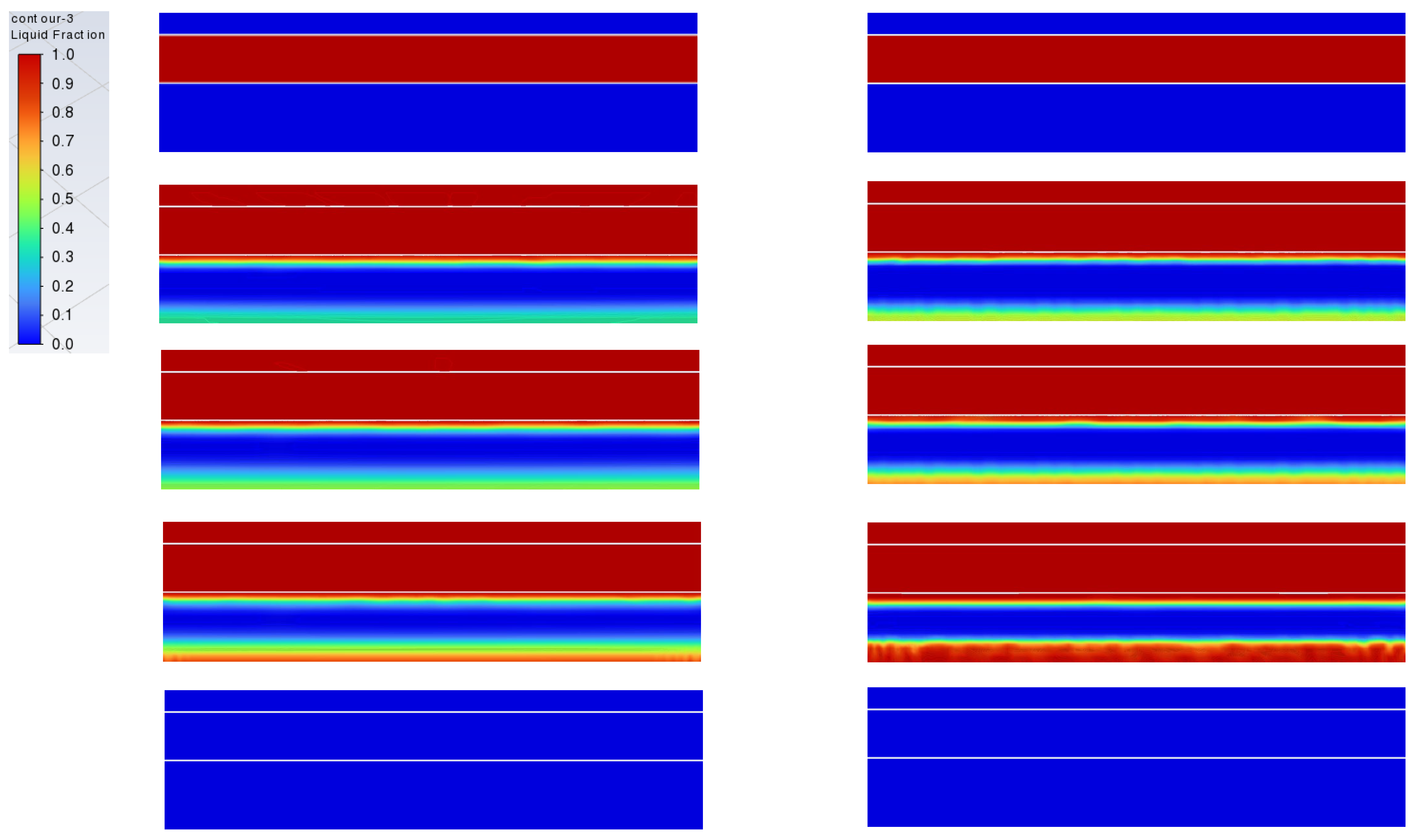
Numerical simulations were performed on the heat transfer model of the PCM-filled grooved radiant panel, with an inlet velocity of 1.2 m/s and inlet temperature of water (heat transfer fluid, HTF) set 10 K above the liquidus temperatures of the two PCMs. The results are presented in Figure 6 and Figure 7, which depict the cross-sectional temperature and liquid fraction contour plots during the melting endothermic process of both PCMs.
The phase transition temperature range and melting plateau stability are core indicators for evaluating the suitability of phase change materials (PCMs) for radiant panels, as they directly determine the panels’ operating temperature range and thermal output stability. The color distribution in the temperature contour plots clearly reflected the phase transition temperature characteristics of the two materials: For n-hexadecane, the temperature contour plot at 0 s showed that the entire color zone was concentrated in the low-temperature range of 290.35–293.95 K, indicating the material was initially in a fully solid state. At 3000 s, a transitional color zone between 295.15 K and 297.55 K first appeared in localized areas, marking the material’s entry into the melting phase transition stage. By 9000 s, this transitional zone expanded significantly and stabilized within the range of 295.15–298.75 K, forming a distinct melting plateau. Until 15,000 s, the contour plot remained dominated by the color area of this temperature zone. The plateau state persisted until 21,000 s, when a high-temperature color zone of 299.95–301.15 K emerged, indicating that the phase transition temperature range of n-hexadecane primarily spans 295.15–298.75 K. Its melting plateau lasted from 6000 s to 15,000 s (≈9000 s) with a temperature fluctuation range of only 3.6 K, demonstrating excellent plateau stability. For LTXC-PCM-A-18, the contour plot at 0 s similarly displayed a solid-state low-temperature color zone (290.35–293.95 K). However, a phase transition color zone of 295.15–298.75 K appeared by 3000 s, initiating phase transition 3000 s earlier than n-hexadecane. By 6000 s, the phase transition color zone dominated the contour plot and stabilized at 296.35–299.95 K, forming a melting plateau. The plateau remained stable at 9000 s, while a high-temperature color zone of 301.15 K appeared in the contour plot at 15,000 s, indicating the phase transition was essentially complete. Thus, the phase transition temperature range of LTXC-PCM-A-18 is 295.15–299.95 K, slightly higher than that of n-hexadecane. Its melting plateau persisted from 3000 s to 9000 s (≈6000 s); although shorter than that of n-hexadecane, its earlier phase transition initiation and temperature range align more closely with the comfort zone for building heating systems.
In terms of melting rate, the two materials exhibited significant differences at the same time points. At 6000 s, the phase transition color zone of n-hexadecane covered only approximately 30% of the total contour plot area, while that of LTXC-PCM-A-18 exceeded 60%. At 9000 s, the melting region of LTXC-PCM-A-18 covered over 80% of the contour plot, compared to only about 50% for n-hexadecane. At 15,000 s, LTXC-PCM-A-18 had completed its phase transition and entered the high-temperature phase, whereas n-hexadecane remained in the middle of its melting plateau, with the phase transition color zone covering approximately 70% of the contour plot. It did not complete the overall phase transition until 21,000 s. This indicates that LTXC-PCM-A-18 has a significantly higher melting rate than n-hexadecane, demonstrating a faster thermal load response. From the perspective of heat transfer performance analysis, the clarity of color zone boundaries and gradient changes in the temperature contour plots reflect thermal conduction characteristics. For n-hexadecane, the boundary between the low-temperature color zone and the phase transition color zone was relatively blurred in contour plots from 6000 s to 15,000 s, with a smaller temperature gradient, indicating a gradual heat conduction process. In contrast, for LTXC-PCM-A-18, the color zone boundaries were clearer in contour plots from 3000 s to 9000 s, and high-temperature color zones diffused faster into low-temperature regions, indicating higher thermal conduction efficiency. Notably, the corners of the grooved radiant panel represent weak thermal conduction areas: high-temperature color zones appeared in these corner regions for n-hexadecane only at 21,000 s, whereas LTXC-PCM-A-18 formed phase transition color zones at the groove corners as early as 9000 s. This demonstrates that the latter has no significant thermal retention zones in the complex groove geometry, resulting in superior heat transfer uniformity.
Leveraging the phase transition characteristics of the two materials, a tailored material adaptation strategy for grooved radiant panels can be proposed: n-hexadecane exhibits a longer melting plateau and minimal temperature fluctuations during phase transition, making it suitable for radiant panels in long-term continuous heating applications—its thermal stability ensures uniform heat output. In contrast, LTXC-PCM-A-18 features early phase transition initiation and rapid response, making it more appropriate for intermittent heating scenarios where dynamic adaptation to fluctuating thermal loads is required.
The liquid fraction is a core metric characterizing the melting process of phase change materials (PCMs), and its spatiotemporal evolution directly reflects the material’s melting kinetics and heat transfer properties. As shown in the figure, for n-hexadecane, the liquid fraction contour plot at 0 s displayed a uniform color zone with no liquid regions present, indicating the material’s initial state was fully solid with no melting initiated. At 6000 s, the contour plot showed liquid phase regions (phase fraction: 0.2–0.5) only in the central area of the radiant panel’s grooves, occupying approximately 25% of the total plot area. The boundaries of these regions were blurred, indicating that melting had initiated only in localized areas with higher heat flux density and was progressing slowly. At 9000 s, the liquid phase ratio in the central region increased to 0.3–0.7, with the liquid phase color zone expanding toward both sides of the grooves to cover about 40% of the area. However, the groove corners remained low liquid phase ratio zones (0.0–0.2), showing significant melting lag. At 15,000 s, the liquid phase fraction further increased to 0.5–0.8, with the color zone covering 65% of the area, while the liquid phase fraction at the groove corners only rose to 0.2–0.3. Only by 21,000 s did the liquid phase ratio of n-hexadecane approach 1.0: over 90% of the contour plot displayed high liquid phase color zones (0.8–1.0), with the groove corners fully melted. The overall melting process took a relatively long time. For LTXC-PCM-A-18, the contour plot at 0 s also showed a solid-state color zone (liquid fraction: 0.0). However, by 3000 s, liquid phase ratio color zones (0.3–0.6) appeared in the groove centers, covering 35% of the total plot area—this initiated melting 3000 s earlier than n-hexadecane and exhibited a higher initial liquid phase ratio. At 6000 s, the liquid phase ratio increased to 0.5–0.8, with color zones covering 70% of the area: liquid phase ratios rose simultaneously on both sides of the grooves, while corner regions reached 0.3–0.4, indicating significantly faster melting diffusion than n-hexadecane. At 9000 s, the liquid phase fraction further increased to 0.7–0.9, with the colored area exceeding 85%; the liquid phase fraction in the groove corners reached 0.5–0.6, with only a few areas remaining in the medium liquid phase fraction zone (0.3–0.5). At 15,000 s, the liquid phase fraction of LTXC-PCM-A-18 approached 1.0: the entire contour plot displayed a high liquid phase fraction color zone (0.9–1.0), indicating complete melting. This process concluded 6000 s earlier than that of n-hexadecane.
Regarding melting initiation characteristics, n-hexadecane exhibited a distinct liquid phase region only at 6000 s, demonstrating significant thermal lag in melting initiation. This is attributed to its low thermal conductivity, which requires accumulated heat flux within the groove structure to surpass the melting threshold. In contrast, LTXC-PCM-A-18 initiated melting at 3000 s, exhibiting a more sensitive thermal response: it rapidly utilizes heat input from the radiant panel to activate phase change thermal storage. This characteristic is particularly evident in comparisons: under identical heat flux input durations, LTXC-PCM-A-18 demonstrated a larger liquid phase initiation area and higher liquid phase fraction. Comparing average liquid fractions at identical time points: at 6000 s, n-hexadecane’s average liquid fraction was approximately 0.3, while LTXC-PCM-A-18 reached 0.6—with the latter’s growth rate twice that of the former. At 9000 s, the average liquid fraction of n-hexadecane was 0.5, while LTXC-PCM-A-18 reached 0.8, further widening the growth rate gap. From the color gradient in the contour plots, n-hexadecane exhibited a liquid phase fraction gradient of 0.2–0.5 per 6000 s, while LTXC-PCM-A-18 showed 0.3–0.6 per 3000 s. The steeper slope of liquid phase fraction over time indicates more efficient melting kinetics.
In building heating systems, grooved radiant panels require adjustment of heat storage rates based on dynamic changes in thermal load. LTXC-PCM-A-18 exhibits rapid melting initiation and accelerated liquid fraction growth, enabling swift response to radiant panel heat input: it can complete heat storage within a short timeframe to accommodate sudden spikes in indoor heat demand. In contrast, n-hexadecane features slow melting initiation and a gradual melting process: its slow liquid fraction growth aligns with steady heat input, preventing heat wastage caused by overly rapid heat storage.

4.1.2. Thermal Performance and Liquid Fraction Variation over Time

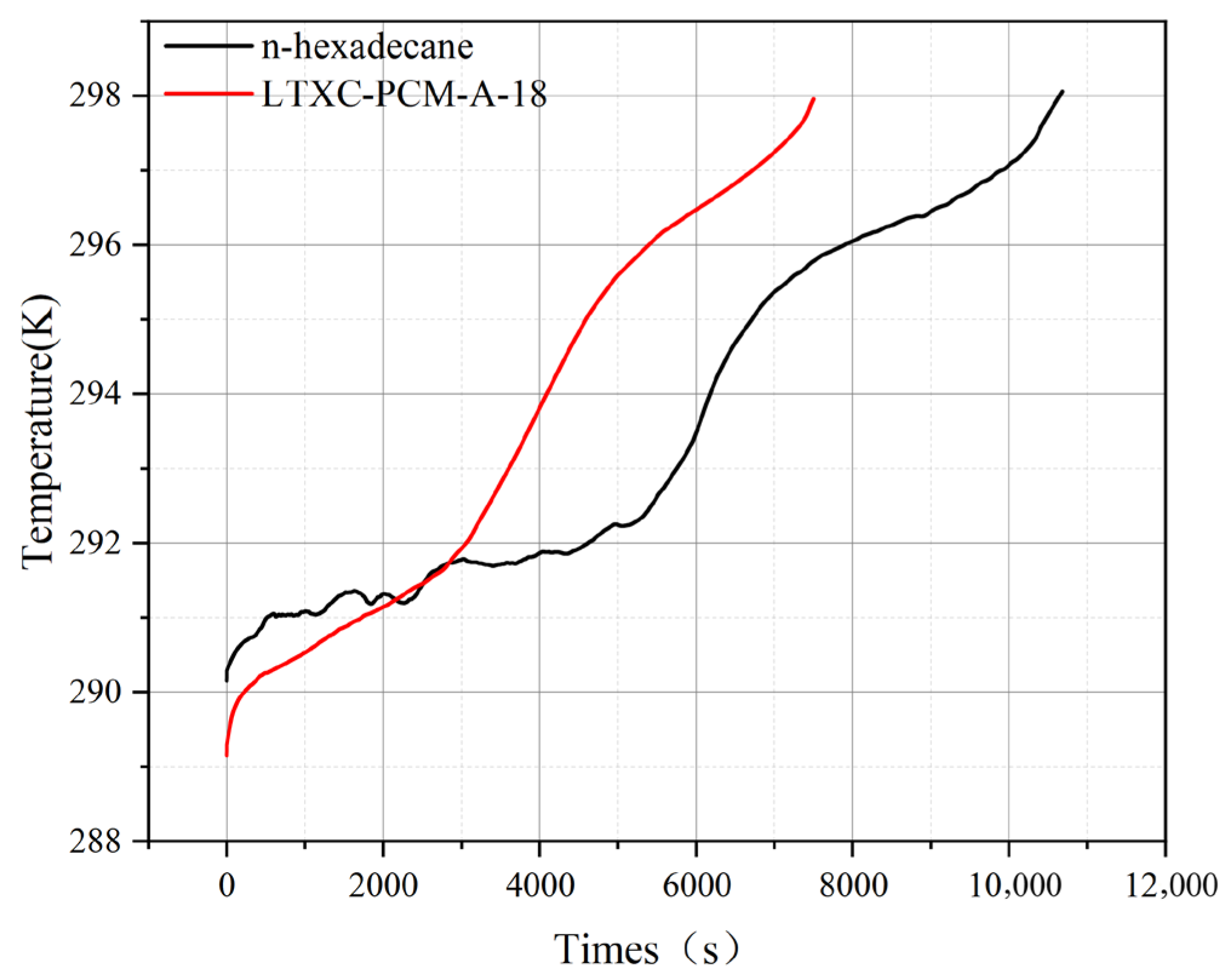
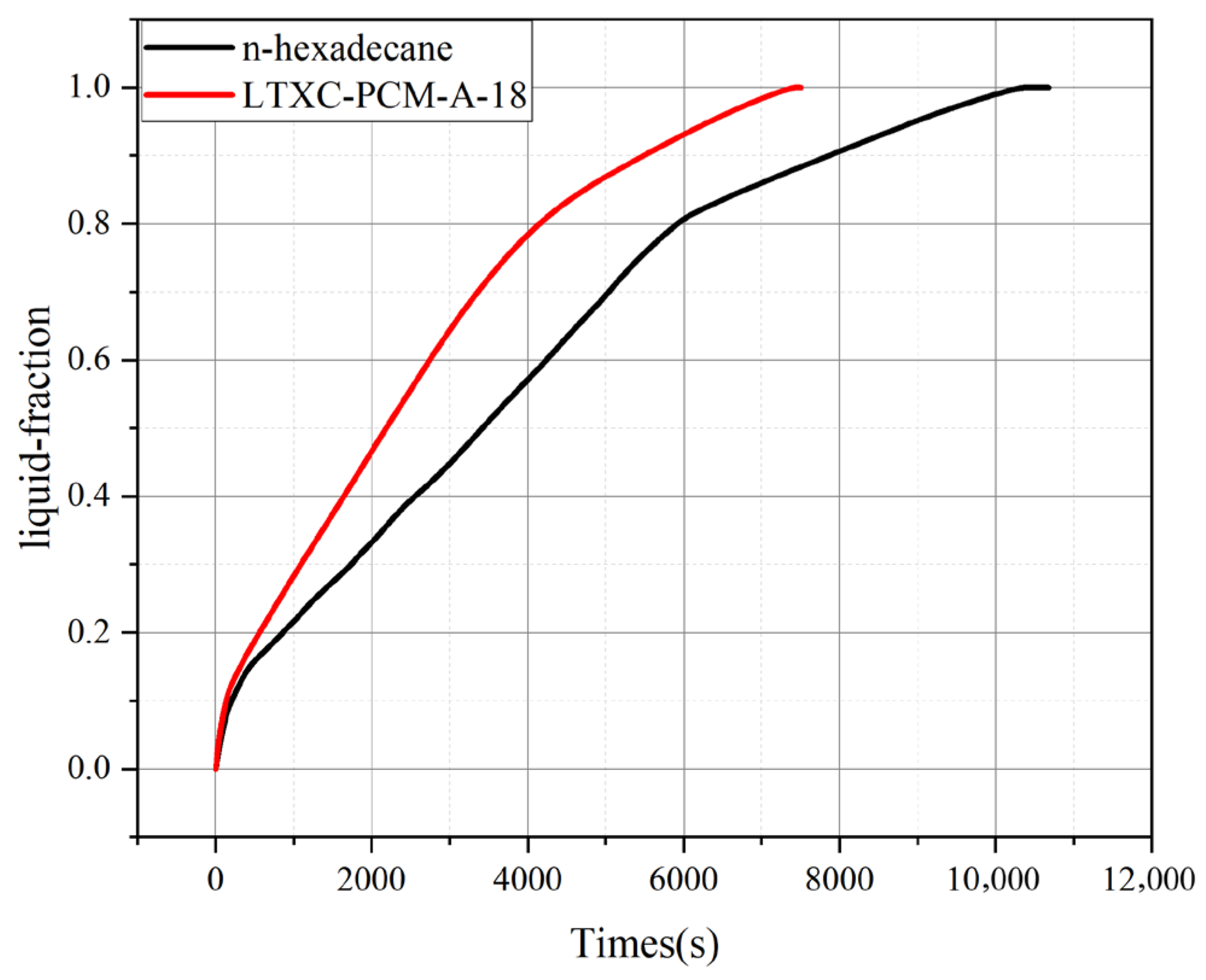
In the study of heat transfer characteristics in phase change material (PCM)-filled grooved radiant panels, the temperature response behaviors of n-hexadecane and LTXC-PCM-A-18 exhibit significant differences, which reflect their distinct thermal properties and phase change characteristics. The slope of the temperature curve directly reflects the material’s response efficiency to the heat flux from the radiant panel, while fluctuations in the slope are closely correlated with the phase change endothermic process. Meanwhile, the slope and inflection point of the liquid fraction curve directly indicate the material melting rate. Figure 8 and Figure 9 show the time-dependent curves of melting enthalpy and liquid fraction for the two PCMs.
Based on the melting temperature-time curve (Figure 8), the melting phase transition processes of n-hexadecane and LTXC-PCM-A-18 exhibit distinct characteristics, which can be specifically divided into three stages:
Preheating Initiation Stage (0–2000 s): During this phase, the temperature curve indicates that both materials remain in a solid preheating state. n-Hexadecane started at approximately 290 K with a heating rate of 0.001 K/s; LTXC-PCM-A-18 had a slightly lower initial temperature but a heating rate of 0.0015 K/s—1.5 times that of n-hexadecane. This difference shows that LTXC-PCM-A-18 absorbs heat flux more readily and initiates phase change heat storage during the initial thermal input phase of the grooved radiant panel, demonstrating a more sensitive thermal response.
Core Phase Change Stage (2000–6000 s): This stage dominates phase change heat absorption, where the evolution of temperature and liquid fraction diverges markedly between the two materials: The slope of n-hexadecane’s temperature curve steeply declined, with the heating rate dropping to 0.000125 K/s, exhibiting a gentle “melting temperature plateau.” This is a typical manifestation of substantial heat absorption suppressing temperature rise during phase transition, indicating a relatively smooth melting process. In contrast, the temperature curve of LTXC-PCM-A-18 maintained a heating rate of 0.001 K/s, showing weaker plateau characteristics. By 6000 s, 80% of its melting was complete—this feature indicates that LTXC-PCM-A-18 has higher heat storage efficiency within the groove structure, enabling faster filling of the radiant panel’s heat storage space.
Final Melting Stage (6000–10,000 s): After 6000 s, the slope of n-hexadecane’s temperature curve rebounded, with a heating rate of 0.000875 K/s, indicating diminished phase change heat absorption capacity and near-completion of melting. When comparing liquid fractions, n-hexadecane only reached 0.98 (indicating complete melting) by 10,000 s. In contrast, LTXC-PCM-A-18 maintained high-speed heating, achieving a liquid fraction ≥0.98 before 8000 s—completing melting approximately 2000 s earlier than n-hexadecane. This difference in termination dynamics signifies: n-hexadecane exhibits a more “prolonged and gradual” melting process, which facilitates sustained and stable heat release from grooved radiant panels; LTXC-PCM-A-18 exhibits a “rapid and compact” melting profile, making it suitable for scenarios with dynamic thermal load variations.
Based on the liquid fraction-time curve (Figure 9), the difference in their phase transition processes directly reflects the materials’ varying adaptability to the heat transfer environment of the radiant panel. At 0 s, both materials were in a fully solid state (liquid fraction = 0), yet their thermal response characteristics diverged sharply: within the first 2000 s, n-hexadecane’s liquid fraction rose only gradually to 0.15, with a growth rate of 0.000075 s−1; conversely, LTXC-PCM-A-18 exhibited a steeply rising liquid fraction curve, reaching 0.4 by 2000 s with a growth rate of 0.0002 s−1 (2.6 times that of n-hexadecane). This indicates that LTXC-PCM-A-18 absorbs heat flux more readily within the grooves and initiates phase change heat storage during the initial heat input phase of the radiant panel, demonstrating a more responsive behavior to thermal loads. The period from 2000 to 6000 s represents the core phase of phase change heat storage. While n-hexadecane’s liquid fraction increased from 0.15 to 0.6 at a sustained growth rate of 0.0001125 s−1, LTXC-PCM-A-18’s liquid fraction rapidly rose from 0.4 to 0.8—reaching 80% melting completion by 6000 s, which significantly outperformed n-hexadecane (achieving only 60% melting in the same period). This characteristic indicates LTXC-PCM-A-18’s superior efficiency in utilizing the heat transfer channels of grooved radiant panels, enabling rapid filling of the thermal storage space.
After 6000 s, the melting process enters its final stage. With “liquid fraction ≥ 0.98” defined as the criterion for complete melting, LTXC-PCM-A-18 reached a liquid fraction plateau (approaching 1.0) around 8000 s, completing the overall melting process. In contrast, n-hexadecane required a delay until approximately 10,000 s to achieve complete melting. This temporal discrepancy dictates their scenario-specific adaptability: LTXC-PCM-A-18’s “rapid termination” characteristic is suitable for intermittent heating scenarios (e.g., residential buildings), enabling swift response to thermal load fluctuations; n-hexadecane’s “gradual completion” characteristic is better suited for continuous heating scenarios (e.g., shopping malls), maintaining stable thermal output from radiant panels.

4.2. Solidification Heat Release Processes of Different Phase Change Materials

4.2.1. Temperature Field and Phase Interface Evolution Analysis

Numerical simulations were performed on the heat transfer model of the PCM-filled grooved radiator, with an inlet flow velocity of 1.2 m/s and the inlet temperature of water (heat transfer fluid) set 10 °C below the liquidus temperature of the PCMs. The results are presented in Figure 10 and Figure 11, which show the temperature distribution and liquid fraction contour plots of the solidification heat release cross-sections for the two PCMs.
The solidification temperature range and plateau stability directly influence the heat release duration and temperature output stability of grooved radiant panels, as these parameters determine the thermal performance of the panels in practical building applications. The color distribution and evolution in temperature contour plots visually reflect the variations in these two characteristics. For n-hexadecane, the solidification temperature contour plot at 0 s showed that the color zones were concentrated in the high-temperature range of 299.95–301.15 K, indicating the material was initially in a fully liquid state. At 15,000 s, a transitional color zone between 297.55 K and 298.75 K first appeared in localized areas, marking the material’s entry into the solidification phase transition stage. By 30,000 s, this transitional zone expanded significantly and stabilized within the range of 295.15–298.75 K, forming a distinct solidification plateau. Until 45,000 s, the contour plot remained dominated by the color area of this temperature zone. The plateau state persisted until 54,000 s, when a large-scale low-temperature color zone of 290.35–293.95 K finally emerged. This indicates that n-hexadecane’s solidification temperature range primarily spans 295.15–298.75 K. Its solidification plateau lasted from 15,000 s to 45,000 s (≈30,000 s) with a temperature fluctuation of only 3.6 K, demonstrating exceptional plateau stability. For LTXC-PCM-A-18, the contour plot at 0 s similarly displayed a liquid high-temperature color zone (299.95–301.15 K). However, a phase transition color zone of 296.35–298.75 K appeared by 15,000 s, initiating the solidification phase transition synchronously with n-hexadecane. By 30,000 s, the phase transition color zone dominated the contour plot, with temperatures stabilizing at 294.15–297.55 K to form a solidification plateau. At 45,000 s, the plateau began to decay, and by 54,000 s, a large low-temperature color zone of 290.35–293.95 K appeared across the contour plot, indicating near-complete solidification. Thus, LTXC-PCM-A-18 exhibits a solidification temperature range of 294.15–297.55 K, slightly lower than that of n-hexadecane. Its solidification plateau persisted from 15,000 s to 45,000 s; although the plateau duration is consistent with that of n-hexadecane, the temperature decline rate accelerates during the latter phase of the plateau, with a temperature fluctuation amplitude of approximately 3.4 K. This indicates slightly weaker overall plateau stability compared to n-hexadecane.
In terms of solidification rate, the two materials exhibited significant differences in their solidification processes at the same time points. At 15,000 s, the solidification transition color zone of n-hexadecane covered only approximately 20% of the total contour plot area, while that of LTXC-PCM-A-18 exceeded 40%. At 30,000 s, the solidification zone of LTXC-PCM-A-18 covered over 70% of the contour plot, compared to only about 40% for n-hexadecane. At 45,000 s, extensive low-temperature color zones began to appear in LTXC-PCM-A-18, whereas n-hexadecane remained in the mid-stage of its solidification plateau, with the solidification transition color zone covering approximately 60% of the plot. At 54,000 s, LTXC-PCM-A-18 had completed full solidification, whereas the low-temperature color zone in n-hexadecane covered only about 70% of the plot. This characteristic indicates that LTXC-PCM-A-18 has a significantly higher solidification rate than n-hexadecane, demonstrating a faster response to the heat dissipation demands of the radiant panel. From the perspective of heat transfer performance analysis, the clarity of color zone boundaries in the temperature contour plots and the heat transfer conditions at the groove edges reflect the thermal conductivity characteristics. For n-hexadecane, the boundary between the high-temperature color zone and the solidification transition color zone was blurred in contour plots from 15,000 s to 45,000 s, with a small temperature gradient and a gradual heat conduction process. In contrast, for LTXC-PCM-A-18, the color zone boundaries were sharper in contour plots from 15,000 s to 30,000 s, and low-temperature zones diffused faster toward high-temperature regions, indicating superior thermal conduction efficiency. Notably, the corners of the grooved radiant panel represent weak heat transfer areas: distinct low-temperature zones appeared at the corners for n-hexadecane only at 54,000 s, whereas LTXC-PCM-A-18 formed a solidification color zone at the groove corners as early as 30,000 s. This demonstrates that the latter has no significant heat transfer stagnation in the complex groove geometry, resulting in superior heat transfer uniformity.
The narrow gaps between the grooves in the grooved radiant panel limit heat transfer efficiency. LTXC-PCM-A-18 exhibits rapid solidification and high heat transfer gradients, enabling it to quickly fill the groove heat transfer pathways without requiring major structural modifications to the radiant panel. In contrast, n-hexadecane demonstrates slow thermal diffusion at the groove corners, which is prone to forming localized hot spots. This necessitates optimizing the groove structural parameters (e.g., groove width, angle) or incorporating high-thermal-conductivity fillers to enhance its solidification rate and adaptability to the groove structure.
The decay pattern of liquid fraction is a key indicator reflecting the solidification process and heat transfer characteristics of phase change materials (PCMs). Its spatial distribution and temporal evolution directly visualize the material’s heat release efficiency and structural compatibility within grooved radiant panels. As shown in the figure, for n-hexadecane, the liquid fraction contour plot during solidification at 0 s exhibited a uniform high liquid fraction color zone (1.0) across the entire domain, with no solid regions present—indicating the material was initially in a fully liquid state, and solidification had not yet initiated. At 15,000 s, a liquid fraction decay zone (0.7–0.9) appeared only at the edge regions of the radiant panel’s grooves, occupying approximately 15% of the total plot area with blurred boundaries. This indicates that solidification had initiated only in localized areas with faster heat dissipation, progressing slowly. At 30,000 s, the liquid fraction in the edge regions decreased to 0.5–0.8, and the solidification color zone slowly expanded toward the groove center, covering about 30% of the area. However, the groove center remained a high liquid fraction zone (0.9–1.0), showing significant solidification lag. At 45,000 s, the liquid fraction further decreased to 0.3–0.7, with the solidified color zone covering 50% of the area, while the liquid fraction at the groove edges only dropped to 0.6–0.7. Only by 54,000 s did the liquid fraction of n-hexadecane decrease significantly: 70% of the contour plot displayed low liquid fraction color zones (0.0–0.5), but the groove center retained liquid regions (0.5–0.7), indicating an overall prolonged and incomplete solidification process. For LTXC-PCM-A-18, the contour plot at 0 s also showed a fully liquid color zone (1.0). However, by 15,000 s, liquid fraction decay zones (0.6–0.8) appeared at the groove edges and corners, covering 30% of the total plot area—this decay zone was larger and more distinct than that of n-hexadecane. At 30,000 s, the liquid fraction dropped to 0.4–0.7, with solidified color zones covering 60% of the area, and the liquid fraction at the groove center also decreased to 0.8–0.9, indicating a significantly faster solidification diffusion rate than n-hexadecane. At 45,000 s, the liquid fraction further decreased to 0.2–0.5, with solidification color zones exceeding 80% coverage, and only a small central region within the groove maintained a moderate liquid fraction (0.5–0.7). At 54,000 s, the liquid fraction of LTXC-PCM-A-18 approached 0.0: the entire contour plot displayed low liquid fraction color zones (0.0–0.3), indicating complete solidification. This solidification process was more thorough than that of n-hexadecane.
Regarding solidification initiation characteristics, n-hexadecane exhibited only a slight decrease in liquid fraction at 15,000 s, showing significant thermal lag in solidification initiation. This is attributed to its low thermal conductivity, which impedes rapid heat transfer from the groove structure to the exterior—sufficient temperature drop accumulation is required before solidification commences. In contrast, LTXC-PCM-A-18 formed an extensive solidification initiation zone by 15,000 s, exhibiting sharper thermal responsiveness: it rapidly releases heat to the radiant panel via thermal conduction. At the same time point, LTXC-PCM-A-18’s solidification initiation area was twice that of n-hexadecane, with greater liquid fraction decay. The corners of the grooved radiant panel are critical for heat loss and “sensitive zones” during solidification: at 54,000 s, n-hexadecane still exhibited a liquid fraction of 0.5–0.7 in the groove center, indicating incomplete solidification coverage. In contrast, LTXC-PCM-A-18 reduced the liquid fraction in groove corners to 0.2–0.4 by 45,000 s and achieved full-area complete solidification by 54,000 s. This characteristic indicates that LTXC-PCM-A-18 has superior solidification spatial uniformity in complex groove structures, with no significant localized liquid retention. In contrast, n-hexadecane’s solidification process is constrained by the groove structure, resulting in lower heat dissipation efficiency in the central region.
Implications for grooved radiant panel adaptation: LTXC-PCM-A-18 is preferred for applications prioritizing rapid heat release and high responsiveness, while n-hexadecane has greater merit for scenarios emphasizing heat release stability and sustainability. Additionally, a “zonal filling” composite strategy can be adopted: filling groove edges and corners with LTXC-PCM-A-18 to ensure rapid heat release, and the central groove area with n-hexadecane to maintain sustained heat release. This spatial material combination achieves balanced and optimized heat release performance for the radiant panel.

4.2.2. Thermal Performance and Liquid Fraction Variation over Time

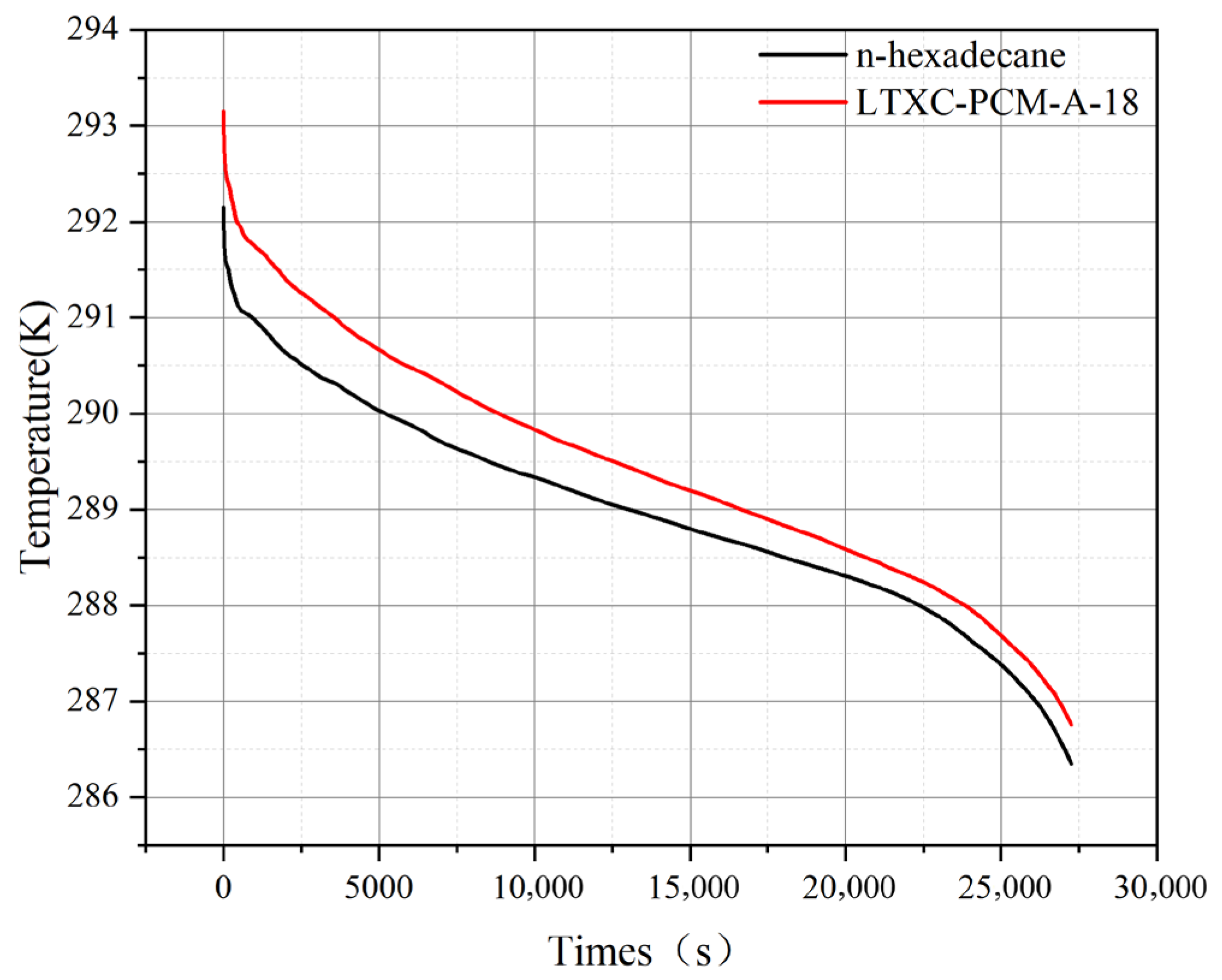
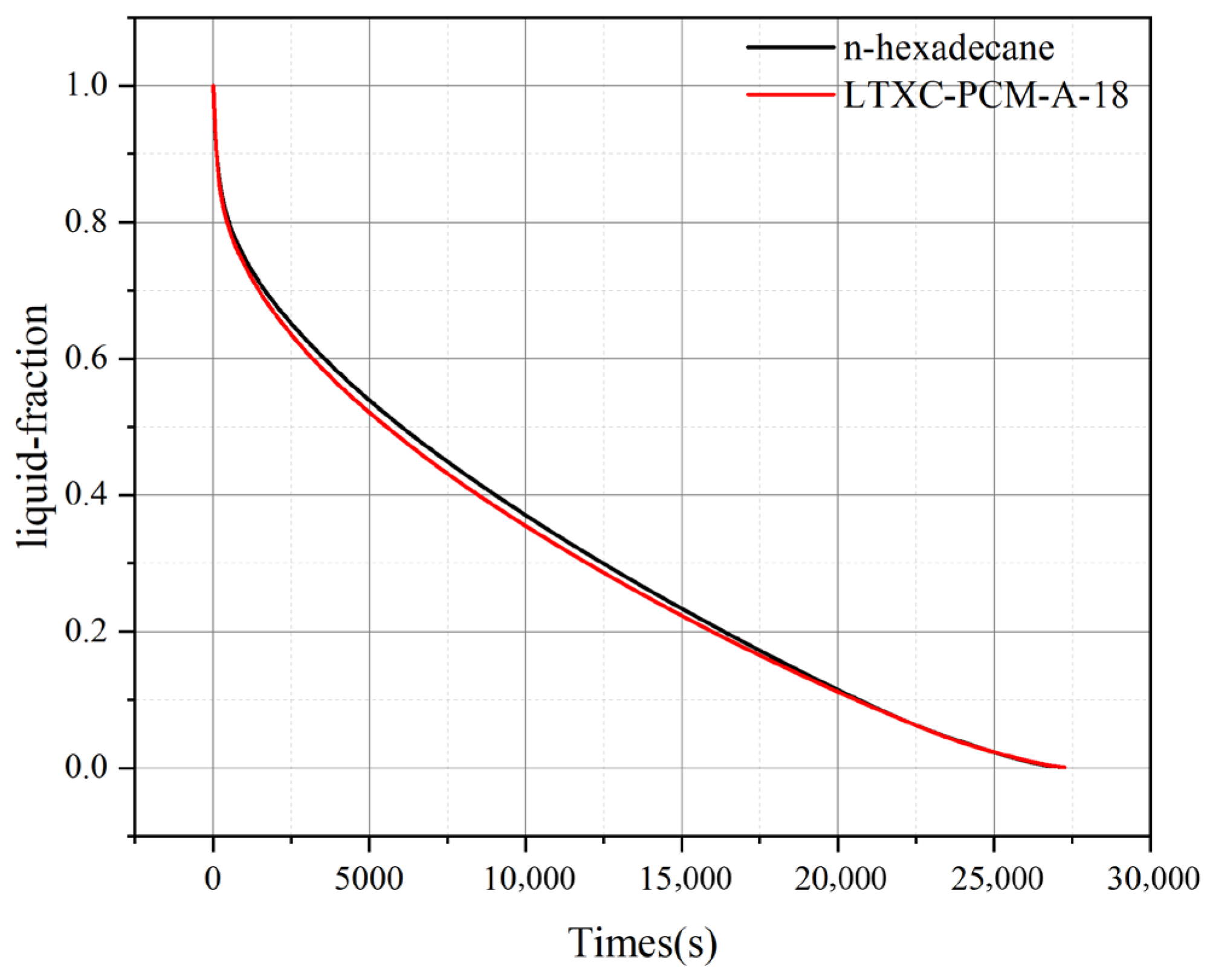
During the solidification process of phase change material (PCM)-filled grooved radiant panels, key differences in solidification characteristics, latent heat release patterns, and thermal stability between the two materials are clearly demonstrated. Figure 12 and Figure 13 present the time-dependent temperature and liquid fraction curves during the solidification exothermic processes of the two PCMs.
Figure 12 presents the temperature-time curves of n-hexadecane and LTXC-PCM-A-18 during solidification in the grooved radiant panel filling structure. The difference in their cooling processes is directly related to the compatibility between the material’s solidification exotherm and the radiant panel’s heat output. At 0 s, the initial temperature of LTXC-PCM-A-18 is approximately 293 K, while that of n-hexadecane is approximately 292 K—both in a fully liquid state.
During the solidification initiation phase (0–5000 s), the red curve (LTXC-PCM-A-18) exhibits a steep decline, with a cooling rate of 0.0006 K/s, while the black curve (n-hexadecane) shows a relatively gradual decline, with a cooling rate of 0.0004 K/s. This indicates that LTXC-PCM-A-18 initiates solidification more rapidly, releases heat to the grooved radiant panel, and responds more sensitively to thermal load demands. The interval of 5000–25,000 s corresponds to the nucleation exothermic phase. Both curves exhibit a gradual decline, with the red curve consistently above the black curve: LTXC-PCM-A-18’s temperature slowly decreased from 290 K to 289 K at a rate of only 0.00005 K/s, while n-hexadecane decreased from 290 K to 288 K at a cooling rate of 0.0001 K/s. This characteristic demonstrates that LTXC-PCM-A-18 has a more pronounced suppression of temperature drop by its solidification exothermic effect, forming a more stable “solidification temperature plateau.” Its temperature consistently remains approximately 1 K higher than that of n-hexadecane, which better aligns with the comfort temperature range for building heating and facilitates stable heat output from the grooved radiant panel.
After 25,000 s, the solidification enters the final stage. LTXC-PCM-A-18’s cooling rate recovered to 0.0004 K/s, approaching complete solidification at 287 K. Meanwhile, n-hexadecane’s cooling rate also recovered to 0.0004 K/s but exhibited a relatively delayed final solidification process.
Figure 13 presents the liquid fraction-time curves of n-hexadecane and LTXC-PCM-A-18 during solidification in the grooved radiant panel filling structure. The decay processes of their liquid fractions clearly demonstrate the kinetic differences in material solidification exothermicity and the thermal output compatibility of the radiant panel. At 0 s, both materials exhibit a liquid fraction of 1.0 (fully liquid). During the solidification initiation phase (0–5000 s), the red curve (LTXC-PCM-A-18) exhibits a steep decline: its liquid fraction decreases from 1.0 to 0.6 at a decay rate of 0.00008 s−1. In contrast, the black curve (n-hexadecane) shows a relatively gradual decrease, dropping only to 0.8 over the same period at a decay rate of 0.00004 s−1. This indicates that LTXC-PCM-A-18 initiates solidification more rapidly, enabling swift release of phase change latent heat during the initial thermal output phase of the grooved radiant panel and demonstrating more responsive behavior to thermal load demands. The core solidification phase spans 5000–20,000 s, where both curves exhibit a gradual decline. However, the red curve consistently remains below the black curve: at 15,000 s, the liquid fraction of LTXC-PCM-A-18 had dropped to 0.2, while n-hexadecane remained above 0.4. This demonstrates that LTXC-PCM-A-18 has a more advanced solidification process, facilitating more efficient heat transfer through the groove structure to the radiant panel.
After 20,000 s, the solidification enters the final stage. The liquid fraction of LTXC-PCM-A-18 approached 0.0 around 25,000 s, completing the overall solidification process; in comparison, the liquid fraction decay of n-hexadecane lagged significantly. Considering application scenarios: LTXC-PCM-A-18’s “rapid initiation-fast progression” characteristics are suitable for intermittent heating applications, enabling swift response to thermal load fluctuations. In contrast, n-hexadecane’s “slow decay-prolonged duration” properties are better suited for continuous heating scenarios, ensuring sustained heat output from radiant panels through prolonged solidification heat release.

5. Conclusions

This study employs Fluent software to establish a numerical model of a novel integrated phase change material (PCM)-filled grooved radiant panel. By simulating and analyzing the complete melting and solidification processes of n-hexadecane and LTXC-PCM-A-18, the differences in their phase change heat transfer performance are compared. Meanwhile, the phase change heat transfer characteristics within this specific grooved structure are elucidated, and the compatibility between the materials and the structure is investigated. The main conclusions are drawn as follows:
1.
During melting, LTXC-PCM-A-18 exhibited a preheating rate of 0.00125 K/s, representing a 67% increase compared with n-hexadecane; its liquid fraction growth rate (0.0002 s−1) from 0 to 2000 s was 2.67 times that of n-hexadecane. At 6000 s, its melting progress was 33.3% ahead, and the melting completion time was 20% earlier than that of n-hexadecane (2000 s). These high-efficiency heat storage characteristics enable LTXC-PCM-A-18 to fully utilize the heat transfer channels of the radiant panel.
2.
During solidification, LTXC-PCM-A-18 exhibited an initial cooling rate (0.0006 K/s) that was 50% faster than that of n-hexadecane, with a liquid fraction decay rate twice that of n-hexadecane. In the core solidification phase, its cooling rate was only 50% of n-hexadecane’s, while maintaining a temperature plateau that was 1 K higher—resulting in superior thermal output stability.
3.
n-Hexadecane undergoes smooth melting and solidification processes, featuring a prolonged temperature plateau during melting and sustained exothermic release during solidification. This makes it suitable for long-term continuous heating applications (e.g., shopping malls and office buildings), where its extended phase transition duration maintains stable heat output from the radiant panel. In contrast, LTXC-PCM-A-18 demonstrates a sensitive thermal response and high phase change efficiency, with a shorter overall melting–solidification cycle. It is better suited for intermittent heating scenarios (e.g., residences and conference rooms), enabling rapid heat storage-release conversion and reducing the startup latency of the radiant panel.
4.
In engineering applications, LTXC-PCM-A-18 should be prioritized for radiant panels serving intermittent heating scenarios, as its rapid phase change response aligns with dynamic thermal load variations. For continuous heating applications, the gradual phase change characteristics of n-hexadecane better support radiant panels in maintaining stable heat output. Future research could further optimize the geometric parameters of the grooved structure to enhance the thermal matching between PCMs and the radiant panel, thereby achieving further improvements in heating efficiency.

Author Contributions

Writing—original draft, H.W.; Writing—review & editing, Z.H. All authors have read and agreed to the published version of the manuscript.

Funding

This study was supported by the Natural Science Foundation of Heilongjiang Province (LH2021E003); and the Enterprise-Commissioned R&D Project of Northeast Forestry University (HKF230500015).

Institutional Review Board Statement

Not applicable.

Informed Consent Statement

Not applicable.

Data Availability Statement

The data presented in this study are available on request from the corresponding author.

Conflicts of Interest

The authors declare no conflicts of interest.

References

  1. Weng, S.; Song, M.; Tao, W.; Chen, J.; Chen, H. Breaking the Inertia of Urban Energy Systems: Does the New Energy Demonstration City Construction Improve Carbon Unlocking Efficiency? Renew. Energy 2025, 244, 122672. [Google Scholar] [CrossRef]
  2. Liu, W.; Dong, Y.; Li, M.; Liu, H.; Wang, X. Weather-Adaptive Janus Aerogel Integrated with Phase Change Materials Enables Dual-Mode Thermal Regulation via Radiative Cooling and Solar Heating. Adv. Funct. Mater. 2025, e13665. [Google Scholar] [CrossRef]
  3. Ji, B.Y.; Mao, X.F.; Cao, Y.; Liu, Y.M.; Cui, Z.G. Current Status and Development Suggestions for China’s Building Energy Conservation and Low-Carbon Technology Standards System. Constr. Econ. 2022, 43, 19–26. [Google Scholar] [CrossRef]
  4. Hu, Y.; Qin, L.; Li, S.; Li, X.; Li, Y.; Sheng, W. A Novel Energy Saving Framework Based on Optimal Chiller Loading and Parameter Optimization for HVAC: A Case Study for Subway Station. J. Build. Eng. 2025, 101, 111887. [Google Scholar] [CrossRef]
  5. Kang, Z.; Peng, X.; Cheng, X.; Feng, G. Current Status of Domestic Research on Composite Radiant Cooling and Air Conditioning Systems. Fluid Mach. 2017, 45, 68–71. [Google Scholar]
  6. Zhao, B.; Hu, M.; Ao, X.; Chen, N.; Pei, G. Radiative Cooling: A Review of Fundamentals, Materials, Applications, and Prospects. Appl. Energy 2019, 236, 489–513. [Google Scholar] [CrossRef]
  7. Zhao, X.; Li, Y.; Chen, X.; Yin, Y.; Huang, G. Radiation Cooling System: Limitations, Solutions, and Future Challenges. Renew. Sustain. Energy Rev. 2025, 212, 115428. [Google Scholar] [CrossRef]
  8. Cui, M.; Ning, B.; Wu, X.; Kim, M.K.; Yang, B.; Tian, Z.; Liu, J. The Development of Radiant Floor Cooling System (RFCS): System Type, Control Strategy, and Application. Results Eng. 2024, 23, 102544. [Google Scholar] [CrossRef]
  9. Suresh, C.; Awasthi, A.; Kumar, B.; Lee, H.; Jeon, Y. Comprehensive Review on Heat Pump Systems Integrated with Phase Change Material-Based Thermal Energy Storage for Sustainable Building Heating. Renew. Sustain. Energy Rev. 2026, 226, 116197. [Google Scholar] [CrossRef]
  10. Sarbu, I.; Dorca, A. Review on Heat Transfer Analysis in Thermal Energy Storage Using Latent Heat Storage Systems and Phase Change Materials. Int. J. Energy Res. 2019, 43, 29–64. [Google Scholar] [CrossRef]
  11. Almtuly, O.S.; Wahid, M.A.; Ardani, M.I.; Hussen, H.M.; Al-Dhief, F.T. A Comprehensive Review of Integrating Phase Change Materials with Radiant Cooling Panel Systems for Energy Savings and Improved Thermal Comfort Designs. Results Eng. 2025, 26, 105169. [Google Scholar] [CrossRef]
  12. Duan, X.T.; Long, Y.; Zhang, J.Q.; Jiao, R.; Li, J.Y. Research progress and prospects of phase change energy storage materials in energy-efficient buildings. Fine Chem. 2025, 1–20. [Google Scholar] [CrossRef]
  13. Tang, L.; Zeng, D.S.; Ling, Z.Y.; Zhang, Z.G.; Fang, X.M. Research progress on phase change cold storage materials and systems. Chem. Ind. Prog. 2023, 42, 4322–4339. [Google Scholar] [CrossRef]
  14. Gopalan, A.; Antony, A.S.M.; Suresh, R.; Sahoo, S.; Livingston, L.M.; Titus, A.; Nanammal, V.; Mohanavel, V.; Sathyamurthy, R. Performance Enhancement of Building Energy through the Combination of Dynamic Insulation Panels and Phase Changing Materials. Energy Rep. 2022, 8, 945–958. [Google Scholar] [CrossRef]
  15. Sun, B.; Xu, Y.; Zhang, Y.; Zhao, H.; Liu, X. Simulation and Optimization Research of Double Energy Storage Floor Based on Heat Transfer Characteristic of Phase Change Materials. J. Energy Storage 2022, 51, 104452. [Google Scholar] [CrossRef]
  16. Nomura, T.; Tabuchi, K.; Zhu, C.; Sheng, N.; Wang, S.; Akiyama, T. High Thermal Conductivity Phase Change Composite with Percolating Carbon Fiber Network. Appl. Energy 2015, 154, 678–685. [Google Scholar] [CrossRef]
  17. Afaynou, I.; Faraji, H.; Choukairy, K.; Djebali, R.; Rezk, H. Comprehensive Analysis and Thermo-Economic Optimization of a Hybrid Phase Change Material-Based Heat Sink for Electronics Cooling. Heat Transf. 2025, 54, 3754–3774. [Google Scholar] [CrossRef]
  18. Boujelbene, M.; Mohammed, H.I.; Sultan, H.S.; Eisapour, M.; Chen, Z.; Mahdi, J.M.; Cairns, A.; Talebizadehsardari, P. A Comparative Study of Twisted and Straight Fins in Enhancing the Melting and Solidifying Rates of PCM in Horizontal Double-Tube Heat Exchangers. Int. Commun. Heat Mass Transf. 2024, 151, 107224. [Google Scholar] [CrossRef]
  19. Zhang, J.; Li, M.; Li, H.; Fu, Y.; Cai, L. Optimization of Thermal Management for the Environmental Worthiness Design of Aviation Equipment Using Phase Change Materials. Aerospace 2024, 11, 943. [Google Scholar] [CrossRef]
  20. Srivastava, U.; Sahoo, R.R. Advanced Fin Designs for Enhancement in Thermal Management of Eutectic Phase Change Materials in a Latent Heat Thermal Energy Storage System. Int. Commun. Heat Mass Transf. 2026, 170, 109932. [Google Scholar] [CrossRef]
  21. Vakilzadeh, A.H.; Sarvestani, A.B.; Javaherdeh, K.; Kamali, R.; Panchal, S. Heat Transfer and Fluid Flow in a PCM-Filled Enclosure: Effect of Heated Wall Configuration. J. Energy Storage 2024, 87, 111448. [Google Scholar] [CrossRef]
  22. Tajik Jamalabad, M.; Cortes, C.; Pallarés, J.; Gil, A.; Arauzo, I. Comparison of Different Numerical Models for Solidification of Paraffin-Based PCMs and Evaluation of the Effect of Variable Mushy Zone Constant. Energies 2024, 17, 5982. [Google Scholar] [CrossRef]
  23. Herrera, P.; De la Hoz Siegler, H.; Clarke, M. Fatty Acids as Phase Change Materials for Building Applications: Drawbacks and Future Developments. Energies 2024, 17, 4880. [Google Scholar] [CrossRef]
  24. Jiang, J.Z.; Yang, Q.; Zhu, H.R.; Cui, H.T.; Song, Q.S. Effect of Medium Filling Degree and Porosity on Thermal Storage Characteristics of Thermal Storage Cavity. Acta Energiae Solaris Sin. 2025, 46, 106–115. [Google Scholar] [CrossRef]
  25. Tan, X.; Cheng, X.S.; Yu, Q.H.; Fang, G.H.; Zhao, C. Research on Thermal Storage Performance of Phase Change Hot Water Tank Based on Fluent. Mach. Tool Hydraul. 2020, 48, 121–125. [Google Scholar]
  26. Tu, N.; Liu, J.C.; Xu, J.; Fang, J.B.; Ma, Y.H. Performance Analysis of Heat Storage and Release Processes of Shell-and-Tube Phase Change Heat Storage Device. Power Gener. Technol. 2024, 45, 508–516. [Google Scholar]
  27. Gu, J.A.; Wu, H.J. Simulation Study on Heat Transfer Performance of Radiant Cooling Panels with Different Phase Change Material Interlayers. Cryog. Supercond. 2022, 50, 40–50, 57. [Google Scholar] [CrossRef]
  28. Meng, F.; Che, C.; Wu, Y.; Wei, J.; Rong, J.; Yang, X.; Li, D.; Yang, R.; Wang, Z. Thermal Storage Performance of a Shell and Tube Phase Change Heat Storage Unit with Different Thermophysical Parameters of the Phase Change Material. Processes 2024, 12, 123. [Google Scholar] [CrossRef]
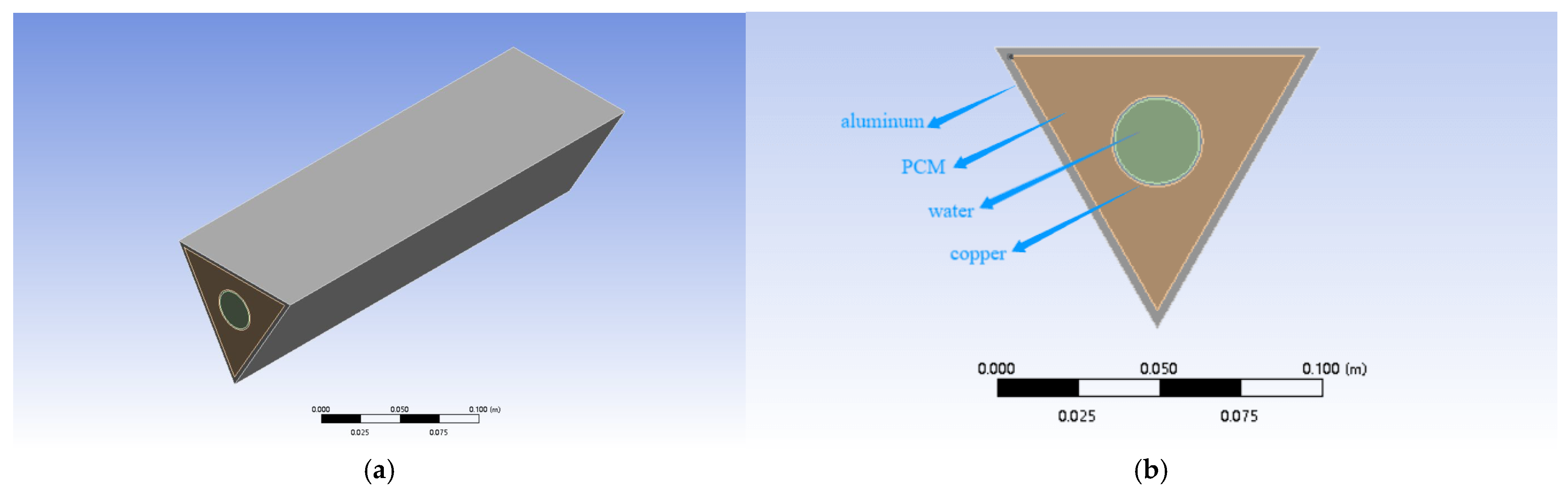
Figure 1. (a) Schematic diagram of the model and (b) cross-sectional diagram.
Applsci 15 13260 g001
Figure 2. Schematic Diagram of a Flat Radiant Panel Model.
Applsci 15 13260 g002
Figure 3. (a) Time-dependent variation in the average convective heat transfer coefficient on the wall surface for grooved and flat radiant panels. (b) Time-dependent liquid fraction of grooved and flat radiant panels”.
Applsci 15 13260 g003
Figure 4. Variation in liquid phase fraction of PCM-filled trench-type radiator heat exchange units with different grid numbers during 1000 s of heat release.
Applsci 15 13260 g004
Figure 5. Time-dependent curves of liquid phase fraction and average temperature of the radiator plate.
Applsci 15 13260 g005
Figure 6. Melting temperature cloud maps at different time points—Left: LTXC-PCM-A-18 (0 s, 3000 s, 6000 s, 9000 s, 15,000 s). Right: n-hexadecane (0 s, 6000 s, 9000 s, 15,000 s, 21,000 s).
Applsci 15 13260 g006
Figure 7. Melting liquid phase fraction cloud maps at different time points—Left: LTXC-PCM-A-18 (0 s, 3000 s, 6000 s, 9000 s, 15,000 s). Right: n-Hexadecane (0 s, 6000 s, 9000 s, 15,000 s, 21,000 s).
Applsci 15 13260 g007
Figure 8. Time-dependent melting temperature curves for n-hexadecane and LTXC-PCM-A-18.
Applsci 15 13260 g008
Figure 9. Time-dependent liquid phase fraction curves for n-hexadecane and LTXC-PCM-A-18.
Applsci 15 13260 g009
Figure 10. Solidification temperature cloud maps at identical time points—Left: LTXC-PCM-A-18 (0 s, 15,000 s, 30,000 s, 45,000 s, 54,000 s). Right: n-Hexadecane (0 s, 15,000 s, 30,000 s, 45,000 s, 54,000 s).
Applsci 15 13260 g010
Figure 11. Solidification liquid phase fraction cloud maps at identical time points—Left: LTXC-PCM-A-18 (0 s, 15,000 s, 30,000 s, 45,000 s, 54,000 s). Right: n-Hexadecane (0 s, 15,000 s, 30,000 s, 45,000 s, 54,000 s).
Applsci 15 13260 g011
Figure 12. Time-dependent solidification temperature curves for n-hexadecane and LTXC-PCM-A-18.
Applsci 15 13260 g012
Figure 13. Time-dependent solidification liquid phase fraction curves for n-hexadecane and LTXC-PCM-A-18.
Applsci 15 13260 g013
Table 1. Nomenclature.
Symbol/AbbreviationDefinitionUnit
ρ Density of phase change material (PCM)kg/m3
C p Specific heat capacity at constant pressureJ/(kg·K)
k Thermal conductivityW/(m·K)
μ Dynamic viscositykg/(m·s)
L Latent heat of phase changeJ/kg
T solidus Solidus temperature°C
T liquidus Liquidus temperature°C
β Liquid fraction (phase change ratio)1/K
g Gravitational accelerationm/s2
h Specific enthalpyJ/kg
p PressurePa
Re Reynolds number
S m Mushy zone source term
S h Phase change latent heat source term
T TemperatureK
T ref Reference temperatureK
t Times
V Volume of PCM domainm3
v Velocity vectorm/s
h avg the average convective heat transfer coefficientW/(m2·K)
A mush Mushy zone constant
CFDComputational Fluid Dynamics
DIMSDynamic Insulated Composite Panel
HVACHeating, Ventilation and Air Conditioning
IEAInternational Energy Agency
HTFHeat Transfer Fluid
PCMPhase Change Material
PCCsPhase Change Composites
Table 2. Thermophysical Properties of PCMs.
Parametersn-HexadecaneLTXC-PCM-A-18Unit
ρ 770800kg/m3
C p 22002000J/(kg·K)
k 0.150.2W/(m·K)
μ 0.0030.003kg/(m·s)
L 237,000220,000J/kg
T solidus 17.517.5°C
T liquidus 18.519.5°C
β 9.5 × 10−48.0 × 10−41/K
A mush 105105
Disclaimer/Publisher’s Note: The statements, opinions and data contained in all publications are solely those of the individual author(s) and contributor(s) and not of MDPI and/or the editor(s). MDPI and/or the editor(s) disclaim responsibility for any injury to people or property resulting from any ideas, methods, instructions or products referred to in the content.