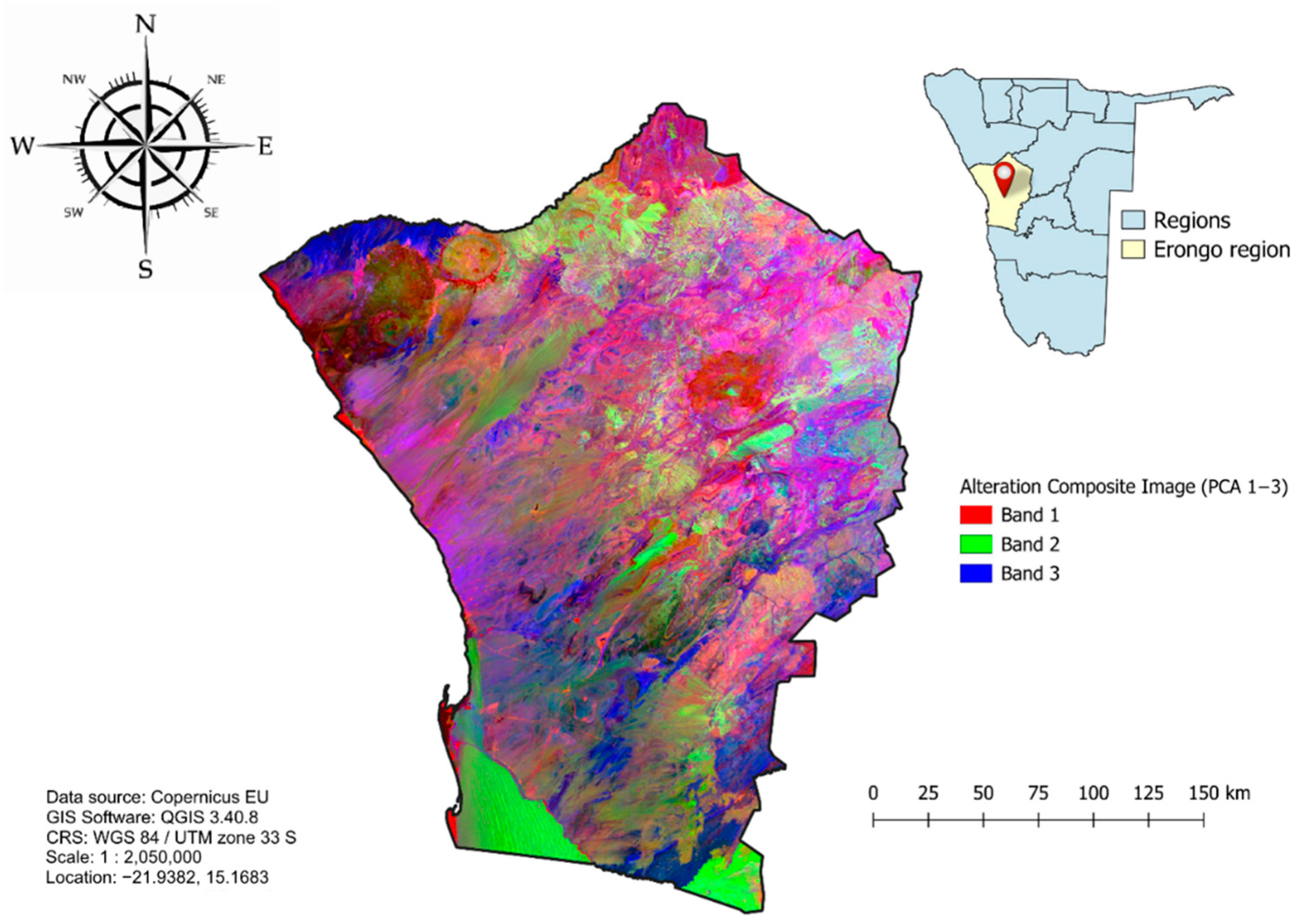
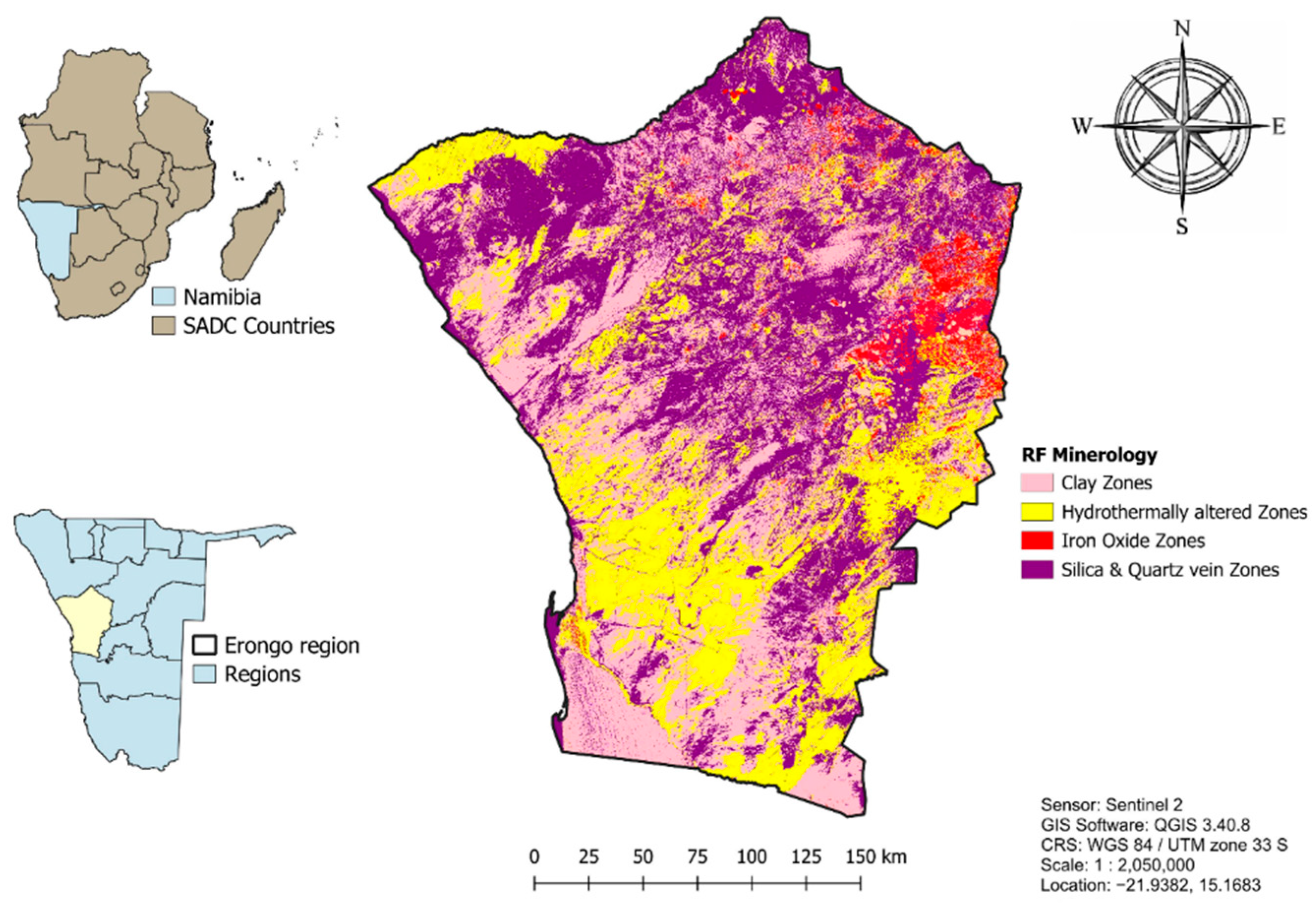
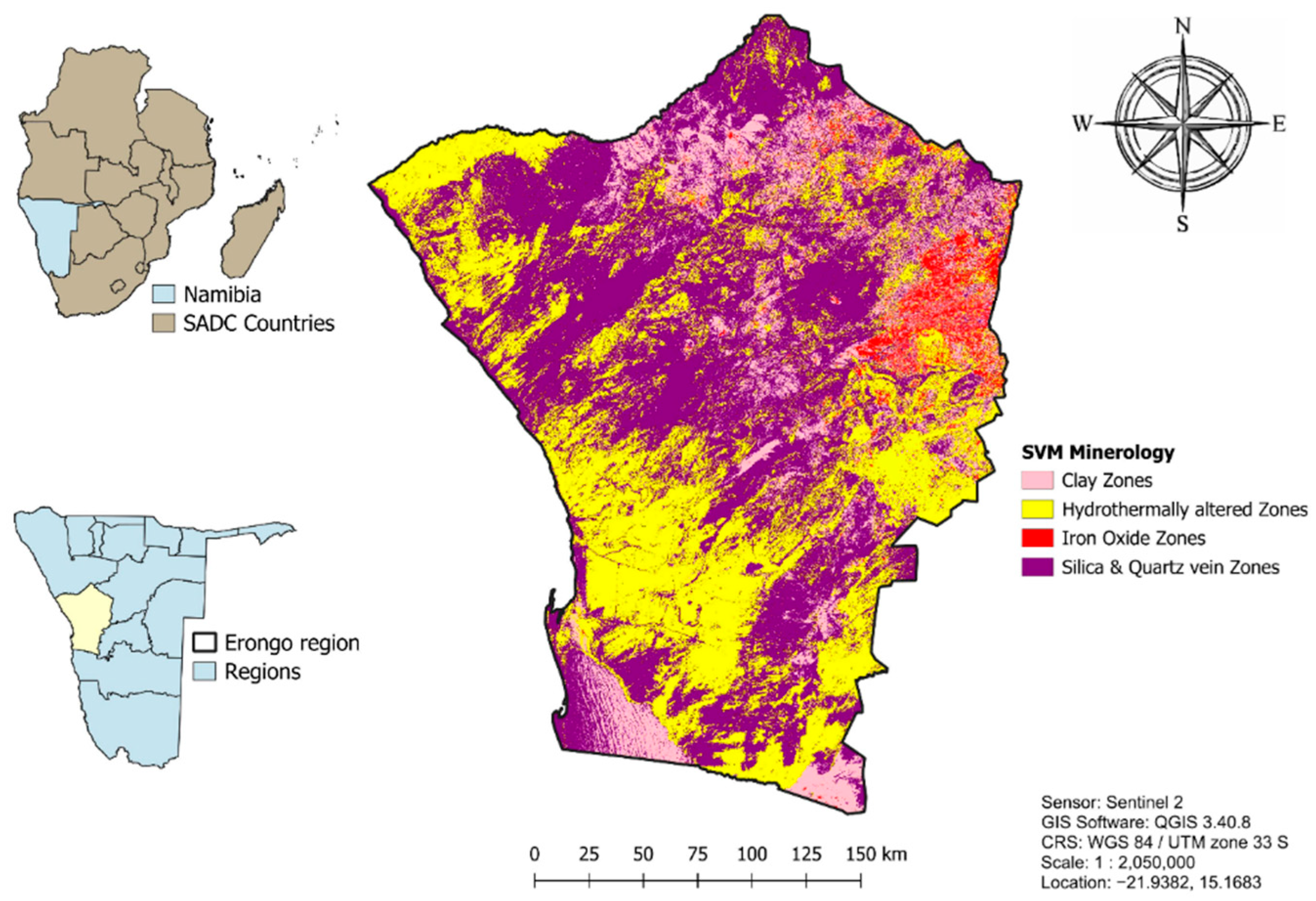
Figure 1.
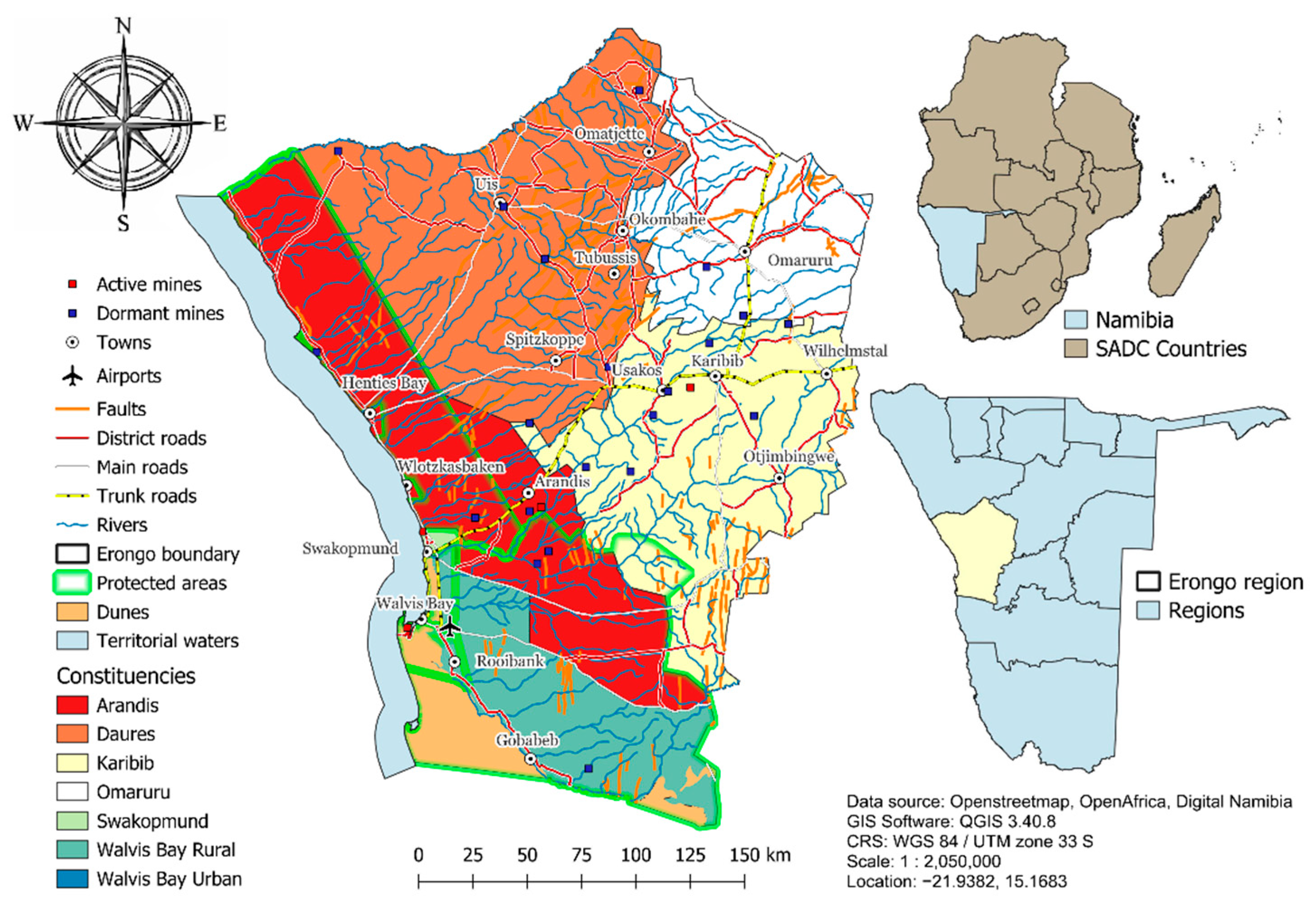
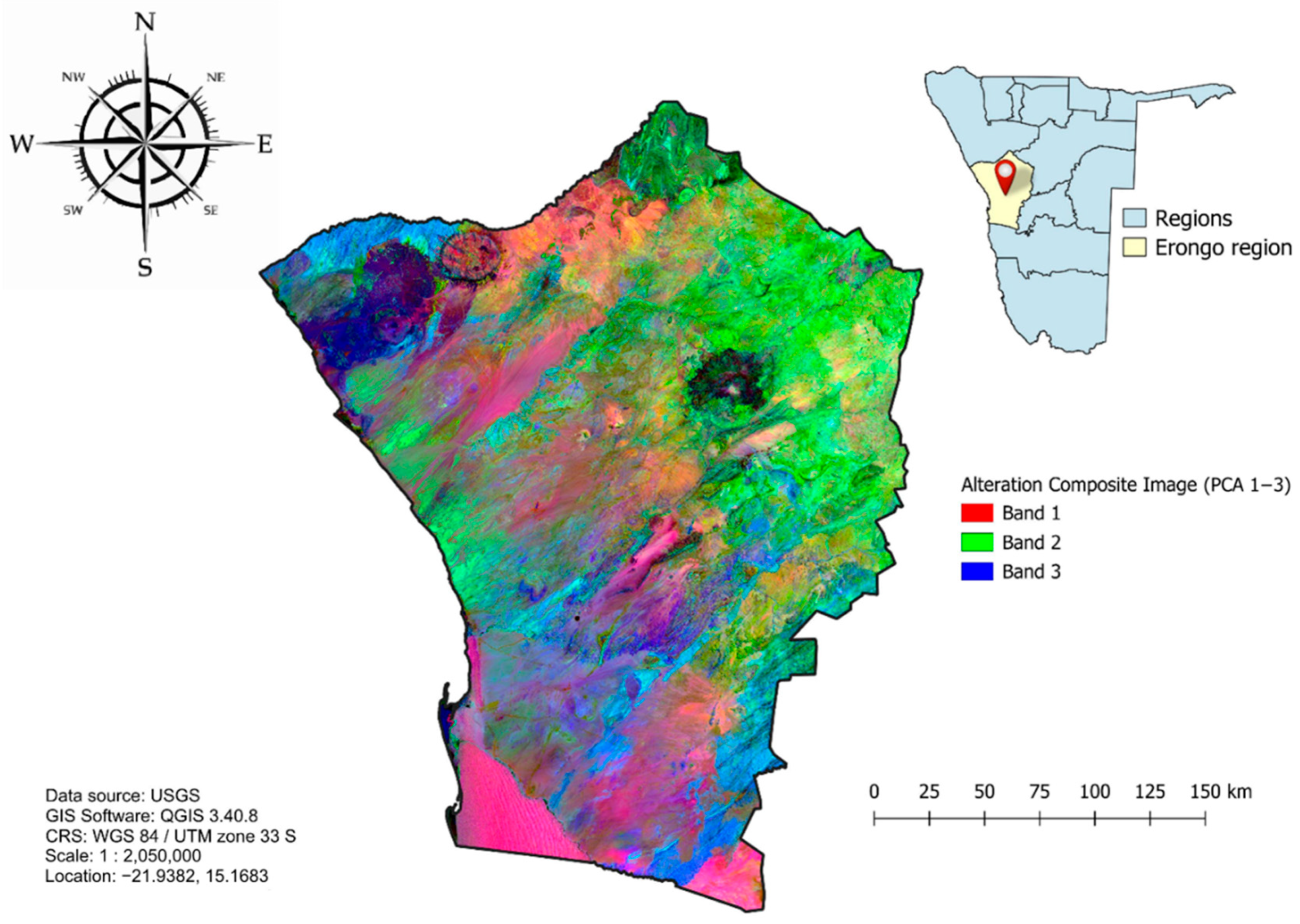
Map of Erongo region, Namibia, showing administrative boundaries, infrastructure, land features and mining activity.
Figure 1.
Map of Erongo region, Namibia, showing administrative boundaries, infrastructure, land features and mining activity.
Figure 2.
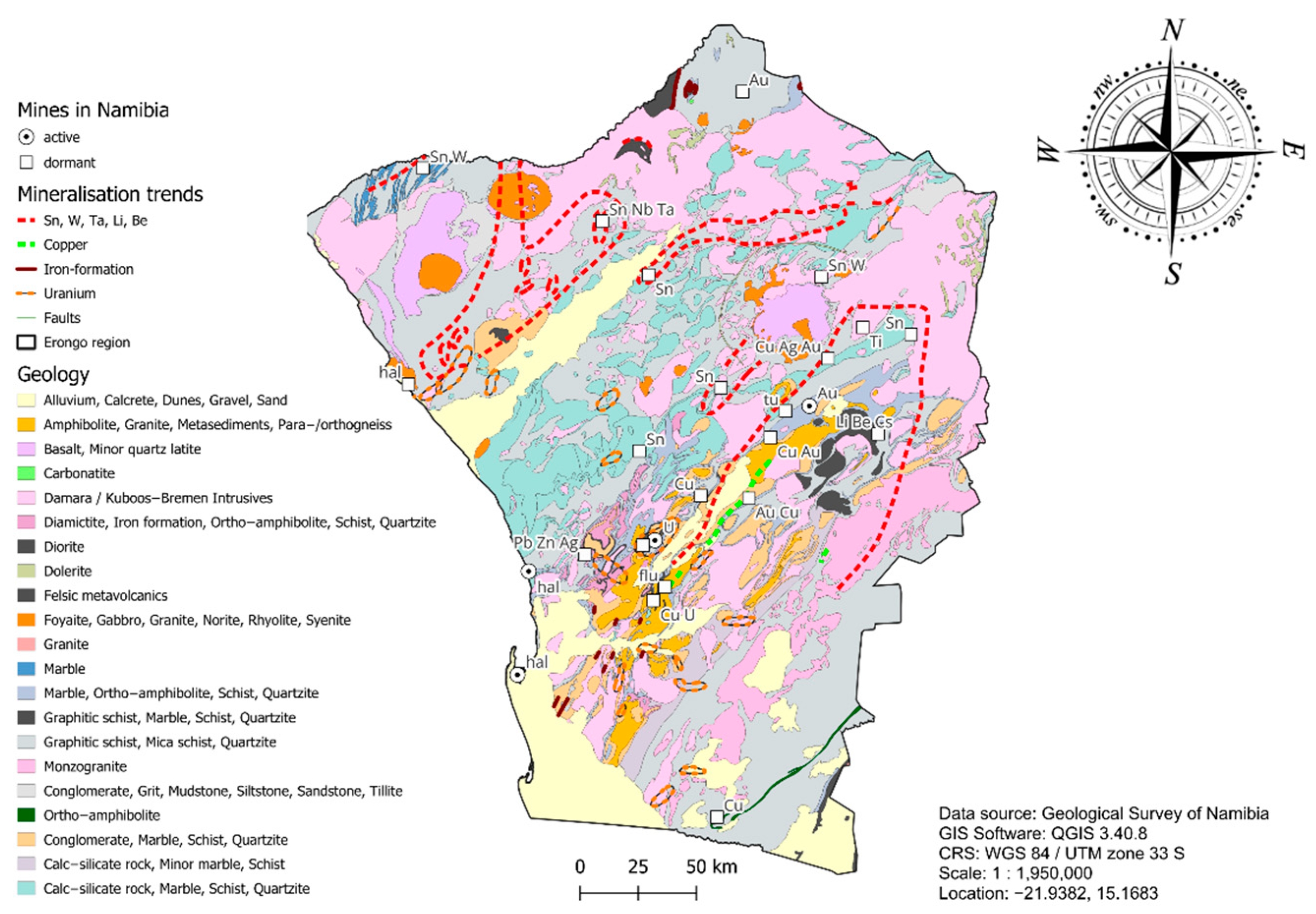
Geological map of the Erongo Region, Namibia, illustrating the principal lithological units, the relevant mines in Namibia and what has been extracted by them.
Figure 2.
Geological map of the Erongo Region, Namibia, illustrating the principal lithological units, the relevant mines in Namibia and what has been extracted by them.
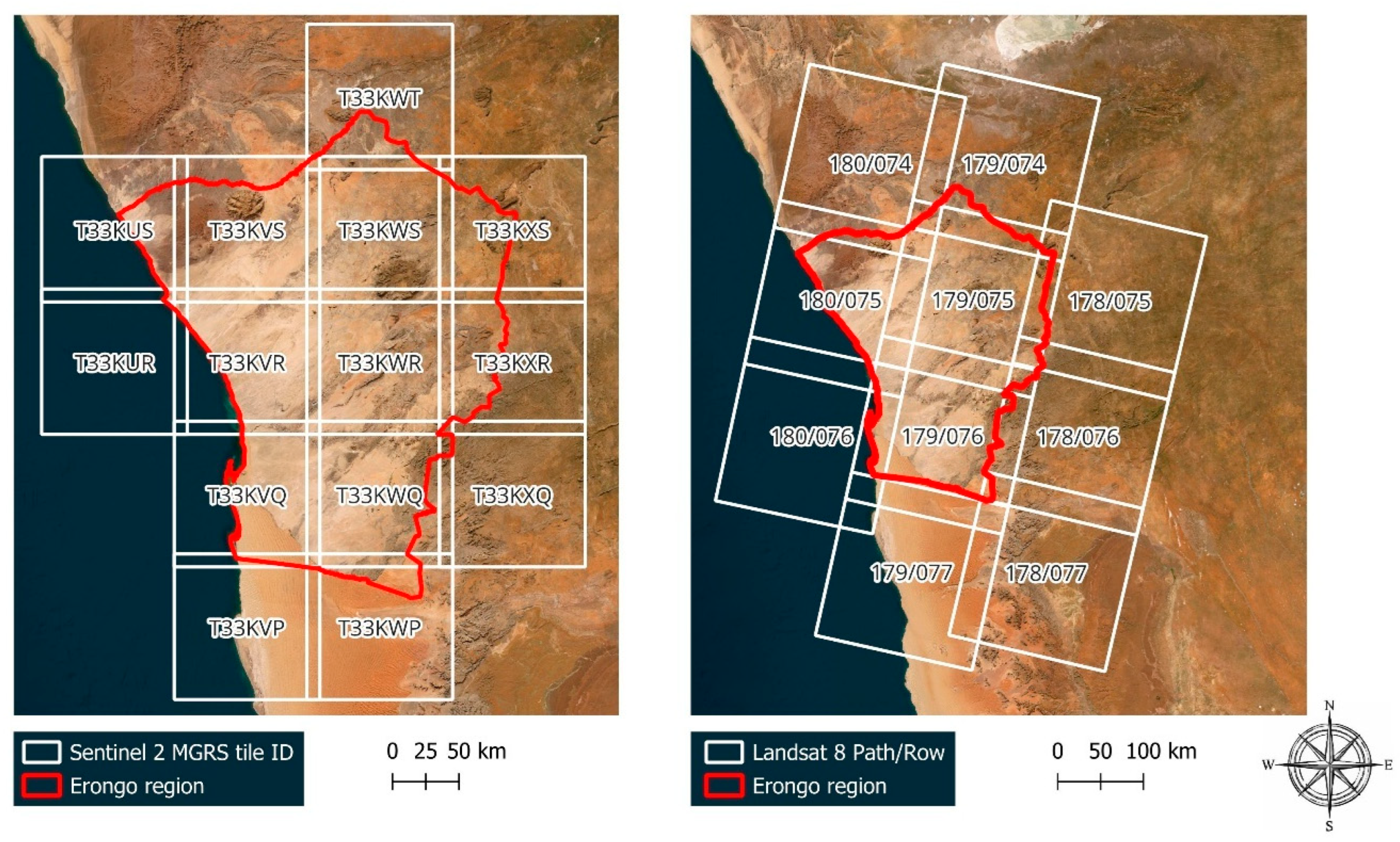
Figure 3.
Satellite scene coverage of the Erongo region showing Sentinel 2 MGRS tile IDs (left) and Landsat 8 Path/Row scenes (right).
Figure 3.
Satellite scene coverage of the Erongo region showing Sentinel 2 MGRS tile IDs (left) and Landsat 8 Path/Row scenes (right).
Figure 4.
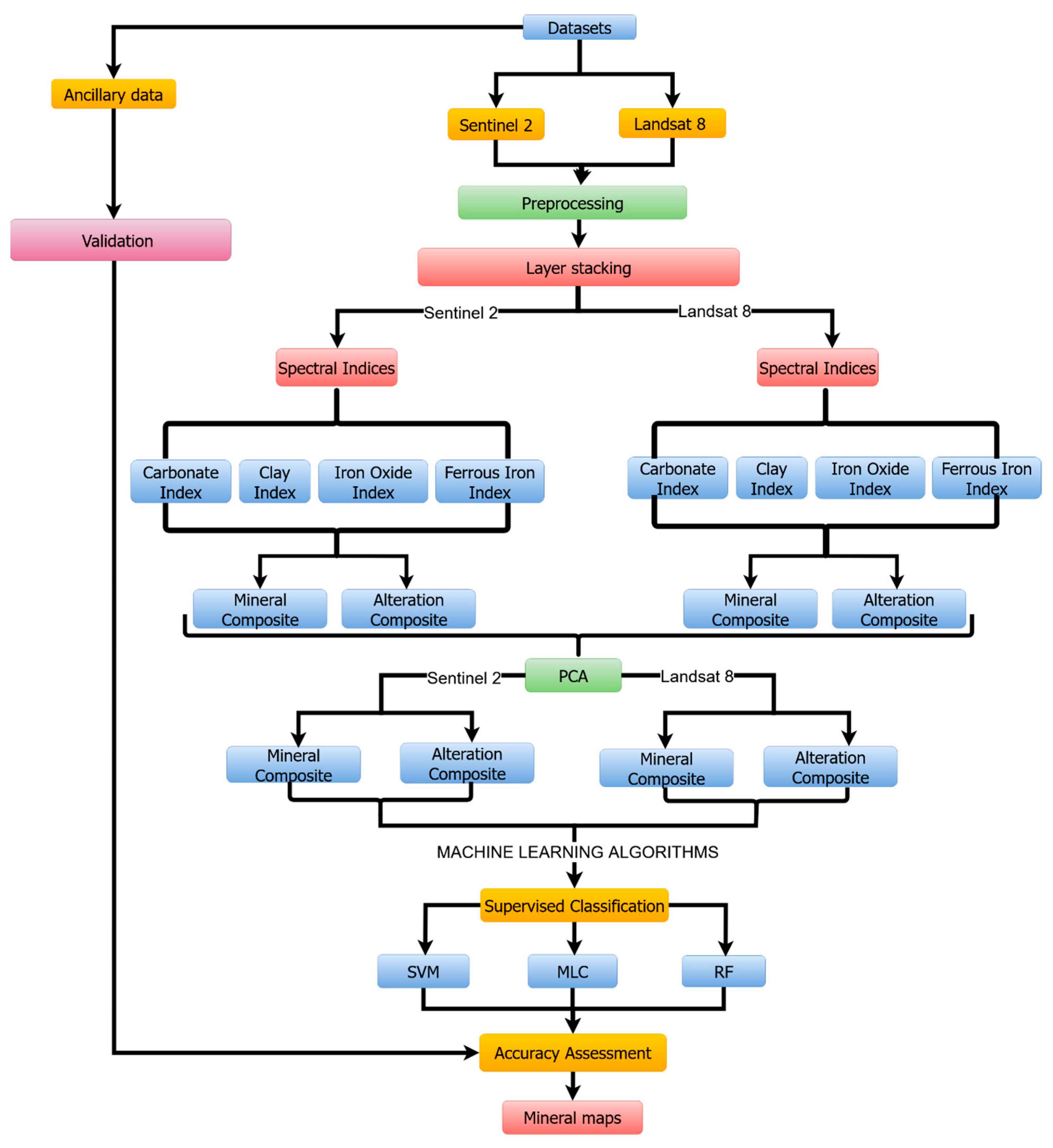
Methodological framework for mineral exploration in the Erongo region using Sentinel 2 and Landsat 8 imagery. The process covers preprocessing, spectral index generation, PCA and supervised classification (SVM, MLC, RF), followed by accuracy assessment.
Figure 4.
Methodological framework for mineral exploration in the Erongo region using Sentinel 2 and Landsat 8 imagery. The process covers preprocessing, spectral index generation, PCA and supervised classification (SVM, MLC, RF), followed by accuracy assessment.
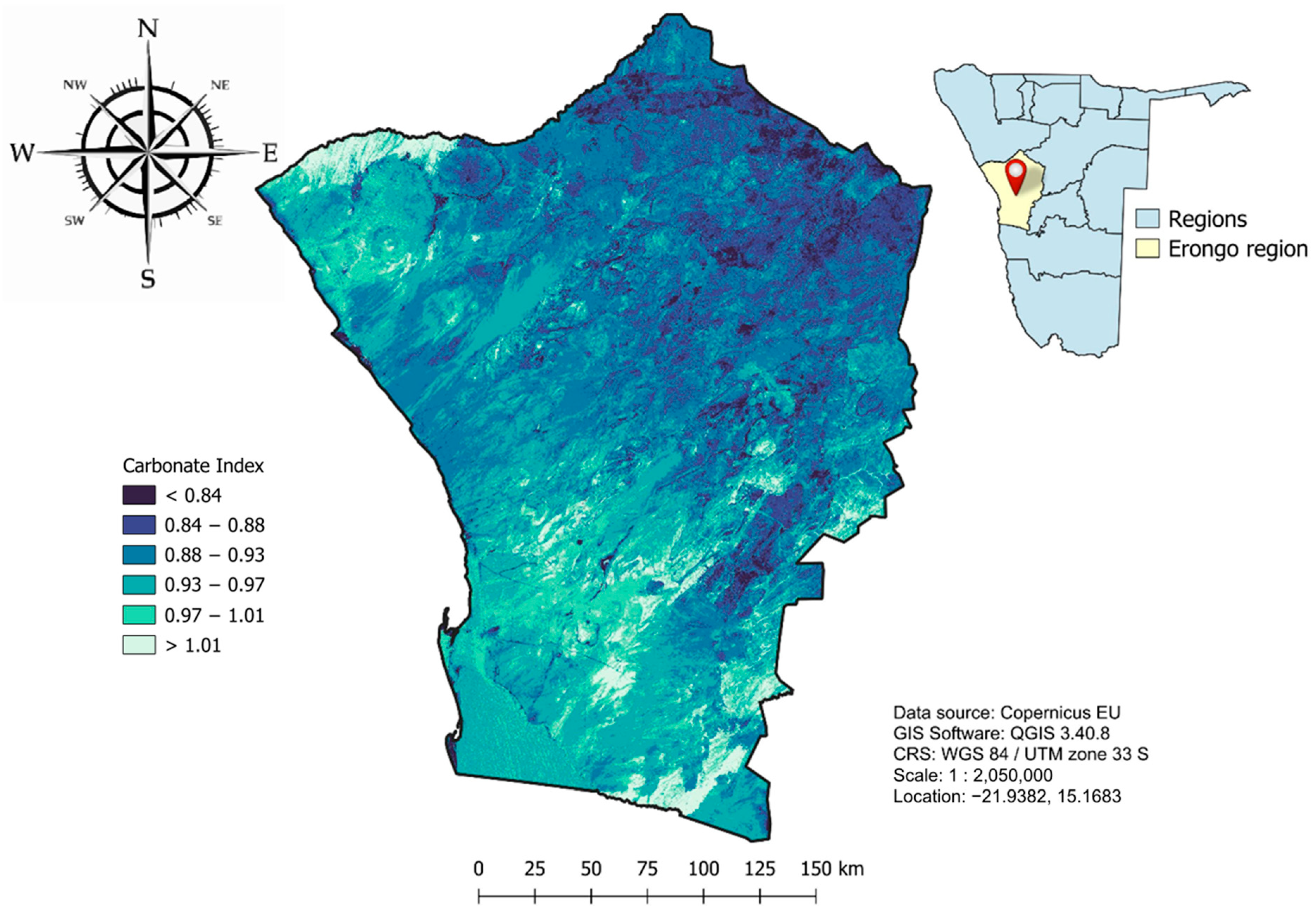
Figure 5.
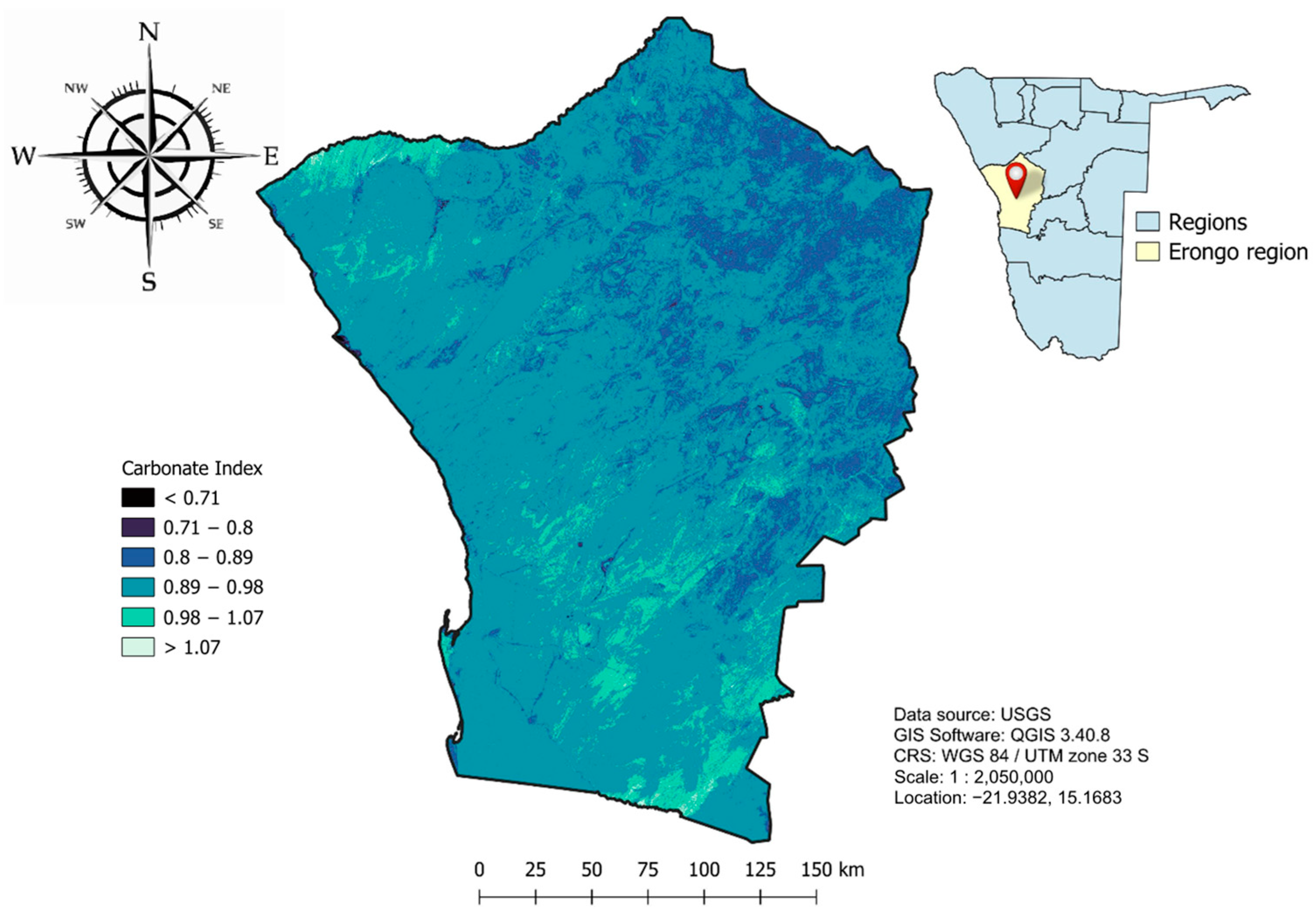
Carbonate Index map of the Erongo region, Namibia, derived from Landsat 8 imagery, illustrating the spatial variability of carbonate-bearing mineral zones across the study area.
Figure 5.
Carbonate Index map of the Erongo region, Namibia, derived from Landsat 8 imagery, illustrating the spatial variability of carbonate-bearing mineral zones across the study area.
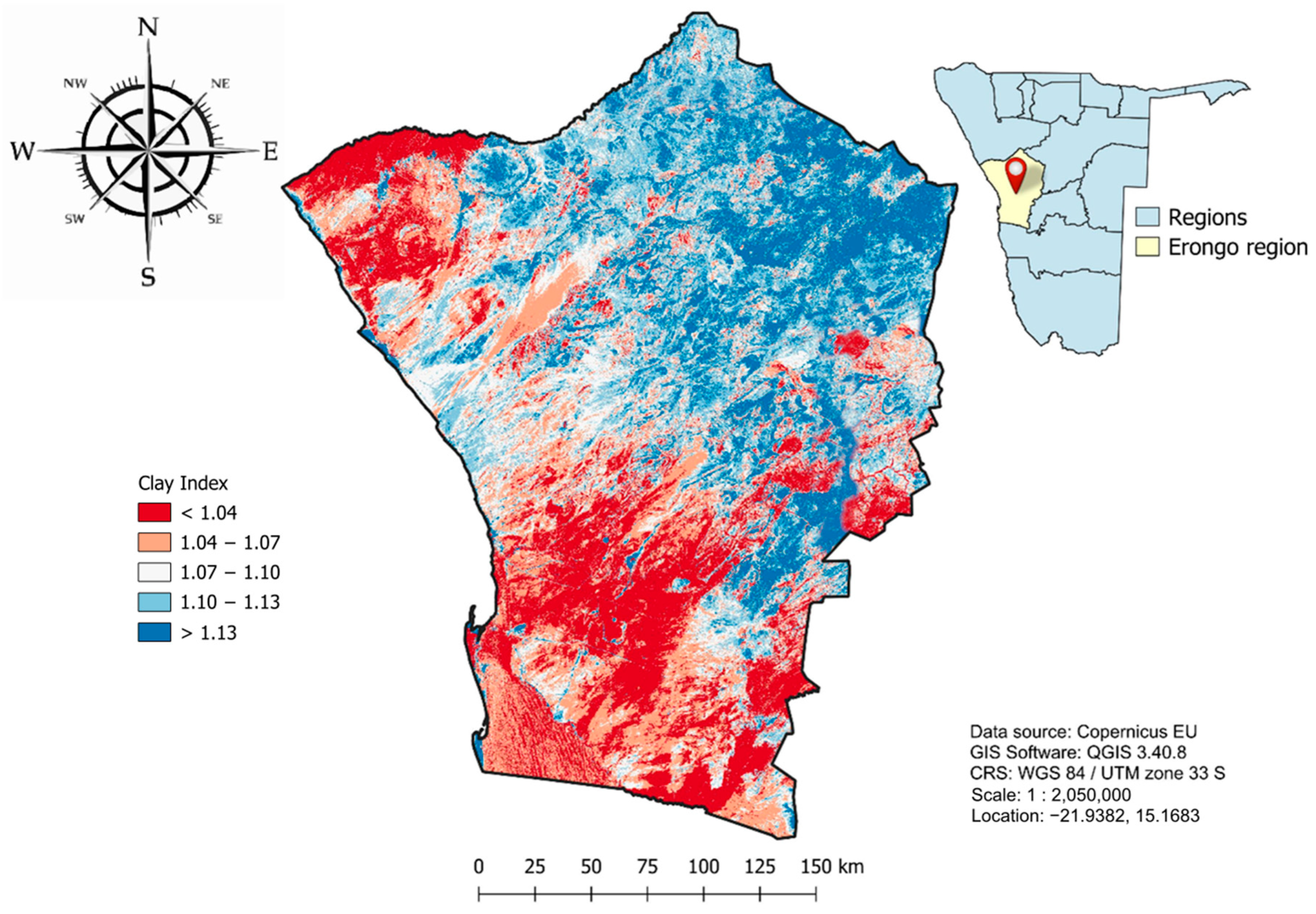
Figure 6.
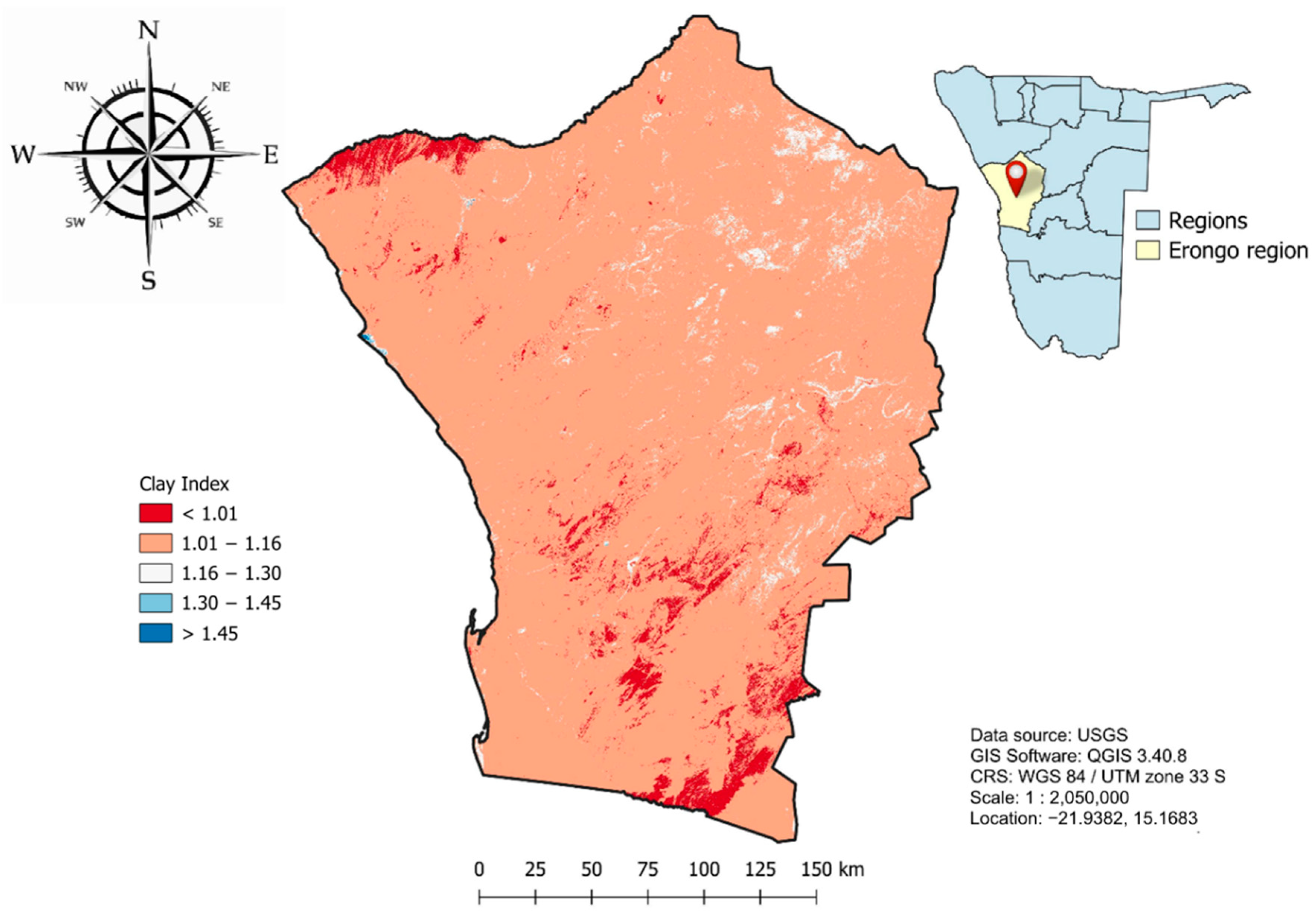
Clay Index map of the Erongo region, Namibia, derived from Landsat 8 imagery, highlighting the spatial distribution of clay-rich mineral zones across the study area.
Figure 6.
Clay Index map of the Erongo region, Namibia, derived from Landsat 8 imagery, highlighting the spatial distribution of clay-rich mineral zones across the study area.
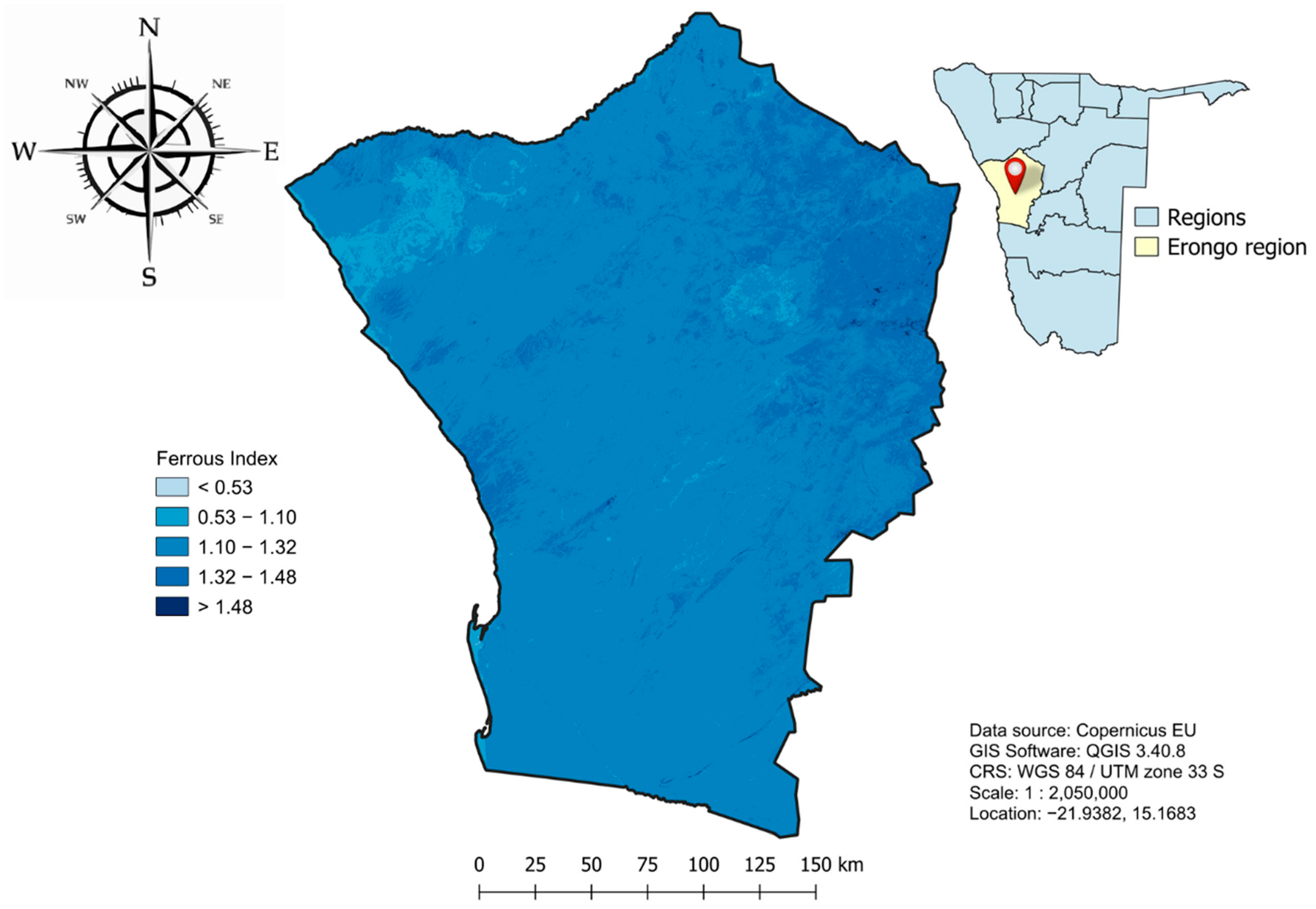
Figure 7.
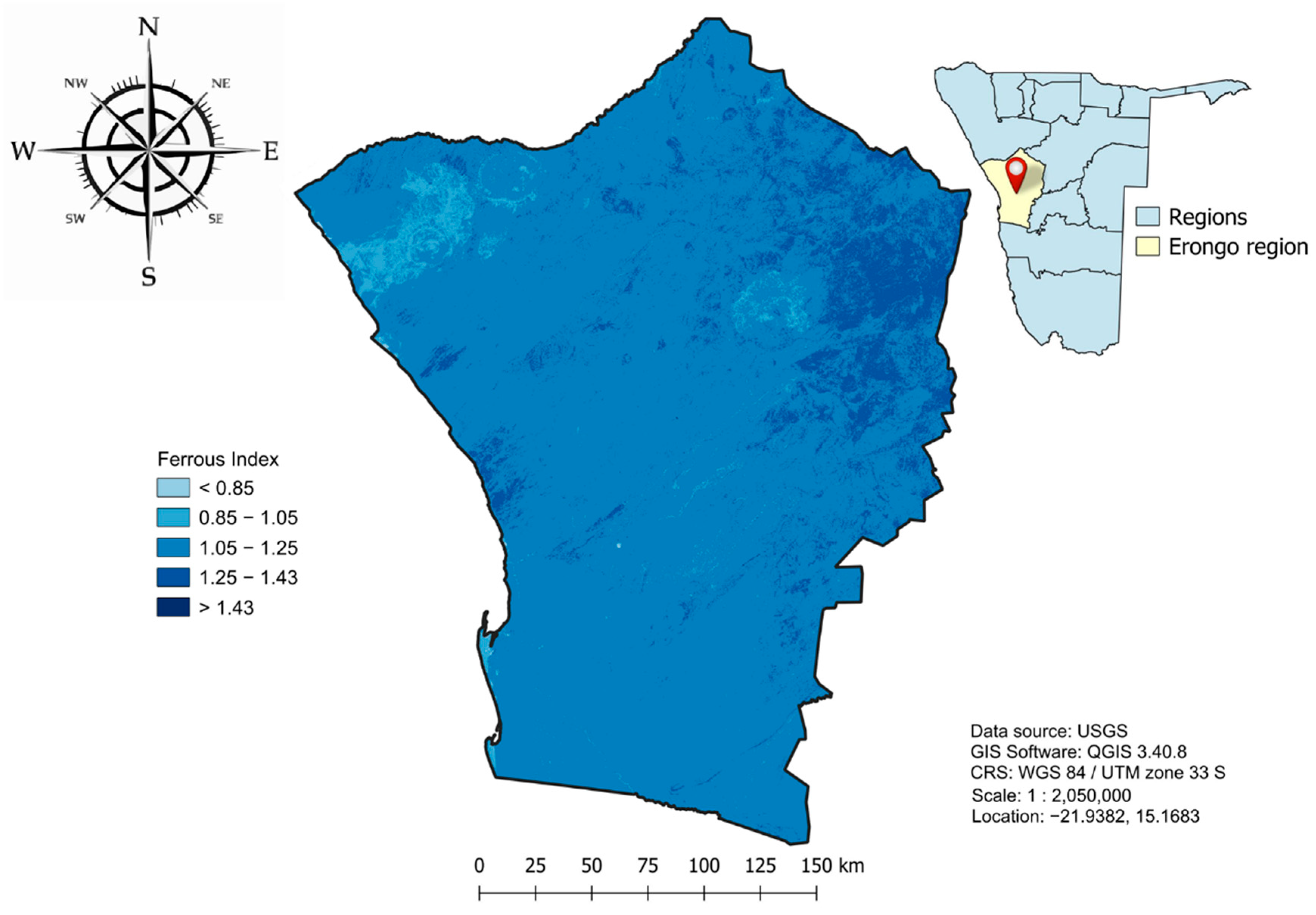
Ferrous Iron Index map of the Erongo region, Namibia, derived from Landsat 8 imagery, illustrating the distribution and relative intensity of ferrous iron-bearing minerals across the study area.
Figure 7.
Ferrous Iron Index map of the Erongo region, Namibia, derived from Landsat 8 imagery, illustrating the distribution and relative intensity of ferrous iron-bearing minerals across the study area.
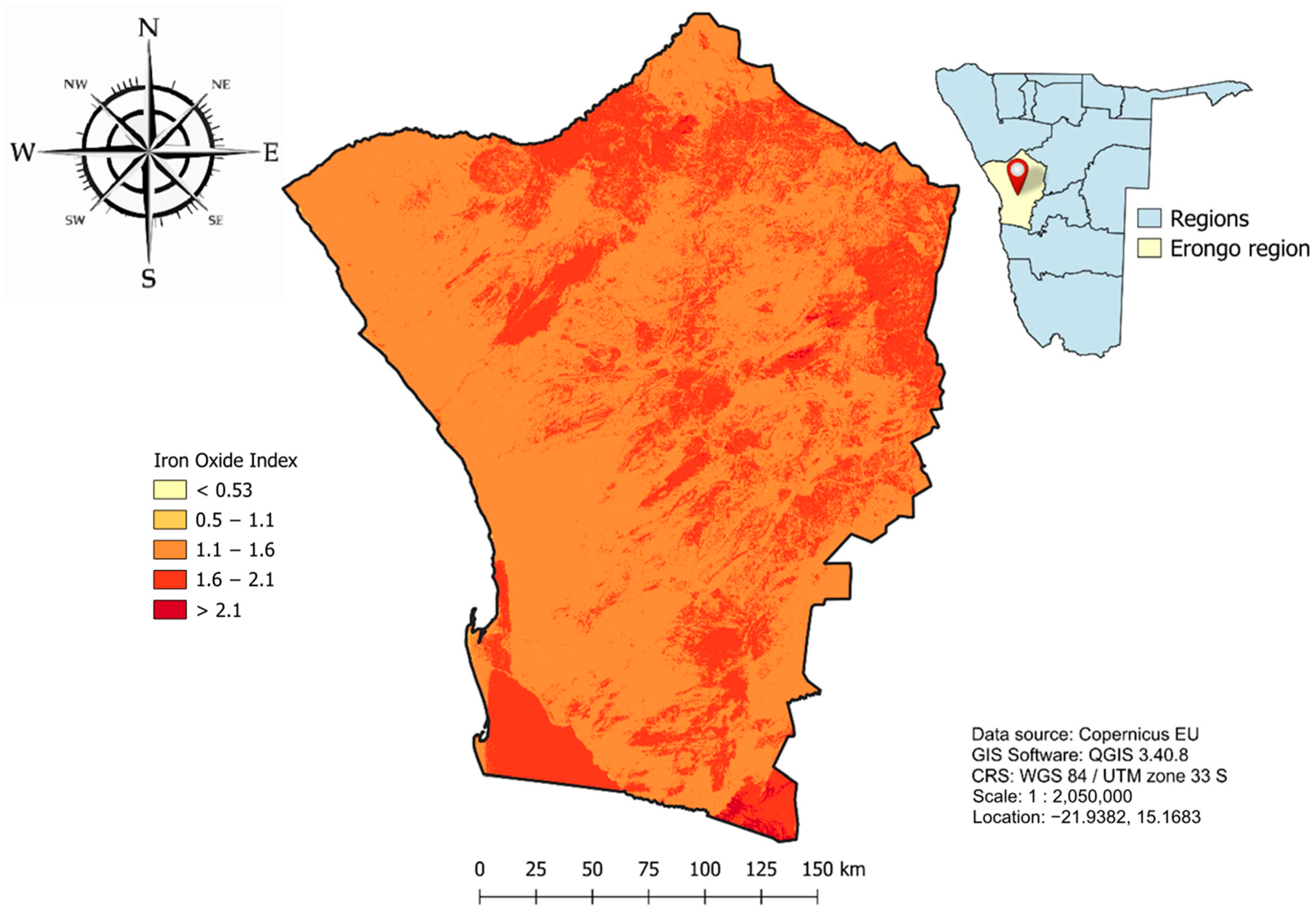
Figure 8.
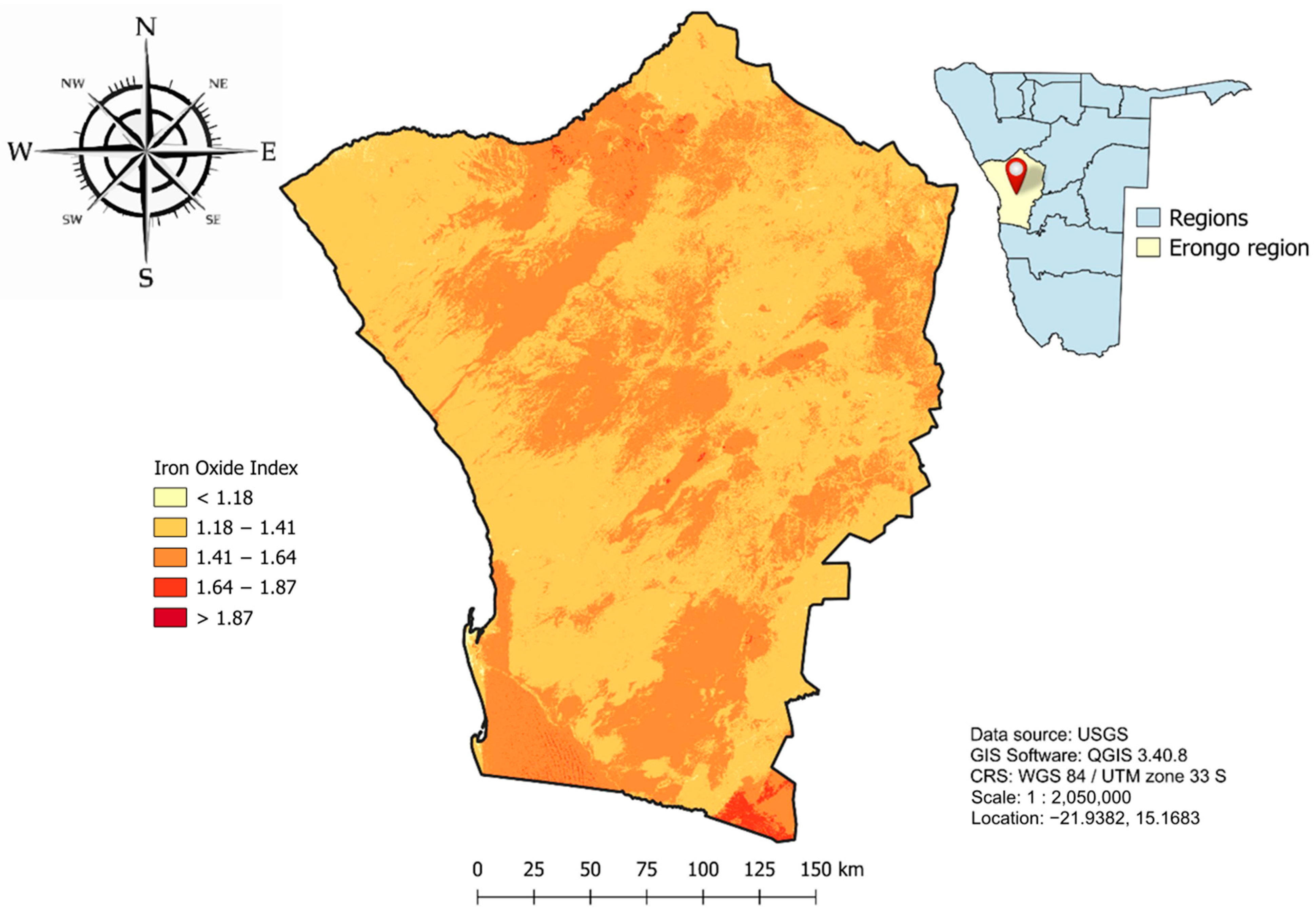
Iron Oxide Index map of the Erongo region, Namibia, derived from Landsat 8 imagery, indicating spatial variations in iron oxide content across the study area.
Figure 8.
Iron Oxide Index map of the Erongo region, Namibia, derived from Landsat 8 imagery, indicating spatial variations in iron oxide content across the study area.
Figure 9.
Carbonate Index map of the Erongo region, Namibia, derived from Sentinel 2 imagery, illustrating the spatial variability of carbonate-bearing mineral zones across the study area.
Figure 9.
Carbonate Index map of the Erongo region, Namibia, derived from Sentinel 2 imagery, illustrating the spatial variability of carbonate-bearing mineral zones across the study area.
Figure 10.
Clay Index map of the Erongo region, Namibia, derived from Sentinel 2 imagery, highlighting the spatial distribution of clay-rich mineral zones across the study area.
Figure 10.
Clay Index map of the Erongo region, Namibia, derived from Sentinel 2 imagery, highlighting the spatial distribution of clay-rich mineral zones across the study area.
Figure 11.
Ferrous Iron Index map of the Erongo region, Namibia, derived from Sentinel 2 imagery, illustrating the distribution and relative intensity of ferrous iron-bearing minerals across the study area.
Figure 11.
Ferrous Iron Index map of the Erongo region, Namibia, derived from Sentinel 2 imagery, illustrating the distribution and relative intensity of ferrous iron-bearing minerals across the study area.
Figure 12.
Iron Oxide Index map of the Erongo region, Namibia, derived from Sentinel 2 imagery, indicating spatial variations in iron oxide content across the study area.
Figure 12.
Iron Oxide Index map of the Erongo region, Namibia, derived from Sentinel 2 imagery, indicating spatial variations in iron oxide content across the study area.
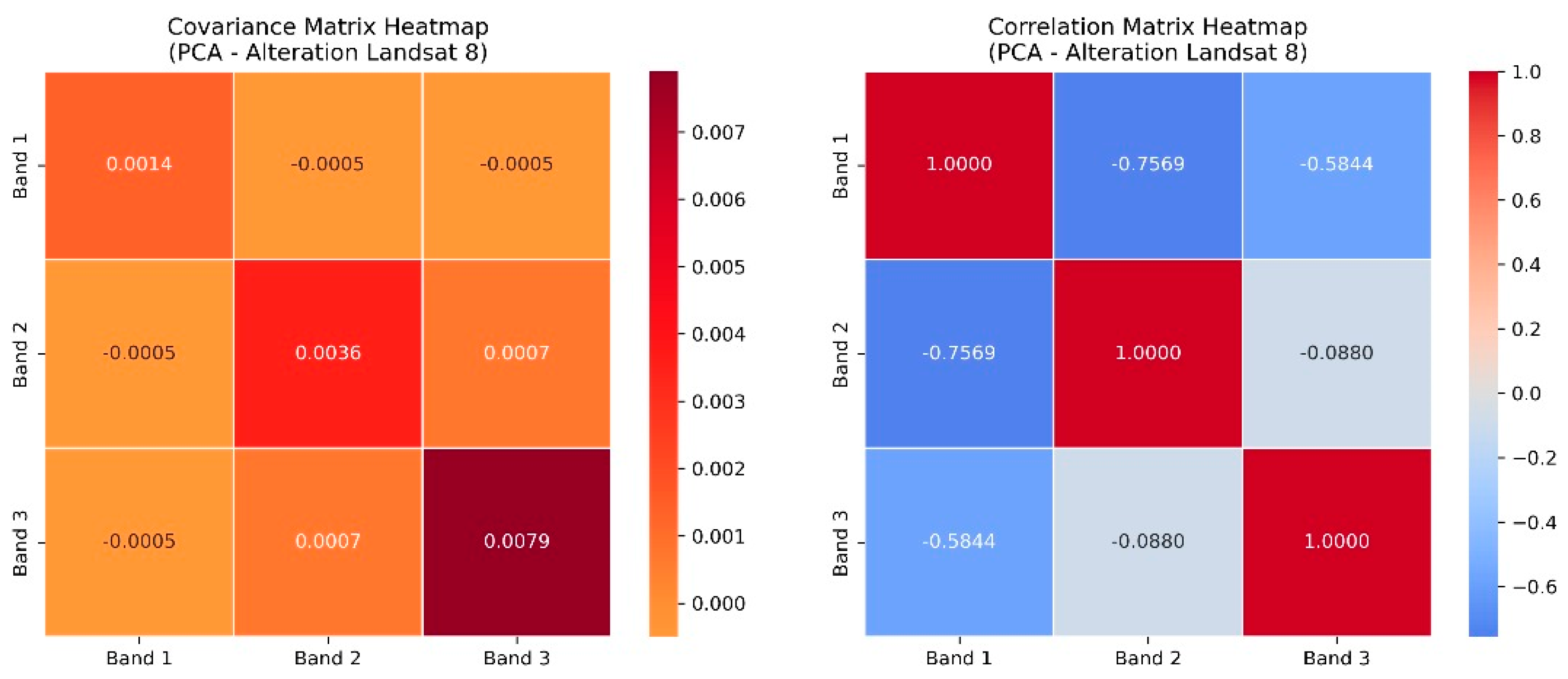
Figure 13.
Covariance matrix heatmap (left) and correlation matrix heatmap (right) for the Landsat 8 alteration composite, showing inter-band relationships between Bands 1–3 prior to Principal Component Analysis (PCA).
Figure 13.
Covariance matrix heatmap (left) and correlation matrix heatmap (right) for the Landsat 8 alteration composite, showing inter-band relationships between Bands 1–3 prior to Principal Component Analysis (PCA).
Figure 14.
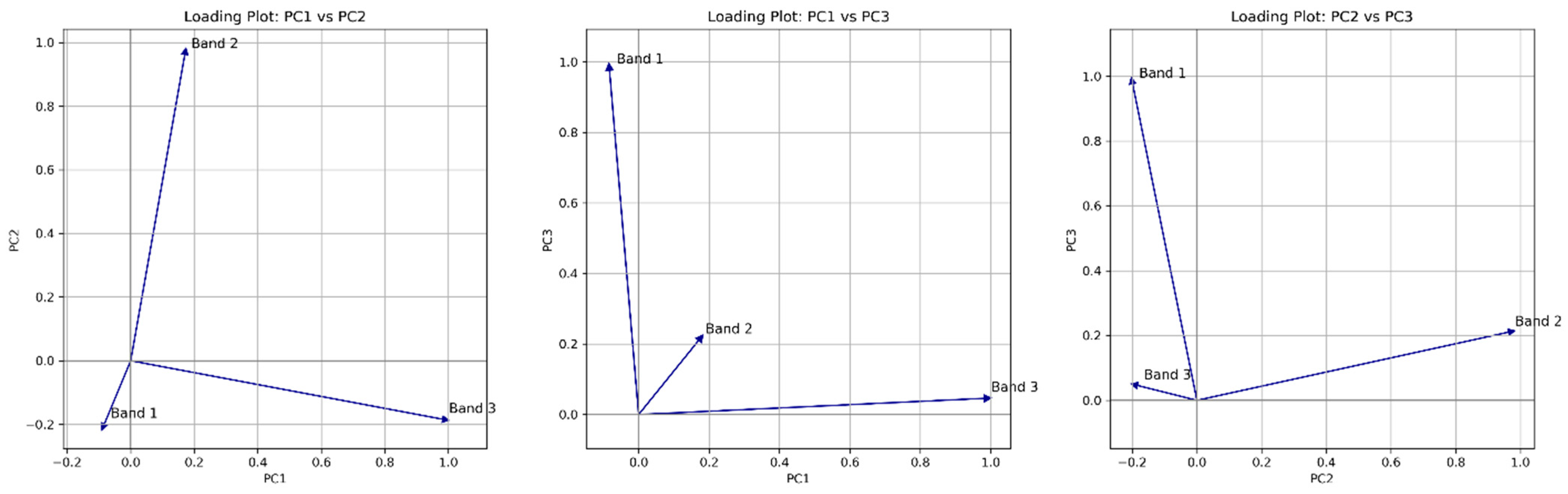
Principal component loading plots for the Landsat 8 alteration composite, showing relationships between Bands 1–3 across PC1 vs. PC2 (left), PC1 vs. PC3 (centre) and PC2 vs. PC3 (right) from the Principal Component Analysis (PCA).
Figure 14.
Principal component loading plots for the Landsat 8 alteration composite, showing relationships between Bands 1–3 across PC1 vs. PC2 (left), PC1 vs. PC3 (centre) and PC2 vs. PC3 (right) from the Principal Component Analysis (PCA).
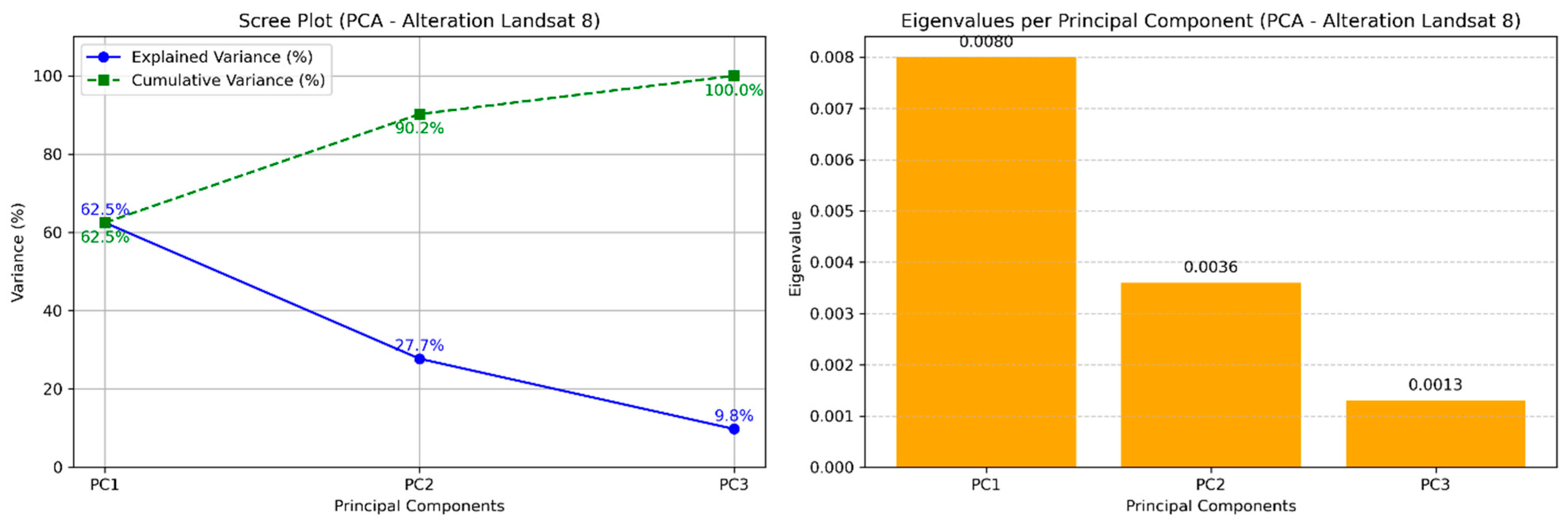
Figure 15.
Scree plot showing explained and cumulative variance (left) and eigenvalue distribution (right) for the first three principal components of the Landsat 8 alteration composite, derived from Principal Component Analysis (PCA).
Figure 15.
Scree plot showing explained and cumulative variance (left) and eigenvalue distribution (right) for the first three principal components of the Landsat 8 alteration composite, derived from Principal Component Analysis (PCA).
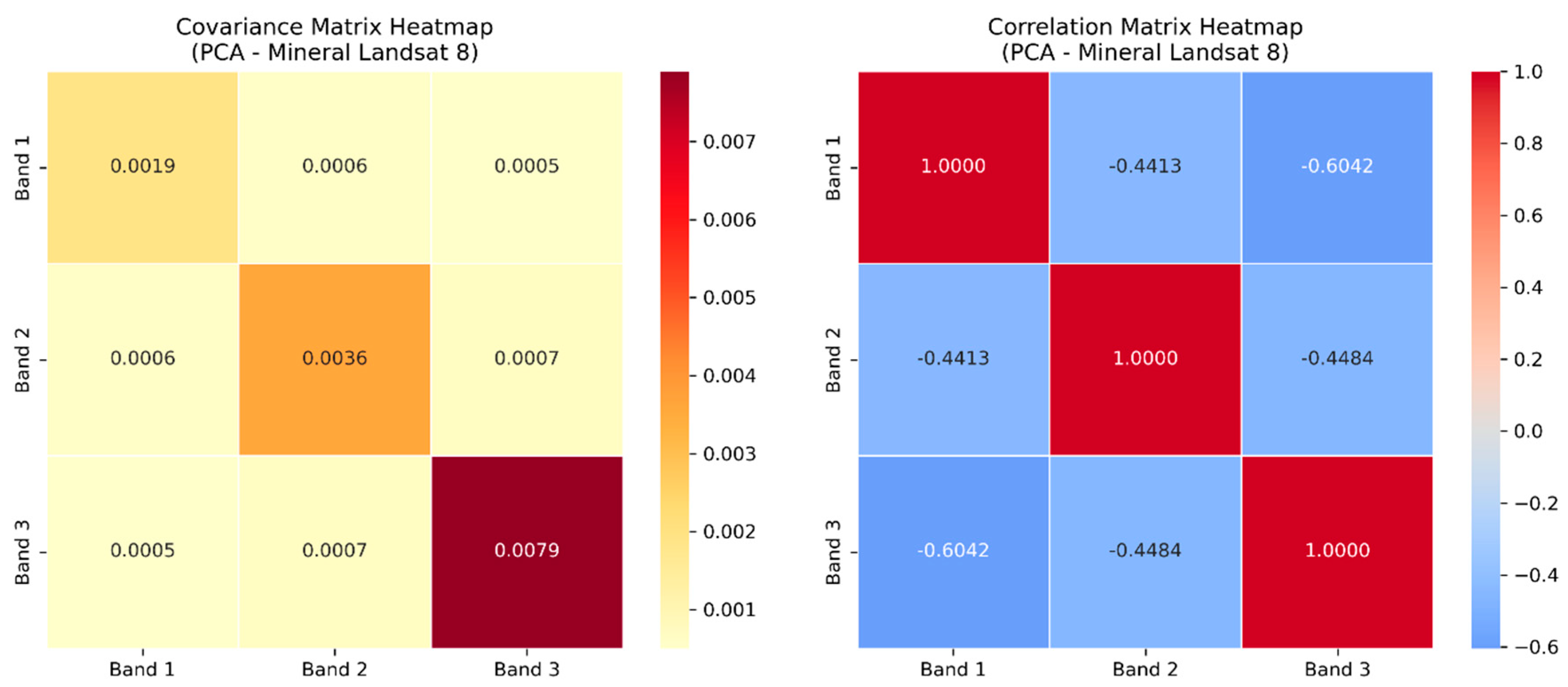
Figure 17.
Covariance matrix heatmap (left) and correlation matrix heatmap (right) for the Landsat 8 mineral composite, showing inter-band relationships between Bands 1–3 prior to Principal Component Analysis (PCA).
Figure 17.
Covariance matrix heatmap (left) and correlation matrix heatmap (right) for the Landsat 8 mineral composite, showing inter-band relationships between Bands 1–3 prior to Principal Component Analysis (PCA).
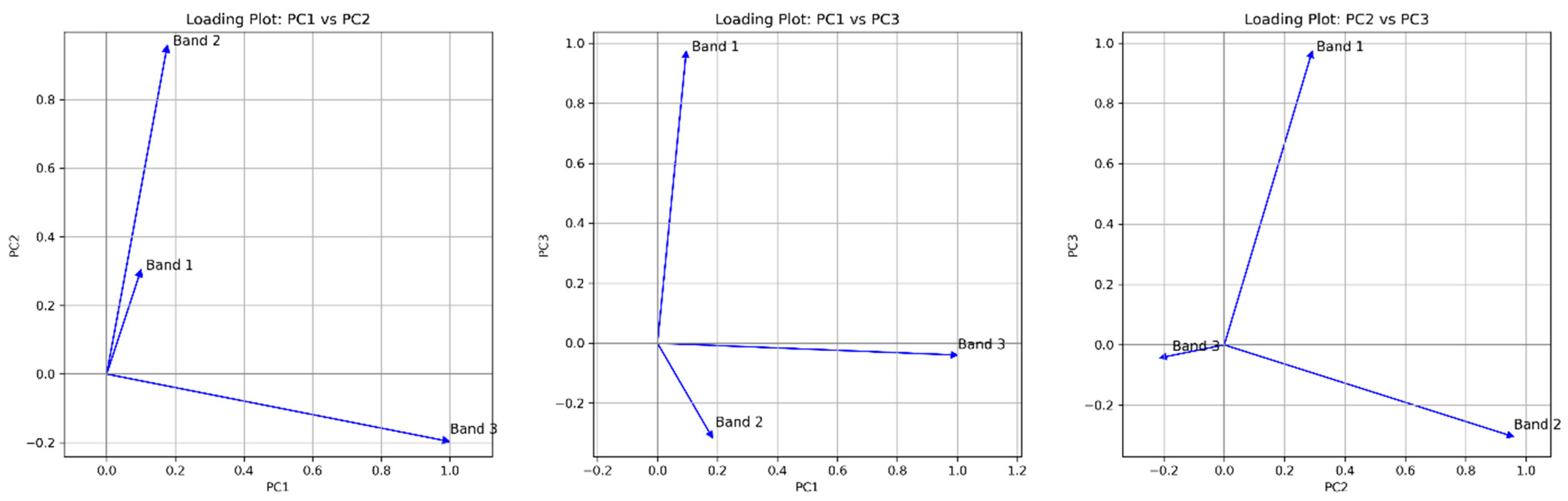
Figure 18.
Principal component loading plots for the Landsat 8 mineral composite, showing relationships between Bands 1–3 across PC1 vs. PC2 (left), PC1 vs. PC3 (centre) and PC2 vs. PC3 (right) from the Principal Component Analysis (PCA).
Figure 18.
Principal component loading plots for the Landsat 8 mineral composite, showing relationships between Bands 1–3 across PC1 vs. PC2 (left), PC1 vs. PC3 (centre) and PC2 vs. PC3 (right) from the Principal Component Analysis (PCA).
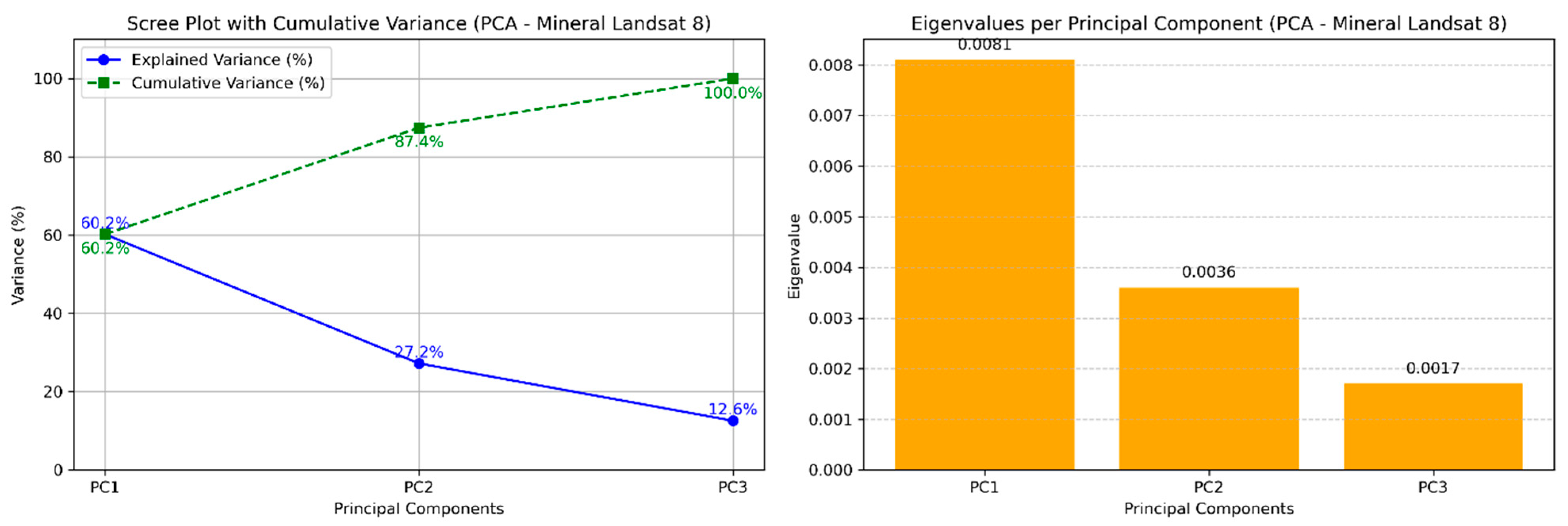
Figure 19.
Scree plot showing explained and cumulative variance (left) and eigenvalue distribution (right) for the first three principal components of the Landsat 8 mineral composite, derived from Principal Component Analysis (PCA).
Figure 19.
Scree plot showing explained and cumulative variance (left) and eigenvalue distribution (right) for the first three principal components of the Landsat 8 mineral composite, derived from Principal Component Analysis (PCA).
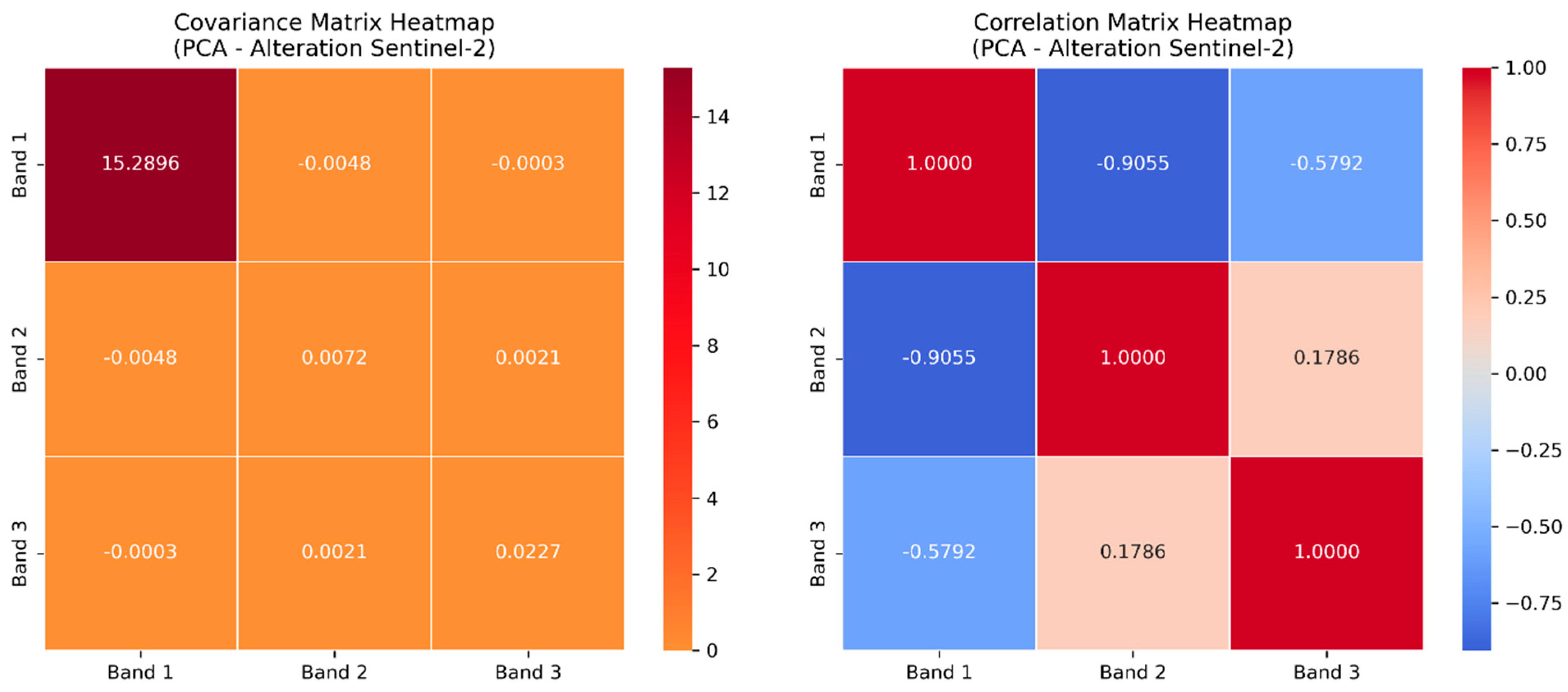
Figure 21.
Covariance matrix heatmap (left) and correlation matrix heatmap (right) for the Sentinel 2 alteration composite, showing inter-band relationships between Bands 1–3 prior to Principal Component Analysis (PCA).
Figure 21.
Covariance matrix heatmap (left) and correlation matrix heatmap (right) for the Sentinel 2 alteration composite, showing inter-band relationships between Bands 1–3 prior to Principal Component Analysis (PCA).
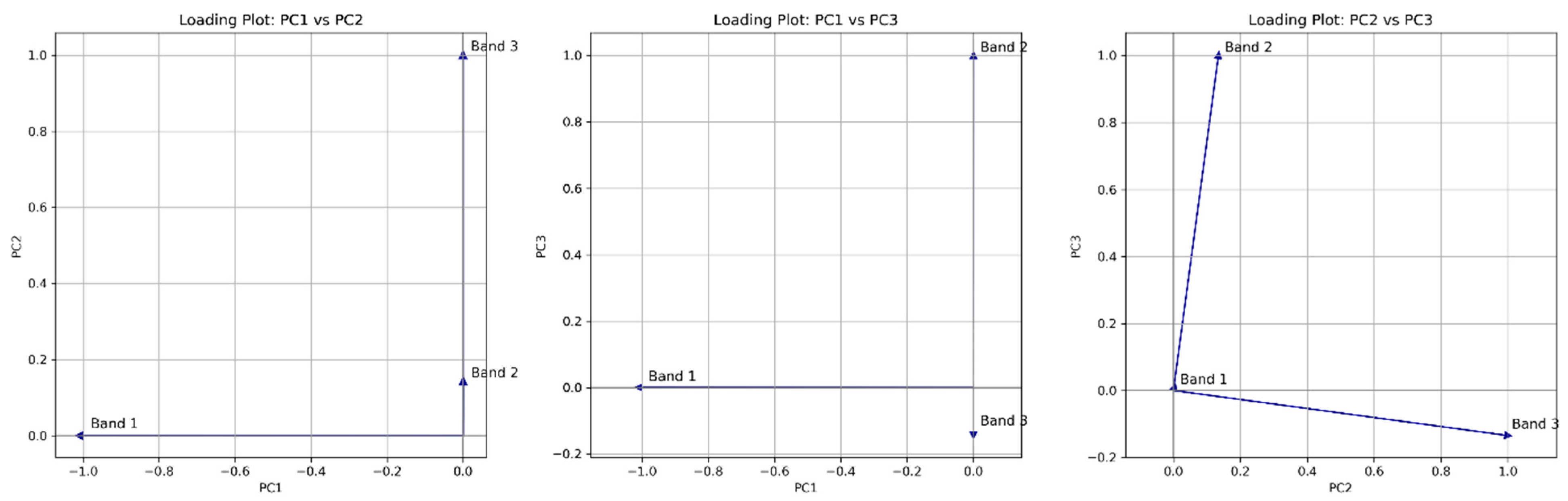
Figure 22.
Principal component loading plots for the Sentinel 2 alteration composite, showing relationships between Bands 1–3 across PC1 vs. PC2 (left), PC1 vs. PC3 (centre) and PC2 vs. PC3 (right) from the Principal Component Analysis (PCA).
Figure 22.
Principal component loading plots for the Sentinel 2 alteration composite, showing relationships between Bands 1–3 across PC1 vs. PC2 (left), PC1 vs. PC3 (centre) and PC2 vs. PC3 (right) from the Principal Component Analysis (PCA).
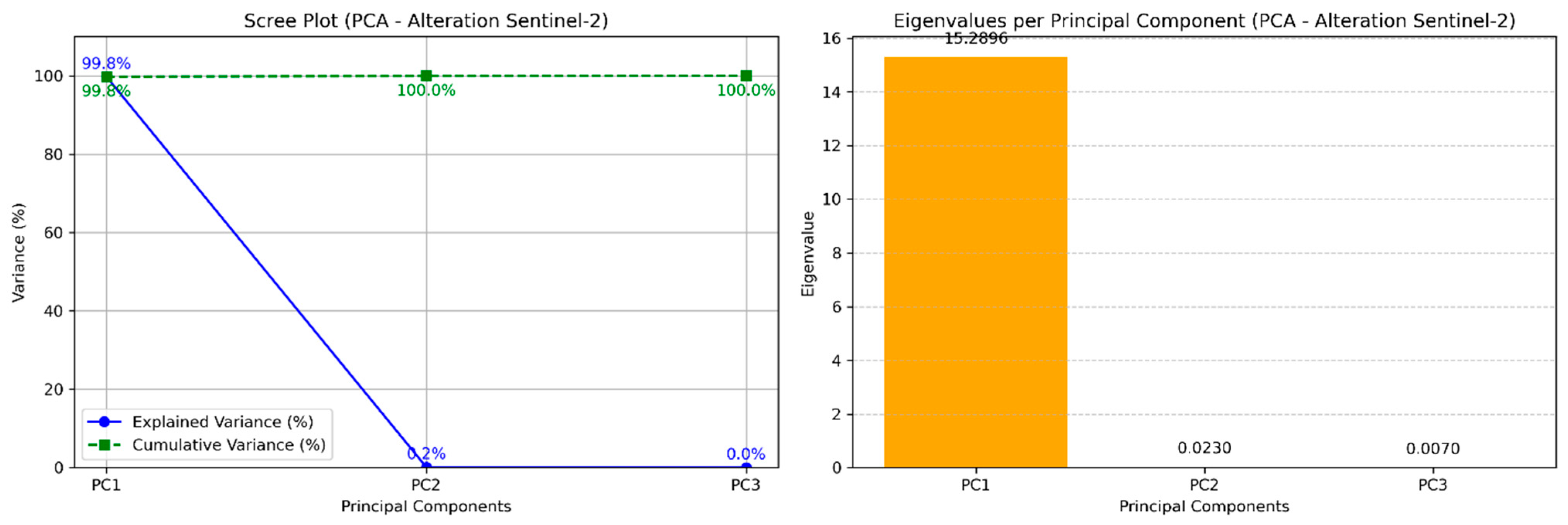
Figure 23.
Scree plot showing explained and cumulative variance (left) and eigenvalue distribution (right) for the first three principal components of the Sentinel 2 alteration composite, derived from Principal Component Analysis (PCA).
Figure 23.
Scree plot showing explained and cumulative variance (left) and eigenvalue distribution (right) for the first three principal components of the Sentinel 2 alteration composite, derived from Principal Component Analysis (PCA).
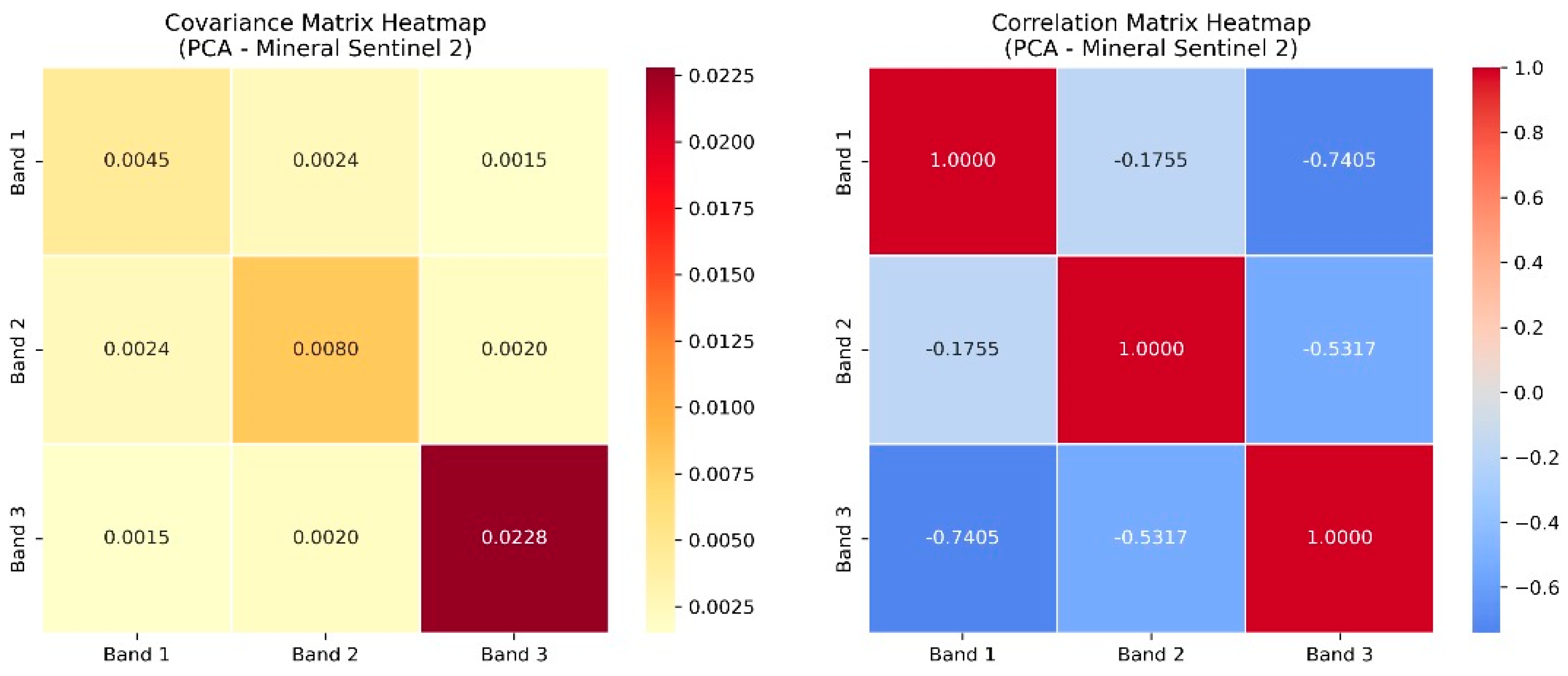
Figure 25.
Covariance matrix heatmap (left) and correlation matrix heatmap (right) for the Sentinel 2 mineral composite, showing inter-band relationships between Bands 1–3 prior to Principal Component Analysis (PCA).
Figure 25.
Covariance matrix heatmap (left) and correlation matrix heatmap (right) for the Sentinel 2 mineral composite, showing inter-band relationships between Bands 1–3 prior to Principal Component Analysis (PCA).
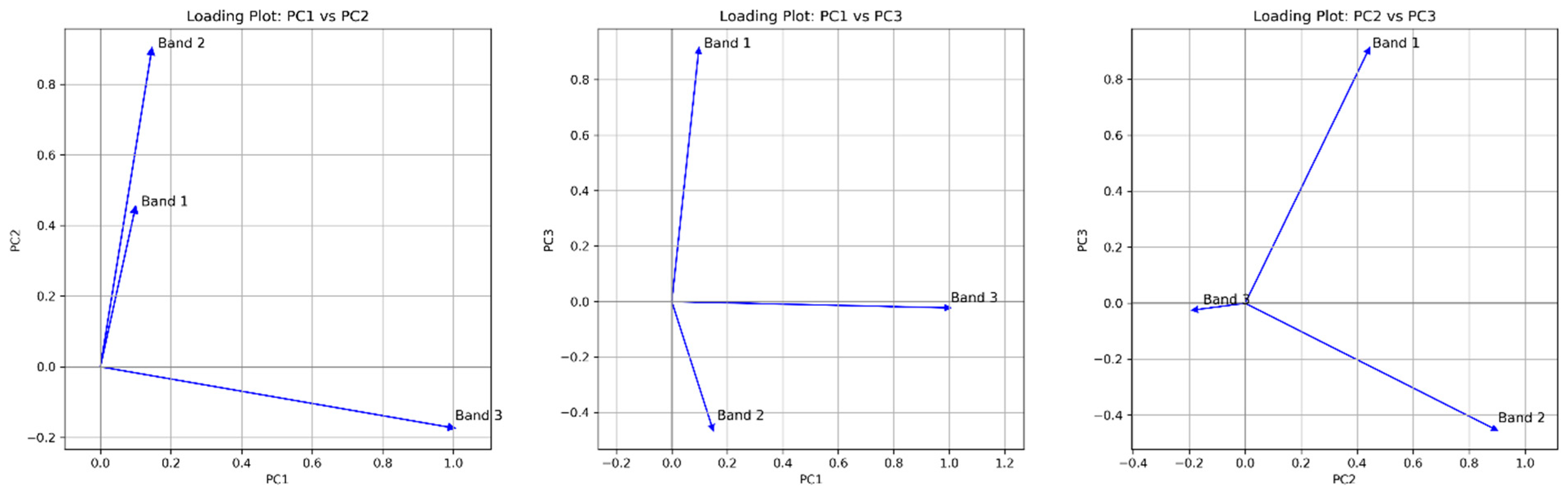
Figure 26.
Principal component loading plots for the Sentinel 2 mineral composite, showing relationships between Bands 1–3 across PC1 vs. PC2 (left), PC1 vs. PC3 (centre) and PC2 vs. PC3 (right) from the Principal Component Analysis (PCA).
Figure 26.
Principal component loading plots for the Sentinel 2 mineral composite, showing relationships between Bands 1–3 across PC1 vs. PC2 (left), PC1 vs. PC3 (centre) and PC2 vs. PC3 (right) from the Principal Component Analysis (PCA).
Figure 27.
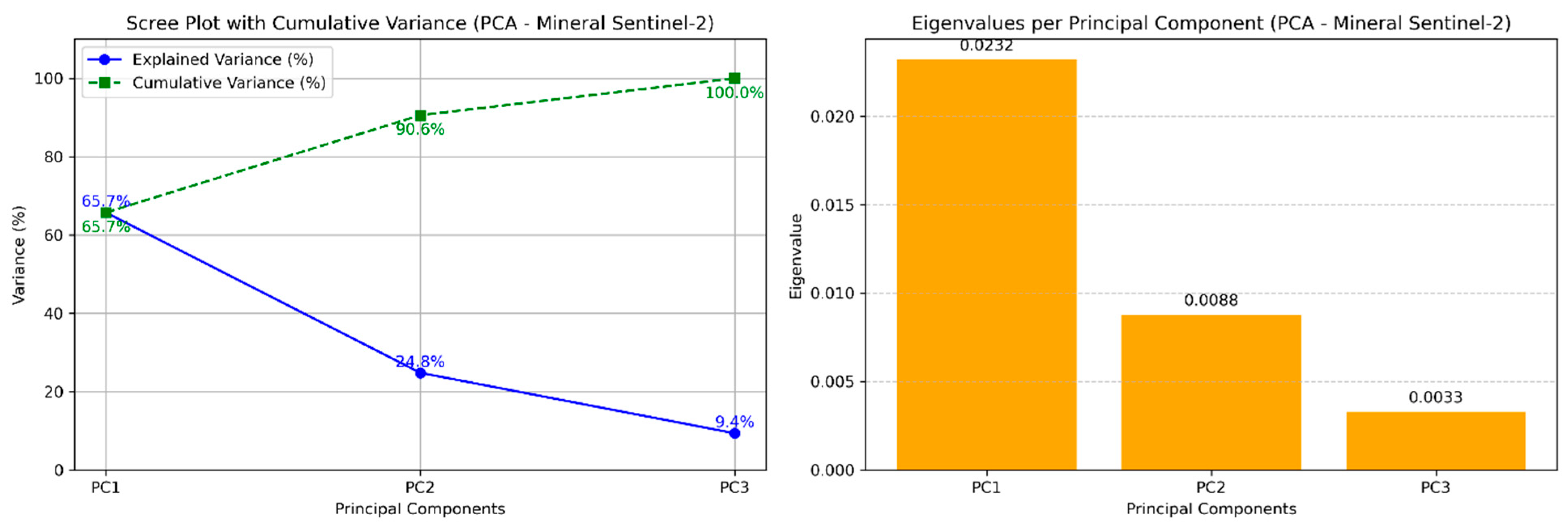
Scree plot showing explained and cumulative variance (left) and eigenvalue distribution (right) for the first three principal components of the Sentinel 2 mineral composite, derived from Principal Component Analysis (PCA).
Figure 27.
Scree plot showing explained and cumulative variance (left) and eigenvalue distribution (right) for the first three principal components of the Sentinel 2 mineral composite, derived from Principal Component Analysis (PCA).
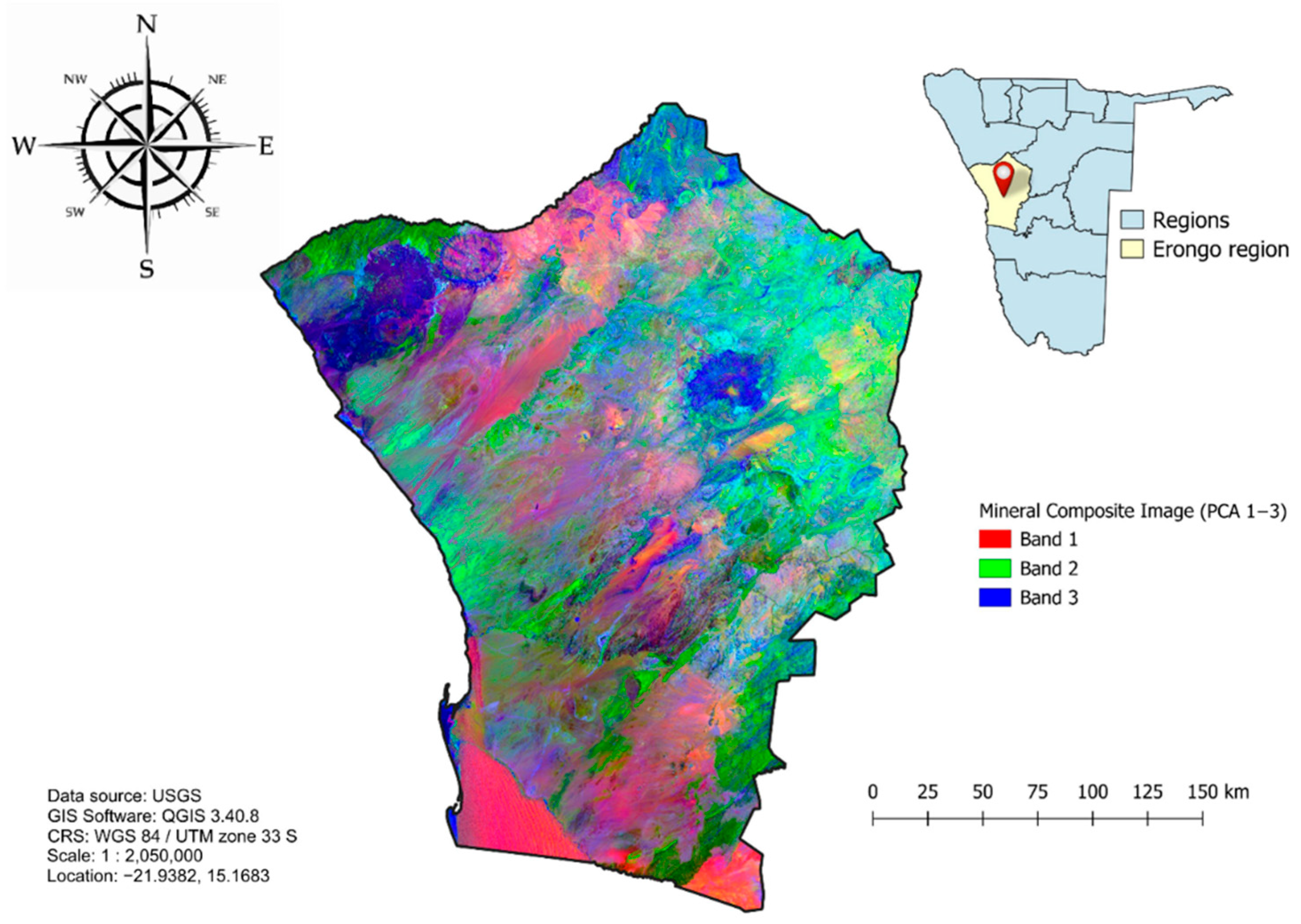
Figure 28.
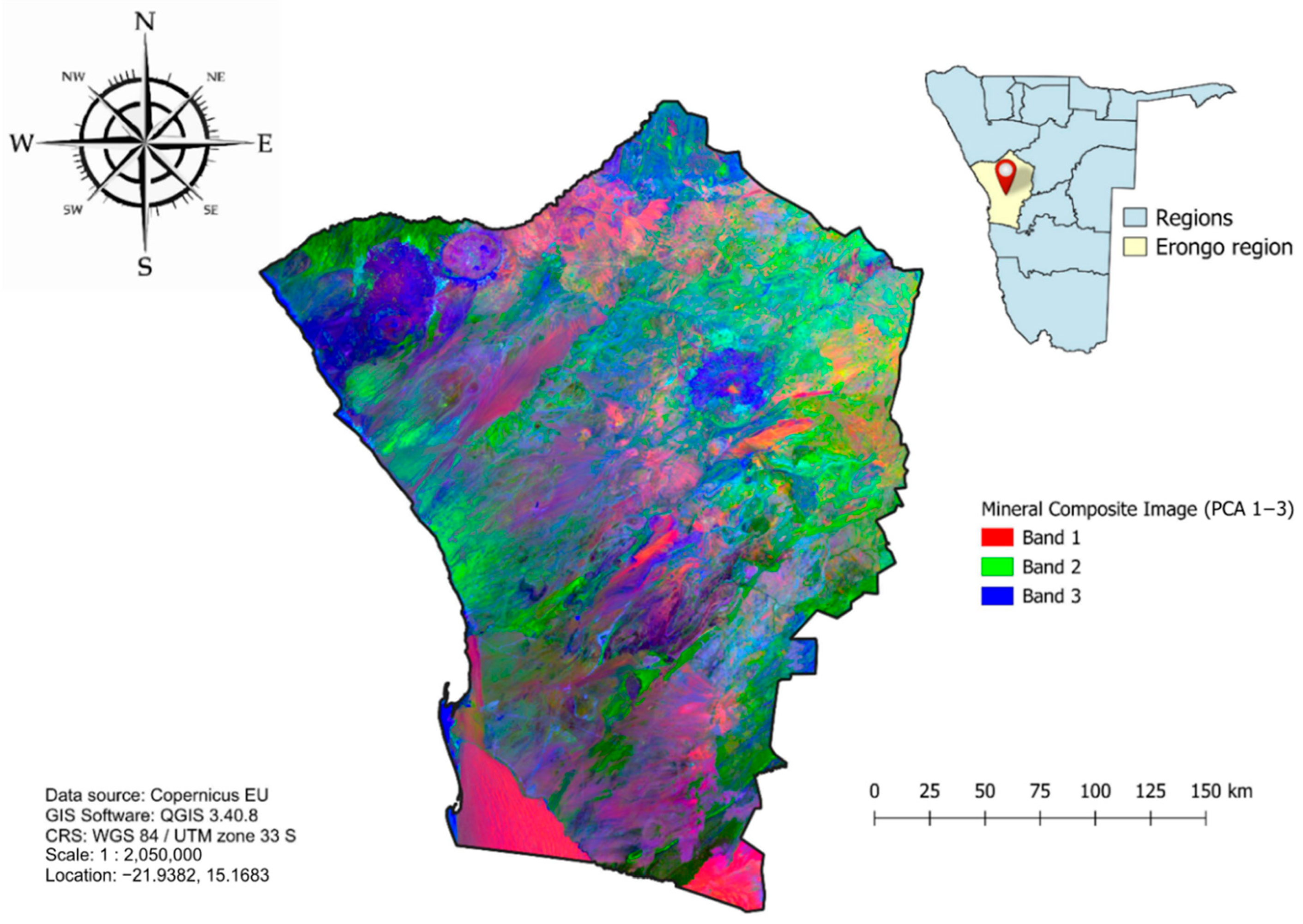
Mineral composite map of the Erongo region, Namibia, derived from Sentinel 2 imagery using Principal Component Analysis (PCA) of Bands 1–3, highlighting spectral variations associated with different mineralogical zones.
Figure 28.
Mineral composite map of the Erongo region, Namibia, derived from Sentinel 2 imagery using Principal Component Analysis (PCA) of Bands 1–3, highlighting spectral variations associated with different mineralogical zones.
Table 1.
Geospatial datasets used in this study, including data type and source for satellite imagery, mineral occurrences and administrative boundaries.
Table 1.
Geospatial datasets used in this study, including data type and source for satellite imagery, mineral occurrences and administrative boundaries.
| Data | Type | Data Source | |
|---|
| Landsat 8 | Raster | USGS | [37] |
| Sentinel 2 | Raster | Copernicus Sentinel Hub | [38] |
| Mineral Occurrences | Shapefile (Vector) | Ministry of Mines and Energy | [39] |
| Administrative data | Shapefile (Vector) | NSA-Digital Namibia | [40] |
Table 2.
Spectral and spatial characteristics of the Landsat 8 and Sentinel 2 bands utilised in this study, including resolution, wavelength (or central wave) and band descriptions.
Table 2.
Spectral and spatial characteristics of the Landsat 8 and Sentinel 2 bands utilised in this study, including resolution, wavelength (or central wave) and band descriptions.
| | Landsat 8 |
|---|
| Band | Resolution | Wavelength | Central Wave | Description |
| Band 2 | 30 m | (0.45–0.51 µm) | 0. 482 µm | Blue |
| Band 4 | 30 m | (0.64–0.67 µm) | 0.655 µm | Red |
| Band 5 | 30 m | (0.85–0.88 µm) | 0.865 µm | Near-Infrared |
| Band 6 | 30 m | (1.57–1.65 µm) | 1.609 µm | SWIR 1 |
| Band 7 | 30 m | (2.11–2.29 µm) | 2.201 µm | SWIR 2 |
| | Sentinel 2 |
| Band | Resolution | Wavelength | Central Wave | Description |
| Band 2 | 10 m | (0.43–0.53 µm) | 0.490 µm | Blue |
| Band 4 | 10 m | (0.64–0.68 µm) | 0.665 µm | Red |
| Band 8 | 10 m | (0.76–0.90 µm) | 0.842 µm | Visible and Near-Infrared (VNIR) |
| Band 11 | 20 m | (1.53–1.68 µm) | 0.1610 µm | Short-Wave Infrared (SWIR) |
| Band 12 | 20 m | (2.07–2.31 µm) | 0.219 µm | Short-Wave Infrared (SWIR) |
Table 3.
Landsat 8 and Sentinel 2 band combinations used for generating spectral indices, including Carbonate Index (CarbI), Clay Index (CI), Ferrous Iron Index (FII) and Iron Oxide Index (IOI).
Table 3.
Landsat 8 and Sentinel 2 band combinations used for generating spectral indices, including Carbonate Index (CarbI), Clay Index (CI), Ferrous Iron Index (FII) and Iron Oxide Index (IOI).
| Landsat 8 | |
|---|
| Carbonate Index (CarbI) | | [44] |
| Clay Index (CI) | | [45] |
| Ferrous Iron Index (FII) | | [46] |
| Iron Oxide Index (IOI) | | [47] |
| Sentinel 2 | |
| Carbonate Index (CarbI) | | [48] |
| Clay Index (CI) | | [49] |
| Ferrous Iron Index (FII) | | [50] |
| Iron Oxide Index (IOI) | | [47] |
Table 4.
RGB band combinations used to generate mineral and alteration composites from Landsat 8 and Sentinel 2 imagery, based on Clay Index, Ferrous Iron Index, Iron Oxide Index and Carbonate Index inputs.
Table 4.
RGB band combinations used to generate mineral and alteration composites from Landsat 8 and Sentinel 2 imagery, based on Clay Index, Ferrous Iron Index, Iron Oxide Index and Carbonate Index inputs.
| Landsat 8 |
|---|
Mineral composite
RGB = [Clay Index, Ferrous Iron Index, Iron Oxide Index] | |
Alteration composite
RGB = [Carbonate Index, Ferrous Iron Index, Iron Oxide Index] | |
| Sentinel 2 |
Mineral composite
RGB = [Clay Index, Ferrous Iron Index, Iron Oxide Index] | |
Alteration composite
RGB = [Carbonate Index, Ferrous Iron Index, Iron Oxide Index] | |
Table 5.
Software tools and their specific applications in the study workflow, including preprocessing, PCA, training sample creation, classification, accuracy assessment and improvement of linguistic quality.
Table 5.
Software tools and their specific applications in the study workflow, including preprocessing, PCA, training sample creation, classification, accuracy assessment and improvement of linguistic quality.
| Software & Tools Used | Purpose |
|---|
| QGIS 3.40.8 + Semi Classification Plugin (version 8.5.0) | Preprocessing, PCA, training samples, classification & map composition |
| Jupyter notebook (python 3.12.7) | Accuracy matrix, statistics, PCA Figures creation |
| Draw.io (version 28.1.2) | Flow chart creation |
| NUST—DLSS Department Grammarly (version 6.7.265) | Improvement of linguistic quality |
Table 6.
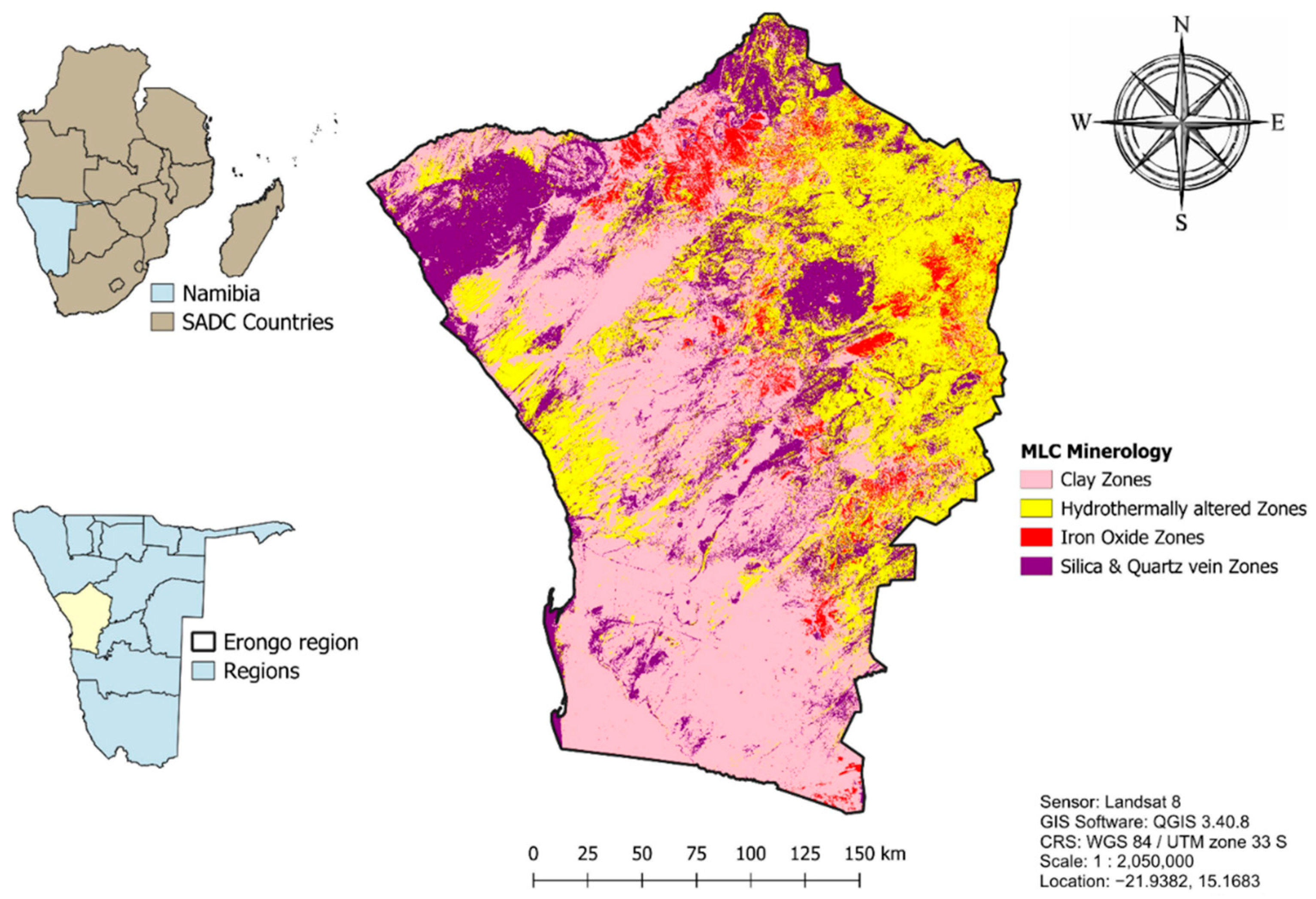
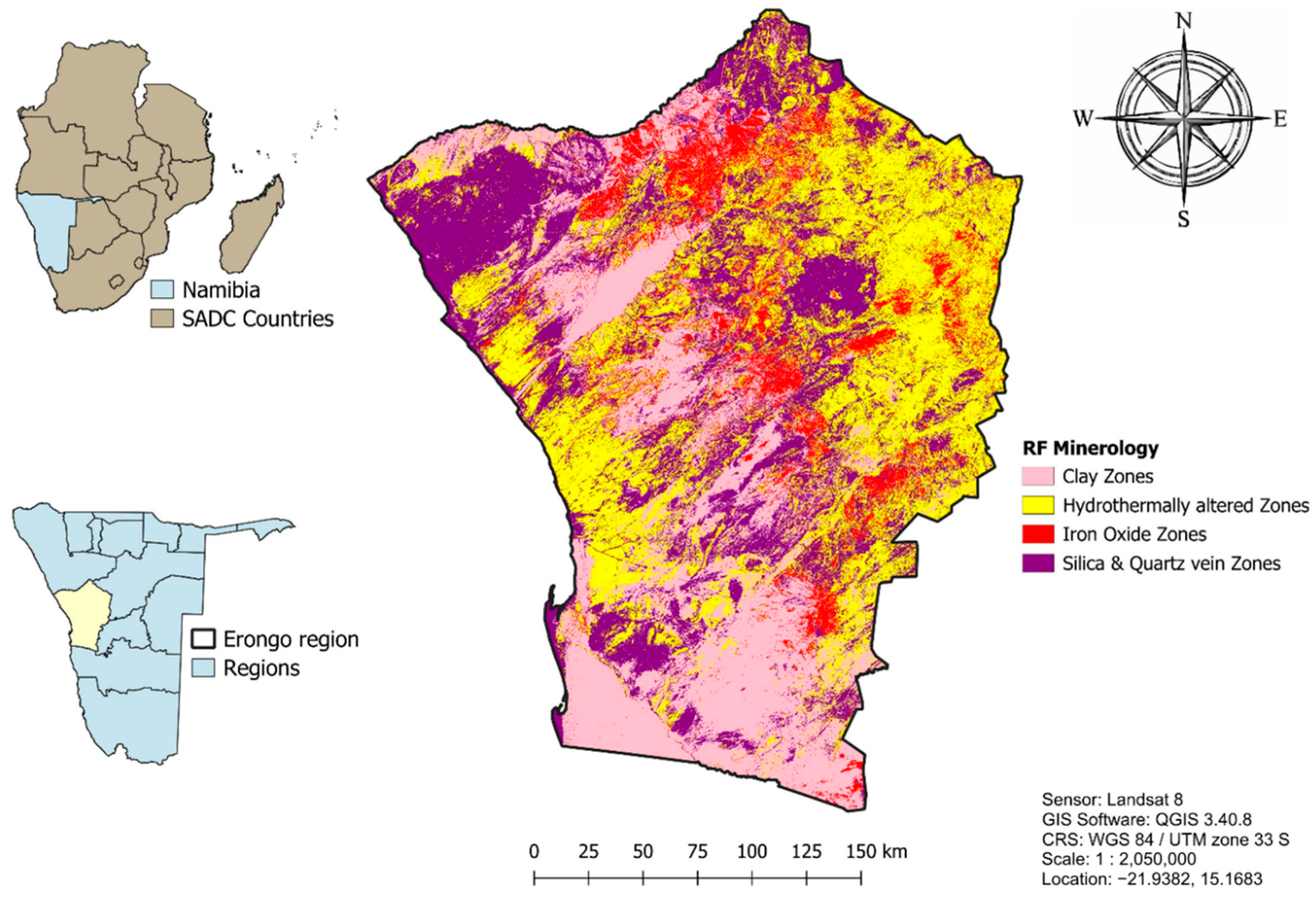
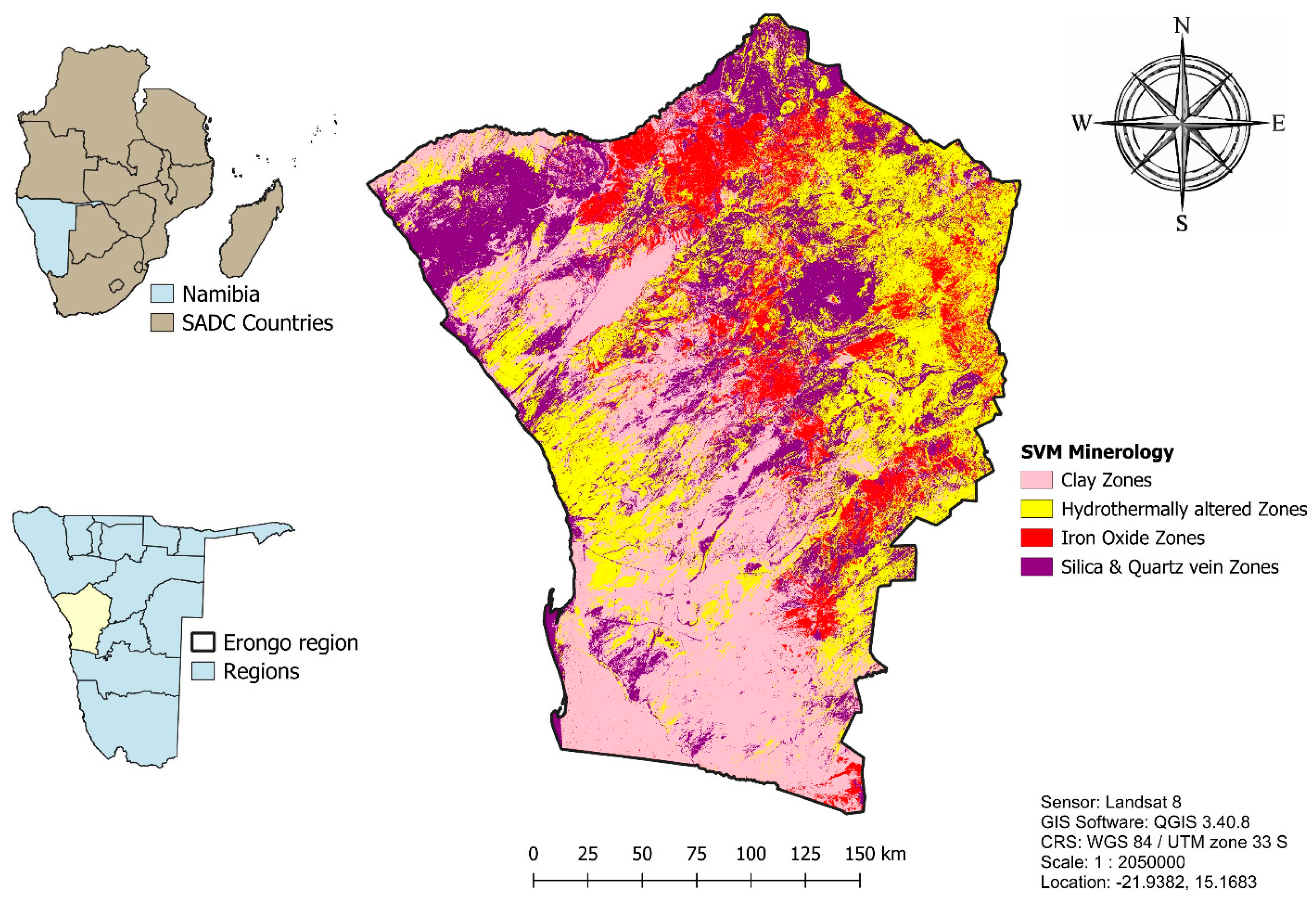
Area (km2) distribution of mineral classes, clay zones, hydrothermally altered zones, iron oxide zones and silica and quartz vein zones, derived from Landsat 8 imagery using Maximum Likelihood Classification (MLC), Random Forest (RF) and Support Vector.
Table 6.
Area (km2) distribution of mineral classes, clay zones, hydrothermally altered zones, iron oxide zones and silica and quartz vein zones, derived from Landsat 8 imagery using Maximum Likelihood Classification (MLC), Random Forest (RF) and Support Vector.
| Sensor | Landsat 8 |
|---|
| Classifier | Maximum Likelihood Classification (MLC) | Random Forest (RF) Classification | Support Vector Machine (SVM) Classification |
|---|
| | km2 | % | km2 | % | km2 | % |
|---|
| Clay Zones | 30,114.1 | 47.5 | 17,511.9 | 27.6 | 22,757.3 | 35.9 |
| Hydrothermal Altered zones | 17,161.5 | 27.1 | 21,391.4 | 33.7 | 16,760.5 | 26.4 |
| Iron Oxide Zones | 3173.0 | 5 | 5992.8 | 9.5 | 7125.2 | 11.2 |
| Silica & Quartz vein Zones | 12,943.4 | 20.4 | 18,495.9 | 29.2 | 16,749.1 | 26.4 |
| Total area (km2) | 63,392 | | 63,392 | | 63,392 | |
Table 7.
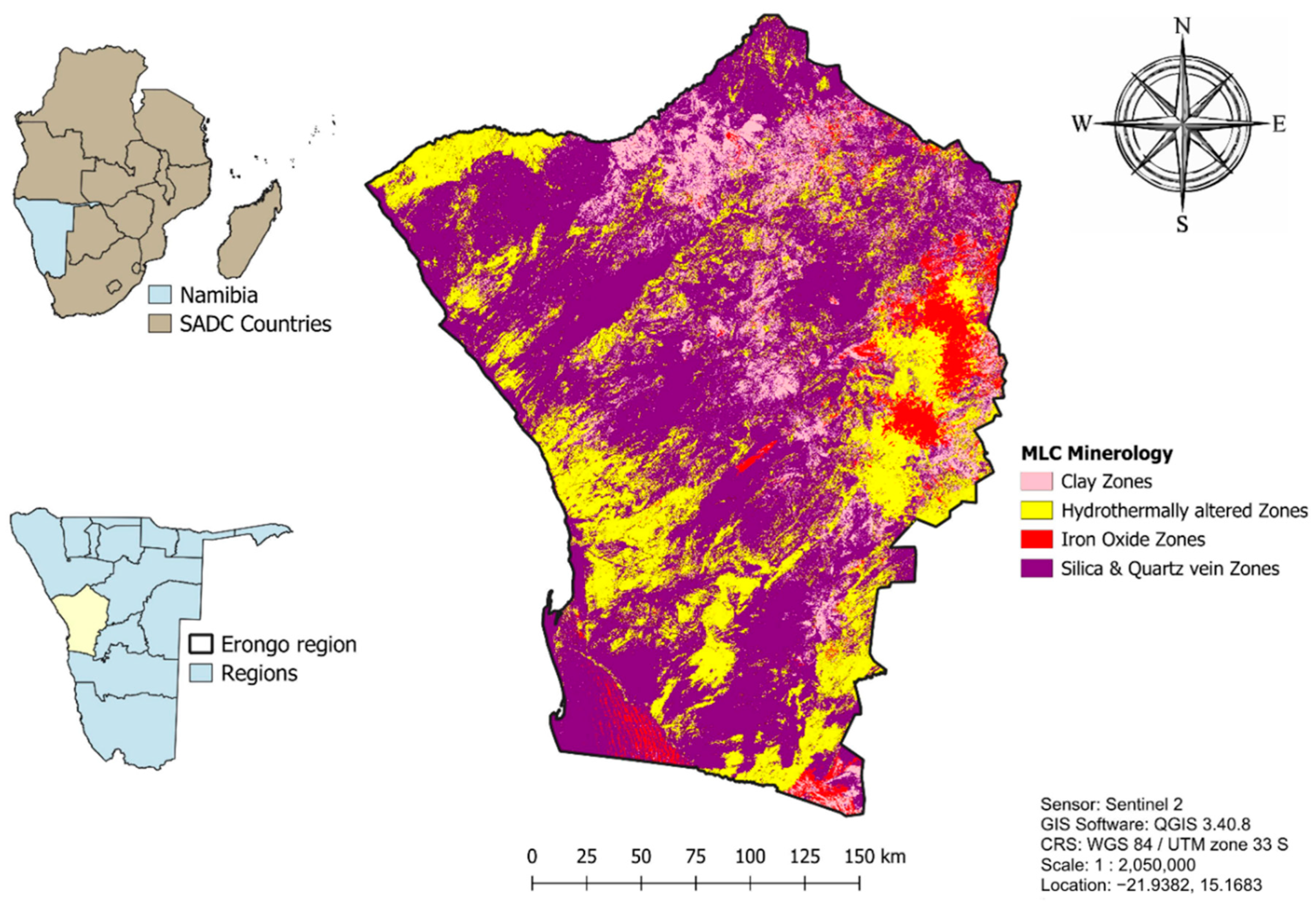
Area (km2) distribution of mineral classes, clay zones, hydrothermally altered zones, iron oxide zones and silica and quartz vein zones, derived from Sentinel 2 imagery using Maximum Likelihood Classification (MLC), Random Forest (RF) and Support Vector.
Table 7.
Area (km2) distribution of mineral classes, clay zones, hydrothermally altered zones, iron oxide zones and silica and quartz vein zones, derived from Sentinel 2 imagery using Maximum Likelihood Classification (MLC), Random Forest (RF) and Support Vector.
| Sensor | Sentinel 2 |
|---|
| Classifier | Maximum Likelihood Classification (MLC) | Random Forest (RF) Classification | Support Vector Machine (SVM) |
|---|
| | km2 | % | km2 | % | km2 | % |
|---|
| Clay Zones | 6845.7 | 10.8 | 23,729.0 | 37.4 | 8119.3 | 12.8 |
| Hydrothermal Altered zones | 14,230.5 | 22.4 | 13,073.3 | 20.6 | 21,753.6 | 34.3 |
| Iron Oxide Zones | 2108.6 | 3.3 | 2271.1 | 3.6 | 1758.6 | 2.8 |
| Silica & Quartz vein Zones | 40,207.7 | 63.5 | 24,319.3 | 38.4 | 31,761.0 | 50.1 |
| Total area (km2) | 63,392 | | 63,392 | | 63,392 | |
Table 8.
Confusion matrices and classification accuracies for Landsat 8 mineral mapping in the Erongo region using Maximum Likelihood Classification (MLC), Random Forest (RF) and Support Vector Machine (SVM). Matrix–cell values represent the number of correctly and incorrectly classified pixels, while Producer’s Accuracy (PA) and User’s Accuracy (UA) are expressed as percentages (%).
Table 8.
Confusion matrices and classification accuracies for Landsat 8 mineral mapping in the Erongo region using Maximum Likelihood Classification (MLC), Random Forest (RF) and Support Vector Machine (SVM). Matrix–cell values represent the number of correctly and incorrectly classified pixels, while Producer’s Accuracy (PA) and User’s Accuracy (UA) are expressed as percentages (%).
| Landsat 8 |
|---|
| Maximum Likelihood Classification (MLC) |
| | Hydrothermally altered zones | Clay zones | Silica & Quartz zones | Iron oxide zones | User’s Accuracy (UA) |
| Hydrothermally altered zones | 143 | 95 | 139 | 3 | 37.63 |
| Clay zones | 16 | 14 | 10 | 0 | 35 |
| Silica & Quartz zones | 0 | 8 | 5 | 0 | 38.46 |
| Iron oxide zones | 0 | 1 | 0 | 0 | 0 |
| Producer’s Accuracy (PA) | 89.93 | 11.86 | 3.24 | 0 | |
| Random Forest Classification (RF) |
| | Hydrothermally altered zones | Clay zones | Silica & Quartz zones | Iron oxide zone | User’s Accuracy (UA) |
| Hydrothermally altered zones | 156 | 38 | 176 | 10 | 41.05 |
| Clay zones | 21 | 4 | 11 | 4 | 10 |
| Silica & Quartz zones | 2 | 3 | 6 | 2 | 46.15 |
| Iron oxide zones | 0 | 1 | 0 | 0 | 0 |
| Producer’s Accuracy (PA) | 87.15 | 8.69 | 3.10 | 0 | |
| Support Vector Machine (SVM) |
| | Hydrothermally altered zones | Clay zones | Silica & Quartz zones | Iron oxide zones | User’s Accuracy (UA) |
| Hydrothermally altered zones | 125 | 57 | 181 | 17 | 32.89 |
| Clay zones | 17 | 7 | 11 | 5 | 17.50 |
| Silica & Quartz zones | 1 | 6 | 5 | 1 | 38.46 |
| Iron oxide zones | 1 | 0 | 0 | 0 | 0 |
| Producer’s Accuracy (PA) | 86.80 | 10 | 2.53 | 0 | |
Table 9.
Confusion matrices and classification accuracies for Sentinel 2 mineral mapping in the Erongo region using Maximum Likelihood Classification (MLC), Random Forest (RF) and Support Vector Machine (SVM). Matrix–cell values represent the number of correctly and incorrectly classified pixels, while Producer’s Accuracy (PA) and User’s Accuracy (UA) are expressed as percentages (%).
Table 9.
Confusion matrices and classification accuracies for Sentinel 2 mineral mapping in the Erongo region using Maximum Likelihood Classification (MLC), Random Forest (RF) and Support Vector Machine (SVM). Matrix–cell values represent the number of correctly and incorrectly classified pixels, while Producer’s Accuracy (PA) and User’s Accuracy (UA) are expressed as percentages (%).
| Sentinel 2 |
|---|
| Maximum Likelihood Classification (MLC) |
| | Hydrothermally altered zones | Clay zones | Silica & Quartz zones | Iron oxide zones | User’s Accuracy (UA) |
| Hydrothermally altered zones | 293 | 73 | 11 | 3 | 77.10 |
| Clay zones | 23 | 11 | 5 | 1 | 27.50 |
| Silica & Quartz zones | 11 | 1 | 1 | 0 | 7.69 |
| Iron oxide zones | 0 | 0 | 0 | 1 | 100 |
| Producer’s Accuracy (PA) | 89.60 | 12.94 | 5.88 | 20 | |
| Random Forest Classification (RF) |
| | Hydrothermally altered zones | Clay zones | Silica & Quartz zones | Iron oxide zones | User’s Accuracy (UA) |
| Hydrothermally altered zones | 247 | 45 | 81 | 7 | 65 |
| Clay zones | 15 | 8 | 17 | 0 | 20 |
| Silica & Quartz zones | 5 | 2 | 6 | 0 | 46.15 |
| Iron oxide zones | 0 | 1 | 0 | 0 | 0 |
| Producer’s Accuracy (PA) | 92.50 | 14.28 | 5.76 | 0 | |
| Support Vector Machine (SVM) |
| | Hydrothermally altered zones | Clay zones | Silica & Quartz zones | Iron oxide zones | User’s Accuracy (UA) |
| Hydrothermally altered zones | 268 | 94 | 14 | 4 | 70.52 |
| Clay zones | 16 | 22 | 2 | 0 | 55 |
| Silica & Quartz zones | 8 | 4 | 1 | 0 | 7.69 |
| Iron oxide zones | 0 | 1 | 0 | 0 | 0 |
| Producer’s Accuracy (PA) | 91.78 | 18.18 | 5.88 | 0 | |
Table 10.
Classification accuracy metrics for Landsat 8 mineral mapping in the Erongo region using Maximum Likelihood Classification (MLC), Random Forest (RF) and Support Vector Machine (SVM), showing Overall Accuracy, Kappa Coefficient and Expected Agreement (PE).
Table 10.
Classification accuracy metrics for Landsat 8 mineral mapping in the Erongo region using Maximum Likelihood Classification (MLC), Random Forest (RF) and Support Vector Machine (SVM), showing Overall Accuracy, Kappa Coefficient and Expected Agreement (PE).
| Landsat 8 |
|---|
| Metric | MLC | RF | SVM |
|---|
| Overall Accuracy | 37.33 | 38.25 | 31.57 |
| Kappa Coefficient | 0.026094991 | −0.00294039 | −0.005036958 |
| PE (Expected Agreement) | 0.35647922 | 0.384298881 | 0.319097878 |
Table 11.
Classification accuracy metrics for Sentinel2 mineral mapping in the Erongo region using Maximum Likelihood Classification (MLC), Random Forest (RF) and Support Vector Machine (SVM), showing Overall Accuracy, Kappa Coefficient and Expected Agreement (PE).
Table 11.
Classification accuracy metrics for Sentinel2 mineral mapping in the Erongo region using Maximum Likelihood Classification (MLC), Random Forest (RF) and Support Vector Machine (SVM), showing Overall Accuracy, Kappa Coefficient and Expected Agreement (PE).
| Sentinel 2 |
|---|
| Metric | MLC | RF | SVM |
|---|
| Overall Accuracy | 70.51 | 60.14 | 67.05 |
| Kappa Coefficient | 0.081329585 | 0.098623 | 0.141972322 |
| PE (Expected Agreement) | 0.678958993 | 0.557768269 | 0.61598781 |