Article

Message Passing Algorithm Receiver Design for RIS-Assisted Downlink MIMO-SCMA System

1
College of Telecommunications and Information Engineering, Nanjing University of Posts and Telecommunications, Nanjing 210003, China
2
China Telecom Corporation Limited, Jiangsu Branch, Nanjing 210037, China
*
Author to whom correspondence should be addressed.
These authors contributed equally to this work.
Appl. Sci. 2025, 15(24), 13197; https://doi.org/10.3390/app152413197
Submission received: 7 November 2025 / Revised: 14 December 2025 / Accepted: 15 December 2025 / Published: 16 December 2025
(This article belongs to the Section Electrical, Electronics and Communications Engineering)

Abstract

Sparse code multiple access (SCMA) and reconfigurable intelligent surfaces (RISs) are two promising techniques in the forthcoming 6G communication networks to provide massive connectivity and enhance the spectral efficiency. To our best knowledge, the phase optimization for the reflecting elements and multi-user detection for the RIS-assisted downlink MIMO-SCMA system is still an open issue. In this way, we first formulate the RIS-assisted downlink MIMO-SCMA model with respect to the phases of the reflecting elements for the RIS. Next, a closed-form solution to these phases is found by solving the geometric median optimization. The iterative symbol detection steps are also provided for the RIS-assisted downlink MIMO-SCMA system. Simulation results illustrate that the proposed RIS-assisted downlink MIMO-SCMA system can significantly enhance the bit error ratio performance; e.g., the RIS-SCMA system with the proposed Gmedian-optimized phases can achieve a 1.5dB SNR gain as compared to the random phases with 10 reflecting elements.

1. Introduction

In the context of sixth-generation (6G) wireless communication systems, the Internet of Things (IoT) is envisioned to interconnect tens of billions of sensor nodes and intelligent terminals [1,2,3,4,5,6,7]. However, the conventional orthogonal access schemes have become inadequate since the 6G communication networks impose stricter requirements on spectral efficiency, ultra-low latency, high transmission rates, and massive connectivity. This limitation arises from their fundamental principle of allocating orthogonal resource blocks to different users to avoid multi-user interference, which inherently restricts resource utilization efficiency. To address these issues, non-orthogonal multiple access (NOMA) has been identified as a promising multiple access technique, which enables the simultaneous servicing of multiple users over the same physical resource block, thereby significantly improving spectral efficiency and system throughput [8,9,10,11,12,13,14,15,16]. Non-orthogonal multiple access techniques can typically be divided into two major categories: power-domain NOMA (PD-NOMA) and code-domain ones. The latter group includes a variety of modern access schemes, such as sparse code multiple access (SCMA), pattern-division multiple access (PDMA), interleave-division multiple access (IDMA), and multi-user shared access (MUSA). In power-domain NOMA, the signals of users are combined at the transmitter through superposition coding with different power levels, and the receiver employs successive interference cancellation [17,18,19] to extract the transmitted symbol. On the other hand, the transmitter of SCMA directly maps information bits to the codeword, which is selected from a unique multi-dimensional complex codebook of each user. Due to the sparsity of the SCMA structure, the message passing algorithm (MPA) has been widely adopted at the receiver to achieve efficient multi-user detection [20]. Massive multiple-input multiple-output (MIMO) has emerged as a key technology for enhancing spectral efficiency in 6G wireless communication networks due to its ability to provide higher spatial degrees of freedom [21,22,23]. In this way, the integration of MIMO with SCMA, referred as MIMO-SCMA, has gained significant attention in both academic research and industrial development [24,25,26,27]. However, this integration presents greater challenges for efficiently recovering the transmitted information bits while keeping computational complexity within a practical range. To address this problem, a graphical modeling framework has been adopted to represent the MIMO-SCMA structure by embedding the fully connected MIMO factor graph into the sparse SCMA factor graph to characterize the overall system [28], which makes message passing algorithm (MPA) detection possible.
Recently, sparse code multiple access (SCMA) has demonstrated superior performance over power-domain NOMA (PD-NOMA) in terms of achievable sum rate [29] and bit error rate (BER) [30] but at the expense of higher computational complexity, which motivates the development of various low-complexity detection strategies. By exploiting the lattice structure of SCMA codewords, a list sphere decoding-based detector was proposed in [31], which limits the search to codewords within a predefined hypersphere, thereby achieving near-optimal performance with significantly reduced complexity. Based on this idea, the authors in [32] introduced a stochastic computing approach with the ability to accelerate its convergence by modifying the variable node update step, which effectively lowers processing latency. Moreover, a dynamic factor graph-based MPA was designed in [33] by reducing message propagation paths. Meanwhile, Gaussian approximation has attracted increasing attention for application in the MPA. The adaptive Gaussian approximation method presented in [34] simplifies the factor graph by approximating the edges associated with weaker channel gains. Nevertheless, the above edge selection mechanism does not always yield the best choice. To address this limitation, an enhanced expectation propagation-based detector was proposed in [35], where Gaussian approximations are incorporated into the updating of variable nodes and resource nodes and the computation of log-likelihood ratios. While much prior work has focused on SCMA detection in single-antenna configurations, interest in MIMO-SCMA has surged owing to its ability to accommodate large user populations and improve spectral utilization [36]. For example, ref. [37] presented a resource-aware MPA detector for the uplink MIMO-SCMA system, combining Gaussian approximation for well-conditioned resources with maximum likelihood processing for the others, thereby significantly lowering computational complexity with only slight BER loss. Similarly, the authors in [38] reformulated the detection task as a tree search problem to enable an efficient sphere decoding strategy. The partially active MPA algorithm proposed in [39] leverages a sliding window to select active users in each iteration to reduce the computational cost. Moreover, the integration of spatial modulation into SCMA systems was explored in [40,41] to enhance both system throughput and BER performance. On the other hand, the pioneering work in [42] proposes a parallel scheduling strategy for message updating on the joint sparse factor graph, which achieves considerable complexity reduction with near-optimal BER performance. It also presents a serial scheduling scheme by updating the messages immediately within the same iteration, which guarantees faster and more stable convergence.
Reconfigurable intelligent surfaces (RISs) have emerged as an effective technique for 6G wireless communication systems to provide a cost-effective and energy-efficient solution to enhance the wireless propagation environment [43,44,45,46]. Unlike conventional relays, an RIS consists of a large number of reflecting elements, which can be independently optimized to reconfigure the wireless channel and subsequently enhance signal strength and improve the spectral and energy efficiency. Although many efforts have focused on the integration with MIMO and power-domain NOMA [47,48,49], this paradigm has just emerged in RIS-assisted SCMA systems. The authors in [50] investigate the maximum capacity of RIS-assisted visible light communication systems by integrating SCMA and power-domain NOMA to support more users and subsequently improve system performance. However, the MIMO technique and the detection of transmitted bits have not been considered. To this end, we first introduce the virtual factor graph of the MIMO-SCMA system and then formulate the RIS-assisted MIMO-SCMA system in terms of the phases of reflecting elements for the RIS. Next, the sub-optimal solution to the phases of RIS elements is obtained by solving the geometric median-based optimization problem. The MPA-based symbol detection steps are also provided for the RIS-assisted downlink MIMO-SCMA system. This paper’s main contributions are highlighted as follows:
  • The RIS-assisted downlink MIMO-SCMA system is formulated in terms of the phase of the reflecting elements for the RIS, and its virtual factor graph is also provided to enhance understanding.
  • The sub-optimal geometric median-based optimization problem is formulated under the constraint for the range of phases corresponding to the RIS reflecting elements. This optimization is solved by calculating the derivative of the objective function with respect to the phases, so that the closed-form solution is obtained.
  • The steps of MPA detection have been provided by considering the phases of the RIS reflecting elements.
  • Simulation results indicate that incorporating an RIS into the downlink MIMO-SCMA system significantly improves the BER performance compared to the configuration without an RIS.
The following sections of this paper are arranged as follows. Section 2 describes the system model of the RIS-assisted MIMO-SCMA system. Section 3 finds the Gmedian solution for the phases of the RIS. Section 4 provides MPA detection steps for the RIS-assisted MIMO-SCMA system. The simulation results along with related discussions are provided in Section 5, and the conclusions of this paper are provided in Section 6.
Notations: Lowercase letters, x, represent scalar quantities, while boldface letters, x , denote column vectors. The symbols E { · } and | · | stand for the statistical expectation and absolute value operators, respectively.

2. System Model

In this section, we first formulate the conventional downlink MIMO-SCMA system, and then the IRS-assisted downlink MIMO-SCMA system is described.
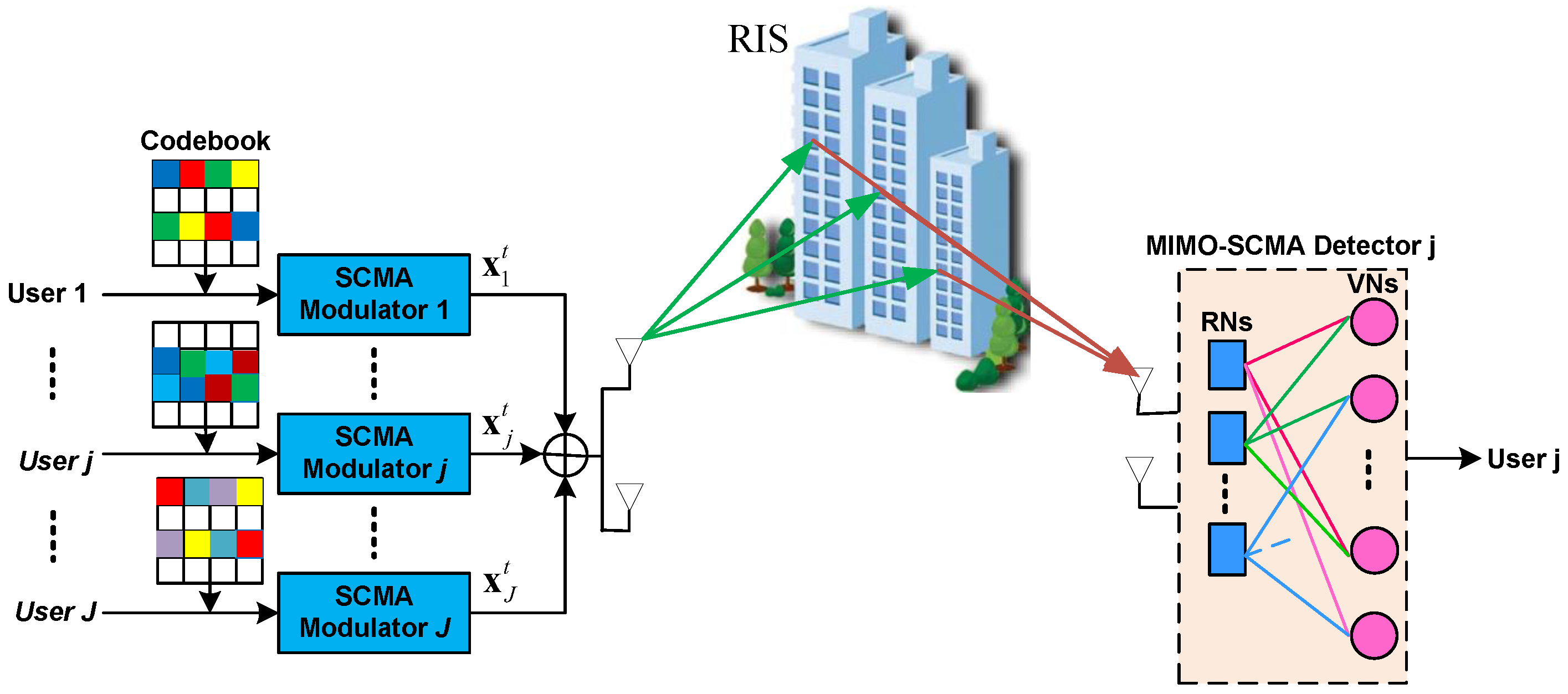
As depicted in Figure 1, we consider a typical downlink MIMO-SCMA transmission model in which J users share K orthogonal resource blocks, such as OFDM subcarriers. The base station and the user employ T and R antennas, respectively. The overloading factor for the system is defined as λ   = J K . The input binary data stream is modulated to a K-dimensional sparse complex vector x j t = [ x 1 , j t , x 2 , j t , , x K , j t ] T for the t-th transmit antenna of the j-th user. Each vector x j t is chosen from a codebook C j t C K × M associated with user j, which contains M codewords, and d v non-zero elements are involved in each codeword, where d v < K . The signal transmitted from the t-th antenna is the sum of codewords from all active users, given by
x t = j = 1 J x j t .
At the receive end, the signal, y l r = [ y l r , 1 , y l r , 2 , , y l r , K ] T , received by the r-th antenna of user l = 1 , 2 , , J can be modeled as
y l r = t = 1 T diag { h l t , r } x t + n l r , = t = 1 T j = 1 J diag { h l t , r } x j t + n l r ,
where r { 1 , , R } , h l t , r = [ h 1 , l t , r , , h K , l t , r ] T is the frequency-domain channel vector between the t-th transmit antenna and the r-th receive antenna of user l, and  n l r denotes the AWGN noise of the r-th receive antenna of user l with variance E [ n j r ( n j r ) H ] = σ 2 I K .
By concatenating all the R receive antenna signals at user l, the received signal vector of user l can be compactly expressed as
y l = t = 1 T j = 1 J diag { h l t } x ˜ j t + n l ,
where
y l = y l 1 y l 2 y l R , h l t = h l t , 1 h l t , 2 h l t , R , x ˜ j t = x j t x j t x j t , n l = n l 1 n l 2 n l R .
To characterize the sparse connectivity between virtual resources and users, a binary indicator matrix F of dimension K R × J T is adopted. The element F u , v indicates whether virtual resource u is connected to the virtual user v, with  u { 1 , , K R } and v { 1 , , J T } . This indicator matrix can be constructed from the single-antenna indicator F , given by
F = P F ,
where P is an R × T matrix with each element P r , t = 1 and ⊗ represents the Kronecker product. The row and column weights of indicator matrix F are
w c = T d c , w v = R d v ,
where d c and d v denote the column and row weights of F , respectively. Consequently, each virtual user is associated with an extended codebook, given by
C ˜ v = C l t C l t C l t C R K × M .
where v = J ( t 1 ) + l . In this way, the system model in (3) can be rewritten as
y l = v = 1 J T diag { h l v } x ˜ v + n l ,
where h l v = h l t and x ˜ v = x ˜ j t . Additionally, the indicator matrix F can be expressed through a joint factor graph, where J T variable nodes (VNs) are associated with virtual users and K R resource nodes (RNs) correspond to virtual resources. The u-th virtual resource node is linked with the v-th virtual user node if and only if F u , v = 1 . Furthermore, we define by
F v = { u F u , v = 1 } ,
the set of RNs associated with the v-th VN and 
V u = { v F u , v = 1 } ,
the set of VNs associated with the u-th RN, respectively.
Example: In this paper, a representative indicator matrix F that serves J = 6 users using K = 4 orthogonal resources is employed for a single-antenna SCMA system, giving
F = 1 1 1 0 0 0 1 0 0 1 1 0 0 1 0 1 0 1 0 0 1 0 1 1 ,
in which d v = 2 , d c = 3 . Moreover, the indicator matrix for a 2 × 2 MIMO-SCMA system can be formulated as
F = F F F F ,
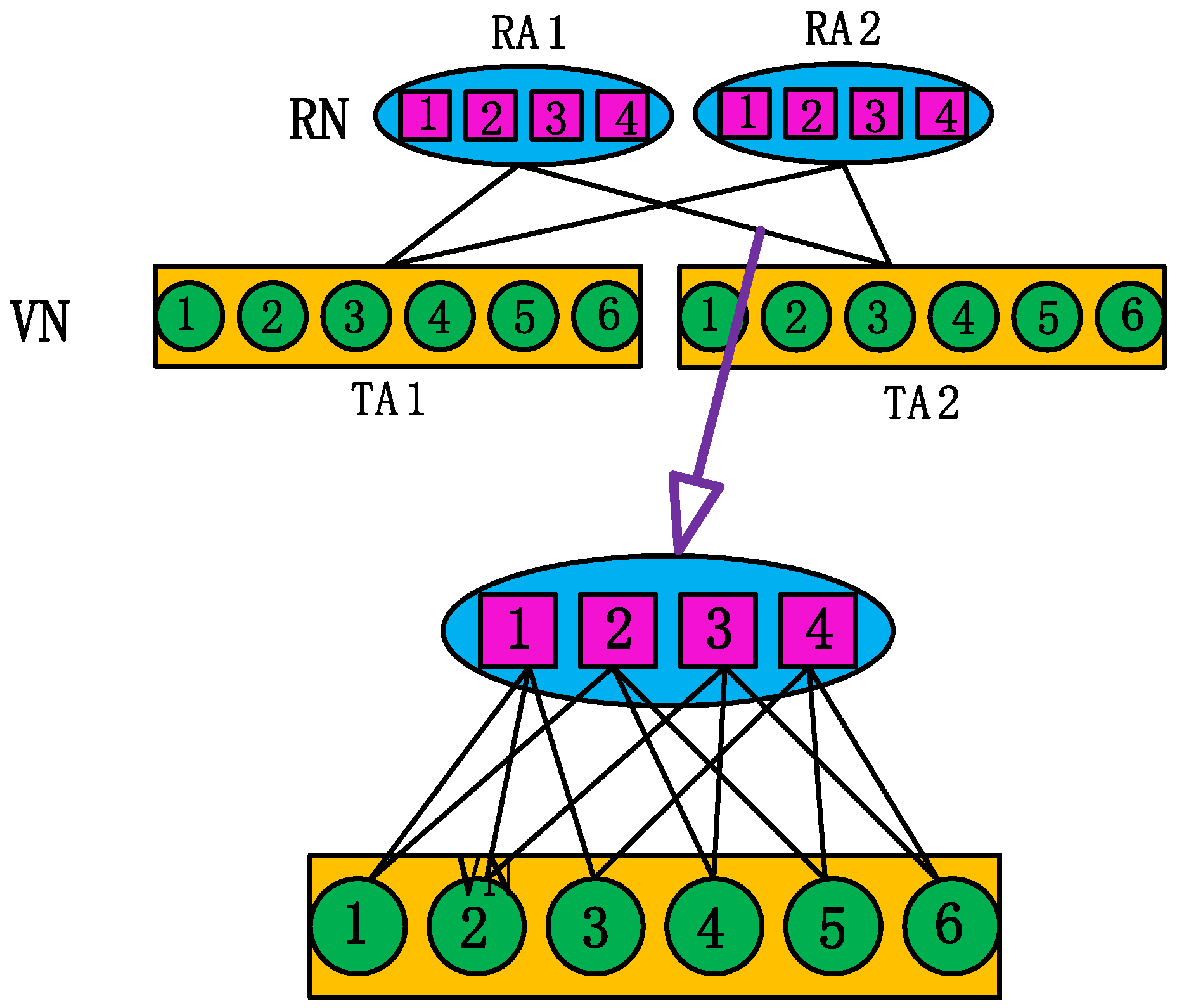
and its corresponding factor graph is depicted in Figure 2, where the virtual variable nodes (VNs) are associated with the transmit antennas and users, while the virtual resource nodes (RNs) correspond to the receive antennas and subcarriers, which determines the message flows in symbol detection. Observing (2), the signal of the k-th resource of the r-th receive antenna for the l-th user can be obtained as
y k , l r = t = 1 T h k , l t , r x k t + n k , l r = t = 1 T j = 1 , j V k J h k , l t , r x j , k t + n k , l r .
In this work, an RIS with N reflecting elements is adopted to improve the peformance of this downlink MIMO-SCMA system. In this sense, the channel coefficient h k , l t , r can be rewritten as
h k , l t , r = n = 1 N g n , k , l t , r e j θ n , k f n , k t
where f n , k t and g n , k , l t , r denote the channel between the k-th resource of the t-th transmit antenna for the base station and the n-th reflecting element of the RIS and the channel between n-th reflecting element of the RIS and the k-th resource of the r-th receive antenna for the l-th user, respectively. θ n , k is the phase shift coefficient for the n-th reflecting element of the RIS with θ n , k ( 0 , 2 π ] . Then, the signal of the k-th resource of the r-th receive antenna for the l-th user can be rewritten as
y k , l r = t = 1 T j = 1 , j V k J n = 1 N g n , k , l t , r e j θ n , k f n , k t x j , k t + n k , l r .

3. Gmedian-Based Phase Optimization for RIS-Assisted MIMO-SCMA System

In this section, we derive the optimized phase for the RIS-assisted MIMO-SCMA system. Firstly, we rewritten the channel coefficients f n , k t and g n , k , l t , r in (14) in the polar form as
g n , k t , r = g n , k , l t , r e j ϕ n , k , l t , r , f n , k t = | f n , k t | e j ψ n , k t ,
where | g n , k , l t , r | and | f n , k t | are the amplitudes of g n , k , l t , r and f n , k t , and  ϕ n , k , l t , r and ψ n , k t are the phases of g n , k , l t , r and f n , k t , respectively. In this way, the received signal in (15) can be rewritten as
y k , l r = t = 1 T j = 1 , j V k J n = 1 N | g n , k , l t , r f n , k t | e j ( θ n , k ϕ n , k , l t , r ψ n , k t ) x j , k t + n k , l r .
In order to strengthen the instantaneous ratio of signal strength to noise power, we can find a sub-optimal solution by solving the geometric median (Gmedian)-based phase optimization as follows:
min θ n , k [ π , π ] l = 1 , l V k J t = 1 T r = 1 R | θ n , k ϕ n , k , l t , r ψ n , k t | 2
with the assumption that ϕ n , k , l t , r and ψ n , k t are known at the receive end. Not that in RIS-assisted MIMO systems, the received signal is the superposition of multiple reflected signals, each with its own channel gain and phase. To maximize the instantaneous SNR, ideally all these signals should add up constructively, but perfect phase alignment is often infeasible due to channel uncertainties or hardware constraints. Gmedian-based phase optimization provides a sub-optimal yet effective solution by finding a central point in the complex plane that minimizes the sum of distances to all signal vectors, which enhances the overall received signal strength in a robust and mathematical way. To find its solution, we compute the derivative of this objective function:
p ( θ n , k ) = l = 1 , l V k J t = 1 T r = 1 R | θ n , k ϕ n , k , l t , r ψ n , k t | 2 ,
with respect to θ n , k , given by
p ( θ n , k ) θ n , k = l = 1 , l V k J t = 1 T r = 1 R 2 ( θ n , k ϕ n , k , l t , r ψ n , k t ) = 0 .
Observe that the summation above is linear in θ n , k . By grouping the terms containing θ n , k and moving the other terms to the right-hand side, the equation can be solved directly by simple algebraic manipulation. Specifically, θ n , k can be expressed as the average of the sum of ϕ n , k , l t , r and ψ n , k t over all indices, giving
θ n , k = l = 1 , l V k J t = 1 T r = 1 R ( ϕ n , k , l t , r + ψ n , k t ) d c T R .
Following the detailed derivations presented for the MIMO-SCMA system above, we now turn to the single-antenna case. In this sense, the received signal at the k-th resource for the l-th user can be formulated as
y k , l = h k , l x k + n k , l = j = 1 J h k , l x j , k + n k , l ,
and the channel coefficient h k , l under RIS transmission can be represented as
h k , l = n = 1 N g n , k , l e j θ n , k f n , k ,
where g n , k , l and f n , k are the channel between the k-th resource for the base station and the n-th reflecting element of the RIS and the channel between the n-th reflecting element of the RIS and the k-th resource for the l-th user, respectively. Subsequently, the received signal in (22) can be reformulated as
y k , l = j = 1 , j V k J n = 1 N g n , k , l e j θ n , k f n , k x j , k + n k , l .
The channel coefficients g n , k , l and f n , k can be expressed in the following forms:
g n , k , l = g n , k , l e j ϕ n , k , l , f n , k = | f n , k | e j ψ n , k .
Accordingly, the received signal in (15) can be equivalently expressed as
y k , l = j = 1 , j V k J n = 1 N | g n , k , l f n , k | e j ( θ n , k ϕ n , k , l ψ n , k ) x j , k + n k , l .
Hence, a sub-optimal solution for θ n , k can be obtained by finding the solution to Gmedian optimization
min θ n , k [ π , π ] l = 1 , l V k J | θ n , k ϕ n , k , l ψ n , k | 2 .
To find its solution, we compute the derivative of this objective function,
p ( θ n , k ) = l = 1 , l V k J | θ n , k ϕ n , k , l ψ n , k | 2 ,
with respect to θ n , k , given by
p ( θ n , k ) θ n , k = l = 1 , l V k J 2 ( θ n , k ϕ n , k , l ψ n , k ) = 0 .
After some algebraic manipulations, we have
θ n , k = l = 1 , l V k J ϕ n , k , l d c + ψ n , k .

4. MPA Detection for the RIS-Assisted MIMO-SCMA System

At the receiver, the transmitted bits are usually recovered employing the message passing algorithm (MPA), which operates in an iterative manner based on the factor graph. The MPA detector can achieve near-optimal performance by iteratively exchanging codeword likelihood information between virtual VNs and RNs.
Define the a posteriori probability of the codeword x ˜ v associated with the v-th variable node as A ( x ˜ v ) . Moreover, let V u v l ( x ˜ v ) and F u v l ( x ˜ v ) represent the message passed from the u-th resource node to the v-th variable node and the message passed from the v-th variable node to the u-th resource node during the l-th iteration, respectively, where l = 1 , 2 , , L . The iterative procedure of the MPA can be summarized as follows:
  • Initialization: Let q = 1 and set the maximum number of iterations as Q. Initialize the a priori probability of each of the M codewords transmitted by the v-th virtual user as F u v 0 ( x ˜ v ) = A ( x ˜ v ) .
  • Variable Node Updating: At the q-th iteration, the message passed from the u-th virtual resource node to the v-th virtual variable node is given by
    V u v q ( x ˜ v ) = d V u v f u ( x ˜ ) d V u v F d v q 1 ( x ˜ d ) ,
    in which
    f u ( x ˜ ) = exp 1 σ 2 y j u v = 1 J T n = 1 N g n , k , l t , r e j θ n , k f n , k t x ˜ u v 2 ,
    where x ˜ = { x ˜ v } , v V u , y j u and h u , j v denote the received signal and the channel gain corresponding to the u-th virtual resource, respectively, and  x ˜ u v represents the u-th element of the MIMO-SCMA codeword x ˜ v . The notation V u v refers to the set of all variable nodes connected to the u-th resource node with the v-th node excluded, which consists of ( w c 1 ) variable nodes.
  • Resource Node Updating: At the q-th iteration, the message passed from the v-th virtual variable node to the u-th virtual resource node can be expressed as
    F u v q ( x ˜ v ) = A ( x ˜ v ) m F v u V m v q ( x ˜ v ) ,
    where F v u denotes the set of all virtual resource nodes associated with the virtual variable node v with the u-th node excluded, which consists of ( w v 1 ) resource nodes.
  • When the iteration reaches the maximum number Q, we compute
    F v ( x ˜ v ) = m F v V m v Q ( x ˜ v ) .
    Based on the a posteriori probability of the codeword x ˜ v , we detect the corresponding virtual codeword transmitted from the t-th transmit antenna of user l, which maximizes F v ( x ˜ v ) with v = J ( t 1 ) + l . The overall MPA detection steps for RIS-assisted MIMO-SCMA system are summarized in Algorithm 1.
Algorithm 1: The MPA detection for the RIS-assisted MIMO-SCMA system.
 Input: g n , k , l t , r , f n , k t , y k , l r ,   σ 2 ,   T ,   R
1Initialization
2Initialize the conditional probability, compute the phases of the RIS reflecting elements as
 
θ n , k = l = 1 , l V k J t = 1 T r = 1 R ϕ n , k , l t , r d c T R + ψ n , k t , Gmedian Optimized π + 2 π rand ( ) , Random
3Iteration
4for  q = 1 : Q  do
5      Conduct variable node updating in (31).
6      Conduct resource node updating in (33)
7end
8Probability Calculation
9Compute the final probabilities of each codeword as (34).
Complexity analysis: Observing from (31) to (34), it is straightforward that the MPA detection for the RIS-assisted MIMO-SCMA system is almost the same as the original one except for the calculation of f u ( x ˜ ) in (32). The computational cost of the original MPA has been given in (19) and (20) [51] in terms of the number of real multiplications and additions. The MPA detection in this work needs further 2 N w c w v M multiplications due to the initialization in (32).

5. Numerical Results

This section presents numerical results to demonstrate the effectiveness of the proposed phase optimization and MPA detector for the RIS-assisted MIMO-SCMA system; bit error ratio (BER) performance comparison was conducted with respect to an identical downlink MIMO-SCMA configuration. The system parameters were set to K = 4 ,   J = 6 ,   M = 4 ,   d c = 3 , and d v = 2 , whose overloading factor is 150 % . The channel gains f n , k t and g n , k , l t , r are assumed to be independent complex Gaussian random variables with zero mean and unit variance. All transmit antennas of a specified user are assigned an identical codebook. The codebook adopted in this work can be found in [51].
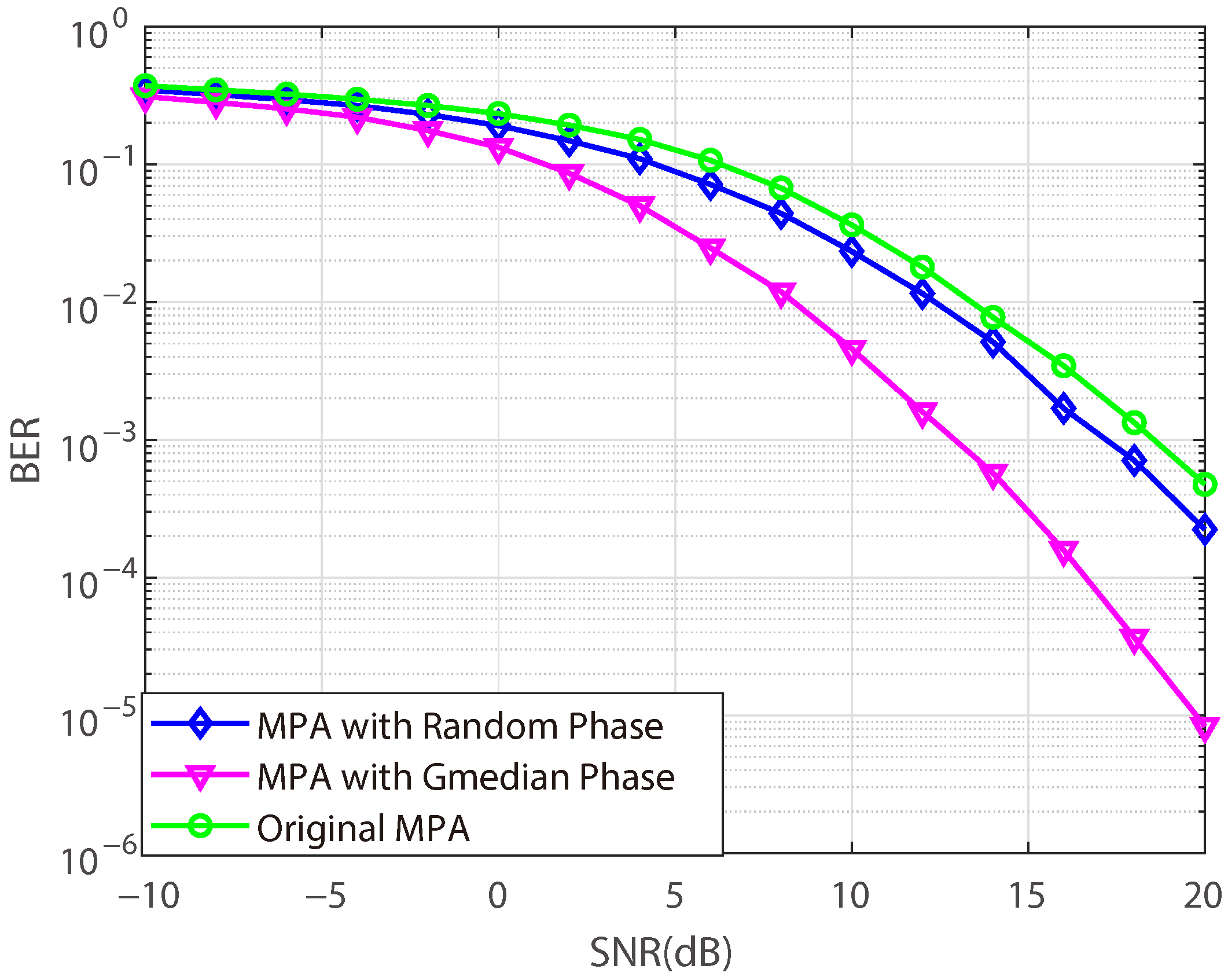
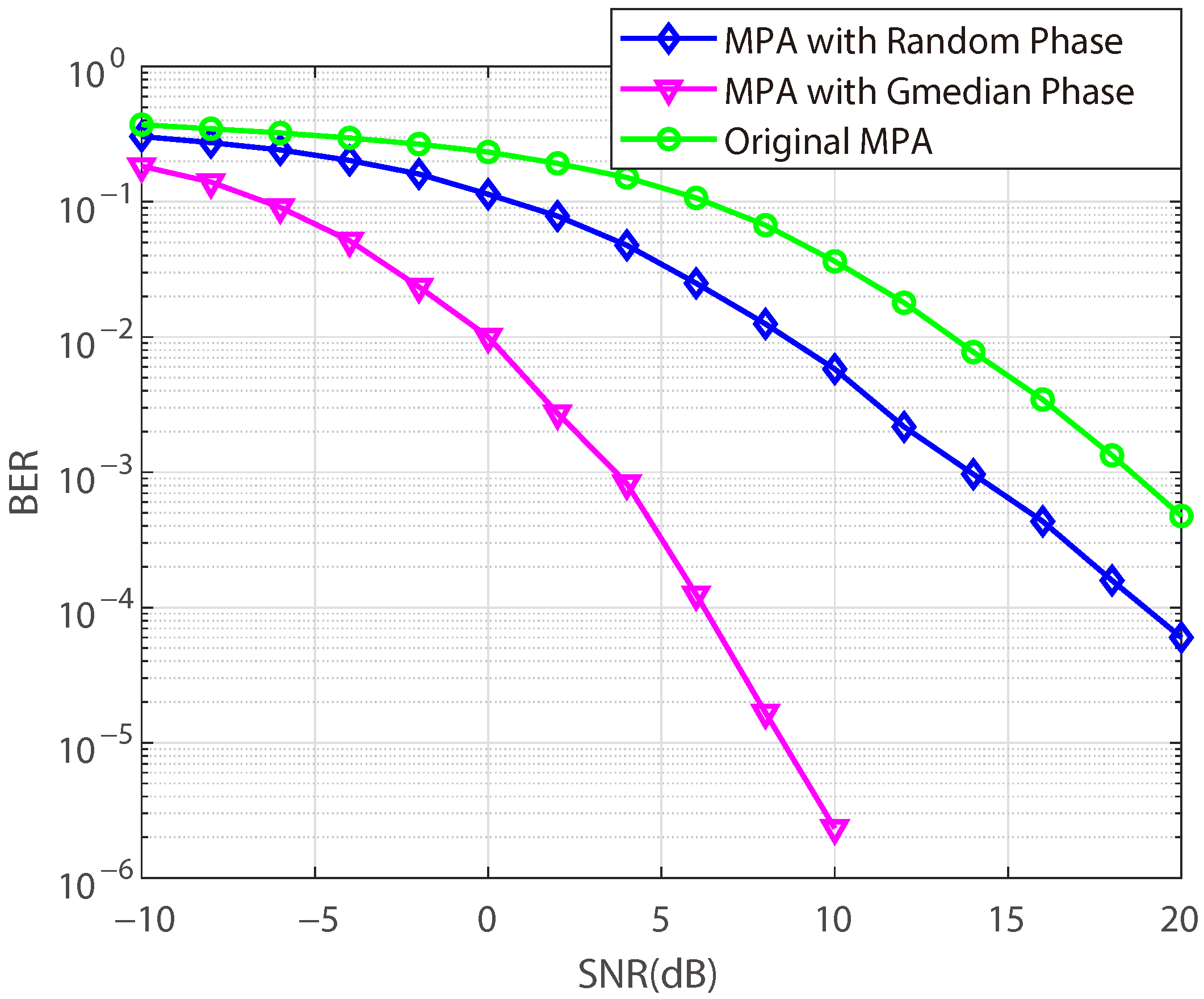
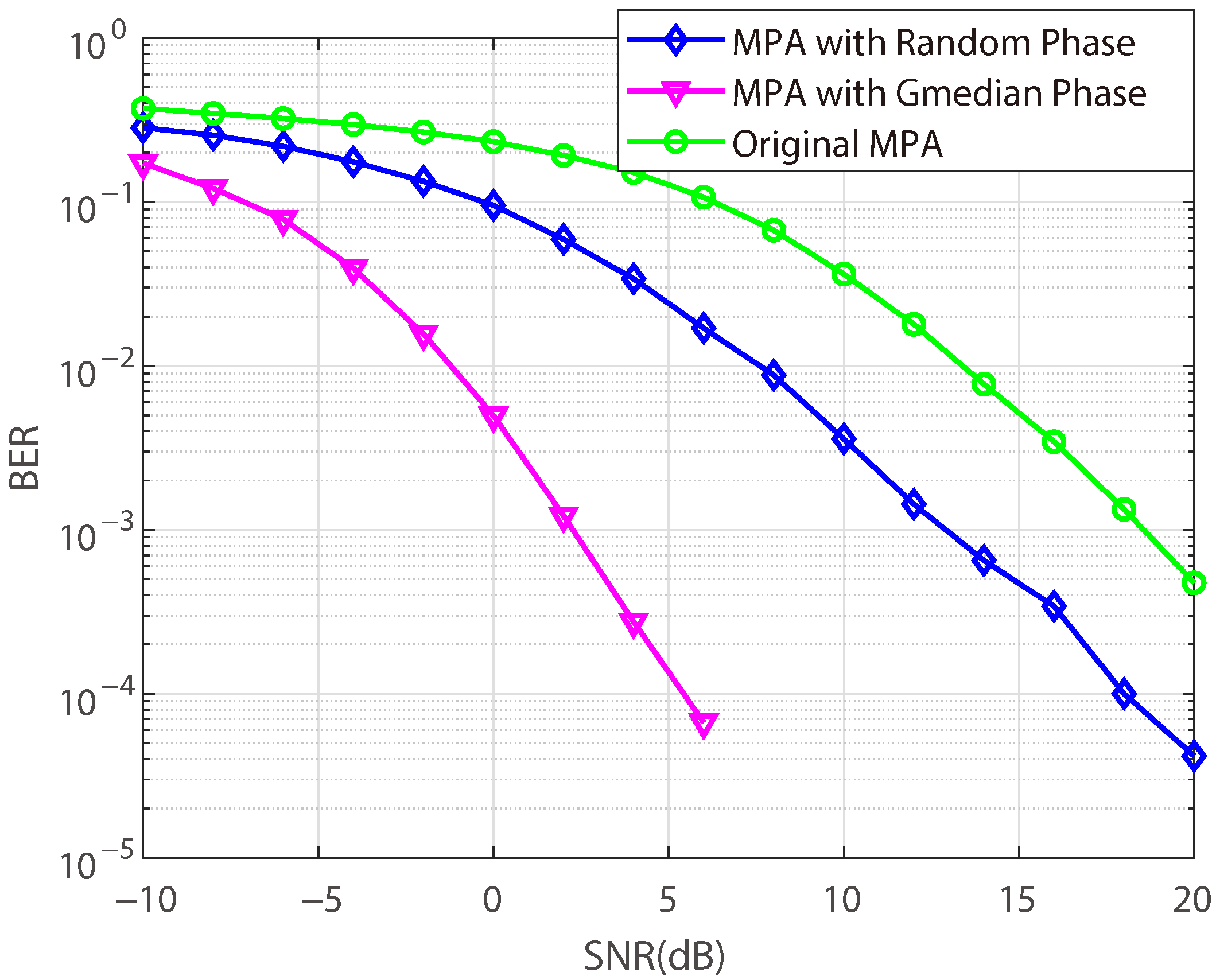
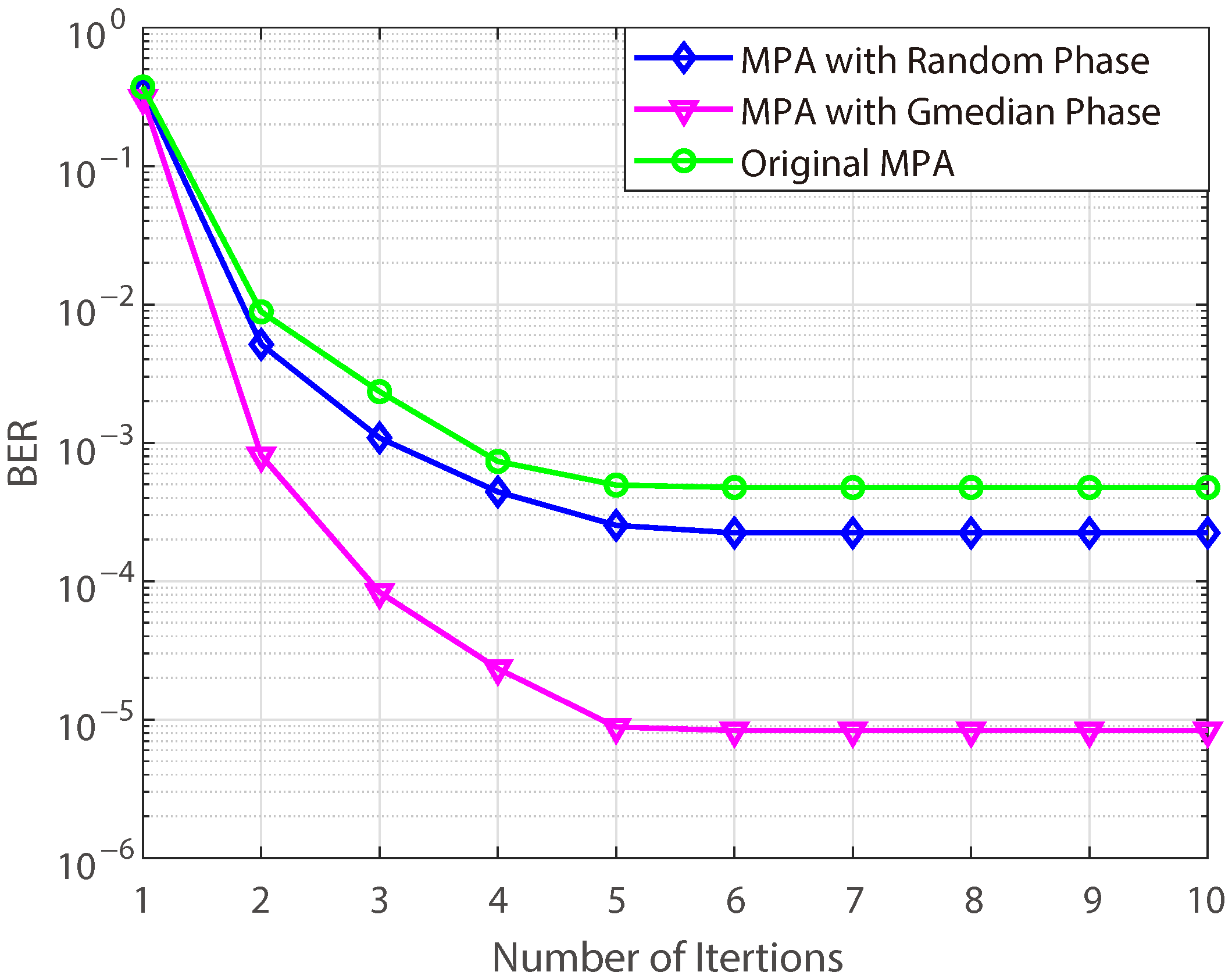
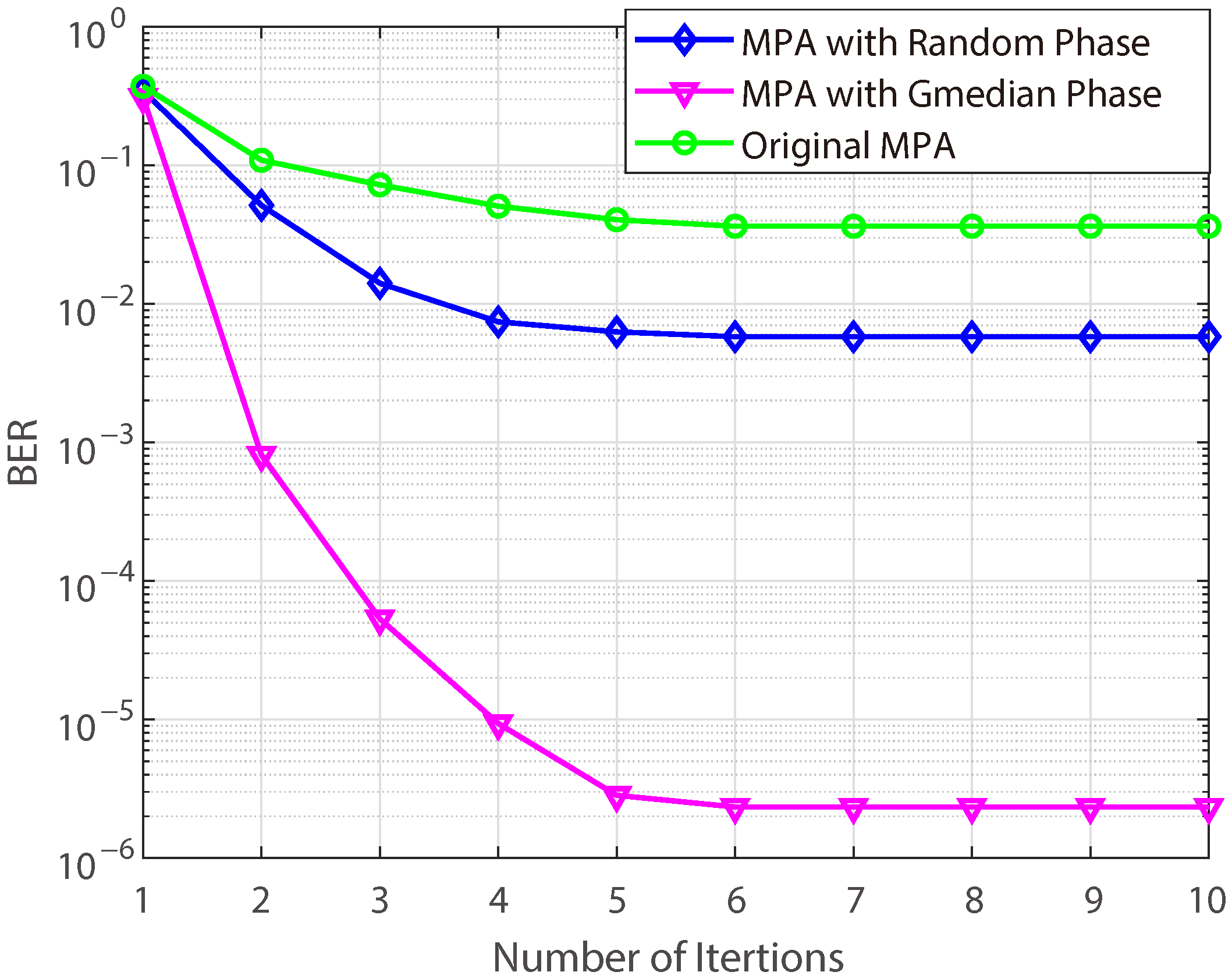
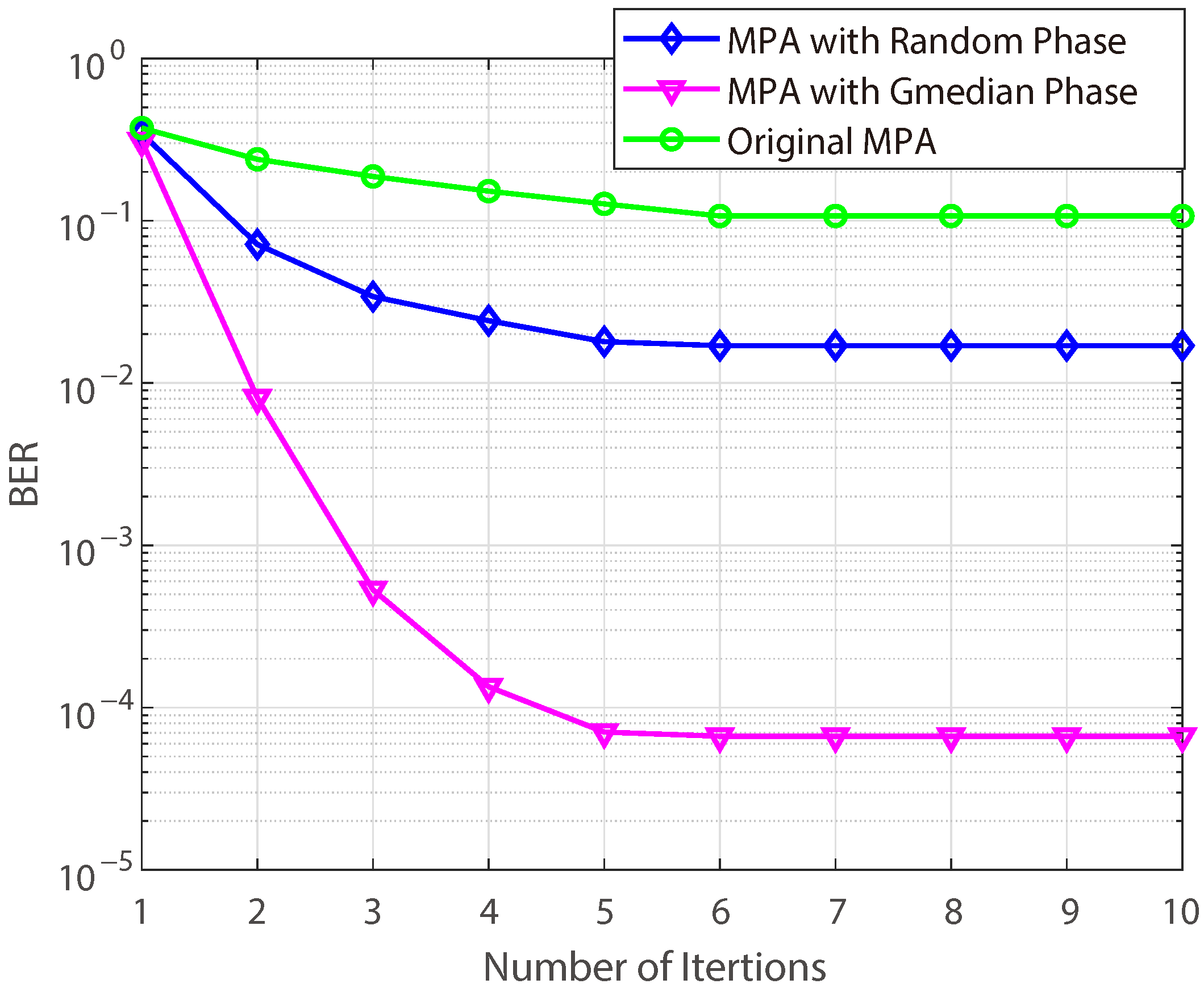
We first simulated the BER performance of different solutions to the phases of RIS reflecting elements as functions of the SNR over different numbers of RIS reflecting elements, N = 10 , 20 , 30 , in Figure 3, Figure 4 and Figure 5, respectively, over the single-input single-output channel. The optimized phases were calculated according to (30) by the Gmedian method, which is reflected in (35). The MPA detection steps have been presented in Section 4 and are summarized in Algorithm 1. Observing Figure 3, Figure 4 and Figure 5, it is straightforward that the MPA with the Gmedian phase can achieve better BER performance than both the random and original ones. This is because the optimized phases under the Gmedian strategy can achieve a higher signal-to noise-ratio, which in return improves the BER performance. We also observe that higher numbers of RIS reflecting elements can enhance the BER performance. For example, the BERs for SNR = 0 dB are almost 10 1 , 10 2 , and 4 × 10 3 , respectively. To describe the BER improvements, BERs of different solutions to the phases of the RIS with different numbers of reflecting elements (REs) at SNR = 5 dB are listed in Table 1. Moreover, we investigated the convergence behaviors of different solutions to the phases of RIS reflecting elements, N = 10 , 20 , 30 , in Figure 6, Figure 7 and Figure 8, respectively, over the single-input single-output channel. Observing Figure 6, Figure 7 and Figure 8, it is obvious that the MPA detection for the RIS-assisted MIMO-SCMA system is the same as the original MPA due to the fact that the convergence behavior is determined by the likelihood probability calculation.
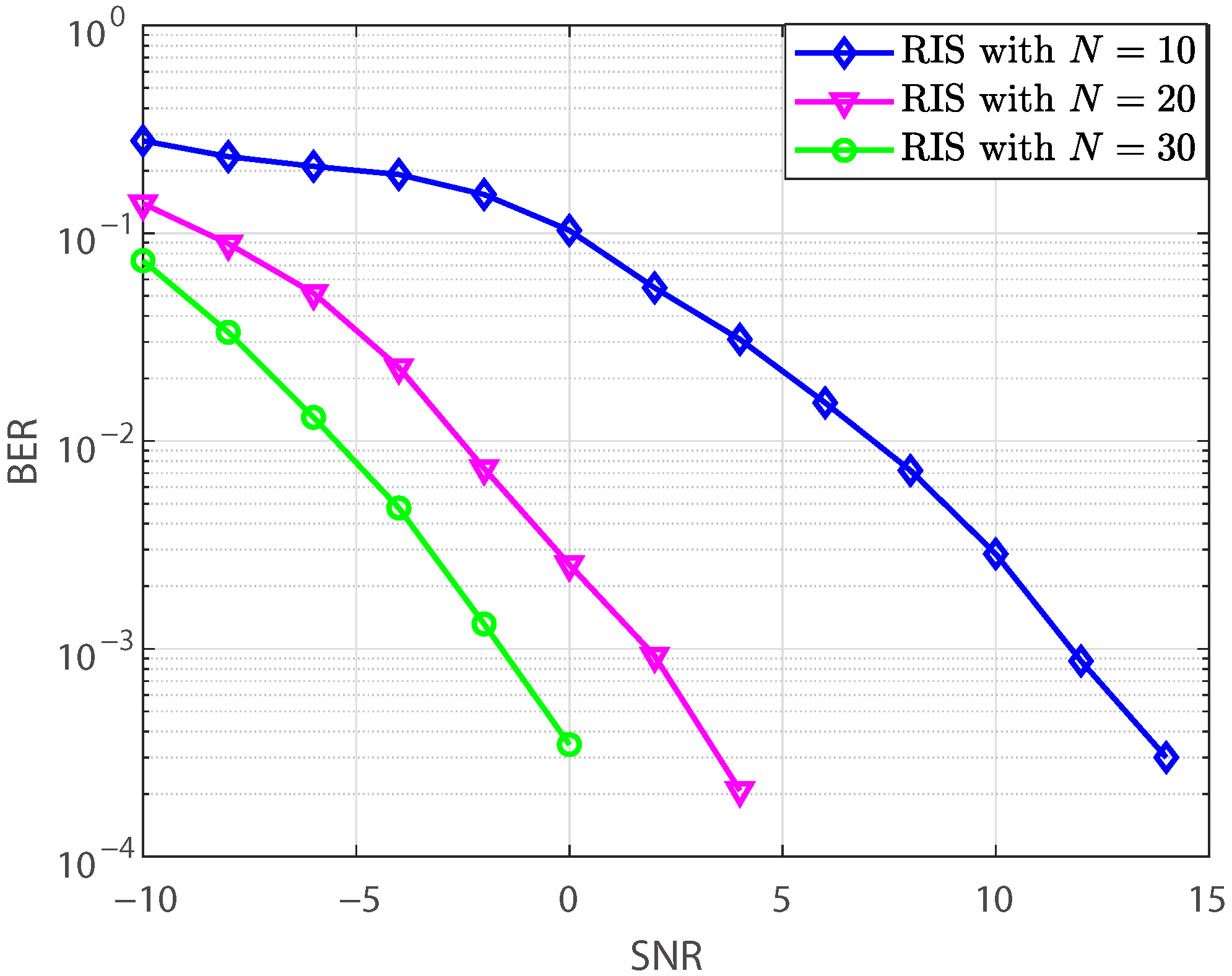
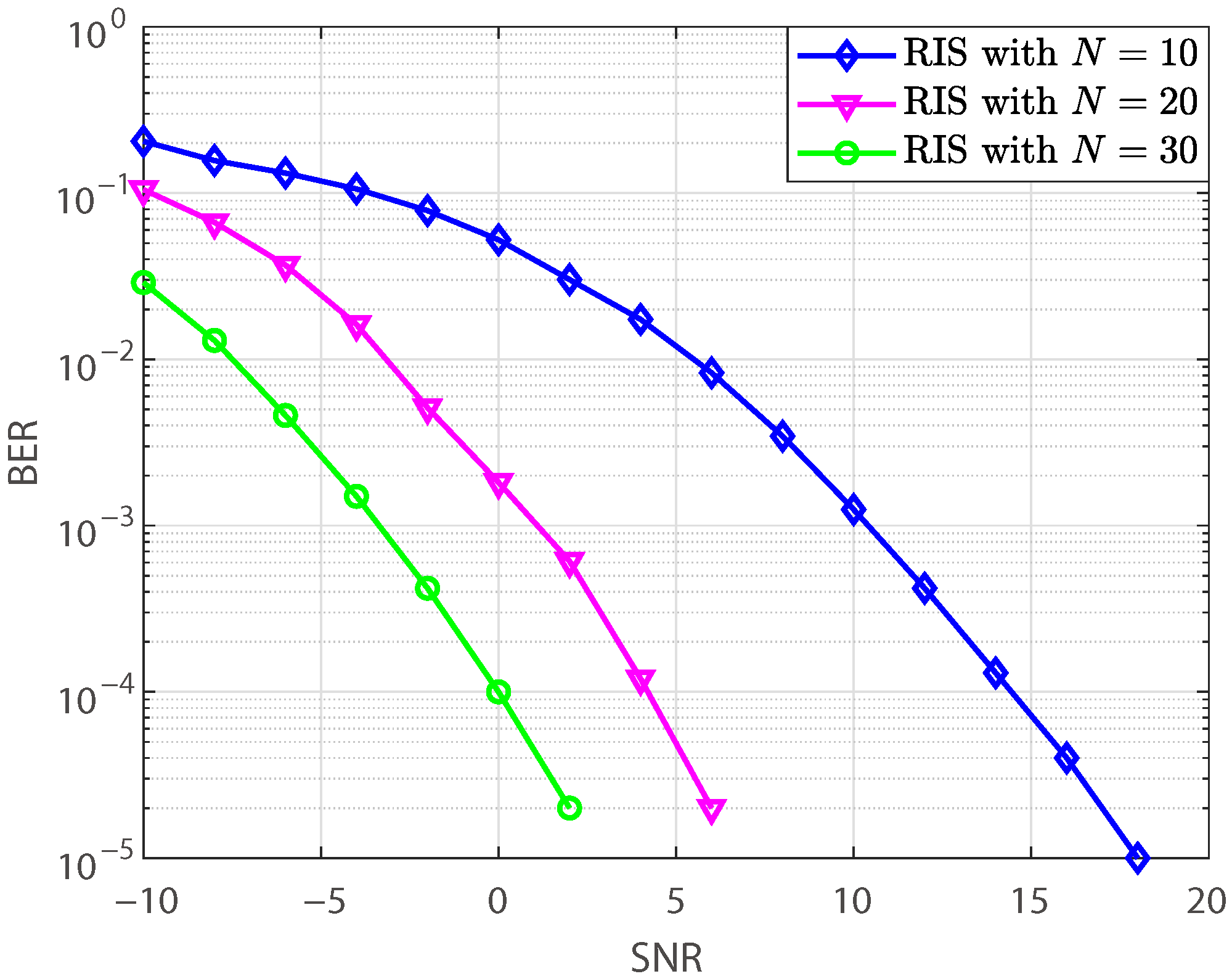
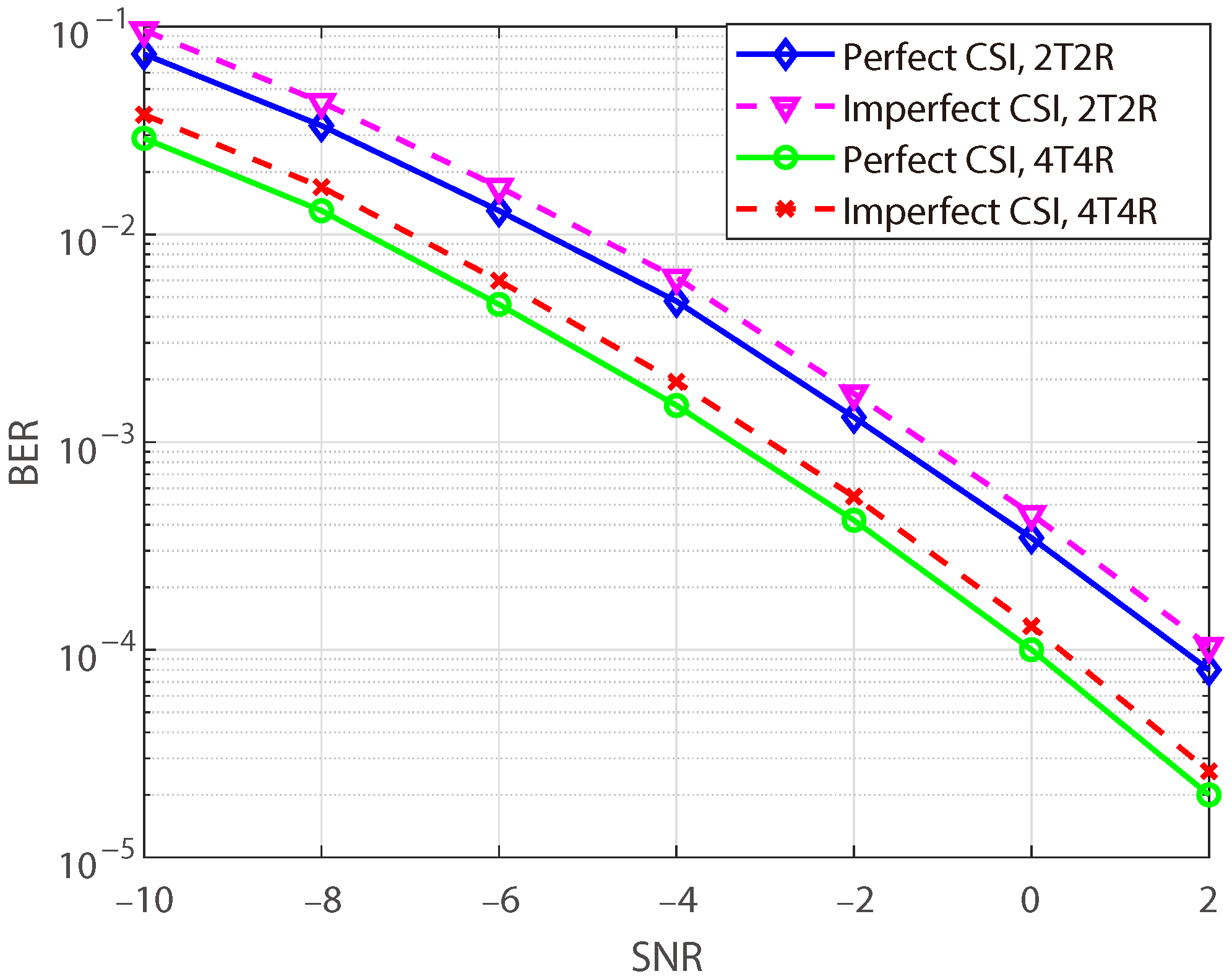
The BERs of different numbers of RIS reflecting elements as functions of the SNR with T = 2 ,   R = 2 and T = 4 ,   R = 4 are also considered in Figure 9 and Figure 10, respectively. Observe from Figure 9 and Figure 10 that the RIS-assisted MIMO-SCMA system with more reflecting elements can achieve better BER performance. This is because the reflecting elements of the RIS can enhance the signal power as compared to the original MPA. Moreover, the robustness of the proposed Gmedian solution for the phases of the RIS reflecting elements in the RIS-assisted MIMO-SCMA system can also be observed. To verify the robustness of our proposed Gmedian-based solution, we also investigated the BER performance for different MIMO configurations under both perfect and imperfect Channel State Information with a number of 30 RIS reflecting elements, as shown in Figure 11, where although slight BER losses are observed, the detection efficiency can be guaranteed.

6. Conclusions

In this work, we investigate the phase optimization of the RIS reflecting elements and detection design for the RIS-assisted downlink MIMO-SCMA system. Moreover, a virtual factor graph representation of the system is introduced to facilitate a deep insight into the structure. A sub-optimal geometric median-based optimization problem is then developed under phase range constraints of the reflecting elements. By deriving the derivative of the objective function with respect to the phase variables, a closed-form analytical solution is obtained. The MPA detection steps are also described by incorporating the RIS phase adjustments. Simulation results demonstrate that the proposed RIS-assisted MIMO-SCMA system achieves superior BER performance compared with its counterpart without an RIS. Future work may focus on integrating RIS-assisted MIMO-SCMA with emerging 6G technologies, such as mmWave, Terahertz communications, and AI-assisted resource allocation.

Author Contributions

Conceptualization, D.F., X.Z., X.Y., X.W., X.S., and H.C.; methodology, D.F., X.Y., and H.C.; writing—original draft preparation, D.F. and X.Z.; writing—review and editing, D.F., X.Z., X.Y., X.W., X.S., and H.C. All authors have read and agreed to the published version of the manuscript.

Funding

This work was supported by the Industry–Academia–Research Collaboration Project between China Telecom and Nanjing University of Posts and Telecommunications (JSSGS2500832EGN00).

Institutional Review Board Statement

Not applicable.

Informed Consent Statement

Not applicable.

Data Availability Statement

The data presented in this study are available in the article.

Conflicts of Interest

Author Xin Wang was employed by China Telecom Corporation Limited. The remaining authors declare that the research was conducted in the absence of any commercial or financial relationships that could be construed as a potential conflict of interest.

References

  1. Wang, C.; You, X.; Gao, X.; Zhu, X.; Li, Z.; Zhang, C.; Wang, H.; Huang, Y.; Chen, Y.; Haas, H.; et al. On the Road to 6G: Visions, Requirements, Key Technologies, and Testbeds. IEEE Commun. Surv. Tuts. 2023, 25, 905–974. [Google Scholar] [CrossRef]
  2. Chafii, M.; Bariah, L.; Muhaidat, S.; Debbah, M. Twelve Scientific Challenges for 6G: Rethinking the Foundations of Communications Theory. IEEE Commun. Surv. Tuts. 2023, 25, 868–904. [Google Scholar] [CrossRef]
  3. Atzori, L.; Iera, A.; Morabito, G. The Internet of Things: A survey. Comput. Netw. 2010, 54, 2787–2805. [Google Scholar] [CrossRef]
  4. Zanella, A.; Bui, N.; Castellani, A.; Vangelista, L.; Zorzi, M. Internet of Things for smart cities. IEEE Internet Things J. 2014, 1, 22–32. [Google Scholar] [CrossRef]
  5. Zhong, Y.; Dutkiewicz, E.; Yang, Y.; Zhu, X.; Zhou, Z.; Jiang, T. Internet of mission-critical things: Human and animal classification-A device-free sensing approach. IEEE Internet Things J. 2018, 5, 3369–3377. [Google Scholar] [CrossRef]
  6. Zhao, H.; Tan, Y.; Guo, K.; Xia, W.; Xu, B.; Quek, T.Q.S. Client Scheduling for Multi-Server Federated Learning in Industrial IoT With Unreliable Communications. IEEE Internet Things J. 2024, 11, 16478–16490. [Google Scholar] [CrossRef]
  7. Ji, B.; Zhang, X.; Mumtaz, S.; Han, C.; Li, C.; Wen, H.; Wang, D. Survey on the internet of vehicles: Network architectures and applications. IEEE Commun. Stand. Mag. 2020, 4, 34–41. [Google Scholar] [CrossRef]
  8. Al-Dulaimi, O.M.K.; Al-Dulaimi, A.M.K.; Alexandra, M.O.; Al-Dulaimi, M.K.H. Strategy for Non-Orthogonal Multiple Access and Performance in 5G and 6G Networks. Sensors 2023, 23, 1705. [Google Scholar] [CrossRef] [PubMed]
  9. Wang, D.; Wu, M.; He, Y.; Pang, L.; Xu, Q.; Zhang, R. An HAP and UAVs Collaboration Framework for Uplink Secure Rate Maximization in NOMA-Enabled IoT Networks. Remote Sens. 2022, 14, 4501. [Google Scholar] [CrossRef]
  10. Liu, Y.; Gao, H.; Cheng, H.; Xia, Y.; Pei, W. Outage Performance Analysis of Improper Gaussian Signaling for Two-User Downlink NOMA Systems with Imperfect Successive Interference Cancellation. Entropy 2023, 25, 1172. [Google Scholar] [CrossRef] [PubMed]
  11. Vidal-Beltrán, S.; López-Bonilla, J.L. Improving Spectral Efficiency in the SCMA Uplink Channel. Mathematics 2021, 9, 651. [Google Scholar] [CrossRef]
  12. Sultana, A.; Woungang, I.; Anpalagan, A.; Zhao, L.; Ferdouse, L. Efficient resource allocation in SCMA-enabled device-to-device communication for 5G networks. IEEE Trans. Veh. Technol. 2020, 69, 5343–5354. [Google Scholar] [CrossRef]
  13. Yu, L.; Liu, Z.; Wen, M.; Cai, D.; Dang, S.; Wang, Y.; Xiao, P. Sparse code multiple access for 6G wireless communication networks: Recent advances and future directions. IEEE Commun. Stand. Mag. 2021, 5, 92–99. [Google Scholar] [CrossRef]
  14. Islam, S.M.R.; Avazov, N.; Dobre, O.A.; Kwak, K. Power-domain non-orthogonal multiple access (NOMA) in 5G systems: Potentials and challenges. IEEE Commun. Surv. Tut. 2017, 19, 721–742. [Google Scholar] [CrossRef]
  15. Wang, P.; Ye, N.; Li, J.; Di, B.; Wang, A. Asynchronous Multi-User Detection for Code-Domain NOMA: Expectation Propagation Over 3D Factor-Graph. IEEE Trans. Veh. Technol. 2022, 71, 10770–10781. [Google Scholar] [CrossRef]
  16. Dai, L.; Wang, B.; Yuan, Y.; Han, S.; Chih-lin, I.; Wang, Z. Non-orthogonal multiple access for 5G: Solutions, challenges, opportunities, and future research trends. IEEE Commun. Mag. 2015, 53, 74–81. [Google Scholar] [CrossRef]
  17. Liang, L.; Xie, S.; Li, G.Y.; Ding, Z.; Yu, X. Graph-based resource sharing in vehicular communication. IEEE Trans. Wirel. Commun. 2018, 17, 4579–4592. [Google Scholar] [CrossRef]
  18. Higuchi, K.; Kishiyama, Y. Non-orthogonal access with random beamforming and intra-beam SIC for cellular MIMO downlink. In Proceedings of the 2013 IEEE 78th Vehicular Technology Conference (VTC Fall), Las Vegas, NV, USA, 2–5 September 2013. [Google Scholar]
  19. Zeng, M.; Yadav, A.A.; Dobre, O.; Tsiropoulos, G.I.; Poor, H.V. Capacity comparison between MIMO-NOMA and MIMO-OMA with multiple users in a cluster. IEEE J. Sel. Areas Commun. 2017, 35, 2413–2424. [Google Scholar] [CrossRef]
  20. Ye, N.; Miao, S.; Pan, J.; Xiang, Y.; Mumtaz, S. Dancing With Chains: Spaceborne Distributed Multi-User Detection Under Inter-Satellite Link Constraints. IEEE J. Sel. Top. Signal Process. 2025, 19, 430–446. [Google Scholar] [CrossRef]
  21. Rusek, F.; Persson, D.; Lau, B.K.; Larsson, E.G.; Marzetta, T.L.; Edfors, O.; Tufvesson, F. Scaling up MIMO: Opportunities and challenges with very large arrays. IEEE Signal Process. Mag. 2013, 30, 40–60. [Google Scholar] [CrossRef]
  22. Bj¨ornson, E.; Hoydis, J.; Kountouris, M.; Debbah, M. Massive MIMO systems with non-ideal hardware: Energy efficiency, estimation, and capacity limits. IEEE Trans. Inf. Theory 2014, 60, 7112–7139. [Google Scholar] [CrossRef]
  23. Huang, Y.; Zhang, C.; Wang, J.; Jing, Y.; Yang, L.; You, X. Signal processing for MIMO-NOMA: Present and future challenges. IEEE Wirel. Commun. 2018, 25, 32–38. [Google Scholar] [CrossRef]
  24. Moltafet, M.; Parsaeefard, S.; Javan, M.R.; Mokari, N. Robust radio resource allocation in MISO-SCMA assisted C-RAN in 5G networks. IEEE Trans. Veh. Technol. 2019, 68, 5758–5768. [Google Scholar] [CrossRef]
  25. Pan, Z.; Liu, W.; Lei, J.; Luo, J.; Wen, L.; Tang, C. Multi-dimensional space-time block coding aided downlink MIMO-SCMA. IEEE Trans. Veh. Technol. 2019, 68, 6657–6669. [Google Scholar] [CrossRef]
  26. Tang, S.; Ma, Z.; Xiao, M.; Hao, L. Hybrid transceiver design for beamspace MIMO-NOMA in code-domain for mmwave communication using lens antenna array. IEEE J. Sel. Areas Commun. 2020, 38, 2118–2127. [Google Scholar] [CrossRef]
  27. Abedi, M.R.; Javan, M.R.; Yamchi, N.M.; Yanikomeroglu, H. 3D MIMO dual communications in SCMA-based secure hetnets. IEEE Trans. Veh. Technol. 2020, 69, 8499–8513. [Google Scholar] [CrossRef]
  28. Narasimhan, T.L.; Chockalingam, A. Channel hardening-exploiting message passing (CHEMP) receiver in large-scale MIMO systems. IEEE J. Sel. Top. Signal Process. 2014, 8, 847–860. [Google Scholar] [CrossRef]
  29. Moltafet, M.; Yamchi, N.M.; Javan, M.R.; Azmi, P. Comparison study between PD-NOMA and SCMA. IEEE Trans. Veh. Technol. 2018, 67, 1830–1834. [Google Scholar] [CrossRef]
  30. Luo, Q.; Gao, P.; Liu, Z.; Xiao, L.; Mheich, Z.; Xiao, P. An error rate comparison of power domain non-orthogonal multiple access and sparse code multiple access. IEEE Open J. Commun. Soc. 2021, 2, 500–511. [Google Scholar] [CrossRef]
  31. Wei, F.; Chen, W. Low Complexity Iterative Receiver Design for Sparse Code Multiple Access. IEEE Trans. Commun. 2017, 65, 621–634. [Google Scholar] [CrossRef]
  32. Han, K.; Hu, J.; Chen, J.; Lu, H. A Low Complexity Sparse Code Multiple Access Detector Based on Stochastic Computing. IEEE Trans. Circuits Syst. I Reg. Pap. 2018, 65, 769–782. [Google Scholar] [CrossRef]
  33. Ma, X.; Yang, L.; Chen, Z.; Siu, Y. Low complexity detection based on dynamic factor graph for SCMA systems. IEEE Commun. Lett. 2017, 21, 2666–2669. [Google Scholar] [CrossRef]
  34. Du, Y.; Dong, B.; Chen, Z.; Fang, J.; Gao, P.; Liu, Z. Low-complexity detector in sparse code multiple access systems. IEEE Commun. Lett. 2016, 20, 1812–1815. [Google Scholar] [CrossRef]
  35. Xiao, J.; Hu, J.; Han, K. Low complexity expectation propagation detection for SCMA using approximate computing. In Proceedings of the 2019 IEEE Globecom Workshops (GC Wkshps), Waikoloa, HI, USA, 9–13 December 2019. [Google Scholar]
  36. Cheng, H.; Zhang, C.; Huang, Y.; Yang, L. Efficient Message Passing Receivers for Downlink MIMO-SCMA Systems. IEEE Trans. Veh. Technol. 2022, 71, 5073–5086. [Google Scholar] [CrossRef]
  37. Tian, L.; Zhao, M.; Zhong, J.; Wen, L. Resource-selection based low complexity detector for uplink SCMA systems with multiple antennas. IEEE Wirel. Commun. Lett. 2018, 7, 316–319. [Google Scholar] [CrossRef]
  38. Pan, Z.; Lei, J.; Wen, L.; Tang, C.; Wang, Z. Low-complexity sphere decoding for MIMO-SCMA systems. IET Commun. 2021, 15, 537–545. [Google Scholar] [CrossRef]
  39. Dai, J.; Chen, G.; Niu, K.; Lin, J. Partially active message passing receiver for MIMO-SCMA systems. IEEE Wirel. Commun. Lett. 2018, 7, 222–225. [Google Scholar] [CrossRef]
  40. Liu, Y.; Yang, L.L.; Xiao, P.; Haas, H.; Hanzo, L. Spatial modulated multicarrier sparse code-division multiple access. IEEE Trans. Wirel. Commun. 2020, 19, 610–623. [Google Scholar] [CrossRef]
  41. Liu, Y.; Xiang, L.; Yang, L.; Hanzo, L. Space-time coded generalized spatial modulation for sparse code division multiple access. IEEE Trans. Wirel. Commun. 2021, 20, 5359–5372. [Google Scholar] [CrossRef]
  42. Du, Y.; Dong, B.; Chen, Z.; Gao, P.; Fang, J. Joint sparse graph detector design for downlink MIMO-SCMA systems. IEEE Wirel. Commun. Lett. 2017, 6, 14–17. [Google Scholar] [CrossRef]
  43. Wu, Q.; Zhang, R. Towards smart and reconfigurable environment: Intelligent reflecting surface aided wireless network. IEEE Commun. Mag. 2020, 58, 106–112. [Google Scholar] [CrossRef]
  44. Huang, C.; Hu, S.; Alexandropoulos, G.C.; Zappone, A.; Yuen, C.; Zhang, R.; Di Renzo, M.; Debbah, M. Holographic MIMO surfaces for 6G wireless networks: Opportunities, challenges, and trends. IEEE Wirel. Commun. 2020, 27, 118–125. [Google Scholar] [CrossRef]
  45. Shi, Z.; Wang, H.; Fu, Y.; Ye, X.; Yang, G.; Ma, S. Outage performance and AoI minimization of HARQ-IR-RIS aided IoT networks. IEEE Trans. Commun. 2023, 71, 1740–1754. [Google Scholar] [CrossRef]
  46. Ding, Z.; Poor, H.V. A simple design of IRS-NOMA transmission. IEEE Commun. Lett. 2020, 24, 1119–1123. [Google Scholar] [CrossRef]
  47. Mu, X.; Liu, Y.; Guo, L.; Lin, J.; Al-Dhahir, N. Exploiting intelligent reflecting surfaces in NOMA networks: Joint beamforming optimization. IEEE Trans. Wirel. Commun. 2020, 19, 6884–6898. [Google Scholar] [CrossRef]
  48. Zuo, J.; Liu, Y.; Qin, Z.; Al-Dhahir, N. Resource allocation in intelligent reflecting surface assisted NOMA systems. IEEE Trans. Commun. 2020, 68, 7170–7183. [Google Scholar] [CrossRef]
  49. Ni, W.; Liu, X.; Liu, Y.; Tian, H.; Chen, Y. Resource allocation for multicell IRS-aidedNOMAnetworks. IEEE Trans. Wirel. Commun. 2021, 20, 4253–4268. [Google Scholar] [CrossRef]
  50. Liu, C.; Yu, L.; Yu, X.; Qian, J.; Wang, Y.; Wang, Z. Capacity Analysis of RIS-assisted Visible Light Communication Systems with Hybrid NOMA. In Proceedings of the 2022 IEEE Globecom Workshops (GC Wkshps), Rio de Janeiro, Brazil, 4–8 December 2022. [Google Scholar]
  51. Jia, M.; Wang, L.; Guo, Q.; Gu, X.; Xiang, W. A Low Complexity Detection Algorithm for Fixed Up-Link SCMA System in Mission Critical Scenario. IEEE Internet Things J. 2018, 5, 3289–3298. [Google Scholar] [CrossRef]
Figure 1. The IRS-assisted downlink MIMO-SCMA system.
Applsci 15 13197 g001
Figure 2. The virtual factor graph of the downlink 2 × 2 MIMO-SCMA system.
Applsci 15 13197 g002
Figure 3. BERs of different solutions to the phases of the RIS as functions of the SNR with N = 10 .
Applsci 15 13197 g003
Figure 4. BERs of different solutions to the phases of the RIS as functions of the SNR with N = 20 .
Applsci 15 13197 g004
Figure 5. BERs of different solutions to the phases of the RIS as functions of the SNR with N = 30 .
Applsci 15 13197 g005
Figure 6. Convergence behaviors of different solutions to the phases of the RIS with N = 10 .
Applsci 15 13197 g006
Figure 7. Convergence behaviors of different solutions to the phases of the RIS with N = 20 .
Applsci 15 13197 g007
Figure 8. Convergence behaviors of different solutions to the phases of the RIS with N = 30 .
Applsci 15 13197 g008
Figure 9. BERs of different numbers of RIS reflecting elements as functions of the SNR with T = 2 and R = 2 .
Applsci 15 13197 g009
Figure 10. BERs of different numbers of RIS reflecting elements as functions of the SNR with T = 4 and R = 4 .
Applsci 15 13197 g010
Figure 11. BER performance of different MIMO configurations under imperfect CSI.
Applsci 15 13197 g011
Table 1. BERs of different solutions to the phases of the RIS with different numbers of reflecting elements (REs) at SNR = 5 dB.
10 REs20 REs30 REs
Gmedian Phases 3.24 × 10 2 3.01 × 10 4 1.26 × 10 4
Random Phases 9.18 × 10 2 3.33 × 10 2 2.27 × 10 2
Disclaimer/Publisher’s Note: The statements, opinions and data contained in all publications are solely those of the individual author(s) and contributor(s) and not of MDPI and/or the editor(s). MDPI and/or the editor(s) disclaim responsibility for any injury to people or property resulting from any ideas, methods, instructions or products referred to in the content.