
Digital Twin and AI Models for Infrastructure Resilience: A Systematic Knowledge Mapping

Abstract
1. Introduction
2. Literature Review
2.1. Digital Twin (DT) for Infrastructure Resilience
2.2. AI and ML in Resilience Modeling
- ▪
- Predictive algorithms: forecast risks, identifying infrastructure most likely to fail during floods or earthquakes [24].
- ▪
- Diagnostic models: detect damage or performance degradation via sensor data and remote monitoring [25].
- ▪
- Optimization algorithms: facilitate repair scheduling and resource allocation to restore critical services efficiently [26].
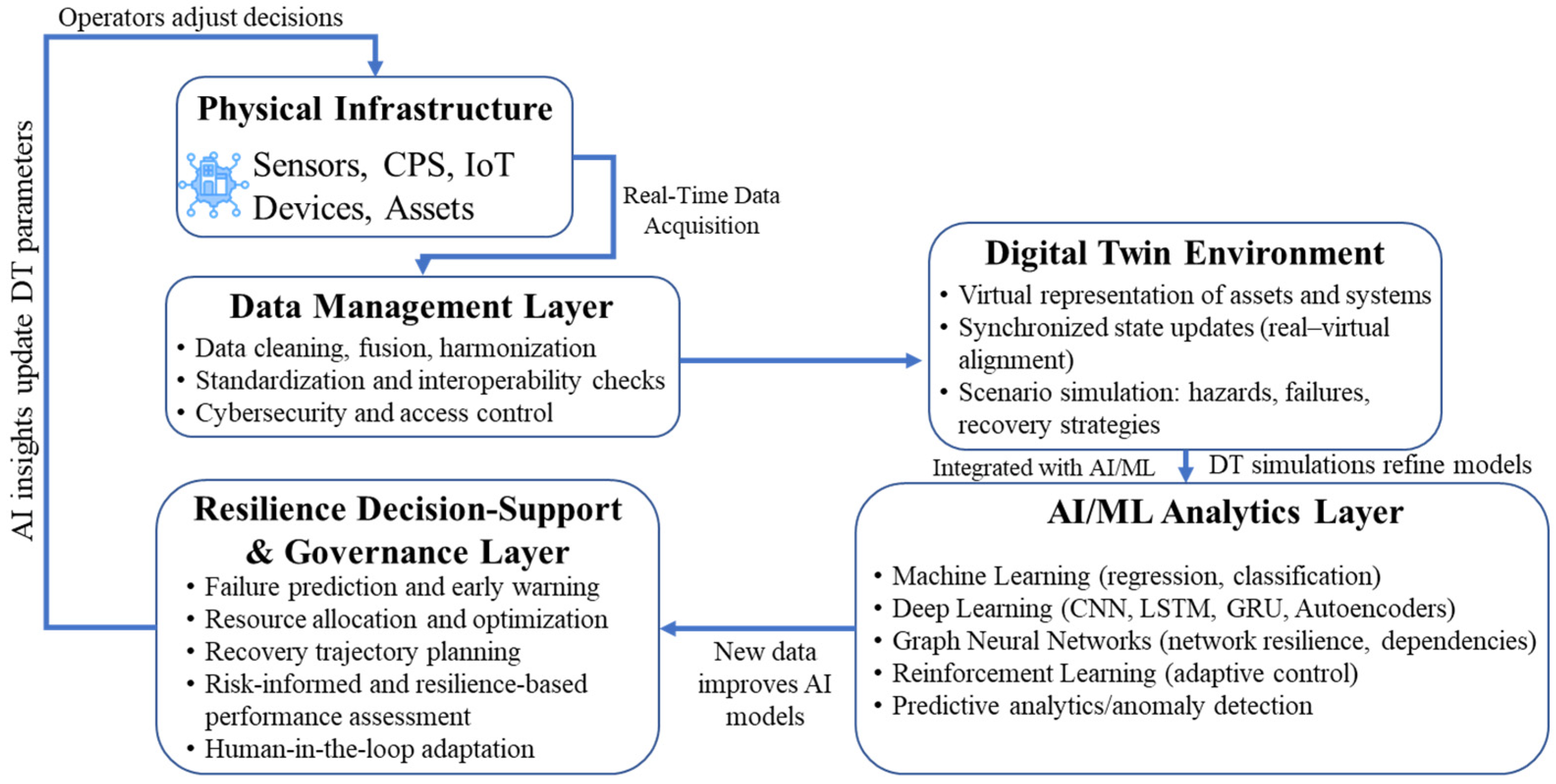
2.3. Integration of Digital Twin and AI for Resilient Infrastructure
2.4. Research Gap
3. Research Methodology
3.1. Design and Rationale
3.2. Data Source and Search Strategy
- ▪
- “digital twin*” OR “virtual twin*” OR “smart infrastructure” AND
- ▪
- “artificial intelligence” OR “machine learning” OR “deep learning” OR “graph neural network*” OR “AI-driven” AND
- ▪
- “resilient” OR “risk management” OR “hazard recovery” OR “infrastructure robustness” OR “system recovery.”
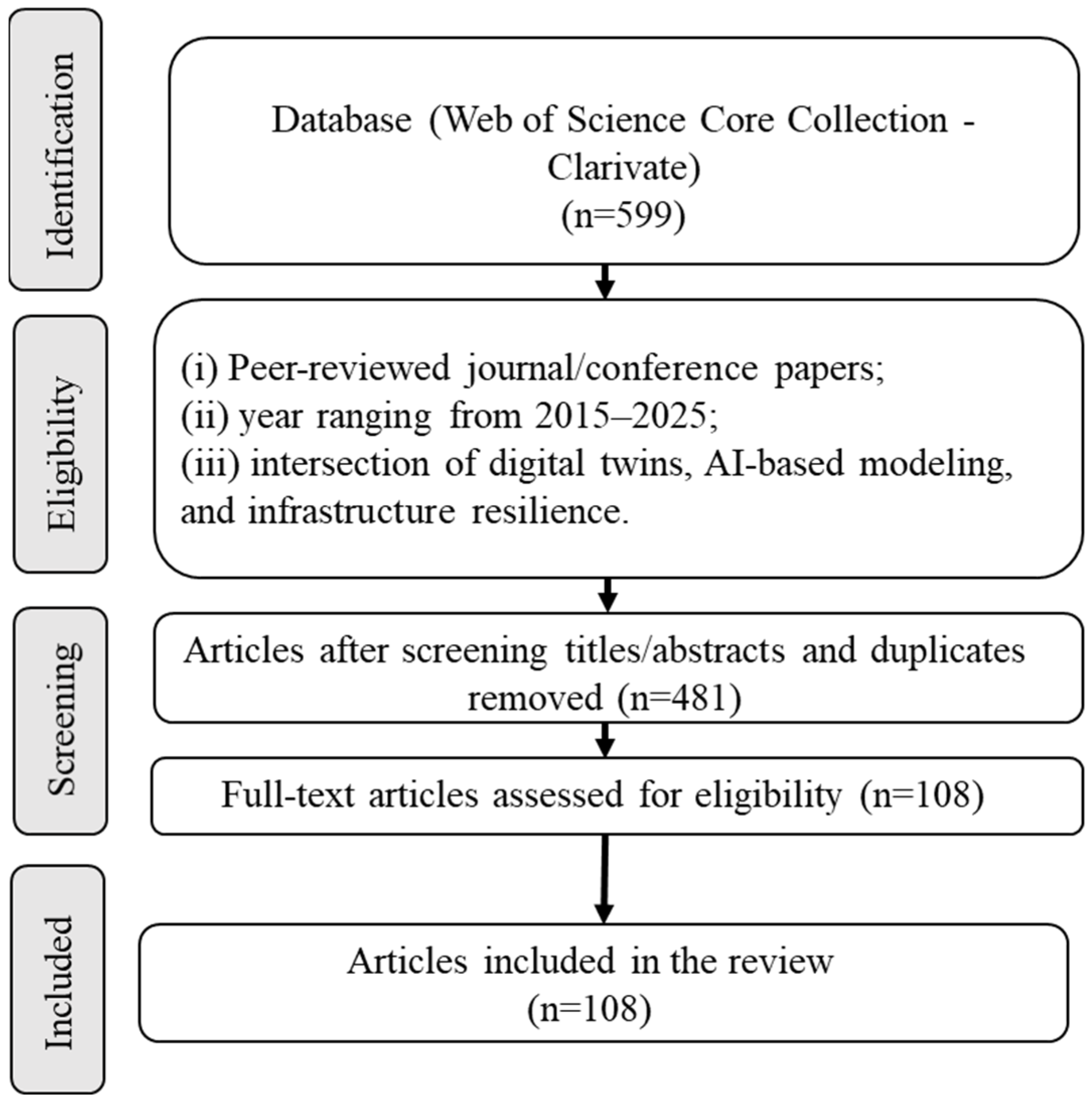
3.3. Eligibility Criteria and Screening Process
- ▪
- Examined DT applications in infrastructure systems (transportation, energy, water, urban networks).
- ▪
- Incorporated AI-based methods (ML, deep learning, GNNs).
- ▪
- Focused explicitly on resilience objectives (prediction, damage assessment, recovery planning, system robustness).
3.4. Data Extraction and Analysis
4. Result
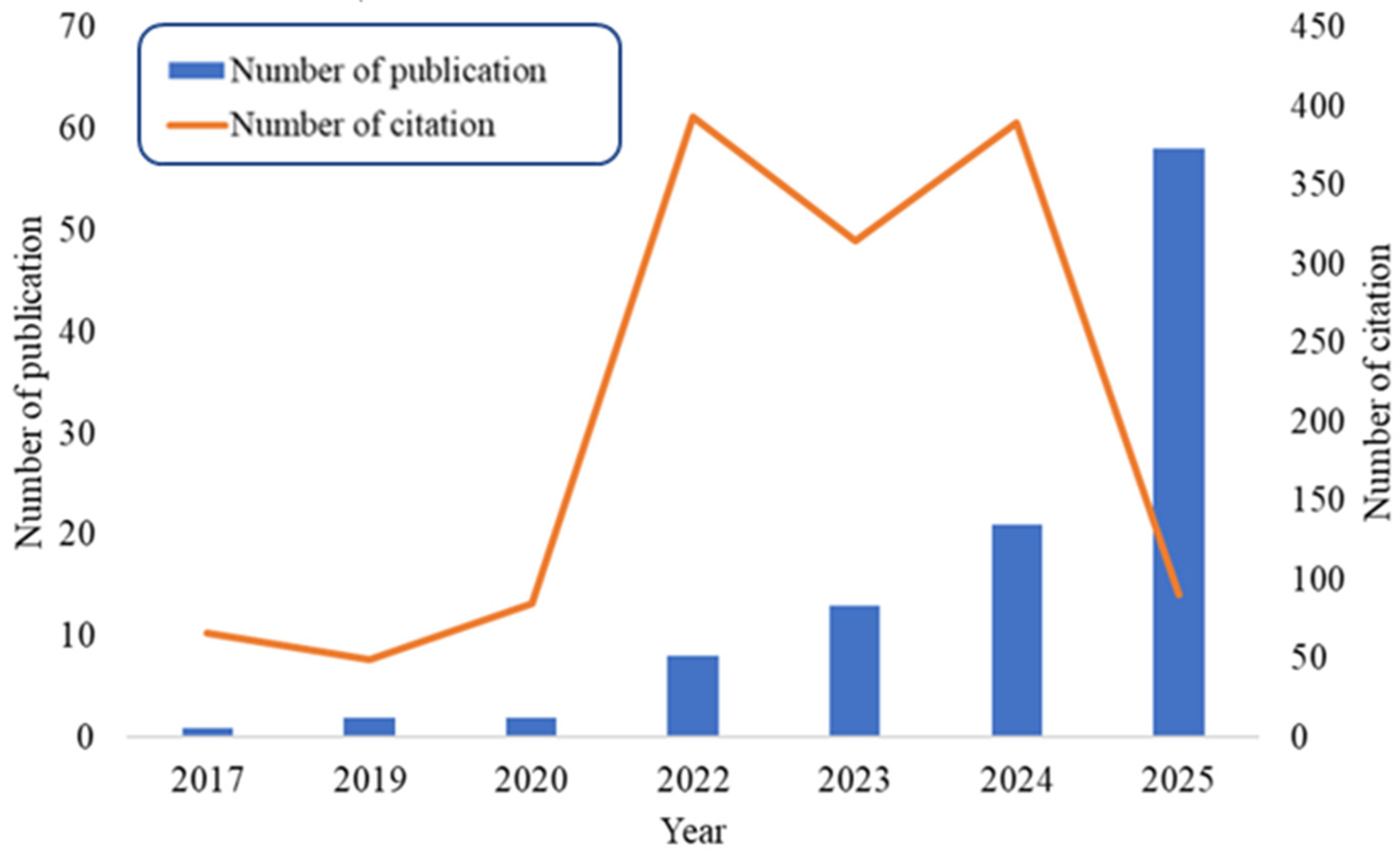
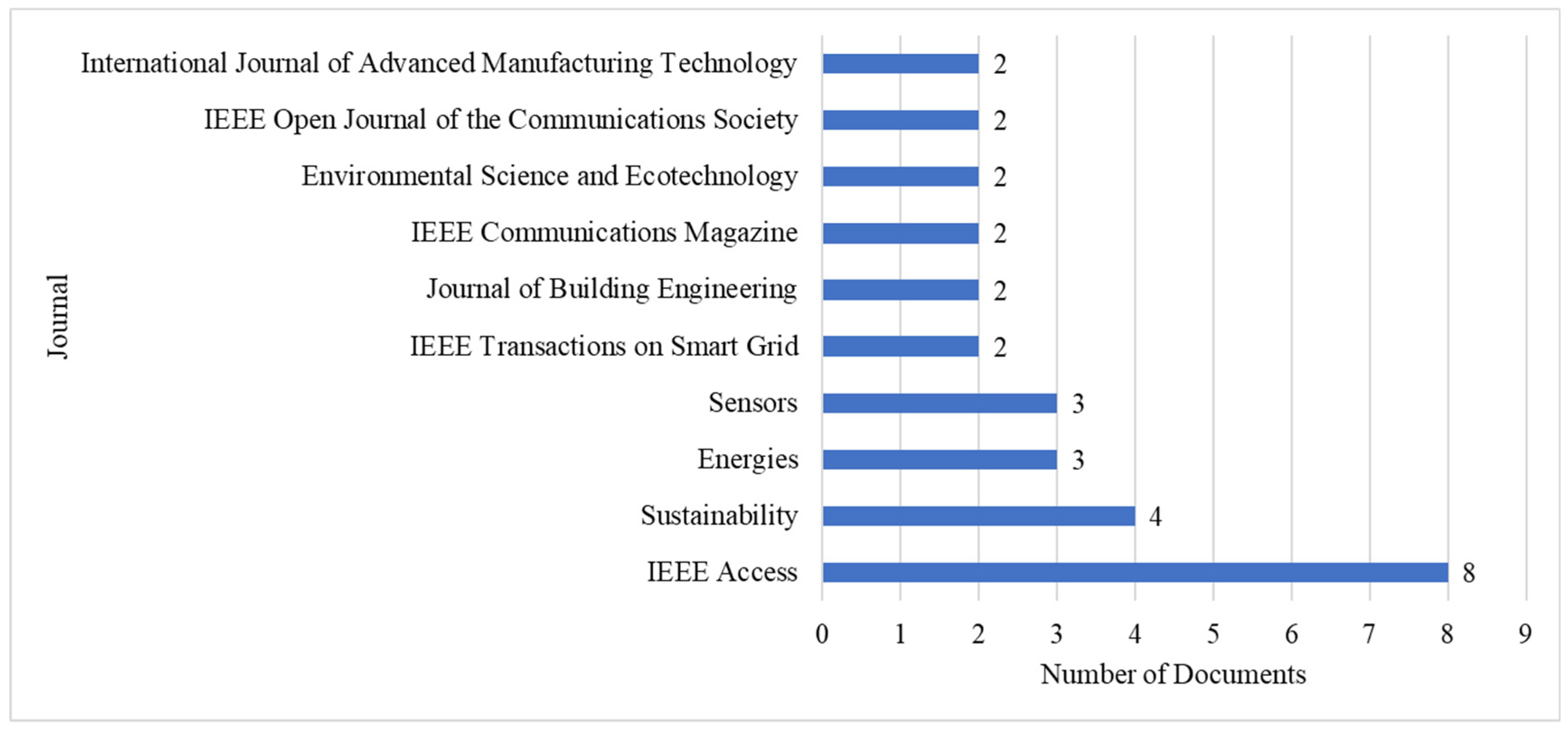
4.1. Trends in Publication and Citation
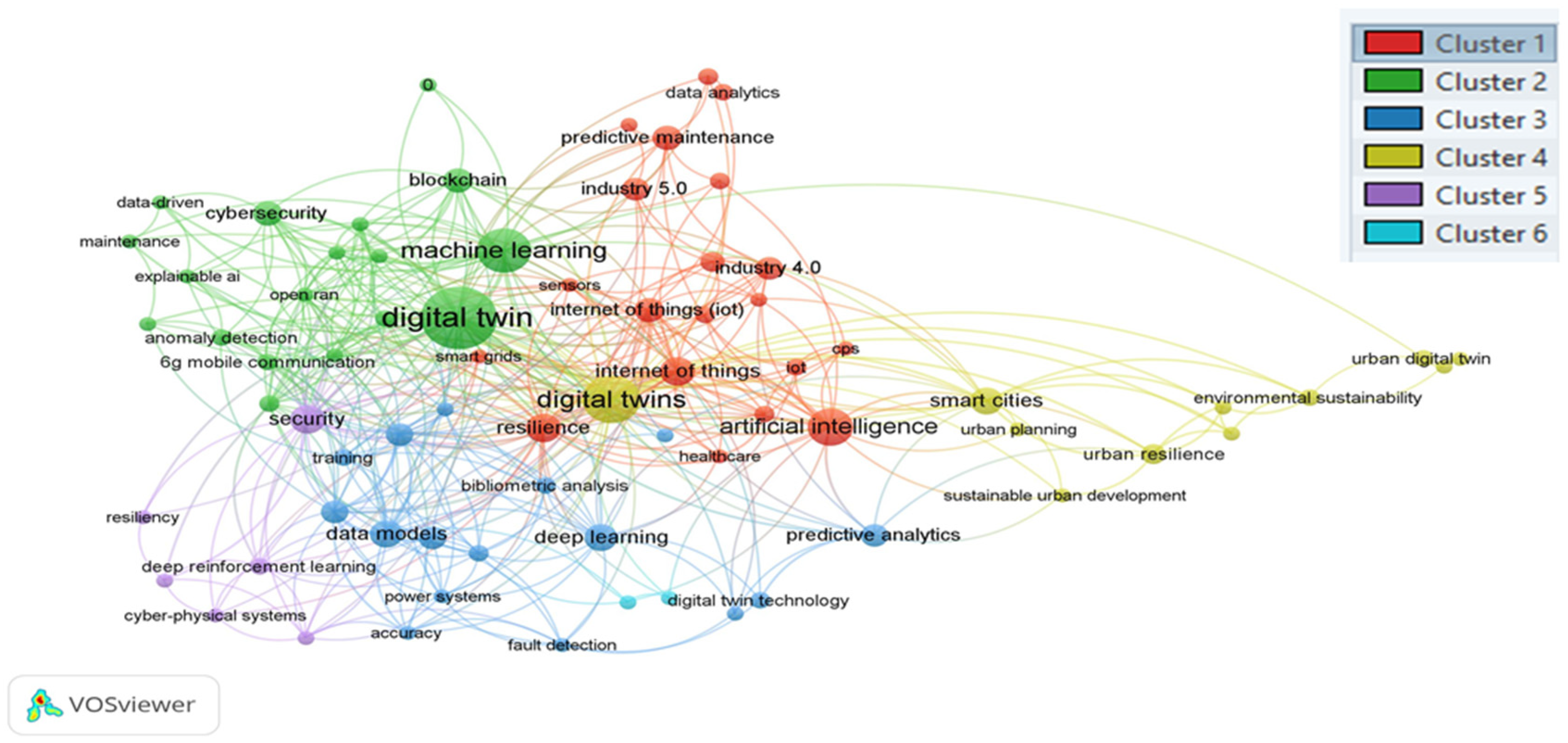
4.2. Main Research Themes and Topics
4.2.1. Cluster 1 (Red): Artificial Intelligence and Industry Applications
4.2.2. Cluster 2 (Green): Digital Twins, Machine Learning, and Data Security
4.2.3. Cluster 3 (Blue): Deep Learning and Cyber–Physical Systems
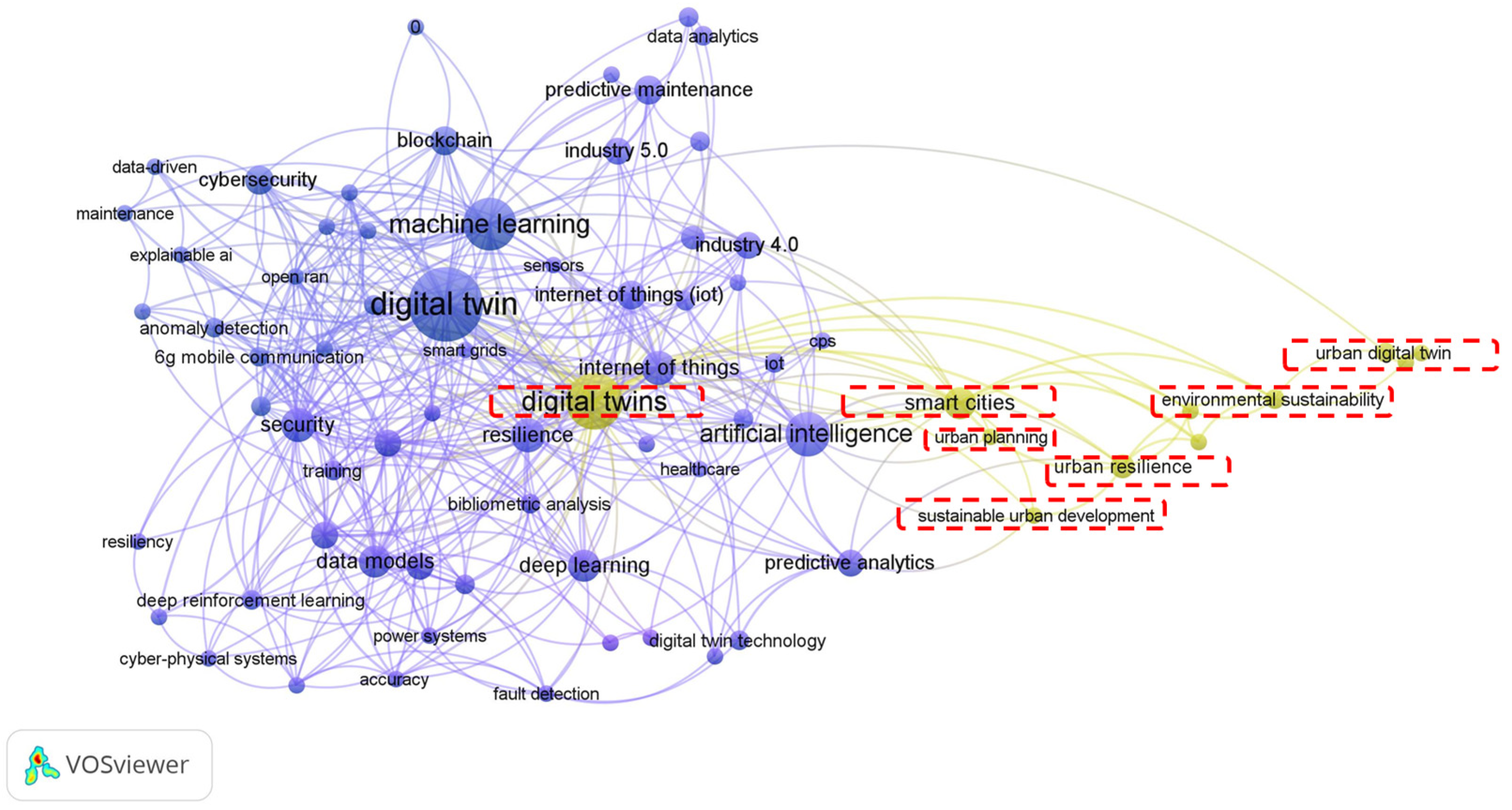
4.2.4. Cluster 4 (Yellow): Smart Cities and Sustainability
4.2.5. Cluster 5 (Purple): Cyber–Physical Systems and Data Models for Resilience
4.2.6. Cluster 6 (Teal): Meta-Research and Methodological Frameworks
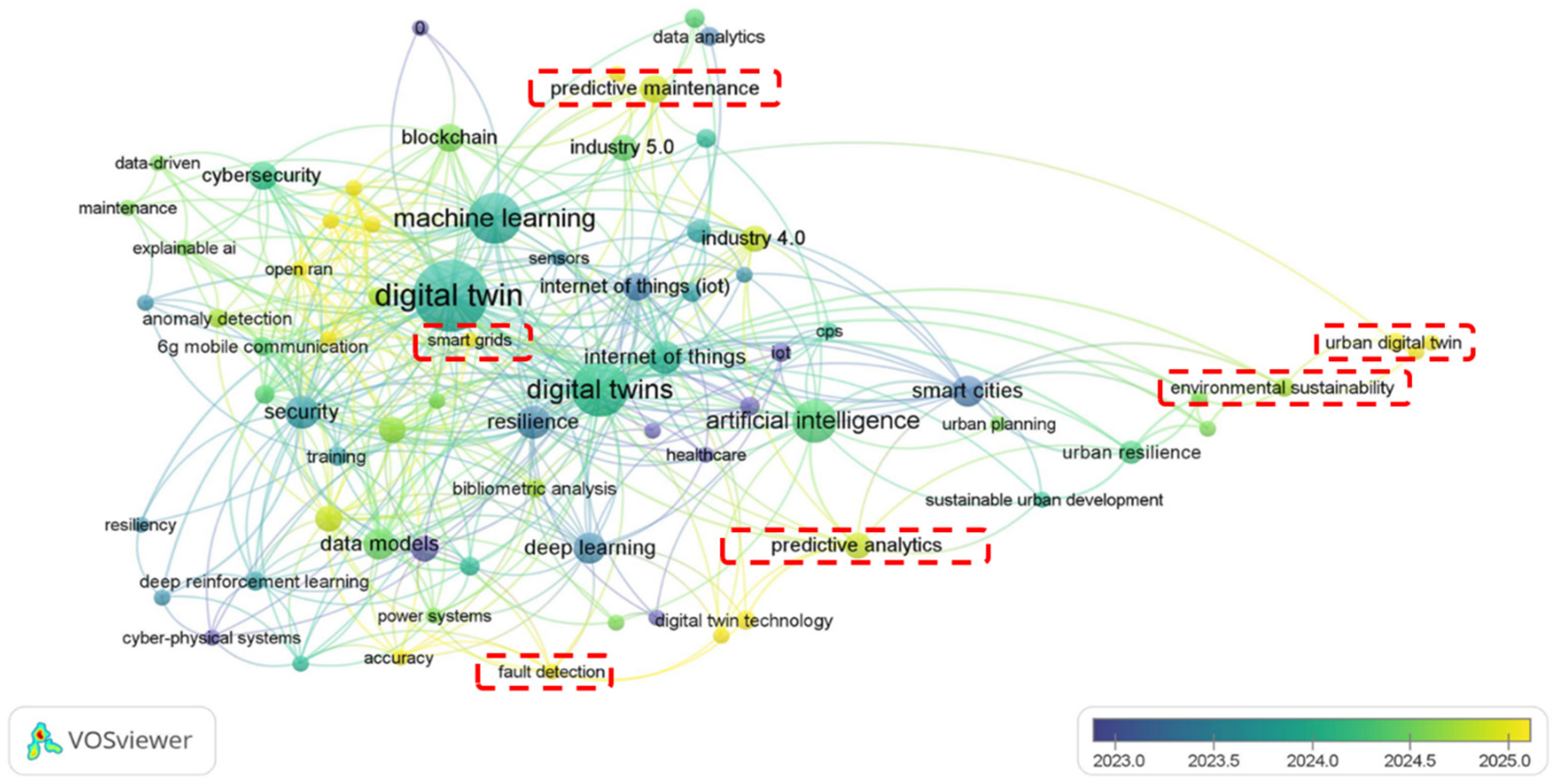
4.3. Early and Emerging Research Topics
5. Discussion and Future Development Frameworks for DT-AI Integration
6. Limitations and Future Studies
Author Contributions
Funding
Institutional Review Board Statement
Informed Consent Statement
Data Availability Statement
Acknowledgments
Conflicts of Interest
References
- National Institute of Standards and Technology (NIST). Community Resilience Planning Guide for Buildings and Infrastructure Systems; U.S. Department of Commerce: Gaithersburg, MD, USA, 2020.
- Bruneau, M.; Chang, S.E.; Eguchi, R.T.; Lee, G.C.; O’Rourke, T.D.; Reinhorn, A.M.; Shinozuka, M.; Tierney, K.; Wallace, W.A.; von Winterfeldt, D. A framework to quantitatively assess and enhance the seismic resilience of communities. Earthq. Spectra 2003, 19, 733–752. [Google Scholar] [CrossRef]
- Cimellaro, G.P.; Reinhorn, A.M.; Bruneau, M. Framework for analytical quantification of disaster resilience. Eng. Struct. 2010, 32, 3639–3649. [Google Scholar] [CrossRef]
- Ouyang, M. Review on modeling and simulation of interdependent critical infrastructure systems. Reliab. Eng. Syst. Saf. 2014, 121, 43–60. [Google Scholar] [CrossRef]
- Madni, A.M.; Madni, C.C.; Lucero, S.D. Leveraging digital twin technology in model-based systems engineering. Systems 2019, 7, 7. [Google Scholar] [CrossRef]
- Jones, D.; Snider, C.; Nassehi, A.; Yon, J.; Hicks, B. Characterising the digital twin: A systematic literature review. CIRP J. Manuf. Sci. Technol. 2020, 29, 36–52. [Google Scholar] [CrossRef]
- Bolton, A.; Butler, L.; Dabson, I.; Enzer, M.; Evans, M.; Fenemore, T.; Harradence, F.; Keaney, A.; Kemp, A.; Luck, A.; et al. The Gemini Principles; Centre for Digital Built Britain: Cambridge, UK, 2018. [Google Scholar] [CrossRef]
- Boje, C.; Guerriero, A.; Kubicki, S.; Rezgui, Y. Towards a semantic construction digital twin: Directions for future research. Autom. Constr. 2020, 114, 103179. [Google Scholar] [CrossRef]
- Ye, X.; Du, J.; Han, Y.; Newman, G.; Retchless, D.; Zou, L.; Ham, Y.; Cai, Z. Developing human-centered urban digital twins for community infrastructure resilience: A research agenda. J. Plan. Lit. 2023, 38, 187–199. [Google Scholar] [CrossRef]
- Jiang, F.; Ma, L.; Broyd, T.; Chen, K. Digital twin and its implementations in the civil engineering sector. Autom. Constr. 2021, 130, 103838. [Google Scholar] [CrossRef]
- Chen, K.; Zhou, X.; Bao, Z.; Skibniewski, M.J.; Fang, W. Artificial intelligence in infrastructure construction: A critical review. Front. Eng. Manag. 2025, 12, 24–38. [Google Scholar] [CrossRef]
- Abid, S.K.; Sulaiman, N.; Chan, S.W.; Nazir, U.; Abid, M.; Han, H.; Ariza-Montes, A.; Vega-Muñoz, A. Toward an Integrated Disaster Management Approach: How Artificial Intelligence Can Boost Disaster Management. Sustainability 2021, 13, 12560. [Google Scholar] [CrossRef]
- Ajayi, O.O.; Kurien, A.; Djouani, K.; Dieng, L. Artificial Intelligence for Infrastructure Resilience: Transportation Systems as a Strategic Case for Policy and Practice. Sustainability 2025, 17, 8992. [Google Scholar] [CrossRef]
- Wettewa, E.; Perera, S.; Jayasinghe, S.; Siriwardhana, C. Graph neural networks for infrastructure resilience assessment under uncertainty. Comput.-Aided Civ. Infrastruct. Eng. 2024, 39, 1259–1278. [Google Scholar] [CrossRef]
- Masud, M.T.; Keshk, M.; Moustafa, N.; Linkov, I.; Emge, D.K. Explainable artificial intelligence for resilient security applications in the Internet of Things. IEEE Open J. Commun. Soc. 2024, 6, 2877–2906. [Google Scholar] [CrossRef]
- Pant, R.; Hall, J.W.; Blainey, S.P. Vulnerability assessment framework for interdependent critical infrastructures: Case-study for Great Britain’s transport network. Eur. J. Transp. Infrastruct. Res. 2016, 16, 142–168. [Google Scholar] [CrossRef]
- Wang, S.; Gu, X.; Luan, S.; Zhao, M. Resilience analysis of interdependent critical infrastructure systems considering deep learning and network theory. Int. J. Crit. Infrastruct. Prot. 2021, 35, 100459. [Google Scholar] [CrossRef]
- Hosseini, S.; Barker, K.; Ramirez-Marquez, J.E. A review of definitions and measures of system resilience. Reliab. Eng. Syst. Saf. 2016, 145, 47–61. [Google Scholar] [CrossRef]
- Tao, F.; Zhang, H.; Liu, A.; Nee, A.Y.C. Digital twin in industry: State-of-the-art. IEEE Trans. Ind. Inform. 2019, 15, 2405–2415. [Google Scholar] [CrossRef]
- Batty, M. Digital twins. Environ. Plan. B Urban Anal. City Sci. 2018, 45, 817–820. [Google Scholar] [CrossRef]
- Dui, H.; Cao, T.; Wang, F. Digital twin-based resilience evaluation and intelligent strategies of smart urban water distribution networks for emergency management. Resilient Cities Struct. 2025, 4, 41–52. [Google Scholar] [CrossRef]
- Zhu, M.; Calderon, C.; Ford, A.; Robson, C.; Jin, J. Digital twin for resilience and sustainability assessment of port facility. Sustain. Resilient Infrastruct. 2025, 1–34. [Google Scholar] [CrossRef]
- Amin, U.; Kim, D.; Ahmed, F.N.; Ahmad, G.; Hossain, M.J. Digital twins for smart asset management in the energy industry: State of the art. Expert Syst. Appl. 2025, 289, 128358. [Google Scholar] [CrossRef]
- Zhou, Y.; Dan, Z. Modern energy resilience studies with artificial intelligence for energy transitions. Cell Rep. Phys. Sci. 2025, 6, 102508. [Google Scholar] [CrossRef]
- Faruk, M.I.; Plabon, F.W.; Saha, U.S.; Hossain, M.D. AI-driven project risk management: Leveraging AI to predict, mitigate, and manage project risks in critical infrastructure and national security projects. J. Comput. Sci. Technol. Stud. 2025, 7, 123–137. [Google Scholar] [CrossRef]
- Azimi, M.; Eslamlou, A.D.; Pekcan, G. Data-driven structural health monitoring and damage detection through deep learning: State-of-the-art review. Sensors 2020, 20, 2778. [Google Scholar] [CrossRef]
- Pant, R.; Barker, K.; Zobel, C.W. Static and dynamic metrics of economic resilience for interdependent infrastructure and industry sectors. Reliab. Eng. Syst. Saf. 2014, 125, 92–102. [Google Scholar] [CrossRef]
- Francis, R.; Bekera, B. A metric and frameworks for resilience analysis of engineered and infrastructure systems. Reliab. Eng. Syst. Saf. 2014, 121, 90–103. [Google Scholar] [CrossRef]
- Jana, D.; Malama, S.; Narasimhan, S.; Taciroglu, E. Edge-based graph neural network for ranking critical road segments in a network. PLoS ONE 2023, 18, e0296045. [Google Scholar] [CrossRef]
- Wettewa, S.; Hou, L.; Zhang, G. Graph neural networks for building and civil infrastructure operation and maintenance enhancement. Adv. Eng. Inform. 2024, 62, 102868. [Google Scholar] [CrossRef]
- Van der Sluis, F.; van den Broek, E.L. Model interpretability enhances domain generalization in textual complexity modeling. Patterns 2025, 6, 101177. [Google Scholar] [CrossRef]
- VOSviewer; Version 1.6.20; Centre for Science and Technology Studies: Leiden, The Netherlands, 2020.
- Brandtner, P.; Dakon, M. AI-powered forecasting under disruption: Lessons from the COVID-19 crisis for adaptive supply chains. In Proceedings of the IntelliSys 2025, Amsterdam, The Netherlands, 28–29 August 2025; pp. 123–137. [Google Scholar] [CrossRef]
- Rejeb, A.; Rejeb, K.; Suele, E.; Hassoun, A.; Keogh, J. Knowledge flows in industry 4.0 research: A longitudinal and dynamic analysis. J. Data Inf. Manag. 2025, 7, 123–145. [Google Scholar] [CrossRef]
- Sadri, H. AI-driven integration of digital twins and blockchain for smart building management systems: A multi-stage empirical study. J. Build. Eng. 2025, 105, 112439. [Google Scholar] [CrossRef]
- Wakili, A.; Bakkali, S.; Ibrahim, I. A digital twin-enhanced cybersecurity framework for IoT in healthcare: Applications in industry 4.0. Telemat. Inform. Rep. 2025, 20, 25. [Google Scholar] [CrossRef]
- Achuthan, K.; Gupta, B.; Raman, R. Bridging cybersecurity with digital twin technology: A thematic analysis. Int. J. Inf. Secur. 2025, 24, 207. [Google Scholar] [CrossRef]
- Ebrahimi, S.; Seyedi, M.; Sheida, K.; Ferdowsi, F.; Carbone, M. Digital Twin-Driven Health Management in Microgrids. IEEE Access 2025, 13, 162406–162421. [Google Scholar] [CrossRef]
- Page, M.J.; McKenzie, J.E.; Bossuyt, P.M.; Boutron, I.; Hoffmann, T.C.; Mulrow, C.D.; Shamseer, L.; Tetzlaff, J.M.; Akl, E.A.; Brennan, S.E.; et al. The PRISMA 2020 statement: An updated guideline for reporting systematic reviews. BMJ 2021, 372, n71. [Google Scholar] [CrossRef] [PubMed]
- Zupic, I.; Čater, T. Bibliometric methods in management and organization. Organ. Res. Methods 2015, 18, 429–472. [Google Scholar] [CrossRef]
- Motroni, A.; Pino, M.; Cecchi, G.; Nepa, P. A Near-Field Focused Array Antenna Empowered by Deep Learning for UHF-RFID Smart Gates. IEEE Trans. Antennas Propag. 2023, 71, 7946–7957. [Google Scholar] [CrossRef]
- Pawar, A.; Khan, S.; El-Ebiary, Y.; Burugari, V.; Abdufattokhov, S.; Saravanan, A.; Ghodhbani, R. Digital Twin-Based Predictive Analytics for Urban Traffic Optimization and Smart Infrastructure Management. Int. J. Adv. Comput. Sci. Appl. 2025, 16. [Google Scholar] [CrossRef]
- Ravinder, M.; Kulkarni, V. Smart grid anomaly detection using MFDA and dilated GRU-based neural networks. Smart Grids Sustain. Energy 2025, 10, 9. [Google Scholar] [CrossRef]
- Bhatia, M.; Kumar, V. Bibliometric analysis of digital twin: Scientometrics and future research trends. IEEE Internet Things J. 2025, 12, 19043–19064. [Google Scholar] [CrossRef]
- Kumar, H.; Tanweer, S.; Agarwal, P.; Rao, N. Machine learning and artificial intelligence-based energy efficient smart cities: A concise survey. J. Inf. Optim. Sci. 2025, 46, 657–668. [Google Scholar] [CrossRef]
- Zeng, S.; Chen, X.; Su, D.; Gong, H. Multi-source data-driven intelligent analysis and decision optimization for high-density pedestrian flows in urban public spaces. Autom. Constr. 2025, 177, 106367. [Google Scholar] [CrossRef]
- Galkin, A.; Samchuk, G.; Kopytkov, D.; Thompson, R. Digital twins in logistics: A comprehensive bibliometric analysis for advancing smart cities and sustainable development. Discov. Sustain. 2025, 6, 853. [Google Scholar] [CrossRef]
- Zhao, T.; Song, C.; Yu, J.; Xing, L.; Xu, F.; Li, W.; Wang, Z. Leveraging Immersive Digital Twins and AI-Driven Decision Support Systems for Sustainable Water Reserves Management: A Conceptual Framework. Sustainability 2025, 17, 3754. [Google Scholar] [CrossRef]
- Alevizos, V.; Gerolimos, N.; Yue, Z.; Edralin, S.; Xu, C.; Papakostas, G.; Vrochidou, E.; Marnellos, G.; Mustafa, M. Advanced Graph-Physics Hybrid Framework (AGPHF) for Holistic Integration of AI-Driven Graph- and Physics-Methodologies to Promote Resilient Wastewater Management in Dynamic Real-World Conditions. Appl. Sci. 2025, 15, 9905. [Google Scholar] [CrossRef]
- Makabate, C.T.; Musonda, I.; Okoro, C.S.; Chileshe, N. Scientometric analysis of BIM adoption by SMEs in the architecture, construction and engineering sector. Eng. Constr. Archit. Manag. 2022, 29, 179–203. [Google Scholar] [CrossRef]
- Rodriguez-Casavilca, H.; Mauricio, D.; Villanueva, J. Evolution of Artificial Intelligence-Based OT Cybersecurity Models in Energy Infrastructures: Services, Technical Means, Facilities and Algorithms. Energies 2025, 18, 5163. [Google Scholar] [CrossRef]
- Miraftabzadeh, S.; Di Martino, A.; Longo, M.; Zaninelli, D. Deep Learning in Power Systems: A Bibliometric Analysis and Future Trends. IEEE Access 2024, 12, 163172–163196. [Google Scholar] [CrossRef]
- Pulikottil, T.; Martinez-Arellano, G.; Barata, J. Immune system inspired smart maintenance framework: Tool wear monitoring use case. Int. J. Adv. Manuf. Technol. 2024, 132, 4699–4721. [Google Scholar] [CrossRef]
- Amanlou, S.; Hasan, M.; Mokhtar, U.; Malik, K.; Islam, S.; Khan, S.; Khan, M.; Khan, M. Cybersecurity Challenges in Smart Grid Systems: Current and Emerging Attacks, Opportunities, and Recommendations. IEEE Open J. Commun. Soc. 2025, 6, 1965–1997. [Google Scholar] [CrossRef]
- Alhaddad, U.; Basuhail, A.; Khemakhem, M.; Eassa, F.; Jambi, K. Ensemble Model Based on Hybrid Deep Learning for Intrusion Detection in Smart Grid Networks. Sensors 2023, 23, 7464. [Google Scholar] [CrossRef]
- Varzeshi, S.; Fien, J.; Irajifar, L. Smart Technologies for Resilient and Sustainable Cities: Comparing Tier 1 and Tier 2 Approaches in Australia. Sustainability 2025, 17, 5485. [Google Scholar] [CrossRef]
- Zhang, J.; Gao, R. Data-Enhanced Sensing: A New Approach to Information Acquisition. IEEE Trans. Instrum. Meas. 2025, 74, 1–20. [Google Scholar] [CrossRef]
- Cichocki, R. Artificial Intelligence in Maritime Cybersecurity: Dual-Use Applications for Defense and Offense in the Age of Digital Seas. TransNav 2025, 19, 617–623. [Google Scholar] [CrossRef]
- Ahmed, S.; Kumar, V.; Kim, J. AITel: eHealth Augmented-Intelligence-Based Telemedicine Resource Recommendation Framework for IoT Devices in Smart Cities. IEEE Internet Things J. 2023, 10, 18461–18468. [Google Scholar] [CrossRef]
- O’Connell, E.; O’Brien, W.; Bhattacharya, M.; Moore, D.; Penica, M. Digital Twins: Enabling Interoperability in Smart Manufacturing Networks. Telecom 2023, 4, 265–278. [Google Scholar] [CrossRef]
- Zhang, J.; Li, L.; Lin, G.; Fang, D.; Tai, Y.; Huang, J. Cyber Resilience in Healthcare Digital Twin on Lung Cancer. IEEE Access 2020, 8, 201900–201913. [Google Scholar] [CrossRef]




Disclaimer/Publisher’s Note: The statements, opinions and data contained in all publications are solely those of the individual author(s) and contributor(s) and not of MDPI and/or the editor(s). MDPI and/or the editor(s) disclaim responsibility for any injury to people or property resulting from any ideas, methods, instructions or products referred to in the content. |
© 2025 by the authors. Licensee MDPI, Basel, Switzerland. This article is an open access article distributed under the terms and conditions of the Creative Commons Attribution (CC BY) license (https://creativecommons.org/licenses/by/4.0/).
Share and Cite
Afolabi, A.; Ogunrinde, O.; Zabihollah, A. Digital Twin and AI Models for Infrastructure Resilience: A Systematic Knowledge Mapping. Appl. Sci. 2025, 15, 13135. https://doi.org/10.3390/app152413135
Afolabi A, Ogunrinde O, Zabihollah A. Digital Twin and AI Models for Infrastructure Resilience: A Systematic Knowledge Mapping. Applied Sciences. 2025; 15(24):13135. https://doi.org/10.3390/app152413135
Chicago/Turabian StyleAfolabi, Adedeji, Olugbenro Ogunrinde, and Abolghassem Zabihollah. 2025. "Digital Twin and AI Models for Infrastructure Resilience: A Systematic Knowledge Mapping" Applied Sciences 15, no. 24: 13135. https://doi.org/10.3390/app152413135
APA StyleAfolabi, A., Ogunrinde, O., & Zabihollah, A. (2025). Digital Twin and AI Models for Infrastructure Resilience: A Systematic Knowledge Mapping. Applied Sciences, 15(24), 13135. https://doi.org/10.3390/app152413135