Article

Tectonic Inversion of the SCS from 3-D Magnetization Vector Clustering: Evidence for Differential Rotation and Ridge Jump


1
Key Laboratory of Intraplate Volcanoes and Earthquakes, Ministry of Education, School of Geophysics and Information Technology, China University of Geosciences (Beijing), Beijing 100083, China
2
Harbin Center for Integrated Natural Resources Survey, China Geological Survey, Harbin 150086, China
*
Author to whom correspondence should be addressed.
Appl. Sci. 2025, 15(24), 13126; https://doi.org/10.3390/app152413126 (registering DOI)
Submission received: 20 November 2025 / Revised: 10 December 2025 / Accepted: 10 December 2025 / Published: 13 December 2025

Abstract

The eastern and southwestern sub-basins of the South China Sea (SCS) display starkly contrasting magnetic lineation patterns, yet quantitative 3-D mapping of the subsurface magnetic architecture—essential for deciphering basin evolution—remains challenging due to the dominance of remanent magnetization. We introduce a joint workflow that integrates anomaly separation with Magnetization-Vector Clustering Inversion (MVCI) to resolve this challenge. A low-rank Hankel matrix filter first disentangles co-located seamount and stripe anomalies in the ocean basin; each component is then inverted using MVCI to recover 3-D magnetization intensity and direction without prior orientation constraints, while simultaneously deriving cluster statistics. Synthetic tests replicating the SCS crustal setting demonstrate that seamount-signal removal dramatically enhances inversion fidelity for both anomaly sources. Application to the SCS reveals two distinct vector clusters in the eastern sub-basin, with mean declinations indicating 10–24° counter-clockwise rotation relative to the southwestern sub-basin. Magnetization intensities are slightly stronger in the southwestern sub-basin, where NE-trending magnetic stripes exhibit narrow spacing, whereas the eastern sub-basin shows wider and more variable NE–W to E–W trending stripes. This study provides the first basin-scale quantification of along-strike magnetic heterogeneity, offering new quantitative constraints on late-stage seafloor spreading and the dynamic evolution of the SCS, while delivering a robust, transferable methodology for other remanence-dominated marginal seas.

1. Introduction

The South China Sea (SCS) represents the largest marginal sea in the Western Pacific, preserving a critical record of Mesozoic–Cenozoic plate reorganization in East Asia. Marine magnetic anomalies, generated by seafloor spreading and geomagnetic reversals, constitute the primary dataset for dating oceanic crust and reconstructing SCS kinematic evolution. Since the 1970s, numerous studies have identified magnetic lineations and correlated them with the global geomagnetic polarity time scale (GPTS). Taylor & Hayes [1] first recognized east–west-trending anomalies in the central basin, assigning them to chron C11–C5d (32–17 Ma). Subsequent work extended these correlations to the southwestern sub-basin, proposing a two-stage opening model marked by a spreading-axis rotation from E–W to NE–SW during chron C6–C5c [2]. Recent achievements of the “SCS Deep” program and IODP expeditions have precisely dated initial spreading in the northeastern SCS at ~32–34 Ma through basement basalt sampling [3]. Coupled with deep-tow magnetic surveys, these data constrain spreading cessation at ~15 Ma in the eastern sub-basin and ~16 Ma in the southwestern sub-basin [4]. Deep-tow surveys and seismic profiles further reveal a southward ridge jump at 23.6 Ma in the eastern sub-basin, coincident with spreading initiation in the southwestern sub-basin. This ridge jump, combined with the east-to-west stepwise expansion of oceanic crust, produced a distinctive asymmetric V-shaped basin—broader in the east, narrower in the west, with a southward-shifted fossil ridge axis. Unlike the relatively stable Atlantic mid-ocean ridges, SCS formation was strongly modulated by interactions with surrounding major plates (e.g., Eurasian, Indo-Australian), leaving the mechanisms governing its north–south and east–west asymmetries as a central question in geoscience [5].
The eastern and southwestern sub-basins exhibit pronounced contrasts in topography, geomorphology, and geophysical signatures, particularly in the geometry of their magnetic anomaly stripes. Magnetic studies [6,7] have revealed segmented stripes and an abrupt strike change from E–W to NE–SW near the fossil spreading axis in the eastern sub-basin, which is consistent with a possible ~10° counter-clockwise rotation. However, these interpretations remain qualitative, relying on manual anomaly shape correlation rather than quantitative magnetization vectors. Inverting these anomalies for 3-D magnetic distributions offers a powerful tool for investigating deep crustal structure and unraveling seafloor spreading history. Traditional 3-D magnetic inversion approaches [8] assume magnetization aligns with the modern geomagnetic field, an assumption violated by abundant basaltic sills and seamounts carrying strong remanence, which can deviate by more than 30° from the present geomagnetic field. In the SCS basin, seamounts exhibit remanent/induced magnetization ratios (Q values) up to 27 [9], rendering conventional fixed-direction methods incapable of recovering true magnetization patterns and limiting quantitative tectonic testing.
Remanence-dominated anomalies present a major challenge for magnetic interpretation. While magnetization vector inversion methods can accommodate remanence by solving for full 3-D magnetization distributions [10,11], they typically require prior-information constraints to mitigate non-uniqueness. Recent advances have introduced clustering constraints that automatically group subsurface cells into discrete magnetization-direction groups without prior constraints. Li & Sun [12,13,14] integrated magnetization-direction clustering into vector inversion, demonstrating its effectiveness for geological discrimination. However, a critical limitation persists in the SCS context: seamount and stripe anomalies often originate at similar depths, causing severe spectral overlap that conventional wavelength-based filters cannot resolve. Zhu et al. [15] addressed this challenge through low-rank Hankel matrix decomposition (LRMD), which separates co-depth magnetic sources by minimizing the Schatten-p norm of the residual trajectory matrix.
Here, we integrate this low-rank separation technique [15] with Magnetization-Vector Clustering Inversion (MVCI) [12] to produce the first 3-D magnetization model of the SCS eastern and southwestern sub-basins. Our objectives are the following: (1) obtain 3-D vector magnetization models in the remanence-dominated SCS basin and quantitatively compare magnetization intensity and directions between eastern and southwestern sub-basins; and (2) test whether observed stripe segmentation and strike changes reflect differential rotation based on inverted magnetization inversion.

2. Geological Setting

The SCS preserves a critical record of Mesozoic–Cenozoic plate reorganization in East Asia. Its formation involved two distinct phases: initial continental extension and rupture driven by Philippine Sea Plate rollback and Pacific Plate subduction, followed by dominant seafloor spreading. During the Oligocene–Miocene transition, the spreading axis rotated from E–W to NE–SW, producing the asymmetric morphology of the two sub-basins and shaping the observed magnetic anomaly patterns [16].
The SCS basin exhibits a triangular geometry, tapering southwestward with water depths of 3300–4850 m and dimensions of ~1480 km (NE) × 800 km (NW). It contains two deep basins with mature oceanic crust—the eastern and southwestern sub-basins—that show marked contrasts in spreading history, crustal properties, magnetic anomaly patterns, seafloor topography, heat flow, and tectonic characteristics [9,17,18,19,20,21]. The eastern sub-basin features a thicker crust and strong, short-wavelength magnetic anomalies, indicating more vigorous magmatism and stronger remanent magnetization signals. In contrast, the southwestern sub-basin displays weaker, longer-wavelength anomalies, reflecting a thinner, less magnetic crust. These systematic differences in magnetic signatures and crustal architecture provide fundamental constraints on the basin’s tectonic evolution.
In this work, we selected two study areas characterized by prominent magnetic anomaly stripes in the southwestern sub-basin (113.54°–115.82° E, 12.39°–14.63° N) and eastern sub-basin (115.83°–118.13° E, 14.63°–16.85° N), respectively (see boxed regions in Figure 1). These domains contain a total of 12 major seamounts labeled A–E and 1–7.

3. Methodology

3.1. Workflow Overview

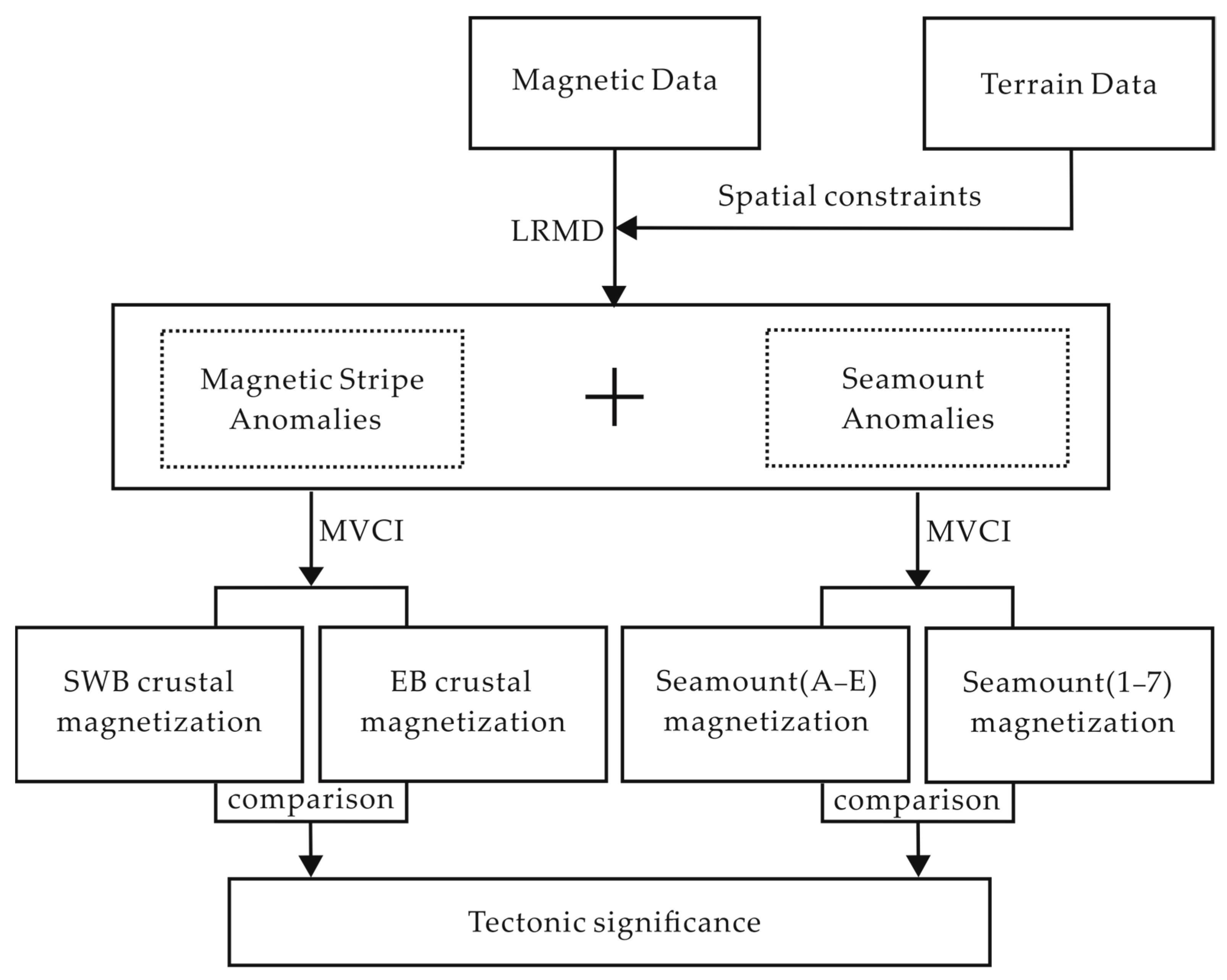
The workflow (Figure 2) comprises three sequential stages:
  • Low-rank Hankel matrix decomposition (LRMD) disentangles co-located seamount and stripe anomalies originating at comparable depths but exhibiting distinct spatial wavelengths;
  • Magnetization-vector inversion (MVCI) recovers 3-D magnetization intensity and direction for each component without a priori orientation constraints;
  • Magnetization-based tectonic interpretation compares recovered magnetization vectors between the eastern and southwestern sub-basins to quantify differential geological processes.

3.2. Low-Rank Hankel Matrix Separation

Here, we briefly describe the principle of the low-rank decomposition method for anomaly separation [15]. Let T t a r denote the local target anomaly and T r e s represent the residual field. The singular value spectrum of the residual anomaly’s Hankel matrix encodes information about the number of distinct source bodies. Minimizing the Schatten-p norm of this matrix, i.e., H ( T T t a r ) via Equation (2), suppresses contributions from multiple sources, thereby achieving separation of the target anomaly:
T = T t a r + T r e s ,
min T tar H T r e s s . t . T = T t a r + T r e s ,
among them, T t a r is obtained via Equation (3):
T t a r = G m 0 ,
where G is the nuclear matrix of the equivalent dipole placed at the depth of the seabed, with the vertical range constrained by the target space, and m0 is the matrix of magnetization parameters. Equation (2) is solved by non-linear conjugate gradients with back-tracking line search. The only user-defined parameter is the dipole spacing, which is set to half the grid interval.
Compared to the wavelet analysis method, the values of the misfit of magnetic anomalies extracted by the LRMD method are greatly reduced [15].

3.3. Magnetization-Vector Cluster Inversion

The MVCI formulates magnetization inversion as a constrained optimization problem to recover 3-D distributions from total-field anomalies. Following Li & Sun [12], we augment the classical Tikhonov functional with a fuzzy C-means (FCM) clustering term that groups magnetization vectors into a finite number of directional classes, thereby reducing inversion non-uniqueness while enhancing geological interpretability.
Given total-field anomaly data d, the forward problem is linear:
d = G m ,
where m = [mx, my, mz]T represents the magnetization vector distribution and G = [Gx, Gy, Gz] are the corresponding sensitivity matrices for the three Cartesian components:
m = [ m 1 , m 2 , , m M ] T R 3 M ,
where M is the number of cells, and each cell’s magnetization represents the vector sum of induced and remanent components. The magnetization direction in each cell is characterized by its unit vector:
v j = m j / m j ,
The standard Tikhonov objective function combines data misfit and model regularization:
φ ( m ) = W d ( G m d ) 2 2 + β W m m 2 2 ,
where Wd and Wm are data weighting and model regularization matrices, respectively, and β is the regularization parameter determined by the L-curve method during the inversion process.
The FCM clustering term for magnetization directions is as follows:
φ fcm = j = 1 M k = 1 C u j k q v j c k 2 ,
where C is the number of clusters, ujk ∈ [0, 1] denotes the membership degree of cell j to cluster k, q ≥ 1 controls clustering fuzziness, and ck represents the cluster center. During inversion, both membership degrees ujk and cluster centers ck are updated iteratively.
When prior geological constraints are available, the guided FCM clustering objective function is as follows:
φ g f c m ( v ) = j = 1 M w j 2 k = 1 C u j k q v j c k 2 + λ k = 1 C c k c k 2 ,
where ck* are known cluster centers and λ controls the influence of prior information.
Thus, the complete MVCI objective function becomes the following:
φ g f c m ( m , u , c ) = W d ( G m d ) 2 2 + β W m m 2 2 + γ φ g f c m ( v )
where γ balances the clustering contribution relative to data misfit and model regularization. Sun & Li [13] discussed the semi-orthogonality and monotonicity of β and γ, and proposed an alternative weight search algorithm (AWS) to automatically determine weight values.
MVCI integrates unsupervised clustering directly into the inversion framework, enabling simultaneous recovery of magnetization vectors and their natural directional grouping without prescribed constraints. By incorporating prior geological knowledge when available, MVCI enhances the geological plausibility of solutions while providing statistical clustering metrics that facilitate quantitative interpretation.

4. Synthetic Tests

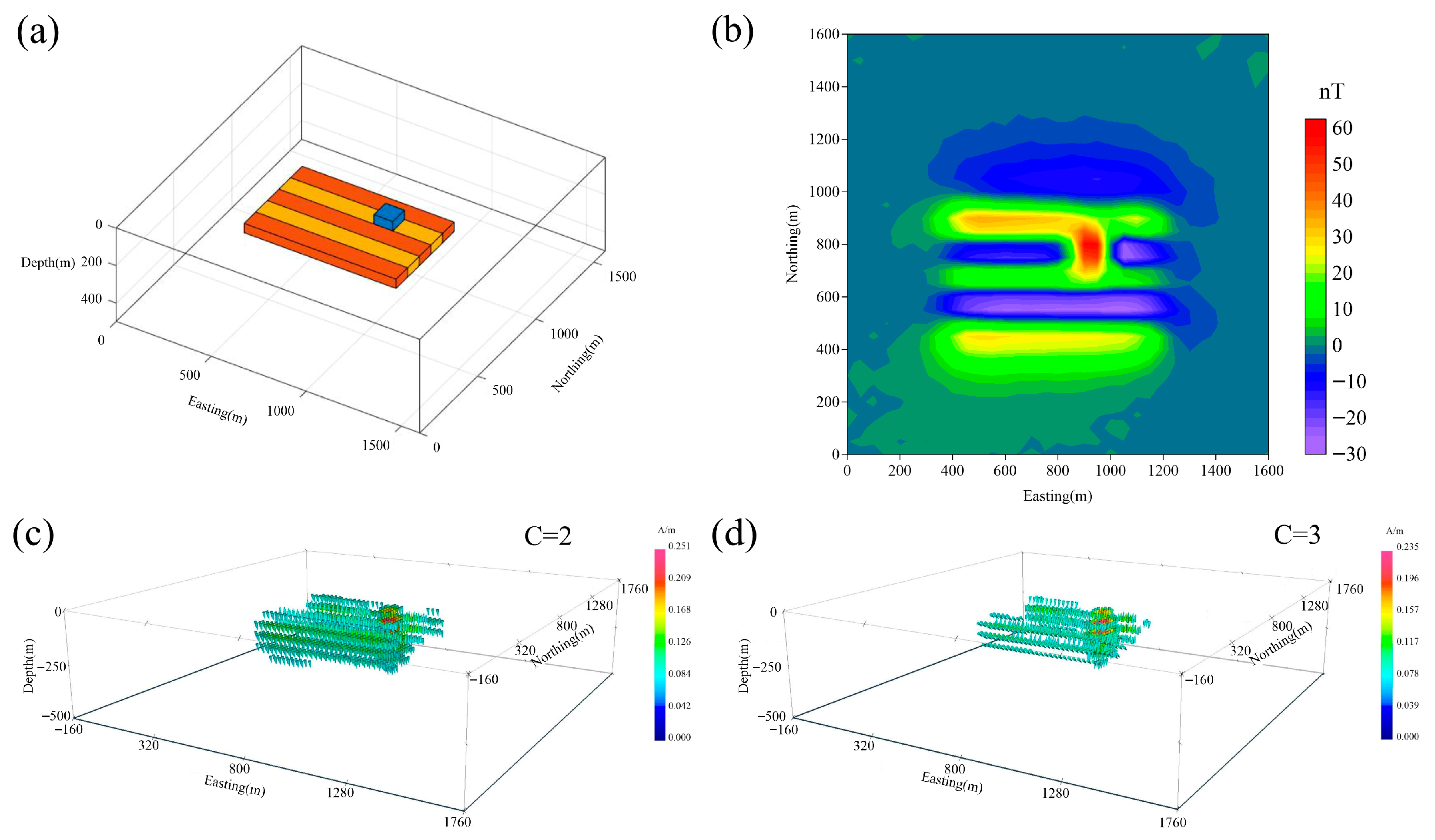
To validate the integrated low-rank Hankel matrix separation and MVCI workflow, we designed a synthetic model that reproduces the key complexity of the SCS environment: co-located magnetic stripes and seamount anomalies with multiple magnetization directions. The model comprises five parallel prisms (800 × 100 × 50 m) representing oceanic crust with alternating magnetizations (I = 60°, D = 30° and I = −60°, D = 210°), overlapped by a cubic body (100 m) simulating a seamount (I = 60°, D = 60°) (Figure 3a). The total-field anomaly (Figure 3b) was computed for a susceptibility of k = 0.02 SI under an inducing field of 50,000 nT, then contaminated with 5% Gaussian noise. The five prisms produce six alternating high- and low-amplitude stripes due to oblique magnetization, while the seamount generates a localized high-amplitude anomaly superimposed on the regional stripe pattern, reproducing the spectral overlap challenge characteristic of the SCS.
To assess the impact of seamount interference on crustal magnetization recovery, we performed MVCI directly on the total-field anomaly (without separation), assuming both two and three magnetization clusters. Both tests yielded degraded results (Figure 3c,d): the overlapping seamount signal caused systematic underestimation of magnetization intensity and loss of directional information in adjacent stripe zones, regardless of the assumed number of clusters. This demonstrates that seamount contamination fundamentally compromises recovery of stripe magnetization patterns, confirming the necessity of the separation step in our workflow.
We therefore implement a workflow that combines anomaly separation with clustering inversion. First, a low-rank decomposition isolates magnetic stripe anomalies from local seamount anomalies. This is followed by separate applications of Multivariate Clustering Inversion (MVCI): we use C = 2 clusters for the stripes and C = 1 for the local anomalies.
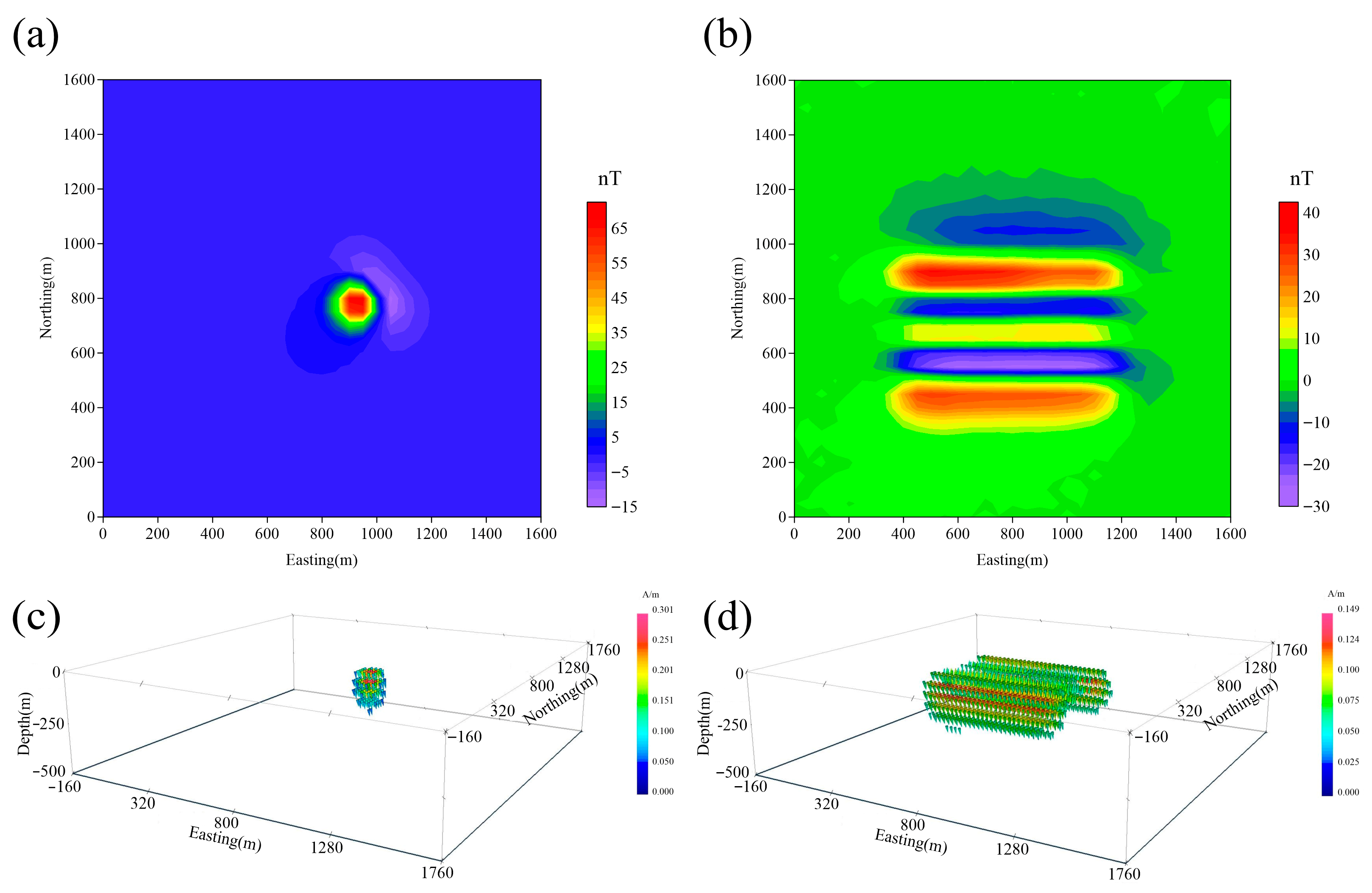
The separated anomalies are shown in Figure 4a,b. Their corresponding inverted magnetization distributions are presented in Figure 4c,d.
Figure 4c displays the 3-D magnetization distribution for the cubic source (M > 0.05 A/m). The recovered position, uniform intensity, and direction all closely match the true model parameters.
Figure 4d shows the magnetization in the stripe area, which is clustered into two orientations. It reveals five alternating positive and negative prisms that accurately restore the synthetic model’s magnetic properties. The positive magnetization directions show better agreement with the true values than the reversed ones.
These results demonstrate that the combined approach of LRMD and MVCI successfully resolves the spectrally overlapping, remanence-dominated magnetic sources characteristic of the South China Sea (SCS).

5. Application to the South China Sea

We applied the integrated low-rank separation + MVCI workflow to two representative study areas—one in the southwestern sub-basin and one in the eastern sub-basin—selected for their prominent magnetic stripes and abundant seamounts. Using a 2’ × 2’ shipborne magnetic grid (Figure 1b), we inverted the 3-D magnetization distribution for oceanic crust and 12 seamounts across both sub-basins.

5.1. Low-Rank Anomaly Separation

Each sub-basin was processed independently to separate stripe and seamount anomalies using low-rank Hankel matrix decomposition.
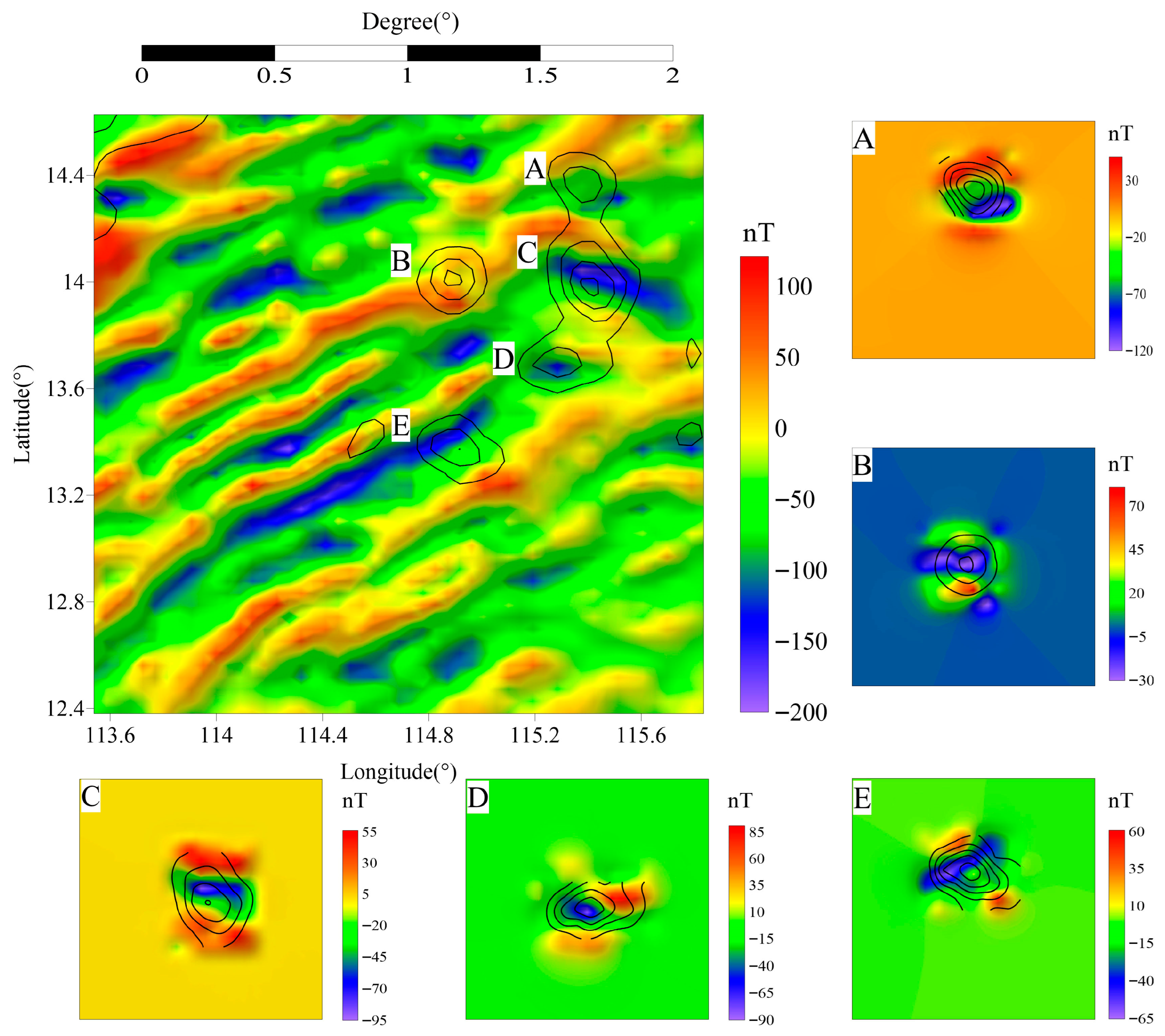
In the southwestern sub-basin (Figure 5), total-field anomalies display prominent NE–SW-trending stripes with alternating polarities (−200 to 120 nT). Stripes over the fossil spreading ridge are predominantly negative, flanked by alternating positive and negative anomalies. While stripes in the western study area exhibit excellent continuity and consistent strikes, those in the northeastern seamount-concentrated region show offset strikes and deteriorated continuity, indicating that seamount interference is the primary factor disrupting stripe patterns. Low-rank decomposition successfully extracted anomalies from five seamounts (see Figure 5A–E), significantly improving stripe continuity after removal.
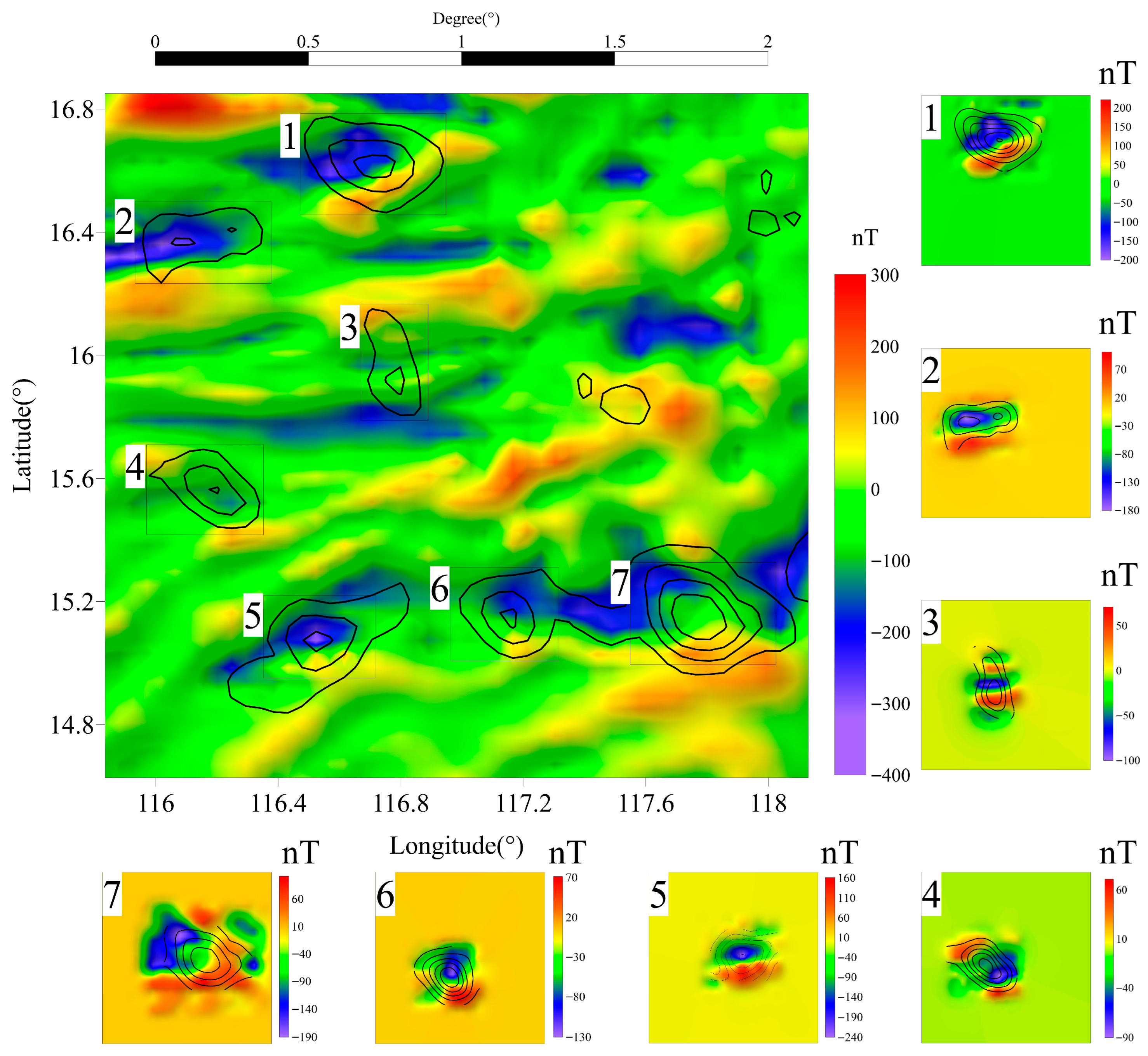
We applied the same method to extract seven seamount anomalies from the total-field anomaly in the eastern sub-basin (Figure 6). Here, magnetic stripes strike roughly E–W with amplitudes of −400 to 300 nT, showing wide spacing and poor overall continuity. Seamounts are evenly distributed throughout the region, and the fossil spreading ridge is similarly dominated by negative stripes. Localized high-amplitude disruptions between 116.43° E and 117.27° E suggest possible intra-basin faulting, though precise locations remain ambiguous due to seamount interference. Removing anomalies from Seamounts 1, 2, and 7 notably improved stripe continuity and amplitude clarity, while Seamounts 4, 5, and 6 showed minimal impact, revealing substantial magnetic heterogeneity among seamounts.
These comparisons demonstrate that southwestern and eastern sub-basin stripes differ significantly in strike, width, continuity, and amplitude, reflecting distinct geological histories. Seamount interference substantially affects magnetic patterns, even altering apparent stripe strikes, which poses a major challenge for geological interpretation.

5.2. Oceanic-Crust Inversion Results

We performed 3-D magnetization inversion using seamount-corrected anomalies from both sub-basins, employing two directional clusters (C = 2) to represent normal and reversed-polarity crust. Given water depths exceeding 4000 m, all data were downward-continued by 4000 m prior to inversion. To prevent noise from being amplified during the downward extension process, filtering was applied to truncate high-frequency noise.
The dataset comprises 2601 observations on a 5000 m grid. The inversion domain was discretized into 968,000 cells (2500 × 2500 × 1000 m) to 8000 m depth. Accounting for the variable inducing field (I = 11–21°, D = −0.8° to −1.8°), we used average directions of I = 14.03°, D = −0.9° for the southwestern sub-basin and I = 18.8°, D = −1.5° for the eastern sub-basin.
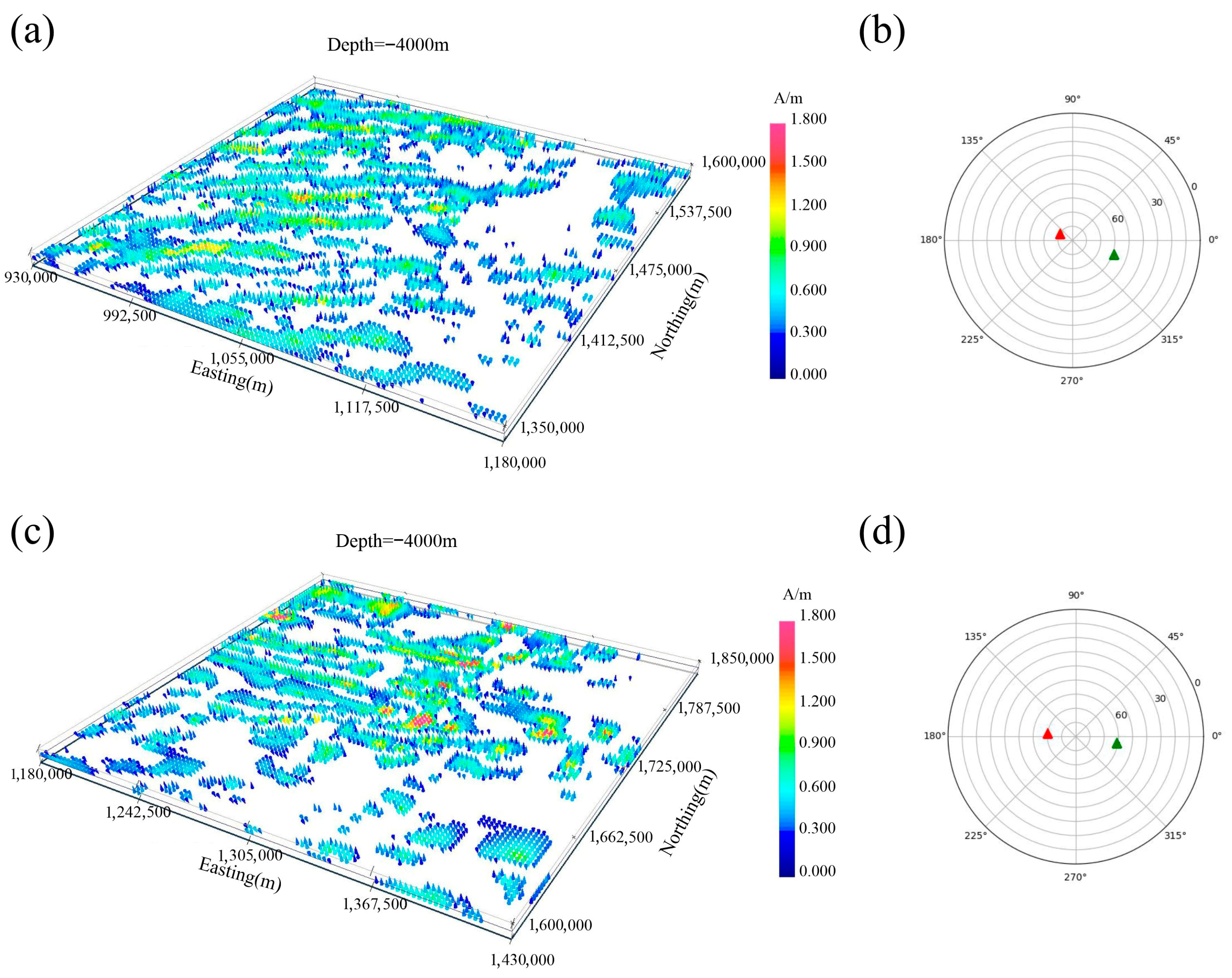
In the southwestern sub-basin (Figure 7a,b), NE–SW-trending stripes show alternating polarity with cluster centers at (I = −79.98°, D = 148.92°) and (I = 59.29°, D = −18.16°). Magnetization near the fossil spreading ridge shows high-intensity, normal polarity extending northeastward toward the Zhongnan Seamount chain, where discontinuities occur. The northwestern flank displays at least three well-extended, consistently oriented stripes, while the southeastern region shows high-intensity, normal-dominant magnetization with similar strikes.
In the eastern sub-basin (Figure 7c), stripes also alternate in polarity but with cluster centers at (I = −69.88°, D = 172.61°) and (I = 60.71°, D = −8.58°). Magnetization orientations are more complex, featuring both E–W and NE–SW strikes. The northern area trends predominantly E–W, while at the fossil spreading ridge, stripes transition from E–W in the east to NE–SW in the west. North of the ridge, the alternating pattern appears segmented, with poorer continuity than in the southwestern sub-basin.

5.3. Seamount Inversion Results

Seamounts formed at different evolutionary stages carry critical information about basin history, lithology, and tectonics [21]. We applied MVCI to 12 seamount anomalies in both sub-basins. Given complex formation histories involving multi-stage magmatic eruptions and varying paleomagnetic fields, we tested clustering parameters from one to four directional groups. The primary magnetization direction remained stable across all tests, so we present single-cluster results for simplicity. Table 1 lists the magnetization direction, cluster centers, and peak intensities for all 12 seamounts.
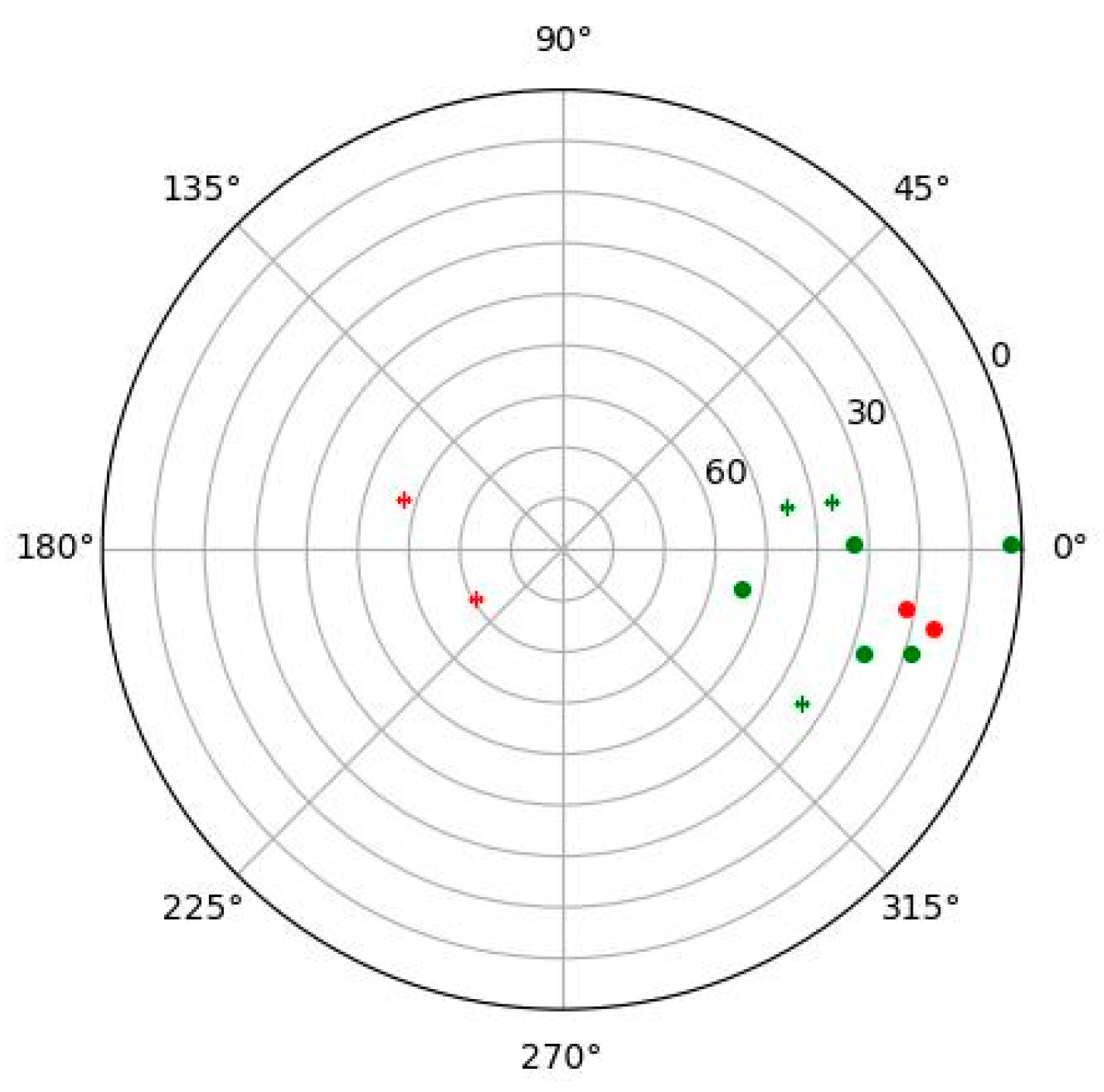
Figure 8 displays the seamount magnetization directions in stereographic projection: southwestern sub-basin seamounts marked with ‘+’ and eastern sub-basin with ‘•’; red indicates positive inclination, green negative. Declinations cluster around 0° and 180°, with two seamounts showing reversed magnetization, while others deviate only modestly from 0°. Inclinations differ markedly between sub-basins: southwestern seamounts show steeper values (~50°), while eastern seamounts are shallower (~20°).

6. Discussion

6.1. Interpretation of Inverted Magnetization

Conventional magnetic lineation identification employs forward modeling software (e.g., Modmag) to generate synthetic anomalies from block-spreading models composed of laterally composite blocks hundreds of meters thick, constrained by spreading rate, ridge asymmetry, jumps, and magnetization intensity, which are then correlated with the geomagnetic polarity timescale (GPTS). In contrast, our inverted magnetization intensities carry physical significance as they represent the full crustal column rather than an arbitrary thin source layer. Li et al. [19] estimated the Curie isotherm depth in the SCS at ~9–13 km using spectral inversion, providing a realistic depth range for our magnetization distribution.
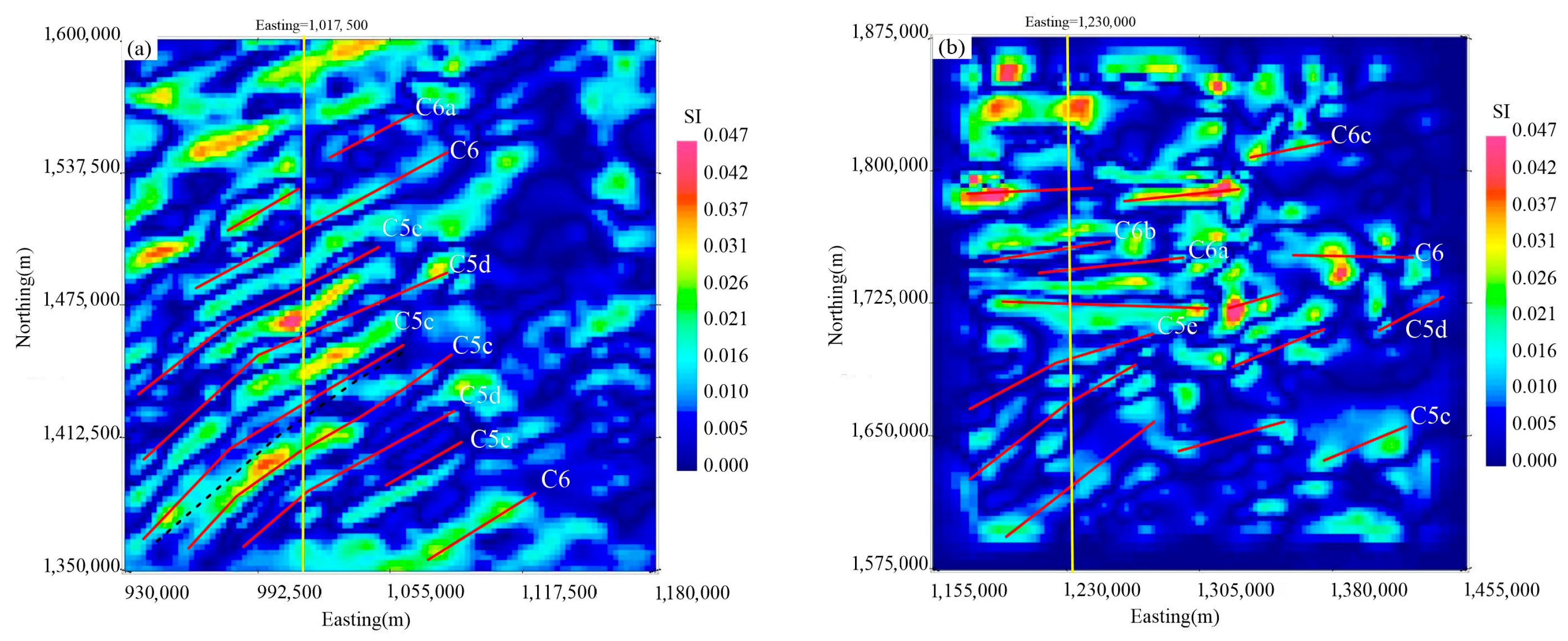
Integrating our 3-D magnetization results with recent high-resolution shipborne/deep-tow magnetic surveys and ocean drilling data [4,17,18,19], we interpret the recovered normal/reverse magnetic structures within established seafloor spreading frameworks. Based on our cluster inversion results, referring to GPTS correlations and previous lineation identifications [18,22,23], we interpreted the magnetic stripes as C5c–C6c and annotated these chron labels directly onto the normally magnetized stripe zones. Figure 9 displays the inverted equivalent susceptibility distribution at 7000 m depth, and it reveals distinct patterns in both sub-basins. In the southwestern sub-basin (Figure 9a), nine normally magnetized stripes (red lines labeled C5c, C5d, C5e, C6, and C6a) symmetrically flank the fossil spreading ridge and extend NE. Near the Zhongnan Seamount Chain, magnetic contrasts diminish and stripe characteristics fade. Notably, the equivalent susceptibility indicates that normally magnetized rocks exhibit weaker magnetization. This is in contrast to reversely magnetized rocks, which show stronger magnetization. In the eastern sub-basin (Figure 9b), seven normally magnetized stripes (red lines labeled C5c, C5d, C5e, C6, C6a, C6b, and C6c) are identified near the ridge and its northern flank. Ridge-adjacent stripes transition from NE-trending in the west to nearly E–W in the east, while northern stripes predominantly strike E-W. Their discontinuous, segmented nature suggests significant post-spreading tectonic modification, likely associated with multiple transform faults. Yellow lines in Figure 9. mark profile locations for detailed analysis (Figure 10).

6.2. Inter-Sub-Basin Comparison

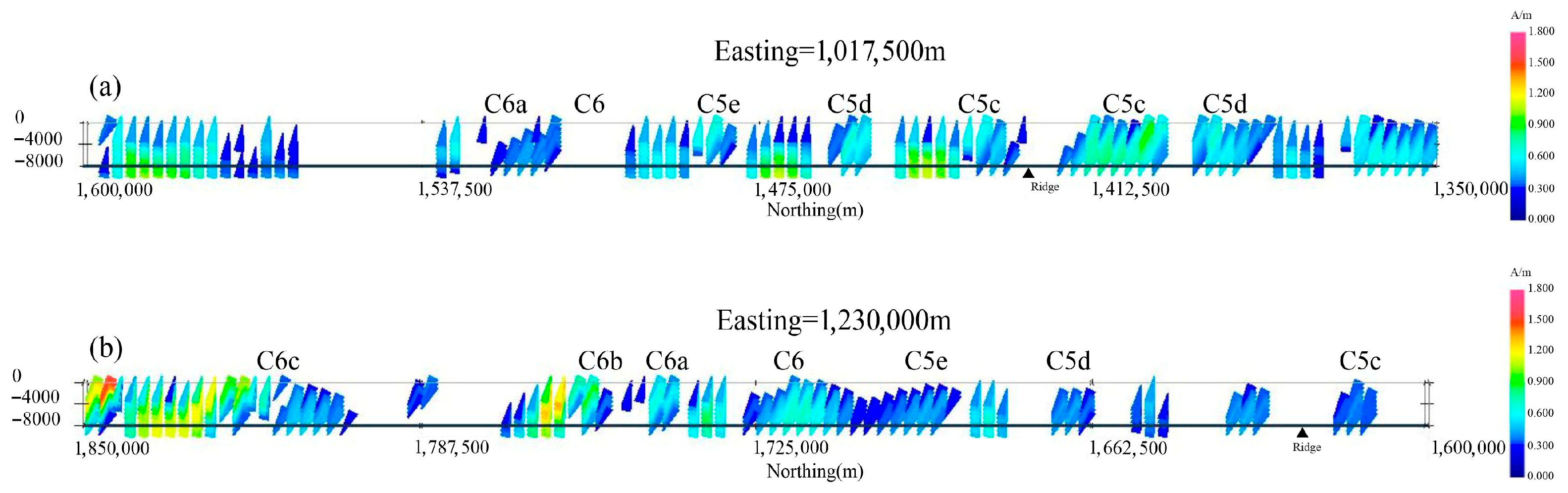
Using seamount-corrected anomalies, we performed clustered inversion to quantitatively compare basin-scale magnetization characteristics (Table 2, Figure 10). The N–S profiles directly visualize normal/reverse structures and their striking differences.
Southwestern sub-basin (Figure 10a): Magnetization exceeds 1 A/m near the fossil ridge, with five high-intensity, alternating polarity stripe pairs to the west (C5c, C5d, C5e, C6, and C6a) and two pairs to the east (C5c, C5d). Magnetization intensity values within the profile generally decrease progressively from the fossil ridge toward both flanks.
Eastern sub-basin (Figure 10b): Chron C5c appears on the profile’s right side with intensity < 0.5 A/m, while high-intensity alternating stripes to its left are identified as C5d, C5e, C6, C6a, C6b, and C6c. Within the profile range, magnetization intensity is generally stronger in the north than in the south, with weaker magnetization near the fossil ridge.

6.3. Seamount Magnetization Patterns

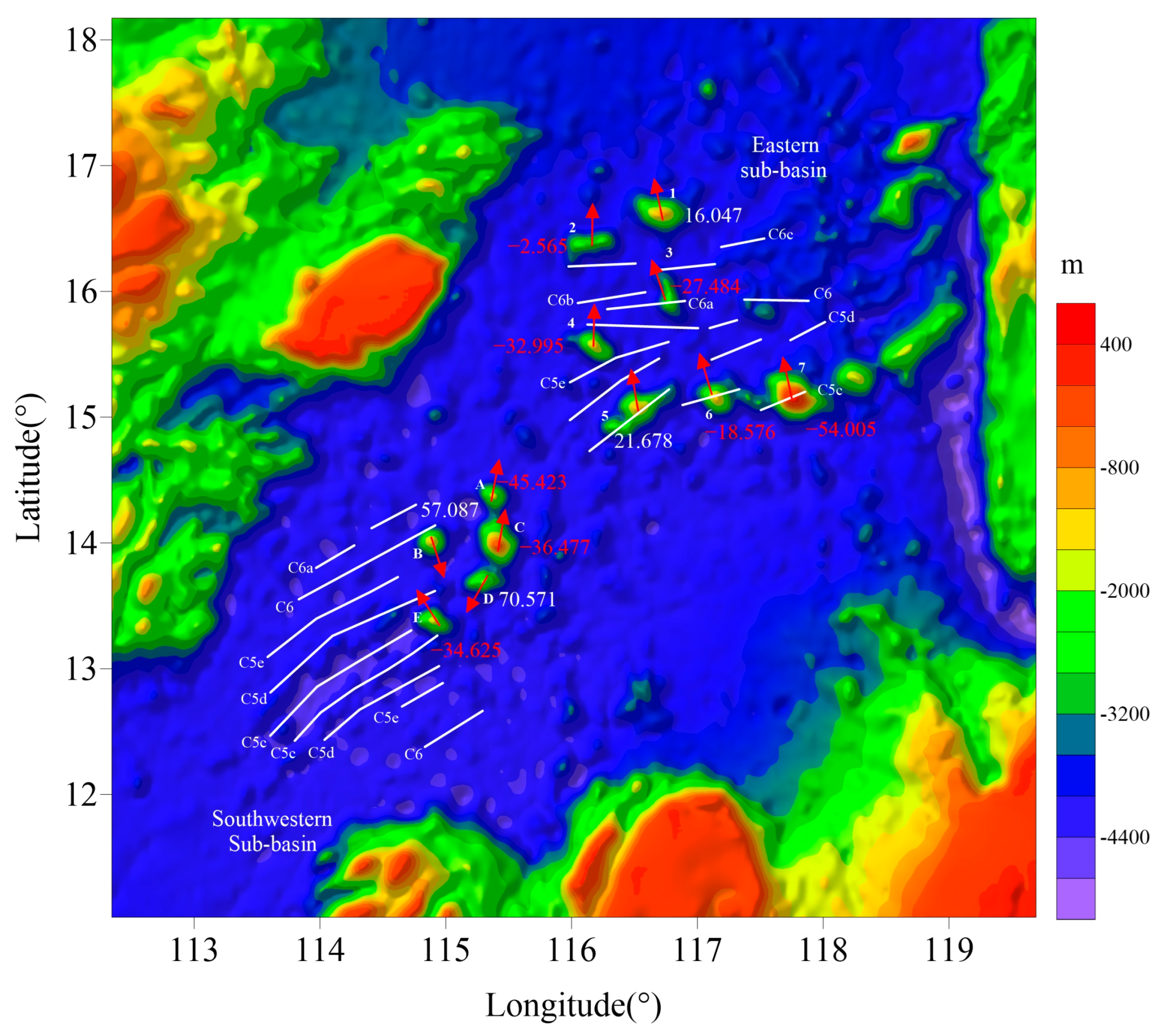
Figure 11 compares the 12 seamounts’ magnetization directions (base map: SCS bathymetry). Red arrows denote declination; numbers indicate inclination (red font = negative, and white = positive). White lines mark identified magnetic stripes.
Southwestern sub-basin: Seamounts B and D exhibit distinct declinations from the other three. After correction, they cluster into two groups: the Zhongnan Seamount Chain (A, C, D), with declinations > 0°, and the Longbei–Longnan group (B, E), with declinations < 0°, suggesting at least two volcanic pulses under different geomagnetic field orientations.
Eastern sub-basin: Seven seamounts show similar declinations (mostly negative, −20° to −5°), except Seamounts 2 and 4, which are slightly positive. This indicates the eastern sub-basin underwent overall counter-clockwise rotation. Magnetic strips trend E–W in the north, transitioning to NE–SW only near the fossil ridge—suggesting rotation postdated spreading and compressed the already-formed crust. Near the southwestern sub-basin, southward ridge migration reduced rotational influence on Seamounts 2 and 4, yielding their distinct declination signature.

6.4. Uncertainty Assessment

We mitigate inversion uncertainty through constraints on source categories and spatial location, which render magnetization vectors geologically interpretable. Although oceanic basalt layers and isolated seamounts in the SCS basin share comparable source depths, their Hankel matrix singular value spectra exhibit markedly different characteristics. We therefore leveraged seamount locations as constraints to reduce uncertainties in low-rank matrix filtering. Formation mechanisms further guided our parameterization—alternating normal/reverse magnetization for magnetic stripes versus multiple eruptive phases for seamounts—prompting us to test clustering parameters of 2–3 for basin inversion and 1–4 for seamount inversion. Uncertainty analysis demonstrated that two magnetization-direction groups remained stable for stripes, while only one group stabilized for most seamounts. Consequently, we selected the 2-cluster basin and 1-cluster seamount solutions for geological interpretation. This approach captures the dual-polarity magnetization pattern characteristic of oceanic basins while avoiding overfitting, thus extracting meaningful geological information.
Synthetic tests confirm that inverted magnetization intensities match theoretical values well despite separation uncertainties. Cluster-center inclination errors are approximately 10–20° relative to true values, while declinations remain accurate. Acknowledging inversion non-uniqueness, our geological interpretation represents a working hypothesis grounded in basin-scale differences in inverted magnetization vectors. Future work will integrate additional constraints for a more comprehensive analysis.

6.5. Tectonic Evolution Implications

Our 3-D magnetization vector field refines the two-stage opening model of the SCS:
Southwestern sub-basin: Characterized by moderate NE–SW spreading without significant late-stage rotation. Five normal/reverse stripe pairs in the west of the fossil ridge versus only four pairs to the east indicate pronounced spreading. The two primary magnetization directional cluster centers (−79.8°, 148.8°) and (59.3°, −18.2°) correspond to reversed and normal polarity Chron magnetizations. Five major seamounts cluster into two groups (Zhongnan chain vs. Longnan–Longbei) with >30° declination difference, recording distinct volcanic episodes.
Eastern sub-basin: Characterized by faster E–W spreading followed by a possible counter-clockwise rotation near the fossil ridge and westward ridge jumps during 20–16 Ma. North of 15.5° N, stripes strike E–W; south of 15° N, they bend to NE–SW (Figure 6). Inversion recovers six stripe pairs north of the fossil axis versus one to the south. The two primary magnetization directional cluster centers (−69.9°, 172.6°) and (60.7°, −8.6°) are rotated 9.6–23.8° relative to the southwestern pairs (Figure 7b,d). Seven seamounts yield consistent inclinations (4–21°) and declinations (−20° to −5°), confirming late-stage whole-plate rotation.
Although MVCI magnetization directions cannot directly indicate paleo-rotation, remanent magnetization dominates in the SCS basin basalt, while induced magnetization effects remain similar across sub-basins. Consequently, total magnetization differences primarily reflect remanence variations. Without measured physical property data, we instead use declination differences between the two oceanic crust clusters, combined with declination patterns from 12 seamounts, to infer relative sub-basin motion driven by tectonic stress changes during basin evolution.
We recognize, however, that this interpretation relies on a constrained, simplified magnetic inversion model that cannot fully capture the complex magnetic signatures of seafloor-spreading crust and multi-stage seamount eruptions. Using inverted magnetization directions for tectonic analysis, therefore, inherently oversimplifies the magnetization history. Future work will refine the model to better align with geological reality and yield more objective insights.

7. Conclusions

We present the first basin-scale 3-D magnetization vector inversion of the South China Sea by integrating low-rank Hankel matrix separation with fuzzy C-means constrained inversion. This approach requires no a priori magnetization directions, enabling magnetization-vector inversion in remanence-dominated settings and facilitating construction of realistic 3-D magnetic architectures. The resulting clustered magnetization directions provide independent quantitative constraints on geological structures and tectonic evolution.
Key findings include the following: (1) The eastern sub-basin underwent a possible counter-clockwise rotation with westward ridge jumps during 20–16 Ma, whereas the southwestern sub-basin opened asymmetrically. (2) Vector-based metrics—including stripe spacing, magnetization intensity, and seamount directional clusters—provide quantitative constraints that reconcile previously qualitative geophysical observations. (3) The developed workflow is readily transferable to other remanence-dominated marginal seas, offering a new baseline for joint geophysical interpretation and tectonic evaluation.

Author Contributions

S.L. and J.W.: Conceptualization, methodology, interpretation, and writing—original draft preparation; J.W. and Z.J.: Processing and inversion, software, and visualization. All authors have read and agreed to the published version of the manuscript.

Funding

This research was funded by the Deep Earth Probe and Mineral Resources Exploration-National Science and Technology Major Project, grant number 2025ZD1008201.

Institutional Review Board Statement

Not applicable.

Informed Consent Statement

Not applicable.

Data Availability Statement

The data used in this article is not publicly available. If there is a need, please contact the corresponding author.

Acknowledgments

We thank the reviewers for their valuable comments on the manuscript revision, and acknowledge the technical support provided by relevant institutions and experts.

Conflicts of Interest

The authors declare no conflicts of interest.

References

  1. Taylor, B.; Hayes, D.E. The tectonic evolution of the South China Sea Basin. In Geophysical Monograph Series; American Geophysical Union: Washington, DC, USA, 1980; Volume 23, pp. 89–104. [Google Scholar]
  2. Briais, A.; Patriat, P.; Tapponnier, P. Updated interpretation of magnetic anomalies and seafloor spreading stages in the South China Sea: Implications for the Tertiary tectonics of Southeast Asia. J. Geophys. Res. 1993, 98, 6299–6328. [Google Scholar] [CrossRef]
  3. Koppers, A.A.P. On the 40Ar/39Ar dating of low-Potassium Ocean crust basalt from IODP Expedition 349, South China Sea. In Proceedings of the AGU Fall Meeting Abstracts, San Francisco, CA, USA, 15–19 December 2014. [Google Scholar]
  4. Li, C.; Xu, X.; Lin, J.; Sun, Z.; Zhu, J.; Yao, Y.; Zhao, X.; Liu, Q.; Kulhanek, D.K.; Wang, J.; et al. Ages and magnetic structures of the South China Sea constrained by deep tow magnetic surveys and IODP Expedition 349. Geochem. Geophys. Geosyst. 2014, 15, 4958–4983. [Google Scholar] [CrossRef]
  5. Lin, J.; Li, J.; Xu, Y.; Sun, Z.; Xia, S.; Huang, X.; Jie, X.; Li, C.; Ding, W.; Zhou, Z. New breakthroughs in ocean drilling and frontier research on marine geology and geophysics in the South China Sea. Acta Oceanol. Sin. 2019, 41, 125–140. [Google Scholar]
  6. Bhattacharyya, B. Magnetic anomalies due to prism-shaped bodies with arbitrary polarization. Geophysics 1964, 29, 517–531. [Google Scholar] [CrossRef]
  7. Rousseeuw, P. Silhouettes: A graphical aid to the interpretation and validation of cluster analysis. J. Comput. Appl. Math. 1987, 20, 53–65. [Google Scholar] [CrossRef]
  8. Li, Y.; Oldenburg, D.W. 3-D inversion of magnetic data. Geophysics 1996, 61, 394–408. [Google Scholar] [CrossRef]
  9. Yao, Y.; Li, X.; Wang, J.; Xu, Z.; Wang, Z.; Zhu, S.; Liu, S.; Zhu, R.; Xu, X.; Gao, H.; et al. Tectonic Geology of the South China Sea and Adjacent Areas; Science Press: Beijing, China, 2023. [Google Scholar]
  10. Li, Y.; Shearer, S.; Haney, M.; Dannemiller, N. Comprehensive approaches to 3D inversion of magnetic data affected by remanent magnetization. Geophysics 2010, 75, L1–L11. [Google Scholar] [CrossRef]
  11. Lelièvre, P.; Oldenburg, D. A 3D total magnetization inversion applicable when significant, complicated remanence is present. Geophysics 2009, 74, L21–L30. [Google Scholar] [CrossRef]
  12. Li, Y.; Sun, J. 3D magnetization inversion using fuzzy c-means clustering with application to geology differentiation. Geophysics 2016, 81, J61–J78. [Google Scholar] [CrossRef]
  13. Sun, J.; Li, Y. Magnetization clustering inversion—Part 1: Building an automated numerical optimization algorithm. Geophysics 2018, 83, J61–J73. [Google Scholar] [CrossRef]
  14. Sun, J.; Li, Y. Magnetization clustering inversion—Part 2: Assessing the uncertainty of recovered magnetization directions. Geophysics 2019, 84, J17–J29. [Google Scholar] [CrossRef]
  15. Zhu, D.; Hu, X.; Liu, S.; Li, H.; Zuo, B. Can targeted source information be extracted from superimposed magnetic anomalies? J. Geophys. Res. Solid Earth 2022, 127, e2022JB024279. [Google Scholar] [CrossRef]
  16. Cullen, A.; Reemst, P.; Henstra, G.; Gozzard, S.; Ray, A. Rifting of the South China Sea: New perspectives. Pet. Geosci. 2010, 16, 273–282. [Google Scholar] [CrossRef]
  17. Li, C.; Li, J.; Ding, W.; Franke, D.; Yao, Y.; Shi, H.; Pang, X.; Cao, Y.; Lin, J.; Kulhanek, D.K.; et al. Seismic stratigraphy of the central South China Sea basin and implications for neotectonics. J. Geophys. Res. Solid Earth 2015, 120, 1377–1399. [Google Scholar] [CrossRef]
  18. Li, C.; Song, T. Magnetic recording of the Cenozoic oceanic crustal accretion and evolution of the South China Sea basin. Chin. Sci. Bull. 2012, 57, 3165–3181. [Google Scholar] [CrossRef]
  19. Li, C.; Shi, X.; Zhou, Z.; Li, J.; Geng, J.; Chen, B. Depths to the magnetic layer bottom in the South China Sea area and their tectonic implications. Geophys. J. Int. 2010, 182, 1229–1247. [Google Scholar] [CrossRef]
  20. Li, S.; Zhang, S.; Galatu, J.; Dai, X. Investigating the gravity variable-density inversion method in complex geological settings: Application to the South China Sea. J. Geophys. Eng. 2025, 22, 1700–1709. [Google Scholar] [CrossRef]
  21. Jin, Z.; Xu, S.; Li, Z. Inversion of heterogeneous magnetism for seamounts in the South China Sea. J. Ocean Univ. Qingdao 2002, 32, 926–934. [Google Scholar]
  22. Qiu, N.; Sun, Z.; Lin, J.; Li, C.-F.; Xu, X. Dating seafloor spreading of the southwest sub-basin in the South China Sea. Gondwana Res. 2023, 120, 190–206. [Google Scholar] [CrossRef]
  23. Wan, J. Study on Magnetic Differences in the South China Sea Basin Based on Magnetic Anomaly Vector Clustering Inversion. Master’s Thesis, China University of Geosciences, Beijing, China, 2023. [Google Scholar]
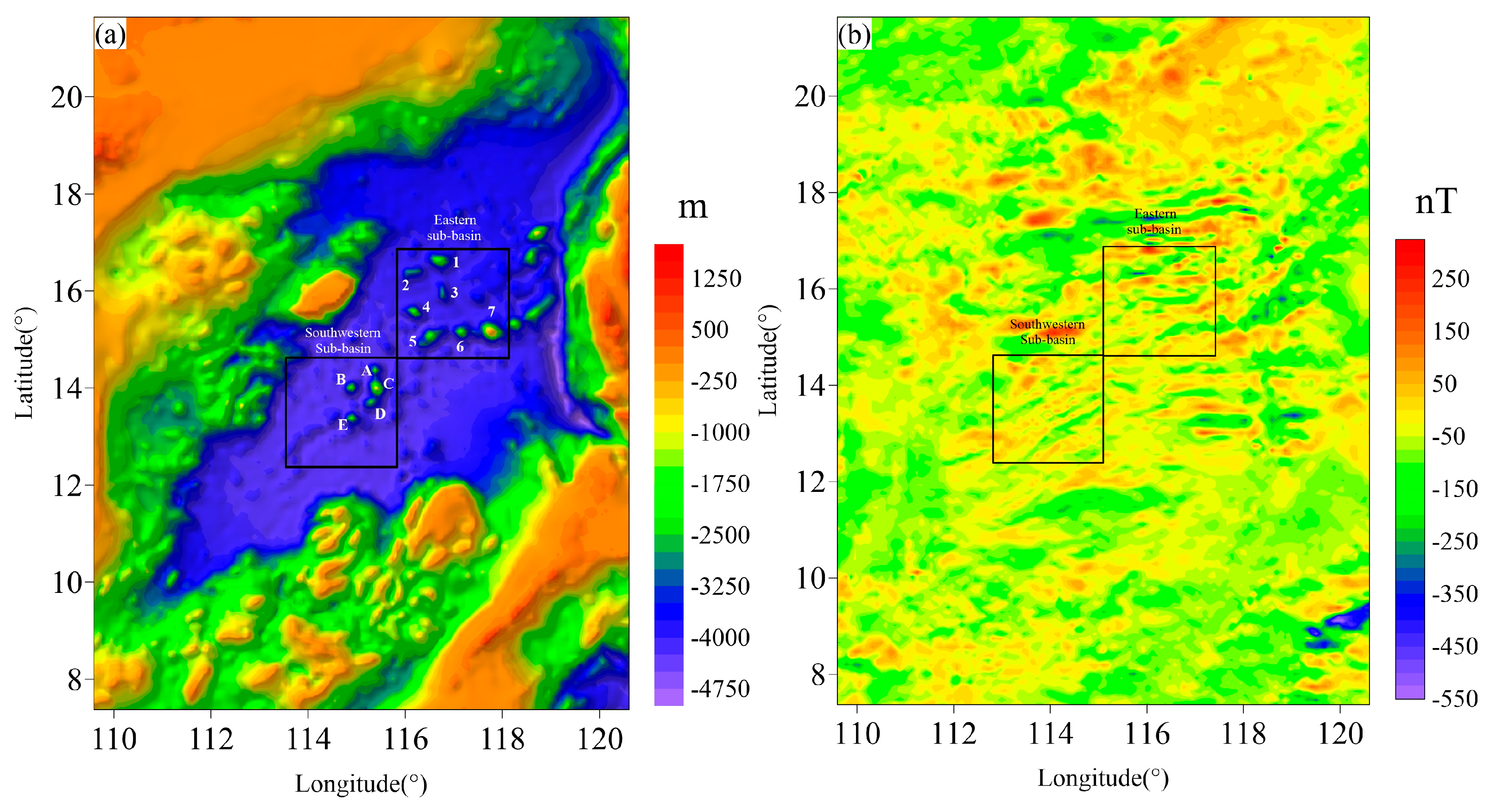
Figure 1. The bathymetry (a) and total-field anomaly (b) in SCS. Two study areas involving the southwestern and eastern sub-basins. The 12 seamounts in the two basins are labeled A–E and 1–7.
Applsci 15 13126 g001
Figure 2. The workflow of magnetization inversion by integrating the low-rank separation technique with the MVCI method.
Applsci 15 13126 g002
Figure 3. Inversion of the synthetic model without anomaly separation. (a) True model geometry comprising five prismatic bodies and one cubic source. The magnetization directions of the red and yellow bodies are (I = 60°, D = 30°) and (I = −60°, D = 210°), respectively. (b) Observed total-field anomaly (contaminated with 5% Gaussian noise) generated by six sources with different magnetization directions under a 50,000 nT inducing field. (c) Inverted magnetization distribution assuming two directional clusters (C = 2). (d) Inverted magnetization distribution assuming three directional clusters (C = 3).
Applsci 15 13126 g003
Figure 4. Magnetic anomaly separation results and their magnetization recovered by MVCI (only cells with magnetization greater than 0.05 A/m are displayed). (a) The extracted magnetic anomaly for the cubic source. (b) The separated stripe anomalies for prisms. (c) The magnetization shows one group spatially in the model domain. (d) The magnetization shows five coherent prisms spatially in the model domain.
Applsci 15 13126 g004
Figure 5. The total-field anomaly and extracted seamounts’ (AE) anomaly in southwestern sub-basins. The inducing field is in the direction of I = 14.03° and D = −0.9°.
Applsci 15 13126 g005
Figure 6. The total-field anomaly and extracted seamounts’ (17) anomalies in eastern sub-basins. The inducing field is in the direction of I = 18.8° and D = −1.5°.
Applsci 15 13126 g006
Figure 7. The inversion results from the separated magnetic strip data assuming two clusters. Only cells with magnetization > 0.3 A/m are shown. (a) The magnetization recovered in the southwestern sub-basin. (b) Two clustering centers in the polar plot for the southwest sub-basin (red indicates positive inclination, and green indicates negative inclination). (c) The magnetization recovered in the eastern sub-basin. (d) Two clustering centers in the polar plot for the eastern sub-basin (red indicates positive inclination, and green indicates negative inclination).
Applsci 15 13126 g007
Figure 8. The 12 seamounts’ magnetization direction clustering centers in the polar plot (+: Southwestern sub-basin seamounts. •: Eastern sub-basin seamounts; red indicates positive inclination, and green indicates negative inclination).
Applsci 15 13126 g008
Figure 9. Superposition of magnetic lineations and inverted effective susceptibility at 7000 m depth. (a) Southwestern sub-basin. (b) Eastern sub-basin. Red line segments denote identified magnetic lineations labeled C5c, C5d, C5e, C6, C6a, C6b, and C6c. Yellow lines mark profile locations for detailed analysis (Figure 10).
Applsci 15 13126 g009
Figure 10. N–S magnetization profiles across two sub-basins showing only cells with magnetization > 0.3 A/m. (a) Southwestern sub-basin profile. (b) Eastern sub-basin profile. Arrows indicate magnetization direction; color denotes intensity.
Applsci 15 13126 g010
Figure 11. Comparison of seamount magnetization directions. Base map shows SCS bathymetry. Red arrows denote declination; numbers indicate inclination (red font = negative, and white = positive). White lines mark identified magnetic strips. The 12 seamounts in the two basins are labeled A–E and 1–7.
Applsci 15 13126 g011
Table 1. The primary magnetization intensities and directions for 12 seamounts.
Seamount
ID
Seamount
Name
Sub-BasinInclination
(°)
Declination
(°)
Peak Intensity
(A/m)
AZhongnanbeiSouthwestern−45.42310.6721.645
BLongbeiSouthwestern57.087162.2150.755
CZhongnanSouthwestern−36.4779.9631.330
DZhongnannanSouthwestern70.571−150.1821.201
ELongnanSouthwestern−34.625−32.6060.972
1XianbeiEastern16.047−11.8815.285
2ShixingEastern−2.5650.8512.546
3XiannanEastern−27.484−18.9961.312
4ZhangzhongEastern−32.9951.1992.457
5ZhenbeiEastern21.678−9.6352.679
6HuangyanEastern−18.576−16.6712.133
7Huangyan islandEastern−54.005−12.2655.083
Table 2. Comparison of magnetization inversion results.
ParameterSouthwestern Sub-BasinEastern Sub-Basin
Clustering centers (I, D)(−79.8°, 148.8°) and (59.3°, −18.2°)(−69.9°, 172.6°) and (60.7°, −8.6°)
Magnetization range0.40–1.80 A/m0.28–1.52 A/m
Modal intensity0.40 A/m0.35 A/m
Lineation strikeNE–SWNE–SW and E–W
Stripe spacingNarrowWide
Disclaimer/Publisher’s Note: The statements, opinions and data contained in all publications are solely those of the individual author(s) and contributor(s) and not of MDPI and/or the editor(s). MDPI and/or the editor(s) disclaim responsibility for any injury to people or property resulting from any ideas, methods, instructions or products referred to in the content.