Article

An Integration Framework of Remote Sensing and Social Media for Dynamic Post-Earthquake Impact Assessment


1
Aerospace Information Research Institute, Chinese Academy of Sciences, Beijing 100094, China
2
School of Surveying and Land Information Engineering, Henan Polytechnic University, Jiaozuo 454150, China
3
College of Geomatics, Shandong University of Science and Technology, Qingdao 266590, China
*
Author to whom correspondence should be addressed.
Appl. Sci. 2025, 15(24), 13125; https://doi.org/10.3390/app152413125 (registering DOI)
Submission received: 11 November 2025 / Revised: 8 December 2025 / Accepted: 9 December 2025 / Published: 13 December 2025

Abstract

Effective post-disaster management requires continuous and reliable monitoring of the evolving disaster situation. While remote sensing provides objective measurements of ground deformation, social media data offer dynamic insights into public perception and disaster progression. However, integrating these complementary data sources to achieve sustained monitoring of disaster remains a challenge. To address this, we propose a novel framework that combines Sentinel-1 SAR data with Sina Weibo posts to improve dynamic earthquake impact assessment. Physical damage was quantified using D-InSAR-derived deformation. Disaster-related locations were identified using a fine-tuned pre-trained language model, and public sentiment was inferred through prompt-based few-shot learning with a large language model. Spatiotemporal analysis was performed to examine the relationship between sentiment dynamics and varying levels of physical damage, followed by an analysis of topic transitions within regional semantic networks to compare discussion patterns across areas. A case study of the 2023 Jishishan earthquake demonstrates the framework’s capability to continuously track disaster evolution: regions experiencing severe physical damage exhibit clear concentrations of negative sentiment, whereas increases in positive sentiment coincide with areas where rescue operations are effectively underway. These findings indicate that integrating the two data sources improves continuous disaster monitoring and situational awareness, thereby supporting emergency response.

1. Introduction

Earthquakes rank among the most devastating natural hazards owing to their sudden onset and extreme destructiveness [1]. Although their occurrence is relatively infrequent, the resulting losses often surpass those caused by other types of disasters. According to EM-DAT statistics [2], earthquakes accounted for only 6.56% of all recorded natural events worldwide between 2000 and 2024, yet they were responsible for nearly half (49.3%) of the total disaster-related fatalities. This disproportionate impact reflects the rapid collapse of built structures and the severe exposure of affected populations. Moreover, timely search-and-rescue operations are critical, as the survival probability of trapped victims declines sharply after the “golden 72 h” [3,4]. Taken together, the severe human losses caused by earthquakes and the pressing need for rapid emergency response underscore the necessity of developing more effective approaches capable of comprehensively assessing disaster impacts and continuously monitoring their evolution. Such approaches should enable the timely detection of critical changes in affected areas—such as emerging gaps in response or shifts in relief priorities—thereby supporting rapid emergency action and mitigation efforts [5].
Remote sensing remains one of the most effective technologies for acquiring and evaluating earthquake-related information [6]. Satellite-based observations provide large-area coverage and allow the timely collection of imagery for comprehensive monitoring of affected regions. Advanced image processing and damage assessment techniques further support the detection of earthquake-induced impacts—such as ground deformation [7], landslides [8], building collapses [6] and road destruction [9]—thereby contributing essential information for emergency response and decision-making. However, despite these advantages, remote sensing offers only discrete temporal snapshots and cannot capture the evolving dynamics of disaster progression or the public’s real-time response from a human-centered perspective [10].
The proliferation of mobile internet technologies has positioned social media platforms as crucial channels for Volunteered Geographic Information (VGI) [11], enabling individuals—often referred to as “citizen sensors”—to report disaster-related observations in real time [12]. During emergencies, affected residents generate rich spatiotemporal data streams, complementing conventional observation systems [13,14]. User-generated content has been increasingly utilized in disaster management research across various hazards, including typhoons [15], floods [16], and earthquakes [17]. Sentiment analysis has proven effective in tracing the dynamic evolution of collective emotions, providing guidance for public communication and psychological interventions [18]. Topic modeling has been employed to characterize event development and support situational understanding [19], while semantic network analysis reveals evolving discussion themes and hotspots, informing information governance and post-disaster evaluation [20]. Given that social media ecosystems vary across regions, platform-specific characteristics must be considered when leveraging VGI for disaster studies. In the Chinese context, Sina Weibo—one of the largest social media platforms with over 605 million monthly active users [21]—serves as a major channel for generating real-time, user-contributed disaster information. Weibo data have proven effective in capturing event updates, monitoring sentiment dynamics, and tracing topic evolution during emergencies, making it a valuable VGI source for disaster assessment and situational awareness [22,23].
Remote sensing provides comprehensive, quantitative information on physical damage in disaster-affected areas, while social media reflects real-time disaster evolution and public response from a human-centered perspective. The integration of these complementary data sources is crucial for achieving continuous disaster monitoring and improving situational awareness. Nevertheless, systematic integration of these heterogeneous data streams remains limited in current research [24]. In particular, the correspondence between the spatiotemporal patterns of public sentiment inferred from social media and the severity of physical damage detected via remote sensing has not been comprehensively investigated. Additionally, the underlying factors driving sentiment evolution across affected regions remain poorly understood, constraining the ability to leverage social signals for operational decision-making. Addressing these gaps is essential for the synergistic exploitation of remote sensing and VGI, and for providing methodological guidance on their integrated application in disaster monitoring and response frameworks.
To address these challenges, this study develops a framework for the synergistic integration of remote sensing and social media for post-earthquake impact assessment. The framework consists of three main components: (1) Physical damage assessment. Spatial patterns of damage were quantified using surface deformation extracted from Sentinel-1 imagery using D-InSAR. (2) Social response extraction. Disaster-affected locations were identified using a fine-tuned BERT-WWM-ext model, a Chinese pre-trained language model optimized through whole-word masking. Public sentiment was inferred from Sina Weibo posts using DeepSeek-R1, a large-scale reasoning-oriented language model, guided by a sentiment analysis prompt. (3) Spatiotemporal and evolution analysis. The framework investigates the temporal dynamics and spatial distribution of public sentiment in relation to varying levels of physical damage and explores the driving factors behind sentiment recovery by analyzing topic transitions within semantic networks.

2. Methodology

This study proposes a framework for the integrated use of social media and remote sensing to support comprehensive monitoring of disaster evolution. The methodological workflow is illustrated in Figure 1.

2.1. Assessing Physical Damage with SAR Imagery

Differential Interferometric Synthetic Aperture Radar (D-InSAR) exploits the phase difference between two SAR imagery to detect subtle surface deformations with millimeter-level precision [25]. Following an earthquake, D-InSAR facilitates rapid quantification of the spatial distribution and magnitude of surface displacement, providing a reliable quantitative basis for physical damage assessment [26]. In this study, a two-pass D-InSAR processing strategy was adopted to streamline the workflow and accelerate computation.
The D-InSAR workflow began with precise orbit correction and co-registration of the master and slave images. To prevent phase discontinuities between adjacent burst interferograms, an azimuth co-registration accuracy of 0.001 pixels was required. Residual offsets were estimated using the Enhanced Spectral Diversity (ESD) technique, improving subpixel-level registration accuracy [27]. Subsequently, interferograms were generated and filtered with the Goldstein adaptive filter to suppress phase noise and enhance phase continuity. The 30 m SRTM DEM was applied to remove the topographic phase component, thereby minimizing distortions caused by orbital residuals and terrain-dependent effects. Phase unwrapping was subsequently performed using the SNAPHU algorithm [28] to ensure spatially consistent recovery of the absolute phase. The unwrapped interferogram was then geocoded into the WGS84 geographic coordinate system to derive the line-of-sight (LOS) deformation field.
To convert the LOS deformation field into an interpretable indicator of physical damage, coseismic displacement was used as a proxy for structural disturbance, with larger surface deformation typically reflecting more severe impacts on buildings and infrastructure. Accordingly, the affected area was classified into three deformation-based damage levels—severe (>3 cm), moderate (1–3 cm), and minor (<1 cm)—as summarized in Table 1. This scheme provides a quantitative basis for mapping damage patterns and supports the subsequent spatiotemporal analysis.

2.2. Extracting Disaster Information in Social Media

Social media constitutes a rich source of disaster-related information and thus represents a valuable resource for situational awareness [29,30]. However, the inherently unstructured nature of social media data poses challenges for direct application in disaster assessment. To address this, natural language processing (NLP) techniques were employed to extract structured disaster-related information, including the locations of affected areas and public sentiment regarding disaster progression and relief interventions.

2.2.1. Extracting Disaster-Affected Locations in Sina Weibo Texts

Geotagged posts typically represent fewer than 10% of all available social media data [31,32]. Nevertheless, Texts often contain implicit references to affected locations [33]. Named Entity Recognition (NER) is a widely used technique for automatically extracting location and other relevant entities from unstructured text [34,35]. In this study, we employed a NER approach based on the BERT-WWM-ext [36], an open-source Chinese pre-trained model. The Whole Word Masking (WWM) strategy during pre-training, which masks entire Chinese words rather than individual characters, enhances the model’s ability to preserve semantic integrity, improving robustness in downstream NER tasks [37].
A BIO annotation scheme was employed manual labeling of disaster-related Weibo data, where “B” denotes the beginning of an entity, “I” indicates its continuation, and “O” represents tokens outside any entities. A dataset comprising 1000 annotated instances was constructed, targeting location entities exclusively, and partitioned into training, validation, and test sets in a 6:2:2 ratio. Model performance was primarily evaluated using the F1-score, defined as Equation (1):
F 1 - score = 2 × Precision × Recall Precision + Recall ,

2.2.2. Analyzing Sentiment in Sina Weibo Texts

Public sentiment strongly correlates with critical factors such as damage severity and the progress of relief efforts. A high prevalence of negative sentiment can indicate severe or urgent disaster conditions [38], providing valuable support for emergency response in events such as earthquakes [39] and typhoons [40].
Sentiment analysis (SA) methodologies can be broadly categorized into two groups. Dictionary-based methods [39] use manually constructed lexicons but require frequent updates. Machine learning–based approaches, especially deep learning techniques [41], can automatically learn semantic features but typically demand large labeled datasets and substantial computational resources. More recently, large language models (LLMs) have advanced SA performance with minimal task-specific annotation, demonstrating superior generalization and robustness in complex contexts [42,43,44].
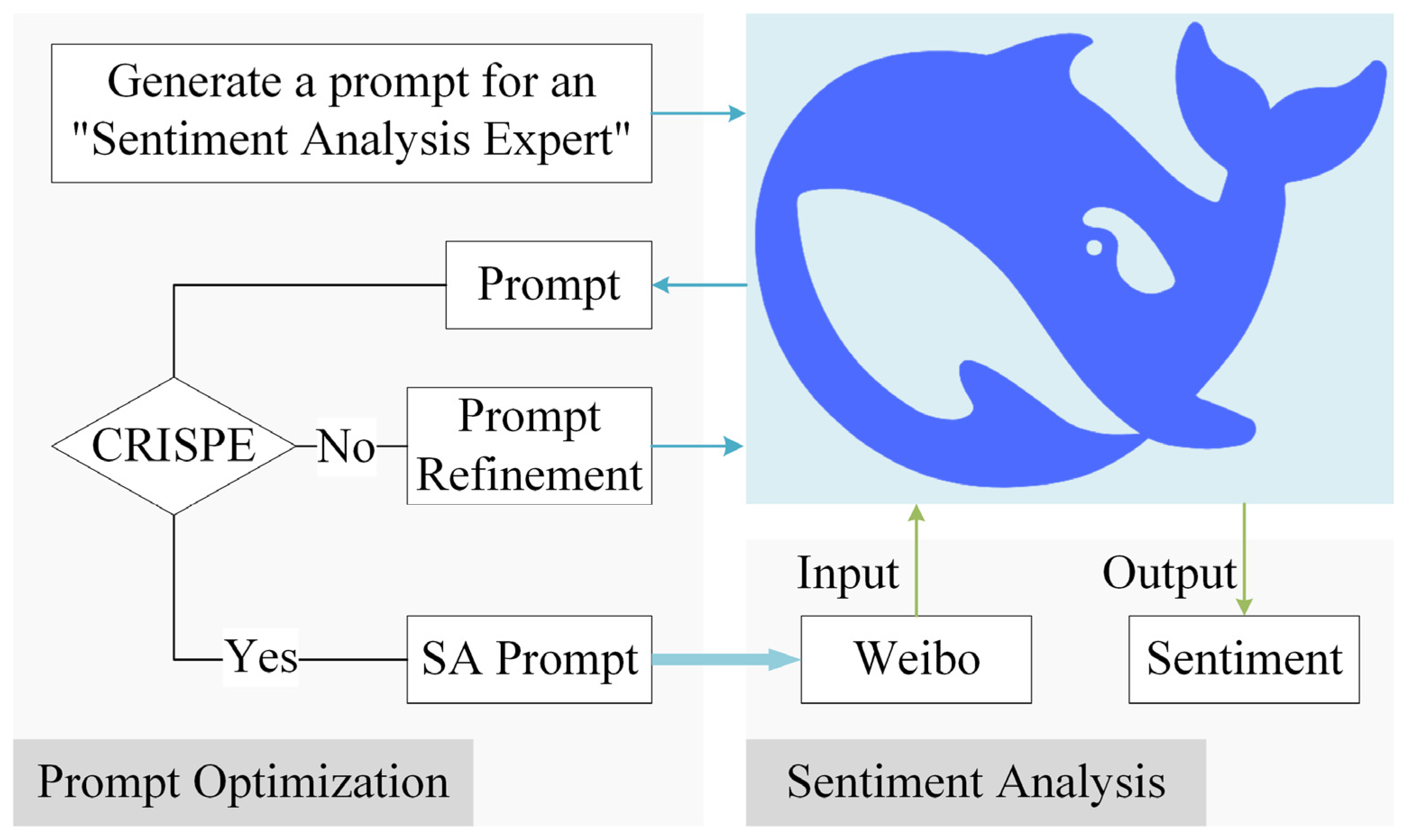
DeepSeek-R1 [45] demonstrates strong capabilities in contextual modeling and semantic reasoning, with prior studies reporting high performance in both radiology report generation [46] and general NLP tasks [47]. Accordingly, we employed DeepSeek-R1 [43] as our sentiment analysis tool. Prompt engineering, a critical technique for enhancing LLM outputs, was implemented to improve the accuracy and reliability of sentiment classification [48,49]. A specialized prompt optimization strategy was adopted. First, task requirements were communicated to the model to generate an initial SA prompt. This was followed by multiple rounds of interactive refinement, progressively improving the prompt until the final version was obtained (Figure 2). The CRISPE (Capacity/Role, Insight, Statement, Personality, Experiment) framework was applied to systematically guide prompt refinement, mitigating uncertainties inherent in LLM-based open-ended text generation [50]. Furthermore, the decoding temperature parameter was fixed at zero to reduce stochastic variability in model outputs.
DeepSeek-R1 generated sentiment classifications by categorizing texts into three classes: positive, negative, and neutral. The inclusion of the neutral category helps prevent the misclassification of news reports and other non-opinionated content as either positive or negative.
To validate the effectiveness of DeepSeek-R1 for Chinese sentiment analysis, we used the publicly available ChnSentiCorp dataset (https://aistudio.baidu.com/datasetdetail/158737, accessed on 4 December 2025) [51] was employed as a benchmark (Table 2). The dataset consists of two sentiment categories—positive and negative. As the original prompt was designed for three-way classification (positive, negative, and neutral), it was adapted for this evaluation by constraining the output to two classes while maintaining the overall prompt structure.

2.3. Analyzing Spatiotemporal Characteristics and Mining Topics in Affected Areas Using Dual-Dimensional Information

2.3.1. Analyzing Spatiotemporal Characteristics of Public Sentiment with Different Physical Damage

Building on the spatial distribution of surface deformation derived from D-InSAR analysis, this study further integrates social media–based sentiment data to characterize their spatiotemporal patterns.
  • Construction and Quantification of Public Sentiment Grids
Sentiment expressed by social media users not only reflects individual attitudes but can also represent broader collective sentiment, including that of populations not actively engaged on these platforms [52,53]. To quantify spatial variations in public sentiment, GIS-based spatial aggregation was applied to convert discrete point-level sentiment data into a regular grid structure. The study area was divided into 100 m × 100 m grid cells, within which the ratio of positive to negative sentiment was used to derive a composite sentiment index. The sentiment index for each grid cell was computed as Equation (2)
E j = Pos j Neg j Pos j + Neg j ,
where E j denotes the sentiment index of the j - th grid cell, Pos j and Neg j represent the number of positive and negative sentiment samples within the cell, respectively. The index ranges from −1 to 1, with values approaching 1 indicating predominantly positive sentiment, values near −1 indicating predominantly negative sentiment.
2.
Spatiotemporal Analysis of Dual-Dimensional Information
Following the deformation-based classification (Table 1), the study area was segmented into three physical damage levels. Subsequently, a GIS-based spatial overlay analysis was conducted to integrate the sentiment grid data with the surface deformation results, enabling a joint examination of both physical and social dimensions. The temporal evolution of sentiment indices was then analyzed in relation to varying degrees of physical damage, revealing the spatiotemporal association between physical damage and public sentiment. This integrated analytical approach facilitates the precise identification of areas exhibiting both severe physical damage and persistently negative sentiment. Such areas represent critical priorities for post-disaster relief operations. Moreover, the temporal evolution of public sentiment provides insights into shifting rescue priorities, thereby supporting adaptive allocation of relief resources and enhancing situational awareness throughout the disaster process.

2.3.2. Analyzing Disaster-Related Topics Based on Semantic Networks

Semantic networks were constructed for each disaster phase, and community detection algorithms were applied to identify clusters of disaster-related topics and their temporal transitions. By comparing topic structures associated with positive and negative sentiments, the key factors driving sentiment recovery were identified.
  • Extraction Disaster-Related Keywords
Disaster-related keywords capture the essential information within textual content, enabling a concise semantic representation that facilitates rapid understanding of disaster-related topics. Chinese lacks explicit word boundaries (e.g., spaces) between lexical units. The widely used Jieba segmentation tool was adopted for Chinese word segmentation. And stop words—such as “的” (possessive marker), “了” (aspect marker), and “在” (preposition)—which convey limited semantic value, were removed to improve analytical efficiency and accuracy.
The TF-IDF method [48] was then employed to extract representative keywords, presented as Equations (3)–(5):
T F i ,   j =   n i ,   j k n k ,   j ,
IDF i = log | D | | { j :   t i     d j } | ,
T F - IDF i ,   j = TF i ,   j   ×   IDF i ,
where n i ,   j denotes the number of occurrences of term i   in document j , k n k ,   j represents the total number of terms in document j , D is the entire corpus; and | { j :   t i     d j } | indicates the number of documents containing term i .
2.
Construction Disaster-Related Semantic network
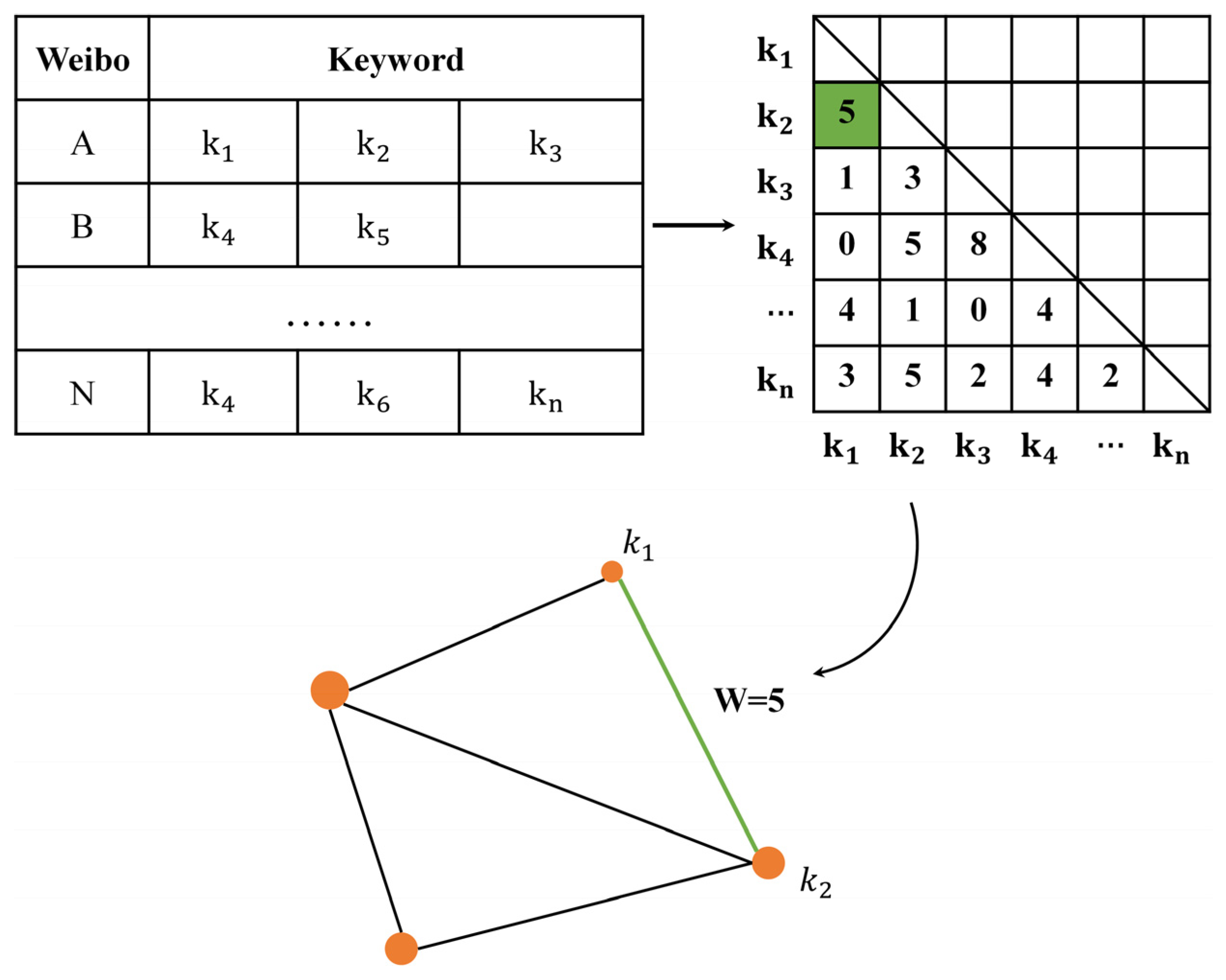
Each Weibo post was treated as an individual document, and the co-occurrence frequencies of keywords within each post were computed to construct a term co-occurrence matrix. This matrix was subsequently transformed into a weighted, undirected network, where nodes represent keywords and edge weights correspond to the frequency of their co-occurrence across the corpus (Figure 3).
3.
Detection Disaster-Related Community
The Louvain modularity maximization algorithm was applied to detect communities within the semantic network, thereby identifying clusters of keywords that frequently co-occur within the same semantic context. Each detected community represents a potential thematic group, allowing a more detailed exploration of post-earthquake public needs and societal responses. In the Louvain algorithm, modularity Q  serves as the primary metric for assessing the quality of community partitioning, as defined in Equation (6):
Q = 1 2 m i ,   j A i ,   j k i   k j 2   m σ ( c i ,   c j ) ,
Here, A i ,   j   denotes the weight of the edge between nodes i and j , k i   represents the degree of node i , m is the sum of the weights of all edges in the network, and σ ( c i ,   c j ) is an indicator function that equals 1 if nodes i and j belong to the same community, and 0 otherwise.

3. Study Area and Data

3.1. Stuay Area

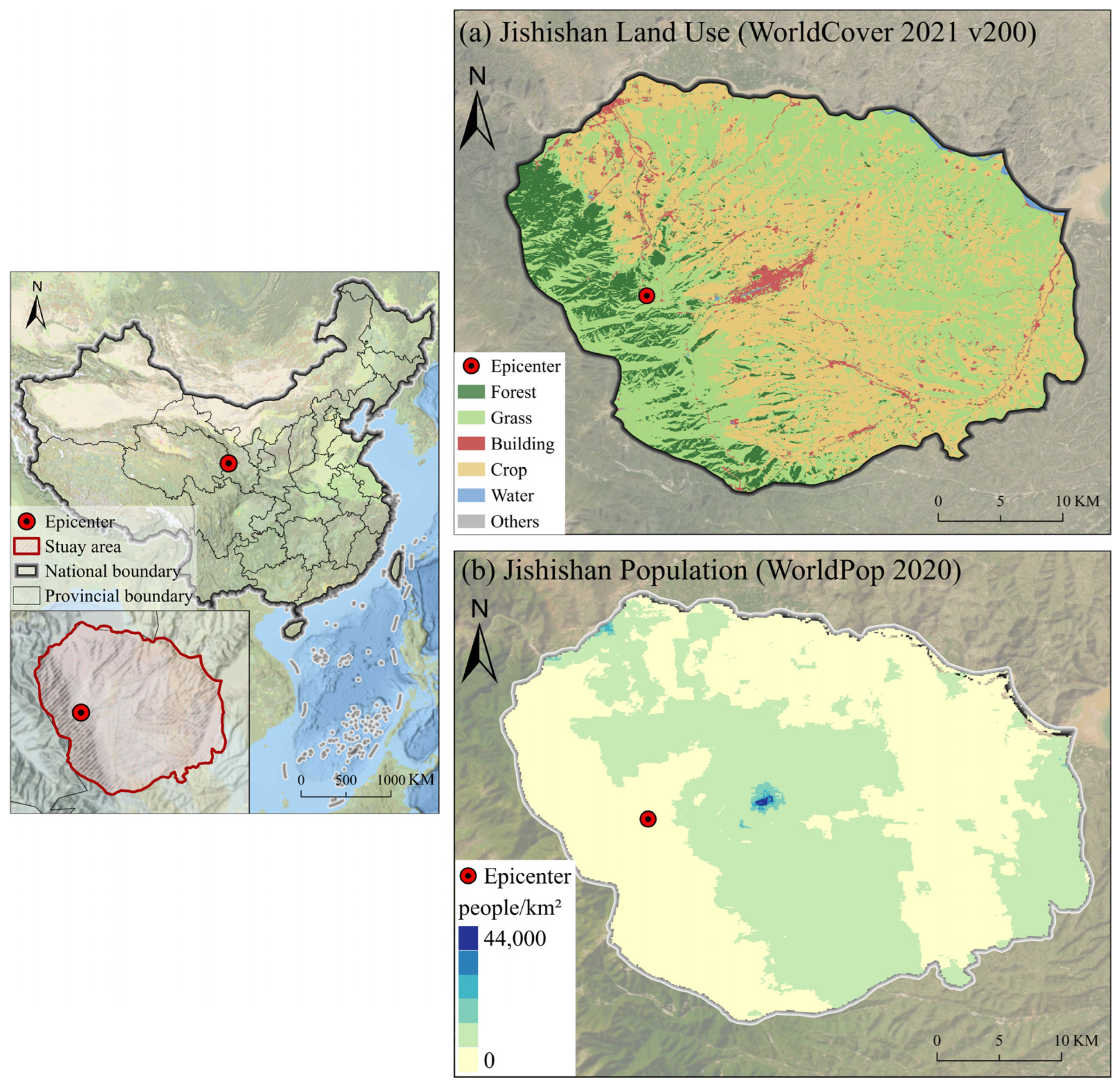
On 18 December 2023 at 23:59 Beijing Time, a magnitude 6.2 earthquake occurred in Liugou Township, Jishishan Bonan-Dongxiang-Salar Autonomous County (35.70° N, 102.79° E). The event originated at an approximate focal depth of 10 km, and the epicentral region experienced a maximum intensity of VIII on the China Seismic Intensity Scale. Jishishan Bonan-Dongxiang-Salar Autonomous County (hereafter, Jishishan) was selected as the study area due to its status as one of the most severely affected regions. The county has a population of approximately 240,000. By the end of 2023, mobile phone penetration reached 115.6 units per 100 inhabitants, with 4G/5G users comprising roughly 93% of all mobile subscribers [54]. Such widespread mobile infrastructure ensures broad access to online platforms, including Sina Weibo, thereby providing a robust basis for leveraging social media–derived Volunteered Geographic Information (VGI) to assess disaster impacts. The fundamental geographical and disaster-related context of the study area is illustrated in Figure 4.

3.2. Data Acquisition

3.2.1. Social Media Data Acquisition

Sina Weibo, one of China’s largest microblogging platforms, enables users to share text, images, and short videos, often accompanied by hashtags, mentions, and geotags. These features generate rich, structured, and georeferenced content, which can be exploited for targeted data retrieval, advanced filtering, and spatially explicit analyses, making Weibo a valuable source of Volunteered Geographic Information (VGI) for disaster research. A Python-based (version 3.8.3) data collection framework was developed to acquire earthquake-related posts via the platform’s “Advanced Search” function. Posts containing disaster-specific keywords (e.g., “Gansu Earthquake,” “earthquake,” “Jishishan Earthquake”) were retrieved within the temporal window of 18–26 December 2023, capturing the post ID, content, and timestamp. After removing duplicate entries based on post ID, a total of 28,051 unique Weibo posts were retained for subsequent analysis.

3.2.2. Remote Sensing Data Acquisition

Remote sensing data were obtained from the Sentinel-1 satellite mission, operated by the European Space Agency (ESA), which provides all-weather, day-and-night imaging for consistent monitoring of disaster-affected areas. Two Sentinel-1A Interferometric Wide (IW) mode scenes, acquired before (2 December 2023) and after (26 December 2023) the earthquake, were selected for analysis.

4. Result

4.1. Disaster Information Extraction from Social Media

4.1.1. Locations Extracted in the Affected Areas

The fine-tuned BERT-WWM-ext achieved satisfactory performance on the test set, as summarized in Table 3. However, the model exhibit certain limitations when processing nested entities [57]. For instance, the location entity “积石山县大河家镇” (Jishishan County Dahejia Town) is occasionally recognized as “石山县大河家镇” (Shishan County Dahejia Town). This error likely results from the model’s morpheme segmentation, in which the character “积” is misinterpreted as a non-toponymic morpheme (e.g., “accumulation”), leading to incorrect boundary segmentation.
Using the fine-tuned BERT-WWM-ext model, a total of 3536 unique location entities were extracted from Weibo posts collected during this earthquake. These entities were geocoded using the Amap API (https://lbs.amap.com/api/webservice/guide/api/georegeo, accessed on 4 December 2025) [58], and the resulting coordinates were standardized to the WGS84 reference system. Higher-level administrative divisions (e.g., provinces, prefecture-level cities, and counties/districts) were excluded according to the study requirements, retaining only fine-grained entities such as towns, townships, villages, and points of interest (POIs). Entities located outside the study area were further removed, yielding a final set of 507 unique locations for spatial analysis.

4.1.2. Public Sentiment Extracted from Sina Weibo

The first, referred to as the expert prompt, guided DeepSeek-R1 in generating and iteratively refining task-specific prompts for sentiment analysis (SA). The second, termed the SA prompt, was used to perform sentiment classification of Weibo texts. The contents of both prompts are summarized in Table 4.
Inference was conducted on the test set from the ChnSentiCorp. The results are summarized in Table 5. Furthermore, the SA prompt was applied to analyze disaster-related Weibo posts. Using DeepSeek-R1, the texts were classified into three sentiment categories—positive, negative, and neutral—while ensuring consistent formatting and semantic coherence. Representative examples of the classification results are presented in Table 6.

4.2. Spatiotemporal Characteristics of Disaster Impacts in Affected Areas Based on Dual-Dimensional Information

To systematically analyze the spatiotemporal characteristics of dual-dimensional information after the earthquake, the disaster process was divided into three phases: Response phase, Rescue phase, and Recovery phase. The specific temporal ranges and characteristics of each phase are summarized in Table 7.

4.2.1. Spatial Distribution of Physical Damage in Affected Areas

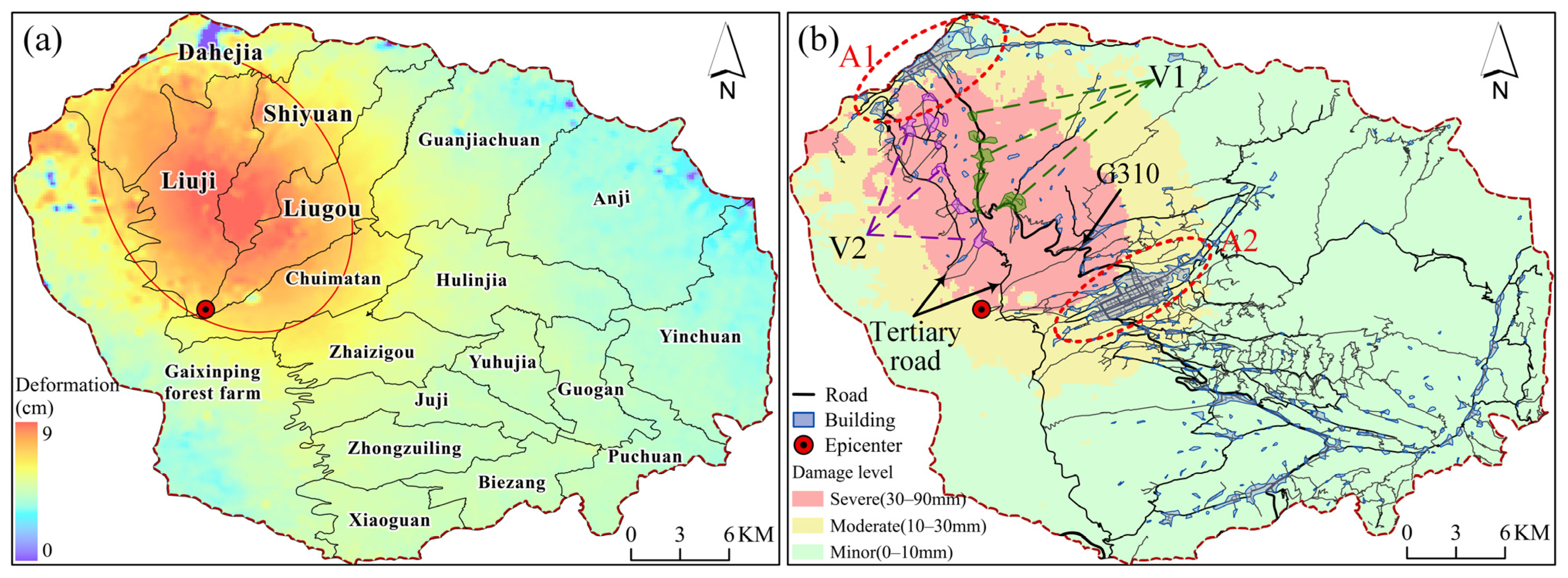
The deformation map shows a maximum line-of-sight (LOS) displacement of 8.5 cm (Figure 5a), which is close to previously reported studies [59]. Based on the classification criteria summarized in Table 1, the deformation field was categorized into three levels—minor, moderate, severe—yielding the classified deformation map shown in Figure 5b. In the Dahejia–Liuji–Chuimatan area, the displacement falls within the severe deformation category according to this classification, and the affected zone exhibits an approximately elliptical pattern, with a major axis of ~23 km and a minor axis of ~18 km. Integration of building distribution data [60] and road network information [61] shows that the study area has underdeveloped transportation infrastructure and relatively low local economic development. Most settlements are aligned along roads, forming linear clusters corresponding to town and village centers, whereas mountainous areas are largely uninhabited. Dahejia (A1) and Chuimatan (A2) exhibit relatively dense and well-connected road networks. In contrast, within the most severely affected area (red ellipse), transportation infrastructure is limited: only a single major arterial road traverses the region, while the remaining roads with restricted traffic capacity. For instance, villages marked in purple (V2) rely on several tertiary-level roads for access, whereas green-marked villages (V1) depend primarily on the G310 highway for connectivity.
This decentralized settlement pattern, combined with a fragile and sparse road network, presents substantial challenges for post-earthquake rescue and relocation operations. Rescue efforts must be dispersed across numerous small and spatially isolated communities, substantially increasing the complexity of coordination and resource allocation. Moreover, the limited road network is highly susceptible to congestion and disruption caused by secondary hazards, thereby constraining access for external rescue teams and leading to supply shortages, isolated populations, and uneven aid distribution. To address these challenges, we further incorporated social media data to identify affected locations and capture public responses across different regions during the disaster process.

4.2.2. Temporal Evolution of Public Sentiment in Weibo Texts

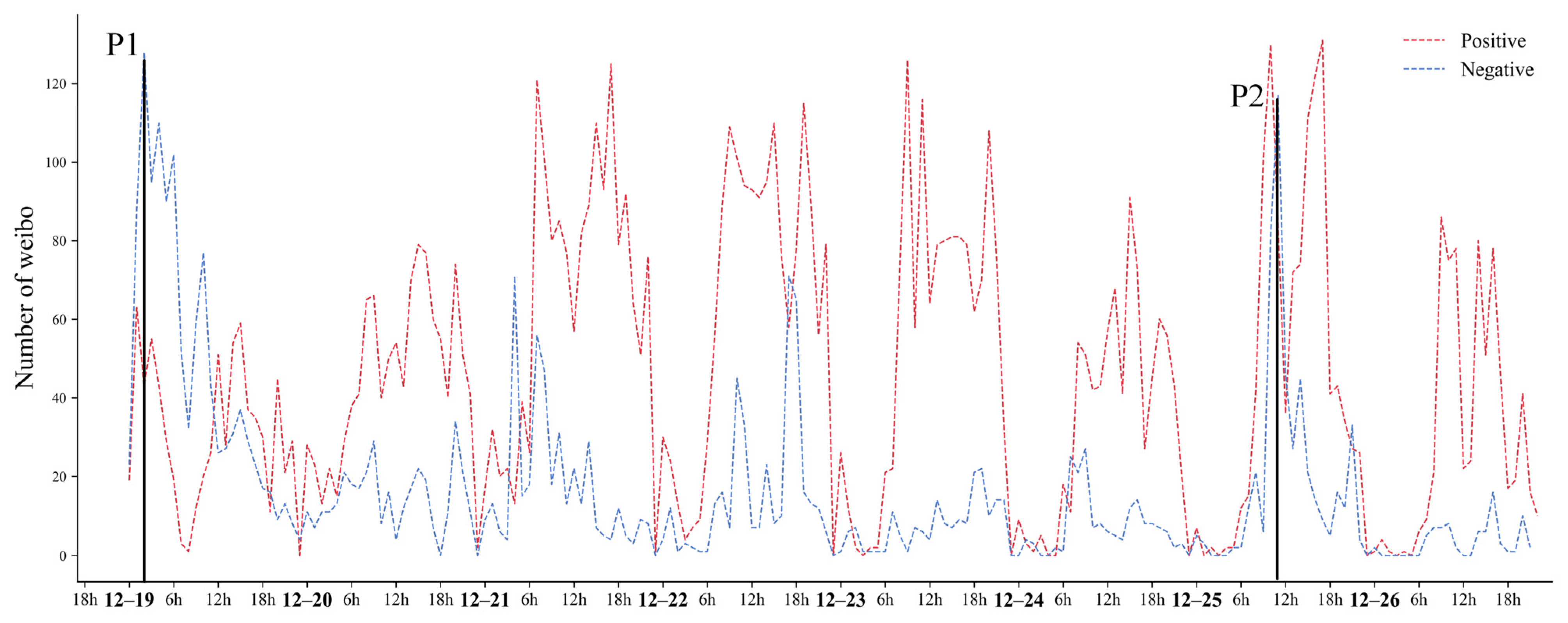
We analyzed the temporal evolution of public sentiment across the entire study area, with results illustrated in Figure 6. On the first day following the earthquake (19 December), public sentiment exhibited pronounced volatility, with a sharp surge in negative sentiment forming the first peak (P1), reflecting widespread shock and anxiety to the sudden event. Beginning on the second (20 December), sentiment dynamics became more regular. Positive sentiment displayed a distinct diurnal oscillation characterized by daytime peaks and nighttime troughs, with gradually increasing amplitudes over subsequent days. This trend indicates a progressive stabilization of the overall emotional state of the public. Analysis of Weibo posts suggests that this stabilization was closely associated with the timely organization of governmental rescue and relief operations, which helped alleviate public panic [62]. However, negative sentiment remained persistently elevated during nighttime periods, likely reflecting limited nighttime rescue activity and insufficient dissemination of relief information, which exacerbated public anxiety and uncertainty. Based on these observations, emergency management should prioritize the allocation of rescue resources and psychological support measures during nighttime hours, as such interventions can effectively reduce the accumulation of negative sentiment.
A second pronounced peak (P2) in negative sentiment occurred on 25 December, driven by memorial events that triggered widespread grief and emotional resonance across social media platforms. Accordingly, disaster management authorities should strengthen sentiment monitoring and public guidance during collective mourning activities to ensure their orderly conduct and mitigate potential psychosocial ripple effects. These measures are essential for reinforcing people-centered principles and promoting risk-informed coordination within comprehensive emergency management frameworks [62].

4.2.3. Spatiotemporal Association Between Surface Deformation and Public Sentiment

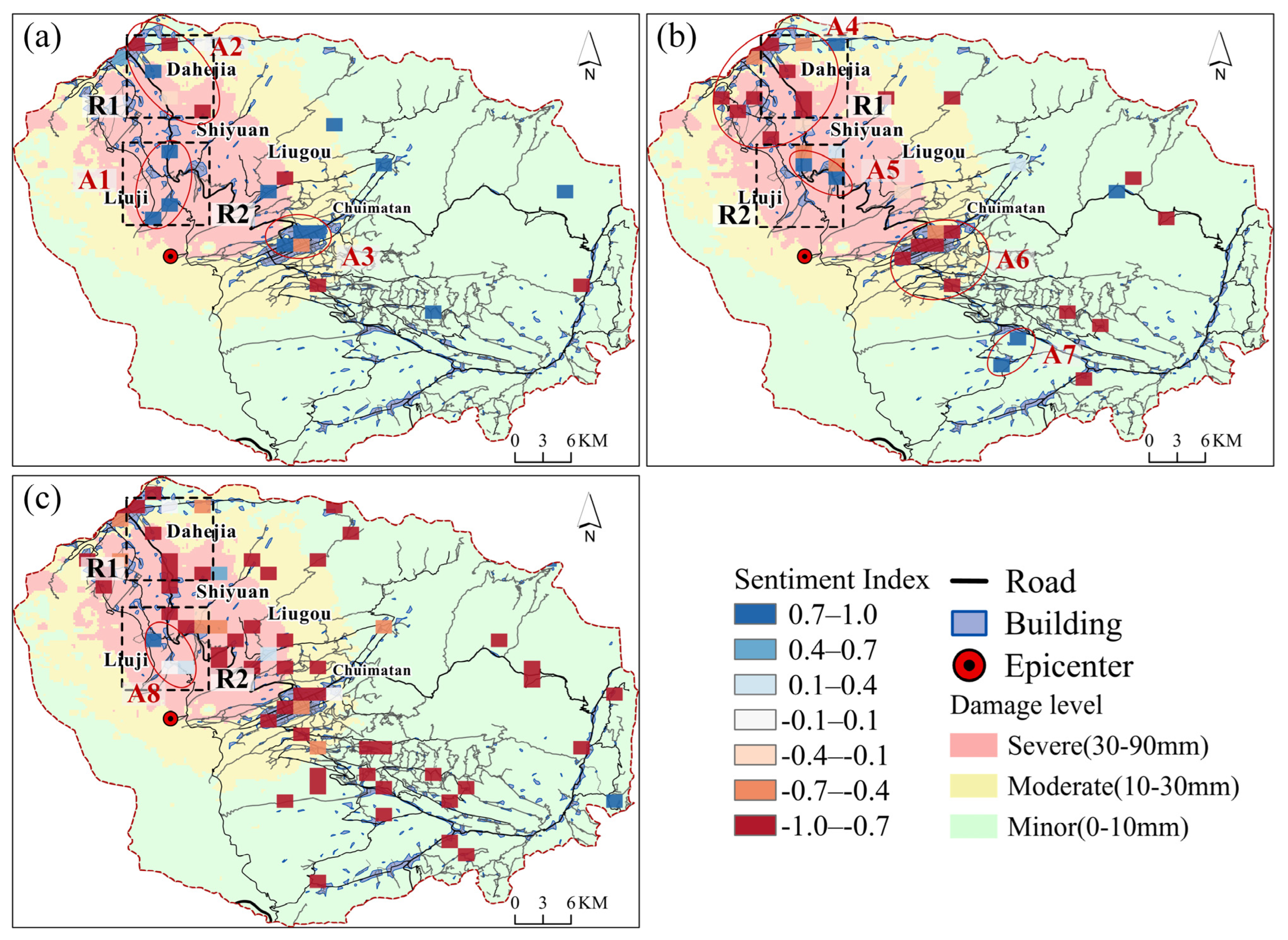
Figure 7 illustrates the spatiotemporal dynamics of public sentiment superimposed on the spatial distribution of physical damage. Sentiment is visualized using a gridded representation, with grid cells of 1 km × 1 km. Color intensity indicates sentiment, with warmer tones representing stronger positive sentiment and cooler tones representing stronger negative sentiment. The figure is organized into three panels, each corresponding to one post-earthquake phase. Spatially, negative sentiment is predominantly concentrated in areas experiencing significant surface deformation, underscoring the dominant influence of physical damage on public emotional responses. Temporally, sentiment grids in the initial stage are sparse and largely negative, reflecting limited information flow and heightened public concern immediately after the event. As the disaster response progresses, the density of sentiment grids increases, and positive sentiment gradually becomes predominant, signaling growing public confidence as rescue and relief efforts intensify. Table 8 provides the detailed sentiment proportions across the three phases.
In the Response phase (19 December), negative sentiment accounts for 44.38% of all sentiment expressions (Table 8). Spatially, negative sentiments were primarily concentrated in the severely damaged areas (Figure 7a), such as A1 (Liuji Town) and A3 (Chuimatan Town). Notably, although A2 (Dahejia Town) also lies within a zone of pronounced surface deformation, its sentiment distribution was predominantly positive. This divergence suggests that severe physical damage does not necessarily translate into uniformly negative public sentiment across space, highlighting the need for further topic-level analysis to explore the contextual factors shaping these differences.
Entering the Rescue phase (20–21 December), negative sentiment decreased to 31.50%, while positive sentiment increased substantially to 52.73%, indicating a clear shift toward positive public sentiment (Table 8). Spatially, as illustrated in Figure 7b, severely damaged areas showed a pronounced decline in negative sentiment. The positive sentiment cluster previously observed in A2 expanded into a larger contiguous cluster (A4), while A3, which had been dominated by negative sentiment in the preceding phase, transitioned to a predominantly positive sentiment pattern (A6). In minor-damage areas, early negative sentiment largely dissipated, and sentiment stabilized toward neutral or positive expressions, suggesting that psychological stress was effectively mitigated as rescue coverage expanded. Notably, a new cluster of negative sentiment emerged in A7, which, according to Weibo text analysis, primarily reflected concerns about the safety of family and friends rather than direct responses to physical damage.
During the Recovery phase (22–26 December), positive sentiment further increased to 59.32%, and negative sentiment declined to 22.35% (Table 8). Spatially (Figure 7c), Negative sentiment had largely dissipated across the study area, persisting only in isolated localities. The sentiment grids during this phase were denser and exhibited a broader spatial distribution, covering much of the study area. Against this backdrop of widespread recovery, A8, one of the most severely affected areas, remained an exception, with residual negative sentiment persisting. This spatial pattern underscores the heterogeneity of post-disaster sentiment recovery: despite the overall stabilization of public sentiment, regions experiencing severe physical damage tend to recover more slowly and are more prone to sustained negative expressions.
Across the evolution of the disaster, remote sensing and social media data exhibited consistent information on disaster impacts. Negative sentiment was primarily concentrated in areas experiencing the most severe surface deformation, with both its spatial extent and intensity gradually diminishing over time. At the same time, analysis of social media sentiment reveals notable heterogeneity. For example, regions R1 and R2 experienced comparable levels of surface deformation, yet their sentiment trajectories differed markedly. R1 exhibited early emergence of positive sentiment, which progressively strengthened over time, whereas R2 maintained persistently high levels of negative sentiment. These divergent patterns may reflect differences in the distribution and effectiveness of rescue efforts. R1, with a more developed road network than R2, likely benefited from more efficient resource allocation and deployment of rescue teams, resulting in a faster shift toward positive sentiment. This disparity highlights the need for further analysis of local social media content to identify the key factors driving sentiment heterogeneity, which can inform targeted resource allocation and guide effective disaster mitigation strategies.

4.3. Topic Transitions of Semantic Network in Affected Areas

To further explore the factors driving differing sentiment patterns in representative heterogeneous regions, we focus on R1 and R2 (Figure 7). For each region, semantic networks were constructed for each phase, and Louvain community detection was applied to identify topic clusters.
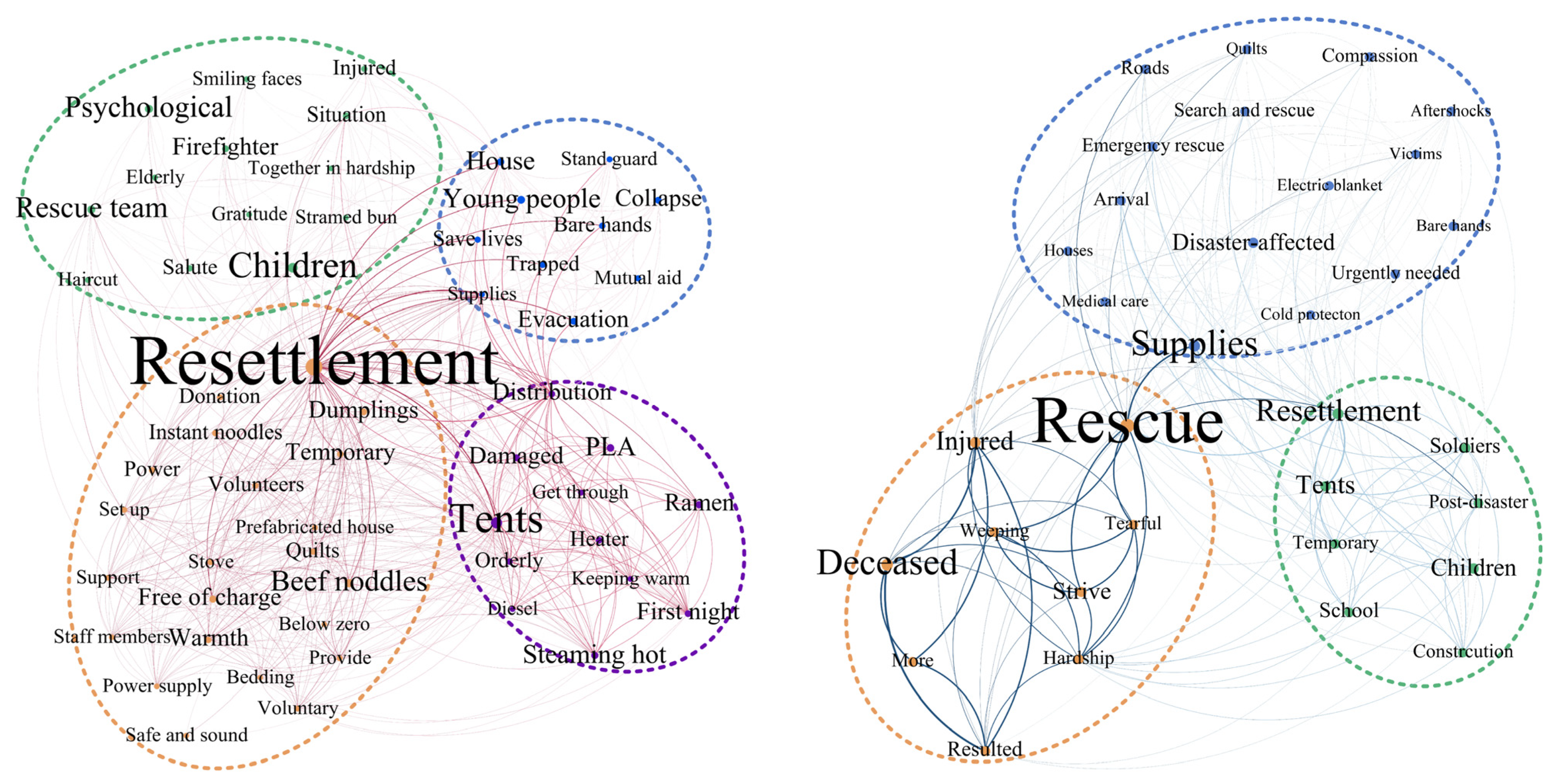
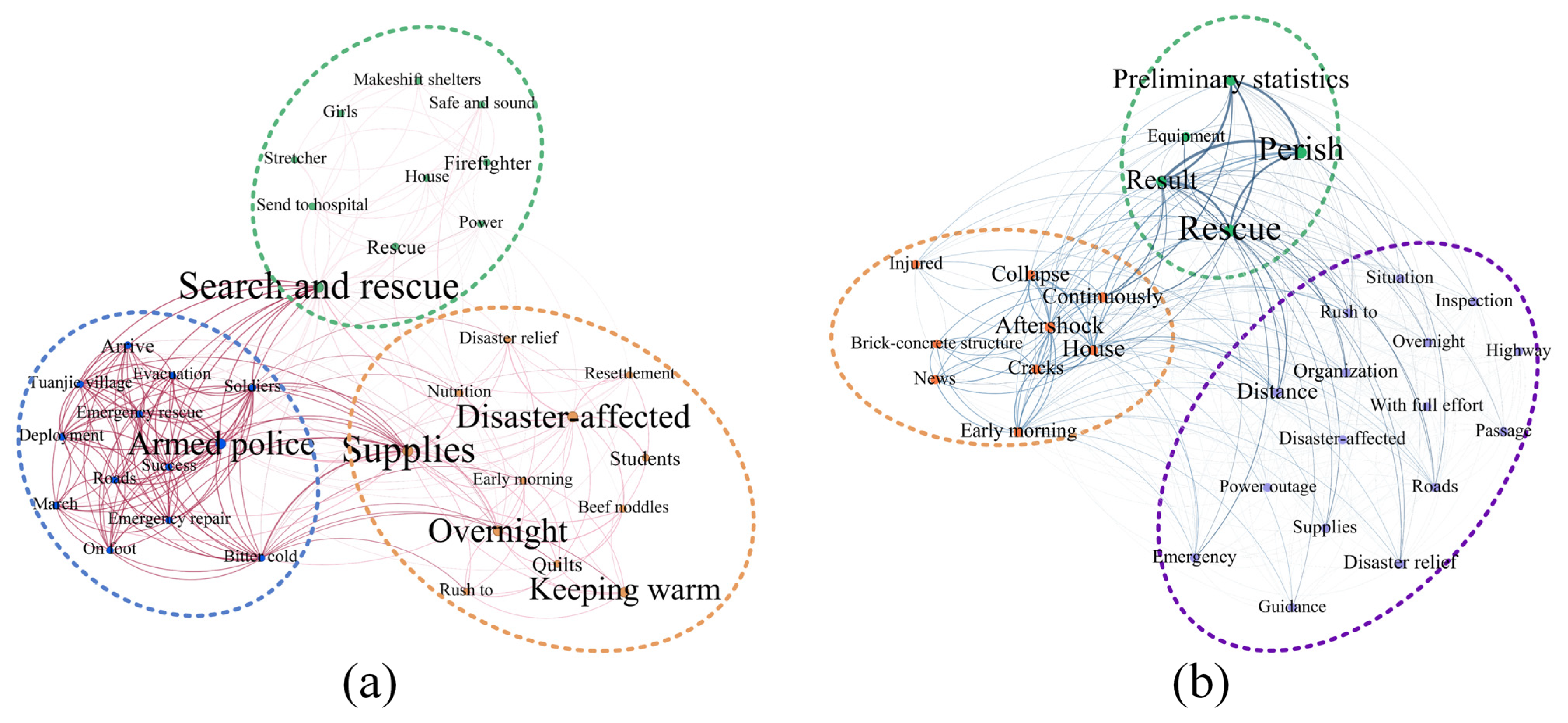
In Response phase, the positive sentiment network in R1 comprised three clusters (Figure 8a): (1) the orange cluster, with topic of supply distribution and evacuee relocation; (2) the blue cluster, with topic of infrastructure emergency repair and rescue efforts deployment; (3) the green cluster, with topic of search and rescue operations for trapped individuals. Core keyword such as “搜救” (Search and Rescue) and “连夜” (Overnight) were strongly linked to high-frequency keywords including “赶到” (Arrive) and “供应” (Supplies), suggesting that this region benefited from timely relief efforts following the earthquake. The dominance of positive sentiment reflects public recognition and trust in the efficiency and promptness of these efforts. The negative sentiment network in R2 also consisted of three clusters (Figure 8b): (1) the orange cluster, with topic of building damage; (2) the purple cluster, with topic of emergency infrastructure repairs; (3) the green cluster, with topic of dissemination of casualty-related information. Core keyword such as “死亡” (Perish), “倒塌” (Collapse) and “余震” (Aftershock) emphasize severe life-threatening conditions and secondary disaster risks. Additional keywords, including “停电” (power outages), “道路” (Roads) and “距离” (Distance), highlighted obstructive factors such as disrupted transportation and challenging environmental conditions, which may have delayed the arrival of rescue efforts. Public sentiment in this region was dominated by anxiety and apprehension, largely driven by physical damage and concern for personal safety. Overall, during Response phase, R1’s semantic network emphasized rescue and relocation, corresponding to predominantly positive sentiment, whereas R2’s network centered on damage and disruption, aligning with persistent anxiety and concern.
In Rescue phase, the positive sentiment network in R1 comprised four main topic clusters (Figure 9a): (1) the blue cluster, with topic of search and rescue of trapped individuals; (2) the orange cluster, with topic of livelihood support and restoration of order; (3) the purple cluster, with topic of supply distribution and service provision; (4) the green cluster, with topic of sentiment support and psychological care. Core keyword “安置” (Resettlement) was densely linked with keywords such as “Supplies” (供应), “Rescue Teams” (救援队), “Tents” (帐篷) and “Beef Noddle” (牛肉面), reflecting the effective coordination of rescue efforts and the diversity of relief supplies. The persistence of positive sentiment suggests that R1 had entered a phase characterized by stable resettlement, livelihood support, and psychological recovery. The negative sentiment network in R2 consisted of three topic clusters (Figure 9b): (1) the green cluster, with topic of resettlement and livelihood support; (2) the blue cluster, with topic of urgent rescue operations and resource scarcity; (3) the orange cluster, with topic of sentiment impact and casualty-related information. Core keyword “Rescue” (救援), together with keywords such as “urgently needed” (急需), “injured” (受伤) and “Deceased” (逝者) reflects a persistent state of acute emergency driven by ongoing rescue demands and environmental constraints. Negative sentiment was further reinforced by grief-related expressions such as “流泪” (tearful), underscoring the sustained psychological burden on affected populations. Overall, in Rescue phase, R1 emphasized livelihood support, psychological recovery, and community cohesion, with positive sentiment predominating. In contrast, sentiment in R2 remained dominated by anxiety and grief, shaped by insufficient rescue capacity, resource shortages, and continued human losses.
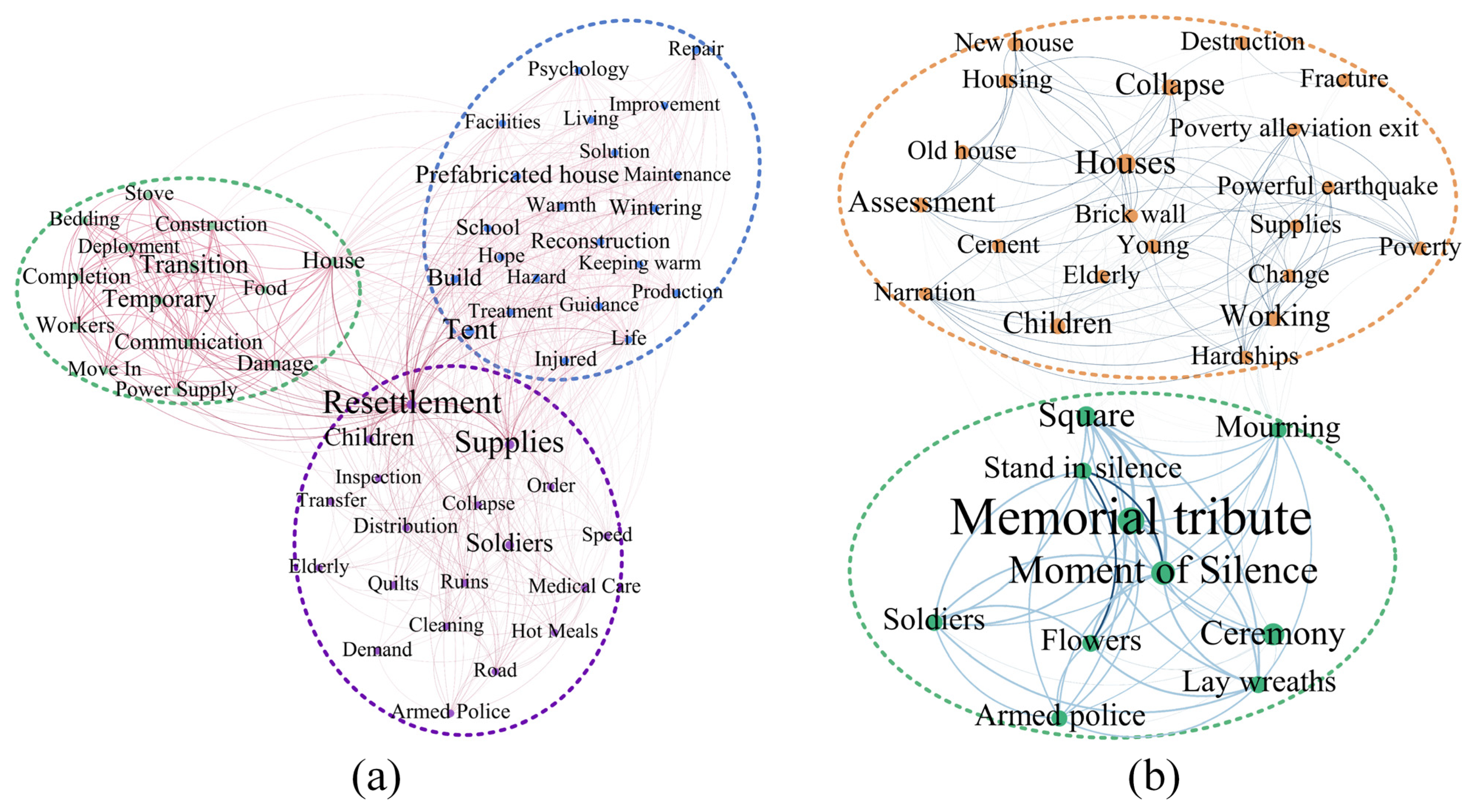
In Recovery phase, the positive sentiment network in R1 comprised three topic clusters (Figure 10a): (1) the blue cluster, with topic of infrastructure development and improvement of living conditions; (2) the green cluster, with topic of interim resettlement and material supply; (3) the purple cluster, with topic of emergency response and safety maintenance. Core keyword remained “Resettlement” (安置), keywords such as “Power supply” (电力供应) and “Prefabricated house” (预制房) highlight the ongoing restoration of essential services and notable improvements in living conditions. The predominance of positive sentiment indicates a steady transition from emergency response toward recovery and reconstruction. The negative sentiment network in R2 comprised two topic clusters (Figure 10b): (1) the green cluster, with topic of mourning and commemoration of the deceased; (2) the orange cluster, centered on prolonged socio-economic challenges. Keywords such as “Mourning” (哀悼) and “Tribute” (敬献) reflect a profound sense of loss and grief, whereas keywords including “Elderly” (老人), “Poverty” (贫困) and “Old house” (旧房) indicate low community resilience, encompassing an aging population, left-behind children, and inadequate housing conditions. Negative sentiment gradually shifted from immediate rescue pressures to deeper reflections on structural vulnerabilities and long-term recovery challenges. Overall, during Recovery phase, the semantic network in R1 emphasized infrastructure restoration and improvements in resettlement, with dominant positive sentiment indicating a steady transition toward recovery and reconstruction. In contrast, R2’s negative sentiment increasingly reflected the commemoration of lives lost and persistent indicators of low community resilience, highlighting ongoing challenges in the region’s post-disaster recovery.
The above results indicate that post-disaster topics revealed a staged pattern of social response: initial with expressions of fear and concern for personal safety, followed by demands for search-and-rescue and relief supplies, and finally attention to reconstruction and the resumption of daily life. Comparative analysis of regional topic variations, particularly concentrations of negative sentiment in areas with limited rescue coverage, can help identify regions where relief efforts may be insufficient and support the dynamic adjustment of resource allocation to mitigate inequities in disaster response.

5. Conclusions

We propose a novel framework integrating Sina Weibo data and Sentinel-1 SAR imagery to achieve continuous and dynamic monitoring of disaster-affected areas. The framework’s effectiveness was demonstrated through the case of the Jishishan earthquake in 2023. The results highlight several key findings. First, continuous monitoring of post-disaster conditions is achieved by combining social media with remote sensing. Surface deformation from Sentinel-1 provides a baseline assessment of the affected areas, while sentiment extracted from Weibo posts reflects the ongoing evolution and progression of disaster impacts. Second, severely damaged areas and the spatial distribution of negative sentiment have strong consistency. Physical damage shaped the initial spatial distribution of sentiment, and regions experiencing more severe damage showed slower sentiment recovery. Third, semantic network analysis and topic transitions across regions revealed that rescue efforts serve as the primary driver of sentiment recovery, while factors such as accessibility and social resilience indirectly influenced the process by affecting the efficiency and reach of rescue efforts. Overall, remote sensing provides precise yet static measurements of physical damage, while social media captures on-the-ground needs and social responses, reflecting the evolving dynamics of the disaster. By integrating these complementary data sources, the proposed framework enables dynamic and continuous disaster monitoring. This capability is crucial for guiding the deployment of rescue forces and supporting timely adjustments in response strategies, ultimately enhancing the efficiency of disaster management.
Despite the promising results achieved using social media in this study, several limitations should be noted. First, sentiment information can indicate the direction of rescue efforts, but the current approach cannot assess resource needs across regions. Incorporating additional information, such as local population distribution and economic conditions, could enable more precise estimation of localized demands in future research. Second, the analysis relies predominantly on textual social media data. While effective for capturing public sentiment and focal concerns, richer multimodal information—such as images—could provide more direct evidence of on-the-ground conditions and enhance disaster perception. Third, the availability of social media data depends on local population usage and network accessibility. communication infrastructure disruptions during disasters may lead to local data gaps, particularly in the initial phase. Although continuous monitoring over the following seven days captured a marked increase in data as network connectivity was restored, in sparsely populated or connectivity-limited areas, data scarcity may lead to underestimation of disaster conditions. Future studies should consider these limitations and explore integrating alternative data sources to improve the robustness and applicability of social media–based disaster assessments.

Author Contributions

Conceptualization, Z.R. and T.Y.; methodology, Z.R., T.Y. and G.L.; software, Z.C.; validation G.L., S.H. and N.M.; formal analysis, Z.R. and T.Y.; investigation, Z.R. and G.L.; resources, N.M.; data curation, Z.C.; writing—original draft preparation, Z.R.; writing—review and editing, T.Y. and S.H.; visualization, S.H.; supervision, T.Y.; project administration, G.L.; funding acquisition, Z.C. and G.L. All authors have read and agreed to the published version of the manuscript.

Funding

This work was funded by The National Natural Science Foundation of China [Grant No. 42201505], The National Earth Observation Scientific Data Center Project [Grant No. E43Z18020A] and the Scientific Data Center, Aerospace Information Research Institute, Chinese Academy of Sciences [Grant No. E2Z218030F].

Institutional Review Board Statement

Not applicable.

Informed Consent Statement

Not applicable.

Data Availability Statement

The original contributions presented in this study are included in the article. Further inquiries can be directed to the corresponding author.

Conflicts of Interest

The authors declare no conflicts of interest.

References

  1. Han, J.; Zheng, Z.; Lu, X.-Z.; Chen, K.-Y.; Lin, J.-R. Enhanced earthquake impact analysis based on social media texts via large language model. Int. J. Disaster Risk Reduct. 2024, 109, 104574. [Google Scholar] [CrossRef]
  2. EM-DAT. EM-DAT: Emergency Events Database. Available online: https://www.emdat.be/ (accessed on 4 December 2025).
  3. Chiu, Y.-Y.; Omura, H.; Chen, H.-E.; Chen, S.-C. Indicators for Post-Disaster Search and Rescue Efficiency Developed Using Progressive Death Tolls. Sustainability 2020, 12, 8262. [Google Scholar] [CrossRef]
  4. Lien, Y.N.; Jang, H.C.; Tsai, T.C. A MANET Based Emergency Communication and Information System for Catastrophic Natural Disasters. In Proceedings of the 2009 29th IEEE International Conference on Distributed Computing Systems Workshops, Montreal, QC, Canada, 22–26 June 2009; pp. 412–417. [Google Scholar] [CrossRef]
  5. Li, L.; Bensi, M.; Baecher, G. Exploring the potential of social media crowdsourcing for post-earthquake damage assessment. Int. J. Disaster Risk Reduct. 2023, 98, 104062. [Google Scholar] [CrossRef]
  6. Xie, Y.; Feng, D.; Chen, H.; Liu, Z.; Mao, W.; Zhu, J.; Hu, Y.; Baik, S.W. Damaged Building Detection From Post-Earthquake Remote Sensing Imagery Considering Heterogeneity Characteristics. IEEE Trans. Geosci. Remote Sens. 2022, 60, 4708417. [Google Scholar] [CrossRef]
  7. Calò, M.; Ruggieri, S.; Doglioni, A.; Morga, M.; Nettis, A.; Simeone, V.; Uva, G. Probabilistic-based assessment of subsidence phenomena on the existing built heritage by combining MTInSAR data and UAV photogrammetry. Struct. Infrastruct. Eng. 2024, 1–16. [Google Scholar] [CrossRef]
  8. Chen, H.; He, Y.; Zhang, L.; Yang, W.; Liu, Y.; Gao, B.; Zhang, Q.; Lu, J. A Multi-Input Channel U-Net Landslide Detection Method Fusing SAR Multisource Remote Sensing Data. IEEE J. Sel. Top. Appl. Earth Obs. Remote Sens. 2024, 17, 1215–1232. [Google Scholar] [CrossRef]
  9. Zhang, S.; He, X.; Xue, B.; Wu, T.; Ren, K.; Zhao, T. Segment-anything embedding for pixel-level road damage extraction using high-resolution satellite images. Int. J. Appl. Earth Obs. Geoinf. 2024, 131, 103985. [Google Scholar] [CrossRef]
  10. Zhu, X.X.; Wang, Y.; Kochupillai, M.; Werner, M.; Häberle, M.; Hoffmann, E.J.; Taubenböck, H.; Tuia, D.; Levering, A.; Jacobs, N.; et al. Geoinformation Harvesting From Social Media Data: A community remote sensing approach. IEEE Geosci. Remote Sens. Mag. 2022, 10, 150–180. [Google Scholar] [CrossRef]
  11. Heipke, C. Crowdsourcing geospatial data. ISPRS J. Photogramm. Remote Sens. 2010, 65, 550–557. [Google Scholar] [CrossRef]
  12. Goodchild, M.F. Citizens as sensors: The world of volunteered geography. GeoJournal 2007, 69, 211–221. [Google Scholar] [CrossRef]
  13. Forati, A.M.; Ghose, R. Examining Community Vulnerabilities through multi-scale geospatial analysis of social media activity during Hurricane Irma. Int. J. Disaster Risk Reduct. 2022, 68, 102701. [Google Scholar] [CrossRef]
  14. Li, Z.; Wang, C.; Emrich, C.T.; Guo, D. A novel approach to leveraging social media for rapid flood mapping: A case study of the 2015 South Carolina floods. Cartogr. Geogr. Inf. Sci. 2018, 45, 97–110. [Google Scholar] [CrossRef]
  15. Zou, L.; He, Z.; Zhou, C.; Zhu, W. Multi-class multi-label classification of social media texts for typhoon damage assessment: A two-stage model fully integrating the outputs of the hidden layers of BERT. Int. J. Digital Earth 2024, 17, 2348668. [Google Scholar] [CrossRef]
  16. Yang, T.; Xie, J.; Li, G.; Zhang, L.; Mou, N.; Wang, H.; Zhang, X.; Wang, X. Extracting Disaster-Related Location Information through Social Media to Assist Remote Sensing for Disaster Analysis: The Case of the Flood Disaster in the Yangtze River Basin in China in 2020. Remote Sens. 2022, 14, 1199. [Google Scholar] [CrossRef]
  17. Xing, Z.; Zhang, X.; Zan, X.; Xiao, C.; Li, B.; Han, K.; Liu, Z.; Liu, J. Crowdsourced social media and mobile phone signaling data for disaster impact assessment: A case study of the 8.8 Jiuzhaigou earthquake. Int. J. Disaster Risk Reduct. 2021, 58, 102200. [Google Scholar] [CrossRef]
  18. Dai, J.; Zhao, Y.; Li, Z. Sentiment-topic dynamic collaborative analysis-based public opinion mapping in aviation disaster management: A case study of the MU5735 air crash. Int. J. Disaster Risk Reduct. 2024, 102, 104268. [Google Scholar] [CrossRef]
  19. Karimiziarani, M.; Foroumandi, E.; Moradkhani, H. Harnessing Twitter (X) with AI-enhanced natural language processing for disaster management: Insights from California wildfire. Environ. Model. Softw. 2025, 192, 106545. [Google Scholar] [CrossRef]
  20. Zhang, P.; Zhang, H.; Kong, F. Research on online public opinion in the investigation of the “7–20” extraordinary rainstorm and flooding disaster in Zhengzhou, China. Int. J. Disaster Risk Reduct. 2024, 105, 104422. [Google Scholar] [CrossRef]
  21. Weibo. 2023 Weibo Young User Development Report. Available online: https://data.weibo.com/report/reportDetail?id=471 (accessed on 4 December 2025).
  22. Wang, C.; Zhang, X.; Wu, J. Disaster information mining from a social perception perspective: A case study of the “23·7” extreme rainfall event in the Beijing–Tianjin–Hebei region. Int. J. Disaster Risk Reduct. 2024, 115, 105056. [Google Scholar] [CrossRef]
  23. Li, Y.; Peng, L.; Sang, Y.; Gao, H. The characteristics and functionalities of citizen-led disaster response through social media: A case study of the #HenanFloodsRelief on Sina Weibo. Int. J. Disaster Risk Reduct. 2024, 106, 104419. [Google Scholar] [CrossRef]
  24. Wieland, M.; Schmidt, S.; Resch, B.; Abecker, A.; Martinis, S. Fusion of geospatial information from remote sensing and social media to prioritise rapid response actions in case of floods. Nat. Hazard. 2025, 121, 8061–8088. [Google Scholar] [CrossRef]
  25. Wang, Y.; Li, G.; Hu, Z.; Sun, C.; Li, Z. A Novel D-InSAR and Offset Tracking Fusion Algorithm Based on Variance-Masked Mean Filtering. Electron. Lett. 2025, 61, e70173. [Google Scholar] [CrossRef]
  26. Peng, W.; Huang, X.; Wang, Z. Coseismic Deformation and Fault Inversion of the 2017 Jiuzhaigou Ms 7.0 Earthquake: Constraints from Steerable Pyramid and InSAR Observations. Remote Sens. 2023, 15, 222. [Google Scholar] [CrossRef]
  27. Peter, H.; Jäggi, A.; Fernández, J.; Escobar, D.; Ayuga, F.; Arnold, D.; Wermuth, M.; Hackel, S.; Otten, M.; Simons, W.; et al. Sentinel-1A–First precise orbit determination results. Adv. Space Res. 2017, 60, 879–892. [Google Scholar] [CrossRef]
  28. Chen, C.W.; Zebker, H.A. Two-dimensional phase unwrapping with use of statistical models for cost functions in nonlinear optimization. J. Opt. Soc. Am. A Opt. Image Sci. Vis. 2001, 18, 338–351. [Google Scholar] [CrossRef]
  29. Mızrak, S. Public’s social media use during the Kahramanmaraş earthquakes on 6 February 2023. Int. J. Disaster Risk Reduct. 2024, 108, 104541. [Google Scholar] [CrossRef]
  30. Karimiziarani, M.; Moradkhani, H. Social response and Disaster management: Insights from twitter data Assimilation on Hurricane Ian. Int. J. Disaster Risk Reduct. 2023, 95, 103865. [Google Scholar] [CrossRef]
  31. Middleton, S.E.; Middleton, L.; Modafferi, S. Real-Time Crisis Mapping of Natural Disasters Using Social Media. IEEE Intell. Syst. 2014, 29, 9–17. [Google Scholar] [CrossRef]
  32. Kumar, A.; Singh, J.P.; Rana, N.P. Authenticity of Geo-Location and Place Name in Tweets. In Proceedings of the Americas Conference on Information Systems, Boston, MA, USA, 10–12 August 2017; Available online: https://aisel.aisnet.org/amcis2017/eGovernment/Presentations/10 (accessed on 4 December 2025).
  33. Chen, Z.; Pokharel, B.; Li, B.; Lim, S. Location Extraction from Twitter Messages Using a Bidirectional Long Short-Term Memory Neural Network with Conditional Random Field Model. In Proceedings of the Geographical Information Systems Theory, Applications and Management, Cham, Switzerland, 23–25 April 2021; pp. 18–30. [Google Scholar] [CrossRef]
  34. Wilkho, R.S.; Gharaibeh, N.G. FF-NER: A named entity recognition model for harvesting web-based information about flash floods and related infrastructure impacts. Int. J. Disaster Risk Reduct. 2025, 125, 105604. [Google Scholar] [CrossRef]
  35. Košprdić, M.; Prodanović, N.; Ljajić, A.; Bašaragin, B.; Milošević, N. From zero to hero: Harnessing transformers for biomedical named entity recognition in zero- and few-shot contexts. Artif. Intell. Med. 2024, 156, 102970. [Google Scholar] [CrossRef]
  36. Cui, Y.; Che, W.; Liu, T.; Qin, B.; Yang, Z. Pre-Training With Whole Word Masking for Chinese BERT. IEEE/ACM Trans. Audio Speech Lang. Process. 2021, 29, 3504–3514. [Google Scholar] [CrossRef]
  37. Liu, Y.; Tuo, H.; He, M.; Fu, Q.; Yu, T.; Tang, J. Mapping Relationship Discovery of Multidimensional Architectures in Autonomous Transportation System Based on Text-Matching Model. J. Adv. Transp. 2023, 2023, 8707205. [Google Scholar] [CrossRef]
  38. Guo, D.; Zhao, Q.; Chen, Q.; Wu, J.; Li, L.; Gao, H. Comparison between sentiments of people from affected and non-affected regions after the flood. Geomat. Nat. Hazards Risk 2021, 12, 3346–3357. [Google Scholar] [CrossRef]
  39. Wang, Y.; Taylor, J.E. Coupling sentiment and human mobility in natural disasters: A Twitter-based study of the 2014 South Napa Earthquake. Nat. Hazard. 2018, 92, 907–925. [Google Scholar] [CrossRef]
  40. Zhang, T.; Cheng, C. Temporal and Spatial Evolution and Influencing Factors of Public Sentiment in Natural Disasters—A Case Study of Typhoon Haiyan. ISPRS Int. J. Geo-Inf. 2021, 10, 299. [Google Scholar] [CrossRef]
  41. Bai, H.; Wang, D.-L.; Feng, S.; Zhang, Y.-F. EKBSA: A Chinese Sentiment Analysis Model by Enhancing K-BERT. J. Comput. Sci. Technol. 2025, 40, 60–72. [Google Scholar] [CrossRef]
  42. Selivanov, A.; Rogov, O.Y.; Chesakov, D.; Shelmanov, A.; Fedulova, I.; Dylov, D.V. Medical image captioning via generative pretrained transformers. Sci. Rep. 2023, 13, 4171. [Google Scholar] [CrossRef]
  43. Petrillo, L.; Martinelli, F.; Santone, A.; Mercaldo, F. Toward the adoption of explainable pre-trained large language models for classifying human-written and ai-generated sentences. Electronics 2024, 13, 4057. [Google Scholar] [CrossRef]
  44. Bojić, L.; Zagovora, O.; Zelenkauskaite, A.; Vuković, V.; Čabarkapa, M.; Veseljević Jerković, S.; Jovančević, A. Comparing large Language models and human annotators in latent content analysis of sentiment, political leaning, emotional intensity and sarcasm. Sci. Rep. 2025, 15, 11477. [Google Scholar] [CrossRef]
  45. Guo, D.; Yang, D.; Zhang, H.; Song, J.; Zhang, R.; Xu, R.; Zhu, Q.; Ma, S.; Wang, P.; Bi, X. Deepseek-r1: Incentivizing reasoning capability in llms via reinforcement learning. arXiv 2025, arXiv:2501.12948. [Google Scholar]
  46. Chen, K.; Hou, X.; Li, X.; Xu, W.; Yi, H. Structured Report Generation for Breast Cancer Imaging Based on Large Language Modeling: A Comparative Analysis of GPT-4 and DeepSeek. Acad. Radiol. 2025, 32, 5693–5702. [Google Scholar] [CrossRef]
  47. Bansal, S.; Gupta, V.; Gupta, E.; Garg, P. Evaluating Handwritten Answers Using DeepSeek: A Comparative Analysis of Deep Learning-Based Assessment. Int. J. Comput. Intell. Syst. 2025, 18, 209. [Google Scholar] [CrossRef]
  48. Polak, M.P.; Morgan, D. Extracting accurate materials data from research papers with conversational language models and prompt engineering. Nat. Commun. 2024, 15, 1569. [Google Scholar] [CrossRef] [PubMed]
  49. Kojima, T.; Gu, S.S.; Reid, M.; Matsuo, Y.; Iwasawa, Y. Large language models are zero-shot reasoners. In Proceedings of the Proceedings of the 36th International Conference on Neural Information Processing Systems, New Orleans, LA, USA, 28 November–9 December 2022; p. 1613. [Google Scholar] [CrossRef]
  50. Wang, M.; Wang, M.; Xu, X.; Yang, L.; Cai, D.; Yin, M. Unleashing ChatGPT’s Power: A Case Study on Optimizing Information Retrieval in Flipped Classrooms via Prompt Engineering. IEEE Trans. Learn. Technol. 2024, 17, 629–641. [Google Scholar] [CrossRef]
  51. Aistudio. Natural Language Processing-ChnSentiCorp Chinese Sentiment Propensity Analysis. Available online: https://aistudio.baidu.com/datasetdetail/158737 (accessed on 4 December 2025).
  52. Neppalli, V.K.; Caragea, C.; Squicciarini, A.; Tapia, A.; Stehle, S. Sentiment analysis during Hurricane Sandy in emergency response. Int. J. Disaster Risk Reduct. 2017, 21, 213–222. [Google Scholar] [CrossRef]
  53. Gruebner, O.; Lowe, S.R.; Sykora, M.; Shankardass, K.; Subramanian, S.V.; Galea, S. A novel surveillance approach for disaster mental health. PLoS ONE 2017, 12, e0181233. [Google Scholar] [CrossRef]
  54. Statistics on Cable Television and 5G User Development in Gansu Province. Available online: https://app.gdj.gansu.gov.cn/home/infomation/detail/aid/40076.html (accessed on 4 December 2025).
  55. Zanaga, D.; Van De Kerchove, R.; Daems, D.; De Keersmaecker, W.; Brockmann, C.; Kirches, G.; Wevers, J.; Cartus, O.; Santoro, M.; Fritz, S.; et al. ESA WorldCover 10 m 2021 v200. 2022. Available online: https://esa-worldcover.org/en/data-access#citation (accessed on 4 December 2025).
  56. WorldPop. Global High Resolution Population Denominators Project. Available online: https://hub.worldpop.org/doi/10.5258/SOTON/WP00645 (accessed on 4 December 2025).
  57. Zhang, K.; Lu, J.; Ai, Z.; Wang, L.; Liu, Z.; Gu, P.; Liu, X. Transformer-based prototype network for Chinese nested named entity recognition. Sci. Rep. 2025, 15, 19820. [Google Scholar] [CrossRef]
  58. Amap. Geo/Reverse Geocoding. Available online: https://lbs.amap.com/api/webservice/guide/api/georegeo (accessed on 4 December 2025).
  59. Hu, J.; Zhang, Z.; Zhu, X.; Zhang, X.; Yang, S.; Huang, C.; Wang, W.; Li, X.; Hou, L.; Zhao, L. Geological hazard susceptibility assessment and forecasting analysis based on InSAR and C-L-A model. Int. J. Appl. Earth Obs. Geoinf. 2025, 143, 104840. [Google Scholar] [CrossRef]
  60. Liu, Z.; Tang, H.; Feng, L.; Lyu, S. China Building Rooftop Area: The first multi-annual (2016–2021) and high-resolution (2.5 m) building rooftop area dataset in China derived with super-resolution segmentation from Sentinel-2 imagery. Earth Syst. Sci. Data 2023, 15, 3547–3572. [Google Scholar] [CrossRef]
  61. OpenStreetMap. Available online: https://www.openstreetmap.org/ (accessed on 4 December 2025).
  62. Yang, T.; Xie, J.; Li, G.; Mou, N.; Li, Z.; Tian, C.; Zhao, J. Social Media Big Data Mining and Spatio-Temporal Analysis on Public Emotions for Disaster Mitigation. ISPRS Int. J. Geo-Inf. 2019, 8, 29. [Google Scholar] [CrossRef]
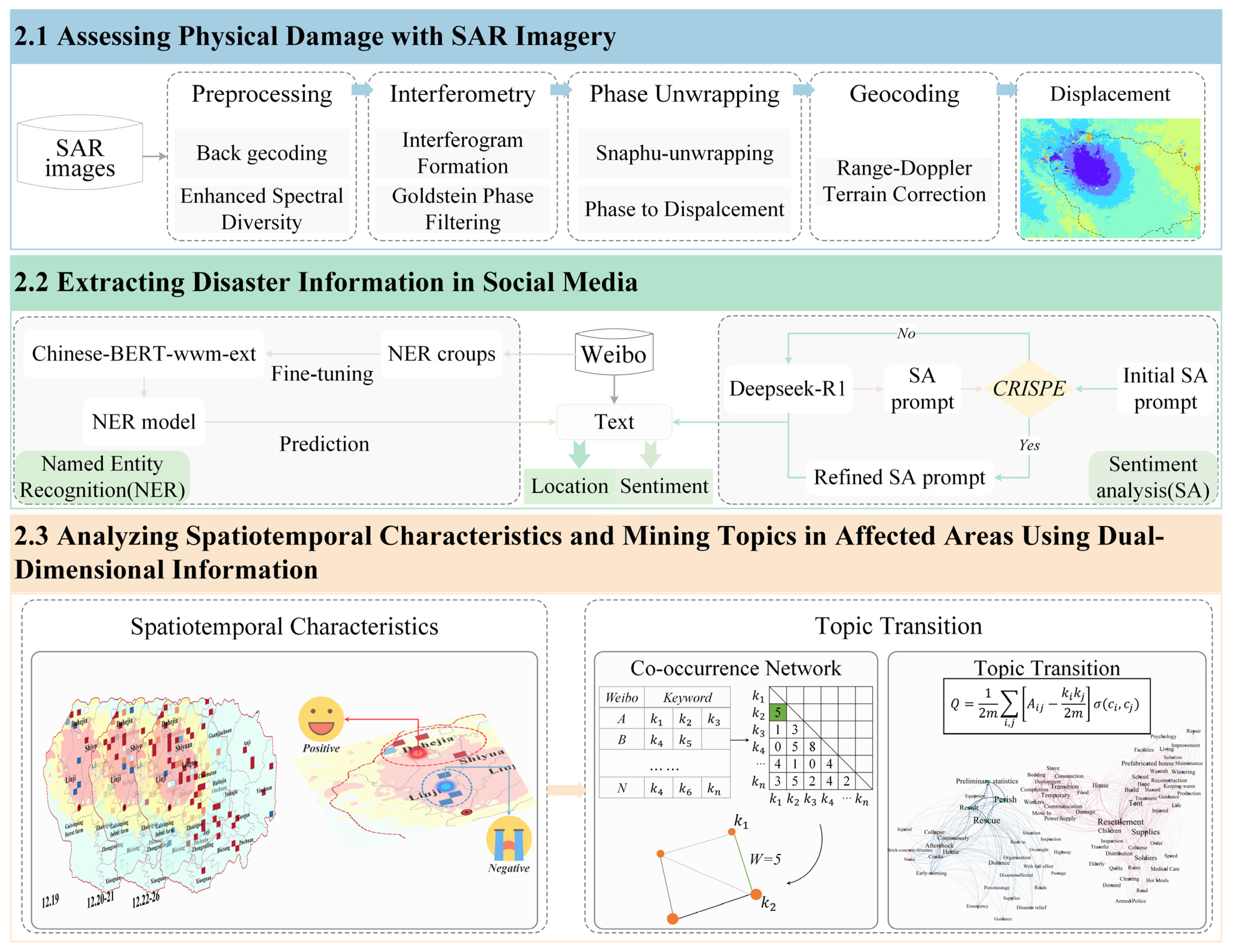
Figure 1. Workflow of the proposed framework.
Applsci 15 13125 g001
Figure 2. Iterative prompt optimization workflow for SA, with the refined prompts subsequently applied to generate SA outputs.
Applsci 15 13125 g002
Figure 3. Keyword extraction and semantic network construction.
Applsci 15 13125 g003
Figure 4. Geographical overview of the study area, showing (a) land-use [55] patterns and (b) population distribution [56].
Applsci 15 13125 g004
Figure 5. D-InSAR deformation results and corresponding damage levels. (a) Map of LOS deformation field with administrative boundaries, red circle indicate areas severely affected by the earthquake. (b) Deformation-based damage levels with road networks and building distribution.
Applsci 15 13125 g005
Figure 6. Positive and negative sentiment trends following the earthquake.
Applsci 15 13125 g006
Figure 7. Spatiotemporal characteristics of public sentiment and physical damage across three post-earthquake phases: (a) Response phase (19 December), (b) Rescue phase (20–21 December), and (c) Recovery phase (22–26 December).
Applsci 15 13125 g007
Figure 8. Semantic network graph during Response phase. (a) Network of topics in R1; (b) Network of topics in R2.
Applsci 15 13125 g008
Figure 9. Semantic network graph during Rescue phase. (a) Network of topics in R1; (b) Network of topics in R2.
Applsci 15 13125 g009
Figure 10. Semantic network graph during Recovery phase. (a) Network of topics in R1; (b) Network of topics in R2.
Applsci 15 13125 g010
Table 1. Classification of physical damage levels based on surface deformation.
LevelDamage CategorySurface Deformation (cm)
1Severe>3
2Moderate1–3
3Minor<1
Table 2. Sample distribution of the ChnSentiCorp dataset.
DatasetTrainTestVal
ChnSentiCorp960012001200
Table 3. Evaluation results of the fine-tuned BERT-WWM-ext model.
ModelPrecision (%)Recall (%)F1-Score (%)
BERT-WWM-ext (fine-tuned)83.0187.5985.24
Table 4. Contents of the Expert Prompt and Sentiment Analysis Prompt.
Expert prompt:
   You are a large language model prompt engineering expert. Please generate a prompt for an intelligent assistant according to the user’s requirements, following these rules:
   1. Align with the user’s needs, specifying the assistant’s role, capabilities, and knowledge base.
   2. Ensure the prompt is clear, precise, and concise, while maintaining high quality.
   3. Output only the prompt itself, without any additional explanations.
   Sentiment analysis prompt:
   ## Role
   You are a sentiment classification expert, specialized in identifying the sentiment polarity of text. With extensive experience in sentiment analysis, you can accurately recognize the sentiment tone expressed in any given text.
   ## Capabilities
   1. Sentiment Classification: Accurately determine whether the text expresses “Positive,” “Negative,” or “Neutral” sentiment.
   ## Output Requirements
   1. Output only the sentiment classification result; do not include explanations or additional text.
   2. The output must be one of the following three options: “Positive,” “Negative,” or “Neutral.”
   3. Maintain a clear, concise, and structured output format.
   ## Procedure
   1. Read the input text carefully.
   2. Determine its sentiment polarity.
   3. Output the classification result according to the Output Requirements.
   ## Example
   Input: “Please stop the earthquakes. I really can’t sleep anymore.”
   Output: Negative
   Input: “May the world be free from disasters. The people of Gansu must persevere!”
   Output: Positive
Table 5. Performance metrics of the DeepSeek-R1 model evaluated on the ChnSentiCorp test set.
ModelAccuracy (%)Precision (%)Recall (%)F1-Score (%)
DeepSeek-R196.9098.1495.4996.80
Table 6. Representative examples of sentiment classification results on disaster-related Weibo posts using the DeepSeek-R1 model.
NumberWeibo Post (Chinese)Weibo Post (English)Sentiment
1希望世界没有灾难, 甘肃人民要坚持下去!Wishing the world could be free from disasters. Hang in there, Gansu!Positive
2地震灾后的冬至,一锅暖暖的汤面驱寒保暖, 临时安置的受灾群众与志愿者还在坚守。It’s Winter Solstice after the quake. A hot pot of noodle soup to warm us up. Survivors in temporary shelters and volunteers are still holding on.Positive
3刚睡下被震醒, 床摇晃的很强烈, 现在都不敢睡觉了。Just fell asleep and the quake shook me awake. The bed was swaying so hard. Too scared to sleep now.Negative
4人真的都要吓傻了, 这一瞬间真的好害怕的…I was literally scared out of my wits… That moment was so terrifying.Negative
5地震发生后, 部分地区受灾较严重。救援供保工作有序进行, 航拍震中, 救援队伍穿梭城间, 多了很多应急帐篷。After the quake, some areas got hit really bad. Rescue and aid efforts are underway. Aerial shots of the epicenter show teams working between buildings, with lots more emergency tents now.Neutral
Table 7. Post-disaster phases, temporal ranges, and key characteristics.
PhaseTemporal RangeKey Characteristics
Response phase19 DecemberImmediate emergency response, situation assessment, and rapid mobilization.
Rescue phase20–21 DecemberLarge-scale search, rescue, and relief operations.
Recovery phase22–26 DecemberResettlement arrangements and preparation for reconstruction efforts.
Table 8. Proportions of sentiment by post-disaster phase.
PhaseNegative (%)Positive (%)Neutral (%)
Response phase44.3838.8116.81
Rescue phase31.5052.7315.77
Recovery phase22.3559.3218.33
Disclaimer/Publisher’s Note: The statements, opinions and data contained in all publications are solely those of the individual author(s) and contributor(s) and not of MDPI and/or the editor(s). MDPI and/or the editor(s) disclaim responsibility for any injury to people or property resulting from any ideas, methods, instructions or products referred to in the content.