Article

Blood Lactate Dynamics Reveal Distance-Specific Anaerobic Demands in 400 m Sprint Training

1
Department of Track and Field, Wroclaw University of Health and Sport Sciences, al. Ignacego Jana Paderewskiego 35, 51-612 Wrocław, Poland
2
Department of Biological and Motor Bases of Sports, Wroclaw University of Health and Sport Sciences, al. Ignacego Jana Paderewskiego 35, 51-612 Wrocław, Poland
3
Department of Individual and Team Physical Activities, Wroclaw University of Health and Sport Sciences, al. Ignacego Jana Paderewskiego 35, 51-612 Wrocław, Poland
4
Faculty of Physical Education, Jozef Pilsudski University of Physical Education in Warsaw, Marymoncka 34, 00-968 Warsaw, Poland
*
Author to whom correspondence should be addressed.
Appl. Sci. 2025, 15(24), 13051; https://doi.org/10.3390/app152413051
Submission received: 7 November 2025 / Revised: 5 December 2025 / Accepted: 8 December 2025 / Published: 11 December 2025

Abstract

This study aimed to determine how anaerobic energy systems are activated during 350 m and 500 m running tests to identify which distance may more effectively develop special endurance for the 400 m run. Eleven elite male 400 m sprinters (6 in the 350 m group and 5 in the 500 m group) participated in the study. Plasma lactate levels were measured at several time points: before starting, after warm-up, immediately before the test, and 1, 3, 12, 20, and 40 min post-exercise. Blood lactate concentration ([La]) was determined using the enzymatic Sentinel test (Italy). A difference in blood lactate concentration between groups was observed, reaching statistical significance at the 3 min post-exercise time point, although no significant changes were observed at other time points. The 350 m trial was associated with higher peak lactate levels, suggesting a greater acute anaerobic demand, while the 500 m trial required a longer recovery period for lactate clearance and return to homeostasis.

1. Introduction

The main goal of training in long sprint events such as the 400 m run is to develop both technical proficiency and motor abilities, with a particular focus on speed and special endurance [1,2,3]. Maintaining near-maximal velocity for 45–60 s requires athletes to rely heavily on anaerobic energy production, which causes rapid accumulation of lactate and hydrogen ions and leads to muscular fatigue [4,5,6,7,8,9,10,11,12]. Consequently, the 400 m sprint represents a highly demanding event that challenges the athlete’s ability to sustain performance under severe metabolic stress [13,14].
From a practical perspective, coaches employ a variety of special endurance runs—typically 300–600 m—to reproduce race-specific fatigue and stimulate anaerobic adaptations [15,16,17,18,19,20,21,22,23,24]. Among these, the 350 m and 500 m runs are commonly used in elite 400 m preparation because they simulate competitive effort while emphasizing different aspects of speed maintenance and recovery. Despite their popularity in real-world training programs, few studies have compared the acute metabolic responses between these distances, especially in terms of blood lactate kinetics [15,16,17,18,19,20,21,22,23,24,25,26,27,28,29,30,31,32].
Previous research has shown that blood lactate concentrations during 400 m running can reach 13–25 mmol/L [16,25,26,27,28,29,30], with peak values often occurring between 2 and 9 min post-exercise [19,25,33]. These results highlight the strong activation of anaerobic glycolysis and its significant contribution—estimated at 57–65% of total energy expenditure, and up to 75% among top-level athletes [15,16,17,18]. However, whether shorter (350 m) or longer (500 m) special endurance runs elicit different levels of anaerobic stress in elite sprinters remains unclear.
Therefore, this study aimed to compare blood lactate responses during two special endurance trials—350 m and 500 m—in elite 400 m runners. The goal was to identify which distance produces a more pronounced acute anaerobic demand and to describe the temporal pattern of lactate changes during recovery. Because the experiment involved two small, non-randomized, and independent groups, the findings should be interpreted descriptively rather than causally. They may primarily serve as a reference for practical sprint training design.

2. Material and Methods

2.1. Subjects

Eleven top male 400 m sprinters took part in the study—6 in the 350 m group and 5 in the 500 m group. One athlete, initially recruited, was excluded from analysis after sustaining a minor injury during warm-up and failing to complete the test. Due to practical constraints and ongoing training schedules, random group assignment was not possible, so the study used a non-randomized allocation method. The participants had an average (±SD) age of 24.56 ± 3.76 years, an average height of 186.21 ± 6.78 cm, and a body mass of 78.92 ± 5.88 kg. All athletes had at least six years of systematic training and ranked among the top national performers in both senior and junior categories. The coaching staff set personal bests for the 400 m: 46.09 ± 0.77 s for the 350 m group and 46.63 ± 15 s for the 500 m group. Group placement was determined based on annual training plans and coaches’ advice to match each athlete’s current training phase. All participants had medical clearance, were informed about the study procedures, risks, and benefits, and gave written consent. They were also advised to avoid strenuous activity for 48 h before testing. The study was approved by the Ethics Committee of the Polish Track and Field Association (PZLA–9/2019).

2.2. Procedure

The study took place in May, at the start of the summer competition season, to enhance psychomotor readiness for the upcoming 400 m races. Tests were conducted under consistent environmental conditions (temperature 18–21 °C, no wind). Each athlete performed a single maximum-effort run over either 350 m or 500 m on an outdoor synthetic track. Runs were individual, following a standardized warm-up protocol (see Section 2.4). FinishLynx photo-finish technology (Lynx System Developers, Inc., Haverhill, MA, USA) recorded trial times. Plasma lactate levels were measured at eight time points before and after each trial with an enzymatic method to determine [La] (mmol/L). No pacemakers or external pacing aids were used. Athletes wore their usual competition spikes. Testing sessions were scheduled consistently in the late morning to limit variability, and athletes maintained a controlled diet and hydration. They avoided caffeine, alcohol, and supplements for 24 h prior to testing. Performance-based classification was used only descriptively and did not influence statistical grouping.

2.3. Anthropometric Measurements

Additionally, the height (m) and body mass (kg) of each participant were measured (see Table 1). Height and body mass were recorded with a calibrated platform scale, accurate to 0.01 m and 0.01 kg, respectively.

2.4. Special Endurance Trial Warm-Up

To optimize their motor, technical, and physiological capabilities for peak performance in each trial, the runners employed highly personalized pacing strategies aimed at maintaining a steady running speed as much as possible. Each session began with a 40 to 50 min warm-up that included 12 min of slow jogging and targeted leg stretching. After this, they engaged in neuromuscular coordination exercises such as skipping, bounding, hopping, and acceleration for about 11–15 min, along with two to three 80–150 m runs that gradually increased in speed and intensity.

2.5. Blood Lactate Concentration Measurement

The plasma lactate levels of competitors were sampled at several time points: before activity, after warming up, immediately before testing, and 1, 3, 12, 20, and 40 min post-exercise. The [La] concentration (mmol/L) was measured using an enzymatic method with the Sentinel test (Sentinel CH. SpA, Milan, Italy). Blood was arterialized from a fingertip and immediately diluted tenfold with an isotonic solution containing NaF and NaCl. Lactate levels were determined in the supernatant after brief centrifugation of the diluted sample. The Sentinel test was adapted by reducing the final reagent volume from 0.2 mL to 0.01 mL for each sample, and the assays were conducted on ELISA plates. A spectrally pure L-lactate standard (Sigma Aldrich, St. Louis, MO, USA) was used as a baseline. An absorbance was measured using a BioTek plate reader (BioTek, Winooski, VT, USA) with Gen5 software version 3.10, and concentrations were calculated. Measurements were performed in duplicate. Standard curves were prepared using lactate concentrations of 0, 0.25, 0.5, 1, and 2 mmol/L, with the test samples diluted 10- or 20-fold. All blood samples were collected and processed by the same experienced laboratory technician, following an identical standard operating procedure. Measurements were performed in duplicate and averaged; if the difference between the two readings exceeded the manufacturer’s recommended acceptable range, the assay was repeated to ensure reliability. This procedure was implemented to enhance the reproducibility and internal validity of the lactate measurements.

2.6. Statistical Analysis

The Shapiro–Wilk test was used to assess the normality of the distributions for somatic parameters and blood lactate concentrations across eight time points. Descriptive statistics (mean, standard deviation, minimum, maximum, and confidence intervals) were calculated. Between-group differences in somatic variables and blood lactate levels were examined using Student’s t-test. A repeated-measures ANOVA was used to analyze time-dependent changes in blood lactate concentration, followed by post hoc least significant difference (LSD) tests to identify specific differences between measurement intervals. We did not perform multiple pairwise t-tests across time points; instead, all time-related effects were evaluated within the repeated-measures ANOVA framework to reduce the risk of Type I error inflation. Spearman’s rank correlation was used to assess relationships between selected somatic parameters and lactate concentrations. Because of the exploratory nature of the study and the small sample size, p-values were interpreted with caution, and no formal correction for multiple comparisons was applied. The level of statistical significance was set at p ≤ 0.05.

3. Results

The anthropometric data (Table 1) show that both the 350 m and 500 m groups were comparable in age, body height, and body mass, with no statistically significant differences. This homogeneity confirms that both groups were similar in physical profile and training level, allowing for reliable comparison of physiological responses.
As expected, the 350 m trial was performed significantly faster (40.98 ± 0.73 s) than the 500 m trial (64.63 ± 1.21 s, p < 0.001). Despite the difference in distance, the mean stride length remained consistent between groups, while stride frequency and average velocity were significantly higher in the 350 m run (Table 2). These parameters confirm the more explosive and speed-oriented character of the shorter trial, compared with the endurance-dominated pacing of the 500 m run.
Mean blood lactate concentrations for both trials are summarized in Table 3 and illustrated in Figure 1. No significant differences were found between groups before or after the warm-up. However, a statistically significant difference emerged at 3 min post-exercise (p = 0.0223), where the 350 m group exhibited a higher peak lactate level (21.97 ± 1.47 mmol/L) compared to the 500 m group (20.08 ± 0.45 mmol/L).
Both groups showed a similar temporal pattern of lactate accumulation (Figure 1), with levels peaking approximately 3 min post-exercise, followed by a gradual decline over 40 min. The 350 m run induced a sharper increase from 1 to 3 min, reflecting a more intense glycolytic activation, while the 500 m trial showed slower accumulation but longer persistence of elevated lactate, indicating greater aerobic involvement in energy production.
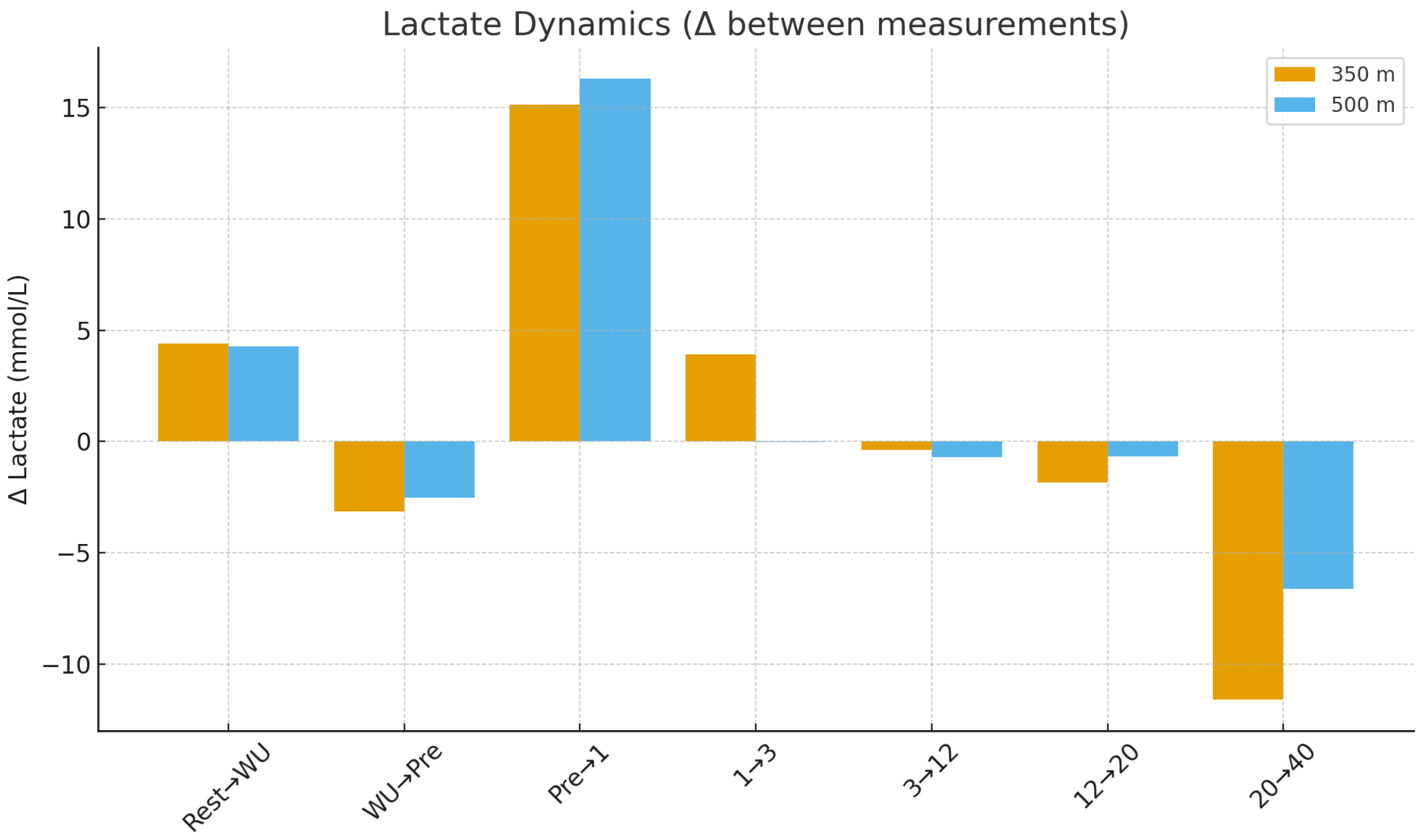
Differences in lactate changes between consecutive time points (Δ) are presented in Table 4 and visualized in Figure 2. In the 350 m group, significant changes occurred at 1–3 min (p < 0.001), 3–12 min (p = 0.012), and 20–40 min (p < 0.001), indicating rapid accumulation and effective clearance. In contrast, the 500 m group showed significant differences only between 1–3 min (p < 0.001) and 20–40 min (p = 0.002), reflecting slower metabolic transitions.
Figure 2 illustrates the changes in lactate (Δ) between consecutive post-exercise measurements during the 350 m and 500 m runs. In both distances, blood lactate levels rose over time, but the magnitude and rate of change differed between the two efforts. The 500 m run showed larger lactate increases early on, indicating more intense glycolytic activity and slower clearance immediately after exercise. Conversely, the 350 m run had smaller Δ values, implying a slower buildup and quicker stabilization of lactatemia.
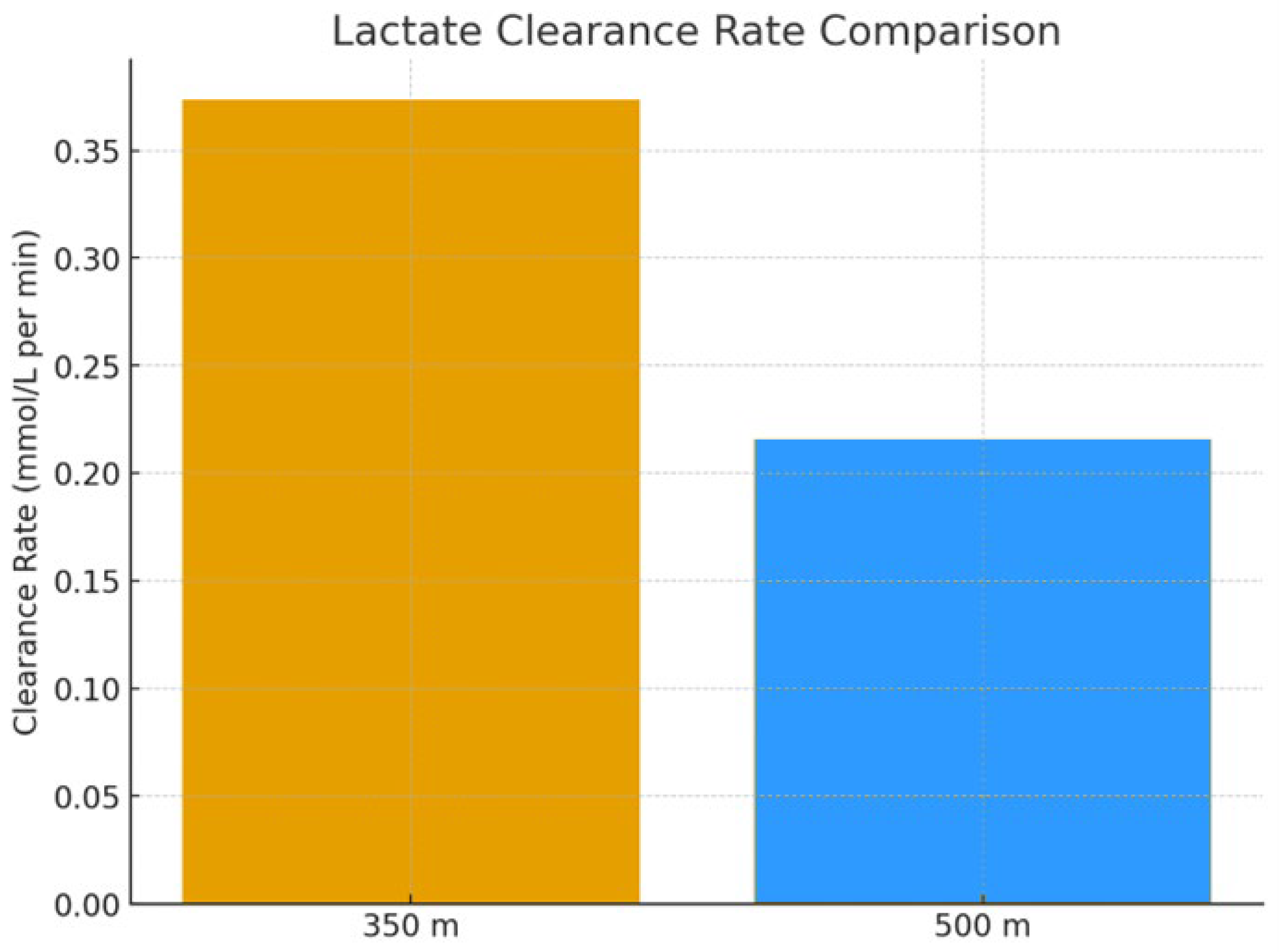
Lactate clearance rates (Figure 3) from the peak (3 min post-exercise) to 40 min post-run are depicted in Figure 4. The 350 m trial demonstrated a substantially higher clearance rate (0.37 mmol/L·min−1) compared with the 500 m trial (0.21 mmol/L·min−1), suggesting more efficient lactate removal and faster recovery of metabolic balance.
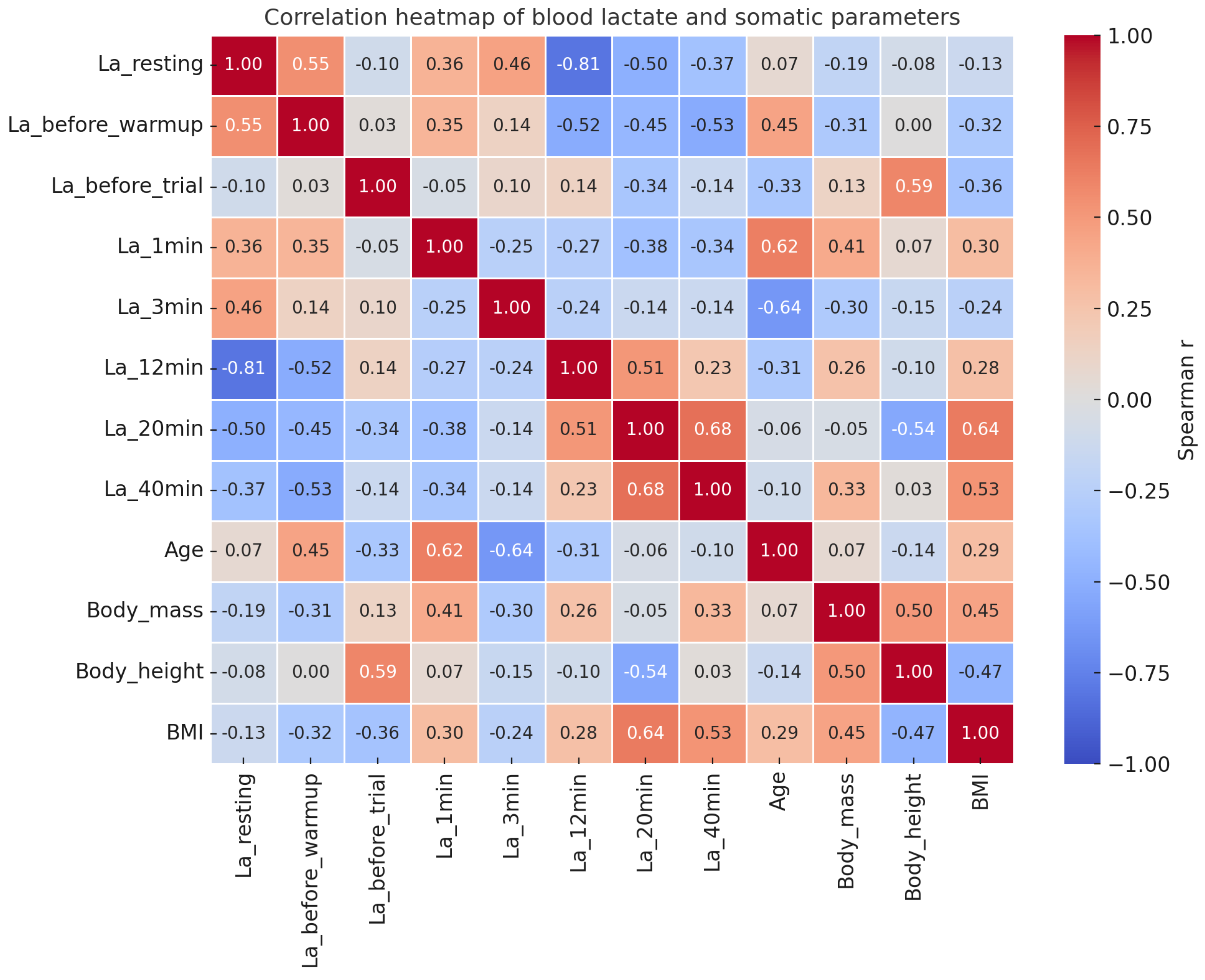
Correlational analysis (Figure 4) revealed that age correlated positively with lactate concentration 1 min post-run in the 350 m group (r = 0.62) and negatively in the 500 m group (r = −0.64). Additionally, BMI was positively associated with lactate at 20 min post-exercise (r = 0.64), suggesting that greater body mass may delay lactate clearance.

4. Discussion

This study investigated the activation of anaerobic energy systems during 350 m and 500 m runs and aimed to determine which distance better develops the specific endurance required for the 400 m event. The analysis focused on the time course of blood lactate changes to describe how metabolic stress differs between the two distances. Blood lactate levels showed a significant difference between groups only at 3 min after exercise, with no notable changes at other time points. These results indicate that the 350 m run produced higher peak lactate levels, reflecting a stronger immediate anaerobic response rather than differences in endurance adaptation.
The lactate response pattern observed in this study is consistent with earlier findings by Hirvonen et al. [7] and Zouhal et al. [17], who demonstrated that blood lactate concentrations typically peak within 2–3 min after maximal 400 m efforts, reaching values of 17–22 mmol/L. The slightly higher peak recorded in the 350 m trial (approximately 22 mmol/L) confirms that a shorter and more intensive effort elicits stronger glycolytic activation, which aligns with the results reported by Hanon and Lepretre [19], indicating that maximal anaerobic glycolysis occurs during efforts lasting 30–45 s. In contrast, the 500 m run, lasting over 60 s, likely involved a greater aerobic contribution and slower lactate clearance, as noted by Duffield and Gastin [16,34].
From a physiological standpoint, the earlier and higher lactate peak observed after the 350 m run reflects dominant anaerobic glycolysis and phosphocreatine breakdown during efforts lasting about 40–45 s, when glycolytic flux and hydrogen ion accumulation reach their maximum [7,15,19]. The longer duration of the 500 m run (>60 s) likely shifted the energy balance toward aerobic metabolism, consistent with previous research on 400–800 m events [16,27,34,35]. This physiological shift may explain both the slightly lower peak lactate values and the slower decline observed in the 500 m group, suggesting prolonged metabolic recovery.
The differences in lactate kinetics between the two trials therefore appear to result from the specific involvement of energy systems rather than differences in general performance capacity. The 350 m distance produced a higher short-term glycolytic load, while the 500 m effort emphasized greater aerobic participation and required a more extended recovery period. A faster reduction in lactate concentration observed in the 350 m group indicates a more dynamic metabolic regulation process and more efficient post-exercise clearance.
After one minute of running over 500 m, blood lactate levels nearly reached their maximum, similar to the values measured after three minutes. In contrast, during the 350 m run, the initial lactate rise was smaller but much steeper over the next two minutes. This sharp increase illustrates a rapid activation of anaerobic glycolysis, which corresponds to the intensity and duration of the 350 m effort. The longer effort duration (64.63 s vs. 40.98 s) reduced the contribution of anaerobic glycolysis after approximately 40 s, as aerobic metabolism became the primary energy source. This transition coincides with a decrease in power output and running velocity. Differences in peak lactate levels among sprinters may result from training background and competitive level, which influence their reliance on anaerobic glycolysis.
According to Newsholme [18] and Arcelli [36], world-class 400 m sprinters generate most of their energy through anaerobic glycolysis, with smaller yet significant contributions from aerobic metabolism and phosphocreatine resynthesis. Although the exact ratios differ among athletes, studies using oxygen uptake and oxygen deficit methods suggest that the aerobic contribution during 400–500 m runs can reach or exceed 30% [15,19,37]. Therefore, it is likely that the 500 m effort in this study involved a relatively higher aerobic component, particularly in its final phase. This is consistent with the assumption that the longer the distance, the greater the participation of aerobic metabolism in sustaining effort. Slower athletes may rely even more heavily on this energy source [37].
The slower pace of the 500 m run may also result in lower ATP turnover, but both trials began with similar acceleration dynamics. The 350 m run was characterized by a higher mean speed, mainly due to increased step frequency, while stride length remained relatively constant between trials. In contrast, the 500 m run was performed at a more rhythmic pace, with smaller decreases in velocity during the final 100–150 m compared to the first 200 m. These differences in pacing strategy highlight the distinct physiological demands of each trial and their potential role in targeted training adaptations.
Previous studies [15,16,34,38,39] analyzing aerobic and anaerobic contributions using the accumulated oxygen deficit (AOD) method have confirmed that short maximal efforts, such as the 400 m sprint, impose a significant anaerobic load. Zouhal et al. [17], who examined six 400 m runners (mean PB ≈ 52 s), reported maximal lactate concentrations of 17.3 ± 1.5 mmol/L and an AOD of 62.5%, values higher than those reported in treadmill-based studies [16,28,34]. These results confirm that maximal track efforts elicit stronger metabolic stress than constant-load tests, as real sprinting involves variable pacing and mechanical load. Importantly, the 400 m race is not a uniform effort; athletes do not run at a constant speed, and similar variability was observed in both special endurance runs analyzed here.
Based on these observations, practical conclusions can be drawn about the use of different special endurance distances in training. The 350 m run, characterized by higher intensity and faster lactate clearance, may be more suitable for improving anaerobic tolerance and glycolytic power. The 500 m run, in turn, emphasizes sustained aerobic contribution and longer recovery, making it useful for endurance-based adaptations and fatigue resistance. Both distances effectively replicate race-specific fatigue, but they emphasize different aspects of energy system engagement and recovery, providing valuable information for structuring 400 m sprint training.

5. Strengths and Limitations

Research on professional athletes can improve understanding of specific adaptations. Although the findings are interesting, they are limited. We only studied top male athletes, so future research should include females. Additionally, we did not examine other biochemical and physiological variables. According to Cairns (2006) [40], the lactate produced by glycogenolysis and glycolysis during exercise correlates with changes in hydrogen ion concentration. However, their removal processes differ [40,41]. Hebisz et al. [42] found that lactate clearance takes longer than hydrogen ion recovery, which is supported by the different rates of change in these metabolites during interval training [42]. This suggests that [H+] is a more sensitive indicator of interval training stress and exercise metabolic costs than lactate levels. Additionally, the observational design with non-randomized group assignment may introduce selection bias, although the groups did not differ significantly in age or basic anthropometric features (Table 1). Another limitation is the small sample size (n = 11), which is typical for studies involving elite national-level sprinters. Nonetheless, the difference observed at the 3 min post-exercise mark had a large effect size (Cohen’s d ≈ 1.6), suggesting that the difference in lactate response is practically meaningful despite the limited statistical power.

6. Conclusions

The present study examined the acute blood lactate responses to 350 m and 500 m special endurance runs in elite 400 m sprinters. A significant difference between the groups was observed only 3 min post-exercise, when higher lactate levels occurred after the 350 m trial. This finding suggests that the shorter distance elicited a stronger immediate anaerobic glycolytic response, while the longer distance involved a greater aerobic contribution and slower return to homeostasis.
From a practical perspective, 350 m special endurance runs may be particularly effective during pre-competitive and competitive phases, as they stimulate glycolytic capacity and enhance tolerance to high lactate levels at near-race speeds. In contrast, 500 m runs appear more appropriate for general and early specific preparation, supporting aerobic base development and promoting recovery.
Although the sample size was limited and the design was non-randomized, the observed patterns of lactate kinetics provide valuable guidance for structuring training aimed at balancing anaerobic power and metabolic recovery in elite 400 m sprinters. Future research should include larger, mixed-gender samples and examine additional metabolic and physiological markers to confirm these trends.

Author Contributions

Conceptualization, R.O. and K.M.; methodology, R.O., K.M., D.M. and A.M.; validation, M.J. and D.M.; formal analysis, R.O. and K.M.; investigation, R.O., K.M., D.M. and A.M.; resources, K.M. and M.J.; data curation, M.J. and D.M.; writing—original draft preparation, R.O. and K.M.; writing—review and editing, K.M. and A.M.; supervision, K.M. and A.M.; project administration, M.J.; funding acquisition, R.O. All authors have read and agreed to the published version of the manuscript.

Funding

The project was financed from the internal funds of the University of Health and Sport Sciences in Wroclaw, Poland (BS/LA/4T).

Institutional Review Board Statement

The study was conducted in accordance with the principles outlined in the Declaration of Helsinki. The study received approval from the Ethics Committee of the Polish Track and Field Association (PZLA–9/2019) on 15 March 2019.

Informed Consent Statement

Informed consent was obtained from all subjects involved in the study.

Data Availability Statement

The raw data supporting the conclusions of this article will be made available by the authors on request.

Acknowledgments

The authors thank the Polish National Track and Field Team and the staff of the Józef Piłsudski University of Physical Education in Warsaw, Poland, for their cooperation and commitment during data collection.

Conflicts of Interest

The authors declare no conflict of interest.

References

  1. Yamamoto, K. Analysis of the major men and women’s 400 m races of 2015. Bull. Stud. Athl. JAAF 2015, 11, 128–135. [Google Scholar]
  2. Yamamoto, K. Analysis of the major men and women’s 400 m races of 2016. Bull. Stud. Athl. JAAF 2016, 12, 98–103. [Google Scholar]
  3. Iskra, J.; Zajac, A.; Maćkała, K.; Paruzej-Dyja, M. High-Performance Sprint Training: Polish Experiences; The Jerzy Kukuczka Academy of Physical Education: Katowice, Poland, 2016. [Google Scholar]
  4. Nummela, A.; Vuorimaa, T.; Rusko, H. Changes in force production, blood lactate and EMG activity in the 400-m sprint. J. Sports Sci. 1992, 10, 217–228. [Google Scholar] [CrossRef] [PubMed]
  5. Weyand, P.; Cureton, K.; Conley, D.; Sloniger, M. Percentage anaerobic energy utilized during track running events. Med. Sci. Sports Exerc. 1993, 25, S-105. [Google Scholar] [CrossRef]
  6. Plevnik, M.; Vučetić, V.; Sporiš, G.; Fiorentini, F.; Milanović, Z.; Miškulin, M. Physiological responses in male and female 400 m sprinters. Croat. J. Educ. 2013, 15, 93–109. [Google Scholar]
  7. Hirvonen, J.; Nummela, A.; Rusko, H.K.; Harkonen, M. Fatigue and changes of ATP, creatine phosphate, and lactate during the 400-m sprint. Can. J. Sport Sci. 1992, 17, 141–144. [Google Scholar]
  8. Wan, J.-j.; Qin, Z.; Wang, P.-y.; Sun, Y.; Liu, X. Muscle fatigue: General understanding and treatment. Exp. Mol. Med. 2017, 49, e384. [Google Scholar] [CrossRef]
  9. Woodward, M.; Debold, E.P. Acidosis and phosphate directly reduce myosin’s force-generating capacity through distinct molecular mechanisms. Front. Physiol. 2018, 9, 862. [Google Scholar] [CrossRef]
  10. Gefen, A.; Megido-Ravid, M.; Itzchak, Y.; Arcan, M. Analysis of muscular fatigue and foot stability during high-heeled gait. Gait Posture 2002, 15, 56–63. [Google Scholar] [CrossRef]
  11. Yousif, H.A.; Norasmadi, A.R.; Bin Salleh, A.F.; Zakaria, A.; Alfarhan, K.A. Assessment of muscles fatigue during 400-Meters running strategies based on the surface EMG signals. J. Biomim. Biomater. Biomed. Eng. 2019, 42, 1–13. [Google Scholar] [CrossRef]
  12. Enoka, R.M.; Duchateau, J. Muscle fatigue: What, why and how it influences muscle function. J. Physiol. 2008, 586, 11–23. [Google Scholar] [CrossRef]
  13. Vazel, P.J. Speed Reserve in the 400 m. Special Report. p. 16. Available online: https://web2.ustfccca.org/wp-content/uploads/2022/01/Tommy-Badon.pdf (accessed on 12 May 2020).
  14. Gorostiaga, E.M.; Asiáin, X.; Izquierdo, M.; Postigo, A.; Aguad, R.; Alonso, J.M.; Ibáñez, J. Vertical jump performance and blood ammonia and lactate levels during typical training sessions in elite 400-m runners. J. Strength Cond. Res. 2010, 24, 138–1149. [Google Scholar] [CrossRef]
  15. Duffield, R.; Dawson, B.; Goodman, C. Energy system contribution to 400 m and 800 m track running. J. Sports Sci. 2005, 23, 299–307. [Google Scholar] [CrossRef]
  16. Spencer, M.R.; Gastin, P.B. Energy system contribution during 200- to 1500-m running in highly trained athletes. Med. Sci. Sports Exerc. 2001, 33, 157–162. [Google Scholar] [CrossRef] [PubMed]
  17. Zouhal, H.; Jabbour, G.; Jacob, C. Anaerobic and aerobic energy system contribution to 400-m flat and 400-m hurdles track running. J. Strength Cond. Res. 2010, 24, 2309–2315. [Google Scholar] [CrossRef]
  18. Newsholme, E.A.; Blomstrand, E.; Ekblom, B. Physical and mental fatigue: Metabolic mechanisms and importance of plasma amino acids. Br. Med. Bull. 1992, 48, 477–495. [Google Scholar] [CrossRef] [PubMed]
  19. Hanon, C.; Lepretre, P.M.; Bishop, D.; Thomas, C. Oxygen uptake and blood metabolic responses to a 400 m run. Eur. J. Appl. Physiol. 2010, 109, 233–240. [Google Scholar] [CrossRef]
  20. Schäffer, W. On Structure Characteristics of the Competitive Performance and the Corresponding Training Content in the Athletics Discipline 400 m Long Sprint. Ph.D. Thesis, Martin-Luther-Universität Halle-Wittenberg, Halle, Germany, 1989; 262p. (In German). [Google Scholar]
  21. Hirvonen, J.; Rehumen, S.; Rusko, M.; Harkonen, M. Breakdown of high energy phosphate compounds and lactate accumulation during short supramaximal exercise. Eur. J. Appl. Physiol. 1987, 56, 253–259. [Google Scholar] [CrossRef]
  22. Szmatlan-Gabryś, U.; Ozimek, M.; Klimek, A.; Gorner, K. Profile of Aerobic and Anaerobic Efficiency of Professional Polish Road Cyclists After Winter Preparatory Period; Annale Universitath Din Oradea, Fascicula Educatie Fizica Si Sport Editura Universitath Din Oradea: Oradea, Romania, 2005; pp. 404–414. [Google Scholar]
  23. Hermansen, L. Effect of metabolic changes on force generation in skeletal muscle during maximal exercise. Hum. Muscle Fatigue Physological Mech. 1981, 82, 75–88. [Google Scholar]
  24. Hermansen, L.; Stensvold, I. Production and removal of lactate during exercise in man. Acta Physiol. Scand. 1972, 86, 191–201. [Google Scholar] [CrossRef]
  25. Bret, C.; Lacour, J.R.; Bourdin, M.; Locatelli, E.; De Angelis, M. Differences in lactate exchange and removal abilities between high-level African and Caucasian 400 m track runners. Eur. J. Appl. Physiol. 2013, 113, 1489–1498. [Google Scholar] [CrossRef]
  26. Saraslanidis, P.J.; Panoutsakopoulos, V.; Tsalis, G.A.; Kyprianou, E. The effect of different first 200 m pacing strategies on blood lactate and biomechanical parameters of the 400 m sprint. Eur. J. Appl. Physiol. 2011, 111, 1579–1590. [Google Scholar] [CrossRef]
  27. Reis, V.M.; Duarte, J.A.; Espírito-Santo, J.; Russell, A.P. Determination of accumulated oxygen deficit during a 400 m run. J. Exerc. Physiol. 2004, 7, 77–83. [Google Scholar]
  28. Nummela, A.; Rusko, H. Time course of anaerobic and aerobic energy expenditure during short term exhaustive running in athletes. Int. J. Sports Med. 1995, 16, 522–527. [Google Scholar] [CrossRef]
  29. Ohkuwa, T.; Kato, Y.; Katsumata, K.; Nakao, T.; Miyamure, M. Blood lactate and glycerol after 400 m and 3000 m runs in sprint and long distance runner. Eur. J. Appl. Physiol. Occup. Physiol. 1984, 53, 213–218. [Google Scholar] [CrossRef] [PubMed]
  30. Grgić, D.; Babić, V.; Blazević, I. Running’s dynamic in male 400 m sprint event. Hum. Kinet. 2019, 12, 44–52. [Google Scholar]
  31. Duffield, R.; Dawson, B. Energy system contribution in track running. New Stud. Athl. 2003, 18, 47–56. [Google Scholar]
  32. Harman, C.H. A biomechanical power model for world-class 400 meter running. In Proceedings of the Sixth Australian Conference on Mathematics and Computers in Sport, Gold Coast, QLD, Australia, 1–3 July 2002; de Mestre, N., Ed.; Bond University: Robina, QLD, Australia, 2002; pp. 155–166. [Google Scholar]
  33. Lacour, J.R.; Bouvat, E.; Barthhelemy, J.C. Post-competition blood lactate concentration as indicators of anaerobic energy expenditure during 400 m and 800 m races. Eur. J. Appl. Physiol. 1990, 61, 172–176. [Google Scholar] [CrossRef] [PubMed]
  34. Spencer, M.R.; Gastin, P.B.; Payne, W.R. Energy system contribution during 400 to 1500 m running. New Stud. Athl. 1996, 11, 59–65. [Google Scholar]
  35. Hanon, C.; Thomas, C. Effects of optimal pacing strategies for 400-, 800-, and 1500-m races on the V_O2 response. J. Sports Sci. 2011, 29, 905–912. [Google Scholar] [CrossRef]
  36. Arcelli, E.; Mambretti, M.; Cimadoro, G.; Alberti, G. The Aerobic mechanism in the 400 m. New Stud. Athl. 2008, 2, 15–23. [Google Scholar]
  37. Vilmi, N.; Äyrämö, S.; Nummela, A. Oxygen uptake, acid-base balance and anaerobic energy system contribution in maximal 300–400 m running in child adolescent and adult athletes. J. Athl. Enhanc. 2016, 5, 1–8. [Google Scholar] [CrossRef]
  38. Duffield, R.; Dawson, B.; Coodman, C. Energy system contribution to 100-m and 200-m track running events. J. Sci. Med. Sport. 2004, 7, 302–313. [Google Scholar] [CrossRef]
  39. Gupta, S.; Goswami, A.; Mukhopadhayay, S. Heart rate and blood lactate in 400 m flat and 400 m hurdles running: A comparative study. Ind. J. Physiol. Pharmacol. 1999, 43, 361–366. [Google Scholar]
  40. Cairns, S.P. Lactic acid and exercise performance. Culprit or Friend? Sports Med. 2006, 36, 279–291. [Google Scholar] [CrossRef] [PubMed]
  41. McNaughton, L.R.; Siegler, J.; Midgley, A. Ergogenic effects of sodium bicarbonate. Curr. Sports Med. Rep. 2008, 7, 230–236. [Google Scholar] [CrossRef] [PubMed]
  42. Hebisz, R.; Hebisz, P.; Borkowski, J.; Zatoń, M. Differences in physiological responses to interval training in cyclists with and without interval training experience. J. Hum. Kinet. 2016, 50, 93–101. [Google Scholar] [CrossRef]
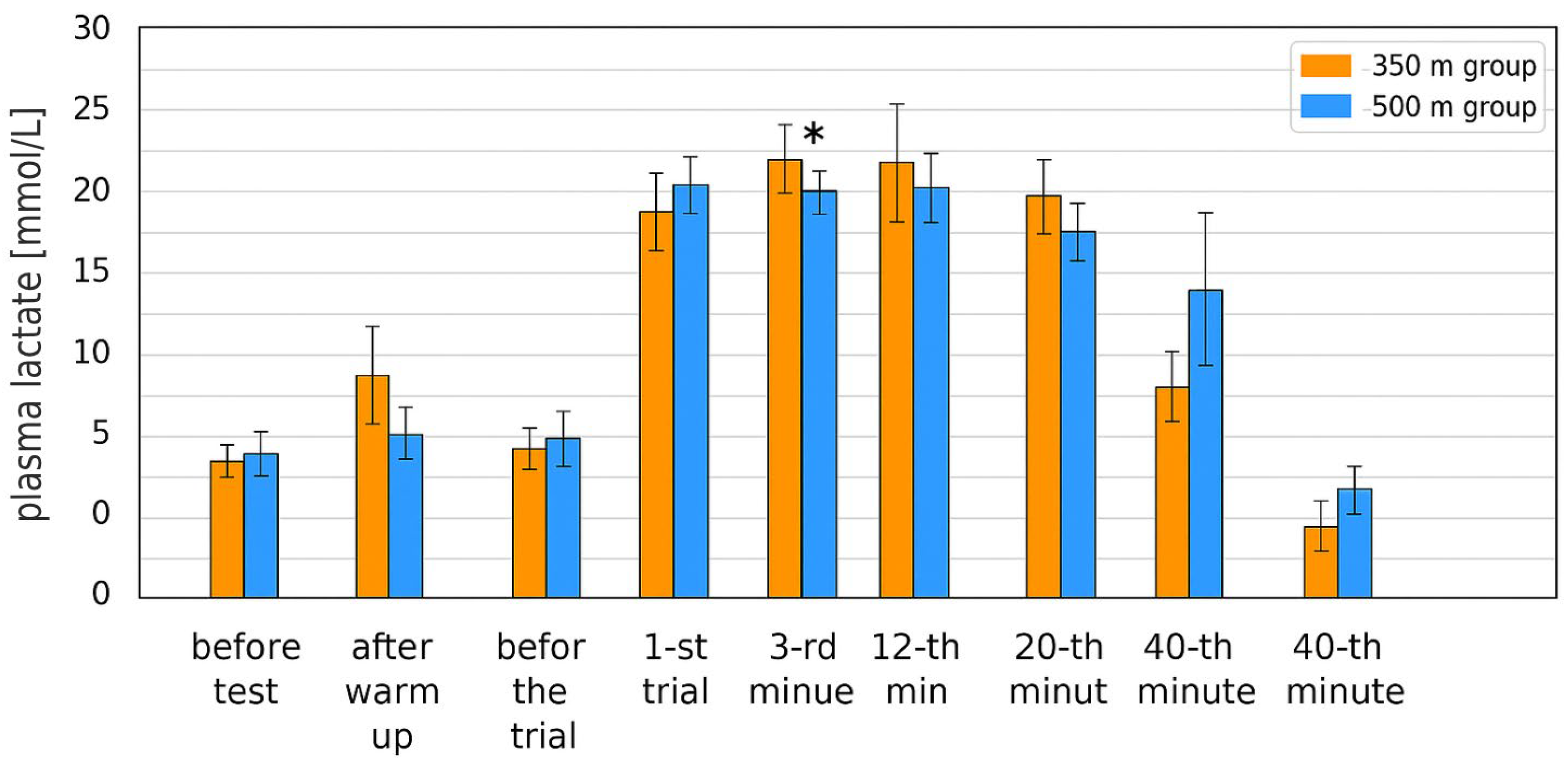
Figure 1. Lactate concentration during the 350 (n = 6) m and 500 m (n = 5) trial. * p < 0.05, indicating a statistically significant difference between groups.
Applsci 15 13051 g001
Figure 2. Lactate dynamics (Δ) between consecutive measurements for 350 m and 500 m runs.
Applsci 15 13051 g002
Figure 3. Lactate clearance rate (mmol/L per minute) in 350 m vs. 500 m groups.
Applsci 15 13051 g003
Figure 4. Correlation heatmap of blood lactate levels and somatic parameters (Spearman’s r). Red indicates positive and blue negative correlations.
Applsci 15 13051 g004
Table 1. Characteristics of selected body parameters of 400 m runners divided into the 350 m group and the 500 m group.
ParametersGroup 350 m, n = 6Group 500 m, n = 5Student’s t-Test
x ¯ SD x ¯ SDtp
Age (years)25.333.8323.803.700.670.5190
Personal best 400 m (s)46.090.7746.631.15−0.300.7705
Body mass (kg)78.357.6279.506.37−0.620.5486
Body height (cm)184.927.20187.502.230.180.8647
Table 2. Characteristics of selected parameters of the 350 m and 500 m run test, p < 0.05, are marked in bold.
ParameterGroup 350 m, n = 6Group 500 m, n = 5Student’s t-Test
x ¯ SD x ¯ SDtp
Time (s) 40.980.7364.631.21−40.170.0000
Step length (cm)223.088.34221.8514.460.180.8637
Step frequency (Hz)4.000.123.550.184.990.0007
Velocity (m/s)8.900.158.020.673.120.0123
Table 3. Characteristics of the level of lactate concentration in the blood of runners in the 350 m and 500 m run test (p < 0.05).
MeasurementGroup 350 m, n = 6Group 500 m, n = 5Student’s t-Test
x ¯ SD x ¯ SDtp
La resting (mmol/L)1.640.542.030.37−1.380.2013
La before warm-up (mmol/L)6.031.666.293.37−0.170.8683
La before the trial (mmol/L)2.900.403.781.32−1.570.1513
La 1 min after trial (mmol/L)18.042.5620.100.31−1.780.1096
La 3 min after trial (mmol/L)21.971.4720.080.452.760.0223
La 12 min after trial (mmol/L)21.592.9419.370.781.630.1385
La 20 min after trial (mmol/L)19.761.9018.710.851.140.2845
La 40 min after trial (mmol/L)8.152.2012.105.44−1.640.1357
Table 4. Post hoc tests’ results of the changes in lactate between adjacent measurements (1–3 min, 3–12 min, 12–20 min, 20–40 min) within groups of 350 m and 500 m runners.
DistanceComparison
Δ1–Δ3Δ3–Δ12Δ12–Δ20Δ20–Δ40
3500.00000.01180.30150.0000
5000.00000.70390.99290.0021
Disclaimer/Publisher’s Note: The statements, opinions and data contained in all publications are solely those of the individual author(s) and contributor(s) and not of MDPI and/or the editor(s). MDPI and/or the editor(s) disclaim responsibility for any injury to people or property resulting from any ideas, methods, instructions or products referred to in the content.