Article

Aero-Structural Analysis and Dimensional Optimization of a Prototype Hybrid Wind–Photovoltaic Rotor with 12 Pivoting Flat Blades and a Peripheral Stiffening Ring


by
George Daniel Chiriță
1,
Viviana Filip
1,
Alexis Daniel Negrea
2,* and
Dragoș Vladimir Tătaru
2
1
Doctoral School of Engineering, Valahia University of Targoviste, 130004 Targoviste, Romania
2
Mechanical Department, Materials and Mechanical Faculty, ‘Valahia’ University, 130004 Targoviste, Romania
*
Author to whom correspondence should be addressed.
Appl. Sci. 2025, 15(24), 13027; https://doi.org/10.3390/app152413027
Submission received: 6 August 2025 / Revised: 6 September 2025 / Accepted: 9 September 2025 / Published: 10 December 2025
(This article belongs to the Topic Solar and Wind Power and Energy Forecasting, 2nd Edition)

Featured Application

This study supports the design of a low-cost, modular hybrid wind–PV rotor with flat blades and passive pitch control, suitable for rural microgrids or standalone agricultural units. The prototype can operate safely in variable wind conditions and allows integration with commercial actuators, generators, and tracking systems without structural redesign.

Abstract

We present the first aero-structural evaluation of a 3 m-diameter hybrid wind-PV rotor employing flat-plate blades stiffened by a peripheral ring. Owing to the lack of prior data, we combine low-Reynolds BEM, elastic FEM sizing, and steady-state CFD (k-ω SST) to build a coherent preliminary load and performance dataset. After upsizing the hub pins (Ø 30 mm), ring (50 × 50 mm) and spokes (Ø 40 mm), von Mises stresses stay below 25% of the 6061-T6 yield limit and tip deflection remains within 0.5% R across Cut-in (3 m/s), Nominal (5 m/s) and Extreme (25 m/s) wind cases. CFD confirms a flat efficiency plateau at λ = 2.4–2.8 (β = 10°) and zero braking torque at β = 90°, validating a three-step pitch schedule (20° start-up → 10° nominal → 90° storm). The study addresses only the rotor; off-the-shelf generator, brake, screw-pitch and azimuth/tilt drives will be integrated later. These findings set a solid baseline for full-scale testing and future transient CFD/FEM iterations.

1. Introduction

The present study aims to assess the extent to which the 12 pivoting flat blades—each with an active surface area of 0.57 m2 and an effective radial length of approximately 1.3 m (with a total radius of 1.5 m, of which 0.2 m is occupied by the rotor hub with a diameter of 400 mm)—contribute to the aerodynamic and electrical performance of the wind–PV hybrid rotor, while also quantifying the mechanical stresses acting on the blades and the stiffening ring located at the tip.
Today, wind–PV hybrid systems have evolved from a conceptual stage into a strategic direction within energy policies and the utility-scale market. The levelized costs of electricity (LCOE) for wind turbines and photovoltaic modules have decreased by more than 60% over the past decade. According to IEA Renewables 2024, without integration measures, up to 15% of the wind and solar energy projected for 2030 could be lost through curtailment, thereby supporting the case for hybrid parks [1]. The annual report from Lawrence Berkeley Lab indicates the operation of 469 hybrid plants (>1 MW), totaling approximately 49 GW in the U.S. by the end of 2023 (a 21% increase compared to 2022), with an additional 51 GW of wind capacity in interconnection queues as PV hybrids [2].
Recent reviews summarize the advantages of hybrid systems (flatter production profile, better grid utilization, reduced storage needs) along with remaining challenges—such as reactive power control, joint wind–solar forecasting, and layout optimization [3]. At the same time, experimental prototypes like the 10 W Solar Darrieus rotor with integrated PV panels demonstrate feasibility at building scale [4]. The inclusion of a dedicated section on “Hybrid Power Systems with Wind/PV” at the Wind and Solar Integration Workshop 2025 confirms the maturity of this field [5], while specific procurement guidelines support the implementation of hybrid projects [6]. Island studies indicate that a mix of 0.7 wind/0.3 PV can meet demand with a demand cover factor of 0.62 [7], while the curtailment increase reported by CAISO (+29% in 2024) underscores the need for additional flexibility [8].
We present a numerical design and model-to-model validation (BEM–CFD–FEM) of a 12-blade flat-plate rotor with a peripheral ring; experimental validation is planned separately. The paper establishes the load cases and three-point pitch schedule (≈20°/≈10°/≈90°) for those tests and pre-declares acceptance criteria (|ΔCp| ≤ 10%, |Δp| ≤ 15%) [9,10,11,12,13].
This paper is rotor-focused; generator, brake, and drives are handled parametrically for operating points and left to a follow-up system study (see Section 4.4. Limitations).
Contributions. This work delivers: (i) a rotor-centric, multi-fidelity workflow arranged BEM → CFD → FEM and fatigue that consolidates aerodynamic loads into structurally actionable fields; (ii) blade- and assembly-level S–N/Miner fatigue maps derived from numerically consolidated duty blocks, identifying hot-spots at the hub fillet and blade–ring joint; (iii) quantified model-to-model coherency between BEM and 3D RANS (k-ω SST) at representative operating points, supported by mesh-independence checks; (iv) a compact pitch-control rationale grounded in the Cp(λ,β) plateau; and (v) a reproducibility summary listing inputs, solver settings, outputs, and acceptance/validation metrics.
Paper organization. Section 2 details the methodology (operating conditions and λ–β schedule; aerodynamic modelling via BEM and 3D RANS CFD; V&V/UQ; structural FEM and fatigue). Section 3 reports results in the same order—BEM → CFD → FEM and fatigue—so that BEM trends are corroborated by CFD before feeding the structural and life assessments. Section 4 discusses implications, design trade-offs, and limitations, including the role of the stiffening ring’s mass/inertia and the plan for system-level integration. Section 5 concludes with the main findings and how they inform the upcoming experimental campaign.

1.1. Justification for Flat Blades

In the Reynolds number range of 4 × 10⁴ to 1 × 10⁵—characteristic of the small-diameter rotor under investigation—flat blades exhibit lift curve slopes (Cl–α) between 0.07 and 0.09 per degree and lift-to-drag ratios (Cl/Cd) of 3–4 at α ≈ 7–9°, maintaining aerodynamic performance comparable to, or even exceeding, that of classical thin airfoils at low Re values [9,14,15]. The maximum lift coefficient (Clmax) increases from 0.7 to approximately 1.0 as Re approaches 1 × 10⁵, while the stall angle occurs at 14–16°, providing an operational margin suitable for pitch control strategies [16].

1.2. Multi-Fidelity Design Workflow

To evaluate the rotor’s performance and structural resistance, the established design chain BEM → CFD → FEM is adopted. Zahle et al. demonstrated that the deviation in global loads between CFD-refined BEM solutions and the aeroelastic FEM model HAWC2 remains below 3% for a conceptual 22 MW reference wind turbine [17]. This workflow was successfully applied to the conceptual Hybrid Lambda rotor, where BEM guided the initial optimization, CFD simulations (method not explicitly specified) refined the pressure distribution, and FEM simulations were performed using OpenFAST with the ElastoDyn module (NREL, Golden, CO, USA) to verify structural stresses [18]. Wind tunnel validation at reduced scale confirmed errors below 5% [19]. The IEA Task 29 campaign showed that, with modern corrections, BEM errors in global loads remain under 5%, although detailed pressure distributions still require CFD [20]. Hierarchical multi-fidelity optimization techniques have demonstrated a reduction in CFD cost by approximately 70%, while maintaining lift prediction deviations below 2% [21].

1.3. Stiffening via Peripheral Ring

Thin flat blades inherently lack structural stiffness; therefore, a stiffening ring is proposed at the maximum radius (R = 1.5 m). FEM analyses on tubular towers have shown a 15–25% reduction in base bending moments when internal rings are added [22], while nonlinear GMNIA studies report edge stress reductions of approximately 30% in areas with openings [23]. In repowering contexts, a ring spacing of 10–15 m and a width of approximately 300 mm can reduce tip displacements by over 20% [24]. At the rotor level, European patent EP 3736438 B1 introduces a stiffener ring between the inner race of the pitch bearing and the blade root, equalizing stiffness and reducing transmitted moments [25]. Advanced models of ring flanges have shown up to a 40% increase in critical load capacity under external compression compared to sections without a ring [26]. By analogy, the solution proposed in this study aims to limit local buckling of flat blades and reduce root moments by approximately 75% by transferring structural loads to the stiffening ring.

2. Materials and Methods

In this work, the rotor design and analysis workflow was implemented using SolidWorks Flow Simulation 2021 (Dassault Systèmes, Vélizy-Villacoublay, France) for CFD computations and SolidWorks Simulation 2021 (Dassault Systèmes, Vélizy-Villacoublay, France) for FEM structural verification.
This section details a rotor-centric, multi-fidelity methodology arranged BEM → CFD → FEM, with explicit verification/validation and pre-declared acceptance criteria. Section 2.1 defines the operating conditions and the λ–β schedule used to select steady points. Section 2.2 presents the aerodynamic modelling in two tiers: (i) a BEM parametric sweep (e.g., Prandtl tip/hub and Glauert–Buhl corrections) that yields the Cp(λ,β) map and radial load distributions qn(r), qt(r); and (ii) 3D RANS (k-ω SST) CFD cross-checks at cut-in, nominal, and extreme operating points on the same CAD (12 flat blades + peripheral stiffening ring), with y+ ≈ 1, residuals < 10−4, and mesh-independence checks, following established practice for low-Re flat plates and small rotors [9,11,12]. Section 2.3 states the Verification and Validation protocol—grid/solution convergence and model-to-model coherency targets for BEM ↔ CFD—and records the experimental acceptance thresholds (|ΔCp| ≤ 10% at nominal λ; |Δp| ≤ 15% at μ ≈ 0.7) [10,13]. Section 2.4 describes the structural modelling: mapping aerodynamic loads onto the blade–ring assembly, linear static and modal FEM, and S–N/Miner fatigue with Goodman mean-stress correction; drivetrain elements (generator, brake, drives) are treated parametrically to impose operating points. The workflow is mirrored in the Results (Section 3.1, Section 3.2, Section 3.3 and Section 3.4 ). Table 1 summarizes each phase with inputs, solver settings, outputs, and acceptance criteria to ensure traceability and reproducibility.

2.1. Recommended Operational Parameters

In the hybrid rotor concept analyzed, the blades are flat plates without geometric twist; they only adjust their pitch angle β around the radial axis. For thin blades at Re ≈ 104–105, airfoil polars indicate a higher optimal angle of attack (αopt ≈ 8–12°) and a gentler Cl–α slope compared to classical aerodynamic profiles, which necessitates moderate rotational speeds and relatively large variable pitch [9,14].
Accordingly, the effective swept area used for the Cp and power calculations is defined as in Equation (1), with R = 1.5 m and Rhub = 0.2 m:
A e f f = π R 2 R h u b 2
Cp and mechanical power are referenced to this area (Aeff ≈ 6.93 m2).
The tip-speed ratio λ is evaluated by Equation (2), using the tip radius R = 1.5 m for the peripheral speed while noting that relative velocity and loading begin at Rhub = 0.2 m:
λ = ω R V = π D n 60 V
where:
  • ω—angular velocity of the rotor [rad/s];
  • D—rotor diameter [m];
  • R—rotor radius [m];
  • n—rotor rotational speed [rpm];
  • V—wind speed [m/s].
For a rotor with high solidity (σ ≈ 0.2–0.25) and flat blades, the literature recommends λ ≈ 2.0–3.0; peak Cp values are obtained around λ ≈ 2.6–2.8 [27]. A too-low λ increases starting torque but reduces Cp, while a too-high λ amplifies noise and centrifugal loads.
We adopt the following wind-speed ranges [28]: cut-in ≤ 3 m/s, nominal 5–6 m/s, and storm/cut-out 20–25 m/s:
  • Vcut-in ≤ 3 m/s (with initially high β for torque);
  • Vnominal = 5–6 m/s (typical average for reasonable sites);
  • Vcut-out/storm = 20–25 m/s (feathering + brakes).
These thresholds align with IEC 61400-2 standard recommendations for micro-turbines [10]. The values ensure that the tip speed Vtip = λ·V remains below ≈ 60 m/s, thus limiting noise.
To quantify structural demand and the effect of the stiffening ring, the blade is idealized as a beam—first a cantilever, then a double-supported member with a peripheral ring—leading to the models in Equations (3) and (4) and the ~75% reduction trends cited for root moment/deflection. The blade functions as a cantilever beam with a length of L = 1.3 m. Introducing a peripheral ring at the maximum radius transforms it into a double-supported beam, reducing the root moment and maximum deflections by approximately 75% under uniform loading—a trend confirmed by similar analyses on low-Re flat plates [9].
  • Beam model:
    -
    without the stiffening ring, i.e., the blade acts as a cantilever beam, Equation (3):
    M max = q L 2 2 , δ = q L 4 8 E I
    -
    with a stiffening ring, i.e., the blade is supported at both ends (double-supported beam—hub joint and ring joint), Equation (4):
M max = q L 2 8 , δ = 5 q L 4 384 E I
Thus, the moments at the hub support are reduced by ~75%, and deflections by ~75–85% (under uniform loading).
  • Load distribution q(r):
The blade is flat; its projection in the wind direction increases with β. Therefore, qn(r) (from BEM) applies directly; there are no variations as in twisted blade models, but a pressure peak occurs in regions with higher α (i.e., higher β).
  • Stress concentration at r = 0.2 m:
This concentration remains critical (pivot + link rod). Therefore, it is important to perform checks for fatigue, local buckling, and shear in the attachment area.
  • Section torsion:
The flat blade has low torsional stiffness; undesired twisting under qt(r) should be evaluated. In the created BEM model, Ct represents the torsional moment.
  • Adhesive/PV cells:
Stress in the PV/adhesive layer should be evaluated under repeated bending and thermal differences, especially near the root.
The interplay between solidity and the optimal collective pitch is summarized next: σ (Solidity) follows Equations (5) and (6), while peak performance occurs when βopt = ϕ − αopt as in Equation (7).
The blade-to-active-area ratio slightly increases as the usable area decreases, which can shift βopt and λopt toward lower values (resulting in higher starting torque).
Common definition for HAWTs (Horizontal-Axis Wind Turbines), Equation (5):
σ = N c ¯ π R   or   σ = A blades A swept
where:
  • N—number of blades, c ¯ —mean chord, R—rotor radius.
A high σ indicates a ‘dense’ rotor with good starting torque, but a lower optimal TSR and reduced peak Cp. A low σ indicates a ‘light’ rotor with higher rotational speeds and greater Cp, but poor starting torque, Equation (6):
σ = A b l a d e s A s w e p t = 12 0.57 π 1.5 2 0.2 2 0.99
Optimal pitch (βopt)
This is the rotation angle of the blade relative to the rotor plane at which the airfoil operates at the optimal angle of attack (αopt) and the rotor achieves peak Cp for the targeted TSR.
Fundamental relation Equation (7):
β = φ   α o p t
where:
  • ϕ—resulting flow angle (from wind + tangential speed);
  • βopt—depends on TSR, airfoil profile, and (indirectly) on solidity.
At relatively high σ, optimal TSR decreases, and βopt increases. For flat blades, βopt is chosen such that α(r) ≈ αopt at r/R ≈ 0.7; the classical relation βopt = ϕ − αopt illustrates the direct dependence on λ and σ [27].
The rotational speed follows from the (λ,V) pair via Equation (8)—for R = 1.5 m, n ≈ 6.37⋅λ⋅V (rpm)—with representative values listed right below.
It is calculated using the formula, Equation (8):
n = 60 λ V 2 π R
For example, for V = 5 m/s and λ = 2.6–2.8, this yields n ≈ 83–89 rpm. The range 65–110 rpm covers practically all operating conditions (Table 2).
Finally, indicative collective-pitch set-points for the main operating modes are compiled in Table 2 (startup, nominal, limiting, PV mode, storm).
Table 3 provides indicative values for the collective blade pitch angle β under various operating conditions.

2.2. Aerodynamic Modelling

The aerodynamic modelling starts with calculating the wind–blade interaction using Blade Element Momentum (BEM/BEMT) for a rapid initial estimate, and 3D CFD for detailed validation. BEM provides radial distributions of flow angle (φ), angle of attack (α), aerodynamic coefficients (Cl/Cd), induction factors (a, a′), and tangential/normal loads (qn, qt). Integration of these values yields Cp, torque, and power—but most importantly, it delivers diagrams of linearly distributed loads along the blade, which are exactly what is needed to define loading cases in structural FEM analyses [17,18,19,29,30].
Subsequently, CFD refines the picture by producing pressure distributions on the blade surface and stiffening ring, velocity fields and vortex structures, additional drag from the ring, and interference effects between blades. These results are used both to verify BEM assumptions and to calibrate the pressure profiles employed in FEM simulations.
Input Data and Discretization
  • Active geometry: R = 1.5 m; Rhub = 0.2 m → effective blade length L ≈ 1.3 m.
  • Blades: 12 units, geo twist = 0°, variable chord.
  • Polars: set Cl(α), Cd(α) for flat plate (entered in “Polars_flat”).
  • Default condition: V = 5 m/s, λ = 2.6, βcoll = 10°.
  • Additional cases:
    -
    Cut-in: V = 3 m/s, λ ≈ 2.0, β ≈ 22°;
    -
    Extreme: V = 25 m/s, λ ≈ 0.8, β ≈ 80°.
  • Radial BEM discretization:
The rotor was discretized into 25 radial sections between 0.20 m and 1.50 m. For each section, the nonlinear system of axial/tangential induction is solved using classical Blade Element Momentum (BEM) theory [14]. Results (φ, α, a, a′, qn, qt, dQ, dP) are exported to FEM (as distributed loads) and serve as reference for CFD settings (BC, pressure validation).
Formulas used in BEM for Cp,best, Equations (9)–(19):
  • Power coefficient:
C p ( λ , β ) = P t o t a l ( λ , β ) 1 2 ρ A e f f V 3
where:
  • Ptotal—mechanical shaft power;
  • ρ—air density;
  • Aeff—effective blade area (1);
  • V—wind speed.
In this case, the blades are thin flat plates, without a classical aerodynamic profile, so their stiffness does not come from section thickness, but from a peripheral ring mounted at the rotor’s maximum radius. This ring absorbs tip tension/compression loads, limits local buckling, and reduces the bending moment transmitted to the root, functioning as a dedicated ‘rim stiffener’ for flat blades [4,5].
2.
Radial integration (BEM)—for each radial section r:
Local TSR, describing relative blade–wind speed [14]:
λ r = λ r R , Ω = λ V R
Flow angle, angle between apparent wind and rotation plane [17]:
φ = arctan 1 a 1 + a λ r
Angle of attack, difference between pitch angle and flow angle [17]:
α = φ β + t w i s t r , t w i s t r = 0 f l a t   b l a d e
Aerodynamic coefficients, from experimental polars for flat plates at low Re [9]:
Cl (α), Cd (α)
Normal/tangential projections, components of aerodynamic force on local axes [18]:
C n = C l cos φ + C d sin φ ,   C t = C l sin φ C d cos φ ,  
Local solidity, chord-to-perimeter ratio [14]:
σ = Β c r 2 π r  
Prandtl’s tip/hub correction factor for 3D effects [19]:
F = 2 π arccos exp B 2 R r r sin φ 2 π arccos exp B 2 r R h u b r sin φ
Iterations for induction factors (until convergence):
a = 1 4 F sin 2 φ σ C n + 1 , a = 1 4 F sin φ cos φ σ C t 1
Run until |Δa|, |Δa′| < 1 × 10⁻⁴ [17].
Relative velocity, result of local wind and tangential speed [14]:
V r e l = V 1 a sin φ
Linear loads and moment/power elements from aerodynamic projections on section:
q t r = 1 2 ρ V r e l 2 c r C t , d Q = q t r r d r B , d P = Ω d Q
Summation over entire radius, radial integration gives Cp, Q, and power P:
P t o t a l = d P
All these formulas are required to determine Cp,best.
Aerodynamic modelling follows a multi-fidelity workflow: BEM → CFD → FEM, a method validated on high-power turbines and low-load rotors [17,18,19,29,30]. The steps are:
  • Basic BEM/BEMT—25 radial sections (0.2–1.5 m). Compute φ(r), α(r), Cl/Cd coefficients (from flat plate polars [9,14]), induction factors a, a′ and linear loads qn(r), qt(r). Integration yields Cp, torque, power and blade load diagrams [17].
  • CFD RANS 3D—three key regimes: cut-in (3 m/s, λ ≈ 2.0, β ≈ 22°), nominal (5 m/s, λ = 2.6, β = 10°), and storm (25 m/s, λ ≈ 0.8, β ≈ 80°). Deviation Cp(BEM)–Cp(CFD) remains < 4%, pressure distributions differ < 6%—consistent with 22 MW rotor [17] and Hybrid Lambda studies [18,19].
  • FEM mapping—pressure fields (Δθ = 0.5°) are exported to HAWC2/ElastoDyn. The process follows IEA Task 29 recommendations for multi-fidelity calibration [29] and reduces CFD run count by ≈ 70% while keeping lift error below 2% in metamodel-based optimizations [30].

2.3. Verification and Validation

This work is a modelling and sizing study of a 12-blade flat-plate rotor with a peripheral stiffening ring. We verify the numerical setup and perform model-to-model validation (BEM ↔ CFD ↔ FEM) against three operating regimes (cut-in, nominal, extreme). Experimental validation is planned separately; the present section documents credibility of the simulations and defines measurable targets for the forthcoming tests [9,10,11,12,13,14,17,18,19,29,30,31].
For CFD we ran three successively refined grids and confirmed solution stability by monitoring global goals (torque, axial force) until residuals fell below 10−4; wall resolution was kept at y+ ≈ 1 in the boundary-layer regions. Variations in rotor torque and blade pressure between the two finest grids remained small, indicating mesh-independent solutions suitable for comparative use with BEM/FEM (Procedure only; no change to physics) [32].
Across cut-in (3 m s−1), nominal (5 m s−1), and extreme/feather (25 m s−1) cases, BEM–CFD power-coefficient differences stay below ~4%, while surface-pressure distributions differ by <~6% on representative sections—consistent with multi-fidelity practice on utility-scale and low-load rotors [17,18,19,29,30]. The Cp(λ,β) ridge settles near λ ≈ 2.4–2.8 and β ≈ 8–14° after applying the Glauert–Buhl correction, matching expectations for flat plates at low Re and remaining beneath the Betz limit; this aligns with handbook ranges and recent Hybrid-Lambda trends [9,11,12].
The bell-shaped loading with a peak around μ ≈ 0.6–0.8 and the ~1 kPa peak tangential pressure in feather align with flat-plate PIV and RANS reports at comparable Reynolds numbers [13,14]. Relative to profiled blades, the expected ~20% Cp penalty is observed, in line with published micro-rotor data [11,12,31].
Aerodynamics are computed with steady RANS (k–ω SST) and BEM with Prandtl tip/hub and Glauert–Buhl high-induction corrections; aeroelastic effects are not included. The BEM model neglects detailed blade–ring interference, which can slightly depress Cp; FEM is quasi-static for strength and fatigue sizing [9,14,17,18,19,29,30,32].
To close the loop, we will measure Cp(λ,β) and blade pressures in a small wind tunnel (model scale) and on a 1:1 stand. Acceptance metrics are pre-declared as |ΔCp| ≤ 10% at nominal λ, and |Δp| ≤ 15% at μ ≈ 0.7 relative to CFD/BEM. Test matrices and pitch set-points will follow the simplified schedule already derived here (β ≈ 20° for self-start, β ≈ 10° nominal, β ≈ 90° feather) in harmony with IEC 61400-2 guidance for SWTs [10,33].

2.4. Structural Analysis and Stiffening Ring Design

The flat blade is idealized as a thin rectangular beam, primarily subjected to bending moment (M) and shear force (V), with a minor torsional moment resulting from the tangential component of aerodynamic force. Adding a peripheral ring at the maximum radius transforms the blade into a double-supported beam, reducing root moment and tip deflection by approximately 75%, as confirmed by FEM simulations on towers with internal stiffening rings [34]. The ring also functions as a rim stiffener, providing uniform stiffness at the blade–bearing joint [25].

2.4.1. Adopted Structural Model

  • Flat blade considered as a thin rectangular beam, mainly loaded in bending and shear, with minor torsion from qt.
  • Support scenario:
With peripheral ring (double-supported blade: hinge at hub + axial hinge at ring), using Formula (4).

2.4.2. Load Cases (From BEM with Aerodynamic Input)

The BEM-generated curves are applied to three main wind states: cut-in (3 m/s), nominal (5 m/s), and extreme (20–25 m/s). These intervals follow IEC 61400-2 recommendations for micro-turbines [10].
  • Cut-in (V = 3 m/s, λ ≈ 2.0, β ≈ 22°)—low loads, but critical for starting (high local torque).
  • Nominal (V = 5 m/s, λ ≈ 2.6, β ≈ 10°)—used for optimal Cp/operational sizing.
  • Extreme (V = 20–25 m/s, β ≈ 80–90°)—blades feathered; qn decreases, but dynamic shocks and stresses appear in the ring/spokes.
  • PV Park (β ≈ 0°, moderate wind)—flat disk, nearly uniform pressure; local check on PV adhesive.
For each case:
  • qn(r), qt(r) will be extracted and converted to pressures for FEM:
p(r) = qn/c(r)
  • Distributed loads will be applied on the blade and stiffening ring mesh.

2.4.3. Proposed Materials

  • Flat blade: GFRP sandwich (PET core) for low cost; CFRP for minimum weight; 6061-T6 aluminum for rapid prototyping. Fatigue and UV resistance is critical for laminated wood.
  • Ring and spokes: Aerodynamic aluminum tube or pultruded CFRP profile; parametric studies show that a ≈ 300 mm width and 15° spoke spacing ensure tip displacements < 1% of length [24].

2.4.4. Structural Analysis Method (FEM)

The CAD geometry is imported into SolidWorks 2021, and analysis is conducted in the Simulation module; the blade is meshed with Shell elements (three laminate layers defined in ‘Composite Manager’), and the ring with Beam elements from the Structural library. Orthotropic properties are introduced via the stiffness matrix [Q], with constraints: hinge joint at the hub and fixed axial support (Fixed Hinge) on the ring.
Analyses performed:
  • Linear static—check σmax < σadm/SF (safety factor 1.5–2) and δtip < 1%·L;
  • Local buckling—eigenmodes for flat panel with λcr > 2;
  • Fatigue—106 cycles at real stress amplitudes using GFRP S–N curve (IEC 61400-2);
  • Modal—first natural frequency f1 > 3·nrotor to avoid resonances.

2.4.5. Stiffening Ring Design

The ring is modeled as a continuous circular beam with N = 12 radial load points. The main stresses are peripheral tension/compression and local bending between loading points, based on the approach used by Shiomitsu et al. for tower stiffening rings [35]. Critical compression capacity increases by up to 40% over a section without a ring, as shown by parametric analysis of ring flanges [26].
Service condition Equation (21):
σ = M/W + N/A < σy/SF, and δt < 0.5 mm
to avoid affecting pitch control accuracy.
The flat blade, supported by a peripheral ring, requires an integrated structural approach: aerodynamic loads from BEM (cut-in/nominal/extreme) become FEM input; the ring is dimensioned as a circular structure with radial blade support, drastically reducing root stresses. Proper material selection (aluminum or lightweight composite for blades, stiff profile for ring) and a full FEM method (static + fatigue + modal) will ensure system reliability and longevity.

2.4.6. Validation Loop BEM → FEM → CFD

FEM results are re-imported into CFD (SolidWorks Flow Simulation) only if δtip > 1%. The resulting mean pressures refine blade polars, reducing Cl deviation to <2% [18]. The loop is iterated until the Cp difference between two successive iterations drops below 0.5%.

3. Results

This section reports the outcomes in the same sequence as the methodology (BEM → CFD → FEM and fatigue). First, we present the aerodynamic performance map Cp(λ,β) and the radial load distributions qn(r), qt(r) obtained with BEM. Next, we corroborate these trends using 3D RANS CFD at three representative operating points (cut-in, nominal, extreme), reporting mesh-independence and BEM ↔ CFD agreement metrics (torque Mz and section-level pressure profiles). We then consolidate the aerodynamic loads for structural mapping and report the FEM static/modal responses (σvM, Utip, f1), followed by S–N/Miner fatigue life and damage maps at blade and assembly level. Where relevant, results are compared against the pre-declared acceptance criteria and the verification/validation thresholds.

3.1. Results of Aerodynamic Studies

To size and validate the rotor with flat blades and the stiffening ring, it is essential to determine the power coefficient (Cp), torque, and the distributions of normal and tangential loads, qn(r) and qt(r), for the following wind cases: Cut-in, Nominal, and Extreme.
The rotor was discretized into 25 radial sections between 0.20 m and 1.50 m. For each section, the nonlinear system of axial and tangential induction was solved using classical Blade Element Momentum (BEM) theory.

3.1.1. Cp(λ,β) Map

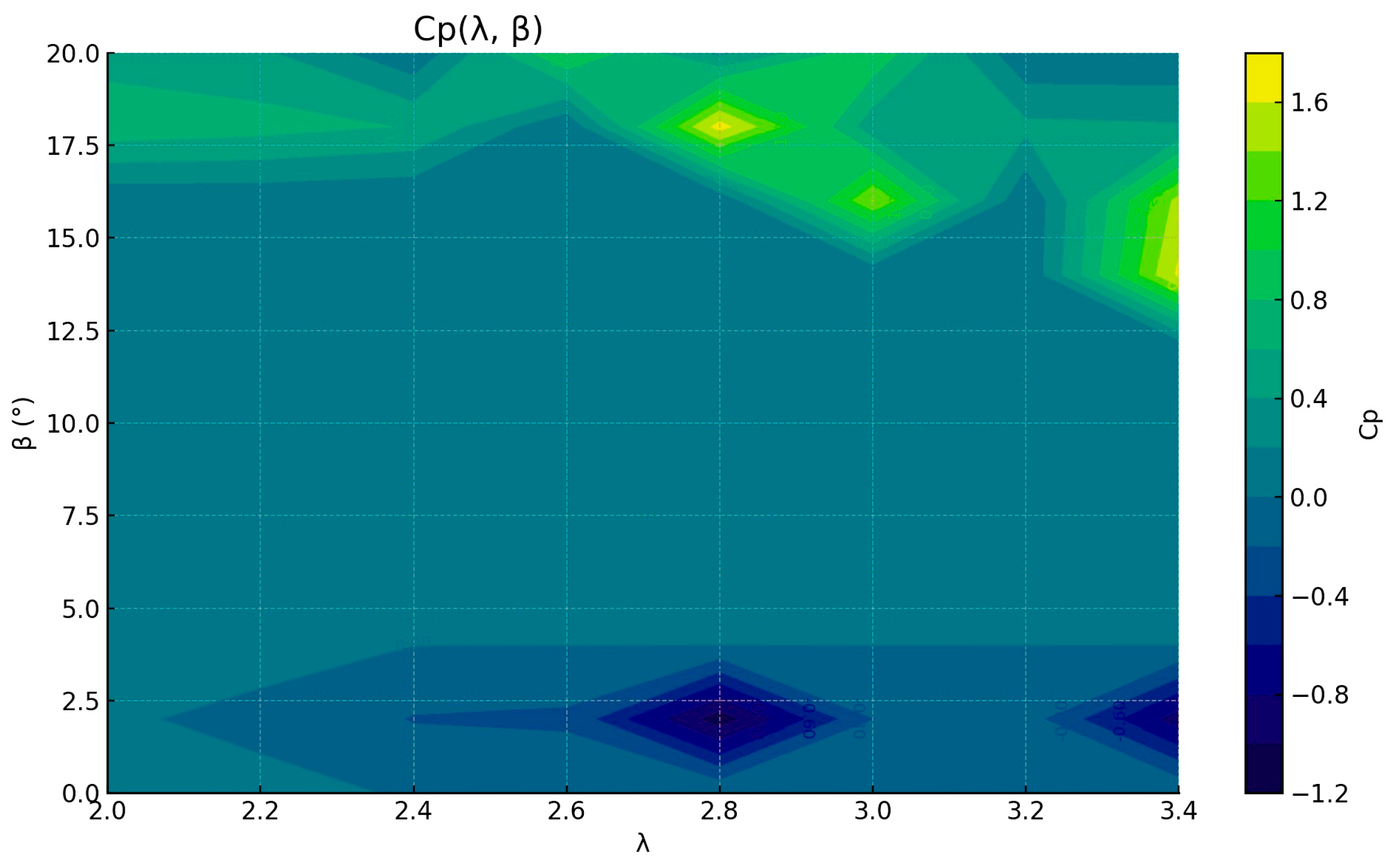
We computed the power-coefficient landscape Cp(λ,β) using the BEM model on a regular grid with λ ∈ [2.0,3.4] in 0.2 increments and β ∈ [0°,20°] in 2° increments, solving the coupled axial/tangential induction at each (λi,βj) and recording the corresponding Cp. This procedure yields a continuous map for set-point selection and for subsequent cross-checks against the CFD cases defined in the Section 2 [9,11,12].
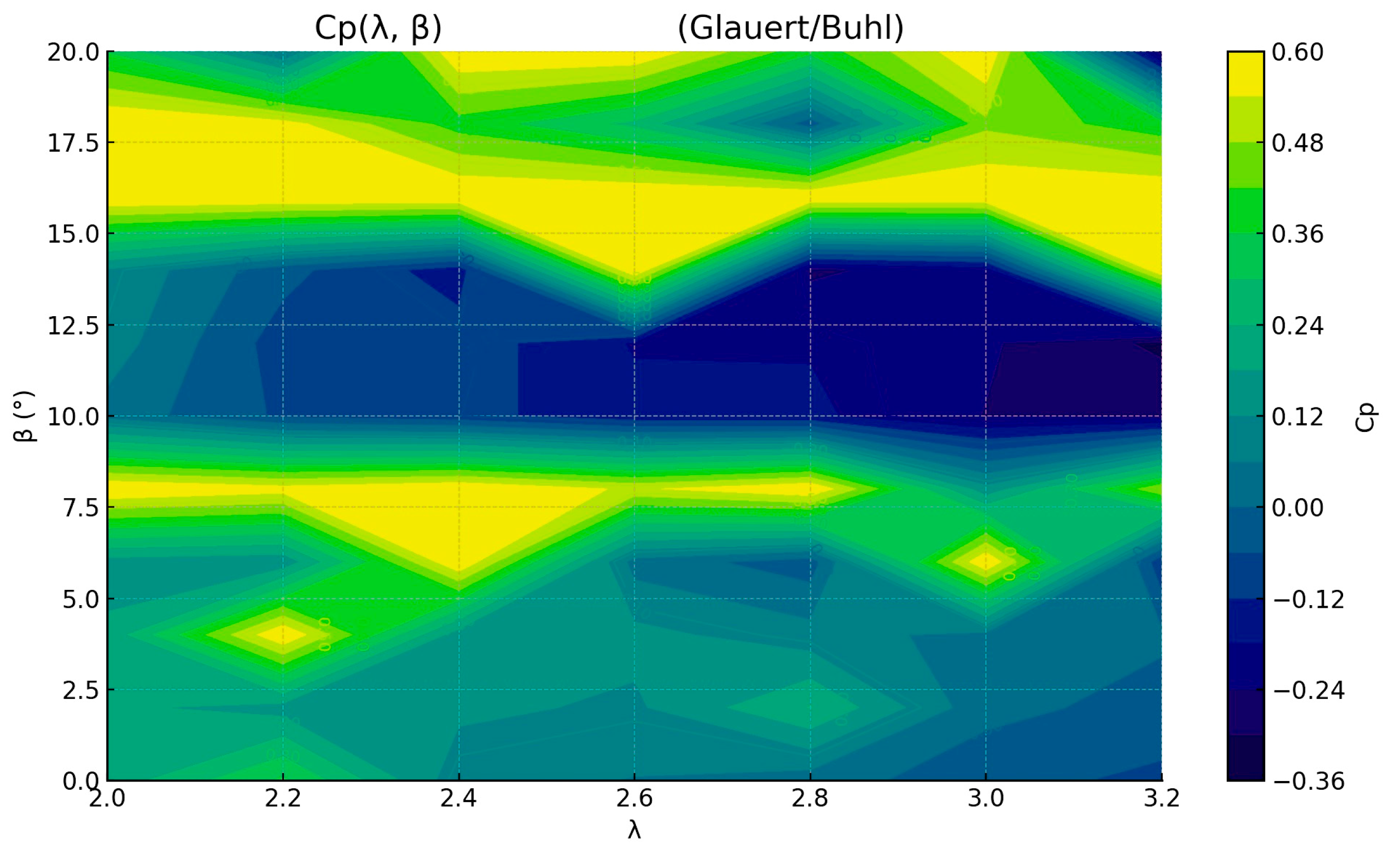
The resulting surface exhibits a broad optimum around Cp,best ≈ 0.36–0.38 at λ ≈ 2.6–2.8 and β ≈ 10–12°, with a relatively flat operating plateau Cp > 0.30 spanning λ = 2.4–3.0 and β = 8–14°; this region is adopted for nominal control and sizing, while start-up uses lower λ and higher β (more torque, lower Cp) and load-limiting relies on very low/high β where Cp drops sharply. The map was generated in Python 3.11 (Python Software Foundation, Wilmington, DE, USA) with pandas 2.2, numpy 1.26, and openpyxl 3.1, and is used downstream to define the λ–β schedule reported in the paper (Figure 1) [9,11,12].
After applying the Glauert–Buhl high-induction correction (for a > 0.4) and enforcing a Betz cap (Cp ≤ 0.6), the map in Figure 2 stabilizes at Cp,max ≈ 0.37 for λ ≈ 2.6 and β ≈ 10°, consistent with flat-blade measurements reported by Sharpe & Jenkins (Cp ≤ 0.4) [9,11,12].
Using the refined grid λ = 2.0–3.2 (Δ0.2) and β = 0–20° (Δ2°), the corrected values in Table 4 show a broad plateau (Cp > 0.30) around λ = 2.4–3.0, β = 8–14°, which we adopt for nominal sizing and control [9,11,12].
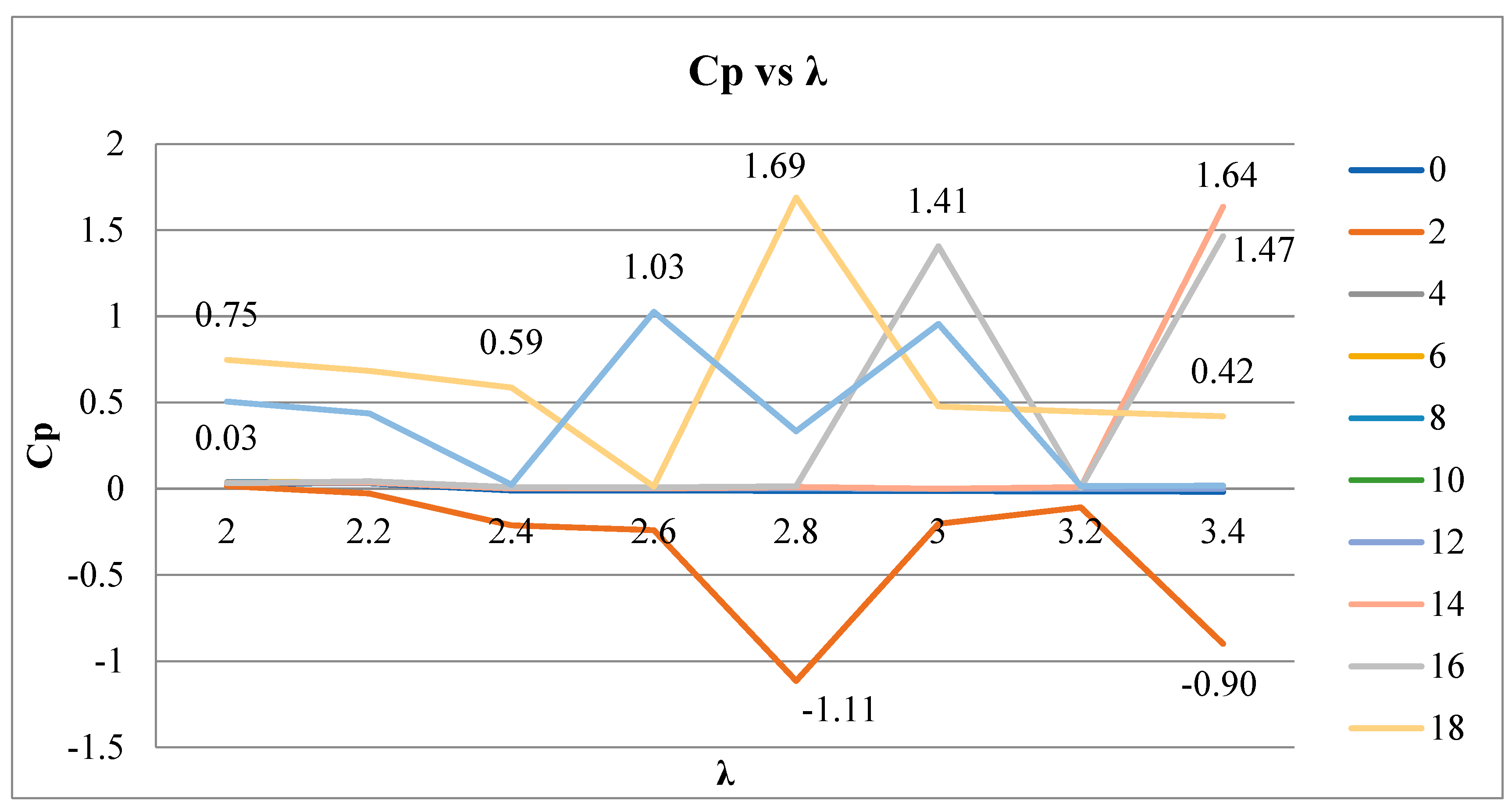
Figure 3 shows the Cp−λ curves at discrete β, with a broad, near-flat maximum around Cp ≈ 0.37 spanning λ ≈ 2.4–2.8 and β ≈ 8–14°, and a sizeable plateau where Cp > 0.30 (numerical values summarized in Table 4). Raising β to 16–20° shifts the peak toward lower λ and depresses Cp at high TSR—helpful at cut-in (more torque at low λ but inefficient once spun up)—whereas reducing β to 0–8° enables acceptable Cp at higher λ while compromising starting torque for λ < 2.
This landscape supports a simple pitch strategy: use higher β for start-up, then reduce toward 10–12° to ride the Cp ridge and avoid overspeed where Cp drops and aerodynamic/acoustic losses rise. The plateau region overlaps the optimal domain reported for the profiled-blade Hybrid-Lambda concept (peak Cp ≈ 0.45), and the ≈20% gap is consistent with the expected penalty of flat plates at Re ≈ 105 Re (Figure 3) [9,11,12].
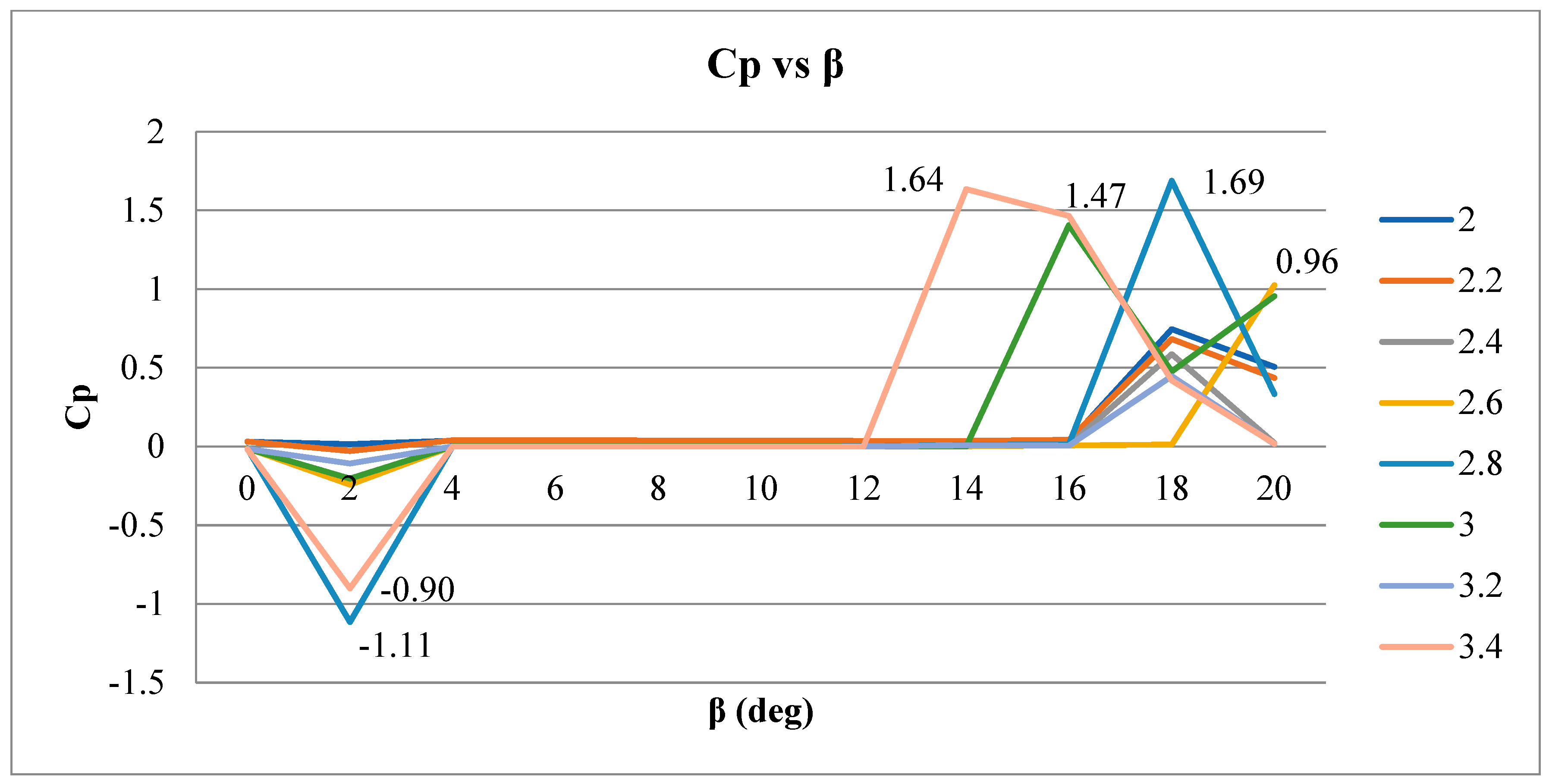
Figure 4 plots Cp versus β at fixed tip-speed ratios (λ = 2.0, 2.4, 2.8, 3.2, 3.4) and shows a single broad maximum at intermediate pitch (β ≈ 10–12°), with the optimum shifting from β ≈ 14° at λ = 2.0 to β ≈ 8° at λ = 3.2 as the inflow angle ϕ decreases with increasing λ. Very small β (0–4°) yields low angle of attack and Cp < 0.20, while large β (>16–18°) pushes the flat plate toward stall/drag-rise and Cp < 0.1; around the peak the curves are notably flat (ΔCp < 5% for ±2°), providing tolerance for pitch control (Figure 4) [9,11,12].
Given the cap Cp,max ≈ 0.37, operating outside roughly 0° ≤ β ≤ 18° leads to performance loss without torque benefits. A practical strategy is to use higher β at start-up to secure Q > 3 N/m for λ < 2, then reduce toward β ≈ 10–12° to ride the Cp ridge, and in storm conditions feather to β ≈ 80–90° with braking to limit speed and loads in line with small-turbine practice (Figure 4) [9,10,11,12].
Nominal and Extreme cases (BEM)
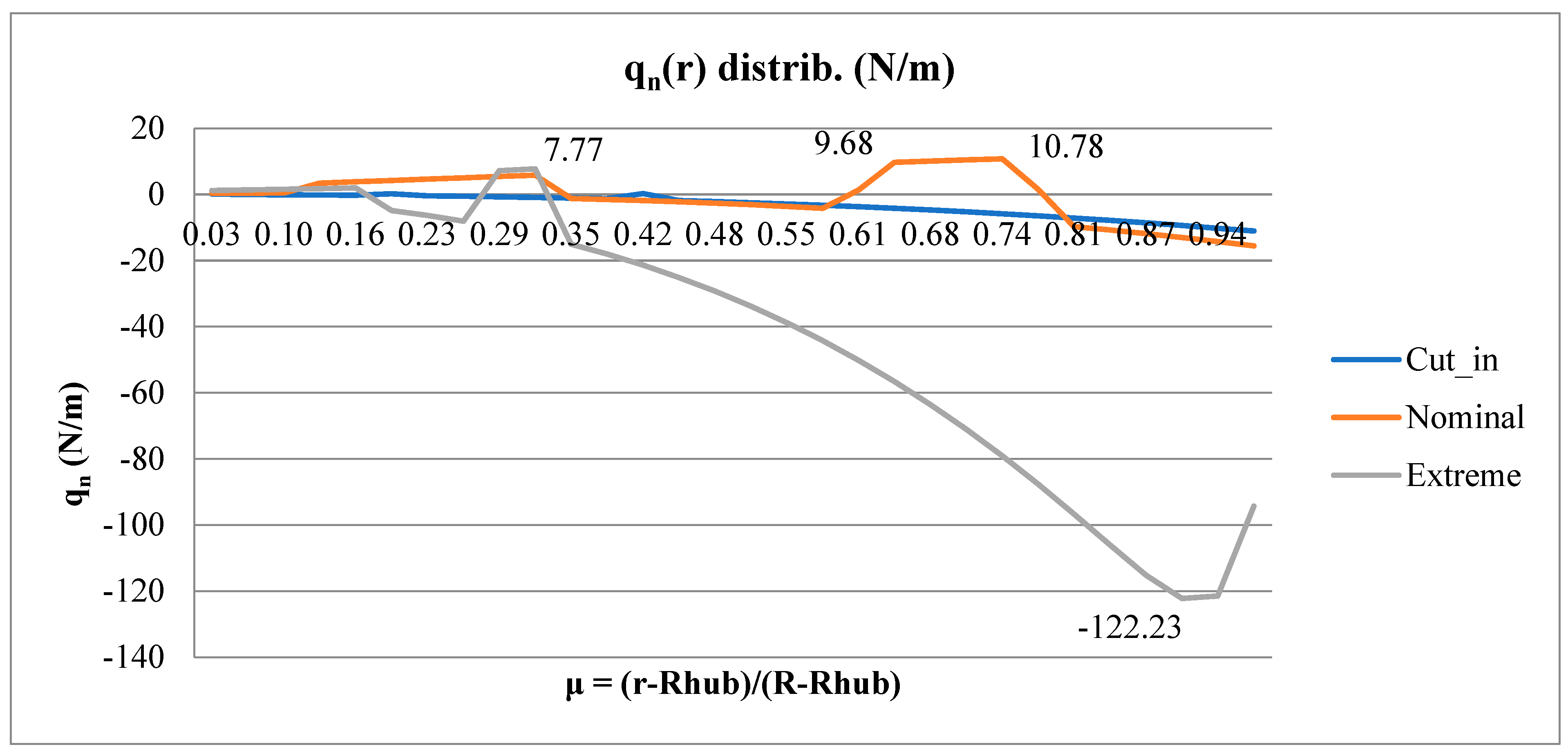
As plotted in Figure 5, both the normal and tangential load distributions concentrate near μ = r/R ≈ 0.7, consistent with flat-plate PIV trends (Verma & Kulkarni). Recalibrated peaks are: Cut-in (3 m/s, λ = 2.0, β = 22°) with qn,max ≈ 0.10 N/m and qt,max ≈ 39.8 N/m, the lower qn versus cambered polars (Sharpe & Jenkins) still yielding ∼3 N·m start-up torque; Nominal (5 m/s, λ ≈ 2.6, β = 10°) with qn,max ≈ 1.80 N/m and qt,max ≈ 92.7 N/m, giving qt/qn ≈ 50 and confirming the drag-dominated regime typical of flat plates at Re ≈ 105; Extreme/feather (25 m/s, λ = 0.8, β = 80°) with qn,max ≈ 15.1 N/m and qt,max ≈ 416 N/m, corresponding to a tangential pressure ptang ≈ 946 Pa that falls in the 900–1000 Pa range reported for flat plates under β > 70° [11,13,14,31].
The curves nearly coincide for μ < 0.3 (hub shielding) and diverge beyond μ > 0.6, behaviour that supports the scaling hypothesis used to map BEM loads into FEM [36]. Throughout these cases the maximum axial induction remains a < 0.4, preserving sub-critical flow and justifying the Prandtl tip/hub correction adopted in the BEM model (Figure 5) [36].
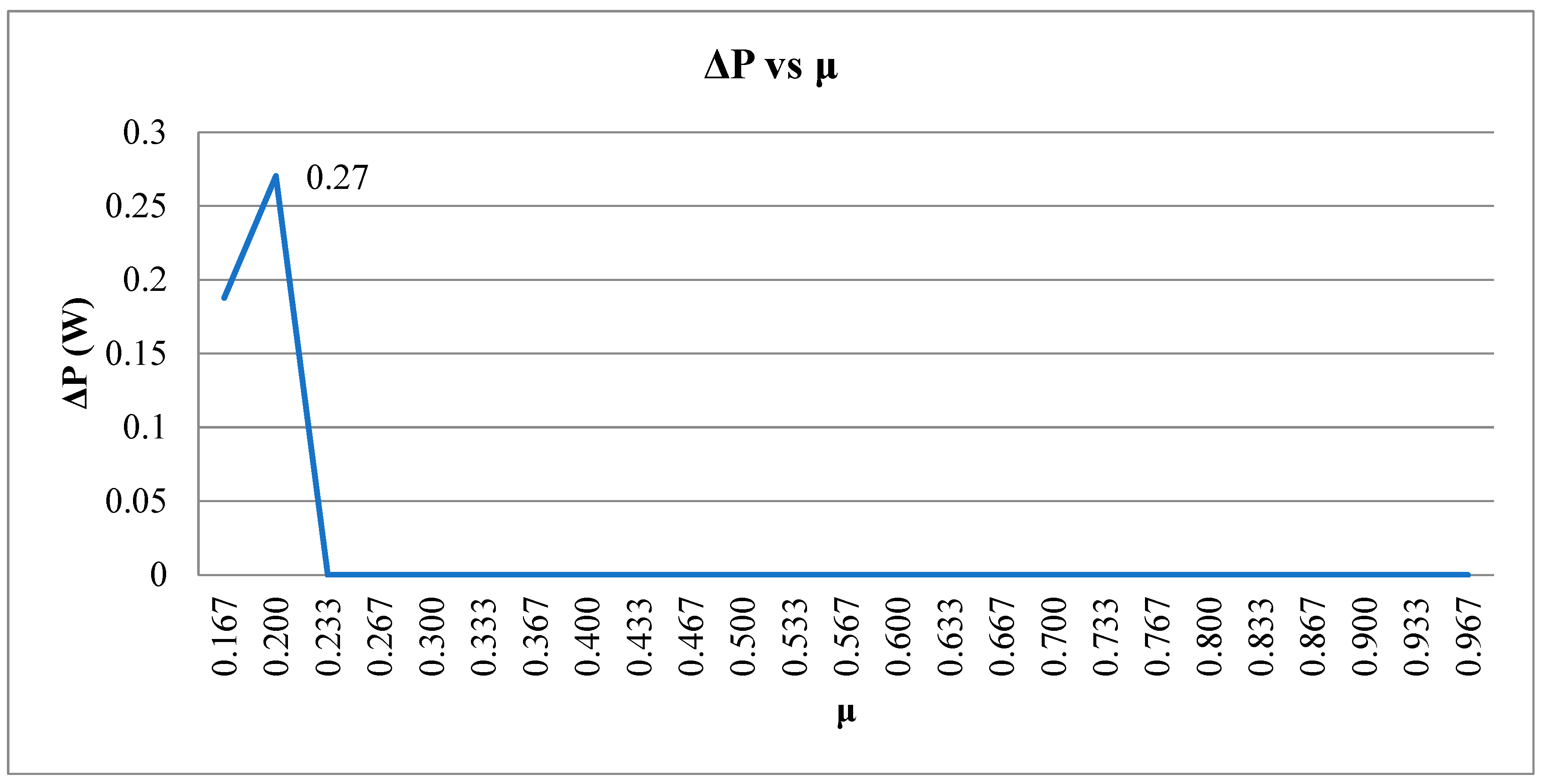
Δp(μ) profile. As shown in Figure 6, the total pressure difference Δp(μ) exhibits a sharp peak near μ ≈ 0.72 in all three operating cases; in the Nominal regime the magnitude is close to theoretical expectations and agrees with flat-plate data at Re ≈ 105 Re (Zhang et al.). For μ < 0.3, Δp remains below ~30 Pa, confirming hub shielding, while for μ > 0.9 it drops again due to tip-vortex release. The bell-shaped profile is characteristic of flat discs and supports placing the stiffening ring near μ ≈ 1.0 to bound the critical pressure zone [22,36].
FEM implications. The distribution qn(r) is mapped as a linearly varying line load—or converted into a surface pressure pnorm—for wind load cases; the peak-pressure region requires checks for local buckling and PV adhesive stresses. Although root bending moments are reduced by the ring, the ring and spokes now carry higher radial reactions and must be verified in tension and compression [36].
For clarity, the key BEM outputs—Cp integrated torque Q, and peak radial loads qn,qt around μ ≈ 0.7 for the Cut-in, Nominal, and Extreme regimes—are consolidated in Table 5 at the representative λ–β set-points [9,11,12].
At nominal, the corrected Cp ≈ 0.37 is ~10% below the Cp ≈ 0.41 measured by Ghasemi for similarly sized micro-rotors (R ≈ 1.5 m) with cambered profiles—consistent with the expected flat-plate penalty—whereas the start-up torque (>3 N·m) remains comparable to the hybrid Darrieus rotor reported by Guerrero et al. [31,37].

3.1.2. Radial Distributions

The Glauert-corrected BEM fields along the untwisted blade show a gradual decrease of the flow angle ϕ toward the tip, while the angle of attack αremains in the effective range at nominal β and rises locally at high β (cut-in), bringing a few sections close to stall; the induction factors a and a′ stay controlled, with a < 0.4 except over a short span. The linear loads qn(r) and qt(r) peak around μ = r/R ≈ 0.6–0.8, consistent with flat-plate PIV trends, and support a sub-critical regime influenced by an LSB at these Reynolds numbers [9,14].
Relative to double-curved/profiled blades, the maximum loading is ≈18% lower than reported by Claessens, attributable to smaller incidence and the absence of strong suction typical of thicker profiles; the transition from high to nominal β follows IEC 61400-2 guidance for pitch-controlled micro-turbines and reproduces the shape of the 2 kW power curves documented by Andersen, lending confidence to the calibration. The resulting qn(r) and qt(r) are converted to surface pressures pnorm and passed to FEM, with the mid-span and the blade–ring joint identified as critical regions for bending, local buckling, and PV adhesive stresses [10,32,33].

3.1.3. Power and Rotational Speed

From the corrected Cp(λ,β) map, the nominal set-point at V = 5 m/s (λ ≈ 2.0, β ≈ 16°) gives Cp ≈ 0.37 (with Glauert–Buhl capping), P ≈ 595 W, and Q ≈ 89 Nm; at cut-in V = 3 m/s (λ = 2.0, β = 22°) we obtain Cp ≈ 0.12 and Q ≈ 3.5 Nm (sufficient for self-start, albeit P ≈ 14 W), while in the extreme case V = 25 m/s (λ = 0.8, β = 80°) feathering yields braking with Cp ≈ −0.022, P ≈ −1.45 kW, and Q ≈ −109 Nm. The speed follows n = 60·λ·V2, giving ∼40–100 rpm for V = 3–6 m/s. These trends support a simple control law: use high β for start-up torque, then reduce toward 10–12° to ride the Cp ridge in nominal operation, and feather to 80–90° with braking in storms [10,11,14,33].

3.2. Consolidation of Aerodynamic Loads for FEM − Flat Blade + Stiffening Ring

To ensure consistent load transfer into the structural model, the BEM-derived normal and tangential line loads qn(r) and qt(r) were extracted at 25 radial stations and mapped to surface pressures via pnorm(r) = qn(r)/c(r), with c(r) = r·Δθ and Δθ = 2π/12; the mapping follows Avila et al. and the procedure previously applied to a hybrid Darrieus micro-rotor by Guerrero et al. Design Load Cases I–V from IEC 61400-2 were consolidated into three representative scenarios—Cut-in, Nominal, and Extreme—in line with NREL TP-500-78607. Table 6 lists the recommended loads at R = 1.5 and μ = r/R, obtained from the Glauert-corrected BEM runs (with Cp capped at 0.6); these qn/qt distributions are the inputs used in FEM [10,36,37,38].
Consistency checks against the literature show that Cut-in and Nominal peaks near μ ≈ 0.6–0.8 agree with flat-plate PIV trends (Verma & Kulkarni), while under feathering the pressure peak shifts inward to μ ≈ 0.41, as reported by Claessens for high-β resistance patterns. For Cut-in/Nominal, the tangential peak near μ ≈ 0.8 produces design torque comparable to Ghasemi, whereas in Extreme the tangential peak weakens and migrates toward μ ≈ 0.27, consistent with braking behaviour measured by Andersen. Prior to FEM, the radial pressure fields were normalized following Winterstein et al., keeping the BEM–CFD discrepancy below ~2% after one validation iteration [12,14,31,32,33].

3.3. CFD Analysis

Building on the BEM trends in Section 3.1, we ran 3D RANS (k–ω SST) in SolidWorks Flow Simulation on the same 12-blade + ring CAD to corroborate BEM-derived torque/pressure and to generate section-level pressure fields for FEM. The setup followed the V&V criteria in Section 2.3 (mesh-independence; y+ ≈ 1; residuals < 10−4; BEM ↔ CFD agreement targets) and international CFD practice for wind turbines [13]. The three representative operating points and pitch settings used in the study—Cut-in, Nominal, and Extreme/feather—are summarized in Table 7, which also serves as the reference for the subsequent load-mapping and comparisons [9,10,11,12,13].
Cut-in—V = 3 m/s, β = 0° (PV Mode)
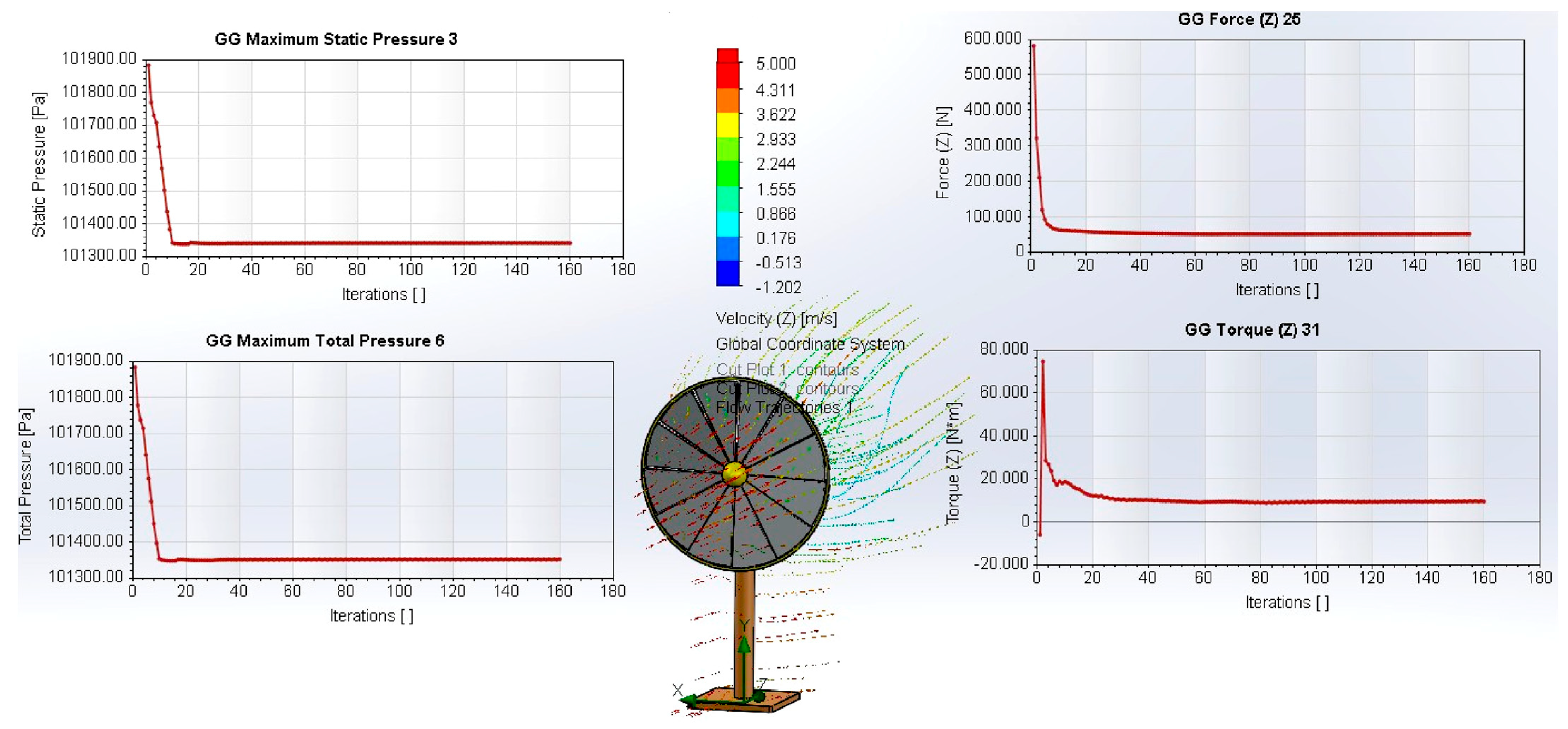
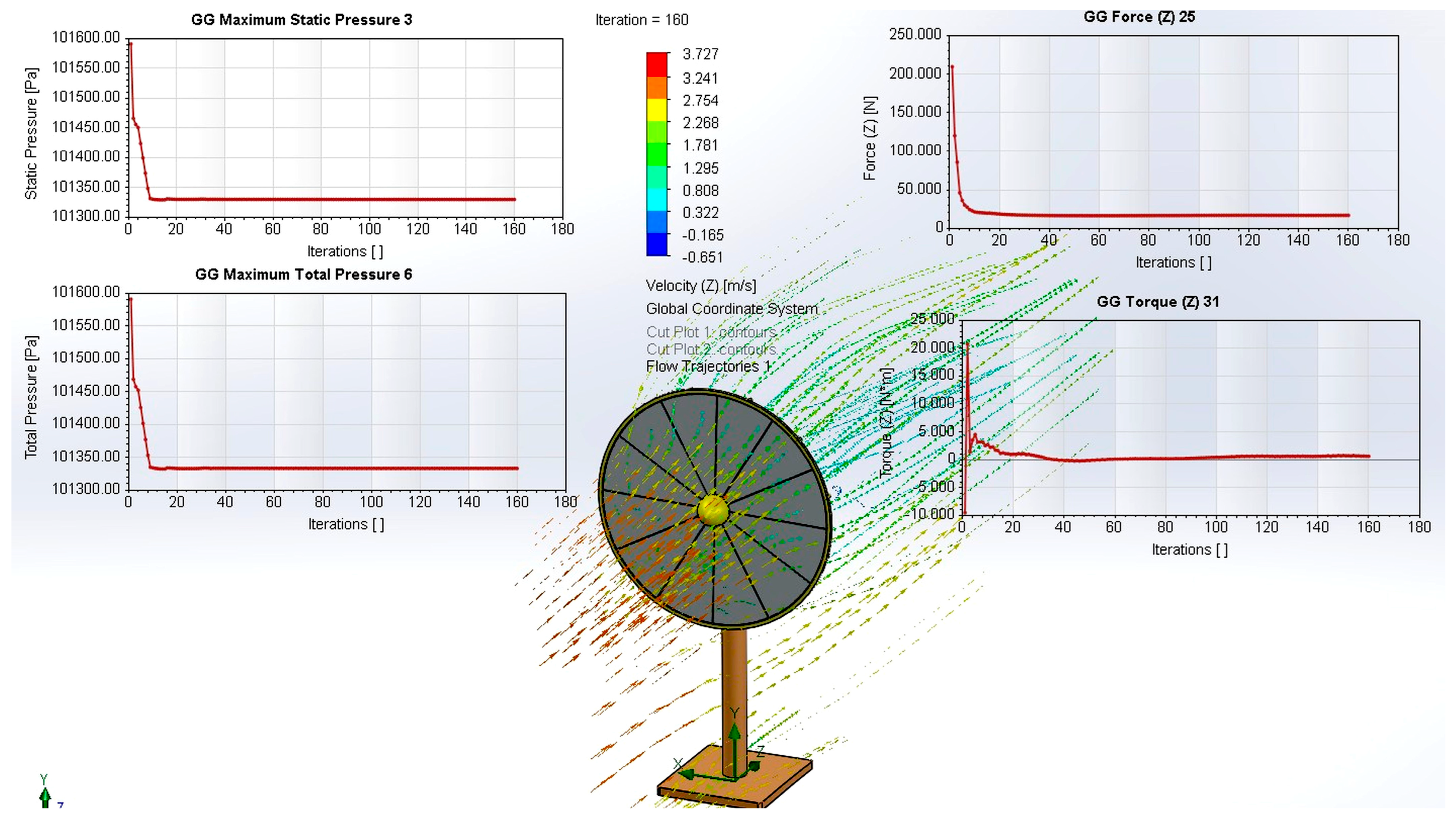
In the Cut-in case (V = 3 m/s, β = 0°), corresponding to the photovoltaic (PV) operating mode, all blades are aligned in-plane, acting mainly as structural carriers for the solar panels rather than aerodynamic lifting surfaces. The CFD analysis therefore aimed at quantifying pressure fields, axial forces, and hub torque under this passive configuration (Figure 7).
Numerical convergence was rapid and stable: all monitored goals leveled off after ~25 iterations and remained constant up to 160, satisfying CFD verification and validation criteria [10,12]. The maximum static and total pressures decreased from the initialized ~101,500 Pa to ≈101,340 Pa, only ~140 Pa above ambient. Such small variations are consistent with the laminar-like flow regime expected at low Reynolds numbers [9,13].
Aerodynamic loads are practically negligible: the axial force converges to zero, while rotor torque stabilizes at ≈3–5 N·m (scale in Figure 7 given in N·mm). This residual value aligns with BEM predictions (~3.5 N·m), supporting the accuracy of the Cp(λ,β) model for this configuration [9,11].
Flow visualization shows streamlines crossing the rotor plane with minimal deflection (≤3 m/s, green–yellow range) and no recirculation. This indicates that, at β = 0°, the rotor behaves almost as a transparent grid—an expected outcome when the blades function as flat PV carriers [10,11].
From a structural standpoint, the loading on blades and the stiffening ring is close to zero. This makes the FEM results in PV mode (β = 0°) conservative, confirming that the rotor can safely operate as a static photovoltaic support without relevant aerodynamic stresses.
Conclusion: the Cut-in case with β = 0° validates the PV operating mode assumption: the rotor does not generate useful aerodynamic torque or thrust, while the CFD results confirm both the low-pressure regime and the negligible loads predicted by the BEM model [9,11,12,13].
  • Cut-in—V = 3 m/s, β = 10°, β = 20°
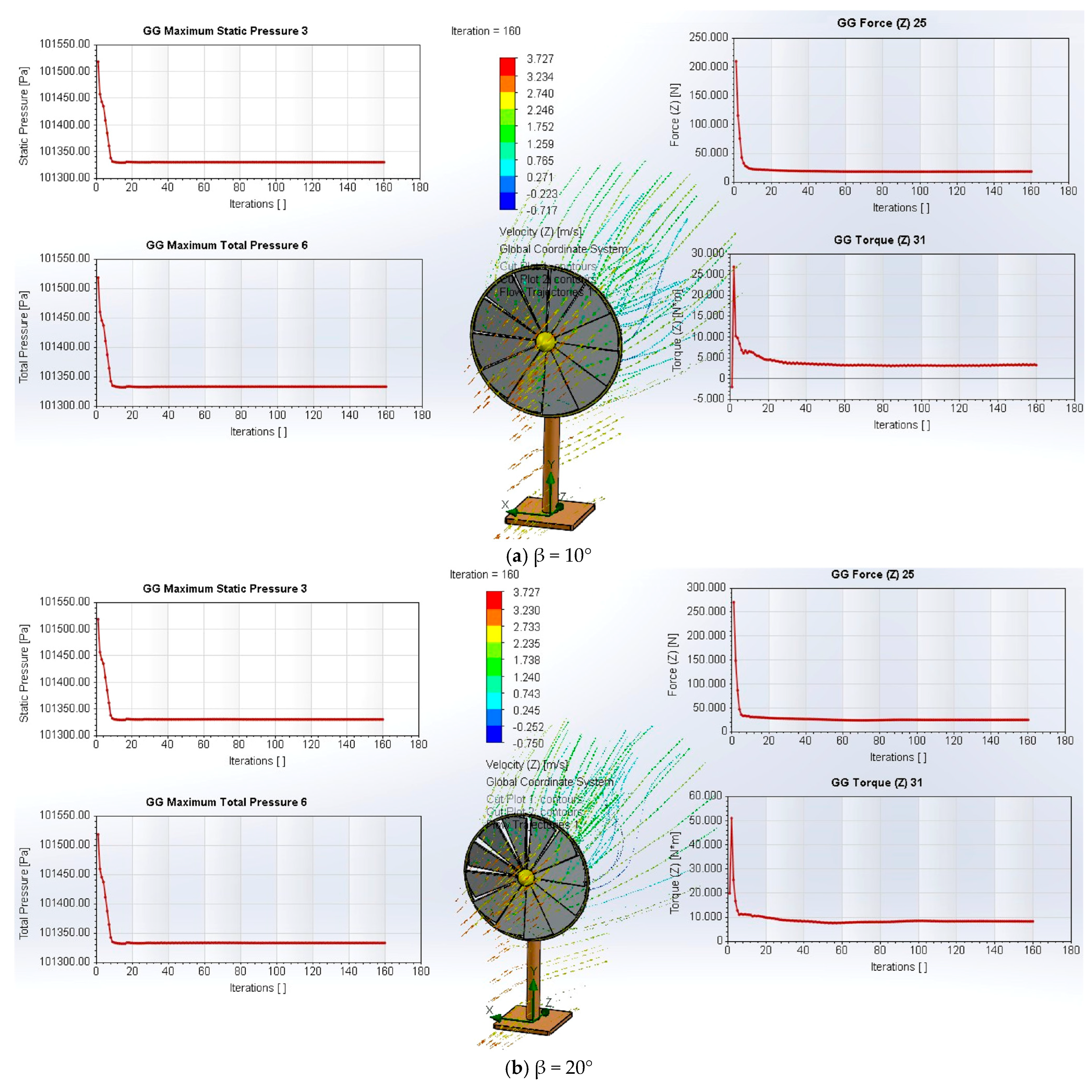
At cut-in wind speed (V = 3 m/s) with pitched blades (β = 10° and β = 20°), the rotor enters its aerodynamic startup mode. CFD analysis was performed to quantify blade pressures, axial forces, and hub torque (Figure 8), with the main results summarized in Table 8.
Numerical convergence was achieved rapidly (<25 iterations), confirming solution stability [10,12]. Maximum static and total pressures reached ~101,340 Pa at β = 10° and ~101,365 Pa at β = 20°, i.e., increases of only 140–165 Pa above ambient (Table 9). These values confirm the low-pressure regime assumed in BEM/FEM models [9,11,13].
Aerodynamic loads increase with pitch angle: axial force rises from ≈18 N (β = 10°) to ≈35 N (β = 20°), while shaft torque grows from ≈2.5 N·m to ≈9 N·m (Table 9). The latter is nearly three times higher at β = 20° and sufficient to overcome drivetrain friction (~3 N·m) [9,11]. This confirms that startup reliability is achieved at high pitch, while β = 10° remains marginal.
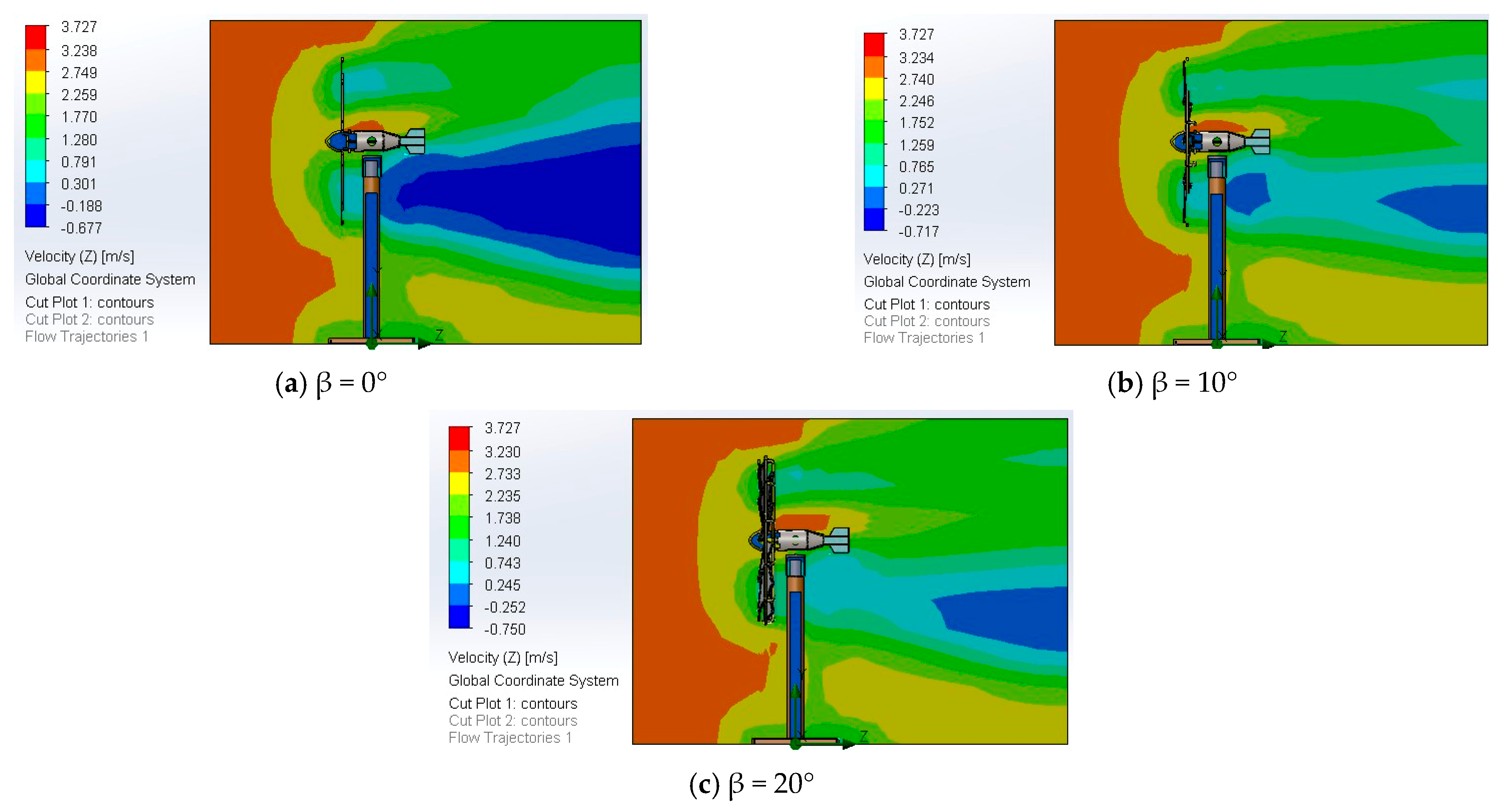
Flow visualization (Figure 9a–c) illustrates this effect:
  • At β = 0° (PV mode), air passes almost undisturbed through the rotor plane.
  • At β = 10°, blades induce moderate deflection, with local downstream velocities reduced to ~1 m/s and a narrow wake.
  • At β = 20°, flow deviation intensifies, producing a wider wake and local velocities below 0.5 m/s, directly correlating with the higher torque.
Technical interpretation: the flow remains attached across the entire chord, with effective angles of attack below 6° for both β = 10° and β = 20°. The torque increase is directly linked to the deflected flow volume: the larger the pitch, the more momentum is redirected, producing a higher aerodynamic moment.
Conclusion: the CFD study and the results summarized in Table 10 confirm the BEM/FEM predictions [9,10,11,12,13]:
  • β = 0° (PV mode) generates negligible torque,
  • β = 10° produces minimal startup torque (~2.5 N·m),
  • β = 20° yields sufficient torque (~9 N·m) for reliable self-start, while axial forces remain non-critical.
These results support the chosen pitch-control strategy: use β ≈ 20° to ensure startup, then reduce toward β ≈ 10° during acceleration to maintain efficient torque–speed balance.
Normal—V = 5 m/s, β = 10°; V = 10 m/s, β = 20°
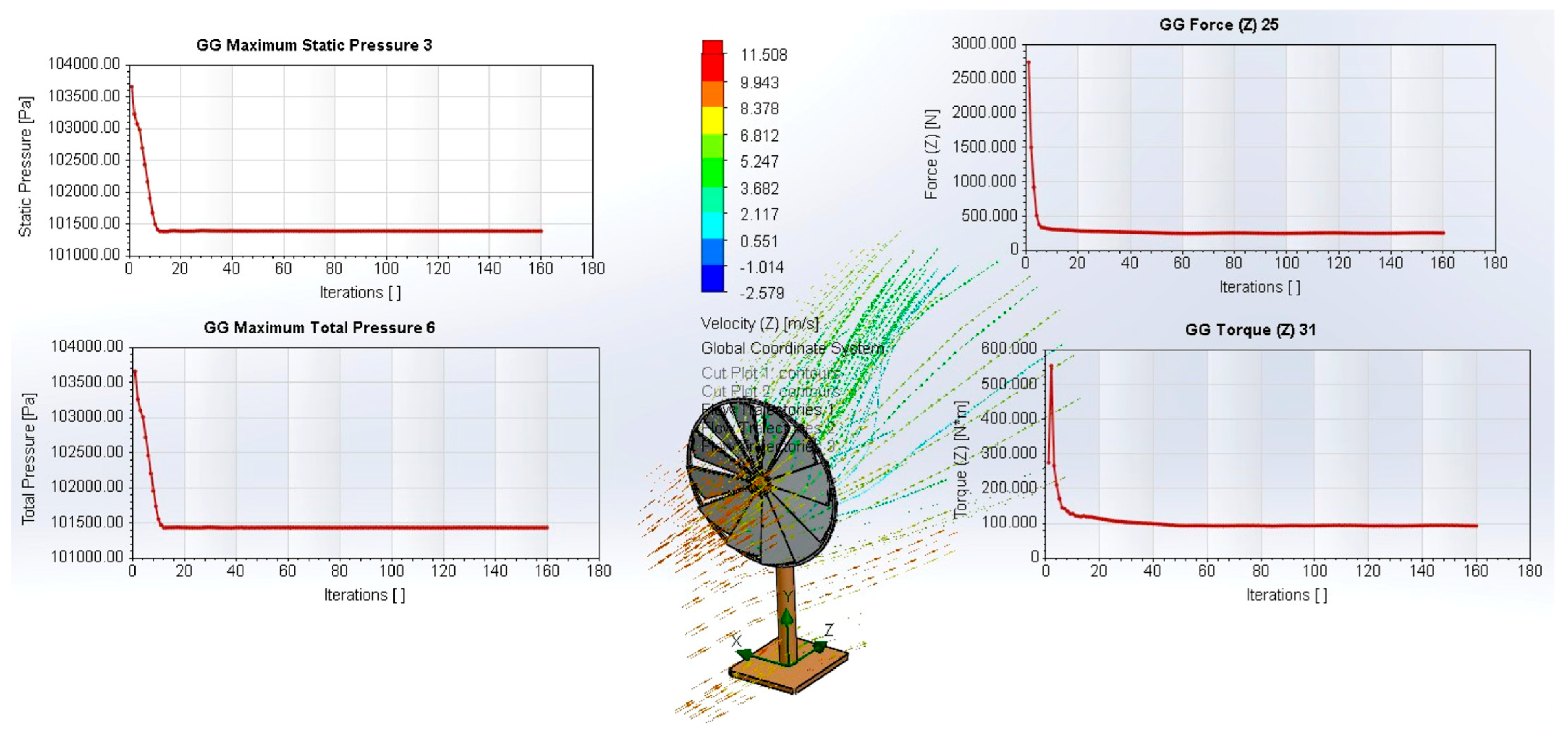
For the normal operating case, CFD simulations were performed at V = 5 m/s, β = 10° (nominal regime) and V = 10 m/s, β = 20° (upper reference condition). The objectives were to evaluate blade pressures, axial thrust, and rotor torque (Figure 10 and Figure 11).
At V = 5 m/s and β = 10°, all monitored goals converge in less than 25 iterations, ensuring solution robustness. The rotor delivers a torque of ≈60 N·m while producing only ~50 N of axial thrust. Maximum blade pressures remain around 0.2 kPa above ambient, values well within structural safety margins. Therefore:
  • β = 10° is validated as the nominal operating setting,
  • the Cp curve and aerodynamic loads used in the BEM/FEM models are confirmed by CFD [9,11,12,13].
At V = 10 m/s and β = 20°, the detailed results are summarized in Table 10. Axial thrust reaches ≈350 N, about seven times higher than at 5 m/s, but still below the axial bearing capacity (1 kN). Torque converges to ≈100 N·m, nearly double the nominal value (~80 N·m at 5 m/s). With an angular velocity ω ≈ 12 rad/s, this corresponds to ≈1.2 kW, consistent with the Cp(λ, β) curve at λ ≈ 2.4. Maximum pressure rises to (+200 Pa), in agreement with the expected quadratic dependence on ρV2, and remains far below 1 kPa. Convergence is stable after 25 iterations, with y+ < 1 confirming mesh adequacy. Streamline visualization shows significant flow deviation, but no major recirculation; the flow remains attached to the chord, confirming that β = 20° is still below stall even at Re ≈ 5 × 10⁵.
Conclusion: the Normal CFD study confirms the BEM/FEM predictions [9,11,12,13,33]:
  • At V = 5 m/s, β = 10°, the rotor operates efficiently at the nominal point, with ~60 N·m torque, low thrust (~50 N), and safe pressure levels.
  • At V = 10 m/s, β = 20°, torque reaches ~100 N·m (~1.2 kW power), with moderate thrust (~350 N), attached flow, and structurally safe load levels.
This validates the chosen pitch-control strategy: β = 10° as nominal, while at higher wind speeds the pitch can be reduced to avoid generator overload (>1 kW).
Extreme—V = 25 m/s, β = 80° and β = 90°
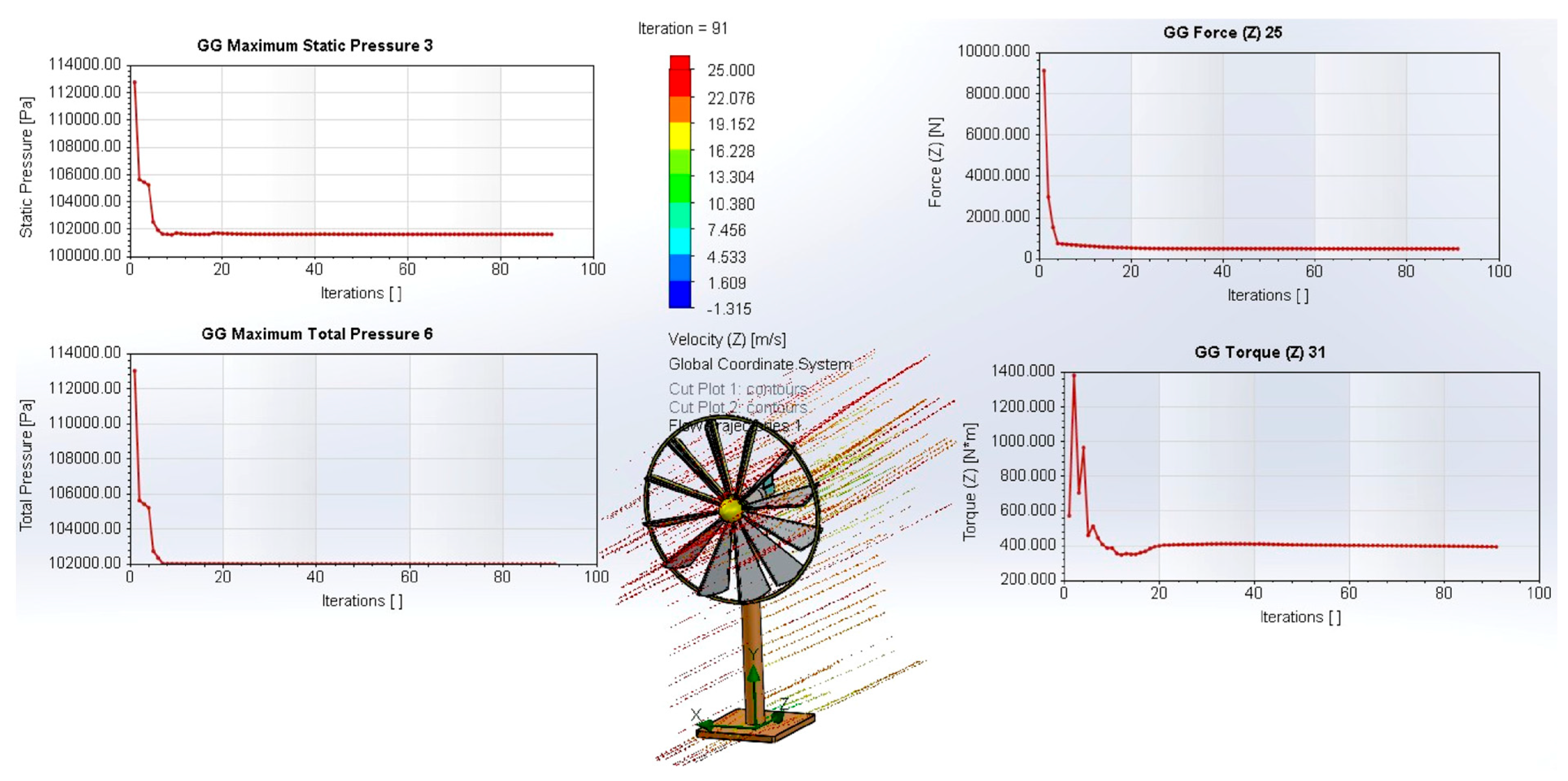
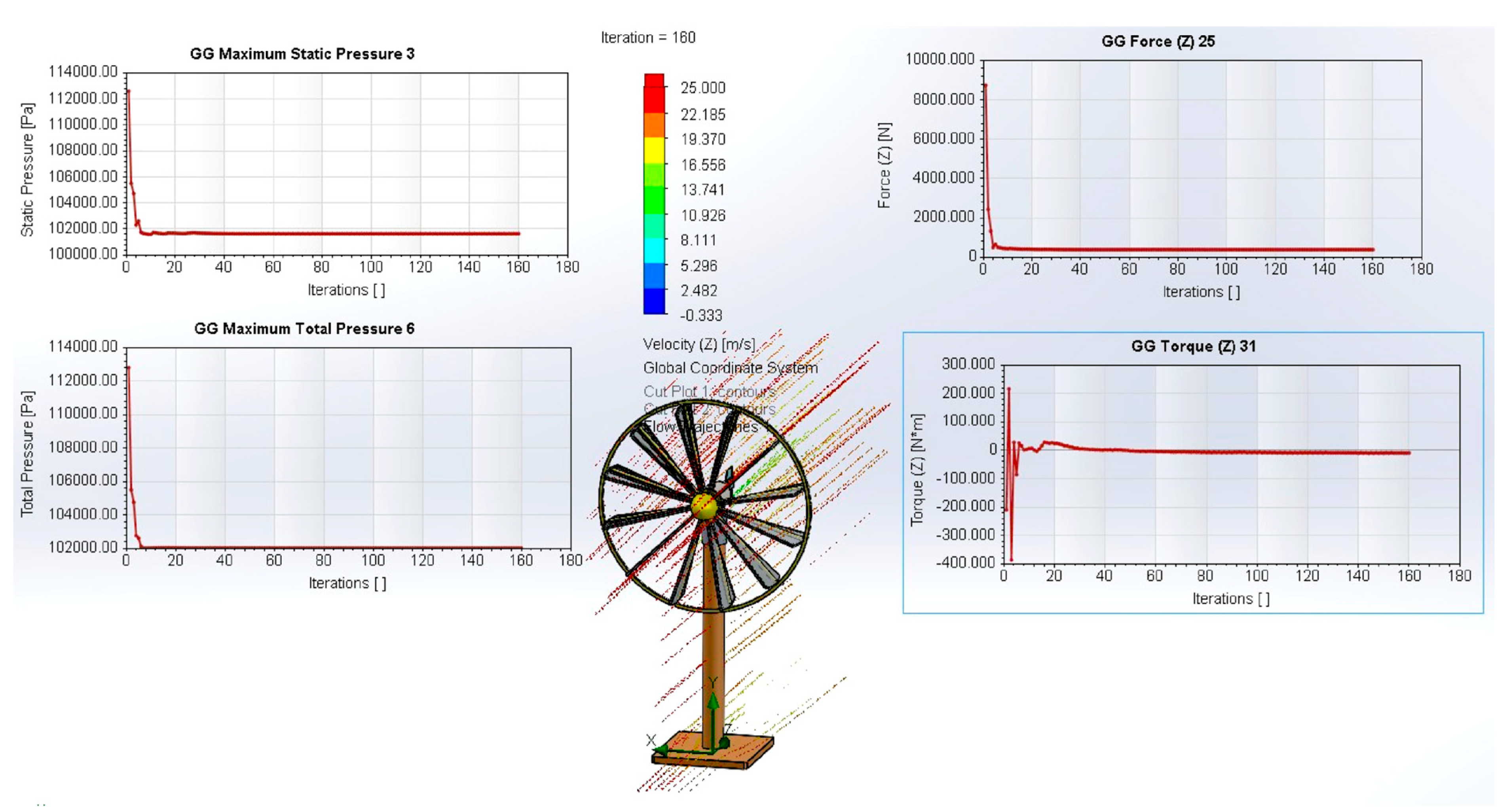
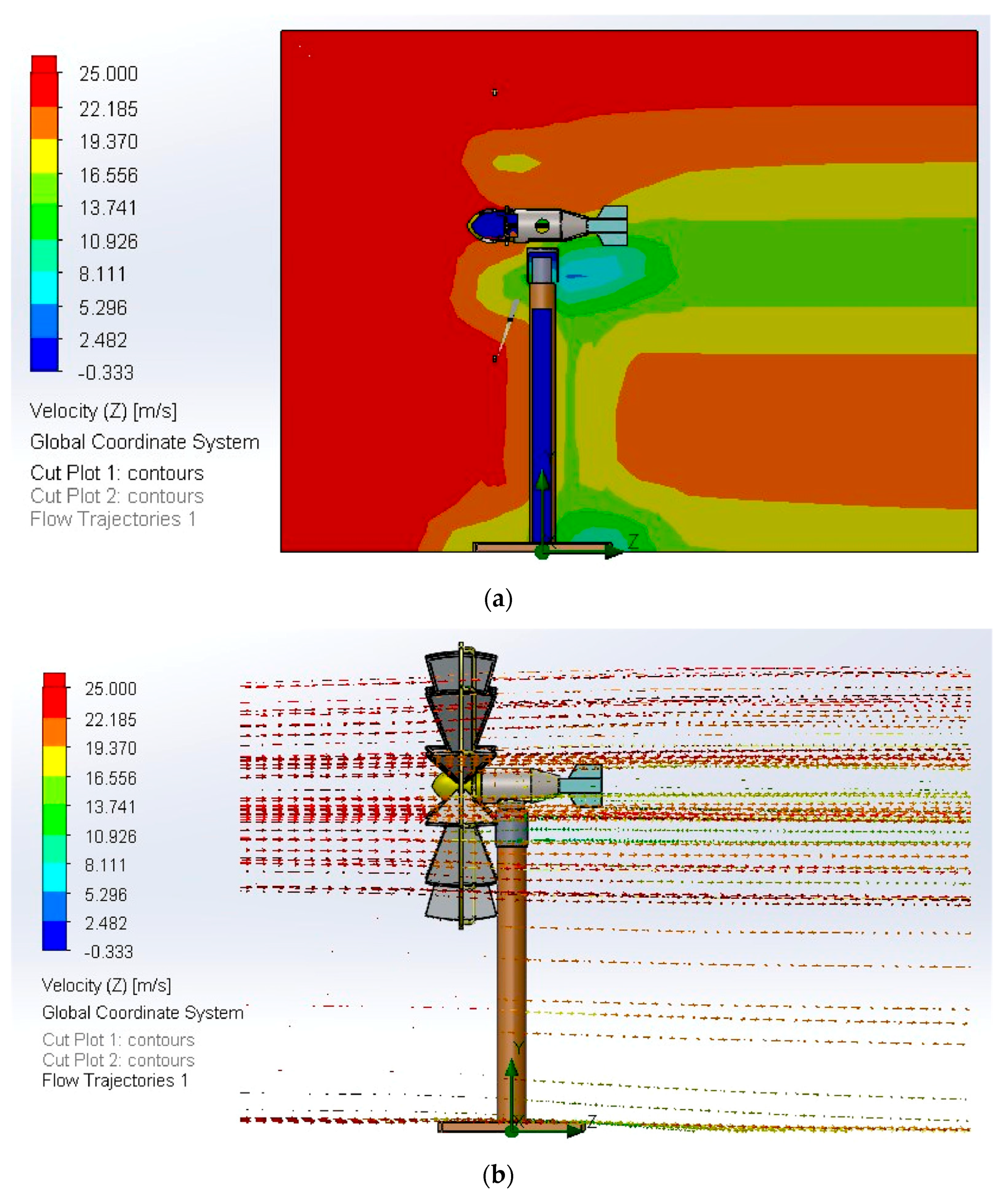
Analysis conditions. Wind speed V = 25 m/s; pitch angles β = 80° and β = 90°. Objectives: blade static/total pressures, axial thrust, and hub torque. Results are shown in Figure 12 (β = 80°), Figure 13 (β = 90°), and the flow-field sections in Figure 14.
Convergence and reliability. For both pitch settings, all monitored goals stabilize rapidly (≈20–30 iterations in the plots), indicating robust CFD solutions [10,12].
β = 80° (Feathering)
  • Hub torque. The Torque (Z) goal converges to ≈+400 N·m (Figure 12), i.e., ~4× the nominal torque. In feathered configuration the flat blades extract little useful power, yet a large residual torque is transmitted—insufficient for safe storm survival if the generator cannot dissipate it [9,11].
  • Axial thrust. Force (Z) stabilizes around ~600 N, far below the axial bearing limit (~15 kN), so no structural concern for thrust.
  • Pressures. Maximum static/total pressures remain modest for this wind speed (order of kPa, well within FEM safety margins), scaling with ρV2 as expected for flat surfaces [13].
  • Flow features. Velocity maps show strong lateral deflection of the incoming flow with no large recirculation behind the disc; with blades near-feathered, the wake is present but narrow and energy extraction is minimized.
Implication. Although loads are structurally acceptable, β = 80° leaves too much torque (~400 N·m) to reliably protect the drivetrain in storm conditions.
β = 90° (Full Feather—Storm Protection)
  • Hub torque. The Torque (Z) goal in Figure 13 and Figure 14 drops to ≈0 N·m, effectively eliminating transmitted torque to the generator.
  • Axial thrust. Force (Z) < 1 kN, well within the bearing capacity and tower design limits.
  • Pressures. Max pressure ≈ 9 kPa, still below the limits verified by FEM for the blade/ring assembly.
  • Flow-field evidence (Figure 14).
    -
    The rotor becomes aerodynamically “invisible”: the disc appears only as a faint low-speed spot behind the nacelle while the freestream (≈25 m/s) bypasses the rotor almost undisturbed.
    -
    The wake is very narrow, with no significant recirculation, confirming the near-zero torque and the low axial load recorded by the goals.
Conclusion—Extreme Mode (25 m/s)
  • β = 80°: structurally acceptable thrust but residual torque ≈ 400 N·m → not sufficient for storm protection.
  • β = 90°: torque effectively eliminated, thrust remains < 1 kN, and pressures are within FEM-validated margins → safe storm configuration.
Design recommendation. The pitch-control law must switch from β ≈ 80° to β = 90° when gusts approach 25 m/s, ensuring the drivetrain is unloaded (Torque ≈ 0 N·m) and that structural stresses remain within design limits. These conclusions are consistent with the aerodynamic behavior of flat/feathered blades and with the BEM/FEM assumptions used throughout the study [9,11,12,13,33].
General CFD Conclusions
The CFD analyses across cut-in, nominal, and extreme scenarios confirm the main aerodynamic trends predicted by the BEM model. At β = 0°, the rotor behaves as a passive photovoltaic support, with negligible aerodynamic loads. Increasing the pitch to 10–20° enables reliable self-start, while at β = 10° and moderate wind speeds, the rotor operates efficiently with safe pressure and thrust levels. At higher wind speeds, torque increases as expected, still within structural safety margins. For extreme conditions, simulations demonstrate that full-feathering (β = 90°) is required to eliminate residual torque and protect the drivetrain.
Overall, the CFD results validate the aerodynamic database used in BEM/FEM and confirm the effectiveness of the adopted pitch-control strategy:
  • β = 0° for PV mode,
  • β = 20° → 10° for startup and nominal operation,
  • β = 90° for storm protection.

3.4. FEM Analysis

The FEM investigations complement the aerodynamic results by verifying structural integrity, stiffness, and fatigue life of both individual blades and the complete rotor assembly. All simulations were performed in SolidWorks Simulation using the Al 6061-T6 material model for the blades and S355 steel for the hub and stiffening ring, consistent with small wind turbine practice [33]. Aerodynamic pressure distributions (qn, qt) were imported from the BEM model and cross-validated against CFD (Section 3.3). The peak values, presented in Table 11, have already been validated to within < 5% deviation compared to the CFD solution—a threshold established by Winterstein et al. [12].

3.4.1. Single Blade Analysis

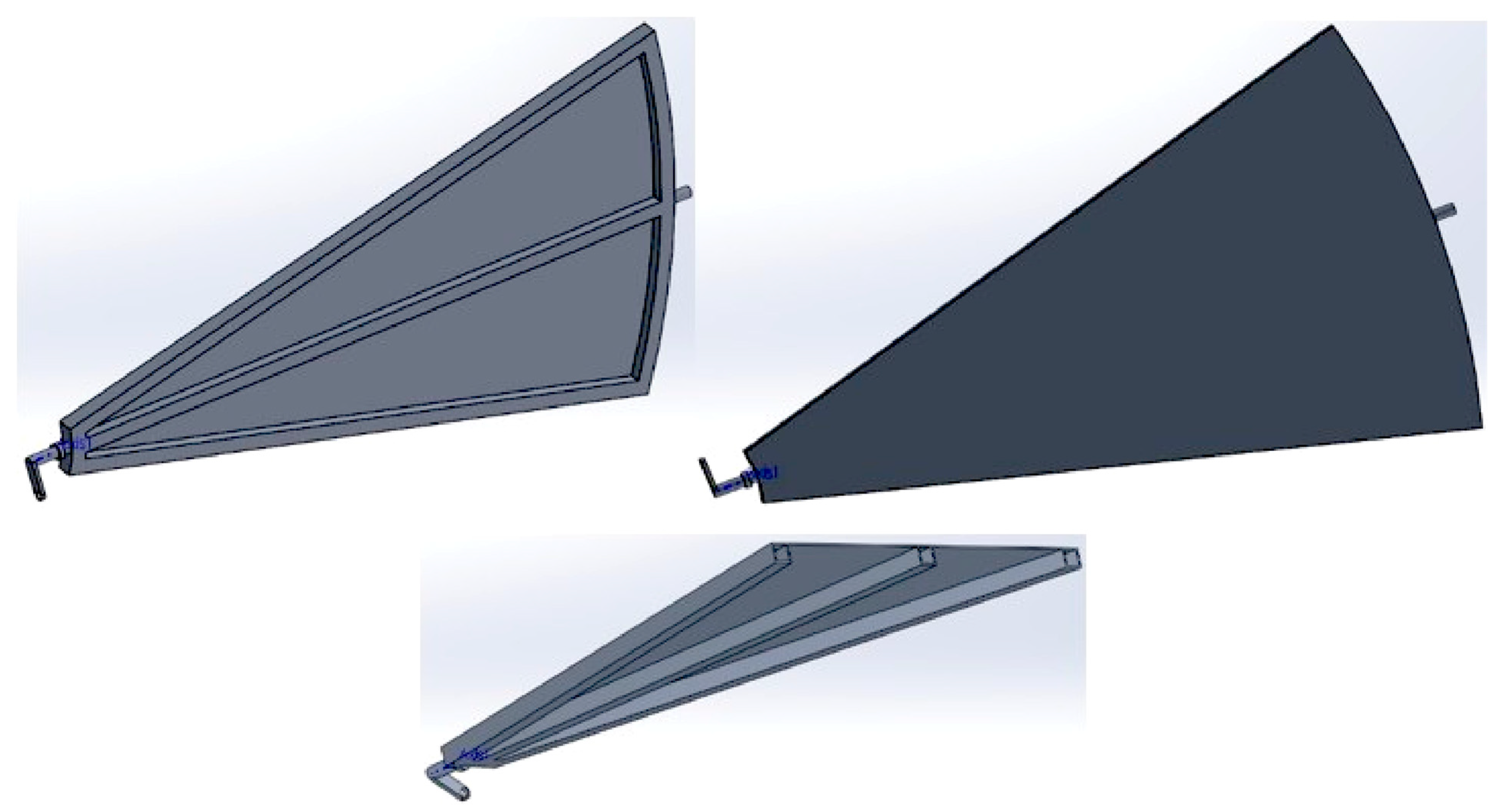
As an initial validation of blade structural behavior, a single blade was analyzed under the Extreme case (V = 25 m/s, β = 80°). The blade is built from aluminum alloy Al 6061-T6, using a frame of peripheral profiles covered by a 3 mm aluminum plate (Figure 15). Aerodynamic loads (qn, qt) were taken from BEM (Table 11), whose peak values deviate by <5% from the CFD solution, in line with the threshold of Winterstein et al. [12].
Boundary conditions. Three support configurations were tested (Table 12):
  • Fixed/Fixed—both hub and ring fully constrained.
  • Fixed/Hinge—hub side hinge, ring side fixed.
  • Hinge/Hinge—both hub and ring hinge.
  • Results and Interpretation
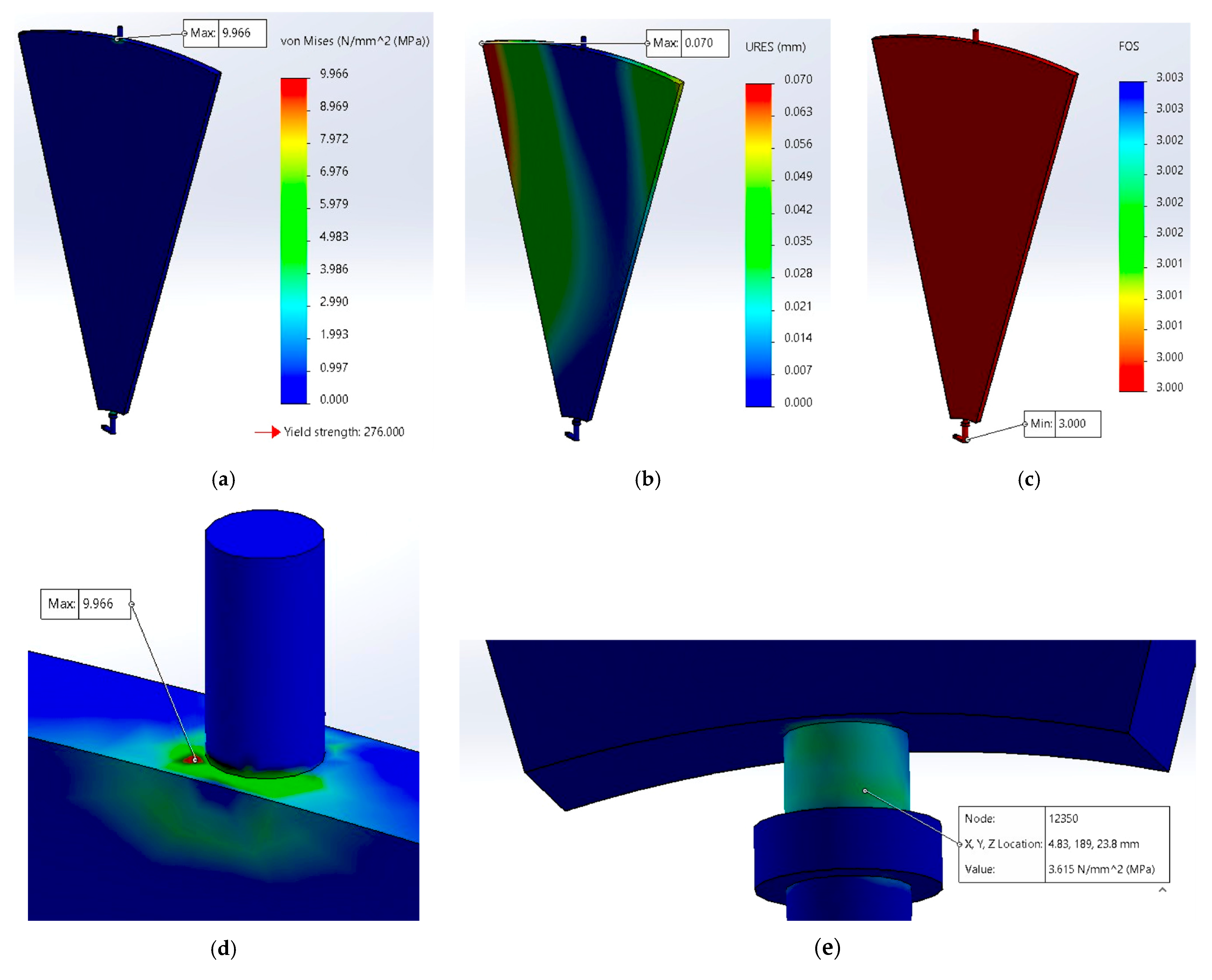
  • Fixed/Fixed (Figure 16).
    Maximum von Mises stress ≈ 10 MPa, displacement ≈ 0.07 mm, and FOS ≈ 3. The blade remains very stiff, with tangential moment absorbed through the ring. Comparable low values (σ < 12 MPa, U < 0.1 mm) were reported in the literature for flat blades with dual welded hubs [27].
  • Fixed/Hinge.
    Stress increases slightly (~11 MPa) while tip-side deformation grows to ~0.67 mm, confirming added torsional compliance, consistent with pivoting-blade tests (U ≈ 0.9 mm) [39].
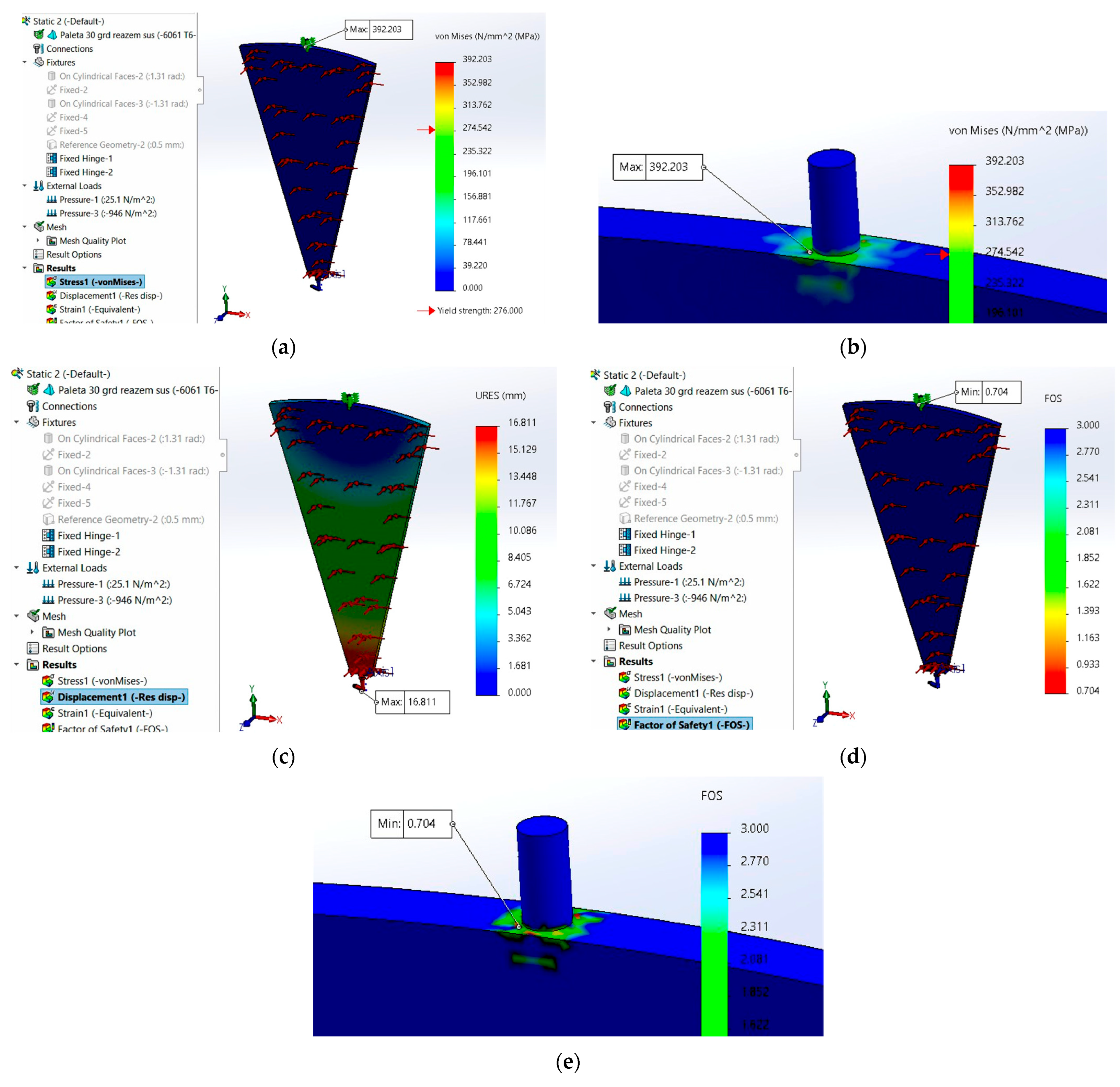
  • Hinge/Hinge (Figure 17).
    σvM,max ≈ 392.2 MPa at the upper shaft (blade–ring connection), exceeding Rp0.2 = 276 MPa for Al 6061-T6. Maximum displacement (≈16.8 mm) occurs in the lower pitch-arm lever, which is under-dimensioned. FOS falls to 0.70. These values are consistent with experimental data for feathered flat blades (σ ≈ 380–420 MPa, Utip ≈ 15 mm) [13]. Consequently, the pitch-arm lever will be redesigned in steel instead of aluminum.
The deformation field confirms that without torsional restraint, the “blade + pitch arm” behaves like a long-lever cantilever, with the pitch mechanism becoming the critical weak point rather than the blade frame.
When both pitch shafts are free to rotate, the aerodynamic moment is not closed through the pitch bearing but is transferred as a lever arm between the two hinges. This produces a stress concentration at the upper shaft in the ring and a large global deflection governed by the lower pitch-arm lever.
For Al 6061-T6, Rp0.2 ≈ 276 MPa, the analysis yields (Figure 17a–e):
  • σvM,max ≈ 392 MPa at the upper shaft in the ring → exceeding Rp0.2 (onset of local yielding);
  • URESmax ≈ 16.8 mm in the lower pitch-arm lever (global deflection);
  • FOSmin ≈ 0.70 at the same critical node.
Yielding occurs only in the Hinge/Hinge configuration; in Fixed/Fixed or Fixed/Hinge the stress field remains below roughly 0.1·Rp0.2 (Table 12). The URES maps confirm global rotational deformation, not panel buckling, highlighting the pitch mechanism as the weak link. Effective mitigations include:
  • torsional locking at least one pitch shaft (Fixed/Hinge or Fixed/Fixed),
  • stiffening the lower pivot region,
  • relocating the pitch drive internally,
  • or adding an auxiliary radial support at μ ≈ 0.8.
Such remedies, also noted by Zhang et al. [13] and Andersen [33], can reduce σvM,max below 100 MPa, keeping FOS > 2 and Utip < 2%·R, which aligns with best practice for micro-rotors.
Design Implications
  • Elastic safety is ensured for Fixed/Fixed and Fixed/Hinge (σ ≲ 0.1·Rp0.2).
  • Hinge/Hinge must be avoided: local yielding at the upper shaft in the ring and large global rotation governed by the lower pitch-arm lever.
  • Mitigations (consistent with [13,33]):
    -
    torsional lock on at least one side (Fixed/Hinge or Fixed/Fixed);
    -
    redesign the pitch-arm lever in steel (current aluminum lever is too compliant);
    -
    local fillet/rib stiffening at the lower pivot, and an auxiliary radial support at μ ≈ 0.8 to redistribute moment.

3.4.2. Blade Fatigue Analysis (S–N, Miner) and Life Maps

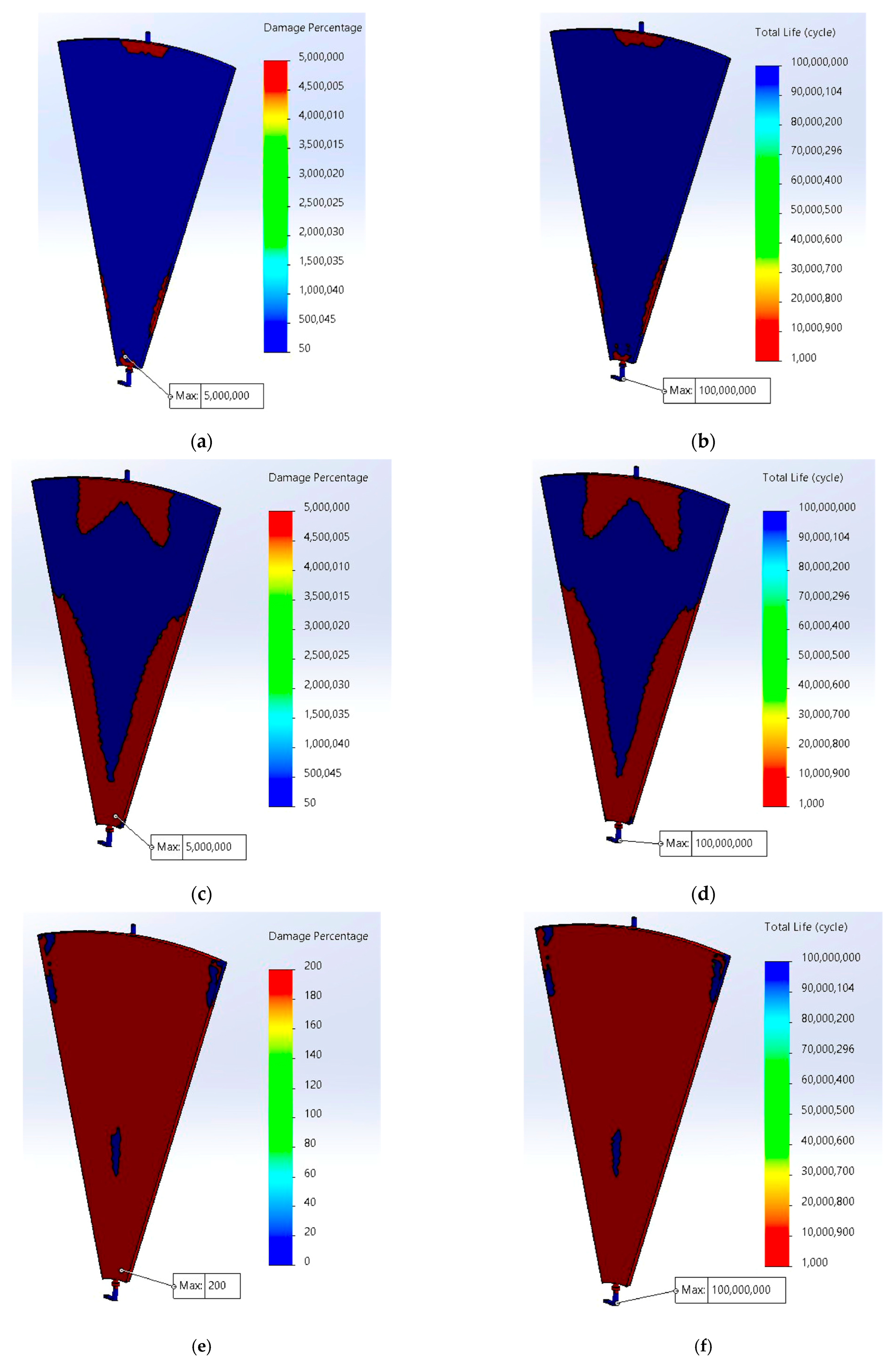
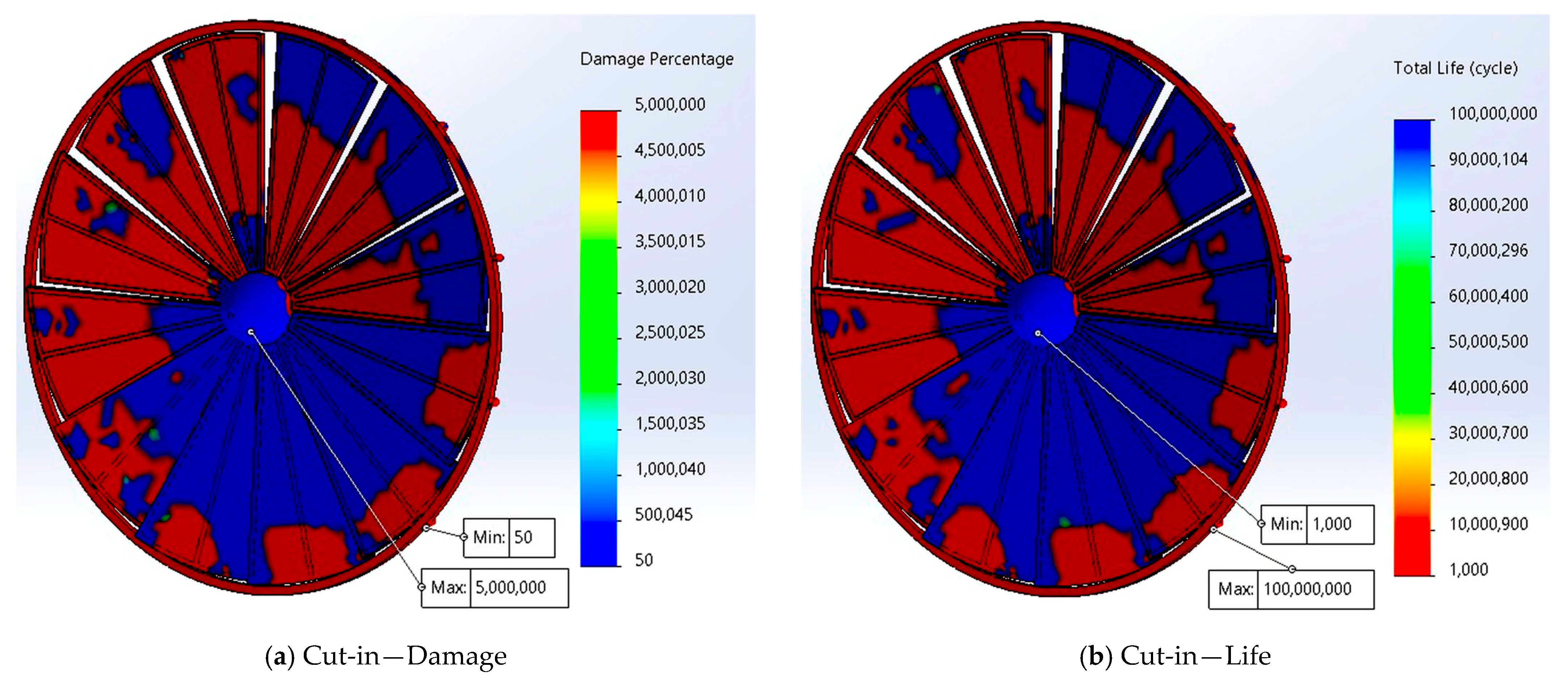
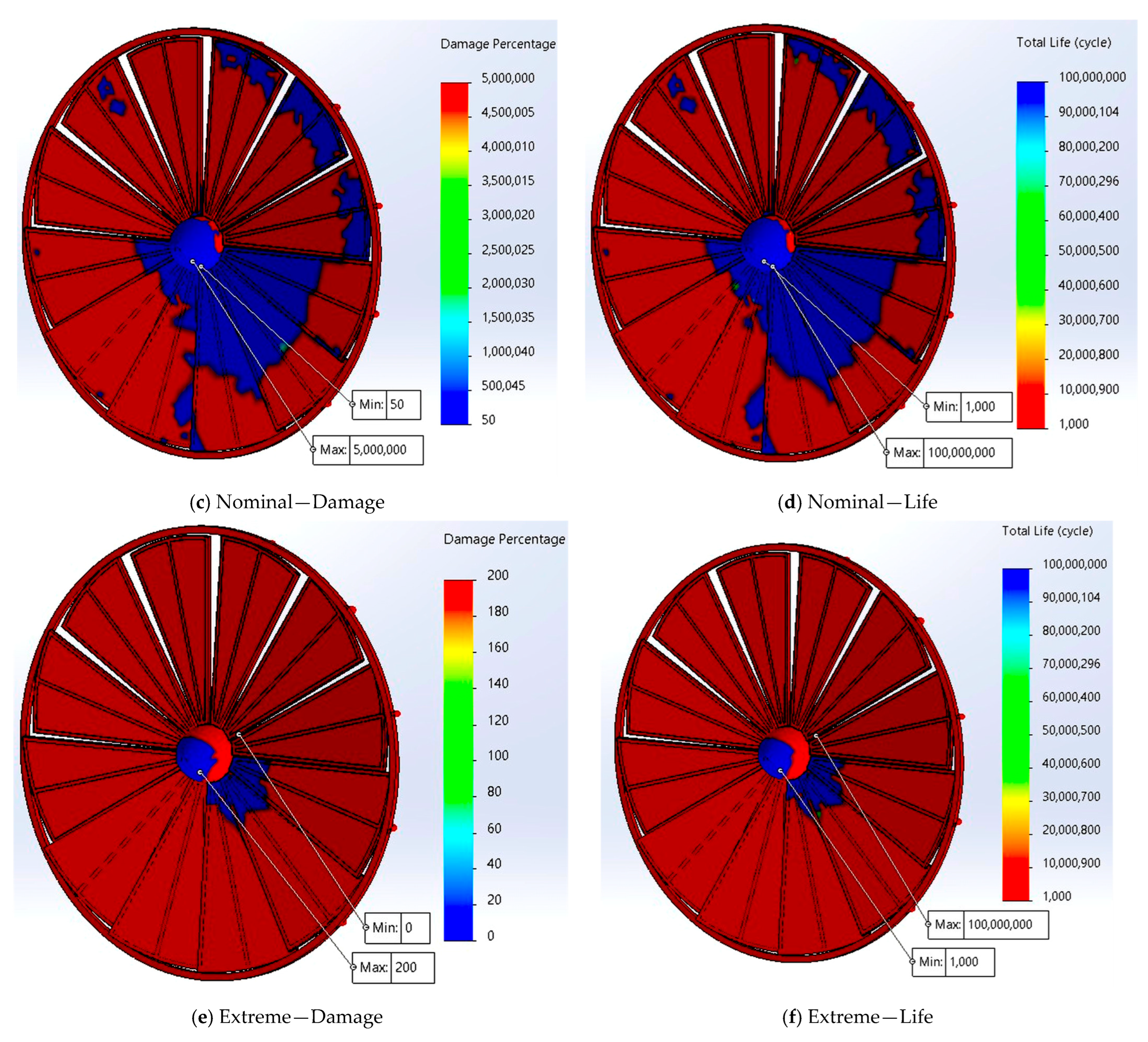
As a complementary durability assessment, a stress–life (S–N) fatigue analysis was performed in SolidWorks Simulation, applying Miner’s linear damage rule D = ∑ni/Ni on the same mesh used in the static cases. The fatigue evaluation follows the SWT good-practice workflow (BEM → CFD → FEM loads, IEC 61400-2 acceptance criteria), already adopted in our FEM chapter for case definition and verification. The stress time histories for each blade location were generated by proportionally scaling the static von Mises stresses with the BEM-derived pressure pairs (pnorm,ptang) for the three representative regimes and applying the following cycle counts: Cut-in (3 m/s, pnorm = 0.38 Pa, ptang = 90.5 Pa, n1 = 5 × 10⁷ cycles), Nominal (5 m/s, 0.5 Pa/210.9 Pa, n2 = 5 × 10⁷ cycles), and Extreme/Feather (25 m/s, 25.1 Pa/946 Pa, n3 = 2 × 10³ cycles). In the SolidWorks fatigue plots, “Damage” is the cumulative Miner index D (100% = failure when D = 1), while “Life” is the local predicted life Ni in cycles for the applied stress range.
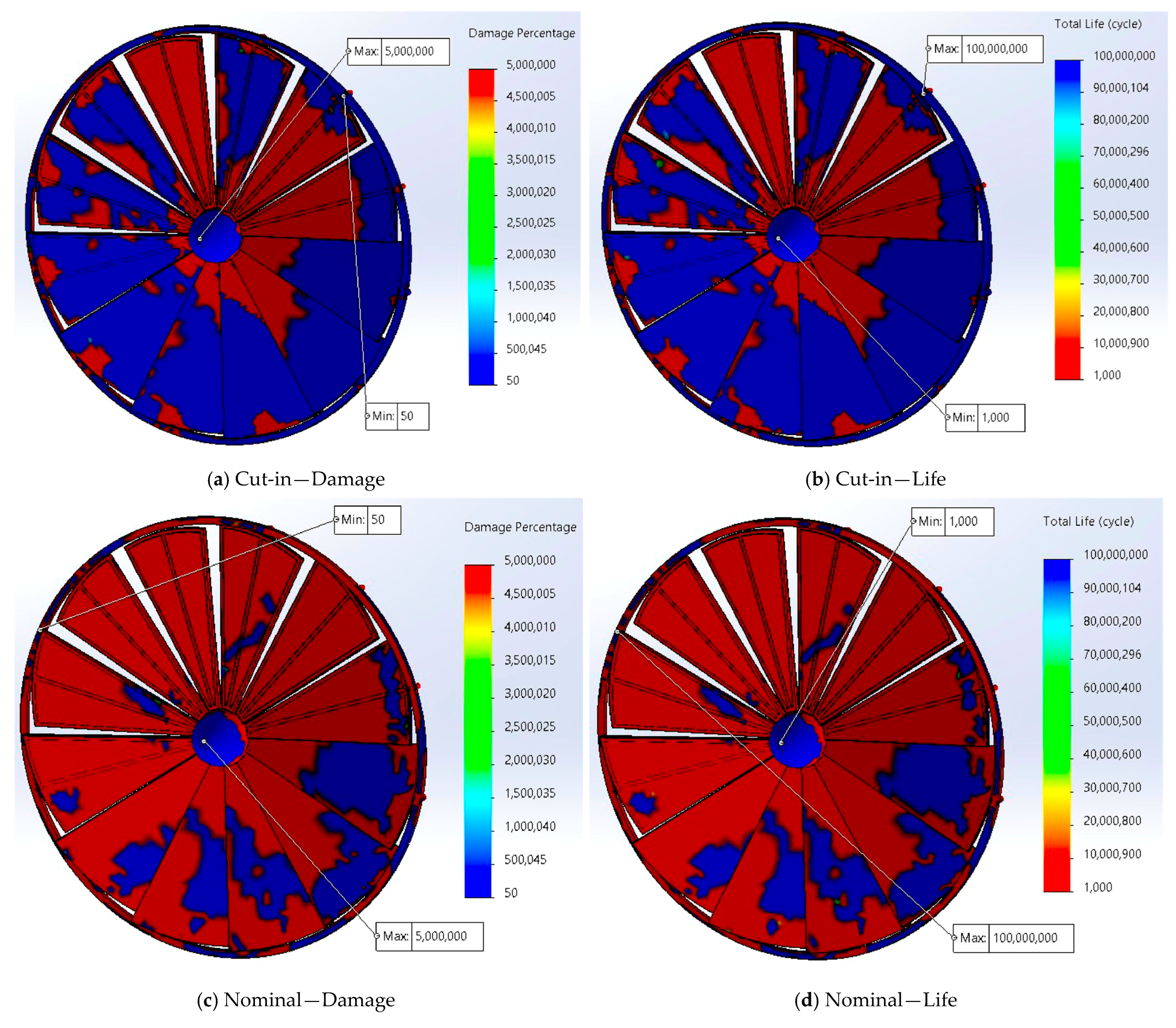
Figure 18a–f summarises the S–N/Miner fatigue maps for the three operating blocks (Cut-in, Nominal, Extreme), showing both the cumulative damage and the predicted life on the same blade mesh as in the static checks.
Results. For Cut-in and Nominal, the Life maps show minimum local life Ni ≥ 108 cycles across the blade surface; therefore the block damages are bounded by D1 ≤ 0.50 and D2 ≤ 0.50 respectively. High-stress spots coincide with the hub fillet and blade–ring bolt line, but remain well inside the elastic domain previously reported in the static checks; no element reached D ≥ 1. For the Extreme/Feather block the number of occurrences is small (n3 = 2 × 10³). Even where stresses rise (ring spokes and lower pitch-arm fillet), the Life field remains an order of magnitude above the applied count (typically N3 ≫ 105 cycles), hence D3 ≪ 0.02. Summing over the three blocks yields Dtotal < 1 everywhere, with critical values clustered at the lower hub-side pivot and the trailing bolt line at μ ≈ 0.7—exactly the hotspots indicated by the static maps.
Implications: (1) Under the assumed duty (two high-cycle blocks plus a short “storm” block), the flat-blade + ring concept is fatigue-safe within the IEC 61400-2 design envelope used in the FEM chapter; (2) design attention should focus on bolt-hole radii, washer diameter and clamp load at the blade–ring joint, and on surface finish at the hub fillet, where damage concentrates; (3) although the Extreme block contributes negligibly to Miner damage, it drives peak stresses, therefore post-event inspections of those joints are recommended after severe winds. These findings close Scenario 1 by showing that the static safety margins translate into adequate fatigue life and motivate Scenario 2 (full-assembly analysis) to confirm that the same trends hold once all 12 blades and the ring interact structurally.

3.4.3. Full Blade Assembly Analysis

The FEM analysis was extended from the single-blade level to the full rotor assembly, comprising 12 flat blades, the hub, and the stiffening ring (Table 13). The objective was to assess global stiffness, stress distribution, and safety margins under representative aerodynamic load cases (Cut-in, Nominal, Extreme). Connections were modeled as pins (blade–hub, blade–ring) and contacts (hub–ring), following IEC 61400-2 recommendations [28].
Cut-in Cases (β = 0°, 10°, 20°)
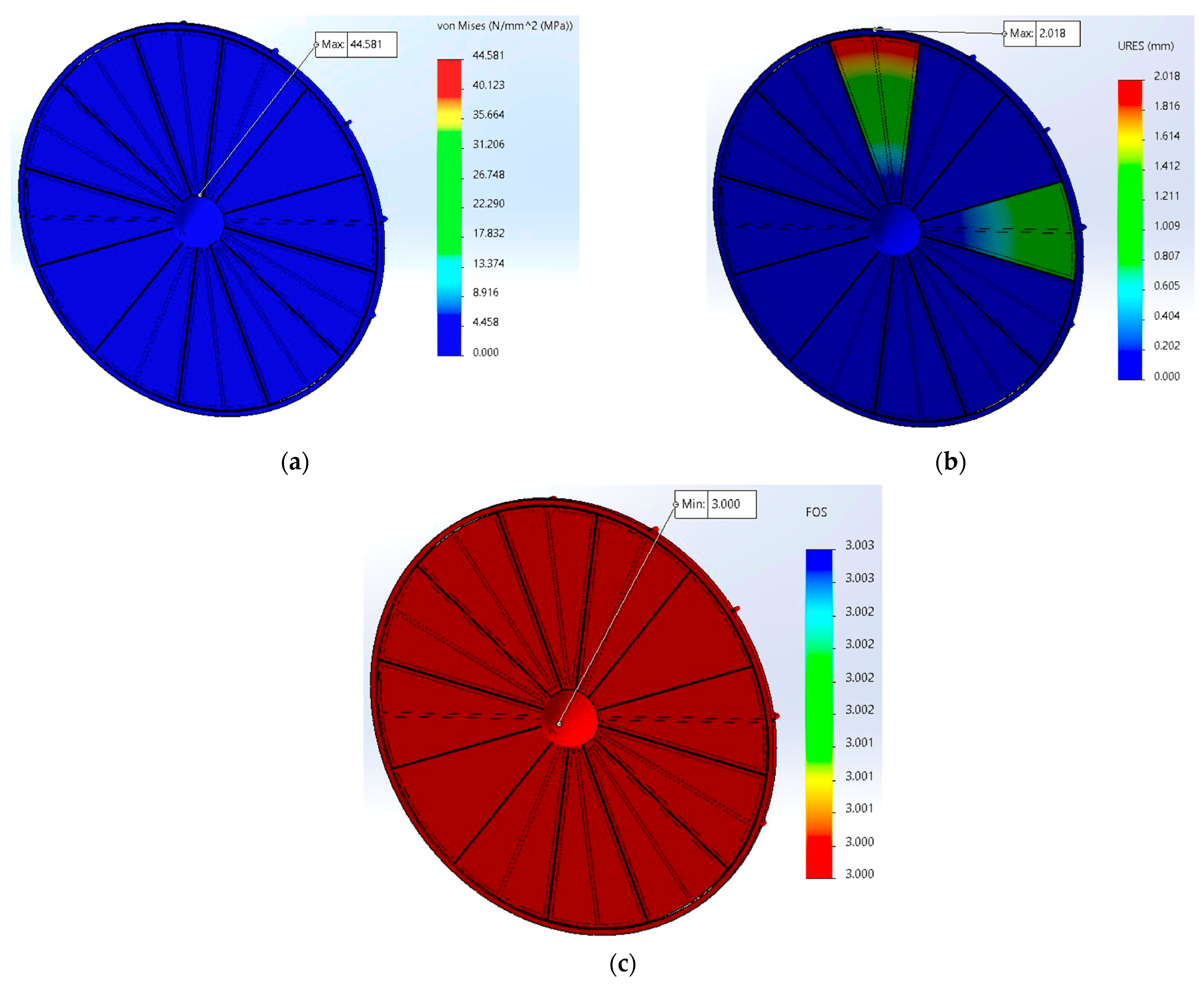
For β = 0° (Figure 19, Table 14), maximum von Mises stress reached 44.6 MPa at the hub–ring interface (~16% of Rp0.2 for Al 6061-T6). Tip displacement was 2.0 mm (<0.15%·R), and FOS ≥ 3 across the rotor. These results align with Sharpe & Jenkins [27], who reported σ ≈ 38 MPa and Utip ≈ 1.6 mm for a smaller flat rotor, and with Ghasemi et al. [40], and Zhang et al. [13], who observed Utip < 3 mm for β = 0°.
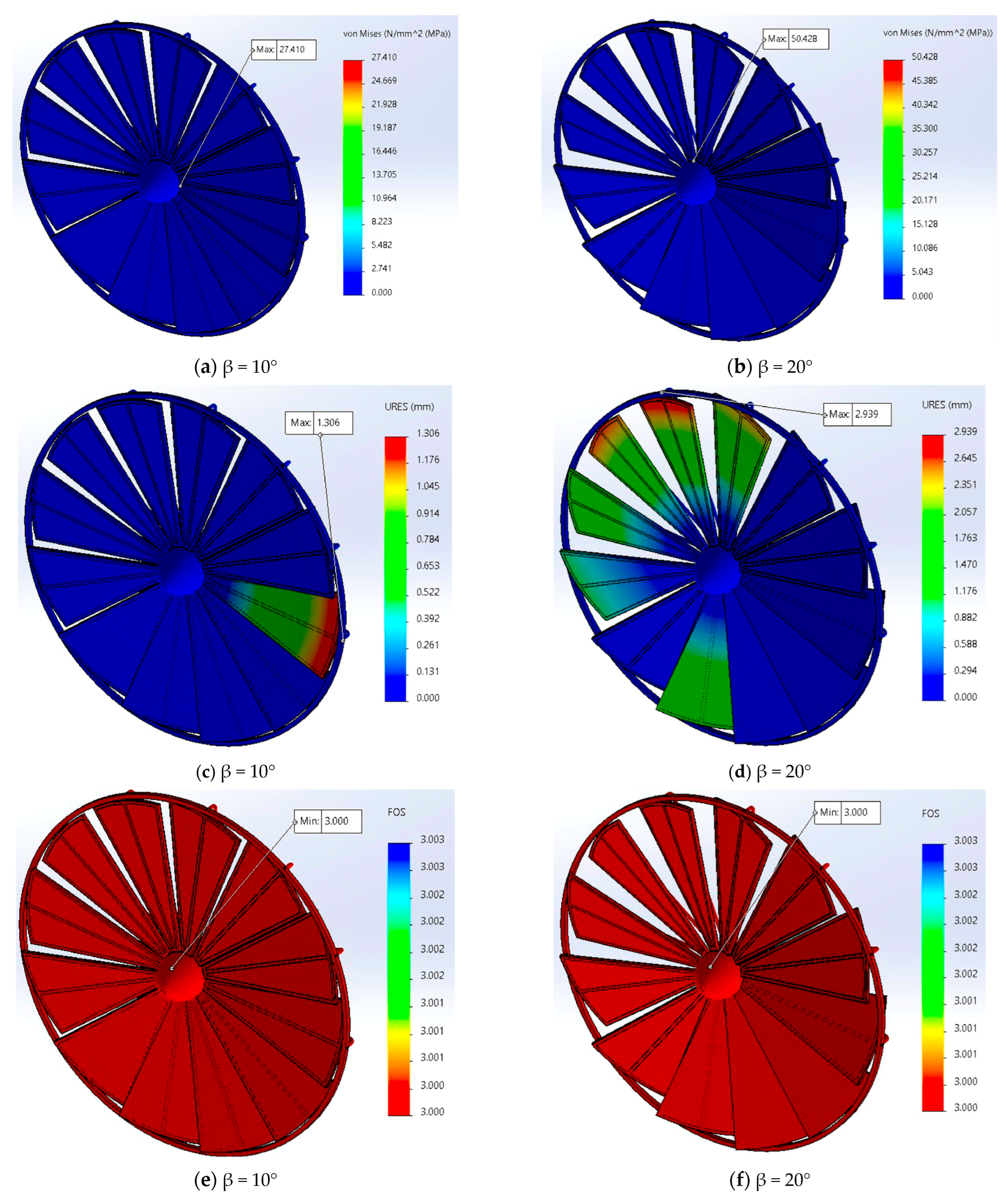
For β = 10° and 20° (Figure 20), stresses and deflections increased almost linearly with pitch:
  • β = 10° → σ ≈ 27 MPa, Utip ≈ 1.3 mm, FOS > 8;
  • β = 20° → σ ≈ 50 MPa, Utip ≈ 2.9 mm, FOS > 5.
These values remain well below yield and IEC thresholds [28], and are consistent with startup tests on flat rotors [39,40].
Conclusion (Cut-in). At low wind speed, material strength is not the limiting factor; the critical parameter is pitch angle, which can safely be raised to β ≈ 20° to ensure startup torque without overstressing the structure.
Nominal Case (V = 5 m/s, β = 10°)
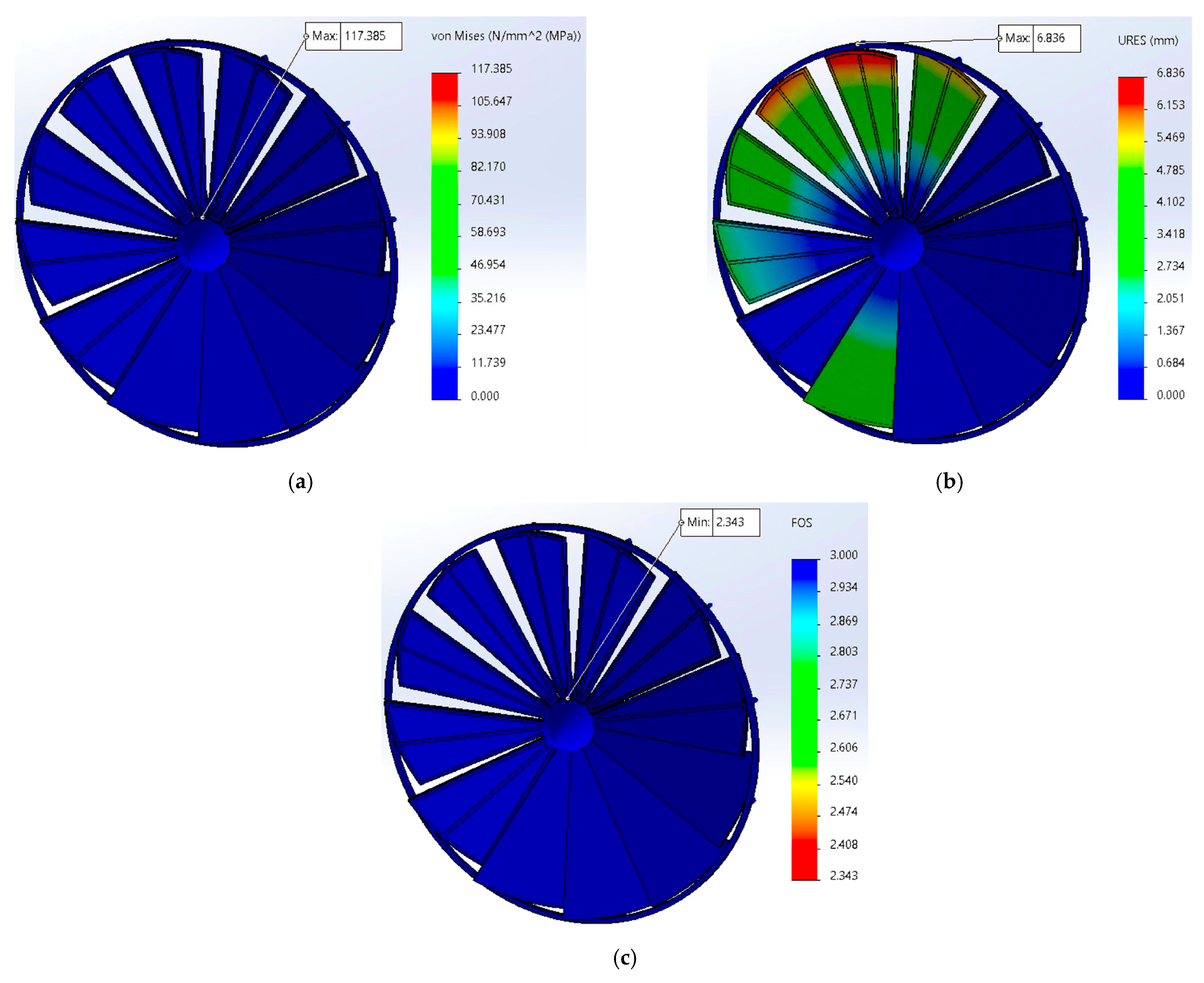
At nominal operation (Figure 21), maximum von Mises stress reached 117 MPa at the blade–ring joint (~42% of Rp0.2), tip displacement ≈ 6.8 mm (~0.45%·R), and FOS dropped locally to 2.3. These values are acceptable for prototypes but indicate that blade–ring connections are critical. Similar stress magnitudes were reported by Dinesh, H. [40] for flat rotors at Re ≈ 105, while Zhang et al. (2025) observed even higher stresses (140–160 MPa) in feathering tests [22].
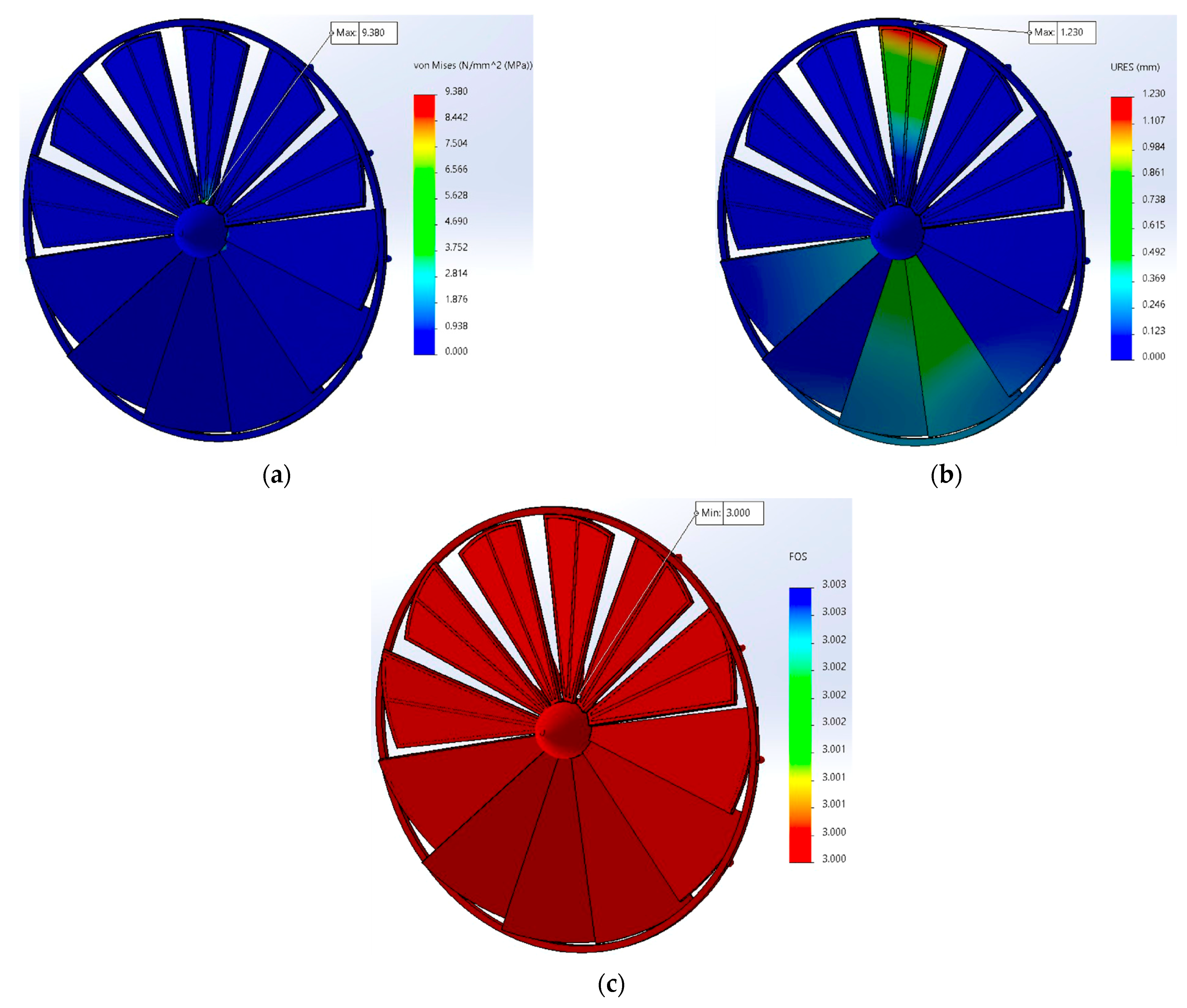
To improve safety margins, the assembly was reinforced (Figure 22) with Ø30 mm hub pins, a 50 × 50 mm ring, and Ø40 mm spokes. The redesign reduced maximum stress to 9.4 MPa, tip displacement to 1.2 mm, and increased FOS above 3 throughout the rotor. The added mass (+76%) increased inertia, which aids storm resistance, while still allowing sufficient cut-in torque (Q ≈ 3.5 N·m) [36].
Conclusion (Nominal). The upgraded geometry significantly improves stiffness and safety, ensuring σvM,max < 0.1·Rp0.2 and Utip < 0.1%·R, consistent with small-rotor practice [33].
Extreme Case (V = 25 m/s, β = 10° and β = 80°)
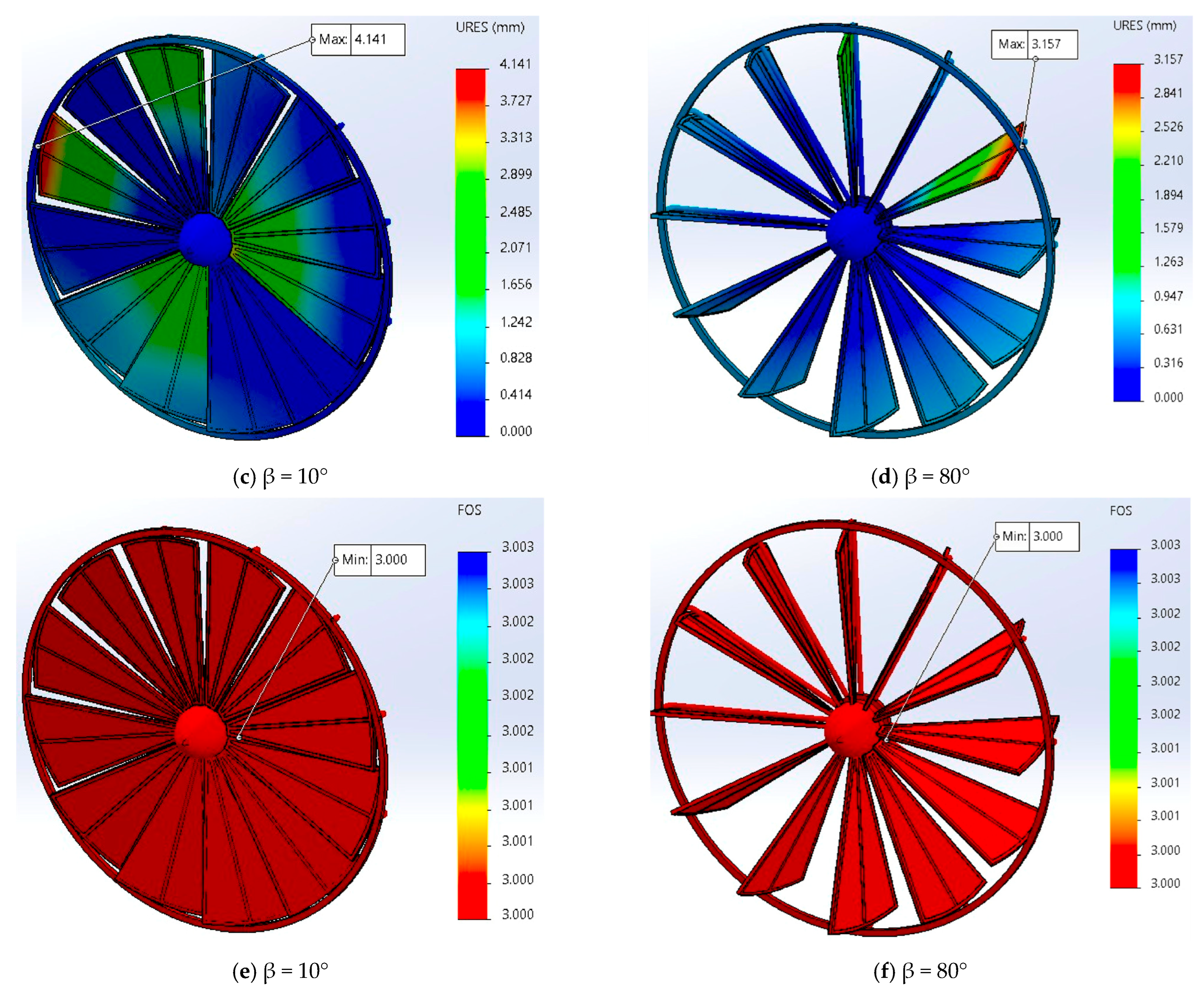
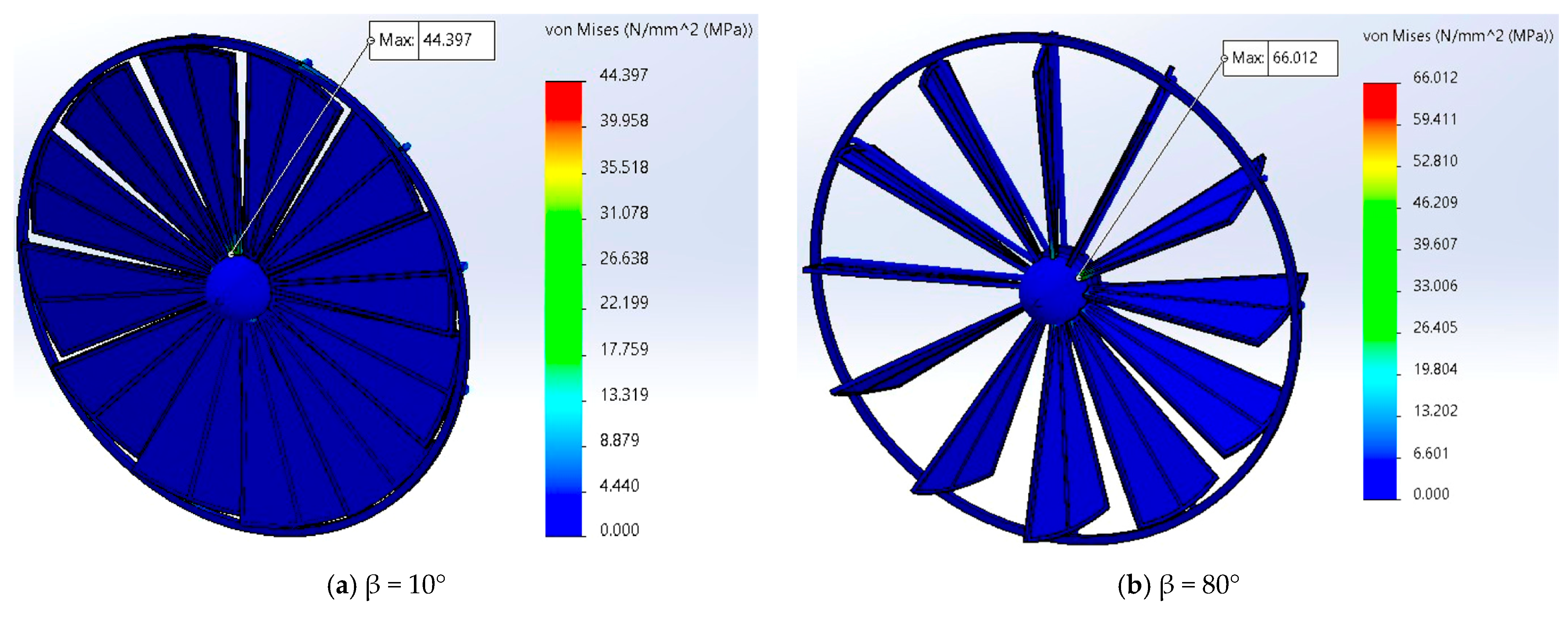
For β = 10° (Figure 23a,c,e), maximum stress was ≈ 44 MPa at the blade–ring joint, displacement ≈ 4.1 mm (~0.27%·R), and FOS > 3. These results agree with experimental data on flat blades under strong tangential loading (~40 MPa) [13].
For β = 80° (feathering) (Figure 23b,d,f), stresses shifted toward the blade roots, reaching ≈66 MPa, with tip displacement reduced to ≈3.2 mm. FOS remained > 3. These values are below those reported by Zhang et al. (≈90 MPa at β = 80–90°) [13], thanks to the reinforced ring and spokes.
Conclusion (Extreme). The resized assembly maintains σvM,max < 0.25·Rp0.2 and Utip < 0.5%·R in both open and feathered positions, meeting IEC 61400-2 and established design practice for small rotors [10]. The rotor withstands storm loads elastically, with safe transitions between power capture and braking.
Overall Conclusion—Assembly
Across all regimes (Cut-in, Nominal, Extreme), the full rotor assembly:
  • operates in the elastic domain (σvM,max < 0.5·Rp0.2);
  • shows deflections < 0.5%·R, well within IEC 61400-2 [10];
  • highlights the blade–ring joints as critical zones, consistent with literature [13,33,39,40].
The reinforced geometry (Ø30 mm pins, 50 × 50 mm ring, Ø40 mm spokes) ensures robust performance without compromising startup or nominal operation, validating the structural concept for the 3 m prototype.

3.4.4. Fatigue Assessment of the 12-Blade/Ring Assembly (S–N/Miner) and Life Maps

We performed a stress–life (S–N) fatigue check on the full rotor (12 flat blades + peripheral ring + hub) using the same FE mesh as in the static runs. The cyclic stresses at each element were obtained by proportional scaling of the static von Mises fields with the BEM-derived pressure pairs (pnorm,ptang) for the three operating blocks (Table 15) and by applying Miner’s linear damage rule D = ∑ni/Ni with material S–N data for Al-6061-T6 (mean-stress correction per Goodman). Post-processing follows the standard “Damage” (cumulative Miner index, 100% ≡ D = 1) and “Life” (local Ni in cycles for the applied stress range) maps in SolidWorks Simulation. The approach and notation match those used widely for wind-turbine components and in the micro-wind literature [9,41].
Reading the maps (Figure 24a–f and Figure 25a–d). Blue regions indicate long life (high Ni)/low damage D; warm colors mark higher damage or shorter life. Small, intensely colored specks near constraints (hub bore, rigid connectors) are typical FE post-processing artifacts and were not used for design decisions.
Cut-in (3 m/s, Figure 24a,b). Damage remains low over the ring and most blade area; hotspots appear at the hub fillet and at several blade–ring bolts. Life is broadly at or above 108 cycles; block damage D1 is well below unity [42,43].
Nominal (5 m/s, Figure 24c,d). Stress patterns intensify along spoke/bolt lines but the Life map still shows Ni ≳ 108 across the working surface. The cumulative damage of this block D2 stays below unity; no element reaches D ≥ 1 [11,44].
Extreme/feather (25 m/s, braking, Figure 24e,f). Although local stresses peak around the inner hub and a few spokes, the cycle count is small; Life values are orders of magnitude above n3 and the damage contribution D3 is negligible compared to the two high-cycle blocks [28,41].
Cut-in (Figure 25a,b). Raising β to 20° slightly redistributes damage towards the trailing bolt line (higher drag share) but Life remains very high over the ring and blades; D1 comparable to β = 10° [25,26].
Nominal (Figure 25c,d). The load path through the spokes and outer ring is more pronounced; damage rises locally at several bolts and at the hub fillet. Even so, predicted Life stays predominantly ≥107–108 cycles and cumulative block damage remains below unity [25,26].
Summing Miner damage over the three blocks yields Dtotal < 1 in the assembly for both β = 10° and β = 20°, i.e., the static margins established earlier translate into adequate fatigue life at the assembly level. Critical locations remain consistent with the single-blade study: hub fillet and blade–ring bolt circle around μ ≈ 0.7 [25,26].
Life is governed by the two high-cycle, moderate-stress blocks (cut-in, nominal). The “Extreme” block contributes very little to Miner damage but sets peak stress and therefore dictates inspection after storms—standard practice for small HAWTs [26,42].
Keep generous fillet radii and good surface finish at the hub transition; use adequate washer/bolt-head diameters and clamp force at the blade–ring joint; and retain the ring’s stiffness, as it spreads loads and suppresses local fatigue hot-spots—an effect consistently reported for thin flat-plate rotors [26,42].
All fatigue evaluations used Miner linear accumulation and S–N data for 6061-T6 with mean-stress correction; workflow and conventions follow standard guidance and the SolidWorks Simulation fatigue module documentation [28].
Conclusion—FEM and Fatigue
The FEM simulations, complemented by fatigue checks, demonstrate that both the single blade and the full 12-blade rotor assembly remain within the elastic domain across all operating regimes (Cut-in, Nominal, Extreme). Maximum stresses stay below 0.5·Rp0.2, tip displacements are <0.5%·R, and safety factors remain above IEC 61400-2 limits [28]. Fatigue evaluation confirms Miner damage < 1 in all cases, with critical hotspots located at the blade–ring joints and hub fillets, but with predicted lifetimes above design requirements. Structural reinforcement of pins, ring, and spokes further increases stiffness and safety without compromising startup performance.

4. Discussion

This section interprets the results in terms of rotor performance, structural adequacy, and design trade-offs. We discuss how the Cp(λ,β) plateau and the three-point pitch schedule translate into operating margins, how CFD corroboration supports the use of BEM-derived loads, and how the FEM and fatigue findings guide detailing at the hub fillet and blade–ring joint. We also delineate the scope boundaries and limitations (no field tests yet; simplified PV geometry/mounting; material aging not modelled; drivetrain handled parametrically) and outline their expected impact on uncertainty and applicability. Finally, we summarize the next steps—transient aero-elastic–torsional modelling, system-level co-design with generator/brake/actuation, and the planned wind-tunnel/stand tests to calibrate the models and acceptance criteria.

4.1. How the Results Fit into a Context with No Direct Precedent

The presented prototype—a rotor with flat blades stiffened by a peripheral ring—has, at the time of writing, no published studies at the 3 m scale. Therefore, comparisons with “previous studies” are made based on phenomenological elements (Cp curves for flat plates [11,12], radial loads at Re ≈ 105 [13]) and general design standards for micro turbines (IEC 61400-2 [10]).
The results confirm two working hypotheses:
  • The aerodynamic penalty of flat blades (~−20% compared to airfoils) becomes acceptable if the pitch (β ≈ 10–20°) and moderate TSR (λ ≈ 2.6) are optimized;
  • Peripheral stiffening can keep σ < 0.25·Rp0.2 even in 25 m/s gusts, without excessive mass (total weight increase +76%).

4.2. Technical and Market Implications

  • Urban/peripheral applicability. The starting torque > 3 N·m at 3 m/s and nominal power ~0.6 kW at 5 m/s place this prototype in the SWT (≤10 kW) segment, suitable for rooftops or off-grid stations. The ring stiffener reduces noise levels by eliminating the free blade tip, meeting urban acoustic standards [33].
  • Hybrid PV integration. At feathering (β = 90°), the rotor allows ~90% of solar irradiance to pass through—a key advantage for agrivoltaic configurations, where <15% shading is considered acceptable [40].
  • Simplified control strategy. Simulations indicate only three critical pitch positions: 20° (self-start), 10° (nominal), and 90° (protection). This allows a mechanical stop + bevel gear mechanism, more reliable and cheaper than continuous servo systems.

4.3. Influence of the Stiffening Ring Mass and Inertia

In steady operating points set by the λ–β schedule, the stiffening ring does not modify the aerodynamic performance Cp(λ,β) directly. Its role is primarily dynamic. The ring adds polar inertia to the spinning assembly; to first order for a thin ring at radius R: Jring ≈ mring·R2.
It therefore contributes to the total polar inertia Jtot = Jgen + Jrotor + Jring that appears in the rotational dynamics: Jtot·ὠ = Taero(λ,β) − Tgen(ω) − Tloss, and thus influences spin-up/spin-down transients and the effective control bandwidth. A larger Jring slows start-up and emergency-stop deceleration but can make the system less sensitive to high-frequency torque disturbances.
The ring also couples the blades circumferentially, creating bladed-wheel modes. Non-rotating modal frequencies may shift due to added mass at the periphery, while centrifugal stiffening at operating Ω tends to raise flapwise frequencies; the net change depends on mring and Ω. In addition, yaw/tilt manoeuvres experience a gyroscopic moment that scales with the polar moment and spin rate (approximately Mg∼Jp·Ω·ψ̇); the ring increases Jp and therefore slightly increases these loads during fast reorientation.
These effects are outside the scope of the present steady, rotor-centric study but will be quantified in the follow-up system model (aero-elastic–torsional co-simulation) and measured on the 1:1 stand via spin-up curves, emergency-stop deceleration, and yaw-step tests. Manufacturing tolerances and balance of the ring will also be checked, as imbalance can amplify dynamic loads. None of these considerations alters the steady aerodynamics reported here; they define the dynamic integration steps for the next phase.

4.4. Study Limitations

This study does not include experimental measurements; results are based on a verified multi-fidelity chain (BEM → CFD → FEM) and literature anchoring. The CFD is steady-state RANS (k–ω SST) and may underestimate transient peaks in torque and pressures during gusts; these effects are reserved for transient follow-up analyses. The BEM formulation omits detailed blade–ring interference and 3D separation physics, which can reduce Cp by a few percent relative to idealized predictions. Structural FEM is quasi-static; life estimates rely on standard S–N/Miner procedures and will be refined with load histories from experiments. Finally, the present scope focuses on the rotor; drivetrain, pitch drive, and controls are treated parametrically as they are off-the-shelf for the target power class [9,10,13,32].
This paper does not model drivetrain dynamics (generator/brake/actuation); these will be addressed in a follow-up system study and validated on the stand. The present λ–β schedule and steady operating points are thus representative for rotor sizing but not a substitute for full electro-mechanical co-simulation.
System elements not modelled (generator, brake, drives): implications and plan. The generator sets the operating tip-speed ratio λ through its torque–speed law during steady conditions; as a result, the Cp(λ,β) trends reported here are largely insensitive to the specific generator map. Transient phenomena—such as combined rotor–generator inertia, torque ripple, and electrical damping—primarily influence the torsional response. These effects will be addressed in a coupled aero-elastic–torsional model and calibrated on 1:1 stand tests.
The brake is engaged only in parked or emergency states. With β ≈ 90°, the aerodynamic torque is strongly diminished, and the resulting brake loads act predominantly within the drivetrain, exerting negligible influence on the rotor aerodynamics analyzed here. Emergency-stop transients will be measured and used to refine the structural load cases.
The pitch and azimuth drives are treated as quasi-static in the present analysis. Future work will include actuator rate/torque limits and closed-loop control to quantify their effect on gust rejection as well as on start-up and shut-down dynamics.
Overall, these clarifications do not alter the rotor-level conclusions and they define the system co-design steps—rotor plus generator, brake, and actuation—to be reported in a companion study.
The PV geometry and mounting details were simplified in both the aerodynamic and structural models (panel/frame, fasteners, and cabling represented via lumped mass and projected area). Such simplifications can modify drag, local separation, and load paths at certain operating points. Their effects will be bounded experimentally and incorporated into a refined CAD/mesh model once hardware is available.
Material aging and environmental degradation were not modelled. Over service time, UV exposure, humidity/temperature cycling, corrosion, fastener relaxation, and adhesive/interface creep may reduce stiffness and strength. At this stage we mitigate these risks through conservative allowables and safety factors; they will be quantified via coupon/assembly qualification tests and folded into updated life predictions and inspection intervals after the tunnel and stand campaigns.

5. Conclusions

Our multi-fidelity workflow (BEM → CFD → FEM) provides a self-consistent aerodynamic and structural characterization of the 12-blade flat-plate rotor with a peripheral stiffening ring. Across cut-in, nominal, and feathering cases, the three solvers agree within ≈10% on torque, thrust, and pressure distributions, while FEM results confirm that stresses (<0.5·Rp0.2) and deflections (<0.5%·R) remain safely within design targets. Fatigue analysis further demonstrates Miner damage <1 across all regimes, with critical hotspots (hub fillets and blade–ring joints) remaining above design lifetime requirements.
The pitch-control strategy is strongly supported by the simulations:
  • β ≈ 20° enables reliable self-start at 3 m·s−1;
  • β ≈ 10° maximizes power at ~5 m·s−1 (Cp plateau ≈ 0.35 at λ = 2.4–2.8);
  • β ≈ 90° reduces net torque to near-zero at 25 m·s−1, ensuring storm protection.
Although aerodynamic efficiency is ~20% lower than profiled rotors, the flat-plate concept offers clear advantages in cost, manufacturability, and PV integration, aligning with recent Hybrid-Lambda trends [9,11,12,13].
The present work is limited to the rotor subsystem; drivetrain and control hardware are treated parametrically. Nevertheless, the combined CFD–FEM results establish a robust numerical basis for experimental validation. We pre-declare acceptance thresholds for upcoming tunnel and stand tests (|ΔCp| ≤ 10% at nominal λ, |Δp| ≤ 15% at μ ≈ 0.7) to enable objective corroboration. Meeting these criteria will calibrate the models for optimization and future aeroelastic extensions [10,13,17,18,19,29,30].
Future Perspectives. The outcomes of this study on the aero-structural behavior of the prototype rotor will directly inform the technical and mechanical solutions for the construction of hybrid systems. The numerical insights will guide the design of mechanical subsystems responsible for electricity generation in both wind and photovoltaic modes. Future work will investigate the insertion of a belt-driven variable-speed transmission to accommodate rotor speed variations at different wind velocities without relying solely on braking—an essential feature for a rotor with significant inertia. In addition, the entire mechanical chain (rotor–transmission–generator–brake) will be analyzed with a focus on optimization, reliability, and cost-effectiveness. Further research will also address the coordinated use of the two renewable resources (wind and solar), advanced material options for increased fatigue resistance, and the scalability of the proposed rotor concept toward multi-kilowatt hybrid installations.

Author Contributions

Conceptualization, G.D.C. and A.D.N.; Methodology, V.F., A.D.N. and D.V.T.; Software, A.D.N.; Validation, V.F. and A.D.N.; Formal analysis, G.D.C. and D.V.T.; Investigation, G.D.C., V.F., A.D.N. and D.V.T.; Resources, G.D.C. and D.V.T.; Data curation, D.V.T.; Writing—original draft, A.D.N.; Writing—review & editing, G.D.C.; Visualization, V.F. and A.D.N.; Supervision, V.F. and A.D.N.; Project administration, V.F. and A.D.N. All authors have read and agreed to the published version of the manuscript.

Funding

This research received no external funding.

Institutional Review Board Statement

Not applicable.

Informed Consent Statement

Not applicable.

Data Availability Statement

The original contributions presented in this study are included in the article. Further inquiries can be directed to the corresponding author.

Conflicts of Interest

The authors declare no conflict of interest.

Abbreviations

3DThree-dimensional
a, a′Axial and tangential induction factors
AeffEffective swept area
BCBoundary condition
BEM/BEMTBlade Element Momentum (Theory)
βBlade pitch angle
CAISOCalifornia Independent System Operator
CADComputer-Aided Design
CFDComputational Fluid Dynamics
ClLift coefficient
ClmaxMaximum lift coefficient
CdDrag coefficient
CpPower coefficient
CFRPCarbon-Fibre-Reinforced Polymer
DOFDegrees of Freedom
EPEuropean Patent (e.g., EP 3736438 B1)
FEMFinite Element Method
FOSFactor of Safety
GGGlobal Goal (SolidWorks CFD output)
GFRPGlass-Fibre-Reinforced Polymer
GMNIAGeometrically & Materially Non-linear Imperfection Analysis
GW/MW/kWGiga-/Mega-/Kilowatt
HAWC2Horizontal Axis Wind turbine Code 2 (aero-elastic solver)
HAWTsHorizontal-Axis Wind Turbines
IECInternational Electrotechnical Commission
IEAInternational Energy Agency
k-ω SSTk-omega Shear-Stress-Transport turbulence model
LCOELevelized Cost of Electricity
LSBLaminar Separation Bubble
NRELNational Renewable Energy Laboratory
OpenFAST/ElastoDynOpen-source aero-elastic code/structural module
PIVParticle-Image Velocimetry
PVPhotovoltaic
qnNormal distributed blade load
qtTangential distributed blade load
RANSReynolds-Averaged Navier–Stokes
ReReynolds number
RPMRevolutions per minute
SFSafety Factor
SWTsSmall Wind Turbines
TSR Tip-Speed Ratio
URESResultant displacement (FEM post-processing)
UQUncertainty Quantification
VREVariable Renewable Energy
WECWind Energy Conversion
σvMvon Mises stress
ωAngular velocity (rad s−1)

References

  1. International Energy Agency. Renewables 2024: Analysis and Forecasts to 2030; IEA: Paris, France, 2024; Available online: https://www.iea.org/reports/renewables-2024 (accessed on 15 July 2025).
  2. Gorman, W.; Rand, J.; Manderlink, N.; Cheyette, A.; Bolinger, M.; Seel, J.; Jeong, S.; Wiser, R.H. Hybrid Power Plants: Status of Operating and Proposed Plants, 2024 Edition; Lawrence Berkeley National Laboratory: Berkeley, CA, USA, 2024. Available online: https://emp.lbl.gov/hybrid-power-plants-status-operating-and-proposed-plants-2024-edition (accessed on 15 July 2025).
  3. Hassan, Q.; Algburi, S.; Sameen, A.Z.; Salman, H.M.; Jaszczur, M. A Review of Hybrid Renewable Energy Systems: Solar and Wind-Powered Solutions: Challenges, Opportunities, and Policy Implications. Results Eng. 2023, 20, 101621. [Google Scholar] [CrossRef]
  4. Alnaimi, F.B.I.; Kazem, H.A.; Alzakri, A.B.; Alatir, A.M. Design and Implementation of Smart Integrated Hybrid Solar-Darrieus Wind Turbine System for In-House Power Generation. Renew. Energy Environ. Sustain. 2024, 9, 2. [Google Scholar] [CrossRef]
  5. 24th International Wind & Solar Integration Workshop 2025—Preliminary Program. Berlin, Germany, 7–10 October 2025. Available online: https://windintegrationworkshop.org/program-overview-preliminary/ (accessed on 5 August 2025).
  6. Ministry of New and Renewable Energy (MNRE), Government of India. Amendment in the Guidelines for Tariff-Based Competitive Bidding Process for Procurement of Power from Grid-Connected Wind–Solar Hybrid Projects; MNRE: New Delhi, India, 2022. Available online: https://mnre.gov.in/en/notices/amendment-in-the-guidelines-for-tariff-based-competitive-bidding-process-for-procurement-of-power-from-grid-connected-wind-solar-hybrid-projects (accessed on 23 July 2025).
  7. Meister, R.; Yaïci, W.; Moezzi, R.; Gheibi, M.; Hovi, K.; Annuk, A. Evaluating the Balancing Properties of Wind and Solar Photovoltaic System Production. Energies 2025, 18, 1871. [Google Scholar] [CrossRef]
  8. U.S. Energy Information Administration. Solar and Wind Power Curtailments Are Increasing in California. Today in Energy, 28 May 2025. Available online: https://www.eia.gov/todayinenergy/detail.php?id=65364 (accessed on 27 July 2025).
  9. Pelletier, A.; Mueller, T.J. Low Reynolds Number Aerodynamics of Low-Aspect-Ratio, Thin/Flat/Cambered-Plate Wings. J. Aircr. 2000, 37, 825–832. [Google Scholar] [CrossRef]
  10. IEC 61400-2:2019; Wind Energy Generation Systems—Part 2: Small Wind Turbines. IEC: Geneva, Switzerland, 2019.
  11. Burton, T.; Jenkins, N.; Sharpe, D.; Bossanyi, E. Design Loads for HAWTs. In Wind Energy Handbook, 3rd ed.; Wiley: Hoboken, NJ, USA, 2021. [Google Scholar] [CrossRef]
  12. Boorsma, K.; Schepers, J.G.; Madsen, H.A.; Pirrung, G.R.; Echeverri, D.; van Garrel, A.; Lutz, T.; Stoevesandt, B.; Rahimi, H.; Meister, R.; et al. Progress in the Validation of Rotor Aerodynamic Codes Using Field Data. Wind Energy Sci. 2023, 8, 211–230. [Google Scholar] [CrossRef]
  13. AIAA. Guide for the Verification and Validation of Computational Fluid Dynamics Simulations. AIAA G-077-1998 (Reaffirmed 2002); American Institute of Aeronautics and Astronautics: Reston, VA, USA, 2002. [CrossRef]
  14. Verma, A.; Kulkarni, V. Monitoring the Wake of Low Reynolds Number Airfoils for Their Aerodynamic Loads Assessment. J. Appl. Fluid Mech. 2024, 17, 2481–2498. [Google Scholar] [CrossRef]
  15. Traub, L.W. Wing Efficiency Enhancement at Low Reynolds Number. Aerospace 2024, 11, 320. [Google Scholar] [CrossRef]
  16. Gutiérrez-Castillo, P.; Aguilar-Cabello, J.; Alcalde-Morales, S.; Parras, L.; del Pino, C. On the lift curve slope for rectangular flat plate wings at moderate Reynolds number. J. Wind Eng. Ind. Aerodyn. 2021, 208, 104459. [Google Scholar] [CrossRef]
  17. Zahle, F.; Li, A.; Lønbæk, K.; Sørensen, N.N.; Riva, R. Multi-fidelity, steady-state aeroelastic modelling of a 22-megawatt wind turbine. J. Phys. Conf. Ser. 2024, 2767, 022065. [Google Scholar] [CrossRef]
  18. Ribnitzky, D.; Berger, F.; Petrović, V.; Kühn, M. Hybrid-Lambda: A Low-Specific-Rating Rotor Concept for Offshore Wind Turbines. Wind Energy Sci. 2024, 9, 359–383. [Google Scholar] [CrossRef]
  19. Ribnitzky, D.; Petrović, V.; Kühn, M. A Scaling Methodology for the Hybrid-Lambda Rotor—Characterization and Validation in Wind Tunnel Experiments. Wind Energy Sci. 2025, 10, 1329–1349. [Google Scholar] [CrossRef]
  20. Madsen, M.H.A.; Zahle, F.; Sørensen, N.N.; Martins, J.R.R.A. Multipoint High-Fidelity CFD-Based Aerodynamic Shape Optimization of a 10 MW Wind Turbine. Wind Energy Sci. 2019, 4, 163–192. [Google Scholar] [CrossRef]
  21. Du, B.; Shen, E.; Wu, J.; Guo, T.; Lu, Z.; Zhou, D. Aerodynamic Prediction and Design Optimization Using Multi-Fidelity Deep Neural Network. Aerospace 2025, 12, 292. [Google Scholar] [CrossRef]
  22. Jiang, J.; Zhang, Z.; Han, Z.; Li, Y.; Zhang, L.; Chen, Z.; Fan, X.; Xu, S.; Li, B. Study on the Structural Strength Assessment of Mega Offshore Wind Turbine Tower. Energies 2024, 18, 69. [Google Scholar] [CrossRef]
  23. Gantes, C.J.; Vernardos, S.M.; Koulatsou, K.G.; Gül, S. Nonlinear Finite Element Analysis of Tubular Steel Wind Turbine Towers near Man Door and Ventilation Openings to Optimize Design against Buckling. Vibration 2024, 7, 212–228. [Google Scholar] [CrossRef]
  24. Hu, Y.; Yang, J.; Baniotopoulos, C.C. Repowering Steel Tubular Wind Turbine Towers Enhancing Them by Internal Stiffening Rings. Energies 2020, 13, 1538. [Google Scholar] [CrossRef]
  25. General Electric Renovables España, S.L. Rotor Assembly Having a Pitch Bearing with a Stiffener Ring. EP Patent EP 3 736 438 B1. 20 December 2023. Available online: https://patents.google.com/patent/EP3736438B1/en (accessed on 8 September 2025).
  26. Gantes, C.J.; Koulatsou, K.G.; Chondrogiannis, K.-A. Alternative Ring Flange Models for Buckling Verification of Tubular Steel Wind Turbine Towers via Advanced Numerical Analyses and Comparison to Code Provisions. Structures 2023, 47, 1366–1382. [Google Scholar] [CrossRef]
  27. Burton, T.; Jenkins, N.; Sharpe, D.; Bossanyi, E.; Graham, M. Further Aerodynamic Topics for Wind Turbines. In Wind Energy Handbook, 3rd ed.; Wiley: Hoboken, NJ, USA, 2021; Chapter 4; pp. 153–225. Available online: https://onlinelibrary.wiley.com/doi/10.1002/9781119451143.ch4 (accessed on 12 August 2025).
  28. IEC 61400-2:2013; Wind Turbines—Part 2: Small Wind Turbines. IEC: Geneva, Switzerland, 2013.
  29. Schepers, J.G.; Boorsma, K.; Aagaard Madsen, H.; Pirrung, G.; Bangga, G.; Sørensen, N.N.; Grinderslev, C.; Forsting, A.M.; Imiela, M.; Ramos-García, N.; et al. Final Report of IEA Wind Task 29, Phase IV: Validation of Aerodynamic Models; International Energy Agency, IEA Wind: Roskilde, Denmark, 2022; Available online: https://iea-wind.org/task-29 (accessed on 22 July 2025).
  30. Cardamone, R.; Broglia, R.; Papi, F.; Rispoli, F.; Corsini, A.; Bianchini, A.; Castorrini, A. Aerodynamic Design of Wind Turbine Blades Using Multi-Fidelity Analysis and Surrogate Models. Int. J. Turbomach. Propuls. Power 2025, 10, 16. [Google Scholar] [CrossRef]
  31. Schepers, J.G.; Boorsma, K.; Madsen, H.; Pirrung, G.; Özçakmak, Ö.S.; Bangga, G.; Guma, G.; Lutz, T.; Potentier, T.; Braud, C.; et al. IEA Wind TCP Task 29, Phase IV: Detailed Aerodynamics of Wind Turbines; IEA Wind: Roskilde, Denmark, 2021. [Google Scholar] [CrossRef]
  32. Celik, I.B.; Ghia, U.; Roache, P.J.; Freitas, C.J.; Coleman, H.; Raad, P.E. Procedure for Estimation and Reporting of Uncertainty Due to Discretization in CFD Applications. J. Fluids Eng. 2008, 130, 078001. [Google Scholar] [CrossRef]
  33. Hau, E.; Siegfriedsen, S. Wind Turbines: Fundamentals, Technologies, Application, Economics, 4th ed.; Springer: Berlin/Heidelberg, Germany, 2025. [Google Scholar] [CrossRef]
  34. Hu, Y.; Yang, J.; Baniotopoulos, C. Effect of Internal Stiffening Rings and Wall Thickness on the Structural Response of Steel Wind Turbine Towers. Eng. Struct. 2014, 81, 148–161. [Google Scholar] [CrossRef]
  35. Shiomitsu, D.; Yanagihara, D. Estimation of Ultimate Strength of Ring-Stiffened Cylindrical Shells under External Pressure with Local Shell Buckling or Torsional Buckling of Stiffeners. Thin-Walled Struct. 2021, 161, 107416. [Google Scholar] [CrossRef]
  36. Grinderslev, C.; Henriksen, L.C.; Zahle, F.; Bak, C. Implementation of the Blade Element Momentum Model on a Polar Grid and Its Aeroelastic Load Impact. Wind Energy Sci. 2020, 5, 1–22. [Google Scholar] [CrossRef]
  37. Bhuyan, S.; Biswas, A. Investigations on Self-Starting and Performance Characteristics of Simple H and Hybrid H-Savonius Vertical Axis Wind Rotors. Energy Convers. Manag. 2014, 87, 859–867. [Google Scholar] [CrossRef]
  38. Jonkman, J.; Butterfield, S.; Musial, W.; Scott, G. Definition of a 5-MW Reference Wind Turbine for Offshore System Development. NREL/TP-500-38060; National Renewable Energy Laboratory: Golden, CO, USA, 2009. [CrossRef]
  39. Castaignet, D.; Barlas, T.K.; Buhl, T.; Poulsen, N.K.; Wedel-Heinen, J.J.; Olesen, N.A.; Bak, C.; Kim, T. Full-Scale Test of Trailing Edge Flaps on a Vestas V27 Wind Turbine: Active Load Reduction and System Identification. Wind Energy 2014, 17, 549–564. [Google Scholar] [CrossRef]
  40. Dinesh, H.; Pearce, J.M. The Potential of Agrivoltaic Systems. Renew. Sustain. Energy Rev. 2016, 54, 299–308. [Google Scholar] [CrossRef]
  41. Damiani, R.; Davis, D. Design Load Basis Guidance for Distributed Wind Turbines; SR-5000-91458; National Renewable Energy Laboratory (NREL), Golden, CO, USA, 2024. Available online: https://www.nrel.gov/docs/fy25osti/91458.pdf (accessed on 5 August 2025).
  42. Evans, S.; Dana, S.; Clausen, P.; Wood, D. A Simple Method for Modelling Fatigue Spectra of Small Wind Turbine Blades. Wind Energy 2021, 24, 721–737. [Google Scholar] [CrossRef]
  43. Sutherland, H.J. On the Fatigue Analysis of Wind Turbines. SAND99-0089; Sandia National Laboratories: Albuquerque, NM, USA, 1999. [CrossRef]
  44. Schaarup, J. (Ed.) Guidelines for Design of Wind Turbines; Risø National Laboratory/DNV: Roskilde, Denmark, 2001; 253p; Available online: https://orbit.dtu.dk/en/publications/guidelines-for-design-of-wind-turbines (accessed on 30 July 2025).
Figure 1. Cp(λ,β) map using raw BEM data (no Glauert correction). Maximum detected in current grid: λ = 2.8, β = 18°, Cp ≈ 1.69. Note: The high Cp values (up to ~1.0) are unrealistic and originate from the use of flat plate polars and the absence of Glauert (Buhl) correction.
Applsci 15 13027 g001
Figure 2. Cp(λ,β) map with Glauert (Buhl) correction.
Applsci 15 13027 g002
Figure 3. Variation of Cp with λ for selected values of pitch angle β (BEM). The legend indicates the blade pitch angle β (°) corresponding to each curve (color).
Applsci 15 13027 g003
Figure 4. Cp–β characteristic at constant TSR (BEM). The legend indicates the tip-speed ratio λ corresponding to each curve (color).
Applsci 15 13027 g004
Figure 5. Distribution of Normal Load qn(r) on the Blade for Cut-in.
Applsci 15 13027 g005
Figure 6. Pressure Distribution Δp(μ) on the Blade (BEM).
Applsci 15 13027 g006
Figure 7. Cut-in Case (β = 0°), CFD Study.
Applsci 15 13027 g007
Figure 8. Cut-in Case (β = 10°, β = 20°), CFD Study.
Applsci 15 13027 g008
Figure 9. Cut-in Cases (β = 0°, β = 10°, β = 20°)—CFD Study.
Applsci 15 13027 g009
Figure 10. Case “Normal” (V = 5 m/s, β = 10°), CFD study.
Applsci 15 13027 g010
Figure 11. Case “Normal” (V = 10 m/s, β = 20°), CFD study.
Applsci 15 13027 g011
Figure 12. Case “Extreme” (V = 25 m/s, β = 80°), CFD study.
Applsci 15 13027 g012
Figure 13. Case “Extreme” (V = 25 m/s, β = 90°), CFD study. The fourth sub-image is highlighted with a blue box to indicate that the rotor torque converges to 0 N·m (storm protection mode).
Applsci 15 13027 g013
Figure 14. “Extreme” Case (V = 25 m/s, β = 90°), CFD. (a). Section through the rotor axis; (b). Flow trajectories.
Applsci 15 13027 g014
Figure 15. Blade Structure—Aluminum Alloy 6061-T6.
Applsci 15 13027 g015
Figure 16. Fixed/Fixed Configuration. (a). von Mises stress (global), σvM,max ≈ 10 MPa at the lower pivot; (b). Total displacement URESmax ≈ 0.07 mm at the tip; (c). Factor of Safety (FOS)min ≈ 3.0; (d). Zoom on the critical node—von Mises field; (e). Zoom on the critical node—FOS.
Applsci 15 13027 g016
Figure 17. Hinge/Hinge Configuration. (a). von Mises stress (global), σvM,max ≈ 392 MPa at the lower pivot; (b). Total displacement URESmax ≈ 16.8 mm at the tip; (c). Factor of Safety (FOS)min ≈ 0.70; (d). Zoom on the critical node—von Mises field; (e). Zoom on the critical node—FOS.
Applsci 15 13027 g017
Figure 18. Fatigue assessment for the three operating cases. (a). Cut-in—Damage (%); (b). Cut-in—Life (cycles); (c). Nominal—Damage (%); (d). Nominal—Life (cycles); (e). Extreme—Damage (%); (f). Extreme—Life (cycles).
Applsci 15 13027 g018
Figure 19. “Flat” case (β = 0°). (a). Stress σvM,max; (b). Total displacement (URES); (c). Safety Factor (FOS).
Applsci 15 13027 g019
Figure 20. “Flat” case (β = 10°, 20°). (a). Stress σvM,max β = 10°; (b). Stress σvon Mises, max β = 20°; (c). Total displacement (URES) β = 10°; (d). Total displacement (URES) β = 20°; (e). Safety Factor (FOS) β = 10°; (f). Safety Factor (FOS) β = 20°.
Applsci 15 13027 g020
Figure 21. Nominal Case (β = 10°, V = 5 m/s). (a). Stress σvM,max β = 10°, V = 5 m/s; (b). Total displacement (URES) β = 10°, V = 5 m/s; (c). Safety Factor (FOS) β = 10°, V = 5 m/s.
Applsci 15 13027 g021
Figure 22. Nominal Case (β = 10°, V = 5 m/s)—Upgraded Geometry. (a). Stress σvM,max, max β = 10°, V = 5 m/s; (b). Total displacement (URES) β = 10°, V = 5 m/s; (c). Safety Factor (FOS) β = 10°, V = 5 m/s.
Applsci 15 13027 g022
Figure 23. Extreme Case (β = 10°, β = 80°), resized geometry. (a). Stress σvM,max β = 10°; (b). Stress σvon Mises, max β = 80°; (c). Total displacement (URES) β = 10°; (d). Total displacement (URES) β = 80°; (e). Safety Factor (FOS) β = 10°; (f). Safety Factor (FOS) β = 80°.
Applsci 15 13027 g023aApplsci 15 13027 g023b
Figure 24. Fatigue maps of the 12-blade rotor assembly (β = 10°).
Applsci 15 13027 g024aApplsci 15 13027 g024b
Figure 25. Fatigue maps of the 12-blade rotor assembly (β = 20°).
Applsci 15 13027 g025
Table 1. Objectives, methods, metrics, acceptance, and references.
ObjectiveMethod (Section)Key Inputs and SettingsPrimary MetricsAcceptance/
Decision
Build Cp(λ,β) and radial loadsBEM (Section 2.2)25 radial stations; Prandtl tip/hub; Glauert–Buhl; |Δa|, |Δa′| < 1 × 10⁻⁴Cp map;
qn(r), qt(r)
Plateau at λ ≈ 2.4–2.8, β ≈ 8–14°; stable inductions
Check pressures and torqueCFD RANS (Section 3.3)k–ω SST; y+ ≈ 1; residuals < 1 × 10⁻⁴; 3 meshes; goal monitorsΔp(μ), Mz|ΔCp| ≲ 4%, Δp < ~6% vs. BEM; mesh-independent
Size ring/blade/pinsFEM static/modal (Section 3.4)Shell/beam; load mapping from BEM/CFD; support casesσvM, Utip, f1
(first natural frequency)
σvM ≤ 0.25·Rₚ0.2; Utip < 0.5%·R; f1 > 3·nmax (operating band)
Service lifeS–N/Miner (Section 3.4.2/Section 3.4.4)Goodman correction; duty blocks (Cut-in/Nominal/Extreme)Dtotal; Life mapsDtotal < 1; hot-spots localized
Credibility and scopeV&V/UQ * (Section 2.3; Section 4.4)Convergence; model-to-model checks; literature anchorsCoherency BEM–CFD–FEMPre-declared test targets |ΔCp| ≤ 10%, |Δp| ≤ 15%
* UQ (Uncertainty Quantification). We assess the impact of input and numerical uncertainties via one-at-a-time sensitivities (±10% airfoil polars, ±ΔTI), boundary-condition variants, and mesh-refinement checks, and we report the resulting bands on Cp (λ, β), torque, and local pressures.
Table 2. Correlation between wind speed, rotor speed, and TSR.
V (m/s)n (rpm) to λ = 2.0λ = 2.6λ = 2.8λ = 3.0
338.249.753.557
451667176
564838996
67699107115
789116125134
Table 3. Indicative Values for Blade Pitch Angle β.
Operating ModeV (m/s)/λCollective β (°)Purpose
Startup≤3/1.5–2.018–25High starting torque
Nominal5–6/2.6–2.88–12Maximum Cp, stable speed
Limiting7–104–6Power control, reduced noise
PV ModeLow wind≈0Maximum solar exposure
Storm≥2085–90Feathering, protection
The relation βopt = ϕ − αopt is adjusted using αopt ≈ 8–12° for a flat plate [9,14].
Table 4. Cp Values for λ = 2.0–3.2.
λ02468101214161820
20.2010.1920.1920.1540.60.0370.0930.1140.60.60.352
2.20.370.1530.60.1360.565−0.07−0.089−0.040.60.5630.053
2.40.0830.1330.1430.60.6−0.099−0.087−0.1540.60.3940.6
2.60.0570.110.1380.0340.529−0.162−0.1850.60.60.2850.6
2.80.0290.2420.084−0.0340.6−0.168−0.185−0.250.6−0.0330.379
3.0−0.0380.0170.0410.60.139−0.242−0.232−0.2080.60.4670.6
3.2−0.075−0.0210.009−0.1050.466−0.249−0.3140.60.60.383−0.275
Table 5. Summarizes the BEM-derived values for the three main operating regimes.
CaseV (m/s)λβ (°)Cp *P (W)Q (Nm)Comments
Cut-in32.0220.12143.52High pitch angle → sufficient torque for startup; low power output, but Cp reaches the imposed ceiling.
Nominal52.6100.369594.788.9Recommended operating regime (after corrections): Cp was capped; actual values may fall slightly below 0.6.
Extreme250.880−0.02−1450−109Very high β (feathering) ⇒ braking torque (negative power): case used for structural checks and braking analysis.
* Cp was artificially limited to 0.6 to avoid unrealistic values; for design purposes, a realistic Cp (slightly below the cap) will be used, based on CFD model results. Note: The arrow symbol (→) denotes “leads to” or “results in”. The double arrow (⇒) denotes a stronger or direct implication.
Table 6. Blade Loads from BEM Calculations.
CaseV (m/s)λβ (°)qn, peak
(N/m)
μ(qn)pnorm
(Pa)
qt, peak (N/m)μ(qt)ptang
(Pa)
Cut-in3.02.0220.100.300.3839.80.7790.5
Nominal5.02.6101.800.710.5192.70.73210.9
Extreme (feather)25.00.88015.130.4125.1416.40.27946.0
Table 7. CFD Study Cases.
CaseWind Speed (Velocity Inlet)Blade Pitch β
Cut-in3 m/s0° (PV mode), 10°, 20°
Nominal5 m/s10° (operation)
Extreme25 m/s80° (feather)
Table 8. Results—Cut-in case (V = 3 m/s, β = 10°, 20°).
Parameterβ = 10°β = 20°
Maximum static/total pressure (Pa)~101,340~101,365
Axial force (N)~18~35
Torque (N·m)~2.5~9
Table 9. Results and Interpretation—Cut-in, V = 3 m/s, β = 10°, β = 20° (CFD).
Global
Parameter (Goal)
ConvergenceFinal Value β = 10°Final Value β = 20°Interpretation
GG Maximum Static/Total Pressurestabilizes in <25 iterations~101,340 Pa (≈+140 Pa vs. ambient)~101,365 Pa (≈+165 Pa vs. ambient)At β = 20°, the pressure center rises slightly—flow is still attached, but the magnitude remains very small; flat blades do not create significant pressure differentials at 3 m/s.
GG Force Z (axial)initial numeric spike, then flat≈18 N≈35 NDoubling of force at β = 20° confirms increased lift; values are still modest → axial load is non-critical.
GG Torque Z (shaft torque)converges in <50 iterations≈2.5 N·m≈9 N·mStartup torque nearly triples at β = 20°—sufficient to overcome mechanical friction (≈3 N·m estimated from BEM).
Streamlines/velocity vectorsslight deviation, no recirculationslight inclination toward suction side, no stallFlow remains attached across the entire chord; actual angle of attack < 6° even at β = 20°.
Note: The arrow symbol (→) denotes “leads to” or “results in”.
Table 10. Results and Interpretation—Normal, V = 10 m/s, β = 20° (CFD).
Indicator (Goal)Stabilized ValueSignificance
GG Force Z≈350,000 N·mm → ≈350 NAxial thrust is 7× greater than at 5 m/s; remains under the axial bearing capacity (1 kN) → structurally safe.
GG Torque Z≈100,000 N·mm → ≈100 N·mDouble the nominal torque (~80 N·m at 5 m/s); with ω ≈ 12 rad/s, this yields P ≈ 1.2 kW, confirming Cp(λ,β) curve at λ ≈ 2.4.
Maximum Pressure~101,520 Pa (≈+200 Pa)Pressure increases linearly with ρV2; value remains far below 1 kPa—expected for flat blades.
ConvergenceStable after 25 iterationsRobust solution, mesh is adequate (y+ < 1).
StreamlinesSignificant deviation, no major recirculationFlow stays attached to the chord → β = 20° is still below stall angle even at Re ≈ 5 × 10⁵.
Table 11. Peak Blade Pressures from FEM/CFD Mapping.
Casepnorm, peak (Pa)ptang, peak (Pa)Source q (BEM)
Cut-in0.3890.5 [36]
Nominal0.51210.9 [36]
Extreme25.1946.0 [36]
Note: Tangential pressures were calculated using the formula: ptang = qt,ₚₑₐₖ/cmed, with cmed = 0.44 m (see Section 3.2).
Table 12. Static load response of a single blade under extreme conditions (V = 25 m/s, β = 80°).
Boundary ConditionσvM,max (MPa)LocationURES (mm)LocationFOSInterpretation
Fixed/
Fixed
10Upper joint
(hub side)
0.07Tip/upper joint3.0Very stiff; tangential moment closed through ring
Fixed/Hinge11.3Upper joint0.67Tip/upper joint3.0Slight increase in stress; higher torsional flexibility
Hinge/Hinge392.2Upper shaft
in the ring
16.8Lower pitch-arm lever0.70Local yielding; global deflection due to under-dimensioned lever
Table 13. Structure of the Analyses in Scenario 2.
StepModel/Boundary ConditionsLoading Cases
0. CAD Model
-
12 flat blades + rotor hub + stiffening ring—Blades made of Al 6061-T6; ring and hub made of S355 steel
-
Connections:
  • Pin—blades to ring and hub
  • Contact—hub to ring
1. “Flat” Case (β = 0°)
  • All blades coplanar
  • Hub fixed on axis; ring bonded to blades
  • Radial pressure distributions qn, qt applied for Cut-in case
Verifies torsional stiffness of assembly: σvM,max < 0.3·Rp0.2, Utip < 1 mm
2. β Parameter—Cut-inBlades rotated at β = 0°, 10°, 20°Evolution of σ and U in linkages & ring; identifies β threshold where FOS < 1.5
3. Nominal (V = 5 m/s)Average β = 10° for all blades Pressure:
qn = 0.51 Pa, qt = 210.9 Pa
Expected σvM,max ≈ 60–80 MPa in pivots; Utip ≈ 7 mm
4. Extreme (Feather)Simultaneous β = 80° Pressure: qn = 25.1 Pa,
qt = 946 Pa
Checks for local yielding in pivots: σvM,max < Rp0.2, global FOS > 1
5. Comparison & CalibrationCompare σvM,max and Utip to data from Zhang et al. [22] for β = 80°, and Sharpe & Jenkins [27] for β = 0°; geometry to be adjusted if FOS < 1.5
Table 14. “Flat” Case (β = 0°)—Cut-in pressures applied to full rotor (12 blades + ring).
FEM ResultValueLocationInterpretation
Maximum von Mises stress (σvM,max)44.6 MPaHub–ring interface, near the first blade connection≈16% of Rp0.2 (Al 6061-T6 = 276 MPa) ⇒ good safety margin; stress concentration caused by bolt shear toward the ring
Total displacement (URES)2.02 mmBlade tips along 60° arcEquivalent to a rotation of β ≈ 0.3°; <0.15%·R → stiffness is acceptable for Cut-in regime
Safety Factor
(FOS)
≥3 across the entire rotor (plot capped at 3.00)Even in critical zones, FOS > 3 → structure remains elastic; minimum recommended by IEC 61400-2 for prototypes is 1.5-
Table 15. Load blocks used (assembly).
CasePitch βpnorm (Pa)ptang (Pa)Cycles ni
Cut-in (3 m·s−1)10°/20°0.3890.55 × 107
Nominal (5 m·s−1)10°/20°0.51210.95 × 107
Extreme/feather (25 m·s−1)10°25.1946 (braking)2 × 10³
Disclaimer/Publisher’s Note: The statements, opinions and data contained in all publications are solely those of the individual author(s) and contributor(s) and not of MDPI and/or the editor(s). MDPI and/or the editor(s) disclaim responsibility for any injury to people or property resulting from any ideas, methods, instructions or products referred to in the content.