Abstract
Surplus cyanobacterial biomass can serve as a low-cost sorbent for polishing nitrate-contaminated waters. We compared raw cyanobacterial biomass (Leptolyngbya sp.) with its hydrochar produced by hydrothermal carbonization. Despite an approximately tenfold increase in BET area after carbonization (4.08 vs. 0.5 m2 g−1), the hydrochar performed worse than the native material under all tested conditions. Batch tests (C0 = 20 to 100 mg N L−1; dose = 0.067 g L−1) reached equilibrium within 25 min, achieving removal rates ranging from 40% up to 56%. Nonlinear fits showed that the pseudo-first-order model simulates the time courses with physically consistent parameters, while the equilibrium data in the studied window were represented by the Freundlich isotherm. In fixed-bed trials, the biomass treated 58 bed volumes to the nitrate-N compliance value of 11.3 mg N L−1, compared with 27 bed volumes for the hydrochar; the breakthrough profiles were modeled using the Yoon–Nelson equation and nonlinear regression. Over the conditions examined, performance tracked surface chemistry and charge characteristics rather than area, consistent with contributions from specific interactions and uptake within the cellular matrix. These results support minimally processed cyanobacterial biomass as a practical option for energy-lean nitrate polishing under the frame of the circular economy.
1. Introduction
Drinking water is essential resource that ensures life for all organisms on the planet. However, consuming water contaminated with unwanted pollutants has led to the deaths of approximately 500,000 people per year [1]. One pollutant that dangerously contaminates water is nitrate. More specifically, nitrate ions occur in soils due to fertilizers used in agricultural crops, animal feces, and various industrial wastes. Nitrate ions are also highly soluble in water and can enter groundwater, contaminating drinking water [2]. The upper permitted limit established for nitrate concentration in drinking water is 50 mg L−1 (11.3 mg L−1 expressed as nitrate nitrogen) [3]. If the nitrate concentration exceeds this limit, the water is unfit for human consumption. “Blue baby syndrome” is a potentially fatal condition that occurs in infants and is caused by the consumption of water contaminated with nitrate [4]. Furthermore, high concentrations of nitrates can negatively affect the environment, as eutrophication may occur. In this phenomenon, high concentrations of nitrogen compounds lead to excessive growth of aquatic plants; when they die, they accumulate at the bottom of lakes and rivers. Subsequently, bacteria consume the organic matter of the dead plants while using large amounts of oxygen. This creates an oxygen deficit within the water body that causes the death of fish and other aquatic species [5].
Various methods such as reverse osmosis, electrodialysis, ion exchange, biological denitrification, and adsorption are used to remove nitrate from water. Reverse osmosis is an effective method for nitrate removal but requires high operating costs. In addition, the management of the discharged solution must be taken into account in the ion-exchange process. Furthermore, biological denitrification is a time-consuming process compared to other methods, and stable conditions (pH, temperature, lack of oxygen) are required. Moreover, as the nitrate concentration increases, the efficiency of electrodialysis is reduced [6]. On the other hand, the adsorption process is a simple and economical method in which the unwanted substance of a fluid adheres to the solid surface of an adsorbent [7]. So far, literature studies have used various types of biomasses (wheat straw, sugarcane bagasse, elephant grass, corn, hazelnut shell, grape seed) as adsorbents for nitrate removal [8,9,10,11,12,13]. In order to increase the adsorption capacity of the biomass, it may be subjected to thermal or chemical treatment. Thermal treatment of biomass by methods such as pyrolysis or hydrothermal carbonization helps to increase the active sites of the adsorbent that can be occupied by the adsorbate. By contrast, chemical modification of the biomass adds functional groups to the biomass surface that increases attraction to the unwanted contaminant. However, thermal treatment and hydrothermal carbonization require substantial energy inputs, to varying degrees. Chemical modification and tailoring of the resulting materials can further increase the environmental footprint. Accordingly, the net added value of modifying agro-industrial residues remains uncertain; several studies advocate life-cycle assessment for an integrated evaluation.
Biomass from cyanobacteria is a material that can be used in a variety of applications. Firstly, cyanobacteria are photosynthetic organisms that occur mainly in aquatic environments. In addition, certain species of cyanobacteria, such as Spirulina, are used as food supplements, while species such as Aulosira convert nitrogen into ammonia and act as fertilizer for agricultural crops. Also, through the cultivation of cyanobacteria in seawater, biofuels such as ethanol and biodiesel can be produced and used at an industrial level. These biofuels are more economical than conventional fuels, as the use of seawater in the cultivation of cyanobacteria helps to save fresh water. Additionally, another sector where cyanobacterial biomass has found application is cosmetics. More specifically, cyanobacterial biomass that is rich in proteins can be used in facial masks, providing better skin hydration while reducing wrinkles [14]. Finally, the use of cyanobacterial biomass as an adsorbent for the removal of various hazardous pollutants (methylene blue, uranium, cadmium) present in water has been investigated [15,16,17].
In this research, biomass derived from cyanobacteria, and more specifically from the genus Leptolyngbya sp., was utilized as an adsorbent for the removal of from standard aqueous solutions. The treatment of various wastes leads to the production of abundant amounts of biomass from cyanobacteria in which the genus Leptolyngbya sp. dominates [18,19]. To prevent the biomass from being classified as waste, one way to exploit it was to use it as an adsorbent. To the best of our knowledge, adsorption of nitrates by cyanobacterial biomass has not been reported; here we provide the first systematic evaluation.
Moreover, thermal and chemical treatment of biomass was carried out to increase its adsorption capacity and process efficiency. A variety of methods (SEM, FTIR, BET) were used to investigate the surface area of untreated and treated biomass. As far as the adsorption process is concerned, both batch and continuous experiments were conducted to determine the optimal conditions and the suggested mechanism of nitrates removal. In batch experiments, various factors affecting nitrates removal, such as adsorbent dosage, pH, and initial nitrates concentration, were examined. Furthermore, the adsorbent was examined in continuous-flow experiments to estimate the time required for saturation of the adsorption column and to demonstrate its efficiency under conditions closer to practical applications.
2. Materials and Methods
2.1. Synthesis of Adsorbents
The genus Leptolyngbya sp. was developed using zarrouk as a nutrient in the Laboratory of Environmental Systems at the University of Patras. The raw biomass was grown in a pond container for about one month. Afterwards, the biomass was washed with deionized water and then dried in an oven at for a few days. The hydrothermal carbonization method was utilized for the synthesis of hydrochar. More specifically, of raw biomass together with of deionized water were placed in a furnace (BOX-CW10-1100, Thermansys, Thessaloniki, Greece) at for at a heating rate of . Subsequently, the solid product of this process was washed and centrifuged with deionized water five times and dried in a furnace at for . It is worth noting that with the hydrothermal carbonization method, the hydrochar yield was equal to . Then, the dried hydrochar, in order to increase its adsorption capacity, was modified using hydrogen peroxide . was chosen because it can increase the oxygenated functional groups on the surface of the hydrochar. Regarding the modification procedure, a solution was used, and the ratio in terms of the amount of hydrochar was [20]. More specifically, of solution and of hydrochar were placed in a beaker which was stirred for . Subsequently, the solid product was washed and centrifuged with deionized water three times and then dried in a furnace at for . Finally, the three adsorbents were converted into powder by utilizing a mortar.
2.2. Characterization of Adsorbents
A variety of methods were used to investigate the surface area of the three adsorbents. First, the structure and morphology of each adsorbent was evaluated via SEM (Scanning Electron Microscopy, Zeiss SUPRA 35VP, Carl Zeiss AG, Oberkochen, Germany). In addition, the FTIR (Fourier Transform Infrared Spectroscopy, Shimadzu IR Tracer–100 spectrometer, Shimadzu, Kyoto, Japan) method was used to determine the chemical groups present on the surface of the adsorbents. Moreover, the BET method (Brunauer–Emmett–Teller, BELSORP MINI X (SN-473) model, Microtrac, Osaka, Japan) was used to calculate the specific surface area of biomass and hydrochar. Furthermore, the zeta potential for biomass and hydrochar was calculated using a Zetasizer, Nano ZS (Malvern Paranalytical, Malvern, UK). Additionally, the zeta potential was calculated as a function of solution pH to assess how the adsorbent surface charge changes with the acidity or alkalinity of the solution. Finally, to adjust the pH of the solution, dilute aqueous solutions of and respectively, were used. The XPS (X-Ray Photoelectron Spectroscopy) was performed on raw biomass and hydrochar samples in a UHV chamber (P~5 × 10⁻¹⁰ mbar) equipped with a SPECS Phoibos 100-1D-DLD hemispherical electron analyzer (SPECS Surface Nano Analysis GmbH, Berlin, Germany) and a non-monochromatized dual-anode Mg/Al X-ray source. XP spectra were recorded with a photon energy of 1253.6 eV (MgKα) and an analyzer pass energy of 15 eV, yielding a full width at half maximum (FWHM) of 0.85 eV for the Ag 3d5/2 line. The analyzed area was a 3 mm spot. The commercial software SpecsLab Prodigy (by Specs GmbH, Berlin, Germany) was used for spectra collection, analysis, and fitting. The relative atomic concentration was calculated from the intensity (peak area) of the XPS peaks weighted with the corresponding relative sensitivity factors (RSF) and considering the analyzer’s transmission function. The samples were in powder form.
2.3. Batch Adsorption Experiments
2.3.1. Experimental Process
A series of batch adsorption experiments by utilizing both biomass and hydrochar as adsorbents were conducted to find the optimal conditions for the removal of nitrate nitrogen from standard aqueous solutions. Initially, each experiment was conducted in a conical flask which was stirred at ambient temperature. Each flask contained of standard aqueous solution of along with the required amount of adsorbent. Potassium nitrate was used to prepare the standard solution. The parameters evaluated to find the optimal conditions during the adsorption process were the initial concentration of and the adsorbent dosage . In particular, standard aqueous solutions of with initial concentrations of were prepared, while the adsorbent dosage used was equal to . In addition, the time duration of each experiment was . During this time, samples of the solution were collected to evaluate the time required to reach equilibrium. Afterwards, each sample was centrifuged at a rotational speed of for and then filtered through Whatman filters. Immediately after filtration, the concentration in each sample was calculated according to the 4500-NO3−-B method [21]. The method showed a linear calibration range of 0.2–11 mg L−1 with R2 = 0.99958. Residual SD was 0.00921, giving limit of detection (LOD) 0.1148 mg L−1 and limit of quantification (LOQ) 0.3478 mg L−1. Multiple blank (interference control) measurements were also carried out to estimate the standard deviation of the blank, which was very similar to that of Residual SD. According to literature reports, LOD and LOQ for this method are 0.1294 mg L−1 and 0.4117 mg L−1, respectively [22]. Potential interferences from nitrite, chloride, and sulfate are negligible under typical environmental concentrations, as also reported in the literature. For the measurements, UV–Vis spectrophotometry was utilized. Each sample was diluted as needed based on the initial concentration. Then, of the diluted sample was transferred into a quartz cell, which was placed in a Hach DR 5000 UV–V is spectrophotometer. It is worth noting that each experiment was performed twice. The calibration curve and its characteristics can be shown in SI. Finally, the removal efficiency was calculated in each sample according to Equation (1) [23]:
where is the initial concentration and is the concentration at the time point where the sample was taken.
2.3.2. Utilization of Modified Hydrochar as an Adsorbent
Batch adsorption experiments were also carried out using the modified hydrochar as an adsorbent. The experimental process followed was the same as that described in Section 2.3.1. The examined initial concentrations were and , while the adsorbent dosages were and respectively. Finally, each experiment was performed in duplicate.
2.3.3. Effect of pH
Apart from the adsorbent dosage and the initial concentration, the effect of pH variation on the removal efficiency was also examined. More specifically, of standard solution along with of raw biomass or hydrochar were placed in a beaker. Then, the beaker was stirred for . In each experiment, pH was adjusted using dilute solutions of and . Τhe value of pH ranged from to . Finally, the concentration in each sample was calculated according to the 4500--B method [21] as described in Section 2.3.1.
2.3.4. Adsorption Kinetic Models
From each adsorption experiment the rate at which nitrate was removed from the solution can be evaluated. Using Equation (2), the amount of adsorbed on the biomass at the time points where the samples were taken was calculated.
where is the initial concentration and the concentration at the time point where the samples were taken, corresponds to the volume of the solution and is the mass of adsorbent used in each experiment. Kinetics were fitted with the pseudo-first-order (PFO) and pseudo-second-order (PSO) rate laws in their nonlinear integrated forms [24,25].
Equation of the pseudo-first order model:
Equation of the pseudo second order model:
where and correspond to the amount of adsorbed on the biomass both at equilibrium and at any time, is the pseudo-first order rate constant, is the pseudo-second order rate constant and is time. Model selection was performed using the Akaike Information Criterion (AIC) and the Bayesian Information Criterion (BIC), which compare candidate nonlinear models by balancing goodness of fit and model complexity.
2.3.5. Adsorption Equilibrium Isotherm Models
Adsorption equilibrium isotherms are used to evaluate the relationship between the amount of adsorbate attached to the surface of the adsorbent expressed as a concentration of molecules or ions when the adsorption process reaches equilibrium. Common models include the Langmuir, Freundlich, and Dubinin–Radushkevich models [26]. More specifically, the Langmuir model assumes that the adsorbent surface is homogeneous and that each active site can adsorb only one molecule or ion. On the other hand, the Freundlich model assumes that the adsorbent surface is heterogeneous and that each active site can be occupied by more than one molecule or ion forming multiple layers on the adsorbent surface [24]. Furthermore, the Dubinin–Radushkevich model is an empirical model applicable to both homogeneous and heterogeneous adsorbent surfaces [27]. The following equations present the expressions that describe the isotherm models [24,27]. Model selection was performed using the Akaike Information Criterion (AIC) and the Bayesian Information Criterion (BIC), which compare candidate nonlinear models by balancing goodness of fit and model complexity.
Equation of Langmuir model:
Equation of Freundlich model:
Equation of Dubinin–Radushkevich model:
where is the amount of that was adsorbed on the biomass at equilibrium, corresponds to the maximum adsorption capacity of the adsorbent, is the Langmuir equilibrium constant, is the concentration of at equilibrium, is the Freundlich constant, the exponent indicates the intensity of adsorption, is a constant related to the free energy of adsorption and ε is defined as
where is the universal gas constant and is the temperature at which adsorption occurred.
2.4. Continuous Adsorption Experiments
2.4.1. Experimental Process
Several continuous-flow column adsorption experiments were carried out using raw biomass and hydrochar as adsorbents. The experiments were conducted in a column that had an overall height of and an internal diameter of . Furthermore, the mass of adsorbent used in each experiment was . The height occupied by the raw biomass was , while that of the hydrochar was . In addition, sand and quartz stone were placed inside the column to prevent the adsorbent from being released from the column. A layer of sand and quartz stone was placed at the bottom of the column with a total mass of , while the height of this layer in the column was . The adsorbent material (raw biomass or hydrochar) was then placed. A layer of sand and quartz stone with a total quantity of was then placed on top of the adsorbent, while the height of this layer in the column was . In addition, continuous experiments were carried out using a standard solution of . The aqueous solution was introduced at the bottom of the column using a pump with a flow rate of , while the discharge point was at the top. The duration of the experiment was . During this time, samples were collected to determine their concentration. Moreover, each sample was filtered through Whatman filters, and then the concentration of in each sample was calculated according to method 4500-NO3−B [21] as presented in Section 2.3.1. In each experiment, the volume of effluent exiting the adsorption column with concentration below the upper permitted limit of for drinking water [3] was calculated. Furthermore, using Equations (9)–(11) the total amount of adsorbed to the column, the adsorption capacity of the column at saturation and the total amount of sent to the column were calculated [28].
where corresponds to the flow rate of the solution, , is the time required for the column to reach saturation, is the mass of the adsorbent and corresponds to the initial concentration.
2.4.2. Column Adsorption Models
To describe the dynamic behavior of the fixed bed, breakthrough curves were analyzed with standard column models. Thomas model was not retained (Langmuir-type saturation not observed in our equilibrium window) [29], and Adams–Bohart (AB) was used only for the entrance region and is reported in the Supplementary Material (SM). Quantitative parameterization is based on Yoon–Nelson (YN).
The nonlinear YN form used for regression was [30]:
where and (mg N L−1) are effluent and influent concentrations, (min) is time, (min−1) is the YN rate constant, and (min) is the characteristic time (equivalent to ). Parameters were obtained by nonlinear least squares on the untransformed data (Levenberg–Marquardt), with . Initial values were taken from the mid-rise region and the observed 50% breakthrough time. AB fits were limited to the initial rise and are provided in the SI; they were not used for full-curve interpretation or design.
Adams–Bohart model assumes that adsorption takes place on the surface of the adsorbent and that it takes a long time for saturation of the column to occur. The nonlinear form of Adams–Bohart model is described in equation [30]:
where are the effluent and influent concentration in the column respectively, equals the flow rate of the solution, is the mass of the adsorbent, is the time, corresponds to the rate constant of Thomas model, is equal to the maximum adsorption capacity, equals the height occupied by the adsorbent in the column, corresponds to the linear flow rate, is the kinetic constant, is the maximum adsorption capacity of the contaminant in the column.
3. Results
3.1. Characterization of Adsorbents
3.1.1. SEM
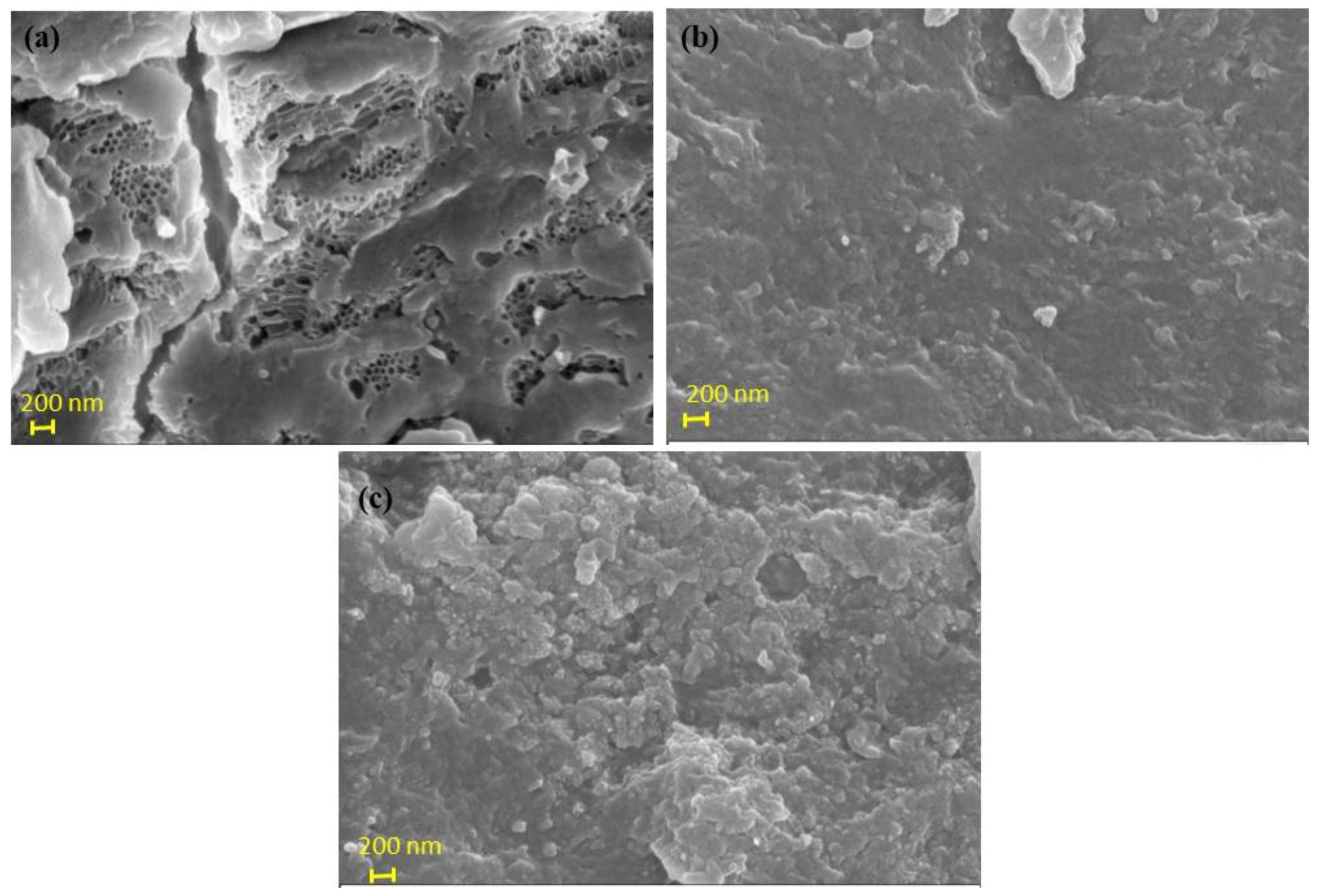
Figure 1a–c illustrate the structure and morphology of the surface of raw biomass, hydrochar and modified hydrochar, respectively. All the images refer to the same scale . More specifically, it can be observed that the biomass surface has a cellular shape. Furthermore, it can be noticed that the hydrothermal carbonization process caused the formation of roughness on the surface of the hydrochar, while this roughness increased upon the hydrochar being modified with H2O2.
Figure 1.
SEM images of (a), biomass, (b) hydrochar, and (c) modified hydrochar.
3.1.2. Zeta Potential-BET
Zeta-potential measurements over a broad pH window (Figure S1) show acidic isoelectric points (ζ = 0) for both materials: pH 1.80 for the raw biomass and pH 2.58 for the hydrochar. Accordingly, at the circumneutral conditions used in the adsorption tests, both solids carry a net-negative surface charge, so nitrate experiences long-range electrostatic repulsion. This electrostatic backdrop is therefore unfavorable for anion uptake and must be considered when interpreting capacity trends. BET N2 physisorption further indicates an almost 10-fold increase in specific surface area upon hydrothermal carbonization, from 0.39 to 4.08 m2 g−1. On the other hand, despite this surface enhancement, the hydrochar did not surpass the pristine biomass; across the conditions examined, the biomass consistently delivered higher removal; therefore, within the explored range, bulk surface area alone does not rationalize performance. The hydrochar is more negative than the biomass at any pH above its isoelectric point, which strengthens the electrostatic barrier and limits access to sorption domains even as geometric area increases. In contrast, the untreated biomass appears to benefit from its inherent surface chemistry and matrix, e.g., protonable/ion-exchangeable functionalities and microenvironments within the cellular structure that probably facilitate uptake despite repulsion. These contributions are in agreement with the kinetics and equilibrium analysis (Section 3), where nonlinear fits favor models consistent with heterogeneous sites rather than simple surface-area control. Regarding the acidic isoelectric point measured, reports on Microcystis aeruginosa based magnetic biochar, for example, indicate Pzc ≈ 3.5 [16], in line with the acidic charging observed here.
3.1.3. FTIR
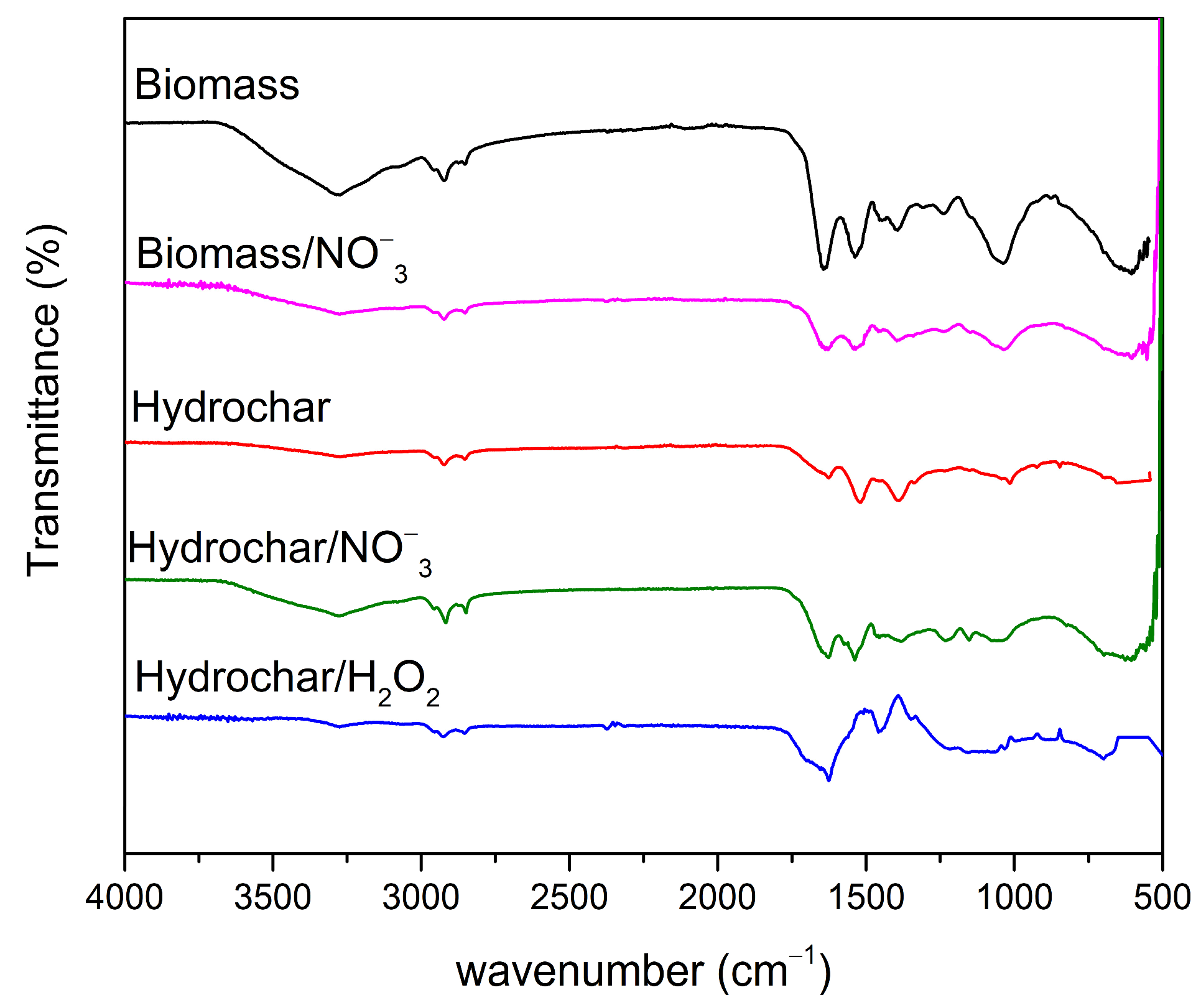
Figure 2 shows the FTIR spectra for raw biomass, hydrochar, and modified hydrochar. In the spectrum corresponding to biomass, the bands recorded at 3265 cm−1, (OH stretching vibration and N-H streching vibration), at 1240 cm−1 and 1040 cm−1 (CO stretch) indicates the presence phenols and alcohol groups, the bands at 2912, 2862 (CH stretch) and 1400 cm−1 (CH bending) are due to aliphatics and the bands at 1644 and 1540 cm−1 (amide II band, N-H bending, and C-N stretching) indicate the presence of proteins and similar N enriched compounds in the biomass [31].
Figure 2.
FTIR spectrum for biomass before and after adsorption (Biomass/NO3−), hydrochar before and after adsorption (Hydrochar/NO3−), and modified hydrochar.
Subsequently, with the conversion of biomass to hydrochar, the FTIR bands belonging to hydroxyls and phenols at 3265 and 1028 are drastically reduced in the spectrum while the band at 1625 (C=C stretch) increases clearly, indicating the dehydration of the biomass and formation of sp2 carbon atoms. The bands at 1520 (NH bending) and 1390 indicate the presence of N groups such as amines and aromatic rings, respectively [31]. In the FTIR spectrum of the modified hydrochar, there is a strong band around 1618 cm−1, which corresponds to the carboxyl groups that have been introduced by the strong oxidizing effect of the peroxide.
For the hydrochar sample, after the saturation process the newly formed bands slightly shown at ~1150, 1233 cm−1 with the peak at around 1020–1100 cm−1,which appeared much broader, show changes in the environment of N-H and O-H bonds, which could be attributed to the interaction with . The peak at 1380 cm−1, which is characteristic of the stretching vibration of the group appeared as a broad band covering the signal of N-H at 1390 cm−1 [32,33,34,35]. On the other hand, at the biomass, these new bands were not detected. Previous research assigned nitrate adsorption to changes in C=O or a C=C bands decrease, and not necessarily to new C–N or C=N bonds, which changes mostly interactions between π-electrons in aromatic rings and those in anionic species, rather than the formation of new stable N-carbon bonds, rendering physical sorption the most dominant mechanism [32].
3.1.4. XPS
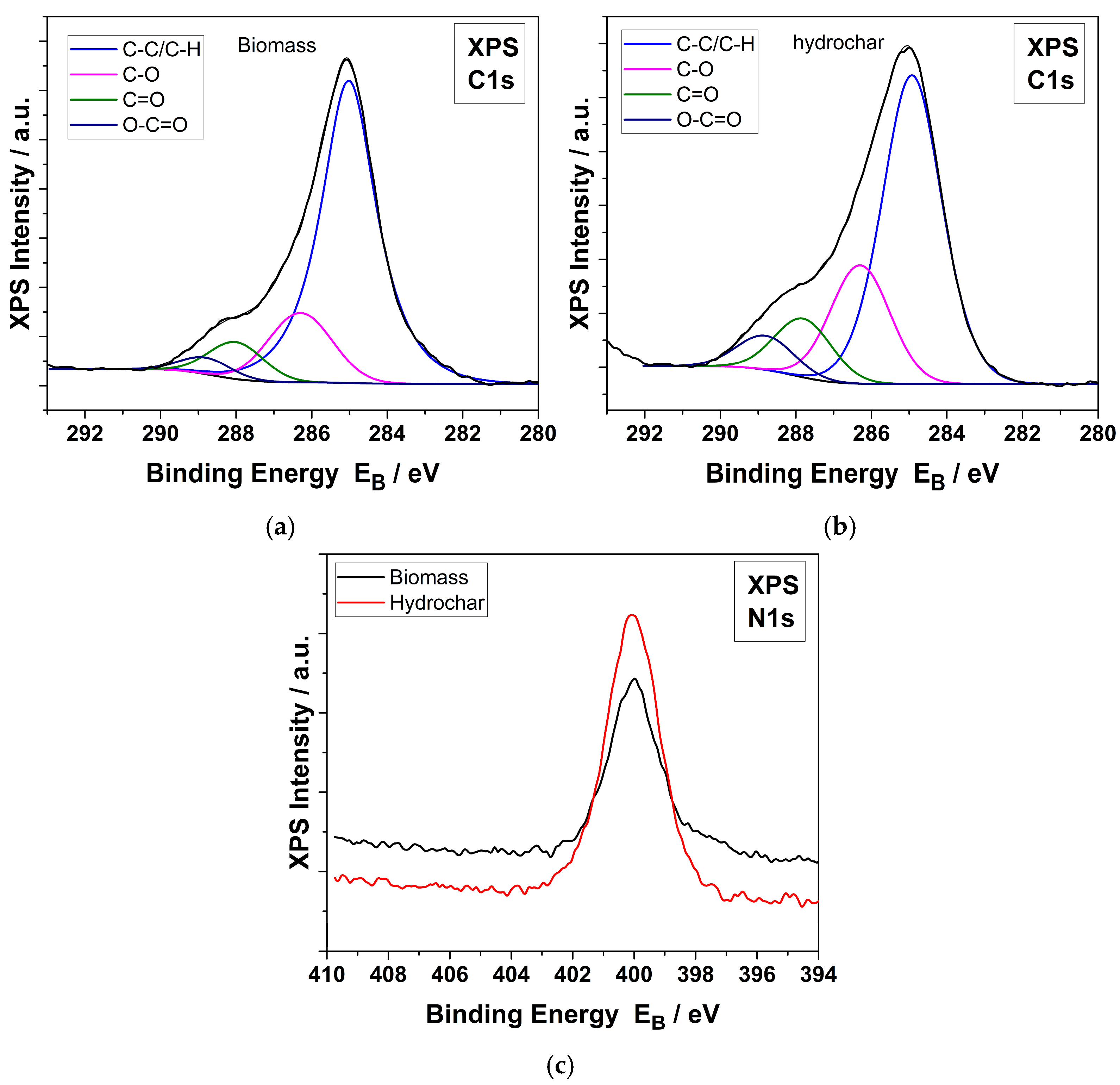
XPS was employed to investigate the surface chemistry of the raw biomass and hydrochar samples. The deconvoluted C1s spectrum was analyzed into four chemical species of C–C/C–H (binding energy at 284.9 ± 0.1 eV), C–O/C–N (binding energy at 286.4 ± 0.1 eV), C=O/O–C–O (binding energy at 287.9 ± 0.1 eV) and O–C=O (binding energy at 288.9 ± 0.1 eV), as can be shown Figure 3a,b [36]. For the biomass, the C1s envelope is dominated by C–C/C–H species (72.7%), with smaller contributions from C–O/C–N (16.6%), C=O/O–C–O (7.5%) and O–C=O (3.1%) as presented in Table 1. In contrast, hydrochar exhibited a lower fraction of C–C/C–H (60.7%) and an increased contribution of oxygenated carbon species, namely C–O/C–N (22.5%), C=O/O–C–O (10.6%) and O–C=O (6.2%) (Table 1). Consistently, XPS quantification shows a slight increase in nitrogen content from 6.0% to 8.9% between raw and hydra, while the N1s peak at 400.0 ± 0.1 eV (Figure 3c) in both samples is assigned to pyrrolic nitrogen [37]. Hydrochar shows a substantial decrease in aliphatic/graphitic carbon (C–C/C–H drops from 72.7% to 60.7%) and a pronounced increase in oxygenated carbon species (C–O, C=O, O–C=O), combined with a higher N content (8.9 at.%), reflecting the formation of a heteroatom-rich carbon surface, but the N- enrichment could deteriorate the interactions with nitrate.
Figure 3.
XPS peaks of (a) deconvoluted C1s for biomass (b) deconvoluted C1s for hydrochar (c) N1s for biomass and hydrochar.
Table 1.
Percentage of carbon components derived from C1s XPS fitting and the percentage of relative atomic concentration derived from XPS analysis (the % relative atomic concentration can be calculated by dividing the peak areas of C1s, N1s, and O1s by the relative sensitivity factors and the analyzer’s transmission function).
3.2. Batch Adsorption Experiments
3.2.1. Effect of Adsorbent Dosage
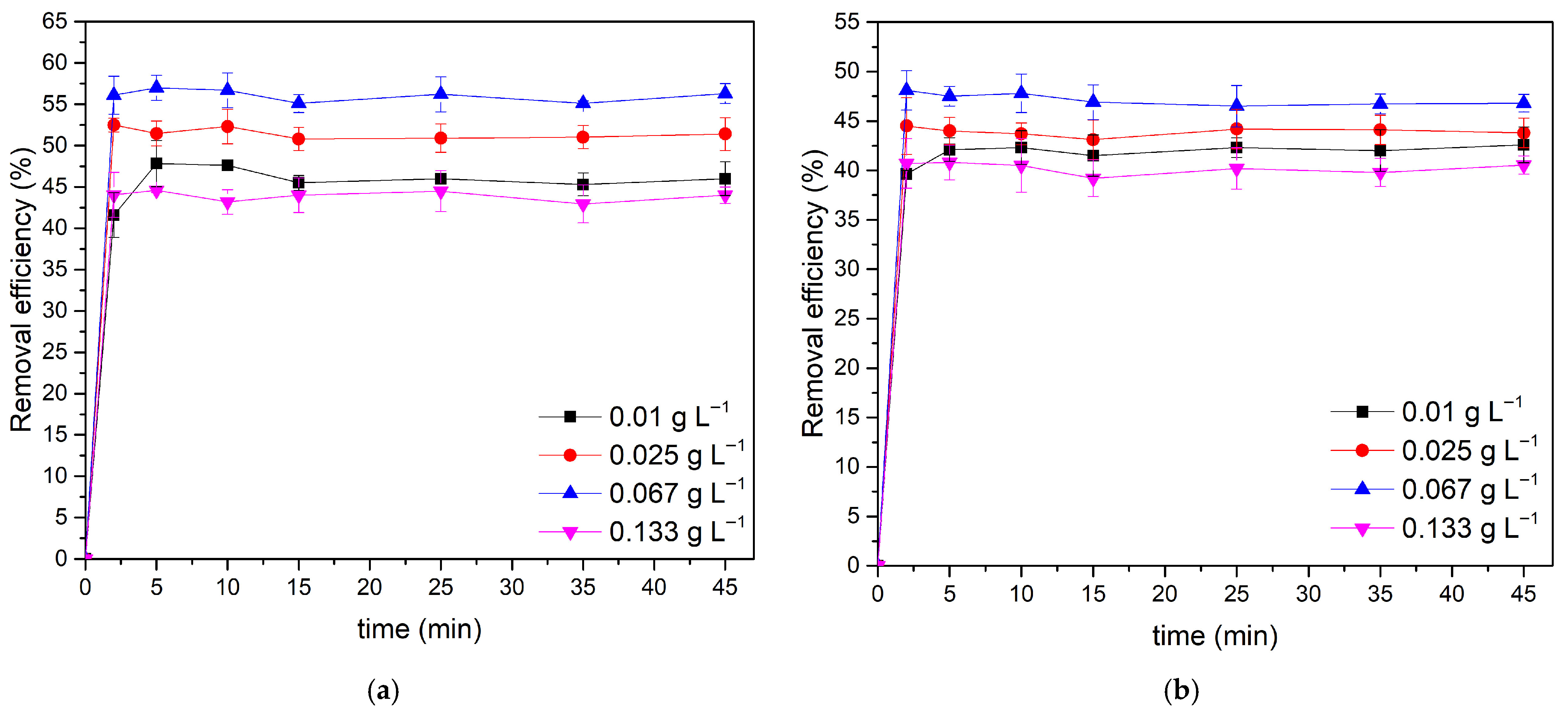
The influence of adsorbent dosage is central to process optimization because it governs both removal efficiency and operating cost. Its effect on nitrate was assessed at an initial concentration of 20 mg N L−1 (Figure 4a,b). For both the raw biomass and the hydrochar, the response was non-monotonic. The biomass reached a maximum removal of 56% at 0.067 g L−1; further increasing the loading was counterproductive, with efficiency falling to 44.5% at 0.133 g L−1. The hydrochar exhibited the same qualitative behavior but at a lower peak, attaining 47.5% removal at 0.067 g L−1. In terms of kinetics, the uptake was rapid under these conditions, with equilibrium essentially reached within almost 25 min, in line with the nonlinear PFO fits discussed later. The initial improvement with increasing dose of the adsorbent is readily explained in the literature by the larger number of available sites. The subsequent decline indicates the onset of inhibitory phenomena at higher solids concentrations. Particle aggregation and overlap can shield active domains and reduce the effective area accessible to nitrate, while increased solids can also alter hydrodynamics (e.g., micro-scale crowding near particles) and thicken the boundary layer, diminishing mass transfer effects noted for comparable systems. Secondly, material-specific contribution arises from surface charge. As established in Section 3.1.2, both sorbents are net-negative at the working pH.
Figure 4.
Illustration of the removal efficiency of as a function of time (a) for each different biomass dosage (, (b) for each different hydrochar dosage (.
Elevating the solids concentration can promote additional deprotonation of surface groups and locally shift pH upward in the particle vicinity, thereby strengthening electrostatic repulsion toward and increasing competition from OH−. This charge-based interpretation is consistent with the enhanced performance of the raw biomass relative to its hydrochar: despite its far lower BET area, the biomass maintains a less-negative ζ-potential across the circumneutral range and presents functionalities within the cellular matrix (e.g., protonable/ion-exchangeable sites) that facilitate uptake even under repulsive conditions.
Taken together, the dosage trends indicate that, within the range explored in this work, surface chemistry and charge characteristics, not surface area governing the efficiency. The overall removal efficiencies paired with adsorption capacities of all examined dosages can be shown in Figure S4. An operational optimum exists near 0.067 g L−1 for C0 = 20 mg N L−1 (although the specific optimum may shift with influent composition and ionic strength, as examined in subsequent sections).
3.2.2. Effect of Initial Concentration
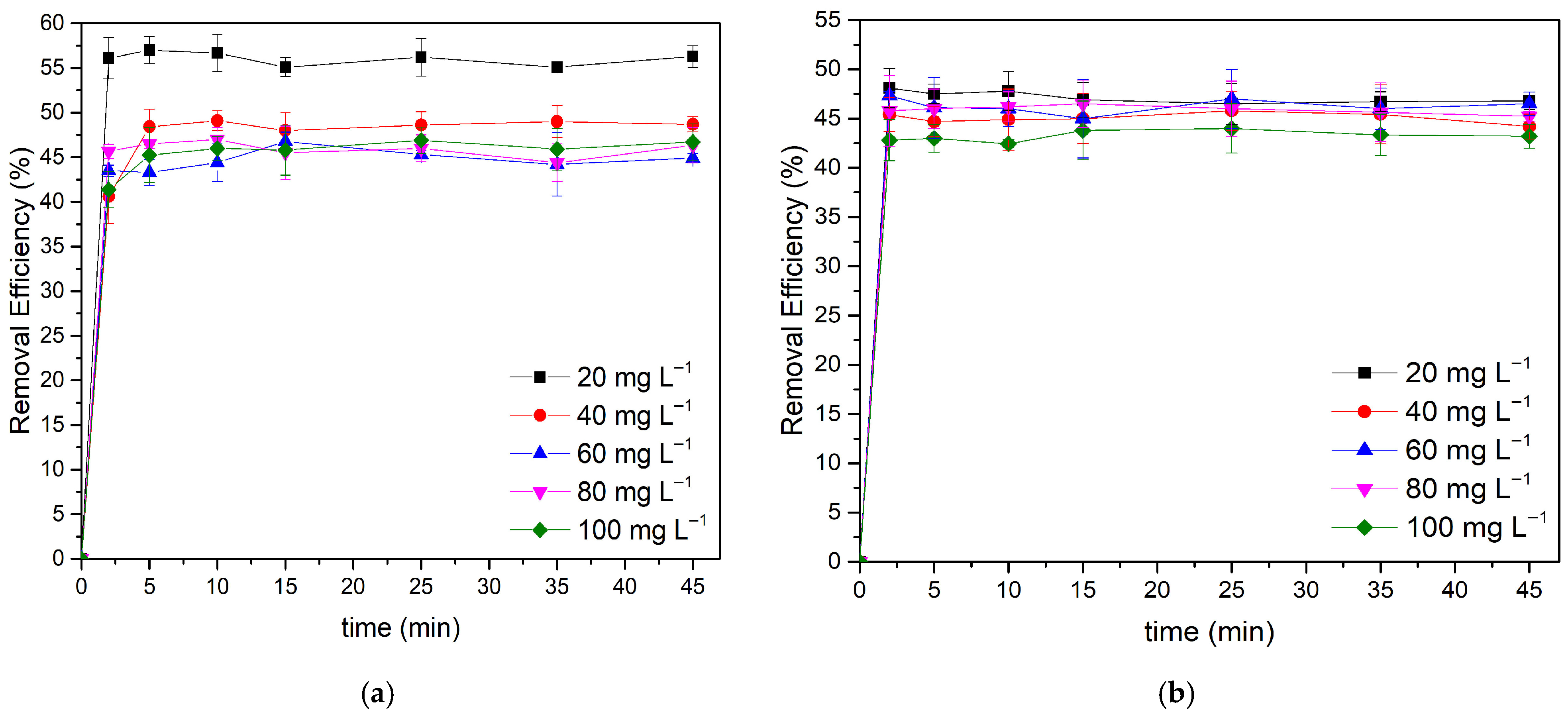
The initial nitrate concentration, , sets the driving force for mass transfer and therefore governs both the extent and the rate of uptake. Initial concentration effects were examined at the dosage identified as optimal in Section 3.2.1 (0.067 g L−1), and the corresponding trends are shown in Figure 5a,b. For both the raw biomass and the hydrochar, the highest percentage removal () occurred at the lowest investigated (20 mg N L−1). As increased to 100 mg N L−1, declined in a steady and reproducible manner. This pattern is typical of systems that offer a finite population of accessible sites. As the ratio of nitrate ions to binding domains rises, fractional coverage increases and a larger portion of nitrate remains in solution at equilibrium, so the percentage removed falls.
Figure 5.
Illustration of the removal efficiency of as a function of time for each different (a) by using of biomass , (b) by using of hydrochar .
It is important to separate this decrease in from the behavior of the equilibrium capacity, (mg g −1). While falls with increasing , increases because the larger concentration gradient enhances transport to the surface and promotes fuller use of available sites within the working range. The counter-directional trends of and reflect a shift in the liquid–solid equilibrium rather than a kinetic limitation. The linkage between (liquid-phase equilibrium concentration) and (solid-phase loading) is treated in the isotherm analysis later in the manuscript, where models accommodating site heterogeneity provide an adequate description over the concentrations tested and no saturation plateau is evident in this window.
Across the entire range, the raw biomass outperformed the hydrochar. In addition, tests with peroxide-modified hydrochar did not improve performance; removal efficiencies remained in the range 42 to 47% (Figure S2). These observations indicate that hydrothermal carbonisation and subsequent hydrogen peroxide oxidation did not enhance affinity for nitrate under the examined conditions. Considering the electrostatic context established in Section 3.1.2, where both materials are net negative at circumneutral pH, further oxidation can introduce additional acidic oxygenated groups that increase repulsion toward without providing compensating specific interactions of sufficient strength. Under the conditions studied, the unmodified cyanobacterial biomass, which retains native functionalities and matrix microenvironments, delivered the most effective performance at fixed dose. The expected decrease in with rising therefore coexists with a monotonic increase in , which is consistent with the equilibrium framework used in the subsequent analysis. The overall removal efficiencies paired with adsorption capacities of all examined initial concentrations can be shown in Figure S5.
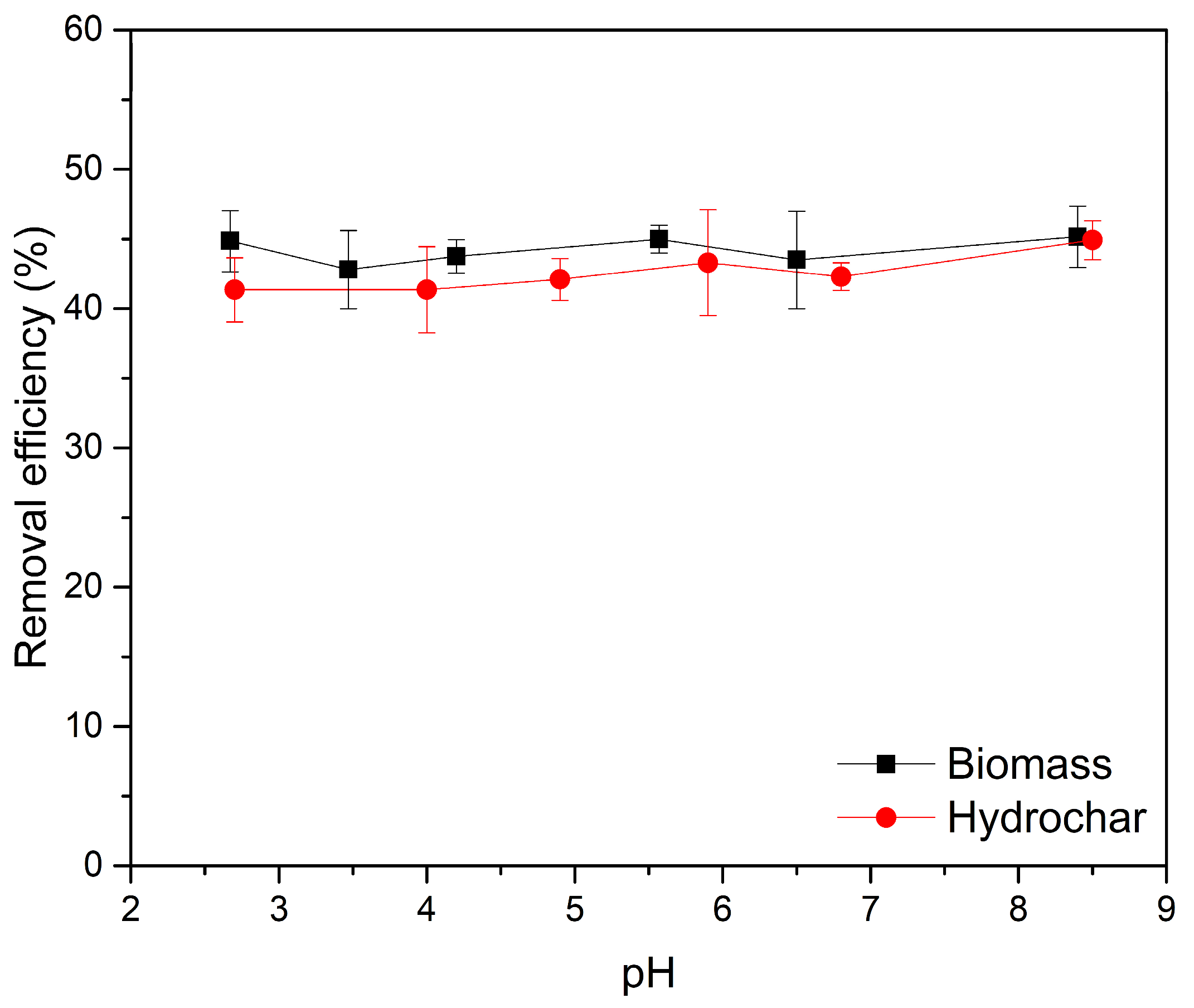
3.2.3. Effect of pH
Solution pH is a governing variable in adsorption because it modulates the surface charge of the sorbent and the speciation of dissolved species. Its effect was examined from pH 2.6 to 8.4 (Figure 6). Over this window, the performance of both materials was stable: the raw biomass maintained removals of 42.8 to 45.1%, and the hydrochar 41.4 to 44.9%. This limited sensitivity to pH does not indicate an absence of electrostatic influences. As shown by the ζ-potential data in Section 3.1.2, both surfaces are net negative throughout most of this range, so nitrate experiences long-range repulsion. Notably, even near the hydrochar’s isoelectric point (pH 2.58), the removal did not rise above the values at higher pH, which suggests that surface charge alone does not control uptake under the present conditions.
Figure 6.
Illustration of the removal efficiency of as a function of pH when of biomass or hydrochar was used .
The observed stability is consistent with contributions from interactions that are not dominated by classical Coulombic attraction. FTIR assigned to amide bands at 1647 and 1541 cm−1, indicative of proteins and other nitrogen-bearing constituents of the biomass, point to site types capable of engaging nitrate through hydrogen bonding and Lewis acid–base interactions. Such interactions are less sensitive to bulk surface charge and can operate effectively even when the net ζ-potential is negative. This mechanism also explains the systematic advantage of the raw biomass over the hydrochar. Carbonization alters and partially removes functionalities, while the hydrochar exhibits a more negative ζ at circumneutral pH, both of which disfavor nitrate sorption. By contrast, the raw biomass retains protonable and ion-exchangeable groups within the cellular matrix that remain active across the tested pH values, allowing comparable removal at low and near-neutral pH despite the persistent electrostatic barrier.
3.2.4. Adsorption Kinetic Models
To quantify the time evolution of nitrate uptake, the experimental profiles were fitted with the pseudo-first-order (PFO) and pseudo-second-order (PSO) formulations using nonlinear regression applied directly to the integrated rate expressions (Equations (3) and (4)). Direct fitting preserves the experimental error structure and avoids the parameter bias introduced by linearized plots [38]; confidence intervals and standard errors were obtained from the Jacobian of the nonlinear fit. Replicate measurements were averaged at each time point, and equal weights were used unless stated otherwise.
The consolidated results are presented in Table 2 and Table S1. Although both models can return to high coefficients of determination, a parameter-level examination separates their performance. Across all conditions tested, the PFO model produced equilibrium capacities that were in close agreement with the independently measured (within experimental uncertainty), and the estimated rate constants were positive and well constrained [39]. The apparent half-times derived from PFO, , clustered within the same order of magnitude for a given adsorbent and temperature, consistent with the observed approach to equilibrium within approximately 25 min (Figures S6 and S7).
Table 2.
Kinetic parameters for the pseudo-first-order model obtained by non-linear regression. The table presents the correlation coefficient (R2), residual sum of squares (RSS), and calculated equilibrium capacity (qe) for nitrate removal by biomass and hydrochar.
PSO was not retained for interpretation in this system [40,41]. In several runs the nonlinear optimization converged to non-physical negative values of . In additional cases the fitted was positive but poorly identifiable and implausibly large (for example, ), which implies an instantaneous approach to equilibrium that is not supported by the measured experimental data under these conditions the associated estimates became highly sensitive to small perturbations in early-time data and deviated from . In addition, residual plots showed structure (early underfit and late overfit) indicative of model mismatch. A rate expression that yields negative or non-identifiable constants, or that requires extreme parameter values to reproduce moderate-rate data, does not provide a physically meaningful description of the process even if appears high. These observations are aligned with known limitations of linearized PSO fits reported for carbonaceous sorbents, where transformations can mask parameter non-identifiability and inflate goodness-of-fit metrics. By employing nonlinear regression on the integrated forms, such artifacts are revealed, and plausibility parameters can be assessed explicitly.
On this basis, PFO is used for kinetic interpretation and for estimating characteristic times. These results can be verified by comparing AIC/BIC to PSO, since lower values or more significant variables concerning the k values (Table S1).
3.2.5. Adsorption Equilibrium Isotherm Models
The equilibrium relation between the aqueous concentration, , and the amount retained on the solid, , was analyzed using the Langmuir, Freundlich, and Dubinin–Radushkevich (D–R) models. As in the previous sections, parameters were obtained by direct nonlinear regression of the original equations, not by linearized transforms, in order to preserve the experimental error structure [42]. The fitted values are reported in Table 3 and Table S2. A critical reading of the results indicates that the Freundlich model is the appropriate descriptor within the investigated window. Although both Langmuir and Freundlich can return high , the experimental isotherms from 20 to 100 mg N do not approach a plateau. The absence of an identifiable saturation region violates a key assumption of the Langmuir formulation and forces the fit to extrapolate far beyond the measured domain. The resulting values, 4480 mg g−1 for the biomass and 3998 mg g−1 for the hydrochar, are not credible capacities for the present materials and should be viewed as mathematical artifacts arising from model use outside its validity range. On this basis, the Langmuir parameters are not used for mechanistic interpretation or for comparison with the literature data and they are retained only for completeness.
Table 3.
Parameters for the Freundlich isotherm model obtained by non-linear regression for nitrate removal by biomass and hydrochar.
The Freundlich equation, which allows for site heterogeneity and does not impose a finite saturation capacity, is consistent with the concave isotherms observed here. The fitted exponents exceeded unity for both sorbents, for the biomass and for the hydrochar, which corresponds to intensity parameters . This behavior is characteristic of favorable uptake over the tested concentrations and matches the gradual increase of with without evidence of a limiting monolayer. Residuals were structureless and parameter uncertainties were well bounded, further supporting the use of Freundlich for this data set. The D–R model provided inferior fits and yielded poorly identifiable characteristic energies; it is therefore not considered further in the main text, with details moved to the Supplementary Information [43].
An important interpretive point concerns the magnitude of the observed equilibrium loadings. For the biomass, exceeded 670 mg g−1 at the highest initial concentration tested. Values of this order are not readily explained by surface adsorption alone on a solid with a measured BET area of 0.5 m2 g−1. The term adsorption used here therefore describes a broader uptake phenomenon. Contributions likely include, first, specific interactions and ion exchange involving protonable nitrogen-containing groups associated with the biomass matrix, and second, absorption or sequestration within cellular or polymeric domains that are present in the minimally processed material. These processes can operate alongside outer-sphere interactions and can produce high apparent capacities even when the net surface charge is negative at circumneutral pH. Summarizing, the equilibrium uptake reflects the combined action of both heterogeneous sites and matrix effects rather than simply controlled by the area. For design purposes and for comparison across materials, the Freundlich parameters determined by nonlinear regression provide a realistic description within the concentration range studied, while extrapolation to a putative saturation capacity is not warranted by the present data. Nonlinear Langmuir and Freundlich isotherms were compared using the Akaike Information Criterion (AIC) and the Bayesian Information Criterion (BIC) presented in Table S2. The D-R model presented poor fitting, so further analysis was not included. For the biomass sorbent, Langmuir produced lower AIC (31.77) and BIC (29.63) values compared with Freundlich (AIC = 56.94; BIC = 54.80). Similarly, for the hydrochar, Langmuir again yielded much lower AIC (38.09) and BIC (36.68) values relative to the Freundlich model (AIC = 63.26; BIC = 61.85). These results demonstrate that monolayer adsorption with homogeneous surface sites provides a significantly better description of the equilibrium data for both sorbents than the heterogeneous multilayer behavior implied by the Freundlich model; however, Langmuir parameters did not present physical meaning, especially concerning the qmax values.
3.3. Continuous Adsorption Experiments
3.3.1. Experimental Results
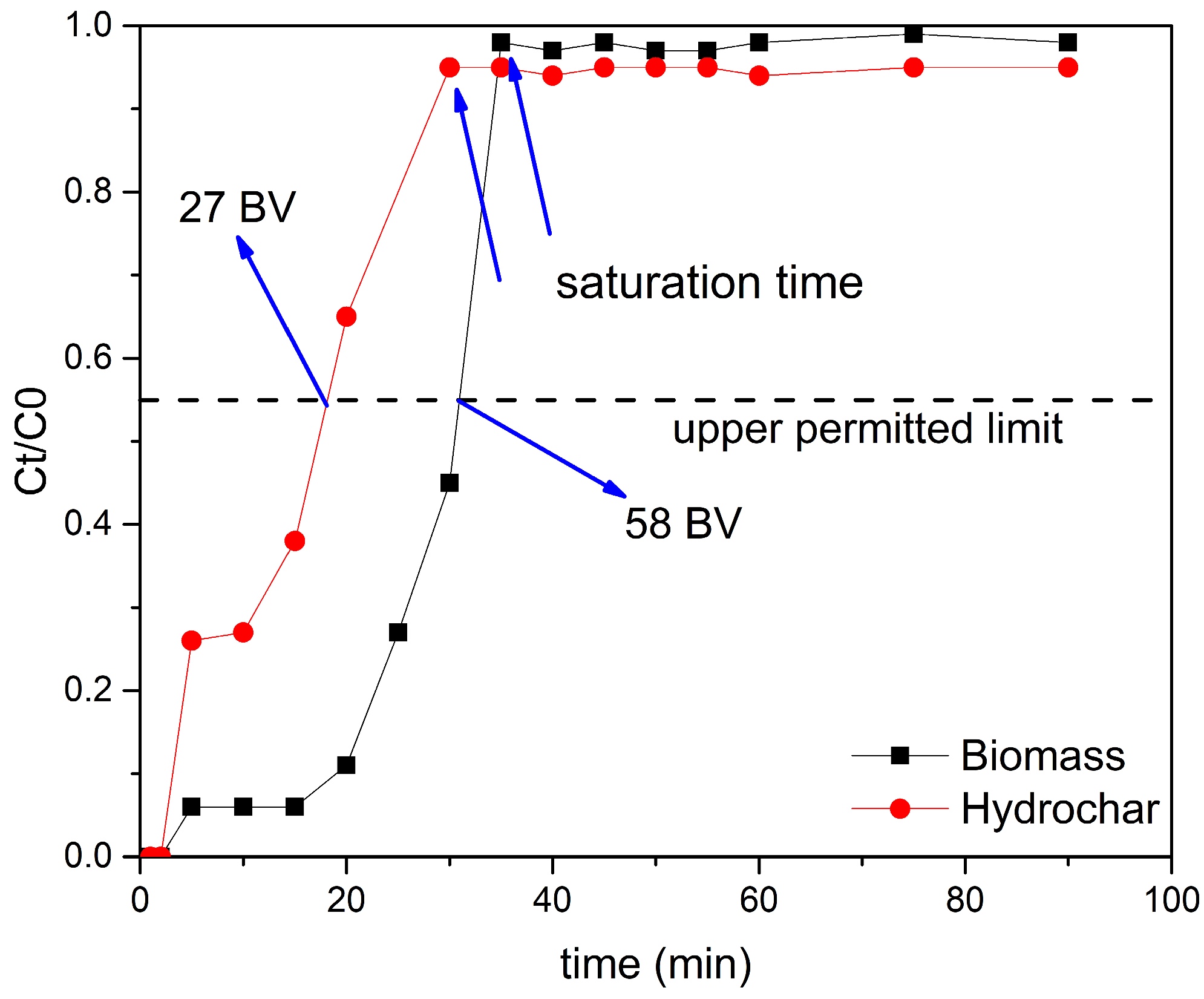
In order to evaluate performance under conditions closer to practice, continuous-flow fixed-bed column experiments were carried out and the breakthrough curves, expressed as the normalized effluent concentration versus time, are shown in Figure 7. The profiles indicate a later breakthrough and a more gradual approach to saturation for the bed packed with the raw biomass, which reached saturation at about 35 min, whereas the hydrochar bed approached saturation at about 30 min. The slope of the biomass curve near the inflection point is smaller, consistent with a broader mass-transfer zone and a slower advance of the concentration front.
Figure 7.
Variation in the fraction as a function of the time duration of the experiment in a column by using biomass and hydrochar as adsorbent.
For a quantitative benchmark, the World Health Organization and European Union parametric value for nitrate in drinking water, 11.3 mg N L−1, was used as the breakthrough criterion. At this compliance point the biomass column treated 58 bed volumes (BV) of influent, while the hydrochar column reached breakthrough after 27 BV under the same operating conditions. Thus, at identical bed height, flow rate, and influent composition, the unmodified material delivered more than a twofold increase in treated volume to the compliance threshold. These differences arise from the interplay between surface chemistry and transport within the mass-transfer zone. As discussed in Section 3.1.2, both materials are net negative at circumneutral pH, but the hydrochar displays a more negative potential over most of the range, which increases long-range repulsion toward and lowers the probability of successful approach to sorption domains. The native biomass retains protonable and ion-exchangeable functionalities within its cellular matrix that facilitated uptake despite this electrostatic backdrop. The result is a slower propagation of the mass-transfer zone through the biomass bed, delayed breakthrough, and a larger operating capacity at the selected compliance limit.
Integral mass-balance calculations based on the area above the curves (Table 4) support this interpretation. Both the total amount of nitrate retained and the dynamic binding capacity at breakthrough are higher for the biomass than for the hydrochar, and the corresponding utilization of the bed before saturation is greater. Taken together with the batch results, the column data indicate that the effective polishing capacity is governed primarily by native surface functionality and matrix effects of the Leptolyngbya biomass rather than by the larger geometric surface area created by hydrothermal carbonization.
Table 4.
Calculation of the parameters of the continuous adsorption experiments.
Bed volumes (BV) corresponding to effluent concentrations equal to 5%, 10%, and 50% of influent (respective 1, 2 and 10 mg L−1) and to an absolute effluent concentration of 11.3 mg N L−1 can be shown in Table 3.
3.3.2. Column Adsorption Models
Breakthrough data were simulated using the Yoon–Nelson equation by nonlinear least squares on the untransformed measurements. Residuals were structureless and goodness-of-fit was high for both sorbents (Table 5), indicating that YN reproduces the initial rise, the inflection, and the approach to saturation.
Table 5.
Parameters for the Yoon–Nelson column adsorption model obtained by non-linear regression for biomass and hydrochar fixed-bed columns.
Attempts to fit the Thomas model were not retained. In the present non-saturating window, the parameters were strongly coupled, and the fits were sensitive to initial guesses; the inferred capacities were not defensible against the integral mass balances (Table 4). This is in agreement with the results of the previous section since Thomas presumes Langmuir-type saturation and second-order surface kinetics assumptions that are not supported here [44]. Therefore, quantitative interpretation is limited to YN. On the other hand, the Adams–Bohart expression that also examined captured only the initial rise (C/C0 ≲ 0.1) and is relegated to the SM (Table S3).
The YN fits yield the characteristic 50% breakthrough time (t50) and the YN rate constant (). The biomass bed shows a substantially longer t50 than the hydrochar bed (29.14 vs. 16.59 min), consistent with the delayed breakthrough in Figure 7 and the broader mass-transfer zone inferred from the gentler slope of the biomass profile. Using YN, the time to any effluent fraction p follows
which provides a direct mapping from fitted parameters to operational time at a chosen compliance threshold. Together with the integral capacities in Table 4, the longer t50 for the biomass quantifies its slower front propagation at the studied empty bed contact time (EBCT) of 3.36 min, reinforcing that native surface functionality and matrix effects rather than simple surface governing also the column and system efficiency.
3.4. Comparison with Other Literature Research

To further assess the efficiency of the Leptolyngbya sp. biomass compared to the literature, Table 6 gathers representative metrics for biomass-derived nitrate sorbents from prior studies. It is worth noting that such comparisons require caution because operating variables differ widely across reports, including sorbent dosage, initial nitrate concentration, contact time, column geometry, and the extent of chemical modification. These conditions and operating parameters strongly influence the reported outcomes and limit direct, one-to-one benchmarking.
To the best of our knowledge, no published work provides a direct comparison of nitrate adsorption by untreated or thermally/chemically treated cyanobacterial biomass against plant-derived biochars or cationically modified sorbents under similar experimental conditions. However, general trends can be inferred from the literature. Untreated cyanobacterial biomass can remove nitrate primarily via biological uptake, as demonstrated for Synechococcus sp. [45]. Μodified cyanobacterial materials, such as chitosan-blended Spirulina biomass, have recently demonstrated improved nitrate affinity but still exhibit moderate capacities (e.g., ~4–5 mg g−1) relative to engineered sorbents [46]. Thermally treated plant biochars, such as wheat-straw or other materials (Table 5), often achieve higher maximum capacities (such as 5–30 mg g−1) due to increased microporosity and surface area generated during pyrolysis. Cationically modified sorbents, such as those functionalized with quaternary ammonium groups, frequently report high capacities, e.g., 26 mg g−1 [47]. Reviews of chitosan-based composites and engineered anion-exchange materials further confirm that cationic modifications substantially enhance nitrate removal compared to untreated biomass [48]. Overall, while the literature provides valuable benchmarks for plant biochars and cationic sorbents, quantitative, head-to-head evaluation of cyanobacterial biomass remains largely unexplored.
A consistent feature of the present material is rapid uptake. Equilibrium was achieved in about 25 min, which is shorter than the one-to-several-hour contact times frequently reported for processed plant-based biochars. Short equilibration times are advantageous for high-throughput configurations or applications with constrained residence time, since they reduce the volume of contactors required to achieve a given level of polishing.
With respect to batch removal efficiency, the present study attained 40 to 56 percent removal at a low dosage of 0.067 . A closer look of Table 5 indicates that higher removals in other works are often associated with substantially larger dosages, typically 0.5 to 5 , or with targeted chemical modification that introduces cationic sites; for example, amine grafting or impregnation with aluminum or iron species that promote electrostatic attraction of nitrate. As already discussed, a direct comparison based on the Langmuir maximum capacity is not appropriate for the current system. As established in Section 3.2.5, the isotherms over 20 to 100 do not approach a plateau, and fitting Langmuir in this non-saturating window forces extrapolated values that lack physical meaning for our materials. Performance is better assessed using experimentally measured equilibrium loadings and the associated kinetics.
In the fixed-bed tests, the biomass column treated 58 bed volumes to the 11.3 compliance threshold. Although, probably some engineered, positively charged media in larger beds can deliver higher treated volumes, the observed value is consistent with operation at a pH well above the acidic isoelectric points of these materials, where long-range electrostatics are unfavorable for nitrate. Under these conditions the native biomass still maintained delayed breakthrough relative to the hydrochar and provided higher dynamic capacity at the selected criterion. Overall, the unmodified Leptolyngbya sp. biomass distinguishes itself by combining fast kinetics with significant efficacy at low dose and without post-treatment functionalization. It serves as a practical benchmark for minimally processed biosorbents aimed at polishing duties, particularly where short contact times and compact units are required.
Table 6.
Comparison of biomass from cyanobacteria with other biomass species for the adsorption of from standard aqueous solutions.
Table 6.
Comparison of biomass from cyanobacteria with other biomass species for the adsorption of from standard aqueous solutions.
| Biomass | Thermal Treatment | Chemical Modification | Batch Experiments | Continuous Experiments | Ref. | |||||
|---|---|---|---|---|---|---|---|---|---|---|
| Adsorbent Dosage | Adsorbent Dosage | |||||||||
| Wheat straw | Pyrolysis | Use of with | - | - | - | [8] | ||||
| Sugarcane bagasse | Pyrolysis | Addition of amines | ≈70.0 | - | - | - | [9] | |||
| Elephant grass | Pyrolysis | - | - | - | - | [10] | ||||
| Corn | Pyrolysis | Use of Fe and amine | ≈90.0 | - | - | - | [11] | |||
| Hazelnut shell | - | Addition of amines | ≈90.0 | - | [12] | |||||
| Grape seed | - | Addition of amines | - | [13] | ||||||
| Date palm leaves | Pyrolysis | - | - | - | - | - | [49] | |||
| Macadamia | Pyrolysis | - | - | - | - | [50] | ||||
| Fruit lobes | Pyrolysis | Use of amines | - | - | - | [51] | ||||
| Sawdust | Pyrolysis | Use of iron chloride | - | - | - | - | [52] | |||
| Modified granular activated carbon | prepared by coating quaternary ammonium-containing polymer | 25.1–376 | 2.5 | 90–120 | ≈26 | [47] | ||||
| Cyanobacteria | - | - | This research | |||||||
| Cyanobacteria | Hydrothermal carbonization | - | This research | |||||||
| Cyanobacteria | Hydrothermal carbonization | Addition of | - | - | - | This research | ||||
4. Conclusions
This study shows that raw, unprocessed cyanobacterial biomass from Leptolyngbya sp. is an effective and rapid biosorbent for aqueous nitrate–nitrogen, and that it performs better than its hydrothermally carbonized derivative under the conditions tested. The main outcomes and their implications are as follows:
- (i)
- Performance and mechanism. In its native state, the biomass achieved 40 to 56% nitrate removal at a low dosage, with equilibrium reached in almost 25 min. Its consistent advantage over the higher-surface-area hydrochar indicates that inherent surface chemistry and charge characteristics govern uptake more than surface area for the examined system.
- (ii)
- Model-based interpretation. Kinetic and equilibrium analyses were carried out by nonlinear regression of the original rate and isotherm expressions. The pseudo-first-order model provided physically consistent rate constants and capacities across all conditions, whereas the pseudo-second-order model produced non-identifiable or non-physical parameters in several runs and was not used for interpretation. The equilibrium data over 20 to 100 mg N L−1 were captured by the Freundlich equation, which accommodates site heterogeneity and does not impose a saturation plateau. Langmuir fits in this non-saturating window forced extrapolated qmax values without physical meaning and were therefore set aside.
- (iii)
- Continuous flow implementation. In fixed-bed columns, the biomass treated 58 bed volumes of influent to the 11.3 mg N L−1 nitrate-N threshold, compared with 27 bed volumes for the hydrochar at the same operating conditions. This outcome matches the batch evidence and reflects a more slowly advancing mass-transfer zone and a higher dynamic capacity for the native material.
Overall, valorizing cyanobacterial biomass in its unmodified form appears to be a practical and interesting route for nitrate polishing where fast contact times and low chemical input are priorities. From an application perspective, the nitrate-laden biomass may be evaluated in future works as a slow-release fertilizer, which would align with circular-economy objectives. Therefore, future work should examine performance under realistic water matrices with competing anions, quantify pH variation, and assess regeneration or end-of-life options so that the proposed system can balance efficiency, cost, and environmental impact.
Supplementary Materials
The following supporting information can be downloaded at: https://www.mdpi.com/article/10.3390/app152413018/s1, Figure S1: Calibration curve of according to the 4500--B method. Figure S2: ζ-potential as a function of pH for biomass and hydrochar (isoelectric point). Figure S3: Illustration of the removal efficiency of as a function of time for each adsorption experiment performed by using the modified hydrochar . Figure S4: Removal efficiencies paired with adsorption capacities of all examined adsorbent dosages Figure S5: Removal efficiencies paired with adsorption capacities of all examined Initial concentrations. Figure S6: Illustration of the non-linear forms of the pseudo-first-order and pseudo-second-order models: (a) at different adsorption dosages of biomass, and (b) at different initial concentrations of NO3−-N using biomass as the adsorbent. Figure S7: Illustration of the non-linear forms of the pseudo-first-order and pseudo-second-order models: (a) at different adsorption dosages of biomass, and (b) at different initial concentrations of NO3−-N using hydrochar as the adsorbent; Table S1: Complete kinetic parameters obtained by non-linear regression for the pseudo-first-order (PFO) and pseudo-second-order (PSO) models. The table presents the correlation coefficient (R2), residual sum of squares (RSS), and calculated equilibrium capacity (qe) for nitrate removal by biomass and hydrochar; Table S2: Parameters for the Langmuir, Freundlich, and Dubinin–Radushkevich isotherm models obtained by non-linear regression for nitrate removal by biomass and hydrochar; Table S3: Parameters for the Adams–Bohart column adsorption model obtained by non-linear fitting to the initial breakthrough region for biomass and hydrochar fixed-bed columns.
Author Contributions
Conceptualization, C.V.L. and D.V.V.; methodology, G.M., C.V.L., A.G.T. and V.G.; validation, G.M., C.V.L., A.G.T., Z.F., V.G. and D.V.V.; formal analysis, G.M., C.V.L., A.G.T., Z.F., V.G. and D.V.V.; investigation, G.M.; resources, V.G. and D.V.V.; data curation, C.V.L., A.G.T., Z.F. and V.G.; writing—original draft preparation, G.M.; writing—review and editing, C.V.L., A.G.T., Z.F., V.G. and D.V.V.; visualization, G.M.; supervision D.V.V. All authors have read and agreed to the published version of the manuscript.
Funding
This research received no external funding.
Institutional Review Board Statement
Not applicable.
Informed Consent Statement
Not applicable.
Data Availability Statement
The original contributions presented in this study are included in the article. Further inquiries can be directed to the corresponding authors.
Acknowledgments
Labrini Sygellou is gratefully acknowledged for the X-Ray photoelectron spectroscopy measurements (XPS) and analysis at the Institute of Chemical Engineering Sciences of the Foundation for Research and Technology, Hellas (FORTH-ICEHT).
Conflicts of Interest
The authors declare no conflicts of interest.
Abbreviations
The following abbreviations are used in this manuscript:
| SEM | Scanning Electron Microscopy |
| BET | Brunauer–Emmett–Teller |
| FTIR | Fourier Transform Infrared Spectroscopy |
| PFO | Pseudo-first-order |
| PSO | Pseudo-second-order |
| AB | Adams–Bohart |
| YN | Yoon–Nelson |
| D-R | Dubinin–Radushkevich |
References
- Lee, D.; Gibson, J.M.D.; Brown, J.; Habtewold, J.; Murphy, H.M. Burden of Disease from Contaminated Drinking Water in Countries with High Access to Safely Managed Water: A Systematic Review. Water Res. 2023, 242, 120244. [Google Scholar] [CrossRef]
- Dey, S.; Uppala, P.; Sambangi, A.; Haripavan, N.; Veerendra, G.T.N. Recycling of Solid Waste Biosorbents for Removal of Nitrates from Contaminated Water. Clean. Circ. Bioecon. 2022, 2, 100014. [Google Scholar] [CrossRef]
- Casas, M.E.; Guivernau, M.; Viñas, M.; Fernández, B.; Cáceres, R.; Biel, C.; Matamoros, V. Use of Wood and Cork in Biofilters for the Simultaneous Removal of Nitrates and Pesticides from Groundwater. Chemosphere 2023, 313, 137502. [Google Scholar] [CrossRef]
- Santos, R.C.; da Silva, R.A.; dos Santos, M.M.; Bovo, A.B.; da Silva, A.F. Assessing Nitrate Contamination in Groundwater for Public Supply: A Study in a Small Brazilian Town. Groundw. Sustain. Dev. 2024, 25, 101084. [Google Scholar] [CrossRef]
- Amador, P.; Soria, J.; Moratalla-López, J.; Rico, A. Looking beyond the Surface: Understanding the Role of Multiple Stressors on the Eutrophication Status of the Albufera Lake (Valencia, Spain). Sci. Total Environ. 2024, 956, 177247. [Google Scholar] [CrossRef]
- Matei, A.; Racoviteanu, G. Review of the Technologies for Nitrates Removal from Water Intended for Human Consumption. In IOP Conference Series: Earth and Environmental Science, Proceedings of the 7th Conference of the Sustainable Solutions for Energy and Environment, Bucharest, Romania, 21–24 October 2020; IOP Publishing Ltd.: Bristol, UK, 2021; Volume 664. [Google Scholar]
- Miriyam, I.B.; Anbalagan, K. Chicken Feathers Waste Biomass as an Effective Hierarchically Porous Adsorbent for Dimethyl, Diethyl and Dibutyl Phthalate: Mechanism, Performance, and Modeling of Batch and Continuous Adsorption Processes. Chem. Eng. Sci. 2026, 319, 122233. [Google Scholar] [CrossRef]
- Wang, L.; Liu, S.; Xuan, W.; Li, S.; Wei, A. Efficient Nitrate Adsorption from Groundwater by Biochar-Supported Al-Substituted Goethite. Sustainability 2022, 14, 7824. [Google Scholar] [CrossRef]
- Hafshejani, L.D.; Hooshmand, A.; Naseri, A.A.; Mohammadi, A.S.; Abbasi, F.; Bhatnagar, A. Removal of Nitrate from Aqueous Solution by Modified Sugarcane Bagasse Biochar. Ecol. Eng. 2016, 95, 101–111. [Google Scholar] [CrossRef]
- Adesemuyi, M.F.; Adebayo, M.A.; Akinola, A.O.; Olasehinde, E.F.; Adewole, K.A.; Lajide, L. Preparation and Characterisation of Biochars from Elephant Grass and Their Utilisation for Aqueous Nitrate Removal: Effect of Pyrolysis Temperature. J. Environ. Chem. Eng. 2020, 8, 104507. [Google Scholar] [CrossRef]
- Yan, M.; Zhu, Q.; Zhen, J. Low Temperature Adsorption of Nitrate in Water by Ammoniac-Grafted Iron-Based Biochar: Electrostatic Interaction and Surface Complexation. Colloids Surf. A Physicochem. Eng. Asp. 2025, 710, 136313. [Google Scholar] [CrossRef]
- Stjepanović, M.; Velić, N.; Habuda-Stanić, M. Modified Hazelnut Shells as a Novel Adsorbent for the Removal of Nitrate from Wastewater. Water 2022, 14, 816. [Google Scholar] [CrossRef]
- Stjepanović, M.; Velić, N.; Habuda-Stanić, M. Modified Grape Seeds: A Promising Alternative for Nitrate Removal from Water. Materials 2021, 14, 4791. [Google Scholar] [CrossRef]
- Amadu, A.A.; Amoako, K.; Degraft-Johnson, A.; Komla Ameka, G. Chapter Industrial Applications of Cyanobacteria. In Cyanobacteria-Recent Advances in Taxonomy and Applications; IntechOpen: Londen, UK, 2021. [Google Scholar]
- Kozyatnyk, I.; Benavente, V.; Weidemann, E.; Gentili, F.G.; Jansson, S. Influence of Hydrothermal Carbonization Conditions on the Porosity, Functionality, and Sorption Properties of Microalgae Hydrochars. Sci. Rep. 2023, 13, 8562. [Google Scholar] [CrossRef]
- Wang, B.; Li, Y.; Zheng, J.; Hu, Y.; Wang, X.; Hu, B. Efficient Removal of U(VI) from Aqueous Solutions Using the Magnetic Biochar Derived from the Biomass of a Bloom-Forming Cyanobacterium (Microcystis aeruginosa). Chemosphere 2020, 254, 126898. [Google Scholar] [CrossRef]
- Liu, P.; Rao, D.; Zou, L.; Teng, Y.; Yu, H. Capacity and Potential Mechanisms of Cd(II) Adsorption from Aqueous Solution by Blue Algae-Derived Biochars. Sci. Total Environ. 2021, 767, 145447. [Google Scholar] [CrossRef]
- Papadopoulos, K.P.; Economou, C.N.; Dailianis, S.; Charalampous, N.; Stefanidou, N.; Moustaka-Gouni, M.; Tekerlekopoulou, A.G.; Vayenas, D.V. Brewery Wastewater Treatment Using Cyanobacterial-Bacterial Settleable Aggregates. Algal Res. 2020, 49, 101957. [Google Scholar] [CrossRef]
- Patsialou, S.; Katapodis, D.; Antonopoulou, G.; Charalampous, N.; Qun, Y.; Dailianis, S.; Tekerlekopoulou, A.G.; Vayenas, D.V. Bioremediation and Toxic Removal Efficiency of Raw Pharmaceutical Wastewaters Treated with a Cyanobacteria-Based System Coupled with Valuable Biomass. J. Water Process Eng. 2024, 58, 104895. [Google Scholar] [CrossRef]
- Zheng, Y.; Bolan, N.; Jenkins, S.N.; Mickan, B.S. Organic Particles and High PH in Food Waste Anaerobic Digestate Enhanced NH4+ Adsorption on Wood-Derived Biochar. Sci. Total Environ. 2024, 946, 174458. [Google Scholar] [CrossRef] [PubMed]
- APHA. Standard Methods for the Examination of Water and Wastewater; The Nineteenth and Earlier Editions; American Public Health Association: Washington, DC, USA, 1999. [Google Scholar]
- Kurniawati, P.; Gusrianti, R.; Dwisiwi, B.B.; Purbaningtias, T.E.; Wiyantoko, B. Verification of Spectrophotometric Method for Nitrate Analysis in Water Samples. In AIP Conference Proceedings, Proceedings of the 2nd International Seminar on Chemical Education (ISCE) 2017, Yogyakarta, Indonesia, 12–13 September 2017; American Institute of Physics Inc.: Melville, NY, USA, 2017; Volume 1911. [Google Scholar]
- Daneshvar, E.; Zarrinmehr, M.J.; Kousha, M.; Hashtjin, A.M.; Saratale, G.D.; Maiti, A.; Vithanage, M.; Bhatnagar, A. Hexavalent Chromium Removal from Water by Microalgal-Based Materials: Adsorption, Desorption and Recovery Studies. Bioresour. Technol. 2019, 293, 122064. [Google Scholar] [CrossRef]
- Karri, R.R.; Jayakumar, N.S.; Sahu, J.N. Modelling of Fluidised-Bed Reactor by Differential Evolution Optimization for Phenol Removal Using Coconut Shells Based Activated Carbon. J. Mol. Liq. 2017, 231, 249–262. [Google Scholar] [CrossRef]
- Ho, Y.S. Review of Second-Order Models for Adsorption Systems. J. Hazard. Mater. 2006, 136, 681–689. [Google Scholar] [CrossRef]
- Foo, K.Y.; Hameed, B.H. Insights into the Modeling of Adsorption Isotherm Systems. Chem. Eng. J. 2010, 156, 2–10. [Google Scholar] [CrossRef]
- Chen, X. Modeling of Experimental Adsorption Isotherm Data. Information 2015, 6, 14–22. [Google Scholar] [CrossRef]
- Khalfa, L.; Sdiri, A.; Bagane, M.; Cervera, M.L. A Calcined Clay Fixed Bed Adsorption Studies for the Removal of Heavy Metals from Aqueous Solutions. J. Clean. Prod. 2021, 278, 123935. [Google Scholar] [CrossRef]
- Taty-Costodes, V.C.; Fauduet, H.; Porte, C.; Delacroix, A. Removal of Cd(II) and Pb(II) Ions, from Aqueous Solutions, by Adsorption onto Sawdust of Pinus Sylvestris. J. Hazard. Mater. 2003, 105, 121–142. [Google Scholar] [CrossRef]
- Bakhta, S.; Sadaoui, Z.; Bouazizi, N.; Samir, B.; Cosme, J.; Allalou, O.; Le Derf, F.; Vieillard, J. Successful Removal of Fluoride from Aqueous Environment Using Al(OH)3@AC: Column Studies and Breakthrough Curve Modeling. RSC Adv. 2024, 14, 1–14. [Google Scholar] [CrossRef]
- Choi, Y.K.; Choi, T.R.; Gurav, R.; Bhatia, S.K.; Park, Y.L.; Kim, H.J.; Kan, E.; Yang, Y.H. Adsorption Behavior of Tetracycline onto Spirulina Sp. (Microalgae)-Derived Biochars Produced at Different Temperatures. Sci. Total Environ. 2020, 710, 136282. [Google Scholar] [CrossRef]
- Xing, W.; Zong, T.; Sun, Y.; Fang, W.; Shen, T.; Zhou, Y. Nano-Biochar Enhanced Adsorption of NO3−-N and Its Role in Mitigating N2O Emissions: Performance and Mechanisms. Agronomy 2025, 15, 1723. [Google Scholar] [CrossRef]
- Wang, T.; Zhai, Y.; Zhu, Y.; Li, C.; Zeng, G. A Review of the Hydrothermal Carbonization of Biomass Waste for Hydrochar Formation: Process Conditions, Fundamentals, and Physicochemical Properties. Renew. Sustain. Energy Rev. 2018, 90, 223–247. [Google Scholar] [CrossRef]
- Zhang, Y.; Wan, Y.; Zheng, Y.; Yang, Y.; Huang, J.; Chen, H.; Chen, J.; Mosa, A.; Gao, B. Hydrochar Loaded with Nitrogen-Containing Functional Groups for Versatile Removal of Cationic and Anionic Dyes and Aqueous Heavy Metals. Water 2024, 16, 3387. [Google Scholar] [CrossRef]
- Chen, C.; Guo, Y.; Long, L.; Chen, K.; Hu, X.; Xue, Y. Biodegradable Chitosan-Ethylene Glycol Hydrogel Effectively Adsorbs Nitrate in Water. Environ. Sci. Pollut. Res. 2020, 27, 32762–32769. [Google Scholar] [CrossRef]
- Gengenbach, T.R.; Major, G.H.; Linford, M.R.; Easton, C.D. Practical Guides for X-Ray Photoelectron Spectroscopy (XPS): Interpreting the Carbon 1s Spectrum. J. Vac. Sci. Technol. A Vac. Surf. Film. 2021, 39, 013204. [Google Scholar] [CrossRef]
- Amirali, E.; Chronopoulos, I.; Yannopoulos, S.N.; Sygellou, L. X-Ray Photoelectron Spectroscopy Analysis of Electrospun Polyacrylonitrile Fibers: Pre- and Post-Thermal Stabilization Investigations. Surf. Sci. Spectra 2024, 31, 024009. [Google Scholar] [CrossRef]
- Subramanyam, B.; Das, A. Linearised and Non-Linearised Isotherm Models Optimization Analysis by Error Functions and Statistical Means. J. Environ. Health Sci. Eng. 2014, 12, 92. [Google Scholar] [CrossRef] [PubMed]
- Qiu, H.; Lv, L.; Pan, B.C.; Zhang, Q.J.; Zhang, W.M.; Zhang, Q.X. Critical Review in Adsorption Kinetic Models. J. Zhejiang Univ.-Sci. A 2009, 10, 716–724. [Google Scholar] [CrossRef]
- Implications of Apparent Pseudo-Second-Order Adsorption Kinetics onto Cellulosic Materials: A Review. Available online: https://bioresources.cnr.ncsu.edu/wp-content/uploads/2019/07/BioRes_14_3_Review_Hubbe_AS_Implications_Appar_Pseudo_Second_Order_Sorptive_Kinetics_15852-1.pdf (accessed on 1 December 2025).
- Tran, H.N.; You, S.J.; Hosseini-Bandegharaei, A.; Chao, H.P. Mistakes and Inconsistencies Regarding Adsorption of Contaminants from Aqueous Solutions: A Critical Review. Water Res. 2017, 120, 88–116. [Google Scholar] [CrossRef] [PubMed]
- Bolster, C.H.; Hornberger, G.M. On the Use of Linearized Langmuir Equations. Soil Sci. Soc. Am. J. 2007, 71, 1796–1806. [Google Scholar] [CrossRef]
- Al-Ghouti, M.A.; Da’ana, D.A. Guidelines for the Use and Interpretation of Adsorption Isotherm Models: A Review. J. Hazard. Mater. 2020, 393, 122383. [Google Scholar] [CrossRef]
- Aksu, Z.; Gönen, F. Biosorption of Phenol by Immobilized Activated Sludge in a Continuous Packed Bed: Prediction of Breakthrough Curves. Process Biochem. 2004, 39, 599–613. [Google Scholar] [CrossRef]
- Hu, Q.; Westerhoff, P.; Vermaas, W. Removal of Nitrate from Groundwater by Cyanobacteria: Quantitative Assessment of Factors Influencing Nitrate Uptake. Appl. Environ. Microbiol. 2000, 66, 133–139. [Google Scholar] [CrossRef]
- Park, S.; Lee, S.J.; Noh, W.; Kim, Y.J.; Kim, J.H.; Back, S.M.; Ryu, B.G.; Nam, S.W.; Park, S.H.; Kim, J. Production of Safe Cyanobacterial Biomass for Animal Feed Using Wastewater and Drinking Water Treatment Residuals. Heliyon 2024, 10, e25136. [Google Scholar] [CrossRef]
- Cho, D.W.; Chon, C.M.; Kim, Y.; Jeon, B.H.; Schwartz, F.W.; Lee, E.S.; Song, H. Adsorption of Nitrate and Cr(VI) by Cationic Polymer-Modified Granular Activated Carbon. Chem. Eng. J. 2011, 175, 298–305. [Google Scholar] [CrossRef]
- Omer, A.M.; Dey, R.; Eltaweil, A.S.; Abd El-Monaem, E.M.; Ziora, Z.M. Insights into Recent Advances of Chitosan-Based Adsorbents for Sustainable Removal of Heavy Metals and Anions. Arab. J. Chem. 2022, 15, 103543. [Google Scholar] [CrossRef]
- Fseha, Y.H.; Sizirici, B.; Yildiz, I. Manganese and Nitrate Removal from Groundwater Using Date Palm Biochar: Application for Drinking Water. Environ. Adv. 2022, 8, 100237. [Google Scholar] [CrossRef]
- Bakly, S.; Al-Juboori, R.A.; Bowtell, L. Macadamia Nutshell Biochar for Nitrate Removal: Effect of Biochar Preparation and Process Parameters. C 2019, 5, 47. [Google Scholar] [CrossRef]
- Jena, D.; Mishra, P.C. Enhanced Biosorptive Incarceration of Nitrate from Aqueous Solutions Using Novel Green Adsorbent: Performance Optimization and Mechanistic Enlightenment. J. Environ. Chem. Eng. 2024, 12, 112350. [Google Scholar] [CrossRef]
- Han, E.Y.; Kim, B.K.; Kim, H.B.; Kim, J.G.; Lee, J.Y.; Baek, K. Reduction of Nitrate Using Biochar Synthesized by Co-Pyrolyzing Sawdust and Iron Oxide. Environ. Pollut. 2021, 290, 118028. [Google Scholar] [CrossRef]
Disclaimer/Publisher’s Note: The statements, opinions and data contained in all publications are solely those of the individual author(s) and contributor(s) and not of MDPI and/or the editor(s). MDPI and/or the editor(s) disclaim responsibility for any injury to people or property resulting from any ideas, methods, instructions or products referred to in the content. |
© 2025 by the authors. Licensee MDPI, Basel, Switzerland. This article is an open access article distributed under the terms and conditions of the Creative Commons Attribution (CC BY) license (https://creativecommons.org/licenses/by/4.0/).