You are currently viewing a new version of our website. To view the old version click .
Applied Sciences
  • Article
  • Open Access

10 December 2025

Technology-Enhanced STEM Physics Instruction: Self-Efficacy of Adult Learners in Second Chance Schools

,
and
1
Department of Industrial Design and Production Engineering, University of West Attica, Egaleo, 122 41 Athens, Greece
2
Department of Special Education, University of Thessaly, 382 21 Volos, Greece
*
Author to whom correspondence should be addressed.
This article belongs to the Special Issue Challenges and Trends in Technology-Enhanced Learning

Abstract

This study explores the impact of two teaching methods on the Self-Efficacy in Physics of adult learners in Greek Second Chance Schools (SCSs), an institution designed to promote Lifelong Learning. The participants were divided into two groups. The experimental group was taught selected Physics topics using a STEM-based approach, while the control group received instruction through traditional lectures. Quantitative data were collected using two reliable and validated structured questionnaires to assess the self-efficacy of adult learners prior to and following the instructional intervention. Findings reveal that the STEM-based approach led to a statistically significant improvement in self-efficacy beliefs among adult learners, with no differences observed by gender or age. This study highlights the value of integrating technology-enhanced STEM education into alternative education frameworks and provides a foundation for future investigations in adult education contexts through the application of innovative, learner-focused methodologies.

1. Introduction

In Greece, approximately one in five adults has limited formal education, holding only a Primary School Leaving Certificate [1]. This challenge, common across Europe, affects employment, social inclusion, and overall societal cohesion. To address this gap, the European Commission introduced Second Chance Schools (SCSs) as part of its Lifelong Learning strategy [2]. Established in Greece in 1997, SCSs aim to equip adults who did not complete compulsory education with essential knowledge and skills for reintegration [3].
Scientific Literacy is a core subject in SCSs, promoting learners’ ability to understand and evaluate science-related issues and make informed decisions [4,5]. However, in practice, it is most often taught using traditional Lecture-Based Learning (LBL), while dialogic and inquiry-based approaches are rarely employed [6,7]. At the same time, STEM education is widely recognized for promoting critical thinking and problem-solving [8,9], and instructional methodologies significantly influence learner outcomes [10]. Given the limitations of lecture-based instruction [11] and the distinctive characteristics of adult learners [12], there is a clear need for learner-centered, experiential pedagogies such as STEM, which align with modern physics instruction and adult education principles. Recent research also highlights the critical role of teacher readiness in implementing STEM education, showing that attitudes, perceived usefulness, and behavioral readiness strongly influence adoption of innovative practices [13].
Emphasizing learning by direct interaction with tools, materials, and real-world applications, experiential STEM education develops elevated conceptual knowledge and practical abilities [14]. STEM education contributes holistically to learners’ development, encompassing cognitive, procedural, and attitudinal aspects [15]. Although STEM education offers many benefits, it is still not widely implemented in adult education, especially in SCSs. Recent research shows that makerspaces and outsourced 3D printing services can help make innovative technologies more accessible and support practical, hands-on STEM learning for a wide range of learners, including adults in alternative education settings [16].
Self-efficacy, the belief in one’s ability to achieve desired outcomes, plays a central role in learning, influencing motivation, persistence, and achievement [17]. Evidence suggests that active, collaborative, and technology-enhanced approaches, including STEM projects and Augmented Reality, can strengthen self-efficacy [18,19,20,21,22]. Building on this evidence, the present study investigates whether technology-enhanced STEM instruction improves physics self-efficacy among adult learners in SCSs compared to traditional lecture-based teaching.
Although previous studies have demonstrated the benefits of STEM education and its positive influence on self-efficacy across various educational levels, little attention has been given to its application in adult learning environments, particularly in SCSs. Existing research primarily focuses on traditional learners or formal education settings, leaving a critical gap in understanding how technology-enhanced STEM approaches affect marginalized adult populations who re-engage with education later in life. To our knowledge, no empirical studies have examined the impact of STEM-based physics instruction on self-efficacy within this unique context, making this investigation both timely and necessary.
Considering the above, the present study seeks to examine the impact of two instructional approaches, lecture-based and STEM-based education, on the self-efficacy in physics of adult learners in SCSs. Although previous research has addressed the effectiveness of STEM education and the construct of self-efficacy across a variety of contexts, limited attention has been given to their application in alternative adult learning environments, particularly those serving socially and educationally marginalized groups.
This study aims to address this gap in adult education by exploring the influence of STEM instruction on the self-efficacy of adults who re-engage with formal education through the SCS system. The central research problem examined in this study is: To what extent does the teaching method influence adult learners’ self-efficacy in physics within the context of SCSs?
Based on this consideration, the study proposes the following research questions:
  • Are there significant differences in the self-efficacy of adult learners in SCSs in the subject of Physics, before and after each intervention?
  • Does the teaching method affect the self-efficacy of adult learners in SCSs in the subject of Physics?
  • Are there gender differences in self-efficacy among adult learners in SCSs in the subject of Physics?
  • Are there age-related differences in self-efficacy among learners in SCSs in the subject of Physics?

2. Theoretical Foundations

2.1. Lecture-Based Learning

Lecture-Based Learning (LBL) is defined as a teaching approach in which the primary activity involves the instructor speaking to a group of students, occasionally supplemented with questions, comments, the use of visuals, or demonstrations. LBL excludes participatory methods, including group work, exercises, role-plays, or skills-based activities, and when assessments are administered, they typically emphasize knowledge acquisition over skill development [11].
Many studies have compared students’ achievement in physics under traditional lecture-based learning with that attained through alternative student-centered approaches. Findings consistently demonstrate that lecture-based methods yield inferior learning outcomes relative to other pedagogical strategies [23,24,25].
Although lecturing remains the most frequently used instructional method, it exhibits certain disadvantages, such as variation in students’ listening rates, disparities in note-taking skills, and the rapid decay of lecture content from memory. In addition, LBL reinforces passive learning. Ultimately, while lectures may be perceived as convenient, their tendency toward passivity and limited transferability underscores the need to prioritize instructional approaches that promote active engagement in learning activities. LBL is suggested under certain circumstances. Lecturing is considered convenient and cost-effective for previews or reviews, for introducing concepts inductively, and for managing variable student responses. Brief lectures can reduce monotony in extended non-lecture formats, while participants also expect opportunities for interaction not always possible otherwise. Lectures are particularly effective when demonstrations require accompanying oral explanations, when the lecturer’s authority enhances credibility, or when instructional content is highly volatile and demands frequent updating. Lastly, lecture-based learning tends to be favored when instructors lack the expertise to develop alternative approaches and when environmental limitations, such as insufficient time, resources, or institutional support, are present [11].

2.2. STEM Education

STEM, an acronym for Science, Technology, Engineering, and Mathematics [26], represents an instructional paradigm that has shifted education from traditional teacher-centered practices to active, student-centered approaches [27]. Effective STEM pedagogy incorporates diverse strategies, including inquiry-based and cooperative learning, student-driven activities, and hands-on experiences [28]. It further engages learners in problem-solving tasks that integrate scientific and mathematical principles, apply engineering design processes, and employ relevant technologies [29]. Technology plays a central role in STEM education, functioning both as a learning tool and as a bridge between theoretical knowledge and practical application by offering experiential opportunities that deepen students’ understanding and assimilation of STEM concepts [30]. Moreover, studies on technology acceptance in educational contexts, such as the integration of AI chatbots, have shown that variables like self-efficacy, perceived usefulness, and social influence are key determinants of students’ willingness to engage with new digital tools, with academic level acting as a significant moderator [31].
Literature abounds with examples demonstrating the benefits of the STEM approach for students, as well as practical applications of STEM methodology in teaching various, if not all, areas of physics. Numerous studies highlight the positive impact of STEM methodology on students’ comprehension and overall development. It has been shown to promote creativity, critical thinking, advanced problem-solving abilities [32,33], and comprises a real-life application of knowledge. Interdisciplinary STEM education also cultivates collaboration and communication, which are key competencies for success in diverse, multidisciplinary teams [30]. Furthermore, the implementation of STEM project-based learning (PjBL) has been found to significantly improve students’ self-efficacy [20], particularly when combined with educational robotics, which has also been shown to enhance computational thinking and engagement in STEM contexts [34]. Overall, STEM education supports student development across cognitive, procedural, and attitudinal dimensions [15].
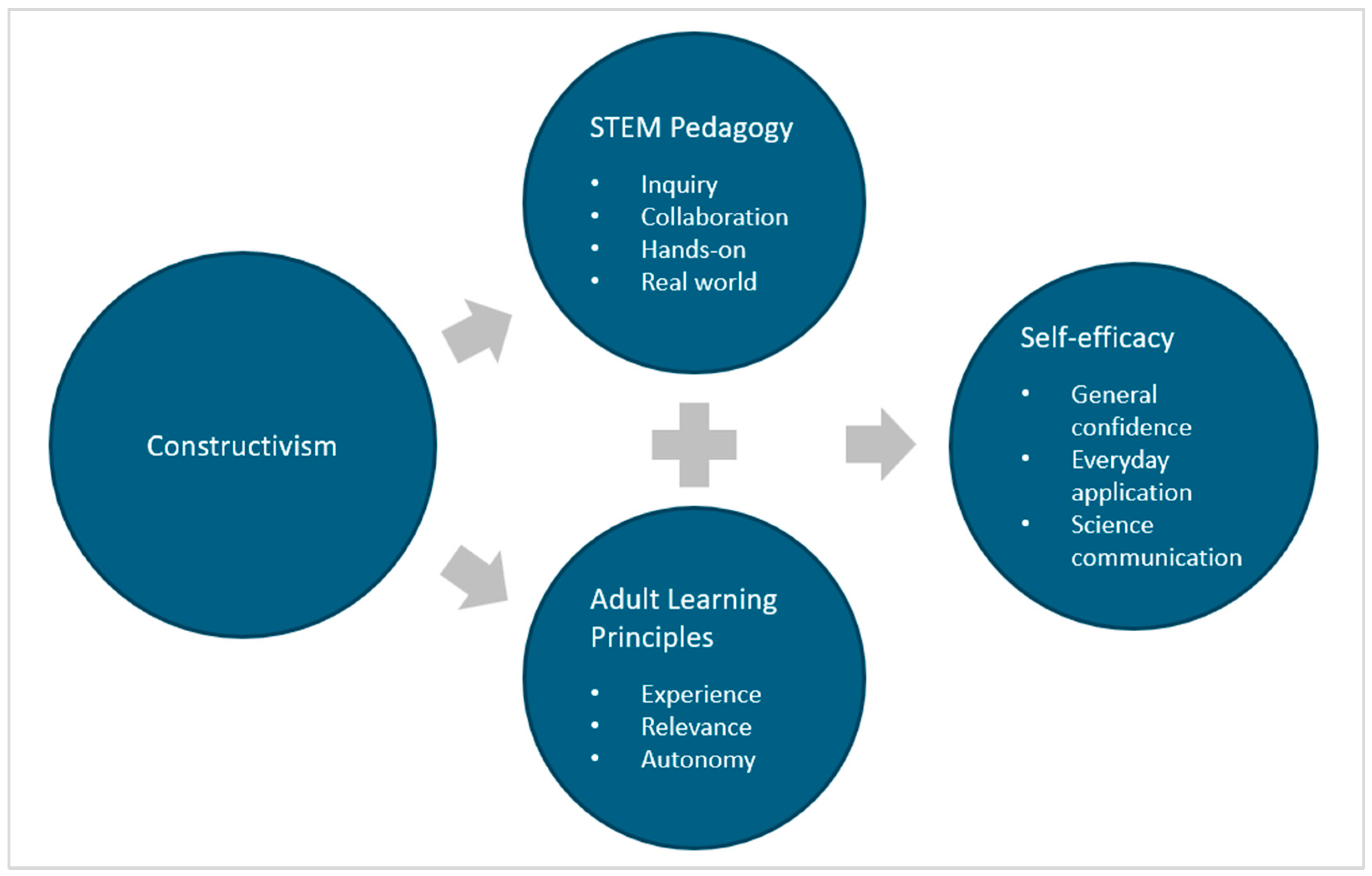
The STEM framework and its core principles are fully aligned with contemporary physics teaching methods grounded in constructivism [35]. Constructivist theory posits that learners bring pre-existing ideas that must be recognized and critically engaged through activities such as group collaboration, hands-on experimentation, and guided inquiry [36], while the teacher’s role shifts from that of a knowledge transmitter to a facilitator, enabling learners to construct understanding through experience and social interaction [37]. Also, considering both the features of effective adult education and those of constructivism, it becomes clear that constructivism provides a highly suitable pedagogical approach for adult learning, a claim further reinforced by existing literature [37,38]. In conclusion, since STEM aligns with constructivist-based approaches to physics instruction, and constructivism itself has been established as a recommended framework for adult education, STEM methodology can be considered particularly appropriate for supporting adult learners’ engagement and achievement. A conceptual diagram of the relationship between constructivism, STEM methodology, adult education and self-efficacy is presented in Figure 1.
Figure 1. A conceptual diagram of the relationship between Constructivism, STEM Pedagogy, Adult Education and Self-efficacy.
After all, the demand for STEM education has become increasingly critical at the individual level, particularly considering contemporary global challenges such as climate change, energy policy, public health, medicine, and data security. In order to make informed decisions, participate in voting or contribute to public discussions on complex issues, individuals need a strong foundation in STEM-related knowledge and skills [8], as research shows that STEM education promotes critical thinking and logical reasoning [9]. Furthermore, it is essential that individuals of all age groups have access to quality STEM education to cultivate a scientifically informed citizenry capable of participating in democratic decision-making processes about the future [8,39]. Equally important is the effort to engage marginalized populations in STEM learning, ensuring that educational opportunities are inclusive. STEM competencies are not only vital for specialized fields but also constitute a set of transferable skills that benefit all members of society [9].
Within this framework, the incorporation of STEM methodology into the scientific literacy curriculum of SCSs possesses significant transformative potential, as it is consistent with adult learning principles by providing meaningful, experiential, and participatory educational opportunities.

2.3. The Notion of Self-Efficacy

Self-efficacy theory highlights the multifaceted nature of human capabilities. Self-efficacy denotes individuals’ beliefs in their capacity to structure and carry out the actions necessary to achieve specific outcomes. Moreover, self-efficacy reflects not merely the sheer quantity of skills one possesses, but rather the belief in what one can accomplish with those skills across different circumstances. Possessing individual subskills does not guarantee effective performance; optimal functioning requires the ability to integrate and apply them under challenging conditions. People may often fall short of their potential not because they lack skills, but because doubts about their efficacy prevent them from mobilizing those skills effectively. Efficacy beliefs explain why individuals with similar abilities, or the same individual under different conditions, may perform inadequately, adequately, or exceptionally. Effective functioning thus requires both competencies and strong efficacy beliefs to guide their effective use [17].
In an interview, Pajares, an academic researcher regarding self-efficacy, clarified that self-efficacy and self-esteem are two distinct constructs, although both are critical self-conceptions that influence human functioning. While confidence is a component of self-esteem, self-efficacy refers specifically to judgments of one’s capability to perform tasks, whereas self-esteem reflects broader evaluations of self-worth. Self-esteem is strongly shaped by cultural and social values, while self-efficacy is task-dependent and independent of cultural values. Answers to self-efficacy questions reveal whether individuals believe they can succeed in a task, while self-esteem questions reflect how positively or negatively they perceive themselves. Importantly, beliefs about one’s capabilities may not necessarily align with one’s overall self-regard [40].
Individuals’ beliefs about their own efficacy have diverse effects. They shape the kinds of activities people decide to engage in, the degree of effort they invest, and the extent to which they persist when confronted with difficulties. Such beliefs also affect resilience in the face of adversity, the tendency to adopt either self-defeating or self-enhancing patterns of thought, the amount of stress and depressive affect experienced under demanding conditions, and ultimately the level of achievements attained [17].
Self-efficacy beliefs are shaped through four main sources. The first involves mastery experiences: relying solely on easy successes can promote unrealistic expectations of quick outcomes and make people more vulnerable to discouragement in the face of difficulties. In contrast, lasting self-efficacy develops through overcoming obstacles with sustained effort and by viewing failures as opportunities to learn rather than as discouraging setbacks. Social modeling also plays a key role, since observing similar others succeed through sustained effort raises observers’ aspirations and confidence in their own abilities. A third influence is social persuasion: encouragement to believe in oneself promotes perseverance and increases the likelihood of success, especially when success is defined as self-improvement rather than competition. Finally, physiological and emotional states contribute by signaling capability; reducing stress and depression, improving physical strength, and accurately interpreting emotional cues all strengthen efficacy beliefs [41].
Since the early stages of educational research, scholars have examined the concept of self-efficacy within the educational context, and substantial progress has been made in elucidating the role of efficacy beliefs in the development of cognitive competencies. Early studies established that self-efficacy contributes uniquely to intellectual performance, rather than simply reflecting cognitive skills [17]. Research on students’ self-efficacy began many decades ago and continues actively to the present day. Since the 1980s, studies have demonstrated that poor academic performance does not necessarily result from a lack of skills but often from insufficient self-efficacy to effectively apply those skills [42]. Subsequent findings revealed that higher levels of self-efficacy are associated with more effective time management, greater persistence, a reduced tendency to prematurely dismiss correct solutions, higher personal goals, enhanced strategic flexibility in problem solving, greater accuracy in evaluating one’s work, and superior intellectual performance [43,44]. Since then, extensive research has been conducted across diverse subjects [21,45,46,47,48,49,50] and all levels of education [51,52], including studies with students with disabilities and learning difficulties [53,54], or marginalized adults [55,56,57], while considerable effort has also been made in the development of reliable and validated measurement scales. This growing body of research underscores the enduring importance of self-efficacy as a key determinant of the learning process, given that self-efficacy is a better predictor of intellectual performance than skills.

2.3.1. Self-Efficacy in Physics

Self-efficacy in physics has been shown to be a significant predictor of students’ performance in the subject and is linked to science-related educational choices across different grade levels. Learners who hold strong beliefs in their ability to succeed in physics-related tasks are more inclined to engage with such activities, invest greater effort in accomplishing them, persist when confronted with challenges, and interpret physiological cues in ways that sustain confidence as they encounter obstacles [58]. Moreover, low self-efficacy may lead students to avoid enrolling in physics courses, thereby hindering their pursuit of careers in this field [59].
A considerable body of research has sought to validate Bandura’s four sources of self-efficacy, with particular attention to Physics [19,58,60,61,62]. Evidence from one such study revealed that students with high levels of self-efficacy in Physics drew upon multiple sources of self-efficacy and reported more positive experiences across all four sources. They were characterized by strong mastery and vicarious experiences, supportive social persuasions, and low levels of physiological or affective arousal. These students not only achieved higher outcomes but also believed that physics ability could be improved through effort. On the contrary, students with low self-efficacy in Physics reported fewer mastery experiences, limited exposure to competent models, fewer positive reinforcements, and elevated anxiety and stress in relation to Physics. Additionally, they demonstrated lower achievement and believed that ability in Physics is innate, fixed and unchangeable [60].
As previously mentioned, the notion of self-efficacy has been extensively examined in the educational domain through diverse approaches. Regarding physics, research findings on self-efficacy beliefs can equip key adults in students’ lives with the knowledge necessary to promote the optimal development of their self-efficacy [58]. Prior research has demonstrated a positive link between students’ mastery-approach goals and their self-efficacy in Physics. Engaging with mastery-oriented goals can promote learning behaviors like persistence and deeper cognitive processing, ultimately leading to improved performance and greater self-efficacy [63]. Other studies show a positive link between perceived recognition and validation by instructors or teaching assistants on students’ self-efficacy and interest. These findings pertain to both school and university students [64,65,66]. In addition, many studies have examined the link between instructional methods and self-efficacy. Instructional strategies shown to be particularly effective in enhancing self-efficacy include question-and-answer sessions, collaborative learning, the use of digital applications, and conceptual problem-solving tasks [18,19]. In addition, approaches such as STEM project-based learning and learning environments incorporating Augmented Reality have also been positively associated with self-efficacy [20,21,22] among students.
The relationship between gender and self-efficacy has attracted significant research attention in the education context. Numerous studies have examined whether disparities in physics self-efficacy exist between male and female students and what accounts for these differences. Stereotypical assumptions of male superiority in Physics, masculine cultures that reduce women’s sense of belonging and the scarcity of female role models have been identified as key factors reinforcing the perception of this field as “male-dominated”. This, in turn, contributes to women’s underrepresentation in physics courses and career trajectories [67] and promotes anxiety among female students about confirming gender-based stereotypes, ultimately resulting in lower performance [68]. Indeed, among all science-related disciplines, female students feel inadequate and remain underrepresented in physics compared to mathematics, biology, chemistry, and earth science, a pattern that persists from secondary through graduate education [67,69].
For these reasons, most of the empirical evidence suggests that male students generally report stronger self-efficacy beliefs [66,69,70]. Nonetheless, several studies have found no statistically significant gender differences in self-efficacy [61,64], while others provide evidence that female students may demonstrate comparatively higher levels of self-efficacy [58]. It is worth mentioning that Williams’ study in 2017 revealed that, while boys and girls demonstrated similar actual performance in science as well as similar quantitative self-efficacy scores, their perceptions of performance varied by gender. Interview data indicated that female students consistently, and in some instances substantially, underestimated their own achievements [64]. In a similar vein, Britner’s study revealed that, despite the absence of gender differences in grades or self-efficacy, female students reported experiencing higher levels of anxiety [61]. This indicates that even when no objective differences are observed between boys and girls, female students are more likely to perceive their abilities less favorably and demonstrate reduced confidence in their performance.

2.3.2. Development of Multidimensional Self-Efficacy Scales

For self-efficacy measurement scales to be reliable and valid, they require rigorous and careful development. Self-efficacy is often mistakenly regarded as a generalized trait. In reality, individuals vary in their sense of efficacy not only across distinct domains of functioning but also across different facets within a single domain. Therefore, there is no universal measure of self-efficacy [41]. Developing valid self-efficacy scales requires a clear conceptual definition of the determinants that regulate performance in a given domain, as well as the barriers that may hinder the achievement of desired outcomes [71]. Similarly, Zimmerman emphasized that self-efficacy beliefs are not a unitary disposition but rather multidimensional in nature [72]. Lastly, Pajares emphasizes that efficacy beliefs differ in level, strength, and generality, dimensions that are critical for ensuring valid measurement, and that assessment items should be phrased using can to capture judgments of capability, rather than will, which merely reflects intention [40].
As can be inferred from the above, in examining students’ self-efficacy, researchers should refrain from employing general self-efficacy items and instead break the notion of self-efficacy down into multiple dimensions for more nuanced investigation. A review of the relevant literature reveals numerous attempts to develop self-efficacy questionnaires in physics. Some questionnaires include only general items [73,74], others consider self-efficacy merely as a component of a broader construct [75,76,77,78,79,80,81], while some examine self-efficacy as a multidimensional construct [82,83,84], as presented in Table 1.
Table 1. Representative examples of self-efficacy questionnaires in physics.
Research in science education has identified several essential dimensions of science learning. These include conceptual understanding, reasoning and higher-order thinking [83], practical work such as laboratory activities, which promotes both practical skills and conceptual understanding, enhances motivation, supports scientific literacy and critical thinking, and cultivates research skills through experiences that mirror authentic inquiry [85] and the application of science to everyday life. Everyday experiences should serve both as entry points and as outcomes of science education. To maximize its impact, teaching must build on pupils’ prior experiences while also emphasizing the application of school science within their communities [86]. More recent studies have also emphasized the role of language and communication in enabling students to articulate and debate scientific ideas [87]. Collectively, these contributions suggest that physics learning may be framed around five interrelated dimensions: conceptual understanding, higher-order thinking, practical work, everyday application, and science communication and these dimensions need to be systematically evaluated in a self-efficacy questionnaire [83].

3. Research Design and Methodology

3.1. Designing the Research

Within the framework of a broader mixed-methods research project, which examined the comparative effectiveness of two instructional approaches for promoting Scientific Literacy, and specifically improving understanding of Physics concepts, a study was conducted to investigate the impact of these instructional approaches on the self-efficacy in Physics of adult learners attending two SCSs in Attica, located in the municipalities of Agioi Anargyroi and Peristeri. The research design incorporated both quantitative and qualitative data, while the two instructional approaches were lecture-based teaching and STEM-oriented instruction combined with educational robotics. A more detailed presentation of the overall research project is beyond the scope of the present article; therefore, the analysis focuses only on the impact of the two instructional approaches on the self-efficacy of adult learners.
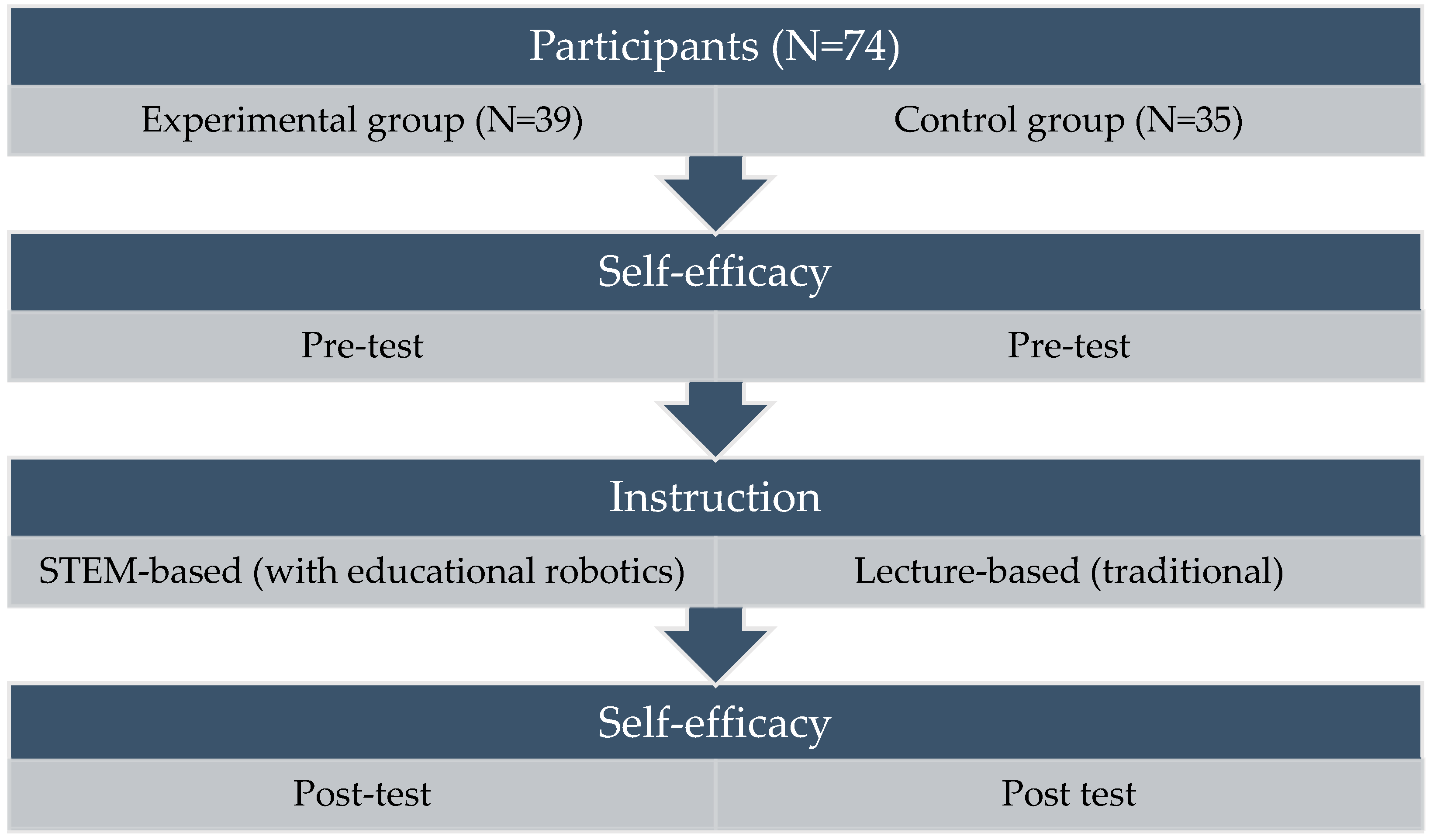
The study consisted of an experimental group of 39 participants (22 men and 17 women) and a control group of 35 participants (7 men and 28 women). The learners were already organized into seven classes, from which four were randomly assigned to serve as the experimental group, while the remaining three classes comprised the control group. This type of experimental design is categorized as a quasi-experimental design, which is widely employed in educational research due to the practical difficulties associated with the random assignment of students to experimental and control groups, particularly in cases where learners are already organized into pre-existing classes [88,89]. Initially, both groups completed the self-efficacy questionnaires and subsequently received instruction on selected Physics concepts. The control group was instructed through a lecture-based approach, whereas the experimental group received instruction via STEM-oriented methods combined with educational robotics. The intervention spanned a total duration of four months. Following the completion of the instructional phase, both groups were once again administered the self-efficacy questionnaires, with the aim of addressing the research questions previously delineated. Figure 2 illustrates the experimental design of the research.
Figure 2. The experimental design of the research.

3.2. Designing the Survey Tools for Data Collection

To evaluate participants’ self-efficacy in Physics, this study employed two structured questionnaires. The first was based on the general, standardized questionnaire developed by Leontari and Gonida [90] for the Greek adolescent student population. This instrument comprises eight items and assesses self-efficacy beliefs in specific subject areas. It has demonstrated reliability and validity, with Cronbach’s alpha coefficient of a = 0.90, and factor loadings of the individual items ranging from 0.64 to 0.83. Measurement of the construct was performed by calculating the mean score of participants’ responses to the eight items.
The second questionnaire consisted of two sections. Section A included three demographic questions (age, gender, occupation), while Section B utilized the multidimensional Science Learning Self-Efficacy (SLSE) scale developed by Lin, Tan, and Chai [91]. This instrument was originally designed to assess students’ self-efficacy in Physics among adolescent learners in Singapore and Taiwan. The scale has demonstrated high reliability, with overall Cronbach’s alpha coefficients of a = 0.94 for the Singaporean sample and a = 0.96 for the Taiwanese sample, as well as evidence of construct validity. For the purposes of the present study, the instrument was translated into Greek and culturally adapted following established guidelines [92], which included forward and backward translation, expert panel review, and pilot testing to ensure linguistic and conceptual equivalence.
Given the unique educational background and needs of adult learners in Second Chance Schools (SCSs), the self-efficacy instruments were carefully adapted to ensure both relevance and accessibility. All SCS participants are primary school graduates who have been absent from formal education for many years and often face significant gaps in reading and mathematical skills. As a result, the primary objectives of Scientific Literacy in SCSs focus on re-engagement with the learning process, development of critical thinking, comprehension of scientific texts, and the ability to participate in reasoned discussions, rather than on advanced conceptual understanding or higher-order problem solving [4]. For this reason, during the adaptation phase, six out of the eight items from the Leontari and Gonida questionnaire were selected for the first questionnaire, and for Section B of the second questionnaire two of the four factors of the Lin, Tan, and Chai instrument were retained, namely “everyday application” (EA) and “science communication” (SC). The rest were excluded as they were found to be misaligned with the learners’ profiles, classroom experiences, and the official aims of Scientific Literacy in SCSs. In SCSs, physics instruction does not emphasize formula-based problem solving, but rather everyday application and science communication, which are more accessible and meaningful for adult learners. This approach is consistent with the official curriculum and pedagogical goals of SCSs, ensuring that the instrument provides a valid and context-appropriate assessment of self-efficacy.
The pilot study of the adapted questionnaires was conducted with a sample of 35 participants at the Second Chance School of Korydallos in Attica, in November 2024. In the final versions, the first questionnaire consisted of six items and the second consisted of 12 items in total: 3 items in Section A and 9 items in Section B. Within Section B, 5 items were allocated to the “everyday application” factor and 4 items to the “science communication” factor, as presented in Table 2. In Section B, three items were excluded in total because, during the pilot study, they displayed very low communalities (<0.4) [93]. All items were positively framed so that higher scores reflected more favorable attitudes. Responses are rated on a five-point Likert scale as follows: 1—Strongly disagree, 2—Disagree, 3—Neither agree nor disagree, 4—Agree, and 5—Strongly agree. The final version of the questionnaires is provided in Appendix A.
Table 2. Questionnaires for measuring self-efficacy in Physics of adult learners in SCSs.
After the initial adaptation and pilot testing of the instrument with 35 participants, used solely to screen for item clarity, cultural appropriateness, and preliminary psychometric suitability, the final version of the questionnaire was administered to the full study sample (N = 74). All reported analyses of validity and reliability, including exploratory and confirmatory factor analyses, were conducted exclusively on this complete dataset. This approach ensures that the psychometric properties presented in this study reflect the responses of the entire participant group, after all item modifications had been made.

3.3. Participants’ Characteristics

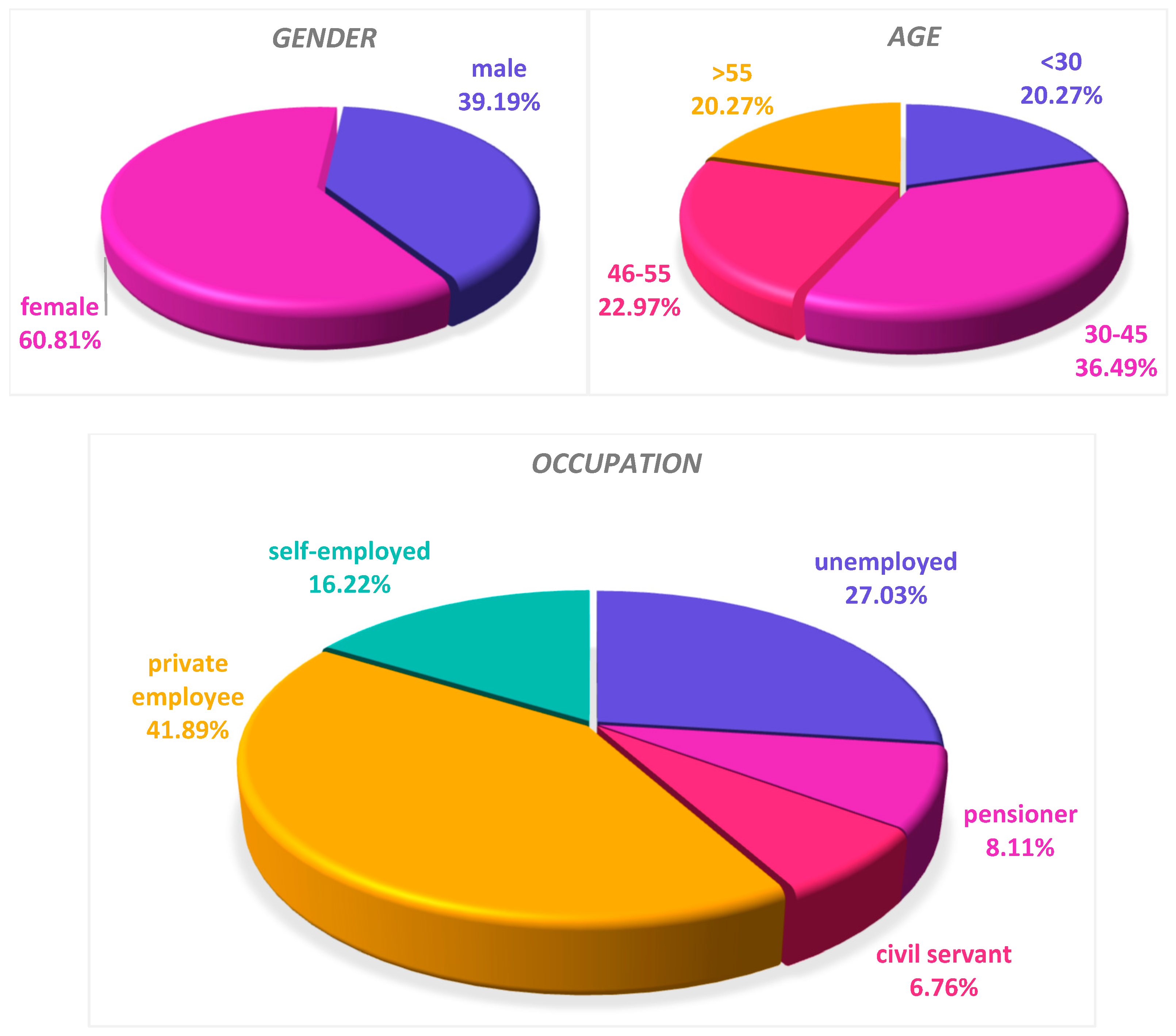
The research was conducted from January to May 2025 at the SCS of Agioi Anargyroi and Peristeri in Attica, Greece. A total of 74 adult learners participated, including 29 men and 45 women. All participants had completed only primary education and had not fulfilled the nine years of compulsory schooling required in Greece. Their ages ranged from 18 to 92 years, with nearly one third (36.5%) falling within the 30–45 age group. Regarding employment status, 41.9% were employed in the private sector, mainly in manual labor roles, while 35.1% were either unemployed or retired. A detailed breakdown of demographic data is provided in Table 3 and Figure 3 illustrates these characteristics to provide additional context for understanding patterns of participation across different groups.
Table 3. Demographic characteristics.
Figure 3. Demographic profiles of adult learners, categorized by gender, age group, and occupation.

3.4. Designing of Lecture-Based Instruction and STEM-Oriented Lessons

3.4.1. General Principles of Lesson Design

The instructional intervention was carried out by the principal researcher, a certified physics teacher with substantial experience in adult education. The researcher had previously completed extensive professional development programs in STEM pedagogy and educational robotics, which ensured advanced expertise in both subject matter and teaching methodology.
Both the experimental and control groups were instructed following an equivalent physics curriculum, ensuring alignment in topics, learning objectives, and assessment criteria. The instructional content encompassed fundamental physics concepts such as sound, friction, buoyancy, heat, and light. To maintain methodological consistency, a unified instructional framework was developed, delineating the sequence of concepts, the duration of each session, approximately 90 min per week over a 13-week period, and the anticipated learning outcomes. Within this framework, learners in the experimental group were organized into small collaborative groups and engaged in robotics-enhanced sessions integrating conceptual instruction with experiential, robotics-supported activities. Each session is allocated approximately 45–60 min to hands-on engagement in assembly, programming, and problem-solving tasks directly related to the targeted physics concepts, promoting active learning and deeper conceptual understanding. Sessions were conceptually synchronized with the lecture-based lessons, thereby minimizing instructional variability and controlling for potential confounding factors.

3.4.2. STEM-Oriented Lessons

During the experimental sessions, active instructional methodologies were employed, whereby learners were not passive recipients of information, but rather involved in the learning process through hands-on experimentation, collaborative problem-solving, and inquiry-based tasks. Τhe intervention design incorporated core andragogical principles by emphasizing relevance, autonomy, and experiential learning. The activities were intentionally contextualized within everyday applications, addressing adult learners’ preference for practical and meaningful experiences. Participants were also provided with opportunities to exercise decision-making during project implementation, promoting self-directed learning. Collaborative group work further reinforced social learning and peer interaction, both of which are vital components of adult education. A concise overview of the experiments conducted is presented below.
The first experimental activity addressed the exploration and understanding of the physical concept of sound. The Phyphox mobile application was utilized for experimental measurements; the acoustic stopwatch tool enabled the determination of the speed of sound in air, whereas the sonar module was employed to measure the distance between the smartphone and a fixed target. In parallel, the concepts of sound reflection and insulation were introduced and discussed in relation to the experimental context.
The second experimental activity aimed to promote an experiential understanding of the concept of friction through the integration of educational robotics, mobile-based sensing, and inquiry-based experimentation with everyday materials. Initially, the groups of adult learners constructed the Delivery Cart using the LEGO Education SPIKE™ Prime Set 45678, following the official building instructions provided in the LEGO Education Spike App (version 3.4.5). They practiced programming the cart and familiarized themselves with all the available sensors. Subsequently, a simpler cart was built and programmed to move autonomously.
Following this stage, the concept of friction was introduced, and learners examined how friction varies according to the type of surface material, the size of the contact surfaces, and the weight of the object. The inclination tool of the Phyphox application was employed to measure the slope angle of an inclined plane during the study of friction’s dependence on the surface material.
The third experimental activity addressed the exploration and understanding of the physical concepts of buoyancy and flotation. Using standard laboratory apparatus, the buoyancy was quantitatively determined, and the factors influencing it were systematically investigated. The experiment began with measurements of buoyancy in water, followed by repeated trials under varying conditions, including different liquid volumes, substitution of water with glycerin, and changes in submersion depth. Subsequently, the concept of flotation was examined using a 3D-printed boat, which had been produced in a prior session [94], illustrating the practical connection between buoyancy and the phenomenon of floating.
The fourth experimental activity addressed the exploration and understanding of the physical concept of heat. A solar oven was constructed using readily available materials. Throughout the process, participants engaged in discussions on thermal phenomena, including the modes of heat transfer, solar radiation, light reflection, melting, thermal insulation and the greenhouse effect.
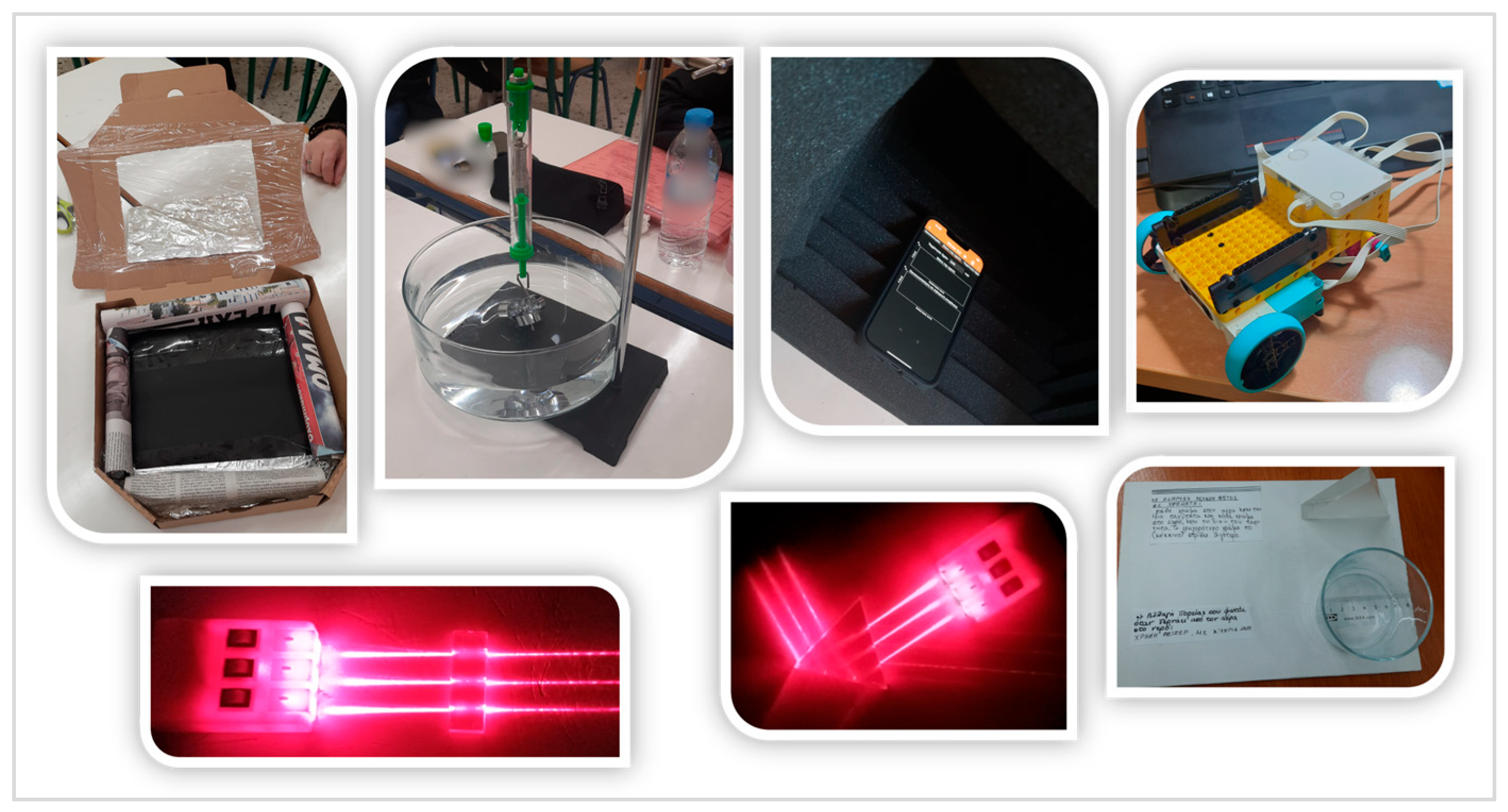
The fifth experimental activity addressed the exploration and understanding of the physical concept of light. Laboratory equipment was employed to investigate fundamental optical phenomena, including the dispersion of white light, light refraction, and the apparent elevation effect. After assembling the experimental setup, participants explored the nature of light and observed the decomposition of white light into its spectral components. The refraction phenomenon was both explained theoretically and verified experimentally. The apparent elevation was demonstrated using common materials. Finally, the concept of the speed of light was introduced through the calculation of the refractive index of a given material. Snapshots of the experimental activities are presented in Figure 4.
Figure 4. Snapshots of the STEM-based experiments.

4. Results

4.1. Reliability and Validity Analysis

To ensure the robustness of the study’s findings, preliminary analyses were conducted to assess both the reliability and validity of the questionnaires prior to the main data collection. Reliability refers to the consistency and stability with which the instruments measure the intended constructs, while validity concerns the extent to which the instruments accurately capture the concept of self-efficacy in the context of this research.

4.1.1. Reliability

The reliability of a questionnaire pertains to the extent of stability and consistency with which it measures the construct it is intended to assess [95].
The internal reliability of the questionnaire responses was confirmed using Cronbach’s alpha coefficient and Composite Reliability (CR). Cronbach’s alpha coefficient reached a value of 0.905 for the first questionnaire and for the entire set of responses for Section B of the second questionnaire, while two constructs of Section B reached a value of 0.829 and 0.850, respectively. In addition, CR reached a value of 0.907 for the first questionnaire, while two constructs of Section B of the second questionnaire reached a value of 0.838 and 0.854, respectively. All results are presented in Table 4. These values are considered acceptable as they exceed the commonly accepted threshold of 0.7 [96].
Table 4. Cronbach’s alpha coefficients and Composite Reliability for both questionnaires.

4.1.2. Validity

The validity of a questionnaire refers to the degree to which it accurately captures the construct of interest, that is, the variable it is intended to measure. In the present study, we assessed construct validity through factor analysis and convergent validity [97] for both questionnaires.
Initially, to evaluate the adequacy of the sample data for factor analysis, Jamovi Software (Version 2.6.44.0) was employed to compute the Kaiser–Meyer–Olkin (KMO) index and the significance level of Bartlett’s test of sphericity (p) for both questionnaires. The threshold for the KMO index is 0.6 and for the significance level p < 0.05 [95]. The findings are presented in Table 5, while the p-values for Bartlett’s test were below 0.001. Consequently, the scales were deemed appropriate for factor analysis.
Table 5. KMO indexes, overall and for each item, for both questionnaires.
Exploratory Factor Analysis (EFA) was conducted for both questionnaires to identify underlying latent factors. Factor extraction was based on eigenvalues greater than 1, resulting in a one-factor solution for the first questionnaire and a two-factor solution for Section B of the second questionnaire, as it was expected, explaining 62% and 58.9% of the total variance, respectively. Total Variance Explained (TVE) reflects the proportion of variance in the data accounted for by all factors, with acceptable values set above 0.50. Factor loadings and communalities for all items are reported in Table 6, with threshold values of 0.40. Factor Loading indicates the extent to which an observed variable reflects or represents the underlying latent factor, while communality refers to the proportion of an item’s variance that is explained by the extracted factor solution. It is noted that items are declared worthy of being included in a factor if the item has a factor load greater than or equal to 0.40 on only one factor [93,95,98,99].
Table 6. Factor loadings and communalities for each item of the two questionnaires and average variance explained for each factor of both questionnaires.
Subsequently, Confirmatory Factor Analysis (CFA) for both questionnaires was used to measure AVE (Average Variance Extracted) and CR (Composite Reliability) mentioned earlier in Section 4.1.1 of this paper. AVE is an index that provides evidence for convergent validity with a threshold > 0.5 [96] and the results are also presented in Table 6.
Finally, convergent validity of the second questionnaire was also examined by computing Spearman’s correlations between its two constructs and the single factor of the first questionnaire, as the variable data, factor mean scores before intervention, did not follow a normal distribution (p < 0.05). The results indicated strong and statistically significant positive associations (ρ ranging from 0.62 to 0.70, p < 0.001), supporting the convergent validity of the second questionnaire.
The findings confirm the reliability and validity of the two questionnaires, ensuring the questionnaires’ suitability for further analysis of adult learners’ Physics self-efficacy in SCSs.

4.2. Descriptive Statistics

Table 7 presents, for each of the two groups before and after the instructional intervention, the mean scores and standard deviations for each questionnaire item. Table 8 displays the mean scores and standard deviations for the first questionnaire and the two factors from Section B of the second questionnaire, for each group before and after the instructional intervention.
Table 7. Mean scores and standard deviations for all survey items for both groups before and after instructional intervention.
Table 8. Mean scores and standard deviations for the factors of both questionnaires and for both groups before and after instructional intervention.

4.2.1. Within-Group Calculations

For the experimental group (N = 39), to compare self-efficacy before and after the intervention, a new variable, the difference in the mean scores (post–pre) for each participant on each item was first computed. Subsequently, the non-parametric Wilcoxon Signed-Rank test was applied, as the variable data did not follow a normal distribution (p < 0.05). Results indicate that for the first questionnaire, the mean score increased slightly from 3.50 to 3.62 (Table 9); however, this difference was not statistically significant and showed only a small effect size (Z = −1.07, p = 0.285, r = 0.17). In contrast, the increases in mean scores for the “everyday application” and “science communication” subscales, from 3.33 to 3.76 and from 3.49 to 3.95, respectively, were statistically significant, with moderate to substantial effect sizes (Z = −3.71, p < 0.001, r = 0.59; 95% CI [0.34, 0.76]; Z = −3.12, p = 0.002, r = 0.50, 95% CI [0.22, 0.71]) [100]. Although the absolute score changes were modest, these results suggest meaningful improvements in self-efficacy for the experimental group. The fact that the 95% confidence intervals for the effect sizes are entirely positive further supports the robustness of the observed improvements, indicating that the intervention had a consistent and meaningful effect on self-efficacy outcomes.
Table 9. Mean scores and standard deviations for the factors of both questionnaires, for the experimental group before and after instructional intervention.
Regarding gender, the normality of the differences in the mean score (post–pre) by gender was tested, only for the subsections of Section B of the second questionnaire, where improvement was observed. For both the subcategories EA and SC, the assumption of normality was not violated (p > 0.05), and the independent samples t-test was conducted, which showed no performance differences between genders. Additionally, the mean score and the standard deviation of the new variable of differences were computed by gender, for the two factors of the second questionnaire.
Particularly, in the EA subscale, men (M = 0.43, SD = 0.76) and women (M = 0.44, SD = 0.51) demonstrated similar improvement. In the SC subscale, women (M = 0.57, SD = 0.65) showed slightly greater improvement than men (M = 0.38, SD = 0.95); however, the results were not statistically significant with a small effect size (p = 0.465, Cohen’s d = 0.24) [101]. All results are presented in Table 10.
Table 10. Mean scores and standard deviations of the difference variable, by gender, within the experimental group.
For the subsections of Section B of the second questionnaire, where improvement was observed, the normality of the differences in the mean score (post–pre) by age group (<30, 30–45, 46–55, >55 years). For both the subcategories EA and SC, the assumption of normality was not violated (p > 0.05), and one-way ANOVA test was conducted, which showed no performance differences between age groups. Additionally, the mean score and the standard deviation of the new variable of differences were computed by age, for the two factors of the second questionnaire.
Particularly, for both the EA and SC subcategories, Table 11 indicates that younger participants showed greater improvement than older participants; however, these differences were not statistically significant among the four age groups (F (3,35) = 0.89, p = 0.454, η2 = 0.07 for EA and F (3,35) = 1.28, p = 0.296, η2 = 0.10 for SC. This suggests that the intervention had a similar impact across age groups for both subscales.
Table 11. Mean scores and standard deviations of the difference variable, by age, within the experimental group.
For the control group (N = 35), the difference in the mean scores (post–pre) for each participant on each item was first computed to compare self-efficacy before and after the instructional intervention. Subsequently, the non-parametric Wilcoxon Signed-Rank Test was applied, as the variable data did not follow a normal distribution (p < 0.05). Although differences in mean scores were observed before and after the intervention, as presented in Table 12, none of the results reached statistical significance (p = 0.347, p = 0.100, and p = 0.494), and all the effect sizes were small (r ≤ 0.28), indicating that the control group did not exhibit any change in self-efficacy following lecture-based instruction.
Table 12. Mean scores and standard deviations for the factors of both questionnaires, within the control group before and after instructional intervention.
Since no statistically significant differences were found before and after the intervention, no further analyses were conducted based on gender or age for the control group.

4.2.2. Calculations Between the Two Groups

Initially, to determine if there are any pre-existing differences between the experimental and control groups, their self-efficacy scores in the pre-test of both questionnaires were compared. As the scores in every group were found not to be normally distributed (p < 0.05), a Mann–Whitney U Test was applied, and the results showed no significant between-group differences (p > 0.05), indicating baseline equivalence. Hence, observed differences between the experimental and control groups cannot be attributed to pre-existing group disparities.
Subsequently, to compare self-efficacy before and after the intervention between the two groups, a new variable, the difference in the mean scores (post–pre) for each participant on each item, was first computed. Following, the Mann–Whitney U Test was applied, as the variable data did not follow a normal distribution (p < 0.05).
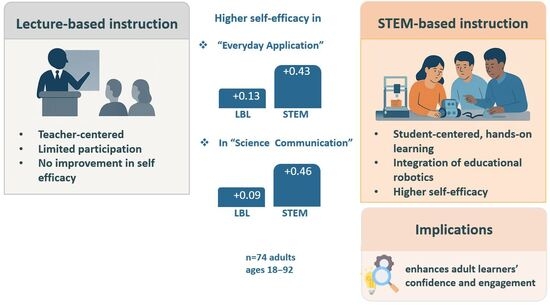
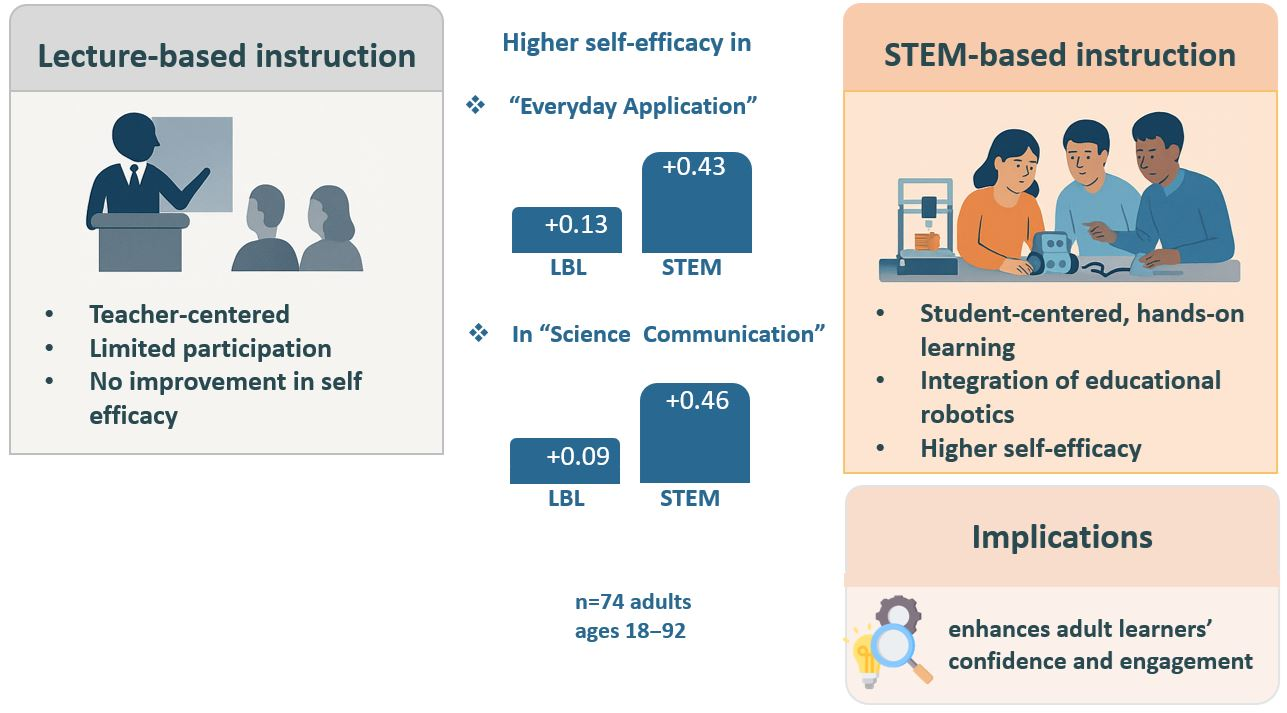
As shown in Table 13, the small difference in means of the new variable for the first questionnaire between the two groups (M = 0.12 and M = 0.09) was not statistically significant (U = 675.5, Z = −0.08, p = 0.939). In contrast, for the EA and SC subscales of Section B of the second questionnaire, the experimental group demonstrated significantly greater improvement, as the observed mean differences were larger (M = 0.43 vs. M = 0.13 and M = 0.46 vs. M = 0.09, respectively), statistically significant, and of medium effect size (EA: U = 458.5, Z = −2.45, p = 0.014, r = 0.28; 95% CI = [−0.48,−0.06], SC: U = 428.0, Z = −2.78, p = 0.005, r = 0.32, 95% CI [−0.51, −0.10]) [100]. The negative values in the confidence intervals for the effect sizes indicate that the observed improvements in the experimental group were greater than those in the control group, consistent with the direction of the calculated mean differences.
Table 13. Mean scores and standard deviations of the difference variable, for the factors of both questionnaires, for both experimental and control groups.
Since no statistically significant differences were found before and after the intervention for the control group, no further analyses were conducted based on the interaction group × gender or group × age for the two groups.

5. Discussion

This study provides the first empirical evidence on the impact of two teaching methods on the self-efficacy of adult learners in Physics within Greek Second Chance Schools (SCSs). Participants were divided into two groups: the control group received instruction through the traditional lecture-based method, while the experimental group engaged in a STEM-oriented instructional approach. Both groups completed two self-efficacy questionnaires before and after the intervention. Results showed no significant change in the general factor of the first questionnaire; however, the experimental group demonstrated improvements in the dimensions “everyday application” and “science communication” in the second questionnaire. These gains were not influenced by gender or age, whereas the control group showed no improvement in any dimension. Between-group comparisons confirmed that, although both groups started with equivalent self-efficacy levels, the experimental group demonstrated greater improvement in these two dimensions, while general physics confidence remained unchanged.
Although our results aligned with earlier research demonstrating that STEM-based instruction increases students’ self-efficacy [20], results require careful interpretation. STEM-based instruction enhanced self-efficacy in areas closely tied to real-world application and collaborative communication, but it did not significantly affect learners’ overall confidence in physics knowledge. This suggests that the benefits of STEM interventions may be domain-specific, reflecting the experiential and problem-solving nature of the activities rather than a broad increase in subject mastery. At the same time, the modest absolute score changes observed in the experimental group indicate that while STEM interventions can positively influence self-efficacy, they are not sufficient on their own and should be complemented by additional strategies. Integrating STEM with structured conceptual review may yield more comprehensive outcomes. Results also constitute strong evidence that self-efficacy measures should not rely on general items but rather adopt a multidimensional structure [41,72].
Moreover, the absence of improvement in self-efficacy among control group participants in both questionnaires, where instruction was implemented using a lecture-based pedagogical approach, was expected, given the disadvantages of the method [11] and its recognized pedagogical inadequacy, particularly in the context of adult education [4,12]. This finding is consistent with previous research on effective teaching methods for physics, showing that lecture-based instruction produces lower learning outcomes than other pedagogical approaches [23,24,25]. Self-efficacy may not constitute a direct learning outcome; however, it has been repeatedly associated with students’ academic performance [58]. This finding also aligns with prior research emphasizing that active, technology-enhanced learning environments promote engagement and practical competence [94,102,103].
Lastly, results indicate that self-efficacy did not differ by gender, a result consistent with prior studies [61,64] or age. The parameter of age has not been extensively examined in previous research, particularly for such a wide age range as that of the participants in our study; however, we considered it worthwhile investigating, given Bandura’s opinion about self-efficacy and age. According to Bandura, as individuals age, they are required to reassess their self-efficacy in response to biological and cognitive changes, which vary widely across people. Despite declines in functions such as memory, accumulated experience, social support, and beliefs in personal control serve as compensatory resources, enabling the maintenance of self-efficacy through goal adjustment and a positive redefinition of the aging process [17].
The STEM-based intervention in this study operationalizes constructivist and adult learning principles in several ways. First, consistent with constructivist theory, learners engaged in active knowledge construction through hands-on robotics projects and inquiry-driven tasks rather than passive reception of information. These activities encouraged learners to build on prior experiences and apply physics concepts in real-world contexts, promoting deeper conceptual understanding. The teacher’s role shifted from a transmitter of knowledge to a facilitator who guided exploration and problem-solving, a hallmark of constructivist pedagogy. Second, the design reflects key andragogical principles by emphasizing relevance and autonomy: robotics activities were linked to everyday applications, addressing adults’ need for practical and meaningful learning, while learners were given opportunities to make decisions during project implementation, promoting self-direction. Collaborative group work further supported social learning and peer interaction, which are critical for adult learners. By integrating these theoretical foundations into practice, the STEM approach provided an experiential, learner-centered environment that aligns with both constructivist and adult education frameworks, thereby enhancing engagement and confidence in applying scientific knowledge.
Beyond theoretical implications, these findings carry practical significance. Scaling STEM-based interventions in resource-constrained adult education settings requires cost-effective strategies. Low-cost robotics kits and open-source platforms can reduce financial barriers, while shared makerspaces or mobile STEM labs can optimize infrastructure use. Modular teacher training programs delivered online or in blended formats can build educator capacity without imposing excessive time or cost burdens. Partnerships with local universities, non-governmental organizations (NGOs), and industry can further support access to equipment and expertise, ensuring sustainability and equity in implementation.
Despite these promising outcomes, certain limitations should be acknowledged. The study relied on validated self-report instruments, which provide valuable insights into learners’ confidence but do not directly assess conceptual mastery. Future research should incorporate performance-based assessments to examine whether gains in self-efficacy translate into improved cognitive outcomes. Additionally, the sample size of 74 participants, although larger than the pilot, remains modest for factor-analytic procedures and limits generalizability. This constraint reflects the practical challenges of conducting research in SCSs, where the available population is inherently limited. The use of convenience sampling may limit the extent to which the findings can be generalized to the broader population of adult learners, as the sample may not fully capture the diversity present in other educational contexts. While demographic data in this study included age, gender, and employment status, socio-economic and cultural variables were not systematically captured.
To enhance the practical applicability of our findings, we propose a framework for the scalable implementation of STEM-based interventions in adult education. This approach begins with a careful assessment of learner needs and available resources, followed by the selection and adaptation of cost-effective educational technologies suited to the local context. Supporting educators through flexible professional development and promoting partnerships with local institutions and organizations are essential for successful adoption. Ongoing monitoring and evaluation, incorporating both self-efficacy and performance-based measures, can guide continuous improvement and ensure that interventions remain responsive to learners’ needs. While self-reported measures of self-efficacy are widely recognized and appropriate for capturing motivational changes, future implementations may benefit from supplementing these with objective assessments to further strengthen the evidence base. By outlining these key steps, we aim to provide educators and policymakers with a clear and actionable guide for applying our approach in diverse settings.
Future studies should include larger and more geographically diverse samples to capture socio-economic and cultural variations that may influence self-efficacy beliefs. Incorporating a broader range of demographic indicators, such as income level, ethnicity, and cultural context, would enable a deeper understanding of the factors shaping self-efficacy. Additionally, exploring correlations between self-efficacy and performance on physics knowledge tests would help clarify whether gains in self-efficacy translate into actual conceptual mastery. It would also be valuable to explore correlations between self-efficacy and performance on physics knowledge tests and to employ qualitative methods, such as interviews, to investigate the underlying causes of variations in self-efficacy among adult learners. Finally, examining the long-term impact of STEM interventions on career trajectories and lifelong learning engagement, as well as identifying the most effective components (e.g., robotics, 3D printing, collaborative projects), would provide actionable insights for policy and practice.

6. Conclusions

This research contributes novel insights into adult education by demonstrating how instructional approach influences self-efficacy in Physics within Greek Second Chance Schools (SCSs). Addressing a gap in the literature, the study compared a traditional lecture-based method with a technology-enhanced STEM approach, revealing that experiential, technology-driven learning promotes improvements in specific dimensions of self-efficacy, particularly “everyday application” and “science communication.” In contrast, no gains were observed in the control group, and overall physics confidence remained unchanged. These findings show that the benefits of STEM instruction are specific and can improve adult learning environments, while not affecting patterns related to gender or age.
This study demonstrates not only the effectiveness of STEM-based instruction but also its alignment with constructivist and adult learning principles, as the intervention operationalized these theories through hands-on, collaborative, and contextually relevant activities. The results underscore the importance of incorporating technology-enhanced, hands-on STEM activities into the curriculum of SCSs. Educators are encouraged to adopt learner-centered, experiential approaches that promote engagement, confidence, and practical scientific literacy among adult learners. To support this shift, targeted professional development should be provided to instructors, enabling them to design and implement effective STEM lessons tailored to the unique needs of adult education. Furthermore, the use of multidimensional self-efficacy assessment tools can help educators monitor learners’ progress and adapt instructional strategies to maximize impact.
From a policy perspective, the demonstrated benefits of STEM-based instruction suggest that such approaches should be scaled and institutionalized within alternative education frameworks, particularly in marginalized or under-resourced communities. Policymakers are urged to allocate resources for educational technologies and the creation of makerspaces, as well as to promote partnerships with universities, industry, and non-governmental organizations. These efforts can enrich the curriculum and provide real-world STEM applications that are relevant to adult learners’ lives and employment prospects.
In addition to these practical implications, the study focused on self-efficacy as a key determinant of learning, assessed through validated self-report instruments widely recognized in educational research. While these tools offer valuable insights into learners’ confidence and engagement, future investigations could complement them with performance-based assessments to provide a more comprehensive view of learning outcomes. Including standardized physics tests or practical problem-solving tasks alongside self-efficacy measures would allow researchers to explore the relationship between perceived capability and actual achievement, thereby enriching the evidence base without altering the primary focus of this work.
Looking ahead, future research should build on these findings by conducting large-scale studies with more geographically and socio-economically diverse samples, thereby enhancing the generalizability of results and exploring potential regional or contextual differences in self-efficacy outcomes. It would also be valuable to investigate the relationship between increased self-efficacy and actual performance on physics knowledge assessments, in order to determine the extent to which self-efficacy gains translate into cognitive achievement. Qualitative research methods, such as interviews, could provide deeper insights into the mechanisms by which STEM instruction influences self-efficacy and help identify barriers and facilitators unique to adult learners in alternative education settings. Additionally, examining the long-term impact of technology-enhanced STEM education on learners’ career trajectories, lifelong learning engagement, and social inclusion would further inform educational practice and policy. Finally, future studies might explore the effectiveness of specific STEM components, such as robotics, 3D printing, or collaborative projects, to identify which elements most strongly contribute to self-efficacy and learning outcomes.
In summary, the integration of technology-enhanced STEM education into adult learning environments holds significant promise for strengthening self-efficacy and supporting learning in marginalized educational settings. By implementing these recommendations and pursuing the outlined research directions, educators and policymakers can further advance the effectiveness and inclusivity of adult education, ensuring that all learners have the opportunity to develop essential STEM competencies for personal and professional growth.

Author Contributions

Conceptualization, D.R. and P.Z.; methodology, D.R. and P.Z.; validation, D.R. and P.Z.; investigation, D.R. and C.K.; data curation, D.R.; writing—original draft preparation, D.R. and P.Z.; writing—review and editing, D.R., C.K. and P.Z.; supervision, C.K. and P.Z. All authors have read and agreed to the published version of the manuscript.

Funding

This research received no external funding.

Institutional Review Board Statement

The Research Ethics Committee (R.E.C.) of the University of West Attica (UNIWA), during its 29th meeting held on 25 October 2024, reviewed the research protocol titled “Implementing Educational Robotics and STEM Approaches in Physics Education at Second Chance Schools” (Protocol No. 98762-29/10/2024). The Committee approved the protocol, confirming that it adheres to established ethical standards and institutional guidelines governing academic research. The study does not involve any experimentation on human subjects or the collection of personal data. All participants will be fully informed about the purpose and procedures of the study and will provide their voluntary, informed consent.

Data Availability Statement

The data presented in this study are available on request from the corresponding author.

Conflicts of Interest

The authors declare no conflicts of interest.

Abbreviations

The following abbreviations are used in this manuscript:
SCSsSecond Chance Schools
LBLLecture-Based Learning
STEMScience, Technology, Engineering, Mathematics
NGONon-governmental organization

Appendix A. Questionnaire

  • First questionnaire-General
    • GEN1: Comparing myself with other classmates, I expect to do well in Physics
    • GEN2: I am confident that I can understand what is taught in Physics lessons
    • GEN3: I expect to do very well in Physics
    • GEN4: Comparing myself with other students in my class, I think I am good at Physics
    • GEN5: I think I will receive a good evaluation in Physics
    • GEN6: If I compare myself with other students in my class, I think I have a lot of knowledge in Physics
  • Second questionnaire-Section B
  • Everyday application
    • EA1: I am able to explain everyday life by using scientific theories
    • EA2: I am able to propose solutions to everyday problems by using science
    • EA3: I can recognize the careers related to science
    • EA4: I am able to apply what I have learned in school science to daily life
    • EA5: I am able to use scientific methods to solve problems in everyday life
  • Science Communication
    • SC1: I am able to use what I have learned in science classes to discuss with others
    • SC2: I feel comfortable to discuss science content with my classmates
    • SC3: In science classes, I can clearly express my own opinions
    • SC4: In science classes, I can express my ideas properly

References

  1. Hellenic Statis Tical Authority. Demographic Characteristics/2021. B05. Population-Housing Census 2021. Permanent Population by Sex, Education Level and Citizenship (Greece, Outside Greece). Available online: https://www.statistics.gr/el/statistics/-/publication/SAM03/ (accessed on 8 May 2025).
  2. European Commission. White Paper on Education and Training. Teaching and Learning Towards the Learning Society. Available online: https://op.europa.eu/en/publication-detail/-/publication/d0a8aa7a-5311-4eee-904c-98fa541108d8/language-en (accessed on 8 May 2025).
  3. Second Chance Schools. Available online: https://www.sde.inedivim.gr (accessed on 11 September 2025).
  4. Halkia, K. Scientific Literacy: Literacy in Science and Technology. In Curriculum Standards for Second Chance Schools, 2nd ed.; Vekris, L., Chontolidou, E., Eds.; Ministry of Education and Religious Affairs: Athens, Greece, 2010; pp. 165–182. [Google Scholar]
  5. Halkia, K.; Chaviara, A.T. Curriculum Framework for the Subject Area: Science and Technology Literacy; Ministry of Education, Lifelong Learning and Religious Affairs, General Secretariat for Lifelong Learning, Institute for Continuing Adult Education (I.D.EK.E.) for Second Chance Schools: Athens, Greece, 2013. [Google Scholar]
  6. Tzampazi, A.; Seroglou, F. Teaching Science in Second Chance Schools: Two case studies inspired by philosophy and history of science. In Proceedings of the 1st European Regional IHPST Conference, Flensburg, Germany, 22–25 September 2019. [Google Scholar]
  7. ScienceLit Project. Scientific Dialogic Gatherings Methodology. 2018. Available online: https://sciencelit.splet.arnes.si/files/2018/11/Metodology.pdf (accessed on 8 May 2025).
  8. Zarestky, J.; Vilen, L. Adult STEM Education for Democratic Participation. Adult Learn. 2023, 34, 157–167. [Google Scholar] [CrossRef]
  9. Marrero, M.E.; Gunning, A.; Germain-Williams, T. What is STEM education? Glob. Educ. Rev. 2014, 1, 1–6. [Google Scholar]
  10. Assem, H.D.; Nartey, L.; Appiah, E.; Aidoo, J.K. A Review of Students’ Academic Performance in Physics: Attitude, Instructional Methods, Misconceptions and Teachers Qualification. Eur. J. Educ. Pedagog. 2023, 4, 84–92. [Google Scholar] [CrossRef]
  11. Bullock, D. Lecture-Driven Instruction. NSPI J. 1980, 19, 15–30. [Google Scholar] [CrossRef]
  12. Tsiboukli, A.; Phillips, Ν. Introduction in adult education. In Training of Adult Educators; Kokkos, A., Koutrouba, K., Eds.; Ministry of Education, Lifelong Learning and Religious Affairs, General Secretariat for Lifelong Learning, Institute for Continuing Adult Education (I.D.EK.E.): Athens, Greece, 2010; pp. 1–68. [Google Scholar]
  13. Wu, P.; Yang, L.; Hu, X.; Li, B.; Liu, Q.; Wang, Y.; Huang, J. How K12 Teachers’ Readiness Influences Their Intention to Implement STEM Education: Exploratory Study Based on Decomposed Theory of Planned Behavior. Appl. Sci. 2022, 12, 11989. [Google Scholar] [CrossRef]
  14. Martín-Cudero, D.; Guede-Cid, R.; Tolmos, P.; Cid-Cid, A.I. Development of a Mathematical Experience from a STEM and Sustainable Development Approach for Primary Education Pre-Service Teachers. Educ. Sci. 2024, 14, 495. [Google Scholar] [CrossRef]
  15. Martín-Páez, T.; Aguilera, D.; Perales-Palacios, F.J.; Vílchez-González, J.M. What are we talking about when we talk about STEM education? A review of literature. Sci. Educ. 2019, 103, 799–822. [Google Scholar] [CrossRef]
  16. Kantaros, A.; Diegel, O.; Piromalis, D.; Tsaramirsis, G.; Khadidos, A.O.; Khadidos, A.O.; Khan, F.Q.; Jan, S. 3D printing: Making an innovative technology widely accessible through makerspaces and outsourced services. Mater. Today Proc. 2022, 49, 2712–2723. [Google Scholar] [CrossRef]
  17. Bandura, A. Self-Efficacy: The Exercise of Control; W. H. Freeman and Company: New York, NY, USA, 1997. [Google Scholar]
  18. Fencl, H.; Scheel, K. Engaging Students: An Examination of the Effects of Teaching Strategies on Self-Efficacy and Course Climate in a Nonmajors Physics Course. J. Coll. Sci. Teach. 2005, 35, 20–24. [Google Scholar]
  19. Toggerson, B.; Krishnamurthy, S.; Hansen, E.; Church, C. Positive Impacts on Student Self-Efficacy from an Introductory Physics for Life Science Course Using the Team-Based Learning Pedagogy. arXiv 2020, arXiv:2001.07277. [Google Scholar] [CrossRef]
  20. Samsudin, M.A.; Jamali, S.M.; Zain, A.N.M.; Ale Ebrahim, N. The Effect of STEM Project Based Learning on Self-Efficacy among High-School Physics Students. J. Turk. Sci. Educ. 2020, 17, 94–108. [Google Scholar] [CrossRef]
  21. Cai, S.; Liu, C.; Wang, T.; Liu, E.; Liang, J.C. Effects of learning physics using Augmented Reality on students’ self-efficacy and conceptions of learning. Br. J. Educ. Technol. 2020, 52, 235–251. [Google Scholar] [CrossRef]
  22. Wyss, C.; Degonda, A.; Bührer, W.; Furrer, F. The Impact of Student Characteristics for Working with AR Technologies in Higher Education—Findings from an Exploratory Study with Microsoft HoloLens. Information 2022, 13, 112. [Google Scholar] [CrossRef]
  23. Korff, J.; Archibeque, B.; Gomez, K.A.; Heckendorf, T.; Mckagan, S.B.; Sayre, E.C.; Schenk, E.; Shepherd, C.; Sorell, L. Secondary Analysis of Teaching Methods in Introductory Physics: A 50k-Student Study. Am. J. Phys. 2016, 84, 969–974. [Google Scholar] [CrossRef]
  24. Eshetu, F.; Gebeyehu, D.; Alemu, M. Effects of Cooperative Learning Method on Secondary School Students’ Physics Achievement. Int. J. Multidiscip. Curr. Res. 2017, 5, 669–676. Available online: http://ijmcr.com/wp-content/uploads/2017/06/Paper26669-676.pdf (accessed on 14 May 2025).
  25. Marušić, M.; Sliško, J. Influence of Three Different Methods of Teaching Physics on the Gain in Students’ Development of Reasoning. Int. J. Sci. Educ. 2012, 34, 301–326. [Google Scholar] [CrossRef]
  26. Sanders, M. STEM, STEM education. STEMmania. Technol. Teach. 2009, 68, 20–26. Available online: https://vtechworks.lib.vt.edu/server/api/core/bitstreams/b5f37b87-c914-4e5a-8abc-f9b491dc2e36/content (accessed on 14 May 2025).
  27. Hasanah, U. Key definitions of STEM education: Literature review. Interdiscip. J. Environ. Sci. Educ. 2020, 16, e2217. [Google Scholar] [CrossRef]
  28. McDonald, C.V. STEM education: A review of the contribution of the disciplines of science, technology, engineering, and mathematics. Sci. Educ. Int. 2016, 27, 530–569. Available online: http://hdl.handle.net/10072/380672 (accessed on 9 November 2025).
  29. Smith, J.; Karr-Kidwell, P.J. The Interdisciplinary Curriculum: A Literature review and a Manual for administrators and Teachers; No. ED443172; ERIC: New Yor, NY, USA, 2000. [Google Scholar]
  30. Joseph, O.B.; Uzondu, N.C. Curriculums development for interdisciplinary STEM education: A review of models and approaches. Int. J. Appl. Res. Soc. Sci. 2024, 6, 1575–1592. [Google Scholar] [CrossRef]
  31. Xiao, J.; Pan, D.; Gong, R.; Xia, T.; Zhang, X.; Yao, D. Academic Level as a Moderator in University Students’ Acceptance of Educational AI Chatbots: An Extended TAM3 Model. Appl. Sci. 2025, 15, 10603. [Google Scholar] [CrossRef]
  32. Kubat, U.; Guray, E. To STEM or not to STEM? That is not the question. Cypriot J. Educ. Sci. 2018, 13, 388–399. [Google Scholar] [CrossRef]
  33. Tytler, R. STEM Education for the Twenty-First Century; Anderson, J., Li, Y., Eds.; Integrated Approaches to STEM Education. Advances in STEM Education; Springer: Cham, Switzerland, 2020; pp. 21–43. [Google Scholar] [CrossRef]
  34. Chatzopoulos, A.; Kalogiannakis, M.; Papoutsidakis, M.; Psycharis, S.; Papachristos, D. Measuring the impact on student’s computational thinking skills through STEM and educational robotics project implementation. In Handbook of Research on Tools for Teaching Computational Thinking in P-12 Education; IGI Global: Hershey, PA, USA, 2020; pp. 238–288. [Google Scholar]
  35. Patel, J. The Constructivist Approach to Curriculum Integration of STEM Education. 2019. Available online: https://osf.io/preprints/socarxiv/4bhrx_v1 (accessed on 9 November 2025).
  36. Driver, R.; Oldham, V. A constructivist approach to curriculum development in science. Stud. Sci. Educ. 1986, 13, 105–122. [Google Scholar] [CrossRef]
  37. Chuang, S. The applications of constructivist learning theory and social learning theory on adult continuous development. Perform. Improv. 2021, 60, 6–14. [Google Scholar] [CrossRef]
  38. Khadimally, S. Role of the Social Constructivist Theory, Andragogy, and Computer-Mediated Instruction (CMI) in Adult ESL Learning and Teaching Environments: How Students Transform into Self-Directed Learners through Mobile Technologies. In Research Anthology on Adult Education and the Development of Lifelong Learners; Information resources Management Association, Ed.; IGI Global: Hershey, PA, USA, 2021; pp. 195–221. [Google Scholar] [CrossRef]
  39. Anelli, C. Scientific Literacy: What Is It, Are We Teaching It, and Does It Matter? Am. Entomol. 2011, 57, 235–244. [Google Scholar] [CrossRef]
  40. Bembenutty, H. The Last Word: An Interview with Frank Pajares: God, the Devil, William James, the Little Prince, and Self-Efficacy. J. Adv. Acad. 2007, 18, 660–677. [Google Scholar] [CrossRef]
  41. Bandura, A. On the Functional Properties of Perceived Self-Efficacy Revisited. J. Manag. 2012, 1, 9–44. [Google Scholar] [CrossRef]
  42. Collins, J.L. Self-Efficacy and Ability in Achievement Behavior; Paper presented at the annual meeting of the American Educational Research Association; American Educational Research Association: New York, NY, USA, 1982. [Google Scholar]
  43. Bouffard-Bouchard, T. Influence of self-efficacy on performance in a cognitive task. J. Soc. Psychol. 1990, 130, 353–363. [Google Scholar] [CrossRef]
  44. Bouffard-Bouchard, T.; Parent, S.; Larivie, S. Influence of self-efficacy on self- regulation and performance among junior and senior High School age students. Int. J. Behav. Dev. 1991, 14, 153–164. [Google Scholar] [CrossRef]
  45. Ainscough, L.; Foulis, E.; Colthorpe, K.; Zimbardi, K.; Robertson-Dean, M.; Chunduri, P.; Bryan-Lluka, L.J. Changes in Biology Self-Efficacy during a First-Year University Course. Cell Biol. Educ.-Life Sci. Educ. 2016, 15, 1–12. [Google Scholar] [CrossRef]
  46. Zhou, S.; Chiu, M.; Dong, Z.; Zhou, W. Foreign language anxiety and foreign language self-efficacy: A meta-analysis. Curr. Psychol. 2022, 42, 31536–31550. [Google Scholar] [CrossRef]
  47. Howell, E.; Yang, S.; Holesovsky, C.; Scheufele, D. Communicating Chemistry through Cooking and Personal Health: Everyday Applications Increase Perceived Relevance, Interest, and Self-Efficacy in Chemistry. J. Chem. Educ. 2021, 98, 1852–1862. [Google Scholar] [CrossRef]
  48. Laranang, J.A.; Bondoc, J.M. Attitudes and Self- Efficacy of Students toward Mathematics. Int. J. Engl. Lit. Soc. Sci. 2020, 5, 1392–1423. [Google Scholar] [CrossRef]
  49. Tseng, C.-Y.; Cheng, T.-H.; Chang, C.-H. A Novel Approach to Boosting Programming Self-Efficacy: Issue-Based Teaching for Non-CS Undergraduates in Interdisciplinary Education. Information 2024, 15, 820. [Google Scholar] [CrossRef]
  50. Ali, S. E-Learners’ Self-efficacy for Online Courses: Self-efficacy for IT Use as a Predictor for Academic Self-efficacy. Pak. J. Distance Online Learn. 2021, 7, 87–104. [Google Scholar]
  51. Riskiningtyas, L.; Wangid, M.N. Students’ self-efficacy of mathematics through brain based learning. J. Phys. Conf. Ser. 2019, 1157, 42067. [Google Scholar] [CrossRef]
  52. Bartimote-Aufflick, K.; Bridgeman, A.; Walker, R.; Sharma, M.; Smith, L. The study, evaluation, and improvement of university student self-efficacy. Stud. High. Educ. 2016, 41, 1918–1942. [Google Scholar] [CrossRef]
  53. Bertills, K.; Granlund, M.; Augustine, L. Student Self-Efficacy and Aptitude to Participate in Relation to Perceived Functioning and Achievement in Students in Secondary School With and Without Disabilities. Front. Psychol. 2021, 12, 607329. [Google Scholar] [CrossRef]
  54. Seyed, S.; Salmani, M.; Nezhad, F.M.; Noruzi, R. Self-Efficacy, Achievement Motivation, and Academic Progress of Students with Learning Disabilities: A Comparison with Typical Students. Middle East J. Rehabil. Health 2017, 4, e44558. [Google Scholar] [CrossRef]
  55. Daza-Pérez, L.; Ordóñez, J.; Figuera, P. Exploring the persistence of adults on secondary education courses: Occupational status, satisfaction and self-efficacy as key factors. J. New Approaches Educ. Res. 2024, 13, 1–17. [Google Scholar] [CrossRef]
  56. Simões, F.; Meneses, A.; Luis, R.; Drumonde, R. NEETs in a rural region of Southern Europe: Perceived self-efficacy, perceived barriers, educational expectations, and vocational expectations. J. Youth Stud. 2017, 20, 1109–1126. [Google Scholar] [CrossRef]
  57. Hammond, C.; Feinstein, L. The effects of adult learning on self-efficacy. Lond. Rev. Educ. 2005, 3, 265–287. [Google Scholar] [CrossRef]
  58. Britner, S.L.; Pajares, F. Sources of science self-efficacy beliefs of middle school students. J. Res. Sci. Teach. 2006, 43, 485–499. [Google Scholar] [CrossRef]
  59. Zeldin, A.L.; Pajares, F. Against the odds: Self-efficacy beliefs of women in mathematical, scientific, and technological careers. Am. Educ. Res. J. 2000, 37, 215–246. [Google Scholar] [CrossRef]
  60. Chen, J.A.; Usher, E.L. Profiles of the sources of science self-efficacy. Learn. Individ. Differ. 2013, 24, 11–21. [Google Scholar] [CrossRef]
  61. Britner, S. Motivation in high school science students: A comparison of gender differences in life, physical, and earth science classes. J. Res. Sci. Teach. 2008, 45, 955–970. [Google Scholar] [CrossRef]
  62. Dou, R.; Brewe, E.; Zwolak, J.P.; Potvin, G.; Williams, E.A.; Kramer, L.H. Beyond performance metrics: Examining a decrease in students’ physics self-efficacy through a social network lens. Phys. Rev. Phys. Educ. Res. 2016, 12, 20124. [Google Scholar] [CrossRef]
  63. Boden, K.; Kuo, E.; Nokes-Malach, T.J.; LeBaron Wallace, T.; Menekse, M. What is the role of motivation in procedural and conceptual physics learning? An examination of self-efficacy and achievement goals. In Proceedings of the Physics Education Research Conference, Cincinnati, OH, USA, 26–27 July 2018. [Google Scholar] [CrossRef]
  64. Webb-Williams, J. Science Self-Efficacy in the Primary Classroom: Using Mixed Methods to Investigate Sources of Self-Efficacy. Res. Sci. Educ. 2018, 48, 939–961. [Google Scholar] [CrossRef]
  65. Li, Y.; Singh, C. Impact of perceived recognition by physics instructors on women’s self-efficacy and interest. Phys. Rev. Phys. Educ. Res. 2023, 19, 20125. [Google Scholar] [CrossRef]
  66. Cwik, S.; Singh, C. Role of inclusiveness of learning environment in predicting students’ outcomes in courses in which women are not underrepresented. arXiv 2024, arXiv:2410.17451. [Google Scholar] [CrossRef]
  67. Cheryan, S.; Ziegler, S.A.; Montoya, A.K.; Jiang, L. Why Are Some STEM Fields More Gender Balanced Than Others? Psychol. Bull. 2016, 143, 1–35. [Google Scholar] [CrossRef] [PubMed]
  68. Kalender, Z.Y.; Marshman, E.; Schunn, C.D.; Nokes-Malach, T.J.; Singh, C. Damage caused by women’s lower self-efficacy on physics learning. Phys. Rev. Phys. Educ. Res. 2020, 16, 10118. [Google Scholar] [CrossRef]
  69. Nissen, J.M. Gender differences in self-efficacy states in high school physics. Phys. Rev. Phys. Educ. Res. 2019, 15, 13102. [Google Scholar] [CrossRef]
  70. Cavallo, A.M.L.; Potter, W.H.; Rozman, M. Gender Differences in Learning Constructs, Shifts in Learning Constructs, and Their Relationship to Course Achievement in a Structured Inquiry, Yearlong College Physics Course for Life Science Majors. Sch. Sci. Math. 2010, 104, 288–300. [Google Scholar] [CrossRef]
  71. Bandura, A. Guide to the construction of self-efficacy scales. In Self-Efficacy Beliefs of Adolescents; Pajares, F., Urdan, T., Eds.; Information Age Publishing: Greenwich, UK, 2006; Volume 5, pp. 307–337. [Google Scholar]
  72. Zimmerman, B.J. Self-Efficacy: An Essential Motive to Learn. Contemp. Educ. Psychol. 2000, 25, 82–91. [Google Scholar] [CrossRef]
  73. Physport. Physics Self-Efficacy Questionnaire (PSEQ). Available online: https://www.physport.org/assessments/assessment.cfm?A=PSEQ&S=2 (accessed on 11 September 2025).
  74. Physport. Self-Efficacy in Physics (SEP). Available online: https://www.physport.org/assessments/assessment.cfm?A=SEP (accessed on 11 September 2025).
  75. Pintrich, P.R. A Manual for the Use of the Motivated Strategies for Learning Questionnaire (MSLQ). 1991. Available online: https://files.eric.ed.gov/fulltext/ED338122.pdf (accessed on 21 November 2025).
  76. Midgley, C.; Maehr, M.; Hruda, L.; Anderman, E.; Anderman, L.; Freeman, K.; Gheen, M.; Kaplan, A.; Kumar, R.; Middleton, M.; et al. The Patterns of Adaptive Learning Scales (PALS). In Manual for the Patterns of Adaptive Learning Scales (PALS); University of Michigan: Ann Arbor, MI, USA, 2000. [Google Scholar]
  77. Tuan, H.; Chin, C.; Shieh, S. The development of a questionnaire to measure students’ motivation towards science learning. Int. J. Sci. Educ. 2005, 27, 639–654. [Google Scholar] [CrossRef]
  78. Glynn, S.Μ.; Brickman, P.; Armstrong, N.; Taasoobshirazi, G. Science Motivation Questionnaire II: Validation With Science Majors and Nonscience Majors. J. Res. Sci. Teach. 2011, 48, 1159–1176. [Google Scholar] [CrossRef]
  79. Physport. Colorado Learning Attitudes about Science Survey (CLASS). Available online: https://www.physport.org/assessments/assessment.cfm?A=CLASS&S=2 (accessed on 3 November 2025).
  80. Thomas, G.; Anderson, D.; Nashon, S. Development of an Instrument Designed to Investigate Elements of Science Students’ Metacognition, Self-Efficacy and Learning Processes: The SEMLI-S. Int. J. Sci. Educ. 2008, 30, 1701–1724. [Google Scholar] [CrossRef]
  81. Velayutham, S.; Aldridge, J.; Fraser, B. Development and Validation of an Instrument to Measure Students’ Motivation and Self-Regulation in Science Learning. Int. J. Sci. Educ. 2011, 33, 2159–2179. [Google Scholar] [CrossRef]
  82. Çaliskan, S.; Selçuk, G.S.; Erol, M. Development of Physics Self-Efficacy Scale. AIP Conf. Proc. 2007, 899, 483–484. [Google Scholar] [CrossRef]
  83. Lin, T.J.; Tsai, C. A multi-dimensional instrument for evaluating Taiwanese High-school students’ learning self-efficacy in relation to their approaches to learning science. Int. J. Sci. Math. Educ. 2012, 11, 1275–1301. [Google Scholar] [CrossRef]
  84. Physport. Sources of Self-Efficacy in Science Courses—Physics (SOSESC-P). Available online: https://www.physport.org/assessments/assessment.cfm?A=SOSESCP (accessed on 11 September 2025).
  85. Oliveira, H.; Bonito, J. Practical work in science education: A systematic literature review. In Frontiers in Education; Frontiers Media: Lausanne, Switzerland, 2023; Volume 8, p. 1151641. [Google Scholar] [CrossRef]
  86. Campbell, B.; Lubben, F. Learning science through contexts: Helping pupils make sense of everyday situations. Int. J. Sci. Educ. 2000, 22, 239–252. [Google Scholar] [CrossRef]
  87. Yore, L.; Bisanz, G.L.; Hand, B.M. Examining the literacy component of science literacy: 25 years of language arts and science research. Int. J. Sci. Educ. 2003, 25, 689–725. [Google Scholar] [CrossRef]
  88. Papanastasiou, Ε.; Papanastasiou, Κ. Methodology of Educational Research; Self-Published: Nicosia, Greece, 2016. [Google Scholar]
  89. Creswell, J. Educational research. Planning, Conducting and Evaluating Quantitative and Qualitative Research, 2nd ed.; Iwn: Athens, Greece, 2011. [Google Scholar]
  90. Leontari, A.; Gonida, E. Self-Efficacy beliefs. In Psychometric Tools in Greece; Stalikas, A., Triliva, S., Roussi, P., Eds.; Pedio: Athens, Greece, 2012; p. 604. [Google Scholar]
  91. Lin, T.J.; Tan, A.L.; Tsai, C.C. A Cross-Cultural Comparison of Singaporean and Taiwanese Eighth Graders’ Science Learning Self-Efficacy from a Multi-Dimensional Perspective. Int. J. Sci. Educ. 2013, 35, 1083–1109. [Google Scholar] [CrossRef]
  92. Hall, D.A.; Zaragoza Domingo, S.; Hamdache, L.Z.; Manchaiah, V.; Thammaiah, S.; Evans, C.; Wong, L.L.N. A good practice guide for translating and adapting hearing-related questionnaires for different languages and cultures. Int. J. Audiol. 2018, 57, 161–175. [Google Scholar] [CrossRef]
  93. Costello, A.B.; Osborne, J. Best practices in exploratory factor analysis: Four recommendations for getting the most from your analysis. Pract. Assess. Res. Eval. 2005, 10, 4868. [Google Scholar] [CrossRef]
  94. Radiopoulou, D.; Kantaros, A.; Ganetsos, T.; Zacharia, P. 3D Printing as a Multimodal STEM Learning Technology: A Survey Study in Second Chance Schools. Multimodal Technol. Interact. 2025, 9, 87. [Google Scholar] [CrossRef]
  95. Navarro, D.J.; Foxcroft, D.R. Learning Statistics with Jamovi: A Tutorial for Psychology Students and Other Beginners; Open Book Publishers: Cambridge, UK, 2025. [Google Scholar] [CrossRef]
  96. Hair, J.; Hult, G.T.M.; Ringle, C.M.; Sarstedt, M. A Primer on partial Least Squares Structural Equation Modeling (PLS-SEM), 2nd ed.; Sage Publications: Los Angeles, CA, USA, 2014. [Google Scholar]
  97. Galanis, P. Validity and reliability of questionnaires in epidemiological studies. Arch. Hell. Med. 2013, 30, 97–110. [Google Scholar]
  98. Sappaile, S.B.; Abeng, T.A.; Nuridayanti, N. Exploratory Factor Analysis as a Tool for Determining Indicators of a Research Variable: Literature Review. Int. J. Educ. Narrat. 2023, 1, 352–361. [Google Scholar] [CrossRef]
  99. Noora, S. Factor Analysis as a Tool for Survey Analysis. Am. J. Appl. Math. Stat. 2021, 9, 4–11. [Google Scholar] [CrossRef]
  100. Ferguson, C.J. An effect size primer: A guide for clinicians and researchers. Prof. Psychol. Res. Pract. 2009, 40, 532–538. [Google Scholar] [CrossRef]
  101. Cohen, J. Statistical Power Analysis for the Behavioral Sciences, 2nd ed.; Routledge: New York, NY, USA, 1988. [Google Scholar]
  102. Zhao, J.; Wijaya, T.T.; Mailizar, M.; Habibi, A. Factors Influencing Student Satisfaction toward STEM Education: Exploratory Study Using Structural Equation Modeling. Appl. Sci. 2022, 12, 9717. [Google Scholar] [CrossRef]
  103. Chatzopoulos, A.; Kantaros, A.; Zacharia, P.; Ganetsos, T.; Papoutsidakis, M. A 3D-Printed, Open-Source, Low-Cost Drone Platform for Mechatronics and STEM Education in an Academic Context. Drones 2025, 9, 797. [Google Scholar] [CrossRef]
Disclaimer/Publisher’s Note: The statements, opinions and data contained in all publications are solely those of the individual author(s) and contributor(s) and not of MDPI and/or the editor(s). MDPI and/or the editor(s) disclaim responsibility for any injury to people or property resulting from any ideas, methods, instructions or products referred to in the content.

Article Metrics

Citations

Article Access Statistics

Multiple requests from the same IP address are counted as one view.