
Article

Rock Mass Strength Characterisation from Field and Laboratory: A Comparative Study on Carbonate Rocks from the Larzac Plateau

1
Institut des Sciences de la Terre de Paris (ISTeP), Sorbonne Université, CNRS-INSU, 75005 Paris, France
2
GéoCod, Cerema Méditerranée, 13593 Aix-en-Provence, France
*
Author to whom correspondence should be addressed.
Appl. Sci. 2025, 15(24), 12956; https://doi.org/10.3390/app152412956
Submission received: 7 October 2025 / Revised: 21 November 2025 / Accepted: 26 November 2025 / Published: 9 December 2025
(This article belongs to the Special Issue Advances and Techniques in Rock Fracture Mechanics)

Abstract

The southern edge of the Larzac carbonate plateau in Occitanie (France) is subject to various landslide processes from rock falls, toppling, and roto-translational slides to rock spreading. To constrain the strength of the carbonate rock mass involved, field and laboratory approaches have been employed. The first approach involves field investigations using the Rock Mass Rating method and the Geological Strength Index, as well as estimations of uniaxial compressive strength conducted with the Schmidt hammer. The second approach consists of various laboratory tests under uniaxial compressive and triaxial stress. A comparison of mechanical parameters obtained from the field and laboratory approaches for characterising the rock mass (cohesion, friction angle and Young’s modulus) illustrates that laboratory measurements provide much higher (70%) cohesion values than field measurements. The friction angles derived from the field investigations are also weaker (20%). Such differences are considered the result of a scale effect, which is less evident for the Young’s modulus. The field approach appears to be more representative of the in situ rock mass strength as it characterises the rock mass by considering both the intact rock and discontinuities.

1. Introduction

Rock mass strength (RMS) is crucial when evaluating slope stability [1]. This strength is often examined through Mohr–Coulomb behaviour, defining failure as a situation in which stress overcomes the shear strength, as defined by the cohesion and the friction angle of the rock mass. Moreover, rock mass may also be characterised by considering the elastic behaviour of materials, as defined by Young’s modulus, which may be considered as the best representative parameter of the pre-failure mechanical behaviour [2].
The RMS depends on the rock-formation processes and geologic history of the rock mass. Rock-formation processes affect the rock matrix (intact rock), while tectonic history adds damage to this intact rock, namely the discontinuities (faults, fractures, bedding planes, etc.) [3]. Discontinuities play a significant role in rock mass slope stability as they largely control the failure mode and the weakening of the strength of the rock mass [4,5]. Characterising these discontinuities is essential for evaluating stability in engineering applications [6]. Since a rock mass can be defined as an intact rock with discontinuities, it is crucial to evaluate qualitatively and quantitatively both components to characterise its strength. The behaviour of rock masses at the field scale reflects the influence of discontinuities and stress redistribution, aspects that complement the information provided by rock mass classification systems and that require informed interpretation by the engineer [7].
Two main categories of methods serve to determine the deformability and the strength of the rock mass: direct methods and indirect methods [8]. Direct methods involve in situ and laboratory tests, including uniaxial compressive or triaxial tests. In situ tests are compound of flat jack, plate bearing, borehole jack, dilatometer, radial jacking in tunnels and “petite sismique”. Indirect methods include mathematical models, geophysical techniques, Schmidt hammer measurements, and mechanical classifications such as the Rock Mass Rating (RMR) [9,10,11] and the Geological Strength Index (GSI) [12,13,14], widely used in engineering [15]. Other rock mass classification systems, most of them based on the RMR method, exist for identifying unstable slopes, although their application for predicting unstable slopes seems to be limited [16]. However, the RMR approach may be useful when constraining rock mass strength from field investigations [17].
Both direct and indirect methods allow one to obtain mechanical parameters such as uniaxial compression strength, shear strength, Young’s modulus, cohesion, and internal friction angle. However, the characterisation of the rock mass strength of a given rock mass volume (e.g., a cubic meter) is unfeasible at the laboratory scale, except for very few laboratories. This limitation directly relates to the concept of a representative elementary volume (REV), which defines the minimum scale at which a jointed rock mass can be considered as a homogenised continuum. Only when the investigated volume exceeds several times the characteristic joint spacing or block size do the mechanical properties become approximately scale-independent [18,19,20]. Laboratory-scale testing of rocks cannot properly represent in situ field conditions due to the dependence of the material strength on the sample size [8]. Based on the works of [21], ref. [22] already described how large rock samples containing more fractures in critical locations result in lower uniaxial compressive strengths. This size dependence of mechanical parameters is known as the scale effect [23,24,25,26,27]. Research on scale effects is generally focused on uniaxial compression tests [21,27,28] and rarely on the mechanical parameters of Mohr–Coulomb behaviours, like cohesion and friction angle. Several formulas with power laws link specimen size and uniaxial compression strength (σc), with a 50 mm diameter cylindrical sample as the standard [27]. Ref. [29] demonstrated scale effects in mudstones and siltstones on cohesion and friction angle [27]. Cohesion decreased by 40% in mudstones with a tenfold increase in sample diameter (from 10 mm to 100 mm), while very little change was observed in siltstones. Additionally, little–no significant change was seen in the friction angle for both the siltstones and mudstones tested. Shear tests at different concrete–rock interface scales conducted by [30] also showed a scale effect, particularly on cohesion, with a reduction of 1.61 MPa between small and large scales, and a minimal effect on the friction angle. The data compiled by [24] showed a reduction of 30–40 MPa in uniaxial compressive strength with a tenfold increase in volume sample (from 10 to 100 cm3) for diorites, granites, and limestones, compared to a reduction of 10–20 MPa for other rock types like basalts, sandstones, and coals with the same volume increase. The scale effect thus varies by rock type [24]. Some rocks, like diorites, granites, and limestones, respond strongly to volume changes compared to others, such as basalts, sandstones, and coals. However, all rocks exhibit a scale effect in mechanical parameters or properties as the sample size increases.
This study aims to compare the laboratory approach with the rock mass classifications (RMR and GSI) approach to constrain the scale effect. This comparison offers a new quantitative evaluation of the impact of scale effects on Mohr–Coulomb parameters in highly fractured environments. It is particularly important for the mechanical characterisation of ancient landslides, as relying solely on laboratory-derived parameters tends to overestimate the initiation strength [31]. To do this, we focused on the carbonate plateau of Larzac, specifically near Lodève city, located in southern Occitanie (France). The area is affected by several ancient mass movement processes, including active rock falls, toppling [32], and paleo-landslides with rotational surfaces, like the Pégairolles-de-l’Escalette landslide [33], as well as rock spreading, such as the Lamerallède landslide [34] (Figure 1). It has been subjected to various tectonic events, which have produced significant fracturing. We used indirect and direct methods to characterise the rock mass strength and discuss the observed scale effect. Other limitations when predicting in situ conditions from laboratory tests, such as the reduction in strength parameters that occurs as a function of joint (fractures) lengths that are much greater than those that can be tested at a laboratory scale [35], are not discussed in the present work.

2. Geological Setting of the Larzac Plateau

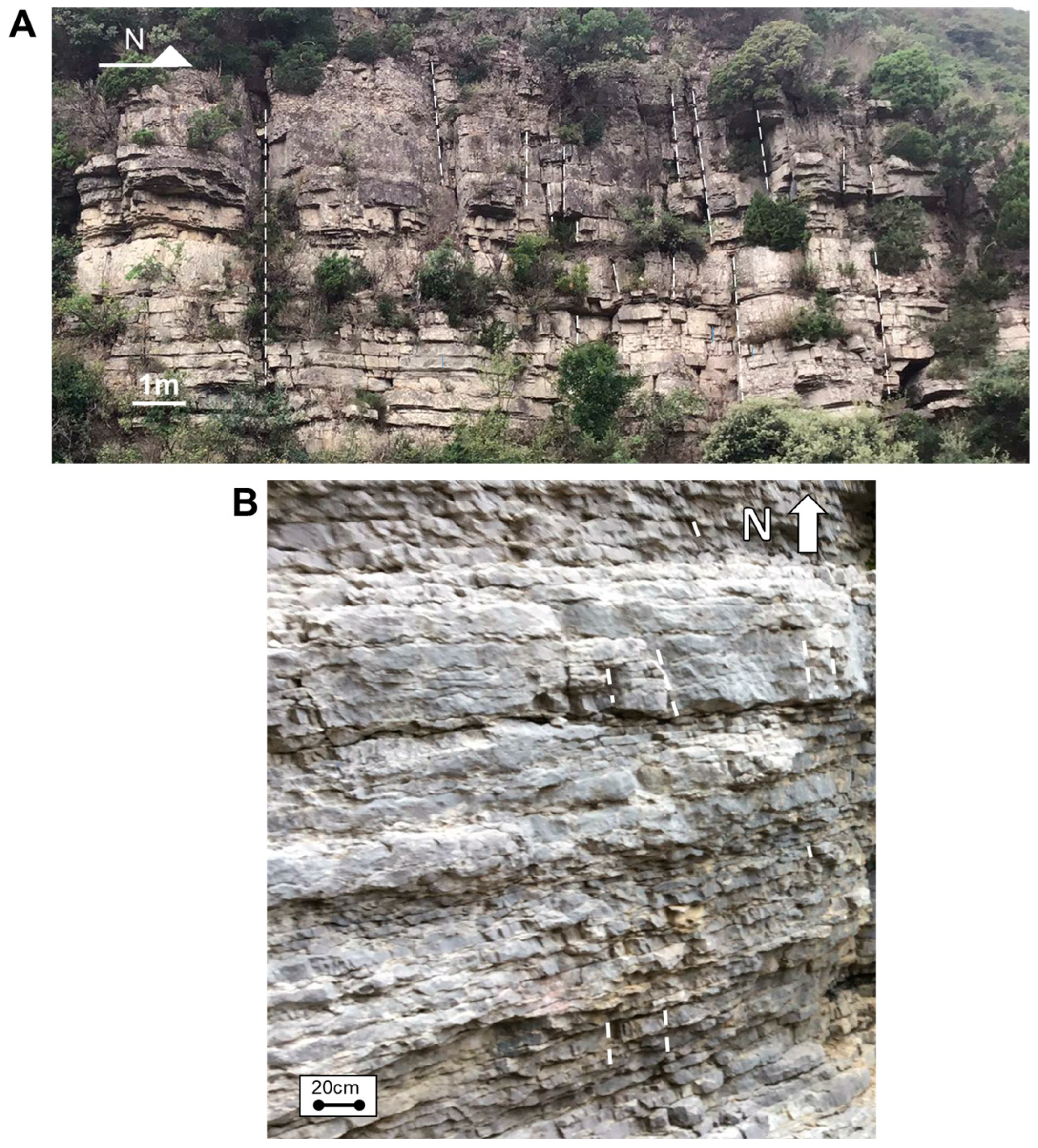
The Larzac Plateau is constituted by sedimentary rocks spanning from the highly fractured Jurassic (Hettangian) carbonate plateau to the underlying Triassic (Ladinian) median sandstone via Triassic (Norian–Carnian) evaporite clays [36] (Figure 1). The Upper Hettangian dolomites, which are 200 m thick, consist of massive and tabular beds (ranging from one to several meters thick). In contrast, the Lower Hettangian rocks, situated at the boundary with the Rhaetian, comprise a 15 m unit of superposed thin (5–10 cm thick) grey mudstone beds known as the “Parlatges” facies. Below it, the Rhaetian interval, which is 30–40 m thick, features thick dolomitized grainstones interspersed with marly intervals. Thus, assimilating the Rhaetian with the carbonates, the carbonate sediment pile reaches a thickness of up to 255 m. The investigated landslides affect all geological formations above the Norian–Carnian clays. Additionally, the carbonate plateau has been influenced by several low-throw faults in a north–south orientation (Figure 1). This carbonate plateau is also known to be karstified [37]. The characterisation of discontinuities was carried out in a previous study [33]. The measurements were performed with a compass on outcrops that were accessible (see the Supplementary Materials). Surveys of joint orientation reveal that the carbonate unit is intersected by a dense network of discontinuities (Figure 2). Three families are identified: layering planes and sub-vertical joints with NNW-SSE and WSW-ENE strikes. The NNW-SSE joint family is linked to Pyrenean–Provençal compression, while the WSW-ENE family is likely associated with Liassic extension (Figure 1) [38].

3. Rock Mass Strength from Field Investigations

3.1. Schmidt Hammer Measurements

A Proceq® Schmidt hammer of N-type (Screening Eagle Company, Schwerzenbach, Switzerland) was used to obtain the in situ measurement of the uniaxial compressive strength (UCS in situ). This device measures the rebound of a mass (with an index RN ranging from 0 to 100) released by the recoil of a pre-compressed spring after impacting a surface horizontally (i.e., the hammer is perpendicular to the vertical surfaces investigated). A minimum of 10 measurements at different locations on the surface were taken to obtain a representative average index. The Schmidt hammer procedure adopted in this study is consistent with the revised ISRM Suggested Method described by [39], which emphasises the influence of surface conditions, impact orientation and data variability when deriving UCS values from rebound hardness. Schmidt hammer rebound measurements provide only an indirect estimate of UCS, derived through empirical correlations.
Several correlation studies exist between Schmidt hammer values and mechanical parameters (Young’s modulus, UCS) as well as rock physical properties (density) [40]. In this study, we adopt the correlation proposed by [41], which was derived from the relationship between laboratory tests and rebound values measured on several lithologies (marble, chalk, granite, limestone).
These Schmidt hammer measurements allow obtaining the estimation of the uniaxial compressive strength in situ (UCSin situ or σc in situ) in MPa using the following correlation appropriate for different types of rocks [41]:
σ c i n - s i t u = 2.21 e 0.07 R N
The hammer rebound values for the dolomitic section of the Rhaetian range from 40 to 65.5. For the Lower Hettangian limestones, the values range from 27.5 to 62. Meanwhile, the rebound values for the Upper Hettangian dolomites range from 41 to 67. The obtained hammer rebound values agree with values found in the literature for dolomites (59–55) and limestones (42–60) (e.g., [42]). Several UCSin situ values were estimated per site on different outcrops to ensure good reproducibility (Table 1).
The UCSin situ values for the Rhaetian dolomite range from 36.5 to 216.5 MPa, showing significant variability, with an average of 102 MPa. The UCSin situ values for the Lower Hettangian limestone range from 15 to 240.5 MPa, also indicating significant variability, with an average of 96 MPa. The UCSin situ values for the Upper Hettangian dolomite range from 39 to 195 MPa, again showing considerable variability, with an average of 110 MPa. The overall average UCSin situ value for all carbonates is 103 MPa. Significant variability can also be seen within individual sites, such as at site D902-2, where UCS values range from 39 to 195 MPa. This indicates that the measurement is dependent on the specific surface measured. The maximum variation on a single site is 156 MPa.

3.2. Rock Mass Classifications

Several geo-mechanical classifications of rocks give an idea of the quality of the rock and allow us to characterise the rock mass. A rock mass consists of the intact rock and discontinuities grouped under the generic term of discontinuities (such as bedding planes, fractures, faults, etc.) [1]. These classifications originate from engineering purposes, addressing issues regarding underground structures and/or excavations [15]. However, these classifications can also be used for describing rock masses in slope instability problems to obtain mechanical parameters. In this work, we used two types of classification: Rock Mass Rating (RMR) [9,10,11,43] and Geological Strength Index (GSI) [12,13,14].
The Rock Mass Rating (RMR), introduced by Bieniawski in 1973 [44] based on the Rock Quality Designation (RQD) by [45]. It is applied to the different fracture families constituting the rock mass for each pre-defined geotechnical unit. This classification assigns a rating to a set of properties of the intact rock and of the discontinuities within the rock mass. The sum of the ratings of each property constitutes the RMR value. The properties of the rock mass considered in the rating, following [43], include uniaxial compressive strength, RQD, the spacing of discontinuities, the condition of the discontinuities (persistence, aperture, roughness, infilling and weathering), the groundwater, and an adjustment value for joint orientation that can be applied (see Appendix A). The RQD was not determined classically on core from boreholes but by formulas given by [46]:
RQD = 115 − 3.3Jv
and
Jv = 1/S1 + 1/S2 + 1/S3
where Jv is the volumetric joint count, and S1, S2, and S3 are the spacings in meters of each joint family cutting the rock mass.
The GSI is a classification system, primarily developed by Hoek and Brown in 1994 [12], based on the structures and conditions of discontinuity surfaces, and estimated from a visual examination of the rock mass. This classification is designed to relate the Hoek–Brown failure criterion to geological observations in the field. The recent revision of the Hoek–Brown criterion [47] provides an updated and comprehensive framework linking GSI to the mechanical degradation of jointed rock masses, reinforcing the relevance of using GSI-derived parameters when comparing laboratory- and field-scale strength. Unlike RMR, it does not rely on RQD in order to encompass rocks of poorer quality. However, it does not provide a precise rating but rather a range of values.
In this work, we did not directly use the GSI because it is more challenging to use due to its visual characterisation. Indeed, it has been recognised that the visual approach to the GSI is difficult and depends on the surveyor’s experience [48,49]. To reduce this “expert approach”, empirical correlations exist with mechanical classifications that are easier to constrain through a less descriptive approach, such as RMR [50], which led to a revision of the GSI by [51] to incorporate quantitative approaches. These quantitative approaches are carried out using fieldwork or borehole studies. However, [48] warn that the quantitative approach must be considered alongside the original qualitative approach. This has also been performed in this study, in which we choose to use the very common correlation to obtain a GSI value from RMR:
GSI = RMR89* − 5
for RMR89* ≥ 23 [12].

3.3. Field Characterisation: Schmidt Hammer and the RMR Approach

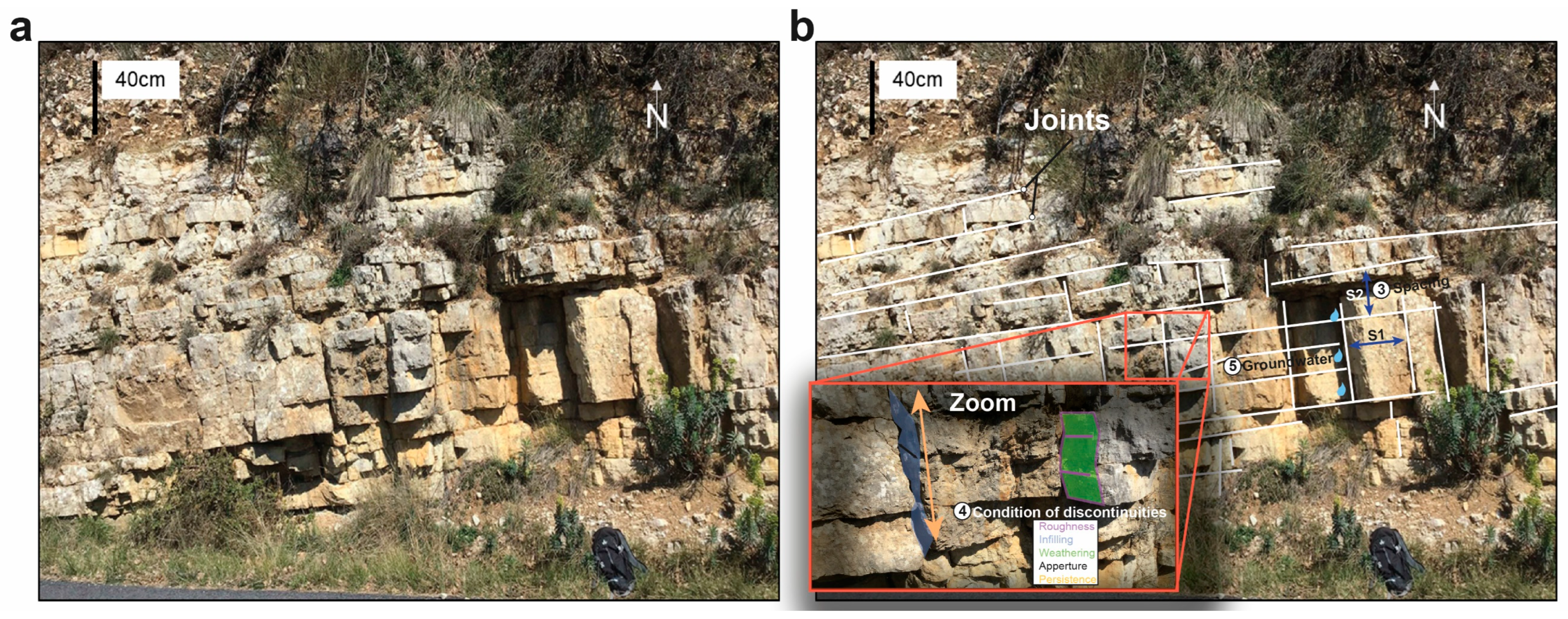
The rock mass classification through the RMR approach is illustrated for an Upper Hettangian outcrop at the D902-2 site (Figure 3). The UCSin situ (also called σc in situ) obtained using the Schmidt hammer ranged from 39 to 195 MPa (with an average of 122 MPa), and the corresponding score in the RMR table is 12. Three sets of discontinuities exist, namely the bedding plane and the N-S and E W fracture sets. The spacing was measured using a measuring tape, while the persistence was assessed visually and supplemented with measurements taken with the measuring tape. The spacing of these different sets of discontinuities ranged between 60 mm and 200 mm, giving a value between 8 and 10 for spacing (corresponding values are 0.1–0.2 m, 0.3 m, and 0.5 m for S1, S2, and S3, respectively). The Jv value and RMR obtained for this site using Equation (3) equals 15 m−3 and 64, respectively, thus giving a score of 13 in the RMR table. The average persistence ranges from less than 1 m to 3 m, giving a score for this category between 4 and 6. The average aperture of the discontinuities ranges from no aperture to greater than 5 mm. The roughness, filling, weathering, and groundwater categories characterising the discontinuities were assessed through visual inspection and physical contact (Figure 3). In this site, the joints were rough, unfilled, unweathered, and completely dry, giving scores of 5, 6, 6, and 15, respectively. All scores of the RMR table obtained in the D902-2 site are summarised in Table 2. The measurements were conducted twice, in two very close outcrops in the D902-2 site and the two scores of the RMR table obtained are summarised in Table 2. By summing each parameter score, two RMR values were obtained for the two outcrops of the D902-2 site, 71 and 77, respectively.
The Rock Mass Rating approach has been applied similarly to the example explained above to several locations (11 sites) on the carbonate Larzac plateau using the Schmidt hammer to obtain the UCS (Table 1).
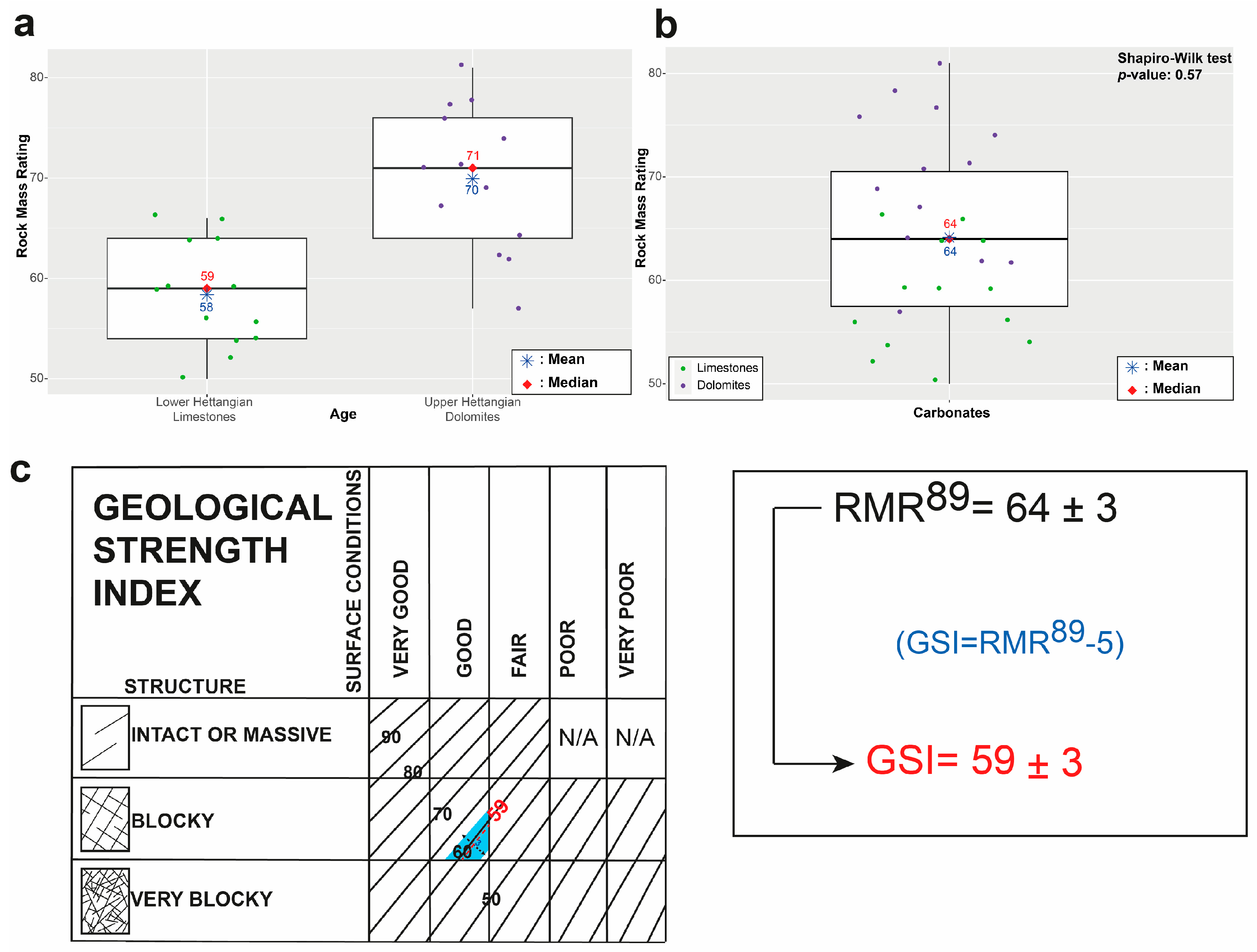
Several RMR values were measured per site on different outcrops (Table 1) to ensure good reproducibility. The RMR value for the dolomites ranges from 51 to 81; meanwhile, for the limestones, it ranges from 50 to 66. For both lithologies, the variation in the RMR does not exceed 7 across outcrops from each site, indicating that the RMR estimation is fairly accurate. The limestones generally have lower average ratings than the dolomites, with mean values of 58 and 70, respectively. This primary difference can be explained in two ways. First, the Schmidt hammer values in the limestones are generally below 100 MPa, reducing the σc rate from 12 to 7 in the RMR first category (see Appendix A). Second, the spacing of discontinuities is roughly decimetric in the limestones, whereas it is metric in the dolomites, reducing the spacing score from 10 to 8 or even 5.
Despite the differences described above, examination of the box plots in Figure 4a shows the majority of values for the Lower Hettangian limestone within the first quartile of the Late Hettangian dolomites. A Shapiro–Wilk test for normality was thus applied to all RMR data (Figure 4b) to evaluate the pertinence of combining these two lithologies (i.e., limestones and dolomites) to obtain a single RMR value for the carbonates. The Shapiro–Wilk statistical test involves two hypotheses, namely H0 and H1. H0 assumes that the distribution is a normal one, while H1 suggests that the distribution is not a normal one. This statistical test uses the p-value, which represents the probability of observing the data if H0 is true. A threshold of 0.05 for the p-value is often set to decide whether to accept or reject H0, thus determining the significance of the results. This test provided a non-significant p-value (p-value > 0.05), indicating a normal distribution, accepting the hypothesis H0, therefore a representative mean for the RMR of 64 for all the carbonates with a Type A uncertainty of 3. The Shapiro–Wilk test indicated normality in the distribution of RMR, encompassing all measurements for the carbonates. This suggests that we can consider a single unit instead of two. Finally, an average GSI of 59 is obtained using Equation (4).
According to a visual examination of the discontinuities, their surface conditions are good. Therefore, if we consider the average GSI, it falls within a range indicative of a blocky structure with good surface conditions for discontinuities (Figure 4c). These GSI values appear consistent with our observations of the rock mass in the field (Figure 3).

3.4. Mohr–Coulomb Strength Properties from RMR

The rock failure can be analysed from the Mohr–Coulomb and Hoek–Brown criteria, whose formulations are presented in Equations (5) and (6), respectively. The difference between these two criteria is that Mohr–Coulomb considers that the shear strength (τ) depends on the cohesion, the internal friction angle, and the normal stress, while the generalised Hoek–Brown equation (GHB) postulates that failure depends on the uniaxial compressive strength.
τ = c + σ n × tan ϕ  
σ 1 = σ 3 + σ c i m b σ 3 σ c i + s a
where τ is the shear stress, c is the cohesion in MPa, σn is the normal stress in MPa, ϕ is the internal friction angle in degrees for the Mohr–Coulomb criterion (Equation (5)), σ1 is the maximal principal stress in MPa, σ3 is the minimal principal stress in MPa, σci is the uniaxial compressive strength of the intact rock in MPa, and a, s, and mb are material empirical dimensionless constants, with s = 1 for intact rocks, for the Hoek–Brown criterion (Equation (6)).
The GHB in Equation (6) can be rewritten using the expression of normal and shear stress in terms of principal stresses [53] as follows:
σ n = σ 3 + σ c m b σ 3 σ c i + s a a m b m b σ 3 / σ c i + s a 1 + 2
τ = σ n     σ 3 1 + a m b m b σ 3 / σ c i + s a 1
The additional empirical parameters a, s, and mb in the formulation of GHB depend on GSI:
a = 1 2 + 1 6 × e G S I / 15     e 20 / 3
s = e ( G S I 100 9 3 D )
m b = m i e ( G S I 100 28 14 D )
The mb is a reduced value of the intrinsic material constant mi [54]. It depends on the type of rock, but mi can be approximated to the fragility index that equals σcit,, where σt is the tensile strength. Based on the mean value of σc and σt of the dolomites and limestones (see Table 1 and Table 3, σc: 109.3 MPa, σt: 10.7 MPa), the value of mi for the studied carbonate rocks is 10.2. D is a factor which depends upon the degree of disturbance to which the rock mass has been subjected by blast damage and/or stress relaxation, with D = 0 for undisturbed in situ and D = 1 for very disturbed rock masses.
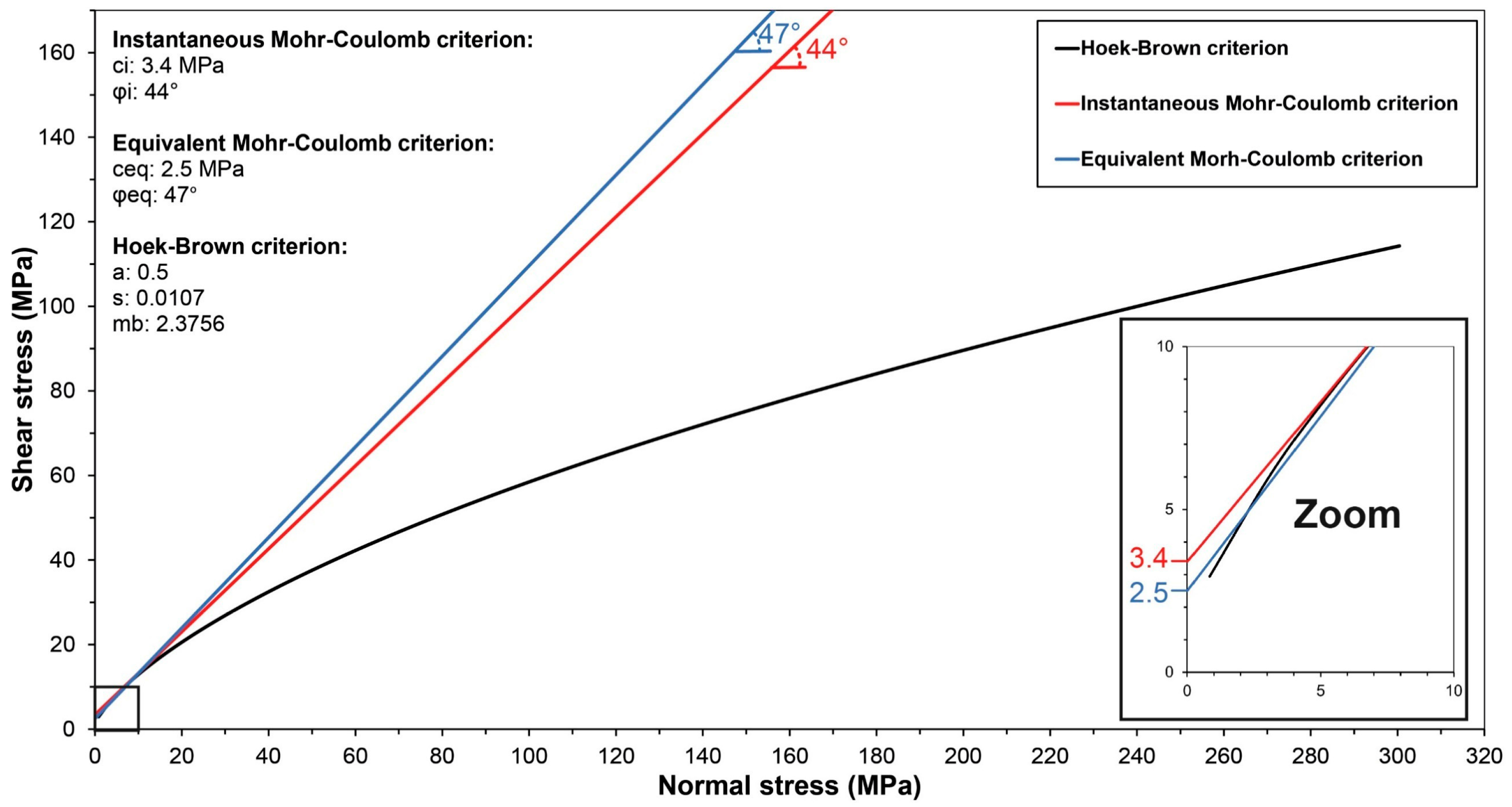
Considering the previously determined GSI value of 59.2, a σc value of 109.3 MPa, and a mi value of 10.2, we were able to obtain the generalised Hoek–Brown criterion (Figure 5). The values of the empirical parameters a, s, and mb are 0.5, 0.0107, and 2.3756, respectively.
The so-called instantaneous method allows to obtain the Mohr–Coulomb criterion from the Hoek–Brown criterion described above using the set of five equations [54] below:
h = 1 + 16 m b σ n + s σ c i 3 m b 2 σ c
θ = 1 3 90 + a t a n 1 h 3 1
ϕ i = a t a n 1 4 h c o s 2 θ 1
τ = cot ϕ i cos ϕ i m b σ c i 8
c i = τ σ n tan ϕ i
The method is called instantaneous because the Mohr–Coulomb envelops the tangent at the Hoek–Brown envelope at a given value of normal stress (Figure 5). Assuming an isotropic carbonate rock mass and no tectonic forces, the stress tensor is equal to the geostatic stress tensor, so that σn corresponds to the vertical stress, σv. Under the hypotheses of infinite horizontal media which could be supposed, the vertical stress is expressed as a function of depth in the following manner:
σ v = 1 n γ n × z n
where n is an integer representing the number of geotechnical layers, γ is the unit weight in kN·m−3, and z is the depth in meters.
In this study, the summation in Equation (17) is calculated at the bottom of the pile of carbonates, as the landslides affect the full carbonate pile. Using a mean γ of 26 kN·m−3 and a depth of summation of 255 m, σv is equal to 6.4 MPa.
The equivalent method [55] is the second alternative to obtain the Mohr–Coulomb parameters (cohesion and friction angle) from the empirical parameters of the GHB criterion. Instead of a tangent in the GHB, the cohesion and friction angle parameters are obtained using the following two equations:
c e q = σ c i 1 + 2 a s + 1 a m b σ 3 n ( s + m b σ 3 n ) a     1 1 + a 2 + a 1 + ( 6 a m b ( s + m b σ 3 n ) a     1 ) / ( 1 + 2 a 2 + a )
ϕ e q = sin 1 6 a m b ( s + m b σ 3 n ) a     1 2 1 + a 2 + a + 6 a m b ( s + m b σ 3 n ) a     1
where σ 3 n = σ 3 m a x / σ c , and σ 3 m a x is obtained for the Bishop method by the following formula:
σ 3 m a x = 0.72 σ c m γ H 0.91 σ c m
where H is the height of the slope gradient, and σ c m is expressed by the following formula:
σ c m = σ c ( m b + 4 s a m b 8 s ( m b / 4 + s ) a     1 ) 2 ( 1 + a ) ( 2 + a )
We took the mean value of γ and considered the carbonate sedimentary pile’s height corresponding to the slope’s height with H equal to 255 m.
For the instantaneous method, the vertical stress of 6.4 MPa was calculated based on the maximum height of the carbonate pile (H = 255 m) with an average γ of 26 kN/m3. The h and θ values are 1.14 and 0.84, respectively. For the equivalent method, the same H and γ were used. Thus, we obtained the values of σcm, σ3max, and σ3n as 13.6, 5.1, and 0.05 MPa, respectively.
The obtained values of cohesion and friction angle using two methods are shown in Figure 5. For the instantaneous Mohr–Coulomb criterion, the cohesion (ci) and friction angle (ϕi) are 3.4 MPa and 44°, respectively. For the equivalent Mohr–Coulomb criterion, the cohesion (ceq) and the friction angle (ϕeq) are 2.5 MPa and 47°.

4. Rock Mass Strength from the Laboratory

4.1. Laboratory Measurements of Rock Strength

The rock strength for rock blocks from the carbonate plateau formation outcropping at six localities (Figure 1) has been characterised through laboratory rock mechanics testing. A total of six rock blocks (two in Lower Hettangien limestones and four in Upper Hettangien dolomites) were sampled, and a total of twenty-two cores (50 mm diameter cores with a height/diameter ratio of 2) were extracted from these rock blocks. Different tests of strength were performed at two laboratories during two campaigns.
Tests on rock blocks labelled 2, 4, 5, and 6 were performed at the Cerema-Toulouse Laboratory Facilities. The analyses performed included several rock strength tests with an MTS 816 equipped with a hydraulic cylinder with a maximum load capacity of 1000 kN [56]. The triaxial cell has a capacity of a maximum confinement pressure of 70 MPa. Loading was performed at a displacement rate of 0.001 mm·s−1.
Tests on rock blocks 7 and 8 were performed at Mines PSL in Fontainebleau. The rock mechanics testing system used was an MTS 815 equipped with a hydraulic cylinder with a maximum load capacity of 1000 kN. The triaxial cell had a maximum confinement pressure of 20 MPa. Loading was performed at a strain rate of 120 µm·m−1·s−1. Sample preparation and testing followed ASTM (American Society for Testing and Materials) standards [57,58]. The procedure for the triaxial, uniaxial compression, and Brazilian tests consisted of progressively increasing the vertical load; therefore, σ1 was determined while keeping σ3 constant. For the triaxial tests, high confinement stresses were applied, as the purpose of the study is to evaluate mechanical parameters relevant to deep-seated slope movements [33].
These two campaigns allowed us to perform the different tests: 10 Brazilian tensile strength tests (six specimens for limestones and four specimens for dolomites), 8 uniaxial compression tests (five specimens for limestones and three specimens for dolomites), and 4 triaxial tests (four specimens for dolomites). Stress–strain curves from these tests were analysed to obtain Poisson’s ratio (ν), Young’s modulus (E), Brazilian tensile strength (σtb), residual stress (σr), and peak stress (σp). All test results are summarised in Table 3.

4.2. Mohr–Coulomb Strength Properties from Laboratory Tests

The different values of UCS, σtb, and E are shown in Table 3. The UCS values obtained for the dolomites range from 64.8 to 103 MPa, with an average of 83.5 MPa. For the limestones, the UCS values are between 83.17 and 187.8 MPa, averaging 197.3 MPa. Notably, the UCS values for dolomites are lower than those for limestones, with an overall average UCS for the entire Hettangian formation being 140.4 MPa. For tensile strength (σtb), the dolomites values range from 5.6 to 7 MPa, averaging 6.3 MPa. The limestones σtb values span from 10 to 17.2 MPa, with an average of 13.7 MPa. Similar to UCS, the tensile strength values for dolomites are lower than those for limestones, resulting in an overall average σt of 10 MPa for the Hettangian. Regarding Young’s modulus, the values for the limestones are between 24.7 and 27 GPa, with an average of 25.6 GPa. The Young’s modulus for the dolomites shows considerable variability, ranging from 9.7 to 89.4 GPa, with an average of 27.6 GPa. The 89.4 GPa value constitutes a clear outlier, as it is substantially higher than all other measurements obtained for this lithology and does not reflect the typical mechanical behaviour of the dataset. Excluding this, the measurements in the dolomites are fairly homogeneous, with an average of 19.15 GPa. Taking all data, the average Young’s modulus for the entire Hettangian formation was 26.6 GPa.
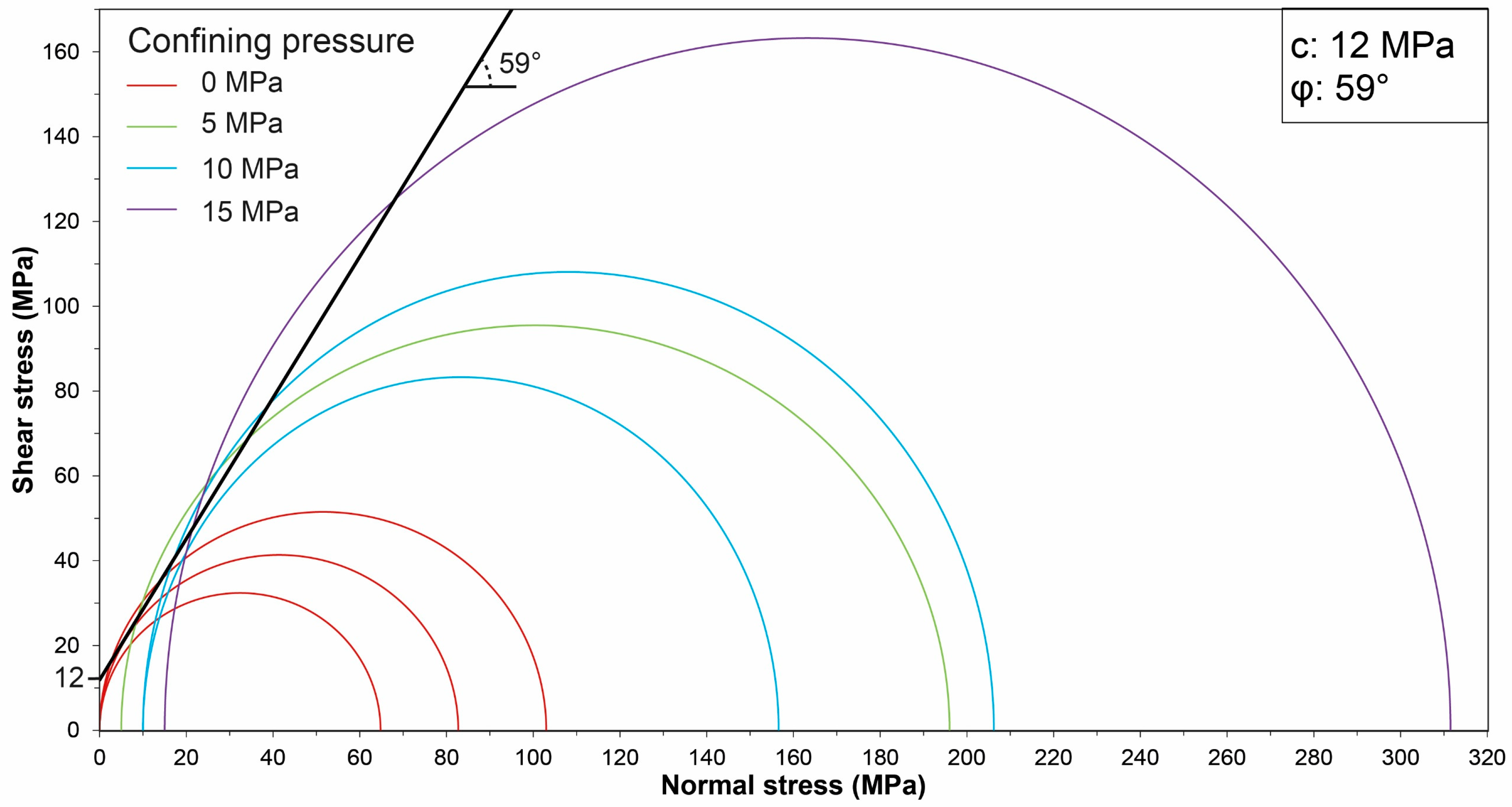
The results of uniaxial compression tests and triaxial tests enabled the construction of Mohr circles with peak stresses (Figure 6 and Table 3). Only the tests performed on dolomite were used because no triaxial tests could be performed on limestone. Exanimation of Figure 6 shows that, for the same confining pressure (σ3), dispersion values of σ1 are observed in the same rock lithology. Indeed, this is the case for a confining pressure of 10 MPa where two values of σ1 were obtained, 156.6 and 206.2 MPa (Table 3 and Figure 6). This is also observed in the absence of confining pressure for the three UCS tests, for which rupture occurred at magnitudes of σ1 of 64.8, 103, and 82.7 MPa, respectively (Table 3 and Figure 6). The dispersion of values of σ1, particularly for UCS values, is not rare for dolomite because it can be a heterogeneous material, especially in grain size [59].
By using the best linear trend with the highest R2 (0.84) when plotting the 7 tests on a σ1–σ3 plane, a Mohr–Coulomb criterion has been obtained. The last ones closely fit the circles at low confinement pressures, ranging from 0 to 10 MPa. However, the last circle, obtained at the maximum confinement of 15 MPa, deviates from the Mohr–Coulomb line (Figure 6). This deviation can be explained by the high value of σp and, consequently, σ1. Despite this, given the high R2 value of the regression used to obtain the Mohr–Coulomb criterion, we consider this criterion to be robust. According to the obtained Mohr–Coulomb criterion, the cohesion and internal friction angle are 12 MPa and 59, respectively (Figure 6).
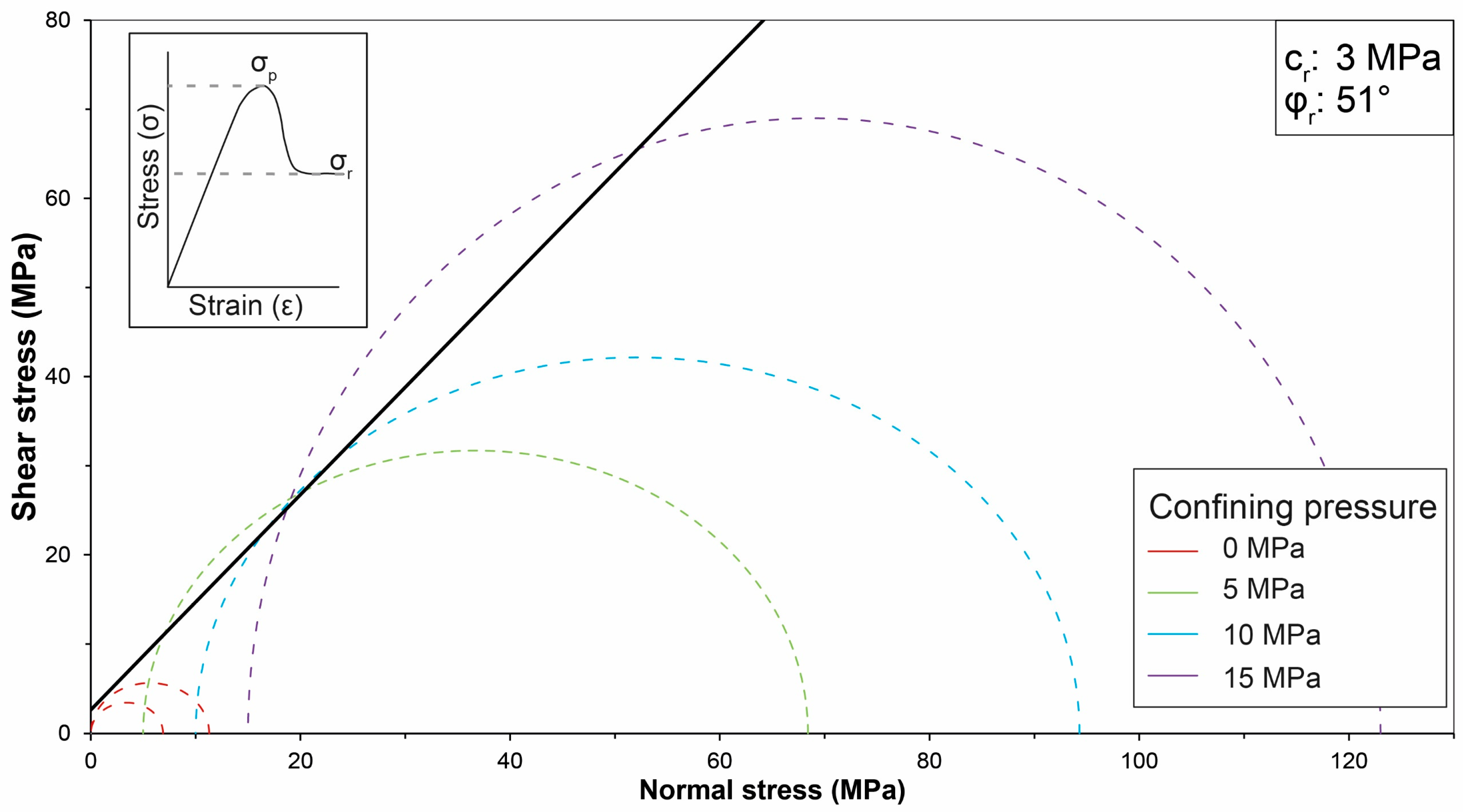
The same procedure was carried out for the tests where residual stress could be estimated mainly from blocks 7 and 8 (Table 3). The residual stress (σr) represents the stress in the rock after rupture exceeding the peak stress (σp) (Figure 7). By using the best linear trend with the higher R2 (0.96) when plotting the tests on a σ1–σ3 plane, a Mohr–Coulomb criterion has been obtained. We observed the same trend for the highest confining pressure of 15 MPa as described before, and we also have a confident R2. The residual cohesion equals 3 MPa, and the residual friction angle equals 51 (Figure 7).

5. Discussion

5.1. Comparison of UCS Value Between Laboratory and In Situ Measurements

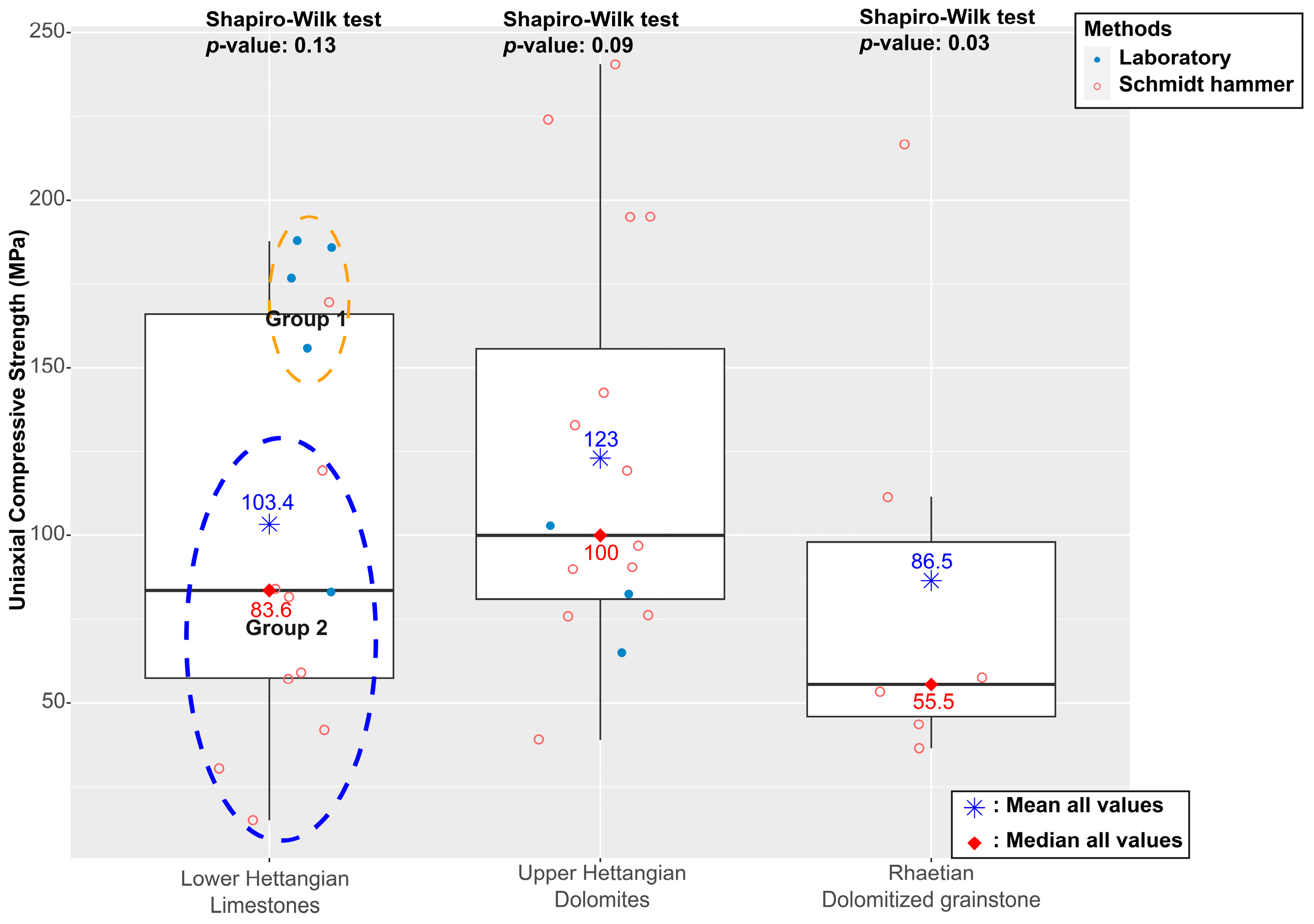
A Shapiro–Wilk test for normality was applied to all uniaxial compressive strength measurements for the different lithologies, including both Schmidt hammer (UCSin situ) and laboratory test measurements. This test provided a p-value > 0.05 for both limestones and dolomites, while the lack of measurements of Rhaetian rocks provided a p-value of ~0.03 (Figure 8).
Even though we can statistically consider a normal distribution for limestones, the UCS measurements revealed two groups on the boxplot (Figure 8). The first group comprises values predominantly obtained from laboratory tests. In contrast, the second group mainly considers Schmidt hammer measurements. Values in the first group exhibit relatively high UCS values, reaching up to 188 MPa, and show a fair degree of homogeneity (Figure 8). In contrast, values in the second group are heterogeneous and significantly lower (Figure 8) up to 15 MPa. The fracture spacing of the limestones in the field was approximately 20 cm. A potential volume scale effect is associated with incorporating discontinuities in the measurement of UCSin situ with the Schmidt hammer. This discrepancy between UCS values obtained in the laboratory and the field via the Schmidt hammer is not observed for the dolomite (Figure 8), notably because the fracture spacing is on a decimetric–metric scale (Figure 1 and Figure 8). The impact of small spacing (centimetric) (Figure 1 and Figure 8) between fractures leads to lower Schmidt hammer rebound values and subsequently lower in situ UCS compared to larger spacing (metric). Thus, fracture spacing influences Schmidt hammer measurements. It is difficult to state the potential effect of the fractures on the UCS value of Rhaetian due to a lack of measurements with the Schmidt hammer and an absence of laboratory values.

5.2. Comparison of Mohr–Coulomb Parameters from the Laboratory and Derived from In Situ Measurements

We observe a significant difference when comparing the cohesion and friction angle values obtained through laboratory and field approaches. Instantaneous cohesion and instantaneous friction angle determined with field approaches exhibit a difference of 72% and 19%, respectively, with the values measured through the laboratory tests. (Table 4). Similarly, equivalent cohesion and equivalent friction angle obtained with field approaches exhibit differences of 79% and 20%, respectively, compared to the laboratory-measured cohesion and friction angle. Laboratory tests are conducted on small samples of 50 mm in diameter and 100–120 mm in height, which are not representative of the entire rock mass, i.e., the intact rock, but cut by joints, thus explaining the observed difference (Table 4) [23]. Laboratory studies on composite and heterogeneous rock specimens [60] show that contrasts in the stiffness, anisotropy, and contact conditions between lithologies generate complex stress distributions not captured by simple strength measurements, highlighting the limits of extrapolating laboratory results to field-scale rock masses.
Refs. [24,26] demonstrated, in particular, that there are three main types of scale effects:
  • The volume effect, which is statistically linked to the increase in defects when considering a larger volume of rock.
  • The surface effect, which is a result of imperfections during sample preparation or due to the reaction of rock minerals on the free surface.
  • The mechanical effect, which is related to the amount of deformation energy present during compression.
The volume effect can fully explain the observed difference between the mechanical parameters obtained in the field and those in the laboratory. The most notable difference in this study remains in the cohesion. The classifications of RMR, and by association GSI, are therefore relevant for considering this scale factor, with the integration here of the strong fracturing of the studied massif. By acknowledging this effect, the characterisation of the rock mass is particularly relevant for the numerical simulation of a landslide affecting an entire slope flank. However, these classifications are subject to the judgment of their user and the terrain conditions [14,61].
However, when considering the residual parameters from laboratory tests, there is very little difference between the cohesion and friction angles derived from field approaches (Table 4). The residual parameters represent the rock after rupture exceeding the peak stress. Thus, these values are closer to those of a rock mass because they consider discontinuity planes. Therefore, field approaches well reflect the behaviour of the rock mass, i.e., the intact rock and the discontinuities, since we converge on values of residual strengths.

5.3. Young’s Modulus

Table 5 presents a non-exhaustive list of empirical formulas to calculate Young’s modulus of the rock mass (Em) depending on RMR and GSI. These formulas come from different methods, some stemming from in situ tests such as dilatometer techniques or plate bearing tests amongst others [8,62], while others originate from back analysis related to in situ tests [63]. Several authors have attempted to determine which of these formulas were most appropriate depending on the type of rocks or the quality of the rock mass. Their conclusions led to the assertion that it is difficult, if not impossible, to determine which of these methods is the most pertinent [63,64]. However, these authors suggest examining the various equations as they provide a probable range of values for Young’s modulus.
To investigate whether there is a scale effect with Young’s modulus, we can compare those of the rock mass, Em, with those obtained in the laboratory without confinement, E. Em is calculated by considering the mean value of RMR for carbonates obtained in this study 64 and the correlated GSI of 59. The Em values for the formulas presented in Table 5 range from 9.4 to 28.4 GPa, with an average of 19.8 GPa. The E values obtained from uniaxial compression tests, conducted without confining pressure, range from 9.7 to 27 GPa, averaging 20.7 GPa. The average Em is 19.8 GPa compared to the average E from UCS tests, i.e., without confinement, which is 20.7 GPa. There is very little difference between the Em modules (i.e., the intact rock and discontinuities, see Table 5) and the modules obtained in the laboratory, E (i.e., the intact rock, see Table 3). By examining the formulas and the averages obtained for Em, the former may be higher than Young’s modulus measured in the laboratory. Yet, ref. [62], by comparing in situ and laboratory tests to obtain the Young’s modulus performed on several rocks (granite, limestones, gneiss, sandstones, etc.), suggested a reduction of 60% between the Young’s modulus of the rock mass and the Young’s modulus obtained in the laboratory.
There are thus two hypotheses explaining the fact that we observe little difference or a difference that goes in the opposite direction of what it should be. The first possibility is that the empirical formulas based on the RMR greatly overestimate Young’s modulus. Indeed, the majority of formulas are obtained through back-analysis and in situ tests for a correlation with a rock mass classification, such as RMR and GSI. However, when we look at a formula derived from in situ measurements, such as the [65] formula (based on dilatometer and plate loading tests), the value obtained is 9.7 GPa. With this value, we see an expected difference predicted by [62] of 56% by comparing it with the mean of E (20.7 GPa). This would imply that one should rely on RMR formulas based on in situ measurements.
Table 5. Comparison between estimated Em (rock mass modulus) and E determined by laboratory testing (intact rock modulus). The RMR used in these formulas is the mean RMR value for carbonates, either 64 or a GSI of 59. The values of Young’s modulus obtained from uniaxial compression tests in the laboratory in this study are also included.
Field
ReferencesFormulasEm (GPa)
[66] E m = 2 R M R 100 28.4
[67] E m = 10 ( R M R 10 40 ) 22.6
[14] E m = σ c 100 × 10 ( G S I 10 40 ) 17.8
[67] E m = e R M R 10 18 20.3
[65] E m = 0.0736 × e ( 0.0755 R M R ) 9.4
[68] E m = 147.28 × e R M R 100 24 0.202 R M R 20.2
Laboratory
Block NumbersSample nameE (GPa)
4R 1999 Rc20.5
8Dolomie 19.7
8Dolomie 216.8
5R 2003 Rc16.5
5R 2007 Rc24.7
6R 2008 Rc27
6R 2009 Rc25.7
6R 2013 Rc25.1
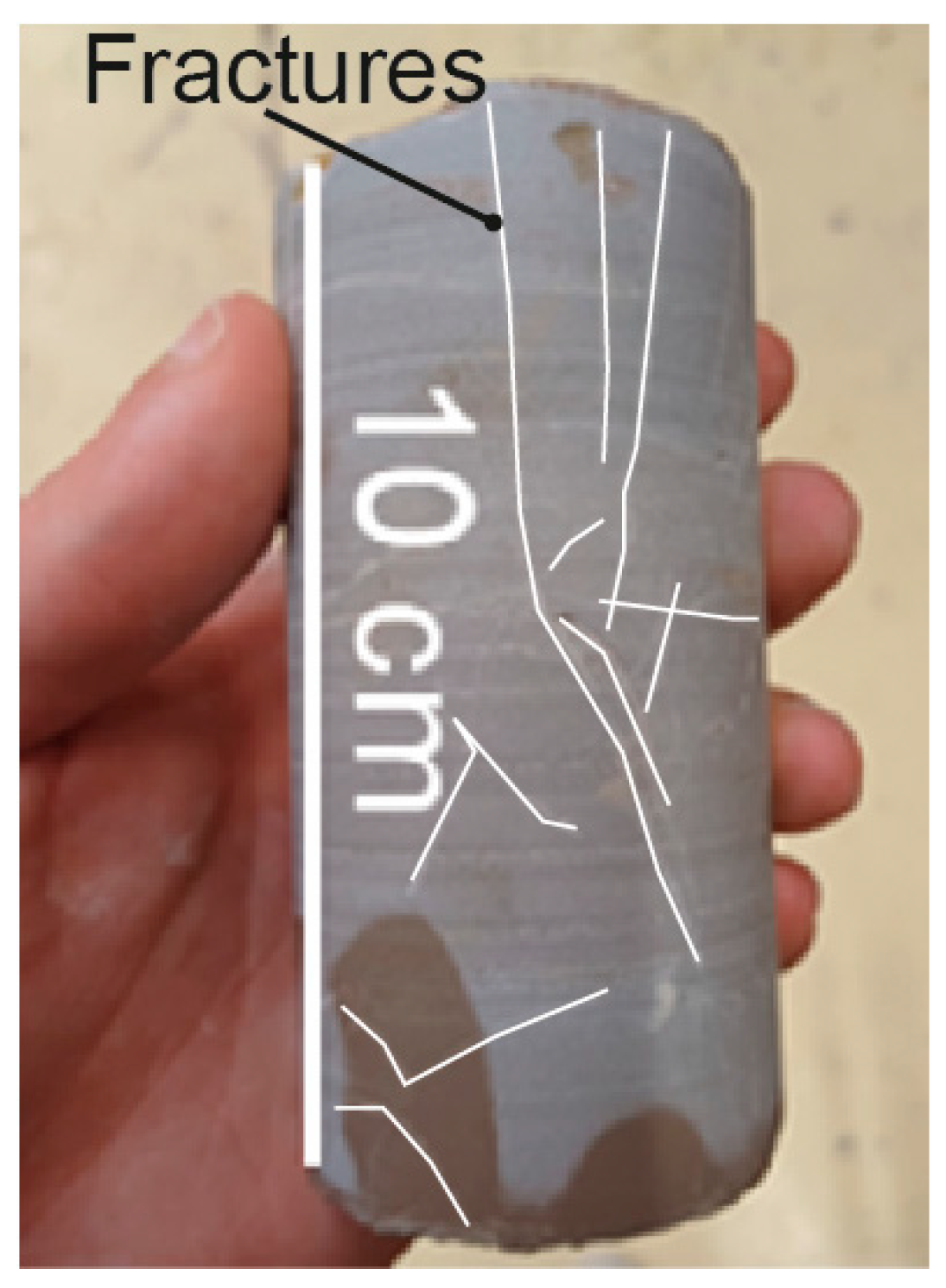
The second hypothesis is that the scale of the tested samples is already too large and already includes many discontinuities. Indeed, carbonates such as dolomites are a very heterogeneous material [59], whose rupture is subject to microcracks contained in the samples, as demonstrated by [69]. This may affect the Young’s modulus. This can be seen in Figure 9, where it is evident that the samples from these studies may indeed have a significant presence of fractures. This fracturing is also evident in the variable UCS values obtained for the dolomite samples (Table 3). These values produce Mohr’s circles with relatively small diameters. However, when confining pressure is applied, the diameters of Mohr’s circles become significantly larger (Table 3). This raises the question of whether dolomite has lower strength without confinement due to its high fracturing and heterogeneity, but becomes much stronger under confinement as the fractures close. This significant difference in strength due to confinement is also reflected in the Mohr–Coulomb criterion, which is tangent to the Mohr’s circles for uniaxial compression tests but less so when confining pressure is applied, indicating a gap in dolomite’s strength with confinement (Figure 6).
It is difficult to differentiate between the two hypotheses concerning the scale effect of Young’s modulus. However, [63] asserts that empirical methods for obtaining the rock mass modulus Em do not consider the scale effect. This assertion would then support the first hypothesis, namely, that these empirical methods overestimate Young’s modulus of the rock mass.

6. Conclusions

In this study, we characterise the strength of rock samples from a carbonate plateau through laboratory testing (UCS and triaxial) and field Schmidt hammer and RMR approaches. It emerged from this work that the estimated measurements of uniaxial compressive strength (UCS in situ), obtained using Schmidt hammer tests, were statistically close to those conducted in the laboratory. However, the Schmidt hammer measurements showed that they incorporated fracturing. Thus, a small spacing of fracturing (in the thin-bedded limestones), on the order of decimetres, reduces the values of UCS compared to the metric scale fractures (in the dolomites) that have little effect.
A notable difference was observed between the field and laboratory approaches regarding the resulting mechanical parameters. This difference is due to the volume scale effect. It can then be proposed that cohesion will decrease by 72% up to 79% and the friction angle will decrease by 20% when considering fracturing rather than just the intact rock for those investigated carbonates. The laboratory tests can characterise the intact rock strength, i.e., a small volume of the rock matrix but not the entire rock mass strength, including fractures; in contrast, the field approach allowed us to quantify the entire rock mass (i.e., the matrix of the rock plus the discontinuities). However, in this study, the values obtained with the residual parameters from laboratory tests are very close to those obtained in the field. This is because the tested samples develop fracture planes during testing. The field approach proved to be a good representation of the strength of the rock mass, taking discontinuities into account, particularly if we consider the small difference between the residual values obtained in the laboratory, which represent intact rock once failed.
The scale effect on Young’s modulus is more difficult to discern due to the greater variability of values when looking at the different empirical methods related to mechanical classification (RMR, GSI). We propose that this is due to an overestimation of Young’s modulus by these empirical correlations.
This work was carried out in the context of characterising ancient landslides, where access to outcrops is limited. These observational constraints significantly restrict sampling possibilities and reduce the number of accessible outcrops and specimens that can be studied. However, we suggest that both approaches are complementary to see how the discontinuities contribute to decreasing the strength of the rock mass. The values obtained from the field are therefore more representative of the rock mass, which makes sense considering that laboratory tests are generally conducted only on small samples. The methodology presented in this study is not new and is widely used in rock engineering. However, such approaches remain rarely applied in natural hazard studies, where monitoring of instabilities is generally prioritised over mechanical characterisation. This is mainly due to the limited accessibility of unstable areas, particularly in the case of ancient landslides. Nevertheless, our work demonstrates the practicality and relevance of rock-engineering tools for geologists working on natural hazards, as they provide an effective means to estimate rock mass strength and, ultimately, slope stability.

Supplementary Materials

The following supporting information can be downloaded at: https://www.mdpi.com/article/10.3390/app152412956/s1, Figure S1: Simplified geological and structural map of the southern edge of the Larzac plateau (inset map shows Occitanie region in red). Red symbols show the location of the paleo-landslides. Numbers indicate the location of fracturing surveys (Figure B). The tectonic stress regime was sourced from Lemonnier et al. (2020) [38], black and grey arrows represent major and minor stresses respectively. This figure is modified from Elkharrat et al. (2025); Figure S2: Measurements of different fracturing surveys. Each number indicate location in Figure A. Locations are linked to the name of the site, its abbreviation, the lithology involved and the number of discontinuities measured N. A colour code is associated with the different fractures and stratification planes (S0), per lithology, there are the following couples: black (fractures)/orange (S0): Lower Hettangian limestones Parlatges facies and red (fractures)/purple (S0): Upper Hettangian dolomite. Measurements taken within a slide are indicated by an asterisk (*). Stereograph and rose diagram (with 20% value of total of perimeter) with all measurements (277 measured fractures). This figure is modified from [33]; Table S1: Joints orientation measurements; Figure S3: Rock Specimens. C1. Left: Early Hettangian limestone. Right: Late Hettangian dolomite. C2. example of a specimen broken during coring due to internal fracturing within the blocks.

Author Contributions

Methodology, K.E., S.L., C.H. and M.G.-B.; Formal analysis, K.E., S.L., C.H. and M.G.-B.; Investigation, K.E., S.L., C.H. and M.G.-B.; Writing—original draft, K.E., S.L., C.H. and M.G.-B.; Writing—review & editing, K.E., S.L., C.H. and M.G.-B.; Supervision, K.E., S.L., C.H. and M.G.-B. All authors contributed to all sections of this article. All authors have read and agreed to the published version of the manuscript.

Funding

This research received no external funding.

Institutional Review Board Statement

Not applicable.

Informed Consent Statement

Not applicable.

Data Availability Statement

The datasets used in this study are publicly available and presented in the article.

Acknowledgments

We would like to thank D.V. and F.V. from Cerema Toulouse for conducting some of the laboratory tests. We also extend our gratitude to J.J., V.N. and J.S. from Mines PSL for conducting the remaining part of the laboratory tests. We appreciate both teams for their advice regarding the processing and conduct of these tests.

Conflicts of Interest

The authors declare no conflicts of interest.

Appendix A

The RMR of [43] (Figure A1 is expressed by the sum of the rating of the following six properties:
  • Uniaxial compressive strength of the intact rock (see Section 3.1).
  • The second parameter is the Rock Quality Designation (RQD) established by the following formulas [46]:
    RQD = 115 − 3.3Jv
    and
    Jv = 1/S1 + 1/S2 + 1/S3
    where Jv is the volumetric joint count, and S1, S2, and S3 are the spacings in meters of each joint constituting the rock mass.
  • The third parameter is the spacing of discontinuities.
  • The fourth parameter consists of several aspects and describes the conditions of the discontinuities (roughness, length, continuity, aperture, moisture, infilling, alteration).
  • The fifth parameter is the circulation of water through the fractures (inlets and outlets, pressure). For scoring, it is determined whether the fracture is wet or dry.
  • The sixth parameter is an adjustment for joint orientation that can be applied.
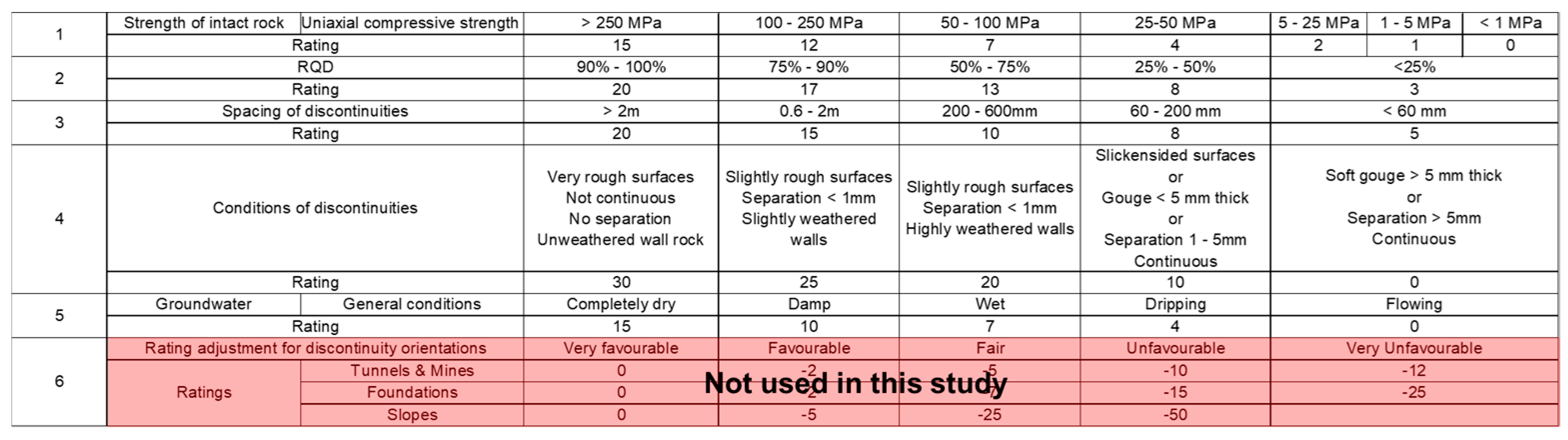
Figure A1. The Rock Mass Rating used in this study, modified from [43].
Applsci 15 12956 g0a1

References

  1. Wyllie, D.C.; Norrish, N.I. Landslides: Investigation and Mitigation. Chapter 14—Rock Strength Properties and Their Measurement. In Transportation Research Board Special Report; Transportation Research Board: Washington, DC, USA, 1996; pp. 372–390. ISBN 978-0-309-06208-4. [Google Scholar]
  2. Kayabasi, A.; Gokceoglu, C.; Ercanoglu, M. Estimating the Deformation Modulus of Rock Masses: A Comparative Study. Int. J. Rock Mech. Min. Sci. 2003, 40, 55–63. [Google Scholar] [CrossRef]
  3. Stead, D.; Wolter, A. A Critical Review of Rock Slope Failure Mechanisms: The Importance of Structural Geology. J. Struct. Geol. 2015, 74, 1–23. [Google Scholar] [CrossRef]
  4. Stead, D.; Eberhardt, E.; Coggan, J.S. Developments in the Characterization of Complex Rock Slope Deformation and Failure Using Numerical Modelling Techniques. Eng. Geol. 2006, 83, 217–235. [Google Scholar] [CrossRef]
  5. Brideau, M.-A.; Yan, M.; Stead, D. The Role of Tectonic Damage and Brittle Rock Fracture in the Development of Large Rock Slope Failures. Geomorphology 2009, 103, 30–49. [Google Scholar] [CrossRef]
  6. Bi, R.; Xu, C.; Xuan, Z.; Zhou, J.; Du, K. Joint Characterization and Stability Analysis: Measurement Techniques and Engineering Implications. Rock Mech. Rock Eng. 2025. [Google Scholar] [CrossRef]
  7. Stacey, T.R. Presidential Address: Rock Engineering—Good Design or Good Judgement? Rock Eng. 2003, 103, 411–421. [Google Scholar]
  8. He, J. A Case Review of the Deformation Modulus of Rock Mass: Scale Effect. In Scale Effects in Rock Masses 93; CRC Press: Balkema, Rotterdam, 1993; pp. 87–91. [Google Scholar]
  9. Bieniawski, Z.T. Engineering Classification of Jointed Rock Masses. Trans. S. Afr. Inst. Civ. Eng. 1973, 15, 335–344. [Google Scholar]
  10. Bieniawski, Z.T. Rock Mass Classification in Rock Engineering, Symposium Proceedings of Exploration for Rock Engineering; A. A. Balkema: Cape Town, South Africa, 1976; Volume 1, pp. 97–106. [Google Scholar]
  11. Bieniawski, Z.T. Classification of Rock Masses for Engineering: The RMR System and Future Trends. In Rock Testing and Site Characterization; Elsevier: Amsterdam, The Netherlands, 1993; pp. 553–573. ISBN 978-0-08-042066-0. [Google Scholar]
  12. Hoek, E. Strength of Rock and Rock Masses. ISRM News J. 1994, 2, 4–16. [Google Scholar]
  13. Hoek, E.; Kaiser, P.K.; Bawden, W.F. Support of Underground Excavations in Hard Rock; A.A. Balkema: Rotterdam, The Netherlands; Brookfield, VT, USA, 1995; ISBN 978-90-5410-186-4. [Google Scholar]
  14. Hoek, E.; Brown, E.T. Practical Estimates of Rock Mass Strength. Int. J. Rock Mech. Min. Sci. 1997, 34, 1165–1186. [Google Scholar] [CrossRef]
  15. Brady, B.H.G.; Brown, E.T. Rock Strength and Deformability, 3rd ed.; Brady, B.H.G., Brown, E.T., Eds.; Springer: Dordrecht, The Netherlands, 2006; ISBN 978-1-4020-2116-9. [Google Scholar]
  16. Pantelidis, L. Rock Slope Stability Assessment through Rock Mass Classification Systems. Int. J. Rock Mech. Min. Sci. 2009, 46, 315–325. [Google Scholar] [CrossRef]
  17. Hashemi, M.; Moghaddas, S.; Ajalloeian, R. Application of Rock Mass Characterization for Determining the Mechanical Properties of Rock Mass: A Comparative Study. Rock Mech. Rock Eng. 2010, 43, 305–320. [Google Scholar] [CrossRef]
  18. Long, J.C.S.; Remer, J.S.; Wilson, C.R.; Witherspoon, P.A. Porous Media Equivalents for Networks of Discontinuous Fractures. Water Resour. Res. 1982, 18, 645–658. [Google Scholar] [CrossRef]
  19. Min, K.-B.; Jing, L. Numerical Determination of the Equivalent Elastic Compliance Tensor for Fractured Rock Masses Using the Distinct Element Method. Int. J. Rock Mech. Min. Sci. 2003, 40, 795–816. [Google Scholar] [CrossRef]
  20. Sari, M. Determination of Representative Elementary Volume (REV) for Jointed Rock Masses Exhibiting Scale-Dependent Behavior: A Numerical Investigation. Int. J. Geo-Eng. 2021, 12, 34. [Google Scholar] [CrossRef]
  21. Bieniawski, Z.T.; Van Heerden, W.L. The Significance of in Situ Tests on Large Rock Specimens. Int. J. Rock Mech. Min. Sci. Geomech. Abstr. 1975, 12, 101–113. [Google Scholar] [CrossRef]
  22. Goodman, R.E. Introduction to Rock Mechanics, 2nd ed.; John Wiley & Sons Ltd.: New York, NY, USA, 1989. [Google Scholar]
  23. Bandis, S.; Lumsden, A.C.; Barton, N.R. Experimental Studies of Scale Effects on the Shear Behaviour of Rock Joints. Int. J. Rock Mech. Min. Sci. Geomech. Abstr. 1981, 18, 1–21. [Google Scholar] [CrossRef]
  24. Bandis, S.C. Scale Effects in the Strength and Deformability of Rocks and Rock Joints. In Proceedings of the First International Workshop on Scale Effects, in Rock Masses, Loen, Norway, 7–8 June 1990; Balkema (AA): Cape Town, South Africa, 1990; pp. 59–74. [Google Scholar]
  25. Barton, N. Scale Effects or Sampling Bias. In Proceeding of the First International Workshop on Scale Effects in Rock Masses, Loen, Norway, 7–8 June 1990; Balkema (AA): Cape Town, South Africa, 1990; pp. 31–54. [Google Scholar]
  26. Fadeev, A.B. Scale Effect of Rock Strength. In Proceeding of the First International Workshop on Scale Effects in Rock Masses, Loen, Norway, 7–8 June 1990; Balkema (AA): Cape Town, South Africa, 1990; pp. 183–189. [Google Scholar]
  27. Yoshinaka, R.; Osada, M.; Park, H.; Sasaki, T.; Sasaki, K. Practical Determination of Mechanical Design Parameters of Intact Rock Considering Scale Effect. Eng. Geol. 2008, 96, 173–186. [Google Scholar] [CrossRef]
  28. Hoek, E.; Brown, E.T. Empirical Strength Criterion for Rock Masses. J. Geotech. Eng. Div. 1980, 106, 1013–1035. [Google Scholar] [CrossRef]
  29. Tani, K. Scale Effect on Shear Strength of Sedimentary Soft Rocks Observed in Triaxial Compression Test (Influence of Potential Joints). In Proceedings of the 36th National Conference of the Japanese Geotechnical Society, Kumamoto, Japan, 11–13 July 2001; pp. 597–598. [Google Scholar]
  30. Mouzannar, H. Caractérisation de La Résistance Au Cisaillement et Comportement Des Interfaces Entre Béton et Fondation Rocheuse Des Structures Hydrauliques. Ph.D. Thesis, Université de Lyon, Lyon, France, 2016. [Google Scholar]
  31. Chemenda, A.I.; Bois, T.; Bouissou, S.; Tric, E. Numerical Modelling of the Gravity-Induced Destabilization of a Slope: The Example of the La Clapière Landslide, Southern France. Geomorphology 2009, 109, 86–93. [Google Scholar] [CrossRef]
  32. Gasc-Barbier, M.; Merrien-Soukatchoff, V.; Krzewinski, V.; Azemard, P.; Genois, J.-L. Assessment of the Influence of Natural Thermal Cycles on Dolomitic Limestone Rock Columns: A 10-Year Monitoring Study. Geomorphology 2024, 464, 109353. [Google Scholar] [CrossRef]
  33. Elkharrat, K.; Homberg, C.; Lafuerza, S.; Loget, N.; Gasc-Barbier, M.; Gautier, S. Paleo-Landslides on the Meridional Border of the Larzac Plateau (France): Recognition and Predisposing/Triggering Factors. Landslides 2025, 22, 1475–1489. [Google Scholar] [CrossRef]
  34. Elkharrat, K.; Homberg, C.; Lafuerza, S.; Loget, N.; Gasc-Barbier, M.; Gautier, S. Study Cases of Complex Paleo-Landslides in the South of France. Landslides 2025, 22, 773–779. [Google Scholar] [CrossRef]
  35. Barton, N.; Choubey, V. The Shear Strength of Rock Joints in Theory and Practice. Rock Mech. 1977, 10, 1–54. [Google Scholar] [CrossRef]
  36. Alabouvette, B.; Arrondeau, J.P.; Aubague, M.; Bodeur, Y.; Dubois, P.; Mattei, J.; Paloc, J.; Rançon, J.P. Notice Explicative de la Feuille le Caylar à 1/50000; BRGM: Orléans, France, 1988. [Google Scholar]
  37. Ambert, M.; Ambert, P. Karstification Des Plateaux et Encaissement Des Vallées Au Cours Du Néogène et Du Quaternaire Dans Les Grands Causses Méridionaux (Larzac, Blandas). Géologie Fr. 1995, 4, 37–50. [Google Scholar]
  38. Lemonnier, N.; Homberg, C.; Roche, V.; Rocher, M.; Bouiller, A.M.; Schnyder, J. Microstructures of Bedding-Parallel Faults under Multistage Deformation: Examples from the Southeast Basin of France. J. Struct. Geol. 2020, 140, 104138. [Google Scholar] [CrossRef]
  39. Aydin, A. (Ed.) The ISRM Suggested Methods for Rock Characterization, Testing and Monitoring: 2007–2014; Springer International Publishing: Cham, Switzerland, 2009; ISBN 978-3-319-07712-3. [Google Scholar]
  40. Aydin, A.; Basu, A. The Schmidt Hammer in Rock Material Characterization. Eng. Geol. 2005, 81, 1–14. [Google Scholar] [CrossRef]
  41. Katz, O.; Reches, Z.; Roegiers, J.-C. Evaluation of Mechanical Rock Properties Using a Schmidt Hammer. Int. J. Rock Mech. Min. Sci. 2000, 37, 723–728. [Google Scholar] [CrossRef]
  42. Kahraman, S. Evaluation of Simple Methods for Assessing the Uniaxial Compressive Strength of Rock. Int. J. Rock Mech. Min. Sci. 2001, 38, 981–994. [Google Scholar] [CrossRef]
  43. Bieniawski, Z.T. Engineering Rock Mass Classification; John Wiley & Sons: New York, NY, USA, 1989. [Google Scholar]
  44. Singh, B.; Goel, R.K. Chapter-6—Rock Mass Rating (RMR). In Rock Mass Classification; Singh, B., Goel, R.K., Eds.; Elsevier Science Ltd.: Oxford, UK, 1999; pp. 34–46. ISBN 978-0-08-043013-3. [Google Scholar]
  45. Deere, D.U.; Hendron, A.J.; Patton, F.D.; Cording, E.J. Design of Surface and near Surface Construction in Rock. In Proceedings of the the 8th U.S. Symposium on Rock Mechanics (USRMS), Minneapolis, MN, USA, 15–17 September 1966; American Rock Mechanics Association: Alexandria, VA, USA, 1967; pp. 237–303. [Google Scholar]
  46. Palmstrom, A. Measurements of and Correlations between Block Size and Rock Quality Designation (RQD). Tunn. Undergr. Space Technol. 2005, 20, 362–377. [Google Scholar] [CrossRef]
  47. Hoek, E.; Brown, E.T. The Hoek–Brown Failure Criterion and GSI—2018 Edition. J. Rock Mech. Geotech. Eng. 2019, 11, 445–463. [Google Scholar] [CrossRef]
  48. Cai, M.; Kaiser, P.K.; Uno, H.; Tasaka, Y.; Minami, M. Estimation of Rock Mass Deformation Modulus and Strength of Jointed Hard Rock Masses Using the GSI System. Int. J. Rock Mech. Min. Sci. 2004, 41, 3–19. [Google Scholar] [CrossRef]
  49. Bertuzzi, R.; Douglas, K.; Mostyn, G. Comparison of Quantified and Chart GSI for Four Rock Masses. Eng. Geol. 2016, 202, 24–35. [Google Scholar] [CrossRef]
  50. Morelli, G.L. Alternative Quantification of the Geological Strength Index Chart for Jointed Rocks. Geotech. Geol. Eng. 2017, 35, 2803–2816. [Google Scholar] [CrossRef]
  51. Hoek, E.; Carter, T.G.; Diederichs, M.S. Quantification of the Geological Strength Index Chart. In Proceedings of the 47th US Rock Mechanics/Geomechanics Symposium, San Francisco, CA, USA, 23–26 June 2013; Volume 3, pp. 1757–1764. [Google Scholar]
  52. Marinos, V.; Marinos, P.; Hoek, E. The Geological Strength Index: Applications and Limitations. Bull. Eng. Geol. Environ. 2005, 64, 55–65. [Google Scholar] [CrossRef]
  53. Balmer, G. A General Analytical Solution for Mohr’s Envelope. Proc. Am. Soc. Test Mater. 1952, 52, 1260–1271. [Google Scholar]
  54. Hoek, E. Estimating Mohr-Coulomb Friction and Cohesion Values from the Hoek-Brown Failure Criterion. Int. J. Rock Mech. Min. Sci. Geomech. Abstr. 1990, 27, 227–229. [Google Scholar] [CrossRef]
  55. Hoek, E.; Carranza-Torres, C.; Corkum, B. Hoek-Brown Failure Criterion—2002 Edition, Proceedings of the Narms-Tac Conference, Toronto, ON, Canada, 7–10 July 2002; University of Toronto Press: Toronto, ON, Canada, 2002; pp. 267–273. [Google Scholar]
  56. Gasc Barbier, M.; Wassermann, J. Etude En Laboratoire de l’anisotropie Des Roches Par Méthode Ultrasonique: Application Au Gneiss de Valabres (Alpes-Maritimes). Bull. Lab. Ponts Chaussées 2013, 139–153. [Google Scholar]
  57. ASTM D4543-08; Standard Practices for Preparing Rock Core as Cylindrical Test Specimens and Verifying Conformance to Dimensional and Shape Tolerances. ASTM: West Conshohocken, PA, USA, 2008.
  58. ASTM D7012-10; Standard Test Method for Compressive Strength and Elastic Moduli of Intact Rock Core Specimens Under Varying States of Stress and Temperatures. ASTM: West Conshohocken, PA, USA, 2008. [CrossRef]
  59. Abd El Aal, A.K.; Ali, S.H.; Wahid, A.; Bashir, Y.; Shoukat, N. The Influence of Crystal Size of Dolomite on Engineering Properties: A Case Study from the Rus Formation, Dammam Dome, Eastern Saudi Arabia. Bull. Eng. Geol. Environ. 2024, 83, 59. [Google Scholar] [CrossRef]
  60. Del Greco, O.; Ferrero, A.M.; Oggeri, C. Experimental and Analytical Interpretation of the Behaviour of Laboratory Tests on Composite Specimens. Int. J. Rock Mech. Min. Sci. Geomech. Abstr. 1993, 30, 1539–1543. [Google Scholar] [CrossRef]
  61. Marinos, P.; Hoek, E. Estimating the Geotechnical Properties of Heterogeneous Rock Masses Such as Flysch. Bull. Eng. Geol. Environ. 2001, 60, 85–92. [Google Scholar] [CrossRef]
  62. Heuze, E. Scale Effects in the Determination of Rock Mass Strength and Deformability. Rock Mech. 1980, 12, 167–192. [Google Scholar] [CrossRef]
  63. Zhang, L. Evaluation of Rock Mass Deformability Using Empirical Methods—A Review. Undergr. Space 2017, 2, 1–15. [Google Scholar] [CrossRef]
  64. Panthee, S.; Singh, P.K.; Kainthola, A.; Das, R.; Singh, T.N. Comparative Study of the Deformation Modulus of Rock Mass. Bull. Eng. Geol. Environ. 2018, 77, 751–760. [Google Scholar] [CrossRef]
  65. Gokceoglu, C.; Sonmez, H.; Kayabasi, A. Predicting the Deformation Moduli of Rock Masses. Int. J. Rock Mech. Min. Sci. 2003, 40, 701–710. [Google Scholar] [CrossRef]
  66. Bieniawski, Z.T. Determining Rock Mass Deformability: Experience from Case Histories. Int. J. Rock Mech. Min. Sci. 1978, 15, 237–247. [Google Scholar] [CrossRef]
  67. Serafim, J.L.; Pereira, J.P. Considerations on the Geomechanical Classification of Bieniawski. In Proceedings of the International Symposium on Engineering Geology and Underground Openings, Lisbon, Portugual, 5–8 September 1983; pp. 1133–1144. [Google Scholar]
  68. Galera, J.M.; Alvarez, M.; Bieniawski, Z.T. Evaluation of the Deformation Modulus of Rock Masses: Comparison of Pressuremeter and Dilatometer Tests with RMR Prediction. In Proceedings of the ISP5-PRESSIO 2005 International Symposium, Paris, France, 22–24 August 2005. [Google Scholar]
  69. Hatzor, Y.; Zur, A.; Mimran, Y. Microstructure Effects on Microcracking and Brittle Failure of Dolomites. Tectonophysics 1997, 281, 141–161. [Google Scholar] [CrossRef]
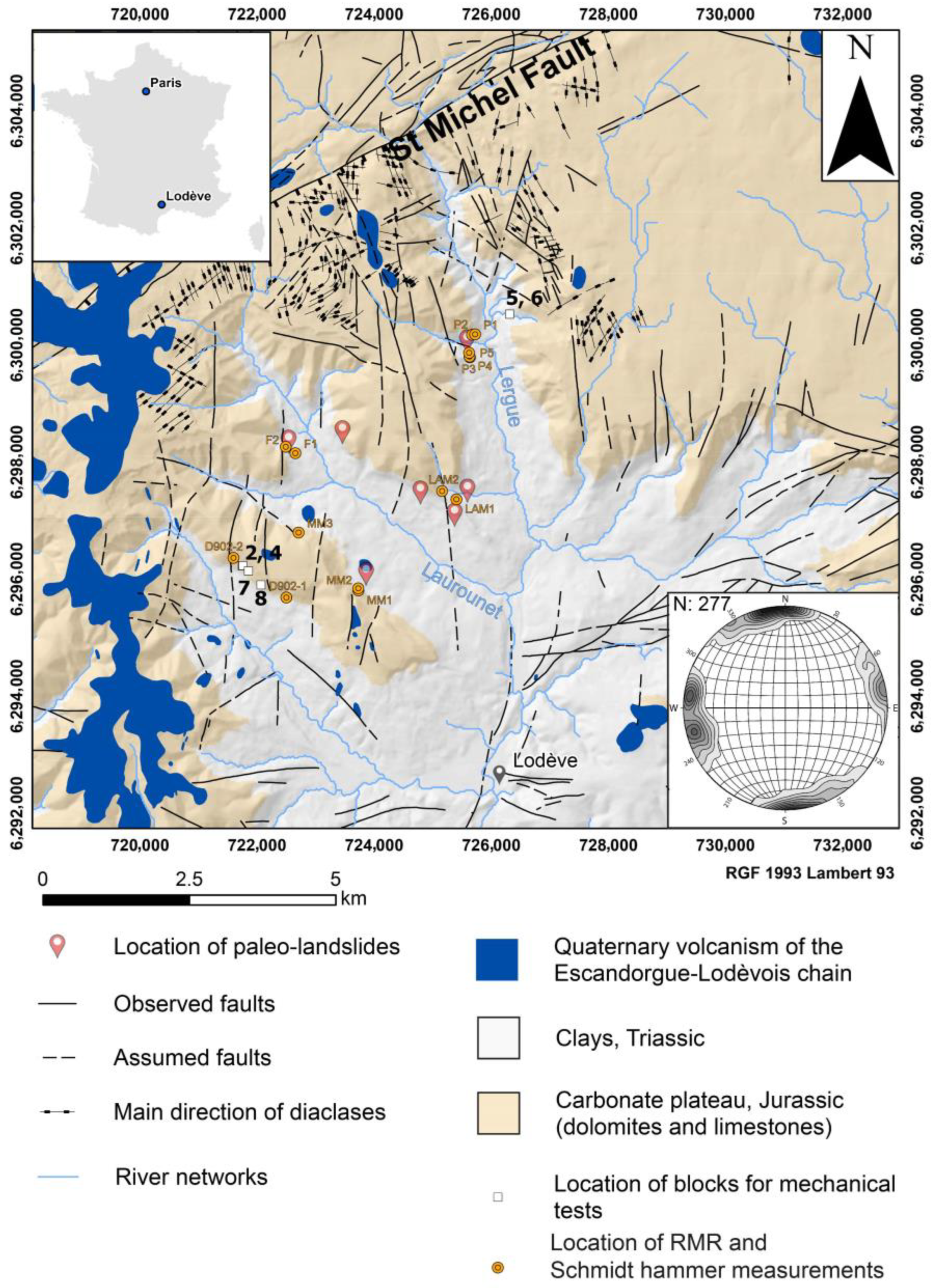
Figure 1. Simplified geological and structural map of the south of the Larzac plateau (the inset map shows France). Red bullets show the location of the investigated paleo-landslides on the map. Locations and block numbers for mechanical tests are indicated by squares. Blocks 2 and 4 are almost in the same place, as well as blocks 5 and 6. Locations of RMR and Schmidt hammer measurements are indicated by circles. Poles of fractures measured on the carbonate unit near or in the location of RMR measurements are represented in a stereoplot with a Kamb contour; contour intervals are 2%.
Applsci 15 12956 g001
Figure 2. (A) Photo of multidimensional fractures (in white) cutting the Late Hettangien rocks (dolomite) in the Pégairolles-de-l’Escalette landslide. (B) Photo of centimetric fractures (in white) cutting the Early Hettangien rocks (limestone) in the Pégairolles-de-l’Escalette landslide.
Applsci 15 12956 g002
Figure 3. (a) Late Hettangian outcrop at the site D902-2. (b) The same outcrop with underlined joints seems to belong to the “Blocky” categories of the GSI, illustrating the application of three categories of the RMR on an outcrop.
Applsci 15 12956 g003
Figure 4. (a) Boxplot of Rock Mass Rating measured as a function of age with mean and median. (b) Boxplot of Rock Mass Rating with all the measurements with mean and median. The p-value of a Shapiro–Wilk test is not significant and demonstrates a normal distribution. (c) Truncated Geological Strength Index modified from [52], within blue the spectrum of mean and standard deviation of found values based on Equation (4).
Applsci 15 12956 g004
Figure 5. Hoek–Brown envelope obtained with GSI value with a = 0.5030, mb = 2.3756 and s = 0.0107. Instantaneous and equivalent Mohr–Coulomb criteria are also represented with their values of cohesion and friction angle. The instantaneous criterion was calculated with an H = 255 m, a mean γ of 26 kN/m3 given a σv = 6.4 MPa and an h = 1.14 and θ = 0.84. The equivalent criterion was calculated with the same H and mean γ. The values of σcm, σ3max, and σ3n are 13.6, 5.09, and 0.047 MPa, respectively.
Applsci 15 12956 g005
Figure 6. Mohr circles and Mohr–Coulomb criterion based on the data of Table 3 with the value of cohesion and friction angle obtained. All Mohr circles correspond to rock tests performed on cores sampled in the Upper Hettangian dolomites.
Applsci 15 12956 g006
Figure 7. Residual Mohr circles and residual Mohr–Coulomb criterion based on the data of Table 3. An explicative sketch shows a complete stress–strain curve with peak and residual stress. All Mohr circles correspond to rock tests performed on cores sampled in the Upper Hettangian dolomites.
Applsci 15 12956 g007
Figure 8. Boxplots of uniaxial compressive strength (UCS) obtained with the Schmidt hammer (red points) and laboratory (blue points) tests. The obtained Shapiro–Wilk test p-value demonstrates a normal distribution for Hettangian formations, except for the Rhaetian formation. The blue and yellow envelopes delineate two distinct groups in the Lower Hettangian formation. See the text for further details. The absolute uncertainty, estimated from the standard deviation of the 10 repeated measurements for each UCS value, was evaluated at 2.4 MPa per measurement point using the Schmidt hammer.
Applsci 15 12956 g008
Figure 9. Photo of a very fractured sample of dolomite.
Applsci 15 12956 g009
Table 1. Rebound values of the Schmidt hammer type N and the corresponding UCS in situ values obtained using the formula from [41] on Hettangian and Triassic rocks. This table also shows the Rock Mass Rating (RMR) and Geological Strength Index (GSI) values derived from the correlation presented in Equation (4) on several Early and Late Hettangian outcrops. The different sites are represented in Figure 1. Several RMR, GSI, and σc values are reported per site because multiple measurements were taken from different outcrops located within a few hundred meters of each other to ensure good reproducibility. EH: Early Hettangian; LH: Late Hettangian; L: Limestone; D: Dolomite.
SiteLithologyAgeHammer Rebound RUCS/σc
In Situ
(MPa)
RMR RatingGSI RatingLat°Long°
P1LEH57119.564; 6459; 5943.8002623.319989
P3LLH528456; 59; 52; 5651; 54; 47; 5143.7964553.318871
P2DLH57119.578; 76; 8173; 71; 7643.8002033.319339
LAM1LEH62; 42169.5; 41.859; 6654; 6143.7749003.315883
MM2LEH27.51554; 50; 5449; 45; 4943.7612753.295003
F1LEH51.5; 47; 37.581.5; 59; 30.566; 5961; 5443.7820923.281767
P4DLH50.5; 5376; 9069; 7464; 6943.7968533.318786
P5DLH54; 59.5; 50.597; 142.5; 7657; 6252; 5743.7974223.318694
LAM2DLH46.5;57 67; 7162; 6643.7761833.312850
MM1DLH64195--43.7609423.295031
MM3DLH67; 66240.5; 22464; 6259; 5743.7698833.282386
D902-1DRhaetian42.543.5--43.7599033.279751
D902-2DLH64; 41; 58.5195; 39; 132.771; 7766; 7243.7660253.268558
F2DEH53; 41.5; 45.590.5; 57.5; 53.5--43.7830813.279728
OtherDRhaetian40; 56; 65.536.5; 111.5; 216.5--43.75482523.7149275
Table 2. RMR table for the D902-2 site. The RMR gave a total score of 71 and 77 because different outcrops in the same site had a slight difference in persistence and spacing. See in text for an explanation of each parameter.
RatingCalculationRMR
SiteσcRQDSpacingPersistenceApertureRoughnessInfillingWeatheringGroundwaterJv
(m−1)
RQD
D902-21213104056615156471
D902-2121386656615156477
Table 3. Different laboratory tests on blocks of limestone and dolomite with pc: confining pressure, σp: peak stress, σr: residual stress, σtb: Brazilian tensile stress, E: Young’s modulus, and ν: Poisson ratio. UCS values are highlighted in bold.
Type of Testpc (MPa)σp
(MPa)
σr (MPa)σtb (MPa)E (GPa)ν (-)
Late Hettangian DolomiteTensile---6.4--
Tensile---5.6--
Tensile---6.4--
Compressive0103--20.50.24
Triaxial10146.6--89.40.25
Tensile---7--
Compressive064.86.9-9.70.21
Compressive082.711.3-16.80.26
Triaxial5191.668.4-24.40.28
Triaxial10196.294.3-19.70.28
Triaxial15296.5123-23.80.27
Early Hettangian LimestoneCompressive083.--16.50.19
Tensile---10.9--
Tensile---16.4--
Tensile---17.2--
Compressive0176.6--24.7-
Compressive0186.1--27-
Compressive0155.6--25.7-
Tensile---10--
Tensile---14.6--
Compressive0187.8--25.1-
Tensile---13--
Table 4. Comparison of rupture parameters (cohesion (c) and friction angle (ϕ)) obtained from field and laboratory approaches. The laboratory values are higher than those obtained for the field, except for residual values that are rather similar. Field parameters are for all carbonates; meanwhile, for laboratory, parameters are only provided for the Upper Hettangian dolomites.
LaboratoryField
PeakResidualInstantaneousEquivalent
c (MPa)1233.42.5
ϕ (°)59514447
Disclaimer/Publisher’s Note: The statements, opinions and data contained in all publications are solely those of the individual author(s) and contributor(s) and not of MDPI and/or the editor(s). MDPI and/or the editor(s) disclaim responsibility for any injury to people or property resulting from any ideas, methods, instructions or products referred to in the content.