Article

Optical Studies of Al2O3:ZnO and Al2O3:TiO2 Bilayer Films in UV-VIS-NIR Spectral Range

1
Faculty of Materials Engineering, Cracow University of Technology, Al. Jana Pawla II 37, 31-864 Cracow, Poland
2
Department of Physics, Cracow University of Technology, 1, Podchorazych Str., 30-084 Cracow, Poland
3
Department of Engineering Materials and Biomaterials, Silesian University of Technology, Konarskiego 18a Str., 44-100 Gliwice, Poland
4
Scientific and Didactic Laboratory of Nanotechnology and Material Technologies, Faculty of Mechanical Engineering, Silesian University of Technology, Towarowa 7 Str., 44-100 Gliwice, Poland
5
Strata Mechanics Research Institute of the Polish Academy of Sciences, Reymonta 27, 30-059 Crakow, Poland
6
Faculty of Chemical Engineering and Technology, Cracow University of Technology, 24 Warszawska St., 31-155 Cracow, Poland
*
Author to whom correspondence should be addressed.
Appl. Sci. 2025, 15(24), 12870; https://doi.org/10.3390/app152412870
Submission received: 4 September 2025 / Revised: 1 December 2025 / Accepted: 2 December 2025 / Published: 5 December 2025
(This article belongs to the Section Optics and Lasers)

Abstract

In this work, the results of ellipsometric studies of bilayer films of broadband oxides (Al2O3:ZnO, Al2O3:TiO2) are presented. Thin layers of A l 2 O 3 , Z n O and T i O 2 were deposited on silicon substrate using the atomic layer deposition (ALD) method. The desired ranges of antireflective properties were selected, and then, based on optical modeling, the appropriate thicknesses of individual layers were determined. Optical constants were determined based on ellipsometric measurements in the spectral range of 193–1690 nm. For several selected samples, this range has been extended to 470–6500 cm−1. B-spline function, Tauc–Lorentz, Cody–Lorentz and Psemi-M0 oscillator models were used to describe the optical properties of the investigated films. Reflectance spectra for layers on a silicon substrate were determined in the range from 200 to 2500 nm. Additionally, complementary studies, SEM and EDS analyses, were also performed. The EDS investigations enabled the determination of the composition of the bilayer films. Spectrophotometric analysis demonstrated consistency between the obtained experimental data and theoretical predictions, confirming the validity of the applied model. The studies showed significant improvement in antireflective properties depending on the thickness of the prepared layers while maintaining an extinction coefficient close to zero, across much of the investigated spectral range, regardless of the layer thickness.

1. Introduction

Coatings and surface layers are used in many areas of everyday life, with the simplest example being household mirrors, which consist of a thin layer of metal or alloy applied to one side of a glass plate. In the past, the predominant technique used for this purpose was the silvering process [1]. Thin coatings are applied in almost every field, from medical applications to the automotive industry, and even the food industry. They can be used as anti-corrosion coatings [2] or passive coatings, forming diffusion barriers for gases during the food packaging process [3]. They are also used as a substitute for lubricants, improving tribological properties [4]. Thin film technologies play a key role in the production of microprocessors, solar panels, batteries, displays, sensors, and many other electronic devices [5].
A convenient method for applying layers with high surface quality is the Atomic Layer Deposition (ALD) method [6]. This method is a variation in the chemical vapor deposition (CVD) process, which originates from another variation in this process, metal–organic chemical vapor deposition (MOCVD). The main distinguishing feature between these variants is the way precursors are introduced into the reaction chamber. In the MOCVD method, reagents are introduced simultaneously, whereas the ALD method involves alternating the introduction of precursors combined with appropriate purging of the chamber with an inert gas. The entire process occurs only on the surface [7]. Additional advantages of the aforementioned method for applying thin coatings include the ability to control the thickness at the level of single particles of the deposited materials, and the applied coating reflects the substrate’s topography, which is beneficial when depositing on surfaces with specific textures [8].
An example application of coatings produced by this method is thin layers of A l 2 O 3 , which function as an anticorrosion buffer, protecting stainless steel from the harmful effects of a chlorinated environment and improving the hardness of the coated materials by up to 75% [9]. The development of this technology, enabling the deposition of coatings even at room temperatures in the future, will allow their application on any surface [10].
Thin layers applied on substrates are also used in the production of solar panels, where they are used to generate electricity from solar radiation [11]. In the field of anti-reflective systems, the reasons for using thin-film coatings include the high transmission of optical systems. This is achieved by selecting materials with a specific refractive index for the incoming radiation. Proper attention must also be paid to the potential phenomenon of radiation interference, which could result in an effect opposite to the intended one, i.e., an increase in the percentage of reflection. Therefore, obtaining homogeneous interfaces between the layers becomes crucial [12,13]. Additionally, they lead to a reduction in the intensity of ghost images and background noise in the image plane [14]. In recent years, there has been an increased interest in the development and study of dielectric coatings. In the field of optics, dielectric coatings are used in the production of optical lenses, anti-reflective coatings, and other optical elements. They are also used to optimize solar panels by increasing the transmission of sunlight or in optoelectronic [15]. With technological progress, further development and innovation in the field of dielectric coatings are expected to expand their applications and improve optical properties.
Currently, the most commonly used coatings in the photovoltaic cell industry are those made of silicon nitride ( S i 3 N 4 or S i N x ) [16]. However, their deposition is a costly process, which is why alternative solutions that meet industrial requirements are being sought. A growing group of materials gaining popularity are wide bandgap metal oxides, which are particularly attractive for optoelectronic applications. Examples of such oxides include A l 2 O 3 , T i O 2 , and Z n O [17,18]. These are used as transparent anti-reflective coatings [19]. A l 2 O 3 is notable for its wide band gap (6.3 eV) and refractive index, which is about 1.7 in the visible spectrum [20]. Another material, ZnO, is a key multifunctional oxide due to its outstanding optical and electrical properties, primarily its wide band gap (3.37 eV) and high binding energy (60 meV) [21,22,23,24]. It can be used in electronic devices or photovoltaic cells as an antireflective coating or a transparent conductive oxide (TCO) layer [25,26]. In the context of TCOs, indium tin oxide (ITO), which has been widely used so far, is becoming increasingly expensive [27], and one of the most promising alternatives is Z n O [28]. T i O 2 is another widely used material, with a wide band gap (3.2 eV) and a high refractive index [19,29]. It is a well-known material previously used in photovoltaic applications [30], but it was eventually replaced by the aforementioned silicon nitrides. Its renewed interest stems from advances in thin-film deposition technologies. It exhibits high absorption of ultraviolet radiation, and ongoing research aims to modify its properties to extend this absorption range.
By combining a layer of A l 2 O 3 with other broadband oxides, we can modify their properties [17]. Such thin-film systems are widely used across various industries, especially in optics and optoelectronics [31]. For example, Al2O3:ZrO2 coatings can be used to improve mechanical properties and protect components from high-temperature corrosion [32]. Meanwhile, combining A l 2 O 3 with H f O 2 enables the fabrication of insulating layers for use in thin-film transistors [33]. From the optical application perspective, combining A l 2 O 3 with T i O 2 or Z n O is particularly interesting. Al2O3:TiO2 systems, due to lower production costs and reduced amounts of hazardous substances, may become a viable alternative to silicon nitride-based coatings, although further research is still required [34]. Al2O3:TiO2 nanolaminates used as passivation layers significantly extend the lifetime of OLEDs [35]. In the case of the Al2O3:ZnO combination, depositing Z n O on an A l 2 O 3 layer alters the growth orientation compared to pure Z n O layers [36]. A l 2 O 3 layers deposited by ALD are inherently amorphous and, according to studies, they inhibit the crystallization of Z n O [37]. By adjusting process parameters, Al2O3:ZnO systems can be successfully tailored and modified, including in terms of their optical properties and band gap width [38].
The need for the application of optical filters also arises from the widespread use of laser radiation. It is utilized in many industries, as well as in science and medicine. In industry, electromagnetic radiation is employed for the precise cutting of various materials [39]. Similarly, in medicine, precision cutting is of great importance during surgical procedures [40]. Additionally, electromagnetic radiation is used for diagnostic purposes or as a method of treating various diseases and correcting cosmetic imperfections [41,42,43].
The aim of this study was to establish bilayer antireflective systems with tunable optical response in three selected wavelength ranges and to evaluate their performance using a wide set of complementary characterization techniques. The layered systems were designed to achieve the widest possible range of antireflective properties near the selected radiation wavelengths. Bilayer antireflective systems were prepared using the ALD method. The systems were prepared in two material variants: Al2O3:ZnO and Al2O3:TiO2. Initially, a layer of A l 2 O 3 with a constant thickness was applied on all silicon substrates, followed by a top layer of Z n O or T i O 2 with varying thicknesses. The analysis of these layered systems included spectrophotometric and ellipsometric measurements in the UV-VIS-NIR and MIR ranges, as well as surface analysis and chemical composition examination using a scanning electron microscope (SEM) and energy-dispersive spectroscopy (EDS). The prepared systems are intended to provide optical parameters that can support the improvement of advanced antireflective configurations.

2. Materials and Methods

2.1. Sample Preparation

Layers of A l 2 O 3 , Z n O and T i O 2 were deposited on polished p-type, boron-doped single-crystal silicon wafers with a (100) crystallographic orientation and a thickness of 460 µm. The wafers, polished on one side and featuring a standard orientation flat, provided a low-roughness and well-characterized substrate suitable for accurate ellipsometric analysis. The deposition process was conducted using an ALD Picosun R 200 (Espoo, Finland) reactor. The thicknesses of the individual layers were determined based on the conducted modeling, ensuring that the reflection minimum fell within the designated ranges. Initial depositions were conducted on mirror-polished silicon substrates ( 2 × 2   c m 2 ) with minimal surface roughness to ensure accurate characterization of the ALD-grown films, minimizing substrate-induced artifacts. Silicon was selected as the substrate due to its well-characterized optical response, surface uniformity, and compatibility with spectroscopic ellipsometry, which enabled accurate determination of the optical constants of the deposited layers. In this study, the use of silicon was not intended to demonstrate antireflective performance for silicon-based devices, but rather to provide a stable and reproducible platform for analyzing the intrinsic optical properties of the deposited films. The substrates contained a native oxide layer, and its preparation included cutting and cleaning of impurities in ultrasonic bath using solvents (acetone and isopropanol). Thin films of aluminum oxide ( A l 2 O 3 ), zinc oxide ( Z n O ), and titanium dioxide ( T i O 2 ), as well as their multilayered structures, were synthesized using an ALD Picosun R-200 reactor (Espoo, Finland). The deposition process employed organometallic precursors such as trimethylaluminium (TMA) and diethylzinc (DEZ), alongside titanium tetrachloride ( T i C l 4 ) for T i O 2 , with deionized water serving as the oxidizing agent in each reaction cycle. Thermal atomic layer deposition (ALD) was carried out under controlled conditions, with substrate temperatures set at 300   ° C for A l 2 O 3 , and 250   ° C for T i O 2 and Z n O . The deposition temperatures were determined through a series of preliminary studies to identify the optimal thermal ALD windows and correspond to the thermal ALD regimes for the respective precursors used. These temperatures ensured uniform growth per cycle, surface-saturated reactions, and minimization of unwanted CVD-type deposition. Each ALD cycle included a 0.1 s precursor pulse followed by a 4 s H 2 O pulse, interleaved with 4 s N 2 purge steps to effectively remove unreacted species and by-products. Firstly, layer of A l 2 O 3 with an estimated thickness of 50   n m was applied in 500 cycles and then, top layer of Z n O or T i O 2 was deposited. The Z n O layers were applied in several variations in different layer thicknesses. The number of cycles for this layer was 200 , 400 , 500 , and 700 , respectively, allowing for the creation of layers with an estimated thickness of about 20 , 45 , 60 , and 85   n m . The T i O 2 layers were deposited in the following number of cycles: 500 , 1000 , and 1500 , which allowed for the creation of layers with an estimated thickness of about 20 , 45 , and 70   n m .

2.2. Experimental Methods

The optical properties of bilayer systems have been examined using spectroscopic ellipsometry (SE, Woollam M-2000, Lincoln, NE, USA) with a spectral range of 193 to 1690   n m , and spectrophotometry (Perkin Elmer Lambda 900, Waltham, MA, USA) with a spectral range of 200 to 2500   n m , techniques. Additionally, in the mid-infrared (MIR) in the range of 470 6500   c m 1 a commercial FTIR spectrometer, the iS50 (Thermo Fisher Scientific, Waltham, MA, USA), was used in conjunction with the SENDIRA optical ellipsometer (Sentech Instruments GmbH, Berlin, Germany). Ellipsometry enables the determination of the thickness of thin layers and the dispersion dependence of the refractive index and extinction coefficient. Using spectrophotometric measurements, the determination of the transmission and reflection spectra of the tested layers is possible. Optical methods provide a preliminary assessment of the quality of the coatings.
In order to examine the surface morphology of the prepared bilayers and determine their elemental composition the scanning electron microscope (SEM) equipped with an energy-dispersive spectroscopy (EDS) system was used. Top view images were captured using an Apreo 2 S LoVac (Thermo Fisher Scientific) witch UltraDry (Thermo Fisher Scientific) and Octane Elect (EDAX Ametek GmbH, Wiesbaden, Germany) detectors. These studies provide information about roughness and inconsistencies in the layer composition, which helps estimate uniformity and overall quality assessment of the produced thin layers.

3. Theory and Calculation

3.1. Reflection Modeling

Knowing the refractive index n, it is possible to estimate the total reflection as a function of the wavelength of the incident light for the prepared layered systems. In the literature, appropriate formulas describing this relationship can be found [44]. Based on these formulas, optical models were developed to represent the estimated reflection of the layered systems. The formula used is as follows:
R = R 321 + T 123 R 31 T 321 e x p 8 π d s u b I m n ^ s u b 2 n 1 2 sin 2 θ 1 R 321 R 31 e x p 8 π d s u b I m n ^ s u b 2 n 1 2 sin 2 θ
where
  • d s u b —substrate thickness,
  • n ^ s u b —complex substrate refractive index,
  • n 1 —impact medium refractive index,
  • θ —impact angle.
Additionally, in the above-mentioned formula, we can recognize terms such as:
R 123 = r 123 2
R 321 = r 321 2
R 31 = r 31 2
T 123 = R e n ^ s u b cos θ s u b n 1 cos θ t 123 2
T 321 = n 1 cos θ R e n ^ s u b cos θ s u b t 321 2
The variable r 31 is calculated based on Fresnel equations, where the first medium represents the incident medium, and the third medium represents the substrate layer. The coefficients r 123 , r 321 , t 123 and t 321 were originally introduced as reflection and transmission coefficients for a single layer on the substrate. However, by using appropriate matrices, these coefficients can be determined for the multilayer system. These equations are also described in the aforementioned source.
The complex refractive index is frequently used in the above formulas, which should be treated as a complex number, where absorption is represented by the imaginary part ( n ^ = n + i k ). As indicated in the literature [45,46,47], the deposited layers exhibit significant absorption k only in the ultraviolet range (i.e., at wavelengths below 400 nm). In other ranges, this value is close to zero. Therefore, in order to simplify the calculation method, the absorption coefficient of the layer was omitted. The reflectance spectrum can be expressed as the difference between the incident radiation and the sum of transmission and absorption. Consequently, this simplification may lead to an overestimation of the modeled reflectance in spectral regions where absorption is present. This omission also allowed for the omission of the imaginary part of the refractive index. Additionally, it was assumed that the electromagnetic radiation beam strikes at a normal angle. Based on such a simplified Formula (1), reflection curves as a function of wavelength were created. As can be observed, the model formula presents results as a dimensionless unit. Therefore, to make the created graphs comparable, the maximum reflection was assumed to be 100%. This approximation is justified by the theory of thin quarter- and half-wave layers.
In order to conduct the study, three electromagnetic wavelength ranges within the visible light or NIR spectrum were selected. The first range selected was approximately 450 550   n m . This range was chosen due to its numerous applications. Light with a wavelength of approximately 450   n m is strongly absorbed by chlorophyll, driving the process of photosynthesis, which is why it is often used in LED lights for research related to controlled plant growth. Radiation from this range is also used in phototherapy for treating various conditions [48]. The second selected range was 700 800   n m . Titanium-sapphire lasers are most effective in this area [49]. These lasers are often used for generating very short electric field pulses [50] or in two-photon microscopy [51]. The last analyzed range is 900 1050   n m . This range is of interest due to the maximum sensitivity of silicon-based detectors [52]. Such detectors can be found, for example, in LiDAR (Light Detection and Ranging) systems. This range was also selected, among other reasons, due to the Nd:YAG laser, which is widely used in various applications, such as the aforementioned LiDAR systems [53] with the radiation beam it generates being 1064   n m [54,55].
Additionally, a sample was also designed and prepared to illustrate the shift in antireflective properties resulting from a change in the layer material while keeping its thickness constant. As a reference system, an Al2O3:TiO2 structure with a T i O 2 layer thickness of 45 nm was selected. This system was chosen as the middle sample.

3.2. Spectroscopic Ellipsometry Modeling

Spectroscopic ellipsometry is a method which allows determination of the thickness and optical parameters of thin films. This method is fast, contactless and reliable. The spectroscopic ellipsometry measures changes in the polarization of light due to its reflection at a surface. The light incident on the sample is linearly polarized, and as a result of interaction with the sample, the polarization changes to elliptical. During the measurement, two ellipsometric angles, Ψ and Δ are registered. The Ψ and Δ angles fully describe the polarization ellipse in the plane perpendicular to the direction of light propagation. The Ψ and Δ angles also define the ratio of the amplitude Fresnel reflection coefficients rp and rs components parallel and perpendicular to incidence plane of light. The ratio is defined in Equation (2) as [56] Equation (2):
ρ = r p r s = tan Ψ e i Δ
The direct result of the ellipsometric measurements are the dispersion relationships of the Ψ and Δ ellipsometric angles. In order to obtain information about the physical parameters characterizing a thin layer, it is necessary to use an appropriate optical model. The B-spline function is used for modeling optical properties when a flexible, mathematical and physically consistent description of the spectrum is needed, which can be easily controlled by “knots” and control points [57,58]. The B-spline function was applied as a preliminary step for further modeling to obtain initial values of the refractive index and extinction coefficient. Then, the B-spline function was parameterized using Cody–Lorentz oscillators (for A l 2 O 3 layers), Tauc–Lorentz oscillators (for T i O 2 layers), and PSemi-M0 oscillators (for Z n O layers). Parameterizing the B-spline function with CL, TL, and PSemi-M0 oscillators in ellipsometry is applied because these oscillator models combine the mathematical flexibility of the B-spline with an accurate, physically justified description of the optical properties of materials, especially semiconductors and amorphous materials. Using CL, TL, and PSemi-M0 oscillators as parameters in the B-spline function results in greater precision in fitting actual ellipsometric data for materials with complex optical structures.
For conventional parametrization of the optical constants of amorphous materials in the interband absorption region the Tauc–Lorentz and Cody–Lorentz oscillator models can be applied. The Gauss model was additionally used for an effective description of the interband transitions. The Tauc–Lorentz model is a combination of Tauc joint density of states for bandgap and conventional Lorentz oscillator broadening first developed by Jellison and Modine [59]. The Cody–Lorentz model was developed by Ferlauto et al. [60]. The main difference between TL and CL is in the absorption onset region with energy slightly higher than Eg, where the TL model gives poor results while the CL model gives a good output. At energies below band gap, the Urbach absorption tail term is included in the CL oscillator. Both TL and CL are Kramers–Kronig consistent.
The imaginary part of TL model is given by Equation (3) [59]:
ε T L ( E ) =   A E 0 B E E g 2 E 2 E 0 2 2 + B 2 E 2 1 E ,                                                                 E > E g                                           0 ,                                                                                   E E g    
where A is the amplitude of the oscillator, Eg is the Tauc band gap, E0 is the center energy of Lorentz peak and B is broadening parameter.
The imaginary part of CL model is given by Equation (4) [60]:
ε C L E = E t G E t L E t E e x p E E t E u ,                     0 < E E t     G E L E ,                                                                   E > E t
where Et is demarcation energy between the Urbach tail transitions and the band-to-band transitions, Eu is the exponential rate of the Urbach absorption of the oscillator, G(E) is variable band edge function given by Equation (5), and L(E) is Lorentzian oscillator function given by Equation (6):
G E = E E g 2 E E g 2 + E p 2
where Ep is the offset from the bandgap energy.
L E = A B E 0 E E 2 E 0 2 2 + B 2 E 2
The real part of dielectric functions for TL and CL is determined from Kramers–Kronig transformation.
To obtain dispersion relations of ZnO films the Psemi-M0 oscillator based on Herzinger–Johs parametrized semiconductor oscillator function [61] has been used. Each Psemi oscillator consists of four polynomial spline functions connected end-to-end. These four functions are constrained such that each one connects smoothly with the adjacent function. The Psemi can be altered by modifying the control points, endpoints, center energy, and amplitude. The formula of the Psemi function is precisely presented in Ref. [62]. The variable fit parameters are: E0—center energy, A—amplitude, B—broadening, WR—width right of the oscillator, PR—horizontal position of the right central point relative to the center energy and endpoints, AR—relative magnitude of the right central point, O2R—coefficient of the 2nd order term in the polynomials on the right side of the Psemi-M0 oscillator. Fixed parameters and their values are WL = 0 (width right of the oscillator), PL = AL = 0.5 (horizontal position of the left central point and relative magnitude of the left central point) and O2L = 0 (coefficient of the 2nd order term in the polynomials on the left side of the Psemi-M0 oscillator) [62].
The Brendel oscillator model [63] was fitted to the ellipsometric data in the range from 470 to 6500   c m 1 .

4. Results and Discussion

4.1. Film Growth Rate

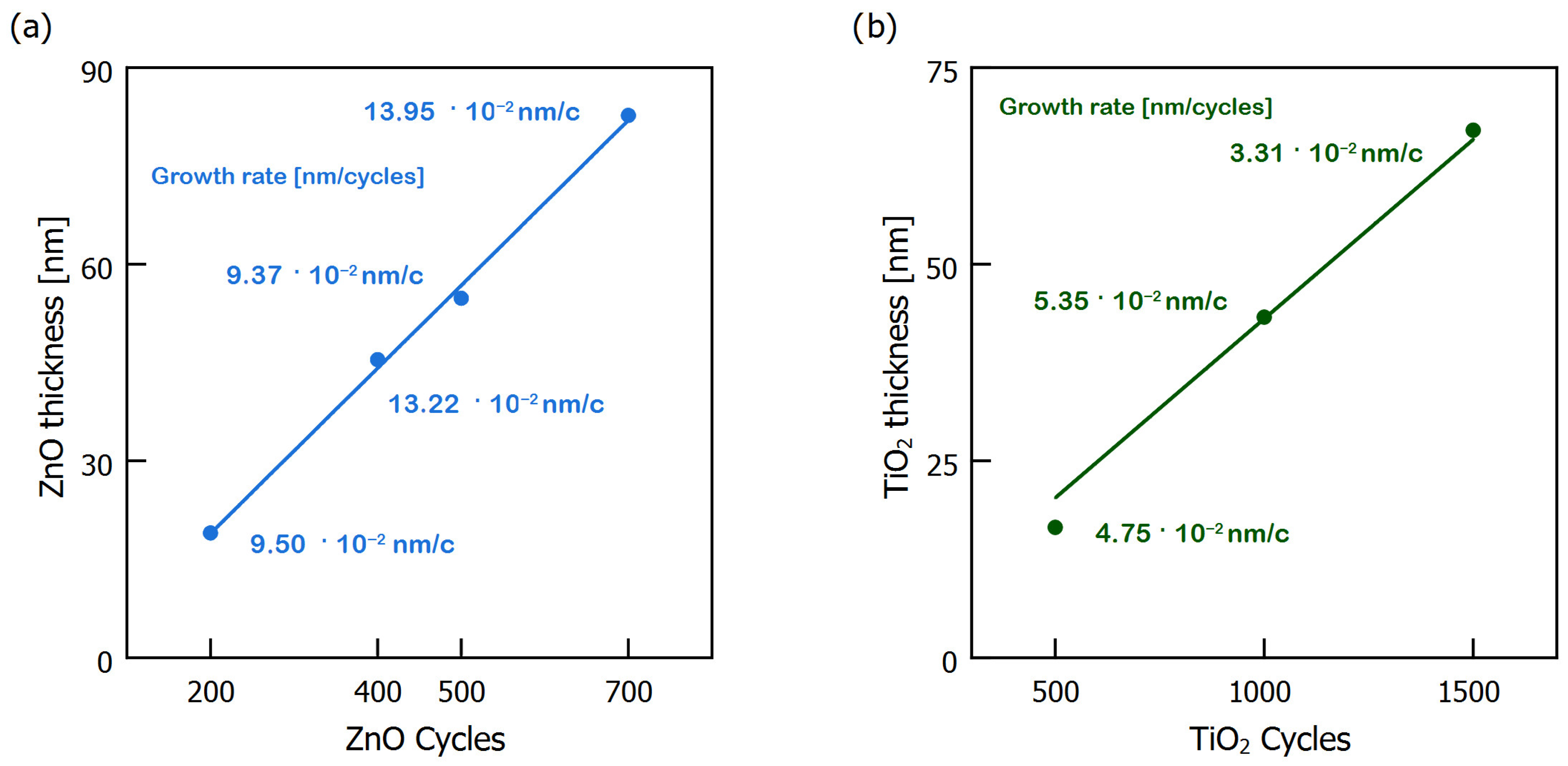
The film thicknesses were measured using spectroscopic ellipsometry and correlated with the number of ALD cycles to determine the average growth per cycle (GPC) for each material. The deposition rate varied across different deposition intervals (e.g., 200 400 cycles, 400 500 cycles), A l 2 O 3 exhibited a GPC of ~ 0.101   n m / c y c l e , Z n O ranged from 0.095 to 0.118   n m / c y c l e depending on the number of cycles, and T i O 2 showed lower GPC values in the range of 0.033 0.045   n m / c y c l e . Figure 1 graphically presents the thickness increase as a function of the number of deposition cycles. The calculated deposition rate, expressed in nanometers per cycle, is provided next to each range. These values were compared with theoretical monolayer thicknesses, estimated from crystallographic data as ~ 0.25 0.30   n m for A l 2 O 3 , ~ 0.26   n m for Z n O , and ~ 0.35   n m for T i O 2 . Therefore, one ALD cycle corresponds to approximately 35 45 % of a monolayer for A l 2 O 3 and Z n O , and 10 13 % for T i O 2 . These results are consistent with the self-limiting, sub-monolayer growth mechanism typical for thermal ALD processes, as typical deposition rates achieved using this method do not allow for the formation of a complete monolayer in a single cycle [64]. The observed nonlinear behavior of the growth per cycle can be attributed to mechanisms intrinsic to the ALD process as well as substrate-related effects. In the initial nucleation stage, the growth rate is strongly influenced by the density of hydroxyl groups on the Si surface, which leads to reduced GPC values before a continuous film is established. As deposition progresses, changes in surface morphology and an increasing number of reactive sites contribute to a gradual increase in the apparent growth rate. Additionally, the steric hindrance and reaction kinetics of the applied precursors, particularly for ZnO and TiO2, result in cycle-dependent variations in adsorption efficiency. These combined effects explain the nonlinearity of the GPC curves and are consistent with the known sub-monolayer, self-limiting growth characteristic of thermal ALD.

4.2. Spectroscopic Ellipsometry

Due to the very wide spectral range of the studies, it is challenging to describe the results across the entire range using only one optical model that accurately explains all the optical phenomena occurring in the layers. In the far ultraviolet region, there is strong radiation absorption in dielectric layers. In the VIS-NIR region, the absence of absorption simplifies the optical model for this range. Absorption reoccurs in the far-infrared range; therefore, different optical models are applied in various spectral ranges. In the spectral range where no absorption occurs, the Cauchy or Sellmeier models can be successfully fitted. The use of the Tauc–Lorentz, Cody–Lorentz and Psemi-M0 oscillator models in the UV-VIS-NIR range also yields reliable results, as these models are well suited for describing interband transitions and the absorption edge. In the infrared range, where broad absorption bands occur due to phonons and free-carrier effects, we consistently use the Brendel model, which incorporates a Gaussian distribution of resonances and therefore provides a more accurate description of the extended absorption features. Such an approach, involving the use of overlapping models for different spectral ranges, is commonly applied in optical modeling [64,65,66,67].
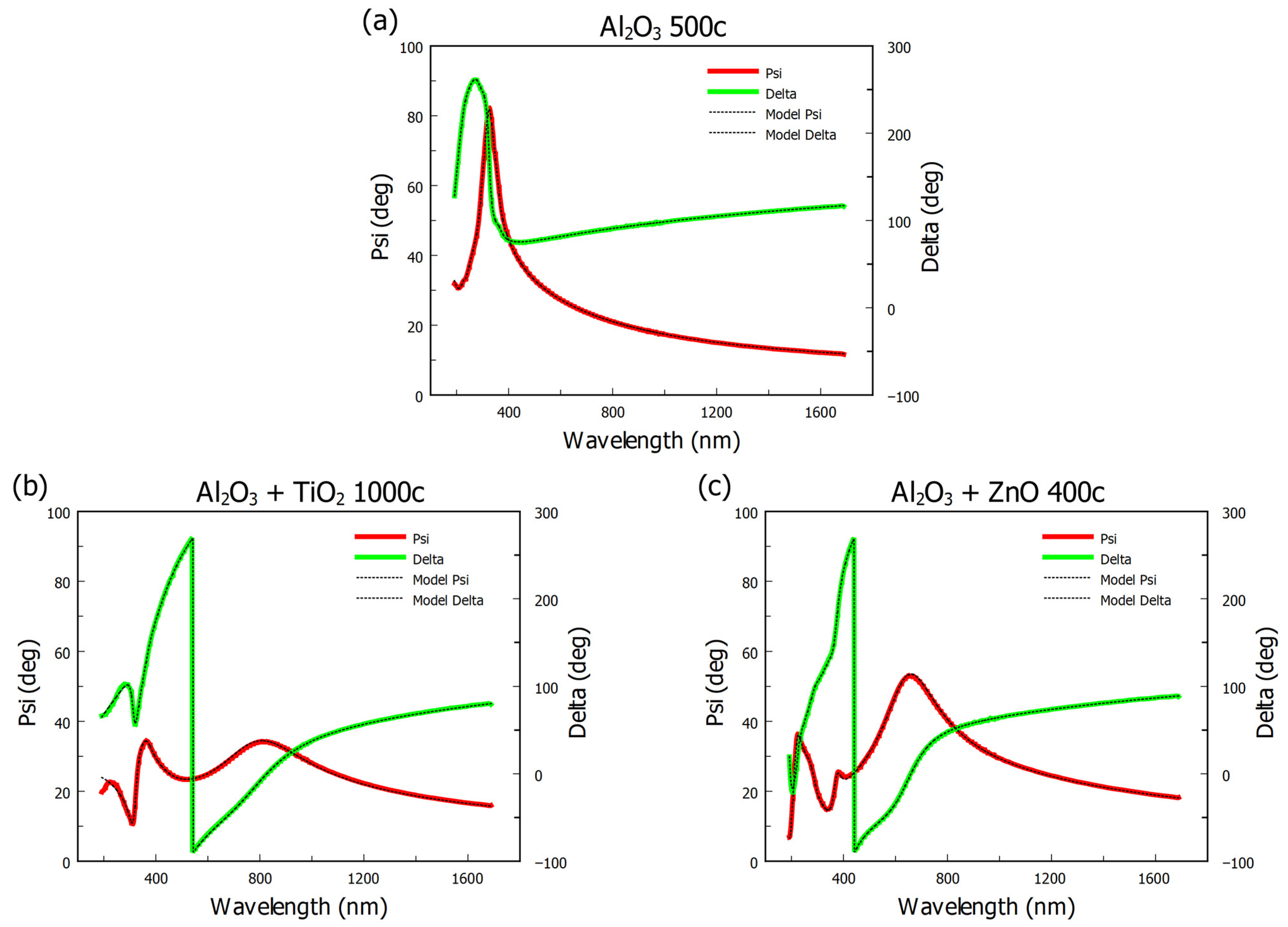
A very important aspect of thin film research is estimating its thickness and determining the growth relative to the number of deposition cycles. Spectroscopic ellipsometry enabled the quick and accurate determination of this parameter. Figure 2 presents the results of dispersion relation of ellipsometric angels Ψ and Δ for selected double-layer systems and a single layer of A l 2 O 3 on silicon substrate.
The theoretical models fit well with the measurement results. For the A l 2 O 3 layer, the Cody–Lorentz model was used, while for the top layers of ZnO and T i O 2 , the PSemi-M0 and Tauc–Lorentz models were used, respectively. Based on the modeling, the dispersion of the refractive index and extinction coefficient, as well as the thickness of the thin layers, were determined and are presented in Table 1.
The thickness of the layer refers to the top layer (either Z n O or T i O 2 ), while the refractive and extinction coefficients apply to the entire bilayer system. In optical models used for dielectric layers, within the established research range (193–1690 nm), typically absorption does not occur. However, in the extended range including the ultraviolet and far infrared, the extinction coefficient is greater than zero.
The results of the thickness of the deposited layers are consistent with the estimated assumptions regarding layer growth relative to the number of cycles. The low value of mean square error indicates the high quality of the prepared layers and the excellent fit of the model to the theoretical data. The calculated surface roughness of the layers was very low, with the maximum value not exceeding 7   n m .
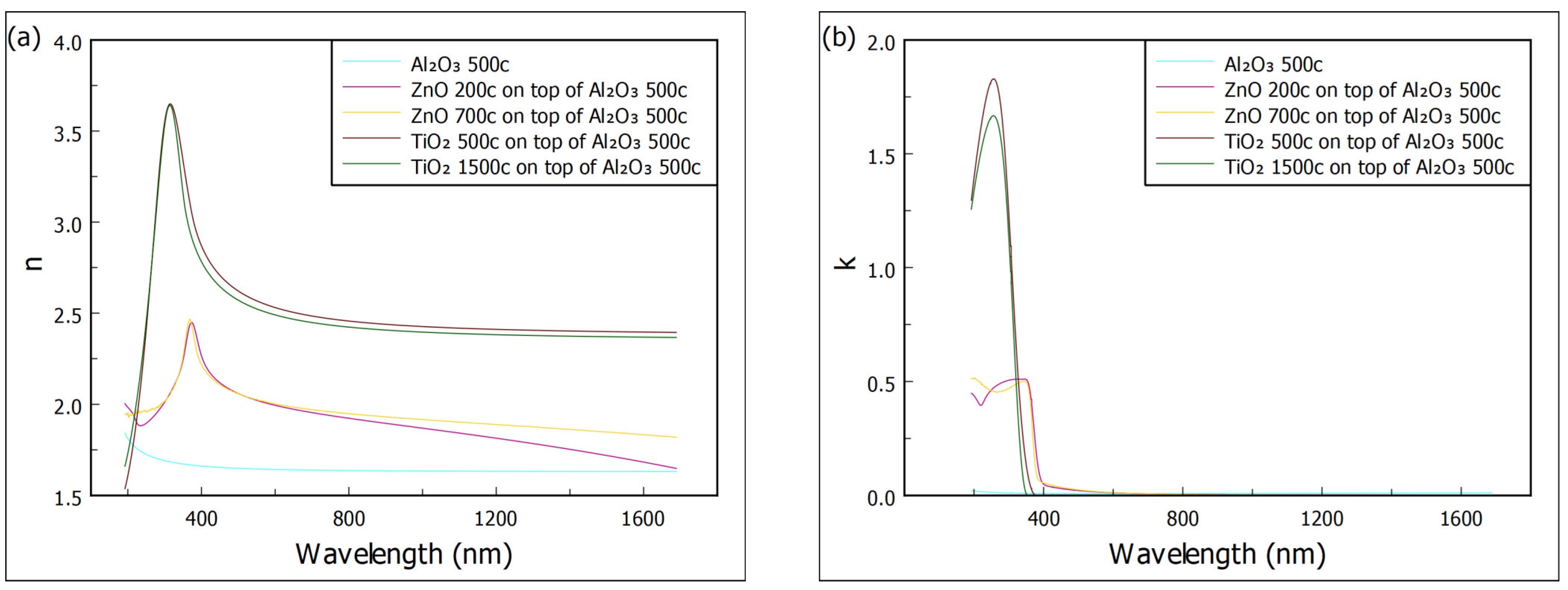
The refractive indices and extinction coefficients for individual samples are presented in Figure 3a,b. A significant difference can be observed for the investigated layered systems with zinc oxide. The refractive index of these systems, in the visible light range, compared to that of pure Z n O from other scientific reports, shows a significantly higher value [68]. All samples with the Z n O layer, regardless of thickness, exhibit a similar refractive index in the visible light range. In the other ranges, noticeable discrepancies related to the change in Z n O layer thickness appear. Similarly, the systems with a top T i O 2 layer exhibited similar curve profiles. The optical parameters obtained for the layers presented in this work were compared with literature data for similar systems. The results show a high degree of consistency with previously reported values [17,45,69,70].
The values of the extinction coefficient k are non-zero only in the UV range, while for wavelengths above 400 nm, they are close to zero. For Z n O layers, the extinction coefficients drop sharply, reaching very low values from around 400 nm, and reach zero from approximately 800 nm to the end of the measurement range. In the case of T i O 2 systems, the extinction coefficient can be estimated to be zero at wavelengths greater than 380 nm.
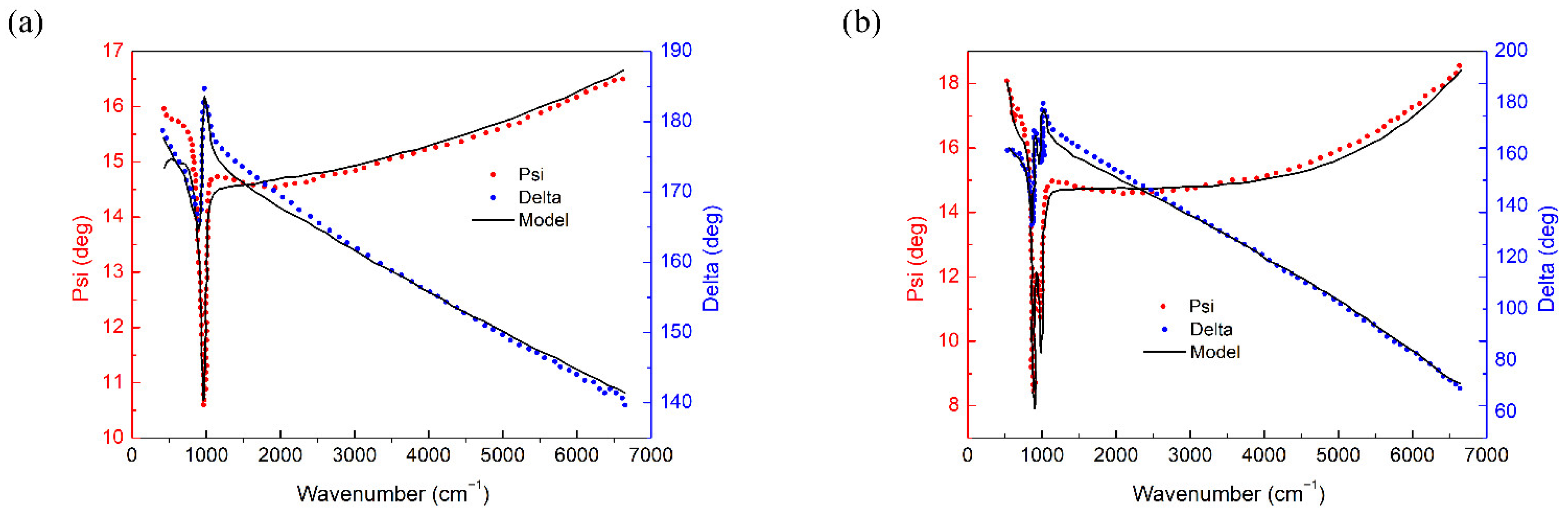
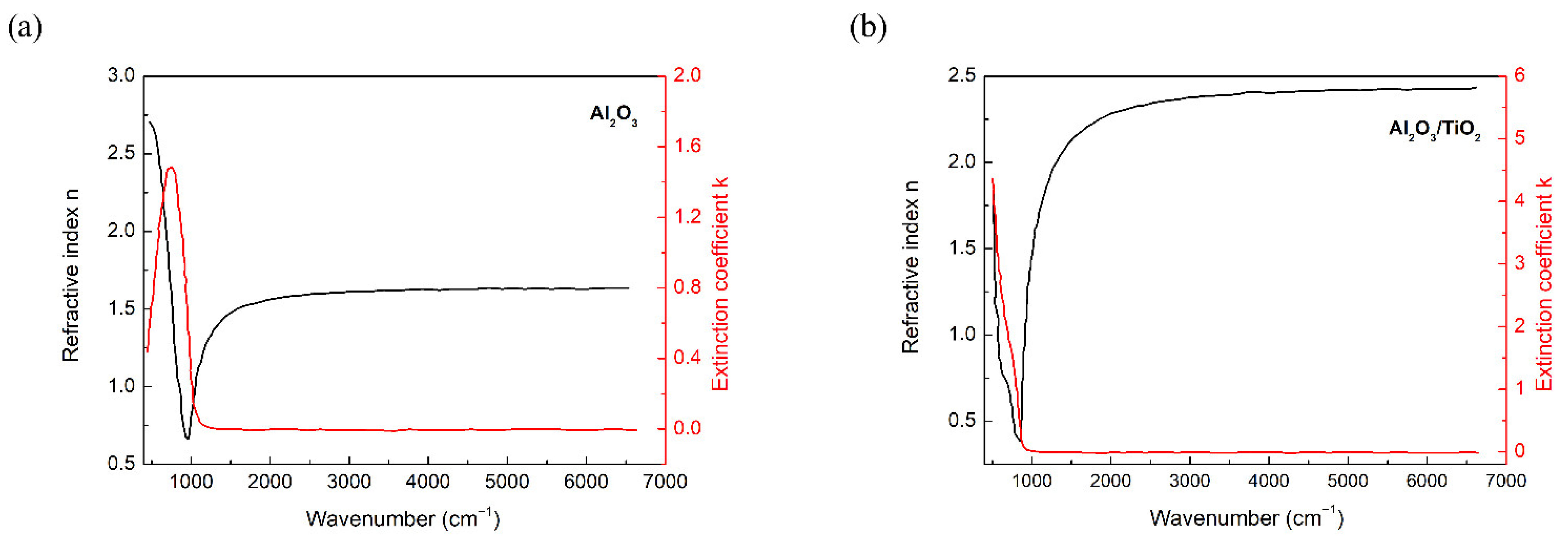
The presented ellipsometric angle plots (Figure 4) for the discussed samples in the infrared range show a high agreement between the experimental data and the fitted model. The measurements of the refractive index n and extinction coefficient k in the range of 1.7 25   µ m (Figure 5), conducted for A l 2 O 3 and Al2O3:TiO2 bilayer systems are in agreement with previously obtained values in the identical electromagnetic wavelength ranges ( 1.7 2.5   µ m ) . The refractive index n in both cases starts to increase sharply after exceeding the threshold of approximately 900   c m 1 , corresponding to an energy of 0.112   e V . In this region, the extinction coefficient k also starts to smooth its curve at a value close to 0, which remains constant throughout the measurement range.

4.3. Reflection Modeling and Spectroscopy

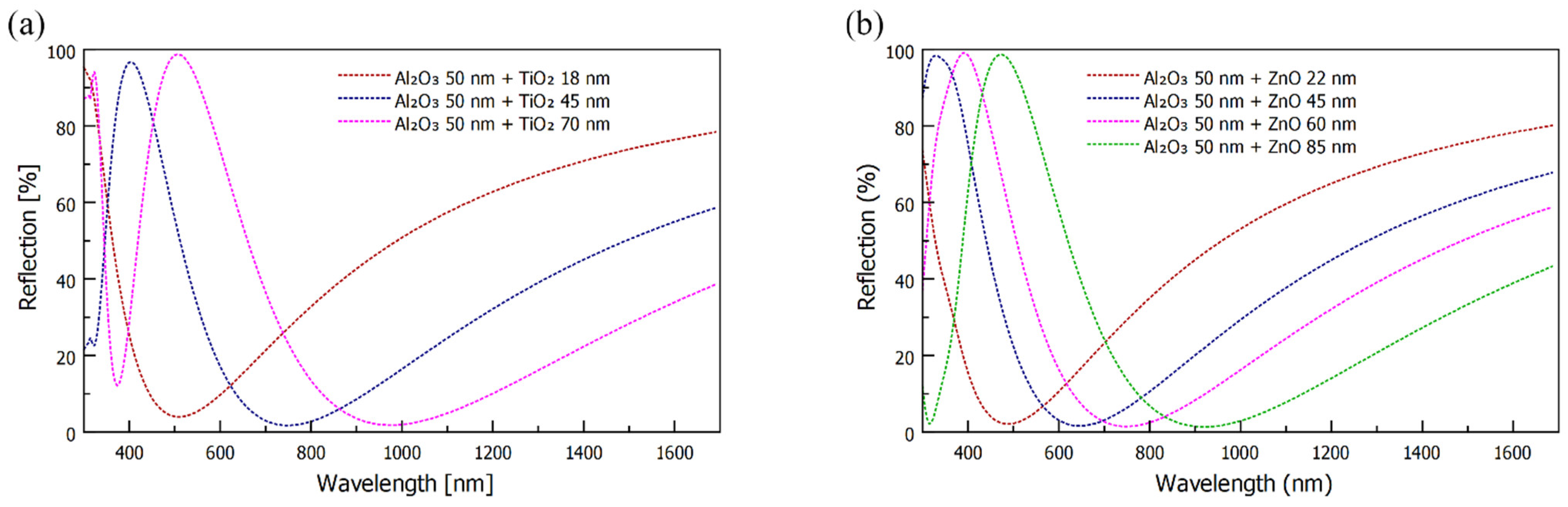
The optimization of the system parameters aimed at achieving antireflective properties in the desired ranges was carried out using optical modeling, the results of which are presented in Figure 6a,b. These show the modeled reflection curves for the Al2O3:ZnO and Al2O3:TiO2 systems for different thicknesses of the top layer. By adjusting the thickness of the layers, we can influence the operating range of the antireflective filter. For all layers, a constant thickness of the A l 2 O 3 layer was assumed, making the thickness of the top layer ( Z n O or T i O 2 ) the remaining optimization variable. It was determined that the optimal thicknesses of the T i O 2 layer, resulting in minimum reflection in the desired areas, are 18 ,   45 and 70   n m . For the Al2O3:ZnO system, the selected thicknesses are 22 ,   45 ,   60 and 85   n m .
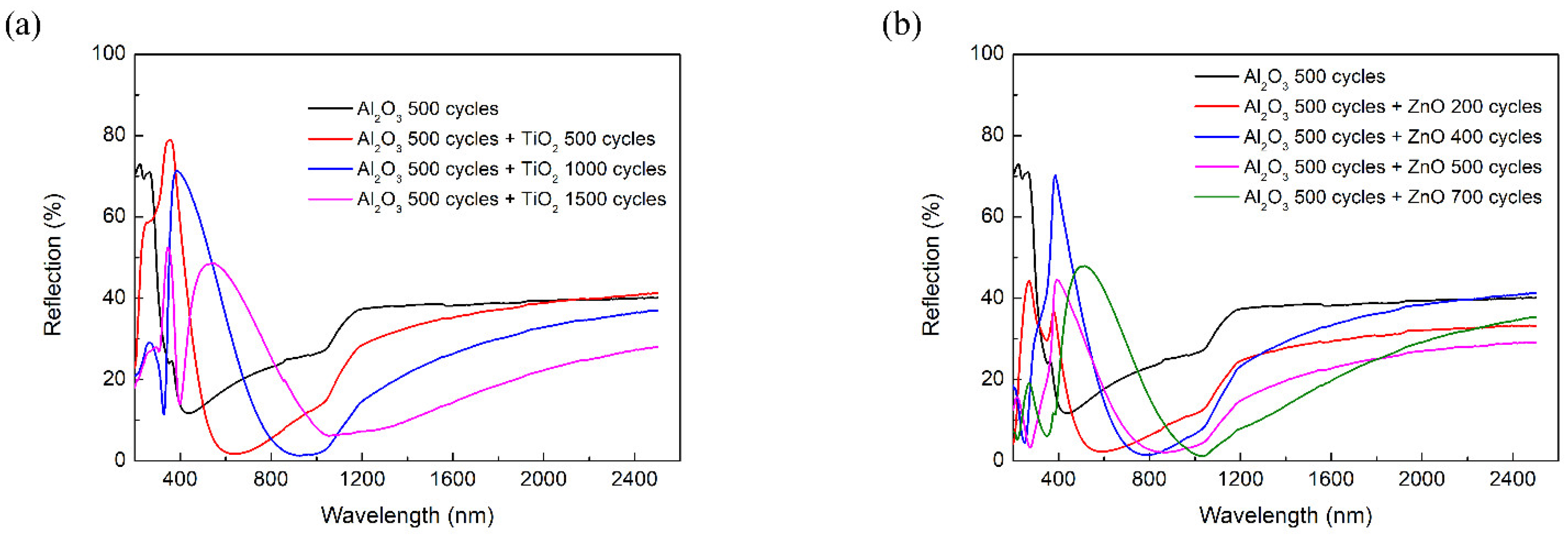
In Figure 7a,b, the reflection spectra for the A l 2 O 3 layer and for the layered systems Al2O3:ZnO and Al2O3:TiO2, respectively, are presented. To facilitate the comparison of experimental data with the model, the corresponding curves are presented in the same colors. The numerical comparison is summarized in Table 2. It presents the obtained minimum reflectance values and the corresponding wavelengths at which these minima occur for each system. Additionally, the table reports the improvement in antireflective performance relative to the system consisting solely of the A l 2 O 3 layer. The best performance was achieved for the Al2O3:ZnO system with the largest prepared thickness of the top layer, yielding a minimum reflectance of 1.16%. This corresponded to an enhancement of 10.58 percentage points compared with the single-layer A l 2 O 3 system, for which the minimum reflectance was 11.74%. The poorest performance was observed for the Al2O3:TiO2 system after 1500 deposition cycles. All remaining systems demonstrated minimum reflectance values close to or below approximately 2%.
A high correlation between the modeled curves and the experimental data can be observed. The location of the minimum reflection point as a function of wavelength for the real systems coincides with the point for the modeled systems.
A noticeable shift in the experimentally observed minima relative to the simulated spectra can be identified. The origins of these deviations may arise from limitations of the applied optical model as well as from physical factors inherent to the real multilayer systems. Actual coatings exhibit surface roughness that affects their optical response, as does the substrate material itself. Furthermore, discrepancies between the simulated and experimental spectra are influenced by differences between the real and literature-reported optical constants n and k, which may result from the specific deposition technique used. In thin-film systems, the optical constants depend not only on surface roughness but also on parameters such as the crystallinity of the material [71] and, to a limited extent, on the film thickness. As reported in the literature, even thin-film stacks fabricated from the same material but crystallized independently may exhibit noticeable variations in their optical properties [72].
For the Al2O3:ZnO system, the point of minimum reflection occurs as expected and according to the presented model. With increasing layer thickness, minimum reflection occurs at wavelengths of approximately 550 nm, 750 nm, 850 nm, and 1050 nm. Similarly, for the Al2O3:TiO2 systems, the point of maximum reflection appears in the specified locations, which correspond to wavelengths of approximately 600 nm, 750 nm, and 1050 nm.
Consolidating all the reflection measurement results, a significant improvement in antireflective properties for all the prepared double-layer systems compared to samples with a single aluminum oxide layer can be clearly observed. The thickness of the top layer has been chosen to achieve anti-reflective properties in specific areas. It had a minimal effect on the reached minimum reflectivity value but influenced its position relative to the wavelength of the electromagnetic radiation.

4.4. Scanning Electron Microscopy and Energy-Dispersive Spectroscopy

All investigated thin films exhibited high uniformity in terms of surface morphology and low roughness. The absence of visible cracks, pores, or other structural defects confirms the high quality of the films obtained using the ALD method. These results align with the optical studies described in the article, including the high repeatability of reflectance measurements, where reflection minima correspond well to the assumptions of optical modeling, as well as ellipsometric studies, in which the extinction coefficient (k) reaches values close to zero in the VIS-NIR range.
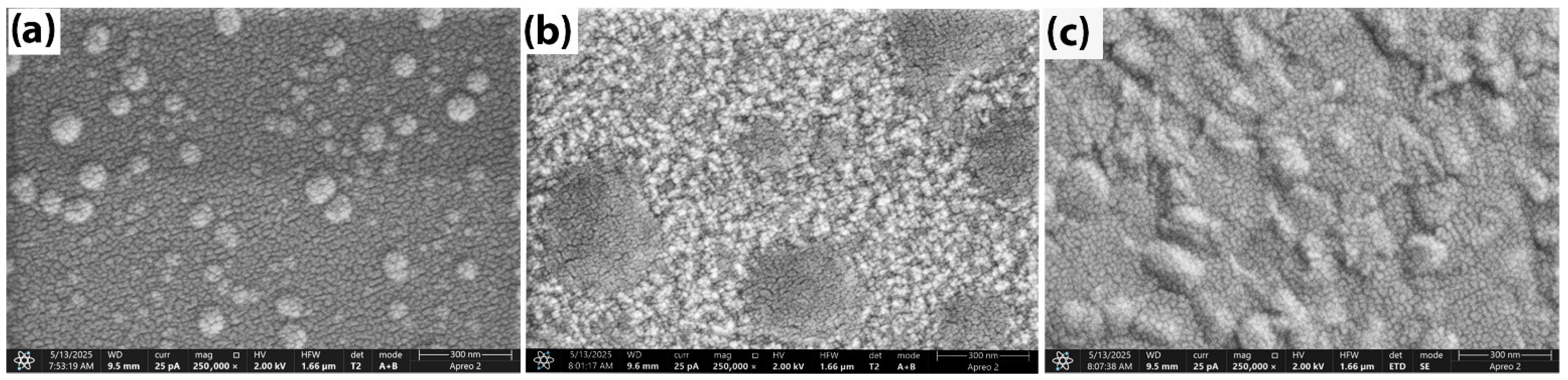
At high magnification (approximately 250,000×), subtle differences in surface morphology become apparent in the analyzed coatings, primarily due to the presence of different types of materials. The A l 2 O 3 layer (Figure 8a) exhibited an exceptionally smooth surface with minimal surface features. The surface morphology reveals repetitive structures with diameters of 20 to 50 nm, forming agglomerates of aluminum oxide phase. These features represent surface grains or aggregates visible in SEM imaging, which should not be confused with crystallite size that requires X-ray diffraction (XRD) or electron backscatter diffraction (EBSD) measurements for accurate determination. Given that ALD-deposited A l 2 O 3 films at these temperatures are typically amorphous, the observed structures likely represent surface texture rather than crystalline grains. The Al2O3:ZnO layer (Figure 8b) also demonstrates an ordered microstructure and high surface uniformity. On the surface of this composite layer, characteristic, regularly shaped oval structures with diameters of 30 to 70 nm are observed, representing surface features associated with the zinc oxide phase morphology. The Al2O3:TiO2 layer (Figure 8c) exhibits the most pronounced differences in surface microstructure compared to the other layers. It features a granular microstructure resulting from the presence of the T i O 2 phase. The observed surface features range from 15 to 40 nm in diameter, representing the granular surface morphology of the titanium dioxide layer.
The observed differences in grain size, roughness, and crystallographic orientation in the analyzed thin films stem from variations in surface energy for A l 2 O 3 , Z n O , and T i O 2 . This parameter is one of the key factors influencing the morphology of layers fabricated using the ALD method, determining the kinetics of atomic migration during layer growth.
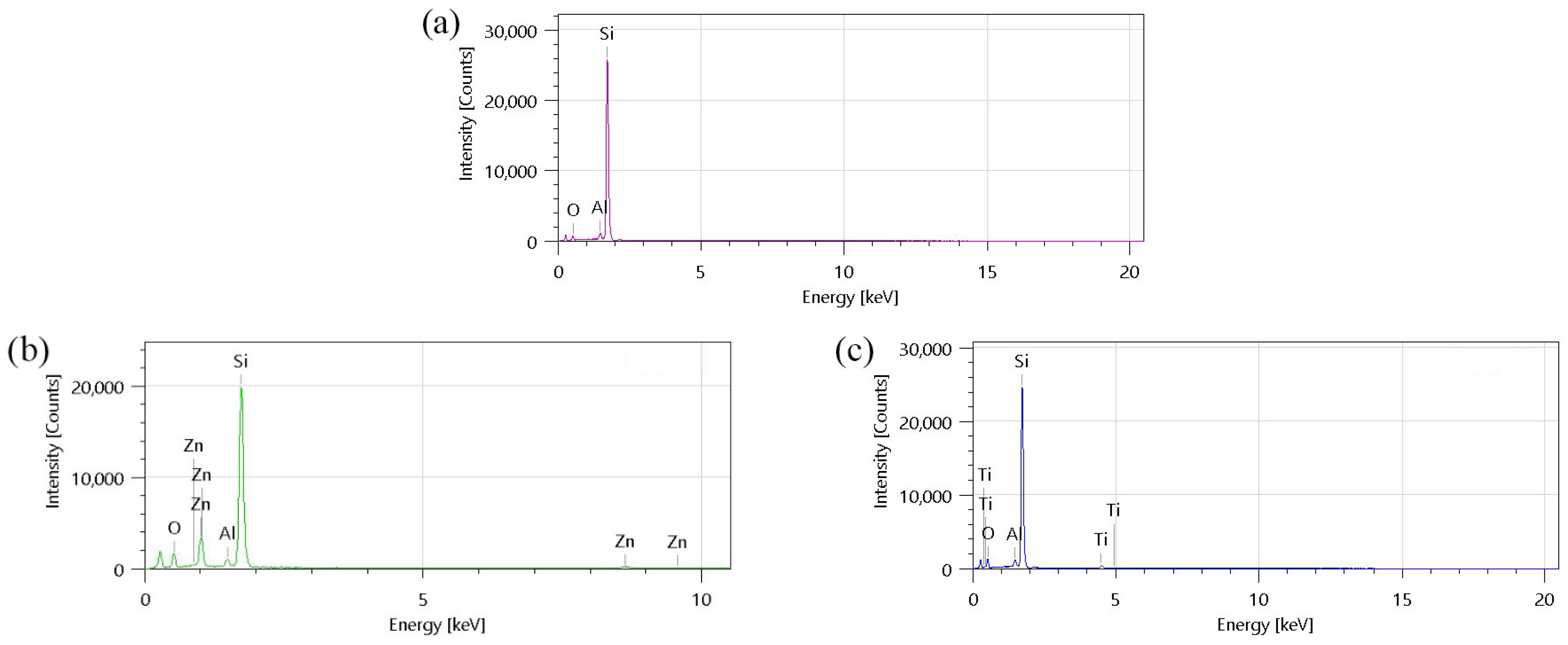
The EDS analysis (Figure 9a–c) was performed to verify the elemental composition of the deposited layers and confirm the absence of contamination. The analysis detected only silicon from the substrate and elements from the deposited layers (Al, O, and Zn or Ti, depending on the sample composition). No signals indicating contamination or impurities were observed, supporting the purity of the ALD deposition process. Due to the penetration depth of the examined sample, which can reach up to 2 μm, the strongest signal came from pure silicon. The results presented in Table 3 show the mass percentage of the respective elements.

5. Conclusions

The study presents the results of research on bilayer systems of Al2O3:TiO2 and Al2O3:ZnO, fabricated using the ALD method. A l 2 O 3 with a fixed thickness was chosen as the base layer material, while the top layer material and its thickness were the variable elements. The systems were obtained in several thickness variations and two material options. The analyzed systems were previously modeled to select the optimal thickness parameters for each layer, i.e., the thicknesses at which the antireflective properties occur in the selected ranges ( 450 550 ,   700 800 and 900 1050 nm). The conducted studies included spectrophotometric and ellipsometric measurements, complemented by SEM and EDS analyses.
The analysis allowed for comparing the calculated results with the experimental data. This comparison mainly focused on the location and quality of the antireflective properties and the thickness of the obtained coatings. The mere coating of silicon wafers with an alumina layer improved the antireflective properties, and further deposition of zinc oxide or titanium oxide led to a significant reduction in reflection in the predicted wavelength range. As expected, the thickness of the outer layer determined only the position of the reflection reduction range, but it had no effect on the degree to which the reflection decreased. Similarly, it did not significantly affect the determined refractive indices and extinction coefficients. The extinction coefficient was low throughout the entire electromagnetic spectrum, and in the 700 800   n m range, it was close to 0 . Spectroscopic ellipsometry covering the wide 0.2 25   μ m range was carried out for selected samples, and the optical behavior was described using different ellipsometric models. A comparison of refractive indices and extinction coefficients for selected samples, conducted using classical ellipsometry and Fourier-transform infrared spectroscopy (FTIR), showed a high level of correspondence in the overlapping ranges ( 1.7 2.5   μ m ). Additionally, for all studied samples, the determined ellipsometric angles were very close to the values predicted by the applied model. The SEM analysis revealed that all examined layers exhibit high surface uniformity and low roughness, confirming their high quality achieved through the ALD method. The observed differences in microstructure result from the type of materials used: the A l 2 O 3 layer shows the lowest roughness, the Al2O3:ZnO layer features an ordered microstructure, while the Al2O3:TiO2 layer presents a granular structure. These variations can be attributed to differences in surface energy among the individual phases, which influence the kinetics of layer growth.
The layers made using the ALD method demonstrated high quality, as evidenced by their low roughness, which could lead to increased scattering of reflected radiation, and the strong alignment between the experimental results and the applied model during ellipsometric studies (indicated by the low value of the MSE error parameter). SEM and EDS analyses also confirmed the high uniformity of the obtained layers and the absence of changes in the chemical composition.
The fabricated structures demonstrated strong suppression of reflected radiation within the operational ranges, and the obtained optical parameters contribute to a better understanding of the behavior of these systems. This insight can support the development and refinement of more advanced configurations, including multilayer antireflective coatings or gradient-index structures. In this context, the presented results may serve as a useful basis for further work on systems that could potentially be applied in photovoltaic and laser technologies, as well as in selected types of sensors.

Author Contributions

Conceptualization, J.J. and M.T.; Methodology, J.J. and M.T.; Software, J.J. and M.T.; Validation J.J.; Formal analysis, N.N., J.J. and P.D.; Investigation, M.M.S., M.S. and N.N.; Resources, N.N., M.M.S., M.S., M.T., K.T. and P.D.; Data curation, N.N., M.T. and P.D.; Writing—original draft preparation, M.T.; Writing—review and editing, N.N., K.T. and P.D.; Visualization, M.T.; Supervision, J.J.; Project administration, J.J. and M.T. All authors have read and agreed to the published version of the manuscript.

Funding

This research received no external funding.

Institutional Review Board Statement

Not applicable.

Data Availability Statement

The raw data supporting the conclusions of this article will be made available by the authors on request.

Conflicts of Interest

The authors declare no conflicts of interest.

References

  1. Mbam, S.O.; Nwonu, S.E.; Orelaja, O.A.; Nwigwe, U.S.; Gou, X.-F. Thin-Film Coating; Historical Evolution, Conventional Deposition Technologies, Stress-State Micro/Nano-Level Measurement/Models and Prospects Projection: A Critical Review. Mater. Res. Express 2019, 6, 122001. [Google Scholar] [CrossRef]
  2. Katiyar, P.; Jin, C.; Narayan, R.J. Electrical Properties of Amorphous Aluminum Oxide Thin Films. Acta Mater. 2005, 53, 2617–2622. [Google Scholar] [CrossRef]
  3. Chaug, Y.-S.; Roy, N. Reactions at the Aluminum Oxide-Ferrite Interface. Thin Solid Film. 1990, 193–194, 959–964. [Google Scholar] [CrossRef]
  4. Chronowska-Przywara, K.; Kot, M.; Zimowski, S. Techniki Badawcze w Analizie Właściwości Mechanicznych i Tribologicznych Cienkich Warstw i Powłok. Zesz. Naukowe. Transp. 2014, 83, 39–49. [Google Scholar]
  5. Wang, W.; Yan, X.; Li, Y. Recent Progress in the Development of Thin-Film Solar Cells. J. Mater. Chem. A Mater. 2019, 193, 3189–3213. [Google Scholar]
  6. Zhang, L.; Jiang, H.C.; Liu, C.; Dong, J.W.; Chow, P. Annealing of Al2O3 Thin Films Prepared by Atomic Layer Deposition. J. Phys. D Appl. Phys. 2007, 40, 3707–3713. [Google Scholar] [CrossRef]
  7. Szindler, M.; Szindler, M.; Basiaga, M.; Łoński, W.; Kaim, P. Application of Ald Thin Films on the Surface of the Surgical Scalpel Blade. Coatings 2021, 11, 1096. [Google Scholar] [CrossRef]
  8. Szindler, M.; Szindler, M. Application of Al2O3, ZnO, and TiO2 ALD Thin Films as Antireflection Coating in the Silicon Solar Cells. Opto-Electron. Rev. 2023, 31, e148223. [Google Scholar] [CrossRef]
  9. Kaady, E.; Habchi, R.; Bechelany, M.; Zgheib, E.; Alhussein, A. Effect of Al2O3, ZnO and TiO2 Atomic Layer Deposition Grown Thin Films on the Electrochemical and Mechanical Properties of Sputtered Al-Zr Coating. Coatings 2023, 13, 65. [Google Scholar] [CrossRef]
  10. Nam, T.; Kim, J.M.; Kim, M.K.; Kim, H.; Kim, W.H. Low-Temperature Atomic Layer Deposition of TiO2, Al2O3, and ZnO Thin Films. J. Korean Phys. Soc. 2011, 59, 452–457. [Google Scholar] [CrossRef]
  11. Bhat, J.V.; Ameta, R. Thin Film Technology for Solar Cells: A Review. J. Mater. Sci. Mater. Electron. 2019, 17648–17672. [Google Scholar]
  12. Nussupov, K.K.; Beisenkhanov, N.B.; Keiinbay, S.; Sultanov, A.T. Silicon Carbide Synthesized by RF Magnetron Sputtering in the Composition of a Double Layer Antireflection Coating SiC/MgF2. Opt Mater 2022, 128, 112370. [Google Scholar] [CrossRef]
  13. Schubert, M.F.; Mont, F.W.; Chhajed, S.; Poxson, D.J.; Kim, J.K.; Schubert, E.F. Design of Multilayer Antireflection Coatings Made from Co-Sputtered and Low-Refractive-Index Materials by Genetic Algorithm. Opt. Express 2008, 16, 5290. [Google Scholar] [CrossRef] [PubMed]
  14. Lissberger, P.H. Optical Applications of Dielectric Thin Films. Rep. Prog. Phys. 1970, 33, 305. [Google Scholar] [CrossRef]
  15. Hwang, C.S.; Lee, W.; Yoon, B.; Lee, H.; Kim, H. Atomic Layer Deposition of Dielectric Thin Films for Emerging Nonvolatile Memory Devices. Nanoscale Res. Lett. 2017, 41. [Google Scholar]
  16. Dekkers, H.F.W.; Beaucarne, G.; Hiller, M.; Charifi, H.; Slaoui, A. Molecular Hydrogen Formation in Hydrogenated Silicon Nitride. Appl. Phys. Lett. 2006, 89, 211914. [Google Scholar] [CrossRef]
  17. Nosidlak, N.; Jaglarz, J.; Vallati, A.; Dulian, P.; Jurzecka-Szymacha, M.; Gierałtowska, S.; Seweryn, A.; Wachnicki, Ł.; Witkowski, B.S.; Godlewski, M. The Optical Properties of Thin Film Alloys of ZnO, TiO2 and ZrO2 with Al2O3 Synthesised Using Atomic Layer Deposition. Coatings 2023, 13, 1872. [Google Scholar] [CrossRef]
  18. Nosidlak, N.; Jaglarz, J.; Dulian, P.; Pietruszka, R.; Witkowski, B.S.; Godlewski, M.; Powroźnik, W.; Stapiński, T. The Thermo-Optical and Optical Properties of Thin ZnO and AZO Films Produced Using the Atomic Layer Deposition Technology. J. Alloys Compd. 2022, 900, 163313. [Google Scholar] [CrossRef]
  19. Zahid, M.A.; Khokhar, M.Q.; Park, S.; Hussain, S.Q.; Kim, Y.; Yi, J. Influence of Al2O3/IZO Double-Layer Antireflective Coating on the Front Side of Rear Emitter Silicon Heterojunction Solar Cell. Vacuum 2022, 200, 110967. [Google Scholar] [CrossRef]
  20. Ching, W.Y.; Xu, Y. First-Principles Calculation of Electronic, Optical, and Structural Properties of A-Al2O3. J. Am. Ceram. Soc. 1994, 77, 404–411. [Google Scholar] [CrossRef]
  21. Fouad, S.S.; Parditka, B.; Nabil, M.; Baradács, E.; Negm, S.; Atyia, H.E.; Erdélyi, Z. Bilayer Number Driven Changes in Polarizability and Optical Property in ZnO/TiO2 Nanocomposite Films Prepared by ALD. Optik 2021, 233, 166617. [Google Scholar] [CrossRef]
  22. Groner, M.D.; Fabreguette, F.H.; Elam, J.W.; George, S.M. Low-Temperature Al2O3 Atomic Layer Deposition. Chem. Mater. 2004, 16, 639–645. [Google Scholar] [CrossRef]
  23. Medjaldi, F.; Bouabellou, A.; Bouachiba, Y.; Taabouche, A.; Bouatia, K.; Serrar, H. Study of TiO2, SnO2 and Nanocomposites TiO2:SnO2 Thin Films Prepared by Sol-Gel Method: Successful Elaboration of Variable–Refractive Index Systems. Mater. Res. Express 2020, 7, 016439. [Google Scholar] [CrossRef]
  24. Erken, Ö.; Gümüş, C. Determination of The Thickness and Optical Constants of Polycrystalline SnO2 Thin Film by Envelope Method. Adıyaman Univ. J. Sci. 2018, 8, 141–151. [Google Scholar]
  25. Baji, Z.; Lábadi, Z.; Molnár, G.; Pécz, B.; Vad, K.; Horváth, Z.E.; Szabó, P.J.; Nagata, T.; Volk, J. Highly Conductive Epitaxial ZnO Layers Deposited by Atomic Layer Deposition. Thin Solid Film. 2014, 562, 485–489. [Google Scholar] [CrossRef]
  26. Boryło, P.; Matus, K.; Lukaszkowicz, K.; Kubacki, J.; Balin, K.; Basiaga, M.; Szindler, M.; Mikuła, J. The Influence of Atomic Layer Deposition Process Temperature on ZnO Thin Film Structure. Appl. Surf. Sci. 2019, 474, 177–186. [Google Scholar] [CrossRef]
  27. Coutts, T.J.; Young, D.L.; Li, X.; Mulligan, W.P.; Wu, X. Search for Improved Transparent Conducting Oxides: A Fundamental Investigation of CdO, Cd2SnO4, and Zn2SnO4. J. Vac. Sci. Technol. A 2000, 18, 2646–2660. [Google Scholar] [CrossRef]
  28. Minami, T. Transparent Conducting Oxide Semiconductors for Transparent Electrodes. Semicond. Sci. Technol. 2005, 20, S35. [Google Scholar] [CrossRef]
  29. Asiltürk, M.; Burunkaya, E.; Sayılkan, F.; Kiraz, N.; Arpaç, E. Structural and Optical Properties of Thin Films Prepared from Surface Modified ZrO2. J. Non Cryst. Solids 2011, 357, 206–210. [Google Scholar] [CrossRef]
  30. Richards, B.S. Single-Material TiO2 Double-Layer Antireflection Coatings. Sol. Energy Mater. Sol. Cells 2003, 79, 369–390. [Google Scholar] [CrossRef]
  31. Houska, J.; Blazek, J.; Rezek, J.; Proksova, S. Overview of Optical Properties of Al2O3 Films Prepared by Various Techniques. Thin Solid Film. 2012, 520, 5405–5408. [Google Scholar] [CrossRef]
  32. Balakrishnan, G.; Sastikumar, D.; Kuppusami, P.; Babu, R.V.; Song, J. Il Microstructural and Mechanical Properties of Al2O3/ZrO2 Nanomultilayer Thin Films Prepared by Pulsed Laser Deposition. Appl. Phys. A Mater. Sci. Process 2018, 124, 158. [Google Scholar] [CrossRef]
  33. Shi, Q.; Aziz, I.; Ciou, J.H.; Wang, J.; Gao, D.; Xiong, J.; Lee, P.S. Al2O3/HfO2 Nanolaminate Dielectric Boosting IGZO-Based Flexible Thin-Film Transistors. Nanomicro Lett. 2022, 14, 195. [Google Scholar] [CrossRef] [PubMed]
  34. Kanda, H.; Uzum, A.; Harano, N.; Yoshinaga, S.; Ishikawa, Y.; Uraoka, Y.; Fukui, H.; Harada, T.; Ito, S. Al2O3/TiO2 Double Layer Anti-Reflection Coating Film for Crystalline Silicon Solar Cells Formed by Spray Pyrolysis. Energy Sci. Eng. 2016, 4, 269–276. [Google Scholar] [CrossRef]
  35. Kim, L.H.; Jeong, Y.J.; An, T.K.; Park, S.; Jang, J.H.; Nam, S.; Jang, J.; Kim, S.H.; Park, C.E. Optimization of Al2O3/TiO2 Nanolaminate Thin Films Prepared with Different Oxide Ratios, for Use in Organic Light-Emitting Diode Encapsulation, via Plasma-Enhanced Atomic Layer Deposition. Phys. Chem. Chem. Phys. 2015, 18, 1042–1049. [Google Scholar] [CrossRef]
  36. Banerjee, P.; Lee, W.J.; Bae, K.R.; Lee, S.B.; Rubloff, G.W. Structural, Electrical, and Optical Properties of Atomic Layer Deposition Al-Doped ZnO Films. J. Appl. Phys. 2010, 108, 043504. [Google Scholar] [CrossRef]
  37. Karvonen, L.; Säynätjoki, A.; Chen, Y.; Jussila, H.; Rönn, J.; Ruoho, M.; Alasaarela, T.; Kujala, S.; Norwood, R.A.; Peyghambarian, N.; et al. Enhancement of the Third-Order Optical Nonlinearity in ZnO/Al 2O3 Nanolaminates Fabricated by Atomic Layer Deposition. Appl. Phys. Lett. 2013, 103, 031903. [Google Scholar] [CrossRef]
  38. Chaaya, A.A.; Viter, R.; Baleviciute, I.; Bechelany, M.; Ramanavicius, A.; Gertnere, Z.; Erts, D.; Smyntyna, V.; Miele, P. Tuning Optical Properties of Al2O3/ZnO Nanolaminates Synthesized by Atomic Layer Deposition. J. Phys. Chem. C 2014, 118, 3811–3819. [Google Scholar] [CrossRef]
  39. Riveiro, A.; Quintero, F.; Boutinguiza, M.; Del Val, J.; Comesaña, R.; Lusquiños, F.; Pou, J. Laser Cutting: A Review on the Influence of Assist Gas. Materials 2019, 12, 157. [Google Scholar] [CrossRef]
  40. Azadgoli, B.; Baker, R.Y. Laser Applications in Surgery. Ann. Transl. Med. 2016, 4, 452. [Google Scholar] [CrossRef]
  41. Kaneko, S. Safety Guidelines for Diagnostic and Therapeutic Laser Applications in the Neurosurgical Field. Laser Ther. 2012, 21, 129–136. [Google Scholar] [CrossRef]
  42. Cotler, H.B.; Chow, R.T.; Hamblin, M.R. The Use of Low Level Laser Therapy (LLLT) For Musculoskeletal Pain. MOJ Orthop. Rheumatol. 2015, 2, 188–194. [Google Scholar] [CrossRef]
  43. Maia, A.M.A.; Barkokebas, A.; Pires, A.P.; Barros, L.F.; Carvalho, A.A.T.; Leão, J.C. Current Use and Future Perspectives of Diagnostic and Therapeutic Lasers in Oral Medicine. Minerva Stomatol. 2008, 57, 511–517. [Google Scholar]
  44. Stenzel, O. Optical Coatings; Springer: Berlin, Heidelberg, 2014; Volume 54, ISBN 978-3-642-54062-2. [Google Scholar]
  45. Zhukovsky, S.V.; Andryieuski, A.; Takayama, O.; Shkondin, E.; Malureanu, R.; Jensen, F.; Lavrinenko, A.V. Experimental Demonstration of Effective Medium Approximation Breakdown in Deeply Subwavelength All-Dielectric Multilayers. Phys. Rev. Lett. 2015, 115, 177402. [Google Scholar] [CrossRef]
  46. Aguilar, O.; de Castro, S.; Godoy, M.P.F.; Rebello Sousa Dias, M. Optoelectronic Characterization of Zn 1-x Cd x O Thin Films as an Alternative to Photonic Crystals in Organic Solar Cells. Opt. Mater. Express 2019, 9, 3638. [Google Scholar] [CrossRef]
  47. Sarkar, S.; Gupta, V.; Kumar, M.; Schubert, J.; Probst, P.T.; Joseph, J.; König, T.A.F. Hybridized Guided-Mode Resonances via Colloidal Plasmonic Self-Assembled Grating. ACS Appl. Mater. Interfaces 2019, 11, 13752–13760. [Google Scholar] [CrossRef] [PubMed]
  48. Ebbesen, F.; Vandborg, P.K.; Donneborg, M.L. The Effectiveness of Phototherapy Using Blue-Green Light for Neonatal Hyperbilirubinemia—Danish Clinical Trials. Semin. Perinatol. 2021, 45, 151358. [Google Scholar] [CrossRef] [PubMed]
  49. Withnall, R. Raman Spectroscopy. In Encyclopedia of Modern Optics; Elsevier: Amsterdam, The Netherlands, 2005; pp. 354–368. [Google Scholar]
  50. Morgner, U.; Kärtner, F.X.; Cho, S.H.; Chen, Y.; Haus, H.A.; Fujimoto, J.G.; Ippen, E.P.; Scheuer, V.; Angelow, G.; Tschudi, T. Sub-Two-Cycle Pulses from a Kerr-Lens Mode-Locked Ti:Sapphire Laser. Opt. Lett. 1999, 24, 411. [Google Scholar] [CrossRef]
  51. Prakash, R.; Yizhar, O.; Grewe, B.; Ramakrishnan, C.; Wang, N.; Goshen, I.; Packer, A.M.; Peterka, D.S.; Yuste, R.; Schnitzer, M.J.; et al. Two-Photon Optogenetic Toolbox for Fast Inhibition, Excitation and Bistable Modulation. Nat. Methods 2012, 9, 1171–1179. [Google Scholar] [CrossRef]
  52. Beć, K.B.; Grabska, J.; Huck, C.W. Miniaturized NIR Spectroscopy in Food Analysis and Quality Control: Promises, Challenges, and Perspectives. Foods 2022, 11, 1465. [Google Scholar] [CrossRef]
  53. Ma, B.; Zheng, X.; Li, J.; Pan, C.; Li, Z.; He, C.; Yan, D.; Chen, Y.; Pan, Q.; Hou, Z.; et al. Long-Term High-Precision Monitoring System for Laser Parameters in Large-Aperture Dual-Wavelength LiDAR. Opt. Laser Technol. 2025, 182, 112200. [Google Scholar] [CrossRef]
  54. Reinecke, A.-M.; Acker, M.; Taut, S.; Herrmann, M.; Lippmann, W.; Hurtado, A. Laser Beam Decontamination of Metallic Surfaces with a Pulsed (150 W) Nd:YAG Laser. Nucl. Eng. Technol. 2023, 55, 4159–4166. [Google Scholar] [CrossRef]
  55. Moskalik, K.; Kozlov, A.; Demin, E.; Boiko, E. The Efficacy of Facial Skin Cancer Treatment with High-Energy Pulsed Neodymium and Nd:YAG Lasers. Photomed. Laser Surg. 2009, 27, 345–349. [Google Scholar] [CrossRef]
  56. Azzam, R.M.A.; Bashara, N.M.; Thorburn Burns, D. Ellipsometry and Polarized Light. Anal. Chim. Acta 1987, 199, 283–284. [Google Scholar] [CrossRef]
  57. Likhachev, D.V. Selecting the Right Number of Knots for B-Spline Parameterization of the Dielectric Functions in Spectroscopic Ellipsometry Data Analysis. Thin Solid Film. 2017, 636, 519–526. [Google Scholar] [CrossRef]
  58. Johs, B.; Hale, J.S. Dielectric Function Representation by B-Splines. Phys. Status Solidi (A) Appl. Mater. Sci. 2008, 205, 715–719. [Google Scholar] [CrossRef]
  59. Jellison, G.E.; Modine, F.A. Parameterization of the Optical Functions of Amorphous Materials in the Interband Region. Appl. Phys. Lett. 1996, 69, 371–373. [Google Scholar] [CrossRef]
  60. Ferlauto, A.S.; Ferreira, G.M.; Pearce, J.M.; Wronski, C.R.; Collins, R.W.; Deng, X.; Ganguly, G. Analytical Model for the Optical Functions of Amorphous Semiconductors from the Near-Infrared to Ultraviolet: Applications in Thin Film Photovoltaics. J. Appl. Phys. 2002, 92, 2424–2436. [Google Scholar] [CrossRef]
  61. Johs, B.; Herzinger, C.M.; Dinan, J.H.; Cornfeld, A.; Benson, J.D. Development of a Parametric Optical Constant Model for Hg1−xCdxTe for Control of Composition by Spectroscopic Ellipsometry during MBE Growth. Thin Solid Film. 1998, 313–314, 137–142. [Google Scholar] [CrossRef]
  62. WVASE. Guide to Using WVASE® Spectroscipic Ellipsometry Data Aquisition and Analysis Software 2012; WVASE: Lincoln, NE, USA, 2012. [Google Scholar]
  63. Brendel, R.; Bormann, D. An Infrared Dielectric Function Model for Amorphous Solids. J. Appl. Phys. 1992, 71, 1–6. [Google Scholar] [CrossRef]
  64. Stenzel, O.; Wilbrandt, S. Theoretical Aspects of Thin Film Optical Spectra: Underlying Models, Model Restrictions and Inadequacies, Algorithms, and Challenges. Appl. Sci. 2025, 15, 2187. [Google Scholar] [CrossRef]
  65. Vargas, W.E.; Clark, N.; Cambronero, M.; Montealegre, F.; Solis, H.; Azofeifa, D.E. Parametric Formulation of the Dielectric Function of Palladium and Palladium Hydride Thin Films. Appl. Opt. 2014, 53, 5294–5306. [Google Scholar] [CrossRef] [PubMed]
  66. Bright, T.J.; Watjen, J.I.; Zhang, Z.M.; Muratore, C.; Voevodin, A.A. Optical Properties of HfO2 Thin Films Deposited by Magnetron Sputtering: From the Visible to the Far-Infrared. Thin Solid Film. 2012, 520, 6793–6802. [Google Scholar] [CrossRef]
  67. Wei, N.-N.; Yang, Z.; Pan, H.-B.; Zhang, F.; Liu, Y.-X.; Wang, R.-P.; Shen, X.; Dai, S.-X.; Nie, Q.-H. Variable Angle Spectroscopic Ellipsometry and Its Applications in Determining Optical Constants of Chalcogenide Glasses in Infrared*. Chin. Phys. B 2018, 27, 067802. [Google Scholar] [CrossRef]
  68. Stelling, C.; Singh, C.R.; Karg, M.; König, T.A.F.; Thelakkat, M.; Retsch, M. Plasmonic Nanomeshes: Their Ambivalent Role as Transparent Electrodes in Organic Solar Cells. Sci. Rep. 2017, 7, 42530. [Google Scholar] [CrossRef]
  69. Boidin, R.; Halenkovič, T.; Nazabal, V.; Beneš, L.; Němec, P. Pulsed Laser Deposited Alumina Thin Films. Ceram. Int. 2016, 42, 1177–1182. [Google Scholar] [CrossRef]
  70. Kischkat, J.; Peters, S.; Gruska, B.; Semtsiv, M.; Chashnikova, M.; Klinkmüller, M.; Fedosenko, O.; MacHulik, S.; Aleksandrova, A.; Monastyrskyi, G.; et al. Mid-Infrared Optical Properties of Thin Films of Aluminum Oxide, Titanium Dioxide, Silicon Dioxide, Aluminum Nitride, and Silicon Nitride. Appl. Opt. 2012, 51, 6789–6798. [Google Scholar] [CrossRef]
  71. Go, D.; Lee, J.; Shin, J.W.; Lee, S.; Kang, W.; Han, J.H.; An, J. Phase-Gradient Atomic Layer Deposition of TiO2 Thin Films by Plasma-Induced Local Crystallization. Ceram. Int. 2021, 47, 28770–28777. [Google Scholar] [CrossRef]
  72. Aulika, I.; Corkovic, S.; Bencan, A.; D’Astorg, S.; Dejneka, A.; Zhang, Q.; Kosec, M.; Zauls, V. Formation of Optical Gradient in Chemical Solution-Derived PbZr[Sub 0.52]Ti[Sub 0.48]O[Sub 3] Thin Films: Spectroscopic Ellipsometry Investigation. J. Electrochem. Soc. 2009, 156, G217. [Google Scholar] [CrossRef]
Figure 1. Variation in film growth rate across different deposition ranges for (a) Al2O3:ZnO and (b) Al2O3:TiO2:TiO2 bilayer. Additionally, the growth rate for each interval, as presented alongside, is given in nanometers per cycle ( n m / c ) .
Applsci 15 12870 g001
Figure 2. Dispersion relation of ellipsometric angles Ψ and Δ for (a) Al2O3, (b) Al2O3:TiO2, (c) Al2O3:ZnO films on a silicon substrate.
Applsci 15 12870 g002
Figure 3. Dispersion relations of (a) refractive index n (b) extinction coefficient k for all thin films on a silicon substrate for various numbers of ALD cycles.
Applsci 15 12870 g003
Figure 4. Spectra of ellipsometric angles Ψ and Δ for (a) sample with a layer of A l 2 O 3 and (b) bilayer sample of Al2O3:TiO2 thin films on a silicon substrate.
Applsci 15 12870 g004
Figure 5. Dispersion relations of refractive index n and extinction coefficient k for sample (a) with a layer of A l 2 O 3 and (b) bilayer sample of Al2O3:TiO2 thin films in spectral range of 470 6500   c m 1 .
Applsci 15 12870 g005
Figure 6. Modeled reflection spectra of (a) Al2O3:TiO2, (b) Al2O3:ZnO films on a silicon substrate for various exterior layer thickness.
Applsci 15 12870 g006
Figure 7. Reflection spectra of (a) Al2O3:TiO2, (b) Al2O3:ZnO films on a silicon substrate for various numbers of ALD cycles.
Applsci 15 12870 g007
Figure 8. SEM images of (a) single-layer A l 2 O 3   500   c y c l e s , (b) A l 2 O 3   500   c y c l e s   +   Z n O   700   c y c l e s bilayer and (c) A l 2 O 3   500   c y c l e s   +   T i O 2   1500   c y c l e s .
Applsci 15 12870 g008
Figure 9. EDS graphs of (a) single-layer A l 2 O 3   500   c y c e l s , (b) A l 2 O 3   500   c y c e l s   +   Z n O   700   c y c l e s bilayer and (c) A l 2 O 3   500   c y c e l s   +   T i O 2   1500   c y c e l s .
Applsci 15 12870 g009
Table 1. Layer thickness and refractive index and extinction coefficient for wavelength of 200, 632 and 1500 nm.
Layer A l 2 O 3 500c Z n O 200c Z n O 400c Z n O 500c Z n O 700c T i O 2 500c T i O 2 1000c T i O 2 1500c
Layer Thickness50.59 (53)18.97 (13)44.88 (17)54.58 (13)82.81 (14)18.04 (13)41.46 (18)65.22 (13)
Roughness [nm]5.07 (14)4.76 (33)6.67 (19)3.16 (14)4.82 (13)4.88 (19)2.14 (16)2.36 (28)
MSE5.5756.32110.0474.1304.84110.10812.98018.663
Refractive index (n)200 nm1.8111.9831.9471.9631.9551.6101.7421.732
632 nm1.6411.9801.9731.9741.9912.5132.4762.474
1500 nm1.6321.7191.8771.7931.8482.3992.3722.370
Extinction coefficient (k)200 nm0.0190.4370.4140.4650.5101.3971.3411.338
632 nm0.0080.0100.0180.0090.0110.0000.0000.000
1500 nm0.0110.0020.0030.0010.0010.0000.0000.000
Table 2. Reflectance minima and improvement comparison relative to the single-layer A l 2 O 3 system.
SystemAl2O3:ZnO 200cAl2O3:ZnO 400cAl2O3:ZnO 500cAl2O3:ZnO 700cAl2O3:TiO2 500cAl2O3:TiO2 1000cAl2O3:TiO2 1500c
Minimum
wavelength [nm]
59079586510356409251055
Minimum
reflectance [%]
2.311.462.081.161.741.326.19
Improvement vs.
single-layer A l 2 O 3
system [p.p.]
9.4310.289.6610.5810.0010.425.55
Table 3. Results of EDS analysis as mass percentage of particular elements.
Analyzed Sample S i   [ % ] O   [ % ] A l   [ % ] Z n   [ % ] T i   [ % ]
A l 2 O 3   500   c y c e l s 90 7 2
A l 2 O 3   500   c y c l e s   +   Z n O   700   c y c l e s 66 14 2 18
A l 2 O 3   500   c y c l e s   +   T i O 2   1500   c y c l e s 79 13 2 6
Disclaimer/Publisher’s Note: The statements, opinions and data contained in all publications are solely those of the individual author(s) and contributor(s) and not of MDPI and/or the editor(s). MDPI and/or the editor(s) disclaim responsibility for any injury to people or property resulting from any ideas, methods, instructions or products referred to in the content.