An Exploratory Study of the Acute Effects of Football Heading on Postural Control and Corticospinal Inhibition


Abstract
1. Introduction
2. Materials and Methods
2.1. Participants
2.2. Sample Size Estimation and Justification
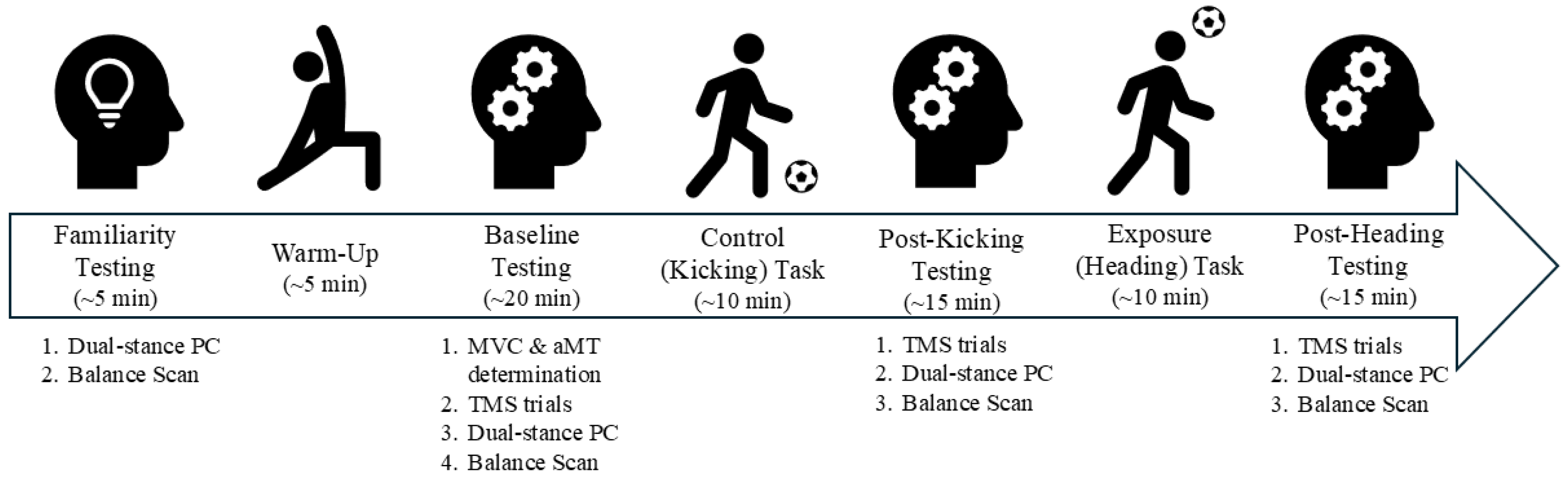
2.3. Study Design
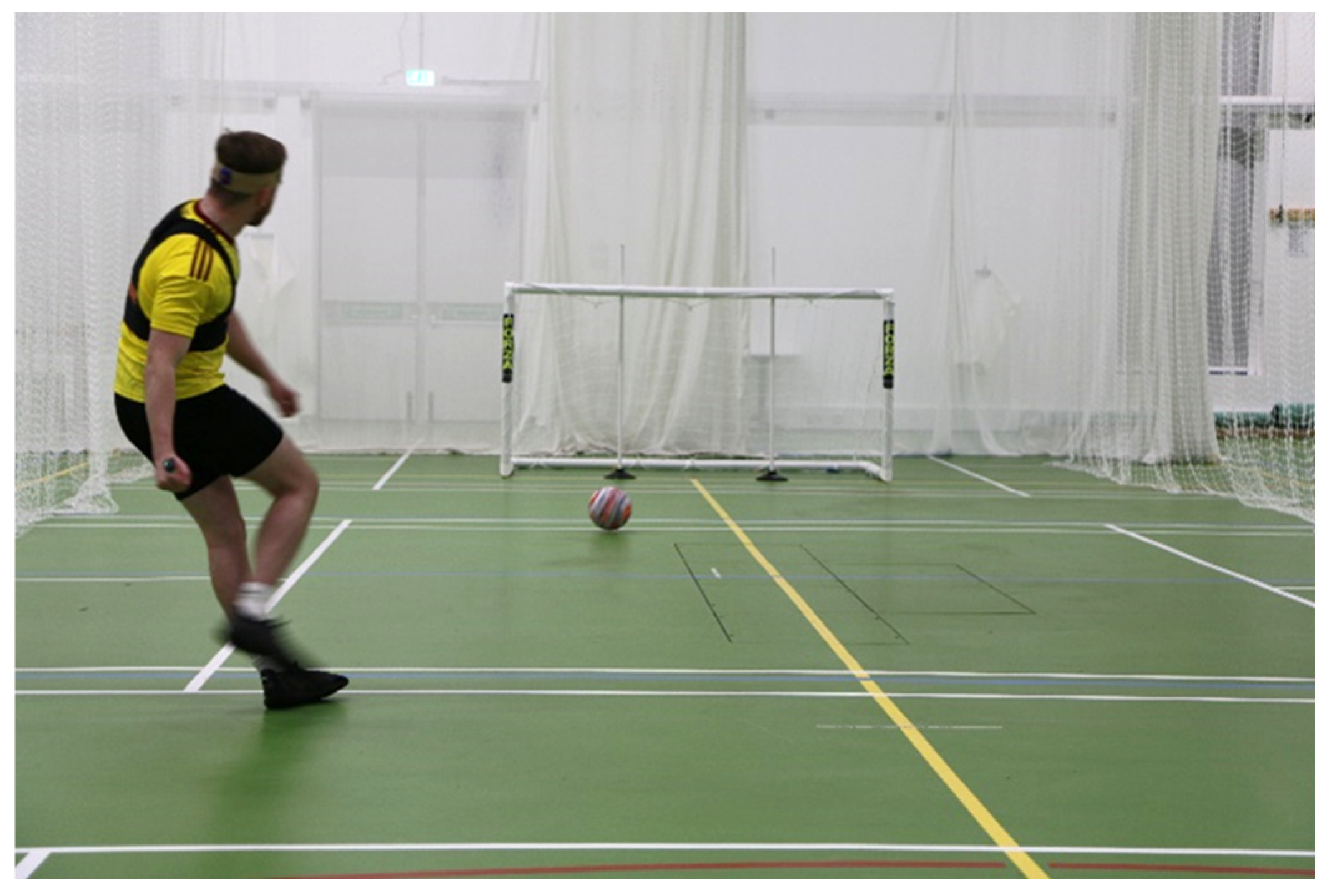
2.4. Kicking Task
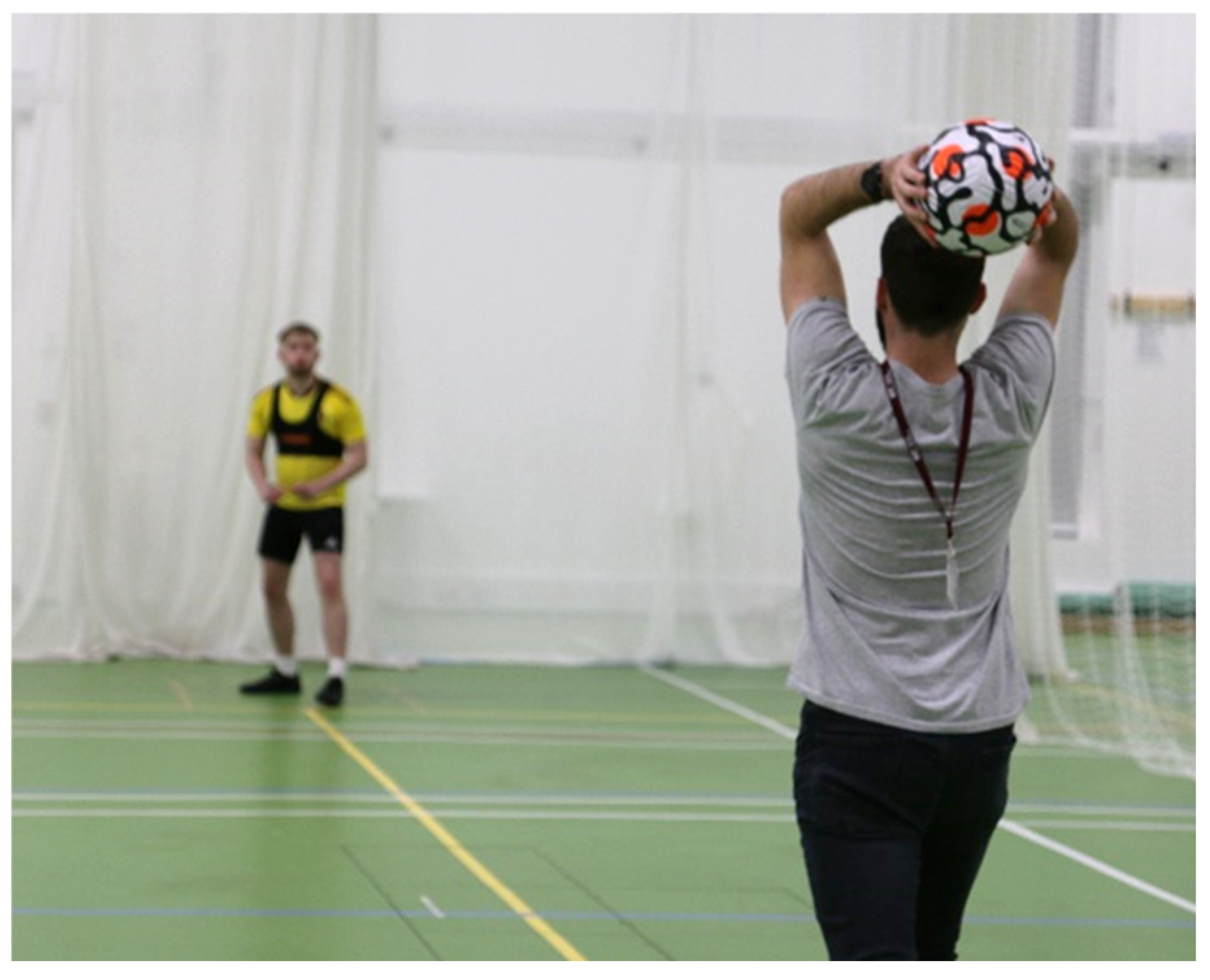
2.5. Heading Task
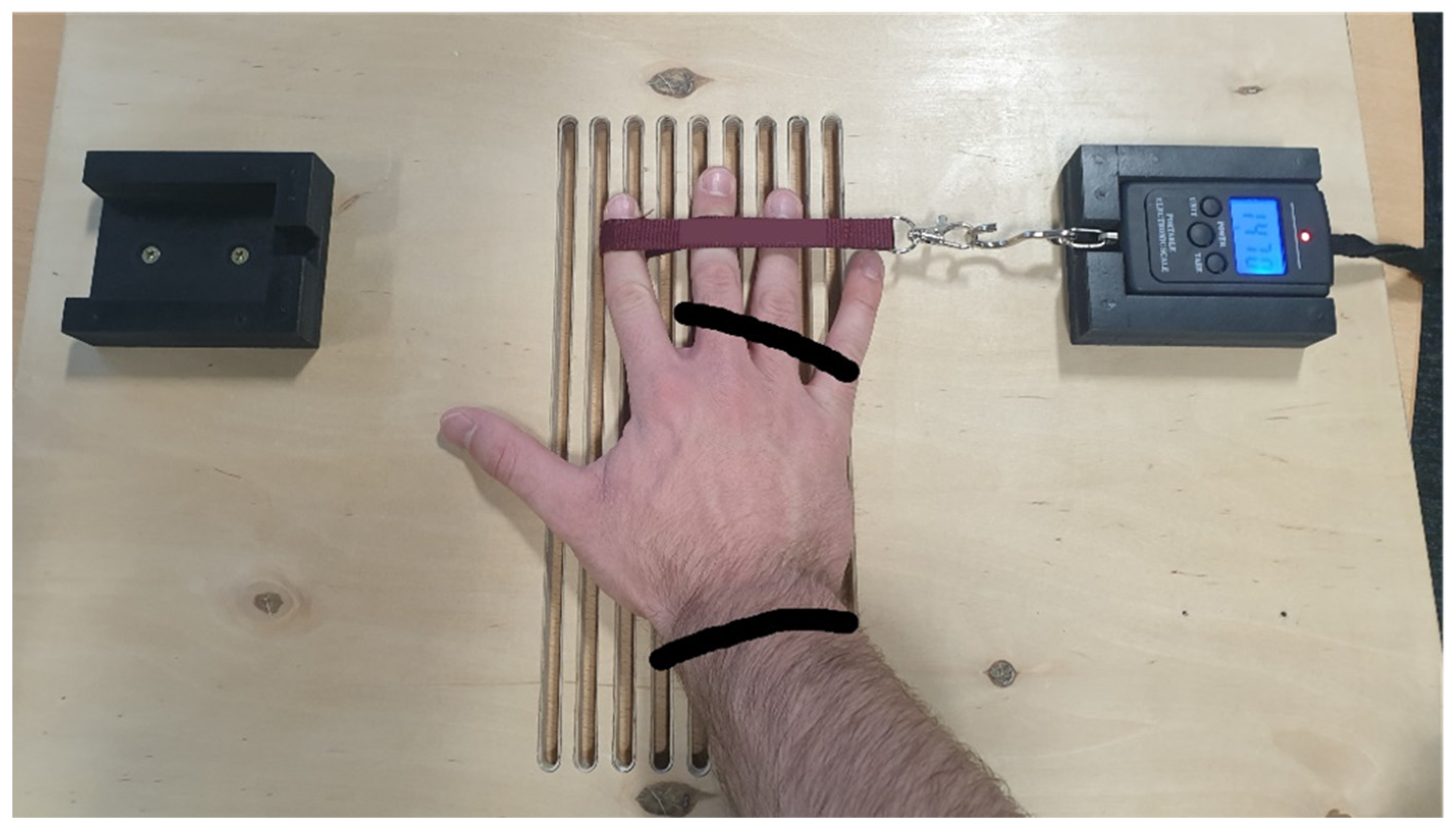
2.6. Corticospinal Inhibition
2.7. Dual-Stance Postural Control Assessment
2.8. Sparta Balance Scan
2.9. Statistical Analysis
3. Results
3.1. Dual-Stance Postural Control Measures
3.2. Sparta Balance Scan Metrics
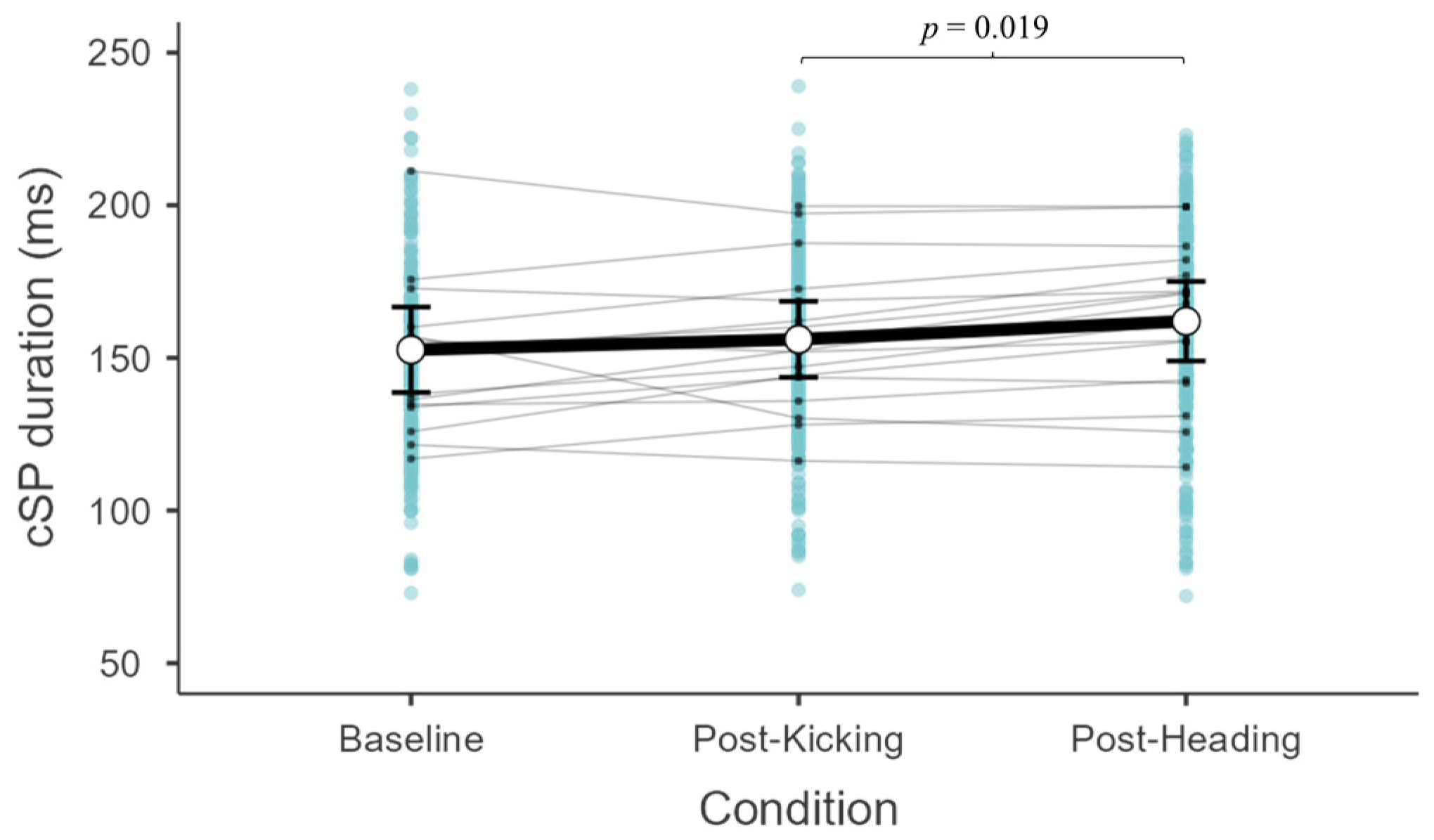
3.3. Cortical Silent Period Results
4. Discussion
4.1. Dual-Stance Postural Control
4.2. Sparta Balance Scan Performance
4.3. Cortical Silent Period
4.4. Limitations
5. Conclusions
Author Contributions
Funding
Data Availability Statement
Acknowledgments
Conflicts of Interest
Appendix A. Within-Participant Mean Differences in Dual-Stance Postural Control Measures Between Conditions

Appendix B. Within-Participant Mean Differences in Sparta Balance Scan Nonlinear Metrics Between Conditions

Appendix C. Within-Participant Mean Differences in Sparta Balance Scan Linear Metrics Between Conditions

Appendix D. Within-Participant Mean Differences in Cortical Silent Period Duration, Representing Corticospinal Inhibition

References
- Howarth, N.E.; Ji, C.; Batten, J.; Pearce, A.J.; Dawes, H.; White, A.J.; DeLuca, G.; Bureau, S.; Nowinski, C.J.; Miller, M.A. Neurodegenerative Disease and Association Football (NDAF): Systematic Review and Meta-Analysis. Int. J. Environ. Res. Public Health 2025, 22, 806. [Google Scholar] [CrossRef]
- McCusker, J. Alan Shearer: Dementia, Football and Me; Film, 59 minutes; BBC One: London, UK, 2017; Available online: https://www.bbc.co.uk/programmes/b09g0gzk (accessed on 28 July 2022).
- Nowinski, C.J.; Bureau, S.C.; Buckland, M.E.; Curtis, M.A.; Daneshvar, D.H.; Faull, R.L.M.; Grinberg, L.T.; Hill-Yardin, E.L.; Murray, H.C.; Pearce, A.J.; et al. Applying the Bradford Hill Criteria for Causation to Repetitive Head Impacts and Chronic Traumatic Encephalopathy. Front. Neurol. 2022, 13, 938163. [Google Scholar] [CrossRef]
- Bailes, J.E.; Petraglia, A.L.; Omalu, B.I.; Nauman, E.; Talavage, T. Role of subconcussion in repetitive mild traumatic brain injury: A review. J. Neurosurg. 2013, 119, 1235–1245. [Google Scholar] [CrossRef]
- Di Virgilio, T.G.; Hunter, A.; Wilson, L.; Stewart, W.; Goodall, S.; Howatson, G.; Donaldson, D.I.; Ietswaart, M. Evidence for acute electrophysiological and cognitive changes following routine soccer heading. eBioMedicine 2016, 13, 66–71. [Google Scholar] [CrossRef] [PubMed]
- Myer, G.D.; Foss, K.B.; Thomas, S.; Galloway, R.; DiCesare, C.A.; Dudley, J.; Gadd, B.; Leach, J.; Smith, D.; Gubanich, P. Altered brain microstructure in association with repetitive subconcussive head impacts and the potential protective effect of jugular vein compression: A longitudinal study of female soccer athletes. Br. J. Sports Med. 2019, 53, 1539–1551. [Google Scholar] [CrossRef]
- Fickling, S.D.; Poel, D.N.; Dorman, J.C.; D’Arcy, R.C.N.; Munce, T.A. Subconcussive changes in youth football players: Objective evidence using brain vital signs and instrumented accelerometers. Brain Commun. 2022, 4, fcab286. [Google Scholar] [CrossRef] [PubMed]
- Haran, F.; Tierney, R.; Wright, W.; Keshner, E.; Silter, M. Acute changes in postural control after soccer heading. Int. J. Sports Med. 2013, 34, 350–354. [Google Scholar] [CrossRef]
- Hwang, S.; Ma, L.; Kawata, K.; Tierney, R.; Jeka, J.J. Vestibular dysfunction after subconcussive head impact. J. Neurotrauma 2017, 34, 8–15. [Google Scholar] [CrossRef]
- Mainwaring, L.; Pennock, K.M.F.; Mylabathula, S.; Alavie, B.Z. Subconcussive head impacts in sport: A systematic review of the evidence. Int. J. Psychophysiol. 2018, 132, 39–54. [Google Scholar] [CrossRef]
- Ling, H.; Morris, H.R.; Neal, J.W.; Lees, A.J.; Hardy, J.; Holton, J.L.; Revesz, T.; Williams, D.D. Mixed pathologies including chronic traumatic encephalopathy account for dementia in retired association football (soccer) players. Acta Neuropathol. 2017, 133, 337–352. [Google Scholar] [CrossRef]
- Davis, G.A.; Iverson, G.; Guskiewicz, K.; Ptito, A.; Johnston, K. Contributions of neuroimaging, balance testing, electrophysiology and blood markers to the assessment of sport-related concussion. Br. J. Sports Med. 2009, 43, i36–i45. [Google Scholar] [CrossRef]
- Ivanenko, Y.; Gurfinkel, V.S. Human postural control. Front. Neurosci. 2018, 12, 171. [Google Scholar] [CrossRef] [PubMed]
- Jiang, P.; Chiba, R.; Takakusaki, K.; Ota, J. A postural control model incorporating multisensory inputs for maintaining a musculoskeletal model in a stance posture. Adv. Robot. 2017, 31, 55–67. [Google Scholar] [CrossRef]
- Beebe, K.E.; Reynolds, E.; Driver, S. One size fits none: Neurobiologic-specific modifications for the assessment, diagnosis, and treatment of sport-related concussion (SRC). Brain Inj. 2021, 35, 505–510. [Google Scholar] [CrossRef]
- Buckley, T.A.; Oldham, J.R.; Caccese, J.B. Postural control deficits identify lingering post-concussion neurological deficits. J. Sport Health Sci. 2016, 5, 61–69. [Google Scholar] [CrossRef]
- Mucha, A.; Collins, M.W.; Elbin, R.; Furman, J.M.; Troutman-Enseki, C.; DeWolf, R.M.; Marchetti, G.; Kontos, A.P. A brief vestibular/ocular motor screening (VOMS) assessment to evaluate concussions: Preliminary findings. Am. J. Sports Med. 2014, 42, 2479–2486. [Google Scholar] [CrossRef]
- Avedesian, J.M.; Singh, H.; Diekfuss, J.A.; Myer, G.D.; Grooms, D.R. Loss of motor stability after sports-related concussion: Opportunities for motor learning strategies to reduce musculoskeletal injury risk. Sports Med. 2021, 51, 2299–2309. [Google Scholar] [CrossRef]
- Purkayastha, S.; Adair, H.; Woodruff, A.; Ryan, L.J.; Williams, B.; James, E.; Bell, K.R. Balance testing following concussion: Postural sway versus complexity index. PMR 2019, 11, 1184–1192. [Google Scholar] [CrossRef]
- Echemendia, R.J.; Brett, B.L.; Broglio, S.; Davis, G.A.; Giza, C.C.; Guskiewicz, K.M.; Harmon, K.G.; Herring, S.; Howell, D.R.; Master, C. Sport concussion assessment tool™–6 (SCAT6). Br. J. Sports Med. 2023, 57, 622–631. [Google Scholar] [CrossRef] [PubMed]
- Starling, A.J.; Leong, D.F.; Bogle, J.M.; Vargas, B.B. Variability of the modified Balance Error Scoring System at baseline using objective and subjective balance measures. Concussion 2015, 1, CNC5. [Google Scholar] [CrossRef] [PubMed]
- Dunne, L.A.; Cole, M.H.; Cormack, S.J.; Howell, D.R.; Johnston, R.D. Validity and reliability of methods to assess movement deficiencies following concussion: A COSMIN systematic review. Sports Med.-Open 2023, 9, 76. [Google Scholar] [CrossRef]
- Lee, C.-H.; Sun, T.-L. Evaluation of postural stability based on a force plate and inertial sensor during static balance measurements. J. Physiol. Anthropol. 2018, 37, 27. [Google Scholar] [CrossRef]
- Echemendia, R.J.; Burma, J.S.; Bruce, J.M.; Davis, G.A.; Giza, C.C.; Guskiewicz, K.M.; Naidu, D.; Black, A.M.; Broglio, S.; Kemp, S. Acute evaluation of sport-related concussion and implications for the Sport Concussion Assessment Tool (SCAT6) for adults, adolescents and children: A systematic review. Br. J. Sports Med. 2023, 57, 722–735. [Google Scholar] [CrossRef]
- Freeman, L.; Gera, G.; Horak, F.B.; Blackinton, M.T.; Besch, M.; King, L. Instrumented test of sensory integration for balance: A validation study. J. Geriatr. Phys. Ther. 2018, 41, 77–84. [Google Scholar] [CrossRef] [PubMed]
- Livingston, S.C.; Desantis, B. The test-retest reliability and minimal detectable change of the sensory organization test and head-shake sensory organization test. J. Sports Med. Allied Health Sci. 2016, 2, 2. [Google Scholar] [CrossRef]
- Ellemberg, D.; Henry, L.C.; Macciocchi, S.N.; Guskiewicz, K.M.; Broglio, S.P. Advances in sport concussion assessment: From behavioral to brain imaging measures. J. Neurotrauma 2009, 26, 2365–2382. [Google Scholar] [CrossRef] [PubMed]
- Chen, B.; Liu, P.; Xiao, F.; Liu, Z.; Wang, Y. Review of the upright balance assessment based on the force plate. Int. J. Environ. Res. Public Health 2021, 18, 2696. [Google Scholar] [CrossRef]
- Cavanaugh, J.T.; Guskiewicz, K.M.; Stergiou, N. A nonlinear dynamic approach for evaluating postural control. Sports Med. 2005, 35, 935–950. [Google Scholar] [CrossRef]
- Manor, B.; Costa, M.D.; Hu, K.; Newton, E.; Starobinets, O.; Kang, H.G.; Peng, C.; Novak, V.; Lipsitz, L.A. Physiological complexity and system adaptability: Evidence from postural control dynamics of older adults. J. Appl. Physiol. 2010, 109, 1786–1791. [Google Scholar] [CrossRef]
- Lipsitz, L.A.; Goldberger, A.L. Loss of ‘complexity’ and aging: Potential applications of fractals and chaos theory to senescence. Jama 1992, 267, 1806–1809. [Google Scholar] [CrossRef]
- Thammachat, K.; Songkhla, S.N.; Aniwattanapong, D.; Suriyaamarit, D. Reliability and minimal detectable change of nonlinear analysis measure of postural control in older adults with mild cognitive impairment. Gait Posture 2023, 107, 152–154. [Google Scholar] [CrossRef]
- Cavanaugh, J.T.; Guskiewicz, K.M.; Giuliani, C.; Marshall, S.; Mercer, V.; Stergiou, N. Detecting altered postural control after cerebral concussion in athletes with normal postural stability. Br. J. Sports Med. 2005, 39, 805–811. [Google Scholar] [CrossRef]
- Sosnoff, J.J.; Broglio, S.P.; Shin, S.; Ferrara, M.S. Previous mild traumatic brain injury and postural-control dynamics. J. Athl. Train. 2011, 46, 85–91. [Google Scholar] [CrossRef]
- Caccese, J.B.; Buckley, T.A.; Tierney, R.T.; Rose, W.C.; Glutting, J.J.; Kaminski, T.W. Postural control deficits after repetitive soccer heading. Clin. J. Sport Med. 2021, 31, 266–272. [Google Scholar] [CrossRef] [PubMed]
- Hulteen, R.M.; Smith, J.J.; Morgan, P.J.; Barnett, L.M.; Hallal, P.C.; Colyvas, K.; Lubans, D.R. Global participation in sport and leisure-time physical activities: A systematic review and meta-analysis. Prev. Med. 2017, 95, 14–25. [Google Scholar] [CrossRef]
- Kirkendall, D.T.; Jordan, S.E.; Garrett, W.E. Heading and head injuries in soccer. Sports Med. 2001, 31, 369–386. [Google Scholar] [CrossRef]
- Parnell, D.; Krustrup, P. Sport and Health: Exploring the Current State of Play; Taylor & Francis Group: Abingdon, UK, 2017; Available online: http://ebookcentral.proquest.com/lib/latrobe/detail.action?docID=5056466 (accessed on 11 March 2025).
- Pensato, U.; Cortelli, P. Soccer (football) and brain health. J. Neurol. 2024, 271, 3019–3029. [Google Scholar] [CrossRef] [PubMed]
- Mackay, D.F.; Russell, E.R.; Stewart, K.; MacLean, J.A.; Pell, J.P.; Stewart, W. Neurodegenerative disease mortality among former professional soccer players. N. Engl. J. Med. 2019, 381, 1801–1808. [Google Scholar] [CrossRef] [PubMed]
- McLaughlin, C. Scottish Football to Ban Heading the Day Before and After Matches. Available online: https://www.bbc.com/news/uk-scotland-63767548 (accessed on 12 December 2022).
- Scottish Football Association. Scottish FA Heading Guidance. Adult Football (18+). Available online: https://www.scottishfa.co.uk/media/9832/heading-guidance-adult-football-18plus.pdf (accessed on 13 July 2022).
- England Football Association. Youth Heading Guidance Chart. Available online: https://www.thefa.com/-/media/thefacom-new/files/rules-and-regulations/2023-24/heading-guidance/youth-heading-guidance-chart.ashx (accessed on 9 September 2021).
- Scottish Football Association. Scottish FA Heading Guidelines—Children’s and Youth Football. Available online: https://www.scottishfa.co.uk/media/6054/scottish-fa-heading-guidelines.pdf (accessed on 13 July 2022).
- England Football Association. Adult Amateur Heading Guidance. Available online: https://www.thefa.com/-/media/thefacom-new/files/rules-and-regulations/2021-22/heading-guidance/adult-amateur-heading-guidance---august-2021.ashx (accessed on 9 September 2021).
- Ashton, J.; Coyles, G.; Malone, J.J.; Roberts, J.W. Immediate effects of an acute bout of repeated soccer heading on cognitive performance. Sci. Med. Footb. 2021, 5, 181–187. [Google Scholar] [CrossRef]
- Delang, N.; Robertson, R.V.; Tinoco Mendoza, F.A.; Henderson, L.A.; Rae, C.D.; McDonald, S.J.; Desbrow, B.; Irwin, C.; Peek, A.L.; Cairns, E.A.; et al. The Acute Effects of Non-concussive Head Impacts on Brain Microstructure, Chemistry and Function in Male Soccer Players: A Pilot Randomised Controlled Trial. Sports Med.-Open 2025, 11, 77. [Google Scholar] [CrossRef]
- Gutierrez, G.M.; Conte, C.; Lightbourne, K. The relationship between impact force, neck strength, and neurocognitive performance in soccer heading in adolescent females. Pediatr. Exerc. Sci. 2014, 26, 33–40. [Google Scholar] [CrossRef]
- Hamel, R.; Waltzing, B.M.; Massey, T.; Blenkinsop, J.; McConnell, L.; Osborne, K.; Sesay, K.; Stoneman, F.; Carter, A.; Maaroufi, H. Sub-concussive head impacts from heading footballs do not acutely alter brain excitability as compared to a control group. PLoS ONE 2024, 19, e0306560. [Google Scholar] [CrossRef]
- Kawata, K.; Tierney, R.; Phillips, J.; Jeka, J. Effect of repetitive sub-concussive head impacts on ocular near point of convergence. Int. J. Sports Med. 2016, 37, 405–410. [Google Scholar] [CrossRef]
- Parr, J.V.; Uiga, L.; Marshall, B.; Wood, G. Soccer heading immediately alters brain function and brain-muscle communication. Front. Hum. Neurosci. 2023, 17, 155. [Google Scholar] [CrossRef]
- Pitteu, C.; Lepère, P.; Poisson, P.; Guillaud, E.; Doat, E.; Glize, B.; Dehail, P.; Cassoudesalle, H. A custom-made mouthguard reduces head acceleration during soccer heading and prevents acute electrophysiological and cognitive changes in amateur male players. eBioMedicine 2025, 115, 105674. [Google Scholar] [CrossRef]
- Yentes, J.M.; Raffalt, P.C. Entropy analysis in gait research: Methodological considerations and recommendations. Ann. Biomed. Eng. 2021, 49, 979–990. [Google Scholar] [CrossRef] [PubMed]
- Pearce, A.J.; Hoy, K.; Rogers, M.A.; Corp, D.T.; Davies, C.B.; Maller, J.J.; Fitzgerald, P.B. Acute motor, neurocognitive and neurophysiological change following concussion injury in Australian amateur football. A prospective multimodal investigation. J. Sci. Med. Sport 2015, 18, 500–506. [Google Scholar] [CrossRef]
- Pearce, A.J.; Middleton, K.; Clarke, A. Time-course responses following sports-related concussion: A multi-modality study. Physician Sportsmed. 2025, 1–9. [Google Scholar] [CrossRef]
- Peek, K.; McKay, M.; Fu, A.; Meyer, T.; Oxenham, V.; Esopenko, C.; Caccese, J.; Andersen, J. The effect of ball characteristics on head acceleration during purposeful heading in male and female youth football players. Sci. Med. Footb. 2021, 5, 195–203. [Google Scholar] [CrossRef] [PubMed]
- Hermens, H.J.; Freriks, B.; Merletti, R.; Stegeman, D.; Blok, J.; Rau, G.; Disselhorst-Klug, C.; Hägg, G. European recommendations for surface electromyography. Roessingh Res. Dev. 1999, 8, 13–54. Available online: http://seniam.org/pdf/contents8.PDF (accessed on 13 July 2022).
- Pearce, A.; Thickbroom, G.; Byrnes, M.; Mastaglia, F. The corticomotor representation of elite racquet sport athletes. Exp. Brain Res. 2000, 130, 238–243. [Google Scholar] [CrossRef]
- Wilson, S.; Thickbroom, G.; Mastaglia, F. Transcranial magnetic stimulation mapping of the motor cortex in normal subjects: The representation of two intrinsic hand muscles. J. Neurol. Sci. 1993, 118, 134–144. [Google Scholar] [CrossRef]
- Škarabot, J.; Mesquita, R.N.; Brownstein, C.G.; Ansdell, P. Myths and methodologies: How loud is the story told by the transcranial magnetic stimulation-evoked silent period? Exp. Physiol. 2019, 104, 635–642. [Google Scholar] [CrossRef]
- Ghai, S.; Ghai, I.; Effenberg, A.O. Effects of dual tasks and dual-task training on postural stability: A systematic review and meta-analysis. Clin. Interv. Aging 2017, 12, 557–577. [Google Scholar] [CrossRef] [PubMed]
- McNevin, N.H.; Wulf, G. Attentional focus on supra-postural tasks affects postural control. Hum. Mov. Sci. 2002, 21, 187–202. [Google Scholar] [CrossRef] [PubMed]
- Prosperini, L.; Castelli, L.; Sellitto, G.; De Luca, F.; De Giglio, L.; Gurreri, F.; Pozzilli, C. Investigating the phenomenon of “cognitive-motor interference” in multiple sclerosis by means of dual-task posturography. Gait Posture 2015, 41, 780–785. [Google Scholar] [CrossRef]
- Rhea, C.K.; Diekfuss, J.A.; Fairbrother, J.T.; Raisbeck, L.D. Postural control entropy is increased when adopting an external focus of attention. Mot. Control 2019, 23, 230–242. [Google Scholar] [CrossRef]
- Prieto, T.E.; Myklebust, J.B.; Hoffmann, R.G.; Lovett, E.G.; Myklebust, B.M. Measures of postural steadiness: Differences between healthy young and elderly adults. IEEE Trans. Biomed. Eng. 1996, 43, 956–966. [Google Scholar] [CrossRef]
- Robertson, D.G.E.; Caldwell, G.E.; Hamill, J.; Kamen, G.; Whittlesey, S. Research Methods in Biomechanics; Human Kinetics: Champaign, IL, USA, 2013. [Google Scholar]
- Kaiser, H.F. The application of electronic computers to factor analysis. Educ. Psychol. Meas. 1960, 20, 141–151. [Google Scholar] [CrossRef]
- Keogh, J.A.; Ruder, M.C.; White, K.; Gavrilov, M.G.; Phillips, S.M.; Heisz, J.J.; Jordan, M.J.; Kobsar, D. Longitudinal monitoring of biomechanical and psychological state in collegiate female basketball athletes using principal component analysis. Transl. Sports Med. 2024, 2024, 7858835. [Google Scholar] [CrossRef] [PubMed]
- Richter, C.; McGuinness, K.; Gualano, L.; O’Connor, N.E.; Moran, K. Identification of an optimal principal components analysis threshold to describe jump height accurately using vertical ground reaction forces. In Proceedings of the XXIV Congress of the International Society of Biomechanics, Natal, Brazil, 4–9 August 2013; Available online: https://doras.dcu.ie/17940/1/ISB2013_draft_final.pdf (accessed on 13 September 2025).
- Epifano, D.J.; Ryan, S.; Clarke, A.; Middleton, K.J. Objective assessment of fast bowling delivery intensity in amateur male cricketers. J. Sports Sci. 2021, 40, 442–449. [Google Scholar] [CrossRef]
- Ryan, S.; Kempton, T.; Coutts, A.J. Data reduction approaches to athlete monitoring in professional Australian football. Int. J. Sports Physiol. Perform. 2021, 16, 59–65. [Google Scholar] [CrossRef]
- Hansen, C.; Wei, Q.; Shieh, J.-S.; Fourcade, P.; Isableu, B.; Majed, L. Sample entropy, univariate, and multivariate multi-scale entropy in comparison with classical postural sway parameters in young healthy adults. Front. Hum. Neurosci. 2017, 11, 206. [Google Scholar] [CrossRef]
- Yagin, F.H.; Pinar, A.; de Sousa Fernandes, M.S. Statistical effect sizes in sports science. J. Exerc. Sci. Phys. Act. Rev. 2024, 2, 164–171. [Google Scholar] [CrossRef]
- Rosenthal, R. Meta-Analytic Procedures for Social Research; SAGE Publications, Inc.: Thousand Oaks, CA, USA, 1991. [Google Scholar] [CrossRef]
- Cohen, J. Statistical Power Analysis for the Behavioral Sciences, 2nd ed.; Lawrence Erlbaum Associates: Hillsdale, NJ, USA, 1988. [Google Scholar]
- Ditroilo, M.; Cristian, M.; Grant, A.; Lakens, D. Exploratory research in sport and exercise science: Perceptions, challenges, and recommendations. J. Sports Sci. 2025, 43, 1108–1120. [Google Scholar] [CrossRef]
- Murray, N.; Belson, E.; Szekely, B.; Islas, A.; Cipriani, D.; Lynall, R.C.; Buckley, T.A.; Powell, D.W.; Munkasy, B. Baseline postural control and lower extremity injury incidence among those with a history of concussion. J. Athl. Train. 2020, 55, 109–115. [Google Scholar] [CrossRef]
- Wallace, C.; Smirl, J.D.; Zetterberg, H.; Blennow, K.; Bryk, K.; Burma, J.; Dierijck, J.; Wright, A.D.; van Donkelaar, P. Heading in soccer increases serum neurofilament light protein and SCAT3 symptom metrics. BMJ Open Sport Exerc. Med. 2018, 4, e000433. [Google Scholar] [CrossRef]
- Promsri, A.; Haid, T.; Federolf, P. How does lower limb dominance influence postural control movements during single leg stance? Hum. Mov. Sci. 2018, 58, 165–174. [Google Scholar] [CrossRef]
- Trajković, N.; Smajla, D.; Kozinc, Ž.; Šarabon, N. Postural stability in single-leg quiet stance in highly trained athletes: Sex and sport differences. J. Clin. Med. 2022, 11, 1009. [Google Scholar] [CrossRef] [PubMed]
- Troester, J.C.; Duffield, R. Monitoring residual 36 h post-match neuromuscular fatigue in rugby union; a role for postural control? Eur. J. Sport Sci. 2019, 19, 1312–1319. [Google Scholar] [CrossRef]
- Montesinos, L.; Castaldo, R.; Pecchia, L. On the use of approximate entropy and sample entropy with centre of pressure time-series. J. Neuroeng. Rehabil. 2018, 15, 116. [Google Scholar] [CrossRef]
- Qiao, C.Z.; Chen, A.; Blouin, J.-S.; Wu, L.C. Potential mechanisms of acute standing balance deficits after concussions and subconcussive head impacts: A review. Ann. Biomed. Eng. 2021, 49, 2693–2715. [Google Scholar] [CrossRef]
- Lynall, R.C.; Campbell, K.R.; Mauntel, T.C.; Blackburn, J.T.; Mihalik, J.P. Single-legged hop and single-legged squat balance performance in recreational athletes with a history of concussion. J. Athl. Train. 2020, 55, 488–493. [Google Scholar] [CrossRef]
- Starr, J.M.; Leaper, S.; Murray, A.D.; Lemmon, H.; Staff, R.T.; Deary, I.J.; Whalley, L.J. Brain white matter lesions detected by magnetic resosnance imaging are associated with balance and gait speed. J. Neurol. Neurosurg. Psychiatry 2003, 74, 94–98. [Google Scholar] [CrossRef]
- Paillard, T.; Noe, F.; Riviere, T.; Marion, V.; Montoya, R.; Dupui, P. Postural performance and strategy in the unipedal stance of soccer players at different levels of competition. J. Athl. Train. 2006, 41, 172–176. [Google Scholar] [PubMed]
- Hamada, N.; Tsujinaka, R.; Oda, H.; Fukuda, S.; Matsuoka, M.; Kunimura, H.; Hiraoka, K. Does Viewing Mirror-Reflected Body Image Affect Static and Dynamic Standing Balance? Percept. Mot. Ski. 2024, 131, 1025–1040. [Google Scholar] [CrossRef]
- Doherty, C.; Zhao, L.; Ryan, J.; Komaba, Y.; Inomata, A.; Caulfield, B. Concussion is associated with altered preparatory postural adjustments during gait initiation. Hum. Mov. Sci. 2017, 52, 160–169. [Google Scholar] [CrossRef]
- Ahmed, M.U.; Mandic, D.P. Multivariate multiscale entropy: A tool for complexity analysis of multichannel data. Phys. Rev. E—Stat. Nonlinear Soft Matter Phys. 2011, 84, 061918. [Google Scholar] [CrossRef]
- Smith, C.; Doma, K.; Heilbronn, B.; Leicht, A. Reliability of force plate metrics during standard jump, balance, and plank assessments in military personnel. Mil. Med. 2023, 188, e2058–e2066. [Google Scholar] [CrossRef]
- Worsey, M.T.; Jones, B.S.; Cervantes, A.; Chauvet, S.P.; Thiel, D.V.; Espinosa, H.G. Assessment of head impacts and muscle activity in soccer using a t3 inertial sensor and a portable electromyography (EMG) system: A preliminary study. Electronics 2020, 9, 834. [Google Scholar] [CrossRef]
- Pearce, A.J.; Hoy, K.; Rogers, M.A.; Corp, D.T.; Maller, J.J.; Drury, H.G.; Fitzgerald, P.B. The long-term effects of sports concussion on retired Australian football players: A study using transcranial magnetic stimulation. J. Neurotrauma 2014, 31, 1139–1145. [Google Scholar] [CrossRef]
- Chmielewski, T.L.; Tatman, J.; Suzuki, S.; Horodyski, M.; Reisman, D.S.; Bauer, R.M.; Clugston, J.R.; Herman, D.C. Impaired motor control after sport-related concussion could increase risk for musculoskeletal injury: Implications for clinical management and rehabilitation. J. Sport Health Sci. 2021, 10, 154–161. [Google Scholar] [CrossRef]
- Degani, A.M.; Santos, M.M.; Leonard, C.T.; Rau, T.F.; Patel, S.A.; Mohapatra, S.; Danna-Dos-Santos, A. The effects of mild traumatic brain injury on postural control. Brain Inj. 2017, 31, 49–56. [Google Scholar] [CrossRef]
- Lapointe, A.P.; Nolasco, L.A.; Sosnowski, A.; Andrews, E.; Martini, D.N.; Palmieri-Smith, R.M.; Gates, D.H.; Broglio, S.P. Kinematic differences during a jump cut maneuver between individuals with and without a concussion history. Int. J. Psychophysiol. 2018, 132, 93–98. [Google Scholar] [CrossRef]
- Lee, B.J.; Blueitt, D.; Hannon, J.; Goto, S.; Garrison, C. Movement patterns during a jump-landing task in athletes after sport-related concussion and healthy control individuals. J. Athl. Train. 2021, 56, 1306–1312. [Google Scholar] [CrossRef]
- Swanson, C.W.; Fling, B.W. Associations between turning characteristics and corticospinal inhibition in young and older adults. Neuroscience 2020, 425, 59–67. [Google Scholar] [CrossRef]
- Swanson, C.W.; Fling, B.W. Associations between gait coordination, variability and motor cortex inhibition in young and older adults. Exp. Gerontol. 2018, 113, 163–172. [Google Scholar] [CrossRef]
- Busa, M.A.; van Emmerik, R.E. Multiscale entropy: A tool for understanding the complexity of postural control. J. Sport Health Sci. 2016, 5, 44–51. [Google Scholar] [CrossRef]
- Sokol-Randell, D.; Stelzer-Hiller, O.W.; Allan, D.; Tierney, G. Heads Up! A Biomechanical Pilot Investigation of Soccer Heading Using Instrumented Mouthguards (iMGs). Appl. Sci. 2023, 13, 2639. [Google Scholar] [CrossRef]
- Tierney, G. Concussion biomechanics, head acceleration exposure and brain injury criteria in sport: A review. Sports Biomech. 2022, 23, 1888–1916. [Google Scholar] [CrossRef]
- Langdon, S.; Goedhart, E.; Oosterlaan, J.; Königs, M. Heading exposure in elite football (soccer): A study in adolescent, young adult, and adult male and female players. Med. Sci. Sports Exerc. 2022, 54, 1459. [Google Scholar] [CrossRef]
- Hallett, M. Transcranial magnetic stimulation and the human brain. Nature 2000, 406, 147–150. [Google Scholar] [CrossRef]
- Ueno, S.; Sekino, M. Figure-eight coils for magnetic stimulation: From focal stimulation to deep stimulation. Front. Hum. Neurosci. 2021, 15, 805971. [Google Scholar] [CrossRef]
- Caccese, J.B.; Buckley, T.A.; Tierney, R.T.; Rose, W.C.; Glutting, J.J.; Kaminski, T.W. Sex and age differences in head acceleration during purposeful soccer heading. Res. Sports Med. 2018, 26, 64–74. [Google Scholar] [CrossRef] [PubMed]
- Gallagher, V.; Kramer, N.; Abbott, K.; Alexander, J.; Breiter, H.; Herrold, A.; Lindley, T.; Mjaanes, J.; Reilly, J. The effects of sex differences and hormonal contraception on outcomes after collegiate sports-related concussion. J. Neurotrauma 2018, 35, 1242–1247. [Google Scholar] [CrossRef] [PubMed]
- Caccese, J.B.; Buckley, T.A.; Tierney, R.T.; Arbogast, K.B.; Rose, W.C.; Glutting, J.J.; Kaminski, T.W. Head and neck size and neck strength predict linear and rotational acceleration during purposeful soccer heading. Sports Biomech. 2018, 17, 462–476. [Google Scholar] [CrossRef]
- Lipsitz, L.A. Dynamics of stability: The physiologic basis of functional health and frailty. J. Gerontol. Ser. A Biol. Sci. Med. Sci. 2002, 57, B115–B125. [Google Scholar] [CrossRef]



| Variable Name | Definition |
|---|---|
| Kicking leg/non-kicking leg balance | A proprietary Sparta metric (0–100) representing single-leg postural stability, derived from sway velocity and related measures. |
| COPx shift (m) | The shift in x-axis (mediolateral) centre of pressure when moving from two legs to one. Measured in m. |
| Multiscale vertical entropy [MVE] | A multiscale sample entropy measurement for the vertical force signal over the target window * (5 s per single-leg stance). Measured in arbitrary units. |
| Multivariate multiscale entropy in XY plane [mMSE-XY] | A multivariate, multiscale sample entropy measurement for centre of pressure (x-y axes) and vertical force over the single-leg target windows. Measured in arbitrary units. |
| Multivariate multiscale entropy—2 leg [mMSE-2] | A multivariate, multiscale sample entropy measurement for centre of pressure (x-y axes) and vertical force over the weigh-in target window (2 s). Measured in arbitrary units. |
| Multivariate multiscale entropy in XY plane—2 leg [mMSE-XY-2] | A multivariate, multiscale sample entropy measurement for centre of pressure (x-y axes) over the weigh-in target window. Measured in arbitrary units. |
| Condition | ANOVA | |||||||
|---|---|---|---|---|---|---|---|---|
| Variable | Baseline | Post-Kicking | Post-Heading | F | df | p | η2 | |
| Dual-stance postural control nonlinear measures | ||||||||
| CI-ML | ||||||||
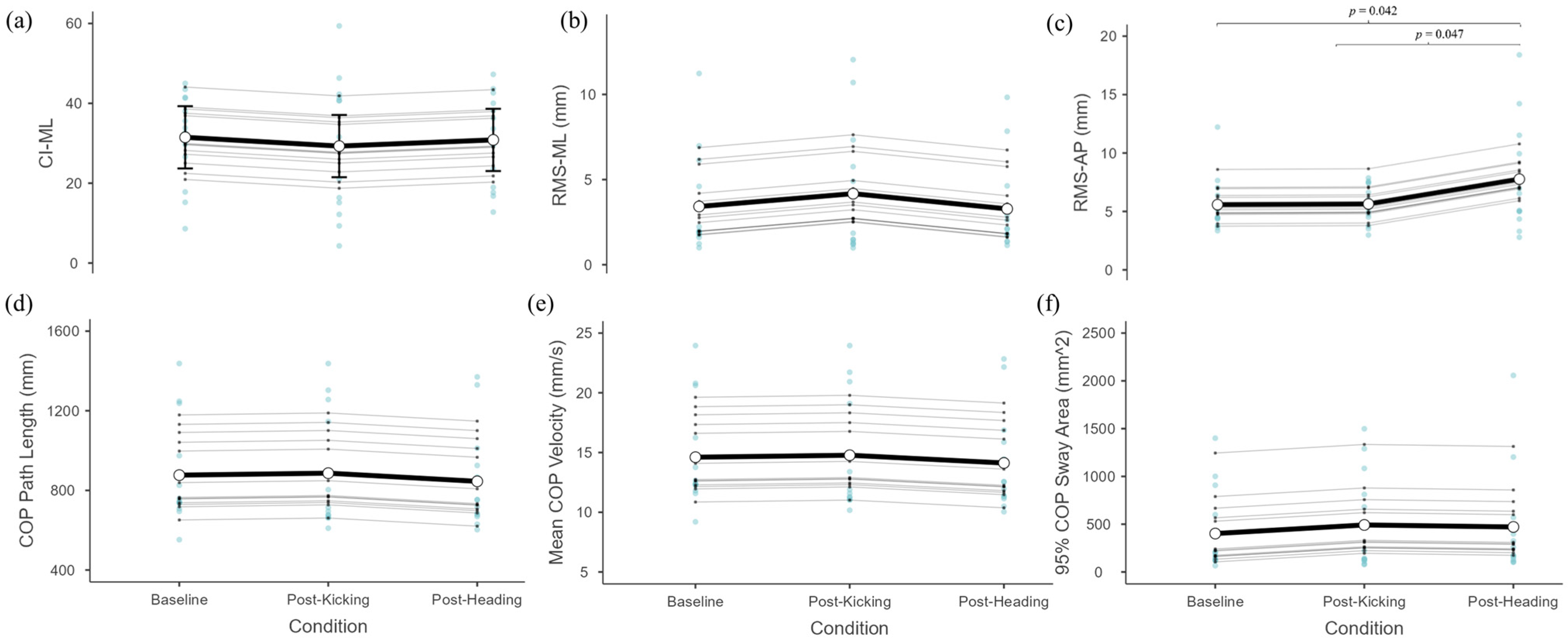
| EMM + SE | 31.49 ± 3.80 | 29.29 ± 3.80 | 30.84 ± 3.80 | 0.15 | 2, 24 | 0.863 | 0.01 | |
| [95% CI] | [23.69–39.28] | [21.49–37.08] | [23.04–38.63] | |||||
| n | 13 | 13 | 13 | |||||
| CI-AP | ||||||||
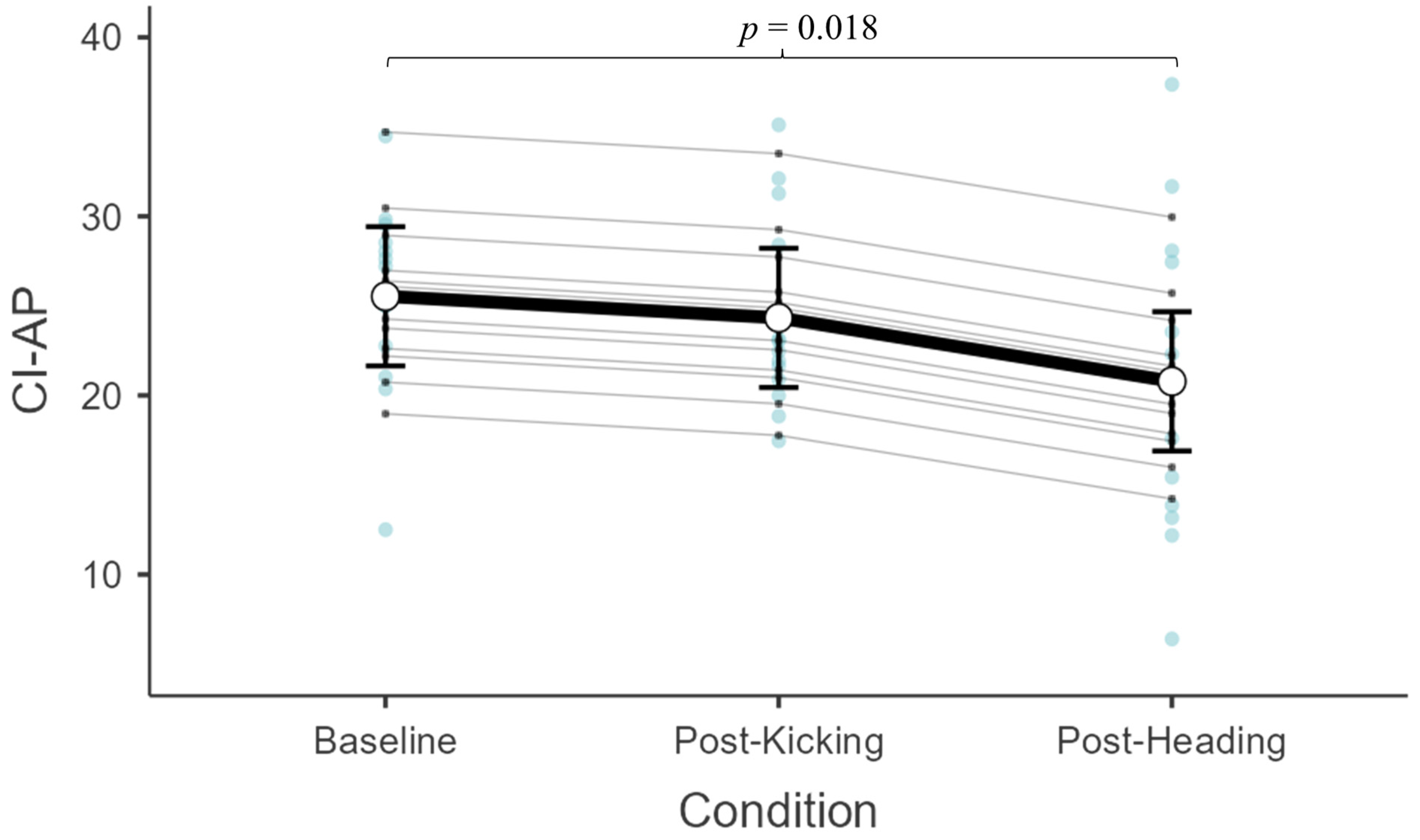
| EMM + SE | 25.54 ± 1.88 | 24.33 ± 1.88 | 20.79 ± 1.88 | 3.52 | 2, 24 | 0.046 * | 0.23 | |
| [95% CI] | [21.65–29.42] | [20.45–28.22] | [16.90–24.67] | |||||
| n | 13 | 13 | 13 | |||||
| Dual-stance postural control linear measures | ||||||||
| RMS-ML (mm) | ||||||||
| EMM + SE | 3.42 ± 0.89 | 4.17 ± 0.89 | 3.28 ± 0.89 | 0.54 | 2, 24 | 0.591 | 0.04 | |
| [95% CI] | [1.60–5.25] | [2.35–6.00] | [1.45–5.11] | |||||
| n | 13 | 13 | 13 | |||||
| RMS-AP (mm) | ||||||||
| EMM + SE | 5.58 ± 0.87 | 5.64 ± 0.87 | 7.77 ± 0.87 | 3.00 | 2, 24 | 0.069 | 0.20 | |
| [95% CI] | [3.80–7.37] | [3.86–7.43] | [5.98–9.55] | |||||
| n | 13 | 13 | 13 | |||||
| COP Path Length (mm) | ||||||||
| EMM + SE | 876.69 ± 75.07 | 886.51 ± 75.07 | 845.55 ± 75.07 | 0.19 | 2, 24 | 0.828 | 0.02 | |
| [95% CI] | [720.89–1032.49] | [730.71–1042.31] | [689.75–1001.35] | |||||
| n | 13 | 13 | 13 | |||||
| Mean COP Velocity (mm/s) | ||||||||
| EMM + SE | 14.61 ± 1.25 | 14.77 ± 1.25 | 14.12 ± 1.25 | 0.17 | 2, 24 | 0.846 | 0.01 | |
| [95% CI] | [12.01–17.21] | [12.17–17.37] | [11.53–16.72] | |||||
| n | 13 | 13 | 13 | |||||
| 95% COP Sway Area (mm2) | ||||||||
| EMM + SE | 402.22 ± 140.70 | 492.08 ± 140.70 | 471.18 ± 140.70 | 0.26 | 2, 24 | 0.776 | 0.02 | |
| [95% CI] | [110.40–694.04] | [200.26–783.91] | [179.36–763.00] | |||||
| n | 13 | 13 | 13 | |||||
| Sparta Balance Scan nonlinear metrics | ||||||||
| MVE | ||||||||
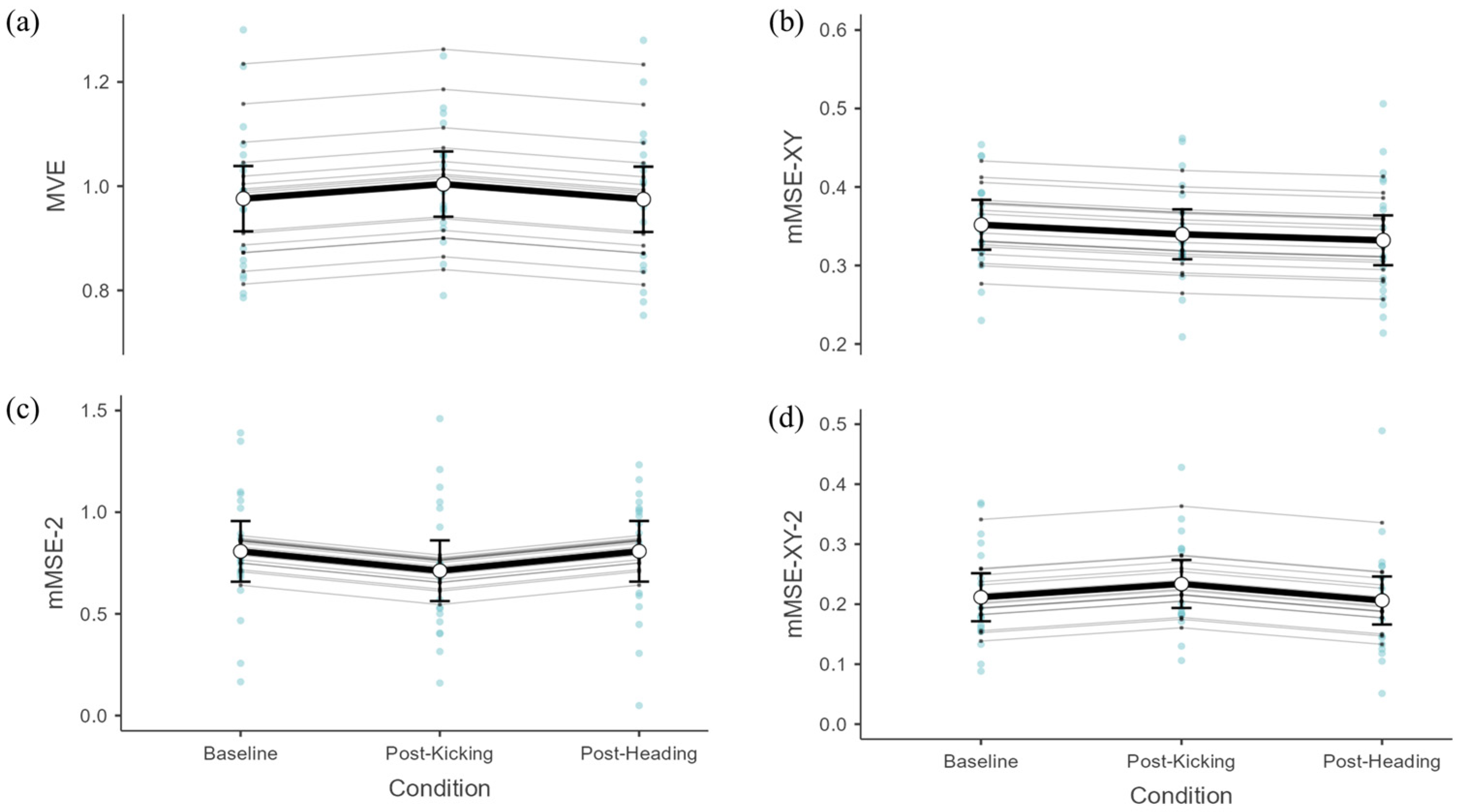
| EMM + SE | 0.98 ± 0.03 | 1.00 ± 0.03 | 0.97 ± 0.03 | 1.06 | 2, 36 | 0.358 | 0.06 | |
| [95% CI] | [0.91–1.04] | [0.94–1.07] | [0.91–1.04] | |||||
| n | 19 | 19 | 19 | |||||
| mMSE-XY | ||||||||
| EMM + SE | 0.35 ± 0.02 | 0.34 ± 0.02 | 0.33 ± 0.02 | 0.83 | 2, 36 | 0.446 | 0.04 | |
| [95% CI] | [0.32–0.38] | [0.31–0.37] | [0.30–0.36] | |||||
| n | 19 | 19 | 19 | |||||
| mMSE-2 | ||||||||
| EMM + SE | 0.81 ± 0.07 | 0.71 ± 0.07 | 0.81 ± 0.07 | 0.64 | 2, 36 | 0.535 | 0.03 | |
| [95% CI] | [0.66–0.96] | [0.56–0.86] | [0.66 ± 0.96] | |||||
| n | 19 | 19 | 19 | |||||
| mMSE-XY-2 | ||||||||
| EMM + SE | 0.21 ± 0.02 | 0.23 ± 0.02 | 0.21 ± 0.02 | 0.94 | 2, 36 | 0.400 | 0.05 | |
| [95% CI] | [0.17–0.25] | [0.19–0.27] | [0.17–0.25] | |||||
| n | 19 | 19 | 19 | |||||
| Kicking Leg Balance | ||||||||
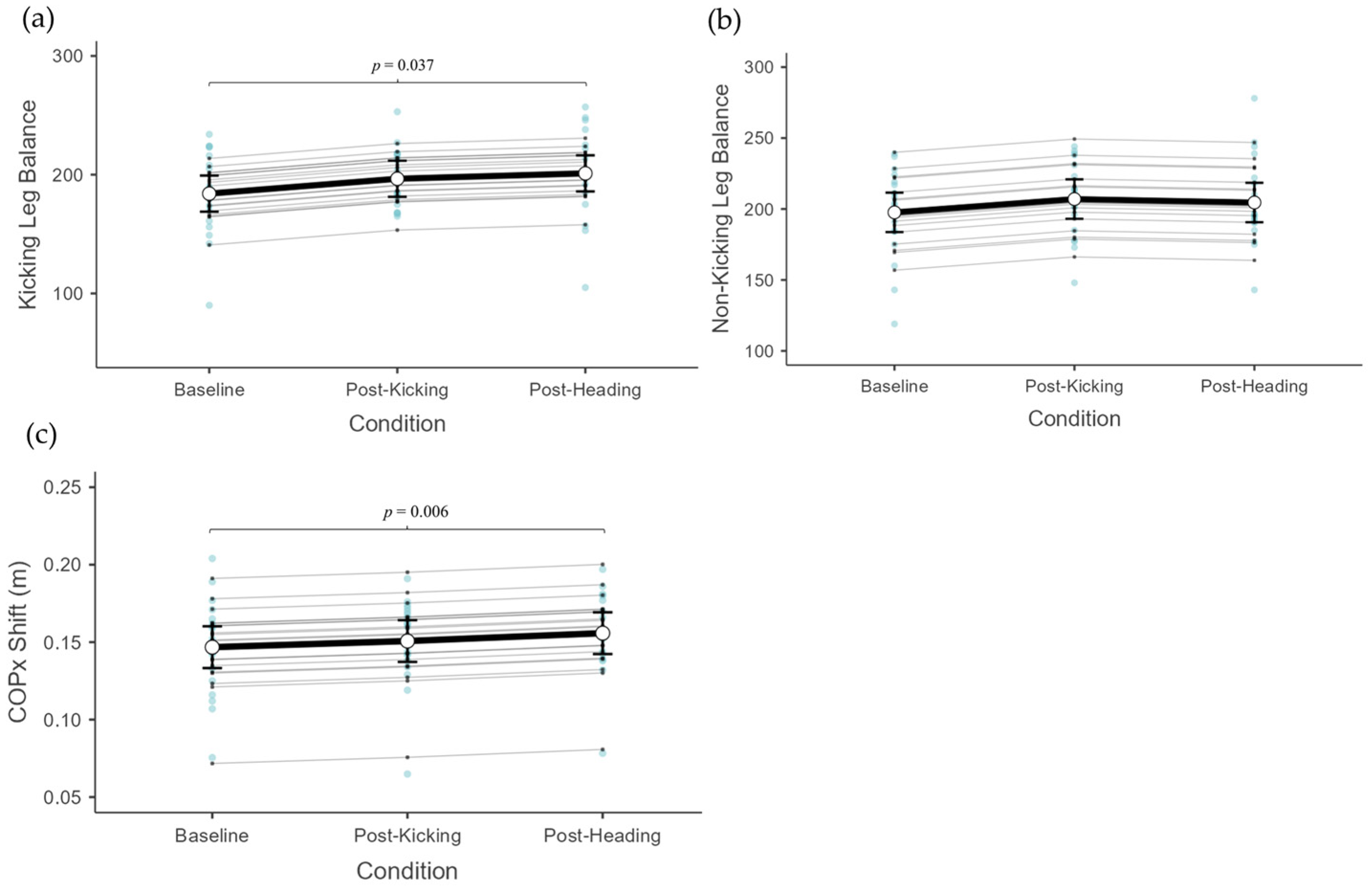
| EMM + SE | 184 ± 7.52 | 197 ± 7.52 | 201 ± 7.52 | 2.51 | 2, 36 | 0.096 | 0.12 | |
| [95% CI] | [169–199] | [181–212] | [186–216] | |||||
| n | 19 | 19 | 19 | |||||
| Non-Kicking Leg Balance | ||||||||
| EMM + SE | 198 ± 6.81 | 207 ± 6.81 | 205 ± 6.81 | 1.38 | 2, 36 | 0.265 | 0.07 | |
| [95% CI] | [184–212] | [193–221] | [191–218] | |||||
| N | 19 | 19 | 19 | |||||
| COPx Shift (m) | ||||||||
| EMM + SE | 0.147 ± 0.006 | 0.151 ± 0.006 | 0.156 ± 0.006 | 4.37 | 2, 36 | 0.020 * | 0.20 | |
| [95% CI] | [0.133–0.160] | [0.137 ± 0.164] | [0.142–0.169] | |||||
| n | 19 | 19 | 19 | |||||
| Corticospinal inhibition | ||||||||
| cSP duration (ms) | ||||||||
| EMM + SE | 152.66 ± 6.52 | 156.09 ± 5.87 | 162.03 ± 6.14 | 3.55 | 2, 15.82 | 0.053 | 0.31 | |
| [95% CI] | [138.66–166.67] | [143.64–168.54] | [149.00–175.06] | |||||
| n | 320 | 320 | 340 | |||||
| Variable | Condition A | Condition B | Mean Difference | 95% CI | %Δ | Cohen’s dz [± 95% CI] | p | |
|---|---|---|---|---|---|---|---|---|
| Dual-stance postural control nonlinear measures (n = 13) | ||||||||
| CI-ML | Baseline | - | Post-Heading | 0.65 | [−7.50, 8.80] | −2.06 | 0.04 [± 1.09] | 0.877 |
| Baseline | - | Post-Kicking | 2.20 | [−5.95, 10.35] | −6.99 | 0.15 [± 1.09] | 0.602 | |
| Post-Kicking | - | Post-Heading | −1.55 | [−9.7, 6.6] | 5.29 | 0.10 [± 1.09] | 0.713 | |
| CI-AP | Baseline | - | Post-Heading | 4.75 | [1.10, 8.40] | −18.6 | 0.71 [± 1.22] | 0.018 * |
| Baseline | - | Post-Kicking | 1.20 | [−2.45, 4.85] | −4.75 | 0.18 [± 1.10] | 0.524 | |
| Post-Kicking | - | Post-Heading | 3.55 | [−0.10, 7.20] | −14.55 | 0.53 [± 1.16] | 0.069 | |
| Dual-stance postural control linear measures (n = 13) | ||||||||
| RMS-ML (mm) | Baseline | - | Post-Heading | 0.14 | [−1.68, 1.96] | −4.09 | 0.04 [± 1.09] | 0.880 |
| Baseline | - | Post-Kicking | −0.75 | [−2.57, 1.07] | 21.93 | 0.22 [± 1.10] | 0.425 | |
| Post-Kicking | - | Post-Heading | 0.89 | [−0.93, 2.71] | −21.34 | 0.27 [± 1.11] | 0.345 | |
| RMS-AP (mm) | Baseline | - | Post-Heading | −2.18 | [−4.18, −0.18] | 39.25 | 0.60 [± 1.18] | 0.042 * |
| Baseline | - | Post-Kicking | −0.06 | [−2.06, 1.94] | 1.08 | 0.02 [± 1.09] | 0.953 | |
| Post-Kicking | - | Post-Heading | −2.12 | [−4.12, −0.12] | 37.77 | 0.58 [± 1.17] | 0.047 * | |
| COP Path Length (mm) | Baseline | - | Post-Heading | 31.14 | [−104.88, 167.16] | −3.55 | 0.12 [± 1.09] | 0.658 |
| Baseline | - | Post-Kicking | −9.82 | [−145.84, 126.20] | 1.12 | 0.04 [± 1.09] | 0.889 | |
| Post-Kicking | - | Post-Heading | 40.96 | [−95.06, 176.98] | −4.62 | 0.16 [± 1.09] | 0.561 | |
| Mean COP Velocity (mm/s) | Baseline | - | Post-Heading | 0.48 | [−1.79, 2.75] | −3.35 | 0.12 [± 1.09] | 0.681 |
| Baseline | - | Post-Kicking | −0.16 | [−2.43, 2.11] | 1.1 | 0.04 [± 1.09] | 0.889 | |
| Post-Kicking | - | Post-Heading | 0.65 | [−1.62, 2.92] | −4.4 | 0.16 [± 1.09] | 0.583 | |
| 95% COP Sway Area (mm2) | Baseline | - | Post-Kicking | −68.96 | [−326.11, 188.19] | 17.14 | 0.15 [± 1.09] | 0.604 |
| Post-Kicking | - | Post-Heading | −89.86 | [−347.01, 167.29] | 22.34 | 0.19 [± 1.10] | 0.500 | |
| Baseline | - | Post-Kicking | 20.90 | [−236.25, 278.05] | −4.25 | 0.04 [± 1.09] | 0.875 | |
| Sparta Balance Scan nonlinear metrics (n = 19) | ||||||||
| MVE | Baseline | - | Post-Heading | 0.00 | [−0.04, 0.04] | −1.02 | 0.01 [± 0.90] | 0.956 |
| Baseline | - | Post-Kicking | −0.03 | [−0.07, 0.01] | 2.04 | 0.28 [± 0.92] | 0.226 | |
| Post-Kicking | - | Post-Heading | 0.030 | [−0.01, 0.07] | −3.00 | 0.30 [± 0.92] | 0.207 | |
| mMSE-XY | Baseline | - | Post-Heading | 0.02 | [−0.02, 0.06] | −5.71 | 0.29 [± 0.92] | 0.211 |
| Baseline | - | Post-Kicking | 0.01 | [−0.03, 0.05] | −2.86 | 0.18 [± 0.91] | 0.439 | |
| Post-Kicking | - | Post-Heading | 0.01 | [−0.03, 0.05] | −2.94 | 0.11 [± 0.90] | 0.626 | |
| mMSE-2 | Baseline | - | Post-Heading | 0.00 | [−0.2, 0.2] | 0.00 | 0.00 [± 0.90] | 0.997 |
| Baseline | - | Post-Kicking | 0.10 | [−0.1, 0.3] | −12.35 | 0.22 [± 0.91] | 0.336 | |
| Post-Kicking | - | Post-Heading | −0.10 | [−0.3, 0.1] | 14.08 | 0.22 [± 0.91] | 0.334 | |
| mMSE-XY-2 | Baseline | - | Post-Heading | 0.01 | [−0.03, 0.05] | 0.00 | 0.06 [± 0.90] | 0.800 |
| Baseline | - | Post-Kicking | −0.02 | [−0.06, 0.02] | 9.52 | 0.24 [± 0.91] | 0.306 | |
| Post-Kicking | - | Post-Heading | 0.03 | [−0.01, 0.07] | −8.7 | 0.30 [± 0.92] | 0.204 | |
| Sparta Balance Scan linear metrics (n = 19) | ||||||||
| Kicking Leg Balance | Baseline | - | Post-Heading | −17.05 | [−32.51, −1.59] | 9.24 | 0.50 [± 0.95] | 0.037 * |
| Baseline | - | Post-Kicking | −12.53 | [−27.99, 2.93] | 7.07 | 0.36 [± 0.93] | 0.121 | |
| Post-Kicking | - | Post-Heading | −4.53 | [−19.99, 10.93] | 2.03 | 0.13 [± 0.90] | 0.570 | |
| Non-Kicking Leg Balance | Baseline | - | Post-Heading | −6.95 | [−18.44, 4.54] | 3.54 | 0.27 [± 0.92] | 0.243 |
| Baseline | - | Post-Kicking | −9.37 | [−20.86, 2.12] | 4.55 | 0.37 [± 0.93] | 0.119 | |
| Post-Kicking | - | Post-Heading | 2.42 | [−9.07, 13.91] | −0.97 | 0.09 [± 0.90] | 0.682 | |
| COPx Shift (m) | Baseline | - | Post-Heading | −0.009 | [−0.015, −0.003] | 6.12 | 0.68 [± 0.90] | 0.006 * |
| Baseline | - | Post-Kicking | −0.004 | [−0.04, 0.010] | 2.72 | 0.30 [± 0.91] | 0.204 | |
| Post-Kicking | - | Post-Heading | −0.005 | [−0.005, 0.005] | 3.31 | 0.38 [± 0.92] | 0.107 | |
| Corticospinal inhibition (n = 16) | ||||||||
| cSP duration (ms) | Baseline | - | Post-Heading | −9.37 | [−18.35, −0.39] | 6.14 | 0.51 [± 0.23] | 0.058 |
| Baseline | - | Post-Kicking | −3.43 | [−10.23, 3.37] | 2.25 | 0.25 [± 0.22] | 0.338 | |
| Post-Kicking | - | Post-Heading ^ | −5.94 | [−10.41, −1.47] | 3.81 | 0.63 [± 0.23] | 0.019 * | |
Disclaimer/Publisher’s Note: The statements, opinions and data contained in all publications are solely those of the individual author(s) and contributor(s) and not of MDPI and/or the editor(s). MDPI and/or the editor(s) disclaim responsibility for any injury to people or property resulting from any ideas, methods, instructions or products referred to in the content. |
© 2025 by the authors. Licensee MDPI, Basel, Switzerland. This article is an open access article distributed under the terms and conditions of the Creative Commons Attribution (CC BY) license (https://creativecommons.org/licenses/by/4.0/).
Share and Cite
Epifano, D.J.; Wheat, J.; Heller, B.; Pearce, A.J.; Middleton, K. An Exploratory Study of the Acute Effects of Football Heading on Postural Control and Corticospinal Inhibition. Appl. Sci. 2025, 15, 12814. https://doi.org/10.3390/app152312814
Epifano DJ, Wheat J, Heller B, Pearce AJ, Middleton K. An Exploratory Study of the Acute Effects of Football Heading on Postural Control and Corticospinal Inhibition. Applied Sciences. 2025; 15(23):12814. https://doi.org/10.3390/app152312814
Chicago/Turabian StyleEpifano, Daniel J., Jon Wheat, Ben Heller, Alan J. Pearce, and Kane Middleton. 2025. "An Exploratory Study of the Acute Effects of Football Heading on Postural Control and Corticospinal Inhibition" Applied Sciences 15, no. 23: 12814. https://doi.org/10.3390/app152312814
APA StyleEpifano, D. J., Wheat, J., Heller, B., Pearce, A. J., & Middleton, K. (2025). An Exploratory Study of the Acute Effects of Football Heading on Postural Control and Corticospinal Inhibition. Applied Sciences, 15(23), 12814. https://doi.org/10.3390/app152312814