Article

Development of a Compact Data Acquisition System for Immersive Ultrasonic Inspection of Small-Diameter Pipelines

1
Smart Gym-Based Translational Research Center for Active Senior’s Healthcare, Pukyong National University, Busan 48513, Republic of Korea
2
Industry 4.0 Convergence Bionics Engineering, Department of Biomedical Engineering, Pukyong National University, Busan 48513, Republic of Korea
3
Department of Mechatronics, Cao Thang Technical College, Ho Chi Minh City 700000, Vietnam
4
Digital Healthcare Research Center, Pukyong National University, Busan 48513, Republic of Korea
5
Ohlabs Corp., Busan 48513, Republic of Korea
*
Authors to whom correspondence should be addressed.
These authors contributed equally to this work.
Appl. Sci. 2025, 15(23), 12817; https://doi.org/10.3390/app152312817 (registering DOI)
Submission received: 24 October 2025 / Revised: 24 November 2025 / Accepted: 29 November 2025 / Published: 4 December 2025

Abstract

This study presents the design and implementation of a compact data acquisition system for immersive ultrasonic inspection of small-diameter pipelines, targeting applications where conventional systems are impractical due to size constraints. The system integrates the Eclipse Z7 platform with a customized pulser-receiver module and a rotary pipeline inspection gauge (PIG) equipped with a 5 MHz immersion-type ultrasonic transducer. The PIG module is designed to scan pipelines with an 8.18 mm wall thickness and a 200 mm inner diameter. Before deployment, real-time system calibration is performed via a connected computer interface to ensure optimal performance. Once inside the pipeline, the PIG operates autonomously, with ultrasonic data being acquired and stored locally on a Raspberry Pi. Post-inspection, the recorded data is extracted and analyzed on the computer to assess pipeline integrity. The proposed system offers a compact alternative to commercial solutions, particularly in scenarios involving limited access and small-diameter pipelines.

1. Introduction

At present, pipelines have become the safest, most efficient, and economical method for transporting oil and gas [1,2,3]. The total length of the pipelines can be up to millions of kilometers, with the diameter of the pipeline ranging from less than 12 inches (small-diameter pipe) to larger than 24 inches (large-diameter pipe) [4,5,6,7]. However, corrosion can appear within 1–5 years of operation, depending on environmental conditions, pipeline materials, and protective measures [8,9]. Microbiologically influenced corrosion can begin within 1–2 years in soils with high moisture and sulfate-reducing bacteria [10,11]. Stress Corrosion Cracking (SCC) at pipeline welds appears after 5–10 years of operation [12,13,14]. Therefore, after a period of operation, regular maintenance and inspection of pipelines is required for early detection of defects and to reduce the risk of serious incidents. Over the decades, various pipeline inspection techniques, including Distributed Fiber-Optic Sensing (DFOS) [15], Structural Health Monitoring (SHM) frameworks with installed sensors [16], wireless sensor network–based leak and stress detection [17], and In-Line Inspection (ILI) [18,19] have been developed. Among them, the most efficient method for detecting and locating corrosion is to use non-destructive testing (NDT) techniques implemented in ILI tools, which allow assessment of pipeline condition without interrupting operation [4,20,21]. Among these tools, the Pipeline Inspection Gauge (PIG) has emerged as one of the most effective devices within ILI technology.
PIGs were first developed in the early 1950s in the United States, initially for pigging deposits inside pipelines [22,23,24]. As maintenance and inspection demands increased, PIGs were integrated with additional functions for inspection, localization, and pipeline mapping [25]. PIGs are classified according to the type of NDT sensors they carry, including Magnetic Flux Leakage (MFL) PIG, Ultrasonic Testing (UT) PIG, Electromagnetic Acoustic Transducer (EMAT) PIG, Eddy Current (EC) PIG, etc. [4,26]. Among them, MFL PIG, using the principle of magnetizing the pipe wall to saturation for detection, is the most popular technique for pipeline inspection. However, it can only provide qualitative results, making the accurate determination of pipe wall thickness difficult, limiting its use in some high-accuracy applications. Meanwhile, UT uses ultrasonic waves transmitted through the pipe wall, analyzing the time and amplitude of the response signal [27]. UT directly measures thickness with high accuracy, and can quantify many types of defects, including mid-wall corrosion defects and axial grooving [27,28]. Despite requiring more stringent operating conditions (clean flow and liquid medium), UT’s advantages in quantification and data reliability make it the optimal choice when precise assessment of deterioration and long-term pipeline safety is required [29].
Although inspecting large transmission pipelines (>20 inches) is challenging, small-diameter pipelines (<12 inches) pose even greater difficulties [6,7]. Since small pipelines are not frequently pigged, deposits tend to accumulate over time, leading to corrosion [30]. For large-diameter pipelines, UT PIGs usually carry a large number of ultrasonic sensors to scan the entire circumference. For instance, the UT PIG developed by Reber et al. integrates 240 sensors around the circumference, corresponding to a sensor pitch of 8 mm [31]. However, for small-diameter pipelines, UT PIGs cannot accommodate such many sensors. To overcome this limitation, an alternative solution has been proposed using the Internal Rotary Inspection System (IRIS), which combines an ultrasonic probe with a rotating mirror to generate a 360° beam around the pipe wall. Birchall et al. demonstrated the use of IRIS in pipelines ranging from 8.6 mm to 300 mm in diameter, enabling the detection of pitting, corrosion, bulging, and other defects [32]. Nevertheless, the electronic system of UT PIGs must be optimized in terms of size, data transmission and processing speed, as well as storage capacity for long-term operation. For example, studies by Kumar et al. focused on developing a UT system based on an FPGA/SoC with two ultrasonic channels, a 12-bit/100 MSPS digitizer, and 256 MB of A-scan data storage. This system was able to measure thickness and deformation in thin-walled 12-inch pipelines and provided clear defect visualization in B-scan [33,34,35]. However, its technical limitations included the use of only two channels (not 360° coverage) and limited storage capacity. Moreover, the system was restricted to 12-inch pipelines, without validation in smaller diameters. These constraints demonstrate potential but also indicate that the system remains at a laboratory prototype stage.
A commercially available ultrasonic system, the OLYMPUS Multi-Scan MS5800, is widely used to support UT-based IRIS inspections. It provides a wide frequency bandwidth from 0.5 to 25 MHz, a sampling rate of up to 100 MSPS (8-bit), and a pulse repetition frequency up to 20 kHz. However, this system does not allow local storage and requires connection to PC-based software, limiting its applicability for long-distance UT PIG inspections. Furthermore, its size and weight (450 × 300 × 220 mm, 12.8 kg) are not suitable for integration into UT PIGs for small-diameter pipelines. These observations indicate that while the deployment of UT PIGs in small-diameter pipelines is technically feasible, the primary obstacle remains space constraints, as such PIGs cannot accommodate all the essential electronic components required for extended and autonomous operation.
To address the challenges outlined above, this paper presents a comprehensive solution for inspecting a small 8-inch (200 mm) diameter pipeline, focusing on size management, operational efficiency, and data storage through the development of a compact UT PIG system. The objectives of this study are to design an integrated UT PIG that inherits the IRIS principle using a 5 MHz ultrasonic sensor rotated by a DC motor to achieve a 360° scan of the pipe wall. The system further integrates a portable pulser/receiver developed in our previous study for driving high-frequency transducers [36]. The FPGA-based digitizer with a 14-bit, 100 MSPS sampling rate is designed based on the Eclipse Z7 and Zmod ADC 1410 for high-speed data processing. The Raspberry Pi 5 with an integrated 500 GB solid-state drive (SSD) is used for efficient data handling during pipeline operation. This approach is expected to overcome the size constraint and restricted data storage limitations of prior systems, while ensuring a compact and high-speed design suitable for small-diameter pipeline inspection.
The key contributions of this work can be summarized as follows:
(1)
Compact and fully integrated UT data-acquisition framework for small-diameter pipelines. The proposed system combines a customized high-voltage pulser/receiver, a 14-bit 100 MS/s FPGA-based digitizer, and a Raspberry Pi 5 storage module into a size-restricted PIG platform suitable for 8-inch (200 mm) pipelines, addressing the space limitations that prevent the use of commercial IRIS systems.
(2)
Unlike commercial instruments like MS5800 that require tethered PC operation, the system performs in-pipe local data recording using an embedded SSD, enabling long-distance inspection without external communication.
(3)
The system achieves smooth A-scan waveforms for both the front and back walls. The wall-thickness accuracy within ±2.5% demonstrates a reliable measurement performance.
(4)
Modular hardware structure enables flexible extension to full PIG inspection. The design supports future integration of position encoders and water-driven propulsion, providing a scalable foundation for complete autonomous pipeline inspection.

2. System Design

2.1. System Block Diagram

Figure 1 illustrates the overall configuration of the compact ultrasonic data acquisition system developed for immersion inspection of small-diameter pipelines. A DC motor drives the rotational movement of a 5 MHz ultrasonic transducer, enabling circumferential scanning of the pipe surface. The transducer is connected to a custom-designed pulser/receiver circuit, which excites the transducer and receives the echo signals. These analog signals are digitized using the Eclypse Z7, Zmod Scope 1410-105-based digitizer, and transferred via a high-speed Ethernet interface. The host computer provides a graphical user interface (GUI) that enables real-time visualization of A-, B-, and C-scan data for system settings and calibration before scanning. During actual scanning, the digitized data is stored in the Raspberry Pi for subsequent processing and analysis. This architecture integrates actuation, signal acquisition, digitization, visualization, and embedded storage into a compact system optimized for ultrasonic inspection of pipelines.

2.2. Pulser/Receiver Architecture

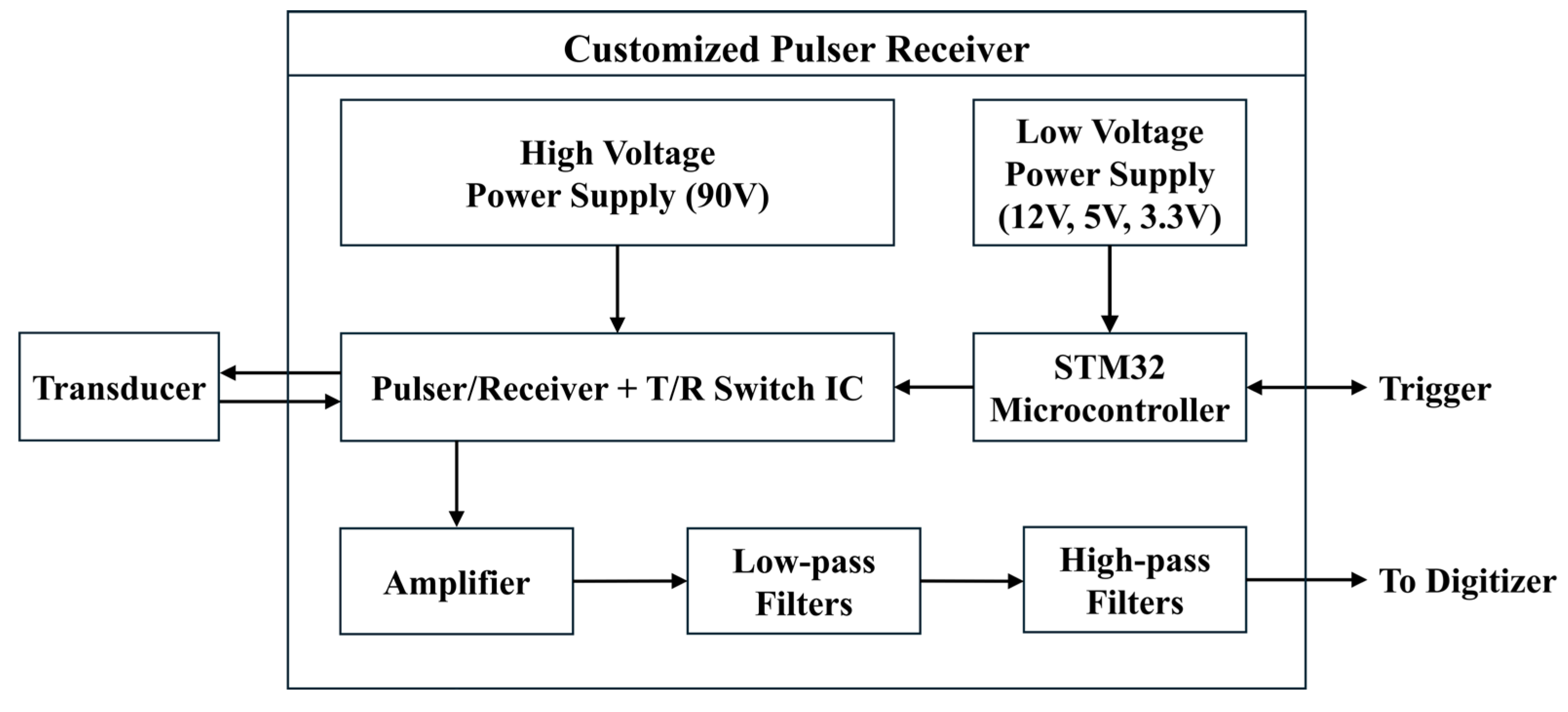
The block diagram in Figure 2 illustrates the pulser/receiver front-end used for ultrasonic excitation and echo acquisition. A high-voltage supply (90 V) drives the pulser/receiver module, which integrates a transmit/receive (T/R) switch to excite the ultrasonic transducer while protecting the receiver during echo detection. An STM32 microcontroller, powered by regulated low-voltage supplies (12 V, 5 V, and 3.3 V), provides synchronized trigger signals and controls the pulser operation. The received ultrasonic echo signals are subsequently amplified and filtered through cascaded high-pass and low-pass stages for noise suppression and bandwidth optimization. The conditioned analog signals are then transmitted to the digitizer for sampling and further processing.

2.3. Digitizer Architecture

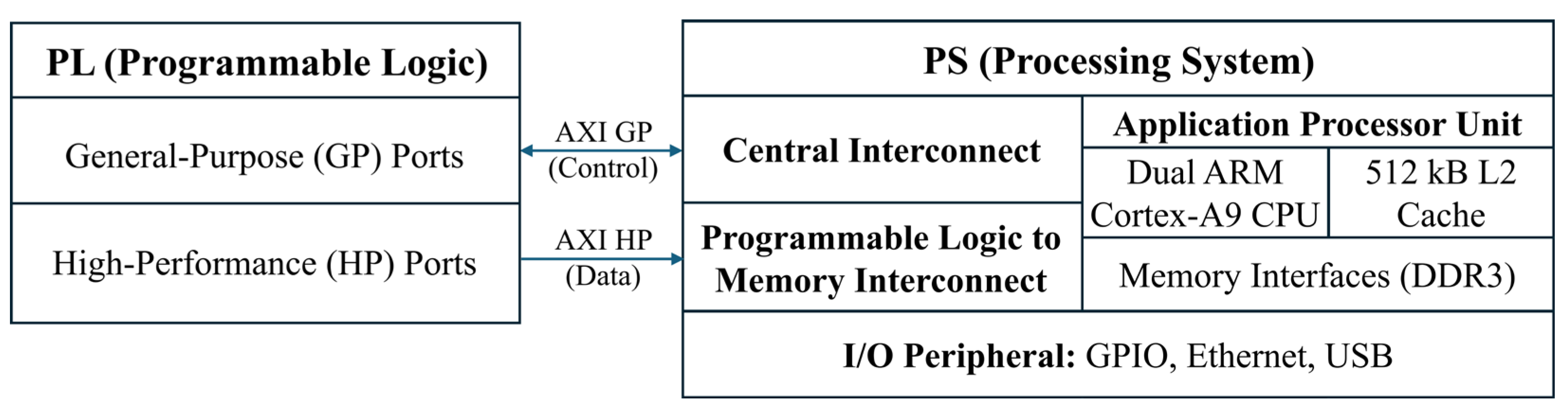
The digitizer module includes the Zmod Scope 1410-105 ADC module and the Eclypse Z7 platform, which integrates the Xilinx Zynq-7000 FPGA and dual ARM Cortex-A9 CPU into a unified system (Figure 3). This architecture combines high-speed analog-to-digital conversion (ADC) with flexible digital processing and embedded control. The Zmod Scope 1410-105, built around a 14-bit, 100 MS/s dual-channel ADC, interfaces with the Eclypse Z7 through the SYZYGY standard, providing a compact, low-latency link for differential LVDS data and control signals. Within the Eclypse Z7, the Programmable Logic (PL) region of the Zynq device handles real-time data acquisition, deserialization, and synchronization using dedicated IP cores, while the Processing System (PS) executes higher-level signal management, communication, and data storage tasks. This tight integration of FPGA and ARM processors allows parallel hardware-level processing, ensuring compact, high-throughput data acquisition.
The technical specification of the proposed pulser/receiver and digitizer is summarized in Table 1. The receiver module features a 30 MHz bandwidth and a maximum gain of 53 dB, ensuring adequate sensitivity and low-noise amplification of the reflected ultrasonic echoes. Each acquisition record consists of a maximum of 512 samples per pulse repetition at 4.5 kHz, with a trigger delay up to 50 µs for synchronizing transmission and reception events. The overall system achieves a continuous data transfer rate of approximately 4500 14-bit A-scans per second, enabling real-time signal acquisition for immersion pipeline ultrasonic inspection.

2.4. GUI for Calibration and Image Processing

The custom-developed graphical user interface (GUI) was designed to provide comprehensive visualization and analysis capabilities for ultrasonic inspection (Figure 4). In real-time mode, the software can display A-scan waveforms, B-scan cross-sectional views, and C-scan plan-view images of the inspected pipe samples. High-speed communication between the host computer and the digitizer is established via a Gigabit Ethernet interface, enabling efficient data streaming, storage, and display. The software supports continuous data saving in raw or processed formats, as well as offline data processing and reconstruction for detailed post-inspection analysis. To ensure accurate defect detection and wall-thickness evaluation, both positive and negative amplitude peak detection algorithms are implemented, in addition to amplitude-threshold-based detection. The peak detection logic identifies the first significant echo within user-defined time gates, accounting for signal polarity and amplitude criteria. Furthermore, the GUI handles the extracted raw data from the Raspberry Pi after the inspection mission to reconstruct the B- and C-scan images. These features collectively provide an integrated environment for real-time monitoring, precise measurement, and advanced data analysis in immersion ultrasonic inspection of pipelines.

2.5. Module Functions and Data Acquisition Method

In this design, there are five main modules and processors, including the STM32 in the Pulser/Receiver, FPGA PL and FPGA PS in Eclipse Z7, Raspberry Pi 5, and the host PC. Table 2 summarizes their primary functions and programming responsibilities.
The data acquisition procedure adopted in this work follows a structured sequence similar to established ultrasonic pipeline inspection workflows. Figure 5 presents the detailed data flow. First, the pulser/receiver generates a 90 V excitation pulse under an internal trigger controlled by the STM32 microcontroller. The resulting echo signals are amplified, filtered, and delivered to the 14-bit, 100 MS/s ADC in the Zmod Scope 1410–105 module. In the FPGA programmable logic (PL), the digitized A-scan samples are deserialized, temporally aligned, and transferred to the processing system (PS) via the high-performance (HP) AXI bus. Within the PS, the dual-core ARM structure enables parallelized acquisition: Core 1 performs continuous buffering, packet framing, and real-time preprocessing, while Core 2 manages TCP/IP streaming. During calibration, the PC connects to Port 5001 to visualize live A-scan/B-scan data. During in-pipe inspection, the PC channel is disabled, and the Raspberry Pi 5 becomes the active storage client through Port 5000. The incoming packets are temporarily stored in the kernel socket buffer, copied into the user buffer, and finally written to the SSD for long-duration logging. After the inspection, the stored datasets are retrieved for offline reconstruction of the A-, B-, and C-scan images. This acquisition method, consisting of (1) controlled triggering, (2) synchronized excitation, (3) high-speed digitization, (4) dual-core buffering and packetization, (5) Ethernet-based streaming, and (6) SSD-based long-term storage, ensures data integrity and uninterrupted capture during the entire scanning mission.

3. Experiment Setup

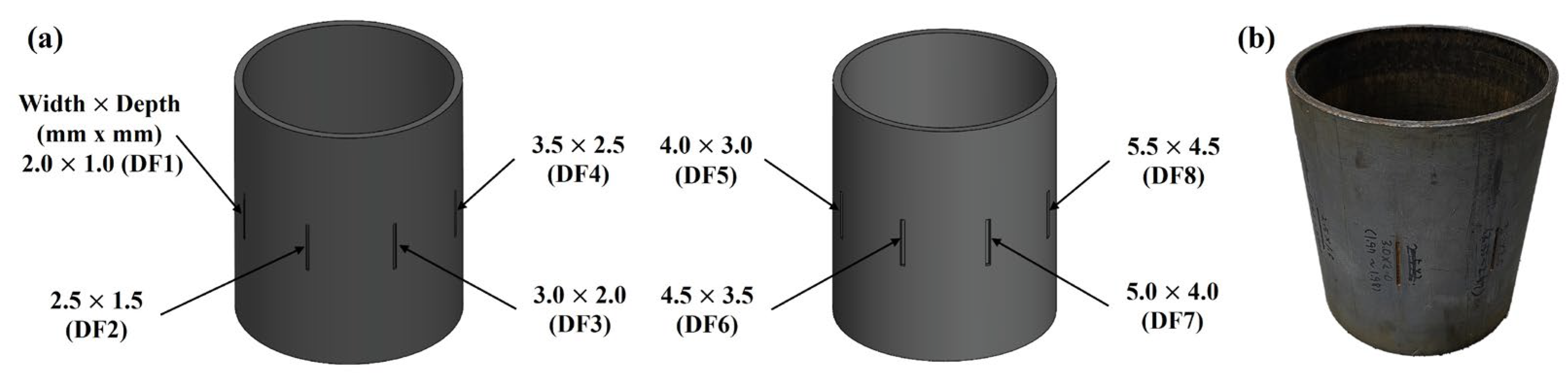
The 8.18 mm wall steel pipeline sample was designed and fabricated, containing artificial defects for ultrasonic inspection. As illustrated in Figure 6a, a total of eight rectangular notches (DF1–DF8) were created on the outer surface of a cylindrical steel section. These notches are used here to simulate localized wall-thickness loss, which is the most common signature of corrosion-type defects in pipelines. Although real corrosion often exhibits irregular morphology, rectangular notches produce consistent and reproducible echoes, ensuring that measurement errors originate from the inspection system rather than from defect-shape variability. The defects were designed with different width and depth combinations ranging from 2.0 × 1.0 mm (DF1) to 5.5 × 4.5 mm (DF8) to evaluate the detection sensitivity and sizing accuracy of the developed system. All the defects have the same length of 50 mm. Figure 6b presents the actual fabricated pipeline specimen, showing the machined notches distributed circumferentially along the outer surface. This sample is used for testing the ability of our proposed inspection concept.
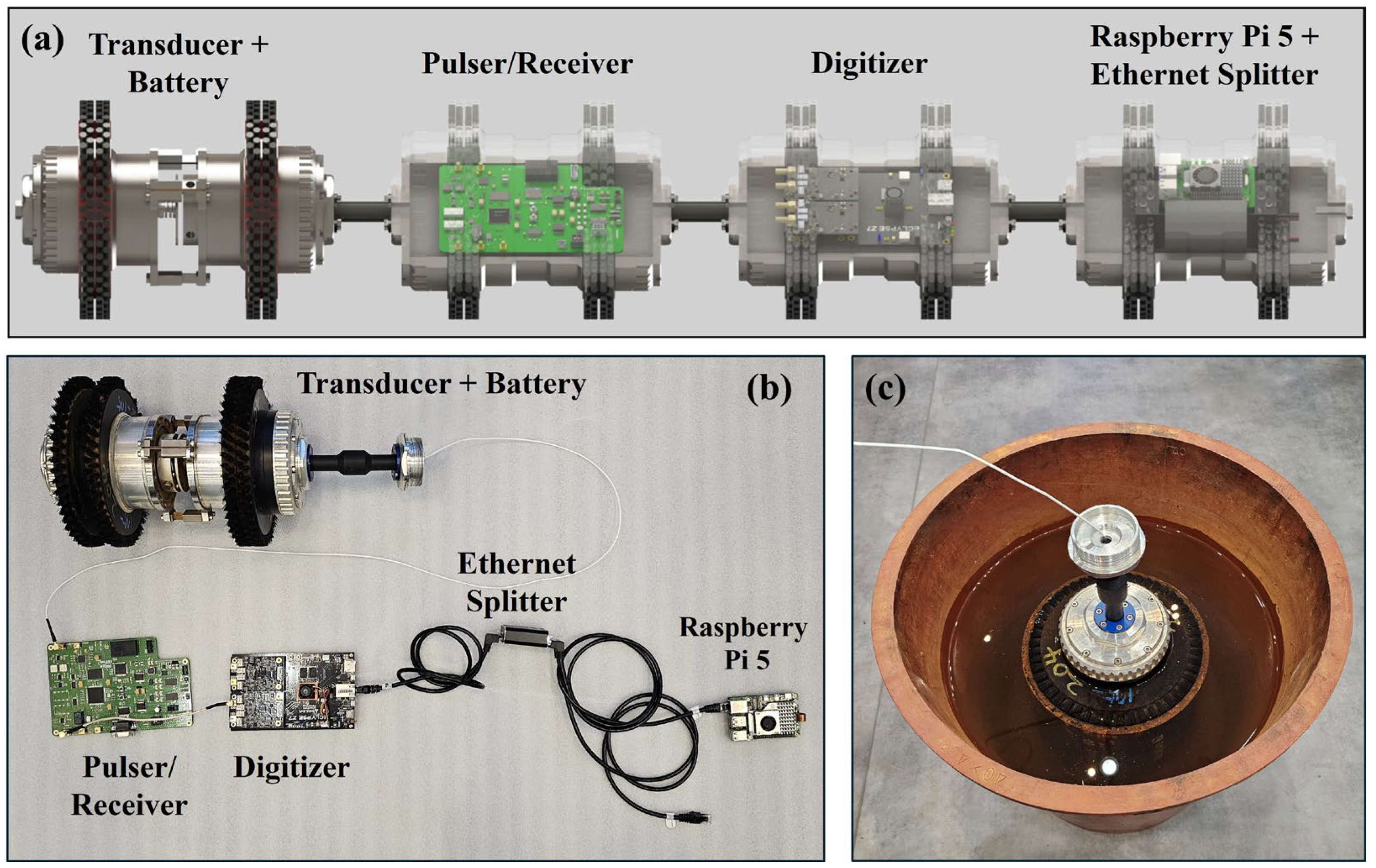
Based on the concept presented above, we proposed a possible solution for immersive small-diameter pipeline inspection. As shown in Figure 7a, the system is composed of four modular units integrated in series: the transducer module with the battery, the pulser/receiver module for signal excitation and amplification, the digitizer module for high-speed data acquisition, and the Raspberry Pi unit with an Ethernet splitter for data storage and communication. All the electrical components fit inside the designed 200 mm diameter PIG modules. In the lab-based testing environment, the transducer module is fabricated and connected with the other hardware components (Figure 7b). The immersion experimental setup is presented in Figure 7c, where the system is submerged in a water tank to ensure proper acoustic coupling between the transducer and the pipe specimen. This setup enables controlled testing, calibration, and data storage during the inspection as well.

4. Results and Discussion

4.1. A-Scan Signal Quality

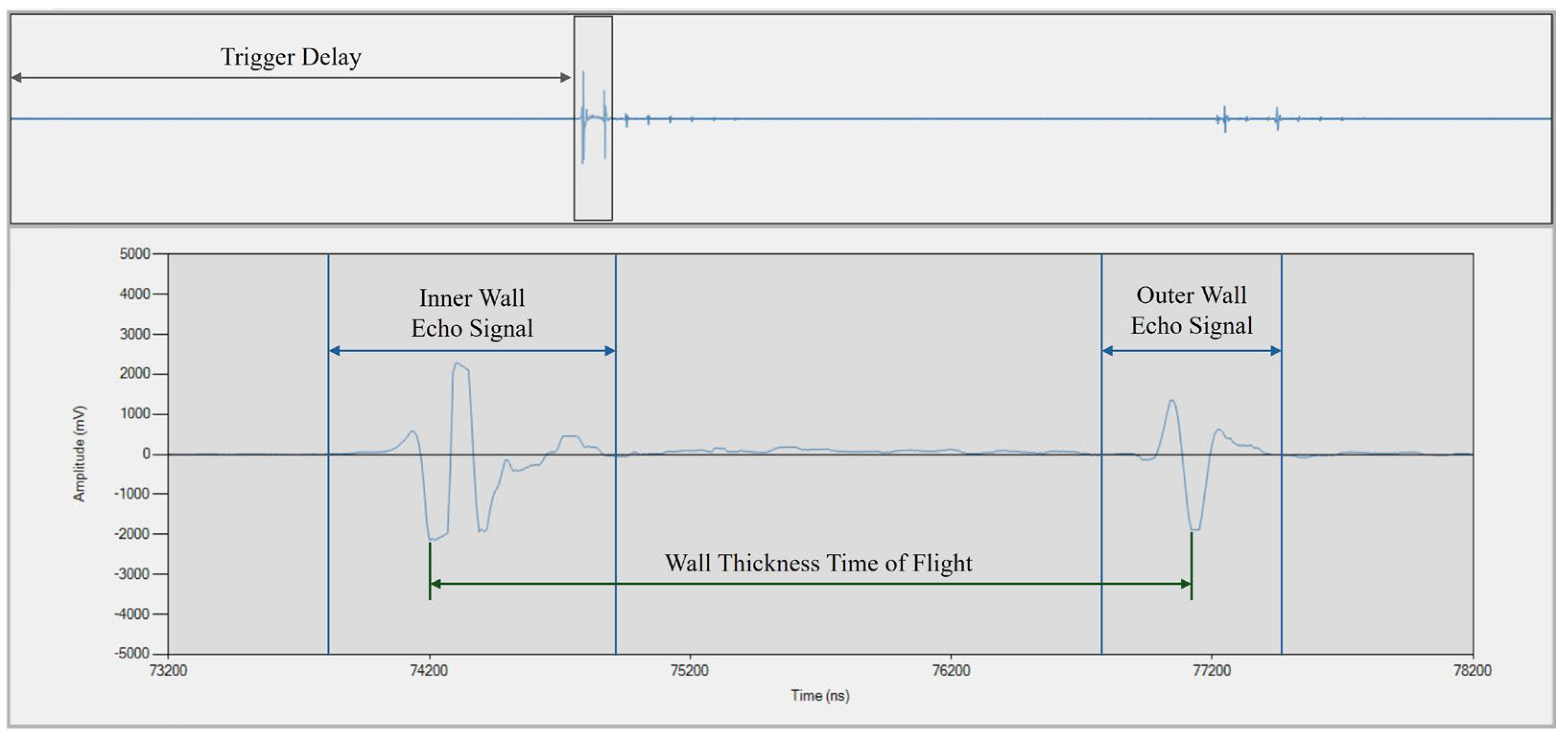
Figure 8 presents the A-scan signal acquired by our developed ultrasonic pulser/receiver and digitizer module. The waveform exhibits a smooth and continuous envelope with minimal quantization noise, confirming the high-fidelity response of the 14-bit ADC. The sampling rate of 100 MHz, corresponding to 20 samples per cycle for the 5 MHz transducer, provides sufficient resolution to capture the detailed ultrasonic waveforms. The initial portion of the signal represents the trigger delay, followed by two distinct reflection peaks corresponding to the inner and outer surfaces of the pipe specimen. The clear separation and smooth amplitude transitions between the echoes enable precise measurement of the time-of-flight (TOF), which is used to determine wall thickness and detect potential surface-breaking defects. To provide a quantitative assessment of signal quality, the measured peak-to-noise ratio (PNR) of the acquired A-scan is 40.86 dB, calculated from a peak amplitude of approximately 2331 mV and an average noise amplitude of 21.09 mV. This high PNR value, together with the visibly clean waveform, demonstrates the effectiveness of the pulser/receiver circuit and the digitizer in maintaining signal integrity for high-resolution ultrasonic inspection.

4.2. B-Scan and C-Scan Image Reconstruction

As shown in Figure 9a, a section of the pipeline containing all eight defects was selected to reconstruct the B-scan image. Peak detection is applied to each A-scan within two predefined temporal gates to locate the front-wall and back-wall echoes. The time difference between these two detected peaks corresponds to the local TOF through the pipe wall. Using Equation (1), the TOF values are converted into spatial positions, allowing the relative locations of the inner and outer surfaces to be reconstructed in length units. In the resulting B-scan image (Figure 9b), the black region represents the material wall area, while the white region corresponds to the surrounding medium. The wavy profiles of the inner and outer walls arise from the non-concentric alignment between the pipeline and the rotating transducer. This phenomenon is normal during pipeline inspection, and the geometric offset does not affect wall-thickness measurements. Along the outer surface, each defect appears as a localized discontinuity in the wall-thickness profile, reflecting regions of reduced ultrasonic TOF caused by the machined notches. The increased white invasion within the black material region indicates greater defect depth. These results demonstrate the system’s capability to resolve all eight defects with distinct spatial separation and depth contrast, confirming accurate synchronization between scanning position and data acquisition. Figure 9c shows the top view of the pipeline cross-section with the eight defects, while Figure 9d presents the surface-aligned cylindrical B-scan image reconstructed from the original B-scan. The appearance of eight white pockets within the black wall region closely matches the cross-sectional geometry of the pipeline, confirming the fidelity of the reconstruction.
Equation (1) was used to calculate the wall thickness (WT) from the TOF. The ultrasonic wave velocity is influenced by temperature variations in the pipeline wall; therefore, knowing the material temperature at the time of inspection is essential for accurate TOF-based thickness estimation. In this work, the ultrasound velocity in carbon steel was set to 5900 m/s at 20 °C. Quantitative evaluation of the wall thickness data, summarized in Table 3, shows excellent agreement between the actual and measured defect depths, with all errors confined within ±2.5%. The smallest defect (DF1, 1.0 mm) exhibited a slight overestimation of 1.3%, while the largest defect (DF8, 4.5 mm) showed negligible deviation (0.04%). The linear relationship between actual and measured depths further validates the reliability of the ultrasonic reconstruction algorithm and the precision of TOF estimation. Minor discrepancies are attributed to the relationship between the sampling rate and the transducer frequency; a higher sampling rate-to-frequency ratio improves the temporal resolution of the digitized waveform, thereby enhancing peak-detection accuracy and enabling more precise wall-thickness calculations. Overall, the B-scan and quantitative results confirm that the developed system provides accurate and repeatable wall-thickness measurements with sub-millimeter precision, making it well-suited for detecting and sizing small surface-breaking defects in small-diameter pipelines.
W T = V × T O F 2
where W T is the pipeline wall thickness, V is the ultrasonic velocity in steel, and T O F is the measured time between the front-wall and back-wall echoes.
We scan the pipeline with a length of 150 mm, as shown in Figure 10a, and obtain the reconstructed C-scan images of this region (Figure 10b). The mapping reveals the wall thickness distribution of the pipeline according to the rainbow revert color channel. At the normal wall position, the blue color represents the non-defect area with a thickness of 8.18 mm. Meanwhile, the circumferential distribution of artificial defects (DF1–DF8) in the C-scan images is aligned with their actual geometric positions. The color-coded thickness map highlights progressive depth variations across the defects, consistent with the designed notch dimensions. During the experiment, the pipeline was manually moved inside the water tank; therefore, its absolute length was not measured or compared with the actual value. Instead, we focused on the relative length of each defect with respect to the total scanned region. The cross-sectional reconstruction accurately delineates the inner and outer pipe walls, confirming that the developed system can effectively perform three-dimensional defect imaging and quantitative wall-thickness assessment for the 200 mm pipeline inspection.
With a sampling rate of 100 MHz, the time resolution of the measurement system is 10 ns, corresponding to an absolute one-way depth resolution of approximately 0.03 mm in steel, calculated as Δ d   =   v × Δ t / 2 , where v     5900   m / s is the longitudinal wave speed. This absolute uncertainty is independent of the actual wall thickness and represents the inherent acquisition-limited error due solely to the sampling interval. The relative error decreases for thicker walls, for instance, an 8.18 mm wall exhibits a percentage uncertainty of only 0.37%. Increasing the ratio between the sampling rate and the transducer center frequency improves measurement accuracy by reducing this acquisition uncertainty. This error accounts only for the limitations of the data acquisition system, excluding other sources such as transducer bandwidth, material inhomogeneity, or signal processing effects.

5. Conclusions and Future Work

In this study, a compact data acquisition system was successfully developed and demonstrated for immersion ultrasonic inspection of small-diameter pipelines. The system integrates a customized pulser/receiver module, a 14-bit, 100 MS/s FPGA-based digitizer (Eclipse Z7 + Zmod Scope 1410-105), and a Raspberry Pi 5 for embedded control and local data storage. The dual-core architecture of the FPGA enables parallelized signal acquisition and communication, ensuring efficient, synchronized data flow between modules. Experimental validation using a 200 mm-diameter steel pipeline with eight artificial defects confirmed the system’s capability to acquire high-quality ultrasonic signals with smooth waveforms, high signal-to-noise ratio, and precise TOF estimation. The reconstructed A-, B-, and C-scan images accurately visualized the spatial distribution and depth of all defects using the customized GUI, with measurement errors maintained within ±2.5%. These results verify the system’s ability to achieve sub-millimeter wall-thickness precision and reliable defect quantification even under non-ideal alignment conditions. The proposed design thus provides a scalable solution for small-diameter pipeline inspection, combining compact hardware, robust data handling, and high-resolution ultrasonic imaging. Future work will involve implementing a fully water-driven PIG propulsion system to enable automated and constant-velocity inspection. A linear encoder will be attached to measure the relative distance during PIG inspection inside the pipeline.

Author Contributions

Conceptualization, V.H.M.D. and D.D.V.; methodology, V.H.M.D. and D.D.V.; software, V.H.M.D. and D.D.V.; validation, T.M.K.N. and L.H.T.; formal analysis, T.D.L., L.K.P., L.T.A.V., T.P.N. and H.G.L.; investigation, J.C.; resources, S.M. and J.O.; data curation, V.H.M.D.; writing—original draft preparation, V.H.M.D., T.M.K.N., L.H.T. and S.M.; writing—review and editing, V.H.M.D. and T.M.K.N., L.H.T. and S.M.; visualization, V.H.M.D. and T.M.K.N.; supervision, S.M. and J.O.; project administration, J.C.; funding acquisition, S.M. and J.O. All authors have read and agreed to the published version of the manuscript.

Funding

This research was funded by the National Research Foundation of Korea (NRF) grant funded by the Korean government (MSIT) (No. 2022R1A5A8023404). This research was also supported by the Global Joint Research Program funded by Pukyong National University (202412240001).

Institutional Review Board Statement

Not applicable.

Informed Consent Statement

Not applicable.

Data Availability Statement

The original contributions presented in this study are included in the article. Further inquiries can be directed to the corresponding authors.

Conflicts of Interest

Author Junghwan Oh was employed by the company Ohlabs Corp. The remaining authors declare that the research was conducted in the absence of any commercial or financial relationships that could be construed as a potential conflict of interest.

References

  1. Strogen, B.; Bell, K.; Breunig, H.; Zilberman, D. Environmental, public health, and safety assessment of fuel pipelines and other freight transportation modes. Appl. Energy 2016, 171, 266–276. [Google Scholar] [CrossRef]
  2. Pootakham, T.; Kumar, A. A comparison of pipeline versus truck transport of bio-oil. Bioresour. Technol. 2010, 101, 414–421. [Google Scholar] [CrossRef] [PubMed]
  3. Clay, K.; Jha, A.; Muller, N.; Walsh, R. External costs of transporting petroleum products: Evidence from shipments of crude oil from North Dakota by pipelines and rail. Energy J. 2019, 40, 55–72. [Google Scholar] [CrossRef]
  4. Song, H.; Yang, L.; Liu, G.; Tian, G.; Ona, D.; Song, Y.; Li, S. Comparative analysis of in-line inspection equipments and technologies. Conf. Ser. Mater. Sci. Eng. 2018, 382, 032021. [Google Scholar] [CrossRef]
  5. Trench, C.J.; Kiefner, J.F. Oil pipeline characteristics and risk factors: Illustrations from the decade of construction. Am. Pet. Inst. 2001, 2–6. Available online: https://www.api.org/-/media/files/oil-and-natural-gas/ppts/other-files/decadefinal.pdf (accessed on 28 November 2025).
  6. Guan, L.; Gao, Y.; Liu, H.; An, W.; Noureldin, A. A Review on Small-Diameter Pipeline Inspection Gauge Localization Techniques: Problems, Methods and Challenges. In Proceedings of the 2019 International Conference on Communications, Signal Processing, and Their Applications (ICCSPA), Sharjah, United Arab Emirates, 19–21 March 2019; pp. 1–6. [Google Scholar]
  7. Zhang, J.; Qin, L.; Sun, M.; Lin, D.; Liu, C.; Zhou, Z. Influence of excitation parameters on the magnetization of MFL ILI tools for small-diameter pipelines. Magn. Mater. 2025, 616, 172780. [Google Scholar] [CrossRef]
  8. Wasim, M.; Djukic, M.B.J. External corrosion of oil and gas pipelines: A review of failure mechanisms and predictive preventions. J. Nat. Gas Sci. Eng. 2022, 100, 104467. [Google Scholar] [CrossRef]
  9. Li, Q.; Zhang, L.; Wang, J.; Liang, Q.; Wei, D.; Liu, X.; Wang, T. Applicability evaluation technology for steel small diameter pipes containing external surface corrosion defects. Sci. Rep. 2024, 14, 25803. [Google Scholar] [CrossRef]
  10. Cao, J.; Ma, W.; Pang, G.; Wang, K.; Ren, J.; Nie, H.; Dang, W.; Yao, T. Failure analysis on girth weld cracking of underground tee pipe. Int. J. Press. Vessel. Pip. 2021, 191, 104371. [Google Scholar] [CrossRef]
  11. Mohtadi-Bonab, M.J.M. Effects of different parameters on initiation and propagation of stress corrosion cracks in pipeline steels: A review. Metals 2019, 9, 590. [Google Scholar] [CrossRef]
  12. Li, X.; Lv, W.; Li, M.; Zhang, K.; Xu, Z.; Yuan, J.; Liu, T.; Wang, S.; Fu, A.; Feng, Y. Sulfide stress corrosion cracking in L360QS pipelines: A comprehensive failure analysis and implications for natural gas transportation safety. Int. J. Press. Vessel. Pip. 2024, 212, 105324. [Google Scholar] [CrossRef]
  13. Yin, Y.; Yang, X.; Cui, L.; Wang, F.; Li, S. Material flow influence on the weld formation and mechanical performance in underwater friction taper plug welds for pipeline steel. Mater. Des. 2015, 88, 990–998. [Google Scholar] [CrossRef]
  14. Feng, Q.; Li, R.; Nie, B.; Liu, S.; Zhao, L.; Zhang, H. Literature review: Theory and application of in-line inspection technologies for oil and gas pipeline girth weld defection. Sensors 2016, 17, 50. [Google Scholar] [CrossRef]
  15. Xu, L.; Shi, S.; Yan, F.; Huang, Y.; Bao, Y. Experimental study on combined effect of mechanical loads and corrosion using tube-packaged long-gauge fiber Bragg grating sensors. Struct. Health Monit. 2023, 22, 3985–4004. [Google Scholar] [CrossRef]
  16. Sharma, V.B.; Tewari, S.; Biswas, S.; Sharma, A. A comprehensive study of techniques utilized for structural health monitoring of oil and gas pipelines. Struct. Health Monit. 2024, 23, 1816–1841. [Google Scholar] [CrossRef]
  17. Spandonidis, C.; Theodoropoulos, P.; Giannopoulos, F.; Galiatsatos, N.; Petsa, A. Evaluation of deep learning approaches for oil & gas pipeline leak detection using wireless sensor networks. Eng. Appl. Artif. Intell. 2022, 113, 104890. [Google Scholar] [CrossRef]
  18. Shatnawi, M.; Földesi, P. A New Extensible Feature Matching Model for Corrosion Defects Based on Consecutive In-Line Inspections and Data Clustering. Appl. Sci. 2025, 15, 2943. [Google Scholar] [CrossRef]
  19. Nguyen, H.-H.; Park, J.-H.; Kim, J.-J.; Yoo, K.; Kim, D.-K.; Jeong, H.-Y. Robust and Unbiased Estimation of Robot Pose and Pipe Diameter for Natural Gas Pipeline Inspection Using 3D Time-of-Flight (ToF) Sensors. Appl. Sci. 2025, 15, 2105. [Google Scholar] [CrossRef]
  20. Ma, Q.; Tian, G.; Zeng, Y.; Li, R.; Song, H.; Wang, Z.; Gao, B.; Zeng, K. Pipeline in-line inspection method, instrumentation and data management. Sensors 2021, 21, 3862. [Google Scholar] [CrossRef]
  21. Zhang, H.; Gao, M.-Q.; Tang, B.; Cui, C.; Xu, X.-F. Dynamic characteristics of the pipeline inspection gauge under girth weld excitation in submarine pipeline. Pet. Sci. 2022, 19, 774–788. [Google Scholar] [CrossRef]
  22. Tan Tien, N.; Hui Ryong, Y.; Yong Woo, R.; Sang Bong, K. Speed control of PIG using bypass flow in natural gas pipeline. In Proceedings of the 2001 IEEE International Symposium on Industrial Electronics (ISIE 2001) (Cat. No.01TH8570), Busan, Republic of Korea, 12–16 June 2001; Volume 862, pp. 863–868. [Google Scholar]
  23. Nguyen, T.T.; Kim, S.B.; Yoo, H.R.; Rho, Y.W. Modeling and simulation for PIG flow control in natural gas Pipeline. KSME Int. J. 2001, 15, 1165–1173. [Google Scholar] [CrossRef]
  24. Tan Tien, N.; Dong Kyu, K.; Yong Woo, R.; Sang Bong, K. Dynamic modeling and its analysis for PIG flow through curved section in natural gas pipeline. In Proceedings of the 2001 IEEE International Symposium on Computational Intelligence in Robotics and Automation (Cat. No.01EX515), Banff, AB, Canada, 29 July–1 August 2001; pp. 492–497. [Google Scholar]
  25. Bernasconi, G.; Giunta, G. Acoustic detection and tracking of a pipeline inspection gauge. J. Pet. Sci. Eng. 2020, 194, 107549. [Google Scholar] [CrossRef]
  26. Ho, M.; El-Borgi, S.; Patil, D.; Song, G. Inspection and monitoring systems subsea pipelines: A review paper. Struct. Health Monit. 2020, 19, 606–645. [Google Scholar] [CrossRef]
  27. Vanaei, H.; Eslami, A.; Egbewande, A. A review on pipeline corrosion, in-line inspection (ILI), and corrosion growth rate models. Int. J. Press. Vessel. Pip. 2017, 149, 43–54. [Google Scholar] [CrossRef]
  28. Parlak, B.O.; Yavasoglu, H.A. A comprehensive analysis of in-line inspection tools and technologies for steel oil and gas pipelines. Sustainability 2023, 15, 2783. [Google Scholar] [CrossRef]
  29. Xie, M.; Tian, Z. A review on pipeline integrity management utilizing in-line inspection data. Eng. Fail. Anal. 2018, 92, 222–239. [Google Scholar] [CrossRef]
  30. Zhang, J.; Wen, M.; Lin, D.; Gao, J.; Qin, L.; Liu, C.; Xu, X.; Lian, Z. Failure analysis of local effusion corrosion in small diameter gas pipeline: Experiment and numerical. Eng. Fail. Anal. 2024, 161, 108300. [Google Scholar] [CrossRef]
  31. Reber, K.; Beller, M.; Willems, H.; Barbian, O. A new generation of ultrasonic in-line inspection tools for detecting, sizing and locating metal loss and cracks in transmission pipelines. In Proceedings of the 2002 IEEE Ultrasonics Symposium, Munich, Germany, 8–11 October 2002; pp. 665–671. [Google Scholar]
  32. Birchall, M.; Sevciuc, N.; Madureira, C. Internal ultrasonic pipe & tube inspection–IRIS. In Proceedings of the IV Conferencia panamericana de END, Buenos Aires, Argentina, 22–26 October 2007. [Google Scholar]
  33. Kumar, N.P.; Tarpara, E.G.; Patankar, V. Experimentation for sag and dimension measurement of thin-walled tubes and pipes using multi-channel ultrasonic imaging system. J. Nondestruct. Evaluation 2021, 40, 2. [Google Scholar] [CrossRef]
  34. Kumar, N.P.; Patankar, V. Battery-powered FPGA-based embedded system for ultrasonic pipe inspection and gauging systems. Rev. Sci. Instrum. 2023, 94, 034712. [Google Scholar] [CrossRef]
  35. Kumar, N.P.; Patankar, V. Zynq SoC FPGA-based water-immersible ultrasonic instrumentation for pipe inspection and gauging. Eng. Res. Express 2024, 6, 015313. [Google Scholar] [CrossRef]
  36. Bui, N.T.; Nguyen, T.M.T.; Dinh, T.T.N.; Bui, Q.C.; Vo, T.H.; Phan, D.T.; Park, S.; Choi, J.; Kang, Y.-H.; Kim, B.-G.; et al. Design of a Multichannel Pulser/Receiver and Optimized Damping Resistor for High-Frequency Transducer Applied to SAM System. Appl. Sci. 2020, 10, 8388. [Google Scholar] [CrossRef]
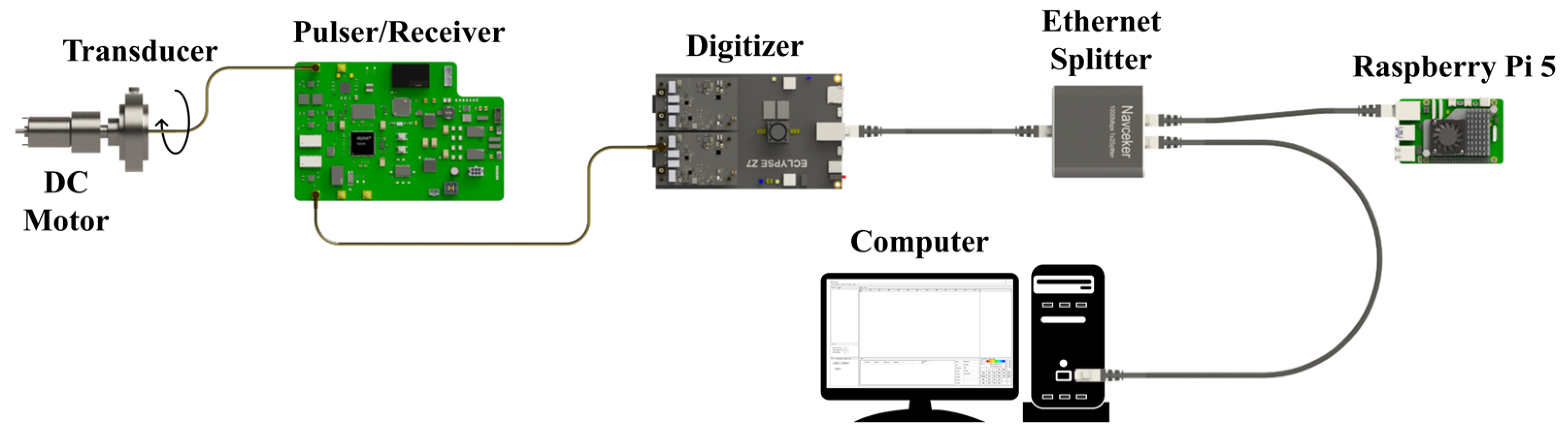
Figure 1. System block diagram.
Applsci 15 12817 g001
Figure 2. Pulser receiver block diagram.
Applsci 15 12817 g002
Figure 3. Digitizer block diagram.
Applsci 15 12817 g003
Figure 4. Graphical user interface.
Applsci 15 12817 g004
Figure 5. System data flow.
Applsci 15 12817 g005
Figure 6. (a) The sample design; (b) The real sample with defects.
Applsci 15 12817 g006
Figure 7. (a) Proposed system design; (b) Experimental setup; (c) System during pipeline inspection.
Applsci 15 12817 g007
Figure 8. A-scan signal.
Applsci 15 12817 g008
Figure 9. (a) Cross-section to show B-scan image in the sample; (b) B-scan image reconstruction; (c) Top view of the cross-section to show B-scan image in the sample; (d) Aligned B-scan image reconstruction.
Applsci 15 12817 g009
Figure 10. (a) Scanning region in the sample (b) C-scan image reconstruction.
Applsci 15 12817 g010
Table 1. Technical specifications of pulser/receiver and digitizer.
PulserChannel1
Voltage90 V (fixed)
Pulse width5–50 ns (5 ns/step)
Rise time2 ns
ReceiverBandwidth30 MHz
Gain53 dB maximum
Low-pass filter36 MHz
DigitizerResolution14 bits
Sample rate100 MHz
Record length512 (at 4.5 kHz)
Trigger delay50 us (at 4.5 kHz)
Data TransferSpeed4500 14-bit A-scans per second
Table 2. Summary of controllers/processors and their system responsibilities.
Module/ProcessorPrimary FunctionsProgramming Responsibilities
STM32 MicrocontrollerControls trigger pulser and timing.Firmware development for pulse width control, trigger synchronization, and GPIO timing signals.
FPGA—Programmable Logic (PL)High-speed ADC data capture; deserialization; buffering; hardware-level synchronization.HDL/Vivado design for ADC interfacing, FIFO management, trigger alignment, and high-speed parallel processing.
FPGA—Processing System (PS)TCP/IP master; data packetization; dual-core task splitting (Core 1: acquisition handling, Core 2: network communication).C applications for TCP/IP communication, buffer control, and PS–PL interfacing.
Raspberry Pi 5TCP/IP slave, long-duration data logging to SSD.C applications for socket communication, storage management.
Host PCReal-time visualization of A/B/C-scan; parameter configuration; pre-inspection calibration, and the data post-processing.GUI software (C#) for data rendering, peak detection, and configuration interface.
Table 3. Comparison between actual and measured depth values of defects.
DefectsActual Depth (mm)Measured Depth (mm)Error (%)
DF111.011.30
DF21.51.481.53
DF321.971.40
DF42.52.531.20
DF533.020.53
DF63.53.582.29
DF744.040.95
DF84.54.490.04
Disclaimer/Publisher’s Note: The statements, opinions and data contained in all publications are solely those of the individual author(s) and contributor(s) and not of MDPI and/or the editor(s). MDPI and/or the editor(s) disclaim responsibility for any injury to people or property resulting from any ideas, methods, instructions or products referred to in the content.