Communication

New Molecular Materials for Direct Air Capture of Carbon Dioxide Using Electro-Swing Chemistry

1
Department of Chemistry, University of Colorado Boulder, Boulder, CO 80309, USA
2
Renewable and Sustainable Energy Institute & Department of Chemistry, University of Colorado Boulder, Boulder, CO 80309, USA
*
Author to whom correspondence should be addressed.
Appl. Sci. 2025, 15(23), 12739; https://doi.org/10.3390/app152312739 (registering DOI)
Submission received: 15 October 2025 / Revised: 19 November 2025 / Accepted: 25 November 2025 / Published: 2 December 2025
(This article belongs to the Section Environmental Sciences)

Featured Application

Capture of carbon dioxide directly from the atmosphere using electricity-driven processes.

Abstract

The increasing amount of carbon dioxide (CO2) in the atmosphere is the main factor contributing to climate change. Recent studies have determined that simply reducing emissions is insufficient to restore the Earth’s atmospheric system—negative emissions are therefore necessary. Current carbon (i.e., CO2) capture technologies use thermal or pressure swings. These approaches suffer from low energy efficiency, high cost, and geographic constraints. Electro-swing chemistry-based carbon capture has emerged as a promising potential solution to these challenges. However, strong CO2-binding sorbents, not susceptible to oxygen interference, remain elusive. In this study, three electron-deficient quinones were designed and tested as CO2 capture molecular sorbents. Cyclic voltammetry (CV) on these novel quinones reveals that 2,3-dicyano-1,4-benzoquinone (DBQ) has a second reduction potential positive of that of oxygen reduction. Moreover, this sorbent binds to CO2 with a free energy ΔGbind of −5.39 kcal/mol when activated by electrochemical reduction. These results suggest that DBQ may be a sorbent candidate that can capture >70% of CO2 in the current atmosphere using electro-swing chemistry without the interference of oxygen in the air. This novel sorbent can be further developed for large-scale carbon capture and combating global warming and its associated impacts.

1. Introduction

From the pre-industrial era to modern-day, atmospheric carbon dioxide (CO2) concentrations have increased by 50%, from 280 ppm to 420 ppm, and climate scientists predict further increases over the next two decades [1,2]. Climate change leads to severe weather events, disruptions of human life, and threats to fragile ecosystems [3,4,5]. To mitigate these consequences, 196 parties signed the Paris Agreement in 2015, establishing a goal to limit the global temperature rise to no more than 2 °C above pre-industrial levels. However, recent studies suggested that a 1.5 °C rise represents a critical threshold before the impacts of climate change become progressively severe. It was determined earlier this year that simply reducing emissions is insufficient to restore Earth’s atmospheric systems—negative emissions are now necessary [6,7,8].
The current carbon capture, utilization, and storage (CCUS) industry typically uses a temperature and/or pressure swing (Figure 1a) to achieve CO2’s capture and release. Within these systems, amine-based sorbents [9] or strong base sorbents [10,11] can capture CO2 at high pressure or low temperature, then release the CO2 under reduced pressure or high temperature. In addition, sorbents are often deployed near concentrated emission sources, since high concentrations of CO2 are needed for them to work; the use of thermo/pressure swings consumes large amounts of energy, so these processes are considered “energy intensive”. Hence, these types of sorbents are not suitable for direct air capture (DAC), and different chemistries must be considered to address the capture of CO2 from the air [12,13].
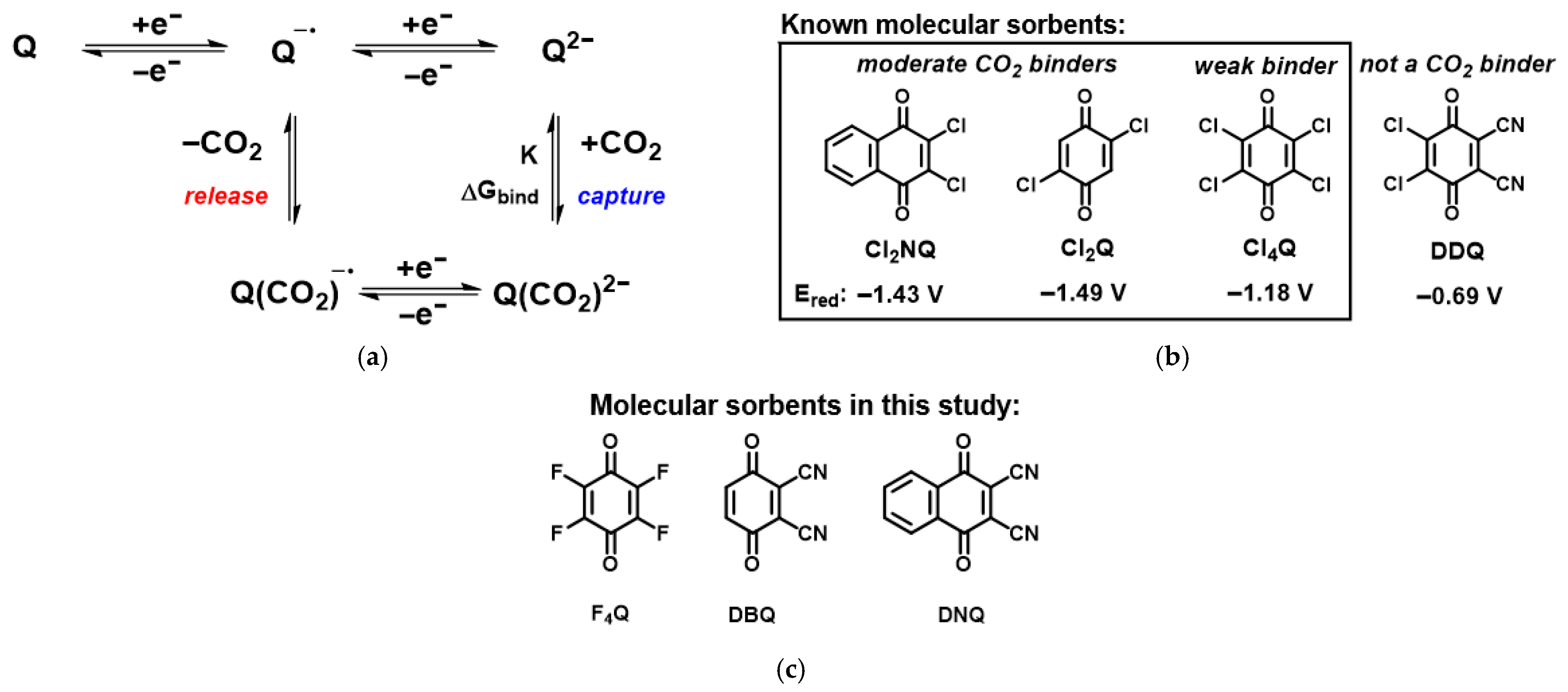
Learning from the ideas surrounding industrial electrification, in which traditional energy-intensive processes are powered by renewable (solar, wind, and hydro) energy, new systems based on electricity-driven chemical reactions allow us to tune the energetics of the process using molecular design. Recent reports showed that an electro-swing process (Figure 1b) using organic molecules (e.g., quinones and isoindigos) can capture and release CO2 in a highly energy-efficient manner [14,15,16,17]. For example, quinone sorbents (Figure 2a) can capture CO2 when reduced and release it when oxidized. However, strong sorbents for capturing low concentrations of CO2 from the air using electrochemistry without the interference of O2 (E1/2 ≈ −1.2 V) remain elusive, preventing the scaleup of this technology. Our previous studies estimated that, if the goal is to remove a fraction of atmospheric CO2 (since air is plentiful) rather than all of it, sorbents with binding energies as low as −4.70 kcal/mol can be used [18,19]. This threshold value allows us to identify novel molecules that bind CO2 from a fundamental physical organic chemistry perspective. Herein, we report the design of a novel, potentially oxygen-stable quinone sorbent that may be suitable for DAC of CO2 using electro-swing chemistry.

2. Molecular Design of New Materials

Our recent studies on seven quinones showed that there is a linear correlation between the second reductive potential of the quinones and their free energy of binding to CO2 [20]. This observation provides a predictive estimation of free energies of CO2 binding. In addition, the second reduction potential is dependent on the electronic property of the substitutions on the quinone (Figure 2b). To overcome the oxygen interference problem for aerobic operation, we decided to continue to investigate additional quinones and identified three quinones with well-defined structures (Figure 2c) based on the previously acquired knowledge on their structure-function relationship [20]. This study is an extension of the findings of [20]. 2,3,5,6-Tetrafluoro-1,4-benzoquinone (F4Q) was selected due to the increased electronegativity of F compared to Cl, possibly leading to a positive shift in the second reduction potential of 2,3,5,6-tetrachloro-1,4-benzoquinone (Cl4Q). 2,3-Dicyano-1,4-benzoquinone (DBQ) and 2,3-dicyano-1,4-naphthoquinone (DNQ) possess two fewer electron-withdrawing groups (i.e., Cl) compared to 2,3-dichloro-5,6-dicyano-1,4-benzoquinone (DDQ), and they have more electron-withdrawing groups (i.e., CN) than 2,3-dichloro-1,4-benzoquinone (Cl2Q) and 2,3-dichloro-1,4-naphthoquinone (Cl2NQ) (i.e., Cl). Therefore, it is anticipated that the second reduction potentials of DBQ and DNQ are between those of Cl2Q or Cl2NQ and DDQ (Figure 2).

3. Materials and Methods

3.1. Synthesis of DNQ and DBQ

These two quinones were synthesized by following Klein’s procedure with minor modifications, as shown in Figure 3 [21]. To characterize the synthetic materials, we determined their melting points using a DigiMelt micromelting-point apparatus (Stanford Research Systems, Sunnyvale, CA, USA). 1H NMR (300 MHz) and 13C NMR (75 MHz) spectra were recorded on a Bruker AV-300 spectrometer (Billerica, MA, USA) with tetramethylsilane (TMS) as an internal standard. The chemical shifts (δ) are given in parts per million (ppm), and the coupling constants (J) are in hertz (Hz). IR spectra were recorded using an Agilent Cary 630 FTIR Spectrometer (Santa Clara, CA, USA). Unless otherwise noted, all reagents, including F4Q, were obtained from commercial suppliers and were used without further purification. Organic solvents used were dried by standard methods when necessary. All reactions were monitored by thin-layer chromatography (TLC) with GF254 silica gel plates.
2,3-Dicyano-1,4-naphthoquinone (DNQ) [21]: 2,3-Dicyanonaphthalene-1,4-diol (700 mg, 3.33 mmol) was suspended in acetic acid (10 mL) and heated to 100 °C. While heating, 30% nitric acid (1.5 mL) was added. Addition of ice to the cold solution and collection of the precipitate afforded the desired product (416 mg, 2.00 mmol, 60%) as a yellow solid.
2,3-Dicyanobenzoquinone (DBQ) [22,23]: 2,3-Dicyanohydroquinone (160 mg, 1.0 mmol) was suspended in acetic acid (2.5 mL) and heated to 100 °C. While heating, 30% nitric acid (0.38 mL) was added. The reaction mixture was cooled by the addition of ice and extracted with CH2Cl2. The combined organic layers were washed with brine, dried over Na2SO4, filtered, and concentrated under vacuum to afford the desired product (40 mg, 0.25 mmol, 25%) as a yellowish-brown solid.

3.2. Cyclic Voltammetry (CV) Measurements [20]

The experiments were performed according to our previously developed procedure in [20]. The details were described in Supplementary Information. In brief, solutions of 1 mM analytes were assayed in 0.1 M NBu4PF6 in acetonitrile at glassy carbon (GC) working electrodes, platinum counter electrodes with a single junction Ag reference electrode referenced externally vs. Fc/Fc+. For carbon capture assays, CV data were collected under argon (Ar), 5% CO2 in Ar, 30% CO2 in Ar, and 100% CO2 with the sparging hose connected to each tank in succession, sparging between runs. The CV data for each quinone under various atmospheric conditions were imported to OriginPro 2025 (Origin Lab) for visualization and analysis and collected in triplicate.

3.3. Data Analysis

To estimate the CO2 binding equilibrium constant (K) of each activated quinone, we adapted our previously developed procedure [20]. In brief, atmospheric pressure at the time of data collection was determined from the National Center for Atmospheric Research (NCAR) Foothills Lab Weather Archive [24]. When necessary, corrections from sea-level values were removed to obtain the true pressure (Boulder’s elevation is 1655 m; 5.35 in Hg was used as the standard subtraction). Next, the temperature of the system was measured, and the vapor pressures of the solutions made according to the procedure were subtracted from the total headspace pressure. The CO2 molar concentrations were calculated by subtracting the vapor pressure of acetonitrile at this temperature from the atmospheric pressure, followed by applying the fraction/percentage of CO2. For each quinone, the E2,red, and E2,ox were extracted from the CV graph under the specific atmosphere. The E1/2 value was calculated as the average of E2,red, and E2,ox. The shift of E1/2 (∆E1/2) under each CO2 atmosphere condition was calculated as its E2,1/2 minus the E2,1/2 under argon atmosphere. A plot of ∆E1/2 vs. [CO2] was then generated using OriginPro 2025 (Origin Lab) and subsequently fitting the curve to Equation (1)
∆E1/2 = (RT/F)ln(K[CO2]n + 1),
where R is the ideal gas constant 8.314 J·mol−1·K−1, T is the temperature in K, and F is the Faraday constant. The fitting derived the CO2 binding equilibrium constant, K and the number of CO2 molecules (n) that are captured by the activated sorbent. The CO2 binding free energy (ΔGbind) for each quinone was calculated using Equation (2)
ΔGbind = −RTln(K).

4. Results and Discussion

4.1. Preparation of Three Designed Quinones

Among the three quinones, DNQ was synthesized by following Klein’s procedure as shown in Figure 3 [21]. In brief, commercially available 2,3-dicyanonaphthalene-1,4-diol was oxidized by nitric acid in acetic acid at 100 °C. After cooling the reaction to 0 °C, DNQ precipitated and was collected by filtration and dried under high vacuum overnight at room temperature. It was characterized by melting point, IR, 1H, and 13C NMR analysis, which match the reported data in the literature. DBQ was synthesized in a similar fashion to DNQ, but it was extracted with dichloromethane after the reaction. Synthetic DBQ was also characterized, and the analytical data matches reported results. The third quinone in the series, F4Q, was commercially available and used without any purification.

4.2. Cyclic Voltammetry Studies of Three Designed Quinones

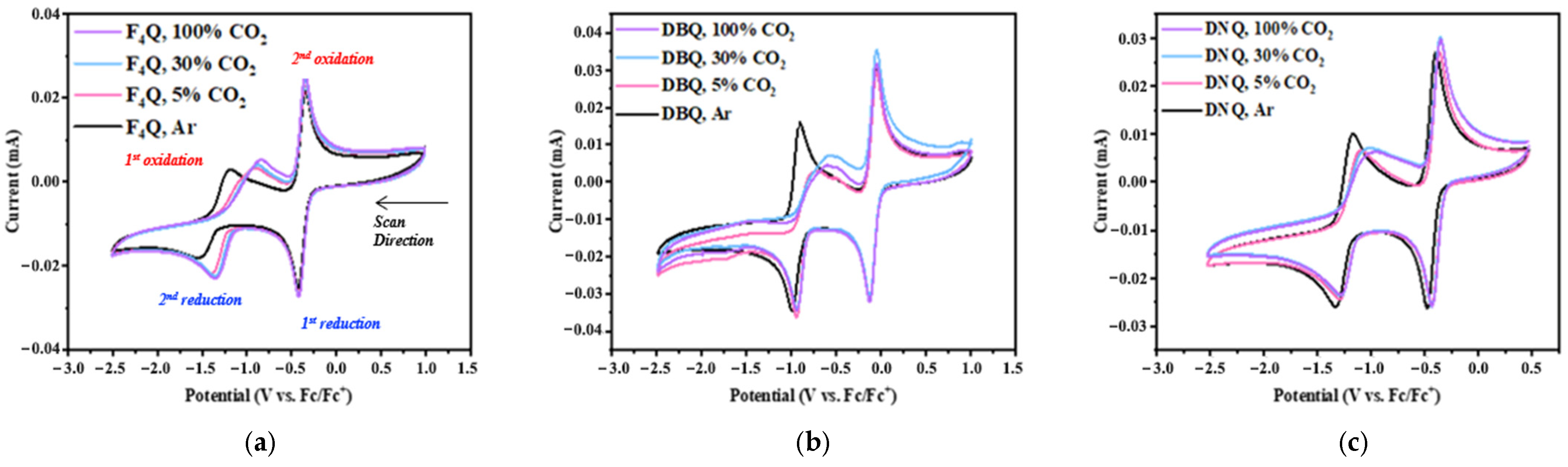
With the quinones in hand, we analyzed their electrochemical properties and CO2 capture ability using our previously developed procedure. For each quinone, the cyclic voltammetry study was first performed from 1.0 to −2.5 V under an argon atmosphere using Potentiastat (BioLogic SP150, Seyssinet-Pariset, France). The CV plots (Figure 4) under Ar showed that, among three novel quinones that we designed, DBQ has the desired second reduction potential (−0.934 V), which is more positive than that of oxygen (c.a., −1.20 V). The second reduction potential of F4Q was more negative (i.e., −1.250 V), which could be attributed to the electron-donating effect through conjugation of fluorine on the benzoquinone scaffold. Compared to DBQ, DNQ has a more negative second reduction potential (−1.366 V), likely due to its extended conjugation that stabilizes the radical anion intermediate and therefore decreases the second reduction potential.
Next, we estimated the ability of each quinone to capture and release CO2 by performing the CV experiments under atmospheres containing various concentrations of CO2 (i.e., 5%, 30%, and 100% CO2 in argon, Figure 4). As expected, the CV plots of all three quinones showed no changes in the first reduction peaks and significant shifts in the second reduction peaks in the presence of CO2. The second reduction potentials (E2,1/2) of each quinone under various concentrations of CO2 were calculated. The potential shifted positively when CO2 was present in the atmosphere. This suggested rapid and spontaneous binding of CO2 after the second reduction in the quinones, and CO2 was released upon the first oxidation, as described in Figure 2a. The changes in second reduction potential (ΔE1/2) from that under argon atmosphere were then calculated and summarized in Table 1. Their corresponding CO2 molar concentrations were calculated based on CO2 percentages in argon and the vapor pressure of the solvent, acetonitrile, at the experimental pressure and temperature (see details in Supplementary Information).

4.3. Calculation of the Reduction Potentials and CO2 Binding Affinity of Three Quinones

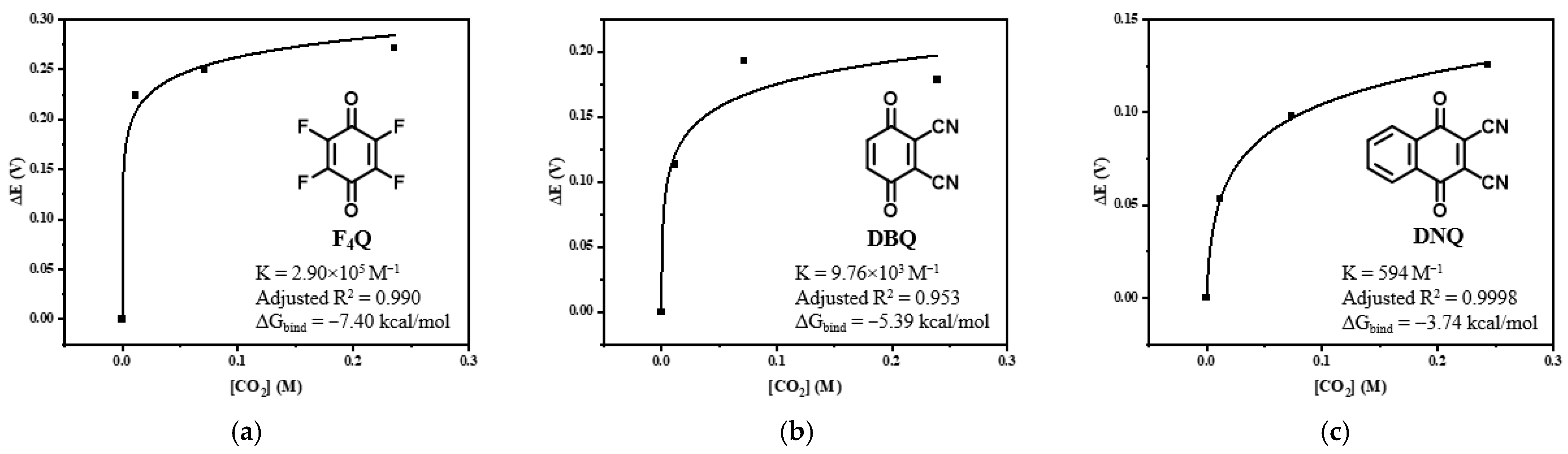
For each quinone, the ΔE1/2 values were plotted against CO2 concentration ([CO2]) in OriginPro (Figure 5). The data were fitted to Equation (1) to estimate the CO2 binding equilibrium constant (K) and the number of CO2 molecules each quinone binds to (n). The results showed that each of the three quinones binds to 1 molecule of CO2, and their binding constants (Ks) vary quite significantly, from 2.90 × 10⁵ M−1 for F4Q to 9.76 × 10³ M−1 for DBQ and 594 M−1 for DNQ. Their CO2 binding free energies (ΔGbind) were also calculated using Equation (2). Both F4Q and DBQ are CO2 binders with ΔGbind values of −7.40 and −5.39 kcal/mol, respectively, while DNQ is a weaker binder with a ΔGbind of −3.74 kcal/mol. Using the K values, we estimate that DBQ and F4Q can capture at least 70% and 98% of CO2, respectively, at low concentrations (i.e., 420 ppm in the current atmosphere) at room temperature [18,25].

4.4. Conclusions

In summary, three structurally well-defined quinones (i.e., F4Q, DNQ, and DBQ) were designed as sorbents for DAC of CO2 using electro-swing chemistry. DNQ and DBQ were synthesized according to a previous literature procedure and characterized using standard procedures and assayed using CV. Among these three quinones, DBQ has a desired second reduction potential of −0.935 V, which is more positive than oxygen (−1.2 V), suggesting that it may be activated/reduced for carbon capture at approximately −1.0 V, thereby outside of the oxygen reduction window. In addition, DBQ, upon activation, is a good CO2 binder with an estimated ΔGbind of −5.39 kcal/mol, suggesting that DBQ could capture >70% of CO2 directly from the current atmosphere at room temperature based on thermodynamics alone. However, kinetic measurements and device optimization will be required to test these materials in real DAC scenarios. Given that this electro-swing process requires relatively low electric energy and can be easily coupled with renewable energy, the discovery of novel quinone-based sorbents holds promise for real-world applications in carbon capture, contributing to efforts to combat global warming and its associated impacts.

Supplementary Materials

The following supporting information can be downloaded at: https://www.mdpi.com/article/10.3390/app152312739/s1, analytical data, IR, and NMR spectra of DNQ and DBQ.

Author Contributions

Conceptualization, Z.W., H.J.K. and O.R.L.; methodology, H.J.K. and O.R.L.; validation, H.J.K. and O.R.L.; formal analysis, Z.W. and H.J.K.; investigation, Z.W.; resources, O.R.L.; data curation, Z.W.; writing—original draft preparation, Z.W.; writing—review and editing, H.J.K. and O.R.L.; supervision, H.J.K. and O.R.L.; project administration, O.R.L. All authors have read and agreed to the published version of the manuscript.

Funding

We thank the University of Colorado for generous startup support.

Institutional Review Board Statement

Not applicable.

Informed Consent Statement

Not applicable.

Data Availability Statement

The original contributions presented in this study are included in the article. Further inquiries can be directed to the corresponding author.

Acknowledgments

Z.W. thanks Abby Rawlings (University of Colorado Boulder) for helping with the synthesis processes and Paul Strode (Fairview High School) for his support. We thank Haley Petersen for useful discussions and graphic support.

Conflicts of Interest

The authors declare no conflicts of interest.

Abbreviations

The following abbreviations are used in this manuscript:
ΔGbindCO2 binding free energy
CCUSCarbon capture, utilization, and storage
Cl2NQ2,3-Dichloro-1,4-naphthoquinone
CO2Carbon dioxide
[CO2]Carbon dioxide concentration
Cl2Q2,3-Dichloro-1,4-benzoquinone
Cl4Q2,3,5,6-Tetrachloro-1,4-benzoquinone
CVCyclic voltammetry
DACDirect air capture
DBQ2,3-Dicyano-1,4-benzoquinone
DDQ2,3-Dichloro-5,6-dicyano-1,4-benzoquinone
DNQ2,3-Dicyano-1,4-naphthoquinone
EReduction potential
F4Q2,3,5,6-Tetrafluorobenzoquinone
NCARNational Center for Atmospheric Research
KEquilibrium constant
QQuinone

References

  1. IPCC. Climate Change 2014: Synthesis Report. In Contribution of Working Groups I, II and III to the Fifth Assessment Report of the Intergovernmental Panel on Climate Change; Pachauri, R.K., Meyer, L., Eds.; IPCC: Geneva, Switzerland, 2014. [Google Scholar]
  2. Tans, P.; Keeling, R. Trends in Atmospheric Carbon Dioxide. NOAA Global Monitoring Laboratory. Available online: https://gml.noaa.gov/ccgg/trends/ (accessed on 24 November 2025).
  3. IPCC. Special Report: Global Warming of 1.5 °C; Intergovernmental Panel on Climate Change (IPCC): Geneva, Switzerland, 2018; Volume 677, p. 393. [Google Scholar]
  4. Hsiang, S.; Kopp, R.; Jina, A.; Rising, J.; Delgado, M.; Mohan, S.; Rasmussen, D.J.; Muir-Wood, R.; Wilson, P.; Oppenheimer, M.; et al. Estimating Economic Damage from Climate Change in the United States. Science 2017, 356, 1362–1369. [Google Scholar] [CrossRef] [PubMed]
  5. Solomon, S.; Plattner, G.-K.; Knutti, R.; Friedlingstein, P. Irreversible Climate Change Due to Carbon Dioxide Emissions. Proc. Natl. Acad. Sci. USA 2009, 106, 1704–1709. [Google Scholar] [CrossRef] [PubMed]
  6. Mikkelsen, M.; Jørgensen, M.; Krebs, F.C. The teraton challenge. A Review of Fixation and Transformation of Carbon Dioxide. Energy Environ. Sci. 2010, 3, 43–81. [Google Scholar] [CrossRef]
  7. Page, B.; Stern, L.N.; Oam, J.H. The Global Status of CCS 2020: Vital to Achieve Net Zero. 2020. Available online: http://www.globalccsinstitute.com/wp-content/uploads/2025/10/Global-Status-of-CCS-Report-English.pdf (accessed on 24 November 2025).
  8. Cresko, J.; Elliott, W.; Nimbalkar, S.; Wenning, T.; Zaltash, A.; Quinn, J.L.; Kuehn, S.D.L. US Department of Energy’s Industrial Decarbonization Roadmap. No. DOE/EE-2635. USDOE Office of Energy Efficiency and Renewable Energy (EERE). 2022. Available online: https://www.osti.gov/servlets/purl/1961393 (accessed on 24 November 2025).
  9. Hack, J.; Maeda, N.; Meier, D.M. Review on CO2 Capture Using Amine-Functionalized Materials. ACS Omega 2022, 7, 39520–39530. [Google Scholar] [CrossRef] [PubMed]
  10. Keith, D.W.; Holmes, G.; St. Angelo, D.; Heidel, K. A Process for Capturing CO2 from the Atmosphere. Joule 2018, 2, 1573–1594. [Google Scholar] [CrossRef]
  11. McQueen, N.; Ghoussoub, M.; Mills, J.; Scholten, M. A Scalable Direct Air Capture Process Based on Accelerated Weathering of Calcium Hydroxide. Heirloom Carbon Technol. 2022, 1–9. Available online: https://api.semanticscholar.org/CorpusID:248119333 (accessed on 24 November 2025).
  12. Sanz-Perez, E.S.; Murdock‚, C.R.; Didas, S.A.; Jones, C.W. Direct Capture of CO2 from Ambient Air. Chem. Rev. 2016, 116, 11840–11876. [Google Scholar] [CrossRef] [PubMed]
  13. Beuttler, C.; Charles, L.; Wurzbacher, J. The Role of Direct Air Capture in Mitigation of Anthropogenic Greenhouse Gas Emissions. Front. Clim. 2019, 1, 10. [Google Scholar] [CrossRef]
  14. Voskian, S.; Hatton, T.A. Faradaic Electro-swing Reactive Adsorption for CO2 Capture. Energy Environ. Sci. 2019, 12, 3530–3547. [Google Scholar] [CrossRef]
  15. Barlow, J.M.; Yang, J.Y. Oxygen-Stable Electrochemical CO2 Capture and Concentration with Quinones Using Alcohol Additives. J. Am. Chem. Soc. 2022, 144, 14161–14169. [Google Scholar] [CrossRef]
  16. Massen-Hane, M.; Diederichsen, K.M.; Hatton, T.A. Engineering Redox-active Electrochemically Mediated Carbon Dioxide Capture Systems. Nat. Chem. Eng. 2024, 1, 35–44. [Google Scholar] [CrossRef]
  17. Li, X.; Zhao, X.; Zhang, L.; Mathur, A.; Xu, Y.; Fang, Z.; Gu, L.; Liu, Y.; Liu, Y. Redox-tunable Isoindigos for Electrochemically Mediated Carbon Capture. Nat. Commun. 2024, 15, 1175. [Google Scholar] [CrossRef] [PubMed]
  18. Petersen, H.A.; Luca, O.R. Application-Specific Thermodynamic Favorability Zones for Direct Air Capture of Carbon Dioxide. Phys. Chem. Chem. Phys. 2021, 23, 12533–12536. [Google Scholar] [CrossRef] [PubMed]
  19. Petersen, H.A. Molecular and Energetic Tuning of Electrochemical Carbon Capture Technologies. Ph.D. Thesis, University of Colorado, Boulder, CO, USA, 2024. [Google Scholar]
  20. Alherz, A.W.; Petersen, H.A.; Singstock, N.R.; Sur, S.N.; Musgrave, C.B.; Luca, O.R. Predictive Energetic Tuning of Quinoid O-nucleophiles for the Electrochemical Capture of Carbon Dioxide. Energy Adv. 2022, 1, 900–907. [Google Scholar] [CrossRef]
  21. Klein, P. Naphthoquinones as Covalent Reversible Inhibitors of Cysteine Proteases—Studies on Inhibition Mechanism and Kinetics. Molecules 2020, 25, 2064. [Google Scholar] [CrossRef] [PubMed]
  22. Cai, G.R.; Guan, Z.; He, Y.H. Synthesis of Six-membered Functionalized Carbocyclic Compounds by One-pot Reaction of Hydroquinone Derivatives and Dienes. Synth. Commun. 2011, 41, 3016–3025. [Google Scholar] [CrossRef]
  23. Zito, A.M.; Bím, D.; Vargas, S.; Alexandrova, A.N.; Yang, J.Y. Computational and Experimental Design of Quinones for Electrochemical CO2 Capture and Concentration. ACS Sustain. Chem. Eng. 2022, 1, 11387–11395. [Google Scholar] [CrossRef]
  24. NCAR/EOL. NCAR Foothills Lab Weather. National Center for Atmospheric Research. 2024. Available online: https://archive.eol.ucar.edu/cgi-bin/weather.cgi (accessed on 24 November 2025).
  25. Smith, S.; Geden, O.; Gidden, M.J.; Lamb, W.F.; Nemet, G.F.; Minx, J.C.; Buck, H.; Burke, J.; Cox, E.; Edwards, M.R.; et al. The State of Carbon Dioxide Removal: A Global, Independent Scientific Assessment of Carbon Dioxide Removal, 2nd ed.; The State of Carbon Dioxide Removal: Oxford, UK, 2024; Available online: https://www.stateofcdr.org/s/The-State-of-Carbon-Dioxide-Removal-2Edition.pdf (accessed on 24 November 2025).
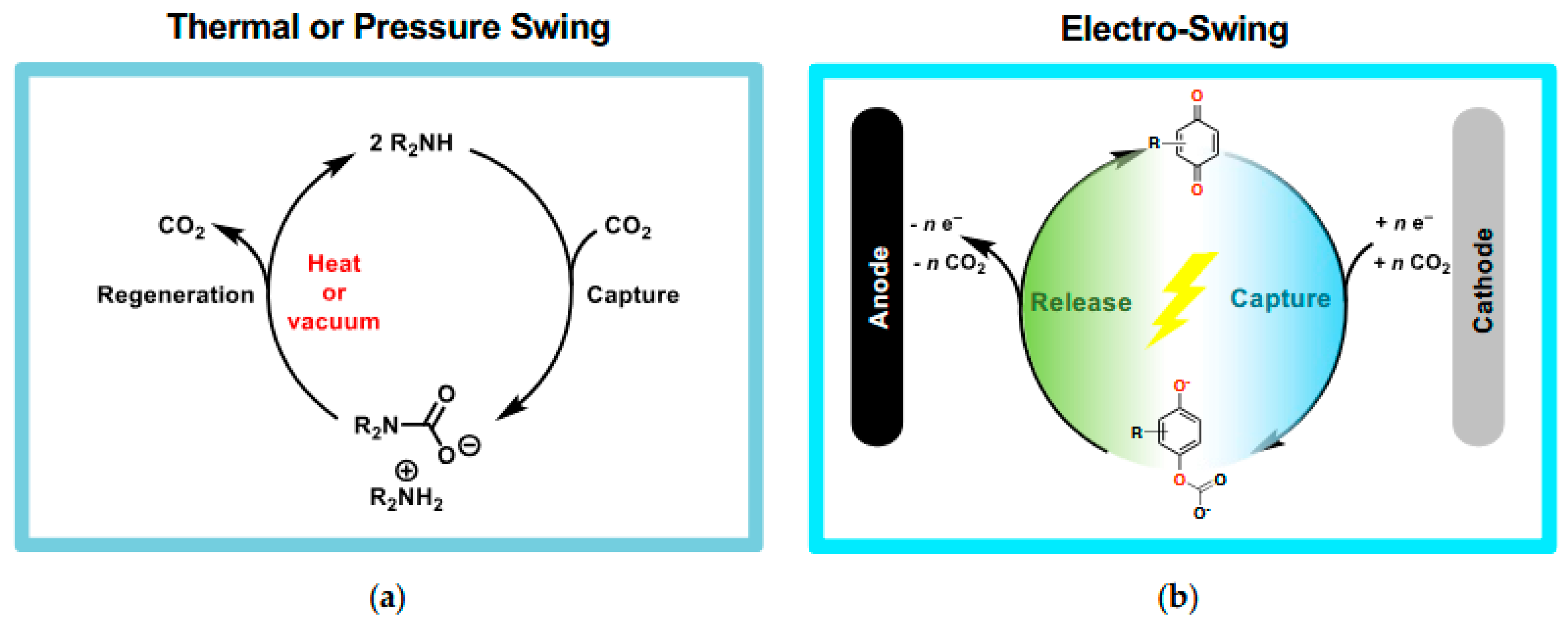
Figure 1. Carbon capture and release strategies. (a) Thermo/pressure swing technology using amines or strong bases as sorbents; (b) Electro-swing technology using sorbents such as quinones.
Applsci 15 12739 g001
Figure 2. Electrochemically mediated carbon capture and release using quinone (Q) sorbents. (a) Proposed reaction mechanism of carbon dioxide capture and release using electro-swing chemistry. Q represents quinone sorbents. (b) Structures and second reduction potentials of four previously evaluated quinone molecular sorbents. (c) Three molecular sorbent quinone candidates for redox-swing CO2 capture.
Applsci 15 12739 g002
Figure 3. Synthesis of DNQ (a) and DBQ (b).
Applsci 15 12739 g003
Figure 4. Cyclic voltammograms of F4Q (a), DBQ (b), and DNQ (c) under argon (black), 5% CO2 in argon (pink), 30% CO2 in argon (cyan), and 100% CO2 (purple), respectively. Each analyte was collected at 1 mM concentration in MeCN with 0.1 M NBu4PF6 supporting electrolyte. Voltammograms were collected at 100 mV/s using a standard three-electrode setup with a glassy carbon working electrode (3 mm), a platinum wire counter electrode, and a silver wire single-junction pseudo-reference electrode referenced externally to Fc/Fc+.
Applsci 15 12739 g004
Figure 5. Plots of ΔE1/2 vs. [CO2] for F4Q (a), DBQ (b), and DNQ (c), and calculation results.
Applsci 15 12739 g005
Table 1. The second reduction potentials and their shifts ΔE1/2 under an atmosphere with various CO2 concentrations for the quinones F4Q, DBQ, and DNQ 1.
SorbentTemperature
(K)
[CO2]
(%)
[CO2]
(M)
E2,red a
(V)
E2,ox a
(V)
E2,1/2 a
(V)
ΔE1/2 a
(V)
F4Q29600.000−1.338−1.162−1.2500.000
50.011−1.297−1.088−1.1930.058
300.070−1.288−1.041−1.1650.086
1000.233−1.288−1.005−1.1470.104
DBQ29500.000−0.903−0.966−0.9350.000
50.012−0.943−0.737−0.8400.095
300.072−0.942−0.580−0.7610.174
1000.239−0.935−0.601−0.7680.167
DNQ29400.000−1.532−1.200−1.3660.000
50.012−1.405−0.904−1.1550.212
300.074−1.331−0.893−1.1120.254
1000.245−1.350−0.840−1.0950.271
1 a: E2,red and E2,ox were extracted from CV plots directly; E2,1/2 is the average of these two; ΔE1/2 is the shift in potential and calculated as ΔE1/2 = E2,1/2 − E2,1/2(Ar).
Disclaimer/Publisher’s Note: The statements, opinions and data contained in all publications are solely those of the individual author(s) and contributor(s) and not of MDPI and/or the editor(s). MDPI and/or the editor(s) disclaim responsibility for any injury to people or property resulting from any ideas, methods, instructions or products referred to in the content.