Article

Assessing Feasibility in Service Teams Transport Scheduling with Dedicated and Flexible Dispatch Approaches


by
Grzegorz Radzki
1,
Grzegorz Bocewicz
1,*,
Jarosław Rudy
2,
Radosław Idzikowski
2 and
Zbigniew Banaszak
1
1
Department of Computer Science and Management, Koszalin University of Technology, Śniadeckich 2, 75-453 Koszalin, Poland
2
Department of Control Systems and Mechatronics, Wrocław University of Science and Technology, Wybrzeże Wyspiańskiego 27, 50-370 Wrocław, Poland
*
Author to whom correspondence should be addressed.
Appl. Sci. 2025, 15(23), 12727; https://doi.org/10.3390/app152312727
Submission received: 3 November 2025 / Revised: 28 November 2025 / Accepted: 30 November 2025 / Published: 1 December 2025

Featured Application

The proposed approach can be applied to the task planning and dispatching of mobile service teams operating within critical infrastructure sectors such as energy, telecommunications, transportation, and emergency response. In these domains, ensuring feasible schedules under varying service time windows, differing levels of service criticality, and the need for flexible allocation of vehicles and personnel is essential. The developed feasibility assessment supports decision-makers in selecting between dedicated and flexible dispatch strategies to improve operational reliability and resource utilization.

Abstract

The research problem addressed in this paper concerns the formulation of feasibility conditions for planned service missions in networks where fulfilling customer orders requires the coordinated participation of multiple resources—referred to as the Service Teams Transport Scheduling (STTS) problem. The study examines feasibility conditions (sufficient and necessary) for routing and scheduling mobile service teams, taking into account constraints arising from service time windows arrangement, vehicle and team availability, and the applied vehicle dispatching strategies. Due to the NP-hard nature of the problem, which limits the possibility of determining service distribution plans in real time, it becomes essential to develop necessary feasibility conditions that can be used in preliminary tests prior to the final search for a feasible service mission plan. By introducing a graph-based representation of time-window arrangement, the study establishes necessary feasibility conditions derived from chromatic number analysis of the corresponding graphs. The feasibility verification approach, based on these conditions, was validated through a series of experiments. The approach combines discrete optimization and declarative modeling to support algorithmic decision-making in real-world service logistics.

1. Introduction

Issues related to the design, construction, and operation of distributed service networks [1] occurring in various entities such as ambulance, fire, police, courier services, taxi networks, repair, maintenance, rescue in disaster, and other services have a decisive impact on the level of quality and competitiveness of the services provided [2,3,4]. The term “distributed service network” refers to distribution and movement: the distribution of resources between facilities located in different locations within a certain area and the movement of resources along the distributed network. In other words, a distributed service network creates a network of supply chains connecting a service provider offering services (such as home healthcare) with a set of customers who order them. Ordered services are delivered by teams of service caregivers and/or nurses who travel to customer locations (e.g., patients) according to the deadlines and periods specified in the customer’s requests.
Providing services to geographically dispersed customers requires that the service provider have appropriately qualified personnel to ensure service quality meets demand, as well as an adequate fleet of vehicles to facilitate the movement (delivery and pickup) of the teams responsible for these operations. This means that a key question becomes: are the service provider’s capabilities (i.e., their equipment and personnel) sufficient to meet customer expectations, including the timing and types of services requested, as well as the timeframe and required qualifications of the personnel performing the requested services?
In this context, the problem addressed in this study, the Service Teams Transport Scheduling Problem (STTS), belongs to the broad class of Vehicle Routing Problems (VRP) [5,6,7,8], a domain that has been extensively investigated in the literature, resulting in numerous extensions adapted to diverse application domains. These extensions have laid the foundation for a new category of problems referred to as Rich Vehicle Routing Problems (RVRP), which represent a comprehensive framework for complex and multi-faceted routing and scheduling tasks. The RVRP concept signifies a paradigm shift from purely theoretical benchmark formulations of the “classical” VRP toward deployable optimization models that integrate multiple real-world constraints and operational features simultaneously [9,10]. Such models aim to more accurately reflect the complexity of actual logistics, distribution, and service systems, encompassing applications such as home healthcare logistics [11,12,13], field service operations [14,15], waste collection and recycling [16,17], humanitarian and emergency logistics [3], as well as city logistics and green mobility [18].
The vast majority of studies conducted in these domains are concerned with determining either feasible or optimal mission plans for executing ordered services. Due to the NP-hard nature of the underlying problems, they are typically addressed using heuristic methods that do not guarantee the identification of any feasible solution or provide only approximate (suboptimal) results. This observation reveals a notable research gap related to the lack of studies that address conditions (sufficient and/or necessary) whose fulfillment justifies the search for feasible variants of mission plans. Such conditions, which enable a rapid assessment of whether the service provider’s available resources, including service teams (STs) and their transport fleet, as well as the provider’s operational capabilities, are adequate to meet customer demands, play a pivotal role in interactive, that is, online, mission planning and replanning platforms, particularly in rescue-type service operations.
The problem considered in this work, namely the STTS, is a generalization of problems found in the literature, including the Home Healthcare Routing and Scheduling Problems (HHRSP) [13,19,20,21,22,23] and the Multiple Traveling Repairman Problems (MTRP) [24]. Both belong to the broader class of Service Routing and Scheduling Problems (SRSP), which encompasses the planning of routes and schedules for mobile service teams, such as technicians, nurses, inspectors, maintenance crews, and other service providers. Their main objective is to develop a service mission plan that maximizes the total number of customers served, or an arbitrarily selected subset thereof, as the primary goal, while minimizing travel costs as a secondary objective. In contrast to the above, the STTS problem focuses on defining a service mission that ensures timely service to all customers, while also taking into account a given set of objective functions (e.g., minimizing vehicle idle time, maximizing resource utilization). It assumes that the mission plan includes both vehicle routes, representing sequences of route segments connecting successively visited customers, and the routes of distributed STs, following sequences of service activities carried out at these locations. Based on these assumptions, this study investigates necessary feasibility conditions (also considered as sufficient infeasibility conditions) for scheduling mobile service teams under two operational dispatching strategies: a dedicated mode, in which the same vehicle is responsible for both delivering and retrieving the team, and a flexible mode, in which delivery and pickup may be handled by different vehicles.
In this paper we do not attempt to cover the entire spectrum of STTS variants observed in practice. Instead, we focus on a representative subclass in which customer locations, travel times, and service durations are deterministic, service teams are homogeneous with respect to skills, and the fleet is characterized only by its size and availability over the planning horizon. The illustrative example introduced in Section 3 belongs to this subclass and is used throughout the paper as a didactic instance for explaining the proposed declarative and graph based formulations.
Considering the nature of constraints determining service routing and scheduling problems and their implementation in Decision Support System (DSS) tools, adopting a declarative modeling framework is the most appropriate choice when selecting a reference model for the STTS problem. Its declarative representation ensures extensibility, enabling the incorporation of problem-specific features, including various types of constraints (e.g., logical, nonlinear) and variables (e.g., fuzzy, boolean). The framework allows for the direct formulation of both decision-making and optimization problems within the Constraint Satisfaction Problem (CSP) [25,26,27] standard and supports implementation in constraint programming environments such as ILOG, ECLiPSe, and Gurobi. Furthermore, it provides a capability rarely discussed in the literature, i.e., the support for both demand-driven and supply-driven modes of service delivery. These characteristics make the proposed model particularly suitable for computer-supported applications.
The practical application of the computer implementation of this model in commercially available constraint programming environments is limited, however by the NP-hard nature of the considered Rich Vehicle Routing Problems (RVRP) [9,10,28]. The computational complexity and the associated processing time significantly restrict the scale of these problems, making it difficult to meet the requirements observed in real-world applications. As previously mentioned, the implementation of heuristic algorithms reduces computational effort only to a limited extent. Moreover, in both approaches, there are also cases where the nature of the imposed constraints prevents the existence of any feasible solution. To reduce the computational cost associated with such situations, it becomes justified to precede the service mission planning process with a verification of the necessary conditions implemented in the pre-test preceding the search for a plan for a feasible service mission. These conditions can be derived from a graph model that represents the sequence of time windows encompassing the implementation of the requested services. Analyzing the chromatic number of such models allows us to determine the required feasibility conditions.
In contrast to standard approaches that focus on the unconditional generation of a mission plan commonly discussed in the literature, this study introduces a key distinction in which each attempt to generate a feasible mission plan is preceded by a verification of necessary conditions that motivates for its searching. Within this context, the paper presents three main contributions:
  • The first contribution is the development of a reference model for the integrated vehicle and service route planning problem, covering the distribution of customer service orders and dedicated to computer-aided service mission planning.
  • The second contribution concerns the formulation of necessary conditions for the existence of feasible service mission plans (also treated as sufficient infeasibility conditions) in selected variants of Service Routing and Scheduling Problems.
  • The third contribution involves extensive computational experiments that demonstrate the applicability and versatility of the proposed approach in practical scenarios. These experiments focus primarily on the evaluation of dedicated and flexible dispatch strategies and aim to assess the scalability and effectiveness of the proposed solution when applied to real-world systems.
These contributions address the research gaps identified in Section 2. In this context, the presented results, which build upon our previous work in the field of service mission modeling and planning [29,30,31,32], emphasize the importance of sufficient feasibility conditions in the planning process and highlight the role of dedicated and flexible dispatch strategies as “operating modes” resources supporting the service provider.
The remainder of this paper is structured as follows. Section 2 reviews the related literature and identifies the research gaps addressed in this study. Section 3 presents a reference framework for Dedicated and Flexible Dispatch Strategies in the distribution of customer-ordered services. Section 4 provides a declarative model of STTS problem. Section 5 presents the concept of a colored graph modelling the STTS problem, and on the basis of which the sought necessary condition for the feasibility (also treated as sufficient infeasibility conditions) of the service mission is derived. Section 6 investigates the scalability of the proposed approaches based on the CSP model and the concept of the chromatic number of its graph, respectively. Finally, Section 7 outlines potential directions for future research.

2. Related Work

As already mentioned, the subject of this study, which falls within the intensively explored research area inspired by the class of VRPs [33,34,35,36], should avoid reiterating issues that have been extensively discussed in numerous previous works [10,37,38]. Given the vast body of literature currently available in this field [9,39,40,41], including an increasing number of taxonomic and survey-oriented publications [13,16,34], as well as further domain overviews [37,40,42], it becomes particularly important to clearly identify the original and innovative contribution of the present study. Additional comprehensive surveys are provided in [38,43,44] and in subsequent analyses, such as [45,46,47]. In this context, the subsequent sections focus on three key aspects: (i) the specificity of Rich Vehicle Routing Problems related to service distribution, (ii) the models and methods employed for solving such problems, and (iii) selected research gaps identified within these domains.

2.1. Routing and Scheduling Driven Services Distribution

Rapidly developing and newly emerging distributed service networks [1] constitute the infrastructure underpinning the growth of the service industry, which continues to increase its share in the domestic product. The key factors influencing the development of the service industry are associated with the efficient allocation of limited resources to accomplish tasks and to satisfy specific service requirements. The role and significance of these factors become evident in the context of routing and scheduling driven service distribution problems.
The observed development of research conducted in the area of VRP indicates two trends related to the expansion of the classic VRP formulation, which boils down to planning optimal routes for a fleet of vehicles delivering goods and/or services to customers while minimizing the total costs or time associated with this. The first trend introduces new constraints, such as vehicle capacity, delivery time windows, or route limitations, as examined for example in [39,48,49]. The second trend integrates problems typically treated separately, such as vehicle routing and customer service scheduling, with contributions that highlight these aspects in [14,50,51]. When combined with the fuzzy and stochastic nature of real-world operations, these developments collectively lead to the class of Rich Vehicle Routing Problems [9,10,19].
Its subclass, Service Routing and Scheduling Problems [12], distinguishes several problem types reflecting domain characteristics. Home Healthcare Routing and Scheduling Problems have been addressed in [11,12,13] and further expanded in [39,48,52]. Technician/Repairman Routing and Scheduling Problems were explored in [14,50,53]. Workforce Scheduling and Routing Problems were discussed in [39,47]. Field Service Scheduling Problems, particularly in telecommunications and energy systems, are analyzed in [14,16,51]. Multi-Skill Routing and Scheduling Problems, requiring diverse competencies, were developed in [54,55]. Across these domains, a common subclass concerns the Workforce/Service Teams Transport Routing and Scheduling Problems (WTRSP), focusing on route and schedule planning for mobile service teams, as studied in [47,50].
The common core of these problems is the synchronization of spatial (i.e., routing) and temporal (i.e., scheduling) decisions, while taking into account resources (e.g., vehicles, people, equipment) and constraints (e.g., time windows, qualifications, capacities, energy, service priorities). The above-mentioned features explain the enormous variety of problems addressed in the literature on the subject and, therefore, the even greater variety of models and methods used to solve them.

2.2. Model Driven Solution Methods

To simplify further considerations, let’s assume the following reduced infrastructure model of a distributed service network, including: the locations of the fleet vehicle docking base, the locations of customers requesting service tasks in predefined time windows, the service teams transported by the fleet vehicles, and a road network whose topology enables the delivery of service operations to each customer within a given time horizon. In the general case, the fleet consists of vehicles with different parameters (e.g., load capacity and permissible speeds), and service requests are carried out by teams with different qualifications (competencies), using road sections with different throughputs. The operating costs of the fleet vehicles, the remuneration of service team members, and the costs of the services provided are known.
Within the adopted model, taking into account the perspectives of the service provider and their customers, two corresponding classes of problems can be formulated: routing and scheduling of service distribution driven by supply and demand. In the first case, most frequently discussed in the literature, the key question is whether the service provider’s capabilities are sufficient to handle all or selected service requests, and if so, which of the possible service missions is the most cost-effective. In the second, relatively less discussed variant, the question concerns which service provider guarantees the cheapest fulfillment of submitted service requests. Problems that seek service missions that balance the service provider’s capabilities with the needs of customers are even less frequently studied [26].
Solutions to these problems are sought within the space of feasible service missions, characterized by different configurations of service network infrastructure parameters, different deadlines for service requests, and different transport strategies (i.e., delivery and pickup) for service teams. The most frequently considered or default transport strategy assumes that a team delivered to a customer by a given vehicle is also picked up by the same vehicle. A rarely used alternative strategy assumes that a team delivered by one vehicle can be picked up by another vehicle. This strategy, which emphasizes the transfer of service teams between vehicles due to the associated costs (e.g., dependent on the length of the routes covered by service personnel), is generally more effective than one in which each team is assigned (dedicated) to a fixed vehicle.
Among the exact models and methods applied to solve the above-mentioned problems belonging to the class of Workforce/Service Teams Transport Routing and Scheduling Problems (WTRSP), the literature most frequently refers to approaches such as exhaustive (brute-force) search, mathematical programming, branch and bound (B&B), and dynamic programming. The most commonly implemented formulations include Mixed-Integer Nonlinear Programming (MINLP) and Mixed-Integer Linear Programming (MILP), which are typically used for small- and medium-sized instances, as well as Set-partitioning models recommended for exact or strong relaxation-based solutions. Constraint Programming (CP) is also frequently cited as particularly suitable for handling complex routing and scheduling problems involving synchronization constraints. Among approximate (metaheuristic) methods, such as Genetic Algorithms (GA), Artificial Bee Colony (ABC), Simulated Annealing (SA), and Particle Swarm Optimization (PSO), the literature most often highlights Reinforcement Learning (RL) for online or dynamic dispatching, and two-stage stochastic programming, where the first stage determines routes and the second stage adjusts teams across scenarios.
According to the “No Free Lunch” theorem [45], none of these methods can be considered universal or superior in all cases. This implies that the specific nature of a given problem and its modeling assumptions determine the choice of the most appropriate method. In the previously discussed problems involving the synchronization of routing and scheduling decisions, while considering available resources (vehicles, personnel, equipment) and constraints (time windows, capacities, energy limits), it is necessary to account for multiple, often conflicting, objectives resulting from their multi-criteria nature. The characteristics outlined above highlight the advantages of Constraint Programming (CP) methods derived from the declarative modeling paradigm. Moreover, the declarative modeling representation of WTRSP ensures model extensibility, enabling the incorporation of specific problem features such as diverse types of constraints (including logical and nonlinear ones) and variables (including fuzzy variables). It also allows the direct formulation of both decision-making and optimization problems within the framework of the Constraint Satisfaction Problem (CSP) [25,27,29] and facilitates their implementation in constraint programming environments such as ILOG, ECLiPSe, and Gurobi. These capabilities make the proposed modeling approach particularly appealing for computer-supported implementations. Within this declarative modeling framework, Constraint Satisfaction Problems (CSPs) and related Constraint Programming (CP) techniques are particularly relevant for service routing and scheduling problems, as they naturally accommodate complex temporal and resource interactions between vehicles, service teams, and customer time windows [30,36,56,57].
Most studies in the Service Routing and Scheduling problems domain (MTRP, HHRSP, etc.) concentrate on optimization, typically aiming to minimize total cost, distance, or lateness, while implicitly assuming that at least one feasible solution exists. However, in many real-world applications (such as home healthcare, maintenance operations, mobile servicing, and humanitarian logistics), determining whether a feasible mission plan exists is far from trivial. A service mission plan is considered realizable (or preliminarily feasible) if there exists at least one configuration of team–task assignments and corresponding route—schedule pairs that simultaneously satisfy all structural, temporal, and resource-related constraints of the system under consideration. In most heuristic and metaheuristic frameworks, feasibility is assumed implicitly. When no such configuration exists, the instance is deemed infeasible, and optimization must be preceded by appropriate measures such as constraint relaxation, task rescheduling, or resource reallocation. Only a limited number of studies explicitly address feasibility testing as a prerequisite to optimization [53,58,59].
In this context, instead of directly searching for an admissible or optimal solution under the implicit assumption of feasibility, it is more robust to first verify whether, given a complex set of structural, temporal, and resource constraints, any feasible configuration exists—and, if not, to identify minimal constraint relaxations that restore feasibility. By distinguishing between realizable and non-realizable mission plans prior to optimization, establishing explicit feasibility conditions not only reduces computational overhead but also facilitates the development of adaptive strategies capable of dynamically reconfiguring service tasks when feasibility conditions are violated.
Constraint Programming (CP) and CSP-based models have been successfully applied to a variety of vehicle routing and time-window problems, often in combination with graph-based formulations that exploit the underlying network structure [57,60]. At the same time, graph-coloring models have been used to analyze feasibility and derive resource bounds in crew scheduling, Dial-a-Ride, and VRP-related settings [61,62,63]. The present work builds on these two lines of research by combining a declarative CSP formulation of STTS with a dedicated time-window conflict graph whose chromatic number provides a fleet-size feasibility condition.

2.3. Open Issues

From the above considerations it follows that contemporary research in the domain of WTRSP, in addition to widely discussed topics such as uncertainty, stochasticity [49,52,64] and real-time re-optimization as well as learning-based methods covering integration, generalization and explainability [44,65], increasingly concentrates on several areas convergent with the scope of this study. These include the integration of routing with operational scheduling and workforce constraints, feasibility testing and infeasibility diagnosis, and sustainability and fairness.
One of the research direction that has been relatively rarely addressed concerns multi-objective trade-offs, fairness, and human-centered metrics. Many service delivery scenarios require personnel to perform tasks at several geographically distributed locations. Examples include home healthcare nurses, repair technicians, and mobile security guards [52]. In such cases, classical optimization criteria such as total distance, cost, or travel time still dominate. However, the systematic treatment of fairness-related dimensions such as workload balance and caregiver continuity in home healthcare, as well as patient or customer experience, and multi-stakeholder objectives analyzed. This observation motivates the question: How can customer experience and fairness-related factors, such as caregiver continuity and balanced workloads be incorporated as primary optimization objectives, and how can operators be provided with efficient decision policies?
Among the most intensively studied areas is the one in which the research objective focuses on feasibility testing and mission feasibility. Many studies still aim to minimize cost, distance, or latency under the implicit assumption of feasibility. Only a few contributions address early feasibility tests, feasibility certificates, or feasibility-first heuristics that can detect infeasible instance configurations before computationally expensive optimization procedures are executed [41,51,61,66]. This constitutes an explicit and recurring research gap across STTS and related subfields such as home healthcare and repairman routing problems. Hence, an important question arises: Can a fast, pre-feasibility test be designed to identify infeasible STTS instances before running full-scale optimization?
In this context, and in direct relation to the theme of this article, the principal contribution of the present study is the introduction of a preliminary feasibility test that is carried out before the main search phase for an admissible service mission plan. When such a plan is found to be infeasible, the solution space can be systematically expanded by increasing the fleet size or vehicle capacity, which enables the transport of a larger number of service teams. The interactive implementation of the proposed method supports efficient analysis of large-scale, real-world scenarios while avoiding excessive computational effort. The advancement of this research direction is expected to lead to formal results concerning analytical conditions for realizability under dedicated and flexible dispatch strategies, algorithmic feasibility tests preceding optimization, and constraint-relaxation strategies that ensure minimal deviation from operational requirements.

2.4. Comparative Background and Novelty of the Approach

Research conducted within the broad class of Service Routing and Scheduling Problems, has predominantly focused on developing optimization-oriented models whose feasibility is implicitly assumed. Classical Vehicle Routing Problems (VRP), centered on deterministic cost or distance minimization, usually presuppose that feasible solutions exist [51,67]. Their extensions—collectively referred to as Rich Vehicle Routing Problems (RVRP)—incorporate additional operational constraints such as heterogeneous fleets, time windows, and pickup–delivery interactions [10,28], but feasibility is still treated merely as a hidden constraint embedded within the optimization procedure. In such frameworks, feasibility becomes observable only post factum, i.e., when the underlying solver returns information about an empty solution set, offering no insight into whether infeasibility results from structural contradictions or from limitations of the search procedure. Even dedicated [59,61,66] feasibility-related studies in Dial-a-Ride or synchronized pickup-and-delivery systems do not consider feasibility conditions specific to service-team transport scheduling with synchronized time-window relations. This situation reveals a persistent research gap: the lack of analytical tools capable of identifying infeasible configurations before launching computationally expensive optimization procedures, explaining infeasibility mechanisms, and indicating minimal constraint relaxations needed to restore feasibility. As modern service logistics systems increasingly require reactivity, strict adherence to time windows, and the ability to operate under resource scarcity, preliminary feasibility assessment becomes not only beneficial but essential. To address this gap, the present study introduces a pre-feasibility analysis performed prior to the search for admissible service mission plans. Unlike feasibility checks embedded in CSP, MILP, or metaheuristic procedures, the proposed approach separates feasibility from optimization by formulating explicit necessary conditions derived from a graph-based representation of time-window relations. Using the chromatic number of these graphs for both dedicated and flexible dispatch strategies, the method identifies infeasible instances whose structural constraints cannot be satisfied under any routing configuration or solver setting. This approach provides actionable analytical insight: it determines the minimal number of vehicles required for performing a mission under each dispatch strategy and immediately eliminates infeasible configurations, avoiding unnecessary computation.
The conceptual positioning of the proposed method relative to these representative models is summarized in Table 1. The column “Feasibility Assessment” emphasizes the key distinction across existing approaches: classical VRP assumes feasibility; RVRP checks it implicitly during optimization; SRSP identifies it only after the solver returns infeasibility; whereas the proposed STTS-Feasibility framework performs an explicit pre-feasibility analysis prior to optimization, identifying minimal structural requirements and enabling informed decision-making before any search is initiated. This shift represents a significant conceptual contribution to the field, elevating feasibility assessment from a secondary diagnostic outcome to a central analytical step.
The proposed graph-based representation enables assessing mission infeasibility without generating or evaluating complete mission plans. While CSP-based approaches provide exact feasibility guarantees, they rely on exhaustive search, which is computationally expensive [61,66]. Heuristic methods, in turn, may prematurely terminate, yielding inconclusive negative results—either reflecting genuine infeasibility or insufficient search [59]. The present approach addresses these weaknesses by introducing a fast, structurally grounded pre-feasibility test applicable before optimization.
The problem considered here corresponds to a strict subclass of the STTS problem, assuming absolute service punctuality with no delays permitted—a scenario characteristic of critical infrastructure servicing. Nonetheless, the proposed representation demonstrates potential for extension to additional feasibility dimensions, including staff competencies, vehicle and equipment capacities, and stochastic disruptions, which constitute promising directions for future research.
Finally, the computational architecture introduced in this study combines declarative constraint modeling with graph-coloring–based feasibility screening. This hybrid approach reduces computation time by several orders of magnitude compared to direct CSP solving, enabling scalable and interactive planning in real-world service logistics systems. In doing so, the framework establishes feasibility analysis as a fundamental analytical component of decision-making in service team transport scheduling.

3. Problem Formulation

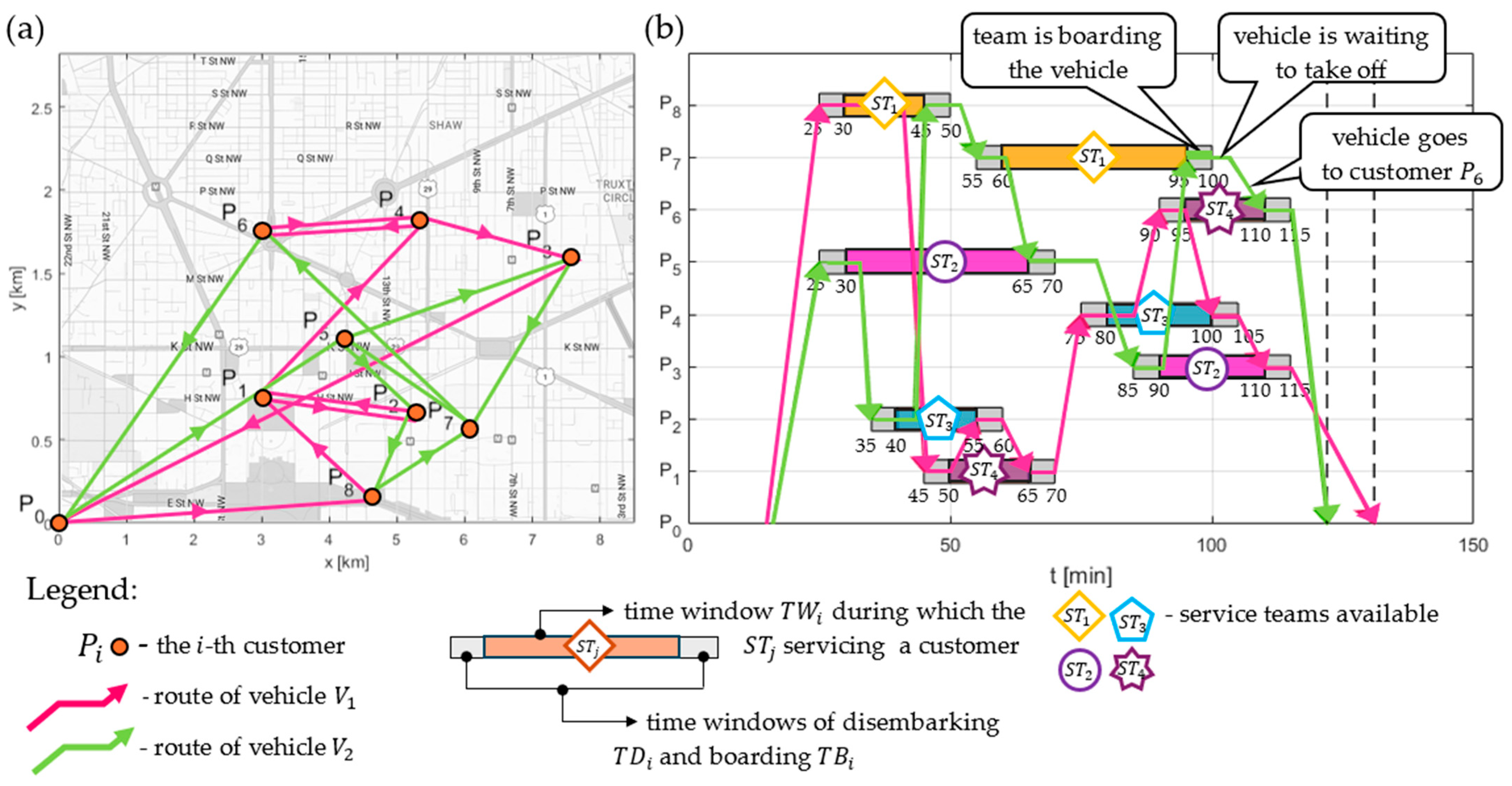
To illustrate the essence of the STTS problem and the concept of dedicated/flexible approaches, consider a situation in which eight clients P 1 , , P 8 request services at predefined times, which are performed within predefined time windows T W 1 , …, T W 8 . Each time window determines the time allocated for service provision. For example, T W 1   =   [ 50 ,   60 ] (minutes) means that service for client P 1 must begin at the 50th minute and end at the 65th minute from the beginning of the time horizon. Such cases, in which time windows T W i are predefined, represent scenarios in which client requests dictate the service provider’s schedule. For example, in the case of home care services, a nurse may be required to visit a patient at a specific time to administer appropriate medications. Similarly, in the case of technical maintenance, service teams performing inspections of industrial equipment may be granted fixed access windows, planned production downtimes, reserved for service work. The service is operated by one of four available service teams ( S T ): S T 1 , …, S T 4 , delivered by vehicles ( N V = 2 ): V 1 , and V 2 . Customer locations ( P 1 , , P 8 ) and depot ( P 0 ) are located in the urban area shown in Figure 1a.
The configuration depicted in Figure 1 is therefore not intended to define the STTS problem itself, but rather to serve as a small scale instance on which the main concepts, namely dedicated versus flexible modes, time window interactions, and fleet size effects, can be presented in a transparent way.
Since the customer locations are known in advance, assuming a fixed speed for all vehicles, the corresponding travel times t i , j can also be determined. To simplify the discussion, it is assumed that these times are constant and independent of the environment. Figure 1b presents a schedule of predefined time windows T W i . Note that the presented schedule includes additional time windows (marked in gray) designated for team disembarking ( T D i ) and boarding ( T B i ) after service completion.
In the example considered, customer P 5 requires the service to be completed between the 30th and 65th minute ( T W 5 =   [ 30 ,   65 ] ). Assuming a 5-min time window for disembarking ( T D 5   =   [ 25 ,   30 ] ) and boarding ( T B 5   =   [ 65 ,   70 ] ), the service team should arrive at the customer’s location at the 25th minute and depart at the 70th minute.
The transportation of service teams is assumed to be carried out in two modes:
  • Dedicated mode, in which each team is delivered to and picked up by the same vehicle.
  • Flexible mode, in which a team may be delivered by one vehicle and picked up by another.
In line with these assumptions, the goal is to design a mission plan for transporting service teams using the available fleet of vehicles, ensuring timely service for each customer. The mission plan assumes its implementation in accordance with the service teams’ work schedules and the routes of the vehicles transporting these teams. The mission plan takes into account the following specific assumptions:
  • the number of customers and their positions are known prior to mission start,
  • the duration of a single operation is the same for each customer,
  • each customer must be visited/served within a specified time window,
  • each customer is served by only one service team,
  • each customer is visited twice by a vehicle (once to deliver service teams and once to pick them up),
  • technical parameters (travel speed, payload, and the number of service teams at the mission start) of vehicles are unchanged throughout the mission plan,
  • the number of service teams transported by a vehicle may change during the mission,
  • two overlapping operations cannot be processed by the same service team,
  • the mission must be completed (all service teams and vehicles return to the depot) before the set time expires
The considered instance of the STTS problem boils down to the question:
  • Is there a service mission plan (schedule for STs and vehicle routes) that ensures all customers are visited within their specified time windows ( T W )?
An affirmative answer to this question depends on the existence of a mission plan that guarantees timely service to all customers, determined by the number of available resources (vehicles and service teams). Figure 2 shows a mission plan (for the distribution network of Figure 1) that requires two vehicles ( V 1 and V 2 ) and four service teams ( S T 1 , …, S T 4 ). This plan is feasible, i.e., guarantees timely service to all customers, only in a mode in which the service teams can be delivered and picked up by different vehicles (flexible mode). This is the case for customers P 2 , P 3 , P 6 , and P 8 the service teams are delivered by one vehicle (by V 1 in the case of P 6 and P 8 and by V 2 in the case of P 1 and P 3 ) and picked up by another (by V 2 in the case of P 6 and P 8 and by V 1 in the case of P 1 and P 3 ).
The routes of vehicles ( V 1 , V 2 ) transporting S T s (Figure 2a) have the form:
  • for the vehicle V 1 : P 0 , P 8 , P 1 , P 2 , P 1 , P 4 , P 6 , P 4 , P 3 , P 0 ,
  • for the vehicle V 2 : P 0 , P 5 , P 2 , P 8 , P 7 , P 5 , P 3 , P 7 , P 6 , P 0 .
  • Above routes enable the timely delivery of STs to all customers while following way:
  • for the team S T 1 :   P 0 , P 8 (moving by vehicle V 1 ) , P 7 , P 0 (moving by vehicle V 2 ),
  • for the team S T 2 : P 0 , P 5 , P 3 (moving by vehicle V 2 ), P 0 (moving by vehicle V 1 ),
  • for the team S T 3 : P 0 , P 2 (moving by vehicle V 2 ), P 4 , P 0 (moving by vehicle V 1 ),
  • for the team S T 4 : P 0 , P 1 , P 6 (moving by vehicle V 1 ), P 0 (moving by vehicle V 2 ).
It’s important to emphasize that each customer is visited twice (not necessarily by the same vehicle), and the vehicles making these visits possible may have scheduled stops at the customer’s parking lot. These periods are usually due to short travel times. For example, after delivering the team to customer P 8 , vehicle V 1 must wait 15 min to reach customer P 1 on time—taking into account the 5-min travel time limited by the assumed vehicle speed.
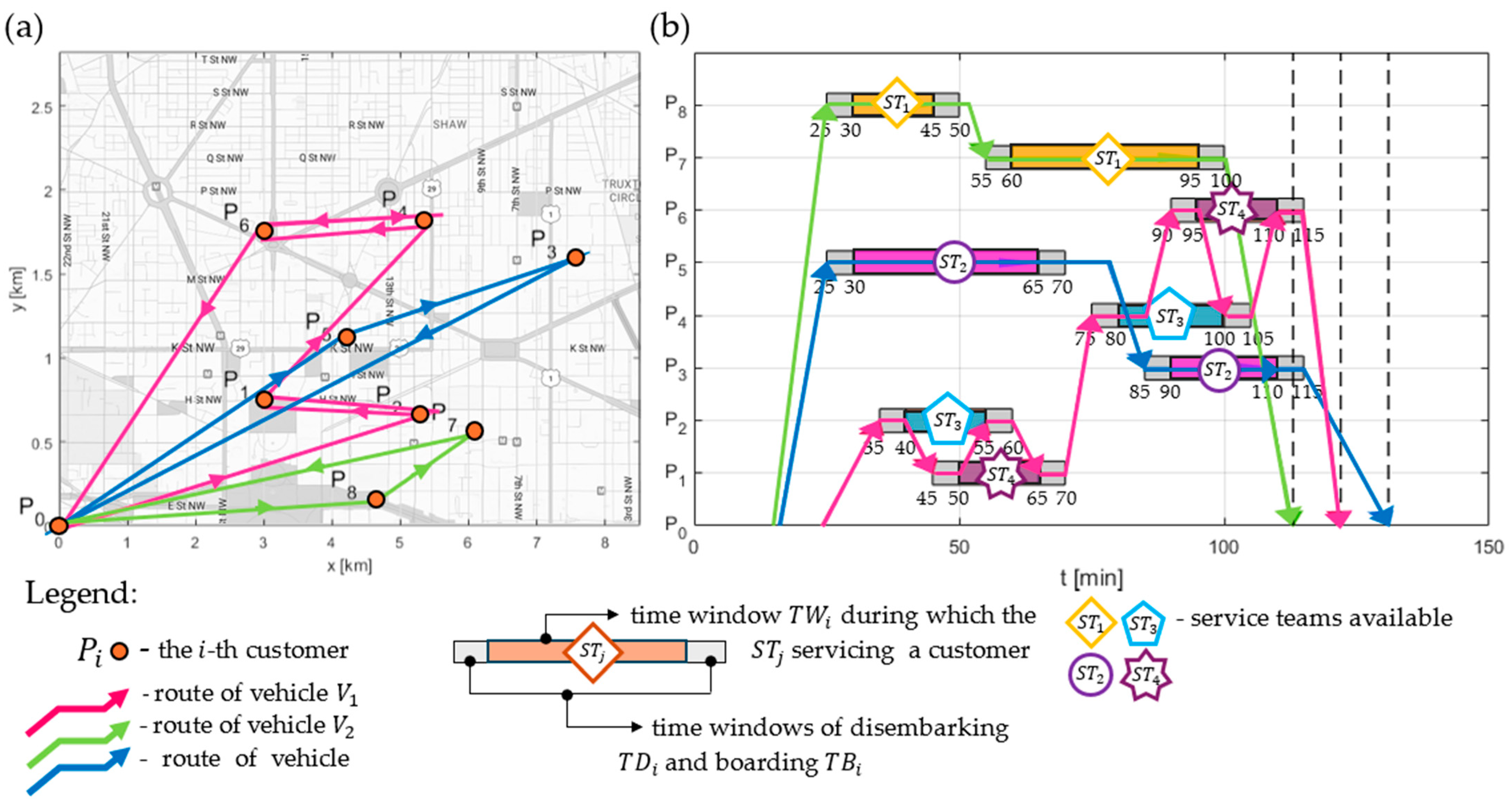
It should be noted that for the considered example, there is no feasible service mission carried out in a mode in which the service team is delivered and picked up by the same vehicle (i.e., dedicated mode). This means that in this mode, there is no service mission plan ensuring timely service to all customers using only two vehicles. It is easy to see that in this mode, a feasible mission plan exists for a fleet of three vehicles: V 1 , V 2 , and V 3 . An illustrative example of such a service mission is shown in Figure 3. As shown in Figure 3b, each service team is delivered to and picked up from the customer by the same vehicle. More specifically, vehicle V 1 serves customers P 1 , P 2 , and P 4 ; vehicle V 2 serves customers P 7 and P 8 ; and vehicle V 3 serves customers P 3 and P 5 . It is worth noting that the assignment of service teams to customers is the same as in the flexible mode, i.e., in a mode in which the service teams can be delivered and picked up by different vehicles.
This example highlights that enforcing the dedicated mode may result in the need for additional resources compared to the flexible mode (three vehicles instead of two). In the subsequent sections, this difference is revisited using a graph-based representation of time-window relations. In that representation, the flexible dispatch variant corresponds to a time-window graph whose chromatic number is 2, which determines the minimum number of vehicles necessary to complete the mission, whereas the dedicated variant yields a chromatic number of 3. In other words, the graph-coloring perspective makes explicit that no assignment of only two vehicles can simultaneously satisfy all overlap and dedicated-mode constraints, while a fleet of three vehicles restores feasibility. The increased fleet size, in turn, leads to reduced utilization (longer idle times compared to the flexible mode), which ultimately translates into higher operational costs.
In general, in both modes, it is impossible to determine a priori whether any feasible service mission plan exists for a given problem instance with a given distribution network, vehicle fleet size, and available service teams. Available solutions are limited to direct attempts to find appropriate solutions. Because STTS (as a special case of the VRP) belongs to the class of NP-hard problems, these methods require significant computational effort, and the time required to solve them usually exceeds practical constraints. In this context, the problem at hand boils down to the following question: Can infeasible cases of STTS mission plans (such as those mentioned above) be identified (predicted) before full-scale computations begin? Therefore, there is a need to establish conditions (sufficient and/or necessary) whose fulfillment for a given instance motivates searching for a feasible service mission plan that ensures timely customer service. Examples of such conditions are presented in the following sections.
It is worth noting that, under the assumptions listed in this section, the presented example is representative of the class of instances analyzed in the numerical experiments reported in Section 6. Nevertheless, many real-world STTS applications exhibit additional structural features, such as multi-skill service teams, heterogeneous vehicle capacities, multiple depots, or stochastic travel and service times, which are not explicitly modelled here. These aspects are beyond the scope of the present study and are discussed as natural directions for extending the proposed framework.

4. Declarative Model

The proposed mathematical formulation of the STTS problem, implementing the declarative modeling paradigm, is oriented towards its computer implementation in a constraint programming environment. This approach was adopted with a view to its future use in computer-aided decision-making processes related to route selection and scheduling for both STs and the fleet vehicles that deliver them. Importantly, the formulation assumes that a feasible solution exists only if all service missions are completed within their prescribed time windows, meaning that partial fulfillment or delay of any task automatically renders the entire instance infeasible. The model is therefore determined by the following sets of parameters, variables, and constraints.
Sets:
P : set of customers and depot, where P = P 0 , P 1 , , P i , , P S I
A : a set of service points representing locations where boarding and disembarking operations are performed: A = { A 0 , A 1 , , A i , , A S I , A 0 , A 1 ,   A 2 , , A i , A S I   } , for each customer P i , point A i represents the location where the STs disembark from the vehicle, while point A i represents the location where the STs board the vehicle; the total number of points is A = S V = 2 S I ,
V : set of vehicles, where V = { V 1 , V 2 , V v , , V N V } ,
: set of S T s , where = { S T 1 , , S T ω , , S T N W } ,
T :set of time windows encompassing the S T s disembarkation ( T D ) , mission execution ( T W ) , and S T s boarding ( T B ) , where: T = T W T D T B
T W : set of time windows T W = T W 1 ,   , T W i , , T W S I , where T W i = s s i m i n , s s i m a x is a time window specifying the expected completion time of the ordered service,
T D :set of time windows T D = T D 1 ,   , T D i , , T D S I , where T D i = d i m i n , d i m a x is a set of time windows corresponding to disembarkation operations of the service teams S T s at service point A i
T B :set of time windows T B = T B 1 ,   , T B i , , T B S I , where T B i = b i m i n , b i m a x is a set of time windows corresponding to boarding operations of the service teams S T s at service point A i
Parameters:
S I : number of customers and depot,
S V : the number of elements of the relationship connecting deliveries/collections is calculated using the formula: S V = 2 S I ,
N V : number of vehicles,
N W : number of service teams,
s t i : service time at customer P i [min],
s s i m i n : start time of the service operation at customer P i [min],
s s i m a x : finish time of the service operation at customer P i [min],
d i m i n : time to start the disembarkation operation at service point A i [min],
d i m a x : time to finish the disembarkation operation at service point A i [min],
b i m i n : time to start the boarding operation at service point A i [min],
b i m a x : time to finish the boarding operation at service point A i [min],
v t i , j :vehicle travel time between service points A i and A j [min],
m v c v :maximal capacity of vehicle v (maximal number of STs),
s v c v :number of teams in the vehicle v during the start from the depot,
T I :time of entry/exit from the vehicle [min],
H :time horizon (length of working day) [min].
Decision variables:
x i , j v :binary variable used to indicate if the vehicle v travels to A j from A i ,
y i v : time at which vehicle v arrives at service point A i or A i ,
z ω , i v : binary variable used to indicate if the ω team was delivered to the service point A i via vehicle v
v c i v : number of teams in the vehicle v during travel to service point A i or A i
s t v : start time of vehicle v ,
v w i v : waiting time of vehicle v arrives at service point A i or A i ,
d i ¯ : binary variable used to indicate if the team is delivered to A i ,
p i ¯ : binary variable used to indicate if the team is taken from A i ,
s s i : service operation start time at customer P i ,
s e i : service operation start time at customer P i ,,
T S T : total service time,
D T i v : parking of vehicle v at service point A i or A i ,
D V : total parking time of the vehicle fleet V
Constraints:
j = 1 S I x 0 , j v = 1 ,   v = 1 , , N V
j = 1 S V   x i , j v = j = 1 S V   x j , i v   ,   v = 1 , , N V ,   i = 1 , , S V  
x i , i v = 0 ,   v = 1 , , N V ,   i = 0 , , S V
i = 1 S V   x i , j v = 1 , v = 1 , , N V ,     j = 0 , , S V  
j = 1 S V     x i , j v = 1 ,   v = 1 , , N V ,     i = 0 , , S V  
i = 1 S V     v = 1 N V x i , j v = 1 , j = 0 , , S V    
v = 1 N V i = 1 S T x i , j v = d j ¯ , j = 0 , , S I
v = 1 N V i = 1 S T x i , ( j + S I ) v = p j ¯ ,   i = 0 , , S I
d i ¯ = p i ¯ ,   i = 0 , , S I
x 0 , j v = 1 y j v = s t v + v t 1 , j ,   v = 1 , , N V , j = 0 , . . , S I
x i , j v = 1 y j v = y i v + v t i , j + v w i v ,   v = 1 , , N V ,   i = 1 , , S T ,   j = 0 , , S V ,   i j
y i v H × j = 1 S T x i , j v , v = 1 , , N V ,     i = 0 , , S V  
y i v 1   y i + S I q 1   y i v y i + S I q T I + s t i ,   v , q = 1 , , N V ,     i = 0 , , S I ,   v q  
v = 1 N V y i v v = 1 N V y i + S I v , i = 1 , , S I
x i , j v = 1 v w i v T I   ,   v = 1 , , N V ,       i = 1 , , S T ,       j = 0 , , S V ,   i j
x 1 , j v = 1 v c j v = s v c v 1 ,   v = 1 , , N V ,     j = 0 , , S I  
x i , j v = 1 v c j v = v c i v 1 ,   v = 1 , , N V ,     i = 1 , , S V ,   j = 0 , , S I  
x 1 , j + S I v = 1 v c j + S I v = v c i v + 1 ,     v = 1 , , N V ,     i = 1 , , S V ,   j = 0 , , S I    
v c i v m v c v     v = 1 , , N V ,     i = 0 , , S V  
v = 1 N V v c i v N W ,   i = 0 , , S V
ω = 1 N W v = 1 N V z ω , i v = 1 ,   i = 1 , , S I  
ω = 1 N W v = 1 N V z ω , 1 v = 0 ,  
i = 2 S I z ω , i v 1 ,     ω = 1 , , N W ,   v = 1 , , N V
z ω , i v = 1 z ω , j v = 1 ( y i v y j + S I q + T I )   ( y j v y i + S I q + T I ) ,         ω 1 , , N W ,       i , j = 0 , , S I ,   i j ,     v , q = 1 , , N V
( x i , j v = 1 ) s s j = y j v + T I ,     v = 1 , N V ,   i = 0 , , S V ,     j = 1 , , S I  
s e i = s s i + s t i   ,     i = 1 , , S I
( x i , j v = 1 )   y j v + T I = s s i m i n   ,   v = 1 , , N V ,   i = 0 , , S V ,     j = 1 , , S I  
( x i , j + S I v = 1 )   y j + S I v = s s i m a x   ,     v = 1 , N V ,   i = 0 , , S V ,     j = 1 , , S I  
( x i , j v = 1 )   y j v = d i m i n     v = 1 , , N V ,   i = 0 , , S V ,     j = 1 , , S I    
( x i , j + S I v = 1 )   y j + S I v = b i m i n ,     v = 1 , N V ,   i = 0 , , S V ,     j = 1 , , S I
( x i , j v = 1 ) D T j v =   v w j v T I ,     v = 1 , , N V ,   i = 0 , , S V ,     j = 1 , , S V
Constraints (1)–(6) define the permissible vehicle routes, while constraints (7)–(9) determine the constraints that condition the delivery and collection of STs to/from service point A i or A i carried out by the fleet vehicles. Constraints (10)–(15) determine the feasibility of the designated routes and schedules of the vehicle fleet, and constraints (16)–(20) prevent their overloading (both in terms of the fleet and its vehicle capacity). Constraints (21)–(24) determine the allocation of STs to service points (SP), while constraints (25)–(30) determine the conditions for synchronizing service operations, and constraint (31) determines the conditions for vehicle downtime.
The proposed model allows to formulate the considered STTS problem as a Constraint Satisfaction Problem ( C S P ) [25,27,31] given by:
C S P =   V , D , C
where: V is a set of decision variables representing vehicle routes and STs (characterized by: x i , j v , z ω , i v ,   d i ¯ , p i ¯ ) as well as their schedules (characterized by y i v ,   s t v , s s i , s e i , v w i v ); D is a set of domains of decision variables: x i , j v , z ω , i v ,   d i ¯ , p i ¯ { 0 , 1 } , y i v ,   s t v , s s i , s e i , v w i v N ; C is the set of constraints defined in conditions (1)–(31).
Solving the C S P problem (32) boils down to determining the values of the decision variables V that satisfy all the constraints in set C . This means that the solution answers the question: Is there a service mission plan (a schedule and vehicle routes) that ensures all customers are visited within their specified time windows? The obtained solution serves as proof of the non-emptiness of the feasible solution set for the given input data.
The open structure of the model allows for the easy formulation of many different variants (e.g., by adding and/or changing constraints and objectives) depending on the needs and specific nature of the problem under consideration, without changing the core of the main model. This type of problem can be represented as a Constraint Optimization Problem ( C O P ), which is an extension of C S P by introducing an objective function C O P T .
C O P = V , D , C , C O P T
Of course, the objective function can be defined in many ways depending on the service provider’s requirements. As an example, in the considered model, the goal is to determine a service mission plan that minimizes the total downtime of the fleet vehicles V i V , defined by Formula (34).
m i n i m i z e   D V ,   ( w h e r e   D V   v = 1 N V i = 1 S T D T i v )    
Same as before, solving the C O P boils down to determining the values of the decision variables V that satisfy all constraints of set C and minimize the objective function C O P T . Solving this problem guarantees timely customer service while minimizing vehicle downtime. Searching for an optimal solution is, of course, possible only if a feasible solution, that is, a prior solution to the C S P problem, exists.
In its current implementation, the C S P model captures the constraints that are common to a broad class of STTS instances: vehicle flow conservation, observance of time windows, and the coupling between vehicle routes and service team schedules. Additional problem specific dimensions, such as multi skill requirements, vehicle capacities, or priority based service rules, can be incorporated by introducing further decision variables and constraints without changing the overall structure of the model. In this paper we deliberately restrict attention to the constraint set (1)–(31), which is sufficient to describe the subclass of STTS instances introduced in Section 3.
While declarative modeling and constraint programming concepts—emphasizing problem specification independently of solution procedures—have been known for decades, they remain rarely applied to integrated routing–scheduling problems. Their strength lies in expressing what constraints must hold rather than how to satisfy them, which in the context of STTS allows a uniform and extensible representation of synchronization relations between vehicles, service teams, and time windows. However, this flexibility is accompanied by well-known computational limitations. As shown in our previous studies [29,30,31,32] and confirmed by the numerical experiments in Section 6, the NP-hard nature of the STTS problem restricts exact declarative methods to instances involving roughly 10–20 customers, which aligns with the scalability observed in earlier implementations of our CSP-based formulations. Comparable limits are consistently reported in the broader literature on Routing and Scheduling problems, including feasibility-focused analyses by [36,60,62,66]. Consequently, exact declarative approaches remain applicable primarily to single-day or short-horizon planning contexts, where the problem size is inherently bounded.
Although the C S P formulation used in this study offers mathematically rigorous feasibility verification and the ability to certify infeasibility, relying on it alone would trigger unnecessary solver calls for structurally impossible instances. This motivated the graph-based pre-feasibility test introduced in Section 5, which—by analyzing the chromatic number of time-window conflict graphs—filters out infeasible cases before invoking the C S P solver. As demonstrated in Section 6, the resulting proposed approach substantially reduces computation effort while preserving the exactness and transparency of the proposed modeling framework.

5. Graph Coloring-Based Assessment

This section presents a graph-based approach to assessing the feasibility of a service mission plan for a given STTS problem instance. The graph-based representation of the time windows arrangement T used in this approach allows us to determine the necessary conditions for the feasibility of the planned mission.

5.1. Graph Representation

Taking into account the assumptions of the model presented in Section 4, it can be assumed that a feasible service mission exists if the vehicles of the fleet V deliver (and pick up) service teams from the set to customers P in given time windows T , i.e., the constraints (1)–(31) hold.
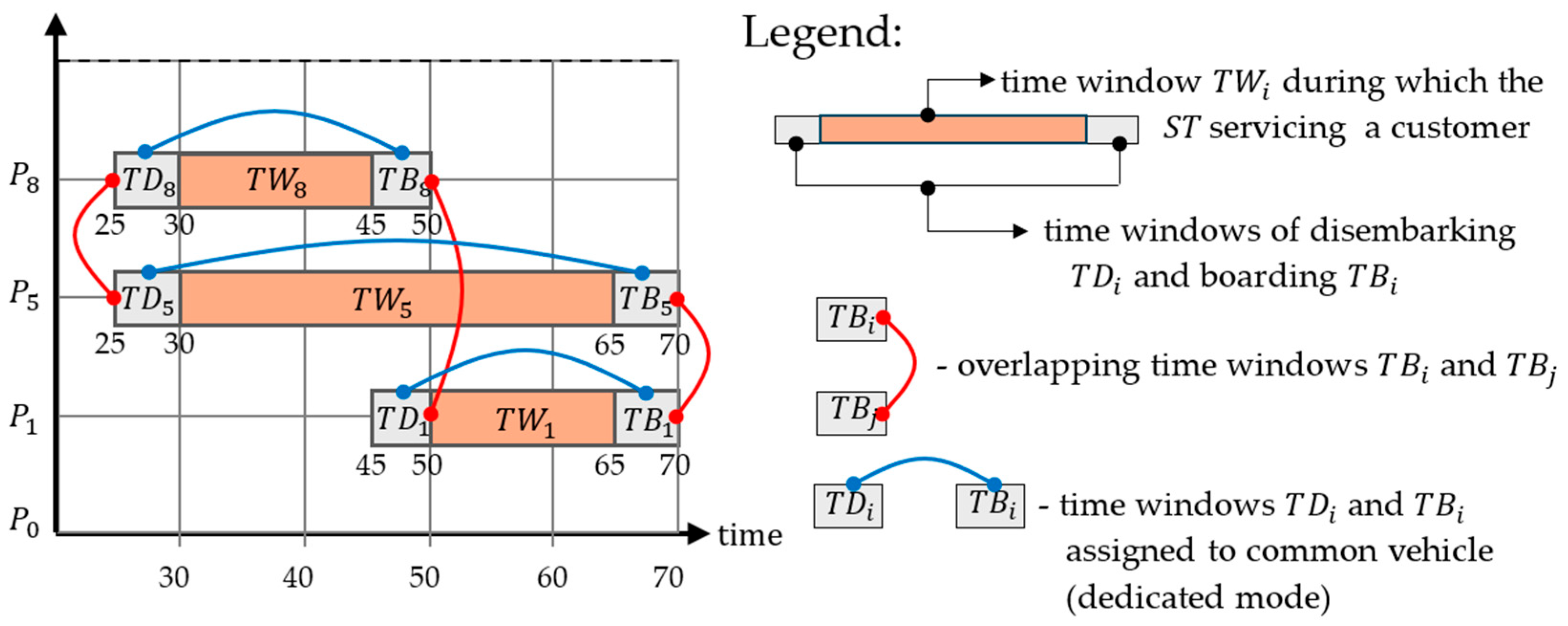
As can be seen from the example presented in Section 3, this is not always possible, as illustrated by the situation in which for a given fleet of two vehicles V 1 and V 2 , a feasible service mission plan implemented in dedicated mode does not exist. It is easy to see that changing the dedicated mode to the flexible mode guarantees the existence of a feasible mission plan, see Figure 2. The reason why the existence of a feasible service mission cannot be ensured in the dedicated mode is the specific time distribution of windows T W 1 , T W 5 , T W 8 (and the related time windows T D 1 , T D 5 , T D 8 and T B 1 , T B 5 , T B 8 ) defining the service requirements of customers P 1 , P 5 and P 8 . This arrangement is shown in Figure 4.
Based on this example, two types of relationships that determine the feasibility of a service mission plan can be distinguished:
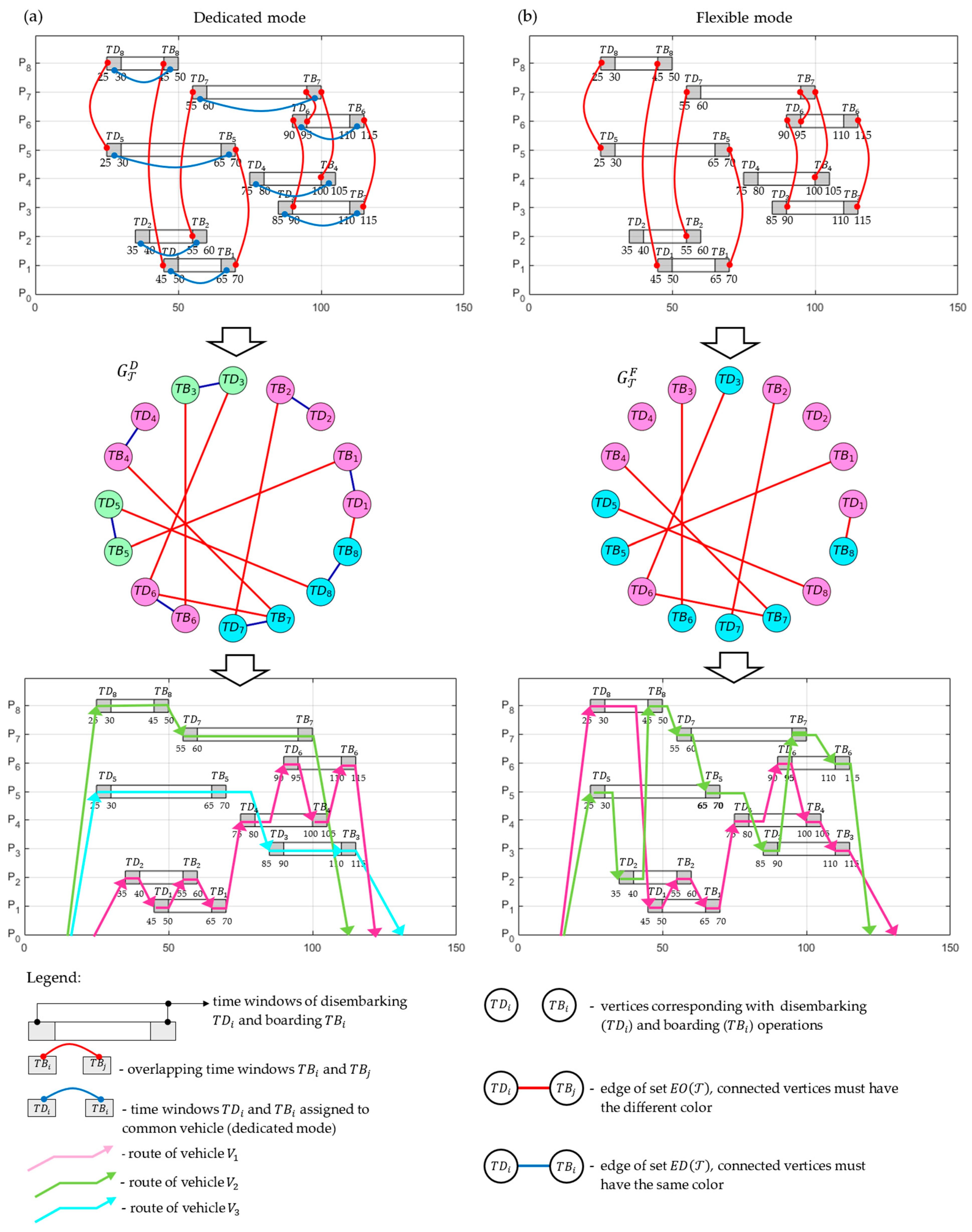
  • Overlapping of disembarking/boarding operations. According to the adopted assumptions, at a given moment, a vehicle can either transport its service teams between customers or stay at the customer’s parking lot to perform disembarking or boarding operations for service teams. Disembarking/boarding operations for customer P i have predefined deadlines, represented by time intervals T D i and T B i , respectively. This means that if a vehicle is engaged in one of these operations for customer P i , it cannot simultaneously perform a similar operation for another customer P j . In other words, overlap (interface) of intervals T D i (or T B i ) with intervals T D j (or T B j ) means that the corresponding operations cannot be performed by the same vehicles, which results in the mission plan being infeasible. In Figure 4, the red line marks pairs of overlapping time intervals: ( T D 8 ,   T D 5 ) , ( T B 8 ,   T D 1 ) and ( T B 5 ,   T B 1 ) . In particular, the overlap of intervals T D 8 and T D 5 (i.e., T D 8 T D 5   ) means that the deliveries of service teams to customers P 8 and P 5 cannot be carried out by the same vehicle.
  • Customer visit by one vehicle. Dedicated mode enforces a similar relationship between time windows T D i and T B i . Unlike the relationship described above, however, it assumes that if a vehicle delivers a service team to a customer, the same vehicle must also pick it up. This means that the disembarking and boarding operations associated with time windows T D i and T B i are performed by the same vehicle. In the example presented, these are pairs of slots: ( T D 8 ,   T B 8 ) , ( T D 5 ,   T B 5 ) , and ( T D 1 ,   T B 1 ) . These pairs are marked with a blue line in Figure 4.
Above conditions must be met simultaneously for the mission plan to be feasible. However, in the case of the time window arrangement in Figure 4, they are mutually contradictory. Assigning two vehicles to disembarking/boarding operations so that the tasks associated with overlapping intervals are performed by different vehicles, while simultaneously ensuring that each customer (disembarking and boarding of the team) is served by the same vehicle, is impossible. This impossibility is exactly what the time-window graph captures in graph-theoretic terms. Intuitively, each vehicle corresponds to one color, red edges encode pairs of operations that must be assigned to different vehicles, and blue edges encode operations that must be assigned to the same vehicle. Any attempt to use only two colors to color the graph leads to a contradiction, mirroring the failure to construct a feasible dedicated-mode mission plan with only two vehicles in the illustrative example.
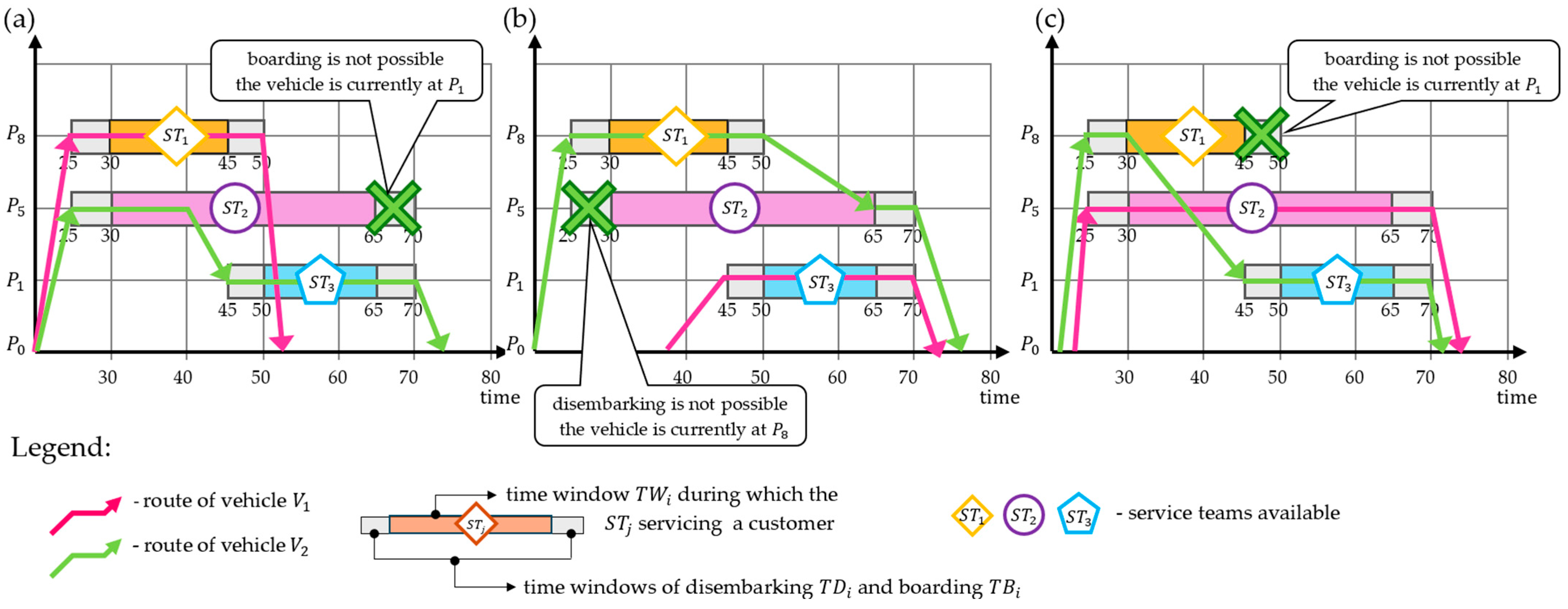
The mission execution variants in dedicated mode, shown in Figure 5, confirm this fact, as illustrated by three variants of potential vehicle assignments. For example, in the first case (Figure 5a), vehicle V 1 delivers a service team to customer P 8 , then waits for the service to be completed, picks up the team, and returns to depot.
According to the dedicated mode assumptions, operations in intervals T D 8 and T B 8 are performed by a single vehicle. Vehicle V 2 subsequently delivers the service team to customer P 5 and P 1 . It then remains at P 1 until the service operation is completed, after which it collects the team and returns to the depot. In the presented scenario, the boarding team operation at customer P 5 cannot be performed by any of the available vehicles. The vehicle V 1 cannot perform it, as this contradicts the assumptions of dedicated mode (operations in intervals T D 5 and T B 5 must be performed by the same vehicle). The vehicle V 2 also cannot perform this operation, because during its duration it is at customer P 1 (intervals T B 5 and T B 1 overlap). A similar situation occurs in each of the presented variants in Figure 5.
As shown in Figure 3, using three vehicles allows for the designation of a service mission that guarantees timely service to all customers (according to the specified intervals T D i and T B i ). Therefore, there is an allocation of vehicles to disembarking/boarding operations that meets the previously formulated assumptions. This means that the possibility of assigning vehicles to disembarkation and boarding operations, and thus the feasibility of the mission plan, is determined by the mutual location (overlap) of intervals T D i and T B i . Therefore, if such an allocation is not possible for a given fleet of vehicles in a given problem instance, it means that there is no feasible service mission plan, i.e., a mission that guarantees timely service to customers in set P .
For the purpose of assessing the feasibility of a service mission (based on the above observations), a graph representation G ( T ) of the time windows arrangement T is introduced:
G T = U T , E T
where:
  • U T —a set of vertices representing disembarking and boarding operations of service teams, carried out within deadlines defined by time windows from the sets T D T and T B T . Formally, there exists a bijection φ :   U T T D T B that maps each vertex to the corresponding disembarking or boarding time window. To simplify the notation, in what follows we identify each vertex u U ( T ) with its associated time window T D i T D or T B i T B and, with a slight abuse of notation, we write U T = T D T B .
  • E T —a set of edges consisting of two subsets E O T and E D T ( E T = E O T E C T ):
  • the subset E O T contains edges representing the overlap relations between intervals T D i and T B j . The edge e o = { T D i , T B j } belongs to the set E O T if the windows T D i and T B j overlap, i.e., d i m i n   b i m i n d i m a x or b i m i n d i m i n   b i m a x ,
  • the subset E D T contains edges representing the relations of the use of one vehicle for each customer (dedicated mode). The set E D T contains edges of the form e d = T D i , T B i where i = 1 S I .
In the graph G T , the vertices U T represent the intervals related to disembarkation and boarding operations ( T D T and T B T ), while the edges correspond to their mutual relationships: overlapping of disembarking/boarding operations (edges of the set E O T ) and operations performed for the same customer (edges of the set E D T ).
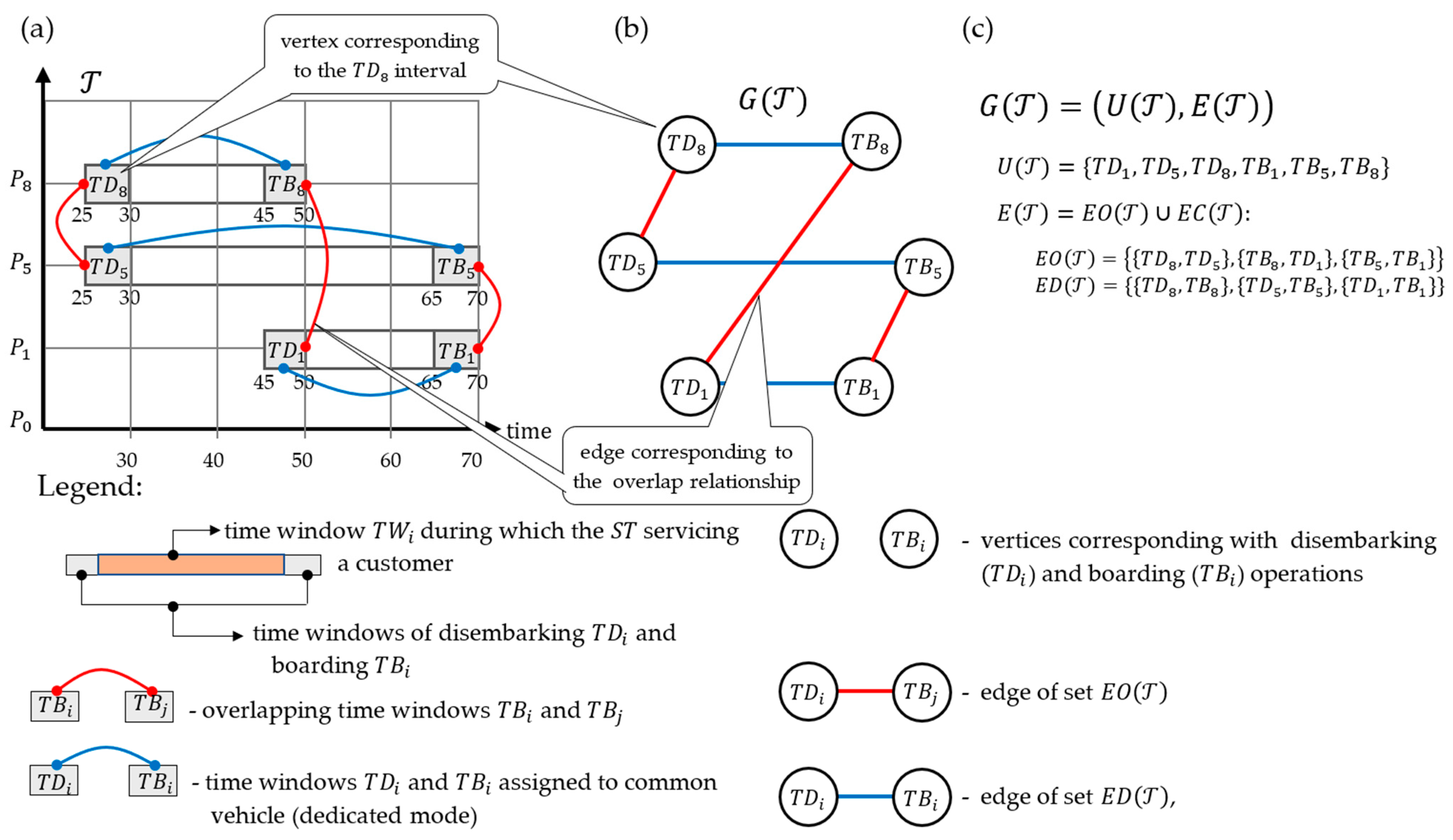
An example of a graph G ( T ) for the time windows arrangement T from Figure 4 is presented in Figure 6. The graph consists of six vertices corresponding to the delivery and pickup windows of service teams to customers P 1 , P 5 , and P 8 : U ( T ) = { T D 1 , T D 5 , T D 8 , T B 1 , T B 5 , T B 8 } .
It contains three edges describing the window overlap relations (red color edges): E O ( T ) = { { T D 8 , T D 5 } , { T B 8 , T D 1 } , { T B 5 , T B 1 } } , and three edges resulting from the dedicated mode assumptions (blue color edges): E D ( T ) = { { T D 8 , T B 8 } ,   { T D 5 , T B 5 } , { T D 1 , T B 1 } } . It is worth noting that the subgraph of G ( T ) obtained by removing the edges of the set E D ( T ) corresponds to the situation in flexible mode, in which there is no requirement for the service team to be delivered and picked up by the same vehicle.
For notational simplicity, the graph G ( T ) containing the edges E D ( T ) (i.e., encompassing dedicated mode) will be denoted G T D , and its components U ( T ) and E ( T ) will be denoted U T D and E T D , respectively. Its subgraph corresponding to flexible mode, in which the edges of the set E D ( T ) = E D T do not occur, will be denoted G T F .

5.2. Admissible Condition

Before stating the formal feasibility condition, it is useful to provide an intuitive interpretation of the graph G ( T ) . Each vertex represents a single operation that must be carried out within a given time interval, while edges encode constraints on how these operations may share vehicles. Red edges correspond to overlapping time windows and therefore link operations that cannot be performed by the same vehicle. Blue edges, present only in the dedicated dispatch mode, connect disembarking and boarding operations of the same customer and thus require that these operations be performed by the same vehicle. Coloring the vertices of the graph with at most N V colors is therefore equivalent to assigning all operations to the N V available vehicles, so that all conflict and coupling relations are respected: vertices joined by red edges must receive different colors, whereas vertices joined by blue edges must receive the same color. The chromatic number then represents the smallest number of vehicles capable of satisfying all these constraints simultaneously; whenever it exceeds the available fleet size, no routing or scheduling decisions can compensate for this structural lack of vehicles.
In other words the introduced notation can be used to assess the feasibility of a service mission. In particular, it allows us to answer the question whether a mission planned for a given fleet V of vehicles can be executed while satisfying all disembarking and boarding time windows. As shown in the examples above, assessing mission feasibility boils down to assessing the allocation of fleet V vehicles to the time windows arrangement T . In graph terms, this assessment corresponds to the problem of coloring the graphs G T D (for dedicated mode) and G T F (for flexible mode) and determining their chromatic numbers χ ( G T D ) and χ ( G T F ) , respectively. In the adopted interpretation, the colors (used to color the vertices) correspond to the vehicles of the fleet V . Assigning a color to a vertex u U T means assigning the corresponding vehicle to the operation (disembarking T D i or boarding T B j ) represented by this vertex. In this context, the assignment of colors must comply with the assumptions governing the allocation of vehicles to operations ensuring feasibility of service plan mission (see Section 5.1) i.e., overlapping operations cannot be performed by the same vehicle, while operations associated with the same customer (in the dedicated mode) should be performed by the same vehicle. In the context of graph coloring, these rules can be expressed as follows:
  • If two vertices are connected by an edge from the E O T set, then the vertices associated with it must have different colors corresponding to the colors of the different vehicles serving customers.
  • If two vertices are connected by an edge from the E C T set (if such exist in the graph), then they must have the same color as the vehicle serving them.
Formally, a vertex coloring of the graph G T D is defined as a mapping c : U ( T ) V that assigns to each vertex of U ( T ) the vehicle executing the corresponding operation. In other words, the vehicles in V are used as colors in the graph-theoretic sense. By feasibility of the mission plan, this mapping satisfies:
  • for every edge { a , b } E O T , we have c ( a ) c ( b ) ,
  • for every edge { a , b } E C T , we have c ( a ) = c ( b ) .
Thus, c is a proper coloring of G T D that uses at most V = N V distinct colors (vehicles). An analogous definition of vertex coloring is used for the graph G T F in the flexible mode, where only the overlap edges in E O T must be respected. It is worth noting that, unlike the classical graph coloring problem, in the considered problem there are two types of relations (edges): relations requiring that adjacent vertices have different colors (i.e., E O T edges) and relations requiring that adjacent vertices have the same color (i.e., E C T edges). This means that graph coloring is not always possible, i.e., assigning vehicles to operations may not always be feasible because the assignment constraints may be mutually contradictory. In that context the chromatic number χ ( G T D ) of such a graph corresponds to the minimum number of vehicles N V required to complete the service mission. This observation leads to the following theorem:
Theorem 1. 
Given is set customers  P , each with service times determined by time windows arrangement  T . Consider the fleet of vehicles  V  (with given number of vehicles  N V ) used in one of two modes: dedicated or flexible. Let the time windows arrangement  T  corresponds to the graph  G T D  (for the dedicated mode) or the graph  G T F  (for the flexible mode), with known chromatic numbers  χ ( G T D )  and  χ ( G T F ) , respectively.
If the chromatic number  χ ( G T D )  of graph  G T D  (and  χ ( G T F )  for graph  G T F ) is greater than the number of available  N V  vehicles in fleet  V , i.e.,  χ G T D > N V  ( χ G T F > N V ), then no feasible service mission plan exists that ensures timely service to all customers from set  P  using at most NV vehicles.
Proof. 
Assume, by contradiction, that a feasible service mission exists for the given arrangement of time windows T , and that this mission can be executed using N V vehicles. This implies that N V is smaller than the chromatic number of the corresponding graph G T D , i.e., χ ( G T D ) > N V (or, for the flexible mode, χ ( G T F ) > N V ). Consequently, each time window from the sets T D T and T B T is assigned to a vehicle according to assumed rules, i.e.,
  • overlapping time windows (e.g., { T D i , T B j } ) cannot be assigned to the same vehicle,
  • time window belonging to the same customer (i.e., { T D i , T B i } ) are assigned to the same vehicle—this applies only to the dedicated mode and the graph G T D .
Assigning vehicles to the intervals TD and TB according to these rules is equivalent to coloring c the corresponding vertices in the graph G T D (or G T F ). The chromatic number χ ( G T D ) (or χ ( G T F ) ) of the graph does not exceed N V : χ ( G T D ) N V (respectively, χ ( G T F ) N V ), which contradicts the initial assumption that χ ( G T D ) > N V (or χ ( G T F ) > N V ). □
Therefore, no feasible service mission can exist in which the number of vehicles N V is smaller than the chromatic number χ ( G T D ) (or χ ( G T F ) ) of the corresponding graph. □
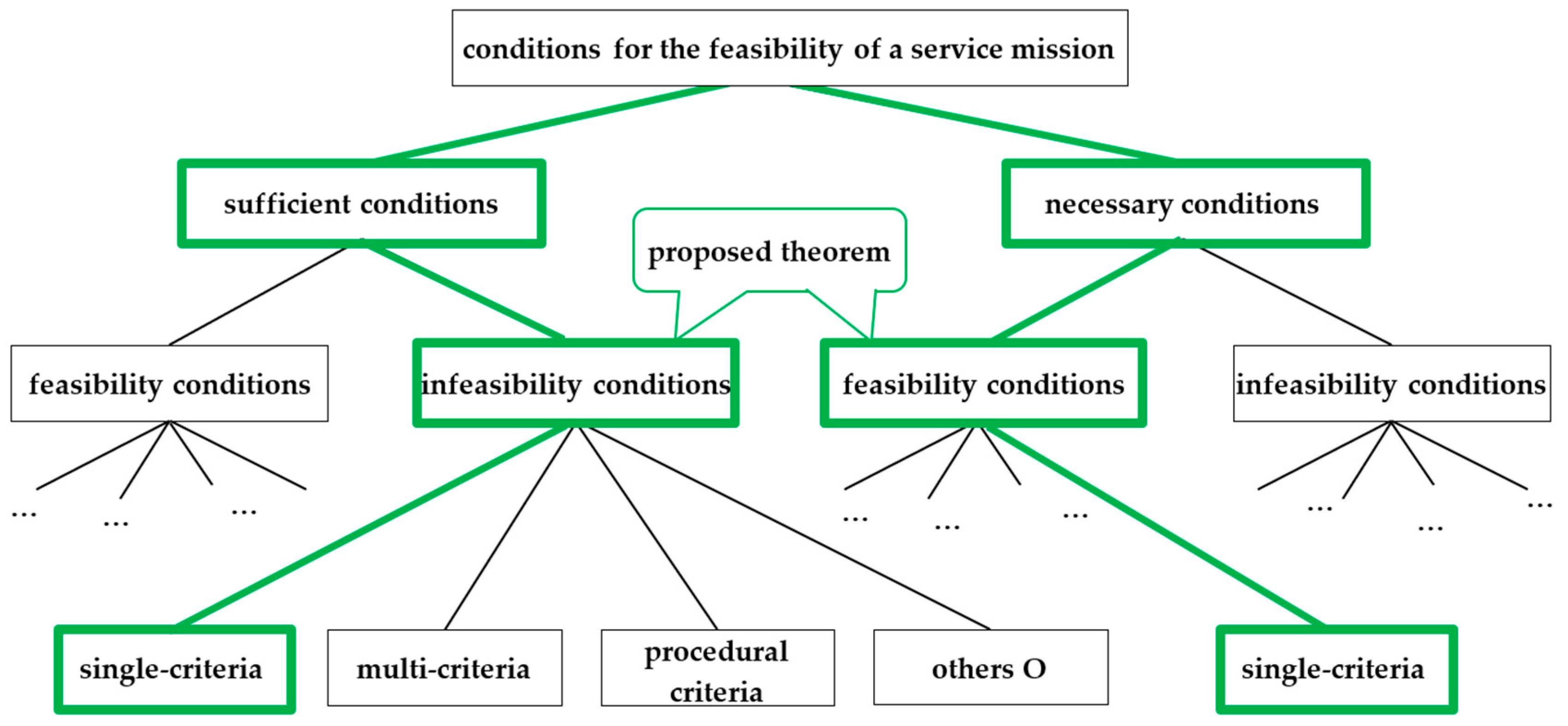
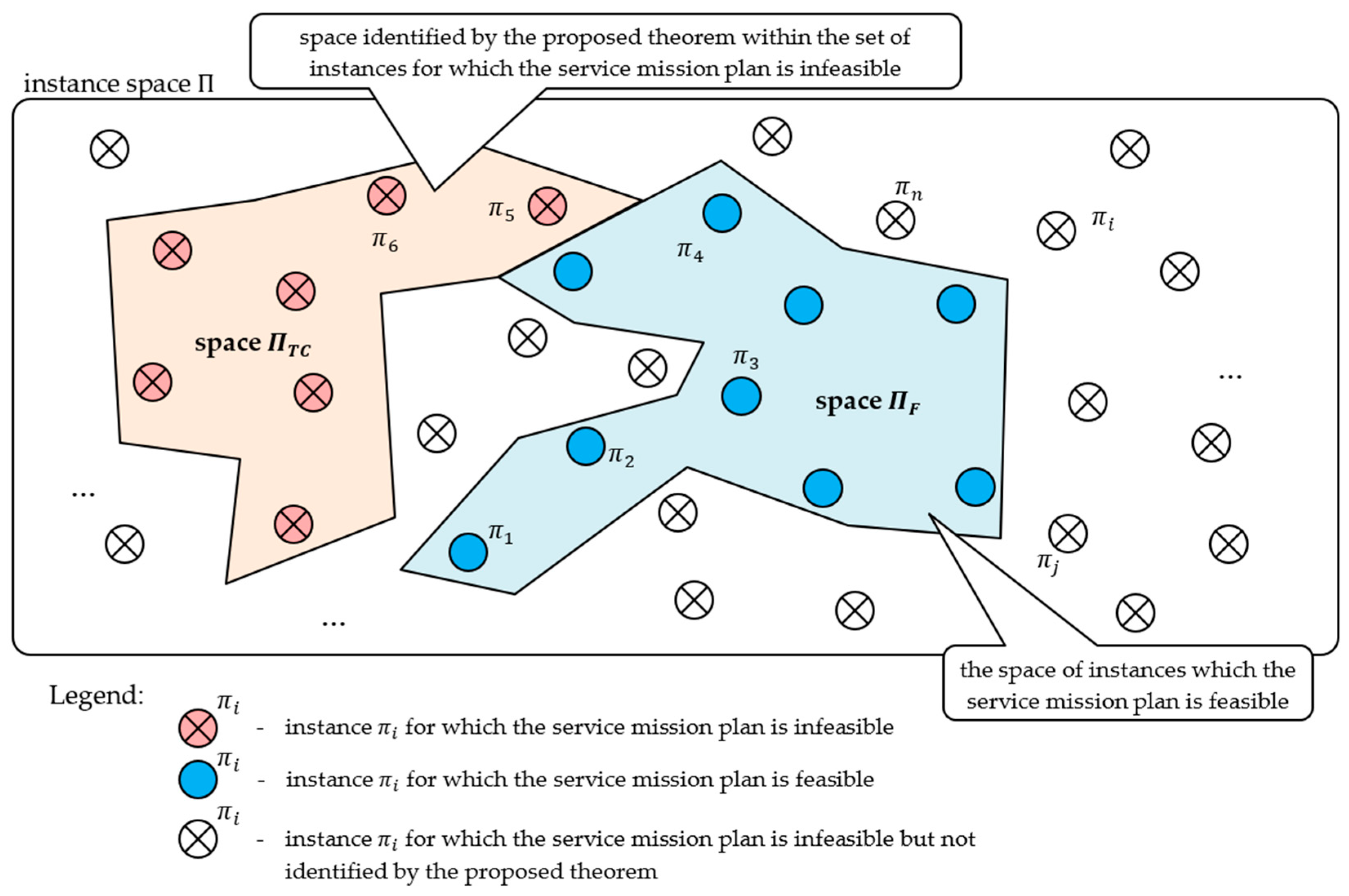
The above theorem provides a sufficient condition for determining the infeasibility of the mission. If it holds (i.e., χ ( G T D ) > N V or χ ( G T F ) > N V ), the mission is infeasible due to an insufficient number of vehicles. This observation leads to the following corollary, which states a necessary condition for feasibility.
Corollary 1. 
If there exists a feasible service mission plan in the dedicated dispatch mode (respectively, in the flexible dispatch mode), then the chromatic number of the corresponding time-window graph cannot exceed the fleet size, i.e.,  χ ( G T D ) N V  (or  χ ( G T F ) N V ). In other words,  χ ( G T D ) N V  (respectively,  χ ( G T F ) N V ) is a necessary condition for the feasibility of the service mission plan with a fleet of  N V  vehicles.
Failure to satisfy this condition implies that the mission is infeasible. Nevertheless, satisfying this condition does not guarantee feasibility, as additional temporal and spatial constraints—such as travel times, service durations, or vehicle duty limits—may still prevent the existence of a realizable schedule.
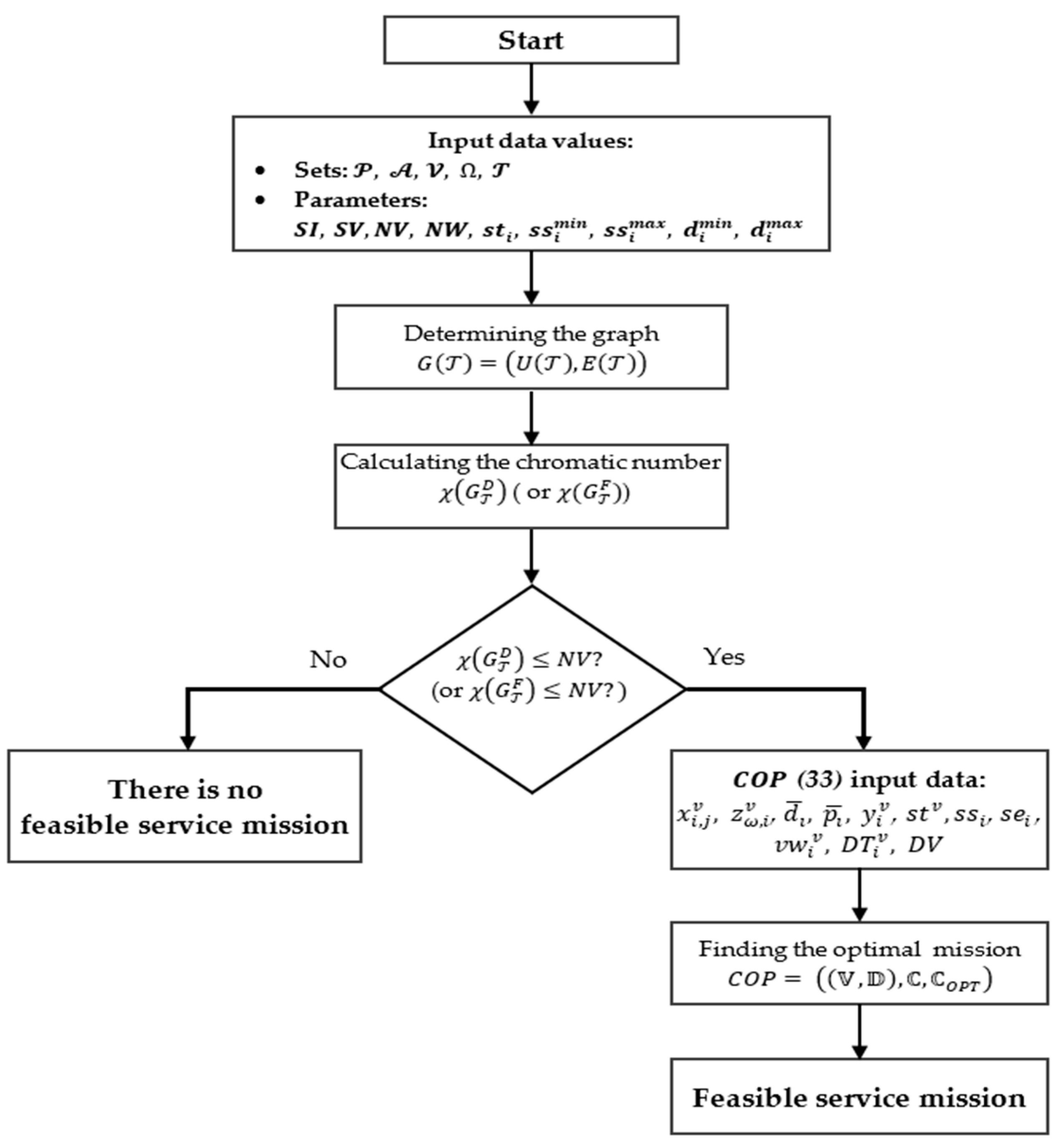
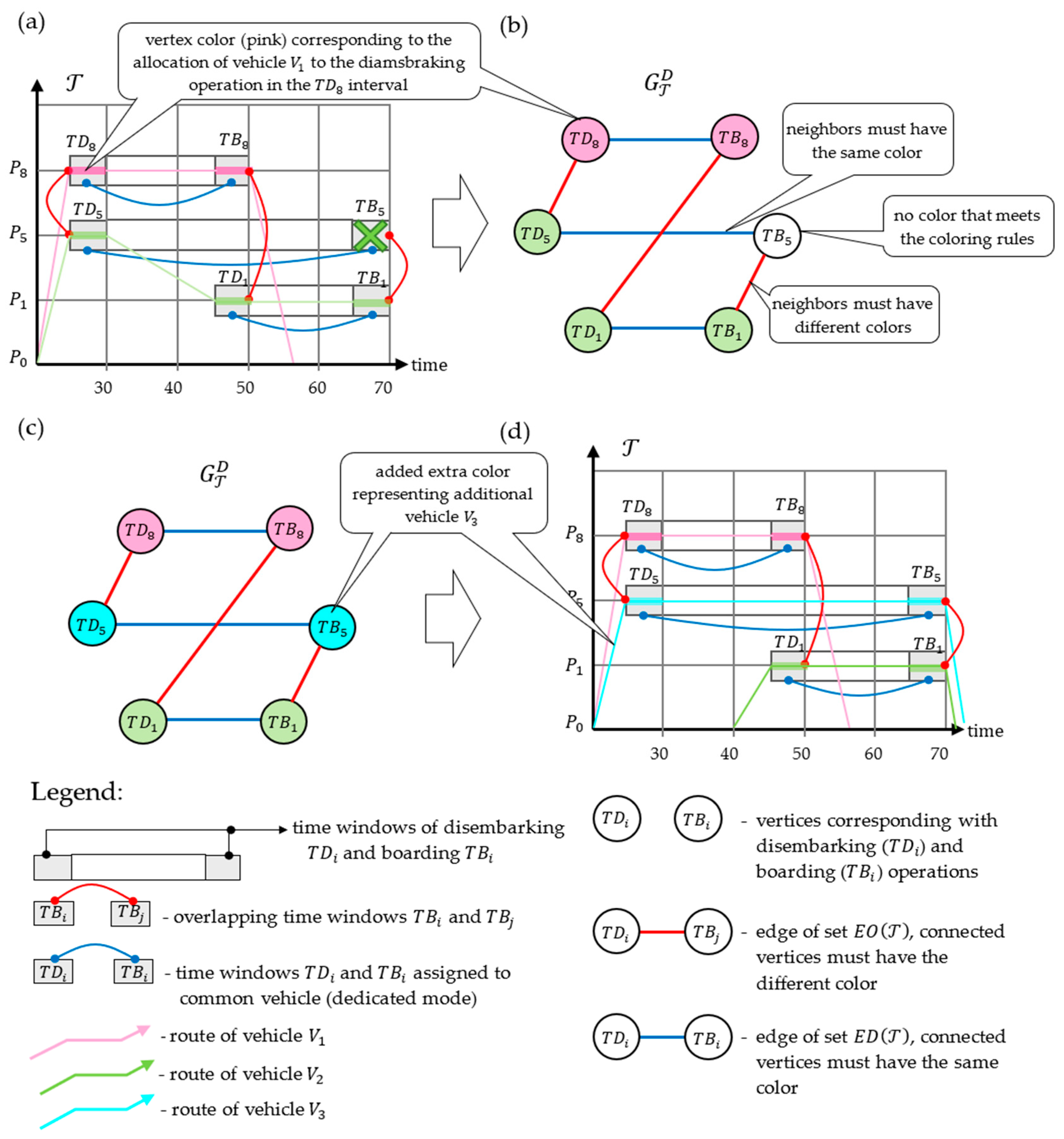
An example of this is Figure 7, which shows an attempt to color the graph from Figure 6 according to the allocation shown in Figure 5a (where two vehicles are available N V   =   2 ). Operationally, χ G T D = 3 means that at least three vehicles are required to carry out all disembarking and boarding operations on time in the dedicated mode. This directly corresponds to the feasible mission plan with three vehicles shown in Figure 3 and explains why all two-vehicle variants in Figure 5 fail to satisfy the dedicated-mode constraints.
The assignment of vehicles V 1 and V 2 to the intervals T D i and T B j is illustrated in the graph as the assignment of colors to the vertices corresponding to these intervals—see Figure 7b. Vehicle V 1 is represented by the pink color, and vehicle V 2 by the green color. As can be seen, coloring the graph with two colors (according to the adopted rules) is not possible. Vertices connected by blue color edges (set E C T ) are required to have the same color, while vertices connected by red color edges must have different colors (set E O T ). In this case, coloring the vertex T B 5 is not possible—it should have a different color than T B 1 (different from green) and the same color as T D 5 (it should be green).
In general, one additional color is required to properly color the graph—its chromatic number is χ G T D = 3 . Figure 7c illustrates an example of a graph coloring solution obtained using three colors. This color assignment satisfies the defined coloring rules. The corresponding schedule (although it does not always have to exist when the condition χ G T D N V is met), shown in Figure 7d, demonstrates how disembarking and boarding operations are executed in accordance with the adopted assumptions: overlapping operations are assigned to different vehicles (e.g., T D 8 and T D 5 ), whereas operations associated with the same customer are performed by a single vehicle (e.g., T D 8 and T B 5 ). This schedule requires three vehicles ( V 1 , V 2 , V 3 ), corresponding to the three colors used in the graph coloring.
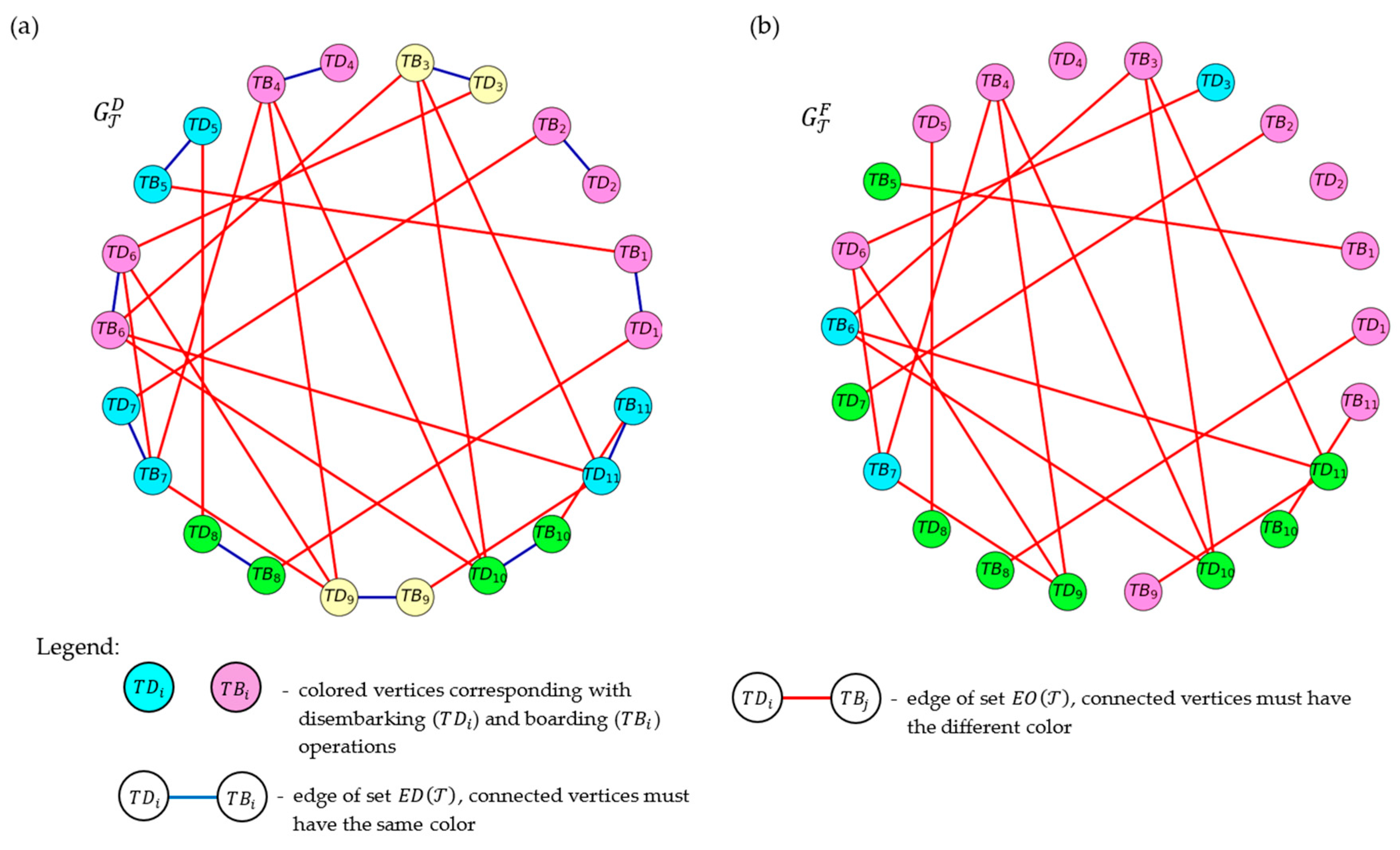
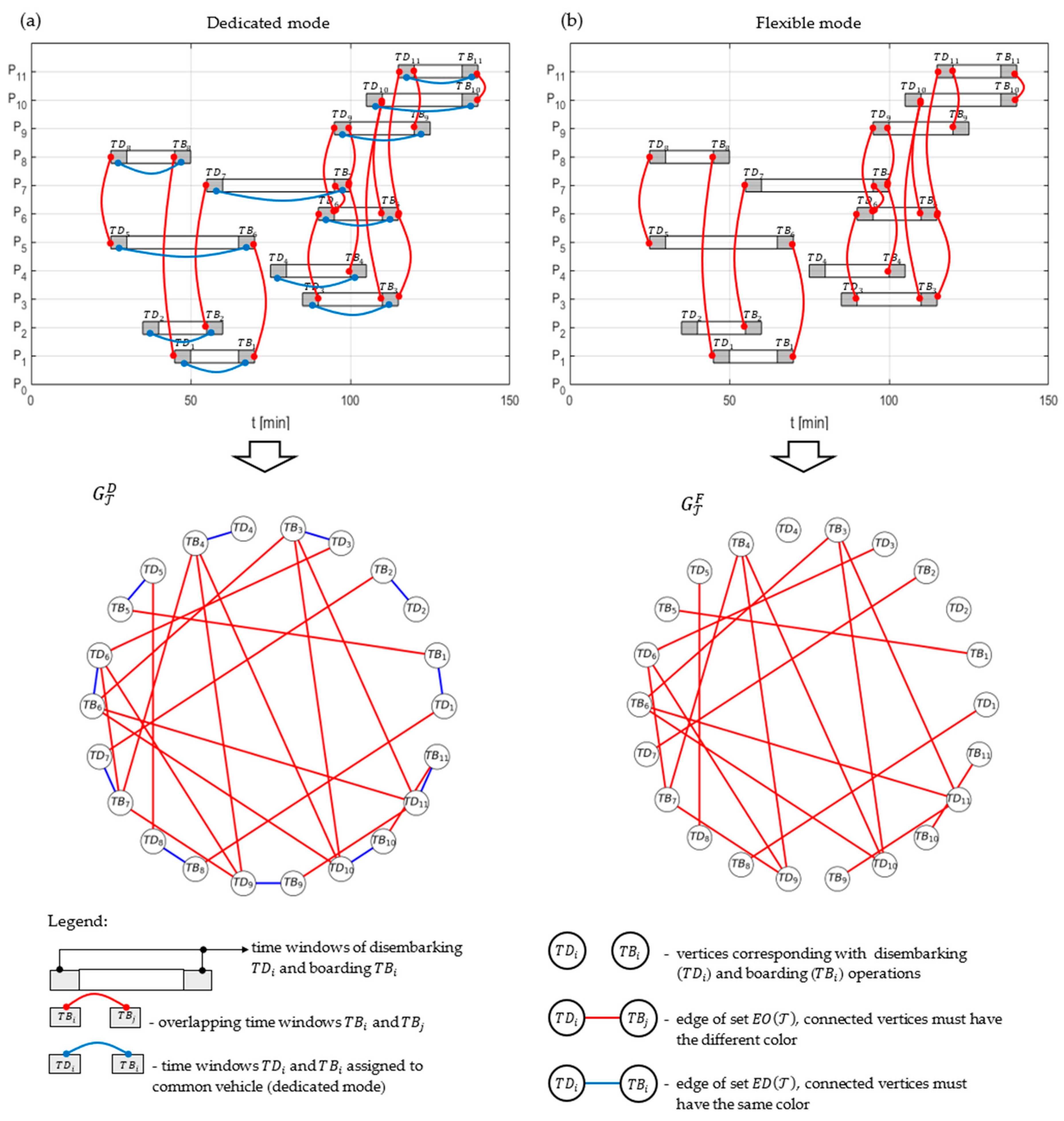
Figure 8 shows graphs G T D and G T F corresponding to the time windows arrangement T from Figure 1: for the dedicated mode (see Figure 8a) for the flexible mode (see Figure 8b). As can be easily observed, both graphs are disconnected, and the graph G T F —which is a subgraph of G T D , obtained by removing the edges E D ( T ) —contains isolated vertices (i.e., not connected to any other vertex), namely T D 2 and T D 4 . The smaller number of edges in G T F and the presence of isolated vertices indicate that it is “easier” to color, as the coloring requires fewer colors. The resulting chromatic numbers of the graphs G T D and G T F are χ G T D = 3 , χ G T F = 2 respectively. According to the examples presented in Section 3, this implies that, with a fleet of two vehicles ( N V = 2 ), it is impossible to execute the mission in the dedicated mode, since χ G T D > N V . Consequently, only by using at least three vehicles in the dedicated mode and at least two vehicles in the flexible mode is it possible to search for a feasible service mission. Examples of such missions, corresponding to the obtained colorings, are illustrated in Figure 8.
The condition of the presented theorem allows to identify the cases of problem instances for which the service mission is not feasible. Of course, determining the chromatic number of a graph, like the problem of planning STTS servicing missions, is N P -hard. However, it turns out that the solution times of graph coloring problems of the same scale and the corresponding STTS problems differ dramatically. The solution times of STTS problems are significantly longer (see next section) than the solution times of the corresponding graph coloring problems. This means that the approach of determining the chromatic number for a given time windows arrangement can be used to initially assess the (in)feasibility of a servicing mission. To evaluate the effectiveness of this approach, consider the following example.

6. Numerical Experiments

In the present study, the numerical experiments are carried out on synthetically generated STTS instances. The underlying data do not originate from a single real-world case, but the instance generation procedure is calibrated to reflect typical single-day service missions observed in practice, in line with the illustrative example introduced in Section 3. In particular, the ranges for the number of customers, the planning horizon, service durations, and fleet size are chosen to mirror realistic configurations encountered in home-care and technical maintenance logistics. The proposed CSP formulation and graph-based feasibility verification operate on generic input data (customer locations, service time windows, travel-time matrix, and fleet characteristics) and can therefore be applied directly to real-world datasets whenever such information is available.

6.1. Illustrative Case

In the considered service distribution network with S I = 11 customers P i P , each of them waits for the execution of ordered services within its respective time window T W i . The time windows arrangement T , which includes the service time windows T W as well as the disembarking T D and boarding T B time windows of service teams, is presented in Figure 9a. The transport of STs can be carried out in either dedicated or flexible mode. Graph representations ( G T D and G T F ) of the time window configuration T for both modes are shown in Figure 9a,b.
The purpose of example is to evaluate the existence of a feasible mission plan for a given network using two approaches:
  • an approach based on the declarative model presented in Section 4, and
  • an approach based on the developed theorem, involving the determination of the chromatic numbers of graphs G T D and G T F .
Ad. 1. In the first stage the sought service mission plan employing a fleet of N V = 2 vehicles was analyzed for two instances of the C S P (32) problem: the dedicated mode and the flexible mode (presented in Section 4). Both instances of C S P were implemented and solved using the Gurobi solver (version 12.0.3, Gurobi, Python API [69]), executed on a system equipped with an Intel Core i7-M4800MQ (2.7–4.82 GHz) processor and 32 GB RAM. In both cases, no feasible mission plan ensuring timely execution of the requested service tasks was obtained, specifically after 8.45 [s] for the dedicated mode and 9.54 [s] for the flexible mode. After relaxing the constraints by increasing the fleet size by one vehicle ( N V = 3 ) and re-running the computations for both service modes, the solver reported no feasible solution for the dedicated mode after 75.65 [s], whereas a feasible solution was found for the flexible mode in 22.00 [s]. Following a further fleet expansion to N V = 4 , an optimal variant of the desired service mission plan was obtained after 3.45 [s]. Summarizing the above experiment, it is evident that the minimum fleet size required to ensure timely mission execution is N V = 4 for the dedicated mode and N V = 3 for the flexible mode. The total computation time needed to determine these values amounted to 87.55 [s] and 31.54 [s], respectively.
Ad. 2. In the second stage, the same scenarios were evaluated using a graph coloring approach, which involves determining the chromatic number. This method identifies the minimum number of colors required to color graphs G T D (Figure 9a) and G T F (Figure 9b). According to the proposed theorem, if the number of available vehicles N V is less than the chromatic number, the mission is infeasible. The computation times required to determine the chromatic numbers χ ( G T D ) and χ ( G T F ) for the considered scenarios N V = 2 , N V = 3 , and N V = 4 were found to be below 0.02 s in all cases. The resulting chromatic numbers, χ ( G T D ) = 4 for the dedicated mode and χ ( G T F ) = 3 for the flexible mode, confirm, according to the theorem the values obtained through the declarative approach. An example of the colored graphs A and B is illustrated in Figure 10.
A summary of the obtained results is presented in Table 2. It can be easily observed that, in the considered case, the evaluation of mission feasibility is at least 1000 times faster when using the graph coloring–based approach (stage 2). However, it should be noted that this approach does not allow for determining the mission plan (if the mission is feasible). It only enables the assessment of whether the mission is infeasible for the given network parameters, such as the fleet size N V .

6.2. Quantitative Experiments

To assess the scalability of solutions implementing the chromatic number concept, a series of experiments was conducted for various scales of service distribution networks P : S I = 8,9 , , 17 and fleet sizes V : N V = 2 ,   3 ,   4 ,   5 . For both instances, for the same parameter values, the response time was measured. There are three possible answers: Yes—in the case of obtaining a feasible solution, No—in the case of information about the lack of feasible solutions, and Unknown—in the case of exceeding the assumed computation time of t   =   300 [s]. The obtained results are summarized in Table 3.
The results of the conducted experiments, summarized in Table 3, indicate that the time required to evaluate mission feasibility ( C T D S T T S and C T F S T T S ) using the declarative approach is significantly greater than that required by the graph coloring approach ( C T G ). The developed graph coloring method enables a substantial reduction in computation time, approximately 1000 times faster than the C S P (32) solution, while preserving the ability to determine whether a mission plan satisfying all constraints exists.
Furthermore, it is easy to observe that the computation times C T F S T T S are generally greater than C T D S T T S , which results from the larger size of the search space of possible communication link configurations, since the flexible mode introduces fewer constraints. In both cases, however, no regularities can be identified that would allow one to predict the computation times as the problem complexity increases, for example with the number of service points S I . This observation motivated us to repeat some of the computations that had previously returned the result Unknown, using an extended computation time limit of 900 s (15 min). The results of these experiments are summarized in Table 4.
The results of the additional experiments collected in Table 4 indicate that even for relatively small instances of the STTS problem, the computation time exceeds 15 min. This disqualifies the proposed declarative approach from being implemented in an online mode. This finding further emphasizes the competitiveness of the proposed method (based on coloring graph), whose primary objective is to develop suitable preprocessing filters to eliminate cases that do not guarantee the existence of feasible solutions.
In our previous research [70] we attempted to replace the exact method based on the C O P model with an approach employing a genetic algorithm. Despite its heuristic nature, which in general does not guarantee the existence of any feasible solution, the approximately tenfold reduction in computation time still does not satisfy the assumed interaction limit of five minutes in the considered scenario.
The results of the conducted experiments, summarized in Table 3 and Table 4 indicate that the time required to evaluate mission feasibility using the declarative approach significantly exceeds that required by the graph coloring approach (i.e., for both modes of service team transportation). Moreover, the proposed graph coloring–based method allows assessing the existence of a mission that ensures timely task completion using a given set of vehicles V , even for a number of target service points that exceeds the capabilities ( S I   < 17 ) of approaches based on directly solving the STTS problem formulated in terms of CSP.
Across the 29 instances examined, infeasibility occurred in 65.52% of cases under the dedicated dispatch mode, whereas under the flexible mode this share decreased to 48.28%, which clearly demonstrates the feasibility advantage of flexible dispatching. Moreover, in 17.24% of all instances, a feasible mission plan existed only in the flexible mode, directly evidencing the operational gains offered by allowing resource reassignment. The average computation times further support this conclusion: solving the STTS model required 72.27 s in the dedicated mode and 93.51 s in the flexible mode, while the corresponding graph-coloring checks took only 0.019 s in both modes. In addition, the number of instances in which the solver exceeded the imposed time limit was the same for both modes (4 cases, ≈13.79%), underscoring the substantial computational burden associated with exact feasibility verification when compared to the lightweight graph-based pretest. Finally, in 100% of the instances where the chromatic number exceeded the available fleet size, no feasible mission plan existed, thereby confirming both the correctness and the predictive reliability of the proposed graph-coloring feasibility condition.

6.3. Feasibility Pretesting

The proposed necessary condition provides a formal basis for initiating the search for a feasible service mission plan while considering one of the critical resources of the STTS problem, namely the size of the available vehicle fleet. This condition can be applied as a preliminary verification step conducted before the full-scale procedure of feasible mission planning. The observed differences in computational efficiency between the declarative approach (solving C S P (32)/ C O P (33)) and the graph coloring approach, discussed in the previous section, justify the development of an additional software layer extending the solution program. The block diagram of the algorithm implemented within this layer is presented in Figure 11.
The flowchart in Figure 11 illustrates the implementation concept for the proposed graph for feasibility verification of a service mission. In subsequent stages of the presented procedure, a graph representing potential task conflicts is determined, and its chromatic number, defining the minimum size of the vehicle fleet required to complete the mission, is calculated. If the determined chromatic number χ ( G T D ) (or χ ( G T F ) ) is smaller than the available fleet size ( N V ), the planned mission is signaled as infeasible. Otherwise, the C O P model runs calculations to determine a feasible maintenance mission plan. The calculation times repeated for the above-presented version of the service mission planning do not differ from those collected in Table 3 and Table 4.

6.4. Discussion

Feasibility in routing and scheduling under constraints is determined by whether a proposed solution can simultaneously satisfy all applicable conditions, determined among others by overlapping of disembarking/boarding operations, customer visit by one vehicle (see Section 5.1). In general, a feasible solution is one in which all routes are assigned to available resources (e.g., vehicles are properly assigned to the operation disembarking/boarding operations), all scheduled tasks fall within their respective time windows (e.g., service operations are timely), and resource limits are not exceeded. In this context, the necessary conditions define the boundaries of service mission feasibility, and any violation of these boundaries implies infeasibility of the mission. Consequently, in computational implementations (e.g., STTS solved using Gurobi), necessary conditions can serve as effective filters during preprocessing [41,51,61,66]. It should be noted, however, that finding a feasible solution to the STTS problem when the number of vehicles is fixed is itself an N P -complete problem [36,59]. Therefore, the development of heuristic algorithms for this class of problems is of primary research interest [44,45].
Alternatively, feasibility can also be addressed through sufficient conditions, which provide constructive or verifiable heuristic-driven criteria that guarantee feasibility without the need for exhaustive search. It should be emphasized, however, that determining sufficiently permissive sufficient conditions that ensure the largest possible feasible solution space is also N P -complete [63]. The common objective in both approaches is to establish a verification procedure for feasibility, which in the present context can be formulated as the question: Can the system fulfill customer orders with the available resources? Furthermore, feasibility analysis in service mission planning plays a role analogous to the safety test in deadlock avoidance—both aim to ensure that incremental allocation decisions do not lead to globally infeasible or unsafe system states [59,66].
The most important research threads dominating in this area are illustrated by the taxonomy of conditions of feasibility and infeasibility of a service mission presented in Figure 12. The proposed taxonomy organizes the logical structure of reasoning about the feasibility of a service mission into two main classes: sufficient conditions and necessary conditions. Each class encompasses both feasibility and infeasibility conditions, allowing the analysis to address not only the existence of feasible solutions but also the identification of factors that render feasibility unattainable. Within this framework, specific criteria are further differentiated into single-criteria, multi-criteria, procedural, and other categories, reflecting the methodological diversity in evaluating feasibility [37,38,43,44]. In this context, the proposed theorem is positioned within the subset of sufficient infeasibility conditions and concerns the single-criteria case, providing a formal basis for determining when the execution of a service mission can be guaranteed to be feasible or, conversely, when infeasibility can be conclusively inferred [41,51]. The green-highlighted elements in the diagram indicate the specific conceptual scope of the proposed theorem, which is situated within the subset of sufficient infeasibility conditions and concerns the single-criteria case. This visual emphasis clarifies the theoretical position of the new result within the broader taxonomy and highlights the logical relationships that the theorem formalizes between sufficiency, infeasibility, and feasibility testing in service mission planning.
Therefore, the condition presented in Section 5.2 is a sufficient condition for the mission to be infeasible and, at the same time, a necessary condition for its feasibility [41,59].
From the perspective of assessing the feasibility of a servicing mission (see approach presented on the Figure 11), this condition is obviously treated as a necessary condition. Its fulfillment ( χ G T D > N V ) disqualifies the parameters of a given problem instance from the existence of an executable servicing mission plan. However, failure to fulfill this condition ( χ G T D < N V ) does not guarantee that the mission will be feasible in practice.
In other words, using this condition, one can exclude from the space of possible problem instances (i.e., which includes all possible combinations of problem parameters and is further denoted by Π ) a certain subset Π T C for which no executable mission plan exists (see Figure 13). Assuming that the space of problem instances for which a feasible mission exists is represented by the set Π F , and the space of instances for which such a mission does not exist by Π I , it follows that Π = Π I Π F oraz Π I Π F = . Consequently, the space of instances for which this condition holds is determined by the relation Π F Π I , which allows identifying only a part of all instances characterized by the infeasibility of the service mission.
Given the intuitive and transparent nature of the discussed cases, the computer experiments were limited to situations describing a single customer service within the assumed time horizon. In general, a customer can be served multiple times. Because the time windows arrangement T is represented as G T D and G T F graphs, the developed condition naturally covers these situations as well. The time required to verify the feasibility of a service mission, which is a function of the number of repeated service visits to a given customer, can be easily estimated. Let f ( S I ) denote the time (i.e., computational complexity) required to evaluate the feasibility of a service mission in a network including S I customers (see Table 2). In the graph representation, this function corresponds to the time needed to determine the chromatic number of the G T D (or G T F ) graph (i.e., to color it), which consists of 2 × S I vertices. Let k denote the number of customer visits, where k 1 , and let F ( k , S I ) represent the time required to evaluate the mission’s feasibility as a function of k . For a single visit, F ( 1 , S I ) = f ( S I ) . As the number of visits k increases, the number of vertices in the G T D (or G T F ) graph grows linearly: U = 2 × k × S I . Therefore, the function F ( k , S I ) can be expressed in terms of f ( S I ) by scaling its argument: F ( k , S I ) = f ( k × S I ) . Due to the exponential nature of f ( S I ) , the ratio F ( k , S I ) / f ( k × S I ) is also exponential. This implies that as the number of visits k increases, the time required to evaluate the feasibility of the service mission grows exponentially. The variation in computation time as a function of k is illustrated in Table 5. As can be easily seen, within 100 s it is possible to assess the feasibility of service missions for S I = 50 customers, each visited k = 5 times.
A significant limitation of the proposed approach is the single-criterion nature of the assessment of service mission feasibility, which focuses on a single dimension: the number of available vehicles ( N V ). In practice, the feasibility of service missions is determined by a number of additional factors. The most important of these include the number of available service teams (including their allocation to vehicles and customers), the finite capacity of vehicles, their diversity (resulting from limited applications), as well as the varying qualifications of service teams, and other operational factors. Developing conditions that take into account further such dimensions will be the subject of future research. We assume that their forms should ensure mutual additivity, i.e., adding new conditions to the set of existing ones cannot lead to their mutual contradiction. The idea of such an approach is illustrated in Figure 14. Subsequent necessary conditions allow for the identification of subsequent subsets of the Π F space (set of instances for which a feasible mission exists).

7. Conclusions

This study addressed the Service Teams Transport Scheduling (STTS) problem under dedicated and flexible dispatch strategies, situated within the broader class of Service Routing and Scheduling Problems (SRSP) and Rich Vehicle Routing Problems (RVRP). The main focus was on identifying and formalizing necessary feasibility conditions for mission planning in distributed service networks, where heterogeneous resources—vehicles, service teams and time windows—must be coordinated to guarantee timely execution of customer orders.
The first contribution of the paper is a declarative modeling framework for STTS formulated as a Constraint Satisfaction Problem (CSP). This formulation supports modular extensions, enables the direct incorporation of various operational constraints and is readily implementable in standard constraint programming environments. The second contribution is a graph-based representation of time-window relations, which leads to a chromatic-number–based feasibility test. This test provides necessary feasibility conditions (equivalently, sufficient infeasibility conditions) that can be evaluated prior to running a full optimization model. The third contribution is an extensive computational study comparing the CSP-based and graph-coloring–based approaches under dedicated and flexible dispatching; the results show that the latter offers orders-of-magnitude reductions in computation time while preserving the ability to certify infeasibility with respect to fleet size.
The comparative analysis of dispatch strategies confirms that flexible dispatching can substantially reduce the minimum fleet size required to achieve feasibility and improve vehicle utilization, whereas enforcing dedicated assignments tends to shrink the feasible region and increase operational costs. From a methodological point of view, the proposed feasibility pretest positions feasibility analysis as a distinct stage that precedes optimization. This separation helps bridge the gap between heuristic search for cost-optimal plans and feasibility-oriented decision support, and provides a transparent diagnostic tool that can be embedded in interactive planning workflows.
At the same time, the present work has several limitations that open concrete avenues for further research. First, the current feasibility condition is single-dimensional: it explicitly captures only the number of available vehicles, while assuming a homogeneous fleet and abstracting from vehicle capacity, team heterogeneity, and operational diversity. Second, the analysis is conducted in a static and deterministic setting with predefined time windows and fixed travel times, which does not fully reflect the dynamic and stochastic nature of real service systems subject to traffic disturbances, delays or online request arrivals. Third, the numerical experiments, although systematic, are limited to single-visit patterns and specific dispatch modes; they do not yet explore richer operational policies (e.g., partial service, priority rules or multi-day missions).
Future work will therefore focus on extending the feasibility framework along several concrete directions. A first line of research will address multi-dimensional feasibility conditions that jointly account for vehicle-related and workforce-related constraints. This includes incorporating team capabilities and skill profiles, vehicle capacity limits and heterogeneity (e.g., specialized vehicles or equipment), and operational diversity such as differentiated service priorities or regulated maximum ride times. Graph-based feasibility tests could then be generalized to multi-layer or labeled graphs in which vertex and edge attributes represent capacity consumption, skill requirements, or compatibility relations, and feasibility conditions are expressed as combinations of chromatic-type bounds across these layers.
A second direction will target dynamic and stochastic service systems. Here, the feasibility assessment should explicitly reflect time-dependent and uncertain travel times, stochastic service durations, and rolling-horizon re-planning triggered by new requests or disturbances. One promising avenue is to embed the feasibility test in scenario-based or chance-constrained frameworks, where chromatic-number–like conditions are evaluated under sampled realizations of travel and service times, yielding probabilistic feasibility guarantees. Another is to develop online, receding-horizon algorithms in which the graph-based pretest is repeatedly updated and used as a fast filter before invoking more expensive optimization or metaheuristic modules.
A third research direction involves tighter integration of the proposed feasibility assessment with human-in-the-loop and learning-based decision support systems. In practical applications such as home healthcare, field maintenance or emergency logistics, operators require not only feasibility certificates but also interpretable explanations of infeasibility causes and suggested minimal relaxations (e.g., increasing fleet size, relaxing selected time windows, or reallocating skill types). Coupling the proposed pretest with explainable diagnostic modules, data-driven dispatch policies, and interactive visualization tools could considerably enhance its usability in real-time control rooms and planning centers.
In summary, the work presented here delivers a computationally efficient and conceptually transparent feasibility pretest for STTS, demonstrates its benefits for dedicated and flexible dispatching strategies, and outlines specific, technically grounded extensions toward multi-dimensional, dynamic and stochastic service systems. These developments are expected to support the design of next-generation decision-support environments in which feasibility, optimality, and operational robustness are addressed in an integrated manner.

Author Contributions

Conceptualization, G.R., R.I., G.B., Z.B. and J.R.; Data curation, G.B. and G.R.; Formal analysis, Z.B. and G.B.; Investigation, G.R. and J.R.; Methodology, G.R. and G.B.; Project administration, G.B. and Z.B.; Resources, R.I. and J.R.; Software, G.R., J.R. and R.I.; Supervision Z.B. and G.B.; Validation, G.R. and G.B.; Visualization, G.R. and G.B.; Writing—original draft, G.R., G.B., J.R., Z.B. and R.I.; Writing—review and editing, G.R., G.B., Z.B., J.R. and R.I. All authors have read and agreed to the published version of the manuscript.

Funding

This research received no external funding.

Institutional Review Board Statement

Not applicable.

Informed Consent Statement

Not applicable.

Data Availability Statement

The data presented in this study are available on request from the corresponding author.

Conflicts of Interest

The authors declare no conflicts of interest.

References

  1. Ahituv, N.; Berman, O. Distributed Service Network Characteristics. In Operations Management of Distributed Service Networks; Springer: Boston, MA, USA, 1988; pp. 1–21. ISBN 978-1-4612-8281-5. [Google Scholar]
  2. Çavdar, B.; He, Q.; Qiu, F. Repair Crew Routing for Power Distribution Network Restoration. arXiv 2022. [Google Scholar] [CrossRef]
  3. Lei, S.; Chen, C.; Li, Y.; Hou, Y. Resilient Disaster Recovery Logistics of Distribution Systems: Co-Optimize Service Restoration with Repair Crew and Mobile Power Source Dispatch. IEEE Trans. Smart Grid 2019, 10, 6187–6202. [Google Scholar] [CrossRef]
  4. Ye, X.; Tang, L.C.; Ye, Z.; Shen, L. Priority Assignment of Repair Services for Spatially Distributed Infrastructure. IISE Trans. 2025, 1–15. [Google Scholar] [CrossRef]
  5. Sousa, R.; da Silveira, G.J.C. The Relationship between Servitization and Product Customization Strategies. Int. J. Oper. Prod. Manag. 2019, 39, 454–474. [Google Scholar] [CrossRef]
  6. Pillac, V.; Gendreau, M.; Guéret, C.; Medaglia, A.L. A Review of Dynamic Vehicle Routing Problems. Eur. J. Oper. Res. 2013, 225, 1–11. [Google Scholar] [CrossRef]
  7. Braekers, K.; Ramaekers, K.; Van Nieuwenhuyse, I. The Vehicle Routing Problem: State of the Art Classification and Review. Comput. Ind. Eng. 2016, 99, 300–313. [Google Scholar] [CrossRef]
  8. Lucci, M.; Severín, D.; Zabala, P. Exact Resolution of a Simultaneous Vehicle Routing and Crew Scheduling Problem in Long--haul Transport. Int. Trans. Oper. Res. 2024. [Google Scholar] [CrossRef]
  9. Banerjee, S.; Sen, G.; Mukhopadhyay, S. Rich Vehicle Routing Problem in Disaster Management Enabling Temporally-Causal Transhipments across Multi-Modal Transportation Network. arXiv 2025. [Google Scholar] [CrossRef]
  10. Lahyani, R.; Khemakhem, M.; Semet, F. Rich Vehicle Routing Problems: From a Taxonomy to a Definition. Eur. J. Oper. Res. 2015, 241, 1–14. [Google Scholar] [CrossRef]
  11. Di Mascolo, M.; Martinez, C.; Espinouse, M.L. Routing and Scheduling in Home Health Care: A Literature Survey and Bibliometric Analysis. Comput. Ind. Eng. 2021, 158, 107255. [Google Scholar] [CrossRef]
  12. Zhang, Y.; Zhang, Z. Joint Optimization of Service Routing and Scheduling in Home Health Care. arXiv 2025. [Google Scholar] [CrossRef]
  13. Cissé, M.; Yalçındağ, S.; Kergosien, Y.; Şahin, E.; Lenté, C.; Matta, A. OR Problems Related to Home Health Care: A Review of Relevant Routing and Scheduling Problems. Oper. Res. Health Care 2017, 13–14, 1–22. [Google Scholar] [CrossRef]
  14. Yu, V.F.; Lin, Y.S.; Jodiawan, P.; Lin, S.W.; Lai, Y.C. The Field Technician Scheduling Problem with Experience-Dependent Service Times. Mathematics 2023, 11, 4562. [Google Scholar] [CrossRef]
  15. Frits, M.; Bertok, B. Routing and Scheduling Field Service Operation by P-Graph. Comput. Oper. Res. 2021, 136, 105472. [Google Scholar] [CrossRef]
  16. Kinobe, J.; Gebresenbet, G.; Vinnerås, B. Reverse Logistics Related to Waste Management with Emphasis on Developing Countries—A Review Paper. J. Environ. Sci. Technol. B 2012, 1, 1104. [Google Scholar]
  17. Gläser, S. A Waste Collection Problem with Service Type Option. Eur. J. Oper. Res. 2022, 303, 1216–1230. [Google Scholar] [CrossRef]
  18. Taniguchi, E. Concepts of City Logistics for Sustainable and Liveable Cities. Procedia Soc. Behav. Sci. 2014, 151, 310–317. [Google Scholar] [CrossRef]
  19. Akbari, V.; Sadati, İ.; Salman, F.S.; Shiri, D. Minimizing Total Weighted Latency in Home Healthcare Routing and Scheduling with Patient Prioritization. OR Spectr. 2023, 45, 807–852. [Google Scholar] [CrossRef] [PubMed]
  20. Euchi, J.; Masmoudi, M.; Siarry, P. Home Health Care Routing and Scheduling Problems: A Literature Review. 4OR 2022, 20, 351–389. [Google Scholar] [CrossRef]
  21. Jin, Z. Home Health Care Problem Related to Routing and Scheduling. Front. Bus. Econ. Manag. 2023, 9, 240–242. [Google Scholar] [CrossRef]
  22. Arabzadeh, E.; Fatemi Ghomi, S.M.T.; Karimi, B. Multi-Period Home Health Care Routing and Scheduling Problem with the Medical Grouping of Patients. Sci. Iran. 2023, 30, 1781–1795. [Google Scholar] [CrossRef]
  23. Ceschia, S.; Di Gaspero, L.; Schaerf, A. Simulated Annealing for the Home Healthcare Routing and Scheduling Problem. In Lecture Notes in Computer Science (Including Subseries Lecture Notes in Artificial Intelligence and Lecture Notes in Bioinformatics); Springer Nature: Cham, Switzerland, 2023; Volume 13796, pp. 402–412. [Google Scholar] [CrossRef]
  24. Shargh, S.B.; Zandieh, M.; Ayough, A.; Farhadi, F. Scheduling in Services: A Review and Bibliometric Analysis. Oper. Manag. Res. 2024, 17, 754–783. [Google Scholar] [CrossRef]
  25. Bocewicz, G. Declarative Models of Concurrent Cyclic Processes; Springer Nature: Durham, NC, USA, 2023; Volume 438. [Google Scholar] [CrossRef]
  26. Szwarc, E.; Bocewicz, G.; Radzki, G.; Banaszak, Z. Balancing Supply and Demand in PaaS Markets: A Framework for Profitability, Cost Optimization, and Sustainability. Sustainability 2025, 17, 2823. [Google Scholar] [CrossRef]
  27. Radzki, G.; Golinska-Dawson, P.; Bocewicz, G.; Banaszak, Z. Modelling Robust Delivery Scenarios for a Fleet of Unmanned Aerial Vehicles in Disaster Relief Missions. J. Intell. Robot. Syst. 2021, 103, 63. [Google Scholar] [CrossRef]
  28. Caceres-Cruz, J.; Arias, P.; Guimarans, D.; Riera, D.; Juan, A.A. Rich Vehicle Routing Problem. ACM Comput. Surv. (CSUR) 2014, 47, 1–28. [Google Scholar] [CrossRef]
  29. Radzki, G.; Bocewicz, G.; Piechowski, M.; Banaszak, Z. Declarative Modeling Approach to Interactive Computer-Aided Balancing of Machining Lines. In Advances in Lean Manufacturing; Antosz, K., Trojanowska, J., Machado, J., Stadnicka, D., Eds.; Lecture Notes in Mechanical Engineering; Springer: Cham, Switzerland, 2025; Volume 1. [Google Scholar] [CrossRef]
  30. Radzki, G.; Bocewicz, G.; Nielsen, I.; Rudy, J.; Banaszak, Z. Multimodal Processes Driven Distribution of Customers’ Ordered Services. Ind. Prod. Eng. 2025, 1–31. [Google Scholar] [CrossRef]
  31. Radzki, G.; Bocewicz, G.; Banaszak, Z. Balancing Timeliness and Resource Limitations in Vehicle Routing Problems with Time Windows. In Automation 2025: Recent Advances in Automation, Robotics and Measurement Techniques. AUTOMATION 2025; Szewczyk, R., Zieliński, C., Kaliczyńska, M., Bučinskas, V., Eds.; Lecture Notes in Networks and Systems; Springer Nature: Durham, NC, USA, 2025; Volume 1687. [Google Scholar] [CrossRef]
  32. Szwarc, E.; Wójcik, R.; Bocewicz, G.; Banaszak, Z. Optimizing Ambulance Routing for Timely Delivery and Pick-Up of Nursing Teams Visiting Patients Undergoing Home Therapy. In Lecture Notes in Networks and Systems; Springer Nature: Durham, NC, USA, 2024; Volume 1219, pp. 24–38. [Google Scholar] [CrossRef]
  33. Kim, G.; Ong, Y.S.; Heng, C.K.; Tan, P.S.; Zhang, N.A. City Vehicle Routing Problem (City VRP): A Review. IEEE Trans. Intell. Transp. Syst. 2015, 16, 1654–1666. [Google Scholar] [CrossRef]
  34. Sar, K.; Ghadimi, P. A Systematic Literature Review of the Vehicle Routing Problem in Reverse Logistics Operations. Comput. Ind. Eng. 2023, 177, 109011. [Google Scholar] [CrossRef]
  35. Tan, S.Y.; Yeh, W.C. The Vehicle Routing Problem: State-of-the-Art Classification and Review. Appl. Sci. 2021, 11, 10295. [Google Scholar] [CrossRef]
  36. Wikarek, J.; Sitek, P.; Zawarczyński, Ł. An Integer Programming Model for the Capacitated Vehicle Routing Problem with Drones. In Lecture Notes in Computer Science (Including Subseries Lecture Notes in Artificial Intelligence and Lecture Notes in Bioinformatics); Springer Nature: Cham, Switzerland, 2019; Volume 11683, pp. 511–520. [Google Scholar] [CrossRef]
  37. Paraskevopoulos, D.C.; Laporte, G.; Repoussis, P.P.; Tarantilis, C.D. Resource Constrained Routing and Scheduling: Review and Research Prospects. Eur. J. Oper. Res. 2017, 263, 737–754. [Google Scholar] [CrossRef]
  38. Eglese, R.; Zambirinis, S. Disruption Management in Vehicle Routing and Scheduling for Road Freight Transport: A Review. TOP 2018, 26, 1–17. [Google Scholar] [CrossRef]
  39. Algendi, A.; Urrutia, S.; Hvattum, L.M.; Helgheim, B.I. Home Healthcare Staffing, Routing, and Scheduling Problem with Multiple Shifts and Emergency Considerations. Networks 2025, 85, 223–242. [Google Scholar] [CrossRef]
  40. Prado Belfiore, P.; Paulo Lopes Fávero, L.; Alexandre Gedra Alvarez, R. Classification in Vehicle Routing Problems. In Anais; SOBRAPO: Rio de Janeiro, Brazil, 2006. [Google Scholar]
  41. Li, K.; Zheng, R.; Hao, X.; Wang, Z. Multi-Objective Infeasibility Diagnosis for Routing Problems Using Large Language Models. arXiv 2025. [Google Scholar] [CrossRef]
  42. Soares, R.; Marques, A.; Amorim, P.; Parragh, S.N. Synchronisation in Vehicle Routing: Classification Schema, Modelling Framework and Literature Review. Eur. J. Oper. Res. 2024, 313, 817–840. [Google Scholar] [CrossRef]
  43. Martin, I.; Wibisono, E. A Proposed Taxonomy for Literature Review in Multi-Objective Vehicle Routing Problems. In AIP Conference Proceedings; AIP Publishing LLC: New York, NY, USA, 2024; Volume 2838. [Google Scholar] [CrossRef]
  44. Hussein, A.A.; Yaseen, E.T.; Rashid, A.N. Learnheuristics in Routing and Scheduling Problems: A Review. Samarra J. Pure Appl. Sci. 2023, 5, 60–90. [Google Scholar] [CrossRef]
  45. Adam, S.P.; Alexandropoulos, S.A.N.; Pardalos, P.M.; Vrahatis, M.N. No Free Lunch Theorem: A Review. Springer Optim. Its Appl. 2019, 145, 57–82. [Google Scholar] [CrossRef]
  46. Berghman, L.; Kergosien, Y.; Billaut, J.C. A Review on Integrated Scheduling and Outbound Vehicle Routing Problems. Eur. J. Oper. Res. 2023, 311, 1–23. [Google Scholar] [CrossRef]
  47. Castillo-Salazar, J.A.; Landa-Silva, D.; Qu, R. Workforce Scheduling and Routing Problems: Literature Survey and Computational Study. Ann. Oper. Res. 2016, 239, 39–67. [Google Scholar] [CrossRef]
  48. Bonomi, V.; Lopes, M.; Santos, D.R.; Mansini, R.; Barbosa-Pòvoa, A.P. Allocation-Routing Problem in a Multi-Hospital Home Hospitalization System: The Case of a Healthcare Provider in Portugal. Int. Trans. Oper. Res. 2025. [Google Scholar] [CrossRef]
  49. Bathaee, M.; Nozari, H.; Szmelter-Jarosz, A. Designing a New Location-Allocation and Routing Model with Simultaneous Pick-Up and Delivery in a Closed-Loop Supply Chain Network under Uncertainty. Logistics 2023, 7, 3. [Google Scholar] [CrossRef]
  50. Khalfay, A.; Crispin, A.; Crockett, K. Solving the Service Technician Routing and Scheduling Problem with Time Windows. Adv. Intell. Syst. Comput. 2020, 1037, 1168–1177. [Google Scholar] [CrossRef]
  51. Archetti, C.; Coelho, L.C.; Speranza, M.G.; Vansteenwegen, P. Beyond Fifty Years of Vehicle Routing: Insights into the History and the Future. Eur. J. Oper. Res. 2025. [Google Scholar] [CrossRef]
  52. Zhao, J.; Wang, T.; Monteiro, T. A Bi-Objective Home Health Care Routing and Scheduling Problem under Uncertainty. Int. J. Environ. Res. Public Health 2024, 21, 377. [Google Scholar] [CrossRef]
  53. Nielsen, C.C.; Pisinger, D. Tactical and Dynamic Technician Routing and Scheduling. Transp. Res. E Logist. Transp. Rev. 2022, 177, 103225. [Google Scholar] [CrossRef]
  54. Qiu, H.; Wang, J.; Wang, D.; Yin, Y. Service-Oriented Multi-Skilled Technician Routing and Scheduling Problem for Medical Equipment Maintenance with Sudden Breakdown. Adv. Eng. Inform. 2023, 57, 102090. [Google Scholar] [CrossRef]
  55. Demiray, O.; Tolga, D.; Yücel, E. An Optimization Framework for a Dynamic Multi-Skill Workforce Scheduling and Routing Problem with Time Windows and Synchronization Constraints. arXiv 2023. [Google Scholar] [CrossRef]
  56. Booth, K.E.C. Constraint Programming Approaches to Electric Vehicle and Robot Routing Problems. Constraints 2023, 28, 506–507. [Google Scholar] [CrossRef]
  57. Kinable, J.; van Hoeve, W.J.; Smith, S.F. Snow Plow Route Optimization: A Constraint Programming Approach. IISE Trans. 2020, 53, 685–703. [Google Scholar] [CrossRef]
  58. Susilawati, E.; Mawengkang, H.; Opim, S.S. Sutarman Developing Feasible Search Approach for Tackling Large Vehicle Routing Problem with Time Window Considering Service Disruption. J. Phys. Conf. Ser. 2019, 1255, 012072. [Google Scholar] [CrossRef]
  59. Hunsaker, B.; Savelsbergh, M. Efficient Feasibility Testing for Dial-a-Ride Problems. Oper. Res. Lett. 2002, 30, 169–173. [Google Scholar] [CrossRef]
  60. Guimarans, D.; Herrero, R.; Ramos, J.J.; Padrón, S. Solving Vehicle Routing Problems Using Constraint Programming and Lagrangean Relaxation in a Metaheuristics Framework. Int. J. Inf. Syst. Supply Chain. Manag. 2011, 4, 61–81. [Google Scholar] [CrossRef]
  61. Berbeglia, G.; Pesant, G.; Rousseau, L.M. Checking the Feasibility of Dial-a-Ride Instances Using Constraint Programming. Transp. Sci. 2010, 45, 399–412. [Google Scholar] [CrossRef]
  62. Gamache, M.; Hertz, A.; Ouellet, J.O. A Graph Coloring Model for a Feasibility Problem in Monthly Crew Scheduling with Preferential Bidding. Comput. Oper. Res. 2007, 34, 2384–2395. [Google Scholar] [CrossRef]
  63. Bazgan, C.; Hassin, R.; Monnot, J. Approximation Algorithms for Some Vehicle Routing Problems. Discret. Appl. Math. 2005, 146, 27–42. [Google Scholar] [CrossRef][Green Version]
  64. Yu, X.; Shen, S.; Wang, H. Integrated Vehicle Routing and Service Scheduling Under Time and Cancellation Uncertainties with Application in Nonemergency Medical Transportation. Nonemergency Med. Transportation. Serv. Sci. 2021, 13, 172–191. [Google Scholar] [CrossRef]
  65. Sharma, M.; Lau, H.C. Hybrid Learning and Optimization Methods for Solving Capacitated Vehicle Routing Problem. arXiv 2025. [Google Scholar] [CrossRef]
  66. Gschwind, T. Route Feasibility Testing and Forward Time Slack for the Synchronized Pickup and Delivery Problem. OR Spectr. 2018, 41, 491–512. [Google Scholar] [CrossRef]
  67. Eggenschwiler, S.; Spahic-Bogdanovic, M.; Hanne, T.; Dornberger, R. Comparison of Swarm and Graph Algorithms for Solving Travelling Salesman Problems. In Proceedings of the 2020 7th International Conference on Soft Computing and Machine Intelligence, ISCMI, Stockholm, Sweden, 14–15 November 2020; pp. 1–7. [Google Scholar] [CrossRef]
  68. Ivanov, D.; Tsipoulanidis, A.; Schönberger, J. Routing and Scheduling; Springer Nature: Cham, Switzerland, 2025; pp. 447–494. [Google Scholar] [CrossRef]
  69. Gurobi Optimizer, L. Gurobi Optimizer Reference Manual. Available online: https://docs.gurobi.com/projects/optimizer/en/current/index.html (accessed on 29 November 2025).
  70. Radzki, G.; Bocewicz, G.; Wikarek, J.; Nielsen, P.; Banaszak, Z. Comparison of Exact and Approximate Approaches to UAVs Mission Contingency Planning in Dynamic Environments. Math. Biosci. Eng. 2022, 19, 7091–7121. [Google Scholar] [CrossRef]
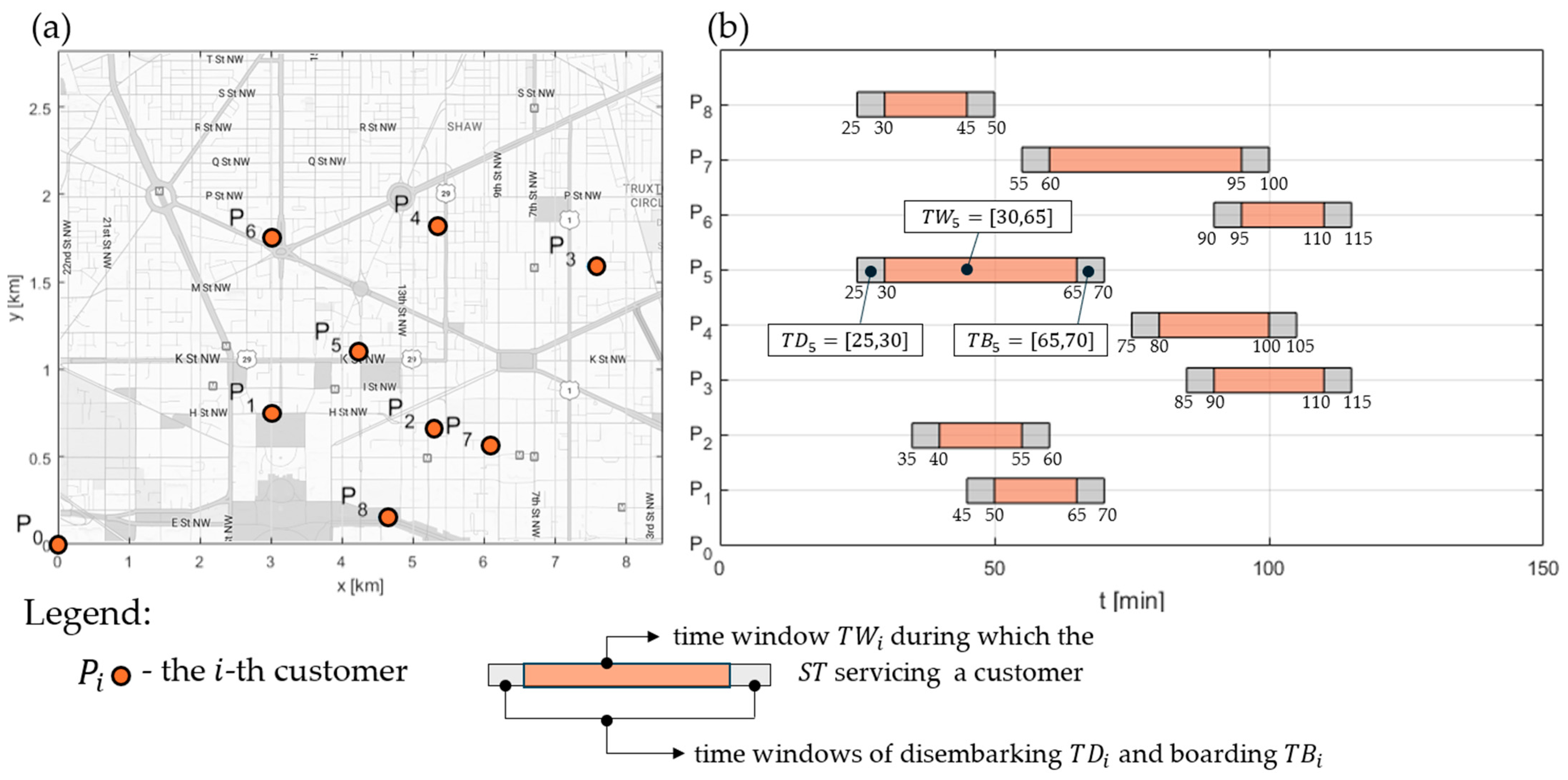
Figure 1. Layout of services distribution network (a) and predetermined time windows T W i (b).
Applsci 15 12727 g001
Figure 2. Example of a flexible mode service mission for the distribution network from Figure 1: routes of vehicles V 1 and V 2 (a) and schedule for STs (b).
Applsci 15 12727 g002
Figure 3. Example of a dedicated mode service mission for the distribution network from Figure 1: routes of vehicles V 1 , V 2 and V 3 (a) and schedule for STs (b).
Applsci 15 12727 g003
Figure 4. Structure of time windows T W 1 , T W 5 , T W 8 , T D 1 ,   T D 5 ,   T D 8 and T B 1 ,   T B 5 ,   T B 8 for the services distribution network shown in Figure 1.
Applsci 15 12727 g004
Figure 5. Example of a time window structure configuration where two vehicles are not enough for on-time deliveries and pickups of service teams: V 1 visits P 8 and V 2 visits P 5 and P 1 (a), V 1 visits P 1 and V 2 visits P 5 and P 8 (b), V 1 visits P 5 and V 2 visits P 1 and P 8 (c).
Applsci 15 12727 g005
Figure 6. Graph G T representing the time window structure arrangement T from Figure 4: structure arrangement T (a), graph G T (b), and formal definition (c).
Applsci 15 12727 g006
Figure 7. Coloring the graph G T D : using 2 colors in time windows arrangement representation (a); using 2 colors in graph representation (b); using 3 colors in time windows arrangement representation (c); using 3 colors in graph representation (d).
Applsci 15 12727 g007
Figure 8. Assessment of the chromatic number for time windows arrangement T from Figure 1: for the dedicated mode χ G T D = 3 (a), and the flexible mode χ G T F = 2 (b).
Applsci 15 12727 g008
Figure 9. Graph representation of the time window arrangement T : in which customers are served in dedicated mode (a) and flexible mode (b).
Applsci 15 12727 g009
Figure 10. Colored graphs from Figure 9: graph G T D with four colors, χ ( G T D ) = 4   (a) and graph G T F with three colors, χ ( G T F ) = 3 (b).
Applsci 15 12727 g010
Figure 11. Flowchart of a feasible service mission planning algorithm implementing a preprocessing filter-like overlay on declarative approach based C O P solution.
Applsci 15 12727 g011
Figure 12. Taxonomy of feasibility conditions.
Applsci 15 12727 g012
Figure 13. Instance space of the STTS problem.
Applsci 15 12727 g013
Figure 14. The idea of adding new necessary conditions determined by various dimensions.
Applsci 15 12727 g014
Table 1. Comparative summary of existing approaches and the proposed STTS-Feasibility.
Approach/ModelMain FocusDispatch
Strategy
Feasibility Assessment ReferencesRelation to
the Present Study
VRP (Vehicle Routing Problem)Cost or distance minimization under deterministic conditionsDedicated onlyAssumes solutions exist; no explicit feasibility check[51,61]Classical baseline routing model
RVRP (Rich Vehicle Routing Problems)Modeling realistic operational constraints (time windows, pickup–delivery, heterogeneous fleets, etc.)Mostly dedicated; some flexible variantsFeasibility checked only implicitly during optimization[10,28]Captures operational richness but rarely examines mission-level feasibility
SRSP (Service Routing and Scheduling Problem)Scheduling of service operations with time-window and sequencing constraintsUsually dedicatedLimited feasibility analysis; infeasibility detected only after solver failure[68]Integrates routing and scheduling; provides conceptual foundation for STTS
Proposed STTS-Feasibility FrameworkFeasibility assessment of service team transport missionsDedicated and Flexible dispatch modesPerforms explicit pre-feasibility testing; identifies minimal fleet and structural requirements before optimization[41,59,60]Introduces graph-based feasibility analysis supporting early mission screening
Table 2. Comparison of the time efficiency of the CSP and graph coloring approaches.
S I N V Is There a Solution for Dedicated Mode? C T D S T T S [s]Is There a Solution for Flexible Mode? C T F S T T S   [ s ] C T G [s]
112No8.45No9.540.02
113No75.65Yes22.000.02
114Yes3.45Yes13.980.02
where: S I —number of customers, N V —vehicle fleet size, C T D S T T S and C T F S T T S —times to solve the STTS problem in dedicated and flexible mode, respectively, C T G —time to solve the graph coloring problem.
Table 3. Comparison of the time efficiency of the CSP and graph coloring approaches.
S I N V Is There a Solution for Dedicated
Mode?
C T D S T T S [s] C T D G [s] χ G T D     N V ? Is There a Solution
for Flexible
Mode?
C T F S T T S [s] C T F G
[s]
χ G T F     N V ?
82No4.350.00NoYes3.000.00Yes
83Yes1.200.00YesYes2.350.00Yes
92No5.700.01NoNo27.060.01No
93Yes8.000.01YesYes10.000.01Yes
102No7.250.01NoNo7.610.01No
103Yes2.030.01YesYes13.700.01Yes
112No8.450.02NoNo9.540.02No
113No75.650.02NoYes22.000.02Yes
114Yes3.450.02YesYes13.980.02Yes
122No9.250.01NoNo13.150.01No
123No128.320.01NoYes23.610.01Yes
124Yes4.230.01YesYes6.580.01Yes
132No95.320.02NoNo15.990.02No
133Unknown300.000.02NoYes33.790.02Yes
134Yes6.970.02YesYes30.210.02Yes
142No69.320.02NoNo25.410.02No
143No4.910.02NoNo47.040.02No
144Yes6.960.02YesYes61.430.02Yes
152No9.270.02NoNo34.240.02No
153No5.740.02NoNo68.080.02No
154Yes22.540.02YesUnknown300.000.02Yes
162No49.520.02NoNo125.980.02No
163No261.270.02NoNo219.670.02No
164Unknown300.000.02NoUnknown300.000.02Yes
165Yes24.660.02YesYes286.340.02Yes
172No36.240.04NoNo154.750.04No
173No45.210.04NoNo256.330.04No
174Unknown300.000.04NoUnknown300.000.04No
175Unknown300.000.04YesUnknown300.000.04Yes
where: S I —number of customers, N V —vehicle fleet size; C T D S T T S and C T F S T T S —times to solve the STTS problem in dedicated and flexible mode, respectively; C T D G and C T F G —times to solve the graph coloring problem in dedicated and flexible mode, respectively; χ G T D N V and χ G T F N V —comparison of chromatic number with N V in dedicated and flexible mode, respectively.
Table 4. Results for unresolved instances from Table 3.
S I N V Is There a Solution for Dedicated
Mode?
C T D S T T S [s] C T D G [s] χ G T D     N V ? Is There a Solution
for Flexible
Mode?
C T F S T T S [s] C T F G
[s]
χ G T F     N V ?
133Unknown>9000.02NoYes333.790.02Yes
154Yes422.540.02YesUnknown>9000.02Yes
164Unknown>9000.02NoUnknown>9000.02Yes
174Unknown>9000.04NoUnknown>9000.04No
175Unknown>9000.04YesUnknown>9000.04Yes
where: S I —number of customers, N V —vehicle fleet size; C T D S T T S and C T F S T T S —times to solve the STTS problem in dedicated and flexible mode, respectively; C T D G and C T F G —times to solve the graph coloring problem in dedicated and flexible mode, respectively; χ G T D N V and χ G T F N V —comparison of chromatic number with N V in dedicated and flexible mode, respectively.
Table 5. Time to solve the graph coloring problem C T G   [ s ] for instances with S I = 50 ,   100 ,   250 and k = 1 , , 5 .
S I k   =   1 k   =   2 k = 3 k   =   4 k   =   5
501 s10 s 40 s 70 s100 s
10010 s70 s 180 s 370 s780 s
250100 s780 s >1000 s>1000 s>1000 s
Disclaimer/Publisher’s Note: The statements, opinions and data contained in all publications are solely those of the individual author(s) and contributor(s) and not of MDPI and/or the editor(s). MDPI and/or the editor(s) disclaim responsibility for any injury to people or property resulting from any ideas, methods, instructions or products referred to in the content.