Deep Learning-Based Gravity Inversion Integrating Physical Equations and Multiple Constraints

 , , ,
, , ,
Abstract
1. Introduction
2. Background
2.1. Physics-Driven Methods
2.2. Data-Driven Methods
3. Combining Physical-Driven and Data-Driven Inversion Methods
4. Methodology
4.1. Network Architecture
4.2. Loss Function
5. Experiments
5.1. Dataset
5.2. Evaluation Metrics
5.3. Inversion Results
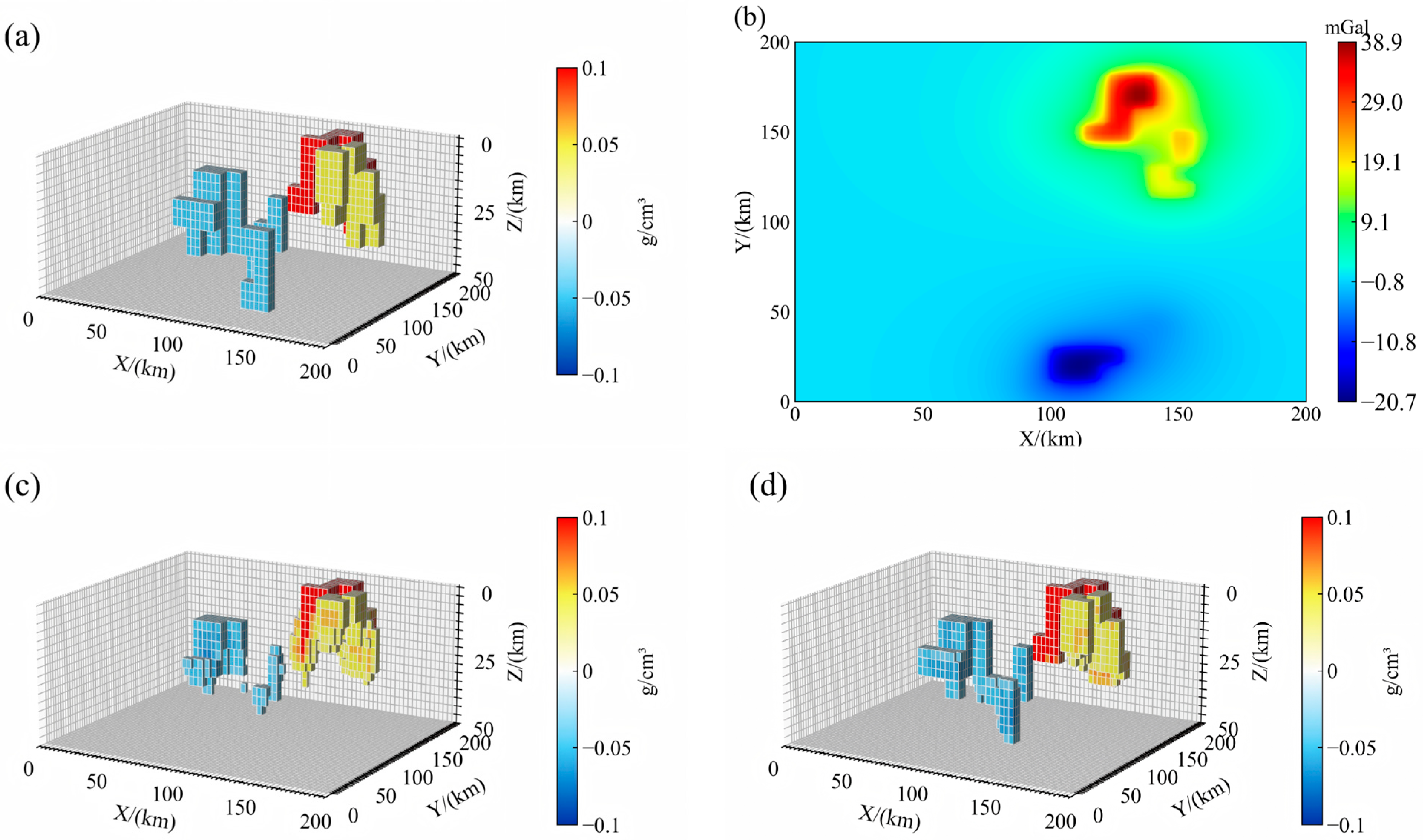
5.3.1. Random Model Inversion
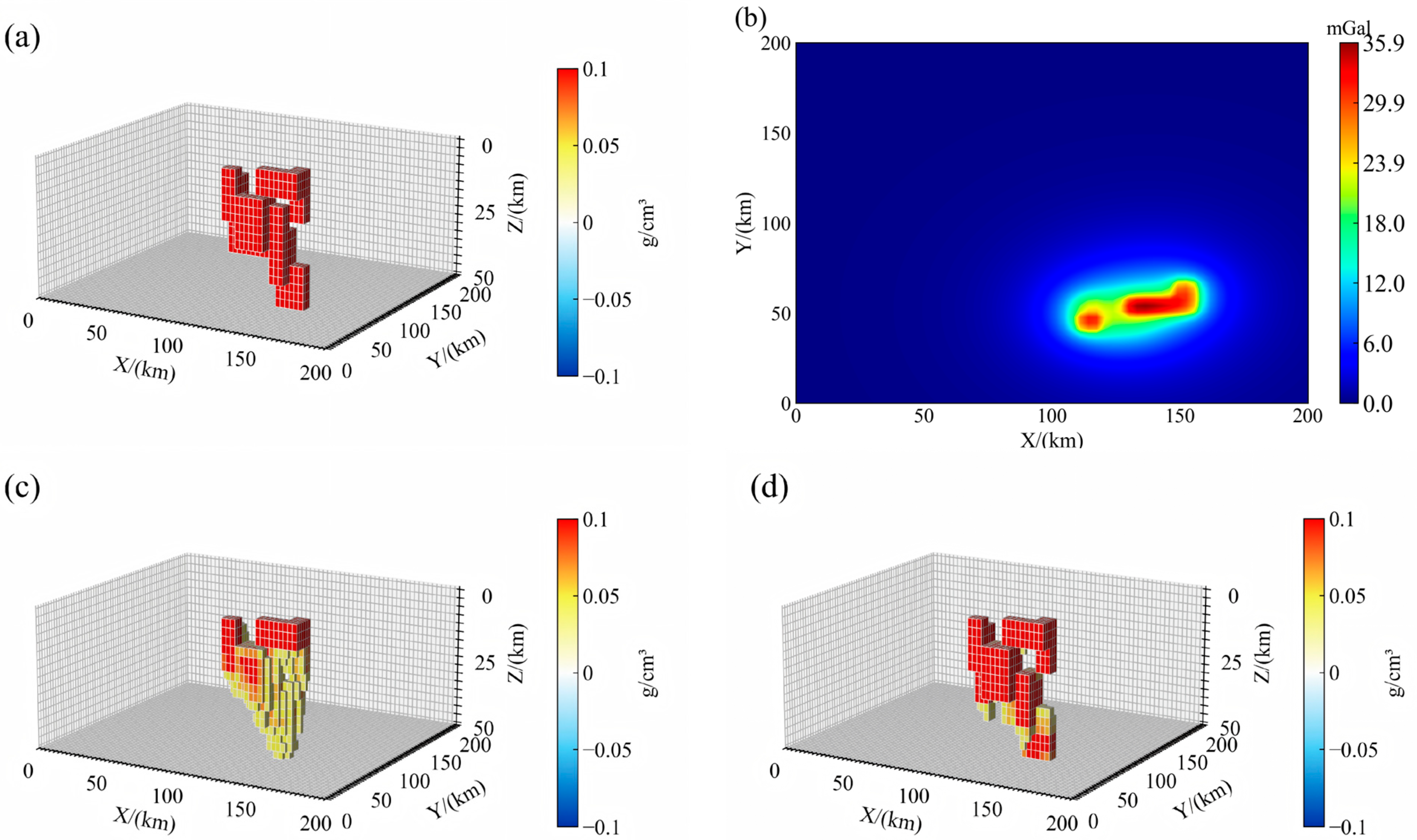
5.3.2. Rule Model Inversion
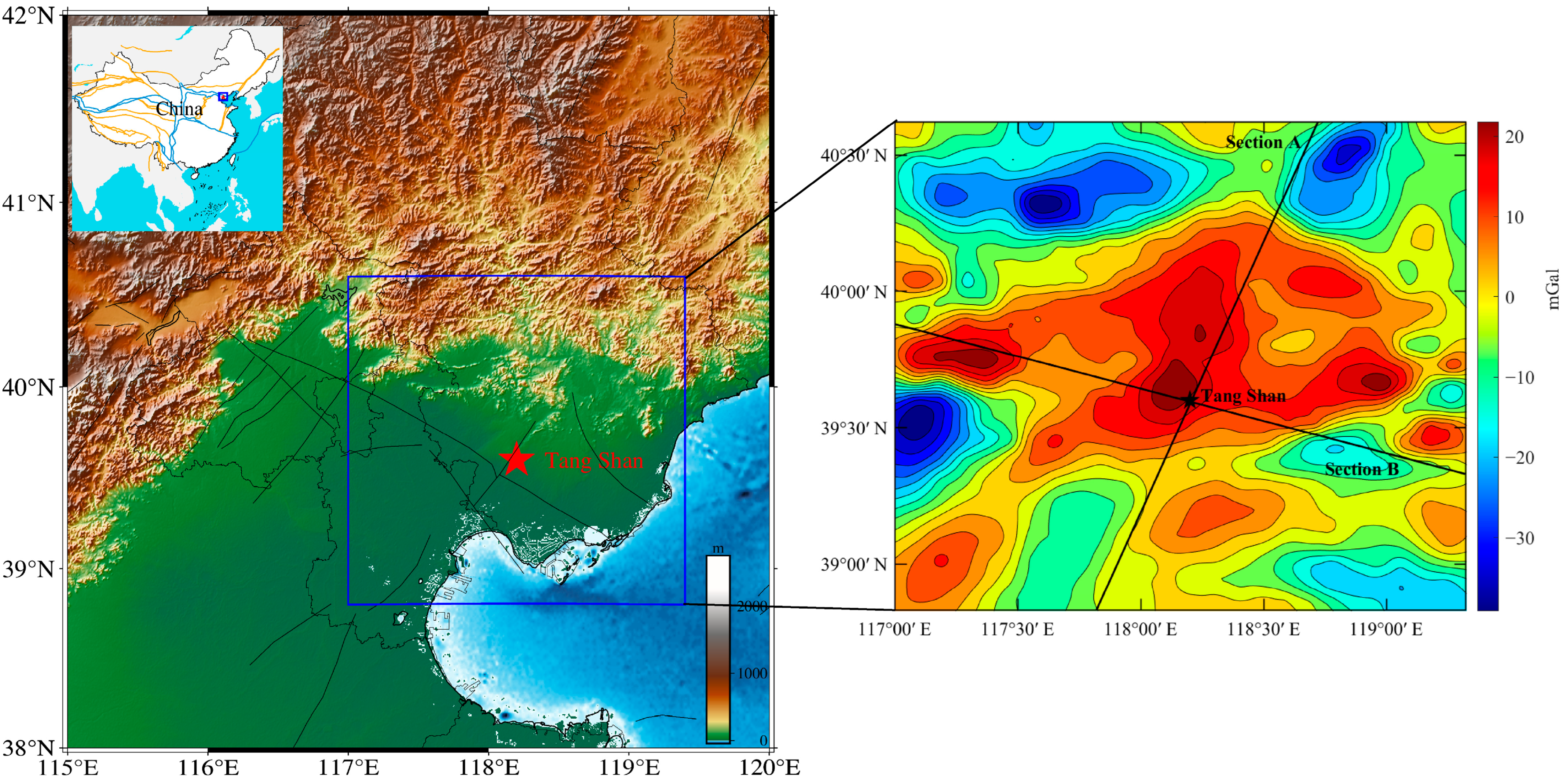
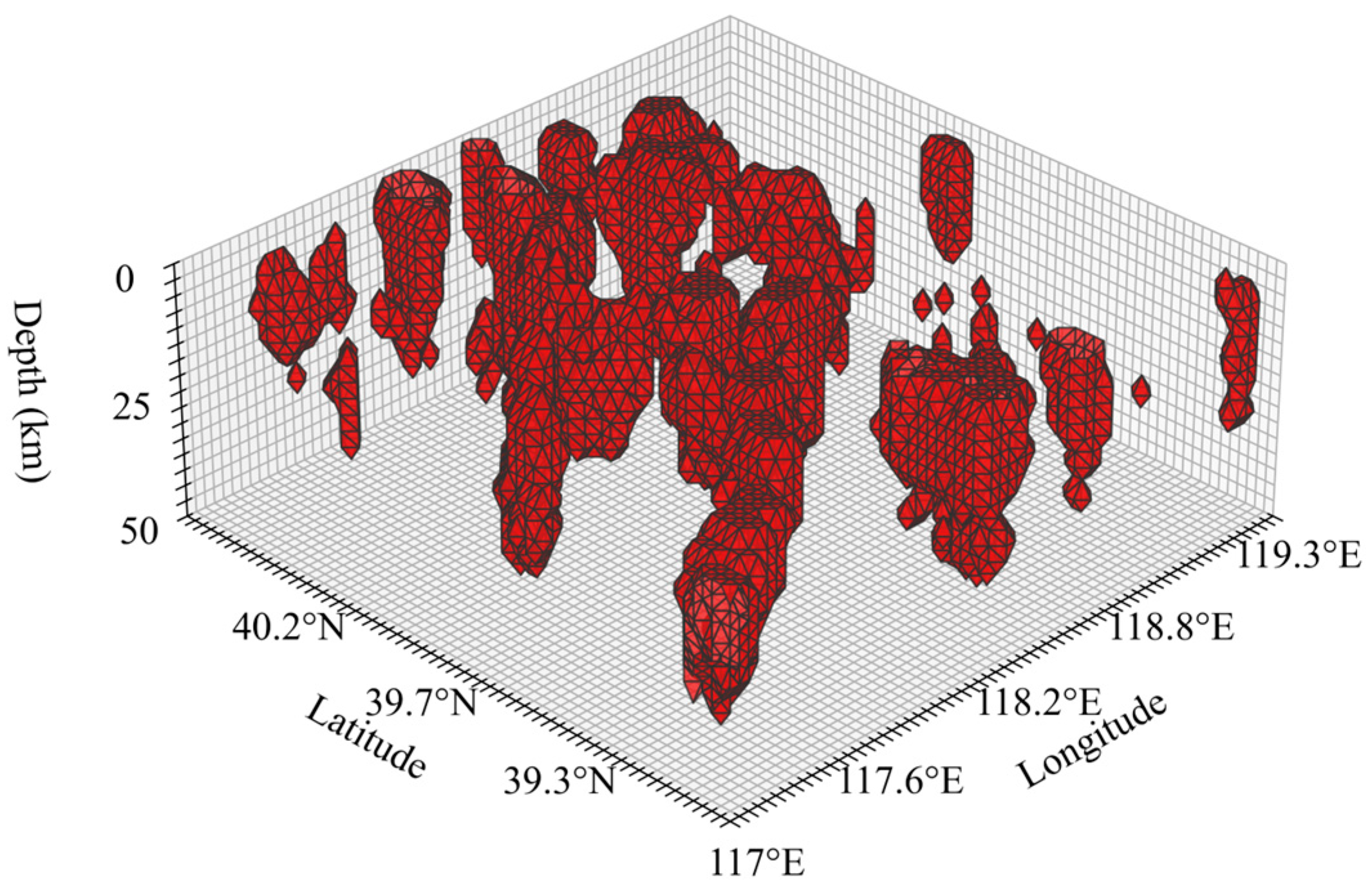
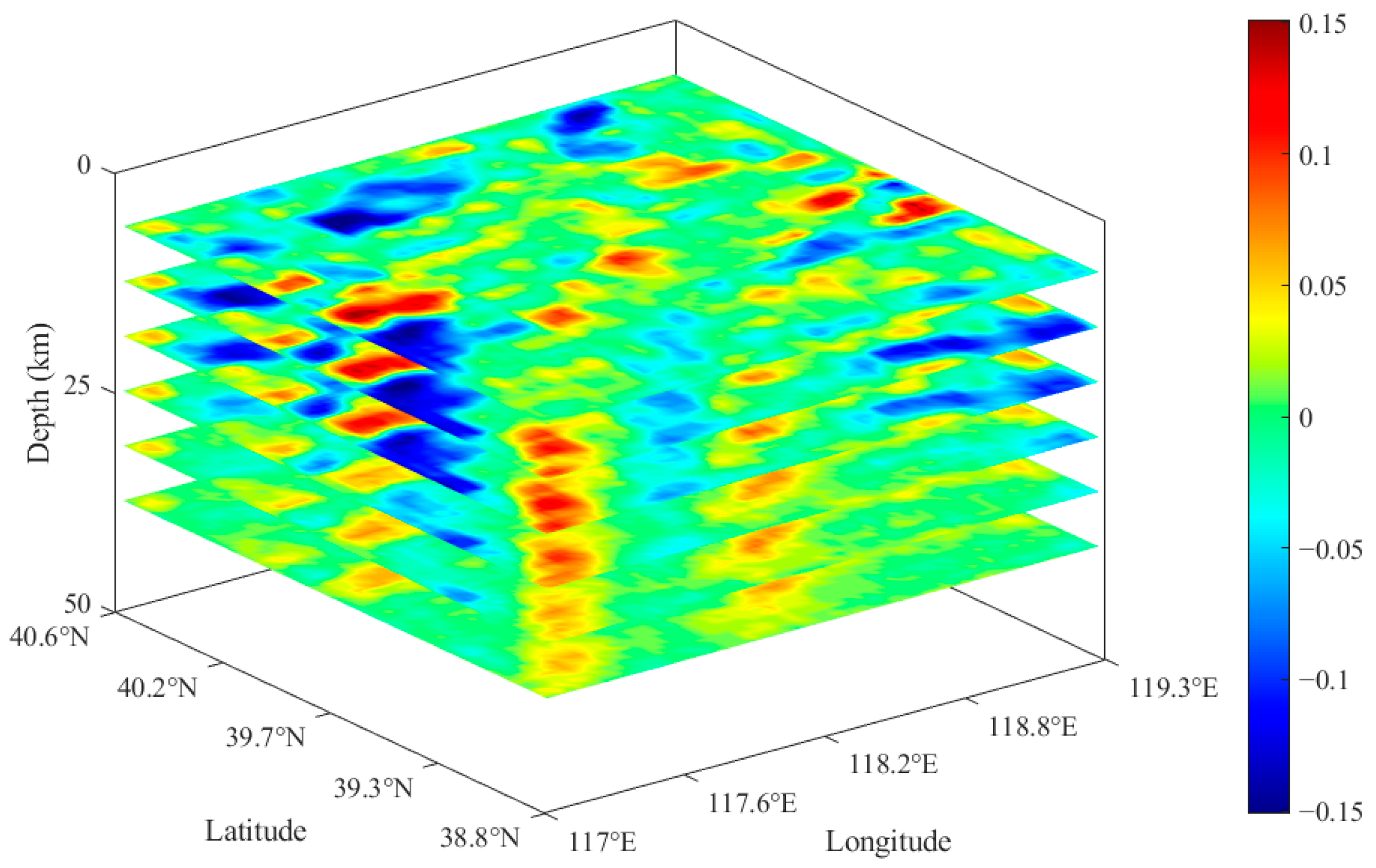
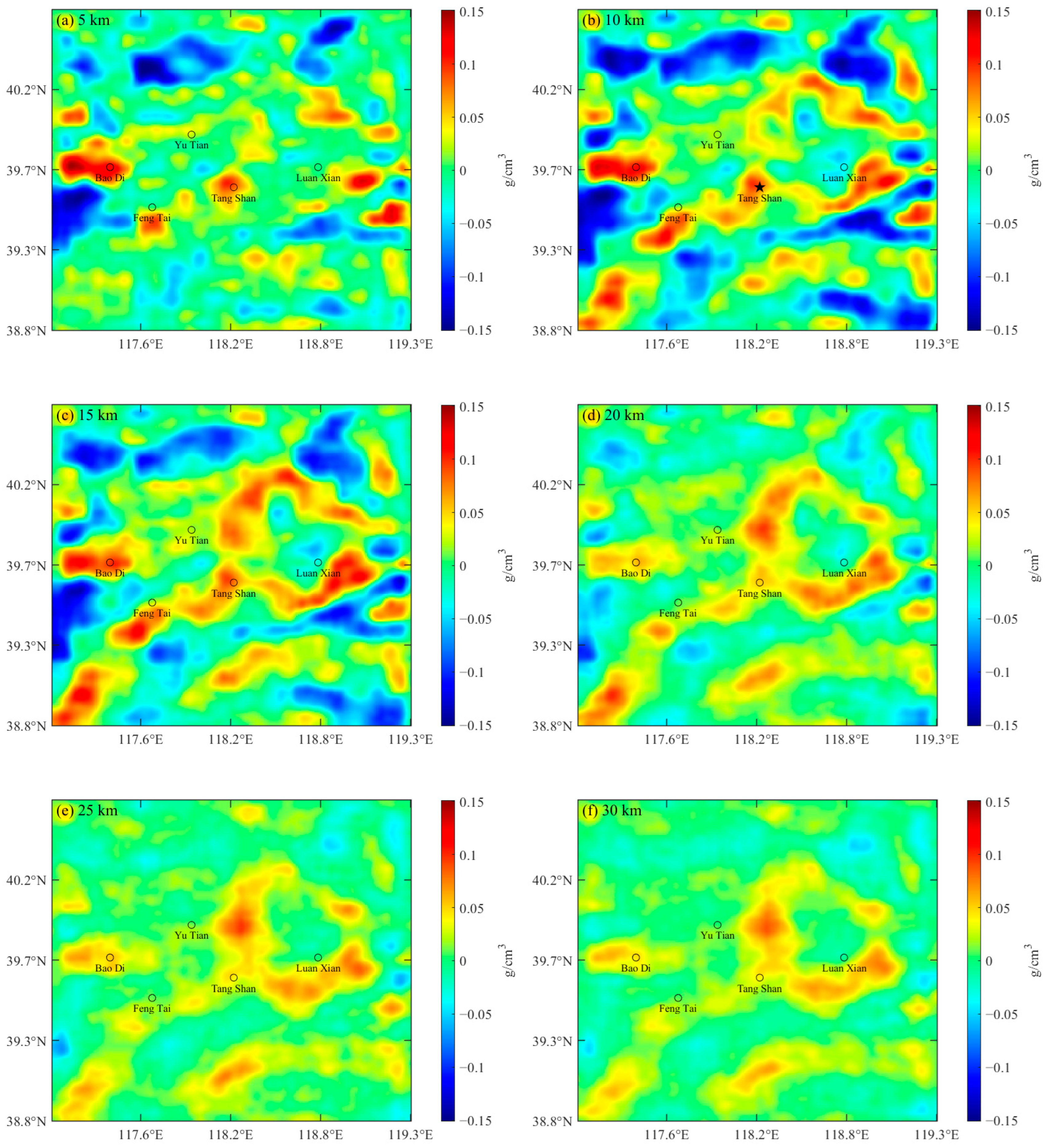
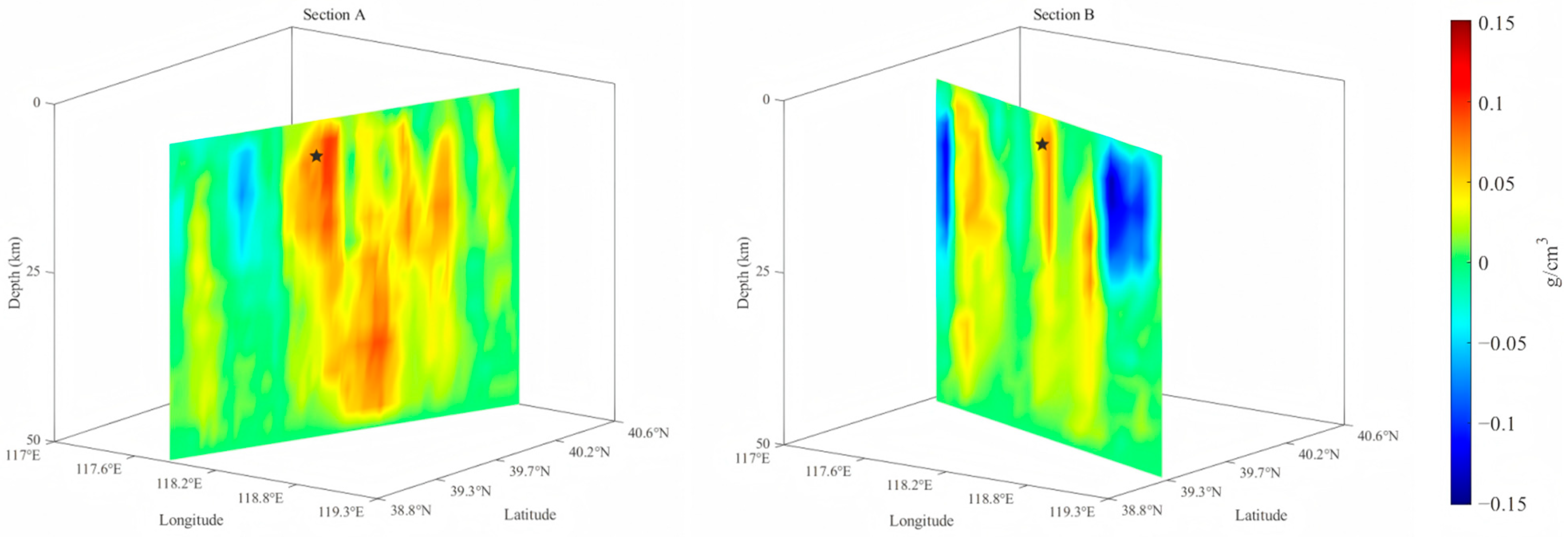
6. Practical Applications
7. Conclusions
- (1)
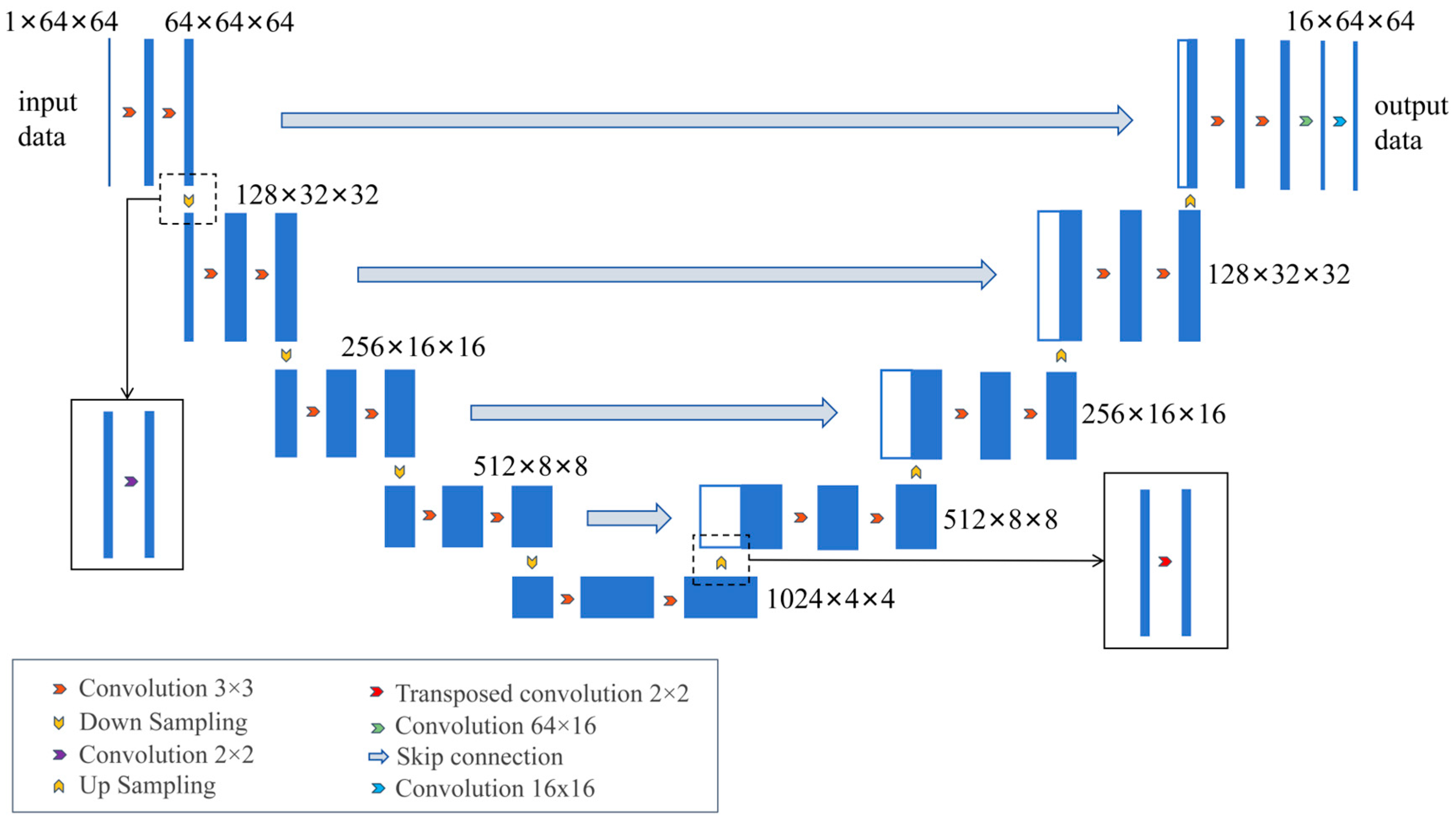
- Network Architecture Design: Several enhancements were made to the traditional U-Net framework. First, conventional pooling operations in the downsampling path were replaced with convolutional operations to better preserve critical fine details. Second, transpose convolution was introduced in the upsampling path, overcoming the limitations of traditional interpolation methods and enabling dynamic learning during feature reconstruction. These improvements allow the network to learn more complex data mappings.
- (2)
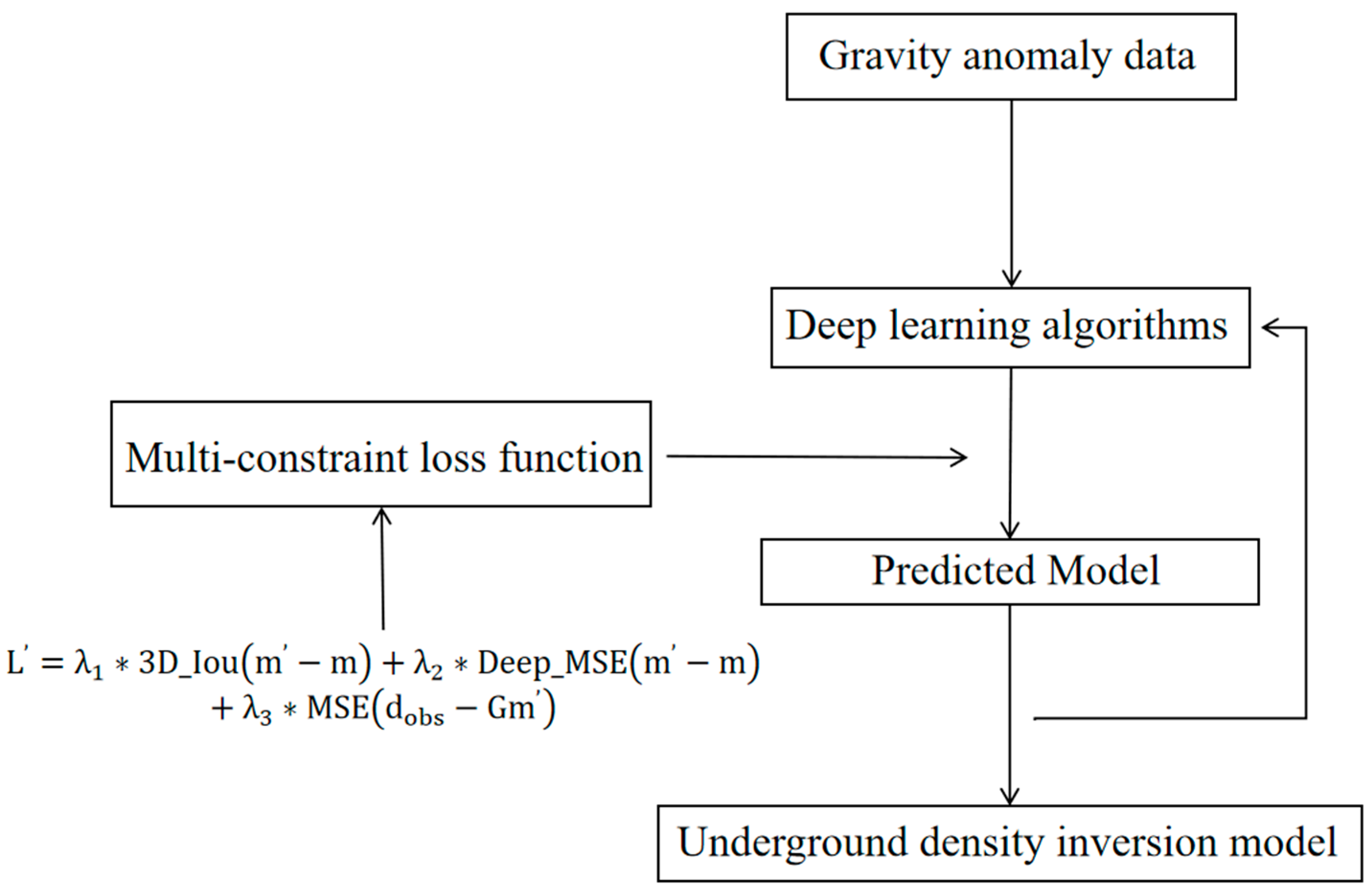
- Loss Function Construction: A composite Multi-Constraint loss function was developed, including 3D Intersection-over-Union (IoU) loss to strengthen geometric constraints; Spatial 3D Mean Squared Error (MSE) loss, an extension of traditional MSE, to better describe spatial continuity in the subsurface density field; depth-weighting functions to mitigate the skin effect commonly encountered in gravity inversion; and gravity field equation constraints to ensure physical plausibility. This multi-scale, multi-physics constraint framework provides rigorous mathematical and physical guarantees for the inversion results.
- (3)
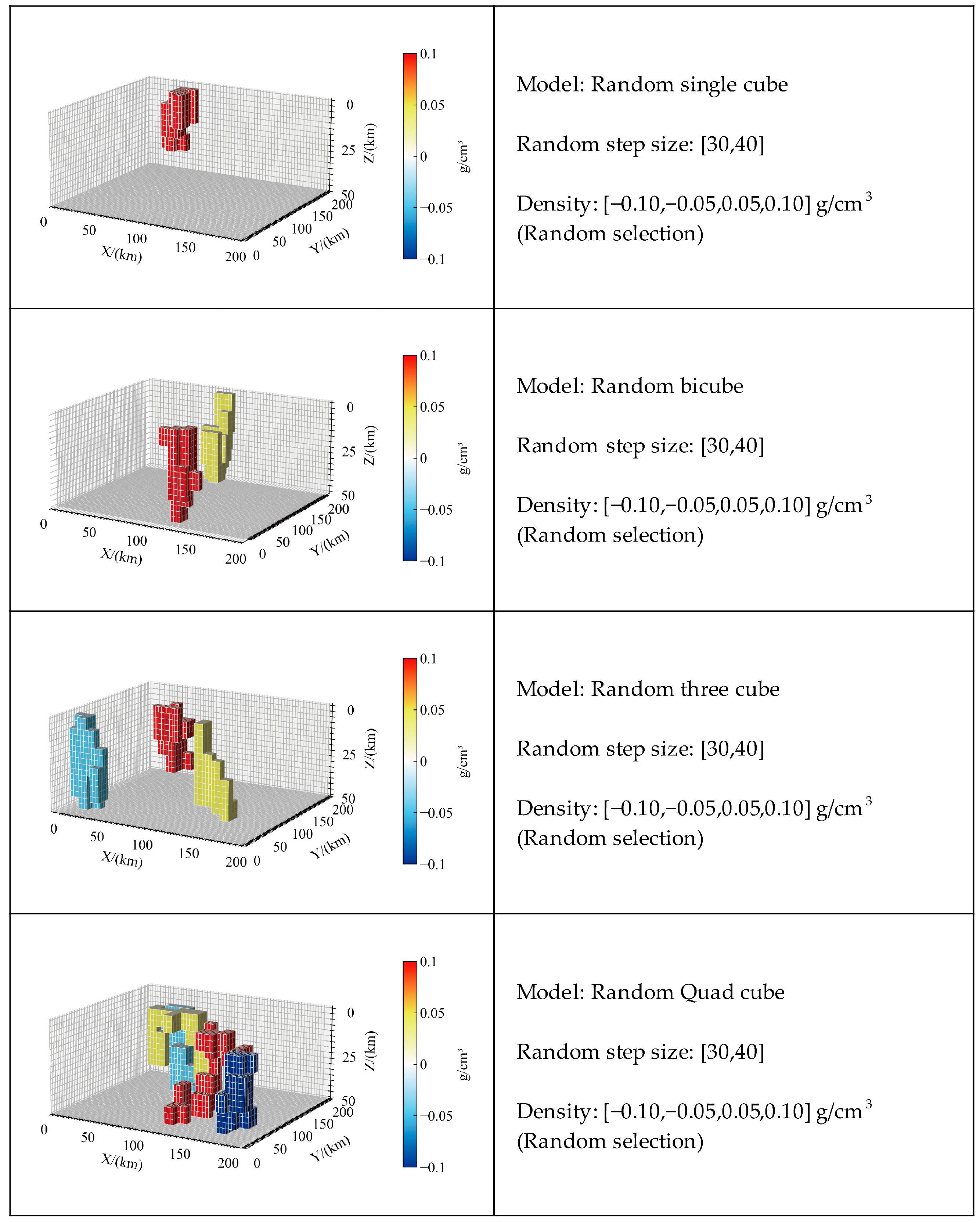
- Dataset Construction: A highly diversified training dataset was created using the random walk method, effectively simulating complex underground anomaly structures.
Author Contributions
Funding
Institutional Review Board Statement
Informed Consent Statement
Data Availability Statement
Acknowledgments
Conflicts of Interest
References
- Nabighian, M.N.; Ander, M.E.; Grauch, V.J.S.; Hansen, R.O.; LaFehr, T.R.; Li, Y.; Pearson, W.C.; Peirce, J.W.; Phillips, J.D.; Ruder, M.E. Historical development of the gravity method in exploration. Geophysics 2005, 70, 63ND–89ND. [Google Scholar] [CrossRef]
- Blakely, R.J. Potential Theory in Gravity and Magnetic Applications; Cambridge University Press: Cambridge, UK, 2009. [Google Scholar]
- Tian, Y.; Liu, J.; Ye, Q.; Shi, L.; Wang, Y.; Ebbing, J. An integrated method for gravity gradient inversion and gravity gradient depth imaging. Geophys. J. Int. 2024, 238, 590–615. [Google Scholar] [CrossRef]
- Tarantola, A. Inverse Problem Theory and Methods for Model Parameter Estimation; Society for Industrial and Applied Mathematics: Philadelphia, PA, USA, 2005. [Google Scholar] [CrossRef]
- Camacho, A.G.; Vajda, P.; Miller, C.A.; Fernández, J. A free-geometry geodynamic modelling of surface gravity changes using Growth-dg software. Sci. Rep. 2021, 11, 23442. [Google Scholar] [CrossRef] [PubMed]
- Last, B.J.; Kubik, K. Compact gravity inversion. Geophysics 1983, 48, 713–721. [Google Scholar] [CrossRef]
- Virieux, J.; Operto, S. An overview of full-waveform inversion in exploration geophysics. Geophysics 2009, 74, WCC1–WCC26. [Google Scholar] [CrossRef]
- Bell, J.B.; Tikhonov, A.N.; Arsenin, V.Y. Solutions of Ill-Posed Problems. Math. Comput. 1978, 32, 1320. [Google Scholar] [CrossRef]
- Li, Y.; Oldenburg, D.W. 3-D inversion of gravity data. Geophysics 1998, 63, 109–119. [Google Scholar] [CrossRef]
- Hansen, P.C. Rank-deficient and discrete ill-posed problems: Numerical aspects of linear inversion. In Mathematical Modeling and Computation; Society for Industrial and Applied Mathematics: Philadelphia, PA, USA, 1998. [Google Scholar] [CrossRef]
- Chen, W.; Tenzer, R.; Tan, X.; Zhao, S. An Adaptive Conjugate Gradient Least-Squares Regularization (ACGLSR) Method for 3D Gravity Density Inversion. Pure Appl. Geophys. 2024, 181, 203–218. [Google Scholar] [CrossRef]
- Davis, K.; Li, Y. The role of the wavelet transform in potential-field inversion techniques. In Proceedings of the International Workshop on Gravity, Electrical & Magnetic Methods and Their Applications, Beijing, China, 10–13 October 2011; Li, X., Li, Y., Meng, X., Eds.; Society of Exploration Geophysicists: Beijing, China, 2011; p. 79. [Google Scholar]
- Foks, N.L.; Krahenbuhl, R.; Li, Y. Adaptive sampling of potential-field data: A direct approach to compressive inversion. Geophysics 2014, 79, IM1–IM9. [Google Scholar] [CrossRef]
- Wang, L.-K.; Fang, W.-B.; Duan, X.-B.; Cao, W.-J.; Li, Z.-C. Review of full waveform inversion initial model building strategy. Prog. Geophys. 2016, 31, 1678–1687. [Google Scholar] [CrossRef]
- Schmidhuber, J. Deep learning in neural networks: An overview. Neural Netw. 2015, 61, 85–117. [Google Scholar] [CrossRef] [PubMed]
- Zhang, Q.; Zhou, Y. Big data will lead to a profound revolution in the field of geological science. Chin. J. Geol. 2017, 52, 637–648. [Google Scholar] [CrossRef]
- Wang, H.; Yan, J.-Y.; Fu, G.-M.; Wang, X. Current status and application prospect of deep learning in geophysics. Prog. Geophys. 2020, 35, 642–655. [Google Scholar] [CrossRef]
- Meng, Q.; Guo, L.; Zhang, S.; Lou, H.; Li, R. Deep Learning in Gravity Research: A Review. J. Earth Sci. 2025, 36, 1808–1819. [Google Scholar] [CrossRef]
- LeCun, Y.; Bengio, Y.; Hinton, G. Deep learning. Nature 2015, 521, 436–444. [Google Scholar] [CrossRef]
- Guo, W.-B.; Zhu, Z.-Q.; Lu, G.-Y. 3-D gravity inversion for physical properties using BP network. Prog. Geophys. 2012, 27, 409–416. [Google Scholar] [CrossRef]
- Yang, Q.; Hu, X.; Liu, S.; Jie, Q.; Wang, H.; Chen, Q. 3-D Gravity Inversion Based on Deep Convolution Neural Networks. IEEE Geosci. Remote Sens. Lett. 2021, 19, 3001305. [Google Scholar] [CrossRef]
- Huang, R.; Liu, S.; Qi, R.; Zhang, Y. Deep Learning 3D Sparse Inversion of Gravity Data. J. Geophys. Res. Solid Earth 2021, 126, e2021JB022476. [Google Scholar] [CrossRef]
- Chen, C.; Li, H.; Zhang, Y.; Jin, X.; Liu, J. Three-Dimensional Gravity Inversion Based on Attention Feature Fusion. Sensors 2024, 24, 5697. [Google Scholar] [CrossRef] [PubMed]
- Xu, Z.; Wang, R.; Zhdanov, M.S.; Wang, X.; Li, J.; Zhang, B.; Liang, S.; Wang, Y. Inversion of the Gravity Gradiometry Data by ResUnet Network: An Application in Nordkapp Basin, Barents Sea. IEEE Trans. Geosci. Remote Sens. 2023, 61, 4502410. [Google Scholar] [CrossRef]
- Lv, M.; Zhang, Y.; Liu, S. Fast forward approximation and multitask inversion of gravity anomaly based on UNet3+. Geophys. J. Int. 2023, 234, 972–984. [Google Scholar] [CrossRef]
- Wang, R.; Ding, Y.; Xu, Z.; Zhdanov, M.S.; Xian, M.; Zhang, Y.; Li, J.; Jiang, C.; Guo, Z. Employing MS-UNets Networks for Multiscale 3-D Gravity Data Inversion: A Case Study in the Nordkapp Basin, Barents Sea. IEEE Trans. Geosci. Remote Sens. 2024, 62, 4502813. [Google Scholar] [CrossRef]
- Raissi, M.; Perdikaris, P.; Karniadakis, G.E. Physics-informed neural networks: A deep learning framework for solving forward and inverse problems involving nonlinear partial differential equations. J. Comput. Phys. 2019, 378, 686–707. [Google Scholar] [CrossRef]
- Colombo, D.; Turkoglu, E.; Li, W.; Rovetta, D. Coupled physics-deep learning inversion. Comput. Geosci. 2021, 157, 104917. [Google Scholar] [CrossRef]
- Sun, J.; Innanen, K.A.; Huang, C. Physics-guided deep learning for seismic inversion with hybrid training and uncertainty analysis. Geophysics 2021, 86, R303–R317. [Google Scholar] [CrossRef]
- Yu, S.; Ma, J. Deep Learning for Geophysics: Current and Future Trends. Rev. Geophys. 2021, 59, e2021RG000742. [Google Scholar] [CrossRef]
- Li, X.; Chouteau, M. Three-Dimensional Gravity Modeling in All Space. Surv. Geophys. 1998, 19, 339–368. [Google Scholar] [CrossRef]
- Toushmalani, R.; Saibi, H. 3D Gravity Inversion using Tikhonov Regularization. Acta Geophys. 2015, 63, 1044–1065. [Google Scholar] [CrossRef]
- Zhdanov, M.S. Geophysical Inverse Theory and Regularization Problems; Elsevier: Amsterdam, The Netherlands, 2002. [Google Scholar]
- Waheed, U.B. The emergence and impact of scientific machine learning in geophysical exploration. In Third International Meeting for Applied Geoscience & Energy Expanded Abstracts; Society of Exploration Geophysicists and American Association of Petroleum Geologists: Houston, TX, USA, 2023; pp. 1807–1812. [Google Scholar] [CrossRef]
- Colombo, D.; Turkoglu, E.; Li, W.; Sandoval-Curiel, E.; Rovetta, D. Physics-driven deep-learning inversion with application to transient electromagnetics. Geophysics 2021, 86, E209–E224. [Google Scholar] [CrossRef]
- Long, J.; Shelhamer, E.; Darrell, T. Fully convolutional networks for semantic segmentation. In Proceedings of the IEEE Conference on Computer Vision and Pattern Recognition (CVPR), Boston, MA, USA, 7–12 June 2015; IEEE: Piscataway, NJ, USA, 2015; pp. 3431–3440. [Google Scholar] [CrossRef]
- Russakovsky, O.; Deng, J.; Su, H.; Krause, J.; Satheesh, S.; Ma, S.; Huang, Z.; Karpathy, A.; Khosla, A.; Bernstein, M.; et al. ImageNet Large Scale Visual Recognition Challenge. Int. J. Comput. Vis. 2015, 115, 211–252. [Google Scholar] [CrossRef]
- Ronneberger, O.; Fischer, P.; Brox, T. U-Net: Convolutional Networks for Biomedical Image Segmentation. arXiv 2015, arXiv:1505.04597. [Google Scholar] [CrossRef]
- Hui, T.; Xu, Y.; Jarhinbek, R. Detail texture detection based on Yolov4-tiny combined with attention mechanism and bicubic interpolation. IET Image Process. 2021, 15, 2736–2748. [Google Scholar] [CrossRef]
- Wang, C.; Wu, J.; Zhu, Z.; Chen, H. MSFNet: MultiStage Fusion Network for infrared and visible image fusion. Neurocomputing 2022, 507, 26–39. [Google Scholar] [CrossRef]
- Dalvi, P.P.; Edla, D.R.; Purushothama, B.R. DenseNet-121 Model for Diagnosis of COVID-19 Using Nearest Neighbour Interpolation and Adam Optimizer. Wirel. Pers. Commun. 2024, 137, 1823–1841. [Google Scholar] [CrossRef]
- Gao, H.; Yuan, H.; Wang, Z.; Ji, S. Pixel Transposed Convolutional Networks. IEEE Trans. Pattern Anal. Mach. Intell. 2019, 42, 1218–1227. [Google Scholar] [CrossRef] [PubMed]
- Wang, X.; Li, J.; Zhang, Q.; Zhao, D.; Liu, J.; Li, K. Efficient 3-D Gravity Data Inversion with Depth Weighting Function. IEEE Trans. Geosci. Remote Sens. 2024, 62, 4513409. [Google Scholar] [CrossRef]
- Li, H.; Chen, S.; Zhang, B.; Li, Y.; Zhuang, J. Bayesian inversion for modelling 3-D density structures in the eastern margin of Bayan Har block and its tectonic implications. Geophys. J. Int. 2023, 236, 872–887. [Google Scholar] [CrossRef]
- Xing, L.; Liu, Z.; Jia, J.; Wu, S.; Chen, Z.; Niu, X. Far-field coseismic gravity changes related to the 2015 MW7.8 Nepal (Gorkha) earthquake observed by superconducting gravimeters in mainland China. Earth Planet. Phys. 2021, 5, 141–148. [Google Scholar] [CrossRef]
- Yang, X.; Shen, C.Y.; Zhu, Y.Q.; Yang, G.L.; Sun, K.; Tan, H.B.; Wang, J.P. Study on gravity inversion of three-dimensional density structure of the crust in Tangshan MS7.8 earthquake area. Chin. J. Geophys. 2023, 66, 183–196. (In Chinese) [Google Scholar] [CrossRef]









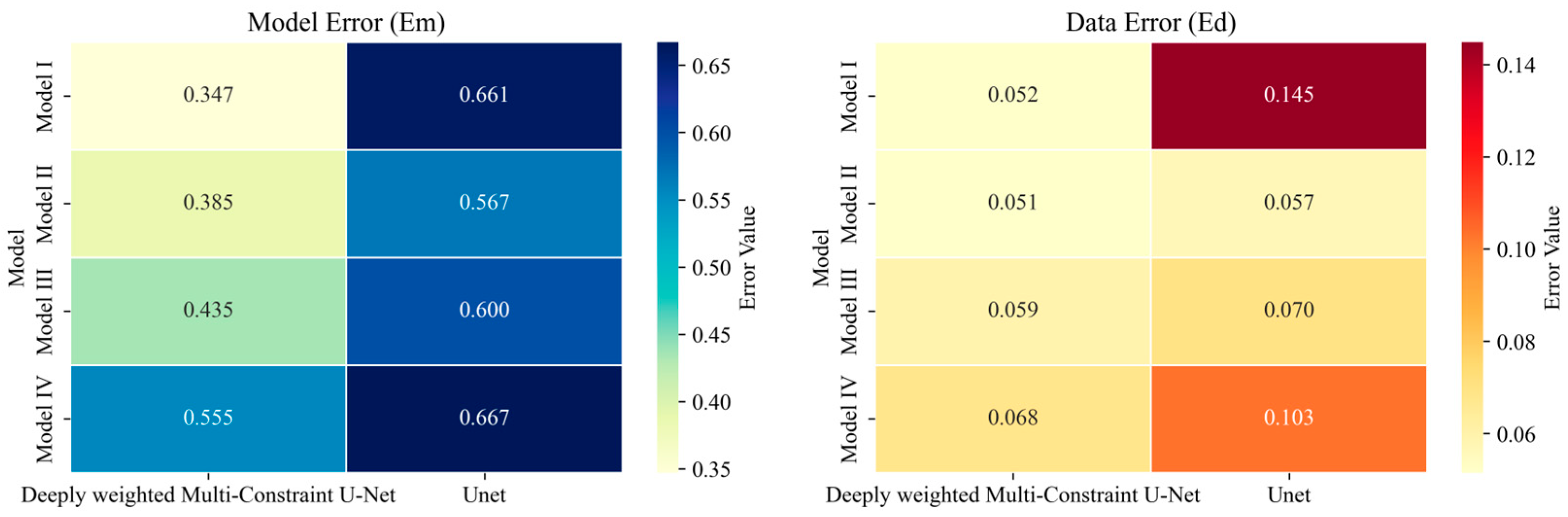
| Model | Em | Ed |
|---|---|---|
| Model Ⅰ | 0.6613 | 0.1448 |
| Model Ⅰ(Deeply weighted Multiple constraints) | 0.3470 | 0.0517 |
| Model Ⅱ | 0.5674 | 0.0569 |
| Model Ⅱ(Deeply weighted Multiple constraints) | 0.3849 | 0.0515 |
| Model Ⅲ | 0.5996 | 0.0695 |
| Model Ⅲ(Deeply weighted Multiple constraints) | 0.4349 | 0.0594 |
| Model Ⅳ | 0.6670 | 0.1031 |
| Model Ⅳ(Deeply weighted Multiple constraints) | 0.5549 | 0.0681 |
Disclaimer/Publisher’s Note: The statements, opinions and data contained in all publications are solely those of the individual author(s) and contributor(s) and not of MDPI and/or the editor(s). MDPI and/or the editor(s) disclaim responsibility for any injury to people or property resulting from any ideas, methods, instructions or products referred to in the content. |
© 2025 by the authors. Licensee MDPI, Basel, Switzerland. This article is an open access article distributed under the terms and conditions of the Creative Commons Attribution (CC BY) license (https://creativecommons.org/licenses/by/4.0/).
Share and Cite
Shi, W.; Wang, J.; Shen, C.; Zhang, S.; Zhang, M.; Tan, H.; Yang, G. Deep Learning-Based Gravity Inversion Integrating Physical Equations and Multiple Constraints. Appl. Sci. 2025, 15, 12717. https://doi.org/10.3390/app152312717
Shi W, Wang J, Shen C, Zhang S, Zhang M, Tan H, Yang G. Deep Learning-Based Gravity Inversion Integrating Physical Equations and Multiple Constraints. Applied Sciences. 2025; 15(23):12717. https://doi.org/10.3390/app152312717
Chicago/Turabian StyleShi, Wenxuan, Jiapei Wang, Chongyang Shen, Shuai Zhang, Minghui Zhang, Hongbo Tan, and Guangliang Yang. 2025. "Deep Learning-Based Gravity Inversion Integrating Physical Equations and Multiple Constraints" Applied Sciences 15, no. 23: 12717. https://doi.org/10.3390/app152312717
APA StyleShi, W., Wang, J., Shen, C., Zhang, S., Zhang, M., Tan, H., & Yang, G. (2025). Deep Learning-Based Gravity Inversion Integrating Physical Equations and Multiple Constraints. Applied Sciences, 15(23), 12717. https://doi.org/10.3390/app152312717