


Article

Wastewater Valorisation in Sustainable Productive Systems: Aquaculture, Urban, and Swine Farm Effluents Hydroponics

by
Tomás M. R. Luz
1,2,*,
Damariz Ushiña
1,2,
Ounísia Santos
1,2,*,
Kirill Ispolnov
1,2,3,
Luis M. I. Aires
1,2,3,
Helena Pala D. Sousa
1,2,3,
Raul Bernardino
1,2,4,
Daniela Vaz
1,2,5,6,
Luís Cotrim
1,2,3,
Fernando Sebastião
1,2,3 and
Judite Vieira
1,2,3
1
LSRE-LCM—Laboratory of Separation and Reaction Engineering—Laboratory of Catalysis and Materials, Polytechnic Institute of Leiria, 2411-901 Leiria, Portugal
2
ALiCE—Associate Laboratory in Chemical Engineering, Faculty of Engineering, University of Porto, Rua Dr. Roberto Frias, 4200-465 Porto, Portugal
3
School of Technology and Management, Polytechnic of Leiria, 2411-901 Leiria, Portugal
4
MARE—Marine and Environmental Sciences Centre, ARNET—Aquatic Research Network, ESTM—School of Tourism and Marine Technology, Polytechnic of Leiria, 2520-614 Peniche, Portugal
5
School of Health Sciences, Polytechnic of Leiria, 2411-901 Leiria, Portugal
6
Coimbra Chemistry Centre, Institute of Molecular Sciences, Department of Chemistry, University of Coimbra, 3004-535 Coimbra, Portugal
*
Authors to whom correspondence should be addressed.
Appl. Sci. 2025, 15(23), 12695; https://doi.org/10.3390/app152312695
Submission received: 29 October 2025 / Revised: 25 November 2025 / Accepted: 28 November 2025 / Published: 30 November 2025
(This article belongs to the Special Issue Waste Valorization, Green Technologies and Circular Economy)

Abstract

The agricultural sector faces significant challenges related to climate change and population growth, which intensify pressure on natural resources and food security. Sustainable resource-efficient systems, alongside wastewater valorisation, are a promising solution. This study evaluated the reuse potential of aquaculture, urban, and swine farm wastewater in hydroponic cultivation. Trials with leafy vegetables and fruit crops were conducted in aquaponic systems containing two fish species (Koi carp and African catfish) and two small-scale hydroponic systems. Water quality, plant development, and environmental parameters were monitored. Results for the best performance scenarios within each cultivation system showed that in urban wastewater, strawberries yielded 183 ± 74 g/plant, exceeding yields in aquaponics (125 ± 60 g/plant). Lettuce performed better in swine farm wastewater (180 ± 39 g/plant) than in urban (65 ± 6 g/plant), with corresponding water-use efficiencies of 117 and 65 g/L. Aquaponics also supported stable yields, up to 108 ± 1 g/plant for lamb’s lettuce and 10,047 ± 8791 g of papaya fruit per plant. Nutrient recovery in hydroponic systems supplied with urban and swine farm wastewater reached up to 95% for N, P, and K. Overall, these systems demonstrated substantially lower water consumption compared with values commonly reported for conventional agriculture, underscoring their strong sustainability advantages.

1. Introduction

Rapid urbanisation, population growth, and climate change are placing significant pressure on the environment and natural resources, threatening the sustainability of conventional agriculture [1]. Currently, approximately 25% of the global population experiences extreme water stress, caused by unequal freshwater distribution, rising drought and flood events, and poor water quality due to inadequate wastewater treatment [2], with approximately 80% of global wastewater discharged untreated into the environment [3]. Conventional agriculture, responsible for almost 72% of global freshwater consumption [4], is both a driver and a victim of water scarcity. The sector is further strained by a fertiliser crisis stemming from geopolitical disruptions, subsidy reductions, and sanctions [5], which reinforces reliance on energy- and resource-intensive synthetic fertilisers that supply up to 25% of global nitrogen and phosphorus [6,7].
In this context, wastewater reuse, particularly for irrigation, has emerged as a promising circular solution that addresses both water scarcity and fertiliser dependency by enabling nutrient recovery from effluents [7]. Urban wastewater, generated from domestic (kitchens, hygiene routines, and toilets) and municipal activities, presents moderate nutrient levels but high volume, especially with rapid urban expansion [8]. Swine wastewater, a by-product of livestock farming [9], exhibits substantially high nutrient loads due to the concentration of organic matter and excreta [10]. The availability and nutrient load of these wastewaters underscore their considerable potential for agricultural reuse. However, both types of wastewaters contain pathogens, organic pollutants, heavy metals, and emerging contaminants [1], requiring appropriate treatment before reuse. Additionally, aquaculture, which now supplies over half of the global fish consumption [11] generates large volumes of wastewater. These systems are nutrient-inefficient, with only 25% of nitrogen from feed retained in fish biomass and 75% excreted [12]. This excess nitrogen is a valuable resource that can be recovered and reused in agricultural systems.
Controlled agricultural systems, such as hydroponics and aquaponics, have demonstrated considerable potential for integrating wastewater reuse and nutrient recovery [1,13], offering a promising strategy to meet global food demand through integrated environmental, social, and economic sustainability [14]. Within this framework, hydroponics, a soilless cultivation technique in which plant roots are exposed to a nutrient-rich solution [15], offers high efficiency in nutrient uptake and water use, reducing water demand by up to 80% compared to traditional soil agriculture [3,16]. Hydroponics can also function as a decentralised wastewater treatment strategy, reducing pressure on conventional treatment plants and improving effluent quality [17], while simultaneously producing a wide range of food and ornamental crops [17]. Wastewater reuse in hydroponic systems has been successfully applied to a range of crops intended for human consumption, including lettuce [18], tomatoes [19], rice [20], wheat [21], and soybeans [22]. It has also been used for the cultivation of ornamental crops [23] as well as for animal feed production, including wheatgrass [20], duckweed [24], and barley forage [25]. In particular, Ceci et al. [25] successfully cultivated barley forage using disinfected urban wastewater in a vertical hydroponic system, demonstrating its safety and nutritional adequacy for dairy cows, as it caused no adverse health effects or changes in milk yield and composition. Despite the positive outcomes, concerns remain regarding the potential for contaminant transfer to plants, as shown by Kreuzig et al. [26], who reported significant accumulation of carbamazepine (120 µg/kg in leaves) and diclofenac (135 µg/kg in roots) in lettuce grown in secondary-treated wastewater. These findings demonstrate that effective wastewater reuse in hydroponic systems depends on strict control of water quality and nutrient composition to ensure optimal plant growth and prevent contamination [27], underscoring the need for fit-for-purpose pre-treatment processes that meet the specific quality requirements of the intended use [28,29]. In practice, however, wastewater treatment typically relies on conventional primary and secondary processes, which are often expensive, centralised, and not specifically tailored to the needs of agricultural reuse [13]. Decentralised treatment technologies such as vermifiltration can be an effective, low-cost, and eco-friendly alternative for preparing raw wastewater for hydroponic reuse, efficiently removing solids, odor, organic matter, ammoniacal nitrogen, pathogens, and heavy metals through the synergistic action of earthworms and microorganisms [30,31,32,33]. This technology has been applied to a wide range of wastewater, with reported removal efficiencies up to 91% chemical oxygen demand (COD) and 89% five-day biochemical oxygen demand (BOD5) [31], 83% total nitrogen (TN) and 62% total phosphorus (TP) [34], and 99% ammonia (N-NH3) and 98.6% nitrites (N-NO2) [35] through nitrification, making it suitable for swine farm wastewater pre-treatment. The resulting effluent is rich in bioavailable nutrients such as nitrate but may require supplementation of nutrients that are relatively low in raw swine farm wastewater, to optimize nutrient uptake by plants, promoting biomass accumulation [36].
As a more integrated approach, aquaponic systems synergistically combine freshwater aquaculture with hydroponics in an efficient way of recirculating water. This closed-loop system reuses nutrient-rich water generated from fish farming as a natural fertiliser to support plant growth, reduce the need for chemical inputs, and mitigate environmental pollution [37]. In these systems, water enriched with metabolic waste (primarily ammonia nitrogen) is transferred from the fish tanks to hydroponic beds via a recirculation pump [38]. Before reaching plant roots, water passes through a biofiltration unit, where ammonia-oxidising and nitrite-oxidising bacteria convert toxic nitrogen compounds into less harmful forms [39]. The resulting nitrate, which is both relatively non-toxic and highly bioavailable, is absorbed by plants in the hydroponic section, serving the dual function of crop cultivation and bioremediation. Once treated, the water is recirculated back to the aquaculture tanks, maintaining the closed-loop cycle and resource efficiency characteristic of aquaponic systems [40]. This accelerated nitrification process leads to more stable water quality, positioning aquaponics as a viable and efficient alternative for integrated production and sustainable resource management [41]. Aquaponic systems have been explored for their ability to recover and reuse nutrients from aquaculture effluents. For instance, Zhu et al. [42] showed that systems using waste-derived nutrients (fish and plant waste) demonstrated high recovery efficiencies (77% for nitrogen and 65% for phosphorus), and produced lettuce plants of slightly better quality than those grown with commercial fertilisers, with low water consumption and minimal risk of heavy metal contamination. Additionally, Atique et al. [43] found that fully integrated aquaponic setups enhance fish growth and feed efficiency relative to decoupled systems, while maintaining plant yields (using spinach, Spinacia oleracea) comparable to hydroponics. Together, these findings emphasise the potential of valorising aquaculture wastewater as a nutrient source for diverse crops, advancing resource recovery, and fostering sustainable food production systems.
Nevertheless, despite these advantages, both hydroponic and aquaponic systems face important limitations, including high initial investment, substantial energy requirements, the need for specialized technical knowledge, and continuous monitoring, which may restrict their large-scale adoption [44,45]. Other important limitations are public acceptance and safety assurance [46]. In recent years, regulatory frameworks have been developed to address these challenges by establishing clear safety and quality standards [28]. Within this context, the present study aims to expand the available knowledge and help demystify some of the concerns surrounding wastewater reuse in agriculture.
Since 2019, our research group has been conducting applied research on sustainable production systems within a controlled-environment greenhouse facility at the Polytechnic University of Leiria, Portugal. This infrastructure supports the development and testing of integrated multitrophic production models, contributing to the advancement of sustainable food systems that integrate circular economy practices. This work synthesises and critically analyses experimental research conducted by our group on wastewater-based hydroponic and aquaponic systems, incorporating both published and unpublished findings. The analysis focuses on experimental studies using aquaculture wastewater in closed-loop aquaponic systems, as well as urban and swine wastewater in small-scale hydroponic systems. Key performance indicators, including crop productivity, nutrient recovery, water quality, and water-use efficiency, were assessed. Additionally, this study addresses technical, environmental, and regulatory challenges, highlighting emerging opportunities for sustainable wastewater reuse in agriculture.

2. Materials and Methods

To assess the potential of wastewater reuse for sustainable agriculture, experiments were carried out in three parallel aquaponic systems (for aquaculture wastewater reuse) and two small-scale hydroponic systems (for urban and swine farm wastewater reuse). Figure 1 provides an overview of all the experiments conducted with the three types of wastewaters, which are described in the following Section 2.1,Section 2.2 and Section 2.3.
These systems were located at the School of Technology and Management of Polytechnic University of Leiria, city of Leiria (latitude 39°44′37′′ N; longitude 8°48′25′′ W, and 33 m above sea level). The aquaponic systems and the urban wastewater hydroponic system were both implemented in the Integrated Multitrophic Systems Laboratory (LSMI), a greenhouse of approximately 150 m2, located in a Mediterranean climate. The greenhouse was subject to the outdoors’s environmental conditions, with only two side openings operated manually as needed. The swine wastewater hydroponic system was installed indoors at the Hydraulics, Water Resources and Environment Laboratory, at room temperature (21–22 °C) with no direct solar radiation. Plant seedlings were sourced from commercial nurseries (except Experiment I), randomly selected, and transplanted into the systems after carefully removing soil from their roots.

2.1. Aquaponic Experiments (I–III)

These experiments were conducted in three independent aquaponic systems (Lines 1, 2, and 3; designated as L1, L2, and L3, respectively), all of which were designed with identical structural components. Each system had a total water volume of 6450 L, recirculated at a flow rate of approximately 44.8 L/min. Further description of the system components is provided by Sebastião et al. [47]. Constant aeration was provided throughout the system, particularly in areas containing living organisms (fish tank, biofilter, and hydroponic deep-water culture (DWC) unit), to maintain optimal dissolved oxygen levels between 5 and 8 mg/L [48]. Systems L2 and L3 of the aquaponic setup were stocked with African catfish (Clarias gariepinus), obtained from Fleuren & Nooijen BV (Nederweert, The Netherlands), while system L1 was stocked with Koi carp (Cyprinus rubrofuscus var. Koi), obtained from Aquários Shallon (Coimbra, Portugal). The fish were fed twice daily with a commercial feed (NEO gold blue 2.4, Aquasoja, Sorgal, S.A., Portugal). Water pH was kept within the optimal range of 5.5 to 7.5 by adding approximately 50 g of potassium carbonate (K2CO3) when needed, to counteract the pH decrease caused by nitrification processes occurring within the systems [49]. The welfare of the fish in the aquaponic systems was monitored constantly.
The series of controlled aquaponic trials was conducted, aiming to explore the integration of different crops and fish species within the systems. The first trial (Experiment I), conducted over three months (23 October 2019, to 28 January 2020), focused on the cultivation of 136 leafy vegetables in L3. The fish tank housed 12 African catfish (Clarias gariepinus), with a stocking density of approximately 5.8 kg/m3, fed at a rate of 8.33 g/fish/day. The crops included two varieties of lamb’s lettuce (Valerianella locusta var. Favor and var. de Hollande) and two varieties of arugula (Eruca vesicaria var. sativa and Eruca sativa), with 68 individuals of each crop. Seeds were initially germinated in a Styrofoam nursery; after four weeks, randomly selected seedlings were transplanted into the system. Subsequent experiments expanded the research scope to include fruit-bearing plants. As such, in Experiment II, dwarf papaya trees (Carica papaya) were cultivated for 13 months (from 2 May 2022 to 31 May 2023), in two parallel aquaponic systems (L2 and L3), with 12 plants assigned to each system. The fish tanks housed 7 African catfish (Clarias gariepinus) each, with a stocking density of approximately 8.5 kg/m3, fed at a rate of 14.29 g/fish/day. In Experiment III, strawberry plants (Fragaria × ananassa Duch.) were cultivated in systems L1 and L2, with 16 plants per system, for six months (from 12 November 2024 to 12 May 2025). This experiment further broadened the research scope by introducing the comparison of different fish species as a new criterion. L1 contained 21 Koi carp (Cyprinus rubrofuscus var. Koi), while L2 housed 5 African catfish (Clarias gariepinus), both were maintained at a stocking density of about 8.0 kg/m3 and fed a commercial diet at rates of 4.76 g/fish/day and 20 g/fish/day, respectively.
In the aquaponic systems, not true replicates were used, as water characteristics differ between systems even when the same fish species were employed. However, crop batches were cultivated concurrently within each system, allowing meaningful comparisons of performance and highlighting the adaptability and versatility of aquaponic systems in integrating diverse crop species under varying environmental and biological conditions.

2.2. Urban Wastewater Hydroponic Experiments (IV–VII)

For the valorisation of urban wastewater in hydroponic systems, a small-scale deep-water culture (DWC) setup was used to grow seedlings of lettuce (Lactuca sativa var. crispa L.), yellow sweet pepper (Capsicum annuum Yellow Bell.), and strawberries (Fragaria × ananassa Duch.). The system used urban wastewater after primary treatment (PTW) and urban wastewater after secondary treatment (STW), both collected from the Olhalvas Wastewater Treatment Plant (WWTP) in Leiria, Portugal. A nutrient solution (NS) was used as a positive control, tailored to meet the specific requirements of each selected crop, following hydroponic recommendations from the literature [50,51]. Further details about the system are described in Santos et al. [52]. For each growth experiment, a total of 8 plants were cultivated per hydroponic condition.
Plant growth was assessed under various seasonal and nutrient conditions in a total of four growth periods/experiments. For the lettuce experiments, growth was monitored during the summer period (5 August to 9 September 2020; 35 days) and the winter period (1 January to 3 March 2021; 49 days), Experiments IV and V, respectively, using urban wastewater, without any nutrient supplementation and pH control. These trials helped to identify key parameters requiring control in the hydroponic systems, particularly pH adjustment and the management of nutrient deficiencies [52]. Based on these findings, subsequent experiments were pH-controlled and supplemented according to specific nutrient requirements (Table 1). Yellow sweet pepper (Experiment VI) was cultivated from 8 July 2024 to 6 January 2025, supplied with urban wastewater supplemented with nitrogen (N), phosphorus (P), potassium (K), iron (Fe), and calcium (Ca). pH was maintained within the optimal range of 5.5 to 6.5 by adding drops of potassium hydroxide (25% w/v) and/or sulfuric acid (50% v/v) solutions as needed. Finally, Experiment VII was conducted from 12 November 2024 to 13 May 2025, growing strawberries in wastewater supplemented with N, P, K, Fe, Ca, and magnesium (Mg), with pH control as well. The supplementation considered the nutrient concentrations already present in the wastewater, adding laboratory-grade salts only for the nutrients in deficit to achieve the same levels as the NS.

2.3. Swine Farm Wastewater Hydroponic Experiments (VII and IX)

These two experiments were conducted using swine farm vermifiltered wastewater (VW) for hydroponic cultivation of lettuce, aiming to optimise biomass productivity with a growth period of 35 days. Given the nutrient deficiency in VW, especially phosphorus, reported in previous studies, both experiments focused on supplementing VW to adjust its nutrient profile, specifically aiming to achieve a N:P ratio closer to that in the nutrient solution (NS) used as a positive control in both studies, as described by Aires et al. [53] and Ispolnov et al. [36]. In Experiment VIII (14 March to 18 April 2024), VW was supplemented with P (30 mg/L), K (37.9 mg/L), and half the concentration of calcium (85.2 mg/L) present in the NS, and full micronutrient levels. In Experiment IX (29 January to 5 March 2025), VW was supplemented only with P (22.4 mg/L) and K (28.2 mg/L). The hydroponic solution pH, in all experiments, was repeatedly adjusted between 6 and 7, considered optimal for lettuce cultivation according to Velazquez-Gonzalez et al. [15], by adding drops of concentrated sulfuric acid.
The preparation of the swine farm wastewater (SWW) used in these experiments followed a two-stage treatment system, integrating vermifiltration as a pre-treatment step before its use in hydroponics, as described in detail by Ispolnov et al. [36]. The SWW was collected from a facultative lagoon on a swine farm in Leiria and stored under laboratory conditions. Given the SWW variable composition, it was analysed microbiologically and physiochemically and diluted to 10–20% before vermifiltration, to guarantee appropriate electrical conductivity (1500–1800 µS/cm). The vermifilter included gravel, sand, and a top layer of vermicompost mixed with wood shavings, inoculated with Eisenia fetida earthworms (10–12 g/L), operating at a flow rate of 13 L/day. After a three-week acclimatisation of the earthworms, the treated effluent was used in the hydroponic system, using the DWC technique. A rectangular lighting fixture provided artificial light with eight 54 W T5 fluorescent tubes (6500 K). The daily photoperiod was 16 h with a daily light integral (DLI) of approximately 11 mol/m2/day, conditions optimised for lettuce growth as described in detail by Aires et al. [53].

2.4. Wastewater Quality Monitoring

Systems monitoring included the assessment of water quality parameters (physical, chemical, and microbiological) to characterise and track water conditions in both aquaponic and hydroponic systems. This was essential to understand how these physicochemical factors influence crop growth and nutrient uptake by plants, as well as to ensure the well-being of the fish species and the overall functioning of the aquaponic systems.
Parameters such as pH, water temperature (T), dissolved oxygen (DO), electrical conductivity (EC), and total dissolved solids (TDS) were measured daily in aquaponic systems and twice a week in hydroponic systems using multiparameter probes (Edge HI-9829, Hanna Instruments, Limena, Italy, PeakTech® 5307, Ahrensburg, Germany, and/or Horiba Laqua WQ-300 series, Horiba, Ltd., Kyoto, Japan). Organic matter was monitored through BOD5 (5-day BOD test, T = 20 °C) and COD (open reflux method; ISO 6060:1989 [54]) measurements at the beginning and end of the experiments using swine and urban wastewater. Other chemical parameters were monitored weekly, including phosphate (P–PO4), ammoniacal nitrogen (N–NH4), nitrate nitrogen (N–NO3), as well as dissolved K and Fe. Phosphate and nitrogen species were quantified by colorimetry using a VARIAN Cary 50 UV–Vis spectrophotometer, while dissolved K and Fe were determined using a VARIAN SpectrAA 55B flame atomic absorption spectrophotometer equipped with element-specific hollow cathode lamps and operated with an air–acetylene flame, with appropriate interference elimination procedures applied as recommended for each element. Monitoring followed the procedures outlined in the Standard Methods for the Examination of Water and Wastewater [55] and other relevant international standards. Microbiological analysis included the quantification of total coliforms and Escherichia coli (E. coli), performed using the membrane filtration method (ISO 9308-1:2014 [56]), measured at the beginning and end of each experiment.
Wastewaters were also monitored for heavy metals by atomic absorption spectroscopy, and data indicate that concentrations were below the method quantification limit for elements such as copper (Cu), zinc (Zn), nickel (Ni), lead (Pb), chromium (Cr) (<0.10 mg/L), and lithium (Li) (<0.05 mg/L). Due to methodological constraints, the presence of emerging contaminants in the wastewater could not be monitored, despite their relevance.

2.5. Water Consumption

During each experiment, water consumption in both aquaponic and hydroponic systems was assessed to establish usage patterns. In the aquaponic systems, most water loss was associated with system maintenance tasks, whereas in hydroponic systems, water consumption was related not only to plant uptake but also to evaporation. Water use efficiency (WUE) (g/L) was assessed in the hydroponic systems as the ratio between the final total fresh weight and the volume of water consumed in each medium in each experiment.

2.6. Crop Monitoring

To assess plant productivity, plant height was measured weekly/monthly using a measuring tape (±1 mm). Fresh weight of leafy greens and fruits was recorded after harvest using an analytical balance with 0.0001 g precision (KERN 470–36, KERN & Sohn GmbH, Balingen, Germany). For fruiting species, the number of fruits per plant was also recorded, and fruits were harvested progressively as they ripened and immediately weighed. At the end of each experiment, the cumulative mass of the harvested fruits per plant was determined. These parameters were selected as key indicators of growth and yield. Visual appearance of the plants was assessed weekly to monitor overall adaptability and plant health within the systems.

2.7. Product Safety Monitoring Parameters

Given that the produced crops could be used for human consumption, it was essential to evaluate the safety and potential toxicity of plant and fruit materials. Product safety assessments included microbiological analyses targeting total coliforms and E. coli, to assess potential health risks due to microbial contamination through wastewater. These microbiological parameters were evaluated using the membrane filtration method (ISO 9308-1:2014 [56]) in post-harvest leaves and fruit samples after an extraction step for solid samples, as described by Santos et al. [52]. Additionally, Caco-2 cells (a human intestinal epithelial cell line) were used as a model to investigate toxicity via the MTT cell viability assay in lettuce extracts, following the procedure described by Primitivo et al. [57]. Safety is indicated by the high viability of Caco-2 cells, observed when the tested material has low levels of harmful substances such as heavy metals, pesticides, and pathogenic microorganisms. Because heavy metals were below quantification limits in the wastewater samples and given that the samples originated predominantly from sources with low contamination potential, they were not further monitored in the resulting produce.

2.8. Greenhouse Environmental Conditions

To characterise the environmental conditions during each experiment and identify their possible influence on crop development and productivity, temperature and relative humidity inside the greenhouse were continuously monitored using a data logger sensor (EasyLog, EL-USB-2-LCD+, Lascar Electronics, Whiteparish, England). The temperature and relative humidity (RH) conditions inside the greenhouse were highly dependent on the external environmental conditions, as it lacks heating or cooling equipment. Seasonality was marked by high temperatures in summer (daily maximum averages of 29.5 °C and 89% RH) and low temperatures in winter (minimums of 11.2 °C and 44.3% RH). Photosynthetic photon flux density (PPFD) was measured daily at the time of highest sunlight intensity (13:30 to 14:30) using a Li-COR, LI-250A light meter equipped with a Quantum Sensor (Q116724). Readings were recorded in µmol/m2/s, representing the instantaneous flux of photosynthetically active photons. Measurements were taken at the canopy level under natural sunlight.

2.9. Statistical Analysis

Descriptive statistics, including means and associated standard deviations (SD), were used to analyse crop growth and yield parameters, as well as air temperature and relative humidity within the greenhouse. An analysis of variance (ANOVA) was employed within each experiment to assess differences among growing water sources for crop growth and yield parameters in aquaponic and hydroponic experiments (except in Experiment I, where only one aquaponic system was used). Specifically, a one-way ANOVA was applied to verify the assumption of normality of crop measurements in each water source and the homogeneity of variance between water sources, followed by Tukey’s HSD post hoc test (p < 0.05) to identify significant pairwise differences at a 95% confidence level. The most advanced statistical analyses were conducted with IBM SPSS Statistics v28 software.

3. Results and Discussion

3.1. Aquaponic Systems Production

Aquaculture wastewater is characterised by its elevated nutrient content, which has considerable potential for valorisation through reuse in hydroponic systems. Table 2 summarises the key water quality parameters measured across the three aquaponic systems (L1, L2, and L3) of the LSMI during the experiments, providing a reference framework for assessing their potential integration into soilless crop production. Since the intervals between the experiments (I and II) conducted in L3 were longer, a greater range of values was observed. This suggests an accumulation of nutrients in the system over time.
Due to pH control, its levels remained stable and consistent across all three aquaponic systems, ranging from 5.1 to 7.3, which falls within the generally acceptable range for aquaponics [58]. When the pH dropped below 5.5, it was adjusted by adding 50 g of K2CO3. Temperature showed slight variability among the systems, generally remaining within the recommended range for aquaponics (18–30 °C) [49], although values fell below 18 °C during winter. L2 exhibited the highest values (14.8–28.1 °C), closely followed by L3 (15.2–27.9 °C), while L1 remained lower (12.6–24.1 °C). These differences can be attributable not only to the distribution of the lines in the greenhouse and corresponding sun exposure, but also to the use of thermostats during winter in L2 and L3 during winter to mitigate low-temperature conditions, as catfish are more sensitive to cold stress [59]. In summer, all systems were covered with light-green shading nets to reduce direct solar radiation on fish tanks and hydroponic beds and to maintain stable temperature ranges. In all systems, DO remained above the minimum threshold recommended for aquaponics (>5 mg/L, [49]). L2 presented values between 5.0 and 10.3 mg/L, whereas L1 showed a slightly higher and wider range (5.8–10.7 mg/L), and L3 consistently exhibited lower DO levels (5.0–8.3 mg/L). These differences are associated with several interacting factors, including bacterial activity, nutrient competition, NH4+ conversion rates, and the slightly varying water volumes of the tanks, and recirculation flow rate, despite similar structural designs [49,60]. Overall, the observed DO patterns reflect the combined influence of biological, chemical, and hydraulic conditions, emphasising the importance of managing both bacterial activity and system hydraulics to maintain optimal DO levels to support fish welfare and ensure efficient nutrient uptake by plants. EC and TDS followed a comparable trend across systems. L2 presented the highest values (1294–2890 µS/cm, EC; 636–1990 mg/L, TDS), L1 maintained moderate and stable values, and L3 showed the widest variability, ranging from very low to intermediate levels (171–2000 µS/cm, EC; 92–1393 mg/L, TDS). Variations between systems were also influenced by differences in plant biomass, as well as the number and composition of plants in each hydroponic bed, which differ among systems. These patterns further reflect the nutrient concentration and accumulation dynamics within each system [50].
Data on BOD5 and COD were not monitored, as organic matter in the aquaponic systems was inherently low from uneaten feed and fish excretion, and maintained through biological filtration and continuous water recirculation, rendering these parameters relatively stable and less informative [61]. Nutrient concentration in the systems was quite satisfactory. Although P-PO4 concentrations in L1 (maximum 10.2 mg/L) were lower than those in L2 and L3, all systems maintained values within the adequate range for plant production (3–60 mg/L) [50]. N-NH4 levels remained low across all lines, consistently within the range considered acceptable for aquaponic systems (<1 mg/L), and generally below thresholds that can become toxic for fish, bacteria, and plants [49], with values below 0.30 mg/L and often below detection limits (<0.05 mg/L), reflecting efficient nitrification processes. N-NO3 also exhibited a wide range, and its predominance reflects active nitrification and mineralisation processes, through which ammoniacal and organic nitrogen were converted into the more bioavailable nitrate form (N-NO3) [12], thereby increasing its availability to plants as an essential macronutrient [50]. Nitrate is generally non-toxic and can occur at concentrations exceeding 1000 mg/L in freshwater environments without adverse effects on aquatic life [12]. K was relatively elevated compared with the other nutrients, which can be partially attributed to the use of K2CO3 for pH control. K is vital for nutrient transport, enzyme activation, and other physiological processes, and can constitute up to 10% of plant tissue. Deficiencies can severely impair plant growth and yield, with potassium being the fifth most required nutrient by plants; therefore, integrating supplementation is highly recommended in aquaponic systems [12]. Fe concentration in the systems was often below the limit of quantification, reflecting the common limitation in aquaponic systems [12] and emphasizing the necessity of nutrient supplementation. Fe supplementation was only carried out during Experiment III (L1 and L2, Table 2) to correct deficiency symptoms (interveinal chlorosis in young leaves) and support the optimal growth of strawberries [62]. Measured concentrations reached up to 2.1 mg/L in L1 and 1.1 mg/L in L2, still below the recommended level for aquaponic systems (2–5 mg/L) [12]. Although no supplementation was carried out in L3, this did not affect comparisons, as L3 was not part of Experiment III. Overall, the nutrient regimes in the systems supported the growth of several leafy and fruit vegetables without causing negative effects on fish or other living organisms. Effective management is essential, not only through pH control or specific nutrient supplementation, but also via partial water renewal.
Analysis of other water quality parameters revealed that E. coli was not detected in any of the systems (L1, L2, or L3), although other coliforms were present. The highest concentrations were observed in L3, reaching up to 7.2 × 10⁴ CFU/100 mL of total coliforms, possibly reflecting an increased organic load in the system (BOD5 and COD were not monitored). The presence of elevated microbial counts in the water suggests a potential risk of contamination on harvested aquaponic produce, which may be controlled using UV light treatment [12].
Regarding crop growth and yield within the aquaponic systems, it was partially related to the availability of nutrients in the systems, as well as to the environmental conditions of the greenhouse and the consequent adaptability of the selected species, with observable differences associated with the different lines and fish species. Results are presented in Table 3.
Data from Experiment I, for lamb’s lettuce and arugula, showed high biomass production (107.6 g/plant for lamb’s lettuce and 79.1 g/plant for arugula), with average plant height slightly above 7 cm. These results suggest that the effluent from African catfish provided a nutrient solution adequate for leafy crop development, likely due to the higher concentrations of nitrates and available phosphorus measured in L3. However, arugula cultivars did not fully adapt to the system, possibly due to greater temperature fluctuation sensitivity [47]. This vegetable is also known to respond negatively when EC values fall below 1800 µS/cm or exceed 3000 µS/cm, conditions that can restrict and impair nutrient uptake [63]. Therefore, EC levels in the system (L3) may have further contributed to the reduced performance.
In Experiment II, plant height was significantly greater in L2 (169 ± 36 cm) compared to L3 (147 ± 56 cm), although fruit yield per plant showed no significant differences, indicating nutrient availability was not limiting. Papaya plants are characterised by a strong tendency for vertical growth under favourable nutritional and environmental conditions [64], and greater height values in L2 can be due to higher EC, which suggests increased dissolved nutrient levels.
Strawberry plants cultivated in two distinct aquaponic systems (L1 and L2; Experiment III) exhibited significant differences in vegetative growth and fruit productivity. Plants in L2 achieved a greater average height (11 ± 3 cm) and produced nearly twice as many fruits per plant (8 ± 4 fruits) compared to L1 (5 ± 2 fruits). Fruit biomass in L2 yielded an average of 125 ± 60 g per plant, in contrast to 66 ± 37 g in L1. These differences can be primarily attributed to the distinct nutrient profiles of the wastewater generated by each fish species. African catfish, known for their high metabolic rate, produce greater volumes of nitrogen, phosphates, and micronutrients, creating a more balanced nutrient solution favourable to both vegetative growth and fruiting [65]. Conversely, Koi carp, as an ornamental fish, generally excrete lower levels of nutrients, leading to reduced nitrate and phosphate content in the wastewater, limiting availability and uptake, and consequently, crop productivity [66]. Water quality analyses confirmed that nitrate and phosphate concentrations were consistently higher in L2 than in L1, reinforcing the correlation between fish metabolism and nutrient availability.
Microbiological analysis of leafy vegetables and fruits (strawberries and papayas) showed that neither coliforms nor E. coli were detectable in the extract samples.
Environmental conditions inside the greenhouse during the experiments were strongly dependent on the external environment. During Experiment I (3 months), the average temperature was 16 ± 2 °C, RH 78 ± 6%, and the recorded PPFD varied with shading, averaging 233 ± 231 µmol/m2/s. In Experiment II (13 months), average values were 21 ± 4 °C, RH 67 ± 9%, and PPFD 299 ± 202 µmol/m2/s, with variations reflecting the seasonal patterns of the Mediterranean climate. In Experiment III (6 months), the average temperature was 20 ± 3 °C, RH 69 ± 6%, and PPFD 428 ± 256 µmol/m2/s. With the arrival of spring, shading was necessary to mitigate excessive internal radiation, particularly during Experiments I and II. Overall, the environmental conditions were favourable for agricultural production.

3.2. Urban Wastewater Hydroponic Production

Each time urban wastewater (PTW and STW) was collected for experimental use, a characterisation was conducted in terms of physicochemical properties, organic load, and microbiological contamination. Table 4 summarises the range of key parameters measured, offering insights into the nutrient recovery potential, as well as quality indicators that may signal potential challenges or risks for sustainable hydroponic applications.
As shown in Table 4, the pH of the wastewaters was always above the recommended range for hydroponics (>6.5 in both PTW and STW) [50], pointing to a need to control within the system. Temperature variations between samples were largely associated with the seasonal timing of wastewater collection and were subject to even greater variation within the system due to temperature fluctuations inside the greenhouse (see [52]). Despite the difference in DO ranges between PTW and STW, the aeration provided in the system throughout the growth experiments maintained stable DO levels above the detrimental threshold for hydroponics (>3 mg/L, [60]). There was a noticeable difference in the quality of PTW and STW. The latter, which was subjected to a biological treatment via an activated sludge process at the WWTP, exhibited lower values of EC and TDS, as well as organic load (BOD5 and COD), compared to PTW (Table 4). Additionally, STW contained higher concentrations of N-NO3 (4.5 to 86 mg/L vs. a maximum of 67 mg/L in PTW), whereas nitrogen in PTW was primarily present as N-NH4 (24 to 52 mg/L vs. a maximum of 3 mg/L in STW). This suggests that a nitrification process occurs within the WWTP, which enhances the suitability of STW for hydroponic applications, as the preferred form of nitrogen consumed by plants is nitrates, and the nitrites generated during the cycle can be detrimental to the crops [60]. In the PTW, as nitrogen was typically present as N-NH4, and thus the nitrogen cycle was expected to occur in the hydroponic systems, with ammonium being microbially converted to N-NO2 and then N-NO3. pH control is known to significantly influence this cycle, as it affects both the activity of nitrifying bacteria and the rate of conversion between nitrogen species [60]. Therefore, maintaining an optimal pH range is critical because it ensures efficient nutrient uptake by plants and prevents nutrient precipitation or dissolution [50]. The concentrations of P-PO4, K, and Fe were similar between the two wastewater sources. This may be attributed to both the low concentrations of these nutrients in the WWTP influent and the limited or absent removal efficiency of these elements, due to the characteristics of the treatment process. It is also worth noting that Fe concentrations consistently remained below the quantification limit (<0.10 mg/L), which indicates a potential deficiency of this essential micronutrient for plants [67]. Typical hydroponic nutrient solutions contain approximately 168–236 mg/L of N, 31–60 mg/L of P, 156–300 mg/L of K, and 2–12 mg/L of Fe [50], which are substantially higher than the concentrations found in the wastewater (PTW and STW). Therefore, nutrient supplementation was a viable strategy to increase productivity, while still allowing the system to benefit from the nutrients already present in the wastewater.
It is important to note that, although both wastewater sources (PTW and STW) contained potential nutrients for plant growth, parameters such as E. coli and BOD5 exceeded the thresholds established by international reuse guidelines (EU Regulation 2020/741). In particular, PTW frequently surpassed the reuse standards for E. coli (≤10–10,000 CFU/100 mL) and BOD5 (≤10–25 mg/L), reinforcing its regulatory limitations for direct agricultural application [28]. To further mitigate these microbiological and organic risks, disinfection processes (e.g., UV irradiation, chlorination, ozonation) can be incorporated as fit-for-purpose treatment steps to ensure compliance with reuse standards and enhance overall safety. Nevertheless, its inclusion in this study was essential to explore its potential as an unconventional resource and to assess the effectiveness of hydroponic systems in improving effluent quality through nutrient recovery and microbial reduction. Nutrient recovery within the hydroponic system was generally satisfactory (minimum values of 43.4% P, 44.9% N, and 90.4% K using lettuce), and significant improvements in water quality were also observed in terms of microbiological and organic parameters, with minimum removal values of 75.2% BOD5, 83.1% COD, 99.4% E. coli and 98.4% coliforms, as reported by Santos et al. [52]. The potential for nutrient recovery was also high for the other crops, even when nutrient supplementation was applied. In Experiment VI, the sweet pepper hydroponic system achieved nutrient removal rates exceeding 54% P, 82% N, 47% K, and 46% Fe, while strawberries (Experiment VII) demonstrated removals of 61% P, 47% N, 45% K, and 94% Fe. These results suggest that crop-specific nutrient uptake patterns play a significant role in overall recovery efficiency. For instance, the high nitrogen removal observed using sweet pepper may reflect its greater vegetative demand, whereas the elevated iron recovery using strawberries could indicate efficient uptake mechanisms or interactions with other nutrients in the wastewater. Organic matter was also highly removed, with reductions exceeding 70%, while microbial counts were reduced by more than 60%, and their removal was largely attributed to the long hydraulic retention times within the system and accumulation in plant roots [68,69]. These findings highlight the dual benefit of integrating hydroponics with wastewater treatment: essential nutrients are efficiently recycled for crop production, while the water discharged from the system achieves higher quality standards, reducing potential environmental impacts.
Monitoring of the wastewaters (PTW and STW) showed that heavy metal concentrations were below the method quantification limits (Cu, Ni, Pb, Cd, Cr < 0.10 mg/L; Zn and Li < 0.05 mg/L), likely due to the predominance of domestic sources in the influent, which typically contain much lower metal levels than industrially influenced wastewater [70].
When comparing crop production with the positive control (NS), the hydroponic experiments using urban wastewater demonstrated clear differences in plant growth performance across crop species and nutrient regimes (NS, PTW, and STW) (Table 5). These differences reflect the varying nutrient availability and water quality associated with each treatment, highlighting the potential and limitations of wastewater reuse in soilless cultivation systems.
In experiments IV and V, lettuce grown in the non-supplemented urban wastewater (PTW and STW) exhibited seasonally dependent growth patterns, with noticeably higher biomass production during summer compared to winter, under the NS and STW conditions, whereas the PTW condition exhibited the opposite trend. Additionally, fresh weight differences between the NS condition and the wastewater treatments were even more pronounced (always statistically significant, Table 5); however, this issue can be addressed through precise nutrient supplementation of the wastewater to enhance crop productivity, as observed by Carvalho et al. [51]. In contrast, yellow sweet pepper and strawberry plants cultivated in supplemented wastewater (Experiments VI and VII) each showed uniform productivity across the different hydroponic solutions during their cultivation cycle, with nutrient supplementation enhancing their productivity (Section 2.2). The only statistically significant difference observed in these last experiments was in plant height. Sweet pepper productivity in the hydroponic system (using both the NS and the wastewater) was relatively lower than expected for hydroponic systems [71], which can be attributed to the reduced pollination observed in this study, as well as the presence of aphids on the pepper flowers, which likely consumed the pollen. Strawberry productivity, in turn, was satisfactory, with results comparable to those reported in the literature [72].
Data on crop productivity using urban wastewater that does not meet the local legal quality standards for reuse highlights the need to reevaluate and change the treatment paradigm for urban wastewater to promote its reuse and nutrient recovery [28]. Microbial contamination (coliforms and E. coli) was not detected in strawberry and pepper fruits. In lettuce leaves, contamination was exclusively found in plants grown with STW (coliforms 8.9 CFU/g), but at levels below the acceptable limits for Enterobacteriaceae coliforms (<104 CFU/g) [73]. Toxicity test results also showed high Caco-2 cell viability (close to 100%) after a 24 h incubation period, observed in lettuce extract concentrations lower than 1% w/v, suggesting that products grown hydroponically with urban wastewater are free of substances potentially harmful to human health. However, it should be noted that these results do not fully rule out potential risks associated with long-term exposure to low concentrations of contaminants, particularly regarding contaminants of emerging concern.
During the urban wastewater hydroponic experiments, recorded environmental conditions inside the greenhouse varied across trials. In Experiment IV (summer), the average temperature was 26 ± 2 °C, RH 60 ± 8%, compared to an average temperature of 17 ± 2 °C, RH 73 ± 8% during winter (Experiment V). PPFD was not monitored in these experiments. In Experiment VI, the average temperature was 22 ± 4 °C, RH 70 ± 8%, and PPFD 346 ± 187 µmol/m2/s. In Experiment VII, the average temperature was 20 ± 3 °C, RH 69 ± 6%, and PPFD 421 ± 254 µmol/m2/s. The impact of these conditions on crop productivity and adaptability was observed through the appearance of caterpillars on lettuce and aphids on pepper flowers [74], although plant survival was not affected. As in the aquaponic experiments, shading was applied when necessary to mitigate excessive internal radiation.

3.3. Swine Farm Wastewater Hydroponic Production

The characterisation of swine farm wastewater, including raw lagoon samples and vermifiltered samples, collected on several occasions before the hydroponic experiments, is presented in Table 6.
The swine farm wastewater exhibited alkaline pH values, high salinity reflected by high EC and TDS levels, as well as a high organic load, with BOD5 values reaching up to 863 mg/L and COD exceeding 5.7 × 10³ mg/L. Microbiologically, the raw wastewater contained elevated concentrations of faecal coliforms (represented by E. coli). These results render the direct application of wastewater to hydroponic systems unfeasible without prior treatment. Following the vermifiltration process, swine farm wastewater has demonstrated potential for reuse in hydroponics, with pH, EC, and TDS values suitable for lettuce cultivation and other crops [15]. BOD5 and COD were significantly reduced, contributing to water quality improvement. VW contained nutrient levels compatible with those recommended for hydroponic plant cultivation [50]. N-NO3 concentrations in VW were substantial, ranging from 105 to 150 mg/L, thus supplying approximately 66% to 94% of the nitrogen concentration found in the NS. K levels were also relevant, ranging from 116 to 224 mg/L. However, P-PO4 concentrations in some cases were found to be limiting for hydroponic crop cultivation [50,60]. Faecal coliform (E. coli) levels in VW were either non-detectable or below 1.4 × 10³ CFU/100 mL. These results reinforce the necessity of monitoring these microorganisms in crop production, given the susceptibility of these systems to their proliferation [75,76]. The variability observed in the composition of the VW was directly related to the characteristics of the SWW entering the vermifilter, which in turn depended on the properties of the collected wastewater. SWW composition is influenced by animal feed type, livestock age and quantity, environmental factors such as temperature and humidity, as well as the treatment it undergoes before collection (facultative lagoon) [77]. These findings emphasise the need for regular monitoring and balanced supplementation of VW, enhancing its agronomic potential as a hydroponic nutrient solution.
Nutrient recovery from vermifiltered swine wastewater was highly effective, as detailed in Ispolnov et al. [36]. N-NH4, N-NO3, P-PO4, and K were almost completely consumed, up to 95%, along with BOD5 reductions of 65% and 32%. However, an increase in faecal coliforms (E. coli) was detected, indicating potential microbial proliferation within the hydroponic system. Although vermifiltration effectively reduces microbial load, it should be considered as a pre-treatment step, since it lacks residual disinfection capacity. Therefore, incorporating an additional disinfection stage (e.g., ultraviolet (UV) irradiation or ozonation) could enhance the microbiological safety in hydroponic applications of the vermifiltered wastewater.
Growth results obtained from the two experiments using VW, supplemented VW (SVW), and an NS as a positive control showed differences in lettuce growth and productivity, as presented in Table 7.
In Experiment VIII, it was observed that after 35 days, the average plant height in the NS (19 ± 2 cm) was slightly greater compared to VW (16 ± 1 cm), while in SVW, it showed an intermediate value. A similar pattern was observed concerning fresh biomass at the end of the study, with NS and SVW yielding significantly higher values than VW. Lettuce demonstrated noticeable adaptability to growth in VW during the first 24 days of growth. However, due to the VW nutrient deficiencies, particularly phosphorus and potentially other unmeasured elements, plant development was compromised. This resulted in slow growth, wilted and greyish leaves, which negatively affected crop appearance and commercial value. VW supplementation with phosphorus and other nutrients, as described in Section 2.3, proved to be an effective strategy, promoting enhanced productivity and a commercially appealing appearance in plants cultivated in SVW. In Experiment IX, no statistically significant differences were observed in plant height among the treatments. Regarding fresh biomass, although the value recorded in SVW (180 ± 39 g) was higher than NS (164 ± 12 g) and VW (144 ± 20 g), the difference between SVW and VW was statistically not significant (p = 0.078).
It is worth noting that, in Experiment IX, VW had better initial nutritional quality, with concentrations of 16.6 ± 0.2 mg/L of P-PO4 and 149 ± 1 mg/L of N-NO3, compared to Experiment VIII, which had 4.2 ± 0.1 mg/L and 108 ± 4 mg/L, respectively. This variation can be attributed to the distinct composition of SWW, suggesting that VW, depending on the initial composition, could be sufficient to promote good crop productivity. Both supplementation strategies proved to be effective in improving crop productivity. Nevertheless, in the second study, supplementation only with P and K enhanced growth and productivity, resulting in a visually appealing and commercially viable crop. Additionally, although coliform contamination was detected in vermifiltered wastewater, no faecal coliform contamination was found on lettuce leaves, and the levels remained below the acceptable limits established by the Health Protection Agency [73]. Overall, VW demonstrated potential for reuse as a medium growth lettuce hydroponic. However, variability of the wastewater composition, concerning nutrient deficiencies and the potential presence of emerging contaminants, such as pharmaceuticals and hormones, may compromise crop development and the quality of the harvested produce. These results suggest that, with adequate supplementation and rigorous monitoring of emerging contaminants, VW can be effectively utilised as a valuable resource, offering considerable potential for application in other crop cultivation.

3.4. Analysis of Productivity Across Sustainable Systems

Focusing on yield and crop-specific responses to each method, the results highlight key differences in performance among the systems. For example, results of hydroponic lettuce production showed both competitive yields and water use efficiency (WUE), underscoring the potential of urban and swine wastewater as alternative nutrient sources. Under greenhouse conditions using urban wastewater (Experiments IV and V), higher WUE values were observed in winter (46 and 65 g/L in PTW and STW, respectively) compared to summer (38 g/L and 16 g/L, respectively). The winter result for STW closely aligns with the findings of Pace & Williams [78], who reported 65 g/L using recirculated reverse osmosis reject water in an NFT system. Under indoor controlled conditions, WUE was even more consistent and elevated. Using swine vermifiltered wastewater (VW), WUE reached 90 g/L, and with nutrient supplementation, these values increased further to 117 g/L. These values surpassed the 75 g/L reported by Pennisi et al. [79] under LED-lit nutrient solution systems, with a PPFD of 215 ± 5 μmol/m2/s. Importantly, wastewater-based hydroponic systems consistently outperformed conventional soil cultivation, which rarely exceed WUE values of 40 g/L, as reported by Michelon et al. [80]. While absolute yield and growth rates may vary depending on system design, environmental conditions, and management-related factors, these results underscore the superior efficiency of hydroponic systems in optimising water use, especially when integrated with nutrient supplementation, while still enabling the recovery of nutrients originally present in the wastewater.
Regarding strawberry productivity, the urban wastewater hydroponic system yielded 7–17 fruits per plant, corresponding to a total fruit mass of 85–279 g per plant, which was higher than the yields observed in the aquaponic system (3–17 fruits per plant, 19–235 g total mass per plant), primarily due to nutrient supplementation of the urban wastewater. Moreover, even within the aquaponic systems, yields varied significantly, with the trend closely linked to nutrient availability (different between L1 and L2), highlighting supplementation as an effective strategy to enhance productivity, carried out as a complement to the nutrients already present in the aquaponic wastewater. Nonetheless, yield differences were likely influenced by multiple interacting factors, and therefore, the results should be interpreted with caution.
Furthermore, the aquaponic systems demonstrated low annual water outflows, with average losses of approximately 203, 475, and 230 L for systems L1, L2, and L3, respectively. These water losses are mostly due to external factors such as system maintenance, sampling, and leakage [81]. Soilless systems have shown significantly higher WUE than conventional soil-based agriculture, primarily due to minimised losses from evaporation, surface runoff, and uneven root zone distribution. For instance, Alizaeh et al. [82] reported that watercress yield, in terms of WUE, was 2.45 and 2.78 times higher in hydroponic and aquaponic systems, respectively, than in a soil-based system. Additionally, daily water use (L/m2/d) decreased by 39% in hydroponics and 34.4% in aquaponics. In a study by Aslanidou et al. [83], aquaponic systems required only 0.32 m3 of water to produce 1 kg of fish (tilapia), whereas intensive aquaculture required 5 m3 and semi-intensive systems more than 2.5 m3 of water to produce the same amount of fish. These findings highlight the superior water efficiency of aquaponic systems, not only in plant cultivation but also in fish production.
Building on this efficiency perspective, when compared to other wastewater reuse strategies, such as struvite precipitation, fertigation, and microalgae-based polishing, hydroponics emerges as a decentralised and economically accessible alternative, characterised by lower implementation costs and greater operational simplicity [15,84,85]. This advantage stems from its capacity to convert an environmental liability into a productive resource, combining effluent treatment with the cultivation of value-added crops. Moreover, hydroponic systems exhibit high resource-use efficiency and significantly reduce the demand for freshwater and synthetic fertilisers, thus aligning with the core principles of the circular economy [15,84]. Nonetheless, challenges such as the requirement for technical expertise [15] and limited social acceptance still constrain large-scale adoption [86,87], emphasising the need for comprehensive techno-economic assessments and public perception studies to validate its broader applicability. Overall, soilless systems not only optimise water and nutrient use but also promote faster plant growth and higher yields compared to conventional farming. Their integration with wastewater reuse represents a promising strategy for sustainable resource management within the agri-food industry.

4. Conclusions and Future Perspectives

The results of this study highlight the potential of wastewater-based hydroponic systems to contribute to sustainable and resource-efficient agriculture, transforming environmental and demographic challenges into opportunities. Aquaponic trials achieved promising yields for leafy vegetables, with lamb’s lettuce and arugula producing 107.6 and 79.1 g per plant, respectively. Fruit productivity was also satisfactory, averaging 10,047 ± 8791 g of papaya per tree in L3 and 125 ± 60 g of strawberries per plant in L2, confirming aquaculture wastewater as an effective nutrient source for both leafy and fruiting crops. In the hydroponic systems, performance varied with wastewater type and management. Non-supplemented urban wastewater yielded up to 65 ± 6 g/plant of lettuce, while non-supplemented swine wastewater supported 144 ± 20 g/plant without supplementation and up to 180 ± 39 g/plant when supplemented. Despite additional nutrients, sweet pepper yields in urban wastewater were modest (up to 190 ± 79 g of fruit per plant), mainly due to environmental constraints, whereas strawberries adapted well, producing up to 183 ± 74 g per plant. Under controlled conditions, the swine wastewater system achieved a WUE of 117 g/L for lettuce, nearly three times the values typically reported for soil-based agriculture, demonstrating the potential of optimised wastewater-fed systems for high resource-use efficiency.
These findings highlight wastewater quality, system design, and environmental control as decisive factors for productivity and nutrient recovery. However, safety remains the primary barrier to large-scale adoption, necessitating robust monitoring and protective measures. In our study, security protocols included heavy metal analysis and routine wastewater monitoring, toxicity tests using produced goods extracts, and evaluation of coliforms and E. coli in both wastewater and crops. With such safeguards in place, integrating treated wastewater into hydroponic cultivation can effectively recover nutrients, optimise resource use, and enhance food system resilience, particularly in water-limited and urban contexts. Importantly, by demonstrating that safe and controlled reuse is both feasible and productive, our work also helps to demystify common misconceptions surrounding wastewater reuse. Additional mechanisms, such as fit-for-purpose treatments including disinfection and other complementary techniques, can further reinforce safety. Overall, wastewater reuse in hydroponics represents a viable pathway toward circular, low-impact agriculture capable of meeting future food demands sustainably, while ensuring both crop safety and consumer protection.

Author Contributions

Conceptualization, T.M.R.L., D.U. and O.S.; methodology, T.M.R.L., D.U. and O.S.; validation, all authors; formal analysis, T.M.R.L., D.U., O.S., F.S. and J.V.; investigation, T.M.R.L., D.U., O.S., D.V., L.C. and F.S.; resources, all authors; data curation, T.M.R.L., D.U., O.S. and F.S.; writing—original draft preparation, T.M.R.L., D.U. and O.S.; writing—review and editing, all authors; visualization, all authors; supervision, K.I., L.M.I.A., H.P.D.S., R.B., F.S. and J.V.; project administration, K.I., L.M.I.A., H.P.D.S., R.B., F.S. and J.V.; funding acquisition, J.V. All authors have read and agreed to the published version of the manuscript.

Funding

This work was financially supported by Fundação para a Ciência e a Tecnologia, I.P./MCTES, through national funds: LSRE-LCM, UIDB/50020/2020; and ALiCE, LA/P/0045/2020 (DOI: 10.54499/LA/P/0045/2020).

Institutional Review Board Statement

All methods guaranteed the care and use of animals in compliance with the Legislation for the protection of animals used for scientific purposes (Directive 2010/63/EU & Regulation (EU) 2019/1010).

Informed Consent Statement

Not applicable.

Data Availability Statement

Data presented in this study are available through contact with the authors.

Acknowledgments

The authors also extend their sincere appreciation to Águas do Centro Litoral (AdCL) for supplying the urban wastewater.

Conflicts of Interest

The authors declare no conflicts of interest.

References

  1. Kundu, D.; Dutta, D.; Samanta, P.; Dey, S.; Sherpa, K.C.; Kumar, S.; Dubey, B.K. Valorization of Wastewater: A Paradigm Shift towards Circular Bioeconomy and Sustainability. Sci. Total Environ. 2022, 848, 157709. [Google Scholar] [CrossRef]
  2. United Nations. The United Nations World Water Development Report 2024: Water for Prosperity and Peace; United Nations Educational, Scientific and Cultural Organization: Paris, France, 2024; ISBN 9789231006579.
  3. Mai, C.; Mojiri, A.; Palanisami, S.; Altaee, A.; Huang, Y.; Zhou, J.L. Wastewater Hydroponics for Pollutant Removal and Food Production: Principles, Progress and Future Outlook. Water 2023, 15, 2614. [Google Scholar] [CrossRef]
  4. United Nations. The United Nations World Water Development Report 2025: Mountains and Glaciers: Water Towers; United Nations Educational, Scientific, and Cultural Organization: Paris, France, 2025; ISBN 978-92-3-100743-9.
  5. Morão, H. The Economic Consequences of Fertilizer Supply Shocks. Food Policy 2025, 133, 102835. [Google Scholar] [CrossRef]
  6. Miao, C.; Zeller, V. Nutrient Circularity from Waste to Fertilizer: A Perspective from LCA Studies. Sci. Total Environ. 2025, 965, 178623. [Google Scholar] [CrossRef] [PubMed]
  7. United Nations. Wastewater: Turning Problem to Solution—A UNEP Rapid Response Assessment; United Nations Environment Programme: Nairobi, Kenya, 2023; ISBN 9789280740615.
  8. Marin, E.; Rusănescu, C.O. Agricultural Use of Urban Sewage Sludge from the Wastewater Station in the Municipality of Alexandria in Romania. Water 2023, 15, 458. [Google Scholar] [CrossRef]
  9. Deng, L.; Zheng, D.; Zhang, J.; Yang, H.; Wang, L.; Wang, W.; He, T.; Zhang, Y. Treatment and Utilization of Swine Wastewater—A Review on Technologies in Full-Scale Application. Sci. Total Environ. 2023, 880, 17. [Google Scholar] [CrossRef] [PubMed]
  10. Nagarajan, D.; Mariappan, N.; Chen, C.Y.; Chen, J.H.; Di Dong, C.; Lee, D.J.; Chang, J.S. Biological Treatment of Swine Wastewater—Conventional Methods versus Microalgal Processes. J. Taiwan Inst. Chem. Eng. 2024, 177, 14. [Google Scholar] [CrossRef]
  11. FAO. The State of World Fisheries and Aquaculture 2022. Towards Blue Transformation; Food and Agriculture Organization of the United Nations: Rome, Italy, 2022; ISBN 978-92-5-136364-5. [Google Scholar]
  12. Yep, B.; Zheng, Y. Aquaponic Trends and Challenges—A Review. J. Clean. Prod. 2019, 228, 1586–1599. [Google Scholar] [CrossRef]
  13. Magwaza, S.T.; Magwaza, L.S.; Odindo, A.O.; Mditshwa, A. Hydroponic Technology as Decentralised System for Domestic Wastewater Treatment and Vegetable Production in Urban Agriculture: A Review. Sci. Total Environ. 2020, 698, 134154. [Google Scholar] [CrossRef]
  14. Jose, J.A.C.; Chu, T.S.C.; Jacob, L.H.M.; Rulloda, L.A.R.; Ambrosio, A.Z.M.H.; Sy, A.C.; Vicerra, R.R.P.; Choi, A.E.S.; Dadios, E.P. An Automated Small-Scale Aquaponics System Design Using a Closed Loop Control. Environ. Chall. 2025, 19, 101127. [Google Scholar] [CrossRef]
  15. Velazquez-Gonzalez, R.S.; Garcia-Garcia, A.L.; Ventura-Zapata, E.; Barceinas-Sanchez, J.D.O.; Sosa-Savedra, J.C. A Review on Hydroponics and the Technologies Associated for Medium-and Small-Scale Operations. Agriculture 2022, 12, 646. [Google Scholar] [CrossRef]
  16. Kannan, M.; Elavarasan, G.; Balamurugan, A.; Dhanusiya, B.; Freedon, D. Hydroponic Farming—A State of Art for the Future Agriculture. Mater. Today Proc. 2022, 68, 2163–2166. [Google Scholar] [CrossRef]
  17. Cifuentes-Torres, L.; Mendoza-Espinosa, L.G.; Correa-Reyes, G.; Daesslé, L.W. Hydroponics with Wastewater: A Review of Trends and Opportunities. Water Environ. J. 2020, 35, 166–180. [Google Scholar] [CrossRef]
  18. Winker, M.; Fischer, M.; Bliedung, A.; Bürgow, G.; Germer, J.; Mohr, M.; Nink, A.; Schmitt, B.; Wieland, A.; Dockhorn, T. Water Reuse in Hydroponic Systems: A Realistic Future Scenario for Germany? Facts and Evidence Gained during a Transdisciplinary Research Project. J. Water Reuse Desalin. 2020, 10, 363–379. [Google Scholar] [CrossRef]
  19. Afonso, A.; Ribeiro, C.; Carvalho, M.J.; Correia, T.; Correia, P.; Regato, M.; Costa, I.; Fernandes, A.; Almeida, A.; Lopes, A.; et al. Pretreated Agro-Industrial Effluents as a Source of Nutrients for Tomatoes Grown in a Dual Function Hydroponic System: Tomato Quality Assessment. Sustainability 2024, 16, 315. [Google Scholar] [CrossRef]
  20. Clyde-Smith, D.; Campos, L.C. Engineering Hydroponic Systems for Sustainable Wastewater Treatment and Plant Growth. Appl. Sci. 2023, 13, 8032. [Google Scholar] [CrossRef]
  21. Al Hamedi, F.; Karthishwaran, K.; Alyafei, M.A.M. Hydroponic Wheat Production Using Fresh Water and Treated Wastewater under the Semi-Arid Region. Emirates J. Food Agric. 2021, 33, 178–186. [Google Scholar] [CrossRef]
  22. Brecht, S.A.; Kong, X.; Xia, X.R.; Shea, D.; Nichols, E.G. Non-Target and Suspect-Screening Analyses of Hydroponic Soybeans and Passive Samplers Exposed to Different Watershed Irrigation Sources. Sci. Total Environ. 2022, 826, 153754. [Google Scholar] [CrossRef] [PubMed]
  23. Santos, O.; Vieira, J.; Ribeiro, A.R.L.; Sousa, H.P. Ornamental Plants for Urban Wastewater Hydroponic Treatment BT. In Proceedings of the 4th International Conference (ICoWEFS 2024), Portalegre, Portugal, 8–10 May 2024; Duque de Brito, P.S., da Costa Sanches Galvão, J.R., de Amorim Almeida, H., de Jesus Gomes, R., Mota Panizio, R., de Jesus Martins Mourato, S., Eds.; Springer: Cham, Switzerland, 2025; pp. 61–71. [Google Scholar]
  24. Ishizawa, H.; Ogata, Y.; Hachiya, Y.; Tokura, K.; Kuroda, M.; Inoue, D.; Toyama, T.; Tanaka, Y.; Mori, K.; Morikawa, M.; et al. Enhanced Biomass Production and Nutrient Removal Capacity of Duckweed via Two-Step Cultivation Process with a Plant Growth-Promoting Bacterium, Acinetobacter Calcoaceticus P23. Chemosphere 2020, 238, 124682. [Google Scholar] [CrossRef]
  25. Ceci, L.; Cavalera, M.A.; Serrapica, F.; Di Francia, A.; Masucci, F.; Carelli, G. Use of Reclaimed Urban Wastewater for the Production of Hydroponic Barley Forage: Water Characteristics, Feed Quality and Effects on Health Status and Production of Lactating Cows. Front. Vet. Sci. 2023, 10, 1274466. [Google Scholar] [CrossRef] [PubMed]
  26. Kreuzig, R.; Haller-Jans, J.; Bischoff, C.; Leppin, J.; Germer, J.; Mohr, M.; Bliedung, A.; Dockhorn, T. Reclaimed Water Driven Lettuce Cultivation in a Hydroponic System: The Need of Micropollutant Removal by Advanced Wastewater Treatment. Environ. Sci. Pollut. Res. 2021, 28, 50052–50062. [Google Scholar] [CrossRef]
  27. Sambo, P.; Nicoletto, C.; Giro, A.; Pii, Y.; Valentinuzzi, F.; Mimmo, T.; Lugli, P.; Orzes, G.; Mazzetto, F.; Astolfi, S. Hydroponic Solutions for Soilless Production Systems: Issues and Opportunities in a Smart Agriculture Perspective. Front. Plant Sci. 2019, 10, 923. [Google Scholar] [CrossRef]
  28. European Commission. Regulation (EU) 2020/741 of the European Parliament and of the Council of 25 May 2020 on Minimum Requirements for Water Reuse. Off. J. Eur. Union 2020, 177, 32–55. [Google Scholar]
  29. WHO. Guidelines for the Safe Use of Wastewater, Excreta and Greywater—Volume 2: Wastewater Use in Agriculture; World Health Organization: Geneva, Switzerland, 2013; ISBN 92-4-154683-2. [Google Scholar]
  30. Arora, S.; Saraswat, S. Vermifiltration as a Natural, Sustainable and Green Technology for Environmental Remediation: A New Paradigm for Wastewater Treatment Process. Curr. Res. Green Sustain. Chem. 2021, 4, 100061. [Google Scholar] [CrossRef]
  31. Mungruaiklang, N.; Iwai, C.B. Using Vermiwash to Enhance Performance of Small-Scale Vermifiltration for Swine Farm Wastewater. Environ. Geochem. Health 2021, 43, 3323–3341. [Google Scholar] [CrossRef] [PubMed]
  32. Singh, R.; Samal, K.; Dash, R.R.; Bhunia, P. Vermifiltration as a Sustainable Natural Treatment Technology for the Treatment and Reuse of Wastewater: A Review. J. Environ. Manag. 2019, 247, 140–151. [Google Scholar] [CrossRef]
  33. Singh, R.; Bhunia, P.; Dash, R.R. A Mechanistic Review on Vermifiltration of Wastewater: Design, Operation and Performance. J. Environ. Manag. 2017, 197, 656–672. [Google Scholar] [CrossRef]
  34. Li, Y.S.; Robin, P.; Cluzeau, D.; Bouché, M.; Qiu, J.P.; Laplanche, A.; Hassouna, M.; Morand, P.; Dappelo, C.; Callarec, J. Vermifiltration as a Stage in Reuse of Swine Wastewater: Monitoring Methodology on an Experimental Farm. Ecol. Eng. 2008, 32, 301–309. [Google Scholar] [CrossRef]
  35. Ispolnov, K.; Aires, L.M.I.; Lourenço, N.D.; Vieira, J.S. A Combined Vermifiltration-Hydroponic System for Swine Wastewater Treatment. Appl. Sci. 2021, 11, 5064. [Google Scholar] [CrossRef]
  36. Ispolnov, K.; Luz, T.M.R.; Aires, L.M.I.; Vieira, J.S. Progress on the Use of Hydroponics to Remediate Hog Farm Wastewater after Vermifiltration Treatment. Water 2024, 16, 1524. [Google Scholar] [CrossRef]
  37. Paolacci, S.; Stejskal, V.; Toner, D.; Jansen, M.A.K. Wastewater Valorisation in an Integrated Multitrophic Aquaculture System; Assessing Nutrient Removal and Biomass Production by Duckweed Species. Environ. Pollut. 2022, 302, 119059. [Google Scholar] [CrossRef]
  38. Rodgers, D.; Won, E.; Timmons, M.B.; Mattson, N. Complementary Nutrients in Decoupled Aquaponics Enhance Basil Performance. Horticulturae 2022, 8, 111. [Google Scholar] [CrossRef]
  39. Chen, P.; Kim, H.J.; Thatcher, L.R.; Hamilton, J.M.; Alva, M.L.; Zhou, Z.; Brown, P.B. Maximizing Nutrient Recovery from Aquaponics Wastewater with Autotrophic or Heterotrophic Management Strategies. Bioresour. Technol. Rep. 2023, 21, 101360. [Google Scholar] [CrossRef]
  40. Van Rooyen, I.L.; Nicol, W. Nitrogen Management in Nitrification-Hydroponic Systems by Utilizing Their PH Characteristics. Environ. Technol. Innov. 2022, 26, 102360. [Google Scholar] [CrossRef]
  41. Hafez, A.; Kashem, M.; Das, P.; Hawari, A.H.; Mehariya, S.; Ibrahim, M.; Shoyeb, T.; Abduquadir, M.; Al, H. Aquaculture from Inland Fish Cultivation to Wastewater Treatment: A Review. Rev. Environ. Sci. Bio Technol. 2023, 22, 969–1008. [Google Scholar] [CrossRef]
  42. Zhu, Z.; Yogev, U.; Keesman, K.J.; Rachmilevitch, S.; Gross, A. Integrated Hydroponics Systems with Anaerobic Supernatant and Aquaculture Effluent in Desert Regions: Nutrient Recovery and Benefit Analysis. Sci. Total Environ. 2023, 904, 166867. [Google Scholar] [CrossRef]
  43. Atique, F.; Lindholm-Lehto, P.; Pirhonen, J. Is Aquaponics Beneficial in Terms of Fish and Plant Growth and Water Quality in Comparison to Separate Recirculating Aquaculture and Hydroponic Systems? Water 2022, 14, 1447. [Google Scholar] [CrossRef]
  44. Ibrahim, L.A.; Shaghaleh, H.; El-Kassar, G.M.; Abu-Hashim, M.; Elsadek, E.A.; Alhaj Hamoud, Y. Aquaponics: A Sustainable Path to Food Sovereignty and Enhanced Water Use Efficiency. Water 2023, 15, 4310. [Google Scholar] [CrossRef]
  45. Pomoni, D.I.; Koukou, M.K.; Vrachopoulos, M.G.; Vasiliadis, L. A Review of Hydroponics and Conventional Agriculture Based on Energy and Water Consumption, Environmental Impact, and Land Use. Energies 2023, 16, 1690. [Google Scholar] [CrossRef]
  46. Hajjar, T.; Mohtar, R.H.; Abou Jaoude, L.; Yanni, S.F. Treated Wastewater Reuse for Irrigation in a Semi-Arid Region. Sci. Total Environ. 2025, 966, 178579. [Google Scholar] [CrossRef] [PubMed]
  47. Sebastião, F.; Vaz, D.C.; Pires, C.L.; Cruz, P.F.; Moreno, M.J.; Brito, R.M.M.; Cotrim, L.; Oliveira, N.; Costa, A.; Fonseca, A. Nutrient-efficient Catfish-based Aquaponics for Producing Lamb’s Lettuce at Two Light Intensities. J. Sci. Food Agric. 2024, 104, 6541–6552. [Google Scholar] [CrossRef] [PubMed]
  48. Yanes, A.R.; Martinez, P.; Ahmad, R. Towards Automated Aquaponics: A Review on Monitoring, IoT, and Smart Systems. J. Clean. Prod. 2020, 263, 121571. [Google Scholar] [CrossRef]
  49. Somerville, C.; Cohen, M.; Pantanella, E.; Stankus, A.; Lovatelli, A. Producción de Alimentos En Acuaponía a Pequeña Escala—Cultivo Integral de Peces y Plantas; FAO: Rome, Italy, 2022; ISBN 978-92-5-135809-2. [Google Scholar]
  50. Al Meselmani, M.A. Nutrient Solution for Hydroponics. In Recent Research and Advances in Soilless Culture; Metin, T., Sanem, A., Ertan, Y., Adem, G., Eds.; IntechOpen: London, UK, 2022; ISBN 978-1-80355-169-2. [Google Scholar]
  51. Carvalho, R.d.S.C.; Bastos, R.G.; Souza, C.F. Influence of the Use of Wastewater on Nutrient Absorption and Production of Lettuce Grown in a Hydroponic System. Agric. Water Manag. 2018, 203, 311–321. [Google Scholar] [CrossRef]
  52. Santos, O.; Vaz, D.; Sebastião, F.; Sousa, H.; Vieira, J. Wastewater as a Nutrient Source for Hydroponic Production of Lettuce: Summer and Winter Growth. Agric. Water Manag. 2024, 301, 108966. [Google Scholar] [CrossRef]
  53. Aires, L.M.I.; Ispolnov, K.; Luz, T.R.; Pala, H.; Vieira, J.S. Optimization of an Indoor DWC Hydroponic Lettuce Production System to Generate a Low N and P Content Wastewater. Processes 2023, 11, 365. [Google Scholar] [CrossRef]
  54. ISO 6060:1989; Water Quality—Determination of Chemical Oxygen Demand, 2nd ed. ISO: Geneva, Switzerland, 1989.
  55. APHA. Standard Methods for the Examination of Water & Wastewater, 21st ed.; Eaton, A.D., Clesceri, L.S., Rice, E.W., Greenberg, A.E., Eds.; American Public Health Association, American Water Works Association, Water Environment Federation: Washington DC, USA, 2005. [Google Scholar]
  56. ISO 9308-1; Water Quality—Enumeration of Escherichia Coli and Coliform, 3rd ed. ISO: Geneva, Switzerland, 2014.
  57. Primitivo, M.J.; Neves, M.; Pires, C.L.; Cruz, P.F.; Brito, C.; Rodrigues, A.C.; de Carvalho, C.C.C.R.; Mortimer, M.M.; Moreno, M.J.; Brito, R.M.M. Edible Flowers of Helichrysum Italicum: Composition, Nutritive Value, and Bioactivities. Food Res. Int. 2022, 157, 111399. [Google Scholar] [CrossRef]
  58. Wang, Y.J.; Yang, T.; Kim, H.J. PH Dynamics in Aquaponic Systems: Implications for Plant and Fish Crop Productivity and Yield. Sustainability 2023, 15, 7137. [Google Scholar] [CrossRef]
  59. Klimuk, A.A.; Beketov, S.V.; Kalita, T.L. Physiological and Ecological Features of Cultivation African Catfish Clarias Gariepinus. Biol. Bull. Rev. 2024, 14, S326–S335. [Google Scholar] [CrossRef]
  60. Trejo-Téllez, L.I.; Gómez-Merino, F.C. Nutrient Solutions for Hydroponic Systems. In Hydroponics—A Standard Methodology for Plant Biological Researches; Asao, T., Ed.; InTech: Rijeka, Croatia, 2012; pp. 1–22. ISBN 978-953-51-0386-8. [Google Scholar]
  61. Krastanova, M.; Sirakov, I.; Ivanova-Kirilova, S.; Yarkov, D.; Orozova, P. Aquaponic Systems: Biological and Technological Parameters. Biotechnol. Biotechnol. Equip. 2022, 36, 305–316. [Google Scholar] [CrossRef]
  62. Li, J.; Cao, X.; Jia, X.; Liu, L.; Cao, H.; Qin, W.; Li, M. Iron Deficiency Leads to Chlorosis Through Impacting Chlorophyll Synthesis and Nitrogen Metabolism in Areca catechu L. Front. Plant Sci. 2021, 12, 710093. [Google Scholar] [CrossRef]
  63. Yang, T.; Samarakoon, U.; Altland, J.; Ling, P. Photosynthesis, Biomass Production, Nutritional Quality, and Flavor-Related Phytochemical Properties of Hydroponic-Grown Arugula (Eruca sativa Mill.) ‘Standard’ under Different Electrical Conductivities of Nutrient Solution. Agronomy 2021, 11, 1340. [Google Scholar] [CrossRef]
  64. Choudhury, S.; Islam, N.; Mustaki, S.; Uddain, J.; Azad, M.O.K.; Choi, K.Y.; Naznin, M.T. Evaluation of the Different Low-Tech Protective Cultivation Approaches to Improve Yield and Phytochemical Accumulation of Papaya (Carica Papaya L.) in Bangladesh. Horticulturae 2022, 8, 210. [Google Scholar] [CrossRef]
  65. Endut, A.; Lananan, F.; Abdul Hamid, S.H.; Jusoh, A.; Wan Nik, W.N. Balancing of Nutrient Uptake by Water Spinach (Ipomoea aquatica) and Mustard Green (Brassica juncea) with Nutrient Production by African Catfish (Clarias gariepinus) in Scaling Aquaponic Recirculation System. Desalin. Water Treat. 2016, 57, 29531–29540. [Google Scholar] [CrossRef]
  66. Hussain, A.S.; Brown, P.B. Current Status of the Propagation of Basil in Aquaponic Systems: A Literature Review. Aquac. Res. 2025, 2025, 1320019. [Google Scholar] [CrossRef]
  67. Bhat, M.A.; Mishra, A.K.; Shah, S.N.; Bhat, M.A.; Jan, S.; Rahman, S.; Baek, K.-H.; Jan, A.T. Soil and Mineral Nutrients in Plant Health: A Prospective Study of Iron and Phosphorus in the Growth and Development of Plants. Curr. Issues Mol. Biol. 2024, 46, 5194–5222. [Google Scholar] [CrossRef] [PubMed]
  68. Ottoson, J.; Norström, A.; Dalhammar, G. Removal of Micro-organisms in a Small-scale Hydroponics Wastewater Treatment System. Lett. Appl. Microbiol. 2005, 40, 443–447. [Google Scholar] [CrossRef]
  69. Sim, S.; Sinlawatpongsakul, C.; Somngam, N.; Phunumkhang, P.; Pengchai, P. Removal of Turbidity, COD and Coliform Bacteria in Duck-Pond Water by Hydroponic Water Convolvulus Gardening. Thai Environ. Eng. J. 2022, 36, 1–8. [Google Scholar]
  70. Tytła, M. Identification of the Chemical Forms of Heavy Metals in Municipal Sewage Sludge as a Critical Element of Ecological Risk Assessment in Terms of Its Agricultural or Natural Use. Int. J. Environ. Res. Public Health 2020, 17, 4640. [Google Scholar] [CrossRef] [PubMed]
  71. Sobczak-Samburska, A.; Pióro-Jabrucka, E.; Przybył, J.L.; Sieczko, L.; Kalisz, S.; Gajc-Wolska, J.; Kowalczyk, K. Effect of Foliar Application of Calcium and Salicylic Acid on Fruit Quality and Antioxidant Capacity of Sweet Pepper (Capsicum Annuum L.) in Hydroponic Cultivation. Agriculture 2025, 15, 26. [Google Scholar] [CrossRef]
  72. Wanas, A.L.; Khamis, M.A.I. Effect of Some Soilless Culture Systems on Growth and Productivity of Strawberry Plants. Int. J. Agric. Sci. Technol. 2022, 2, 18–29. [Google Scholar] [CrossRef]
  73. Health Protection Agency Guidelines for Assessing the Microbiological Safety of Ready-to-Eat Foods Placed on the Market; Health Protection Agency: London, UK, 2009.
  74. Roberts, J.M.; Bruce, T.J.A.; Monaghan, J.M.; Pope, T.W.; Leather, S.R.; Beacham, A.M. Vertical Farming Systems Bring New Considerations for Pest and Disease Management. Ann. Appl. Biol. 2020, 176, 226–232. [Google Scholar] [CrossRef]
  75. Weller, D.L.; Saylor, L.; Turkon, P. Total Coliform and Generic E. Coli Levels, and Salmonella Presence in Eight Experimental Aquaponics and Hydroponics Systems: A Brief Report Highlighting Exploratory Data. Horticulturae 2020, 6, 42. [Google Scholar] [CrossRef]
  76. Dankwa, A.S.; Machado, R.M.; Perry, J.J. Sources of Food Contamination in a Closed Hydroponic System. Lett. Appl. Microbiol. 2020, 70, 55–62. [Google Scholar] [CrossRef]
  77. Nagarajan, D.; Kusmayadi, A.; Yen, H.-W.; Dong, C.-D.; Lee, D.-J.; Chang, J.-S. Current Advances in Biological Swine Wastewater Treatment Using Microalgae-Based Processes. Bioresour. Technol. 2019, 289, 121718. [Google Scholar] [CrossRef]
  78. Pace, A.; Williams, K.A. Comparison of Hydroponic Butterhead Lettuce Grown in Reject Water from a Reverse Osmosis System, Municipal Water, and Purified Water. HortScience 2024, 59, 1553–1562. [Google Scholar] [CrossRef]
  79. Pennisi, G.; Orsini, F.; Blasioli, S.; Cellini, A.; Crepaldi, A.; Braschi, I.; Spinelli, F.; Nicola, S.; Fernandez, J.A.; Stanghellini, C.; et al. Resource Use Efficiency of Indoor Lettuce (Lactuca Sativa L.) Cultivation as Affected by Red: Blue Ratio Provided by LED Lighting. Sci. Rep. 2019, 9, 14127. [Google Scholar] [CrossRef] [PubMed]
  80. Michelon, N.; Pennisi, G.; Ohn Myint, N.; Orsini, F.; Gianquinto, G. Strategies for Improved Water Use Efficiency (WUE) of Field-Grown Lettuce (Lactuca Sativa L.) under a Semi-Arid Climate. Agronomy 2020, 10, 668. [Google Scholar] [CrossRef]
  81. Schoor, M.; Arenas-Salazar, A.P.; Parra-Pacheco, B.; García-Trejo, J.F.; Torres-Pacheco, I.; Guevara-González, R.G.; Rico-García, E. Horticultural Irrigation Systems and Aquacultural Water Usage: A Perspective for the Use of Aquaponics to Generate a Sustainable Water Footprint. Agriculture 2024, 14, 925. [Google Scholar] [CrossRef]
  82. Alizaeh, P.; Sodaeizade, H.; Arani, A.M.; Hakimzadeh, M.A. Comparing Yield, Nutrient Uptake and Water Use Efficiency of Nasturtium Officinale Cultivated in Aquaponic, Hydroponic, and Soil Systems. Heliyon 2025, 11, e42339. [Google Scholar] [CrossRef]
  83. Aslanidou, M.; Elvanidi, A.; Mourantian, A.; Levizou, E.; Mente, E.; Katsoulas, N. Evaluation of Productivity and Efficiency of a Large-Scale Coupled or Decoupled Aquaponic System. Sci. Hortic. 2024, 337, 113552. [Google Scholar] [CrossRef]
  84. Haddad, M.; Mizyed, N.; Masoud, M. Evaluation of Gradual Hydroponic System for Decentralized Wastewater Treatment and Reuse in Rural Areas of Palestine. Int. J. Agric. Biol. Eng. 2012, 5, 47–53. [Google Scholar] [CrossRef]
  85. Iftikhar, A.; Tao, W. Production of Natural Fertilizers with Sludge Digestate by Mineral-Based Struvite Crystallization and Organic Binding. J. Clean. Prod. 2025, 525, 146599. [Google Scholar] [CrossRef]
  86. Haldar, K.; Kujawa-Roeleveld, K.; Schoenmakers, M.; Datta, D.K.; Rijnaarts, H.; Vos, J. Institutional Challenges and Stakeholder Perception towards Planned Water Reuse in Peri-Urban Agriculture of the Bengal Delta. J. Environ. Manag. 2021, 283, 111974. [Google Scholar] [CrossRef] [PubMed]
  87. Morris, J.C.; Georgiou, I.; Guenther, E.; Caucci, S. Barriers in Implementation of Wastewater Reuse: Identifying the Way Forward in Closing the Loop. Circ. Econ. Sustain. 2021, 1, 413–433. [Google Scholar] [CrossRef]
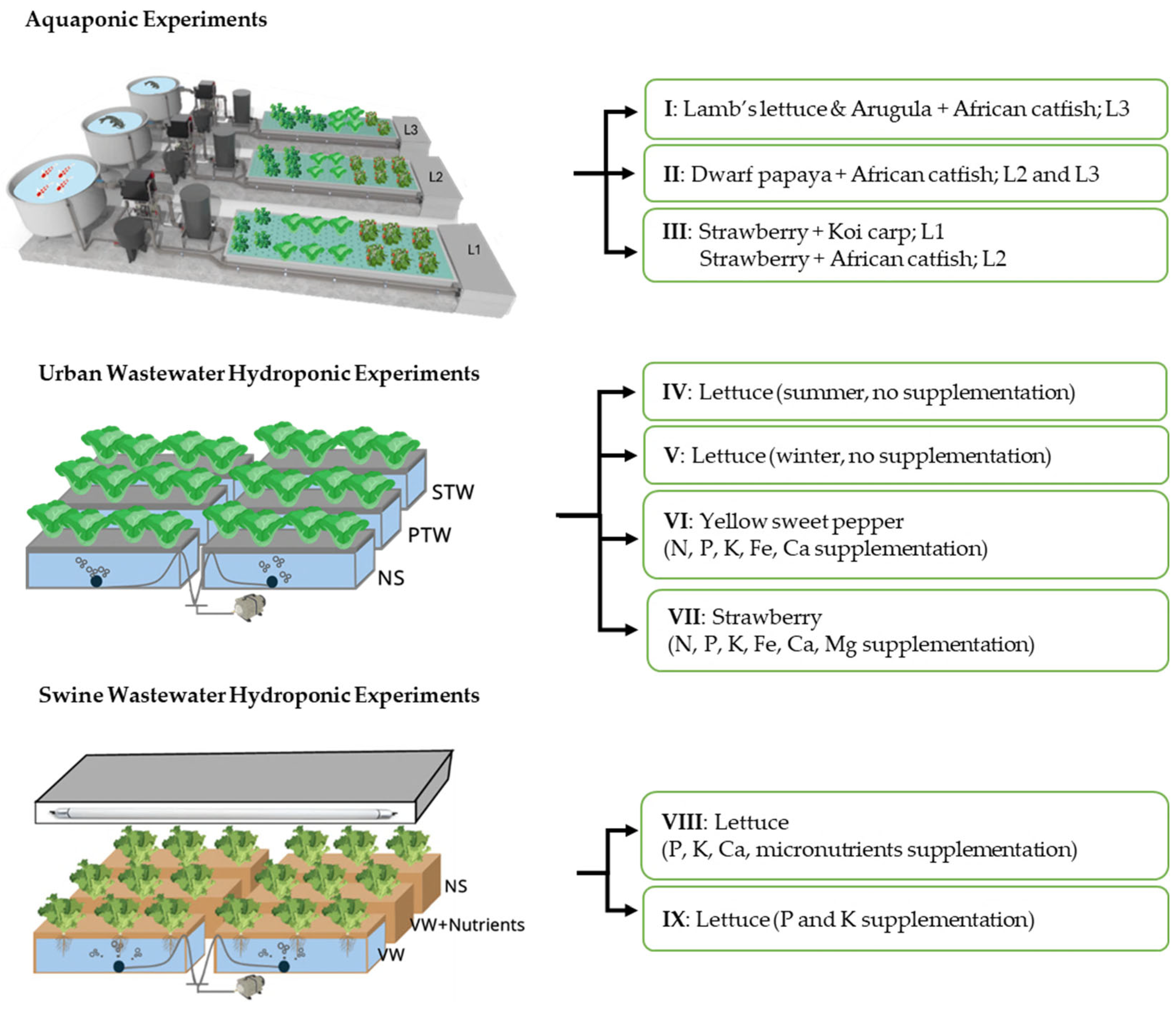
Figure 1. Summary diagram of the experiments carried out using wastewater. Legend: L1, L2, and L3—parallel aquaponic systems (lines 1, 2, and 3); NS—nutrient solution; PTW—primary treated wastewater; STW—secondary treated wastewater; VW—vermifiltered wastewater.
Applsci 15 12695 g001
Table 1. Overview of nutrient supplementation (mg/L) applied in experiments VI and VII in both PTW and STW.
Nutrient SaltChemical FormulaExperiment VI Experiment VII
PTWSTWPTWSTW
Potassium nitrateKNO3481.3481.3353.8375.0
Calcium nitrateCa (NO3)285.4108.51069.71145.5
Monopotassium phosphateKH2PO4150.1153.0250.3248.9
Magnesium sulphate heptahydrateMgSO4·7H2O----438.0438.0
EDTA iron (III) sodium saltC10H12FeN2NaO824.324.313.113.1
Table 2. Range of measured characterisation parameters in the aquaculture wastewater during Experiments I–III.
ParameterAquaponic Systems
L1L2L3
pH5.5–6.45.1–6.75.1–7.3
T (°C)12.6–24.114.8–28.115.2–27.9
DO (mg/L)5.8–10.75.0–10.35.0–8.3
EC (µS/cm)1209–14851294–2890171–2000
TDS (mg/L)600–742636–199092–1393
BOD5 (mg/L)n.m.n.m.n.m.
COD (mg/L)n.m.n.m.n.m.
P-PO4 (mg/L)7.0–10.914.7–63.41.2–52.3
N-NH4 (mg/L)<0.05 *–0.22<0.05 *–0.30<0.05 *–0.24
N-NO3 (mg/L)78–124153–102912.7–617
K (mg/L)231.2–298.4203.1–4223.0–256
Fe (mg/L)0.08–2.10<0.10 *–1.10<0.10 *–0.20
Coliform (CFU/100 mL)1.7 × 10⁴–3.3 × 1043.0 × 104 **3.2 × 10⁴–7.2 × 10⁴
E. coli (CFU/100 mL)000
n.m.—Parameter not monitored in the sample, systems low in organic matter; * Value below the method limit of quantification; ** Detected only once.
Table 3. Data on crop productivity and yield in the aquaponic systems (mean ± SD).
ExperimentCropGrowth/Yield ParameterAquaponic System
L1L2L3
ILamb’s lettuceheight (cm)N/AN/A7 ± 2
g/plant108 ± 1
Arugulaheight (cm)7.2 ± 2
g/plant79 ± 1
IIPapayas treesheight (cm)N/A169 ± 36 a147 ± 56 b
fruit/plant6 ± 2 a8 ± 4 a
g/plant *7054 ± 2421 a10047 ± 8791 a
IIIStrawberry plantsheight (cm)8 ± 1 b11 ± 3 aN/A
fruit/plant5 ± 2 b8 ± 4 a
g/plant *66 ± 37 b125 ± 60 a
* Mass of fruit produced per plant (g); Values in the same row followed by the same letter are not significantly different by ANOVA (p > 0.05); N/A: Not Applies. ANOVA was not applied to Experiment I (only one water source).
Table 4. Range of measured characterisation parameters in the PTW and STW used in the hydroponic experiments (IV–VII), before supplementation.
ParameterWastewater
PTWSTW
pH6.9–8.88.5–8.6
T (°C)12–2512–27
DO (mg/L)6.9–8.88.2–8.3
EC (µS/cm)500–932479–685
TDS (mg/L)405–566322–343
BOD5 (mg/L)65–1143.7–13
COD (mg/L)94–247<30 *–89
P-PO4 (mg/L)2.6–5.82.6–6.8
N-NH4 (mg/L)24–52<0.05 *–3.0
N-NO3 (mg/L)<1.0 *–674.5–86
K (mg/L)15–9215–85
Fe (mg/L)<0.10 *<0.10 *
Coliform (CFU/100 mL)3.0 × 10⁵–6.1 × 1063.9 × 104–1.3 × 10⁵
E. coli (CFU/100 mL)1.3 × 10⁵–2.0 × 1066.7 × 103–6.0 × 10⁴
* Value below the method limit of quantification.
Table 5. Data on crop productivity and yield in the urban wastewater hydroponic system (mean ± SD).
ExperimentCropGrowth/Yield ParameterHydroponic Solution
NSPTWSTW
IVLettuce
(summer)
height (cm)25 ± 2 a13 ± 2 cb15 ± 4 b
g/plant134 ± 21 a27 ± 10 c54 ± 29 b
VLettuce
(winter)
height (cm)23 ± 2 a17 ± 3 b15 ± 2 c
g/plant123 ± 10 a65 ± 6 b49 ± 14 c
VISweet
peppers
height (cm)81 ± 23 a65 ± 16 ab55 ± 12 cb
fruit/plant1.8 ± 0.7 a2.0 ± 0.8 a1.3 ± 0.5 a
g/plant *189 ± 103 a190 ± 79 a127 ± 37 a
VIIStrawberry plantsheight (cm)10 ± 2 c20 ± 3 a20 ± 1 ab
fruit/plant12 ± 4 a12 ± 4 a10 ± 3 a
g/plant *177 ± 71 a183 ± 74 a179 ± 43 a
* Mass of fruit produced per plant (g); Values in the same row followed by the same letter are not significantly different by ANOVA followed by Tukey’s test (p > 0.05).
Table 6. Range of measured characterisation parameters in the raw swine wastewater (SWW) and vermifiltered wastewater (VW) used in the hydroponic experiments VIII and IX.
ParameterWastewater
SWWVW
pH7.7–8.85.6–8.1
T (°C)17.0–20.020.0–20.4
EC (µS/cm)6.6 × 103–1.7 × 1041.4 × 103–1.9 × 10³
TDS (mg/L)3.3 × 103–8.2 × 1036.5 × 102–1.2 × 10³
DO (mg/L)0.02–3.391.2–9.2
BOD5 (mg/L)100–8634.6–33.1
COD (mg/L)4.6 × 103–5.7 × 1031.9 × 102–2.2 × 10²
P-PO4 (mg/L)6.9–17.63.4–29.3
N-NH4 (mg/L)662–14650.4–67.7
N-NO3 (mg/L)3.9–11.5105–150
K (mg/L)n.m.116–224
Fe (mg/L)n.m.<0.10 *–0.62
Coliform (CFU/100 mL)3.1 × 10³–3.9 × 1041.1 × 103–1.1 × 10⁵
E. coli (CFU/100 mL)9.7 × 10²–3.5 × 1040–1.4 × 10³
n.m.—Parameter not monitored in the sample; * Value below the method limit of quantification.
Table 7. Data on crop growth and yield in the swine wastewater hydroponic system (mean ± SD).
ExperimentCropGrowth/Yield ParameterHydroponic Solution
NSVWSVW
VIIILettuceheight (cm)19 ± 2 a16 ± 1 b18 ± 1 ab
g/plant180 ± 33 a106 ± 23 b160 ± 25 ab
IXheight (cm)20.9 ± 0.6 a21 ± 4 a20.4 ± 0.7 a
g/plant164 ± 12 a144 ± 20 a180 ± 39 a
Values in the same row followed by the same letter are not significantly different by ANOVA followed by Tukey’s test (p > 0.05).
Disclaimer/Publisher’s Note: The statements, opinions and data contained in all publications are solely those of the individual author(s) and contributor(s) and not of MDPI and/or the editor(s). MDPI and/or the editor(s) disclaim responsibility for any injury to people or property resulting from any ideas, methods, instructions or products referred to in the content.


