Enhancing Chinese Event Prediction with Prompt-Driven Knowledge Augmentation

Abstract
1. Introduction
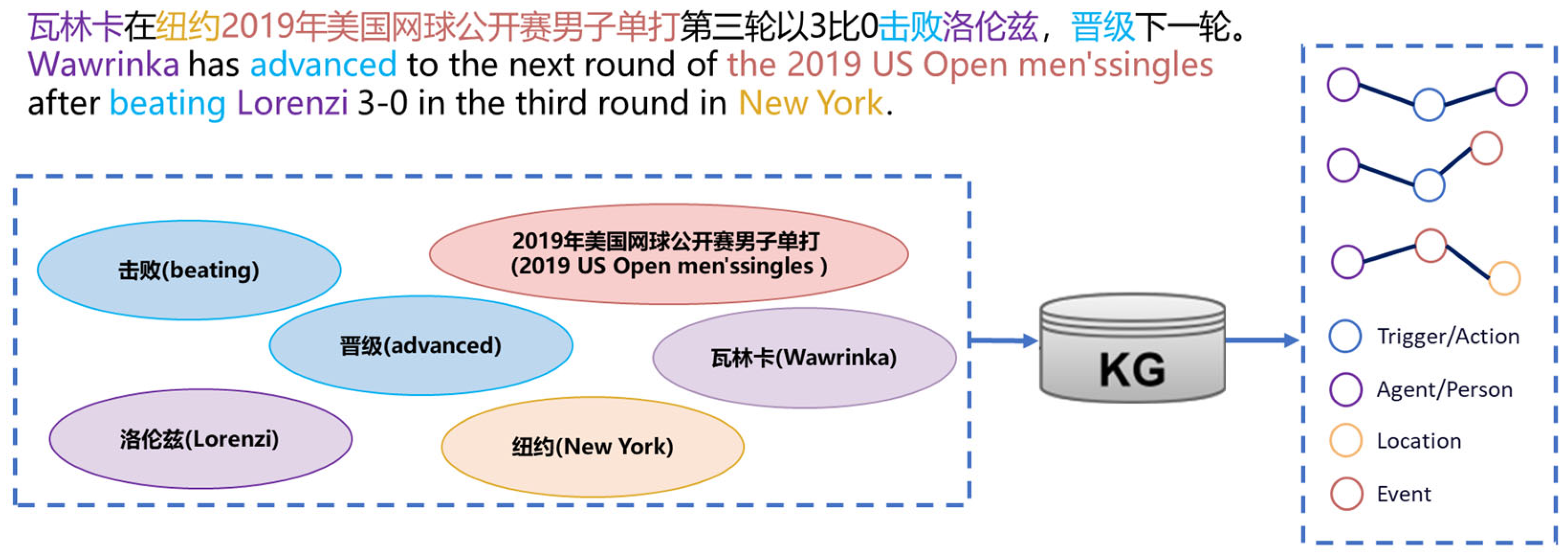
- Structural Rigidity: KGs rely on pre-defined schemas that struggle to accommodate compound event elements. For instance, the phrase “2019 US Open men’s singles” represents a specific, time-bound entity that may not fit into a KG’s fixed entity schemas. Traditional KGs often lack flexible mechanisms to capture such context-specific or emerging entities, leading to an incomplete semantic representation of events.
- Coverage Gaps: Static KGs typically fail to include up-to-date information for the latest events. In this example, if the KG lacks entries for “2019 US Open men’s singles”, it cannot retrieve the relevant background knowledge, resulting in an incomplete knowledge integration. This limitation is further evident in scenarios involving newly emerging events (e.g., “2023 US Open men’s singles”) that have not been added to the KG.
- Ambiguity Challenges: KGs often struggle with entity disambiguation, particularly for ambiguous proper nouns. The name “Lorenzi” in the sentence could refer to multiple individuals, but a traditional KG may lack contextual clues to distinguish which specific “Lorenzi” is mentioned. Without additional disambiguation mechanisms, the KG might incorrectly associate the event with the wrong entity, introducing misleading knowledge into the prediction process and degrading accuracy.
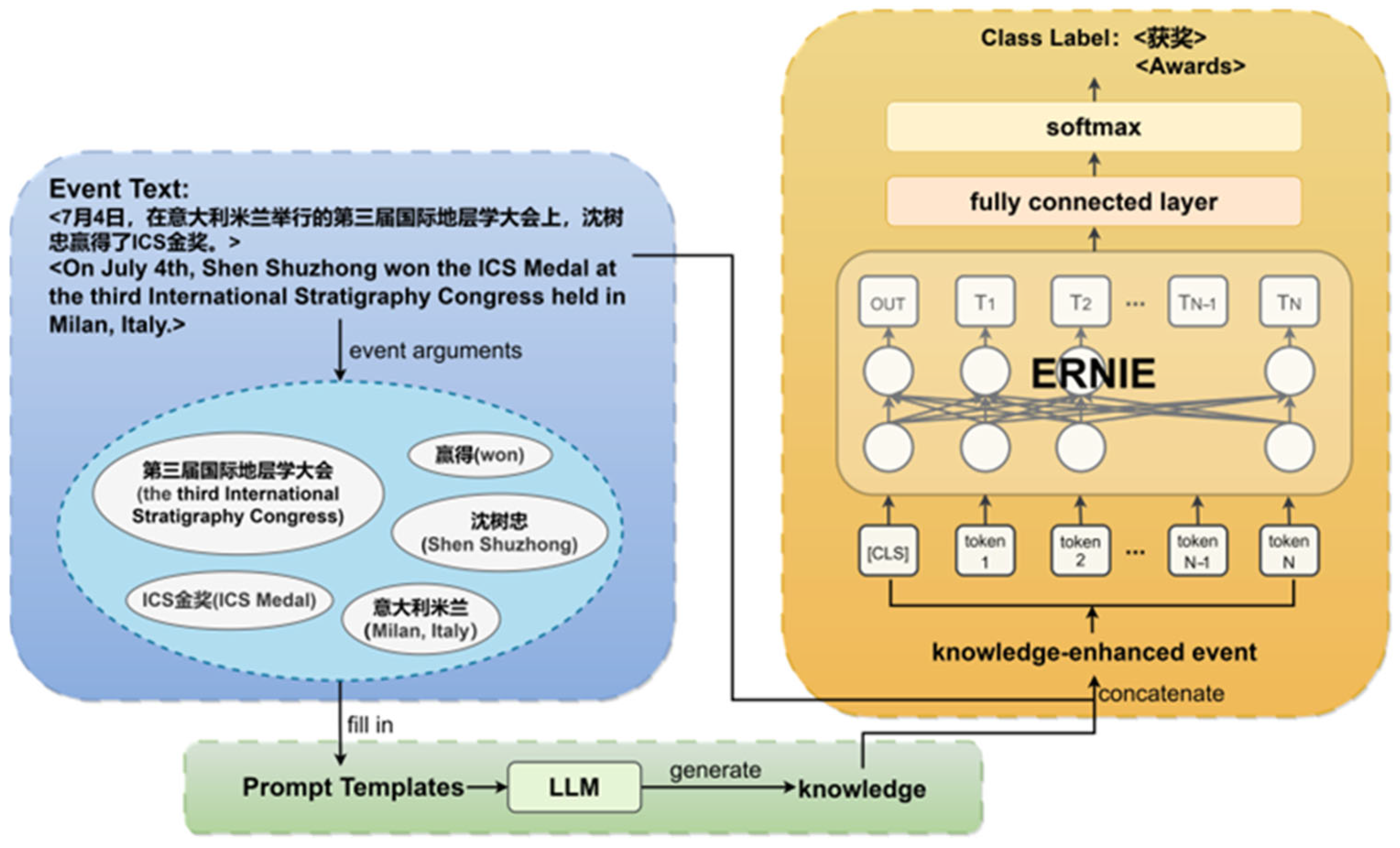
- Event Prediction with Fine-Grained Information: We leverage explicit fine-grained information within event texts to enable accurate event predictions, addressing the sparsity challenge in short-text scenarios.
- Prompt-Driven Augmentation: We propose a prompt-driven framework using LLMs to generate context-specific knowledge for triggers/arguments, enhancing semantic richness and addressing short-text sparsity.
- Systematic PLM Fine-Tuning: We establish a robust training pipeline through rigorous fine-tuning of PLMs on two Chinese event prediction benchmarks.
- Performance Validation: Experiments show our method significantly improves prediction accuracy over standalone LLMs/PLMs, validating the efficacy of integrated knowledge augmentation.
2. Related Works
2.1. Knowledge Augmentation
2.2. Event Prediction
3. Problem Definition
4. Methodology
4.1. Fine-Grained Event Decomposition
4.2. Prompt Construction
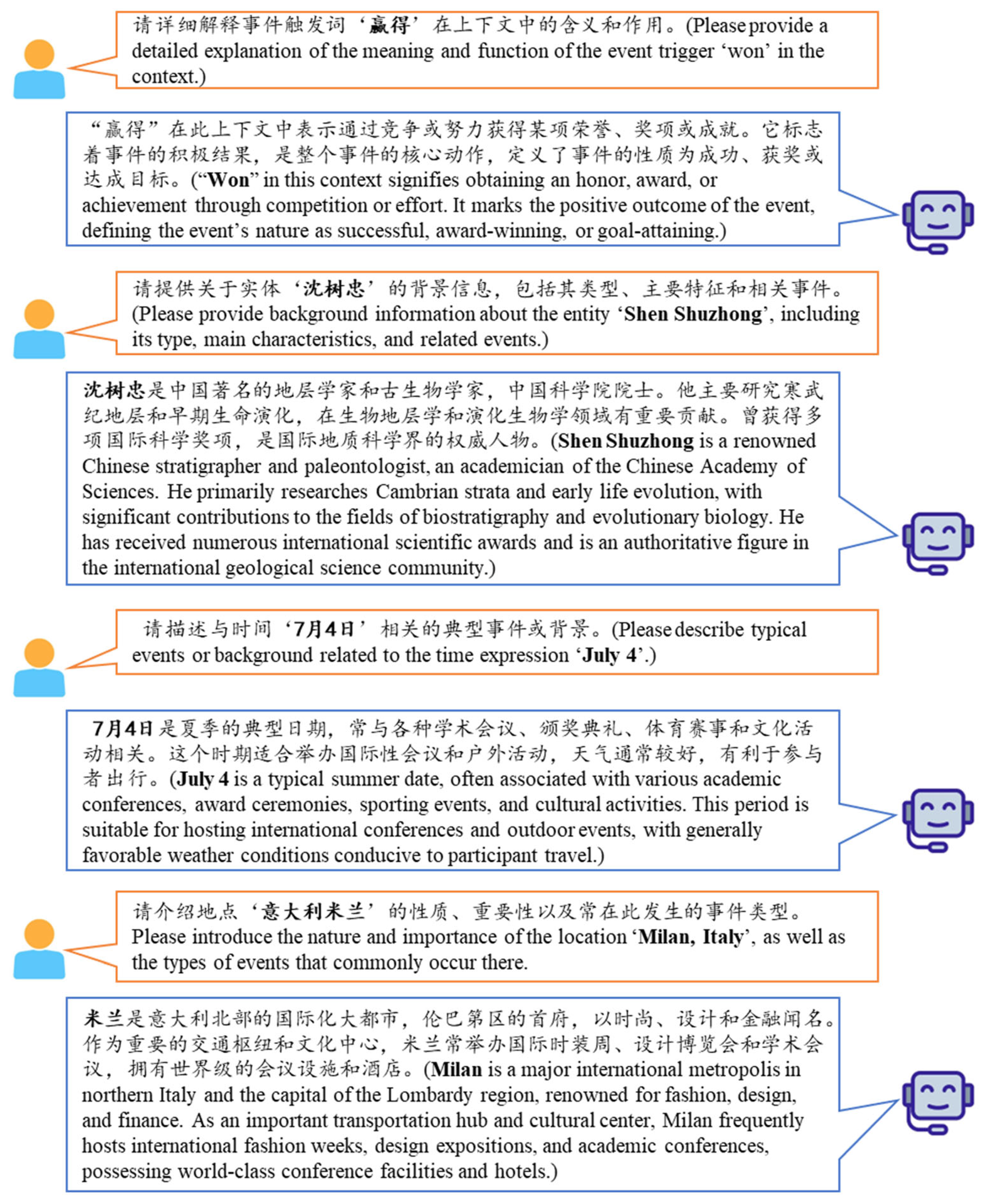
- For Event Triggers: Please provide a detailed explanation of the meaning and function of the event trigger [trigger word] in the context.
- For Entity Arguments: Please provide background information about the entity [entity word], including its type, main characteristics, and related events.
- For Time Arguments: Please describe typical events or background related to the time expression [time words].
- For Location Arguments: Please introduce the nature and importance of the location [location words], as well as the types of events that commonly occur there.
4.3. Fine-Tuning
5. Experiment
5.1. Implementation Details
5.2. Main Results
5.3. Ablation Study and Further Analysis
5.4. Limitation
- Knowledge Verification: Integrate an automated validation layer that cross-checks LLM-generated knowledge against trusted external sources (e.g., CN-DBpedia, OwnThink) before augmentation.
- Confidence-based Filtering: Leverage the LLM’s internal confidence scores to discard low-certainty or ambiguous generations.
- Ensemble Knowledge Generation: Aggregate outputs from multiple diverse LLMs (e.g., GPT-3.5, Qwen, GLM, Baichuan) to identify consensus facts and suppress outliers.
- Knowledge Distillation: Train a lightweight student model (e.g., MiniRBT) to mimic the behavior of the full CEP-PKA pipeline, preserving performance while eliminating recurring API costs.
- Domain-specific Fine-tuning: Fine-tune LLMs on fact-checked, domain-relevant corpora to enhance factual consistency and reduce hallucination rates.
5.5. Case Study
5.6. Error Analysis
6. Conclusions
Author Contributions
Funding
Institutional Review Board Statement
Informed Consent Statement
Data Availability Statement
Conflicts of Interest
References
- Chambers, N.; Jurafsky, D. Unsupervised learning of narrative event chains. In Annual Meeting of the Association for Computational Linguistics, Proceedings of the ACL-08: HLT, Columbus, OH, USA, 15–20 June 2008; Standford University: Standford, CA, USA, 2008; pp. 789–797. Available online: https://api.semanticscholar.org/CorpusID:529375 (accessed on 23 November 2025).
- Lv, S.; Qian, W.; Huang, L.; Han, J.; Hu, S. Sam-net: Integrating event-level and chain-level attentions to predict what happens next. In Proceedings of the Thirty-Third AAAI Conference on Artificial Intelligence (2019), Honolulu, HI, USA, 27 January–1 February 2019; Available online: https://api.semanticscholar.org/CorpusID:57983897 (accessed on 23 November 2025).
- Huai, Z.; Zhang, D.; Yang, G.; Tao, J. Spatial-temporal knowledge graph network for event prediction. Neurocomputing 2023, 553, 126557. [Google Scholar] [CrossRef]
- Zhao, L. Event Prediction in Big Data Era: A Systematic Survey. ACM Comput. Surv. (CSUR) 2020, 54, 1–37. [Google Scholar] [CrossRef]
- Cao, Y.; Tang, Y.; Du, H.; Xu, F.; Wei, Z.; Jin, C. Heterogeneous reinforcement learning network for aspect-based sentiment classification with external knowledge. IEEE Trans. Affect. Comput. 2023, 14, 3362–3375. [Google Scholar] [CrossRef]
- Gardères, F.; Ziaeefard, M.; Abeloos, B.; Lécué, F. Conceptbert: Concept-aware representation for visual question answering. In Findings of the Association for Computational Linguistics: EMNLP; Association for Computational Linguistics: Stroudsburg, PA, USA, 2020; pp. 489–498. Available online: https://api.semanticscholar.org/CorpusID:226284018 (accessed on 23 November 2025).
- Achiam, O.J.; Adler, S.; Agarwal, S.; Ahmad, L.; Akkaya, I.; Aleman, F.L.; Almeida, D.; Altenschmidt, J.; Altman, S.; Anadkat, S.; et al. GPT-4 Technical Report. 2023. Available online: https://api.semanticscholar.org/CorpusID:257532815 (accessed on 23 November 2025).
- Melamud, O.; Goldberger, J.; Dagan, I. context2vec: Learning generic context embedding with bidirectional LSTM. In Proceedings of the 20th Conference on Computational Natural Language Learning (CoNLL 2016), Berlin, Germany, 11–12 August 2016; Available online: https://api.semanticscholar.org/CorpusID:7890036 (accessed on 23 November 2025).
- Huang, L.; Sun, C.; Qiu, X.; Huang, X. Glossbert: Bert for word sense disambiguation with gloss knowledge. arXiv 2019, arXiv:1908.07245. Available online: https://api.semanticscholar.org/CorpusID:201103745 (accessed on 23 November 2025).
- Natu, S.; Sural, S.; Sarkar, S. External commonsense knowledge as a modality for social intelligence question-answering. In Proceedings of the 2023 IEEE/CVF International Conference on Computer Vision Workshops (ICCVW), Paris, France, 2–6 October 2023; pp. 3036–3042. Available online: https://api.semanticscholar.org/CorpusID:266151538 (accessed on 23 November 2025).
- Bayat, F.F.; Qian, K.; Han, B.; Sang, Y.; Belyi, A.; Khorshidi, S.; Wu, F.; Ilyas, I.; Li, Y. FLEEK: Factual error detection and correction with evidence retrieved from external knowledge. arXiv 2023, arXiv:2310.17119v1. Available online: https://api.semanticscholar.org/CorpusID:264490676 (accessed on 23 November 2025). [CrossRef]
- Liu, J.; Yang, L. Knowledge-enhanced prompt learning for few-shot text classification. Big Data Cogn. Comput. 2024, 8, 43. [Google Scholar] [CrossRef]
- Yan, Y.; Zheng, P.; Wang, Y. Enhancing large language model capabilities for rumor detection with knowledge-powered prompting. Eng. Appl. Artif. Intell. 2024, 133, 108259. [Google Scholar] [CrossRef]
- Li, Z.; Ding, X.; Liu, T. Constructing narrative event evolutionary graph for script event prediction. In Proceedings of the Twenty-Seventh International Joint Conference on Artificial Intelligence (IJCAI), Stockholm, Sweden, 13–19 July 2018; Available online: https://api.semanticscholar.org/CorpusID:21723549 (accessed on 23 November 2025).
- Liu, X.; Huang, H.; Zhang, Y. End-to-end event factuality prediction using directional labeled graph recurrent network. Inf. Process. Manag. 2022, 59, 102836. [Google Scholar] [CrossRef]
- Yu, X.; Sun, W.; Li, J.; Liu, K.; Liu, C.; Tan, J. ONSEP: A novel online neural-symbolic framework for event prediction based on large language model. In Findings of the Association for Computational Linguistics ACL 2024; Ku, L.W., Martins, A., Srikumar, V., Eds.; Association for Computational Linguistics: Bangkok, Thailand, 2024; pp. 6335–6350. Available online: https://aclanthology.org/2024.findings-acl.378 (accessed on 23 November 2025).
- Mathur, P.; Morariu, V.I.; Garimella, A.; Dernoncourt, F.; Gu, J.; Sawhney, R.; Nakov, P.; Manocha, D.; Jain, R. DocScript: Document-level script event prediction. In Proceedings of the 2024 Joint International Conference on Computational Linguistics, Language Resources and Evaluation (LREC-COLING 2024), Torino, Italy, 20–25 May 2024; Calzolari, N., Kan, M.Y., Hoste, V., Lenci, A., Sakti, S., Xue, N., Eds.; ELRA: Paris, France; ICCL: Mauren, Liechtenstein, 2024; pp. 489–498. Available online: https://aclanthology.org/2024.lrec-main.458 (accessed on 23 November 2025).
- Sun, Y.; Wang, S.; Li, Y.; Feng, S.; Chen, X.; Zhang, H.; Tian, X.; Zhu, D.; Tian, H.; Wu, H. Ernie: Enhanced representation through knowledge integration. arXiv 2019, arXiv:1904.09223. [Google Scholar] [CrossRef]
- Li, X.; Li, F.; Pan, L.; Chen, Y.; Peng, W.; Wang, Q.; Lyu, Y.; Zhu, Y. Duee: A largescale dataset for chinese event extraction in real-world scenarios. In Proceedings of the Natural Language Processing and Chinese Computing (NLPCC 2020), Zhengzhou, China, 14–18 October 2020; Available online: https://api.semanticscholar.org/CorpusID:222180086 (accessed on 23 November 2025).
- Deng, H.; Zhang, Y.; Zhang, Y.; Ying, W.; Yu, C.; Gao, J.; Wang, W.; Bai, X.; Yang, N.; Ma, J.; et al. Title2Event: Benchmarking open event extraction with a large-scale Chinese title dataset. In Proceedings of the 2022 Conference on Empirical Methods in Natural Language Processing, Abu Dhabi, United Arab Emirates, 7–11 December 2022; Association for Computational Linguistics: Stroudsburg, PA, USA, 2022; pp. 6511–6524. Available online: https://aclanthology.org/2022.emnlp-main.437 (accessed on 23 November 2025).
- Yao, F.; Xiao, C.; Wang, X.; Liu, Z.; Hou, L.; Tu, C.; Liu, Y.; Shen, W.; Sun, M. LEVEN: A Large-Scale Chinese Legal Event Detection Dataset. arXiv 2022, arXiv:2203.08556. [Google Scholar] [CrossRef]
- Liu, Y.; Ott, M.; Goyal, N.; Du, J.; Joshi, M.; Chen, D.; Levy, O.; Lewis, M.; Zettlemoyer, L.; Stoyanov, V. Roberta: A robustly optimized bert pretraining approach. arXiv 2019, arXiv:1907.11692. [Google Scholar]
- Cui, Y.; Che, W.; Liu, T.; Qin, B.; Wang, S.; Hu, G. Revisiting pre-trained models for Chinese natural language processing. arXiv 2020, arXiv:2004.13922v2. [Google Scholar] [CrossRef]
- Guo, B.; Han, S.; Han, X.; Huang, H.; Lu, T. Label confusion learning to enhance text classification models. arXiv 2020, arXiv:2012.04987. [Google Scholar] [CrossRef]
- Yang, S.; Liu, L.; Xu, M. Free lunch for few-shot learning: Distribution calibration. In Proceedings of the International Conference on Learning Representations (ICLR), Vienna, Austria, 3–7 May 2021; Available online: https://openreview.net/forum?id=JWOiYxMG92s (accessed on 23 November 2025).
- Yu, W.; Huang, X.; Yuan, Q.; Yi, M.; An, S.; Li, X. Information security field event detection technology based on satt-lstm. Secur. Commun. Netw. 2021, 2021, 5599962. [Google Scholar] [CrossRef]
- Ni, C.; Liu, W.; Li, W.; Wu, J.; Ren, H. Chinese event detection based on event ontology and siamese network. In Knowledge Science, Engineering and Management; Springer: Berlin/Heidelberg, Germany, 2021; Available online: https://api.semanticscholar.org/CorpusID:237206910 (accessed on 23 November 2025).
- Cheng, Q.; Fu, Y.; Huang, J.C.; Cheng, G.; Du, H. Event detection based on the label attention mechanism. Int. J. Mach. Learn. Cybern. 2022, 14, 633–641. [Google Scholar] [CrossRef]
- Yao, X.; Yang, Z.; Cui, Y.; Wang, S. Minirbt: A two-stage distilled small chinese pre-trainedmodel. arXiv 2023, arXiv:2304.00717. [Google Scholar]
- Ke, X.; Ou, Z.; Wu, X.; Li, B. A new Chinese event detection method based on pmtnet. In Proceedings of the 16th International Conference on Machine Learning and Computing, Shenzhen, China, 2–5 February 2024; Available online: https://api.semanticscholar.org/CorpusID:270338481 (accessed on 23 November 2025).
- Liu, W.; Zhou, P.; Zhao, Z.; Wang, Z.; Ju, Q.; Deng, H.; Wang, P. K-BERT: Enabling Language Representation with Knowledge Graph. In Proceedings of the Thirty-Fourth AAAI Conference on Artificial Intelligence (AAAI-20), New York, NY, USA, 7–12 February 2020; pp. 2901–2908. [Google Scholar] [CrossRef]
- Wang, X.; Gao, T.; Zhu, Z.; Zhang, Z.; Liu, Z.; Li, J.; Tang, J. KEPLER: A Unified Model for Knowledge Embedding and Pre-trained Language Representation. Trans. Assoc. Comput. Linguist. 2021, 9, 176–194. [Google Scholar] [CrossRef]



| DuEE w/o Knowledge | DuEE w/Knowledge | Title2Event w/o Knowledge | Title2Event w/Knowledge | |
|---|---|---|---|---|
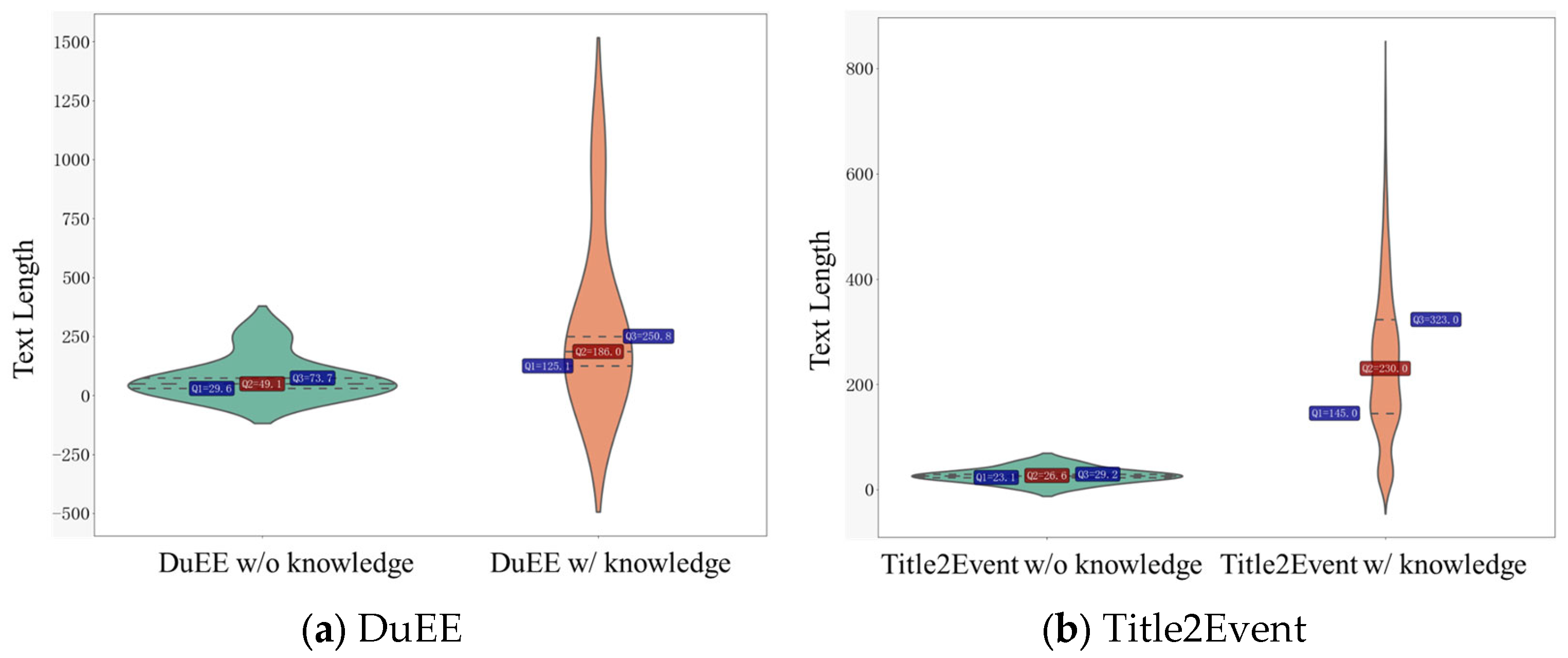
| Max/Min/Average Length | 2554/8/58 | 1012/12/196 | 50/7/226 | 780/8/244 |
| lst/2nd/3rd Quartile | 26/41/79 | 108/177/269 | 22/27/30 | 144/230/324 |
| Dataset | Method | Macro | Weighted | ACC | ||||
|---|---|---|---|---|---|---|---|---|
| P | R | F1 | P | R | F1 | |||
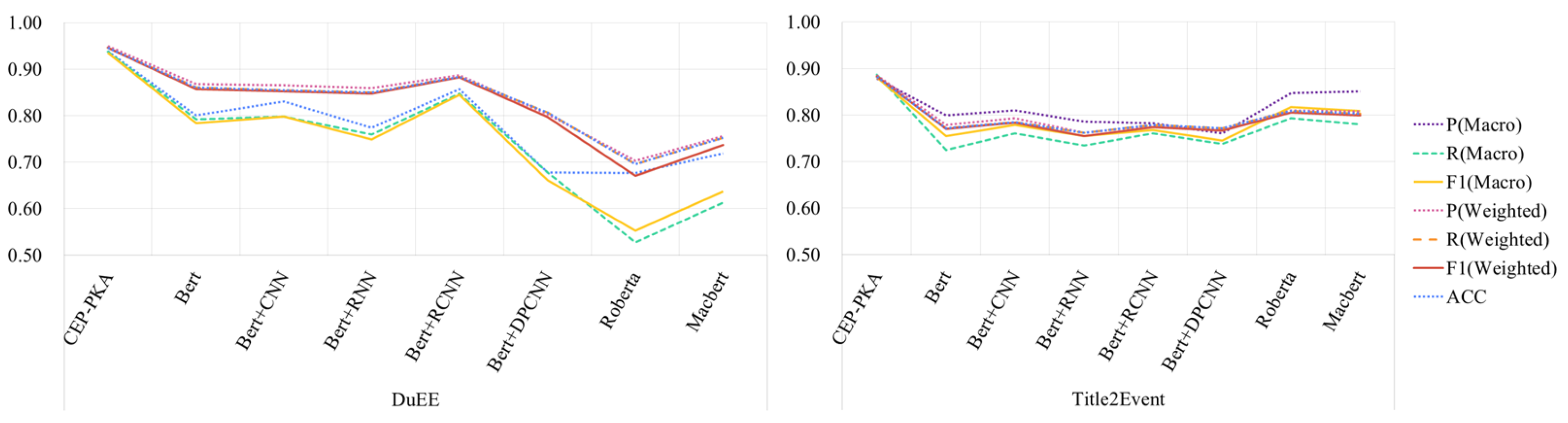
| DuEE | CEP-PKA | 0.9387 | 0.9374 | 0.9355 | 0.9492 | 0.9463 | 0.9461 | 0.9463 |
| Bert * | 0.8164 | 0.8304 | 0.8138 | 0.8815 | 0.8754 | 0.8746 | 0.8754 | |
| Bert + CNN * | 0.8138 | 0.8080 | 0.7987 | 0.8700 | 0.8619 | 0.8608 | 0.8619 | |
| Bert + RNN * | 0.7320 | 0.7402 | 0.7226 | 0.8335 | 0.8478 | 0.8351 | 0.8478 | |
| Bert + RCNN * | 0.8461 | 0.8523 | 0.8415 | 0.8844 | 0.8787 | 0.8779 | 0.8787 | |
| Bert + DPCNN* | 0.6754 | 0.6207 | 0.6099 | 0.7950 | 0.7843 | 0.7755 | 0.7843 | |
| Roberta * | 0.7849 | 0.6744 | 0.7001 | 0.8059 | 0.8022 | 0.7905 | 0.8022 | |
| Macbert * | 0.8080 | 0.7261 | 0.7480 | 0.8347 | 0.8305 | 0.8237 | 0.8305 | |
| LCM * | 0.7863 | 0.7736 | 0.7799 | 0.8400 | 0.8503 | 0.8451 | 0.7879 | |
| DC * | 0.4785 | 0.5218 | 0.4726 | 0.6483 | 0.5307 | 0.5567 | 0.5307 | |
| SAtt-LSTM † | 0.6910 | 0.8120 | 0.7310 | - | - | - | - | |
| CED-EOSN † | 0.9350 | 0.9110 | 0.9230 | - | - | - | - | |
| EDLA † | 0.9439 | 0.9726 | 0.9581 | - | - | - | - | |
| miniRBT * | 0.4986 | 0.32094 | 0.29196 | 0.74826 | 0.8667 | 0.68328 | 0.8667 | |
| PMTNet † | 0.7629 | 0.7797 | 0.7712 | - | - | - | - | |
| K-BERT * | 0.8352 | 0.8505 | 0.8420 | 0.8608 | 0.8755 | 0.8673 | 0.8651 | |
| KEPLER * | 0.9205 | 0.9407 | 0.9302 | 0.9356 | 0.9503 | 0.9421 | 0.9407 | |
| Title2Event | CEP-PKA | 0.8787 | 0.8866 | 0.8811 | 0.8863 | 0.8820 | 0.8829 | 0.8820 |
| Bert * | 0.7989 | 0.7116 | 0.7434 | 0.7730 | 0.7640 | 0.7619 | 0.7640 | |
| Bert + CNN * | 0.7927 | 0.7625 | 0.7746 | 0.7890 | 0.7859 | 0.7839 | 0.7859 | |
| Bert + RNN * | 0.7264 | 0.6830 | 0.6976 | 0.7269 | 0.7241 | 0.7213 | 0.7241 | |
| Bert + RCNN * | 0.7691 | 0.7799 | 0.7709 | 0.7793 | 0.7775 | 0.7755 | 0.7775 | |
| Bert + DPCNN* | 0.6588 | 0.6622 | 0.6543 | 0.7210 | 0.7295 | 0.7226 | 0.7295 | |
| Roberta * | 0.7785 | 0.7316 | 0.7513 | 0.7539 | 0.7534 | 0.7487 | 0.7534 | |
| Macbert * | 0.7882 | 0.7430 | 0.7618 | 0.7642 | 0.7637 | 0.7593 | 0.7637 | |
| DC * | 0.4602 | 0.6009 | 0.4792 | 0.5779 | 0.4652 | 0.4552 | 0.4652 | |
| LCM * | 0.7698 | 0.7909 | 0.7802 | 0.7845 | 0.8222 | 0.8029 | 0.7534 | |
| miniRBT * | 0.7332 | 0.6571 | 0.6872 | 0.6972 | 0.6975 | 0.6894 | 0.6975 | |
| K-BERT * | 0.7854 | 0.7608 | 0.7723 | 0.7905 | 0.7808 | 0.7854 | 0.7809 | |
| KEPLER * | 0.8207 | 0.8003 | 0.8106 | 0.8305 | 0.8201 | 0.8250 | 0.8204 | |
| Dataset | Knowledge | Macro | Weighted | ACC | ||||
|---|---|---|---|---|---|---|---|---|
| P | R | F1 | P | R | F1 | |||
| DuEE | × | 0.9021 | 0.8971 | 0.8906 | 0.9370 | 0.9351 | 0.9329 | 0.9351 |
| ✓ | 0.9387 | 0.9374 | 0.9455 | 0.9492 | 0.9463 | 0.9461 | 0.9463 | |
| (+3.66%) | (+4.03%) | (+4.49%) | (+1.22%) | (+1.12) | (+1.32%) | (+1.12%) | ||
| Title2Event | × | 0.8812 | 0.8837 | 0.8799 | 0.8804 | 0.8769 | 0.8765 | 0.8769 |
| ✓ | 0.8787 | 0.8866 | 0.8811 | 0.8863 | 0.8820 | 0.8829 | 0.8820 | |
| (−0.25%) | (+0.29%) | (+0.12%) | (+0.59%) | (+0.51%) | (+0.64%) | (+0.51%) | ||
| Dataset | LLMs | Macro | Weighted | ACC | ||||
|---|---|---|---|---|---|---|---|---|
| P | R | F1 | P | R | F1 | |||
| DuEE | Qwen | 0.9315 | 0.9220 | 0.9242 | 0.9409 | 0.9388 | 0.9382 | 0.9388 |
| Deepseek | 0.9228 | 0.9342 | 0.9249 | 0.9412 | 0.9366 | 0.9371 | 0.9366 | |
| GPT 3.5 | 0.9387 | 0.9374 | 0.9355 | 0.9492 | 0.9463 | 0.9461 | 0.9463 | |
| Title2Event | Qwen | 0.8817 | 0.8492 | 0.8629 | 0.8729 | 0.8715 | 0.8708 | 0.8715 |
| Deepseek | 0.8780 | 0.8881 | 0.8814 | 0.8859 | 0.8827 | 0.8830 | 0.8827 | |
| GPT 3.5 | 0.8787 | 0.8866 | 0.8811 | 0.8863 | 0.8820 | 0.8829 | 0.8820 | |
| Dataset | Model | Knowledge | Macro | Weighted | ACC | ||||
|---|---|---|---|---|---|---|---|---|---|
| P | R | F1 | P | R | F1 | ||||
| DuEE | CEP-PKA | ✓ | 0.9387 | 0.9374 | 0.9455 | 0.9492 | 0.9463 | 0.9461 | 0.9463 |
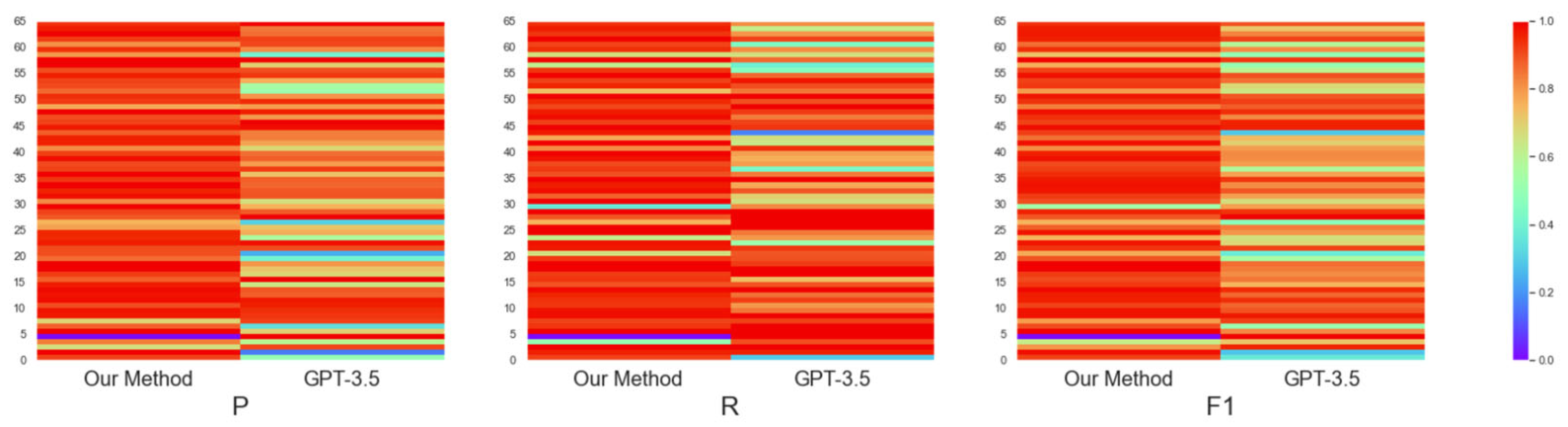
| GPT3.5 | ✓ | 0.7829 | 0.8249 | 0.7732 | 0.8478 | 0.7590 | 0.7709 | 0.7590 | |
| × | 0.7711 | 0.8042 | 0.7549 | 0.8455 | 0.7522 | 0.7680 | 0.7522 | ||
| Title2Event | CEP-PKA | ✓ | 0.8787 | 0.8866 | 0.8811 | 0.8863 | 0.8820 | 0.8829 | 0.8820 |
| GPT3.5 | ✓ | 0.5824 | 0.6888 | 0.5752 | 0.6326 | 0.5266 | 0.4702 | 0.5266 | |
| × | 0.5884 | 0.6668 | 0.5625 | 0.6183 | 0.5184 | 0.4721 | 0.5184 | ||
Disclaimer/Publisher’s Note: The statements, opinions and data contained in all publications are solely those of the individual author(s) and contributor(s) and not of MDPI and/or the editor(s). MDPI and/or the editor(s) disclaim responsibility for any injury to people or property resulting from any ideas, methods, instructions or products referred to in the content. |
© 2025 by the authors. Licensee MDPI, Basel, Switzerland. This article is an open access article distributed under the terms and conditions of the Creative Commons Attribution (CC BY) license (https://creativecommons.org/licenses/by/4.0/).
Share and Cite
Lou, S.; Xie, X.; Liu, W.; Jiang, W. Enhancing Chinese Event Prediction with Prompt-Driven Knowledge Augmentation. Appl. Sci. 2025, 15, 12543. https://doi.org/10.3390/app152312543
Lou S, Xie X, Liu W, Jiang W. Enhancing Chinese Event Prediction with Prompt-Driven Knowledge Augmentation. Applied Sciences. 2025; 15(23):12543. https://doi.org/10.3390/app152312543
Chicago/Turabian StyleLou, Shulan, Xiaoxue Xie, Wei Liu, and Wangtao Jiang. 2025. "Enhancing Chinese Event Prediction with Prompt-Driven Knowledge Augmentation" Applied Sciences 15, no. 23: 12543. https://doi.org/10.3390/app152312543
APA StyleLou, S., Xie, X., Liu, W., & Jiang, W. (2025). Enhancing Chinese Event Prediction with Prompt-Driven Knowledge Augmentation. Applied Sciences, 15(23), 12543. https://doi.org/10.3390/app152312543