Locating Causes of Inconsistency in a Variability Model for Software Product Line


Abstract
1. Introduction
2. Related Work
3. Background Information
3.1. Definitions
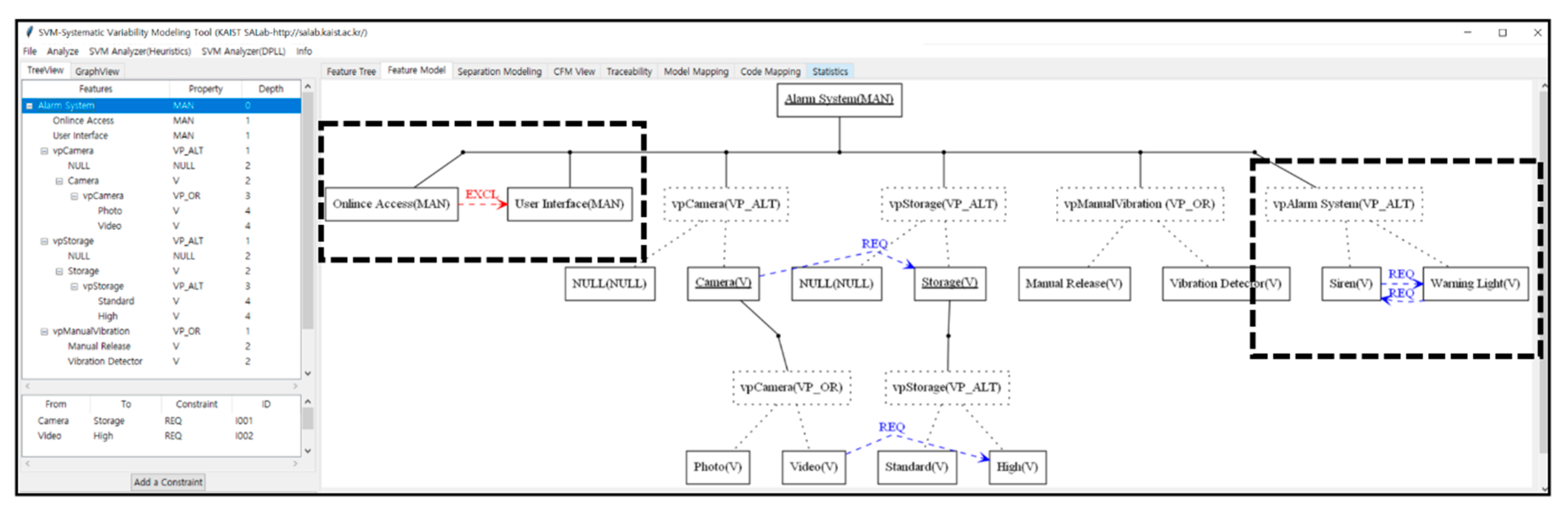
3.2. Variability Modeling with SVM
3.3. Inconsistent Model
3.4. Davis–Putnam–Logemann–Loveland (DPLL) Algorithm
4. The Proposed Method: ICL
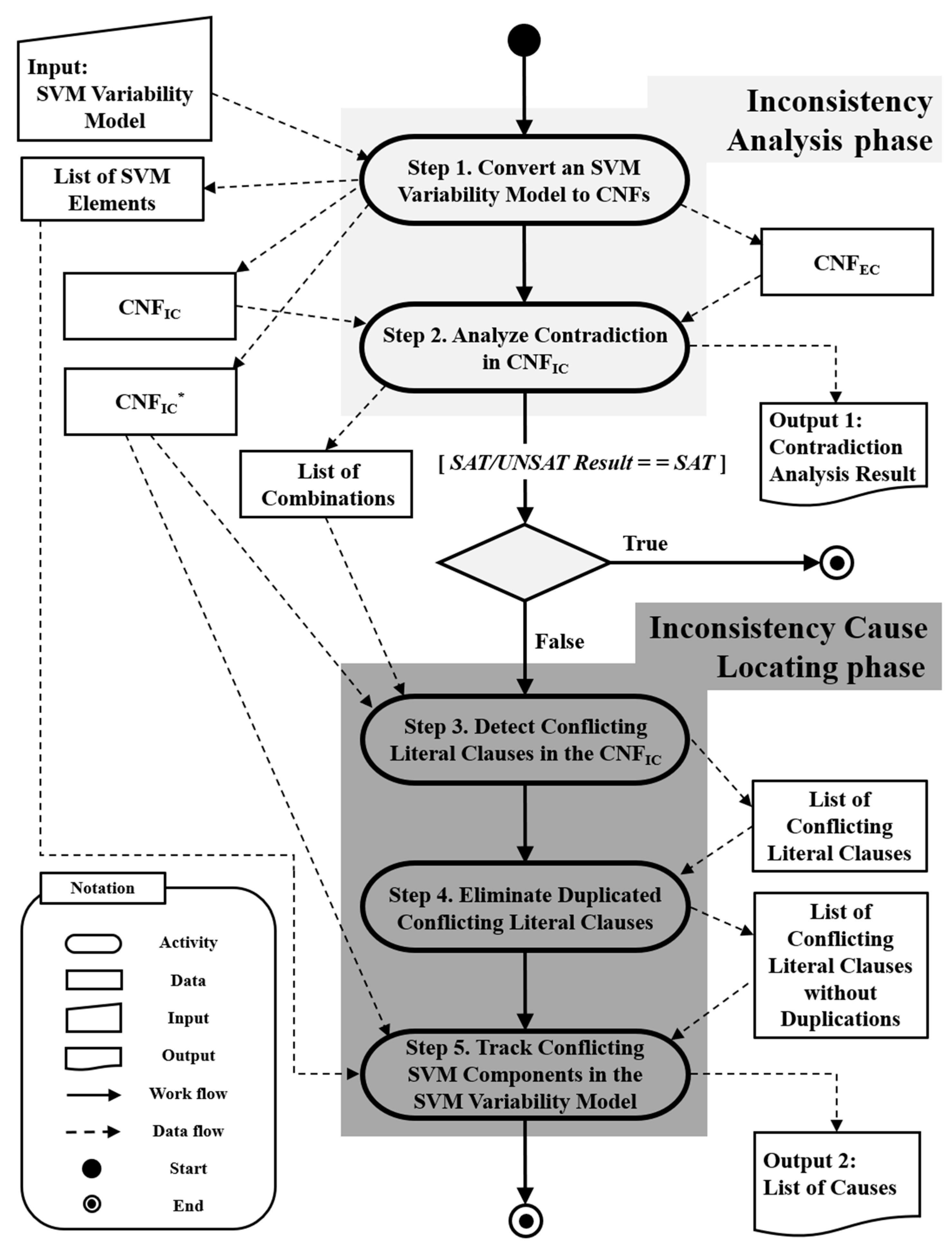
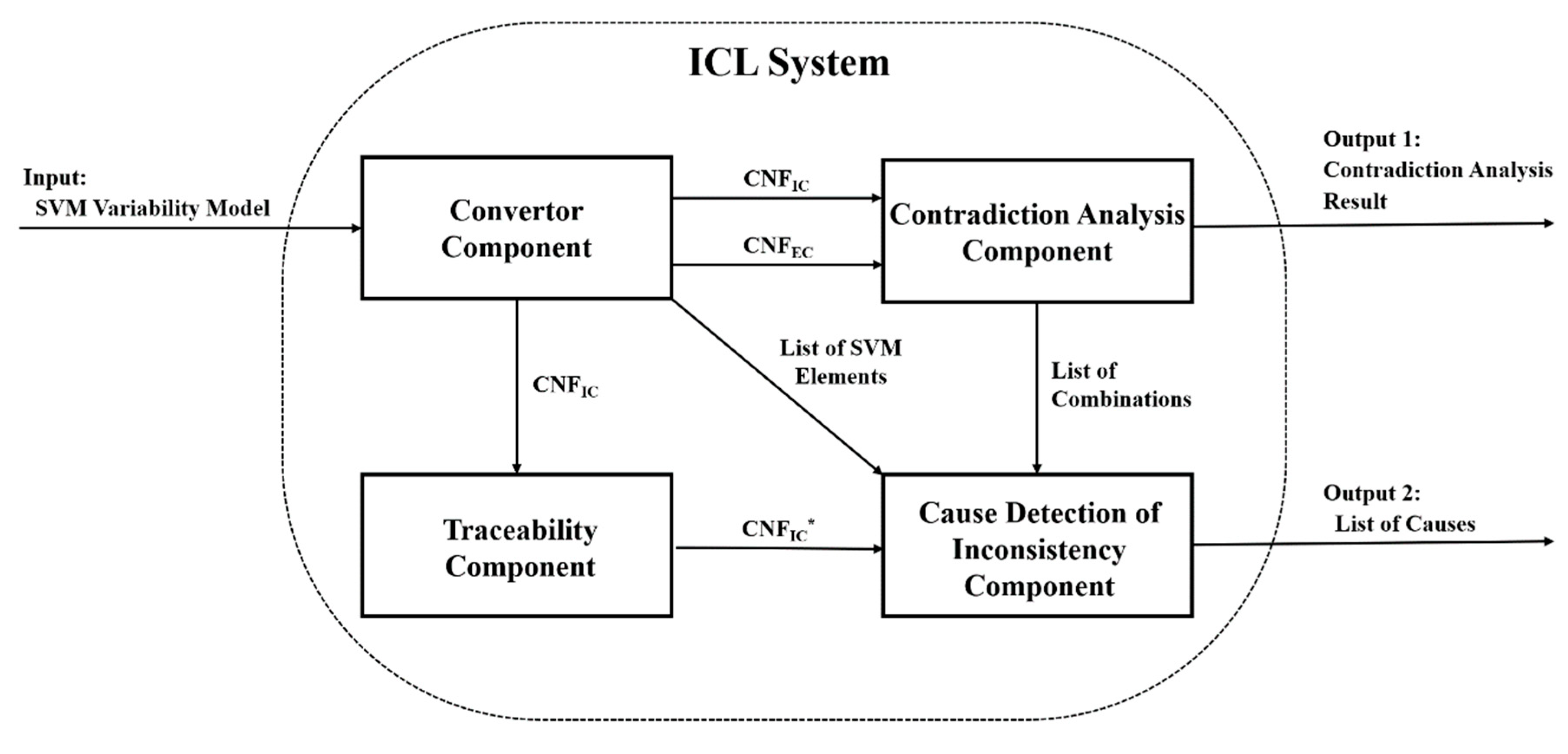
4.1. The Workflow of the ICL Method
4.2. Steps of the ICL Method
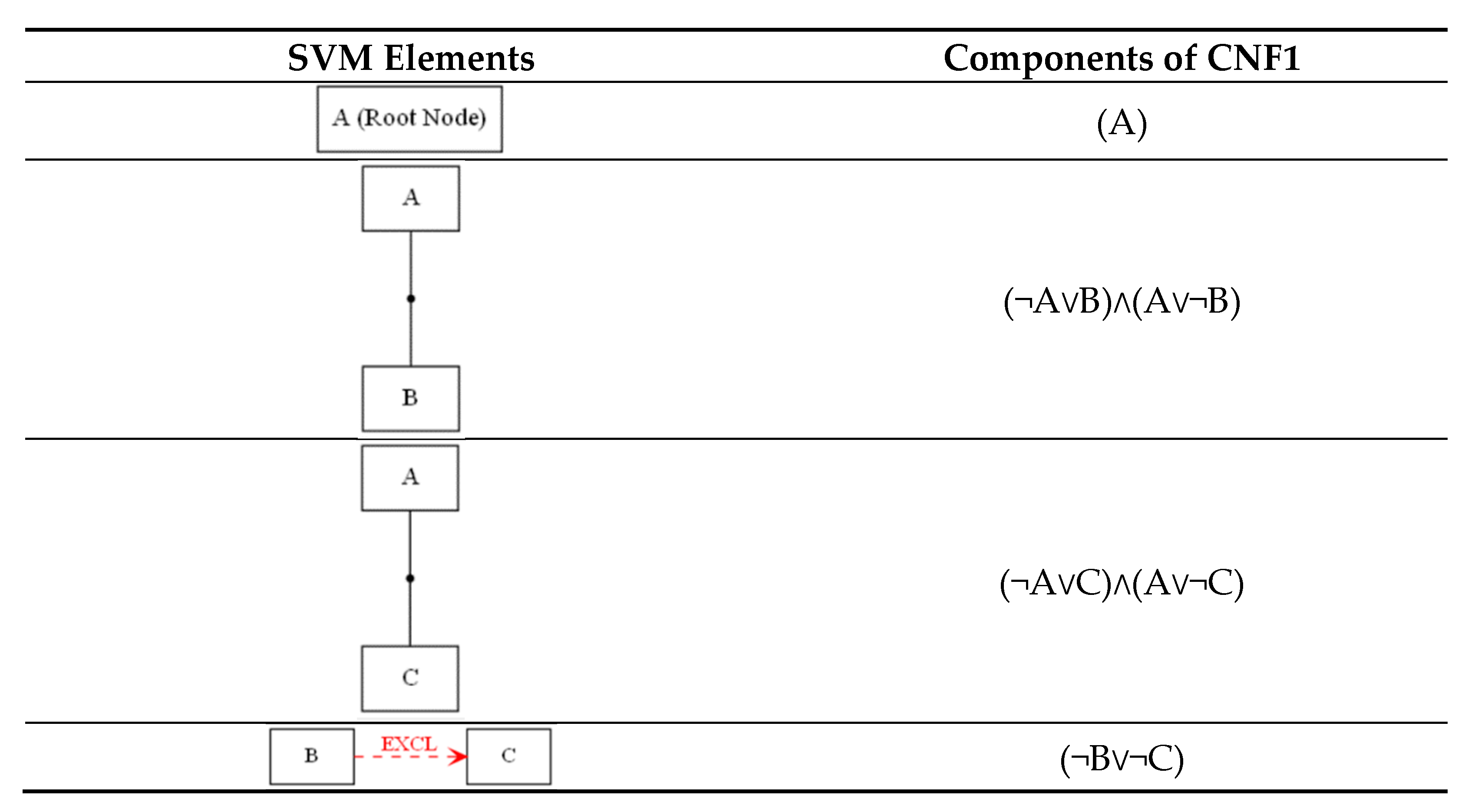
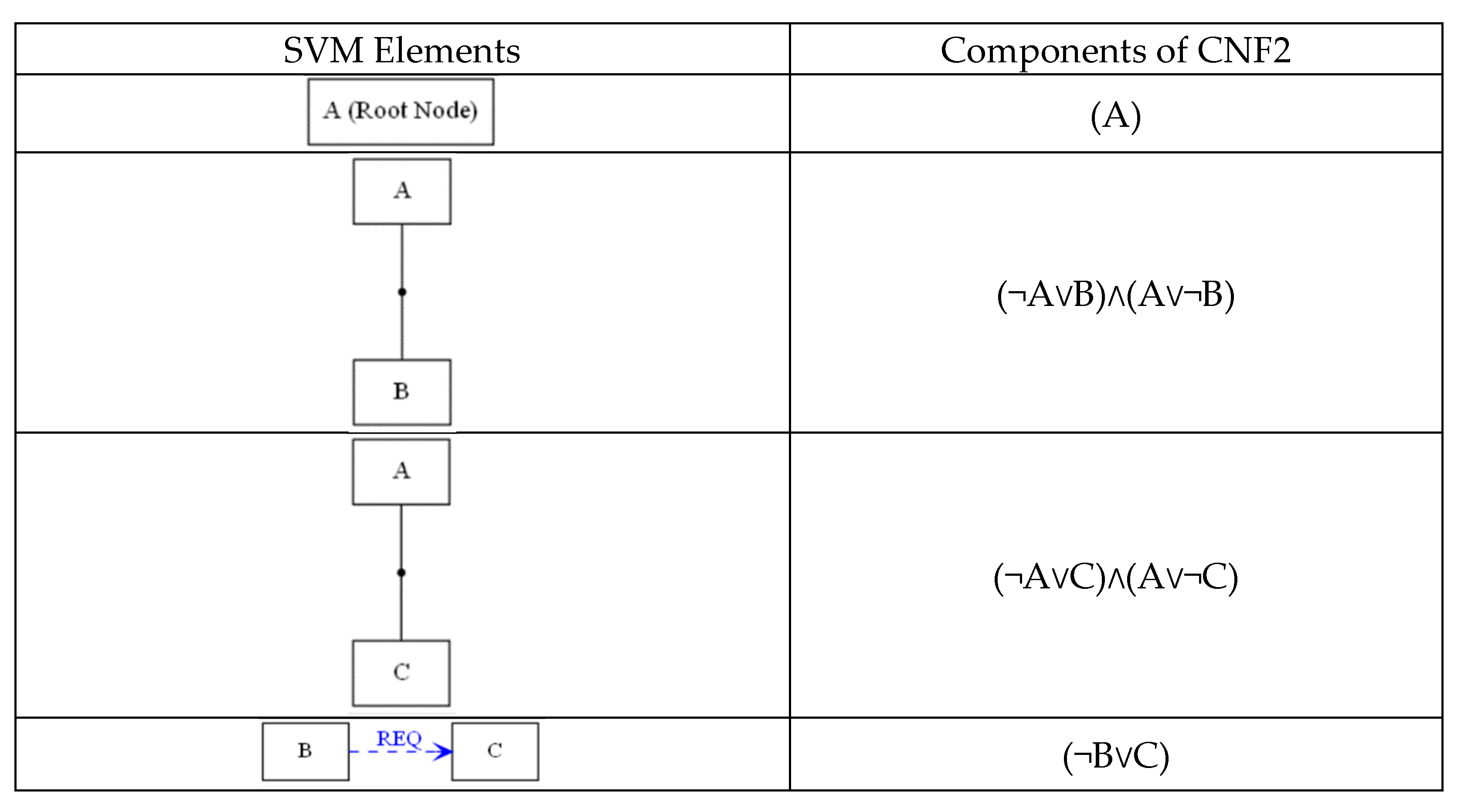
4.2.1. Step 1: Convert an SVM Variability Model to CNFs
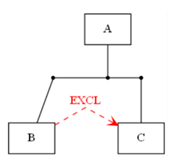
4.2.2. Step 2: Analyze Contradiction in CNFIC
- (a)
- A combination of truth values of all variables that make “CNFIC is False and CNFEC is True”.
- (b)
- The result of an evaluation of the truth value of a CNFIC is False.
- (c)
- The result of an evaluation of the truth value of a CNFEC is True.
4.2.3. Step 3: Detect Conflicting Literal Clauses in CNFIC
4.2.4. Step 4: Eliminate Duplicated Conflicting Literal Clauses
4.2.5. Step 5: Track Conflicting SVM Components in the SVM Variability Model


5. Evaluation
5.1. Research Questions
5.2. The ICL Tool
5.3. Experiment 1: Applying to Experimental Variability Models
5.3.1. Subject Models
5.3.2. Experimental Design
5.3.3. Experiment Results
5.4. Experiment 2: Applying to Real-World Variability Models
5.4.1. Subject Models
- (1)
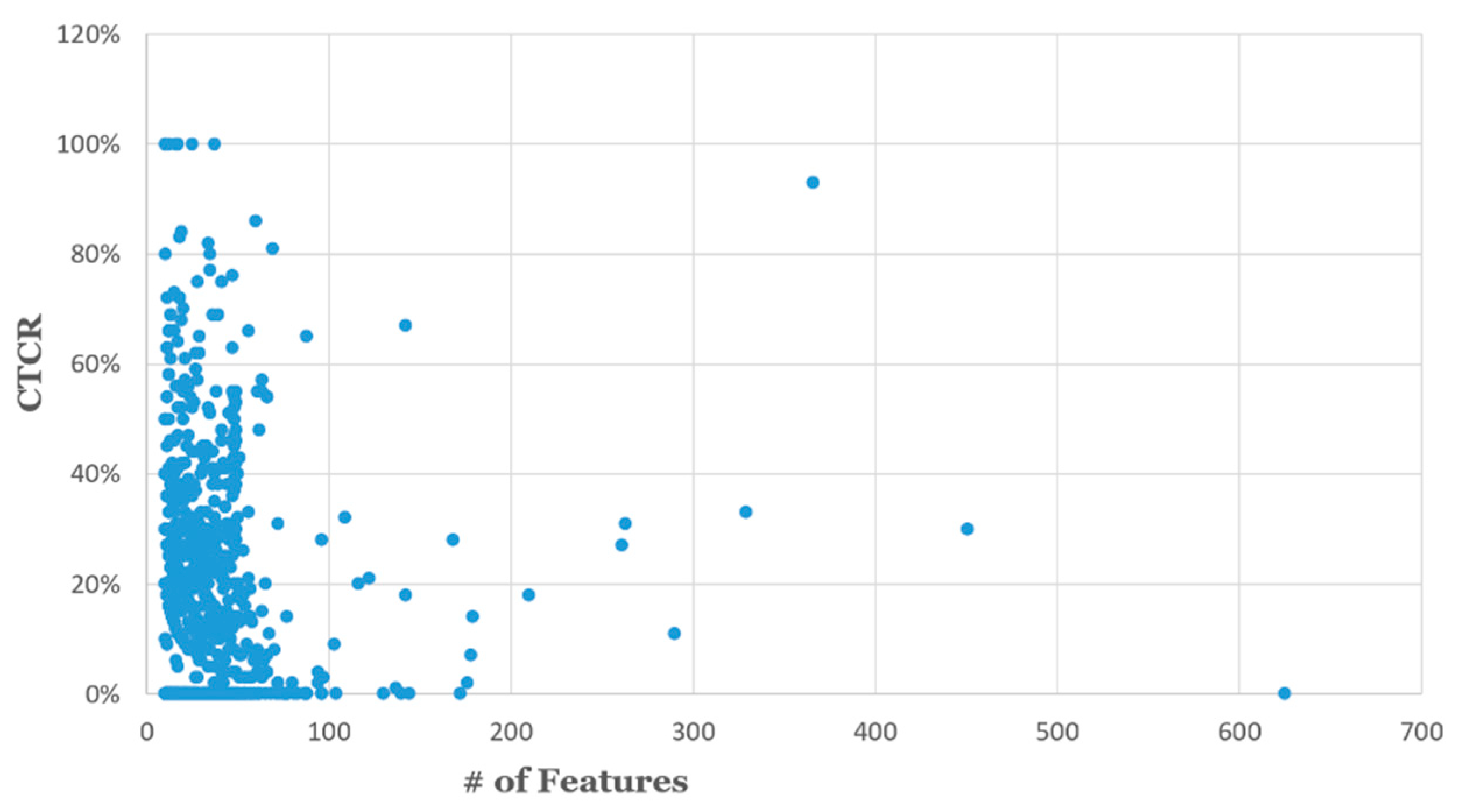
- Selection Criterion 1. All models in the repository were analyzed in terms of feature size and CTCR (Cross-Tree Constraint Ratio), and models were selected in the area with the most distribution.
- (2)
- Selection Criterion 2. Very small models and incomplete models were excluded from the experiment. Complete models were selected such that the information of the organization that developed them and their developers were clearly specified, and models with ten or less features and incomplete models whose feature names are arbitrarily given, for example, A, B, and C, were excluded from the experiment.
- (3)
- Selection Criterion 3. If the number of features is the same, then variability models with a higher CTCR were selected as subjects for the experiment. Since inconsistency is caused by conflicts of relationships and constraints between components in the variability model, there is a high probability of inconsistency in the variability model with a high CTCR. Inconsistency does not occur in the variability models with 0% CTCR.
- (4)
- Selection Criterion 4. Since the feature size can be large, it affects performance, so a variability model with a large number of features in the SPLOT repository was included in the experiment. In the process of converting a variability model into a CNF formula, even if the number of constraints increases, the number of literals in the CNF formula does not necessarily increase. However, when the number of features increases, the number of literals increases proportionally, affecting performance.
5.4.2. Experimental Design
5.4.3. Experiment Results
5.5. Adequacy of the Located Cause of Inconsistency
5.6. Threats to Validity
5.6.1. Validity of Subject Models for Experiment 1
5.6.2. Validity of Subject Models for Experiment 2
5.6.3. Validity of the Scalability of the ICL Tool
5.6.4. Validity of the Time Complexity of the ICL Tool
6. Conclusions
Author Contributions
Funding
Institutional Review Board Statement
Informed Consent Statement
Data Availability Statement
Conflicts of Interest
Appendix A. How to Select Subject Models Among Real-World Variability Models


| # Feature | # Model | Ratio |
|---|---|---|
| 1~10 | 100 | 8.73% |
| 11~20 | 463 | 40.40% |
| 21~30 | 205 | 17.89% |
| 31~40 | 140 | 12.30% |
| 41~50 | 121 | 10.56% |
| 51~60 | 41 | 3.58% |
| 61~70 | 23 | 2.01% |
| 71~80 | 14 | 1.22% |
| 81~90 | 8 | 0.70% |
| 91~ | 30 | 2.62% |
| Sum | 1146 | 100% |
| CTCR | # Model | Ratio |
|---|---|---|
| 0%~10% | 573 | 50.00% |
| 11%~20% | 186 | 16.23% |
| 21%~30% | 148 | 12.91% |
| 31%~40% | 96 | 8.38% |
| 41%~50% | 62 | 5.41% |
| 51%~60% | 32 | 2.79% |
| 61%~70% | 25 | 2.18% |
| 71%~80% | 11 | 0.96% |
| 81%~90% | 5 | 0.44% |
| 91%~100% | 8 | 0.70% |
| Sum | 1146 | 100% |
- −
- Condition 1: model that has 11 to 40 features
- −
- Condition 2: model that has 0% to 40% CTCR
| Subject Models | # Features | CTCR | Creator |
|---|---|---|---|
| Alarm System | 13 | 30% | Florian Wartenberg |
| Smart Hotel | 13 | 15% | Jefferson da Silva Barbosa |
| Mobile Media_Lenita | 15 | 26% | Lenita Ambrosio |
| Smart Home | 22 | 18% | Jefferson da Silva Barbosa |
| Automotive System | 31 | 41% | Jean-Vivien Millo |
| Banking Software | 176 | 2% | Ganesh Khandu Narwane |
| Subjected Model | Derived Models | ||
|---|---|---|---|
| Model ID | CTCR | Add Constraints | |
| Alarm System | Alarm System_Original | 30% | N/A |
| Alarm System_D1 | 46% | E <Siren, Warning Light> | |
| Alarm System_D2 | 46% | R <Siren, Warning Light> | |
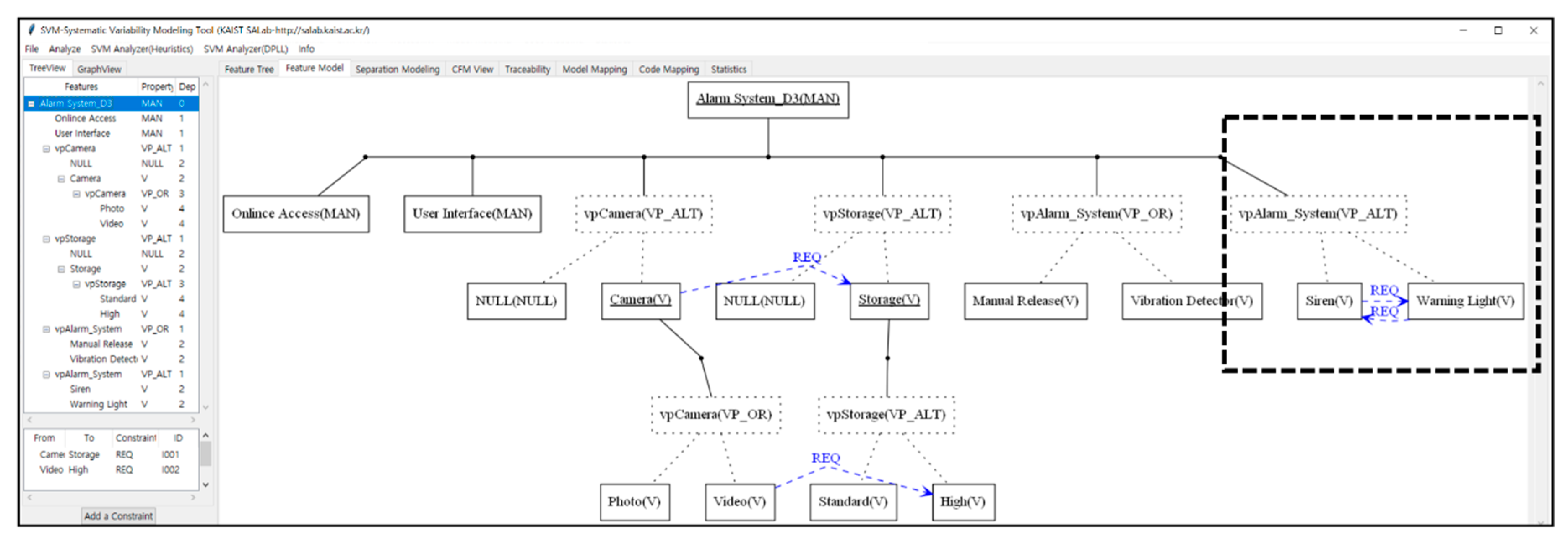
| Alarm System_D3 | 46% | R <Siren, Warning Light>, R <Warning Light, Siren> | |
| Alarm System_D4 | 62% | R <Siren, Warning Light>, R <Warning Light, Siren>, E <Online Access, User Interface> | |
| Smart Hotel | Smart Home_Original | 15% | N/A |
| Smart Home_D1 | 31% | R <SilentAlarm, VisualAlarm> | |
| Smart Home_D2 | 38% | R <SilentAlarm, VisualAlarm>, R <AutomatedIlumination, SilentAlarm> | |
| Smart Home_D3 | 46% | R <SilentAlarm, VisualAlarm>, E <InfraredSensor, VolumetricSensor> | |
| Smart Home_D4 | 46% | R <SilentAlarm, VisualAlarm>, R <AutomatedIlumination, PipedMusic>, R <PipedMusic, SilentAlarm> | |
| Mobile Media_ Lenita | Mobile Media_Lenita_Original | 26% | N/A |
| Mobile Media_Lenita_D1 | 40% | E <MediaManagement, ScrrenSize> | |
| Mobile Media_Lenita_D2 | 33% | R <Video, CopyMedia> | |
| Mobile Media_Lenita_D3 | 47% | R <Video, CopyMedia>, E <ReceivePhto, SendPhoto> | |
| Mobile Media_Lenita_D4 | 47% | R <Video, CopyMedia>, R <SetFavourites, ViewFavourites> | |
| Smart Home | Smart Home_Original | 18% | N/A |
| Smart Home_D1 | 27% | E <Lighting, ControlSystem> | |
| Smart Home_D2 | 32% | E <HDTV42, ControlPanel>, R <Lighting, ControlSystem> | |
| Smart Home_D3 | 41% | R <ControlSystem, MoviePlayers>, E <Lighting, MoviePlayers>, R <PCPlayers, HDTV32> | |
| Smart Home_D4 | 45% | E <Lighting, MoviePlayers>, R <PCPlayers, HDTV32>, R <CellPhone, HDTV42> | |
| Automotive System | Automotive System_Original | 41% | N/A |
| Automotive System_D1 | 48% | E <Chassis, Energy Reservoir> | |
| Automotive System_D2 | 48% | R <GearBox, Engine> | |
| Automotive System_D3 | 48% | E <Climate Control, Manual Control> | |
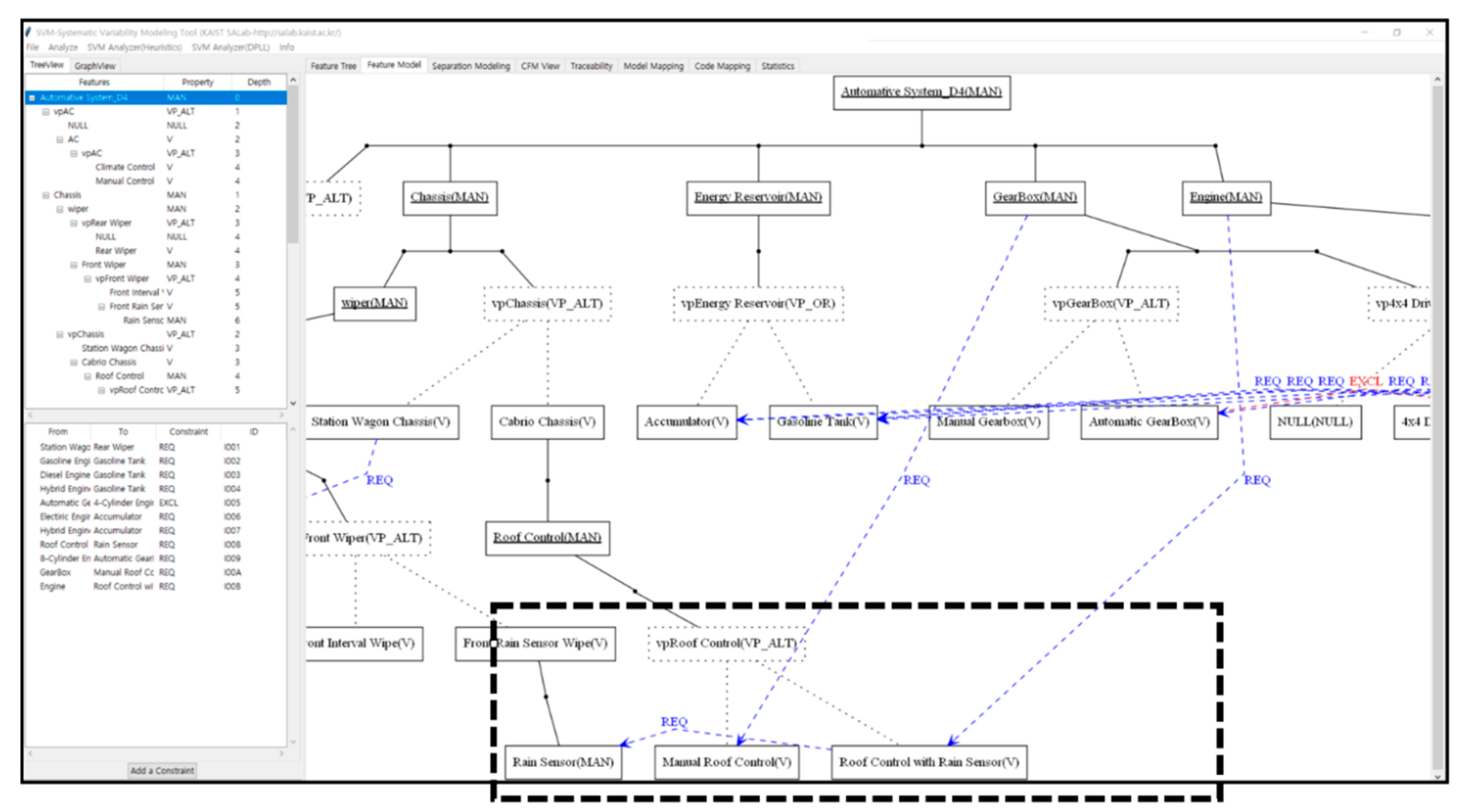
| Automotive System_D4 | 58% | R <GearBpx, Manual Roof Control>, R <Engine, Roof Control with Rain Sensor> | |
Appendix B. Variability Models Drawn with the SVM Tool for Experiment 2


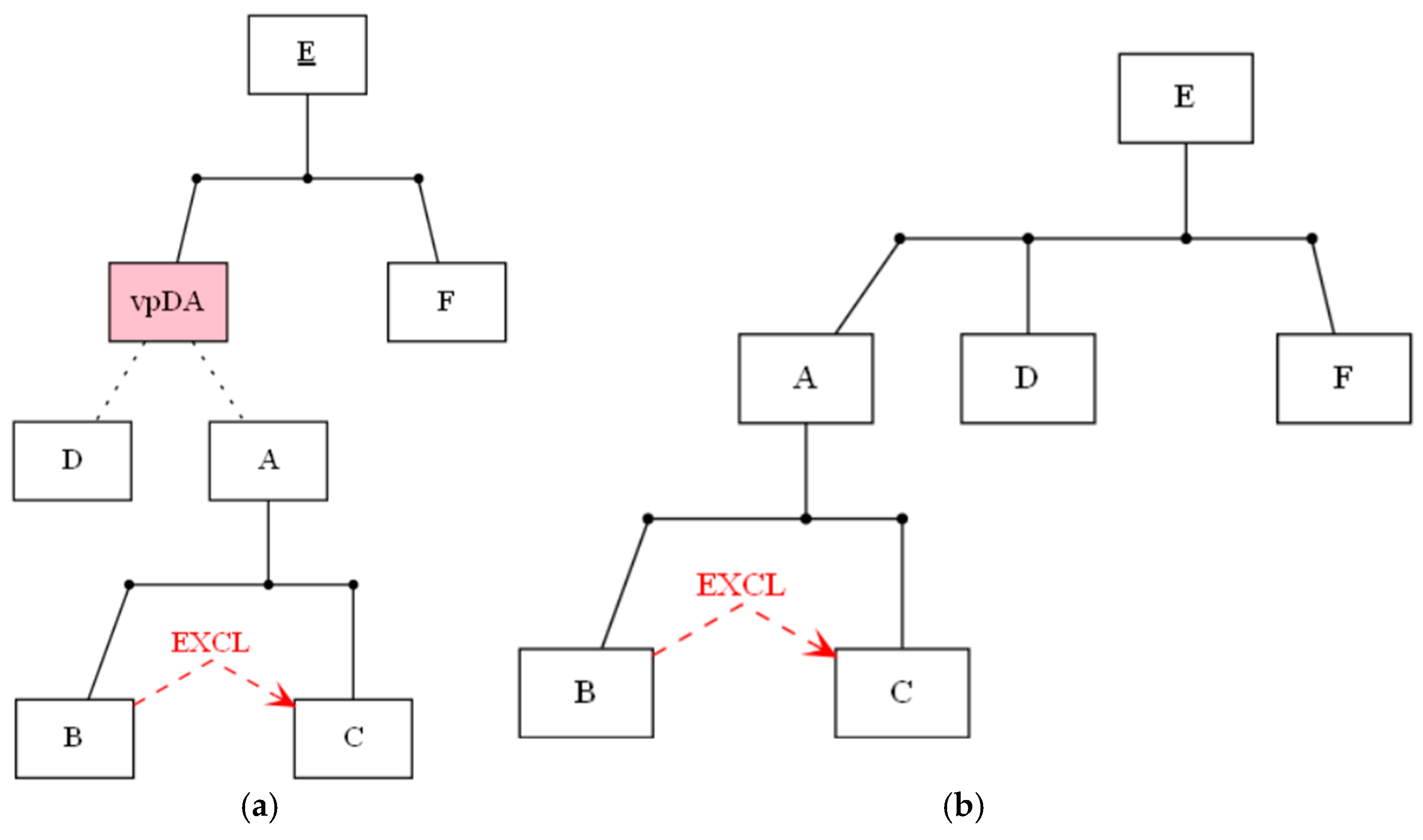
Appendix C. Example 4.2 in Section 4.2.1

References
- Linden, F.; Schmid, K.; Rommes, E. Software Product Lines in Action: The Best Industrial Practice in Product Line Engineering; Springer Science & Business Media: Berlin/Heidelberg, Germany, 2007. [Google Scholar]
- Pohl, K.; Böckle, G.; Linden, F. Software Product Line Engineering: Foundations, Principles and Techniques; Springer: Berlin/Heidelberg, Germany, 2005. [Google Scholar]
- Maßen, T.; Lichter, H. Deficiencies in feature models. In Proceedings of the Workshop on Software Variability Management for Product Derivation-Towards Tool Support, Boston, MA, USA, 30 August 2004; Springer: Berlin/Heidelberg, Germany, 2004; Volume 44. [Google Scholar]
- Batory, D. Feature models, grammars, and propositional formulas. In Proceedings of the Software Product Lines Conference, Rennes, France, 26–29 September 2005; pp. 7–20. [Google Scholar]
- Trinidad, P.; Benavides, D.; Durán, A.; Ruiz-Cortés, A.; Toro, M. Automated error analysis for the agilization of feature modeling. J. Syst. Softw. 2008, 81, 883–896. [Google Scholar] [CrossRef]
- Benavides, D.; Segura, S.; Trinidad, P.; Ruiz-Cortés, A. FAMA: Tooling a Framework for the Automated Analysis of Feature Models. In Proceeding of the First International Workshop on Variability Modelling of Software-Intensive Systems (VAMOS), Limerick, Ireland, 16–18 January 2007; pp. 129–134. [Google Scholar]
- Zhang, W.; Zhao, H.; Mei, H. A propositional logic-based method for verification of feature models. In Proceedings of the International Conference on Formal Engineering Methods, Seattle, WA, USA, 8–12 November 2004; pp. 115–130. [Google Scholar]
- Mendonca, M.; Branco, M.; Cowan, D. SPLOT: Software product lines online tools. In Proceedings of the 24th ACM SIGPLAN Conference Companion on Object Oriented Programming Systems Languages and Applications, Orlando, FL, USA, 25–29 October 2009; pp. 761–762. [Google Scholar]
- Software Product Lines Online Tools. Available online: http://52.32.1.180:8080/SPLOT/index.html (accessed on 9 October 2025).
- Wang, H.; Li, Y.; Sun, J.; Zhang, H.; Pan, J. A semantic web approach to Feature modeling and verification. In Proceedings of the Workshop on Semantic Web Enabled Software Engineering, Galway, Ireland, 6 November 2005; pp. 46–60. [Google Scholar]
- Wang, H.; Li, Y.; Sun, J.; Zhang, H.; Pan, J. Verifying feature models using OWL. J. Web Semant. 2007, 5, 117–159. [Google Scholar] [CrossRef]
- Mannion, M. Using First-Order Logic for Product Line Model Validation. International Conference on Software Product Lines; Springer: Berlin/Heidelberg, Germany, 2002; pp. 176–187. [Google Scholar]
- Sun, J.; Zhang, H.; Li, Y.; Wang, H. Formal semantics and verification for feature modeling. In Proceedings of the 10th IEEE International Conference on Engineering of Complex Computer Systems, Shanghai, China, 16–20 June 2005; pp. 303–312. [Google Scholar]
- Thüm, T.; Kästner, C.; Benduhn, F.; Meinicke, J.; Saake, G.; Leich, T. FeatureIDE: An extensible framework for feature-oriented software development. Sci. Comput. Program. 2014, 79, 70–85. [Google Scholar] [CrossRef]
- Website, FeatureIDE. Available online: https://featureide.github.io/ (accessed on 9 October 2025).
- Kowal, M.; Ananieva, S.; Thüm, T. Explaining anomalies in feature models. ACM SIGPLAN Not. 2016, 52, 132–143. [Google Scholar] [CrossRef]
- Wang, B.; Xiong, Y.F.; Hu, Z.J. Interactive Inconsistency Fixing in Feature Modeling. J. Comput. Sci. Technol. 2014, 29, 724–736. [Google Scholar] [CrossRef]
- Hentze, M.; Pett, T.; Thüm, T.; Schaefer, I. Hyper explanations for feature-model defect analysis. In Proceedings of the 15th International Working Conference on Variability Modelling of Software-Intensive Systems, Krems, Austria, 9–11 February 2021. [Google Scholar]
- Deelstra, S.; Sinnema, M.; Bosch, J. Experiences in software product families: Problems and issues during product derivation. In Proceedings of the International Conference on Software Product Lines, Boston, MA, USA, 30 August–2 September 2004; pp. 165–182. [Google Scholar]
- Choi, H.; Lee, K.; Lee, J.; Kang, K.C. Multiple Views of Feature Models to Manage Complexity. In Proceedings of the Workshop on Scalable Modeling Techniques for Software Product Lines (SCALE), San Francisco, CA, USA, 24–28 August 2009. [Google Scholar]
- Kang, K.C.; Cohen, S.G.; Hess, J.A.; Novak, W.E.; Peterson, A.S. Feature-Oriented Domain Analysis (FODA) Feasibility Study; SEI Technical Report; Defense Technical Information Center: Fort Belvoir, VA, USA, 1990.
- Kang, K.C.; Lee, J.; Donohoe, P. Donohoe Feature-Oriented Product Line Engineering. IEEE Softw. 2002, 19, 58–65. [Google Scholar] [CrossRef]
- Benavides, D.; Segura, S.; Ruiz-Cortés, A. Automated analysis of feature models 20 years later: A literature review. Inf. Syst. 2010, 35, 615–636. [Google Scholar] [CrossRef]
- Mendonca, M.; Wąsowski, A.; Czarnecki, K. SAT-based Analysis of Feature Models is Easy. In Proceedings of the 13th International Software Product Line Conference, San Francisco, CA, USA, 24–28 August 2009; pp. 231–240. [Google Scholar]
- Liang, J.; Ganesh, V.; Czarnecki, K.; Raman, V. SAT-based Analysis of Large Real-world Feature Models is Easy. In Proceedings of the 19th International Conference on Software Product Line, Nashville, TN, USA, 20–24 July 2015; pp. 91–100. [Google Scholar]
- Sundermann, C.; Thüm, T.; Schaefer, I. Evaluating# SAT solvers on industrial feature models. In Proceedings of the 14th International Working Conference on Variability Modelling of Software-Intensive Systems, Magdeburg, Germany, 5–7 February 2020. [Google Scholar]
- Meinicke, J.; Thüm, T.; Schröter, R.; Benduhn, F.; Leich, T.; Saake, G. Mastering Software Variability with FeatureIDE; Springer: Cham, Switzerland, 2017. [Google Scholar]
- Elfaki, A.O.; Phon-Amnuaisuk, S.; Ho, C.K. Modeling Variability in Software Product Line Using First Order Logic. In Proceedings of the 2009 Seventh ACIS International Conference on Software Engineering Research, Management and Applications, Haikou, China, 2–4 December 2009; pp. 227–233. [Google Scholar]
- Kang, S.; Han, Y.; Ahn, H.; Lee, J. Critical analysis of feature model evolution. In Proceedings of the 8th International Conference on Software Engineering and Service Science (ICSESS), Beijing, China, 24–26 November 2017. [Google Scholar]
- Le, V.-M.; Felfernig, A.; Tran, T.N.T.; Atas, M.; Uta, M.; Benavides, D.; Galindo, J. DirectDebug: A software package for the automated testing and debugging of feature models. Softw. Impacts 2021, 9, 100085. [Google Scholar] [CrossRef]
- Han, Y.; Kang, S. SVM: A Variability Modeling Tool for Software Product Line; CS-TR-2022-425; School of Computing, KAIST: Daejeon, Republic of Korea, 2022; Available online: https://cs.kaist.ac.kr/research/techReport (accessed on 8 April 2022).
- Kang, S.; Han, Y.; Ahn, H.; Lee, J. Compositional Feature Model CFM for Software Product Line Development and a Variability Modeling Tool SVM that Supports CFM. Commun. Korean Inst. Inf. Sci. Eng. 2018, 36, 9–18. (In Korean) [Google Scholar]
- Leblanc, H.; Wisdom, W.A. Deductive Logic, 2nd ed.; Allyn and Bacon: Boston, MA, USA, 1976. [Google Scholar]
- DPLL Algorithm. Available online: http://ais.informatik.uni-freiburg.de/teaching/ss17/ki/slides/ai08_satisfiability_and_model_construction.pdf (accessed on 9 October 2025).
- Russell, S.J.; Norvig, P. Artificial Intelligence a Modern Approach, 3rd ed.; Pearson: London, UK, 2017. [Google Scholar]
- Mendonca, M. Efficient Reasoning Techniques for Large Scale Feature Models. Ph.D. Thesis, University of Waterloo, Waterloo, ON, Canada, 2009; pp. 1–170. [Google Scholar]
- Segura, S.; Benavides, D.; Ruiz-Cortés, A. Functional testing of feature model analysis tools. a first step. In Proceedings of the 5th Software Product Lines Testing Workshop (SPLiT 2008), Limerick, Ireland, 8–12 September 2008; IEEE: New York, NY, USA, 2008; pp. 36–39. [Google Scholar]
- Segura, S.; Benavides, D.; Ruiz-Cortés, A. FaMa Test Suite v1.2; Technical Report ISA-10-TR-01; ISA Research Group: Arlington, VA, USA, 2010; pp. 1–52. [Google Scholar]
- Segura, S.; Benavides, D.; Ruiz-Cortés, A. Functional testing of feature model analysis tools: A test suite. IET Softw. 2011, 5, 70–82. [Google Scholar] [CrossRef]


| SVM Elements | Graphical Notation 1 | Textual Notation | ||
|---|---|---|---|---|
| Inclusion Relationship |  | I <A,B> | ||
| Variability Dependencies | Alternative Relationship | When Bi’s, 1 ≤ i ≤ n, are non-collection child nodes (Alternative Relationship) |  | A <vpA,{B1,B2,…,Bn}> |
| When Bi’s, 1 ≤ i ≤ n, are collection child nodes (Collection Alternative Relationship) | C <vpA,{B1,B2,…,Bn}> | |||
| Optional Relationship |  | O <vpA,{B, NULL}> | ||
| Variability Constraints | Requires Constraint |  | R <A,B> | |
| Excludes Constraint |  | E <A,B> | ||
| SVM Elements | Components of CNF Formula | |
|---|---|---|
 | (A) | |
 | (¬A∨B)∧(A∨¬B) | |
 | When Bi’s, 1 ≤ i ≤ n, are non-collection elements | (¬A∨B1∨B2∨…∨Bn)∧ (¬B1∨¬B2)∧…∧(¬B1∨¬Bn)∧(¬B1∨A)∧ (¬B2∨¬B3)∧…∧(¬B2∨¬Bn)∧(¬B2∨A)∧ (¬Bn-1∨¬Bn)∧(¬Bn-1∨A)∧ (¬Bn∨A) |
| When Bi’s, 1 ≤ i ≤ n, are collection elements | (¬A∨B1∨B2∨…∨Bn)∧(¬B1∨A)∧(¬B2∨A)∧…∧(¬Bn∨A) | |
 | (A∨¬B) | |
 | (¬A∨B) | |
 | (¬A∨¬B) | |
| Variables | CNF1 | |||
|---|---|---|---|---|
| A | B | C | E [CNF1IC] | E [CNF1EC] |
| True | True | True | False | True |
| True | True | False | False | False |
| True | False | True | False | False |
| True | False | False | False | False |
| False | True | True | False | False |
| False | True | False | False | False |
| False | False | True | False | False |
| False | False | False | False | False |
| SAT/UNSAT Result | UNSAT | SAT | ||
| Variables | CNF2 | |||
|---|---|---|---|---|
| A | B | C | E [CNF2IC] | E [CNF2EC] |
| True | True | True | True | True |
| True | True | False | False | False |
| True | False | True | False | False |
| True | False | False | False | False |
| False | True | True | False | False |
| False | True | False | False | False |
| False | False | True | False | False |
| False | False | False | False | False |
| SAT/UNSAT Result | SAT | SAT | ||
| Analysis Perspectives | The Number of Models | 24 Types of Models | Analysis Results (from [37,38,39]) |
|---|---|---|---|
| Inconsistency Analysis Perspective | 24 | VM-1, VM-2, VM-3, VM-4, VM-5, VM-6, VM-7, VM-8, VM-9, VM-10, VM-12, VM-13, VM-14, VM-15, VM-16, VM-17, VM-18, VM-19, VM-20, VM-22 | Consistent |
| VM-11, VM-21, VM-23, VM-24 | Inconsistent | ||
| Other Six Perspectives 2 | 168 | ||
| Total | 192 | ||
| 24 Types of Models | The Number of Models | Inconsistency Analysis Results (from the ICL Tool) |
|---|---|---|
| VM-1, VM-2, VM-3, VM-4, VM-5, VM-6, VM-7, VM-8, VM-9, VM-10, VM-12, VM-13, VM-14, VM-15, VM-16, VM-17, VM-18, VM-19, VM-20, VM-22 | 20 | Consistent |
| VM-11, VM-21, VM-23, VM-24 | 4 | Inconsistent |
| Inconsistent Models | Located Causes (from the ICL Tool) |
|---|---|
| VM-11 | (E <B,C>:{I <A,C>}) |
| VM-21 | (R <E,D>:{A <vpB,{C,D}>}) |
| VM-23 | (E <E,B>:{A <vpB,{C,D}>}) |
| VM-24 | (R <H,G>:{A <vpB,{C,D,E,F,G}>}) |
| Model Name | Subject Models | Inconsistency Analysis Results from the SPLOT Tool | Inconsistency Analysis Results from the ICL Tool |
|---|---|---|---|
| Alarm System | Alarm System_Original | Consistent | Consistent |
| Alarm System_D1 | Consistent | Consistent | |
| Alarm System_D2 | Consistent | Consistent | |
| Alarm System_D3 | Inconsistent | Inconsistent | |
| Alarm System_D4 | Inconsistent | Inconsistent | |
| Smart Hotel | Smart Hotel_Original | Consistent | Consistent |
| Smart Hotel_D1 | Consistent | Consistent | |
| Smart Hotel_D2 | Inconsistent | Inconsistent | |
| Smart Hotel_D3 | Consistent | Consistent | |
| Smart Hotel_D4 | Inconsistent | Inconsistent | |
| Mobile Media_Lenita | Mobile Media_Lenita_Original | Consistent | Consistent |
| Mobile Media_Lenita_D1 | Inconsistent | Inconsistent | |
| Mobile Media_Lenita_D2 | Consistent | Consistent | |
| Mobile Media_Lenita_D3 | Consistent | Consistent | |
| Mobile Media_Lenita_D4 | Consistent | Consistent | |
| Smart Home | Smart Home_Original | Consistent | Consistent |
| Smart Home_D1 | Inconsistent | Inconsistent | |
| Smart Home_D2 | Consistent | Consistent | |
| Smart Home_D3 | Inconsistent | Inconsistent | |
| Smart Home_D4 | Consistent | Consistent | |
| Automotive System | Automotive System_Original | Consistent | Consistent |
| Automotive System_D1 | Inconsistent | Inconsistent | |
| Automotive System _D2 | Consistent | Consistent | |
| Automotive System _D3 | Consistent | Consistent | |
| Automotive System _D4 | Inconsistent | Inconsistent |
| Model | Size of Model | Located Causes | Time (ms 3) | |
|---|---|---|---|---|
| # Features | CTCR | |||
| Alarm System_D3 | 13 | 46% | (R <Siren, Warning_Light>: {A <vpAlarm_System, {Siren, Warning_Light}>}) | 0.99 |
| Alarm System_D4 | 13 | 62% | (E <Onlince_Access, User_Interface>: {I <Alarm_System, User_Interface>}) | 2.02 |
| (R <Siren, Warning_Light>: {A <vpAlarm_System, {Siren, Warning_Light}>}) | ||||
| Smart Hotel_D2 | 13 | 38% | (R <SilentAlarm, VisualAlarm>: {A <vpAlarm, {SilentAlarm, Siren, VisualAlarm}>}) | 1.01 |
| Smart Hotel_D4 | 13 | 46% | (R <SilentAlarm, VisualAlarm>: {A <vpAlarm,{SilentAlarm, Siren, VisualAlarm}>, R <PipedMusic, SilentAlarm>}) | 1.00 |
| Mobile Media_Lenita_D1 | 15 | 40% | (E <MediaManagement, ScrrenSize>: {I <Mobile_Media_Lenita, ScrrenSize>, A <vpScrrenSize,{Screen1}>}) | 1.00 |
| Smart Home_D1 | 22 | 27% | (E <Lighting, ControlSystem>: {I <SmartHome, ContolSystem>, C <vpControlSystem, {CellPhone, ControlPanel}>}) | 1.01 |
| Smart Home_D3 | 22 | 41% | (E <Lighting, MoviePlayers>: {C <vpMoviePlayers, {HDTV42, PCPlays, HDTV32}>, R <ControlSystem, MoviePlayers>}) | 2.01 |
| Automotive System_D1 | 31 | 48% | (E <Chassis, Energy_Reservoir>: {I <Automated_System, Energy Reservoir>, C <vpEnergyReservoir, {Accumulator, Gasline_Tank}>}) | 6.02 |
| Automotive System_D4 | 31 | 58% | (R <Engine, Roof_Control_with_Rain_Sensor>: {A <vpRoof_Control, {Manual_Roof_Control, Roof_Control_with_Rain_Sensor}>, R <Roof_Control_with_Rain_Sensor, Rain_Sensor>}) | 6.01 |
| Model ID | Size of Model | Detected Causes | Time (Milliseconds) | |
|---|---|---|---|---|
| # Features | CTCR | |||
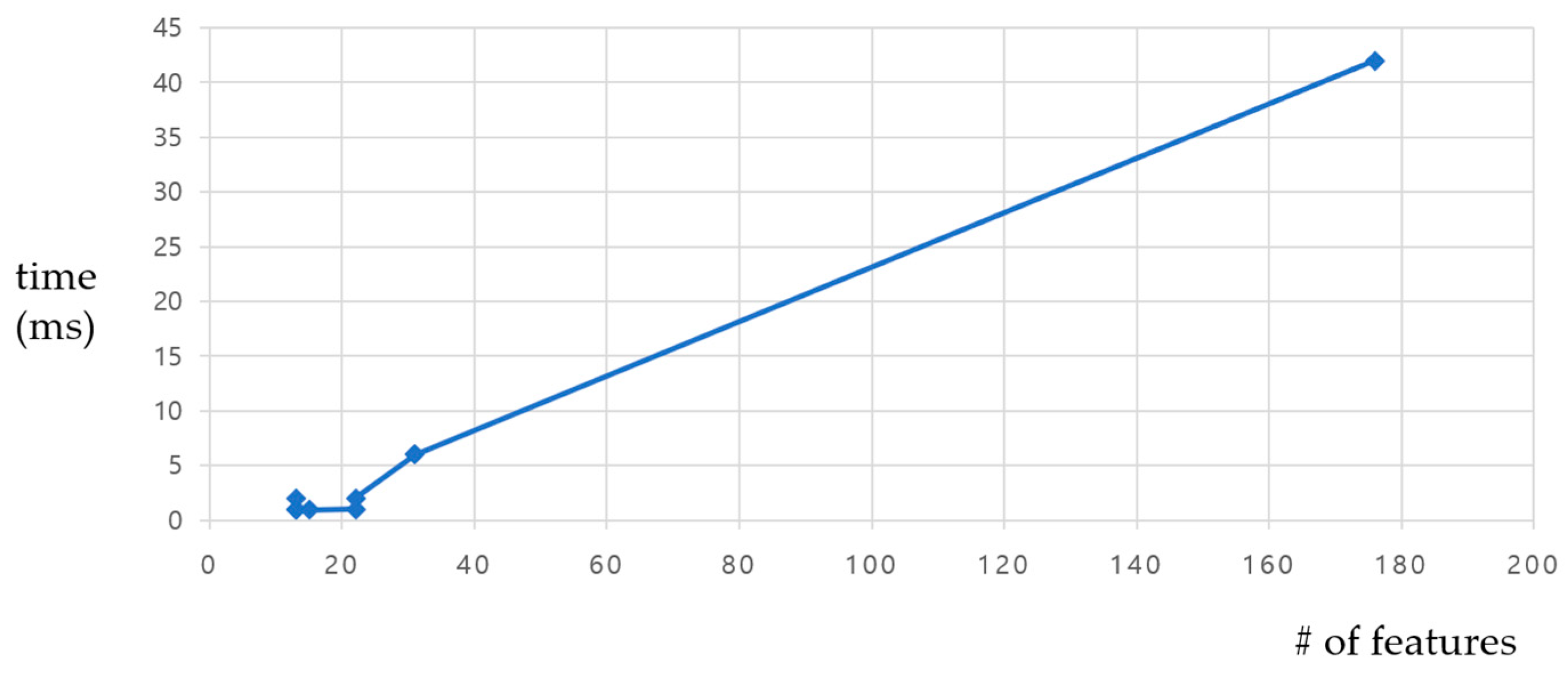
| Banking Software_D1 | 176 | 2% | (E <OpenAccount, ATMLogin>: {I <CoreBanking, OpenAccount>, I <CoreBanking, ATMLogin>}) | 42 |
Disclaimer/Publisher’s Note: The statements, opinions and data contained in all publications are solely those of the individual author(s) and contributor(s) and not of MDPI and/or the editor(s). MDPI and/or the editor(s) disclaim responsibility for any injury to people or property resulting from any ideas, methods, instructions or products referred to in the content. |
© 2025 by the authors. Licensee MDPI, Basel, Switzerland. This article is an open access article distributed under the terms and conditions of the Creative Commons Attribution (CC BY) license (https://creativecommons.org/licenses/by/4.0/).
Share and Cite
Han, Y.; Kang, S.; Lee, J. Locating Causes of Inconsistency in a Variability Model for Software Product Line. Appl. Sci. 2025, 15, 12328. https://doi.org/10.3390/app152212328
Han Y, Kang S, Lee J. Locating Causes of Inconsistency in a Variability Model for Software Product Line. Applied Sciences. 2025; 15(22):12328. https://doi.org/10.3390/app152212328
Chicago/Turabian StyleHan, Younghun, Sungwon Kang, and Jihyun Lee. 2025. "Locating Causes of Inconsistency in a Variability Model for Software Product Line" Applied Sciences 15, no. 22: 12328. https://doi.org/10.3390/app152212328
APA StyleHan, Y., Kang, S., & Lee, J. (2025). Locating Causes of Inconsistency in a Variability Model for Software Product Line. Applied Sciences, 15(22), 12328. https://doi.org/10.3390/app152212328