1. Introduction
Hydraulic shock absorbers play a crucial role in vehicle dynamics by controlling the oscillatory motion of the suspension system and dissipating the kinetic energy generated by road-induced excitations. They directly influence ride comfort, handling stability, and safety, while mitigating vibration and noise transmission to the vehicle body. In modern automotive engineering, shock absorbers are integral to Noise, Vibration, and Harshness (NVH) performance optimization and the fatigue durability of suspension components. Their proper design and calibration determine not only passenger comfort but also tire–road contact consistency, making them one of the most critical elements of both passive and semi-active suspension systems. In particular, NVH performance has gained increased importance in hybrid and fully electric vehicles, where the absence of combustion engine masking effects makes vibration and acoustic disturbances far more perceptible to the occupants, thus imposing stricter requirements on the damping system’s dynamic behavior and structural integrity.
The design of automotive hydraulic shock absorbers [
1] involves balancing multiple, often conflicting objectives such as ride comfort, handling stability, and durability. Traditional development workflows rely on iterative experimental testing and empirical tuning, which are costly and time-consuming. To address these challenges, model-based design has become a key methodology, enabling engineers to create virtual prototypes and explore wide design spaces before committing to physical prototyping. In this approach, high-fidelity numerical models serve as executable representations of the physical system. When integrated with advanced optimization algorithms, these models enable the identification of trade-offs among mechanical, hydraulic, and structural objectives.
Designing a shock absorber that simultaneously satisfies damping-force accuracy, NVH performance, and fatigue durability remains a complex multi-domain optimization problem. Increasing damping stiffness improves stability but worsens comfort; reducing stiffness enhances comfort but compromises durability and control. Achieving an optimal balance therefore requires multi-objective optimization (MOO) methods capable of identifying Pareto-optimal solutions under nonlinear, coupled constraints.
Numerous studies have addressed isolated aspects of shock absorber optimization, typically focusing on damping-force characteristics, vibration behavior, or fatigue life, but few provide a unified framework that captures the full interaction among these domains. The present work builds upon these research directions and proposes a multi-domain Pareto optimization framework integrating mechanical, hydraulic, and fatigue models to concurrently improve safety, comfort, and reliability.
1.1. Damping Force Optimization
Accurate control of the damping force is essential for maintaining the desired balance between ride comfort and handling stability. Earlier studies have focused on optimizing valve configurations, flow geometries, and shim stiffness to achieve desired force–velocity profiles. Satpute, Singh, and Sawant [
2] developed a fluid-flow model for a hydraulic shock absorber with a shim-loaded relief valve, coupling nonlinear orifice flow equations with shim deformation behavior. Their study demonstrated that optimized shim stiffness can reduce peak damping force by approximately 10% while preserving rebound/compression balance. Similarly, Wang et al. [
3] performed a multi-objective optimization of a three-valve system by combining technical and economic performance criteria. The resulting configuration met most objectives within constraints, though trade-offs between comfort and valve responsiveness were observed. Sonnenburg [
4] investigated parameter combinations of hydraulic shock absorber modules and found that optimized geometries can reduce dynamic wheel-load fluctuation by up to 20% while maintaining ride comfort, confirming the sensitivity of damping performance to small design changes. Collectively, these works underline that precise damping-force optimization is critical for achieving desired system performance. However, these approaches largely rely on single-domain analyses, without accounting for the coupled influence of vibration transmission and fatigue loading.
1.2. NVH Performance Enhancement
The NVH performance of shock absorbers has become an equally important design criterion, directly linked to ride comfort and driver perception. Kaldas et al. [
5] focused on optimizing shock absorber top-mount stiffness and damping parameters to reduce transmitted vibration energy. Their approach achieved a 12% reduction in seat-track acceleration and a 15% decrease in perceived harshness compared with the baseline configuration. Czop, Sławik, and Wszołek [
6] integrated a nonlinear lumped-parameter model with a multi-objective optimization routine to minimize vibration transmission while maintaining force accuracy, reducing vibration levels by approximately 20% within the 80–120 Hz frequency range. Later, Wszołek [
7] extended this methodology through a model-based optimization framework that simultaneously targeted damping-force conformity, vibration isolation, and fatigue life. The optimized configurations achieved up to a 25% improvement in vibration attenuation while maintaining acceptable force deviations. These studies collectively demonstrate that NVH performance optimization can be effectively achieved through parametric modeling and simulation. Nevertheless, most prior work treats NVH improvement as an isolated objective, without integrating it with mechanical and fatigue-related constraints, limiting the ability to assess true multi-domain trade-offs.
1.3. Fatigue Durability Improvement
Fatigue durability is a crucial design consideration in hydraulic shock absorbers, especially for the shim-based valve systems, which are subjected to high cyclic stresses during operation. The accurate prediction of fatigue life requires combining hydraulic pressure field analysis, material stress evaluation, and cycle-based fatigue modeling. Czop et al. [
8] conducted systematic sensitivity analyses of geometric and hydraulic parameters to evaluate their effects on valve shim stress and fatigue life. Their findings highlighted that variations in valve thickness, orifice diameter, and preload significantly influence the stress amplitude and fatigue strength of valve components. Recent studies, such as He et al. [
9], have incorporated fatigue durability into multi-objective frameworks, coupling nonlinear dynamic effects and parasitic losses to optimize both structural reliability and dynamic performance. These results confirm that fatigue durability assessment plays a central role in defining feasible design spaces for optimization. However, fatigue modeling is often treated as a post-processing step rather than as an integrated design constraint within the optimization process. The present study addresses this limitation by embedding fatigue evaluation directly into the multi-domain optimization workflow.
1.4. Multi-Objective Optimization and Advanced Design Methodologies
The theoretical foundation of MOO has been established in several key works. Simpson et al. [
10] provided one of the earliest comprehensive overviews of metamodel-based design, emphasizing surrogate modeling approaches for computationally expensive simulations—an idea conceptually aligned with the reduced-order modeling adopted in this study. Eschenauer et al. [
11] and Statnikov and Matusov [
12] formalized multicriteria optimization frameworks, introducing systematic methods for balancing competing engineering objectives through Pareto frontier exploration. Rao [
13] further unified these principles into an engineering optimization framework combining mathematical programming with population-based heuristics. Martins and Lambe [
14] extended this foundation with a detailed classification of multidisciplinary optimization architectures, highlighting hierarchical and collaborative schemes that enable coupling between mechanical, hydraulic, and fatigue sub-model concepts directly reflected in the present multi-domain framework. Modern optimization algorithms, often referred to as nontraditional optimization methods, have proven to be highly efficient and reliable for solving such complex design problems. These include Genetic Algorithms (GA), Simulated Annealing, Particle Swarm Optimization (PSO), Ant Colony Optimization, Neural Network-based optimization, and Fuzzy Optimization. MOO can be formulated for continuous, discrete, or binary design variables while accounting for geometric, physical, and manufacturing constraints. Multiple objective functions are defined from engineering principles, each potentially comprising several weighted terms [
13]. The main advantage of population-based approaches lies in their ability to explore multiple Pareto-optimal solutions simultaneously within a single optimization run. In these methods, the fitness of each candidate solution is ranked using Pareto strength, while diversity is preserved through density estimation and dominance-based constraint handling. Visualization and exploration of the Pareto set then support design decision-making and trade-off evaluation, as posterior preferences can be assigned to select the most balanced configuration. Recent studies in suspension system design illustrate the practical potential of these approaches. Puliti et al. [
15] developed a multi-objective optimization framework for regenerative shock absorbers, achieving more than 65% energy recovery efficiency while reducing device volume by 20%. Guo et al. [
16] optimized a hydraulic integrated regenerative suspension, improving ride comfort by 15% and reducing tire-load fluctuation by 12%. Jin et al. [
17] employed an NSGA-II-based surrogate modeling approach for electro-hydraulic suspensions, achieving 18% vibration reduction and 22% improvement in harvested energy. Zhou et al. [
18] integrated digital-twin-assisted PSO for hybrid hydraulic–electromagnetic absorbers, obtaining a 25% improvement in energy recovery and a 15% reduction in body acceleration. Finally, Jiang et al. [
19] applied evolutionary algorithms to magnetorheological shock absorbers, balancing controllability, response speed, and compactness. Together, these studies illustrate that multi-objective approaches can effectively reconcile conflicting performance criteria, yet they rarely integrate fatigue durability and NVH performance within a unified optimization environment.
1.5. Research Gap and Objectives
The reviewed body of literature indicates that, although the optimization of damping-force characteristics, NVH performance, and fatigue durability has been extensively investigated as separate problems, a comprehensive multi-domain modeling framework that simultaneously integrates these interdependent phenomena has not yet been systematically formulated or experimentally validated. Prior studies frequently neglect the coupling effects among hydraulic dynamics, vibration transmission, mechanical deformation, and fatigue degradation, all of which are critical for accurately replicating the operational behavior of hydraulic shock absorbers under real-world conditions. To address this research gap, the present study redefines a multi-domain Pareto optimization framework for hydraulic shock absorbers, integrating mechanical-hydraulic, test-rig, and fatigue sub-models within a unified computational environment. A genetic-algorithm-based Pareto search is employed to determine optimal design configurations that balance damping-force conformity, vibration attenuation, and fatigue life. Importantly, the proposed methodology introduces the Minkowski distance metric as a novel criterion for ranking Pareto-optimal solutions, enabling a more discriminative and quantitative evaluation of trade-offs among competing design objectives. Compared with previous research [
7], the proposed approach extends the number of design variables to twelve and broadens the experimental validation scope, enhancing both model fidelity and practical applicability.
2. Multi-Objective Optimization
The Pareto frontier, also referred to as the Pareto-optimal set, comprises those parameter configurations that achieve mutual non-domination, meaning that no other solution improves one objective without deteriorating another. The identification of this frontier is essential for isolating the most significant design trade-offs and for narrowing the decision space to feasible and efficient configurations. By exploring only the Pareto-efficient region, designers can systematically evaluate performance compromises among competing objectives rather than analyzing the entire parameter space. Incorporating results from sensitivity analyses and preliminary single-objective optimization runs into the initial population enhances the convergence and robustness of the multi-objective search. The single-objective optimization problem related to the NVH performance of hydraulic shock absorbers has been addressed in earlier work [
6]. Within the weighted-sum approach, multiple objective functions are aggregated into a single scalar cost function, where each objective is assigned a relative weighting coefficient reflecting its design significance:
In the context of multi-objective optimization (MOO), the design vector
represents an
-dimensional array of decision variables, while
denotes the vector of objective functions to be minimized or maximized. The formulation is typically subject to a set of inequality
and equality
constraints, which define the feasible design space. The numbers of design variables and constraints denoted by
,
, and
, respectively, are not necessarily interdependent [
13]. In the weighted-sum approach, each objective is multiplied by a weighting coefficient
, representing its relative importance or marginal rate of substitution between competing objectives. These weights reflect implicit value judgments and are systematically varied to explore the trade-offs within the objective space. Each unique combination of weights yields one Pareto-efficient solution, forming a subset of the overall non-dominated solution set. However, a well-known limitation of the weighting method is its inability to generate the complete Pareto frontier when the trade-off surface is non-convex. The efficiency frontier between two objectives,
and
, illustrates how improvement in one criterion necessarily entails a deterioration in the other as the corresponding weight
is increased. Consequently, MOO techniques are not designed to yield a single “best” configuration but rather to map the trade-off relationships among competing performance criteria. The principal stages of a multi-objective optimization process typically include: (i) generation of a non-dominated solution set (representing technologically or economically feasible designs), and (ii) selection of compromise solutions using either a weighting scheme or a constraint-based approach. A design vector
is said to dominate another if it provides equal or superior values for all objectives and strictly better performance in at least one. Non-dominated or Pareto-efficient solutions represent designs where improvement in any single criterion necessarily requires a sacrifice in another. In formal notation, MOO problems are expressed as the minimization of a vector-valued objective function
subject to the specified design constraints:
In the formal definition of a multi-objective optimization problem, the design vector
represents an
-dimensional set of decision variables, while
denotes the corresponding objective function vector. The system is further constrained by inequality constraints
and equality constraints
, which define the feasible region of the search space. The total number of design variables
and the number of imposed constraints
and/or
are not required to exhibit any direct functional relationship [
13]. The outcome of the optimization process is a collection of Pareto-feasible solutions that populate an m-dimensional objective space, representing all non-dominated configurations that satisfy the governing constraints. This solution set, often visualized as a Pareto frontier, provides the decision-maker with the spectrum of attainable trade-offs among competing objectives.
Here,
denotes the number of Pareto-feasible solutions obtained through the optimization process. Each Pareto-optimal solution, represented as an individual row within the solution matrix
, is subsequently evaluated and ranked according to subjective decision criteria that incorporate soft engineering knowledge and customer-driven preferences, assigning greater significance to one of the objectives. The ranking procedure employs the Minkowski distance metric [
11,
13,
20] to quantify the relative proximity of each feasible solution vector to a reference (ideal) solution, thereby facilitating the systematic ordering of design candidates within the multi-objective decision space:
In this formulation,
represents the reference vector comprising the assumed, simulated, or experimentally measured values of the optimization criteria. When available, a validated shock absorber design may serve as the reference configuration. In the absence of such a baseline, a theoretical utopia point—corresponding to the origin of the design parameter space under the assumption of objective function minimization—is adopted as the reference, i.e.,
,
, …,
. The input data for the Minkowski distance metric consist of an
matrix
, which contains the evaluated objective function values for all Pareto-feasible design vectors, and a
matrix
, which defines the reference (ideal) point. The output of this operation is a distance vector
, whose elements represent the Minkowski distances between each Pareto-optimal solution and the designated reference point, thereby enabling quantitative ranking within the multi-objective decision space [
13]:
where
c is an arbitrary scalar positive value which for the special case of
c = 1, the Minkowski distance metric gives the city block metric, for the special case of
c = 2, the Minkowski distance metric gives the Euclidean distance, and for the special case of
c = ∞, the Minkowski distance metric gives the Chebychev distance.
3. Modeling Framework Functional Components
The proposed multi-domain (solid–fluid–electrical) lumped-parameter model represents a monotube take-apart hydraulic shock absorber coupled with a servo-hydraulic test rig, analogous to the configuration utilized in industrial facilities for the evaluation of damping-force characteristics and NVH performance. The developed model faithfully reproduces the essential dynamic responses observed during experimental damper characterization and reflects the measurement methodology adopted by a leading global manufacturer of hydraulic shock absorbers. The formulation was implemented within the MATLAB/Simulink 2024b simulation environment, enabling iterative execution of the model within the fitness function of a genetic algorithm to conduct multi-objective minimization with respect to the selected design variables of the shock absorber.
3.1. Monotube Shock Absorber Model (Damping Force)
The shock absorber model considered in this study corresponds to the standard monotube shock absorber configuration, which is widely employed in passenger cars, motorcycles, and commercial vehicles [
1]. In such a design, a piston reciprocates within a single tube that is directly exposed to the surrounding air, thus enhancing heat dissipation during high-frequency or long-duration tests. To suppress foaming and cavitation in the hydraulic oil—which would otherwise deteriorate force response—a high-pressure gas chamber is incorporated in parallel with the oil chamber. The gas maintains sufficient pressure to minimize bubble formation and, at the same time, compensates for volumetric changes in the compression and rebound chambers resulting from the reciprocating motion of the piston–rod assembly. Moreover, the gas chamber accommodates thermal expansion of the oil caused by temperature rise during operation.
The piston side connected to the rod is conventionally referred to as the rebound chamber, while the side with the larger effective area is the compression chamber [
1]. The working fluid (oil) occupies the tube volume on both sides of the piston. A floating piston is located opposite the piston head within the tube volume, serving as a separator between the oil and a high-pressure gas chamber (typically charged to 5–30 bar).
During the compression stroke, when the rod moves into the tube, the hydraulic fluid from the compression (head-side) chamber is forced through a series of valves and orifices across the piston into the rebound (rod-side) chamber. Initially, the oil flows through port restrictions once the pressure differential across the check valve exceeds its threshold. The fluid then enters an intermediate junction volume within the piston before passing through bleed orifices into the rod-side chamber. In addition, a pressure-relief valve connected to the junction volume opens when the pressure differential surpasses a preset limit, providing an alternative flow path. Leakage may also occur around the piston seal due to the clearance between the piston and the inner tube wall.
Because oil is relatively incompressible and the displaced volume on the head side exceeds that of the rod side, a reduction in gas volume occurs to accommodate the additional fluid. This gas compression effect prevents fluid accumulation in the compression chamber. During the rebound stroke, the fluid in the rod-side chamber is pressurized relative to the head side, forcing oil across the piston through a separate set of ports and orifices specific to rebound operation. In this case, the compression-side ports remain closed by check valves, and vice versa for the compression stroke. Unlike compression, however, the reduction in oil volume during rebound is compensated by the expansion of the high-pressure nitrogen gas chamber.
The nonlinear behavior of hydraulic shock absorbers arises from several sources, including variable oil volume, friction of the main and floating pistons, nonlinear valve characteristics, and the thermodynamic properties of the oil–gas mixture. The monotube hydraulic shock absorber model introduced in this section follows the formulation of Czop et al. [
21] with the omission of the third and reserve chamber tubes and the inclusion of a high-pressure gas chamber. The development of the model was based on the following assumptions:
the relationship between density and pressure is nonlinear due to oil–gas emulsion effects,
pressure and density are uniformly distributed within each chamber,
pressure–flow characteristics of all restrictions are monotonic,
valves open and close abruptly in a symmetric manner, with valve dynamics neglected,
oil temperature remains constant,
friction between the floating piston and the pressure tube is negligible (owing to low-friction sealing and absence of side forces),
the mass of the floating piston is neglected since it is several times smaller than the fluid mass, and its inertia is therefore insignificant.
The calibration of the shock absorber model parameters was conducted to ensure that the simulated force–velocity characteristics accurately reproduced the experimentally measured behavior. Two primary groups of parameters were identified and adjusted: (i) the static friction components, and (ii) the valve discharge coefficients. The static (stiction) and Coulomb friction parameters were identified using low-velocity excitation tests, within a piston-rod velocity range of ±5 mm/s. The calibration procedure minimized the deviation between the measured and simulated force–displacement hysteresis loops. The friction parameters were iteratively tuned until the model reproduced the characteristic transition from the pre-sliding regime to steady-state motion, including the breakaway force peak observed at the onset of piston movement. This ensured that the friction model captured both the magnitude and dynamic evolution of the resistive forces without introducing artificial stick–slip oscillations. The discharge coefficients were identified under medium- and high-speed operating conditions, where the valve stack exhibited turbulent orifice flow. The initial estimates were derived from the production Bill of Materials (BOM) and associated design documentation, which specify the nominal valve geometries, flow areas, and clearances (
Table 1).
These baseline values were further refined using correlations and empirical models reported in the relevant literature, where typical discharge coefficients for sharp-edged orifices range between 0.6 and 0.8. The final calibration step involved minimizing the root-mean-square (RMS) error between the measured and simulated damping-force curves over a set of representative excitation amplitudes and frequencies. This procedure ensured consistency of the predicted compression and rebound characteristics across multiple operating regimes. In summary, the calibration process combined nominal parameter initialization from production data with iterative model refinement guided by literature-based correlations and experimental validation, yielding a high-fidelity representation of the physical damping behavior suitable for subsequent multi-objective optimization.
3.2. Monotube Shock Absorber Model (Fatigue)
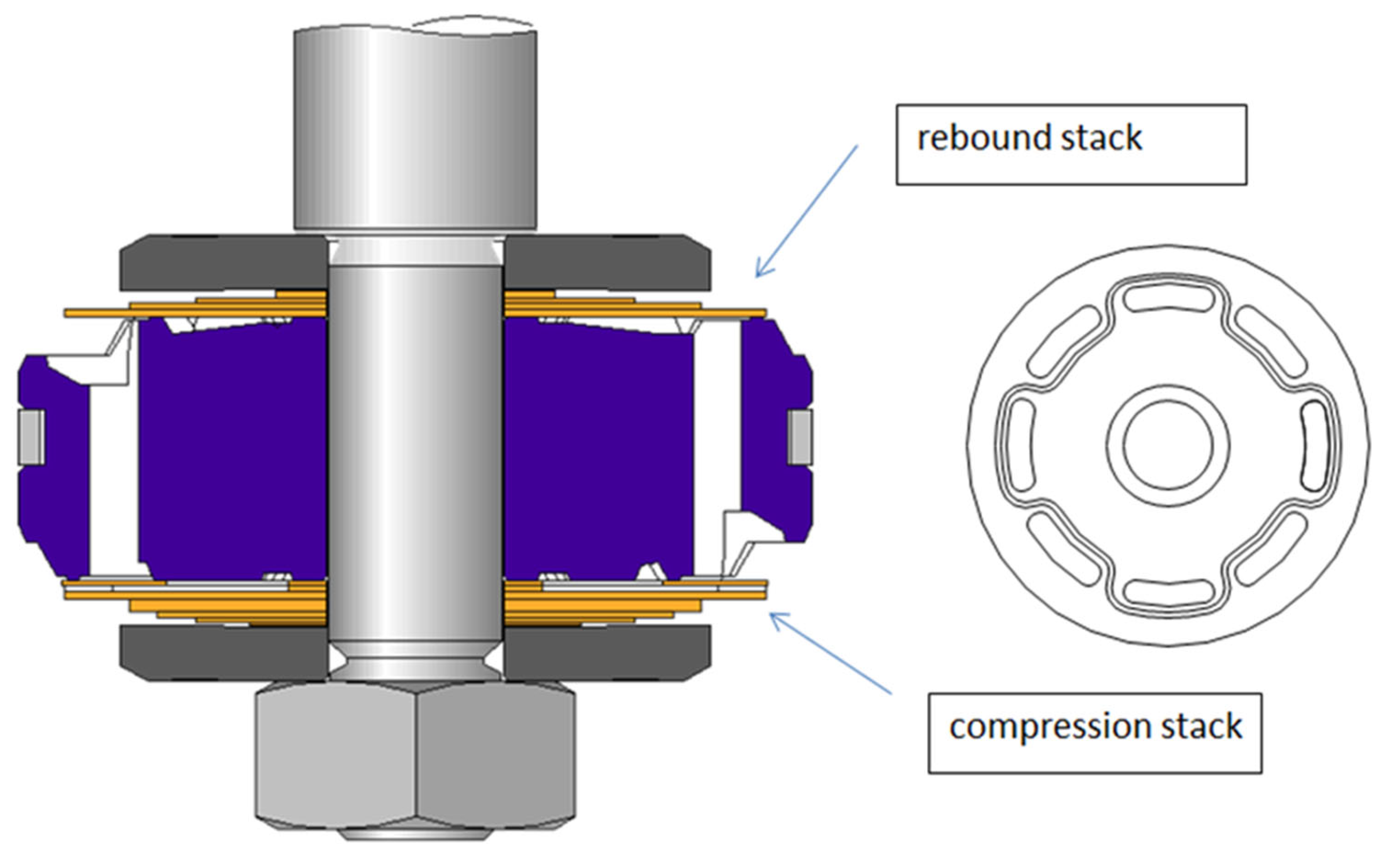
The overall lifetime of a hydraulic shock absorber is predominantly governed by the fatigue resistance of its most vulnerable component, typically the shim stacks (
Figure 1), which are particularly susceptible to cyclic loading-induced damage [
8]. Two types of shim stacks are typically employed: the straight shim stack and the pyramid shim stack. The primary advantage of the pyramid configuration lies in its ability to achieve a gradual stress distribution, starting from the clamping (bending) shim of the smallest diameter up to the sealing shim, located on the valve seat, with the largest diameter. This arrangement has been shown to improve stress conditions by approximately 20–40%. However, achieving a stiffness level comparable to that of a baseline straight shim stack requires a greater number of shims in the pyramid configuration. This presents a practical challenge when the total number of shims is constrained by manufacturing limitations, such as the capacity of automated shim assembly systems.
The stress distribution within the valve shim stack arises from a complex interplay of factors, including the geometric configuration, material properties, and assembly precision of the valve components, as well as operational loading conditions, service history, and manufacturing tolerances, as reported in [
8]. Beyond these structural determinants, fluid–structure interaction effects, such as aeration and cavitation, markedly diminish the effective pressure transmitted to the valve surfaces, thereby modifying the anticipated fatigue response. The fatigue endurance of shim valves is further influenced by mechanical friction effects [
22,
23] and by the progressive degradation of material properties, particularly the reduction in the elastic modulus observed during extended operational cycles. In addition to the global fatigue mechanisms associated with stress amplitude and cycle accumulation, localized degradation phenomena, such as fretting fatigue, can play a decisive role in the deterioration of critical contact interfaces within the shim stack assembly. The bleed circuit, realized as a fixed-area orifice, imposes a dominant flow restriction that governs the damping characteristics under low-flow conditions. By allowing the hydraulic medium to bypass the closed shim stack, this orifice directly influences the vehicle’s handling dynamics during low-frequency excitation events, thereby serving as a key control parameter in defining ride and stability performance.
The monotube shock absorber model was also calibrated to ensure that the predicted durability of the valve system accurately reflected the experimentally observed endurance characteristics. The procedure focused on the identification of material fatigue parameters, local stress amplitudes, and load-spectrum scaling under constant-amplitude loading conditions. Material constants describing the Wöhler fatigue curve (SN) were obtained from manufacturer data sheets and verified through component-level fatigue tests. Local stress amplitudes in critical valve regions were evaluated using finite element analysis (FEA) and corrected with experimentally derived factors accounting for surface finish, mean-stress influence, and geometric notches. The simulated loading spectrum was based on constant-amplitude pressure cycles representative of typical shock absorber operating conditions. The stress-time histories generated in the model were validated against strain gauge measurements on selected valve components. The load-scaling coefficient was adjusted so that the predicted number of cycles to failure corresponded to the endurance limit observed in rig-based durability tests. In summary, the calibration integrated literature-based material fatigue data, FEA-derived local stress distributions, and experimentally validated constant-amplitude load spectra, resulting in a reliable fatigue model capable of predicting the service life of the shock absorber as reported by Czop and Wszołek [
8].
3.3. Servo-Hydraulic Test Rig Model (Vibrations)
The vibration (NVH) behavior of shock absorbers can only be properly analyzed when accounting for the upper and lower mounts, together with either the vehicle suspension dynamics or, alternatively, the dynamics of the test rig, typically a servo-hydraulic system. It is advantageous to investigate isolated subsystems of gradually increasing complexity—such as the suspension or the hydraulic shock absorber—under controlled laboratory conditions. In many cases of hydraulic shock absorber prototyping, it is particularly beneficial to employ laboratory test rigs, as they provide repeatable excitation, precise control of operating parameters, and reduced dependence on full-vehicle prototypes. It is advantageous to investigate isolated subsystems of gradually increasing complexity—such as the suspension or the hydraulic shock absorber—under controlled laboratory conditions. In many cases of hydraulic shock absorber prototyping, it is particularly beneficial to employ laboratory test rigs together with specialized instrumentation, as they provide repeatable excitation, precise control of operating parameters, and reduced dependence on full-vehicle prototypes. Furthermore, laboratory-based testing reduces both cost and duration relative to on-road sessions.
A common practice in such studies is the application of servo-hydraulic test rigs, which enable the quantification and ranking of vibration intensity generated by hydraulic shock absorbers [
21]. Nevertheless, the servo-hydraulic system itself influences the evaluation process, as the actuator exhibits variable stiffness and possesses a specific resonance frequency. To ensure modeling accuracy, it is therefore necessary to incorporate the dynamics of the MTS 858 servo-hydraulic tester (cf.
Section 4.2) into the analysis by coupling its mathematical representation with that of the hydraulic shock absorber.
The servo-hydraulic test rig model adopted in this study follows the formulations presented by Czop et al. [
21]. The model incorporates hydraulic accumulators that separate gas and liquid volumes by means of either an elastic diaphragm or a floating piston. Consequently, a volumetric flow balance is applied in place of a mass-flow balance. The oil properties are assumed to remain unaffected by the presence of a gaseous fraction, while variations in the bulk modulus of the oil are considered negligible. In addition, the oil temperature is treated as constant throughout the experiments. The hydraulic shock absorber, when coupled with a top mount, is represented by the mathematical formulation rigorously developed in [
21].
The coupled system is realized by linking the hydraulic shock absorber model and the servo-hydraulic tester through force, velocity, and displacement feedback relationships, as described in [
21]. In the physical setup, the shock absorber is rigidly attached at its upper end to the main frame of the servo-hydraulic tester via a load cell and a top mount, while its lower end is rigidly fixed to the rod of the MTS 858 hydraulic actuator.
The equivalent mechanical system of the servo-hydraulic tester is represented as a series connection of lumped mass, damping, and stiffness elements. Within the simulation framework, the effective damping and stiffness coefficients of both the hydraulic shock absorber and the hydraulic actuator are inherently nonlinear [
21]. The model formulation requires several physical parameters, primarily associated with fluid (oil) properties that are sensitive to ambient conditions, such as oil density. The top mount, an external component connecting the shock absorber to the suspension, transfers the rod force to the vehicle structure. The servo-hydraulic tester model incorporates a simplified servo-valve representation, modeled as a second-order transfer function describing spool dynamics. This transfer function is parameterized by the natural frequency and damping ratio, both identified in [
21].
The servo-hydraulic test rig model was calibrated to reproduce the dynamic boundary conditions observed during experimental testing. The calibration procedure addressed both the hydraulic and control subsystems to ensure the correct representation of actuator dynamics, pressure transients, and displacement tracking. Key hydraulic parameters such as the effective bulk modulus, line compliance, and servo-valve flow coefficients were initially derived from the production Bill of Materials (BOM) and manufacturer datasheets. The key parameters of the servo-hydraulic tester model are summarized in
Table 2.
These nominal values were subsequently refined using step-response and harmonic-excitation tests, ensuring agreement in rise time, gain, and damping ratio between the simulated and measured pressure signals. The feedback controller parameters (PID gains and delay) were tuned to match the experimental actuator motion. The calibration minimized phase lag and amplitude deviation between commanded and measured displacements, providing an accurate representation of the rig’s closed-loop dynamics. In summary, the calibration combined nominal component data with experimental dynamic identification, resulting in a validated test rig model suitable for reliable coupling with the shock absorber simulation in the optimization framework.
3.4. Modeling Framework
The modeling framework formulates a first-principle, lumped-parameter representation of a mono-tube shock absorber coupled with a servo-hydraulic test rig.
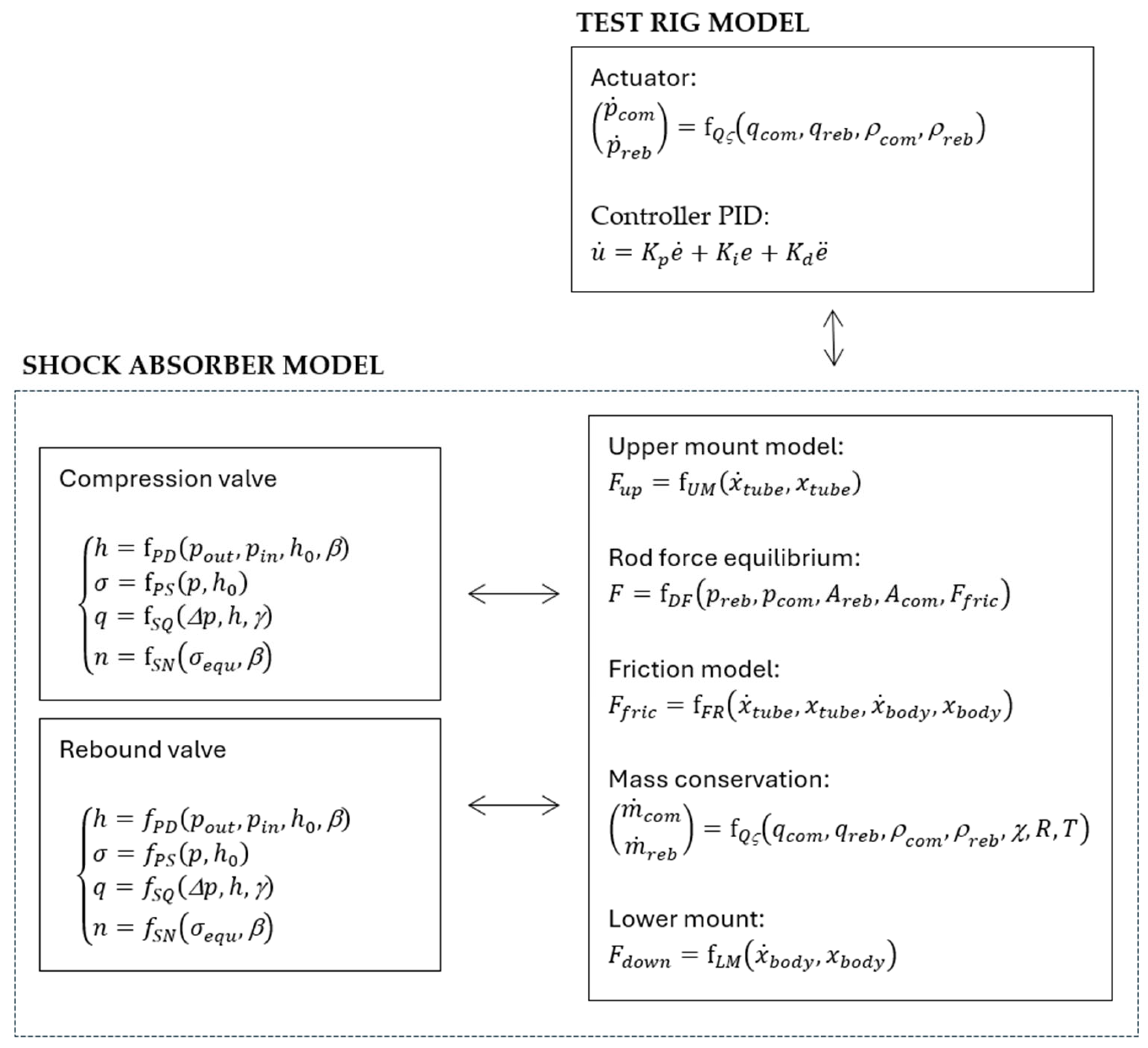
Figure 2 illustrates the functional structure of the modeling framework. The diagram illustrates the valve system architecture, comprising both compression and rebound shim stacks, whose flow characteristics are defined through empirically calibrated look-up tables. The model incorporates the mass and force balance equations along with the mechanical relations governing the upper and lower mounts, and integrates the key physical and geometric parameters of the hydraulic shock absorber.
Furthermore, it includes the volumetric continuity equations of the test-rig actuator and the governing control law of the applied MTS FlexTest SE PID–Feed-Forward (PID–FF) controller (cf.
Section 4.2). The diagram explicitly depicts the dynamic coupling and information flow among the individual sub-models constituting the overall modeling framework.
Table 3 provides a structured overview of the framework architecture, classifying the model components according to the data sources and parameters required for the evaluation of damping-force characteristics, vibration performance (NVH), and fatigue durability.
The modeling framework is implemented as a primary Simulink model. The mechanic, hydraulic, test-rig, and fatigue sub-models operate in a co-simulation environment within MATLAB/Simulink, enabling time-synchronized data exchange between domains at each integration step through the MATLAB workspace. The mechanical sub-model computes piston and valve displacements, while the hydraulic sub-model simultaneously determines pressure and flow characteristics within the compression and rebound chambers. These pressure forces are subsequently transferred back to the mechanical domain as reaction loads, ensuring a fully coupled dynamic interaction. The model employs the ode23tb solver, and data are sampled at a frequency of up to 2.5 kHz, which allows accurate reproduction of both sine-test excitations (for damping-force characterization) and road-excitation conditions (for vibration response evaluation). The obtained stress, shim-edge displacement, and pressure data were implemented in the Simulink model as lookup tables, providing the local alternating stress values in the shims corresponding to instantaneous pressure and flow conditions during simulation. These characteristics were originally developed by Czop and Wszołek [
8] through finite-element off-line simulations and are embedded within the Simulink model to represent the local structural response of the valve system with high fidelity.
4. Experimental Setup
4.1. Monotube Shock Absorber Take-Apart Unit
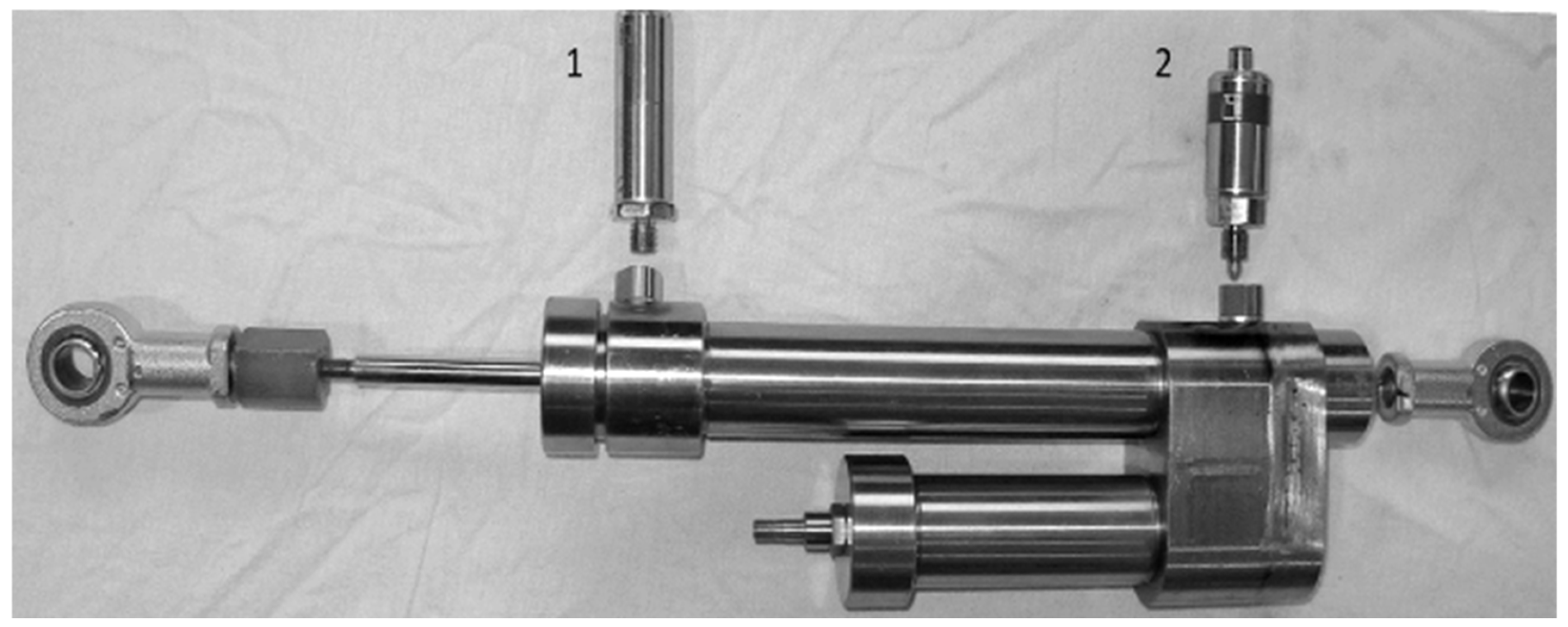
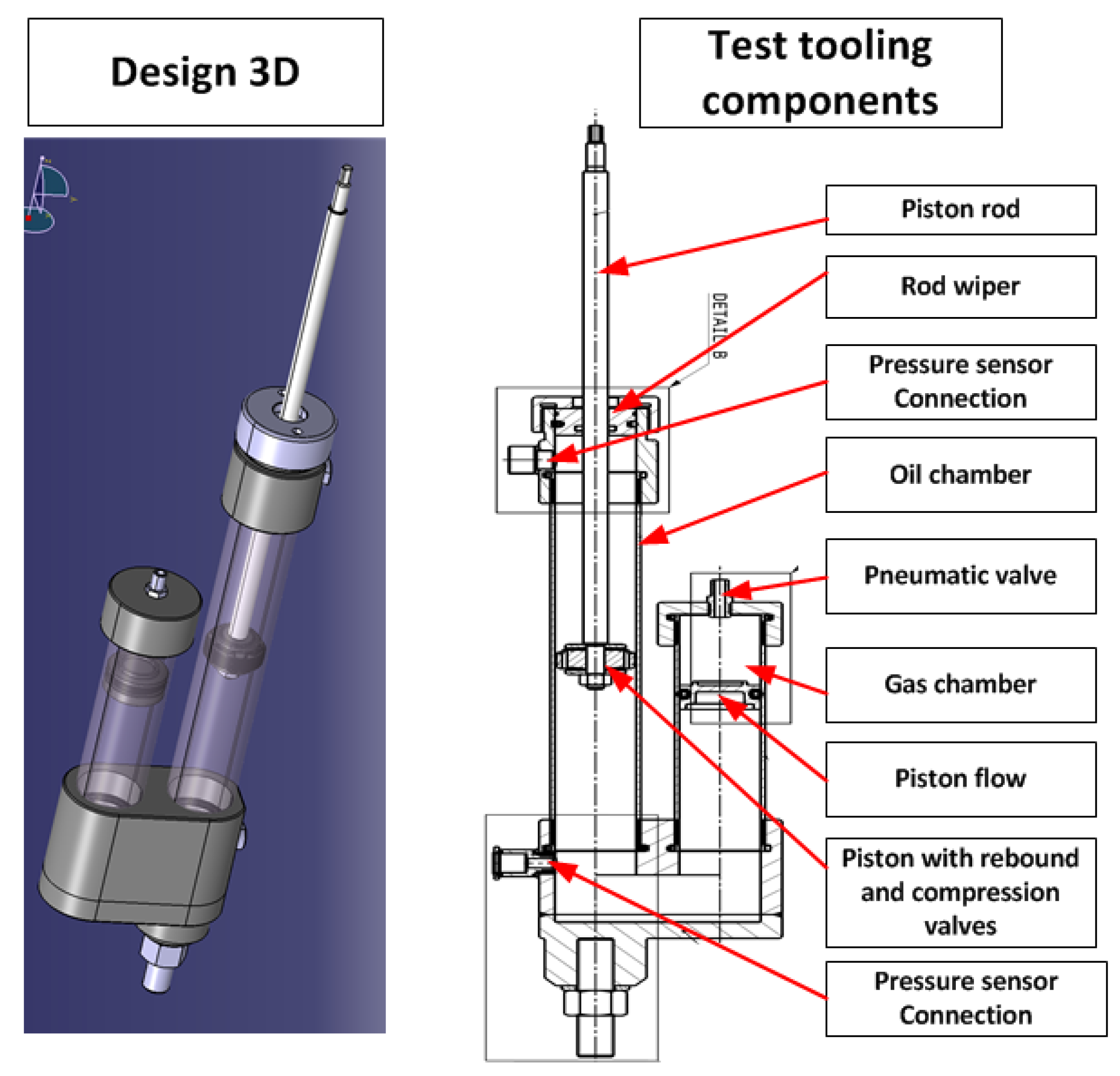
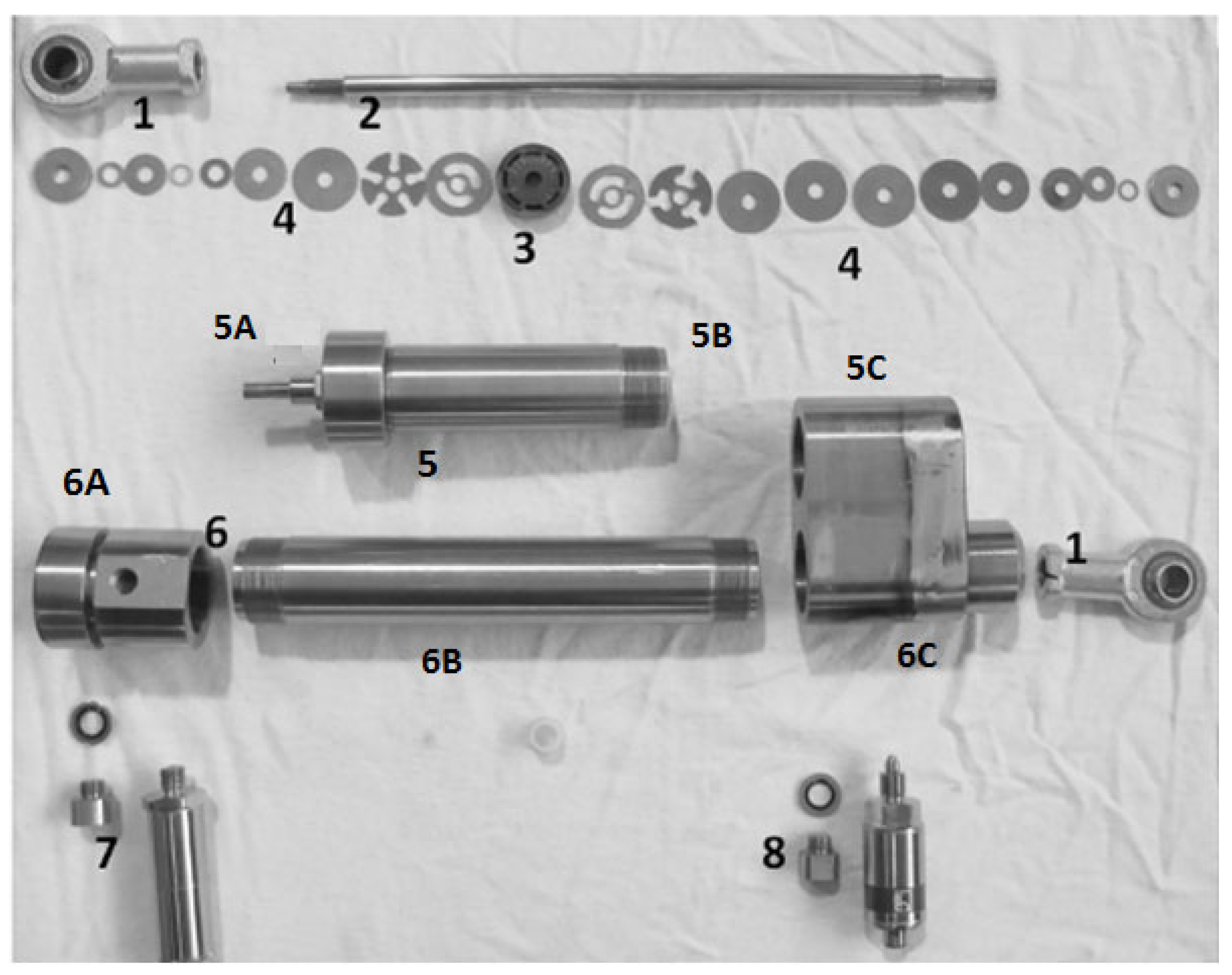
The experimental investigations were conducted using a laboratory setup specifically developed to characterize the mechanical and fluid-dynamic behavior of a dedicated, take-apart hydraulic monotube shock absorber unit (
Figure 3) employed in the experimental tests.
The unit retained the fundamental working principles of a monotube shock absorber, but was purposely modified to provide extended parametric flexibility. In particular, it allowed independent adjustment of the gas pressure in the accumulator, variation of the gas–oil ratio through direct gas injection into the rebound chamber, and modification of valve characteristics with the use of compression and rebound shim stacks and bleed orifices. The monotube configuration allowed rapid reconfiguration of both the valve system and the shock absorber assembly. To measure the fast transient phenomena in the internal fluid dynamics, high-frequency piezoresistive pressure transducers (HBM-PM3B and HBM-P2VA1, 0–10 MPa range; Hottinger Baldwin Messtechnik GmbH, Darmstadt, Germany) were installed in the upper and lower working chambers (
Figure 4 and
Figure 5).
The take-apart unit enables direct observation of pressure fluctuations associated with valve operation and additionally facilitates the experimental simulation of cavitation and aeration phenomena, achieved either through controlled air injection or by creating vacuum conditions. Although not directly implementable in a suspension system, the tooling enabled superior control of internal parameters compared with production shock absorbers and was therefore well suited for validation studies.
4.2. Servo-Hydraulic Test Rig
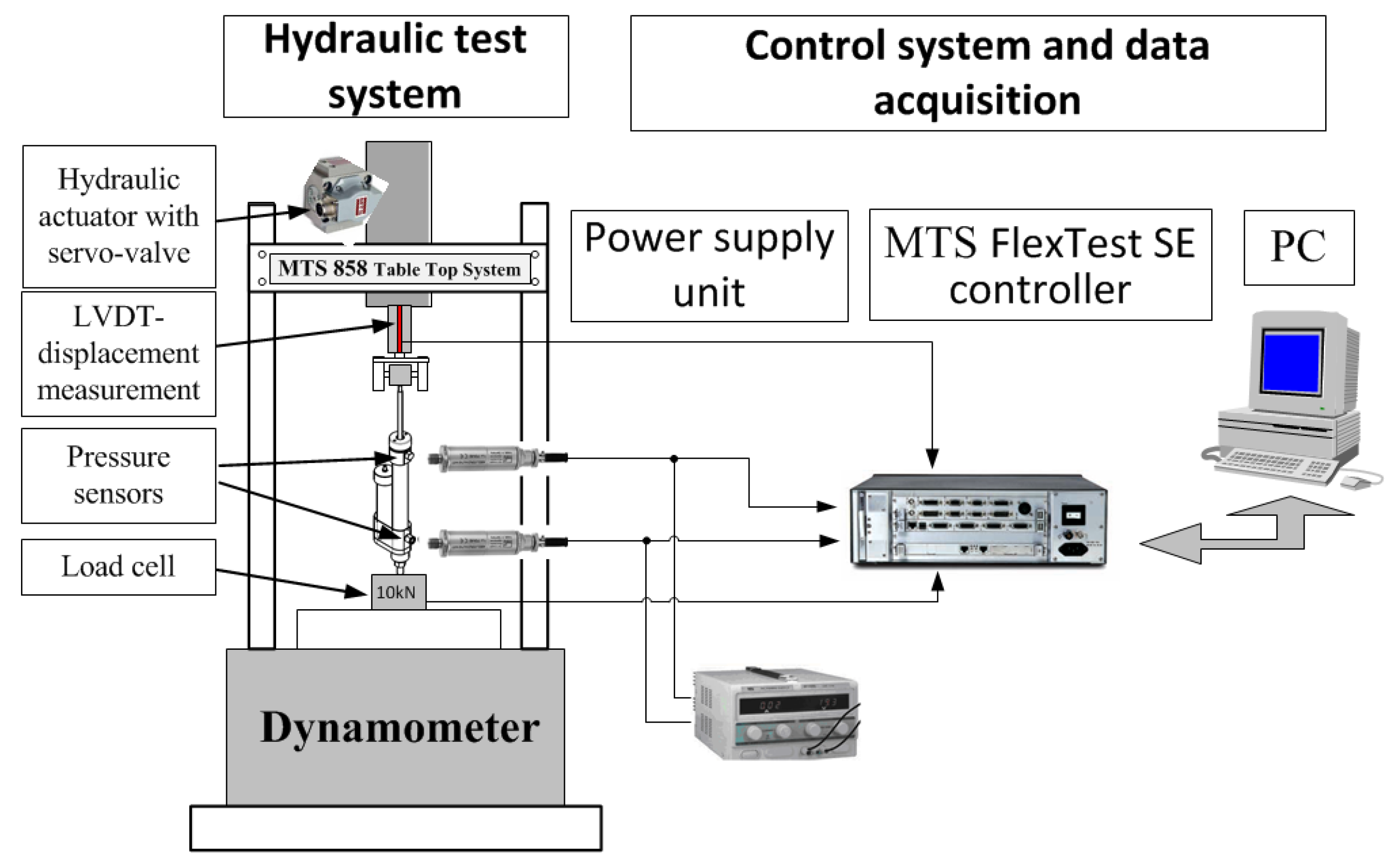
The experimental setup was built around an MTS 858 servo-hydraulic test frame (MTS Systems Corp., Eden Prairie, MN, USA), which enabled precise generation of excitation profiles in both compression and rebound directions. The system was instrumented with a fatigue-rated axial load cell (10 kN capacity, nonlinearity 0.08% FS; MTS Systems Corp., Eden Prairie, MN, USA), and an LVDT-based displacement transducer integrated into the hydraulic actuator (stroke 100 mm; MTS Systems Corp., Eden Prairie, MN, USA). A laboratory DC power supply (0–60 V/0–10 A; NDN DF1760SL10A, NDN-Zbigniew Daniluk, Warsaw, Poland) was incorporated into the setup to provide controlled electrical input.
4.3. Measurement Setup
The measurement setup employed in this study consisted of several components integrated to enable precise data acquisition and control of the test procedure. A schematic representation of the complete measurement setup is presented in
Figure 6.
The measurement signals were acquired through a dedicated computer system equipped with a CI-4600U2B Ultra2 Wide SCSI CardBus adapter (Centos, CI-series model; Centos Corporation, Raleigh, NC, USA), while data acquisition and processing were carried out using LMS Test Lab 8a software (LMS International, Leuven, Belgium; now Siemens Digital Industries Software). The acquisition system ensured synchronous registration of force, displacement, and pressure signals at sufficiently high sampling rates to resolve transient phenomena.
5. Model-Based Optimization
5.1. Optimization Objectives
The optimization procedure of a hydraulic shock absorber requires the development of a modeling framework capable of fully reproducing the engineering and manufacturing evaluation tests, including the measured signals (damping force and vibration response) as well as the key configurable parameters, such as valve shim stacks and the characteristics of the upper and lower mounts. The investigations presented in this study focus on three objective functions, which are inherently conflicting requirements. The first and most important criterion verifies the shock absorber with respect to the damping force specified by the vehicle manufacturer. The second addresses the permissible vibration level, which serves as a measure of the generated noise (NVH). The third criterion evaluates the fatigue durability of the shock absorber, expressed as the number of damping cycles sustained at a given damping velocity.
5.1.1. Damping Force Objective
In the automotive industry, the damping force of a hydraulic shock absorber is typically defined and verified according to manufacturer-specific test procedures, aligned with internal OEM requirements. Although no universal ISO or SAE standard directly prescribes damper force-testing methods, road-excitation inputs used in such procedures are often characterized according to ISO 8608 [
24], which provides a standardized classification of road surface roughness for vibration and durability analyses. The most common practice is to represent the damping characteristics in the form of a force–velocity curve, obtained from servo-hydraulic test benches under controlled piston rod velocities. Tolerance bands, often in the range of ±10–15%, are specified by the vehicle manufacturer or tier-1 suspension supplier to ensure compatibility with the overall suspension system design and ride comfort targets. These specifications distinguish between compression and rebound characteristics, and may further define low-speed and high-speed regimes depending on the vehicle segment (e.g., passenger cars vs. heavy-duty vehicles). The responsibility for defining the target damping force lies primarily with the OEM (original equipment manufacturer) of the vehicle, based on ride and handling requirements, while the shock absorber supplier must design and validate the shock absorber to meet these targets. Verification is conducted through standardized laboratory tests, often complemented by road validation, to ensure reproducibility and compliance with NVH and durability requirements.
The monotube take-apart shock absorber considered in this study is equipped with a cylinder of 36 mm bore and a piston rod of 11 mm diameter, while the gas pressure in the compensation chamber is set to the standard value of 30 bar (
Table 1). The reference damping characteristics are presented in
Table 4 and
Table 5 with the tolerance limit of 15%.
In order to formulate the damping force matching criterion as one of the optimization objectives, it was assumed that the matching error of the damping characteristic is expressed by the following equation:
where
In these equations,
v denotes the rebound and compression velocity index corresponding to the
k (
k = 6) discrete velocity points listed in
Table 4 and
Table 5,
Fmax and
Fmin represent the upper and lower bounds of the damping force tolerance range [N], respectively,
β denotes the tolerance range [N], and
α is the error metric exponent, here assumed to follow a linear distance metric (
α = 1).
5.1.2. Vibration (NVH) Objective
In the automotive industry, the vibration and noise levels [
25] of a hydraulic shock absorber are typically assessed through a combination of objective measurements and subjective evaluation procedures. Although standards such as ISO 2631 [
26] and ISO 5349 [
27] do not directly prescribe testing methods for damper components, they offer methodological guidance and can serve as useful inspiration when defining vibration-related assessment protocols.
Objective evaluation is commonly performed using accelerometers and microphones mounted on the piston rod and the shock absorber housing, respectively, to record vibration spectra and sound pressure levels. The results are analyzed in the frequency domain, typically in the range of 20–700 Hz, with narrow-band or third-octave representations used to identify dominant resonance peaks. Tolerance thresholds are defined by the vehicle manufacturer or suspension supplier, often expressed in terms of dB levels or RMS acceleration values, to ensure compliance with ride comfort and NVH specifications.
Subjective evaluation, in turn, is conducted by trained test drivers or NVH specialists who assess the perceptibility and acceptability of shock absorber-generated noise under defined driving maneuvers such as cobblestone road, rumble strips, or sharp cornering. These assessments are frequently benchmarked against reference shock absorbers or competitor products, and are complemented by structured rating scales (e.g., 1–10 scales for harshness or noise perception) [
21]. The responsibility for defining the acceptable vibration and noise targets lies with the OEM, while the shock absorber manufacturer is required to design and validate the product against both objective limits and subjective customer expectations. Validation is carried out on servo-hydraulic test rigs as well as in full-vehicle road tests, to guarantee reproducibility and compliance with industry NVH requirements.
The noise generated by a hydraulic shock absorber originates from several mechanisms, including frictional interactions, aerodynamic effects, hydraulic fluid turbulence, and structural vibrations. Experimental studies [
21,
28,
29] have demonstrated that abnormal noise is closely linked to high-frequency vibration phenomena, typically in the range of 70–400 Hz, occurring in the piston–rod assembly during reversals of rod motion. In this work, the NVH-related objective function is formulated as the mean squared error between the target and the actual power spectral density (PSD) characteristics, evaluated over the frequency range of 70–400 Hz with a resolution of 10 Hz, and is expressed as:
where
f denotes the frequency index of the PSD, discretized with a step size of 10 Hz across the analyzed range (
a = 70,
b = 400), such that
f = {70, 80,…, 400}. The parameter
tolPSD represents the tolerance coefficient, here assumed as
tolPSD = 2 dB. A is the vibration amplitude expressed in decibels [dB], while
Aref denotes the corresponding reference vibration amplitude in decibels [dB]. Finally,
α is the error metric exponent, assumed to follow a linear distance metric with
α = 1.
5.1.3. Fatigue Durability
In the automotive industry, the fatigue durability of a hydraulic shock absorber is typically evaluated through a combination of laboratory-based accelerated life tests and component-level durability assessments. These procedures are commonly aligned with the ISO 16750 series [
30], which defines environmental and mechanical load conditions for road-vehicle components, together with OEM-specific durability protocols tailored to application-dependent load spectra and performance requirements. Objective evaluation is commonly performed by subjecting the shock absorber or its critical valve components (e.g., shim stacks) to controlled cyclic loading on servo-hydraulic test rigs, where sinusoidal or random excitation is applied at defined amplitudes and frequencies until failure occurs. The resulting data are analyzed in the form of stress–life curves or cycles-to-failure distributions, typically focusing on stress levels in the range of 100–400 MPa, which are characteristic of valve shim fatigue. Tolerance thresholds are set by the vehicle manufacturer or suspension supplier, often defined in terms of minimum cycle counts (e.g., ≥10
6 cycles) at given damping velocities, to ensure compliance with durability and warranty requirements.
Subjective evaluation of durability, while less common, may involve expert assessments of performance degradation symptoms, such as changes in damping force characteristics, abnormal noise, or increased vibration transmission after prolonged testing. These assessments are often benchmarked against reference or competitive shock absorbers, and are complemented by post-test inspections of the internal components (e.g., crack initiation in valve shims or wear in piston–rod assemblies). The responsibility for defining acceptable durability targets lies primarily with the OEM, whereas the shock absorber supplier is required to design, validate, and document compliance against both cycle-based criteria and performance stability over the product’s expected service life. Validation is performed through a combination of accelerated bench tests, vehicle endurance testing, and post-mortem component analysis.
Fatigue durability is evaluated in two steps. First, the maximum resultant stresses in the shim stacks are determined through modeling of the valve system under representative operating conditions. The obtained equivalent stress corresponds to the maximum stress occurring in one of the shims within the stack, typically in the thickest shims [
8]. Second, by applying an excitation model of the shock absorber motion, either a synthetic sinusoidal input or a road-derived random signal, the corresponding number of cycles to failure of the valve system is estimated. Failure is defined either as a physical event, such as shim fracture, or as exceeding the tolerance limits of the shock absorber’s force–velocity characteristics.
The formula defining the objective function for minimizing the resultant stress in the shim stacks is expressed in a cumulative form for both rebound and compression directions:
where
v denotes the velocity index of the shock absorber in rebound and compression conditions, and
k is the number of considered velocity points (
k = 3). The parameter
tolSTRESS represents the stress tolerance coefficient, here set to 10 MPa.
σ is the maximum resultant (equivalent) stress in the valve shim [MPa],
σref is the reference stress [MPa], and
α is the error metric exponent, assumed to follow a distance metric (
α = 1). The stress evaluation is usually performed at three discrete operational shock absorber velocities, namely
v1 = 1.5 m/s,
v2 = 2.0 m/s, and
v3 = 2.5 m/s.
5.2. Design Variables and Boundary Conditions
To derive the Pareto-optimal set, twelve critical design variables were identified (
Table 6). These variables were serialized with respect to the feasible adjustment ranges and available component variants of the hydraulic shock absorber. The definition of the design space in this manner guarantees that the Pareto frontier reflects not only the fundamental trade-offs among damping force accuracy, NVH behavior, and fatigue durability, but also realistic engineering constraints imposed by manufacturability and components availability.
5.3. Batch Optimization Process and Fitness Function
The optimization procedure was implemented in the MATLAB–Simulink environment, where the lumped-parameter model of the monotube hydraulic shock absorber and the associated test rig was iteratively executed within the fitness function of a genetic algorithm available in the Global Optimization Toolbox [
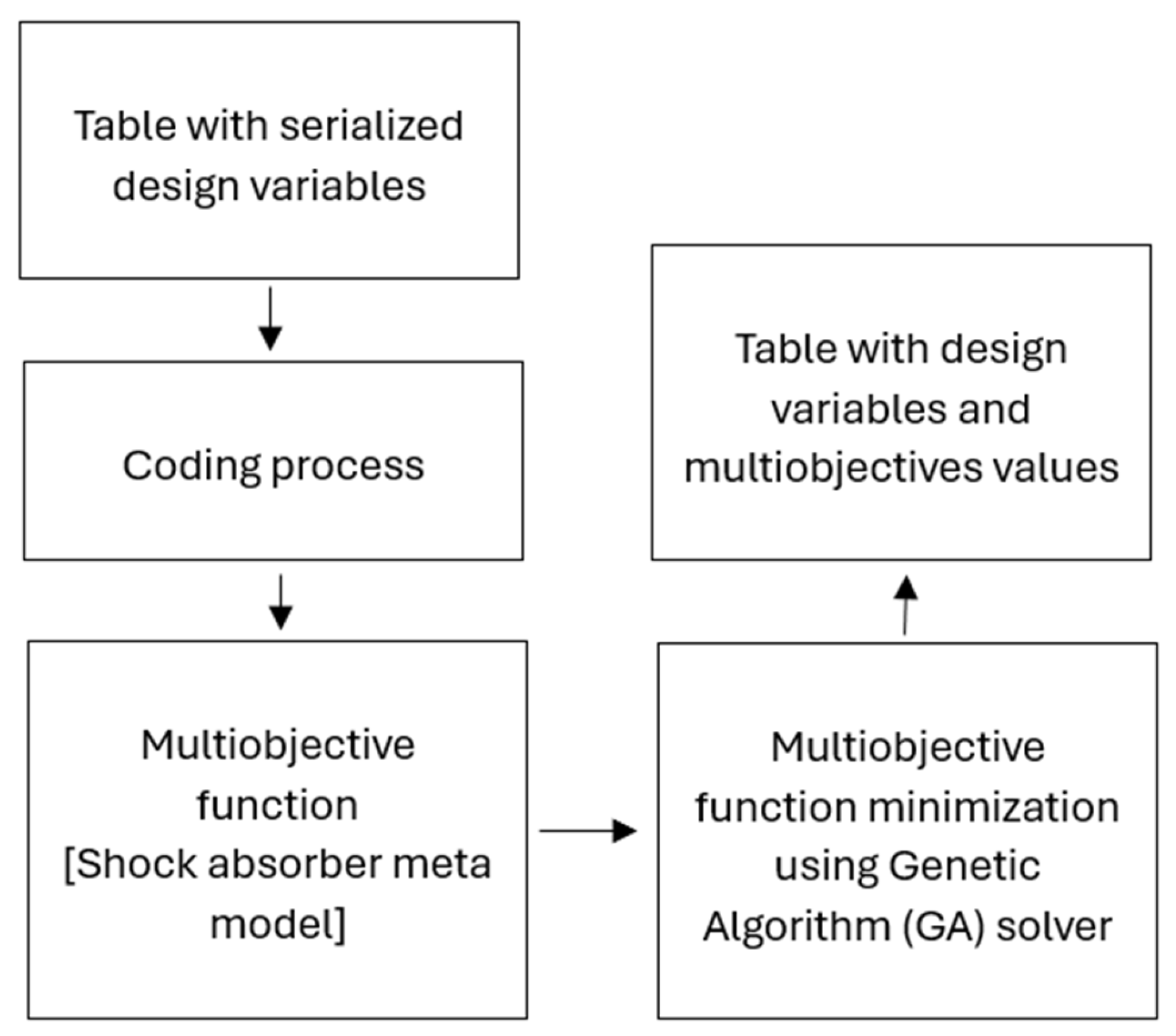
31]. The fitness function assessed each candidate solution against the defined multi-objective criteria, namely damping force conformity, vibration level (NVH), and fatigue durability expressed by stress metric. At each iteration, the algorithm generated a set of design variables including shim stack geometry, valve characteristics, and mount stiffness which were subsequently transferred to the Simulink model. The simulations yielded the corresponding force–velocity characteristics, vibration response spectra, and valve system stress levels. These outputs were post-processed to compute error metrics relative to the target specifications, which were then aggregated into the multi-objective fitness function. This framework provided a seamless coupling between the optimization algorithm and the physical model, enabling large-scale automated evaluations while preserving consistency and reproducibility across simulation runs (
Figure 7).
To facilitate the integration of design parameters into the optimization framework, each variable was discretized and systematically encoded to reflect the feasible set of component variants (
Table 6). This encoding procedure ensured that discrete engineering attributes—such as shim thickness, diameter, and quantity—were directly represented in the genetic algorithm, thereby avoiding the need for interpolation between non-physical values. Each admissible state of a design variable was assigned a unique code (e.g., x
1 = 0.10 mm→#1, x
2 = 0.15 mm→#2), which provided a one-to-one correspondence between numerical optimization variables and realizable shock absorber configurations. Within this formulation, the solution vector generated by the genetic algorithm, X = [
x1,
x2, …,
x12], could be directly mapped onto a physically meaningful configuration, thereby ensuring manufacturability and preserving the physical interpretability of each candidate design. The encoding scheme was applied consistently across shim-related parameters (thickness, diameter, number of shims, bleed area) and mount-related multipliers, thereby capturing both fluid-dynamic and structural effects. In consequence, the optimization process operated within a discretized nevertheless practically constrained design space, reflecting actual limitations imposed by component availability, production feasibility, and industry standards.
5.4. Implementation of Optimization Model
The “gamultiobj” solver from Global Optimization Toolbox of the MATLAB software package [
31] was employed to generate a Pareto-optimal set for the multi-objective minimization problem based on a genetic algorithm [
31]. The solver is well-suited for problems characterized by nonlinear, nonconvex, and discontinuous objective functions, which are typical for lumped-parameter models of hydraulic shock absorbers coupled with structural and NVH constraints.
The formulation of the optimization problem followed a population-based approach. Each individual in the population represented a unique configuration of the shock absorber, defined by a coded vector of twelve design variables (
Table 6). The solver automatically initialized the initial population and iteratively evolved it through genetic operators such as selection, crossover, and mutation. At each generation, the MATLAB–Simulink model of the shock absorber and test rig was executed repeatedly by the fitness function, which computed the objective function values corresponding to damping force accuracy, vibration level (NVH), and stress level (fatigue durability).
The results of each simulation were post-processed to yield error metrics relative to the target specifications, which were then aggregated into the multi-objective fitness function. This iterative process was repeated across hundreds of generations, ensuring sufficient exploration of the design space and convergence of the Pareto frontier. To prevent premature convergence and ensure diversity among the solutions, standard constraint-handling mechanisms embedded in the solver were activated. The termination criteria were set based on both the maximum number of generations and the relative change in Pareto spread, guaranteeing convergence to a stable frontier of non-dominated solutions.
This implementation enabled seamless integration between the optimization algorithm and the meta-based model, providing an automated framework capable of efficiently evaluating a large number of candidate configurations. The generated Pareto frontier thus reflects the fundamental trade-offs among damping force compliance, NVH behavior, and stress level, while respecting the discrete nature of shim-based design variables and the engineering constraints imposed by manufacturability.
5.5. Preferable Pareto Frontier Solution
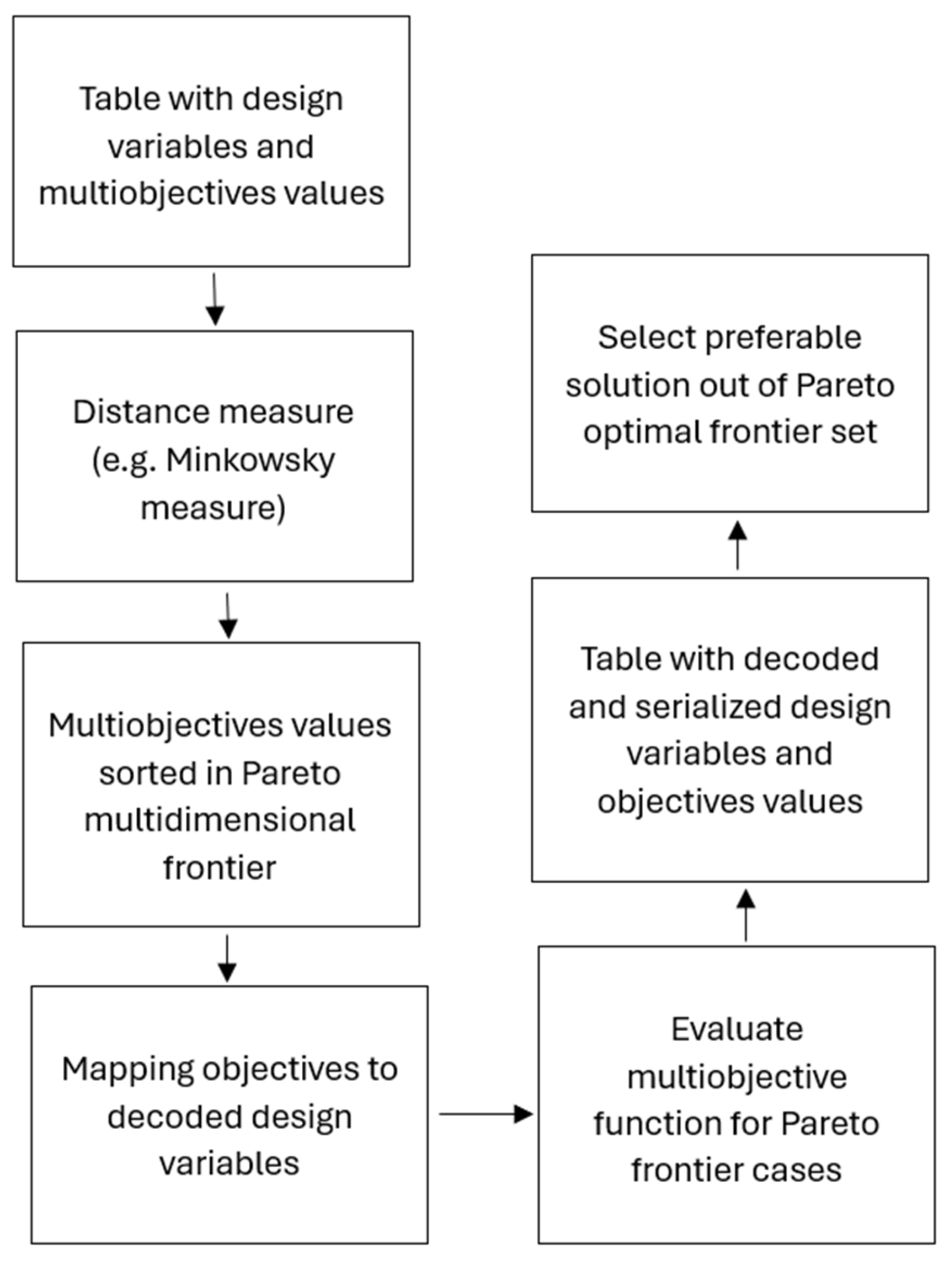
The optimization procedure produces a set of Pareto-optimal solutions, collectively forming the Pareto frontier. The multi-objective process (
Figure 8) yields a matrix of non-dominated solutions that require further sorting and selection. In this study, the preferred configuration was automatically identified by ranking the spatial distances between Pareto frontier elements using distance-based measures, such as the Minkowski distance metric.
To determine the preferred solutions, the twelve design variables were extracted from the optimization results and discretized by rounding to the nearest numerical codes, which were subsequently decoded according to the dimensional variants and manufacturable component options specified in
Table 5. The decoded and serialized design variables were then reintroduced into the simulation framework, permitting recalculation of the objective function values, derivation of the corresponding model parameters, and visualization of the optimization outcomes.
6. Model-Based Prediction of Pareto-Optimal Solutions
The prediction of Pareto-optimal solutions was performed in accordance with the workflow shown in
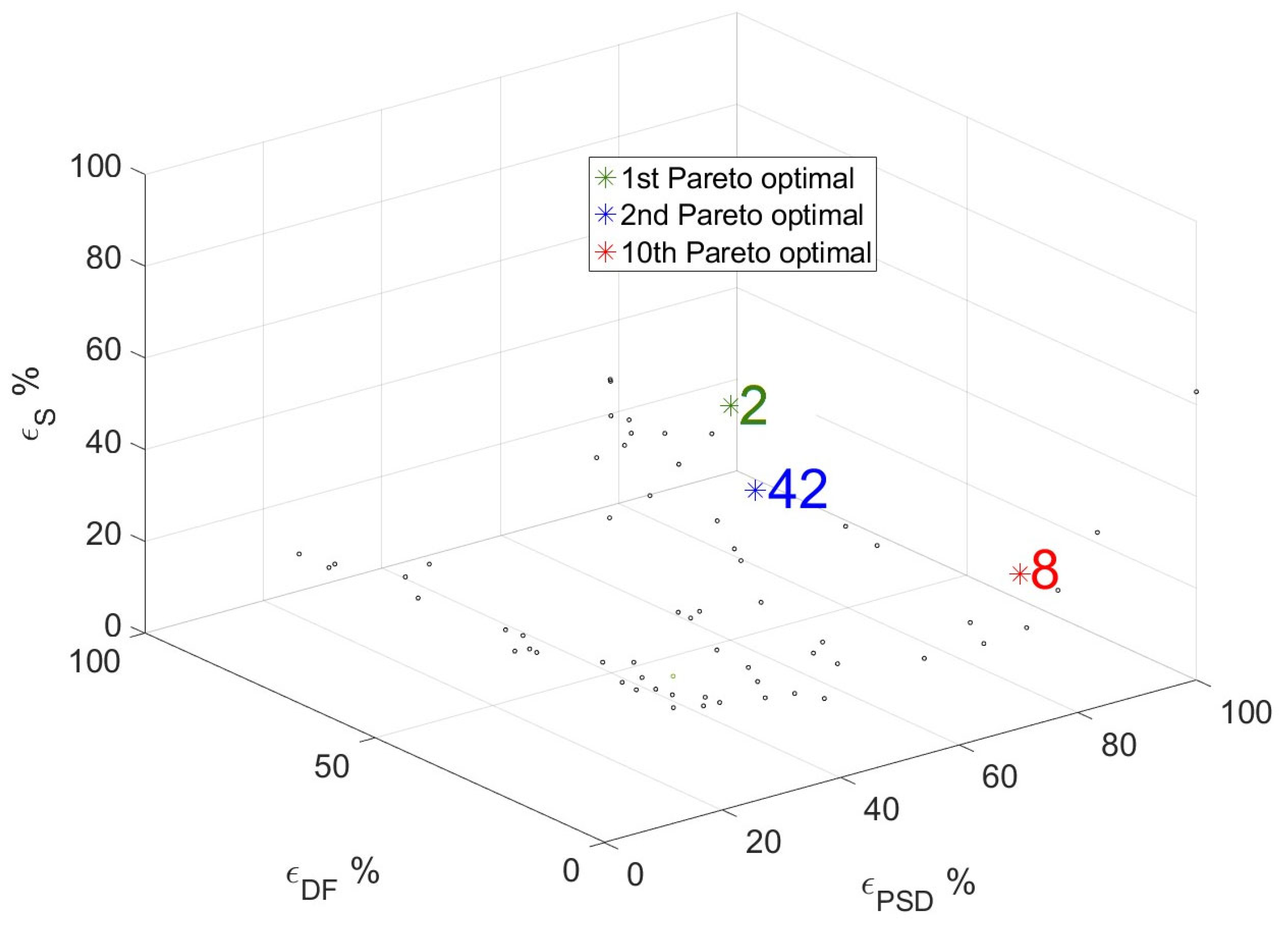
Figure 8. The multi-objective optimization procedure, executed in batch mode for twelve design variables and three objective functions, yielded 60 non-dominated candidates forming the Pareto frontier. These solutions were ranked using the Minkowski distance metric with an exponent of k = 3 (Equation (6)), with the damping force criterion assigned a higher weight (α = 10
3) as compliance with force tolerances was considered a prerequisite for NVH and fatigue durability improvements. Based on this ranking, two of the most preferred configurations and a third, arbitrarily selected as the tenth most preferred, were chosen for further analysis (
Figure 9,
Table 7). These configurations were then subjected to experimental validation by reassembling the monotube take-apart shock absorber unit, measuring the damping force and piston-rod vibrations, while stress levels were indirectly estimated through simulations and verified against previously reported Wöhler curves.
Subsequently, the encoded decision variables of the selected solutions were decoded by rounding to the nearest integer values, followed by serialization to assign the corresponding physical design parameters (
Table 8).
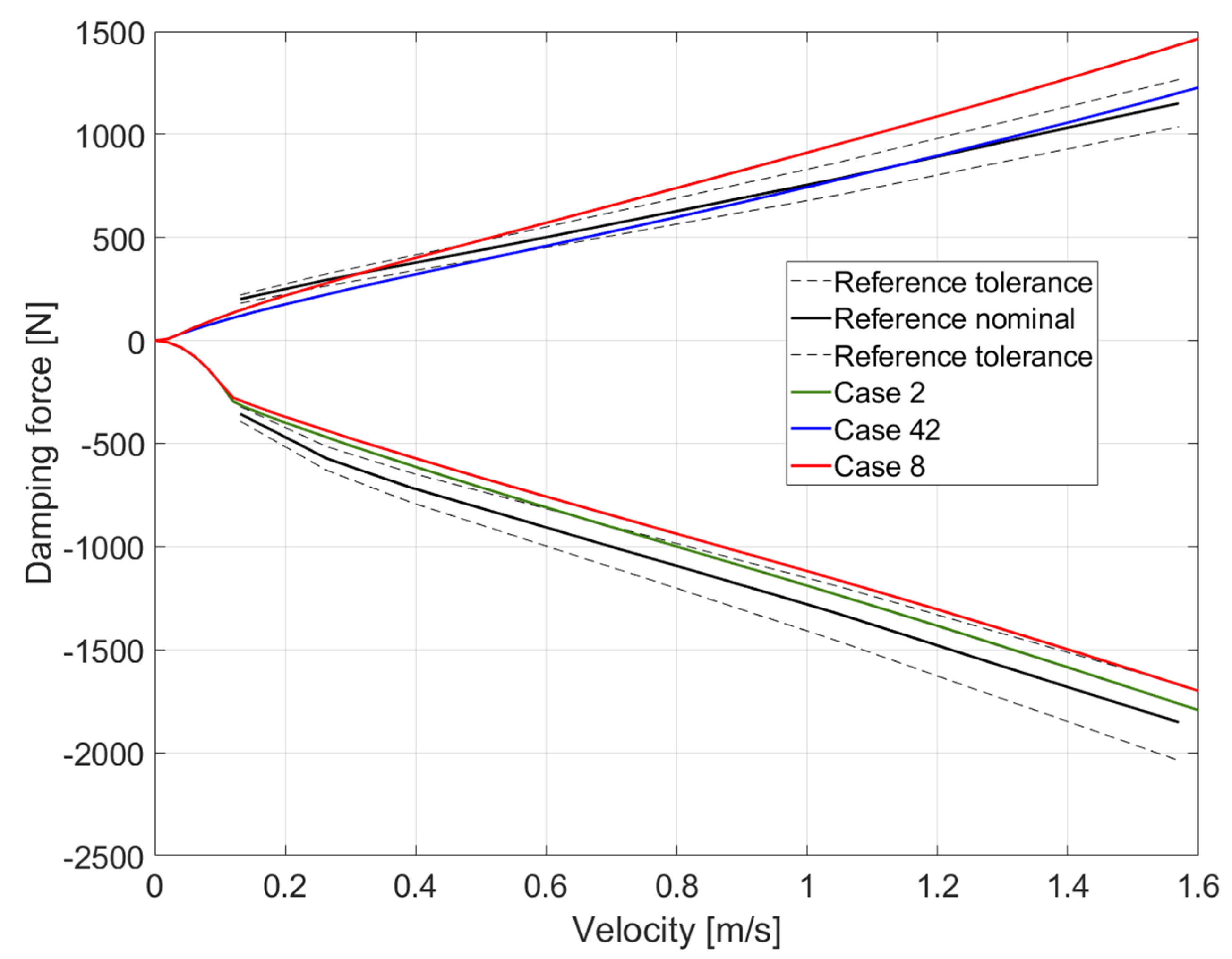
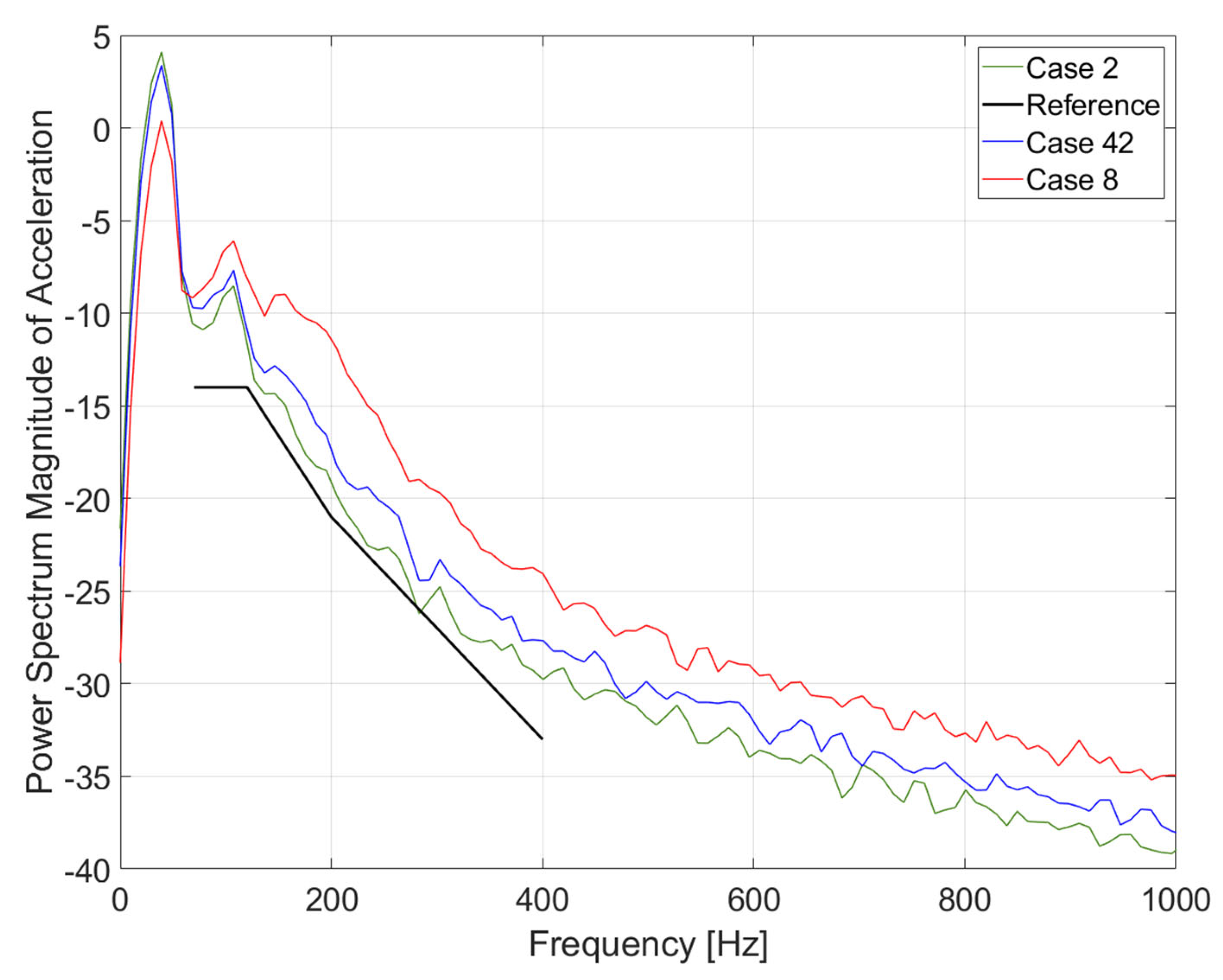
These parameters were used to invoke the fitness function, which, through a batch-processing script, executed the MATLAB–Simulink model of the shock absorber and test rig. The model generated the corresponding damping force characteristic (
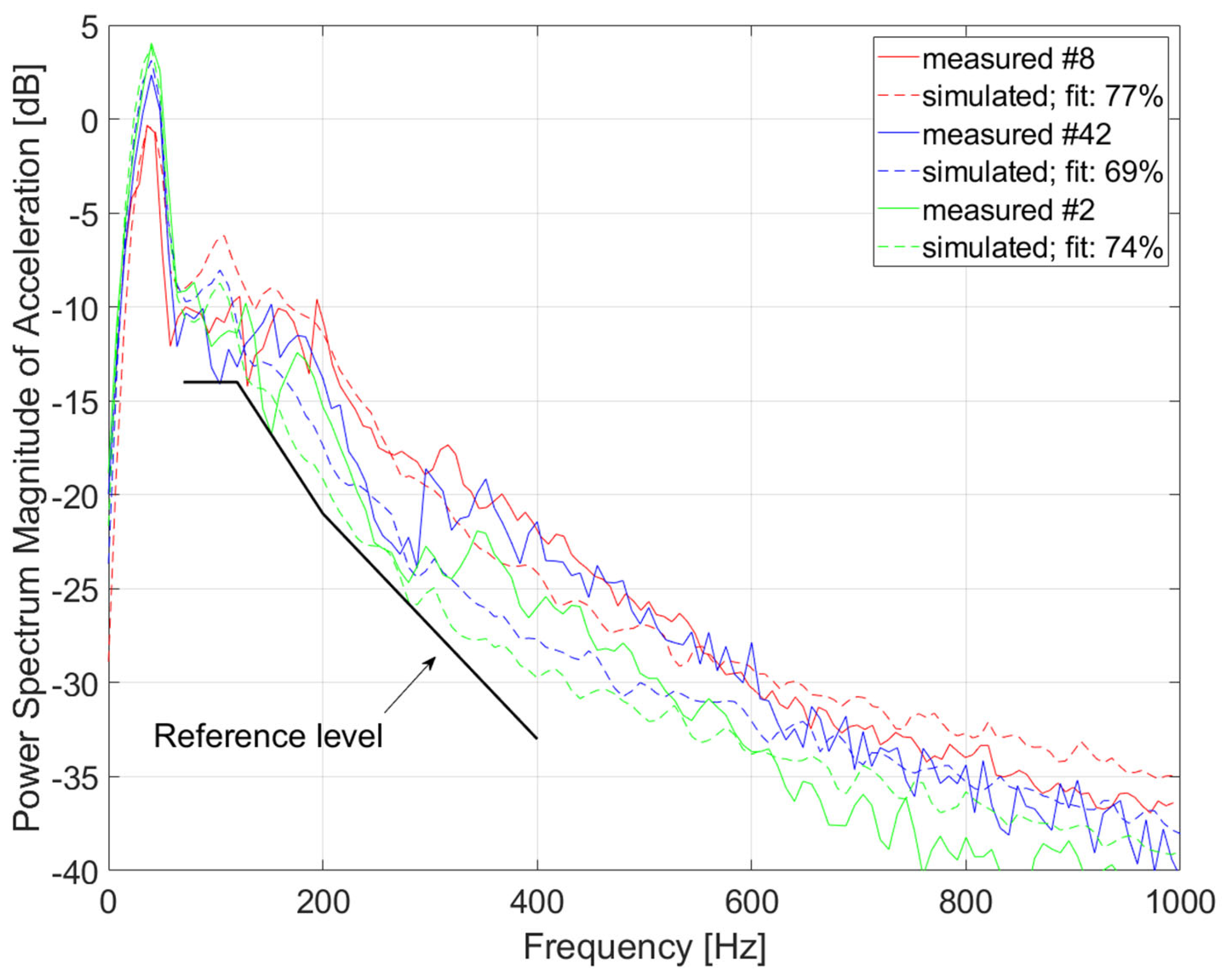
Figure 10), vibration characteristic (
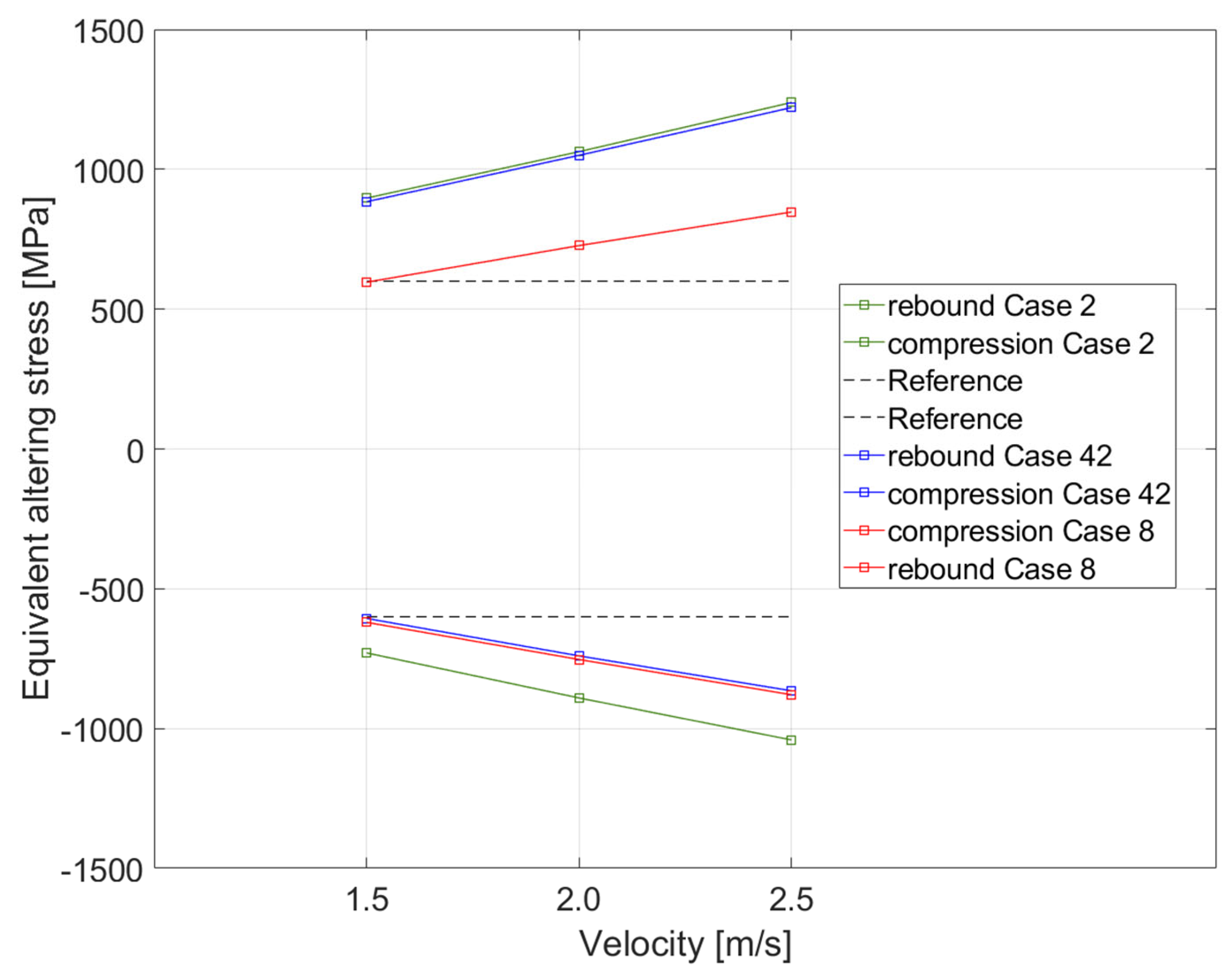
Figure 11), and equivalent stress characteristic (
Figure 12) for each candidate design. Representative results for the three highlighted cases are presented in
Table 9, illustrating the trade-offs among damping force compliance, vibration behavior, and fatigue durability.
7. Validation of Model-Based Prediction of Pareto-Optimal Solutions
The procedures related to damping force, vibration level (NVH) and fatigue validation predictions are addressed in the section. Experimental works were conducted on a monotube take-apart unit, which was reassembled in three configurations corresponding to predicted candidate cases 2, 42, and 8 (cf.
Table 7). The modifications involved reconfiguring the valve shim stacks (
x1,
x2,
x3,
x4,
x7,
x8,
x11,
x12), adjusting bleed areas to control flow resistance (
x9,
x10), and adjusting custom rubber top-mount bushings tailored to the specified force–displacement characteristics (
x5;
x6).
It must be acknowledged that the discrepancies observed between the predicted and measured responses are partly attributable to inherent industrial manufacturing tolerances and experimental uncertainties. Compliance elements such as the rubber bushings of the upper and lower mounts exhibit dimensional variability, which directly affects their effective stiffness and damping characteristics. Calibrated hydraulic orifices are subject to machining tolerances that induce minor deviations in bleed areas and flow resistance. Likewise, valve shim stacks are influenced by metallurgical variability including differences in alloy composition, rolling direction, and heat-treatment history which manifest as anisotropy in mechanical properties and measurable variations in shim thickness and diameter. In addition, limitations of the servo-hydraulic test bench, such as fluid thermal dissipation effects and restricted control precision in achieving target piston-rod velocities under load, further contribute to measurement scatter. Collectively, these factors constrain the possibility of perfect quantitative agreement between simulation and experiment.
Nevertheless, the identified manufacturing tolerances and measurement uncertainties are not critical to the primary function of the proposed framework. The modeling framework does not aim to achieve exact numerical congruence with experimental data but rather to ensure consistent ranking of design alternatives within the optimization process. As long as measurements are conducted using the same monotube shock absorber, identical instrumentation, and the same test-rig configuration, the relative comparisons remain valid and reproducible. Under such controlled conditions, the influence of hardly measurable production variations, such as valve shim thickness (±5%), orifice cross-section (±3%), shim-stack preload force (±5%), and typical measurement errors of force transducers (±2%), displacement sensors (±3%), or oil temperature drift (±5 °C), is negligible in the context of comparative optimization. Consequently, the framework serves primarily as a quantitative decision-support environment that ranks alternative configurations from the most to the least favorable in terms of damping performance, NVH behavior, and fatigue durability. The ultimate configuration is subsequently validated and fine-tuned through subjective ride-work evaluations conducted by professional test engineers, while the model provides a robust and traceable analytical basis to guide this refinement process rather than an exact deterministic prediction.
7.1. Validation of Damping Force Prediction
The damping force was measured on a servo-hydraulic test rig under controlled excitation conditions (
Figure 6). The damping-force data were filtered (150 Hz Butterworth) and segmented into full cycles; mean and standard deviation values were computed for 0.02 m/s velocity bins to ensure repeatability. The shock absorber was rigidly mounted between the top and bottom fixations of the rig, with the piston rod connected to the test rig actuator. A calibrated strain-gage force transducer integrated in the load cell of the test machine (MTS 858) was employed to record the axial force transmitted through the shock absorber. The excitation was applied in the form of sinusoidal signals with controlled amplitude and frequency, while the corresponding damping force was continuously acquired. The resulting measurements provided force–velocity characteristics over the prescribed velocity range (up to 1.5 m/s) and served as the reference data for validation of the simulation model (
Table 9 and
Table 10).
7.2. Validation of Vibration Level (NVH) Prediction
The prediction of vibration level (NVH) was conducted using a random excitation signal in the form of narrow-band colored noise with a maximum peak-to-peak amplitude of 10 mm and a total duration of 26 s. The excitation bandwidth was limited to 50 Hz due to the transmission characteristics of the hydraulic test system. The baseline excitation sequence was repeated ten times, and the vibration measurements were averaged. The measurement repeatability, expressed as the signal standard deviation, was approximately 1.5 decibels. The servo-hydraulic tester was capable of transmitting this random excitation to the shock absorber in the frequency range of 0–50 Hz, while measuring its response as piston-rod acceleration across a broader bandwidth of 0–1500 Hz. In this manner, the wide-band vibration conditions of the shock absorber were reproduced in a manner analogous to those encountered during road operation. The response signal was acquired on the hydraulic actuator rod using an accelerometer. The shock absorber was rigidly mounted to the main frame of the servo-hydraulic tester through a top fixation (load cell) and top mount (
Figure 13), while the bottom end was connected to the actuator rod by means of the bottom fixation assembly. The spectral analysis of vibration signals was performed using the Welch method as implemented in MATLAB. This method estimates the power spectral density (PSD) by dividing the input signal into overlapping segments (512 bins), applying a window function to each segment, and computing the discrete Fourier transform. The resulting periodograms are then averaged, which reduces the variance of the spectral estimate while preserving frequency resolution.
The Welch method, a well-established technique for power spectral density (PSD) estimation, was employed to obtain a reliable representation of the vibration energy distribution across the frequency range of interest. This approach enabled a quantitative comparison between experimental and simulated responses. The agreement between the predictions and the experimental measurements was quantified using the following expression in the frequency domain:
where:
Ames denotes the vector of measured data points,
Apred denotes the vector of predicted (simulated) data points, the function
mean(.) obtains the mean value of the simulated data.
7.3. Validation of Fatigue Durability Prediction
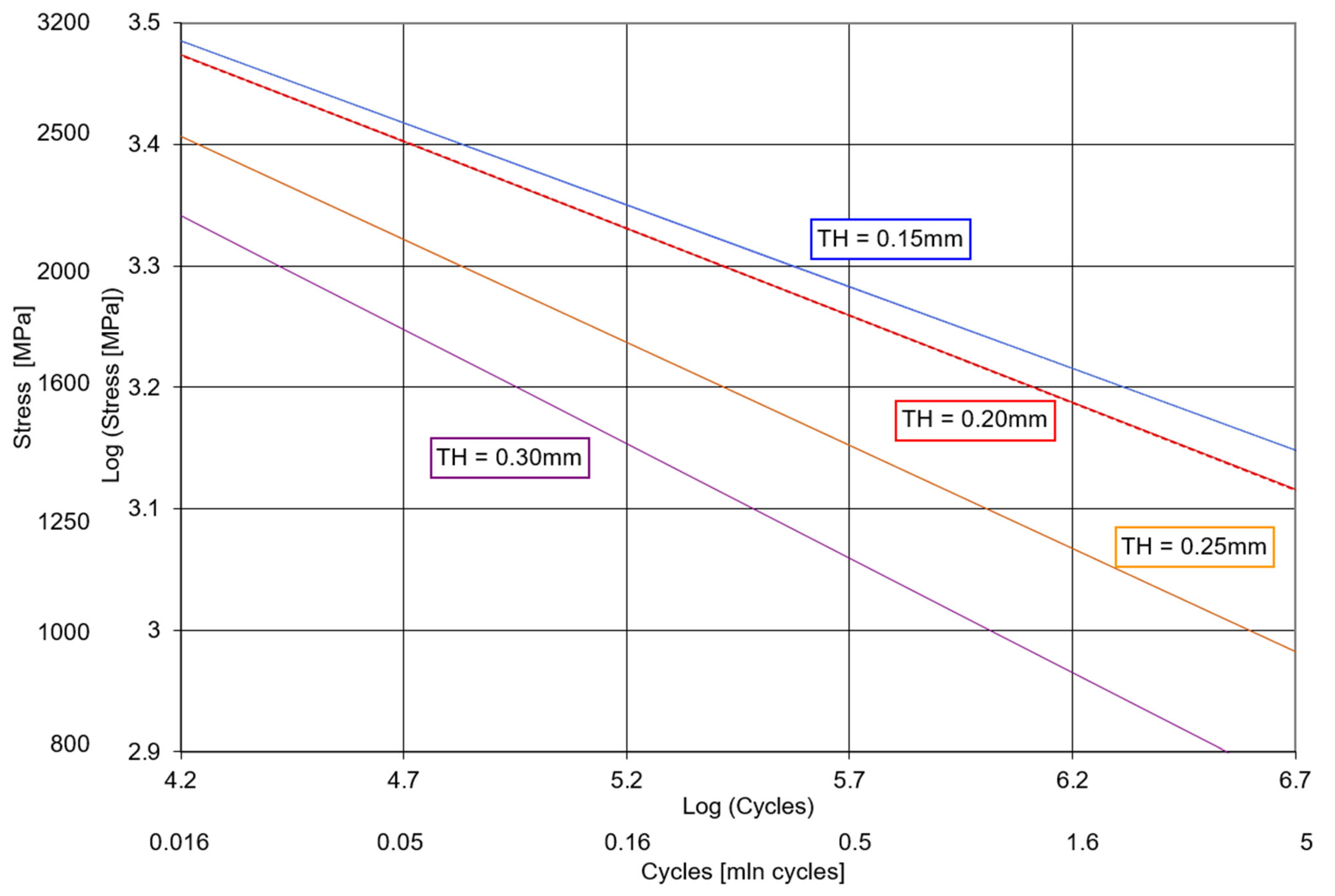
A full-scale fatigue validation was not performed at the complete shock absorber level. Instead, the stress amplitudes obtained from the coupled simulation model for the critical shims were converted into an equivalent fatigue life estimate using the experimentally determined Wöhler (S–N) curve for the valve-shim spring steel 51CrV4 (1.8159, EN 10083-3 [
32]. In this approach, the predicted stress levels were translated into the limiting service life of the shock absorber, expressed as the estimated number of operating cycles to failure, rather than being verified through direct durability testing. The optimization results obtained in the present study were highly satisfactory, as none of the investigated configurations exceeded a stress level of 600 MPa at a piston-rod velocity of v = 2.5 m/s (
Figure 14).
Under these near-endurance conditions, conducting full fatigue endurance tests would have been extremely time-consuming and economically unjustified, potentially requiring one to two months of continuous operation without reaching failure. Comprehensive fatigue tests at the shock absorber level have already been conducted and reported by Czop and Wszołek [
8], for valve settings with limited fatigue durability providing an experimental reference for the fatigue behavior of similar valve systems.
8. Summary and Conclusions
This study introduces a modeling framework based on multi-objective optimization developed to resolve the intrinsic trade-offs inherent in the design of automotive hydraulic shock absorbers. The central challenge of this process lies in achieving a balanced compromise among three interdependent performance domains: damping-force conformity, vibration (NVH) behavior, and fatigue durability. The latter assessed through structural stress analysis and experimentally determined Wöhler (S–N) curves. To address these conflicting requirements, a genetic algorithm (GA) based global optimization procedure was implemented using MATLAB’s Global Optimization Toolbox. Three objective functions were formulated to represent the competing performance indices, and the resulting Pareto-optimal solutions were analyzed using the Minkowski distance metric, enabling quantitative ranking and identification of the most favorable configurations within a multidimensional design space.
The modeling framework was experimentally validated using a monotube take-apart shock absorber. Three representative Pareto-optimal configurations were physically implemented by reconfiguring valve shim stacks, adjusting bleed orifices, and modifying upper mount stiffness. The validation campaign, conducted on a servo-hydraulic test rig under both sinusoidal and random excitations, confirmed satisfactory agreement between simulated and measured damping-force characteristics, with deviations not exceeding 15% across the evaluated piston-velocity range. It should be emphasized that the developed modeling framework is not intended to achieve exact numerical agreement with experimental data but rather to serve as a ranking and decision-support tool for evaluating alternative design configurations. Provided that all tests are performed using the same shock absorber, calibrated instrumentation, and identical test conditions, the relative ordering of optimization outcomes remains valid and reproducible. Consequently, the framework enables consistent identification of the most and least favorable configurations with respect to damping performance, NVH behavior, and fatigue life, thereby offering a quantitative foundation for engineering decision-making.
In current industrial practice, the shock absorber configuration process extends beyond objective verification of damping-force, vibration, and durability criteria. The final design selection is typically guided by subjective ride-work evaluations, during which professional test drivers-drawing on extensive experience assess perceived ride comfort, handling balance, and overall suspension quality. The proposed modeling framework therefore functions as an effective pre-screening mechanism, constraining the design space to configurations that meet manufacturer specifications. From this reduced and validated candidate set, subjective ride assessments can then identify the most preferred configuration, thus combining quantitative optimization with expert-driven qualitative evaluation in a coherent development workflow.
The modeling framework also provides a scalable foundation for collaborative optimization of control algorithms including semi-active and electro-hydraulic damping systems where mechanical, hydraulic, and control domains interact dynamically across various shock absorber architectures (monotube, double-tube, and adaptive systems). Its structure can be extended to support integrated optimization in conventional, hybrid, and electric passenger and commercial vehicles, enabling cross-domain co-simulation between mechanical and electronic subsystems and supporting the development of intelligent suspension systems within modern mobility platforms.
In summary, the presented modeling framework offers an industry-relevant methodology that bridges the gap between simulation-driven optimization and practical suspension development workflows. It supports both objective compliance verification and subjective quality assessment in the design of hydraulic shock absorbers, contributing to the next generation of model-based and experience-driven suspension engineering for advanced automotive applications.