Article

Study on Flexural Performance of a New Exterior Prefabricated Composite Wall Panel

by
Qin Yang
1,
Hui Lu
2,
Qilin Zhang
1,
Zhiguo Chang
3 and
Xuhong Qiang
1,*
1
College of Civil EngineFering, Tongji University, Shanghai 200092, China
2
The Housing and UrbanFF-Rural Development Bureau of Taicang City, Taicang 215499, China
3
Shanghai Tonglei Civil Engineering Technology Co., Ltd., Shanghai 200433, China
*
Author to whom correspondence should be addressed.
Appl. Sci. 2025, 15(22), 12252; https://doi.org/10.3390/app152212252
Submission received: 18 September 2025 / Revised: 10 November 2025 / Accepted: 11 November 2025 / Published: 18 November 2025
(This article belongs to the Section Civil Engineering)

Abstract

This paper develops a new exterior prefabricated composite wall panel composed of light-gauge steel studs, profiled steel sheet and steel fiber-reinforced concrete. To investigate its performance, static loading tests are conducted on five wall panel specimens. The failure modes, load–displacement curves and cross-sectional strain distributions of the specimens under uniformly distributed loads are obtained and analyzed. The influences of stud spacing, wall panel section configuration and loading patterns on the flexural performance of the composite wall panels are systematically examined. Relevant finite element models are established and comparative analyses are conducted between the test results and the numerical simulation results. A theoretical analytical model is developed for the composite wall panels and an approximate method for calculating deflection is proposed based on the principle of minimum potential energy.

1. Introduction

Exterior prefabricated wall panels are important components of prefabricated buildings. Commonly used exterior prefabricated wall panels can be categorized into monolithic concrete wall panels, framed concrete wall panels and strip panels. Among these, the framed concrete exterior wall panel exhibits excellent holistic performance with lightweight and high-strength properties. However, its flexural performance depends on the composite action between the framing and concrete, which is further influenced by the cross-sectional configuration and composition of the wall panels. Due to the wide variety of framed concrete exterior wall panels [1,2,3,4,5] and the limited research data on their flexural performance [6,7,8,9,10,11,12,13,14,15,16,17], conservative approximate design methods are often adopted in practical engineering projects. These methods typically neglect the flexural stiffness contribution of concrete slabs, leading to uneconomical steel consumption. In existing structures, the interaction between infill walls and the structural frame plays a critical role in the overall seismic performance. Past earthquake events have repeatedly demonstrated that neglecting this interaction can lead to unintended damage patterns, such as shear failure in beam–column joints, collapse of infill panels or abrupt changes in global stiffness [18]. Consequently, a significant research gap exists in systems that effectively integrate the following elements: (1) profiled steel sheeting serving as both a permanent formwork and tensile reinforcement; (2) steel fiber-reinforced concrete (SFRC) to enhance durability and bond performance; and (3) optimized stud spacing configurations that balance constructability. Furthermore, comprehensive studies that systematically examine the interactions between these elements and their collective impact on flexural performance remain notably scarce.
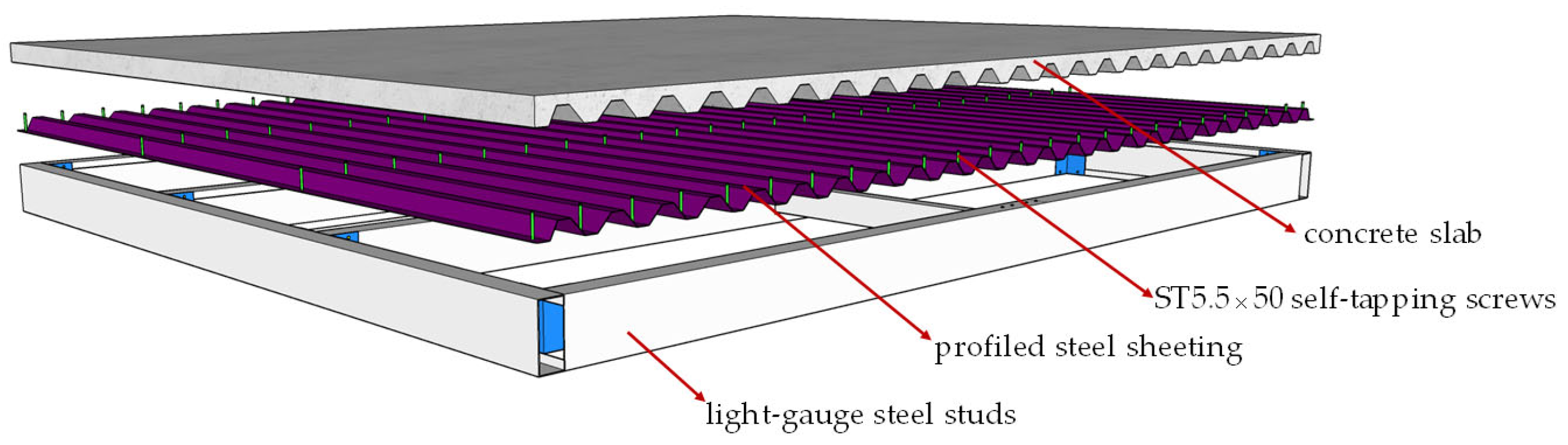
This paper develops a new exterior prefabricated composite wall panel (Figure 1), composed of cold-formed thin-walled steel studs with C-shaped and rectangular cross-sections, profiled steel sheeting and steel fiber-reinforced concrete, which are connected by self-tapping screws. The incorporation of profiled steel sheeting effectively enhances the in-plane stiffness of the lightweight steel studs while reducing concrete consumption. Consequently, compared to traditional stud concrete wall panels, this new type of wall panel exhibits significant advantages, such as lightweight, high strength, rapid construction, simple connections and high material recyclability.
In the exterior wall panel shown in Figure 1, both the light-gauge steel studs and the profiled steel sheet–concrete composite slab collectively provide the flexural stiffness for wind load resistance. However, the current conservative design approach that considers only the flexural stiffness of the light steel studs while neglecting the contribution of the composite slab would significantly increase steel consumption, leading to unacceptable economic costs for wall panel construction.
This paper presents experimental investigations, numerical simulations and theoretical analyses for the new wall panel. Through in-depth research on the composite working mechanism between the light steel studs and profiled steel sheet–concrete slab, as well as the overall flexural performance of the wall panel, this study provides technical support and a theoretical basis for achieving an economical and rational design of the new wall panel system.

2. Experimental Scheme for Flexural Performance of New Exterior Wall Panels

2.1. Specimen Design

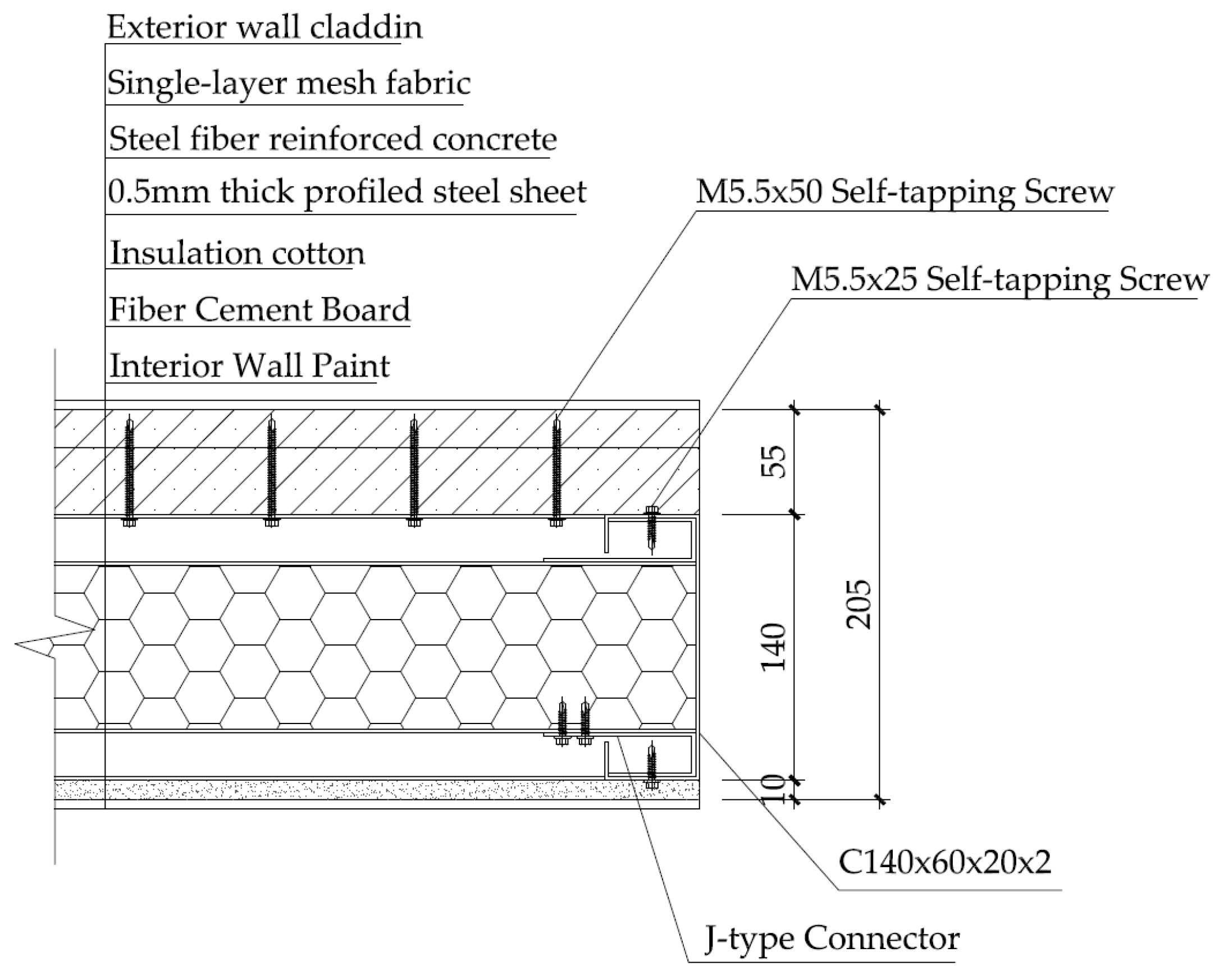
The configuration of the exterior composite wall panel is shown in Figure 2. The steel stud adopts C-shaped cold-formed thin-walled steel sections with lipped edges, specifically model C140 × 60 × 20 × 2.0. The profiled steel sheet is model YX35-125-750. The thickness of the steel fiber-reinforced concrete is 55 mm and the model of the self-tapping screw is ST5.5. These self-tapping screws act as both connectors and shear keys in the composite structure.
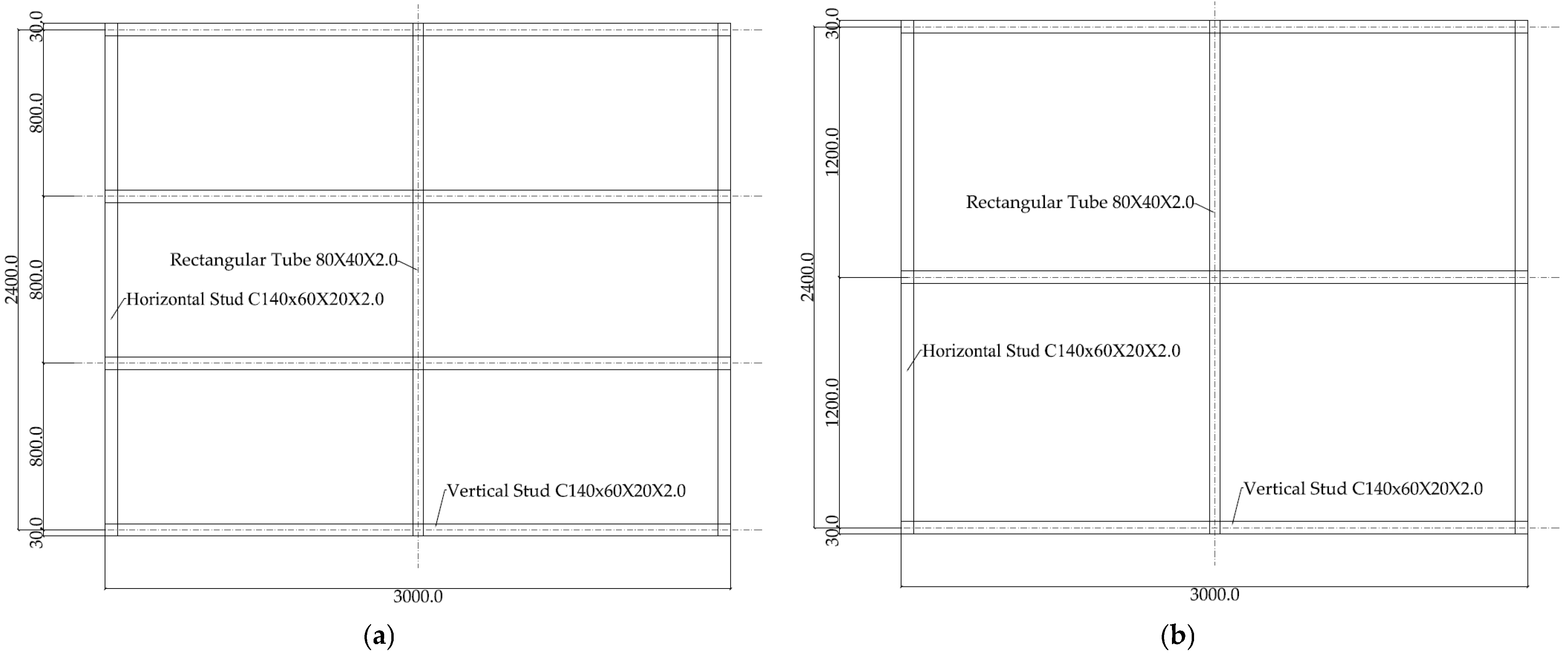
A total of five conventional-sized exterior wall panel specimens were designed for the experiment. The stud spacing was chosen based on common practice in prefabricated wall systems and preliminary finite element analysis. Specimen 4S is a pure light-gauge steel stud wall panel and the others are composite wall panels combining light steel studs with profiled steel sheet–concrete. The detailed parameters of the specimens are summarized in Table 1 and the arrangement of light-gauge steel studs is illustrated in Figure 3.

2.2. Material Properties Test

The steel fiber-reinforced concrete (SFRC) used in this study is a composite material formed by incorporating an appropriate amount (30 kg/m3) of milled steel fibers with ordinary concrete. Compared with conventional concrete, its impact resistance, shrinkage behavior, fatigue performance, durability and crack-resisting effects are effectively improved [19,20,21,22,23,24,25]. Additionally, it enhances the bonding performance between concrete and self-tapping screws [26,27,28,29,30]. During the casting of concrete slabs, three standard 150 mm × 150 mm × 150 mm cubic specimens and six standard 150 mm × 150 mm × 300 mm prismatic specimens were prepared using the same batch of concrete to determine its material properties. The test results are summarized in Table 2.
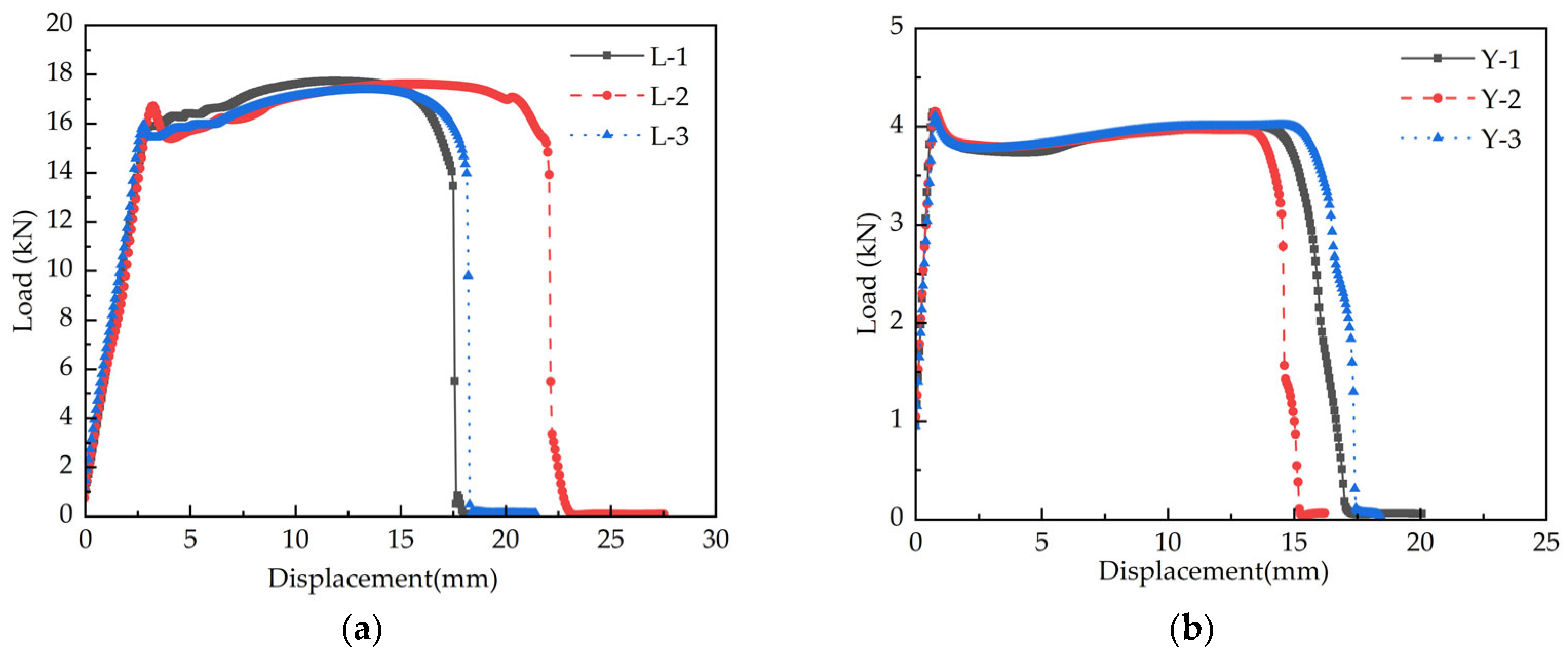
To evaluate the mechanical properties of the steel components, proportional tensile specimens were extracted from the webs of C-shaped steel studs and profiled steel sheets, with three specimens in each group. Tensile tests were conducted on these specimens using a universal testing machine. The load–displacement curves from the tensile tests are shown in Figure 4 and the corresponding test results are listed in Table 3. In this context, Group L represents the C-shaped steel studs and Group Y denotes the profiled steel sheets.

2.3. Experimental Method

The experiment employed a sandbag stacking method to simulate wind load effects. The surface of each wall panel specimen was divided into 24 grids measuring 500 mm × 600 mm each. The sandbags were evenly distributed and individually weighed to control the total load within each grid cell, and a uniform deformation pattern was confirmed through displacement sensors at multiple locations. The displacement data and strain data during the experimental process were continuously recorded at a frequency of 1 Hz using the Donghua DH3816N static stress–strain testing system throughout the entire experiment. The time was recorded at the start of each load level and after its completion, to match with displacement and strain data for data processing and result analysis.

2.4. Loading System

The test is non-destructive with predetermined maximum test loads applied through incremental loading stages. The characteristic value of wind load perpendicular to the surface of the exterior wall panel is calculated according to Equation (1):
w k = β g z μ s l μ z w 0
The wind pressure corresponding to a return period R of 50 years is adopted as the reference wind pressure, which is taken as 0.75 kN/m2 [31]. Assuming the application height of the wall panel to be 100 m, the height variation coefficient for wind pressure is adopted according to the 100 m elevation. The calculated maximum wind pressure load characteristic value and maximum wind suction load characteristic value are presented in Table 4.
The maximum test load is adopted as 8 kN/m2 (≈800 kg/m2), considering a value greater than twice the characteristic value.

2.5. Measurement Point Layout

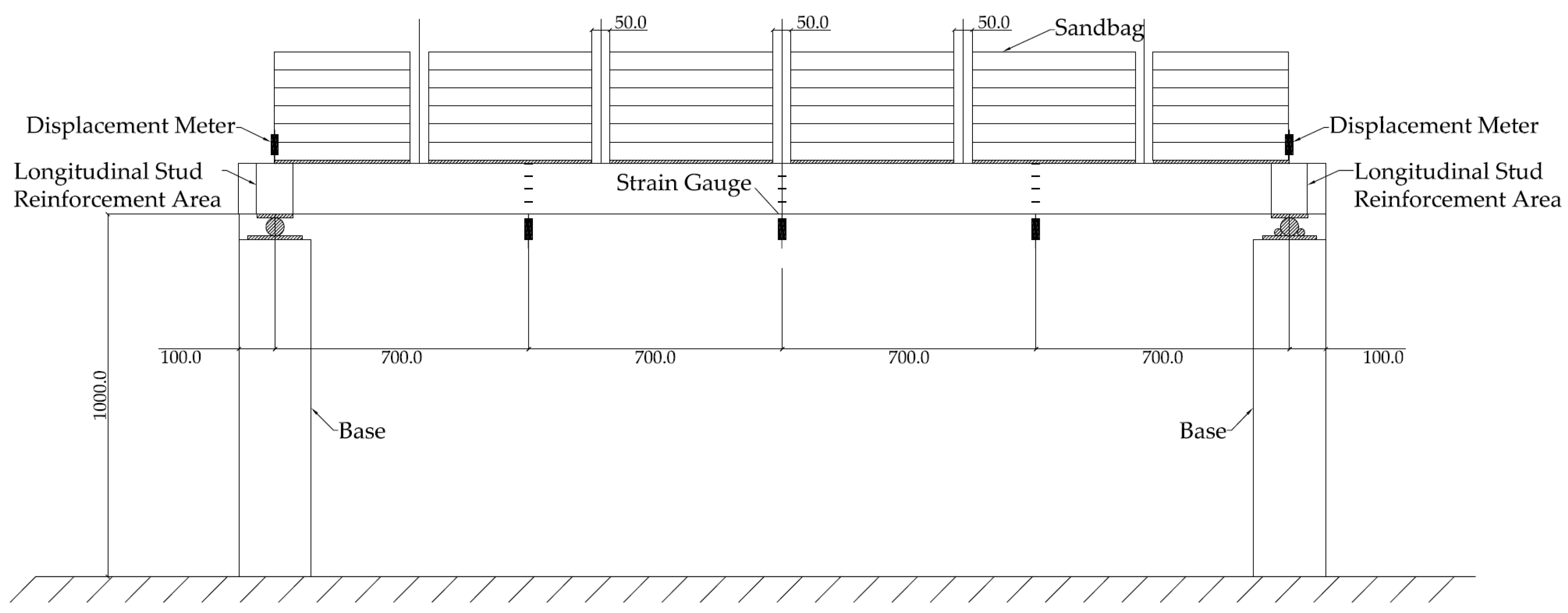
Displacement transducers were installed at both the mid-span and quarter-span positions of each steel stud. Additional displacement transducers were positioned at both ends of each steel stud (directly above the supports) to serve as reference measurement points for verification purposes.
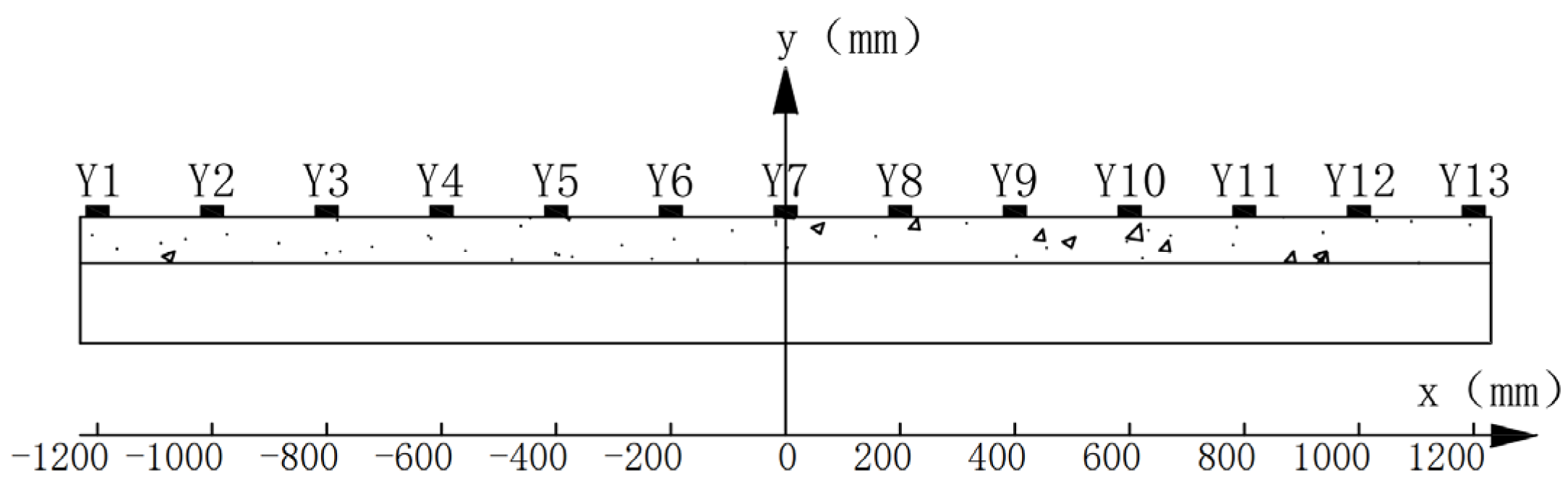
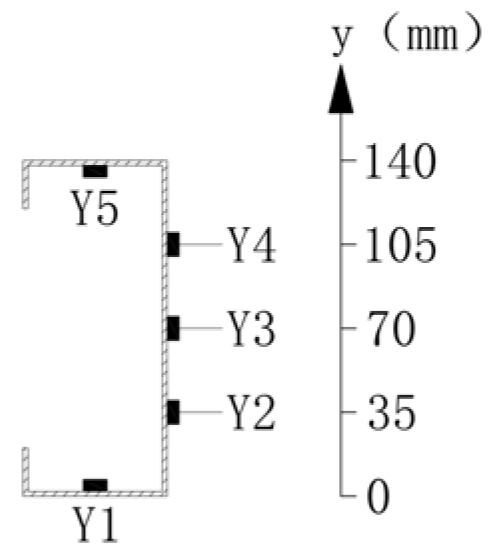
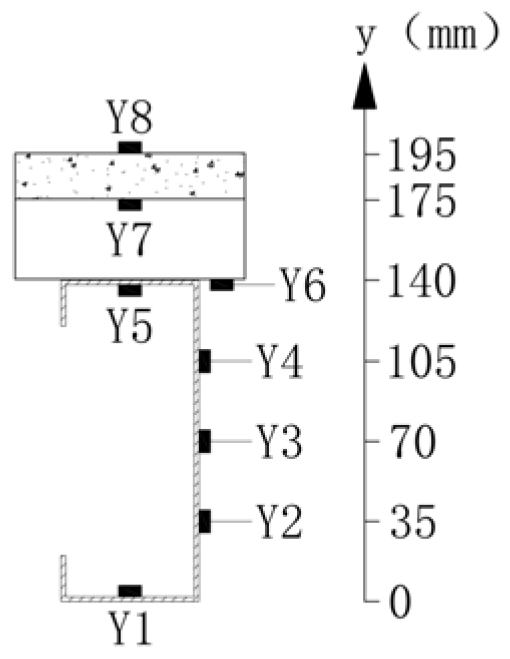
To monitor strain distribution along the height of the steel studs, five 10 mm resistance strain gauges were uniformly distributed along the height direction at the mid-span of each steel stud to measure strain variations along the steel stud height. For the concrete slab, three 50 mm resistance strain gauges were arranged through the thickness direction. Additionally, thirteen 50 mm resistance strain gauges were uniformly distributed along the width direction at the mid-span of the concrete slab to measure the strain distribution in the concrete slab of SFRC profiled steel sheet exterior composite wall panels. The configurations of displacement gauges and strain gauges are illustrated in Figure 5, Figure 6, Figure 7 and Figure 8.

3. Experimental Phenomena of Flexural Performance of New Exterior Composite Wall Panels

3.1. Specimen 4S

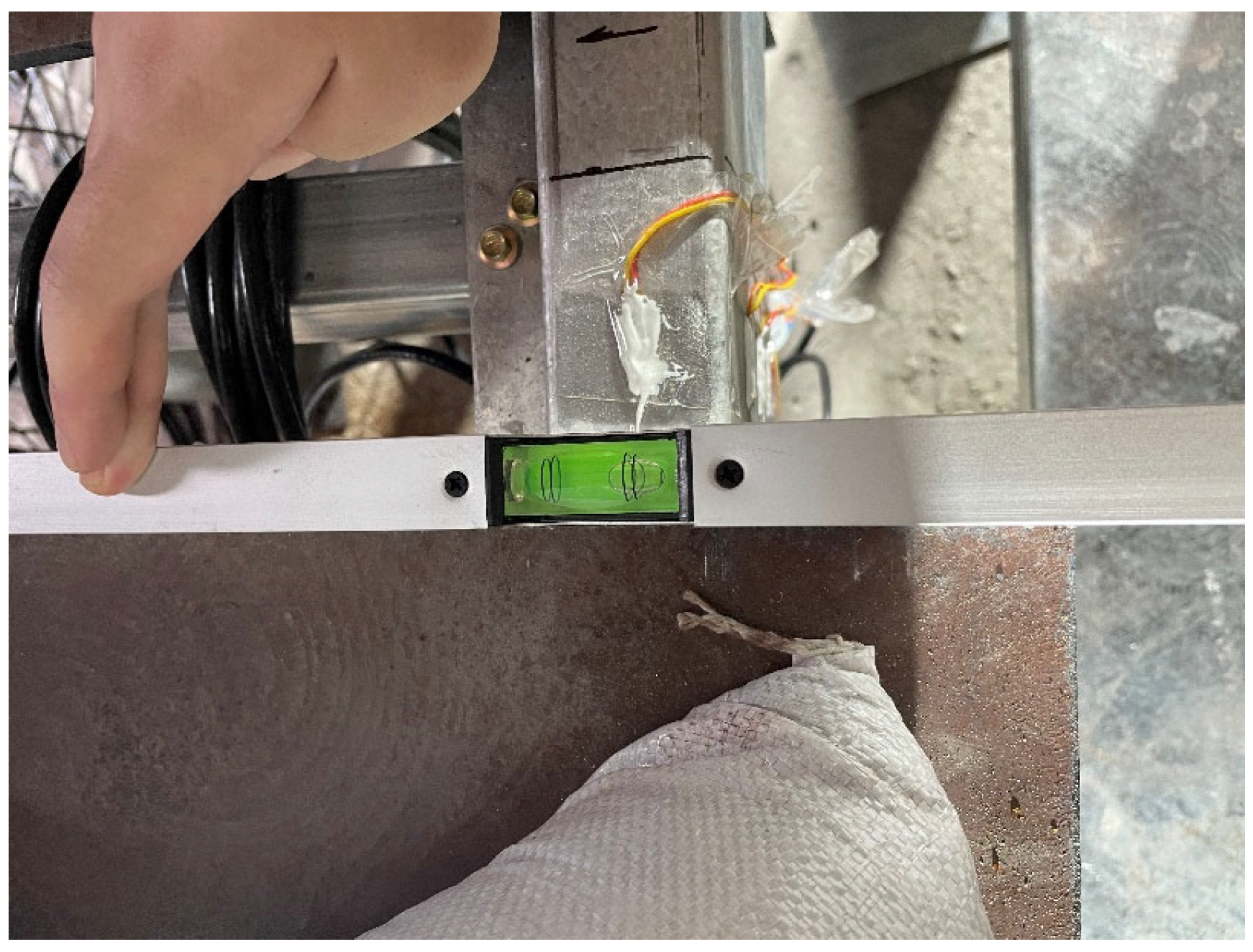
Specimen 4S did not experience failure throughout the entire testing loading process. Its load–displacement curve exhibited an approximately linear relationship. Based on the material property test results of the studs, it can be concluded that specimen 4S remains in the elastic stage. However, the tangent stiffness slightly decreased in the later stage of the test. This phenomenon can be attributed to significant torsional deformation occurring in the studs under higher load levels (as shown in Figure 9), which induced additional vertical displacement due to torsion effects.

3.2. Specimen 4SC-1

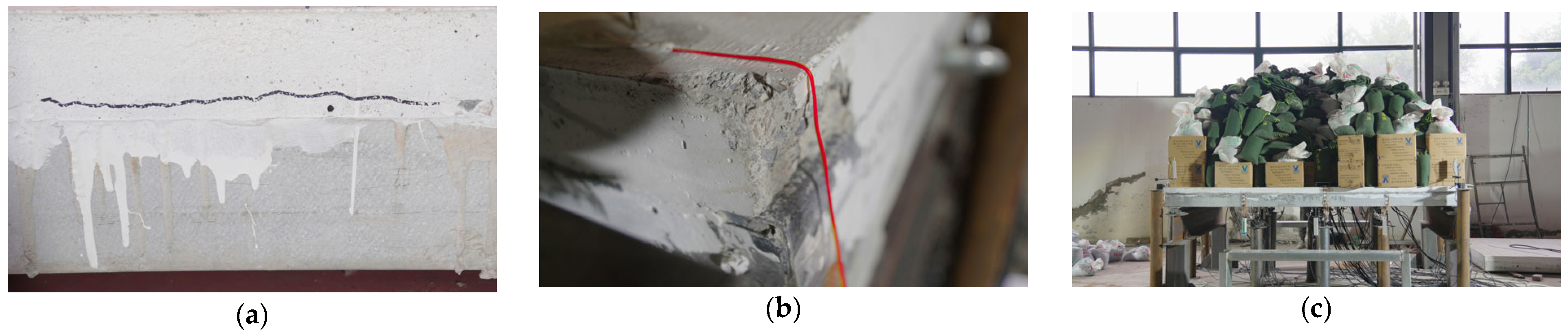
In the initial loading stage, specimen 4SC-1 remained in the elastic phase. The displacement increased linearly under the applied load. In later loading stages, the displacement growth rate accelerated, but no significant plastic phenomena were observed by the end of the test. When the load reached 7.33 kN/m2, shear cracks appeared at the interface between the concrete and the stud at the end of the wall panel (Figure 10a), leading to a reduction in composite performance and overall stiffness. When the load reached 7.67 kN/m2, the cracks at the end of the wall panel further developed and concrete spalling occurred at one corner of the concrete slab (Figure 10b). When the load reached 8.00 kN/m2, only new cracks were observed, with no additional damage to the concrete slab. After the loading was completed, the composite wall panel remained intact (Figure 10c), showing no visible failure or significant deflection.

3.3. Specimen 3SC-1

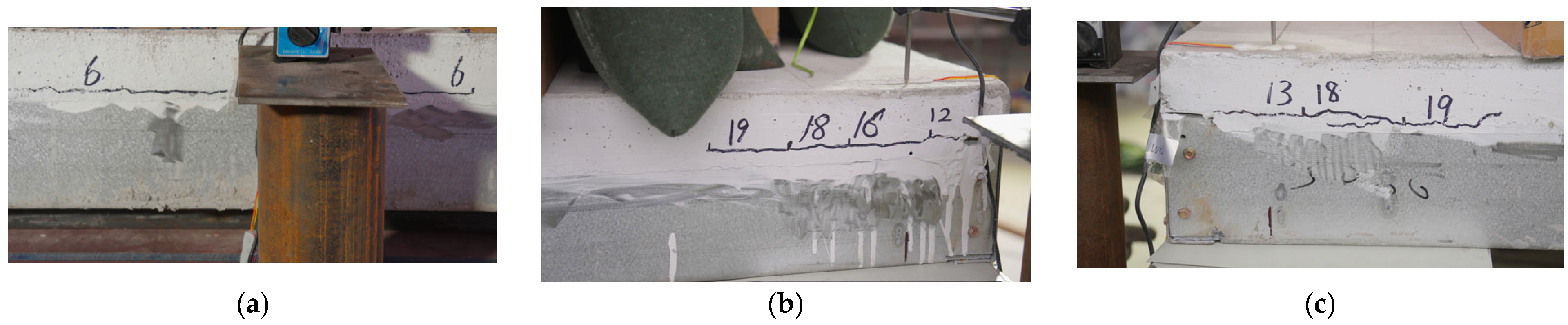
Specimen 3SC-1 exhibited similar behavior to 4SC-1 during testing. The load–displacement curve remained linear in the early loading stage and no failure occurred throughout the entire loading duration. However, unlike specimen 4SC-1, specimen 3SC-1 exhibited shear cracks at an earlier stage. When the load reached 3.33 kN/m2, the first shear crack appeared at one end of the specimen (Figure 11a). When the load reached 4.00 kN/m2, crack propagation was observed along pre-existing cracks while no new crack initiation occurred. From 5.33 kN/m2 to 8.00 kN/m2, new cracks emerged or existing cracks propagated with each load increment (Figure 11b,c).

3.4. Specimen 4SC-2

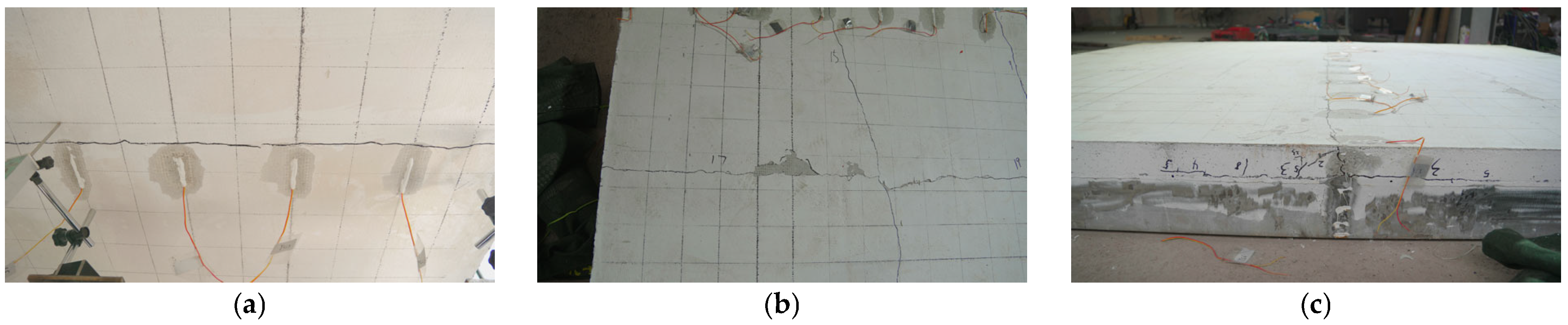
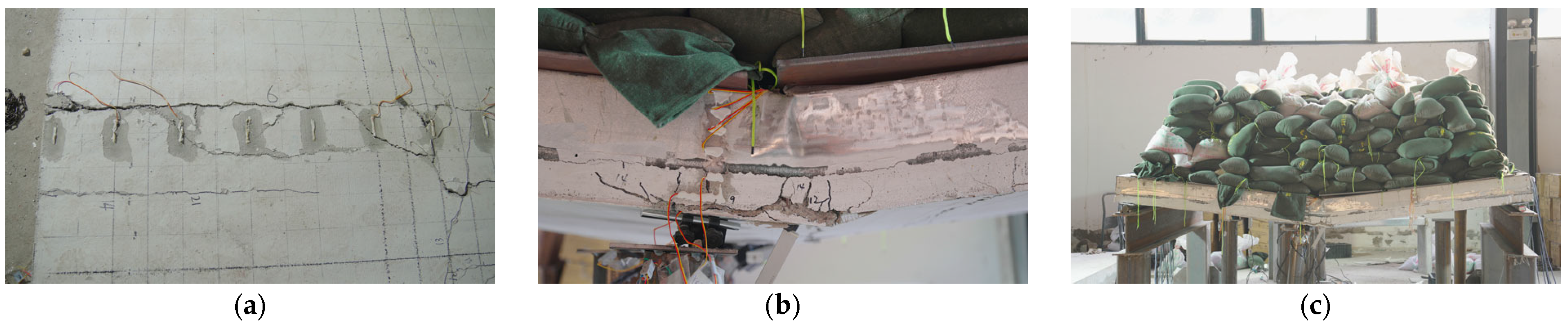
Specimen 4SC-2 underwent a reverse loading test, where the concrete slab was subjected to tensile stress. During the experiment, cracks at the bottom of the concrete slab were primarily monitored, while shear cracks were not observed. When the load reached 4.86 kN/m2 and after the completion of the holding phase, an audible sound was emitted from the specimen prior to the application of the next load increment. A through crack formed at the mid-span of the concrete slab (Figure 12a), accompanied by a sudden increase in the displacement of the wall panel. When the load reached 5.19 kN/m2, a through crack appeared near the quarter point on the right side of the specimen. However, the flexural stiffness of the composite wall panel did not decrease accordingly. When the load reached 6.52 kN/m2, cracks nearly parallel to the span direction appeared on the right side. When the load reached 7.19 kN/m2, cracks appeared near the quarter point on the opposite side but did not fully penetrate. It was not until the load reached 7.86 kN/m2 that through cracks occurred (Figure 12b). At test completion, the concrete slab at the mid-span of the specimen had separated from the light-gauge steel studs (Figure 12c). However, the concrete slab did not detach completely and the specimen had not collapsed. The light-gauge steel studs remained capable of sustaining additional loads.

3.5. Specimen 3SC-2

Specimen 3SC-2 exhibited similar behavior to 4SC-2 during the test. When the load reached 2.79 kN/m2, short cracks formed in the concrete near the left quarter point during load holding. When the load reached 3.33 kN/m2, cracks extended toward the opposite side without rapid deflection growth. When the load reached 3.67 kN/m2 and after the completion of the holding phase, an audible sound was emitted from the specimen prior to the application of the next load increment. A through crack formed at the mid-span of the concrete slab (as shown in Figure 13a), accompanied by a sudden increase in the displacement of the wall panel. The cracks at the quarter points of specimen 3SC-2 appeared earlier than those at the mid-span, which was attributed to the presence of initial microcracks at the quarter point location. When the load reached 4.33 kN/m2, cracks appeared at the quarter point on the opposite side of the concrete slab. As the load increased, the cracks continued to propagate. When the load was increased to 8.00 kN/m2, buckling occurred in the upper flange of the studs during load holding (Figure 13b), leading to a sudden collapse of the specimen due to a complete loss of load-bearing capacity (Figure 13c).

4. Experimental Results on Flexural Performance of the New Exterior Wall Panel

4.1. Displacement Experimental Results of Wall Panels

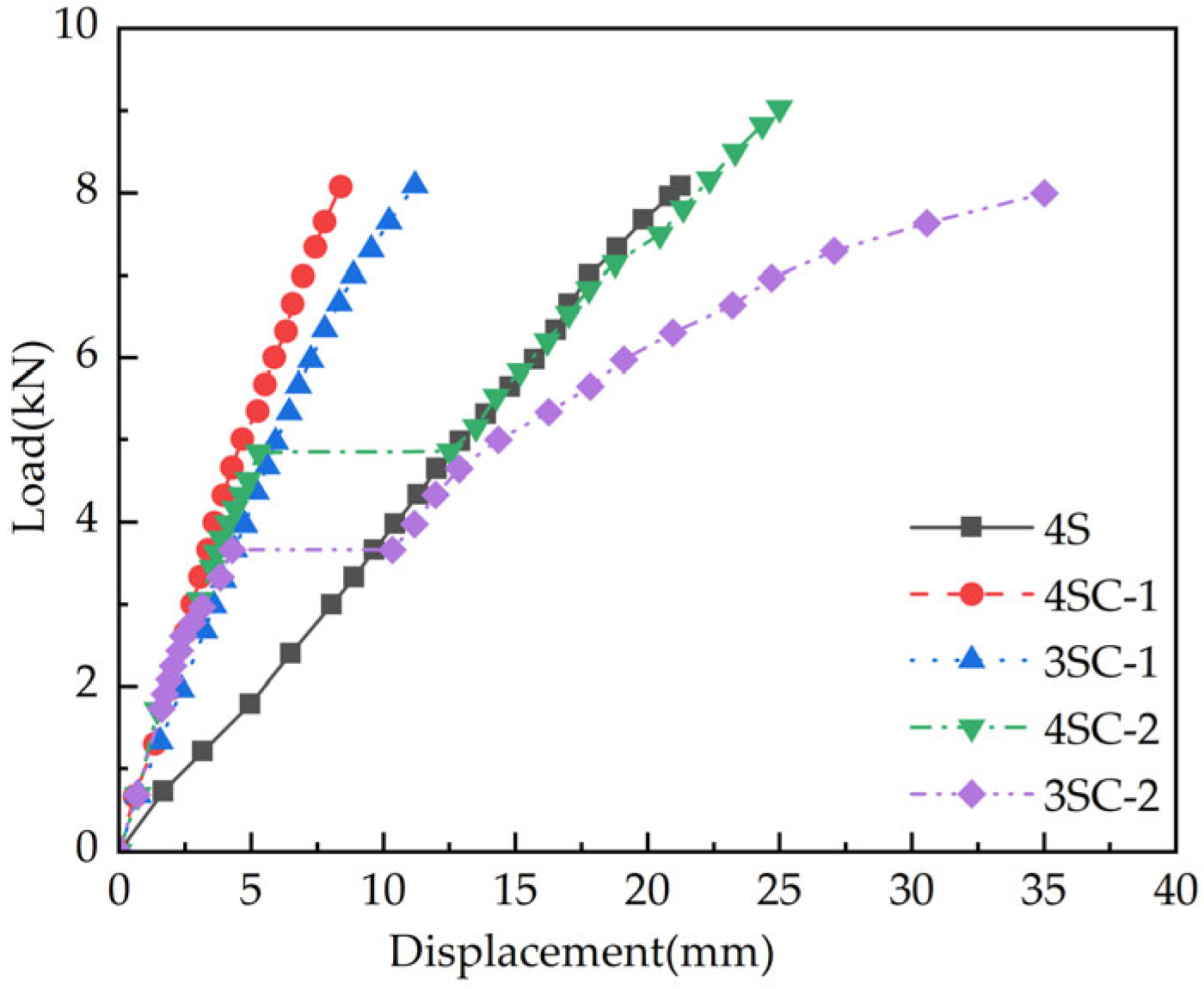
The load–displacement curves for specimens 4S, 4SC-1, 4SC-2, 3SC-1 and 3SC-2 are plotted in Figure 14 and the experimental results are summarized in Table 5. According to the relevant regulations on relative deflection limits for steel-profile unitized curtain walls, the deflection limits for SFRC profiled steel sheet exterior composite wall panels under normal service conditions are defined as the smaller value between the absolute deflection of 20 mm and the relative deflection of L/200, where L represents the span of the composite wall panel. Therefore, the limit load of the specimen during the normal service stage is taken as the smaller value between the cracking load of the wall panel and the load corresponding to the deflection limit.
Figure 14 and Table 5 show the following:
(1) By comparing the load–displacement curves of specimens 4S, 4SC-1 and 3SC-1, it can be observed that the presence of concrete slabs significantly enhances the flexural stiffness of wall panels. This improvement consequently increases the ultimate load of SFRC profiled steel sheet exterior composite wall panels under serviceability limit states, with specimen 4SC-1 demonstrating approximately 2.5 times higher stiffness than specimen 4S.
(2) Specimen 4S remains in an elastic state throughout the entire loading process, while specimens 4SC-1 and 3SC-1 exhibit accelerated displacement growth and plastic behavior during later loading stages. Combined with experimental observations, this phenomenon is inferred to result from the yielding of some self-tapping screws at the specimen ends.
(3) For composite wall panels with identical dimensions, the spacing of studs significantly influences the flexural performance of the wall panels.
(4) The load–displacement curves of specimens 4SC-2 and 3SC-2 both show distinct slip segments. These slips correspond to the formation of throughout cracks at the mid-span of concrete slabs under corresponding loads, leading to the failure of composite action, a reduction in the stiffness of the composite wall panel and a sudden increase in deflection.
(5) Compared to specimens 4SC-1 and 4SC-2, the initial stiffness of both specimens was similar before cracking occurred in 4SC-2. However, as the load increased, the concrete slab in specimen 4SC-2 experienced tensile damage, resulting in a gradual reduction in stiffness. The same phenomenon was observed in specimens 3SC-1 and 3SC-2.
(6) After cracking, the load–displacement curve of specimen 4SC-2 became nearly parallel to that of specimen 4S, indicating that both the external loads and the self-weight of the concrete were entirely borne by the steel stud framework after concrete slab cracking. For post-cracking specimen 3SC-2, the displacement growth rate of the wall panel progressively accelerated due to excessive spacing of vertical studs, ultimately causing specimen failure via buckling of the stud structure’s upper flange.

4.2. Wall Panel Strain Experimental Results

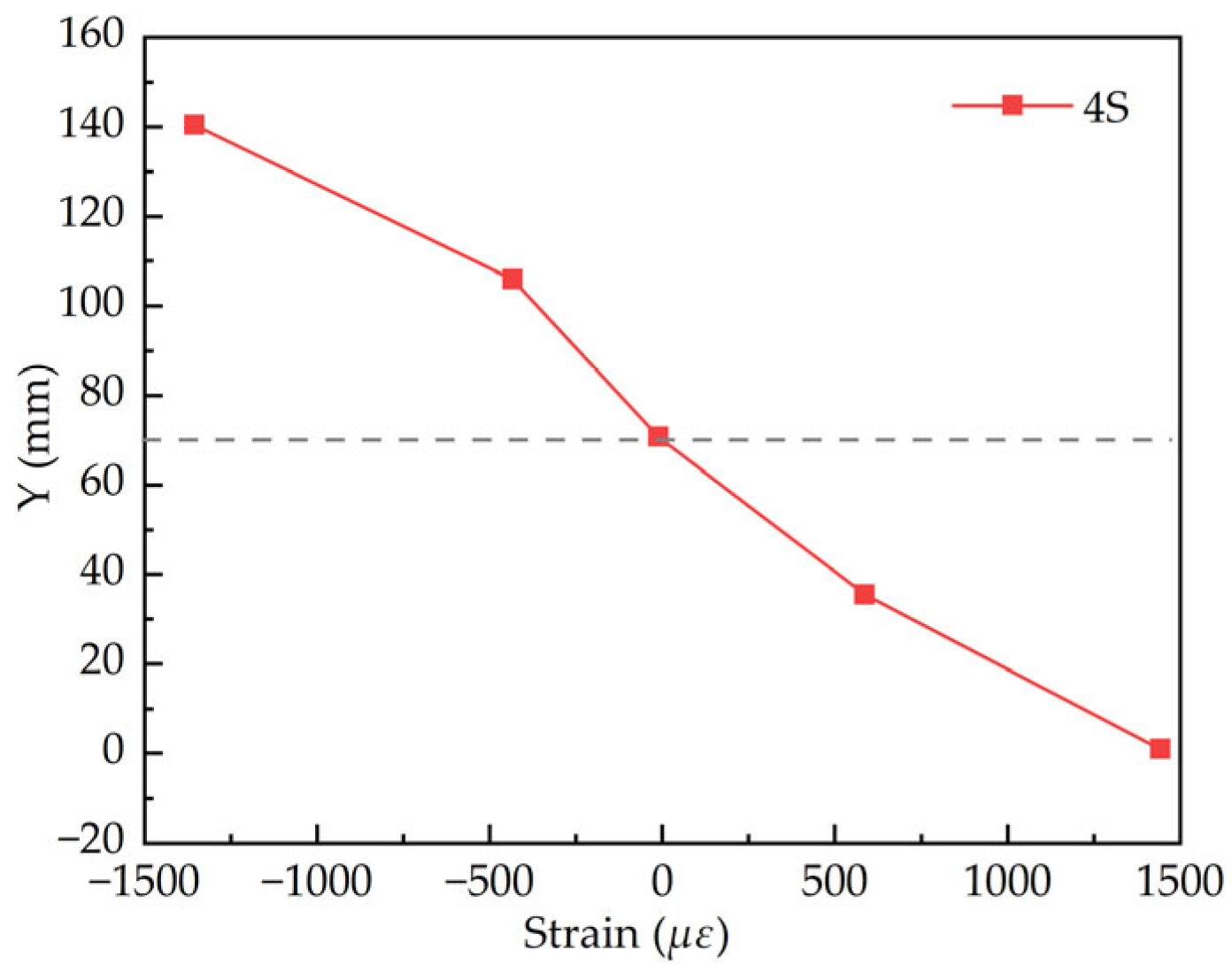
Figure 6 shows the arrangement of strain gauges along the height direction on the second stud of specimen 4S, with the corresponding strain distribution plotted in Figure 15. The dashed line indicates the position of the section neutral axis. As shown in Figure 15, the cross-sectional strain of the pure light-gauge steel stud wall panel basically conforms to the plane section assumption during flexural deformation. When the load reached 8 kN/m2, the maximum strain on the stud was approximately 1500 με, corresponding to a stress of 309 MPa, which had not yet reached the yield strength of the steel stud.
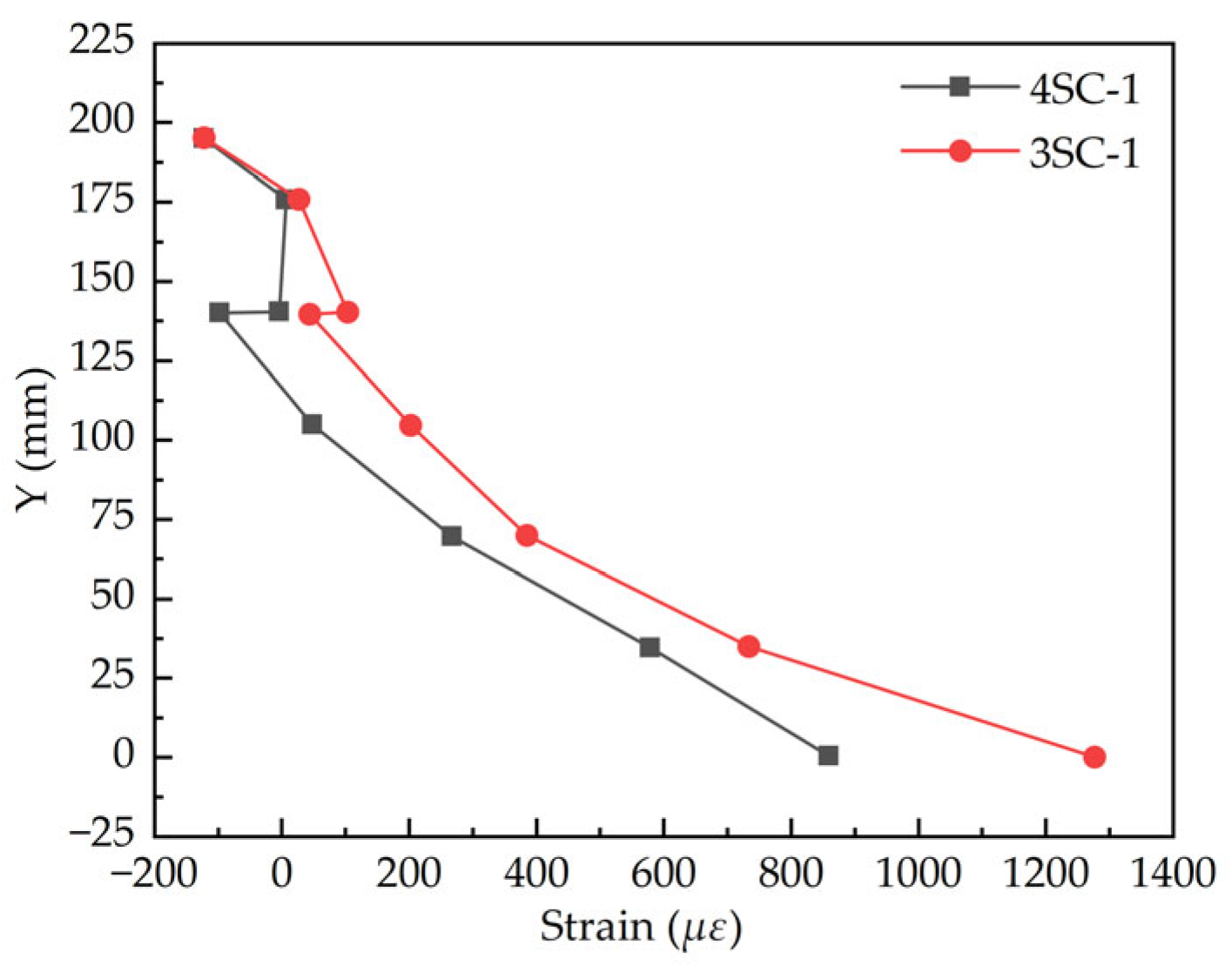
Except for specimen 4S, all specimens were composite wall panels consisting of light steel studs and profiled steel sheet–concrete composite slabs. The variation patterns of strain obtained from the tests along the height of the wall panel cross-section were generally consistent. This paper takes specimens 4SC-1 and 3SC-1 as examples for analysis. Figure 7 shows the arrangement of strain gauges along the height direction of the cross-section for the composite wall panels. The corresponding strain distributions of specimen 4SC-1 and specimen 3SC-1 are plotted in Figure 16. As shown in Figure 16, the light-gauge steel studs and profiled steel sheet–concrete slabs connected by self-tapping screws exhibit significant composite action characteristics. This structural configuration demonstrates neither fully separated sections nor completely integrated composite sections.
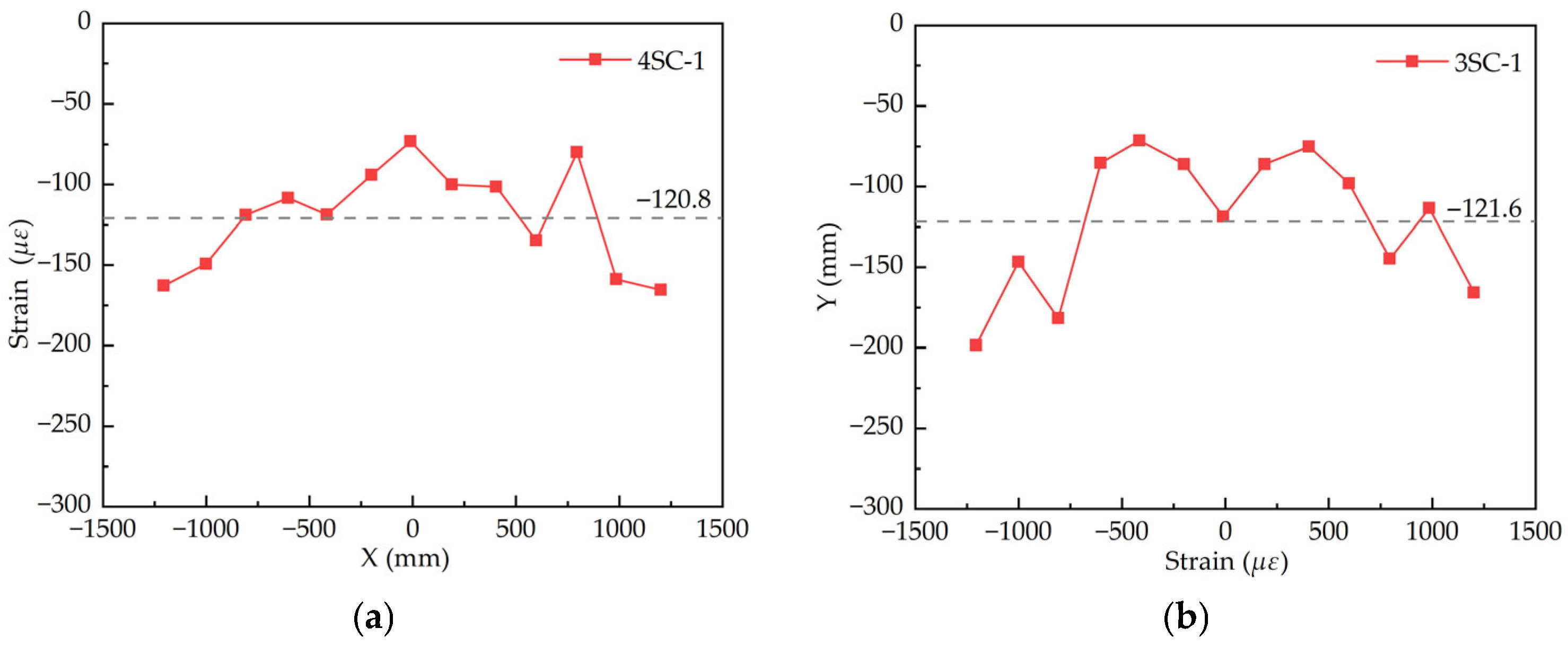
Compared to specimen 4S (pure light-gauge steel stud cross-section), the maximum stress on the studs in composite wall panels is significantly reduced due to the composite effect. A comparison of the test results of the two composite wall panels reveals that the maximum strain on the studs decreases as the stud spacing decreases. Figure 8 shows the arrangement of strain gauges on the concrete slab surface along the width of the specimens. The corresponding strain distributions for specimens 4SC-1 and 3SC-1 are plotted in Figure 17a,b, respectively. The dashed line represents the average strain. From Figure 17, it can be observed that (1) although partial data drift exists in the compressive strain of the concrete slab, the overall distribution remains approximately symmetrical; and (2) the compressive strain of the concrete directly above the studs is significantly greater than that of the concrete at the sides.

5. Numerical Calculation of Flexural Performance for the New Exterior Wall Panel

5.1. Finite Element Model

The components of the new exterior wall panel include the studs, self-tapping screws, connectors and concrete panels. These four components can be broadly categorized as metal materials and concrete materials. Material property tests indicated that the light steel studs exhibit distinct yield points and ultimate tensile strength. Therefore, a bilinear hardening constitutive model was adopted for the metal materials. The yield strength is taken as 350 MPa, the pre-yield elastic modulus E s = 2.06 × 10 5 and the post-yield elastic modulus E = 0.01 E s .   The concrete adopted the CDP (Concrete Damaged Plasticity) constitutive model [32], with the parameter settings listed in Table 6. The parameters were selected based on typical values for reinforced concrete and validated against experimental data.
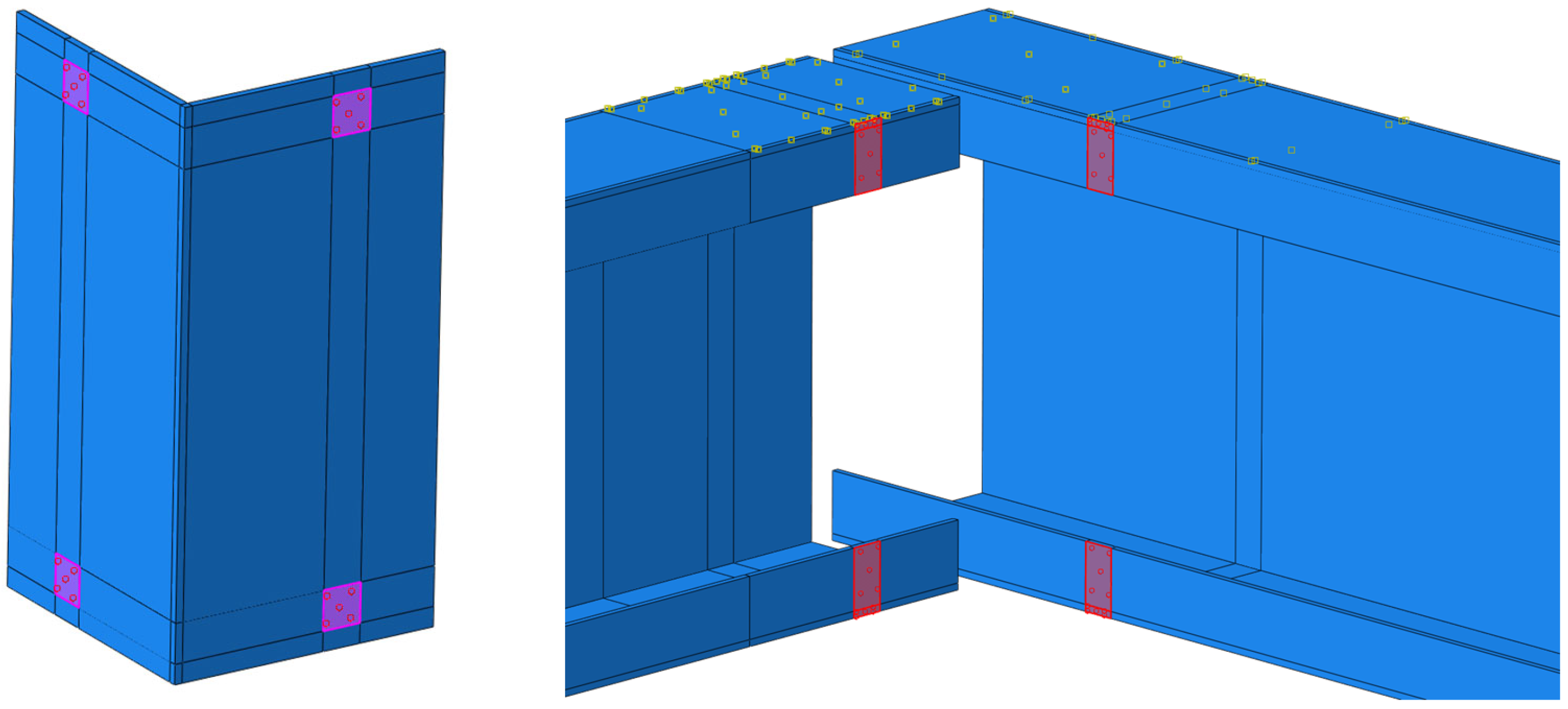
The self-tapping screws serving as shear connectors were constrained in the concrete slab using an embedded region constraint at their upper portions, while their lower ends were bonded to the surface of the light steel studs through TIE constraints. During the experimental process, the self-tapping screw connections used to form the light steel studs did not experience failure. Consequently, TIE constraints were adopted to simulate the mechanical behavior of these self-tapping screw connections [33]. To mitigate the effect of TIE constraints on stiffness enhancement, the components were pre-segmented to ensure that TIE connections acted only at screw locations, thereby reducing the regions subjected to TIE connections, as illustrated in Figure 18. The red and purple regions in the Figure 18 represent the connection areas of the ties. Unconnected regions between steel studs where TIE connections were not implemented employed surface-to-surface contact with tangential friction and normal hard contact to simulate actual interaction. Similarly, surface-to-surface contact was applied between the concrete undersurface and light-gauge steel stud upper surface.
The self-tapping screws were modeled using B31 Timoshenko beam elements (two-node spatial linear beam elements). The concrete was simulated with C3D8R eight-node linear hexahedral elements. When the thickness-to-span ratio of light steel studs is less than 1/15, S4R four-node shell elements should theoretically be employed. However, to ensure the accuracy of subsequent nodal displacement extraction, the steel studs are still modeled using C3D8R eight-node linear hexahedral elements. In such cases, the element size must be strictly controlled during meshing to guarantee that the ratio of the longest to the shortest edges in the hexahedral elements remains below 50:1, thereby ensuring the reliability of the computational results.

5.2. Finite Element Calculation Results and Comparison with Experimental Data

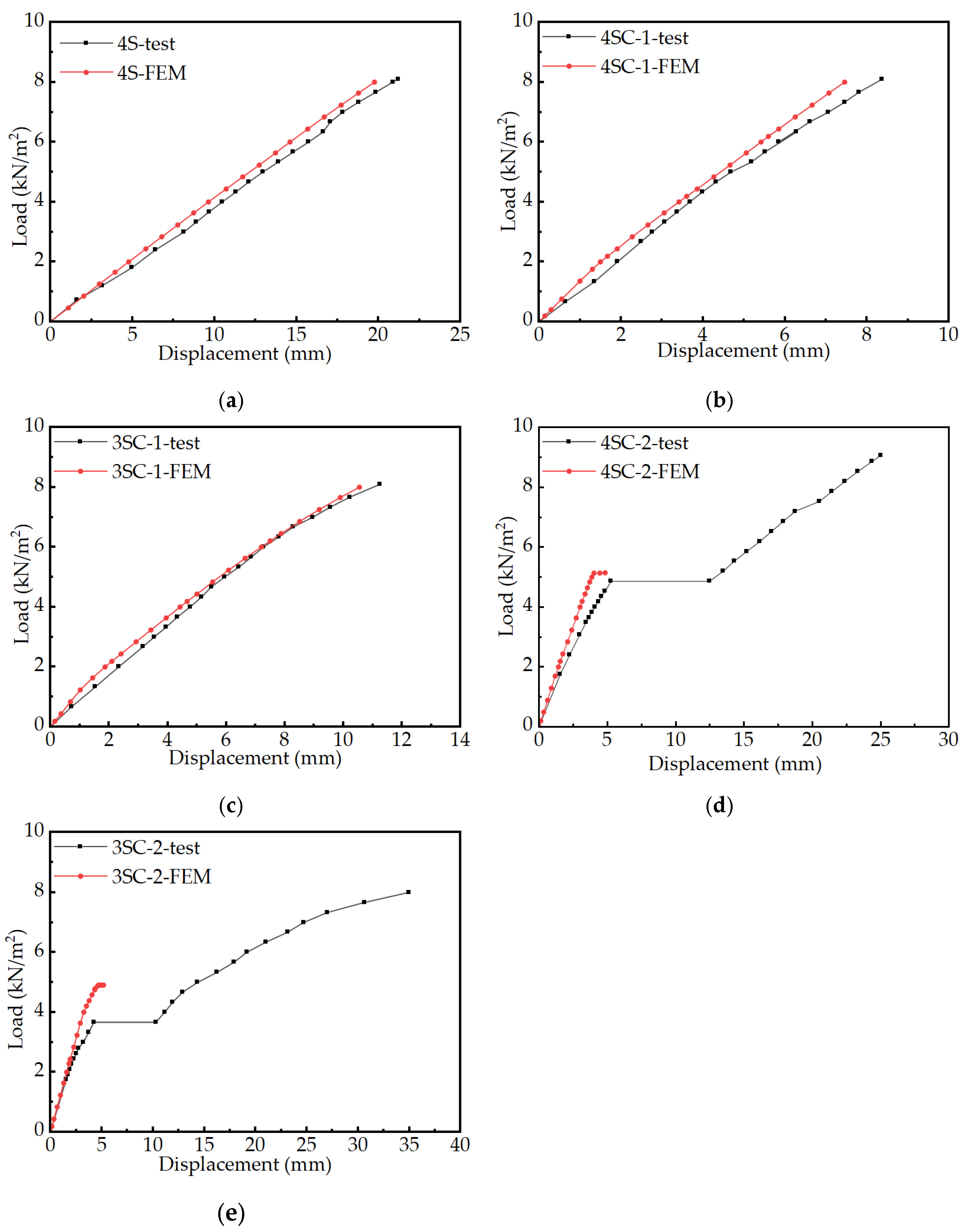
The displacement results obtained from the finite element method (FEM) for specimens 4S, 4SC-1, 3SC-1, 4SC-2 and 3SC-2 were compared with experimentally measured displacements, as shown in Figure 19a–e. The load–displacement curves obtained from the FEM for specimens 4S, 4SC-1 and 3SC-1 showed good agreement with the experimental curves. As the load increased, no significant nonlinear phenomena were observed in the finite element models of specimens 4S or 4SC-1. For specimen 3SC-1, the finite element model showed a slight reduction in stiffness during the later loading stages. The displacements of the three finite element models under maximum load deviated from the experimental values by no more than 10%.
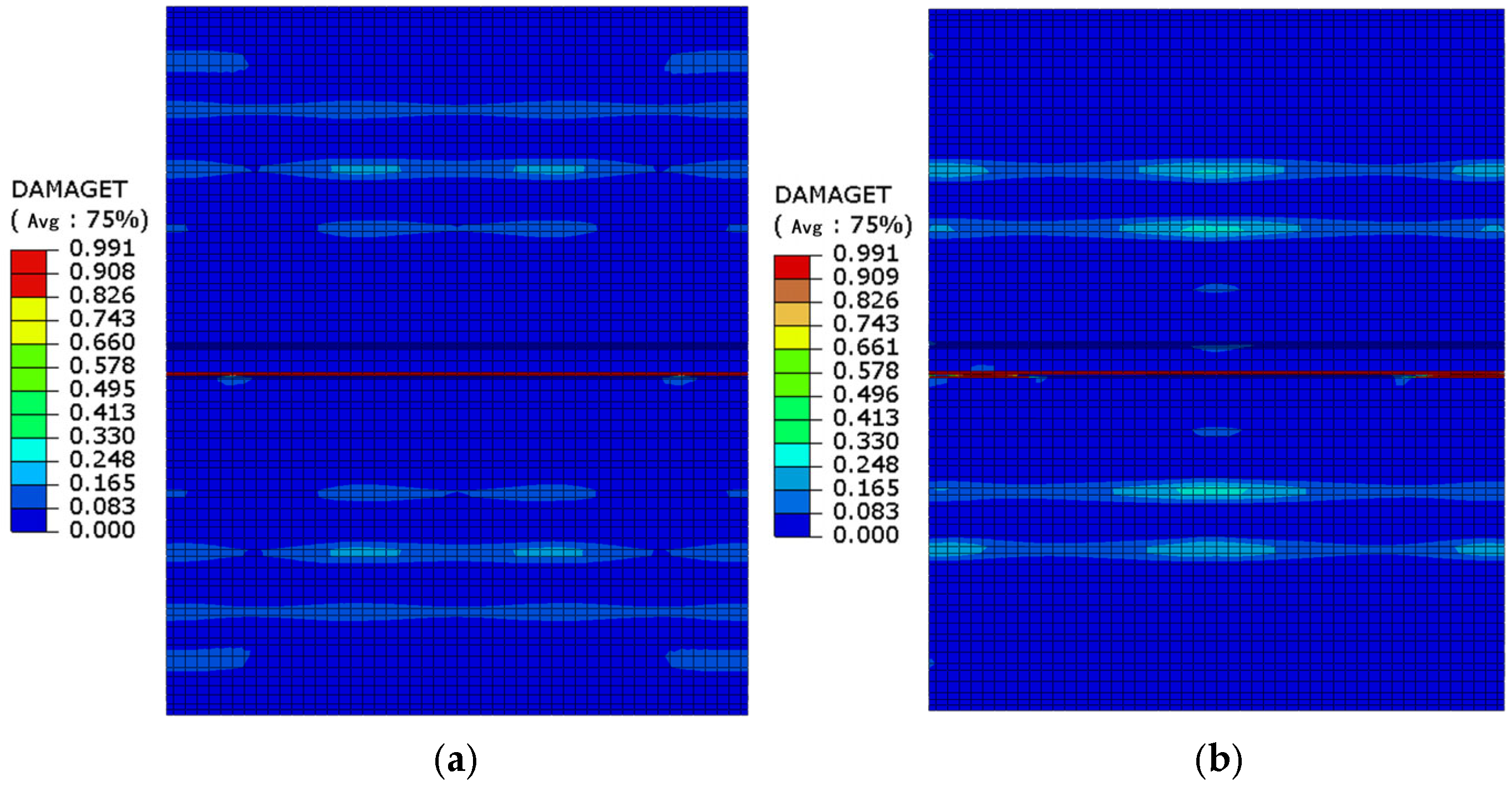
The finite element and experimental load–displacement curves for specimens 4SC-2 and 3SC-2 both exhibited slip segments, significant indicators of concrete cracking. The CDP model utilizes damage parameters to evaluate the cracking extent of concrete. As shown in Figure 20a,b, when the cracking load was reached, the DAMAGET (tensile damage) at the mid-span of the concrete had already exceeded 90%. The damage contour plot reveals that all concrete elements at the mid-span along the specimen’s width direction had reached a damaged state, corresponding to the through cracks observed at the mid-span during the test. After the concrete damage occurred at the mid-span, the nonlinearity of the model increased and the solution convergence decreased. In Figure 19d,e, the slip segments of the finite element load–displacement curves for specimens 4SC-2 and 3SC-2 correspond to the occurrence of throughout damage in the concrete slab at the mid-span in the numerical model, which matches the throughout cracks at the mid-span shown in Figure 12a and Figure 13a, respectively. Following the concrete slab cracking, the failure of the composite action led to a sudden stiffness reduction in the composite wall panel, causing an abrupt increase in displacement and resulting in a slip segment in the load–displacement curve. The subsequent loading could not be performed due to the failure of the model to converge and no subsequent cracks corresponding to the experimental results. Additionally, since steel stud buckling only occurs under large deformations, this phenomenon was not observed in the finite element model either.
As shown in Figure 14, once a throughout crack formed at the mid-span, the post-cracking bearing capacity of the specimens corresponded to that of the steel stud skeleton. Subsequent crack propagation had no influence on the specimen’s bearing capacity and the emergence of a mid-span crack could be regarded as the failure criterion. Thus, for the model under wind suction load, ABAQUS only needed to identify the cracking load, with no requirement to capture subsequent crack development or the buckling behavior of the steel studs.
The initial stiffness of the finite element models for specimens 4SC-2 and 3SC-2 showed reasonable agreement with experimental results. However, as the load increased, the finite element model stiffness gradually deviated from the test data, with this phenomenon being more pronounced in specimen 4SC-2. This discrepancy can be attributed to the following analysis: In the finite element model of specimen 4SC-2, the self-tapping screws did not reach yielding before concrete cracking, resulting in a linear load–displacement curve. A sudden displacement increase occurred when reaching the cracking load, consistent with the characteristics of brittle concrete failure. In contrast, during the tests, the continuous development of internal micro-cracks in the tension zone concrete led to the gradual stiffness degradation of the specimen.
In the finite element model of specimen 3SC-2, the reduced number of self-tapping screws resulted in increased shear force on individual screws. This caused the screws to yield prior to concrete cracking, consequently leading to nonlinear behavior in the load–displacement response. When comparing the finite element curves with the experimental curves, the finite element curves of all five specimens were found to lie above the experimental curves. This discrepancy arose because the finite element model does not account for initial imperfections, resulting in greater stiffness of the model compared to the actual specimens.
The stiffness and cracking load of the finite element model were compared with the experimental values and the comparative results are summarized in Table 7. Notably, the stiffness value of specimen 4SC-2, the stiffness value of specimen 3SC-2 and the cracking load exhibited significant deviations from the experimental values, with errors all exceeding 20%. The stiffness values of specimens 4S, 4SC-1 and 3SC-1, as well as the cracking load of specimen 4SC-2, exhibit deviations within approximately 10% when compared with the experimental results. This phenomenon can be attributed to two primary factors. Firstly, the concrete slabs in specimens 4SC-2 and 3SC-2 were subjected to tensile stresses, where the initial cracks propagated with increasing load, leading to a continuous decline in specimen stiffness, whereas the finite element models did not incorporate initial cracks. Secondly, the concrete tensile strength demonstrated higher sensitivity to initial defects, which resulted in significant discreteness in the cracking loads obtained from testing. Overall, the finite element model demonstrated satisfactory accuracy in simulating the deformation behavior of the specimen under a uniformly distributed load and successfully reproduced the throughout cracks at the mid-span under wind suction load. These results validate the reliability of the finite element model established in this study.

6. Theoretical Analysis of Flexural Deformation in New Composite Wall Panels

6.1. Fundamental Assumptions

(1) Light steel studs and concrete are considered as isotropic linear elastic materials;
(2) Both light steel studs and concrete slabs individually satisfy the plane section assumption before and after deformation;
(3) Light steel studs and concrete slabs maintain the same curvature during the loading;
(4) Interface friction and uplift of concrete slabs are neglected;
(5) The effect of the profiled steel sheet and concrete ribs is disregarded;
(6) The influence of material shear deformation is ignored;
(7) Self-tapping screws are equivalent to a continuous and uniform linear elastic medium, with shear force magnitude proportional to the interface slip displacement;
(8) The theoretical model assumes perfect bonding between the components and the linear elastic material behavior;
(9) The effects of interface slip, material nonlinearity and concrete cracking are not considered in this simplified model.

6.2. Total Potential Energy Expression of Wall Panels Under Bending

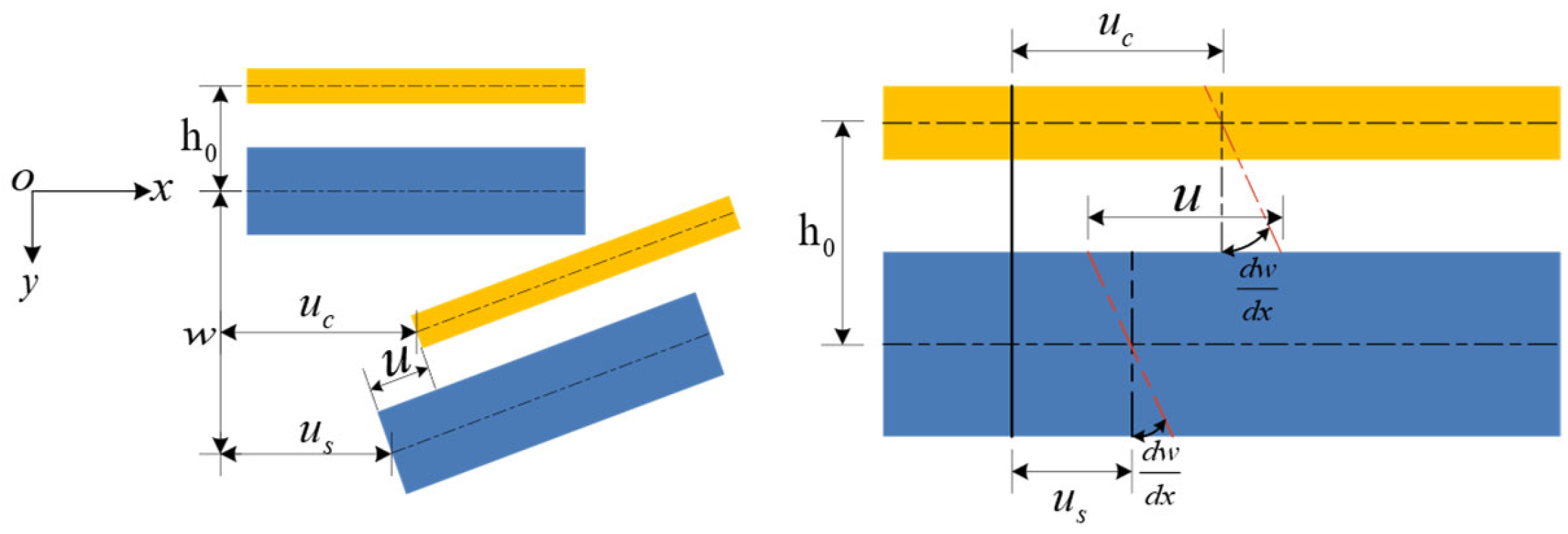
Figure 21 shows the analytical diagram of interface slip in the composite wall panel before and after deformation.
The expression for the interface slip can be derived from the geometric relationship shown in Figure 21, as presented in Equation (2).
u x = u c x u s x + h 0 d w x d x
Taking the first-order derivative of Equation (2) and considering the self-equilibrium of axial forces in the composite beam, Equation (3) can be obtained. Solving Equation (3) yields the expressions for the axial normal strain at the centroidal axes of both the concrete slab and the light steel studs. Based on the plane section assumption, the axial normal strain distributions at various points in the concrete slab and light steel stud can be derived as Equations (4) and (5), respectively.
d u x d x = ε c x ε s x + h 0 d 2 w x d x 2 E c A c ε c x + E s A s ε s x = 0
ε c x , y 1 = E s A s E c A c + E s A s h 0 d 2 w x d x 2 d u x d x + y 1 d 2 w x d x 2                    
ε s x , y 2 = E c A c E c A c + E s A s h 0 d 2 w x d x 2 d u x d x + y 2 d 2 w x d x 2                      
According to the theory of elastic mechanics, the total potential energy of a structural system can be expressed as Equation (6). By substituting the strain expressions and interface shear expressions into Equation (6), the total potential energy expression of the composite wall panel can be derived as Equation (7).
Π = U Γ = V W ε i j d V V f i u i d V S p i u i d S
Π = E c 2 t c 2 t c 2 0 L ε c 2 x , y 1 b e d y 1 d x + E s 2 2 h + t s h 0 L ε s 2 x , y 2 b s d y 2 d x + 2 h h + b 0 L ε s 2 x , y 2 t s d y 2 d x + h h 0 L ε s 2 x , y 2 t s d y 2 d x + K 2 0 L u 2 x d x 0 L q u x d x

6.3. Flexural Deformation Formula

According to the principle of minimum potential energy, among all kinematically admissible deformation states, the total potential energy of the true equilibrium state reaches its minimum value. Therefore, by taking the first variation in the total potential energy described in Equation (7) and setting it equal to zero, we can derive the governing differential equation. To avoid solving differential equations, the deflection curve and slip curve are expanded into series expansions, where simple functions are used to approximate the actual curves. From the schematic diagram of the mechanical analysis of the SFRC–light-gauge steel stud composite wall panel, it can be observed that the deflection curve is symmetrical about the axis x = L/2, while the slip curve is anti-symmetrical about the same axis x = L/2. Therefore, the functions w(x) and u(x) can be expanded using trigonometric series and power series as follows:
Trigonometric series:
w x = n = 1 Y n sin n π x L
u x = n = 1 X n cos n π x L
Power series:
w x = Y 0 + n = 1 Y n x L 2 2 n
u x = n = 1 X n x L 2 2 n 1
Since trigonometric series possess integral orthogonality over the interval [0, L], they allow solutions for arbitrary-order expansions. In contrast, power series lack integral orthogonality and thus require sequential computation starting from the first-order expansion. This study demonstrates that expanding power series to the second order already achieves satisfactory precision. The first-order and second-order expansions of the power series correspond to Equations (12)–(15).
w x = Y 0 + Y 1 x L 2 2
u x = X 1 x L 2
w x = Y 0 + Y 1 x L 2 2 + Y 2 x L 2 4
u x = X 1 x L 2 + X 2 x L 2 3
The series expansion expressions of the displacement function and slip function are substituted into the strain expression, which is then incorporated into the total potential energy expression of the system. By setting the first variation to zero and solving the algebraic equations, the undetermined coefficients can be determined. The specific coefficients for both the trigonometric series and power series are solved, as shown in Equations (16)–(28).
Trigonometric series:
Y n = q L 4 n π 5 4 × 1 B s
X n = q L n π 4 4 × 1 K I n π 2 A 0 h 0 + E s I 0 h 0 L 2
B s = E s I 0 + E s A 0 h 0 2 1 + n π 2 E s A 0 K L 2
First-order power series solution:
Y 0 = q L 4 96 × 1 B s
Y 1 = q L 2 24 × 1 B s
X 1 = q 12 × 1 K I 12 A 0 h 0 + E s I 0 h 0 L 2
B s = E s I 0 + E s A 0 h 0 2 1 + 12 E s A 0 K L 2
Second-order power series solution:
Y 0 = 5 q L 4 384 × 1 B s
Y 1 = q L 2 16 × 1 B s
Y 2 = q 24 × 1 B s
X 1 = q 8 × 1 K I 10 A 0 h 0 + E s I 0 h 0 L 2
X 2 = q 6 L 2 × 1 K I 10 A 0 h 0 + E s I 0 h 0 L 2
B s = E s I 0 + E s A 0 h 0 2 1 + 10 E s A 0 K L 2

6.4. Analysis and Comparison of Theoretical Calculation Formulas and Experimental Results

Taking specimens 4SC-1 and 3SC-1 as examples, the validity of the theoretical calculation formulas was verified by comparing the theoretical calculation results with the aforementioned analysis results. The calculation formulas for mid-span deflection of the new composite wall panel under wind pressure load are listed in Table 8. The calculated results after substituting parameters are presented in Table 9 and Table 10.
The calculation results from Table 9 and Table 10 indicate that the mid-span deflection obtained through theoretical calculations is lower than both the experimental values and the finite element calculation values. This discrepancy occurs because the theoretical formula does not consider the adverse effects of concrete damage on the stiffness of the composite wall panel, nor does it account for the reduction in composite stiffness caused by mid-span openings in the steel studs. The calculation results of the first-order power series theory formula exhibit relatively poor accuracy. However, both the first-order trigonometric series and second-order power series theory formulas achieve errors within 15% when compared to the finite element results. Nevertheless, it should be noted that deflection calculation accuracy alone cannot be used to assess the quality of theoretical solutions. The theoretical calculation model does not account for the effects of initial concrete defects and openings in the steel studs, making it more closely aligned with the working conditions of the finite element model. Therefore, the finite element analysis results should be considered as the reference benchmark for validating theoretical calculation results.
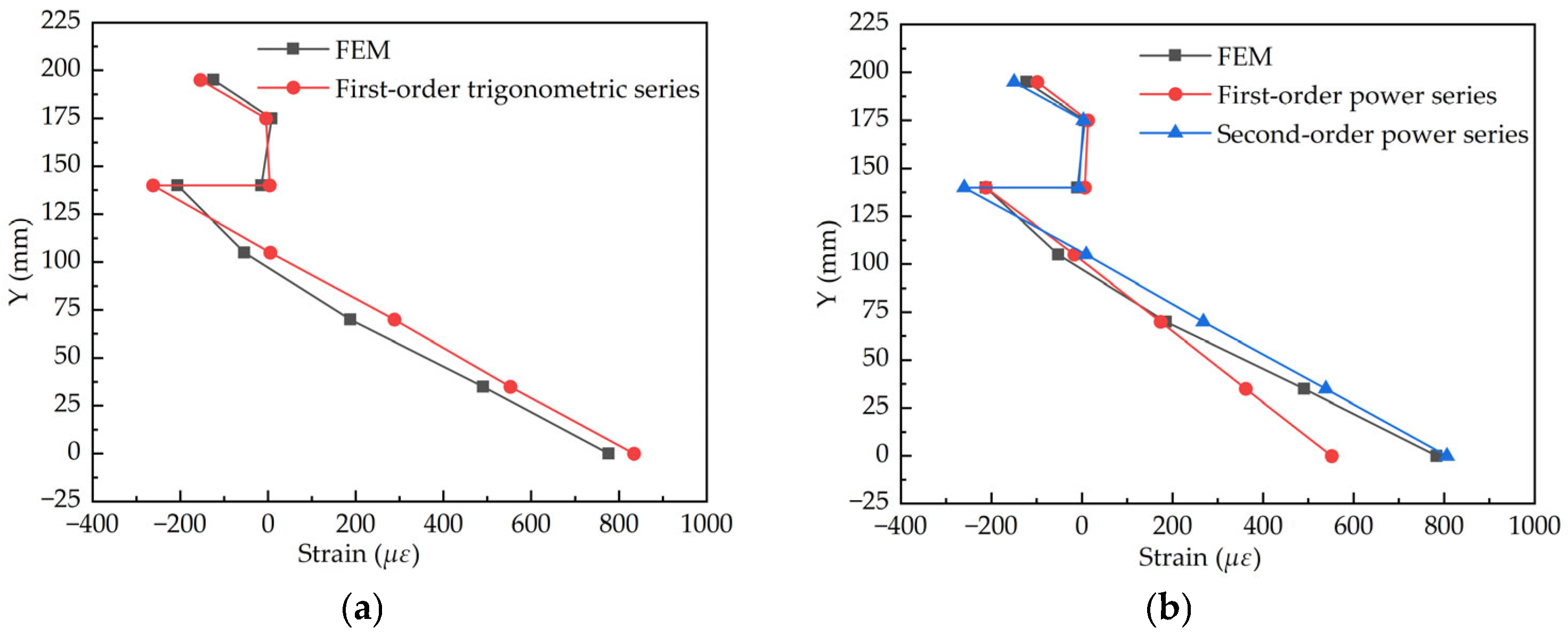
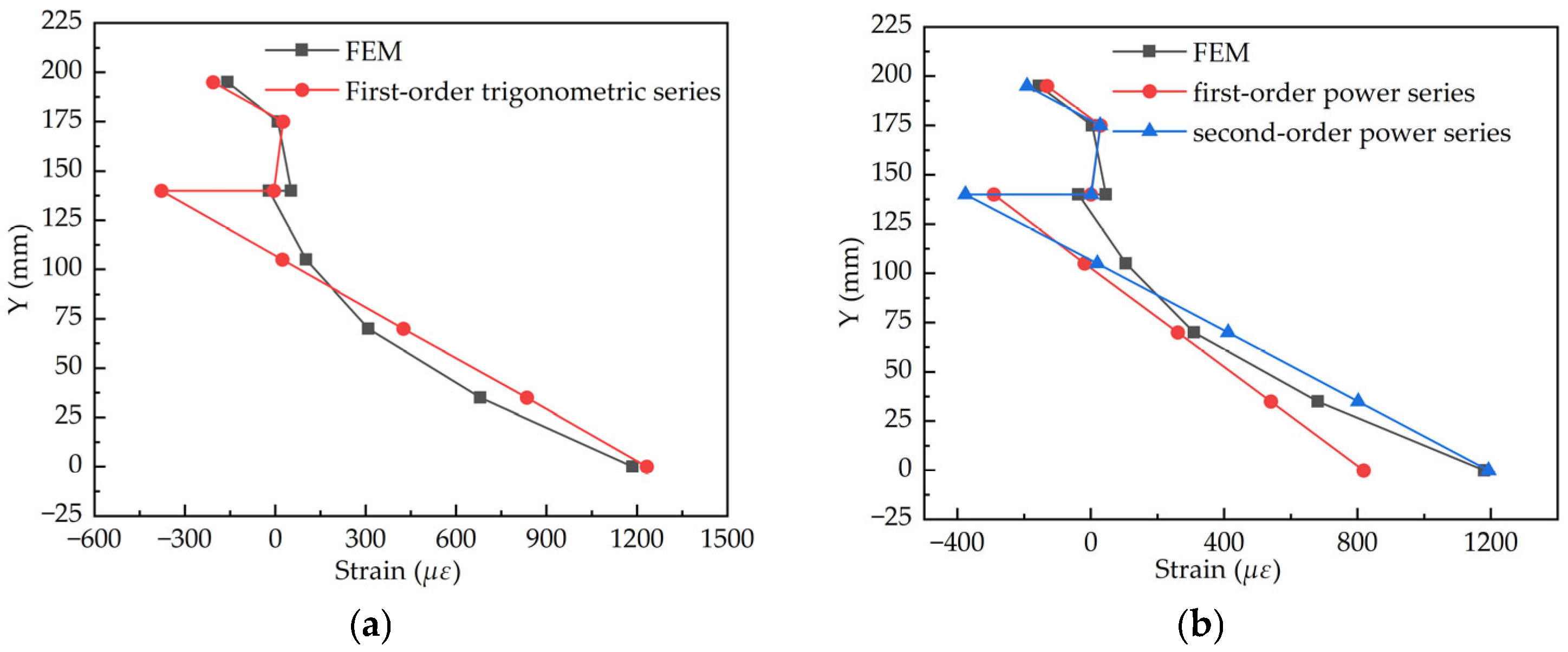
The strain distribution of composite wall panels is calculated using Equations (4) and (5). By substituting x = L/2, the strain distribution at the mid-span section can be obtained. Figure 22 and Figure 23 compare the mid-span strain distribution calculated by different theoretical formulas with the finite element analysis results. Notably, due to the fundamental assumption that neglects the contribution of concrete ribs in theoretical calculations, the concrete strain at the interface is considered zero in the theoretical model. Figure 22 and Figure 23 reveal that (1) the strain distributions of the concrete slab and light steel studs are parallel but exhibit distinct neutral axes, with strain discontinuity observed at their interface; (2) the strain distributions calculated using first-order trigonometric series and second-order power series show close agreement with the finite element results, effectively reflecting the strain distribution characteristics of composite wall panels under partial shear connection; and (3) although first-order power series results demonstrate better consistency with finite element results in compression zones, significant discrepancies are observed in the tensile regions of steel studs.
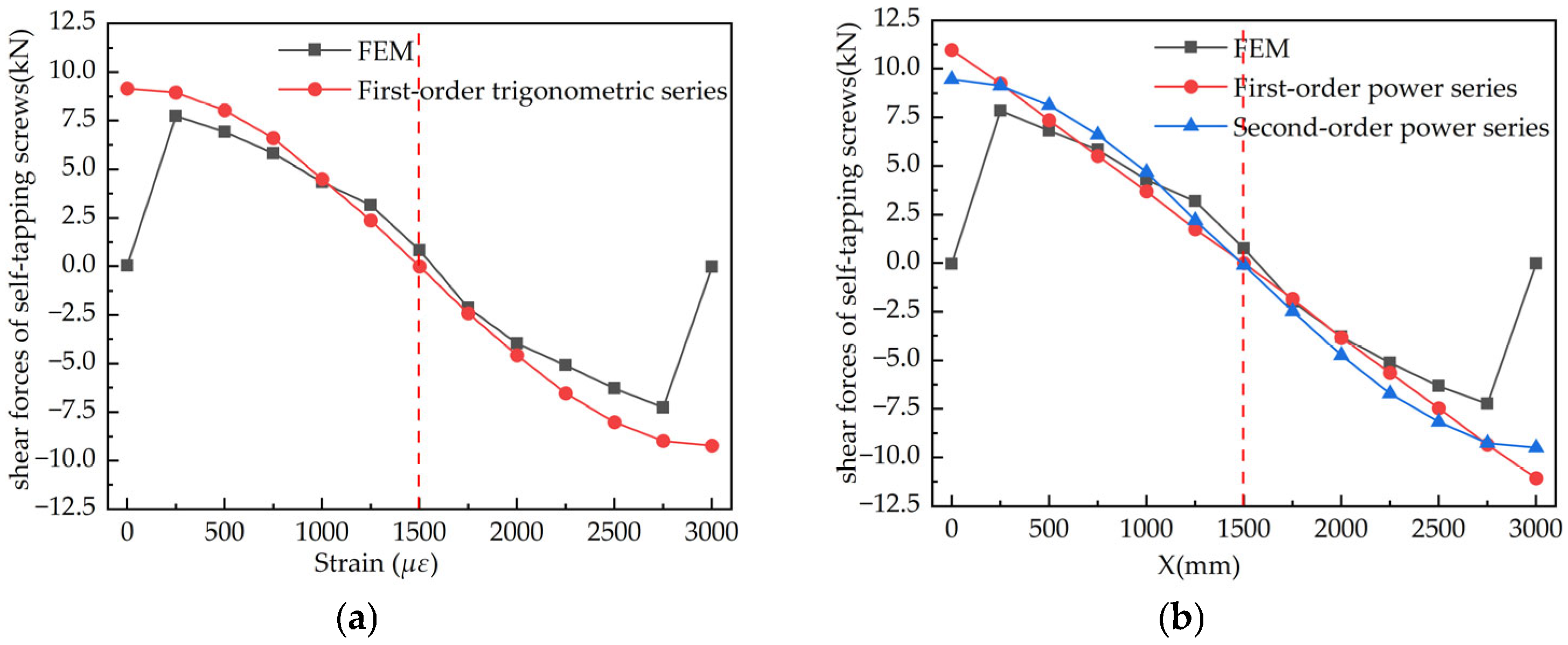
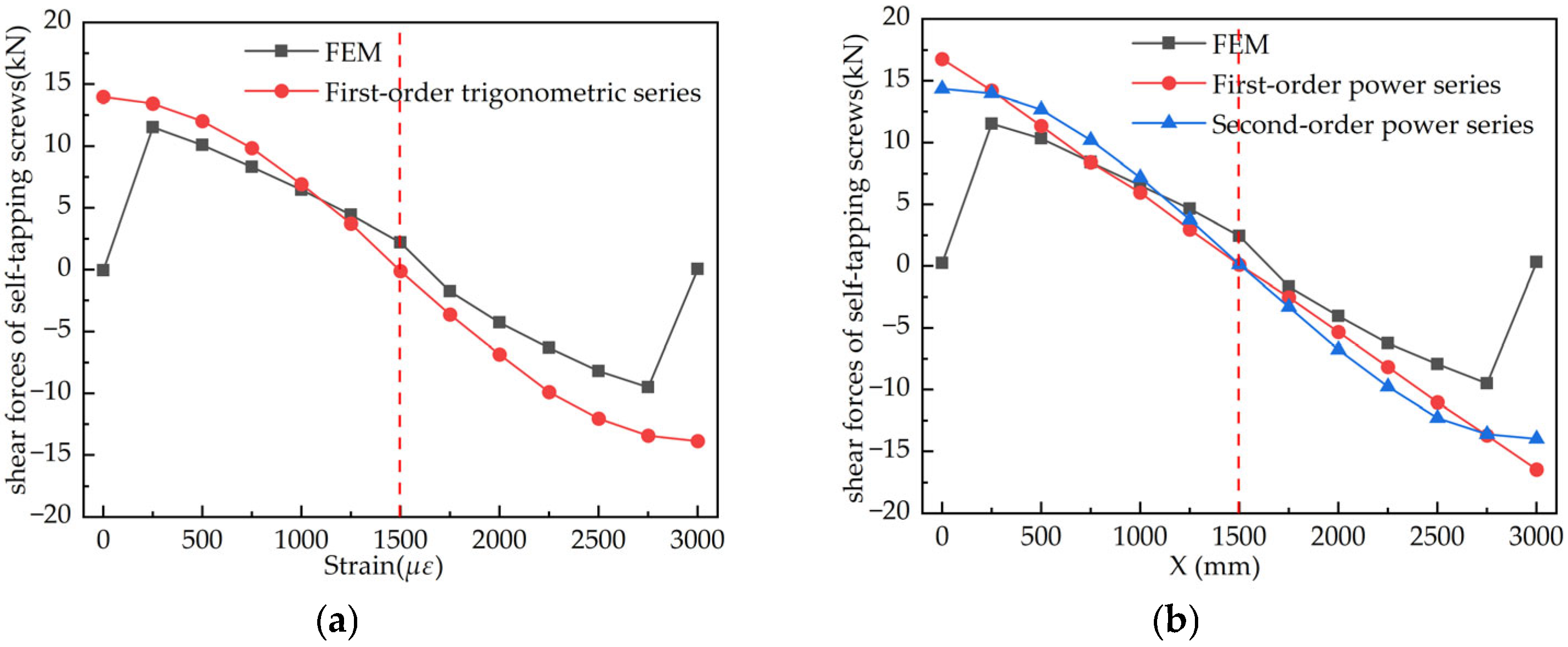
The shear forces of self-tapping screws at various positions on the light-gauge steel studs can be obtained using Equation (29). As shown in Figure 24 and Figure 25, since the slip curves are anti-symmetric about the axis x = L/2, the shear forces of self-tapping screws are consequently also anti-symmetric about the axis x = L/2.
v = k u x
where v—shear force of a single self-tapping screw.
The shear force of self-tapping screws calculated by Equation (29) was compared with the finite element calculation results. In the finite element model, the shear force of self-tapping screws demonstrated nonlinear increases from the mid-span towards the end regions. However, a sudden reduction in finite element calculated values was observed at the beam ends. The reason for this phenomenon is that the two self- tapping screws at the beam end are located on transverse studs. These transverse studs, through their connection with longitudinal studs via folded plates, undergo deformation release which consequently alleviates the shear force exerted on the self- tapping screws at the beam end. Both the first-order trigonometric series solution and second-order power series solution can reflect the nonlinear growth pattern of screw shear forces. However, these theoretical values are numerically greater than the finite element results, demonstrating an increasing deviation trend as the distance from the mid-span increases. This discrepancy primarily stems from the fact that the theoretical model fails to account for friction effects, resulting in calculated interface slip values that exceed actual interface slip values. The shear force of self-tapping screws obtained from the first-order power series solution demonstrates linear growth characteristics, which contradicts the nonlinear increasing behavior of shear force.
Through comprehensive verification, the first-order trigonometric series solution and the second-order power series solution can effectively reflect the flexural deformation patterns of composite wall panels under uniformly distributed loads with satisfactory computational accuracy. In contrast, the first-order power series solution exhibits inadequate precision and is not recommended for engineering design calculations.

7. Discussion

(1) While this study primarily investigates short-term flexural performance, the long-term structural durability of the composite wall panel necessitates careful evaluation of time-dependent effects including creep, corrosion and fatigue.
Under sustained loading conditions, the viscoelastic characteristics of steel fiber-reinforced concrete may induce significant creep deformation. Although the current experimental program did not specifically characterize creep behavior, the composite action achieved through the integration of profiled steel sheeting and self-tapping screws is expected to provide effective restraint against such time-dependent deformations. To ensure structural serviceability throughout the design service life, long-term monitoring remains essential for validating deformation stability.
Corrosion-resistance represents a critical factor affecting structural durability. The light-gauge steel components, particularly at steel–concrete interfaces, are susceptible to moisture-induced corrosion. While the incorporation of steel fibers enhances crack control capacity, thereby reducing permeability risks, additional protective measures remain imperative for applications in corrosive environments to guarantee long-term performance.
For applications subject to cyclic wind loads, the fatigue performance of connection details demands particular attention. Although steel fiber addition improves the inherent fatigue resistance of concrete, the long-term mechanical behavior of self-tapping screw connections under repeated loading conditions requires systematic investigation through dedicated fatigue testing.
While these durability considerations extend beyond the current research scope, they are of paramount importance for comprehensive life-cycle performance assessment. Subsequent research should incorporate specialized durability testing to address these critical aspects.
(2) The numerical simulations presented in this study also draw upon the work of Natalia Staszak [34,35], Anna Szymczak-Graczyk [36] et al. Their research demonstrates the significant role of numerical models in predicting the behavior of diverse materials and structural systems. Whether in the elastic analysis of multi-layer slabs, the homogenization of composite slabs or the digital twin simulation of hygrothermal performance, these numerical methods exhibit distinct advantages in simplifying complex structures and enhancing computational efficiency. The homogenization approach, in particular, which transforms intricate three-dimensional configurations into equivalent single-layer models not only preserves accuracy but also substantially reduces modeling and computational expenses. Furthermore, the introduction of analytical correction factors has been shown to further improve model accuracy. These methodologies provide reliable tools for the present investigation. Future research will continue to explore homogenization strategies under multi-physics coupling conditions and extend their application to dynamic and nonlinear response analyses.
(3) Future investigations should focus on its dynamic response and fatigue performance under seismic and wind-induced vibrations, examine long-term behavior under thermal variations, freeze–thaw cycles, fire exposure, validate practical applicability through full-scale testing and connection detail optimization and conduct multi-hazard coupling effect analyses. These research directions will provide comprehensive theoretical and experimental foundations for the widespread implementation and safety assurance of this wall system.
(4) The new exterior prefabricated composite wall panel presents a technically sound, economically viable, and environmentally conscious alternative to conventional wall systems. Its applications span new construction, modular projects and resilient building designs, offering significant savings in time, cost and material, while supporting sustainable construction goals through efficient resource use and recyclability.

8. Conclusions

(1) None of the four SC new composite wall panel specimens exhibited concrete slab detachment from the profiled steel sheet or pull-out failure of the self-tapping screws. This indicates that incorporating an appropriate amount of milled steel fibers from steel ingots into concrete can effectively enhance the bonding effect between concrete and both self-tapping screws and profiled steel sheets, thereby forming a reliable composite panel system.
(2) The steel fiber-reinforced concrete slab can significantly improve the flexural stiffness of the new composite wall panel by more than two times. Therefore, the contribution of concrete slabs should not be neglected in design calculations.
(3) Reducing the spacing of light-gauge steel studs can effectively enhance the flexural stiffness of the composite wall panel. When stud spacing is relatively large, the ultimate bearing capacity of the composite wall panel is governed by cracking load, whereas, when stud spacing is dense, it becomes controlled by relative deflection.
(4) When the concrete in the new composite wall panel cracks, it can be considered that all loads are borne by the steel studs. Subsequent crack propagation has little effect on the flexural performance of the composite wall panel.
(5) In the new composite wall panel, the self-tapping screws connecting the light-gauge steel studs with the profiled steel sheeting–concrete slab enable the wall panel to achieve partial composite action.
(6) By pre-segmenting each component to ensure that the TIE connections acted only at the screw locations, this approach effectively reduced the regions subjected to TIE connections, thereby improving the simulation accuracy of the flexural stiffness characteristics of the new composite wall panel.
(7) The formulas for elastic deflection and slip displacement considering the slip effect of the new composite wall panel under wind pressure load derived in this paper show good agreement with both the experimental results and finite element results, which can serve as a valuable reference for design calculations.

Author Contributions

Conceptualization, Q.Y. and Q.Z.; software, Q.Y. and H.L.; investigation, Q.Z.; data curation, Q.Y. and H.L.; writing—original draft preparation, Q.Y. and H.L.; writing—review and editing, Q.Z., X.Q. and Z.C.; visualization, Q.Y.; supervision, Q.Z.; project administration, Q.Z., X.Q. and Z.C.; funding acquisition, Q.Z. All authors have read and agreed to the published version of the manuscript.

Funding

This research was funded by the National Key R&D Program of China (2020YFD1100400, 2018YFD1101004).

Institutional Review Board Statement

Not applicable.

Informed Consent Statement

Not applicable.

Data Availability Statement

The original contributions presented in the study are included in the article material. Further inquiries can be directed to the corresponding author.

Conflicts of Interest

Author Zhiguo Chang was employed by the company Shanghai Tonglei Civil Engineering Technology Co., Ltd. The remaining authors declare that the research was conducted in the absence of any commercial or financial relationships that could be construed as a potential conflict of interest.

References

  1. Wang, Q. Research on Flexural Performance of Light Steel Framing Lightweight Aggregate Concrete Composite Wall Panels; Shandong University: Jinan, China, 2023. (In Chinese) [Google Scholar]
  2. Tan, C.; Wan, H.; Chen, A. Parametric Numerical Analysis on Flexural Performance of Light Steel Framing Sandwich Composite External Hanging Wall Panels. J. Taiyuan Univ. Technol. 2020, 51, 19–25. [Google Scholar]
  3. Zhang, L. Optimization Design and Mechanical Performance Research of Light Steel Framing Concrete Composite External Hanging Wall Panel; Southeast University: Nanjing, China, 2018. (In Chinese) [Google Scholar]
  4. Luo, X.; Xu, D.; Bing, Y.; He, Y.; Chen, Q. Thermal Performance and Building Energy Simulation of Precast Insulation Walls in Two Climate Zones. Buildings 2024, 14, 2612. [Google Scholar] [CrossRef]
  5. Ife, L.W. The performance of cold-formed steel products in housing. Int. Spec. Conf. Cold-Form. Steel Struct. 1975, 3, 621–667. [Google Scholar]
  6. Han, S.-j.; Heo, I.; Kim, J.-H.; Kim, K.-S.; Oh, Y.-H. Experimental and Numerical Studies on the Structural Performance of a Double Composite Wall. Appl. Sci. 2021, 11, 506. [Google Scholar] [CrossRef]
  7. Zhu, H. Discussion on Selection and Application of Enclosure Wall Panels for Prefabricated Steel Structure Residential Buildings. China Constr. Met. Struct. 2021, 8, 116–118. [Google Scholar] [CrossRef]
  8. Huo, S.; Chen, X. Research and Application Analysis of External Enclosure System for Prefabricated Steel Structures. Chongqing Archit. 2022, 21, 52–55. [Google Scholar]
  9. Sun, F. Development of assembled steel structure residence external envelope structure system. Shaxi Archit. 2017, 43, 33–35. [Google Scholar]
  10. Tanner, J.E.; Varela, J.L.; Klingner, R.E.; Brightman, M.J.; Cancino, U. Seismic testing of autoclaved aerated concrete shearwalls: A comprehensive review. Struct. J. 2005, 102, 374–382. [Google Scholar]
  11. Laboube, R.A.; Yu, W.W. Study of cold-formed steel beam webs subjected to bending stress. Interact. Spec. Conf. Cold-Form. Steel Struct. 1975, 3, 315–335. [Google Scholar]
  12. Schafer, B.W.; Pekoz, T. Laterally braced cold-formed steel flexural members with edge stiffened flanges. J. Struct. Eng. 1999, 125, 118–127. [Google Scholar] [CrossRef]
  13. Yu, C.; Schafer, B.W. Local buckling tests on cold-formed steel beams. J. Struct. Eng. 2003, 129, 1596–1606. [Google Scholar] [CrossRef]
  14. Mohebbi, S.; Mirghaderi, R.; Farahbod, F.; Sabbagh, A.B. Experimental work on single and double-sided steel sheathed cold-formed steel shear walls for seismic actions. Thin-Walled Struct. 2015, 91, 50–62. [Google Scholar] [CrossRef]
  15. Hu, X.B.; Zhang, Z.W.; Huang, Z.W.; Mao, J.Y.; Li, Q.S.; Yuan, Z.S. Bending performance of cold-formed steel joist foam concrete wallboard. Prog. Steel Build. Struct. 2022, 24, 67–75. (In Chinese) [Google Scholar]
  16. Cheng, Z.Y. Analysis shear performance of plywood-sheathed light-gauge steel framing walls. Sichuan Build. Mater. 2017, 43, 37–38+95. (In Chinese) [Google Scholar]
  17. Cai, W.; Fang, H.; Qi, Y.J.; Liu, W.Q.; Zhu, X.X. Experiment on flexural properties of prefabricated light-gauge steel-concrete composite external wall panels. Ind. Constr. 2021, 51, 50–57. (In Chinese) [Google Scholar]
  18. Pavese, A.; Lanese, I.; Nascimbene, R. Seismic Vulnerability Assessment of an Infilled Reinforced Concrete Frame Structure Designed for Gravity Loads. J. Earthq. Eng. 2017, 21, 267–289. [Google Scholar] [CrossRef]
  19. Sawadogo, S.A.S.L.; Bui, T.-T.; Bennani, A.; Al Galib, D.; Reynaud, P.; Limam, A. 3D Modular Construction Made of Precast SFRC-Stiffened Panels. Infrastructures 2025, 10, 176. [Google Scholar] [CrossRef]
  20. Uddin, N. Structural characterization of hybrid fiber reinforced polymer(FRP)-autoclave aerated aoncrete(AAC) panels. J. Reinf. Plast. Compos. 2006, 25, 981–999. [Google Scholar] [CrossRef]
  21. Kasagani, H.; Rao, C. Effect of graded fibers on stress strain behavior of glass fiber reinforced concrete in tension. Constr. Build. Mater. 2018, 183, 592–604. [Google Scholar] [CrossRef]
  22. Shen, M. Research on the application of steel fiber reinforced concrete technology in highway bridge construction. TranspoWorld 2017, 4/5/6, 142–143. (In Chinese) [Google Scholar] [CrossRef]
  23. Qing, L.B.; Yu, K.L.; Mu, R.; Ge, Z.M. Meso-scale simulation of tension properties for aligned steel fiber reinforced cementitious composites. J. Build. Mater. 2018, 21, 561–567. (In Chinese) [Google Scholar]
  24. Jiang, X.; Song, J.; Qiang, X.; Kolstein, H.; Bijlaard, F. Moisture Absorption/Desorption Effects on Flexural Property of Glass-Fiber-Reinforced Polyester Laminates: Three-Point Bending Test and Coupled Hygro-Mechanical Finite Element Analysis. Polymers 2016, 8, 290. [Google Scholar] [CrossRef] [PubMed]
  25. Shu, Y.; Jiang, X.; Qiang, X. Durability and PSO-CZM parameter inversion of Fe-SMA/steel adhesive joints under coastal service condition of a practical bridge. Eng. Struct. 2025, 343, 121233. [Google Scholar] [CrossRef]
  26. Wang, X.L.; Li, W.J.; Liu, Y.Q.; Yoo, D.-Y. Bond performance of reinforcing bars in SFRC: Experiments and meso-mechanical mode. Compos. Struct. 2023, 318, 117092. [Google Scholar] [CrossRef]
  27. Yazıcı, Ş.; İnan, G.; Tabak, V. Effect of aspect ratio and volume fraction of steel fiber on the mechanical properties of SFRC. Constr. Build. Mater. 2007, 21, 1250–1253. [Google Scholar] [CrossRef]
  28. Jiang, X.; Jia, C.; Ma, X.; Qiang, X. Mechanical performance and bond-slip model of adhesively bonded joints between Fe-SMA and concrete. Int. J. Adhes. Adhes. 2025, 142, 104085. [Google Scholar] [CrossRef]
  29. Shu, Y.; Jiang, X.; Qiang, X.; Chen, W. Failure mechanism and shear strength of Fe-SMA-to-steel dissimilar bonded joints under aging conditions. Thin-Walled Struct. 2026, 218, 114032. [Google Scholar] [CrossRef]
  30. Lee, C.; Kim, H. Orientation factor and number of fibers at failure plane in ring-type steel fiber reinforced concrete. Cem. Concr. Res. 2009, 40, 810–819. [Google Scholar] [CrossRef]
  31. GB 50009-2012; Load Code for the Design of Building Structures. China Architecture & Building Press: Beijing, China, 2012.
  32. Xiong, J.G.; Ding, L.; Tian, Q. Parameter calculation method and experimental verification for concrete damage plastic model. J. Nanchang Univ. (Eng. Technol.) 2019, 41, 21–26. (In Chinese) [Google Scholar]
  33. Tian, Y.; Wang, J.; Lu, T.; Barlow, C. An experimental study on the axial behavior of cold-formed steel wall studs and panels. Thin-Walled Struct. 2003, 42, 557–573. [Google Scholar] [CrossRef]
  34. Staszak, N.; Szymczak-Graczyk, A.; Garbowski, T. Elastic Analysis of Three-Layer Concrete Slab Based on Numerical Homogenization with an Analytical Shear Correction Factor. Appl. Sci. 2022, 12, 9918. [Google Scholar] [CrossRef]
  35. Staszak, N.; Garbowski, T.; Szymczak-Graczyk, A. Solid Truss to Shell Numerical Homogenization of Prefabricated Composite Slabs. Materials 2021, 14, 4120. [Google Scholar] [CrossRef]
  36. Szymczak-Graczyk, A.; Korentz, J.; Garbowski, T. Digital Twin Model for Predicting Hygrothermal Performance of Building Materials from Moisture Permeability Tests. Materials 2025, 18, 4360. [Google Scholar] [CrossRef]
Figure 1. Composition of the new exterior prefabricated composite wall panel.
Applsci 15 12252 g001
Figure 2. Configuration of the new exterior wall panel specimen.
Applsci 15 12252 g002
Figure 3. The layout of light-gauge steel: (a) specimen 4S and specimen 4SC, (b) specimen 3SC.
Applsci 15 12252 g003
Figure 4. Load–displacement curve of tensile experiments: (a) light-gauge steel specimen, (b) profiled steel sheet specimen.
Applsci 15 12252 g004
Figure 5. Schematic diagram of the loading setup.
Applsci 15 12252 g005
Figure 6. Layout of strain gauges on the light-gauge steel studs.
Applsci 15 12252 g006
Figure 7. Layout of strain gauges on the composite wall panel.
Applsci 15 12252 g007
Figure 8. Layout of strain gauges in the width direction of the concrete slab.
Applsci 15 12252 g008
Figure 9. Torsion of light-gauge steel.
Applsci 15 12252 g009
Figure 10. Experiment phenomenon of specimen 4SC-1: (a) shear crack at the end, (b) concrete spalling, (c) completion of loading.
Applsci 15 12252 g010
Figure 11. Experiment phenomenon of specimen 3SC-1: (a) first shear crack at the end, (b) development of shear cracks-1, (c) development of shear cracks-2.
Applsci 15 12252 g011
Figure 12. Experiment phenomenon of specimen 4SC-2: (a) mid-span through crack, (b) crack at the quarter point, (c) the separation between concrete slab and light-gauge steel.
Applsci 15 12252 g012
Figure 13. Experiment phenomenon of specimen 3SC-2: (a) mid-span through crack, (b) buckling of light-gauge steel, (c) collapse of the specimen.
Applsci 15 12252 g013
Figure 14. Load–displacement curve of the experiment.
Applsci 15 12252 g014
Figure 15. Strain distribution at the mid-span cross-section of specimen 4S.
Applsci 15 12252 g015
Figure 16. Strain distribution at the mid-span cross-section of specimens 4SC-1 and 3SC-1.
Applsci 15 12252 g016
Figure 17. Strain distribution in the width direction of the concrete slab: (a) specimen 4SC-1, (b) specimen 3SC-1.
Applsci 15 12252 g017
Figure 18. Tie connection between light-gauge steel and connecting plate.
Applsci 15 12252 g018
Figure 19. Comparison of load–displacement curves between finite element analysis and experiments: (a) 4S, (b) 4SC-1, (c) 3SC-1, (d) 4SC-2, (e) 3SC-2.
Applsci 15 12252 g019
Figure 20. Concrete damage contour: (a) specimen 4SC-2, (b) specimen 3SC-2.
Applsci 15 12252 g020
Figure 21. Schematic diagram of interface slip analysis.
Applsci 15 12252 g021
Figure 22. Comparison of strain distribution at the mid-span cross-section of specimen 4SC-1: (a) comparison between FEM and triangular series, (b) comparison between FEM and power series.
Applsci 15 12252 g022
Figure 23. Comparison of strain distribution at the mid-span cross-section of specimen 3SC-1: (a) comparison between FEM and triangular series, (b) comparison between FEM and power series.
Applsci 15 12252 g023
Figure 24. Comparison of shear force distribution in self-tapping screws of specimen 4SC-1: (a) comparison between FEM and triangular series, (b) comparison between FEM and power series.
Applsci 15 12252 g024
Figure 25. Comparison of shear force distribution in self-tapping screws of specimen 3SC-1: (a) comparison between FEM and triangular series, (b) comparison between FEM and power series.
Applsci 15 12252 g025
Table 1. The parameters of five specimens.
Specimen Number L × W Stud SpacingYes/No
Concrete Slab
4S3000 × 2400800No
4SC-13000 × 2400800Yes
4SC-23000 × 2400800Yes
3SC-13000 × 24001200Yes
3SC-23000 × 24001200Yes
Table 2. Mechanical properties of steel fiber-reinforced concrete (SFRC).
Specimen Number f c u 0 ( M P a ) f c 0 ( M P a ) E c ( M P a )
SFRC-127.617.728,200
SFRC-228.816.528,200
SFRC-326.620.129,400
Average27.718.128,600
Table 3. Properties of light-gauge steel and profiled steel sheet.
Specimen Number f y M P a f u M P a E s × 10 3   M P a
Experimental ValueAverageExperimental ValueAverageExperimental ValueAverage
L-1345352385383207.34209.16
L-2365385208.51
L-3345380211.63
Y-1385395390402223.12223.02
Y-2400405221.57
Y-3400410224.38
Table 4. Selection of experiment load values.
Load Type Maximum   Load   ( k N / m 2 )
Pressure3.052
Suction−3.419
Table 5. Results of the experiment.
Specimen NumberCracking Load
( k N / m 2 )
Load   Corresponding   to   Deflection   Limit   ( k N / m 2 )Ultimate Load Under Normal Service Condition
( k N / m 2 )
State
4S-4.294.29Completeness
4SC-1- > 8.10 > 8.10Completeness
4SC-24.864.864.86Destruction
3SC-1-8.088.08Completeness
3SC-23.674.023.67Destruction
Table 6. Parameters of CDP constitutive model.
ψ / ° ϵ f b 0 / f c 0 K μ
300.11.160.666670.00001
where ψ —dilation angle; ϵ —flow potential offset; f b 0 / f c 0 —ratio of biaxial ultimate compressive strength to uniaxial ultimate compressive strength; K —ratio of the second stress invariant on the tensile meridian to that on the compressive meridian; μ —viscosity coefficient.
Table 7. Comparison of flexural stiffness and cracking load between finite element analysis and experiments.
Specimen Number Flexural Stiffness
( k N · m 2 · m m 1 )
Cracking Load
( k N · m 2 )
4SExperimental value0.382-
Finite element value0.405-
Finite/Experimental106.02%-
4SC-1Experimental value0.968-
Finite element value1.072-
Finite/Experimental110.74%-
4SC-2Experimental value0.9204.86
Finite element value1.2585.13
Finite/Experimental136.74%105.56%
3SC-1Experimental value0.719-
Finite element value0.793-
Finite/Experimental110.29%-
3SC-2Experimental value0.8233.67
Finite element value1.0634.88
Finite/Experimental129.16%132.97%
Table 8. Calculation Formulas for mid-span deflection of the new composite wall panel.
Formulas B s
Flexural Stiffness of Composite Wall Panel
w
Deflection at Mid-Span of Composite Wall Panel
First-order trigonometric series solution E s I 0 + E s A 0 h 0 2 1 + π 2 E s A 0 K L 2 4 q L 4 π 5 B s
First-order power series solution E s I 0 + E s A 0 h 0 2 1 + 12 E s A 0 K L 2 q L 4 96 B s
Second-order power series solution E s I 0 + E s A 0 h 0 2 1 + 10 E s A 0 K L 2 5 q L 4 384 B s
Table 9. Comparison of experiment, finite element and theoretical formula results for the mid-span deflection of specimen 4SC-1.
Data Sources w / m m Compared with the ExperimentCompared with the Finite Element
Experiment 8.37-+12.23%
Finite element7.458−10.90%-
First-order trigonometric series solution6.681−20.18%−10.42%
First-order power series solution5.679−32.15%−23.85%
Second-order power series solution6.671−20.29%−10.55%
Table 10. Comparison of experiment, finite element and theoretical formula results for the mid-span deflection of specimen 3SC-1.
Data Sources w / m m Compared with the ExperimentCompared with the Finite Element
Experiment 11.26-6.76%
Finite element10.547−6.33%-
First-order trigonometric series solution9.821−12.78%−6.88%
First-order power series solution8.363−25.73%−20.71%
Second-order power series solution9.807−12.90%−7.02%
Disclaimer/Publisher’s Note: The statements, opinions and data contained in all publications are solely those of the individual author(s) and contributor(s) and not of MDPI and/or the editor(s). MDPI and/or the editor(s) disclaim responsibility for any injury to people or property resulting from any ideas, methods, instructions or products referred to in the content.