Article

Gait-Induced Myoelectric EEG Artifact Removal Validation from Conventional and Tripolar Concentric Ring Electrodes


1
Department of Biomedical Engineering, Texas A&M University, College Station, TX 77843, USA
2
Department of Biomedical Engineering, University of Houston, Houston, TX 77204, USA
*
Author to whom correspondence should be addressed.
Appl. Sci. 2025, 15(22), 12103; https://doi.org/10.3390/app152212103
Submission received: 20 October 2025 / Revised: 12 November 2025 / Accepted: 13 November 2025 / Published: 14 November 2025

Abstract

(1) Background: Understanding neural dynamics during human movement is a core neuroscience objective, yet there are fundamental challenges to the collection of high-fidelity neuroelectric signals during motion. We investigated the effects of electroencephalography (EEG) electrode design for cleaning high-density EEG, using an electrical testbed that mimicked the human head. (2) Methods: We used a 60-channel high-density array of tripolar concentric ring electrodes and conventional disk electrodes to compare the recovery of simulated brainwave activity in the presence of electrical neck muscle artifacts during walking. Simulated brainwave activity consisted of randomly occurring sinusoidal bursts with unique frequency content within human EEG spectral bands (5–37 Hz). Electrical neck muscle activity was recorded from a human subject during walking and broadcast into the head phantom device at scaled surface recording amplitudes (0× 0.5× 0.67×, 1×, 1.5×, 2×). We compared the number and spatial distribution of detected neural sources among electrode channels based on spectral power. (3) Results: At low muscle activation amplitudes, conventional electrodes identified more spectral power peaks (p ≤ 0.01) among more electrodes (p < 0.05) compared to tripolar concentric ring electrodes, indicating poorer spatial selectivity. At greater muscle artifact amplitudes, conventional electrodes identified fewer neural spectral power peaks (p < 0.05) with lesser localization accuracy (p < 0.05) compared to tripolar concentric ring electrodes. (4) Conclusions: We identified improved myoelectric artifact removal from tripolar concentric ring electrode recordings compared to conventional electrodes, offering a promising approach for recovering high-fidelity electrocortical activity from human subjects during locomotion.

1. Introduction

High-density electroencephalography (EEG) records electrical brain activity at fast-time scales using relatively lightweight and portable recording equipment [1,2]. Electrophysiological signals recorded during movement can become corrupted by electrode and cable motions, as well as electrical muscle activity that differs in location, amplitude, timing, and frequency content depending on the recording site. EEG captures electrocortical potentials within frequency bands ranging from approximately 0.5–50 Hz and amplitude ranges of 0–100 µV [3]. Electromyography (EMG) measures motor unit action potentials that propagate along muscle fibers within frequency ranges of approximately 10–500 Hz, with amplitude ranges on the millivolt scale [4]. Due to amplitudes that exceed brain activity by a factor of up to 103, it is difficult to eliminate myoelectric artifacts from EEG recordings [5]. Spectral overlap among electrical brain and muscle activities further complicates noise removal strategies from EEG recordings, and myoelectric artifacts are significantly more pronounced during movement [6].
Mobile EEG experiments suffer from a cumulative effect of multiple physiological artifacts, especially as physical exertion increases [7]. Cardiac activity increases and presents itself as a low-frequency signal detectable in EEG recordings [7,8]. As physical exertion increases, sweat can introduce electrical noise due to its conductive properties that affect recording impedance [9], and each step in a gait cycle perturbs the skin-electrode interface, causing non-uniform voltage changes that exceed electrical brain activity at each EEG electrode site, further impeding EEG data quality [7,10]. Myoelectric artifacts are significantly more pronounced due to additional muscle recruitment involved in maintaining dynamic movement and balance. Upper body and intercostal muscles are increasingly recruited to increase airflow [11,12] and muscles in the head and neck are activated cyclically to stabilize the head during dynamic movement and add high-amplitude EMG artifacts into the EEG data [6].
A wide variety of signal cleaning methods have been used to increase signal quality and remove artifacts from EEG recordings, including traditional filtering approaches and statistical signal decomposition methods, such as independent component analysis (ICA), principal component analysis (PCA), and canonical correlation analysis (CCA) [13,14]. Artifact subspace reconstruction (ASR) is a PCA-based algorithm operating within a sliding window, identifying values outside of a preset standard deviation threshold and eliminating random high-amplitude artifacts from mobile EEG data [15,16]. This method is proven to remove myoelectric and ocular artifacts from mobile EEG recordings while maintaining high-quality brain activity [17,18,19,20]. The iCanClean EEGLab plugin provides a computationally efficient algorithm that simultaneously removes multiple artifacts from mobile EEG data [21]. By applying a combination of filtering, CCA, and linear regression, this library improves ICA decomposition results from mobile EEG recordings [21,22,23]. Although software-based signal cleaning methods are critical for tools for cleaning EEG data, they often have a high computational cost, require high-density channel recordings, or cannot be used in real-time [13,24,25].
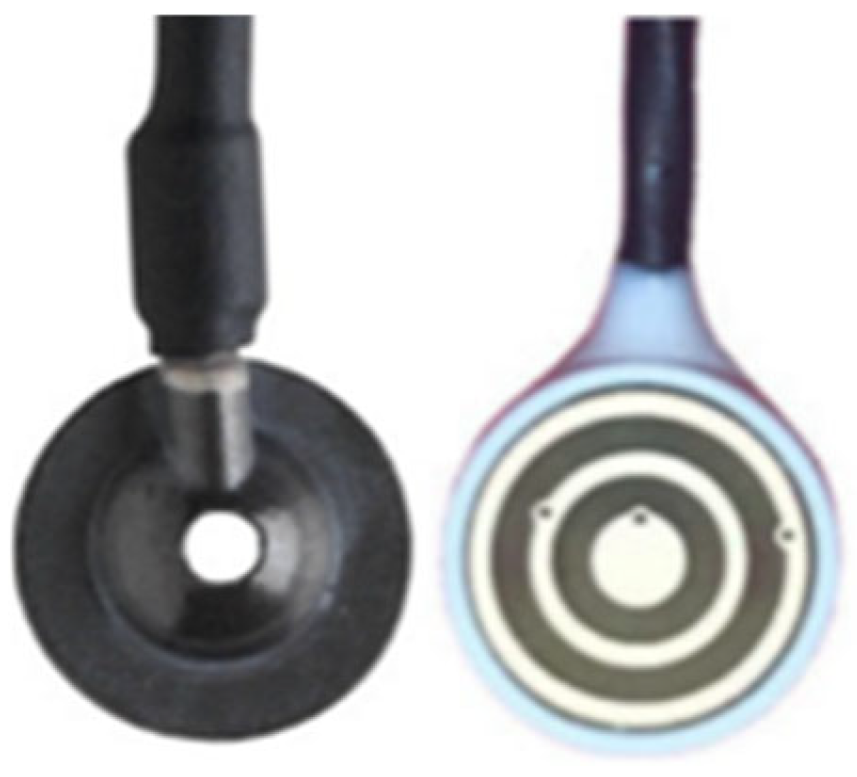
Signal processing methods have enhanced EEG signal recording quality, but remaining challenges exist [5]. Hardware innovations that incorporate unique electrode geometries for noise cancellation provide an alternative approach for improving mobile EEG signal recording quality. Dual-layer EEG was developed using two mechanically coupled, electrically isolated recording electrodes at each recording site [26]. Primary scalp EEG electrodes measure a mixture of brain activity and noise, while secondary electrodes measure isolated noise. Both electrodes experience equivalent motion artifact and environmental noise, allowing for spectral subtraction of noise components to produce clean EEG data. Dual-layer EEG has been rigorously validated using physical simulations to eliminate motion-induced artifacts and has been applied to isolate sensorimotor electrocortical activity during human walking and running [26,27]. Tripolar concentric ring electrodes offer an alternative recording geometry, consisting of three concentric rings on each electrode, enabling the calculation of a surface Laplacian that enhances the spatial selectivity at each EEG recording site (Figure 1) [28,29,30]. This approach calculates the second order derivative of voltages around nine points on the electrode, attenuating broadly distributed low-frequency signals and enhancing localized high-frequency signals in real-time [31]. The surface Laplacian method has been effective at eliminating electrical muscle activity from scalp EEG, but tripolar concentric electrodes have yet to be tested and validated in mobile conditions with unique and challenging artifact contamination [31].
Our objective was to evaluate the influence of tripolar concentric ring electrode geometry on EEG signal recording quality in the presence of gait-induced myoelectric artifacts. We extracted artificial brain signals contaminated by electrical muscle activity at amplitudes up to and exceeding typical amplitudes measured during human gait, using an electrical head phantom device. We evaluated signal recording quality by assessing spectral and spatial characteristics of ground-truth simulated brain activity based on neural spectral power peak detection, scalp map spatial entropy, and localization accuracy. We hypothesized that tripolar concentric ring electrode recordings would enhance neural signal recovery in the presence of electrical muscle artifacts compared to standard electrode recordings.

2. Materials and Methods

2.1. Experimental Setup

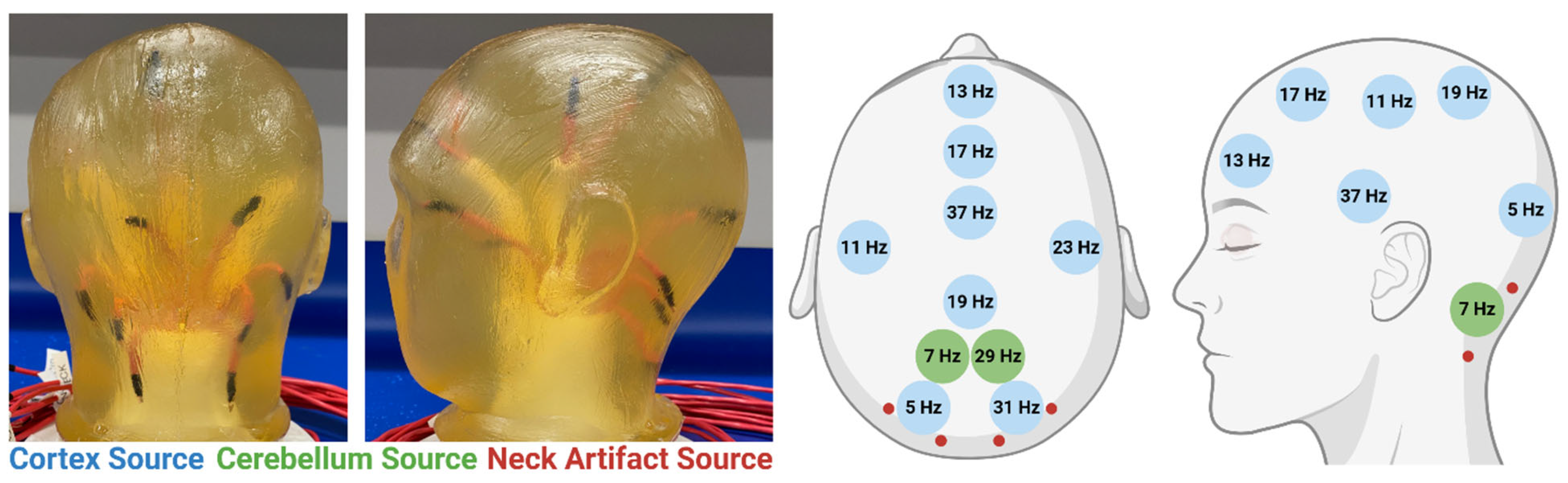
We constructed an electrical head phantom device using ballistics gelatin to mimic the electrical and mechanical properties of the human head [32,33,34,35,36]. The head model included fourteen dipolar sources, each consisting of exposed pairs of wire tips with approximately 2 mm of separation (Figure 2, Table 1). Ten simulated neural sources and four myoelectric broadcast sources were in, (1) left and (2) right occipital lobes, (3 and 4) sensorimotor cortices, and (5/6) cerebellum; (7) frontal and (8) parietal lobes, (9) premotor cortex, and (10) anterior cingulate gyrus; (1) left and (2) right sternocleidomastoids and (3 and 4) semispinalis capitis muscles. Broadcast sources were divided into left and right regions to reflect lateralized activation dynamics characteristic of human gait [37].
To generate realistic electrical neck muscle activity during walking, we recorded data from a healthy, young human male subject walking at comfortable walking speed, between 1 m/s and 1.6 m/s. Four bipolar surface EMG electrodes (Cometa Systems, Newburg, MO, USA) were placed on the left and right sternocleidomastoids and semispinalis capitis muscles to record neck muscle activity during walking. Electrical muscle activity was scaled below and exceeding normal physiological conditions to test the ability of tripolar concentric ring electrode cleaning to remove electrical noise contamination.
Custom MATLAB (MathWorks Inc., Natick, MA, USA) code was used to broadcast the neuromuscular signals from each antenna, using a National Instruments (Austin, TX, USA) compact DAQ and output modules (NI cDAQ-9178 and NI-9269, respectively). Simulated neural signals consisted of random, time-varying, single-frequency sinusoidal bursts at each antenna.
Frequencies within typical EEG spectral bands were selected at prime number values to avoid potential resonance frequencies appearing in the recorded signals (Figure 2, Table 1). We generated random bursts of simulated neural activity as single-frequency sinusoids in 0.5, 0.75, and 1 s segments. Electrical neck muscle activities were broadcast from the corresponding neck muscle antennae. Broadcast signal calibration was performed using a single conventional disk electrode placed on the head phantom surface to ensure that surface-level signal amplitudes were within realistic activation amplitudes (±25 µV brain and ±100 mV muscle). We placed the electrode directly over the broadcast antenna, recorded a 5 s burst of simulated neural activity for neural signal amplitude calibration, and recorded 30 s of raw electrical muscle activity. Broadcast amplitudes were individually scaled for each broadcast antenna to meet target activation amplitudes at the recording surface.

2.2. Protocol

We recorded 5 min of continuous EEG data in each of the six myoelectric amplitude conditions (0×, 0.5×, 0.67×, 1×, 1.5×, and 2× surface recording amplitude during walking). Broadcast signals were recorded from the surface of the head phantom using 60-tripolar concentric ring electrodes (CREmedical, Kingston, RI, USA). Electrode instrumentation followed a standard 64-channel, 10–20 system EEG layout, excluding electrodes 61–64. Conventional electrode FC4 was used as the reference electrode, and the ground electrode was placed on the base of the head phantom [38]. We secured each electrode to the head using conductive Ten20 electrode paste (Weaver and Co., Aurora, CO, USA). Tripolar concentric ring electrodes simultaneously recorded voltages from the single central disk, emulating a conventional disk electrode, and across each tripolar ring, enabling a direct comparison between simulated neuromuscular electrical signals recorded from disk electrodes and tripolar concentric ring electrodes. Simultaneous tripolar and monopolar recording captured 60 channels of tripolar concentric ring electrode EEG data and 59 channels of conventional electrode EEG data. Electrodes were routed into three CREmedical t-interface 20 v2.0 boards for pre-amplification and channel splitting into tripolar surface Laplacian and conventional central disk signals. Signals were transmitted through a Brain Products actiCHamp Plus amplifier (Brain Products, GmbH, Gilching, Germany) and recorded with Brain Vision Recorder (Brain Vision LLC, Morrisville, NC, USA).

2.3. Electroencephalography Processing

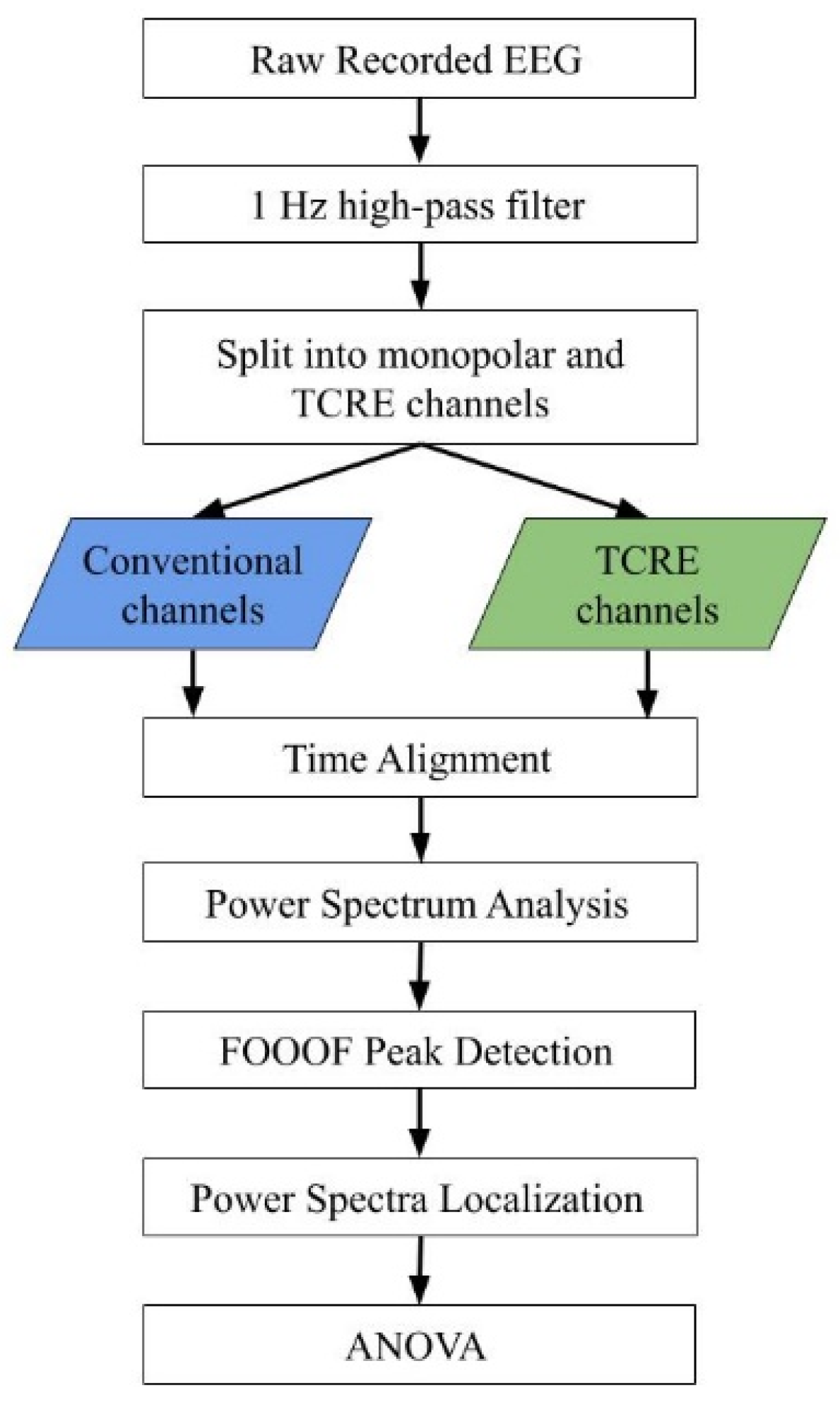
EEG recordings were processed offline using MATLAB 2019b, EEGLab toolbox, Python 3.10, and the Fitting Oscillations and One Over F (FOOOF) library version 1.0.0 [39,40]. A signal processing flowchart is shown in Figure 3. We applied EEGLab’s default 1 Hz high-pass filter to all channels, performed temporal synchronization between ground truth and EEG recordings, and separated and labeled the conventional disk and tripolar concentric ring electrode datasets. We performed spectral analyses using EEGLab’s spectopo function to identify individual frequency contribution to the overall power spectral density (PSD).
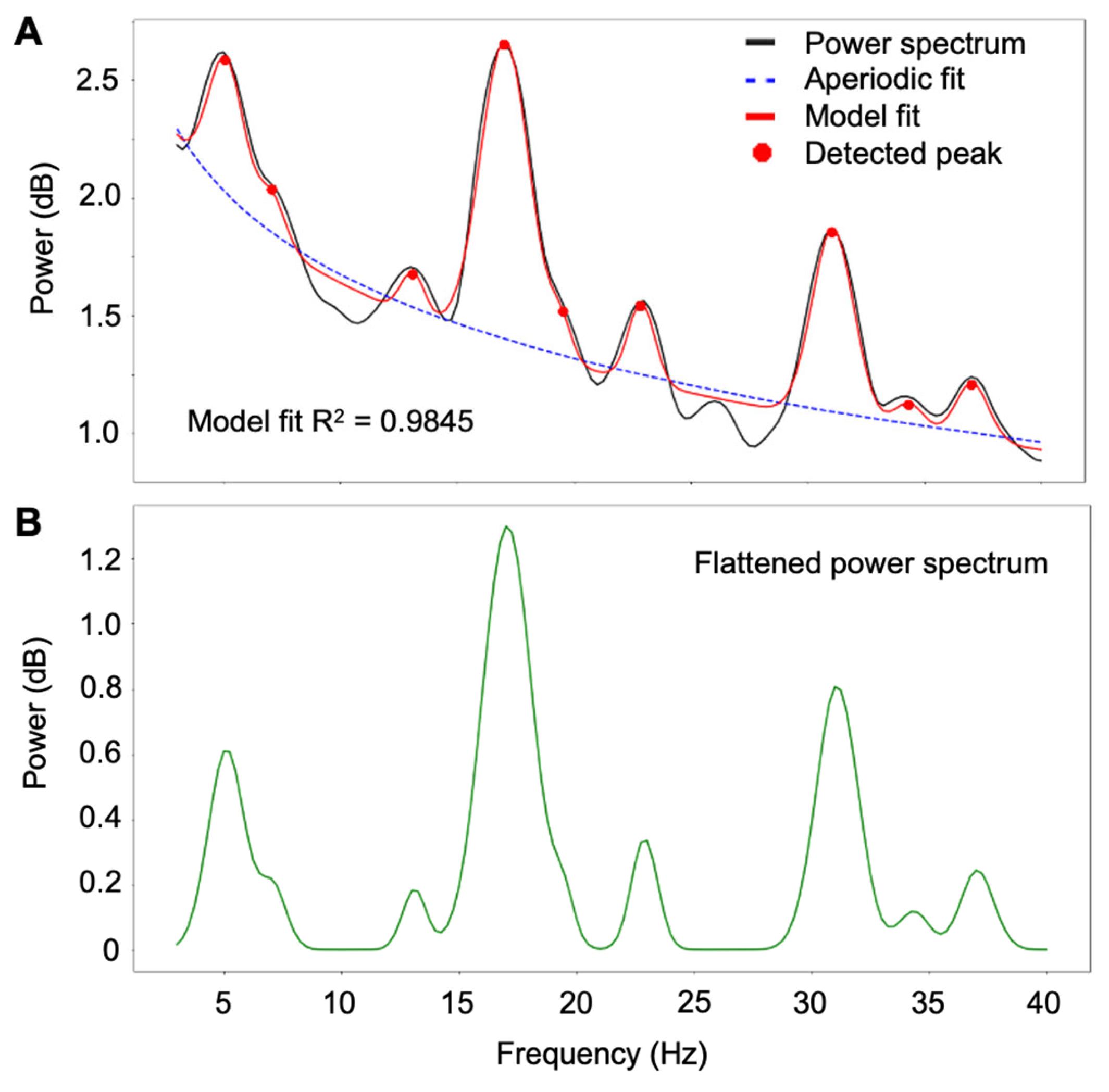
We used the FOOOF toolbox to remove aperiodic noise and identify statistically significant spectral power peaks from each EEG channel [41,42]. Aperiodic noise removal generated flattened power spectra (Figure 4). Model parameters were kept at default except for peak threshold (set to 1.85 standard deviations above aperiodic noise fit), and peak width limits (set to a 3 Hz maximum range) [43]. These changes were made to fit smaller amplitude power peaks and reduce overfitting in broader bandwidth power peaks, while maintaining statistical power. If the center frequency of a detected peak matched an input neural signal frequency, and the bandwidth of the detected peak included an input neural signal frequency, the detected peak was deemed to have matched an input neural signal. All statistically significant spectral power peaks were identified by FOOOF modeling, and R2 model fit correlation metrics were maintained above 0.85 for each electrode type and muscle artifact condition.

2.4. Source Signal Recovery Evaluation

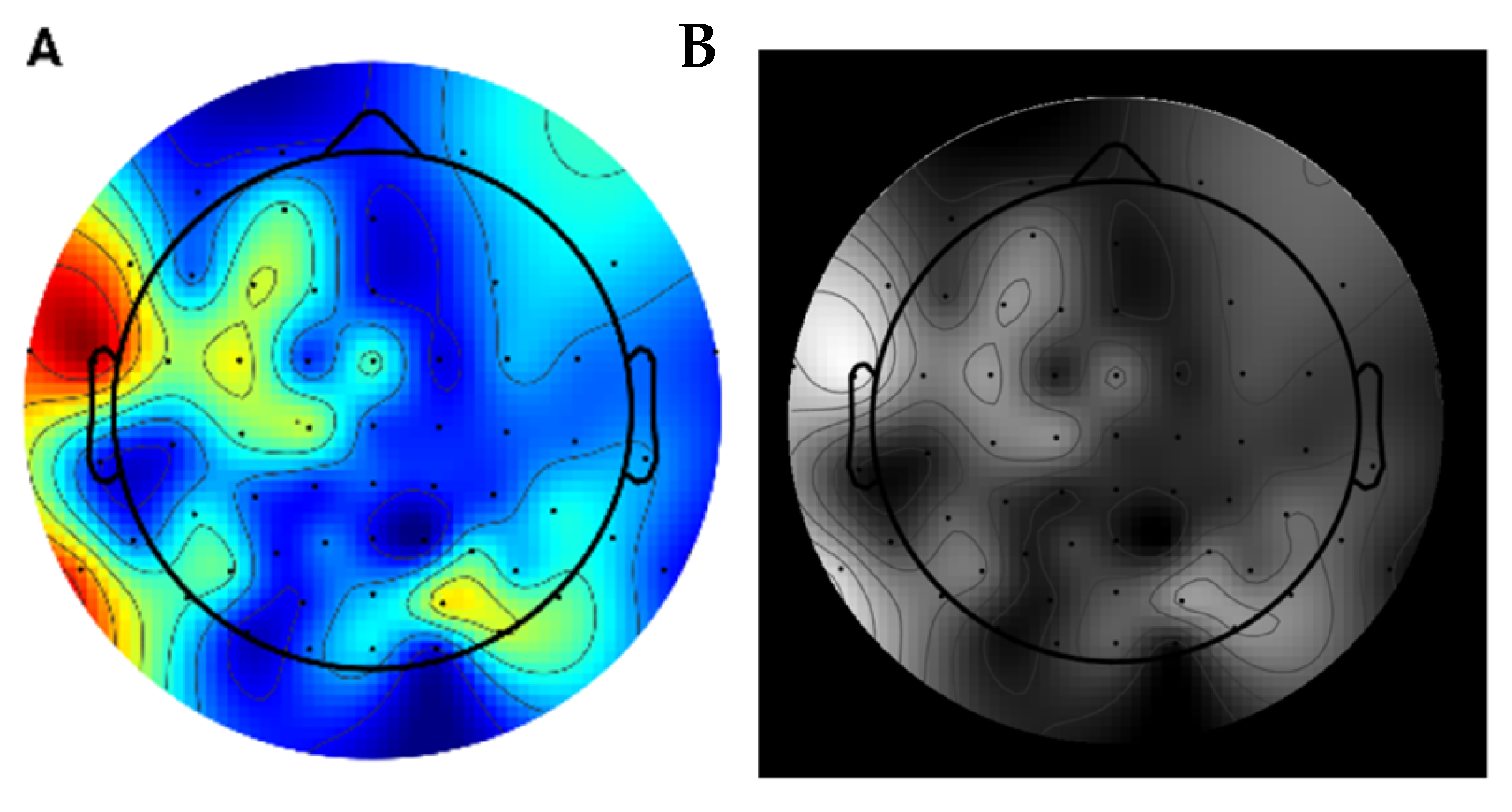
To evaluate spectral power peak detection among recording electrodes, we generated scalp maps from single frequency activity at each neural input frequency (5, 7, 11, 13, 17, 19, 23, 29, 31, and 37 Hz) using flattened power spectra from FOOOF and EEGLab’s topoplot function. We normalized power values at each input neural frequency from 0 to 1 among electrodes using MATLAB’s normalize function and used EEGLab’s topoplot function to generate colorized scalp map images using the normalized power spectra and 10–20 scalp electrode locations. Colorized scalp map images were converted to a 0–255 value grayscale image using MATLAB’s rgb2gray function, 0 indicating black and 255 indicating white for each pixel, as shown in Figure 5. Images were masked using createCirclesMask.m by assigning a 250-pixel radius around the center of each image, isolating the scalp map. Entropy was calculated using MATLAB’s entropy function to characterize the texture of the grayscale image. Greater image entropy values indicate greater image complexity, corresponding to more disorganized and broadly distributed neural signal frequency activation across the scalp map [44]. Lesser image entropy values indicate a more uniform image, corresponding to more localized neural signal activity.
To determine source signal localization spatial accuracy, we calculated a weighted average among channels that detected each neural input frequency. Spectral power peak amplitudes were identified from the flattened power spectra, normalizing the peak amplitude among electrode channels at each neural input frequency to 1. We then calculated the 3D weighted average (spectral power peak amplitude × 3D coordinate) and the resultant distance to the neural source location as a proportion of the head radius.
We separately performed two-way analysis of variance tests (α = 0.05) based on the number of spectral power peaks detected, number of channels detecting spectral power peaks, entropy results, and distance to source. Factors included electrode type and muscle artifact amplitude, with pairwise t-test comparisons and false discovery rate corrections.

3. Results

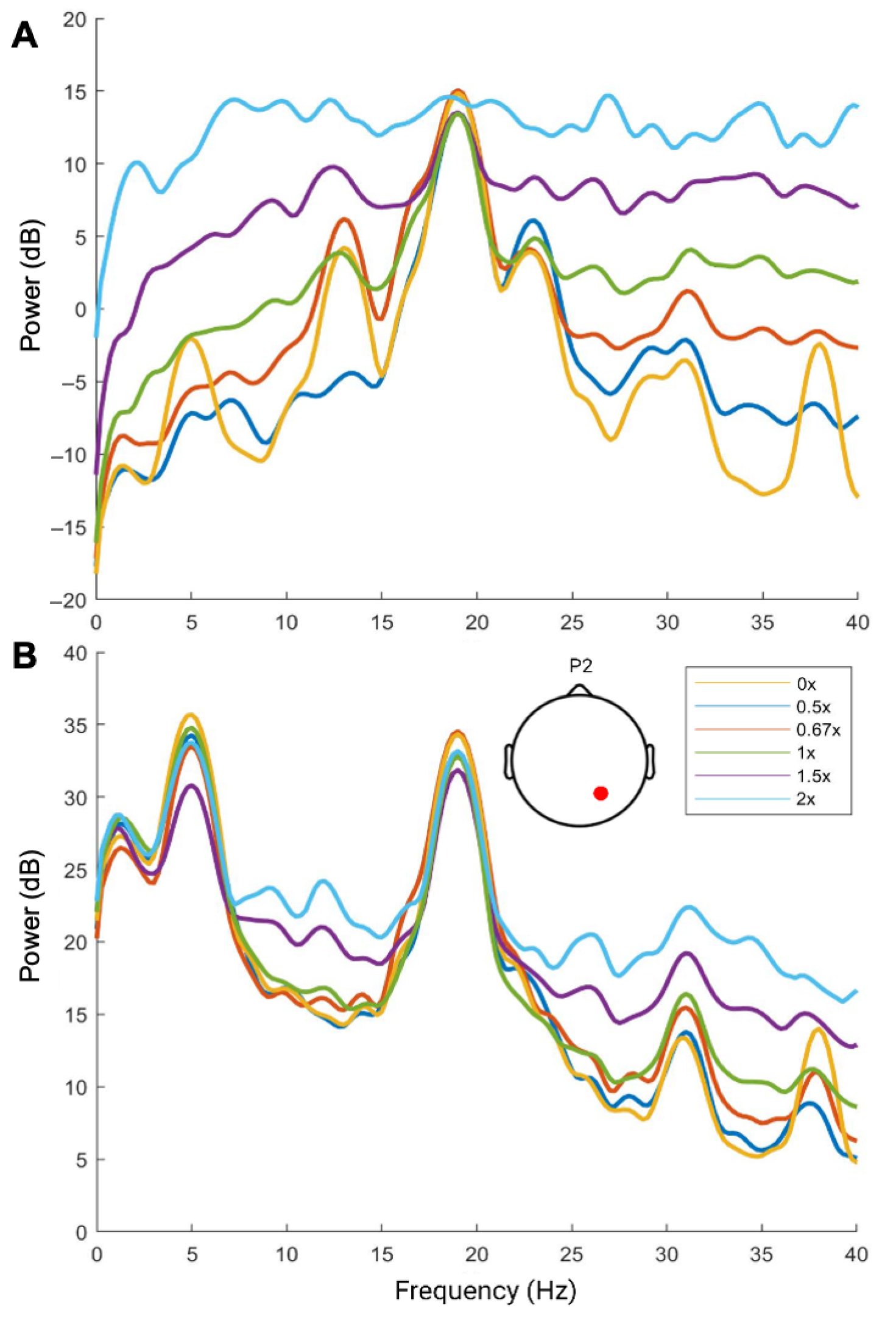
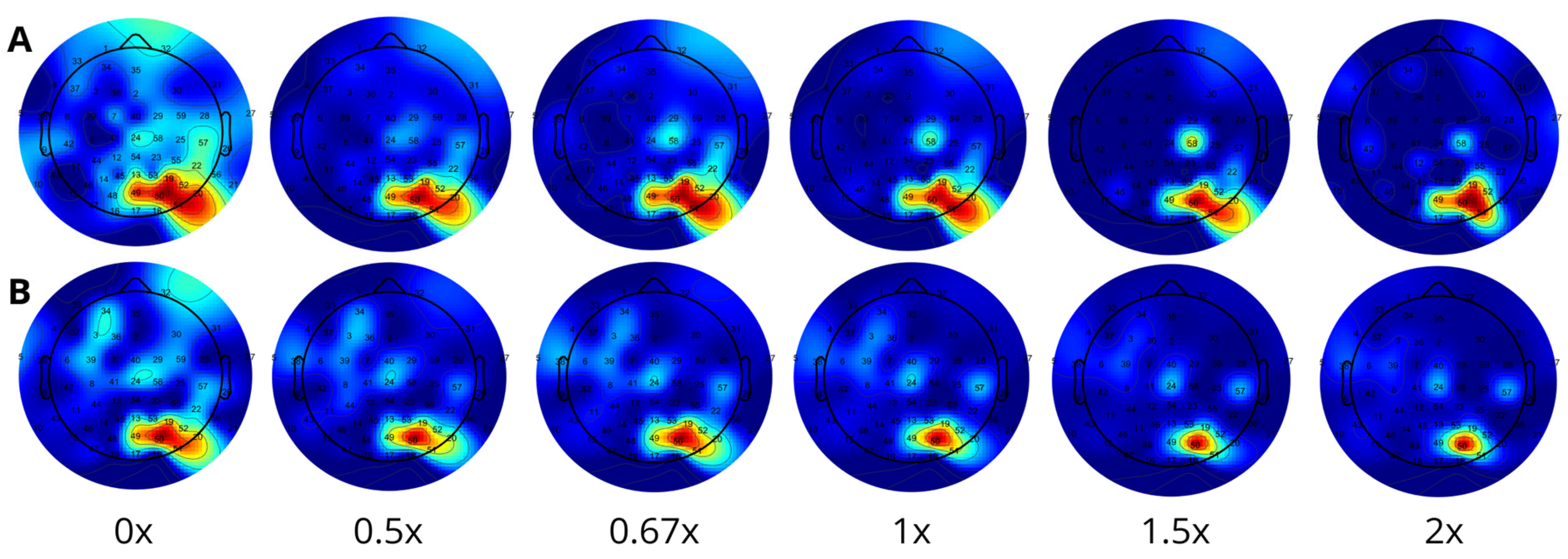
As muscle activation amplitude increased, spectral power broadly increased among conventional electrode recordings, capturing the broad spectral bandwidth of background electrical muscle activation (Figure 6A). Conventional electrode recordings lost identifiable neural power peaks as muscle artifact amplitudes increased, while tripolar concentric ring electrodes identified distinct spectral power peaks at the input neural frequencies regardless of muscle artifact amplitude (Figure 6B). Conventional electrode power spectra showed a greater number of neural signal peaks among electrode channels and poorer spatial selectivity (Figure 7A). Tripolar concentric ring electrode recordings recovered spectral power peaks matching local neural broadcast antennae frequencies, attenuating distant sources and muscle artifacts, with better localization (Figure 7B).

3.1. Spectral Power Peak Detection

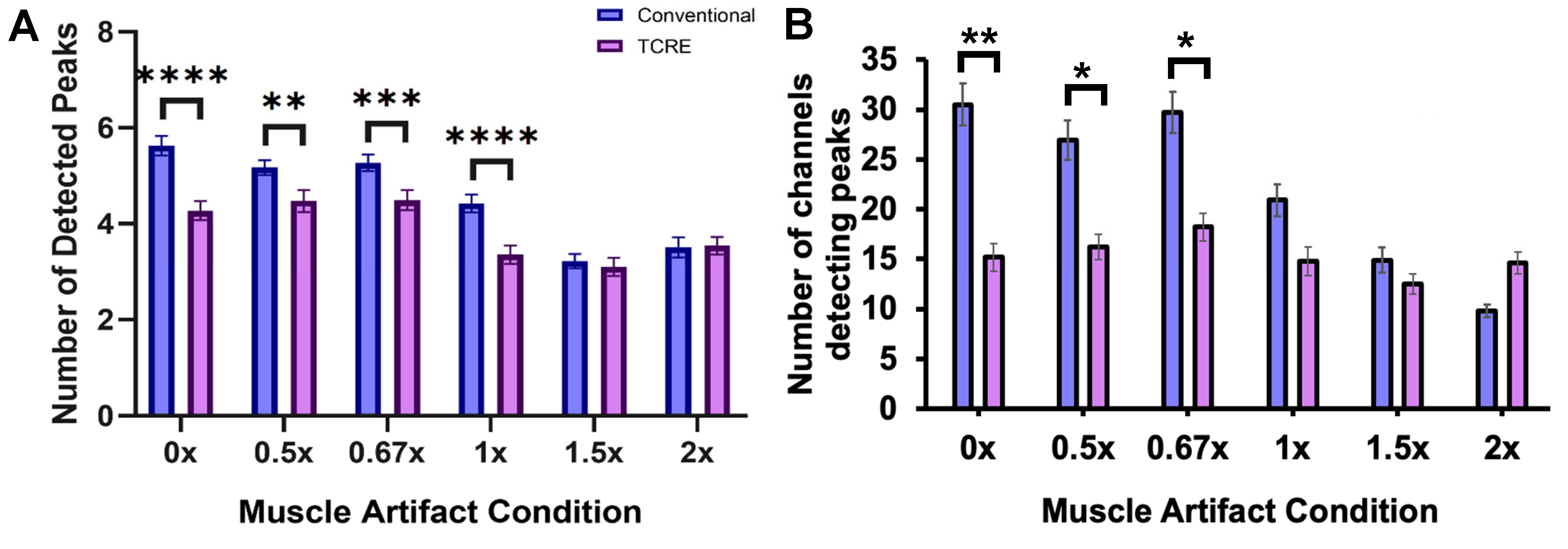
At greater muscle artifact amplitudes, fewer neural spectral power peaks were detected by both electrode types (Figure 8A, conventional: F5,45 = 43.1, p < 0.001, η2 = 0.43; tripolar: F5,45 = 13.5, p < 0.001, η2 = 0.19) and the number of conventional electrode channels detecting spectral power peaks decreased (Figure 8B, F5,45 = 4.8, p = 0.004, η2 = 0.35). Lesser than and equal to physiologically recorded muscle activation amplitudes (0–1×), conventional electrodes identified more spectral power peaks (Figure 8A) among more electrode channels compared to tripolar concentric ring electrodes (Figure 8B).

3.2. Spectral Power Scalp Map Localization

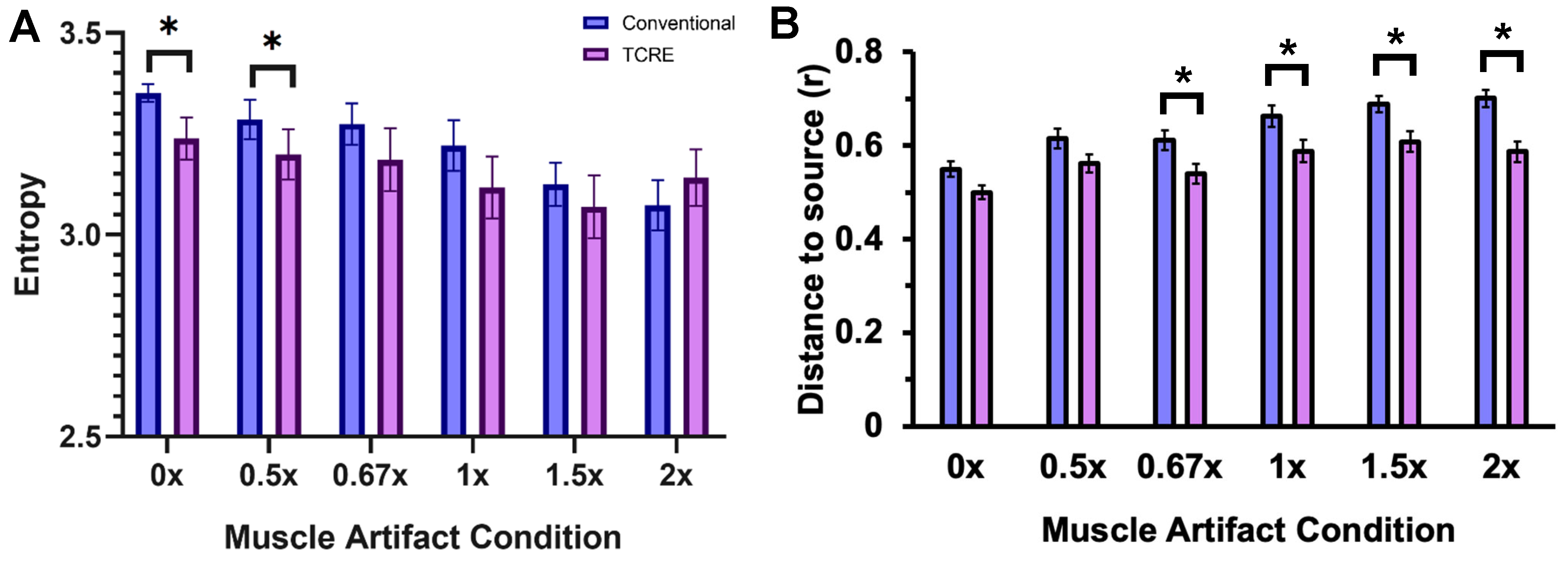
At greater muscle activation amplitudes, spectral power entropy decreased for both conventional and tripolar concentric ring electrode recordings (Figure 9A, conventional: F5,45 = 13.6, p < 0.001, η2 = 0.6; tripolar: F5,45 = 0.08, p = 0.006, η2 = 0.30), while conventional electrodes showed greater separation between electrode channels and detected neural sources (Figure 9B, F5,45 = 2.3, p < 0.05, η2 = 0.21). Compared to conventional electrodes, tripolar concentric ring electrodes showed lesser spectral power entropy without and at low myoelectric amplitude (0.5×) (Figure 9A, F1,9 = 10.3, p = 0.024, η2 = 0.67), and lesser distance between electrode channels and detected neural sources at greater myoelectric artifact amplitudes (≥0.67×, Figure 9B, F1,9 = 9.6, p = 0.01, η2 = 0.52).

4. Discussion

We evaluated tripolar concentric ring electrodes for neural signal recovery in the presence of gait-induced myoelectric artifacts by broadcasting ground-truth artificial brain signals and scaled human neck muscle activity from a head phantom device. Neural signal recovery was challenged by scaling neck muscle artifacts beyond normal physiological ranges. Artificial neural spectral power peak detection, image entropy of electrical activation scalp maps, and the proximity between channels and artificial neural sources were used to assess the spatial and spectral accuracy of EEG recording methods for neural source localization. Our results show the efficacy of tripolar concentric ring electrode recordings for gait-induced myoelectric artifact removal in conditions that are challenging for conventional EEG electrode methods.

4.1. Tripolar Concentric Ring Electrodes Improved Artificial Neural Signal Recovery

Tripolar concentric ring electrodes maintained artificial neural source recovery in the presence of myoelectric artifact contamination by attenuating distant electrical sources compared to conventional electrode recordings. These results align with previous studies showing the ability of tripolar concentric ring electrodes to enhance spatial resolution of neuroelectric activity, increasing local signal-to-noise ratio [31,45]. Because the surface Laplacian acquisition method inherently reduces common signals across electrode rings, voltage error is reduced and local signals are enhanced, leading to amplification of simulated neural sources directly beneath the electrode surface [31]. Tripolar concentric ring electrode recordings were robust to scaled neck muscle artifacts in capturing simulated neural signals, outperforming conventional electrodes for neural signal detection [46].
Compared to conventional electrode recordings, tripolar concentric electrode recordings showed narrowly distributed artificial neural activity from scalp maps, expressed by lesser entropy values and closer proximity between electrode channels and detected neural sources, in agreement with results from previous studies [45,47]. Tripolar concentric ring electrodes have removed real-time muscle artifacts in stationary EEG studies, but have not been tested against significantly higher amplitude and time-varying muscle artifacts that exist in mobile EEG studies [46,47]. Taken together, tripolar concentric ring electrodes were robust to muscle artifacts, amplifying local electrical activity, attenuating global electrical sources, and enhancing spatial localization of neural activity, showing promise for mobile EEG applications.
Software-based signal cleaning methods are necessary for interpreting electrical brain activity from EEG recordings, but many studies have shown that hardware and EEG system experimental setup are critical for collecting high-quality EEG data [14,24,48]. Signal cleaning beyond simple high-pass filtering has failed to show a significant impact on maximizing ERP significance [49]. The artifact subspace reconstruction algorithm is particularly effective for removing low-frequency, high-amplitude artifacts from EEG data collected during challenging real-world movements, but computational time remains a significant limitation [16]. Although adaptive mixture ICA signal decomposition has shown significant effects on improving decomposition quality in mobile experiments, the effects were not as great as expected [50]. Statistical decomposition also benefits from more recording channels to improve source separation, which is not always feasible in mobile EEG scenarios [24,51]. Software-based signal cleaning undoubtedly improves EEG data quality, but eliminating artifacts at the recording site reduces the burden on signal processing. Using computational methods in conjunction with EEG recordings from tripolar concentric ring electrodes provides new avenues for enhancing EEG data quality.

4.2. Limitations and Future Directions

Our electrical head phantom testbed allowed us to evaluate EEG recording hardware and signal cleaning methods for removing electrical muscle activation artifacts, but limitations still exist in this experimental setup. Although we included ten unique neural sources and four neck muscle artifact sources to act as a model for human neuromuscular activity during locomotion, this setup lacks the complexity of the human brain and additional noise sources. Increasingly complex phantom head models can be developed to include additional neuromuscular, ocular, cardiac, electrical, and motion artifacts, combined with more realistic artificial brain sources [32,35,52]. The head phantom was made of a homogenous material that did not include a skull, skin, or hair that affect electrocortical signal strength and neck muscle artifact propagation. Future phantom head design can include multiple material layers that more accurately represent the electromechanical properties of the human head. The electrical head phantom testbed has been configured to include motion-induced noise from cable sway and electrode-skin disruptions, which has yet to be tested on tripolar concentric ring electrodes [32,35,52].
Because neural signal frequency properties and source activity locations are often central to EEG interpretation [53], we focused our analysis on spectral power and spatial features to quantify signal quality. Spectral power changes provide biomarkers for nervous system functioning [53,54] and are generally more robust to noise artifacts that can be separated from aperiodic activity, leading to greater stability than raw temporal waveforms [54,55]. The effects of tripolar concentric ring electrode noise removal from temporal waveforms have shown reduced susceptibility to electrical noise, but alternative metrics may be considered when assessing noise removal from EEG waveforms [29,46].
Tripolar concentric ring electrodes more effectively isolated high-frequency neural signals compared to lower frequencies, acting as a high-pass spatial filter, in line with previous findings in epilepsy patients [28,56,57]. It is possible that low frequencies, especially the 5 Hz and 7 Hz neural signals, were over-filtered, resulting in poor localization. Flattened power spectra model parameters (FOOOF) could also have been tuned to enhance signal source recovery. To identify low-frequency activity more accurately, model parameters could be specifically tuned to isolate power peaks over a narrower frequency bandwidth. Decreasing the peak threshold standard deviation would improve spatial localization of low-frequency neural activity.
Although tripolar concentric ring electrodes showed enhanced neural signal recovery and localization during our physical simulations, remaining hardware limitations present challenges for mobile human testing. The CREmedical t-interface 20 data acquisition system currently requires wired connections to an external amplifier that are susceptible to cable sway artifacts and added bulk of the recording configuration.

5. Conclusions

We identified that tripolar concentric ring electrode recordings attenuated global electrical signals and gait-induced myoelectric artifacts to enhance neural signal recovery compared to conventional electrode recordings. Scalp topographies of neural activity showed that tripolar concentric ring electrodes identified specific locations of neural signal broadcasts, providing enhanced source localization. Applications of these methods during human gait can improve our understanding of supraspinal locomotor control in conditions and from brain regions that might otherwise remain unattainable.

Author Contributions

Conceptualization, A.D.N. and S.P.; methodology, A.D.N. and S.P.; formal analysis, S.P.; resources, A.D.N.; writing—original draft preparation, S.P.; writing—review and editing, A.D.N. and S.P.; visualization, S.P.; supervision, A.D.N.; funding acquisition, A.D.N. All authors have read and agreed to the published version of the manuscript.

Funding

This work was partially funded by the Texas A&M Innovation[X] program.

Institutional Review Board Statement

The study was conducted in accordance with the Declaration of Helsinki and approved by the Texas A&M University Institutional Review Board (protocol code 2021-1198 and date of approval 19 April 2022).

Informed Consent Statement

Informed consent was obtained from all subjects involved in the study.

Data Availability Statement

The raw data supporting the conclusions of this article will be made available by the authors on request.

Conflicts of Interest

The authors declare no conflicts of interest.

Abbreviations

The following abbreviations are used in this manuscript:
EEGElectroencephalography
FOOOFFitting Oscillations and One Over F

References

  1. Biondi, A.; Santoro, V.; Viana, P.F.; Laiou, P.; Pal, D.K.; Bruno, E.; Richardson, M.P. Noninvasive Mobile EEG as a Tool for Seizure Monitoring and Management: A Systematic Review. Epilepsia 2022, 63, 1041–1063. [Google Scholar] [CrossRef] [PubMed]
  2. Lau-Zhu, A.; Lau, M.P.H.; McLoughlin, G. Mobile EEG in Research on Neurodevelopmental Disorders: Opportunities and Challenges. Dev. Cogn. Neurosci. 2019, 36, 100635. [Google Scholar] [CrossRef] [PubMed]
  3. Buskila, Y.; Bellot-Saez, A.; Morley, J.W. Generating Brain Waves, the Power of Astrocytes. Front. Neurosci. 2019, 13, 1125. [Google Scholar] [CrossRef] [PubMed]
  4. Schlink, B.R.; Nordin, A.D.; Ferris, D.P. Comparison of Signal Processing Methods for Reducing Motion Artifacts in High-Density Electromyography During Human Locomotion. IEEE Open J. Eng. Med. Biol. 2020, 1, 156–165. [Google Scholar] [CrossRef]
  5. Urigüen, J.A.; Garcia-Zapirain, B. EEG Artifact Removal—State-of-the-Art and Guidelines. J. Neural Eng. 2015, 12, 031001. [Google Scholar] [CrossRef]
  6. Gwin, J.T.; Gramann, K.; Makeig, S.; Ferris, D.P. Electrocortical Activity Is Coupled to Gait Cycle Phase during Treadmill Walking. NeuroImage 2011, 54, 1289–1296. [Google Scholar] [CrossRef]
  7. Song, S.; Nordin, A.D. Mobile Electroencephalography for Studying Neural Control of Human Locomotion. Front. Hum. Neurosci. 2021, 15, 749017. [Google Scholar] [CrossRef]
  8. Goncharova, I.I.; McFarland, D.J.; Vaughan, T.M.; Wolpaw, J.R. EMG Contamination of EEG: Spectral and Topographical Characteristics. Clin. Neurophysiol. 2003, 114, 1580–1593. [Google Scholar] [CrossRef]
  9. Butkeviciute, E.; Bikulciene, L.; Sidekerskiene, T.; Blazauskas, T.; Maskeliunas, R.; Damasevicius, R.; Wei, W. Removal of Movement Artefact for Mobile EEG Analysis in Sports Exercises. IEEE Access 2019, 7, 7206–7217. [Google Scholar] [CrossRef]
  10. Kline, J.E.; Huang, H.J.; Snyder, K.L.; Ferris, D.P. Isolating Gait-Related Movement Artifacts in Electroencephalography during Human Walking. J. Neural Eng. 2015, 12, 046022. [Google Scholar] [CrossRef]
  11. Thompson, T.; Steffert, T.; Ros, T.; Leach, J.; Gruzelier, J. EEG Applications for Sport and Performance. Methods 2008, 45, 279–288. [Google Scholar] [CrossRef] [PubMed]
  12. Kristeva-Feige, R.; Fritsch, C.; Timmer, J.; Lücking, C.-H. Effects of Attention and Precision of Exerted Force on Beta Range EEG-EMG Synchronization during a Maintained Motor Contraction Task. Clin. Neurophysiol. 2002, 113, 124–131. [Google Scholar] [CrossRef] [PubMed]
  13. Jiang, X.; Bian, G.-B.; Tian, Z. Removal of Artifacts from EEG Signals: A Review. Sensors 2019, 19, 987. [Google Scholar] [CrossRef] [PubMed]
  14. Reis, P.M.R.; Hebenstreit, F.; Gabsteiger, F.; Von Tscharner, V.; Lochmann, M. Methodological Aspects of EEG and Body Dynamics Measurements during Motion. Front. Hum. Neurosci. 2014, 8, 156. [Google Scholar] [CrossRef]
  15. Miyakoshi, M. Artifact Subspace Reconstruction: A Candidate for a Dream Solution for EEG Studies, Sleep or Awake. Sleep 2023, 46, zsad241. [Google Scholar] [CrossRef]
  16. Kim, H.; Chang, C.-Y.; Kothe, C.; Iversen, J.R.; Miyakoshi, M. Juggler’s ASR: Unpacking the Principles of Artifact Subspace Reconstruction for Revision toward Extreme MoBI. J. Neurosci. Methods 2025, 420, 110465. [Google Scholar] [CrossRef]
  17. Chang, C.-Y.; Hsu, S.-H.; Pion-Tonachini, L.; Jung, T.-P. Evaluation of Artifact Subspace Reconstruction for Automatic Artifact Components Removal in Multi-Channel EEG Recordings. IEEE Trans. Biomed. Eng. 2020, 67, 1114–1121. [Google Scholar] [CrossRef]
  18. Mavros, P.; Wälti, M.J.; Nazemi, M.; Ong, C.H.; Hölscher, C. A Mobile EEG Study on the Psychophysiological Effects of Walking and Crowding in Indoor and Outdoor Urban Environments. Sci. Rep. 2022, 12, 18476. [Google Scholar] [CrossRef]
  19. Jacobsen, N.S.J.; Blum, S.; Witt, K.; Debener, S. A Walk in the Park? Characterizing Gait-related Artifacts in Mobile EEG Recordings. Eur. J. Neurosci. 2021, 54, 8421–8440. [Google Scholar] [CrossRef]
  20. Ledwidge, P.S.; McPherson, C.N.; Faulkenberg, L.; Morgan, A.; Baylis, G.C. A Comparison of Approaches for Motion Artifact Removal from Wireless Mobile EEG During Overground Running. Sensors 2025, 25, 4810. [Google Scholar] [CrossRef]
  21. Downey, R.J.; Ferris, D.P. iCanClean Removes Motion, Muscle, Eye, and Line-Noise Artifacts from Phantom EEG. Sensors 2023, 23, 8214. [Google Scholar] [CrossRef]
  22. Gonsisko, C.B.; Ferris, D.P.; Downey, R.J. iCanClean Improves Independent Component Analysis of Mobile Brain Imaging with EEG. Sensors 2023, 23, 928. [Google Scholar] [CrossRef]
  23. Salminen, J.; Liu, C.; Pliner, E.M.; Tenerowicz, M.; Roy, A.; Richer, N.; Hwang, J.; Hass, C.J.; Clark, D.J.; Seidler, R.D.; et al. Gait speed-related changes in electrocortical activity in younger and older adults. J. Neurophysiol. 2025, 133, 1761–1794. [Google Scholar] [CrossRef]
  24. Arpaia, P.; De Luca, M.; Di Marino, L.; Duran, D.; Gargiulo, L.; Lanteri, P.; Moccaldi, N.; Nalin, M.; Picciafuoco, M.; Robbio, R.; et al. A Systematic Review of Techniques for Artifact Detection and Artifact Category Identification in Electroencephalography from Wearable Devices. Sensors 2025, 25, 5770. [Google Scholar] [CrossRef]
  25. Raj, V.A.; Parupudi, T.; Thalengala, A.; Nayak, S.G. A Comprehensive Review of Deep Learning Models for Denoising EEG Signals: Challenges, Advances, and Future Directions. Discov. Appl. Sci. 2025, 7, 1268. [Google Scholar] [CrossRef]
  26. Nordin, A.D.; Hairston, W.D.; Ferris, D.P. Dual-Electrode Motion Artifact Cancellation for Mobile Electroencephalography. J. Neural Eng. 2018, 15, 056024. [Google Scholar] [CrossRef]
  27. Nordin, A.D.; Hairston, W.D.; Ferris, D.P. Human Electrocortical Dynamics While Stepping over Obstacles. Sci. Rep. 2019, 9, 4693. [Google Scholar] [CrossRef] [PubMed]
  28. Besio, W.G.; Cao, H.; Zhou, P. Application of Tripolar Concentric Electrodes and Prefeature Selection Algorithm for Brain–Computer Interface. IEEE Trans. Neural Syst. Rehabil. Eng. 2008, 16, 191–194. [Google Scholar] [CrossRef] [PubMed]
  29. Stuart, N.; Manners, J.; Kemps, E.; Nguyen, P.; Lechat, B.; Catcheside, P.; Scott, H. Tripolar Concentric Ring Electrodes for Capturing Localised Electroencephalography Signals during Sleep. J. Sleep Res. 2024, 33, e14203. [Google Scholar] [CrossRef] [PubMed]
  30. Wise, M.V.; Caplovitz, G.P.; Foster, G.; Crognale, M.A. Comparison of Tripolar and Traditional EEG Recording of the Visual Evoked Potential. Vis. Res. 2025, 230, 108594. [Google Scholar] [CrossRef]
  31. Besio, G.; Koka, K.; Aakula, R.; Dai, W. Tri-Polar Concentric Ring Electrode Development for Laplacian Electroencephalography. IEEE Trans. Biomed. Eng. 2006, 53, 926–933. [Google Scholar] [CrossRef]
  32. Richer, N.; Downey, R.J.; Hairston, W.D.; Ferris, D.P.; Nordin, A.D. Motion and Muscle Artifact Removal Validation Using an Electrical Head Phantom, Robotic Motion Platform, and Dual Layer Mobile EEG. IEEE Trans. Neural Syst. Rehabil. Eng. 2020, 28, 1825–1835. [Google Scholar] [CrossRef]
  33. Hairston, W.D.; Slipher, G.A.; Yu, A.B. Ballistic Gelatin as a Putative Substrate for EEG Phantom Devices. arXiv 2016, arXiv:1609.07691. [Google Scholar] [CrossRef]
  34. Richer, N.; Downey, R.J.; Nordin, A.D.; Hairston, W.D.; Ferris, D.P. Adding Neck Muscle Activity to a Head Phantom Device to Validate Mobile EEG Muscle and Motion Artifact Removal. In Proceedings of the 2019 9th International IEEE/EMBS Conference on Neural Engineering (NER), San Francisco, CA, USA, 20–23 March 2019; IEEE: New York, NY, USA; pp. 275–278. [Google Scholar]
  35. Symeonidou, E.-R.; Nordin, A.; Hairston, W.; Ferris, D. Effects of Cable Sway, Electrode Surface Area, and Electrode Mass on Electroencephalography Signal Quality during Motion. Sensors 2018, 18, 1073. [Google Scholar] [CrossRef]
  36. Yu, A.; Hairston, W. Open EEG Phantom. 2019. Available online: https://doi.org/10.17605/OSF.IO/QRKA2. (accessed on 12 November 2025). [CrossRef]
  37. Nordin, A.D.; Hairston, W.D.; Ferris, D.P. Faster Gait Speeds Reduce Alpha and Beta EEG Spectral Power From Human Sensorimotor Cortex. IEEE Trans. Biomed. Eng. 2020, 67, 842–853. [Google Scholar] [CrossRef] [PubMed]
  38. Schlink, B.R.; Ferris, D.P. A Lower Limb Phantom for Simulation and Assessment of Electromyography Technology. IEEE Trans. Neural Syst. Rehabil. Eng. 2019, 27, 2378–2385. [Google Scholar] [CrossRef] [PubMed]
  39. Delorme, A.; Makeig, S. EEGLAB: An Open Source Toolbox for Analysis of Single-Trial EEG Dynamics Including Independent Component Analysis. J. Neurosci. Methods 2004, 134, 9–21. [Google Scholar] [CrossRef] [PubMed]
  40. Gerster, M.; Waterstraat, G.; Litvak, V.; Lehnertz, K.; Schnitzler, A.; Florin, E.; Curio, G.; Nikulin, V. Separating Neural Oscillations from Aperiodic 1/f Activity: Challenges and Recommendations. Neuroinformatics 2022, 20, 991–1012. [Google Scholar] [CrossRef]
  41. Donoghue, T.; Haller, M.; Peterson, E.J.; Varma, P.; Sebastian, P.; Gao, R.; Noto, T.; Lara, A.H.; Wallis, J.D.; Knight, R.T.; et al. Parameterizing Neural Power Spectra into Periodic and Aperiodic Components. Nat. Neurosci. 2020, 23, 1655–1665. [Google Scholar] [CrossRef]
  42. Pathania, A.; Schreiber, M.; Miller, M.W.; Euler, M.J.; Lohse, K.R. Exploring the Reliability and Sensitivity of the EEG Power Spectrum as a Biomarker. Int. J. Psychophysiol. 2021, 160, 18–27. [Google Scholar] [CrossRef]
  43. Levin, A.R.; Naples, A.J.; Scheffler, A.W.; Webb, S.J.; Shic, F.; Sugar, C.A.; Murias, M.; Bernier, R.A.; Chawarska, K.; Dawson, G.; et al. Day-to-Day Test-Retest Reliability of EEG Profiles in Children With Autism Spectrum Disorder and Typical Development. Front. Integr. Neurosci. 2020, 14, 21. [Google Scholar] [CrossRef]
  44. Schlink, B.R.; Nordin, A.D.; Ferris, D.P. Human Myoelectric Spatial Patterns Differ among Lower Limb Muscles and Locomotion Speeds. Physiol. Rep. 2020, 8, e14652. [Google Scholar] [CrossRef] [PubMed]
  45. Koka, K.; Besio, W.G. Improvement of Spatial Selectivity and Decrease of Mutual Information of Tri-Polar Concentric Ring Electrodes. J. Neurosci. Methods 2007, 165, 216–222. [Google Scholar] [CrossRef] [PubMed]
  46. Aghaei-Lasboo, A.; Inoyama, K.; Fogarty, A.S.; Kuo, J.; Meador, K.J.; Walter, J.J.; Le, S.T.; Graber, K.D.; Razavi, B.; Fisher, R.S. Tripolar Concentric EEG Electrodes Reduce Noise. Clin. Neurophysiol. 2020, 131, 193–198. [Google Scholar] [CrossRef] [PubMed]
  47. Liu, X.; Makeyev, O.; Besio, W. Improved Spatial Resolution of Electroencephalogram Using Tripolar Concentric Ring Electrode Sensors. J. Sens. 2020, 2020, 6269394. [Google Scholar] [CrossRef]
  48. Melnik, A.; Legkov, P.; Izdebski, K.; Kärcher, S.M.; Hairston, W.D.; Ferris, D.P.; König, P. Systems, Subjects, Sessions: To What Extent Do These Factors Influence EEG Data? Front. Hum. Neurosci. 2017, 11, 150. [Google Scholar] [CrossRef]
  49. Delorme, A. EEG Is Better Left Alone. Sci. Rep. 2023, 13, 2372. [Google Scholar] [CrossRef]
  50. Klug, M.; Berg, T.; Gramann, K. Optimizing EEG ICA Decomposition with Data Cleaning in Stationary and Mobile Experiments. Sci. Rep. 2024, 14, 14119. [Google Scholar] [CrossRef]
  51. Klug, M.; Gramann, K. Identifying Key Factors for Improving ICA-based Decomposition of EEG Data in Mobile and Stationary Experiments. Eur. J. Neurosci. 2021, 54, 8406–8420. [Google Scholar] [CrossRef]
  52. Mathewson, K.E.; Harrison, T.J.L.; Kizuk, S.A.D. High and Dry? Comparing Active Dry EEG Electrodes to Active and Passive Wet Electrodes. Psychophysiology 2017, 54, 74–82. [Google Scholar] [CrossRef]
  53. Ng, M.C.; Jing, J.; Westover, M.B. A Primer on EEG Spectrograms. J. Clin. Neurophysiol. 2022, 39, 177–183. [Google Scholar] [CrossRef] [PubMed]
  54. Pani, S.M.; Saba, L.; Fraschini, M. Clinical Applications of EEG Power Spectra Aperiodic Component Analysis: A Mini-Review. Clin. Neurophysiol. 2022, 143, 1–13. [Google Scholar] [CrossRef]
  55. Melman, T.; Victor, J.D. Robust Power Spectral Estimation for EEG Data. J. Neurosci. Methods 2016, 268, 14–22. [Google Scholar] [CrossRef][Green Version]
  56. Toole, C.; Martinez-Juárez, I.E.; Gaitanis, J.N.; Blum, A.; Sunderam, S.; Ding, L.; DiCecco, J.; Besio, W.G. Source Localization of High-Frequency Activity in Tripolar Electroencephalography of Patients with Epilepsy. Epilepsy Behav. 2019, 101, 106519. [Google Scholar] [CrossRef]
  57. He, B. Brain Electric Source Imaging: Scalp Laplacian Mapping and Cortical Imaging. Crit. Rev. Biomed. Eng. 1999, 27, 149–188. [Google Scholar]
Figure 1. Comparison of conventional and tripolar concentric ring electrodes.
Applsci 15 12103 g001
Figure 2. Head phantom testbed with anatomical broadcast sources and frequencies.
Applsci 15 12103 g002
Figure 3. EEG processing flowchart.
Applsci 15 12103 g003
Figure 4. Model fit for single electrode power spectral density with returned statistics. (A) Original power spectrum with initial model fit, power peaks, and aperiodic noise. (B) Flattened power spectrum.
Applsci 15 12103 g004
Figure 5. Scalp map from 2× muscle amplitude, 7 Hz neural frequency tripolar concentric ring electrode. (A) Color scalp map. (B) Grayscale image.
Applsci 15 12103 g005
Figure 6. Exemplar power spectral densities from (A) conventional and (B) tripolar concentric ring electrode parietal 2 (P2) in each muscle condition. P2 electrode is located nearest the 19 and 31 Hz neural input antenna.
Applsci 15 12103 g006
Figure 7. Exemplar scalp maps of 31 Hz neural activity during each muscle artifact amplitude condition for (A) conventional and (B) tripolar concentric ring electrode recordings.
Applsci 15 12103 g007
Figure 8. (A) Number of neural input spectral power peaks detected for each electrode type. Averaged among electrodes and neural input frequencies. (B) Number of channels detecting neural input spectral power peaks for each electrode type. Averaged among neural input frequencies. (* is p < 0.05, ** is p < 0.01, *** is p < 0.001, **** is p < 0.0001).
Applsci 15 12103 g008
Figure 9. (A) Spectral power scalp map entropy values for each electrode type and muscle amplitude condition. Averaged among electrodes and neural input frequencies. Lesser entropy is lesser spatial homogeneity and greater source localization. (B) Normalized distance between the weighted average among electrode channels that detected each neural input frequency and the source location (proportion of head radius). Averaged among electrodes and neural input frequencies (* is p < 0.05).
Applsci 15 12103 g009
Table 1. Anatomical antenna location and corresponding broadcast frequency for each artificial neural source.
Anatomic LocationFrequency (Hz)
Left Occipital Lobe5
Left Cerebellar Hemisphere7
Left Sensorimotor Cortex11
Frontal Lobe13
Premotor Cortex17
Parietal Lobe19
Right Sensorimotor Cortex23
Right Cerebellar Hemisphere29
Right Occipital Lobe31
Anterior Cingulate Gyrus37
Disclaimer/Publisher’s Note: The statements, opinions and data contained in all publications are solely those of the individual author(s) and contributor(s) and not of MDPI and/or the editor(s). MDPI and/or the editor(s) disclaim responsibility for any injury to people or property resulting from any ideas, methods, instructions or products referred to in the content.