


High-Resolution Seismic Susceptibility Assessment Integrating Vulnerability and Exposure Indicators: Application to Seoul


Abstract
1. Introduction
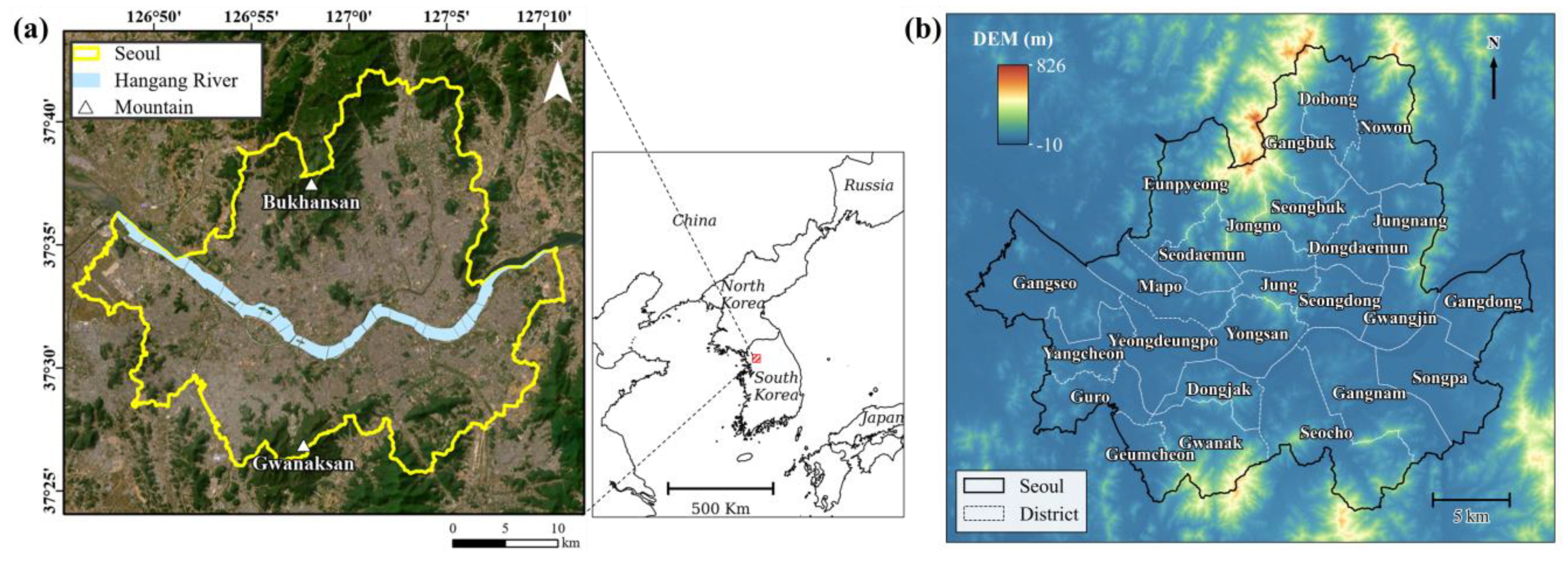
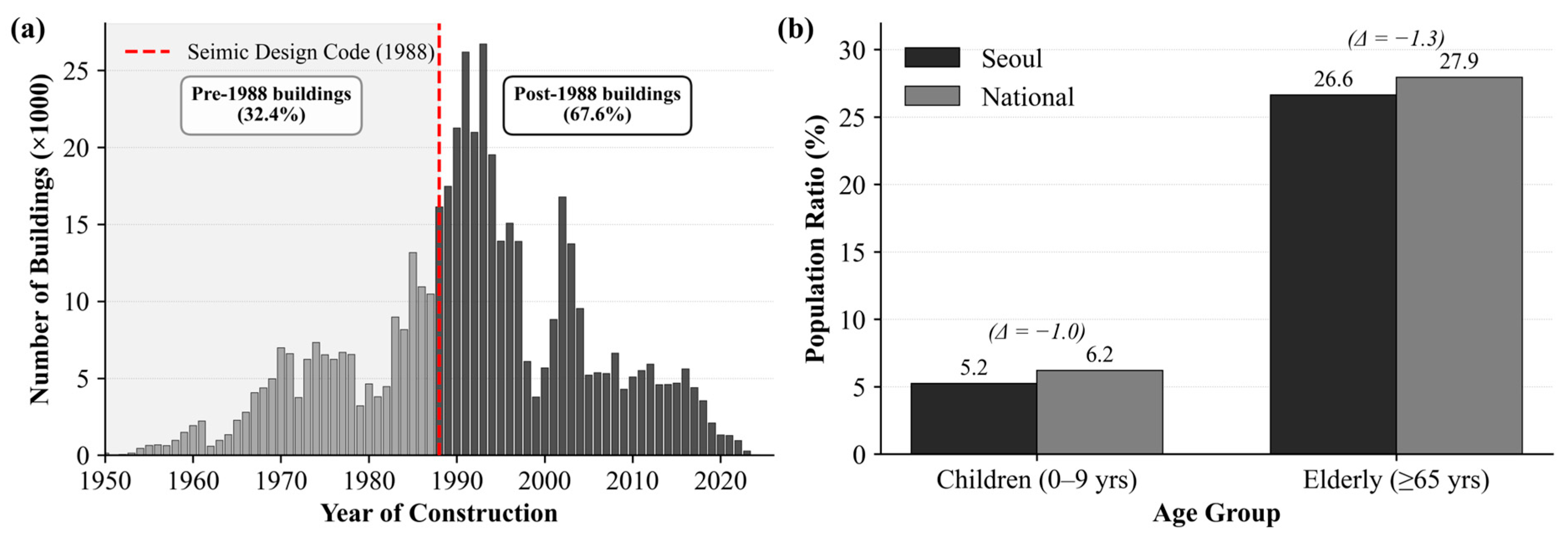
2. Study Area
3. Methodology
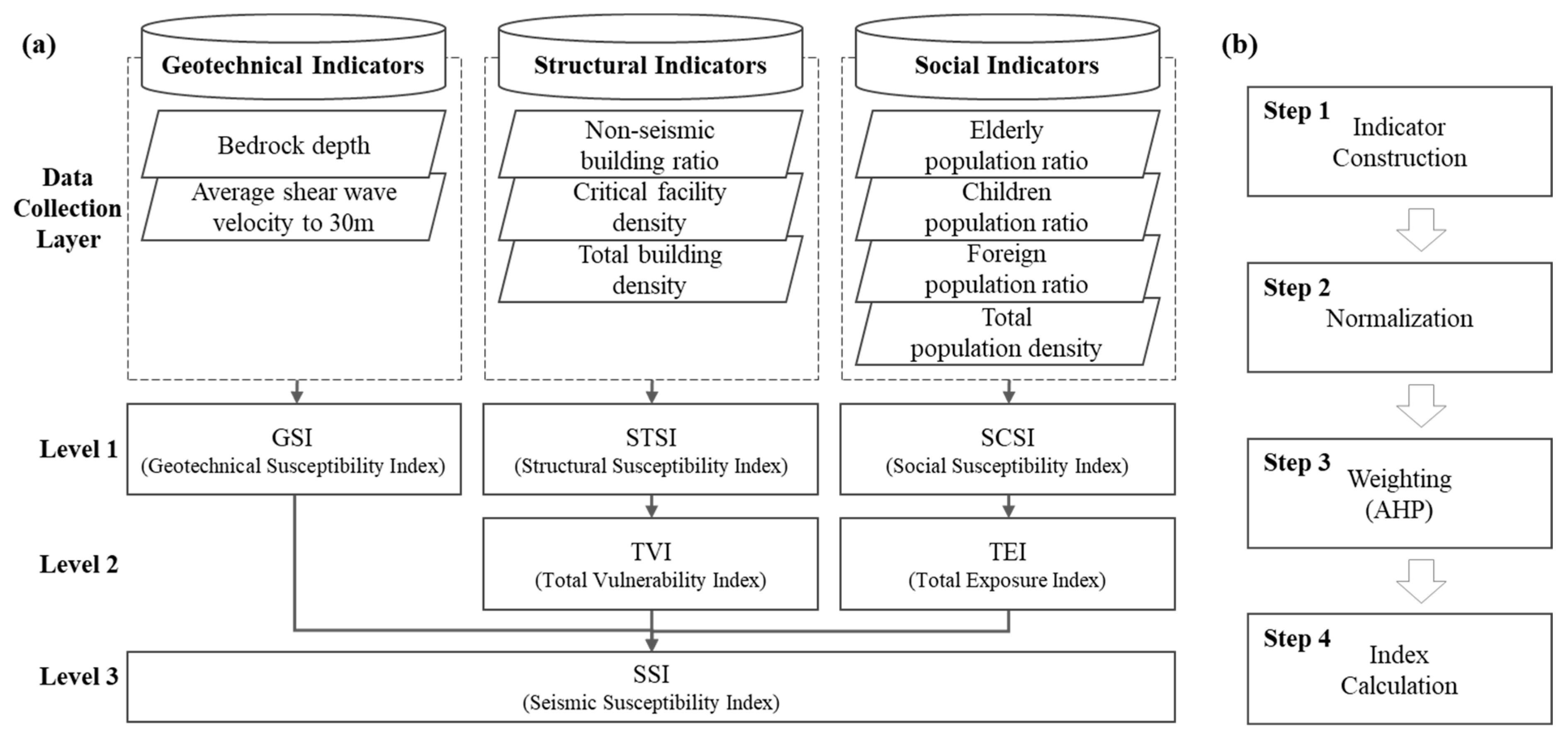
3.1. Multi-Level Seismic Susceptibility Assessment Framework
3.2. Indicators and Data
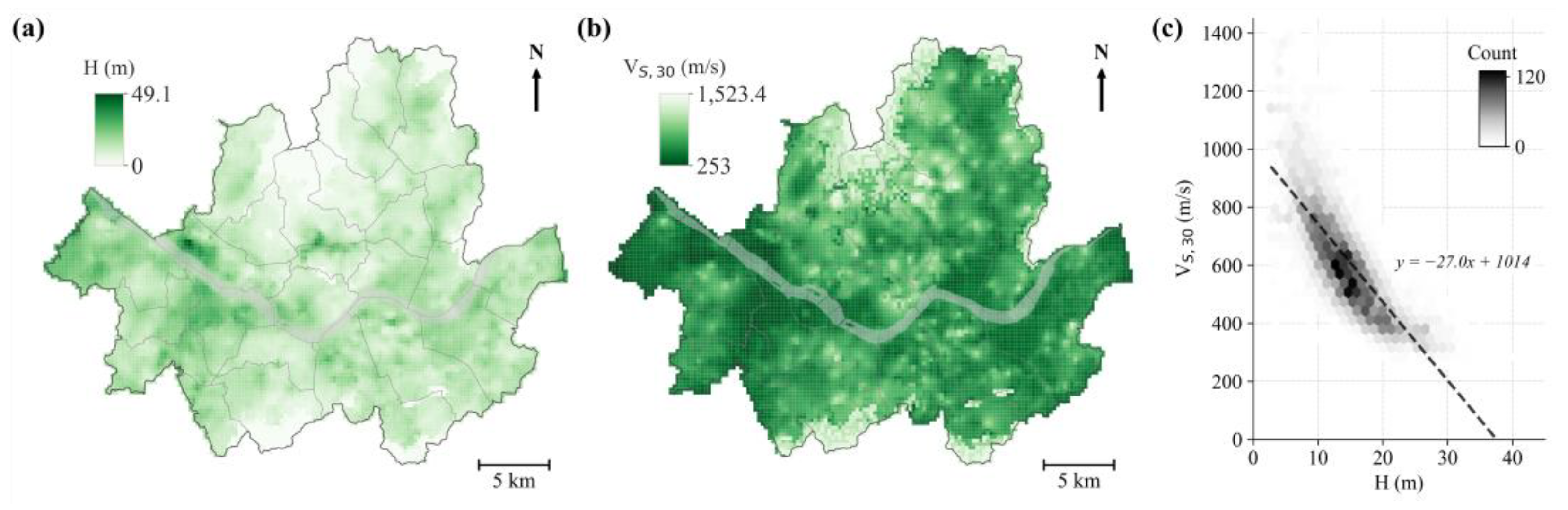
3.2.1. Geotechnical Indicators
3.2.2. Structural Indicators
3.2.3. Social Indicators
3.3. Analytic Hierarchy Process-Based Weighting
3.4. Susceptibility Index Calculation
4. Results
4.1. Spatial Patterns of Component Indices
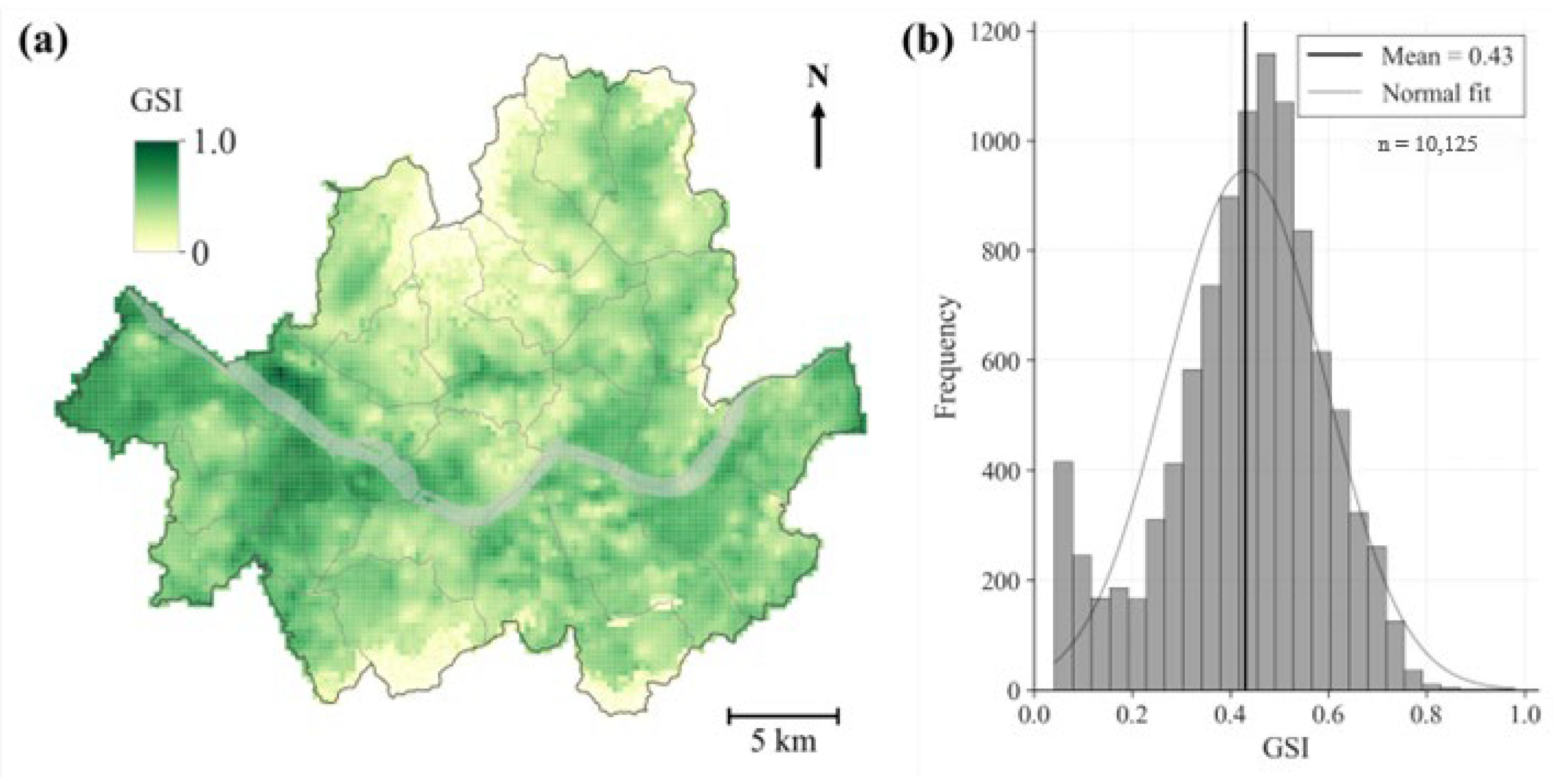
4.1.1. Geotechnical Susceptibility Index
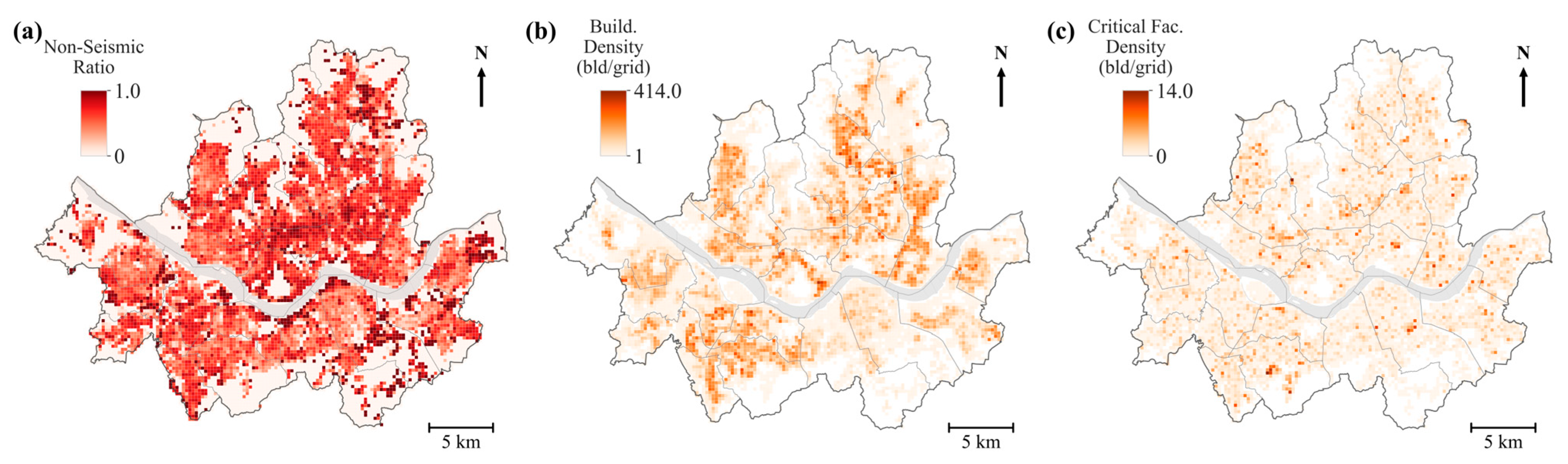
4.1.2. Structural Susceptibility Index
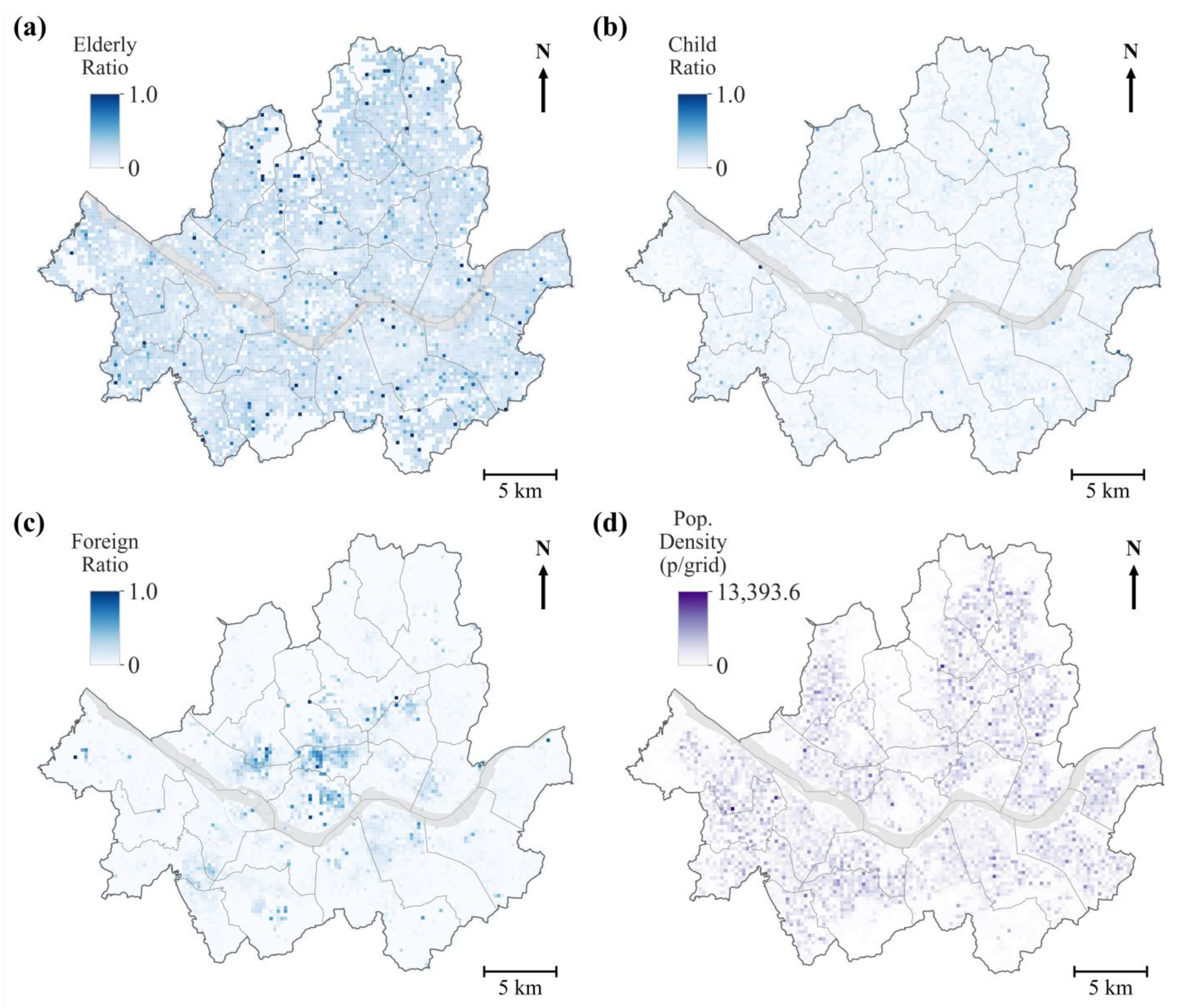
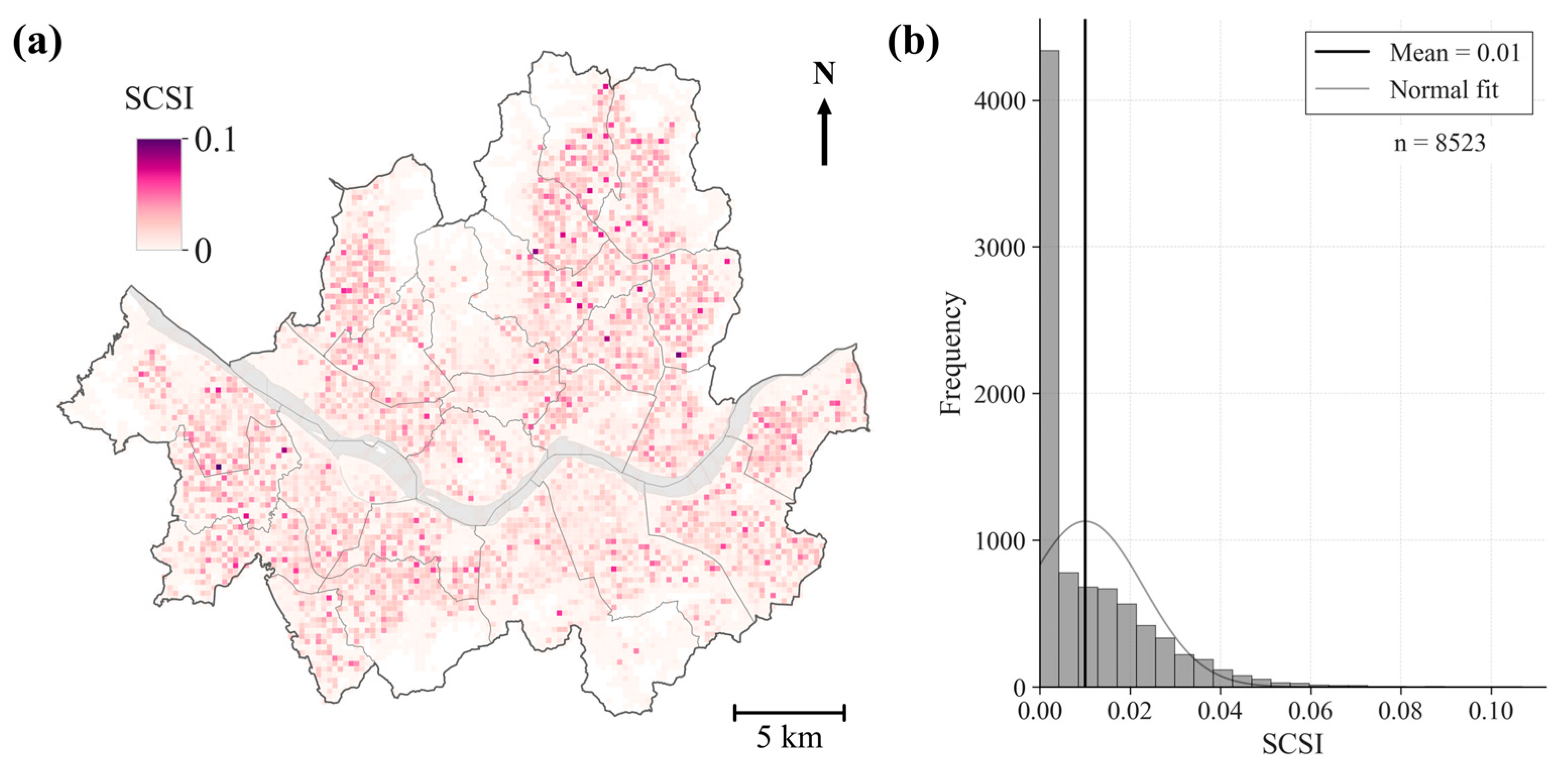
4.1.3. Social Susceptibility Index
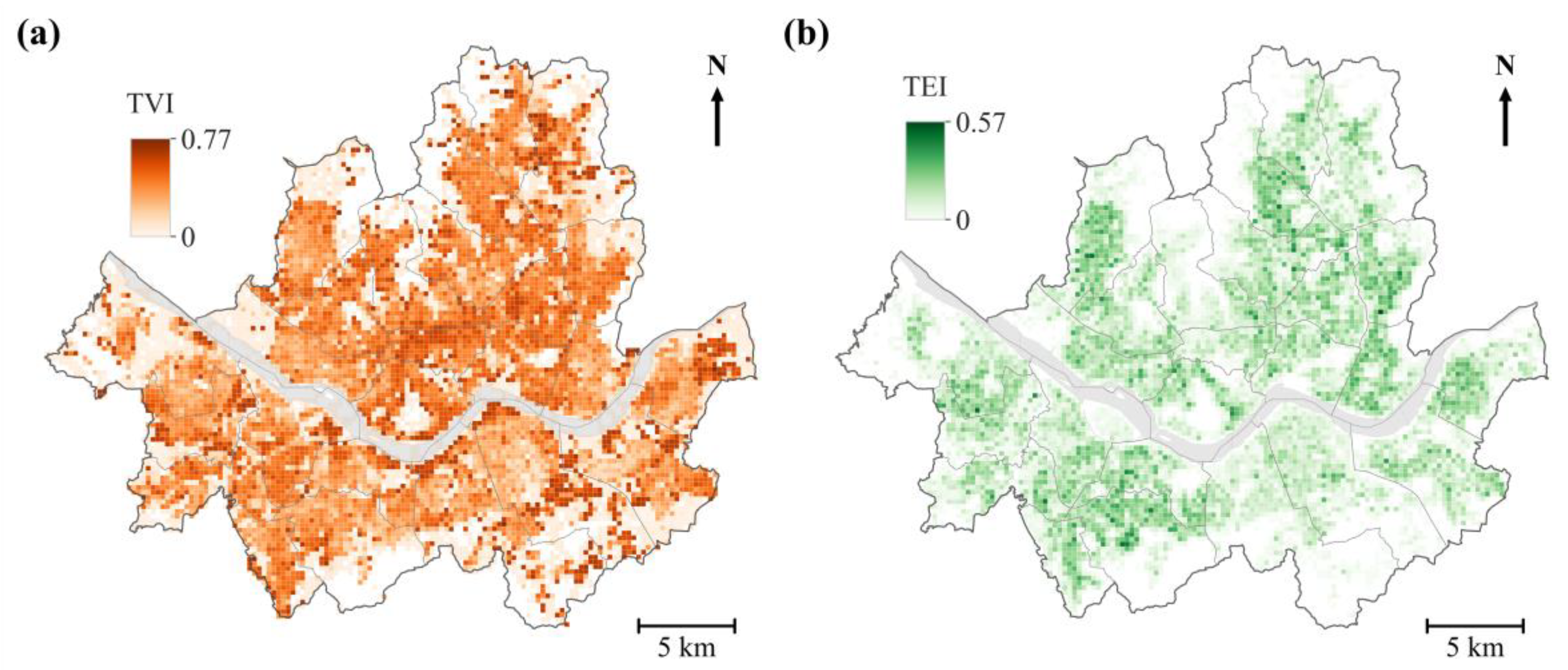
4.1.4. Total Vulnerability and Exposure Indices
4.2. Identification of Seismic Hotspots
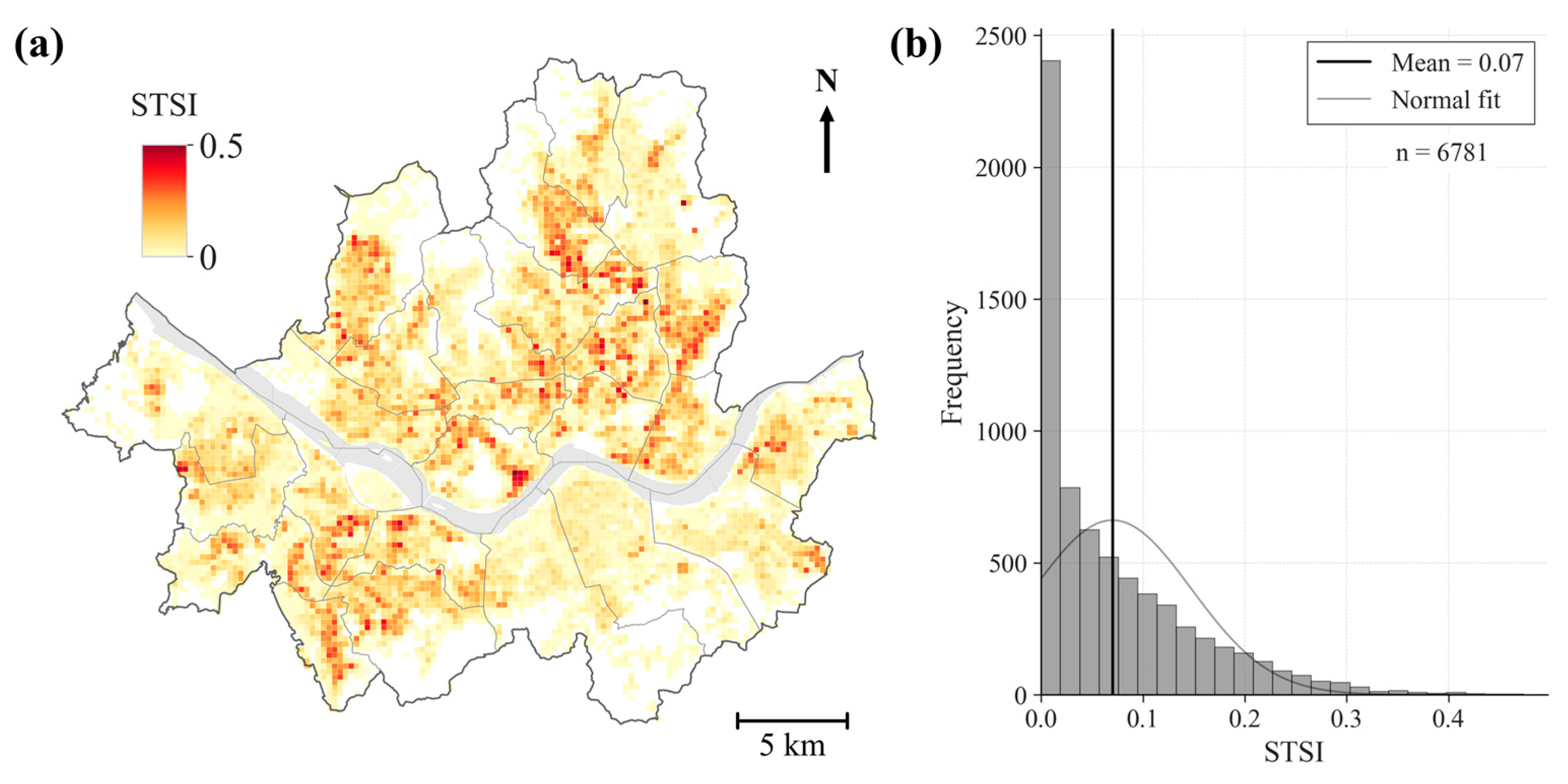
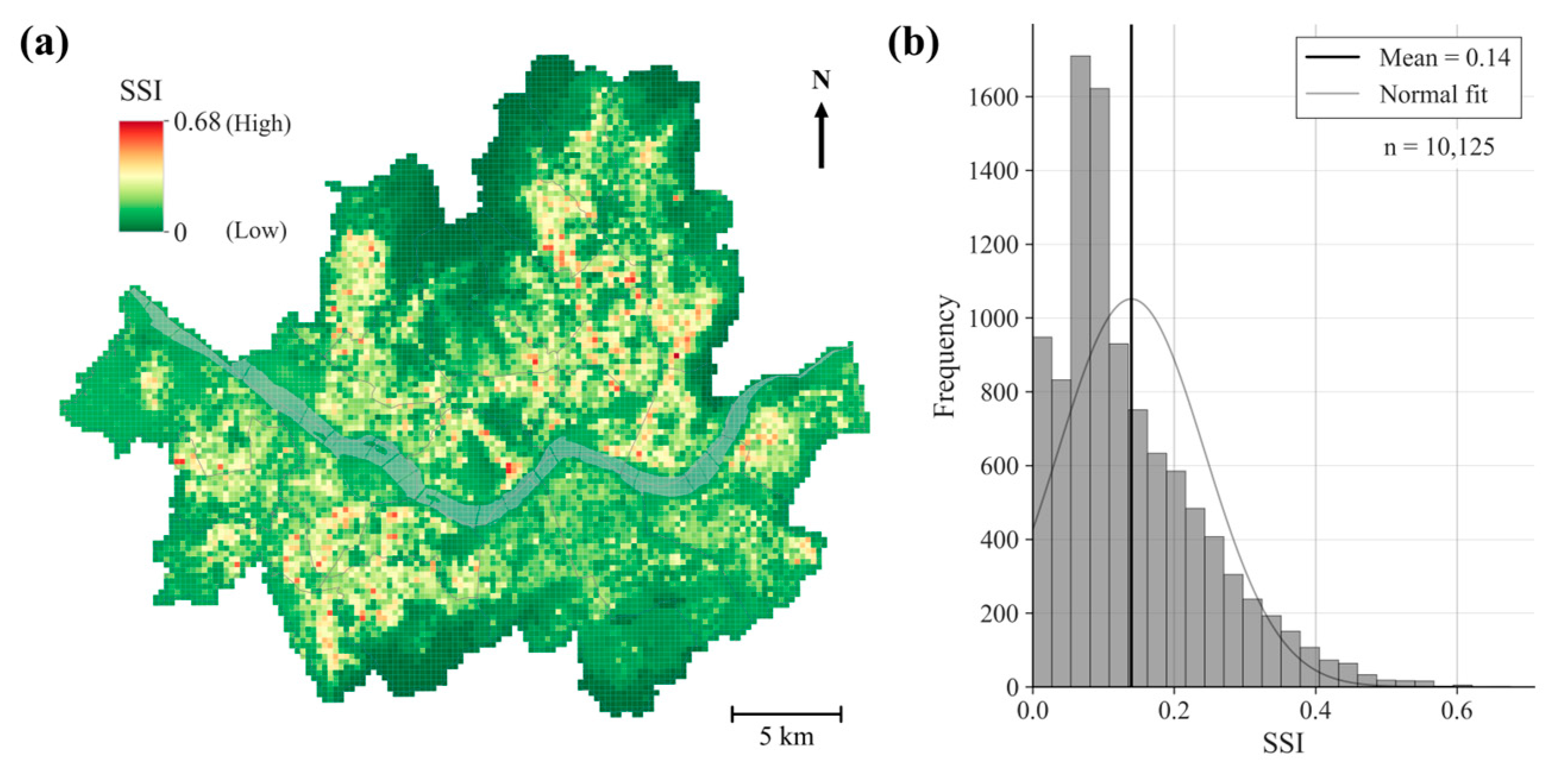
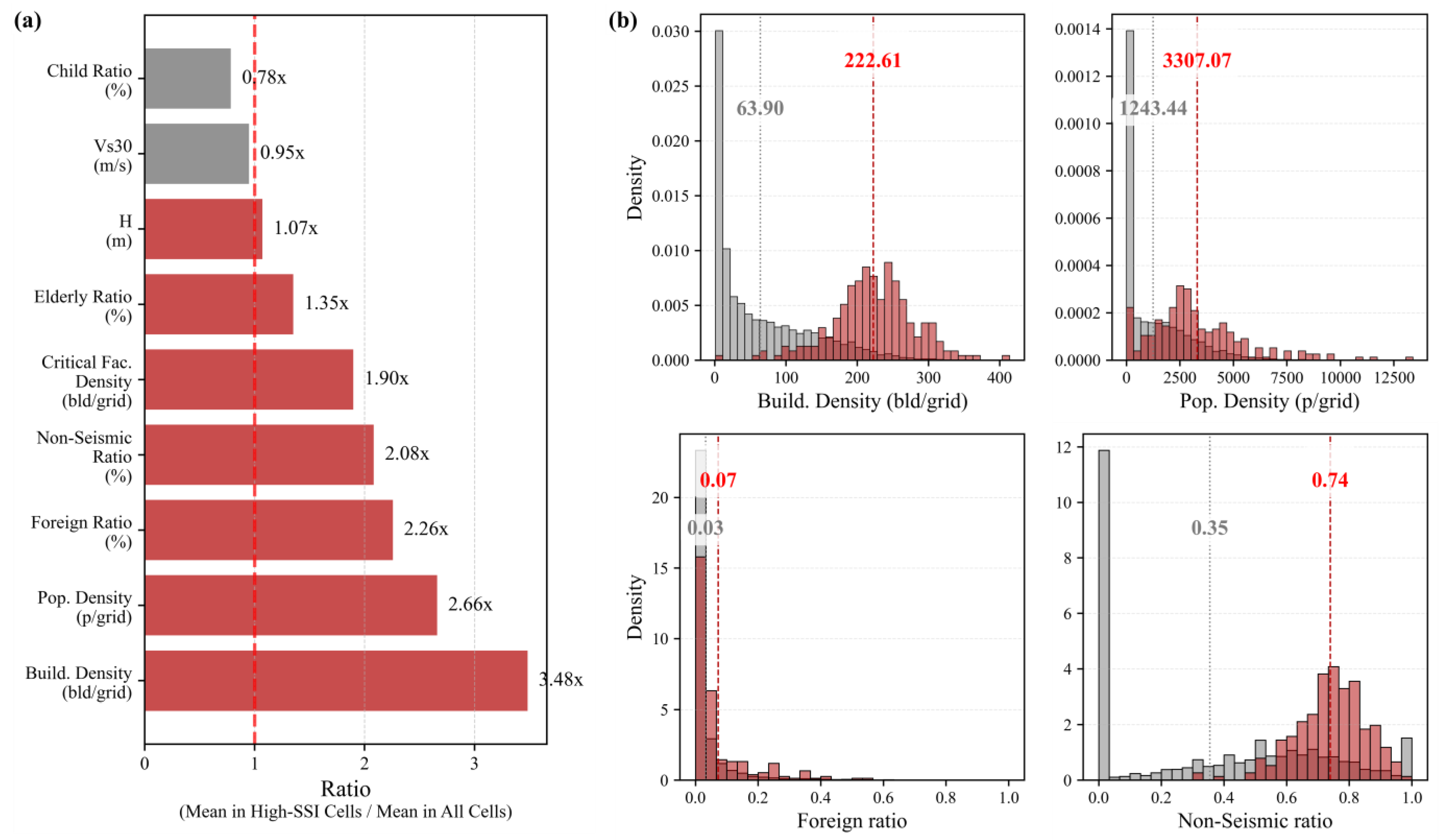
4.2.1. Spatial and Statistical Distribution Characteristics
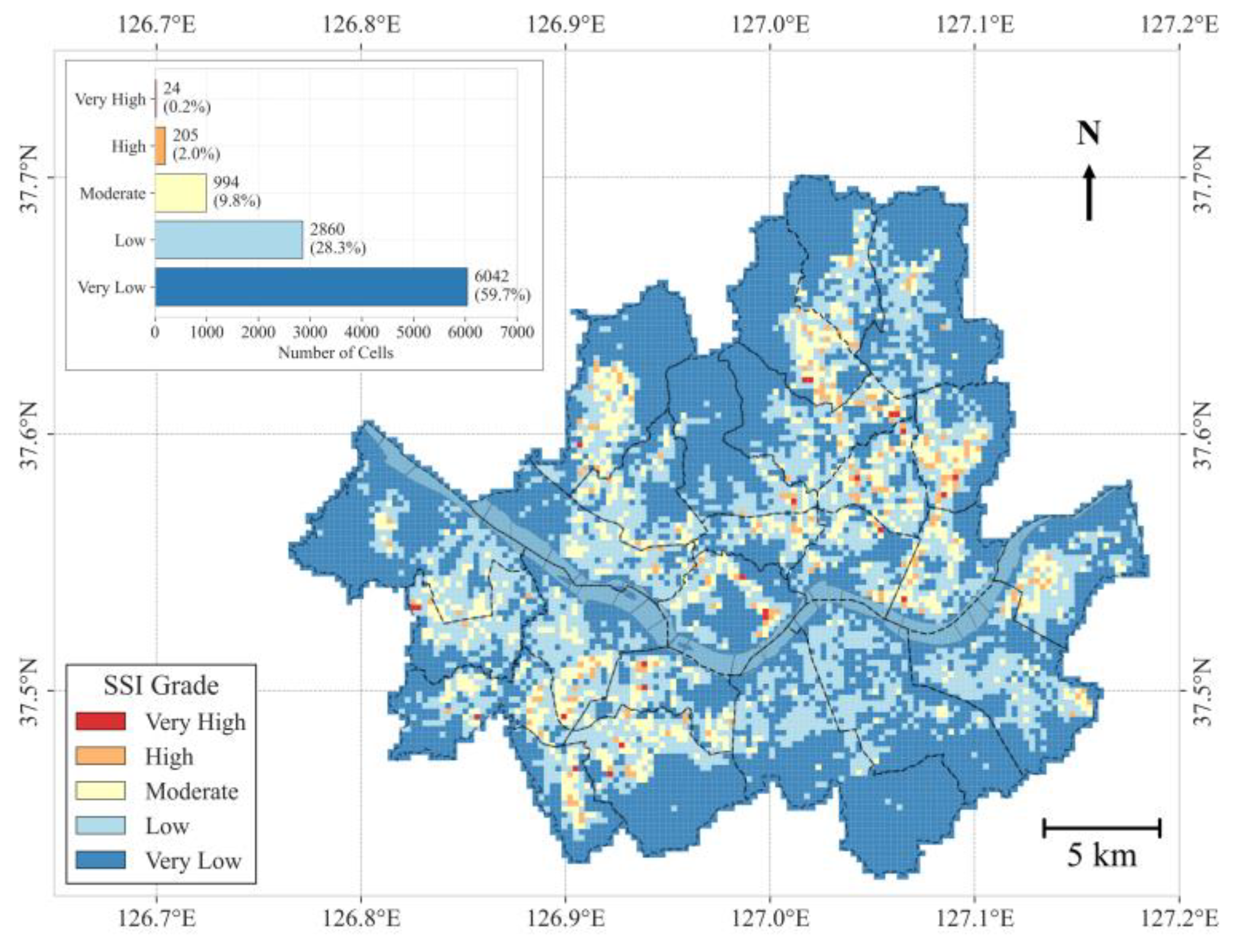
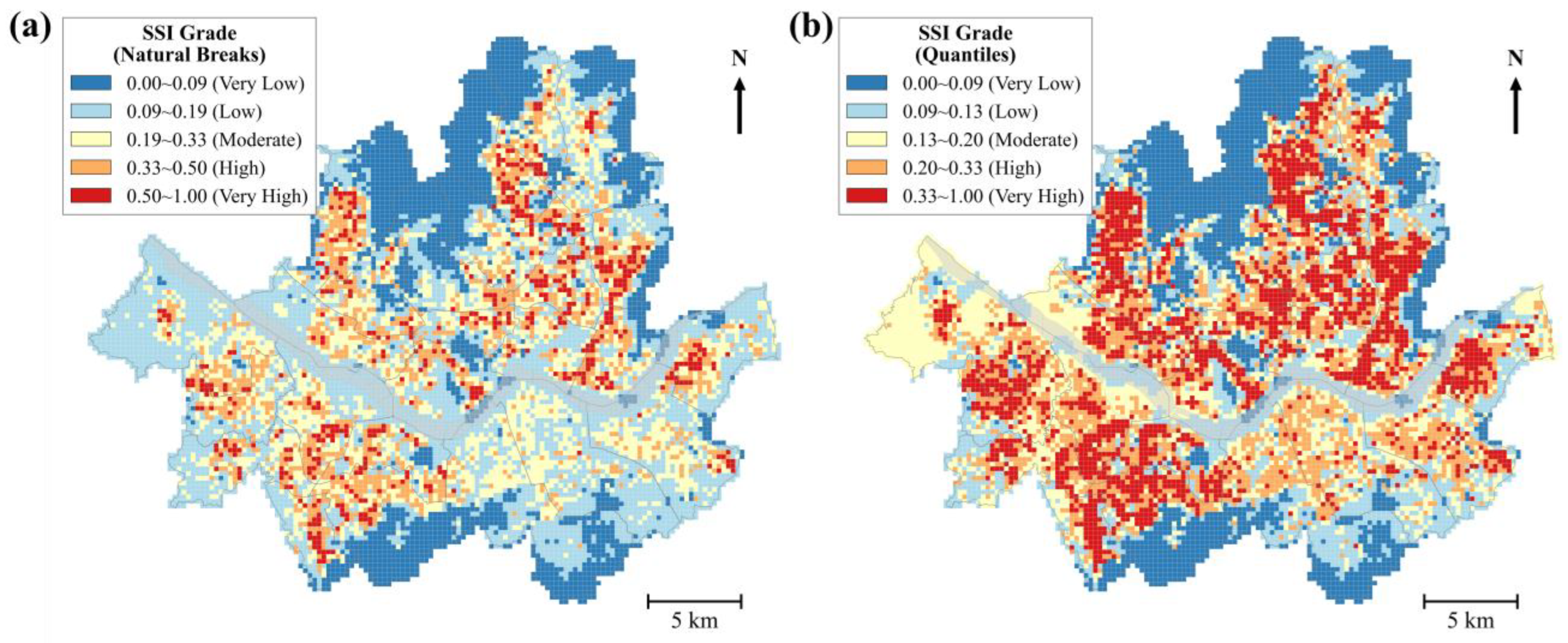
4.2.2. Classification by Susceptibility Grade
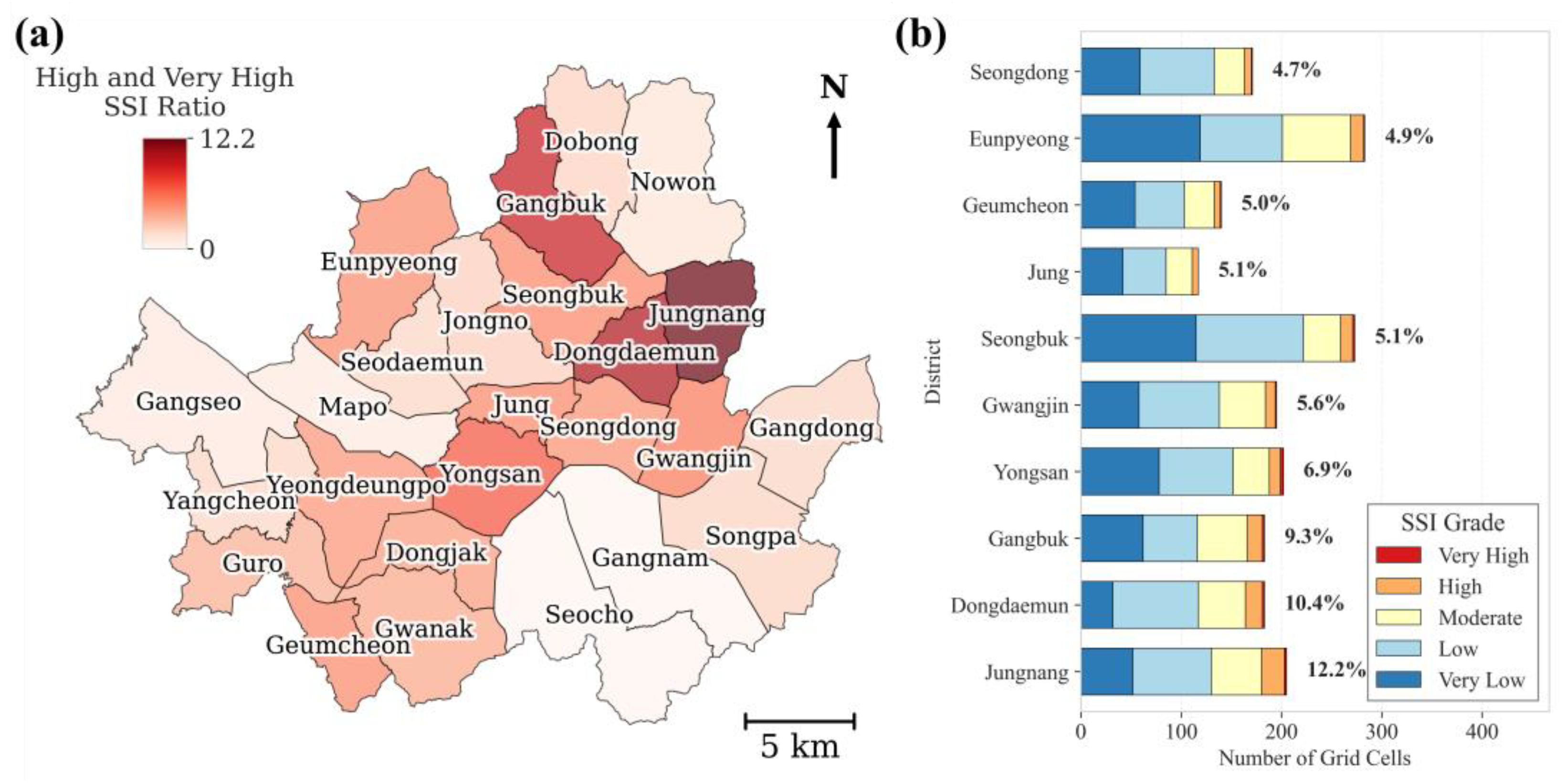
4.3. Administrative District-Level Analysis
5. Discussion
5.1. Spatial Concentration and Distribution Patterns
5.2. Policy Application of the Multi-Level Framework
5.3. Methodological Advances
Sensitivity Analysis of Classification Methods
5.4. Limitations and Future Directions
6. Conclusions
Author Contributions
Funding
Institutional Review Board Statement
Informed Consent Statement
Data Availability Statement
Conflicts of Interest
References
- Dolce, M.; Prota, A.; Borzi, B.; da Porto, F.; Lagomarsino, S.; Magenes, G.; Moroni, C.; Penna, A.; Polese, M.; Speranza, E.; et al. Seismic risk assessment of residential buildings in Italy. Bull. Earthq. Eng. 2021, 19, 2999–3032. [Google Scholar] [CrossRef]
- Chaulagain, H.; Rodrigues, H.; Silva, V.; Spacone, E.; Varum, H. Seismic risk assessment and hazard mapping in Nepal. Nat. Hazards 2015, 78, 583–602. [Google Scholar] [CrossRef]
- Choo, M.; Yoon, D.K. Examining the effects of the local communities’ social capital on disaster response capacity in Seoul, South Korea. Int. J. Disaster Risk Reduc. 2022, 75, 102973. [Google Scholar] [CrossRef]
- Mestav Sarica, G.; Pan, T.C. Seismic loss dynamics in three Asian megacities using a macro-level approach based on socioeconomic exposure indicators. Commun. Earth Environ. 2022, 3, 101. [Google Scholar] [CrossRef]
- Bansal, B.K.; Chopra, S.; Wu, Y.M. Editorial: Seismic hazard assessment of metropolitan cities: Scenario and challenges. Front. Earth Sci. 2023, 11, 1205383. [Google Scholar] [CrossRef]
- Guéguen, P.; Michel, C.; LeCorre, L. A simplified approach for vulnerability assessment in moderate-to-low seismic hazard regions: Application to Grenoble (France). Bull. Earthq. Eng. 2007, 5, 467–490. [Google Scholar] [CrossRef]
- Xofi, M.; Ferreira, T.M.; Domingues, J.C.; Santos, P.P.; Pereira, S.; Oliveira, S.C.; Reis, E.; Zêzere, J.L.; Garcia, R.A.C.; Lourenço, P.B. On the Seismic Vulnerability Assessment of Urban Areas Using Census Data: The Lisbon Metropolitan Area as a Pilot Study Area. J. Earthq. Eng. 2024, 28, 242–265. [Google Scholar] [CrossRef]
- Ansari, A.; El Hussain, I.; Deif, A.; Mohamed, A.M.; Al-Shijbi, Y.; Al-Jabri, K.; Mandhaniya, P.; Lee, J.H.; Alluqmani, A.E.; Mutaz, E. Integrated GIS-AHP based assessment of earthquake vulnerability and risk for urban residential buildings in Muscat, Sultanate of Oman. Sci. Rep. 2025, 15, 31995. [Google Scholar] [CrossRef] [PubMed]
- Hoyos, M.C.; Hernández, A.F. Impact of vulnerability assumptions and input parameters in urban seismic risk assessment. Bull. Earthq. Eng. 2021, 19, 4407–4434. [Google Scholar] [CrossRef]
- Kim, H.S.; Sun, C.G.; Lee, M.G.; Cho, H.I. Multivariate geotechnical zonation of seismic site effects with clustering-blended model for a city area, South Korea. Eng. Geol. 2021, 294, 106365. [Google Scholar] [CrossRef]
- Han, J.; Nur, A.S.; Syifa, M.; Ha, M.; Lee, C.-W.; Lee, K.-Y. Improvement of Earthquake Risk Awareness and Seismic Literacy of Korean Citizens through Earthquake Vulnerability Map from the 2017 Pohang Earthquake, South Korea. Remote Sens. 2021, 13, 1365. [Google Scholar] [CrossRef]
- Kim, B.; Ji, Y.; Kim, M.; Lee, Y.-J.; Kang, H.; Yun, N.-R.; Kim, H.; Lee, J. Building Damage Caused by the 2017 M5.4 Pohang, South Korea, Earthquake, and Effects of Ground Conditions. J. Earthq. Eng. 2022, 26, 3054–3072. [Google Scholar] [CrossRef]
- Choi, J.H.; Ko, K.; Gihm, Y.S.; Cho, C.S.; Lee, H.; Song, S.G.; Bang, E.S.; Lee, H.J.; Bae, H.K.; Kim, S.W. Surface deformations and rupture processes associated with the 2017 M w 5.4 Pohang, Korea, earthquake. Bull. Seismol. Soc. Am. 2019, 109, 756–769. [Google Scholar] [CrossRef]
- Naik, S.P.; Park, K.; Hategekimana, F.; Shin, H.C.; Kim, Y.S. Stratigraphic and structural evidence of transpressional Quaternary fault reactivation along the SE Korean Peninsula. Quaternary Sci. Adv. 2024, 13, 100165. [Google Scholar] [CrossRef]
- Naik, S.P.; Shin, H.C.; Jeong, S.H.; Park, K.; Hategekimana, F.; Lee, J.; Kim, Y.S.; Choi, J.H.; Takao, K. Comprehensive Analysis of Late Quaternary Faulting and Earthquake Potential on the Cheongun-Dong Fault, Southeast Korea: Implications for Intraplate Seismic Hazards in a Slow Tectonic Regime. Bull. Seismol. Soc. Am. 2025, 115, 1979–2001. [Google Scholar] [CrossRef]
- Frigerio, I.; Ventura, S.; Strigaro, D.; Mattavelli, M.; De Amicis, M.; Mugnano, S.; Boffi, M. A GIS-based approach to identify the spatial variability of social vulnerability to seismic hazard in Italy. Appl. Geogr. 2016, 74, 12–22. [Google Scholar] [CrossRef]
- Huang, C.; Palacios, S.M.; Meslem, A. Development of a new tool for seismic risk assessment and multi-criteria decision making. Int. J. Disaster Risk Reduc. 2024, 106, 104261. [Google Scholar] [CrossRef]
- Ravankhah, M.; Schmidt, M.; Will, T. An indicator-based risk assessment framework for World Heritage sites in seismic zones: The case of “Bam and its Cultural Landscape” in Iran. Int. J. Disaster Risk Reduc. 2021, 63, 102405. [Google Scholar] [CrossRef]
- Silva, V.; Crowley, H.; Varum, H.; Pinho, R. Seismic risk assessment for mainland Portugal. Bull. Earthq. Eng. 2014, 13, 429–457. [Google Scholar] [CrossRef]
- Rosset, P.; Zhu, H.; Chouinard, L.; Sirous, N.; Rimando, J.; Peace, A.; Goda, K. Influence of local versus national datasets on seismic loss estimates: A case study for residential buildings in the metropolitan area of Montreal, Canada. Int. J. Disaster Risk Reduc. 2024, 105, 104404. [Google Scholar] [CrossRef]
- Abo El Ezz, A.; Smirnoff, A.; Nastev, M.; Nollet, M.-J.; McGrath, H. ER2-Earthquake: Interactive web-application for urban seismic risk assessment. Int. J. Disaster Risk Reduc. 2019, 34, 326–336. [Google Scholar] [CrossRef]
- Mascheri, G.; Chieffo, N.; Arrighi, C.; Del Gaudio, C.; Lourenço, P.B. A framework for multi-risk assessment in a historical area of Lisbon. Int. J. Disaster Risk Reduc. 2024, 108, 104508. [Google Scholar] [CrossRef]
- Bellalem, F.; Molina, S.; Daniell, J.; Maouche, S.; Talbi, A.; Mobarki, M.; Ymmel, H.; Djellit, H. Seismic risk assessment for the downtown of the city of Blida, Algeria. Int. J. Disaster Risk Reduc. 2024, 103, 104314. [Google Scholar] [CrossRef]
- Galderisi, A.; Limongi, G. A Comprehensive Assessment of Exposure and Vulnerabilities in Multi-Hazard Urban Environments: A Key Tool for Risk-Informed Planning Strategies. Sustainability 2021, 13, 9055. [Google Scholar] [CrossRef]
- Han, J.; Kim, J. A GIS-Based Seismic Vulnerability Mapping and Assessment Using AHP: A Case Study of Gyeongju, Korea. Korean J. Remote Sens. 2019, 35, 217–228. [Google Scholar] [CrossRef]
- Lee, S.; Oh, S. A comprehensive seismic risk assessment map of South Korea based on seismic, geotechnical, and social vulnerability. Environ. Earth Sci. 2022, 81, 33. [Google Scholar] [CrossRef]
- Malakar, M.; Malakar, S.; Hasan, M.S.U.; Rai, A.K.; Kannaujiya, V.K. Seismic risk assessment using integrated MCDM method in West Bengal, India. Evol. Earth 2024, 2, 100036. [Google Scholar] [CrossRef]
- Yu, K.; Chouinard, L.E.; Rosset, P. Seismic vulnerability assessment for Montreal. Georisk 2016, 10, 164–178. [Google Scholar] [CrossRef]
- Rahimi, F.; Sadeghi Niaraki, A.; Ghodousi, M.; Choi, S.M. Spatial-temporal modeling of urban resilience and risk to earthquakes. Sci. Rep. 2025, 15, 8321. [Google Scholar] [CrossRef]
- Lee, Y.; Lee, Y.-G.; Park, D. Geotechnical data based seismic microzonation in Seoul using region-specific and code-based site amplification models. Bull. Earthq. Eng. 2024, 22, 2375–2403. [Google Scholar] [CrossRef]
- Cutter, S.L.; Boruff, B.J.; Shirley, W.L. Social Vulnerability to Environmental Hazards. Soc. Sci. Q. 2003, 84, 242–261. [Google Scholar] [CrossRef]
- Park, Y.; Yang, J.S.; Kim, S. Social and Economic Disaster Vulnerability Assessment Considering Urban Characteristics of Seoul. J. Korean Soc. Hazard Mitig. 2016, 16, 337–345. [Google Scholar] [CrossRef]
- Ba, Z.; Zhao, J.; Zhang, Y.; Wu, M.; Mu, S. A Probabilistic Seismic Hazard Analysis Method Incorporating Physics-Based Simulation and Ground Motion Prediction Equation. Int. J. Disaster Risk Sci. 2025, 16, 392–407. [Google Scholar] [CrossRef]
- STEIn, S.; Geller, R.J.; Liu, M. Why earthquake hazard maps often fail and what to do about it. Tectonophysics 2012, 562-563, 1–25. [Google Scholar] [CrossRef]
- Van Westen, C.J.; Castellanos, E.; Kuriakose, S.L. Spatial data for landslide susceptibility, hazard, and vulnerability assessment: An overview. Eng. Geol. 2008, 102, 112–131. [Google Scholar] [CrossRef]
- Guillard Gonçalves, C.; Zêzere, J.L.; Pereira, S.; Garcia, R.A.C. Assessment of physical vulnerability of buildings and analysis of landslide risk at the municipal scale: Application to the Loures municipality, Portugal. Nat. Hazards Earth Syst. Sci. 2016, 16, 311–331. [Google Scholar] [CrossRef]
- UNDRR. Sendai Framework for Disaster Risk Reduction 2015–2030; United Nations Office for Disaster Risk Reduction (UNDRR): Geneva, Switzerland, 2015. [Google Scholar]
- Lee, J.Y.; Kwon, K.D.; Raza, M. Current water uses, related risks, and management options for Seoul megacity, Korea. Environ. Earth Sci. 2018, 77, 14. [Google Scholar] [CrossRef]
- Kim, H.J.; Lee, J.Y.; Jeon, W.H.; Lee, K.K. Chapter 18—Groundwater Environment in Seoul, Republic of Korea. In Groundwater Environment in Asian Cities, Shrestha, S., Pandey, V.P., Shivakoti, B.R., Thatikonda, S., Eds.; Butterworth-Heinemann: London, UK, 2016; pp. 413–449. [Google Scholar]
- Choi, W.; Park, J.W.; Kim, J. Loss assessment of building and contents damage from the potential earthquake risk in Seoul, South Korea. Nat. Hazards Earth Syst. Sci. 2019, 19, 985–997. [Google Scholar] [CrossRef]
- Jeong, S.K.; Ban, Y.U. The spatial configurations in South Korean apartments built between 1972 and 2000. Habitat Int. 2014, 42, 90–102. [Google Scholar] [CrossRef]
- Gelézeau, V. Changing Socio-Economic Environments, Housing Culture and New Urban Segregation in Seoul. Eur. J. East Asian Stud. 2008, 7, 295–321. [Google Scholar] [CrossRef]
- Pittore, M.; Haas, M.; Silva, V. Variable resolution probabilistic modeling of residential exposure and vulnerability for risk applications. Earthq. Spectra 2020, 36, 321–344. [Google Scholar] [CrossRef]
- IPCC. Summary for Policymakers. In Managing the Risks of Extreme Events and Disasters to Advance Climate Change Adaptation. A Special Report of Working Groups I and II of the Intergovernmental Panel on Climate Change; IPCC: Geneva, Switzerland, 2012; pp. 1–3. [Google Scholar]
- MOLIT. V-world. Available online: https://www.vworld.kr (accessed on 15 December 2024).
- SMG. Seoul Open Data Plaza. Available online: https://data.seoul.go.kr/ (accessed on 15 December 2024).
- KDS 17 10 00:2018; General Seismic Design. MOLIT: Sejong, Republic of Korea, 2018.
- FEMA. NEHRP Recommended Seismic Provisions for New Buildings and Other Structures; Rep. No. P-1050-1; Building Seismic Safety Council, National Institute of Building Sciences: Washington, DC, USA, 2015. [Google Scholar]
- Government of the Republic of Korea. Enforcement Decree of the Framework Act on Disaster and Safety Management. Available online: https://www.law.go.kr/법령/재난및안전관리기본법시행령 (accessed on 15 December 2024).
- Lori, P. Children and Disasters: Understanding Vulnerability, Developing Capacities, and Promoting Resilience—An Introduction. Child. Youth Environ. 2008, 18, 1–29. [Google Scholar] [CrossRef]
- Saaty, T.L.; Kearns, K.P. Chapter 3—The Analytic Hierarchy Process. In Analytical Planning; Saaty, T.L., Kearns, K.P., Eds.; Pergamon: Oxford, UK, 1985; pp. 19–62. [Google Scholar]
- Rehman, A.; Song, J.; Haq, F.; Ahamad, M.I.; Sajid, M.; Zahid, Z. Geo-physical hazards microzonation and suitable site selection through multicriteria analysis using geographical information system. Appl. Geogr. 2021, 135, 102550. [Google Scholar] [CrossRef]
- Sun, C.G.; Kim, H.S. GIS-based regional assessment of seismic site effects considering the spatial uncertainty of site-specific geotechnical characteristics in coastal and inland urban areas. Geomat. Nat. Hazards Risk 2017, 8, 1592–1621. [Google Scholar] [CrossRef]

| Domain | Category | Symbol | Indicator | Unit | Data Source |
|---|---|---|---|---|---|
| Geotechnical | Vulnerability | GT1 | Bedrock depth | m | Lee, Lee and Park [30] |
| GT2 | Average shear wave velocity to 30m | m/s | |||
| Structural | Vulnerability | STV1 | Non-seismic building ratio | - | V-WORLD [45] |
| Exposure | STE1 | Total building density | count per grid | ||
| STE2 | Critical facility density | ||||
| Social | Vulnerability | SCV1 | Elderly population ratio (≥65 years) | - | Seoul Open Data Plaza [46] |
| SCV2 | Child population ratio (<10 years) | ||||
| SCV3 | Foreign population ratio | ||||
| Exposure | SCE1 | Total population density | count per grid |
| Domain | Indicator | ||||
|---|---|---|---|---|---|
| Category | Weight | Category | Weight | ||
| Geotechnical | 0.15 | GT1 | 0.58 | ||
| GT2 | 0.42 | ||||
| Structural | 0.50 | STV1 | 1.00 | ||
| STE1 | 0.60 | ||||
| STE2 | 0.40 | ||||
| Social | 0.35 | SCV1 | 0.45 | ||
| SCV2 | 0.30 | ||||
| SCV3 | 0.25 | ||||
| SCE1 | 1.00 | ||||
| Classification | Very Low | Low | Moderate | High | Very High |
|---|---|---|---|---|---|
| Equal interval | 6042 (59.7%) | 2860 (28.3%) | 994 (9.8%) | 205 (2.0%) | 24 (0.2%) |
| Natural breaks (Jenks) | 2345 (23.2%) | 3764 (37.2%) | 2153 (21.3%) | 1338 (13.2%) | 525 (5.2%) |
| Quantiles | 2025 (20.0%) | 2025 (20.0%) | 2025 (20.0%) | 2025 (20.0%) | 2025 (20.0%) |
Disclaimer/Publisher’s Note: The statements, opinions and data contained in all publications are solely those of the individual author(s) and contributor(s) and not of MDPI and/or the editor(s). MDPI and/or the editor(s) disclaim responsibility for any injury to people or property resulting from any ideas, methods, instructions or products referred to in the content. |
© 2025 by the authors. Licensee MDPI, Basel, Switzerland. This article is an open access article distributed under the terms and conditions of the Creative Commons Attribution (CC BY) license (https://creativecommons.org/licenses/by/4.0/).
Share and Cite
Lee, Y.; Yoo, J.-K. High-Resolution Seismic Susceptibility Assessment Integrating Vulnerability and Exposure Indicators: Application to Seoul. Appl. Sci. 2025, 15, 11942. https://doi.org/10.3390/app152211942
Lee Y, Yoo J-K. High-Resolution Seismic Susceptibility Assessment Integrating Vulnerability and Exposure Indicators: Application to Seoul. Applied Sciences. 2025; 15(22):11942. https://doi.org/10.3390/app152211942
Chicago/Turabian StyleLee, Youngsuk, and Jin-Kwon Yoo. 2025. "High-Resolution Seismic Susceptibility Assessment Integrating Vulnerability and Exposure Indicators: Application to Seoul" Applied Sciences 15, no. 22: 11942. https://doi.org/10.3390/app152211942
APA StyleLee, Y., & Yoo, J.-K. (2025). High-Resolution Seismic Susceptibility Assessment Integrating Vulnerability and Exposure Indicators: Application to Seoul. Applied Sciences, 15(22), 11942. https://doi.org/10.3390/app152211942

