Article

Stochastic Finite Element-Based Reliability Analysis of Construction Disturbance Induced by Boom-Type Roadheaders in Karst Tunnels


1
Kunming Survey, Design and Research Institute Co., Ltd. of CREEC, Kunming 650200, China
2
Faculty of Civil Engineering and Mechanics, Kunming University of Science and Technology, Kunming 650200, China
3
Department of Geotechnical Engineering, College of Civil Engineering, Tongji University, Shanghai 200092, China
4
Key Laboratory of Geotechnical and Underground Engineering of Ministry of Education, Tongji University, Shanghai 200092, China
*
Author to whom correspondence should be addressed.
Appl. Sci. 2025, 15(21), 11789; https://doi.org/10.3390/app152111789
Submission received: 30 September 2025 / Revised: 2 November 2025 / Accepted: 3 November 2025 / Published: 5 November 2025

Abstract

Tunnel construction in karst formations faces significant geological uncertainties, which pose challenges for quantifying construction risks using traditional deterministic methods. This paper proposes a probabilistic reliability analysis framework that integrates the Stochastic Finite Element Method (SFEM), a Radial Basis Function Neural Network (RBFNN) surrogate model, and Monte Carlo Simulation (MCS) method. The probability distributions of rock mass mechanical parameters and karst geometric parameters were established based on field investigation and geophysical prospecting data. The accuracy of the finite element model was verified through existing physical model tests, with the lateral karst condition identified as the most unfavorable scenario. Limit state functions with control indices, including tunnel crown settlement, invert uplift, ground surface settlement and convergence, were defined. A high-precision surrogate model was constructed using RBFNN (average R2 > 0.98), and the failure probabilities of displacement indices were quantitatively evaluated via MCS (10,000 samples). Results demonstrate that the overall failure probability of tunnel construction is 3.31%, with the highest failure probability observed for crown settlement (3.26%). Sensitivity analysis indicates that the elastic modulus of the disturbed rock mass and the clear distance between the karst cavity and the tunnel are the key parameters influencing deformation. This study provides a probabilistic risk assessment tool and a quantitative decision-making basis for tunnel construction in karst areas.

1. Introduction

Tunnel construction in karst formation frequently encounters severe threats from unfavorable geological conditions, including concealed cavities and fracture zones [1,2]. The substantial geological uncertainties inherent in such environments present significant challenges for engineering construction.
A substantial body of scholarly research has been developed comparing the reliability design methodologies embedded in Chinese and European technical standards from both theoretical and implementation perspectives. Chinese design codes, exemplified by GB 50068 (Unified Standard for Reliability Design of Building Structures) [3], are fundamentally grounded in probabilistic reliability theory and employ partial factor methods to ensure structural safety. However, these provisions demonstrate limited consideration for the distinctive characteristics of geotechnical engineering and underground structures. While specialized codes such as Q/CR 9129-2018 (Code for Design of Railway Tunnel—Limit State Method) [4] have accumulated substantial design experience and advocate for transitioning railway tunnel design toward limit state methodologies under safety assurance principles, their applicability remains incomplete across all structural typologies. The partial factors and design parameters specified require further adaptation to accommodate diverse structural configurations. Current geotechnical design practice in China incorporates three primary methodological frameworks: allowable bearing capacity design, single safety factor method under limit states, and reliability-based partial factor design under limit states. Notably, GB 50007-2011 (Code for Design of Building Foundation) [5] adopts a hybrid approach, selectively applying these methodologies according to specific problem domains. In contrast, Eurocode EN 1997-1 [6] establishes a unified probabilistic limit state design framework, mandating explicit differentiation between Ultimate Limit States (ULS) and Serviceability Limit States (SLS) through distinct verification procedures. This contrasts with the fragmented theoretical foundation observed in Chinese geotechnical codes, where probability-based limit state methods coexist with traditional safety factor approaches—particularly in foundation bearing capacity and global stability analyses [7,8,9,10,11].
The comparative analysis reveals that Chinese standards emphasize detailed engineering classification systems and comprehensive site investigation protocols to address geological uncertainty, supplemented by quantitative indicator systems for risk assessment. European standards provide a cohesive probabilistic design framework. Nevertheless, both regulatory systems lack efficient and precise analytical tools capable of addressing the pronounced spatial heterogeneity of karst media and the consequent complex system-level failure mechanisms inherent in such geotechnical environments.
Traditional deterministic analysis methods prove inadequate for quantifying these risks, whereas the Stochastic Finite Element Method (SFEM) offers a robust framework to address this limitation [12]. Thus, this methodology incorporates the inherent randomness of rock mass physico-mechanical parameters, karst occurrence conditions, and external loading into the finite element analysis framework [13]. Phoon et al. [14] have emphasized uncertainty calculation when modeling in decision making. Sousa and Einstein [15] have developed an approach to assess risk during tunnel construction, which consists of a combined “geologic prediction model” and “construction decision model”. Through the establishment of probabilistic models, it enables the quantification of statistical distribution characteristics for rock mass and displacement fields, and facilitates the calculation of exceedance probabilities for construction-induced disturbances based on reliability theory, thereby achieving a comprehensive probabilistic assessment of engineering risks.
Recent research has established a substantial theoretical and practical foundation for investigating construction-induced disturbances in karst regions. The principal research achievements manifest in several key areas: Regarding field monitoring and model testing investigations, Mair et al. [16] and Wongsaroj et al. [17] conducted systematic studies on ground settlement mechanisms induced by tunnel excavation in soft soil strata through integrated field monitoring and model testing, establishing settlement prediction models incorporating time-dependent effects. Zhang et al. [18] utilizing the Dalian Metro Line 5 project as a case study, performed detailed laboratory model tests to quantitatively analyze the influence patterns of hidden cavities on ground settlement caused by shield tunneling operations. Gai [19] executed a series of model tests specifically targeting Guizhou karst formations, revealing quantitative relationships between cavity diameter, spatial positioning, and surface settlement/surrounding rock stress characteristics.
In the domain of numerical modeling and theoretical analysis, Fang et al. [20] developed discrete element models for shield tunnel construction in karst strata, conducting in-depth analyses of the influence mechanisms of infill strength in cavities ahead of the tunnel face on surrounding rock stability. Yang [21] elucidated inverse proportional relationships between segment displacement, surface settlement, and the roof-to-segment distance (d) through parametric numerical analyses. Li et al. [22] systematically simulated various karst occurrence conditions using a commercial finite element analysis software, clarifying the effects of karst features on rock mass deformation, excavation-induced plastic zones, and lining internal forces.
Regarding intelligent prediction and treatment technologies, Fu et al. [23] optimized Backpropagation Neural Network parameters using Bayesian regularization to develop settlement prediction models for karst tunnels, validating their effectiveness in the Changqingpo Tunnel project. Zhang et al. [24,25] employed Hybrid Neural Networks for ground settlement prediction in Guangzhou Metro Line 9, identifying critical shield operational parameters influencing settlement through partial derivative sensitivity analysis. Kang et al. [26] proposed comprehensive treatment and waterproofing strategies for formations containing numerous cavities and fractures, specifically tailored for Earth Pressure Balance shield tunneling. Xu et al. [27] and Yan et al. [28], respectively, validated the effectiveness of treatment schemes including surrounding rock grouting, jet grouting pile reinforcement, and pile-slab structures through engineering case studies in Wuhan and Guangzhou.
Notwithstanding these substantial research achievements, prevailing studies predominantly adhere to deterministic analytical paradigms. The analytical processes typically employ singular, deterministic parameters to characterize highly spatially variable karst geometric features and rock mass mechanical properties. While this approach can reveal influence patterns of various factors on tunnel stability, its fundamental limitation lies in the inability to quantify inherent uncertainties and exceedance risk probabilities encountered during construction, consequently failing to meet the requirements for risk-controlled refined management and decision-making in modern tunnel engineering.
Therefore, to address the inherent limitations of deterministic analysis, this research aims to develop a comprehensive probabilistic reliability analysis framework for risk assessment in karst tunnel construction. The main contributions of this study are as follows:
Create an experimentally validated stochastic finite element model (SFEM), and incorporating a Radial Basis Function Neural Network (RBFNN) surrogate model with Monte Carlo Simulation, by establishing probability distribution models for rock mass and karst parameters based on field investigation and geophysical prospecting data
Conduct reliability analysis of construction-induced disturbances under the most unfavorable condition of lateral karst presence.
Quantitatively evaluate failure probabilities of displacement indicators, thereby providing a probabilistic basis.

2. Framework for Reliability Analysis

2.1. Overall Analysis Procedure

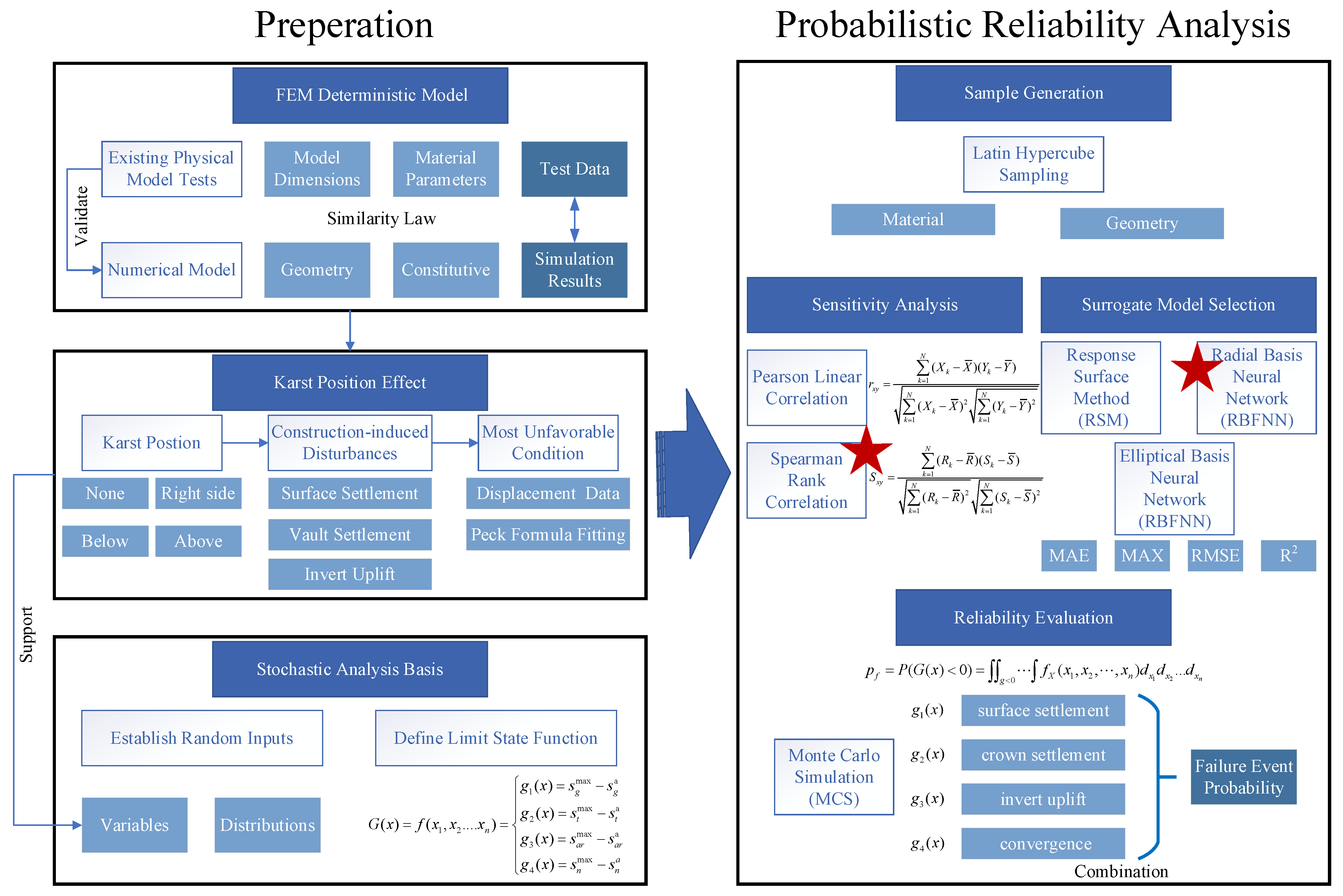
This study aims to establish an integrated methodology suitable for reliability analysis of construction-induced disturbances in karst tunnel construction. The overall technical roadmap and procedure are as following Figure 1:
Preparation of Stochastic Analysis Basis:
  • Identification of Random Input Variables and Their Distributions: Based on in situ geotechnical mechanical tests and surface geophysical prospecting results from the supporting project, the statistical characteristics of geotechnical physical-mechanical parameters (e.g., elastic modulus, cohesion, unit weights) and karst cavity geometric parameters (e.g., lengths of major and minor axes, clear distance to tunnel cross-section) were obtained. Parameters follow normal or uniform distributions.
  • Definition of Output Responses and Failure Criteria: According to specifications and engineering requirements, tunnel crown settlement, invert uplift, convergence, and surface settlement were selected as key output responses. Corresponding limit state functions were established to determine failure.
Establishment and Validation of Deterministic Model:
  • Development of Numerical Model: Leveraging existing physical model tests, a finite element model for tunnel construction in karst areas was established in ABAQUS. Model dimensions, material parameters (using the Mohr–Coulomb constitutive model), boundary conditions, and karst location were strictly set according to similarity relationships.
  • Validation of Model Accuracy: The correctness and rationality of the established finite element model in simulating the disturbance patterns of tunnel excavation in karst areas were verified by comparing numerical simulation results with physical model test data on surface settlement under conditions with and without karst cavities. This validation step is the cornerstone of the credibility of all subsequent stochastic analyses.
Effect of Karst Position on Construction Disturbance:
  • Investigation of Key Influencing Factors: Utilizing the validated numerical model while maintaining constant geotechnical parameters, the effects of varying karst cavity positions relative to the tunnel (none, below, right side, above) on construction-induced disturbances were systematically analyzed.
  • Determination of the Most Unfavorable Condition: Through quantitative analysis of displacement monitoring data and Peck formula fitting parameters across the four scenarios, the lateral karst condition was identified as exerting the most substantial influence on tunnel disturbance. Consequently, this condition was selected as the target scenario for subsequent stochastic reliability analysis.
Probabilistic Reliability Analysis:
  • Sample Generation and Calculation: The Latin Hypercube Sampling (LHS) method was employed to perform sampling within the distribution ranges of each random variable. For each sample, the corresponding displacement response was obtained by executing finite element calculations.
  • Construction and Validation of Surrogate Model: To reduce the computational cost of large-scale sampling, the Response Surface Method (RSM) and Radial Basis/Elliptical Basis Neural Network methods were used to establish predictive models. Their accuracy was compared using an additional validation dataset (metrics including MAE, MAX, RMSE, R2, etc.). Ultimately, the Radial Basis Function Neural Network (RBFNN) was selected as the high-precision surrogate model for subsequent simulations.
  • Sensitivity Analysis: Based on the Spearman rank correlation coefficient, the correlation between all input random variables and output responses was analyzed to identify key parameters affecting the disturbance response (e.g., elastic modulus of the disturbed rock mass, clear distance between karst and tunnel) and clarify the influence of each parameter.
  • Reliability Evaluation: Large-scale Monte Carlo simulation (10,000 times) was performed using the trained RBFNN surrogate model to calculate the probability distribution characteristics of the displacement responses. Finally, the failure probability of each failure mode and the overall system was quantitatively evaluated according to the limit state functions.

2.2. Limit State Equations

The reliability of a tunnel structure is measured by whether it reaches a predetermined limit state. To control disturbance during the construction process, attention must be paid to geotechnical displacement indicators such as surface settlement, tunnel crown settlement, invert uplift and convergence. Considering the relationship between the target indicators and random parameters, Equation (1) shows the normal limit state equation:
G ( x ) = f ( x 1 , x 2 x n )
In detail, it is established using four characteristic parameters (Equations (2)–(5)):
g 1 ( x ) = s g max s g a
g 2 ( x ) = s t max s t a
g 3 ( x ) = s a r max s a r a
g 4 ( x ) = s n max s n a
where
( x 1 , x 2 x n ) is the vector of input random variables, containing the physical-mechanical parameters of each rock/soil layer and the geometric parameters of the karst cavity;
s g max is the maximum allowable value of surface settlement (mm);
s g a is the value of surface settlement (mm);
s t max is the maximum allowable value of tunnel crown settlement (mm);
s t a is the value of tunnel crown settlement (mm);
s a r max is the maximum allowable value of invert uplift (mm);
s a r a is the value of invert uplift (mm);
s n max is the limit value of tunnel convergence (mm);
s n a is the value of tunnel convergence (mm).
The limit values for each target parameter are based on specifications and deformation limits for the supporting project. The tunnel in the supporting project primarily traverses Grade IV to V weak surrounding rock with a burial depth of 50–70 m. According to specifications Table 1 [29,30], the ultimate relative displacement value around tunnels and chambers in Grade IV surrounding rock with burial depths of 50–300 m is 0.4–1.2%. Taking 0.6% as the relative convergence limit, 0.30% as the maximum allowable relative crown settlement, and 0.3% as the maximum allowable relative invert uplift, the calculated values are: s g max = 20 mm, s n max = 80 mm, s t max = 40 mm, s a r a = 40 mm.

2.3. Parameter Sensitivity Analysis Method

Parameter sensitivity analysis is the process of determining the sensitivity of a response to random variables by analyzing the correlation between changes in random variables and the response of the target limit state function. To quantify the contribution of each random input variable to the uncertainty of the displacement response, this study employs global sensitivity analysis. Existing methods mainly include Pearson linear correlation and Spearman rank correlation analysis to assess the magnitude of influence of all input parameters on the output response [31].
Due to the highly nonlinear nature of ground disturbance during tunnel excavation, non-parametric statistical methods—specifically, using rank correlation coefficients—should be employed for correlation analysis. Sensitivity analysis is achieved by ranking the mutual influence between parameters and using the Spearman rank correlation coefficient to measure the correlation between random variables.
The formula for calculating the rank correlation coefficient is as follows:
S x y = k = 1 N ( R k R ¯ ) ( S k S ¯ ) k = 1 N ( R k R ¯ ) 2 k = 1 N ( S k S ¯ ) 2
where N is the number of samples; R is the rank value of the parameter, R ¯ is the average rank of N parameters; S is the rank value of the target, S ¯ is the average rank of N target values; S x y is the Spearman rank correlation coefficient.

2.4. Surrogate Model

Reliability analysis based on the Monte Carlo method typically requires thousands of simulations, making direct invocation of the finite element model computationally expensive. Surrogate Models approximate the mapping relationship between inputs and outputs through mathematical methods, significantly reducing the computation time for stochastic finite element analysis and greatly improving computational efficiency [32].
The selection of error parameters is critical for the evaluation of surrogate models. The selected error metric formulations are expressed as:
M A E = 1 n i = 1 n y i y ˜ i
M A X = max y i y ˜ i
R M S E = i = 1 n ( y i y ˜ i ) 2 n
R 2 = 1 R S S S S T = 1 i = 1 n ( y i y ˜ i ) 2 i = 1 n ( y i y ¯ i ) 2
where n represents the number of data points, y i denotes the simulated result for the i-th data point, y i ˜ indicates the predicted value for the i-th data point, and y i ¯ signifies the mean value of all data points. RSS is the residual sum of squares, and SST is total sum of squares.
This study compared multiple surrogate modeling methods and selected the Response Surface Method (RSM), Radial Basis Function Neural Network (RBFNN) and Elliptical Basis Function Neural Network (EBFNN) as the final modeling tools for comparison. Each method is briefly outlined below:
  • Response Surface Method (RSM)
The Response Surface Method is an approximate modeling technique that uses polynomial functions to fit the output response space. It is divided into the single response surface method and the multiple response surface method. The single response surface method approximates the system’s overall failure probability by building a response surface for the overall system target value. The multiple response surface method establishes explicit expressions related to input parameters for each limit state function to characterize multiple potential failure modes. RSM can accurately approximate output parameters with relatively few numerical experiments and is described by algebraic expressions. It demonstrates good robustness but also has certain errors and can struggle to fit highly complex functional relationships.
2.
Radial Basis (RBF)/Elliptical Basis (EBF) Neural Network Methods
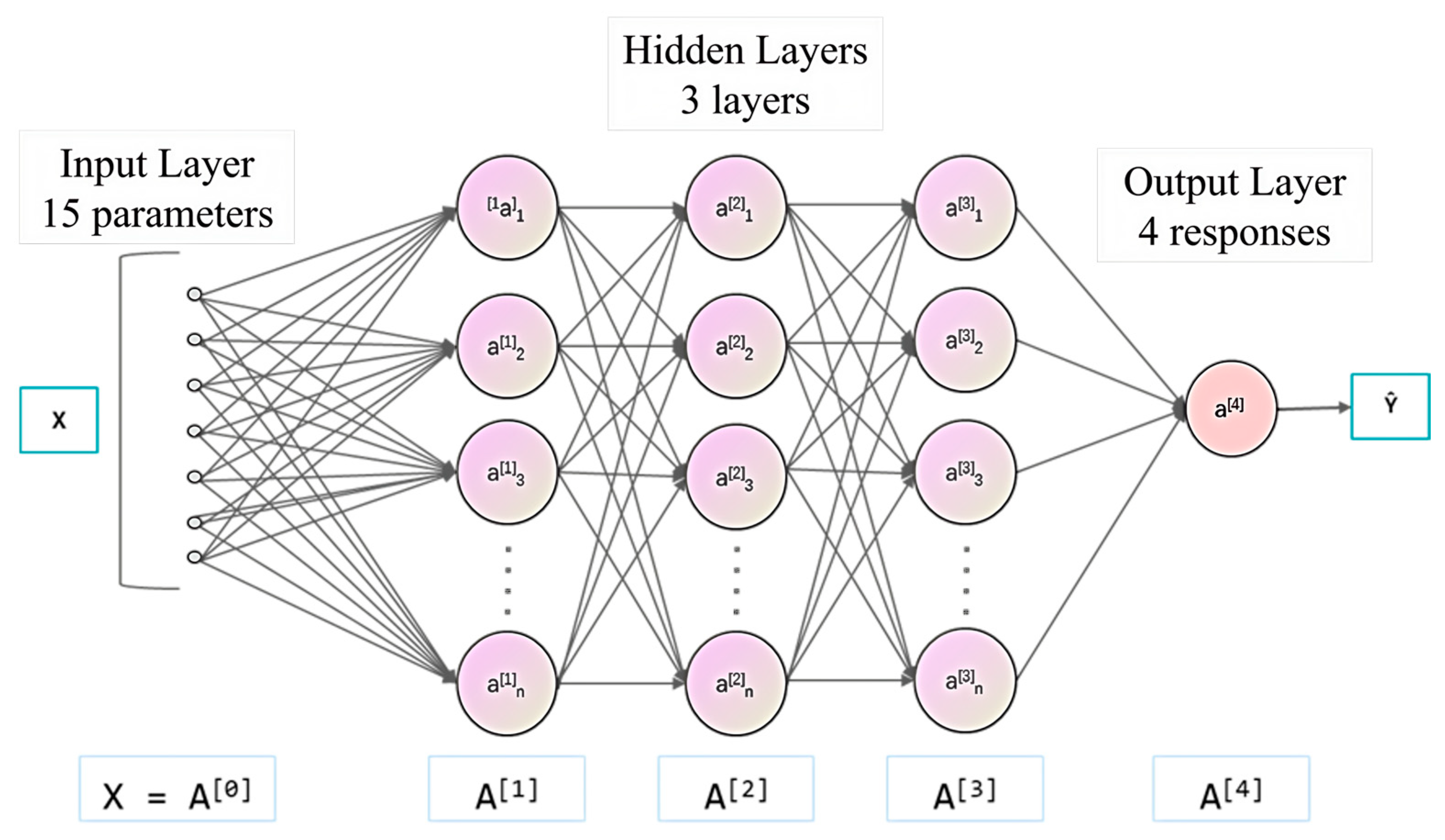
Neural networks commonly used for function approximation include BP networks and RBF neural networks. Both are multi-layer feedforward neural networks. RBF neural networks possess advantages such as strong generalization capability and powerful nonlinear function approximation ability [33], often used in prediction scenarios with fewer parameters and strong physical correlation between input and output parameters. This method does not require explicit expressions, offers fast network training, high accuracy, and good generalization ability. However, building a neural network model usually requires considerable time and higher computer configuration requirements. The structure for a typical three-layer feedforward neural network is shown in Figure 2.
Radial Basis Function (RBF) Network: A type of neural network that utilizes the Euclidean distance between the input vector and the prototype (center) vectors as its fundamental argument. Formally, x 1 , , x N Ω N represents a set of center vectors. The core component is the radial basis function: g i g ( x x j , c ) ,   j = 1 N , which operates on the Euclidean distance x x j , : ( x x j ) T ( x x j ) and 0.2 c 3 .

2.5. Reliability Analysis

Reliability is defined as the probability of completing a predetermined function under specified conditions and within a specified time [34]. It is a probabilistic measure of reliability, termed the reliable probability, denoted as p s . A tunnel can be regarded as a system composed of support structures and surrounding rock, where the failure of any part may trigger the failure of the whole [35]. Conducting reliability analysis can yield the exceedance probability of disturbance for the entire tunnel, facilitating a more objective analysis of the safety level during tunnel construction.
According to the definition of reliability and the basic principles of probability theory, if the basic random variables affecting the reliability of tunnel construction disturbance are x 1 , x 2 , x n , with the corresponding joint probability density function (PDF) denoted as f X ( x 1 , x 2 , x n ) , then the exceedance probability of disturbance for the entire tunnel can be expressed in combination with the limit state equation as:
p f = P ( G ( x ) < 0 ) = g < 0 f X ( x 1 , x 2 , , x n ) d x 1 d x 2 d x n
Furthermore, the reliability index β serves as another standard measure in structural reliability analysis in geotechnics and structures [14,36,37]. It provides a relatively intuitive scale where a higher β value corresponds to a greater safety margin. In reliability-based limit state design methods, the reliability index offers a unified “metric” for evaluating the safety of different structures under various loading conditions, thereby facilitating the development of design codes and standards. To some extent, it addresses the practical limitations of using the failure probability ( p f ) directly, particularly in high-reliability structures where becomes an extremely small numerical value that is inconvenient for communication and application in engineering practice. The relationship between p f and β is:
β   =     Φ 1 p f
where Φ 1 denotes the inverse of the standard normal cumulative distribution function.

2.6. Monte Carlo Simulation

The Monte Carlo method is a mathematical technique that involves large-scale random sampling of input parameters and uses the statistical estimates of the output results as an approximate solution to the original problem [38].
A significant advantage of the Monte Carlo method is its lack of strict requirements regarding the distribution of the state function and random variables during reliability analysis. This makes the Monte Carlo method particularly suitable for calculating the reliability of complex limit state equations with numerous random variables.
The Monte Carlo method exhibits strong adaptability in handling high-dimensional, irregular, or complex problems.

2.7. Summary

This paper employs a combination of the Monte Carlo method and predictive models to conduct reliability analysis of disturbance induced by boom-type roadheader construction in karst areas: random sampling is conducted within the distribution intervals of each random variable, the predictive model is used to calculate tunnel construction disturbance, and the failure probability and reliability are analyzed. The computational accuracy of the Monte Carlo method depends on the number of samples. The number of samples N needs to satisfy the condition and can be determined based on the required error tolerance and the failure probability. The number of simulations is initially set to 10,000.

3. Validation of Numerical Simulation Method for Karst Formations

3.1. Model Overview and Assumptions

To validate the accuracy of the numerical simulation approach for karst geology, this study conducted a comparative analysis based on physical model tests of shield tunnel excavation in karst formations performed by Su [39].
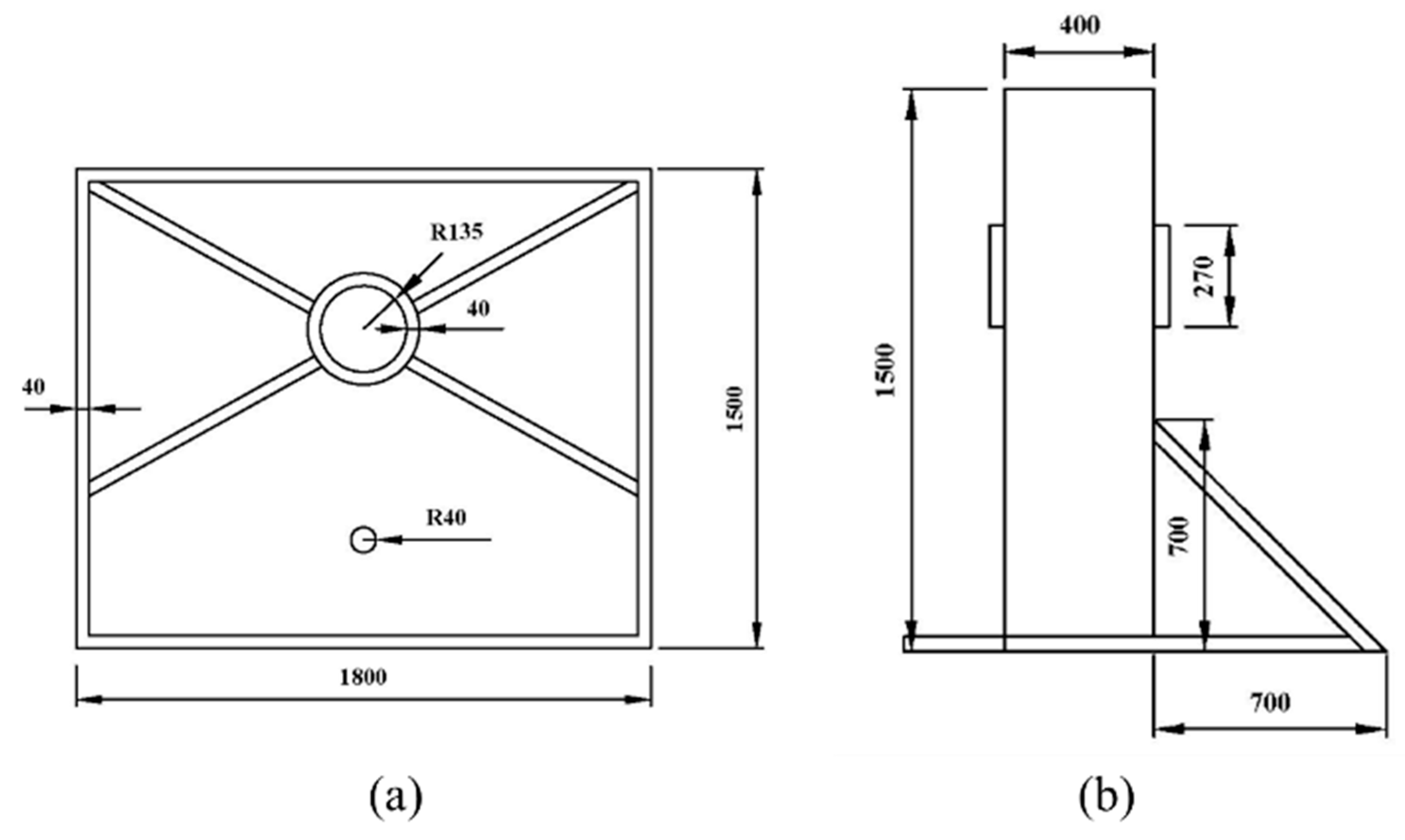
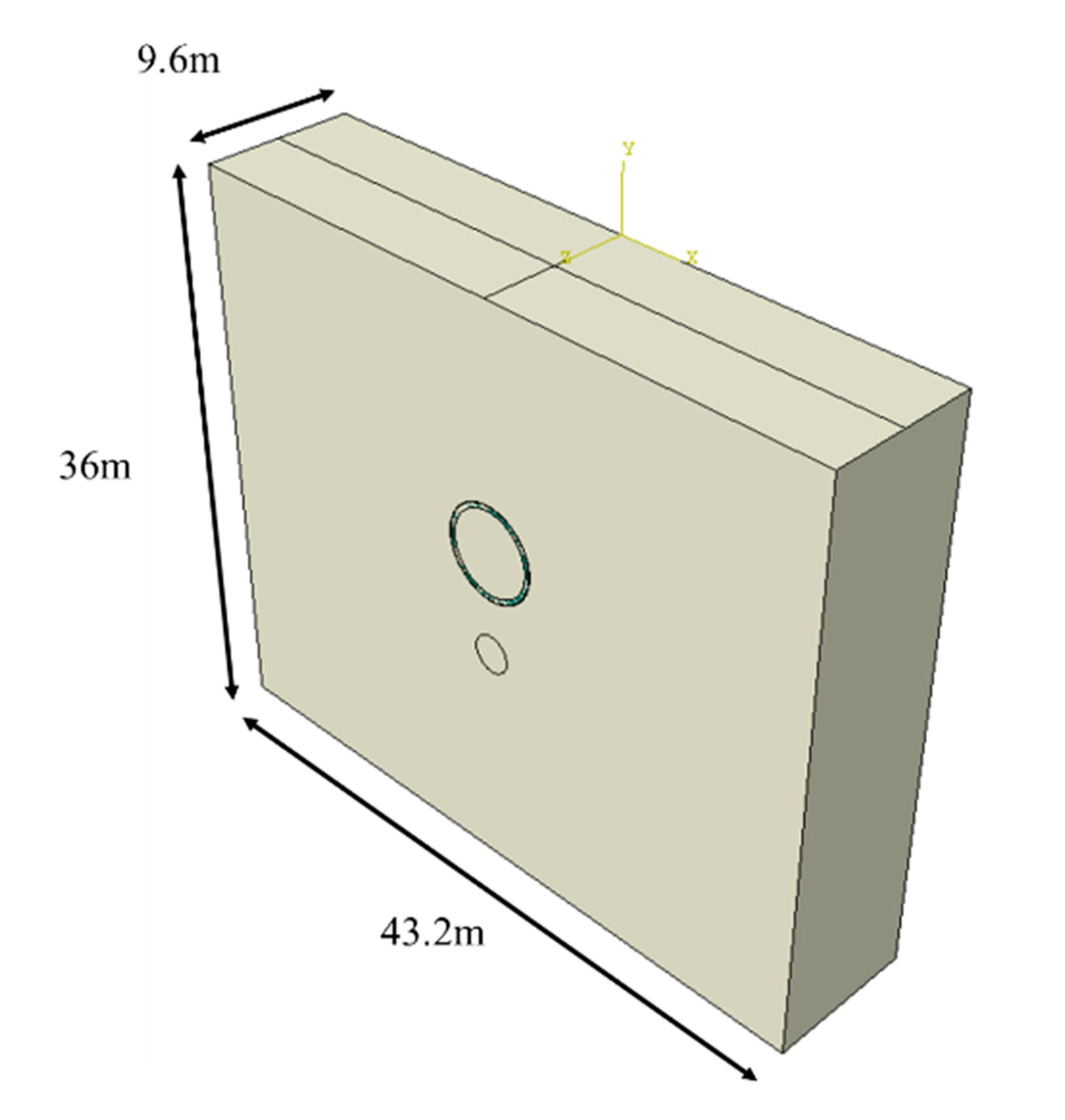
The experimental setup was established according to the engineering geological conditions of Dalian Metro Line 5 using plane strain model testing methodology. Following the geometric similarity constants specified in Table 2, a model test container measuring 1.8 m in length, 1.5 m in height, and 0.4 m in width was fabricated, corresponding to a prototype dimension of 43.2 m (length) × 36 m (height) × 9.6 m (tunnel advance length). As shown in Figure 3, the front and rear surfaces of the model container were constrained against displacement; in addition to restricting lateral movement, lubricant was applied to the interior walls to minimize shear stress and reduce friction between the container and simulative materials.
Corresponding to the physical model test, a numerical model of 43.2 m × 36 m × 9.6 m was developed in ABAQUS, comprising the geotechnical mass, karst cavity region, and tunnel lining system. The tunnel was situated at a burial depth of 12 m, featuring an external diameter of 6 m and a concrete lining thickness of 350 mm. The karst zone was positioned 2.4 m beneath the tunnel centerline with a diameter of 2.4 m, as illustrated in Figure 4.

3.2. Material Constitutive Model

The Mohr–Coulomb elastoplastic constitutive model was employed to characterize the mechanical behavior of the rock mass. Material parameters for the numerical model were determined by integrating the physico-mechanical properties of the simulative materials utilized in the physical model tests with the established similarity relationships, as comprehensively detailed in Table 3.
An important calibration was necessary due to the reinforcement effect induced by the sensors and cabling embedded within the physical model, which resulted in an underestimation of the prototype material’s elastic modulus when back-calculated from the experimental data. To ensure the numerical model’s response under the karst-free condition aligned with the macroscopic outcomes of the physical experiment, the elastic modulus of the soft rock in the numerical model was accordingly adjusted to 85 MPa. This calibration is consistent with the justification provided by Su [39].

3.3. Validation Results and Analysis

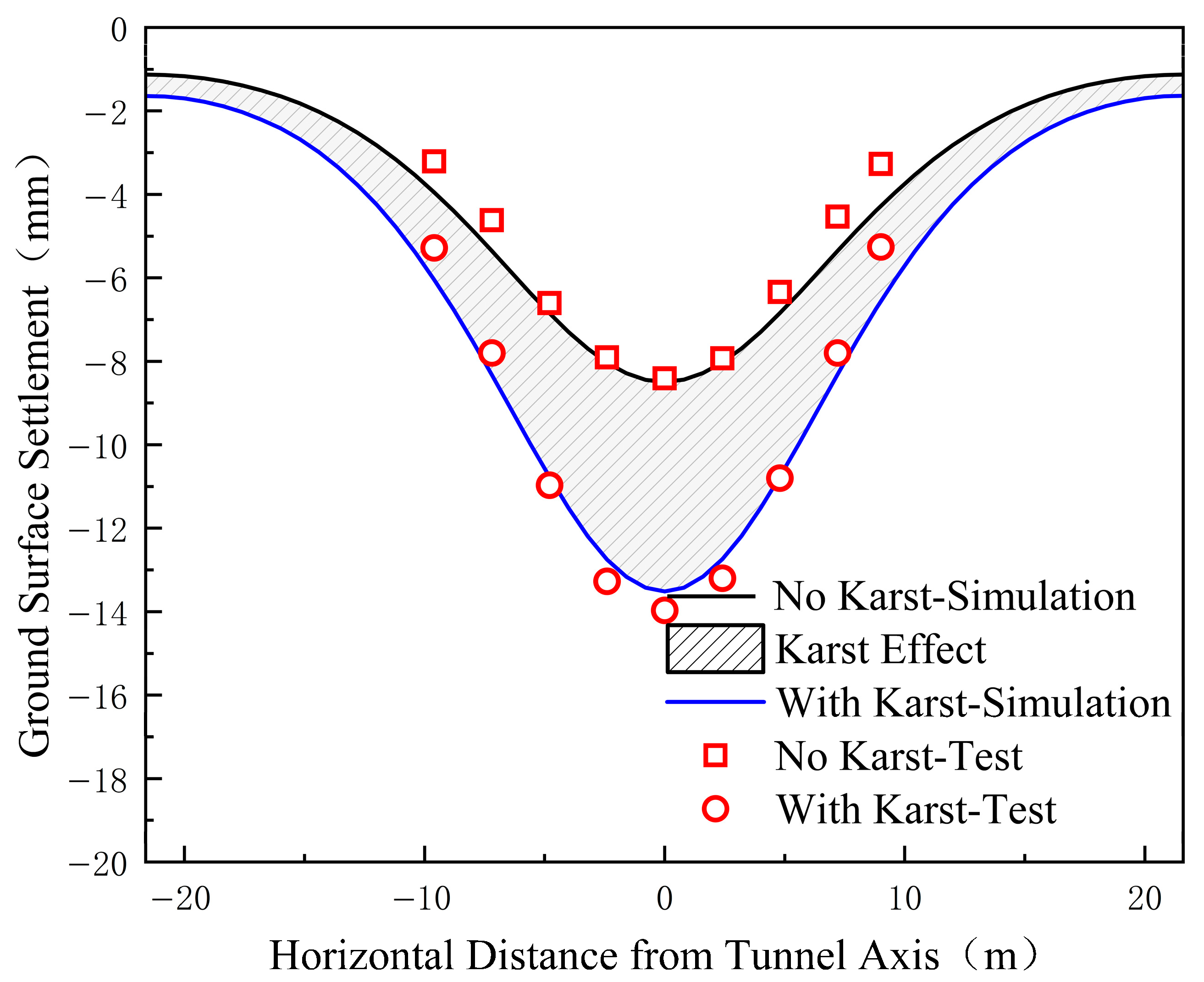
To validate the correctness and rationality of the tunnel construction model in karst formations, the surface settlement curves obtained from numerical simulations were compared with those measured from physical model tests under both karst-free and karst-present conditions, as shown in Figure 5.
The results demonstrate close agreement between the numerical simulations and experimental measurements. Under the karst-free condition, the maximum surface settlement measured in the physical test was 8.41 mm, while the numerical simulation yielded a value of 8.49 mm. For the karst condition, the corresponding values were 13.97 mm and 13.51 mm, respectively.
The settlement trough profiles exhibited a high degree of consistency: within 10 m on either side of the tunnel centerline, the settlement patterns were essentially identical. Beyond this range, the physically measured settlements were slightly smaller than the numerically predicted values, primarily attributable to the reinforcement effect caused by embedded sensors and cabling in the physical model. The gray shaded area in Figure 5 represents the differential settlement induced by the karst cavity. Since the cavity was located directly beneath the tunnel in soft rock formations, its presence significantly reduced the supporting capacity of the rock mass, resulting in a 5.02 mm increase in maximum surface settlement. This finding is consistent with established understanding of tunnel-induced deformation mechanisms and confirms the validity and rationality of the numerical model.
The comparative analysis demonstrates that the developed finite element model can accurately replicate the results of physical model tests, thereby verifying its effectiveness for simulating excavation-induced disturbance patterns in karst formations. As both the physical tests and numerical model satisfy plane strain conditions, subsequent investigations will utilize an equivalent two-dimensional model to significantly enhance computational efficiency.

4. Analysis of the Influence of Karst Spatial Location on Construction-Induced Disturbances

4.1. Model Configuration and Material Parameters

This study employs a validated numerical modeling approach to investigate how karst spatial location affects construction disturbances induced by roadheader excavation. The analysis focuses on chainage DK705 + 870 of a tunnel project in Southwest China. The model domain extends 150 m horizontally, 80 m vertically, and 1 m along the excavation direction, utilizing a three-bench excavation sequence with the following configuration: upper bench (4.8 m), middle bench (3.1 m), and lower bench (5.94 m).
A comprehensive monitoring system was implemented with settlement measurement points positioned at the ground surface directly above the tunnel axis and at the tunnel crown to record post-construction surface settlement and crown displacement. The Mohr–Coulomb constitutive model was selected to represent the mechanical behavior of the rock mass.
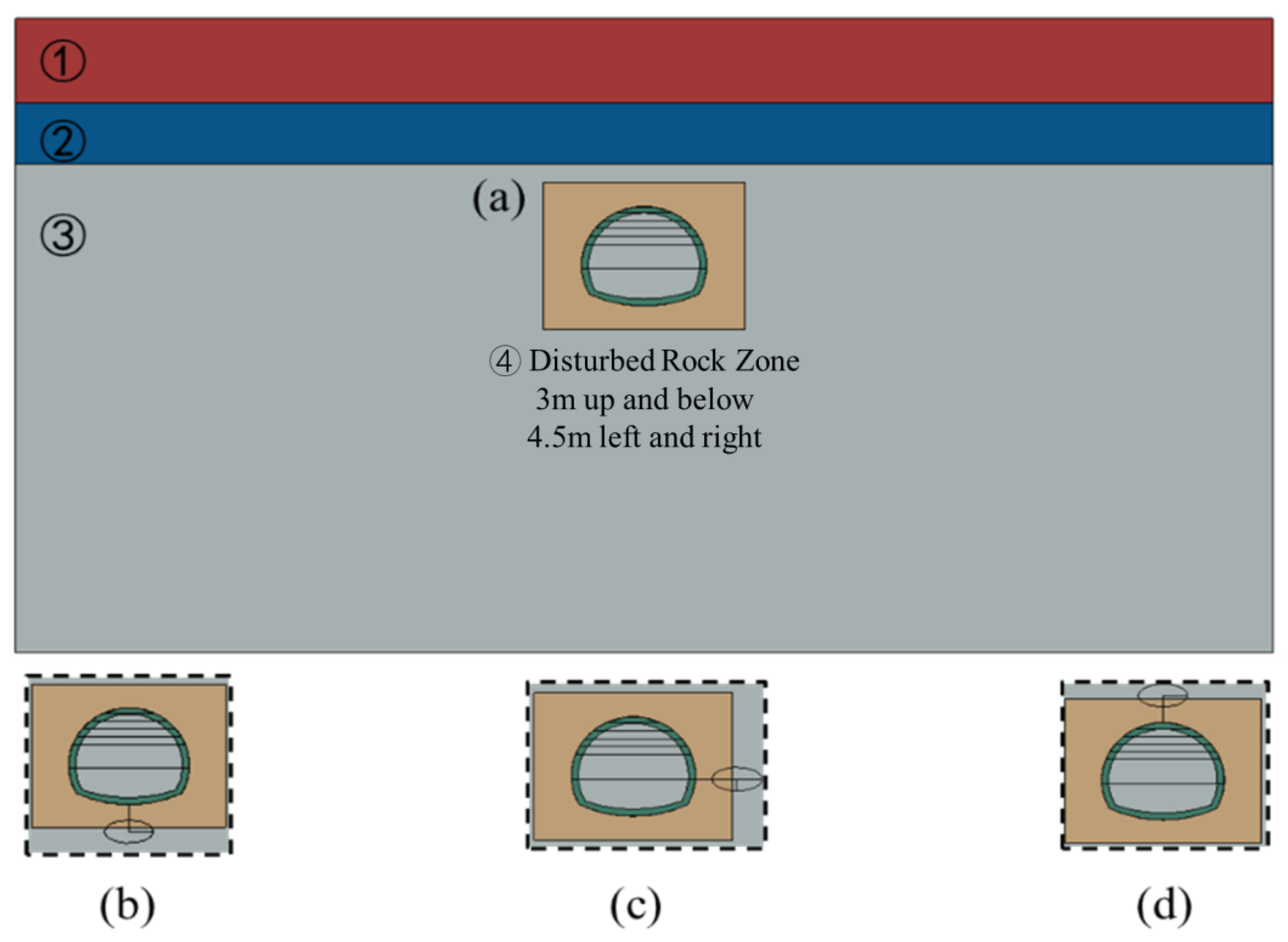
A disturbance zone was defined extending approximately 4.5 m laterally and 3 m vertically beyond the tunnel profile [40] to account for construction effects from roadheader milling operations (upper bench) and mechanical excavation (middle-lower benches and invert). Given the favorable ground conditions and predominantly elastic response to excavation vibrations, a disturbance factor of D = 0.3 was adopted based on established practice [41]. Material characterization followed the generalized Hoek-Brown criterion with these parameters for the weakly weathered dolomite interbedded with limestone: σci = 60 MPa, GSI = 60, and mi = 12 [42]. These values yielded calculated parameters of D = 0.3, a = 0.517, and s = 0.007, corresponding to a reduction in intact rock strength to 18.6% of its original value. Accordingly, within the disturbed zone, the cohesion parameter was reduced to 20% of its intact value, while both elastic modulus and Poisson’s ratio were reduced to 80% of their original values.
The parameters for each soil layer were determined in accordance with the geotechnical investigation report of the referenced project, with values presented in Table 4 below:

4.2. Simulation Condition Design

To investigate the influence of different karst spatial positions on disturbances induced by roadheader construction, a series of numerical analyses were conducted considering various relative positions between the tunnel and karst cavity (Figure 6). Four representative conditions were designed: no karst cavity, karst cavity below the tunnel, karst cavity on the right side of the tunnel, and karst cavity above the tunnel. The controlled variable method was employed, maintaining constant geotechnical physical-mechanical parameters and karst dimensions while only varying the spatial location of the karst cavity.
The geometric dimensions of the karst cavity were determined based on statistical data from engineering geological investigations, with a major axis radius of 3 m and minor axis radius of 1.5 m. The net distance between the karst cavity and tunnel design section was set at 2 m. The specific calculation conditions are summarized in Table 5.

4.3. Analysis of Results

4.3.1. Surface Settlement Patterns

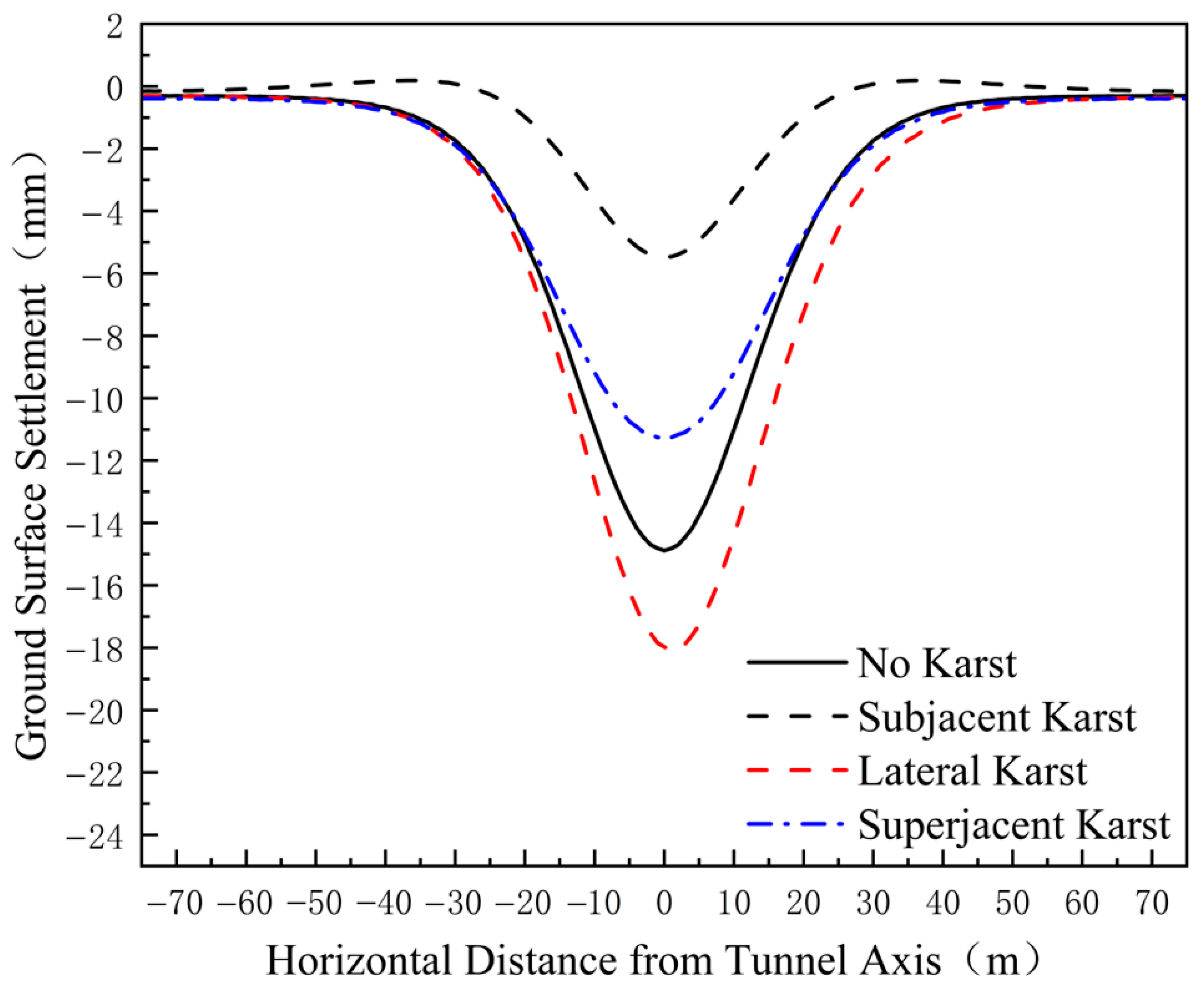
Figure 7 presents the surface settlement profiles observed under the four investigated conditions. The maximum surface settlements recorded for Condition 1 (no karst), Condition 2 (subjacent karst), Condition 3 (lateral karst), and Condition 4 (superjacent karst) measured −14.88 mm, −5.48 mm, −17.97 mm, and −11.24 mm, respectively. Distinct from the behavior observed in soft soil formations, the influence of karst features on deformation mechanisms reveals fundamentally different characteristics in high-stiffness formations:
Condition 2 (Subjacent Karst): The underlying cavity facilitates stress redistribution within the rock mass, reducing confinement losses and consequently diminishing maximum surface settlement by 63.2% compared to the karst-free benchmark. This geological configuration alters load transfer mechanisms, producing localized heave manifestations laterally displaced from the tunnel centerline.
Condition 3 (Lateral Karst): The proximal karst structure compromises the lateral constraint mechanism, resulting in significantly enhanced settlement magnitudes (20.8% increase relative to Condition 1). The settlement profile exhibits pronounced asymmetry with evident translation toward the karst cavity, indicating preferential strain localization.
Condition 4 (Superjacent Karst): The overlying cavity functions as a predefined discontinuity, producing modest stress relief in the overburden that reduces maximum settlement by 24.5% through improved arching effects compared to the intact condition.
Quantitative characterization of settlement trough morphology was achieved through modified Peck formulation:
S ( x ) = S max e ( x + a ) 2 2 i 2 + c
S max = A V i i 2 π
where
Smax is the maximum settlement value directly above the symmetric center of the settlement trough (mm); x is the horizontal distance from the calculation point to the surface projection of the tunnel centerline (m); Vi is the volume loss rate (%); i is the width parameter of the settlement trough (m), representing the distance from the inflection point to the symmetric center; a is the offset parameter for the x-axis (m); c is the offset parameter for the y-axis (mm).
Table 6 summarizes the calibrated parameters for each condition through nonlinear regression analysis.
Trough width analysis reveals fundamental mechanistic differences: Condition 2 demonstrates 9.7% width reduction (15.80 m) indicating constrained deformation fields due to stress redistribution. Condition 3 exhibits 4.3% width expansion (18.25 m) resulting from compromised lateral constraint and enhanced strain propagation. Condition 4 shows 5.7% width reduction (16.50 m) suggesting modest improvement in confinement efficiency.
The horizontal translation parameter a remains null for Conditions 1, 2, and 4, confirming symmetric deformation patterns about the tunnel axis. The significant offset (a = −1.2970 m) in Condition 3 validates asymmetric failure mechanisms induced by unilateral weakness. Minimal vertical offsets (c values) across all conditions indicate negligible systematic errors, with observed variations potentially attributable to model boundary effects.

4.3.2. Tunnel Displacement

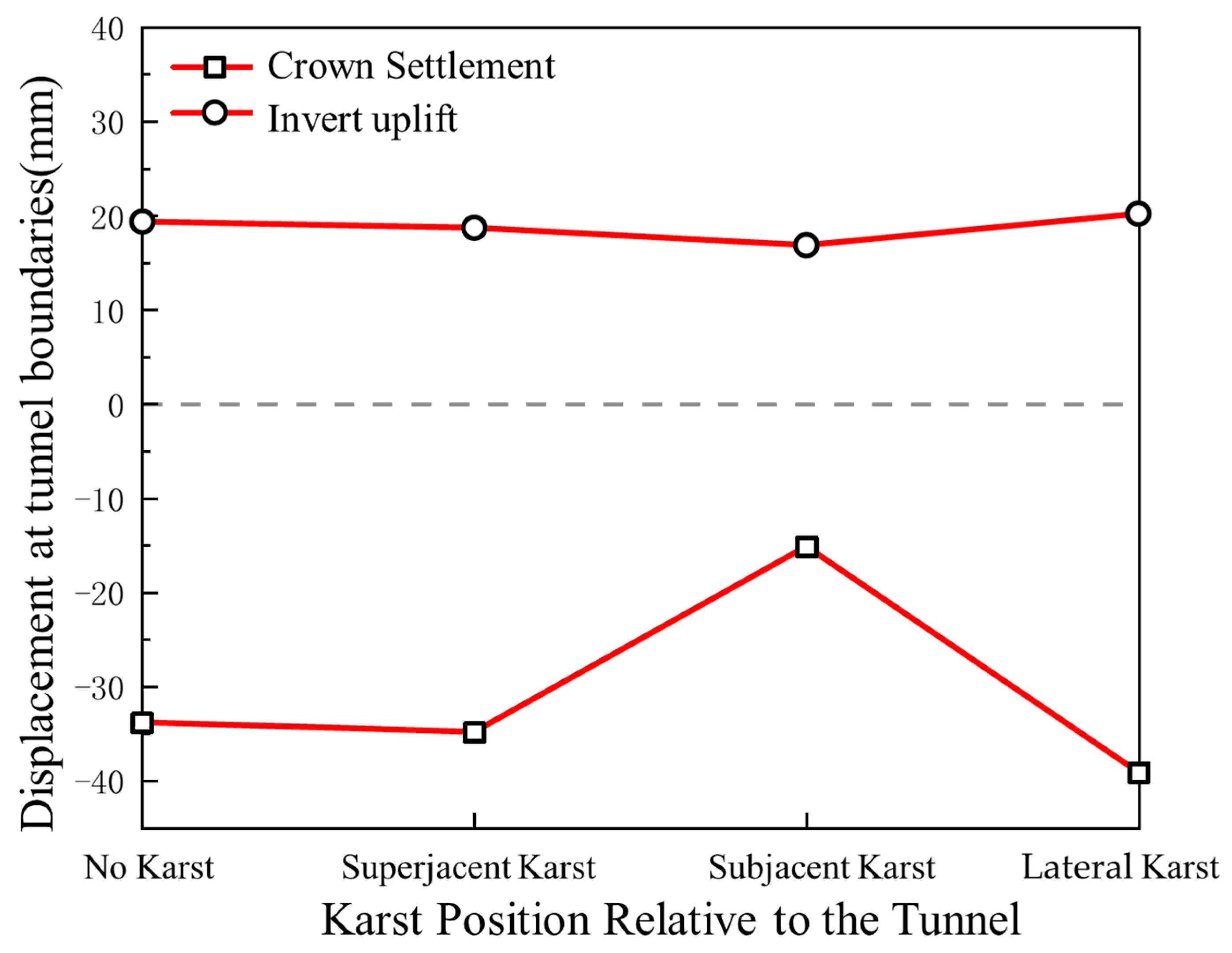
Displacement responses at the tunnel crown and invert, as shown in Figure 8, provide further insight into the influence of karst position:
  • Crown settlement:
Condition 1 (no karst) exhibits a crown settlement of −33.83 mm. Condition 2 (subjacent karst) shows a significant reduction to −15.16 mm, representing a 55.2% decrease compared to the karst-free condition. It indicates that the underlying karst cavity effectively releases stress and deformation in the basal rock mass. Condition 3 (lateral karst) demonstrates increased crown settlement of −39.12 mm, corresponding to a 15.6% increase relative to Condition 1. This amplification results from compromised support capacity due to the adjacent karst presence. Condition 4 (superjacent karst) records a crown settlement of −34.86 mm, showing only a marginal 3.0% increase, suggesting limited influence from overhead karst features.
  • Invert uplift:
Condition 1 yields an invert uplift of 19.33 mm. Condition 2 exhibits reduced uplift of 16.84 mm (12.9% decrease), indicating stress release in the basal rock mass due to the underlying cavity. Condition 3 shows a slight increase to 20.17 mm (4.3% increase), while Condition 4 demonstrates a minor reduction to 18.69 mm (3.3% decrease), confirming the limited effect of superior karst positions on invert deformation.

4.3.3. Discussion

Within the geological context of the referenced project, the rock mass demonstrates competent self-supporting capacity. Karst cavities located above or below the tunnel are interpreted as representing preliminary unloading of the rock mass, resulting in significant reduction in both maximum surface settlement and crown settlement. When the karst cavity is positioned beneath the tunnel (Condition 2), the most substantial reductions in maximum surface settlement, settlement trough width parameter, and crown settlement are observed. This finding demonstrates consistent mechanistic behavior with previous research by Li, Liu and Su [22] and Pan et al. [43].
The lateral karst configuration (Condition 3) exerts the most substantial influence on surface settlement and crown settlement induced by roadheader excavation. Consequently, this most unfavorable condition with lateral karst positioning has been selected for subsequent stochastic finite element simulations and reliability analysis.

5. Reliability Analysis Method for Tunnel Construction Based on Monte Carlo Simulation

5.1. Input Variables and Output Responses

  • Input Variables
Based on geological survey data and field test results, the geotechnical mechanical parameters relevant to the tunnel excavation section were selected as random input variables. As the tunnel section is located in weakly weathered limestone interbedded with dolomite with favorable mechanical properties, and the construction-induced disturbance mainly remains within the elastic deformation range of the rock mass, parameters such as elastic modulus E, Poisson’s ratio μ, and unit weight γ were selected as random variables. The geometric parameters of the karst cavity—including the major axis radius a, minor axis radius b, and the clear distance d between the karst cavity and the tunnel section—were also included as analysis parameters. The variability and uncertainty of these parameters play significant roles in simulating the ground response during tunnel excavation.
The coefficient of variation for the Poisson’s ratio and unit weight of the soil layers is relatively small. The distribution patterns of the artificial fill and hard plastic clay were determined with reference to the coefficient of variation in the weakly weathered limestone interbedded with dolomite. Given the significant discreteness in the geometric characteristics of the karst cavity, a uniform distribution was adopted to simulate the statistical patterns of parameters such as the major axis radius, minor axis radius, and the clear distance between the karst cavity and the tunnel section. During actual construction, hollow grouting anchor bolts were installed in the tunnel arch and mortar anchor bolts were applied to the sidewalls during initial support. Based on empirical practice, the elastic modulus of the rock mass within the influence range of the anchor bolts was increased by 20%. After the installation of the anchor bolts, the overall strength of the rock mass was significantly enhanced, and its uncertainty was reduced. Therefore, this region was treated as a homogeneous rock mass.
The statistical characteristics and distribution types of each input variable are detailed in Table 7.
2.
Output Responses
Ground surface settlement, tunnel crown settlement, invert uplift and convergence and were selected as output responses. The limit state functions are defined as follows (for symbol definitions and limit values, refer to Section 2.2):
G ( x ) = f ( E i , μ i , γ i , a , b , d ) = g 1 ( x ) = s g max s g a g 2 ( x ) = s t max s t a g 3 ( x ) = s a r max s a r a g 4 ( x ) = s n max s n a

5.2. Surrogate Model Development and Validation

To address the prohibitive computational cost associated with large-scale Monte Carlo simulations using direct finite element analysis, surrogate modeling techniques were employed. This study utilized the Latin Hypercube Sampling (LHS) method to generate 332 training samples within the input variable space according to their probability distributions, with corresponding output responses obtained through high-fidelity finite element computations. Additionally, 40 independent test samples were generated through the same sampling method for Response Surface Method (RSM) validation, while 33 test samples were prepared for neural network validation to ensure model generalizability.
Three distinct surrogate modeling approaches were implemented and comparatively evaluated: Response Surface Method (RSM), Radial Basis Function Neural Network (RBFNN), and Elliptical Basis Function Neural Network (EBFNN). Model performance was quantitatively assessed using four error metrics: Mean Absolute Error (MAE), Maximum Absolute Error (MAX), Root Mean Square Error (RMSE), and Coefficient of Determination (R2). The predetermined accuracy thresholds were established as follows: MAE < 0.2, MAX < 0.3, RMSE < 0.2, and R2 > 0.9. Models satisfying all these criteria were deemed acceptable for engineering applications.
The stochastic finite element computations, design of experiments, and surrogate model development were all conducted within the Isight integration platform. This platform imposes certain limitations on the flexibility of model training and the customization of parameters. In this study, the Latin Hypercube Sampling method was initially employed to generate 332 training samples. Subsequently, the platform’s built-in three-layer feedforward Radial Basis Function Neural Network (RBFNN) was utilized for model training. The key parameters were configured as follows: the Smoothing Factor was set to its default value of 0 (this parameter is designed to mitigate model ill-conditioning caused by uneven sample distribution through a relaxation factor, with its maximum allowable value being 0.1); the Maximum Iterations to fit was set to 50 (this parameter is effective only for the Elliptical Basis Function Neural Network, EBFNN). To evaluate the model’s generalizability, the cross-validation method was adopted. The specific procedure involved: selecting a subset of 33 points from the primary dataset, sequentially removing each point, re-training the model and recalculating the coefficients using the remaining data, and then comparing the actual response value with the predicted value at each removed point.
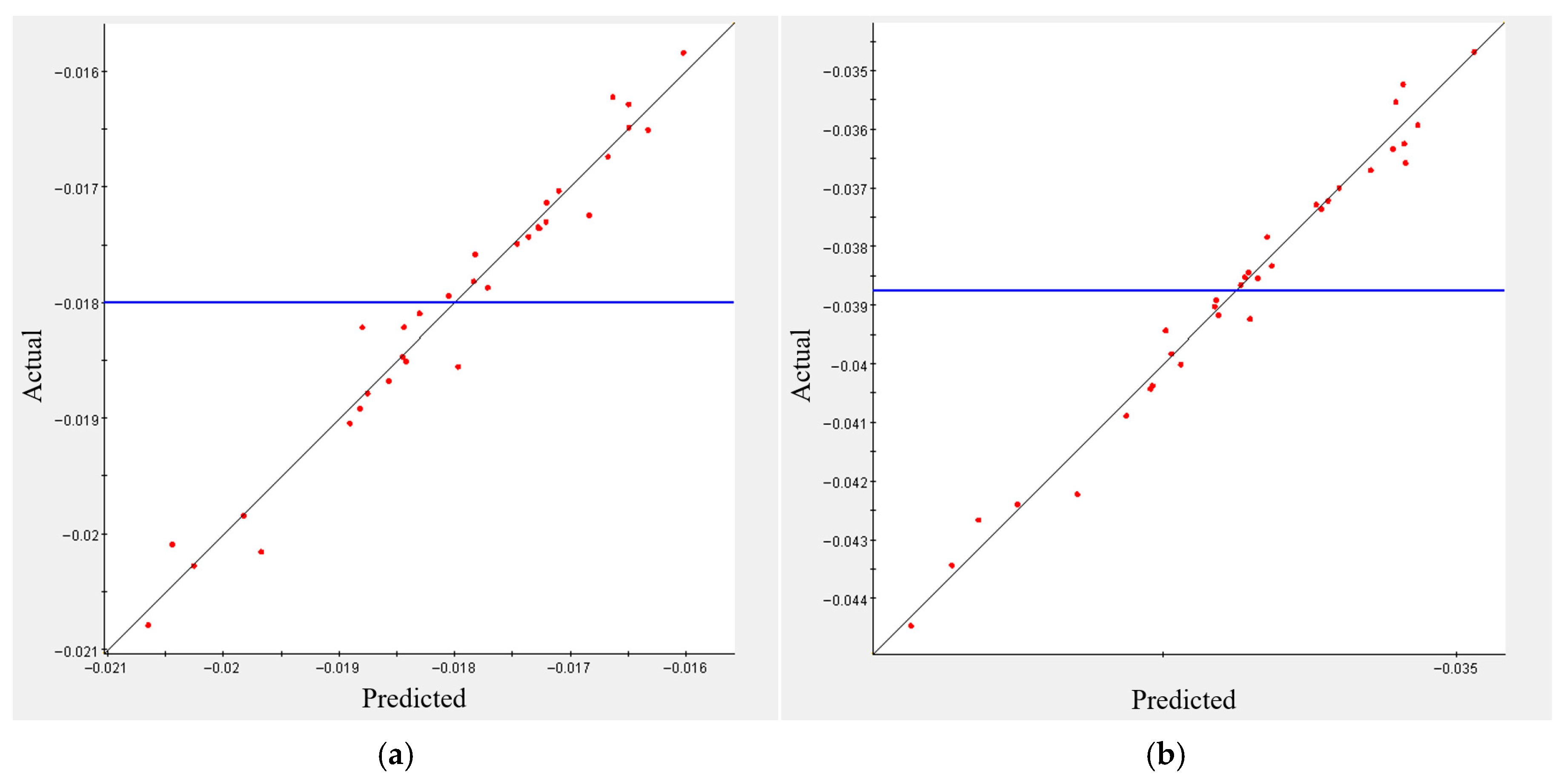
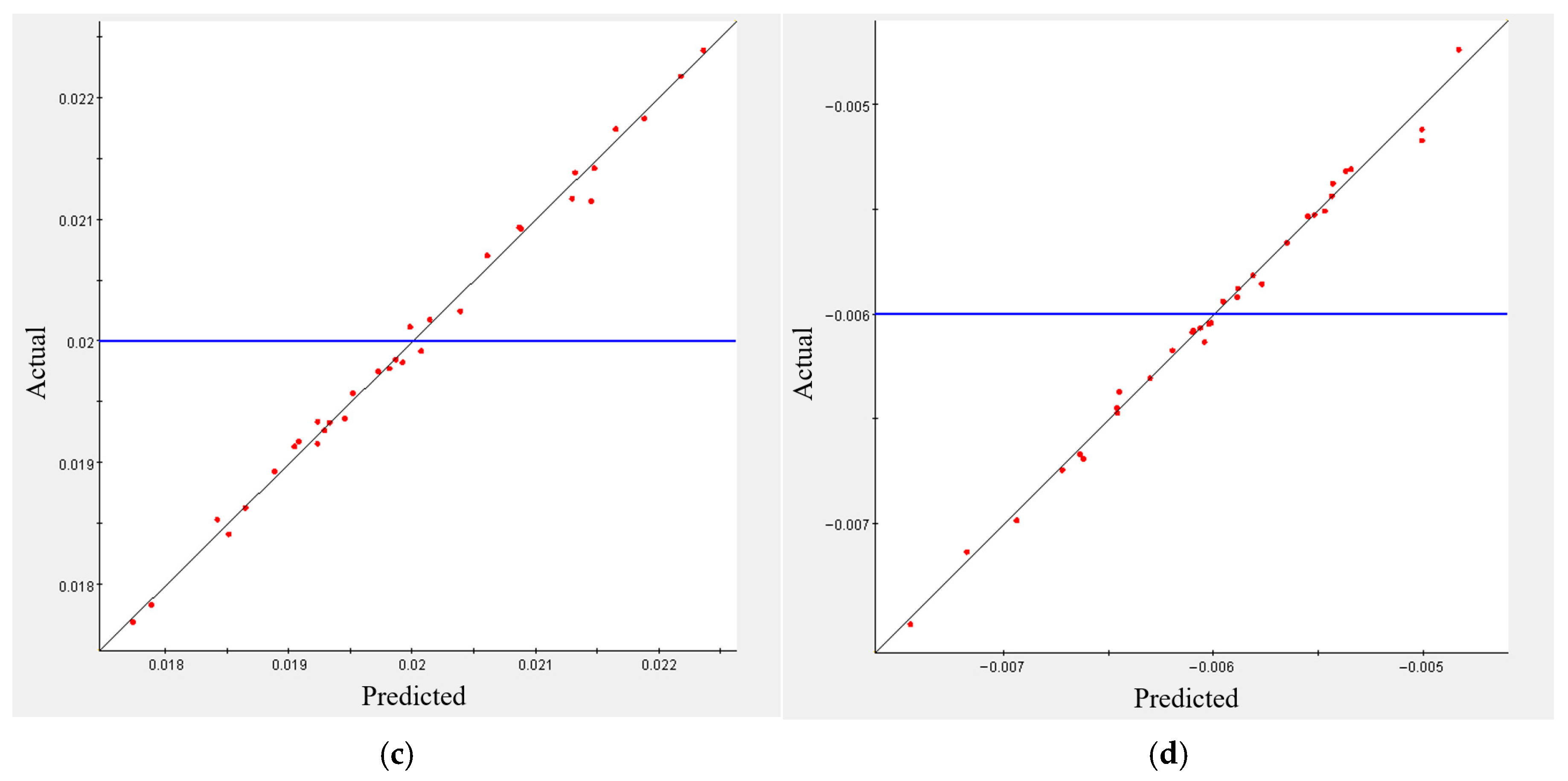
Comparative analysis of error metrics across the three surrogate modeling approaches (Table 8) reveals that all models satisfied the predetermined accuracy thresholds, demonstrating their capability to effectively replace computationally expensive finite element simulations for subsequent Monte Carlo analysis. However, notable performance differences were observed: The RSM model exhibited robust performance (R2 ≥ 0.949), while the EBFNN model, despite achieving high accuracy, generally showed higher MAE and MAX values compared to the RBFNN approach. The RBFNN model demonstrated superior overall performance, with all R2 values exceeding 0.98 and consistently better error metrics across all output responses, particularly for critical responses g1 and g2, indicating exceptional nonlinear mapping capability and generalization performance. The prediction results are shown in Figure 9 compared with the actual value (simulated), demonstrating a satisfactory fit of the surrogate model.
Based on this comprehensive evaluation, the RBFNN surrogate model was selected for subsequent large-scale Monte Carlo simulations due to its optimal balance between prediction accuracy and computational efficiency.

5.3. Parameter Sensitivity Analysis

To discern the paramount factors governing the tunnel construction disturbance response, a global sensitivity analysis was performed using the Spearman rank correlation coefficient. This technique is ideal for capturing monotonic, potentially nonlinear relationships without presuming linearity, thus suited to our complex geotechnical system.
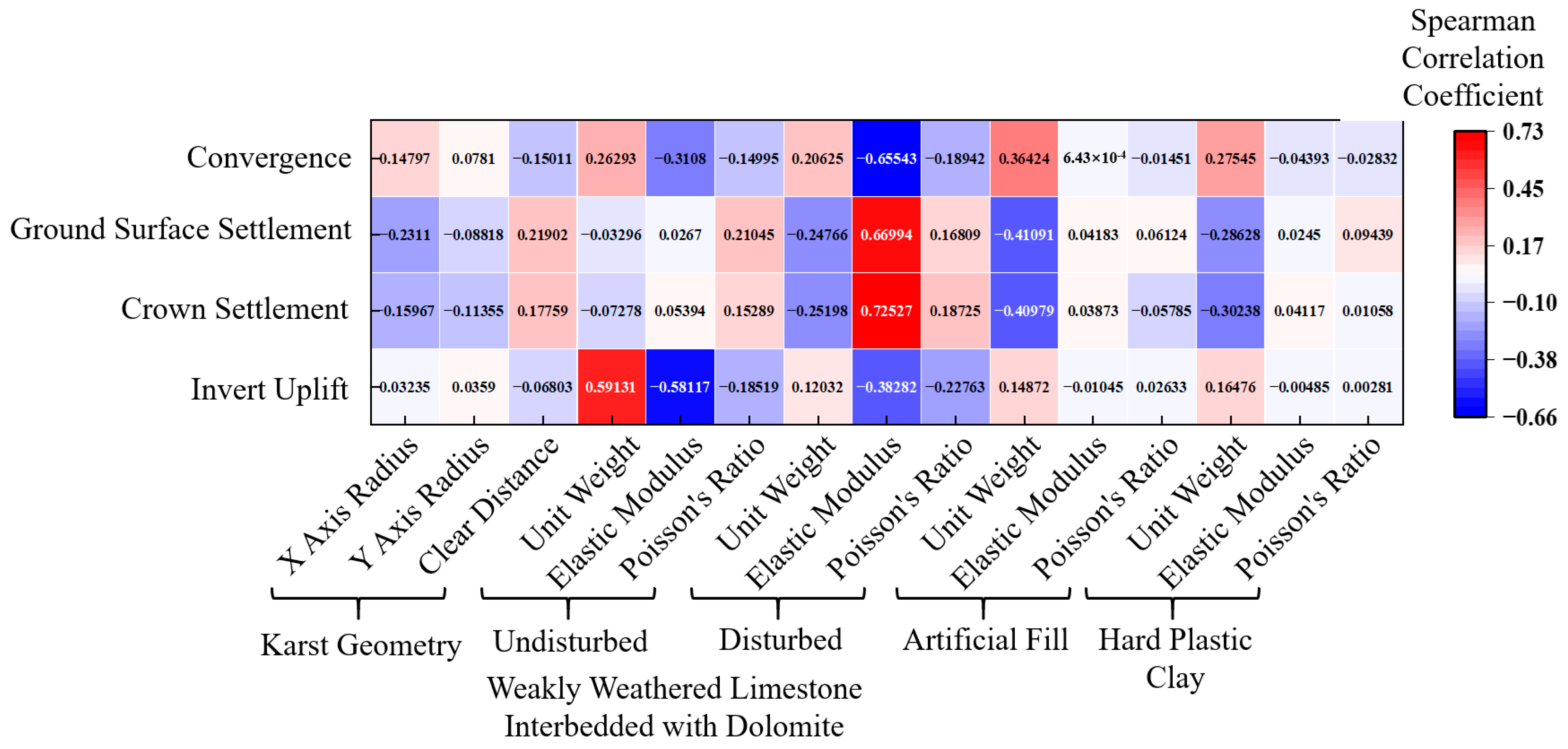
The analysis, visualized in the heatmap (Figure 10), yielded a hierarchy of parameter influence, with two factors demonstrating preeminent importance:
Primary Controlling Parameters:
Elastic Modulus of the Disturbed Rock Mass was the unequivocally most significant parameter, showing strong negative correlations with surface settlement (g1, −0.67) and convergence (g3, −0.66). This implies that a reduction in the stiffness of the rock mass surrounding the tunnel excavation—a direct consequence of construction-induced disturbance—is the primary driver of increased deformation.
Clearance Distance to Karst Cavity (d) was also identified as a critical factor, significantly affecting all major displacement responses. This highlights the substantial risk posed by adjacent karst features, where a smaller net distance drastically compromises the stability provided by the surrounding rock.
Secondary and Selective Influences:
Undisturbed Rock Mass Properties: The elastic modulus of the undisturbed rock mass exhibited a positive correlation with invert uplift (0.59) and, to a lesser extent, convergence (0.26). A plausible mechanistic explanation is that a stiffer, more competent intact rock mass provides a stronger foundation, resisting heave but potentially transferring more load to the lining, manifesting as increased convergence.
Karst Cavity Geometry: The major axis radius (a) showed a modest negative correlation with surface settlement (−0.23), indicating that wider cavities pose a greater risk to surface stability, likely due to a larger zone of compromised rock mass. The minor axis radius (b) had a negligible impact.
The sensitivity analysis conclusively identifies the integrity of the disturbed rock mass and the proximity of karst cavities (d) as the dominant sources of uncertainty and risk. Furthermore, the properties of the undisturbed rock mass and the horizontal geometry of the cavity (a) are also recognized as non-negligible contributing factors. This hierarchy of parameter influence, quantifying the impact of each variable, provides a comprehensive and solid parameter basis for subsequent probabilistic risk assessment and informed decision-making.

5.4. Reliability Analysis of Construction Disturbance in Karst Tunnels Using Boom-Type Roadheaders

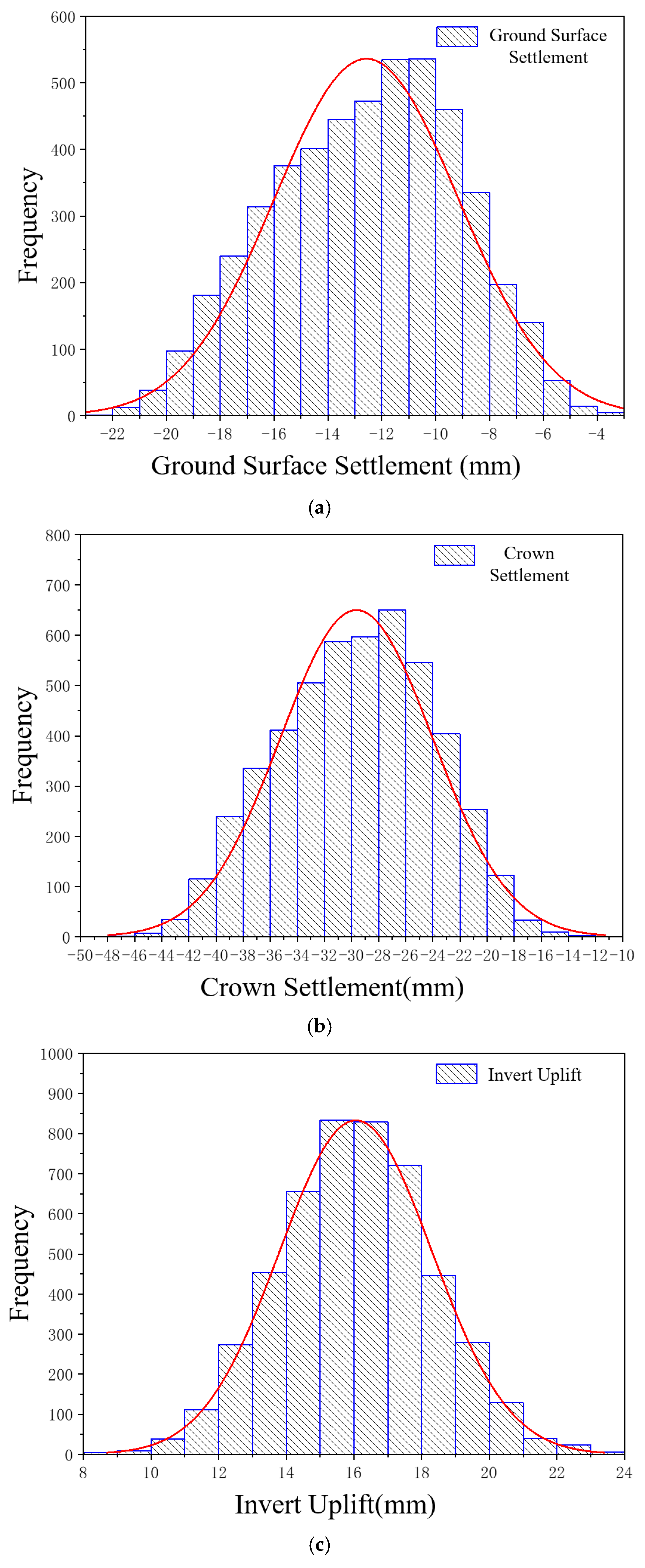
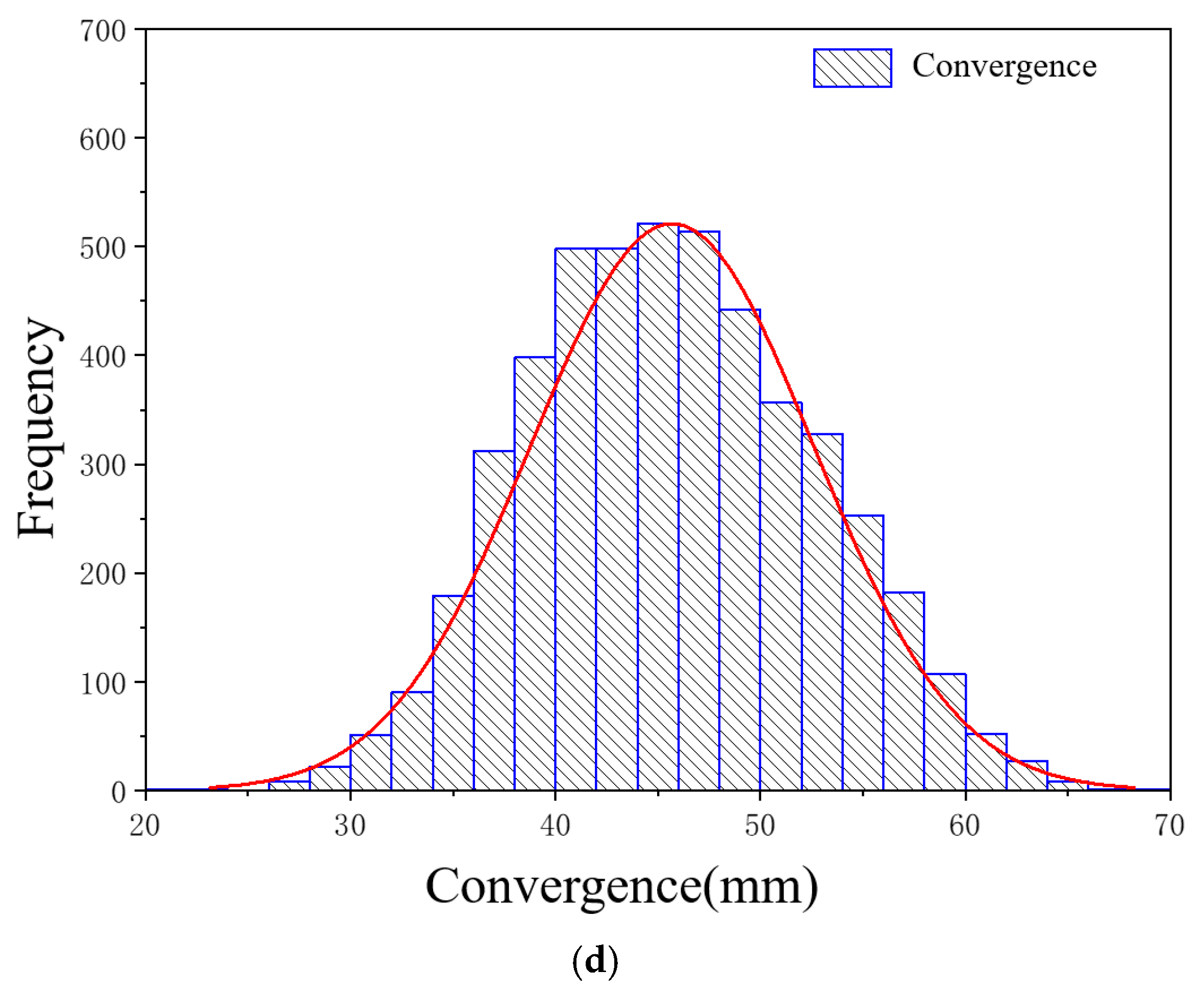
Leveraging the validated high-precision RBFNN surrogate model, a large-scale probabilistic assessment of the tunnel construction disturbance response under the lateral karst condition was conducted via Monte Carlo Simulation (MCS). A total of 10,000 random samples were generated. The sampling history indicated that the calculated failure probabilities stabilized after approximately 4850 samples, confirming the sufficiency of the 10,000-sample size for obtaining stable statistical indicators. The probability distribution characteristics of the key displacement indicators were thus obtained, with their frequency distribution histograms shown in Figure 11.
Statistical analysis of the MCS output yielded the following characteristics for the displacement responses: Surface settlement had a minimum of −3.67 mm, a maximum of −22.67 mm, and a mean of −12.57 mm; Crown settlement ranged from −13.11 mm to −46.86 mm, with a mean of −29.63 mm; Invert uplift varied between 8.83 mm and 22.57 mm, averaging 16.05 mm; Convergence spanned from 22.00 mm to 69.30 mm, with a mean value of 45.69 mm.
Based on the defined limit state functions, the probabilities and corresponding reliability index for each individual failure mode and the system failure were calculated (Table 9). The results indicate:
  • The failure probability for crown settlement, g 2 ( x ) , is the highest (3.26%), identifying it as the primary controlling failure mode, and the reliability index is 1.85 correspondingly.
  • The failure probability for surface settlement, g 1 ( x ) , is 1.05%. The reliability index is 2.31.
  • The failure probabilities for invert uplift, g 3 ( x ) , and convergence, g 4 ( x ) . are extremely low (0.01%), and the reliability index is 3.72, indicating they do not constitute significant risk sources under the considered conditions.
  • The overall system failure probability (i.e., the probability of any indicator exceeding its limit) for the tunnel construction disturbance is 3.31% (with the reliability index of 1.84). This value is predominantly governed by the failure probability of crown settlement.
These quantitative results provide a crucial probabilistic basis for risk assessment. The identified failure probabilities, particularly for crown settlement, highlight potential vulnerabilities and should inform decision-making regarding the necessity and intensity of mitigation measures. Such measures could include enhancing the physico-mechanical parameters and reducing the variability of the rock mass in the disturbed zone through systematic bolting (improving the elastic modulus of the disturbed rock mass), grouting karst cavities to diminish their influence (increasing effective d), and improving overall surrounding rock quality, thereby directly addressing the key sensitive parameters identified in the previous section.

6. Conclusions

This study developed an integrated probabilistic analysis framework suitable for reliability analysis of construction disturbances in karst tunnels excavated by boom-type roadheaders by combining the Stochastic Finite Element Method (SFEM), Monte Carlo Simulation (MCS), and a Radial Basis Function Neural Network (RBFNN) surrogate model. The main conclusions are as follows:
(1) Significant uncertainty exists in karst tunnel construction. The probabilistic analysis revealed the discrete nature of the tunnel construction response in karst formations. The case study showed that the overall failure probability of tunnel construction under the condition of a lateral karst cavity is 3.31%, with the failure probability of crown settlement being the highest (3.26%), identified as the most critical failure mode.
(2) The influence mechanisms of key parameters were revealed. Sensitivity analysis based on Spearman rank correlation indicated that the elastic modulus of the disturbed rock mass and the net distance between the karst cavity and the tunnel are the most critical parameters affecting deformation reliability, whose variability contributes most significantly to the failure probability.
(3) An effective surrogate modeling method was proposed. The established RBFNN surrogate model achieved a good balance between prediction accuracy (average R2 > 0.98) and computational efficiency, significantly improving the efficiency of Monte Carlo simulations and providing an effective tool for probabilistic analysis of similar projects.
Furthermore, the proposed probabilistic framework, integrating SFEM, MCS, and RBFNN surrogate modeling, is sufficiently general and holds potential for application in the reliability assessment of a broader range of engineering structures beyond underground constructions, such as slopes, foundations, and retaining systems.
Notwithstanding these contributions, this study has several limitations that suggest directions for future research:
Firstly, while the influence of karst cavities at typical locations (above, below, and lateral to the tunnel) was investigated, the potential risks from cavities at oblique or asymmetric orientations were not fully considered.
Secondly, the analysis was conducted using a two-dimensional model and did not simulate the sequential process of tunnel excavation, primarily due to the computational constraints of probabilistic analysis; thus, complex 3D effects and time-dependent behaviors warrant further investigation.
Thirdly, the current model employs linear-elastic material behavior. A critical direction for further development of this methodology would be the incorporation of more advanced nonlinear constitutive models with elastoplasticity to more accurately capture the complex mechanical response of geological materials.
Finally, the geological model was based on a specific stratigraphy, and the impact of different stratigraphic distributions and layer properties on the reliability outcomes remains to be explored.

Author Contributions

W.D. (Wenyun Ding): Resources, Project Administration, and Conceptualization (Engineering Methodology). Y.S.: writing—original draft, visualization and methodology. W.D. (Wenqi Ding): writing—review and editing, supervision, and funding acquisition. Y.G.: Resources, Project Administration, and Writing—Review and Editing. Y.Q.: writing—review and editing, conceptualization. J.T.: validation and investigation. All authors have read and agreed to the published version of the manuscript.

Funding

This research was funded by Key Technology R&D Plan of Yunnan Provincial Department of Science and Technology (Grant No. 202303AA080003), Yunnan Jinsha River Expressway Tunnel Intelligent Construction Technology Demonstration Project for Complex Environments, and Science and Technology Major Project of Department of Transport of Yunnan Province (No. 202302AD080007).

Institutional Review Board Statement

Not applicable.

Informed Consent Statement

Not applicable.

Data Availability Statement

The original contributions presented in this study are included in the article. Further inquiries can be directed to the corresponding author.

Acknowledgments

The authors thank the managers of China Railway 18th Bureau Group Co., Ltd.

Conflicts of Interest

Authors Wenyun Ding and Yongfa Guo were employed by the company Kunming Survey, Design and Research Institute Co., Ltd. of CREEC. The remaining authors declare that the research was conducted in the absence of any commercial or financial relationships that could be construed as a potential conflict of interest.

Abbreviations and Notations

The following abbreviations and notations are used in this manuscript:
( x 1 , x 2 x n ) the vector of input random variables
s g max the maximum allowable value of surface settlement
s g a the value of surface settlement
s t max the maximum allowable value of tunnel crown settlement
s t a the value of tunnel crown settlement
s a r max the maximum allowable value of invert uplift
s a r a the value of invert uplift
s n max the limit value of tunnel convergence
s n a the value of tunnel convergence
S x y the rank correlation coefficient
N the number of samples
R the rank value of the parameter
R ¯ the average rank of N parameters
S the rank value of the target
S ¯ the average rank of N target values
p f the failure probability
βthe reliability index
S max the maximum settlement value directly above the symmetric center of the settlment trough
athe major axis radius
bthe minor axis radius
xthe horizontal distance from the calculation point to the surface projection of the tunnel centerline
Vithe volume loss rate
ithe width parameter of the settlement trough
EElastic Modulus
μPoisson’s Ratio
γUnit Weight
φFriction Angle
cCohesion
dClear Distance
EBFNNElliptical Basis Function Neural Network
LHSLatin Hypercube Sampling
MAEMean Absolute Error
MAXMaximum Absolute Error
MCSMonte Carlo Simulation
PDFprobability density function
R2Coefficient of Determination
RBFNNRadial Basis Function Neural Network
RMSERoot Mean Square Error
RSMResponse Surface Method
SFEMStochastic Finite Element Method

References

  1. Rong, Y. Effects of Concealed Soil Cavities in Karst Areas on the Mechanical Behavior and Deformation of Operational Urban Rail Transit Shield Tunnels. Master’s Thesis, South China University of Technology, Guangzhou, China, 2019. [Google Scholar]
  2. Cai, Y. Research on Deformation and Failure Mechanisms of Cavity-Containing Strata under the Influence of Urban Tunnel Construction. Ph.D. Thesis, Beijing Jiaotong University, Beijing, China, 2020. [Google Scholar]
  3. GB 50068; Unified Standard for Reliability Design of Building Structures. Ministry of Housing and Urban-Rural Development of PRC and State Administration of Market Regulation: Beijing, China, 2018.
  4. Q/CR 9129-2018; Code for Design of Railway Tunnel (Limit State Method). China State Railway Group Co., Ltd.: Beijing, China, 2018.
  5. GB 50007-2011; Code for Design of Building Foundation. Ministry of Housing and Urban-Rural Development of the People’s Republic of China: Beijing, China, 2011.
  6. BS EN 1997-1; Eurocode 7: Geotechnical Design. Part 1. General Rules. British Standards Institution: London, UK, 2024.
  7. Li, Y.-S.; Yu, S.-X.; Deng, T. Comparing Three Design Approaches in En1997-1 Eurocode with Those in Chinese Geotechnical Design Code. Rock Soil Mech. 2012, 33, 105–110. [Google Scholar]
  8. Han, X. Research on Differences between Chinese and European (French) Standard Systems for Geotechnical Engineering. J. Railw. Eng. Soc. 2011, 28, 117–121. [Google Scholar]
  9. Liu, Z.; Ni, G.; Lin, C.; Huo, J. Study on the Differences between China and EU Railway Tunnel Standards and Proposals for Revision. Railw. Stand. Des. 2023, 67, 165–171. [Google Scholar] [CrossRef]
  10. de Koker, N.; Day, P.W. Reliability Analysis of En 1997 Design Approaches for Eccentrically Loaded Footings. Proc. Inst. Civ. Eng. Geotech. Eng. 2018, 172, 113–120. [Google Scholar] [CrossRef]
  11. Low, B.K.; Phoon, K.-K. Reliability-Based Design and Its Complementary Role to Eurocode 7 Design Approach. Comput. Geotech. 2015, 65, 30–44. [Google Scholar] [CrossRef]
  12. Xu, J.; Zheng, Y. Elastoplastic Stochastic Finite Element Analysis of Surrounding Rock of Tunnel and Its Application to Reliability Calculation. Rock Soil Mech. 2003, 24, 70–74. [Google Scholar] [CrossRef]
  13. Wang, Z.; Li, M.; Yu, Y.; Xu, S.; Xu, C.; Zheng, F.; Huang, W.; Wu, Z.; Wan, J. Analysis of Influence of Tunnel through Karst Cave on Deformationand Internal Force of Lining Structure. Water Resour. Hydropower Eng. 2024, 55, 435–446. [Google Scholar] [CrossRef]
  14. Phoon, K.-K.; Cao, Z.-J.; Ji, J.; Leung, Y.F.; Najjar, S.; Shuku, T.; Tang, C.; Yin, Z.-Y.; Ikumasa, Y.; Ching, J. Geotechnical Uncertainty, Modeling, and Decision Making. Soils Found. 2022, 62, 101189. [Google Scholar] [CrossRef]
  15. Sousa, R.L.; Einstein, H.H. Risk Analysis during Tunnel Construction Using Bayesian Networks: Porto Metro Case Study. Tunn. Undergr. Space Technol. 2012, 27, 86–100. [Google Scholar] [CrossRef]
  16. Mair, R.J.; Soga, K.; Wongsaroj, J. Tunnelling-Induced Consolidation Settlements in London Clay. Géotechnique 2013, 63, 1103–1115. [Google Scholar] [CrossRef]
  17. Wongsaroj, J.; Soga, K.; Mair, R.J. Modelling of Long-Term Ground Response to Tunnelling under St James’s Park, London. Géotechnique 2007, 57, 75–90. [Google Scholar] [CrossRef]
  18. Zhang, J.; Xu, M.; Cui, M.; Xin, Y.; Wang, H.; Su, P. Prediction of Ground Subsidence Caused by Shield Tunnel Construction Under Hidden Karst Cave. Geotech. Geol. Eng. 2022, 40, 3839–3850. [Google Scholar] [CrossRef]
  19. Gai, X. Effects of Concealed Karst Caves on Tunnel Surrounding Rock Stress and Surface Settlement: An Investigation. Constr. Mach. Maint. 2023, 1, 67–69. [Google Scholar]
  20. Fang, Z.; Ding, N.; Yang, W.; Dai, Z.; Wang, J.; He, J.; Ding, R.; Ba, X.; Zhou, Z. The Influence of Different Karst Cave Filling Material Strengths on Stratum Stability During Shield Tunneling. Geotech. Geol. Eng. 2023, 41, 1309–1323. [Google Scholar] [CrossRef]
  21. Yang, X. Numerical Simulation of Shield Tunnel under Different Karst Conditions. J. Liaoning Prov. Coll. Commun. 2022, 24, 13–16. [Google Scholar]
  22. Li, P.; Liu, J.; Su, F. Numerical Analysis on Effect of Karst Cave on Stability in Metro Tunnel excavation. Subgrade Eng. 2013, 4, 76–81. [Google Scholar]
  23. Fu, H.; Zhao, Y.; Ding, H.; Rao, Y.; Yang, T.; Zhou, M. A Novel Intelligent Displacement Prediction Model of Karst Tunnels. Sci. Rep. 2022, 12, 16983. [Google Scholar] [CrossRef]
  24. Zhang, K.; Lyu, H.; Shen, S.; Zhou, A.; Yin, Z. Data on Evolutionary Hybrid Neural Network Approach to Predict Shield Tunneling-Induced Ground Settlements. Data Brief 2020, 33, 106432. [Google Scholar] [CrossRef]
  25. Zhang, K.; Lyu, H.; Shen, S.; Zhou, A.; Yin, Z. Evolutionary Hybrid Neural Network Approach to Predict Shield Tunneling-Induced Ground Settlements. Tunn. Undergr. Space Technol. 2020, 106, 103594. [Google Scholar] [CrossRef]
  26. Kang, Y.; Kang, Y.; Geng, Z.; Geng, Z.; Lu, L.; Chen, L.; Liu, X.; Liu, B.; Huang, X. Compound Karst Cave Treatment and Waterproofing Strategy for Epb Shield Tunnelling in Karst Areas: A Case Study. Front. Earth Sci. 2021, 9, 761573. [Google Scholar] [CrossRef]
  27. Xu, H.; Xiao, C.; Liu, W.; Zuo, Y.; Wei, C. Numerical Study on Karst Treatment Technology of Wuhan Metro Line 6. IOP Conf. Ser. Earth Environ. Sci. 2020, 571, 012090. [Google Scholar] [CrossRef]
  28. Yan, Z.; Yan, B.; Zhang, J.; Jiang, X.; Dai, Y. Surface Control Techniques for Tunnels in Karst Areas under Airport Taxiways. Proc. Inst. Civ. Eng. Geotech. Eng. 2022, 176, 552–566. [Google Scholar] [CrossRef]
  29. GB 50911-2013; Code for Monitoring Measurement of Urban Rail Transit Engineering. China Architecture & Building Press (CABP): Beijing, China, 2013.
  30. Q/CR 9218-2024; Technical Specification for Monitoring Measurement of Railway Tunnel. China State Railway Group Co., Ltd.: Beijing, China, 2024.
  31. Zhang, W. Study on the Parameter Inversion and the Adjustment of the Predicted Deformation of Three-dimensional Foundation Pit Based on Isight Platform. Master’s Thesis, China University of Mining and Technology, Xuzhou, China, 2023. [Google Scholar]
  32. Lai, Y. Isight Parameter Optimization: Theory and Case Studies Explained in Detail; Jiang, X., Fang, L., Li, M., Eds.; Beihang University Press: Beijing, China, 2012. [Google Scholar]
  33. Luo, Y.; Zhao, Z. Research on the Algorithm of Aireraft Fuel Quantity Based on Rbf Neural Network. J. Air Force Eng. Univ. 2025, 26, 26–33. [Google Scholar]
  34. Xu, B. Research of the Fatigue Reliability of Prestressed Concretebeams under Corrosive Environment. Master’s Thesis, Dalian University of Technology, Dalian, China, 2011. [Google Scholar]
  35. Gong, J.; Wei, W. Principles of Reliability Design for Engineering Structures; China Machine Press: Beijing, China, 2007. [Google Scholar]
  36. Nguyen, V.U. Reliability index in geotechnics. Comput. Geotech. 1985, 1, 117–138. [Google Scholar] [CrossRef]
  37. Dudzik, A.; Potrzeszcz-Sut, B. Hybrid Approach to the First Order Reliability Method in the Reliability Analysis of a Spatial Structure. Appl. Sci. 2021, 11, 648. [Google Scholar] [CrossRef]
  38. Wang, E. Research on Compressive Behavior and Reliability of Round-Ended Steel Tube-Filled Concrete Column. Master’s thesis, Wuhan University of Technology, Wuhan, China, 2012. [Google Scholar]
  39. Su, P. Model Test Study on the Influence of Concealed Karst Caves on the Stability of Surrounding Rock in Shield Tunnels. Master’s Thesis, Dalian Jiaotong University, Dalian, China, 2020. [Google Scholar]
  40. Xiao, Y.; He, M.; Qiao, Y.; Cai, W.; Jiang, Y.; Zhu, H. A Novel Implementation Method of Gzz-Based Constitutive Model into Flac3d. Tunn. Undergr. Space Technol. 2024, 145, 105601. [Google Scholar] [CrossRef]
  41. Chen, P. Estimation of Equivalent Mohr-Coulomb Parameters of Slope Based on Hoek-Brown Criterion; Chang’an University: Xi’an, China, 2021. [Google Scholar]
  42. Mo, Y.; Hu, X.; Cui, D.; Gu, D.; Xie, Z.; Yang, Y. A Method for Determining Hoek-Brown Criterion Parameters and Estimating Mechanical Parameters of Arenated Dolomite Masse. Rock Soil Mech. 2025, 46, 257–265. [Google Scholar] [CrossRef]
  43. Pan, Q.; Zhang, Q.; Zhao, J.; He, Y.; Li, S. Analysis on Influence of Karst Distribution on Stability of Shield Tunnels. Mod. Tunn. Technol. 2018, 55, 466–474. [Google Scholar] [CrossRef]
Figure 1. Flow Chart. (The red star signifies the preferred option based on a comprehensive qualitative and quantitative assessment).
Applsci 15 11789 g001
Figure 2. Structure of the Three-Layer Feedforward Neural Network.
Applsci 15 11789 g002
Figure 3. Schematic diagram of the model test container: (a) Front view; (b) Side view [39].
Applsci 15 11789 g003
Figure 4. Numerical model of tunnel construction in karst formations.
Applsci 15 11789 g004
Figure 5. Comparison of surface settlement between numerical simulation and model test results.
Applsci 15 11789 g005
Figure 6. Schematic diagram of models and working conditions: (a) Condition 1; (b) Condition 2; (c) Condition 3; (d) Condition 4.
Applsci 15 11789 g006
Figure 7. Surface Settlement Profiles for Various Karst Relative Positions.
Applsci 15 11789 g007
Figure 8. Displacement at tunnel boundaries.
Applsci 15 11789 g008
Figure 9. Predicted and simulated results comparison from RBFNN (test set): (a) maximum surface settlement; (b) crown settlement; (c) invert uplift; (d) convergence. (The blue line represents the mean value of simulated results).
Applsci 15 11789 g009aApplsci 15 11789 g009b
Figure 10. Heatmap of Spearman correlation coefficients.
Applsci 15 11789 g010
Figure 11. Frequency distribution of output responses from Monte-Carlo simulation: (a) maximum surface settlement; (b) crown settlement; (c) invert uplift; (d) convergence (10,000 Monte Carlo samples).
Applsci 15 11789 g011aApplsci 15 11789 g011b
Table 1. Ultimate Relative Displacement Values Around Tunnels and Chambers (%) [22,23].
Rock Mass GradeTunnel Burial Depth (m)
h ≤ 5050 < h ≤ 300300 < h ≤ 500
III0.10–0.300.20–0.500.40–1.20
IV0.15–0.500.40–1.200.80–2.00
V0.20–0.500.40–1.601.00–3.00
Table 2. Fundamental Physical Quantities and Similarity Constants [30].
Physical QuantitySimilarity RelationSimilarity Constant
Geometric Dimensions C l 24
Unit Weight C γ 1
Stress C σ 24
Strain C ε 1
Displacement C w 24
Elastic Modulus C E 24
Poisson’s Ratio C μ 1
Table 3. Physico-mechanical properties of the simulated and similitude materials.
MaterialElastic Modulus
E (MPa)
Poisson’s Ratio
μ
Unit Weight
γ (kN/m3)
Friction Angle
φ (°)
Cohesion
C (kPa)
Similitude Material22.300.2522.3540.5680.61
Simulated Material
(Soft Rock)
85.000.2522.3540.561934.64
Table 4. Geotechnical Parameters of Construction Materials.
PartLithological DescriptionThickness
(m)
Elastic Modulus
E (MPa)
Poisson’s Ratio
μ
Unit Weight
γ (kN/m3)
Friction Angle
φ (°)
Cohesion
c (kPa)
Artificial Fill10.7017.280.3218.001835
Hard Plastic Clay7.7023.820.3218.2014.4136.9
Weakly Weathered Limestone Interbedded with Dolomite (Undisturbed)61.605000.3127.3022.557.51 × 103
Weakly Weathered Limestone Interbedded with Dolomite (Disturbed)-4000.2427.3018.001502
LiningC35 Concrete-31.5 × 1030.224.50--
Table 5. Numerical Simulation Conditions.
Condition No.Tunnel Depth
(m)
Clear Distance
(m)
Major Axis Radius
(m)
Minor Axis Radius
(m)
Relative Position
123.72--No karst
223.7231.5Below tunnel
323.7231.5Right side of tunnel
423.7231.5Above tunnel
Table 6. Calibrated parameters for Peck settlement trough formulation.
Condition No.ConfigurationSmax
(mm)
i
(m)
Vi
(%)
a
(m)
c
(mm)
R2
1Intact rock−14.2413.28−0.00310−0.41630.9992
2Subjacent karst−5.5510.78−0.001000.02730.9957
3Lateral karst−17.2713.73−0.0039−1.2970−0.50500.9989
4Superjacent karst−10.8814.87−0.002700.44200.9998
Table 7. Statistical characteristics and distribution types of stochastic finite element input parameters.
Stratum NameStatistical ParameterElastic Modulus
E (MPa)
Poisson’s Ratio
μ
Unit Weight
γ (kN/m3)
Artificial FillRepresentative Value17.280.3218
Standard Deviation2.850.050.036
Coefficient of Variation0.160.150.02
Distribution TypeNormalNormalNormal
Hard Plastic ClayRepresentative Value23.820.3218.2
Standard Deviation3.090.050.036
Coefficient of Variation0.130.150.02
Distribution TypeNormalNormalNormal
Weakly Weathered Limestone Interbedded with Dolomite (Undisturbed)Representative Value5000.3127.3
Standard Deviation1150.050.5
Coefficient of Variation0.230.150.02
Distribution TypeNormalNormalNormal
Weakly Weathered Limestone Interbedded with Dolomite (Disturbed)Representative Value6000.3127.3
Standard Deviation///
Coefficient of Variation///
Distribution Type///
Part NameParameterX Axis Radius
(m)
Y Axis Radius
(m)
Clear Distance
d (m)
Untreated Karst CavityMinimum Value32.52
Maximum Value67.58
Distribution TypeUniformUniformUniform
Table 8. Error evaluation metrics summary (10,000 Monte Carlo samples).
Surrogate ModelOutput ResponseMAEMAXRMSER2
RSM g 1 ( x ) 0.0350.180.0510.949
g 2 ( x ) 0.0360.120.0460.961
g 3 ( x ) 0.0190.0490.0240.992
g 4 ( x ) 0.0230.090.0330.988
RBFNN g 1 ( x ) 0.0340.1200.0470.965
g 2 ( x ) 0.0260.0760.0340.980
g 3 ( x ) 0.0160.0640.0200.994
g 4 ( x ) 0.0180.0710.0310.989
EBFNN g 1 ( x ) 0.0360.1410.0480.966
g 2 ( x ) 0.0350.1210.0450.972
g 3 ( x ) 0.0150.0580.0200.994
g 4 ( x ) 0.0270.0870.0350.988
Table 9. Probabilities of different failure modes.
Failure EventFailure Probability
pf
Reliability Index
β
g 1 ( x ) < 0 0.01052.31
g 2 ( x ) < 0 0.03261.85
g 3 ( x ) < 0 0.00013.72
g 4 ( x ) < 0 0.00013.72
g 1 ( x ) < 0 g 2 ( x ) < 0 g 3 ( x ) < 0 g 4 ( x ) < 0 0.00013.72
g 1 ( x ) < 0 g 2 ( x ) < 0 g 3 ( x ) < 0 g 4 ( x ) < 0
(System Overall Failure)
0.03311.84
Disclaimer/Publisher’s Note: The statements, opinions and data contained in all publications are solely those of the individual author(s) and contributor(s) and not of MDPI and/or the editor(s). MDPI and/or the editor(s) disclaim responsibility for any injury to people or property resulting from any ideas, methods, instructions or products referred to in the content.