


Abstract
Consumers prefer snacks that are tasty, healthy, and crunchy. However, optimizing crunchiness using sensory methods is time-consuming and expensive. Therefore, this paper proposes a new approach to measuring instrumental crunchiness. Whole strawberries of the “Honeoya” variety were osmotic dehydrated in a sucrose solution or chokeberry juice concentrate for 1, 2, and 3 h before freeze-drying. Texture was analyzed using acoustic emission (AE) and a compression test. The crunchiness index was calculated taking into account the number of AE events and mechanical energy. The content of bioactive substances, water activity, and porosity of the freeze-dried products were also assessed. Freeze-dried fruits that were osmotically dehydrated in chokeberry juice concentrate were characterized by lower final water activity and higher content of bioactive substances, but their crunchiness was the lowest. The crunchiest, loudest, and least hard were freeze-dried strawberries osmotically dehydrated in the sucrose solution. The tested freeze-dried strawberries differed in the range of sound frequencies generated, which indicates a different cracking mechanism.
1. Introduction
Among the many consumer expectations regarding dry snacks, texture is the second-most important feature influencing acceptance after taste [1]. Texture, like taste, encompasses features liked (crispness and crunchiness) and disliked (rubberiness, stickiness, and hardness) by consumers [1,2,3]. Numerous researchers have demonstrated that crispness and crunchiness are complex concepts, combining a wide range of perceptions, such as crack characteristics, sound, density, and food geometry [1,4,5,6,7]. It has been proven that consumers have different understandings of the terms “crispy” and “crunchy,” but the sound produced during chewing is important in both of these characteristics. According to consumer perceptions, the term “crunchy” refers to food with a hard texture that generates low-pitched sounds when chewed. High-frequency sounds, crackly and splitting, were used to describe the perception of “crispy”. Consumers considered sound the most important characteristic for the perception of crispness/crunchiness, followed by food hardness [4,6,8,9]. Texture is most often assessed sensorially, but due to its high subjectivity, instrumental methods are constantly being improved to allow for quick, objective measurement [3,7], not only in laboratory settings but also in industrial settings. Instrumental texture testing has often been performed using mechanical tests, but, in recent years, acoustic tests have also been used [7,10,11,12]. Due to the strong correlations between sensory properties and instrumental properties measured via deformation force and sounds, instrumental texture measurement has been found to be a good tool to mimic human chewing and texture perception [13,14,15].
Various methods are used to measure acoustic emissions generated during mechanical tests [3,7,16,17]. Sounds can be recorded using a microphone, a piezoelectric sensor, or a broadband AE sensor (accelerometer). When recording sound with a microphone, it is difficult to eliminate the acoustic background, i.e., sounds coming from the recording equipment, such as the noise of a computer fan, because the microphone receives sounds passing through the air [11,16]. This means that silence must be maintained during the AE measurement. This is not necessary if an accelerometer is used, which records the signal (sound wave) generating and propagating through the test sample as it deforms [16,18]. This method has been successfully used to assess texture changes caused by increased moisture content in potato chips, cereal products, and apple gels [16,17,19] and predict the crispness of apples [18]. Therefore, in this study, it was assumed that instrumental (acoustic and mechanical) measurement of dried fruit texture could help develop a standard of crispness against which newly developed snacks can be measured. This is particularly important when the product varies in shape, has a heterogeneous structure, or is porous, such as dried fruit, as these characteristics strongly influence the perception of texture. Although it was proven that the main factor affecting the textural properties of fruit and vegetable chips was their chemical composition, and the cell structure was a secondary factor [20].
Strawberries are valued for their flavor, low calories, and nutritional value. Water dominates the composition of these fruits (approximately 90%), with the amount varying slightly due to soil and climatic conditions in each harvest year. These fruits contain 7.2% total carbohydrates (including 1.4% sucrose), 0.7% protein, 0.4% fat, and 0.8% ash. They are also a source of dietary fiber (1.8–1.9%) and many vitamins, such as ascorbic acid (C), on average, 66.0 mg per 100 g, niacin (vitamin PP), riboflavin (B2), thiamine (B1), and vitamin B6; they also contain minerals, primarily potassium, calcium, phosphorus, magnesium, sodium, and iron, along with smaller amounts of manganese, copper, and zinc [21]. Strawberries are also rich in minerals, flavonoids, and polyphenol compounds, many of which are natural antioxidants [22,23]. Salazar-Orbea et al. [24] identified 18 phenolic compounds in strawberries.
Due to seasonality, a large surplus of strawberries is inevitable, and their delicate texture and perishability necessitate their rapid preservation after harvest [25,26]. One of the many preservation methods is drying, which allows for the production of crispy snacks. The process should be carried out to ensure microbiological stability, preserve nutritional value, and the best possible quality characteristics, i.e., color, flavor, aroma, and crisp texture. Dried fruit contains concentrated nutrients, and even if they are partially degraded during drying, the product is still characterized by bioactive compound content exceeding their level in raw tissues (per unit weight), which may make it a product with health-promoting properties [27,28,29]. In the process of drying strawberries and other soft fruits, it is tough to obtain high-quality dried fruit. Various drying techniques affect textural characteristics, such as product hardness and crispness [30], and reduce the content of bioactive compounds [27,31,32]. One technique that largely preserves the properties of the raw material is freeze-drying [33,34]. This method is energy-intensive and expensive, but it produces a product with the texture desired by consumers, a lighter color than the raw material, and a higher nutritional value than when drying strawberries using other methods [27,30,35,36]. Previous research found that freeze-dried fruits showed better retention of vitamin C, anthocyanins, phenols, and antioxidant capacity than those dried by hot-air drying and refractance window drying [31]. Freeze-dried strawberries retained better raw material properties, including polyphenol content, compared to air-dried strawberries [30,37]. To ensure the desired nutritional and sensory value and shorten the drying time during freeze-drying, fruit pre-treatment with ultrasound [29,35,38,39,40] or high pressure [39,41], as well as osmotic dehydration in various solutions, e.g., fruit juice concentrates or fruit pomace extracts, is used. The use of osmotic dehydration in chokeberry juice concentrate causes an increase in the dry mass and total polyphenol content of the dehydrated apples and significantly reduces the water content [38], which improves the economics of the freeze-drying process. The process minimizes changes in the color, composition, and texture of the dehydrated fruit [42,43]. The addition of sugar protects anthocyanin pigments by inhibiting enzymatic degradation, enriching flavor, and preventing oxidation [44]. In particular, dehydration of fruit in fruit juice concentrate solutions may increase the content of bioactive compounds [38,45,46], which may be a natural antioxidant reducing the oxidation of nutrients [47]. Although the effects of temperature and time of osmotic dehydration of fruits in different solutions are well known [38,39,45], there is no information on the acoustic measurement of crunchiness in freeze-dried strawberries, and its relationship with mechanical properties and the content of bioactive substances. Literature reports indicate that the acoustic parameters of food texture strongly correlate with sensory evaluation [2,12,13,14,28,29,30], and the sound produced during eating influences the perception of crisp/crunchy products [8,10]. However, there is no information in the literature on the critical acoustic parameters of the texture of dried fruits. Expanding knowledge on acoustic parameters, crispness, and their relationship with the content of bioactive compounds may contribute to the development and implementation of an objective method for measuring the texture of dried fruit. Therefore, it is necessary to evaluate the crunchiness of freeze-dried strawberries and analyze the correlation with the content of bioactive compounds. Objective measurement of crunchiness can be one of the parameters used to optimize the texture of dried fruits in industrial conditions.
2. Materials and Methods
2.1. Osmotically Dehydrated and Freeze-Dried Strawberries
Whole strawberry fruits of the variety Honeoye were frozen at −40 °C and stored at −20 °C for 3 months. The strawberries were thawed in a microwave oven until a temperature of 25 °C was reached. Then, the fruits were dehydrated in osmotic solutions: sucrose (60 ± 1%) and chokeberry juice concentrate (60 ± 1° Brix) (Sokpol, Myszków, Poland). The chokeberry juice concentrate contained 60% carbohydrates, including 31% sugars. During osmotic dehydration, the ratio of material to solution was 1 to 4 (w/w). The process was carried out at 30 °C for 1, 2, and 3 h, with constant mixing of the samples at a frequency of 1 Hz. Osmotically dehydrated fruit in chokeberry juice concentrate is shown in Figure S1. After dehydration, the strawberries were frozen at −45 °C for 2 h in a freezer (51.20 IRINOX SPA), and then freeze-dried in a device, Alpha 1–4 LSC Plus Christ Company (Osterode am Harz, Germany). The parameters of the drying process were kept constant: pressure at 63 Pa; safety pressure at 137 Pa; temperature at 30 °C; and time of 24 h. The freeze-dried fruits were stored in a dark place at 20 ± 2 °C until analysis. The freeze-dried, non-dehydrated strawberries and strawberries osmotically dehydrated for 1 h, 2 h, and 3 h in sucrose solution (samples code: sucrose 1 h; sucrose 2 h, sucrose 3 h) and chokeberry juice concentrate (samples code: chokeberry 1 h, chokeberry 2 h, chokeberry 3 h) were used for analysis.
2.2. Dry Matter, Water Activity, and Density
The dry matter content was analyzed in freeze-dried, non-dehydrated, and osmotically dehydrated strawberries, according to the methodology described by Kowalska et al. [45].
The water activity (aw) of dried strawberries was determined using an AquaLab instrument (Model CX-2, USA, DECAGON DEVICES. Inc., Pullman, WA, USA).
The particle density, apparent density, and porosity were measured in 3 repetitions, according to the methodology described by Marzec et al. [13].
2.3. Acoustic and Mechanical Properties
During the compression test, acoustic emission (AE) was measured via the contact method using an accelerometer type 4381 (Brüel&Kjær, Narum, Denmark) with a sensitivity of 10 pC/ms−2. The accelerometer signal was amplified by 40 dB and digitized using card type 9112 (Adlink Technology Inc., Taipei, Taiwan) at a sampling rate of 44.1 kHz. The sound was analyzed in the frequency range of 1 to 16 kHz. A typical AE signal recording is a sinusoid, appearing as a sequence of pulses with amplitudes varying over time. Acoustic parameters can be determined in the time domain. The AE event is a group of signals characterized by a damped sinusoid over a period of time. The acoustic parameters, energy of acoustic event (a.u.), number of AE events, and amplitude of sound (μV), were calculated using the Calculate_44 kHz_auto program (Warsaw, Poland). Spectral characteristics of freeze-dried fruits were visualized on acoustograms [16].
The compression test was conducted to investigate the mechanical properties of dried strawberries, using the Texture Analyzer TA-Hdplus (Stable Micro Systems, Godalming, Surrey, UK). The test speed was 0.5 mm·s−1. The following mechanical parameters were calculated: compression force and mechanical energy (compression work). Compression work was calculated as the area under the compression curve of dried strawberries. Analysis was conducted with 15 replicates.
The crunchiness index was calculated as the product of the number of AE events and the mechanical energy recorded during sample compression [16].
2.4. Determination of Bioactive Substances Content
The antioxidant properties of the tested non-dehydrated, dehydrated, and freeze-dried strawberries were expressed in terms of the content of total polyphenols, anthocyanins, and flavonoid phenolic compounds. Dried fruits were ground in an analytical mill (IKA A11 basic; IKA-Werke GmbH, Germany), weighed on an analytical balance to the nearest 0.0001 g, approximately 0.3 g into a 15 mL Falcon flask, and mixed with 10 mL of extraction reagent (80% methanol). Extraction was performed on a shaker (Multi Reax, Heidolph Instruments, Germany) for 24 h (stirring speed set to 6) at room temperature. Samples were centrifuged for 2 min at 5000× g in a laboratory centrifuge (MegaStar 600, VWR). The supernatant was transferred to 0.2 mL capped tubes. Two extracts were prepared for each sample. The determination was performed spectroscopically using the color reaction of alites with Folin’s Ciocalteau reagent. A total of 10 µL of methanol extract and 10 µL of distilled water were dispensed into 96-well plates. Then, 40 µL of 5-fold diluted Folin’s Ciocalteau reagent was added and mixed. After 3 min, 250 µL of saturated sodium carbonate was added and mixed again. Incubation was continued for 60 min at room temperature, protected from light. Absorbance was measured using a Heλios spectrophotometer (Thermo Electron Co., Waltham, MA, USA) at a wavelength of 750 nm. A blank sample was prepared in which the extract was replaced with methanol. Two replicates of each extract were assayed. The content of phenolic compounds was calculated based on the calibration curve for gallic acid (Sigma Aldrich, Switzerland) in the range of 0–100 µg/mL (R2 = 0.998), and the result was expressed as gallic acid (mg GAE/100 g d.m.).
The differential pH method was used to determine the total anthocyanin content, which involves structural changes in the chemical forms of anthocyanins and measuring absorbance at pH 1.0 and 4.5. The crude extracts were diluted separately with 0.025 M hydrochloric acid and potassium chloride buffer (pH = 1) and 0.4 M sodium acetate buffer (pH = 4.5). The absorbance of the mixture was measured at 515 nm and 700 nm using a Heλios spectrophotometer (Thermo Electron Co., Waltham, MA, USA). The content of anthocyanins was expressed in terms of mg cyanidin-3-glucoside (mg Cy-3-glu/100 g d.m.).
Flavonoid content was determined based on a quercetin standard calibration curve in the range of 0.075–0.200 mg/ mL(Sigma-Aldrich, Steinheim, Germany). Absorbance was measured at 430 nm in a spectrophotometer (Thermo Electron Co., Waltham, MA, USA). Total flavonoid content was expressed as mg of quercetin equivalent per gram of dry matter [45,46].
2.5. Statistical Analysis
One-way ANOVA analysis was used to analyze significant differences in the obtained values. Significant differences between mean values were determined using Tukey’s Multiple Range test, with the significance level set at α < 0.05. Principal component analysis (PCA) was performed. The STATISTICA software v. 13.3 (StatSoft Inc., Tulsa, OK, USA) was used to analyze the data (StatSoft Inc., Tulsa, OK, USA).
3. Results and Discussion
3.1. Dry Matter Content, Water Activity, and Density Results
The dry matter content of dehydrated fruit is important because it is closely related to the sugar content. Before drying, pre-dehydration of plant tissue in osmotic solutions such as sucrose or chokeberry juice concentrate affects the increase in dry matter content [45]. It should also be noted that the fruits were thawed before osmotic dehydration in this study. The freezing process affects the structure, which could have affected the dry matter [48]. It should be emphasized that the strawberries were quickly frozen to reduce the drip loss [49]. After 1, 2, and 3 h of osmotic dehydration in sucrose, a significant increase in dry matter content was observed compared to non-dehydrated strawberries (Table 1). On the other hand, an increase in dry matter in strawberries osmo-dehydrated in chokeberry juice concentrate was observed only after 2 and 3 h (Table 1).
Table 1.
Dry matter content, water activity, and density analysis of freeze-dried strawberries. Each value is presented as mean ± SD.
3.2. Crunchiness of Freeze-Dried Strawberries
Acoustic emission (AE) is the phenomenon of the generation and propagation of elastic waves in solid materials and liquids. Materials in which AE signals are generated are characterized by a heterogeneous distribution of internal energy, resulting from manufacturing technology or operation under various conditions [16,17]. Sounds generated by dry products during deformation are closely related to their cellular structure. The tissue of freeze-dried fruit consists of air-filled cells [17]. During a compression test, the source of the generated sound is the rupturing of the cell walls. The loudness of such a sound results from the disruption of the cell walls, which is a factor determining the sound amplitude. Dried products with strong acoustic emission (“loud”) are characterized by high crunchiness and low hardness [13].
The acoustic texture parameters (energy of acoustic event, number of AE events, and amplitude of sound) and mechanical parameters (force and work) determined during the compression test are presented in Table 2.
Table 2.
Acoustic and mechanical parameters analysis of freeze-dried strawberries. Each value is presented as mean ± SD.
Strawberries that were not osmotically dehydrated before freeze-drying had a water activity (aw) of 0.275 (Table 1). The use of osmotic dehydration in a sucrose solution before freeze-drying did not significantly affect water activity compared to non-dehydrated dried material. The use of chokeberry juice concentrate resulted in a statistically lower aw regardless of the osmotic dehydration time. Water activity was approximately 0.190. Numerous studies have shown that freeze-drying fruit results in low water activity, which ensures microbiological stability during storage and the product’s crispness/crunchiness [29,31,45]. According to Gautam et al. [50], the critical aw required for microorganism growth is greater than 0.65.
The particle density of the dried material differed significantly. However, the apparent density was significantly lower only in strawberries that were not osmotically dehydrated. This resulted in differences in the porosity of the dried fruit (Table 1). After 3 h of osmotic dehydration in both solutions, the samples had a porosity lower by 10 percentage points compared to the non-dehydrated samples.
During the osmotic dehydration of plant materials, sucrose and other sugars present in the solution migrate into the material, and water is transferred from the material into the solution [45]. Therefore, the longer the dehydration time, the greater the amount of osmotic substance that can be absorbed by the strawberries, which results in an increase in the density and reduction in porosity of the dried product.
Knowing that the freezing process causes damage to the tissue structure and that cell juice leaks out during thawing, we assumed that this would affect the texture, and the resulting snacks would not be crunchy. As it turned out, freeze-drying preceded by osmotic dehydration in sucrose solution, but not in chokeberry juice concentrate, for 2 and 3 h resulted in snacks that generated the highest number of AE events, with the highest acoustic event energy and amplitude of sound (Table 2). The values of acoustic parameters were significantly higher than the non-osmotically dehydrated sample that was not thawed before drying. According to data from the literature, the structure, including the porosity, of the material is primarily responsible for acoustic emission [14,17]. In our study, strawberries osmotically dehydrated in chokeberry juice concentrate had significantly lower porosity compared to non-osmotically dehydrated strawberries and similar porosity to samples osmo-dehydrated in the sucrose solution. Acoustic emission also depends on the mechanical properties of the material and defects present in the sample caused by the technological process. However, it was most likely the chemical composition that determined the acoustic properties of the tested samples. Despite retaining porosity, the content of organic acids in the chokeberry juice concentrate may have weakened the structure of the freeze-dried strawberries, resulting in weaker AE. In freeze-dried fruits, the presence of sugars with a higher molecular weight increases the stability of the structure. Li et al. [20] studied the effect of chemical composition and structure on the texture of various dried fruits; they demonstrated that texture depends on chemical composition, while structure is of secondary importance for texture. Pre-dehydration in sucrose resulted in reduced compression force and work compared to non-dehydrated strawberries. Osmotic dehydration of fruit in chokeberry juice concentrate, combined with extending the dehydration time from 1 h to 3 h, increased the force and work compression of the samples. Some textural properties of our osmotically dehydrated strawberries were consistent with those previously reported, while others were inconsistent. These differences may be due to varying samples, preparation conditions, and the type of mechanical test used. Piotrowski et al. [30] demonstrated that the compressive strength of whole strawberries dried by vacuum, convection, and freeze-drying was a consequence of the structure of the materials. The porosity and total surface area of air cells in the freeze-drying fruit structure influence the acoustic and mechanical properties [10].
Alonzo-Macias et al. [51] considered the total number of force peaks recorded during the puncture test of dried strawberries to be one of the main and important parameters identifying crunchiness. Our previous research shows that, among acoustic parameters, the number of AE events strongly correlated with sensory assessment. Zdunek et al. [18] tested fresh apples and also indicated that the number of AE events was related to sensory characteristics. In our opinion, the crunchiness of dried fruits should be considered as mechanical and acoustic properties, as these properties are important for perception, because consumers perceive mechanical characteristics and hear sounds. Hence, we determined the crunchiness index as the product of the generated number of AE events and work compression. The crunchiness index was previously determined for crackers, which effectively described the change in texture, depending on the water content [16]. Strawberries osmo-dehydrated in a sucrose solution before freeze-drying had a significantly higher crunchiness index than those dehydrated in chokeberry juice concentrate (Table 2).
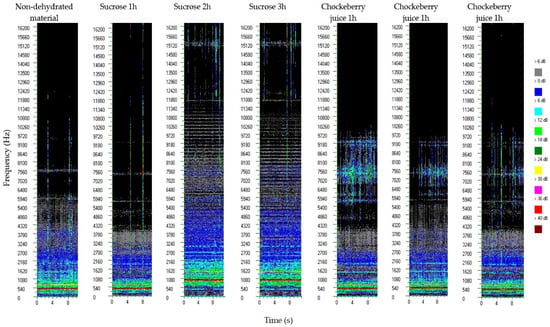
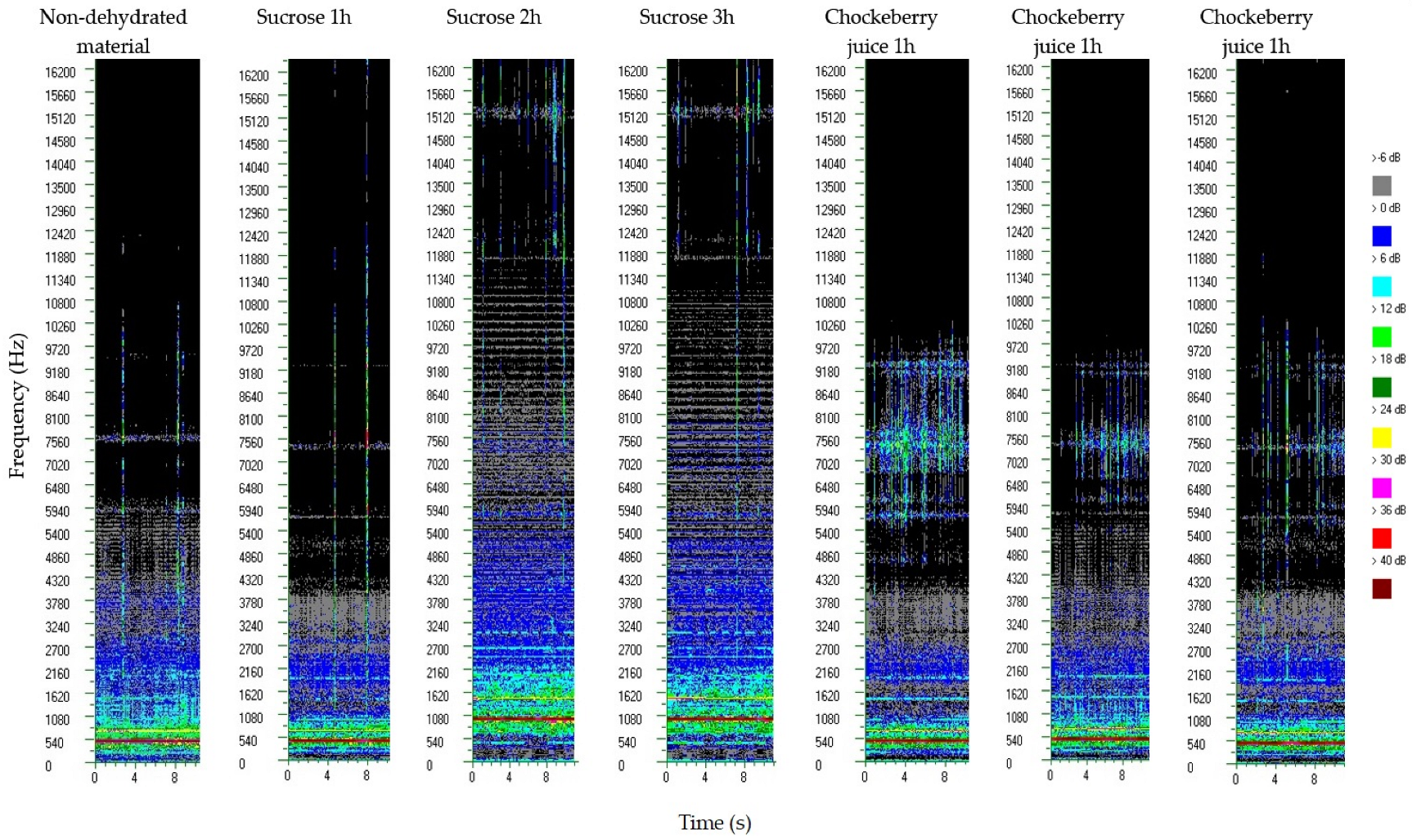
Dacremont [52] demonstrated that food crispness/crunchiness can be distinguished based on the frequency of instrumentally recorded sounds. Although no significant correlation was observed between the low-frequency range and sensory crispness for puffed-grain food, it was found that acoustic features extracted from the natural low-frequency range showed a significantly better correlation with sensory crispness [53]. In connection with the above, the frequencies of sound generated in the human audible range were also analyzed, and the results are presented in acoustograms (Figure 1).
Figure 1.
Acoustic activity of freeze-dried strawberries that were not dehydrated or osmotically dehydrated in sucrose or chokeberry juice concentrate for 1 h, 2 h, and 3 h.
Figure 1 presents an acoustogram of the collected data from the process of deforming freeze-dried strawberries. The horizontal axis represents the actual measurement time of the signal generated by the compressed sample, the vertical axis presents the spectral characteristics of the measured signal, and the colors indicate the signal intensity [13]. The freeze-dried strawberry types tested differed in terms of acoustic activity; non-dehydrated strawberries and strawberries osmo-dehydrated in chokeberry juice concentrate did not generate frequency sounds above 10 kHz. However, osmo-dehydration in sucrose solution resulted in a material that generated low- and high-frequency sounds (Figure 1). The detection of dominant sound frequency bands in the frequency characteristics indicates the complexity and diversity of the cracking mechanism of freeze-dried strawberries. The generated sounds originated from the breakdown and microdislocation of the structure. Cracking of pore walls caused displacement and generated low-frequency sounds. However, structural densification, destruction of substructures, and dislocations of macromolecules in the samples could be responsible for the generation of high-frequency sounds exceeding 10 kHz.
3.3. Content of Bioactive Substances
The tested products differed in the content of bioactive compounds (Table 3). Non-dehydrated strawberries had the lowest phenolic content (1975 mg GAE/100 g d.m) (Table 3). In contrast, the highest content of the determined compounds, ranging from 4664.58 mg GAE/100 g d.m. in samples dehydrated for 1 h to 5000.80 mg GAE/100 g d.m. after 3 h of dehydration, was found in strawberries dehydrated in chokeberry juice concentrate. The obtained results confirm the validity of using chokeberry juice concentrate as an osmotic medium and the effect of dehydration time on total phenolic content. Removing water during dehydration increases the concentration of compounds in the food matrix, and conducting the process at low temperatures protects labile phenolic compounds [54].
Table 3.
The total phenolic, anthocyanin, and flavonoid content in freeze-dried strawberries. Each value is presented as mean ± SD.
Anthocyanins are characterized by low thermal stability, which leads to their degradation during drying. Therefore, the content of these compounds in dried fruits such as blueberries, raspberries, and cherries is lower compared to fresh fruits [54,55,56]. However, the freeze-drying process takes place at low temperature and under vacuum conditions; therefore, it does not lead to significant thermal and oxidative degradation of anthocyanin [54]. Furthermore, the obtained results confirmed the beneficial effect of osmotic dehydration on anthocyanin content, regardless of the osmotic solution used (Table 3). Strawberries dehydrated in sucrose before freeze-drying had the highest anthocyanin content. In turn, the lower pH of the chokeberry juice concentrate likely influenced the anthocyanin content, which ranged from approximately 74 to approximately 200 mg Cy-3-glu/100 g d.m. It should be noted that thermal processes, including various drying methods, are the main factor influencing anthocyanin content [24].
Overall, osmotic treatment positively affected the flavonoid content in freeze-dried strawberries (Table 3). The lowest flavonoid content was determined in control samples and samples osmotically dehydrated in sucrose solution for 1 h. In the remaining dehydrated samples, the determined flavonoid content was at a similar level, ranging from approximately 15 to 17 mg quercetin/g d.m. A decrease in the content of the determined compounds was observed after 3 h of dehydration, which could be caused by mass exchange and transfer of water-soluble flavonoids to the dehydrating solution.
The obtained results are consistent with the data from the literature: osmotic dehydration of strawberries prior to freeze-drying increases the content of bioactive compounds, and the content of phenolic compounds depends on the dehydration solution used [45,46]. The osmotic dehydration process in chokeberry juice concentrate increased the polyphenol content and antioxidant potential of carrots and zucchini [55]. A significant factor influencing the content of phenolic compounds is the drying technique used, including temperature and process time [34,55,56,57,58,59]. Samoticha et al. [55] found that various drying methods led to the loss of polyphenols and anthocyanins, with the lowest anthocyanin losses, approximately 43%, occurring after freeze-drying of chokeberry fruits. In turn, Mendelowa et al. [56] showed that drying of chokeberry fruits using hot air and infrared methods led to a loss of polyphenol content by 45% and 41%, respectively, compared with fresh fruits; the content of anthocyanin pigments also decreased by 67% and 55%. Similarly, Akcicek et al. [54] confirmed the degradation of phenolic compounds during drying of blueberries by various methods, except freeze-drying, which caused an increase in the polyphenol content from 1423.31 mg GAE/100 g d.m. in fresh fruits to 1662.83 mg GAE/100 g d.m. in freeze-dried products. However, it should be remembered that processing is not the only factor influencing the content of bioactive compounds. According to Bojarska et al. [60], of the 11 varieties tested, fresh strawberries of the “Honeoya” variety were characterized by a high content of total polyphenols (5870 mg/100 g dry weight), but the lowest oxidative capacity of 44.8%. The varying content of bioactive compounds in fruit varieties results from differences in genotypes and environmental conditions [54,60].
3.4. The Relationship Between Texture Properties and Content of Bioactive Compounds of Freeze-Dried Strawberries
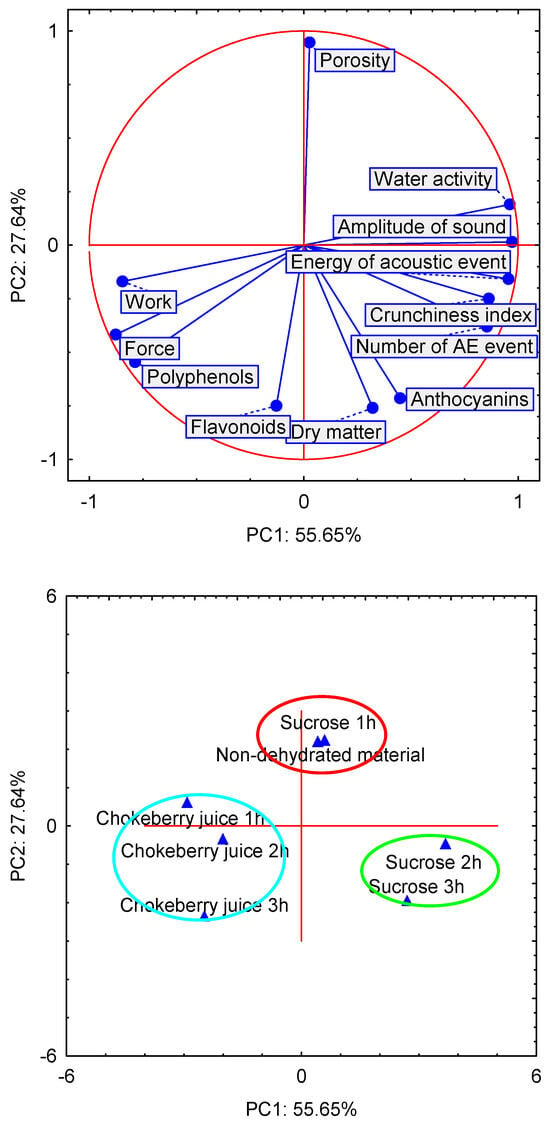
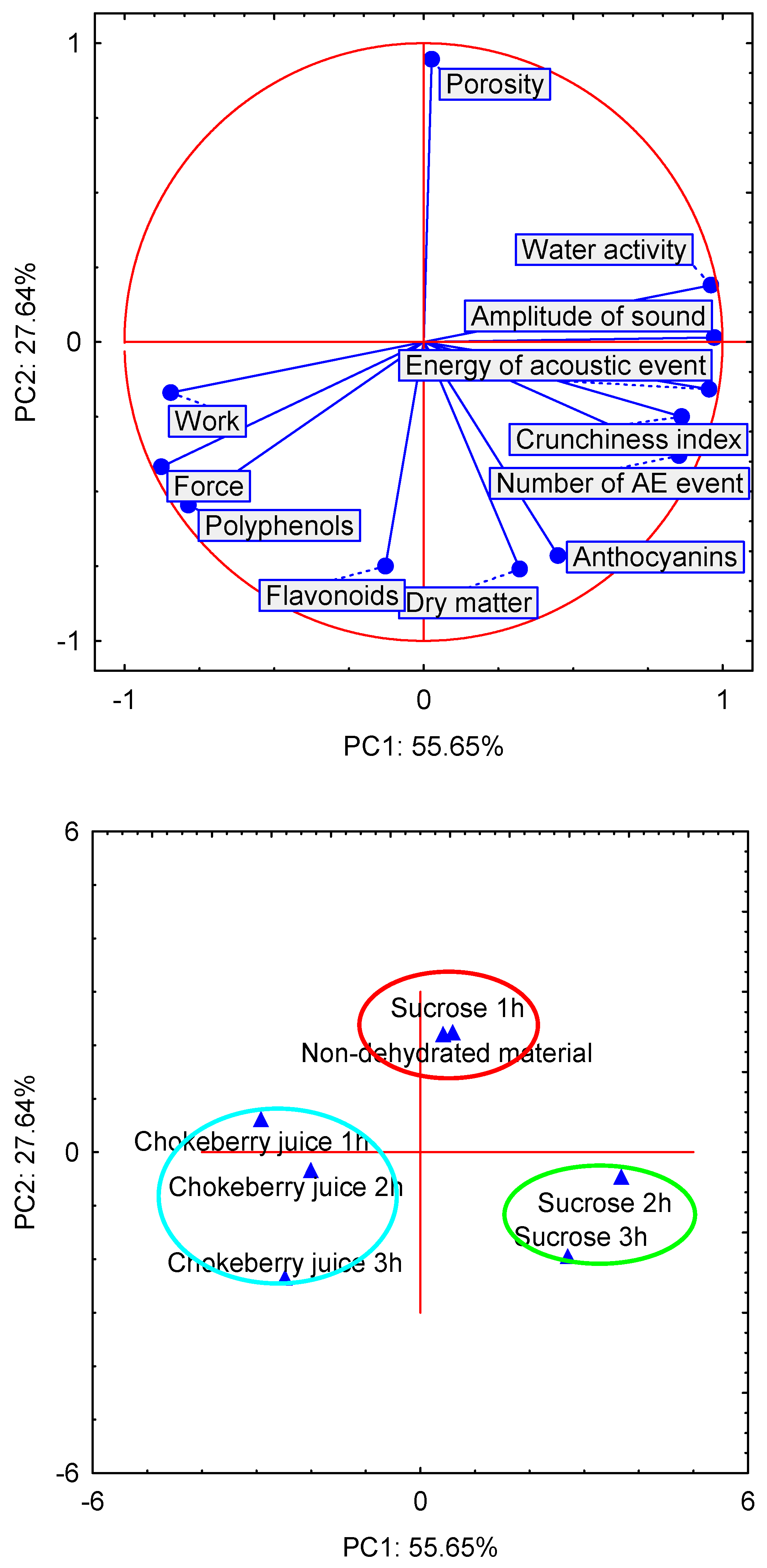
To visually present the correlations between acoustic, mechanical, and bioactive properties, as well as porosity, water activity, and dry matter content in the freeze-dried strawberry samples, principal component analysis (PCA) was performed. The first two principal components (PCs) explained 83.3% of the variance in all measured parameters; PC1 and PC2 explained 55.7% and 27.6%, respectively. PC1 consisted of textural parameters (acoustic and mechanical), crunchiness index, water activity, and total polyphenol content (Tables S1 and S2). PC2 consisted of porosity, dry matter, and bioactive compounds (anthocyanins and flavonoids) (Tables S1 and S2). On the right side of the diagram (green loop in Figure 2), samples dehydrated in sucrose solution for 2 and 3 h had low hardness, strong acoustic emission and crunchiness, and lower total polyphenol content, but higher anthocyanin content and oxidative capacity. The osmotically dehydrated strawberry samples in chokeberry juice concentrate were located next to each other on the left side of the PCA diagram (blue loop in Figure 2), indicating they were similar. They were characterized by the highest hardness, low crunchiness, and weak acoustic emission, but had the highest total polyphenol content. Non-dehydrated strawberries and those dehydrated in sucrose solution for 1 h formed a separate group in the PCA diagram (red loop in Figure 2); they had optimal texture, but the lowest content of bioactive compounds. A table of correlations between the analyzed parameters is provided in the Supplementary Materials (Table S3). Significant negative correlations were found between water activity (aw), force (−909), and work compression (−0.807), as well as positive correlations between aw and energy of acoustic event (0.878), aw and amplitude of the sound (0.932), and negative aw and total polyphenol content (−0.917). These relationships confirm that low water activity contributes to both a greater loss of bioactive compounds and sound amplification. These results are consistent with those available in the literature. Low humidity during the drying of bananas led to the degradation of bioactive compounds [61]. Amplitude of the sound also correlated negatively with total polyphenol content (−0.779). Dry matter correlated with porosity (−756) and anthocyanins (0.902). No correlation was observed between the crunchiness index and the content of bioactive compounds. The obtained results indicate that the amplitude of sound, rather than the crunchiness index, is an important parameter of the texture of freeze-dried strawberries. The amplitude of sound strongly depends on the structure of the materials [10,16]. In our study, porosity varied, but no correlation was found with acoustic parameters. Therefore, analysis of microstructure is necessary. Furthermore, the presence of high-molecular-weight sugars in freeze-dried fruit increases the stability of the structure [62], so further studies should analyze the chemical composition.
Figure 2.
PCA diagram; red, green and blue loops separate samples with similar values of the analyzed indicators.
4. Conclusions
In this study, we instrumentally measured the acoustic parameters, crunchiness, and polyphenol, anthocyanin, and flavonoid content in freeze-dried strawberries that had been osmotically dehydrated in a sucrose solution or chokeberry juice concentrate. The texture of the final products varied. Osmotic dehydration in the sucrose solution before freeze-drying improved texture; the crunchiness index was the highest, and the samples produced the loudest sound (highest energy, number of EA events, and sound amplitude), but the content of total phenolics was lower compared with fruits dehydrated in chokeberry juice concentrate. Preceding freeze-drying with osmotic dehydration in chokeberry juice concentrate produced snacks with low crunchiness, a hard texture, and a high content of bioactive compounds. Correlation and principal component analysis showed a negative relationship between sound amplitude and polyphenol content. The crunchiness index did not show any dependence on the content of bioactive substances. The freeze-dried strawberries, either non-dehydrated or osmotically dehydrated in chokeberry juice concentrate, generated sounds at frequencies between 0.5 and 10 kHz. However, fruits osmotically dehydrated in the sucrose solution generated sounds across the entire frequency range (0.5–16 kHz). Other spectral characteristics of the tested products indicated a different cracking mechanism. Therefore, research with a detailed analysis of the microstructure and general chemical composition of freeze-dried fruits is necessary to provide an explanation of the fracture mechanism.
Supplementary Materials
The following supporting information can be downloaded at: https://www.mdpi.com/article/10.3390/app152111704/s1.
Author Contributions
Conceptualization, A.M. and H.K.; methodology, A.M., H.K. and J.K.; software, A.M.; validation, A.M., H.K. and J.K.; formal analysis, A.M.; investigation, M.K.; resources, A.M., H.K. and J.K.; data curation, A.M., J.K. and H.K.; writing—original draft preparation, A.M.; writing—review and editing, A.M.; visualization, A.M.; supervision, A.M. and H.K.; project administration, A.M.; funding acquisition, A.M. All authors have read and agreed to the published version of the manuscript.
Funding
This research received no external funding.
Institutional Review Board Statement
Not applicable.
Informed Consent Statement
Not applicable.
Data Availability Statement
The data presented in this study are available on request from the corresponding author.
Conflicts of Interest
The authors declare no potential conflicts of interest with respect to the research, authorship, and/or publication of this article.
References
- Pellegrino, R.; Luckett, C.R. Aversive textures and their role in food rejection. J. Texture Stud. 2020, 51, 733–741. [Google Scholar] [CrossRef] [Scilit] [PubMed]
- Surmacka-Szcześniak, A. Texture is a sensory property. Food Qual. Prefer. 2002, 13, 215–225. [Google Scholar] [CrossRef] [Scilit]
- Wang, X.; Njehia, N.S.; Katsuno, N.; Nishizu, T. An acoustic study on the texture of cellular brittle foods. Rev. Agric. Sci. 2020, 8, 170–185. [Google Scholar] [CrossRef] [Scilit]
- Fillion, L.; Kilcast, D. Consumer perception of crispness and crunchiness in fruits and vegetables. Food Qual. Prefer. 2002, 13, 23–29. [Google Scholar] [CrossRef] [Scilit]
- Luyten, A.; Pluter, J.J.; Vliet, T. Crispy/crunchy crusts of cellular solid foods: A literature review with discussion. J. Texture Stud. 2004, 35, 445–492. [Google Scholar] [CrossRef] [Scilit]
- Chauvin, M.A.; Younce, F.; Ross, C.; Swansons, B. Standard scales for crispness, crackliness and crunchiness in dry and wet foods: Relationship with acoustical determinations. J. Texture Stud. 2008, 39, 345–368. [Google Scholar] [CrossRef] [Scilit]
- Sabella, P.; Farina, A.; Leporati, A. Methodology of Chewing’s sound acquisition by different detectors for dry food in terms of crispness and crunchiness. Appl. Acoust. 2024, 218, 109889. [Google Scholar] [CrossRef] [Scilit]
- Vickers, Z.M.; Bourne, M.C. A psychoacoustic theory of crispness. J. Food Sci. 1976, 41, 1158–1164. [Google Scholar] [CrossRef] [Scilit]
- Duizer, L. A review of acoustic research for studying the sensory perception of crisp, crunchy and crackly textures. Trends Food Sci. Technol. 2001, 12, 17–24. [Google Scholar] [CrossRef] [Scilit]
- Saeleaw, M.; Schleining, G. A review: Crispness in dry foods and quality measurements based on acoustic–mechanical destructive techniques. J. Food Eng. 2011, 105, 387–399. [Google Scholar] [CrossRef] [Scilit]
- Andreani, P.; de Moraes, J.O.; Murta, B.H.P.; Link, J.V.; Tribuzi, G.; Laurindo, J.B.; Paul, S.; Carciofi, B.A.M. Spectrum crispness sensory scale correlation with instrumental acoustic high-sampling rate and mechanical analyses. Food Res. Int. 2020, 129, 108886. [Google Scholar] [CrossRef] [Scilit]
- Kohyama, K. Food texture–sensory evaluation and instrumental measurement. In Textural Characteristics of World Foods, 1st ed.; Nishinari, K., Ed.; John Wiley & Sons Ltd.: Hoboken, NJ, USA, 2020; pp. 1–13. [Google Scholar]
- Marzec, A.; Kowalska, H.; Zadrożna, M. Analysis of instrumental and sensory texture attributes of microwave–convective dried apples. J. Texture Stud. 2010, 41, 417–439. [Google Scholar] [CrossRef] [Scilit]
- Jakubczyk, E.; Gondek, E.; Tryzno, E. Application of novel acoustic measurement techniques for texture analysis of co-extruded snacks. LWT-Food Sci. Technol. 2017, 75, 582–589. [Google Scholar] [CrossRef] [Scilit]
- Dias-Faceto, L.S.; Salvador, A.; Conti-Silva, A.C. Acoustic settings combination as a sensory crispness indicator of dry crispy food. J. Texture Stud. 2020, 51, 232–241. [Google Scholar] [CrossRef] [Scilit] [PubMed]
- Lewicki, P.P.; Marzec, A.; Ranachowski, Z. Acoustic properties of foods. In Food Properties Handbook, 2nd ed.; Shafiur Rahman, M., Ed.; CRC Press Taylor & Francis Group: Boca Raton, FL, USA; London, UK; New York, NY, USA, 2009; Chapter 24; pp. 811–841. [Google Scholar]
- Jakubczyk, E.; Kamińska-Dwórznicka, A.; Ostrowska-Ligęza, E. The effect of composition, pre-treatment on the mechanical and acoustic properties of apple gels and freeze-dried materials. Gels 2022, 8, 110. [Google Scholar] [CrossRef] [Scilit] [PubMed]
- Zdunek, A.; Konopacka, D.; Jesionkowska, K. Crispness and crunchiness judgment of apples based on contact acoustic emission. J. Texture Stud. 2010, 41, 75–91. [Google Scholar] [CrossRef] [Scilit]
- Taniwaki, M.; Kohyama, K. Mechanical and acoustic evaluation of potato chip crispness using a versatile texture analyzer. J. Food Eng. 2012, 112, 268–273. [Google Scholar] [CrossRef] [Scilit]
- Li, Y.; Zhao, H.; Xiang, K.; Li, D.; Liu, C.; Wang, H.; Pang, W.; Niu, l.; Yu, R.; Sun, X. Factors affecting chemical and textural properties of dried tuber, fruit and vegetable. J. Food Eng. 2024, 365, 111828. [Google Scholar] [CrossRef] [Scilit]
- Kunachowicz, H.; Przygoda, B.; Nadolna, I.; Iwanow, K. Tabele Składu i Wartości Odżywczej Żywności; PZWL Wydawnictwo Lekarskie: Warszawa, Poland, 2020. [Google Scholar]
- Diamanti, J.; Capocasa, F.; Denoyes, B.; Petit, A.; Chartier, P.; Faedi, W.; Maltoni, M.L.; Battino, M.; Mezzetti, B. Standardized method for evaluation of strawberry (Fragaria × ananassa Duch.) germplasm collections as a genetic resource for fruit nutritional compounds. J. Food Compos. Anal. 2012, 28, 170–178. [Google Scholar] [CrossRef] [Scilit]
- Bahmani, R.; Razavi, F.; Mortazavi, S.N.; Gohari, G.; Juárez-Maldonado, A. Evaluation of Proline-Coated Chitosan Nanoparticles on Decay Control and Quality Preservation of Strawberry Fruit (cv. Camarosa) during Cold Storage. Horticulturae 2022, 8, 648. [Google Scholar] [CrossRef] [Scilit]
- Salazar-Orbea, G.; García-Villalba, R.; Bernal, M.; Hernández, A.; Tomás-Barberán, F.; Sánchez-Siles, L. Stability of phenolic compounds in apple and strawberry: Effect of different processing techniques in industrial set up. Food Chem. 2023, 401, 134099. [Google Scholar] [CrossRef] [Scilit]
- Tahir, H.E.; Xiaobo, Z.; Jiyong, S.; Mahunu, G.K.; Zhai, X.; Mariod, A.A. Quality and postharvest-shelf life of cold-stored strawberry fruit as affected by gum arabic (Acacia senegal) edible coating. J. Food Biochem. 2018, 42, e12527. [Google Scholar] [CrossRef] [Scilit]
- Macedo, L.L.; Corrêa, J.G.; da Silva Araújo, C.; Cardoso, W.S. Use of Ethanol to Improve Convective Drying and Quality Preservation of Fresh and Sucrose and Coconut Sugar-impregnated Strawberries. Food Bioprocess Technol. 2023, 16, 2257–2271. [Google Scholar] [CrossRef] [Scilit]
- Wojdyło, A.; Figiel, A.; Oszmiański, J. Effect of drying methods with the application of vacuum microwaves on the bioactive compounds, color, and antioxidant activity of strawberry fruits. J. Agric. Food Chem. 2009, 57, 1337–1343. [Google Scholar] [CrossRef] [Scilit] [PubMed]
- Nowak, D.; Jakubczyk, E. The freeze-drying of foods-the characteristic of the process course and the effect of its parameters on the physical properties of food materials. Foods 2020, 9, 1488. [Google Scholar] [CrossRef] [Scilit]
- Jakubczyk, E.; Tryzno-Gendek, E.; Kot, A.; Kamińska-Dwórznicka, A.; Nowak, D. Pre-Treatment Impact on Freeze-Drying Process and Properties of Dried Blueberries. Processes 2025, 13, 537. [Google Scholar] [CrossRef] [Scilit]
- Piotrowski, D.; Kostyra, E.; Grzegory, P. Influence of drying methods on the structure. mechanical and sensory properties of strawberries. Eur. Food Res. Technol. 2021, 247, 1859–1867. [Google Scholar] [CrossRef] [Scilit]
- Nemzer, B.; Vargas, L.; Xia, X.; Sintara, M.; Feng, H. Phytochemical and physical properties of blueberries, tart cherries, strawberries, and cranberries as affected by different drying methods. Food Chem. 2018, 262, 242–250. [Google Scholar] [CrossRef] [Scilit]
- Zhang, H.; Wang, B.; Lv, W.; Xiao, H. Optimizing crispness and nutrient retention in carrot snacks: Multi-stage drying via microwave-infrared and negative pressure puffing with moisture-dependent transition. Innov. Food Sci. Emerg. Technol. 2025, 105, 104171. [Google Scholar] [CrossRef] [Scilit]
- Sun, Y.; Zhang, M.; Mujumdar, A. Berry drying: Mechanism, pretreatment, drying technology, nutrient preservation, and mathematical models. Food Eng. Rev. 2019, 11, 61–77. [Google Scholar] [CrossRef] [Scilit]
- ElGamal, R.; Song, C.; Rayan, A.M.; Liu, C.; Al-Rejaie, S.; ElMasry, G. Thermal Degradation of Bioactive Compounds during Drying Process of Horticultural and Agronomic Products: A Comprehensive Overview. Agronomy 2023, 13, 1580. [Google Scholar] [CrossRef] [Scilit]
- Xu, B.; Chen, J.; Tiliwa, S.E.; Yan, W.; Roknul Azam, S.; Yuan, J.; Wei, B.; Zhou, C.; Ma, H. Effect of multi-mode dual-frequency ultrasound pretreatment on the vacuum freeze-drying process and quality attributes of the strawberry slices. Ultrason. Sonochem. 2021, 78, 105714. [Google Scholar] [CrossRef] [Scilit]
- Biernacka, B.; Dziki, D.; Rudy, S.; Krzykowski, A.; Polak, R.; Dziki, L. Influence of Pretreatments and Freeze-Drying Conditions of Strawberries on Drying Kinetics and Physicochemical Properties. Processes 2022, 10, 1588. [Google Scholar] [CrossRef] [Scilit]
- Michalczyk, M.; Macura, R.; Matuszak, I. The effect of air-drying, freeze-drying and storage on the quality and antioxidant activity of some selected berries. J. Food Proces. Preserv. 2009, 33, 11–21. [Google Scholar] [CrossRef] [Scilit]
- Masztalerz, K.; Lech, K.; Wojdyło, A.; Nowicka, P.; Michalska-Ciechanowska, A.; Figiel, A. The impact of the osmotic dehydration process and its parameters on the mass transfer and quality of dried apples. Dry. Technol. 2020, 39, 1074–1086. [Google Scholar] [CrossRef] [Scilit]
- Nowacka, M.; Matys, A.; Witrowa-Rajchert, D. Innovative Technologies for Improving the Sustainability of the Food Drying Industry. Curr. Food Sci Technol. Rep. 2024, 2, 231–239. [Google Scholar] [CrossRef] [Scilit]
- Alabi, K.P.; Fadeyibi, A.; Adebayo, K.R.; Gabriel, L.O. Effects of Osmotic Dehydration-Assisted Freezing at Different Pressure Rates on Mass Transfer and Quality of Fresh-Cut Apple. J. Food Process Eng. 2025, 48, e70133. [Google Scholar] [CrossRef] [Scilit]
- Tylewicz, U.; Oliveira, G.; Alminger, M.; Nohynek, L.; Dalla Rosa, M.; Romani, S. Antioxidant and Antimicrobial Properties of Organic Fruits Subjected to PEF-Assisted Osmotic Dehydration. Innov. Food Sci. Emerg. Technol. 2020, 62, 102341. [Google Scholar] [CrossRef] [Scilit]
- Arnold, M.; Tylewicz, U.; Suliburska, J.; Świeca, M.; Wojdyło, A.; Gramza-Michałowska, A. Vacuum and Ultrasound-Assisted Impregnation of Gala Apples with Sea Buckthorn Juice and Calcium Lactate: Functional Properties. Antioxidant Profile. and Activity of Polyphenol Oxidase and Peroxidase of Freeze-Dried Products. Pol. J. Food Nutr. Sci. 2025, 75, 283–302. [Google Scholar] [CrossRef] [Scilit]
- Ciurzyńska, A.; Lenart, A.; Siemiątkowska, M. Wpływ odwadniania osmotycznego na barwę i właściwości mechaniczne liofilizowanych truskawek. Acta Agroph. 2011, 17, 17–32. [Google Scholar]
- Wrolstad, R.E.; Skrede, G.; Lea, P.; Enersen, G. Influence of sugar on anthocyanin pigment stability in frozen strawberries. J. Food Sci. 1990, 55, 1064–1065. [Google Scholar] [CrossRef] [Scilit]
- Kowalska, H.; Marzec, A.; Kowalska, J.; Ciurzyńska, A.; Czajkowska, K.; Cichowska, J.; Rybak, K.; Lenart, A. Osmotic dehydration of Honeoye strawberries in solutions enriched with natural bioactive molecules. LWT Food Sci. Technol. 2017, 85 Pt B, 500–505. [Google Scholar] [CrossRef] [Scilit]
- Kowalska, J.; Roszkowska, S.; Kowalska, H. The influence of chokeberry juice and inulin as osmotic-enriching agents in pre-treatment on polyphenols content and sensory quality of dried strawberries. Agric. Food Sci. 2019, 28, 190–199. [Google Scholar] [CrossRef] [Scilit]
- Karasawa, M.M.G.; Mohan, C. Fruits as Prospective Reserves of Bioactive Compounds: A Review. Nat. Prod. Biopros. 2018, 8, 335–346. [Google Scholar] [CrossRef] [Scilit]
- Loayza-Salazar, S.; Siche, R.; Vegas, C.; Chávez-Llerena, R.T.; Encina-Zelada, C.R.; Calla-Florez, M.; Comettant-Rabanal, R. Novel Technologies in the Freezing Process and Their Impact on the Quality of Fruits and Vegetables. Food Eng. Rev. 2024, 16, 371–395. [Google Scholar] [CrossRef] [Scilit]
- Da Silva, D.L.; Silveira, A.S.; Ronzoni, A.F.; Hermes, C.J.L. Effect of freezing rate on the quality of frozen strawberries (Fragaria x ananassa). Int. J. Refrig. 2022, 144, 46–54. [Google Scholar] [CrossRef] [Scilit]
- Gautam, A.; Gill, P.P.S.; Singh, N.; Jawandha, S.K.; Arora, R.; Singh, A. Composite coating of xanthan gum with sodium nitroprusside alleviates quality deterioration in strawberry fruit. Food Hydrocoll. 2024, 155, 110208. [Google Scholar] [CrossRef] [Scilit]
- Alonzo-Macías, M.; Montejano-Gaitán, G.; Allaf, K. Texture Measurement of Dried Strawberry Slices. J. Texture Stud. 2014, 45, 246–259. [Google Scholar] [CrossRef] [Scilit]
- Dacremont, C. Spectral composition of eating sounds generated by crispy, crunchy and crackly foods. J. Texture Stud. 1995, 26, 27–43. [Google Scholar] [CrossRef] [Scilit]
- Zhu, C.; Hu, X.; Jia, X.; Ji, Z.; Wang, Z.; Shen, W. Correlation between acoustic characteristics and sensory evaluation of puffed-grain food based on energy analysis. J. Texture Stud. 2024, 55, e12832. [Google Scholar] [CrossRef] [Scilit] [PubMed]
- Akcicek, A.; Avci, E.; Tekin-Cakmak, Z.H.; Kasapoglu, M.Z.; Sagdic, O.; Karasu, S. Influence of Different Drying Techniques on the Drying Kinetics, Total Bioactive Compounds, Anthocyanin Profile, Color, and Microstructural Properties of Blueberry Fruit. ACS Omega 2023, 8, 41603–41611. [Google Scholar] [CrossRef] [Scilit] [PubMed]
- Samoticha, J.; Wojdyło, A.; Lech, K. The influence of different the drying methods on chemical composition and antioxidant activity in chokeberries. LWT-Food Sci. Technol. 2016, 66, 484–489. [Google Scholar] [CrossRef] [Scilit]
- Mendelova, A.; Mendel, Ľ.; Solgajová, M.; Kolesárová, A.; Mareček, J.; Zeleňáková, L. Comparison of the influence of different fruit drying methods on the content of selected bioactive substances. J. Microbiol. Biotech. Food Sci. 2022, 12, e9223. [Google Scholar] [CrossRef] [Scilit]
- Lech, K.; Michalska, A.; Wojdyło, A.; Nowicka, P.; Figiel, A. The Influence of the Osmotic Dehydration Process on Physicochemical Properties of Osmotic Solution. Molecules 2017, 22, 2246. [Google Scholar] [CrossRef] [Scilit] [PubMed]
- Gómez, M.J.; Varo, M.; Mérida, J.; Serratosa, M.P. Influence of drying processes on anthocyanin profiles, total phenolic compounds and antioxidant activities of blueberry (Vaccinium corymbosum). LWT Food Sci. Technol. 2019, 120, 108931. [Google Scholar] [CrossRef] [Scilit]
- López, J.; Shun Ah-Hen, K.; Vega-Gálvez, A.; Morales, A.; García-Segovia, P.; Uribe, E. Effects of drying methods on quality attributes of murta (Ugni molinae turcz) berries: Bioactivity, nutritional aspects, texture profile, microstructure and functional properties. J. Food Proces. Eng. 2017, 40, e12511. [Google Scholar] [CrossRef] [Scilit]
- Bojarska, J.E.; Czaplicki, S.; Zarecka, K.; Zadernowski, R. Phenolic compounds of selected varieties of strawberry. ŻYW Nauka. Technol. Jakość Supl. 2006, 2, 20–27. [Google Scholar]
- Sarpong, F.; Yu, X.; Zhou, C.; Amenorfe, L.P.; Bai, J.; Wu, B.; Ma, H. The kinetics and thermodynamics study of bioactive compounds and antioxidant degradation of dried banana (Musa ssp.) slices using controlled humidity convective air drying. J. Food Meas. Charact. 2018, 12, 1935–1946. [Google Scholar] [CrossRef] [Scilit]
- Feng, S.; Bi, J.; Yi, J.; Li, X.; Li, J.; Ma, Y. Cell wall polysaccharides and mono-/disaccharides as chemical determinants for the texture and hygroscopicity of freeze-dried fruit and vegetable cubes. Food Chem. 2022, 395, 133574. [Google Scholar] [CrossRef] [Scilit]

Disclaimer/Publisher’s Note: The statements, opinions and data contained in all publications are solely those of the individual author(s) and contributor(s) and not of MDPI and/or the editor(s). MDPI and/or the editor(s) disclaim responsibility for any injury to people or property resulting from any ideas, methods, instructions or products referred to in the content. |
© 2025 by the authors. Licensee MDPI, Basel, Switzerland. This article is an open access article distributed under the terms and conditions of the Creative Commons Attribution (CC BY) license (https://creativecommons.org/licenses/by/4.0/).