Abstract
To understand the macroscopic fracture behavior of shale under different confining pressures, it is necessary to study the process of microcrack propagation from a microscopic perspective. In this study, a cohesive zone model for heterogeneous shale based on mineral distribution was constructed. Numerical simulation experiments were conducted under different confining pressures to investigate the effects of confining pressure on the extension of microcracks under tensile and shear loading from three perspectives: microcrack morphology, acoustic emission characteristics, and mechanical responses of different minerals. This study reveals the influence of different confining pressures on the extension of microcracks under tensile and shear loading conditions in shale and their microscopic mechanisms, which holds theoretical and practical significance for the exploitation of deeply buried shale gas.
1. Introduction
Reservoir fracturing is a crucial core technology for shale gas development, commonly adopting hydraulic fracturing techniques to generate a complex network of fractures to enhance the recovery rate of shale gas. In recent years, the burial depth of reservoirs in the southwestern Sichuan shale gas block in China has exceeded 4000 m, with some reservoirs reaching depths close to 6000 m [1]. Investigations have shown that shale gas reserves with burial depths greater than 3500 m account for approximately 65% of China’s total shale gas reserves [2]. Compared to shallow shale reservoirs with burial depths less than 3500 m, these deeply buried shale reservoirs are subjected to high in situ stress conditions. How does the high in situ stress generated by the deep burial affect the formation of shale fracture networks? How does the deep burial high in situ stress differ from the low in situ stress in shallow shale reservoirs in terms of fracturing networks? These are critical questions that need to be addressed in the development of deep shale gas. Therefore, conducting research on the influence of in situ stress on the shale fracturing process holds significant theoretical value and practical significance for shale gas development.
In terms of experimental study on the influence of confining pressure on shale macroscopic fracturing. Several scholars have conducted triaxial compression, three-point bending, and wave velocity measurement experiments under varying confining pressures, demonstrating that confining pressure significantly influences the physical and mechanical properties as well as the failure mechanisms of shale [3,4,5,6]. With increasing confining pressure, the peak failure stress of shale increases, while Young’s modulus and Poisson’s ratio remain relatively stable [7]. Additionally, the fracture modes of shale under different confining pressures were summarized. As confining pressure rises and strain rate decreases, the failure mode transitions from a composite brittle-splitting and shear-dominated mechanism to a single shear-dominated mechanism, eventually evolving into ductile failure [8]. Yang et al. [9] analyzed the influence of confinement pressure on rock failure modes and fracture distribution using micrometric CT experiments, revealing that the mechanical properties of soft and hard rock materials are crucial in controlling the distribution of fractures when confining pressure increases. Han et al. [10] conducted triaxial compression tests on Luoreping shale and revealed the generation of microcracks in the shale, their fusion into macroscopic cracks, and the final through-going process under different confinement pressures based on acoustic emission (AE) characteristics. While most of these studies focus on the macroscopic cracks and characteristics of shale under different confinement pressures, the processes involved in the formation, aggregation, and propagation of microcracks have only been inferred based on AE characteristics and have not obtained a comprehensive understanding of their evolution [11].
The macroscopic fracturing of shale is closely related to its internal microstructure and microdefects, with the microcracking in shale significantly influencing the formation and evolution processes of macroscopic cracks [12]. To comprehend the fracture mechanisms of shale, it is necessary to investigate the generation and propagation of microcracks in shale from a microscopic perspective [13,14]. In terms of the influence of confining pressure on microcrack fracturing, Wang et al. [15], based on CT scanning technology, suggested that under high confining pressures, deformation and fracturing of shale are constrained, making it difficult for microcracks to initiate and propagate, whereas under low confining pressures, shale is prone to shear failure and microfracture development. Xiong et al. [16] proposed that high confining pressures promote shear and intra-granular failure but also restrict the extent of shear expansion cracking, resulting in a tendency towards a smooth shear band in macroscopic fracturing. Taheri et al. [17] observed that in triaxial compression tests, the lateral opening of microcracks is inhibited by the effect of confining pressure. Huang et al. [18] studied the effects of different confining pressures on the peak strength, elastic modulus, and pre-existing microfracture connectivity in sandstone specimens. Zhang et al. [19] conducted rock compression tests on short cylindrical granite specimens at different confining pressures, and the results indicated that with increasing confining pressure, the roughness of fracture surfaces slightly decreased due to the inhibitory effect of high confining pressure on crack propagation and enhanced frictional forces on the surfaces of two new shear fractures. Yang et al. [20] found that as the confining pressure increased from 0 MPa to 30 MPa, the amount of AE events decreased, primarily due to higher confining pressures suppressing the initiation and propagation of tensile cracks around the crack tip. It is evident that confining pressure, as an external condition affecting rock fracturing, has a significant impact on the morphology of microcracks and modes of fracture. Additionally, the intrinsic characteristic of microscale heterogeneity within rocks similarly influences their mechanical behavior during fracturing.
In terms of the research on the influence of microscale heterogeneity on crack propagation, Kong et al. [21,22] developed a heterogeneous model for rocks and investigated the effects of mineral particles and grain boundaries on hydraulic fracturing. They found that shale primarily undergoes tensile fracturing with a smaller proportion of shear fracturing, and shale tends to expand along the direction of minimum confinement. Sui et al. [23] investigated the influence of shale heterogeneity on crack propagation using scanning electron microscopy (SEM), proposing that establishing a correlation between microstructural characteristics and mechanical properties can enhance the understanding of anisotropic crack behavior. Wang et al. [24] studied the influence of bedding orientation on the mechanical and ultrasonic properties of black shale under high confining pressure (60 MPa), revealing the impact of shale’s microstructure on energy release and ultrasonic anisotropy. Yao et al. [25] observed that granite specimens with pre-existing cracks tend to undergo tensile fracture under low confining pressures, while tensile–shear mixture fracture and shear fractures are predominant under high confining pressures. Gupta et al. [26] proposed that confining pressure and bedding orientation jointly control the direction and mode of microcrack propagation. Zhang et al. [27] demonstrated that the effect of anisotropy on compressive strength decreases with increasing confining pressure. It can be concluded that factors such as mineral composition, bedding orientation, and pre-existing fractures contribute to the microscale heterogeneity of rocks, which in turn influences their microfracturing behavior under different confining pressures.
During the hydraulic fracturing process, cracks initially undergo partial opening, followed by the introduction of proppants to prop them open. Concurrently, high-pressure fracturing fluid drives the movement of the cracks on both sides. Throughout this process, shale experiences a complex stress state involving tension, shear, and compression [28]. Observations of hydraulic fracturing cracks have revealed distinct characteristics of microcracks generated from tension, shear, tensile-shear, and compressive-shear modes [29,30]. Several scholars have conducted comparative studies on the mechanical properties and fracture processes of shale under different loading conditions [31]. Therefore, in investigating the influence of confining pressure on microcracks in rocks, it is crucial to focus on the characteristics and evolution mechanisms of both tensile and shear fracturing in shale under different confining pressures.
In summary, the key to understanding the influence of confining pressure on shale crack propagation lies in the microscale crack initiation, growth, and evolution, as these processes determine the mechanisms of macroscopic crack formation and evolution [32,33]. The current research in this area remains relatively limited. Therefore, in this study, we developed a heterogeneous cohesive zone model for shale based on mineral distribution. We set five different confining pressures, representing depths of 0 m (surface), 1000 m, 2000 m, 3000 m, and 4000 m, namely 0 MPa, 30 MPa, 60 MPa, 90 MPa, and 120 MPa. Two loading modes, tension and shear, were employed to investigate and compare the crack propagation patterns and fracture mechanisms of shale under different confining pressures. This study aims to provide theoretical support for exploring the differences in microcracking behavior between shallow and deep shale and contribute to the development of deep-buried shale gas extraction techniques.
2. Heterogeneous Cohesive Zone Model Based on Mineral Distribution
2.1. Voronoi Tessellation Technique
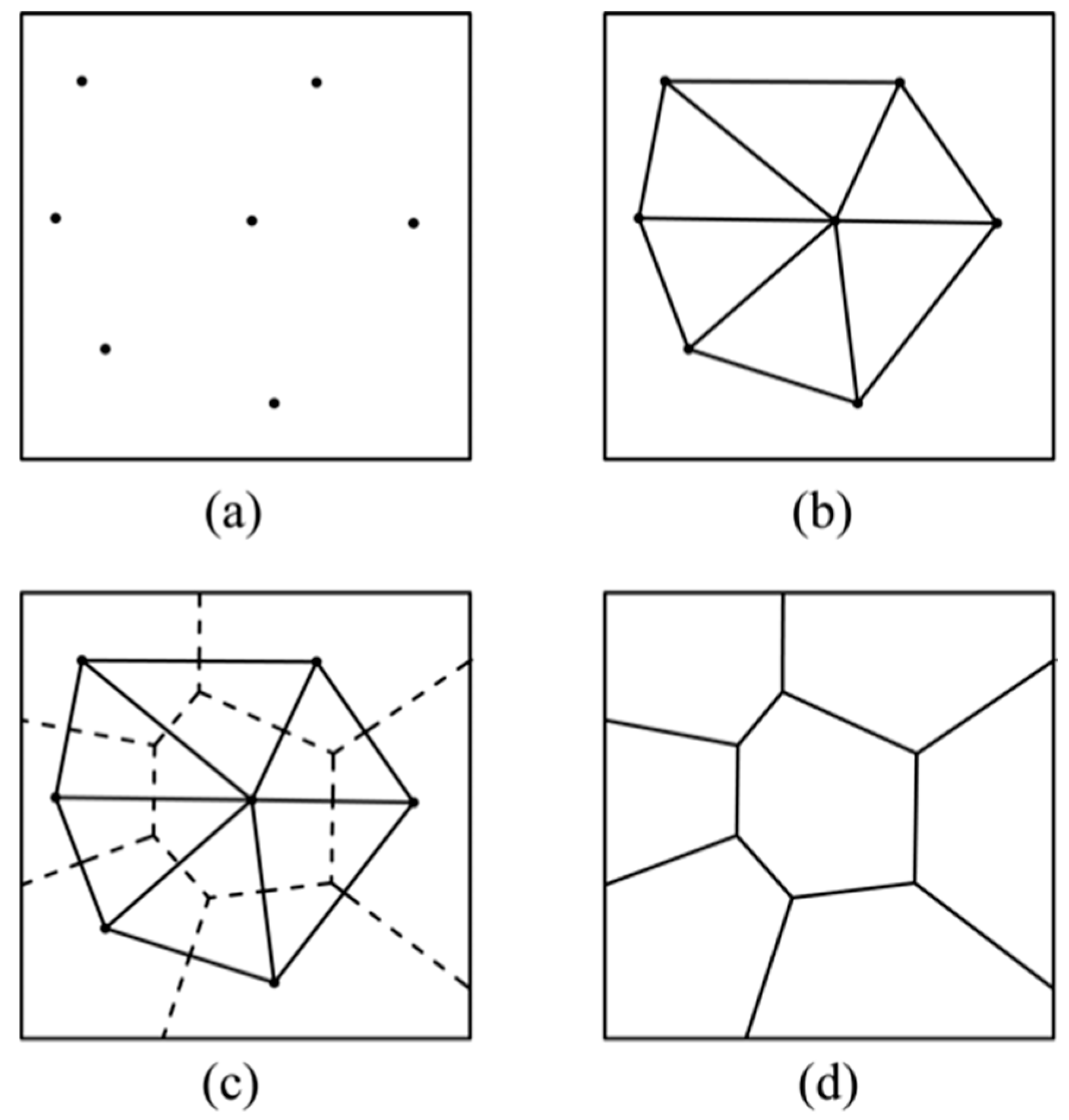
In order to accurately represent the microstructure of mineral grains, the Voronoi tessellation technique was implemented in ABAQUS using Python 3.11 programming language. The implementation process can be described as follows [34]: Firstly, a series of randomly distributed control points was generated in the model, as shown in Figure 1a. Then, neighboring control points were triangulated based on Delaunay triangulation. When a newly formed triangle encloses other control points, excluding its vertices, the triangle is discarded and the corresponding vertex is reconnected with other control points to form a new triangle, until the aforementioned condition is satisfied, as illustrated in Figure 1b. Perpendicular bisectors were constructed for each side of the triangles, as depicted in Figure 1c. Finally, the triangles and control points were removed, and Voronoi grains were generated, as shown in Figure 1d.
Figure 1.
Generation procedure of random Voronoi polygons. (a) Randomly distributed control points, (b) Delaunay triangulation process, (c) Perpendicular bisectors of triangles, (d) Final voronoi grain structure.
2.2. Numerical Calculation Principle of Cohesion Zone Model
The Cohesive Zone Model (CZM) was initially proposed by Dugdale et al. [35] and Barenblatt et al. [36] to address the difficulty in studying the crack tip singularity. This model has been widely applied in the investigation of interfacial delamination in composite materials [37]. Strom et al. [38], using the CZM, explained the penetration and deflection behavior of cracks passing through layer interfaces based on the energy method, thus validating the applicability of this model.
- (1)
- Constitutive equation of cohesive element [39]
The cohesive element is based on the linear elastic constitutive model of the traction-separation law. Before the cohesive element is damaged, the stress and strain satisfy the following linear elastic relationship:
The symbol t represents stress, ɛ represents strain, K is the stiffness of interface element, which can be obtained by dividing the elastic modulus by the unit thickness. The subscript n represents the normal direction, and the subscripts s and t are two tangential directions perpendicular to the normal direction. For uncoupled constitutive relations, only , , and need to be defined.
- (2)
- Fracture propagation criteria [39]
- a.
- Damage initiation criterion
Crack initiation refers to the beginning of cohesive element degradation. The maximum principal stress control criterion was used in the simulation. That is, when the normal tensile stress or tangential stress reaches the corresponding strength, it will break [40].
where is the normal stress; and are the shear stresses in two directions; is the tensile strength; and and are the shear strengths in the two directions, in this study, we approximate these values as equivalent for simplification; is expressed as:
The cohesive element will not produce initial damage in a purely compressed state.
- b.
- Damage evolution criterion
When the stress–strain state of a cohesive element meets the damage initiation criterion, damage begins to develop. The element then enters a progressive damage evolution phase until the displacement reaches the critical failure value, leading to complete interface separation and ultimate failure. In this study, the damage evolution criterion was based on effective displacement, and the damage variable D was defined as follows [41,42,43]:
where is the effective displacement at failure, taken as 0.01 in the model, is the effective displacement at the initial evolution of damage, and is the maximum effective displacement during the loading process.
- (3)
- Principle of AE simulation
The ABAQUS simulation results were extracted using the Python programming language, and the resulting parameters were processed using MATLAB 2016b programming to simulate AE during the loading process. By utilizing AE localization maps and characteristic parameters, the crack rupture situation was further depicted, providing an effective means for in-depth analysis of crack propagation processes.
The number of AE events was determined by considering the number of damaged elements as the count of AE events, with each damaged element being regarded as one AE event. AE localization was achieved by extracting the coordinates of the nodes in the damaged elements and calculating the coordinates of the centroid of the damaged element as the location point for AE events. The AE energy was obtained by extracting the dissipated energy per unit volume of the damaged elements as the AE energy.
The parameter MMIXDME, which can be used to determine the type of rupture, is defined as follows [44]:
where Gn is the Type I tensile fracture energy; Gs is the Type II slip fracture energy; Gt is the Type III tear fracture energy. GT is the sum of Gn, Gs and Gt.
The value range of MMIXDME is between 0 and 1. When MMIXDME is 0, it indicates a tensile fracture; when the value is 1, it indicates a shear fracture, and when the value is between the 0 and 1, there is a tensile-shear mixed fracture.
3. Numerical Simulation Model
3.1. Model Design
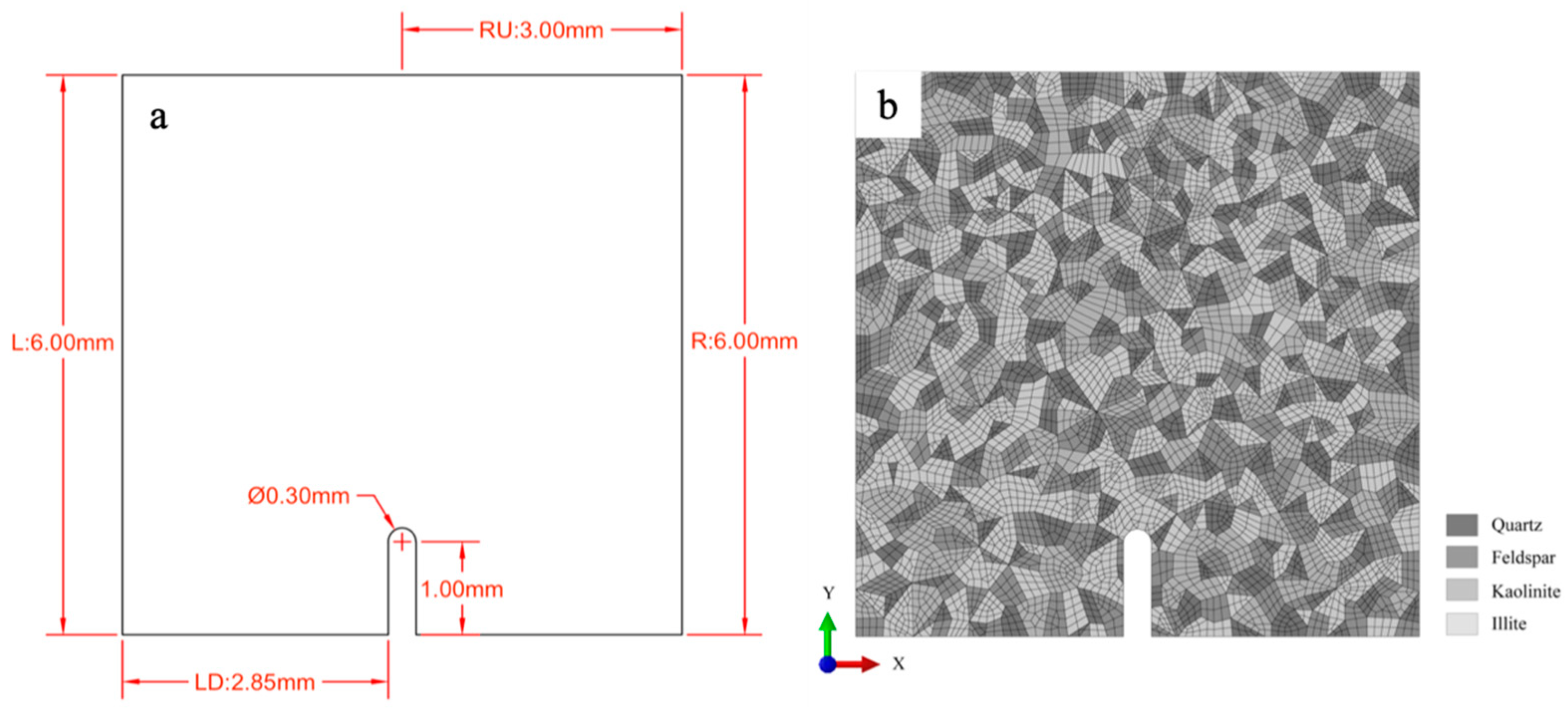
Using the ABAQUS 2017 software, a two-dimensional geometric model was established as shown in Figure 2a. The dimensions of the model were 6 mm × 6 mm, with a slot width of 0.3 mm and a slot height of 1.15 mm (including the radius of the circle).
Figure 2.
(a) 2D geometric model and its size, (b) Heterogeneous rock mineral model, quartz, feldspar, kaolinite, and illite are represented by gray scales from high to low.
Firstly, the model was divided into 722 Voronoi cells using the Voronoi tessellation technique. Each Voronoi cell represented a mineral grain, with the grain size referenced from the research work of Ji et al. [45]. Then, the four minerals (quartz, feldspar, kaolinite, and illite) were randomly assigned to the Voronoi cells in a descending order of grayscale, with compositions of 30%, 30%, 20%, and 20%, respectively, forming geometric sets for each mineral. Finally, the model was meshed with a grid size of 0.08 mm. Cohesive elements with zero thickness were embedded along the grain boundaries and globally within the mesh to establish a heterogeneous mineral model of shale, as shown in Figure 2b. Each mineral set contained four-node plane strain solid elements (CPE4), as well as cohesive elements with zero thickness at the boundaries of the CPE4 elements. Cohesive elements were also established at the boundaries between different minerals to form mineral boundary sets. The model simulated crack initiation and progression through the degradation and failure of cohesive elements under mechanical loading. The parameters for the mineral CPE4 elements are shown in Table 1, which was based on the data of Wang et al. [46]. The parameters for the internal cohesive elements within each mineral and the cohesive elements at different mineral boundaries are shown in Table 2, which was based on the data of Zhang, Cui, Han, Si and Zhao [44]. It should be noted that the mechanical properties of mineral boundaries depend on the bonding strength, and there is currently no unified method for characterizing the solid clay strength. Many experimental studies have suggested that mineral boundaries exhibit higher packing density and stronger bonding compared to clay minerals [47,48,49,50]. Therefore, in this model, the strength parameters of the mineral boundaries were set slightly larger than that of kaolinite but smaller than that of feldspar.
Table 1.
Mineral composition and parameters of the CPE4 elements of different minerals.
Table 2.
The parameters of cohesive elements at the boundaries of CPE4 elements and the cohesive elements at the boundaries of different minerals.
The total number of elements in the model was 21,242, including 6830 CPE4 elements and 14,412 cohesive elements. The total analysis time was 1 s, with an initial increment step of 0.01 s, a minimum increment step of 1 × 10⁻³ s, and a maximum increment step of 0.1 s.
3.2. Loading Methods
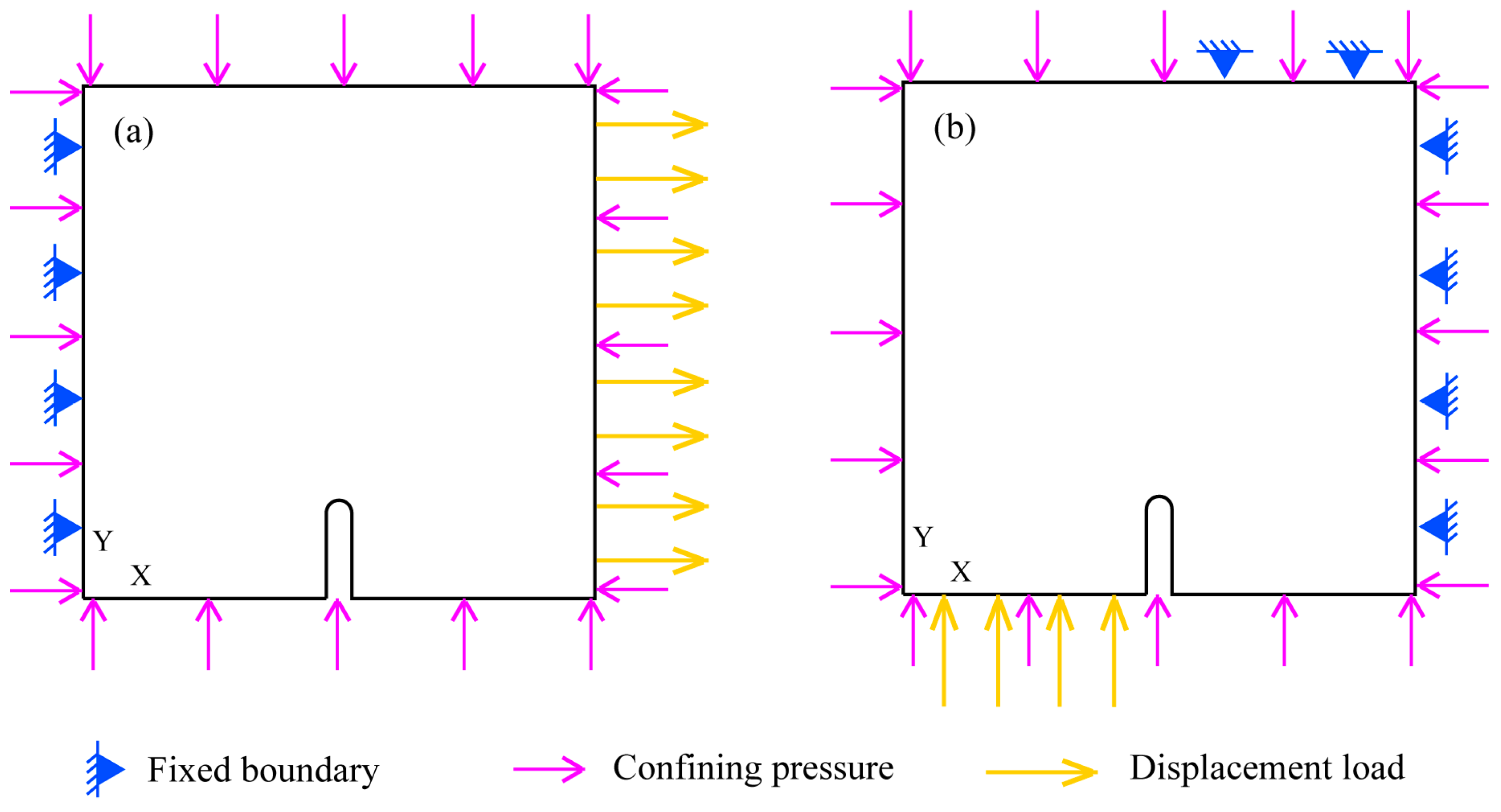
The loading methods of the model are illustrated in Figure 3. Figure 3a depicts the tensile loading configuration, where the left boundary of the model is fixed and a displacement load of 3 mm/s in the rightward direction is applied to the right boundary. Tensile tests were conducted under confining pressures of 0 MPa, 30 MPa, 60 MPa, 90 MPa, and 120 MPa. Figure 3b represents the shear loading configuration, where the right boundary and the upper-right half boundary of the model are fixed, and a displacement load of 3 mm/s in the upward direction is applied to the lower-left boundary. Shear tests were conducted under confining pressures of 0 MPa, 30 MPa, 60 MPa, 90 MPa, and 120 MPa.
Figure 3.
(a) The tensile loading methods of shale under different confining pressure, (b) The shear loading methods of shale under different confining pressure.
4. Results
Based on the results, this study analyzes the final fracture path of cracks, fracture types, characteristics of crack propagation stages, and the relationship between cracks and minerals.
4.1. Crack Paths and Fracture Types
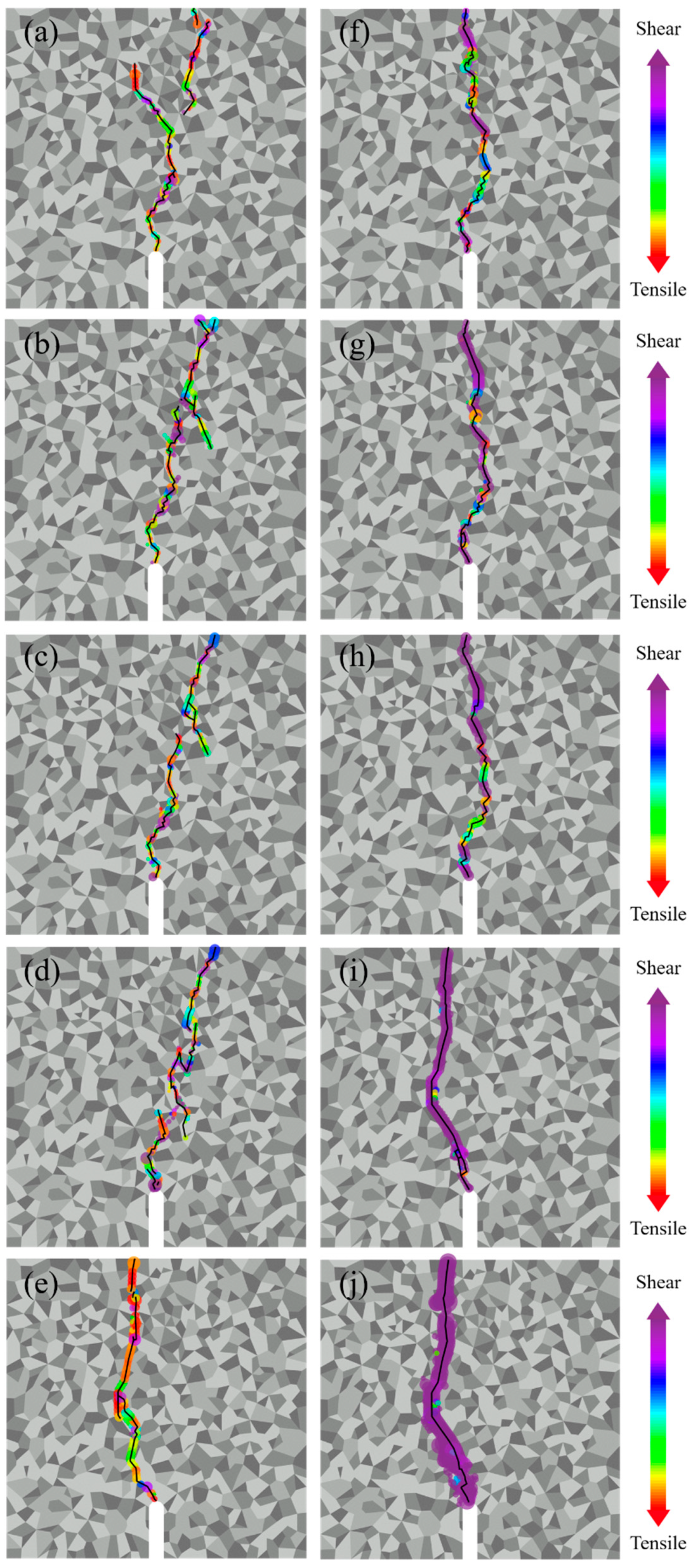
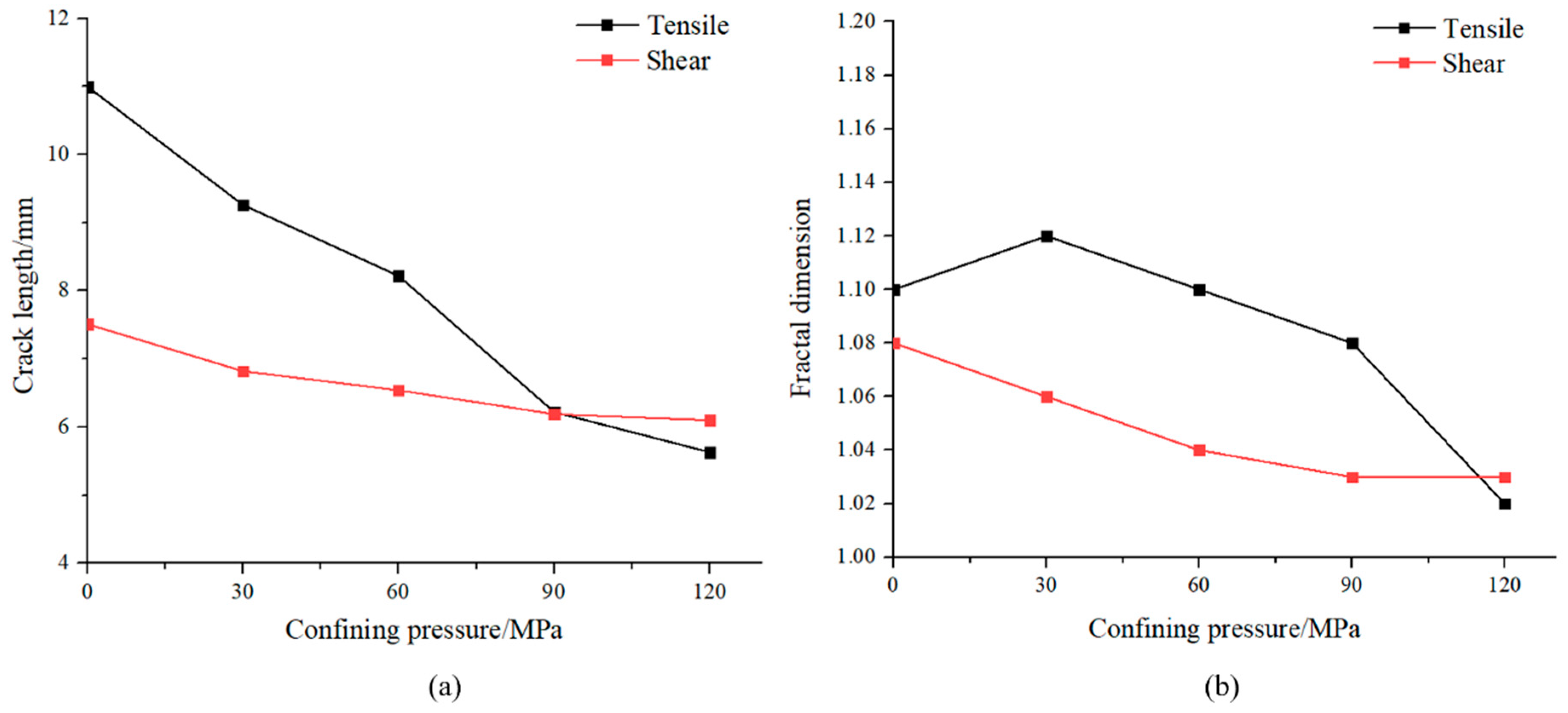
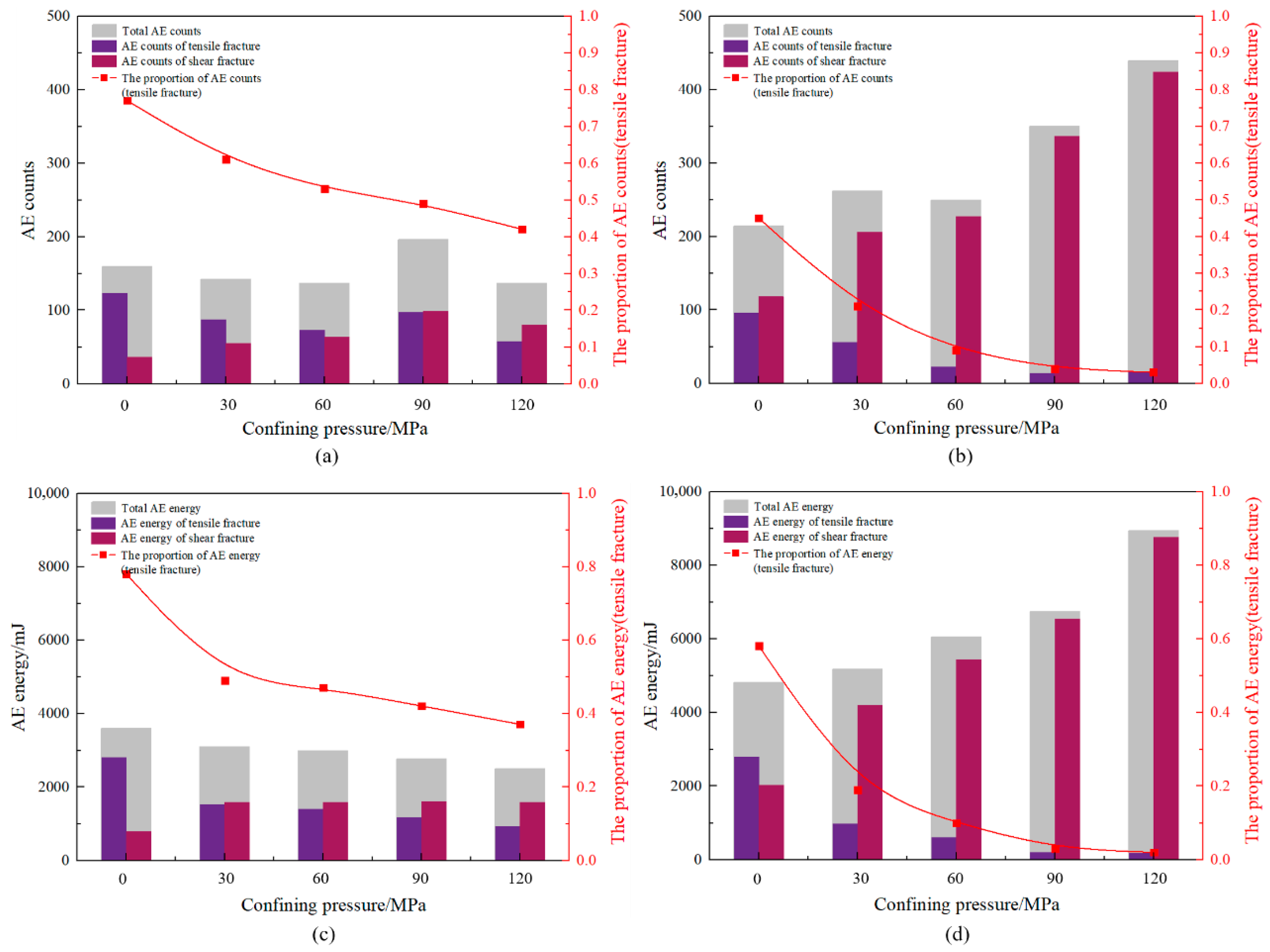
Based on the simulation results and AE localization results, the final crack paths and fracture types are superimposed, as shown in Figure 4. In this figure, different colors of AE represent different fracture types, while the size of AE circles indicates the magnitude of fracture energy. It can be observed from the figure that with increasing confining pressure, significant differences exist in terms of the extension paths, fracture types, and fracture energy of tensile and shear-loaded microcracks. Therefore, the computation of crack length and fractal dimension is presented in Figure 5, while the statistical analysis of AE fracture types and fracture energy is illustrated in Figure 6. In this study, the box dimension method was used to calculate the fractal dimension (D) of cracks under six different loading methods. The fractal dimension quantifies structural irregularity, offering a robust framework for analyzing crack morphology and topological complexity in fractured surfaces. Larger fractal dimensions correlate with increased crack complexity, which subsequently enhances shale gas recovery efficiency.
Figure 4.
(a–e) Distribution of microcracks and AE location under tensile loading at 0 MPa, 30 MPa, 60 MPa, 90 MPa, 120 MPa confining pressure. (f–j) Distribution of microcracks and AE location under shear loading at 0 MPa, 30 MPa, 60 MPa, 90 MPa, 120 MPa confining pressure. Red dots are the AE location of tensile fractures, purple dots are the AE location of shear fractures, and the colors between the two are the AE location of tensile-shear fractures. The size of the dot represents the level of AE energy.
Figure 5.
(a) Crack length, (b) Fractal dimension.
Figure 6.
(a,c) AE counts and AE energy in tensile loading. (b,d) AE counts and AE energy in shear loading.
The principle of the box dimension method is as follows [51]. Cover the cracked area with square boxes with side length r. Some entire boxes are empty and the rest of the boxes cover a part of the crack. N(r) is the number of boxes covering the cracks; when r→0, the fractal dimension D is as follows:
In tensile loading, the total number of acoustic emission events remains relatively constant with changes in confining pressure; however, the fracture energy of acoustic emissions decreases slightly with increasing confining pressure. Microscopic cracks typically form as numerous widely distributed discontinuous cracks and then propagate by connecting these discontinuous cracks. At low confining pressures, the crack paths are more tortuous, the fractal dimension of the cracks is higher, the crack length is longer, and the range of crack distribution is broader. Micro-cracks primarily undergo tensile fracture, with a higher proportion of the number and energy of tensile fractures. As the confining pressure increases, the cracks tend to become straighter, the fractal dimension decreases, the crack length decreases, and the crack distribution range narrows. The number and energy of tensile fractures decrease, while the number and energy of shear fractures increase. This suggests that high confining pressure inhibits the formation of tensile fractures in tensile loading, resulting in decreased crack length, fractal dimension, and crack distribution range.
In shear loading, the total number and total energy of AE events increase with increasing confining pressure. Fewer discontinuous cracks are produced, and cracks propagate continuously. At low confining pressures, the degree of crack tortuosity, fractal dimension, and crack length are all reduced compared to tensile loading. Micro-cracks mainly undergo shear fracture, with fewer numbers and lower proportions of tensile fractures compared to tensile loading. As the confining pressure increases, the cracks become straighter, and the crack length and fractal dimension decrease, although the decrease is smaller than in tensile loading. The number and energy of tensile fractures gradually decrease, and their proportion becomes much smaller than in tensile loading. Shear fracture becomes dominant, and almost no tensile fracture occurs under high confining pressure. This indicates that high confining pressure inhibits the formation of tensile fractures and promotes shear fractures in shear loading, resulting in decreased crack length, fractal dimension, and crack distribution range.
Although the number and proportion of tensile fractures decrease with increasing confining pressure in both tensile and shear loading, the decrease is smaller in tensile loading, and almost no tensile fracture occurs in shear loading under high confining pressure. The number and energy proportion of tensile fractures show a positive correlation with crack length, fractal dimension, and crack distribution range. This is because shear fractures are usually straight and smooth, while tensile fractures tend to be more tortuous.
4.2. Characteristics of Crack Propagation at Different Stages
By comparing and analyzing the crack propagation process, fracture locations, and AE characteristics, it can be observed that in tensile loading, cracks initially form in minerals with lower strength, followed by fractures occurring in minerals with higher strength, ultimately resulting in the connectivity of discontinuous cracks. On the other hand, in shear loading, cracks first penetrate through minerals with lower strength and then propagate through minerals with higher strength along the direction of the shear stress centerline. Regardless of whether it is tensile or shear loading, the crack propagation process exhibits certain stages. Therefore, in this study, the fracture stages are divided based on the AE b value. The b value is a parameter used in seismology and rock mechanics to characterize the magnitude-frequency distribution of AE events [52]. In 1944, Gutenberg and Richter first proposed that b value reflects the relationship between the frequency and magnitude of earthquakes [53]. In the initial stage, cracks penetrate through minerals with low strength, resulting in smaller fracture energies and a predominance of small-scale fractures, leading to larger AE b values. Subsequently, the AE b value gradually decreases, indicating an increase in the proportion of high-energy fracture events, as the cracks traverse minerals with higher strength.
In this study, the AE b value is calculated according to the following equation:
This equation consists of the following variables: m represents the seismic magnitude; Ω denotes the AE energy; N corresponds to the number of seismic events within a Δm range; a and b are constants. The parameter b describes the size distribution scaling, which is often referred to as the b value [54]. To calculate the AE b value, we set every 100 AE events as a calculation segment. Within this time interval, the frequency of AE events N and the average energy value representing the magnitude are obtained. The least squares method is employed to fit lg(Ω) and lg(N), yielding the AE b value within this range.
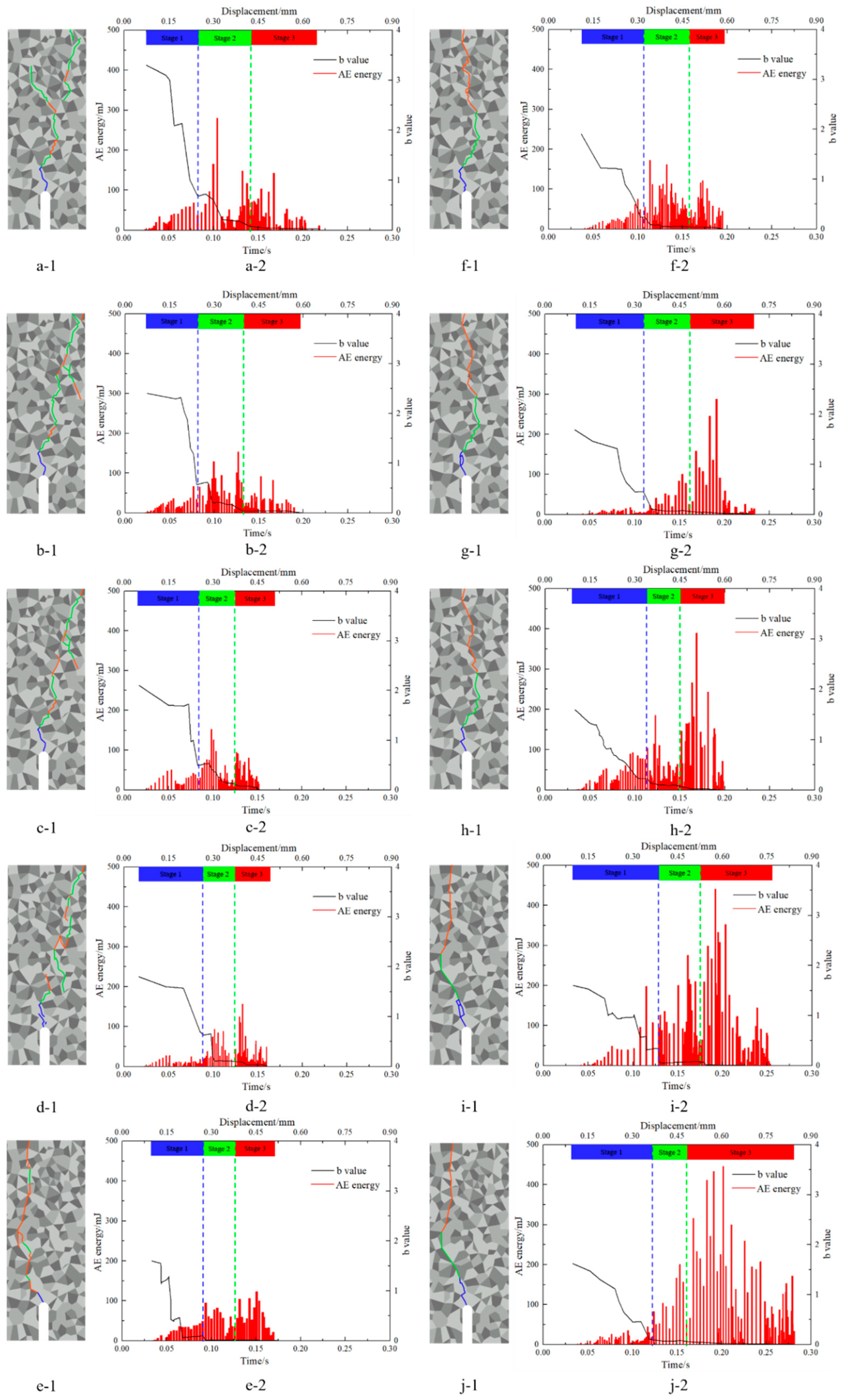
The variations in AE energy and b value over time are superimposed, while taking into account the different types of minerals encountered during the process of crack propagation. This allows for the division of the crack propagation process and the release of AE energy into three stages: crack initiation, stable crack propagation, and unstable crack propagation and breakthrough, as illustrated in Figure 7.
Figure 7.
The three stages of shale microcrack propagation (represented, respectively, by blue, green, and red) and their corresponding acoustic emission-time characteristics are depicted. (a-1,2–e-1,2) Three stages of crack propagation and the associated acoustic emission characteristics at different confining pressures of 0 MPa, 30 MPa, 60 MPa, 90 MPa, and 120 MPa under tensile loading. (f-1,2–j-1,2) Three stages of crack propagation and the corresponding acoustic emission characteristics at different confining pressures of 0 MPa, 30 MPa, 60 MPa, 90 MPa, and 120 MPa under shear loading.
Stage 1: The blue regions represent the crack initiation stage, where cracks primarily occur in illite with lower strength near the notches, regardless of whether under tensile or shear loading. During this stage, the AE energy is relatively low, but the b value is high, indicating that small fractures with lower energy dominate. As the displacement load increases, the b values decrease while the fracture energy gradually increases for both tensile and shear loading. Under tensile loading, the b values slightly decrease with increasing confining pressure, while the AE energy shows no clear pattern, and the crack paths remain generally similar. This suggests that confining pressure has a minor influence on the crack initiation stage under tensile loading. Under shear loading, the b values also slightly decrease with increasing confining pressure, and the AE energy shows no clear pattern, with similar crack paths observed. However, the displacement load at initiation increases with increasing confining pressure due to the enhanced shear strength of the rock caused by higher confining pressures.
Stage 2: The green regions represent the phase of stable crack propagation. During this stage, the b-value is relatively low, while the total fracture energy is high. Under tensile loading, the fracture mechanism involves the occurrence of discontinuous microcracks that are widely distributed within illite and kaolinite. With increasing confining pressure, the b value exhibits a slight decrease. Under shear loading, the cracks primarily originate from the illite and kaolinite present in the central region of the specimen, as well as at the boundaries between different minerals. This stage is characterized by higher AE energy levels and smaller b values. As the confining pressure increases, the cracks become more planar and smoother, resulting in an increase in AE energy and a decrease in b values.
Stage 3: The red regions denote the stage of unstable crack propagation and breakthrough. During this stage, there is a higher level of AE energy and the lowest b value, primarily associated with the formation of high-energy cracks. Under tensile loading, this stage is characterized by the generation of cracks mainly within the kaolinite and at the boundaries between different minerals, which connect and penetrate the cracks formed in the previous two stages. As the confining pressure increases, the fracture energy gradually increases, while the b value tends to decrease. Additionally, the total displacement load required for crack breakthrough decreases with increasing confining pressure. Under shear loading, the cracks in this stage predominantly occur at the boundaries between minerals and within quartz and feldspar minerals. With increasing confining pressure, the cracks become more planar and smoother, resulting in an increase in the AE energy, and a gradual decrease in the b value. Furthermore, the total displacement load required for crack breakthrough increases.
It is evident that confining pressure has an impact on the microcrack paths and AE characteristics in different stages of both tensile and shear loading. This impact is primarily manifested through the generation of different types of fractures by minerals with varying mechanical strengths. Therefore, the next section will discuss the fracture of minerals under different confining pressures.
4.3. The Influence of Confining Pressure on the Fracture of Different Minerals
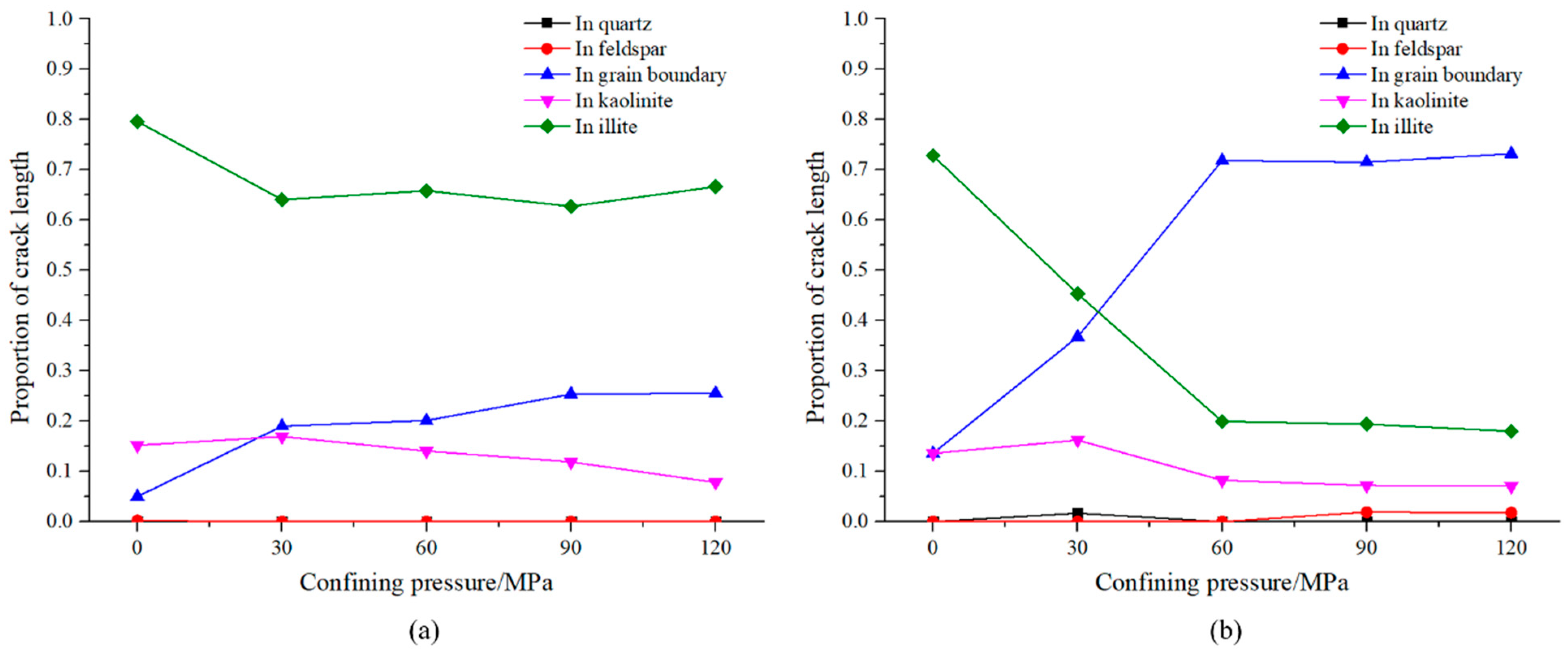
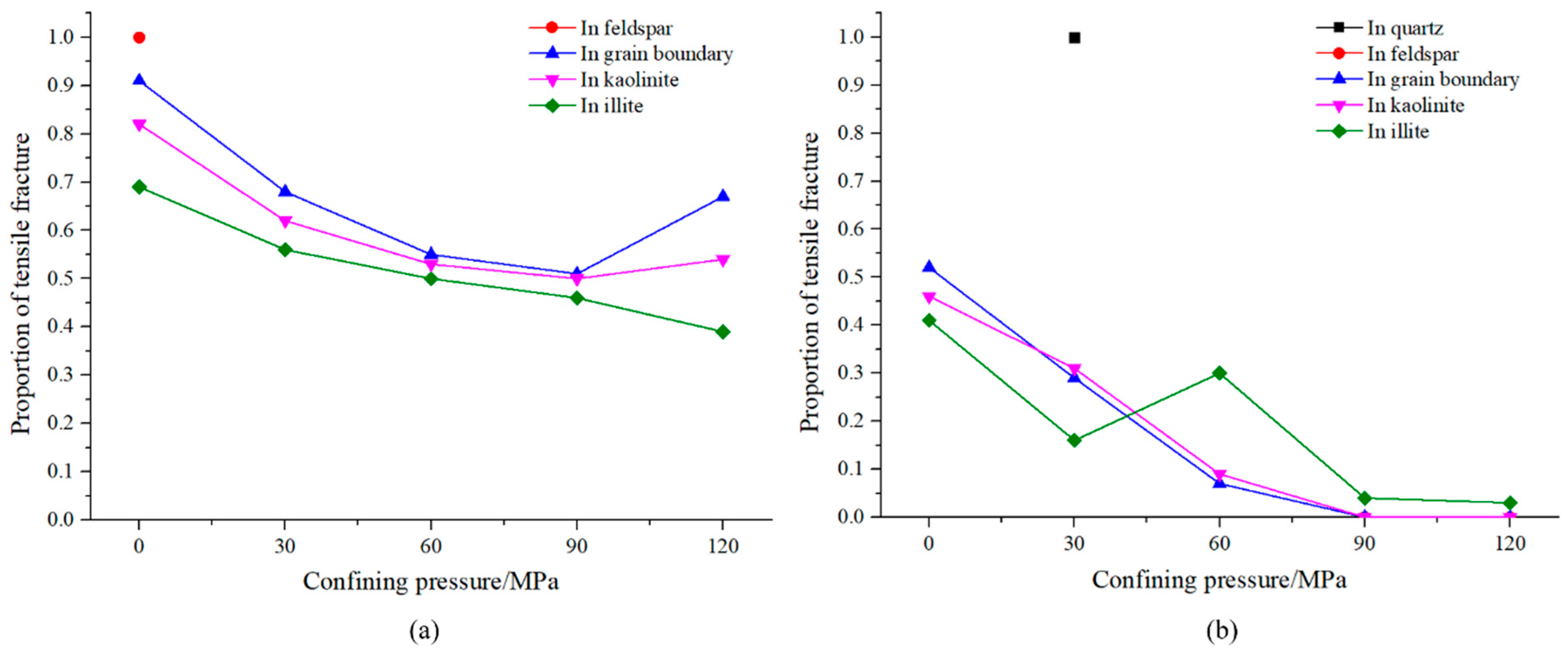
In both tensile and shear loading conditions, the increase in confining pressure leads to different mechanical responses of various minerals due to their distinct physical and mechanical properties. This results in variations in the proportion of microcrack lengths and different types of fractures among the minerals under different confining pressures. The statistical analysis of the proportion of total crack length passing through different mineral types under various confining pressures is shown in Figure 8 for both tensile and shear loading conditions. The proportion of tensile fractures within the cracks traversing different mineral types is presented in Figure 9.
Figure 8.
The proportion of crack length passing through various minerals under different confining pressure conditions is shown for tensile loading (a) and shear loading (b).
Figure 9.
The proportion of tensile fractures within cracks passing through various minerals under different confining pressure conditions for tensile loading (a) and shear loading (b).
In tensile loading, cracks primarily occur in illite, followed by mineral boundaries and kaolinite. Tensile fractures account for over 50% of the total fractures, as illite exhibits relatively low tensile strength and is prone to fracture initiation. Quartz and feldspar, on the other hand, exhibit minimal crack formation due to their higher tensile strength, with only a few tension cracks observed in feldspar at a confining pressure of 0 MPa. Regardless of the magnitude of confining pressure, the proportion of tensile fractures increases with the improvement of mineral mechanical properties. With increasing confining pressure, there is a slight reduction in cracks in kaolinite and illite, a slight increase in microcracks at mineral boundaries, and a slight decrease in the proportion of tensile fractures among various minerals. However, overall, the proportion of tensile fractures remains above 50%.
In shear loading, cracks mainly occur in illite, mineral boundaries, and kaolinite, with the proportion of tensile fractures being less than 50%, predominantly exhibiting shear fractures. Quartz and feldspar exhibit a small number of cracks, with quartz primarily experiencing tensile fractures and feldspar primarily experiencing shear fractures. With increasing confining pressure, there is a significant increase in crack length at mineral boundaries, while the proportion of cracks in kaolinite and illite decreases. The proportion of tensile fractures among various minerals significantly decreases with increasing confining pressure, remaining below 50% and even negligible within the high confining pressure range.
5. Discussion
In this study, we developed a heterogeneous model based on mineral distribution to investigate the influence of confining pressure on microcrack propagation under tensile and shear loading conditions.
It was observed that regardless of the loading condition (tensile or shear), the proportion of tensile failure, crack length, fractal dimension, and crack distribution range decreased with increasing confining pressure. High confining pressure exhibited an inhibitory effect on the complexification of shale fracture networks. This finding is consistent with previous studies on shale uniaxial compression tests conducted under high confining pressure, which revealed that high confining pressure suppressed the extensive generation of tensile microcracks, restricted the opening range of shear cracks, and promoted crack closure [15,16,17,18,19,20,21,22]. This study also confirms this phenomenon under both tensile and shear loading conditions. Furthermore, it was found that tensile loading generally resulted in multiple discontinuous microcracks, while shear loading typically produced only one crack near the shear centerline. Chen et al. [55]. also confirmed experimentally that the damage zone of tensile fracture contained one or more long and large extending microcracks, while shear cracks usually formed narrower cracks. This characteristic of microcrack propagation is not new to our research [44,56]; previous experiments and numerical simulations have demonstrated that the tensile strength of minerals and their boundaries is much lower than their shear strength. Therefore, widespread tensile microcrack generation occurs under tensile loading, whereas microcracks only form near the shear centerline under shear loading [44,57,58]. Studies have shown that high confining pressure increases the tensile and shear strength of rocks [59,60]. Thus, in this study, regardless of tensile or shear loading, the complexity of microcracks decreased as confining pressure increased. There was a clear positive correlation between the proportion of tensile fractures and the complexity and distribution range of cracks. This can be attributed to the increased tensile strength, which suppresses the extensive generation of tensile microcracks and reduces the overall complexity of cracks.
The ultimate fracture path difference can be explained by examining the processes of crack initiation, propagation, and connection. Both tensile and shear loading show distinct stages in the crack propagation process. Microcracks first initiate in mechanically weaker illite, followed by fracturing in mechanically stronger kaolinite and mineral boundaries, eventually leading to complete specimen failure. This supports the findings of Eberhardt et al. [61], where cracks were found to initiate in minerals with lower strength and subsequently appear in minerals with higher strength. The different mechanical properties of minerals result in varying energy release during fracture, leading to changes in the b value [52]. The results of this study demonstrate a good correspondence between the three stages of crack fracture and b value and energy release. With increasing confining pressure, the b values for each stage decrease, indicating that higher confining pressures promote an increase in high-energy fracture cracks and a decrease in low-energy fracture cracks during crack initiation, propagation, and connection stages. Higher confining pressures require larger energy release for microcrack initiation during tensile loading, limiting their widespread occurrence and resulting in a lower b value. Crack connection tends to occur along the shortest path near the centerline, preventing extensive crack propagation. In shear loading, higher confining pressures lead to fewer crack deflections, making them straighter and smoother. Cracks tend to propagate along the shear centerline with less branching away from the main crack. Therefore, even minerals with higher strength can be penetrated, resulting in higher fracture energy [62] and lower b values. This is consistent with the experimental observations of Zhang et al. [19], where higher confining pressures enhance the shear and tensile strength of minerals, exerting inhibitory effects on various stages of crack propagation.
Investigating which minerals the cracks traverse and how they traverse these minerals under different confining pressures can provide valuable insights into the mechanical responses of minerals under varying confining pressures. In tensile loading, increasing confining pressure has a minor influence on the proportion of crack length in each mineral compared to the total crack length. However, the proportion of tensile fractures in each mineral decreases with increasing confining pressure. In shear loading, higher confining pressures induce more shear failures in minerals with higher mechanical strength, resulting in a decrease in the proportion of tensile fractures in each mineral with increasing confining pressure. In tensile loading, as the confining pressure increases, some minerals that were originally under tensile stress transition to shear stress. However, the shear strength of minerals is significantly higher than their tensile strength, rendering these minerals unable to undergo fracture. Consequently, higher confining pressures lead to a reduced distribution range of discontinuous cracks, resulting in a lower degree of crack complexity. In shear loading, higher confining pressures cause an increase in shear stress near the shear centerline, making it easier to shear the high-strength minerals at the shear centerline. This results in almost exclusively shear fractures, leading to straighter cracks. These findings are consistent with previous studies where an increasing confining pressure leads to a gradual transition from tensile fractures to predominantly shear fractures in rock. In addition to grain boundary cracks, transgranular cracks also significantly increase in the shear fracture zone [55,63].
In this study, a model is constructed based on minerals with different properties to investigate the influence of confining pressure on the propagation of microcracks from three perspectives: microcrack morphology, acoustic emission, and the mechanical response of different minerals. The research elucidates the mechanistic effects of varying confining pressures on the evolution of microcrack propagation under both tensile and shear loading conditions. Shale experiences a complex stress state during hydraulic fracturing, making this comparative study theoretically significant for understanding the microscopic fracture mechanisms in shale under tension and shear at different depths. However, the limitations of this research lie in the fact that, with increasing burial depth, the physical and mechanical properties of shale undergo changes, such as density, Poisson’s ratio, and elastic modulus. The variations in physical and mechanical parameters of shale at different burial depths have not been considered in this study. Additionally, the changes in shale pore pressure and the transformation of effective stress during the destruction process with increasing confining pressure have not been addressed. Furthermore, the inclusion of fluid permeability tests under different confining pressures in this experiment, assessing the connectivity of cracks under tensile and shear loading, could reflect crack closure conditions and crack aperture, providing a more intuitive significance for enhancing shale gas recovery.
6. Conclusions
This study develops a heterogeneous shale cohesive model based on mineral distribution and conducts numerical simulation experiments under varying confining pressures with both tensile and shear loading. The influence of confining pressure on microcrack propagation is investigated from three perspectives: microcrack morphology, acoustic emission characteristics, and the mechanical responses of different minerals. The mechanisms by which different confining pressures affect microcrack propagation under tensile and shear loading are elucidated. The following conclusions are drawn:
- (1)
- In terms of microcrack morphology: regardless of tensile or shear loading, the proportion of tensile fracture, crack length, fractal dimension, and crack distribution range decrease with increasing confining pressure, indicating a suppressive effect of elevated confining pressure on the complexity of the shale fracture network. This is primarily attributed to the inhibitory effect of increased confining pressure on the widespread generation of tensile microcracks.
- (2)
- In terms of acoustic emission characteristics of micro-fractures: the process of crack propagation under both tensile and shear loading exhibits distinct stages, including crack initiation, stable propagation, and unstable propagation, which correspond well with the AE b value and energy release. Elevated confining pressure suppresses the widespread initiation of cracks, promoting crack connectivity and penetration along the central axis via the shortest path, resulting in straight, smooth cracks with fewer branching fractures deviating from the main crack.
- (3)
- In terms of the mechanical responses of different minerals: under tensile loading, the influence of increased confining pressure on the proportion of crack length in various minerals is relatively minor, while the proportion of tensile fracturing in each mineral decreases with rising confining pressure. Conversely, under shear loading, elevated confining pressure induces more shear failure in minerals with higher mechanical strength, leading to a reduction in the proportion of tensile fracturing in each mineral with increasing confining pressure.
Author Contributions
Conceptualization, J.L.; Data curation, S.L.; Formal analysis, Z.S.; Investigation, L.L.; Methodology, C.S.; Resources, X.C.; Supervision, Z.C.; Validation, C.J.; Writing—original draft, J.Z. All authors have read and agreed to the published version of the manuscript.
Funding
This work was supported by Hebei Natural Science Foundation (Grant No. D2025512020), the Fundamental Research Funds for the Central Universities (Grant No. ZY20230219), Langfang City Science and Technology Support Plan Project (Grant No. 2025013074).
Institutional Review Board Statement
Not applicable.
Informed Consent Statement
Not applicable.
Data Availability Statement
The original contributions presented in this study are included in the article. Further inquiries can be directed to the corresponding author.
Conflicts of Interest
The authors declare no conflicts of interest.
References
- Chang, X.; Xu, E.; Guo, Y.; Yang, C.; Hu, Z.; Guo, W. Experimental study of hydraulic fracture initiation and propagation in deep shale with different injection methods. J. Petrol. Sci. Eng. 2022, 216, 110834. [Google Scholar] [CrossRef]
- Shi, X.; Wu, W.; Zhou, S.; Tian, C.; Li, D.; Li, D.; Li, Y.; Cai, C.; Chen, Y. Adsorption characteristics and controlling factors of marine deep shale gas in southern Sichuan Basin, China. J. Nat. Gas Geosci. 2022, 7, 61–72. [Google Scholar] [CrossRef]
- Jiang, G.; Zuo, J.; Li, Y.; Wei, X. Experimental Investigation on Mechanical and Acoustic Parameters of Different Depth Shale Under The Effect of Confining Pressure. Rock Mech. Rock Eng. 2019, 52, 4273–4286. [Google Scholar] [CrossRef]
- Liu, J.; Zhang, K.; Liu, W.; Shi, X. Experimental study of mechanical behaviours of shale under different confining pressures and different strain rates. Rock Soil Mech. 2017, 38, 43–52. [Google Scholar]
- Meng, L.; Li, T.; Xu, J.; Ma, H.; Yin, H. Experimental study on influence of confining pressure on shale mechanical properties under high temperature condition. J. China Coal Soc. 2012, 37, 1829–1833. [Google Scholar]
- Han, J.; Gao, M.; Wu, Y.; Raza, A.; He, P.; Li, J.; Lu, Y.; Yang, M.; Zhu, H. Experimental Study of Confining Pressure-Induced Fracture Network for Shale Gas Reservoir Under Triaxial Compression Conditions. Fractal Fract. 2025, 9, 311. [Google Scholar] [CrossRef]
- Tan, J.; Shen, B.; Wu, H.; Wang, Y.; Ma, X.; Ma, X.; Liu, W. Characteristics of Lamination in Deep Marine Shale and Its Influence on Mechanical Properties: A Case Study on the Wufeng-Longmaxi Formation in Sichuan Basin. Minerals 2024, 14, 1249. [Google Scholar] [CrossRef]
- Wang, L.; Guo, Y.; Zhou, J.; Yang, H.; Yang, C.; Xiao, J. Rock mechanical characteristics of deep marine shale in southern China, a case study in Dingshan block. J. Petrol. Sci. Eng. 2021, 204, 108699. [Google Scholar] [CrossRef]
- Yang, S.; Yin, P.; Huang, Y.; Cheng, J. Strength, deformability and X-ray micro-CT observations of transversely isotropic composite rock under different confining pressures. Eng. Fract. Mech. 2019, 214, 1–20. [Google Scholar] [CrossRef]
- Han, B.; Yang, H. Microscopic fracture process and quantitative study of shale under different confining pressures. Coal Sci. Technol. 2019, 47, 90–95. [Google Scholar]
- Yin, P.; Yang, S.; Gao, F.; Tian, W. Experimental and DEM Simulation Study on the Mechanical Characteristic and Strain Energy Evolution of Longmaxi Shale under a Confining Pressure Unloading Path. Energies 2023, 16, 5960. [Google Scholar] [CrossRef]
- Wong, T.; Wong, R.; Chau, K.; Tang, C. Microcrack statistics, Weibull distribution and micromechanical modeling of compressive failure in rock. Mech. Mater. 2006, 38, 664–681. [Google Scholar] [CrossRef]
- Li, S.; Zhang, S.; Ma, X.; Zou, Y.; Li, N.; Chen, M.; Cao, T.; Bo, Z. Hydraulic Fractures Induced by Water-/Carbon Dioxide-Based Fluids in Tight Sandstones. Rock Mech. Rock Eng. 2019, 52, 3323–3340. [Google Scholar] [CrossRef]
- Singh, K.; Singh, D.; Ranjith, P. Laboratory Simulation of Flow through Single Fractured Granite. Rock Mech. Rock Eng. 2014, 48, 987–1000. [Google Scholar] [CrossRef]
- Wang, Y.; Liu, D.; Zhao, Z.; Wang, H. Investigation on the effect of confining pressure on the geomechanical and ultrasonic properties of black shale using ultrasonic transmission and post-test CT visualization. J. Petrol. Sci. Eng. 2020, 185, 106630. [Google Scholar] [CrossRef]
- Xiong, L.; Wu, S. Numerical simulation of micro-cracking and energy budget in porous rocks under contractional regimes across the brittle-ductile transition. J. Struct. Geol. 2021, 148, 104376. [Google Scholar] [CrossRef]
- Taheri, A.; Zhang, Y.; Munoz, H. Performance of rock crack stress thresholds determination criteria and investigating strength and confining pressure effects. Constr. Build. Mater. 2020, 243, 118263. [Google Scholar] [CrossRef]
- Huang, Y.; Yang, S.; Tian, W. Crack coalescence behavior of sandstone specimen containing two pre-existing flaws under different confining pressures. Theor. Appl. Fract. Mech. 2019, 99, 118–130. [Google Scholar] [CrossRef]
- Zhang, C.; Li, D.; Wang, C.; Ma, J.; Zhou, A.; Xiao, P. Effect of confining pressure on shear fracture behavior and surface morphology of granite by the short core in compression test. Theor. Appl. Fract. Mech. 2022, 121, 103506. [Google Scholar] [CrossRef]
- Yang, S.; Xu, T.; He, L.; Jing, H.; Wen, S.; Yu, Q.L. Numerical study on failure behavior of brittle rock specimen containing pre-existing combined flaws under different confining pressure. Arch. Civ. Mech. Eng. 2015, 15, 1085–1097. [Google Scholar] [CrossRef]
- Kong, L.; Ranjith, P.G.; Li, B.Q. Fluid-driven micro-cracking behaviour of crystalline rock using a coupled hydro-grain-based discrete element method. Int. J. Rock Mech. Min. Sci. 2021, 144, 104766. [Google Scholar] [CrossRef]
- Kong, L.; Ranjith, P.G.; Li, Q.B.; Song, Y. Rock grain-scale mechanical properties influencing hydraulic fracturing using Hydro-GBM approach. Eng. Fract. Mech. 2022, 262, 108227. [Google Scholar] [CrossRef]
- Sui, W.; Wang, Y.; Li, J. Microscopic Study of Shale Anisotropy with SEM In Situ Compression and Three-Point Bending Experiments. Energies 2023, 16, 2440. [Google Scholar] [CrossRef]
- Wang, Y.; Feng, W.K.; Zhao, Z.H.; Zhang, D. Anisotropic energy and ultrasonic characteristics of black shale under triaxial deformation revealed utilizing real-time ultrasonic detection and post-test CT imaging. Geophys. J. Int. 2019, 219, 260–270. [Google Scholar] [CrossRef]
- Yao, W.; Cai, Y.; Yu, J.; Zhou, J.; Liu, S.; Tu, B. Experimental and numerical study on mechanical and cracking behaviors of flawed granite under triaxial compression. Measurement 2019, 145, 573–582. [Google Scholar] [CrossRef]
- Gupta, N.; Mishra, B. Experimental Investigation of the Influence of Bedding Planes and Differential Stress on Microcrack Propagation in Shale Using X-Ray CT Scan. Geotech. Geol. Eng. 2021, 39, 213–236. [Google Scholar] [CrossRef]
- Zhang, Q.; Fan, X.; Chen, P.; Ma, T.; Zeng, F. Geomechanical behaviors of shale after water absorption considering the combined effect of anisotropy and hydration. Eng. Geol. 2020, 269, 105547. [Google Scholar] [CrossRef]
- Ougier-Simonin, A.; Renard, F.; Boehm, C.; Vidal-Gilbert, S. Microfracturing and microporosity in shales. Earth Sci. Rev. 2016, 162, 198–226. [Google Scholar] [CrossRef]
- Guo, X.; Li, Y.; Liu, R.; Wang, Q. Characteristics and controlling factors of micro-pore structures of Longmaxi Shale Play in the Jiaoshiba area, Sichuan Basin. Nat. Gas Ind. B 2014, 1, 165–171. [Google Scholar] [CrossRef]
- Zeng, W.; Ding, W.; Zhang, J.; Zhang, Y.; Ling, G.; Kai, J.; Li, Y. Fracture development in Paleozoic shale of Chongqing area (South China). Part two: Numerical simulation of tectonic stress field and prediction of fractures distribution. J. Asian Earth Sci. 2013, 75, 267–279. [Google Scholar] [CrossRef]
- Lin, T.; Dong, Z.; Gong, B. Numerical Study of the Mechanical Properties and Failure Mechanisms of Shale Under Different Loading Conditions. Appl. Sci. 2025, 15, 4405. [Google Scholar] [CrossRef]
- Zhang, J.; Cui, Z.; Chen, X.; Li, L. Research Progress on the Microfracture of Shale: Experimental Methods, Microfracture Propagation, Simulations, and Perspectives. Appl. Sci. 2024, 14, 784. [Google Scholar] [CrossRef]
- Tang, T.; Shi, X.; Zhu, X.; Li, L. Experimental Study on the Effect of Bedding on the Fracture Process Zone of Shale. Energies 2022, 15, 6359. [Google Scholar] [CrossRef]
- Wu, Z.; Yu, F.; Zhang, P.; Liu, X. Micro-mechanism study on rock breaking behavior under water jet impact using coupled SPH-FEM/DEM method with Voronoi grains. Eng. Anal. Bound. Elem. 2019, 108, 472–483. [Google Scholar] [CrossRef]
- Dugdale, D.S. Yielding of steel sheets containing slits. J. Mech. Phys. Solids 1960, 8, 100–104. [Google Scholar] [CrossRef]
- Barenblatt, G.I. The Mathematical Theory of Equilibrium Cracks in Brittle Fracture. In Advances in Applied Mechanics; Dryden, H.L., von Kármán, T., Kuerti, G., van den Dungen, F.H., Howarth, L., Eds.; Elsevier: Amsterdam, The Netherlands, 1962; Volume 7, pp. 55–129. [Google Scholar]
- Shen, M.; Liu, H.; Ji-Song, Y.U. On the measurement method of traction-separation curve in material fracture cohesive zone model. J. Exp. Mech. 2018, 33, 395–409. [Google Scholar]
- Strom, J.L.; Parmigiani, J.P. Transition of crack path at bi-material interfaces. Eng. Fract. Mech. 2014, 115, 13–21. [Google Scholar] [CrossRef]
- Dassault Systemes Simulia Corp. Abaqus User’s Manual; Dassault Systemes Simulia Corp: Boston, MA, USA, 2022. [Google Scholar]
- Han, W.; Jiang, Y.; Luan, H.; Du, Y.; Zhu, Y.; Liu, J. Numerical investigation on the shear behavior of rock-like materials containing fissure-holes with FEM-CZM method. Comput. Geotech. 2020, 125, 103670. [Google Scholar] [CrossRef]
- Meng, Y.; Jing, H.; Liu, X.; Yin, Q.; Wei, X. Experimental and numerical investigation on the effects of bedding plane properties on the mechanical and acoustic emission characteristics of sandy mudstone. Eng. Fract. Mech. 2021, 245, 107582. [Google Scholar] [CrossRef]
- Meng, Y.; Jing, H.; Yuan, L.; Zhang, L. Numerical investigation on the effect of bedding plane properties on mode I fracture characteristics of mudstone with FEM-CZM method. Bull. Eng. Geol. Environ. 2021, 81, 3. [Google Scholar] [CrossRef]
- Wang, P.; Wang, S.; Jierula, A.; Sun, Z. Use of bulk embedding cohesive elements to realize bifurcating propagation of rock crack. Geomech. Geophys. Geo-Energy Geo-Resour. 2021, 7, 8. [Google Scholar] [CrossRef]
- Zhang, J.; Cui, Z.; Han, W.; Si, K.; Zhao, Y. Comparative Study on Mineral-Scale Microcrack Propagation of Shale under Different Loading Methods. Adv. Civ. Eng. 2021, 2021, 6621347. [Google Scholar] [CrossRef]
- Ji, L.; Lin, M.; Cao, G.; Jiang, W. A core-scale reconstructing method for shale. Sci. Rep. 2019, 9, 4364. [Google Scholar] [CrossRef]
- Wang, L.; Cui, Z.; Peng, R.; Zhao, L.; Wei, T.; Liu, D.; Zhang, X. Numerical simulations on the structural heterogeneity and fracture bias effect of three-point bending specimen. Theor. Appl. Fract. Mech. 2024, 132, 104466. [Google Scholar] [CrossRef]
- Abedi, S.; Slim, M.; Hofmann, R.; Bryndzia, T.; Ulm, F.-J. Nanochemo-mechanical signature of organic-rich shales: A coupled indentation–EDX analysis. Acta Geotech. 2016, 11, 559–572. [Google Scholar] [CrossRef]
- Deirieh, A.; Ortega, J.A.; Ulm, F.J.; Abousleiman, Y. Nanochemomechanical assessment of shale: A coupled WDS-indentation analysis. Acta Geotech. 2012, 7, 271–295. [Google Scholar] [CrossRef]
- Kumar, V.; Curtis, M.E.; Gupta, N.; Sondergeld, C.H.; Rai, C.S. Estimation of Elastic Properties of Organic Matter and Woodford Shale Through Nano-indentation Measurements. In Proceedings of the SPE Canadian Unconventional Resources Conference, Calgary, AB, Canada, 30 October–1 November 2012. [Google Scholar]
- Ulm, F.-J.; Abousleiman, Y. The Nanogranular Nature of Shale. Acta Geotech. 2006, 1, 77–88. [Google Scholar] [CrossRef]
- Han, W.; Cui, Z.; Zhu, Z.; Han, X. The Effect of Bedding Plane Angle on Hydraulic Fracture Propagation in Mineral Heterogeneity Model. Energies 2022, 15, 6052. [Google Scholar] [CrossRef]
- Dong, L.; Zhang, L.; Liu, H.; Du, K.; Liu, X. Acoustic Emission b Value Characteristics of Granite under True Triaxial Stress. Mathematics 2022, 10, 451. [Google Scholar] [CrossRef]
- Gutenberg, B.; Richter, C.F. Frequency of earthquakes in California. Bull. Seismol. Soc. Am. 1944, 34, 185–188. [Google Scholar] [CrossRef]
- Liu, X.; Han, M.; He, W.; Li, X.; Chen, D. A New b Value Estimation Method in Rock Acoustic Emission Testing. J. Geophys. Res. Solid Earth 2020, 125, e2020JB019658. [Google Scholar] [CrossRef]
- Cheng, Y.; Wong, L.N.Y. Microscopic Characterization of Tensile and Shear Fracturing in Progressive Failure in Marble. J. Geophys. Res. Solid Earth 2018, 123, 204–225. [Google Scholar] [CrossRef]
- Cui, Z.; Li, X.; Liu, D. In-situ observation of en echelon intermittent intermittent cracks of shale in micro-nano scale. J. Eng. Geol. 2018, 26, 85–90. [Google Scholar]
- Cui, Z.; Han, W. In Situ Scanning Electron Microscope (SEM) Observations of Damage and Crack Growth of Shale. Microsc. Microanal. 2018, 24, 107–115. [Google Scholar] [CrossRef]
- Cui, Z.; Zhang, J.; Ranjith, P.G.; Li, X. Crystallographic constraints on microcrack dynamics in granite: Insights from in-situ microscopic characterization of crack network propagation. Int. J. Rock Mech. Min. Sci. 2025, 195, 106278. [Google Scholar] [CrossRef]
- Mighani, S.; Sondergeld, C.H.; Rai, C.S. Stress Dependency of Rock Tensile Strength. In Proceedings of the 49th U.S. Rock Mechanics/Geomechanics Symposium, San Francisco, CA, USA, 29 June–1 July 2015; p. ARMA-2015-2147. [Google Scholar]
- Olsson, R.; Barton, N. An improved model for hydromechanical coupling during shearing of rock joints. Int. J. Rock Mech. 2001, 38, 317–329. [Google Scholar] [CrossRef]
- Eberhardt, E.; Stimpson, B.; Stead, D. Effects of Grain Size on the Initiation and Propagation Thresholds of Stress-induced Brittle Fractures. Rock Mech. Rock Eng. 1999, 32, 81–99. [Google Scholar] [CrossRef]
- Zhou, Q.; Xie, H.P.; Zhu, Z.M.; He, R.; Lu, H.J.; Fan, Z.D.; Nie, X.F.; Ren, L. Fracture Toughness Anisotropy in Shale Under Deep In Situ Stress Conditions. Rock Mech. Rock Eng. 2023, 56, 7535–7555. [Google Scholar] [CrossRef]
- Chen, M.; Zang, C.; Ding, Z.; Zhou, G.; Jiang, B.; Zhang, G.; Zhang, C. Effects of confining pressure on deformation failure behavior of jointed rock. J. Cent. South Univ. 2022, 29, 1305–1319. [Google Scholar] [CrossRef]
Disclaimer/Publisher’s Note: The statements, opinions and data contained in all publications are solely those of the individual author(s) and contributor(s) and not of MDPI and/or the editor(s). MDPI and/or the editor(s) disclaim responsibility for any injury to people or property resulting from any ideas, methods, instructions or products referred to in the content. |
© 2025 by the authors. Licensee MDPI, Basel, Switzerland. This article is an open access article distributed under the terms and conditions of the Creative Commons Attribution (CC BY) license (https://creativecommons.org/licenses/by/4.0/).