

Boosting Seed Performance with Cold Plasma

Abstract
1. Introduction
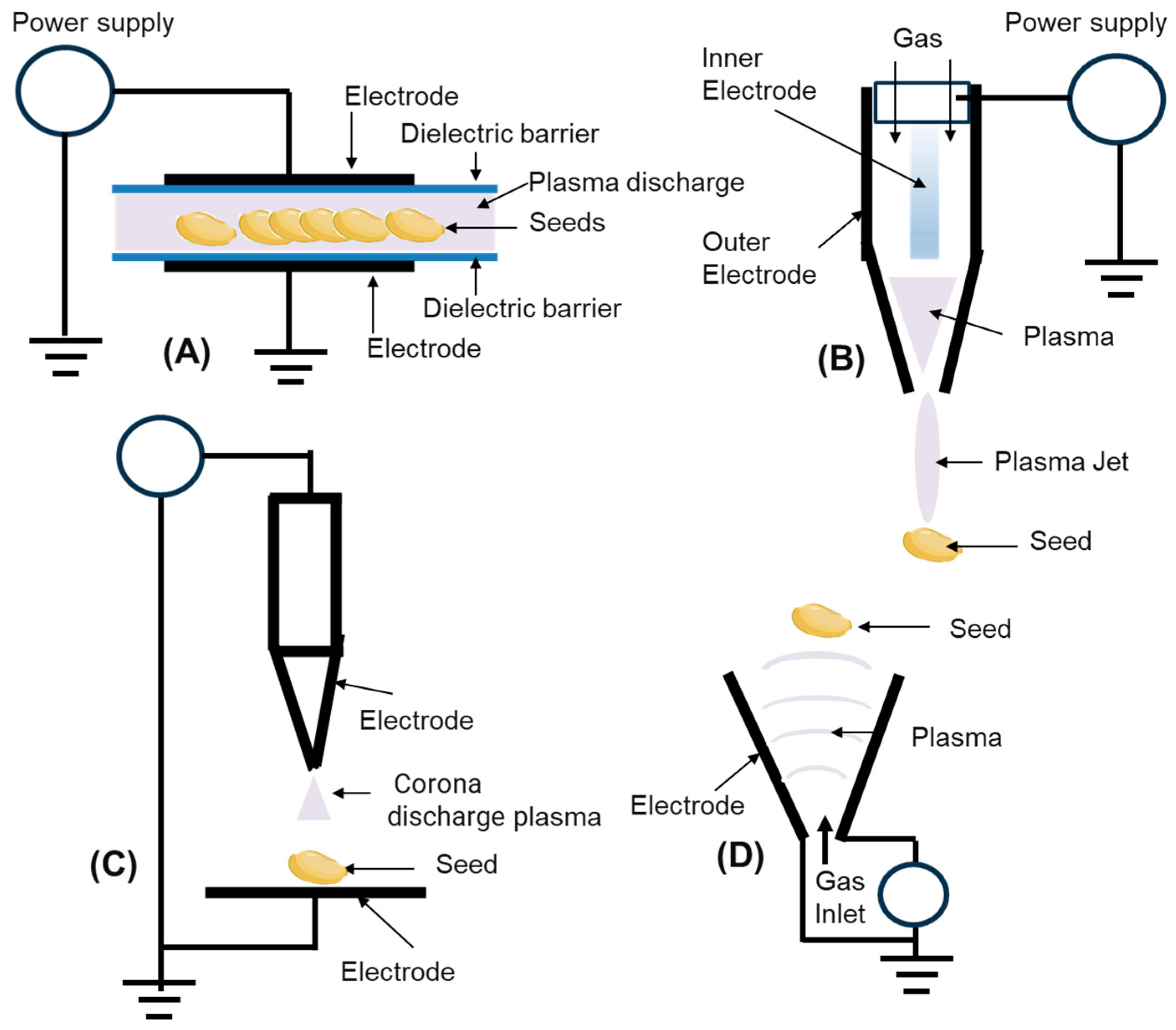
2. Cold Plasma Generation and Its Active Chemistry
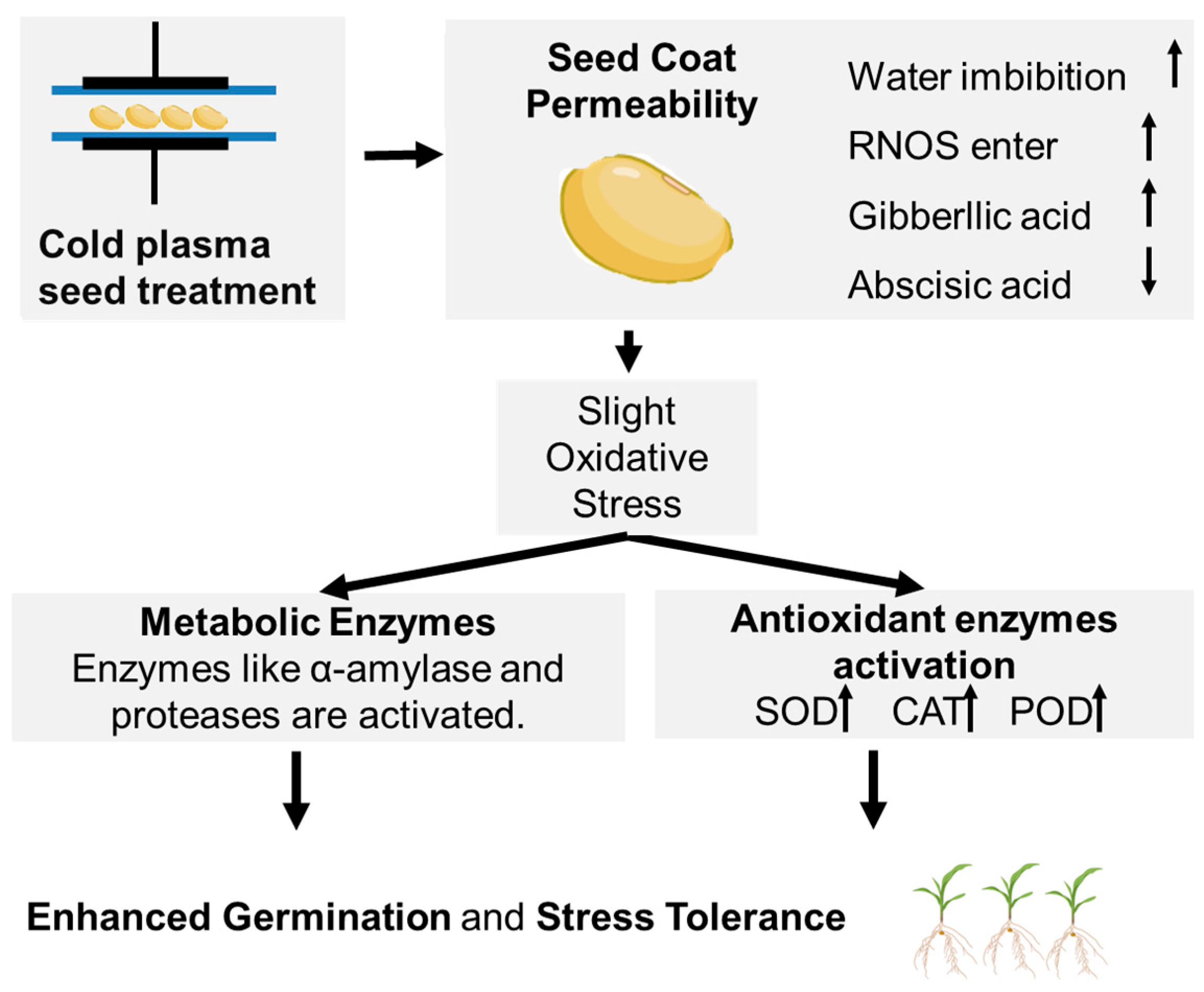
3. Mechanisms of Cold Plasma Interaction with Seeds
3.1. Physical Effects: Seed Coat Etching and Enhanced Hydrophilicity
3.2. Biochemical and Physiological Effects: RONS as Signaling Molecules
3.3. Antimicrobial Effects: A Chemical-Free Approach to Seed Decontamination
4. Agronomic Benefits and Efficacy
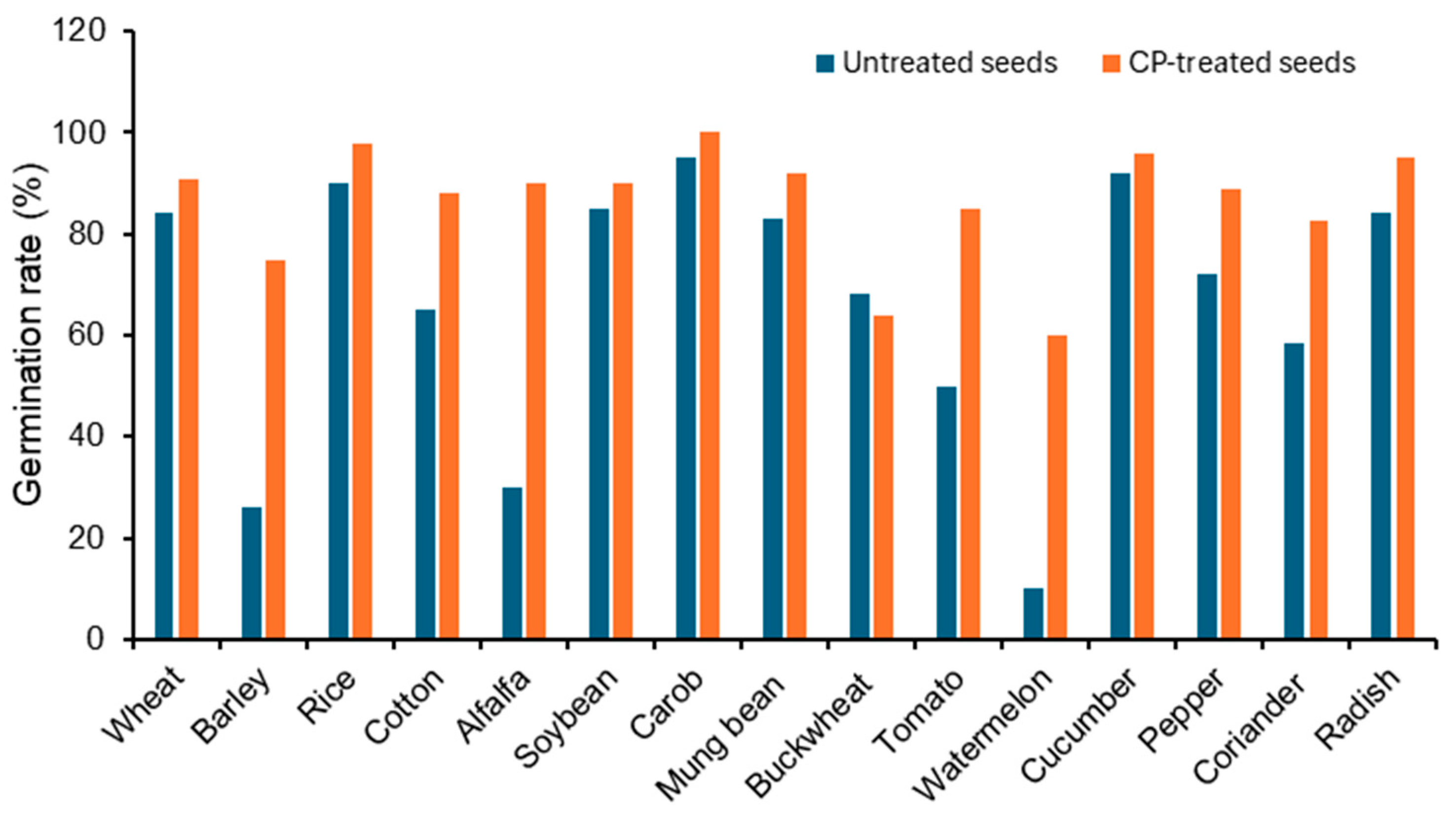
4.1. Enhanced Germination and Vigor
4.2. Stress Tolerance

| Species | Plasma Type | Effects on Seed Coats | Hydrophilicity | Germination | Ref |
|---|---|---|---|---|---|
| Wheat | DBD/helium | Surface etching, removal of waxy layer. Confirmed with SEM imaging. | Significantly increased. Water contact angle decreased from ~120° to <40°. | Increased germination rate and speed. Enhanced seedling growth and vigor. | [29,70] |
| Soybean | DBD plasma/O2 and N2 | Beneficial effect on seed coating with rhizobia. | Significantly increased. Water absorption rate was markedly higher post-treatment. | Accelerated germination and enhanced early seedling growth. | [35] |
| Peper | DBD/argon | Interaction between seed coat and plasma affected seedling abnormalities. | Increased seed coat hydrophilicity. | Enhanced germination and seedling vigor | [38] |
| Pumpkin | CAPJ/helium or argon | Strong corrugation of seed coat | Improve seed water uptake during imbibitions | CAPJ accelerates the germination and radicle development | [39] |
| Camelina | DBD/air | Partial external structures disappeared and became disorganized | - | CP pretreatment led to an increase in the efficiency of the oil extraction process | [40] |
| Maize | GAD/air | Modification of the etched surface of the starch caryopsis at 900 s exposure time | Improve seed water uptake | Germination parameters increased by 4.6% and 17.4% | [41] |
| Lentils, beans, and wheat | CRF/air | Effectively modification of seed coat surface properties | Significantly increased wettability, allowing faster hydration of the embryo. | Increase in the germination speed. | [42] |
| Plasma Type | Effects of Plasma Under Stress Conditions | Ref |
|---|---|---|
| Drought stress | ||
| Radio Frequency (RF) Discharge | Enhanced seed germination under PEG-induced drought conditions. | [24] |
| DBD | Improved nodulation, symbiotic nitrogen fixation, root and shoot growth. | [71] |
| RF | CP had a significant effect on the adaptability of alfalfa seeds in different drought environment | [73] |
| Plasma Jet | Induced drought stress tolerance with improved growth and biochemical alterations in tomato seedlings. | [28] |
| Salinity | ||
| DBD | Plasma treatment of barley seeds induced high germination and more chlorophylls a and b in leaves | [74] |
| Cold Plasma (10 kV) | CP treatment either alone or combined with SA improved plant uptake of nutrients in rice (Oryza sativa) under salinity conditions. | [75] |
| DBD/8 min | CP increases the production of Prosopis koelziana pigments, further strengthening their ability to resist salt stress | [76] |
| RF | One-minute CP treatment of wheat seeds significantly enhanced grain yield and quality under moderate to high salinity stress | [77] |
| Cadmium | ||
| DBD/1.5 min | Plasma technology mitigates Cd toxicity in wheat plants | [78] |
| Temperature | ||
| Cold Plasma (20 kV for 20 min) | Highest germination, seedling dry weight, vigor index, and field emergence under cold stress (18 °C). | [79] |
| CP | CP can significantly improve the germination of rice seeds affected by heat stress. | [80] |
| Biotic Stress | ||
| Radio Frequency (RF) Discharge | Increased resistance to Ralstonia solanacearum (bacterial wilt). | [25] |
| Dielectric Barrier Discharge (DBD) | Effectively removed seed-borne fungal pathogens, enhancing seed health and germination. | [81] |
| CP | Boosts plant protection against pathogens. | [82] |
4.3. Crop Production
5. Assessment of CP-Seed Treatment
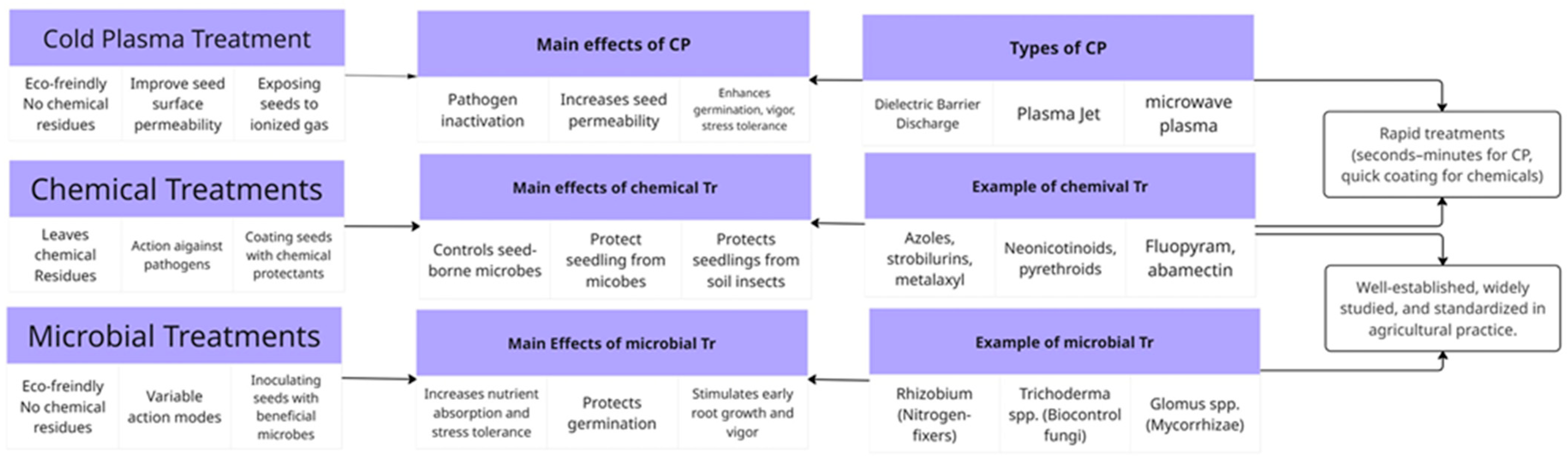
5.1. Comparison with Chemical Treatment and Biological Priming
5.2. Limitations
- (a)
- Excessive or prolonged plasma exposure can damage seed surfaces and even internal structures, reducing seed viability and growth. A recent study demonstrated that plasma treatments beyond an optimal duration caused cracking and rupturing of seed coats, negatively affecting water uptake and the development of seedling. For soybean, cultivar-specific responses further illustrate the risks of excessive plasma exposure. According to the study by [84], significant variation was observed among cultivars: some showed enhanced germination and vigor at shorter exposure times (≤3 min), while others demonstrated declines in germination percentage, seedling length, and vigor index when treated for longer durations (≥5 min) or under higher discharge power. In addition, prolonged exposure was associated with altered antioxidant enzyme activities, indicating stress responses [84]. These findings emphasize that optimization of CP treatment is strongly cultivar-dependent, and that exceeding threshold exposure levels can shift effects from beneficial to detrimental.
- (b)
- Although reactive oxygen and nitrogen species (RONS) play a central role, the precise biochemical and molecular mechanisms remain unclear [85,86,87,88,89,90]. As shown in a study on Arabidopsis thaliana [84], short exposures (0.5–1 min) at 60 W stimulated root elongation and fresh weight, suggesting beneficial signaling from plasma-generated RONS. In contrast, longer exposures (≥5 min) significantly reduced root length and biomass, with severe inhibition observed at 10 min attributed to oxidative stress caused by RONS generated during the plasma treatment [86].
- (c)
- Practical challenges limit field adoption, as farmers are familiar with chemical or microbial seed treatments; CP requires new infrastructure and training. The challenges of practical field application include the need of specialized, often costly equipment and technical expertise to operate plasma treatment systems effectively [86]. Limited field-scale data and standardized protocols further complicate widespread acceptance in agricultural practice [71,83].
- (d)
- While CP treatment enhances early seedling vigor, these advantages may diminish over time. Some studies show faster germination and enhanced early seedling growth, treated and untreated plants reach comparable final growth and biomass at later stages [91]. This suggests that the positive effects of CP are often limited to early developmental stages, highlighting the need for long-term monitoring to determine whether initial benefits translate into lasting agronomic improvements.
5.3. Lack of Field Validation
6. Perspectives and Conclusions
Supplementary Materials
Author Contributions
Funding
Data Availability Statement
Conflicts of Interest
Abbreviations
| CP | Cold Plasm |
| RONS | Reactive oxygen and nitrogen species |
| RNS | Reactive nitrogen species |
| ROS | Reactive oxygen species |
| DBD | Dielectric Barrier Discharge |
| APPJ | Atmospheric Pressure Plasma Jet |
| NO | Nitric oxide |
| ABA | Abscisic acid |
| GA | Gibberellic acid |
| SOD | Superoxide dismutase |
| CAT | Catalase |
| POD | Peroxidase |
References
- Rockström, J.; Williams, J.; Daily, G.; Noble, A.; Matthews, N.; Gordon, L.; Wetterstrand, H.; DeClerck, F.; Shah, M.; Steduto, P.; et al. Sustainable intensification of agriculture for human prosperity and global sustainability. Ambio 2017, 46, 4–17. [Google Scholar] [CrossRef]
- Kassam, A.; Friedrich, T. An ecologically sustainable approach to agricultural production intensification: Global perspectives and developments. Field Actions Science Reports. J. Field Actions 2012, 6, 1–6. Available online: http://journals.openedition.org/factsreports/1382 (accessed on 5 October 2025).
- Sarfraz, S.; Ali, F.; Hameed, A.; Ahmad, Z.; Riaz, K. Sustainable agriculture through technological innovations. In Sustainable Agriculture in the Era of the OMICs Revolution; Springer International Publishing: Cham, Switzerland, 2023; pp. 223–239. [Google Scholar] [CrossRef]
- Bareke, T. Biology of seed development and germination physiology. Adv. Plants Agric. Res. 2018, 8, 336–346. [Google Scholar] [CrossRef]
- Munkvold, G.P.; Watrin, C.; Scheller, M.; Zeun, R.; Olaya, G. Benefits of chemical seed treatments on crop yield and quality. In Global Perspectives on the Health of Seeds and Plant Propagation Material; Springer: Dordrecht, The Netherlands, 2014; pp. 89–103. [Google Scholar] [CrossRef]
- Chatterjee, R. Fundamental concepts and discussion of plasma physics. Techno Rev. J. Technol. Manag. 2022, 2, 1–14. [Google Scholar] [CrossRef]
- Yasoob, A.N.; Abdalameer, N.K.; Mohammed, A.Q. Plasma production and applications: A review. Int. J. Nanosci. 2022, 21, 2230003. [Google Scholar] [CrossRef]
- Mehmood, M.A.; Iqbal, M.M.; Ashfaq, M.; Raza, N.; Wang, J.; Hafeez, A.; Kayani, S.B.; Ali, Q. Impact of Antibacterial Agents in Horticulture: Risks to Non-Target Organisms and Sustainable Alternatives. Horticulturae 2025, 11, 753. [Google Scholar] [CrossRef]
- Pal, P.; Sehgal, H.; Joshi, M.; Arora, G.; Simek, M.; Lamba, R.P.; Maurya, S.; Pal, U.N. Advances in using non-thermal plasmas for healthier crop production: Toward pesticide and chemical fertilizer-free agriculture. Planta 2025, 261, 109. [Google Scholar] [CrossRef] [PubMed]
- Akishev, Y.; Machala, Z.; Koval, N. Special issue on recent developments in plasma sources and new plasma regimes. J. Phys. D Appl. Phys 2019, 52, 130301. [Google Scholar] [CrossRef]
- Bruggeman, P.; Brandenburg, R. Atmospheric pressure discharge filaments and microplasmas: Physics, chemistry and diagnostics. J. Phys. D Appl. Phys. 2013, 46, 464001. [Google Scholar] [CrossRef]
- Desai, M.; Chandel, A.; Chauhan, O.P.; Semwal, A.D. Uses and future prospects of cold plasma in agriculture. Food Humanit. 2024, 2, 100262. [Google Scholar] [CrossRef]
- Harry, J.E. Introduction to Plasma Technology: Science, Engineering, and Applications; John Wiley & Sons: Hoboken, NJ, USA, 2013; Available online: https://www.wiley-vch.de/en/areas-interest/natural-sciences/introduction-to-plasma-technology-978-3-527-32763-8?utm_source=chatgpt.com (accessed on 5 October 2025).
- Waghmare, R. Cold plasma technology for fruit based beverages: A review. Trends Food Sci. Technol. 2021, 114, 60–69. [Google Scholar] [CrossRef]
- Benabderrahim, M.A.; Bettaieb, I.; Hannachi, H.; Rejili, M.; Dufour, T. Cold plasma treatment boosts barley germination and seedling vigor: Insights into soluble sugar, starch, and protein modifications. J. Cereal Sci. 2024, 116, 103852. [Google Scholar] [CrossRef]
- Holc, M.; Mozetič, M.; Recek, N.; Primc, G.; Vesel, A.; Zaplotnik, R.; Gselman, P. Wettability increase in plasma-treated agricultural seeds and its relation to germination improvement. Agronomy 2021, 11, 1467. [Google Scholar] [CrossRef]
- Lee, Y.; Lee, Y.Y.; Kim, Y.S.; Balaraju, K.; Mok, Y.S.; Yoo, S.J.; Jeon, Y. Enhancement of seed germination and microbial disinfection on ginseng by cold plasma treatment. J. Ginseng Res. 2021, 45, 519–526. [Google Scholar] [CrossRef] [PubMed]
- Guragain, R.P.; Kierzkowska-Pawlak, H.; Fronczak, M.; Kędzierska-Sar, A.; Subedi, D.P.; Tyczkowski, J. Germination improvement of fenugreek seeds with cold plasma: Exploring long-lasting effects of surface modification. Sci. Hortic. 2024, 324, 112619. [Google Scholar] [CrossRef]
- Orlowski, J.; Motyka-Pomagruk, A.; Dzimitrowicz, A.; Pohl, P.; Terefinko, D.; Lojkowska, E.; Jamroz, P.; Sledz, W. Application of Cold Atmospheric Pressure Plasma Jet Results in Achievement of Universal Antibacterial Properties on Various Plant Seeds. Appl. Sci. 2025, 15, 1255. [Google Scholar] [CrossRef]
- Los, A.; Ziuzina, D.; Boehm, D.; Bourke, P. Effects of cold plasma on wheat grain microbiome and antimicrobial efficacy against challenge pathogens and their resistance. Int. J. Food Microbiol. 2020, 335, 108889. [Google Scholar] [CrossRef] [PubMed]
- Mravlje, J.; Regvar, M.; Starič, P.; Mozetič, M.; Vogel-Mikuš, K. Cold plasma affects germination and fungal community structure of buckwheat seeds. Plants 2021, 10, 851. [Google Scholar] [CrossRef]
- Pauzaite, G.; Malakauskiene, A.; Nauciene, Z.; Zukiene, R.; Filatova, I.; Lyushkevich, V.; Azarko, I.; Mildaziene, V. Changes in Norway spruce germination and growth induced by pre-sowing seed treatment with cold plasma and electromagnetic field: Short-term versus long-term effects. Plasma Process. Polym. 2018, 15, 1700068. [Google Scholar] [CrossRef]
- Cherif, M.M.; Assadi, I.; Khezami, L.; Ben Hamadi, N.; Assadi, A.A.; Elfalleh, W. Review on recent applications of cold plasma for safe and sustainable food production: Principles, implementation, and application limits. Appl. Sci. 2023, 13, 2381. [Google Scholar] [CrossRef]
- Ling, L.; Jiangang, L.; Min, S.; Yanhui, L.; Hanliang, S. Cold plasma treatment enhances oilseed rape seed germination and seedling growth. J. Zhejiang Univ. Sci. B 2015, 16, 51–58. [Google Scholar] [CrossRef]
- Jiang, J.; He, X.; Li, L.; Li, J.; Shao, H.; Xu, Q.; Ye, R.; Dong, Y. Effect of cold plasma treatment on seed germination and growth of wheat. Plasma Sci. Technol. 2014, 16, 54. [Google Scholar] [CrossRef]
- Li, L.; Jiang, J.F.; Li, J.; Shen, M.; He, X.; Shao, H.; Dong, Y. Effects of cold plasma treatment on seed germination and seedling growth of soybean. Sci. Rep. 2014, 4, 5859. [Google Scholar] [CrossRef] [PubMed]
- Chanioti, S.; Katsenios, N.; Efthimiadou, A.; Stergiou, P.; Xanthou, Z.-M.; Giannoglou, M.; Dimitrakellis, P.; Gogolides, E.; Katsaros, G. Pre-sowing treatment of maize seeds by cold atmospheric plasma and pulsed electromagnetic fields: Effect on plant and kernels characteristics. Aust. J. Crop Sci. 2021, 15, 251–259. [Google Scholar] [CrossRef]
- Adhikari, B.; Adhikari, M.; Ghimire, B.; Adhikari, B.C.; Park, G.; Choi, E.H. Cold plasma seed priming modulates growth, redox homeostasis and stress response by inducing reactive species in tomato (Solanum lycopersicum). Free. Radic. Biol. Med. 2020, 156, 57–69. [Google Scholar] [CrossRef] [PubMed]
- Molina, R.; Lalueza, A.; López-Santos, C.; Ghobeira, R.; Cools, P.; Morent, R.; De Geyter, N.; González-Elipe, A.R. Physicochemical surface analysis and germination at different irrigation conditions of DBD plasma-treated wheat seeds. Plasma Process. Polym. 2021, 18, 2000086. [Google Scholar] [CrossRef]
- Ranieri, P.; Sponsel, N.; Kizer, J.; Rojas-Pierce, M.; Hernández, R.; Gatiboni, L.; Shome, M.; Kvitky, J.; Fridman, A.; Staack, D. Plasma agriculture: Review from the perspective of the plant and its ecosystem. Plasma Process. Polym. 2021, 18, e2000162. [Google Scholar] [CrossRef]
- Bafoil, M.; Le Ru, A.; Merbahi, N.; Eichwald, O.; Dunand, C.; Yousfi, M. New insights of low-temperature plasma effects on germination of three genotypes of Arabidopsis thaliana seeds under osmotic and saline stresses. Sci. Rep. 2019, 9, 8649. [Google Scholar] [CrossRef]
- Guo, Q.; Wang, Y.; Zhang, H.; Qu, G.; Wang, T.; Sun, Q.; Liang, D. Alleviation of adverse effects of drought stress on wheat seed germination using atmospheric dielectric barrier discharge plasma treatment. Sci. Rep. 2017, 7, 16680. [Google Scholar] [CrossRef]
- Bárdos, L.; Baránková, H. Cold atmospheric plasma: Sources, processes, and applications. Thin Solid Film. 2010, 518, 6705–6713. [Google Scholar] [CrossRef]
- Daeschlein, G.; Scholz, S.; Arnold, A.; von Podewils, S.; Haase, H.; Emmert, S.; von Woedtke, T.; Weltmann, K.D.; Jünger, M. In vitro susceptibility of important skin and wound pathogens against low temperature atmospheric pressure plasma jet (APPJ) and dielectric barrier discharge plasma (DBD). Plasma Process. Polym. 2012, 9, 380–389. [Google Scholar] [CrossRef]
- Stryczewska, H.D.; Boiko, O. Applications of plasma produced with electrical discharges in gases for agriculture and biomedicine. Appl. Sci. 2022, 12, 4405. [Google Scholar] [CrossRef]
- Šimek, M.; Homola, T. Plasma-assisted agriculture: History, presence, and prospects—A review. Eur. Phys. J. D 2021, 75, 210. [Google Scholar] [CrossRef]
- Pérez-Pizá, M.C.; Cejas, E.; Zilli, C.; Prevosto, L.; Mancinelli, B.; Santa-Cruz, D.; Yannarelli, G.; Balestrasse, K. Enhancement of soybean nodulation by seed treatment with non–thermal plasmas. Sci. Rep. 2020, 10, 4917. [Google Scholar] [CrossRef] [PubMed]
- Sriruksa, C.; Sawangrat, C.; Sansongsiri, S.; Boonyawan, D.; Thanapornpoonpong, S.N. Influence of Seed Coat Integrity on the Response of Pepper Seeds to Dielectric Barrier Discharge Plasma Treatment. Plants 2025, 14, 1938. [Google Scholar] [CrossRef] [PubMed]
- Volkov, A.G.; Hairston, J.S.; Patel, D.; Gott, R.P.; Xu, K.G. Cold plasma poration and corrugation of pumpkin seed coats. Bioelectrochemistry 2019, 128, 175–185. [Google Scholar] [CrossRef]
- Rezaei, S.; Ghobadian, B.; Ebadi, M.T.; Ghomi, H. Qualitative and quantitative assessment of extracted oil from Camelina sativa seed treated by dielectric-barrier discharge cold plasma. Contrib. Plasma Phys. 2020, 60, e202000032. [Google Scholar] [CrossRef]
- Kamseu-Mogo, J.P.; Kamgang-Youbi, G.; Djepang, S.A.; Tamo, B.S.; Laminsi, S. Treatment of maize seeds (Zea mays) by nonthermal plasma generated by gliding electric discharge for application in agriculture. IEEE Trans. Plasma Sci. 2021, 49, 2318–2328. [Google Scholar] [CrossRef]
- Bormashenko, E.; Grynyov, R.; Bormashenko, Y.; Drori, E. Cold radiofrequency plasma treatment modifies wettability and germination speed of plant seeds. Sci. Rep. 2012, 2, 741. [Google Scholar] [CrossRef]
- Kanwal, K.; Zafar, M.; Khan, A.M.; Mahmood, T.; Abbas, Q.; Ozdemir, F.A.; Ahmad, M.; Sultana, S.; Rozina; Fatima, A.; et al. Implication of scanning electron microscopy and light microscopy for oil content determination and seed morphology of Verbenaceae. Microsc. Res. Tech. 2022, 85, 789–798. [Google Scholar] [CrossRef]
- Ghodsimaab, S.P.; Makarian, H.; Ghasimi Hagh, Z.; Gholipoor, M. Scanning electron microscopy, biochemical and enzymatic studies to evaluate hydro-priming and cold plasma treatment effects on the germination of Salvia leriifolia Benth. seeds. Front. Plant Sci. 2023, 13, 1035296. [Google Scholar] [CrossRef]
- Grainge, G.; Nakabayashi, K.; Steinbrecher, T.; Kennedy, S.; Ren, J.; Iza, F.; Leubner-Metzger, G. Molecular mechanisms of seed dormancy release by gas plasma-activated water technology. J. Exp. Bot. 2022, 73, 4065–4078. [Google Scholar] [CrossRef]
- Dufour, T.; Gutierrez, Q.; Bailly, C. Sustainable improvement of seeds vigor using dry atmospheric plasma priming: Evidence through coating wettability, water uptake, and plasma reactive chemistry. J. Appl. Phys. 2021, 129, 084902. [Google Scholar] [CrossRef]
- Bhatt, P.; Kumar, V.; Subramaniyan, V.; Nagarajan, K.; Sekar, M.; Chinni, S.V.; Ramachawolran, G. Plasma modification techniques for natural polymer-based drug delivery systems. Pharmaceutics 2023, 15, 2066. [Google Scholar] [CrossRef]
- Zhao, J.; Nie, L. Five gaseous reactive oxygen and nitrogen species (RONS) density generated by microwave plasma jet. Phys. Plasmas 2019, 26, 073503. [Google Scholar] [CrossRef]
- Bethke, P.C.; Libourel, I.G.; Jones, R.L. Nitric oxide reduces seed dormancy in Arabidopsis. J. Exp. Bot. 2006, 57, 517–526. [Google Scholar] [CrossRef] [PubMed]
- Zukiene, R.; Nauciene, Z.; Januskaitiene, I.; Pauzaite, G.; Mildaziene, V.; Koga, K.; Shiratani, M. Dielectric barrier discharge plasma treatment-induced changes in sunflower seed germination, phytohormone balance, and seedling growth. Appl. Phys. Express 2019, 12, 126003. [Google Scholar] [CrossRef]
- Mildaziene, V.; Ivankov, A.; Sera, B.; Baniulis, D. Biochemical and physiological plant processes affected by seed treatment with non-thermal plasma. Plants 2022, 11, 856. [Google Scholar] [CrossRef] [PubMed]
- Bourke, P.; Ziuzina, D.; Boehm, D.; Cullen, P.J.; Keener, K. The potential of cold plasma for safe and sustainable food production. Trends Biotechnol. 2018, 36, 615–626. [Google Scholar] [CrossRef]
- Mandal, R.; Singh, A.; Singh, A.P. Recent developments in cold plasma decontamination technology in the food industry. Trends Food Sci. Technol. 2018, 80, 93–103. [Google Scholar] [CrossRef]
- Fojlaley, M.; Aghajani, A.; Ranji, A.; Bahlooli, E. Low-temperature cold plasma and decontamination of cereals and fruits: A review. World J. Environ. Biosci. 2020, 9, 133–142. Available online: https://environmentaljournals.org/article/low-temperature-cold-plasma-and-decontamination-of-cereals-and-fruits-a-review (accessed on 5 October 2025).
- Sivachandiran, L.; Khacef, A. Enhanced seed germination and plant growth by atmospheric pressure cold air plasma: Combined effect of seed and water treatment. RSC Adv. 2017, 7, 1822–1832. [Google Scholar] [CrossRef]
- Lackmann, J.W.; Schneider, S.; Edengeiser, E.; Jarzina, F.; Brinckmann, S.; Steinborn, E.; Havenith, M.; Benedikt, J.; Bandow, J.E. Photons and particles emitted from cold atmospheric-pressure plasma inactivate bacteria and biomolecules independently and synergistically. J. R. Soc. Interface 2013, 10, 20130591. [Google Scholar] [CrossRef]
- Sultan, S.M.; Yousef, A.F.; Ali, W.M.; Mohamed, A.A.; Ahmed, A.R.M.; Shalaby, M.E.; Teiba, I.I.; Hassan, A.M.; Younes, N.A.; Kotb, E.F. Cold atmospheric plasma enhances morphological and biochemical attributes of tomato seedlings. BMC Plant Biol. 2024, 24, 420. [Google Scholar] [CrossRef]
- Khamsen, N.; Onwimol, D.; Teerakawanich, N.; Dechanupaprittha, S.; Kanokbannakorn, W.; Hongesombut, K.; Srisonphan, S. Rice (Oryza sativa L.) seed sterilization and germination enhancement via atmospheric hybrid nonthermal discharge plasma. ACS Appl. Mater. Interfaces 2016, 8, 19268–19275. Available online: https://pubs.acs.org/doi/abs/10.1021/acsami.6b04555 (accessed on 5 October 2025). [CrossRef]
- Benabderrahim, M.A.; Hannachi, H.; Elfalleh, W.; Dufour, T. Nutritional and growth enhancement of alfalfa sprouts through cold plasma and UV seed treatments. Ital. J. Food Sci. 2025, 37, 160–173. [Google Scholar] [CrossRef]
- Othman, K.B.; Cherif, M.M.; Assadi, I.; Elfalleh, W.; Khezami, L.; Ghorbal, A.; Assadi, A.A. Exploring Cold plasma technology: Enhancements in Carob seed germination, phytochemical Composition, and antioxidant activity. Heliyon 2024, 10, e28966. [Google Scholar] [CrossRef] [PubMed]
- Jangra, S.; Mishra, A.; Mishra, R.; Pandey, S.; Prakash, R. Transformative impact of atmospheric cold plasma on mung bean seeds: Unveiling surface characteristics, physicochemical alterations, and enhanced germination potential. AIP Adv. 2024, 14, 075215. [Google Scholar] [CrossRef]
- Lotfy, K. Effects of cold atmospheric plasma jet treatment on the seed germination and enhancement growth of watermelon. Open J. Appl. Sci. 2017, 7, 705. [Google Scholar] [CrossRef][Green Version]
- Štěpánová, V.; Slavíček, P.; Kelar, J.; Prášil, J.; Smékal, M.; Stupavská, M.; Jurmanová, J.; Černák, M. Atmospheric pressure plasma treatment of agricultural seeds of cucumber (Cucumis sativus L.) and pepper (Capsicum annuum L.) with effect on reduction of diseases and germination improvement. Plasma Process. Polym. 2018, 15, 1700076. [Google Scholar] [CrossRef]
- Guragain, R.P.; Baniya, H.B.; Guragain, D.P.; Subedi, D.P. Exploring the effects of non-thermal plasma pre-treatment on coriander (Coriander sativum L.) seed germination efficiency. Heliyon 2024, 10, e28763. [Google Scholar] [CrossRef] [PubMed]
- Guragain, R.P.; Baniya, H.B.; Dhungana, S.; Chhetri, G.K.; Sedhai, B.; Basnet, N.; Shakya, A.; Pandey, B.P.; Pradhan, S.P.; Joshi, U.M.; et al. Effect of plasma treatment on the seed germination and seedling growth of radish (Raphanus sativus). Plasma Sci. Technol. 2021, 24, 015502. [Google Scholar] [CrossRef]
- de Groot, G.J.; Hundt, A.; Murphy, A.B.; Bange, M.P.; Mai-Prochnow, A. Cold plasma treatment for cotton seed germination improvement. Sci. Rep. 2018, 8, 14372. [Google Scholar] [CrossRef] [PubMed]
- Le, T.Q.X.; Nguyen, L.N.; Nguyen, T.T.; Choi, E.H.; Nguyen, Q.L.; Kaushik, N.K.; Dao, N.T. Effects of cold plasma treatment on physical modification and endogenous hormone regulation in enhancing seed germination and radicle growth of mung bean. Appl. Sci. 2022, 12, 10308. [Google Scholar] [CrossRef]
- Waskow, A.; Guihur, A.; Howling, A.; Furno, I. RNA sequencing of Arabidopsis thaliana seedlings after non-thermal plasma-seed treatment reveals upregulation in plant stress and defense pathways. Int. J. Mol. Sci. 2022, 23, 3070. [Google Scholar] [CrossRef] [PubMed]
- Thakur, N.; Vasudevan, S.N. Plasma treatment and seed quality advancement: A review. Agric. Rev. 2021, 42, 197–202. [Google Scholar] [CrossRef]
- Holubová, Ľ.; Švubová, R.; Slováková, Ľ.; Bokor, B.; Chobotová Kročková, V.; Renčko, J.; Uhrin, F.; Medvecká, V.; Zahoranová, A.; Gálová, E. Cold atmospheric pressure plasma treatment of maize grains—Induction of growth, enzyme activities and heat shock proteins. Int. J. Mol. Sci. 2021, 22, 8509. [Google Scholar] [CrossRef] [PubMed]
- Abeysingha, D.N.; Dhaliwal, H.K.; Du, L.; De Silva, C.; Szczyglowski, K.; Roopesh, M.S.; Thilakarathna, M.S. The potential of cold plasma-based seed treatments in legume–rhizobia symbiotic nitrogen fixation: A review. Crops 2024, 4, 95–114. [Google Scholar] [CrossRef]
- Feng, J.; Wang, D.; Shaao, C.; Tang, X. Effects of cold plasma treatment on alfalfa seed growth under simulated drought stress. Plasma Sci. Technol. 2018, 20, 035505. [Google Scholar] [CrossRef]
- Perea-Brenes, A.; Garcia, J.L.; Cantos, M.; Cotrino, J.; Gonzalez-Elipe, A.R.; Gomez-Ramirez, A.; Lopez-Santos, C. Germination and first stages of growth in drought, salinity, and cold stress conditions of plasma-treated barley seeds. ACS Agric. Sci. Technol. 2023, 3, 760–770. Available online: https://pubs.acs.org/doi/10.1021/acsagscitech.3c00121?goto=supporting-info (accessed on 5 October 2025). [CrossRef]
- Sheteiwy, M.S.; An, J.; Yin, M.; Jia, X.; Guan, Y.; He, F.; Hu, J. Cold plasma treatment and exogenous salicylic acid priming enhances salinity tolerance of Oryza sativa seedlings. Protoplasma 2019, 256, 79–99. [Google Scholar] [CrossRef] [PubMed]
- Shahabi, Z.M.; Nasibi, F.; Noori, H. Cold plasma technology as a pre-treatment for seed priming enhances germination and reduces salinity stress in Prosopis Koelziana. Sci. Rep. 2025, 15, 26250. [Google Scholar] [CrossRef]
- Saudy, H.S.; Fawzy, M.; Abd El-Momen, W.R.; Mubarak, M.; Ibrahim, M.F.; Elgendy, A.T. Potentiality of non-thermal plasma as an innovative technique for ameliorating wheat productivity under saline soil conditions. Egypt. J. Agron. 2025, 47, 471–480. [Google Scholar] [CrossRef]
- Kabir, A.H.; Rahman, M.; Das, U.; Sarkar, U.; Roy, N.C.; Reza, A.; Talukder, M.R.; Uddin, A. Reduction of cadmium toxicity in wheat through plasma technology. PLoS ONE 2019, 14, e0214509. [Google Scholar] [CrossRef]
- Shilpa, B.; Priya, P.B.; Pallavi, M.; Rao, P.J.M. Effect of Cold Plasma Treatment on Seed Quality Parameters under Cold Stress in Rice (Oryza sativa L.). J. Exp. Agric. Int. 2024, 46, 943–953. [Google Scholar] [CrossRef]
- Starič, P.; Mravlje, J.; Mozetič, M.; Zaplotnik, R.; Šetina Batič, B.; Junkar, I.; Vogel Mikuš, K. The influence of glow and afterglow cold plasma treatment on biochemistry, morphology, and physiology of wheat seeds. Int. J. Mol. Sci. 2022, 23, 7369. [Google Scholar] [CrossRef] [PubMed]
- Suriyasak, C.; Hatanaka, K.; Tanaka, H.; Okumura, T.; Yamashita, D.; Attri, P.; Koga, K.; Shiratani, M.; Hamaoka, N.; Ishibashi, Y. Alterations of DNA methylation caused by cold plasma treatment restore delayed germination of heat-stressed rice (Oryza sativa L.) seeds. ACS Agric. Sci. Technol. 2021, 1, 5–10. Available online: https://pubs.acs.org/doi/10.1021/acsagscitech.0c00070?goto=supporting-info (accessed on 5 October 2025). [CrossRef]
- Kocira, S.; Pérez-Pizá, M.C.; Bohata, A.; Bartos, P.; Szparaga, A. Cold Plasma as a Potential Activator of Plant Biostimulants. Sustainability 2022, 14, 495. [Google Scholar] [CrossRef]
- Pańka, D.; Jeske, M.; Łukanowski, A.; Baturo-Cieśniewska, A.; Prus, P.; Maitah, M.; Maitah, K.; Malec, K.; Rymarz, D.; Muhire, J.d.D.; et al. Can cold plasma be used for boosting plant growth and plant protection in sustainable plant production? Agronomy 2022, 12, 841. [Google Scholar] [CrossRef]
- Adhikari, B.; Adhikari, M.; Park, G. The effects of plasma on plant growth, development, and sustainability. Appl. Sci. 2020, 10, 6045. [Google Scholar] [CrossRef]
- Sayahi, K.; Sari, A.H.; Hamidi, A.; Nowruzi, B.; Hassani, F. Evaluating the impact of Cold plasma on Seedling Growth properties, seed germination, and soybean antioxidant enzyme activity. BMC Biotechnol. 2024, 24, 93. [Google Scholar] [CrossRef] [PubMed]
- Cui, D.; Yin, Y.; Wang, J.; Wang, Z.; Ding, H.; Ma, R.; Jiao, Z. Research on the physio-biochemical mechanism of non-thermal plasma-regulated seed germination and early seedling development in Arabidopsis. Front. Plant Sci. 2019, 10, 1322. [Google Scholar] [CrossRef] [PubMed]
- Cui, D.; Yin, Y.; Sun, H.; Wang, X.; Zhuang, J.; Wang, L.; Ma, R.; Jiao, Z. Regulation of cellular redox homeostasis in Arabidopsis thaliana seedling by atmospheric pressure cold plasma-generated reactive oxygen/nitrogen species. Ecotoxicol. Environ. Saf. 2022, 240, 113703. [Google Scholar] [CrossRef]
- Ucar, Y.; Ceylan, Z.; Durmus, M.; Tomar, O.; Cetinkaya, T. Application of cold plasma technology in the food industry and its combination with other emerging technologies. Trends Food Sci. Technol. 2021, 114, 355–371. [Google Scholar] [CrossRef]
- Jiang, J.; Lu, Y.; Li, J.; Li, L.; He, X.; Shao, H.; Dong, Y. Effect of seed treatment by cold plasma on the resistance of tomato to Ralstonia solanacearum (bacterial wilt). PLoS ONE 2014, 9, e97753. [Google Scholar] [CrossRef]
- Suwannarat, S.; Homkanchan, S.; Puttha, J.; Srisonphan, S. Nonthermal plasma engineering for seed disinfection and germination using streamer corona and dielectric barrier discharges. Results Eng. 2025, 26, 104884. [Google Scholar] [CrossRef]
- Waskow, A.; Howling, A.; Furno, I. Mechanisms of plasma-seed treatments as a potential seed processing technology. Front. Phys. 2021, 9, 617345. [Google Scholar] [CrossRef]
- Ahmed, N.; Siow, K.S.; Wee, M.M.R.; Patra, A. A study to examine the ageing behaviour of cold plasma-treated agricultural seeds. Sci. Rep. 2023, 13, 1675. [Google Scholar] [CrossRef]
- Harish, M.S.; Yadav, S.; Jain, B.T. Effect of Cold Plasma Seed Treatment on Physiological and Biochemical Changes in Aged Mustard Seed Variety-RH0749. Epigenetics 2024, 7, 8. [Google Scholar] [CrossRef]
- Attri, P.; Ishikawa, K.; Okumura, T.; Koga, K.; Shiratani, M. Plasma agriculture from laboratory to farm: A review. Processes 2020, 8, 1002. [Google Scholar] [CrossRef]
- Recek, N.; Zaplotnik, R.; Vesel, A.; Primc, G.; Gselman, P.; Mozetič, M.; Holc, M. Germination and growth of plasma-treated maize seeds planted in fields and exposed to realistic environmental conditions. Int. J. Mol. Sci. 2023, 24, 6868. [Google Scholar] [CrossRef] [PubMed]
- Barjasteh, A.; Lamichhane, P.; Dehghani, Z.; Kaushik, N.; Gupta, R.; Choi, E.H.; Kaushik, N.K. Recent progress of non-thermal atmospheric pressure plasma for seed germination and plant development: Current scenario and future landscape. J. Plant Growth Regul. 2023, 42, 5417–5432. [Google Scholar] [CrossRef]
- Ďurčányová, S.; Slováková, Ľ.; Klas, M.; Tomeková, J.; Ďurina, P.; Stupavská, M.; Kováčik, D.; Zahoranová, A.; Kováčik, D. Efficacy comparison of three atmospheric pressure plasma sources for soybean seed treatment: Plasma characteristics, seed properties, germination. Plasma Chem. Plasma Process. 2023, 43, 1863–1885. [Google Scholar] [CrossRef]
- Thirumdas, R.; Kothakota, A.; Annapure, U.; Siliveru, K.; Blundell, R.; Gatt, R.; Valdramidis, V.P. Plasma activated water (PAW): Chemistry, physico-chemical properties, applications in food and agriculture. Trends Food Sci. Technol. 2018, 77, 21–31. [Google Scholar] [CrossRef]
- Misra, N.N.; Schlüter, O.; Cullen, P.J. (Eds.) Cold Plasma in Food and Agriculture: Fundamentals and Applications; Academic Press: Cambridge, MA, USA, 2016; Available online: https://cir.nii.ac.jp/crid/1971712334776425020 (accessed on 5 October 2025).
- Volin, J.C.; Denes, F.S.; Young, R.A.; Park, S.M. Modification of seed germination performance through cold plasma chemistry technology. Crop Sci. 2000, 40, 1706–1718. [Google Scholar] [CrossRef]
- Bormashenko, E.; Grynyov, R.; Bormashenko, Y.; Drori, E. Cold radiofrequency plasma treatment modifies wettability and germination rate of plant seeds. Adv. Contact Angle Wettability Adhes. 2013, 1, 243–258. [Google Scholar] [CrossRef]
- Dobrzański, B.; Grundas, S.; Stępniewski, A. Introduction to Scientific Discipline Agrophysics—History and Research Objects. In Advances in Agrophysical Research; IntechOpen: London, UK, 2013. [Google Scholar] [CrossRef]


Disclaimer/Publisher’s Note: The statements, opinions and data contained in all publications are solely those of the individual author(s) and contributor(s) and not of MDPI and/or the editor(s). MDPI and/or the editor(s) disclaim responsibility for any injury to people or property resulting from any ideas, methods, instructions or products referred to in the content. |
© 2025 by the authors. Licensee MDPI, Basel, Switzerland. This article is an open access article distributed under the terms and conditions of the Creative Commons Attribution (CC BY) license (https://creativecommons.org/licenses/by/4.0/).
Share and Cite
Benabderrahim, M.A.; Bettaieb, I.; Rejili, M. Boosting Seed Performance with Cold Plasma. Appl. Sci. 2025, 15, 10996. https://doi.org/10.3390/app152010996
Benabderrahim MA, Bettaieb I, Rejili M. Boosting Seed Performance with Cold Plasma. Applied Sciences. 2025; 15(20):10996. https://doi.org/10.3390/app152010996
Chicago/Turabian StyleBenabderrahim, Mohamed Ali, Imen Bettaieb, and Mokhtar Rejili. 2025. "Boosting Seed Performance with Cold Plasma" Applied Sciences 15, no. 20: 10996. https://doi.org/10.3390/app152010996
APA StyleBenabderrahim, M. A., Bettaieb, I., & Rejili, M. (2025). Boosting Seed Performance with Cold Plasma. Applied Sciences, 15(20), 10996. https://doi.org/10.3390/app152010996