Article

Advancing GAN Deepfake Detection: Mixed Datasets and Comprehensive Artifact Analysis


by
Tamer Say
1,
Mustafa Alkan
2,* and
Aynur Kocak
2
1
Department of Information Security Engineering, Graduate School of Natural and Applied Sciences, Gazi University, 06560 Ankara, Turkey
2
Department of Electrical and Electronics Engineering, Faculty of Technology, Gazi University, 06560 Ankara, Turkey
*
Author to whom correspondence should be addressed.
Appl. Sci. 2025, 15(2), 923; https://doi.org/10.3390/app15020923
Submission received: 30 November 2024 / Revised: 11 January 2025 / Accepted: 15 January 2025 / Published: 18 January 2025
(This article belongs to the Section Computing and Artificial Intelligence)

Abstract

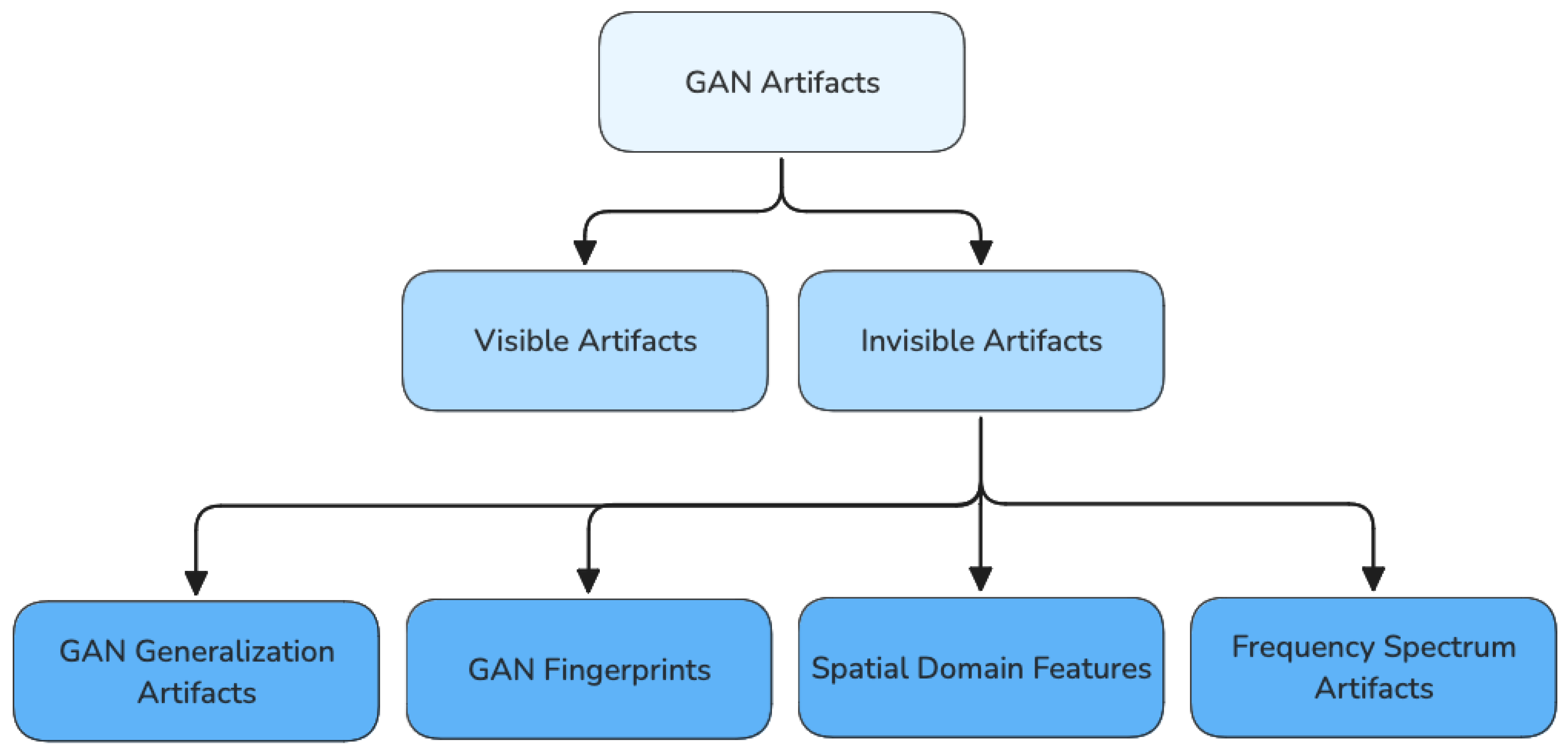
The rapid advancement of synthetic media, while beneficial, has also spawned GAN-generated deepfakes, which pose risks, including misinformation and digital fraud. This paper investigates the detectability of GAN-generated static images, focusing on residual artifacts that are imperceptible to humans but detectable through digital analysis. Our approach introduces three key advancements: (1) a taxonomy for classifying GAN residues in deepfake detection; (2) a unique mixed dataset combining StyleGAN3, ProGAN, and InterfaceGAN to aid cross-model detection research; and (3) a combination of frequency space analysis and RGB color correlation methods to improve artifact detection. Covering three different transform methods, three GAN models, and twelve classification methods, ours is the most comprehensive study of detection of static deepfake face images produced by GANs. Our results demonstrate that artifact-based detection can achieve high accuracy, precision, recall, and F1 scores, challenging prior assumptions about the detectability of synthetic face images.
Keywords: computer vision; deepfakes; synthetic media; machine learning computer vision; deepfakes; synthetic media; machine learning