Article

Removal of Zn(II), Cu(II) and Pb(II) from Rainwater by White Bean Peel: Optimization by Response Surface Methodology

by
Gonçalo H. Cabral
1,
Ana C. Estrada
2 and
Patrícia S. M. Santos
3,*
1
Department of Chemistry, University of Aveiro, Campus Universitário de Santiago, 3810-193 Aveiro, Portugal
2
CICECO & Department of Chemistry, University of Aveiro, Campus Universitário de Santiago, 3810-193 Aveiro, Portugal
3
CESAM & Department of Chemistry, University of Aveiro, Campus Universitário de Santiago, 3810-193 Aveiro, Portugal
*
Author to whom correspondence should be addressed.
Appl. Sci. 2025, 15(2), 627; https://doi.org/10.3390/app15020627
Submission received: 1 October 2024 / Revised: 6 January 2025 / Accepted: 7 January 2025 / Published: 10 January 2025
(This article belongs to the Special Issue New Approaches to Water Treatment: Challenges and Trends)

Abstract

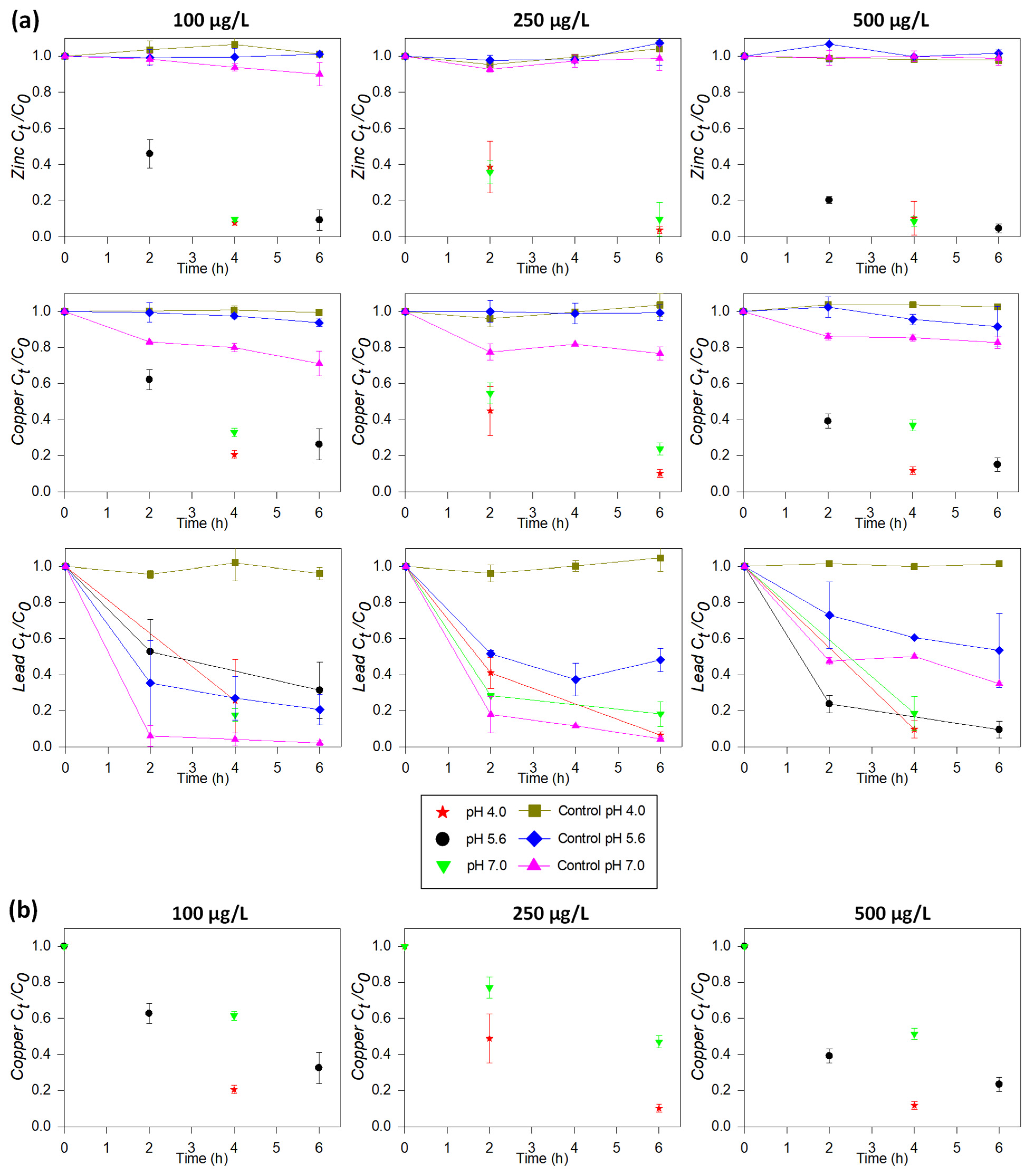
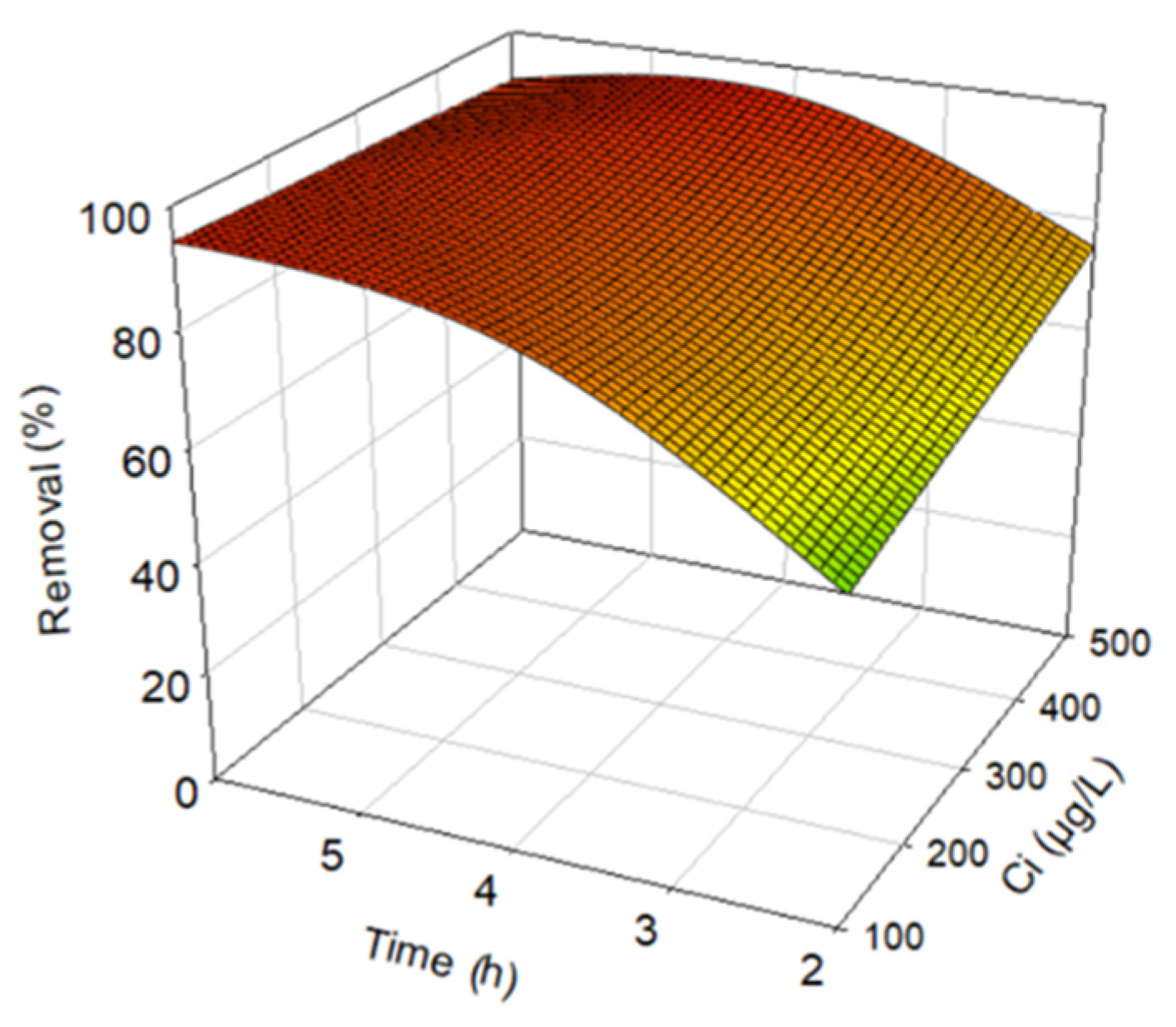
Potentially toxic elements (PTEs) have been found in high levels in rainwater, highlighting the importance of removing them when the water is intended for domestic use. In this work, white bean peel was evaluated as sorbent for the removal of a mixture of PTEs from rainwater, namely Zn(II), Cu(II) and Pb(II). A uniform experimental design was used to evaluate the sorption and to optimize the removal process by response surface methodology. The biosorbent reduced the PTEs concentration in the solution, and their removal increased with the increase of the initial concentration and with time. The removal of Cu(II) and Pb(II) was affected by the pH of the solution since, at pH 7.0 for Cu(II), and at pH 5.6 and 7.0 for Pb(II), a decrease occurred in the removal. The optimal conditions for removal, 6 h of contact time between the sorbent and the solution, were applied to rainwater samples spiked with the mixture of PTEs and resulted in removals of 30–90% for Zn(II), 11–78% for Cu(II), and 11–97% for Pb(II), generally lower than those expected by the models, 91% for Zn(II) and 52% for Cu(II), highlighting that the rainwater matrix interferes with the removal of PTEs by peel. However, the white bean peel may be an alternative as sorbent to reduce Zn(II), Cu(II), and Pb(II) concentrations in rainwater, since it is a natural and sustainable material.
Keywords: rainwater; potentially toxic elements; white bean peel; biosorption; uniform design; response surface methodology rainwater; potentially toxic elements; white bean peel; biosorption; uniform design; response surface methodology