Article

Evaluation of Bending Stress and Shape Recovery Behavior Under Cyclic Loading in PLA 4D-Printed Lattice Structures

by
Maria Pia Desole
1,*,
Annamaria Gisario
1 and
Massimiliano Barletta
2
1
Dipartimento di Ingegneria Meccanica e Aerospaziale, Sapienza Università di Roma, Via Eudossiana 18, 00184 Roma, Italy
2
Dipartimento di Ingegneria Industriale Elettronica e Meccanica, Università degli Studi Roma Tre, Via Vito Volterra 62, 00146 Roma, Italy
*
Author to whom correspondence should be addressed.
Appl. Sci. 2025, 15(15), 8540; https://doi.org/10.3390/app15158540
Submission received: 16 April 2025 / Revised: 26 June 2025 / Accepted: 27 June 2025 / Published: 31 July 2025

Abstract

This study aims to analyze the bending behavior of polylactic acid (PLA) structures made by fusion deposition modeling (FDM) technology. The investigation analyzed chiral structures such as lozenge and clepsydra, as well as geometries with wavy patterns such as roller and Es, in addition to a honeycomb structure. All geometries have a relative density of 50%. After being subjected to three-point bending tests, the capacity to spring back with respect to the bending angle and the shape recovery of the structures were measured. The roller and lozenge structures demonstrated the best performance, with shape recovery assessed through three consecutive hot water immersion cycles. The lozenge structure exhibits 25% higher energy absorption than the roller, but the latter ensures better replicability and shape stability. Additionally, the roller absorbs 15% less energy than the lozenge, which experiences a 27% decrease in absorption between the first and second cycle. This work provides new insights into the bending-based energy absorption and recovery behavior of PLA metamaterials, relevant for applications in adaptive and energy-dissipating systems.

1. Introduction

Four-dimensional printing is an innovative technology that leverages the synergy between structural design and smart materials to create complex geometries capable of dynamically responding to external stimuli [1]. Four-dimensional printing is an evolution of 3D printing, an additive manufacturing technique that enables high-precision fabrication of final products through a layer-by-layer deposition process used to build three-dimensional objects [2,3]. In particular, 4D printing represents an advancement of this technology, allowing the printed objects to change their properties, functionality, or shape over time, which represents the fourth dimension. The direct applications of 4D printing are related to smart packaging [4], the biomedical field [5], soft robotics [6], and the aerospace and automotive industries [7,8].
In this context, the development of shape memory materials (SMMs) has been very important. Shape memory materials (SMMs) are responsive to external stimuli, with the unique ability to alter their shape when exposed to specific triggers. When a shape change is prompted by temperature variation, this is known as the thermally induced shape memory effect [9]. The most common shape memory materials (SMMs) include shape memory polymers (SMPs) [10]. Among the SMMs, shape memory polymers (SMPs) are particularly popular and studied, with numerous examples in the literature, including polylactic acid (PLA) [11,12]. In the case of PLA, thermal stimulation is the most common recovery mechanism [13]. The glass transition temperature (Tg) plays a key role in activating shape memory behavior. By heating the material above Tg and subsequently cooling it below this threshold, a reversible transition between the glassy and rubbery states occurs in the polymer’s reversible phase, enabling the fixation or release of a temporary shape [14]. For PLA, the Tg ranges between 55 °C [15] and 65 °C [16], a range influenced by factors such as crystallinity [17], purity, and the presence of additives [18]. This approach gives rise to the so-called “metamaterial”—a term derived from the Greek prefix “meta-”, meaning “beyond”, evoking the idea of materials that go beyond conventional boundaries [19]. Metamaterials, through the design of cell geometries on a microscopic scale, can exhibit properties absent in natural materials [20], such as controlled and reversible deformation [21]. The integration of lattice structures in metamaterials also allows for modulating physical characteristics such as stiffness and energy absorption, making them particularly suitable for advanced engineering applications [22,23].
The geometry of the lattice cell plays a pivotal role in determining the mechanical performance and functional behavior SMP structures fabricated through 4D printing. Several studies have shown that specific geometries—such as honeycomb, auxetic, and body-centered cubic (BCC) arrangements—can drastically influence stiffness, energy absorption, and recovery behavior under cyclic loading. For instance, ref. [24] reported that honeycomb and combined hexagonal structures exhibited superior energy absorption at low temperatures, while configurations with higher density were more effective near the glass transition temperature. Study [25] found that circular cell-based BCC variants offered improved structural integrity and compressive performance compared to standard BCC lattices. In auxetic geometries, the introduction of concave nodes and superelastic elements can enhance impact resistance and energy dissipation [26]. These studies underline the importance of careful geometric selection when designing 4D-printed SMP metamaterials, particularly in applications requiring repeated activation and recovery. In this context, the present work investigates different families of lattice cells—chiral, wavy, and honeycomb—focusing on their flexural behavior and shape memory response over multiple deformation cycles. A recent study has explored three types of cell structures: the standard honeycomb, the conventional hexagonal structure, and a configuration combining both structures [24]. These have been subjected to compression tests to assess both their mechanical behavior and their capacity to absorb energy. The first two structures showed higher energy absorption at low temperatures, while the alternating configuration, with higher density, demonstrated better performance for compressions close to the material’s glass transition temperature. Some studies analyze various configurations of the body-centered cubic (BCC) structure by adding different circular elements, with three different pattern thicknesses, respectively: 0.6 mm, 0.8 mm, and 1 mm. The circular-element structures showed fewer defects than traditional BCC structures. They also have better compression and energy absorption behavior. In other studies, recovery occurs following dynamic stress, as in [26], where various types of auxetic structures stressed by impact with different speeds were studied. From the obtained results, the best solutions were those that included a version with double elastic–superelastic material and concave corners that improve energy absorption. Some studies [25] have analyzed the response to the impact of three types of structures, simple cubic, BCC, and face-centered cubic (FCC), as well as hybrid structures made by combining the former. The best structure is that which combines the three SC geometries, BCC, and FCC, as they are not only the densest but also demonstrate a 70% increase in toughness and a higher specific energy absorption capacity than conventional lattices. Furthermore, the distribution of plates in each element structure in the hybrid configuration plays a crucial role in mitigating damaging failure modes, transforming the brittle fracture into progressive damage to flat lattice structures. Density significantly affects both the mechanical strength and energy absorption capacity of structures [27]. In particular, structures with higher energy absorption are those with a higher density. The energy absorption of structures has been frequently studied [28]. However, it is less common for research to analyze this capacity after various stress cycles, which can significantly affect the performance of structures over time. In general, energy absorption properties are studied for 30% of studies on cell structures [29]. Studies on bending [30,31] are also less frequent compared to compression and impact studies. In addition, the studies carried out so far do not consider the analysis of the deformation and shape recovery cycles nor the energy absorbed during these processes [32,33]. In this study, three types of cell structures—chiral, wavy, and honeycomb—are analyzed to assess their bending behavior and energy absorption capacity. In addition, an analysis of load cycles and shape recovery was carried out, applied with limited time intervals, with form recovery carried out immediately after the spring back. The relative density of the structures has been set at 50%, measured by 3D modelling software. The thermal stimulus required for shape recovery was applied through immersion in a hot water bath at a temperature of 55 °C, a value that remains below the material’s glass transition temperature. The aim of the present study is to investigate different types of lattice structures subjected to bending, to determine their mechanical strength and their ability to absorb energy after multiple loading cycles.

2. Materials and Methods

2.1. Materials

In the following case study, the bending-stressed structures involve the use of a non-technical PLA filament produced by Ultimaker (Utrecht, The Netherlands), frequently used for 4D printing of stimulus-responsive polymer materials [16]. This material is known for its ease of printing, gloss, and color variety [34]. PLA stands out as one of the highest-tensile-strength thermoplastic polymers, particularly suitable for molten deposition modeling technology [33]. In Table 1, the material’s properties are shown.
The orange color is specific because the additives used to obtain this shade can affect the mechanical properties of the material, as shown in [35].

2.2. Design of Lattice Structures

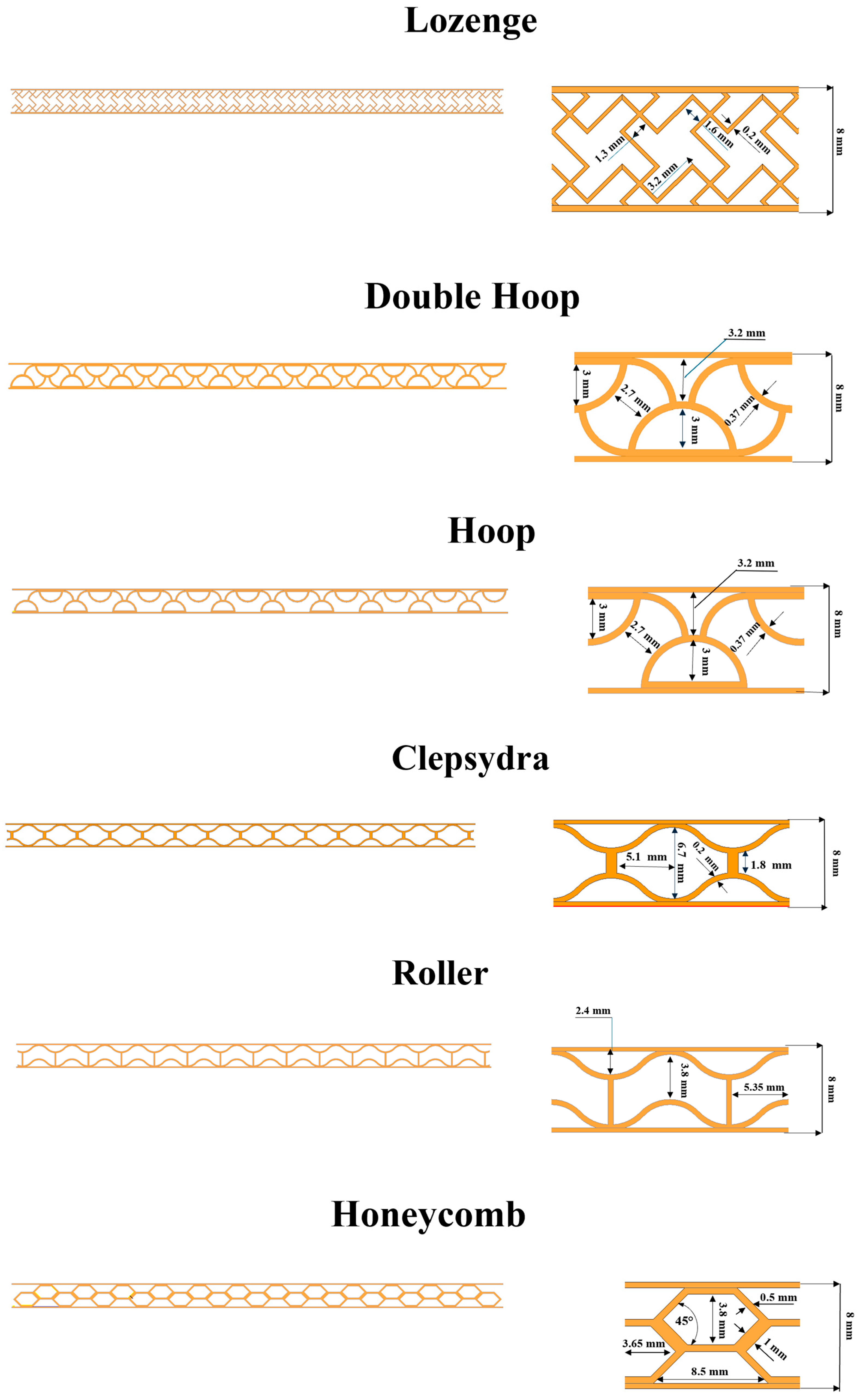
The structures were realized using the CAD software “Autodesk Inventor 2023” version 27. The dimensions of the geometry were defined referring to ISO 178:2019 [36]. The height of each structure has been set at 8 mm. According to the standard, the width was determined to be 16 mm, slightly increased to ensure an integer number of cells in the geometry. Therefore, the dimensions of the beam were established at 161 × 16 × 8 mm3, respectively, for length, width, and depth. In addition, the patterns were delimited by an upper and a lower layer to facilitate the execution of bending tests. In this case, different types of structures were considered, including the best results from compression of the previous work, such as lozenge, which is a polygonal chiral structure. The hoop and double hoop were designed based on the chiral structures already studied in [27], integrating circular elements and connecting arms between them. The structures clepsydra and roller, on the other hand, are based on structures with a corrugated layer, as previously analyzed by [34]. Finally, the honeycomb structure, also inspired by the literature, was designed for compression based on analyses already conducted in [37,38]. In Figure 1, the CAD model and 3D cell detail of the structures are shown. The choice of structures was guided by the specific purpose of this study, namely the analysis of geometries potentially applicable in the packaging sector. In particular, the lozenge and honeycomb structures were selected by reference to existing literature, which highlights their good performance in terms of mechanical strength and energy absorption capacity [28,39].

2.3. Additive Manufacturing of Lattice Structures

For the production of samples, the 3D printer “Ultimaker S5” was used, which exploits FDM technology and allows the creation of a print on a volume of 330 × 240 × 300 mm3. The size for the nozzle diameter was set at 0.4 mm, which guarantees a layer resolution of 20–200 μm. During the production of the samples, type AA and BB extruders were used, both with diameters of 0.4 mm, useful for the extrusion of polylactic acid and the support material; in this case, butenediol–vinyl alcohol copolymer (BVOH) was chosen, commonly used as a support material in FDM printing [35]. The support material was used to avoid direct contact between pattern and hot plate. The print parameters used in this study are shown in Table 2.
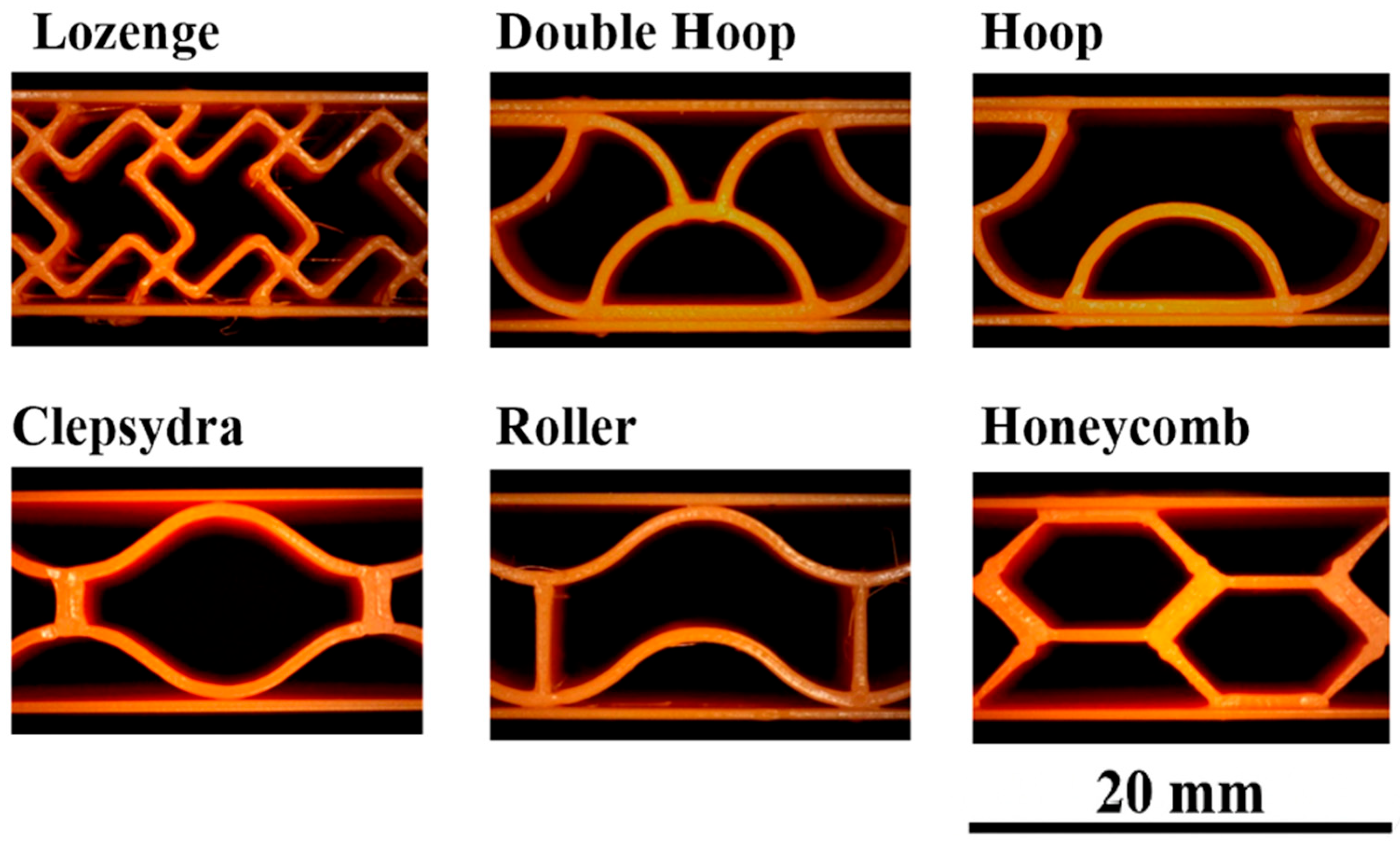
The layer thickness was considered to be 0.2 mm so that there is a good compromise between precision and print time. The printing temperature has been set to 200 °C according to the values in the technical sheet. The print speed has been set to 60 mm/s to find a balance between accuracy and reduction of print defects, which would increase with higher speeds [40], while minimizing the presence of residual stresses [41]. The filling density has been set to 100% to increase the mechanical strength of the structure [42], while the plate temperature has been set to 60 °C [43], to avoid phenomena such as warping and ensure better surface quality [44]. A water-soluble carrier material was also chosen, but it has higher dissolution and lower absorption of the corresponding PVA [45]. The printing speed for polylactic acid remained unchanged, but for the substrate, it was set to 35 mm/s. The same consideration can be given to the printing temperature, as a 210 °C temperature has been set for the BVOH. In Figure 2, the structures after the 3D printing process are presented, with particular reference to the central cell, which will be subjected to deformation.

2.4. Bending Test

For bending tests, the machine “Autograph AGS-X series” produced by the company Shimadzu Italy s.r.l was used. The maximum load cell capacity is 5 kN, which guarantees a maximum error of 1%. For the interface, the proprietary software “Trapezium X” was used and installed on a desktop “Dell OPTIPLEX 3050” PC equipped with an i3-6100 processor and 4 GB of ram. The software allows you to set both test and data acquisition parameters, which can then be exported into different formats. In the tests described in this paper, .csv files were obtained with a sampling time of 10 ms. In order to perform a bending test, the machine is equipped with a system capable of supporting such analysis, as shown in [46]. This system consists of a top punch with a radius of 5 mm, which will press vertically on the specimen placed on a support consisting of two lower connected elements, whose distance from the center of the specimen determines, together with the displacement of the upper punch, the extent of deformation. For the bending tests, the ISO 178:2019 standard was considered, specifically developed for the study of three-point bending for plastic specimens. This regulation specifies the distance to which the supports must be placed and provides a range of values for the center punch’s lowering speed, from which to choose. The distance L between the supports is directly proportional, once again, to the thickness h chosen for the specimens by means of Equation (1).
L = 16 ± 1 h
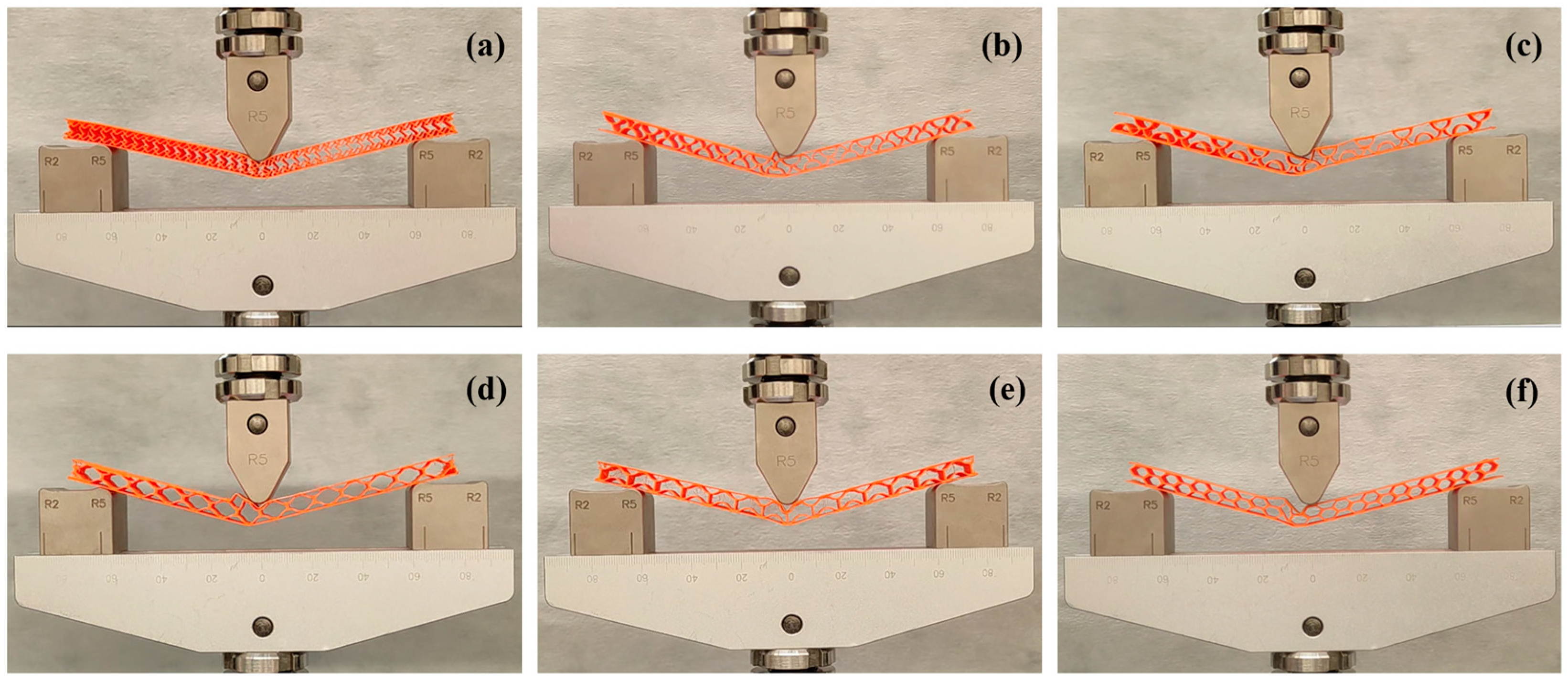
where L and h are the length span between supports and height of the sample, respectively. In this study, this distance between the support is 128 mm. The speed chosen for the bending tests is 2 mm/min; instead, the displacement has been set to 16 mm, twice the height of the structure. Figure 3 shows a frame of the bending test carried out at 2 mm/min with 16 mm displacement.

2.5. Spring Back and Shape Recovery

The spring back of structures is measured after mechanical tests on test pieces. In the case of spring back, the phenomenon can be mainly attributed to the typical viscoelasticity behavior of PLA.
For structures subjected to bending, the spring back at the angle of bending is measured. Initially, the aim was to monitor the recovery of the angle formed following the bending test. The height of the center of the structure was not measured for the elastic return, as this was not significant from a measurement point of view. A digital goniometer was used for point angle measurement. All the structures stressed via bending showed an elastic recovery after an average time of about 30–35 min, with measurements made at intervals of 5 min. This time interval is necessary to achieve an immediate initial recovery and then a progressive one over time [15].
For shape recovery, recovery with hot water was used through the immersion thermostat Julabo Corio Series C. This method allows the samples to have a good thermal stability of about 0.03 °C. As usual, the hot water bath was carried out with mainly demineralized water [47], with an amount of about 70%. As already studied in [28], in the case of cubic structures, recovery of shape for temperatures above the glass transition of PLA has not created any particular problems, since recovery is favored by both the geometry and the density of the structures. In the case of bending structures, it is very important to define the temperature at which this recovery takes place. In this case, the glass transition temperature of the material, defined by the technical data sheet, is stable at 59.1 °C.
In these conditions, the material is able to recover its initial shape thanks to the reversible transition between the glass and rubber state, characteristic of memory polymers [48,49].
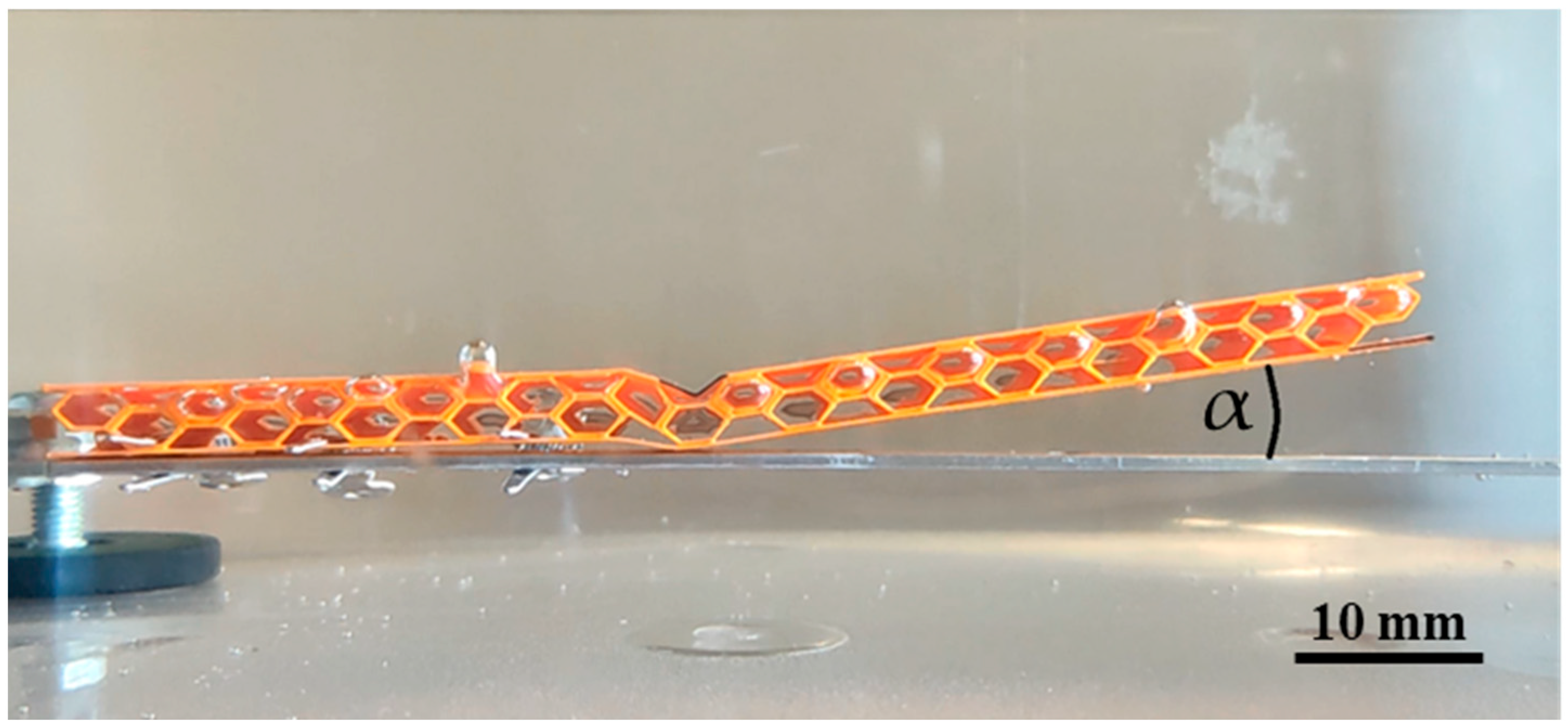
To avoid damage to the structure due to its slender shape, it was decided to operate below the glass transition temperature at 55 °C. In Figure 4 a frame of the honeycomb structure shape recovery is shown.
For each structure, one side was fixed to a support while the other was left free to move. Only then was the audition dipped in water. The angle formed between the base of the support and the free side, indicated in Figure 4, by the letter α, was measured with the software tracker, which allows us to track the movement of the sample over time. For the insertion of samples into the hot bath, a specifically designed support has been developed, suitable for both cubic and traviform specimens. All the tests for this project were conducted using a video recording system. This tool not only serves to verify the results obtained but, in the specific case of the recovery test, becomes essential for quantifying the recovery of form and describing its progression relative to the various tested geometries. To transition from video to a description of recovery over time, the Video Tracker Analysis and Modelling Tool 6 software was used. The software distinguishes the selected pixel from its surroundings using a co-occurrence matrix algorithm. This method analyzes each frame of the video, focusing on a small area highlighted by the user around the plotted pixel. It recognizes subtle color or brightness variations between pixels, assigning each layer a unique number.

2.6. Analysis of Cycles and Energy Absorption

For the analysis of flexural structures, shape recovery was evaluated following elastic relaxation. In this study, structures that did not sustain permanent damage after the initial bending stress were subjected to shape recovery tests, performing three complete cycles in succession at close time intervals.
After performing the bending tests and measuring both the spring back and the shape recovery, the amount of energy normalized in relation to the mass of the structure was calculated. For this purpose, the area under the force–displacement curves obtained during compression tests was considered. The parameter used for this calculation is SEA (specific energy absorption), which indicates the capacity of the structure to absorb energy in relation to its mass. This parameter is specified in Equation (2) [15].
S E A = E A m
where EA is the energy absorbed is determined from the area under the force–displacement curve to the point where densification begins, shown in Equation (3). Instead, m is the mass of the structure.
E A = 0 ε σ ε   d ε
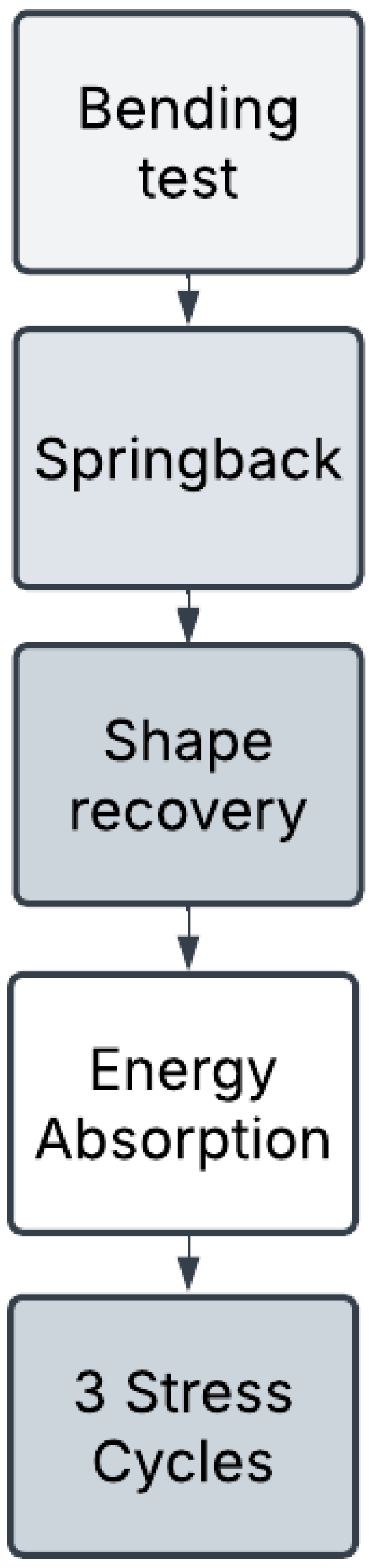
where σ ε is the magnitude of the stress developed during the compression test [49]. In order to summarize the methodology we used, a flowchart has been presented in Figure 5.

3. Results and Discussion

3.1. Bending Test at 16 mm, Spring Back, and Shape Recovery

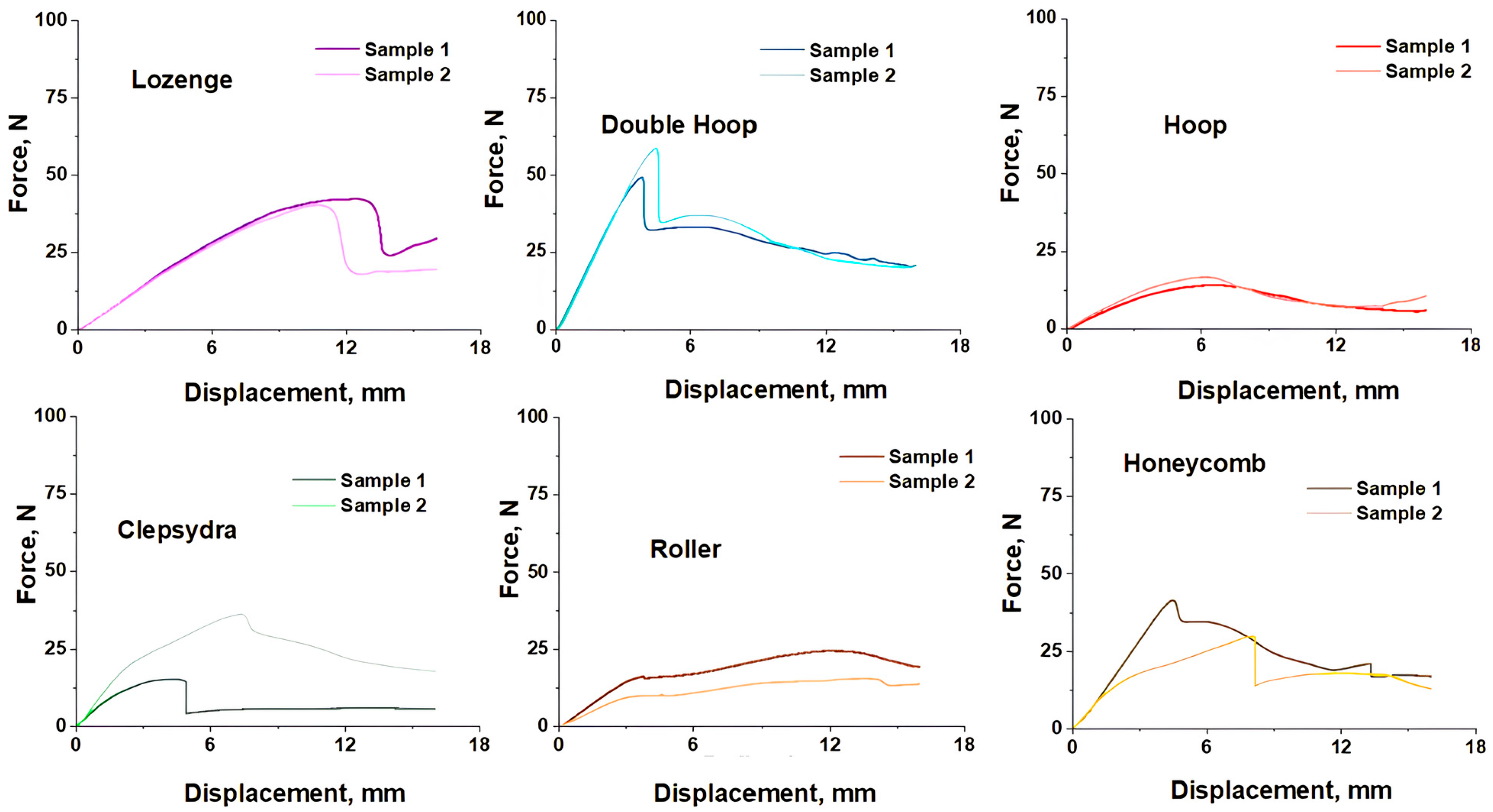
In Figure 6, the stress–strain curves for tests carried out at a speed of 2 mm/min and with a displacement of 16 mm are shown, taking two replicates for each structure. For the lozenge, double hoop, hoop, and roller structures, there is a certain replicability of the force–displacement curve, while the honeycomb and clepsydra structures show different behavior between the two replicates, with a variation in maximum load of 30% and 40%, respectively. Lozenge and double hoop structures, on the other hand, have the highest mechanical strength with an average load of 41 N and 53 N, respectively. The results obtained in this study are consistent with the findings of recent works on 3D-printed lattice cores in sandwich panels, where the use of structured PLA lattices under flexural loading demonstrated enhanced energy absorption and mechanical performance. As reported by [50], specific cell morphologies play a crucial role in controlling the flexural response, which supports the favorable behavior observed for the lozenge and roller geometries tested in our work.
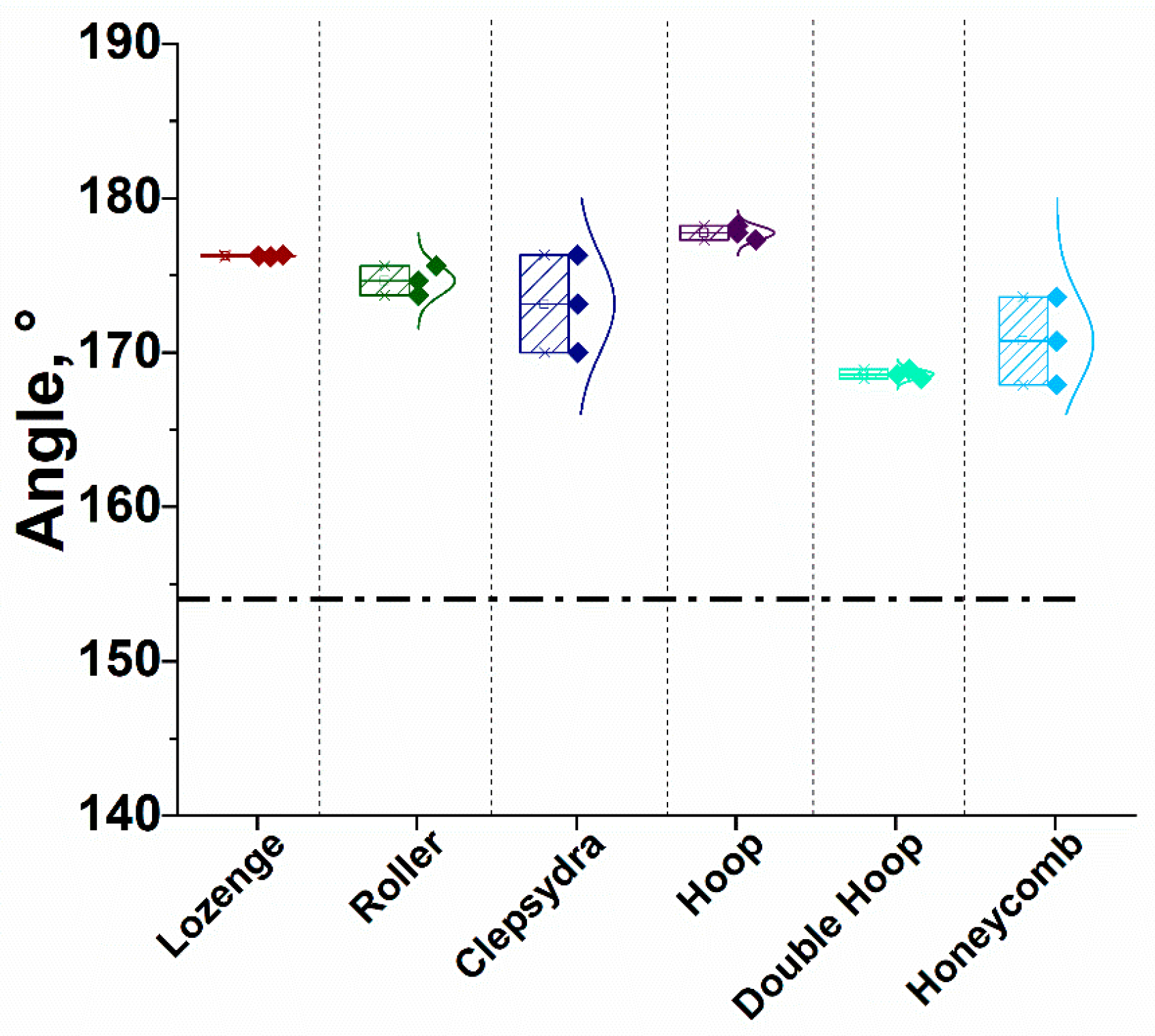
The honeycomb structure shows a marked descending peak, absent in the first sample. This anomaly was caused by internal failure of the structure, which is why it was decided later to exclude this geometry from subsequent tests. Study [48] analyzed the mechanical behavior of Kevlar fiber sandwich panels with a lozenge-shaped core filled with foam. Overall, the lozenge structure shows good bending behavior, and the results indicate that foam filling significantly improves mechanical properties, increasing energy absorption capacity and structural strength. In [51], various lattice structures with relative densities comparable to those of the structures examined in this study are analyzed. The mechanical strength shows values very similar to those of the lozenge grid structure, with a maximum load capacity averaging around 50 N. The spring back was then measured, with the graph shown in Figure 7. For each structure, the maximum, minimum, and mean final values of each test piece are shown, while the hatched horizontal line at the bottom of the graph represents the average value measured at the end of the bending test before the load is removed. Looking from left to right, the lozenge and hoop structures show a lower elastic recovery than the others, while the clepsydra and honeycomb structures show a higher elastic recovery. In the case of the lozenge, the limited elastic recovery is also due to the limited deformation of the structure itself.
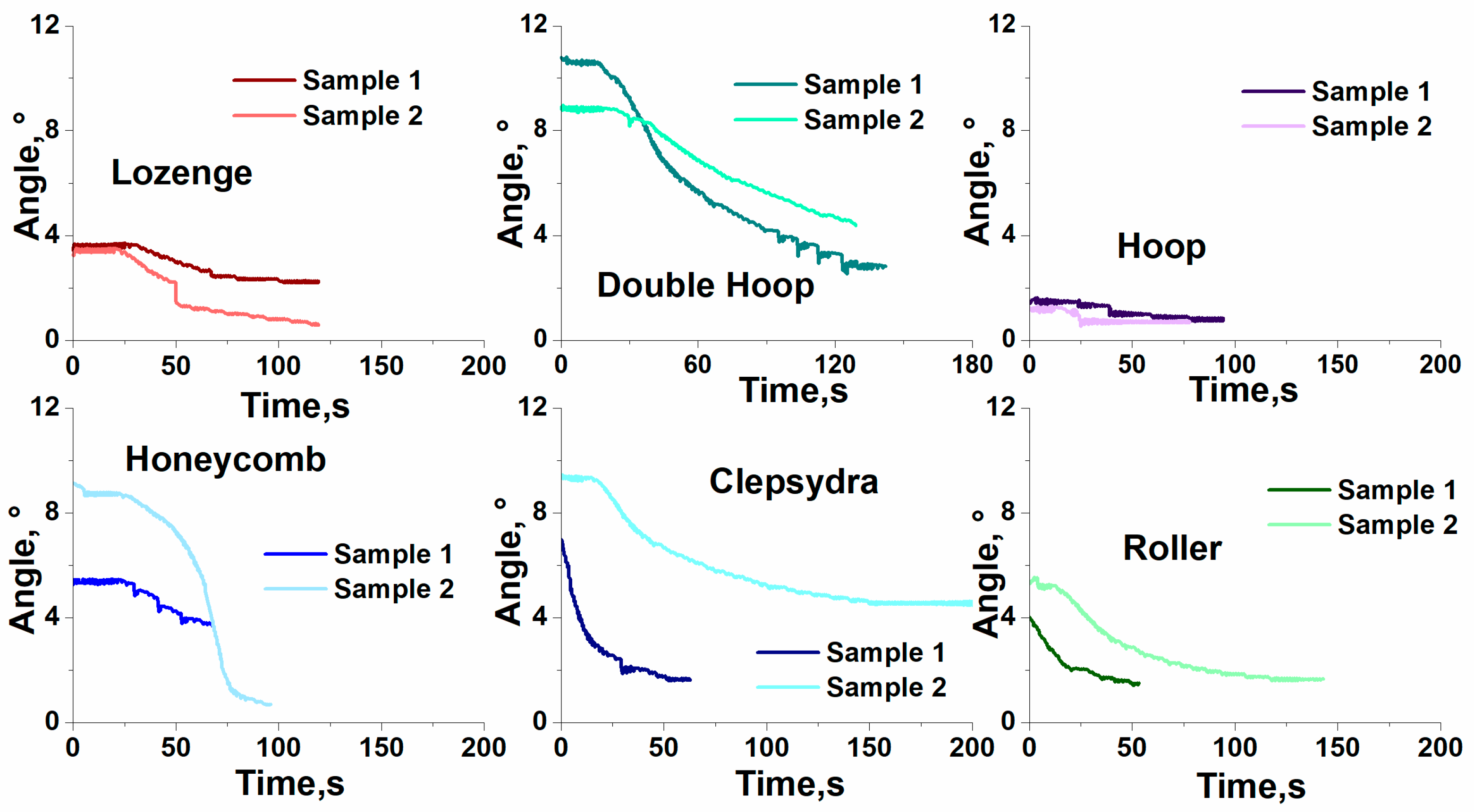
The trend of the recovery of the angle of bending, for each of the six structures in consideration, is shown in Figure 8.
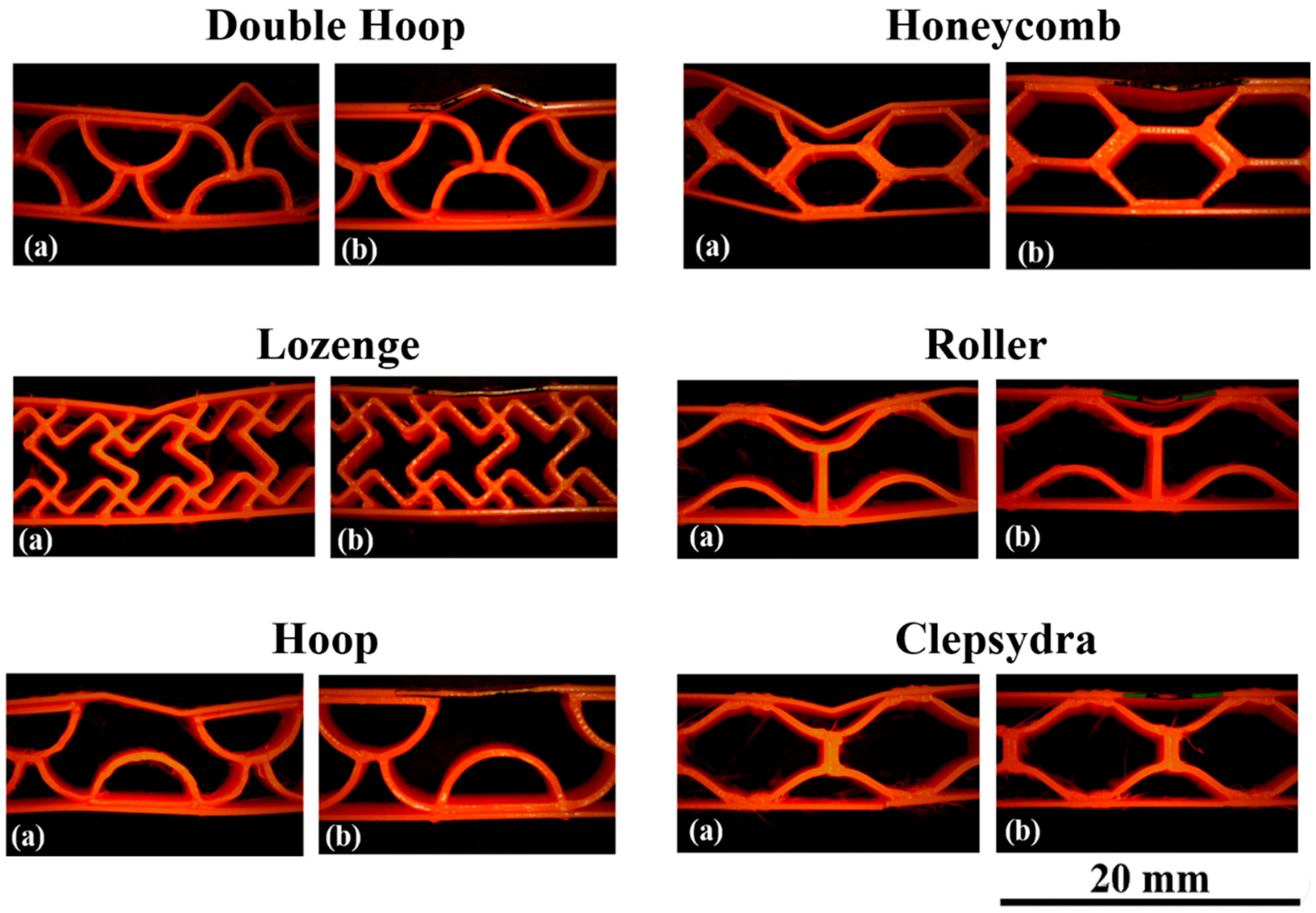
It is possible to observe that the recovery of form mainly takes place within 60–90 s from immersion in water; above this time interval, the recovery is almost insignificant. When analyzing the graphs shown in Figure 6 in detail, it is noted that structures which showed a lower elastic recovery, such as lozenge and hoop, have almost completely returned to their initial geometry in a relatively short time. In addition, such structures show a certain replicability in behavior, unlike others, which have marked variability. Therefore, for the purposes of the next study, hoop and lozenge will be the tested structures. This statement is confirmed by the behavior of the double hoop structure, which, in addition to showing a lower angular recovery than the others, shows a similar difficulty in recovering the shape of the midpoint, as illustrated in the following images. Figure 9 shows the geometries before (a) and after shape recovery (b). The lozenge structure, after a single bending–elastic return-shape recovery cycle, has completely restored its initial shape. The double hoop, on the other hand, does not show an obvious angular recovery, unlike the hoop, where the recovery is almost total. For the honeycomb structure, the geometry is not completely recovered, showing that after the first cycle, the structure is obviously damaged. The same is true for the height of the midpoint. In this case, it was not considered necessary to plot the movement since the distances considered were negligible. The roller and clepsydra structures show a good angle recovery. Ref. [52] studied the shape recovery of TPMS structures following a thermal stimulus with hot air at 75 °C. In this case, the cubic structures have a good recovery above the glass transition, which, in the case of biomass-derived polyester, poly (trimethylene furanoate) (PTF), is 53 °C. In [53], the lattice structures BCC, FCC, and FBCC were tested for compression and subsequently subjected to form recovery. The cubic structures show a shape recovery of about 120 s, with similar time-frames compared to this study.
In the end, it appears that most of the structures have almost completely recovered the bending angle and the variation of the height of the midpoint. The exception is the double hoop and honeycomb structures. In particular, the double hoop shows significant deformation even after extraction from the tank, while the hoop has almost completely recovered its initial configuration.

3.2. Energy Absorption

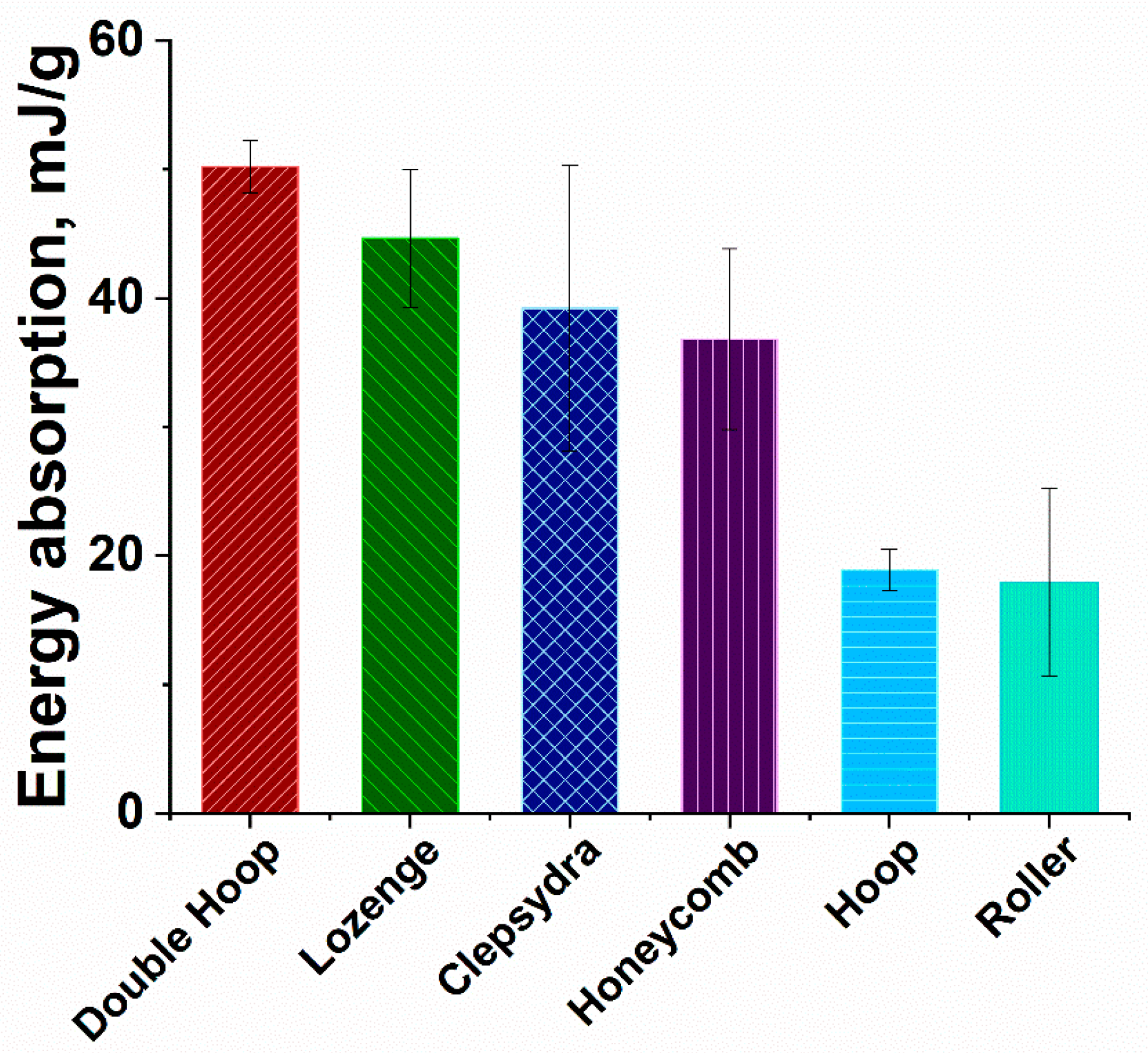
After analyzing the bending behavior and the subsequent spring back and shape recovery, the other parameter analyzed to evaluate the behavior of structures is the absorption energy. After the bending and return tests, elastic and shape, the area under the stress–strain curves normalized to the mass of each specimen previously measured was calculated. As in the previous cases, for this calculation, reference was made to the SEA parameter, which expresses the capacity of the structure to absorb energy per unit mass [54]. In Figure 10, you can see the average values of the absorption energy calculated for the two replicates of each test piece and their respective standard deviation.
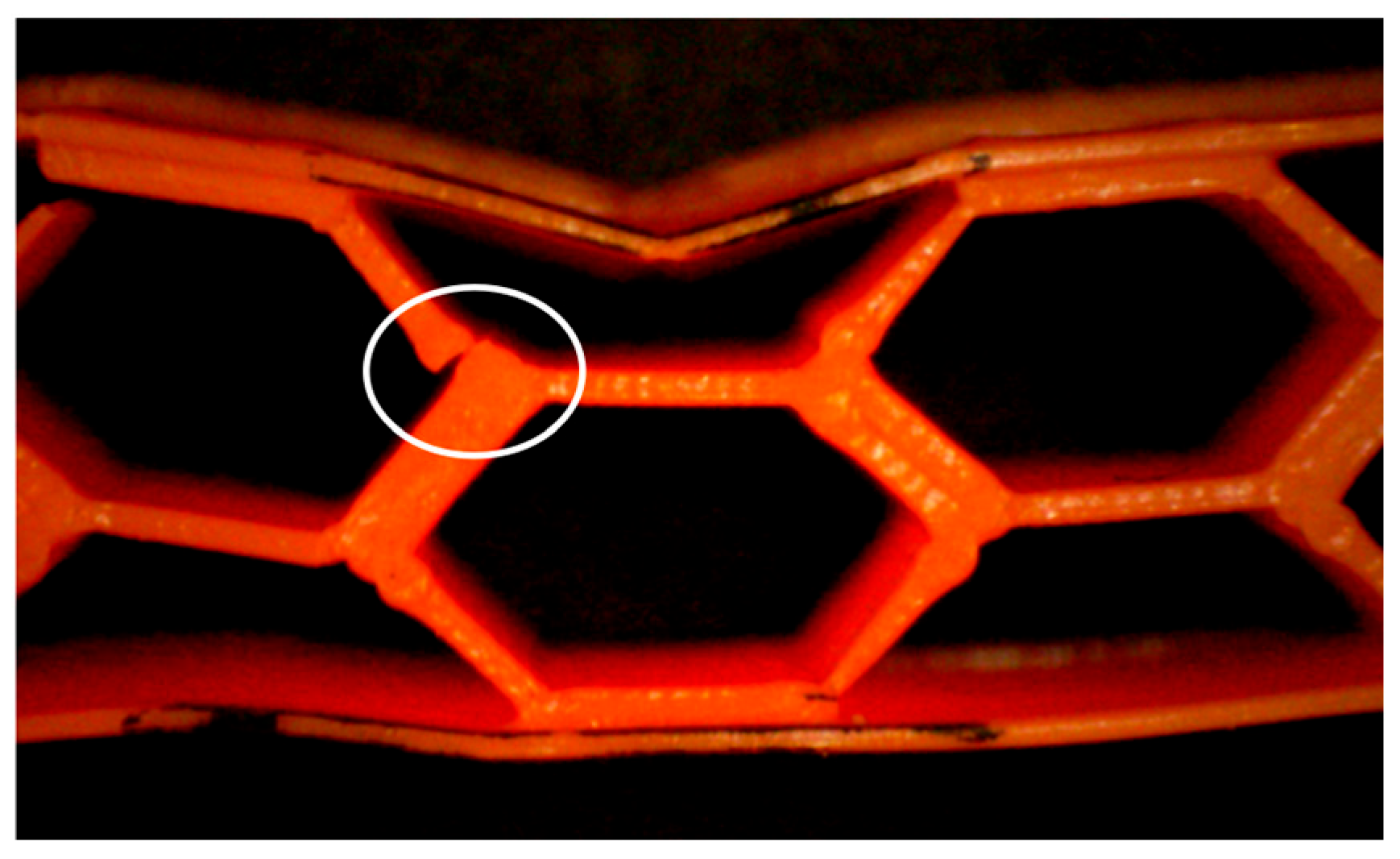
It can be observed that the roller and hoop structures have the lowest values of absorbed energy, while the double hoop and lozenge structures show significantly higher values of absorbed energy, with values above twice those of the former. Honeycomb also shows very high values in terms of absorption energy, but due to non-optimal behavior from the point of view of recovery and deformation, they were excluded from subsequent experimental tests. In Figure 11, the honeycomb structure is shown as a result of the damage due to post-cyclic testing; this structure cannot be reused for subsequent cycles due to permanent damage. Ultimately, the structures selected for the next stages were lozenge and roller. The lozenge structure was chosen for its good recovery and high energy absorption capacity, while the roller structure was preferred for its replicability of its behavior and for its good elastic and shape recovery.
In particular, [53] studied heterogeneous lattice structures and observed that those with reinforced cell configurations showed improved energy absorption under thermal cycles. Similarly, [13] highlighted that 4D-printed metamaterials maintain a relatively high SEA across repeated loading cycles when using thermally activated SMPs, such as PLA. The present results support these trends, confirming that proper geometric design (e.g., lozenge) enhances performance even under reduced stimulus conditions.

3.3. Bending Test at 16 mm

3.3.1. Bending Test

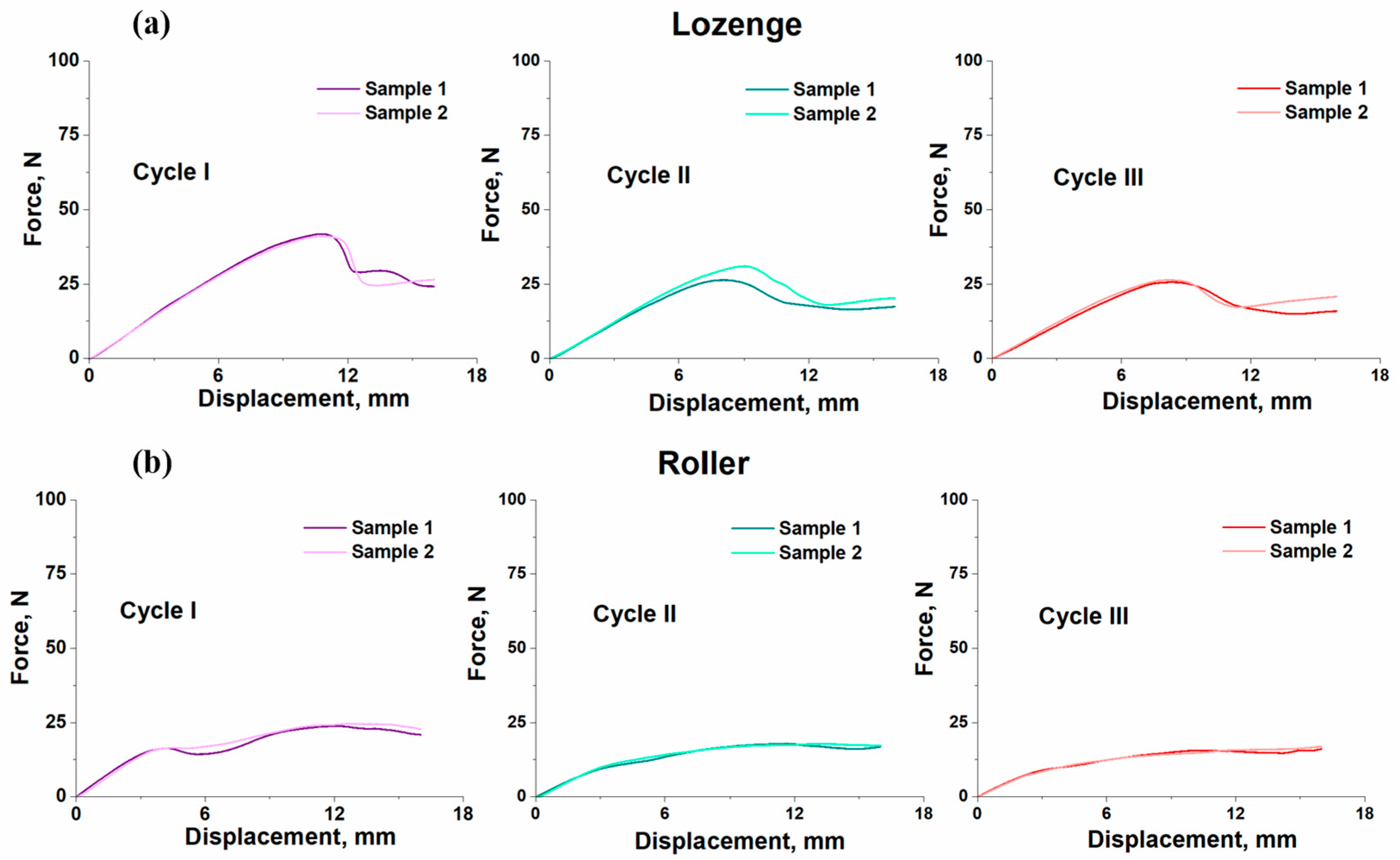
At this point, the structures that were previously selected as the best, lozenge and roller, have been subjected to further stress cycles, with particular attention to elastic return and shape recovery. In this phase, each structure was subjected to three cycles, carried out at close time intervals, that is, on the same day. Each new flex–elastic return-shape recovery cycle was performed after leaving the specimens at room temperature for about an hour, once removed from the tank to allow completion of the shape recovery. In Figure 12, the force–displacement graphs are shown for the lozenge and roller structures, for each individual cycle. As regards the lozenge, the curve pattern is very similar from the first to the third cycle, with variations in the maximum load of 37% between the first and third cycles. Between the first and second cycles, the variation is 26%. The curve is characterized by a peak, to present a subsequent descending stretch, and then a stretch with an almost constant load is noted. For the roller structure, the force–displacement curve pattern shows a good degree of replicability between cycles, with the maximum load being reduced from 24 N to 15 N between the first and third cycle.
The force–displacement curve of the first cycle for each structure is similar to that observed in single-cycle tests. Another interesting consideration is that the trends of the second and third cycles, for each structure, are very similar—trends which, in the case of the roller, do not deviate much from the curve of the first cycle, unlike the lozenge, where a greater difference can be noticed. In short, the lozenge has the highest mechanical strength with maximum load compared to the roller. Considering the second replication, the results of the force–deflection curves are consistent with those obtained for the first replication. The lozenge structure is confirmed as the structure capable of reaching the highest values in terms of stress, while the roller has slightly lower maximum loads during the three bending cycles. The observed cyclic bending behavior, especially for the lozenge structure, aligns with prior studies on patterned PLA cores.
Ref. [54] showed that foam-filled composite lattice structures with lozenge cores exhibit decreasing peak loads across cycles, similar to our observations. However, our roller structure showed more stable behavior, suggesting an advantage in repeatability for less complex cell shapes. This is in agreement with reports from [55] on optimized curved-core lattice patterns.

3.3.2. Spring Back

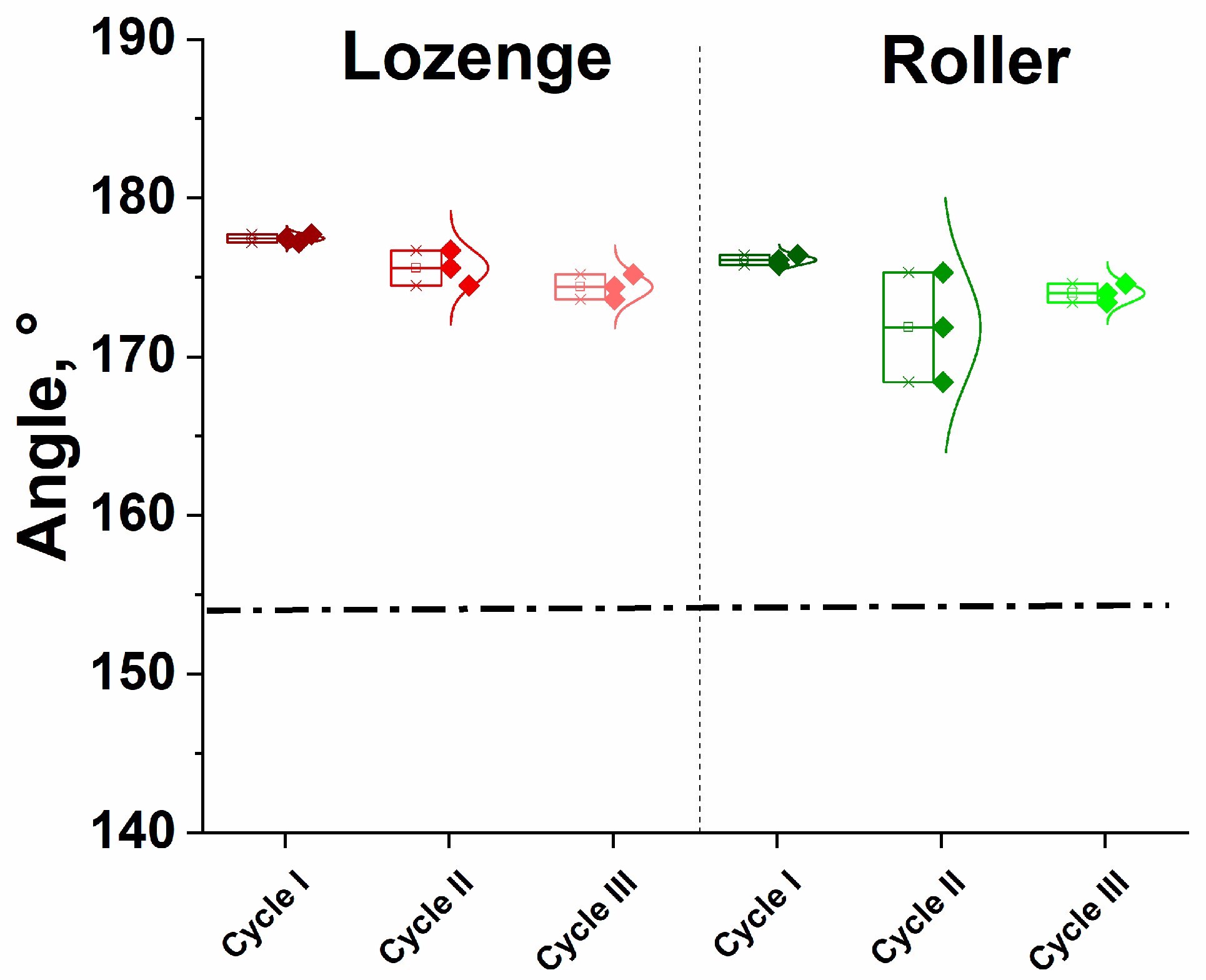
The spring back was then measured, with the values recorded in the box plot of Figure 13. Again, the dashed line represents the mean measure of the elastic recovery measured at the end of the bending test. The graph shows that lozenge and roller have a good recovery at the end of the third bending and recovery cycle, with a slight decrease in the value of the angle as the number of cycles increases. The data are variable, especially for the elastic recovery of the second cycle, while this variability is reduced for the first and third cycles.
The observed spring back response confirms the typical viscoelastic and shape memory behavior of PLA. According to [9], shape memory polymers such as PLA exhibit gradual reduction in elastic recovery over successive cycles, especially when thermal recovery is incomplete. Ref. [56] also observed that simplified geometries tend to preserve their spring back capacity better, which supports the results seen in the roller structure.

3.3.3. Shape Recovery

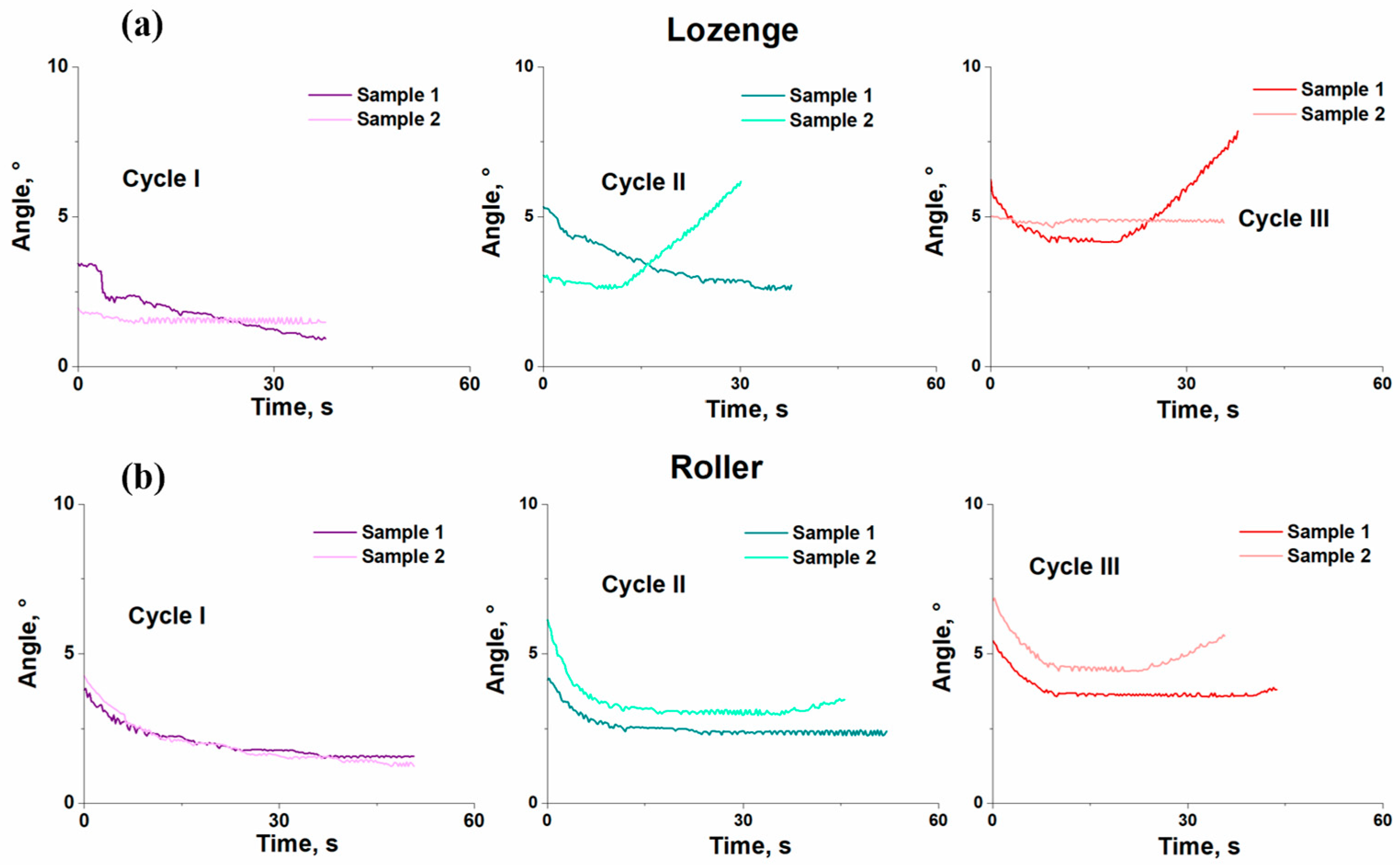
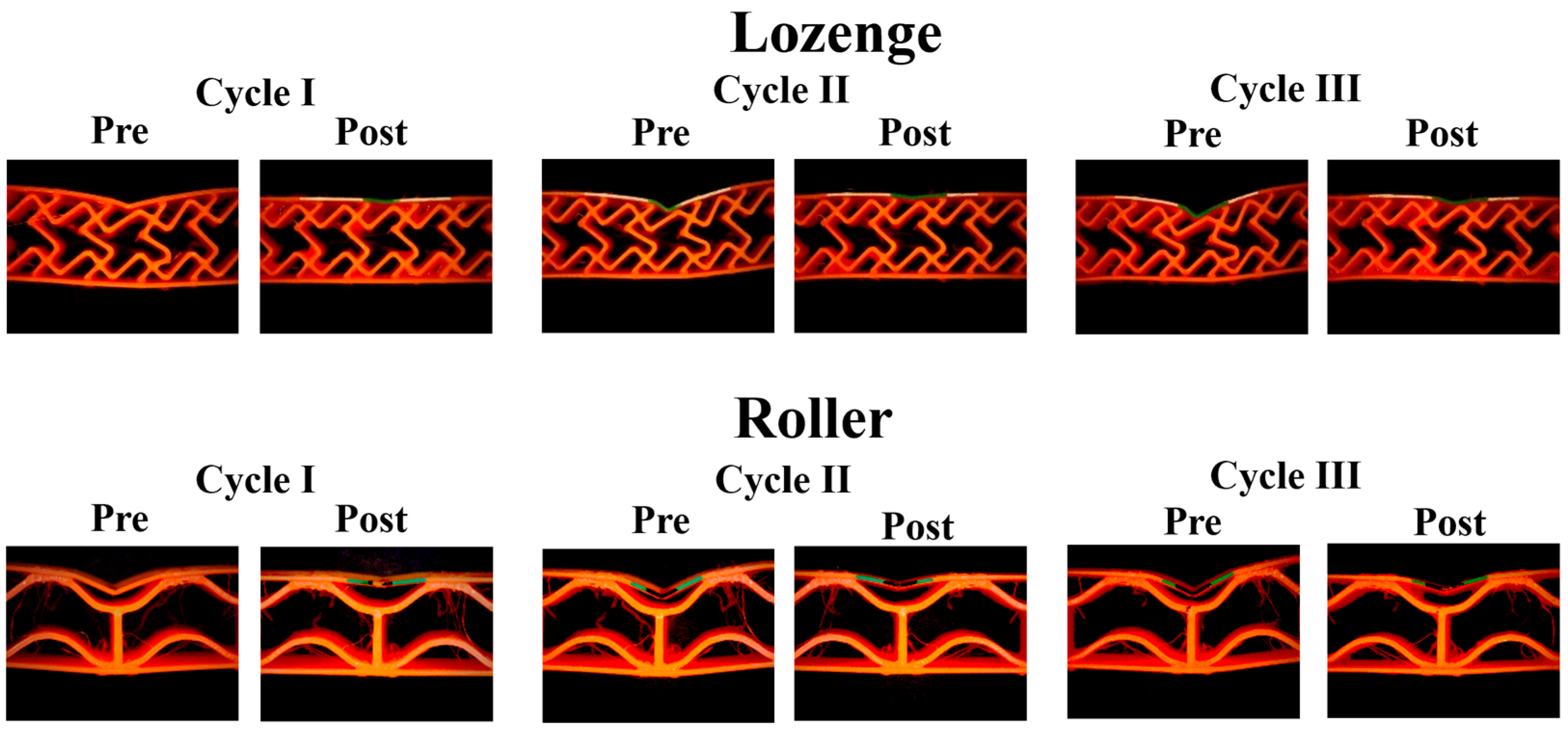
For the recovery of shape, the curves of the first cycle do not vary compared to the trial with a single cycle (Figure 14). The curves linked to successive cycles have a first descending phase and a subsequent increasing phase. This behavior is particularly evident for the lozenge, since the roller does not show such a phenomenon. Close recovery cycles are not well tolerated by the structure, as a thermal stimulus is provided at short intervals. Therefore, once immersed in the tank and due to the pressure of water, structures tend to rise. Once removed from the tank, they have recovered their original form. This is related not only to the limited density of the structure but also to the poor thermal stability of PLA [56]. The values recorded with the measurement made at the end of the third recovery cycle indicate that the lozenge is the structure which can recover most of its original shape at an angle of 0.7°. Visual analysis of the midpoint, by means of a microscope, showed a constant but increasingly minor recovery from the first to the third cycle. To support this statement, in Figure 15, the images of the structures are shown under examination pre- and post recovery for each cycle.
The lozenge and roller show very similar trends for the two replicas, reaching a nearly total recovery of the bending angle. This result confirms the good replicability of the two chosen structures. For the roller, the angle measured at the end of the recovery of the third cycle is 2.8° and 2.4°, respectively, despite the temporal proximity with which the cycles were performed. For the analysis of the recovery of the midpoint, the geometry that showed a better recovery is roller, with a final value of 7.65 mm thickness.

3.3.4. Energy Absorption

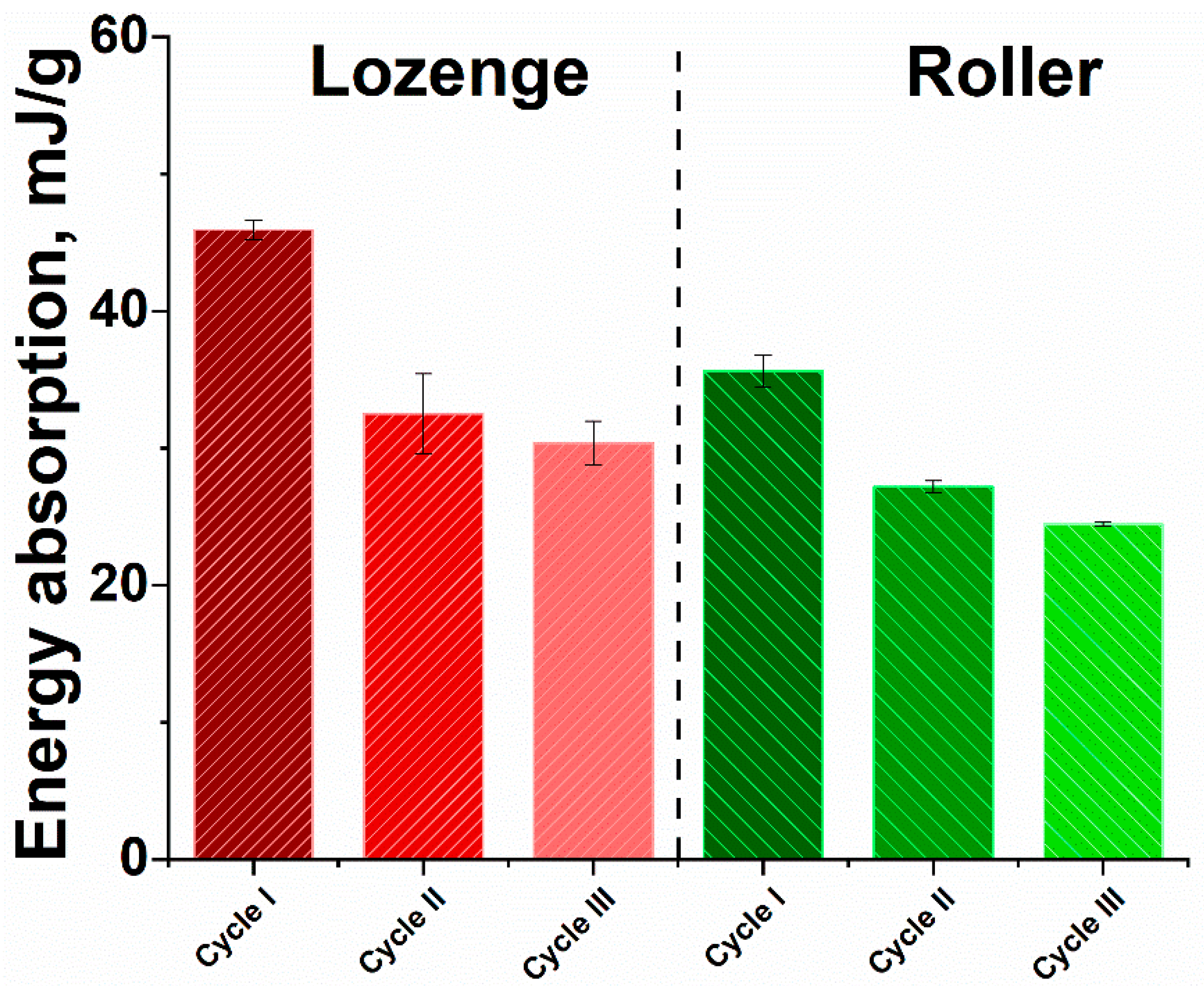
The trend of absorption energy is shown in Figure 16. For each structure, the calculated mean energy value for the two replicates and their standard deviation were reported. As expected from the analysis of the results analyzed so far, the lozenge shows the highest values, and in the first cycle, it exceeds 40 mJ/g. The roller structure still offers good energy absorption values, exceeding 30 mJ/g. Moreover, the difference between the first and second cycles is relatively small, unlike the lozenge structure, which shows a 27% reduction in energy absorbed between the first and second cycles. The lozenge structure is also a good energy absorber [57], especially when the structure is improved by defining lateral and longitudinal reinforcement ribs. The obtained results are consistent with those reported by [23], in which PLA-based 4D-printed meta-sandwich structures demonstrated stable energy absorption and recovery behavior over multiple loading cycles. As observed for the lozenge and roller geometries in the present study, specific cell configurations were able to maintain structural integrity and performance repeatability even after repeated thermal activation.

4. Conclusions

This study investigates the bending behavior of various lattice structures, including chiral geometries like lozenge and clepsydra, wavy shapes such as roller and Es, circular-element designs like double hoop and hoop, and a traditional honeycomb pattern. All structures were produced with 50% density. An initial three-point bending test was conducted at a speed of 2 mm/min with a support span of 128 mm, as specified by the testing standard. The specimens underwent cyclic loading, including bending, spring back, and shape recovery phases, to assess their performance at or near the glass transition temperature. Recovery was specifically tested at 55 °C. Each geometry was initially evaluated with a 16 mm displacement, using two replicates per type. The following results were achieved:
  • Among the tested structures, lozenge and double hoop exhibited the highest mechanical strength, while honeycomb and clepsydra showed inconsistent results.
  • In terms of spring back, lozenge and hoop demonstrated limited elastic return, whereas honeycomb and clepsydra displayed more pronounced recovery. The lozenge structure, in particular, exhibited minimal deformation, which contributed to its reduced spring back.
  • Thermal-induced shape recovery via immersion in a hot bath did not yield consistent results across most structures, except for the roller, which consistently showed good recovery both in quantity and repeatability. Despite the relatively mild thermal input, repeated cycles in quick succession tended to overstress the specimens, likely due to hydrostatic pressure effects.
  • Mechanically, the roller and lozenge performed best in the second and third cycles, with noticeable improvements in energy absorption. As a result, three full cycles of loading, spring back, and recovery were performed. Both the roller and lozenge remained structurally intact throughout. However, the lozenge reached higher peak loads in all cycles, while the roller maintained more stable stress and recovery behavior. The lozenge’s shape recovery in later cycles was partially hindered by hydrostatic forces, slightly compromising its elastic response.
  • The lozenge absorbed the highest amount of energy overall, whereas the roller showed the smallest decrease in absorbed energy between the second and third cycles. Both structures ultimately demonstrated strong mechanical performance and efficient energy absorption.
For future investigations, it is recommended to extend the thermal stimulus duration to enhance shape recovery stability. Increasing the number of cycles would also provide further insight into the long-term mechanical behavior of these geometries. In addition, for future studies, it is necessary to increase the number of replicates to statistically validate the results. The results suggest promising applications in smart packaging, where lightweight, recoverable, and energy-absorbing materials can offer enhanced protection, thermal responsiveness, and the possibility of reuse through shape recovery after deformation.

Author Contributions

All authors contributed to the study conception and design. Material preparation, data collection, and analysis were performed by M.P.D. and A.G. The first draft of the manuscript was written by M.P.D. and all authors commented on previous versions of the manuscript. The manuscript was revised by A.G. and M.B. All authors have read and agreed to the published version of the manuscript.

Funding

This research received no external funding.

Data Availability Statement

Data are available on reasonable request.

Conflicts of Interest

The authors declare no conflicts of interest.

References

  1. Momeni, F.; Liu, X.; Ni, J. A review of 4D printing. Mater. Des. 2017, 122, 42–79. [Google Scholar] [CrossRef]
  2. Lu, H.; Yao, Y.; Lin, L. Carbon-based reinforcement in shape-memory polymer composite for electrical actuation. Pigment Resin Technol. 2014, 43, 20–26. [Google Scholar] [CrossRef]
  3. Yan, Q.; Dong, H.; Su, J.; Han, J.; Song, B.; Wei, Q.; Shi, Y. A Review of 3D Printing Technology for Medical Applications. Engineering 2018, 4, 729–742. [Google Scholar] [CrossRef]
  4. Yang, W.; Tu, A.; Ma, Y.; Li, Z.; Xu, J.; Lin, M.; Zhang, K.; Jing, L.; Fu, C.; Jiao, Y.; et al. Chitosan and Whey Protein Bio-Inks for 3D and 4D Printing Applications with Particular Focus on Food Industry. Molecules 2021, 27, 173. [Google Scholar] [CrossRef] [PubMed]
  5. Yarali, E.; Mirzaali, M.J.; Ghalayaniesfahani, A.; Accardo, A.; Diaz-Payno, P.J.; Zadpoor, A.A. 4D printing for biomedical applications. Adv. Mater. 2024, 36, 2402301. [Google Scholar] [CrossRef] [PubMed]
  6. Hann, S.Y.; Cui, H.; Nowicki, M.; Zhang, L.G. 4D printing soft robotics for biomedical applications. Addit. Manuf. 2020, 36, 101567. [Google Scholar] [CrossRef]
  7. Ntouanoglou, K.; Stavropoulos, P.; Mourtzis, D. 4D Printing Prospects for the Aerospace Industry: A critical review. Procedia Manuf. 2018, 18, 120–129. [Google Scholar] [CrossRef]
  8. Raina, A.; Haq, M.I.U.; Javaid, M.; Rab, S.; Haleem, A. 4D Printing for Automotive Industry Applications. J. Inst. Eng. (India) Ser. D 2021, 102, 521–529. [Google Scholar] [CrossRef]
  9. Xia, Y.; He, Y.; Zhang, F.; Liu, Y.; Leng, J. A Review of Shape Memory Polymers and Composites: Mechanisms, Materials, and Applications. Adv. Mater. 2021, 33, 2000713. [Google Scholar] [CrossRef]
  10. Holman, H.; Kavarana, M.N.; Rajab, T.K. Smart materials in cardiovascular implants: Shape memory alloys and shape memory polymers. Artif. Organs 2021, 45, 454–463. [Google Scholar] [CrossRef]
  11. Liu, H.; Wang, F.; Wu, W.; Dong, X.; Sang, L. 4D printing of mechanically robust PLA/TPU/Fe3O4 magneto-responsive shape memory polymers for smart structures. Compos. Part B Eng. 2023, 248, 110382. [Google Scholar] [CrossRef]
  12. Makwakwa, D.; Motloung, M.P.; Ojijo, V.; Bandyopadhyay, J.; Ray, S.S. Influencing the shape recovery and thermomechanical properties of 3DP PLA using smart textile and boehmite alumina and thermochromic dye modifiers. Macromol 2022, 2, 485–499. [Google Scholar] [CrossRef]
  13. Zhang, J.; Yin, Z.; Ren, L.; Liu, Q.; Ren, L.; Yang, X.; Zhou, X. Advances in 4D printed shape memory polymers: From 3D printing, smart excitation, and response to applications. Adv. Mater. Technol. 2022, 7, 2101568. [Google Scholar] [CrossRef]
  14. Radjabian, M.; Kish, M.H.; Mohammadi, N. Structure–property relationship for poly (lactic acid)(PLA) filaments: Physical, thermomechanical and shape memory characterization. J. Polym. Res. 2012, 19, 1–10. [Google Scholar] [CrossRef]
  15. Nguyen, H.T.H.; Qi, P.; Rostagno, M.; Feteha, A.; Miller, S.A. The quest for high glass transition temperature bioplastics. J. Mater. Chem. A 2018, 6, 9298–9331. [Google Scholar] [CrossRef]
  16. Wang, Y.; Gómez Ribelles, J.L.; Salmerón Sánchez, M.; Mano, J.F. Morphological contributions to glass transition in poly (L-lactic acid). Macromolecules 2005, 38, 4712–4718. [Google Scholar] [CrossRef]
  17. Pyda, M.; Bopp, R.C.; Wunderlich, B. Heat capacity of poly(lactic acid). J. Chem. Thermodyn. 2004, 36, 731–742. [Google Scholar] [CrossRef]
  18. Berthier, L.; Biroli, G. Theoretical perspective on the glass transition and amorphous materials. Rev. Mod. Phys. 2011, 83, 587–645. [Google Scholar] [CrossRef]
  19. Rivas-Cardona, A.; Marotta, E. A Review of the Analytical Models and Experimental Investigations for the Electromagnetic and Thermophysical Properties of Metamaterials and Negative Refraction. In Proceedings of the 40th Thermophysics Conference, Seattle, WA, USA, 23–26 June 2008; American Institute of Aeronautics and Astronautics: Reston, VA, USA, 2008. [Google Scholar] [CrossRef]
  20. Poddubny, A.; Iorsh, I.; Belov, P.; Kivshar, Y. Hyperbolic metamaterials. Nat. Photonics 2013, 7, 948–957. [Google Scholar] [CrossRef]
  21. Jia, Z.; Liu, F.; Jiang, X.; Wang, L. Engineering lattice metamaterials for extreme property, programmability, and multifunctionality. J. Appl. Phys. 2020, 127, 150901. [Google Scholar] [CrossRef]
  22. Contreras, N.; Zhang, X.; Hao, H.; Hernández, F. Application of elastic metamaterials/meta-structures in civil engineering: A review. Compos. Struct. 2024, 327, 117663. [Google Scholar] [CrossRef]
  23. Suresh Kumar, N.; Naidu, K.C.B.; Banerjee, P.; Anil Babu, T.; Venkata Shiva Reddy, B. A review on metamaterials for device applications. Crystals 2021, 11, 518. [Google Scholar] [CrossRef]
  24. Xu, P.; Lan, X.; Zeng, C.; Zhang, X.; Zhao, H.; Leng, J.; Liu, Y. Compression behavior of 4D printed metamaterials with various Poisson’s ratios. Int. J. Mech. Sci. 2024, 264, 108819. [Google Scholar] [CrossRef]
  25. Alomar, Z.; Concli, F. Compressive behavior assessment of a newly developed circular cell-based lattice structure. Mater. Des. 2021, 205, 109716. [Google Scholar] [CrossRef]
  26. Wang, W.-J.; Zhang, W.-M.; Guo, M.-F.; Yang, H.; Ma, L. Impact resistance of assembled plate-lattice auxetic structures. Compos. Struct. 2024, 338, 118132. [Google Scholar] [CrossRef]
  27. Andrew, J.J.; Schneider, J.; Ubaid, J.; Velmurugan, R.; Gupta, N.K.; Kumar, S. Energy absorption characteristics of additively manufactured plate-lattices under low- velocity impact loading. Int. J. Impact Eng. 2021, 149, 103768. [Google Scholar] [CrossRef]
  28. Gisario, A.; Desole, M.P.; Mehrpouya, M.; Barletta, M. Energy absorbing 4D printed meta-sandwich structures: Load cycles and shape recovery. Int. J. Adv. Manuf. Technol. 2023, 127, 1779–1795. [Google Scholar] [CrossRef]
  29. Jin, N.; Wang, F.; Wang, Y.; Zhang, B.; Cheng, H.; Zhang, H. Failure and energy absorption characteristics of four lattice structures under dynamic loading. Mater. Des. 2019, 169, 107655. [Google Scholar] [CrossRef]
  30. Korshunova, N.; Alaimo, G.; Hosseini, S.B.; Carraturo, M.; Reali, A.; Niiranen, J.; Auricchio, F.; Rank, E.; Kollmannsberger, S. Bending behavior of octet-truss lattice structures: Modelling options, numerical characterization and experimental validation. Mater. Des. 2021, 205, 109693. [Google Scholar] [CrossRef]
  31. Shamim, R. Investigation of bending and crush behaviors in polymer lattice structures: Computational approaches and experimental evaluation. J. Reinf. Plast. Compos. 2024, 07316844241273043. [Google Scholar] [CrossRef]
  32. Baran, E.H.; Erbil, H.Y. Surface modification of 3D printed PLA objects by fused deposition modeling: A review. Colloids Interfaces 2019, 3, 43. [Google Scholar] [CrossRef]
  33. Ilyas, R.A.; Sapuan, S.M.; Harussani, M.M.; Hakimi, M.Y.A.Y.; Haziq, M.Z.M.; Atikah, M.S.N.; Asyraf, M.R.M.; Ishak, M.R.; Razman, M.R.; Nurazzi, N.M.; et al. Polylactic Acid (PLA) Biocomposite: Processing, Additive Manufacturing and Advanced Applications. Polymers 2021, 13, 1326. [Google Scholar] [CrossRef]
  34. Wittbrodt, B.; Pearce, J.M. The effects of PLA color on material properties of 3-D printed components. Addit. Manuf. 2015, 8, 110–116. [Google Scholar] [CrossRef]
  35. Siemiński, P. Chapter 7-Introduction to fused deposition modeling. In Additive Manufacturing; Pou, J., Riveiro, A., Davim, J.P., Eds.; Handbooks in Advanced Manufacturing; Elsevier: Amsterdam, The Netherlands, 2021; pp. 217–275. ISBN 978-0-12-818411-0. [Google Scholar]
  36. ISO 178:2019; Plastics—Determination of Flexural Properties. ISO: Geneva, Switzerland, 2019.
  37. Cheng, P.; Wang, K.; Chen, X.; Le Duigou, A.; Peng, Y.; Wen, W. Compressive property and shape memory effect of 3D printed continuous ramie fiber reinforced biocomposite corrugated structures. Smart Mater. Struct. 2022, 31, 124003. [Google Scholar] [CrossRef]
  38. Mehrpouya, M.; Gisario, A.; Azizi, A.; Barletta, M. Investigation on shape recovery of 3D printed honeycomb sandwich structure. Polym. Adv. Technol. 2020, 31, 3361–3365. [Google Scholar] [CrossRef]
  39. Thomas, T.; Tiwari, G. Crushing behavior of honeycomb structure: A review. Int. J. Crashworthiness 2019, 24, 555–579. [Google Scholar] [CrossRef]
  40. Geng, P.; Zhao, J.; Wu, W.; Ye, W.; Wang, Y.; Wang, S.; Zhang, S. Effects of extrusion speed and printing speed on the 3D printing stability of extruded PEEK filament. J. Manuf. Process. 2019, 37, 266–273. [Google Scholar] [CrossRef]
  41. Zhang, W.; Wu, A.S.; Sun, J.; Quan, Z.; Gu, B.; Sun, B.; Cotton, C.; Heider, D.; Chou, T.-W. Characterization of residual stress and deformation in additively manufactured ABS polymer and composite specimens. Compos. Sci. Technol. 2017, 150, 102–110. [Google Scholar] [CrossRef]
  42. Tanveer, Q.; Mishra, G.; Mishra, S.; Sharma, R. Effect of infill pattern and infill density on mechanical behaviour of FDM 3D printed Parts- a current review. Mater. Today Proc. 2022, 62, 100–108. [Google Scholar] [CrossRef]
  43. Elhattab, K.; Bhaduri, S.B.; Sikder, P. Influence of fused deposition modelling nozzle temperature on the rheology and mechanical properties of 3d printed β-tricalcium phosphate (tcp)/polylactic acid (pla) composite. Polymers 2022, 14, 1222. [Google Scholar] [CrossRef]
  44. Alsoufi, M.S.; Alhazmi, M.W.; Suker, D.K.; Alghamdi, T.A.; Sabbagh, R.A.; Felemban, M.A.; Bazuhair, F.K. Experimental characterization of the influence of nozzle temperature in FDM 3D printed pure PLA and advanced PLA+. Am. J. Mech. Eng. 2019, 7, 45–60. [Google Scholar] [CrossRef]
  45. Leschok, M.; Dillenburger, B. Sustainable thin-shell 3D printed formwork for concrete. In Impact: Design With All Senses, Proceedings of the Design Modeling Symposium Berlin 2019, Berlin, Germany, 23–25 September 2019; Springer: Berlin/Heidelberg, Germany, 2020; pp. 487–501. [Google Scholar]
  46. Bil, M.; Jurczyk-Kowalska, M.; Kopeć, K.; Heljak, M. Study of Correlation Between Structure and Shape-Memory Effect/Drug-Release Profile of Polyurethane/Hydroxyapatite Composites for Antibacterial Implants. Polymers 2023, 15, 938. [Google Scholar] [CrossRef] [PubMed]
  47. Sharma, D.; Hiremath, S.S. Bio-inspired repeatable lattice structures for energy absorption: Experimental and finite element study. Compos. Struct. 2022, 283, 115102. [Google Scholar] [CrossRef]
  48. Nosratbakhsh, M.; Rostamiyan, Y.; Maddah, S. Compressive and bending behavior of foam-filled Kevlar fiber composite sandwich panel with novel loz-enge core: A numerical and experimental study. Proc. Inst. Mech. Eng. Part L J. Mater. Des. Appl. 2022, 237, 155–169. [Google Scholar] [CrossRef]
  49. Chahardoli, S. Flexural behavior of sandwich panels with 3D printed cellular cores and aluminum face sheets under quasi-static loading. J. Sandw. Struct. Mater. 2023, 25, 232–250. [Google Scholar] [CrossRef]
  50. Sang, L.; Wu, W.; Sun, Z.; Wang, F.; Xu, J.; Tian, J.; Zhao, Y.; Zhang, H. Reusability and energy absorption behavior of 4D-printed heterogeneous lattice structures based on biomass shape memory polyester. J. Mater. Res. Technol. 2023, 27, 1563–1578. [Google Scholar] [CrossRef]
  51. Hassan, M.S.; Chavez, L.A.; Chou, C.-C.; Hall, S.E.; Tseng, T.-L.; Lin, Y. Mechanical response of shape-recovering metamaterial structures fabricated by additive manufacturing. Mater. Res. Express 2021, 8, 115801. [Google Scholar] [CrossRef]
  52. Ha, N.S.; Lu, G.; Xiang, X. Energy absorption of a bio-inspired honeycomb sandwich panel. J. Mater. Sci. 2019, 54, 6286–6300. [Google Scholar] [CrossRef]
  53. Qian, Y.; Liu, H.; Zhang, L.; Jiang, M.; Huang, H.; Yan, J. Tailoring the surface characteristic of metallic glass for wettability control. J. Mater. Res. Technol. 2023, 24, 7040–7046. [Google Scholar] [CrossRef]
  54. Kang, S.; Liu, W.; Wang, J.; Song, H.; Yuan, W.; Huang, C. Self-adaptive 3D lattice for curved sandwich structures. Addit. Manuf. 2022, 54, 102761. [Google Scholar] [CrossRef]
  55. Yang, Y.; Chen, X.; Liu, B.; Li, Y.; Yin, H. Shape memory polymer composite supports for reinforcement binding: Design, manufacturing, and validation. J. Reinf. Plast. Compos. 2024, 44, 585–601. [Google Scholar] [CrossRef]
  56. Cao, M.; Cui, T.; Yue, Y.; Li, C.; Guo, X.; Jia, X.; Wang, B. Preparation and characterization for the thermal stability and mechanical property of PLA and PLA/CF samples built by FFF approach. Materials 2023, 16, 5023. [Google Scholar] [CrossRef] [PubMed]
  57. Zhang, Y.; Ma, L.-H.; Xu, H.-Q.; Zhou, W. A novel anti-missing-rib lozenge lattice metamaterial with enhanced mechanical properties. Mater. Today Commun. 2024, 38, 108151. [Google Scholar] [CrossRef]
Figure 1. CAD model and detail of the cell’s structures.
Applsci 15 08540 g001
Figure 2. Cells of the structures produced by fusion deposition modeling.
Applsci 15 08540 g002
Figure 3. Frame of bending test: (a) lozenge, (b) double hoop, (c) hoop, (d) clepsydra, (e) roller, (f) honeycomb.
Applsci 15 08540 g003
Figure 4. Honeycomb structure shape recovery frame.
Applsci 15 08540 g004
Figure 5. Flowchart of the methodology used in this study.
Applsci 15 08540 g005
Figure 6. Force–displacement curve bending test for 16 mm.
Applsci 15 08540 g006
Figure 7. Spring back bending test at 16 mm.
Applsci 15 08540 g007
Figure 8. Shape recovery bending test at 16 mm.
Applsci 15 08540 g008
Figure 9. (a) Before recovery. (b) After recovery.
Applsci 15 08540 g009
Figure 10. Energy absorption bending test at 16 mm.
Applsci 15 08540 g010
Figure 11. Honeycomb structure after post-cyclic testing with breakdown detail.
Applsci 15 08540 g011
Figure 12. Lozenge (a) and roller (b) structure bending test at 16 mm.
Applsci 15 08540 g012
Figure 13. Lozenge and Roller spring back bending test at 16 mm.
Applsci 15 08540 g013
Figure 14. Lozenge (a) and roller (b) shape recovery bending test at 16 mm.
Applsci 15 08540 g014
Figure 15. Pre–post shape recovery.
Applsci 15 08540 g015
Figure 16. Energy absorption.
Applsci 15 08540 g016
Table 1. Material’s properties.
MATERIAL PROCESS
FILAMENT DIAMETER2.85 ± 0.10 mm
DENSITY1.24 g/cm3
TENSILE STRENGTH (STRESS AT BREAK)45.6 MPa
Table 2. Process parameters.
PROCESS PARAMETES
THICKNESS OF THE LAYER0.2 mm
PRINTING TEMPERATURE200 °C
PRINTING SPEED60 mm/s
Disclaimer/Publisher’s Note: The statements, opinions and data contained in all publications are solely those of the individual author(s) and contributor(s) and not of MDPI and/or the editor(s). MDPI and/or the editor(s) disclaim responsibility for any injury to people or property resulting from any ideas, methods, instructions or products referred to in the content.